Nanocomposite materials 
Dr. V. Krishnakumar 
Professor and Head 
Department of Physics 
Periyar University 
Salem. Tamilnadu 
India
Outline 
• Introduction 
• Definitions 
• Synthesis of nanomaterials 
• Challenges 
• Nanocomposites 
• General features 
• Advantages and Limitations 
• Conclusion
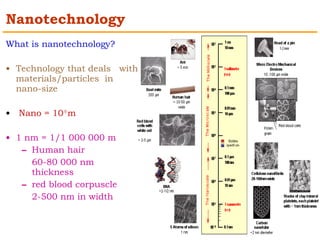
Nanotechnology 
What is nanotechnology? 
• Technology that deals with 
materials/particles in 
nano-size 
• Nano = 10-9 m 
• 1 nm = 1/1 000 000 m 
– Human hair 
60-80 000 nm 
thickness 
– red blood corpuscle 
2-500 nm in width
Contiued…. 
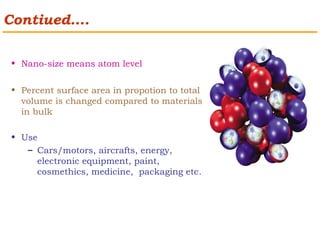
• Nano-size means atom level 
• Percent surface area in propotion to total 
volume is changed compared to materials 
in bulk 
• Use 
– Cars/motors, aircrafts, energy, 
electronic equipment, paint, 
cosmethics, medicine, packaging etc.
Different definitions for ‘ NANO’ 
Nanocluster 
A collection of units (atoms or reactive molecules) of up to about 50 
units 
Nanocolloids 
A stable liquid phase containing particles in the 1-1000 nm range. 
A colloid particle is one such 1-1000 nm particle. 
Nanoparticle 
A solid particle in the 1-100 nm range that could be noncrystalline, 
an aggregate of crystallites or a single crystallite 
Nanocrystal 
A solid particle that is a single crystal in the nanometer range
Some Nanotech inventions – 
Nano is not new! 
• Nanowires of silicon, and other materials, have 
remarkable optical, electronic and magnetic properties. 
• People use nanoparticles of soot in tires since 1900 to 
make them black, and nano bits of gold and silver have 
been added to color pigments in stained glass since the 
10th century! Color depends on the size of these 
particles. 
• You can’t avoid nanoparticles-or you’d have to stop 
drinking milk, which is full of nano-sized particles of 
casein. The sugar molecule is about 1nm is 
diameter. 
• Humans are living proof of Nanotechnology
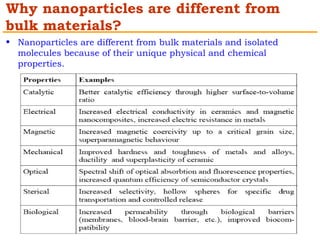
Why nanoparticles are different from 
bulk materials? 
• Nanoparticles are different from bulk materials and isolated 
molecules because of their unique physical and chemical 
properties.
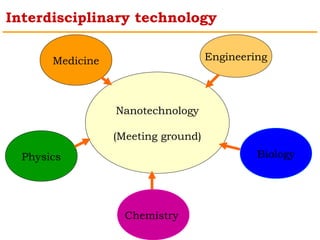
Interdisciplinary technology 
Nanotechnology 
(Meeting ground) 
Engineering 
Physics 
Chemistry 
Medicine 
Biology
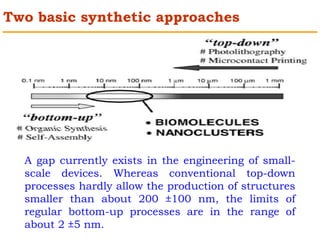
Two basic synthetic approaches 
A gap currently exists in the engineering of small-scale 
devices. Whereas conventional top-down 
processes hardly allow the production of structures 
smaller than about 200 ±100 nm, the limits of 
regular bottom-up processes are in the range of 
about 2 ±5 nm.
Nanoparticles 
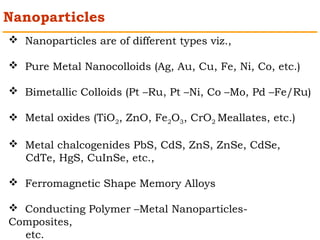
 Nanoparticles are of different types viz., 
 Pure Metal Nanocolloids (Ag, Au, Cu, Fe, Ni, Co, etc.) 
 Bimetallic Colloids (Pt –Ru, Pt –Ni, Co –Mo, Pd –Fe/Ru) 
 Metal oxides (TiO2, ZnO, Fe2O3, CrO2 Meallates, etc.) 
 Metal chalcogenides PbS, CdS, ZnS, ZnSe, CdSe, 
CdTe, HgS, CuInSe, etc., 
 Ferromagnetic Shape Memory Alloys 
 Conducting Polymer –Metal Nanoparticles- 
Composites, 
etc.
Synthesis of Nanoparticles 
• Chemical Reduction 
• Reverse micellar synthesis 
• Sol-gel process 
• Aero-gel Process 
• Microemulsion 
• Co-precipitation 
• Decomposition of Organometallic Compounds 
• Hydrothermal routes•Solution evaporation process, 
• Sonochemical Ultrasonication 
• Encapsulation in hosts (Zeolites, clays, buseritesbuserites, etc.) 
• - Ray γ irradiation in presence of redox mediators, etc.
Challenges in nanotechnology 
For the fabrication and processing of nanomaterial and 
nanostructures, the following challenges must be met: 
Overcome the huge surface energy, a result of 
enormous surface area or large surface to volume ratio 
Ensure all nanomaterials with desired size, uniform size 
distribution,morphology, crystallinity, chemical 
composition and microstructure that altogether result in 
desired physical properties. 
Prevent nanomaterials and nanostructures from 
concerning through either Ostwald ripening or 
agglomeration 
Morphology control
Nanocomposites 
Definitions: 
 Nanocomposites are broad range of materials consisting of two or 
more components, with at least one component having 
dimensions in the nm regime (i.e. between 1 and 100 nm) 
 Nanocomposites consist of two phases 
(i.e nanocrystalline phase + matrix phase) 
Phase may be 
inorganic-inorganic, inorganic-organic or organic-organic 
 Nanocomposite means nanosized particles (i.e metals, 
semiconductors, dielectric materials, etc) embedded in different 
matrix materials (ceramics, glass, polymers, etc).
General features of nanocomposites 
Nanocomposites differ from traditional composites in 
the smaller size of the particles in the matrix materials. 
Small size may cause 
a) Physical sensivity of bulk materials to physical or 
mechanical energy 
b) Higher chemical reactivity of grain boundaries 
Physical sensitivity 
 Small size effect 
 Quantum confinement 
effect 
Chemical reactivity 
 Higher gas absorption 
 Increased nonstoichiometry 
 Regrowth 
 Rotation and orientation 
 Sub graining 
 Assembly
Physical sensitivity 
Small size effect: 
When the particle sizes in composite materials approach lengths of 
physical interaction with energy, such as light wave, electromagnetic 
waves, the periodic boundry conditions of coupling interaction with 
energy would behave different from its microscopic counterparts, 
which results in unusual properties 
Quantum confinement effect: 
When electrons are confined to a small domain, such as a 
nanoparticles, the electrons behave like “particles in a box” and their 
resulting new energy levels are determined by quantum confinement 
effect. These new energy levels give rise to the modification of 
optoelectronic properties such as “blue shift” light emitting diode
Chemical reactivity 
Higher gas absorption: 
large specific area of nanopartilces can easily absorb gaseous species 
Increased nonstoichiometry phases: 
Nanomaterials easily form chemically unsaturated bonds and 
nonstoichiometry compounds 
Regrowth: 
Nanomaterials are probably easier to recrystallise and regrow in processing 
and service conditions than traditional materials 
Rotation and orientation: 
Crystallographic rotation and orientation of nanoparticles have been found 
in processing of nanocomposites 
Sub-grain: 
Nanoparticles enveloped into larger particles act as dispersed pinholes to 
divide the large particles into several parts. 
Assembly 
Nanoparticles are easy to aggregate and assemble in liquid or gaseous media
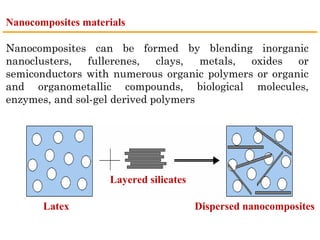
Nanocomposites materials 
Nanocomposites can be formed by blending inorganic 
nanoclusters, fullerenes, clays, metals, oxides or 
semiconductors with numerous organic polymers or organic 
and organometallic compounds, biological molecules, 
enzymes, and sol-gel derived polymers 
Latex 
Layered silicates 
Dispersed nanocomposites
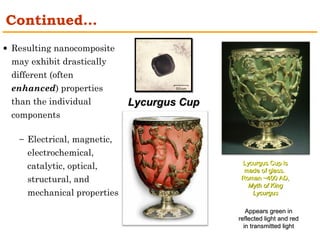
LLyyccuurrgguuss CCuupp 
· Resulting nanocomposite 
may exhibit drastically 
different (often 
enhanced) properties 
than the individual 
components 
- Electrical, magnetic, 
electrochemical, 
catalytic, optical, 
structural, and 
mechanical properties 
LLyyccuurrgguuss CCuupp iiss 
mmaaddee ooff ggllaassss.. 
RRoommaann ~~440000 AADD,, 
MMyytthh ooff KKiinngg 
LLyyccuurrgguuss 
Continued… 
AAppppeeaarrss ggrreeeenn iinn 
rreefflleecctteedd lliigghhtt aanndd rreedd 
iinn ttrraannssmmiitttteedd lliigghhtt
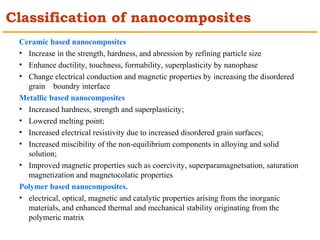
Classification of nanocomposites 
Ceramic based nanocomposites 
• Increase in the strength, hardness, and abression by refining particle size 
• Enhance ductility, touchness, formability, superplasticity by nanophase 
• Change electrical conduction and magnetic properties by increasing the disordered 
grain boundry interface 
Metallic based nanocomposites 
• Increased hardness, strength and superplasticity; 
• Lowered melting point; 
• Increased electrical resistivity due to increased disordered grain surfaces; 
• Increased miscibility of the non-equilibrium components in alloying and solid 
solution; 
• Improved magnetic properties such as coercivity, superparamagnetsation, saturation 
magnetization and magnetocolatic properties 
Polymer based nanocomposites. 
• electrical, optical, magnetic and catalytic properties arising from the inorganic 
materials, and enhanced thermal and mechanical stability originating from the 
polymeric matrix
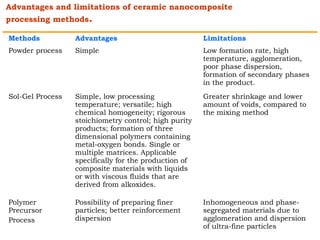
Advantages and limitations of ceramic nanocomposite 
processing methods. 
Methods Advantages Limitations 
Powder process Simple Low formation rate, high 
temperature, agglomeration, 
poor phase dispersion, 
formation of secondary phases 
in the product. 
Sol-Gel Process Simple, low processing 
temperature; versatile; high 
chemical homogeneity; rigorous 
stoichiometry control; high purity 
products; formation of three 
dimensional polymers containing 
metal-oxygen bonds. Single or 
multiple matrices. Applicable 
specifically for the production of 
composite materials with liquids 
or with viscous fluids that are 
derived from alkoxides. 
Greater shrinkage and lower 
amount of voids, compared to 
the mixing method 
Polymer 
Precursor 
Process 
Possibility of preparing finer 
particles; better reinforcement 
dispersion 
Inhomogeneous and phase-segregated 
materials due to 
agglomeration and dispersion 
of ultra-fine particles
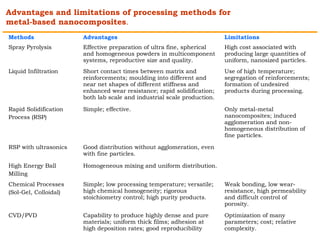
Advantages and limitations of processing methods for 
metal-based nanocomposites. 
Methods Advantages Limitations 
Spray Pyrolysis Effective preparation of ultra fine, spherical 
and homogeneous powders in multicomponent 
systems, reproductive size and quality. 
High cost associated with 
producing large quantities of 
uniform, nanosized particles. 
Liquid Infiltration Short contact times between matrix and 
reinforcements; moulding into different and 
near net shapes of different stiffness and 
enhanced wear resistance; rapid solidification; 
both lab scale and industrial scale production. 
Use of high temperature; 
segregation of reinforcements; 
formation of undesired 
products during processing. 
Rapid Solidification 
Process (RSP) 
Simple; effective. Only metal-metal 
nanocomposites; induced 
agglomeration and non-homogeneous 
distribution of 
fine particles. 
RSP with ultrasonics Good distribution without agglomeration, even 
with fine particles. 
High Energy Ball 
Milling 
Homogeneous mixing and uniform distribution. 
Chemical Processes 
(Sol-Gel, Colloidal) 
Simple; low processing temperature; versatile; 
high chemical homogeneity; rigorous 
stoichiometry control; high purity products. 
Weak bonding, low wear-resistance, 
high permeability 
and difficult control of 
porosity. 
CVD/PVD Capability to produce highly dense and pure 
materials; uniform thick films; adhesion at 
high deposition rates; good reproducibility 
Optimization of many 
parameters; cost; relative 
complexity.
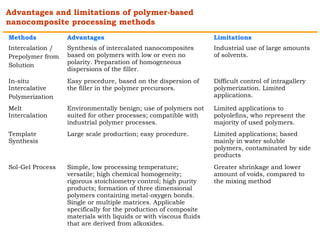
Advantages and limitations of polymer-based 
nanocomposite processing methods 
Methods Advantages Limitations 
Intercalation / 
Prepolymer from 
Solution 
Synthesis of intercalated nanocomposites 
based on polymers with low or even no 
polarity. Preparation of homogeneous 
dispersions of the filler. 
Industrial use of large amounts 
of solvents. 
In-situ 
Intercalative 
Polymerization 
Easy procedure, based on the dispersion of 
the filler in the polymer precursors. 
Difficult control of intragallery 
polymerization. Limited 
applications. 
Melt 
Intercalation 
Environmentally benign; use of polymers not 
suited for other processes; compatible with 
industrial polymer processes. 
Limited applications to 
polyolefins, who represent the 
majority of used polymers. 
Template 
Synthesis 
Large scale production; easy procedure. Limited applications; based 
mainly in water soluble 
polymers, contaminated by side 
products 
Sol-Gel Process Simple, low processing temperature; 
versatile; high chemical homogeneity; 
rigorous stoichiometry control; high purity 
products; formation of three dimensional 
polymers containing metal-oxygen bonds. 
Single or multiple matrices. Applicable 
specifically for the production of composite 
materials with liquids or with viscous fluids 
that are derived from alkoxides. 
Greater shrinkage and lower 
amount of voids, compared to 
the mixing method
Thank you

Nanocomposite

  • 1.
    Nanocomposite materials Dr.V. Krishnakumar Professor and Head Department of Physics Periyar University Salem. Tamilnadu India
  • 2.
    Outline • Introduction • Definitions • Synthesis of nanomaterials • Challenges • Nanocomposites • General features • Advantages and Limitations • Conclusion
  • 3.
    Nanotechnology What isnanotechnology? • Technology that deals with materials/particles in nano-size • Nano = 10-9 m • 1 nm = 1/1 000 000 m – Human hair 60-80 000 nm thickness – red blood corpuscle 2-500 nm in width
  • 4.
    Contiued…. • Nano-sizemeans atom level • Percent surface area in propotion to total volume is changed compared to materials in bulk • Use – Cars/motors, aircrafts, energy, electronic equipment, paint, cosmethics, medicine, packaging etc.
  • 5.
    Different definitions for‘ NANO’ Nanocluster A collection of units (atoms or reactive molecules) of up to about 50 units Nanocolloids A stable liquid phase containing particles in the 1-1000 nm range. A colloid particle is one such 1-1000 nm particle. Nanoparticle A solid particle in the 1-100 nm range that could be noncrystalline, an aggregate of crystallites or a single crystallite Nanocrystal A solid particle that is a single crystal in the nanometer range
  • 6.
    Some Nanotech inventions– Nano is not new! • Nanowires of silicon, and other materials, have remarkable optical, electronic and magnetic properties. • People use nanoparticles of soot in tires since 1900 to make them black, and nano bits of gold and silver have been added to color pigments in stained glass since the 10th century! Color depends on the size of these particles. • You can’t avoid nanoparticles-or you’d have to stop drinking milk, which is full of nano-sized particles of casein. The sugar molecule is about 1nm is diameter. • Humans are living proof of Nanotechnology
  • 7.
    Why nanoparticles aredifferent from bulk materials? • Nanoparticles are different from bulk materials and isolated molecules because of their unique physical and chemical properties.
  • 8.
    Interdisciplinary technology Nanotechnology (Meeting ground) Engineering Physics Chemistry Medicine Biology
  • 9.
    Two basic syntheticapproaches A gap currently exists in the engineering of small-scale devices. Whereas conventional top-down processes hardly allow the production of structures smaller than about 200 ±100 nm, the limits of regular bottom-up processes are in the range of about 2 ±5 nm.
  • 10.
    Nanoparticles  Nanoparticlesare of different types viz.,  Pure Metal Nanocolloids (Ag, Au, Cu, Fe, Ni, Co, etc.)  Bimetallic Colloids (Pt –Ru, Pt –Ni, Co –Mo, Pd –Fe/Ru)  Metal oxides (TiO2, ZnO, Fe2O3, CrO2 Meallates, etc.)  Metal chalcogenides PbS, CdS, ZnS, ZnSe, CdSe, CdTe, HgS, CuInSe, etc.,  Ferromagnetic Shape Memory Alloys  Conducting Polymer –Metal Nanoparticles- Composites, etc.
  • 11.
    Synthesis of Nanoparticles • Chemical Reduction • Reverse micellar synthesis • Sol-gel process • Aero-gel Process • Microemulsion • Co-precipitation • Decomposition of Organometallic Compounds • Hydrothermal routes•Solution evaporation process, • Sonochemical Ultrasonication • Encapsulation in hosts (Zeolites, clays, buseritesbuserites, etc.) • - Ray γ irradiation in presence of redox mediators, etc.
  • 12.
    Challenges in nanotechnology For the fabrication and processing of nanomaterial and nanostructures, the following challenges must be met: Overcome the huge surface energy, a result of enormous surface area or large surface to volume ratio Ensure all nanomaterials with desired size, uniform size distribution,morphology, crystallinity, chemical composition and microstructure that altogether result in desired physical properties. Prevent nanomaterials and nanostructures from concerning through either Ostwald ripening or agglomeration Morphology control
  • 13.
    Nanocomposites Definitions: Nanocomposites are broad range of materials consisting of two or more components, with at least one component having dimensions in the nm regime (i.e. between 1 and 100 nm)  Nanocomposites consist of two phases (i.e nanocrystalline phase + matrix phase) Phase may be inorganic-inorganic, inorganic-organic or organic-organic  Nanocomposite means nanosized particles (i.e metals, semiconductors, dielectric materials, etc) embedded in different matrix materials (ceramics, glass, polymers, etc).
  • 14.
    General features ofnanocomposites Nanocomposites differ from traditional composites in the smaller size of the particles in the matrix materials. Small size may cause a) Physical sensivity of bulk materials to physical or mechanical energy b) Higher chemical reactivity of grain boundaries Physical sensitivity  Small size effect  Quantum confinement effect Chemical reactivity  Higher gas absorption  Increased nonstoichiometry  Regrowth  Rotation and orientation  Sub graining  Assembly
  • 15.
    Physical sensitivity Smallsize effect: When the particle sizes in composite materials approach lengths of physical interaction with energy, such as light wave, electromagnetic waves, the periodic boundry conditions of coupling interaction with energy would behave different from its microscopic counterparts, which results in unusual properties Quantum confinement effect: When electrons are confined to a small domain, such as a nanoparticles, the electrons behave like “particles in a box” and their resulting new energy levels are determined by quantum confinement effect. These new energy levels give rise to the modification of optoelectronic properties such as “blue shift” light emitting diode
  • 16.
    Chemical reactivity Highergas absorption: large specific area of nanopartilces can easily absorb gaseous species Increased nonstoichiometry phases: Nanomaterials easily form chemically unsaturated bonds and nonstoichiometry compounds Regrowth: Nanomaterials are probably easier to recrystallise and regrow in processing and service conditions than traditional materials Rotation and orientation: Crystallographic rotation and orientation of nanoparticles have been found in processing of nanocomposites Sub-grain: Nanoparticles enveloped into larger particles act as dispersed pinholes to divide the large particles into several parts. Assembly Nanoparticles are easy to aggregate and assemble in liquid or gaseous media
  • 17.
    Nanocomposites materials Nanocompositescan be formed by blending inorganic nanoclusters, fullerenes, clays, metals, oxides or semiconductors with numerous organic polymers or organic and organometallic compounds, biological molecules, enzymes, and sol-gel derived polymers Latex Layered silicates Dispersed nanocomposites
  • 18.
    LLyyccuurrgguuss CCuupp ·Resulting nanocomposite may exhibit drastically different (often enhanced) properties than the individual components - Electrical, magnetic, electrochemical, catalytic, optical, structural, and mechanical properties LLyyccuurrgguuss CCuupp iiss mmaaddee ooff ggllaassss.. RRoommaann ~~440000 AADD,, MMyytthh ooff KKiinngg LLyyccuurrgguuss Continued… AAppppeeaarrss ggrreeeenn iinn rreefflleecctteedd lliigghhtt aanndd rreedd iinn ttrraannssmmiitttteedd lliigghhtt
  • 19.
    Classification of nanocomposites Ceramic based nanocomposites • Increase in the strength, hardness, and abression by refining particle size • Enhance ductility, touchness, formability, superplasticity by nanophase • Change electrical conduction and magnetic properties by increasing the disordered grain boundry interface Metallic based nanocomposites • Increased hardness, strength and superplasticity; • Lowered melting point; • Increased electrical resistivity due to increased disordered grain surfaces; • Increased miscibility of the non-equilibrium components in alloying and solid solution; • Improved magnetic properties such as coercivity, superparamagnetsation, saturation magnetization and magnetocolatic properties Polymer based nanocomposites. • electrical, optical, magnetic and catalytic properties arising from the inorganic materials, and enhanced thermal and mechanical stability originating from the polymeric matrix
  • 20.
    Advantages and limitationsof ceramic nanocomposite processing methods. Methods Advantages Limitations Powder process Simple Low formation rate, high temperature, agglomeration, poor phase dispersion, formation of secondary phases in the product. Sol-Gel Process Simple, low processing temperature; versatile; high chemical homogeneity; rigorous stoichiometry control; high purity products; formation of three dimensional polymers containing metal-oxygen bonds. Single or multiple matrices. Applicable specifically for the production of composite materials with liquids or with viscous fluids that are derived from alkoxides. Greater shrinkage and lower amount of voids, compared to the mixing method Polymer Precursor Process Possibility of preparing finer particles; better reinforcement dispersion Inhomogeneous and phase-segregated materials due to agglomeration and dispersion of ultra-fine particles
  • 21.
    Advantages and limitationsof processing methods for metal-based nanocomposites. Methods Advantages Limitations Spray Pyrolysis Effective preparation of ultra fine, spherical and homogeneous powders in multicomponent systems, reproductive size and quality. High cost associated with producing large quantities of uniform, nanosized particles. Liquid Infiltration Short contact times between matrix and reinforcements; moulding into different and near net shapes of different stiffness and enhanced wear resistance; rapid solidification; both lab scale and industrial scale production. Use of high temperature; segregation of reinforcements; formation of undesired products during processing. Rapid Solidification Process (RSP) Simple; effective. Only metal-metal nanocomposites; induced agglomeration and non-homogeneous distribution of fine particles. RSP with ultrasonics Good distribution without agglomeration, even with fine particles. High Energy Ball Milling Homogeneous mixing and uniform distribution. Chemical Processes (Sol-Gel, Colloidal) Simple; low processing temperature; versatile; high chemical homogeneity; rigorous stoichiometry control; high purity products. Weak bonding, low wear-resistance, high permeability and difficult control of porosity. CVD/PVD Capability to produce highly dense and pure materials; uniform thick films; adhesion at high deposition rates; good reproducibility Optimization of many parameters; cost; relative complexity.
  • 22.
    Advantages and limitationsof polymer-based nanocomposite processing methods Methods Advantages Limitations Intercalation / Prepolymer from Solution Synthesis of intercalated nanocomposites based on polymers with low or even no polarity. Preparation of homogeneous dispersions of the filler. Industrial use of large amounts of solvents. In-situ Intercalative Polymerization Easy procedure, based on the dispersion of the filler in the polymer precursors. Difficult control of intragallery polymerization. Limited applications. Melt Intercalation Environmentally benign; use of polymers not suited for other processes; compatible with industrial polymer processes. Limited applications to polyolefins, who represent the majority of used polymers. Template Synthesis Large scale production; easy procedure. Limited applications; based mainly in water soluble polymers, contaminated by side products Sol-Gel Process Simple, low processing temperature; versatile; high chemical homogeneity; rigorous stoichiometry control; high purity products; formation of three dimensional polymers containing metal-oxygen bonds. Single or multiple matrices. Applicable specifically for the production of composite materials with liquids or with viscous fluids that are derived from alkoxides. Greater shrinkage and lower amount of voids, compared to the mixing method
  • 23.

Editor's Notes

  • #3 Diameter smaller than bohr radius for the exciton => 3dim spherical quantum well
  • #6 Diameter smaller than bohr radius for the exciton => 3dim spherical quantum well Comercialized, liter wise batch production, low T, liquid phase…
  • #8 Fine tune to get Shokly-Quessier efficiency for single junctionsolar cell (31%) Go up to 66% by utilizing HOT photogenerated carriers
  • #9 Tunable bandgap Strong absorptin at shorter wavelengths Inorganic properties: scalable and controlled synthesis, ability to be processed in solution, « no » sensitivity to additional doping
  • #13 Hot electron transport -> To increase the output voltage (rate of sepration, transport > rate of cooling) Impact ionization -> To increase output current (rate of II > rate of cooling)
  • #14 P-I-N junction => creates a potential to separate charge carriers
  • #15 Pure inorganic=>expensive // pure organic=>inefficient =>use blend Low current mobility (ineffective hopping charge transport)
  • #16 A: external quantum efficency: 55% at
  • #18 Hybrid cell: low hole mobility in polymer, Sensitivity to environment =>Replace organic part by inorganic CdTe D. Solvent pyridine-> spin casted to FLEXIBLE film
  • #19 Normalized photocurrent spectral response and absorption spectra of CdTe, CdSe solutions => See both caracteristic=> both contribute to photocurrent B. I-V characteristic dark and under simulated Air Mass 1.5 Global Other devices with varying nc diameter yields 0.6 Voc Column 3-4-5-6 Difference from p-n junctions: no free carrier w/o light illumination=> unlikly creation of depletion region CdSe (CdTe) films are insulating in dark (linear-Ohmic- IV curves) with 500Gohms/cm2 Under light, 10 times less Device: 3 orders of magnitude =>like organics: limited number of untrapped carriers in dark, best described by rigid band model
  • #20 B. I-V characteristic dark and under simulated Air Mass 1.5 Global Other devices with varying nc diameter yields 0.6 Voc Column 3-4-5-6 Extraction by diffusion (type II heterojunction)
  • #21 No schottky, no pn thus D-A (organic) behavior Inorganic: work better with blend No selective contact from electrode here (e and h can be passed in both material) => current can be passed in both direction in blend cell Exciton not separated at the junction but from the little confinement along the rod length=>e&h in same donnor=>more suceptible recombination +they are traps on the surface
  • #22 Minimize the high surface trap area Device remains insulating in dark but 100 better in photoconductivity Red shift (to bulk like) Vos == => same driving force for charge extraction in un/sintered devices
  • #23 They are robust