By
VIJAY MEHTA
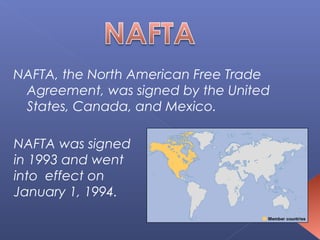
NAFTA, the North American Free Trade
 Agreement, was signed by the United
 States, Canada, and Mexico.

NAFTA was signed
in 1993 and went
into effect on
January 1, 1994.
NAFTA was written to create a Free Trade
  Area in North America.
 “Free Trade” means that countries may
  freely trade goods with each other
  without having to pay a tariff (tax) on
  those goods.
 In other words, “free trade” means no
  trade barriers.
The purpose of the agreement is to:
 Allow free movement of goods and
  services among the countries.
 Promote competition in the free trade
  areas.
 Protect the property rights of people and
  businesses in each country.
 Be able to resolve problems that arise
  among the countries.
 Encourage cooperation among
  countries.
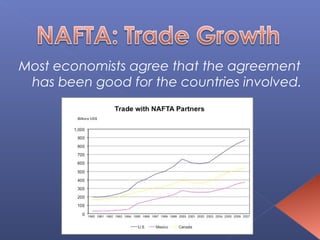
Most economists agree that the agreement
 has been good for the countries involved.
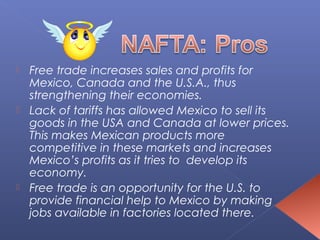
 Free trade increases sales and profits for
  Mexico, Canada and the U.S.A., thus
  strengthening their economies.
 Lack of tariffs has allowed Mexico to sell its
  goods in the USA and Canada at lower prices.
  This makes Mexican products more
  competitive in these markets and increases
  Mexico’s profits as it tries to develop its
  economy.
 Free trade is an opportunity for the U.S. to
  provide financial help to Mexico by making
  jobs available in factories located there.
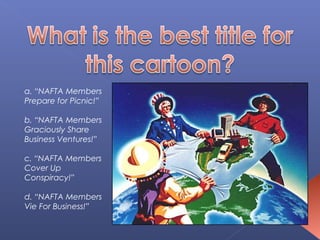
a. “NAFTA Members
Prepare for Picnic!”

b. “NAFTA Members
Graciously Share
Business Ventures!”

c. “NAFTA Members
Cover Up
Conspiracy!”

d. “NAFTA Members
Vie For Business!”
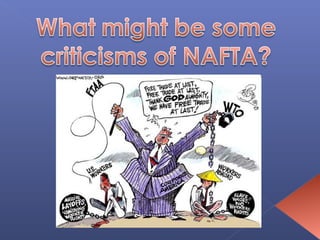
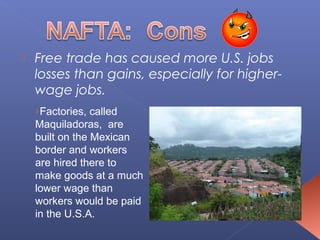
   Free trade has caused more U.S. jobs
    losses than gains, especially for higher-
    wage jobs.
    ›Factories, called
    Maquiladoras, are
    built on the Mexican
    border and workers
    are hired there to
    make goods at a much
    lower wage than
    workers would be paid
    in the U.S.A.
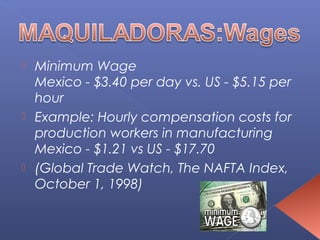
 Minimum Wage
  Mexico - $3.40 per day vs. US - $5.15 per
  hour
 Example: Hourly compensation costs for
  production workers in manufacturing
  Mexico - $1.21 vs US - $17.70
 (Global Trade Watch, The NAFTA Index,
  October 1, 1998)
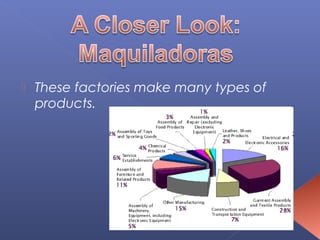
   These factories make many types of
    products.
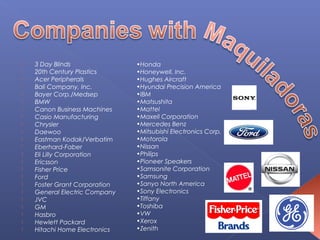
   3 Day Blinds               •Honda
   20th Century Plastics      •Honeywell, Inc.
   Acer Peripherals           •Hughes Aircraft
   Bali Company, Inc.         •Hyundai Precision America
   Bayer Corp./Medsep         •IBM
   BMW                        •Matsushita
   Canon Business Machines    •Mattel
   Casio Manufacturing        •Maxell Corporation
   Chrysler                   •Mercedes Benz
   Daewoo                     •Mitsubishi Electronics Corp.
   Eastman Kodak/Verbatim     •Motorola
   Eberhard-Faber             •Nissan
   Eli Lilly Corporation      •Philips
   Ericsson                   •Pioneer Speakers
   Fisher Price               •Samsonite Corporation
   Ford                       •Samsung
   Foster Grant Corporation   •Sanyo North America
   General Electric Company   •Sony Electronics
   JVC                        •Tiffany
   GM                         •Toshiba
   Hasbro                     •VW
   Hewlett Packard            •Xerox
   Hitachi Home Electronics   •Zenith
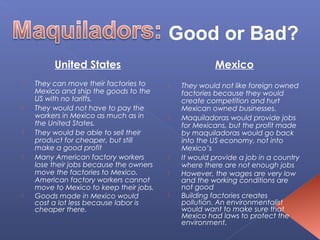
Good or Bad?
         United States                                Mexico
   They can move their factories to        They would not like foreign owned
    Mexico and ship the goods to the         factories because they would
    US with no tariffs.                      create competition and hurt
   They would not have to pay the           Mexican owned businesses.
    workers in Mexico as much as in         Maquiladoras would provide jobs
    the United States.                       for Mexicans, but the profit made
   They would be able to sell their         by maquiladoras would go back
    product for cheaper, but still           into the US economy, not into
    make a good profit                       Mexico’s
   Many American factory workers           It would provide a job in a country
    lose their jobs because the owners       where there are not enough jobs
    move the factories to Mexico.           However, the wages are very low
    American factory workers cannot          and the working conditions are
    move to Mexico to keep their jobs.       not good
   Goods made in Mexico would              Building factories creates
    cost a lot less because labor is         pollution. An environmentalist
    cheaper there.                           would want to make sure that
                                             Mexico had laws to protect the
                                             environment.

Nafta PPT

  • 1.
  • 2.
    NAFTA, the NorthAmerican Free Trade Agreement, was signed by the United States, Canada, and Mexico. NAFTA was signed in 1993 and went into effect on January 1, 1994.
  • 3.
    NAFTA was writtento create a Free Trade Area in North America.  “Free Trade” means that countries may freely trade goods with each other without having to pay a tariff (tax) on those goods.  In other words, “free trade” means no trade barriers.
  • 4.
    The purpose ofthe agreement is to:  Allow free movement of goods and services among the countries.  Promote competition in the free trade areas.  Protect the property rights of people and businesses in each country.  Be able to resolve problems that arise among the countries.  Encourage cooperation among countries.
  • 5.
    Most economists agreethat the agreement has been good for the countries involved.
  • 6.
     Free tradeincreases sales and profits for Mexico, Canada and the U.S.A., thus strengthening their economies.  Lack of tariffs has allowed Mexico to sell its goods in the USA and Canada at lower prices. This makes Mexican products more competitive in these markets and increases Mexico’s profits as it tries to develop its economy.  Free trade is an opportunity for the U.S. to provide financial help to Mexico by making jobs available in factories located there.
  • 7.
    a. “NAFTA Members Preparefor Picnic!” b. “NAFTA Members Graciously Share Business Ventures!” c. “NAFTA Members Cover Up Conspiracy!” d. “NAFTA Members Vie For Business!”
  • 9.
    Free trade has caused more U.S. jobs losses than gains, especially for higher- wage jobs. ›Factories, called Maquiladoras, are built on the Mexican border and workers are hired there to make goods at a much lower wage than workers would be paid in the U.S.A.
  • 10.
     Minimum Wage Mexico - $3.40 per day vs. US - $5.15 per hour  Example: Hourly compensation costs for production workers in manufacturing Mexico - $1.21 vs US - $17.70  (Global Trade Watch, The NAFTA Index, October 1, 1998)
  • 11.
    These factories make many types of products.
  • 12.
    3 Day Blinds •Honda  20th Century Plastics •Honeywell, Inc.  Acer Peripherals •Hughes Aircraft  Bali Company, Inc. •Hyundai Precision America  Bayer Corp./Medsep •IBM  BMW •Matsushita  Canon Business Machines •Mattel  Casio Manufacturing •Maxell Corporation  Chrysler •Mercedes Benz  Daewoo •Mitsubishi Electronics Corp.  Eastman Kodak/Verbatim •Motorola  Eberhard-Faber •Nissan  Eli Lilly Corporation •Philips  Ericsson •Pioneer Speakers  Fisher Price •Samsonite Corporation  Ford •Samsung  Foster Grant Corporation •Sanyo North America  General Electric Company •Sony Electronics  JVC •Tiffany  GM •Toshiba  Hasbro •VW  Hewlett Packard •Xerox  Hitachi Home Electronics •Zenith
  • 13.
    Good or Bad? United States Mexico  They can move their factories to  They would not like foreign owned Mexico and ship the goods to the factories because they would US with no tariffs. create competition and hurt  They would not have to pay the Mexican owned businesses. workers in Mexico as much as in  Maquiladoras would provide jobs the United States. for Mexicans, but the profit made  They would be able to sell their by maquiladoras would go back product for cheaper, but still into the US economy, not into make a good profit Mexico’s  Many American factory workers  It would provide a job in a country lose their jobs because the owners where there are not enough jobs move the factories to Mexico.  However, the wages are very low American factory workers cannot and the working conditions are move to Mexico to keep their jobs. not good  Goods made in Mexico would  Building factories creates cost a lot less because labor is pollution. An environmentalist cheaper there. would want to make sure that Mexico had laws to protect the environment.