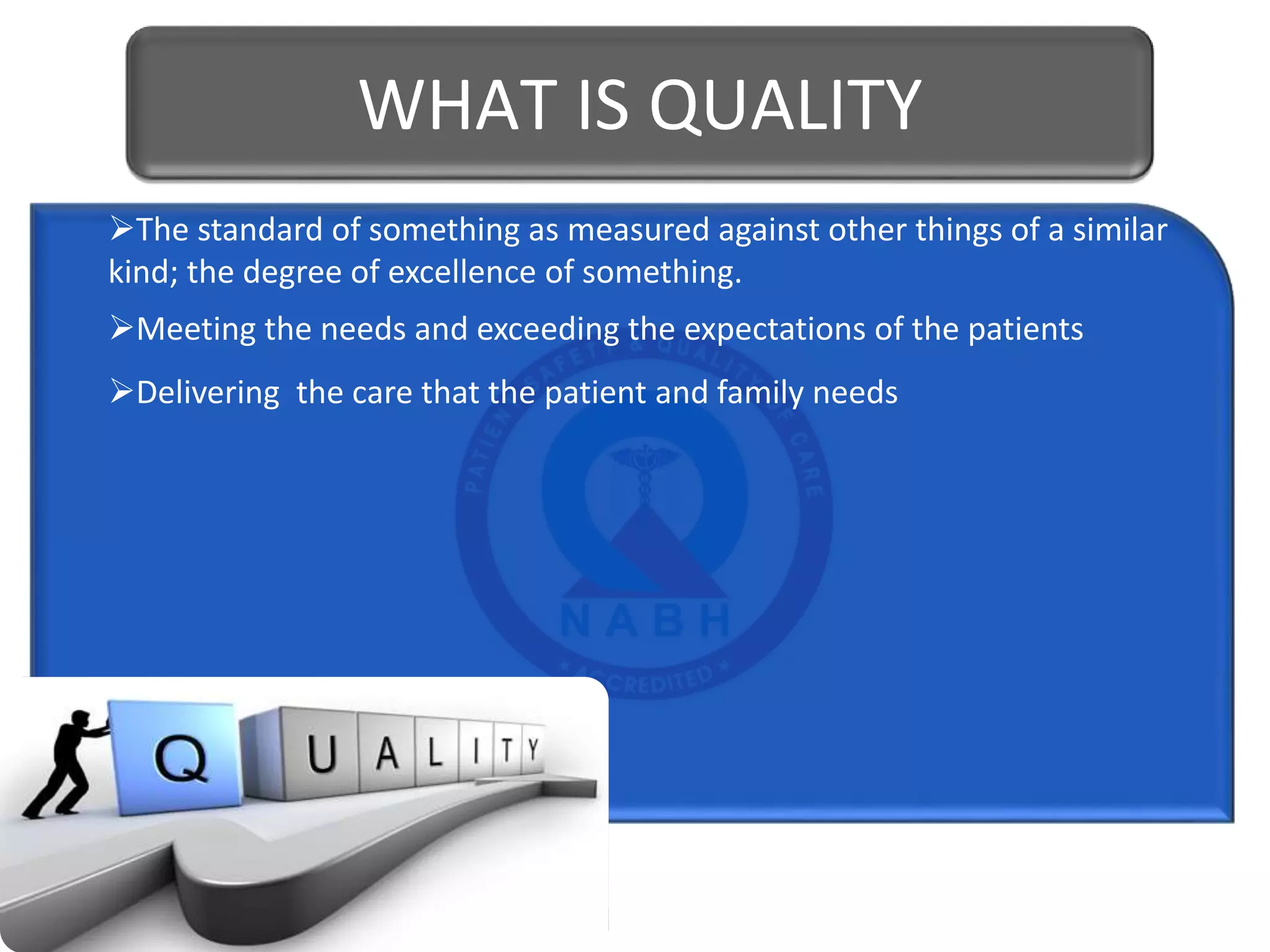
The standard of something as measured against other things of a similar
kind; the degree of excellence of something.
Meeting the needs and exceeding the expectations of the patients
Delivering the care that the patient and family needs
WHAT IS QUALITY
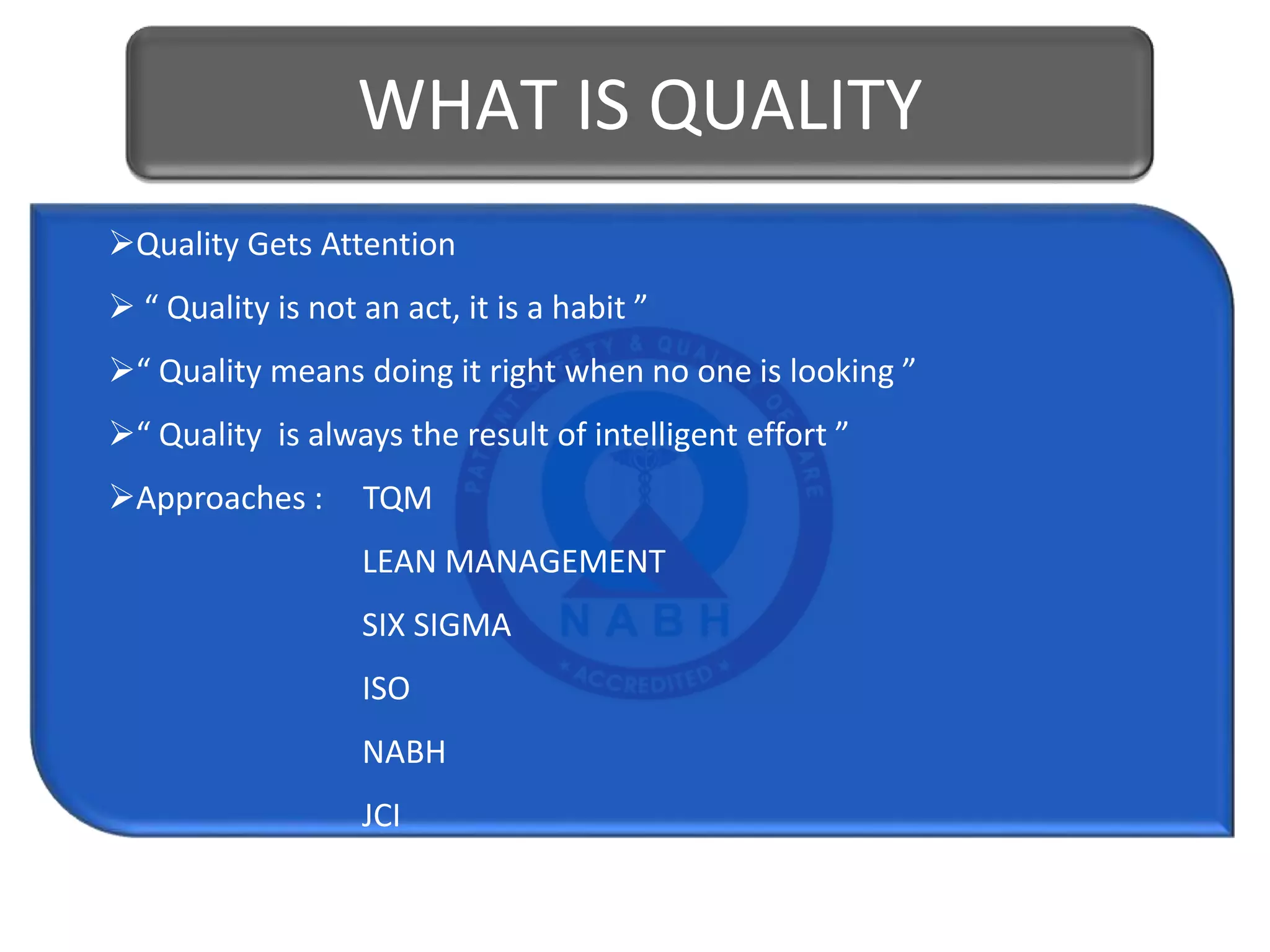
WHAT IS QUALITY
Quality Gets Attention
 “ Quality is not an act, it is a habit ”
“ Quality means doing it right when no one is looking ”
“ Quality is always the result of intelligent effort ”
Approaches : TQM
LEAN MANAGEMENT
SIX SIGMA
ISO
NABH
JCI
IMPLEMENTATION OF QUALITY
MANAGEMENT PROGRAM IN A HOSPITAL
1. Commitment of Top Management
2. Educating the Management and Staff
3. Formation of Quality Management Team
4. Awareness Campaign and Development
of Quality Culture
5. Defining Key Improvement Objectives
6. Development of Quality Policy and
Quality Manual
7. Training of Top Management
8. Training of Lower Level Staff
9. Identification and Mapping of all the
Hospital’s Process
10. Development of Hospital Information
System
11. Formulation of Criteria and Standards
12. Implementing the Program
13. Management Review of the QMS
14. Internal Audit/ Mock Survey
15. Detection of Non- Conformities /effects
16. Implementation of Corrective Measures
17. Review and Implementation of
Corrective Measures
18. External Certification/ Accreditation
BENEFITS OF ACCREDITATION
 Benefits for Patients
Biggest beneficiary
High quality of care and
patient safety
Rights of patients
Patients satisfaction
 Benefits for Hospitals
CQI
Commitment to quality care
Community confidence
Benchmarking
 Benefits for Hospital Staff
Staff satisfaction
Improves overall professional
development
 Benefits to paying and
regulatory bodies
INTRODUCTION
 NABH - National Accreditation Board for Hospitals & Healthcare
 Hospital Accreditation
 Constituent board of Quality Council of India
 International Linkage – lSQua & ASQua
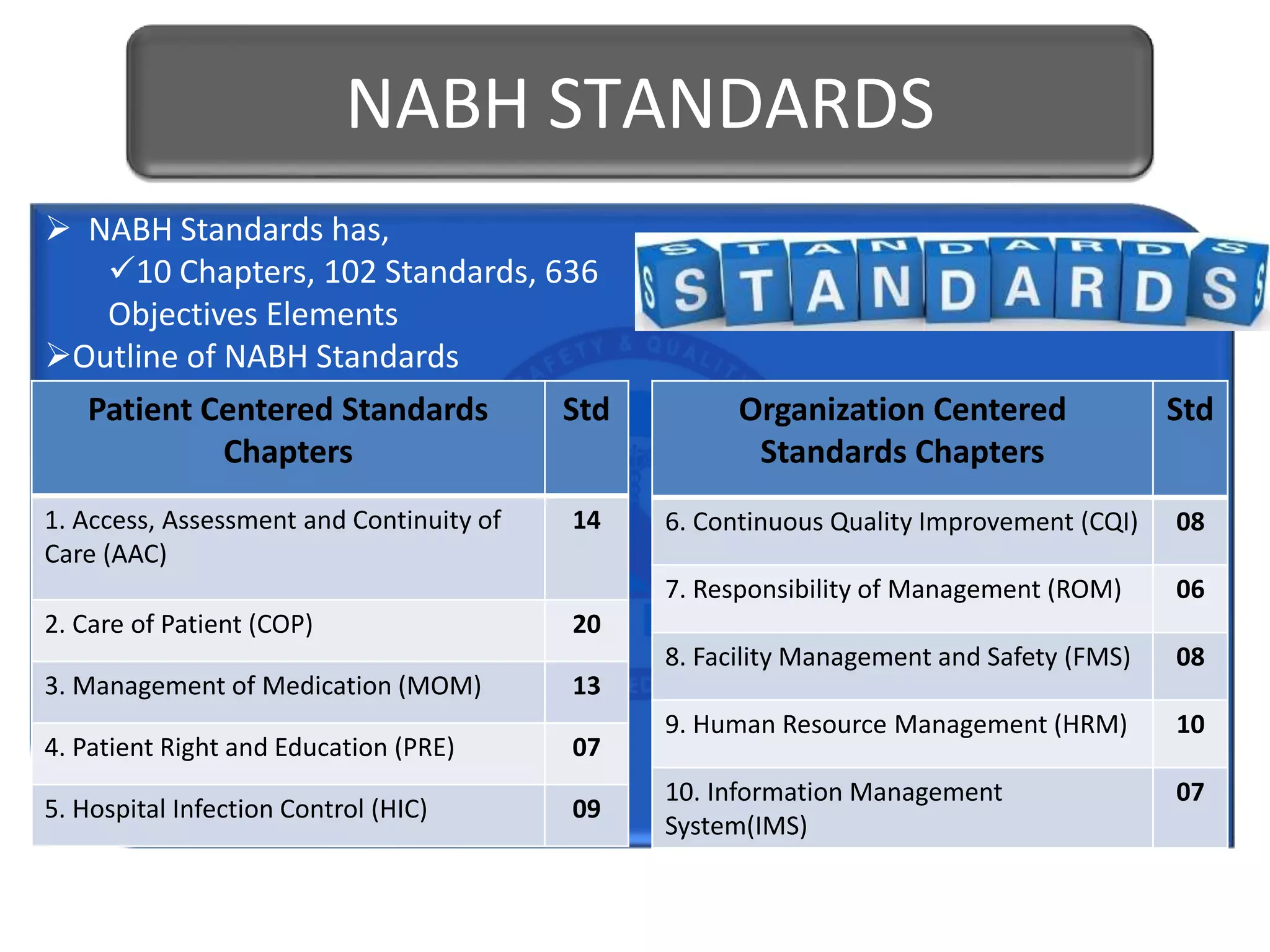
NABH STANDARDS
 NABH Standards has,
10 Chapters, 102 Standards, 636
Objectives Elements
Outline of NABH Standards
Patient Centered Standards
Chapters
Std
1. Access, Assessment and Continuity of
Care (AAC)
14
2. Care of Patient (COP) 20
3. Management of Medication (MOM) 13
4. Patient Right and Education (PRE) 07
5. Hospital Infection Control (HIC) 09
Organization Centered
Standards Chapters
Std
6. Continuous Quality Improvement (CQI) 08
7. Responsibility of Management (ROM) 06
8. Facility Management and Safety (FMS) 08
9. Human Resource Management (HRM) 10
10. Information Management
System(IMS)
07
1. ACCESS, ASSESSMENT AND
CONTINUITY OF CARE
AAC 1: The organization defines and displays the services that it can provide.
AAC 2. The organization has a well-defined registration and admission process.
AAC 3. There is an appropriate mechanism for transfer (in and out) or referral of
patients.
AAC 4. Patients cared for by the organization undergo an established initial
assessment.
AAC 5. Patients cared for by the organization undergo a regular reassessment.
AAC 6. Laboratory services are provided as per the scope of services of the
organization.
AAC 7. There is an established laboratory-quality assurance programme.
AAC 8. There is an established laboratory-safety programme.
AAC 9. Imaging services are provided as per the scope of services of the organization.
AAC 10. There is an established quality-assurance programme for imaging services.
AAC 11. There is an established radiation-safety programme.
AAC 12. Patient care is continuous and multidisciplinary in nature.
AAC 13. The organization has a documented discharge process.
AAC 14. Organization defines the content of the discharge summary.
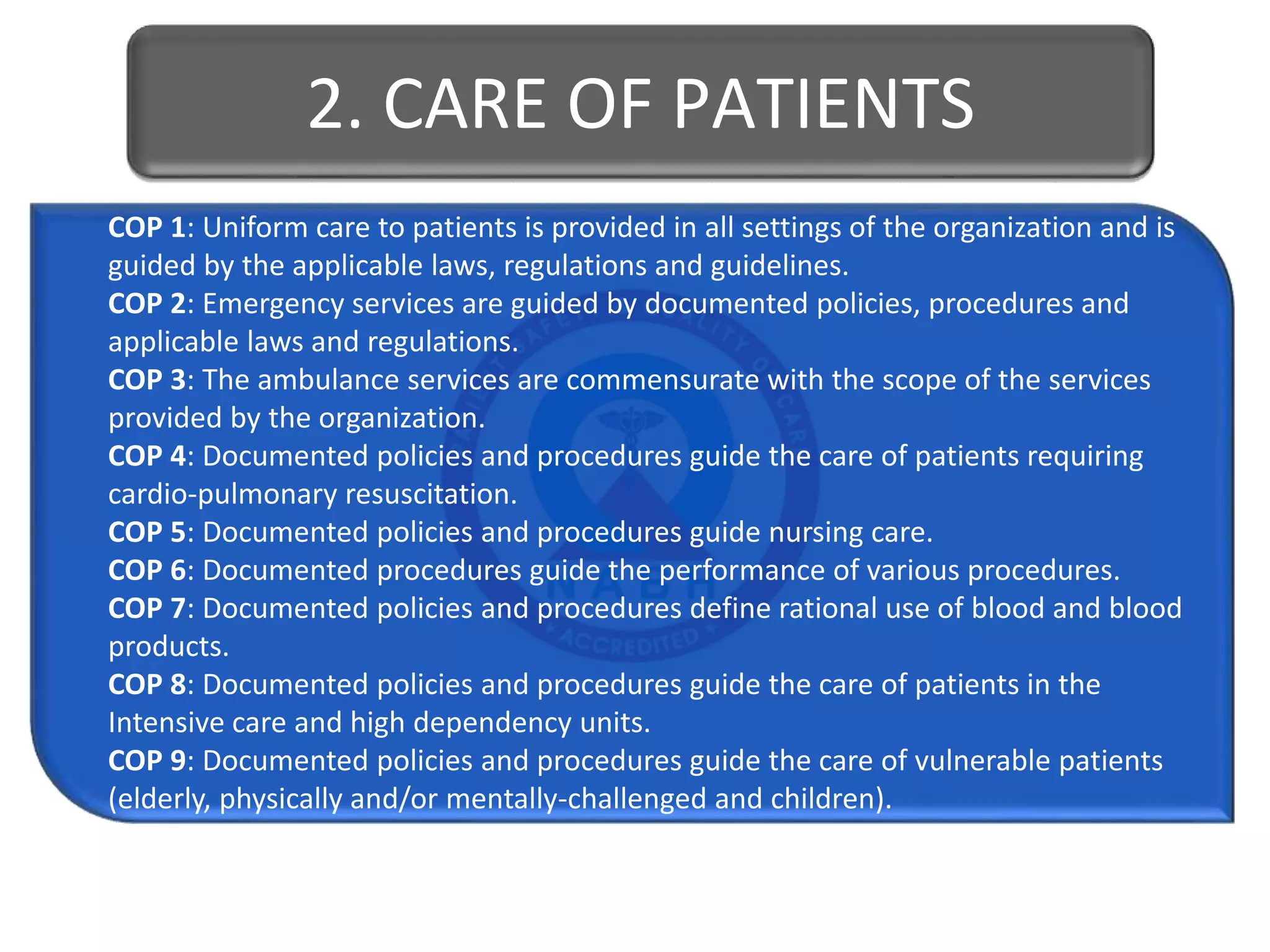
2. CARE OF PATIENTS
COP 1: Uniform care to patients is provided in all settings of the organization and is
guided by the applicable laws, regulations and guidelines.
COP 2: Emergency services are guided by documented policies, procedures and
applicable laws and regulations.
COP 3: The ambulance services are commensurate with the scope of the services
provided by the organization.
COP 4: Documented policies and procedures guide the care of patients requiring
cardio-pulmonary resuscitation.
COP 5: Documented policies and procedures guide nursing care.
COP 6: Documented procedures guide the performance of various procedures.
COP 7: Documented policies and procedures define rational use of blood and blood
products.
COP 8: Documented policies and procedures guide the care of patients in the
Intensive care and high dependency units.
COP 9: Documented policies and procedures guide the care of vulnerable patients
(elderly, physically and/or mentally-challenged and children).
2. CARE OF PATIENTS
(Continue..)
COP 10: Documented policies and procedures guide obstetric care.
COP 11: Documented policies and procedures guide pediatric services.
COP 12: Documented policies and procedures guide the care of patients undergoing
moderate sedation.
COP 13: Documented policies and procedures guide the administration of anesthesia.
COP 14: Documented policies and procedures guide the care of patients undergoing
surgical procedures.
COP 15: Documented policies and procedures guide the care of patients under
restraints.
COP 16: Documented policies and procedures guide appropriate pain management.
COP 17: Documented policies and procedures guide appropriate rehabilitative
services.
COP 18: Documented policies and procedures guide all research activities.
COP 19: Documented policies and procedures guide nutritional therapy.
COP 20: Documented policies and procedures guide the end of life care.
3. MANAGEMENT OF
MEDICATION
MOM 1: Documented policies and procedures guide the organization of pharmacy
services and usage of medication.
MOM 2: There is a hospital formulary.
MOM 3: Documented policies and procedures exist for storage of medication.
MOM 4: Documented policies and procedures guide the safe and rational
prescription of medications.
MOM 5: Documented policies and procedures guide the safe dispensing of
medications.
MOM 6: There are documented policies procedures for medication management.
MOM 7: Patients are monitored after medication administration.
MOM 8: Near misses, medication errors and adverse drug events are reported and
analyzed.
MOM 9: Documented procedures guide the use of narcotic drugs and psychotropic
substances.
MOM 10: Documented policies and procedures. guide the usage of
chemotherapeutic agents.
3. MANAGEMENT OF
MEDICATION (Continue…)
MOM 11: Documented policies and procedures govern usage of radioactive drugs.
MOM 12: Documented policies and procedures guide the use of implantable
prosthesis and medical devices.
MOM 13: Documented policies and procedures guide the use of medical supplies,
and consumables.
4. PATIENTS RIGHTS AND
RESPONSIBILITY
PRE 1: The organization protects patient and family rights and informs them about
their responsibilities during care.
PRE2: Patient and family rights support individual beliefs, values and involve the
patient and family in decision-making processes.
PRE3: The patient and/or family members are educated to make informed decisions
and are involved in the care-planning and delivery process.
PRE4: A documented procedure for obtaining patient and/or family's consent exists
for informed decision making about their care.
PRE5: Patient and families have a right to information and education about their
healthcare needs.
PRE 6: Patient and families have a right to information on expected costs.
PRE 7: Organization has a complaint redressal procedure.
5. HOSPITAL INFECTION
CONTROL
HIC 1: The organization has a well-designed, comprehensive and coordinated
Hospital Infection Prevention and Control (HIC) programme aimed at reducing/
eliminating risks to patients, visitors and providers of care.
HIC 2: The organization implements the policies and procedures laid down in the
Infection Control Manual.
HIC 3: The organization performs surveillance activities to capture and monitor
infection prevention and control data.
HIC 4: The organization takes actions to prevent and control Healthcare Associated
Infections (HAl) in patients.
HIC 5: The organization provides adequate and appropriate resources for prevention
and control of Healthcare Associated Infections (HAl).
HIC 6: The organization identifies and takes appropriate actions to control outbreaks
of infections.
HIC 7: There are documented policies and procedures for sterilization activities in the
organization.
HIC 8: Bio-medical waste (BMW) is handled in an appropriate and safe manner.
5. HOSPITAL INFECTION
CONTROL (Continue…)
HIC 9: The infection control programme is supported by the management and
includes training of staff and employee health.
6. CONTINUAL QUALITY
IMPROVEMENT
COI 1: There is a structured quality improvement and continuous monitoring
programme in the organization.
COI 2: There is a structured patient-safety programme in the organization.
COl 3: The organization identifies key indicators to monitor the clinical structures,
processes and outcomes which are used as tools for continual improvement.
COl 4: The organization identifies key indicators to monitor the managerial structures,
processes and outcomes, which are used as tools for continual improvement.
COl 5: The quality improvement programme is supported by the management.
COl 6: There is an established system for clinical audit.
COl 7: Incidents, complaints and feedback are collected and analyzed to ensure
continual quality improvement.
COl 8: Sentinel events are intensively analyzed.
7. RESPONSIBLITIES OF
MANAGEMENT
ROM 1: The responsibilities of those responsible for governance are defined.
ROM 2: The organization complies with the laid-down and applicable legislations and
regulations.
ROM 3: The services provided by each department are documented.
ROM 4: The organization is managed by the leaders in an ethical manner.
ROM5: The organization displays professionalism in management of affairs.
ROM 6: Management ensures that patient-safety aspects and risk-management
issues are an integral part of patient care and hospital management.
8. FACILITY MANAGEMENT
AND SAFETY
FMS 1.The organization has a system in place to provide a safe and secure
environment.
FMS 2.The organization’s environment and facilities operate to ensure safety of
patients, their families, staff and visitors.
FMS 3.The organization has a programme for engineering support services.
FMS 4.The organization has a programme for bio-medical equipment management.
FMS 5.The organization has a programme for medical gases, vacuum and compressed
air.
FMS 6.The organization has plans for fire and non-fire emergencies within the
facilities.
FMS 7.The organization plans for handling-community emergencies, epidemics and
other disasters.
FMS 8.The organization has a plan for management of hazardous materials
9. HUMAN RESOURCE
MANAGEMENT
HRM 1: The organization has a documented system of human resource planning.
HRM 2: The organization has a documented procedure for recruiting staff and
orienting them to the organization’s environment.
HRM3: There is an ongoing programme for professional training- and development
of the staff.
HRM4: Staff is adequately trained on various safety-related aspects.
HRM5: An appraisal system for evaluating the performance of an employee exists as
an integral part of the human resource management process.
HRM6: The organization has documented disciplinary grievance handling policies
and procedures.
HRM7: The organization addresses the health needs of the employees.
HRM8: There is a documented personal record for each staff member.
HRM9: There is a process for credentialing and privileging of medical professionals
permitted to provide patient care without supervision.
HRM 10: There is a process for 'credentialing and privileging of nursing
professionals, permitted to provide patient care without supervision.
10. INFORMATION
MANAGEMENT SYSTEM
IMS 1: Documented policies and procedures exist to meet the information needs of
the care providers, management of the organization as well as other agencies that
require data and information from the organization.
IMS 2: The organization has processes in place for effective management of data.
IMS 3: The organization has a complete and accurate medical record for every
patient.
IMS 4: The medical record reflects continuity of care.
IMS 5: Documented policies and procedures are in place for maintaining
confidentiality, integrity and security of records, data and information.
IMS 6: Documented policies and procedures exist for retention time of records, data
and information.
IMS 7: The organization regularly carries out review of medical records.
ACCREDITATION PROCEDURE
Self-Assessment
Application for accreditation
Pre - Assessment visit
Final Assessment of hospital
Issue of Accreditation Certificate
Surveillance
Re assessment
PREARATION FOR
ACCREDITATION
Make a definite plan of action for
obtaining accreditation
Nominate a responsible person to co-
ordinate all activities related to
accreditation.
Must have conducted self-assessment
against NABH standards at least 3 months
before submission of application and must
ensure compliance
PRE ASSESSMENT
Check the preparedness of the hospital for final assessment
 Commitment to quality goals and consonance to laid down standards
Review of the documentation system of the hospital
Explain the methodology to be adopted for assessment.
FINAL ASSESSMENT
Compliance with the NC’s pointed out during the pre-assessment.
Comprehensive review of hospital functions and services
LEVEL - ACCREDITATION
ENTRY LEVEL ACCREDITATION
All the regulatory legal requirements should be fully met.
No individual standard should have more than two zeros.
The average score for individual standard must not be less than 5.
The average score for individual chapter must be more than 5.
The overall average score for all standards must exceed 5.
Validity period min 6 months to max 18 months.
Cannot apply for assessment before 6 months.
PROGRESSIVE LEVEL
All the regulatory legal requirements should be fully met.
No individual standard should have more than two zeros.
The average score for individual standard must not be less than 5.
The average score for individual chapter must be more than 6.
The overall average score for all standards must exceed 6.
Validity period min 3 months to max of 12 months.
Cannot apply for assessment before 3 months.
LEVEL – ACCREDITATION
(Continue…)
ACCREDITATION
All the regulatory legal requirements should be fully met.
No individual standard should have more than one zero to qualify.
The average score for individual standards must not be less than 5.
The average score for individual chapter must not be less than 7.
The overall average score for all standards must exceed 7.
Validity period is 3 years
SURVEILLANCE &
RE-ASSESSMENTS
One surveillance visit in one accreditation cycle of three years.
Will be planned during the 2nd year i.e. after 18 months of accreditation.
May apply for renewal of accreditation at least six months before the expiry of
validity
NABH may call for un-announced visit, based on any concern or any serious
complaint or incident reported
METHODOLOGY
Random Structured
interviews
To determine their level of
awareness and compliance with
organization policies and
procedures.
To assess their awareness levels
of their rights, privileges and
patient rights.
To determine their satisfaction
levels
METHODOLOGY
Observation
Visits to various areas
Facility surveys and
tours
Review of documents
Adherence to statutory obligations
METHODOLOGY
NABH can be achieved by the cooperation
and support of hospital staff only……

Nabh introduction

  • 1.
    The standard ofsomething as measured against other things of a similar kind; the degree of excellence of something. Meeting the needs and exceeding the expectations of the patients Delivering the care that the patient and family needs WHAT IS QUALITY
  • 2.
    WHAT IS QUALITY QualityGets Attention  “ Quality is not an act, it is a habit ” “ Quality means doing it right when no one is looking ” “ Quality is always the result of intelligent effort ” Approaches : TQM LEAN MANAGEMENT SIX SIGMA ISO NABH JCI
  • 3.
    IMPLEMENTATION OF QUALITY MANAGEMENTPROGRAM IN A HOSPITAL 1. Commitment of Top Management 2. Educating the Management and Staff 3. Formation of Quality Management Team 4. Awareness Campaign and Development of Quality Culture 5. Defining Key Improvement Objectives 6. Development of Quality Policy and Quality Manual 7. Training of Top Management 8. Training of Lower Level Staff 9. Identification and Mapping of all the Hospital’s Process 10. Development of Hospital Information System 11. Formulation of Criteria and Standards 12. Implementing the Program 13. Management Review of the QMS 14. Internal Audit/ Mock Survey 15. Detection of Non- Conformities /effects 16. Implementation of Corrective Measures 17. Review and Implementation of Corrective Measures 18. External Certification/ Accreditation
  • 4.
    BENEFITS OF ACCREDITATION Benefits for Patients Biggest beneficiary High quality of care and patient safety Rights of patients Patients satisfaction  Benefits for Hospitals CQI Commitment to quality care Community confidence Benchmarking  Benefits for Hospital Staff Staff satisfaction Improves overall professional development  Benefits to paying and regulatory bodies
  • 5.
    INTRODUCTION  NABH -National Accreditation Board for Hospitals & Healthcare  Hospital Accreditation  Constituent board of Quality Council of India  International Linkage – lSQua & ASQua
  • 6.
    NABH STANDARDS  NABHStandards has, 10 Chapters, 102 Standards, 636 Objectives Elements Outline of NABH Standards Patient Centered Standards Chapters Std 1. Access, Assessment and Continuity of Care (AAC) 14 2. Care of Patient (COP) 20 3. Management of Medication (MOM) 13 4. Patient Right and Education (PRE) 07 5. Hospital Infection Control (HIC) 09 Organization Centered Standards Chapters Std 6. Continuous Quality Improvement (CQI) 08 7. Responsibility of Management (ROM) 06 8. Facility Management and Safety (FMS) 08 9. Human Resource Management (HRM) 10 10. Information Management System(IMS) 07
  • 7.
    1. ACCESS, ASSESSMENTAND CONTINUITY OF CARE AAC 1: The organization defines and displays the services that it can provide. AAC 2. The organization has a well-defined registration and admission process. AAC 3. There is an appropriate mechanism for transfer (in and out) or referral of patients. AAC 4. Patients cared for by the organization undergo an established initial assessment. AAC 5. Patients cared for by the organization undergo a regular reassessment. AAC 6. Laboratory services are provided as per the scope of services of the organization. AAC 7. There is an established laboratory-quality assurance programme. AAC 8. There is an established laboratory-safety programme. AAC 9. Imaging services are provided as per the scope of services of the organization. AAC 10. There is an established quality-assurance programme for imaging services. AAC 11. There is an established radiation-safety programme. AAC 12. Patient care is continuous and multidisciplinary in nature. AAC 13. The organization has a documented discharge process. AAC 14. Organization defines the content of the discharge summary.
  • 8.
    2. CARE OFPATIENTS COP 1: Uniform care to patients is provided in all settings of the organization and is guided by the applicable laws, regulations and guidelines. COP 2: Emergency services are guided by documented policies, procedures and applicable laws and regulations. COP 3: The ambulance services are commensurate with the scope of the services provided by the organization. COP 4: Documented policies and procedures guide the care of patients requiring cardio-pulmonary resuscitation. COP 5: Documented policies and procedures guide nursing care. COP 6: Documented procedures guide the performance of various procedures. COP 7: Documented policies and procedures define rational use of blood and blood products. COP 8: Documented policies and procedures guide the care of patients in the Intensive care and high dependency units. COP 9: Documented policies and procedures guide the care of vulnerable patients (elderly, physically and/or mentally-challenged and children).
  • 9.
    2. CARE OFPATIENTS (Continue..) COP 10: Documented policies and procedures guide obstetric care. COP 11: Documented policies and procedures guide pediatric services. COP 12: Documented policies and procedures guide the care of patients undergoing moderate sedation. COP 13: Documented policies and procedures guide the administration of anesthesia. COP 14: Documented policies and procedures guide the care of patients undergoing surgical procedures. COP 15: Documented policies and procedures guide the care of patients under restraints. COP 16: Documented policies and procedures guide appropriate pain management. COP 17: Documented policies and procedures guide appropriate rehabilitative services. COP 18: Documented policies and procedures guide all research activities. COP 19: Documented policies and procedures guide nutritional therapy. COP 20: Documented policies and procedures guide the end of life care.
  • 10.
    3. MANAGEMENT OF MEDICATION MOM1: Documented policies and procedures guide the organization of pharmacy services and usage of medication. MOM 2: There is a hospital formulary. MOM 3: Documented policies and procedures exist for storage of medication. MOM 4: Documented policies and procedures guide the safe and rational prescription of medications. MOM 5: Documented policies and procedures guide the safe dispensing of medications. MOM 6: There are documented policies procedures for medication management. MOM 7: Patients are monitored after medication administration. MOM 8: Near misses, medication errors and adverse drug events are reported and analyzed. MOM 9: Documented procedures guide the use of narcotic drugs and psychotropic substances. MOM 10: Documented policies and procedures. guide the usage of chemotherapeutic agents.
  • 11.
    3. MANAGEMENT OF MEDICATION(Continue…) MOM 11: Documented policies and procedures govern usage of radioactive drugs. MOM 12: Documented policies and procedures guide the use of implantable prosthesis and medical devices. MOM 13: Documented policies and procedures guide the use of medical supplies, and consumables.
  • 12.
    4. PATIENTS RIGHTSAND RESPONSIBILITY PRE 1: The organization protects patient and family rights and informs them about their responsibilities during care. PRE2: Patient and family rights support individual beliefs, values and involve the patient and family in decision-making processes. PRE3: The patient and/or family members are educated to make informed decisions and are involved in the care-planning and delivery process. PRE4: A documented procedure for obtaining patient and/or family's consent exists for informed decision making about their care. PRE5: Patient and families have a right to information and education about their healthcare needs. PRE 6: Patient and families have a right to information on expected costs. PRE 7: Organization has a complaint redressal procedure.
  • 13.
    5. HOSPITAL INFECTION CONTROL HIC1: The organization has a well-designed, comprehensive and coordinated Hospital Infection Prevention and Control (HIC) programme aimed at reducing/ eliminating risks to patients, visitors and providers of care. HIC 2: The organization implements the policies and procedures laid down in the Infection Control Manual. HIC 3: The organization performs surveillance activities to capture and monitor infection prevention and control data. HIC 4: The organization takes actions to prevent and control Healthcare Associated Infections (HAl) in patients. HIC 5: The organization provides adequate and appropriate resources for prevention and control of Healthcare Associated Infections (HAl). HIC 6: The organization identifies and takes appropriate actions to control outbreaks of infections. HIC 7: There are documented policies and procedures for sterilization activities in the organization. HIC 8: Bio-medical waste (BMW) is handled in an appropriate and safe manner.
  • 14.
    5. HOSPITAL INFECTION CONTROL(Continue…) HIC 9: The infection control programme is supported by the management and includes training of staff and employee health.
  • 15.
    6. CONTINUAL QUALITY IMPROVEMENT COI1: There is a structured quality improvement and continuous monitoring programme in the organization. COI 2: There is a structured patient-safety programme in the organization. COl 3: The organization identifies key indicators to monitor the clinical structures, processes and outcomes which are used as tools for continual improvement. COl 4: The organization identifies key indicators to monitor the managerial structures, processes and outcomes, which are used as tools for continual improvement. COl 5: The quality improvement programme is supported by the management. COl 6: There is an established system for clinical audit. COl 7: Incidents, complaints and feedback are collected and analyzed to ensure continual quality improvement. COl 8: Sentinel events are intensively analyzed.
  • 16.
    7. RESPONSIBLITIES OF MANAGEMENT ROM1: The responsibilities of those responsible for governance are defined. ROM 2: The organization complies with the laid-down and applicable legislations and regulations. ROM 3: The services provided by each department are documented. ROM 4: The organization is managed by the leaders in an ethical manner. ROM5: The organization displays professionalism in management of affairs. ROM 6: Management ensures that patient-safety aspects and risk-management issues are an integral part of patient care and hospital management.
  • 17.
    8. FACILITY MANAGEMENT ANDSAFETY FMS 1.The organization has a system in place to provide a safe and secure environment. FMS 2.The organization’s environment and facilities operate to ensure safety of patients, their families, staff and visitors. FMS 3.The organization has a programme for engineering support services. FMS 4.The organization has a programme for bio-medical equipment management. FMS 5.The organization has a programme for medical gases, vacuum and compressed air. FMS 6.The organization has plans for fire and non-fire emergencies within the facilities. FMS 7.The organization plans for handling-community emergencies, epidemics and other disasters. FMS 8.The organization has a plan for management of hazardous materials
  • 18.
    9. HUMAN RESOURCE MANAGEMENT HRM1: The organization has a documented system of human resource planning. HRM 2: The organization has a documented procedure for recruiting staff and orienting them to the organization’s environment. HRM3: There is an ongoing programme for professional training- and development of the staff. HRM4: Staff is adequately trained on various safety-related aspects. HRM5: An appraisal system for evaluating the performance of an employee exists as an integral part of the human resource management process. HRM6: The organization has documented disciplinary grievance handling policies and procedures. HRM7: The organization addresses the health needs of the employees. HRM8: There is a documented personal record for each staff member. HRM9: There is a process for credentialing and privileging of medical professionals permitted to provide patient care without supervision. HRM 10: There is a process for 'credentialing and privileging of nursing professionals, permitted to provide patient care without supervision.
  • 19.
    10. INFORMATION MANAGEMENT SYSTEM IMS1: Documented policies and procedures exist to meet the information needs of the care providers, management of the organization as well as other agencies that require data and information from the organization. IMS 2: The organization has processes in place for effective management of data. IMS 3: The organization has a complete and accurate medical record for every patient. IMS 4: The medical record reflects continuity of care. IMS 5: Documented policies and procedures are in place for maintaining confidentiality, integrity and security of records, data and information. IMS 6: Documented policies and procedures exist for retention time of records, data and information. IMS 7: The organization regularly carries out review of medical records.
  • 20.
    ACCREDITATION PROCEDURE Self-Assessment Application foraccreditation Pre - Assessment visit Final Assessment of hospital Issue of Accreditation Certificate Surveillance Re assessment
  • 21.
    PREARATION FOR ACCREDITATION Make adefinite plan of action for obtaining accreditation Nominate a responsible person to co- ordinate all activities related to accreditation. Must have conducted self-assessment against NABH standards at least 3 months before submission of application and must ensure compliance
  • 22.
    PRE ASSESSMENT Check thepreparedness of the hospital for final assessment  Commitment to quality goals and consonance to laid down standards Review of the documentation system of the hospital Explain the methodology to be adopted for assessment. FINAL ASSESSMENT Compliance with the NC’s pointed out during the pre-assessment. Comprehensive review of hospital functions and services
  • 23.
    LEVEL - ACCREDITATION ENTRYLEVEL ACCREDITATION All the regulatory legal requirements should be fully met. No individual standard should have more than two zeros. The average score for individual standard must not be less than 5. The average score for individual chapter must be more than 5. The overall average score for all standards must exceed 5. Validity period min 6 months to max 18 months. Cannot apply for assessment before 6 months. PROGRESSIVE LEVEL All the regulatory legal requirements should be fully met. No individual standard should have more than two zeros. The average score for individual standard must not be less than 5. The average score for individual chapter must be more than 6. The overall average score for all standards must exceed 6. Validity period min 3 months to max of 12 months. Cannot apply for assessment before 3 months.
  • 24.
    LEVEL – ACCREDITATION (Continue…) ACCREDITATION Allthe regulatory legal requirements should be fully met. No individual standard should have more than one zero to qualify. The average score for individual standards must not be less than 5. The average score for individual chapter must not be less than 7. The overall average score for all standards must exceed 7. Validity period is 3 years
  • 25.
    SURVEILLANCE & RE-ASSESSMENTS One surveillancevisit in one accreditation cycle of three years. Will be planned during the 2nd year i.e. after 18 months of accreditation. May apply for renewal of accreditation at least six months before the expiry of validity NABH may call for un-announced visit, based on any concern or any serious complaint or incident reported
  • 26.
    METHODOLOGY Random Structured interviews To determinetheir level of awareness and compliance with organization policies and procedures. To assess their awareness levels of their rights, privileges and patient rights. To determine their satisfaction levels
  • 27.
    METHODOLOGY Observation Visits to variousareas Facility surveys and tours
  • 28.
    Review of documents Adherenceto statutory obligations METHODOLOGY
  • 29.
    NABH can beachieved by the cooperation and support of hospital staff only……