MySQL Create a database nss pythondb then import the SQL File available in the SQL File Folder
1.
Presentation on –Conversational Campus Assistant
for Atal University using RAG and local LLMs.
Department of Computer Science and
Applications
Atal Bihari Vajpayee Vishwavidyalaya, Koni, Bilaspur,
Chhattisgarh
Presented to – Dr. H.S. Hota
Associate Professor, University
Teaching Department
Presented by – Kishan Kumar
Kaushik, Pravin Bhargaw, MCA 3rd
Semester, Computer Science.
Roll No. – 24, 29
Session – 2025-26
2.
Table of contents:Load balancing
● What is load Balancing ?
● Goals of Load Balancing.
● Types of Load Balancing:
○ Static Load Balancing.
○ Dynamic Load Balancing.
● Strategies of Load Balancing:
○ Centralised.
○ Distributed.
3.
Table of contents:Virtualization
● Virtualization definition.
● Virtualization Architecture.
● Benefits of Virtualization.
● Virtualization in Cloud Computing.
● Hypervisor.
● Server without virtualization.
● Server with virtualization.
● Hypervisor types.
● Hypervisor implementation approaches.
● Popular hypervisors.
4.
• A moduleis a simple file written in python code
which can be used for defining various types of
classes, variables as well as other codes.
• We can reference any python file as a module and
use it.
• A file containing Python code, for example:
kishan.py , is called a module, and the name of the
module will be kishan.
What is module in
python?
5.
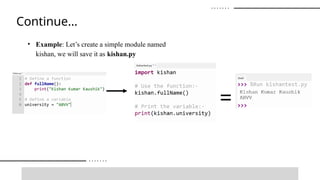
• Example: Let’screate a simple module named
kishan, we will save it as kishan.py
Continue…
=
6.
• The randommodule in Python is a built-in library
that allows us to generate random numbers and
perform random type of operations in the programs.
• This module can be used to perform random actions
such as generating random numbers, printing random
a value for a list etc.
What is random module?
Algorithm behind randommodule:
• In Python, random module generates the numbers using the Mersenne Twister
algorithm, which is a pseudorandom number generator (PRNG).
• It is called "Mersenne Twister" because its total length (the number of random
numbers it can produce before repeating) is based on Mersenne primes.
• The random numbers generated by Python's random module are floating-point
numbers with 53 bits of precision.
• The period of the Mersenne Twister is 2² ³ − 1, which is an extremely large
⁰⁰ ⁷
number (approximately 10 ¹¹).
⁶⁰
9.
Continued...
Working of MersenneTwister:
• State Initialization: It maintains an internal state array of 624 integers (each 32
bits).
• Twisting Step: At each step, the generator updates its internal state by
combining values from the state array using bitwise operations.
• Output Transformation: The output is refined with a tempering process to
improve randomness.
10.
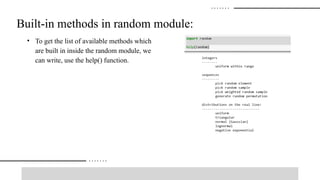
Built-in methods inrandom module:
• To get the list of available methods which
are built in inside the random module, we
can write, use the help() function.
11.
Continued...
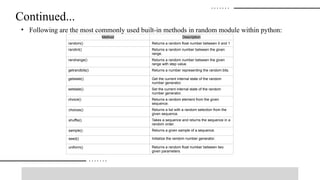
• Following arethe most commonly used built-in methods in random module within python:
Method Description
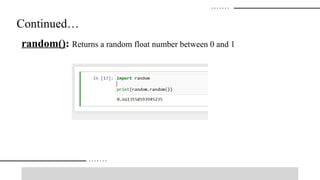
random() Returns a random float number between 0 and 1
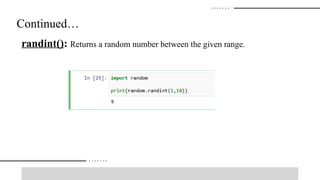
randint() Returns a random number between the given
range.
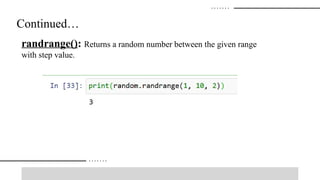
randrange() Returns a random number between the given
range with step value.
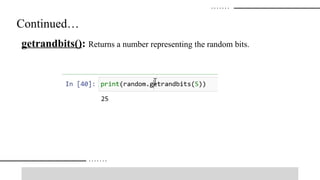
getrandbits() Returns a number representing the random bits.
getstate() Get the current internal state of the random
number generator.
setstate() Set the current internal state of the random
number generator.
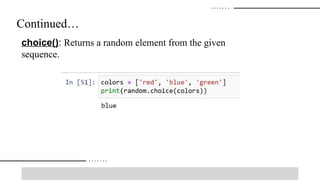
choice() Returns a random element from the given
sequence.
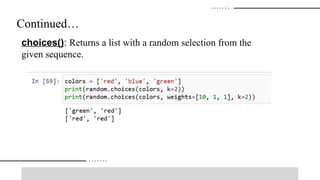
choices() Returns a list with a random selection from the
given sequence.
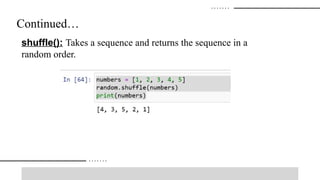
shuffle() Takes a sequence and returns the sequence in a
random order.
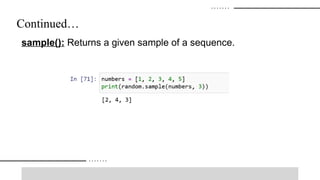
sample() Returns a given sample of a sequence.
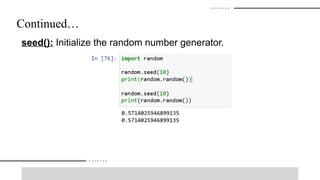
seed() Initialize the random number generator.
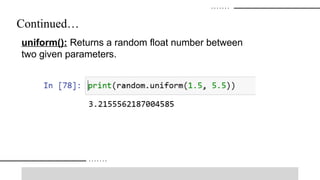
uniform() Returns a random float number between two
given parameters.
Continued…
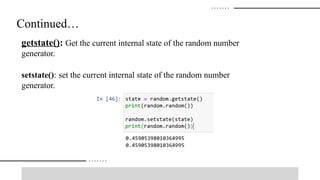
getstate(): Get thecurrent internal state of the random number
generator.
setstate(): set the current internal state of the random number
generator.
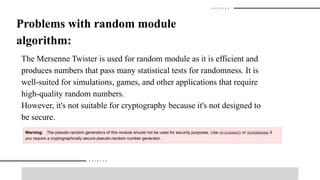
Problems with randommodule
algorithm:
The Mersenne Twister is used for random module as it is efficient and
produces numbers that pass many statistical tests for randomness. It is
well-suited for simulations, games, and other applications that require
high-quality random numbers.
However, it's not suitable for cryptography because it's not designed to
be secure.





![FUNCTIONS IN PYTHON[RANDOM FUNCTION]](https://cdn.slidesharecdn.com/ss_thumbnails/functions2-200924082810-thumbnail.jpg?width=640&height=640&fit=bounds)


