MySQL Indexing 
Best Practices for MySQL 5.6 
Peter Zaitsev 
CEO, Percona 
Highload++ 2014, Moscow, Russia 
Nov 1, 2014
www.percona.com 
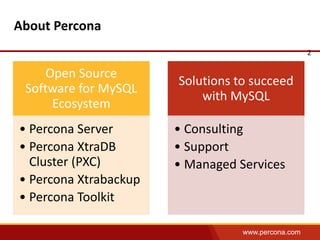
About Percona 
Open Source 
Software for MySQL 
Ecosystem 
• Percona Server 
• Percona XtraDB 
Cluster (PXC) 
• Percona Xtrabackup 
• Percona Toolkit 
Solutions to succeed 
with MySQL 
• Consulting 
• Support 
• Managed Services 
2
www.percona.com 
You’ve Made a Great Choice ! 
Understanding indexing is crucial both for 
Developers and DBAs 
Poor index choices are responsible for large 
portion of production problems 
Indexing is not a rocket science
www.percona.com 
MySQL Indexing: Agenda 
Understanding Indexing 
Setting up best indexes for your 
applications 
Working around common MySQL 
limitations
www.percona.com 
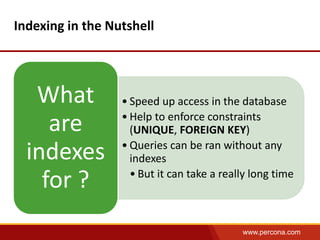
Indexing in the Nutshell 
• Speed up access in the database 
• Help to enforce constraints 
(UNIQUE, FOREIGN KEY) 
• Queries can be ran without any 
indexes 
• But it can take a really long time 
What 
are 
indexes 
for ?
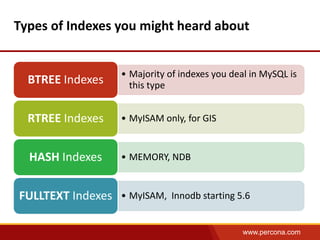
Types of Indexes you might heard about 
• Majority of indexes you deal in MySQL is 
this type BTREE Indexes 
www.percona.com 
RTREE Indexes • MyISAM only, for GIS 
HASH Indexes • MEMORY, NDB 
FULLTEXT Indexes • MyISAM, Innodb starting 5.6
www.percona.com 
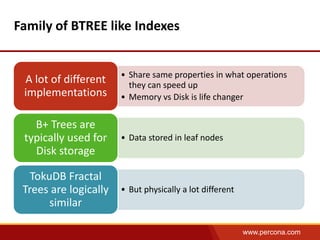
Family of BTREE like Indexes 
• Share same properties in what operations 
they can speed up 
• Memory vs Disk is life changer 
A lot of different 
implementations 
• Data stored in leaf nodes 
B+ Trees are 
typically used for 
Disk storage 
• But physically a lot different 
TokuDB Fractal 
Trees are logically 
similar
www.percona.com 
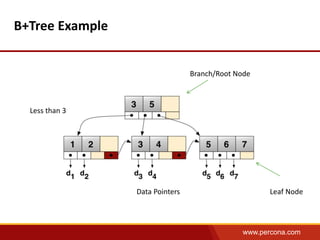
B+Tree Example 
Branch/Root Node 
Less than 3 
Data Pointers Leaf Node
www.percona.com 
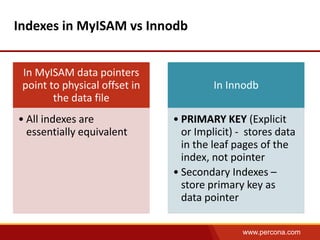
Indexes in MyISAM vs Innodb 
In MyISAM data pointers 
point to physical offset in 
the data file 
• All indexes are 
essentially equivalent 
In Innodb 
• PRIMARY KEY (Explicit 
or Implicit) - stores data 
in the leaf pages of the 
index, not pointer 
• Secondary Indexes – 
store primary key as 
data pointer
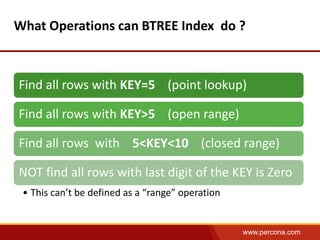
What Operations can BTREE Index do ? 
Find all rows with KEY=5 (point lookup) 
www.percona.com 
Find all rows with KEY>5 (open range) 
Find all rows with 5<KEY<10 (closed range) 
NOT find all rows with last digit of the KEY is Zero 
• This can’t be defined as a “range” operation
www.percona.com 
String Indexes 
• Sort order is defined for strings 
(collation) 
• “AAAA” < “AAAB” 
There is no 
difference… 
really 
• LIKE “ABC%” means 
• “ABC[LOWEST]”<KEY<“ABC[HIGHEST]” 
• LIKE “%ABC” can’t be optimized by use 
of the index 
Prefix LIKE is 
a special type 
of Range
www.percona.com 
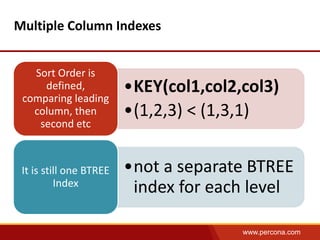
Multiple Column Indexes 
•KEY(col1,col2,col3) 
•(1,2,3) < (1,3,1) 
Sort Order is 
defined, 
comparing leading 
column, then 
second etc 
•not a separate BTREE 
index for each level 
It is still one BTREE 
Index
www.percona.com 
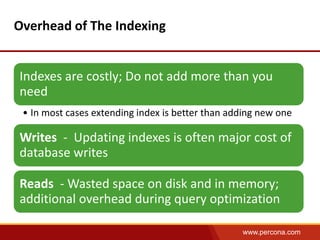
Overhead of The Indexing 
Indexes are costly; Do not add more than you 
need 
• In most cases extending index is better than adding new one 
Writes - Updating indexes is often major cost of 
database writes 
Reads - Wasted space on disk and in memory; 
additional overhead during query optimization
www.percona.com 
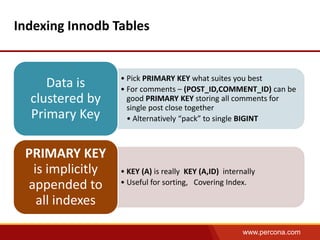
Indexing Innodb Tables 
• Pick PRIMARY KEY what suites you best 
• For comments – (POST_ID,COMMENT_ID) can be 
good PRIMARY KEY storing all comments for 
single post close together 
• Alternatively “pack” to single BIGINT 
Data is 
clustered by 
Primary Key 
• KEY (A) is really KEY (A,ID) internally 
• Useful for sorting, Covering Index. 
PRIMARY KEY 
is implicitly 
appended to 
all indexes
www.percona.com 
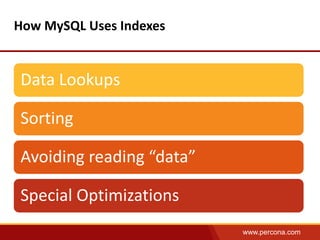
How MySQL Uses Indexes 
Data Lookups 
Sorting 
Avoiding reading “data” 
Special Optimizations
www.percona.com 
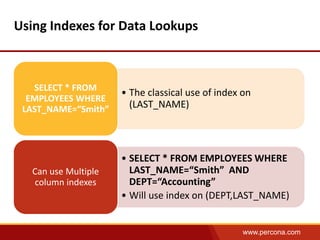
Using Indexes for Data Lookups 
• The classical use of index on 
(LAST_NAME) 
SELECT * FROM 
EMPLOYEES WHERE 
LAST_NAME=“Smith” 
• SELECT * FROM EMPLOYEES WHERE 
LAST_NAME=“Smith” AND 
DEPT=“Accounting” 
• Will use index on (DEPT,LAST_NAME) 
Can use Multiple 
column indexes
www.percona.com 
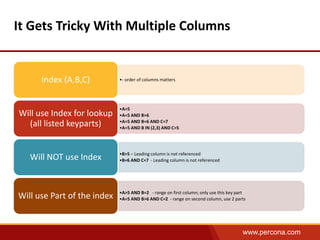
It Gets Tricky With Multiple Columns 
Index (A,B,C) •- order of columns matters 
•A>5 
•A=5 AND B>6 
•A=5 AND B=6 AND C=7 
•A=5 AND B IN (2,3) AND C>5 
Will use Index for lookup 
(all listed keyparts) 
•B>5 – Leading column is not referenced 
•B=6 AND C=7 - Leading column is not referenced Will NOT use Index 
•A>5 AND B=2 - range on first column; only use this key part 
•A=5 AND B>6 AND C=2 - range on second column, use 2 parts Will use Part of the index
www.percona.com 
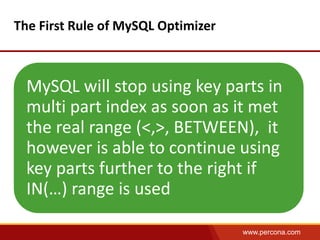
The First Rule of MySQL Optimizer 
MySQL will stop using key parts in 
multi part index as soon as it met 
the real range (<,>, BETWEEN), it 
however is able to continue using 
key parts further to the right if 
IN(…) range is used
www.percona.com 
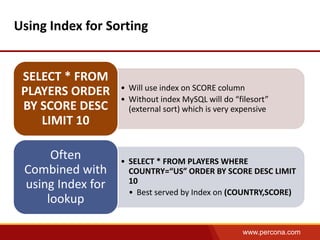
Using Index for Sorting 
• Will use index on SCORE column 
• Without index MySQL will do “filesort” 
(external sort) which is very expensive 
SELECT * FROM 
PLAYERS ORDER 
BY SCORE DESC 
LIMIT 10 
• SELECT * FROM PLAYERS WHERE 
COUNTRY=“US” ORDER BY SCORE DESC LIMIT 
10 
• Best served by Index on (COUNTRY,SCORE) 
Often 
Combined with 
using Index for 
lookup
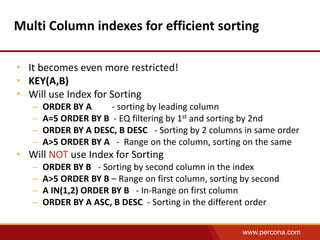
Multi Column indexes for efficient sorting 
www.percona.com 
• It becomes even more restricted! 
• KEY(A,B) 
• Will use Index for Sorting 
– ORDER BY A - sorting by leading column 
– A=5 ORDER BY B - EQ filtering by 1st and sorting by 2nd 
– ORDER BY A DESC, B DESC - Sorting by 2 columns in same order 
– A>5 ORDER BY A - Range on the column, sorting on the same 
• Will NOT use Index for Sorting 
– ORDER BY B - Sorting by second column in the index 
– A>5 ORDER BY B – Range on first column, sorting by second 
– A IN(1,2) ORDER BY B - In-Range on first column 
– ORDER BY A ASC, B DESC - Sorting in the different order
www.percona.com 
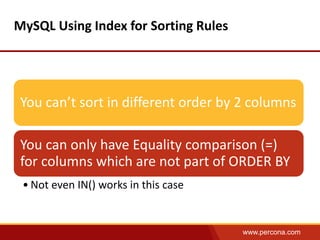
MySQL Using Index for Sorting Rules 
You can’t sort in different order by 2 columns 
You can only have Equality comparison (=) 
for columns which are not part of ORDER BY 
• Not even IN() works in this case
www.percona.com 
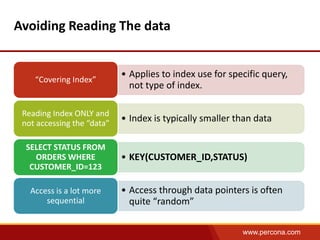
Avoiding Reading The data 
• Applies to index use for specific query, 
not type of index. 
“Covering Index” 
• Index is typically smaller than data Reading Index ONLY and 
not accessing the “data” 
• KEY(CUSTOMER_ID,STATUS) 
SELECT STATUS FROM 
ORDERS WHERE 
CUSTOMER_ID=123 
• Access through data pointers is often 
quite “random” 
Access is a lot more 
sequential
www.percona.com 
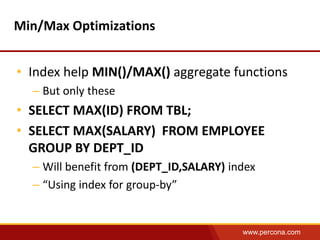
Min/Max Optimizations 
• Index help MIN()/MAX() aggregate functions 
– But only these 
• SELECT MAX(ID) FROM TBL; 
• SELECT MAX(SALARY) FROM EMPLOYEE 
GROUP BY DEPT_ID 
– Will benefit from (DEPT_ID,SALARY) index 
– “Using index for group-by”
www.percona.com 
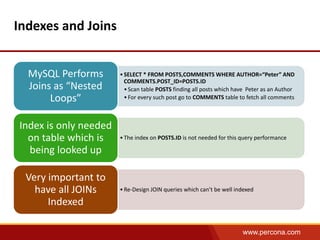
Indexes and Joins 
• SELECT * FROM POSTS,COMMENTS WHERE AUTHOR=“Peter” AND 
COMMENTS.POST_ID=POSTS.ID 
• Scan table POSTS finding all posts which have Peter as an Author 
• For every such post go to COMMENTS table to fetch all comments 
MySQL Performs 
Joins as “Nested 
Loops” 
• The index on POSTS.ID is not needed for this query performance 
Index is only needed 
on table which is 
being looked up 
• Re-Design JOIN queries which can’t be well indexed 
Very important to 
have all JOINs 
Indexed
www.percona.com 
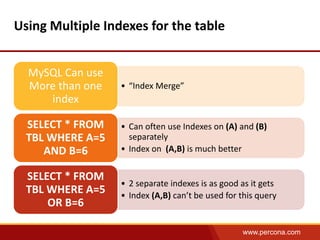
Using Multiple Indexes for the table 
• “Index Merge” 
MySQL Can use 
More than one 
index 
• Can often use Indexes on (A) and (B) 
separately 
• Index on (A,B) is much better 
SELECT * FROM 
TBL WHERE A=5 
AND B=6 
• 2 separate indexes is as good as it gets 
• Index (A,B) can’t be used for this query 
SELECT * FROM 
TBL WHERE A=5 
OR B=6
www.percona.com 
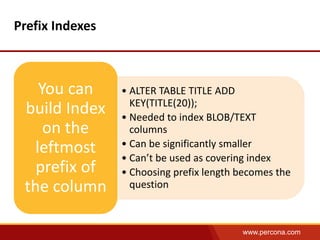
Prefix Indexes 
• ALTER TABLE TITLE ADD 
KEY(TITLE(20)); 
• Needed to index BLOB/TEXT 
columns 
• Can be significantly smaller 
• Can’t be used as covering index 
• Choosing prefix length becomes the 
question 
You can 
build Index 
on the 
leftmost 
prefix of 
the column
www.percona.com 
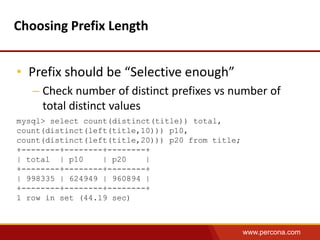
Choosing Prefix Length 
• Prefix should be “Selective enough” 
– Check number of distinct prefixes vs number of 
total distinct values 
mysql> select count(distinct(title)) total, 
count(distinct(left(title,10))) p10, 
count(distinct(left(title,20))) p20 from title; 
+--------+--------+--------+ 
| total | p10 | p20 | 
+--------+--------+--------+ 
| 998335 | 624949 | 960894 | 
+--------+--------+--------+ 
1 row in set (44.19 sec)
Most common Titles Most Common Title Prefixes 
www.percona.com 
Choosing Prefix Length 
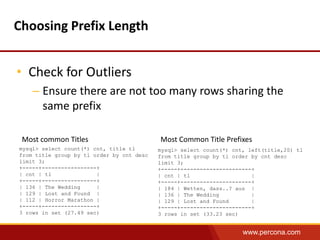
• Check for Outliers 
– Ensure there are not too many rows sharing the 
same prefix 
mysql> select count(*) cnt, title tl 
from title group by tl order by cnt desc 
limit 3; 
+-----+-----------------+ 
| cnt | tl | 
+-----+-----------------+ 
| 136 | The Wedding | 
| 129 | Lost and Found | 
| 112 | Horror Marathon | 
+-----+-----------------+ 
3 rows in set (27.49 sec) 
mysql> select count(*) cnt, left(title,20) tl 
from title group by tl order by cnt desc 
limit 3; 
+-----+----------------------+ 
| cnt | tl | 
+-----+----------------------+ 
| 184 | Wetten, dass..? aus | 
| 136 | The Wedding | 
| 129 | Lost and Found | 
+-----+----------------------+ 
3 rows in set (33.23 sec)
www.percona.com 
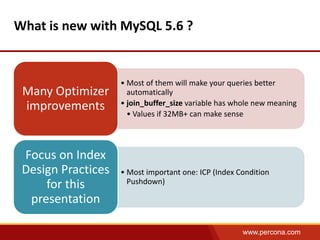
What is new with MySQL 5.6 ? 
• Most of them will make your queries better 
automatically 
• join_buffer_size variable has whole new meaning 
• Values if 32MB+ can make sense 
Many Optimizer 
improvements 
• Most important one: ICP (Index Condition 
Pushdown) 
Focus on Index 
Design Practices 
for this 
presentation
www.percona.com 
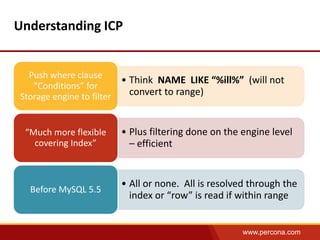
Understanding ICP 
• Think NAME LIKE “%ill%” (will not 
convert to range) 
Push where clause 
“Conditions” for 
Storage engine to filter 
• Plus filtering done on the engine level 
– efficient 
“Much more flexible 
covering Index” 
• All or none. All is resolved through the 
index or “row” is read if within range 
Before MySQL 5.5
www.percona.com 
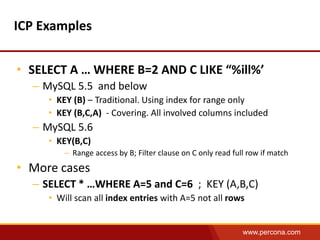
ICP Examples 
• SELECT A … WHERE B=2 AND C LIKE “%ill%’ 
– MySQL 5.5 and below 
• KEY (B) – Traditional. Using index for range only 
• KEY (B,C,A) - Covering. All involved columns included 
– MySQL 5.6 
• KEY(B,C) 
– Range access by B; Filter clause on C only read full row if match 
• More cases 
– SELECT * …WHERE A=5 and C=6 ; KEY (A,B,C) 
• Will scan all index entries with A=5 not all rows
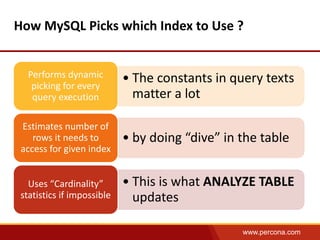
How MySQL Picks which Index to Use ? 
• The constants in query texts 
matter a lot 
www.percona.com 
Performs dynamic 
picking for every 
query execution 
• by doing “dive” in the table 
Estimates number of 
rows it needs to 
access for given index 
• This is what ANALYZE TABLE 
updates 
Uses “Cardinality” 
statistics if impossible
www.percona.com 
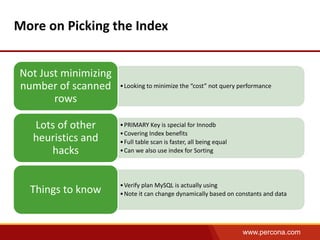
More on Picking the Index 
• Looking to minimize the “cost” not query performance 
Not Just minimizing 
number of scanned 
rows 
•PRIMARY Key is special for Innodb 
•Covering Index benefits 
•Full table scan is faster, all being equal 
•Can we also use index for Sorting 
Lots of other 
heuristics and 
hacks 
•Verify plan MySQL is actually using 
•Note it can change dynamically based on constants and data Things to know
www.percona.com 
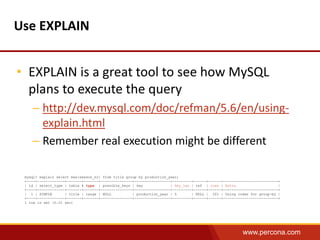
Use EXPLAIN 
• EXPLAIN is a great tool to see how MySQL 
plans to execute the query 
– http://dev.mysql.com/doc/refman/5.6/en/using-explain. 
html 
– Remember real execution might be different 
mysql> explain select max(season_nr) from title group by production_year; 
+----+-------------+-------+-------+---------------+-----------------+---------+------+------+--------------------------+ 
| id | select_type | table | type | possible_keys | key | key_len | ref | rows | Extra | 
+----+-------------+-------+-------+---------------+-----------------+---------+------+------+--------------------------+ 
| 1 | SIMPLE | title | range | NULL | production_year | 5 | NULL | 201 | Using index for group-by | 
+----+-------------+-------+-------+---------------+-----------------+---------+------+------+--------------------------+ 
1 row in set (0.01 sec)
www.percona.com 
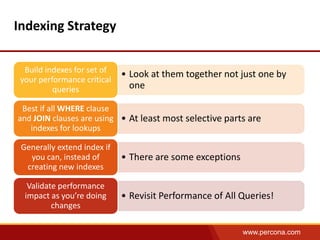
Indexing Strategy 
• Look at them together not just one by 
one 
Build indexes for set of 
your performance critical 
queries 
• At least most selective parts are 
Best if all WHERE clause 
and JOIN clauses are using 
indexes for lookups 
• There are some exceptions 
Generally extend index if 
you can, instead of 
creating new indexes 
• Revisit Performance of All Queries! 
Validate performance 
impact as you’re doing 
changes
www.percona.com 
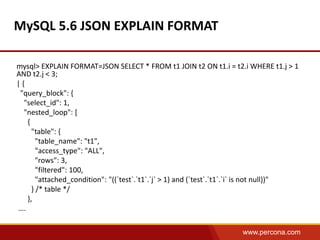
MySQL 5.6 JSON EXPLAIN FORMAT 
mysql> EXPLAIN FORMAT=JSON SELECT * FROM t1 JOIN t2 ON t1.i = t2.i WHERE t1.j > 1 
AND t2.j < 3; 
| { 
"query_block": { 
"select_id": 1, 
"nested_loop": [ 
{ 
"table": { 
"table_name": "t1", 
"access_type": "ALL", 
"rows": 3, 
"filtered": 100, 
"attached_condition": "((`test`.`t1`.`j` > 1) and (`test`.`t1`.`i` is not null))" 
} /* table */ 
}, 
….
www.percona.com 
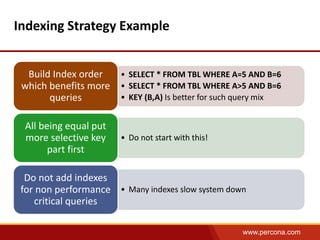
Indexing Strategy Example 
• SELECT * FROM TBL WHERE A=5 AND B=6 
• SELECT * FROM TBL WHERE A>5 AND B=6 
• KEY (B,A) Is better for such query mix 
Build Index order 
which benefits more 
queries 
• Do not start with this! 
All being equal put 
more selective key 
part first 
• Many indexes slow system down 
Do not add indexes 
for non performance 
critical queries
www.percona.com 
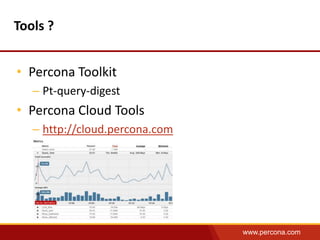
Tools ? 
• Percona Toolkit 
– Pt-query-digest 
• Percona Cloud Tools 
– http://cloud.percona.com
www.percona.com 
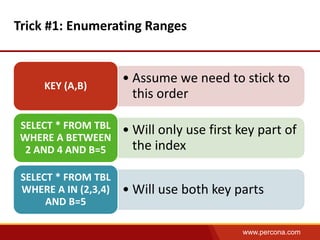
Trick #1: Enumerating Ranges 
• Assume we need to stick to 
this order 
KEY (A,B) 
• Will only use first key part of 
the index 
SELECT * FROM TBL 
WHERE A BETWEEN 
2 AND 4 AND B=5 
• Will use both key parts 
SELECT * FROM TBL 
WHERE A IN (2,3,4) 
AND B=5
www.percona.com 
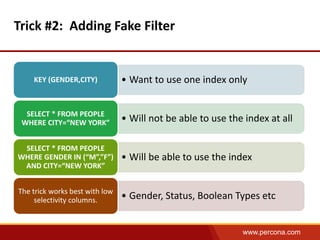
Trick #2: Adding Fake Filter 
KEY (GENDER,CITY) • Want to use one index only 
• Will not be able to use the index at all SELECT * FROM PEOPLE 
WHERE CITY=“NEW YORK” 
• Will be able to use the index 
SELECT * FROM PEOPLE 
WHERE GENDER IN (“M”,”F”) 
AND CITY=“NEW YORK” 
• Gender, Status, Boolean Types etc The trick works best with low 
selectivity columns.
www.percona.com 
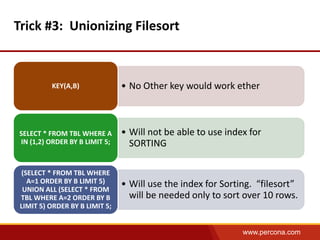
Trick #3: Unionizing Filesort 
KEY(A,B) • No Other key would work ether 
• Will not be able to use index for 
SORTING 
SELECT * FROM TBL WHERE A 
IN (1,2) ORDER BY B LIMIT 5; 
• Will use the index for Sorting. “filesort” 
will be needed only to sort over 10 rows. 
(SELECT * FROM TBL WHERE 
A=1 ORDER BY B LIMIT 5) 
UNION ALL (SELECT * FROM 
TBL WHERE A=2 ORDER BY B 
LIMIT 5) ORDER BY B LIMIT 5;
www.percona.com 
Thank You ! 
• pz@percona.com 
• http://www.percona.com 
• @percona at Twitter 
• http://www.facebook.com/Percona

Работа с индексами - лучшие практики для MySQL 5.6, Петр Зайцев (Percona)

  • 1.
    MySQL Indexing BestPractices for MySQL 5.6 Peter Zaitsev CEO, Percona Highload++ 2014, Moscow, Russia Nov 1, 2014
  • 2.
    www.percona.com About Percona Open Source Software for MySQL Ecosystem • Percona Server • Percona XtraDB Cluster (PXC) • Percona Xtrabackup • Percona Toolkit Solutions to succeed with MySQL • Consulting • Support • Managed Services 2
  • 3.
    www.percona.com You’ve Madea Great Choice ! Understanding indexing is crucial both for Developers and DBAs Poor index choices are responsible for large portion of production problems Indexing is not a rocket science
  • 4.
    www.percona.com MySQL Indexing:Agenda Understanding Indexing Setting up best indexes for your applications Working around common MySQL limitations
  • 5.
    www.percona.com Indexing inthe Nutshell • Speed up access in the database • Help to enforce constraints (UNIQUE, FOREIGN KEY) • Queries can be ran without any indexes • But it can take a really long time What are indexes for ?
  • 6.
    Types of Indexesyou might heard about • Majority of indexes you deal in MySQL is this type BTREE Indexes www.percona.com RTREE Indexes • MyISAM only, for GIS HASH Indexes • MEMORY, NDB FULLTEXT Indexes • MyISAM, Innodb starting 5.6
  • 7.
    www.percona.com Family ofBTREE like Indexes • Share same properties in what operations they can speed up • Memory vs Disk is life changer A lot of different implementations • Data stored in leaf nodes B+ Trees are typically used for Disk storage • But physically a lot different TokuDB Fractal Trees are logically similar
  • 8.
    www.percona.com B+Tree Example Branch/Root Node Less than 3 Data Pointers Leaf Node
  • 9.
    www.percona.com Indexes inMyISAM vs Innodb In MyISAM data pointers point to physical offset in the data file • All indexes are essentially equivalent In Innodb • PRIMARY KEY (Explicit or Implicit) - stores data in the leaf pages of the index, not pointer • Secondary Indexes – store primary key as data pointer
  • 10.
    What Operations canBTREE Index do ? Find all rows with KEY=5 (point lookup) www.percona.com Find all rows with KEY>5 (open range) Find all rows with 5<KEY<10 (closed range) NOT find all rows with last digit of the KEY is Zero • This can’t be defined as a “range” operation
  • 11.
    www.percona.com String Indexes • Sort order is defined for strings (collation) • “AAAA” < “AAAB” There is no difference… really • LIKE “ABC%” means • “ABC[LOWEST]”<KEY<“ABC[HIGHEST]” • LIKE “%ABC” can’t be optimized by use of the index Prefix LIKE is a special type of Range
  • 12.
    www.percona.com Multiple ColumnIndexes •KEY(col1,col2,col3) •(1,2,3) < (1,3,1) Sort Order is defined, comparing leading column, then second etc •not a separate BTREE index for each level It is still one BTREE Index
  • 13.
    www.percona.com Overhead ofThe Indexing Indexes are costly; Do not add more than you need • In most cases extending index is better than adding new one Writes - Updating indexes is often major cost of database writes Reads - Wasted space on disk and in memory; additional overhead during query optimization
  • 14.
    www.percona.com Indexing InnodbTables • Pick PRIMARY KEY what suites you best • For comments – (POST_ID,COMMENT_ID) can be good PRIMARY KEY storing all comments for single post close together • Alternatively “pack” to single BIGINT Data is clustered by Primary Key • KEY (A) is really KEY (A,ID) internally • Useful for sorting, Covering Index. PRIMARY KEY is implicitly appended to all indexes
  • 15.
    www.percona.com How MySQLUses Indexes Data Lookups Sorting Avoiding reading “data” Special Optimizations
  • 16.
    www.percona.com Using Indexesfor Data Lookups • The classical use of index on (LAST_NAME) SELECT * FROM EMPLOYEES WHERE LAST_NAME=“Smith” • SELECT * FROM EMPLOYEES WHERE LAST_NAME=“Smith” AND DEPT=“Accounting” • Will use index on (DEPT,LAST_NAME) Can use Multiple column indexes
  • 17.
    www.percona.com It GetsTricky With Multiple Columns Index (A,B,C) •- order of columns matters •A>5 •A=5 AND B>6 •A=5 AND B=6 AND C=7 •A=5 AND B IN (2,3) AND C>5 Will use Index for lookup (all listed keyparts) •B>5 – Leading column is not referenced •B=6 AND C=7 - Leading column is not referenced Will NOT use Index •A>5 AND B=2 - range on first column; only use this key part •A=5 AND B>6 AND C=2 - range on second column, use 2 parts Will use Part of the index
  • 18.
    www.percona.com The FirstRule of MySQL Optimizer MySQL will stop using key parts in multi part index as soon as it met the real range (<,>, BETWEEN), it however is able to continue using key parts further to the right if IN(…) range is used
  • 19.
    www.percona.com Using Indexfor Sorting • Will use index on SCORE column • Without index MySQL will do “filesort” (external sort) which is very expensive SELECT * FROM PLAYERS ORDER BY SCORE DESC LIMIT 10 • SELECT * FROM PLAYERS WHERE COUNTRY=“US” ORDER BY SCORE DESC LIMIT 10 • Best served by Index on (COUNTRY,SCORE) Often Combined with using Index for lookup
  • 20.
    Multi Column indexesfor efficient sorting www.percona.com • It becomes even more restricted! • KEY(A,B) • Will use Index for Sorting – ORDER BY A - sorting by leading column – A=5 ORDER BY B - EQ filtering by 1st and sorting by 2nd – ORDER BY A DESC, B DESC - Sorting by 2 columns in same order – A>5 ORDER BY A - Range on the column, sorting on the same • Will NOT use Index for Sorting – ORDER BY B - Sorting by second column in the index – A>5 ORDER BY B – Range on first column, sorting by second – A IN(1,2) ORDER BY B - In-Range on first column – ORDER BY A ASC, B DESC - Sorting in the different order
  • 21.
    www.percona.com MySQL UsingIndex for Sorting Rules You can’t sort in different order by 2 columns You can only have Equality comparison (=) for columns which are not part of ORDER BY • Not even IN() works in this case
  • 22.
    www.percona.com Avoiding ReadingThe data • Applies to index use for specific query, not type of index. “Covering Index” • Index is typically smaller than data Reading Index ONLY and not accessing the “data” • KEY(CUSTOMER_ID,STATUS) SELECT STATUS FROM ORDERS WHERE CUSTOMER_ID=123 • Access through data pointers is often quite “random” Access is a lot more sequential
  • 23.
    www.percona.com Min/Max Optimizations • Index help MIN()/MAX() aggregate functions – But only these • SELECT MAX(ID) FROM TBL; • SELECT MAX(SALARY) FROM EMPLOYEE GROUP BY DEPT_ID – Will benefit from (DEPT_ID,SALARY) index – “Using index for group-by”
  • 24.
    www.percona.com Indexes andJoins • SELECT * FROM POSTS,COMMENTS WHERE AUTHOR=“Peter” AND COMMENTS.POST_ID=POSTS.ID • Scan table POSTS finding all posts which have Peter as an Author • For every such post go to COMMENTS table to fetch all comments MySQL Performs Joins as “Nested Loops” • The index on POSTS.ID is not needed for this query performance Index is only needed on table which is being looked up • Re-Design JOIN queries which can’t be well indexed Very important to have all JOINs Indexed
  • 25.
    www.percona.com Using MultipleIndexes for the table • “Index Merge” MySQL Can use More than one index • Can often use Indexes on (A) and (B) separately • Index on (A,B) is much better SELECT * FROM TBL WHERE A=5 AND B=6 • 2 separate indexes is as good as it gets • Index (A,B) can’t be used for this query SELECT * FROM TBL WHERE A=5 OR B=6
  • 26.
    www.percona.com Prefix Indexes • ALTER TABLE TITLE ADD KEY(TITLE(20)); • Needed to index BLOB/TEXT columns • Can be significantly smaller • Can’t be used as covering index • Choosing prefix length becomes the question You can build Index on the leftmost prefix of the column
  • 27.
    www.percona.com Choosing PrefixLength • Prefix should be “Selective enough” – Check number of distinct prefixes vs number of total distinct values mysql> select count(distinct(title)) total, count(distinct(left(title,10))) p10, count(distinct(left(title,20))) p20 from title; +--------+--------+--------+ | total | p10 | p20 | +--------+--------+--------+ | 998335 | 624949 | 960894 | +--------+--------+--------+ 1 row in set (44.19 sec)
  • 28.
    Most common TitlesMost Common Title Prefixes www.percona.com Choosing Prefix Length • Check for Outliers – Ensure there are not too many rows sharing the same prefix mysql> select count(*) cnt, title tl from title group by tl order by cnt desc limit 3; +-----+-----------------+ | cnt | tl | +-----+-----------------+ | 136 | The Wedding | | 129 | Lost and Found | | 112 | Horror Marathon | +-----+-----------------+ 3 rows in set (27.49 sec) mysql> select count(*) cnt, left(title,20) tl from title group by tl order by cnt desc limit 3; +-----+----------------------+ | cnt | tl | +-----+----------------------+ | 184 | Wetten, dass..? aus | | 136 | The Wedding | | 129 | Lost and Found | +-----+----------------------+ 3 rows in set (33.23 sec)
  • 29.
    www.percona.com What isnew with MySQL 5.6 ? • Most of them will make your queries better automatically • join_buffer_size variable has whole new meaning • Values if 32MB+ can make sense Many Optimizer improvements • Most important one: ICP (Index Condition Pushdown) Focus on Index Design Practices for this presentation
  • 30.
    www.percona.com Understanding ICP • Think NAME LIKE “%ill%” (will not convert to range) Push where clause “Conditions” for Storage engine to filter • Plus filtering done on the engine level – efficient “Much more flexible covering Index” • All or none. All is resolved through the index or “row” is read if within range Before MySQL 5.5
  • 31.
    www.percona.com ICP Examples • SELECT A … WHERE B=2 AND C LIKE “%ill%’ – MySQL 5.5 and below • KEY (B) – Traditional. Using index for range only • KEY (B,C,A) - Covering. All involved columns included – MySQL 5.6 • KEY(B,C) – Range access by B; Filter clause on C only read full row if match • More cases – SELECT * …WHERE A=5 and C=6 ; KEY (A,B,C) • Will scan all index entries with A=5 not all rows
  • 32.
    How MySQL Pickswhich Index to Use ? • The constants in query texts matter a lot www.percona.com Performs dynamic picking for every query execution • by doing “dive” in the table Estimates number of rows it needs to access for given index • This is what ANALYZE TABLE updates Uses “Cardinality” statistics if impossible
  • 33.
    www.percona.com More onPicking the Index • Looking to minimize the “cost” not query performance Not Just minimizing number of scanned rows •PRIMARY Key is special for Innodb •Covering Index benefits •Full table scan is faster, all being equal •Can we also use index for Sorting Lots of other heuristics and hacks •Verify plan MySQL is actually using •Note it can change dynamically based on constants and data Things to know
  • 34.
    www.percona.com Use EXPLAIN • EXPLAIN is a great tool to see how MySQL plans to execute the query – http://dev.mysql.com/doc/refman/5.6/en/using-explain. html – Remember real execution might be different mysql> explain select max(season_nr) from title group by production_year; +----+-------------+-------+-------+---------------+-----------------+---------+------+------+--------------------------+ | id | select_type | table | type | possible_keys | key | key_len | ref | rows | Extra | +----+-------------+-------+-------+---------------+-----------------+---------+------+------+--------------------------+ | 1 | SIMPLE | title | range | NULL | production_year | 5 | NULL | 201 | Using index for group-by | +----+-------------+-------+-------+---------------+-----------------+---------+------+------+--------------------------+ 1 row in set (0.01 sec)
  • 35.
    www.percona.com Indexing Strategy • Look at them together not just one by one Build indexes for set of your performance critical queries • At least most selective parts are Best if all WHERE clause and JOIN clauses are using indexes for lookups • There are some exceptions Generally extend index if you can, instead of creating new indexes • Revisit Performance of All Queries! Validate performance impact as you’re doing changes
  • 36.
    www.percona.com MySQL 5.6JSON EXPLAIN FORMAT mysql> EXPLAIN FORMAT=JSON SELECT * FROM t1 JOIN t2 ON t1.i = t2.i WHERE t1.j > 1 AND t2.j < 3; | { "query_block": { "select_id": 1, "nested_loop": [ { "table": { "table_name": "t1", "access_type": "ALL", "rows": 3, "filtered": 100, "attached_condition": "((`test`.`t1`.`j` > 1) and (`test`.`t1`.`i` is not null))" } /* table */ }, ….
  • 37.
    www.percona.com Indexing StrategyExample • SELECT * FROM TBL WHERE A=5 AND B=6 • SELECT * FROM TBL WHERE A>5 AND B=6 • KEY (B,A) Is better for such query mix Build Index order which benefits more queries • Do not start with this! All being equal put more selective key part first • Many indexes slow system down Do not add indexes for non performance critical queries
  • 38.
    www.percona.com Tools ? • Percona Toolkit – Pt-query-digest • Percona Cloud Tools – http://cloud.percona.com
  • 39.
    www.percona.com Trick #1:Enumerating Ranges • Assume we need to stick to this order KEY (A,B) • Will only use first key part of the index SELECT * FROM TBL WHERE A BETWEEN 2 AND 4 AND B=5 • Will use both key parts SELECT * FROM TBL WHERE A IN (2,3,4) AND B=5
  • 40.
    www.percona.com Trick #2:Adding Fake Filter KEY (GENDER,CITY) • Want to use one index only • Will not be able to use the index at all SELECT * FROM PEOPLE WHERE CITY=“NEW YORK” • Will be able to use the index SELECT * FROM PEOPLE WHERE GENDER IN (“M”,”F”) AND CITY=“NEW YORK” • Gender, Status, Boolean Types etc The trick works best with low selectivity columns.
  • 41.
    www.percona.com Trick #3:Unionizing Filesort KEY(A,B) • No Other key would work ether • Will not be able to use index for SORTING SELECT * FROM TBL WHERE A IN (1,2) ORDER BY B LIMIT 5; • Will use the index for Sorting. “filesort” will be needed only to sort over 10 rows. (SELECT * FROM TBL WHERE A=1 ORDER BY B LIMIT 5) UNION ALL (SELECT * FROM TBL WHERE A=2 ORDER BY B LIMIT 5) ORDER BY B LIMIT 5;
  • 42.
    www.percona.com Thank You! • pz@percona.com • http://www.percona.com • @percona at Twitter • http://www.facebook.com/Percona