UNITED STATES OF AMERICA
                      BEFORE FEDERAL TRADE COMMISSION

___________________________________
                                   )
In the Matter of                   )
                                   )
TIME WARNER INC.,                  )
      a corporation;               )
                                   )
TURNER BROADCASTING                )
SYSTEM, INC.,                      )
      a corporation;               )
                                   )                              File No. 961-0004
TELE-COMMUNICATIONS, INC.,         )
      a corporation; and           )
                                   )
LIBERTY MEDIA CORPORATION,         )
      a corporation.               )
__________________________________ )
             _


                   AGREEMENT CONTAINING CONSENT ORDER


        The Federal Trade Commission ("Commission"), having initiated an investigation of
the proposed acquisition of Turner Broadcasting System, Inc. (“Turner”) by Time Warner Inc.
(“Time Warner”), and Tele-Communications, Inc.’s (“TCI”) and Liberty Media Corporation’s
(“LMC”) proposed acquisitions of interests in Time Warner, and it now appearing that Time
Warner, Turner, TCI, and LMC, hereinafter sometimes referred to as "proposed
respondents," are willing to enter into an agreement containing an order to divest certain
assets, and providing for other relief:

       IT IS HEREBY AGREED by and between proposed respondents, by their duly
authorized officers and attorneys, and counsel for the Commission that:

1.     Proposed respondent Time Warner is a corporation organized, existing and doing
       business under and by virtue of the laws of the State of Delaware with its office and
       principal place of business located at 75 Rockefeller Plaza, New York, New York
       10019.


                                               1
2.     Proposed respondent Turner is a corporation organized, existing and doing business
       under and by virtue of the laws of the State of Georgia, with its office and principal
       place of business located at One CNN Center, Atlanta, Georgia 30303.

3.     Proposed respondent TCI is a corporation organized, existing and doing business under
       and by virtue of the law of the State of Delaware, with its office and principal place of
       business located at 5619 DTC Parkway, Englewood, Colorado 80111.

4.     Proposed respondent LMC is a corporation organized, existing and doing business
       under and by virtue of the law of the State of Delaware, with its office and principal
       place of business located at 8101 East Prentice Avenue, Englewood, Colorado 80111.

5.    Proposed respondents admit all the jurisdictional facts set forth in the draft of
complaint   here attached for purposes of this agreement and order only.

6.     Proposed respondents waive:

       (1)     any further procedural steps;

       (2)     the requirement that the Commission's decision contain a statement of findings
       of fact and conclusions of law;

       (3)     all rights to seek judicial review or otherwise to challenge or contest the validity
       of the order entered pursuant to this agreement; and

       (4)     any claim under the Equal Access to Justice Act.

7.     Proposed respondents shall submit (either jointly or individually), within sixty (60)
       days of the date this agreement is signed by proposed respondents, an initial report or
       reports, pursuant to § 2.33 of the Commission’s Rules, signed by the proposed
       respondents and setting forth in detail the manner in which the proposed respondents
       will comply with Paragraphs VI, VII and VIII of the order, when and if entered. Such
       report will not become part of the public record unless and until this agreement and
       order are accepted by the Commission for public comment.

8.     This agreement shall not become part of the public record of the proceeding unless and
       until it is accepted by the Commission. If this agreement is accepted by the
       Commission it, together with a draft of the complaint contemplated hereby, will be
       placed on the public record for a period of sixty (60) days and information in respect
       thereto publicly released. The Commission thereafter may either withdraw its
       acceptance of this agreement and so notify the proposed respondents, in which event it
       will take such action as it may consider appropriate, or issue and serve its complaint (in
       such form as the circumstances may require) and decision, in disposition of the
       proceeding.

                                                2
9.    This agreement is for settlement purposes only and does not constitute an admission by
      proposed respondents that the law has been violated as alleged in the draft of complaint
      here attached, or that the facts as alleged in the draft complaint, other than
      jurisdictional facts, are true.

10.   This agreement contemplates that, if it is accepted by the Commission, and if such
      acceptance is not subsequently withdrawn by the Commission pursuant to the
      provisions of § 2.34 of the Commission's Rules, the Commission may, without further
      notice to the proposed respondents, (1) issue its complaint corresponding in form and
      substance with the draft of complaint here attached and its decision containing the
      following order in disposition of the proceeding, and (2) make information public with
      respect thereto. When so entered, the order shall have the same force and effect and
      may be altered, modified or set aside in the same manner and within the same time
      provided by statute for other orders. The order shall become final upon service.
      Delivery by the U.S. Postal Service of the complaint and decision containing the
      agreed-to order to proposed respondents' addresses as stated in this agreement shall
      constitute service. Proposed respondents waive any right they may have to any other
      manner of service. The complaint may be used in construing the terms of the order,
      and no agreement, understanding, representation, or interpretation not contained in the
      order or the agreement may be used to vary or contradict the terms of the order.

11.   Proposed respondents have read the proposed complaint and order contemplated
      hereby. Proposed respondents understand that once the order has been issued, they
      will be required to file one or more compliance reports showing that they have fully
      complied with the order. Proposed respondents further understand that they may be
      liable for civil penalties in the amount provided by law for each violation of the order
      after it becomes final.

12.   Proposed respondents agree to be bound by all of the terms of the Interim Agreement
      attached to this agreement and made a part hereof as Appendix I, upon acceptance by
      the Commission of this agreement for public comment. Proposed respondents agree to
      notify the Commission’s Bureau of Competition in writing, within 30 days of the date
      the Commission accepts this agreement for public comment, of any and all actions
      taken by the proposed respondents to comply with the Interim Agreement and of any
      ruling or decision by the Internal Revenue Service (“IRS”) concerning the Distribution
      of The Separate Company stock to the holders of the Liberty Tracking Stock within
      two (2) business days after service of the IRS Ruling.

13.   The order’s obligations upon proposed respondents are contingent upon consummation
      of the Acquisition.

                                          ORDER

                                              I.

                                              3
As used in this Order, the following definitions shall apply:

A) “Acquisition” means Time Warner’s acquisition of Turner and TCI’s and LMC’s
acquisition of interest in Time Warner.

B) “Affiliated” means having an Attributable Interest in a Person.

C) “Agent” or “Representative” means a Person that is acting in a fiduciary capacity on
behalf of a principal with respect to the specific conduct or action under review or
consideration.

D) “Attributable Interest” means an interest as defined in 47 C.F.R. § 76.501 (and
accompanying notes), as that rule read on July 1, 1996.

E) “Basic Service Tier” means the Tier of video programming as defined in 47 C.F.R. §
76.901(a), as that rule read on July 1, 1996.

F) “Buying Group” or “Purchasing Agent” means any Person representing the interests of
more than one Person distributing multichannel video programming that: (1) agrees to be
financially liable for any fees due pursuant to a Programming Service Agreement which it
signs as a contracting party as a representative of its members, or each of whose members, as
contracting parties, agrees to be liable for its portion of the fees due pursuant to the
programming service agreement; (2) agrees to uniform billing and standardized contract
provisions for individual members; and (3) agrees either collectively or individually on
reasonable technical quality standards for the individual members of the group.

G) “Carriage Terms” means all terms and conditions for sale, licensing or delivery to an
MVPD for a Video Programming Service and includes, but is not limited to, all discounts
(such as for volume, channel position and Penetration Rate), local advertising availabilities,
marketing, and promotional support, and other terms and conditions.

H) “CATV” means a cable system, or multiple cable systems Controlled by the same Person,
located in the United States.

I) “Closing Date” means the date of the closing of the Acquisition.

J) “CNN” means the Video Programming Service Cable News Network.

K) “Commission” means the Federal Trade Commission.

L) “Competing MVPD” means an Unaffiliated MVPD whose proposed or actual service area
overlaps with the actual service area of an Time Warner CATV.


                                                4
M) “Control,” “Controlled” or “Controlled by” has the meaning set forth in 16 C.F.R.
§801.1 as that regulation read on July 1, 1996, except that Time Warner’s 50% interest in
Comedy Central (as of the Closing Date) and TCI’s 50% interests in Bresnan
Communications, Intermedia Partnerships and Lenfest Communications (all as of the Closing
Date) shall not be deemed sufficient standing alone to confer Control over that Person.

N) “Converted WTBS” means WTBS once converted to a Video Programming Service.

O) “Fully Diluted Equity of Time Warner” means all Time Warner common stock actually
issued and outstanding plus the aggregate number of shares of Time Warner common stock that
would be issued and outstanding assuming the exercise of all outstanding options, warrants and
rights (excluding shares that would be issued in the event a poison pill is triggered) and the
conversion of all outstanding securities that are convertible into Time Warner common stock.

P) “HBO” means the Video Programming Service Home Box Office, including multiplexed
versions.

Q) “Independent Advertising-Supported News and Information Video Programming Service”
means a National Video Programming Service (1) that is not owned, Controlled by, or
Affiliated with Time Warner; (2) that is a 24-hour per day service consisting of current
national, international, sports, financial and weather news and/or information, and other
similar programming; and (3) that has national significance so that, as of February 1, 1997, it
has contractual commitments to supply its service to 10 million subscribers on Unaffiliated
MVPDs, or, together with the contractual commitments it will obtain from Time Warner, it
has total contractual commitments to supply its service to 15 million subscribers. If no such
Service has such contractual commitments, then Time Warner may choose from among the
two Services with contractual commitments with Unaffiliated MVPDs for the largest number
of subscribers.

R) “Independent Third Party” means (1) a Person that does not own, Control, and is not
Affiliated with or has a share of voting power, or an Ownership Interest in, greater than 1% of
any of the following: TCI, LMC, or the Kearns-Tribune Corporation; or (2) a Person which
none of TCI, LMC, or the TCI Control Shareholders owns, Controls, is Affiliated with, or in
which any of them has a share of voting power, or an Ownership Interest in, greater than 1%.
Provided, however, that an Independent Third Party shall not lose such status if, as a result of
a transaction between an Independent Third Party and The Separate Company, such
Independent Third Party becomes a successor to The Separate Company and the TCI Control
Shareholders collectively hold an Ownership Interest of 5% or less and collectively hold a
share of voting power of 1% or less in that successor company.

S) “LMC” means Liberty Media Corporation, all of its directors, officers, employees,
Agents, and Representatives, and also includes (1) all of its predecessors, successors, assigns,
subsidiaries, and divisions, all of their respective directors, officers, employees, Agents, and
Representatives, and the respective successors and assigns of any of the foregoing; and (2)

                                                5
partnerships, joint ventures, and affiliates that Liberty Media Corporation Controls, directly or
indirectly.

T) “The Liberty Tracking Stock” means Tele-Communications, Inc. Series A Liberty Media
Group Common Stock and Tele-Communications, Inc. Series B Liberty Media Group
Common Stock.

U) “Multichannel Video Programming Distributor” or “MVPD” means a Person providing
multiple channels of video programming to subscribers in the United States for which a fee is
charged, by any of various methods including, but not limited to, cable, satellite master
antenna television, multichannel multipoint distribution, direct-to-home satellite (C-band, Ku-
band, direct broadcast satellite), ultra high-frequency microwave systems (sometimes called
LMDS), open video systems, or the facilities of common carrier telephone companies or their
affiliates, as well as Buying Groups or Purchasing Agents of all such Persons.

V) “National Video Programming Service” means a Video Programming Service that is
intended for distribution in all or substantially all of the United States.

W) “Ownership Interest” means any right(s), present or contingent, to hold voting or
nonvoting interest(s), equity interest(s), and/or beneficial ownership(s) in the capital stock of a
Person.

X) “Penetration Rate” means the percentage of Total Subscribers on an MVPD who receives
a particular Video Programming Service.

Y) “Person” includes any natural person, corporate entity, partnership, association, joint
venture, government entity or trust.

Z) “Programming Service Agreement” means any agreement between a Video Programming
Vendor and an MVPD by which a Video Programming Vendor agrees to permit carriage of a
Video Programming Service on that MVPD.

AA) “The Separate Company” means a separately incorporated Person, either existing or to
be created, to take the actions provided by Paragraph II and includes without limitation all of
The Separate Company’s subsidiaries, divisions, and affiliates Controlled, directly or
indirectly, all of their respective directors, officers, employees, Agents, and Representatives,
and the respective successors and assigns of any of the foregoing, other than any Independent
Third Party.

BB) “Service Area Overlap” means the geographic area in which a Competing MVPD’s
proposed or actual service area overlaps with the actual service area of a Time Warner CATV.

CC) “Similarly Situated MVPDs” means MVPDs with the same or similar number of Total
Subscribers as the Competing MVPD has nationally and the same or similar Penetration

                                                 6
Rate(s) as the Competing MVPD makes available nationally.

DD) “TCI” means Tele-Communications, Inc., all of its directors, officers, employees,
Agents, and Representatives, and also includes (1) all of its predecessors, successors, assigns,
subsidiaries, and divisions, all of their respective directors, officers, employees, Agents, and
Representatives, and the respective successors and assigns of any of the foregoing; and (2)
partnerships, joint ventures, and affiliates that Tele-Communications, Inc. Controls, directly
or indirectly. TCI acknowledges that the obligations of subparagraphs (C)(6), (8)-(9), (D)(1)-
(2) of Paragraph II and of Paragraph III of this order extend to actions by Bob Magness and
John C. Malone, taken in an individual capacity as well as in a capacity as an officer or
director, and agrees to be liable for such actions.

EE) “TCI Control Shareholders” means the following Persons, individually as well as
collectively: Bob Magness, John C. Malone, and the Kearns-Tribune Corporation, its Agents
and Representatives, and the respective successors and assigns of any of the foregoing.

FF) “TCI’s and LMC’s Interest in Time Warner” means all the Ownership Interest in Time
Warner to be acquired by TCI and LMC, including the right of first refusal with respect to
Time Warner stock to be held by R. E. Turner, III, pursuant to the Shareholders Agreement
dated September 22, 1995 with LMC or any successor agreement.

GG) “TCI’s and LMC’s Turner-Related Businesses” means the businesses conducted by
Southern Satellite Systems, Inc., a subsidiary of TCI which is principally in the business of
distributing WTBS to MVPDs.

HH) “Tier” means a grouping of Video Programming Services offered by an MVPD to
subscribers for one package price.

II) “Time Warner” means Time Warner Inc., all of its directors, officers, employees, Agents,
and Representatives, and also includes (1) all of its predecessors, successors, assigns,
subsidiaries, and divisions, including, but not limited to, Turner after the Closing Date,, all of
their respective directors, officers, employees, Agents, and Representatives, and the respective
successors and assigns of any of the foregoing; and (2) partnerships, joint ventures, and
affiliates that Time Warner Inc. Controls, directly or indirectly. Time Warner shall, except
for the purposes of definitions OO and PP, include Time Warner Entertainment Company,
L.P., so long as it falls within this definition.

JJ) “Time Warner CATV” means a CATV which is owned or Controlled by Time Warner.
“Non-Time Warner CATV” means a CATV which is not owned or Controlled by Time
Warner. Obligations in this order applicable to Time Warner CATVs shall not survive the
disposition of Time Warner’s Control over them.

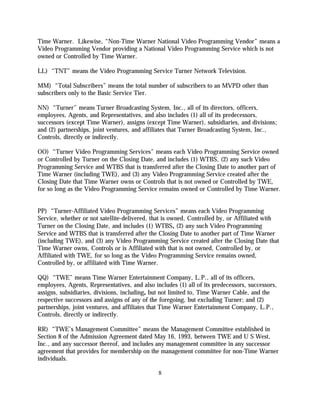
KK) “Time Warner National Video Programming Vendor” means a Video Programming
Vendor providing a National Video Programming Service which is owned or Controlled by

                                                7
Time Warner. Likewise, “Non-Time Warner National Video Programming Vendor” means a
Video Programming Vendor providing a National Video Programming Service which is not
owned or Controlled by Time Warner.

LL) “TNT” means the Video Programming Service Turner Network Television.

MM) “Total Subscribers” means the total number of subscribers to an MVPD other than
subscribers only to the Basic Service Tier.

NN) “Turner” means Turner Broadcasting System, Inc., all of its directors, officers,
employees, Agents, and Representatives, and also includes (1) all of its predecessors,
successors (except Time Warner), assigns (except Time Warner), subsidiaries, and divisions;
and (2) partnerships, joint ventures, and affiliates that Turner Broadcasting System, Inc.,
Controls, directly or indirectly.

OO) “Turner Video Programming Services” means each Video Programming Service owned
or Controlled by Turner on the Closing Date, and includes (1) WTBS, (2) any such Video
Programming Service and WTBS that is transferred after the Closing Date to another part of
Time Warner (including TWE), and (3) any Video Programming Service created after the
Closing Date that Time Warner owns or Controls that is not owned or Controlled by TWE,
for so long as the Video Programming Service remains owned or Controlled by Time Warner.


PP) “Turner-Affiliated Video Programming Services” means each Video Programming
Service, whether or not satellite-delivered, that is owned, Controlled by, or Affiliated with
Turner on the Closing Date, and includes (1) WTBS, (2) any such Video Programming
Service and WTBS that is transferred after the Closing Date to another part of Time Warner
(including TWE), and (3) any Video Programming Service created after the Closing Date that
Time Warner owns, Controls or is Affiliated with that is not owned, Controlled by, or
Affiliated with TWE, for so long as the Video Programming Service remains owned,
Controlled by, or affiliated with Time Warner.

QQ) “TWE” means Time Warner Entertainment Company, L.P., all of its officers,
employees, Agents, Representatives, and also includes (1) all of its predecessors, successors,
assigns, subsidiaries, divisions, including, but not limited to, Time Warner Cable, and the
respective successors and assigns of any of the foregoing, but excluding Turner; and (2)
partnerships, joint ventures, and affiliates that Time Warner Entertainment Company, L.P.,
Controls, directly or indirectly.

RR) “TWE’s Management Committee” means the Management Committee established in
Section 8 of the Admission Agreement dated May 16, 1993, between TWE and U S West,
Inc., and any successor thereof, and includes any management committee in any successor
agreement that provides for membership on the management committee for non-Time Warner
individuals.

                                               8
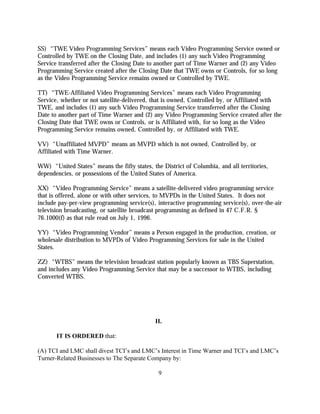
SS) “TWE Video Programming Services” means each Video Programming Service owned or
Controlled by TWE on the Closing Date, and includes (1) any such Video Programming
Service transferred after the Closing Date to another part of Time Warner and (2) any Video
Programming Service created after the Closing Date that TWE owns or Controls, for so long
as the Video Programming Service remains owned or Controlled by TWE.

TT) “TWE-Affiliated Video Programming Services” means each Video Programming
Service, whether or not satellite-delivered, that is owned, Controlled by, or Affiliated with
TWE, and includes (1) any such Video Programming Service transferred after the Closing
Date to another part of Time Warner and (2) any Video Programming Service created after the
Closing Date that TWE owns or Controls, or is Affiliated with, for so long as the Video
Programming Service remains owned, Controlled by, or Affiliated with TWE.

VV) “Unaffiliated MVPD” means an MVPD which is not owned, Controlled by, or
Affiliated with Time Warner.

WW) “United States” means the fifty states, the District of Columbia, and all territories,
dependencies, or possessions of the United States of America.

XX) “Video Programming Service” means a satellite-delivered video programming service
that is offered, alone or with other services, to MVPDs in the United States. It does not
include pay-per-view programming service(s), interactive programming service(s), over-the-air
television broadcasting, or satellite broadcast programming as defined in 47 C.F.R. §
76.1000(f) as that rule read on July 1, 1996.

YY) “Video Programming Vendor” means a Person engaged in the production, creation, or
wholesale distribution to MVPDs of Video Programming Services for sale in the United
States.

ZZ) “WTBS” means the television broadcast station popularly known as TBS Superstation,
and includes any Video Programming Service that may be a successor to WTBS, including
Converted WTBS.


                                             II.

       IT IS ORDERED that:

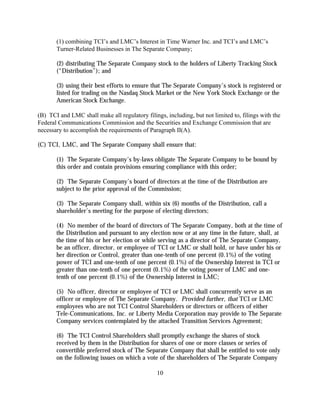
(A) TCI and LMC shall divest TCI’s and LMC’s Interest in Time Warner and TCI’s and LMC’s
Turner-Related Businesses to The Separate Company by:

                                               9
(1) combining TCI’s and LMC’s Interest in Time Warner Inc. and TCI’s and LMC’s
       Turner-Related Businesses in The Separate Company;

       (2) distributing The Separate Company stock to the holders of Liberty Tracking Stock
       (“Distribution”); and

       (3) using their best efforts to ensure that The Separate Company’s stock is registered or
       listed for trading on the Nasdaq Stock Market or the New York Stock Exchange or the
       American Stock Exchange.

(B) TCI and LMC shall make all regulatory filings, including, but not limited to, filings with the
Federal Communications Commission and the Securities and Exchange Commission that are
necessary to accomplish the requirements of Paragraph II(A).

(C) TCI, LMC, and The Separate Company shall ensure that:

       (1) The Separate Company’s by-laws obligate The Separate Company to be bound by
       this order and contain provisions ensuring compliance with this order;

       (2) The Separate Company’s board of directors at the time of the Distribution are
       subject to the prior approval of the Commission;

       (3) The Separate Company shall, within six (6) months of the Distribution, call a
       shareholder’s meeting for the purpose of electing directors;

       (4) No member of the board of directors of The Separate Company, both at the time of
       the Distribution and pursuant to any election now or at any time in the future, shall, at
       the time of his or her election or while serving as a director of The Separate Company,
       be an officer, director, or employee of TCI or LMC or shall hold, or have under his or
       her direction or Control, greater than one-tenth of one percent (0.1%) of the voting
       power of TCI and one-tenth of one percent (0.1%) of the Ownership Interest in TCI or
       greater than one-tenth of one percent (0.1%) of the voting power of LMC and one-
       tenth of one percent (0.1%) of the Ownership Interest in LMC;

       (5) No officer, director or employee of TCI or LMC shall concurrently serve as an
       officer or employee of The Separate Company. Provided further, that TCI or LMC
       employees who are not TCI Control Shareholders or directors or officers of either
       Tele-Communications, Inc. or Liberty Media Corporation may provide to The Separate
       Company services contemplated by the attached Transition Services Agreement;

       (6) The TCI Control Shareholders shall promptly exchange the shares of stock
       received by them in the Distribution for shares of one or more classes or series of
       convertible preferred stock of The Separate Company that shall be entitled to vote only
       on the following issues on which a vote of the shareholders of The Separate Company

                                                10
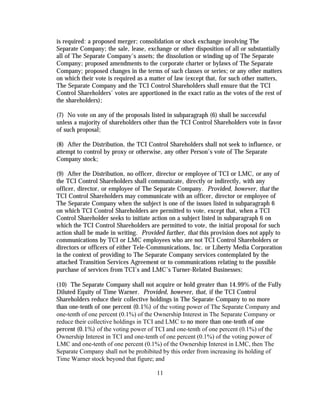
is required: a proposed merger; consolidation or stock exchange involving The
Separate Company; the sale, lease, exchange or other disposition of all or substantially
all of The Separate Company’s assets; the dissolution or winding up of The Separate
Company; proposed amendments to the corporate charter or bylaws of The Separate
Company; proposed changes in the terms of such classes or series; or any other matters
on which their vote is required as a matter of law (except that, for such other matters,
The Separate Company and the TCI Control Shareholders shall ensure that the TCI
Control Shareholders’ votes are apportioned in the exact ratio as the votes of the rest of
the shareholders);

(7) No vote on any of the proposals listed in subparagraph (6) shall be successful
unless a majority of shareholders other than the TCI Control Shareholders vote in favor
of such proposal;

(8) After the Distribution, the TCI Control Shareholders shall not seek to influence, or
attempt to control by proxy or otherwise, any other Person’s vote of The Separate
Company stock;

(9) After the Distribution, no officer, director or employee of TCI or LMC, or any of
the TCI Control Shareholders shall communicate, directly or indirectly, with any
officer, director, or employee of The Separate Company. Provided, however, that the
TCI Control Shareholders may communicate with an officer, director or employee of
The Separate Company when the subject is one of the issues listed in subparagraph 6
on which TCI Control Shareholders are permitted to vote, except that, when a TCI
Control Shareholder seeks to initiate action on a subject listed in subparagraph 6 on
which the TCI Control Shareholders are permitted to vote, the initial proposal for such
action shall be made in writing. Provided further, that this provision does not apply to
communications by TCI or LMC employees who are not TCI Control Shareholders or
directors or officers of either Tele-Communications, Inc. or Liberty Media Corporation
in the context of providing to The Separate Company services contemplated by the
attached Transition Services Agreement or to communications relating to the possible
purchase of services from TCI’s and LMC’s Turner-Related Businesses;

(10) The Separate Company shall not acquire or hold greater than 14.99% of the Fully
Diluted Equity of Time Warner. Provided, however, that, if the TCI Control
Shareholders reduce their collective holdings in The Separate Company to no more
than one-tenth of one percent (0.1%) of the voting power of The Separate Company and
one-tenth of one percent (0.1%) of the Ownership Interest in The Separate Company or
reduce their collective holdings in TCI and LMC to no more than one-tenth of one
percent (0.1%) of the voting power of TCI and one-tenth of one percent (0.1%) of the
Ownership Interest in TCI and one-tenth of one percent (0.1%) of the voting power of
LMC and one-tenth of one percent (0.1%) of the Ownership Interest in LMC, then The
Separate Company shall not be prohibited by this order from increasing its holding of
Time Warner stock beyond that figure; and

                                        11
(11) The Separate Company shall not acquire or hold, directly or indirectly, any
       Ownership Interest in Time Warner that is entitled to exercise voting power except (a) a
       vote of one-one hundredth (1/100) of a vote per share owned, voting with the outstanding
       common stock, with respect to the election of directors and (b) with respect to proposed
       changes in the charter of Time Warner Inc. or of the instrument creating such securities
       that would (i) adversely change any of the terms of such securities or (ii) adversely affect
       the rights, power, or preferences of such securities. Provided, however, that any portion
       of The Separate Company’s stock in Time Warner that is sold to an Independent Third
       Party may be converted into voting stock of Time Warner. Provided, further, that, if the
       TCI Control Shareholders reduce their collective holdings in The Separate Company to
       no more than one-tenth of one percent (0.1%) of the voting power of The Separate
       Company and one-tenth of one percent (0.1%) of the Ownership Interest in The Separate
       Company or reduce their collective holdings in both TCI and LMC to no more than one-
       tenth of one percent (0.1%) of the voting power of TCI and one-tenth of one percent
       (0.1%) of the Ownership Interest in TCI and one-tenth of one percent (0.1%) of the
       voting power of LMC and one-tenth of one percent (0.1%) of the Ownership Interest in
       LMC, The Separate Company’s Time Warner stock may be converted into voting stock
       of Time Warner.

(D) TCI and LMC shall use their best efforts to obtain a private letter ruling from the Internal
Revenue Service to the effect that the Distribution will be generally tax-free to both the
Liberty Tracking Stock holders and to TCI under Section 355 of the Internal Revenue Code of
1986, as amended (“IRS Ruling”). Upon receipt of the IRS Ruling, TCI and LMC shall have
thirty (30) days (excluding time needed to comply with the requirements of any federal
securities and communications laws and regulations, provided that TCI and LMC shall use
their best efforts to comply with all such laws and regulations) to carry out the requirements of
Paragraph II(A) and (B). Pending the IRS Ruling, or in the event that TCI and LMC are
unable to obtain the IRS Ruling,

       (1) TCI, LMC, Bob Magness and John C. Malone, collectively or individually, shall not
       acquire or hold, directly or indirectly, an Ownership Interest that is more than the lesser of
       9.2% of the Fully Diluted Equity of Time Warner or 12.4% of the actual issued and
       outstanding common stock of Time Warner, as determined by generally accepted
       accounting principles. Provided, however, that day-to-day market price changes that
       cause any such holding to exceed the latter threshold shall not be deemed to cause the
       parties to be in violation of this subparagraph; and

       (2) TCI, LMC and the TCI Control Shareholders shall not acquire or hold any
       Ownership Interest in Time Warner that is entitled to exercise voting power except (a)
       a vote of one-one hundredth (1/100) of a vote per share owned, voting with the
       outstanding common stock, with respect to the election of directors and (b) with respect
       to proposed changes in the charter of Time Warner Inc. or of the instrument creating
       such securities that would (i) adversely change any of the terms of such securities or


                                                12
(ii) adversely affect the rights, power, or preferences of such securities. Provided,
       however, that any portion of TCI’s and LMC’s Interest in Time Warner that is sold to
       an Independent Third Party may be converted into voting stock of Time Warner.

In the event that TCI and LMC are unable to obtain the IRS Ruling, TCI and LMC shall be
relieved of the obligations set forth in subparagraphs (A), (B) and (C).

                                                III.

       IT IS FURTHER ORDERED that

        After the Distribution, TCI, LMC, Bob Magness and John C. Malone, collectively or
individually, shall not acquire or hold, directly or indirectly, any voting power of, or other
Ownership Interest in, Time Warner that is more than the lesser of 1% of the Fully Diluted
Equity of Time Warner or 1.35% of the actual issued and outstanding common stock of Time
Warner, as determined by generally accepted accounting principles (provided, however, that such
interest shall not vote except as provided in Paragraph II(D)(2)), without the prior approval of the
Commission. Provided, further, that day-to-day market price changes that cause any such
holding to exceed the latter threshold shall not be deemed to cause the parties to be in violation
of this Paragraph.

                                                IV.

       IT IS FURTHER ORDERED that

(A) For six months after the Closing Date, TCI and Time Warner shall not enter into any new
Programming Service Agreement that requires carriage of any Turner Video Programming
Service on any analog Tier of TCI’s CATVs.

(B) Any Programming Service Agreement entered into thereafter that requires carriage of any
Turner Video Programming Service on TCI’s CATVs on an analog Tier shall be limited in
effective duration to five (5) years, except that such agreements may give TCI the unilateral
right(s) to renew such agreements for one or more five-year periods.

(C) Notwithstanding the foregoing, Time Warner, Turner and TCI may enter into, prior to the
Closing Date, agreements that require carriage on an analog Tier by TCI for no more than five
years for each of WTBS (with the five year period to commence at the time of WTBS’
conversion to Converted WTBS) and Headline News, and such agreements may give TCI the
unilateral right(s) to renew such agreements for one or more five-year periods.

                                                V.

       IT IS FURTHER ORDERED that


                                                13
Time Warner shall not, expressly or impliedly:

(A) refuse to make available or condition the availability of HBO to any MVPD on whether
that MVPD or any other MVPD agrees to carry any Turner-Affiliated Video Programming
Service;

(B) condition any Carriage Terms for HBO to any MVPD on whether that MVPD or any other
MVPD agrees to carry any Turner-Affiliated Video Programming Service;

(C) refuse to make available or condition the availability of each of CNN, WTBS, or TNT to
any MVPD on whether that MVPD or any other MVPD agrees to carry any TWE-Affiliated
Video Programming Service; or

(D) condition any Carriage Terms for each of CNN, WTBS, or TNT to any MVPD on
whether that MVPD or any other MVPD agrees to carry any TWE-Affiliated Video
Programming Service.

                                              VI.

       IT IS FURTHER ORDERED that

(A) For subscribers that a Competing MVPD services in the Service Area Overlap, Time
Warner shall provide, upon request, any Turner Video Programming Service to that
Competing MVPD at Carriage Terms no less favorable, relative to the Carriage Terms then
offered by Time Warner for that Service to the three MVPDs with the greatest number of
subscribers, than the Carriage Terms offered by Turner to Similarly Situated MVPDs relative
to the Carriage Terms offered by Turner to the three MVPDs with the greatest number of
subscribers for that Service on July 30, 1996. For Turner Video Programming Services not in
existence on July 30, 1996, the pre-Closing Date comparison will be to relative Carriage
Terms offered with respect to any Turner Video Programming Service existing as of July 30,
1996.

(B) Time Warner shall be in violation of this Paragraph if the Carriage Terms it offers to the
Competing MVPD for those subscribers outside the Service Area Overlap are set at a higher
level compared to Similarly Situated MVPDs so as to avoid the restrictions set forth in
subparagraph (A).

                                              VII.

       IT IS FURTHER ORDERED that

(A) Time Warner shall not require a financial interest in any National Video Programming
Service as a condition for carriage on one or more Time Warner CATVs.


                                              14
(B) Time Warner shall not coerce any National Video Programming Vendor to provide, or
retaliate against such a Vendor for failing to provide exclusive rights against any other MVPD
as a condition for carriage on one or more Time Warner CATVs.

(C) Time Warner shall not engage in conduct the effect of which is to unreasonably restrain
the ability of a Non-Time Warner National Video Programming Vendor to compete fairly by
discriminating in video programming distribution on the basis of affiliation or nonaffiliation of
Vendors in the selection, terms, or conditions for carriage of video programming provided by
such Vendors.

                                              VIII.

       IT IS FURTHER ORDERED that

(A) Time Warner shall collect the following information, on a quarterly basis:

       (1) for any and all offers made to Time Warner’s corporate office by a Non-Time
       Warner National Video Programming Vendor to enter into or to modify any
       Programming Service Agreement for carriage on an Time Warner CATV, in that
       quarter:

               a) the identity of the National Video Programming Vendor;

               b) a description of the type of programming;

               c) any and all Carriage Terms as finally agreed to or, when there is no final
               agreement but the Vendor’s initial offer is more than three months old, the last
               offer of each side;

               d) any and all commitment(s) to a roll-out schedule, if applicable, as finally
               agreed to or, when there is no final agreement but the Vendor’s initial offer is
               more than three months old, the last offer of each side;

               e) a copy of any and all Programming Service Agreement(s) as finally agreed to
               or, when there is no final agreement but the Vendor’s initial offer is more than
               three months old, the last offer of each side; and

       (2) on an annual basis for each National Video Programming Service on Time Warner
       CATVs, the actual carriage rates on Time Warner CATVs and

               (a) the average carriage rates on all Non-Time Warner CATVs for each
               National Video Programming Service that has publicly-available information
               from which Penetration Rates can be derived; and


                                               15
(b) the carriage rates on each of the fifty (50) largest (in total number of
              subscribers) Non-Time Warner CATVs for each National Video Programming
              Service that has publicly-available information from which Penetration Rates
              can be derived.

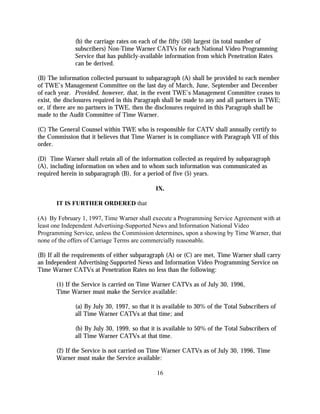
(B) The information collected pursuant to subparagraph (A) shall be provided to each member
of TWE’s Management Committee on the last day of March, June, September and December
of each year. Provided, however, that, in the event TWE’s Management Committee ceases to
exist, the disclosures required in this Paragraph shall be made to any and all partners in TWE;
or, if there are no partners in TWE, then the disclosures required in this Paragraph shall be
made to the Audit Committee of Time Warner.

(C) The General Counsel within TWE who is responsible for CATV shall annually certify to
the Commission that it believes that Time Warner is in compliance with Paragraph VII of this
order.

(D) Time Warner shall retain all of the information collected as required by subparagraph
(A), including information on when and to whom such information was communicated as
required herein in subparagraph (B), for a period of five (5) years.

                                              IX.

       IT IS FURTHER ORDERED that

(A) By February 1, 1997, Time Warner shall execute a Programming Service Agreement with at
least one Independent Advertising-Supported News and Information National Video
Programming Service, unless the Commission determines, upon a showing by Time Warner, that
none of the offers of Carriage Terms are commercially reasonable.

(B) If all the requirements of either subparagraph (A) or (C) are met, Time Warner shall carry
an Independent Advertising-Supported News and Information Video Programming Service on
Time Warner CATVs at Penetration Rates no less than the following:

       (1) If the Service is carried on Time Warner CATVs as of July 30, 1996,
       Time Warner must make the Service available:

              (a) By July 30, 1997, so that it is available to 30% of the Total Subscribers of
              all Time Warner CATVs at that time; and

              (b) By July 30, 1999, so that it is available to 50% of the Total Subscribers of
              all Time Warner CATVs at that time.

       (2) If the Service is not carried on Time Warner CATVs as of July 30, 1996, Time
       Warner must make the Service available:

                                              16
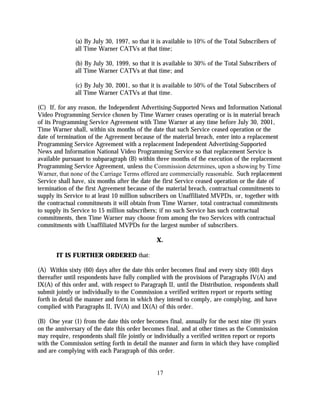
(a) By July 30, 1997, so that it is available to 10% of the Total Subscribers of
               all Time Warner CATVs at that time;

               (b) By July 30, 1999, so that it is available to 30% of the Total Subscribers of
               all Time Warner CATVs at that time; and

               (c) By July 30, 2001, so that it is available to 50% of the Total Subscribers of
               all Time Warner CATVs at that time.

(C) If, for any reason, the Independent Advertising-Supported News and Information National
Video Programming Service chosen by Time Warner ceases operating or is in material breach
of its Programming Service Agreement with Time Warner at any time before July 30, 2001,
Time Warner shall, within six months of the date that such Service ceased operation or the
date of termination of the Agreement because of the material breach, enter into a replacement
Programming Service Agreement with a replacement Independent Advertising-Supported
News and Information National Video Programming Service so that replacement Service is
available pursuant to subparagraph (B) within three months of the execution of the replacement
Programming Service Agreement, unless the Commission determines, upon a showing by Time
Warner, that none of the Carriage Terms offered are commercially reasonable. Such replacement
Service shall have, six months after the date the first Service ceased operation or the date of
termination of the first Agreement because of the material breach, contractual commitments to
supply its Service to at least 10 million subscribers on Unaffiliated MVPDs, or, together with
the contractual commitments it will obtain from Time Warner, total contractual commitments
to supply its Service to 15 million subscribers; if no such Service has such contractual
commitments, then Time Warner may choose from among the two Services with contractual
commitments with Unaffiliated MVPDs for the largest number of subscribers.

                                               X.

       IT IS FURTHER ORDERED that:

(A) Within sixty (60) days after the date this order becomes final and every sixty (60) days
thereafter until respondents have fully complied with the provisions of Paragraphs IV(A) and
IX(A) of this order and, with respect to Paragraph II, until the Distribution, respondents shall
submit jointly or individually to the Commission a verified written report or reports setting
forth in detail the manner and form in which they intend to comply, are complying, and have
complied with Paragraphs II, IV(A) and IX(A) of this order.

(B) One year (1) from the date this order becomes final, annually for the next nine (9) years
on the anniversary of the date this order becomes final, and at other times as the Commission
may require, respondents shall file jointly or individually a verified written report or reports
with the Commission setting forth in detail the manner and form in which they have complied
and are complying with each Paragraph of this order.


                                               17
XI.

        IT IS FURTHER ORDERED that respondents shall notify the Commission at least
thirty (30) days prior to any proposed change in respondents (other than this Acquisition) such
as dissolution, assignment, sale resulting in the emergence of a successor corporation, or the
creation or dissolution of subsidiaries or any other change in the corporation that may affect
compliance obligations arising out of the order.

                                              XII.

       IT IS FURTHER ORDERED that, for the purpose of determining or securing
compliance with this order, and subject to any legally recognized privilege, upon written
request, respondents shall permit any duly authorized representative of the Commission:

1.     Access, during regular business hours upon reasonable notice and in the presence of
counsel for respondents, to inspect and copy all books, ledgers, accounts, correspondence,
memoranda and other records and documents in the possession or under the control of
respondents relating to any matters contained in this order; and

2.      Upon five days' notice to respondents and without restraint or interference from it, to
interview officers, directors, or employees of respondents, who may have counsel present,
regarding such matters.

                                             XIII.

        IT IS FURTHER ORDERED THAT this order shall terminate ten (10) years from
the date this order becomes final.


                                               18
Signed this _____ day of _______________, 19____.

TIME WARNER INC., A CORPORATION

    By:   ________________________
          Gerald M. Levin

          ________________________
          Counsel for Time Warner Inc.

TURNER BROADCASTING SYSTEM, INC., A CORPORATION

    By:   ________________________
          General Counsel

          ________________________
          Counsel for Turner Broadcasting System, Inc.

TELE-COMMUNICATIONS, INC., A CORPORATION

    By:   ________________________
          John C. Malone

          ________________________
          Counsel for Tele-Communications, Inc.

LIBERTY MEDIA CORPORATION, A CORPORATION

    By:   ________________________
          Vice President

          ________________________
          Counsel for Liberty Media Corporation


                                         19
FEDERAL TRADE COMMISSION


       By:
              _____________________


              _____________________
              James A. Fishkin
              Thomas N. Dahdouh
              Attorneys
              Bureau of Competition


Approved:


____________________
Robert W. Doyle, Jr.
Deputy Assistant Director
Bureau of Competition


____________________
Willard K. Tom
Assistant Director
Bureau of Competition


____________________
George S. Cary
Senior Deputy Director
Bureau of Competition


____________________
William J. Baer
Director
Bureau of Competition


                                      20
Appendix I

                            UNITED STATES OF AMERICA
                        BEFORE FEDERAL TRADE COMMISSION
____________________________________
                                      )
                                      )
 In the Matter of                     )
                                      )
TIME WARNER INC.,                     )
        a corporation;                )
                                      )
TURNER BROADCASTING                   )
SYSTEM, INC.,                         )
        a corporation;                )
                                      )              File No. 961-0004
TELE-COMMUNICATIONS, INC.,            )
        a corporation; and            )
                                      )
LIBERTY MEDIA CORPORATION,            )
        a corporation.                )
                                      )
____________________________________)


                                 INTERIM AGREEMENT


        This Interim Agreement is by and between Time Warner Inc. (“Time Warner”), a
corporation organized, existing, and doing business under and by virtue of the law of the State
of Delaware, with its office and principal place of business at New York, New York; Turner
Broadcasting System, Inc. (“Turner”), a corporation organized, existing, and doing business
under and by virtue of the law of the State of Georgia with its office and principal place of
business at Atlanta, Georgia; Tele-Communications, Inc. (“TCI”), a corporation organized,
existing, and doing business under and by virtue of the law of the State of Delaware, with its
office and principal place of business located at Englewood, Colorado; Liberty Media Corp.
(“LMC”), a corporation organized, existing and doing business under and by virtue of the law
of the State of Delaware, with its office and principal place of business located at Englewood,
Colorado; and the Federal Trade Commission ("Commission"), an independent agency of the
United States Government, established under the Federal Trade Commission Act of 1914, 15
Interim Agreement                                                                Page 2 of 5


U.S.C. § 41 et seq.

        WHEREAS Time Warner entered into an agreement with Turner for Time Warner to
acquire the outstanding voting securities of Turner, and TCI and LMC proposed to acquire
stock in Time Warner (hereinafter "the Acquisition");

      WHEREAS the Commission is investigating the Acquisition to determine whether it
would violate any statute enforced by the Commission;

         WHEREAS TCI and LMC are willing to enter into an Agreement Containing Consent
Order (hereafter “Consent Order”) requiring them, inter alia, to divest TCI’s and LMC’s
Interest in Time Warner and TCI’s and LMC’s Turner-Related Businesses,” by contributing
those interests to a separate corporation, The Separate Company, the stock of which will be
distributed to the holders of Liberty Tracking Stock (“the Distribution”), but, in order to
fulfill paragraph II(D) of that Consent Order, TCI and LMC must apply now to receive an
Internal Revenue Service ruling as to whether the Distribution will be generally tax-free to
both the Liberty Tracking Stock holders and to TCI under Section 355 of the Internal Revenue
Code of 1986, as amended (“IRS Ruling”);

        WHEREAS “TCI’s and LMC’s Interest in Time Warner” means all of the economic
interest in Time Warner to be acquired by TCI and LMC, including the right of first refusal
with respect to Time Warner stock to be held by R. E. Turner, III, pursuant to the
Shareholders Agreement dated September 22, 1995 with LMC or any successor agreement;

       WHEREAS “TCI’s and LMC’s Turner-Related Businesses” means the businesses
conducted by Southern Satellite Systems, Inc., a subsidiary of TCI which is principally in the
business of distributing WTBS to MVPDs;

       WHEREAS “Liberty Tracking Stock” means Tele-Communications, Inc. Series A
Liberty Media Group Common Stock and Tele-Communications, Inc. Series B Liberty Media
Group Common Stock;

       WHEREAS Time Warner, Turner, TCI, and LMC are willing to enter into a Consent
Order requiring them, inter alia, to forego entering into certain new programming service
agreements for a period of six months from the date that the parties close this Acquisition
(“Closing Date”), but, in order to comply more fully with that requirement, they must cancel
now the two agreements that were negotiated as part of this Acquisition: namely, (1) the
September 15, 1995, program service agreement between TCI’s subsidiary, Satellite Services,
Inc. (“SSI”), and Turner and (2) the September 14, 1995, cable carriage agreement between
SSI and Time Warner for WTBS (hereafter “Two Programming Service Agreements”);

       WHEREAS if the Commission accepts the attached Consent Order, the Commission is
Interim Agreement                                                                 Page 3 of 5


required to place the Consent Order on the public record for a period of at least sixty (60) days
and may subsequently withdraw such acceptance pursuant to the provisions of Rule 2.34 of the
Commission's Rules of Practice and Procedure, 16 C.F.R. § 2.34;

       WHEREAS the Commission is concerned that if the parties do not, before this order is
made final, apply to the IRS for the IRS Ruling and cancel the Two Programming Service
Agreements, compliance with the operative provisions of the Consent Order might not be
possible or might produce a less than effective remedy;

        WHEREAS Time Warner, Turner, TCI, and LMC’s entering into this Agreement
shall in no way be construed as an admission by them that the Acquisition is illegal;

       WHEREAS Time Warner, Turner, TCI, and LMC understand that no act or
transaction contemplated by this Agreement shall be deemed immune or exempt from the
provisions of the antitrust laws or the Federal Trade Commission Act by reason of anything
contained in this Agreement;

         NOW, THEREFORE, upon understanding that the Commission has not yet
determined whether the Acquisition will be challenged, and in consideration of the
Commission's agreement that, unless the Commission determines to reject the Consent Order,
it will not seek further relief from Time Warner, Turner, TCI, and LMC with respect to the
Acquisition, except that the Commission may exercise any and all rights to enforce this
Agreement and the Consent Order to which this Agreement is annexed and made a part
thereof, the parties agree as follows:

       1.     Within thirty (30) days of the date the Commission accepts the attached Consent
              Order for public comment, TCI and LMC shall apply to the IRS for the IRS
              Ruling.

       2.     On or before the Closing Date, Time Warner, Turner and TCI shall cancel the
              Two Programming Service Agreements.

       3.     This Agreement shall be binding when approved by the Commission.


Dated: _____________________


FOR THE FEDERAL TRADE COMMISSION
Interim Agreement                                          Page 4 of 5


______________________


______________________
Stephen Calkins
General Counsel


FOR TIME WARNER INC., A CORPORATION

      By:   ________________________
            Gerald A. Levin


            ________________________

            Counsel for Time Warner Inc.

FOR TURNER BROADCASTING SYSTEM, INC., A CORPORATION

      By:   ________________________

            General Counsel

            ________________________

            Counsel for Turner Broadcasting System, Inc.

FOR TELE-COMMUNICATIONS, INC., A CORPORATION

      By:   ________________________
            John C. Malone

            ________________________

            Counsel for Tele-Communications, Inc.
FOR LIBERTY MEDIA CORPORATION, A CORPORATION

       By:    ________________________

              Vice President

              ________________________

              Counsel for Liberty Media Corporation

[Appendix II attached to paper copies but not available in electronic format]
UNITED STATES OF AMERICA
                        BEFORE FEDERAL TRADE COMMISSION

____________________________________
                                    )
     In the Matter of               )
                                    )
TIME WARNER INC.,                   )
      a corporation;                )
                                    )
TURNER BROADCASTING                 )
SYSTEM, INC.,                       )               Docket No.
      a corporation;                )
                                    )
TELE-COMMUNICATIONS, INC.,          )
      a corporation; and            )
                                    )
LIBERTY MEDIA CORPORATION,          )
      a corporation.                )
____________________________________)


                                         COMPLAINT

        Pursuant to the provisions of the Federal Trade Commission Act and the Clayton Act,
and by virtue of the authority vested in it by said Acts, the Federal Trade Commission
("Commission"), having reason to believe that respondents Time Warner Inc., Turner
Broadcasting System, Inc., Tele-Communications, Inc., and Liberty Media Corporation, all
subject to the jurisdiction of the Commission, have entered into various agreements in
violation of Section 5 of the Federal Trade Commission Act, as amended, 15 U.S.C. § 45,
and that if the terms of such agreements were to be consummated, would result in a violation
of Section 7 of the Clayton Act, as amended, 15 U.S.C. § 18, and Section 5 of the Federal
Trade Commission Act, as amended, 15 U.S.C. § 45, and it appearing to the Commission that
a proceeding in respect thereof would be in the public interest, hereby issues its complaint,
stating its charges as follows:

                                         I. Definitions

1.      For the purposes of this complaint, the following definitions shall apply:

      a.     "Cable Television Programming Service" means satellite-delivered video
programming that is offered, alone or with other services, to Multichannel Video
Programming Distributors ("MVPDs") in the United States.
b.     "Fully Diluted Equity of Time Warner" means all Time Warner common stock
actually issued and outstanding plus the aggregate number of shares of Time Warner common
stock that would be issued and outstanding assuming the exercise of all outstanding options,
warrants and rights (excluding shares that would be issued in the event a poison pill is
triggered) and the conversion of all outstanding securities that are convertible into Time
Warner common stock.

        c.       "Multichannel Video Programming Distributor" or "MVPD" means a person
providing multiple channels of video programming to subscribers in the United States for
which a fee is charged, by any of various methods including, but not limited to, cable, satellite
master antenna television, multichannel multipoint distribution, direct-to-home satellite (C-
band, Ku-band, direct broadcast satellite), ultra high-frequency microwave systems (sometimes
called LMDS), open video systems, or the facilities of common carrier telephone companies
or their affiliates, as well as buying groups or purchasing agents of all such persons.

       d.       "Turner Cable Television Programming Service" means each Cable Television
Programming Service, whether or not satellite-delivered, that is currently owned, controlled
by, or affiliated with Turner.

                               II. Respondent Time Warner Inc.

2.     Respondent Time Warner Inc. ("Time Warner") is a corporation organized, existing,
and doing business under and by virtue of the laws of the State of Delaware, with its
headquarters office and principal place of business located at 75 Rockefeller Plaza, New York,
New York 10019. Time Warner had sales of approximately $8 billion in 1995.

3.       Respondent Time Warner is, and at all times relevant herein has been, engaged in the
sale of Cable Television Programming Services to MVPDs throughout the United States.
Time Warner's primary Cable Television Programming Services include Home Box Office
("HBO") and Cinemax, and their multiplexed versions. Other Cable Television Programming
Services that are controlled by or affiliated with Time Warner include E! Entertainment
Television, Comedy Central, and Court TV. Time Warner also owns approximately 20
percent of the outstanding stock of Turner. Time Warner is the nation's largest producer of
Cable Television Programming Services sold to MVPDs, measured on the basis of
subscription revenues. Time Warner's subscription revenues from the sale of Cable
Television Programming Services to MVPDs in 1995 were approximately $1.5 billion, and its
total revenues from Cable Television Programming Services in 1995 were approximately $1.6
billion.

4.     Respondent Time Warner's HBO, the largest Cable Television Programming Service
measured on the basis of subscription revenues, is viewed by MVPDs as a "marquee" or
"crown jewel" service, i.e., those services necessary to attract and retain a significant
percentage of their subscribers.
5.     Respondent Time Warner is, and at all times relevant herein has been, an MVPD.

                                               2
Time Warner currently serves, either directly or indirectly, approximately 11.5 million
households in selected areas in the United States. These 11.5 million households are
approximately 17 percent of all of the households in the United States that purchase Cable
Television Programming Services from MVPDs. Time Warner is the nation's second largest
MVPD. Time Warner's total revenues in 1995 from serving as an MVPD were approximately
$3.25 billion.

6.     Respondent Time Warner is, and at all times relevant herein has been, engaged in
commerce as "commerce" is defined in Section 1 of the Clayton Act, as amended, 15 U.S.C.
§ 12, and is a corporation whose business is in or affecting commerce as "commerce" is
defined in Section 4 of the Federal Trade Commission Act, as amended, 15 U.S.C. § 44.

                     III. Respondent Turner Broadcasting System, Inc.

7.     Respondent Turner Broadcasting System, Inc. ("Turner") is a corporation existing and
doing business under and by virtue of the laws of the State of Georgia with its headquarters
and principal place of business located at One CNN Center, Atlanta, Georgia 30348. Turner
had sales of approximately $3.4 billion in 1995.

8.     Respondent Turner is, and at all times relevant herein has been, engaged in the sale of
Cable Television Programming Services to MVPDs throughout the United States. Turner's
Cable Television Programming Services include Cable News Network ("CNN"), Headline
News ("HLN"), Turner Network Television ("TNT"), TBS Superstation ("WTBS"), Cartoon
Network, Turner Classic Movies ("TCM"), CNN International USA ("CNNI USA"), CNN
Financial Network ("CNNfn"), and services emphasizing regional sports programming.
Turner is one of the nation's largest producers of Cable Television Programming Services sold
to MVPDs as measured by subscription revenue. Turner's subscription revenues from the sale
of Cable Television Programming Services to MVPDs in 1995 were approximately $700
million, and its total revenues from Cable Television Programming Services in 1995 were
approximately $2 billion. As a programmer that does not own its own distribution systems,
Turner had no incentive to, and generally did not, charge significantly higher prices for the
same Cable Television Programming Services to new MVPD entrants compared to the prices
offered to established MVPDs.

9.     Respondent Turner's CNN, TNT, and WTBS are viewed by MVPDs as "marquee" or
"crown jewel" services, i.e., those services necessary to attract and retain a significant
percentage of their subscribers.

10.     Respondent Turner is, and at all times relevant herein has been, engaged in commerce
as "commerce" is defined in Section 1 of the Clayton Act, as amended, 15 U.S.C. § 12, and is
a corporation whose business is in or affecting commerce as "commerce" is defined in Section
4 of the Federal Trade Commission Act, as amended, 15 U.S.C. § 44.

                         IV. Respondent Tele-Communications, Inc.

                                              3
11.    Respondent Tele-Communications, Inc. ("TCI") is a corporation existing and doing
business under and by virtue of the laws of the State of Delaware, with its headquarters and
principal place of business located at 5619 DTC Parkway, Englewood, Colorado 80111. TCI
had sales of approximately $6.85 billion in 1995.

12.    Respondent TCI is, and at all times relevant herein has been, engaged in the sale of
Cable Television Programming Services to MVPDs throughout the United States. Some of the
larger Cable Television Programming Services that are controlled by or affiliated with TCI
include Starz!, Encore, Discovery Channel, The Learning Channel, Court TV, E!
Entertainment Television, BET, The Family Channel, Home Shopping Network, and services
emphasizing regional sports programming. TCI also owns, directly or indirectly,
approximately 24 percent of the outstanding stock of Turner. TCI's subscription revenues
from the sale of Cable Television Programming Services controlled by TCI to MVPDs in 1995
were approximately $300 million. TCI's total revenues, excluding home shopping retail sales,
from Cable Television Programming Services that are controlled by or affiliated with TCI in
1995 were approximately $520 million.

13.    Respondent TCI is, and at all times relevant herein has been, an MVPD. TCI
currently serves approximately 14 million households in selected areas in the United States.
TCI also has either direct or indirect interests in cable television systems that distribute Cable
Television Programming Services to an additional approximately 4 million households in the
United States. These 18 million households are approximately 27 percent of all of the
households in the United States that subscribe to Cable Television Programming Services from
MVPDs. TCI is the nation's largest MVPD. TCI's total revenues in 1995 from serving as an
MVPD were approximately $5 billion.

14.     Respondent TCI is, and at all times relevant herein has been, engaged in commerce as
"commerce" is defined in Section 1 of the Clayton Act, as amended, 15 U.S.C. § 12, and is a
corporation whose business is in or affecting commerce as "commerce" is defined in Section 4
of the Federal Trade Commission Act, as amended, 15 U.S.C. § 44.

                          V. Respondent Liberty Media Corporation

15.    Respondent Liberty Media Corporation ("LMC") is a corporation existing and doing
business under and by virtue of the laws of the State of Delaware, with its headquarters and
principal place of business located at 8101 East Prentice Avenue, Englewood, Colorado
80111. LMC is a wholly-owned subsidiary of Respondent TCI.

16.    Respondent LMC is, and at all times relevant herein has been, engaged in the sale of
Cable Television Programming Services to MVPDs throughout the United States.

17.    Respondent LMC is, and at all times relevant herein has been, engaged in commerce as
"commerce" is defined in Section 1 of the Clayton Act, as amended, 15 U.S.C. § 12, and is a
corporation whose business is in or affecting commerce as "commerce" is defined in Section 4

                                                4
of the Federal Trade Commission Act, as amended, 15 U.S.C. § 44.

                                     VI. The Agreements

18.     This matter comprises three related principal agreements: (a) the acquisition by Time
Warner of Turner; (b) the acquisition by TCI and LMC of an interest in Time Warner; and (c)
the long-term mandatory carriage agreements between TCI, Turner, and Time Warner
requiring TCI to carry Turner's CNN, Headline News, TNT, and WTBS at a discounted price
based on the industry average price.

              A.      The Time Warner-Turner Acquisition

19.    On or about September 22, 1995, Respondent Time Warner and Respondent Turner
entered into an agreement for Time Warner to acquire the approximately 80 percent of the
outstanding shares in Turner that it does not already own.

20.    The value of the Time Warner-Turner acquisition as of the date the Time Warner-
Turner agreement was entered into was approximately $7.5 billion. As initially structured, the
transaction called for each share of Turner Class A Common Stock and Turner Class B
Common Stock to be converted into the right to receive .75 of a share of New Time Warner
Common Stock. In addition, each share of Turner Class C Convertible Preferred Stock was to
be converted into the right to receive 4.8 shares of New Time Warner Common Stock.

              B.      The TCI-Time Warner Acquisition

21.     Respondents TCI and LMC have, directly or indirectly, an approximately 24 percent
existing interest in Respondent Turner. By trading their interest in Turner for an interest in
Time Warner, TCI and LMC would have acquired approximately a 7.5 percent interest in the
Fully Diluted Equity of Time Warner, or approximately 10 percent of the outstanding shares
of Time Warner, valued at approximately $2 billion as of the date the Respondents signed the
proposed consent agreement.

22.     Respondent TCI also would acquire a right of first refusal on the approximately 7.4
percent interest in the Fully Diluted Equity of Time Warner that R. E. Turner, III, chairman
of Turner, would receive as result of trading his interest in Turner for an interest in
Respondent Time Warner. Although Time Warner has a "poison pill" that would prevent TCI
from acquiring more than a certain amount of stock without triggering adverse consequences,
that poison pill would still allow TCI to acquire approximately 15 percent of the Fully Diluted
Equity of Time Warner, and if the poison pill were to be altered or waived, TCI could acquire
more than 15 percent of the Fully Diluted Equity of Time Warner.


              C.      The Long-Term Mandatory Carriage Agreements


                                               5
23.     On or about September 14, 1995, and September 15, 1995, in anticipation of and
contingent upon the Time Warner-Turner and TCI-Time Warner acquisitions, TCI, Turner,
and Time Warner entered into two long-term mandatory carriage agreements formally referred
to as the Programming Services Agreements ("PSAs"). Under the terms of these PSAs, TCI
would be required, on virtually all of its cable television systems, to carry CNN, Headline
News, TNT, and WTBS for a 20-year period. The price to TCI would be 85 percent of the
average price paid by the rest of the industry for these services.

                                  VII. Trade and Commerce

24.     One relevant line of commerce (i.e., the product market) in which to analyze the
effects of the proposed transaction is the sale of Cable Television Programming Services to
MVPDs.

25.    Another relevant line of commerce in which to analyze the effects of the proposed
transaction is the sale of Cable Television Programming Services to households.

26.     Cable Television Programming Services are a relevant line of commerce because over-
the-air broadcast television, video cassette rentals, and other forms of news and entertainment
do not have a sufficient price-constraining effect on the sales of Cable Television
Programming Services to MVPDs, or the resale of Cable Television Programming Services by
MVPDs to households so as to prevent the exercise of market power.

27.     The relevant section of the country (i.e., the geographic market) in which to analyze
the effects of the sale of Cable Television Programming Services to MVPDs is the entire
United States.

28.     The entire United States is the relevant section of the country in which to analyze the
effects of the proposed transactions in the sale of Cable Television Programming Services to
MVPDs because most Cable Television Programming Services are distributed throughout the
United States.

29.    The relevant sections of the country in which to analyze the effects of the sale of Cable
Television Programming Services by MVPDs to households are each of the local areas in
which either Respondent Time Warner or Respondent TCI operate as MVPDs.

                                    VIII. Market Structure

30.    The sale of Cable Television Programming Services to MVPDs in the United States is
highly concentrated, whether measured by the Herfindahl-Hirschman Index (commonly
referred to as "HHI") or by two-firm and four-firm concentration ratios.


                                               6
31.     The post-acquisition HHI for the sale of Cable Television Programming Services to
MVPDs in the United States measured on the basis of subscription revenues would increase by
approximately 663 points, from 1,549 to 2,212, and will increase further if Time Warner
converts WTBS from a "superstation" to a cable network charging subscriber fees. Post-
acquisition Time Warner will be the largest provider of Cable Television Programming
Services to MVPDs in the United States and its market share will be in excess of 40 percent.

32.     The post-acquisition HHI in the sale of Cable Television Programming Services by
MVPDs to households in each of the local areas in which Respondent Time Warner and
Respondent TCI sell Cable Television Programming Services is unchanged from the proposed
acquisitions and remains highly-concentrated. Time Warner, as an MVPD, serves, either
directly or indirectly, approximately 11.5 million households in selected areas in the United
States that represent approximately 17 percent of all of the households in the United States that
purchase Cable Television Programming Services. TCI, as an MVPD, serves, either directly
or indirectly, approximately 18 million households that represent 27 percent of all of the
households in the United States that subscribe to Cable Television Programming Services.

                                     XI. Entry Conditions

33.    Entry into the relevant markets is difficult, and would not be timely, likely or sufficient
to prevent anticompetitive effects.

34.     Entry into the production of Cable Television Programming Services for sale to
MVPDs that would have a significant market impact and prevent the anticompetitive effects is
difficult. It generally takes more than two years to develop a Cable Television Programming
Service to a point where it has a substantial subscriber base and competes directly with the
Time Warner and Turner "marquee" or "crown jewel" services throughout the United States.
Timely entry is made even more difficult and time consuming due to a shortage of available
channel capacity.

35.     Entry into the sale of Cable Television Programming Services to households in each of
the local areas in which Respondent Time Warner and Respondent TCI operate as MVPDs is
dependent upon access to a substantial majority of the high quality, "marquee" or "crown
jewel" programming that MVPD subscribers deem important to their decision to subscribe,
and that such access is threatened by increasing concentration at the programming level,
combined with vertical integration of such programming into the MVPD level.

                                   X. Competition Affected

36.     Respondent Time Warner and Respondent Turner are actual competitors with each
other and with other sellers in the sale of Cable Television Programming Services to MVPDs,
and Time Warner's HBO, and Turner's CNN, TNT, and WTBS, are a large percentage of the
limited number of "marquee" or "crown jewel" Cable Television Programming Services which
disproportionately attract subscribers to MVPDs.

                                                7
37.    Respondent Time Warner faces actual and potential competition from other MVPDs
and potential MVPD entrants in the sale of Cable Television Programming Services to
households in each of the local areas in which it serves as an MVPD.

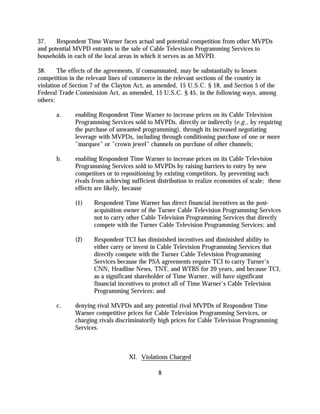
38.     The effects of the agreements, if consummated, may be substantially to lessen
competition in the relevant lines of commerce in the relevant sections of the country in
violation of Section 7 of the Clayton Act, as amended, 15 U.S.C. § 18, and Section 5 of the
Federal Trade Commission Act, as amended, 15 U.S.C. § 45, in the following ways, among
others:

       a.     enabling Respondent Time Warner to increase prices on its Cable Television
              Programming Services sold to MVPDs, directly or indirectly (e.g., by requiring
              the purchase of unwanted programming), through its increased negotiating
              leverage with MVPDs, including through conditioning purchase of one or more
              "marquee" or "crown jewel" channels on purchase of other channels;

       b.     enabling Respondent Time Warner to increase prices on its Cable Television
              Programming Services sold to MVPDs by raising barriers to entry by new
              competitors or to repositioning by existing competitors, by preventing such
              rivals from achieving sufficient distribution to realize economies of scale; these
              effects are likely, because

              (1)    Respondent Time Warner has direct financial incentives as the post-
                     acquisition owner of the Turner Cable Television Programming Services
                     not to carry other Cable Television Programming Services that directly
                     compete with the Turner Cable Television Programming Services; and

              (2)    Respondent TCI has diminished incentives and diminished ability to
                     either carry or invest in Cable Television Programming Services that
                     directly compete with the Turner Cable Television Programming
                     Services because the PSA agreements require TCI to carry Turner's
                     CNN, Headline News, TNT, and WTBS for 20 years, and because TCI,
                     as a significant shareholder of Time Warner, will have significant
                     financial incentives to protect all of Time Warner's Cable Television
                     Programming Services; and

       c.     denying rival MVPDs and any potential rival MVPDs of Respondent Time
              Warner competitive prices for Cable Television Programming Services, or
              charging rivals discriminatorily high prices for Cable Television Programming
              Services.


                                   XI. Violations Charged

                                               8
39.    The agreement entered into between Time Warner and Turner for Time Warner to
acquire Turner violates Section 5 of the Federal Trade Commission Act, as amended, 15
U.S.C. § 45, and would, if consummated, violate Section 7 of the Clayton Act, as amended,
15 U.S.C. § 18, and Section 5 of the Federal Trade Commission Act, as amended, 15 U.S.C.
§ 45.

40.     The agreement entered into between TCI, LMC, and Time Warner for TCI and LMC
to acquire an equity interest in Time Warner violates Section 5 of the Federal Trade
Commission Act, as amended, 15 U.S.C. § 45, and would, if consummated, violate Section 7
of the Clayton Act, as amended, 15 U.S.C. § 18, and Section 5 of the Federal Trade
Commission Act, as amended, 15 U.S.C. § 45.

41.     The PSAs entered into between TCI, Turner, and Time Warner violate Section 5 of the
Federal Trade Commission Act, as amended, 15 U.S.C. § 45, and would, if consummated,
violate Section 5 of the Federal Trade Commission Act, as amended, 15 U.S.C. § 45.

        WHEREFORE, THE PREMISES CONSIDERED, the Federal Trade Commission on
this ______ day of _____________, 19____, issues its Complaint against Respondents Time
Warner, Turner, TCI, and LMC.

        By the Commission.


SEAL:


                                          ____________________
                                          Donald S. Clark
                                          Secretary


                                             9
ANALYSIS OF PROPOSED
                     CONSENT ORDER TO AID PUBLIC COMMENT

I.    Introduction

        The Federal Trade Commission has accepted for public comment from Time Warner

Inc. ("Time Warner"), Turner Broadcasting System, Inc. ("Turner"), Tele-Communications,

Inc. ("TCI"), and Liberty Media Corporation ("LMC") (collectively "the proposed

respondents") an Agreement Containing Consent Order ("the proposed consent order"). The

Commission has also entered into an Interim Agreement that requires the proposed

respondents to take specific action during the public comment period.

        The proposed consent order is designed to remedy likely antitrust effects arising from

Time Warner's acquisition of Turner as well as related transactions, including TCI's proposed

ownership interest in Time Warner and long-term cable television programming service

agreements between Time Warner and TCI for post-acquisition carriage by TCI of Turner

programming.

II.     Description of the Parties, the Acquisition and Related Transactions

        Time Warner is a leading provider of cable networks and a leading distributor of cable

television. Time Warner Entertainment (“TWE”), a partnership in which Time Warner holds

the majority interest, owns HBO and Cinemax, two premium cable networks. Time Warner

and Time Warner Cable, a subsidiary of TWE, are collectively the nation's second largest

distributor of cable television and serve approximately 11.5 million cable subscribers or

approximately 17 percent of U.S. cable television households.


                                               1
Turner is a leading provider of cable networks. Turner owns the following “marquee”

or “crown jewel” cable networks: Cable News Network ("CNN"), Turner Network

Television ("TNT"), and TBS SuperStation (referred to as "WTBS"). Turner also owns

Headline News (“HLN”), Cartoon Network, Turner Classic Movies, CNN International USA

and CNN Financial Network.

       TCI is the nation's largest operator of cable television systems, serving approximately

27 percent of all U.S. cable television households. LMC, a subsidiary of TCI, is a leading

provider of cable programming. TCI also owns interests in a large number of cable networks.

       In September 1995, Time Warner and Turner entered into an agreement for Time

Warner to acquire the approximately 80 percent of the outstanding shares in Turner that it

does not already own. TCI and LMC have an approximately 24 percent existing interest in

Turner. By trading their interest in Turner for an interest in Time Warner, TCI and LMC

would acquire approximately a 7.5 percent interest in the fully diluted equity of Time Warner

as well as the right of first refusal on the approximately 7.4 percent interest in Time Warner

that R. E. Turner, III, chairman of Turner, would receive as a result of this acquisition.

Although Time Warner has a 'poison pill' that would prevent TCI from acquiring more than a

certain amount of stock without triggering adverse consequences, that poison pill would still

allow TCI to acquire approximately 15 percent of the Fully Diluted Equity, and if the poison

pill were to be altered or waived, TCI could acquire more than 15 percent of the fully diluted

equity of Time Warner. Also in September 1995, Time Warner entered into two long-term

mandatory carriage agreements referred to as the Programming Service Agreements (PSAs).


                                                2
Under the terms of these PSAs, TCI would be required, on virtually all of its cable television

systems, to carry CNN, HLN, TNT and WTBS for a twenty-year period.

III.   The Complaint

       The draft complaint accompanying the proposed consent order and the Interim

Agreement alleges that the acquisition, along with related transactions, would allow Time

Warner unilaterally to raise the prices of cable television programming and would limit the

ability of cable television systems that buy such programming to take responsive action to

avoid such price increases. It would do so, according to the draft complaint, both through

horizontal combination in the market for cable programming (in which Time Warner, after the

acquisition, would control about 40% of the market) and through higher entry barriers into

that market as a result of the vertical integration (by merger and contract) between Turner’s

programming interests and Time Warner’s and TCI’s cable distribution interests. The

complaint alleges that TCI and Time Warner, respectively, operate the first and second largest

cable television systems in the United States, reaching nearly half of all cable households; that

Time Warner would gain the power to raise prices on its own and on Turner’s programming

unilaterally; that TCI’s ownership interest in Time Warner and concurrent long term

contractual obligations to carry Turner programming would undermine TCI’s incentive to sign

up better or less expensive non-Time Warner programming, preventing rivals to the combined

Time Warner and Turner from achieving sufficient distribution to realize economies of scale

and thereby to erode Time Warner’s market power; that barriers to entry into programming

and into downstream retail distribution markets would be raised; and that substantial increases

in wholesale programming costs for both cable systems and alternative service providers—


                                                3
including direct broadcast satellite service and other forms of non-cable distribution—would

lead to higher service prices and fewer entertainment and information sources for consumers.

       The Commission has reason to believe that the acquisition and related transactions, if

successful, may have anticompetitive effects and be in violation of Section 7 of the Clayton

Act and Section 5 of the Federal Trade Commission Act.

IV.    Terms of the Proposed Consent Order

       The proposed consent order would resolve the alleged antitrust concerns by breaking

down the entry barriers that would otherwise be erected by the transaction. It would do so by:

(1) requiring TCI to divest all of its ownership interests in Time Warner or, in the alternative,

capping TCI's ownership of Time Warner stock and denying TCI and its controlling

shareholders the right to vote any such Time Warner stock; (2) canceling the PSAs; (3)

prohibiting Time Warner from bundling Time Warner's HBO with any Turner networks and

prohibiting the bundling of Turner's CNN, TNT, and WTBS with any Time Warner networks;

(4) prohibiting Time Warner from discriminating against rival Multichannel Video

Programming Distributors (“MVPDs”) in the provision of Turner programming; (5)

prohibiting Time Warner from foreclosing rival programmers from access to Time Warner's

distribution; and (6) requiring Time Warner to carry a 24-hour all news channel that would

compete with Turner's CNN. The following sections discuss the primary provisions of the

proposed consent order in more detail.


                                                4
A.     TCI Will Divest Its Interest in Time Warner or Accept a Capped Nonvoting
              Interest

       The divestiture provision of the proposed consent order (Paragraph II) requires TCI

and LMC to divest their collective ownership of approximately 7.5 percent of the fully diluted

shares in Time Warner—the amount they will obtain from Time Warner in exchange for their

24 percent ownership interest in Turner—to a different company ("The Separate Company")

that will be spun off by TCI and LMC. The stock of The Separate Company would be

distributed to all of the shareholders of TCI's LMC subsidiary. Because that stock would be

freely tradeable on an exchange, the ownership of The Separate Company would diverge over

time from the ownership of the Liberty Media Tracking Stock (and would, at the outset, be

different from the ownership of TCI). TCI would therefore breach its fiduciary duty to its

shareholders if it forestalled programming entry that could benefit TCI as a cable system

operator in order to benefit Time Warner’s interests as a programmer.

       In addition to the divestiture provisions ensuring that TCI will have no incentive to

forgo its own best interests in order to favor those of Time Warner, the proposed consent

order contains provisions to ensure that the transaction will not leave TCI or its management

in a position to influence Time Warner to alter its own conduct in order to benefit TCI’s

interests. Absent restrictions in the consent order, the TCI Control Shareholders (John C.

Malone, Bob Magness, and Kearns-Tribune Corporation) would have a controlling share of

the voting power of The Separate Company. To prevent those shareholders from having

significant influence over Time Warner’s conduct, the proposed consent order contains the


                                               5
following provisions that will wall off the TCI Control Shareholders from influencing the

officers, directors, and employees of The Separate Company and its day-to-day operations:


       The Commission must approve the initial board of directors of The Separate Company;

       Within six months of the distribution of The Separate Company's stock, the
       stockholders (excluding the TCI Control Shareholders) of The Separate Company must
       elect new directors;

       Members of the board of directors of The Separate Company are prohibited from
       serving as officers, directors, or employees of TCI or LMC, or holding or controlling
       greater than one-tenth of one percent (0.1%) of the ownership in or voting power of
       TCI or LMC;

       Officers, directors or employees of TCI or LMC are prohibited from concurrently
       serving as officers, directors, or employees of The Separate Company, with a narrow
       exception so that TCI or LMC employees may provide limited operational services to
       The Separate Company;

       The TCI Control Shareholders are prohibited from voting (other than a de
       minimis voting share necessary for tax purposes) any stock of The Separate Company
       to elect the board of directors or on other matters. There are limited exceptions for
       voting on major issues such as a proposed merger or sale of The Separate Company,
       the disposition of all or substantially all of The Separate Company's assets, the
       dissolution of The Separate Company, or proposed changes in the corporate charter or
       bylaw of The Separate Company. However, no vote on any of these excepted issues
       would be successful unless a majority of shareholders other than the TCI Control
       Shareholders vote in favor of such proposal;

       The TCI Control Shareholders are prohibited from seeking to influence, or attempting
       to control by proxy or otherwise, any other person’s vote of The Separate Company’s
       stock;

       Officers, directors, and employees of TCI or LMC, or any of the TCI Control
       Shareholders are prohibited from communicating with any officer, director, or
       employee of The Separate Company except on the limited matters on which they are
       permitted to vote. Further restrictions require that, in order for a TCI Control
       Shareholder to seek to initiate action on an issue on which they are entitled to vote,
       they must do so in writing;


                                               6
The Separate Company is prohibited from acquiring more than 14.99% of the fully
       diluted equity shares of Time Warner, with exceptions in the event that the TCI
       Control Shareholders sell their stock in The Separate Company or in TCI and LMC;
       and

       The Separate Company is prohibited from voting its shares (other than a de minimis
       voting share necessary for tax purposes) in Time Warner, except that such shares can
       become voting if The Separate Company sells them to an Independent Third Party or in
       the event that the TCI Control Shareholders sell their stock in The Separate Company
       or in TCI and LMC.

       The Commission has reason to believe that the divestiture of TCI's and LMC's interest

in Time Warner to The Separate Company is in the public interest. The required divestiture

of the Time Warner stock by TCI and LMC and the ancillary restrictions outlined above are

beneficial to consumers because (1) they would restore TCI's otherwise diminished incentives

to carry cable programming that would compete with Time Warner's cable programming; and

(2) they would eliminate TCI's and LMC's ability to influence the operations of Time Warner.

       The proposed consent order also requires TCI and LMC to apply to the Internal

Revenue Service (“IRS”) for a ruling that the divestiture of TCI's and LMC's interest in Time

Warner to The Separate Company would be generally tax-free. Upon receipt of the IRS

Ruling, TCI and LMC has thirty days to transfer its Time Warner stock to The Separate

Company. After TCI and LMC divest this interest in Time Warner to The Separate

Company, TCI, LMC, Magness and Malone are prohibited from acquiring any stock in Time

Warner, above a collective de minimis nonvoting amount, without the prior approval of the

Commission.

       Pending the ruling by the IRS, or in the event that the TCI and LMC are unable to

obtain such an IRS ruling, (1) TCI, LMC, John C. Malone and Bob Magness, collectively and

individually, are capped at level no more than the lesser of 9.2 percent of the fully diluted

                                                7
equity of Time Warner or 12.4% of the actual issued and outstanding common stock of Time

Warner, as determined by generally accepted accounting principles; and (2) TCI, LMC and

the TCI Control Shareholders’ interest in Time Warner must be nonvoting (other than a de

minimis voting share necessary for tax purposes), unless the interest is sold to an Independent

Third Party. This nonvoting cap is designed to restore TCI's otherwise diminished incentives

to carry cable programming that would compete with Time Warner's cable programming as

well as to prevent TCI from seeking to influence Time Warner’s competitive behavior.

       B.       TCI’s Long-Term Carriage Agreement with Turner Is Canceled

       As part of the transaction, Time Warner and TCI entered into PSAs that required TCI

to carry Turner programming for the next twenty years, at a price set at the lesser of 85% of

the industry average price or the lowest price given to any distributor. According to the

complaint, the PSAs would tend to prevent Time Warner’s rivals from achieving sufficient

distribution to threaten Time Warner’s market power by locking up scarce TCI channel space

for an extended period of time. By negotiating this arrangement as part of the Turner

acquisition, and not at arm’s length, Time Warner was able to compensate TCI for helping to

achieve this result. Under the Interim Agreement, TCI and Time Warner are obligated to

cancel the PSAs. Following cancellation of the PSAs, there would be a six month "cooling

off" period during which Time Warner and TCI could not enter into new mandatory carriage

requirements on an analog tier for Turner programming.1 This cooling off period will ensure


       1
           Analog technology is currently used for cable programming distribution and places

                                               8
that such agreements are negotiated at arm’s length. Thereafter, the parties cannot enter into

any agreement that would secure Time Warner guaranteed mandatory carriage rights on TCI

analog channel capacity for more than five-year periods. This restriction would not prevent

TCI from having renewal options to extend for additional five-year periods, but would prohibit

Time Warner from obligating TCI to carry a Time Warner channel for more than five years.

The only exceptions to the cooling off period for Time Warner/TCI carriage agreements would

relate to WTBS and HLN on which there are no existing contracts. Any such carriage

agreements for those services would also be limited to five years.

       In requiring the cancellation of the PSAs and prescribing shorter renewal option

periods, the Commission has not concluded that any such long-term programming agreements

are anticompetitive in and of themselves or would violate the antitrust laws standing alone.

Rather, the Commission has concluded that the PSAs are anticompetitive in the context of the

entire transaction arising from the merger and ownership of Time Warner stock by TCI and in

light of those two companies’ significant market shares in both programming and cable

service. The divestiture and rescission requirements would therefore sever complementary

ownership and long-term contractual links between TCI and Time Warner. This would restore

incentives for TCI, a cable operator serving nearly a third of the nation's cable households, to

place non-Time Warner programming on its cable systems, in effect disciplining any market

power resulting from a combination of Time Warner and Turner programming.


significant limitations on the addition of new channels. Digital technology, which is still in its
infancy and not currently a competitive factor in video distribution, has the potential to expand
capacity sixfold, thereby substantially alleviating capacity constraints on the digital tier.

                                                9
C.     Time Warner is Barred From Bundling HBO with any Turner
              Programming and CNN, TNT and WTBS with Time Warner Programming

       Paragraph V bars Time Warner from bundling HBO with Turner channels—that is,

making HBO available, or available on more favorable terms, only if the purchaser agrees to

take the Turner channels. Time Warner is also barred from bundling CNN, TNT, or WTBS

with Time Warner channels. This provision applies to new programming as well as existing

programming. This provision is designed to address concerns that the easiest way the

combined firm could exert substantially greater negotiating leverage over cable operators is by

combining all or some of such “marquee” services and offering them as a package or offering

them along with unwanted programming. Because the focus of the provision is on seeking to

prevent the additional market power arising from this combination of programming, this

provision does not prevent bundling engaged in pre-merger—that is, Turner channels with

Turner channels and pre-merger Time Warner channels with Time Warner channels. Rather,

it is narrowly targeted at Time Warner’s use of its newly-acquired stable of “marquee”

channels to raise prices by bundling.

       The Commission emphasizes that, in general, bundling often benefits customers by

giving firms an incentive to increase output and serve buyers who would otherwise not obtain

the product or service. The Commission, however, believes that, in the context of this

transaction, the limited bar on bundling is a prudent measure that will prevent actions by Time

Warner that are likely to harm competition.


       D.     Time Warner is Barred from Price Discrimination Against Rival MVPDs

                                              10
Paragraph VI is designed to prevent Time Warner from using its larger stable of

programming interests to disadvantage new entrants into the distribution of cable programs

such as Direct Broadcast Services, wireless systems, and systems created by telephone

companies. The complaint alleges that, as a programmer that does not own its own

distribution, Turner pre-merger had no incentive to and did not generally charge significantly

higher prices to new MVPD entrants compared to the prices offered to established MVPDs.

Under the terms of Paragraph VI, the preacquisition range of pricing offered by Turner is used

as a benchmark to prevent Time Warner from discriminating against the rival distributors of

programming in its service areas, and Time Warner may not increase the range of pricing on

Turner programming services between established MVPDs and new entrants any more than

Turner had pre-merger. Because Time Warner’s incentive to discriminate against MVPDs

stems from an incentive to protect its own cable company from those in or entering its

downstream distribution areas, this provision only covers competitors in Time Warner’s

distribution areas. Because the price charged by Time Warner as a programmer to Time

Warner’s cable systems is, to some extent, an internal transfer price, the proposed consent

order uses as a benchmark the price charged to the three largest cable system operators

nationwide rather than the price charged to Time Warner. This provision, therefore,

compares the price charged to Time Warner’s competitors in the overlap areas with the price

charged to the three largest cable system operators, and asks whether the spread between the

two is any greater than the pre-merger spread between a similarly situated MVPD and the

three largest cable system operators. It thus focuses on the greater possibility for price

discrimination against new MVPD entrants arising directly as a result of this merger. It both


                                               11
ensures that Time Warner’s additional market power as a result of this merger does not result

in higher prices to new MVPD entrants, while it narrowly protects only those new entrants

that Time Warner may have an incentive to harm.

       E. Conduct and Reporting Requirements Designed to Ensure that Time Warner
       Cable Does Not Discriminatorily Deny Carriage to Unaffiliated Programmers

       The order has two main provisions designed to address concerns that this combination

increases Time Warner’s incentives to disadvantage unaffiliated programmers in making

carriage decisions for its own cable company. Paragraph VII, drawn from statutory provisions

in the 1992 Cable Act, is designed to prevent Time Warner from discriminating in its carriage

decisions so as to exclude or substantially impair the ability of an unaffiliated national video

programmer to enter into or to compete in the video programming market. The Commission

views these provisions as working in tandem with the collection and reporting requirements

contained in Paragraph VIII. Under that paragraph, Time Warner is required to collect and

maintain information about programming offers received and the disposition of those offers as

well as information comparing Time Warner cable systems’ carriage rates to carriage rates on

other MVPDs for national video programming services. Such information would be reported

on a quarterly basis to the management committee of TWE. TWE’s management committee

includes representatives of U S West since U S West is a minority partner in TWE. TWE

owns or operates all of Time Warner’s cable systems. Because U S West's incentives would

be to maximize return to TWE’s cable systems rather than to Time Warner's wholly owned

programming interests, it would have strong incentives to alert the Commission to actions by

Time Warner that favored Time Warner’s wholly owned programming interests at the expense

of Time Warner cable systems’ profitability. Such information would also be available for

                                                12
inspection independently by the Commission. Furthermore, Time Warner’s General Counsel

responsible for cable systems is required to certify annually to the Commission its compliance

with the substantive prohibitions in Paragraph VII.

       F.      Time Warner Cable Agrees to Carry CNN Rival

       Of the types of programming in which the post-merger Time Warner will have a leading

position, the one with the fewest existing close substitutes is the all-news segment, in which

CNN is by far the most significant player. There are actual or potential entrants that could in the

future erode CNN’s market power, but their ability to do so is partly dependent on their ability to

secure widespread distribution. Without access to Time Warner’s extensive cable holdings, such

new entry may not be successful. Time Warner’s acquisition of CNN gives it both the ability and

incentive to make entry of competing news services more difficult, by denying them access to its

extensive distribution system. To remedy this potential anticompetitive effect, Time Warner

would be required to place a news channel on certain of its cable systems under Paragraph IX of

the proposed agreement. The rate of roll-out and the final penetration rate is set at levels so as

not to interfere with Time Warner’s carriage of other programming. It is set at such a level that

Time Warner may continue carrying any channel that it is now carrying, may add any channel

that it is contractually committed to carry in the future, and may continue any plans it has to carry

unaffiliated programming in the future. It limits only Time Warner’s ability to give effect to its

incentive to deny access even to a news channel that does not interfere with such commitments

or plans. Time Warner has committed to achieve penetration of 50% of total basic subscribers by

July 30, 1999, if it seeks to fulfill this provision by increasing carriage for an existing channel, or

to achieve penetration of 50% of total basic subscribers by July 30, 2001, if it seeks to fulfill this


                                                  13
provision by carrying a channel not currently carried by Time Warner. This shorter period is

possible in the former case because, to the extent that Time Warner is already committed to carry

the channel on a portion of Time Warner’s systems, less additional capacity would need to be

found in order to achieve the required penetration. On the other hand, the longer period if a new

news service is selected assures that an existing news service or other service need not be

displaced to make room for the new service.

       This provision was crafted so as to give Time Warner flexibility in choosing a new news

channel, without undermining the Commission’s competitive concern that the chosen service

have the opportunity to become a strong competitor to CNN. To ensure that the competing news

channel is competitively significant, the order obligates Time Warner to choose a news service

that will have contractual commitments with unaffiliated cable operators to reach 10 million

subscribers by February 1, 1997. Together with Time Warner’s commitments required by the

proposed order, such a service would have commitments for a total of approximately 15 million

subscribers. In the alternative, Time Warner could take a service with a smaller unaffiliated

subscriber base, if it places the service on more of its own systems in order to assure that the

service’s total subscribers would reach 15 million. In order to attract advertisers and become a

competitive force, a news service must have a critical mass of subscribers. The thresholds

contained in this order give Time Warner flexibility while ensuring that the service selected has

enough subscribers to have a credible opportunity to become an effective competitor. The


                                                 14
February 1, 1997, date was selected so as to give competitive news services an opportunity to

achieve the required number of subscribers.

       Accordingly, this provision should not interfere with Time Warner’s plans to carry

programming of its choosing or unduly involve the Commission in Time Warner’s choice of a

new service. It is analogous to divestiture of one channel on some cable systems and is thus far

less burdensome to Time Warner than the typical antitrust remedy which would require that Time

Warner divest some or all of cable systems in their entirety. The Commission, however,

recognizes that this provision is unusual and invites public comment on the appropriateness of

such a requirement.

V. Opportunity for Public Comment

       The proposed consent order has been placed on the public record for 60 days for

reception of comments from interested persons. Comments received during this period will

become part of the public record. After 60 days, the Commission will again review the

agreement and comments received, and will decide whether it should withdraw from the

agreement or make final the order contained in the agreement.

       By accepting the consent order subject to final approval, the Commission anticipates

that the competitive problems alleged in the complaint will be resolved. The purpose of this

analysis is to invite and facilitate public comment concerning the consent order. It is not

intended to constitute an official interpretation of the agreement and proposed order or in any

way to modify their terms.


                                               15
Separate Statement of Chairman Pitofsky, and
                 Commissioners Steiger and Varney

                        In the Matter of

                         Time Warner Inc.
                        File No. 961-0004

     The proposed merger and related transactions among Time
Warner, Turner, and TCI involve three of the largest firms in
cable programming and delivery -- firms that are actual or
potential competitors in many aspects of their businesses.    The
transaction would have merged the first and third largest cable
programmers (Time Warner and Turner).   At the same time it would
have further aligned the interests of TCI and Time Warner, the
two largest cable distributors.   Finally, the transaction as
proposed would have greatly increased the level of vertical
integration in an industry in which the threat of foreclosure is
both real and substantial.1   While the transaction posed
complicated and close questions of antitrust enforcement, the
conclusion of the dissenters that there was no competitive
problem at all is difficult to understand.


     1
        Both Congress and the regulators have identified problems
with the effects of vertical foreclosure in this industry. See
generally James W. Olson and Lawrence J. Spiwak, Can Short-term
Limits on Strategic Vertical Restraints Improve Long-term Cable
Industry Market Performance?, 13 Cardozo Arts & Entertainment Law
Journal 283 (1995). Enforcement action in this case is wholly
consistent with the goals of Congress in enacting the 1992 Cable
Act: providing greater access to programming and promoting
competition in local cable markets.

                                  1
Many of the concerns raised in the dissenting
Commissioners statements are carefully addressed in the
analysis to aid public comment.     We write to clarify our
views on certain specific issues raised in the dissents.
        Product market.   The dissenting Commissioners suggest
that the product market alleged, "the sale of Cable
Television Programming Services to MVPDs (Multichannel Video
Programming Distributors)," cannot be sustained.     The facts
suggest otherwise.    Substantial evidence, confirmed in the
parties' documents and testimony, as well as documents and
sworn statements from third-parties, indicated the existence
of an all cable television market.     Indeed, there was
significant evidence of competitive interaction in terms of
carriage, promotions and marketing support, subscriber fees,
and channel position between different segments of cable
programming, including basic and premium channel
programming.    Cable operators look to all types of cable
programming to determine the proper mix of diverse content
and format to attract a wide range of subscribers.
        Although a market that includes both CNN and HBO may
appear somewhat unusual on its face, the Commission was
presented here with substantial evidence that MVPDs require
access to certain "marquee" channels, such as HBO and CNN,
to retain existing subscribers or expand their subscriber
base.    Moreover, we can not concur that evidence in the
record supports Commissioner Azcuenaga's proposed market


                               2
definition, which would segregate offerings into basic and
    premium cable programming markets.
            Entry.   Although we agree that entry is an important
    factor, we cannot concur with Commissioner Azcuenaga's
    overly generous view of entry conditions in this market.
    While new program channels have entered in the past few
    years, these channels have not become competitively
    significant.     None of the channels that has entered since
    1991 has acquired more than a 1% market share.
            Moreover, the anticompetitive effects of this
    acquisition would have resulted from one firm's control of
    several marquee channels.     In that aspect of the market,
    entry has proven slow and costly.     The potential for new
    entry in basic services cannot guarantee against competitive
    harm.    To state the matter simply, the launch of a new
    "Billiards Channel," "Ballet Channel," or the like will
    barely make a ripple on the shores of the marquee channels
    through which Time Warner can exercise market power.
            Technology.   Commissioner Azcuenaga also seems to
    suggest that the Commission has failed to recognize the
    impact of significant technological changes in the market,
    such as the emergence of new delivery systems such as direct
    broadcast satellite networks ("DBS").2     We agree that these
    alternative technologies may someday become a significant


    2
      DBS providers are included as participants in the relevant
product market.

                                   3
competitive force in the market.      Indeed, that prospect is
one of the reasons the Commission has acted to prevent Time
Warner from being able to disadvantage these competitors by
discriminating in access to programming.
     But to suggest that these technologies one day may
become more widespread does not mean they currently are, or
in the near future will be, important enough to defeat
anticompetitive conduct.   Alternative technologies such as
DBS have only a small foothold in the market, perhaps a 3%
share of total subscribers.       Moreover, DBS is more costly
and lacks the carriage of local stations.      It seems rather
unlikely that the emerging DBS technology is sufficient to
prevent the competitive harm that would have arisen from
this transaction.
     Horizontal competitive effects.       Although Commissioner
Starek presents a lengthy argument on why we need not worry
about the horizontal effects of the acquisition, the record
developed in this investigation strongly suggests
anticompetitive effects would have resulted without remedial
action.   This merger would combine the first and third
largest providers of cable programming, resulting in a
merged firm controlling over 40% of the market, and several
of the key marquee channels including HBO and CNN.      The
horizontal concerns are strengthened by the fact that Time
Warner and TCI are the two largest MVPDs in the country.
The Commission staff received an unprecedented level of


                              4
concern from participants in all segments of the market
about the potential anticompetitive effects of this merger.
     One of the most frequent concerns expressed was that
the merger heightens the already formidable entry barriers
into programming by further aligning the incentives of both
Time Warner and TCI to deprive entrants of sufficient
distribution outlets to achieve the necessary economies of
scale.    The proposed order addresses the impact on entry
barriers as follows.   First, the prohibition on bundling
would deter Time Warner from using the practice to compel
MVPDs to accept unwanted channels which would further limit
available channel capacity to non-Time Warner programmers.
Second, the conduct and reporting requirements in paragraphs
VII and VIII provide a mechanism for the Commission to
become aware of situations where Time Warner discriminates
in handling carriage requests from programming rivals.
     Third, the proposed order reduces entry barriers by
eliminating the programming service agreements (PSAs), which
would have required TCI to carry certain Turner networks
until 2015, at a price set at the lower of 85% of the
industry average price or the lowest price given to any
other MVPD.   The PSAs would have reduced the ability and
incentives of TCI to handle programming from Time Warner's
rivals.   Channel space on cable systems is scarce.   If the
PSAs effectively locked up significant channel space on TCI,
the ability of rival programmers to enter would have been


                             5
harmed.   This effect would have been exacerbated by the
unusually long duration of the agreement and the fact that
TCI would have received a 15% discount over the most
favorable price given to any other MVPD.   Eliminating the
twenty-year PSAs and restricting the duration of future
contracts between TCI and Time Warner would restore TCI's
opportunities and incentives to evaluate and carry non-Time
Warner programming.
     We believe that this remedy carefully restricts
potential anticompetitive practices, arising from this
acquisition, that would have heightened entry barriers.
     Vertical foreclosure.   The complaint alleges that post-
acquisition Time Warner and TCI would have the power to:
(1) foreclose unaffiliated programming from their cable
systems to protect their programming assets; and (2)
disadvantage competing MVPDs, by engaging in price
discrimination.   Commissioner Azcuenaga contends that Time
Warner and TCI lack the incentives and the ability to engage
in either type of foreclosure.   We disagree.
     First, it is important to recognize the degree of
vertical integration involved.   Post-merger Time Warner
alone would control more than 40% of the programming assets
(as measured by subscriber revenue obtained by MVPDs).     Time
Warner and TCI, the nation's two largest MVPDs,   control
access to about 44% of all cable subscribers.   The case law


                             6
have found that these levels of concentration can be
     problematic.3
          Second, the Commission received evidence that these
     foreclosure threats were real and substantial.      There was
     clearly reason to believe that this acquisition would
     increase the incentives to engage in this foreclosure
     without remedial action.   For example, the launch of a new
     channel that could achieve marquee status would be almost
     impossible without distribution on either the Time Warner or
     TCI cable systems.   Because of the economies of scale
     involved, the successful launch of any significant new
     channel usually requires distribution on MVPDs that cover
     40-60% of subscribers.
          Commissioner Starek suggests that we need not worry
     about foreclosure because there are sufficient number of
     unaffiliated programmers and MVPDs so that each can survive
     by entering into contracts.       With all due respect, this view
     ignores the competitive realities of the marketplace.      TCI
     and Time Warner are the two largest MVPDs in the U.S. with
     market shares of 27% and 17% respectively.4      Carriage on one
     or both systems is critical for new programming to achieve


     3
        See Ash Grove Cement Co. v. FTC, 577 F.2d 1368 (9th Cir.
1978); Mississippi River Corp. v. FTC, 454 F.2d 1083 (8th Cir.
1972); United States Steel Corp. v. FTC, 426 F.2d 592 (6th Cir.
1970); see generally Herbert Hovenkamp, Federal Antitrust Policy
§ 9.4 (1994).
     4
      They are substantially larger than the next largest MVPD,
Continental, which has an approximately 6% market share.

                                   7
competitive viability.     Attempting to replicate the coverage
      of these systems by lacing together agreements with the
      large number of much smaller MVPDs is costly and time
      consuming.5   The Commission was presented with evidence
      thatdenial of coverage on the Time Warner and TCI systems
      could further delay entry of potential marquee channels for
      several years.
             TCI ownership of Time Warner.    Commissioner Azcuenaga
      suggests that TCI's potential acquisition of a 15% interest
      in Time Warner, with the prospect of acquiring up to 25%
      without further antitrust review, does not pose any
      competitive problem.     We disagree.   Such a substantial
      ownership interest, especially in a highly concentrated
      market with substantial vertically interdependent
      relationships and high entry barriers, poses significant
      competitive concerns.6    In particular, the interest would
      give TCI greater incentives to disadvantage programmer
      competitors of Time Warner; similarly it would increase Time
      Warner's incentives to disadvantage MVPDs that compete with
      TCI.   The Commission's remedy would eliminate these


  5
   See U.S. Department of Justice Horizontal Merger Guidelines,
¶13,103 Trade Cas. (CCH) at 20,565-66, §§ 4.2, 4.21 (June 14,
1984), incorporated in U.S. Department of Justice and Federal
Trade Commission Horizontal Merger Guidelines, ¶13,104 Trade Cas.
(CCH) (April 7, 1992).
      6
      See United States v. dupont de Nemours & Co., 353 U.S. 586
(1957); F & M Schaefer Corp. v. C. Schmidt & Sons, Inc., 597 F.2d
814, 818-19 (2d Cir. 1979); Gulf & Western Indus. v. Great
Atlantic & Pacific Tea Co., 476 F.2d 687 (2d Cir. 1973).

                                    8
incentives to act anticompetitively by making TCI's interest
truly passive.
     Efficiencies.   Finally, Commissioner Azcuenaga seems to
suggest that the acquisition may result in certain
efficiencies in terms of "more and better programming
options" and "reduced transactions costs."   There was little
or no evidence presented to the Commission to suggest that
these efficiencies were likely to occur.


                            9
DISSENTING STATEMENT OF COMMISSIONER MARY L. AZCUENAGA
             in Time Warner Inc., File No. 961-0004


     The Commission today accepts for public comment a proposed

consent agreement to settle allegations that the proposed

acquisition by Time Warner Inc. (Time Warner) of Turner

Broadcasting System, Inc. (Turner), and related agreements with

Tele-Communications, Inc. (TCI),1 would be unlawful.   Alleging

that this transaction violates the law is possible only by

abandoning the rigor of the Commission's usual analysis under

Section 7 of the Clayton Act.   To reach this result, the majority

adopts a highly questionable market definition, ignores any

consideration of efficiencies and blindly assumes difficulty of

entry in the antitrust sense in the face of overwhelming evidence

to the contrary.   The decision of the majority also departs from

more general principles of antitrust law by favoring competitors

over competition and contrived theory over facts.

     The usual analysis of competitive effects under the law,

unlike the apparent analysis of the majority, would take full

account of the swirling forces of innovation and technological

advances in this dynamic industry.   Unfortunately, the complaint


     1
      Liberty Media Corporation, a wholly-owned subsidiary of
TCI, also is named in the complaint and order. For simplicity,
references in this statement to TCI include Liberty.
and the underlying theories on which the proposed order is based

do not begin to satisfy the rigorous standard for merger analysis

that this agency has applied for years.    Instead, the majority

employs a looser standard for liability and a regulatory order

that threatens the likely efficiencies from the transaction.

Having found no reason to relax our standards of analysis for

this case, I cannot agree that the order is warranted.


                          Product Market

     We focus in merger analysis on the likelihood that the

transaction will create or enhance the ability to exercise market

power, i.e., raise prices.   The first step usually is to examine

whether the merging firms sell products that are substitutes for

one another to see if there is a horizontal competitive overlap.

This is important in a case based on a theory of unilateral

anticompetitive effects, as this one is, because according to the

merger guidelines, the theory depends on the factual assumption

that the products of the merging firms are the first and second

choices for consumers.2


     2
        1992 Horizontal Merger Guidelines ¶ 2.2. The theory is
that when the post-merger firm raises the price on product A or
on products A and B, sales lost due to the price increase on the
first-choice product (A) will be diverted to the second-choice
product (B). The price increase is unlikely to be profitable
unless a significant share of consumers regard the products of
the merged firm as their first and second choices.

                                 2
In this case, it could be argued that from the perspective

of cable system operators and other multichannel video program

distributors (MVPDs), who are purchasers of programming services,

all network services are substitutes.   This is the horizontal

competitive overlap that is alleged in the complaint.3

     One problem with the alleged all-programming market is that

basic services (such as Turner's CNN) and premium services (such

as Time Warner's HBO) are not substitutes along the usual

dimensions of competition.   Most significantly, they do not

compete on price.   CNN is sold to MVPDs for a fee per subscriber

that is on average less than one-tenth of the average price for

HBO, and it is resold as part of a package of basic services for

an inclusive fee.   HBO is sold at wholesale for more than ten

times as much; it is resold to consumers on an a la carte basis

or in a package with other premium services, and a subscription

to basic service usually is a prerequisite.   It is highly

unlikely that a cable operator, to avoid a price increase, would

drop a basic channel and replace it with a significantly more

expensive premium channel.   Furthermore, cable system operators

tell us that when the price for basic cable services increases,

consumers drop pay services, suggesting that at least at the

retail level these goods are complementary, rather than

substitutes for one another.


     3
         Complaint ¶ 24.

                                 3
Another possible argument is that CNN and HBO should be in

the same product market because, from the cable operator's

perspective, each is "necessary to attract and retain a

significant percentage of their subscribers."4   If CNN and HBO

were substitutes in this sense, we would expect to see cable

system operators playing them against one another to win price

concessions in negotiations with programming sellers, but there

is no evidence that they have been used this way, and cable

system operators have told us that basic and premium channels do

not compete on price.5   There are closer substitutes, in terms of

price and content, for CNN (in the basic tier) and for HBO (in

the premium tier).

     I am not persuaded that the product market alleged in the

complaint could be sustained.   The products of Time Warner and

Turner are not the first and second choices for consumers (or

cable system operators or other MVPDs), and there are no other

     4
        Complaint ¶¶ II.4 & III.9. To the extent that each
network (CNN and HBO) is viewed as "necessary" to attract
subscribers, as alleged in the complaint, each would appear to
have market power quite independent of the proposed transaction
and of each other.
     5
        If the market includes premium cable channels, it
probably ought also to include video cassette rentals, which
constrain the pricing of premium channels. Federal
Communications Commission, Second Annual Report on the Status of
Competition in the Market for the Delivery of Video Programming
¶ 121 (Dec. 7, 1995) (hereafter "FCC Report"). If the theory is
that HBO and CNN compete for channel space, the market probably
should include over-the-air broadcast networks, at least to the
extent that they can obtain cable channel space as the price for
retransmission rights.

                                 4
horizontal overlaps warranting enforcement action in any other

cable programming market.6      Under these circumstances, it would

seem appropriate to withdraw the proposed complaint.


                                  Entry

     The proposed complaint alleges that entry is difficult and

unlikely.7    This is an astonishing allegation, given the amount

of entry in the cable programming market.       The number of cable

programming services increased from 106 to 129 in 1995, according

to the FCC.8    One source reported thirty national 24-hour

channels expected to launch this year,9 and another recently

identified seventy-three networks "on the launch pad" for 1996.10

That adds up to between fifty-three and ninety-six new and

announced networks in two years.        Another source listed 141

national 24-hour cable networks launched or announced between


     6
        In the two product markets most likely to be sustained
under the law, basic cable services and premium cable services,
the transaction falls within safe harbors described in the 1992
Merger Guidelines.
     7
          Complaint ¶¶ 33-35.
     8
          FCC Report ¶ 10.
     9
        National Cable Television Association, Cable Television
Developments 103-17 (Fall 1995).
     10
        "On the Launch Pad," Cable World, April 29, 1996, at 143;
see also Cablevision, Jan. 22, 1996, at 54 (98 announced services
with expected launches in 1996).

                                    5
January 1993 and March 1996.11

     This does not mean that entry is easy or inexpensive.     Not

all the channels that have announced will launch a service, and

not all those that launch will succeed.12   But some of them will.

Some recent entrants include CNNfn (December 1995), Nick at Nite

(April 1996), MS/NBC (July 1996) and the History Channel (January

1995).13   The Fox network plans to launch a third 24-hour news

channel, and Westinghouse and CBS Entertainment recently

announced that they will launch a new entertainment and

information cable channel, Eye on People, in March 1997.14     The

fact of so much ongoing entry indicates that entry should be

regarded as virtually immediate.

     New networks need not be successful or even launched before

they can exert significant competitive pressure.   Announced

launches can affect pricing immediately.    The launch of MS/NBC

     11
        "A Who's Who of New Nets," Cablevision, April 15, 1996
(Special Supp.) at 27A-44A (as of March 28, 1996, 163 new
networks when regional, pay-per-view and interactive services are
included).
     12
        "The stamina and pocket-depth of backers of new players
[networks] still remain key factors for survival. However,
distribution is still the name of the game." Cablevision, April
15, 1996 (Special Supp.), at 3A.
     13
        Carter, "For History on Cable, the Time Has Arrived,"
N.Y. Times, May 20, 1996, at D1. The article reported that the
History Channel began in January 1995 with one million
subscribers, reached 8 million subscribers by the end of the year
and by May 1996 was seen in 18 million homes.
     14
        Carmody, "The TV Channel," The Washington Post, Aug. 21,
1996, at D12.

                                   6
and the announcement of Fox's cable news channel already may have

affected the incumbent all-news channel, CNN, because cable

system operators can credibly threaten to switch to one of the

new news networks in negotiations to renew CNN.15

     Any constraint on cable channel capacity does not appear to

be deterring entry of new networks.   Indeed, the amount of entry

that is occurring apparently reflects confidence that channel

capacity will expand, for example, by digital technology.       In

addition, alternative MVPDs, such as Direct Broadcast Satellite

(DBS), may provide a launching pad for new networks.16    For

example, CNNfn was launched in 1995 with 4 to 5 million

households, divided between DBS and cable.

     Nor should we ignore significant technological changes in

video distribution that are affecting cable programming.    One

such change is the development and commercialization of new

distribution methods that can provide alternatives for both cable

programmers and subscribers.   DBS is one example.   With digital

capability, DBS can provide hundreds of channels to subscribers.

By September 1995, DBS was available in all forty-eight

     15
        This is the kind of competition we would expect to see
between cable networks that are substitutes for one another and
the kind of competition that is non-existent between CNN and HBO.
     16
        The entry of alternative MVPD technologies may put
competitive pressure on cable system operators to expand capacity
more quickly. See "The Birth of Networks," Cablevision (Special
Supp. April 15, 1996), at 8A (cable system operators "don't want
DBS and the telcos to pick up the services of tomorrow while they
are being overly arrogant about their capacity").

                                 7
contiguous states and Alaska.17   In April 1996, DBS had 2.4

million customers; in August 1996, DBS had 3.34 million

subscribers18 (compared to 62 million cable customers in the

U.S.).    AT&T recently invested $137.5 million in DirecTV, a DBS

provider, began to sell satellite dishes and programming to its

long distance customers in four markets, and reportedly plans to

expand to the rest of the country in September 1996.19    EchoStar

and AlphaStar both have launched new DBS services, and MCI

Communication and News Corp. have announced a partnership to

enter DBS.20   Some industry analysts predict that DBS will serve

15 million subscribers by 2000.21

     Digital technology, which would expand cable capacity to as

many as 500 channels, is another important development.    DBS

already uses digital technology, and some cable operators plan to

begin providing digital service later this year.   Discovery


     17
          FCC Report ¶ 49.
     18
        DBS Digest, Aug. 22, 1996 (http://www.dbsdish.com/
dbsdata.html (Sept. 5, 1996)).
     19
        See Breznick, "Crowded Skies," Cable World (April 29,
1996) (http://www.mediacentral.com/magazines/CableWorld/News96/
1996042913.htm/539128 (Sept. 3, 1996); see also N.Y. Times, July
14, 1996, at 23 (AT&T full page ad for digital satellite system,
DirecTV and USSB); USA Today, Aug. 20, 1996, at 5D (DISH Network
full page ad for digital satellite system and channels).
     20
        Breznick, "Crowded Skies," Cable World, April 29, 1996
(http://www.mediacentral.com/magazines/CableWorld/News96/19960429
13.htm/539128 (Sept. 3, 1996)).
     21
          See id.

                                  8
Communications (The Discovery Channel) has announced that it will

launch four new programming services designed for digital boxes

in time for TCI's "digital box rollout" this fall.22     (Even

without digital service, cable systems have continued to upgrade

their capacity; in 1994, about 64% of cable systems offered

thirty to fifty-three channels, and more than 14% offered fifty-

four or more channels.23)     Local telephone companies have entered

as distributors via video dialtone, MMDS24 and cable systems, and

the telcos are exploring additional ways to enter video

distribution markets.   Digital compression and advanced

television technologies could make it possible for multiple

programs to be broadcast over a single over-the-air broadcast

channel.25   When these developments will be fully realized is

open to debate, but it is clear that they are on the way and


     22
        Katz, "Discovery Goes Digital," Multichannel News Digest,
Sept. 3, 1996 ("The new networks . . . will launch Oct. 22 in
order to be included in Tele-Communications Inc.'s digital box
rollout in Hartford, Conn.") (http://www.multichannel.com/digest.
htm (Sept. 5, 1996)).
     23
          FCC Report at B-2 (Table 3).
     24
        MMDS stands for multichannel multipoint distribution
service, a type of wireless cable. See FCC Report at ¶¶ 68-85.
Industry observers project that MMDS will serve more than 2
million subscribers in 1997 and grow more than 280% between 1995
and 1998. FCC Report ¶ 71.
     25
          FCC Report ¶ 116.

                                   9
affecting competition.     According to one trade association

official, cable operators are responding to competition by

"upgrading their infrastructures with fiber optics and digital

compression technologies to boost channel capacity . . . .

What's more, cable operators are busily trying to polish their

images with a public that has long registered gripes over

pricing, customer service and programming choice."26

       Ongoing entry in programming suggests that no program seller

could maintain an anticompetitive price increase and, therefore,

there is no basis for liability under Section 7 of the Clayton

Act.    Changes in the video distribution market will put

additional pressure on both cable systems and programming

providers to be competitive by providing quality programming at

reasonable prices.     The quality and quantity of entry in the

industry warrants dismissal of the complaint.


                     Horizontal Theory of Liability

       The proposed complaint alleges that Time Warner will be able

to exploit its ownership of HBO and the Turner basic channels by

"bundling" Turner networks with HBO, that is, by selling them as

a package.27     As a basis for liability in a merger case, this


       26
        Pendleton, "Keeping Up With Cable Competition," Cable
World, April 29, 1996, at 158.
       27
            Complaint ¶ 38a.

                                   10
appears to be without precedent.28   Bundling is not always

anticompetitive, and one problem with the theory is that we

cannot predict when it will be anticompetitive.29   Bundling can

be used to transfer market power from the "tying" product to the

"tied" product, but it also is used in many industries as a means

of discounting.   Popular cable networks, for example, have been

sold in a package at a discount from the single product price.

This can be a way for a programmer to encourage cable system

operators to carry multiple networks and achieve cross-promotion

among the networks in the package.   Even if it seemed more likely

than not that Time Warner would bundle HBO with Turner networks

after the merger, we could not a priori identify this as an

anticompetitive effect.

     The alleged violation rests on a theory that the acquisition

raises the potential for unlawful tying.   To the best of my

knowledge, Section 7 of the Clayton Act has never been extended

to such a situation.   There are two reasons not to adopt the

theory here.   First, challenging the mere potential to engage in


     28
        Cf. Heublein, Inc., 96 F.T.C. 385, 596-99 (1980)
(rejecting a claim of violation based on leveraging).
     29
        See Whinston, "Tying, Foreclosure, and Exclusion," 80 Am.
Econ. Rev. 837, 855-56 (1990) (tying can be exclusionary, but
"even in the simple models considered [in the article], which
ignore a number of other possible motivations for the practice,
the impact of this exclusion on welfare is uncertain. This fact,
combined with the difficulty of sorting out the leverage-based
instances of tying from other cases, makes the specification of a
practical legal standard extremely difficult.").

                                11
such conduct appears to fall short of the "reasonable

probability" standard under Section 7 of the Clayton Act.   We do

not seek to enjoin mergers on the mere possibility that firms in

the industry may later choose to engage in unlawful conduct.    It

is difficult to imagine a merger that could not be enjoined if

"mere possibility" of unlawful conduct were the standard.   Here,

the likelihood of anticompetitive effects is even more removed,

because tying, the conduct that might possibly occur, in turn

might or might not prove to be unlawful.   Second, anticompetitive

tying is unlawful, and Time Warner would face private law suits

and agency enforcement action for such conduct.

     The proposed remedy for the alleged bundling is to prohibit

it,30 with no attempt to distinguish efficient bundling from

anticompetitive bundling.31   Assuming liability on the basis of

an anticompetitive horizontal overlap, the obvious remedy would

be to enjoin the transaction or require the divestiture of HBO.

Divestiture is a simple, easily reviewable and complete remedy

for an anticompetitive horizontal overlap.   The weakness of the

Commission's case seems to be the only impediment to imposing

that remedy here.


     30
          Order ¶ V.
     31
        Although the proposed order would permit any bundling
that Time Warner or Turner could have implemented independently
before the merger, the reason for this distinction appears
unrelated to distinguishing between pro- and anti-competitive
bundling.

                                 12
Vertical Theories

     The complaint also alleges two vertical theories of

competitive harm.    The first is foreclosure of unaffiliated

programming from Time Warner and TCI cable systems.32       The second

is anticompetitive price discrimination against competing MVPDs

in the sale of cable programming.33       Neither of these alleged

outcomes appears particularly likely.


                                 Foreclosure

     Time Warner cannot foreclose the programming market by

refusing carriage on its cable system, because Time Warner has

less than 20% of cable subscribers in the United States.       Even if

TCI were willing to join in an attempt to barricade programming

produced by others from distribution, TCI and Time Warner

together control less than 50% of the cable subscribers in the

country.    In that case, entry of programming via cable might be

more expensive (because of the costs of obtaining carriage on a

number of smaller systems), but it need not be foreclosed.       And

even if Time Warner and TCI together controlled a greater share

of cable systems, the availability of alternative distributors of

video programming and the technological advances that are

expanding cable channel capacity make foreclosure as a result of


     32
           Complaint ¶ 38b.
     33
           Complaint ¶ 38c.

                                     13
this transaction improbable.

     The foreclosure theory also is inconsistent with the

incentives of the market.    Cable system operators want more and

better programming, to woo and win subscribers.    To support their

cable systems, Time Warner and TCI must satisfy their subscribers

by providing programming that subscribers want at reasonable

prices.   Given competing distributors and expanding channel

capacity, neither of them likely would find it profitable to

attempt to exclude new programming.

     TCI as a shareholder of Time Warner, as the transaction has

been proposed to us (with a minority share of less than 10%),

would have no greater incentive than it had as a 23% shareholder

of Turner to protect Turner programming from competitive entry.

Indeed, TCI’s incentive to protect Turner programming would

appear to be diminished.34   If TCI's interest in Time Warner

increased, it stands to reason that TCI's interest in the well-

being of the Turner networks also would increase.    But it is

important to remember that TCI's principal source of income is

its cable operations, and its share of Time Warner profits from

Turner programming would be insufficient incentive for TCI to

jeopardize its cable business.35    It may be that TCI could

     34
        Turner programming would account for only part of TCI’s
interest in Time Warner.
     35
        Even if its share of Time Warner were increased to 18%,
TCI's interest in the combined Time Warner/Turner cash flow would
be only slightly greater than TCI's pre-transaction interest in

                                   14
acquire an interest in Time Warner that could have

anticompetitive consequences, but the Commission should analyze

that transaction when and if TCI increases its holdings.      The

divestiture requirement imposed by the order36 is not warranted

at this time.

     Another aspect of the foreclosure theory alleged in the

complaint is a carriage agreement (programming service agreement

or PSA) between TCI and Turner.      Under the PSA, TCI would carry

certain Turner networks for twenty years, at a discount from the

average price at which Time Warner sells the Turner networks to

other cable operators.    The complaint alleges that TCI's

obligations under the PSA would diminish its incentives and

ability to carry programming that competes with Turner

programming,37 which in turn would raise barriers to entry for

unaffiliated programming.       The increased difficulty of entry, so

the theory goes, would in turn enable Time Warner to raise the

price of Turner programming sold to cable operators and other

MVPDs.    It is hard to see that the PSA would have anticompetitive

effects.    TCI already has contracts with Turner that provide for

mandatory carriage of CNN and TNT, and TCI is likely to continue


Turner cash flow, and it would still amount to only an
insignificant fraction of the cash flow generated by TCI's cable
operations.
     36
           Order ¶¶ II & III.
     37
           Complaint ¶ 38b(2).

                                    15
to carry these programming networks for the foreseeable future.38

The current agreements do not raise antitrust issues, and the PSA

raises no new ones.   Any theoretical bottleneck on existing

systems would be even further removed by the time the carriage

requirements under the PSA would have become effective (when

existing carriage commitments expire), because technological

changes will have expanded cable channel capacity and alternative

MVPDs will have expanded their subscribership.   The PSA could

even give TCI incentives to encourage the entry of new

programming to compete with Time Warner's programming and keep

TCI's costs down.39   The PSA would have afforded Time Warner long

term carriage for the Turner networks, given TCI long term

programming commitments with some price protection, and

eliminated the costs of renegotiating a number of existing

Turner/TCI carriage agreements as they expire.   These are

efficiencies.   No compelling reason has been advanced for

requiring that the carriage agreement be cancelled.40

     In addition to divestiture by TCI of its Time Warner shares

     38
        Cable system operators like to keep their subscribers
happy, and subscribers do not like to have popular programming
cancelled.
     39
        Under the "industry average price" provision of the PSA,
Time Warner could raise price to TCI by increasing the price it
charges other MVPDs. TCI could encourage entry to defeat any
attempt by Time Warner to increase price.
     40
        See Order ¶ IV. There would appear to be even less
justification for cancelling the PSA after TCI has been required
either to divest or to cap its shareholdings in Time Warner.

                                 16
and cancellation of the TCI/Turner carriage agreement, the

proposed remedies for the alleged foreclosure include:

(1) antidiscrimination provisions by which Time Warner must abide

in dealing with program providers;41 (2) recordkeeping

requirements to police compliance with the antidiscrimination

provision;42 and (3) a requirement that Time Warner carry "at

least one Independent Advertising-Supported News and Information

National Video Programming Service."43      These remedial provisions

are unnecessary, and they may be harmful.

     Paragraph VII of the proposed order, the antidiscrimination

provision, seeks to protect unaffiliated programming vendors from

exploitation and discrimination by Time Warner.      The order

provision is taken almost verbatim from a regulation of the

Federal Communications Commission.44     It is highly unusual, to

say the least, for an order of the FTC to require compliance with

a law enforced by another federal agency, and it is unclear what

expertise we might bring to the process of assuring such

compliance.   Although a requirement to obey existing law and FCC

regulations may not appear to burden Time Warner unduly, the

additional burden of complying with the FTC order may be costly


     41
          Order ¶ VII.
     42
          Order ¶ VIII.
     43
          Order ¶ IX.
     44
          See 47 C.F.R. § 76.1301(a)-(c).

                                 17
for both Time Warner and the FTC.      In addition to imposing

extensive recordkeeping requirements,45 the order apparently

would create another forum for unhappy programmers, who could

seek to instigate an FTC investigation of Time Warner's

compliance with the order, instead of or in addition to citing

the same conduct in a complaint filed with and adjudicated by the

FCC.46    The burden of attempting to enforce compliance with FCC

regulations is one that this agency need not and should not

assume.

     Paragraph IX of the proposed order requires Time Warner to

carry an independent all-news channel (presumably MS/NBC or the

anticipated Fox all-news channel).      This requirement is entirely

unwarranted.    A duty to deal might be appropriate on a sufficient

showing if Time Warner were a monopolist.      But with less than 20%

of cable subscribers in the United States, Time Warner is neither

a monopolist nor an "essential facility" in cable distribution.47

CNN, the apparent target of the FTC-sponsored entry, also is not

     45
        The recordkeeping requirement may simply replicate an FCC
requirement and perhaps impose no additional costs on Time
Warner.
     46
        See 47 C.F.R. § 76.1302. The FCC may mandate carriage
and impose prices, terms and other conditions of carriage.
     47
        Even in New York City, undoubtedly an important media
market, available data indicate that Time Warner apparently
serves only about one-quarter of cable households. See
Cablevision, May 13, 1996, at 57; April 29, 1996, at 131 (Time
Warner has about 1.1 million subscribers in New York, which has
about 4.5 million cable households). We do not have data about
alternative MVPD subscribers in the New York area.

                                  18
a monopolist but is one of many cable programming services in the

all-programming market alleged in the complaint.     Clearly, CNN

also is one of many sources of news and information readily

available to the public, although this is not a market alleged in

the complaint.    Antitrust law, properly applied, provides no

justification whatsoever for the government to help establish a

competitor for CNN.    Nor is there any apparent reason, other than

the circular reason that it would be helpful to them, why

Microsoft, NBC, or Rupert Murdoch's Fox needs a helping hand from

the FTC in their new programming endeavors.     CNN and other

program networks did not obtain carriage mandated by the FTC when

they launched; why should the Commission now tilt the playing

field in favor of other entrants?


                         Price Discrimination

     The complaint alleges that Time Warner could

discriminatorily raise the prices of programming services to its

MVPD rivals,48 presumably to protect its cable operations from

competition.     This theory assumes that Time Warner has market

power in the all-cable programming market.      As discussed above,

however, there are reasons to think that the alleged all-cable

programming market would not be sustained, and entry into cable

programming is widespread and, because of the volume of entry,


     48
          Complaint ¶ 38c.

                                  19
immediate.   Under those circumstances, it appears not only not

likely but virtually inconceivable that Time Warner could sustain

any attempt to exercise market power in the all-cable programming

market.

     Whatever the merits of the theory in this case, however,

discrimination against competing MVPDs in price or other terms of

sale of programming is prohibited by federal statute49 and by FCC

regulations,50 and the FCC provides a forum to adjudicate

complaints of this nature.     Unfortunately, the majority is not

content to leave policing of telecommunications to the FCC.


     49
          47 U.S.C.A. § 548.
     50
          47 C.F.R. §§ 76.1000 - 76.1002.

                                  20
Paragraph VI of the proposed order addresses the alleged

violation in the following way:    (1) it requires Time Warner to

provide Turner programming to competing MVPDs on request; and

(2) it establishes a formula for determining the prices that Time

Warner can charge MVPDs for Turner programming in areas in which

Time Warner cable systems and the MVPDs compete.      The provision

is inconsistent with two antitrust principles:      Antitrust

traditionally does not impose a duty to deal absent monopoly,

which does not exist here, and antitrust traditionally has not

viewed price regulation as an appropriate remedy for market

power.    Indeed, price regulation usually is seen as antithetical

to antitrust.

     Although Paragraph VI ostensibly has the same

nondiscrimination goal as federal telecommunications law and FCC

regulations, the bright line standard in the proposed order for

determining a nondiscriminatory price fails to take account of

the circumstances Congress has identified in which price

differences could be justified, such as, for example, cost

differences, economies of scale or "other direct and legitimate

economic benefits reasonably attributable to the number of

subscribers serviced by the distributor."51      These are

significant omissions, particularly for an agency that has taken

pride in its mission to prevent unfair methods of competition.


     51
          47 U.S.C.A. § 548(c)(2)(B)(i)-(iii).

                                  21
There is no apparent reason or authority for creating this

exception to a congressional mandate.     To the extent that the

proposed order creates a regulatory scheme different from that

afforded by the FCC, disgruntled MVPDs may find it to their

advantage to seek sanctions against Time Warner at the FTC.52

This is likely to be costly for the FTC and for Time Warner, and

the differential scheme of regulation also could impose other,

unforeseen costs on the industry.


                           Efficiencies

     As far as I can tell, the proposed consent order entirely

ignores the likely efficiencies of the proposed transaction.       The

potential vertical efficiencies include more and better

programming options for consumers and reduced transaction costs

for the merging firms.   The potential horizontal efficiencies

include savings from the integration of overlapping operations

and of film and animation libraries.    For many years, the

Commission has devoted considerable time and effort to

identifying and evaluating efficiencies that may result from

proposed mergers and acquisitions.   Although cognizable

efficiencies occur less frequently than one might expect, the

Commission has not stinted in its efforts to give every possible


     52
        Most people outside the FTC and the FCC already confuse
the two agencies. Surely we do not want to contribute to this
confusion.

                                22
consideration to efficiencies.    That makes the apparent

disinterest in the potential efficiencies of this transaction

decidedly odd.


                          Industry Complaints

        We have heard many expressions of concern about the proposed

transaction.    Cable system operators and alternative MVPDs have

been concerned about the price and availability of programming

from Time Warner after the acquisition.    Program providers have

been concerned about access to Time Warner's cable system.    These

are understandable concerns, and I am sympathetic to them.    To

the extent that these industry members want assured supply or

access and protected prices, however, this is the wrong agency to

help them.    Because Time Warner cannot foreclose either level of

service and is neither a monopolist nor an "essential facility"

in the programming market or in cable services, there would

appear to be no basis in antitrust for the access requirements

imposed in the order.

        The Federal Communications Commission is the agency charged

by Congress with regulating the telecommunications industry, and

the FCC already has rules in place prohibiting discrminatory

prices and practices.    While there may be little harm in

requiring Time Warner to comply with communications law, there

also is little justification for this agency to undertake the

task.    To the extent that the proposed consent order offers a

                                  23
standard different from that promulgated by Congress and the FCC,

it arguably is inconsistent with the will of Congress.   To the

extent that the proposed consent order would offer a more

attractive remedy for complaints from disfavored competitors and

customers of Time Warner, they are more likely to turn to us than

to the FCC.   There is much to be said for having the FTC confine

itself to FTC matters, leaving FCC matters to the FCC.


     The proposed order should be rejected.


                                24
DISSENTING STATEMENT OF COMMISSIONER ROSCOE B. STAREK, III

                                   In the Matter of

                               Time Warner Inc., et al.

                                  File No. 961 0004


      I respectfully dissent from the Commission's decision to accept a consent

agreement with Time Warner Inc. ("TW"), Turner Broadcasting System, Inc.

("TBS"), Tele-Communications, Inc. ("TCI"), and Liberty Media Corporation. The

proposed complaint against these producers and distributors of cable television

programming alleges anticompetitive effects arising from (1) the horizontal

integration of the programming interests of TW and TBS and (2) the vertical

integration of the TBS's programming interests with TW's and TCI's distribution

interests. I am not persuaded that either the horizontal or the vertical aspects of

this transaction are likely "substantially to lessen competition" in violation of

Section 7 of the Clayton Act, 15 U.S.C. § 18, or otherwise to constitute "unfair

methods of competition" in violation of Section 5 of the Federal Trade Commission

Act, 15 U.S.C. § 45. Moreover, even if one were to assume the validity of one or

more theories of violation underlying this action, the proposed order does not

appear to prevent the alleged effects and may instead create inefficiency.
Horizontal Theories of Competitive Harm


       This transaction involves, inter alia, the combination of TW and TBS, two

major suppliers of programming to multichannel video program distributors

("MVPDs"). Accordingly, there is a straightforward theory of competitive harm

that merits serious consideration by the Commission. In its most general terms,

the theory is that cable operators regard TW programs as close substitutes for TBS

programs. Therefore, the theory says, TW and TBS act as premerger constraints

on each other's ability to raise program prices. Under this hypothesis, the merger

eliminates this constraint, allowing TW -- either unilaterally or in coordination with

other program vendors -- to raise prices on some or all of its programs.


       Of course, this story is essentially an illustration of the standard theory of

competitive harm set forth in Section 2 of the 1992 Horizontal Merger Guidelines.1

Were an investigation pursuant to this theory to yield convincing evidence that it

applies to the current transaction, under most circumstances the Commission

would seek injunctive relief to prevent the consolidation of the assets in question.

The Commission has eschewed that course of action, however, choosing instead a

very different sort of "remedy" that allows the parties to proceed with the


   1
     U.S. Department of Justice and Federal Trade Commission, Horizontal
Merger Guidelines, § 2 (1992), 4 Trade Reg. Rep. (CCH) ¶ 13,104 at 20,573-6 et
seq.

                                           2
transaction but restricts them from engaging in some (but not all) "bundled" sales

of programming to unaffiliated cable operators.2 Clearly, this choice of relief

implies an unusual theory of competitive harm from what ostensibly is a

straightforward horizontal transaction. The Commission's remedy does nothing to

prevent the most obvious manifestation of postmerger market power -- an across-

the-board price increase for TW and TBS programs. Why has the Commission

forgone its customary relief directed against its conventional theory of harm?


       The plain answer is that there is little persuasive evidence that TW's

programs constrain those of TBS (or vice-versa) in the fashion described above. In

a typical FTC horizontal merger enforcement action, the Commission relies heavily

on documentary evidence establishing the substitutability of the parties' products

or services.3 For example, it is standard to study the parties' internal documents to

   2
      In the Analysis of Proposed Consent Order to Aid Public Comment (§ IV.C),
the Commission asserts that "the easiest way the combined firm could exert
substantially greater negotiating leverage over cable operators is by combining all
or some of such `marquee' services and offering them as a package or offering
them along with unwanted programming." As I note below, it is far from obvious
why this bundling strategy represents the "easiest" way to exercise market power
against cable operators. The easiest way to exercise any newly-created market
power would be simply to announce higher programming prices.
   3
       The Merger Guidelines emphasize the importance of such evidence. Section
1.11 specifically identifies the following two types of evidence as particularly
informative: "(1) evidence that buyers have shifted or have considered shifting
purchases between products in response to relative changes in price or other
competitive variables [and] (2) evidence that sellers base business decisions on the
prospect of buyer substitution between products in response to relative changes in
price or other competitive variables."
       To illustrate, in Coca-Cola Bottling Co. of the Southwest, Docket No. 9215,
complaint counsel argued in favor of a narrow product market consisting of "all

                                          3
determine which producers they regard as their closest competitors. This

assessment also depends frequently on internal documents supplied by customers

that show them playing off one supplier against another -- via credible threats of

supplier termination -- in an effort to obtain lower prices.


      In this matter, however, documents of this sort are conspicuous by their

absence. Notwithstanding a voluminous submission of materials from the

respondents and third parties (and the considerable incentives of the latter --

especially other cable operators -- to supply the Commission with such

documents), there are no documents that reveal cable operators threatening to

drop a TBS "marquee" network (e.g., CNN) in favor of a TW "marquee" network

(e.g., HBO). There also are no documents from, for instance, TW suggesting that

it sets the prices of its "marquee" networks in reference to those of TBS, taking

into account the latter's likely competitive response to unilateral price increases or

decreases. Rather, the evidence supporting any prediction of a postmerger price

increase consists entirely of customers' contentions that program prices would rise


branded carbonated soft drinks" ("CSDs"), while respondent argued for a much
broader market. In determining that all branded CSDs constituted the relevant
market, the Commission placed great weight on internal documents from local
bottlers of branded CSDs showing that those bottlers "[took] into account only the
prices of other branded CSD products [and not the prices of private label or
warehouse-delivered soft drinks] in deciding on pricing for their own branded CSD
products." 5 Trade Reg. Rep. (CCH) ¶ 23,681 at 23,413 (Aug. 31, 1994),
vacated and remanded on other grounds, Coca-Cola Bottling Co. of the Southwest
v. FTC, No. 94-41224 (5th Cir., June 10, 1996). (The Commission dismissed its
complaint on September 6, 1996.)

                                           4
following the acquisition. Although customers' opinions on the potential effects of

a transaction often are important, they seldom are dispositive. Typically the

Commission requires substantial corroboration of these opinions from independent

information sources.4


       Independent validation of the anticompetitive hypothesis becomes

particularly important when key elements of the story lack credibility. For a

standard horizontal theory of harm to apply here, one key element is that, prior to

the acquisition, a MVPD could credibly threaten to drop a marquee network (e.g.,

CNN), provided it had access to another programmer's marquee network (e.g.,

HBO) that it could offer to potential subscribers. This threat would place the

MVPD in a position to negotiate a better price for the marquee networks than if


   4
       For example, in R.R. Donnelley Sons & Co., et al., Docket No. 9243, the
Administrative Law Judge's decision favoring complaint counsel rested in part on
his finding that "[a]s soon as the Meredith/Burda acquisition was announced,
customers expressed concern to the FTC and the parties about the decrease in
competition that might result." (Initial Decision Finding 404.) In overturning the
ALJ's decision, the Commission cautioned: "There is some danger in relying on
these customer complaints to draw any general conclusions about the likely effects
of the acquisition or about the analytical premises for those conclusions. The
complaints are consistent with a variety of effects, and many -- including those the
ALJ relied upon -- directly contradict [c]omplaint [c]ounsel's prediction of unilateral
price elevation." 5 Trade Reg. Rep. (CCH) ¶ 23,876 at 23,660 n.189 (July 21,
1995).
       Also, in several instances involving hospital mergers in concentrated
markets, legions of third parties came forth to attest to the transaction's efficiency.
The Commission has discounted this testimony, however, when these third parties
could not articulate or document the source of the claimed efficiency, or when the
testimony lacked corroboration from independent information sources. I believe
that the Commission should apply the same evidentiary standards to the third-party
testimony in the current matter.

                                          5
those networks were jointly owned.


       Here, the empirical evidence gathered during the investigation reveals that

such threats would completely lack credibility. Indeed, there appears to be little, if

any, evidence that such threats ever have been made, let alone carried out. CNN

and HBO are not substitutes, and both are carried on virtually all cable systems

nationwide. If, as a conventional horizontal theory of harm requires, these program

services are truly substitutes -- if MVPDs regularly play one off against the other,

credibly threatening to drop one in favor of another -- then why are there virtually

no instances in which an MVPD has carried out this threat by dropping one of the

marquee services? The absence of this behavior by MVPDs undermines the

empirical basis for the asserted degree of substitutability between the two program

services.5


       Faced with this pronounced lack of evidence to support a conventional

market power story and a conventional remedy, the Commission has sought refuge


   5
       In virtually any case involving less pressure to come up with something to
show for the agency's strenuous investigative efforts, the absence of such
evidence would lead the Commission to reject a hypothesized product market that
included both marquee services. Suppose that two producers of product A
proposed to merge and sought to persuade the Commission that the relevant
market also included product B, but they could not provide any examples of actual
substitution of B for A, or any evidence that threats of substitution of B for A
actually elicited price reductions from sellers of A. In the usual run of cases, this
lack of substitutability would almost surely lead the Commission to reject the
expanded market definition. But not so here.

                                          6
in what appears to be a very different theory of postmerger competitive behavior.

This theory posits an increased likelihood of program "bundling" as a consequence

of the transaction.6 But there are two major problems with this theory as a basis

for an enforcement action. First, there is no strong theoretical or empirical basis

for believing that an increase in bundling of TW and TBS programming would occur

postmerger. Second, even if such bundling did occur, there is no particular reason

to think that it would be competitively harmful.


       Given the lack of documentary evidence to show that TW intends to bundle

its programming with that of TBS, I do not understand why the majority considers

an increase in program bundling to be a likely feature of the postmerger equilibrium,

nor does economic theory supply a compelling basis for this prediction. Indeed, the

rationale for this element of the case (as set forth in the Analysis to Aid Public

Comment) can be described charitably as "incomplete." According to the Analysis,

unless the FTC prevents it, TW would undertake a bundling strategy in part to foist

"unwanted programming" upon cable operators.7 Missing from the Analysis,


   6
       As I noted earlier, a remedy that does nothing more than prevent "bundling"
of different programs would fail completely to prevent the manifestations of market
power -- such as across-the-board price increases -- most consistent with
conventional horizontal theories of competitive harm.
   7
        As I have noted, supra n.2, the Analysis also claims that TW could obtain
"substantially greater negotiating leverage over cable operators . . . by combining
all or some of [the merged firm's] `marquee' services and offering them as a
package . . ." If the Analysis uses the term "negotiating leverage" to mean
"market power" as the latter is conventionally defined, then it confronts three

                                           7
however, is any sensible explanation of why TW should wish to pursue this

strategy, because the incentives to do so are not obvious.8


       A possible anticompetitive rationale for "bundling" might run as follows: by

requiring cable operators to purchase a bundle of TW and TBS programs that

contains substantial amounts of "unwanted" programming, TW can tie up scarce

channel capacity and make entry by new programmers more difficult. But even if


difficulties: (1) the record fails to support the proposition that the TW and TBS
"marquee" channels are close substitutes for each other; (2) even assuming that
those channels are close substitutes, there are more straightforward ways for TW
to exercise postmerger market power; and (3) the remedy does nothing to prevent
these more straightforward exercises of market power. See discussion supra.
   8
       In "A Note on Block Booking" in THE ORGANIZATION OF INDUSTRY
(1968), George Stigler analyzed the practice of "block booking" -- or, in current
parlance, "bundling" -- "marquee" motion pictures with considerably less popular
films. Some years earlier, the United States Supreme Court had struck this
practice down as an anticompetitive "leveraging" of market power from desirable
to undesirable films. United States v. Loew's Inc., 371 U.S. 38 (1962). As Stigler
explained (at 165), it is not obvious why distributors should wish to force
exhibitors to take the inferior film:

       Consider the following simple example. One film, Justice Goldberg
       cited Gone with the Wind, is worth $10,000 to the buyer, while a
       second film, the Justice cited Getting Gertie's Garter, is worthless to
       him. The seller could sell the one for $10,000, and throw away the
       second, for no matter what its cost, bygones are forever bygones.
       Instead the seller compels the buyer to take both. But surely he can
       obtain no more than $10,000, since by hypothesis this is the value of
       both films to the buyer. Why not, in short, use his monopoly power
       directly on the desirable film? It seems no more sensible, on this
       logic, to block book the two films than it would be to compel the
       exhibitor to buy Gone with the Wind and seven Ouija boards, again for
       $10,000.

                                         8
that strategy were assumed arguendo to be profitable,9 the order would have only

a trivial impact on TW's ability to pursue it. The order prohibits only the bundling

of TW programming with TBS programming; TW remains free under the order to

create new "bundles" comprising exclusively TW, or exclusively TBS, programs.

Given that many TW and TBS programs are now sold on an unbundled basis -- a

fact that calls into question the likelihood of increased postmerger bundling10 -- and

given that, under the majority's bundling theory, any TW or TBS programming


   9
       The argument here basically is a variant of the argument often used to
condemn exclusive dealing as a tool for monopolizing a market. Under this
argument, an upstream monopolist uses its market power to obtain exclusive
distribution rights from its distributors, thereby foreclosing potential manufacturing
entrants and obtaining additional market power. But there is problem with this
argument, as Bork explains in THE ANTITRUST PARADOX (1978):

        [The monopolist] can extract in the prices it charges retailers all that
        the uniqueness of its line is worth. It cannot charge the retailer that
        full worth in money and then charge it again in exclusivity the retailer
        does not wish to grant. To suppose that it can is to commit the error
        of double counting. If [the firm] must forgo the higher prices it could
        have demanded in order to get exclusivity, then exclusivity is not an
        imposition, it is a purchase.

Id. at 306; see also id. at 140-43.

       Although modern economic theory has established the theoretical possibility
that a monopolist might, under very specific circumstances, outbid an entrant for
the resources that would allow entry to occur (thus preserving the monopoly),
modern theory also has shown that this is not a generally applicable result. It
breaks down, for example, when (as is likely in MVPD markets) many units of new
capacity are likely to become available sequentially. See, e.g., Krishna, "Auctions
with Endogenous Valuations: The Persistence of Monopoly Revisited," 83 Am.
Econ. Rev. 147 (1993); Malueg and Schwartz, "Preemptive investment, toehold
entry, and the mimicking principle," 22 RAND J. Econ. 1 (1991).
   10
     If bundling is profitable for anticompetitive reasons, why do we not observe
TW and TBS now exploiting all available opportunities to reap these profits?

                                            9
can tie up a cable channel and thereby displace a potential entrant's programming,

the order hardly would constrain TW's opportunities to carry out this "foreclosure"

strategy.


        Finally, all of the above analysis implicitly assumes that the bundling of TW

and TBS programming, if undertaken, would more likely than not be

anticompetitive. The Analysis to Aid Public Comment, however, emphasizes that

bundling programming in many other instances can be procompetitive. There

seems to be no explanation of why the particular bundles at issue here would be

anticompetitive, and no articulation of the principles that might be used to

differentiate welfare-enhancing from welfare-reducing bundling.11


        Thus, I am neither convinced that increased program bundling is a likely

consequence of this transaction nor persuaded that any such bundling would be

anticompetitive. Were I convinced that anticompetitive bundling is a likely


   11
       Perhaps this reflects the fact that the economics literature does not provide
clear guidance on this issue. See, e.g., Adams and Yellen, "Commodity Bundling
and the Burden of Monopoly," 90 Q.J. Econ. 475 (1976). Adams and Yellen
explain how a monopolist might use bundling as a method of price discrimination.
(This also was Stigler's explanation, supra n.8.) As Adams and Yellen note,
"public policy must take account of the fact that prohibition of commodity bundling
without more may increase the burden of monopoly . . . [M]onopoly itself must be
eliminated to achieve high levels of social welfare." 90 Q.J. Econ. at 498. Adams
and Yellen's conclusion is apposite here: if the combination of TW and TBS
creates (or enhances) market power, then the solution is to enjoin the transaction
rather than to proscribe certain types of bundling, since the latter "remedy" may
actually make things worse. And if the acquisition does not create or enhance
market power, the basis for the bundling proscription is even harder to discern.

                                          10
consequence of this transaction, I would find the proposed remedy inadequate.


Vertical Theories of Competitive Harm


        The proposed consent order also contains a number of provisions designed

to alleviate competitive harm purportedly arising from the increased degree of

vertical integration between program suppliers and program distributors brought

about by this transaction.12 I have previously expressed my skepticism about

enforcement actions predicated on theories of harm from vertical relationships.13

The current complaint and proposed order only serve to reinforce my doubts about

such enforcement actions and about remedies ostensibly designed to address the

alleged competitive harms.


   12
       Among other things, the order (1) constrains the ability of TW and TCI to
enter into long-term carriage agreements (¶ IV); (2) compels TW to sell Turner
programming to downstream MVPD entrants at regulated prices (¶ VI); (3) prohibits
TW from unreasonably discriminating against non-TW programmers seeking
carriage on TW cable systems (¶ VII(C)); and (4) compels TW to carry a second
24-hour news service (i.e., in addition to CNN) (¶ IX).
  13
         Dissenting Statement of Commissioner Roscoe B. Starek, III, in Waterous
Company, Inc./Hale Products, Inc., File No. 901 0061, 5 Trade Reg. Rep. (CCH)
¶ 24,076 at 23,888-90; Dissenting Statement of Commissioner Roscoe B. Starek,
III, in Silicon Graphics, Inc. (Alias Research, Inc., and Wavefront Technologies,
Inc.), Docket No. C-3626 (Nov. 14, 1995), 61 Fed. Reg. 16797 (Apr. 17, 1996);
Remarks of Commissioner Roscoe B. Starek, III, "Reinventing Antitrust
Enforcement? Antitrust at the FTC in 1995 and Beyond," remarks before a
conference on "A New Age of Antitrust Enforcement: Antitrust in 1995" (Marina
Del Rey, California, Feb. 24, 1995) [available on the Commission's World Wide
Web site at http://www.ftc.gov].

                                        11
The vertical theories of competitive harm posited in this matter, and the

associated remedies, are strikingly similar to those to which I objected in Silicon

Graphics, Inc. ("SGI"), and the same essential criticisms apply. In SGI, the

Commission's complaint alleged anticompetitive effects arising from the vertical

integration of SGI -- the leading manufacturer of entertainment graphics

workstations -- with Alias Research, Inc., and Wavefront Technologies, Inc. -- two

leading suppliers of entertainment graphics software. Although the acquisition

seemingly raised straightforward horizontal competitive problems arising from the

combination of Alias and Wavefront, the Commission inexplicably found that the

horizontal consolidation was not anticompetitive on net.14 Instead, the order

addressed only the alleged vertical problems arising from the transaction. The

Commission alleged, inter alia, that the acquisitions in SGI would reduce

competition through two types of foreclosure: (1) nonintegrated software vendors

would be excluded from the SGI platform, thereby inducing their exit (or deterring

their entry); and (2) rival hardware manufacturers would be denied access to Alias

and Wavefront software, without which they could not effectively compete against

SGI. Similarly, in this case the Commission alleges (1) that nonintegrated program

vendors will be excluded from TW and TCI cable systems and (2) that potential

MVPD entrants into TW's cable markets will be denied access to (or face


   14
      I say "inexplicably" not because I necessarily believed this horizontal
combination should have been enjoined, but because the horizontal aspect of the
transaction would have exacerbated the upstream market power that would have
had to exist for the vertical theories to have had any possible relevance.

                                          12
supracompetitive prices for) TW and TBS programming -- thus lessening their

ability to effectively compete against TW's cable operations. The complaint further

charges that the exclusion of nonintegrated program vendors from TW's and TCI's

cable systems will deprive those vendors of scale economies, render them

ineffective competitors vis-à-vis the TW/Turner programming services, and thus

confer market power on TW as a seller of programs to MVPDs in non-TW/non-TCI

markets.


        My dissenting statement in SGI identified the problems with this kind of

analysis. For one thing, these two types of foreclosure -- foreclosure of

independent program vendors from the TW and TCI cable systems, and foreclosure

of independent MVPD firms from TW and TBS programming -- tend to be mutually

exclusive. The very possibility of excluding independent program vendors from TW

and TCI cable systems suggests the means by which MVPDs other than TW and

TCI can avoid foreclosure. The nonintegrated program vendors surely have

incentives to supply the "foreclosed" MVPDs, and each MVPD has incentives to

induce nonintegrated program suppliers to produce programming for it.15


   15
       Moreover, as was also true in SGI, the proposed complaint in the present
case characterizes premerger entry conditions in a way that appears to rule out
significant anticompetitive foreclosure of nonintegrated upstream producers as a
consequence of the transaction. Paragraphs 33, 34, and 36 of the complaint
allege in essence that there are few producers of "marquee" programming before
the merger (other than TW and TBS), in large part because entry into "marquee"
programming is so very difficult (stemming from, e.g., the substantial irreversible
investments that are required). If that is true -- i.e., if the posited programming

                                          13
In response to this criticism, one might argue -- and the complaint alleges16 --

that pervasive scale economies in programming, combined with a failure to obtain

carriage on the TW and TCI systems, would doom potential programming entrants

(and "foreclosed" incumbent programmers) because, without TW and/or TCI

carriage, they would be deprived of the scale economies essential to their survival.

In other words, the argument goes, the competitive responses of "foreclosed"

programmers and "foreclosed" distributors identified in the preceding paragraph

never will materialize. There are, however, substantial conceptual and empirical

problems with this argument, and its implications for competition policy have not

been fully explored.


        First, if one believes that programming is characterized by such substantial

scale economies that the loss of one large customer results in the affected

programmer's severely diminished competitive effectiveness (in the limit, that

programmer's exit), then this essentially is an argument that the number of

program producers that can survive in equilibrium (or, perhaps more accurately, the

number of program producers in a particular program "niche") will be small -- with

perhaps only one survivor. Under the theory of the current case, this will result in


market already was effectively foreclosed before the merger -- then, as in SGI,
TW's acquisition of TBS could not cause substantial postmerger foreclosure of
competitively significant alternatives to TW/TBS programming.
   16
        See Paragraph 38.b of the proposed complaint.

                                           14
a supracompetitive price for that program. Further, this will occur irrespective of

the degree of vertical integration between programmers and distributors. Indeed,

under these circumstances, there is a straightforward reason why vertical

integration between a program distributor and a program producer would be both

profitable and procompetitive (i.e., likely to result in lower prices to consumers):

instead of monopoly markups by both the program producer and the MVPD, there

would be only one markup by the vertically integrated firm.17


        Second, and perhaps more important, if the reasoning of the complaint is

carried to its logical conclusion, it constitutes a basis for challenging any vertical

integration by large cable operators or large programmers -- even if that vertical

integration were to occur via de novo entry by an operator into the programming

market, or by de novo entry by a programmer into distribution. Consider the

following hypothetical: A large MVPD announces both that it intends to enter a

particular program niche and that it plans to drop the incumbent supplier of that

type of programming. According to the theory underlying the proposed complaint,


   17
      See, e.g., Tirole, THE THEORY OF INDUSTRIAL ORGANIZATION 174-76
(1988). The program price reductions would be observed only in those geographic
markets where TW owned cable systems. Thus, the greater the number of cable
subscribers served by TW, the more widespread would be the efficiencies.
According to the proposed complaint (¶ 32), TW cable systems serve only 17
percent of cable subscribers nationwide, so one might argue that the efficiencies
are accordingly limited. But this, of course, leaves the Commission in the
uncomfortable position of arguing that TW's share of total cable subscribership is
too small to yield significant efficiencies, yet easily large enough to generate
substantial "foreclosure" effects.

                                           15
the dropped program would suffer substantially from lost scale economies,

severely diminishing its competitive effectiveness, which in turn would confer

market power on the vertically integrated entrant in its program sales to other

MVPDs. Were the Commission to apply its current theory of competitive harm

consistently, it evidently would have to find this de novo entry into programming

by this large MVPD competitively objectionable.


        I suspect, of course, that virtually no one would be comfortable challenging

such integration, since there is a general predisposition to regard expansions of

capacity as procompetitive.18 Consequently, one might attempt to reconcile the

differential treatment of the two forms of vertical integration by somehow

distinguishing them from each other.19 But in truth, the situations actually merit


   18
       This would appear true especially when, as posited here, there is substantial
premerger market power upstream because, under such circumstances, vertical
integration is a means by which a downstream firm can obtain lower input prices.
As noted earlier (supra n.17 and accompanying text), this integration can be
procompetitive whether it occurs via merger or internal expansion.
   19
       One might attempt to differentiate my hypothetical from a situation involving
an MVPD's acquisition of a program supplier by arguing that the former would yield
two suppliers of the relevant type of programming, but the latter only one. But this
conclusion would be incorrect. If we assume that the number of suppliers that can
survive in equilibrium is determined by the magnitude of scale economies relative to
the size of the market, and that the pre-entry market structure represented an
equilibrium, then the existence of two program suppliers will be only a transitory
phenomenon, and the market will revert to the equilibrium structure dictated by
these technological considerations -- that is, one supplier. Upstream integration by
the MVPD merely replaces one program monopolist with another; but as noted
above, under these circumstances vertical integration can yield substantial
efficiencies.

                                          16
similar treatment -- albeit not the treatment prescribed by the proposed order. In

neither case should an enforcement action be brought, because any welfare loss

flowing from either scenario derives from the structure of the upstream market,

which in turn is determined primarily by the size of the market and by technology,

not by the degree of vertical integration between different stages of production.


        Third, it is far from clear that TCI's incentives to preclude entry into

programming are the same as TW's.20 As an MVPD, TCI is harmed by the creation

of entry barriers to new programming. Even if TW supplies it with TW

programming at a competitive price, TCI is still harmed if program variety or

innovation is diminished. On the other hand, as a part owner of TW, TCI benefits if

TW's programming earns supracompetitive returns on sales to other MVPDs. TCI's

net incentive to sponsor new programming depends on which factor dominates --

its interest in program quality and innovation, or its interest in supracompetitive

returns on TW programming. All of the analyses of which I am aware concerning

this tradeoff show that TCI's ownership interest in TW would have to increase

substantially -- far beyond what the current transaction contemplates, or what

would be possible without a significant modification of


   20
        Even TW has mixed incentives to preclude programming entry. As a
programmer allegedly in possession of market power, TW would wish to deter
programming entry to protect this market power. But as a MVPD, TW -- like any
other MVPD -- benefits from the creation of valuable new programming services
that it can sell to its subscribers. On net, however, it appears true that TW's
incentives balance in favor of wishing to prevent entry.

                                            17
TW's internal governance structure21 -- for TCI to have an incentive to deter entry

by independent programmers. TCI's incentive to encourage programming entry is

intensified, moreover, by the fact that it has undertaken an ambitious expansion

program to digitize its system and increase capacity to 200 channels. Because this

appears to be a costly process, and because not all cable customers can be

expected to purchase digital service, the cost per buyer -- and thus the price -- of

digital services will be fairly high. How can TCI expect to induce subscribers to

buy this expensive service if, through programming foreclosure, it has restricted

the quantity and quality of programming that would be available on this service

tier?22


          The foregoing illustrates why foreclosure theories fell into intellectual

    21
      TW has a "poison pill" provision that would make it costly for TCI to
increase its ownership of TW above 18 percent.
    22
       Note too that there is an inverse relationship between TCI's ability to prevent
programming entry and its incentives to do so. Much of the analysis in this case
has emphasized that TCI's size (27 percent of cable households) gives it
considerable ability to determine which programs succeed and which fail, and the
logic of the proposed complaint is that TCI will exercise this ability so as to protect
TW's market power in program sales to non-TW/non-TCI MVPDs. But although
increases in TCI's size may increase its ability to preclude entry into programming,
at the same time such increases reduce TCI's incentives to do so. The reasoning is
simple: as the size of the non-TW/non-TCI cable market shrinks, the
supracompetitive profits obtained from sales of programming to this sector also
shrink. Simultaneously, the harm from TCI (as a MVPD) from precluding the entry
of new programmers increases with TCI's subscriber share. (In the limit -- i.e., if
TCI and TW controlled all cable households -- there would be no non-TW/non-TCI
MVPDs, no sales of programming to such MVPDs, and thus no profits to be
obtained from such sales.) Any future increases in TCI's subscriber share would,
other things held constant, reduce its incentives to "foreclose" entry by
independent programmers.

                                              18
disrepute: because of their inability to articulate how vertical integration harms

competition and not merely competitors. The majority's analysis of the Program

Service Agreement ("PSA") illustrates this perfectly. The PSA must be

condemned, we are told, because a TCI channel slot occupied by a TW program is

a channel slot that cannot be occupied by a rival programmer. As Bork noted, this

is a tautology, not a theory of competitive harm.23 It is a theory of harm to

competitors -- competitors that cannot offer TCI inducements (such as low prices)

sufficient to cause TCI to patronize them rather than TW.


        All of the majority's vertical theories in this case ultimately can be shown to

be theories of harm to competitors, not to competition. Thus, I have not been

persuaded that the vertical aspects of this transaction are likely to diminish

competition substantially. Even were I to conclude otherwise, however, I could not

support the extraordinarily regulatory remedy contained in the proposed order, two

of whose provisions merit special attention: (1) the requirement that TW sell

programming to MVPDs seeking to compete with TW cable systems at a price

determined by a formula contained in the order; and (2) the requirement that TW

carry at least one "Independent Advertising-Supported News and Information

National Video Programming Service."


        Under Paragraph VI of the proposed order, TW must sell Turner programming


   23
        Bork, THE ANTITRUST PARADOX, supra n.9, at 304.

                                           19
to potential entrants into TW cable markets at prices determined by a "most

favored nation" clause that gives the entrant the same price -- or, more precisely,

the same "carriage terms" -- that TW charges the three largest MVPDs currently

carrying this programming. As is well known, most favored nation clauses have

the capacity to cause all prices to rise rather than to fall.24 But even putting this

possibility aside, this provision of the order converts the Commission into a de

facto price regulator -- a task, as I have noted on several previous occasions, to

which we are ill-suited.25 During the investigation third parties repeatedly informed

me of the difficulty that the Federal Communications Commission has encountered

in attempting to enforce its nondiscrimination regulations. The FTC's regulatory

burden would be lighter only because, perversely, our pricing formula would

disallow any of the efficiency-based rationales for differential pricing recognized by

the Congress and the FCC.26


   24
       See, e.g., RxCare of Tennessee, Inc., et al., Docket No. C-3664, 5 Trade
Reg. Rep. (CCH) ¶ 23,957 (June 10, 1996); see also Cooper and Fries, "The most-
favored-nation pricing policy and negotiated prices," 9 Int'l J. Ind. Org. 209
(1991). The logic is straightforward: if by cutting price to another (noncompeting)
MVPD TW is compelled also to cut price to downstream competitors, the incentive
to make this price cut is diminished. Although this effect might be small in the
early years of the order (when the gains to TW from cutting price to a large,
independent MVPD might swamp the losses from cutting price to its downstream
competitors), its magnitude will grow over the order's 10-year duration, as TW
cable systems confront greater competition.
   25
        See my dissenting statements in Silicon Graphics and Waterous/Hale, supra
n.13.
   26
       Mirroring the applicable statute, the FCC rules governing the sale of cable
programming by vertically integrated programmers to nonaffiliated MVPDs allow for
price differentials reflecting, inter alia, "economies of scale, cost savings, or other

                                          20
Most objectionable is Paragraph IX of the order, the "must carry" provision

that compels TW to carry an additional 24-hour news service. I am baffled how

the Commission has divined that consumers would prefer that a channel of

supposedly scarce cable capacity be used for a second news service, instead of for

something else. More generally, although remedies in horizontal merger cases

sometimes involve the creation of a new competitor to replace the competition

eliminated by the transaction, no competitor has been lost in the present case.

Indeed, there is substantial entry already occurring in this segment of the

programming market, notwithstanding the severe "difficulty" of entering the

markets alleged in the complaint.27 Obviously, the incentives to buy programming

from an independent vendor are diminished (all else held constant) when a

distributor integrates vertically into programming. This is true whether the

integration is procompetitive or anticompetitive on net, and whether the integration

occurs via merger or via de novo entry.28 I could no more support a must-carry

provision for TW as a result of its acquisition of CNN than I could endorse a similar


direct and legitimate economic benefits reasonably attributable to the number of
subscribers served by the distributor." 47 U.S.C. § 548(c)(2)(B)(iii); 47 C.F.R.
§ 76.1002(b)(3).
   27
      The Microsoft/NBC joint venture, MSNBC, already is in service; the Fox entry
apparently will also be operational shortly.
   28
       The premise inherent in this provision of the order is that TW can "foreclose"
independent programming entry independently (i.e., without the cooperation of TCI,
whose incentives to sponsor independent programming are ostensibly preserved by
the stock ownership cap contained in Paragraphs II and III of the order). Given that
TW has only 17 percent of total cable subscribership, I find this proposition
fanciful.

                                          21
requirement to remedy the "anticompetitive consequences" of de novo integration

by TW into the news business.


                                      22

[u][mvpd]

  • 1.
    UNITED STATES OFAMERICA BEFORE FEDERAL TRADE COMMISSION ___________________________________ ) In the Matter of ) ) TIME WARNER INC., ) a corporation; ) ) TURNER BROADCASTING ) SYSTEM, INC., ) a corporation; ) ) File No. 961-0004 TELE-COMMUNICATIONS, INC., ) a corporation; and ) ) LIBERTY MEDIA CORPORATION, ) a corporation. ) __________________________________ ) _ AGREEMENT CONTAINING CONSENT ORDER The Federal Trade Commission ("Commission"), having initiated an investigation of the proposed acquisition of Turner Broadcasting System, Inc. (“Turner”) by Time Warner Inc. (“Time Warner”), and Tele-Communications, Inc.’s (“TCI”) and Liberty Media Corporation’s (“LMC”) proposed acquisitions of interests in Time Warner, and it now appearing that Time Warner, Turner, TCI, and LMC, hereinafter sometimes referred to as "proposed respondents," are willing to enter into an agreement containing an order to divest certain assets, and providing for other relief: IT IS HEREBY AGREED by and between proposed respondents, by their duly authorized officers and attorneys, and counsel for the Commission that: 1. Proposed respondent Time Warner is a corporation organized, existing and doing business under and by virtue of the laws of the State of Delaware with its office and principal place of business located at 75 Rockefeller Plaza, New York, New York 10019. 1
  • 2.
    2. Proposed respondent Turner is a corporation organized, existing and doing business under and by virtue of the laws of the State of Georgia, with its office and principal place of business located at One CNN Center, Atlanta, Georgia 30303. 3. Proposed respondent TCI is a corporation organized, existing and doing business under and by virtue of the law of the State of Delaware, with its office and principal place of business located at 5619 DTC Parkway, Englewood, Colorado 80111. 4. Proposed respondent LMC is a corporation organized, existing and doing business under and by virtue of the law of the State of Delaware, with its office and principal place of business located at 8101 East Prentice Avenue, Englewood, Colorado 80111. 5. Proposed respondents admit all the jurisdictional facts set forth in the draft of complaint here attached for purposes of this agreement and order only. 6. Proposed respondents waive: (1) any further procedural steps; (2) the requirement that the Commission's decision contain a statement of findings of fact and conclusions of law; (3) all rights to seek judicial review or otherwise to challenge or contest the validity of the order entered pursuant to this agreement; and (4) any claim under the Equal Access to Justice Act. 7. Proposed respondents shall submit (either jointly or individually), within sixty (60) days of the date this agreement is signed by proposed respondents, an initial report or reports, pursuant to § 2.33 of the Commission’s Rules, signed by the proposed respondents and setting forth in detail the manner in which the proposed respondents will comply with Paragraphs VI, VII and VIII of the order, when and if entered. Such report will not become part of the public record unless and until this agreement and order are accepted by the Commission for public comment. 8. This agreement shall not become part of the public record of the proceeding unless and until it is accepted by the Commission. If this agreement is accepted by the Commission it, together with a draft of the complaint contemplated hereby, will be placed on the public record for a period of sixty (60) days and information in respect thereto publicly released. The Commission thereafter may either withdraw its acceptance of this agreement and so notify the proposed respondents, in which event it will take such action as it may consider appropriate, or issue and serve its complaint (in such form as the circumstances may require) and decision, in disposition of the proceeding. 2
  • 3.
    9. This agreement is for settlement purposes only and does not constitute an admission by proposed respondents that the law has been violated as alleged in the draft of complaint here attached, or that the facts as alleged in the draft complaint, other than jurisdictional facts, are true. 10. This agreement contemplates that, if it is accepted by the Commission, and if such acceptance is not subsequently withdrawn by the Commission pursuant to the provisions of § 2.34 of the Commission's Rules, the Commission may, without further notice to the proposed respondents, (1) issue its complaint corresponding in form and substance with the draft of complaint here attached and its decision containing the following order in disposition of the proceeding, and (2) make information public with respect thereto. When so entered, the order shall have the same force and effect and may be altered, modified or set aside in the same manner and within the same time provided by statute for other orders. The order shall become final upon service. Delivery by the U.S. Postal Service of the complaint and decision containing the agreed-to order to proposed respondents' addresses as stated in this agreement shall constitute service. Proposed respondents waive any right they may have to any other manner of service. The complaint may be used in construing the terms of the order, and no agreement, understanding, representation, or interpretation not contained in the order or the agreement may be used to vary or contradict the terms of the order. 11. Proposed respondents have read the proposed complaint and order contemplated hereby. Proposed respondents understand that once the order has been issued, they will be required to file one or more compliance reports showing that they have fully complied with the order. Proposed respondents further understand that they may be liable for civil penalties in the amount provided by law for each violation of the order after it becomes final. 12. Proposed respondents agree to be bound by all of the terms of the Interim Agreement attached to this agreement and made a part hereof as Appendix I, upon acceptance by the Commission of this agreement for public comment. Proposed respondents agree to notify the Commission’s Bureau of Competition in writing, within 30 days of the date the Commission accepts this agreement for public comment, of any and all actions taken by the proposed respondents to comply with the Interim Agreement and of any ruling or decision by the Internal Revenue Service (“IRS”) concerning the Distribution of The Separate Company stock to the holders of the Liberty Tracking Stock within two (2) business days after service of the IRS Ruling. 13. The order’s obligations upon proposed respondents are contingent upon consummation of the Acquisition. ORDER I. 3
  • 4.
    As used inthis Order, the following definitions shall apply: A) “Acquisition” means Time Warner’s acquisition of Turner and TCI’s and LMC’s acquisition of interest in Time Warner. B) “Affiliated” means having an Attributable Interest in a Person. C) “Agent” or “Representative” means a Person that is acting in a fiduciary capacity on behalf of a principal with respect to the specific conduct or action under review or consideration. D) “Attributable Interest” means an interest as defined in 47 C.F.R. § 76.501 (and accompanying notes), as that rule read on July 1, 1996. E) “Basic Service Tier” means the Tier of video programming as defined in 47 C.F.R. § 76.901(a), as that rule read on July 1, 1996. F) “Buying Group” or “Purchasing Agent” means any Person representing the interests of more than one Person distributing multichannel video programming that: (1) agrees to be financially liable for any fees due pursuant to a Programming Service Agreement which it signs as a contracting party as a representative of its members, or each of whose members, as contracting parties, agrees to be liable for its portion of the fees due pursuant to the programming service agreement; (2) agrees to uniform billing and standardized contract provisions for individual members; and (3) agrees either collectively or individually on reasonable technical quality standards for the individual members of the group. G) “Carriage Terms” means all terms and conditions for sale, licensing or delivery to an MVPD for a Video Programming Service and includes, but is not limited to, all discounts (such as for volume, channel position and Penetration Rate), local advertising availabilities, marketing, and promotional support, and other terms and conditions. H) “CATV” means a cable system, or multiple cable systems Controlled by the same Person, located in the United States. I) “Closing Date” means the date of the closing of the Acquisition. J) “CNN” means the Video Programming Service Cable News Network. K) “Commission” means the Federal Trade Commission. L) “Competing MVPD” means an Unaffiliated MVPD whose proposed or actual service area overlaps with the actual service area of an Time Warner CATV. 4
  • 5.
    M) “Control,” “Controlled”or “Controlled by” has the meaning set forth in 16 C.F.R. §801.1 as that regulation read on July 1, 1996, except that Time Warner’s 50% interest in Comedy Central (as of the Closing Date) and TCI’s 50% interests in Bresnan Communications, Intermedia Partnerships and Lenfest Communications (all as of the Closing Date) shall not be deemed sufficient standing alone to confer Control over that Person. N) “Converted WTBS” means WTBS once converted to a Video Programming Service. O) “Fully Diluted Equity of Time Warner” means all Time Warner common stock actually issued and outstanding plus the aggregate number of shares of Time Warner common stock that would be issued and outstanding assuming the exercise of all outstanding options, warrants and rights (excluding shares that would be issued in the event a poison pill is triggered) and the conversion of all outstanding securities that are convertible into Time Warner common stock. P) “HBO” means the Video Programming Service Home Box Office, including multiplexed versions. Q) “Independent Advertising-Supported News and Information Video Programming Service” means a National Video Programming Service (1) that is not owned, Controlled by, or Affiliated with Time Warner; (2) that is a 24-hour per day service consisting of current national, international, sports, financial and weather news and/or information, and other similar programming; and (3) that has national significance so that, as of February 1, 1997, it has contractual commitments to supply its service to 10 million subscribers on Unaffiliated MVPDs, or, together with the contractual commitments it will obtain from Time Warner, it has total contractual commitments to supply its service to 15 million subscribers. If no such Service has such contractual commitments, then Time Warner may choose from among the two Services with contractual commitments with Unaffiliated MVPDs for the largest number of subscribers. R) “Independent Third Party” means (1) a Person that does not own, Control, and is not Affiliated with or has a share of voting power, or an Ownership Interest in, greater than 1% of any of the following: TCI, LMC, or the Kearns-Tribune Corporation; or (2) a Person which none of TCI, LMC, or the TCI Control Shareholders owns, Controls, is Affiliated with, or in which any of them has a share of voting power, or an Ownership Interest in, greater than 1%. Provided, however, that an Independent Third Party shall not lose such status if, as a result of a transaction between an Independent Third Party and The Separate Company, such Independent Third Party becomes a successor to The Separate Company and the TCI Control Shareholders collectively hold an Ownership Interest of 5% or less and collectively hold a share of voting power of 1% or less in that successor company. S) “LMC” means Liberty Media Corporation, all of its directors, officers, employees, Agents, and Representatives, and also includes (1) all of its predecessors, successors, assigns, subsidiaries, and divisions, all of their respective directors, officers, employees, Agents, and Representatives, and the respective successors and assigns of any of the foregoing; and (2) 5
  • 6.
    partnerships, joint ventures,and affiliates that Liberty Media Corporation Controls, directly or indirectly. T) “The Liberty Tracking Stock” means Tele-Communications, Inc. Series A Liberty Media Group Common Stock and Tele-Communications, Inc. Series B Liberty Media Group Common Stock. U) “Multichannel Video Programming Distributor” or “MVPD” means a Person providing multiple channels of video programming to subscribers in the United States for which a fee is charged, by any of various methods including, but not limited to, cable, satellite master antenna television, multichannel multipoint distribution, direct-to-home satellite (C-band, Ku- band, direct broadcast satellite), ultra high-frequency microwave systems (sometimes called LMDS), open video systems, or the facilities of common carrier telephone companies or their affiliates, as well as Buying Groups or Purchasing Agents of all such Persons. V) “National Video Programming Service” means a Video Programming Service that is intended for distribution in all or substantially all of the United States. W) “Ownership Interest” means any right(s), present or contingent, to hold voting or nonvoting interest(s), equity interest(s), and/or beneficial ownership(s) in the capital stock of a Person. X) “Penetration Rate” means the percentage of Total Subscribers on an MVPD who receives a particular Video Programming Service. Y) “Person” includes any natural person, corporate entity, partnership, association, joint venture, government entity or trust. Z) “Programming Service Agreement” means any agreement between a Video Programming Vendor and an MVPD by which a Video Programming Vendor agrees to permit carriage of a Video Programming Service on that MVPD. AA) “The Separate Company” means a separately incorporated Person, either existing or to be created, to take the actions provided by Paragraph II and includes without limitation all of The Separate Company’s subsidiaries, divisions, and affiliates Controlled, directly or indirectly, all of their respective directors, officers, employees, Agents, and Representatives, and the respective successors and assigns of any of the foregoing, other than any Independent Third Party. BB) “Service Area Overlap” means the geographic area in which a Competing MVPD’s proposed or actual service area overlaps with the actual service area of a Time Warner CATV. CC) “Similarly Situated MVPDs” means MVPDs with the same or similar number of Total Subscribers as the Competing MVPD has nationally and the same or similar Penetration 6
  • 7.
    Rate(s) as theCompeting MVPD makes available nationally. DD) “TCI” means Tele-Communications, Inc., all of its directors, officers, employees, Agents, and Representatives, and also includes (1) all of its predecessors, successors, assigns, subsidiaries, and divisions, all of their respective directors, officers, employees, Agents, and Representatives, and the respective successors and assigns of any of the foregoing; and (2) partnerships, joint ventures, and affiliates that Tele-Communications, Inc. Controls, directly or indirectly. TCI acknowledges that the obligations of subparagraphs (C)(6), (8)-(9), (D)(1)- (2) of Paragraph II and of Paragraph III of this order extend to actions by Bob Magness and John C. Malone, taken in an individual capacity as well as in a capacity as an officer or director, and agrees to be liable for such actions. EE) “TCI Control Shareholders” means the following Persons, individually as well as collectively: Bob Magness, John C. Malone, and the Kearns-Tribune Corporation, its Agents and Representatives, and the respective successors and assigns of any of the foregoing. FF) “TCI’s and LMC’s Interest in Time Warner” means all the Ownership Interest in Time Warner to be acquired by TCI and LMC, including the right of first refusal with respect to Time Warner stock to be held by R. E. Turner, III, pursuant to the Shareholders Agreement dated September 22, 1995 with LMC or any successor agreement. GG) “TCI’s and LMC’s Turner-Related Businesses” means the businesses conducted by Southern Satellite Systems, Inc., a subsidiary of TCI which is principally in the business of distributing WTBS to MVPDs. HH) “Tier” means a grouping of Video Programming Services offered by an MVPD to subscribers for one package price. II) “Time Warner” means Time Warner Inc., all of its directors, officers, employees, Agents, and Representatives, and also includes (1) all of its predecessors, successors, assigns, subsidiaries, and divisions, including, but not limited to, Turner after the Closing Date,, all of their respective directors, officers, employees, Agents, and Representatives, and the respective successors and assigns of any of the foregoing; and (2) partnerships, joint ventures, and affiliates that Time Warner Inc. Controls, directly or indirectly. Time Warner shall, except for the purposes of definitions OO and PP, include Time Warner Entertainment Company, L.P., so long as it falls within this definition. JJ) “Time Warner CATV” means a CATV which is owned or Controlled by Time Warner. “Non-Time Warner CATV” means a CATV which is not owned or Controlled by Time Warner. Obligations in this order applicable to Time Warner CATVs shall not survive the disposition of Time Warner’s Control over them. KK) “Time Warner National Video Programming Vendor” means a Video Programming Vendor providing a National Video Programming Service which is owned or Controlled by 7
  • 8.
    Time Warner. Likewise,“Non-Time Warner National Video Programming Vendor” means a Video Programming Vendor providing a National Video Programming Service which is not owned or Controlled by Time Warner. LL) “TNT” means the Video Programming Service Turner Network Television. MM) “Total Subscribers” means the total number of subscribers to an MVPD other than subscribers only to the Basic Service Tier. NN) “Turner” means Turner Broadcasting System, Inc., all of its directors, officers, employees, Agents, and Representatives, and also includes (1) all of its predecessors, successors (except Time Warner), assigns (except Time Warner), subsidiaries, and divisions; and (2) partnerships, joint ventures, and affiliates that Turner Broadcasting System, Inc., Controls, directly or indirectly. OO) “Turner Video Programming Services” means each Video Programming Service owned or Controlled by Turner on the Closing Date, and includes (1) WTBS, (2) any such Video Programming Service and WTBS that is transferred after the Closing Date to another part of Time Warner (including TWE), and (3) any Video Programming Service created after the Closing Date that Time Warner owns or Controls that is not owned or Controlled by TWE, for so long as the Video Programming Service remains owned or Controlled by Time Warner. PP) “Turner-Affiliated Video Programming Services” means each Video Programming Service, whether or not satellite-delivered, that is owned, Controlled by, or Affiliated with Turner on the Closing Date, and includes (1) WTBS, (2) any such Video Programming Service and WTBS that is transferred after the Closing Date to another part of Time Warner (including TWE), and (3) any Video Programming Service created after the Closing Date that Time Warner owns, Controls or is Affiliated with that is not owned, Controlled by, or Affiliated with TWE, for so long as the Video Programming Service remains owned, Controlled by, or affiliated with Time Warner. QQ) “TWE” means Time Warner Entertainment Company, L.P., all of its officers, employees, Agents, Representatives, and also includes (1) all of its predecessors, successors, assigns, subsidiaries, divisions, including, but not limited to, Time Warner Cable, and the respective successors and assigns of any of the foregoing, but excluding Turner; and (2) partnerships, joint ventures, and affiliates that Time Warner Entertainment Company, L.P., Controls, directly or indirectly. RR) “TWE’s Management Committee” means the Management Committee established in Section 8 of the Admission Agreement dated May 16, 1993, between TWE and U S West, Inc., and any successor thereof, and includes any management committee in any successor agreement that provides for membership on the management committee for non-Time Warner individuals. 8
  • 9.
    SS) “TWE VideoProgramming Services” means each Video Programming Service owned or Controlled by TWE on the Closing Date, and includes (1) any such Video Programming Service transferred after the Closing Date to another part of Time Warner and (2) any Video Programming Service created after the Closing Date that TWE owns or Controls, for so long as the Video Programming Service remains owned or Controlled by TWE. TT) “TWE-Affiliated Video Programming Services” means each Video Programming Service, whether or not satellite-delivered, that is owned, Controlled by, or Affiliated with TWE, and includes (1) any such Video Programming Service transferred after the Closing Date to another part of Time Warner and (2) any Video Programming Service created after the Closing Date that TWE owns or Controls, or is Affiliated with, for so long as the Video Programming Service remains owned, Controlled by, or Affiliated with TWE. VV) “Unaffiliated MVPD” means an MVPD which is not owned, Controlled by, or Affiliated with Time Warner. WW) “United States” means the fifty states, the District of Columbia, and all territories, dependencies, or possessions of the United States of America. XX) “Video Programming Service” means a satellite-delivered video programming service that is offered, alone or with other services, to MVPDs in the United States. It does not include pay-per-view programming service(s), interactive programming service(s), over-the-air television broadcasting, or satellite broadcast programming as defined in 47 C.F.R. § 76.1000(f) as that rule read on July 1, 1996. YY) “Video Programming Vendor” means a Person engaged in the production, creation, or wholesale distribution to MVPDs of Video Programming Services for sale in the United States. ZZ) “WTBS” means the television broadcast station popularly known as TBS Superstation, and includes any Video Programming Service that may be a successor to WTBS, including Converted WTBS. II. IT IS ORDERED that: (A) TCI and LMC shall divest TCI’s and LMC’s Interest in Time Warner and TCI’s and LMC’s Turner-Related Businesses to The Separate Company by: 9
  • 10.
    (1) combining TCI’sand LMC’s Interest in Time Warner Inc. and TCI’s and LMC’s Turner-Related Businesses in The Separate Company; (2) distributing The Separate Company stock to the holders of Liberty Tracking Stock (“Distribution”); and (3) using their best efforts to ensure that The Separate Company’s stock is registered or listed for trading on the Nasdaq Stock Market or the New York Stock Exchange or the American Stock Exchange. (B) TCI and LMC shall make all regulatory filings, including, but not limited to, filings with the Federal Communications Commission and the Securities and Exchange Commission that are necessary to accomplish the requirements of Paragraph II(A). (C) TCI, LMC, and The Separate Company shall ensure that: (1) The Separate Company’s by-laws obligate The Separate Company to be bound by this order and contain provisions ensuring compliance with this order; (2) The Separate Company’s board of directors at the time of the Distribution are subject to the prior approval of the Commission; (3) The Separate Company shall, within six (6) months of the Distribution, call a shareholder’s meeting for the purpose of electing directors; (4) No member of the board of directors of The Separate Company, both at the time of the Distribution and pursuant to any election now or at any time in the future, shall, at the time of his or her election or while serving as a director of The Separate Company, be an officer, director, or employee of TCI or LMC or shall hold, or have under his or her direction or Control, greater than one-tenth of one percent (0.1%) of the voting power of TCI and one-tenth of one percent (0.1%) of the Ownership Interest in TCI or greater than one-tenth of one percent (0.1%) of the voting power of LMC and one- tenth of one percent (0.1%) of the Ownership Interest in LMC; (5) No officer, director or employee of TCI or LMC shall concurrently serve as an officer or employee of The Separate Company. Provided further, that TCI or LMC employees who are not TCI Control Shareholders or directors or officers of either Tele-Communications, Inc. or Liberty Media Corporation may provide to The Separate Company services contemplated by the attached Transition Services Agreement; (6) The TCI Control Shareholders shall promptly exchange the shares of stock received by them in the Distribution for shares of one or more classes or series of convertible preferred stock of The Separate Company that shall be entitled to vote only on the following issues on which a vote of the shareholders of The Separate Company 10
  • 11.
    is required: aproposed merger; consolidation or stock exchange involving The Separate Company; the sale, lease, exchange or other disposition of all or substantially all of The Separate Company’s assets; the dissolution or winding up of The Separate Company; proposed amendments to the corporate charter or bylaws of The Separate Company; proposed changes in the terms of such classes or series; or any other matters on which their vote is required as a matter of law (except that, for such other matters, The Separate Company and the TCI Control Shareholders shall ensure that the TCI Control Shareholders’ votes are apportioned in the exact ratio as the votes of the rest of the shareholders); (7) No vote on any of the proposals listed in subparagraph (6) shall be successful unless a majority of shareholders other than the TCI Control Shareholders vote in favor of such proposal; (8) After the Distribution, the TCI Control Shareholders shall not seek to influence, or attempt to control by proxy or otherwise, any other Person’s vote of The Separate Company stock; (9) After the Distribution, no officer, director or employee of TCI or LMC, or any of the TCI Control Shareholders shall communicate, directly or indirectly, with any officer, director, or employee of The Separate Company. Provided, however, that the TCI Control Shareholders may communicate with an officer, director or employee of The Separate Company when the subject is one of the issues listed in subparagraph 6 on which TCI Control Shareholders are permitted to vote, except that, when a TCI Control Shareholder seeks to initiate action on a subject listed in subparagraph 6 on which the TCI Control Shareholders are permitted to vote, the initial proposal for such action shall be made in writing. Provided further, that this provision does not apply to communications by TCI or LMC employees who are not TCI Control Shareholders or directors or officers of either Tele-Communications, Inc. or Liberty Media Corporation in the context of providing to The Separate Company services contemplated by the attached Transition Services Agreement or to communications relating to the possible purchase of services from TCI’s and LMC’s Turner-Related Businesses; (10) The Separate Company shall not acquire or hold greater than 14.99% of the Fully Diluted Equity of Time Warner. Provided, however, that, if the TCI Control Shareholders reduce their collective holdings in The Separate Company to no more than one-tenth of one percent (0.1%) of the voting power of The Separate Company and one-tenth of one percent (0.1%) of the Ownership Interest in The Separate Company or reduce their collective holdings in TCI and LMC to no more than one-tenth of one percent (0.1%) of the voting power of TCI and one-tenth of one percent (0.1%) of the Ownership Interest in TCI and one-tenth of one percent (0.1%) of the voting power of LMC and one-tenth of one percent (0.1%) of the Ownership Interest in LMC, then The Separate Company shall not be prohibited by this order from increasing its holding of Time Warner stock beyond that figure; and 11
  • 12.
    (11) The SeparateCompany shall not acquire or hold, directly or indirectly, any Ownership Interest in Time Warner that is entitled to exercise voting power except (a) a vote of one-one hundredth (1/100) of a vote per share owned, voting with the outstanding common stock, with respect to the election of directors and (b) with respect to proposed changes in the charter of Time Warner Inc. or of the instrument creating such securities that would (i) adversely change any of the terms of such securities or (ii) adversely affect the rights, power, or preferences of such securities. Provided, however, that any portion of The Separate Company’s stock in Time Warner that is sold to an Independent Third Party may be converted into voting stock of Time Warner. Provided, further, that, if the TCI Control Shareholders reduce their collective holdings in The Separate Company to no more than one-tenth of one percent (0.1%) of the voting power of The Separate Company and one-tenth of one percent (0.1%) of the Ownership Interest in The Separate Company or reduce their collective holdings in both TCI and LMC to no more than one- tenth of one percent (0.1%) of the voting power of TCI and one-tenth of one percent (0.1%) of the Ownership Interest in TCI and one-tenth of one percent (0.1%) of the voting power of LMC and one-tenth of one percent (0.1%) of the Ownership Interest in LMC, The Separate Company’s Time Warner stock may be converted into voting stock of Time Warner. (D) TCI and LMC shall use their best efforts to obtain a private letter ruling from the Internal Revenue Service to the effect that the Distribution will be generally tax-free to both the Liberty Tracking Stock holders and to TCI under Section 355 of the Internal Revenue Code of 1986, as amended (“IRS Ruling”). Upon receipt of the IRS Ruling, TCI and LMC shall have thirty (30) days (excluding time needed to comply with the requirements of any federal securities and communications laws and regulations, provided that TCI and LMC shall use their best efforts to comply with all such laws and regulations) to carry out the requirements of Paragraph II(A) and (B). Pending the IRS Ruling, or in the event that TCI and LMC are unable to obtain the IRS Ruling, (1) TCI, LMC, Bob Magness and John C. Malone, collectively or individually, shall not acquire or hold, directly or indirectly, an Ownership Interest that is more than the lesser of 9.2% of the Fully Diluted Equity of Time Warner or 12.4% of the actual issued and outstanding common stock of Time Warner, as determined by generally accepted accounting principles. Provided, however, that day-to-day market price changes that cause any such holding to exceed the latter threshold shall not be deemed to cause the parties to be in violation of this subparagraph; and (2) TCI, LMC and the TCI Control Shareholders shall not acquire or hold any Ownership Interest in Time Warner that is entitled to exercise voting power except (a) a vote of one-one hundredth (1/100) of a vote per share owned, voting with the outstanding common stock, with respect to the election of directors and (b) with respect to proposed changes in the charter of Time Warner Inc. or of the instrument creating such securities that would (i) adversely change any of the terms of such securities or 12
  • 13.
    (ii) adversely affectthe rights, power, or preferences of such securities. Provided, however, that any portion of TCI’s and LMC’s Interest in Time Warner that is sold to an Independent Third Party may be converted into voting stock of Time Warner. In the event that TCI and LMC are unable to obtain the IRS Ruling, TCI and LMC shall be relieved of the obligations set forth in subparagraphs (A), (B) and (C). III. IT IS FURTHER ORDERED that After the Distribution, TCI, LMC, Bob Magness and John C. Malone, collectively or individually, shall not acquire or hold, directly or indirectly, any voting power of, or other Ownership Interest in, Time Warner that is more than the lesser of 1% of the Fully Diluted Equity of Time Warner or 1.35% of the actual issued and outstanding common stock of Time Warner, as determined by generally accepted accounting principles (provided, however, that such interest shall not vote except as provided in Paragraph II(D)(2)), without the prior approval of the Commission. Provided, further, that day-to-day market price changes that cause any such holding to exceed the latter threshold shall not be deemed to cause the parties to be in violation of this Paragraph. IV. IT IS FURTHER ORDERED that (A) For six months after the Closing Date, TCI and Time Warner shall not enter into any new Programming Service Agreement that requires carriage of any Turner Video Programming Service on any analog Tier of TCI’s CATVs. (B) Any Programming Service Agreement entered into thereafter that requires carriage of any Turner Video Programming Service on TCI’s CATVs on an analog Tier shall be limited in effective duration to five (5) years, except that such agreements may give TCI the unilateral right(s) to renew such agreements for one or more five-year periods. (C) Notwithstanding the foregoing, Time Warner, Turner and TCI may enter into, prior to the Closing Date, agreements that require carriage on an analog Tier by TCI for no more than five years for each of WTBS (with the five year period to commence at the time of WTBS’ conversion to Converted WTBS) and Headline News, and such agreements may give TCI the unilateral right(s) to renew such agreements for one or more five-year periods. V. IT IS FURTHER ORDERED that 13
  • 14.
    Time Warner shallnot, expressly or impliedly: (A) refuse to make available or condition the availability of HBO to any MVPD on whether that MVPD or any other MVPD agrees to carry any Turner-Affiliated Video Programming Service; (B) condition any Carriage Terms for HBO to any MVPD on whether that MVPD or any other MVPD agrees to carry any Turner-Affiliated Video Programming Service; (C) refuse to make available or condition the availability of each of CNN, WTBS, or TNT to any MVPD on whether that MVPD or any other MVPD agrees to carry any TWE-Affiliated Video Programming Service; or (D) condition any Carriage Terms for each of CNN, WTBS, or TNT to any MVPD on whether that MVPD or any other MVPD agrees to carry any TWE-Affiliated Video Programming Service. VI. IT IS FURTHER ORDERED that (A) For subscribers that a Competing MVPD services in the Service Area Overlap, Time Warner shall provide, upon request, any Turner Video Programming Service to that Competing MVPD at Carriage Terms no less favorable, relative to the Carriage Terms then offered by Time Warner for that Service to the three MVPDs with the greatest number of subscribers, than the Carriage Terms offered by Turner to Similarly Situated MVPDs relative to the Carriage Terms offered by Turner to the three MVPDs with the greatest number of subscribers for that Service on July 30, 1996. For Turner Video Programming Services not in existence on July 30, 1996, the pre-Closing Date comparison will be to relative Carriage Terms offered with respect to any Turner Video Programming Service existing as of July 30, 1996. (B) Time Warner shall be in violation of this Paragraph if the Carriage Terms it offers to the Competing MVPD for those subscribers outside the Service Area Overlap are set at a higher level compared to Similarly Situated MVPDs so as to avoid the restrictions set forth in subparagraph (A). VII. IT IS FURTHER ORDERED that (A) Time Warner shall not require a financial interest in any National Video Programming Service as a condition for carriage on one or more Time Warner CATVs. 14
  • 15.
    (B) Time Warnershall not coerce any National Video Programming Vendor to provide, or retaliate against such a Vendor for failing to provide exclusive rights against any other MVPD as a condition for carriage on one or more Time Warner CATVs. (C) Time Warner shall not engage in conduct the effect of which is to unreasonably restrain the ability of a Non-Time Warner National Video Programming Vendor to compete fairly by discriminating in video programming distribution on the basis of affiliation or nonaffiliation of Vendors in the selection, terms, or conditions for carriage of video programming provided by such Vendors. VIII. IT IS FURTHER ORDERED that (A) Time Warner shall collect the following information, on a quarterly basis: (1) for any and all offers made to Time Warner’s corporate office by a Non-Time Warner National Video Programming Vendor to enter into or to modify any Programming Service Agreement for carriage on an Time Warner CATV, in that quarter: a) the identity of the National Video Programming Vendor; b) a description of the type of programming; c) any and all Carriage Terms as finally agreed to or, when there is no final agreement but the Vendor’s initial offer is more than three months old, the last offer of each side; d) any and all commitment(s) to a roll-out schedule, if applicable, as finally agreed to or, when there is no final agreement but the Vendor’s initial offer is more than three months old, the last offer of each side; e) a copy of any and all Programming Service Agreement(s) as finally agreed to or, when there is no final agreement but the Vendor’s initial offer is more than three months old, the last offer of each side; and (2) on an annual basis for each National Video Programming Service on Time Warner CATVs, the actual carriage rates on Time Warner CATVs and (a) the average carriage rates on all Non-Time Warner CATVs for each National Video Programming Service that has publicly-available information from which Penetration Rates can be derived; and 15
  • 16.
    (b) the carriagerates on each of the fifty (50) largest (in total number of subscribers) Non-Time Warner CATVs for each National Video Programming Service that has publicly-available information from which Penetration Rates can be derived. (B) The information collected pursuant to subparagraph (A) shall be provided to each member of TWE’s Management Committee on the last day of March, June, September and December of each year. Provided, however, that, in the event TWE’s Management Committee ceases to exist, the disclosures required in this Paragraph shall be made to any and all partners in TWE; or, if there are no partners in TWE, then the disclosures required in this Paragraph shall be made to the Audit Committee of Time Warner. (C) The General Counsel within TWE who is responsible for CATV shall annually certify to the Commission that it believes that Time Warner is in compliance with Paragraph VII of this order. (D) Time Warner shall retain all of the information collected as required by subparagraph (A), including information on when and to whom such information was communicated as required herein in subparagraph (B), for a period of five (5) years. IX. IT IS FURTHER ORDERED that (A) By February 1, 1997, Time Warner shall execute a Programming Service Agreement with at least one Independent Advertising-Supported News and Information National Video Programming Service, unless the Commission determines, upon a showing by Time Warner, that none of the offers of Carriage Terms are commercially reasonable. (B) If all the requirements of either subparagraph (A) or (C) are met, Time Warner shall carry an Independent Advertising-Supported News and Information Video Programming Service on Time Warner CATVs at Penetration Rates no less than the following: (1) If the Service is carried on Time Warner CATVs as of July 30, 1996, Time Warner must make the Service available: (a) By July 30, 1997, so that it is available to 30% of the Total Subscribers of all Time Warner CATVs at that time; and (b) By July 30, 1999, so that it is available to 50% of the Total Subscribers of all Time Warner CATVs at that time. (2) If the Service is not carried on Time Warner CATVs as of July 30, 1996, Time Warner must make the Service available: 16
  • 17.
    (a) By July30, 1997, so that it is available to 10% of the Total Subscribers of all Time Warner CATVs at that time; (b) By July 30, 1999, so that it is available to 30% of the Total Subscribers of all Time Warner CATVs at that time; and (c) By July 30, 2001, so that it is available to 50% of the Total Subscribers of all Time Warner CATVs at that time. (C) If, for any reason, the Independent Advertising-Supported News and Information National Video Programming Service chosen by Time Warner ceases operating or is in material breach of its Programming Service Agreement with Time Warner at any time before July 30, 2001, Time Warner shall, within six months of the date that such Service ceased operation or the date of termination of the Agreement because of the material breach, enter into a replacement Programming Service Agreement with a replacement Independent Advertising-Supported News and Information National Video Programming Service so that replacement Service is available pursuant to subparagraph (B) within three months of the execution of the replacement Programming Service Agreement, unless the Commission determines, upon a showing by Time Warner, that none of the Carriage Terms offered are commercially reasonable. Such replacement Service shall have, six months after the date the first Service ceased operation or the date of termination of the first Agreement because of the material breach, contractual commitments to supply its Service to at least 10 million subscribers on Unaffiliated MVPDs, or, together with the contractual commitments it will obtain from Time Warner, total contractual commitments to supply its Service to 15 million subscribers; if no such Service has such contractual commitments, then Time Warner may choose from among the two Services with contractual commitments with Unaffiliated MVPDs for the largest number of subscribers. X. IT IS FURTHER ORDERED that: (A) Within sixty (60) days after the date this order becomes final and every sixty (60) days thereafter until respondents have fully complied with the provisions of Paragraphs IV(A) and IX(A) of this order and, with respect to Paragraph II, until the Distribution, respondents shall submit jointly or individually to the Commission a verified written report or reports setting forth in detail the manner and form in which they intend to comply, are complying, and have complied with Paragraphs II, IV(A) and IX(A) of this order. (B) One year (1) from the date this order becomes final, annually for the next nine (9) years on the anniversary of the date this order becomes final, and at other times as the Commission may require, respondents shall file jointly or individually a verified written report or reports with the Commission setting forth in detail the manner and form in which they have complied and are complying with each Paragraph of this order. 17
  • 18.
    XI. IT IS FURTHER ORDERED that respondents shall notify the Commission at least thirty (30) days prior to any proposed change in respondents (other than this Acquisition) such as dissolution, assignment, sale resulting in the emergence of a successor corporation, or the creation or dissolution of subsidiaries or any other change in the corporation that may affect compliance obligations arising out of the order. XII. IT IS FURTHER ORDERED that, for the purpose of determining or securing compliance with this order, and subject to any legally recognized privilege, upon written request, respondents shall permit any duly authorized representative of the Commission: 1. Access, during regular business hours upon reasonable notice and in the presence of counsel for respondents, to inspect and copy all books, ledgers, accounts, correspondence, memoranda and other records and documents in the possession or under the control of respondents relating to any matters contained in this order; and 2. Upon five days' notice to respondents and without restraint or interference from it, to interview officers, directors, or employees of respondents, who may have counsel present, regarding such matters. XIII. IT IS FURTHER ORDERED THAT this order shall terminate ten (10) years from the date this order becomes final. 18
  • 19.
    Signed this _____day of _______________, 19____. TIME WARNER INC., A CORPORATION By: ________________________ Gerald M. Levin ________________________ Counsel for Time Warner Inc. TURNER BROADCASTING SYSTEM, INC., A CORPORATION By: ________________________ General Counsel ________________________ Counsel for Turner Broadcasting System, Inc. TELE-COMMUNICATIONS, INC., A CORPORATION By: ________________________ John C. Malone ________________________ Counsel for Tele-Communications, Inc. LIBERTY MEDIA CORPORATION, A CORPORATION By: ________________________ Vice President ________________________ Counsel for Liberty Media Corporation 19
  • 20.
    FEDERAL TRADE COMMISSION By: _____________________ _____________________ James A. Fishkin Thomas N. Dahdouh Attorneys Bureau of Competition Approved: ____________________ Robert W. Doyle, Jr. Deputy Assistant Director Bureau of Competition ____________________ Willard K. Tom Assistant Director Bureau of Competition ____________________ George S. Cary Senior Deputy Director Bureau of Competition ____________________ William J. Baer Director Bureau of Competition 20
  • 21.
    Appendix I UNITED STATES OF AMERICA BEFORE FEDERAL TRADE COMMISSION ____________________________________ ) ) In the Matter of ) ) TIME WARNER INC., ) a corporation; ) ) TURNER BROADCASTING ) SYSTEM, INC., ) a corporation; ) ) File No. 961-0004 TELE-COMMUNICATIONS, INC., ) a corporation; and ) ) LIBERTY MEDIA CORPORATION, ) a corporation. ) ) ____________________________________) INTERIM AGREEMENT This Interim Agreement is by and between Time Warner Inc. (“Time Warner”), a corporation organized, existing, and doing business under and by virtue of the law of the State of Delaware, with its office and principal place of business at New York, New York; Turner Broadcasting System, Inc. (“Turner”), a corporation organized, existing, and doing business under and by virtue of the law of the State of Georgia with its office and principal place of business at Atlanta, Georgia; Tele-Communications, Inc. (“TCI”), a corporation organized, existing, and doing business under and by virtue of the law of the State of Delaware, with its office and principal place of business located at Englewood, Colorado; Liberty Media Corp. (“LMC”), a corporation organized, existing and doing business under and by virtue of the law of the State of Delaware, with its office and principal place of business located at Englewood, Colorado; and the Federal Trade Commission ("Commission"), an independent agency of the United States Government, established under the Federal Trade Commission Act of 1914, 15
  • 22.
    Interim Agreement Page 2 of 5 U.S.C. § 41 et seq. WHEREAS Time Warner entered into an agreement with Turner for Time Warner to acquire the outstanding voting securities of Turner, and TCI and LMC proposed to acquire stock in Time Warner (hereinafter "the Acquisition"); WHEREAS the Commission is investigating the Acquisition to determine whether it would violate any statute enforced by the Commission; WHEREAS TCI and LMC are willing to enter into an Agreement Containing Consent Order (hereafter “Consent Order”) requiring them, inter alia, to divest TCI’s and LMC’s Interest in Time Warner and TCI’s and LMC’s Turner-Related Businesses,” by contributing those interests to a separate corporation, The Separate Company, the stock of which will be distributed to the holders of Liberty Tracking Stock (“the Distribution”), but, in order to fulfill paragraph II(D) of that Consent Order, TCI and LMC must apply now to receive an Internal Revenue Service ruling as to whether the Distribution will be generally tax-free to both the Liberty Tracking Stock holders and to TCI under Section 355 of the Internal Revenue Code of 1986, as amended (“IRS Ruling”); WHEREAS “TCI’s and LMC’s Interest in Time Warner” means all of the economic interest in Time Warner to be acquired by TCI and LMC, including the right of first refusal with respect to Time Warner stock to be held by R. E. Turner, III, pursuant to the Shareholders Agreement dated September 22, 1995 with LMC or any successor agreement; WHEREAS “TCI’s and LMC’s Turner-Related Businesses” means the businesses conducted by Southern Satellite Systems, Inc., a subsidiary of TCI which is principally in the business of distributing WTBS to MVPDs; WHEREAS “Liberty Tracking Stock” means Tele-Communications, Inc. Series A Liberty Media Group Common Stock and Tele-Communications, Inc. Series B Liberty Media Group Common Stock; WHEREAS Time Warner, Turner, TCI, and LMC are willing to enter into a Consent Order requiring them, inter alia, to forego entering into certain new programming service agreements for a period of six months from the date that the parties close this Acquisition (“Closing Date”), but, in order to comply more fully with that requirement, they must cancel now the two agreements that were negotiated as part of this Acquisition: namely, (1) the September 15, 1995, program service agreement between TCI’s subsidiary, Satellite Services, Inc. (“SSI”), and Turner and (2) the September 14, 1995, cable carriage agreement between SSI and Time Warner for WTBS (hereafter “Two Programming Service Agreements”); WHEREAS if the Commission accepts the attached Consent Order, the Commission is
  • 23.
    Interim Agreement Page 3 of 5 required to place the Consent Order on the public record for a period of at least sixty (60) days and may subsequently withdraw such acceptance pursuant to the provisions of Rule 2.34 of the Commission's Rules of Practice and Procedure, 16 C.F.R. § 2.34; WHEREAS the Commission is concerned that if the parties do not, before this order is made final, apply to the IRS for the IRS Ruling and cancel the Two Programming Service Agreements, compliance with the operative provisions of the Consent Order might not be possible or might produce a less than effective remedy; WHEREAS Time Warner, Turner, TCI, and LMC’s entering into this Agreement shall in no way be construed as an admission by them that the Acquisition is illegal; WHEREAS Time Warner, Turner, TCI, and LMC understand that no act or transaction contemplated by this Agreement shall be deemed immune or exempt from the provisions of the antitrust laws or the Federal Trade Commission Act by reason of anything contained in this Agreement; NOW, THEREFORE, upon understanding that the Commission has not yet determined whether the Acquisition will be challenged, and in consideration of the Commission's agreement that, unless the Commission determines to reject the Consent Order, it will not seek further relief from Time Warner, Turner, TCI, and LMC with respect to the Acquisition, except that the Commission may exercise any and all rights to enforce this Agreement and the Consent Order to which this Agreement is annexed and made a part thereof, the parties agree as follows: 1. Within thirty (30) days of the date the Commission accepts the attached Consent Order for public comment, TCI and LMC shall apply to the IRS for the IRS Ruling. 2. On or before the Closing Date, Time Warner, Turner and TCI shall cancel the Two Programming Service Agreements. 3. This Agreement shall be binding when approved by the Commission. Dated: _____________________ FOR THE FEDERAL TRADE COMMISSION
  • 24.
    Interim Agreement Page 4 of 5 ______________________ ______________________ Stephen Calkins General Counsel FOR TIME WARNER INC., A CORPORATION By: ________________________ Gerald A. Levin ________________________ Counsel for Time Warner Inc. FOR TURNER BROADCASTING SYSTEM, INC., A CORPORATION By: ________________________ General Counsel ________________________ Counsel for Turner Broadcasting System, Inc. FOR TELE-COMMUNICATIONS, INC., A CORPORATION By: ________________________ John C. Malone ________________________ Counsel for Tele-Communications, Inc.
  • 25.
    FOR LIBERTY MEDIACORPORATION, A CORPORATION By: ________________________ Vice President ________________________ Counsel for Liberty Media Corporation [Appendix II attached to paper copies but not available in electronic format]
  • 26.
    UNITED STATES OFAMERICA BEFORE FEDERAL TRADE COMMISSION ____________________________________ ) In the Matter of ) ) TIME WARNER INC., ) a corporation; ) ) TURNER BROADCASTING ) SYSTEM, INC., ) Docket No. a corporation; ) ) TELE-COMMUNICATIONS, INC., ) a corporation; and ) ) LIBERTY MEDIA CORPORATION, ) a corporation. ) ____________________________________) COMPLAINT Pursuant to the provisions of the Federal Trade Commission Act and the Clayton Act, and by virtue of the authority vested in it by said Acts, the Federal Trade Commission ("Commission"), having reason to believe that respondents Time Warner Inc., Turner Broadcasting System, Inc., Tele-Communications, Inc., and Liberty Media Corporation, all subject to the jurisdiction of the Commission, have entered into various agreements in violation of Section 5 of the Federal Trade Commission Act, as amended, 15 U.S.C. § 45, and that if the terms of such agreements were to be consummated, would result in a violation of Section 7 of the Clayton Act, as amended, 15 U.S.C. § 18, and Section 5 of the Federal Trade Commission Act, as amended, 15 U.S.C. § 45, and it appearing to the Commission that a proceeding in respect thereof would be in the public interest, hereby issues its complaint, stating its charges as follows: I. Definitions 1. For the purposes of this complaint, the following definitions shall apply: a. "Cable Television Programming Service" means satellite-delivered video programming that is offered, alone or with other services, to Multichannel Video Programming Distributors ("MVPDs") in the United States.
  • 27.
    b. "Fully Diluted Equity of Time Warner" means all Time Warner common stock actually issued and outstanding plus the aggregate number of shares of Time Warner common stock that would be issued and outstanding assuming the exercise of all outstanding options, warrants and rights (excluding shares that would be issued in the event a poison pill is triggered) and the conversion of all outstanding securities that are convertible into Time Warner common stock. c. "Multichannel Video Programming Distributor" or "MVPD" means a person providing multiple channels of video programming to subscribers in the United States for which a fee is charged, by any of various methods including, but not limited to, cable, satellite master antenna television, multichannel multipoint distribution, direct-to-home satellite (C- band, Ku-band, direct broadcast satellite), ultra high-frequency microwave systems (sometimes called LMDS), open video systems, or the facilities of common carrier telephone companies or their affiliates, as well as buying groups or purchasing agents of all such persons. d. "Turner Cable Television Programming Service" means each Cable Television Programming Service, whether or not satellite-delivered, that is currently owned, controlled by, or affiliated with Turner. II. Respondent Time Warner Inc. 2. Respondent Time Warner Inc. ("Time Warner") is a corporation organized, existing, and doing business under and by virtue of the laws of the State of Delaware, with its headquarters office and principal place of business located at 75 Rockefeller Plaza, New York, New York 10019. Time Warner had sales of approximately $8 billion in 1995. 3. Respondent Time Warner is, and at all times relevant herein has been, engaged in the sale of Cable Television Programming Services to MVPDs throughout the United States. Time Warner's primary Cable Television Programming Services include Home Box Office ("HBO") and Cinemax, and their multiplexed versions. Other Cable Television Programming Services that are controlled by or affiliated with Time Warner include E! Entertainment Television, Comedy Central, and Court TV. Time Warner also owns approximately 20 percent of the outstanding stock of Turner. Time Warner is the nation's largest producer of Cable Television Programming Services sold to MVPDs, measured on the basis of subscription revenues. Time Warner's subscription revenues from the sale of Cable Television Programming Services to MVPDs in 1995 were approximately $1.5 billion, and its total revenues from Cable Television Programming Services in 1995 were approximately $1.6 billion. 4. Respondent Time Warner's HBO, the largest Cable Television Programming Service measured on the basis of subscription revenues, is viewed by MVPDs as a "marquee" or "crown jewel" service, i.e., those services necessary to attract and retain a significant percentage of their subscribers. 5. Respondent Time Warner is, and at all times relevant herein has been, an MVPD. 2
  • 28.
    Time Warner currentlyserves, either directly or indirectly, approximately 11.5 million households in selected areas in the United States. These 11.5 million households are approximately 17 percent of all of the households in the United States that purchase Cable Television Programming Services from MVPDs. Time Warner is the nation's second largest MVPD. Time Warner's total revenues in 1995 from serving as an MVPD were approximately $3.25 billion. 6. Respondent Time Warner is, and at all times relevant herein has been, engaged in commerce as "commerce" is defined in Section 1 of the Clayton Act, as amended, 15 U.S.C. § 12, and is a corporation whose business is in or affecting commerce as "commerce" is defined in Section 4 of the Federal Trade Commission Act, as amended, 15 U.S.C. § 44. III. Respondent Turner Broadcasting System, Inc. 7. Respondent Turner Broadcasting System, Inc. ("Turner") is a corporation existing and doing business under and by virtue of the laws of the State of Georgia with its headquarters and principal place of business located at One CNN Center, Atlanta, Georgia 30348. Turner had sales of approximately $3.4 billion in 1995. 8. Respondent Turner is, and at all times relevant herein has been, engaged in the sale of Cable Television Programming Services to MVPDs throughout the United States. Turner's Cable Television Programming Services include Cable News Network ("CNN"), Headline News ("HLN"), Turner Network Television ("TNT"), TBS Superstation ("WTBS"), Cartoon Network, Turner Classic Movies ("TCM"), CNN International USA ("CNNI USA"), CNN Financial Network ("CNNfn"), and services emphasizing regional sports programming. Turner is one of the nation's largest producers of Cable Television Programming Services sold to MVPDs as measured by subscription revenue. Turner's subscription revenues from the sale of Cable Television Programming Services to MVPDs in 1995 were approximately $700 million, and its total revenues from Cable Television Programming Services in 1995 were approximately $2 billion. As a programmer that does not own its own distribution systems, Turner had no incentive to, and generally did not, charge significantly higher prices for the same Cable Television Programming Services to new MVPD entrants compared to the prices offered to established MVPDs. 9. Respondent Turner's CNN, TNT, and WTBS are viewed by MVPDs as "marquee" or "crown jewel" services, i.e., those services necessary to attract and retain a significant percentage of their subscribers. 10. Respondent Turner is, and at all times relevant herein has been, engaged in commerce as "commerce" is defined in Section 1 of the Clayton Act, as amended, 15 U.S.C. § 12, and is a corporation whose business is in or affecting commerce as "commerce" is defined in Section 4 of the Federal Trade Commission Act, as amended, 15 U.S.C. § 44. IV. Respondent Tele-Communications, Inc. 3
  • 29.
    11. Respondent Tele-Communications, Inc. ("TCI") is a corporation existing and doing business under and by virtue of the laws of the State of Delaware, with its headquarters and principal place of business located at 5619 DTC Parkway, Englewood, Colorado 80111. TCI had sales of approximately $6.85 billion in 1995. 12. Respondent TCI is, and at all times relevant herein has been, engaged in the sale of Cable Television Programming Services to MVPDs throughout the United States. Some of the larger Cable Television Programming Services that are controlled by or affiliated with TCI include Starz!, Encore, Discovery Channel, The Learning Channel, Court TV, E! Entertainment Television, BET, The Family Channel, Home Shopping Network, and services emphasizing regional sports programming. TCI also owns, directly or indirectly, approximately 24 percent of the outstanding stock of Turner. TCI's subscription revenues from the sale of Cable Television Programming Services controlled by TCI to MVPDs in 1995 were approximately $300 million. TCI's total revenues, excluding home shopping retail sales, from Cable Television Programming Services that are controlled by or affiliated with TCI in 1995 were approximately $520 million. 13. Respondent TCI is, and at all times relevant herein has been, an MVPD. TCI currently serves approximately 14 million households in selected areas in the United States. TCI also has either direct or indirect interests in cable television systems that distribute Cable Television Programming Services to an additional approximately 4 million households in the United States. These 18 million households are approximately 27 percent of all of the households in the United States that subscribe to Cable Television Programming Services from MVPDs. TCI is the nation's largest MVPD. TCI's total revenues in 1995 from serving as an MVPD were approximately $5 billion. 14. Respondent TCI is, and at all times relevant herein has been, engaged in commerce as "commerce" is defined in Section 1 of the Clayton Act, as amended, 15 U.S.C. § 12, and is a corporation whose business is in or affecting commerce as "commerce" is defined in Section 4 of the Federal Trade Commission Act, as amended, 15 U.S.C. § 44. V. Respondent Liberty Media Corporation 15. Respondent Liberty Media Corporation ("LMC") is a corporation existing and doing business under and by virtue of the laws of the State of Delaware, with its headquarters and principal place of business located at 8101 East Prentice Avenue, Englewood, Colorado 80111. LMC is a wholly-owned subsidiary of Respondent TCI. 16. Respondent LMC is, and at all times relevant herein has been, engaged in the sale of Cable Television Programming Services to MVPDs throughout the United States. 17. Respondent LMC is, and at all times relevant herein has been, engaged in commerce as "commerce" is defined in Section 1 of the Clayton Act, as amended, 15 U.S.C. § 12, and is a corporation whose business is in or affecting commerce as "commerce" is defined in Section 4 4
  • 30.
    of the FederalTrade Commission Act, as amended, 15 U.S.C. § 44. VI. The Agreements 18. This matter comprises three related principal agreements: (a) the acquisition by Time Warner of Turner; (b) the acquisition by TCI and LMC of an interest in Time Warner; and (c) the long-term mandatory carriage agreements between TCI, Turner, and Time Warner requiring TCI to carry Turner's CNN, Headline News, TNT, and WTBS at a discounted price based on the industry average price. A. The Time Warner-Turner Acquisition 19. On or about September 22, 1995, Respondent Time Warner and Respondent Turner entered into an agreement for Time Warner to acquire the approximately 80 percent of the outstanding shares in Turner that it does not already own. 20. The value of the Time Warner-Turner acquisition as of the date the Time Warner- Turner agreement was entered into was approximately $7.5 billion. As initially structured, the transaction called for each share of Turner Class A Common Stock and Turner Class B Common Stock to be converted into the right to receive .75 of a share of New Time Warner Common Stock. In addition, each share of Turner Class C Convertible Preferred Stock was to be converted into the right to receive 4.8 shares of New Time Warner Common Stock. B. The TCI-Time Warner Acquisition 21. Respondents TCI and LMC have, directly or indirectly, an approximately 24 percent existing interest in Respondent Turner. By trading their interest in Turner for an interest in Time Warner, TCI and LMC would have acquired approximately a 7.5 percent interest in the Fully Diluted Equity of Time Warner, or approximately 10 percent of the outstanding shares of Time Warner, valued at approximately $2 billion as of the date the Respondents signed the proposed consent agreement. 22. Respondent TCI also would acquire a right of first refusal on the approximately 7.4 percent interest in the Fully Diluted Equity of Time Warner that R. E. Turner, III, chairman of Turner, would receive as result of trading his interest in Turner for an interest in Respondent Time Warner. Although Time Warner has a "poison pill" that would prevent TCI from acquiring more than a certain amount of stock without triggering adverse consequences, that poison pill would still allow TCI to acquire approximately 15 percent of the Fully Diluted Equity of Time Warner, and if the poison pill were to be altered or waived, TCI could acquire more than 15 percent of the Fully Diluted Equity of Time Warner. C. The Long-Term Mandatory Carriage Agreements 5
  • 31.
    23. On or about September 14, 1995, and September 15, 1995, in anticipation of and contingent upon the Time Warner-Turner and TCI-Time Warner acquisitions, TCI, Turner, and Time Warner entered into two long-term mandatory carriage agreements formally referred to as the Programming Services Agreements ("PSAs"). Under the terms of these PSAs, TCI would be required, on virtually all of its cable television systems, to carry CNN, Headline News, TNT, and WTBS for a 20-year period. The price to TCI would be 85 percent of the average price paid by the rest of the industry for these services. VII. Trade and Commerce 24. One relevant line of commerce (i.e., the product market) in which to analyze the effects of the proposed transaction is the sale of Cable Television Programming Services to MVPDs. 25. Another relevant line of commerce in which to analyze the effects of the proposed transaction is the sale of Cable Television Programming Services to households. 26. Cable Television Programming Services are a relevant line of commerce because over- the-air broadcast television, video cassette rentals, and other forms of news and entertainment do not have a sufficient price-constraining effect on the sales of Cable Television Programming Services to MVPDs, or the resale of Cable Television Programming Services by MVPDs to households so as to prevent the exercise of market power. 27. The relevant section of the country (i.e., the geographic market) in which to analyze the effects of the sale of Cable Television Programming Services to MVPDs is the entire United States. 28. The entire United States is the relevant section of the country in which to analyze the effects of the proposed transactions in the sale of Cable Television Programming Services to MVPDs because most Cable Television Programming Services are distributed throughout the United States. 29. The relevant sections of the country in which to analyze the effects of the sale of Cable Television Programming Services by MVPDs to households are each of the local areas in which either Respondent Time Warner or Respondent TCI operate as MVPDs. VIII. Market Structure 30. The sale of Cable Television Programming Services to MVPDs in the United States is highly concentrated, whether measured by the Herfindahl-Hirschman Index (commonly referred to as "HHI") or by two-firm and four-firm concentration ratios. 6
  • 32.
    31. The post-acquisition HHI for the sale of Cable Television Programming Services to MVPDs in the United States measured on the basis of subscription revenues would increase by approximately 663 points, from 1,549 to 2,212, and will increase further if Time Warner converts WTBS from a "superstation" to a cable network charging subscriber fees. Post- acquisition Time Warner will be the largest provider of Cable Television Programming Services to MVPDs in the United States and its market share will be in excess of 40 percent. 32. The post-acquisition HHI in the sale of Cable Television Programming Services by MVPDs to households in each of the local areas in which Respondent Time Warner and Respondent TCI sell Cable Television Programming Services is unchanged from the proposed acquisitions and remains highly-concentrated. Time Warner, as an MVPD, serves, either directly or indirectly, approximately 11.5 million households in selected areas in the United States that represent approximately 17 percent of all of the households in the United States that purchase Cable Television Programming Services. TCI, as an MVPD, serves, either directly or indirectly, approximately 18 million households that represent 27 percent of all of the households in the United States that subscribe to Cable Television Programming Services. XI. Entry Conditions 33. Entry into the relevant markets is difficult, and would not be timely, likely or sufficient to prevent anticompetitive effects. 34. Entry into the production of Cable Television Programming Services for sale to MVPDs that would have a significant market impact and prevent the anticompetitive effects is difficult. It generally takes more than two years to develop a Cable Television Programming Service to a point where it has a substantial subscriber base and competes directly with the Time Warner and Turner "marquee" or "crown jewel" services throughout the United States. Timely entry is made even more difficult and time consuming due to a shortage of available channel capacity. 35. Entry into the sale of Cable Television Programming Services to households in each of the local areas in which Respondent Time Warner and Respondent TCI operate as MVPDs is dependent upon access to a substantial majority of the high quality, "marquee" or "crown jewel" programming that MVPD subscribers deem important to their decision to subscribe, and that such access is threatened by increasing concentration at the programming level, combined with vertical integration of such programming into the MVPD level. X. Competition Affected 36. Respondent Time Warner and Respondent Turner are actual competitors with each other and with other sellers in the sale of Cable Television Programming Services to MVPDs, and Time Warner's HBO, and Turner's CNN, TNT, and WTBS, are a large percentage of the limited number of "marquee" or "crown jewel" Cable Television Programming Services which disproportionately attract subscribers to MVPDs. 7
  • 33.
    37. Respondent Time Warner faces actual and potential competition from other MVPDs and potential MVPD entrants in the sale of Cable Television Programming Services to households in each of the local areas in which it serves as an MVPD. 38. The effects of the agreements, if consummated, may be substantially to lessen competition in the relevant lines of commerce in the relevant sections of the country in violation of Section 7 of the Clayton Act, as amended, 15 U.S.C. § 18, and Section 5 of the Federal Trade Commission Act, as amended, 15 U.S.C. § 45, in the following ways, among others: a. enabling Respondent Time Warner to increase prices on its Cable Television Programming Services sold to MVPDs, directly or indirectly (e.g., by requiring the purchase of unwanted programming), through its increased negotiating leverage with MVPDs, including through conditioning purchase of one or more "marquee" or "crown jewel" channels on purchase of other channels; b. enabling Respondent Time Warner to increase prices on its Cable Television Programming Services sold to MVPDs by raising barriers to entry by new competitors or to repositioning by existing competitors, by preventing such rivals from achieving sufficient distribution to realize economies of scale; these effects are likely, because (1) Respondent Time Warner has direct financial incentives as the post- acquisition owner of the Turner Cable Television Programming Services not to carry other Cable Television Programming Services that directly compete with the Turner Cable Television Programming Services; and (2) Respondent TCI has diminished incentives and diminished ability to either carry or invest in Cable Television Programming Services that directly compete with the Turner Cable Television Programming Services because the PSA agreements require TCI to carry Turner's CNN, Headline News, TNT, and WTBS for 20 years, and because TCI, as a significant shareholder of Time Warner, will have significant financial incentives to protect all of Time Warner's Cable Television Programming Services; and c. denying rival MVPDs and any potential rival MVPDs of Respondent Time Warner competitive prices for Cable Television Programming Services, or charging rivals discriminatorily high prices for Cable Television Programming Services. XI. Violations Charged 8
  • 34.
    39. The agreement entered into between Time Warner and Turner for Time Warner to acquire Turner violates Section 5 of the Federal Trade Commission Act, as amended, 15 U.S.C. § 45, and would, if consummated, violate Section 7 of the Clayton Act, as amended, 15 U.S.C. § 18, and Section 5 of the Federal Trade Commission Act, as amended, 15 U.S.C. § 45. 40. The agreement entered into between TCI, LMC, and Time Warner for TCI and LMC to acquire an equity interest in Time Warner violates Section 5 of the Federal Trade Commission Act, as amended, 15 U.S.C. § 45, and would, if consummated, violate Section 7 of the Clayton Act, as amended, 15 U.S.C. § 18, and Section 5 of the Federal Trade Commission Act, as amended, 15 U.S.C. § 45. 41. The PSAs entered into between TCI, Turner, and Time Warner violate Section 5 of the Federal Trade Commission Act, as amended, 15 U.S.C. § 45, and would, if consummated, violate Section 5 of the Federal Trade Commission Act, as amended, 15 U.S.C. § 45. WHEREFORE, THE PREMISES CONSIDERED, the Federal Trade Commission on this ______ day of _____________, 19____, issues its Complaint against Respondents Time Warner, Turner, TCI, and LMC. By the Commission. SEAL: ____________________ Donald S. Clark Secretary 9
  • 35.
    ANALYSIS OF PROPOSED CONSENT ORDER TO AID PUBLIC COMMENT I. Introduction The Federal Trade Commission has accepted for public comment from Time Warner Inc. ("Time Warner"), Turner Broadcasting System, Inc. ("Turner"), Tele-Communications, Inc. ("TCI"), and Liberty Media Corporation ("LMC") (collectively "the proposed respondents") an Agreement Containing Consent Order ("the proposed consent order"). The Commission has also entered into an Interim Agreement that requires the proposed respondents to take specific action during the public comment period. The proposed consent order is designed to remedy likely antitrust effects arising from Time Warner's acquisition of Turner as well as related transactions, including TCI's proposed ownership interest in Time Warner and long-term cable television programming service agreements between Time Warner and TCI for post-acquisition carriage by TCI of Turner programming. II. Description of the Parties, the Acquisition and Related Transactions Time Warner is a leading provider of cable networks and a leading distributor of cable television. Time Warner Entertainment (“TWE”), a partnership in which Time Warner holds the majority interest, owns HBO and Cinemax, two premium cable networks. Time Warner and Time Warner Cable, a subsidiary of TWE, are collectively the nation's second largest distributor of cable television and serve approximately 11.5 million cable subscribers or approximately 17 percent of U.S. cable television households. 1
  • 36.
    Turner is aleading provider of cable networks. Turner owns the following “marquee” or “crown jewel” cable networks: Cable News Network ("CNN"), Turner Network Television ("TNT"), and TBS SuperStation (referred to as "WTBS"). Turner also owns Headline News (“HLN”), Cartoon Network, Turner Classic Movies, CNN International USA and CNN Financial Network. TCI is the nation's largest operator of cable television systems, serving approximately 27 percent of all U.S. cable television households. LMC, a subsidiary of TCI, is a leading provider of cable programming. TCI also owns interests in a large number of cable networks. In September 1995, Time Warner and Turner entered into an agreement for Time Warner to acquire the approximately 80 percent of the outstanding shares in Turner that it does not already own. TCI and LMC have an approximately 24 percent existing interest in Turner. By trading their interest in Turner for an interest in Time Warner, TCI and LMC would acquire approximately a 7.5 percent interest in the fully diluted equity of Time Warner as well as the right of first refusal on the approximately 7.4 percent interest in Time Warner that R. E. Turner, III, chairman of Turner, would receive as a result of this acquisition. Although Time Warner has a 'poison pill' that would prevent TCI from acquiring more than a certain amount of stock without triggering adverse consequences, that poison pill would still allow TCI to acquire approximately 15 percent of the Fully Diluted Equity, and if the poison pill were to be altered or waived, TCI could acquire more than 15 percent of the fully diluted equity of Time Warner. Also in September 1995, Time Warner entered into two long-term mandatory carriage agreements referred to as the Programming Service Agreements (PSAs). 2
  • 37.
    Under the termsof these PSAs, TCI would be required, on virtually all of its cable television systems, to carry CNN, HLN, TNT and WTBS for a twenty-year period. III. The Complaint The draft complaint accompanying the proposed consent order and the Interim Agreement alleges that the acquisition, along with related transactions, would allow Time Warner unilaterally to raise the prices of cable television programming and would limit the ability of cable television systems that buy such programming to take responsive action to avoid such price increases. It would do so, according to the draft complaint, both through horizontal combination in the market for cable programming (in which Time Warner, after the acquisition, would control about 40% of the market) and through higher entry barriers into that market as a result of the vertical integration (by merger and contract) between Turner’s programming interests and Time Warner’s and TCI’s cable distribution interests. The complaint alleges that TCI and Time Warner, respectively, operate the first and second largest cable television systems in the United States, reaching nearly half of all cable households; that Time Warner would gain the power to raise prices on its own and on Turner’s programming unilaterally; that TCI’s ownership interest in Time Warner and concurrent long term contractual obligations to carry Turner programming would undermine TCI’s incentive to sign up better or less expensive non-Time Warner programming, preventing rivals to the combined Time Warner and Turner from achieving sufficient distribution to realize economies of scale and thereby to erode Time Warner’s market power; that barriers to entry into programming and into downstream retail distribution markets would be raised; and that substantial increases in wholesale programming costs for both cable systems and alternative service providers— 3
  • 38.
    including direct broadcastsatellite service and other forms of non-cable distribution—would lead to higher service prices and fewer entertainment and information sources for consumers. The Commission has reason to believe that the acquisition and related transactions, if successful, may have anticompetitive effects and be in violation of Section 7 of the Clayton Act and Section 5 of the Federal Trade Commission Act. IV. Terms of the Proposed Consent Order The proposed consent order would resolve the alleged antitrust concerns by breaking down the entry barriers that would otherwise be erected by the transaction. It would do so by: (1) requiring TCI to divest all of its ownership interests in Time Warner or, in the alternative, capping TCI's ownership of Time Warner stock and denying TCI and its controlling shareholders the right to vote any such Time Warner stock; (2) canceling the PSAs; (3) prohibiting Time Warner from bundling Time Warner's HBO with any Turner networks and prohibiting the bundling of Turner's CNN, TNT, and WTBS with any Time Warner networks; (4) prohibiting Time Warner from discriminating against rival Multichannel Video Programming Distributors (“MVPDs”) in the provision of Turner programming; (5) prohibiting Time Warner from foreclosing rival programmers from access to Time Warner's distribution; and (6) requiring Time Warner to carry a 24-hour all news channel that would compete with Turner's CNN. The following sections discuss the primary provisions of the proposed consent order in more detail. 4
  • 39.
    A. TCI Will Divest Its Interest in Time Warner or Accept a Capped Nonvoting Interest The divestiture provision of the proposed consent order (Paragraph II) requires TCI and LMC to divest their collective ownership of approximately 7.5 percent of the fully diluted shares in Time Warner—the amount they will obtain from Time Warner in exchange for their 24 percent ownership interest in Turner—to a different company ("The Separate Company") that will be spun off by TCI and LMC. The stock of The Separate Company would be distributed to all of the shareholders of TCI's LMC subsidiary. Because that stock would be freely tradeable on an exchange, the ownership of The Separate Company would diverge over time from the ownership of the Liberty Media Tracking Stock (and would, at the outset, be different from the ownership of TCI). TCI would therefore breach its fiduciary duty to its shareholders if it forestalled programming entry that could benefit TCI as a cable system operator in order to benefit Time Warner’s interests as a programmer. In addition to the divestiture provisions ensuring that TCI will have no incentive to forgo its own best interests in order to favor those of Time Warner, the proposed consent order contains provisions to ensure that the transaction will not leave TCI or its management in a position to influence Time Warner to alter its own conduct in order to benefit TCI’s interests. Absent restrictions in the consent order, the TCI Control Shareholders (John C. Malone, Bob Magness, and Kearns-Tribune Corporation) would have a controlling share of the voting power of The Separate Company. To prevent those shareholders from having significant influence over Time Warner’s conduct, the proposed consent order contains the 5
  • 40.
    following provisions thatwill wall off the TCI Control Shareholders from influencing the officers, directors, and employees of The Separate Company and its day-to-day operations: The Commission must approve the initial board of directors of The Separate Company; Within six months of the distribution of The Separate Company's stock, the stockholders (excluding the TCI Control Shareholders) of The Separate Company must elect new directors; Members of the board of directors of The Separate Company are prohibited from serving as officers, directors, or employees of TCI or LMC, or holding or controlling greater than one-tenth of one percent (0.1%) of the ownership in or voting power of TCI or LMC; Officers, directors or employees of TCI or LMC are prohibited from concurrently serving as officers, directors, or employees of The Separate Company, with a narrow exception so that TCI or LMC employees may provide limited operational services to The Separate Company; The TCI Control Shareholders are prohibited from voting (other than a de minimis voting share necessary for tax purposes) any stock of The Separate Company to elect the board of directors or on other matters. There are limited exceptions for voting on major issues such as a proposed merger or sale of The Separate Company, the disposition of all or substantially all of The Separate Company's assets, the dissolution of The Separate Company, or proposed changes in the corporate charter or bylaw of The Separate Company. However, no vote on any of these excepted issues would be successful unless a majority of shareholders other than the TCI Control Shareholders vote in favor of such proposal; The TCI Control Shareholders are prohibited from seeking to influence, or attempting to control by proxy or otherwise, any other person’s vote of The Separate Company’s stock; Officers, directors, and employees of TCI or LMC, or any of the TCI Control Shareholders are prohibited from communicating with any officer, director, or employee of The Separate Company except on the limited matters on which they are permitted to vote. Further restrictions require that, in order for a TCI Control Shareholder to seek to initiate action on an issue on which they are entitled to vote, they must do so in writing; 6
  • 41.
    The Separate Companyis prohibited from acquiring more than 14.99% of the fully diluted equity shares of Time Warner, with exceptions in the event that the TCI Control Shareholders sell their stock in The Separate Company or in TCI and LMC; and The Separate Company is prohibited from voting its shares (other than a de minimis voting share necessary for tax purposes) in Time Warner, except that such shares can become voting if The Separate Company sells them to an Independent Third Party or in the event that the TCI Control Shareholders sell their stock in The Separate Company or in TCI and LMC. The Commission has reason to believe that the divestiture of TCI's and LMC's interest in Time Warner to The Separate Company is in the public interest. The required divestiture of the Time Warner stock by TCI and LMC and the ancillary restrictions outlined above are beneficial to consumers because (1) they would restore TCI's otherwise diminished incentives to carry cable programming that would compete with Time Warner's cable programming; and (2) they would eliminate TCI's and LMC's ability to influence the operations of Time Warner. The proposed consent order also requires TCI and LMC to apply to the Internal Revenue Service (“IRS”) for a ruling that the divestiture of TCI's and LMC's interest in Time Warner to The Separate Company would be generally tax-free. Upon receipt of the IRS Ruling, TCI and LMC has thirty days to transfer its Time Warner stock to The Separate Company. After TCI and LMC divest this interest in Time Warner to The Separate Company, TCI, LMC, Magness and Malone are prohibited from acquiring any stock in Time Warner, above a collective de minimis nonvoting amount, without the prior approval of the Commission. Pending the ruling by the IRS, or in the event that the TCI and LMC are unable to obtain such an IRS ruling, (1) TCI, LMC, John C. Malone and Bob Magness, collectively and individually, are capped at level no more than the lesser of 9.2 percent of the fully diluted 7
  • 42.
    equity of TimeWarner or 12.4% of the actual issued and outstanding common stock of Time Warner, as determined by generally accepted accounting principles; and (2) TCI, LMC and the TCI Control Shareholders’ interest in Time Warner must be nonvoting (other than a de minimis voting share necessary for tax purposes), unless the interest is sold to an Independent Third Party. This nonvoting cap is designed to restore TCI's otherwise diminished incentives to carry cable programming that would compete with Time Warner's cable programming as well as to prevent TCI from seeking to influence Time Warner’s competitive behavior. B. TCI’s Long-Term Carriage Agreement with Turner Is Canceled As part of the transaction, Time Warner and TCI entered into PSAs that required TCI to carry Turner programming for the next twenty years, at a price set at the lesser of 85% of the industry average price or the lowest price given to any distributor. According to the complaint, the PSAs would tend to prevent Time Warner’s rivals from achieving sufficient distribution to threaten Time Warner’s market power by locking up scarce TCI channel space for an extended period of time. By negotiating this arrangement as part of the Turner acquisition, and not at arm’s length, Time Warner was able to compensate TCI for helping to achieve this result. Under the Interim Agreement, TCI and Time Warner are obligated to cancel the PSAs. Following cancellation of the PSAs, there would be a six month "cooling off" period during which Time Warner and TCI could not enter into new mandatory carriage requirements on an analog tier for Turner programming.1 This cooling off period will ensure 1 Analog technology is currently used for cable programming distribution and places 8
  • 43.
    that such agreementsare negotiated at arm’s length. Thereafter, the parties cannot enter into any agreement that would secure Time Warner guaranteed mandatory carriage rights on TCI analog channel capacity for more than five-year periods. This restriction would not prevent TCI from having renewal options to extend for additional five-year periods, but would prohibit Time Warner from obligating TCI to carry a Time Warner channel for more than five years. The only exceptions to the cooling off period for Time Warner/TCI carriage agreements would relate to WTBS and HLN on which there are no existing contracts. Any such carriage agreements for those services would also be limited to five years. In requiring the cancellation of the PSAs and prescribing shorter renewal option periods, the Commission has not concluded that any such long-term programming agreements are anticompetitive in and of themselves or would violate the antitrust laws standing alone. Rather, the Commission has concluded that the PSAs are anticompetitive in the context of the entire transaction arising from the merger and ownership of Time Warner stock by TCI and in light of those two companies’ significant market shares in both programming and cable service. The divestiture and rescission requirements would therefore sever complementary ownership and long-term contractual links between TCI and Time Warner. This would restore incentives for TCI, a cable operator serving nearly a third of the nation's cable households, to place non-Time Warner programming on its cable systems, in effect disciplining any market power resulting from a combination of Time Warner and Turner programming. significant limitations on the addition of new channels. Digital technology, which is still in its infancy and not currently a competitive factor in video distribution, has the potential to expand capacity sixfold, thereby substantially alleviating capacity constraints on the digital tier. 9
  • 44.
    C. Time Warner is Barred From Bundling HBO with any Turner Programming and CNN, TNT and WTBS with Time Warner Programming Paragraph V bars Time Warner from bundling HBO with Turner channels—that is, making HBO available, or available on more favorable terms, only if the purchaser agrees to take the Turner channels. Time Warner is also barred from bundling CNN, TNT, or WTBS with Time Warner channels. This provision applies to new programming as well as existing programming. This provision is designed to address concerns that the easiest way the combined firm could exert substantially greater negotiating leverage over cable operators is by combining all or some of such “marquee” services and offering them as a package or offering them along with unwanted programming. Because the focus of the provision is on seeking to prevent the additional market power arising from this combination of programming, this provision does not prevent bundling engaged in pre-merger—that is, Turner channels with Turner channels and pre-merger Time Warner channels with Time Warner channels. Rather, it is narrowly targeted at Time Warner’s use of its newly-acquired stable of “marquee” channels to raise prices by bundling. The Commission emphasizes that, in general, bundling often benefits customers by giving firms an incentive to increase output and serve buyers who would otherwise not obtain the product or service. The Commission, however, believes that, in the context of this transaction, the limited bar on bundling is a prudent measure that will prevent actions by Time Warner that are likely to harm competition. D. Time Warner is Barred from Price Discrimination Against Rival MVPDs 10
  • 45.
    Paragraph VI isdesigned to prevent Time Warner from using its larger stable of programming interests to disadvantage new entrants into the distribution of cable programs such as Direct Broadcast Services, wireless systems, and systems created by telephone companies. The complaint alleges that, as a programmer that does not own its own distribution, Turner pre-merger had no incentive to and did not generally charge significantly higher prices to new MVPD entrants compared to the prices offered to established MVPDs. Under the terms of Paragraph VI, the preacquisition range of pricing offered by Turner is used as a benchmark to prevent Time Warner from discriminating against the rival distributors of programming in its service areas, and Time Warner may not increase the range of pricing on Turner programming services between established MVPDs and new entrants any more than Turner had pre-merger. Because Time Warner’s incentive to discriminate against MVPDs stems from an incentive to protect its own cable company from those in or entering its downstream distribution areas, this provision only covers competitors in Time Warner’s distribution areas. Because the price charged by Time Warner as a programmer to Time Warner’s cable systems is, to some extent, an internal transfer price, the proposed consent order uses as a benchmark the price charged to the three largest cable system operators nationwide rather than the price charged to Time Warner. This provision, therefore, compares the price charged to Time Warner’s competitors in the overlap areas with the price charged to the three largest cable system operators, and asks whether the spread between the two is any greater than the pre-merger spread between a similarly situated MVPD and the three largest cable system operators. It thus focuses on the greater possibility for price discrimination against new MVPD entrants arising directly as a result of this merger. It both 11
  • 46.
    ensures that TimeWarner’s additional market power as a result of this merger does not result in higher prices to new MVPD entrants, while it narrowly protects only those new entrants that Time Warner may have an incentive to harm. E. Conduct and Reporting Requirements Designed to Ensure that Time Warner Cable Does Not Discriminatorily Deny Carriage to Unaffiliated Programmers The order has two main provisions designed to address concerns that this combination increases Time Warner’s incentives to disadvantage unaffiliated programmers in making carriage decisions for its own cable company. Paragraph VII, drawn from statutory provisions in the 1992 Cable Act, is designed to prevent Time Warner from discriminating in its carriage decisions so as to exclude or substantially impair the ability of an unaffiliated national video programmer to enter into or to compete in the video programming market. The Commission views these provisions as working in tandem with the collection and reporting requirements contained in Paragraph VIII. Under that paragraph, Time Warner is required to collect and maintain information about programming offers received and the disposition of those offers as well as information comparing Time Warner cable systems’ carriage rates to carriage rates on other MVPDs for national video programming services. Such information would be reported on a quarterly basis to the management committee of TWE. TWE’s management committee includes representatives of U S West since U S West is a minority partner in TWE. TWE owns or operates all of Time Warner’s cable systems. Because U S West's incentives would be to maximize return to TWE’s cable systems rather than to Time Warner's wholly owned programming interests, it would have strong incentives to alert the Commission to actions by Time Warner that favored Time Warner’s wholly owned programming interests at the expense of Time Warner cable systems’ profitability. Such information would also be available for 12
  • 47.
    inspection independently bythe Commission. Furthermore, Time Warner’s General Counsel responsible for cable systems is required to certify annually to the Commission its compliance with the substantive prohibitions in Paragraph VII. F. Time Warner Cable Agrees to Carry CNN Rival Of the types of programming in which the post-merger Time Warner will have a leading position, the one with the fewest existing close substitutes is the all-news segment, in which CNN is by far the most significant player. There are actual or potential entrants that could in the future erode CNN’s market power, but their ability to do so is partly dependent on their ability to secure widespread distribution. Without access to Time Warner’s extensive cable holdings, such new entry may not be successful. Time Warner’s acquisition of CNN gives it both the ability and incentive to make entry of competing news services more difficult, by denying them access to its extensive distribution system. To remedy this potential anticompetitive effect, Time Warner would be required to place a news channel on certain of its cable systems under Paragraph IX of the proposed agreement. The rate of roll-out and the final penetration rate is set at levels so as not to interfere with Time Warner’s carriage of other programming. It is set at such a level that Time Warner may continue carrying any channel that it is now carrying, may add any channel that it is contractually committed to carry in the future, and may continue any plans it has to carry unaffiliated programming in the future. It limits only Time Warner’s ability to give effect to its incentive to deny access even to a news channel that does not interfere with such commitments or plans. Time Warner has committed to achieve penetration of 50% of total basic subscribers by July 30, 1999, if it seeks to fulfill this provision by increasing carriage for an existing channel, or to achieve penetration of 50% of total basic subscribers by July 30, 2001, if it seeks to fulfill this 13
  • 48.
    provision by carryinga channel not currently carried by Time Warner. This shorter period is possible in the former case because, to the extent that Time Warner is already committed to carry the channel on a portion of Time Warner’s systems, less additional capacity would need to be found in order to achieve the required penetration. On the other hand, the longer period if a new news service is selected assures that an existing news service or other service need not be displaced to make room for the new service. This provision was crafted so as to give Time Warner flexibility in choosing a new news channel, without undermining the Commission’s competitive concern that the chosen service have the opportunity to become a strong competitor to CNN. To ensure that the competing news channel is competitively significant, the order obligates Time Warner to choose a news service that will have contractual commitments with unaffiliated cable operators to reach 10 million subscribers by February 1, 1997. Together with Time Warner’s commitments required by the proposed order, such a service would have commitments for a total of approximately 15 million subscribers. In the alternative, Time Warner could take a service with a smaller unaffiliated subscriber base, if it places the service on more of its own systems in order to assure that the service’s total subscribers would reach 15 million. In order to attract advertisers and become a competitive force, a news service must have a critical mass of subscribers. The thresholds contained in this order give Time Warner flexibility while ensuring that the service selected has enough subscribers to have a credible opportunity to become an effective competitor. The 14
  • 49.
    February 1, 1997,date was selected so as to give competitive news services an opportunity to achieve the required number of subscribers. Accordingly, this provision should not interfere with Time Warner’s plans to carry programming of its choosing or unduly involve the Commission in Time Warner’s choice of a new service. It is analogous to divestiture of one channel on some cable systems and is thus far less burdensome to Time Warner than the typical antitrust remedy which would require that Time Warner divest some or all of cable systems in their entirety. The Commission, however, recognizes that this provision is unusual and invites public comment on the appropriateness of such a requirement. V. Opportunity for Public Comment The proposed consent order has been placed on the public record for 60 days for reception of comments from interested persons. Comments received during this period will become part of the public record. After 60 days, the Commission will again review the agreement and comments received, and will decide whether it should withdraw from the agreement or make final the order contained in the agreement. By accepting the consent order subject to final approval, the Commission anticipates that the competitive problems alleged in the complaint will be resolved. The purpose of this analysis is to invite and facilitate public comment concerning the consent order. It is not intended to constitute an official interpretation of the agreement and proposed order or in any way to modify their terms. 15
  • 50.
    Separate Statement ofChairman Pitofsky, and Commissioners Steiger and Varney In the Matter of Time Warner Inc. File No. 961-0004 The proposed merger and related transactions among Time Warner, Turner, and TCI involve three of the largest firms in cable programming and delivery -- firms that are actual or potential competitors in many aspects of their businesses. The transaction would have merged the first and third largest cable programmers (Time Warner and Turner). At the same time it would have further aligned the interests of TCI and Time Warner, the two largest cable distributors. Finally, the transaction as proposed would have greatly increased the level of vertical integration in an industry in which the threat of foreclosure is both real and substantial.1 While the transaction posed complicated and close questions of antitrust enforcement, the conclusion of the dissenters that there was no competitive problem at all is difficult to understand. 1 Both Congress and the regulators have identified problems with the effects of vertical foreclosure in this industry. See generally James W. Olson and Lawrence J. Spiwak, Can Short-term Limits on Strategic Vertical Restraints Improve Long-term Cable Industry Market Performance?, 13 Cardozo Arts & Entertainment Law Journal 283 (1995). Enforcement action in this case is wholly consistent with the goals of Congress in enacting the 1992 Cable Act: providing greater access to programming and promoting competition in local cable markets. 1
  • 51.
    Many of theconcerns raised in the dissenting Commissioners statements are carefully addressed in the analysis to aid public comment. We write to clarify our views on certain specific issues raised in the dissents. Product market. The dissenting Commissioners suggest that the product market alleged, "the sale of Cable Television Programming Services to MVPDs (Multichannel Video Programming Distributors)," cannot be sustained. The facts suggest otherwise. Substantial evidence, confirmed in the parties' documents and testimony, as well as documents and sworn statements from third-parties, indicated the existence of an all cable television market. Indeed, there was significant evidence of competitive interaction in terms of carriage, promotions and marketing support, subscriber fees, and channel position between different segments of cable programming, including basic and premium channel programming. Cable operators look to all types of cable programming to determine the proper mix of diverse content and format to attract a wide range of subscribers. Although a market that includes both CNN and HBO may appear somewhat unusual on its face, the Commission was presented here with substantial evidence that MVPDs require access to certain "marquee" channels, such as HBO and CNN, to retain existing subscribers or expand their subscriber base. Moreover, we can not concur that evidence in the record supports Commissioner Azcuenaga's proposed market 2
  • 52.
    definition, which wouldsegregate offerings into basic and premium cable programming markets. Entry. Although we agree that entry is an important factor, we cannot concur with Commissioner Azcuenaga's overly generous view of entry conditions in this market. While new program channels have entered in the past few years, these channels have not become competitively significant. None of the channels that has entered since 1991 has acquired more than a 1% market share. Moreover, the anticompetitive effects of this acquisition would have resulted from one firm's control of several marquee channels. In that aspect of the market, entry has proven slow and costly. The potential for new entry in basic services cannot guarantee against competitive harm. To state the matter simply, the launch of a new "Billiards Channel," "Ballet Channel," or the like will barely make a ripple on the shores of the marquee channels through which Time Warner can exercise market power. Technology. Commissioner Azcuenaga also seems to suggest that the Commission has failed to recognize the impact of significant technological changes in the market, such as the emergence of new delivery systems such as direct broadcast satellite networks ("DBS").2 We agree that these alternative technologies may someday become a significant 2 DBS providers are included as participants in the relevant product market. 3
  • 53.
    competitive force inthe market. Indeed, that prospect is one of the reasons the Commission has acted to prevent Time Warner from being able to disadvantage these competitors by discriminating in access to programming. But to suggest that these technologies one day may become more widespread does not mean they currently are, or in the near future will be, important enough to defeat anticompetitive conduct. Alternative technologies such as DBS have only a small foothold in the market, perhaps a 3% share of total subscribers. Moreover, DBS is more costly and lacks the carriage of local stations. It seems rather unlikely that the emerging DBS technology is sufficient to prevent the competitive harm that would have arisen from this transaction. Horizontal competitive effects. Although Commissioner Starek presents a lengthy argument on why we need not worry about the horizontal effects of the acquisition, the record developed in this investigation strongly suggests anticompetitive effects would have resulted without remedial action. This merger would combine the first and third largest providers of cable programming, resulting in a merged firm controlling over 40% of the market, and several of the key marquee channels including HBO and CNN. The horizontal concerns are strengthened by the fact that Time Warner and TCI are the two largest MVPDs in the country. The Commission staff received an unprecedented level of 4
  • 54.
    concern from participantsin all segments of the market about the potential anticompetitive effects of this merger. One of the most frequent concerns expressed was that the merger heightens the already formidable entry barriers into programming by further aligning the incentives of both Time Warner and TCI to deprive entrants of sufficient distribution outlets to achieve the necessary economies of scale. The proposed order addresses the impact on entry barriers as follows. First, the prohibition on bundling would deter Time Warner from using the practice to compel MVPDs to accept unwanted channels which would further limit available channel capacity to non-Time Warner programmers. Second, the conduct and reporting requirements in paragraphs VII and VIII provide a mechanism for the Commission to become aware of situations where Time Warner discriminates in handling carriage requests from programming rivals. Third, the proposed order reduces entry barriers by eliminating the programming service agreements (PSAs), which would have required TCI to carry certain Turner networks until 2015, at a price set at the lower of 85% of the industry average price or the lowest price given to any other MVPD. The PSAs would have reduced the ability and incentives of TCI to handle programming from Time Warner's rivals. Channel space on cable systems is scarce. If the PSAs effectively locked up significant channel space on TCI, the ability of rival programmers to enter would have been 5
  • 55.
    harmed. This effect would have been exacerbated by the unusually long duration of the agreement and the fact that TCI would have received a 15% discount over the most favorable price given to any other MVPD. Eliminating the twenty-year PSAs and restricting the duration of future contracts between TCI and Time Warner would restore TCI's opportunities and incentives to evaluate and carry non-Time Warner programming. We believe that this remedy carefully restricts potential anticompetitive practices, arising from this acquisition, that would have heightened entry barriers. Vertical foreclosure. The complaint alleges that post- acquisition Time Warner and TCI would have the power to: (1) foreclose unaffiliated programming from their cable systems to protect their programming assets; and (2) disadvantage competing MVPDs, by engaging in price discrimination. Commissioner Azcuenaga contends that Time Warner and TCI lack the incentives and the ability to engage in either type of foreclosure. We disagree. First, it is important to recognize the degree of vertical integration involved. Post-merger Time Warner alone would control more than 40% of the programming assets (as measured by subscriber revenue obtained by MVPDs). Time Warner and TCI, the nation's two largest MVPDs, control access to about 44% of all cable subscribers. The case law 6
  • 56.
    have found thatthese levels of concentration can be problematic.3 Second, the Commission received evidence that these foreclosure threats were real and substantial. There was clearly reason to believe that this acquisition would increase the incentives to engage in this foreclosure without remedial action. For example, the launch of a new channel that could achieve marquee status would be almost impossible without distribution on either the Time Warner or TCI cable systems. Because of the economies of scale involved, the successful launch of any significant new channel usually requires distribution on MVPDs that cover 40-60% of subscribers. Commissioner Starek suggests that we need not worry about foreclosure because there are sufficient number of unaffiliated programmers and MVPDs so that each can survive by entering into contracts. With all due respect, this view ignores the competitive realities of the marketplace. TCI and Time Warner are the two largest MVPDs in the U.S. with market shares of 27% and 17% respectively.4 Carriage on one or both systems is critical for new programming to achieve 3 See Ash Grove Cement Co. v. FTC, 577 F.2d 1368 (9th Cir. 1978); Mississippi River Corp. v. FTC, 454 F.2d 1083 (8th Cir. 1972); United States Steel Corp. v. FTC, 426 F.2d 592 (6th Cir. 1970); see generally Herbert Hovenkamp, Federal Antitrust Policy § 9.4 (1994). 4 They are substantially larger than the next largest MVPD, Continental, which has an approximately 6% market share. 7
  • 57.
    competitive viability. Attempting to replicate the coverage of these systems by lacing together agreements with the large number of much smaller MVPDs is costly and time consuming.5 The Commission was presented with evidence thatdenial of coverage on the Time Warner and TCI systems could further delay entry of potential marquee channels for several years. TCI ownership of Time Warner. Commissioner Azcuenaga suggests that TCI's potential acquisition of a 15% interest in Time Warner, with the prospect of acquiring up to 25% without further antitrust review, does not pose any competitive problem. We disagree. Such a substantial ownership interest, especially in a highly concentrated market with substantial vertically interdependent relationships and high entry barriers, poses significant competitive concerns.6 In particular, the interest would give TCI greater incentives to disadvantage programmer competitors of Time Warner; similarly it would increase Time Warner's incentives to disadvantage MVPDs that compete with TCI. The Commission's remedy would eliminate these 5 See U.S. Department of Justice Horizontal Merger Guidelines, ¶13,103 Trade Cas. (CCH) at 20,565-66, §§ 4.2, 4.21 (June 14, 1984), incorporated in U.S. Department of Justice and Federal Trade Commission Horizontal Merger Guidelines, ¶13,104 Trade Cas. (CCH) (April 7, 1992). 6 See United States v. dupont de Nemours & Co., 353 U.S. 586 (1957); F & M Schaefer Corp. v. C. Schmidt & Sons, Inc., 597 F.2d 814, 818-19 (2d Cir. 1979); Gulf & Western Indus. v. Great Atlantic & Pacific Tea Co., 476 F.2d 687 (2d Cir. 1973). 8
  • 58.
    incentives to actanticompetitively by making TCI's interest truly passive. Efficiencies. Finally, Commissioner Azcuenaga seems to suggest that the acquisition may result in certain efficiencies in terms of "more and better programming options" and "reduced transactions costs." There was little or no evidence presented to the Commission to suggest that these efficiencies were likely to occur. 9
  • 59.
    DISSENTING STATEMENT OFCOMMISSIONER MARY L. AZCUENAGA in Time Warner Inc., File No. 961-0004 The Commission today accepts for public comment a proposed consent agreement to settle allegations that the proposed acquisition by Time Warner Inc. (Time Warner) of Turner Broadcasting System, Inc. (Turner), and related agreements with Tele-Communications, Inc. (TCI),1 would be unlawful. Alleging that this transaction violates the law is possible only by abandoning the rigor of the Commission's usual analysis under Section 7 of the Clayton Act. To reach this result, the majority adopts a highly questionable market definition, ignores any consideration of efficiencies and blindly assumes difficulty of entry in the antitrust sense in the face of overwhelming evidence to the contrary. The decision of the majority also departs from more general principles of antitrust law by favoring competitors over competition and contrived theory over facts. The usual analysis of competitive effects under the law, unlike the apparent analysis of the majority, would take full account of the swirling forces of innovation and technological advances in this dynamic industry. Unfortunately, the complaint 1 Liberty Media Corporation, a wholly-owned subsidiary of TCI, also is named in the complaint and order. For simplicity, references in this statement to TCI include Liberty.
  • 60.
    and the underlyingtheories on which the proposed order is based do not begin to satisfy the rigorous standard for merger analysis that this agency has applied for years. Instead, the majority employs a looser standard for liability and a regulatory order that threatens the likely efficiencies from the transaction. Having found no reason to relax our standards of analysis for this case, I cannot agree that the order is warranted. Product Market We focus in merger analysis on the likelihood that the transaction will create or enhance the ability to exercise market power, i.e., raise prices. The first step usually is to examine whether the merging firms sell products that are substitutes for one another to see if there is a horizontal competitive overlap. This is important in a case based on a theory of unilateral anticompetitive effects, as this one is, because according to the merger guidelines, the theory depends on the factual assumption that the products of the merging firms are the first and second choices for consumers.2 2 1992 Horizontal Merger Guidelines ¶ 2.2. The theory is that when the post-merger firm raises the price on product A or on products A and B, sales lost due to the price increase on the first-choice product (A) will be diverted to the second-choice product (B). The price increase is unlikely to be profitable unless a significant share of consumers regard the products of the merged firm as their first and second choices. 2
  • 61.
    In this case,it could be argued that from the perspective of cable system operators and other multichannel video program distributors (MVPDs), who are purchasers of programming services, all network services are substitutes. This is the horizontal competitive overlap that is alleged in the complaint.3 One problem with the alleged all-programming market is that basic services (such as Turner's CNN) and premium services (such as Time Warner's HBO) are not substitutes along the usual dimensions of competition. Most significantly, they do not compete on price. CNN is sold to MVPDs for a fee per subscriber that is on average less than one-tenth of the average price for HBO, and it is resold as part of a package of basic services for an inclusive fee. HBO is sold at wholesale for more than ten times as much; it is resold to consumers on an a la carte basis or in a package with other premium services, and a subscription to basic service usually is a prerequisite. It is highly unlikely that a cable operator, to avoid a price increase, would drop a basic channel and replace it with a significantly more expensive premium channel. Furthermore, cable system operators tell us that when the price for basic cable services increases, consumers drop pay services, suggesting that at least at the retail level these goods are complementary, rather than substitutes for one another. 3 Complaint ¶ 24. 3
  • 62.
    Another possible argumentis that CNN and HBO should be in the same product market because, from the cable operator's perspective, each is "necessary to attract and retain a significant percentage of their subscribers."4 If CNN and HBO were substitutes in this sense, we would expect to see cable system operators playing them against one another to win price concessions in negotiations with programming sellers, but there is no evidence that they have been used this way, and cable system operators have told us that basic and premium channels do not compete on price.5 There are closer substitutes, in terms of price and content, for CNN (in the basic tier) and for HBO (in the premium tier). I am not persuaded that the product market alleged in the complaint could be sustained. The products of Time Warner and Turner are not the first and second choices for consumers (or cable system operators or other MVPDs), and there are no other 4 Complaint ¶¶ II.4 & III.9. To the extent that each network (CNN and HBO) is viewed as "necessary" to attract subscribers, as alleged in the complaint, each would appear to have market power quite independent of the proposed transaction and of each other. 5 If the market includes premium cable channels, it probably ought also to include video cassette rentals, which constrain the pricing of premium channels. Federal Communications Commission, Second Annual Report on the Status of Competition in the Market for the Delivery of Video Programming ¶ 121 (Dec. 7, 1995) (hereafter "FCC Report"). If the theory is that HBO and CNN compete for channel space, the market probably should include over-the-air broadcast networks, at least to the extent that they can obtain cable channel space as the price for retransmission rights. 4
  • 63.
    horizontal overlaps warrantingenforcement action in any other cable programming market.6 Under these circumstances, it would seem appropriate to withdraw the proposed complaint. Entry The proposed complaint alleges that entry is difficult and unlikely.7 This is an astonishing allegation, given the amount of entry in the cable programming market. The number of cable programming services increased from 106 to 129 in 1995, according to the FCC.8 One source reported thirty national 24-hour channels expected to launch this year,9 and another recently identified seventy-three networks "on the launch pad" for 1996.10 That adds up to between fifty-three and ninety-six new and announced networks in two years. Another source listed 141 national 24-hour cable networks launched or announced between 6 In the two product markets most likely to be sustained under the law, basic cable services and premium cable services, the transaction falls within safe harbors described in the 1992 Merger Guidelines. 7 Complaint ¶¶ 33-35. 8 FCC Report ¶ 10. 9 National Cable Television Association, Cable Television Developments 103-17 (Fall 1995). 10 "On the Launch Pad," Cable World, April 29, 1996, at 143; see also Cablevision, Jan. 22, 1996, at 54 (98 announced services with expected launches in 1996). 5
  • 64.
    January 1993 andMarch 1996.11 This does not mean that entry is easy or inexpensive. Not all the channels that have announced will launch a service, and not all those that launch will succeed.12 But some of them will. Some recent entrants include CNNfn (December 1995), Nick at Nite (April 1996), MS/NBC (July 1996) and the History Channel (January 1995).13 The Fox network plans to launch a third 24-hour news channel, and Westinghouse and CBS Entertainment recently announced that they will launch a new entertainment and information cable channel, Eye on People, in March 1997.14 The fact of so much ongoing entry indicates that entry should be regarded as virtually immediate. New networks need not be successful or even launched before they can exert significant competitive pressure. Announced launches can affect pricing immediately. The launch of MS/NBC 11 "A Who's Who of New Nets," Cablevision, April 15, 1996 (Special Supp.) at 27A-44A (as of March 28, 1996, 163 new networks when regional, pay-per-view and interactive services are included). 12 "The stamina and pocket-depth of backers of new players [networks] still remain key factors for survival. However, distribution is still the name of the game." Cablevision, April 15, 1996 (Special Supp.), at 3A. 13 Carter, "For History on Cable, the Time Has Arrived," N.Y. Times, May 20, 1996, at D1. The article reported that the History Channel began in January 1995 with one million subscribers, reached 8 million subscribers by the end of the year and by May 1996 was seen in 18 million homes. 14 Carmody, "The TV Channel," The Washington Post, Aug. 21, 1996, at D12. 6
  • 65.
    and the announcementof Fox's cable news channel already may have affected the incumbent all-news channel, CNN, because cable system operators can credibly threaten to switch to one of the new news networks in negotiations to renew CNN.15 Any constraint on cable channel capacity does not appear to be deterring entry of new networks. Indeed, the amount of entry that is occurring apparently reflects confidence that channel capacity will expand, for example, by digital technology. In addition, alternative MVPDs, such as Direct Broadcast Satellite (DBS), may provide a launching pad for new networks.16 For example, CNNfn was launched in 1995 with 4 to 5 million households, divided between DBS and cable. Nor should we ignore significant technological changes in video distribution that are affecting cable programming. One such change is the development and commercialization of new distribution methods that can provide alternatives for both cable programmers and subscribers. DBS is one example. With digital capability, DBS can provide hundreds of channels to subscribers. By September 1995, DBS was available in all forty-eight 15 This is the kind of competition we would expect to see between cable networks that are substitutes for one another and the kind of competition that is non-existent between CNN and HBO. 16 The entry of alternative MVPD technologies may put competitive pressure on cable system operators to expand capacity more quickly. See "The Birth of Networks," Cablevision (Special Supp. April 15, 1996), at 8A (cable system operators "don't want DBS and the telcos to pick up the services of tomorrow while they are being overly arrogant about their capacity"). 7
  • 66.
    contiguous states andAlaska.17 In April 1996, DBS had 2.4 million customers; in August 1996, DBS had 3.34 million subscribers18 (compared to 62 million cable customers in the U.S.). AT&T recently invested $137.5 million in DirecTV, a DBS provider, began to sell satellite dishes and programming to its long distance customers in four markets, and reportedly plans to expand to the rest of the country in September 1996.19 EchoStar and AlphaStar both have launched new DBS services, and MCI Communication and News Corp. have announced a partnership to enter DBS.20 Some industry analysts predict that DBS will serve 15 million subscribers by 2000.21 Digital technology, which would expand cable capacity to as many as 500 channels, is another important development. DBS already uses digital technology, and some cable operators plan to begin providing digital service later this year. Discovery 17 FCC Report ¶ 49. 18 DBS Digest, Aug. 22, 1996 (http://www.dbsdish.com/ dbsdata.html (Sept. 5, 1996)). 19 See Breznick, "Crowded Skies," Cable World (April 29, 1996) (http://www.mediacentral.com/magazines/CableWorld/News96/ 1996042913.htm/539128 (Sept. 3, 1996); see also N.Y. Times, July 14, 1996, at 23 (AT&T full page ad for digital satellite system, DirecTV and USSB); USA Today, Aug. 20, 1996, at 5D (DISH Network full page ad for digital satellite system and channels). 20 Breznick, "Crowded Skies," Cable World, April 29, 1996 (http://www.mediacentral.com/magazines/CableWorld/News96/19960429 13.htm/539128 (Sept. 3, 1996)). 21 See id. 8
  • 67.
    Communications (The DiscoveryChannel) has announced that it will launch four new programming services designed for digital boxes in time for TCI's "digital box rollout" this fall.22 (Even without digital service, cable systems have continued to upgrade their capacity; in 1994, about 64% of cable systems offered thirty to fifty-three channels, and more than 14% offered fifty- four or more channels.23) Local telephone companies have entered as distributors via video dialtone, MMDS24 and cable systems, and the telcos are exploring additional ways to enter video distribution markets. Digital compression and advanced television technologies could make it possible for multiple programs to be broadcast over a single over-the-air broadcast channel.25 When these developments will be fully realized is open to debate, but it is clear that they are on the way and 22 Katz, "Discovery Goes Digital," Multichannel News Digest, Sept. 3, 1996 ("The new networks . . . will launch Oct. 22 in order to be included in Tele-Communications Inc.'s digital box rollout in Hartford, Conn.") (http://www.multichannel.com/digest. htm (Sept. 5, 1996)). 23 FCC Report at B-2 (Table 3). 24 MMDS stands for multichannel multipoint distribution service, a type of wireless cable. See FCC Report at ¶¶ 68-85. Industry observers project that MMDS will serve more than 2 million subscribers in 1997 and grow more than 280% between 1995 and 1998. FCC Report ¶ 71. 25 FCC Report ¶ 116. 9
  • 68.
    affecting competition. According to one trade association official, cable operators are responding to competition by "upgrading their infrastructures with fiber optics and digital compression technologies to boost channel capacity . . . . What's more, cable operators are busily trying to polish their images with a public that has long registered gripes over pricing, customer service and programming choice."26 Ongoing entry in programming suggests that no program seller could maintain an anticompetitive price increase and, therefore, there is no basis for liability under Section 7 of the Clayton Act. Changes in the video distribution market will put additional pressure on both cable systems and programming providers to be competitive by providing quality programming at reasonable prices. The quality and quantity of entry in the industry warrants dismissal of the complaint. Horizontal Theory of Liability The proposed complaint alleges that Time Warner will be able to exploit its ownership of HBO and the Turner basic channels by "bundling" Turner networks with HBO, that is, by selling them as a package.27 As a basis for liability in a merger case, this 26 Pendleton, "Keeping Up With Cable Competition," Cable World, April 29, 1996, at 158. 27 Complaint ¶ 38a. 10
  • 69.
    appears to bewithout precedent.28 Bundling is not always anticompetitive, and one problem with the theory is that we cannot predict when it will be anticompetitive.29 Bundling can be used to transfer market power from the "tying" product to the "tied" product, but it also is used in many industries as a means of discounting. Popular cable networks, for example, have been sold in a package at a discount from the single product price. This can be a way for a programmer to encourage cable system operators to carry multiple networks and achieve cross-promotion among the networks in the package. Even if it seemed more likely than not that Time Warner would bundle HBO with Turner networks after the merger, we could not a priori identify this as an anticompetitive effect. The alleged violation rests on a theory that the acquisition raises the potential for unlawful tying. To the best of my knowledge, Section 7 of the Clayton Act has never been extended to such a situation. There are two reasons not to adopt the theory here. First, challenging the mere potential to engage in 28 Cf. Heublein, Inc., 96 F.T.C. 385, 596-99 (1980) (rejecting a claim of violation based on leveraging). 29 See Whinston, "Tying, Foreclosure, and Exclusion," 80 Am. Econ. Rev. 837, 855-56 (1990) (tying can be exclusionary, but "even in the simple models considered [in the article], which ignore a number of other possible motivations for the practice, the impact of this exclusion on welfare is uncertain. This fact, combined with the difficulty of sorting out the leverage-based instances of tying from other cases, makes the specification of a practical legal standard extremely difficult."). 11
  • 70.
    such conduct appearsto fall short of the "reasonable probability" standard under Section 7 of the Clayton Act. We do not seek to enjoin mergers on the mere possibility that firms in the industry may later choose to engage in unlawful conduct. It is difficult to imagine a merger that could not be enjoined if "mere possibility" of unlawful conduct were the standard. Here, the likelihood of anticompetitive effects is even more removed, because tying, the conduct that might possibly occur, in turn might or might not prove to be unlawful. Second, anticompetitive tying is unlawful, and Time Warner would face private law suits and agency enforcement action for such conduct. The proposed remedy for the alleged bundling is to prohibit it,30 with no attempt to distinguish efficient bundling from anticompetitive bundling.31 Assuming liability on the basis of an anticompetitive horizontal overlap, the obvious remedy would be to enjoin the transaction or require the divestiture of HBO. Divestiture is a simple, easily reviewable and complete remedy for an anticompetitive horizontal overlap. The weakness of the Commission's case seems to be the only impediment to imposing that remedy here. 30 Order ¶ V. 31 Although the proposed order would permit any bundling that Time Warner or Turner could have implemented independently before the merger, the reason for this distinction appears unrelated to distinguishing between pro- and anti-competitive bundling. 12
  • 71.
    Vertical Theories The complaint also alleges two vertical theories of competitive harm. The first is foreclosure of unaffiliated programming from Time Warner and TCI cable systems.32 The second is anticompetitive price discrimination against competing MVPDs in the sale of cable programming.33 Neither of these alleged outcomes appears particularly likely. Foreclosure Time Warner cannot foreclose the programming market by refusing carriage on its cable system, because Time Warner has less than 20% of cable subscribers in the United States. Even if TCI were willing to join in an attempt to barricade programming produced by others from distribution, TCI and Time Warner together control less than 50% of the cable subscribers in the country. In that case, entry of programming via cable might be more expensive (because of the costs of obtaining carriage on a number of smaller systems), but it need not be foreclosed. And even if Time Warner and TCI together controlled a greater share of cable systems, the availability of alternative distributors of video programming and the technological advances that are expanding cable channel capacity make foreclosure as a result of 32 Complaint ¶ 38b. 33 Complaint ¶ 38c. 13
  • 72.
    this transaction improbable. The foreclosure theory also is inconsistent with the incentives of the market. Cable system operators want more and better programming, to woo and win subscribers. To support their cable systems, Time Warner and TCI must satisfy their subscribers by providing programming that subscribers want at reasonable prices. Given competing distributors and expanding channel capacity, neither of them likely would find it profitable to attempt to exclude new programming. TCI as a shareholder of Time Warner, as the transaction has been proposed to us (with a minority share of less than 10%), would have no greater incentive than it had as a 23% shareholder of Turner to protect Turner programming from competitive entry. Indeed, TCI’s incentive to protect Turner programming would appear to be diminished.34 If TCI's interest in Time Warner increased, it stands to reason that TCI's interest in the well- being of the Turner networks also would increase. But it is important to remember that TCI's principal source of income is its cable operations, and its share of Time Warner profits from Turner programming would be insufficient incentive for TCI to jeopardize its cable business.35 It may be that TCI could 34 Turner programming would account for only part of TCI’s interest in Time Warner. 35 Even if its share of Time Warner were increased to 18%, TCI's interest in the combined Time Warner/Turner cash flow would be only slightly greater than TCI's pre-transaction interest in 14
  • 73.
    acquire an interestin Time Warner that could have anticompetitive consequences, but the Commission should analyze that transaction when and if TCI increases its holdings. The divestiture requirement imposed by the order36 is not warranted at this time. Another aspect of the foreclosure theory alleged in the complaint is a carriage agreement (programming service agreement or PSA) between TCI and Turner. Under the PSA, TCI would carry certain Turner networks for twenty years, at a discount from the average price at which Time Warner sells the Turner networks to other cable operators. The complaint alleges that TCI's obligations under the PSA would diminish its incentives and ability to carry programming that competes with Turner programming,37 which in turn would raise barriers to entry for unaffiliated programming. The increased difficulty of entry, so the theory goes, would in turn enable Time Warner to raise the price of Turner programming sold to cable operators and other MVPDs. It is hard to see that the PSA would have anticompetitive effects. TCI already has contracts with Turner that provide for mandatory carriage of CNN and TNT, and TCI is likely to continue Turner cash flow, and it would still amount to only an insignificant fraction of the cash flow generated by TCI's cable operations. 36 Order ¶¶ II & III. 37 Complaint ¶ 38b(2). 15
  • 74.
    to carry theseprogramming networks for the foreseeable future.38 The current agreements do not raise antitrust issues, and the PSA raises no new ones. Any theoretical bottleneck on existing systems would be even further removed by the time the carriage requirements under the PSA would have become effective (when existing carriage commitments expire), because technological changes will have expanded cable channel capacity and alternative MVPDs will have expanded their subscribership. The PSA could even give TCI incentives to encourage the entry of new programming to compete with Time Warner's programming and keep TCI's costs down.39 The PSA would have afforded Time Warner long term carriage for the Turner networks, given TCI long term programming commitments with some price protection, and eliminated the costs of renegotiating a number of existing Turner/TCI carriage agreements as they expire. These are efficiencies. No compelling reason has been advanced for requiring that the carriage agreement be cancelled.40 In addition to divestiture by TCI of its Time Warner shares 38 Cable system operators like to keep their subscribers happy, and subscribers do not like to have popular programming cancelled. 39 Under the "industry average price" provision of the PSA, Time Warner could raise price to TCI by increasing the price it charges other MVPDs. TCI could encourage entry to defeat any attempt by Time Warner to increase price. 40 See Order ¶ IV. There would appear to be even less justification for cancelling the PSA after TCI has been required either to divest or to cap its shareholdings in Time Warner. 16
  • 75.
    and cancellation ofthe TCI/Turner carriage agreement, the proposed remedies for the alleged foreclosure include: (1) antidiscrimination provisions by which Time Warner must abide in dealing with program providers;41 (2) recordkeeping requirements to police compliance with the antidiscrimination provision;42 and (3) a requirement that Time Warner carry "at least one Independent Advertising-Supported News and Information National Video Programming Service."43 These remedial provisions are unnecessary, and they may be harmful. Paragraph VII of the proposed order, the antidiscrimination provision, seeks to protect unaffiliated programming vendors from exploitation and discrimination by Time Warner. The order provision is taken almost verbatim from a regulation of the Federal Communications Commission.44 It is highly unusual, to say the least, for an order of the FTC to require compliance with a law enforced by another federal agency, and it is unclear what expertise we might bring to the process of assuring such compliance. Although a requirement to obey existing law and FCC regulations may not appear to burden Time Warner unduly, the additional burden of complying with the FTC order may be costly 41 Order ¶ VII. 42 Order ¶ VIII. 43 Order ¶ IX. 44 See 47 C.F.R. § 76.1301(a)-(c). 17
  • 76.
    for both TimeWarner and the FTC. In addition to imposing extensive recordkeeping requirements,45 the order apparently would create another forum for unhappy programmers, who could seek to instigate an FTC investigation of Time Warner's compliance with the order, instead of or in addition to citing the same conduct in a complaint filed with and adjudicated by the FCC.46 The burden of attempting to enforce compliance with FCC regulations is one that this agency need not and should not assume. Paragraph IX of the proposed order requires Time Warner to carry an independent all-news channel (presumably MS/NBC or the anticipated Fox all-news channel). This requirement is entirely unwarranted. A duty to deal might be appropriate on a sufficient showing if Time Warner were a monopolist. But with less than 20% of cable subscribers in the United States, Time Warner is neither a monopolist nor an "essential facility" in cable distribution.47 CNN, the apparent target of the FTC-sponsored entry, also is not 45 The recordkeeping requirement may simply replicate an FCC requirement and perhaps impose no additional costs on Time Warner. 46 See 47 C.F.R. § 76.1302. The FCC may mandate carriage and impose prices, terms and other conditions of carriage. 47 Even in New York City, undoubtedly an important media market, available data indicate that Time Warner apparently serves only about one-quarter of cable households. See Cablevision, May 13, 1996, at 57; April 29, 1996, at 131 (Time Warner has about 1.1 million subscribers in New York, which has about 4.5 million cable households). We do not have data about alternative MVPD subscribers in the New York area. 18
  • 77.
    a monopolist butis one of many cable programming services in the all-programming market alleged in the complaint. Clearly, CNN also is one of many sources of news and information readily available to the public, although this is not a market alleged in the complaint. Antitrust law, properly applied, provides no justification whatsoever for the government to help establish a competitor for CNN. Nor is there any apparent reason, other than the circular reason that it would be helpful to them, why Microsoft, NBC, or Rupert Murdoch's Fox needs a helping hand from the FTC in their new programming endeavors. CNN and other program networks did not obtain carriage mandated by the FTC when they launched; why should the Commission now tilt the playing field in favor of other entrants? Price Discrimination The complaint alleges that Time Warner could discriminatorily raise the prices of programming services to its MVPD rivals,48 presumably to protect its cable operations from competition. This theory assumes that Time Warner has market power in the all-cable programming market. As discussed above, however, there are reasons to think that the alleged all-cable programming market would not be sustained, and entry into cable programming is widespread and, because of the volume of entry, 48 Complaint ¶ 38c. 19
  • 78.
    immediate. Under those circumstances, it appears not only not likely but virtually inconceivable that Time Warner could sustain any attempt to exercise market power in the all-cable programming market. Whatever the merits of the theory in this case, however, discrimination against competing MVPDs in price or other terms of sale of programming is prohibited by federal statute49 and by FCC regulations,50 and the FCC provides a forum to adjudicate complaints of this nature. Unfortunately, the majority is not content to leave policing of telecommunications to the FCC. 49 47 U.S.C.A. § 548. 50 47 C.F.R. §§ 76.1000 - 76.1002. 20
  • 79.
    Paragraph VI ofthe proposed order addresses the alleged violation in the following way: (1) it requires Time Warner to provide Turner programming to competing MVPDs on request; and (2) it establishes a formula for determining the prices that Time Warner can charge MVPDs for Turner programming in areas in which Time Warner cable systems and the MVPDs compete. The provision is inconsistent with two antitrust principles: Antitrust traditionally does not impose a duty to deal absent monopoly, which does not exist here, and antitrust traditionally has not viewed price regulation as an appropriate remedy for market power. Indeed, price regulation usually is seen as antithetical to antitrust. Although Paragraph VI ostensibly has the same nondiscrimination goal as federal telecommunications law and FCC regulations, the bright line standard in the proposed order for determining a nondiscriminatory price fails to take account of the circumstances Congress has identified in which price differences could be justified, such as, for example, cost differences, economies of scale or "other direct and legitimate economic benefits reasonably attributable to the number of subscribers serviced by the distributor."51 These are significant omissions, particularly for an agency that has taken pride in its mission to prevent unfair methods of competition. 51 47 U.S.C.A. § 548(c)(2)(B)(i)-(iii). 21
  • 80.
    There is noapparent reason or authority for creating this exception to a congressional mandate. To the extent that the proposed order creates a regulatory scheme different from that afforded by the FCC, disgruntled MVPDs may find it to their advantage to seek sanctions against Time Warner at the FTC.52 This is likely to be costly for the FTC and for Time Warner, and the differential scheme of regulation also could impose other, unforeseen costs on the industry. Efficiencies As far as I can tell, the proposed consent order entirely ignores the likely efficiencies of the proposed transaction. The potential vertical efficiencies include more and better programming options for consumers and reduced transaction costs for the merging firms. The potential horizontal efficiencies include savings from the integration of overlapping operations and of film and animation libraries. For many years, the Commission has devoted considerable time and effort to identifying and evaluating efficiencies that may result from proposed mergers and acquisitions. Although cognizable efficiencies occur less frequently than one might expect, the Commission has not stinted in its efforts to give every possible 52 Most people outside the FTC and the FCC already confuse the two agencies. Surely we do not want to contribute to this confusion. 22
  • 81.
    consideration to efficiencies. That makes the apparent disinterest in the potential efficiencies of this transaction decidedly odd. Industry Complaints We have heard many expressions of concern about the proposed transaction. Cable system operators and alternative MVPDs have been concerned about the price and availability of programming from Time Warner after the acquisition. Program providers have been concerned about access to Time Warner's cable system. These are understandable concerns, and I am sympathetic to them. To the extent that these industry members want assured supply or access and protected prices, however, this is the wrong agency to help them. Because Time Warner cannot foreclose either level of service and is neither a monopolist nor an "essential facility" in the programming market or in cable services, there would appear to be no basis in antitrust for the access requirements imposed in the order. The Federal Communications Commission is the agency charged by Congress with regulating the telecommunications industry, and the FCC already has rules in place prohibiting discrminatory prices and practices. While there may be little harm in requiring Time Warner to comply with communications law, there also is little justification for this agency to undertake the task. To the extent that the proposed consent order offers a 23
  • 82.
    standard different fromthat promulgated by Congress and the FCC, it arguably is inconsistent with the will of Congress. To the extent that the proposed consent order would offer a more attractive remedy for complaints from disfavored competitors and customers of Time Warner, they are more likely to turn to us than to the FCC. There is much to be said for having the FTC confine itself to FTC matters, leaving FCC matters to the FCC. The proposed order should be rejected. 24
  • 83.
    DISSENTING STATEMENT OFCOMMISSIONER ROSCOE B. STAREK, III In the Matter of Time Warner Inc., et al. File No. 961 0004 I respectfully dissent from the Commission's decision to accept a consent agreement with Time Warner Inc. ("TW"), Turner Broadcasting System, Inc. ("TBS"), Tele-Communications, Inc. ("TCI"), and Liberty Media Corporation. The proposed complaint against these producers and distributors of cable television programming alleges anticompetitive effects arising from (1) the horizontal integration of the programming interests of TW and TBS and (2) the vertical integration of the TBS's programming interests with TW's and TCI's distribution interests. I am not persuaded that either the horizontal or the vertical aspects of this transaction are likely "substantially to lessen competition" in violation of Section 7 of the Clayton Act, 15 U.S.C. § 18, or otherwise to constitute "unfair methods of competition" in violation of Section 5 of the Federal Trade Commission Act, 15 U.S.C. § 45. Moreover, even if one were to assume the validity of one or more theories of violation underlying this action, the proposed order does not appear to prevent the alleged effects and may instead create inefficiency.
  • 84.
    Horizontal Theories ofCompetitive Harm This transaction involves, inter alia, the combination of TW and TBS, two major suppliers of programming to multichannel video program distributors ("MVPDs"). Accordingly, there is a straightforward theory of competitive harm that merits serious consideration by the Commission. In its most general terms, the theory is that cable operators regard TW programs as close substitutes for TBS programs. Therefore, the theory says, TW and TBS act as premerger constraints on each other's ability to raise program prices. Under this hypothesis, the merger eliminates this constraint, allowing TW -- either unilaterally or in coordination with other program vendors -- to raise prices on some or all of its programs. Of course, this story is essentially an illustration of the standard theory of competitive harm set forth in Section 2 of the 1992 Horizontal Merger Guidelines.1 Were an investigation pursuant to this theory to yield convincing evidence that it applies to the current transaction, under most circumstances the Commission would seek injunctive relief to prevent the consolidation of the assets in question. The Commission has eschewed that course of action, however, choosing instead a very different sort of "remedy" that allows the parties to proceed with the 1 U.S. Department of Justice and Federal Trade Commission, Horizontal Merger Guidelines, § 2 (1992), 4 Trade Reg. Rep. (CCH) ¶ 13,104 at 20,573-6 et seq. 2
  • 85.
    transaction but restrictsthem from engaging in some (but not all) "bundled" sales of programming to unaffiliated cable operators.2 Clearly, this choice of relief implies an unusual theory of competitive harm from what ostensibly is a straightforward horizontal transaction. The Commission's remedy does nothing to prevent the most obvious manifestation of postmerger market power -- an across- the-board price increase for TW and TBS programs. Why has the Commission forgone its customary relief directed against its conventional theory of harm? The plain answer is that there is little persuasive evidence that TW's programs constrain those of TBS (or vice-versa) in the fashion described above. In a typical FTC horizontal merger enforcement action, the Commission relies heavily on documentary evidence establishing the substitutability of the parties' products or services.3 For example, it is standard to study the parties' internal documents to 2 In the Analysis of Proposed Consent Order to Aid Public Comment (§ IV.C), the Commission asserts that "the easiest way the combined firm could exert substantially greater negotiating leverage over cable operators is by combining all or some of such `marquee' services and offering them as a package or offering them along with unwanted programming." As I note below, it is far from obvious why this bundling strategy represents the "easiest" way to exercise market power against cable operators. The easiest way to exercise any newly-created market power would be simply to announce higher programming prices. 3 The Merger Guidelines emphasize the importance of such evidence. Section 1.11 specifically identifies the following two types of evidence as particularly informative: "(1) evidence that buyers have shifted or have considered shifting purchases between products in response to relative changes in price or other competitive variables [and] (2) evidence that sellers base business decisions on the prospect of buyer substitution between products in response to relative changes in price or other competitive variables." To illustrate, in Coca-Cola Bottling Co. of the Southwest, Docket No. 9215, complaint counsel argued in favor of a narrow product market consisting of "all 3
  • 86.
    determine which producersthey regard as their closest competitors. This assessment also depends frequently on internal documents supplied by customers that show them playing off one supplier against another -- via credible threats of supplier termination -- in an effort to obtain lower prices. In this matter, however, documents of this sort are conspicuous by their absence. Notwithstanding a voluminous submission of materials from the respondents and third parties (and the considerable incentives of the latter -- especially other cable operators -- to supply the Commission with such documents), there are no documents that reveal cable operators threatening to drop a TBS "marquee" network (e.g., CNN) in favor of a TW "marquee" network (e.g., HBO). There also are no documents from, for instance, TW suggesting that it sets the prices of its "marquee" networks in reference to those of TBS, taking into account the latter's likely competitive response to unilateral price increases or decreases. Rather, the evidence supporting any prediction of a postmerger price increase consists entirely of customers' contentions that program prices would rise branded carbonated soft drinks" ("CSDs"), while respondent argued for a much broader market. In determining that all branded CSDs constituted the relevant market, the Commission placed great weight on internal documents from local bottlers of branded CSDs showing that those bottlers "[took] into account only the prices of other branded CSD products [and not the prices of private label or warehouse-delivered soft drinks] in deciding on pricing for their own branded CSD products." 5 Trade Reg. Rep. (CCH) ¶ 23,681 at 23,413 (Aug. 31, 1994), vacated and remanded on other grounds, Coca-Cola Bottling Co. of the Southwest v. FTC, No. 94-41224 (5th Cir., June 10, 1996). (The Commission dismissed its complaint on September 6, 1996.) 4
  • 87.
    following the acquisition.Although customers' opinions on the potential effects of a transaction often are important, they seldom are dispositive. Typically the Commission requires substantial corroboration of these opinions from independent information sources.4 Independent validation of the anticompetitive hypothesis becomes particularly important when key elements of the story lack credibility. For a standard horizontal theory of harm to apply here, one key element is that, prior to the acquisition, a MVPD could credibly threaten to drop a marquee network (e.g., CNN), provided it had access to another programmer's marquee network (e.g., HBO) that it could offer to potential subscribers. This threat would place the MVPD in a position to negotiate a better price for the marquee networks than if 4 For example, in R.R. Donnelley Sons & Co., et al., Docket No. 9243, the Administrative Law Judge's decision favoring complaint counsel rested in part on his finding that "[a]s soon as the Meredith/Burda acquisition was announced, customers expressed concern to the FTC and the parties about the decrease in competition that might result." (Initial Decision Finding 404.) In overturning the ALJ's decision, the Commission cautioned: "There is some danger in relying on these customer complaints to draw any general conclusions about the likely effects of the acquisition or about the analytical premises for those conclusions. The complaints are consistent with a variety of effects, and many -- including those the ALJ relied upon -- directly contradict [c]omplaint [c]ounsel's prediction of unilateral price elevation." 5 Trade Reg. Rep. (CCH) ¶ 23,876 at 23,660 n.189 (July 21, 1995). Also, in several instances involving hospital mergers in concentrated markets, legions of third parties came forth to attest to the transaction's efficiency. The Commission has discounted this testimony, however, when these third parties could not articulate or document the source of the claimed efficiency, or when the testimony lacked corroboration from independent information sources. I believe that the Commission should apply the same evidentiary standards to the third-party testimony in the current matter. 5
  • 88.
    those networks werejointly owned. Here, the empirical evidence gathered during the investigation reveals that such threats would completely lack credibility. Indeed, there appears to be little, if any, evidence that such threats ever have been made, let alone carried out. CNN and HBO are not substitutes, and both are carried on virtually all cable systems nationwide. If, as a conventional horizontal theory of harm requires, these program services are truly substitutes -- if MVPDs regularly play one off against the other, credibly threatening to drop one in favor of another -- then why are there virtually no instances in which an MVPD has carried out this threat by dropping one of the marquee services? The absence of this behavior by MVPDs undermines the empirical basis for the asserted degree of substitutability between the two program services.5 Faced with this pronounced lack of evidence to support a conventional market power story and a conventional remedy, the Commission has sought refuge 5 In virtually any case involving less pressure to come up with something to show for the agency's strenuous investigative efforts, the absence of such evidence would lead the Commission to reject a hypothesized product market that included both marquee services. Suppose that two producers of product A proposed to merge and sought to persuade the Commission that the relevant market also included product B, but they could not provide any examples of actual substitution of B for A, or any evidence that threats of substitution of B for A actually elicited price reductions from sellers of A. In the usual run of cases, this lack of substitutability would almost surely lead the Commission to reject the expanded market definition. But not so here. 6
  • 89.
    in what appearsto be a very different theory of postmerger competitive behavior. This theory posits an increased likelihood of program "bundling" as a consequence of the transaction.6 But there are two major problems with this theory as a basis for an enforcement action. First, there is no strong theoretical or empirical basis for believing that an increase in bundling of TW and TBS programming would occur postmerger. Second, even if such bundling did occur, there is no particular reason to think that it would be competitively harmful. Given the lack of documentary evidence to show that TW intends to bundle its programming with that of TBS, I do not understand why the majority considers an increase in program bundling to be a likely feature of the postmerger equilibrium, nor does economic theory supply a compelling basis for this prediction. Indeed, the rationale for this element of the case (as set forth in the Analysis to Aid Public Comment) can be described charitably as "incomplete." According to the Analysis, unless the FTC prevents it, TW would undertake a bundling strategy in part to foist "unwanted programming" upon cable operators.7 Missing from the Analysis, 6 As I noted earlier, a remedy that does nothing more than prevent "bundling" of different programs would fail completely to prevent the manifestations of market power -- such as across-the-board price increases -- most consistent with conventional horizontal theories of competitive harm. 7 As I have noted, supra n.2, the Analysis also claims that TW could obtain "substantially greater negotiating leverage over cable operators . . . by combining all or some of [the merged firm's] `marquee' services and offering them as a package . . ." If the Analysis uses the term "negotiating leverage" to mean "market power" as the latter is conventionally defined, then it confronts three 7
  • 90.
    however, is anysensible explanation of why TW should wish to pursue this strategy, because the incentives to do so are not obvious.8 A possible anticompetitive rationale for "bundling" might run as follows: by requiring cable operators to purchase a bundle of TW and TBS programs that contains substantial amounts of "unwanted" programming, TW can tie up scarce channel capacity and make entry by new programmers more difficult. But even if difficulties: (1) the record fails to support the proposition that the TW and TBS "marquee" channels are close substitutes for each other; (2) even assuming that those channels are close substitutes, there are more straightforward ways for TW to exercise postmerger market power; and (3) the remedy does nothing to prevent these more straightforward exercises of market power. See discussion supra. 8 In "A Note on Block Booking" in THE ORGANIZATION OF INDUSTRY (1968), George Stigler analyzed the practice of "block booking" -- or, in current parlance, "bundling" -- "marquee" motion pictures with considerably less popular films. Some years earlier, the United States Supreme Court had struck this practice down as an anticompetitive "leveraging" of market power from desirable to undesirable films. United States v. Loew's Inc., 371 U.S. 38 (1962). As Stigler explained (at 165), it is not obvious why distributors should wish to force exhibitors to take the inferior film: Consider the following simple example. One film, Justice Goldberg cited Gone with the Wind, is worth $10,000 to the buyer, while a second film, the Justice cited Getting Gertie's Garter, is worthless to him. The seller could sell the one for $10,000, and throw away the second, for no matter what its cost, bygones are forever bygones. Instead the seller compels the buyer to take both. But surely he can obtain no more than $10,000, since by hypothesis this is the value of both films to the buyer. Why not, in short, use his monopoly power directly on the desirable film? It seems no more sensible, on this logic, to block book the two films than it would be to compel the exhibitor to buy Gone with the Wind and seven Ouija boards, again for $10,000. 8
  • 91.
    that strategy wereassumed arguendo to be profitable,9 the order would have only a trivial impact on TW's ability to pursue it. The order prohibits only the bundling of TW programming with TBS programming; TW remains free under the order to create new "bundles" comprising exclusively TW, or exclusively TBS, programs. Given that many TW and TBS programs are now sold on an unbundled basis -- a fact that calls into question the likelihood of increased postmerger bundling10 -- and given that, under the majority's bundling theory, any TW or TBS programming 9 The argument here basically is a variant of the argument often used to condemn exclusive dealing as a tool for monopolizing a market. Under this argument, an upstream monopolist uses its market power to obtain exclusive distribution rights from its distributors, thereby foreclosing potential manufacturing entrants and obtaining additional market power. But there is problem with this argument, as Bork explains in THE ANTITRUST PARADOX (1978): [The monopolist] can extract in the prices it charges retailers all that the uniqueness of its line is worth. It cannot charge the retailer that full worth in money and then charge it again in exclusivity the retailer does not wish to grant. To suppose that it can is to commit the error of double counting. If [the firm] must forgo the higher prices it could have demanded in order to get exclusivity, then exclusivity is not an imposition, it is a purchase. Id. at 306; see also id. at 140-43. Although modern economic theory has established the theoretical possibility that a monopolist might, under very specific circumstances, outbid an entrant for the resources that would allow entry to occur (thus preserving the monopoly), modern theory also has shown that this is not a generally applicable result. It breaks down, for example, when (as is likely in MVPD markets) many units of new capacity are likely to become available sequentially. See, e.g., Krishna, "Auctions with Endogenous Valuations: The Persistence of Monopoly Revisited," 83 Am. Econ. Rev. 147 (1993); Malueg and Schwartz, "Preemptive investment, toehold entry, and the mimicking principle," 22 RAND J. Econ. 1 (1991). 10 If bundling is profitable for anticompetitive reasons, why do we not observe TW and TBS now exploiting all available opportunities to reap these profits? 9
  • 92.
    can tie upa cable channel and thereby displace a potential entrant's programming, the order hardly would constrain TW's opportunities to carry out this "foreclosure" strategy. Finally, all of the above analysis implicitly assumes that the bundling of TW and TBS programming, if undertaken, would more likely than not be anticompetitive. The Analysis to Aid Public Comment, however, emphasizes that bundling programming in many other instances can be procompetitive. There seems to be no explanation of why the particular bundles at issue here would be anticompetitive, and no articulation of the principles that might be used to differentiate welfare-enhancing from welfare-reducing bundling.11 Thus, I am neither convinced that increased program bundling is a likely consequence of this transaction nor persuaded that any such bundling would be anticompetitive. Were I convinced that anticompetitive bundling is a likely 11 Perhaps this reflects the fact that the economics literature does not provide clear guidance on this issue. See, e.g., Adams and Yellen, "Commodity Bundling and the Burden of Monopoly," 90 Q.J. Econ. 475 (1976). Adams and Yellen explain how a monopolist might use bundling as a method of price discrimination. (This also was Stigler's explanation, supra n.8.) As Adams and Yellen note, "public policy must take account of the fact that prohibition of commodity bundling without more may increase the burden of monopoly . . . [M]onopoly itself must be eliminated to achieve high levels of social welfare." 90 Q.J. Econ. at 498. Adams and Yellen's conclusion is apposite here: if the combination of TW and TBS creates (or enhances) market power, then the solution is to enjoin the transaction rather than to proscribe certain types of bundling, since the latter "remedy" may actually make things worse. And if the acquisition does not create or enhance market power, the basis for the bundling proscription is even harder to discern. 10
  • 93.
    consequence of thistransaction, I would find the proposed remedy inadequate. Vertical Theories of Competitive Harm The proposed consent order also contains a number of provisions designed to alleviate competitive harm purportedly arising from the increased degree of vertical integration between program suppliers and program distributors brought about by this transaction.12 I have previously expressed my skepticism about enforcement actions predicated on theories of harm from vertical relationships.13 The current complaint and proposed order only serve to reinforce my doubts about such enforcement actions and about remedies ostensibly designed to address the alleged competitive harms. 12 Among other things, the order (1) constrains the ability of TW and TCI to enter into long-term carriage agreements (¶ IV); (2) compels TW to sell Turner programming to downstream MVPD entrants at regulated prices (¶ VI); (3) prohibits TW from unreasonably discriminating against non-TW programmers seeking carriage on TW cable systems (¶ VII(C)); and (4) compels TW to carry a second 24-hour news service (i.e., in addition to CNN) (¶ IX). 13 Dissenting Statement of Commissioner Roscoe B. Starek, III, in Waterous Company, Inc./Hale Products, Inc., File No. 901 0061, 5 Trade Reg. Rep. (CCH) ¶ 24,076 at 23,888-90; Dissenting Statement of Commissioner Roscoe B. Starek, III, in Silicon Graphics, Inc. (Alias Research, Inc., and Wavefront Technologies, Inc.), Docket No. C-3626 (Nov. 14, 1995), 61 Fed. Reg. 16797 (Apr. 17, 1996); Remarks of Commissioner Roscoe B. Starek, III, "Reinventing Antitrust Enforcement? Antitrust at the FTC in 1995 and Beyond," remarks before a conference on "A New Age of Antitrust Enforcement: Antitrust in 1995" (Marina Del Rey, California, Feb. 24, 1995) [available on the Commission's World Wide Web site at http://www.ftc.gov]. 11
  • 94.
    The vertical theoriesof competitive harm posited in this matter, and the associated remedies, are strikingly similar to those to which I objected in Silicon Graphics, Inc. ("SGI"), and the same essential criticisms apply. In SGI, the Commission's complaint alleged anticompetitive effects arising from the vertical integration of SGI -- the leading manufacturer of entertainment graphics workstations -- with Alias Research, Inc., and Wavefront Technologies, Inc. -- two leading suppliers of entertainment graphics software. Although the acquisition seemingly raised straightforward horizontal competitive problems arising from the combination of Alias and Wavefront, the Commission inexplicably found that the horizontal consolidation was not anticompetitive on net.14 Instead, the order addressed only the alleged vertical problems arising from the transaction. The Commission alleged, inter alia, that the acquisitions in SGI would reduce competition through two types of foreclosure: (1) nonintegrated software vendors would be excluded from the SGI platform, thereby inducing their exit (or deterring their entry); and (2) rival hardware manufacturers would be denied access to Alias and Wavefront software, without which they could not effectively compete against SGI. Similarly, in this case the Commission alleges (1) that nonintegrated program vendors will be excluded from TW and TCI cable systems and (2) that potential MVPD entrants into TW's cable markets will be denied access to (or face 14 I say "inexplicably" not because I necessarily believed this horizontal combination should have been enjoined, but because the horizontal aspect of the transaction would have exacerbated the upstream market power that would have had to exist for the vertical theories to have had any possible relevance. 12
  • 95.
    supracompetitive prices for)TW and TBS programming -- thus lessening their ability to effectively compete against TW's cable operations. The complaint further charges that the exclusion of nonintegrated program vendors from TW's and TCI's cable systems will deprive those vendors of scale economies, render them ineffective competitors vis-à-vis the TW/Turner programming services, and thus confer market power on TW as a seller of programs to MVPDs in non-TW/non-TCI markets. My dissenting statement in SGI identified the problems with this kind of analysis. For one thing, these two types of foreclosure -- foreclosure of independent program vendors from the TW and TCI cable systems, and foreclosure of independent MVPD firms from TW and TBS programming -- tend to be mutually exclusive. The very possibility of excluding independent program vendors from TW and TCI cable systems suggests the means by which MVPDs other than TW and TCI can avoid foreclosure. The nonintegrated program vendors surely have incentives to supply the "foreclosed" MVPDs, and each MVPD has incentives to induce nonintegrated program suppliers to produce programming for it.15 15 Moreover, as was also true in SGI, the proposed complaint in the present case characterizes premerger entry conditions in a way that appears to rule out significant anticompetitive foreclosure of nonintegrated upstream producers as a consequence of the transaction. Paragraphs 33, 34, and 36 of the complaint allege in essence that there are few producers of "marquee" programming before the merger (other than TW and TBS), in large part because entry into "marquee" programming is so very difficult (stemming from, e.g., the substantial irreversible investments that are required). If that is true -- i.e., if the posited programming 13
  • 96.
    In response tothis criticism, one might argue -- and the complaint alleges16 -- that pervasive scale economies in programming, combined with a failure to obtain carriage on the TW and TCI systems, would doom potential programming entrants (and "foreclosed" incumbent programmers) because, without TW and/or TCI carriage, they would be deprived of the scale economies essential to their survival. In other words, the argument goes, the competitive responses of "foreclosed" programmers and "foreclosed" distributors identified in the preceding paragraph never will materialize. There are, however, substantial conceptual and empirical problems with this argument, and its implications for competition policy have not been fully explored. First, if one believes that programming is characterized by such substantial scale economies that the loss of one large customer results in the affected programmer's severely diminished competitive effectiveness (in the limit, that programmer's exit), then this essentially is an argument that the number of program producers that can survive in equilibrium (or, perhaps more accurately, the number of program producers in a particular program "niche") will be small -- with perhaps only one survivor. Under the theory of the current case, this will result in market already was effectively foreclosed before the merger -- then, as in SGI, TW's acquisition of TBS could not cause substantial postmerger foreclosure of competitively significant alternatives to TW/TBS programming. 16 See Paragraph 38.b of the proposed complaint. 14
  • 97.
    a supracompetitive pricefor that program. Further, this will occur irrespective of the degree of vertical integration between programmers and distributors. Indeed, under these circumstances, there is a straightforward reason why vertical integration between a program distributor and a program producer would be both profitable and procompetitive (i.e., likely to result in lower prices to consumers): instead of monopoly markups by both the program producer and the MVPD, there would be only one markup by the vertically integrated firm.17 Second, and perhaps more important, if the reasoning of the complaint is carried to its logical conclusion, it constitutes a basis for challenging any vertical integration by large cable operators or large programmers -- even if that vertical integration were to occur via de novo entry by an operator into the programming market, or by de novo entry by a programmer into distribution. Consider the following hypothetical: A large MVPD announces both that it intends to enter a particular program niche and that it plans to drop the incumbent supplier of that type of programming. According to the theory underlying the proposed complaint, 17 See, e.g., Tirole, THE THEORY OF INDUSTRIAL ORGANIZATION 174-76 (1988). The program price reductions would be observed only in those geographic markets where TW owned cable systems. Thus, the greater the number of cable subscribers served by TW, the more widespread would be the efficiencies. According to the proposed complaint (¶ 32), TW cable systems serve only 17 percent of cable subscribers nationwide, so one might argue that the efficiencies are accordingly limited. But this, of course, leaves the Commission in the uncomfortable position of arguing that TW's share of total cable subscribership is too small to yield significant efficiencies, yet easily large enough to generate substantial "foreclosure" effects. 15
  • 98.
    the dropped programwould suffer substantially from lost scale economies, severely diminishing its competitive effectiveness, which in turn would confer market power on the vertically integrated entrant in its program sales to other MVPDs. Were the Commission to apply its current theory of competitive harm consistently, it evidently would have to find this de novo entry into programming by this large MVPD competitively objectionable. I suspect, of course, that virtually no one would be comfortable challenging such integration, since there is a general predisposition to regard expansions of capacity as procompetitive.18 Consequently, one might attempt to reconcile the differential treatment of the two forms of vertical integration by somehow distinguishing them from each other.19 But in truth, the situations actually merit 18 This would appear true especially when, as posited here, there is substantial premerger market power upstream because, under such circumstances, vertical integration is a means by which a downstream firm can obtain lower input prices. As noted earlier (supra n.17 and accompanying text), this integration can be procompetitive whether it occurs via merger or internal expansion. 19 One might attempt to differentiate my hypothetical from a situation involving an MVPD's acquisition of a program supplier by arguing that the former would yield two suppliers of the relevant type of programming, but the latter only one. But this conclusion would be incorrect. If we assume that the number of suppliers that can survive in equilibrium is determined by the magnitude of scale economies relative to the size of the market, and that the pre-entry market structure represented an equilibrium, then the existence of two program suppliers will be only a transitory phenomenon, and the market will revert to the equilibrium structure dictated by these technological considerations -- that is, one supplier. Upstream integration by the MVPD merely replaces one program monopolist with another; but as noted above, under these circumstances vertical integration can yield substantial efficiencies. 16
  • 99.
    similar treatment --albeit not the treatment prescribed by the proposed order. In neither case should an enforcement action be brought, because any welfare loss flowing from either scenario derives from the structure of the upstream market, which in turn is determined primarily by the size of the market and by technology, not by the degree of vertical integration between different stages of production. Third, it is far from clear that TCI's incentives to preclude entry into programming are the same as TW's.20 As an MVPD, TCI is harmed by the creation of entry barriers to new programming. Even if TW supplies it with TW programming at a competitive price, TCI is still harmed if program variety or innovation is diminished. On the other hand, as a part owner of TW, TCI benefits if TW's programming earns supracompetitive returns on sales to other MVPDs. TCI's net incentive to sponsor new programming depends on which factor dominates -- its interest in program quality and innovation, or its interest in supracompetitive returns on TW programming. All of the analyses of which I am aware concerning this tradeoff show that TCI's ownership interest in TW would have to increase substantially -- far beyond what the current transaction contemplates, or what would be possible without a significant modification of 20 Even TW has mixed incentives to preclude programming entry. As a programmer allegedly in possession of market power, TW would wish to deter programming entry to protect this market power. But as a MVPD, TW -- like any other MVPD -- benefits from the creation of valuable new programming services that it can sell to its subscribers. On net, however, it appears true that TW's incentives balance in favor of wishing to prevent entry. 17
  • 100.
    TW's internal governancestructure21 -- for TCI to have an incentive to deter entry by independent programmers. TCI's incentive to encourage programming entry is intensified, moreover, by the fact that it has undertaken an ambitious expansion program to digitize its system and increase capacity to 200 channels. Because this appears to be a costly process, and because not all cable customers can be expected to purchase digital service, the cost per buyer -- and thus the price -- of digital services will be fairly high. How can TCI expect to induce subscribers to buy this expensive service if, through programming foreclosure, it has restricted the quantity and quality of programming that would be available on this service tier?22 The foregoing illustrates why foreclosure theories fell into intellectual 21 TW has a "poison pill" provision that would make it costly for TCI to increase its ownership of TW above 18 percent. 22 Note too that there is an inverse relationship between TCI's ability to prevent programming entry and its incentives to do so. Much of the analysis in this case has emphasized that TCI's size (27 percent of cable households) gives it considerable ability to determine which programs succeed and which fail, and the logic of the proposed complaint is that TCI will exercise this ability so as to protect TW's market power in program sales to non-TW/non-TCI MVPDs. But although increases in TCI's size may increase its ability to preclude entry into programming, at the same time such increases reduce TCI's incentives to do so. The reasoning is simple: as the size of the non-TW/non-TCI cable market shrinks, the supracompetitive profits obtained from sales of programming to this sector also shrink. Simultaneously, the harm from TCI (as a MVPD) from precluding the entry of new programmers increases with TCI's subscriber share. (In the limit -- i.e., if TCI and TW controlled all cable households -- there would be no non-TW/non-TCI MVPDs, no sales of programming to such MVPDs, and thus no profits to be obtained from such sales.) Any future increases in TCI's subscriber share would, other things held constant, reduce its incentives to "foreclose" entry by independent programmers. 18
  • 101.
    disrepute: because oftheir inability to articulate how vertical integration harms competition and not merely competitors. The majority's analysis of the Program Service Agreement ("PSA") illustrates this perfectly. The PSA must be condemned, we are told, because a TCI channel slot occupied by a TW program is a channel slot that cannot be occupied by a rival programmer. As Bork noted, this is a tautology, not a theory of competitive harm.23 It is a theory of harm to competitors -- competitors that cannot offer TCI inducements (such as low prices) sufficient to cause TCI to patronize them rather than TW. All of the majority's vertical theories in this case ultimately can be shown to be theories of harm to competitors, not to competition. Thus, I have not been persuaded that the vertical aspects of this transaction are likely to diminish competition substantially. Even were I to conclude otherwise, however, I could not support the extraordinarily regulatory remedy contained in the proposed order, two of whose provisions merit special attention: (1) the requirement that TW sell programming to MVPDs seeking to compete with TW cable systems at a price determined by a formula contained in the order; and (2) the requirement that TW carry at least one "Independent Advertising-Supported News and Information National Video Programming Service." Under Paragraph VI of the proposed order, TW must sell Turner programming 23 Bork, THE ANTITRUST PARADOX, supra n.9, at 304. 19
  • 102.
    to potential entrantsinto TW cable markets at prices determined by a "most favored nation" clause that gives the entrant the same price -- or, more precisely, the same "carriage terms" -- that TW charges the three largest MVPDs currently carrying this programming. As is well known, most favored nation clauses have the capacity to cause all prices to rise rather than to fall.24 But even putting this possibility aside, this provision of the order converts the Commission into a de facto price regulator -- a task, as I have noted on several previous occasions, to which we are ill-suited.25 During the investigation third parties repeatedly informed me of the difficulty that the Federal Communications Commission has encountered in attempting to enforce its nondiscrimination regulations. The FTC's regulatory burden would be lighter only because, perversely, our pricing formula would disallow any of the efficiency-based rationales for differential pricing recognized by the Congress and the FCC.26 24 See, e.g., RxCare of Tennessee, Inc., et al., Docket No. C-3664, 5 Trade Reg. Rep. (CCH) ¶ 23,957 (June 10, 1996); see also Cooper and Fries, "The most- favored-nation pricing policy and negotiated prices," 9 Int'l J. Ind. Org. 209 (1991). The logic is straightforward: if by cutting price to another (noncompeting) MVPD TW is compelled also to cut price to downstream competitors, the incentive to make this price cut is diminished. Although this effect might be small in the early years of the order (when the gains to TW from cutting price to a large, independent MVPD might swamp the losses from cutting price to its downstream competitors), its magnitude will grow over the order's 10-year duration, as TW cable systems confront greater competition. 25 See my dissenting statements in Silicon Graphics and Waterous/Hale, supra n.13. 26 Mirroring the applicable statute, the FCC rules governing the sale of cable programming by vertically integrated programmers to nonaffiliated MVPDs allow for price differentials reflecting, inter alia, "economies of scale, cost savings, or other 20
  • 103.
    Most objectionable isParagraph IX of the order, the "must carry" provision that compels TW to carry an additional 24-hour news service. I am baffled how the Commission has divined that consumers would prefer that a channel of supposedly scarce cable capacity be used for a second news service, instead of for something else. More generally, although remedies in horizontal merger cases sometimes involve the creation of a new competitor to replace the competition eliminated by the transaction, no competitor has been lost in the present case. Indeed, there is substantial entry already occurring in this segment of the programming market, notwithstanding the severe "difficulty" of entering the markets alleged in the complaint.27 Obviously, the incentives to buy programming from an independent vendor are diminished (all else held constant) when a distributor integrates vertically into programming. This is true whether the integration is procompetitive or anticompetitive on net, and whether the integration occurs via merger or via de novo entry.28 I could no more support a must-carry provision for TW as a result of its acquisition of CNN than I could endorse a similar direct and legitimate economic benefits reasonably attributable to the number of subscribers served by the distributor." 47 U.S.C. § 548(c)(2)(B)(iii); 47 C.F.R. § 76.1002(b)(3). 27 The Microsoft/NBC joint venture, MSNBC, already is in service; the Fox entry apparently will also be operational shortly. 28 The premise inherent in this provision of the order is that TW can "foreclose" independent programming entry independently (i.e., without the cooperation of TCI, whose incentives to sponsor independent programming are ostensibly preserved by the stock ownership cap contained in Paragraphs II and III of the order). Given that TW has only 17 percent of total cable subscribership, I find this proposition fanciful. 21
  • 104.
    requirement to remedythe "anticompetitive consequences" of de novo integration by TW into the news business. 22