Hello Learners! I
AM YOUR
TEACHER WIN
UNLOCKING
TERMS
INSTRUCTION:
Arrange the following jumbled
letters to reveal the correct
terms guided with each
definition/meaning.
ISMANTILONA
means having a strong
feelings to one’s nation.
ODYELM
One of the basic elements of
music that is above the
chords and rhythm.
MISNRTUNET
A device used to produce
music.
INSTRUMENT
ERCOPMOS
A person who writes music,
especially a professional
occupation.
INSTRUMENT
MUSIC OF
ROMANTIC PERIOD
Romantic Period
rises from 1820-1910, described as a
cultural movement that stressed
emotion, imagination, individualism and
freedom of expression.
Romantic Music
refers to Western music composed in
the late 18th century to 19th century.
Romantic composers used the
different elements of music in order
to create passionate compositions.
Composers use elaborate harmonic
progressions and along with a wide
range of dynamics, tempo, and pitch
became a common style in
compositions.
Musical Elements in
Romantic Era
1. Instrumentation/Timbre
 The size of the orchestra doubled in number and
also exploited tone color of new instruments such
as the piccolo and contrabass soon to add more
tone color.
 On the other hand, some composers utilized the
power of a single instrument more by creating
beautiful compositions which interplay with the
different musical elements as well. One example
of this is how Frederic Chopin utilized the tone
color of the piano in most of his compositions
earning him the title “Poet of the Piano”.
2. Melody
 Longer and more elaborate melodies were
explored to create more expression.
 It also had expanded range from low sounds to
very high melodies.
3. Tempo and Dynamics
 The tempo and dynamics were expanded to allow
composers to showcase more emotions.
 In tempo, rubato is used in order to give more
emotional expression.
 Rubato is the sudden holding back or pressing
forward from its original tempo.
4. Form
 new music forms were also created in the
Romantic era such as Rhapsodies, Nocturnes,
and Lieder, all of which were created to allow
composes to be more expressive.
ROMANTIC COMPOSERS
AND
THEIR COMPOSITIONS
Niccolo Paganini
Famous composer of violin and string
music
Born in October 27, 1782
Became the most famous violin virtuoso in
the world
Some Works:
“La Campanella”
“The Carnival of Venice”
VIOLIN AND STRINGS MUSIC
Frederic Chopin
known as ‘Poet of the Piano’
Polish French composer and pianist of
the Romantic period, best known for his
solo pieces for piano and his piano
concerti.
He composed "Nocturne" in 1830. It
becomes one of his most well-known
works.
PIANO MUSIC
Franz Liszt
• born October 22 1811
• Known as virtuoso pianist and composer
and the busiest musicians during the era.
Some of his Piano works:
• Sonata in B Minor
• Liszt’s “Hungarian Rhapsodies”
• Arrangement of the 9 Beethoven
Symphonies
Robert Schuman
• born in 1810. He was a composer and
music critic.
Piano Works:
• “Abegg Variations,” Opus 1(1830)
• “Carnaval,” Opus” (1935)
• “Kinderszennen,” Opus 15, (1838)
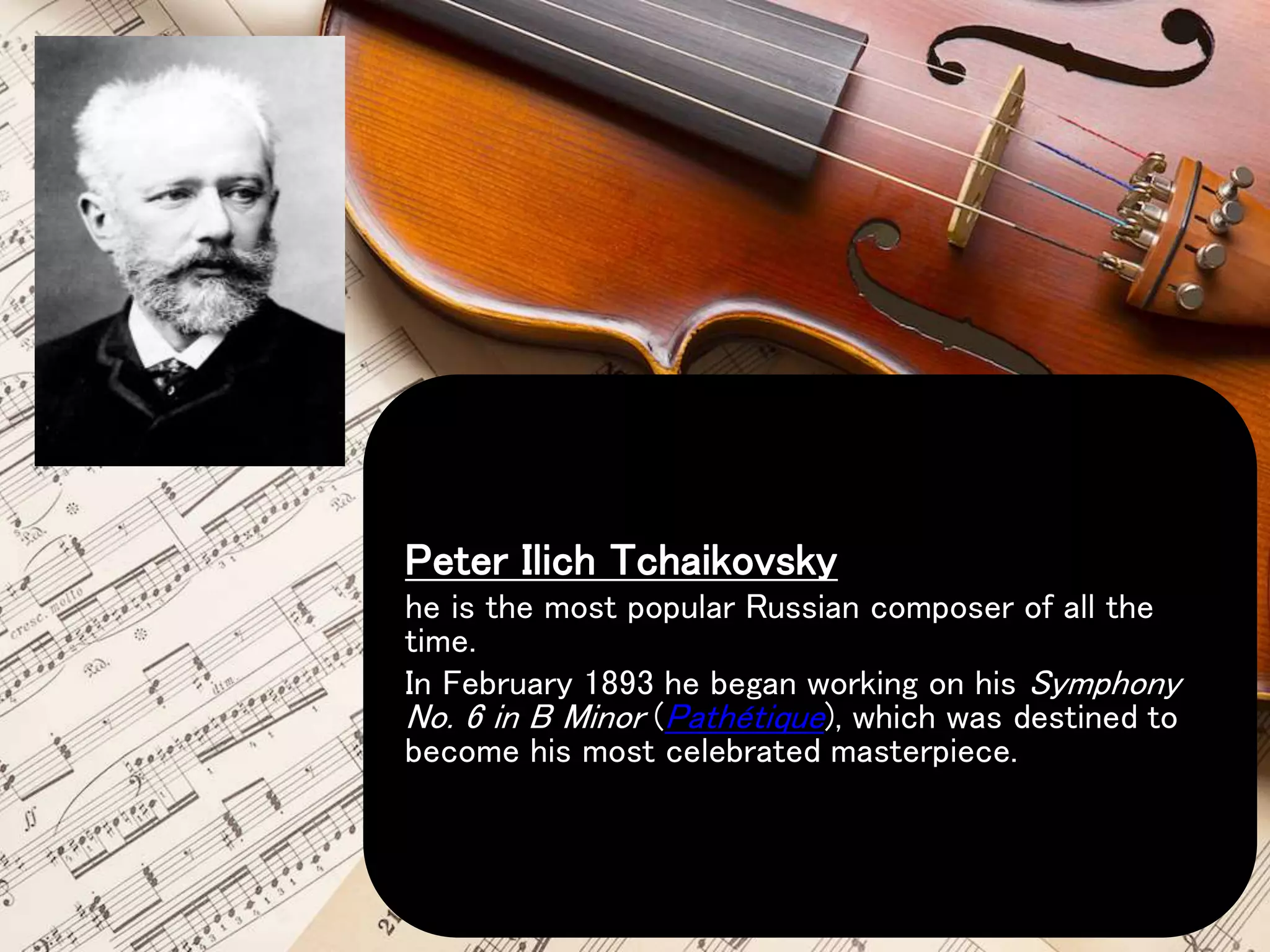
Peter Ilich Tchaikovsky
he is the most popular Russian composer of all the
time.
In February 1893 he began working on his Symphony
No. 6 in B Minor (Pathétique), which was destined to
become his most celebrated masterpiece.
Franz Schubert
is an Austrian composer who bridged the
worlds of Classical and Romantic music.
He composed his Lied, “Erlkönig op. 1 D
328”, for solo voice and piano.
A technically challenging piece for both
performers and accompanists, "Erlkönig"
has been popular and acclaimed since its
premiere in 1821, and has been
described as one of the "commanding
compositions of the century.
Romanticism emphasizes on the ability to express one’s
emotion, imagination, and even nationalism, due to the
turn of events of the 1800s.
Therefore, these composers felt free to change and
twist the Classical musical forms in their own ways and
explore different ways to use sound and change musical
elements. These include adding more instruments to the
orchestra or highlighting on one single instrument.
Expanding the use of tempo and dynamics, providing
drastic melodic changes and colorful harmonic
progressions through
chromaticism.
A C T I V I T Y
INSTRUCTION:
• Go to your Google App
Search “Class Point”
• classpoint.app › joinClassPoint
App - Enter class code and join!
• Click “Join Class”
• Enter the Code and your Name
What to Understand!!!
1. My understanding about the music
of the Romantic Period is that…….
_____________________________________________________________
_____________________________________________________________
__________
d
Name of the Composer Romantic
Instrumental Music
Famous Composition
1. 2. Carnival of the
Animals
3. 4. Hungarian
Rhapsodies
5. Violin and String
Music
6.
7 8. Symphony Fantastique
Peter Ilyich
Tchaikovsky
9. 10.
Direction: Complete the table below and give the needed
information.
MUSIC-PPT.pptx

MUSIC-PPT.pptx

  • 2.
    Hello Learners! I AMYOUR TEACHER WIN
  • 4.
    UNLOCKING TERMS INSTRUCTION: Arrange the followingjumbled letters to reveal the correct terms guided with each definition/meaning.
  • 5.
    ISMANTILONA means having astrong feelings to one’s nation.
  • 7.
    ODYELM One of thebasic elements of music that is above the chords and rhythm.
  • 9.
    MISNRTUNET A device usedto produce music.
  • 10.
  • 11.
    ERCOPMOS A person whowrites music, especially a professional occupation.
  • 12.
  • 13.
  • 14.
    Romantic Period rises from1820-1910, described as a cultural movement that stressed emotion, imagination, individualism and freedom of expression. Romantic Music refers to Western music composed in the late 18th century to 19th century.
  • 15.
    Romantic composers usedthe different elements of music in order to create passionate compositions. Composers use elaborate harmonic progressions and along with a wide range of dynamics, tempo, and pitch became a common style in compositions.
  • 16.
    Musical Elements in RomanticEra 1. Instrumentation/Timbre  The size of the orchestra doubled in number and also exploited tone color of new instruments such as the piccolo and contrabass soon to add more tone color.  On the other hand, some composers utilized the power of a single instrument more by creating beautiful compositions which interplay with the different musical elements as well. One example of this is how Frederic Chopin utilized the tone color of the piano in most of his compositions earning him the title “Poet of the Piano”.
  • 17.
    2. Melody  Longerand more elaborate melodies were explored to create more expression.  It also had expanded range from low sounds to very high melodies. 3. Tempo and Dynamics  The tempo and dynamics were expanded to allow composers to showcase more emotions.  In tempo, rubato is used in order to give more emotional expression.  Rubato is the sudden holding back or pressing forward from its original tempo.
  • 18.
    4. Form  newmusic forms were also created in the Romantic era such as Rhapsodies, Nocturnes, and Lieder, all of which were created to allow composes to be more expressive.
  • 19.
  • 20.
    Niccolo Paganini Famous composerof violin and string music Born in October 27, 1782 Became the most famous violin virtuoso in the world Some Works: “La Campanella” “The Carnival of Venice” VIOLIN AND STRINGS MUSIC
  • 21.
    Frederic Chopin known as‘Poet of the Piano’ Polish French composer and pianist of the Romantic period, best known for his solo pieces for piano and his piano concerti. He composed "Nocturne" in 1830. It becomes one of his most well-known works. PIANO MUSIC
  • 23.
    Franz Liszt • bornOctober 22 1811 • Known as virtuoso pianist and composer and the busiest musicians during the era. Some of his Piano works: • Sonata in B Minor • Liszt’s “Hungarian Rhapsodies” • Arrangement of the 9 Beethoven Symphonies
  • 24.
    Robert Schuman • bornin 1810. He was a composer and music critic. Piano Works: • “Abegg Variations,” Opus 1(1830) • “Carnaval,” Opus” (1935) • “Kinderszennen,” Opus 15, (1838)
  • 25.
    Peter Ilich Tchaikovsky heis the most popular Russian composer of all the time. In February 1893 he began working on his Symphony No. 6 in B Minor (Pathétique), which was destined to become his most celebrated masterpiece.
  • 27.
    Franz Schubert is anAustrian composer who bridged the worlds of Classical and Romantic music. He composed his Lied, “Erlkönig op. 1 D 328”, for solo voice and piano. A technically challenging piece for both performers and accompanists, "Erlkönig" has been popular and acclaimed since its premiere in 1821, and has been described as one of the "commanding compositions of the century.
  • 29.
    Romanticism emphasizes onthe ability to express one’s emotion, imagination, and even nationalism, due to the turn of events of the 1800s. Therefore, these composers felt free to change and twist the Classical musical forms in their own ways and explore different ways to use sound and change musical elements. These include adding more instruments to the orchestra or highlighting on one single instrument. Expanding the use of tempo and dynamics, providing drastic melodic changes and colorful harmonic progressions through chromaticism.
  • 30.
    A C TI V I T Y INSTRUCTION: • Go to your Google App Search “Class Point” • classpoint.app › joinClassPoint App - Enter class code and join! • Click “Join Class” • Enter the Code and your Name
  • 31.
    What to Understand!!! 1.My understanding about the music of the Romantic Period is that……. _____________________________________________________________ _____________________________________________________________ __________
  • 32.
    d Name of theComposer Romantic Instrumental Music Famous Composition 1. 2. Carnival of the Animals 3. 4. Hungarian Rhapsodies 5. Violin and String Music 6. 7 8. Symphony Fantastique Peter Ilyich Tchaikovsky 9. 10. Direction: Complete the table below and give the needed information.