Multi-View Design Patterns and
Responsive Visualization for
Genomics Data
Seminar On
Under the Guidance : Submitted By:
Dr. S. B. Gurav Vidya Vijay Mali
Agenda
 Abstract
 Introduction
 Motivation
 Objective
 Literature survey
 Overview Diagram
 References
2
Abstract
 Genome data is very crucial in clinical trails
 Understanding the genome patterns are always a
challenging task
 Using multi pattern analysis always enhances the model
 Using of Gosling grammar enhances the process of
genome data Visualization
3
4
Introduction
 Genome data
 Genome patterns
 Gosling Grammar
 Genome data visualization
Motivation
 Handling huge genome data is always a tedious
work
 Identifying the pattern according to the need is
a challenging task in genome data
5
Objectives
 To preprocess the data properly
 To enhance the model with Gosling grammar
 To identify the multi-pattern in genome tracks
6
LITERATURE SURVEY
Paper Author Methodology
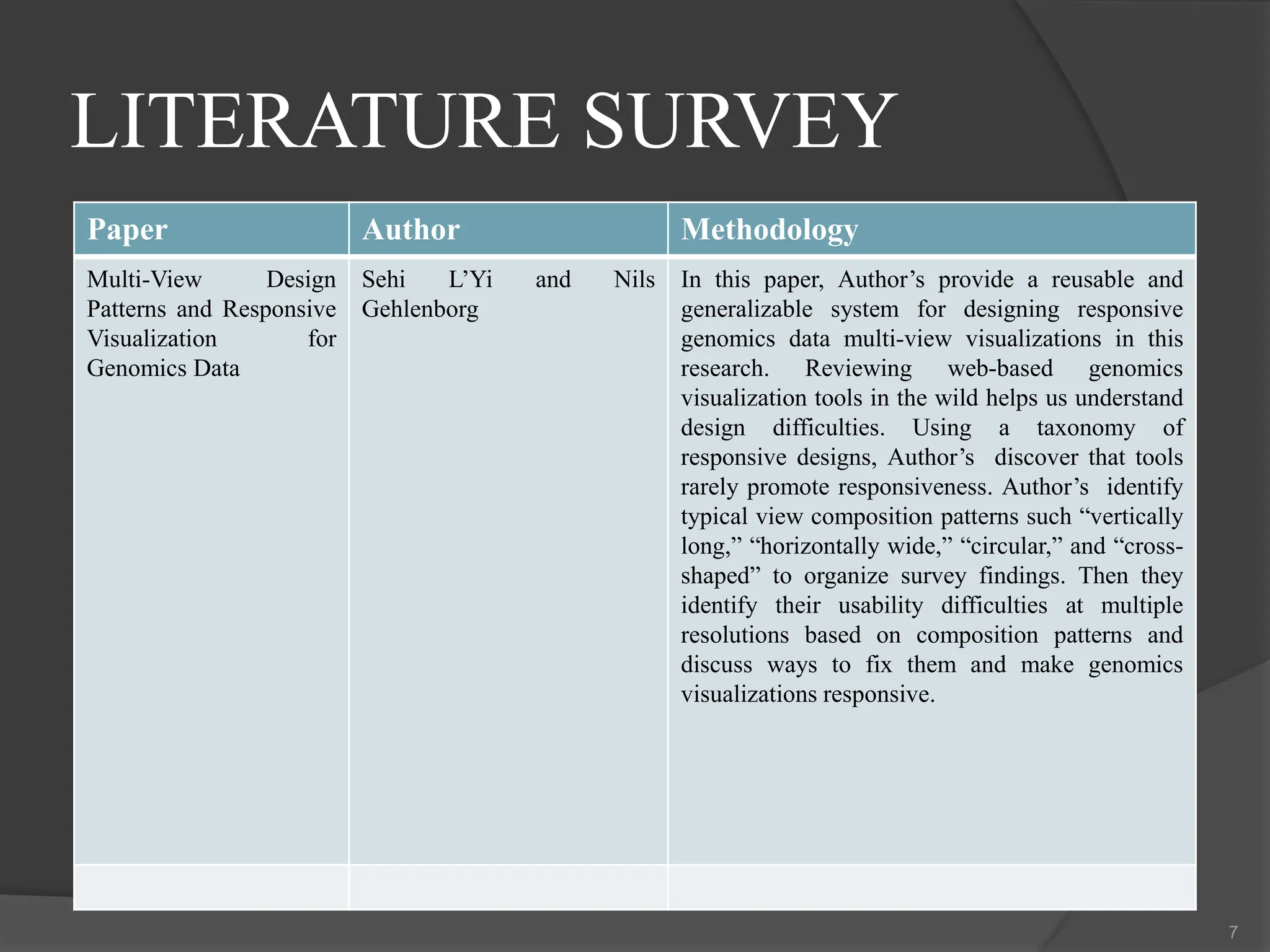
Multi-View Design
Patterns and Responsive
Visualization for
Genomics Data
Sehi L’Yi and Nils
Gehlenborg
In this paper, Author’s provide a reusable and
generalizable system for designing responsive
genomics data multi-view visualizations in this
research. Reviewing web-based genomics
visualization tools in the wild helps us understand
design difficulties. Using a taxonomy of
responsive designs, Author’s discover that tools
rarely promote responsiveness. Author’s identify
typical view composition patterns such “vertically
long,” “horizontally wide,” “circular,” and “cross-
shaped” to organize survey findings. Then they
identify their usability difficulties at multiple
resolutions based on composition patterns and
discuss ways to fix them and make genomics
visualizations responsive.
7
LITERATURE SURVEY
Paper Author Methodology
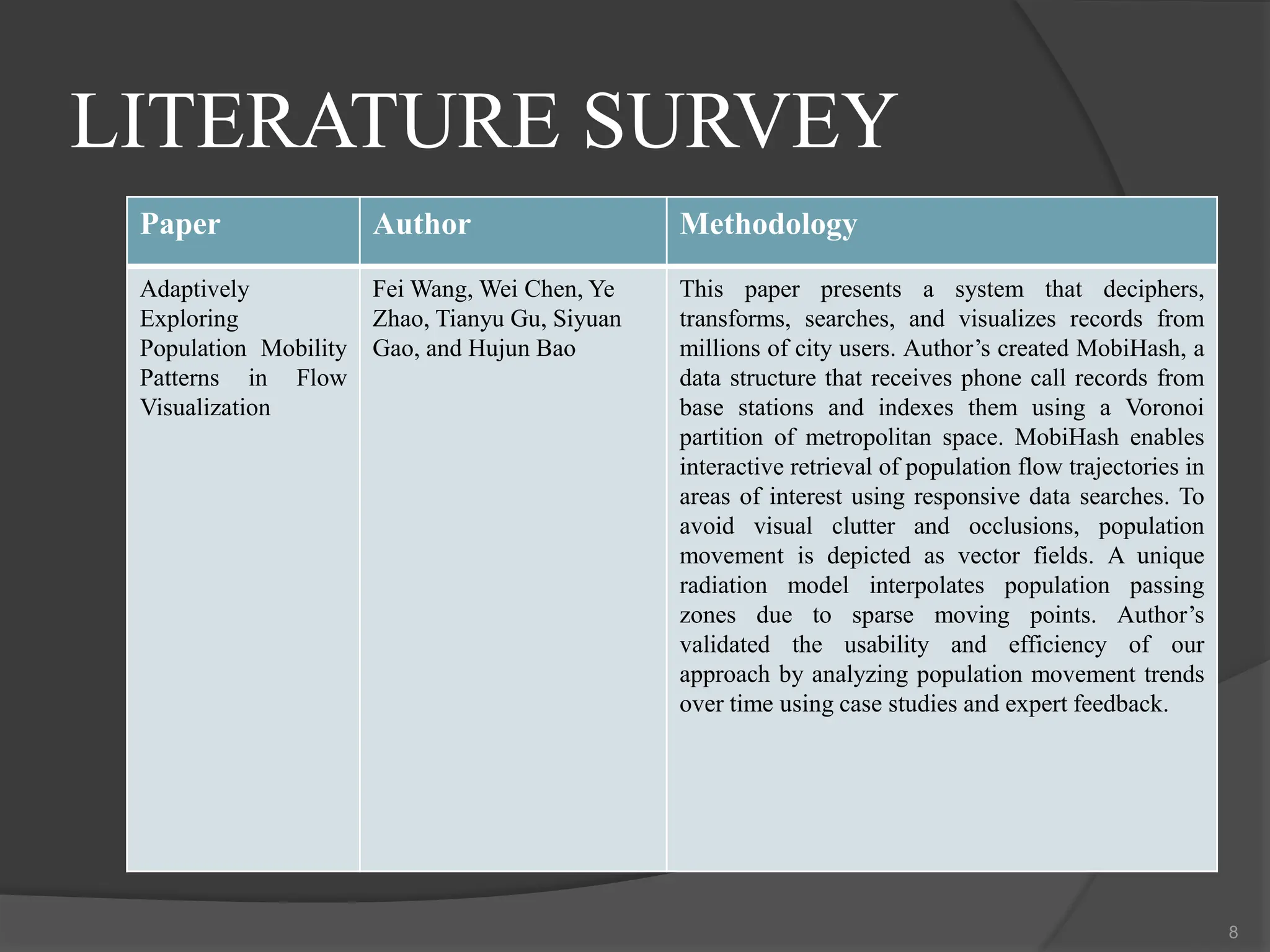
Adaptively
Exploring
Population Mobility
Patterns in Flow
Visualization
Fei Wang, Wei Chen, Ye
Zhao, Tianyu Gu, Siyuan
Gao, and Hujun Bao
This paper presents a system that deciphers,
transforms, searches, and visualizes records from
millions of city users. Author’s created MobiHash, a
data structure that receives phone call records from
base stations and indexes them using a Voronoi
partition of metropolitan space. MobiHash enables
interactive retrieval of population flow trajectories in
areas of interest using responsive data searches. To
avoid visual clutter and occlusions, population
movement is depicted as vector fields. A unique
radiation model interpolates population passing
zones due to sparse moving points. Author’s
validated the usability and efficiency of our
approach by analyzing population movement trends
over time using case studies and expert feedback.
8
LITERATURE SURVEY
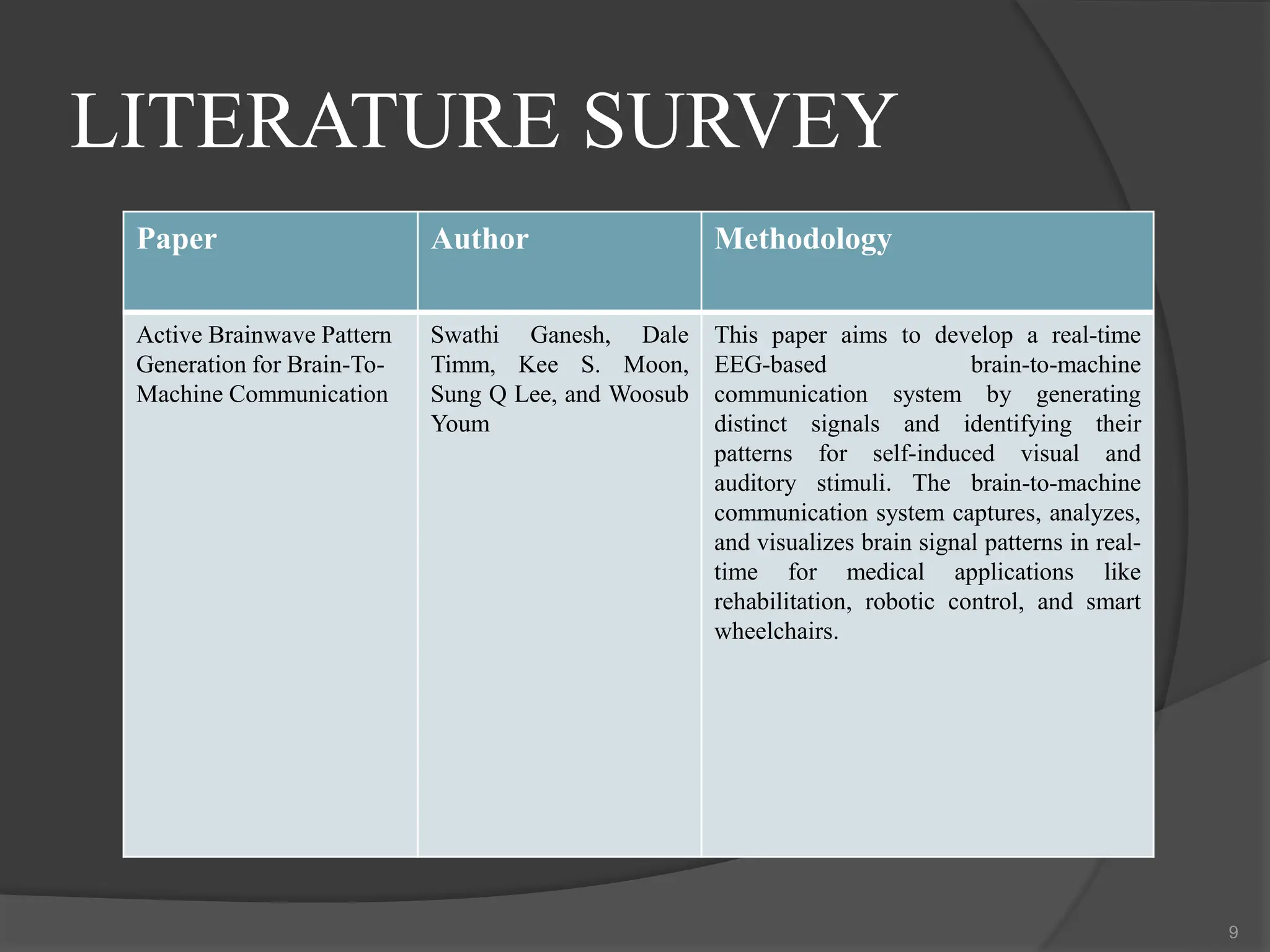
Paper Author Methodology
Active Brainwave Pattern
Generation for Brain-To-
Machine Communication
Swathi Ganesh, Dale
Timm, Kee S. Moon,
Sung Q Lee, and Woosub
Youm
This paper aims to develop a real-time
EEG-based brain-to-machine
communication system by generating
distinct signals and identifying their
patterns for self-induced visual and
auditory stimuli. The brain-to-machine
communication system captures, analyzes,
and visualizes brain signal patterns in real-
time for medical applications like
rehabilitation, robotic control, and smart
wheelchairs.
9
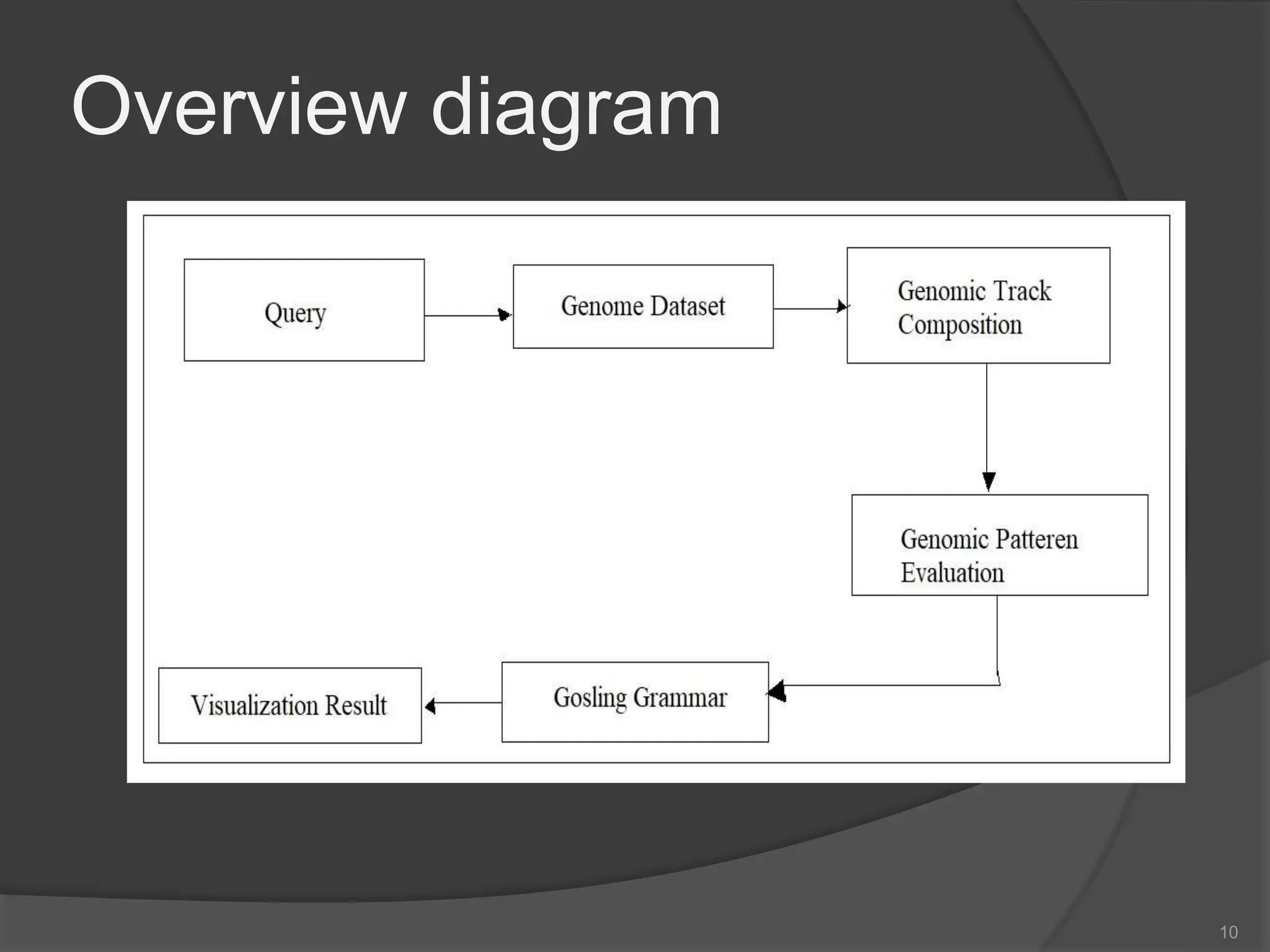
Overview diagram
10
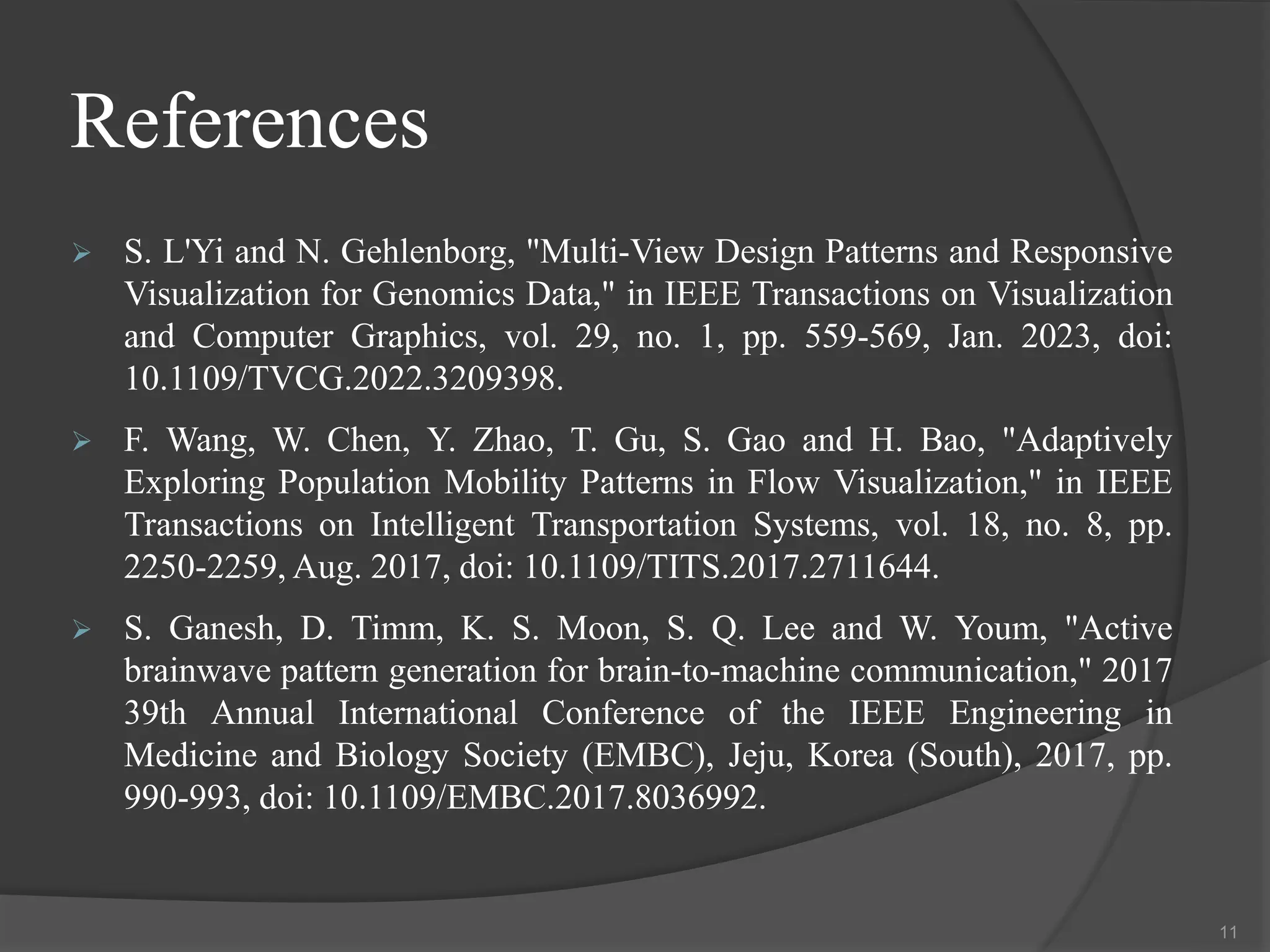
References
 S. L'Yi and N. Gehlenborg, "Multi-View Design Patterns and Responsive
Visualization for Genomics Data," in IEEE Transactions on Visualization
and Computer Graphics, vol. 29, no. 1, pp. 559-569, Jan. 2023, doi:
10.1109/TVCG.2022.3209398.
 F. Wang, W. Chen, Y. Zhao, T. Gu, S. Gao and H. Bao, "Adaptively
Exploring Population Mobility Patterns in Flow Visualization," in IEEE
Transactions on Intelligent Transportation Systems, vol. 18, no. 8, pp.
2250-2259, Aug. 2017, doi: 10.1109/TITS.2017.2711644.
 S. Ganesh, D. Timm, K. S. Moon, S. Q. Lee and W. Youm, "Active
brainwave pattern generation for brain-to-machine communication," 2017
39th Annual International Conference of the IEEE Engineering in
Medicine and Biology Society (EMBC), Jeju, Korea (South), 2017, pp.
990-993, doi: 10.1109/EMBC.2017.8036992.
11

Multi-View Design Patterns and Responsive Visualization for Genomics Data.ppt

  • 1.
    Multi-View Design Patternsand Responsive Visualization for Genomics Data Seminar On Under the Guidance : Submitted By: Dr. S. B. Gurav Vidya Vijay Mali
  • 2.
    Agenda  Abstract  Introduction Motivation  Objective  Literature survey  Overview Diagram  References 2
  • 3.
    Abstract  Genome datais very crucial in clinical trails  Understanding the genome patterns are always a challenging task  Using multi pattern analysis always enhances the model  Using of Gosling grammar enhances the process of genome data Visualization 3
  • 4.
    4 Introduction  Genome data Genome patterns  Gosling Grammar  Genome data visualization
  • 5.
    Motivation  Handling hugegenome data is always a tedious work  Identifying the pattern according to the need is a challenging task in genome data 5
  • 6.
    Objectives  To preprocessthe data properly  To enhance the model with Gosling grammar  To identify the multi-pattern in genome tracks 6
  • 7.
    LITERATURE SURVEY Paper AuthorMethodology Multi-View Design Patterns and Responsive Visualization for Genomics Data Sehi L’Yi and Nils Gehlenborg In this paper, Author’s provide a reusable and generalizable system for designing responsive genomics data multi-view visualizations in this research. Reviewing web-based genomics visualization tools in the wild helps us understand design difficulties. Using a taxonomy of responsive designs, Author’s discover that tools rarely promote responsiveness. Author’s identify typical view composition patterns such “vertically long,” “horizontally wide,” “circular,” and “cross- shaped” to organize survey findings. Then they identify their usability difficulties at multiple resolutions based on composition patterns and discuss ways to fix them and make genomics visualizations responsive. 7
  • 8.
    LITERATURE SURVEY Paper AuthorMethodology Adaptively Exploring Population Mobility Patterns in Flow Visualization Fei Wang, Wei Chen, Ye Zhao, Tianyu Gu, Siyuan Gao, and Hujun Bao This paper presents a system that deciphers, transforms, searches, and visualizes records from millions of city users. Author’s created MobiHash, a data structure that receives phone call records from base stations and indexes them using a Voronoi partition of metropolitan space. MobiHash enables interactive retrieval of population flow trajectories in areas of interest using responsive data searches. To avoid visual clutter and occlusions, population movement is depicted as vector fields. A unique radiation model interpolates population passing zones due to sparse moving points. Author’s validated the usability and efficiency of our approach by analyzing population movement trends over time using case studies and expert feedback. 8
  • 9.
    LITERATURE SURVEY Paper AuthorMethodology Active Brainwave Pattern Generation for Brain-To- Machine Communication Swathi Ganesh, Dale Timm, Kee S. Moon, Sung Q Lee, and Woosub Youm This paper aims to develop a real-time EEG-based brain-to-machine communication system by generating distinct signals and identifying their patterns for self-induced visual and auditory stimuli. The brain-to-machine communication system captures, analyzes, and visualizes brain signal patterns in real- time for medical applications like rehabilitation, robotic control, and smart wheelchairs. 9
  • 10.
  • 11.
    References  S. L'Yiand N. Gehlenborg, "Multi-View Design Patterns and Responsive Visualization for Genomics Data," in IEEE Transactions on Visualization and Computer Graphics, vol. 29, no. 1, pp. 559-569, Jan. 2023, doi: 10.1109/TVCG.2022.3209398.  F. Wang, W. Chen, Y. Zhao, T. Gu, S. Gao and H. Bao, "Adaptively Exploring Population Mobility Patterns in Flow Visualization," in IEEE Transactions on Intelligent Transportation Systems, vol. 18, no. 8, pp. 2250-2259, Aug. 2017, doi: 10.1109/TITS.2017.2711644.  S. Ganesh, D. Timm, K. S. Moon, S. Q. Lee and W. Youm, "Active brainwave pattern generation for brain-to-machine communication," 2017 39th Annual International Conference of the IEEE Engineering in Medicine and Biology Society (EMBC), Jeju, Korea (South), 2017, pp. 990-993, doi: 10.1109/EMBC.2017.8036992. 11