MMuullttiippllee IInntteelllliiggeennccee:: 
MMeeeettiinngg tthhee NNeeeeddss ooff 
AAllll SSttuuddeennttss
"I am 100% convinced that if I were to 
come back to Earth in 50 years, 
people would laugh at the idea of 
uniform education.” -Howard 
Gardner
Definition 
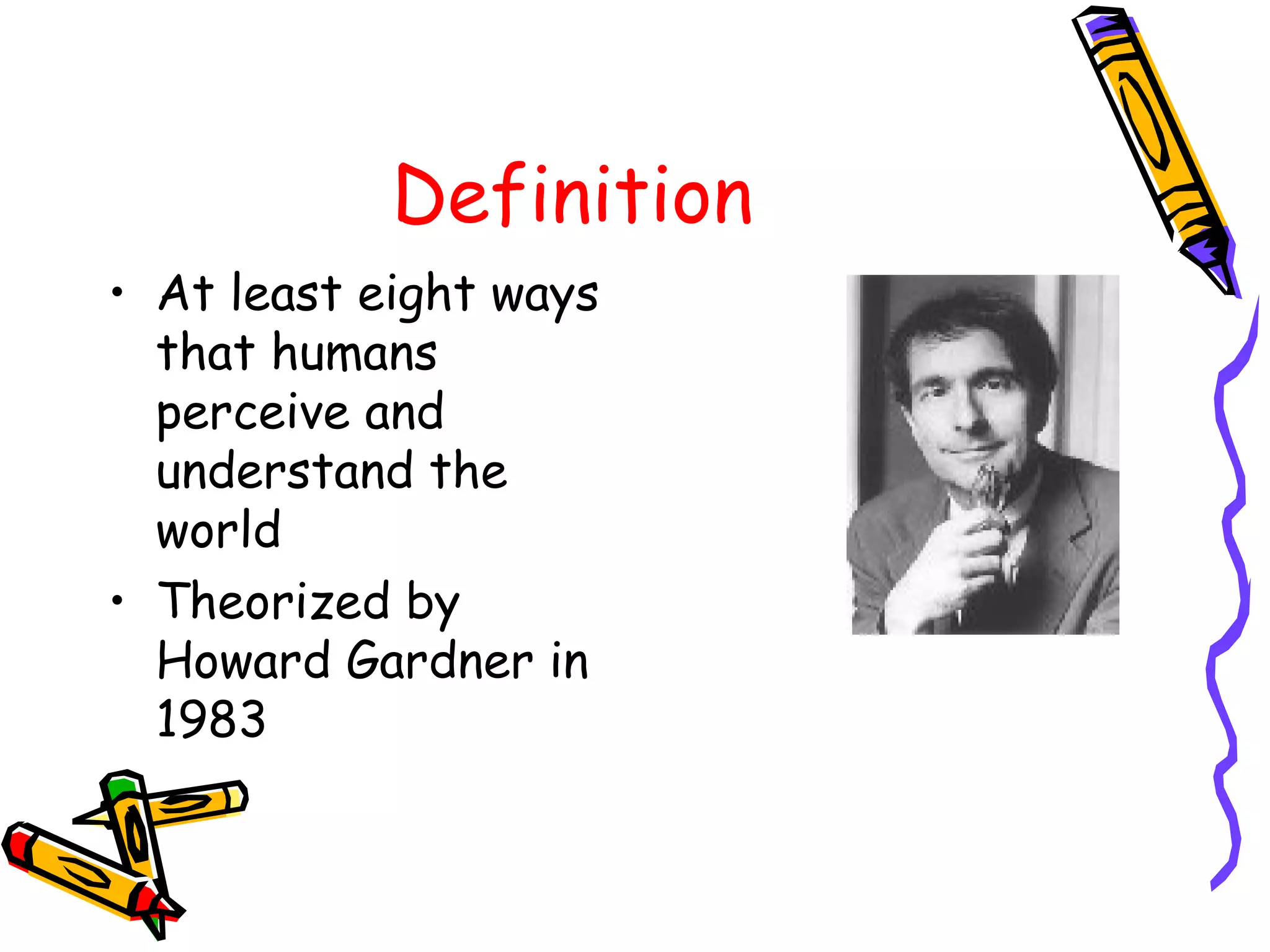
• At least eight ways 
that humans 
perceive and 
understand the 
world 
• Theorized by 
Howard Gardner in 
1983
All theories of learning 
purport the following: 
• “. . . student brains are more than IQ and 
their skills span more than the Three R’s” 
(Flick and Lederman 120) 
• All students can learn 
• It is important in education to celebrate 
all aspects of diversity, including the many 
ways students learn
Reasoning Behind 
Gardner’s Theory 
• “Individuals should be encouraged to use 
their preferred intelligences in learning.” 
• “Instructional activities should appeal to 
different forms of intelligence.” 
• “Assessment of learning should measure 
multiple forms of intelligence.” 
(Gardner)
Why the Attraction for 
Educators… 
• Helps to create more personalized lessons 
• Helps “explain and promote understanding” 
(Owen) 
• Helps promote self-motivation in students 
because learning is based on innate talents 
• Validates teacher insights into their 
students
TThhee EEiigghhtt EEssttaabblliisshheedd 
IInntteelllliiggeenncceess……
Naturalist Learners (the 
new intelligence) 
• Sensitive to patterns in and 
connecting to nature 
• Especially like animals and natural 
phenomena 
• Suggestions for Teachers: Be aware 
to changes in even minute details of 
the classroom environment, bring the 
outdoors in
Verbal-Linguistic 
Learners 
• Sensitive to meanings, sounds and rhythms 
of words 
• Especially like storytelling and creative 
writing 
• Suggestions for Teachers: activities such 
as dialogue writing, books on tape, word 
processing, newspaper activities, etc.
Logical-Mathematical 
Learners 
• Sensitive to order and sequence 
• Especially like problem solving, noting 
and creating patterns and 
experiments 
• Suggestions for Teachers: use of 
graphic organizers, showing 
relationships, computer instruction, 
syllogism, etc.
Visual-Spatial Learners 
• Sensitive to visual cues and images 
• Especially like day-dreaming and art 
• Suggestions for Teachers: using 
color, mind-mapping, manipulatives, 
etc.
Body-Kinesthetic 
Learners 
• Sensitive to activity, athletics and 
physical gestures while talking 
• Especially like role-playing, touching 
and feeling 
• Suggestions for Teachers: hands-on 
activities, manipulatives, use of 
textures, etc.
Musical-Rhythmic 
Learners 
• Sensitive to singing, playing instruments, 
drumming 
• Especially like the human voice, sounds 
from nature, instrumental music 
• Suggestions for Teachers: vary voice 
pitch during instruction, play music in the 
classroom, watch surrounding sounds for 
possible interference
Interpersonal Learners 
• Sensitive to leadership opportunities, 
others’ feelings; “street smart” 
• Especially like helping others, peer 
tutoring, working cooperatively 
• Suggestions for teachers: group 
work, discussions, skits, etc.
Intrapersonal Learners 
• Sensitive to their own feelings, personal 
motivation 
• Especially like day-dreaming, working 
alone; “march to the beat of a different 
drummer” 
• Suggestions for Teachers: designate quiet 
areas, independent practice, journals, etc.
HHooww WWee CCaann CChhaannggee……
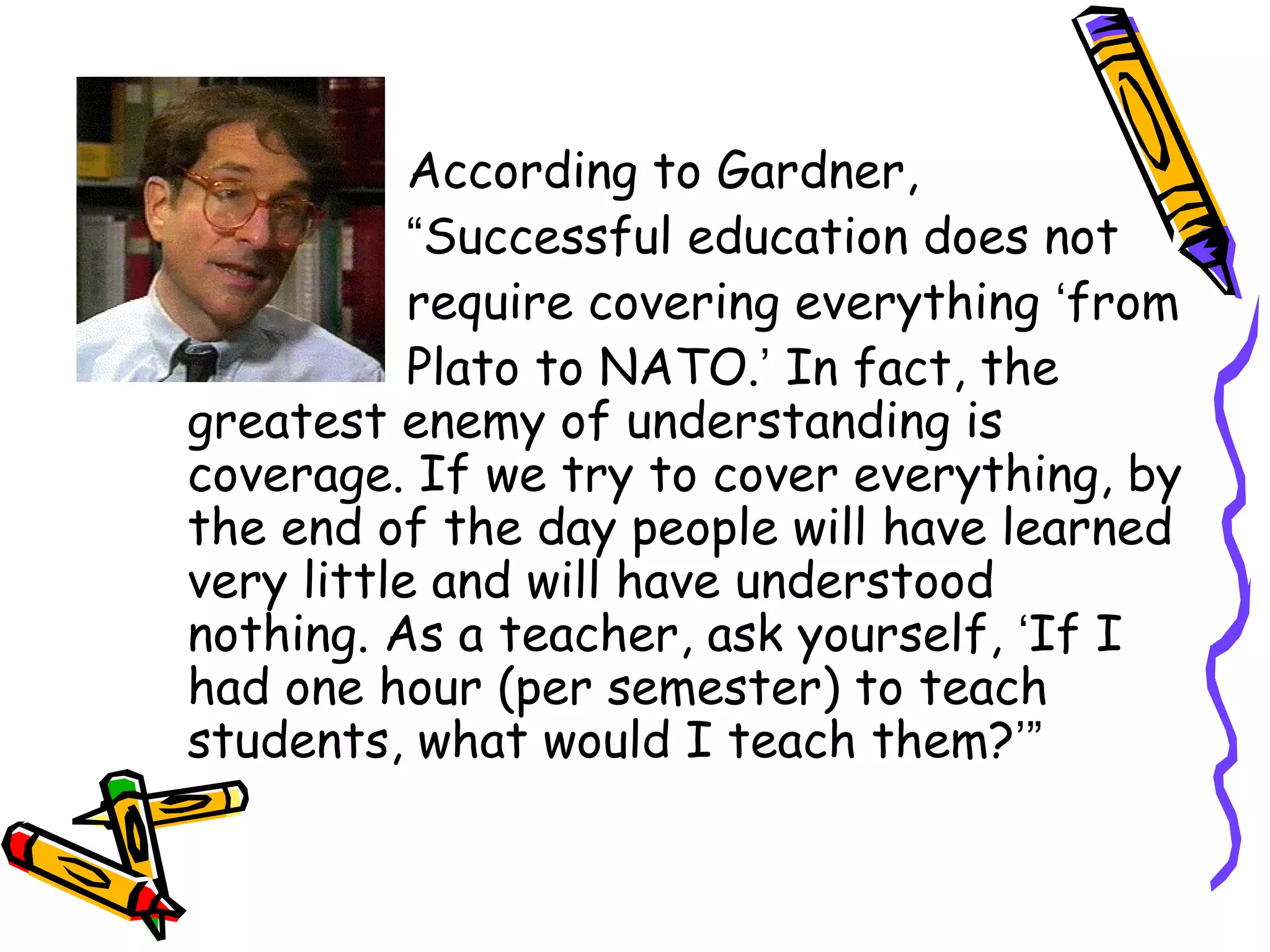
According to Gardner, 
“Successful education does not 
require covering everything ‘from 
Plato to NATO.’ In fact, the 
greatest enemy of understanding is 
coverage. If we try to cover everything, by 
the end of the day people will have learned 
very little and will have understood 
nothing. As a teacher, ask yourself, ‘If I 
had one hour (per semester) to teach 
students, what would I teach them?’”
The Impact on Schools 
• We teach all children the way we have met 
the needs of the gifted in the past 
• Move beyond traditional methods; 
incorporate the other six intelligences in 
teaching, assessing and planning 
• Teachers are better able to create more 
“inclusive, affective and effective 
instruction” (Owen)
Schools in the Future 
• Movement toward Apprenticeships: 
have students work closely with key 
individuals over an extended period 
of time in order for them to learns 
EXACTLY what a culture would like 
them to know someday; teaching is 
primarily done through example
• Creation of Children’s Museums: 
Students are afforded the 
opportunity to work with interesting 
topics at their own pace and in their 
own ways; what they’ve “learned” in 
school can be “checked out” through 
experimentation; additional questions 
will naturally arise that can be 
brought back to the classroom and 
discussed further
• Focus on the End Result/What 
Students REALLY need to know upon 
leaving the formal learning 
environment 
• Recognize that not all children will 
have an “understanding” of all 
traditional areas in today’s world of 
information dissemination
The Really Important 
Things for Students to 
Know… 
• How to make use of accessible 
information 
• How to use expertise 
• How to become lifelong learners 
• How to find out about the things 
they don’t know but need to know
SSuucccceessss SSttoorriieess
Works Cited 
• Andrews, Roland H. “Three Perspectives of Learning 
Styles.” School Administrator. January 1994. 51:1, pp/ 
19+. 
• Flick, Lawrence B. and Norman G. Lederman. “Popular 
Theories—Unpopular Research.” School Science and 
Mathematics. March 2003. 103:3, pp. 117-121. 
• Gardner, Howard. “Multiple Intelligences.” TIP Database. 
Ed. Greg Kearsley. 1994-2006. George Washington 
University. 1 March 2006. 
http://tip.psychology.org/gardner.html. 
• Reiff, Judith C. “Bridging Home and School Through 
Multiple Intelligences.” Childhood Education. Spring 1996. 
72:3, pp. 164-166.
Works Cited (con’t.) 
• Wilson, Leslie Owen. “The Eighth Intelligence: 
Naturalistic Intelligence.” Newer Views of 
Learning. The CELT Center. March 2005. 1 March 
2006. 
http://www.uwsp.edu/education/lwilson/index.htm. 
• Wilson, Leslie Owen. “What’s the Big Attraction?” 
New Horizons for Learning. March 1998. New 
Horizons. 1 March 2006. 
http://www.newhorizons.org/strategies/mi/wilson1.htm 
.

Multiple intelligence

  • 1.
    MMuullttiippllee IInntteelllliiggeennccee:: MMeeeettiinnggtthhee NNeeeeddss ooff AAllll SSttuuddeennttss
  • 2.
    "I am 100%convinced that if I were to come back to Earth in 50 years, people would laugh at the idea of uniform education.” -Howard Gardner
  • 3.
    Definition • Atleast eight ways that humans perceive and understand the world • Theorized by Howard Gardner in 1983
  • 4.
    All theories oflearning purport the following: • “. . . student brains are more than IQ and their skills span more than the Three R’s” (Flick and Lederman 120) • All students can learn • It is important in education to celebrate all aspects of diversity, including the many ways students learn
  • 5.
    Reasoning Behind Gardner’sTheory • “Individuals should be encouraged to use their preferred intelligences in learning.” • “Instructional activities should appeal to different forms of intelligence.” • “Assessment of learning should measure multiple forms of intelligence.” (Gardner)
  • 6.
    Why the Attractionfor Educators… • Helps to create more personalized lessons • Helps “explain and promote understanding” (Owen) • Helps promote self-motivation in students because learning is based on innate talents • Validates teacher insights into their students
  • 7.
    TThhee EEiigghhtt EEssttaabblliisshheedd IInntteelllliiggeenncceess……
  • 8.
    Naturalist Learners (the new intelligence) • Sensitive to patterns in and connecting to nature • Especially like animals and natural phenomena • Suggestions for Teachers: Be aware to changes in even minute details of the classroom environment, bring the outdoors in
  • 9.
    Verbal-Linguistic Learners •Sensitive to meanings, sounds and rhythms of words • Especially like storytelling and creative writing • Suggestions for Teachers: activities such as dialogue writing, books on tape, word processing, newspaper activities, etc.
  • 10.
    Logical-Mathematical Learners •Sensitive to order and sequence • Especially like problem solving, noting and creating patterns and experiments • Suggestions for Teachers: use of graphic organizers, showing relationships, computer instruction, syllogism, etc.
  • 11.
    Visual-Spatial Learners •Sensitive to visual cues and images • Especially like day-dreaming and art • Suggestions for Teachers: using color, mind-mapping, manipulatives, etc.
  • 12.
    Body-Kinesthetic Learners •Sensitive to activity, athletics and physical gestures while talking • Especially like role-playing, touching and feeling • Suggestions for Teachers: hands-on activities, manipulatives, use of textures, etc.
  • 13.
    Musical-Rhythmic Learners •Sensitive to singing, playing instruments, drumming • Especially like the human voice, sounds from nature, instrumental music • Suggestions for Teachers: vary voice pitch during instruction, play music in the classroom, watch surrounding sounds for possible interference
  • 14.
    Interpersonal Learners •Sensitive to leadership opportunities, others’ feelings; “street smart” • Especially like helping others, peer tutoring, working cooperatively • Suggestions for teachers: group work, discussions, skits, etc.
  • 15.
    Intrapersonal Learners •Sensitive to their own feelings, personal motivation • Especially like day-dreaming, working alone; “march to the beat of a different drummer” • Suggestions for Teachers: designate quiet areas, independent practice, journals, etc.
  • 16.
    HHooww WWee CCaannCChhaannggee……
  • 17.
    According to Gardner, “Successful education does not require covering everything ‘from Plato to NATO.’ In fact, the greatest enemy of understanding is coverage. If we try to cover everything, by the end of the day people will have learned very little and will have understood nothing. As a teacher, ask yourself, ‘If I had one hour (per semester) to teach students, what would I teach them?’”
  • 18.
    The Impact onSchools • We teach all children the way we have met the needs of the gifted in the past • Move beyond traditional methods; incorporate the other six intelligences in teaching, assessing and planning • Teachers are better able to create more “inclusive, affective and effective instruction” (Owen)
  • 19.
    Schools in theFuture • Movement toward Apprenticeships: have students work closely with key individuals over an extended period of time in order for them to learns EXACTLY what a culture would like them to know someday; teaching is primarily done through example
  • 20.
    • Creation ofChildren’s Museums: Students are afforded the opportunity to work with interesting topics at their own pace and in their own ways; what they’ve “learned” in school can be “checked out” through experimentation; additional questions will naturally arise that can be brought back to the classroom and discussed further
  • 21.
    • Focus onthe End Result/What Students REALLY need to know upon leaving the formal learning environment • Recognize that not all children will have an “understanding” of all traditional areas in today’s world of information dissemination
  • 22.
    The Really Important Things for Students to Know… • How to make use of accessible information • How to use expertise • How to become lifelong learners • How to find out about the things they don’t know but need to know
  • 23.
  • 24.
    Works Cited •Andrews, Roland H. “Three Perspectives of Learning Styles.” School Administrator. January 1994. 51:1, pp/ 19+. • Flick, Lawrence B. and Norman G. Lederman. “Popular Theories—Unpopular Research.” School Science and Mathematics. March 2003. 103:3, pp. 117-121. • Gardner, Howard. “Multiple Intelligences.” TIP Database. Ed. Greg Kearsley. 1994-2006. George Washington University. 1 March 2006. http://tip.psychology.org/gardner.html. • Reiff, Judith C. “Bridging Home and School Through Multiple Intelligences.” Childhood Education. Spring 1996. 72:3, pp. 164-166.
  • 25.
    Works Cited (con’t.) • Wilson, Leslie Owen. “The Eighth Intelligence: Naturalistic Intelligence.” Newer Views of Learning. The CELT Center. March 2005. 1 March 2006. http://www.uwsp.edu/education/lwilson/index.htm. • Wilson, Leslie Owen. “What’s the Big Attraction?” New Horizons for Learning. March 1998. New Horizons. 1 March 2006. http://www.newhorizons.org/strategies/mi/wilson1.htm .

Editor's Notes

  • #8 Suggestions for table activities: Have each table take ONE of the intelligences and on chart paper, describe HOW this child would best learn in their classroom/content area. Have each table discuss as a group and report out ONE lesson activity that would engage a child with that type of intelligence. Have tables consider WHAT type of intelligence the TEACHER is, their STUDNENTS, and the effects of mis-matches in classrooms.