I
magine riding a roller coaster: the slow initial creep
to the top, followed by a gut-pinned-to-the-roof-of-
your-mouth plunge. As you ride this particular roller
coaster, though, those peaks slowly lose elevation, until
eventually, whoosh, you run out of track. This nightmare
isn’t reserved for 12-year-olds. Wildlife managers get those
cold sweats in the middle of the night, too, especially if you
mention mule deer.
Lewis and Clark first encountered mule deer in
South Dakota. They noted the animal’s absence in forests
and riverbeds but love for the “rough country.” Other
prominent explorers rarely mentioned mule deer in their
observations of big game, even though mule deer range
from the coastal islands of Alaska, south to southern Baja
Mexico, east through the American Great Plains up into
southern Yukon Territory. After the West was officially
open, settlers, miners and ranchers pushed into those
wide open spaces. With them, market hunters decimated
mule deer populations of the late 1800s and early 1900s.
Shortly thereafter, the landscape changed, both physically
and socially.
In 1903, the first hints at regulated hunting with
licenses took hold. In 1923, the Pittman-Robertson Federal
Aid in Wildlife Restoration Act passed. Along with their
dreams of a new life, settlers brought with them cattle
and sheep, which mowed native grasses. Land managers
did their best to eliminate fire and predators from the
landscape. Forests were cleared of timber to build log
In the past decade, mule deer
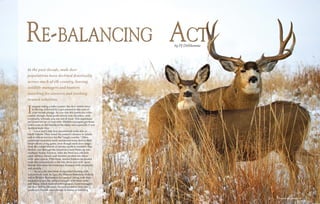
populations have declined drastically
across much of elk country, leaving
wildlife managers and hunters
searching for answers and working
toward solutions.
RE-BALANCING ACTby PJ DelHomme
GARYKRAMER
by PJ DelHomme
GARYKRAMER
NOV/DEC 2015 • BUGLE • 91
Mulies.indd 90-91Mulies.indd 90-91 1/8/2016 4:19:37 PM1/8/2016 4:19:37 PM
homes, stoke wood stoves and support mine shafts
dug deep into the earth.
Mule deer populations exploded. Why? Mule
deer prefer to eat woody shrubs such as big sagebrush
and bitterbrush. These early seral plants are the first
to sprout following a disturbance such as logging.
The grass and overstory that kept woody shrubs from
spreading were gone and this allowed shrubs
to thrive.
From the 1950s through 1970, mule deer
numbers hit historic highs. While the fish and game
counts for this time are scant and far more anecdotal
than today’s, a look at the Boone and Crockett Club
(B&C) entries shows a wave of typical mule deer
record-book entries for states such as Colorado, New
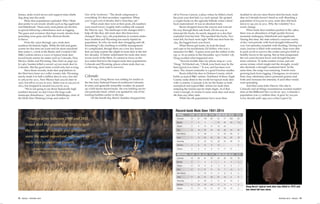
Mexico, Idaho and Wyoming. (See chart on page 93).
In 1963, hunters killed a record 147,000 mule deer in
Colorado. But the good times would only last so long.
Since those records, mule deer populations in
the West have been on a roller coaster ride. Wyoming
nearly made it to half a million deer in 2003, but slid
to 376,000 by 2013. New Mexico had 300,000 deer in
1970, but fell to 70,000 in 2003. Idaho was at 300,000 in
2003, but dropped to around 200,000 by 2013.
“We’re not going to see those historically high
numbers because we don’t have the huge scale
landscape disturbance,” says Jim Heffelfinger, chair of
the Mule Deer Working Group and author of
Deer of the Southwest. “The shrub component is
everything. It’s that secondary vegetation. When
you’ve got a lot of shrubs, that’s what they eat.”
When mule deer were at their peak, elk numbers
were much lower; roughly half a million elk roamed
the West in 1975. The landscape-wide changes didn’t
help elk like they did mule deer. But times have
changed. Since 1975, elk populations in western states
have doubled and Wyoming has nearly tripled its
population. So why are mule deer struggling and elk
flourishing? Like anything in wildlife management,
it’s complicated, though there are a few key factors
that can help explain the plight of mule deer in the last
few decades. To better understand the mule deer story
across much of the West, it’s easiest to focus on the
two states that have the largest mule deer populations:
Colorado and Wyoming, places where mule deer are
on the long, slow road to recovery.
Colorado
In 1972, Doug Burris was rattling for mulies in
the San Juan National Forest of southwest Colorado.
In rainy and generally miserable weather, he passed
up a half-dozen decent bucks. He was holding out for
one particular buck, which was spotted by one of his
hunting buddies earlier in the trip.
On the fourth day, Burris’ buddies dropped him
off in Proven Canyon, a place where he killed a buck
the prior year that had a 41-inch spread. He spotted
a couple bucks on the opposite hillside when a third
buck materialized. It was an absolute brute.
Burris dropped down the canyon and weaved
his way through thick oak brush. On his way to
intercept the bucks, he nearly stepped on a doe that
exploded from her bed. This spooked the bucks. Two
went left, his buck went right. With one shot from his
.264, the biggest buck was down.
When Burris got home, he took the head
and cape to his taxidermist, Ed Schlier, who was a
measurer for B&C. A green score put the antlers in the
top 10. In an article in the December 1975 Outdoor Life,
Doug recalled what happened next.
“Several months later my phone rang at 1 a.m.
‘Doug,’ Ed blurted out, ‘I think your buck may be the
best typical ever taken.’” It was, and has been ever
since. The closest contender is a good 8 inches smaller.
Burris killed his deer in Dolores County, which
holds 24 typical B&C entries. Northeast of there, Eagle
County ranks third in the world for typical mule deer
with 73 entries. Colorado is by far the leader in both
nontypical and typical B&C entries for mule deer,
eclipsing the runner-ups by triple digits. As if that
wasn’t enough, it’s home to more mule deer and more
elk than any other state.
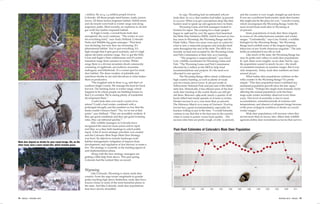
While the elk populations have more than
doubled to 267,000 since Burris shot his buck, mule
deer in Colorado haven’t fared as well. Reaching a
population of 614,000 in 2005, mule deer slid back
down to 391,000 in 2013. Why the volatility? In a
word: change.
When mule deer numbers peaked in the 1960s,
there was an abundance of high-quality browse:
mountain mahogany, bitterbrush and sagebrush.
During this time, the state entered a raucous course
of dry/wet periods, with local drought followed by
very wet episodes complete with flooding. During wet
years, browse is filled with nutrients. Does were able
to pack on fat to survive the winter and give birth to
healthy fawns in the spring. But as time progressed,
the wet years became fewer and drought became
more common. To make matters worse, just one
severe winter, which might end the drought, would
also decimate a drought-weakened herd. At the
same time, the range was maturing. Forests were
growing back from logging. Cheatgrass, an invasive
from Asia, eliminates native perennial grasses and
forbs and increases fire intensity. It and other weeds
were spreading.
And then came John Denver. His ode to
Colorado and all things mountainous reached number
nine on the Billboard Hot 100 list in 1973. Colorado’s
population was 2.5 million then. It grew by 500,000
every decade until 1993-2003 when it grew by
Doug Burris' typical mule deer was killed in 1972 and
has stood tall ever since.
“Studies done between 1999 and 2011
found that the severity of winters and
the amount of summer precipitation
were the most important influences on
mule deer population growth."
—From Colorado Parks and Wildlife’s,
The Story of Colorado’s Mule Deer
TYPICAL 41-50 51-60 61-70 71-80 81-90 91-00 01-10 11-14
Colorado 14 57 140 92 67 77 225 53
Nevada 1 4 3 - 13 22 30 15
Oregon 3 5 13 9 15 34 - -
Utah 12 18 28 20 30 39 44 22
New Mexico - 6 39 7 9 42 55 8
Idaho 4 12 45 42 46 53 38 18
Wyoming - 8 24 13 20 54 56 14
Montana 3 9 12 9 12 - - 5
Arizona 5 4 6 9 11 17 27 -
Record-book Mule Deer 1941-2014
NON-TYPICAL 41-50 51-60 61-70 71-80 81-90 91-00 01-10 11-14
Colorado 10 30 61 33 34 26 53 16
Nevada 3 7 6 4 - 5 9 3
Oregon 11 13 8 8 4 5 2 1
Utah 17 17 31 12 14 7 13 4
New Mexico - 5 15 8 4 8 9 2
Idaho 17 29 41 29 31 16 9 8
Wyoming 7 8 20 5 11 9 13 5
Montana 6 13 10 10 2 4 4 2
Arizona 17 11 13 6 10 19 15 4
D.ROBERTANDLORRIFRANZ
COURTESYBOONE&CROCKETT
92 • BUGLE • NOV/DEC 2015 NOV/DEC 2015 • BUGLE • 93
Mulies.indd 92-93Mulies.indd 92-93 1/8/2016 4:19:58 PM1/8/2016 4:19:58 PM
700,000
600,000
500,000
400,000
300,000
BACKGROUNDPHOTO:WESUNCAPHER
Post-Hunt Estimates of Colorado's Mule Deer Population
In 1991, Wyoming had an estimated 578,000
mule deer. In 2013, that number had fallen 39 percent
to 353,000. When you get a precipitous drop like that,
hunters tend to speak up and agencies have to listen.
Wyoming Game and Fish managers looked to
hunters for input. The scoping for a major project
began in 1998 and by 2007 the agency had launched
the Mule Deer Initiative (MDI), which focused on two
key areas in Wyoming: the Wyoming Range and the
Platte Valley. These two areas were part of a pilot for
what is now a statewide program and includes herd
units throughout the rest of the state. The MDI was
recently revised and accepted by the Wyoming Game
and Fish Commission at their July 2015 meeting.
“The program is unprecedented,” says Daryl
Lutz, wildlife coordinator for Wyoming Game and
Fish. “The Wyoming Game and Fish Commission
allocated $2.5 million to the MDI to help fund
recommendations and projects. It’s the most ever
allocated to one species.”
The Wyoming Range offers classic wilderness
high country hunting, as well as plenty of roads
and two-tracks down lower. It sits just south of
Yellowstone National Park and just east of the Idaho
state line. Historically, it has offered some of the best
mule deer hunting in the world. Bucks can still get
old there. Between 1989-2008, nearly a quarter of all
bucks killed had inside spreads of at least 25 inches.
Hunter success in 2013 was more than 40 percent.
The February-March 2015 issue of Eastmans’ Hunting
Journal has a good recommendation, especially for
hunters willing to put in the time. “I would honestly
venture to say that this is the best area in the country
when it comes to points versus hunt quality…The
success rates here are pretty rough, at only 32 percent,
and the country is very rough, straight up and down.
If you are a proficient backcountry mule deer hunter,
this might just be the place for you.” Lincoln County,
which encompasses the Wyoming Range, holds the
most record book mule deer in Wyoming at
36 percent.
Some populations of mule deer there migrate
in excess of 180 miles between summer and winter
ranges. “Undoubtedly,” says Gary Fralick, a wildlife
biologist for the Wyoming Range, “the Wyoming
Range herd exhibits some of the longest migratory
behaviors of any North American ungulate.” The area
holds an estimated 6,500 elk as well.
Like much of the state, the Wyoming Range has
seen its peaks and valleys in mule deer populations.
In 1976, there were roughly 22,000 deer, but by 1991,
the population soared to nearly 60,000—the result
of consistent moisture on summer ranges. But it was
only temporary. Today, mule deer numbers are back
around 36,500.
What makes deer populations continue on the
roller coaster in the Wyoming Range? It’s pretty
simple. “This deer population hasn’t exhibited any
sustained population growth since the late 1990s,”
says Fralick. “Perhaps the single most dramatic factor
affecting the annual population cycle has been
large-scale winter mortality observed every three
years. This level of mortality is due to snow
accumulations, extended periods of extreme cold
temperatures, and absence of adequate forage because
of the poor ecological condition of shrubs on crucial
winter ranges.”
Mule deer populations will increase when they
recruit more than 65 fawns/doe. (Most state wildlife
agencies define deer recruitment as fawns that survive
1 million. By 2014, 5.4 million people lived in
Colorado. All those people need homes, roads, power,
lawns. All those factors fragment habitat. Subdivisions
and ski resorts were built in winter range and along
migratory paths. Most recently, an explosion in oil and
gas wells has further impacted habitat.
In Eagle County, a record-book mule deer
stronghold, the cycle continues. “The winter of 2007
hit everything hard,” says Andy Holland, Colorado
Parks and Wildlife big game manager. “That herd
was declining, but now they are increasing. It’s
phenomenal habitat. You’ve got everything. It’s
high enough that it gets good moisture, and it’s high
alpine elevation summer range. You’ve got the Holy
Cross and Eagle’s Nest wildernesses and it’s prime
transition range from summer to winter. Winter
range there is a diverse mountain shrub community
consisting of sagebrush, serviceberry, mountain
mahogany and bitterbrush. It’s a sweet spot for mule
deer habitat. The sheer number of palatable and
nutritious shrubs in our mid elevations is what makes
them so productive.
“The toughest unit to draw is 44, and that’s in
southern Eagle County. We manage the herd for buck
harvest. The limiting factor is winter range, which
happens to be where people are building houses in
that I-70 corridor. We’re seeing plenty of residential
development there.”
Could mule deer ever reach a point of no
return? Could a bad winter, combined with a
prolonged drought, put the numbers so low that the
herds couldn’t bounce back? “No, we’re not at that
point,” says Holland. “They are incredibly resilient. If
they get good conditions and they get good twinning
rates, they can rebound quickly.”
Still, wildlife managers in Colorado have
recognized the need for more action and in April
and May 2014 they held meetings to solicit public
input. A list of seven strategic priorities was created
and the Colorado West Slope Mule Deer Strategy
was born. Its objectives include landscape-scale
habitat management, mitigation of impacts from
development, and regulation of doe harvest, to name a
few. The strategy is currently in the funding approval
and implementation phase.
Along with the new strategy, managers are
getting a little help from above. This past spring,
Colorado had the wettest May on record.
Wyoming
Like Colorado, Wyoming is classic mule deer
country. From the sage-swept rangelands to granite
peaks reaching high above timberline, mule deer have
found a home in some of the most beautiful places in
the state. And like Colorado, mule deer populations
here have slowly dwindled.
Mule deer depend on shrubs for year-round forage. Elk, on the
other hand, have a more varied diet, which includes grass.
1975 1978 1981 1984 1987 1990 1993 1996 1999 2002 2005 2008 2011
VICSCHENDELDENNIEMANNBILLCOSTER/FLPA/MINDENPICTURES
94 • BUGLE • NOV/DEC 2015 NOV/DEC 2015 • BUGLE • 95
Mulies.indd 94-95Mulies.indd 94-95 1/8/2016 4:20:03 PM1/8/2016 4:20:03 PM
BACKGROUNDPHOTO:PETEOXFORD/NPL/MINDENPICTURES
75%
65%
55%
45%
35%
25%
15%
5%
While there is no doubt that
climate and weather patterns factor
heavily in the rise and fall of mule
deer populations, a number of other
elements aren’t helping.
Oil and gas exploration in mule
deer habitat has boomed in recent
decades, especially in Colorado and
Wyoming. It’s not necessarily a single
well-pad that disrupts mule deer, it’s
the cumulative effect of thousands
of them across a landscape. And
with those well pads comes a lot of
baggage. The “Habitat Guidelines for
Mule Deer,” produced by the Mule
Deer Working Group, outline the
effects of oil and gas development
in mule deer habitat. “In addition
to well pads, a typical oil and gas
field includes many other facilities
and associated activities that affect
wildlife: roads, tanks, equipment
staging areas, compressor stations,
shops, pipelines, power supplies,
traffic, human activity, etc.”
The handbook goes on to describe
how “…the largest single threat to
biological diversity is the outright
destruction of habitat along with
habitat alteration and fragmentation of
large habitats into smaller patches.”
Unregulated use of roads fragments
the open landscape, creating barriers
for migrating deer and acting as a
vector for people and noxious weeds.
As elk populations surge and
mule deer decline, it’s easy to point
the finger at the 800-pound bull in
the room, but elk are simply more
adaptable than mule deer to changes
in the environment. The past two
decades have seen unprecedented
change across the West, and much
of it tends to favor elk. Elk are grazers
that prefer grass. As the shrubs
decline and grass (and trees) move
in, mule deer move out. Elk will eat
shrubs in winter, but mule deer won’t
eat the hard-to-digest grass.
Mule deer are more sensitive to
extreme shifts in weather. Because
of their larger size, elk can remain in
secure, high-mountain areas until the
snow reaches roughly 18 inches or
more. Mule deer move down once the
snow piles to about 10 inches. Elk
have the advantage of staying high
and eating better forage, away from
fragmented habitat below. If mule deer
move into lower, fragmented habitat,
they are not going to get the nutrients
they need to survive winter, much less
raise healthy fawns.
“It just depends on so many
variables,” says Jum Heffelfinger,
chair of the Mule Deer Working Group.
“It depends on the populations of both
species, topography, winter range.
Elk do have a potential to be major
competitors.
Chronic Wasting Disease
(CWD) was first discovered in wild
mule deer in both Wyoming and
Colorado in 1975. Since then, it has
spread or been discovered in wild
deer populations in the Midwest,
Northeast, Canada, and the extreme
Southwest, though the largest area
affected is still where Wyoming,
Colorado and Nebraska meet. While
the disease is typically fatal and has
spread, Heffelfinger doesn’t see it as
the key threat to mule deer.
“It’s not going away, but generally
not thought of impacting populations
too much,” he says. “I just wouldn’t
overplay that. Researchers are
keeping an eye on it.”
Predators? From the Mule
Deer Initiative handbook: “Predator
management may or may not
increase the size of a mule deer
population.” Okay, before you slap
your forehead at this non-answer,
please read on. Yes, coyotes, bears
and mountain lions eat mule deer,
but the science suggests localized
predator removal will work only in
mule deer populations that are not
exceeding the habitat’s carrying
capacity. In other words, if the
habitat does not hold quality forage,
removing predators is not going to
increase fawn survival rates. Mule
deer populations that have not
exceeded the carrying capacity of a
particular landscape could respond
positively to predator management.
—PJ DelHomme
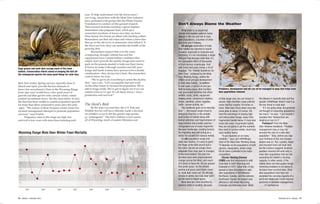
their first winter. Spring surveys, typically done in
March and April, provide the key measure of
fawn/doe recruitment.) Does in the Wyoming Range
from 1991-2007 would have a few good years of
growth and then get hit with a brutal winter, which
pushed recruitment down. See the chart below. In fact,
the herd has been unable to sustain population growth
for more than three consecutive years since the early
1990s. “The impact of these frequent winter losses has
stymied management attempts to promote population
recovery,” says Fralick.
Pregnancy rates in the range are high, but
survival is low, even with most does twinning each
Sage grouse and mule deer occupy much of the same
habitat. Conservation efforts aimed at keeping the bird off
the endangered species list mean good things for mule deer.
year. To help understand why the fawns aren’t
surviving, researchers with the Mule Deer Initiative
have partnered with groups like the Muley Fanatic
Foundation to conduct on-the-ground research.
That research includes inserting vaginal implant
transmitters into pregnant does, which give
researchers locations of fawns once they are born.
Once found, live fawns are fitted with tracking collars.
Researchers can then tell when and where a fawn dies
then go to the site to try to determine what killed it. If
the fawn survives, they can ascertain the health of the
growing deer.
Researchers suspect that over the years
overgrazing, drought, habitat loss and fire
suppression have created habitat conditions that
simply don’t provide the quality forage does need to
pack on the pounds needed to help rear their fawns.
If fawns do make it through summer and fall, poor
forage and harsh winters have proven to be a deadly
combination—they always have been. But researchers
want to know for sure.
“We’ve got to do everything to arrest the decline
first,” says Lutz. “Let’s accomplish that and work
on the other issues to increase the population. We’re
still in triage mode. We’ve got to figure out if we can
sustain what we’ve got. It’s all about fawns—fawn
production and survival.”
The Herd’s Bird
By the time you read this, the U.S. Fish and
Wildlife Service will have officially made a decision
on whether or not to list the greater sage grouse
as “endangered.” The bird’s habitat covers nearly
all of Wyoming, much of eastern Montana and
Don’t Always Blame the Weather
Predators, development and elk can all be managed in ways that helps mule
deer populations rebound.
Wyoming Range Mule Deer Winter Fawn Mortality
1993 1996 1999 2002 2005 2008 2011 2014
BARBARAMAGNUSON/LARRYKIMBALL
TOM&PATLEESON
96 • BUGLE • NOV/DEC 2015 NOV/DEC 2015 • BUGLE • 97
Mulies.indd 96-97Mulies.indd 96-97 1/8/2016 4:20:31 PM1/8/2016 4:20:31 PM
MOAR™
OUR NEW SHV™
3-10 x 42.
THE EXPERTS HAVE SPOKEN. AGAIN.
For the second straight year, Outdoor
Life magazine has selected a Nightforce
SHV™ as their Editor’s Choice in optics.
You might think that an award-winning
riflescope like this comes at a hefty
price.The fact is, our SHV™ 3-10 x 42 is
the mostaffordableriflescopewe’veever
made. That makes you the winner.
336 Hazen Lane, Orofino, ID 83544 208.476.9814 Learn more at NightforceOptics.com
IHR™
A mere 11.6" long, less than 21 ounces
Side parallax adjustment
Choice of IHR™ or MOAR™ reticles
Superb clarity, resolution and light transmission
For the second straight year Outdoor A mere 11 6" long less than 21 ounceeses
northwestern Colorado and west into Idaho, Oregon
and Nevada. Much of that habitat overlaps with mule
deer habitat. And much like mule deer, the bird’s
habitat has been adversely affected by development,
livestock grazing and habitat fragmentation.
The good news for mule deer? It turns out that
the threat of listing an animal that lives in 11 states
on more than 165 million acres (think Texas-big)
motivates just about everyone on the landscape into
action. Because sage grouse live on 52 percent BLM
land and 31 percent private land, getting buy-in from
landowners is key. In 2010 the Natural Resources
and Conservation Service launched the Sage Grouse
Initiative, which has pumped tens of millions of
dollars into sage grouse conservation efforts. Since
then, 1,129 ranches have enrolled in voluntary
conservation projects totaling 4.4 million acres.
“Mule deer are riding the coattails of sage grouse
right now,” says Miles Moretti, Mule Deer Foundation
president. “I like to say, ‘what’s good for the bird
is good for the mule deer herd.’ Six million (out of
11 million) acres of high-priority area for mule deer
overlap with sage grouse habitat. What I’ve seen is
that agencies are going to get the sage grouse issue
behind them. And they are looking at a sagebrush
landscape initiative.”
In a 2015 study in Wyoming’s Green River
Basin, researchers Holly Copeland and Hall Sawyer
examined the overlap between two migratory
populations of mule deer and lands with some sage
grouse protections. The study’s conclusion? “Sage
grouse conservation efforts doubled the protection of
deer migration habitat and winter range.”
While mule deer aren’t out of the woods yet,
their demise has gotten the attention of agencies
across the board. “There are a lot of positive things
going on, but it’s not one thing that drove numbers
down,” Moretti says. “You have to leverage your
dollars to be successful. Partnerships are the only
way to get this done. If we work together and identify
high-priority areas, I’m optimistic that we can turn
some of these mule deer populations around.”
Jim Heffelfinger, of the Mule Deer Working
Group, agrees.
“Colorado has been big on research. Nevada and
Utah have been big in large-scale habitat projects,” he
says. “I think sportsmen are becoming more involved
in conservation organizations, getting out there and
helping out on projects.
“There are really only a couple places where
mule deer are still declining. The news continues
to report on the decline, but now we are seeing an
uptick. We are stable or increasing, but that doesn’t
mean we’re happy where we’re at.”
Elk Country = Mule Deer Country
Mule deer and elk haunt the same splendid country. Why not ensure conservation works for both?
Tom Toman, RMEF’s director of
science planning, recalls the day he
sat in on an RMEF Project Advisory
Committee (PAC) as it reviewed a
grant proposal to burn 80 percent of
the sagebrush in a spot he knew more
than 1,000 mule deer depended on for
winter range. It raised an immediate
red flag with the team that included
biologists from the state wildlife
agency, a nearby university, the U.S.
Forest Service and the Bureau of Land
Management.
While elk thrive on grasses that
erupt after a fire, sagebrush takes
longer to recover and makes up
the bulk of a mule deer’s winter
provisions across much of the West.
Burn all the sage and the blackened
stalks may not be the only skeletons
covering the landscape after a
hard winter.
“We looked at each other across
that table and there was no question
what we needed do,” Toman says.
“We’re simply not going to fund a
project that could be detrimental to
mule deer. We sent it back to the
manager who submitted it and told
him to try again, but next time to
propose a burn on no more than 20
percent of the area with a 30-year
interval before treating adjacent acres.
That allows sage to recover and
provides forage for an array of critters
without stressing out those that need
it for their bread and butter.”
Of course sagebrush is just
one ecosystem where mulies and
elk overlap. From pinyon-junipers
up through ponderosas, aspens,
lodgepoles and larches to the alpine,
they can be found cohabitating. It’s
also fair to say that elk and mule deer
occupy overlapping territory in the
hearts of many hunters.
“They are a symbol of the West
just as much as elk,” Toman says. “It
only makes sense for a conservation
nnnn 22220000
eeeararar
tt acacaccrrerer sst aacacca rerres.s
dd
crcrcrcrititittteteersrs
tt nnnneeeeeeeee dddd
ndndndnd
rrrrssss
s,s,ss,
llpippip nenenenene,,,
ItItItIttItI ’s’s’sss
eeeeee ddddddeeeeeeeeeerrrrrr
ththththththhtheeee
WeWeWeWeW ststststs
aaaaysysssyys... “I“I“I“I“““Itttttttttttt
vvvvvvvvatatatatatatatioioioiooiooonnnn
400 vital habitat protection and
improvement projects on over
350,000 acres to benefit both species
and a host of other wildlife.
Mule deer are struggling alongside
another native of the rugged and
broken landscapes—the sage grouse.
Overlap the most vital remaining
habitat for sage grouse, mule deer
and elk on a map, and you quickly
see how intimately connected these
iconic western species are. That’s
why RMEF is partnering with the
Sage Grouse Initiative to fund a staffer
based in northwest Colorado tasked
with finding conservation opportunities
in that region that benefit all three
species at the same time.
This kind of collaboration only
grows more important as human
populations expand along with
other habitat pressures such
as energy development and an
increasingly hotter, drier climate.
RMEF is committed to finding new
and innovative ways to stretch
conservation dollars further, and to
support research that reveals how
best to spend that cash to benefit the
greatest variety of species.
—Paul Queneau
organization like the RMEF to ensure
both are able to prosper together.”
RMEF was just five years old
when it funded its first three projects
that directly named mule deer
as co-beneficiaries. One helped
burn 2,200 acres of oak brush on
Colorado’s Oak Ridge State Wildlife
Area north of Meeker in a region
known affectionately as “the deer
factory.” Another project roller-
chopped 800 acres of pinyons and
junipers encroaching on elk and
mule deer winter range on Utah‘s
La Sal National Forest. The third
helped launch what would become
a landmark study of mule deer and
elk’s response to roads, ATVs, cattle
grazing, hunting pressure and other
factors at the Starkey Experimental
Forest in northeast Oregon.
Since then RMEF has helped
fund upwards of 800 projects that
biologists specifically identified as
a benefit to mule deer. So far, RMEF
has protected or enhanced more than
2 million acres of prime elk habitat
where mule deer are present and stand
to benefit.
Invariably, RMEF’s work has
involved strong collaborators,
leveraging and multiplying each
other’s cash to get the greatest
bang for their conservation buck.
Since 1991, the Elk Foundation
has partnered with the Mule Deer
Foundation (MDF) on more than
NOV/DEC 2015 • BUGLE • 99
Mulies.indd 98-99Mulies.indd 98-99 1/8/2016 4:20:53 PM1/8/2016 4:20:53 PM

Mulies

  • 1.
    I magine riding aroller coaster: the slow initial creep to the top, followed by a gut-pinned-to-the-roof-of- your-mouth plunge. As you ride this particular roller coaster, though, those peaks slowly lose elevation, until eventually, whoosh, you run out of track. This nightmare isn’t reserved for 12-year-olds. Wildlife managers get those cold sweats in the middle of the night, too, especially if you mention mule deer. Lewis and Clark first encountered mule deer in South Dakota. They noted the animal’s absence in forests and riverbeds but love for the “rough country.” Other prominent explorers rarely mentioned mule deer in their observations of big game, even though mule deer range from the coastal islands of Alaska, south to southern Baja Mexico, east through the American Great Plains up into southern Yukon Territory. After the West was officially open, settlers, miners and ranchers pushed into those wide open spaces. With them, market hunters decimated mule deer populations of the late 1800s and early 1900s. Shortly thereafter, the landscape changed, both physically and socially. In 1903, the first hints at regulated hunting with licenses took hold. In 1923, the Pittman-Robertson Federal Aid in Wildlife Restoration Act passed. Along with their dreams of a new life, settlers brought with them cattle and sheep, which mowed native grasses. Land managers did their best to eliminate fire and predators from the landscape. Forests were cleared of timber to build log In the past decade, mule deer populations have declined drastically across much of elk country, leaving wildlife managers and hunters searching for answers and working toward solutions. RE-BALANCING ACTby PJ DelHomme GARYKRAMER by PJ DelHomme GARYKRAMER NOV/DEC 2015 • BUGLE • 91 Mulies.indd 90-91Mulies.indd 90-91 1/8/2016 4:19:37 PM1/8/2016 4:19:37 PM
  • 2.
    homes, stoke woodstoves and support mine shafts dug deep into the earth. Mule deer populations exploded. Why? Mule deer prefer to eat woody shrubs such as big sagebrush and bitterbrush. These early seral plants are the first to sprout following a disturbance such as logging. The grass and overstory that kept woody shrubs from spreading were gone and this allowed shrubs to thrive. From the 1950s through 1970, mule deer numbers hit historic highs. While the fish and game counts for this time are scant and far more anecdotal than today’s, a look at the Boone and Crockett Club (B&C) entries shows a wave of typical mule deer record-book entries for states such as Colorado, New Mexico, Idaho and Wyoming. (See chart on page 93). In 1963, hunters killed a record 147,000 mule deer in Colorado. But the good times would only last so long. Since those records, mule deer populations in the West have been on a roller coaster ride. Wyoming nearly made it to half a million deer in 2003, but slid to 376,000 by 2013. New Mexico had 300,000 deer in 1970, but fell to 70,000 in 2003. Idaho was at 300,000 in 2003, but dropped to around 200,000 by 2013. “We’re not going to see those historically high numbers because we don’t have the huge scale landscape disturbance,” says Jim Heffelfinger, chair of the Mule Deer Working Group and author of Deer of the Southwest. “The shrub component is everything. It’s that secondary vegetation. When you’ve got a lot of shrubs, that’s what they eat.” When mule deer were at their peak, elk numbers were much lower; roughly half a million elk roamed the West in 1975. The landscape-wide changes didn’t help elk like they did mule deer. But times have changed. Since 1975, elk populations in western states have doubled and Wyoming has nearly tripled its population. So why are mule deer struggling and elk flourishing? Like anything in wildlife management, it’s complicated, though there are a few key factors that can help explain the plight of mule deer in the last few decades. To better understand the mule deer story across much of the West, it’s easiest to focus on the two states that have the largest mule deer populations: Colorado and Wyoming, places where mule deer are on the long, slow road to recovery. Colorado In 1972, Doug Burris was rattling for mulies in the San Juan National Forest of southwest Colorado. In rainy and generally miserable weather, he passed up a half-dozen decent bucks. He was holding out for one particular buck, which was spotted by one of his hunting buddies earlier in the trip. On the fourth day, Burris’ buddies dropped him off in Proven Canyon, a place where he killed a buck the prior year that had a 41-inch spread. He spotted a couple bucks on the opposite hillside when a third buck materialized. It was an absolute brute. Burris dropped down the canyon and weaved his way through thick oak brush. On his way to intercept the bucks, he nearly stepped on a doe that exploded from her bed. This spooked the bucks. Two went left, his buck went right. With one shot from his .264, the biggest buck was down. When Burris got home, he took the head and cape to his taxidermist, Ed Schlier, who was a measurer for B&C. A green score put the antlers in the top 10. In an article in the December 1975 Outdoor Life, Doug recalled what happened next. “Several months later my phone rang at 1 a.m. ‘Doug,’ Ed blurted out, ‘I think your buck may be the best typical ever taken.’” It was, and has been ever since. The closest contender is a good 8 inches smaller. Burris killed his deer in Dolores County, which holds 24 typical B&C entries. Northeast of there, Eagle County ranks third in the world for typical mule deer with 73 entries. Colorado is by far the leader in both nontypical and typical B&C entries for mule deer, eclipsing the runner-ups by triple digits. As if that wasn’t enough, it’s home to more mule deer and more elk than any other state. While the elk populations have more than doubled to 267,000 since Burris shot his buck, mule deer in Colorado haven’t fared as well. Reaching a population of 614,000 in 2005, mule deer slid back down to 391,000 in 2013. Why the volatility? In a word: change. When mule deer numbers peaked in the 1960s, there was an abundance of high-quality browse: mountain mahogany, bitterbrush and sagebrush. During this time, the state entered a raucous course of dry/wet periods, with local drought followed by very wet episodes complete with flooding. During wet years, browse is filled with nutrients. Does were able to pack on fat to survive the winter and give birth to healthy fawns in the spring. But as time progressed, the wet years became fewer and drought became more common. To make matters worse, just one severe winter, which might end the drought, would also decimate a drought-weakened herd. At the same time, the range was maturing. Forests were growing back from logging. Cheatgrass, an invasive from Asia, eliminates native perennial grasses and forbs and increases fire intensity. It and other weeds were spreading. And then came John Denver. His ode to Colorado and all things mountainous reached number nine on the Billboard Hot 100 list in 1973. Colorado’s population was 2.5 million then. It grew by 500,000 every decade until 1993-2003 when it grew by Doug Burris' typical mule deer was killed in 1972 and has stood tall ever since. “Studies done between 1999 and 2011 found that the severity of winters and the amount of summer precipitation were the most important influences on mule deer population growth." —From Colorado Parks and Wildlife’s, The Story of Colorado’s Mule Deer TYPICAL 41-50 51-60 61-70 71-80 81-90 91-00 01-10 11-14 Colorado 14 57 140 92 67 77 225 53 Nevada 1 4 3 - 13 22 30 15 Oregon 3 5 13 9 15 34 - - Utah 12 18 28 20 30 39 44 22 New Mexico - 6 39 7 9 42 55 8 Idaho 4 12 45 42 46 53 38 18 Wyoming - 8 24 13 20 54 56 14 Montana 3 9 12 9 12 - - 5 Arizona 5 4 6 9 11 17 27 - Record-book Mule Deer 1941-2014 NON-TYPICAL 41-50 51-60 61-70 71-80 81-90 91-00 01-10 11-14 Colorado 10 30 61 33 34 26 53 16 Nevada 3 7 6 4 - 5 9 3 Oregon 11 13 8 8 4 5 2 1 Utah 17 17 31 12 14 7 13 4 New Mexico - 5 15 8 4 8 9 2 Idaho 17 29 41 29 31 16 9 8 Wyoming 7 8 20 5 11 9 13 5 Montana 6 13 10 10 2 4 4 2 Arizona 17 11 13 6 10 19 15 4 D.ROBERTANDLORRIFRANZ COURTESYBOONE&CROCKETT 92 • BUGLE • NOV/DEC 2015 NOV/DEC 2015 • BUGLE • 93 Mulies.indd 92-93Mulies.indd 92-93 1/8/2016 4:19:58 PM1/8/2016 4:19:58 PM
  • 3.
    700,000 600,000 500,000 400,000 300,000 BACKGROUNDPHOTO:WESUNCAPHER Post-Hunt Estimates ofColorado's Mule Deer Population In 1991, Wyoming had an estimated 578,000 mule deer. In 2013, that number had fallen 39 percent to 353,000. When you get a precipitous drop like that, hunters tend to speak up and agencies have to listen. Wyoming Game and Fish managers looked to hunters for input. The scoping for a major project began in 1998 and by 2007 the agency had launched the Mule Deer Initiative (MDI), which focused on two key areas in Wyoming: the Wyoming Range and the Platte Valley. These two areas were part of a pilot for what is now a statewide program and includes herd units throughout the rest of the state. The MDI was recently revised and accepted by the Wyoming Game and Fish Commission at their July 2015 meeting. “The program is unprecedented,” says Daryl Lutz, wildlife coordinator for Wyoming Game and Fish. “The Wyoming Game and Fish Commission allocated $2.5 million to the MDI to help fund recommendations and projects. It’s the most ever allocated to one species.” The Wyoming Range offers classic wilderness high country hunting, as well as plenty of roads and two-tracks down lower. It sits just south of Yellowstone National Park and just east of the Idaho state line. Historically, it has offered some of the best mule deer hunting in the world. Bucks can still get old there. Between 1989-2008, nearly a quarter of all bucks killed had inside spreads of at least 25 inches. Hunter success in 2013 was more than 40 percent. The February-March 2015 issue of Eastmans’ Hunting Journal has a good recommendation, especially for hunters willing to put in the time. “I would honestly venture to say that this is the best area in the country when it comes to points versus hunt quality…The success rates here are pretty rough, at only 32 percent, and the country is very rough, straight up and down. If you are a proficient backcountry mule deer hunter, this might just be the place for you.” Lincoln County, which encompasses the Wyoming Range, holds the most record book mule deer in Wyoming at 36 percent. Some populations of mule deer there migrate in excess of 180 miles between summer and winter ranges. “Undoubtedly,” says Gary Fralick, a wildlife biologist for the Wyoming Range, “the Wyoming Range herd exhibits some of the longest migratory behaviors of any North American ungulate.” The area holds an estimated 6,500 elk as well. Like much of the state, the Wyoming Range has seen its peaks and valleys in mule deer populations. In 1976, there were roughly 22,000 deer, but by 1991, the population soared to nearly 60,000—the result of consistent moisture on summer ranges. But it was only temporary. Today, mule deer numbers are back around 36,500. What makes deer populations continue on the roller coaster in the Wyoming Range? It’s pretty simple. “This deer population hasn’t exhibited any sustained population growth since the late 1990s,” says Fralick. “Perhaps the single most dramatic factor affecting the annual population cycle has been large-scale winter mortality observed every three years. This level of mortality is due to snow accumulations, extended periods of extreme cold temperatures, and absence of adequate forage because of the poor ecological condition of shrubs on crucial winter ranges.” Mule deer populations will increase when they recruit more than 65 fawns/doe. (Most state wildlife agencies define deer recruitment as fawns that survive 1 million. By 2014, 5.4 million people lived in Colorado. All those people need homes, roads, power, lawns. All those factors fragment habitat. Subdivisions and ski resorts were built in winter range and along migratory paths. Most recently, an explosion in oil and gas wells has further impacted habitat. In Eagle County, a record-book mule deer stronghold, the cycle continues. “The winter of 2007 hit everything hard,” says Andy Holland, Colorado Parks and Wildlife big game manager. “That herd was declining, but now they are increasing. It’s phenomenal habitat. You’ve got everything. It’s high enough that it gets good moisture, and it’s high alpine elevation summer range. You’ve got the Holy Cross and Eagle’s Nest wildernesses and it’s prime transition range from summer to winter. Winter range there is a diverse mountain shrub community consisting of sagebrush, serviceberry, mountain mahogany and bitterbrush. It’s a sweet spot for mule deer habitat. The sheer number of palatable and nutritious shrubs in our mid elevations is what makes them so productive. “The toughest unit to draw is 44, and that’s in southern Eagle County. We manage the herd for buck harvest. The limiting factor is winter range, which happens to be where people are building houses in that I-70 corridor. We’re seeing plenty of residential development there.” Could mule deer ever reach a point of no return? Could a bad winter, combined with a prolonged drought, put the numbers so low that the herds couldn’t bounce back? “No, we’re not at that point,” says Holland. “They are incredibly resilient. If they get good conditions and they get good twinning rates, they can rebound quickly.” Still, wildlife managers in Colorado have recognized the need for more action and in April and May 2014 they held meetings to solicit public input. A list of seven strategic priorities was created and the Colorado West Slope Mule Deer Strategy was born. Its objectives include landscape-scale habitat management, mitigation of impacts from development, and regulation of doe harvest, to name a few. The strategy is currently in the funding approval and implementation phase. Along with the new strategy, managers are getting a little help from above. This past spring, Colorado had the wettest May on record. Wyoming Like Colorado, Wyoming is classic mule deer country. From the sage-swept rangelands to granite peaks reaching high above timberline, mule deer have found a home in some of the most beautiful places in the state. And like Colorado, mule deer populations here have slowly dwindled. Mule deer depend on shrubs for year-round forage. Elk, on the other hand, have a more varied diet, which includes grass. 1975 1978 1981 1984 1987 1990 1993 1996 1999 2002 2005 2008 2011 VICSCHENDELDENNIEMANNBILLCOSTER/FLPA/MINDENPICTURES 94 • BUGLE • NOV/DEC 2015 NOV/DEC 2015 • BUGLE • 95 Mulies.indd 94-95Mulies.indd 94-95 1/8/2016 4:20:03 PM1/8/2016 4:20:03 PM
  • 4.
    BACKGROUNDPHOTO:PETEOXFORD/NPL/MINDENPICTURES 75% 65% 55% 45% 35% 25% 15% 5% While there isno doubt that climate and weather patterns factor heavily in the rise and fall of mule deer populations, a number of other elements aren’t helping. Oil and gas exploration in mule deer habitat has boomed in recent decades, especially in Colorado and Wyoming. It’s not necessarily a single well-pad that disrupts mule deer, it’s the cumulative effect of thousands of them across a landscape. And with those well pads comes a lot of baggage. The “Habitat Guidelines for Mule Deer,” produced by the Mule Deer Working Group, outline the effects of oil and gas development in mule deer habitat. “In addition to well pads, a typical oil and gas field includes many other facilities and associated activities that affect wildlife: roads, tanks, equipment staging areas, compressor stations, shops, pipelines, power supplies, traffic, human activity, etc.” The handbook goes on to describe how “…the largest single threat to biological diversity is the outright destruction of habitat along with habitat alteration and fragmentation of large habitats into smaller patches.” Unregulated use of roads fragments the open landscape, creating barriers for migrating deer and acting as a vector for people and noxious weeds. As elk populations surge and mule deer decline, it’s easy to point the finger at the 800-pound bull in the room, but elk are simply more adaptable than mule deer to changes in the environment. The past two decades have seen unprecedented change across the West, and much of it tends to favor elk. Elk are grazers that prefer grass. As the shrubs decline and grass (and trees) move in, mule deer move out. Elk will eat shrubs in winter, but mule deer won’t eat the hard-to-digest grass. Mule deer are more sensitive to extreme shifts in weather. Because of their larger size, elk can remain in secure, high-mountain areas until the snow reaches roughly 18 inches or more. Mule deer move down once the snow piles to about 10 inches. Elk have the advantage of staying high and eating better forage, away from fragmented habitat below. If mule deer move into lower, fragmented habitat, they are not going to get the nutrients they need to survive winter, much less raise healthy fawns. “It just depends on so many variables,” says Jum Heffelfinger, chair of the Mule Deer Working Group. “It depends on the populations of both species, topography, winter range. Elk do have a potential to be major competitors. Chronic Wasting Disease (CWD) was first discovered in wild mule deer in both Wyoming and Colorado in 1975. Since then, it has spread or been discovered in wild deer populations in the Midwest, Northeast, Canada, and the extreme Southwest, though the largest area affected is still where Wyoming, Colorado and Nebraska meet. While the disease is typically fatal and has spread, Heffelfinger doesn’t see it as the key threat to mule deer. “It’s not going away, but generally not thought of impacting populations too much,” he says. “I just wouldn’t overplay that. Researchers are keeping an eye on it.” Predators? From the Mule Deer Initiative handbook: “Predator management may or may not increase the size of a mule deer population.” Okay, before you slap your forehead at this non-answer, please read on. Yes, coyotes, bears and mountain lions eat mule deer, but the science suggests localized predator removal will work only in mule deer populations that are not exceeding the habitat’s carrying capacity. In other words, if the habitat does not hold quality forage, removing predators is not going to increase fawn survival rates. Mule deer populations that have not exceeded the carrying capacity of a particular landscape could respond positively to predator management. —PJ DelHomme their first winter. Spring surveys, typically done in March and April, provide the key measure of fawn/doe recruitment.) Does in the Wyoming Range from 1991-2007 would have a few good years of growth and then get hit with a brutal winter, which pushed recruitment down. See the chart below. In fact, the herd has been unable to sustain population growth for more than three consecutive years since the early 1990s. “The impact of these frequent winter losses has stymied management attempts to promote population recovery,” says Fralick. Pregnancy rates in the range are high, but survival is low, even with most does twinning each Sage grouse and mule deer occupy much of the same habitat. Conservation efforts aimed at keeping the bird off the endangered species list mean good things for mule deer. year. To help understand why the fawns aren’t surviving, researchers with the Mule Deer Initiative have partnered with groups like the Muley Fanatic Foundation to conduct on-the-ground research. That research includes inserting vaginal implant transmitters into pregnant does, which give researchers locations of fawns once they are born. Once found, live fawns are fitted with tracking collars. Researchers can then tell when and where a fawn dies then go to the site to try to determine what killed it. If the fawn survives, they can ascertain the health of the growing deer. Researchers suspect that over the years overgrazing, drought, habitat loss and fire suppression have created habitat conditions that simply don’t provide the quality forage does need to pack on the pounds needed to help rear their fawns. If fawns do make it through summer and fall, poor forage and harsh winters have proven to be a deadly combination—they always have been. But researchers want to know for sure. “We’ve got to do everything to arrest the decline first,” says Lutz. “Let’s accomplish that and work on the other issues to increase the population. We’re still in triage mode. We’ve got to figure out if we can sustain what we’ve got. It’s all about fawns—fawn production and survival.” The Herd’s Bird By the time you read this, the U.S. Fish and Wildlife Service will have officially made a decision on whether or not to list the greater sage grouse as “endangered.” The bird’s habitat covers nearly all of Wyoming, much of eastern Montana and Don’t Always Blame the Weather Predators, development and elk can all be managed in ways that helps mule deer populations rebound. Wyoming Range Mule Deer Winter Fawn Mortality 1993 1996 1999 2002 2005 2008 2011 2014 BARBARAMAGNUSON/LARRYKIMBALL TOM&PATLEESON 96 • BUGLE • NOV/DEC 2015 NOV/DEC 2015 • BUGLE • 97 Mulies.indd 96-97Mulies.indd 96-97 1/8/2016 4:20:31 PM1/8/2016 4:20:31 PM
  • 5.
    MOAR™ OUR NEW SHV™ 3-10x 42. THE EXPERTS HAVE SPOKEN. AGAIN. For the second straight year, Outdoor Life magazine has selected a Nightforce SHV™ as their Editor’s Choice in optics. You might think that an award-winning riflescope like this comes at a hefty price.The fact is, our SHV™ 3-10 x 42 is the mostaffordableriflescopewe’veever made. That makes you the winner. 336 Hazen Lane, Orofino, ID 83544 208.476.9814 Learn more at NightforceOptics.com IHR™ A mere 11.6" long, less than 21 ounces Side parallax adjustment Choice of IHR™ or MOAR™ reticles Superb clarity, resolution and light transmission For the second straight year Outdoor A mere 11 6" long less than 21 ounceeses northwestern Colorado and west into Idaho, Oregon and Nevada. Much of that habitat overlaps with mule deer habitat. And much like mule deer, the bird’s habitat has been adversely affected by development, livestock grazing and habitat fragmentation. The good news for mule deer? It turns out that the threat of listing an animal that lives in 11 states on more than 165 million acres (think Texas-big) motivates just about everyone on the landscape into action. Because sage grouse live on 52 percent BLM land and 31 percent private land, getting buy-in from landowners is key. In 2010 the Natural Resources and Conservation Service launched the Sage Grouse Initiative, which has pumped tens of millions of dollars into sage grouse conservation efforts. Since then, 1,129 ranches have enrolled in voluntary conservation projects totaling 4.4 million acres. “Mule deer are riding the coattails of sage grouse right now,” says Miles Moretti, Mule Deer Foundation president. “I like to say, ‘what’s good for the bird is good for the mule deer herd.’ Six million (out of 11 million) acres of high-priority area for mule deer overlap with sage grouse habitat. What I’ve seen is that agencies are going to get the sage grouse issue behind them. And they are looking at a sagebrush landscape initiative.” In a 2015 study in Wyoming’s Green River Basin, researchers Holly Copeland and Hall Sawyer examined the overlap between two migratory populations of mule deer and lands with some sage grouse protections. The study’s conclusion? “Sage grouse conservation efforts doubled the protection of deer migration habitat and winter range.” While mule deer aren’t out of the woods yet, their demise has gotten the attention of agencies across the board. “There are a lot of positive things going on, but it’s not one thing that drove numbers down,” Moretti says. “You have to leverage your dollars to be successful. Partnerships are the only way to get this done. If we work together and identify high-priority areas, I’m optimistic that we can turn some of these mule deer populations around.” Jim Heffelfinger, of the Mule Deer Working Group, agrees. “Colorado has been big on research. Nevada and Utah have been big in large-scale habitat projects,” he says. “I think sportsmen are becoming more involved in conservation organizations, getting out there and helping out on projects. “There are really only a couple places where mule deer are still declining. The news continues to report on the decline, but now we are seeing an uptick. We are stable or increasing, but that doesn’t mean we’re happy where we’re at.” Elk Country = Mule Deer Country Mule deer and elk haunt the same splendid country. Why not ensure conservation works for both? Tom Toman, RMEF’s director of science planning, recalls the day he sat in on an RMEF Project Advisory Committee (PAC) as it reviewed a grant proposal to burn 80 percent of the sagebrush in a spot he knew more than 1,000 mule deer depended on for winter range. It raised an immediate red flag with the team that included biologists from the state wildlife agency, a nearby university, the U.S. Forest Service and the Bureau of Land Management. While elk thrive on grasses that erupt after a fire, sagebrush takes longer to recover and makes up the bulk of a mule deer’s winter provisions across much of the West. Burn all the sage and the blackened stalks may not be the only skeletons covering the landscape after a hard winter. “We looked at each other across that table and there was no question what we needed do,” Toman says. “We’re simply not going to fund a project that could be detrimental to mule deer. We sent it back to the manager who submitted it and told him to try again, but next time to propose a burn on no more than 20 percent of the area with a 30-year interval before treating adjacent acres. That allows sage to recover and provides forage for an array of critters without stressing out those that need it for their bread and butter.” Of course sagebrush is just one ecosystem where mulies and elk overlap. From pinyon-junipers up through ponderosas, aspens, lodgepoles and larches to the alpine, they can be found cohabitating. It’s also fair to say that elk and mule deer occupy overlapping territory in the hearts of many hunters. “They are a symbol of the West just as much as elk,” Toman says. “It only makes sense for a conservation nnnn 22220000 eeeararar tt acacaccrrerer sst aacacca rerres.s dd crcrcrcrititittteteersrs tt nnnneeeeeeeee dddd ndndndnd rrrrssss s,s,ss, llpippip nenenenene,,, ItItItIttItI ’s’s’sss eeeeee ddddddeeeeeeeeeerrrrrr ththththththhtheeee WeWeWeWeW ststststs aaaaysysssyys... “I“I“I“I“““Itttttttttttt vvvvvvvvatatatatatatatioioioiooiooonnnn 400 vital habitat protection and improvement projects on over 350,000 acres to benefit both species and a host of other wildlife. Mule deer are struggling alongside another native of the rugged and broken landscapes—the sage grouse. Overlap the most vital remaining habitat for sage grouse, mule deer and elk on a map, and you quickly see how intimately connected these iconic western species are. That’s why RMEF is partnering with the Sage Grouse Initiative to fund a staffer based in northwest Colorado tasked with finding conservation opportunities in that region that benefit all three species at the same time. This kind of collaboration only grows more important as human populations expand along with other habitat pressures such as energy development and an increasingly hotter, drier climate. RMEF is committed to finding new and innovative ways to stretch conservation dollars further, and to support research that reveals how best to spend that cash to benefit the greatest variety of species. —Paul Queneau organization like the RMEF to ensure both are able to prosper together.” RMEF was just five years old when it funded its first three projects that directly named mule deer as co-beneficiaries. One helped burn 2,200 acres of oak brush on Colorado’s Oak Ridge State Wildlife Area north of Meeker in a region known affectionately as “the deer factory.” Another project roller- chopped 800 acres of pinyons and junipers encroaching on elk and mule deer winter range on Utah‘s La Sal National Forest. The third helped launch what would become a landmark study of mule deer and elk’s response to roads, ATVs, cattle grazing, hunting pressure and other factors at the Starkey Experimental Forest in northeast Oregon. Since then RMEF has helped fund upwards of 800 projects that biologists specifically identified as a benefit to mule deer. So far, RMEF has protected or enhanced more than 2 million acres of prime elk habitat where mule deer are present and stand to benefit. Invariably, RMEF’s work has involved strong collaborators, leveraging and multiplying each other’s cash to get the greatest bang for their conservation buck. Since 1991, the Elk Foundation has partnered with the Mule Deer Foundation (MDF) on more than NOV/DEC 2015 • BUGLE • 99 Mulies.indd 98-99Mulies.indd 98-99 1/8/2016 4:20:53 PM1/8/2016 4:20:53 PM