Dr.Mishu Singh
Chemistry Department
M.P.Govt P.G. College
Hardoi
INFRARED
SPECTROSCOPY
1
2
?
3
“Seeing The non-seeable”
“Using electromagnetic radiation as a probe to obtain
information about atoms and molecules that are too small
to see”
4
What is Spectroscopy ?
 Atoms and molecules interact with electromagnetic radiation (EMR)
in a wide variety of ways.
 Atoms and molecules may absorb and/or emit EMR.
 Absorption of EMR stimulates different types of motion in atoms
and/or molecules.
 The patterns of absorption (wavelengths absorbed and to what extent)
and/or emission (wavelengths emitted and their respective intensities)
are called ‘spectra’.
 Spectroscopy is the interaction of EMR with matters to get spectra
,which gives information like, bond length, bond angle, geometry and
molecular structure.
5
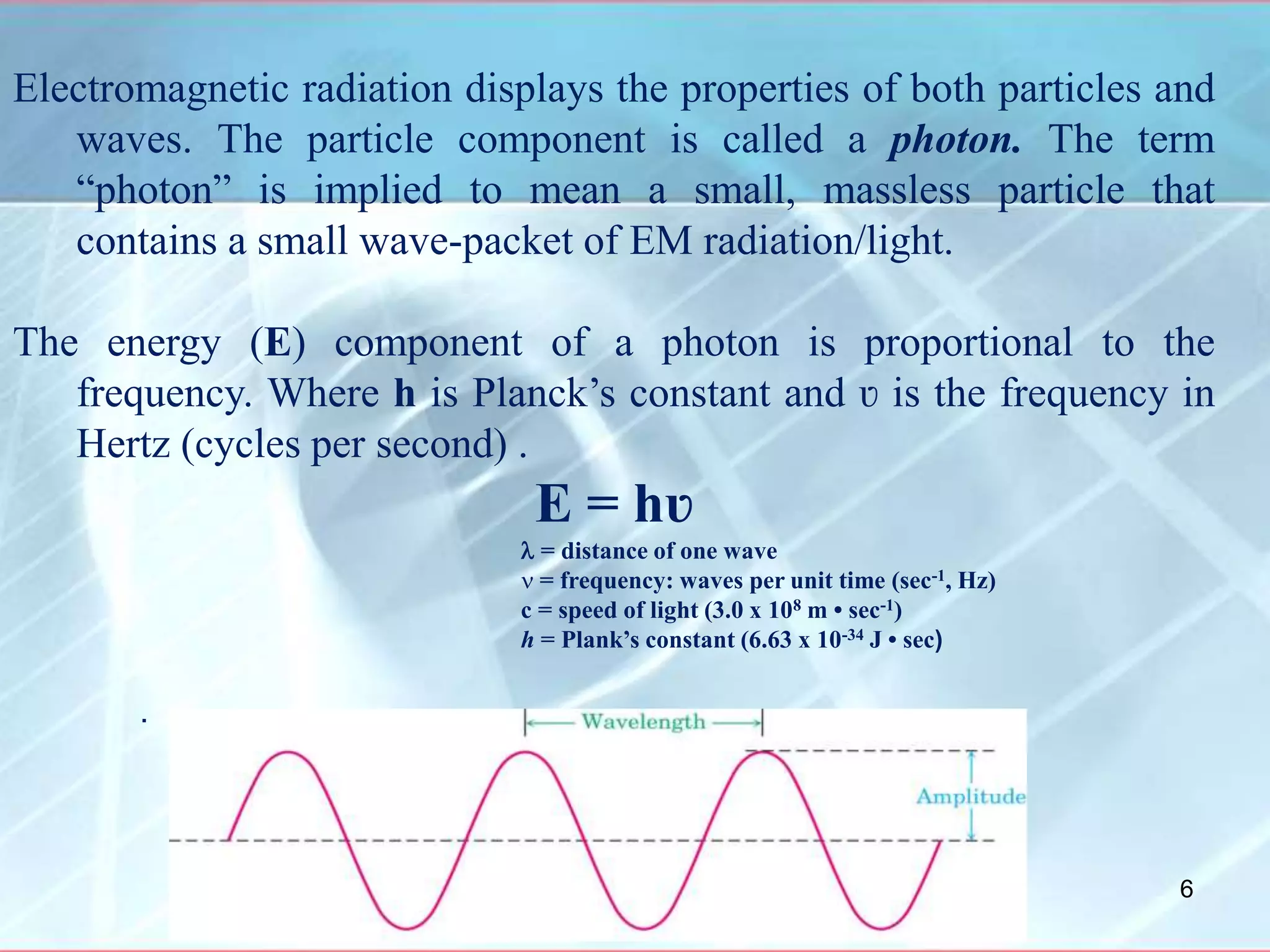
Electromagnetic radiation displays the properties of both particles and
waves. The particle component is called a photon. The term
“photon” is implied to mean a small, massless particle that
contains a small wave-packet of EM radiation/light.
The energy (E) component of a photon is proportional to the
frequency. Where h is Planck’s constant and ʋ is the frequency in
Hertz (cycles per second) .
E = hʋ
= distance of one wave
 = frequency: waves per unit time (sec-1, Hz)
c = speed of light (3.0 x 10⁸ m • sec-1)
h = Plank’s constant (6.63 x 10⁻³⁴ J • sec)
.
6
Because the speed of light, c, is constant, the frequency, n,
(number of cycles of the wave per second) can complete in the
same time, must be inversely proportional to how long the
oscillation is, or wavelength:
Because the atomic particles in matter also exhibit wave and
particle properties, EM radiation can interact with matter in
two ways:
• Collision – particle-to-particle – energy is lost as heat and
movement.
• Coupling – the wave property of the radiation matches the
wave property of the particle and “couple” to the next higher
quantum mechanical energy level
 =
c = 3 x 1010 cm/s
___

c
 E = h =
___

hc
7
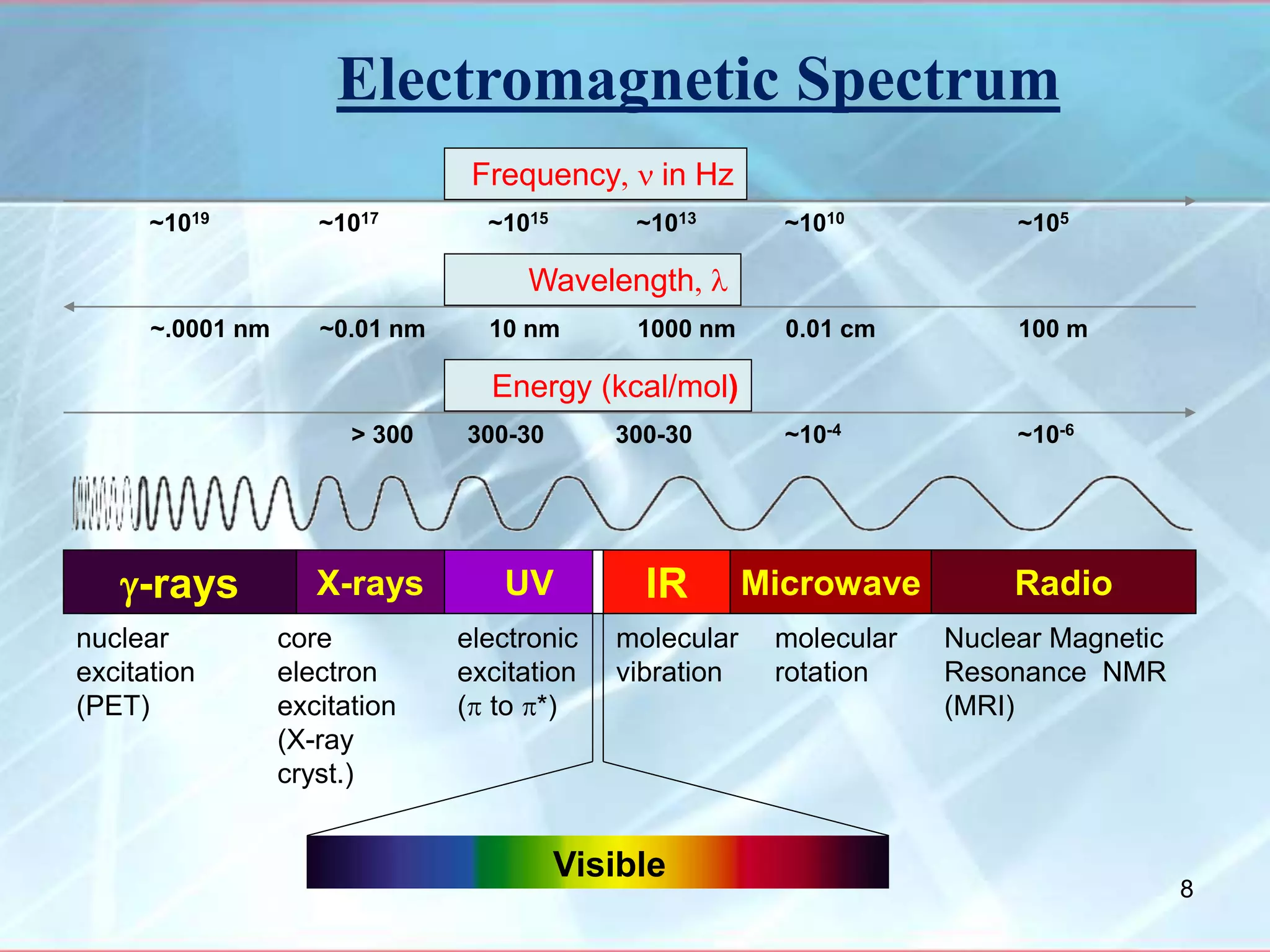
Electromagnetic Spectrum
UVX-rays IRg-rays RadioMicrowave
Energy (kcal/mol)
300-30 300-30 ~10-4> 300 ~10-6
Visible
Frequency,  in Hz
~1015 ~1013 ~1010 ~105~1017~1019
Wavelength, 
10 nm 1000 nm 0.01 cm 100 m~0.01 nm~.0001 nm
nuclear
excitation
(PET)
core
electron
excitation
(X-ray
cryst.)
electronic
excitation
(p to p*)
molecular
vibration
molecular
rotation
Nuclear Magnetic
Resonance NMR
(MRI)
8
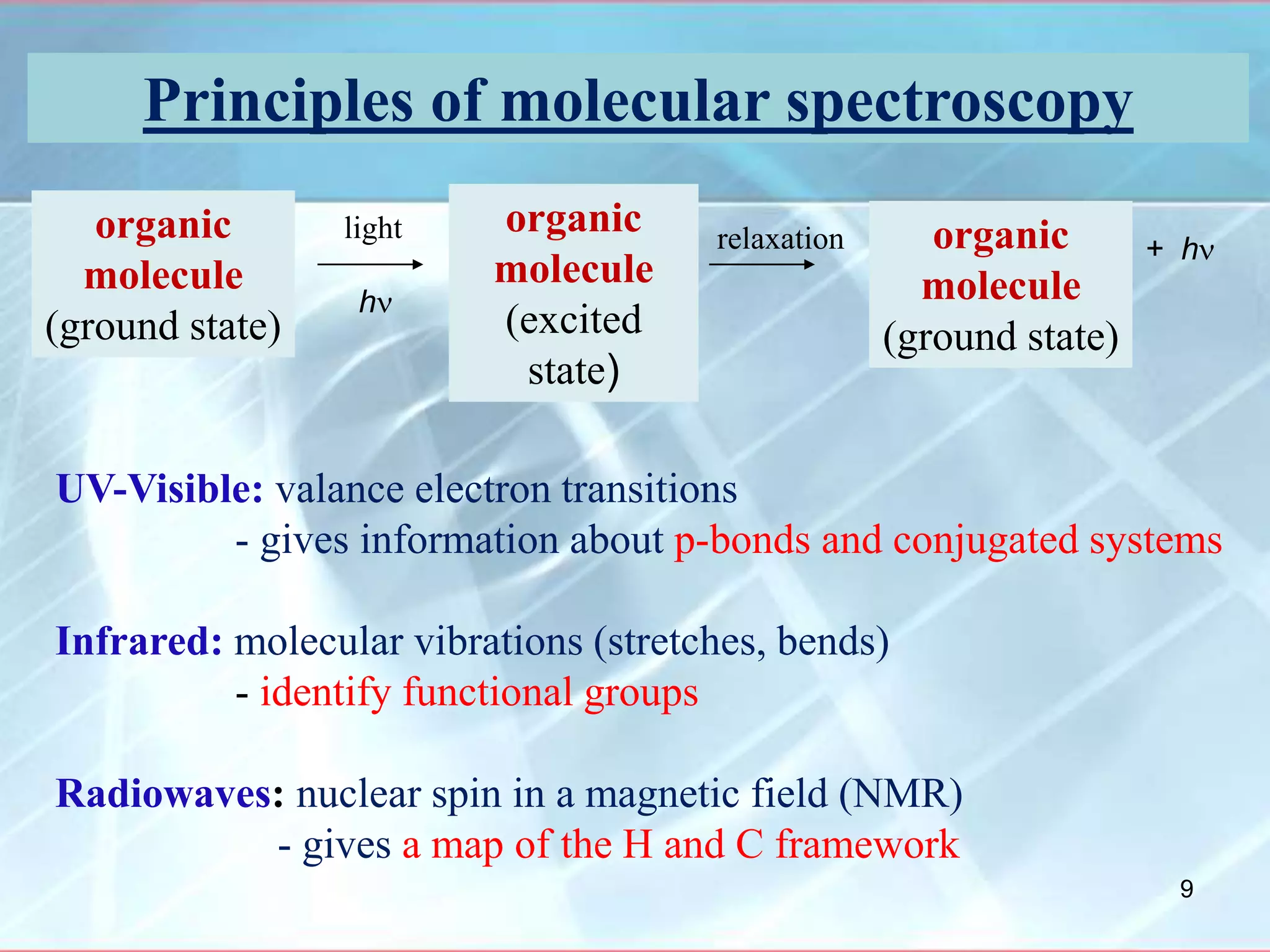
UV-Visible: valance electron transitions
- gives information about p-bonds and conjugated systems
Infrared: molecular vibrations (stretches, bends)
- identify functional groups
Radiowaves: nuclear spin in a magnetic field (NMR)
- gives a map of the H and C framework
organic
molecule
(ground state)
organic
molecule
(excited
state)
organic
molecule
(ground state)
+ hrelaxation
Principles of molecular spectroscopy
light
h
9
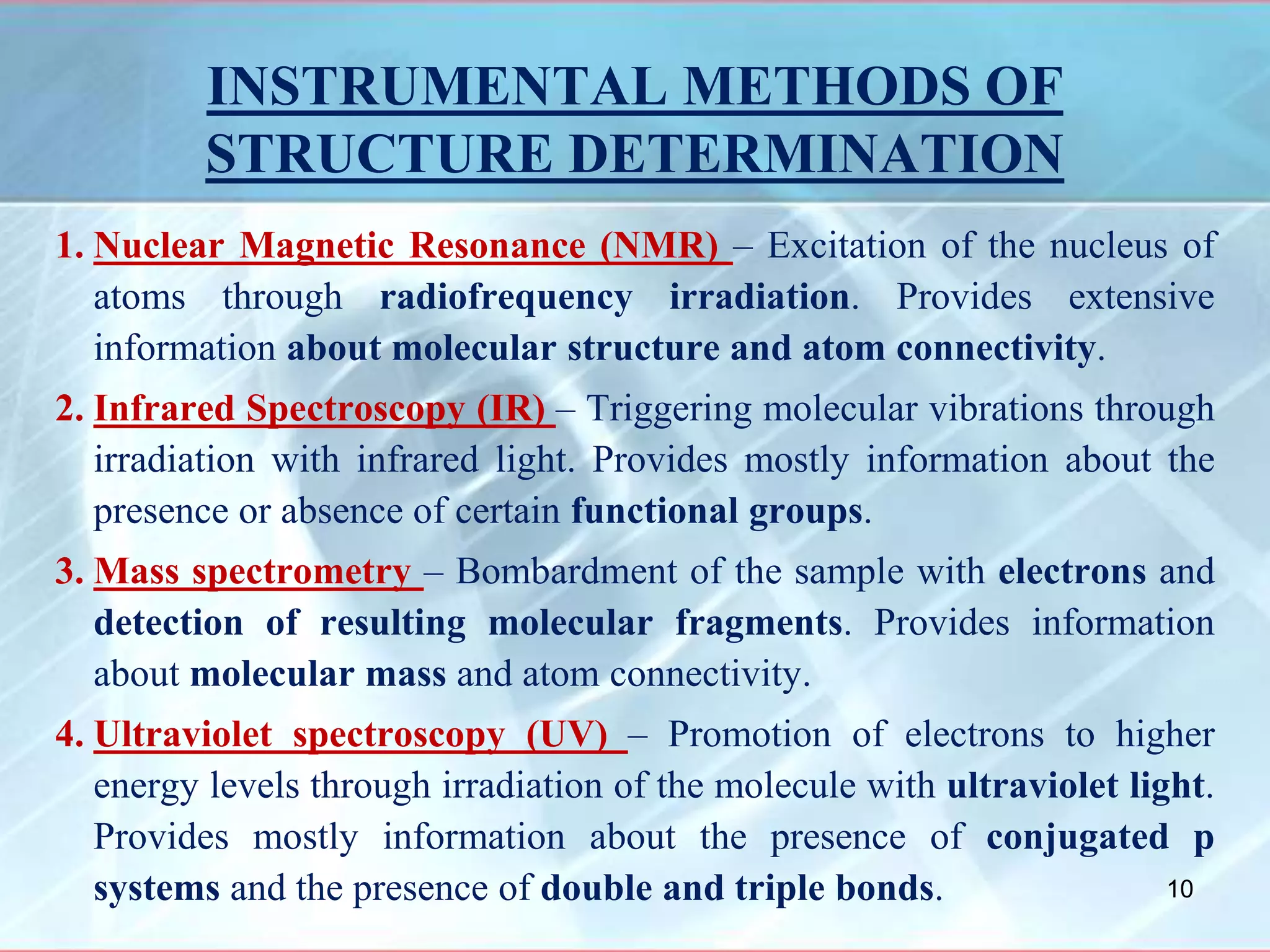
INSTRUMENTAL METHODS OF
STRUCTURE DETERMINATION
1. Nuclear Magnetic Resonance (NMR) – Excitation of the nucleus of
atoms through radiofrequency irradiation. Provides extensive
information about molecular structure and atom connectivity.
2. Infrared Spectroscopy (IR) – Triggering molecular vibrations through
irradiation with infrared light. Provides mostly information about the
presence or absence of certain functional groups.
3. Mass spectrometry – Bombardment of the sample with electrons and
detection of resulting molecular fragments. Provides information
about molecular mass and atom connectivity.
4. Ultraviolet spectroscopy (UV) – Promotion of electrons to higher
energy levels through irradiation of the molecule with ultraviolet light.
Provides mostly information about the presence of conjugated p
systems and the presence of double and triple bonds. 10
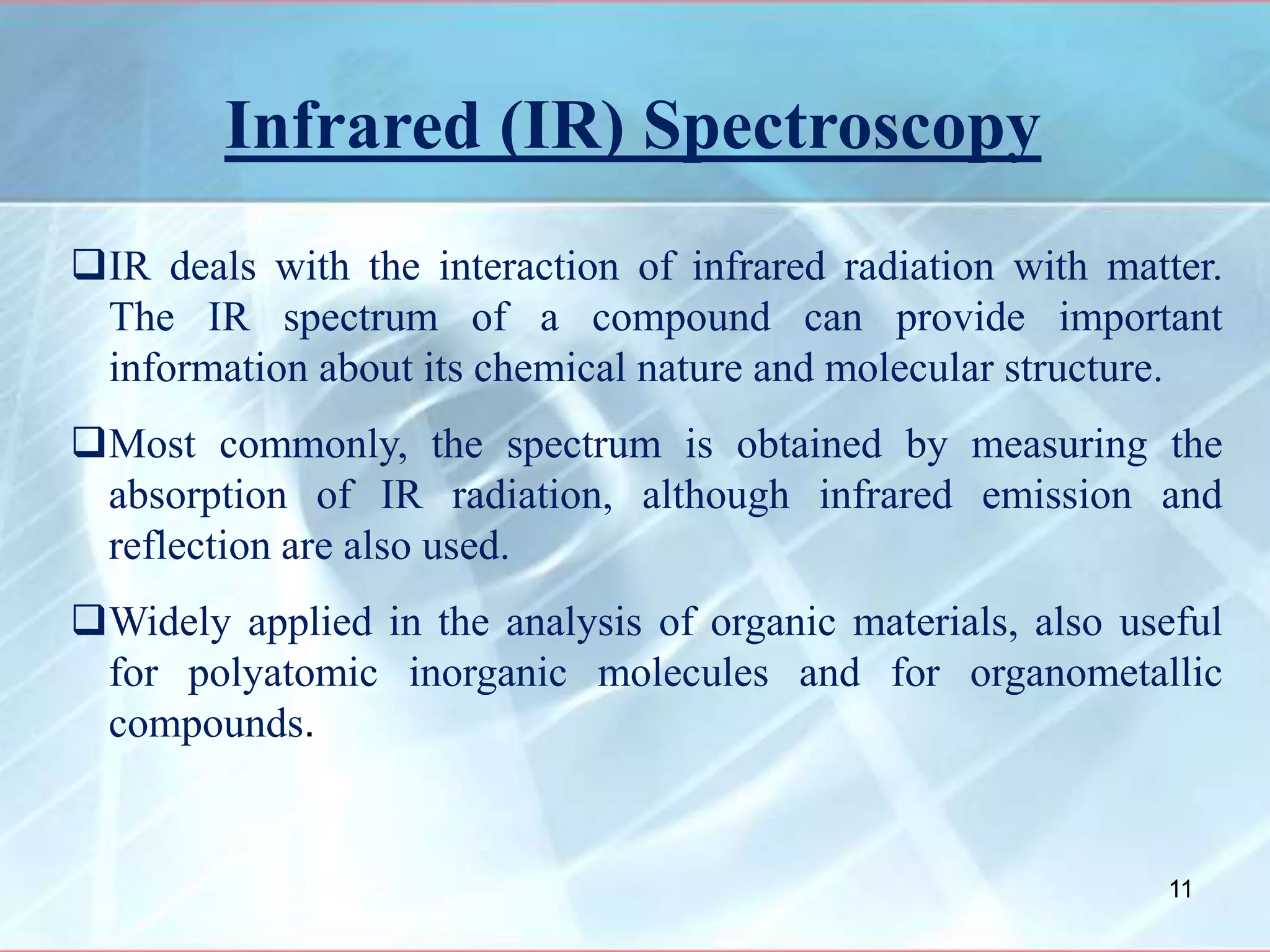
Infrared (IR) Spectroscopy
IR deals with the interaction of infrared radiation with matter.
The IR spectrum of a compound can provide important
information about its chemical nature and molecular structure.
Most commonly, the spectrum is obtained by measuring the
absorption of IR radiation, although infrared emission and
reflection are also used.
Widely applied in the analysis of organic materials, also useful
for polyatomic inorganic molecules and for organometallic
compounds.
11
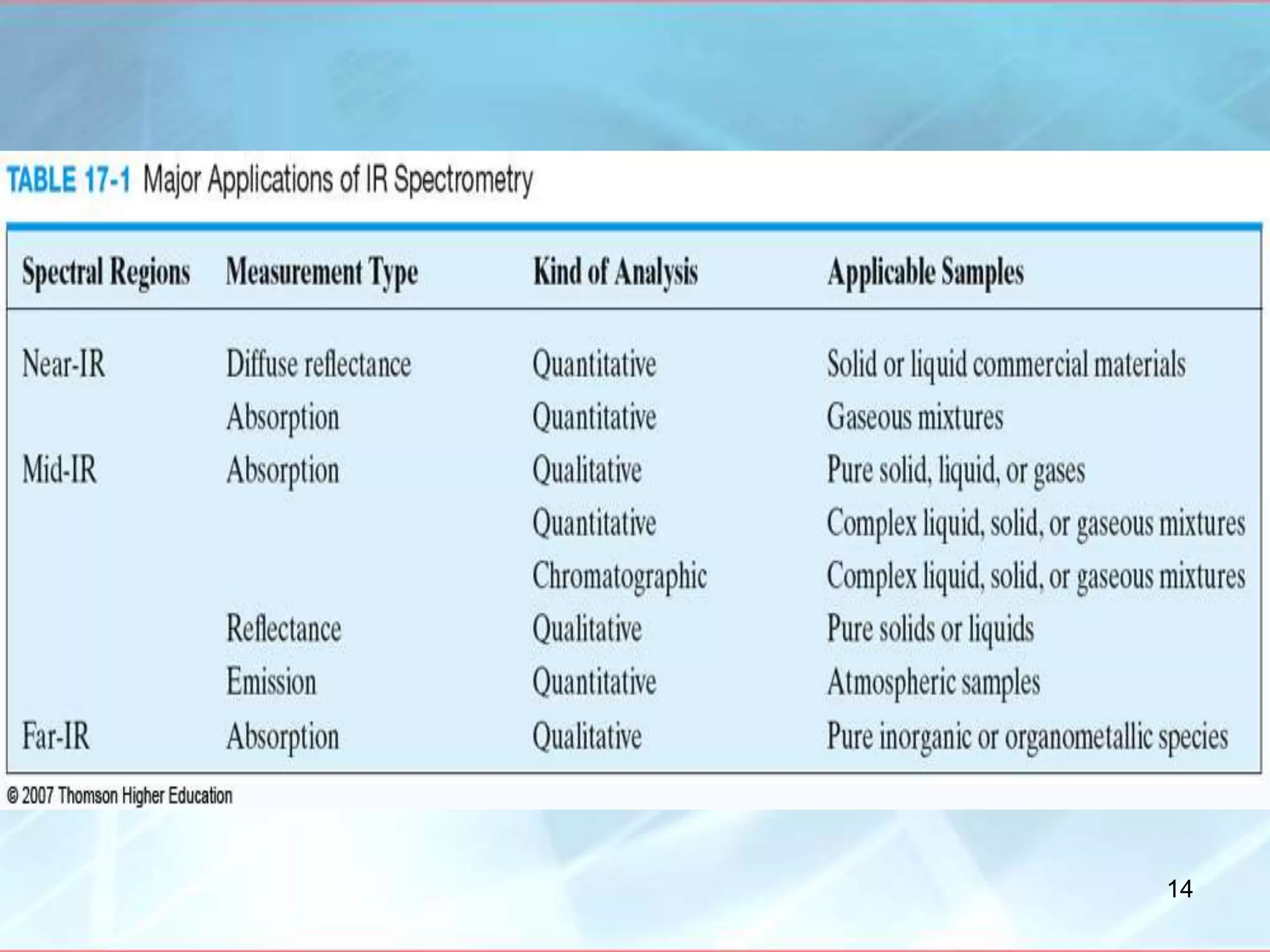
 Infrared spectrometry is applied to the qualitative and
quantitative determination of molecular species of all types
.
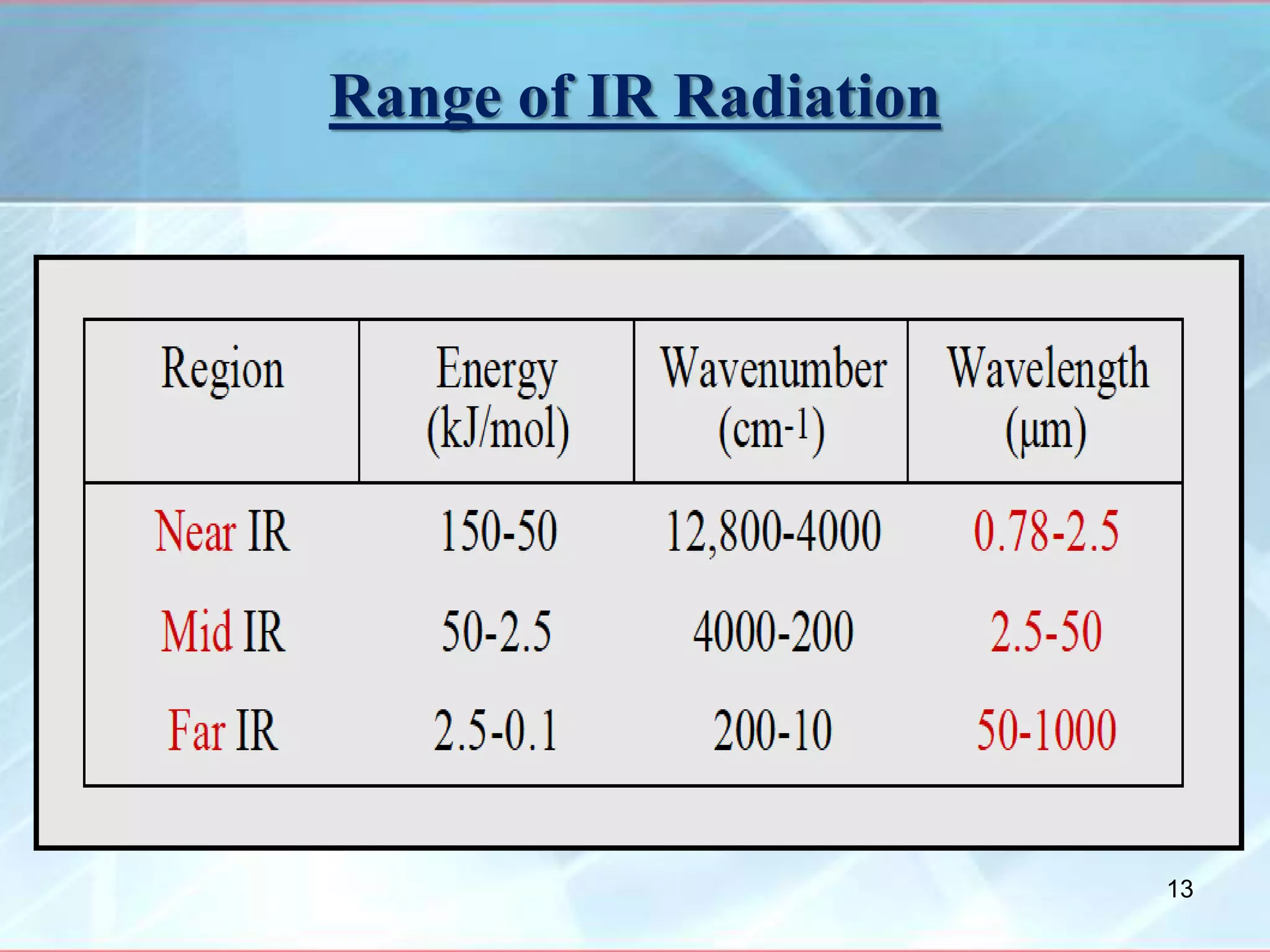
 The most widely used region is the mid-infrared that extends
from about 400 to 4000 cm-1 (2.5 to 25 m). (Absorption,
reflection and emission spectra are employed)
 The near-infrared region from 4000 to 14,000 cm-1 (0.75 to 2.5
m) also finds considerable use for the routine quantitative
determination. (water, CO2, low conc. Hydrocarbons, amine
nitrogen, many other compounds)
 The far-infrared region has been for the determination of the
structures of inorganic and metal-organic species.
12
Range of IR Radiation
13
14
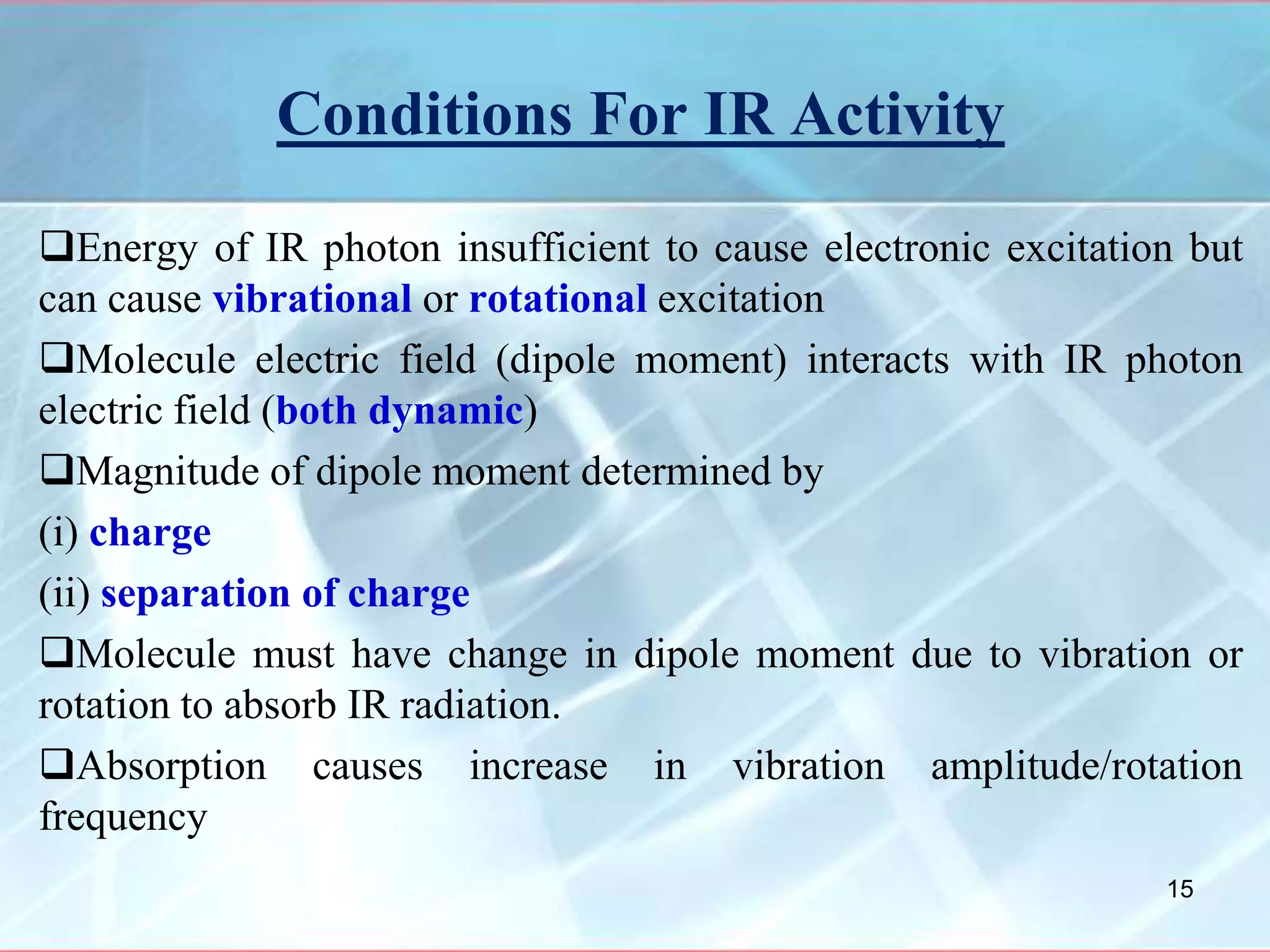
Conditions For IR Activity
Energy of IR photon insufficient to cause electronic excitation but
can cause vibrational or rotational excitation
Molecule electric field (dipole moment) interacts with IR photon
electric field (both dynamic)
Magnitude of dipole moment determined by
(i) charge
(ii) separation of charge
Molecule must have change in dipole moment due to vibration or
rotation to absorb IR radiation.
Absorption causes increase in vibration amplitude/rotation
frequency
15
DIPOLE MOMENT (µ)
µ = Q x r
 Q = charge and r = distance between charges
 Asymmetrical distribution of electrons in a bond renders the
bond polar
 A result of electro negativity difference
 µ changes upon vibration due to changes in r
 Change in µ with time is necessary for a molecule to absorb
IR radiation 16
 The repetitive changes in µ makes it possible for polar
molecules to absorb IR radiation
 Symmetrical molecules do not absorb IR radiation since
they do not have dipole moment (O2, F2, H2, Cl2)
 Diatomic molecules with dipole moment are IR-active
(HCl, HF, CO, HI)
 Molecules with more than two atoms may or may not be
IR active depending on whether they have permanent net
dipole moment
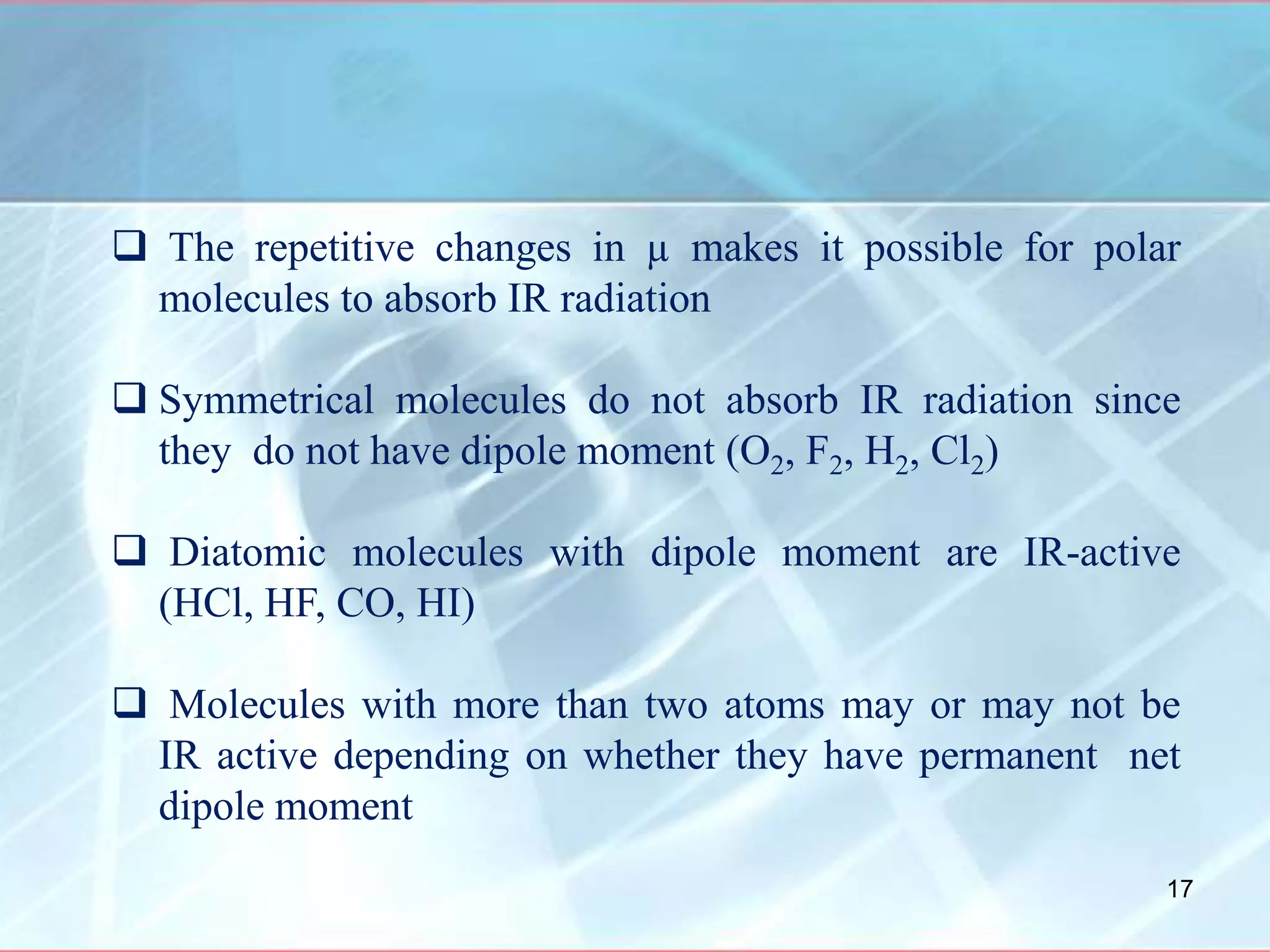
17
A bond or molecule must have a permanent dipole moment. If not,
then, some of its vibration must produce an induced dipole moment
in order to have an absorbance in the IR spectrum.
The frequency of vibration of a particular bond must be equal to
the frequency of IR radiation.
18
Molecules with permanent dipole moments
(μ) are IR active!
19
Some linear molecules may be IR active
CO2 O=C=O
20
21
IR ABSORPTION BY MOLECULES
 Molecules with covalent bonds may absorb IR radiation
 Absorption is quantized
 Molecules move to a higher energy state
 IR radiation is sufficient enough to cause rotation and vibration. The IR
scans a range of frequencies (in the infrared part of the electromagnetic
spectrum). Any frequency which matches the characteristic frequency of
a bond will be absorbed
 Radiation between 1 and 100 µm will cause excitation to higher
vibrational states
22
 Absorption spectrum is composed of broad vibrational
absorption bands
 Molecules absorb radiation when a bond in the molecule
vibrates at the same frequency as the incident radiant energy
 Molecules vibrate at higher amplitude after absorption
 A molecule must have a change in dipole moment during
vibration in order to absorb IR radiation
23
Absorption frequency depends on:
 Masses of atoms in the bonds
 Geometry of the molecule
 Strength of bond
 Other contributing factors
24
 Infrared radiation is largely thermal energy.
 It induces stronger molecular vibrations in covalent bonds, which
can be viewed as springs holding ,together two masses, or atoms.
Specific bonds respond to (absorb) specific frequencies
Theory / Principle
μ =m1.m2/m1+m2 , reduced mass
K = Force constant
X Y
25
 As a covalent bond oscillates – due to the oscillation of
the dipole of the molecule – a varying electromagnetic field
is produced. The greater the dipole moment change through
the vibration, the more intense the EM field that is
generated
26
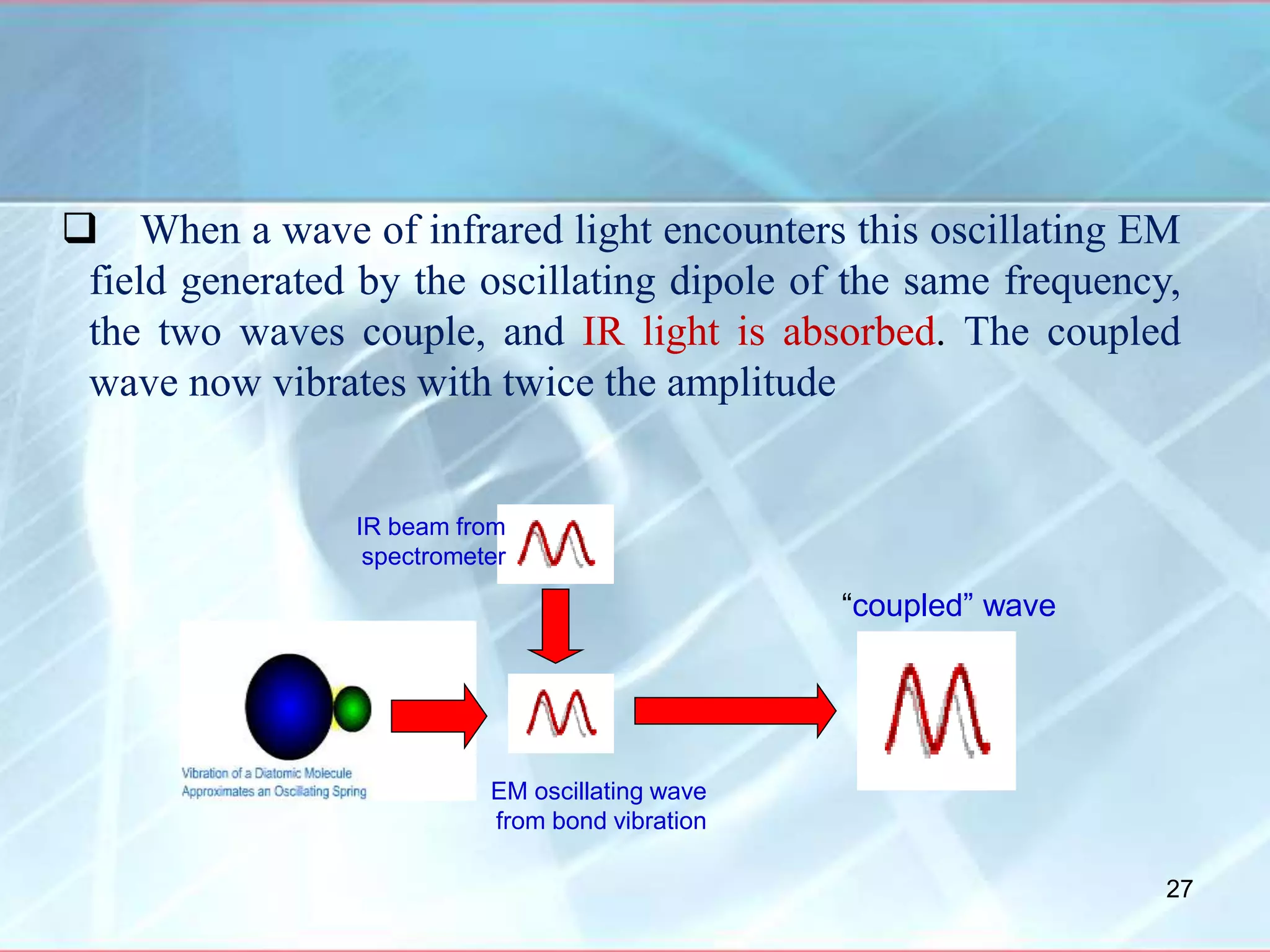
EM oscillating wave
from bond vibration
IR beam from
spectrometer
“coupled” wave
 When a wave of infrared light encounters this oscillating EM
field generated by the oscillating dipole of the same frequency,
the two waves couple, and IR light is absorbed. The coupled
wave now vibrates with twice the amplitude
27
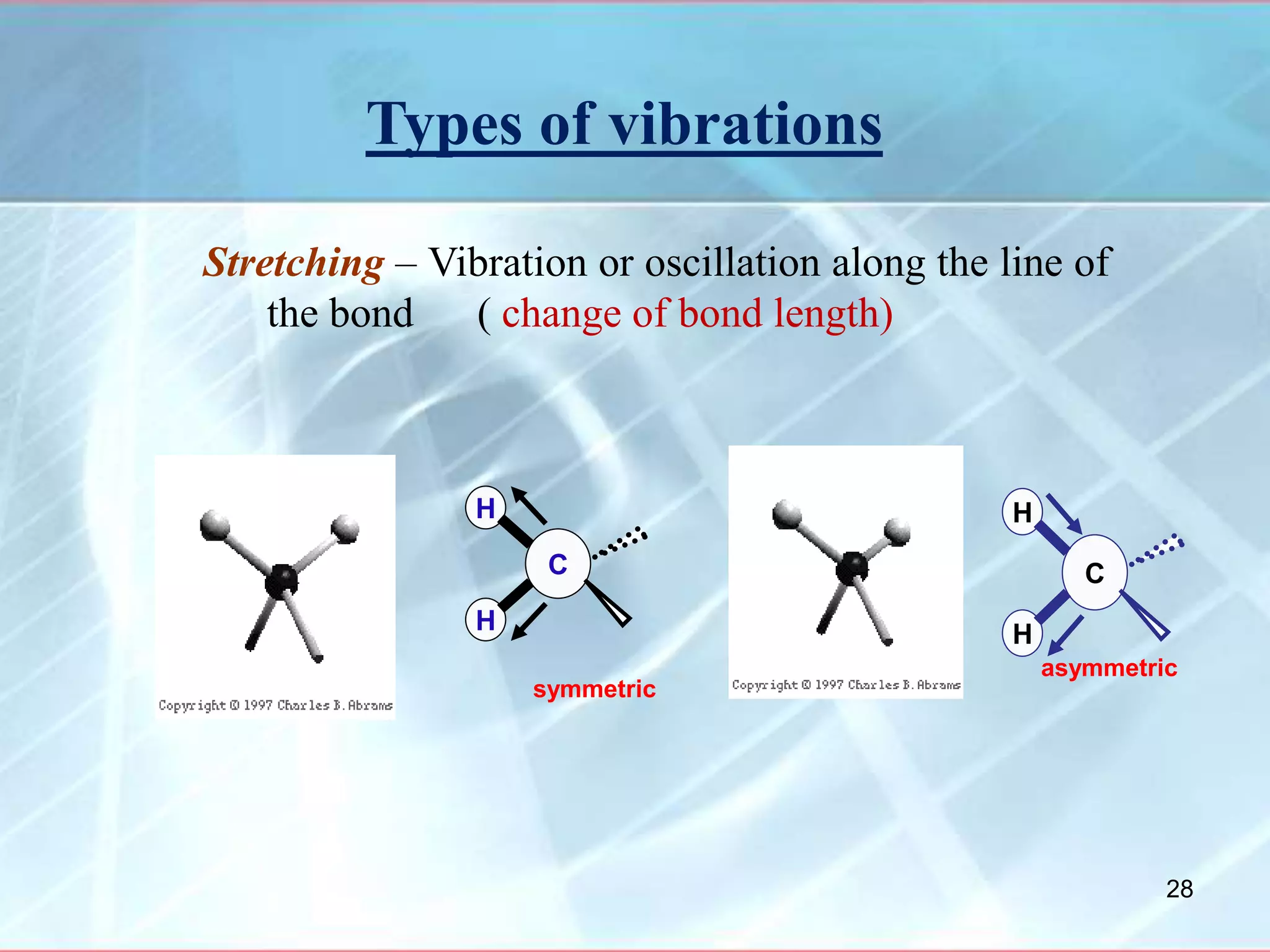
Types of vibrations
Stretching – Vibration or oscillation along the line of
the bond ( change of bond length)
H
H
C
H
H
C
asymmetric
symmetric
28
scissor
H
H
CC
H
H
CC
H
H
CC
H
H
CC
rock twist wag
in plane out of plane
Bending Vibration or oscillation not along the
line of the bond (change of bond angle)
Types of vibrations
29
30
Vibrational Modes
• Covalent bonds can vibrate in several modes, including stretching,
bending (rocking, scissoring, wagging and twisting)
• The most useful bands in an infrared spectrum correspond to
stretching frequencies, and those will be the ones we’ll focus on.
A molecule containing n atoms , has 3n degrees of freedom.
3n = Translational modes + Rotational modes + Vibrational Mode
Linear Molecule : TM = 3, RM = 2 , hence ,
3n = 3 + 2 + Vibrational Modes
Vibrational Modes = (3n-5) ; C2H2 , CO2
Strecthing vib = (n-1)
bending vib = (2n-4)
Non-linear Molecule : Vibrational Modes = (3n-6); C6H6 , CHCl3
Strecthing vib = (n-1)
bending vib. = (2n-5)
31
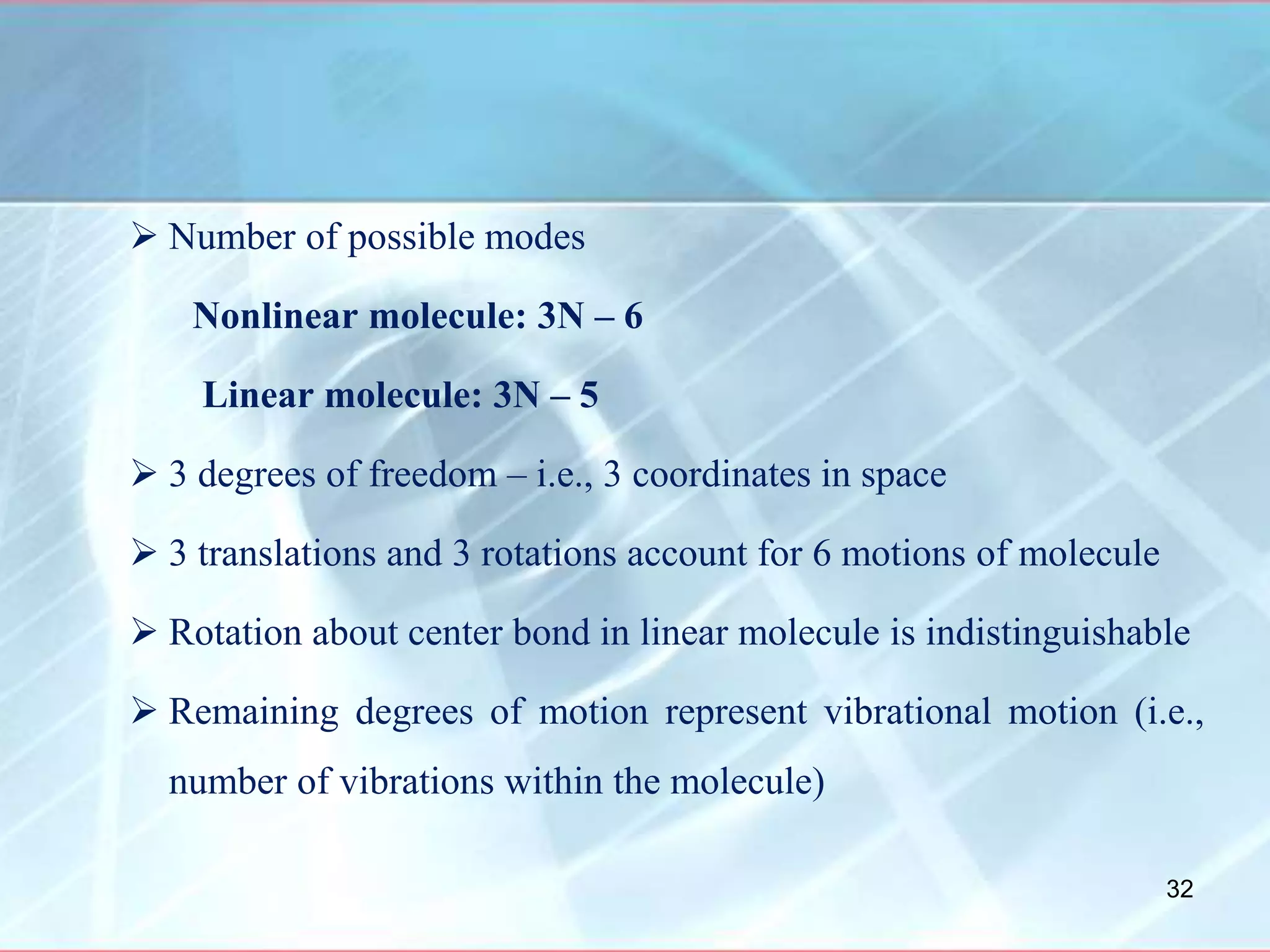
 Number of possible modes
Nonlinear molecule: 3N – 6
Linear molecule: 3N – 5
 3 degrees of freedom – i.e., 3 coordinates in space
 3 translations and 3 rotations account for 6 motions of molecule
 Rotation about center bond in linear molecule is indistinguishable
 Remaining degrees of motion represent vibrational motion (i.e.,
number of vibrations within the molecule)
32
Factors Influencing the Normal Modes
Four factors tend to produce fewer experimental peaks than would be
expected from the theoretical number of normal modes.
(1) the symmetry of the molecules is such that no change in dipole
results from a particular vibration
(2) the energies of two or more vibrations are identical or nearly
identical
(3) the absorption intensity is so low as to be undetectable by
ordinary means
(4) the vibrational energy is in a wavelength region beyond the range
of the instrument. 33
Occasionally more peaks are found than are expected based upon the
number of normal modes.
The occurrence of overtone peaks that occur at two or three times the
frequency of a fundamental peak. In addition combination bands are
sometimes encountered when a photon excites two vibrational modes
simultaneously.
The frequency of the combination band is approximately the sum or
difference of the two fundamental frequencies.
34
Vibratrional Coupling
The energy of a vibration, and thus the wavelength of its absorption
peak, may be influenced by other vibrators in the molecule.
A number of factors influence the extent of such coupling:
1. Strong coupling between stretching vibrations occurs only when
there is an atom common to the two vibrations.
2. Interaction between bending vibrations requires a common bond
between the vibrating groups.
35
3.Coupling between a stretching and a bending vibration can occur if
the stretching bond forms one side of the angle that varies in the
bending vibration.
4. Interaction is greatest when the coupled groups have individual
energies that are approximately equal.
5. Little or no interaction is observed between groups separated by two
or more bonds.
6. Coupling requires that the vibrations be of the same symmetry
species.
36
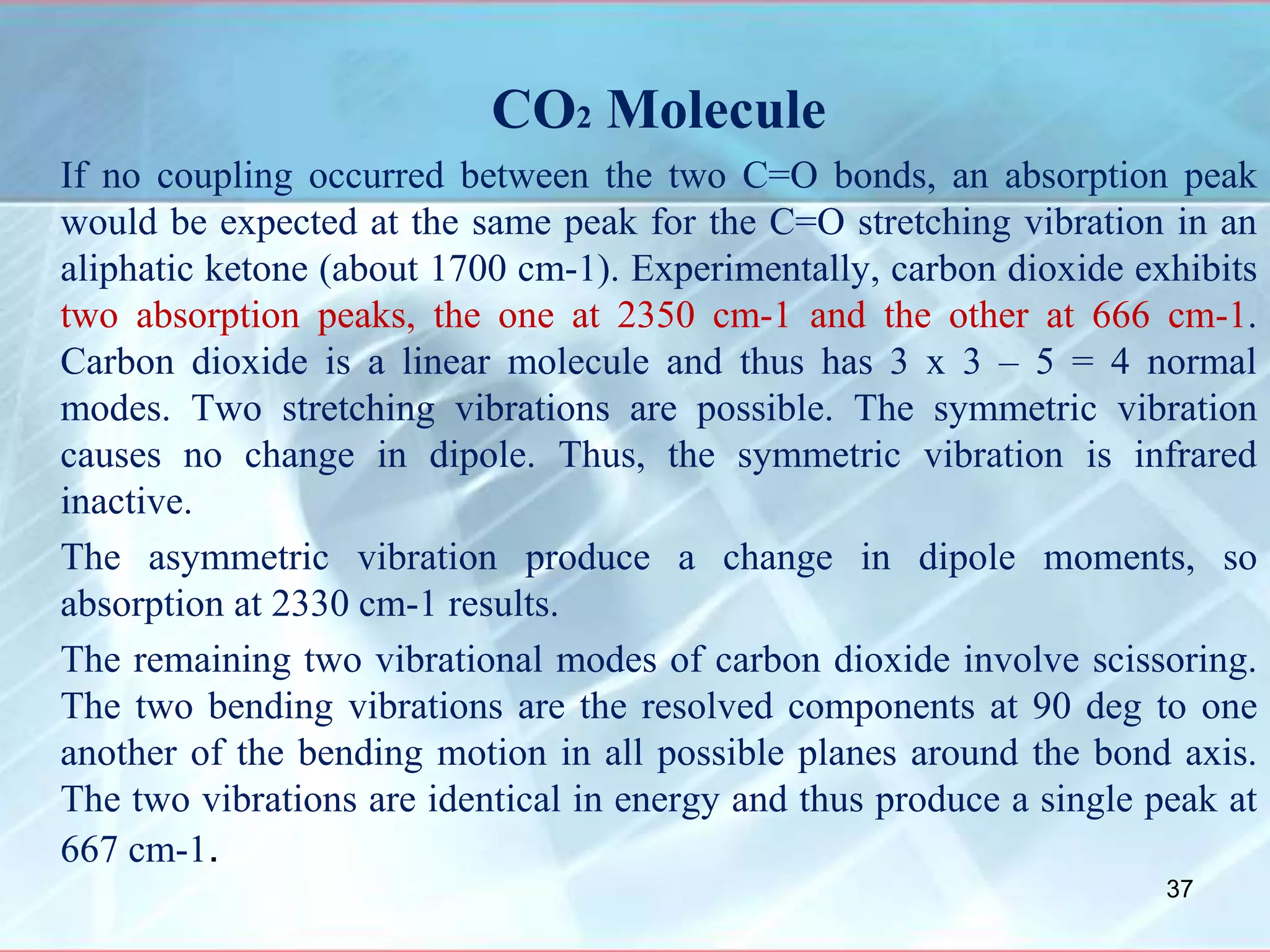
CO2 Molecule
If no coupling occurred between the two C=O bonds, an absorption peak
would be expected at the same peak for the C=O stretching vibration in an
aliphatic ketone (about 1700 cm-1). Experimentally, carbon dioxide exhibits
two absorption peaks, the one at 2350 cm-1 and the other at 666 cm-1.
Carbon dioxide is a linear molecule and thus has 3 x 3 – 5 = 4 normal
modes. Two stretching vibrations are possible. The symmetric vibration
causes no change in dipole. Thus, the symmetric vibration is infrared
inactive.
The asymmetric vibration produce a change in dipole moments, so
absorption at 2330 cm-1 results.
The remaining two vibrational modes of carbon dioxide involve scissoring.
The two bending vibrations are the resolved components at 90 deg to one
another of the bending motion in all possible planes around the bond axis.
The two vibrations are identical in energy and thus produce a single peak at
667 cm-1.
37
38
H2O molecule
Triatomic molecule such as water, sulfur dioxide, or nitrogen dioxide
have 3 x 3 – 6 = 3 vibrational modes. The central atom is not in line
with the other two, a symmetric stretching vibration will produce a
change in dipole and will thus be responsible for infrared absorption.
Stretching peaks at 3650 and 3760 cm-1 appear in the infrared
spectrum for the symmetric and asymmetric vibrations of the water
molecule. There is only one component to the scissoring vibration for
this nonlinear molecule. For water, the bending vibration cause
absorption at 1595 cm-1.
39
40
In an IR Spectrum each stretching and bending vibration occurs with a
characteristic frequency as the atoms and charges involved are different
for different bonds
The y-axis on an IR
spectrum is in units of
% transmittance
In regions where the
EM field of an osc.
bond interacts with IR
light of the same n –
transmittance is low
(light is absorbed)
In regions
where no osc.
bond is
interacting with
IR light,
transmittance
nears 100%
41
The x-axis of the IR spectrum is in units of wavenumber, n, which is the
number of waves per centimeter in units of cm-1
(Remember E = hʋ or E = hc/ɻ)
42
1. This unit wavenumbers is used rather than wavelength (microns)
because wavenumbers are directly proportional to the energy of
transition being observed – chemists like this, physicists hate it
High frequencies and high wavenumbers equate higher energy is
quicker to understand than Short wavelengths equate higher
energy
2. This unit is used rather than frequency as the numbers are more
“real” than the exponential units of frequency
3. IR spectra are observed for the mid-infrared: 600-4000 cm-1
Use of unit “wavenumbers”
43
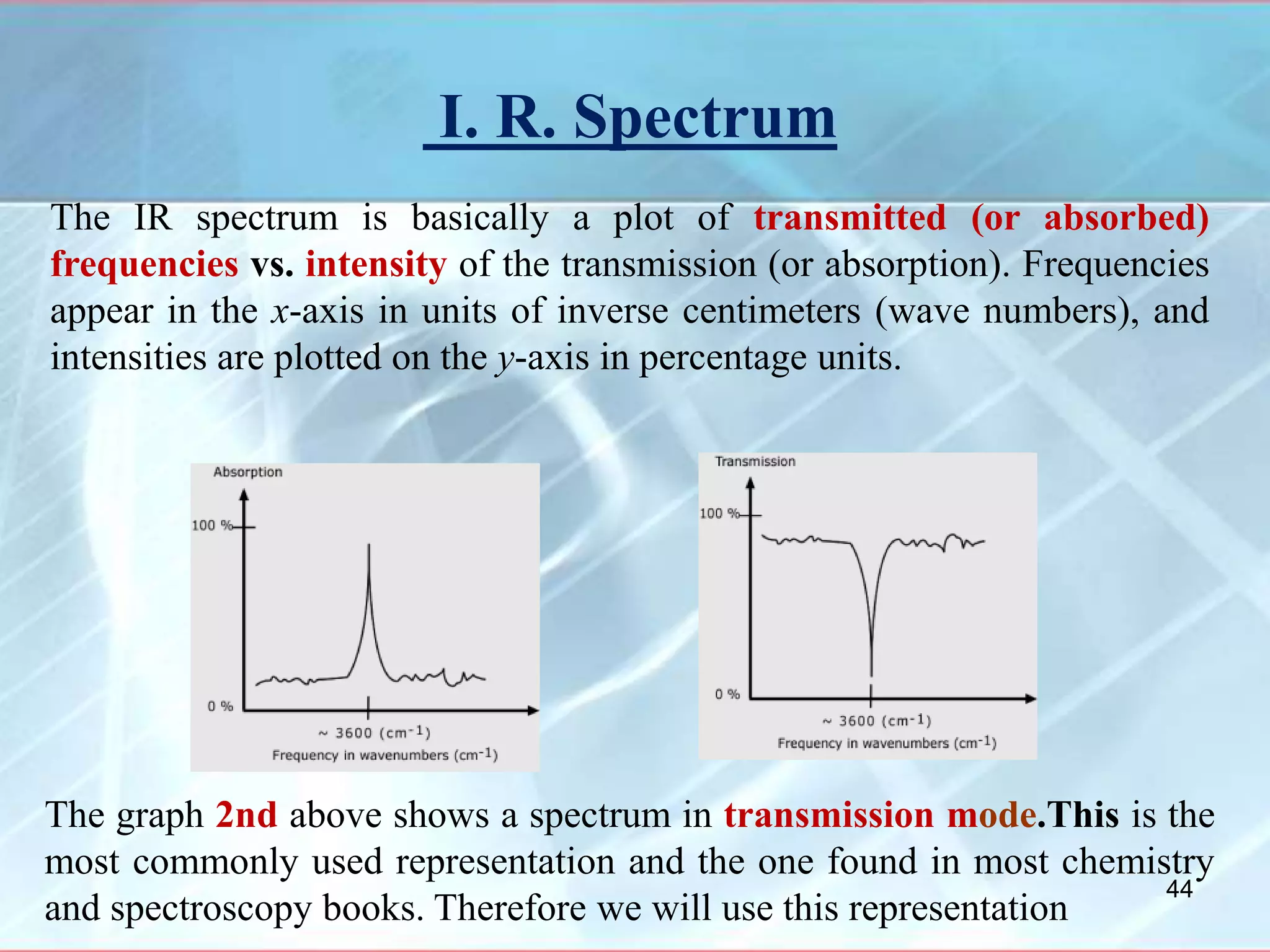
I. R. Spectrum
The IR spectrum is basically a plot of transmitted (or absorbed)
frequencies vs. intensity of the transmission (or absorption). Frequencies
appear in the x-axis in units of inverse centimeters (wave numbers), and
intensities are plotted on the y-axis in percentage units.
The graph 2nd above shows a spectrum in transmission mode.This is the
most commonly used representation and the one found in most chemistry
and spectroscopy books. Therefore we will use this representation
44
Infrared Active Bonds
1.Not all covalent bonds display bands in the IR spectrum. Only polar bonds
do so. These are referred to as IR active.
2. The intensity of the bands depends on the magnitude of the dipole moment
associated with the bond in question:
• Strongly polar bonds such as carbonyl groups (C=O) produce strong bands.
• Medium polarity bonds and asymmetric bonds produce medium bands.
• Weakly polar bond and symmetric bonds produce weak or non observable
bands.
45
Infrared Band Shapes
Two of the most common bands are narrow; thin and pointed, like
a dagger and Broad bands ;wide and smoother.
A typical example of a broad band is that displayed by O-H bonds,
such as those found in alcohols and carboxylic acids, as shown
below.
Broad bands
46
CLASSIFICATION OF IR BANDS
IR bands can be classified as strong (s), medium (m), or weak (w), depending
on their relative intensities in the infrared spectrum. A strong band covers most
of the y-axis. A medium band falls to about half of the y-axis, and a weak band
falls to about one third or less of the y-axis.
•Strong (s) – peak is tall, transmittance is low (0-35 %)
•Medium (m) – peak is mid-height (75-35%)
•Weak (w) – peak is short, transmittance is high (90-75%) 47
Information Obtained From Ir Spectra
• IR is most useful in providing information about the presence or
absence of specific functional groups.
• IR can provide a molecular fingerprint that can be used when
comparing samples. If two pure samples display the same IR
spectrum it can be argued that they are the same compound.
• IR does not provide detailed information or proof of molecular
formula or structure. It provides information on molecular
fragments, specifically functional groups.
• Therefore it is very limited in scope, and must be used in
conjunction with other techniques to provide a more complete
picture of the molecular structure. 48
The Fingerprint Region
Although the entire IR spectrum can be used as a fingerprint for the
purposes of comparing molecules, the 600 - 1400 cm-1 range is called the
fingerprint region. This is normally a complex area showing many bands,
frequently overlapping each other.
Fingerprint region: complex and difficult to
interpret reliably.
Focus your analysis on this region. This is where most
stretching frequencies appear.
49
50
51
52
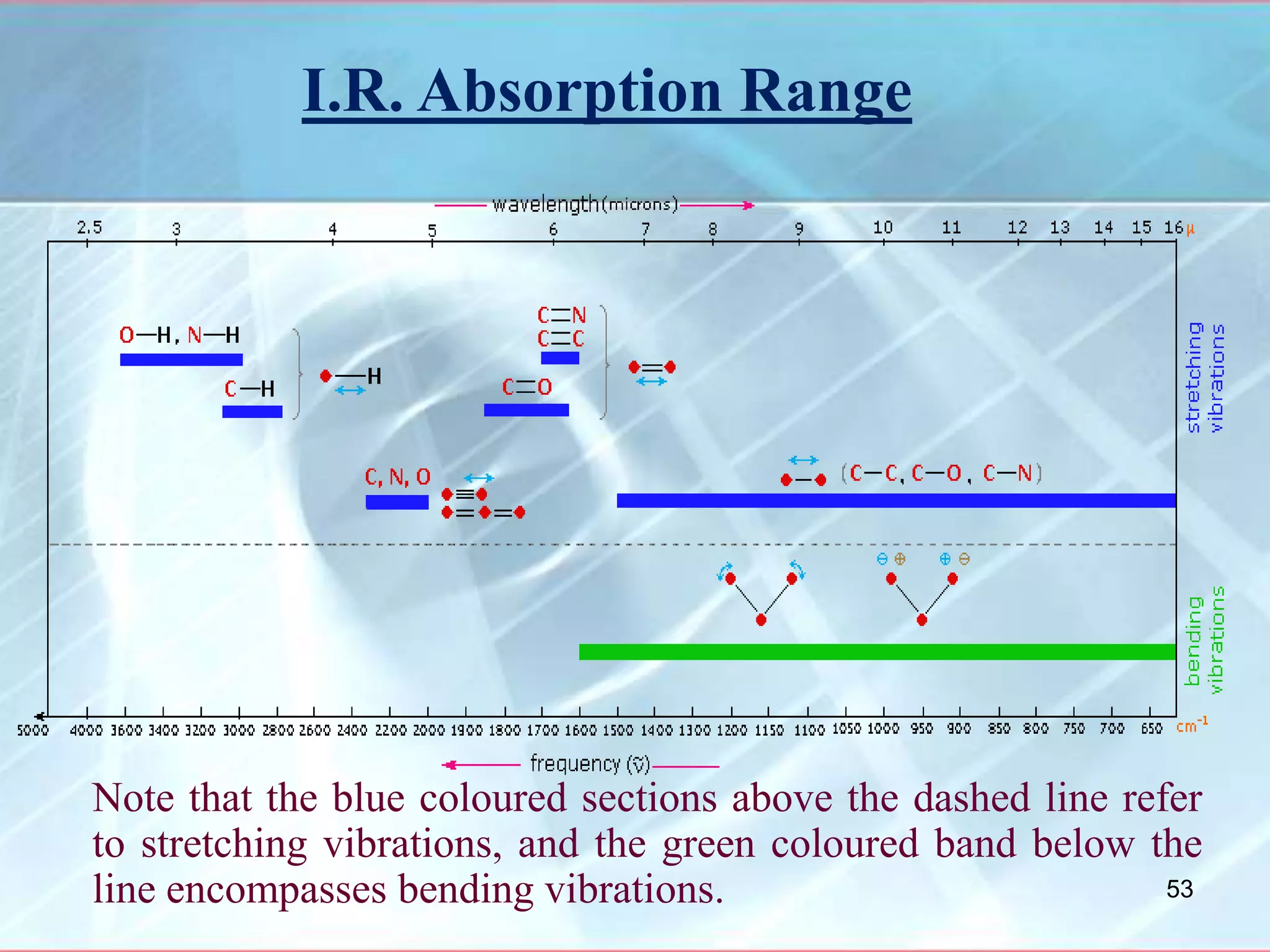
I.R. Absorption Range
Note that the blue coloured sections above the dashed line refer
to stretching vibrations, and the green coloured band below the
line encompasses bending vibrations. 53
Summary of IR Absorptions
54
Applications of Infrared Spectroscopy
 Infrared spectrometry is applied to the qualitative and quantitative
determination of molecular species of all types.
 The most widely used region is the mid-infrared that extends
from about 400 to 4000 cm-1 (2.5 to 25 m). (Absorption,
reflection and emission spectra are employed)
 The near-infrared region from 4000 to 14,000 cm-1 (0.75 to 2.5
m) also finds considerable use for the routine quantitative
determination. (water, CO2, low conc. Hydrocarbons, amine
nitrogen, many other compounds)
 The far-infrared region has been for the determination of the
structures of inorganic and metal-organic species. 55
Functional Groups & IR Frequencies
56
Factors effecting IR absorption
1. Force constant, k
2. Reduced mass, μ
3. Electronegativity difference, N
4. Bond dissociation energy, D
5. Internuclear distance, r
It also depends upon: Inductive effect, resonance, H-bonding
and steric effect etc.
Stronger bonds will have higher Force constant .K
57
Sample problem
The force constant for a typical triple bond is 1.91 x 10³ N/m.
Calculate the approximate frequency of the main absorption peak
due to vibration of CO.
58
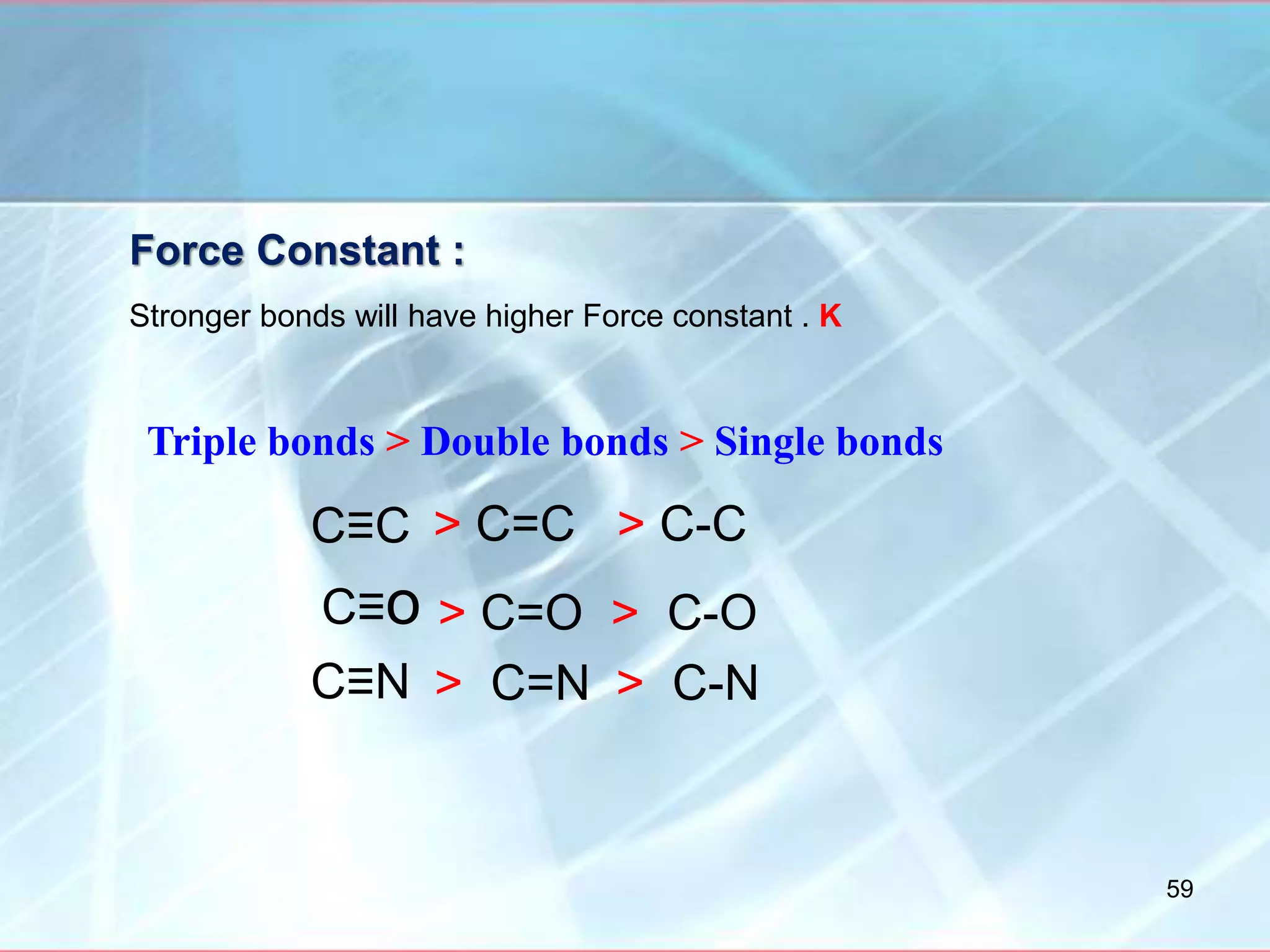
Force Constant :
Stronger bonds will have higher Force constant . K
Triple bonds > Double bonds > Single bonds
> C=C > C-C
> C=O > C-O
C≡C
C≡o
C≡N > C-N> C=N
59
PREDICTING STRUCTURE OF UNKNOWN
 Identify the major functional groups from the strong
absorption peaks
 Identify the compound as aromatic or aliphatic
 Subtract the FW of all functional groups identified from the given
molecular weight of the compound
 Look for C≡C and C=C stretching bands
 Look for other unique CH bands (e.g. aldehyde)
 Use the difference obtained to deduce the structure
60
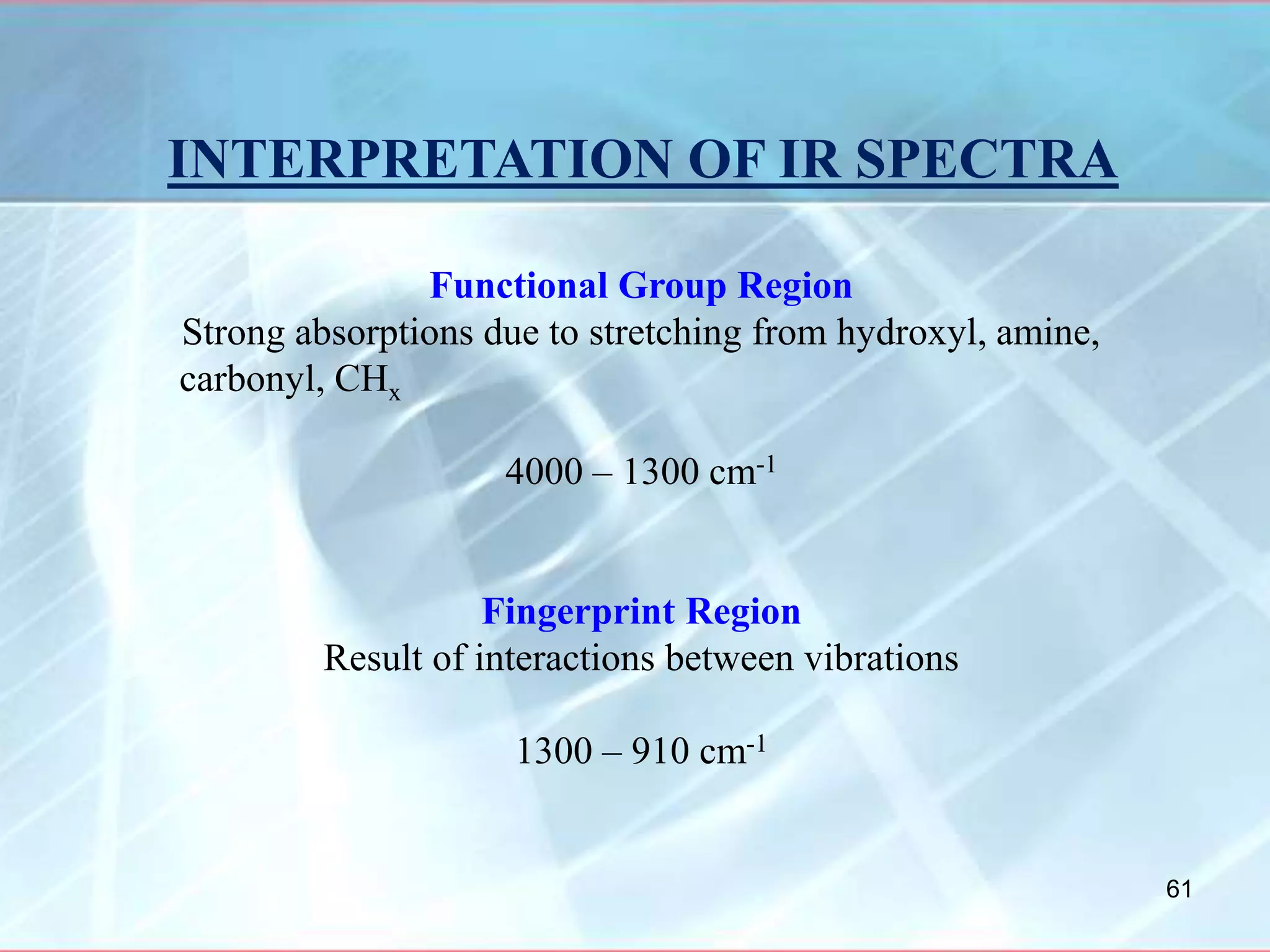
INTERPRETATION OF IR SPECTRA
Functional Group Region
Strong absorptions due to stretching from hydroxyl, amine,
carbonyl, CHx
4000 – 1300 cm-1
Fingerprint Region
Result of interactions between vibrations
1300 – 910 cm-1
61
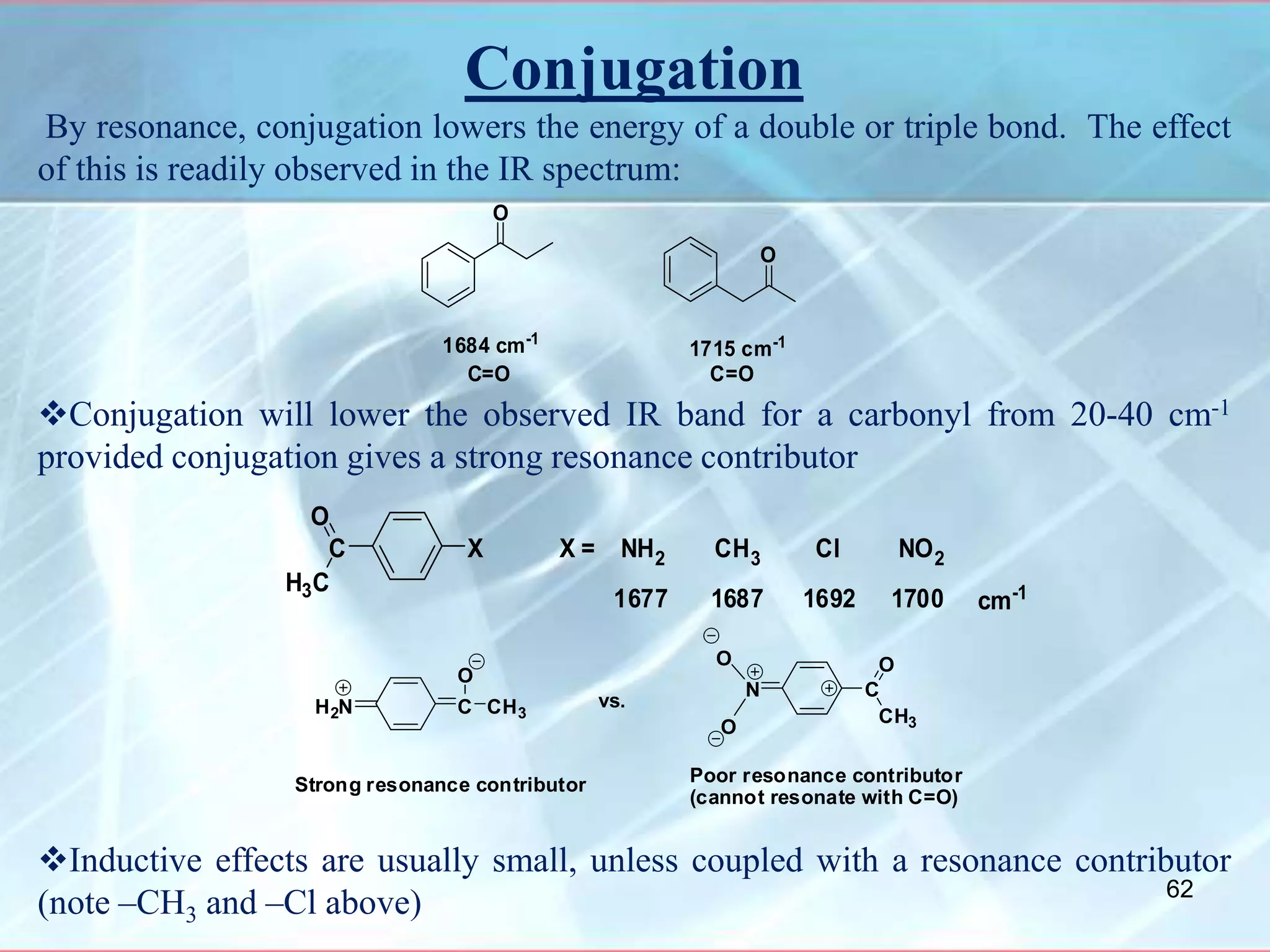
Conjugation
By resonance, conjugation lowers the energy of a double or triple bond. The effect
of this is readily observed in the IR spectrum:
Conjugation will lower the observed IR band for a carbonyl from 20-40 cm-1
provided conjugation gives a strong resonance contributor
Inductive effects are usually small, unless coupled with a resonance contributor
(note –CH3 and –Cl above)
O
O
1684 cm-1
1715 cm-1
C=O C=O
C
H3C
O
X X = NH2 CH3 Cl NO2
1677 1687 1692 1700 cm-1
H2N C CH3
O
Strong resonance contributor
vs.
N
O
O
C
CH3
O
Poor resonance contributor
(cannot resonate with C=O)
62
Usually not important in IR spectroscopy, unless they reduce the strength of a bond
(usually p) by interfering with proper orbital overlap:
Here the methyl group in the structure at the right causes the carbonyl group to be
slightly out of plane, interfering with resonance
Strain effects – Changes in bond angle forced by the constraints of a ring will
cause a slight change in hybridization, and therefore, bond strength
As bond angle decreases, carbon becomes more electronegative, as well as less sp2
hybridized (bond angle < 120°)
O
C=O: 1686 cm-1
O
C=O: 1693 cm-1
CH3
O O O O O
1815 cm-1
1775 cm-1
1750 cm-1
1715 cm-1
1705 cm-1
Steric Effects
63
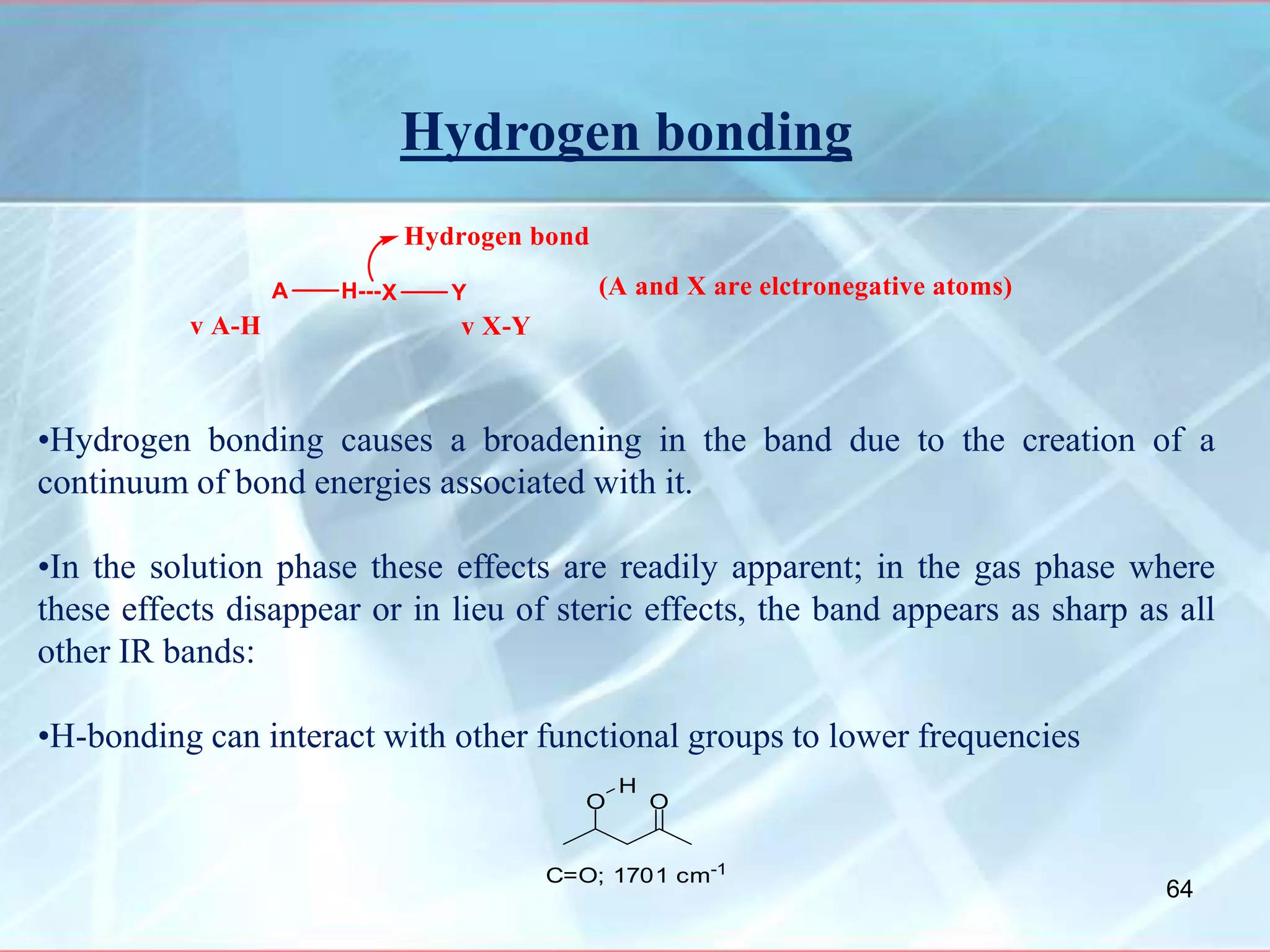
Hydrogen bonding
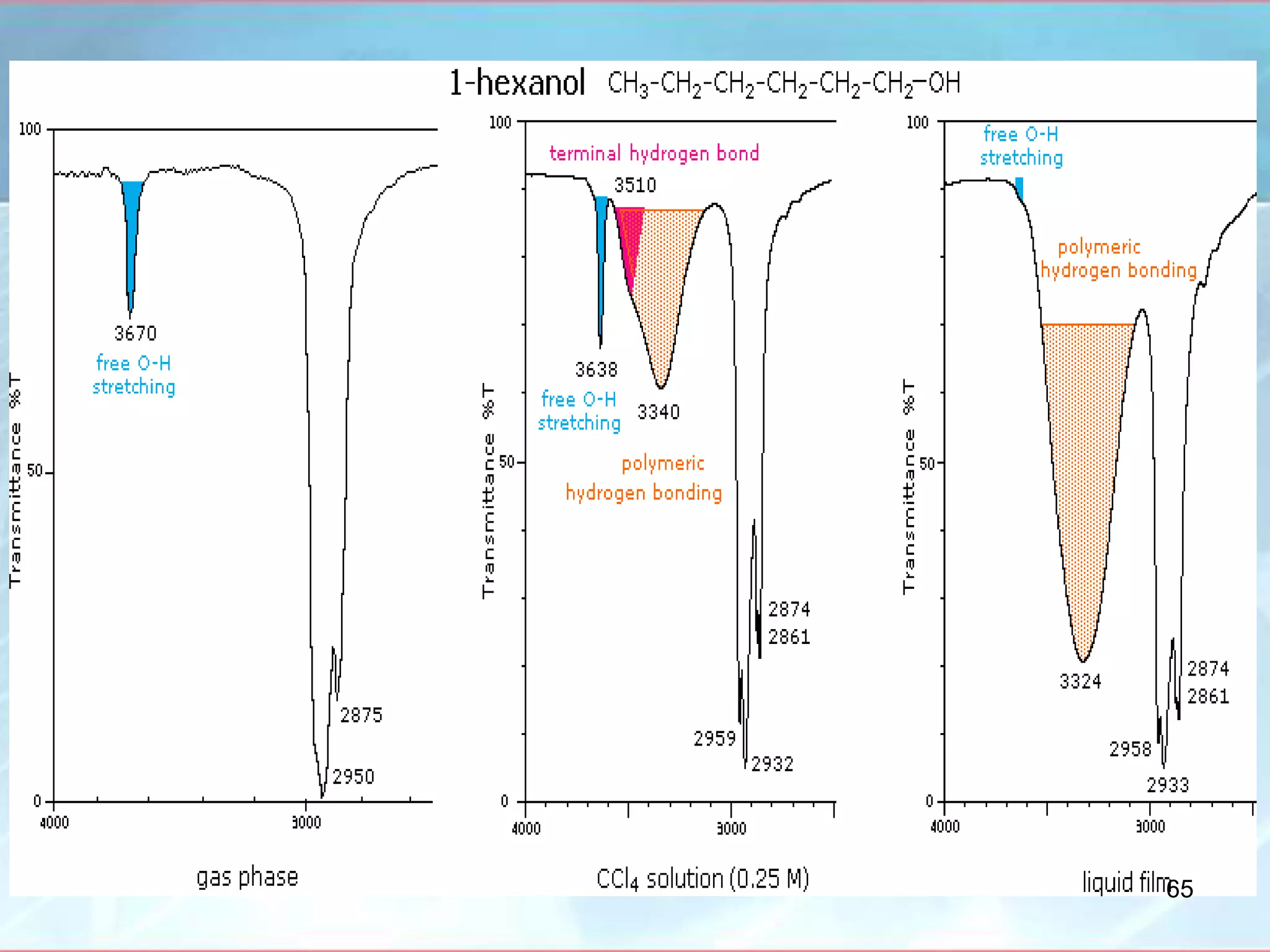
•Hydrogen bonding causes a broadening in the band due to the creation of a
continuum of bond energies associated with it.
•In the solution phase these effects are readily apparent; in the gas phase where
these effects disappear or in lieu of steric effects, the band appears as sharp as all
other IR bands:
•H-bonding can interact with other functional groups to lower frequencies
C=O; 1701 cm-1
OO
H
64
65
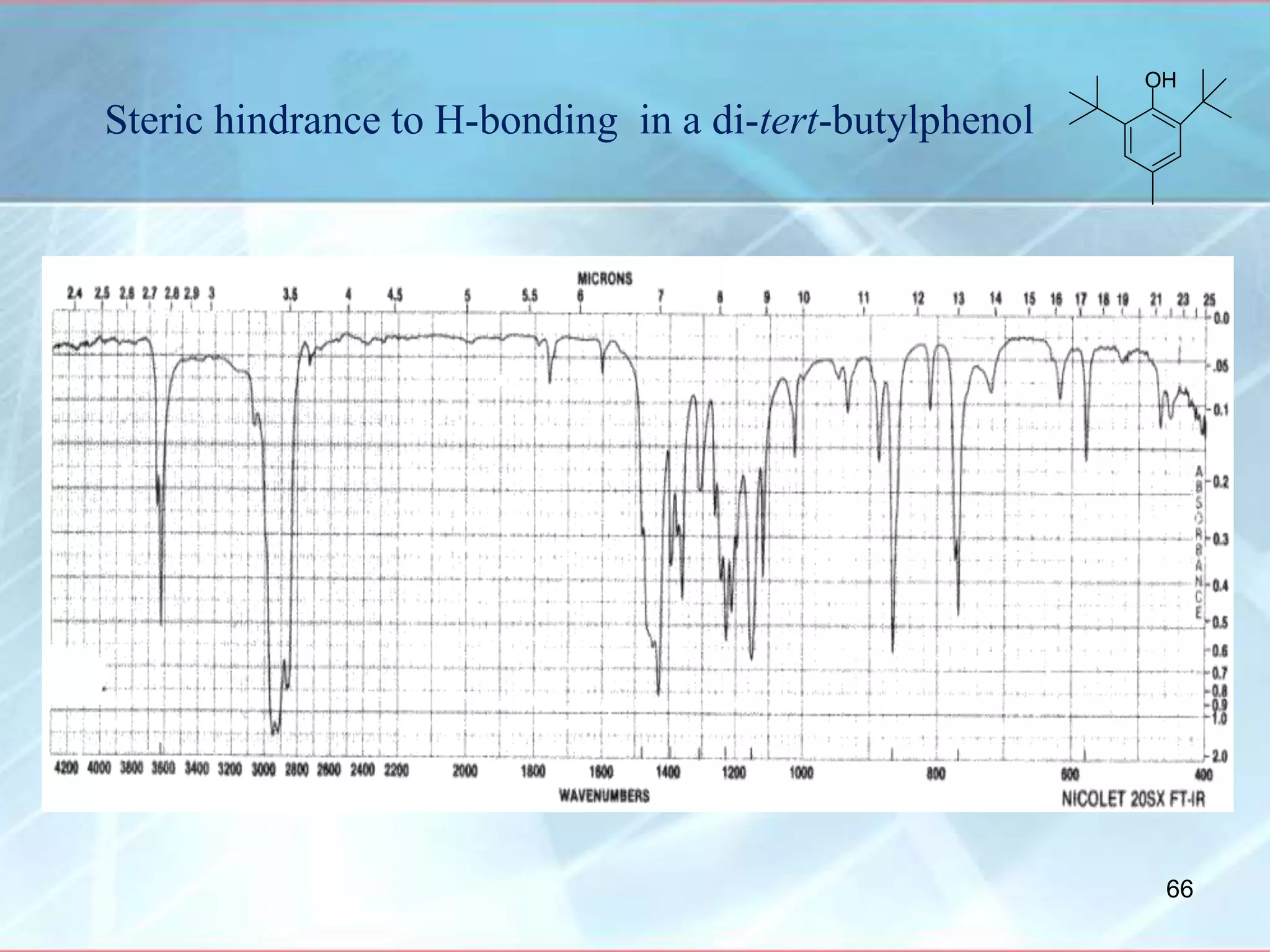
Steric hindrance to H-bonding in a di-tert-butylphenol
OH
66
Gas phase spectrum of 1-butanol
67
Single Bond Region
O-H ν = 3400-3600 cm-1
N-H ν = 3200-3400 cm-1
C-H ν = 2900-3100 cm-1
Greater the dipole moment, the more intense the absorption. But, actually it is
not so. There are other factors which affect the absorption in IR region
68
Infrared Absorption Frequencies of C-H
Depend upon the state of hybridization of C-atom attached.
Structural unit Frequency, cm-1
sp C—H 3310-3320
sp2 C—H 3000-3100
sp3 C—H 2850-2950
69
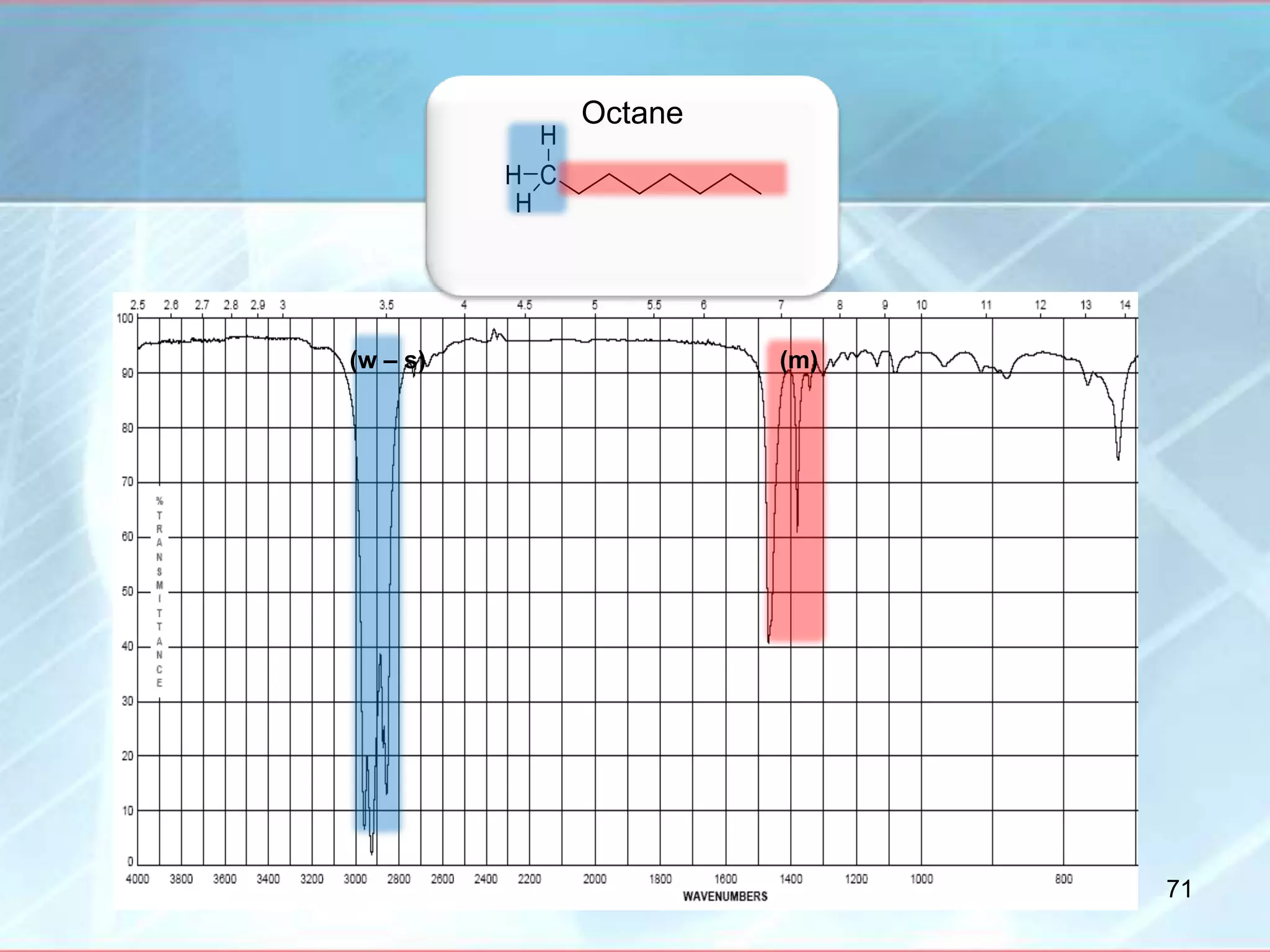
Alkanes– combination of C-C and C-H bonds
• C-C stretches and bends 1360-1470 cm-1
• CH2-CH2 bond 1450-1470 cm-1
• CH2-CH3 bond 1360-1390 cm-1
• sp3 C-H between 2800-3000 cm-1
70
Octane
(w – s) (m)
71
72
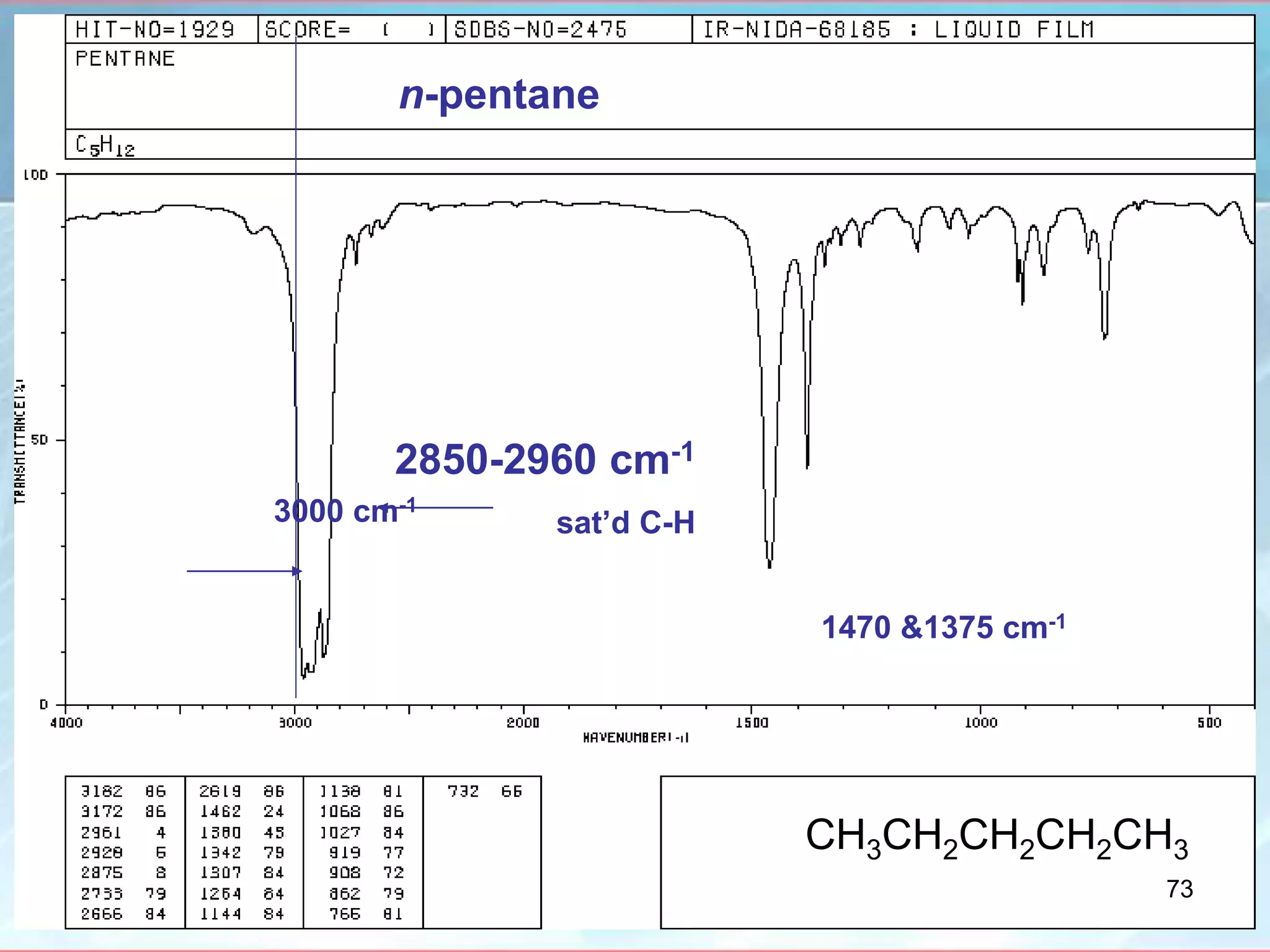
n-pentane
CH3CH2CH2CH2CH3
3000 cm-1
1470 &1375 cm-1
2850-2960 cm-1
sat’d C-H
73
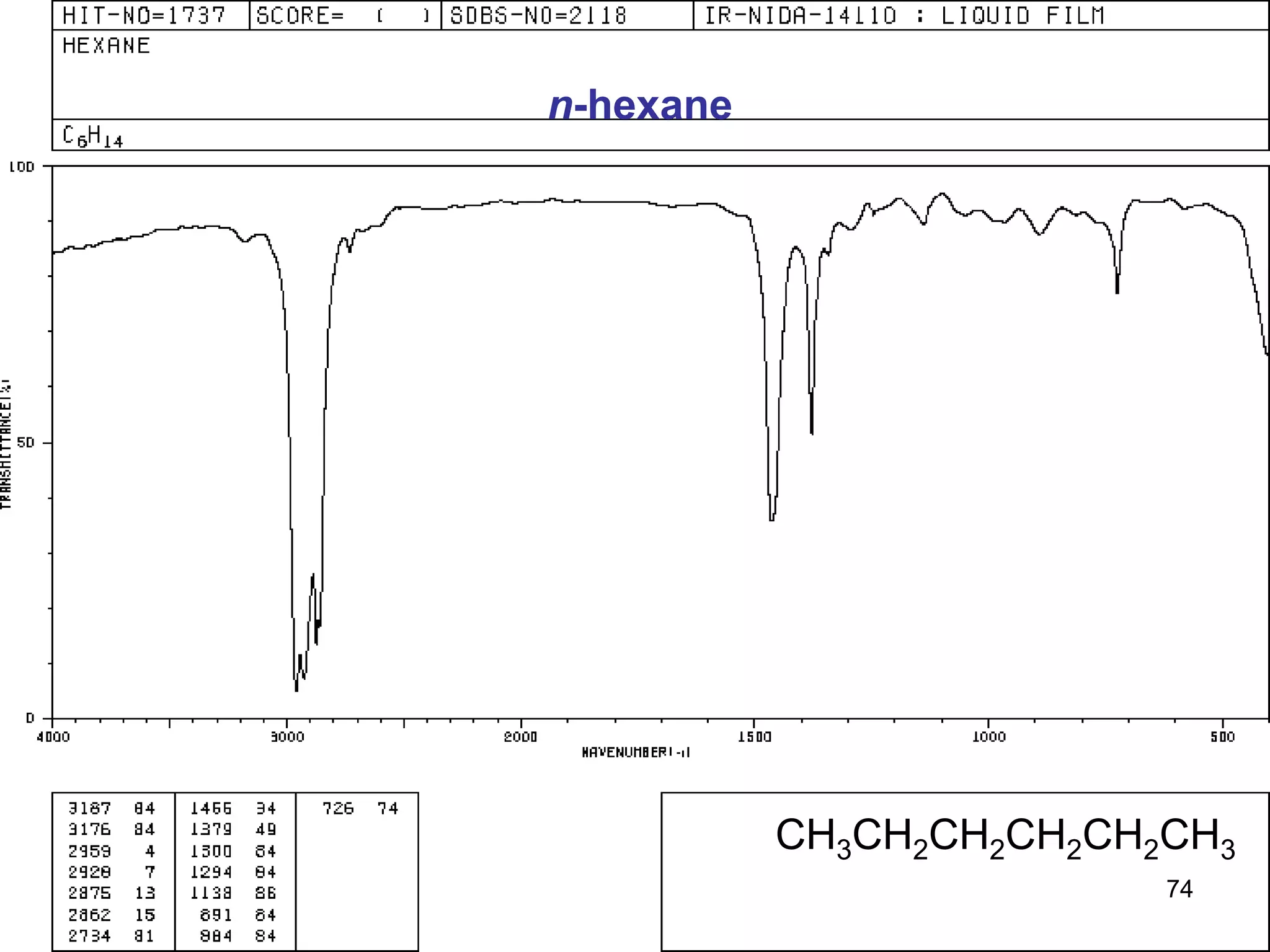
CH3CH2CH2CH2CH2CH3
n-hexane
74
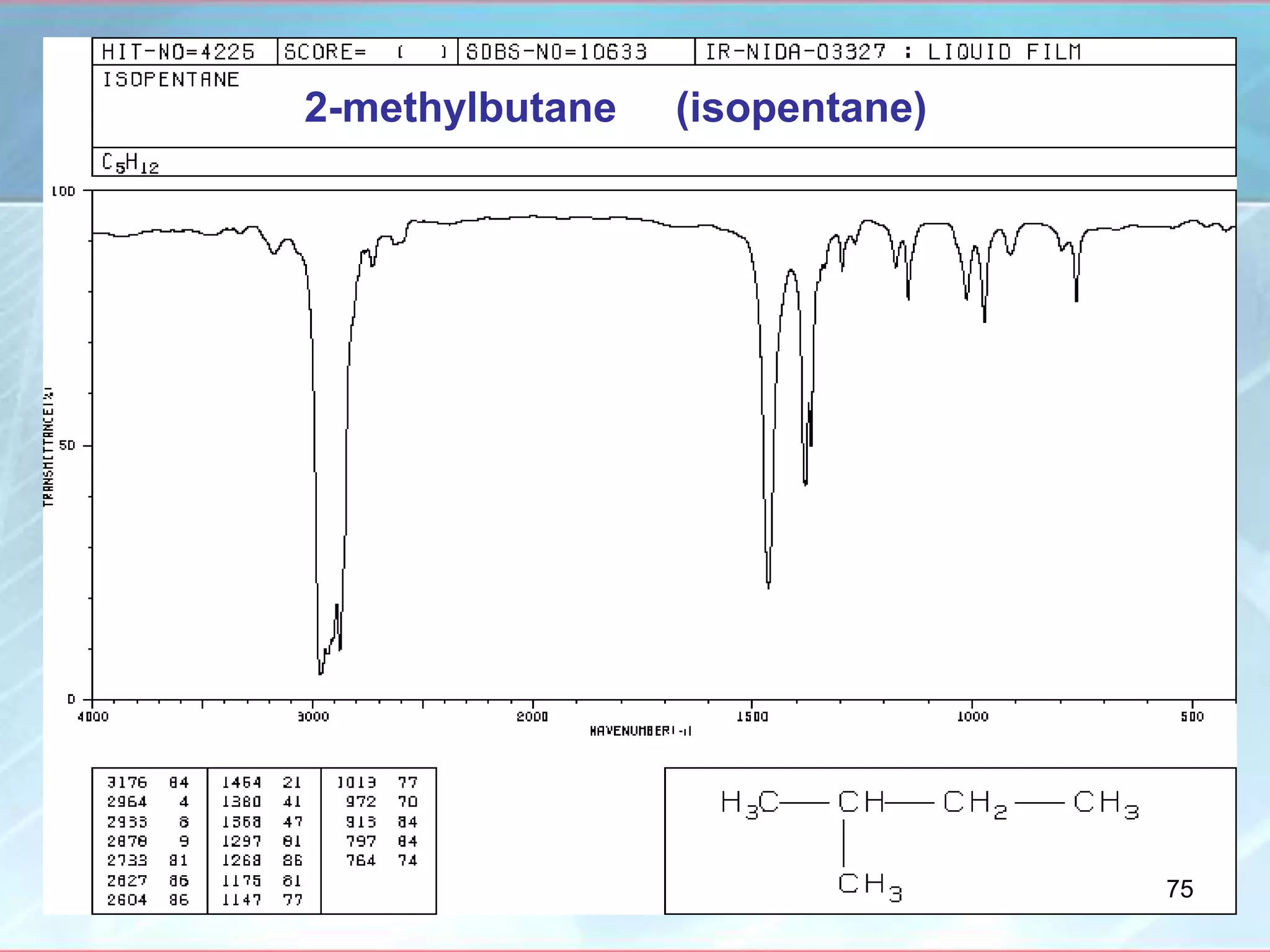
2-methylbutane (isopentane)
75
2,3-dimethylbutane
76
cyclohexane
no 1375 cm-1
no –CH3
77
Toluene
CH3
sp2
C-H
sp3
C-H aromatic
C=C
aromatic oops
78
isopropyl split 1370 + 1385
isopropylbenzene
79
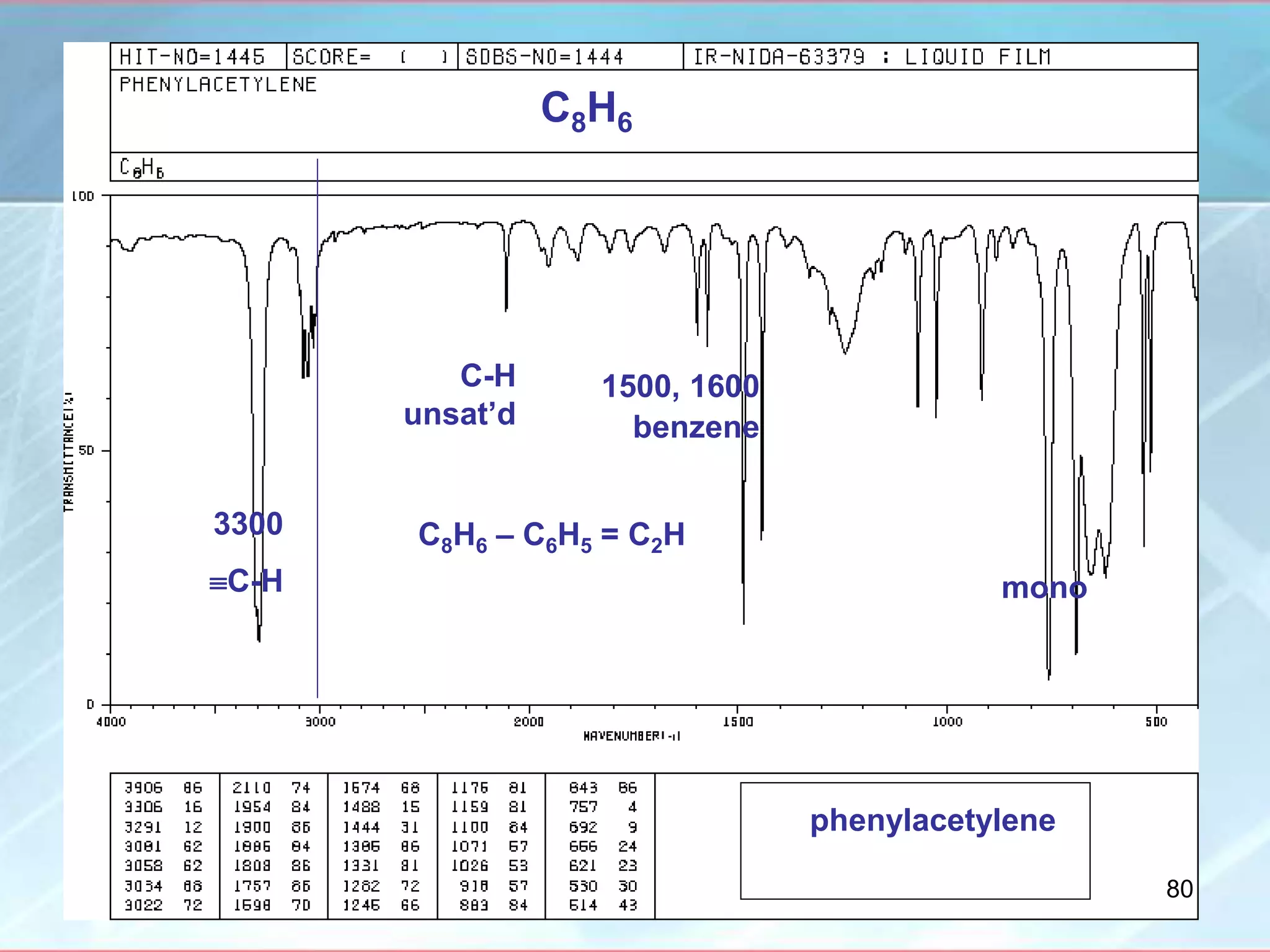
C8H6
C-H
unsat’d
1500, 1600
benzene
mono
C8H6 – C6H5 = C2H
phenylacetylene
3300
C-H
80
C4H8
1640-
1680
C=C
880-
900
R2C=CH2
isobutylene CH3
CH3C=CH2
Unst’d
81
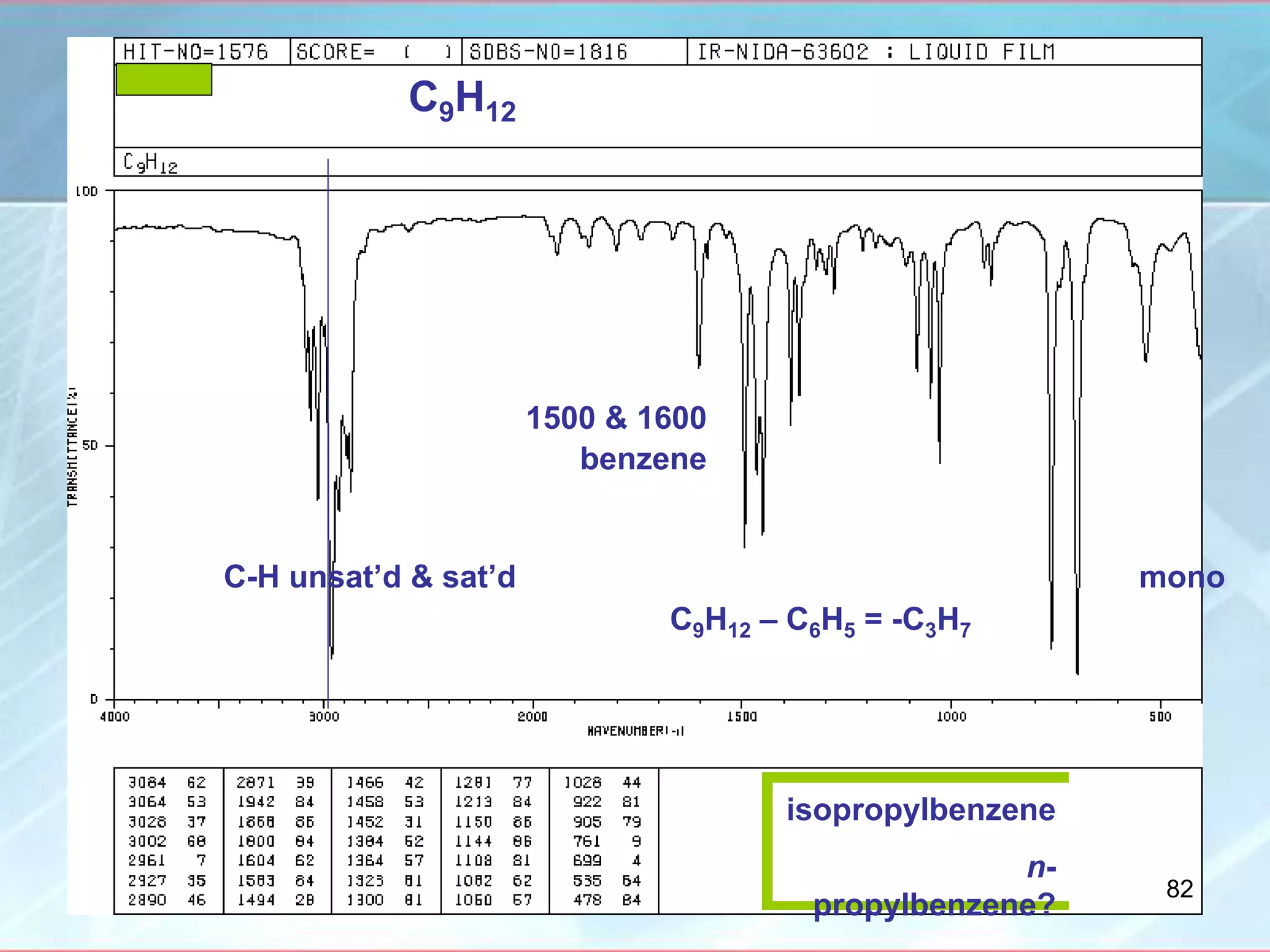
C9H12
C-H unsat’d & sat’d
1500 & 1600
benzene
mono
C9H12 – C6H5 = -C3H7
isopropylbenzene
n-
propylbenzene?
82
n-propylbenzene
83
Alkenes – addition of the C=C and vinyl C-H bonds
• C=C stretch at 1620-1680 cm-1 weaker as substitution
increases
• vinyl C-H stretch occurs at 3000-3100 cm-1
• The difference between alkane, alkene or alkyne C-H is
important! If the band is slightly above 3000 it is vinyl sp2
C-H or alkyl sp C-H, if it is below it is alkyl sp3 C-H
84
1-Octene
(w – m)
(w – m)
85
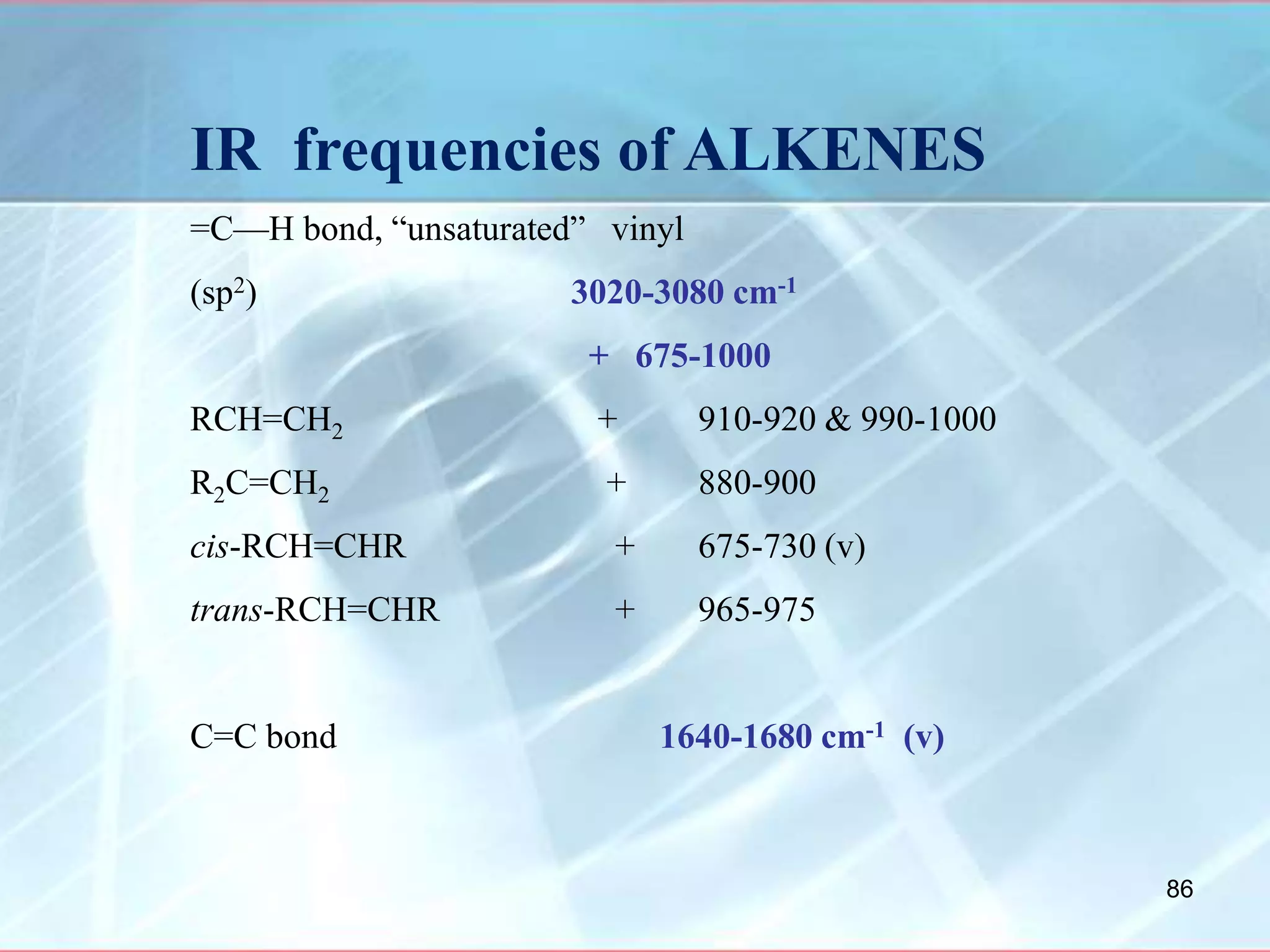
IR frequencies of ALKENES
=C—H bond, “unsaturated” vinyl
(sp2) 3020-3080 cm-1
+ 675-1000
RCH=CH2 + 910-920 & 990-1000
R2C=CH2 + 880-900
cis-RCH=CHR + 675-730 (v)
trans-RCH=CHR + 965-975
C=C bond 1640-1680 cm-1 (v)
86
87
1-Hexene
CH2 CH CH2 CH2 CH2 CH3
sp2
C-H
sp3
C-H stretch
C=C
stretch
out of plane
bendings (oops)
88
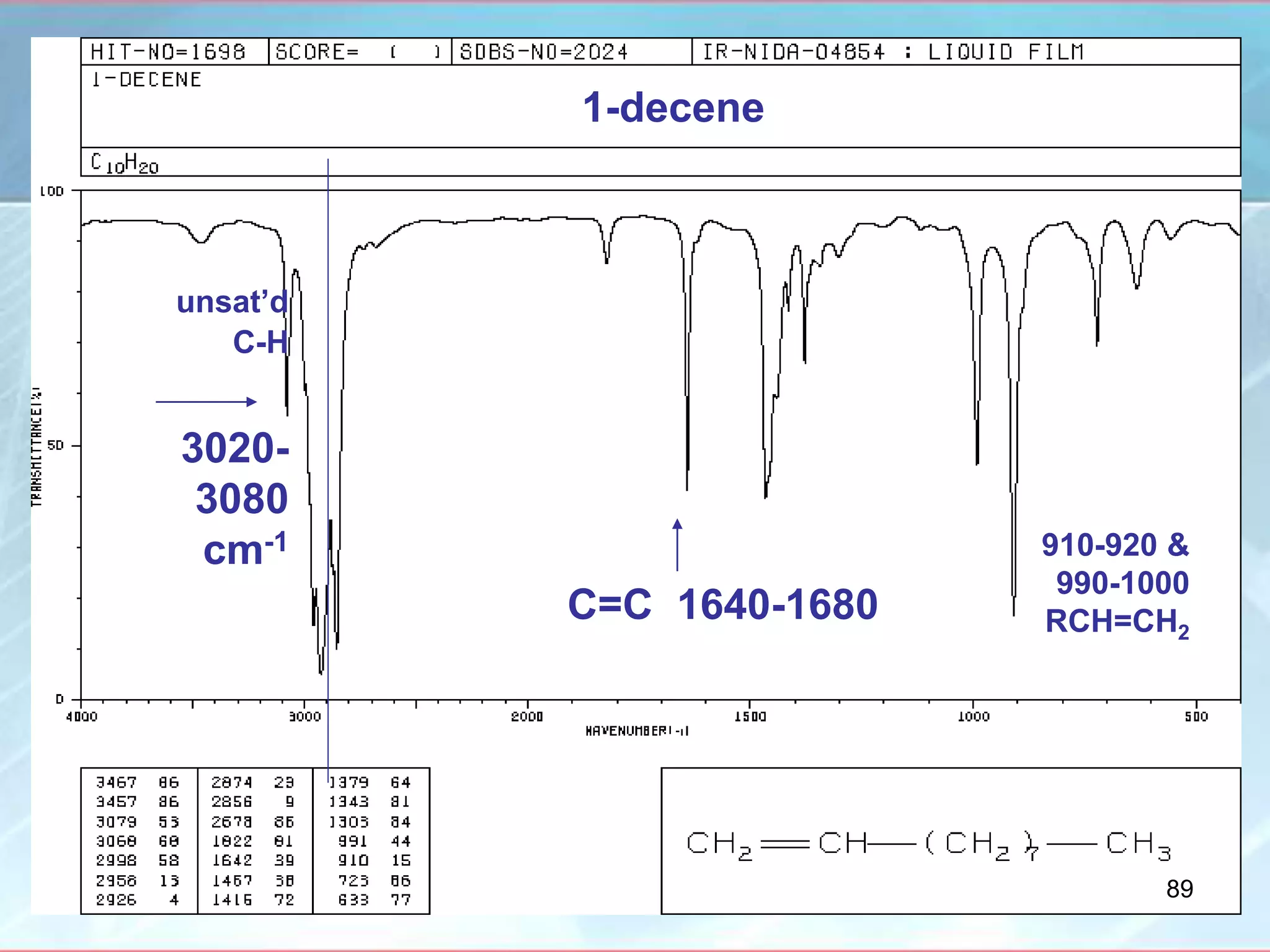
1-decene
910-920 &
990-1000
RCH=CH2
C=C 1640-1680
unsat’d
C-H
3020-
3080
cm-1
89
4-methyl-1-pentene
910-920 &
990-1000
RCH=CH2
90
2-methyl-1-butene
880-900
R2C=CH2
91
2,3-dimethyl-1-butene
880-900
R2C=CH2
92
Non Terminal Alkene
This spectrum shows that the band appearing around 3080 cm-1 can be
obscured by the broader bands appearing around 3000 cm-1.
( lower )
93
Alkynes
C≡C stretch 2100-2260 cm-1; strength depends on asymmetry of bond,
strongest for terminal alkynes, weakest for symmetrical internal alkynes
 C-H for terminal alkynes (,sharp &weak )occurs at 3200-3300 cm-1
Internal alkynes ( R-C≡C-R ) would not have this band!
(m – s)
(w-m)
94
I.R .Spectrum of Alkynes
95
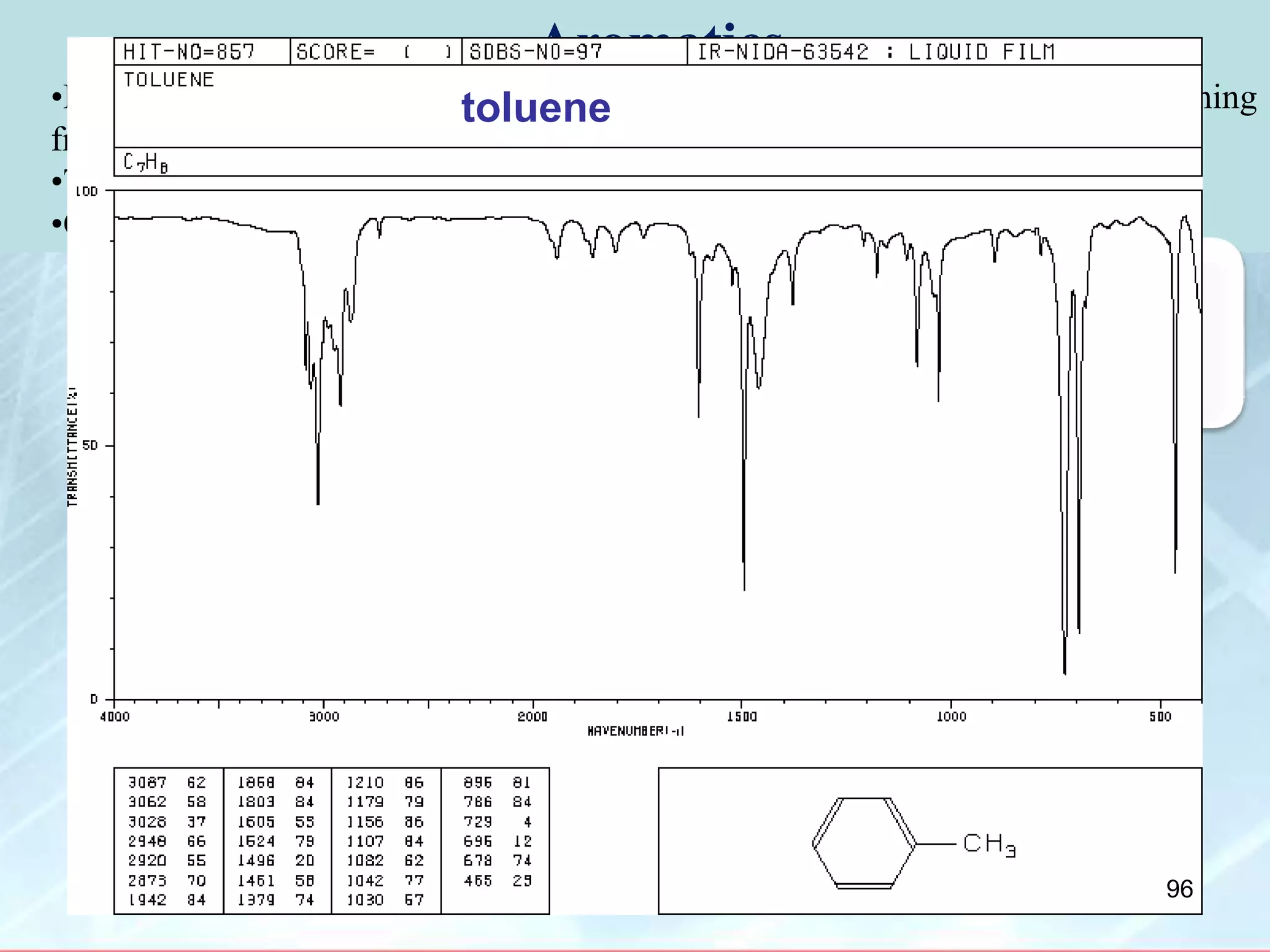
Aromatics
•Due to the delocalization of e- in the ring, C-C bond order is 1.5, the stretching
frequency for these bonds is slightly lower in energy than normal C=C
•These show up as a pair of sharp bands, 1500 & 1600 cm-1,
•C-H bonds of the ring show up similar to vinyl C-H at 3000-3100 cm-1
Ethyl benzene
(w – m) (w – m)
toluene
96
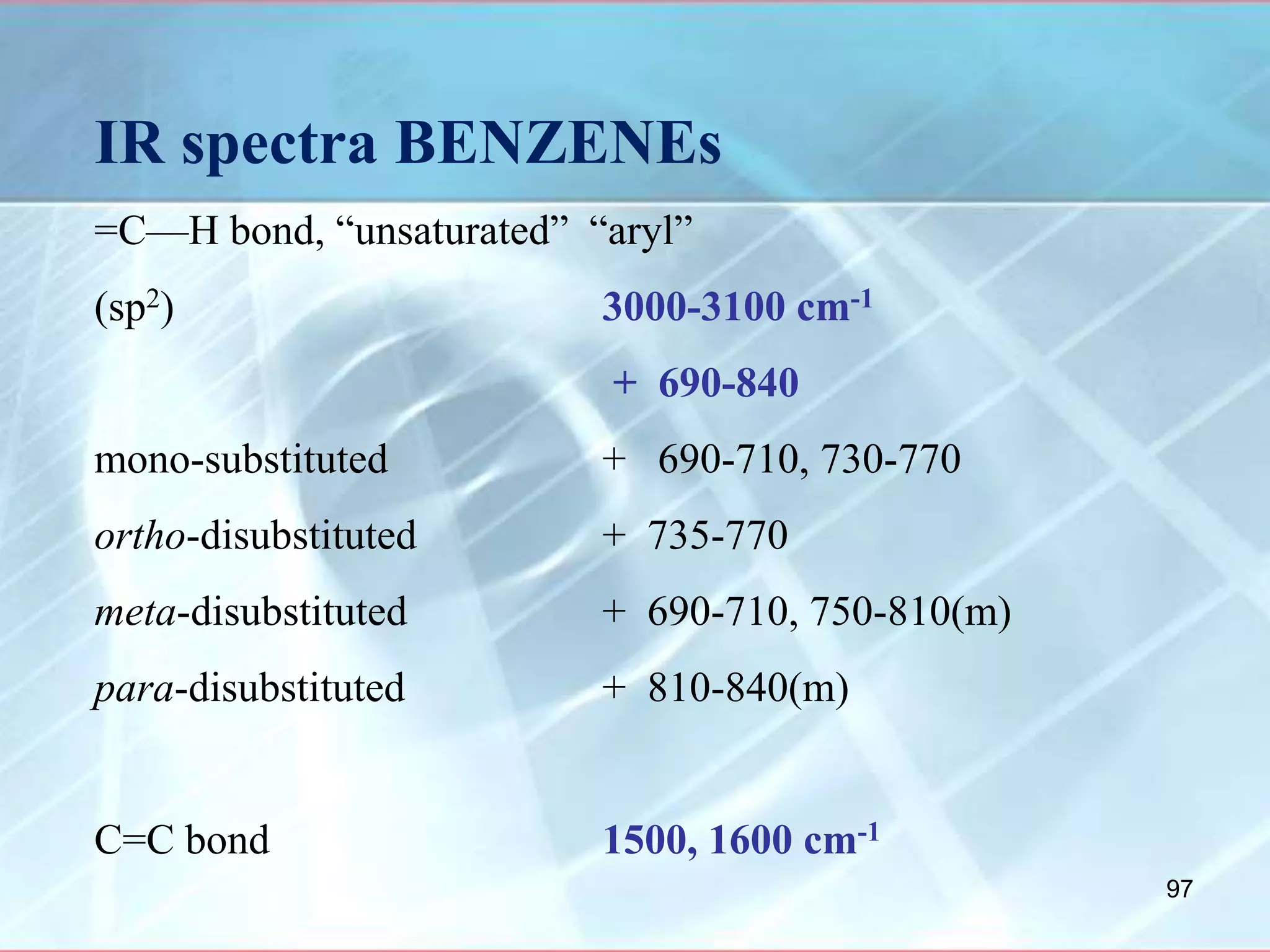
IR spectra BENZENEs
=C—H bond, “unsaturated” “aryl”
(sp2) 3000-3100 cm-1
+ 690-840
mono-substituted + 690-710, 730-770
ortho-disubstituted + 735-770
meta-disubstituted + 690-710, 750-810(m)
para-disubstituted + 810-840(m)
C=C bond 1500, 1600 cm-1
97
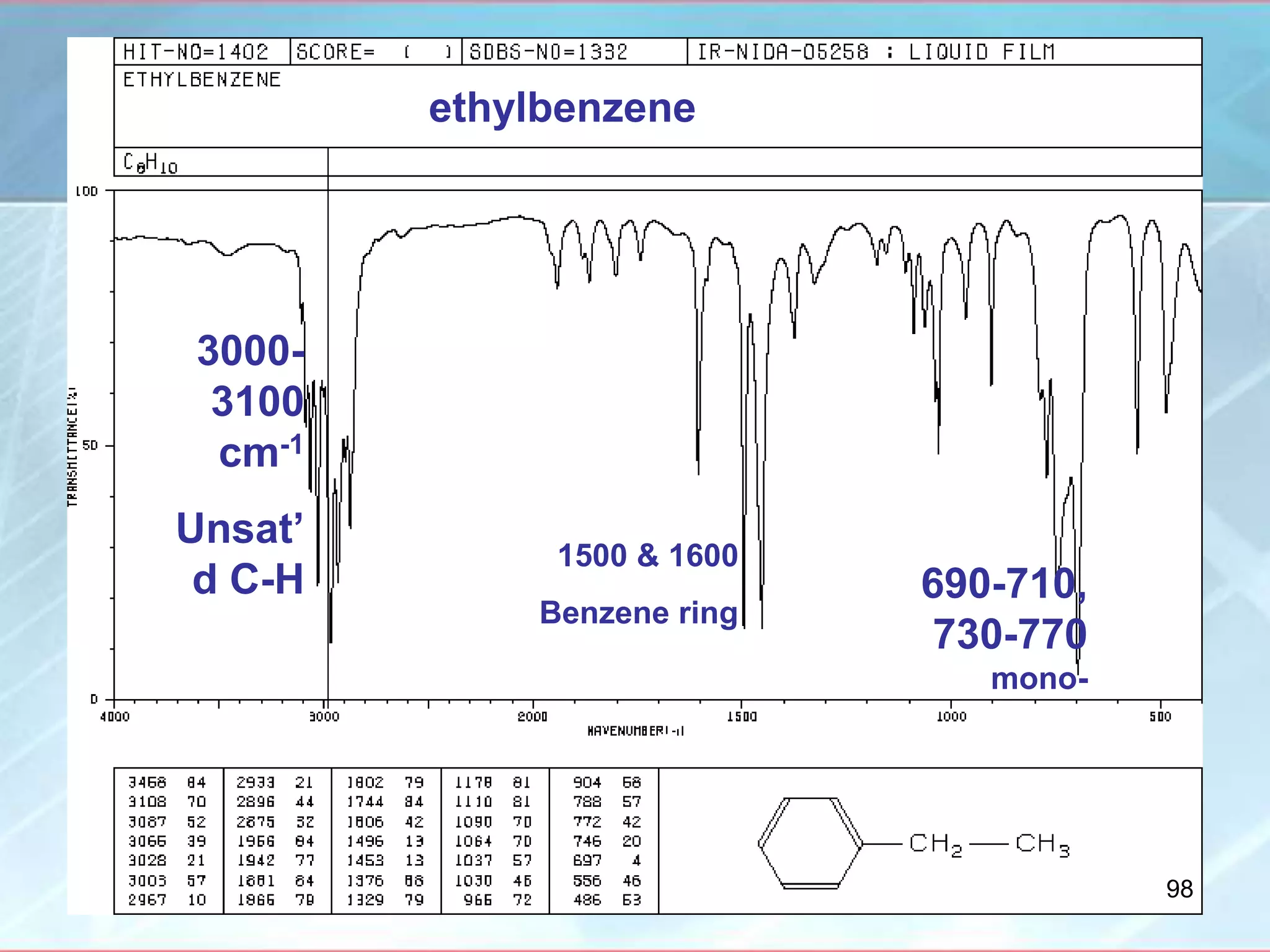
ethylbenzene
690-710,
730-770
mono-
1500 & 1600
Benzene ring
3000-
3100
cm-1
Unsat’
d C-H
98
o-xylene
735-
770
ortho
99
p-xylene
810-840(m)
para
100
m-xylene
meta
690-710,
750-
810(m)
101
styrene
no sat’d C-H
910-920 &
990-1000
RCH=CH2
mono
1640
C=C
102
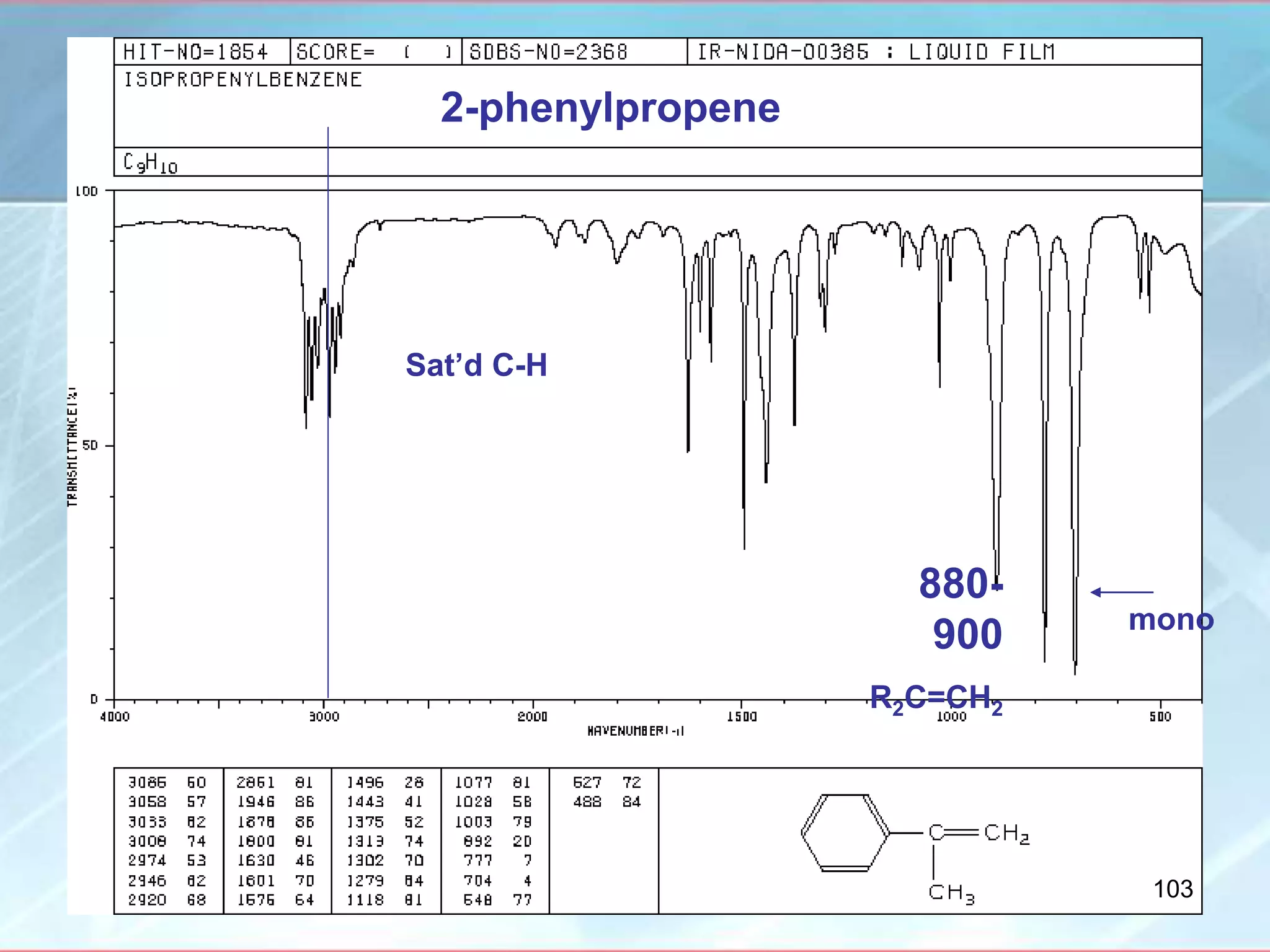
2-phenylpropene
mono
880-
900
R2C=CH2
Sat’d C-H
103
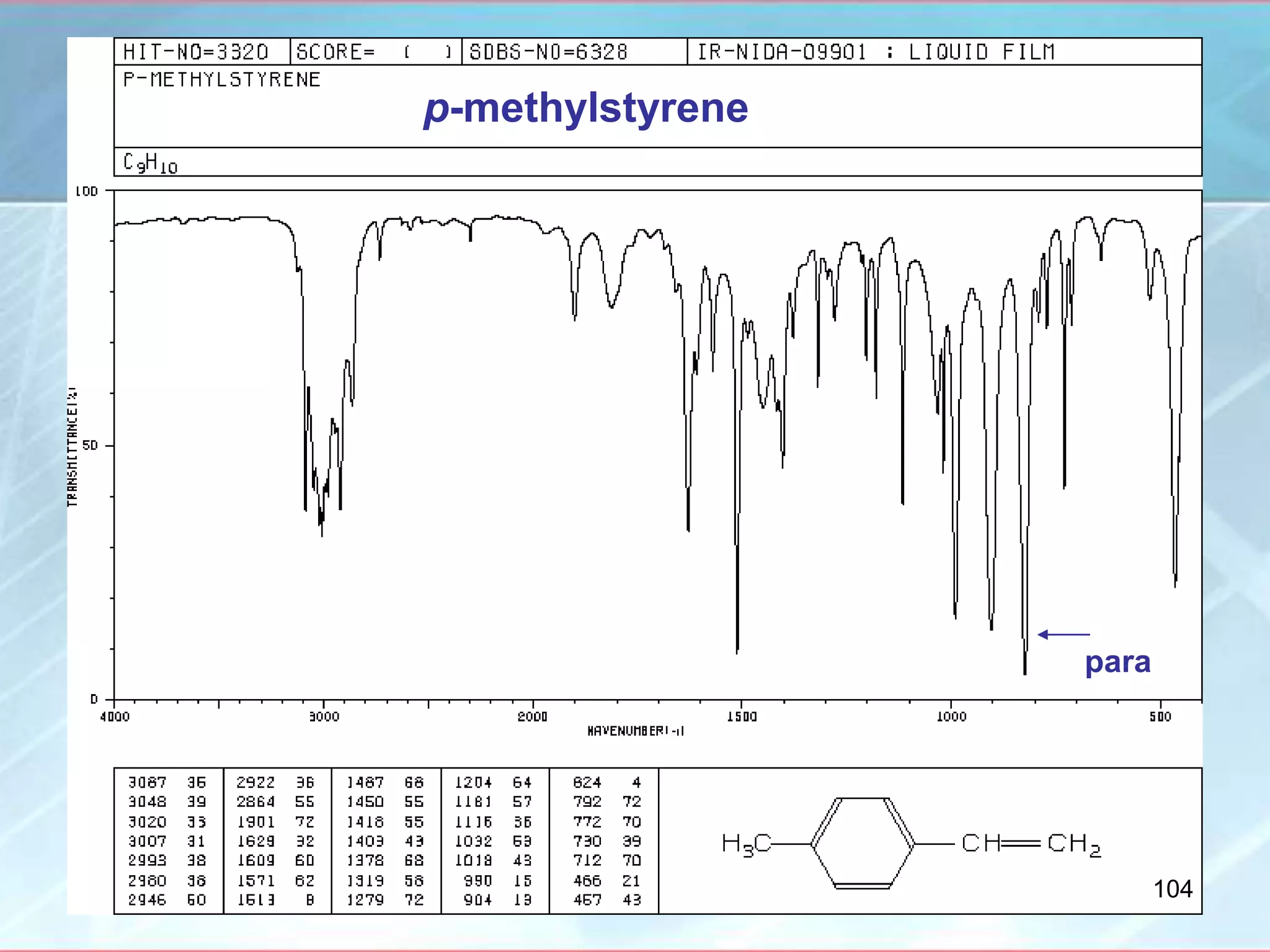
p-methylstyrene
para
104
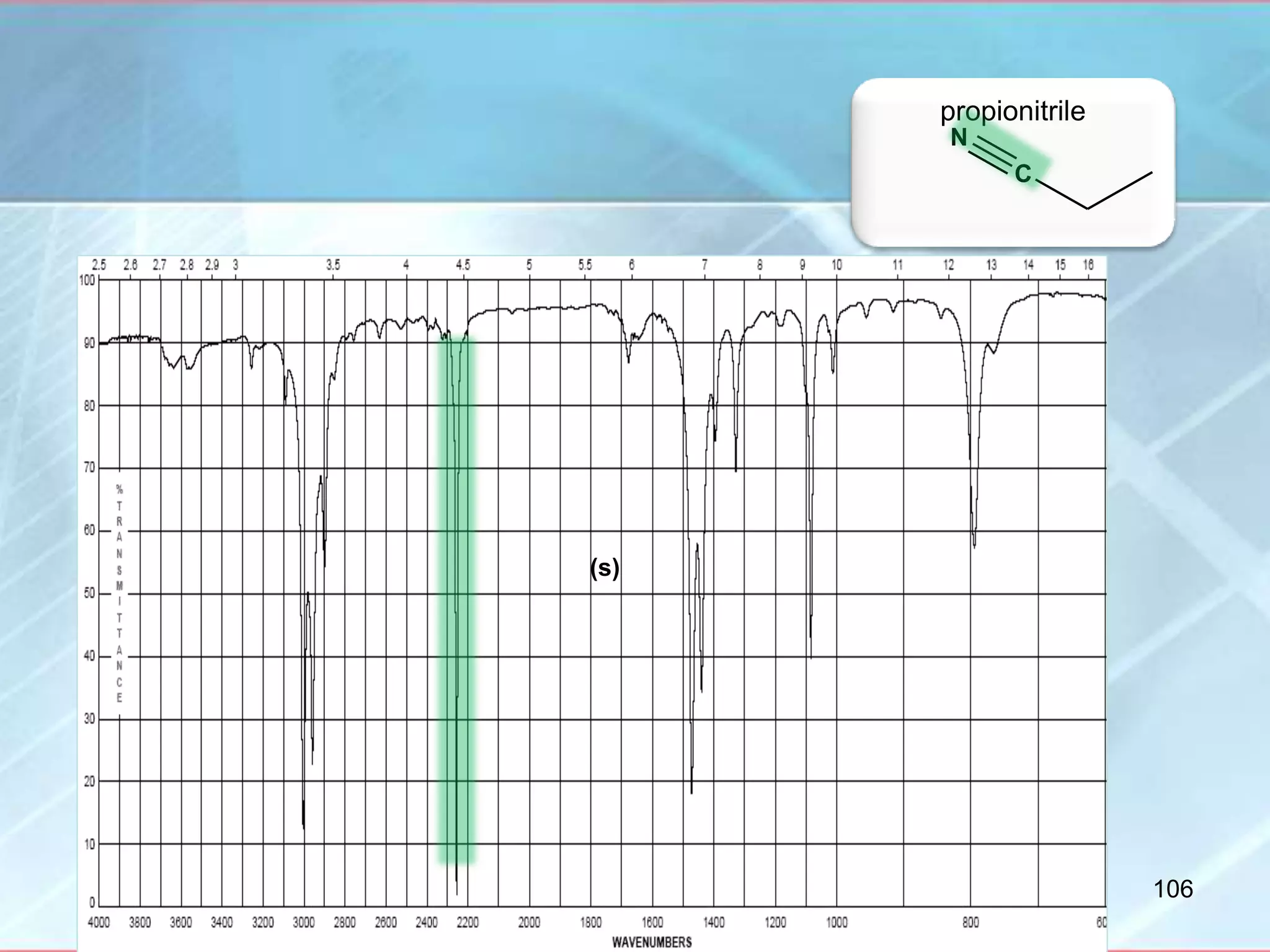
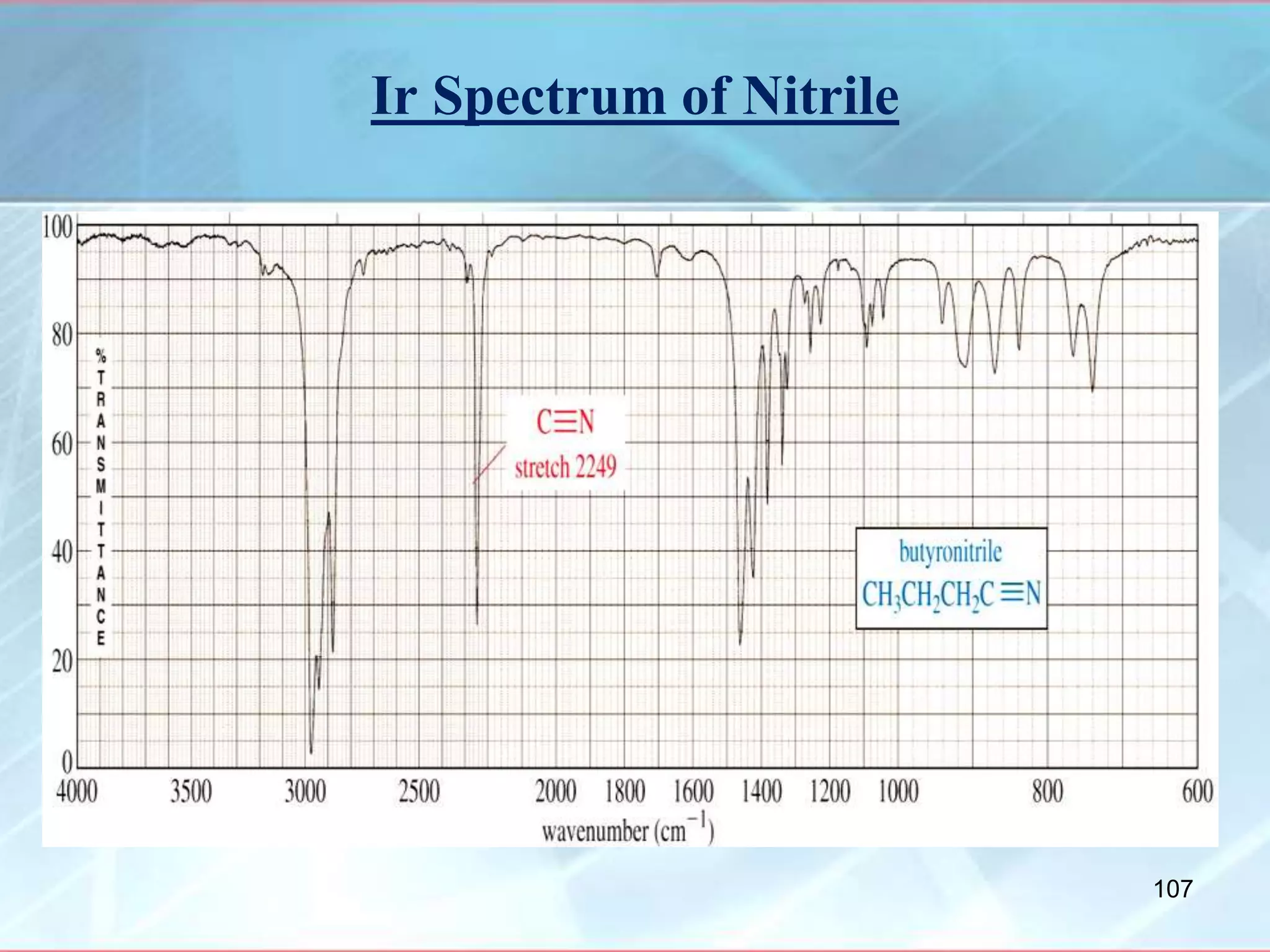
Nitriles (the cyano- or –C≡N group)
•Principle group is the carbon nitrogen triple bond at 2100-
2280 cm-1
•This band has a sharp, pointed shape just like the alkyne C-C
triple bond, but because the CN triple bond is more polar,
this band is stronger than alkynes.
105
propionitrile
N
C
(s)
106
Ir Spectrum of Nitrile
107
Ethers
•Addition of the C-O-C asymmetric band and vinyl C-H bonds
•Show a strong band for the antisymmetric C-O-C stretch at
1050-1150 cm-1
108
methyl n-propyl ether
no O--H
C-O ether
109
Diisopropyl ether
(s)
110
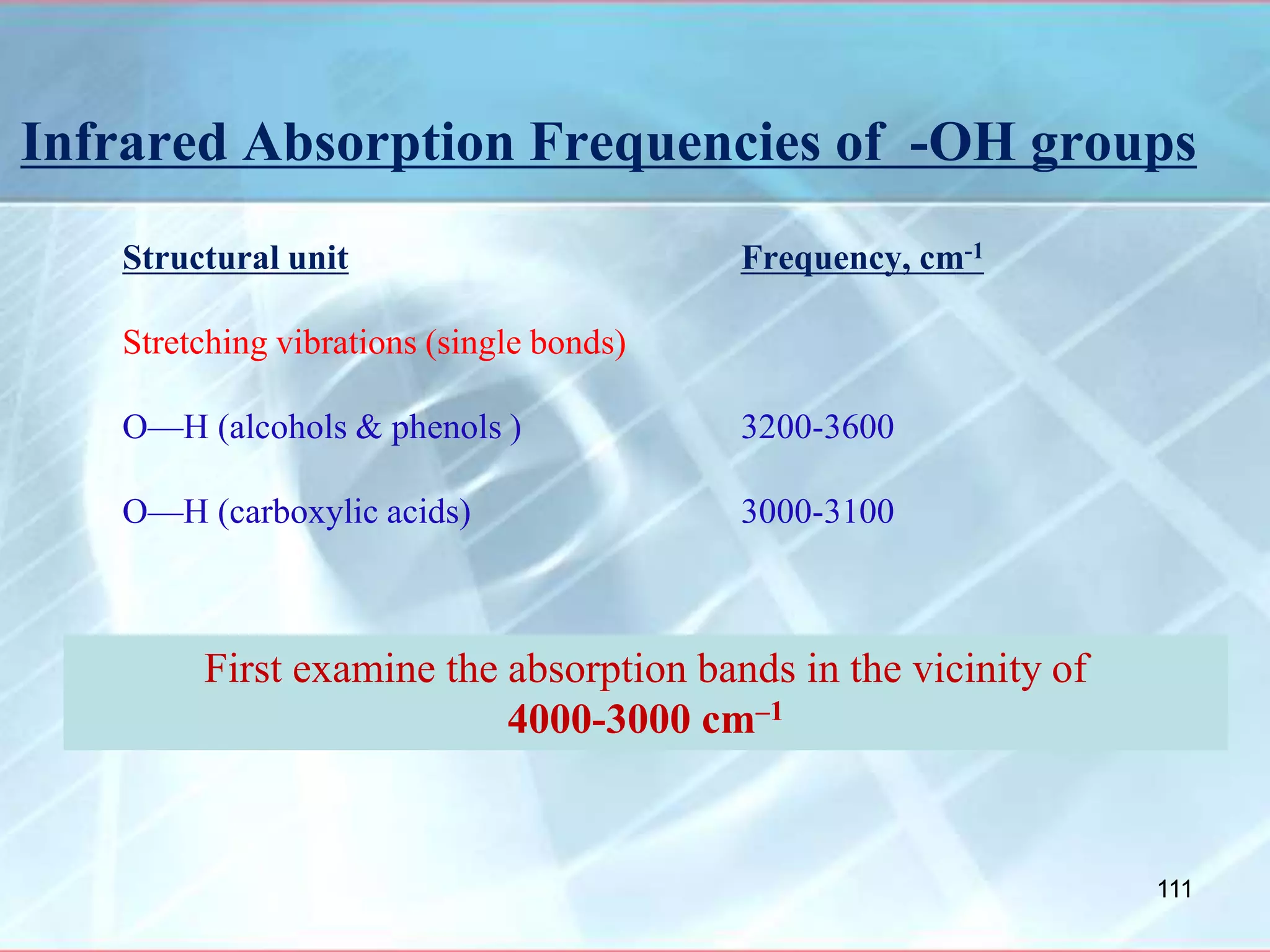
Infrared Absorption Frequencies of -OH groups
Structural unit Frequency, cm-1
Stretching vibrations (single bonds)
O—H (alcohols & phenols ) 3200-3600
O—H (carboxylic acids) 3000-3100
First examine the absorption bands in the vicinity of
4000-3000 cm–1
111
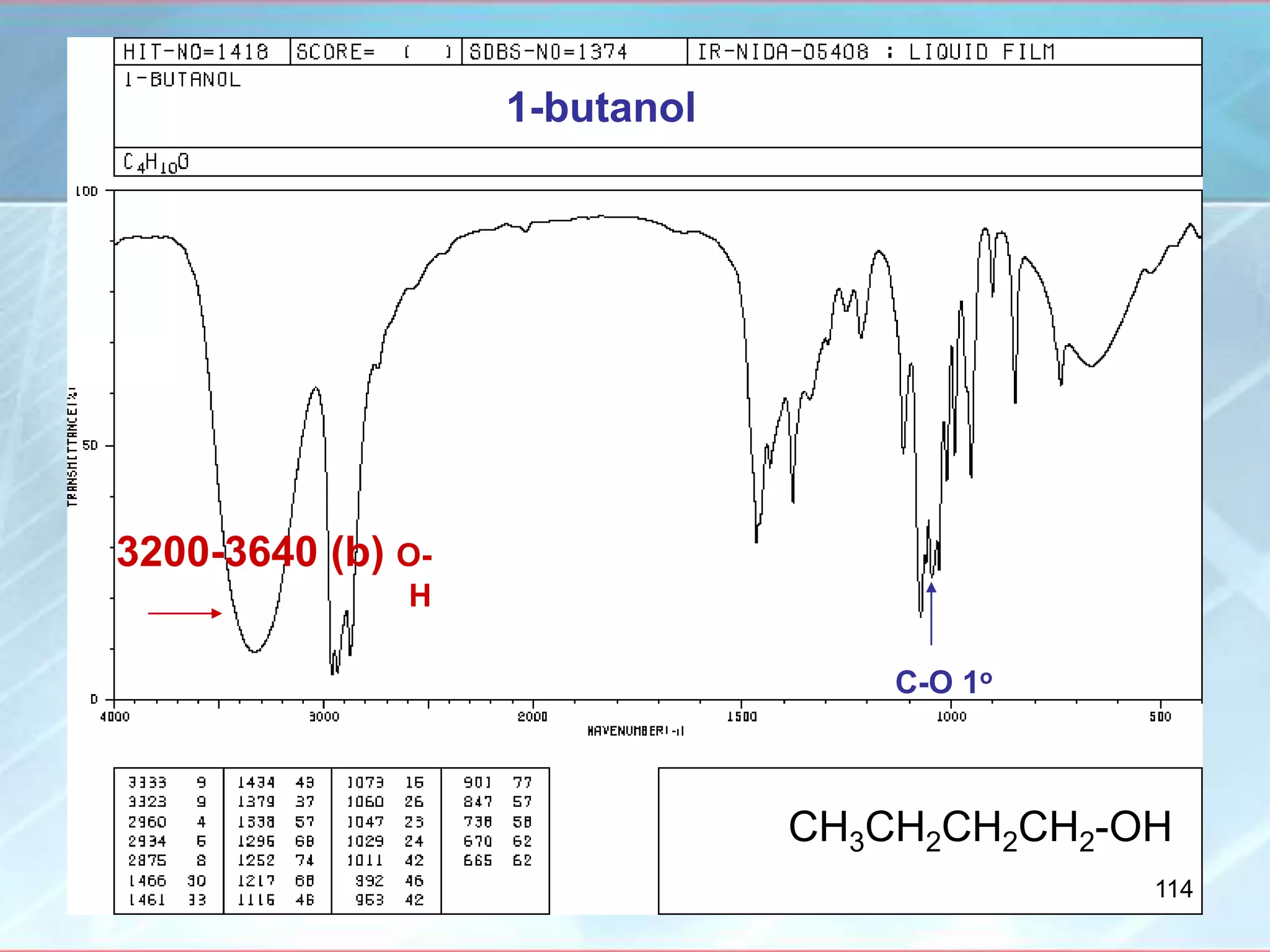
Alcohols
•Strong, broad O-H stretch from 3200-3400 cm-1
•Like ethers, C-O stretch from 1050-1260 cm-1
•Band position changes depending on the alcohols substitution:
• 1° 1075-1000;
•2° 1075-1150;
•3° 1100-1200;
• phenol 1180-1260
OH band in neat aliphatic alcohols is a broad band centered at ~ 3200 cm-1
due to hydrogen bonding (3200 – 3400 cm-1)
- OH band in dilute solutions of aliphatic alcohols is a sharp peak ~ 3400 cm-
1
112
1-butanol
(m– s)
br
(s)
113
1-butanol
CH3CH2CH2CH2-OH
C-O 1o
3200-3640 (b) O-
H
114
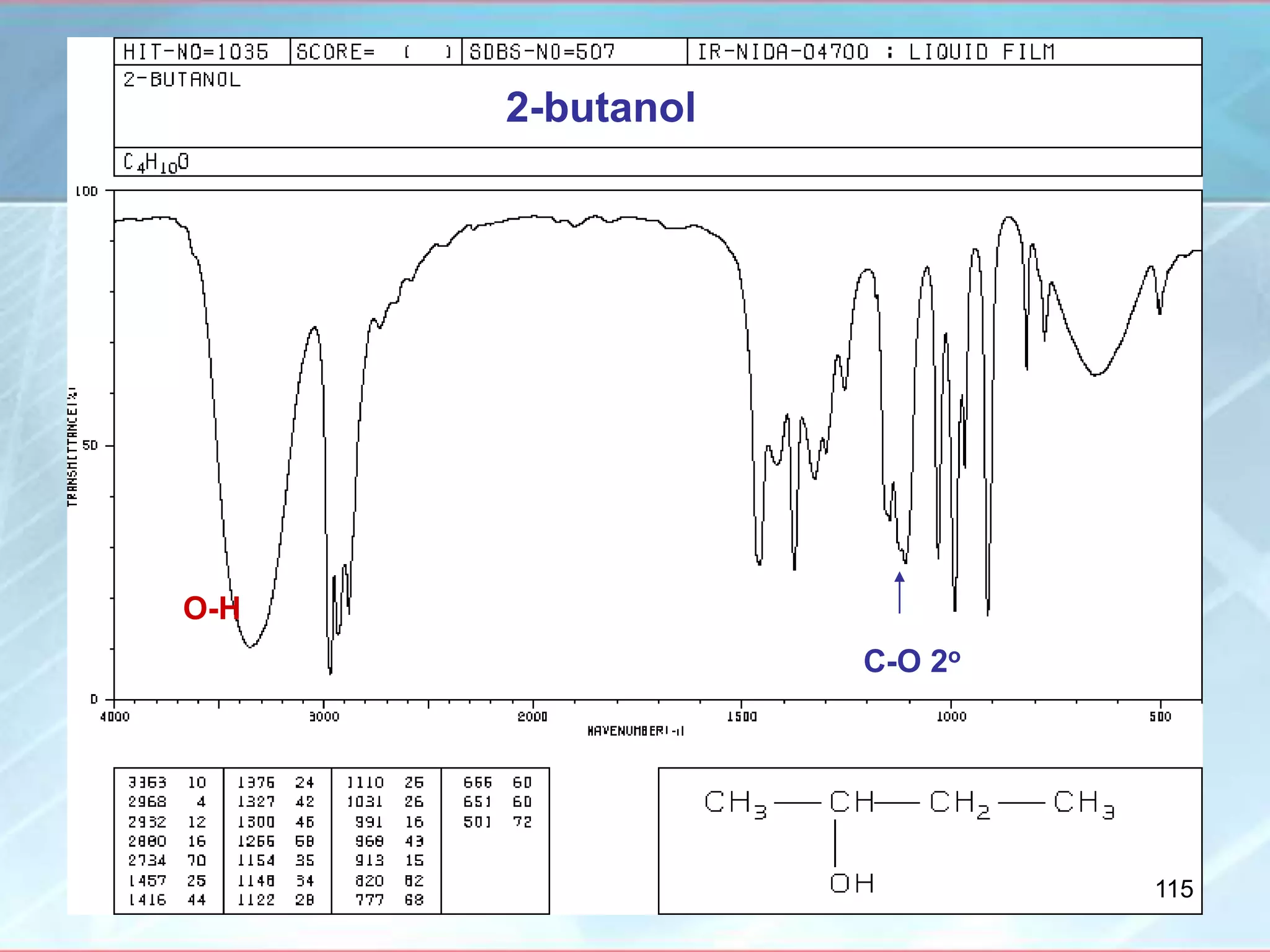
2-butanol
C-O 2o
O-H
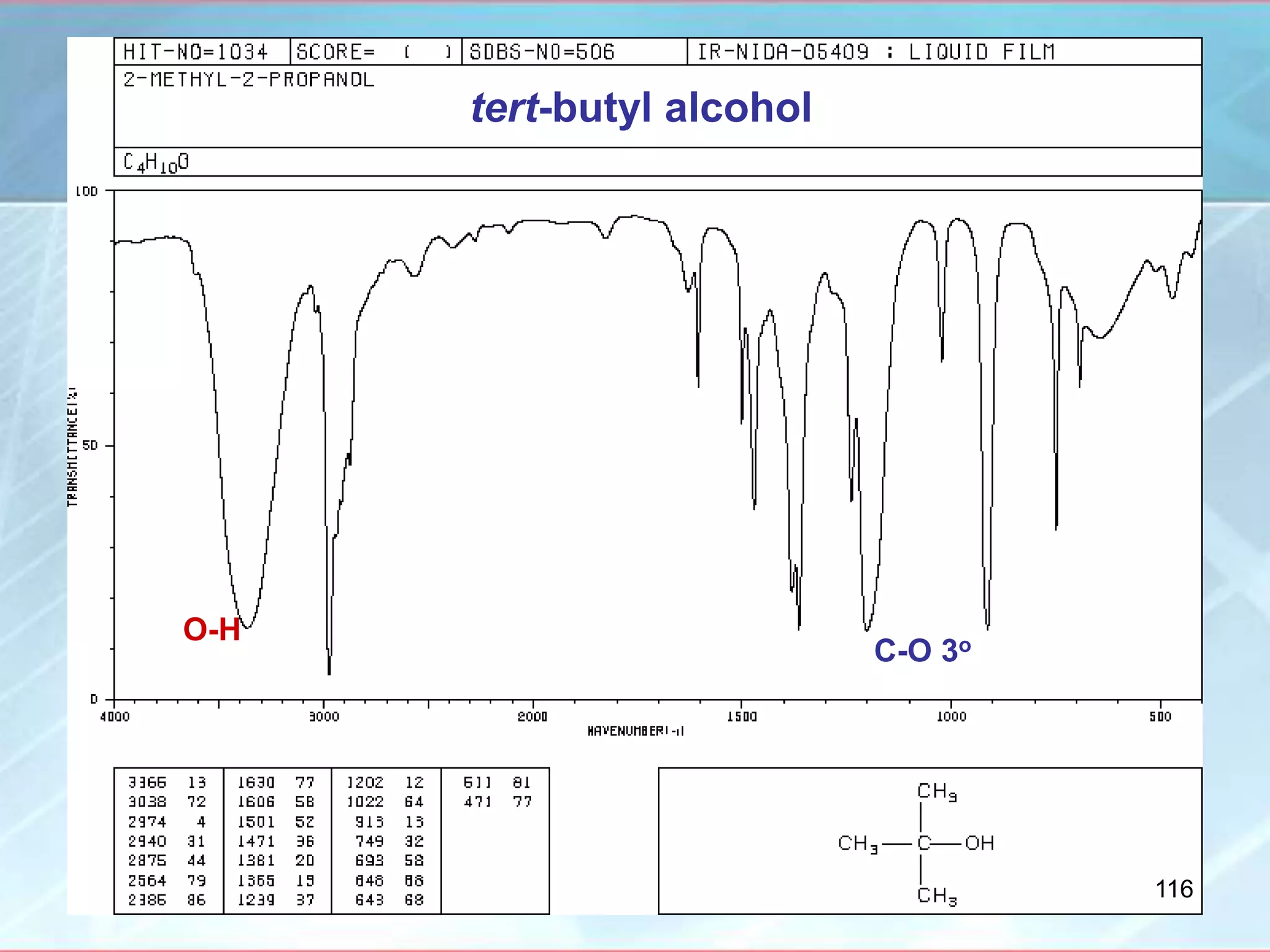
115
tert-butyl alcohol
C-O 3o
O-H
116
Cyclohexanol
OH
O-H
stretch
bending
C-O
stretch
sp3 C-H stretch
117
Phenol
CO→H stretch is broad band
C→H stretch ~ 3050 cm-1
C−C→O band ~ 1225 cm-1
C −O−H bend ~ 1350 cm-1
Aromatic ring C stretching between 1450 – 1600 cm-1
Mono substituted bands ~ 745 – 895 cm-1 and 1650 – 2000 cm-1
118
Carboxylic Acids
• Consist of both, C=O and O-H groups.
• C=O band occurs between 1700-1725 cm-1
• The highly dissociated O-H bond has a broad band from 2400-
3500 cm-1 covering up to half the IR spectrum in some cases
119
4-phenylbutyric acid
(w – m)
br
(s) (s)
120
IR Spectrum of A Carboxylic Acid
121
Propionic Acid
122
IR Spectrum of Carbonyl Componds
• Carbonyl compounds are those that contain the C=O functional group
• Aldehydes and ketones show a strong, prominent, band around 1710 - 1720
cm-1 (right in the middle of the spectrum). This band is due to the highly polar
C=O bond.
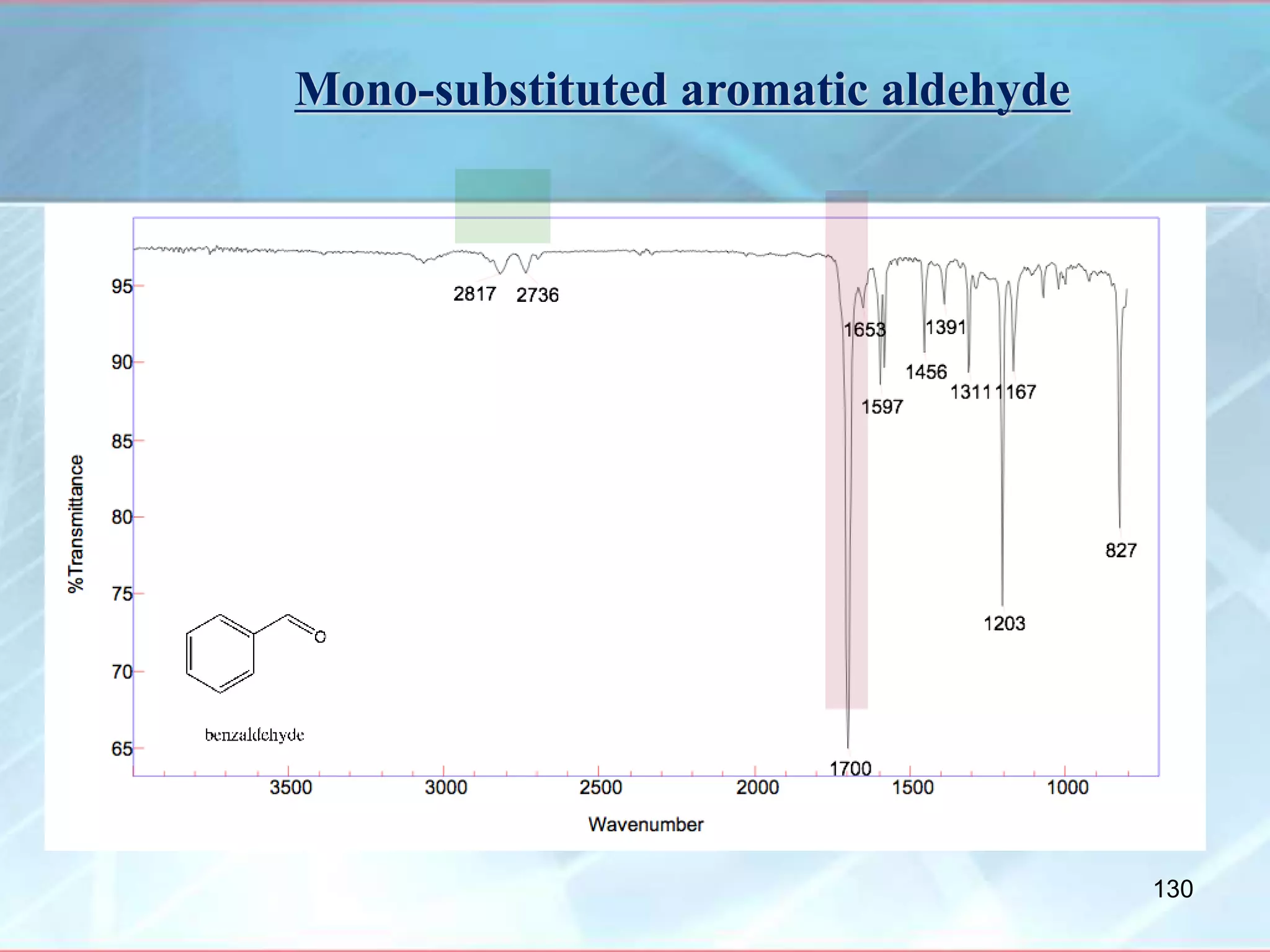
• Because ,aldehydes also contain a C-H bond to the sp2 carbon of the C=O bond,
they also show a pair of medium strength bands positioned about 2700 and
2800 cm-1.
• These bands are missing in the spectrum of a ketone because the sp2 carbon of the
ketone lacks the C-H bond.
123
Infrared Absorption Frequencies of C=O
Structural unit Frequency, cm-1
Stretching vibrations (carbonyl groups)
1.Aldehydes and ketones 1710-1750
2.Carboxylic acids 1700-1725
3.Acid anhydrides 1800-1850 and 1740-1790
4.Esters 1730-1750
5.Amides 1680-1700
6.Acid Chloride 1800
C O
ν C=O Decreasing order
RCO)2O > RCOX > RCOOR’ > RCHO > RCOR > RCOOH > RCONH2
124
ν C=O of Aldehydes And Ketones
Both ,aldehyde and ketone have a common functional group, called as ,
carbonyl , C=O.
Strong, sharp C=O peak 1670 - 1780 cm1
125
1. CH2O , EDG-CHO , EWG-CHO
(CH3-CHO) , (Cl3C- CHO)
2. CH3-CHO , CH3-CO-CH3
3. Ph –CHO, CH3-CHO
4. Ph –CO-CH3, CH3-CO-CH3
How does Adsorption differ in Aldehydes & Ketones?
126
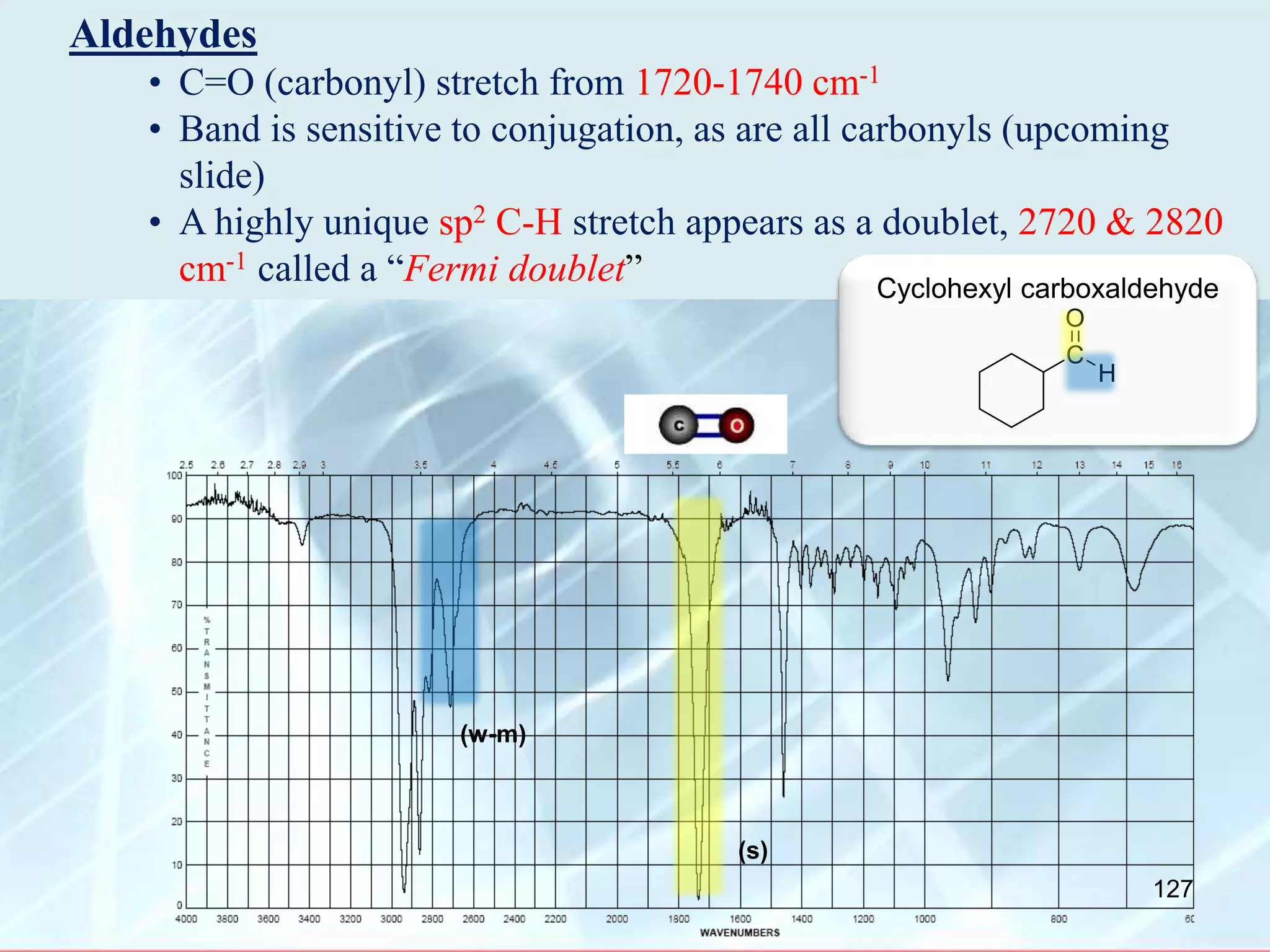
Aldehydes
• C=O (carbonyl) stretch from 1720-1740 cm-1
• Band is sensitive to conjugation, as are all carbonyls (upcoming
slide)
• A highly unique sp2 C-H stretch appears as a doublet, 2720 & 2820
cm-1 called a “Fermi doublet” Cyclohexyl carboxaldehyde
(w-m)
(s)
127
128
129
Mono-substituted aromatic aldehyde
130
131
Ketones
• Simplest of the carbonyl compounds
as far as IR spectrum – carbonyl only
• C=O stretch occurs at 1705-1725
cm-1
3-methyl-2-pentanone
(s)
132
IR: Ketones
133
2-butanone
 C=O
~1700 (s)
134
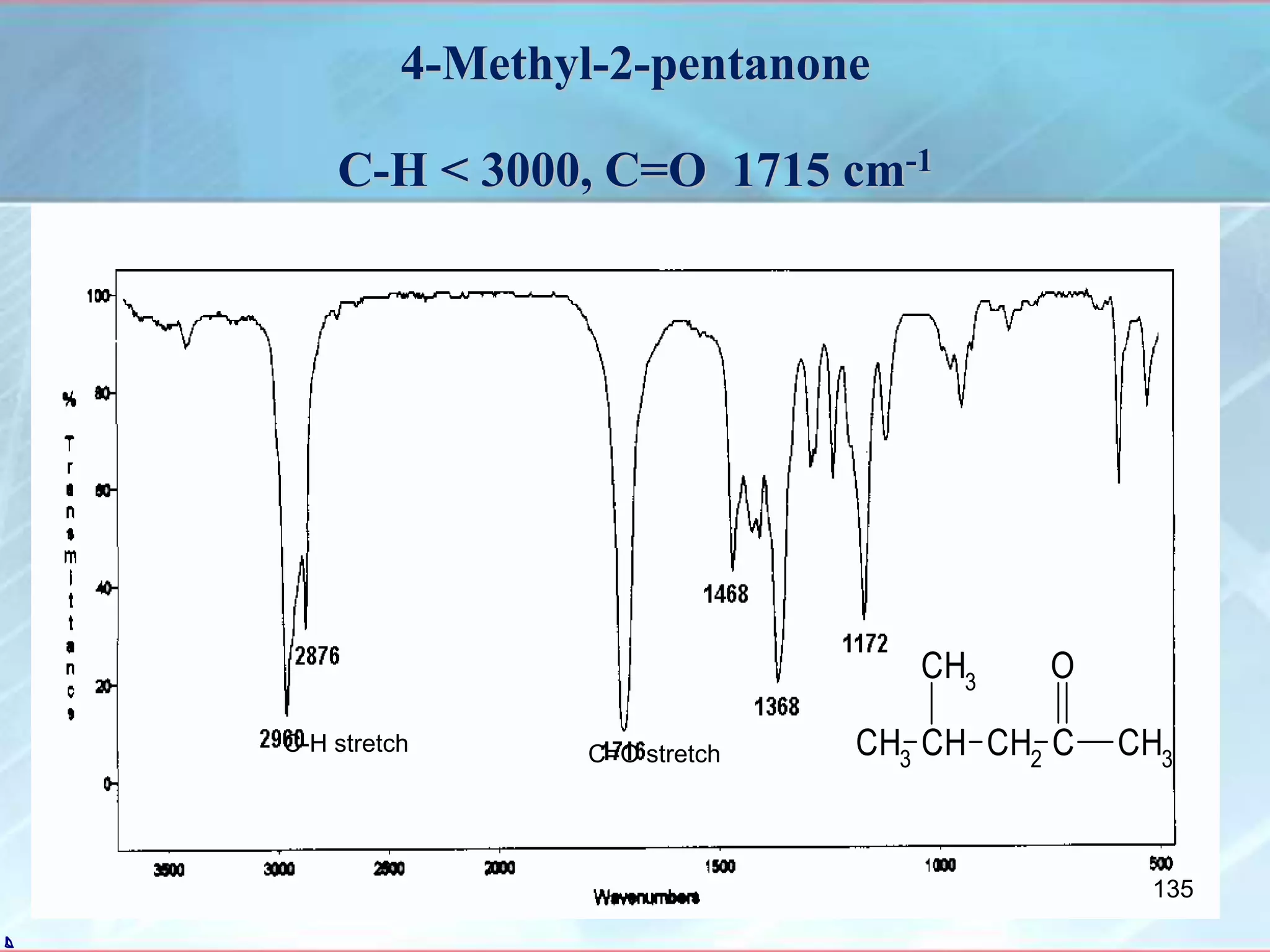
4-Methyl-2-pentanone
C-H < 3000, C=O 1715 cm-1
CH3
CH CH2
C CH3
OCH3
C-H stretch C=O stretch
135
Cyclic aliphatic ketone
136
Mono substituted aromatic methyl ketone
C=O
aromatic C=C
137
Mono substituted aromatic ketone
138
OO
1650-1700 cm-1
1660-1700 cm-1 rotational isomers cause
doubling. S-trans 1674, S-cis 1699
OO
H
1580-1640 cm-1 for enol
1715 cm-1 for the keto bond
Along with br. OH str.
Effect Of Conjugation on ν C=O
Conjugation with a double bond or benzene ring lowers the stretching
frequency by 30 to 40 cm-1. Ketones are sensitive to conjugation
139
Effects of Conjugation
140
Strain on C=O of Ketones
Ring strain increases frequency
• Incorporation of the carbonyl group in a small ring (5, 4 or 3-
membered), raises the stretching frequency.
30 cm-1 higher for every C atom removed
-diketones, str-str for open chain, IR inactive; in ring, 1720,1740
-haloketones--can see second band from rotamer populations
(1720, 1745) 141
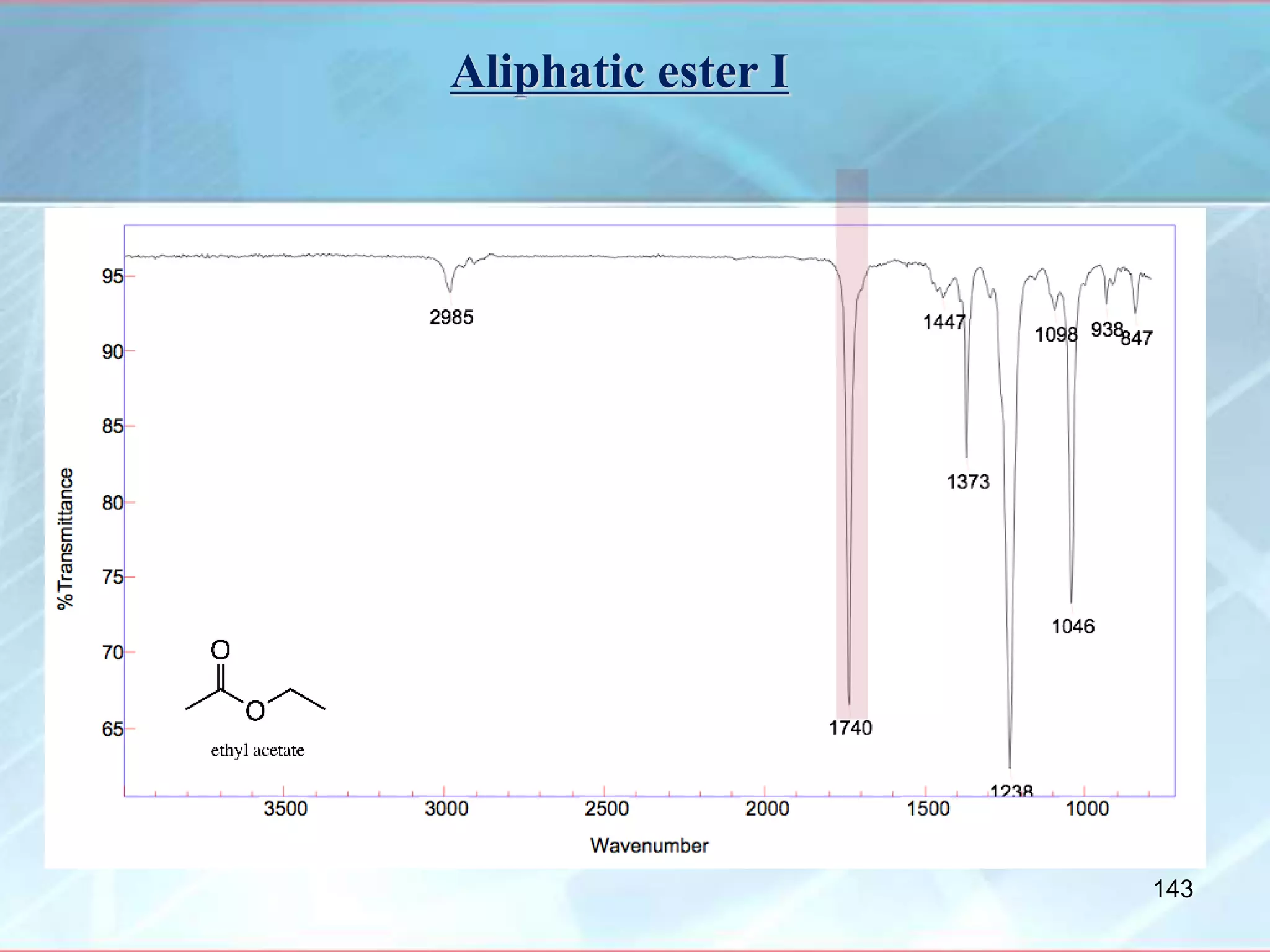
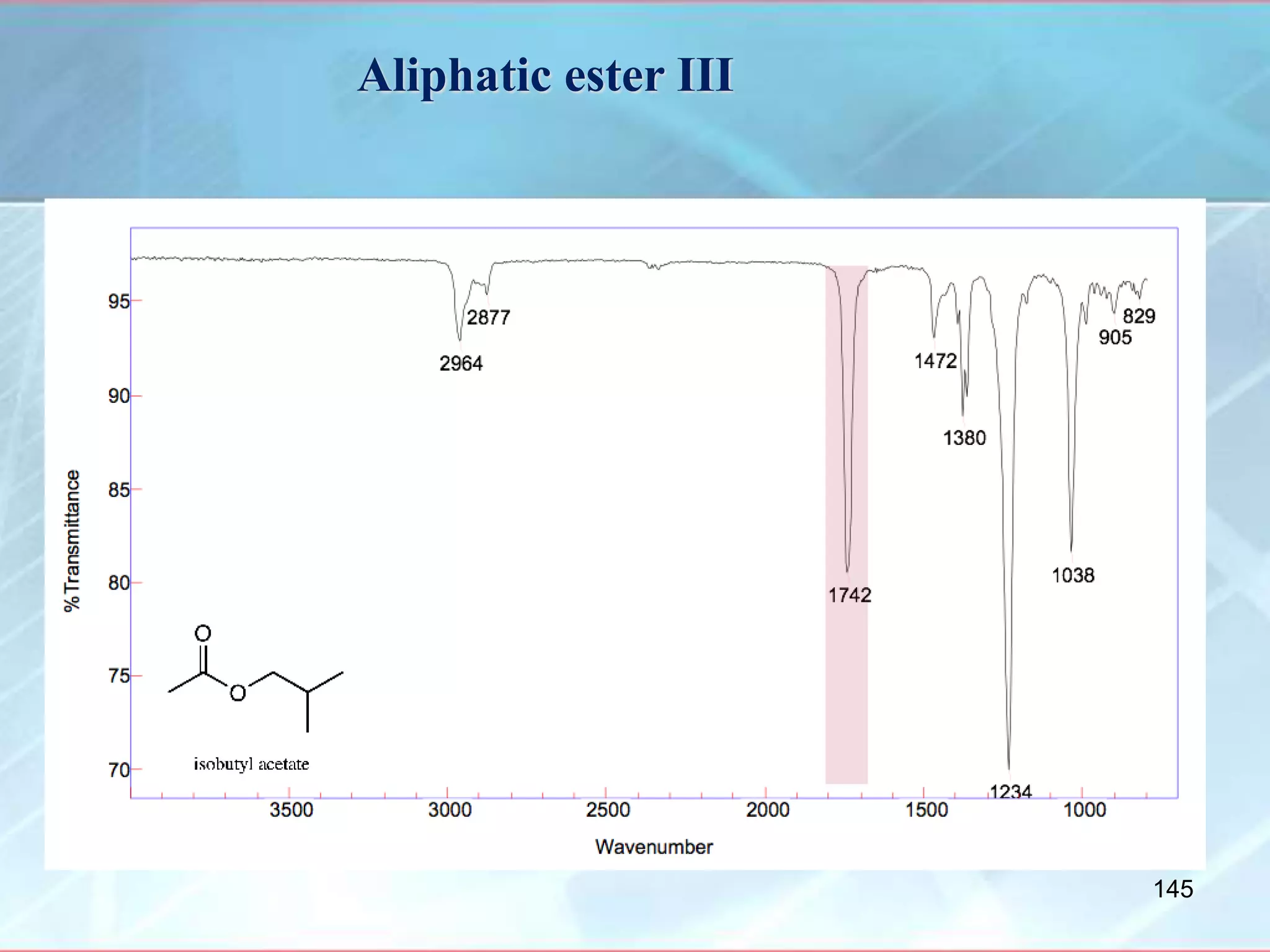
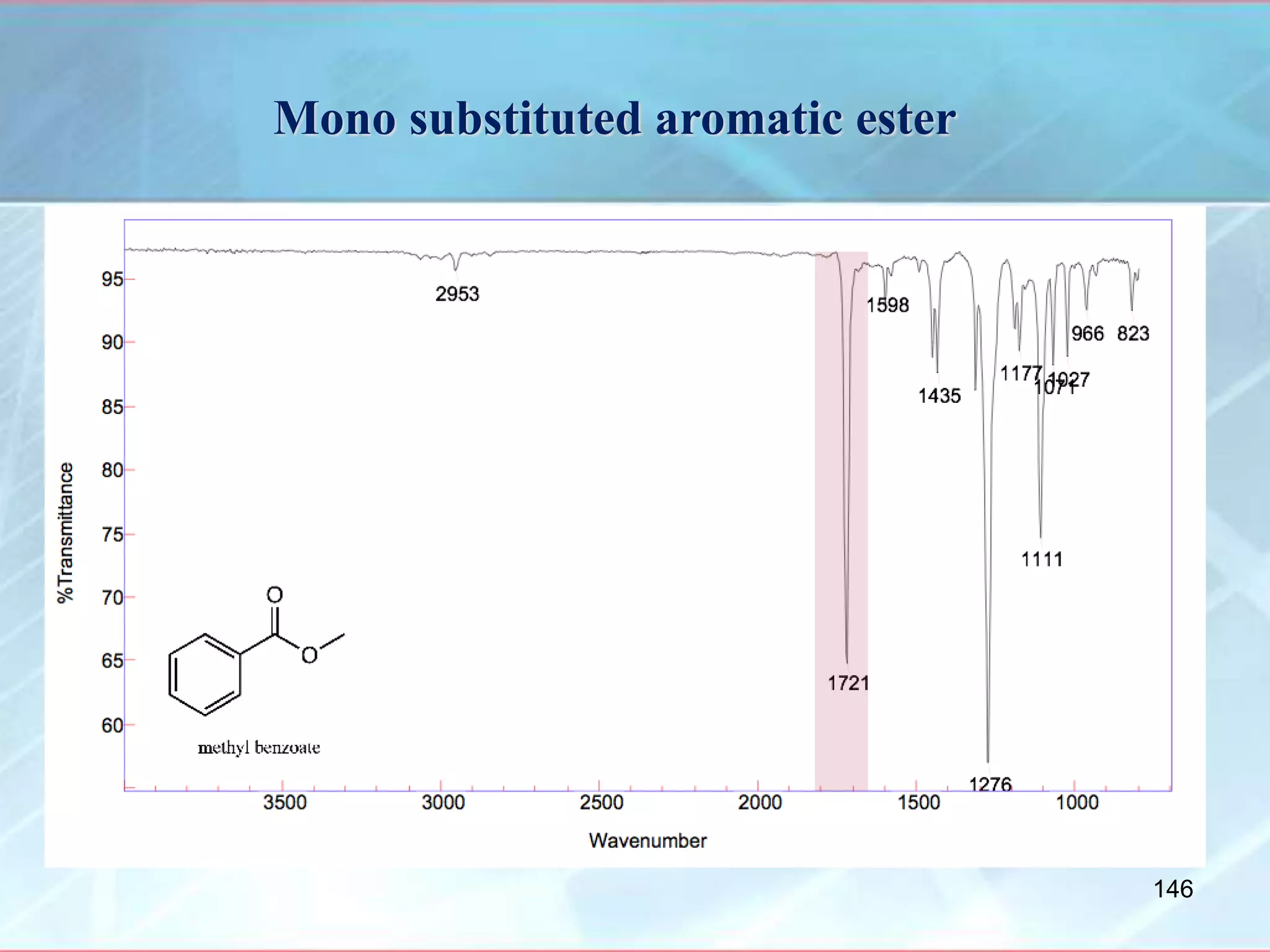
Esters and Lactones:
• C=O stretch at 1735-1750 cm-1
• Strong band for C-O at a higher frequency than ethers or
alcohols at 1150-1250 cm-1
• Lactones absorb at higher frequency than esters
Ethyl pivalate
(s)
(s)
142
Aliphatic ester I
143
Aliphatic ester II
144
Aliphatic ester III
145
Mono substituted aromatic ester
146
Mono substituted aromatic conjugated ester
147
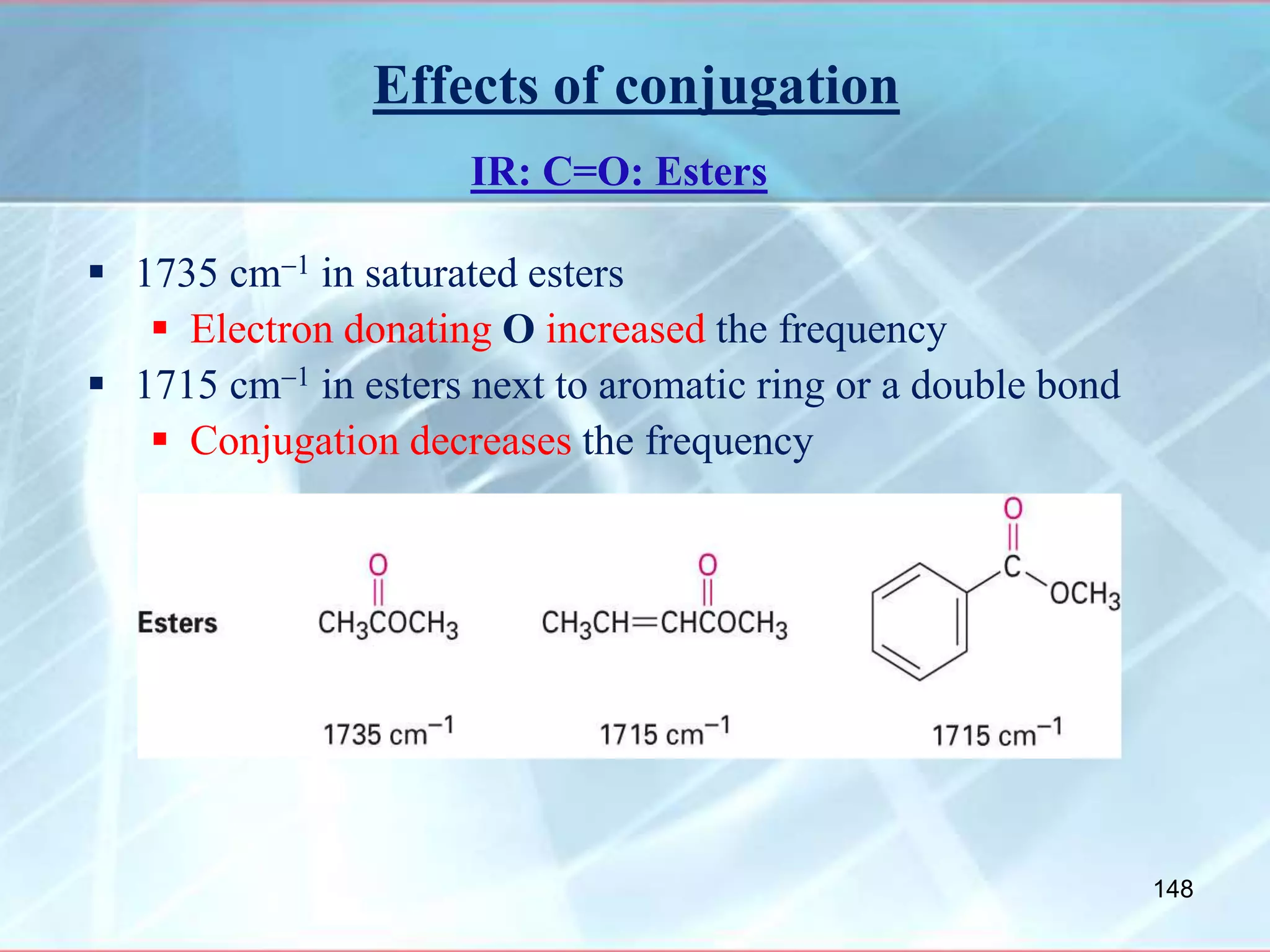
IR: C=O: Esters
 1735 cm1 in saturated esters
 Electron donating O increased the frequency
 1715 cm1 in esters next to aromatic ring or a double bond
 Conjugation decreases the frequency
Effects of conjugation
148
Effects of conjugation
O
O
R
Lowers to 1715 cm-1
O
O
R
Similar, to 1715 cm-1
O
O
Raises to 1770 cm-1
O
O
:
Weakens DB character
Strengthens DB character
(inductive over resonance)
149
Mono substituted aromatic conjugated ester
150
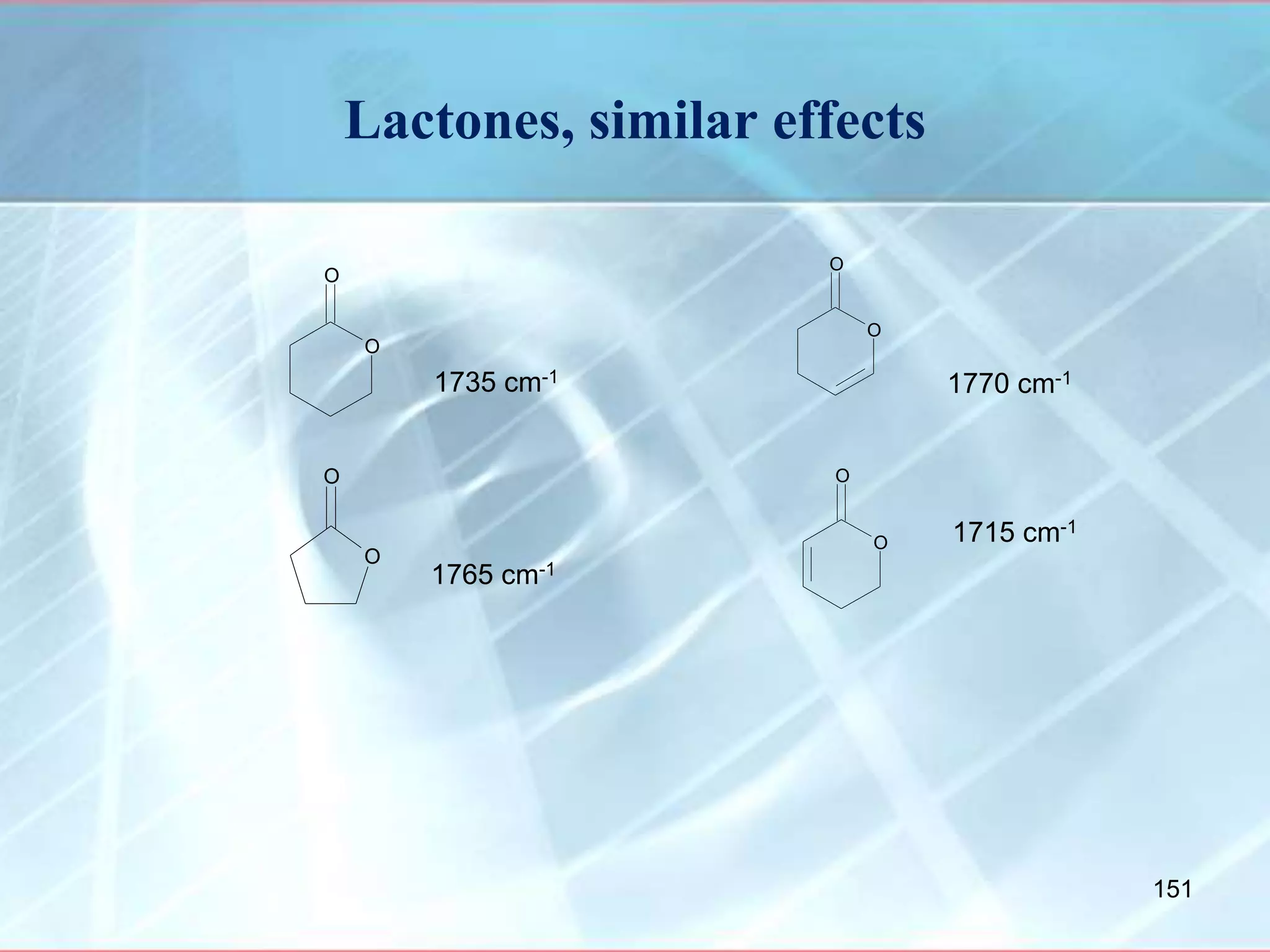
Lactones, similar effects
O
O
O
O
1735 cm-1
1765 cm-1
O
O
O
O
1770 cm-1
1715 cm-1
151
INTERPRETATION OF IR SPECTRA
Nitrogen-Containing Compounds
- 1o amines (NH2) have scissoring mode and low
frequency wagging mode
- 2o amines (NH) only have wagging mode (cannot scissor)
- 3o amines have no NH band and are characterized by C−N
stretching modes ~ 1000 – 1200 cm-1 and 700 – 900 cm-1
- 1o, 2o, 3o amides are similar to their amine counterparts
but have additional C=O stretching band
152
INTERPRETATION OF IR SPECTRA
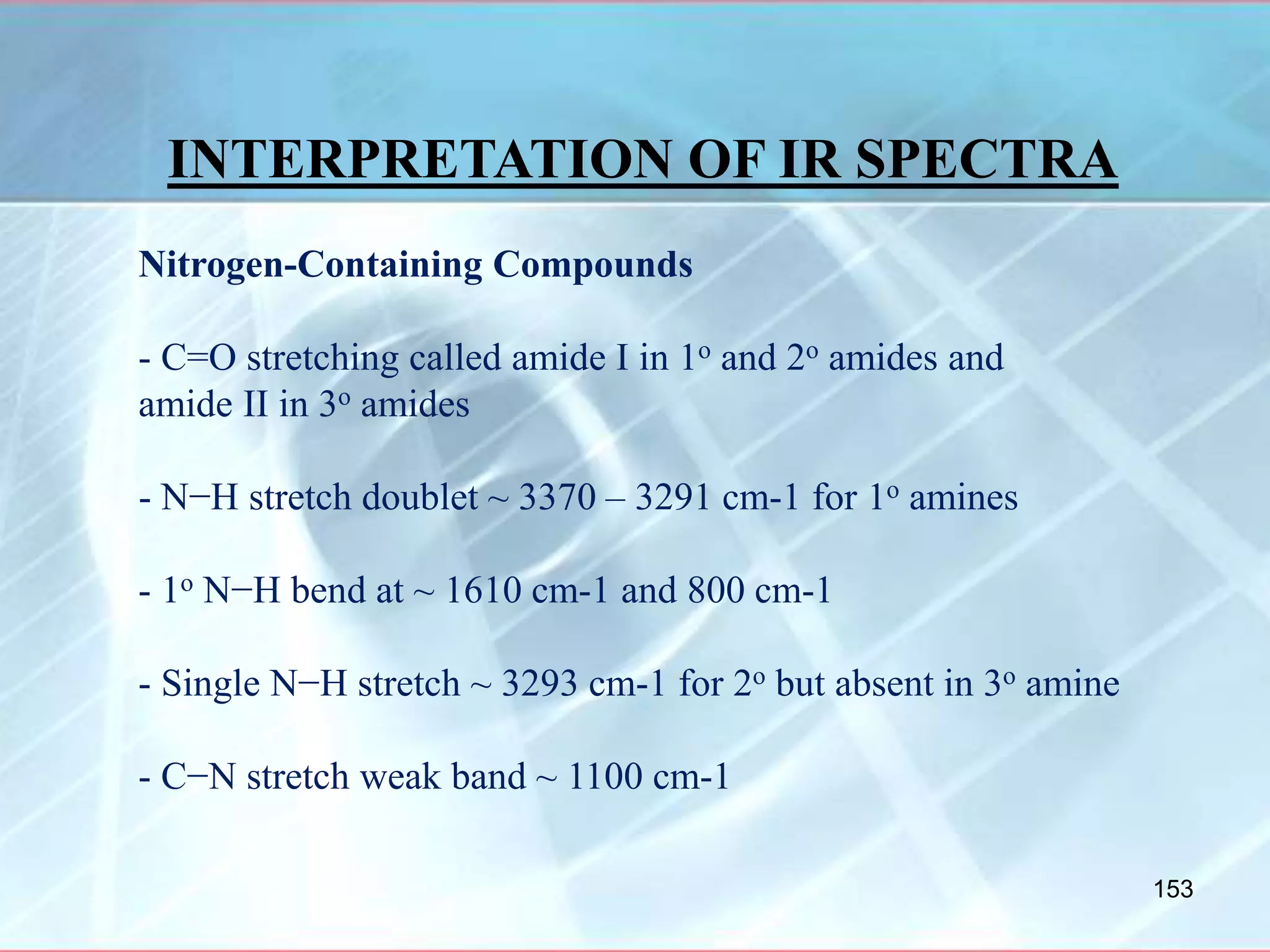
Nitrogen-Containing Compounds
- C=O stretching called amide I in 1o and 2o amides and
amide II in 3o amides
- N−H stretch doublet ~ 3370 – 3291 cm-1 for 1o amines
- 1o N−H bend at ~ 1610 cm-1 and 800 cm-1
- Single N−H stretch ~ 3293 cm-1 for 2o but absent in 3o amine
- C−N stretch weak band ~ 1100 cm-1
153
INTERPRETATION OF IR SPECTRA
Amino Acids [RCH(NH2)COOH]
- IR spectrum is related to salts of amines and salts of acids
- Broad CH bands that overlap with each other
- Broad band ~ 2100 cm-1
- NH band ~ 1500 cm-1
- Carboxylate ion stretch ~ 1600 cm-1
154
• Display features of amines and carbonyl compounds
• C=O stretch at 1640-1680 cm-1
• If the amide is primary (-NH2) the N-H stretch occurs from
3200-3500 cm-1 as a doublet
• If the amide is secondary (-NHR) the N-H stretch occurs at
3200-3500 cm-1 as a sharp singlet
Amides
155
pivalamide
NH2
O
(m – s) (s)
156
157
• Coupling of the anhydride though the ether oxygen splits the carbonyl
band into two with a separation of 70 cm-1
• Bands are at 1740-1770 cm-1 and 1810-1840 cm-1
• Mixed mode C-O stretch at 1000-1100 cm-1
Acid anhydrides
158
Propionic anhydride
O
O O
(s) (s)
159
• Shows the –N-H stretch for NH2 as a doublet between
3200-3500 cm-1 (symmetric and anti-symmetric modes)
• -NH2 has deformation band from 1590-1650 cm-1
• Additionally there is a “wag” band at 780-820 cm-1 that
is not diagnostic
Amines - Primary
160
2-aminopentane
(w)
161
1-Butanamine
CH3 CH2 CH2 CH2 NH2
N-H
stretch
doublet
sp3 C-H stretch
N-H
bend
CH2
CH3
bend
162
• N-H band for R2N-H occurs at 3200-3500 cm-1 as a single sharp
peak weaker than –O-H
• Tertiary amines (R3N) have no N-H bond and will not have a
band in this region
Amines – Secondary
163
pyrrolidine
(w – m)
164
165
INTERPRETATION OF IR SPECTRA
Halogenated Compounds
- C→X strong absorption bands in the fingerprint and
aromatic regions
- More halogens on the same C results in an increase in intensity
and a shift to higher wavenumbers
- Absorption due to C−Cl and C−Br occurs below 800 cm-1
166
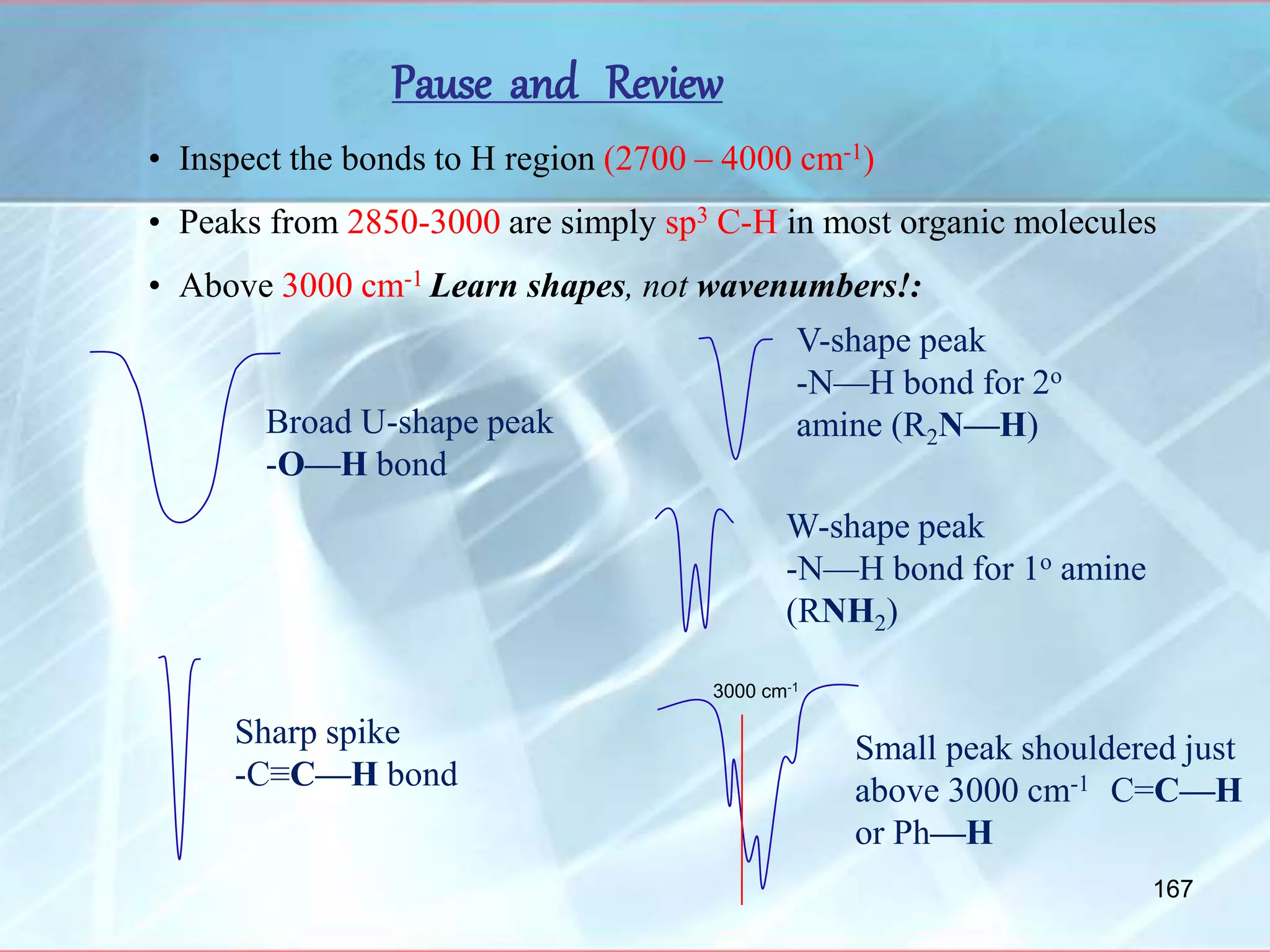
• Inspect the bonds to H region (2700 – 4000 cm-1)
• Peaks from 2850-3000 are simply sp3 C-H in most organic molecules
• Above 3000 cm-1 Learn shapes, not wavenumbers!:
Broad U-shape peak
-O—H bond
V-shape peak
-N—H bond for 2o
amine (R2N—H)
Sharp spike
-C≡C—H bond
W-shape peak
-N—H bond for 1o amine
(RNH2)
3000 cm-1
Small peak shouldered just
above 3000 cm-1 C=C—H
or Ph—H
Pause and Review
167
Study of metal complexes
The metal-heteroatom bond stretching vibration can be studied with the
help of far IR spectroscopy
Examples:
168
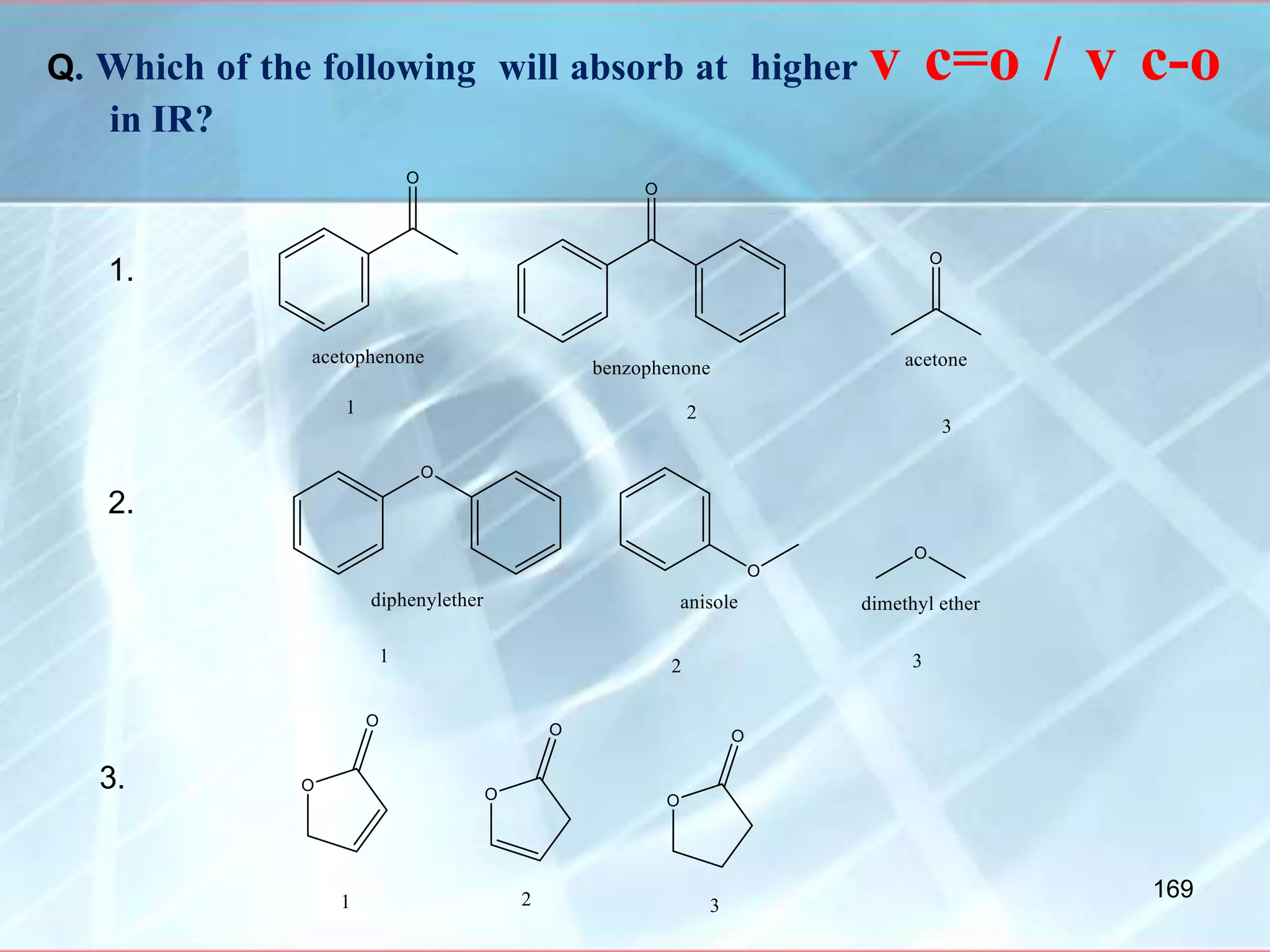
Q. Which of the following will absorb at higher v c=o / v c-o
in IR?
1.
2.
3.
169
Ques. Predict the approximate positions of all of the important
absorptions in the IR spectrum of this compound.
Ques. Explain how IR spectroscopy could be used to distinguish
between these two compounds. Be as specific as possible.
170
171
Explain which functional group is present in the compound with the
following IR spectrum. Show a possible structure for the compound.
The peak at 3300 cm-1 indicates the presence of an spC-H bond.
 The peaks at 3000 - 2850 cm-1 indicate the presence of sp3C-H bonds.
The peak at 2150 cm-1 indicates the presence of a carbon-carbon triple bond.
So the compound is a 1-alkyne. A possible structure is
172
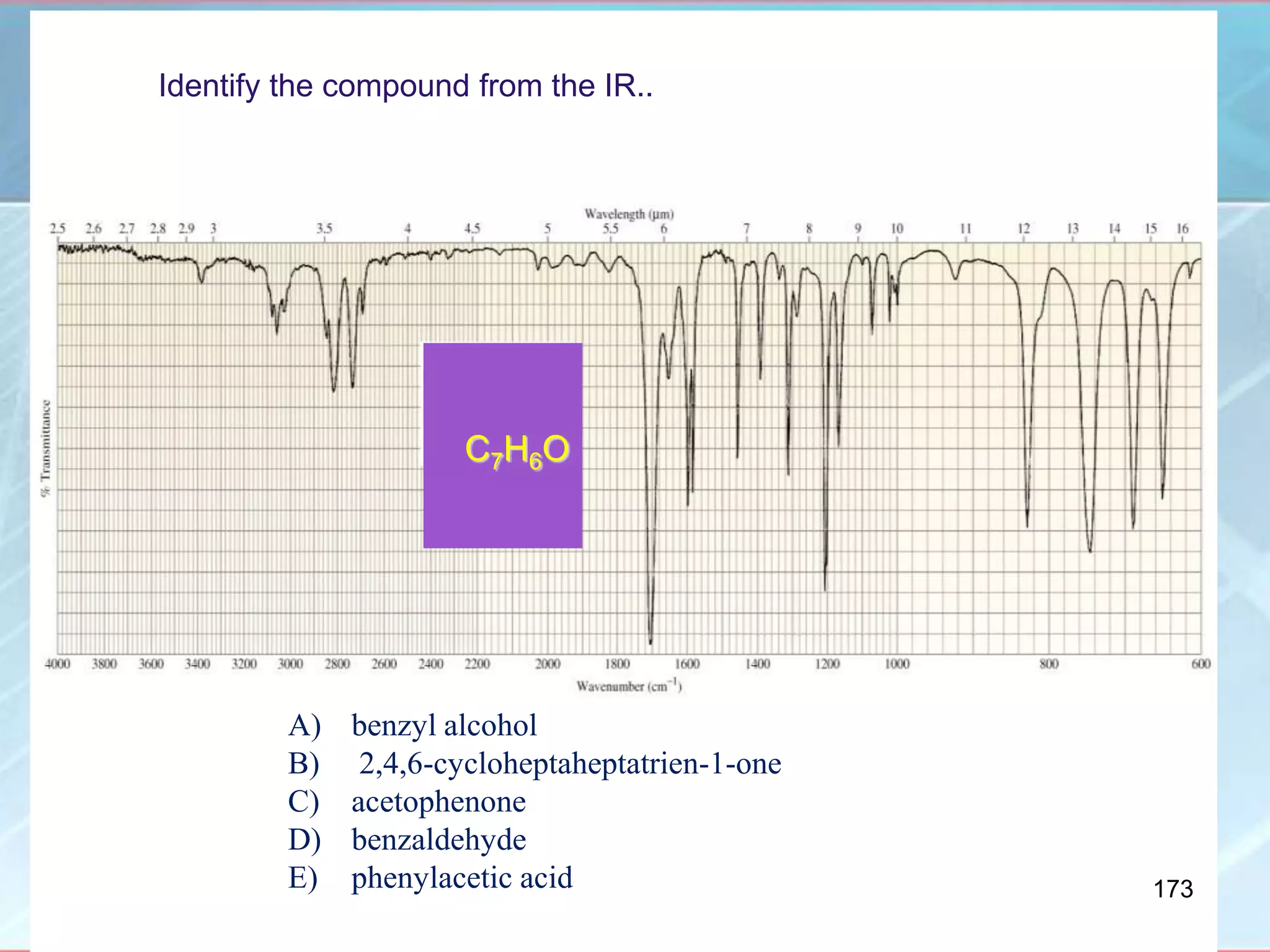
A) benzyl alcohol
B) 2,4,6-cycloheptaheptatrien-1-one
C) acetophenone
D) benzaldehyde
E) phenylacetic acid
C7H6O
Identify the compound from the IR..
173
C10H12O
A) 2,4,5-trimethylbenzaldehyde
B) p-allylanisole
C) 2-allyl-4-methylphenol
D) 1-phenyl-2-butanone 174
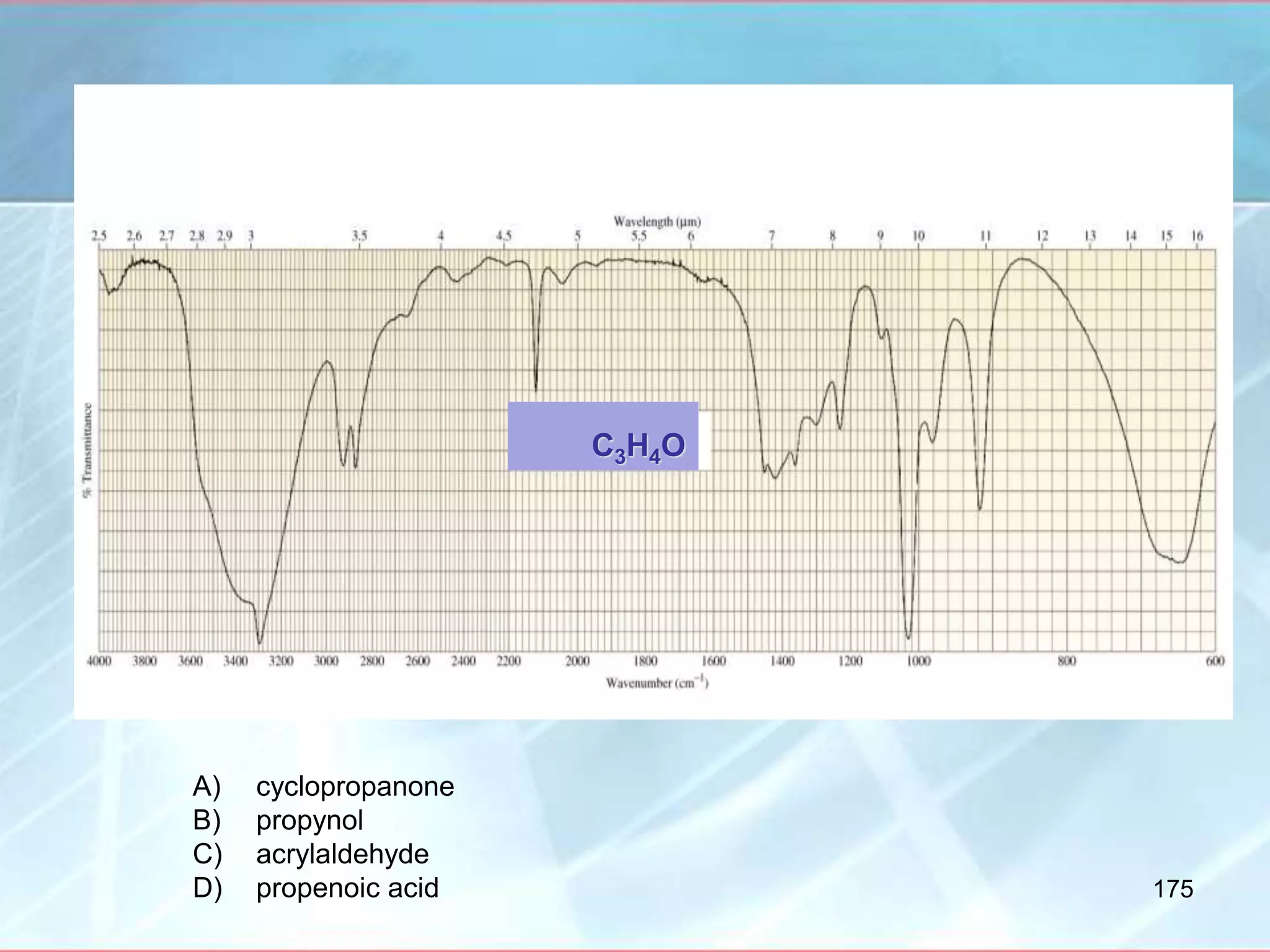
C3H4O
A) cyclopropanone
B) propynol
C) acrylaldehyde
D) propenoic acid 175
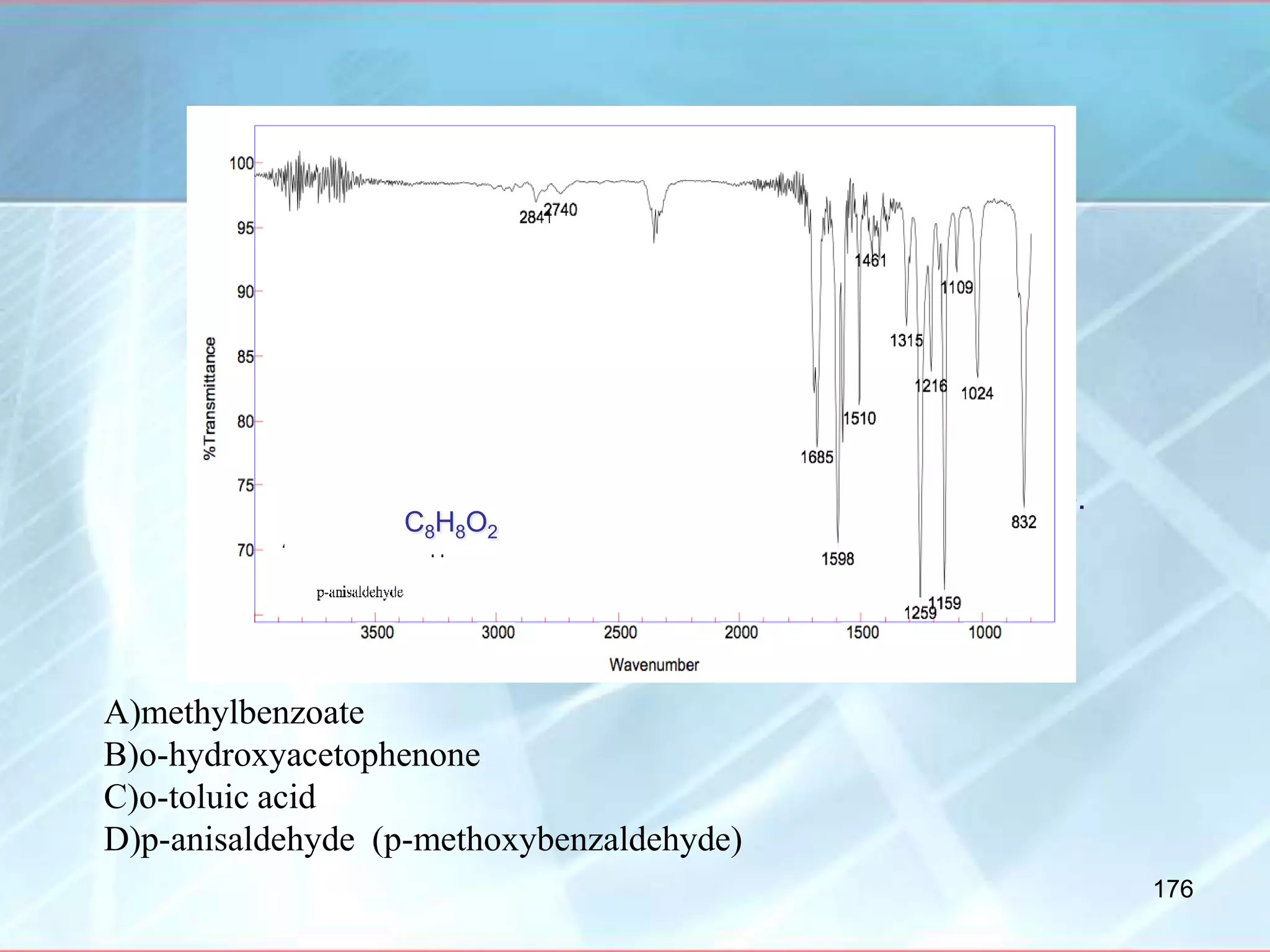
A)methylbenzoate
B)o-hydroxyacetophenone
C)o-toluic acid
D)p-anisaldehyde (p-methoxybenzaldehyde)
Identify the compound from the IR above.
C8H8O2
176
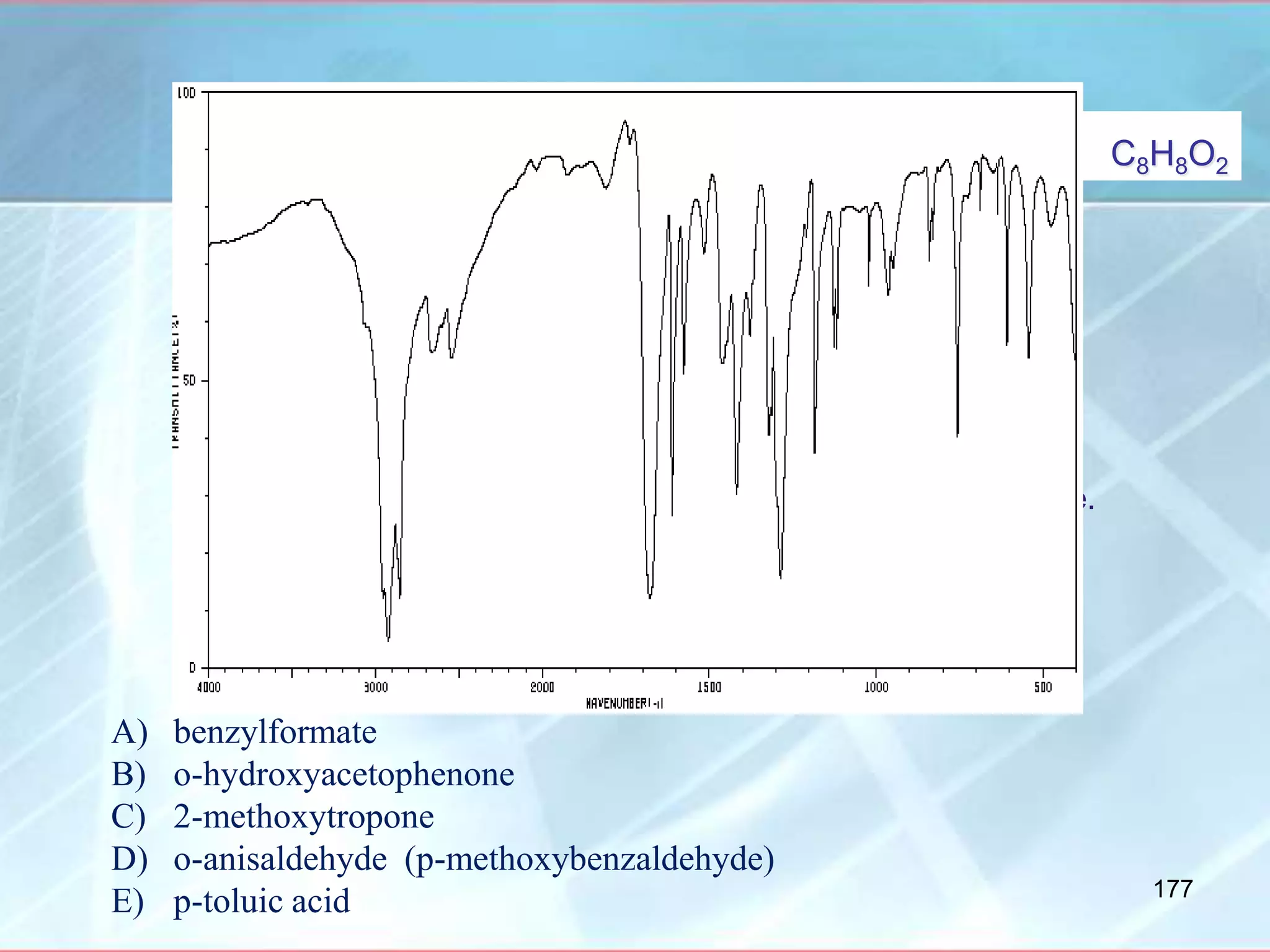
A) benzylformate
B) o-hydroxyacetophenone
C) 2-methoxytropone
D) o-anisaldehyde (p-methoxybenzaldehyde)
E) p-toluic acid
Identify the compound from the IR above.
C8H8O2
177
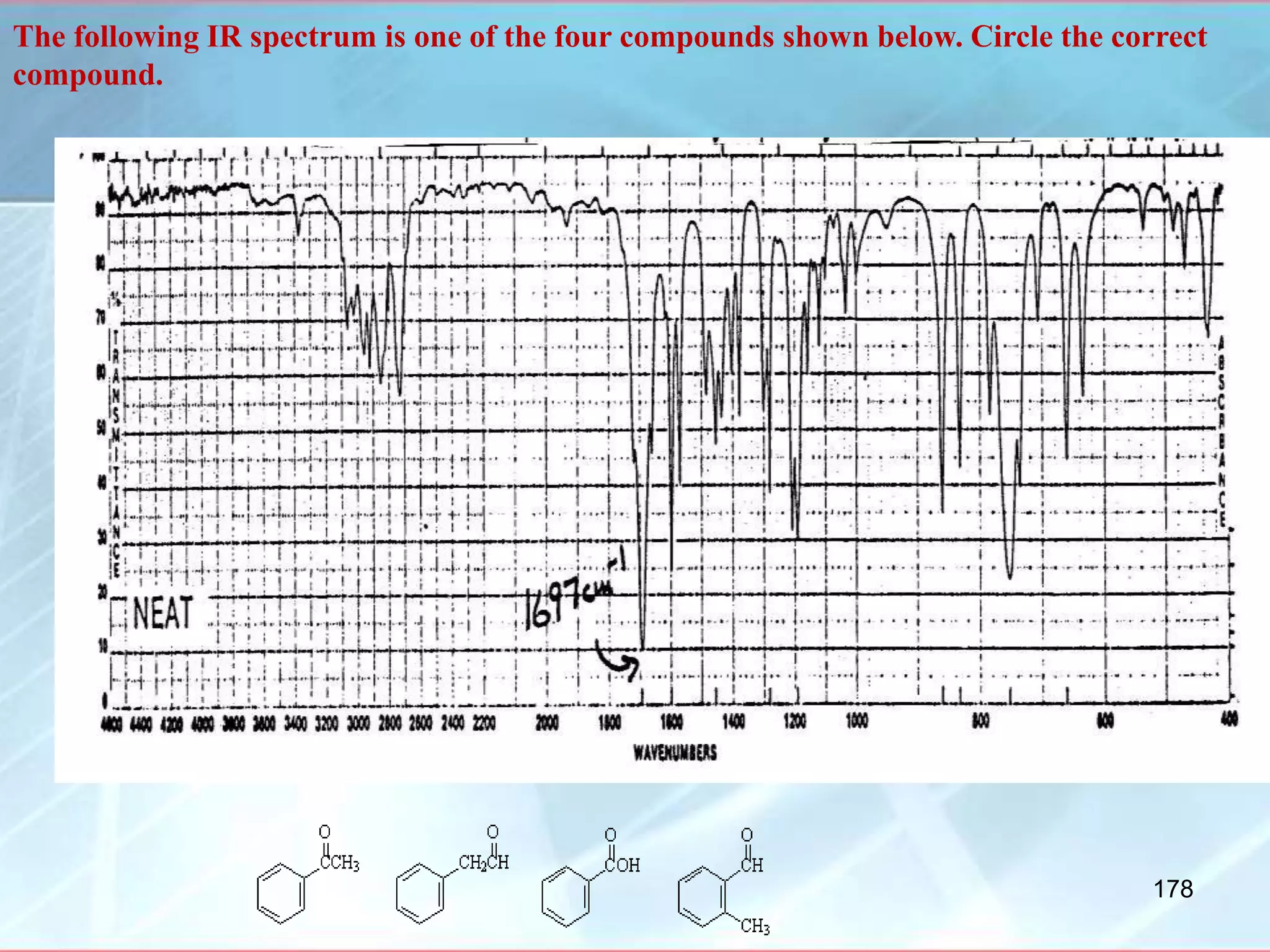
The following IR spectrum is one of the four compounds shown below. Circle the correct
compound.
answer
178
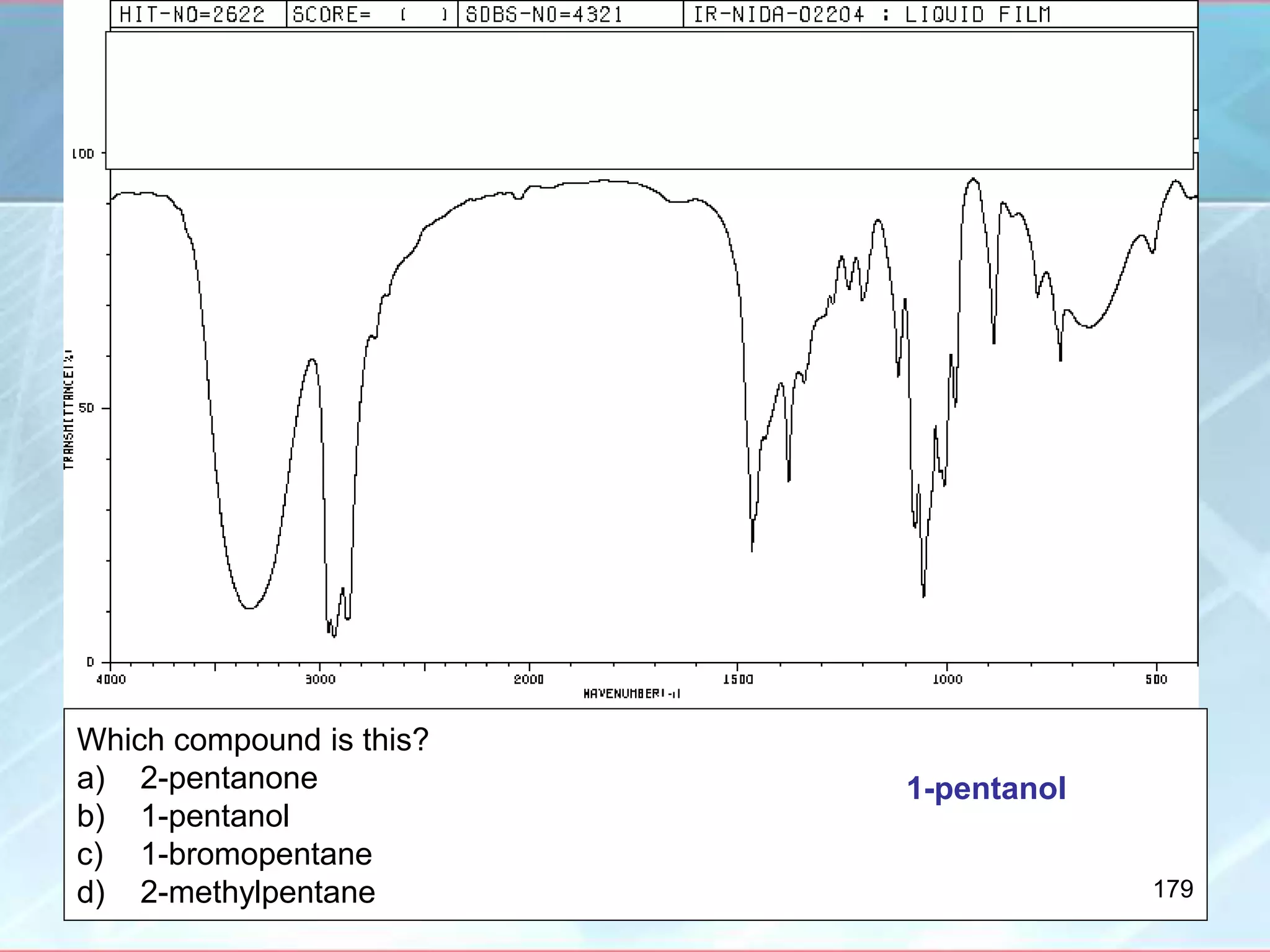
Which compound is this?
a) 2-pentanone
b) 1-pentanol
c) 1-bromopentane
d) 2-methylpentane
1-pentanol
179
What is the compound?
a) 1-bromopentane
b) 1-pentanol
c) 2-pentanone
d) 2-methylpentane
2-pentanone
180
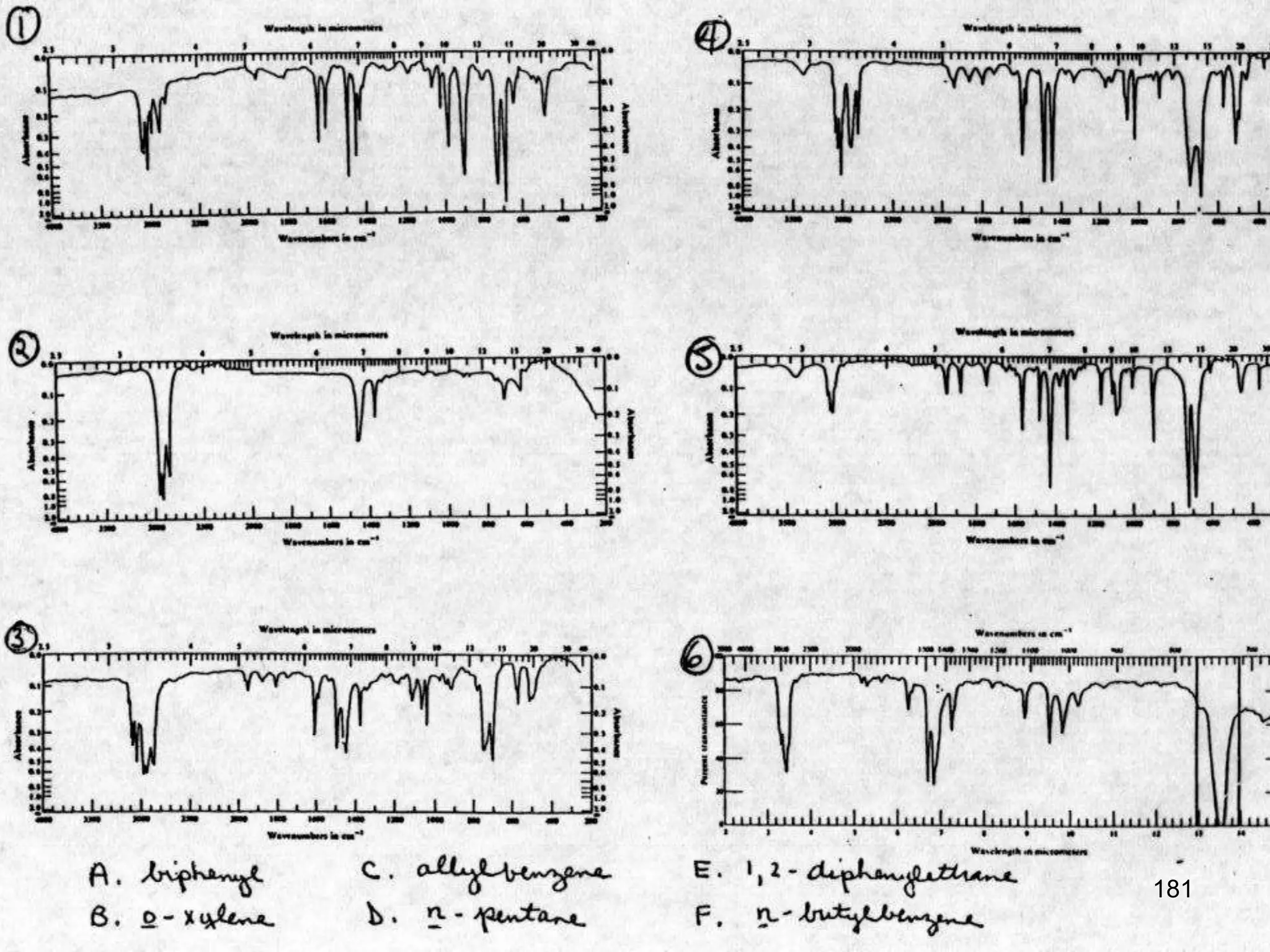
181
1
182
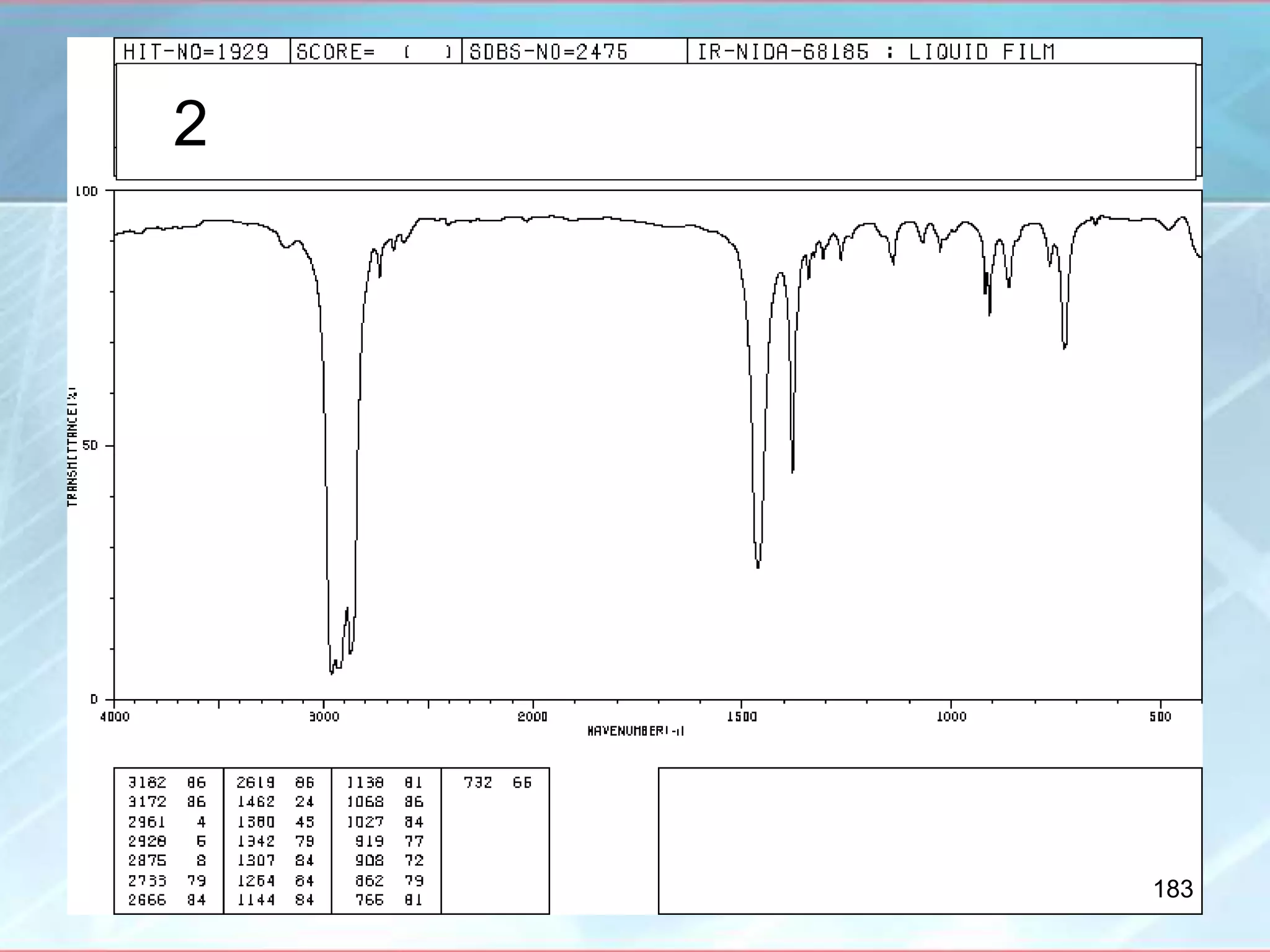
2
183
3
184
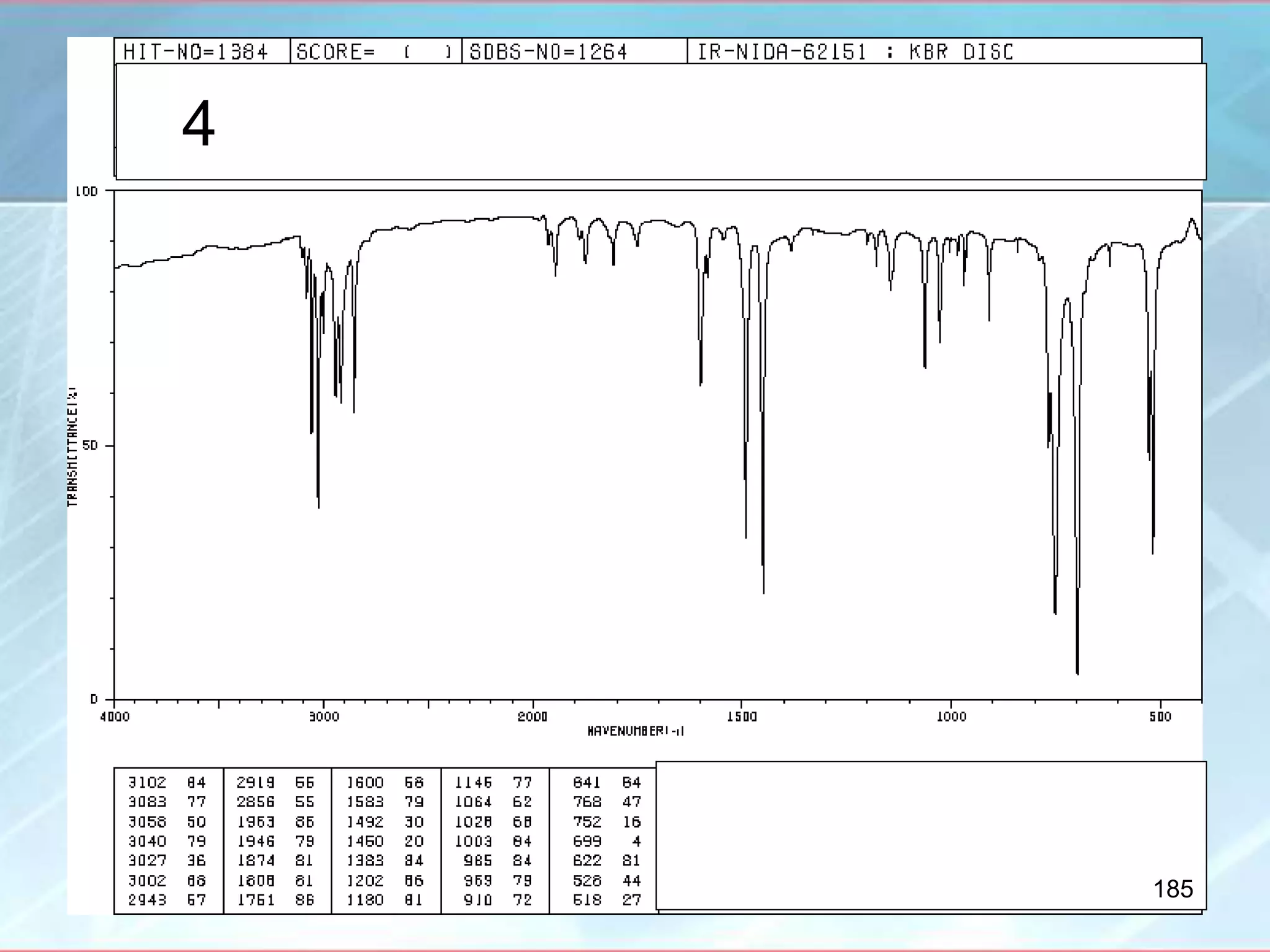
4
185
5
186
6
187
Strengths and Limitations
 IR alone cannot determine a structure
 Some signals may be ambiguous
 The functional group is usually indicated
 The absence of a signal is definite proof that the functional
group is absent
 Correspondence with a known sample’s IR spectrum
confirms the identity of the compound
188
THANKYOU
FOR
PATIENCE
189
217
Continue……….

Ms infrared spectroscopy

  • 1.
    Dr.Mishu Singh Chemistry Department M.P.GovtP.G. College Hardoi INFRARED SPECTROSCOPY 1
  • 2.
  • 3.
  • 4.
    “Seeing The non-seeable” “Usingelectromagnetic radiation as a probe to obtain information about atoms and molecules that are too small to see” 4
  • 5.
    What is Spectroscopy?  Atoms and molecules interact with electromagnetic radiation (EMR) in a wide variety of ways.  Atoms and molecules may absorb and/or emit EMR.  Absorption of EMR stimulates different types of motion in atoms and/or molecules.  The patterns of absorption (wavelengths absorbed and to what extent) and/or emission (wavelengths emitted and their respective intensities) are called ‘spectra’.  Spectroscopy is the interaction of EMR with matters to get spectra ,which gives information like, bond length, bond angle, geometry and molecular structure. 5
  • 6.
    Electromagnetic radiation displaysthe properties of both particles and waves. The particle component is called a photon. The term “photon” is implied to mean a small, massless particle that contains a small wave-packet of EM radiation/light. The energy (E) component of a photon is proportional to the frequency. Where h is Planck’s constant and ʋ is the frequency in Hertz (cycles per second) . E = hʋ = distance of one wave  = frequency: waves per unit time (sec-1, Hz) c = speed of light (3.0 x 10⁸ m • sec-1) h = Plank’s constant (6.63 x 10⁻³⁴ J • sec) . 6
  • 7.
    Because the speedof light, c, is constant, the frequency, n, (number of cycles of the wave per second) can complete in the same time, must be inversely proportional to how long the oscillation is, or wavelength: Because the atomic particles in matter also exhibit wave and particle properties, EM radiation can interact with matter in two ways: • Collision – particle-to-particle – energy is lost as heat and movement. • Coupling – the wave property of the radiation matches the wave property of the particle and “couple” to the next higher quantum mechanical energy level  = c = 3 x 1010 cm/s ___  c  E = h = ___  hc 7
  • 8.
    Electromagnetic Spectrum UVX-rays IRg-raysRadioMicrowave Energy (kcal/mol) 300-30 300-30 ~10-4> 300 ~10-6 Visible Frequency,  in Hz ~1015 ~1013 ~1010 ~105~1017~1019 Wavelength,  10 nm 1000 nm 0.01 cm 100 m~0.01 nm~.0001 nm nuclear excitation (PET) core electron excitation (X-ray cryst.) electronic excitation (p to p*) molecular vibration molecular rotation Nuclear Magnetic Resonance NMR (MRI) 8
  • 9.
    UV-Visible: valance electrontransitions - gives information about p-bonds and conjugated systems Infrared: molecular vibrations (stretches, bends) - identify functional groups Radiowaves: nuclear spin in a magnetic field (NMR) - gives a map of the H and C framework organic molecule (ground state) organic molecule (excited state) organic molecule (ground state) + hrelaxation Principles of molecular spectroscopy light h 9
  • 10.
    INSTRUMENTAL METHODS OF STRUCTUREDETERMINATION 1. Nuclear Magnetic Resonance (NMR) – Excitation of the nucleus of atoms through radiofrequency irradiation. Provides extensive information about molecular structure and atom connectivity. 2. Infrared Spectroscopy (IR) – Triggering molecular vibrations through irradiation with infrared light. Provides mostly information about the presence or absence of certain functional groups. 3. Mass spectrometry – Bombardment of the sample with electrons and detection of resulting molecular fragments. Provides information about molecular mass and atom connectivity. 4. Ultraviolet spectroscopy (UV) – Promotion of electrons to higher energy levels through irradiation of the molecule with ultraviolet light. Provides mostly information about the presence of conjugated p systems and the presence of double and triple bonds. 10
  • 11.
    Infrared (IR) Spectroscopy IRdeals with the interaction of infrared radiation with matter. The IR spectrum of a compound can provide important information about its chemical nature and molecular structure. Most commonly, the spectrum is obtained by measuring the absorption of IR radiation, although infrared emission and reflection are also used. Widely applied in the analysis of organic materials, also useful for polyatomic inorganic molecules and for organometallic compounds. 11
  • 12.
     Infrared spectrometryis applied to the qualitative and quantitative determination of molecular species of all types .  The most widely used region is the mid-infrared that extends from about 400 to 4000 cm-1 (2.5 to 25 m). (Absorption, reflection and emission spectra are employed)  The near-infrared region from 4000 to 14,000 cm-1 (0.75 to 2.5 m) also finds considerable use for the routine quantitative determination. (water, CO2, low conc. Hydrocarbons, amine nitrogen, many other compounds)  The far-infrared region has been for the determination of the structures of inorganic and metal-organic species. 12
  • 13.
    Range of IRRadiation 13
  • 14.
  • 15.
    Conditions For IRActivity Energy of IR photon insufficient to cause electronic excitation but can cause vibrational or rotational excitation Molecule electric field (dipole moment) interacts with IR photon electric field (both dynamic) Magnitude of dipole moment determined by (i) charge (ii) separation of charge Molecule must have change in dipole moment due to vibration or rotation to absorb IR radiation. Absorption causes increase in vibration amplitude/rotation frequency 15
  • 16.
    DIPOLE MOMENT (µ) µ= Q x r  Q = charge and r = distance between charges  Asymmetrical distribution of electrons in a bond renders the bond polar  A result of electro negativity difference  µ changes upon vibration due to changes in r  Change in µ with time is necessary for a molecule to absorb IR radiation 16
  • 17.
     The repetitivechanges in µ makes it possible for polar molecules to absorb IR radiation  Symmetrical molecules do not absorb IR radiation since they do not have dipole moment (O2, F2, H2, Cl2)  Diatomic molecules with dipole moment are IR-active (HCl, HF, CO, HI)  Molecules with more than two atoms may or may not be IR active depending on whether they have permanent net dipole moment 17
  • 18.
    A bond ormolecule must have a permanent dipole moment. If not, then, some of its vibration must produce an induced dipole moment in order to have an absorbance in the IR spectrum. The frequency of vibration of a particular bond must be equal to the frequency of IR radiation. 18
  • 19.
    Molecules with permanentdipole moments (μ) are IR active! 19
  • 20.
    Some linear moleculesmay be IR active CO2 O=C=O 20
  • 21.
  • 22.
    IR ABSORPTION BYMOLECULES  Molecules with covalent bonds may absorb IR radiation  Absorption is quantized  Molecules move to a higher energy state  IR radiation is sufficient enough to cause rotation and vibration. The IR scans a range of frequencies (in the infrared part of the electromagnetic spectrum). Any frequency which matches the characteristic frequency of a bond will be absorbed  Radiation between 1 and 100 µm will cause excitation to higher vibrational states 22
  • 23.
     Absorption spectrumis composed of broad vibrational absorption bands  Molecules absorb radiation when a bond in the molecule vibrates at the same frequency as the incident radiant energy  Molecules vibrate at higher amplitude after absorption  A molecule must have a change in dipole moment during vibration in order to absorb IR radiation 23
  • 24.
    Absorption frequency dependson:  Masses of atoms in the bonds  Geometry of the molecule  Strength of bond  Other contributing factors 24
  • 25.
     Infrared radiationis largely thermal energy.  It induces stronger molecular vibrations in covalent bonds, which can be viewed as springs holding ,together two masses, or atoms. Specific bonds respond to (absorb) specific frequencies Theory / Principle μ =m1.m2/m1+m2 , reduced mass K = Force constant X Y 25
  • 26.
     As acovalent bond oscillates – due to the oscillation of the dipole of the molecule – a varying electromagnetic field is produced. The greater the dipole moment change through the vibration, the more intense the EM field that is generated 26
  • 27.
    EM oscillating wave frombond vibration IR beam from spectrometer “coupled” wave  When a wave of infrared light encounters this oscillating EM field generated by the oscillating dipole of the same frequency, the two waves couple, and IR light is absorbed. The coupled wave now vibrates with twice the amplitude 27
  • 28.
    Types of vibrations Stretching– Vibration or oscillation along the line of the bond ( change of bond length) H H C H H C asymmetric symmetric 28
  • 29.
    scissor H H CC H H CC H H CC H H CC rock twist wag inplane out of plane Bending Vibration or oscillation not along the line of the bond (change of bond angle) Types of vibrations 29
  • 30.
  • 31.
    Vibrational Modes • Covalentbonds can vibrate in several modes, including stretching, bending (rocking, scissoring, wagging and twisting) • The most useful bands in an infrared spectrum correspond to stretching frequencies, and those will be the ones we’ll focus on. A molecule containing n atoms , has 3n degrees of freedom. 3n = Translational modes + Rotational modes + Vibrational Mode Linear Molecule : TM = 3, RM = 2 , hence , 3n = 3 + 2 + Vibrational Modes Vibrational Modes = (3n-5) ; C2H2 , CO2 Strecthing vib = (n-1) bending vib = (2n-4) Non-linear Molecule : Vibrational Modes = (3n-6); C6H6 , CHCl3 Strecthing vib = (n-1) bending vib. = (2n-5) 31
  • 32.
     Number ofpossible modes Nonlinear molecule: 3N – 6 Linear molecule: 3N – 5  3 degrees of freedom – i.e., 3 coordinates in space  3 translations and 3 rotations account for 6 motions of molecule  Rotation about center bond in linear molecule is indistinguishable  Remaining degrees of motion represent vibrational motion (i.e., number of vibrations within the molecule) 32
  • 33.
    Factors Influencing theNormal Modes Four factors tend to produce fewer experimental peaks than would be expected from the theoretical number of normal modes. (1) the symmetry of the molecules is such that no change in dipole results from a particular vibration (2) the energies of two or more vibrations are identical or nearly identical (3) the absorption intensity is so low as to be undetectable by ordinary means (4) the vibrational energy is in a wavelength region beyond the range of the instrument. 33
  • 34.
    Occasionally more peaksare found than are expected based upon the number of normal modes. The occurrence of overtone peaks that occur at two or three times the frequency of a fundamental peak. In addition combination bands are sometimes encountered when a photon excites two vibrational modes simultaneously. The frequency of the combination band is approximately the sum or difference of the two fundamental frequencies. 34
  • 35.
    Vibratrional Coupling The energyof a vibration, and thus the wavelength of its absorption peak, may be influenced by other vibrators in the molecule. A number of factors influence the extent of such coupling: 1. Strong coupling between stretching vibrations occurs only when there is an atom common to the two vibrations. 2. Interaction between bending vibrations requires a common bond between the vibrating groups. 35
  • 36.
    3.Coupling between astretching and a bending vibration can occur if the stretching bond forms one side of the angle that varies in the bending vibration. 4. Interaction is greatest when the coupled groups have individual energies that are approximately equal. 5. Little or no interaction is observed between groups separated by two or more bonds. 6. Coupling requires that the vibrations be of the same symmetry species. 36
  • 37.
    CO2 Molecule If nocoupling occurred between the two C=O bonds, an absorption peak would be expected at the same peak for the C=O stretching vibration in an aliphatic ketone (about 1700 cm-1). Experimentally, carbon dioxide exhibits two absorption peaks, the one at 2350 cm-1 and the other at 666 cm-1. Carbon dioxide is a linear molecule and thus has 3 x 3 – 5 = 4 normal modes. Two stretching vibrations are possible. The symmetric vibration causes no change in dipole. Thus, the symmetric vibration is infrared inactive. The asymmetric vibration produce a change in dipole moments, so absorption at 2330 cm-1 results. The remaining two vibrational modes of carbon dioxide involve scissoring. The two bending vibrations are the resolved components at 90 deg to one another of the bending motion in all possible planes around the bond axis. The two vibrations are identical in energy and thus produce a single peak at 667 cm-1. 37
  • 38.
  • 39.
    H2O molecule Triatomic moleculesuch as water, sulfur dioxide, or nitrogen dioxide have 3 x 3 – 6 = 3 vibrational modes. The central atom is not in line with the other two, a symmetric stretching vibration will produce a change in dipole and will thus be responsible for infrared absorption. Stretching peaks at 3650 and 3760 cm-1 appear in the infrared spectrum for the symmetric and asymmetric vibrations of the water molecule. There is only one component to the scissoring vibration for this nonlinear molecule. For water, the bending vibration cause absorption at 1595 cm-1. 39
  • 40.
  • 41.
    In an IRSpectrum each stretching and bending vibration occurs with a characteristic frequency as the atoms and charges involved are different for different bonds The y-axis on an IR spectrum is in units of % transmittance In regions where the EM field of an osc. bond interacts with IR light of the same n – transmittance is low (light is absorbed) In regions where no osc. bond is interacting with IR light, transmittance nears 100% 41
  • 42.
    The x-axis ofthe IR spectrum is in units of wavenumber, n, which is the number of waves per centimeter in units of cm-1 (Remember E = hʋ or E = hc/ɻ) 42
  • 43.
    1. This unitwavenumbers is used rather than wavelength (microns) because wavenumbers are directly proportional to the energy of transition being observed – chemists like this, physicists hate it High frequencies and high wavenumbers equate higher energy is quicker to understand than Short wavelengths equate higher energy 2. This unit is used rather than frequency as the numbers are more “real” than the exponential units of frequency 3. IR spectra are observed for the mid-infrared: 600-4000 cm-1 Use of unit “wavenumbers” 43
  • 44.
    I. R. Spectrum TheIR spectrum is basically a plot of transmitted (or absorbed) frequencies vs. intensity of the transmission (or absorption). Frequencies appear in the x-axis in units of inverse centimeters (wave numbers), and intensities are plotted on the y-axis in percentage units. The graph 2nd above shows a spectrum in transmission mode.This is the most commonly used representation and the one found in most chemistry and spectroscopy books. Therefore we will use this representation 44
  • 45.
    Infrared Active Bonds 1.Notall covalent bonds display bands in the IR spectrum. Only polar bonds do so. These are referred to as IR active. 2. The intensity of the bands depends on the magnitude of the dipole moment associated with the bond in question: • Strongly polar bonds such as carbonyl groups (C=O) produce strong bands. • Medium polarity bonds and asymmetric bonds produce medium bands. • Weakly polar bond and symmetric bonds produce weak or non observable bands. 45
  • 46.
    Infrared Band Shapes Twoof the most common bands are narrow; thin and pointed, like a dagger and Broad bands ;wide and smoother. A typical example of a broad band is that displayed by O-H bonds, such as those found in alcohols and carboxylic acids, as shown below. Broad bands 46
  • 47.
    CLASSIFICATION OF IRBANDS IR bands can be classified as strong (s), medium (m), or weak (w), depending on their relative intensities in the infrared spectrum. A strong band covers most of the y-axis. A medium band falls to about half of the y-axis, and a weak band falls to about one third or less of the y-axis. •Strong (s) – peak is tall, transmittance is low (0-35 %) •Medium (m) – peak is mid-height (75-35%) •Weak (w) – peak is short, transmittance is high (90-75%) 47
  • 48.
    Information Obtained FromIr Spectra • IR is most useful in providing information about the presence or absence of specific functional groups. • IR can provide a molecular fingerprint that can be used when comparing samples. If two pure samples display the same IR spectrum it can be argued that they are the same compound. • IR does not provide detailed information or proof of molecular formula or structure. It provides information on molecular fragments, specifically functional groups. • Therefore it is very limited in scope, and must be used in conjunction with other techniques to provide a more complete picture of the molecular structure. 48
  • 49.
    The Fingerprint Region Althoughthe entire IR spectrum can be used as a fingerprint for the purposes of comparing molecules, the 600 - 1400 cm-1 range is called the fingerprint region. This is normally a complex area showing many bands, frequently overlapping each other. Fingerprint region: complex and difficult to interpret reliably. Focus your analysis on this region. This is where most stretching frequencies appear. 49
  • 50.
  • 51.
  • 52.
  • 53.
    I.R. Absorption Range Notethat the blue coloured sections above the dashed line refer to stretching vibrations, and the green coloured band below the line encompasses bending vibrations. 53
  • 54.
    Summary of IRAbsorptions 54
  • 55.
    Applications of InfraredSpectroscopy  Infrared spectrometry is applied to the qualitative and quantitative determination of molecular species of all types.  The most widely used region is the mid-infrared that extends from about 400 to 4000 cm-1 (2.5 to 25 m). (Absorption, reflection and emission spectra are employed)  The near-infrared region from 4000 to 14,000 cm-1 (0.75 to 2.5 m) also finds considerable use for the routine quantitative determination. (water, CO2, low conc. Hydrocarbons, amine nitrogen, many other compounds)  The far-infrared region has been for the determination of the structures of inorganic and metal-organic species. 55
  • 56.
    Functional Groups &IR Frequencies 56
  • 57.
    Factors effecting IRabsorption 1. Force constant, k 2. Reduced mass, μ 3. Electronegativity difference, N 4. Bond dissociation energy, D 5. Internuclear distance, r It also depends upon: Inductive effect, resonance, H-bonding and steric effect etc. Stronger bonds will have higher Force constant .K 57
  • 58.
    Sample problem The forceconstant for a typical triple bond is 1.91 x 10³ N/m. Calculate the approximate frequency of the main absorption peak due to vibration of CO. 58
  • 59.
    Force Constant : Strongerbonds will have higher Force constant . K Triple bonds > Double bonds > Single bonds > C=C > C-C > C=O > C-O C≡C C≡o C≡N > C-N> C=N 59
  • 60.
    PREDICTING STRUCTURE OFUNKNOWN  Identify the major functional groups from the strong absorption peaks  Identify the compound as aromatic or aliphatic  Subtract the FW of all functional groups identified from the given molecular weight of the compound  Look for C≡C and C=C stretching bands  Look for other unique CH bands (e.g. aldehyde)  Use the difference obtained to deduce the structure 60
  • 61.
    INTERPRETATION OF IRSPECTRA Functional Group Region Strong absorptions due to stretching from hydroxyl, amine, carbonyl, CHx 4000 – 1300 cm-1 Fingerprint Region Result of interactions between vibrations 1300 – 910 cm-1 61
  • 62.
    Conjugation By resonance, conjugationlowers the energy of a double or triple bond. The effect of this is readily observed in the IR spectrum: Conjugation will lower the observed IR band for a carbonyl from 20-40 cm-1 provided conjugation gives a strong resonance contributor Inductive effects are usually small, unless coupled with a resonance contributor (note –CH3 and –Cl above) O O 1684 cm-1 1715 cm-1 C=O C=O C H3C O X X = NH2 CH3 Cl NO2 1677 1687 1692 1700 cm-1 H2N C CH3 O Strong resonance contributor vs. N O O C CH3 O Poor resonance contributor (cannot resonate with C=O) 62
  • 63.
    Usually not importantin IR spectroscopy, unless they reduce the strength of a bond (usually p) by interfering with proper orbital overlap: Here the methyl group in the structure at the right causes the carbonyl group to be slightly out of plane, interfering with resonance Strain effects – Changes in bond angle forced by the constraints of a ring will cause a slight change in hybridization, and therefore, bond strength As bond angle decreases, carbon becomes more electronegative, as well as less sp2 hybridized (bond angle < 120°) O C=O: 1686 cm-1 O C=O: 1693 cm-1 CH3 O O O O O 1815 cm-1 1775 cm-1 1750 cm-1 1715 cm-1 1705 cm-1 Steric Effects 63
  • 64.
    Hydrogen bonding •Hydrogen bondingcauses a broadening in the band due to the creation of a continuum of bond energies associated with it. •In the solution phase these effects are readily apparent; in the gas phase where these effects disappear or in lieu of steric effects, the band appears as sharp as all other IR bands: •H-bonding can interact with other functional groups to lower frequencies C=O; 1701 cm-1 OO H 64
  • 65.
  • 66.
    Steric hindrance toH-bonding in a di-tert-butylphenol OH 66
  • 67.
    Gas phase spectrumof 1-butanol 67
  • 68.
    Single Bond Region O-Hν = 3400-3600 cm-1 N-H ν = 3200-3400 cm-1 C-H ν = 2900-3100 cm-1 Greater the dipole moment, the more intense the absorption. But, actually it is not so. There are other factors which affect the absorption in IR region 68
  • 69.
    Infrared Absorption Frequenciesof C-H Depend upon the state of hybridization of C-atom attached. Structural unit Frequency, cm-1 sp C—H 3310-3320 sp2 C—H 3000-3100 sp3 C—H 2850-2950 69
  • 70.
    Alkanes– combination ofC-C and C-H bonds • C-C stretches and bends 1360-1470 cm-1 • CH2-CH2 bond 1450-1470 cm-1 • CH2-CH3 bond 1360-1390 cm-1 • sp3 C-H between 2800-3000 cm-1 70
  • 71.
  • 72.
  • 73.
    n-pentane CH3CH2CH2CH2CH3 3000 cm-1 1470 &1375cm-1 2850-2960 cm-1 sat’d C-H 73
  • 74.
  • 75.
  • 76.
  • 77.
  • 78.
  • 79.
    isopropyl split 1370+ 1385 isopropylbenzene 79
  • 80.
    C8H6 C-H unsat’d 1500, 1600 benzene mono C8H6 –C6H5 = C2H phenylacetylene 3300 C-H 80
  • 81.
  • 82.
    C9H12 C-H unsat’d &sat’d 1500 & 1600 benzene mono C9H12 – C6H5 = -C3H7 isopropylbenzene n- propylbenzene? 82
  • 83.
  • 84.
    Alkenes – additionof the C=C and vinyl C-H bonds • C=C stretch at 1620-1680 cm-1 weaker as substitution increases • vinyl C-H stretch occurs at 3000-3100 cm-1 • The difference between alkane, alkene or alkyne C-H is important! If the band is slightly above 3000 it is vinyl sp2 C-H or alkyl sp C-H, if it is below it is alkyl sp3 C-H 84
  • 85.
  • 86.
    IR frequencies ofALKENES =C—H bond, “unsaturated” vinyl (sp2) 3020-3080 cm-1 + 675-1000 RCH=CH2 + 910-920 & 990-1000 R2C=CH2 + 880-900 cis-RCH=CHR + 675-730 (v) trans-RCH=CHR + 965-975 C=C bond 1640-1680 cm-1 (v) 86
  • 87.
  • 88.
    1-Hexene CH2 CH CH2CH2 CH2 CH3 sp2 C-H sp3 C-H stretch C=C stretch out of plane bendings (oops) 88
  • 89.
  • 90.
  • 91.
  • 92.
  • 93.
    Non Terminal Alkene Thisspectrum shows that the band appearing around 3080 cm-1 can be obscured by the broader bands appearing around 3000 cm-1. ( lower ) 93
  • 94.
    Alkynes C≡C stretch 2100-2260cm-1; strength depends on asymmetry of bond, strongest for terminal alkynes, weakest for symmetrical internal alkynes  C-H for terminal alkynes (,sharp &weak )occurs at 3200-3300 cm-1 Internal alkynes ( R-C≡C-R ) would not have this band! (m – s) (w-m) 94
  • 95.
    I.R .Spectrum ofAlkynes 95
  • 96.
    Aromatics •Due to thedelocalization of e- in the ring, C-C bond order is 1.5, the stretching frequency for these bonds is slightly lower in energy than normal C=C •These show up as a pair of sharp bands, 1500 & 1600 cm-1, •C-H bonds of the ring show up similar to vinyl C-H at 3000-3100 cm-1 Ethyl benzene (w – m) (w – m) toluene 96
  • 97.
    IR spectra BENZENEs =C—Hbond, “unsaturated” “aryl” (sp2) 3000-3100 cm-1 + 690-840 mono-substituted + 690-710, 730-770 ortho-disubstituted + 735-770 meta-disubstituted + 690-710, 750-810(m) para-disubstituted + 810-840(m) C=C bond 1500, 1600 cm-1 97
  • 98.
    ethylbenzene 690-710, 730-770 mono- 1500 & 1600 Benzenering 3000- 3100 cm-1 Unsat’ d C-H 98
  • 99.
  • 100.
  • 101.
  • 102.
    styrene no sat’d C-H 910-920& 990-1000 RCH=CH2 mono 1640 C=C 102
  • 103.
  • 104.
  • 105.
    Nitriles (the cyano-or –C≡N group) •Principle group is the carbon nitrogen triple bond at 2100- 2280 cm-1 •This band has a sharp, pointed shape just like the alkyne C-C triple bond, but because the CN triple bond is more polar, this band is stronger than alkynes. 105
  • 106.
  • 107.
    Ir Spectrum ofNitrile 107
  • 108.
    Ethers •Addition of theC-O-C asymmetric band and vinyl C-H bonds •Show a strong band for the antisymmetric C-O-C stretch at 1050-1150 cm-1 108
  • 109.
    methyl n-propyl ether noO--H C-O ether 109
  • 110.
  • 111.
    Infrared Absorption Frequenciesof -OH groups Structural unit Frequency, cm-1 Stretching vibrations (single bonds) O—H (alcohols & phenols ) 3200-3600 O—H (carboxylic acids) 3000-3100 First examine the absorption bands in the vicinity of 4000-3000 cm–1 111
  • 112.
    Alcohols •Strong, broad O-Hstretch from 3200-3400 cm-1 •Like ethers, C-O stretch from 1050-1260 cm-1 •Band position changes depending on the alcohols substitution: • 1° 1075-1000; •2° 1075-1150; •3° 1100-1200; • phenol 1180-1260 OH band in neat aliphatic alcohols is a broad band centered at ~ 3200 cm-1 due to hydrogen bonding (3200 – 3400 cm-1) - OH band in dilute solutions of aliphatic alcohols is a sharp peak ~ 3400 cm- 1 112
  • 113.
  • 114.
  • 115.
  • 116.
  • 117.
  • 118.
    Phenol CO→H stretch isbroad band C→H stretch ~ 3050 cm-1 C−C→O band ~ 1225 cm-1 C −O−H bend ~ 1350 cm-1 Aromatic ring C stretching between 1450 – 1600 cm-1 Mono substituted bands ~ 745 – 895 cm-1 and 1650 – 2000 cm-1 118
  • 119.
    Carboxylic Acids • Consistof both, C=O and O-H groups. • C=O band occurs between 1700-1725 cm-1 • The highly dissociated O-H bond has a broad band from 2400- 3500 cm-1 covering up to half the IR spectrum in some cases 119
  • 120.
    4-phenylbutyric acid (w –m) br (s) (s) 120
  • 121.
    IR Spectrum ofA Carboxylic Acid 121
  • 122.
  • 123.
    IR Spectrum ofCarbonyl Componds • Carbonyl compounds are those that contain the C=O functional group • Aldehydes and ketones show a strong, prominent, band around 1710 - 1720 cm-1 (right in the middle of the spectrum). This band is due to the highly polar C=O bond. • Because ,aldehydes also contain a C-H bond to the sp2 carbon of the C=O bond, they also show a pair of medium strength bands positioned about 2700 and 2800 cm-1. • These bands are missing in the spectrum of a ketone because the sp2 carbon of the ketone lacks the C-H bond. 123
  • 124.
    Infrared Absorption Frequenciesof C=O Structural unit Frequency, cm-1 Stretching vibrations (carbonyl groups) 1.Aldehydes and ketones 1710-1750 2.Carboxylic acids 1700-1725 3.Acid anhydrides 1800-1850 and 1740-1790 4.Esters 1730-1750 5.Amides 1680-1700 6.Acid Chloride 1800 C O ν C=O Decreasing order RCO)2O > RCOX > RCOOR’ > RCHO > RCOR > RCOOH > RCONH2 124
  • 125.
    ν C=O ofAldehydes And Ketones Both ,aldehyde and ketone have a common functional group, called as , carbonyl , C=O. Strong, sharp C=O peak 1670 - 1780 cm1 125
  • 126.
    1. CH2O ,EDG-CHO , EWG-CHO (CH3-CHO) , (Cl3C- CHO) 2. CH3-CHO , CH3-CO-CH3 3. Ph –CHO, CH3-CHO 4. Ph –CO-CH3, CH3-CO-CH3 How does Adsorption differ in Aldehydes & Ketones? 126
  • 127.
    Aldehydes • C=O (carbonyl)stretch from 1720-1740 cm-1 • Band is sensitive to conjugation, as are all carbonyls (upcoming slide) • A highly unique sp2 C-H stretch appears as a doublet, 2720 & 2820 cm-1 called a “Fermi doublet” Cyclohexyl carboxaldehyde (w-m) (s) 127
  • 128.
  • 129.
  • 130.
  • 131.
  • 132.
    Ketones • Simplest ofthe carbonyl compounds as far as IR spectrum – carbonyl only • C=O stretch occurs at 1705-1725 cm-1 3-methyl-2-pentanone (s) 132
  • 133.
  • 134.
  • 135.
    4-Methyl-2-pentanone C-H < 3000,C=O 1715 cm-1 CH3 CH CH2 C CH3 OCH3 C-H stretch C=O stretch 135
  • 136.
  • 137.
    Mono substituted aromaticmethyl ketone C=O aromatic C=C 137
  • 138.
  • 139.
    OO 1650-1700 cm-1 1660-1700 cm-1rotational isomers cause doubling. S-trans 1674, S-cis 1699 OO H 1580-1640 cm-1 for enol 1715 cm-1 for the keto bond Along with br. OH str. Effect Of Conjugation on ν C=O Conjugation with a double bond or benzene ring lowers the stretching frequency by 30 to 40 cm-1. Ketones are sensitive to conjugation 139
  • 140.
  • 141.
    Strain on C=Oof Ketones Ring strain increases frequency • Incorporation of the carbonyl group in a small ring (5, 4 or 3- membered), raises the stretching frequency. 30 cm-1 higher for every C atom removed -diketones, str-str for open chain, IR inactive; in ring, 1720,1740 -haloketones--can see second band from rotamer populations (1720, 1745) 141
  • 142.
    Esters and Lactones: •C=O stretch at 1735-1750 cm-1 • Strong band for C-O at a higher frequency than ethers or alcohols at 1150-1250 cm-1 • Lactones absorb at higher frequency than esters Ethyl pivalate (s) (s) 142
  • 143.
  • 144.
  • 145.
  • 146.
  • 147.
    Mono substituted aromaticconjugated ester 147
  • 148.
    IR: C=O: Esters 1735 cm1 in saturated esters  Electron donating O increased the frequency  1715 cm1 in esters next to aromatic ring or a double bond  Conjugation decreases the frequency Effects of conjugation 148
  • 149.
    Effects of conjugation O O R Lowersto 1715 cm-1 O O R Similar, to 1715 cm-1 O O Raises to 1770 cm-1 O O : Weakens DB character Strengthens DB character (inductive over resonance) 149
  • 150.
    Mono substituted aromaticconjugated ester 150
  • 151.
    Lactones, similar effects O O O O 1735cm-1 1765 cm-1 O O O O 1770 cm-1 1715 cm-1 151
  • 152.
    INTERPRETATION OF IRSPECTRA Nitrogen-Containing Compounds - 1o amines (NH2) have scissoring mode and low frequency wagging mode - 2o amines (NH) only have wagging mode (cannot scissor) - 3o amines have no NH band and are characterized by C−N stretching modes ~ 1000 – 1200 cm-1 and 700 – 900 cm-1 - 1o, 2o, 3o amides are similar to their amine counterparts but have additional C=O stretching band 152
  • 153.
    INTERPRETATION OF IRSPECTRA Nitrogen-Containing Compounds - C=O stretching called amide I in 1o and 2o amides and amide II in 3o amides - N−H stretch doublet ~ 3370 – 3291 cm-1 for 1o amines - 1o N−H bend at ~ 1610 cm-1 and 800 cm-1 - Single N−H stretch ~ 3293 cm-1 for 2o but absent in 3o amine - C−N stretch weak band ~ 1100 cm-1 153
  • 154.
    INTERPRETATION OF IRSPECTRA Amino Acids [RCH(NH2)COOH] - IR spectrum is related to salts of amines and salts of acids - Broad CH bands that overlap with each other - Broad band ~ 2100 cm-1 - NH band ~ 1500 cm-1 - Carboxylate ion stretch ~ 1600 cm-1 154
  • 155.
    • Display featuresof amines and carbonyl compounds • C=O stretch at 1640-1680 cm-1 • If the amide is primary (-NH2) the N-H stretch occurs from 3200-3500 cm-1 as a doublet • If the amide is secondary (-NHR) the N-H stretch occurs at 3200-3500 cm-1 as a sharp singlet Amides 155
  • 156.
  • 157.
  • 158.
    • Coupling ofthe anhydride though the ether oxygen splits the carbonyl band into two with a separation of 70 cm-1 • Bands are at 1740-1770 cm-1 and 1810-1840 cm-1 • Mixed mode C-O stretch at 1000-1100 cm-1 Acid anhydrides 158
  • 159.
  • 160.
    • Shows the–N-H stretch for NH2 as a doublet between 3200-3500 cm-1 (symmetric and anti-symmetric modes) • -NH2 has deformation band from 1590-1650 cm-1 • Additionally there is a “wag” band at 780-820 cm-1 that is not diagnostic Amines - Primary 160
  • 161.
  • 162.
    1-Butanamine CH3 CH2 CH2CH2 NH2 N-H stretch doublet sp3 C-H stretch N-H bend CH2 CH3 bend 162
  • 163.
    • N-H bandfor R2N-H occurs at 3200-3500 cm-1 as a single sharp peak weaker than –O-H • Tertiary amines (R3N) have no N-H bond and will not have a band in this region Amines – Secondary 163
  • 164.
  • 165.
  • 166.
    INTERPRETATION OF IRSPECTRA Halogenated Compounds - C→X strong absorption bands in the fingerprint and aromatic regions - More halogens on the same C results in an increase in intensity and a shift to higher wavenumbers - Absorption due to C−Cl and C−Br occurs below 800 cm-1 166
  • 167.
    • Inspect thebonds to H region (2700 – 4000 cm-1) • Peaks from 2850-3000 are simply sp3 C-H in most organic molecules • Above 3000 cm-1 Learn shapes, not wavenumbers!: Broad U-shape peak -O—H bond V-shape peak -N—H bond for 2o amine (R2N—H) Sharp spike -C≡C—H bond W-shape peak -N—H bond for 1o amine (RNH2) 3000 cm-1 Small peak shouldered just above 3000 cm-1 C=C—H or Ph—H Pause and Review 167
  • 168.
    Study of metalcomplexes The metal-heteroatom bond stretching vibration can be studied with the help of far IR spectroscopy Examples: 168
  • 169.
    Q. Which ofthe following will absorb at higher v c=o / v c-o in IR? 1. 2. 3. 169
  • 170.
    Ques. Predict theapproximate positions of all of the important absorptions in the IR spectrum of this compound. Ques. Explain how IR spectroscopy could be used to distinguish between these two compounds. Be as specific as possible. 170
  • 171.
  • 172.
    Explain which functionalgroup is present in the compound with the following IR spectrum. Show a possible structure for the compound. The peak at 3300 cm-1 indicates the presence of an spC-H bond.  The peaks at 3000 - 2850 cm-1 indicate the presence of sp3C-H bonds. The peak at 2150 cm-1 indicates the presence of a carbon-carbon triple bond. So the compound is a 1-alkyne. A possible structure is 172
  • 173.
    A) benzyl alcohol B)2,4,6-cycloheptaheptatrien-1-one C) acetophenone D) benzaldehyde E) phenylacetic acid C7H6O Identify the compound from the IR.. 173
  • 174.
    C10H12O A) 2,4,5-trimethylbenzaldehyde B) p-allylanisole C)2-allyl-4-methylphenol D) 1-phenyl-2-butanone 174
  • 175.
    C3H4O A) cyclopropanone B) propynol C)acrylaldehyde D) propenoic acid 175
  • 176.
  • 177.
    A) benzylformate B) o-hydroxyacetophenone C)2-methoxytropone D) o-anisaldehyde (p-methoxybenzaldehyde) E) p-toluic acid Identify the compound from the IR above. C8H8O2 177
  • 178.
    The following IRspectrum is one of the four compounds shown below. Circle the correct compound. answer 178
  • 179.
    Which compound isthis? a) 2-pentanone b) 1-pentanol c) 1-bromopentane d) 2-methylpentane 1-pentanol 179
  • 180.
    What is thecompound? a) 1-bromopentane b) 1-pentanol c) 2-pentanone d) 2-methylpentane 2-pentanone 180
  • 181.
  • 182.
  • 183.
  • 184.
  • 185.
  • 186.
  • 187.
  • 188.
    Strengths and Limitations IR alone cannot determine a structure  Some signals may be ambiguous  The functional group is usually indicated  The absence of a signal is definite proof that the functional group is absent  Correspondence with a known sample’s IR spectrum confirms the identity of the compound 188
  • 189.
  • 190.