MULTIPLE SCLEROSIS
MODERATOR : MRS Sibi Riju
Lecture CON
PRESENTER :Mr. Mahesh Kumar Sharma
M.Sc. nursing 1st year
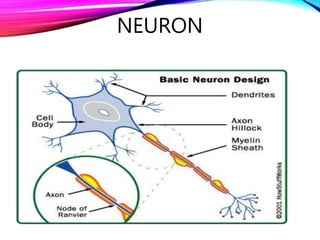
NEURON
INTRODUCTION
It is an Auto Immune Disease which is when the body
starts to destroy itself.
 It is a life-long disease with no cure.
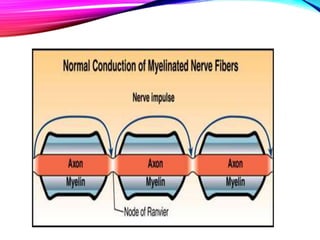
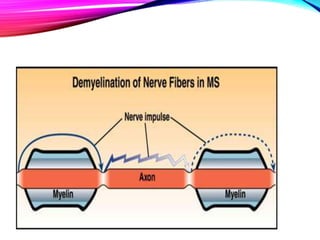
 In MS, the body attacks and destroys the fatty tissue
called myelin that insulates an axon/nerve, and is called
demyelination.
 If damage is severe it can also destroy the nerve/axon
itself.
CONT ..
 MS affects the central nervous system and inflames
the white matter in the brain which creates plaques.
White matter is below the top layer of our brain and
spinal cord. Plaques block a signal from being passed
from the body to the spinal cord and brain.
 Currently in the US, 250,000-300,000 people have
been diagnosed with MS and there are 200 new cases
diagnosed every week.
INCIDENCE
Women makes up 70-75 % cases of MS
Whites are commonly affected
Age of onset ranges from 10 to 50 yrs .the distribution
is bimodal ,with one peak at in mid 20s and other at mid
40s.
DEFINITION
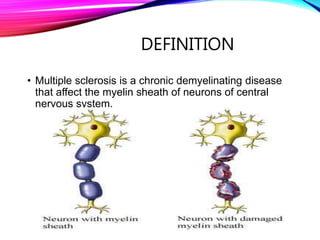
• Multiple sclerosis is a chronic demyelinating disease
that affect the myelin sheath of neurons of central
nervous system.
ETIOLOGY , RISK FACTORS
• ETIOLOGY
Exact etiology not known
Environmental agent
Genetic susceptibility
• RISK FACTORS
Infection
Physical injury
Emotional stress
Pregnancy
Fatigue
CONT..
PATHOPHYSIOLOGY
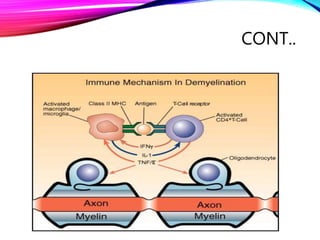
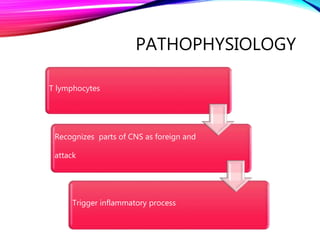
T lymphocytes
Recognizes parts of CNS as foreign and
attack
Trigger inflammatory process
Damaging effects
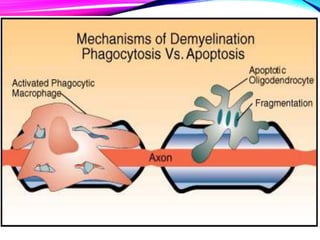
Demyelination
Demyelination also plays an
important role with repeated attack
less affective demyelination
Multiple lesions are produced in the
CNS
Multiple lesions are produced in
the CNS
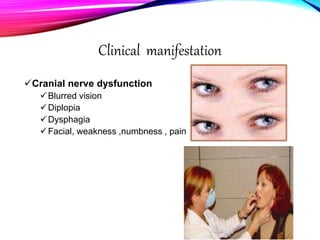
Clinical manifestation
Cranial nerve dysfunction
Blurred vision
Diplopia
Dysphagia
Facial, weakness ,numbness , pain
CONTD..
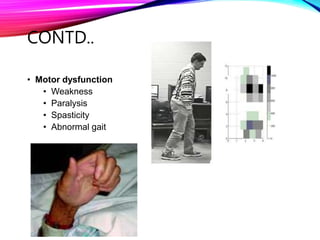
• Motor dysfunction
• Weakness
• Paralysis
• Spasticity
• Abnormal gait
CONTD..
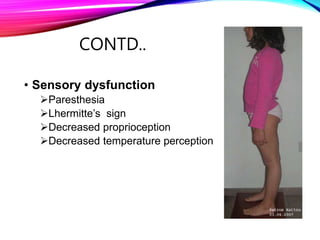
• Sensory dysfunction
Paresthesia
Lhermitte’s sign
Decreased proprioception
Decreased temperature perception
CONTD..
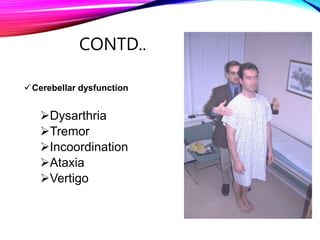
Cerebellar dysfunction
Dysarthria
Tremor
Incoordination
Ataxia
Vertigo
CONTD..
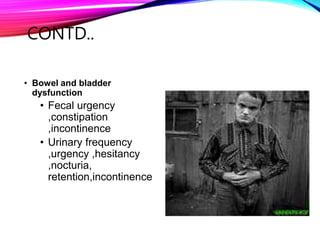
• Bowel and bladder
dysfunction
• Fecal urgency
,constipation
,incontinence
• Urinary frequency
,urgency ,hesitancy
,nocturia,
retention,incontinence
CONTD..
Cognitive dysfunction
Decreased short term memory
Difficulty in learning
Decreased concentration
Mood alteration , short attention span
Sexual dysfunction
Fatigue
TYPES OF MS
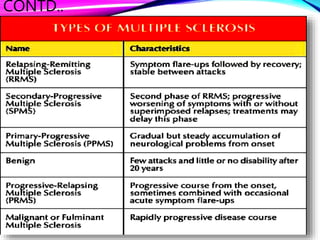
I. Relapsing –remitting MS
II. Primary – progressive MS
III. Secondary – progressive MS
IV. Progressive – relapsing MS
V. Benign MS
VI. Malignant or fulminant MS
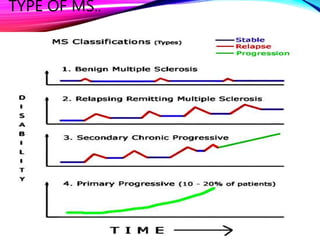
TYPE OF MS..
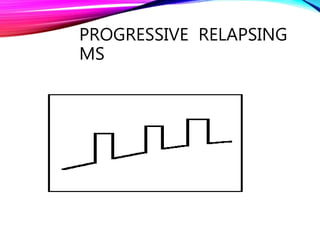
PROGRESSIVE RELAPSING
MS
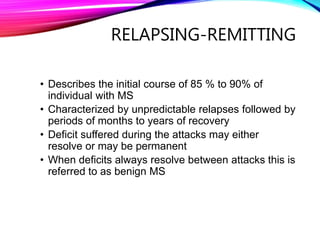
RELAPSING-REMITTING
• Describes the initial course of 85 % to 90% of
individual with MS
• Characterized by unpredictable relapses followed by
periods of months to years of recovery
• Deficit suffered during the attacks may either
resolve or may be permanent
• When deficits always resolve between attacks this is
referred to as benign MS
CONT.
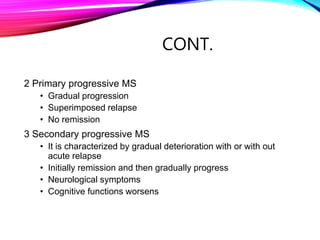
2 Primary progressive MS
• Gradual progression
• Superimposed relapse
• No remission
3 Secondary progressive MS
• It is characterized by gradual deterioration with or with out
acute relapse
• Initially remission and then gradually progress
• Neurological symptoms
• Cognitive functions worsens
CONT..
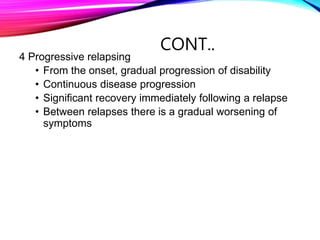
4 Progressive relapsing
• From the onset, gradual progression of disability
• Continuous disease progression
• Significant recovery immediately following a relapse
• Between relapses there is a gradual worsening of
symptoms
CONTD..
DIAGNOSTIC EVALUATION
• HISTORY
• viral infection
• precipitating factors
• family history
• signs and symptoms
• Sexual history
• mental status examination
• cranial nerve examination
• motor deficit
• sensory examination
• Cerebellar functions
DIAGNOSIS
MRI brain
MRI spine
Evoked potentials
Lumbar puncture
EEG
PET
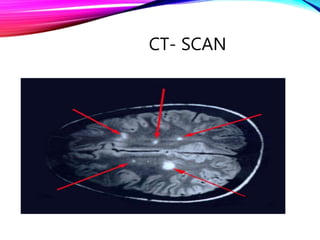
CT- SCAN
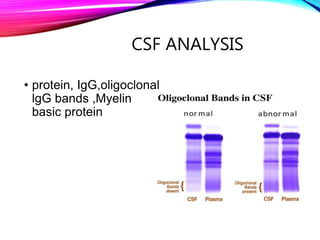
CSF ANALYSIS
• protein, IgG,oligoclonal
lgG bands ,Myelin
basic protein
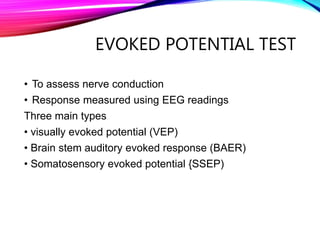
EVOKED POTENTIAL TEST
• To assess nerve conduction
• Response measured using EEG readings
Three main types
• visually evoked potential (VEP)
• Brain stem auditory evoked response (BAER)
• Somatosensory evoked potential {SSEP)
DIFFERENTIAL DIAGNOSIS
• Lyme disease
• Neurosyphilis
• Sarcoidosis
• SLE
• HIV associated myelopathy
• Polyarteritis nodosa
• tumors, cervical spondolysis
• Vitamin B12 deficiency
TREATMENT
• Medical management
• Surgical management
• Nursing management
CONT..
Aim
• Delay the progression of disease
• Manage chronic symptoms
• Treat acute exacerbations
• Generally palliative
• Immunotherapeutic drugs
• Methyl prednisolone
• ACTH
• Nonsteroidal immunosuppressive agents
• Azathioprine
• Cyclophosphamide
• Cyclosporine
• interferon's
MEDICAL MANAGEMENT
• Treat acute relapse
• IV or oral corticosteroids (prednisolone
,ACTH )
• Immunosuppressants (azathioprine ,
cyclophoshomide )
• Treat exacerbations
• Interferon β1b
• Interferon β1a
• Glatiramir acetate
CONTD..
• Symptomatic treatment
• Bladder dysfunction (oxybutin ,
propanthalene)
• Constipation ( psyllium hydrochloric
mucilloid ,bisacosyl)
• Fatigue ( amantadine )
• Tremor (propranalol ,clonazepam)
SURGICAL MANAGEMENT
• Intrathecal baclofen via surgically implantable pump
• Adductor tenotomy
• Dorsal rhizotomy
• Surgical diversion for urinary incontinence , retention
etc.
• Plastic surgery to cure decubitus ulcer
• No surgical intervention to alter the disease course of
MS.
NURSING MANAGEMENT
• Impaired urinary elimination R/T bladder dysfunction
• Fluid intake should be maintained at 2L/day
• Avoid fluid intake after evening meals
• Voiding to be attempted at every 3 hrs when
awake
• If voiding not successful-intermittent
catheterization
• Teach self catheterization
CONTD..
• Constipation R/T immobility and demyelination
high fiber diet ,bulk formers ,stool softners
Fluid intake ,2L/day
Laxatives and enemas to be AVOIDED because it
cause dependence
A bowel program to be performed
Rectal evacuation by glcerin ,bisacodyl
suppositories ,digital stimulation
CONTD..
• Activity intolerance R/T fatigue and muscle weakness
Assist client in planning his activities at his peak
energy level ,which is usually the morning
Periods of rest through out he day to be planned
Collaboration with physical and occupational
therapist helps a lot .Drug amantadine may help to
reduce fatigue
CONTD..
• Impaired physical mobility R/T weakness, contractures ,spasticity ,
ataxia
Spastic muscles can be stretched at least twice a day through
their full range of motion
Correct body alignment to prevent contractures
Use of splints is helpful
Ataxia and tremor lessened by small weights applied to distal
extremities
CONTD..
• Risk for self care deficit R/T muscle weakness
Client may require aids like wheel chairs ,or canes to perform
ADL and to ambulate
Teach client to use ADL aids
Table tops are adjusted at comfortable heights
Work in combination with physical therapist ,occupational
therapist and social worker
REFERENCES
• Ellen barker ; neurosciences nursing ; 2nd edition ; pg 685 –
718
• Joyce M Black ; medical surgical nursing ; 7th edition ; pg
2177-2189
• burner medical surgical nursing ;5th edition p.g. 1765- 17
• www . wikipedia .com
• thank all students for
attention

Mr. mahesh kumar

  • 1.
    MULTIPLE SCLEROSIS MODERATOR :MRS Sibi Riju Lecture CON PRESENTER :Mr. Mahesh Kumar Sharma M.Sc. nursing 1st year
  • 2.
  • 3.
    INTRODUCTION It is anAuto Immune Disease which is when the body starts to destroy itself.  It is a life-long disease with no cure.  In MS, the body attacks and destroys the fatty tissue called myelin that insulates an axon/nerve, and is called demyelination.  If damage is severe it can also destroy the nerve/axon itself.
  • 4.
    CONT ..  MSaffects the central nervous system and inflames the white matter in the brain which creates plaques. White matter is below the top layer of our brain and spinal cord. Plaques block a signal from being passed from the body to the spinal cord and brain.  Currently in the US, 250,000-300,000 people have been diagnosed with MS and there are 200 new cases diagnosed every week.
  • 5.
    INCIDENCE Women makes up70-75 % cases of MS Whites are commonly affected Age of onset ranges from 10 to 50 yrs .the distribution is bimodal ,with one peak at in mid 20s and other at mid 40s.
  • 6.
    DEFINITION • Multiple sclerosisis a chronic demyelinating disease that affect the myelin sheath of neurons of central nervous system.
  • 7.
    ETIOLOGY , RISKFACTORS • ETIOLOGY Exact etiology not known Environmental agent Genetic susceptibility • RISK FACTORS Infection Physical injury Emotional stress Pregnancy Fatigue
  • 11.
  • 12.
    PATHOPHYSIOLOGY T lymphocytes Recognizes partsof CNS as foreign and attack Trigger inflammatory process
  • 13.
    Damaging effects Demyelination Demyelination alsoplays an important role with repeated attack less affective demyelination Multiple lesions are produced in the CNS Multiple lesions are produced in the CNS
  • 14.
    Clinical manifestation Cranial nervedysfunction Blurred vision Diplopia Dysphagia Facial, weakness ,numbness , pain
  • 15.
    CONTD.. • Motor dysfunction •Weakness • Paralysis • Spasticity • Abnormal gait
  • 16.
    CONTD.. • Sensory dysfunction Paresthesia Lhermitte’ssign Decreased proprioception Decreased temperature perception
  • 17.
  • 18.
    CONTD.. • Bowel andbladder dysfunction • Fecal urgency ,constipation ,incontinence • Urinary frequency ,urgency ,hesitancy ,nocturia, retention,incontinence
  • 19.
    CONTD.. Cognitive dysfunction Decreased shortterm memory Difficulty in learning Decreased concentration Mood alteration , short attention span Sexual dysfunction Fatigue
  • 20.
    TYPES OF MS I.Relapsing –remitting MS II. Primary – progressive MS III. Secondary – progressive MS IV. Progressive – relapsing MS V. Benign MS VI. Malignant or fulminant MS
  • 21.
  • 22.
  • 23.
    RELAPSING-REMITTING • Describes theinitial course of 85 % to 90% of individual with MS • Characterized by unpredictable relapses followed by periods of months to years of recovery • Deficit suffered during the attacks may either resolve or may be permanent • When deficits always resolve between attacks this is referred to as benign MS
  • 24.
    CONT. 2 Primary progressiveMS • Gradual progression • Superimposed relapse • No remission 3 Secondary progressive MS • It is characterized by gradual deterioration with or with out acute relapse • Initially remission and then gradually progress • Neurological symptoms • Cognitive functions worsens
  • 25.
    CONT.. 4 Progressive relapsing •From the onset, gradual progression of disability • Continuous disease progression • Significant recovery immediately following a relapse • Between relapses there is a gradual worsening of symptoms
  • 26.
  • 27.
    DIAGNOSTIC EVALUATION • HISTORY •viral infection • precipitating factors • family history • signs and symptoms • Sexual history • mental status examination • cranial nerve examination • motor deficit • sensory examination • Cerebellar functions
  • 28.
    DIAGNOSIS MRI brain MRI spine Evokedpotentials Lumbar puncture EEG PET
  • 29.
  • 30.
    CSF ANALYSIS • protein,IgG,oligoclonal lgG bands ,Myelin basic protein
  • 31.
    EVOKED POTENTIAL TEST •To assess nerve conduction • Response measured using EEG readings Three main types • visually evoked potential (VEP) • Brain stem auditory evoked response (BAER) • Somatosensory evoked potential {SSEP)
  • 32.
    DIFFERENTIAL DIAGNOSIS • Lymedisease • Neurosyphilis • Sarcoidosis • SLE • HIV associated myelopathy • Polyarteritis nodosa • tumors, cervical spondolysis • Vitamin B12 deficiency
  • 33.
    TREATMENT • Medical management •Surgical management • Nursing management
  • 34.
    CONT.. Aim • Delay theprogression of disease • Manage chronic symptoms • Treat acute exacerbations • Generally palliative • Immunotherapeutic drugs • Methyl prednisolone • ACTH • Nonsteroidal immunosuppressive agents • Azathioprine • Cyclophosphamide • Cyclosporine • interferon's
  • 35.
    MEDICAL MANAGEMENT • Treatacute relapse • IV or oral corticosteroids (prednisolone ,ACTH ) • Immunosuppressants (azathioprine , cyclophoshomide ) • Treat exacerbations • Interferon β1b • Interferon β1a • Glatiramir acetate
  • 36.
    CONTD.. • Symptomatic treatment •Bladder dysfunction (oxybutin , propanthalene) • Constipation ( psyllium hydrochloric mucilloid ,bisacosyl) • Fatigue ( amantadine ) • Tremor (propranalol ,clonazepam)
  • 37.
    SURGICAL MANAGEMENT • Intrathecalbaclofen via surgically implantable pump • Adductor tenotomy • Dorsal rhizotomy • Surgical diversion for urinary incontinence , retention etc. • Plastic surgery to cure decubitus ulcer • No surgical intervention to alter the disease course of MS.
  • 38.
    NURSING MANAGEMENT • Impairedurinary elimination R/T bladder dysfunction • Fluid intake should be maintained at 2L/day • Avoid fluid intake after evening meals • Voiding to be attempted at every 3 hrs when awake • If voiding not successful-intermittent catheterization • Teach self catheterization
  • 39.
    CONTD.. • Constipation R/Timmobility and demyelination high fiber diet ,bulk formers ,stool softners Fluid intake ,2L/day Laxatives and enemas to be AVOIDED because it cause dependence A bowel program to be performed Rectal evacuation by glcerin ,bisacodyl suppositories ,digital stimulation
  • 40.
    CONTD.. • Activity intoleranceR/T fatigue and muscle weakness Assist client in planning his activities at his peak energy level ,which is usually the morning Periods of rest through out he day to be planned Collaboration with physical and occupational therapist helps a lot .Drug amantadine may help to reduce fatigue
  • 41.
    CONTD.. • Impaired physicalmobility R/T weakness, contractures ,spasticity , ataxia Spastic muscles can be stretched at least twice a day through their full range of motion Correct body alignment to prevent contractures Use of splints is helpful Ataxia and tremor lessened by small weights applied to distal extremities
  • 42.
    CONTD.. • Risk forself care deficit R/T muscle weakness Client may require aids like wheel chairs ,or canes to perform ADL and to ambulate Teach client to use ADL aids Table tops are adjusted at comfortable heights Work in combination with physical therapist ,occupational therapist and social worker
  • 43.
    REFERENCES • Ellen barker; neurosciences nursing ; 2nd edition ; pg 685 – 718 • Joyce M Black ; medical surgical nursing ; 7th edition ; pg 2177-2189 • burner medical surgical nursing ;5th edition p.g. 1765- 17 • www . wikipedia .com
  • 44.
    • thank allstudents for attention