INTRODUCTIONTO MPLS
By: Engineering& TechnologySolutions
Telecom / IT Solutions,Services , Consultancyand Training Company
Islamabad ,Pakistan
Phone : +92 – 3034452001
Email : zeeshan.ahmed@etspk.com
www.etspk.com
About ETS
Engineering& TechnologySolutions(ETS) offers a broad range of complimentary engineering design and
build services including Deployment, Planning & Optimization,ManagedServices, Human Resource
Consultancy,ProjectManagementand Trainingsto a wide rangeof Sectorsincluding Telecommunications,
InformationTechnology, Networks etc
Engineering & Technology Solutions
To Empower Through Excellence
ICT Solutions& Services Company
Islamabad – Pakistan
www.etspk.com
www.presentationgo.com
Contents
01
02
03
Draw-Backs
Drawbacks of Traditional IP Routing
MPLS
Basic MPLS Concepts
Architecture
MPLS Architecture
04
05
06
Mode of Operation
MPLS Mode of Operation
Frame Mode
Frame Mode of MPLS
LSRs
Architecture of LSRs
Engineering& TechnologySolutions– Islamabad, Pakistan www.etspk.com
Traditional IP forwarding is based on the following:
• Routing protocolsare used to distributeLayer 3 routing information.
• Forwardingis based on the destinationaddressonly.
• Routing lookupsare performed on
every hop.
Drawbacks of Traditional IP Routing
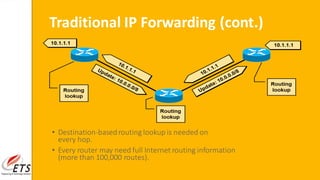
Traditional IP Forwarding (cont.)
• Destination-basedrouting lookup is needed on
every hop.
• Every router may need full Internet routing information
(more than 100,000 routes).
• MPLS is a new forwarding mechanism in which packets are
forwarded based on labels.
• Labels may correspond to IP destination networks (equal to
traditional IP forwarding).
• Labels can also correspond to other parameters, such as quality
of service (QoS) or source address.
• MPLS was designed to support forwarding of other protocols as
well.
Basic MPLS Concepts
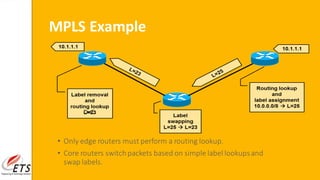
MPLS Example
• Only edge routers must perform a routing lookup.
• Core routers switchpackets based on simple label lookupsand
swap labels.
MPLS Architecture
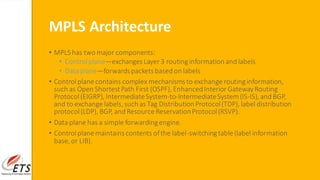
• MPLS has two major components:
• Controlplane—exchangesLayer 3 routinginformation and labels
• Data plane—forwardspacketsbased on labels
• Controlplanecontains complex mechanismsto exchange routinginformation,
such as Open ShortestPath First (OSPF), EnhancedInterior GatewayRouting
Protocol(EIGRP),IntermediateSystem-to-IntermediateSystem(IS-IS),and BGP,
and to exchangelabels,such as Tag Distribution Protocol(TDP), label distribution
protocol(LDP), BGP, and ResourceReservationProtocol(RSVP).
• Data plane has a simple forwardingengine.
• Controlplanemaintainscontents ofthe label-switchingtable(label information
base,or LIB).
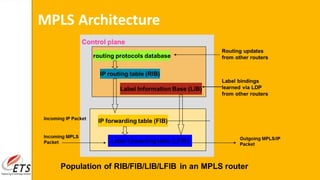
MPLS Architecture
Population of RIB/FIB/LIB/LFIB in an MPLS router
MPLS Modes of Operation
• MPLS technology is intended to be used anywhere regardless of
Layer 1 media and Layer 2 protocol.
• MPLS uses a 32-bit label field that is inserted between Layer 2
and Layer 3 headers (frame-mode).
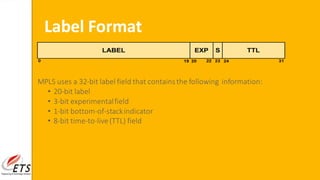
Label Format
MPLS uses a 32-bit label field that containsthe following information:
• 20-bit label
• 3-bit experimentalfield
• 1-bit bottom-of-stackindicator
• 8-bit time-to-live(TTL) field
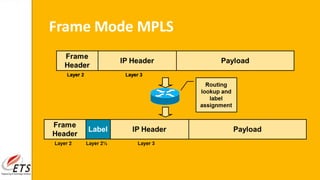
Frame Mode MPLS
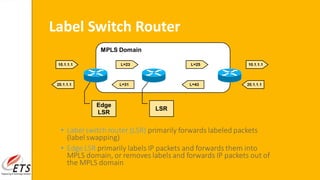
Label Switch Router
• Label switch router (LSR) primarily forwards labeled packets
(label swapping)
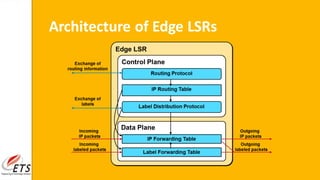
• Edge LSR primarily labels IP packets and forwards them into
MPLS domain, or removes labels and forwards IP packets out of
the MPLS domain
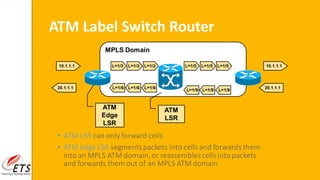
ATM Label Switch Router
• ATM LSR can only forward cells
• ATM edge LSR segmentspackets into cells and forwards them
into an MPLS ATM domain, or reassemblescells intopackets
and forwards them out of an MPLS ATM domain
Architecture of LSRs
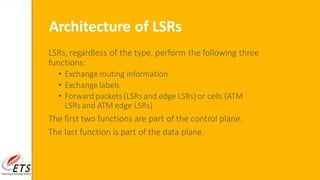
LSRs, regardless of the type, perform the following three
functions:
• Exchange routing information
• Exchange labels
• Forwardpackets (LSRs and edge LSRs) or cells (ATM
LSRs and ATM edge LSRs)
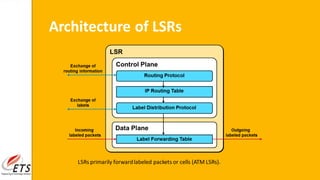
The first two functions are part of the control plane.
The last function is part of the data plane.
Architecture of LSRs
LSRs primarily forwardlabeled packets or cells (ATM LSRs).
Architecture of Edge LSRs
www.presentationgo.com
IP Series Training by ETS
Switching & Routing : IP Basics , TCP/ IP, OSI, Routing Protocol and Basics of
Routers andSwitches Configurations.
Certified IP Network Professional : Detail IP Certification covering most of IP
features includingIPAdvance configurations,MPLS,QoS,IPv6,Mobile IP, IMS etc
IP Devices Configuration Speciallist : Vendor Specific Routers & Switches
Configuration,InstallationandO&M
IP for Telecom Professionals : IPv4 vs IPv6 , MPLS , QoS, IP Tranmission, IP
Tunneling, IPSecurity , IPNetwork Management ,Mobile IP
IP Backhauling 3G/4G : Mobile IP , IPv6 , IP Addressing & Routing , 3G / 4G IP
Design and O&M
IP_7001
IP _ 7002
IP _ 7003
IP_7004
IP_7005
Engineering & Technology Solutions
To Empower Through Excellence
ICT Solutions& Services Company
Islamabad – Pakistan
Engineering& TechnologySolutions– Islamabad, Pakistan www.etspk.com
For Registrationand In HouseOrganization: Contact: +92 – 3034452001, Whatsapp: +92-3338742754
Email : zeeshan.ahmed@etspk.com
www.etspk.com
Thanks You

MPLS

  • 1.
    INTRODUCTIONTO MPLS By: Engineering&TechnologySolutions Telecom / IT Solutions,Services , Consultancyand Training Company Islamabad ,Pakistan Phone : +92 – 3034452001 Email : zeeshan.ahmed@etspk.com www.etspk.com
  • 2.
    About ETS Engineering& TechnologySolutions(ETS)offers a broad range of complimentary engineering design and build services including Deployment, Planning & Optimization,ManagedServices, Human Resource Consultancy,ProjectManagementand Trainingsto a wide rangeof Sectorsincluding Telecommunications, InformationTechnology, Networks etc Engineering & Technology Solutions To Empower Through Excellence ICT Solutions& Services Company Islamabad – Pakistan www.etspk.com
  • 3.
    www.presentationgo.com Contents 01 02 03 Draw-Backs Drawbacks of TraditionalIP Routing MPLS Basic MPLS Concepts Architecture MPLS Architecture 04 05 06 Mode of Operation MPLS Mode of Operation Frame Mode Frame Mode of MPLS LSRs Architecture of LSRs Engineering& TechnologySolutions– Islamabad, Pakistan www.etspk.com
  • 4.
    Traditional IP forwardingis based on the following: • Routing protocolsare used to distributeLayer 3 routing information. • Forwardingis based on the destinationaddressonly. • Routing lookupsare performed on every hop. Drawbacks of Traditional IP Routing
  • 5.
    Traditional IP Forwarding(cont.) • Destination-basedrouting lookup is needed on every hop. • Every router may need full Internet routing information (more than 100,000 routes).
  • 6.
    • MPLS isa new forwarding mechanism in which packets are forwarded based on labels. • Labels may correspond to IP destination networks (equal to traditional IP forwarding). • Labels can also correspond to other parameters, such as quality of service (QoS) or source address. • MPLS was designed to support forwarding of other protocols as well. Basic MPLS Concepts
  • 7.
    MPLS Example • Onlyedge routers must perform a routing lookup. • Core routers switchpackets based on simple label lookupsand swap labels.
  • 8.
    MPLS Architecture • MPLShas two major components: • Controlplane—exchangesLayer 3 routinginformation and labels • Data plane—forwardspacketsbased on labels • Controlplanecontains complex mechanismsto exchange routinginformation, such as Open ShortestPath First (OSPF), EnhancedInterior GatewayRouting Protocol(EIGRP),IntermediateSystem-to-IntermediateSystem(IS-IS),and BGP, and to exchangelabels,such as Tag Distribution Protocol(TDP), label distribution protocol(LDP), BGP, and ResourceReservationProtocol(RSVP). • Data plane has a simple forwardingengine. • Controlplanemaintainscontents ofthe label-switchingtable(label information base,or LIB).
  • 9.
    MPLS Architecture Population ofRIB/FIB/LIB/LFIB in an MPLS router
  • 10.
    MPLS Modes ofOperation • MPLS technology is intended to be used anywhere regardless of Layer 1 media and Layer 2 protocol. • MPLS uses a 32-bit label field that is inserted between Layer 2 and Layer 3 headers (frame-mode).
  • 11.
    Label Format MPLS usesa 32-bit label field that containsthe following information: • 20-bit label • 3-bit experimentalfield • 1-bit bottom-of-stackindicator • 8-bit time-to-live(TTL) field
  • 12.
  • 13.
    Label Switch Router •Label switch router (LSR) primarily forwards labeled packets (label swapping) • Edge LSR primarily labels IP packets and forwards them into MPLS domain, or removes labels and forwards IP packets out of the MPLS domain
  • 14.
    ATM Label SwitchRouter • ATM LSR can only forward cells • ATM edge LSR segmentspackets into cells and forwards them into an MPLS ATM domain, or reassemblescells intopackets and forwards them out of an MPLS ATM domain
  • 15.
    Architecture of LSRs LSRs,regardless of the type, perform the following three functions: • Exchange routing information • Exchange labels • Forwardpackets (LSRs and edge LSRs) or cells (ATM LSRs and ATM edge LSRs) The first two functions are part of the control plane. The last function is part of the data plane.
  • 16.
    Architecture of LSRs LSRsprimarily forwardlabeled packets or cells (ATM LSRs).
  • 17.
  • 18.
    www.presentationgo.com IP Series Trainingby ETS Switching & Routing : IP Basics , TCP/ IP, OSI, Routing Protocol and Basics of Routers andSwitches Configurations. Certified IP Network Professional : Detail IP Certification covering most of IP features includingIPAdvance configurations,MPLS,QoS,IPv6,Mobile IP, IMS etc IP Devices Configuration Speciallist : Vendor Specific Routers & Switches Configuration,InstallationandO&M IP for Telecom Professionals : IPv4 vs IPv6 , MPLS , QoS, IP Tranmission, IP Tunneling, IPSecurity , IPNetwork Management ,Mobile IP IP Backhauling 3G/4G : Mobile IP , IPv6 , IP Addressing & Routing , 3G / 4G IP Design and O&M IP_7001 IP _ 7002 IP _ 7003 IP_7004 IP_7005 Engineering & Technology Solutions To Empower Through Excellence ICT Solutions& Services Company Islamabad – Pakistan Engineering& TechnologySolutions– Islamabad, Pakistan www.etspk.com For Registrationand In HouseOrganization: Contact: +92 – 3034452001, Whatsapp: +92-3338742754 Email : zeeshan.ahmed@etspk.com
  • 19.