Technology Seminar
MPEG Video Technology
Presented By- Yuboraj Dutta & Sayan Naskar
Content
• Standards
• Frame Structure
• Frame Types
• Frame
Sequences
• Difference
Frames
• Motion
Prediction
Content
• MPEG Encoding
– Inter-frame Process
• I/P/B Frames
• Motion Prediction
– Intra-frame Process
• DCT
• Zig Zag Scan & Run length
encoding
• Entropy coding
• Quantisation
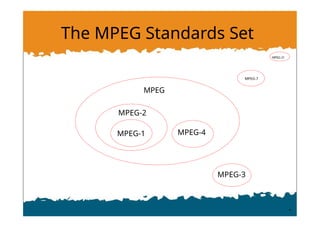
The MPEG Standards Set
MPEG
MPEG-2
MPEG-1 MPEG-4
MPEG-3
MPEG-7
MPEG-21
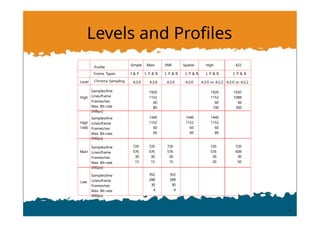
Levels and Profiles
• MPEG-2 Profile @ Level
• Profiles
– Simple, Main, SNR, Spatial, High, 422
Profile
• Levels
– High, High-1440, Main, Low
Levels and Profiles
Profile
Simple Main SNR Spatial High 422
Frame Types I & P I, P & B I, P & B I, P & B I, P & B I, P & B
Level Chroma Sampling 4:2:0 4:2:0 4:2:0 4:2:0 4:2:0 or 4:2:2 4:2:0 or 4:2:2
High
Samples/line
Lines/frame
Frames/sec
Max Bit-rate
(MBps)
1920
1152
60
80
1920
1152
60
100
1920
1088
60
300
High
1440
Samples/line
Lines/frame
Frames/sec
Max Bit-rate
(MBps)
1440
1152
60
60
1440
1152
60
60
1440
1152
60
80
Main
Samples/line
Lines/frame
Frames/sec
Max Bit-rate
(MBps)
720
576
30
15
720
576
30
15
720
576
30
15
720
576
30
20
720
608
30
50
Low
Samples/line
Lines/frame
Frames/sec
Max Bit-rate
(MBps)
352
288
30
4
352
288
30
4
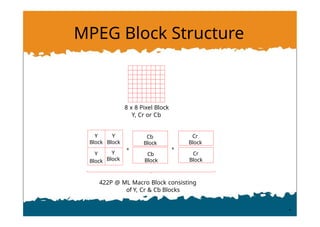
MPEG Block Structure
+ +
8 x 8 Pixel Block
Y, Cr or Cb
422P @ ML Macro Block consisting
of Y, Cr & Cb Blocks
Y
Block
Y
Block
Y
Block
Y
Block
Cb
Block
Cb
Block
Cr
Block
Cr
Block
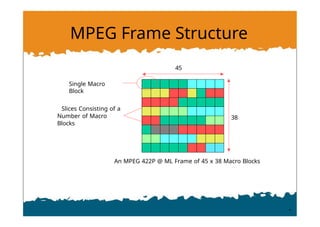
MPEG Frame Structure
An MPEG 422P @ ML Frame of 45 x 38 Macro Blocks
Slices Consisting of a
Number of Macro
Blocks
Single Macro
Block
45
38
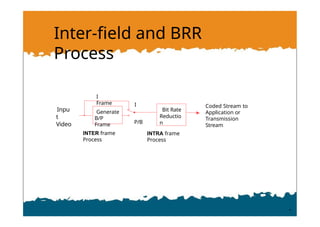
Inter-field and BRR
Process
Coded Stream to
Application or
Transmission
Stream
INTRA frame
Process
INTER frame
Process
Inpu
t
Video
Generate
B/P
Frame
Bit Rate
Reductio
n
I
Frame I
P/B
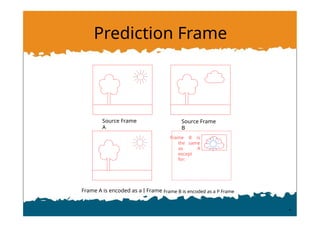
Prediction Frame
Source Frame
A
Source Frame
B
Frame A is encoded as a I Frame Frame B is encoded as a P Frame
Frame B is
the same
as A
except
for:
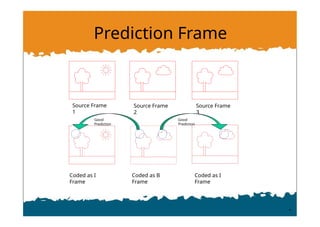
Prediction Frame
Source Frame
1
Source Frame
2
Source Frame
3
Coded as I
Frame
Coded as I
Frame
Coded as B
Frame
Good
Prediction
Good
Prediction
Frame Types
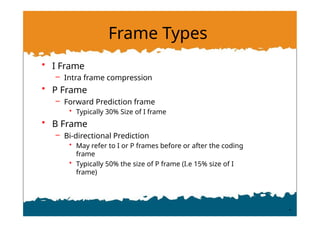
• I Frame
– Intra frame compression
• P Frame
– Forward Prediction frame
• Typically 30% Size of I frame
• B Frame
– Bi-directional Prediction
• May refer to I or P frames before or after the coding
frame
• Typically 50% the size of P frame (I.e 15% size of I
frame)
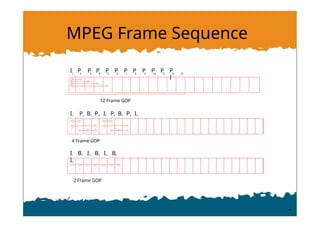
MPEG Frame Sequence
I1 2 3 4
P P P 5
P 6
P 7
P 8
P 9
P 10
P 11
P 12
P
I
13
12 Frame GOP
I1 P2 B3 P4 I5 P6 B7 P8 I9
4 Frame GOP
I1 B2 I3 B4 I5 B6
I7
2 Frame GOP
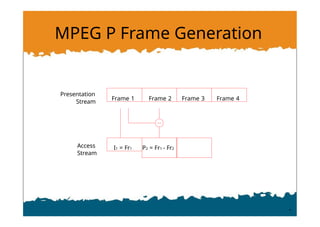
MPEG P Frame Generation
Presentation
Stream
Access
Stream
Frame 1 Frame 2 Frame 3 Frame 4
I1 = Fr1 P2 = Fr1 - Fr2
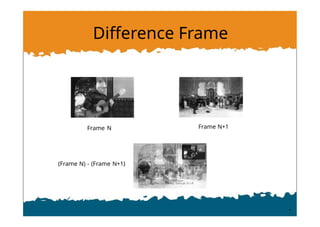
Difference Frame
Frame N Frame N+1
(Frame N) - (Frame N+1)
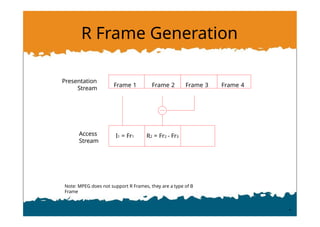
R Frame Generation
Presentation
Stream
Access
Stream
Frame 1 Frame 2 Frame 3 Frame 4
I1 = Fr1 R2 = Fr2 - Fr3
Note: MPEG does not support R Frames, they are a type of B
Frame
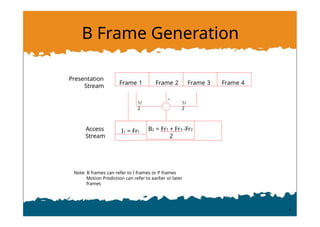
B Frame Generation
Presentation
Stream
Access
Stream
Frame 1 Frame 2 Frame 3 Frame 4
I1 = Fr1
1/
2
1/
2
-
B2 = Fr1 + Fr3 -Fr2
2
Note: B frames can refer to I frames or P frames
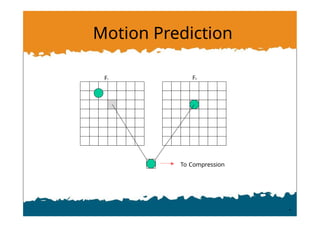
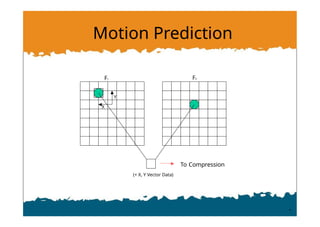
Motion Prediction can refer to earlier or later
frames
Motion Prediction
F1 F2
To Compression
Motion Prediction
F1 F2
To Compression
(+ X, Y Vector Data)
Y
X
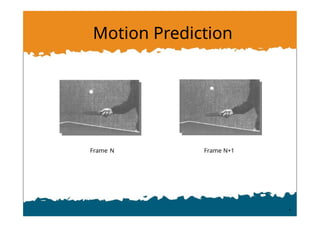
Motion Prediction
Frame N Frame N+1
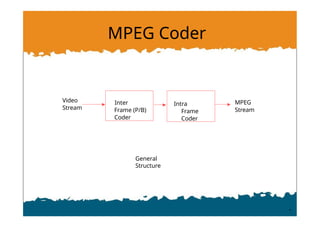
MPEG Coder
Inter
Frame (P/B)
Coder
Intra
Frame
Coder
Video
Stream
MPEG
Stream
General
Structure
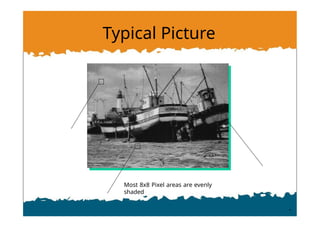
Typical Picture
Most 8x8 Pixel areas are evenly
shaded
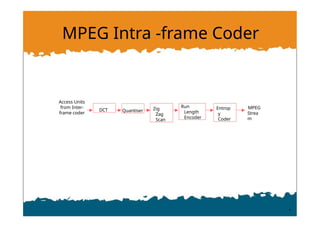
MPEG Intra -frame Coder
DCT Quantiser Zig
Zag
Scan
Run
Length
Encoder
Entrop
y
Coder
Access Units
from Inter-
frame coder
MPEG
Strea
m
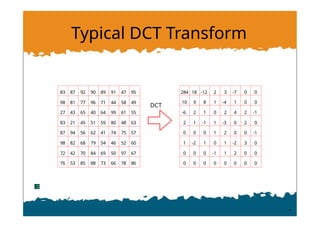
Typical DCT Transform
DCT
83 87 92 90 89 91 47 95
98 81 77 96 71 44 58 49
27 43 65 40 64 99 61 55
83 21 45 51 59 80 48 63
87 94 56 62 41 74 75 57
98 82 68 79 54 46 52 60
72 42 70 84 69 50 97 67
76 53 85 88 73 66 78 86
284 18 -12 2 3 -7 0 0
10 9 8 1 -4 1 0 0
-6 2 1 0 2 4 2 -1
2 1 -1 1 -3 0 2 0
0 0 0 1 2 0 0 -1
1 -2 1 0 1 -2 3 0
0 0 0 -1 1 2 0 0
0 0 0 0 0 0 0 0
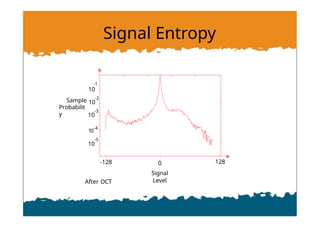
Signal Entropy
Sample
Probabilit
y
0
Signal
Level
10
10
10
-1
10
-2
-3
10
-4
-5
128
-128
After DCT
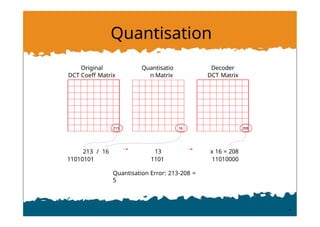
Quantisation
208
16
213
Quantisation Error: 213-208 =
5
213 / 16 13 x 16 = 208
11010101 1101 11010000
Original
DCT Coeff Matrix
Quantisatio
n Matrix
Decoder
DCT Matrix
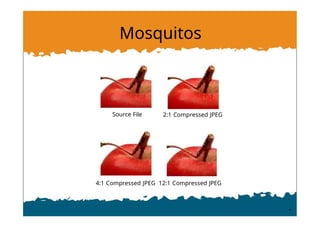
Mosquitos
Source File 2:1 Compressed JPEG
4:1 Compressed JPEG 12:1 Compressed JPEG
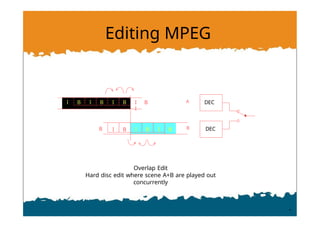
Editing MPEG
Overlap Edit
Hard disc edit where scene A+B are played out
concurrently
I
B
I
B
I B I B
I
I
B
I
B
I B
A
B
B
DEC
DEC
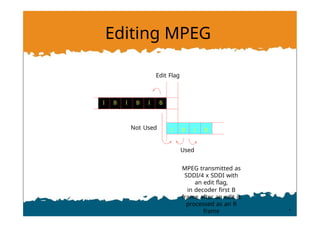
Editing MPEG
Edit Flag
Used
MPEG transmitted as
SDDI/4 x SDDI with
an edit flag,
in decoder first B
frame after an edit is
processed as an R
frame
I B I B I B
Not Used I B I B
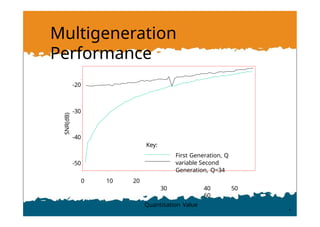
Multigeneration
Performance
-50
-40
-30
-20
SNR(dB)
0 10 20
Key:
First Generation, Q
variable Second
Generation, Q=34
30 40 50
60
Quantisation Value
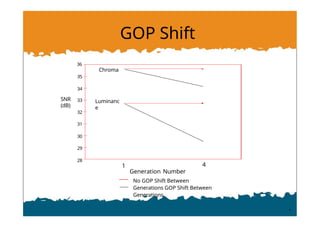
GOP Shift
32
31
30
29
28
33
36
Chroma
35
34
Luminanc
e
1 4
Generation Number
No GOP Shift Between
Generations GOP Shift Between
Generations
SNR
(dB)
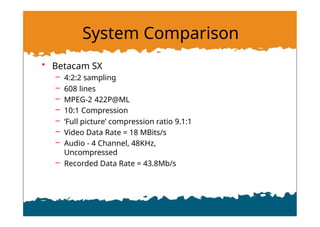
System Comparison
• Betacam SX
– 4:2:2 sampling
– 608 lines
– MPEG-2 422P@ML
– 10:1 Compression
– ‘Full picture’ compression ratio 9.1:1
– Video Data Rate = 18 MBits/s
– Audio - 4 Channel, 48KHz,
Uncompressed
– Recorded Data Rate = 43.8Mb/s
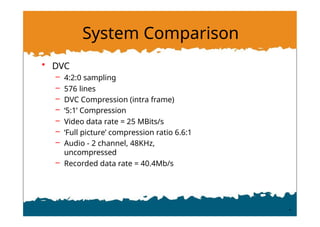
System Comparison
• DVC
– 4:2:0 sampling
– 576 lines
– DVC Compression (intra frame)
– ‘5:1’ Compression
– Video data rate = 25 MBits/s
– ‘Full picture’ compression ratio 6.6:1
– Audio - 2 channel, 48KHz,
uncompressed
– Recorded data rate = 40.4Mb/s
Compression Ratios
• Is compression ratio a good measure of
quality?
• What else must be considered?
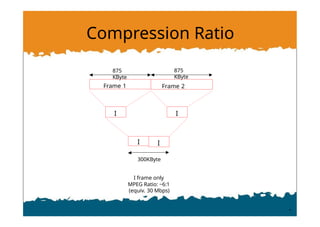
Compression Ratio
300KByte
I frame only
MPEG Ratio: ~6:1
(equiv. 30 Mbps)
I
I I
I
875
KByte
875
KByte
Frame 1 Frame 2
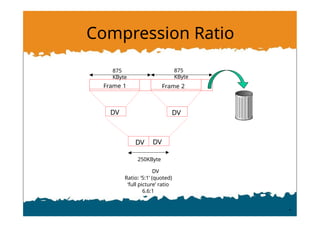
Compression Ratio
250KByte
DV
Ratio: ‘5:1’ (quoted)
‘full picture’ ratio
6.6:1
DV DV
DV DV
875
KByte
875
KByte
Frame 1 Frame 2
Compression Ratio
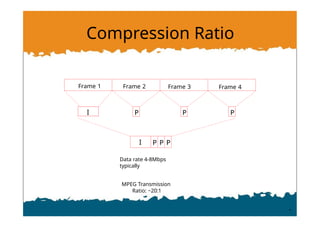
I P P P
I P P P
Data rate 4-8Mbps
typically
MPEG Transmission
Ratio: ~20:1
Frame 1 Frame 2 Frame 3 Frame 4
Quality Comparison
• Cannot use analogue measurement techniques
– all systems produce ‘perfect’ results
• Data rate or Compression ratio is not a good
measure of quality
• Different systems have different efficiencies
• Must measure system based on visual impairment
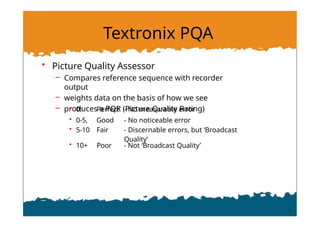
Textronix PQA
• Picture Quality Assessor
– Compares reference sequence with recorder
output
– weights data on the basis of how we see
– produces a PQR (Picture Quality Rating)
• 0: Perfect - No measurable error
• 0-5, Good - No noticeable error
• 5-10 Fair - Discernable errors, but ‘Broadcast
Quality’
• 10+ Poor - Not ‘Broadcast Quality’
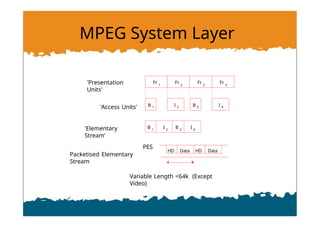
MPEG System Layer
Fr 1
Fr 2
Fr 3
Fr 4
'Access Units'
'Elementary
Stream'
'Presentation
Units'
B 1 I 2 I 4
B 3
B 1
I 2
B 3
I 4
HD HD
Data Data
Variable Length <64k (Except
Video)
PES
Packetised Elementary
Stream
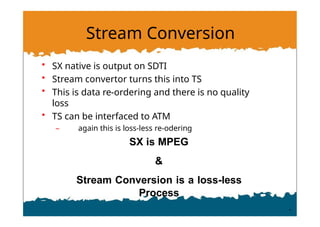
Stream Conversion
• SX native is output on SDTI
• Stream convertor turns this into TS
• This is data re-ordering and there is no quality
loss
• TS can be interfaced to ATM
– again this is loss-less re-odering
SX is MPEG
&
Stream Conversion is a loss-less
Process
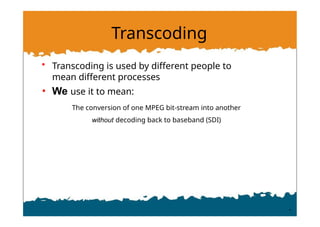
Transcoding
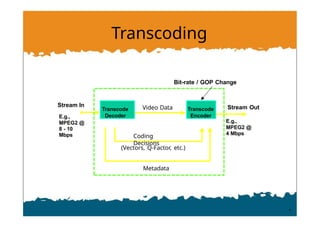
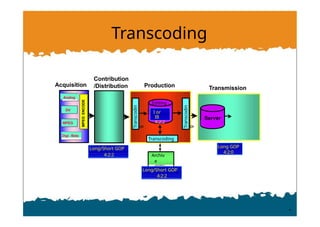
• Transcoding is used by different people to
mean different processes
• We use it to mean:
The conversion of one MPEG bit-stream into another
without decoding back to baseband (SDI)
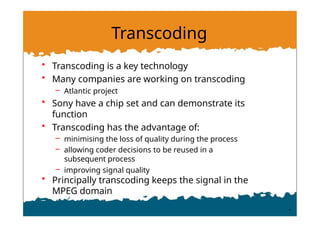
Transcoding
• Transcoding is a key technology
• Many companies are working on transcoding
– Atlantic project
• Sony have a chip set and can demonstrate its
function
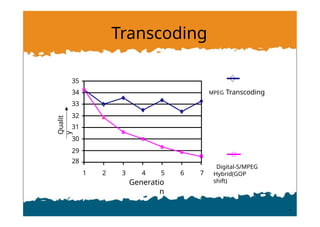
• Transcoding has the advantage of:
– minimising the loss of quality during the process
– allowing coder decisions to be reused in a
subsequent process
– improving signal quality
• Principally transcoding keeps the signal in the
MPEG domain
Transcoding
Stream In
E.g.,
MPEG2 @
8 - 10
Mbps
E.g.,
MPEG2 @
4 Mbps
Transcode
Decoder
Video Data
Bit-rate / GOP Change
Coding
Decisions
Transcode
Encoder
Stream Out
(Vectors, Q-Factor, etc.)
Metadata
Transcoding
Contribution
/Distribution Transmission
Production
Acquisition
Archiv
e
(DTF)
Long/Short GOP
4:2:2
MPEG
ENCODE
DV
Analog
Digi. Beta
MPEG
Long GOP
4:2:0
Transcoding
Editing
I or
IB
4:2:2
Server
Transcodin
g
Transcodin
g
Long/Short GOP
4:2:2
Transcoding
MPEG Transcoding
Digital-S/MPEG
Hybrid(GOP
shift)
35
34
33
32
31
30
29
28
1 2 3 6 7
4 5
Generatio
n
Qualit
y
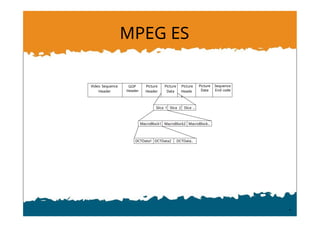
MPEG ES
Video Sequence
Header
GOP
Header
Picture
Header
Picture
Data
Picture
Heade
r
Picture
Data
Sequence
End code
MacroBlock1 MacroBlock2 MacroBlock..
DCTData1 DCTData2 DCTData..
Slice 1 Slice 2 Slice ..
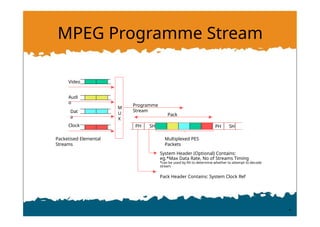
MPEG Programme Stream
Video
Audi
o
Packetised Elemental
Streams
Dat
a
M
U
X
Programme
Stream
PH SH PH SH
Multiplexed PES
Packets
System Header (Optional) Contains:
eg.*Max Data Rate, No of Streams Timing
*can be used by RX to determine whether to attempt to decode
stream
Pack Header Contains: System Clock Ref
Pack
Clock
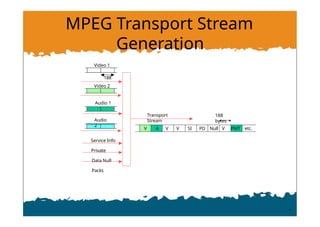
MPEG Transport Stream
Generation
Service Info
Private
Data Null
Packs
Transport
Stream
V A V V SI PD Null V PMT etc.
188
bytes
Video 1
188
Video 2
Audio 1
Audio
2
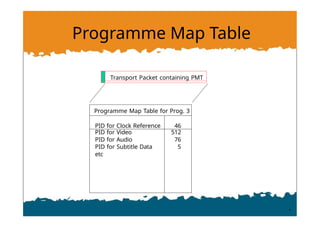
Programme Map Table
Programme Map Table for Prog. 3
PID for Clock Reference 46
PID for Video 512
PID for Audio 76
PID for Subtitle Data 5
etc
Transport Packet containing PMT
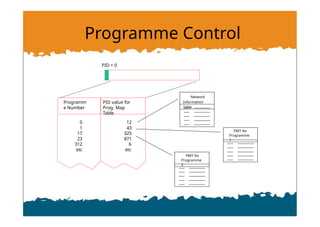
Programme Control
PID = 0
Programm
e Number
0
1
17
23
312
etc
12
43
325
871
6
etc
PID value for
Prog. Map
Table
Network
Information
Table
PMT for
Programme
1
PMT for
Programme
2
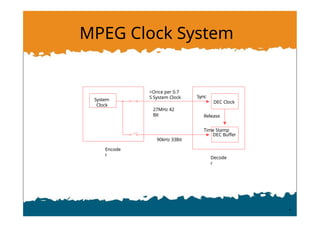
MPEG Clock System
System
Clock
DEC Clock
Encode
r
Sync
Decode
r
>Once per 0.7
S System Clock
27MHz 42
Bit Release
Time Stamp
DEC Buffer
90kHz 33Bit
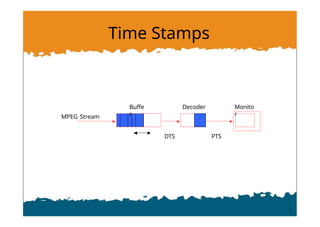
Time Stamps
MPEG Stream
Buffe
r
Decoder Monito
r
DTS PTS
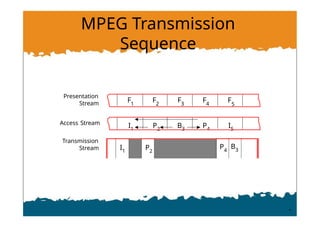
MPEG Transmission
Sequence
F
F F F F
1 2 3 4 5
I1
P2
B3
P4
I5
Presentation
Stream
Access Stream
Transmission
Stream I1
P2
P4
B3
MPEG-4
• Originally intended for very low data rate
for:
– Video conferencing
– Portable video phones
• Low data limit raised (now 5Kbps to
10Mbps)
• Wide range of resolutions supported
• Progressive and interlace supported
• Now intended for complex multimedia
type applications
MPEG-4
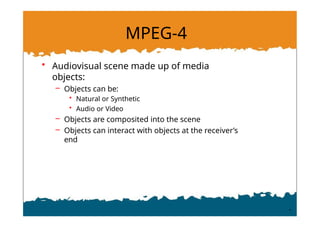
• Audiovisual scene made up of media
objects:
– Objects can be:
• Natural or Synthetic
• Audio or Video
– Objects are composited into the scene
– Objects can interact with objects at the receiver’s
end
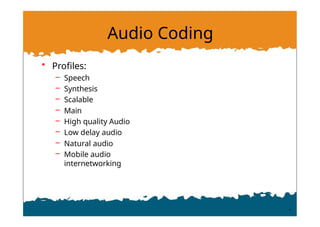
Audio Coding
• Profiles:
– Speech
– Synthesis
– Scalable
– Main
– High quality Audio
– Low delay audio
– Natural audio
– Mobile audio
internetworking
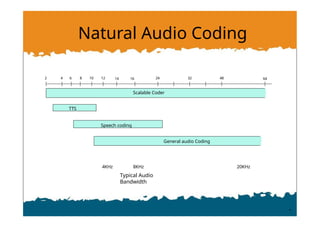
Natural Audio Coding
2 4 6 8 10 12 14 16 24 32 64
48
Scalable Coder
TTS
Speech coding
General audio Coding
4KHz 20KHz
8KHz
Typical Audio
Bandwidth
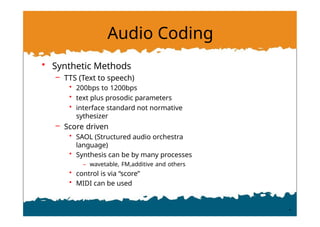
Audio Coding
• Synthetic Methods
– TTS (Text to speech)
• 200bps to 1200bps
• text plus prosodic parameters
• interface standard not normative
sythesizer
– Score driven
• SAOL (Structured audio orchestra
language)
• Synthesis can be by many processes
– wavetable, FM,additive and others
• control is via “score”
• MIDI can be used
Video Coding
• Profiles
– for natural objects
• Simple
• Simple scalable
• Core
• Main
• N-bit
– for synthetic objects
• Simple facial animation
• Scalable textural
• Basic Animated 2D
Texture
• Hybrid visual
Video Coding
• Synthetic objects
– parametric coding of
• faces
• bodies
• static and dynamic meshes
• Face Animation
– Facial description
parameters
– Facial animation
parameters
– Face animation table
– Face interpolation
technique
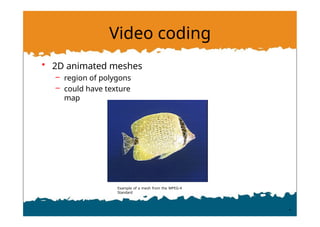
Video coding
• 2D animated meshes
– region of polygons
– could have texture
map
Example of a mesh from the MPEG-4
Standard
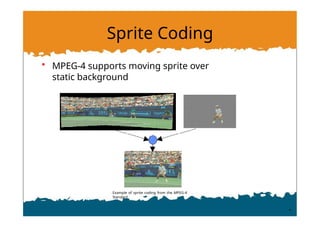
Sprite Coding
• MPEG-4 supports moving sprite over
static background
Example of sprite coding from the MPEG-4
Standard
MPEG Products
• Broadcast
– VTRs - Betacam SX, IMX
– Servers - MAV-70, MAV-555
• Contribution
– EBU Standard
• DVD
– players and authoring
systems
• Transmission
– Satellite and terrestrial
MPEG Open World
• Pro-MPEG Forum
– Consortium of many companies working toward
greater Interoperabilty
www.pro-
mpeg.org
Thank You

MPEG.ppt x

  • 1.
    Technology Seminar MPEG VideoTechnology Presented By- Yuboraj Dutta & Sayan Naskar
  • 2.
    Content • Standards • FrameStructure • Frame Types • Frame Sequences • Difference Frames • Motion Prediction
  • 3.
    Content • MPEG Encoding –Inter-frame Process • I/P/B Frames • Motion Prediction – Intra-frame Process • DCT • Zig Zag Scan & Run length encoding • Entropy coding • Quantisation
  • 4.
    The MPEG StandardsSet MPEG MPEG-2 MPEG-1 MPEG-4 MPEG-3 MPEG-7 MPEG-21
  • 5.
    Levels and Profiles •MPEG-2 Profile @ Level • Profiles – Simple, Main, SNR, Spatial, High, 422 Profile • Levels – High, High-1440, Main, Low
  • 6.
    Levels and Profiles Profile SimpleMain SNR Spatial High 422 Frame Types I & P I, P & B I, P & B I, P & B I, P & B I, P & B Level Chroma Sampling 4:2:0 4:2:0 4:2:0 4:2:0 4:2:0 or 4:2:2 4:2:0 or 4:2:2 High Samples/line Lines/frame Frames/sec Max Bit-rate (MBps) 1920 1152 60 80 1920 1152 60 100 1920 1088 60 300 High 1440 Samples/line Lines/frame Frames/sec Max Bit-rate (MBps) 1440 1152 60 60 1440 1152 60 60 1440 1152 60 80 Main Samples/line Lines/frame Frames/sec Max Bit-rate (MBps) 720 576 30 15 720 576 30 15 720 576 30 15 720 576 30 20 720 608 30 50 Low Samples/line Lines/frame Frames/sec Max Bit-rate (MBps) 352 288 30 4 352 288 30 4
  • 7.
    MPEG Block Structure ++ 8 x 8 Pixel Block Y, Cr or Cb 422P @ ML Macro Block consisting of Y, Cr & Cb Blocks Y Block Y Block Y Block Y Block Cb Block Cb Block Cr Block Cr Block
  • 8.
    MPEG Frame Structure AnMPEG 422P @ ML Frame of 45 x 38 Macro Blocks Slices Consisting of a Number of Macro Blocks Single Macro Block 45 38
  • 9.
    Inter-field and BRR Process CodedStream to Application or Transmission Stream INTRA frame Process INTER frame Process Inpu t Video Generate B/P Frame Bit Rate Reductio n I Frame I P/B
  • 10.
    Prediction Frame Source Frame A SourceFrame B Frame A is encoded as a I Frame Frame B is encoded as a P Frame Frame B is the same as A except for:
  • 11.
    Prediction Frame Source Frame 1 SourceFrame 2 Source Frame 3 Coded as I Frame Coded as I Frame Coded as B Frame Good Prediction Good Prediction
  • 12.
    Frame Types • IFrame – Intra frame compression • P Frame – Forward Prediction frame • Typically 30% Size of I frame • B Frame – Bi-directional Prediction • May refer to I or P frames before or after the coding frame • Typically 50% the size of P frame (I.e 15% size of I frame)
  • 13.
    MPEG Frame Sequence I12 3 4 P P P 5 P 6 P 7 P 8 P 9 P 10 P 11 P 12 P I 13 12 Frame GOP I1 P2 B3 P4 I5 P6 B7 P8 I9 4 Frame GOP I1 B2 I3 B4 I5 B6 I7 2 Frame GOP
  • 14.
    MPEG P FrameGeneration Presentation Stream Access Stream Frame 1 Frame 2 Frame 3 Frame 4 I1 = Fr1 P2 = Fr1 - Fr2
  • 15.
    Difference Frame Frame NFrame N+1 (Frame N) - (Frame N+1)
  • 16.
    R Frame Generation Presentation Stream Access Stream Frame1 Frame 2 Frame 3 Frame 4 I1 = Fr1 R2 = Fr2 - Fr3 Note: MPEG does not support R Frames, they are a type of B Frame
  • 17.
    B Frame Generation Presentation Stream Access Stream Frame1 Frame 2 Frame 3 Frame 4 I1 = Fr1 1/ 2 1/ 2 - B2 = Fr1 + Fr3 -Fr2 2 Note: B frames can refer to I frames or P frames Motion Prediction can refer to earlier or later frames
  • 18.
  • 19.
    Motion Prediction F1 F2 ToCompression (+ X, Y Vector Data) Y X
  • 20.
  • 21.
  • 22.
    Typical Picture Most 8x8Pixel areas are evenly shaded
  • 23.
    MPEG Intra -frameCoder DCT Quantiser Zig Zag Scan Run Length Encoder Entrop y Coder Access Units from Inter- frame coder MPEG Strea m
  • 24.
    Typical DCT Transform DCT 8387 92 90 89 91 47 95 98 81 77 96 71 44 58 49 27 43 65 40 64 99 61 55 83 21 45 51 59 80 48 63 87 94 56 62 41 74 75 57 98 82 68 79 54 46 52 60 72 42 70 84 69 50 97 67 76 53 85 88 73 66 78 86 284 18 -12 2 3 -7 0 0 10 9 8 1 -4 1 0 0 -6 2 1 0 2 4 2 -1 2 1 -1 1 -3 0 2 0 0 0 0 1 2 0 0 -1 1 -2 1 0 1 -2 3 0 0 0 0 -1 1 2 0 0 0 0 0 0 0 0 0 0
  • 25.
  • 26.
    Quantisation 208 16 213 Quantisation Error: 213-208= 5 213 / 16 13 x 16 = 208 11010101 1101 11010000 Original DCT Coeff Matrix Quantisatio n Matrix Decoder DCT Matrix
  • 27.
    Mosquitos Source File 2:1Compressed JPEG 4:1 Compressed JPEG 12:1 Compressed JPEG
  • 28.
    Editing MPEG Overlap Edit Harddisc edit where scene A+B are played out concurrently I B I B I B I B I I B I B I B A B B DEC DEC
  • 29.
    Editing MPEG Edit Flag Used MPEGtransmitted as SDDI/4 x SDDI with an edit flag, in decoder first B frame after an edit is processed as an R frame I B I B I B Not Used I B I B
  • 30.
    Multigeneration Performance -50 -40 -30 -20 SNR(dB) 0 10 20 Key: FirstGeneration, Q variable Second Generation, Q=34 30 40 50 60 Quantisation Value
  • 31.
    GOP Shift 32 31 30 29 28 33 36 Chroma 35 34 Luminanc e 1 4 GenerationNumber No GOP Shift Between Generations GOP Shift Between Generations SNR (dB)
  • 32.
    System Comparison • BetacamSX – 4:2:2 sampling – 608 lines – MPEG-2 422P@ML – 10:1 Compression – ‘Full picture’ compression ratio 9.1:1 – Video Data Rate = 18 MBits/s – Audio - 4 Channel, 48KHz, Uncompressed – Recorded Data Rate = 43.8Mb/s
  • 33.
    System Comparison • DVC –4:2:0 sampling – 576 lines – DVC Compression (intra frame) – ‘5:1’ Compression – Video data rate = 25 MBits/s – ‘Full picture’ compression ratio 6.6:1 – Audio - 2 channel, 48KHz, uncompressed – Recorded data rate = 40.4Mb/s
  • 34.
    Compression Ratios • Iscompression ratio a good measure of quality? • What else must be considered?
  • 35.
    Compression Ratio 300KByte I frameonly MPEG Ratio: ~6:1 (equiv. 30 Mbps) I I I I 875 KByte 875 KByte Frame 1 Frame 2
  • 36.
    Compression Ratio 250KByte DV Ratio: ‘5:1’(quoted) ‘full picture’ ratio 6.6:1 DV DV DV DV 875 KByte 875 KByte Frame 1 Frame 2
  • 37.
    Compression Ratio I PP P I P P P Data rate 4-8Mbps typically MPEG Transmission Ratio: ~20:1 Frame 1 Frame 2 Frame 3 Frame 4
  • 38.
    Quality Comparison • Cannotuse analogue measurement techniques – all systems produce ‘perfect’ results • Data rate or Compression ratio is not a good measure of quality • Different systems have different efficiencies • Must measure system based on visual impairment
  • 39.
    Textronix PQA • PictureQuality Assessor – Compares reference sequence with recorder output – weights data on the basis of how we see – produces a PQR (Picture Quality Rating) • 0: Perfect - No measurable error • 0-5, Good - No noticeable error • 5-10 Fair - Discernable errors, but ‘Broadcast Quality’ • 10+ Poor - Not ‘Broadcast Quality’
  • 40.
    MPEG System Layer Fr1 Fr 2 Fr 3 Fr 4 'Access Units' 'Elementary Stream' 'Presentation Units' B 1 I 2 I 4 B 3 B 1 I 2 B 3 I 4 HD HD Data Data Variable Length <64k (Except Video) PES Packetised Elementary Stream
  • 41.
    Stream Conversion • SXnative is output on SDTI • Stream convertor turns this into TS • This is data re-ordering and there is no quality loss • TS can be interfaced to ATM – again this is loss-less re-odering SX is MPEG & Stream Conversion is a loss-less Process
  • 42.
    Transcoding • Transcoding isused by different people to mean different processes • We use it to mean: The conversion of one MPEG bit-stream into another without decoding back to baseband (SDI)
  • 43.
    Transcoding • Transcoding isa key technology • Many companies are working on transcoding – Atlantic project • Sony have a chip set and can demonstrate its function • Transcoding has the advantage of: – minimising the loss of quality during the process – allowing coder decisions to be reused in a subsequent process – improving signal quality • Principally transcoding keeps the signal in the MPEG domain
  • 44.
    Transcoding Stream In E.g., MPEG2 @ 8- 10 Mbps E.g., MPEG2 @ 4 Mbps Transcode Decoder Video Data Bit-rate / GOP Change Coding Decisions Transcode Encoder Stream Out (Vectors, Q-Factor, etc.) Metadata
  • 45.
    Transcoding Contribution /Distribution Transmission Production Acquisition Archiv e (DTF) Long/Short GOP 4:2:2 MPEG ENCODE DV Analog Digi.Beta MPEG Long GOP 4:2:0 Transcoding Editing I or IB 4:2:2 Server Transcodin g Transcodin g Long/Short GOP 4:2:2
  • 46.
  • 47.
    MPEG ES Video Sequence Header GOP Header Picture Header Picture Data Picture Heade r Picture Data Sequence Endcode MacroBlock1 MacroBlock2 MacroBlock.. DCTData1 DCTData2 DCTData.. Slice 1 Slice 2 Slice ..
  • 48.
    MPEG Programme Stream Video Audi o PacketisedElemental Streams Dat a M U X Programme Stream PH SH PH SH Multiplexed PES Packets System Header (Optional) Contains: eg.*Max Data Rate, No of Streams Timing *can be used by RX to determine whether to attempt to decode stream Pack Header Contains: System Clock Ref Pack Clock
  • 49.
    MPEG Transport Stream Generation ServiceInfo Private Data Null Packs Transport Stream V A V V SI PD Null V PMT etc. 188 bytes Video 1 188 Video 2 Audio 1 Audio 2
  • 50.
    Programme Map Table ProgrammeMap Table for Prog. 3 PID for Clock Reference 46 PID for Video 512 PID for Audio 76 PID for Subtitle Data 5 etc Transport Packet containing PMT
  • 51.
    Programme Control PID =0 Programm e Number 0 1 17 23 312 etc 12 43 325 871 6 etc PID value for Prog. Map Table Network Information Table PMT for Programme 1 PMT for Programme 2
  • 52.
    MPEG Clock System System Clock DECClock Encode r Sync Decode r >Once per 0.7 S System Clock 27MHz 42 Bit Release Time Stamp DEC Buffer 90kHz 33Bit
  • 53.
  • 54.
    MPEG Transmission Sequence F F FF F 1 2 3 4 5 I1 P2 B3 P4 I5 Presentation Stream Access Stream Transmission Stream I1 P2 P4 B3
  • 55.
    MPEG-4 • Originally intendedfor very low data rate for: – Video conferencing – Portable video phones • Low data limit raised (now 5Kbps to 10Mbps) • Wide range of resolutions supported • Progressive and interlace supported • Now intended for complex multimedia type applications
  • 56.
    MPEG-4 • Audiovisual scenemade up of media objects: – Objects can be: • Natural or Synthetic • Audio or Video – Objects are composited into the scene – Objects can interact with objects at the receiver’s end
  • 57.
    Audio Coding • Profiles: –Speech – Synthesis – Scalable – Main – High quality Audio – Low delay audio – Natural audio – Mobile audio internetworking
  • 58.
    Natural Audio Coding 24 6 8 10 12 14 16 24 32 64 48 Scalable Coder TTS Speech coding General audio Coding 4KHz 20KHz 8KHz Typical Audio Bandwidth
  • 59.
    Audio Coding • SyntheticMethods – TTS (Text to speech) • 200bps to 1200bps • text plus prosodic parameters • interface standard not normative sythesizer – Score driven • SAOL (Structured audio orchestra language) • Synthesis can be by many processes – wavetable, FM,additive and others • control is via “score” • MIDI can be used
  • 60.
    Video Coding • Profiles –for natural objects • Simple • Simple scalable • Core • Main • N-bit – for synthetic objects • Simple facial animation • Scalable textural • Basic Animated 2D Texture • Hybrid visual
  • 61.
    Video Coding • Syntheticobjects – parametric coding of • faces • bodies • static and dynamic meshes • Face Animation – Facial description parameters – Facial animation parameters – Face animation table – Face interpolation technique
  • 62.
    Video coding • 2Danimated meshes – region of polygons – could have texture map Example of a mesh from the MPEG-4 Standard
  • 63.
    Sprite Coding • MPEG-4supports moving sprite over static background Example of sprite coding from the MPEG-4 Standard
  • 64.
    MPEG Products • Broadcast –VTRs - Betacam SX, IMX – Servers - MAV-70, MAV-555 • Contribution – EBU Standard • DVD – players and authoring systems • Transmission – Satellite and terrestrial
  • 65.
    MPEG Open World •Pro-MPEG Forum – Consortium of many companies working toward greater Interoperabilty www.pro- mpeg.org
  • 66.