Moving Coil
Microphone
By Prof. Hitesh Dholakiya
E
n
g
i
n
e
e
r
i
n
g
F
u
n
d
a
Engineering Funda Android App Audio Video YT Playlist
Outlines
❖ Basics of Moving Coil Microphone
❖ Structure of Moving Coil Microphone
❖ Elements of Moving Coil Microphone
❖ Working of Moving Coil Microphone
❖ Directivity of Moving Coil Microphone
❖ Characteristics of Moving Coil Microphone
❖ Features of Moving Coil Microphone
❖ Applications of Moving Coil Microphone
E
n
g
i
n
e
e
r
i
n
g
F
u
n
d
a
Engineering Funda Android App Audio Video YT Playlist
Basics
❖ It is also called Dynamic µP
❖ It uses the principle of Electromagnetic Induction
❖ sound pressure – moves coil placed in magnetic field – change
in flux – emf is produced – forms output of µP
E
n
g
i
n
e
e
r
i
n
g
F
u
n
d
a
Engineering Funda Android App Audio Video YT Playlist
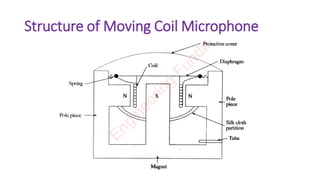
Structure of Moving Coil Microphone
E
n
g
i
n
e
e
r
i
n
g
F
u
n
d
a
Elements
❖ Magnet :
❑ permanent POT Type
❑ gives uniform magnetic field in the gap
❖ Diaphragm :
❑ thin circular sheet of nonmagnetic material
❑ It is of light weight
❑ slightly domed for extra rigidity
❑ fixed with the help of springs
❖ Springs :
❑ provides compliance to the motion of diaphragm
❖ Mass of the diaphragm and coil assembly :
❑ provide inductive effect
❖ Protective cover :
❑ metal grill
❑ To save delicate diaphragm and coil assembly from being mishandled
E
n
g
i
n
e
e
r
i
n
g
F
u
n
d
a
Working
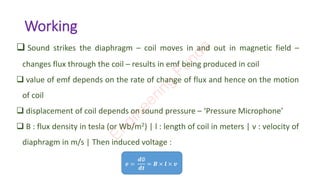
❑ Sound strikes the diaphragm – coil moves in and out in magnetic field –
changes flux through the coil – results in emf being produced in coil
❑ value of emf depends on the rate of change of flux and hence on the motion
of coil
❑ displacement of coil depends on sound pressure – ‘Pressure Microphone’
❑ B : flux density in tesla (or Wb/m2) | l : length of coil in meters | v : velocity of
diaphragm in m/s | Then induced voltage :
𝒆 =
𝒅∅
𝒅𝒕
= 𝑩 × 𝒍 × 𝒗
E
n
g
i
n
e
e
r
i
n
g
F
u
n
d
a
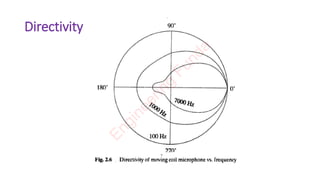
Directivity
E
n
g
i
n
e
e
r
i
n
g
F
u
n
d
a
Characteristics
❖ Sensitivity : 30 µV for SPL of 0.1 Pa
❖ SNR : 30 dB
❖ Freq Response : 60 Hz to 8000 Hz for ±1dB
❖ Distortion : less than 5%
❖ Directivity : basically Omni-directional
❖ O/P Impedance : quite low – about 25 ohm – to match line of
200 ohm – step up transformer of about 3:1 turns ratio is built
E
n
g
i
n
e
e
r
i
n
g
F
u
n
d
a
Features
❑ magnet is quite heavy – heavy protective case – very
robust and reliable
❑ does not need external bias
❑ can be spoken into from distance of 25 cm
❑ cost is not high – lower cost than ribbon and capacitor –
higher than crystal and carbon
E
n
g
i
n
e
e
r
i
n
g
F
u
n
d
a
Applications
❑ Suitable for PA systems
❑ Broadcast studios
E
n
g
i
n
e
e
r
i
n
g
F
u
n
d
a

Moving Coil Microphone

  • 1.
    Moving Coil Microphone By Prof.Hitesh Dholakiya E n g i n e e r i n g F u n d a Engineering Funda Android App Audio Video YT Playlist
  • 2.
    Outlines ❖ Basics ofMoving Coil Microphone ❖ Structure of Moving Coil Microphone ❖ Elements of Moving Coil Microphone ❖ Working of Moving Coil Microphone ❖ Directivity of Moving Coil Microphone ❖ Characteristics of Moving Coil Microphone ❖ Features of Moving Coil Microphone ❖ Applications of Moving Coil Microphone E n g i n e e r i n g F u n d a Engineering Funda Android App Audio Video YT Playlist
  • 3.
    Basics ❖ It isalso called Dynamic µP ❖ It uses the principle of Electromagnetic Induction ❖ sound pressure – moves coil placed in magnetic field – change in flux – emf is produced – forms output of µP E n g i n e e r i n g F u n d a Engineering Funda Android App Audio Video YT Playlist
  • 4.
    Structure of MovingCoil Microphone E n g i n e e r i n g F u n d a
  • 5.
    Elements ❖ Magnet : ❑permanent POT Type ❑ gives uniform magnetic field in the gap ❖ Diaphragm : ❑ thin circular sheet of nonmagnetic material ❑ It is of light weight ❑ slightly domed for extra rigidity ❑ fixed with the help of springs ❖ Springs : ❑ provides compliance to the motion of diaphragm ❖ Mass of the diaphragm and coil assembly : ❑ provide inductive effect ❖ Protective cover : ❑ metal grill ❑ To save delicate diaphragm and coil assembly from being mishandled E n g i n e e r i n g F u n d a
  • 6.
    Working ❑ Sound strikesthe diaphragm – coil moves in and out in magnetic field – changes flux through the coil – results in emf being produced in coil ❑ value of emf depends on the rate of change of flux and hence on the motion of coil ❑ displacement of coil depends on sound pressure – ‘Pressure Microphone’ ❑ B : flux density in tesla (or Wb/m2) | l : length of coil in meters | v : velocity of diaphragm in m/s | Then induced voltage : 𝒆 = 𝒅∅ 𝒅𝒕 = 𝑩 × 𝒍 × 𝒗 E n g i n e e r i n g F u n d a
  • 7.
  • 8.
    Characteristics ❖ Sensitivity :30 µV for SPL of 0.1 Pa ❖ SNR : 30 dB ❖ Freq Response : 60 Hz to 8000 Hz for ±1dB ❖ Distortion : less than 5% ❖ Directivity : basically Omni-directional ❖ O/P Impedance : quite low – about 25 ohm – to match line of 200 ohm – step up transformer of about 3:1 turns ratio is built E n g i n e e r i n g F u n d a
  • 9.
    Features ❑ magnet isquite heavy – heavy protective case – very robust and reliable ❑ does not need external bias ❑ can be spoken into from distance of 25 cm ❑ cost is not high – lower cost than ribbon and capacitor – higher than crystal and carbon E n g i n e e r i n g F u n d a
  • 10.
    Applications ❑ Suitable forPA systems ❑ Broadcast studios E n g i n e e r i n g F u n d a