Movement and behavior of scarlet
macaws (Ara macao) during the post-
fledging dependence period
1 Conservation Biology Program, University of Minnesota
Mark Myers1 and Christopher Vaughan2
2 Department of Wildlife Ecology & Gaylord Nelson Institute
of Environmental Studies, University of Wisconsin
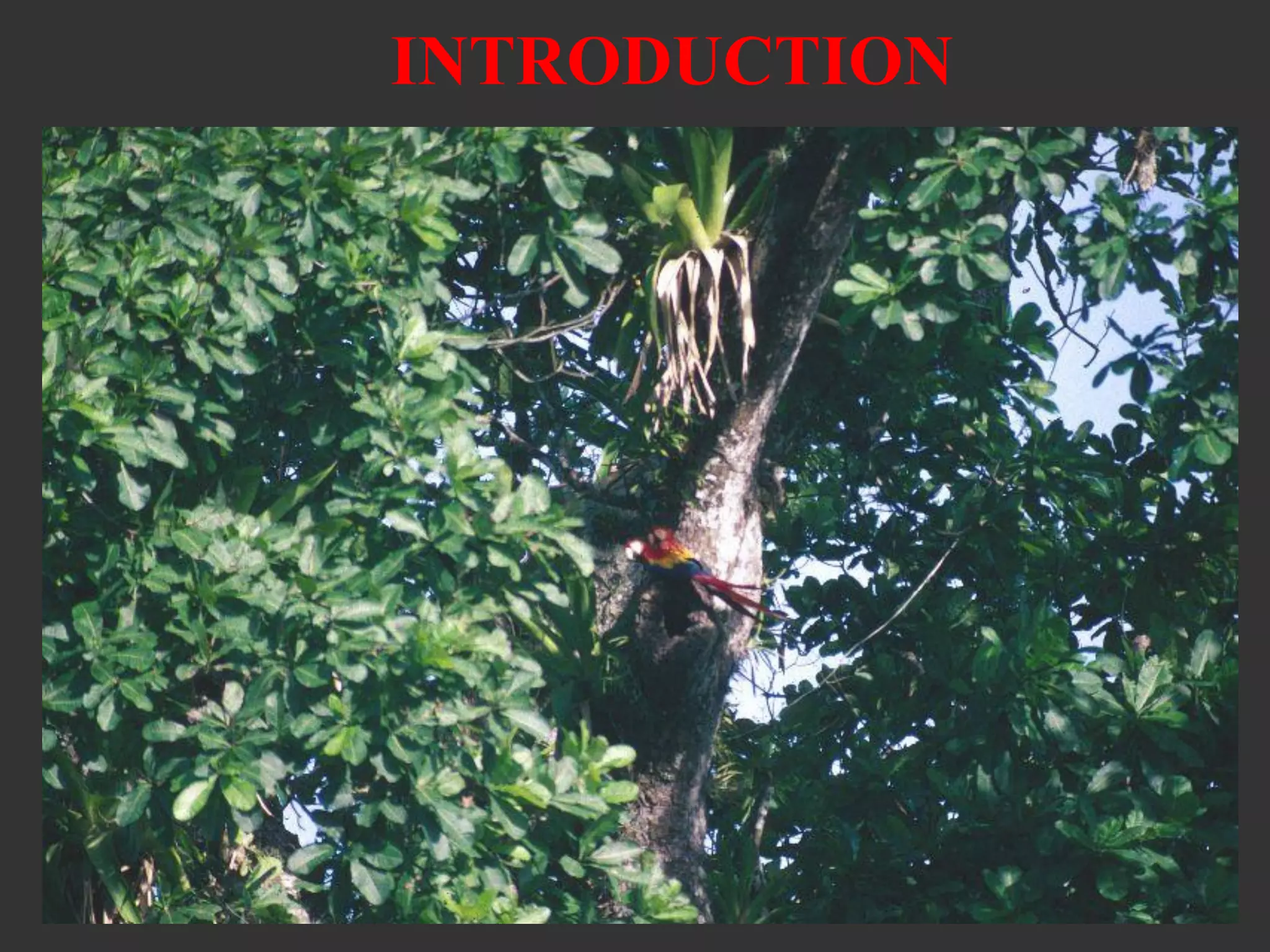
INTRODUCTION
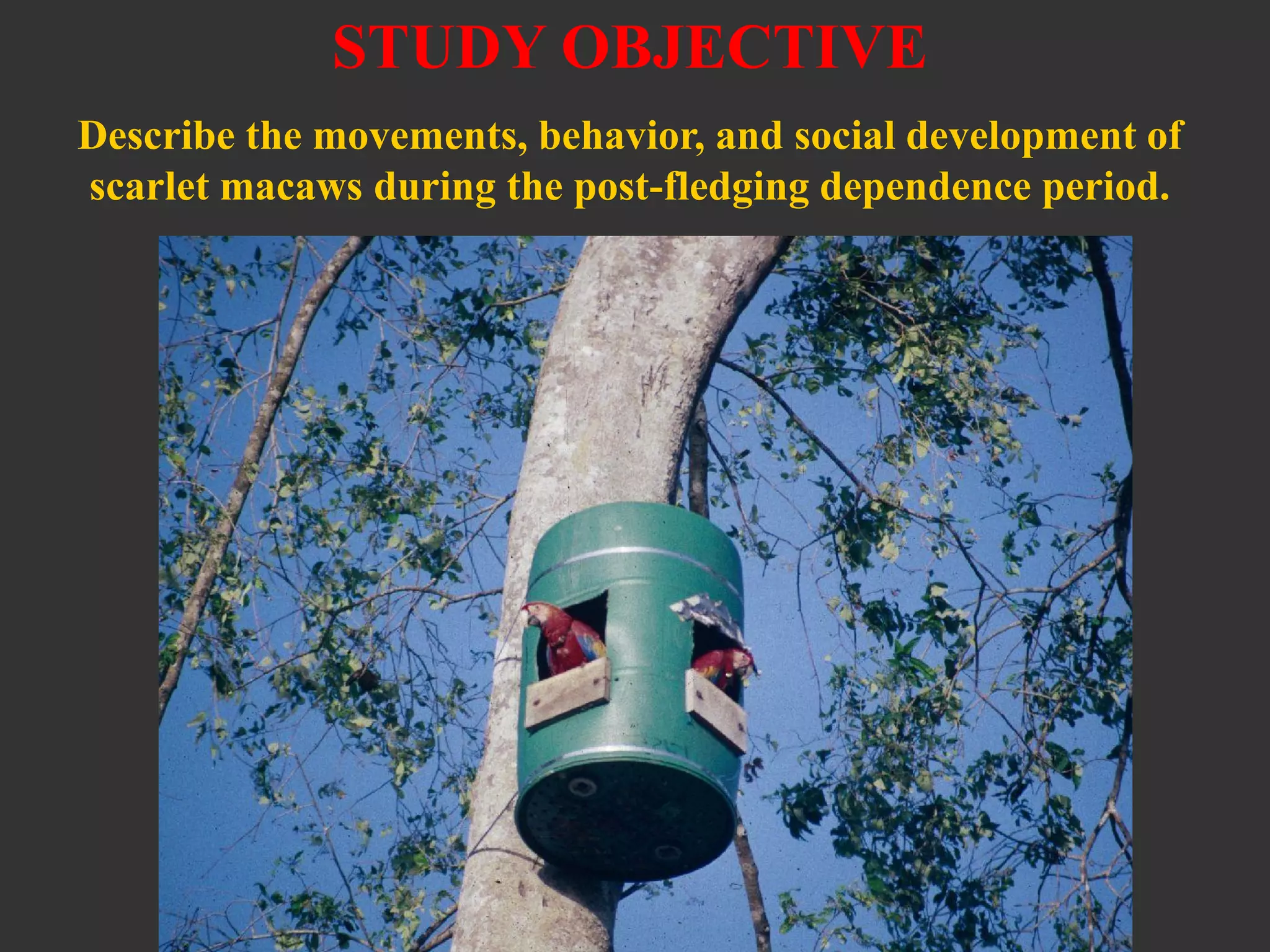
STUDY OBJECTIVE
Describe the movements, behavior, and social development of
scarlet macaws during the post-fledging dependence period.
MOTIVATION
1) Post-fledgling dependence period is little-known, yet potentially
sensitive in terms of population demography.
2) Management options to reduce poaching.
• In situ
– Artificial nestbox program
– Guard active nest cavities
– Community involvement
and education
• Ex situ
– Remove eggs or nestlings
from high-risk nests
– Hand-rear and release
young macaws
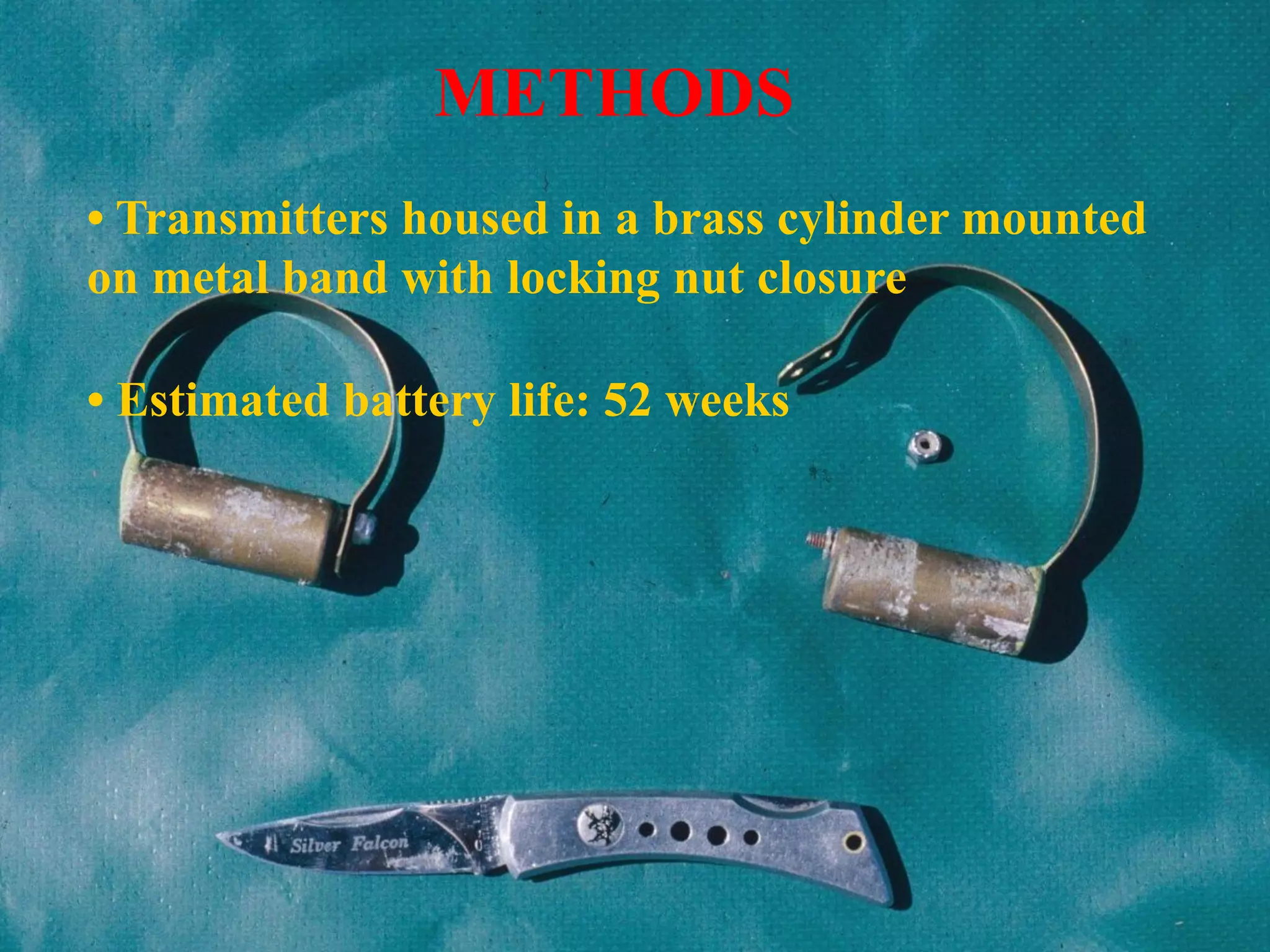
• Transmitters housed in a brass cylinder mounted
on metal band with locking nut closure
• Estimated battery life: 52 weeks
METHODS
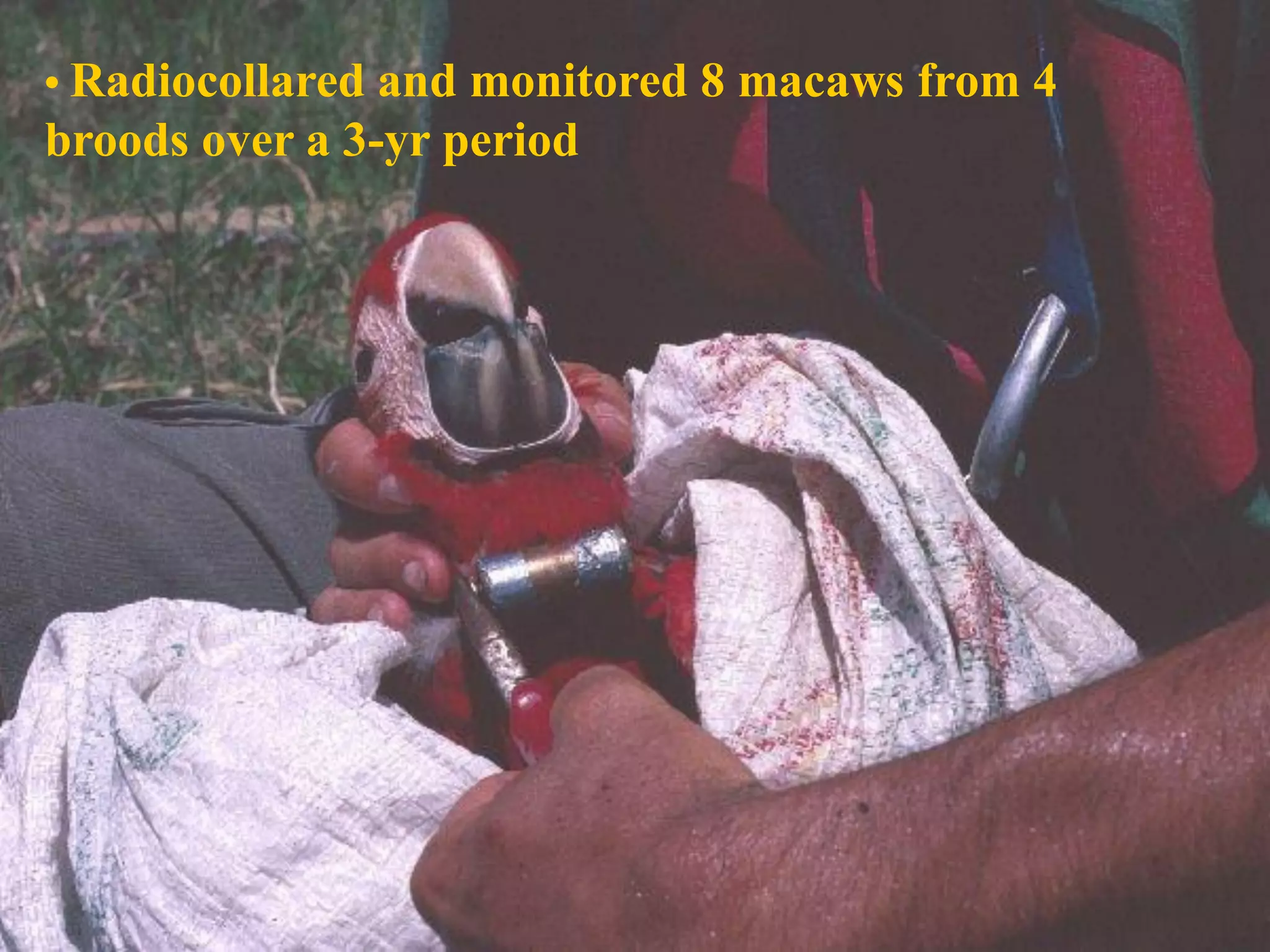
• Radiocollared and monitored 8 macaws from 4
broods over a 3-yr period
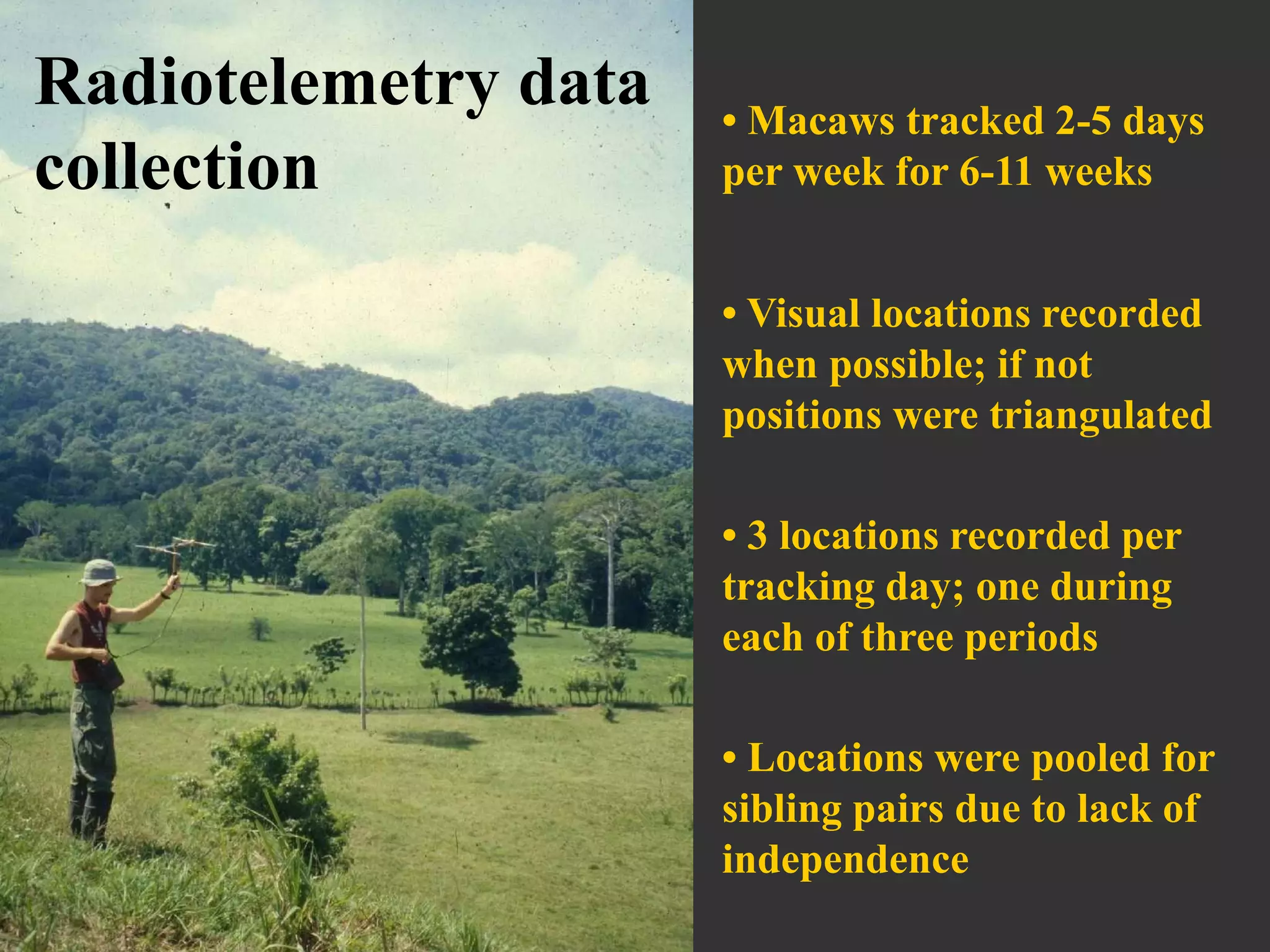
• Macaws tracked 2-5 days
per week for 6-11 weeks
• Visual locations recorded
when possible; if not
positions were triangulated
• Locations were pooled for
sibling pairs due to lack of
independence
Radiotelemetry data
collection
• 3 locations recorded per
tracking day; one during
each of three periods
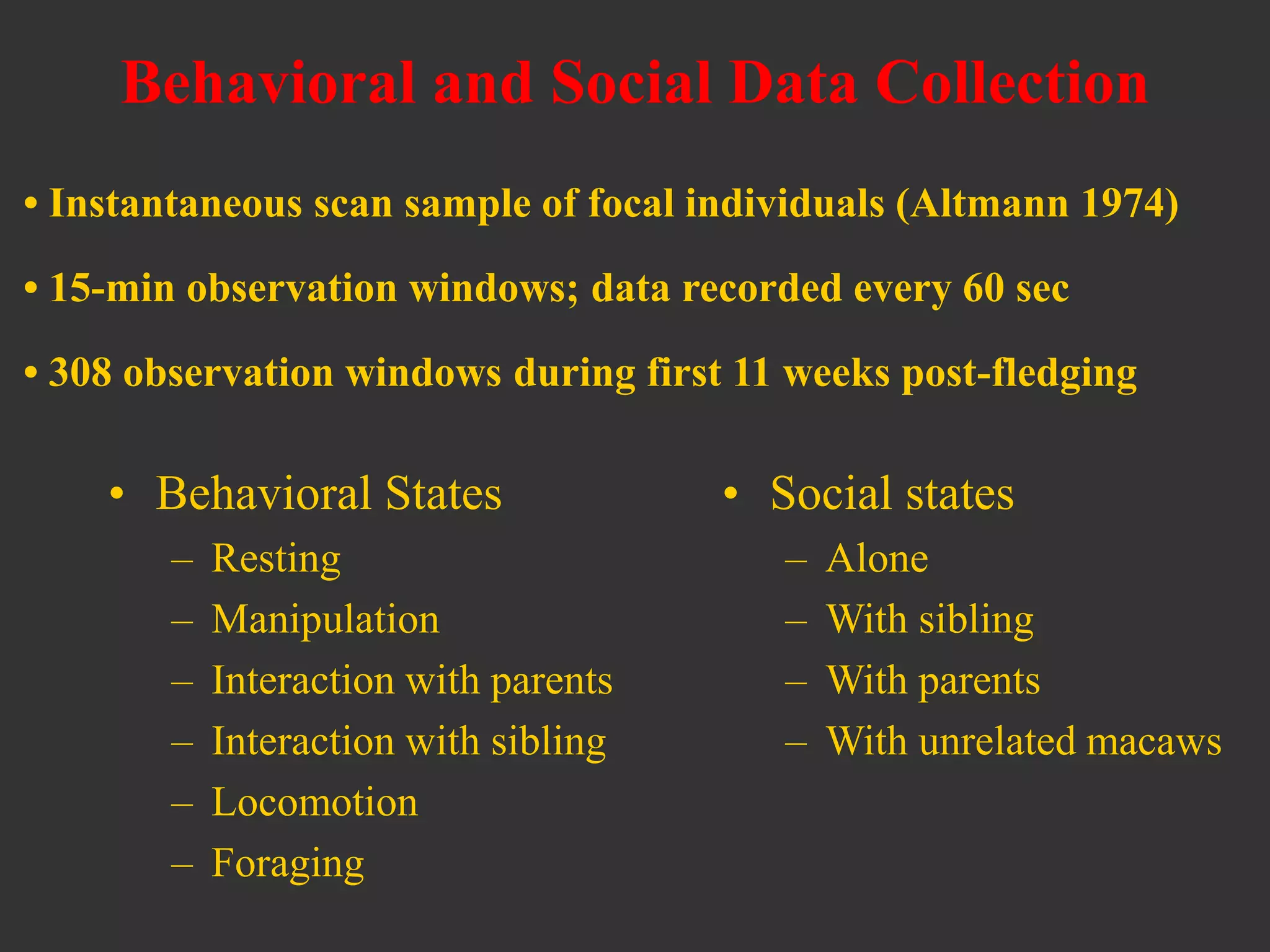
Behavioral and Social Data Collection
• Behavioral States
– Resting
– Manipulation
– Interaction with parents
– Interaction with sibling
– Locomotion
– Foraging
• Social states
– Alone
– With sibling
– With parents
– With unrelated macaws
• Instantaneous scan sample of focal individuals (Altmann 1974)
• 15-min observation windows; data recorded every 60 sec
• 308 observation windows during first 11 weeks post-fledging
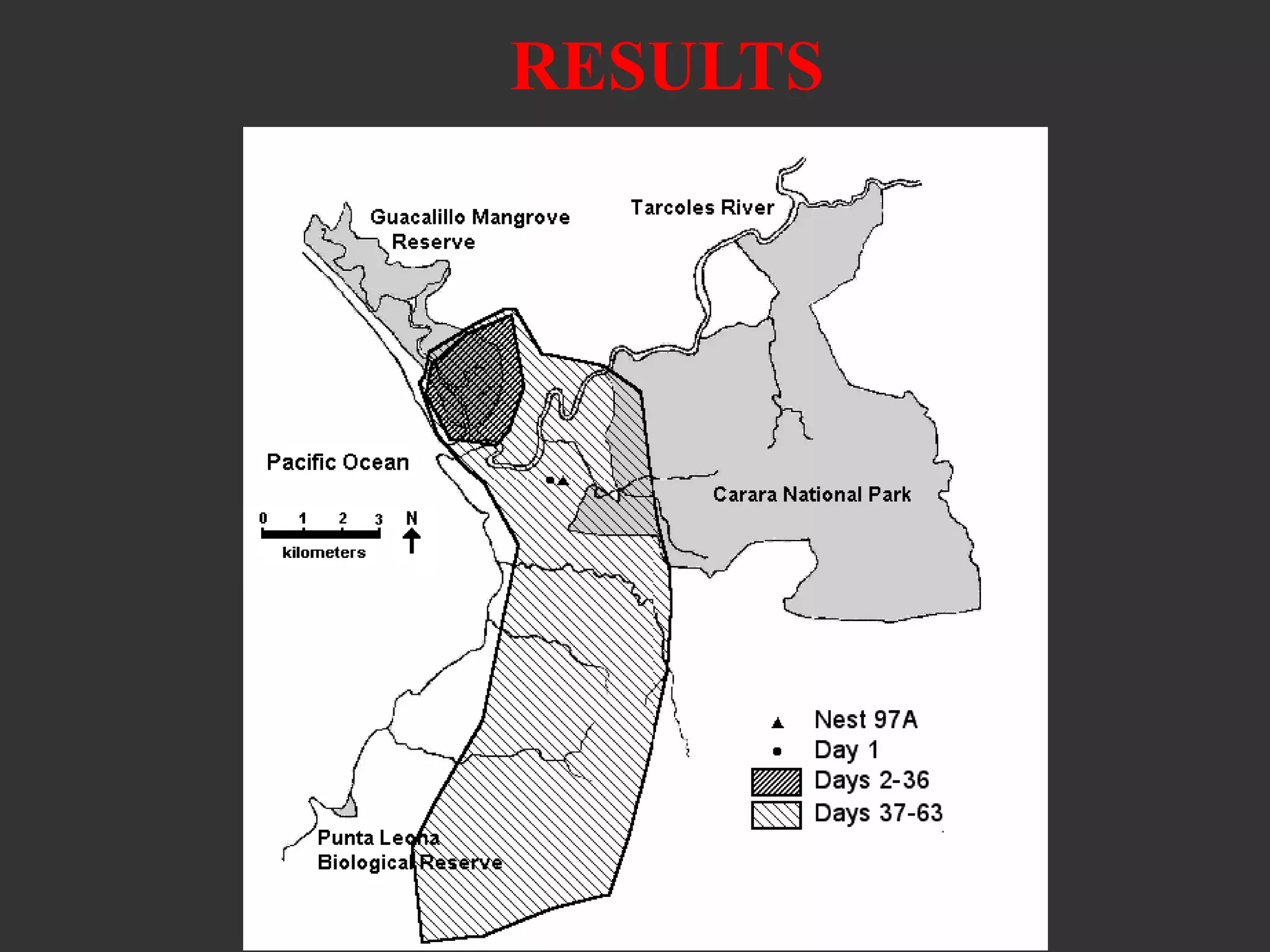
RESULTS
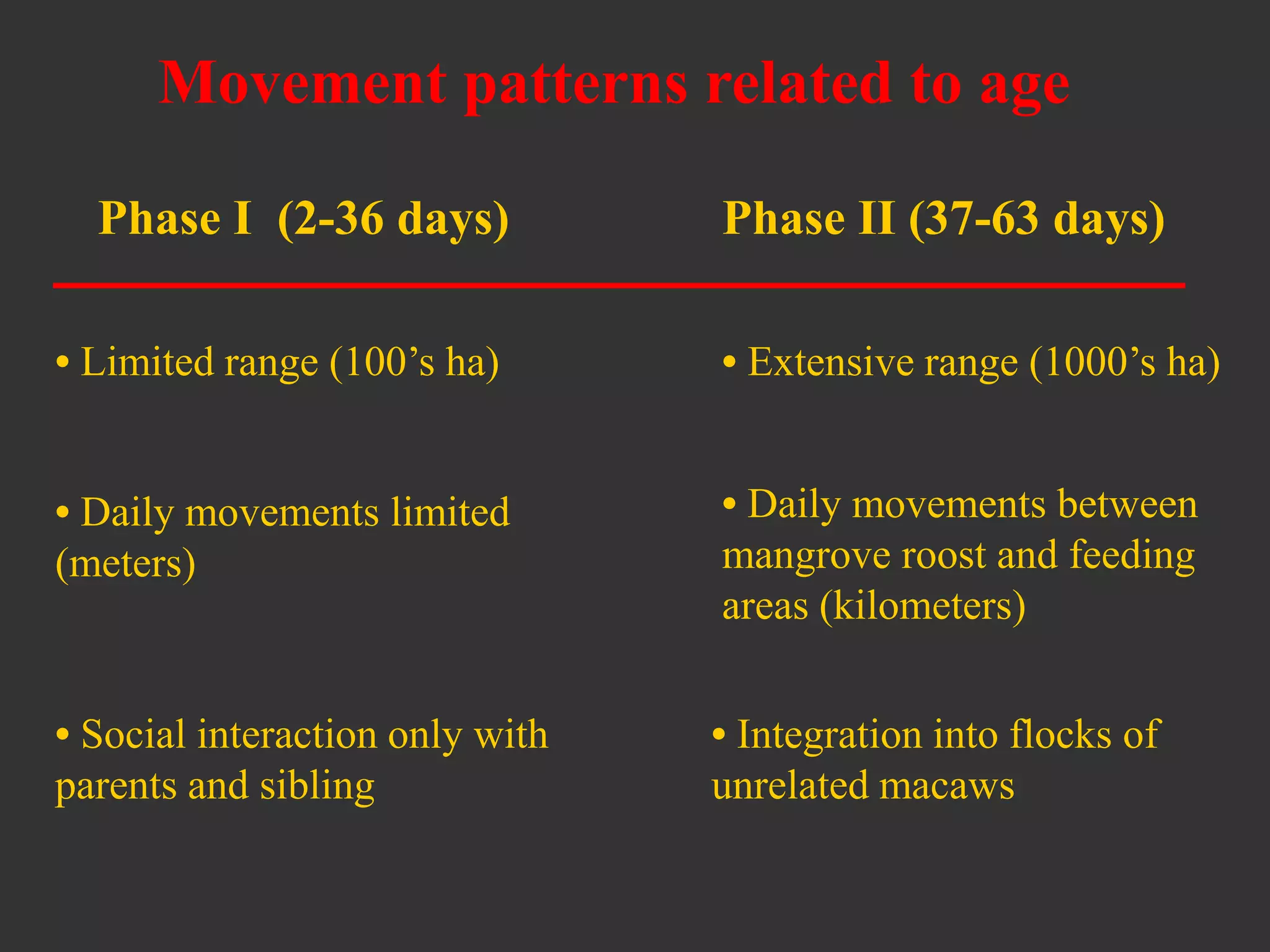
Phase I (2-36 days)
• Social interaction only with
parents and sibling
Phase II (37-63 days)
Movement patterns related to age
• Daily movements limited
(meters)
• Limited range (100’s ha) • Extensive range (1000’s ha)
• Integration into flocks of
unrelated macaws
• Daily movements between
mangrove roost and feeding
areas (kilometers)
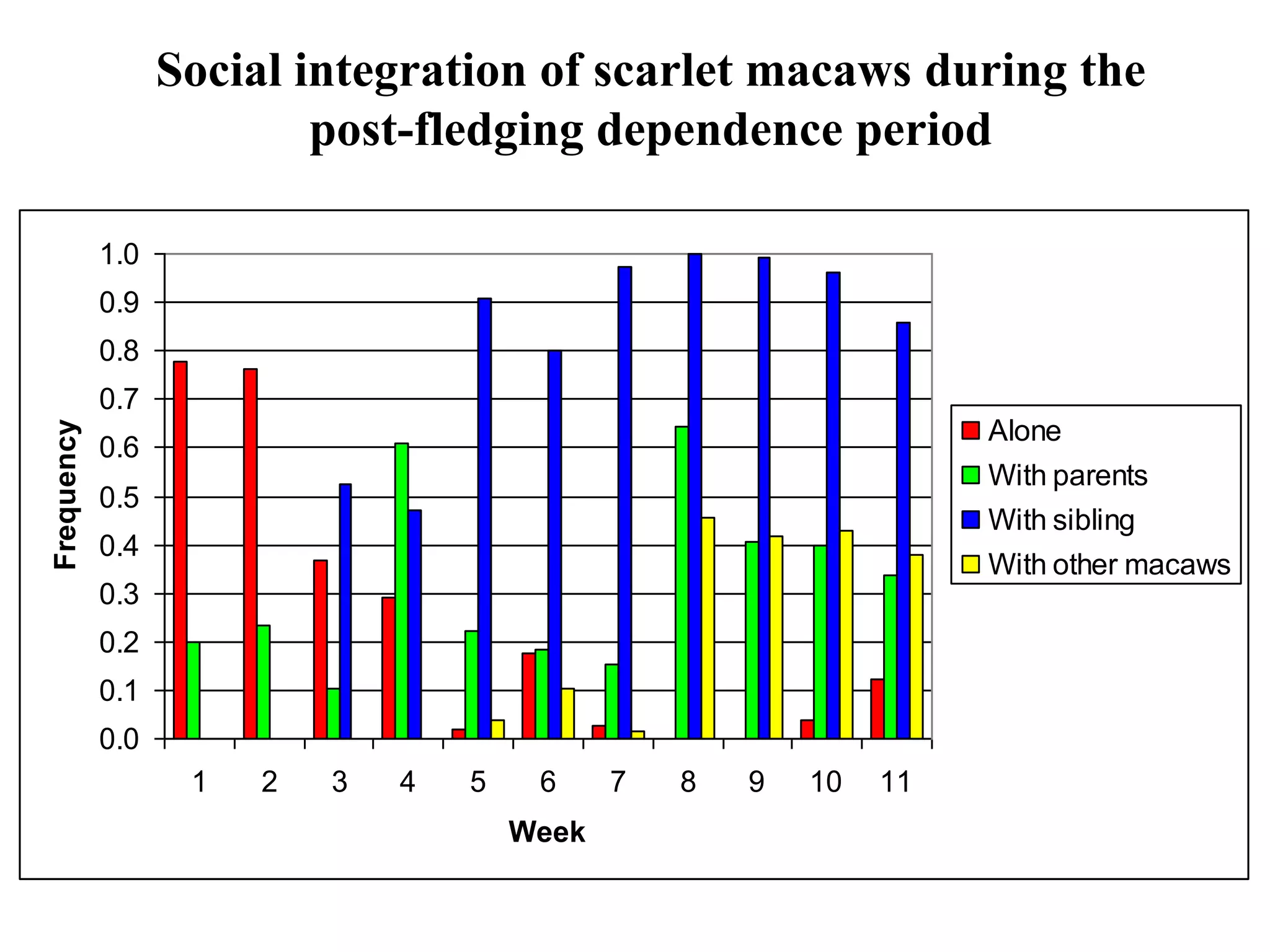
0.0
0.1
0.2
0.3
0.4
0.5
0.6
0.7
0.8
0.9
1.0
1 2 3 4 5 6 7 8 9 10 11
Week
Frequency
Alone
With parents
With sibling
With other macaws
Social integration of scarlet macaws during the
post-fledging dependence period
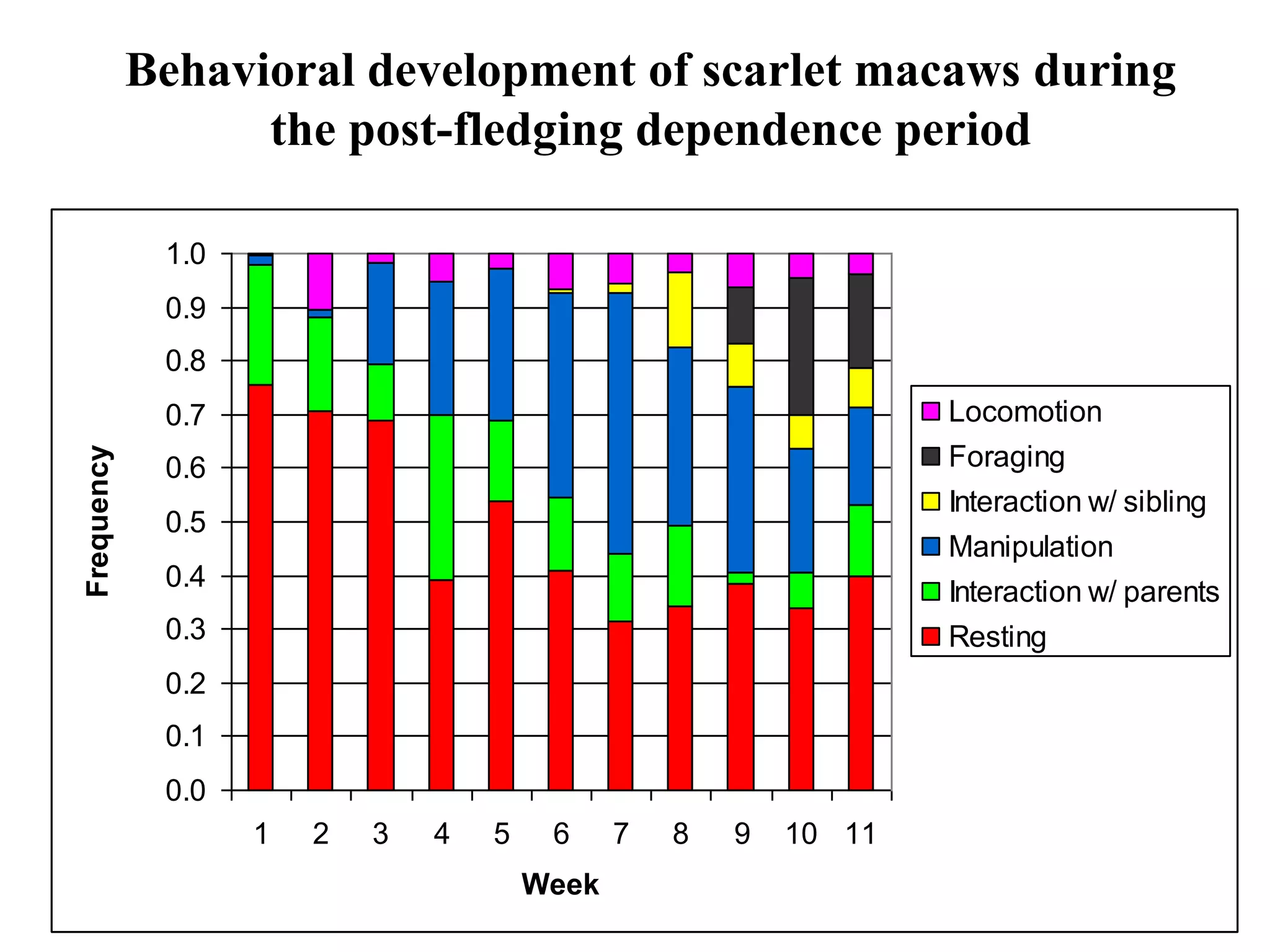
0.0
0.1
0.2
0.3
0.4
0.5
0.6
0.7
0.8
0.9
1.0
1 2 3 4 5 6 7 8 9 10 11
Week
Frequency
Locomotion
Foraging
Interaction w/ sibling
Manipulation
Interaction w/ parents
Resting
Behavioral development of scarlet macaws during
the post-fledging dependence period
• Cost of guarding 3-6 nestboxes concentrated in a small area for
the duration of the nesting season is US $1500
• We recommend extending protection and monitoring into
the early post-fledging period
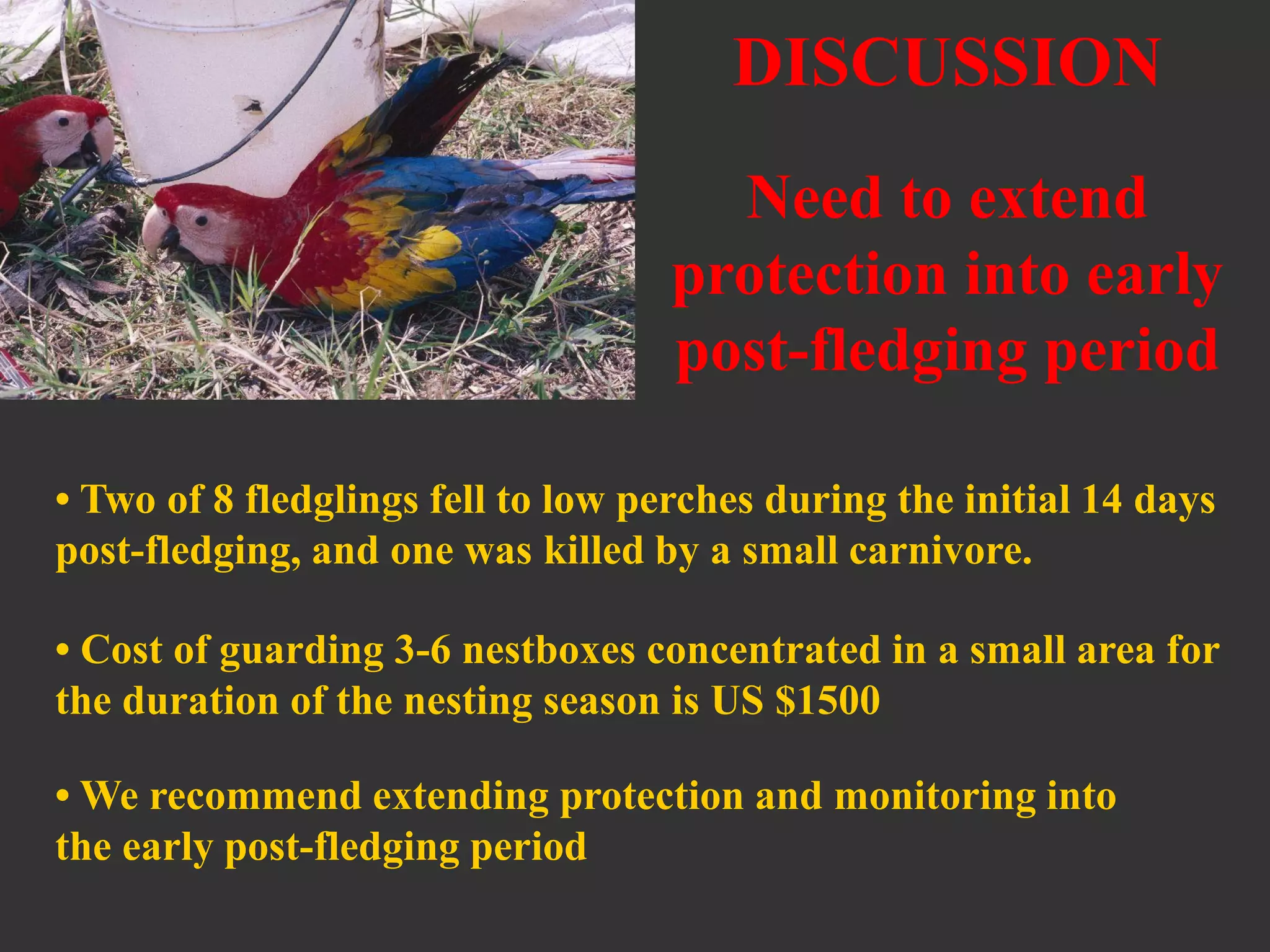
• Two of 8 fledglings fell to low perches during the initial 14 days
post-fledging, and one was killed by a small carnivore.
Need to extend
protection into early
post-fledging period
DISCUSSION
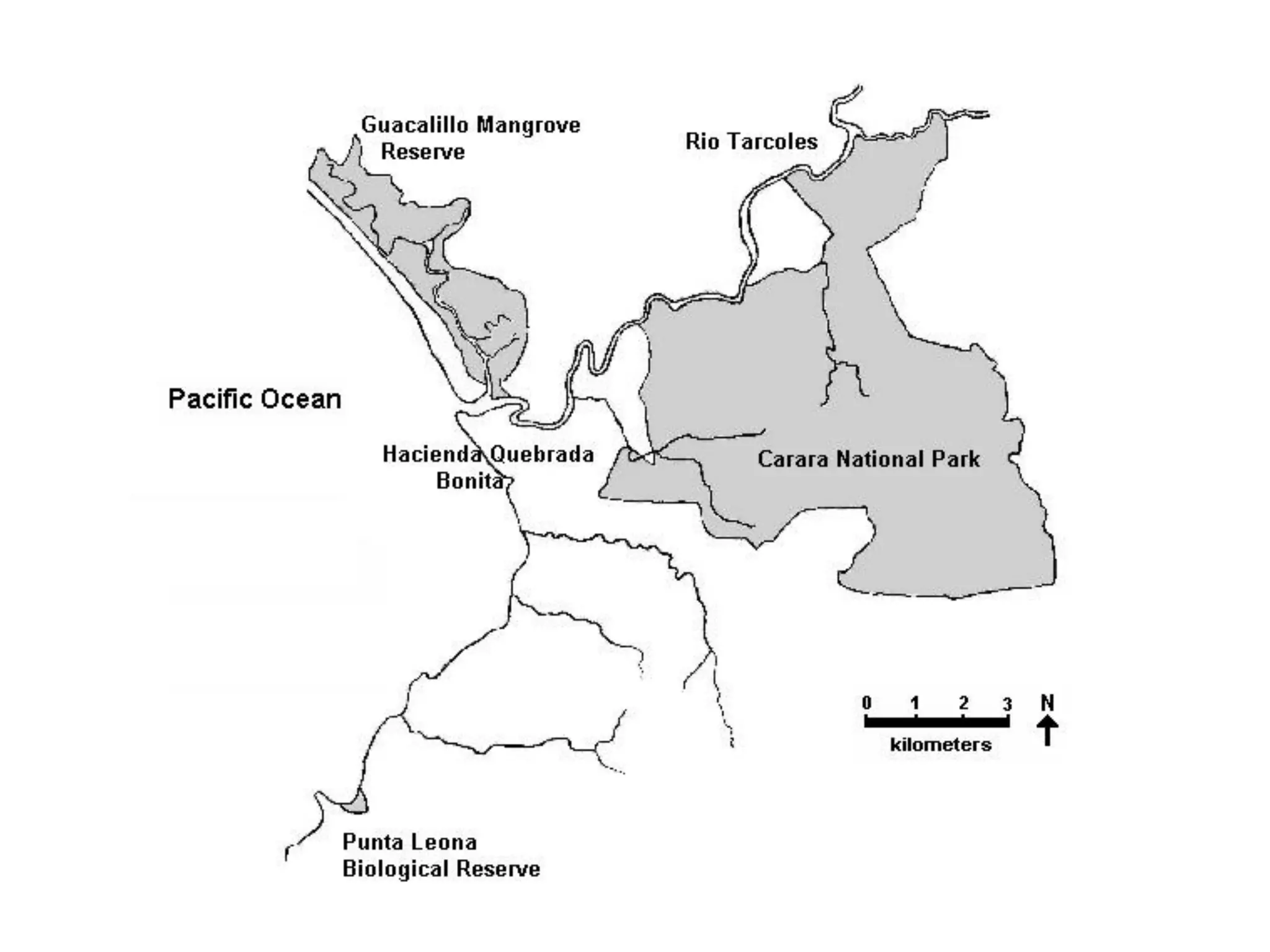
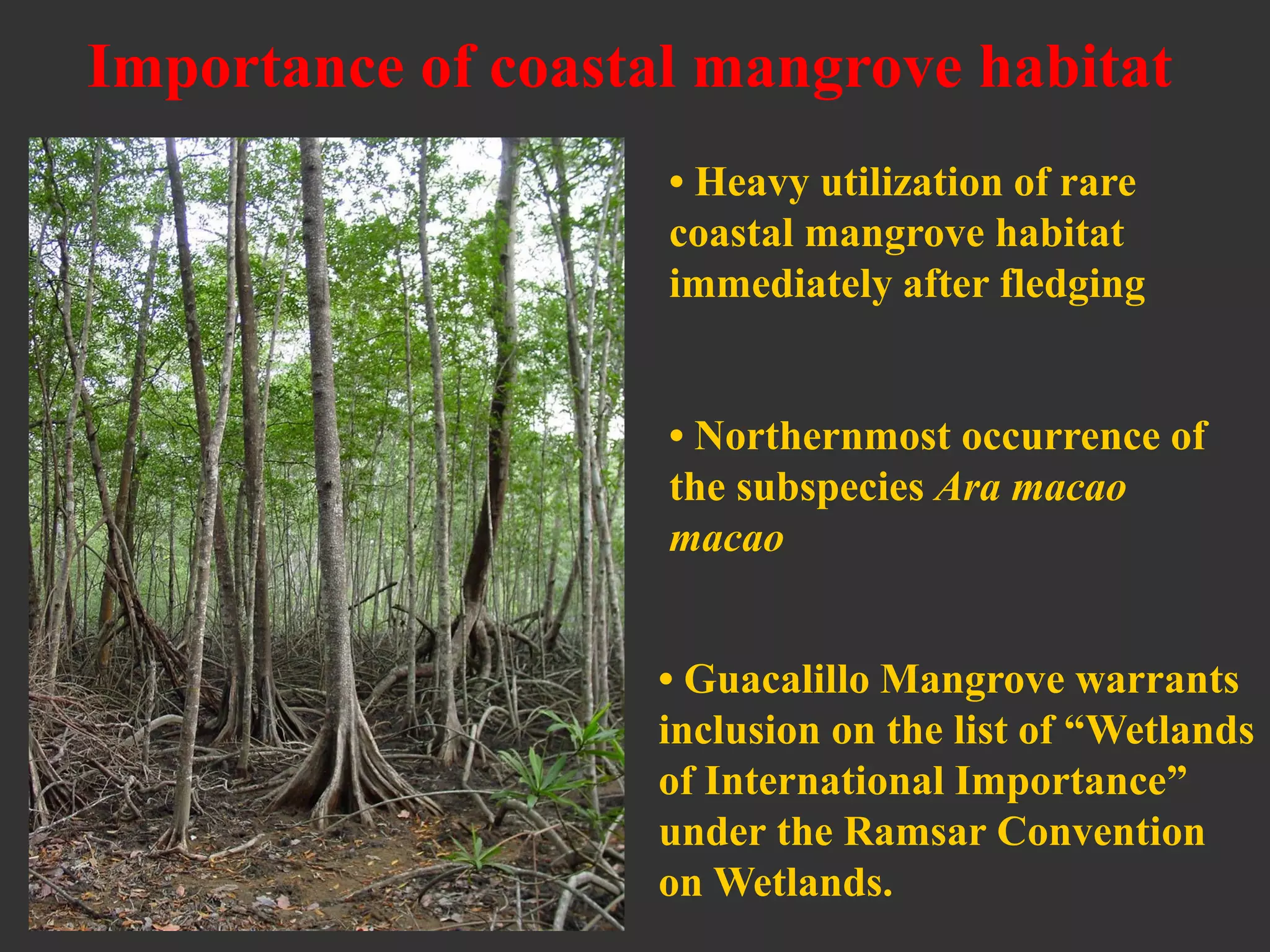
• Heavy utilization of rare
coastal mangrove habitat
immediately after fledging
• Guacalillo Mangrove warrants
inclusion on the list of “Wetlands
of International Importance”
under the Ramsar Convention
on Wetlands.
• Northernmost occurrence of
the subspecies Ara macao
macao
Importance of coastal mangrove habitat
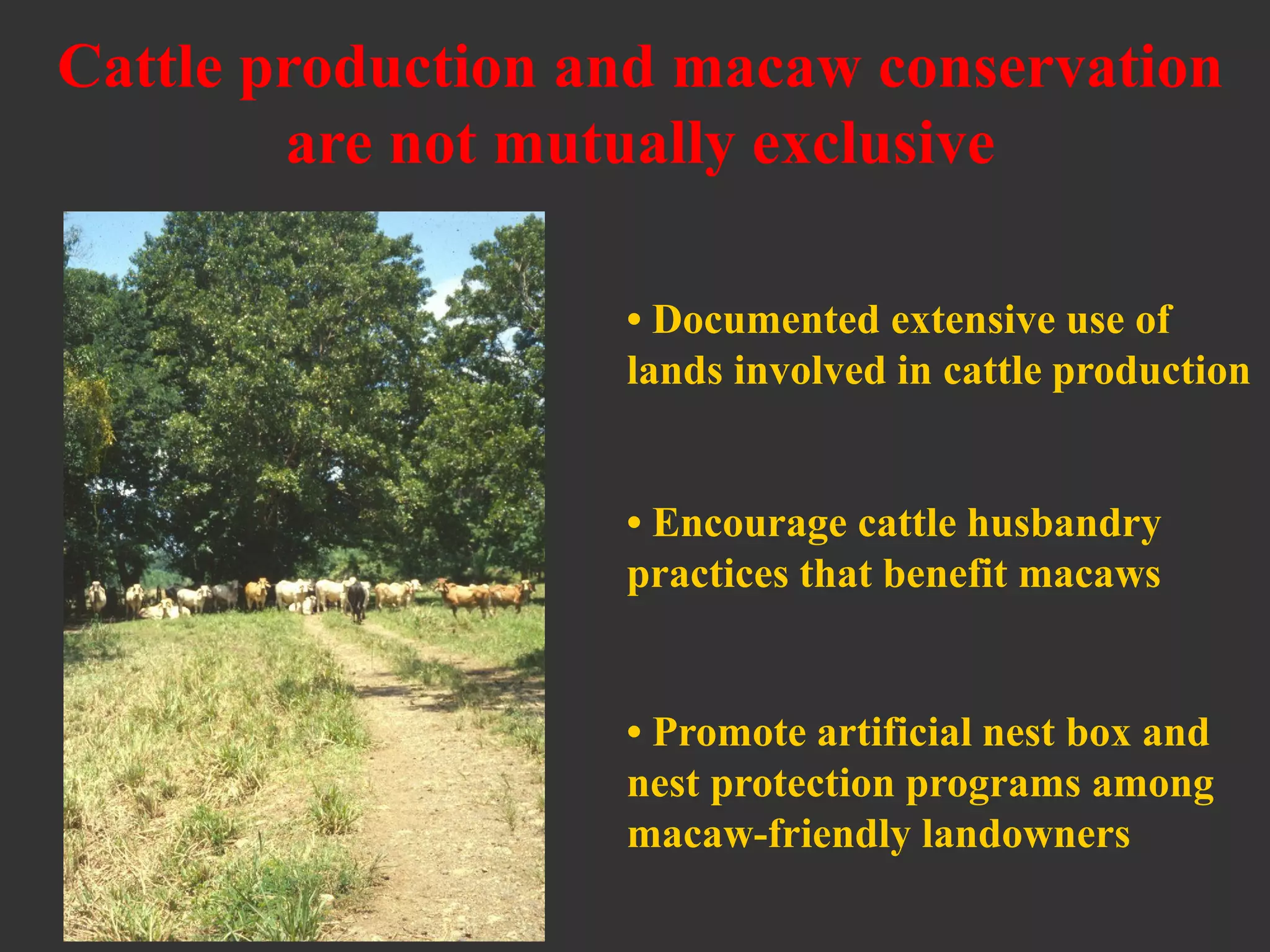
• Documented extensive use of
lands involved in cattle production
• Promote artificial nest box and
nest protection programs among
macaw-friendly landowners
• Encourage cattle husbandry
practices that benefit macaws
Cattle production and macaw conservation
are not mutually exclusive
Implications for in situ vs. ex situ management
• Our results suggest that the post-fledging period is a sensitive
time when young macaws gradually develop behaviors and
social relationships required for successful life in the wild.
• Conditions are difficult to reproduce in captive settings.
• From the avian literature, environmental and social contexts
of early learning influence developmental trajectory.
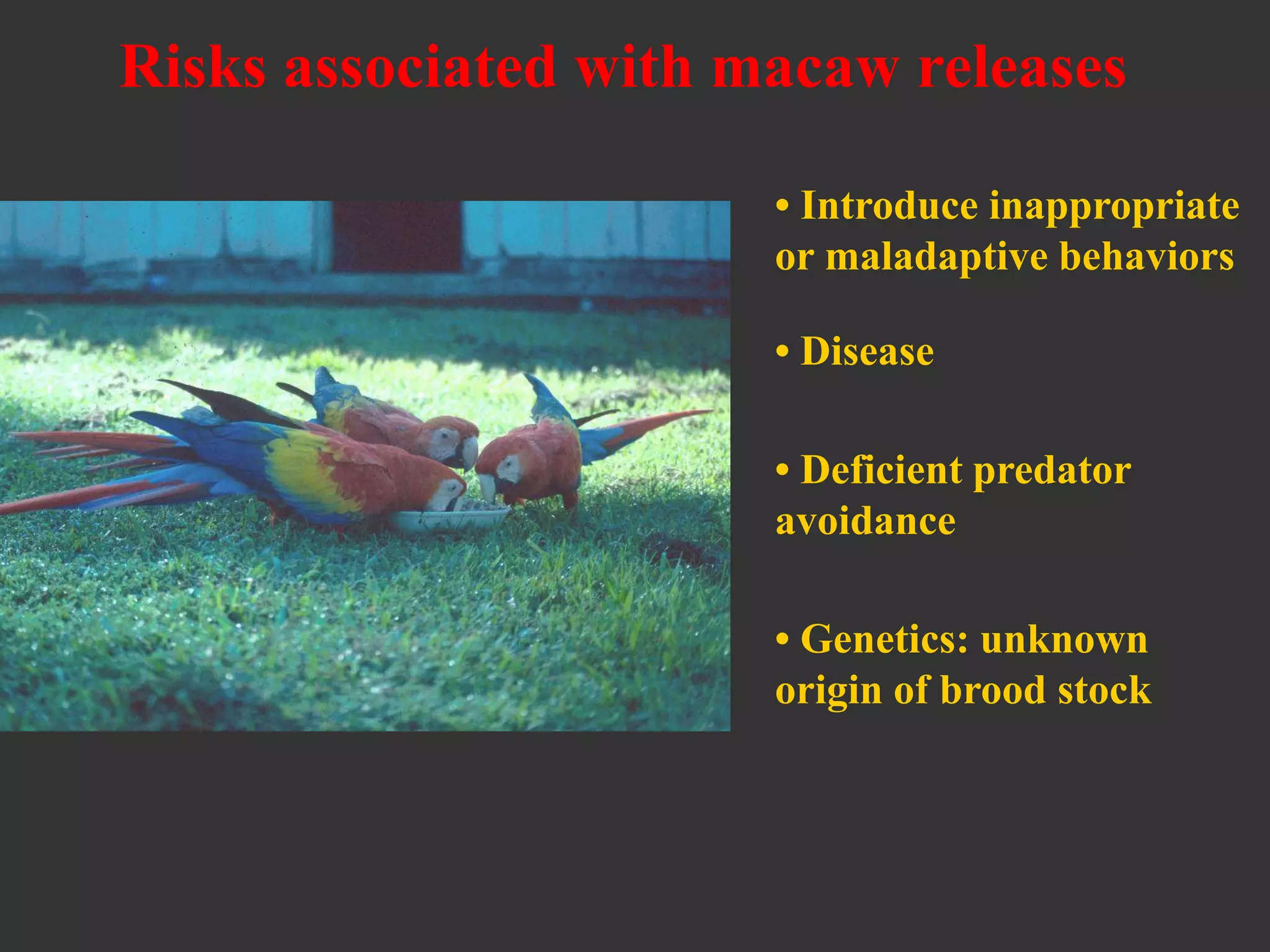
• Disease
• Introduce inappropriate
or maladaptive behaviors
Risks associated with macaw releases
• Genetics: unknown
origin of brood stock
• Deficient predator
avoidance
Long-term conservation of the Central
Pacific scarlet macaw population
• Increase recruitment of naturally fledged birds into the
population
• Active management and protection of natural and artificial
nest cavities
• Collaboration with local landowners and communities
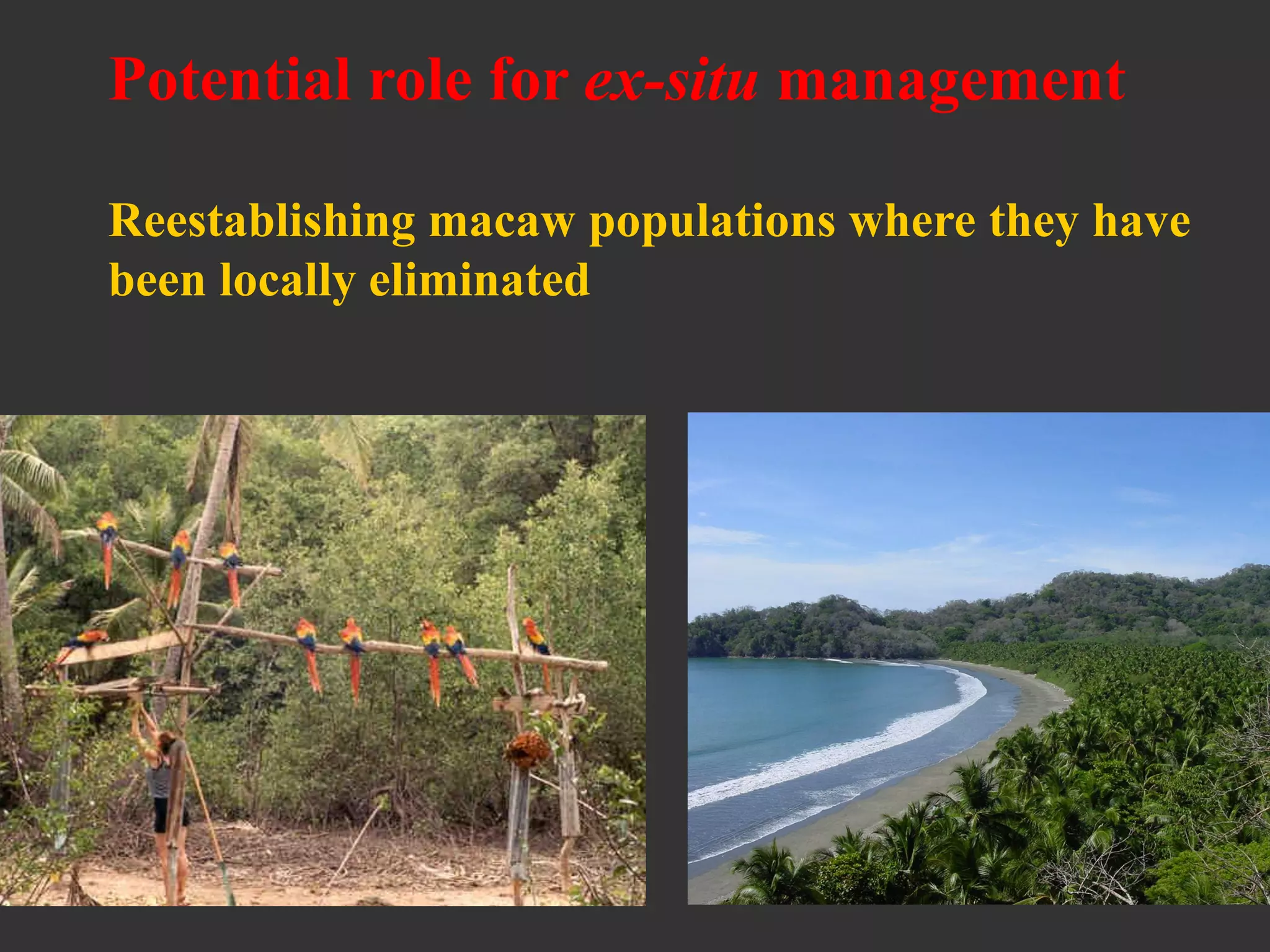
Potential role for ex-situ management
Reestablishing macaw populations where they have
been locally eliminated
Liberaciones de Ara macao en Costa
Rica (1997-2017)?
• 11 organizaciones +?
• 16 sitios de liberación +?
• Han liberadas ~700 lapas rojas desde
1997? Éxito?
• Con cuales fines tienen los proyectos?
• Futuro?
Preguntas Antes de Crear
Organización/Liberar Animales
• Genética- se tomó en cuenta?
• Enfermedades- Examinadas?
• Hábitat- hay alimentos todo el año, sitios de
anidación, sitios de pernoctar, etc?
• Aprendió en cautiverio (fuentes de comida-
donde/cuando/como, depredadores-cuales/defensa,
anidación-como/cuando/donde, ser humano?,
habilidades sociales, sitios de pernoctar, etc.)
• Existe monitoreo para determinar grado de éxito y
como mejorarlo?
• Poseen las aves habilidades
para la sobrevivencia y la
convivencia social?
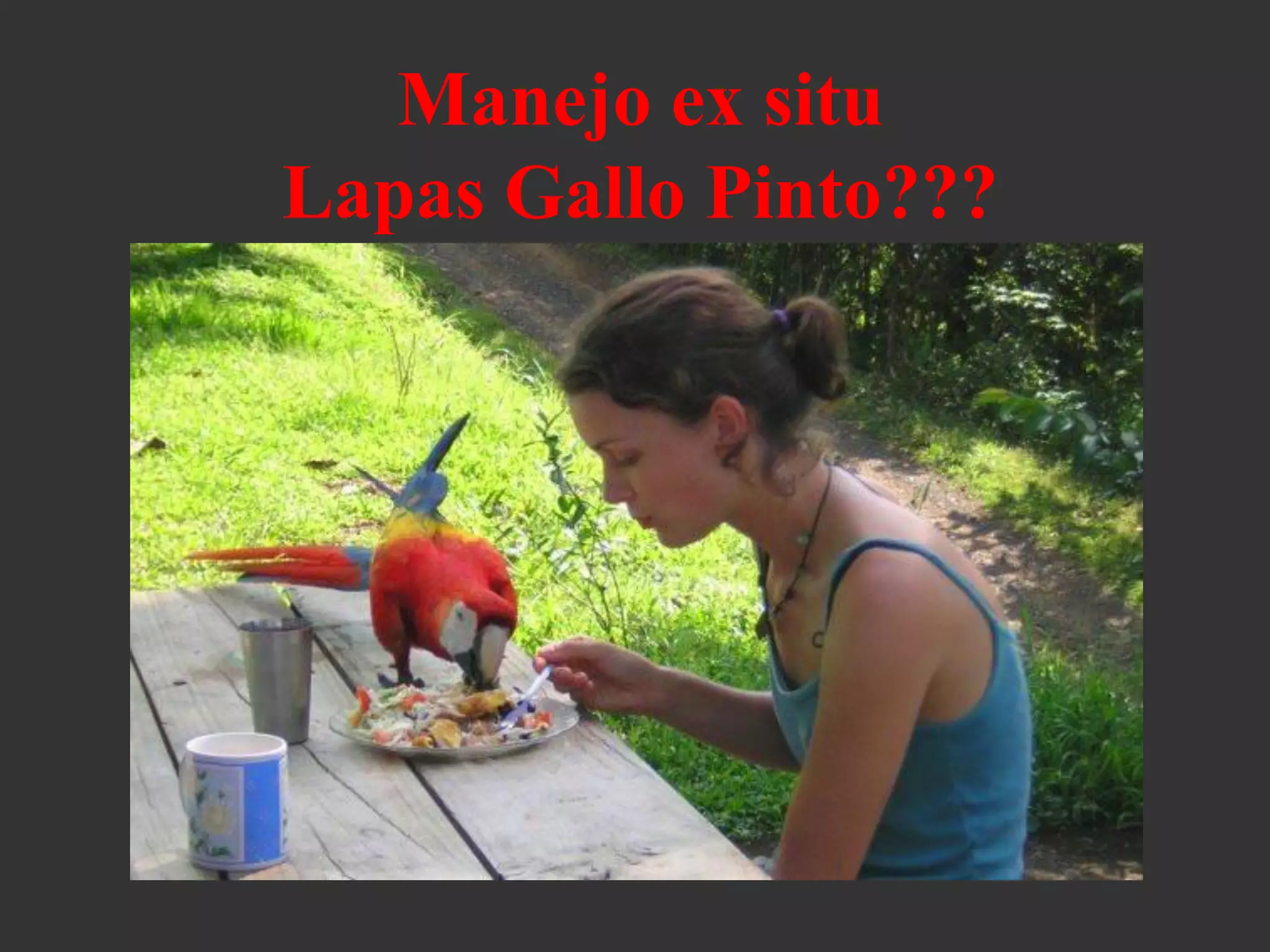
Manejo ex situ
Lapas Gallo Pinto???
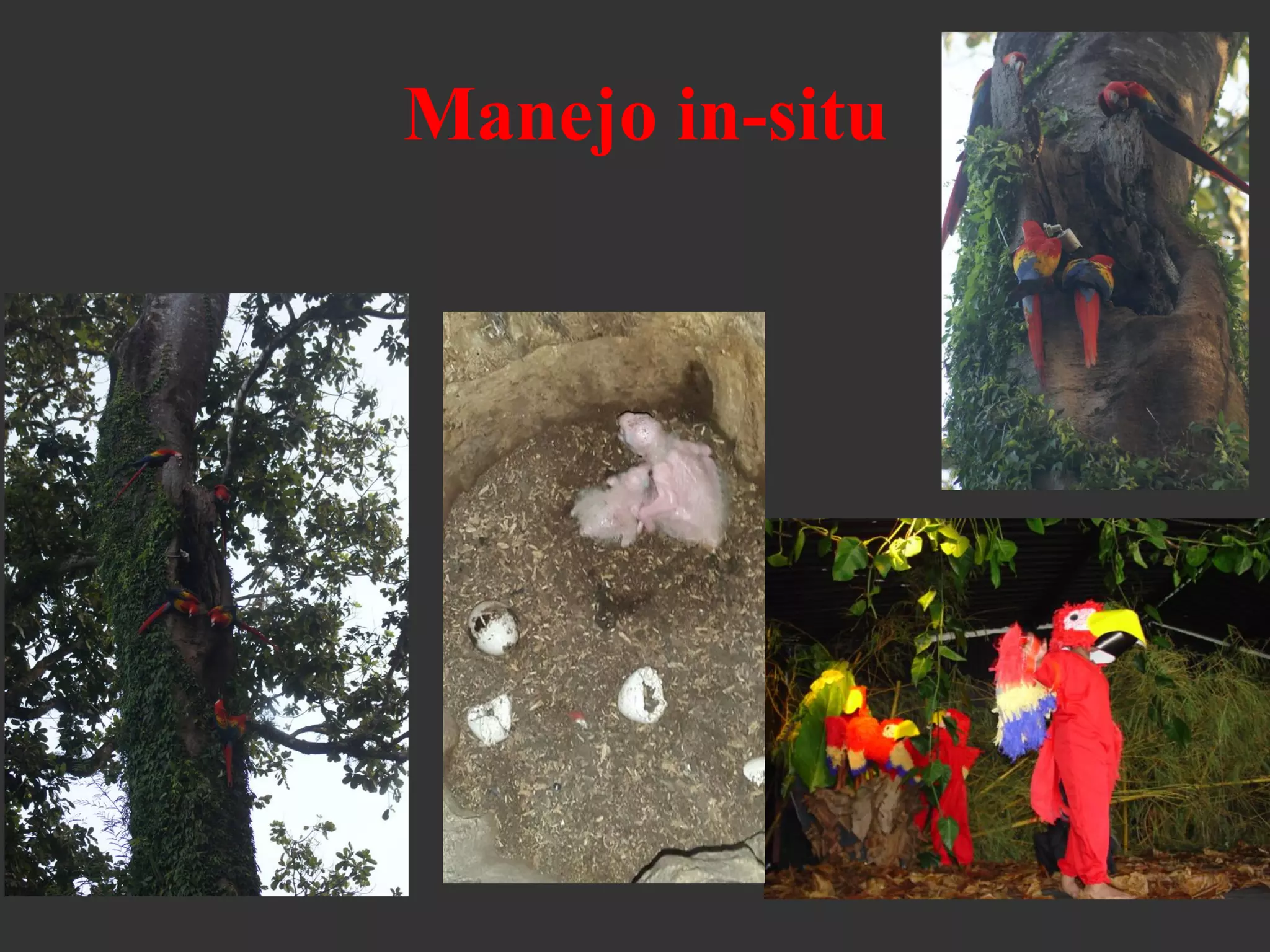
Manejo in-situ
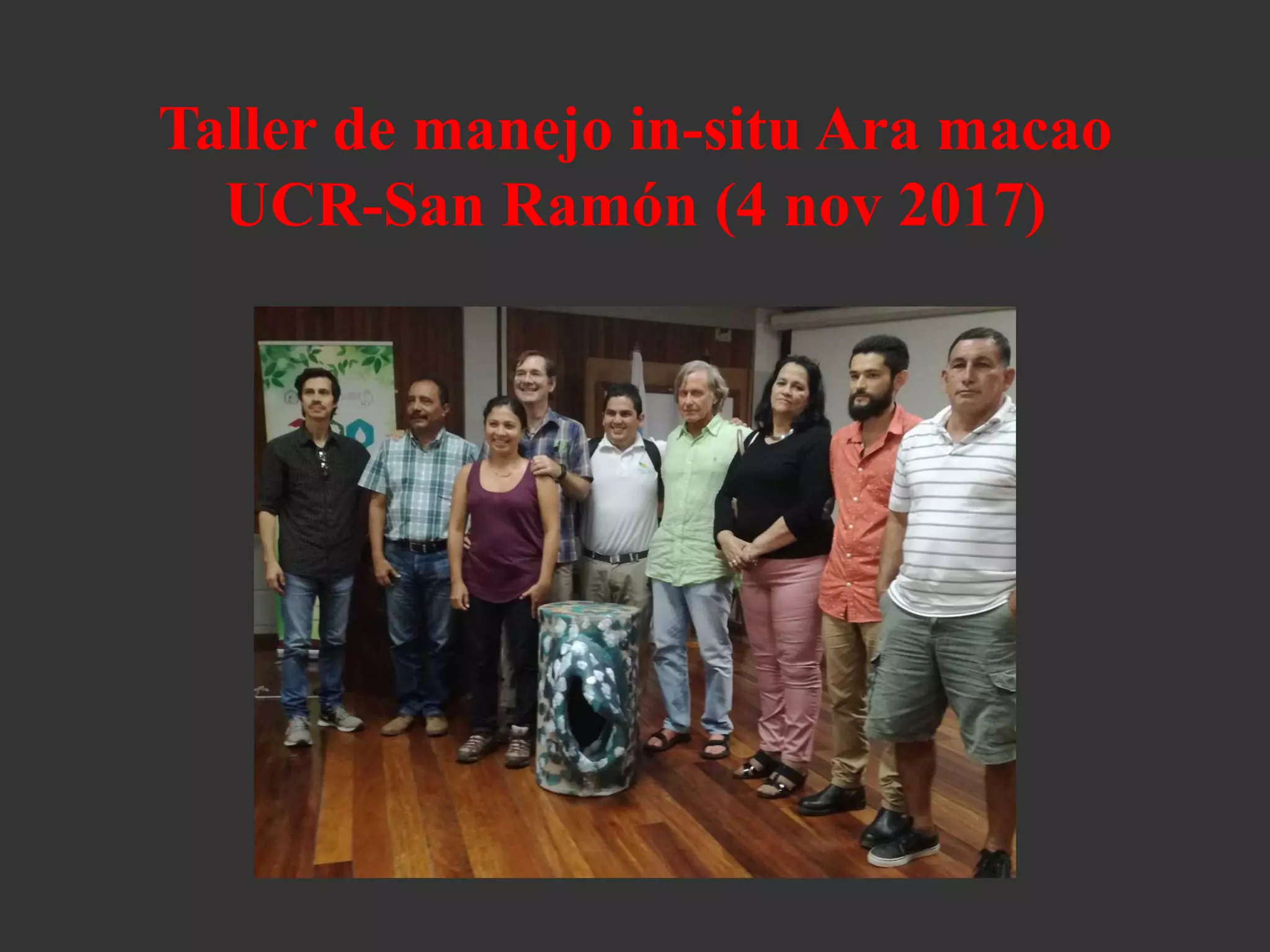
Taller de manejo in-situ Ara macao
UCR-San Ramón (4 nov 2017)

Movement and behavior of scarlet macaws (Ara macao) during the post fledging dependence period

  • 1.
    Movement and behaviorof scarlet macaws (Ara macao) during the post- fledging dependence period 1 Conservation Biology Program, University of Minnesota Mark Myers1 and Christopher Vaughan2 2 Department of Wildlife Ecology & Gaylord Nelson Institute of Environmental Studies, University of Wisconsin
  • 2.
  • 3.
    STUDY OBJECTIVE Describe themovements, behavior, and social development of scarlet macaws during the post-fledging dependence period.
  • 4.
    MOTIVATION 1) Post-fledgling dependenceperiod is little-known, yet potentially sensitive in terms of population demography. 2) Management options to reduce poaching. • In situ – Artificial nestbox program – Guard active nest cavities – Community involvement and education • Ex situ – Remove eggs or nestlings from high-risk nests – Hand-rear and release young macaws
  • 7.
    • Transmitters housedin a brass cylinder mounted on metal band with locking nut closure • Estimated battery life: 52 weeks METHODS
  • 8.
    • Radiocollared andmonitored 8 macaws from 4 broods over a 3-yr period
  • 9.
    • Macaws tracked2-5 days per week for 6-11 weeks • Visual locations recorded when possible; if not positions were triangulated • Locations were pooled for sibling pairs due to lack of independence Radiotelemetry data collection • 3 locations recorded per tracking day; one during each of three periods
  • 10.
    Behavioral and SocialData Collection • Behavioral States – Resting – Manipulation – Interaction with parents – Interaction with sibling – Locomotion – Foraging • Social states – Alone – With sibling – With parents – With unrelated macaws • Instantaneous scan sample of focal individuals (Altmann 1974) • 15-min observation windows; data recorded every 60 sec • 308 observation windows during first 11 weeks post-fledging
  • 11.
  • 12.
    Phase I (2-36days) • Social interaction only with parents and sibling Phase II (37-63 days) Movement patterns related to age • Daily movements limited (meters) • Limited range (100’s ha) • Extensive range (1000’s ha) • Integration into flocks of unrelated macaws • Daily movements between mangrove roost and feeding areas (kilometers)
  • 13.
    0.0 0.1 0.2 0.3 0.4 0.5 0.6 0.7 0.8 0.9 1.0 1 2 34 5 6 7 8 9 10 11 Week Frequency Alone With parents With sibling With other macaws Social integration of scarlet macaws during the post-fledging dependence period
  • 14.
    0.0 0.1 0.2 0.3 0.4 0.5 0.6 0.7 0.8 0.9 1.0 1 2 34 5 6 7 8 9 10 11 Week Frequency Locomotion Foraging Interaction w/ sibling Manipulation Interaction w/ parents Resting Behavioral development of scarlet macaws during the post-fledging dependence period
  • 15.
    • Cost ofguarding 3-6 nestboxes concentrated in a small area for the duration of the nesting season is US $1500 • We recommend extending protection and monitoring into the early post-fledging period • Two of 8 fledglings fell to low perches during the initial 14 days post-fledging, and one was killed by a small carnivore. Need to extend protection into early post-fledging period DISCUSSION
  • 16.
    • Heavy utilizationof rare coastal mangrove habitat immediately after fledging • Guacalillo Mangrove warrants inclusion on the list of “Wetlands of International Importance” under the Ramsar Convention on Wetlands. • Northernmost occurrence of the subspecies Ara macao macao Importance of coastal mangrove habitat
  • 17.
    • Documented extensiveuse of lands involved in cattle production • Promote artificial nest box and nest protection programs among macaw-friendly landowners • Encourage cattle husbandry practices that benefit macaws Cattle production and macaw conservation are not mutually exclusive
  • 18.
    Implications for insitu vs. ex situ management • Our results suggest that the post-fledging period is a sensitive time when young macaws gradually develop behaviors and social relationships required for successful life in the wild. • Conditions are difficult to reproduce in captive settings. • From the avian literature, environmental and social contexts of early learning influence developmental trajectory.
  • 19.
    • Disease • Introduceinappropriate or maladaptive behaviors Risks associated with macaw releases • Genetics: unknown origin of brood stock • Deficient predator avoidance
  • 20.
    Long-term conservation ofthe Central Pacific scarlet macaw population • Increase recruitment of naturally fledged birds into the population • Active management and protection of natural and artificial nest cavities • Collaboration with local landowners and communities
  • 21.
    Potential role forex-situ management Reestablishing macaw populations where they have been locally eliminated
  • 22.
    Liberaciones de Aramacao en Costa Rica (1997-2017)? • 11 organizaciones +? • 16 sitios de liberación +? • Han liberadas ~700 lapas rojas desde 1997? Éxito? • Con cuales fines tienen los proyectos? • Futuro?
  • 23.
    Preguntas Antes deCrear Organización/Liberar Animales • Genética- se tomó en cuenta? • Enfermedades- Examinadas? • Hábitat- hay alimentos todo el año, sitios de anidación, sitios de pernoctar, etc? • Aprendió en cautiverio (fuentes de comida- donde/cuando/como, depredadores-cuales/defensa, anidación-como/cuando/donde, ser humano?, habilidades sociales, sitios de pernoctar, etc.) • Existe monitoreo para determinar grado de éxito y como mejorarlo?
  • 24.
    • Poseen lasaves habilidades para la sobrevivencia y la convivencia social?
  • 25.
    Manejo ex situ LapasGallo Pinto???
  • 27.
  • 28.
    Taller de manejoin-situ Ara macao UCR-San Ramón (4 nov 2017)