How to motivate your Patients
1
Dr. Elhadi Miskeen, MBBS, MD,FAIMER,TUFH
University of Bisha , College of Medicine
May 2022
Motivational interviewing
Content
and
objectives
2
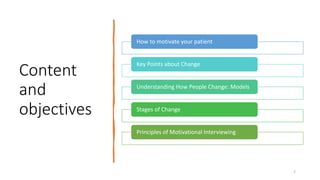
How to motivate your patient
Key Points about Change
Understanding How People Change: Models
Stages of Change
Principles of Motivational Interviewing
Key Points about Change
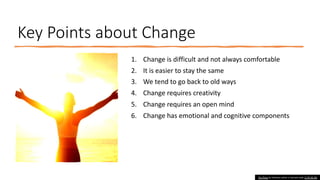
1. Change is difficult and not always comfortable
2. It is easier to stay the same
3. We tend to go back to old ways
4. Change requires creativity
5. Change requires an open mind
6. Change has emotional and cognitive components
This Photo by Unknown author is licensed under CC BY-NC-ND.
Key Points about Change
7. Change happens over time
8. The process is as important as the result
9. Often there is a difference between what someone knows they should do and there
readiness to do it.
10. Greatest chance to impact change is pairing it to the specific stage of change.
Understanding
How People
Change: Models
l Traditional approach
l Motivating for change
Traditional approach
Conventional approaches to change
management underestimate this point.
Change has no Start and End Points.
— Traditional change initiatives realise change
as a kind of project. Projects have by definition
a certain start and an end. Conventional change
projects are plan-driven and revolutionary.
This Photo by Unknown author is licensed under CC BY-SA-NC.
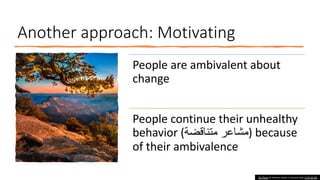
Another approach: Motivating
People are ambivalent about
change
People continue their unhealthy
behavior ( ‫ﻣ‬
‫ﺷ‬
‫ﺎ‬
‫ﻋ‬
‫ر‬
‫ﻣ‬
‫ﺗ‬
‫ﻧ‬
‫ﺎ‬
‫ﻗ‬
‫ﺿ‬
‫ﺔ‬ ) because
of their ambivalence
This Photo by Unknown author is licensed under CC BY-NC-ND.
Ambivalence
Ambivalence: Feeling two ways about
something.
• All change contains an element
of ambivalence.
• Resolving ambivalence in the
direction of change is a key
element of motivational
interviewing
This Photo by Unknown author is licensed under CC BY-SA.
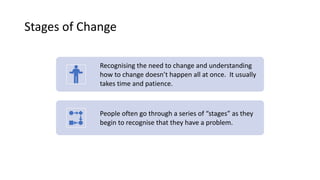
Stages of Change
Recognising the need to change and understanding
how to change doesn’t happen all at once. It usually
takes time and patience.
People often go through a series of “stages” as they
begin to recognise that they have a problem.
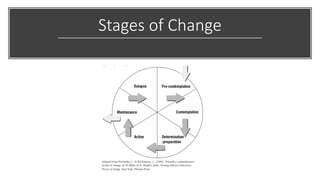
Understanding How
People Change-5 STEPS
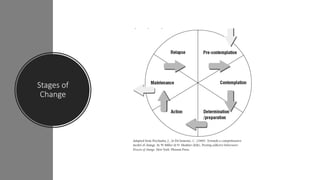
Stages of Change
• Five stages of change have been
conceptualized for a variety of problem
behaviors.
• The five stages of change are:
• precontemplation
• Contemplation
• Preparation
• action
• and maintenance.
• Precontemplation is the stage at which
there is no intention to change behavior in
the foreseeable future.
Stages of Change
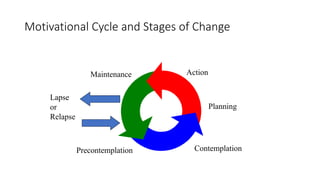
Motivational Cycle and Stages of Change
Precontemplation Contemplation
Action
Maintenance
Lapse
or
Relapse
Planning
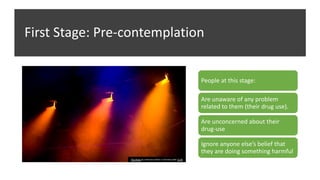
First Stage: Pre-contemplation
People at this stage:
Are unaware of any problem
related to them (their drug use).
Are unconcerned about their
drug-use
Ignore anyone else’s belief that
they are doing something harmful
This Photo by Unknown author is licensed under CC BY.
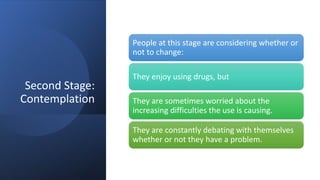
Second Stage:
Contemplation
People at this stage are considering whether or
not to change:
They enjoy using drugs, but
They are sometimes worried about the
increasing difficulties the use is causing.
They are constantly debating with themselves
whether or not they have a problem.
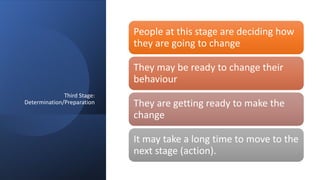
Third Stage:
Determination/Preparation
People at this stage are deciding how
they are going to change
They may be ready to change their
behaviour
They are getting ready to make the
change
It may take a long time to move to the
next stage (action).
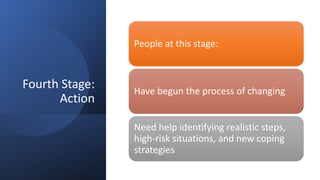
Fourth Stage:
Action
People at this stage:
Have begun the process of changing
Need help identifying realistic steps,
high-risk situations, and new coping
strategies
Fifth Stage:
Maintenance
People in this stage:
• Have made a
change and
• Are working on
maintaining the
change
Relapse
People at this stage have
reinitiated the identified
behaviour.
• People usually make several
attempts to quit before
being successful.
• The process of changing is
rarely the same in
subsequent attempts. Each
attempt incorporates new
information gained from the
previous attempts.
Relapse
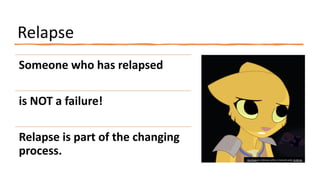
Someone who has relapsed
is NOT a failure!
Relapse is part of the changing
process. This Photo by Unknown author is licensed under CC BY-SA.
Stages of
Change
Principles of Motivational
Interviewing
This Photo by Unknown author is licensed under CC BY-SA-NC.
Principles of Motivational
Interviewing
Motivational interviewing is founded on 4 basic
principles:
• Express empathy
• Develop discrepancy
• Roll with resistance
• Support self-efficacy
Principle 1: Express empathy
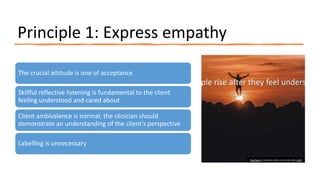
The crucial attitude is one of acceptance
Skillful reflective listening is fundamental to the client
feeling understood and cared about
Client ambivalence is normal; the clinician should
demonstrate an understanding of the client’s perspective
Labelling is unnecessary
This Photo by Unknown author is licensed under CC BY.
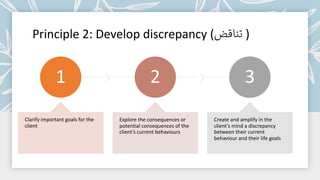
Principle 2: Develop discrepancy ( ‫ﺗ‬
‫ﻨ‬
‫ﺎ‬
‫ﻗ‬
‫ﺾ‬ )
1
Clarify important goals for the
client
2
Explore the consequences or
potential consequences of the
client’s current behaviours
3
Create and amplify in the
client’s mind a discrepancy
between their current
behaviour and their life goals
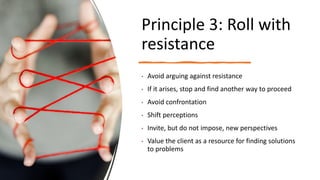
Principle 3: Roll with
resistance
• Avoid arguing against resistance
• If it arises, stop and find another way to proceed
• Avoid confrontation
• Shift perceptions
• Invite, but do not impose, new perspectives
• Value the client as a resource for finding solutions
to problems
Principle 4:
Support self-
efficacy
• Belief in the ability to change
(self-efficacy) is an important
motivator
• The client is responsible for
choosing and carrying out
personal change
• There is hope in the range of
alternative approaches available
This Photo by Unknown author is licensed under CC BY.
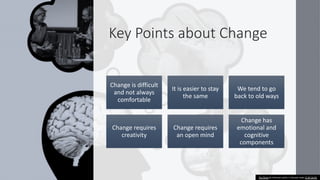
Key Points about Change
Change is difficult
and not always
comfortable
It is easier to stay
the same
We tend to go
back to old ways
Change requires
creativity
Change requires
an open mind
Change has
emotional and
cognitive
components
This Photo by Unknown author is licensed under CC BY-SA-NC.
Key Points
about Change
7. Change happens over time
8. The process is as important as the
result
9. Often there is a difference
between what someone knows
they should do and there
readiness to do it.
10. Greatest chance to impact change
is pairing it to the specific stage of
change.
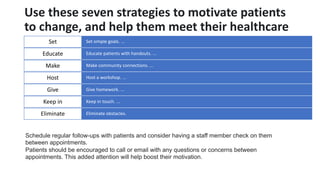
Use these seven strategies to motivate patients
to change, and help them meet their healthcare
goals: Set simple goals. ...
Set
Educate patients with handouts. ...
Educate
Make community connections. ...
Make
Host a workshop. ...
Host
Give homework. ...
Give
Keep in touch. ...
Keep in
Eliminate obstacles.
Eliminate
Schedule regular follow-ups with patients and consider having a staff member check on them
between appointments.
Patients should be encouraged to call or email with any questions or concerns between
appointments. This added attention will help boost their motivation.
THANKS
30
This Photo by Unknown author is licensed under CC BY-NC.

Motivational interviewing.pdf

  • 1.
    How to motivateyour Patients 1 Dr. Elhadi Miskeen, MBBS, MD,FAIMER,TUFH University of Bisha , College of Medicine May 2022 Motivational interviewing
  • 2.
    Content and objectives 2 How to motivateyour patient Key Points about Change Understanding How People Change: Models Stages of Change Principles of Motivational Interviewing
  • 3.
    Key Points aboutChange 1. Change is difficult and not always comfortable 2. It is easier to stay the same 3. We tend to go back to old ways 4. Change requires creativity 5. Change requires an open mind 6. Change has emotional and cognitive components This Photo by Unknown author is licensed under CC BY-NC-ND.
  • 4.
    Key Points aboutChange 7. Change happens over time 8. The process is as important as the result 9. Often there is a difference between what someone knows they should do and there readiness to do it. 10. Greatest chance to impact change is pairing it to the specific stage of change.
  • 5.
    Understanding How People Change: Models lTraditional approach l Motivating for change
  • 6.
    Traditional approach Conventional approachesto change management underestimate this point. Change has no Start and End Points. — Traditional change initiatives realise change as a kind of project. Projects have by definition a certain start and an end. Conventional change projects are plan-driven and revolutionary. This Photo by Unknown author is licensed under CC BY-SA-NC.
  • 7.
    Another approach: Motivating Peopleare ambivalent about change People continue their unhealthy behavior ( ‫ﻣ‬ ‫ﺷ‬ ‫ﺎ‬ ‫ﻋ‬ ‫ر‬ ‫ﻣ‬ ‫ﺗ‬ ‫ﻧ‬ ‫ﺎ‬ ‫ﻗ‬ ‫ﺿ‬ ‫ﺔ‬ ) because of their ambivalence This Photo by Unknown author is licensed under CC BY-NC-ND.
  • 8.
    Ambivalence Ambivalence: Feeling twoways about something. • All change contains an element of ambivalence. • Resolving ambivalence in the direction of change is a key element of motivational interviewing This Photo by Unknown author is licensed under CC BY-SA.
  • 9.
    Stages of Change Recognisingthe need to change and understanding how to change doesn’t happen all at once. It usually takes time and patience. People often go through a series of “stages” as they begin to recognise that they have a problem.
  • 10.
    Understanding How People Change-5STEPS Stages of Change • Five stages of change have been conceptualized for a variety of problem behaviors. • The five stages of change are: • precontemplation • Contemplation • Preparation • action • and maintenance. • Precontemplation is the stage at which there is no intention to change behavior in the foreseeable future.
  • 11.
  • 12.
    Motivational Cycle andStages of Change Precontemplation Contemplation Action Maintenance Lapse or Relapse Planning
  • 13.
    First Stage: Pre-contemplation Peopleat this stage: Are unaware of any problem related to them (their drug use). Are unconcerned about their drug-use Ignore anyone else’s belief that they are doing something harmful This Photo by Unknown author is licensed under CC BY.
  • 14.
    Second Stage: Contemplation People atthis stage are considering whether or not to change: They enjoy using drugs, but They are sometimes worried about the increasing difficulties the use is causing. They are constantly debating with themselves whether or not they have a problem.
  • 15.
    Third Stage: Determination/Preparation People atthis stage are deciding how they are going to change They may be ready to change their behaviour They are getting ready to make the change It may take a long time to move to the next stage (action).
  • 16.
    Fourth Stage: Action People atthis stage: Have begun the process of changing Need help identifying realistic steps, high-risk situations, and new coping strategies
  • 17.
    Fifth Stage: Maintenance People inthis stage: • Have made a change and • Are working on maintaining the change
  • 18.
    Relapse People at thisstage have reinitiated the identified behaviour. • People usually make several attempts to quit before being successful. • The process of changing is rarely the same in subsequent attempts. Each attempt incorporates new information gained from the previous attempts.
  • 19.
    Relapse Someone who hasrelapsed is NOT a failure! Relapse is part of the changing process. This Photo by Unknown author is licensed under CC BY-SA.
  • 20.
  • 21.
    Principles of Motivational Interviewing ThisPhoto by Unknown author is licensed under CC BY-SA-NC.
  • 22.
    Principles of Motivational Interviewing Motivationalinterviewing is founded on 4 basic principles: • Express empathy • Develop discrepancy • Roll with resistance • Support self-efficacy
  • 23.
    Principle 1: Expressempathy The crucial attitude is one of acceptance Skillful reflective listening is fundamental to the client feeling understood and cared about Client ambivalence is normal; the clinician should demonstrate an understanding of the client’s perspective Labelling is unnecessary This Photo by Unknown author is licensed under CC BY.
  • 24.
    Principle 2: Developdiscrepancy ( ‫ﺗ‬ ‫ﻨ‬ ‫ﺎ‬ ‫ﻗ‬ ‫ﺾ‬ ) 1 Clarify important goals for the client 2 Explore the consequences or potential consequences of the client’s current behaviours 3 Create and amplify in the client’s mind a discrepancy between their current behaviour and their life goals
  • 25.
    Principle 3: Rollwith resistance • Avoid arguing against resistance • If it arises, stop and find another way to proceed • Avoid confrontation • Shift perceptions • Invite, but do not impose, new perspectives • Value the client as a resource for finding solutions to problems
  • 26.
    Principle 4: Support self- efficacy •Belief in the ability to change (self-efficacy) is an important motivator • The client is responsible for choosing and carrying out personal change • There is hope in the range of alternative approaches available This Photo by Unknown author is licensed under CC BY.
  • 27.
    Key Points aboutChange Change is difficult and not always comfortable It is easier to stay the same We tend to go back to old ways Change requires creativity Change requires an open mind Change has emotional and cognitive components This Photo by Unknown author is licensed under CC BY-SA-NC.
  • 28.
    Key Points about Change 7.Change happens over time 8. The process is as important as the result 9. Often there is a difference between what someone knows they should do and there readiness to do it. 10. Greatest chance to impact change is pairing it to the specific stage of change.
  • 29.
    Use these sevenstrategies to motivate patients to change, and help them meet their healthcare goals: Set simple goals. ... Set Educate patients with handouts. ... Educate Make community connections. ... Make Host a workshop. ... Host Give homework. ... Give Keep in touch. ... Keep in Eliminate obstacles. Eliminate Schedule regular follow-ups with patients and consider having a staff member check on them between appointments. Patients should be encouraged to call or email with any questions or concerns between appointments. This added attention will help boost their motivation.
  • 30.
    THANKS 30 This Photo byUnknown author is licensed under CC BY-NC.