Motion Capturing
Sri Harsha Dokula
Contents
● Introduction
● History
● Techniques of Motion Capturing
● Production pipeline
● Applications
● Advantages and Disadvantages
● Conclusion
● References
Introduction
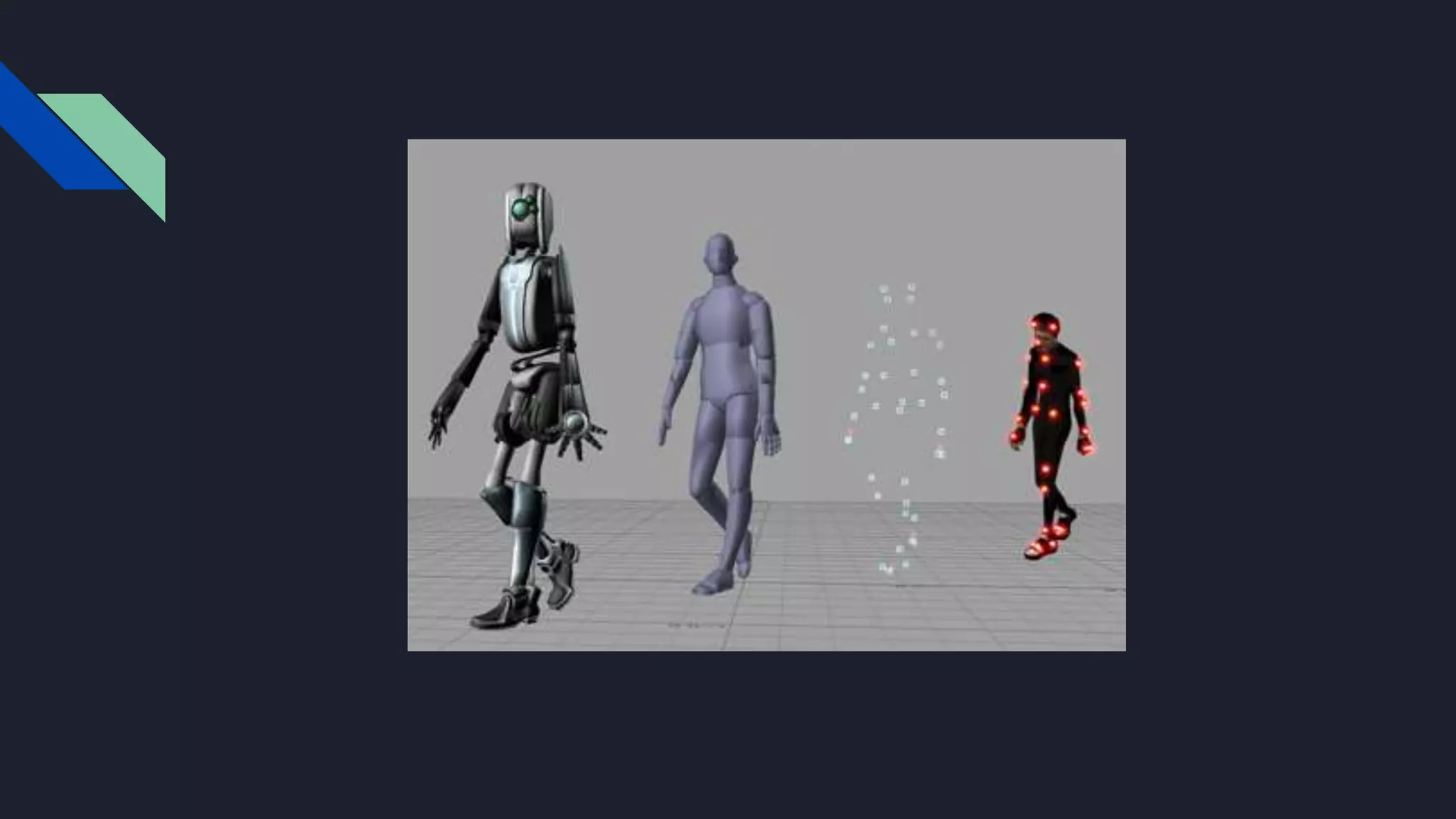
● Motion capture is the process for recording the movement of objects or
people.
● Motion capture technology involves sensing , digitizing and recording the
object in motion.
● Also known as MOCAP in short or performance capture.
History
● Motion Capture was first developed in the late 1800’s by
Muybridge.
● Started as a analysis tool in biomechanics for study of motion of various
animals.
● Max Fleischer developed “ROTOSCOPING” technique for
animations in 1970’s.
ROTOSCOPING
Process -
● Capture
● Trace
● Post processing
Capture-
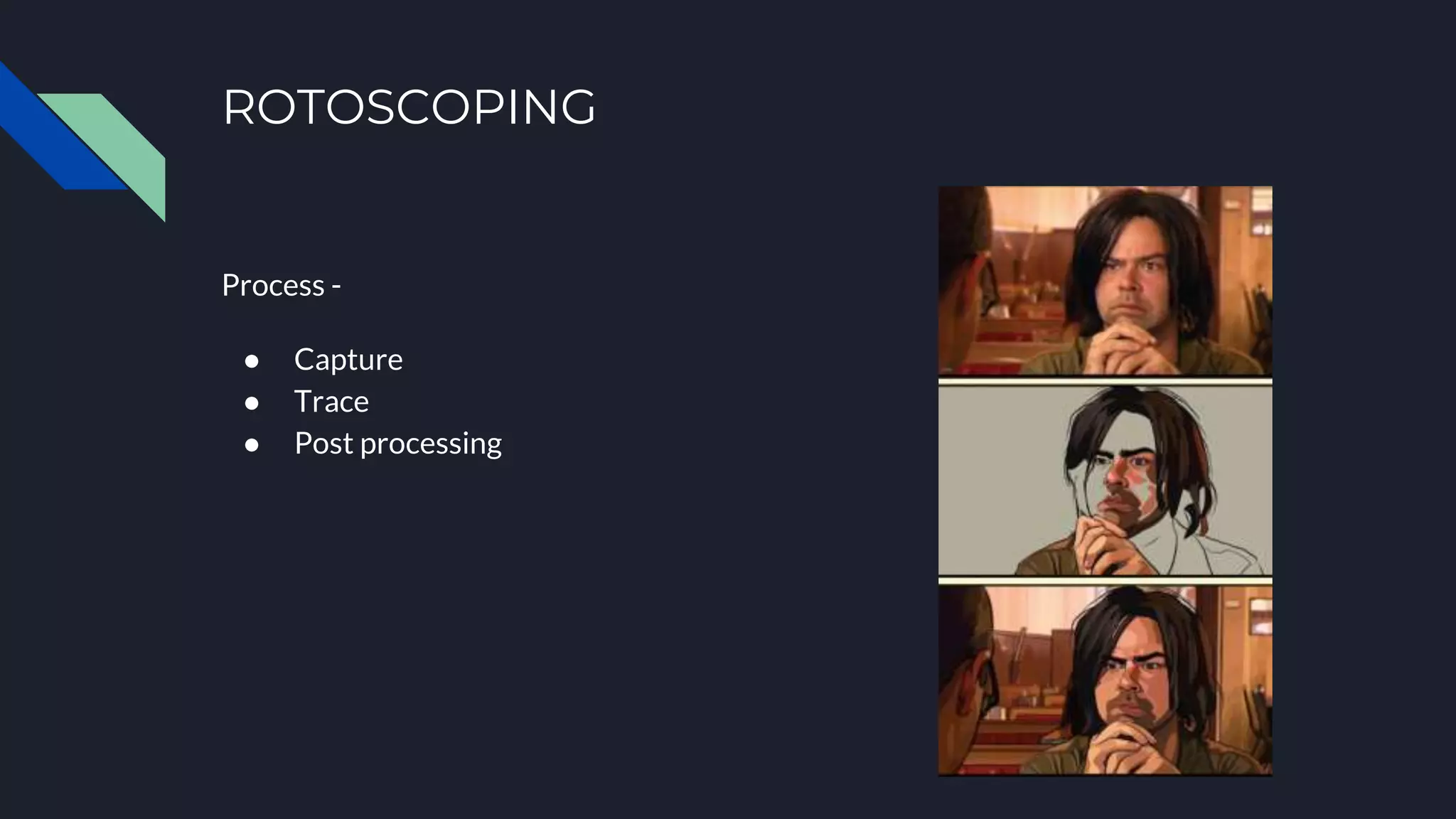
Rotoscoping works by first capturing a video of real actors around the props.
Tracing-
Animators then trace over each frame of the recorded video, this would result in a figure that
moves in a very realistic fashion.
Post processing-
Finally, the animated figures would be coloured and then integrated with various background
layers to create a final shot.
Techniques of MOCAP
1. Mechanical Capture
2. Magnetic Capture and
3. Optical Capture
Mechanical Capture
● The person wears an exoskeleton over his body which has angle encoders at
the joints.
● The skeleton data recorded is processed and a 3D model is generated .
Magnetic Capture
● The person wears a suit fitted with several magnetic sensors.
● The low-frequency magnetic field generated is received by central magnet.
● The sensors provide positional and rotational information which will be
rendered into a 3D model.
Optical Capture
● The suit is fitted with reflective markers at specific places over the body.
● The infrared rays reflected by the markers are picked up by the special
cameras and later transformed into digital form.
Production pipeline
Applications
● Entertainment
● Health and Medicine
● Sports
● Science
Entertainment
Health and Medicine
In Health & Medicine mocap is used in performing various tests on user.
For better visualization of movements of body parts .
Example: Gait analysis.
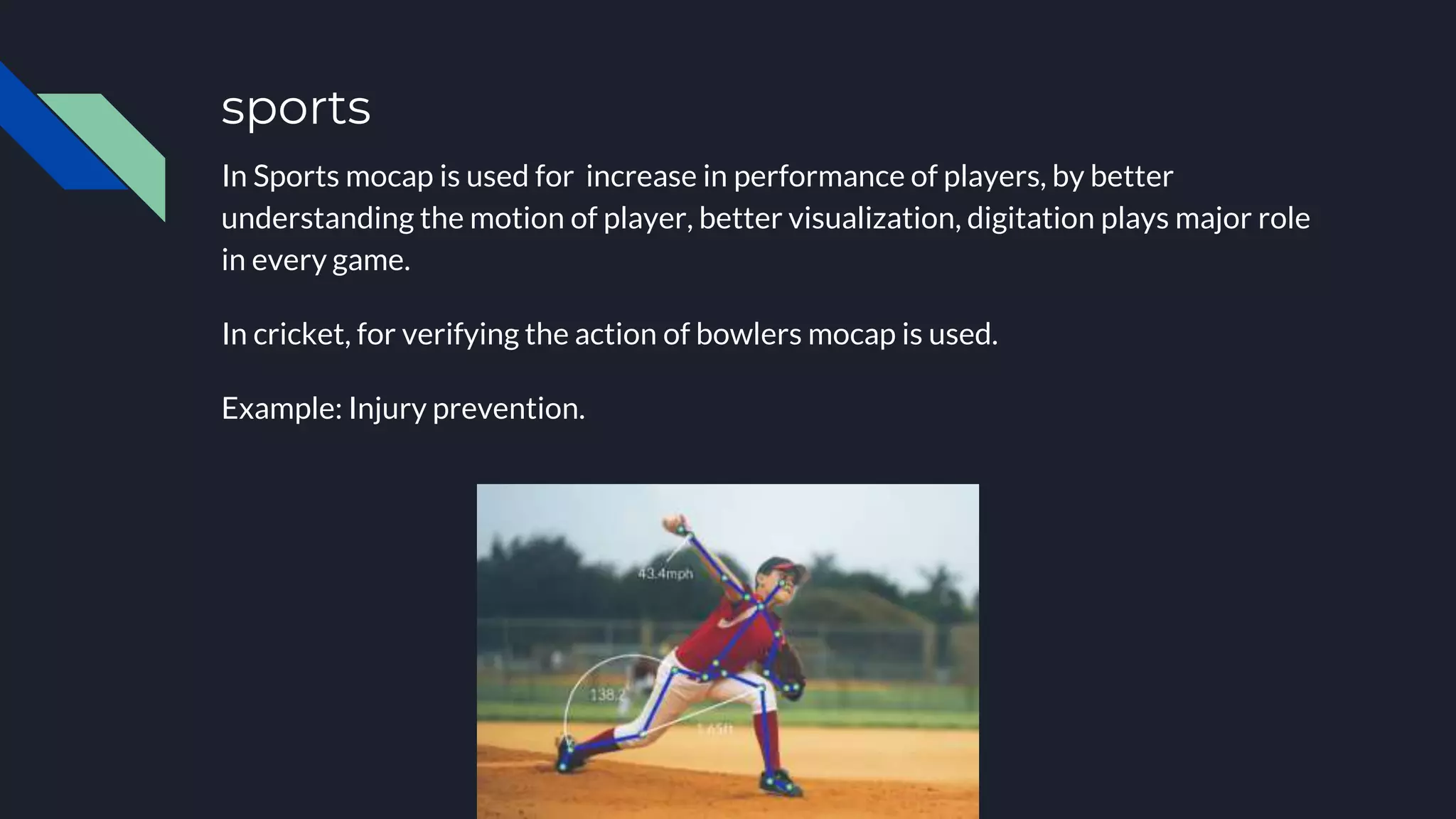
sports
In Sports mocap is used for increase in performance of players, by better
understanding the motion of player, better visualization, digitation plays major role
in every game.
In cricket, for verifying the action of bowlers mocap is used.
Example: Injury prevention.
Science
In science it used for ergonomic product designs.
Example: Development of Biped robots.
Advantages
● Complex movements and realistic physical interactions such as secondary motions ,
weights and exchange of forces can be easily recreated in a physically accurate manner.
● The amount of animation data that can be produced within a given time is extremely large
compared to traditional animation techniques.
● Potential for free software and third party solutions reducing costs.
Disadvantages
● Specific hardware and special software programs are required to obtain the data.
● When problems occur , it is easier to reshoot the scene rather than trying to manipulate
the data.
● The capture system may have specific requirements for the space it is operated in,
depending on camera field of view or magnetic distortion.
Conclusion
Motion capture systems have evolved from simple , user unfriendly systems to very mobile and
specialized ones.
References
● https://en.wikipedia.org/wiki/Motion_capture
- For general information.
● https://www.qualisys.com/applications/equine-animal/animal-bio/-
- For applications .
● http://www.ijritcc.org/download/IJRITCC_1350.pdf
- Journal on MOCAP.
Any Questions?
Thank You

Motion capturing

  • 1.
  • 2.
    Contents ● Introduction ● History ●Techniques of Motion Capturing ● Production pipeline ● Applications ● Advantages and Disadvantages ● Conclusion ● References
  • 3.
    Introduction ● Motion captureis the process for recording the movement of objects or people. ● Motion capture technology involves sensing , digitizing and recording the object in motion. ● Also known as MOCAP in short or performance capture.
  • 5.
    History ● Motion Capturewas first developed in the late 1800’s by Muybridge. ● Started as a analysis tool in biomechanics for study of motion of various animals. ● Max Fleischer developed “ROTOSCOPING” technique for animations in 1970’s.
  • 6.
    ROTOSCOPING Process - ● Capture ●Trace ● Post processing
  • 7.
    Capture- Rotoscoping works byfirst capturing a video of real actors around the props. Tracing- Animators then trace over each frame of the recorded video, this would result in a figure that moves in a very realistic fashion. Post processing- Finally, the animated figures would be coloured and then integrated with various background layers to create a final shot.
  • 8.
    Techniques of MOCAP 1.Mechanical Capture 2. Magnetic Capture and 3. Optical Capture
  • 9.
    Mechanical Capture ● Theperson wears an exoskeleton over his body which has angle encoders at the joints. ● The skeleton data recorded is processed and a 3D model is generated .
  • 10.
    Magnetic Capture ● Theperson wears a suit fitted with several magnetic sensors. ● The low-frequency magnetic field generated is received by central magnet. ● The sensors provide positional and rotational information which will be rendered into a 3D model.
  • 12.
    Optical Capture ● Thesuit is fitted with reflective markers at specific places over the body. ● The infrared rays reflected by the markers are picked up by the special cameras and later transformed into digital form.
  • 14.
  • 15.
    Applications ● Entertainment ● Healthand Medicine ● Sports ● Science
  • 16.
  • 17.
    Health and Medicine InHealth & Medicine mocap is used in performing various tests on user. For better visualization of movements of body parts . Example: Gait analysis.
  • 18.
    sports In Sports mocapis used for increase in performance of players, by better understanding the motion of player, better visualization, digitation plays major role in every game. In cricket, for verifying the action of bowlers mocap is used. Example: Injury prevention.
  • 19.
    Science In science itused for ergonomic product designs. Example: Development of Biped robots.
  • 20.
    Advantages ● Complex movementsand realistic physical interactions such as secondary motions , weights and exchange of forces can be easily recreated in a physically accurate manner. ● The amount of animation data that can be produced within a given time is extremely large compared to traditional animation techniques. ● Potential for free software and third party solutions reducing costs.
  • 21.
    Disadvantages ● Specific hardwareand special software programs are required to obtain the data. ● When problems occur , it is easier to reshoot the scene rather than trying to manipulate the data. ● The capture system may have specific requirements for the space it is operated in, depending on camera field of view or magnetic distortion.
  • 22.
    Conclusion Motion capture systemshave evolved from simple , user unfriendly systems to very mobile and specialized ones.
  • 23.
    References ● https://en.wikipedia.org/wiki/Motion_capture - Forgeneral information. ● https://www.qualisys.com/applications/equine-animal/animal-bio/- - For applications . ● http://www.ijritcc.org/download/IJRITCC_1350.pdf - Journal on MOCAP.
  • 24.
  • 25.