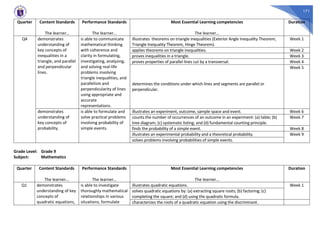
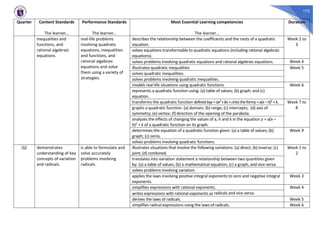
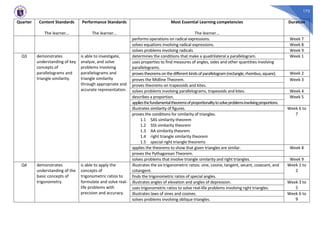
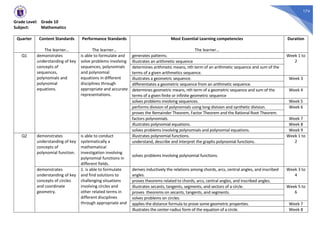
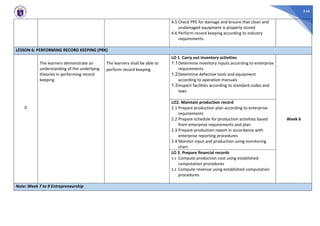
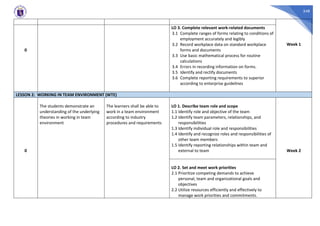
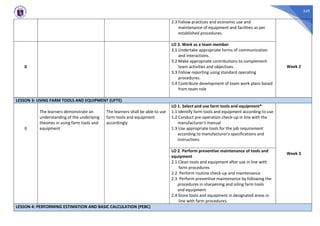
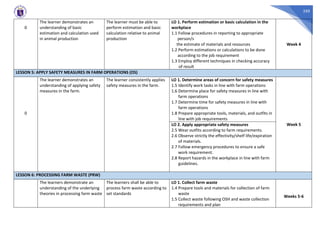
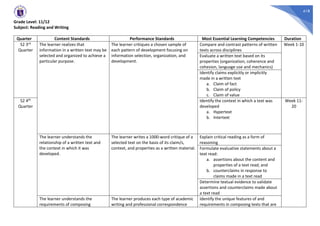
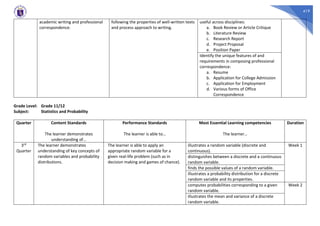
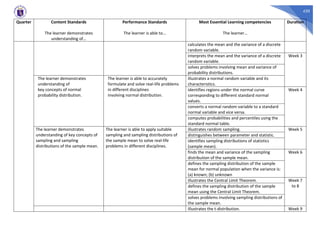
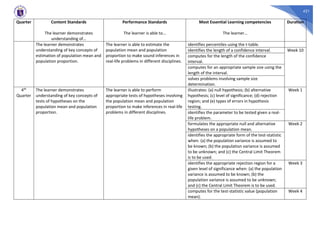
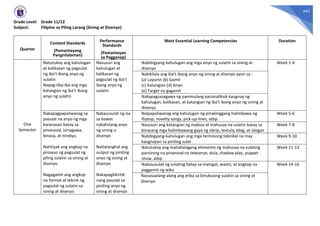
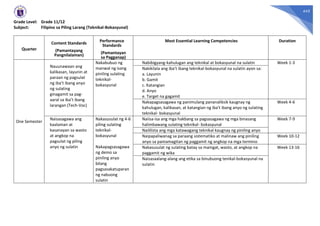
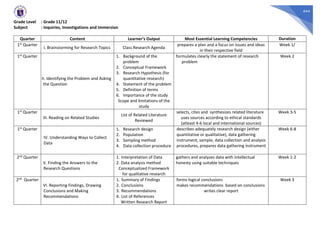
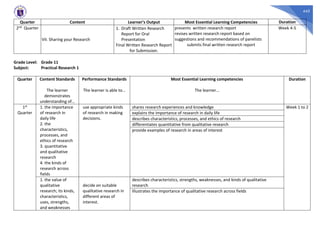
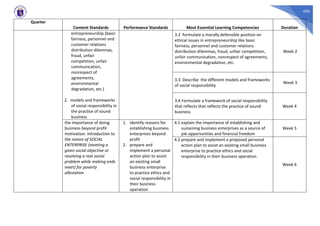
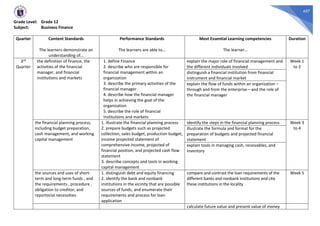
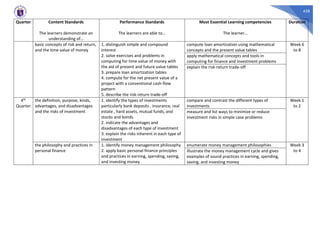
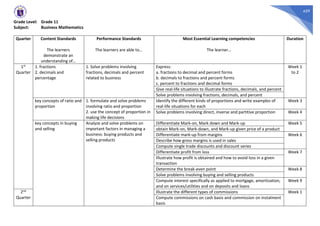
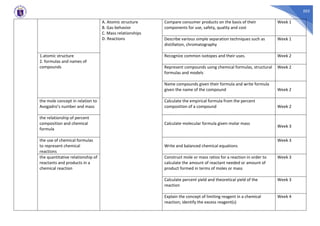
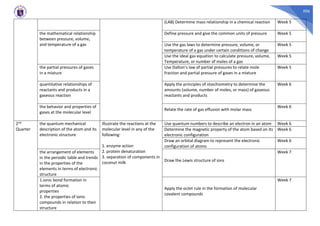
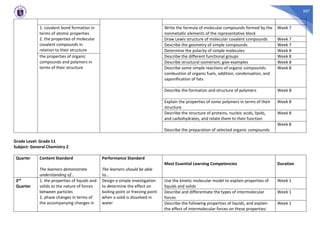
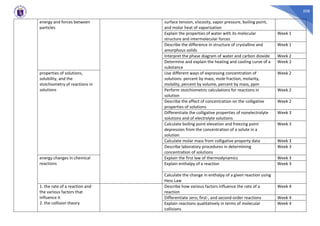
1
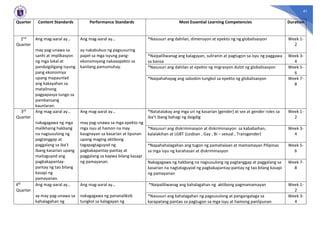
2
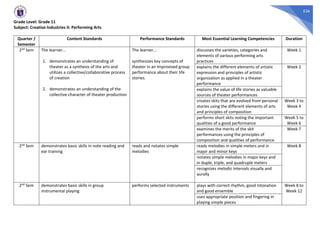
3
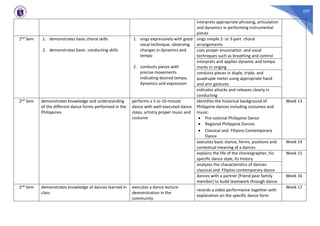
4
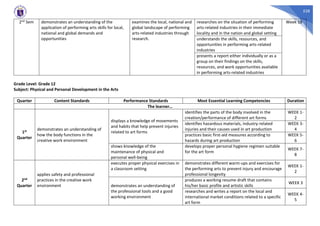
5
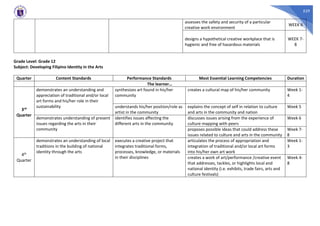
6
7
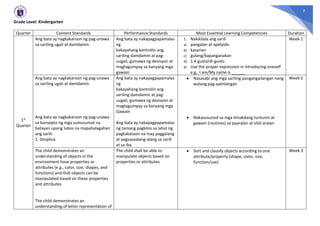
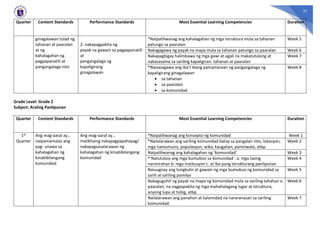
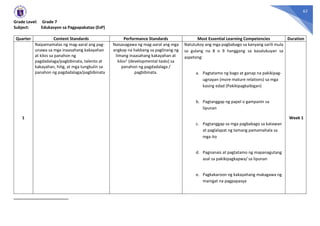
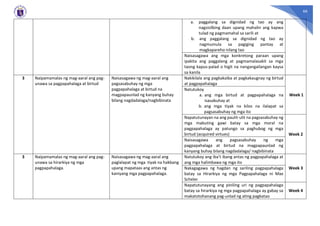
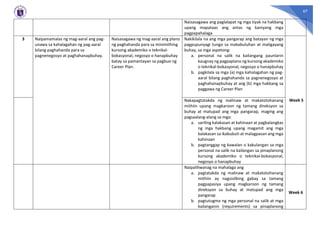
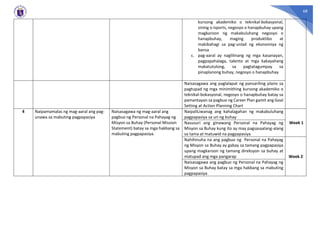
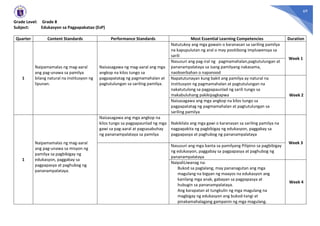
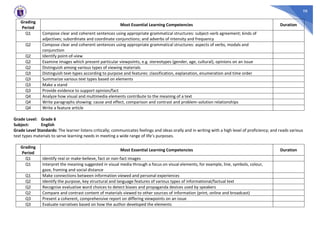
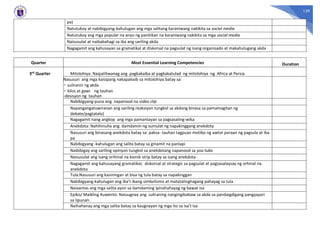
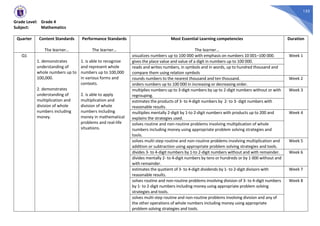
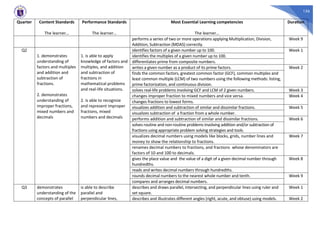
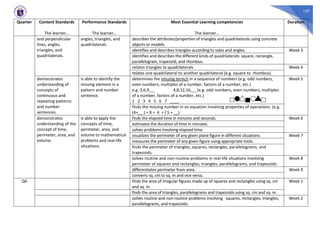
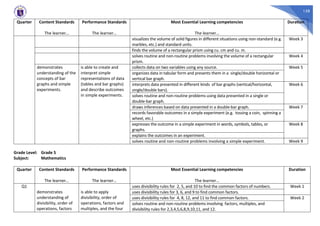
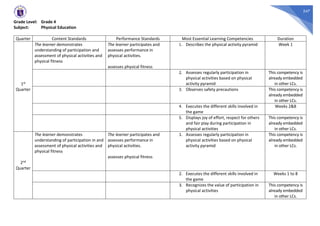
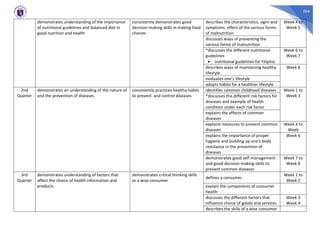
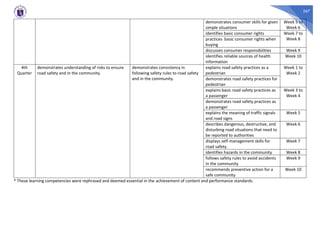
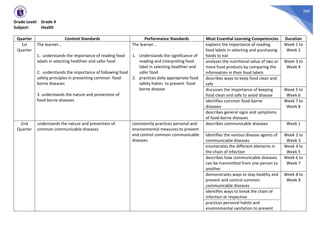
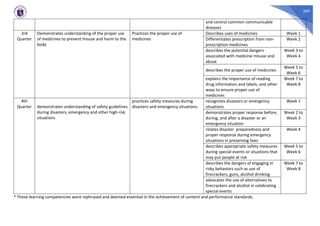
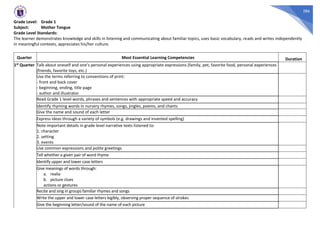
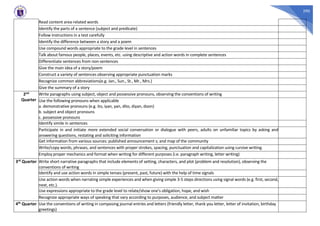
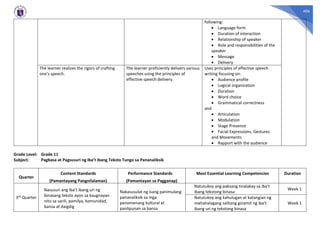
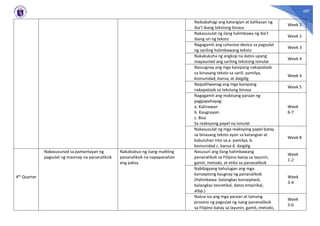
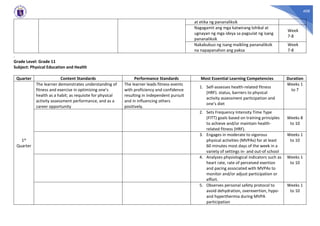
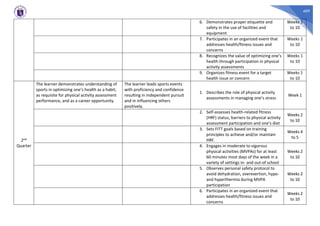
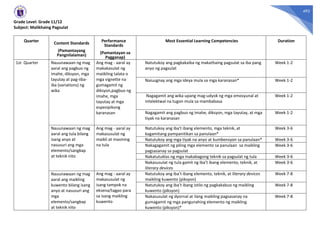
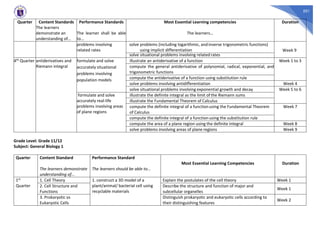
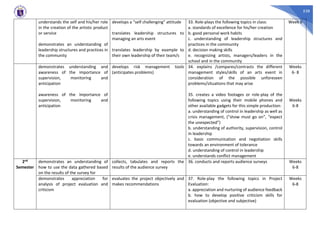
Grade Level: Kindergarten
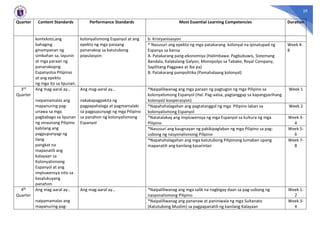
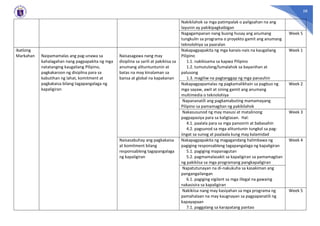
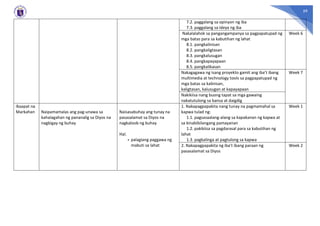
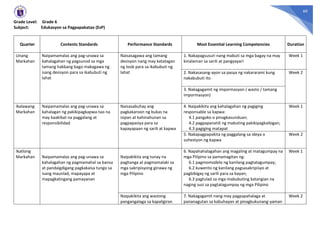
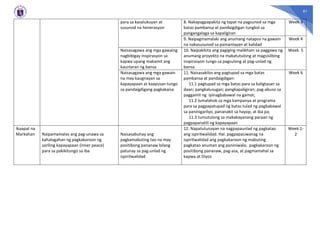
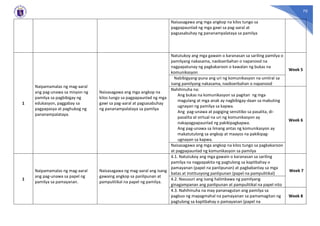
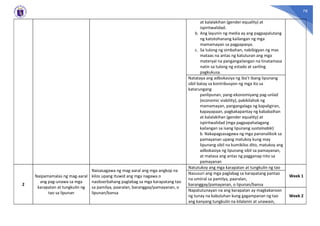
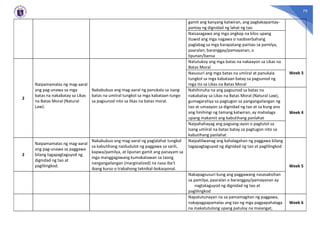
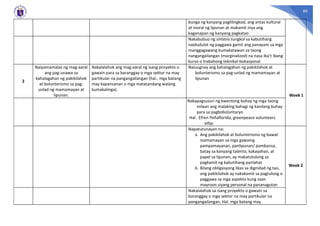
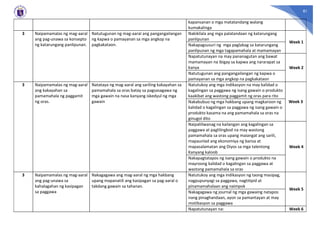
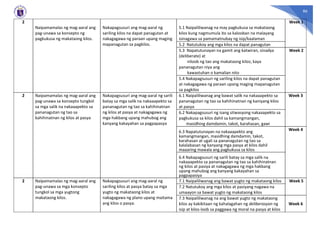
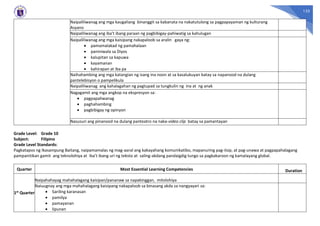
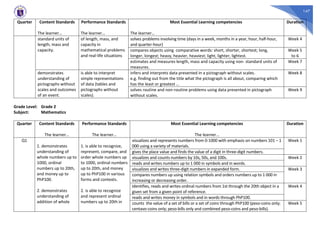
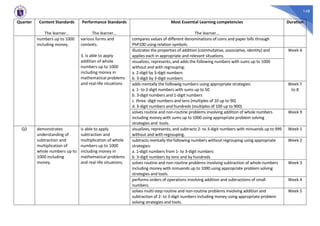
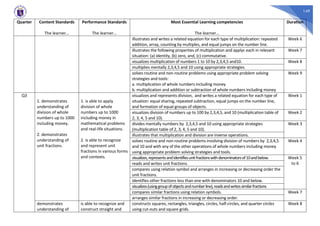
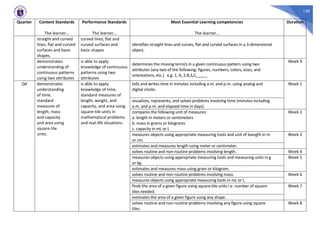
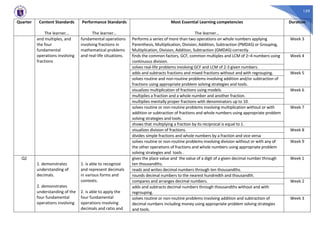
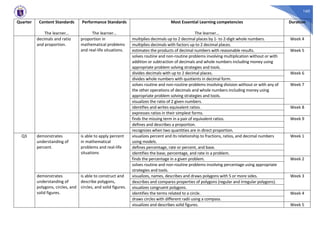
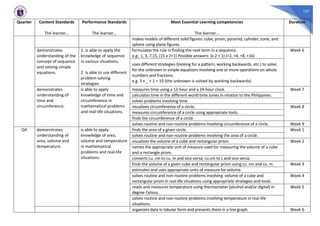
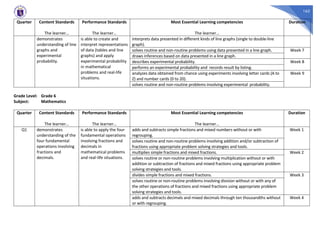
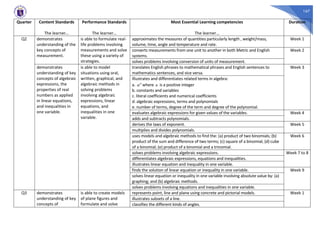
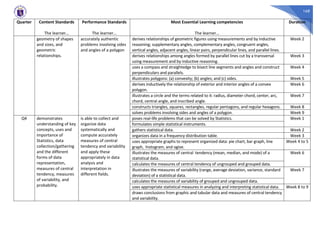
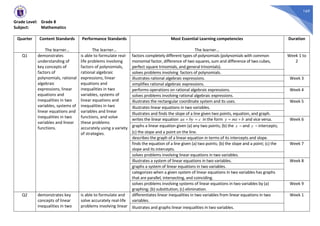
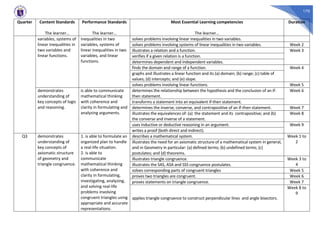
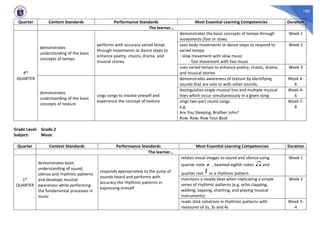
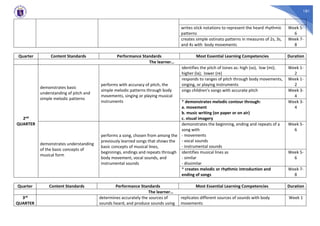
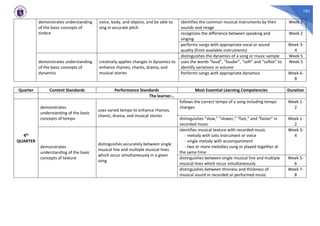
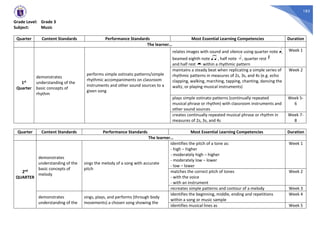
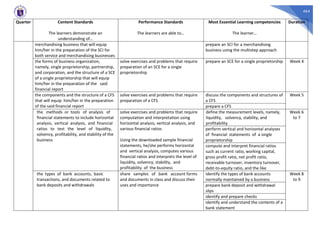
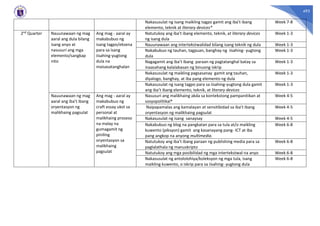
Quarter Content Standards Performance Standards Most Essential Learning Competencies Duration
1st
Quarter
Ang bata ay nagkakaroon ng pag-unawa
sa sariling ugali at damdamin.
Ang bata ay nakapagpapamalas
ng
kakayahang kontrolin ang
sariling damdamin at pag-
uugali, gumawa ng desisyon at
magtagumpay sa kanyang mga
gawain
1. Nakikilala ang sarili
a) pangalan at apelyido
b) kasarian
c) gulang/kapanganakan
d) 1.4 gusto/di-gusto
e) Use the proper expression in introducing oneself
e.g., I am/My name is ______
Week 1
Ang bata ay nagkakaroon ng pag-unawa
sa sariling ugali at damdamin.
Ang bata ay nagkakaroon ng pag-unawa
sa konsepto ng mga sumusunod na
batayan upang lubos na mapahalagahan
ang sarili:
1. Disiplina
Ang bata ay nakapagpapamalas
ng
kakayahang kontrolin ang
sariling damdamin at pag-
uugali, gumawa ng desisyon at
magtagumpay sa kanyang mga
Gawain
Ang bata ay nakapagpapamalas
ng tamang pagkilos sa lahat ng
pagkakataon na may paggalang
at pagsasaalang-alang sa sarili
at sa iba
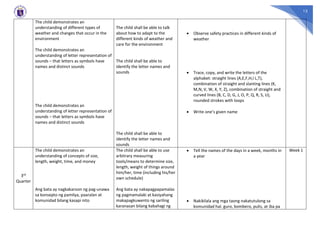
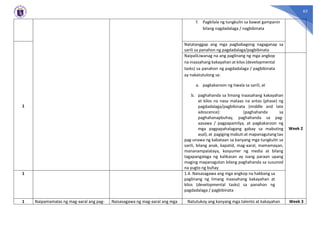
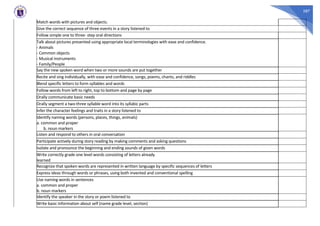
• Nasasabi ang mga sariling pangangailangan nang
walang pag-aalinlangan
• Nakasusunod sa mga itinakdang tuntunin at
gawain (routines) sa paaralan at silid-aralan
Week 2
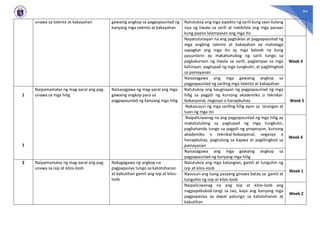
The child demonstrates an
understanding of objects in the
environment have properties or
attributes (e.g., color, size, shapes, and
functions) and that objects can be
manipulated based on these properties
and attributes
The child demonstrates an
understanding of letter representation of
The child shall be able to
manipulate objects based on
properties or attributes
• Sort and classify objects according to one
attribute/property (shape, color, size,
function/use)
Week 3
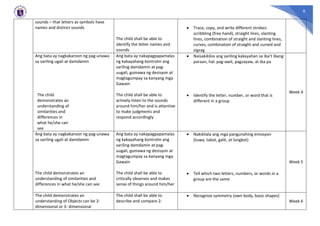
8
sounds – that letters as symbols have
names and distinct sounds
The child shall be able to
identify the letter names and
sounds
• Trace, copy, and write different strokes:
scribbling (free hand), straight lines, slanting
lines, combination of straight and slanting lines,
curves, combination of straight and curved and
zigzag
Ang bata ay nagkakaroon ng pag-unawa
sa sariling ugali at damdamin
The child
demonstrates an
understanding of
similarities and
differences in
what he/she can
see
Ang bata ay nakapagpapamalas
ng kakayahang kontrolin ang
sariling damdamin at pag-
uugali, gumawa ng desisyon at
magtagumpay sa kanyang mga
Gawain
The child shall be able to
actively listen to the sounds
around him/her and is attentive
to make judgments and
respond accordingly
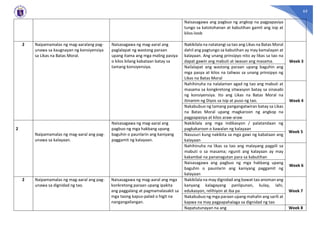
• Naisakikilos ang sariling kakayahan sa iba’t ibang
paraan, hal. pag-awit, pagsayaw, at iba pa
• Identify the letter, number, or word that is
different in a group
Week 4
Ang bata ay nagkakaroon ng pag-unawa
sa sariling ugali at damdamin
The child demonstrates an
understanding of similarities and
differences in what he/she can see
Ang bata ay nakapagpapamalas
ng kakayahang kontrolin ang
sariling damdamin at pag-
uugali, gumawa ng desisyon at
magtagumpay sa kanyang mga
Gawain
The child shall be able to
critically observes and makes
sense of things around him/her
• Nakikilala ang mga pangunahing emosyon
(tuwa, takot, galit, at lungkot)
• Tell which two letters, numbers, or words in a
group are the same
Week 5
The child demonstrates an
understanding of Objects can be 2-
dimensional or 3- dimensional
The child shall be able to
describe and compare 2-
• Recognize symmetry (own body, basic shapes)
Week 6
9
The child demonstrates an
understanding of body parts and their
uses
dimensional and 3- dimensional
objects
The child shall be able to take
care of oneself and the
environment and able to solve
problems encountered within
the context of everyday living
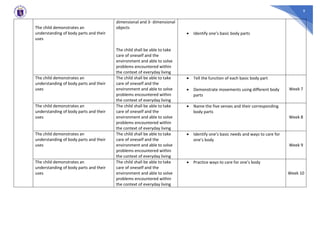
• Identify one’s basic body parts
The child demonstrates an
understanding of body parts and their
uses
The child shall be able to take
care of oneself and the
environment and able to solve
problems encountered within
the context of everyday living
• Tell the function of each basic body part
• Demonstrate movements using different body
parts
Week 7
The child demonstrates an
understanding of body parts and their
uses
The child shall be able to take
care of oneself and the
environment and able to solve
problems encountered within
the context of everyday living
• Name the five senses and their corresponding
body parts
Week 8
The child demonstrates an
understanding of body parts and their
uses
The child shall be able to take
care of oneself and the
environment and able to solve
problems encountered within
the context of everyday living
• Identify one’s basic needs and ways to care for
one’s body
Week 9
The child demonstrates an
understanding of body parts and their
uses
The child shall be able to take
care of oneself and the
environment and able to solve
problems encountered within
the context of everyday living
• Practice ways to care for one’s body
Week 10
10
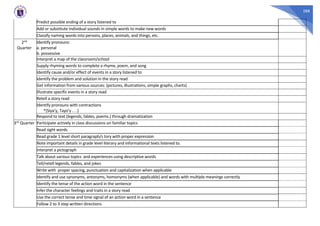
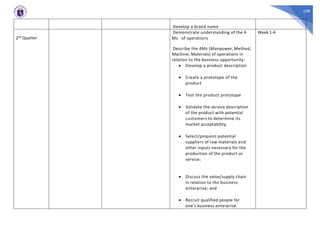
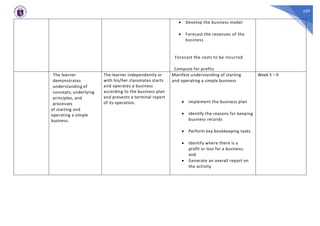
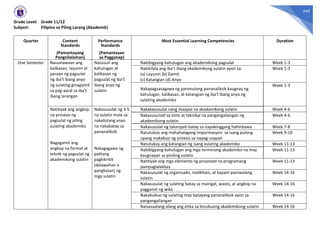
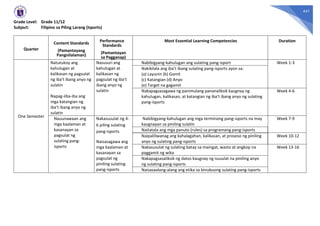
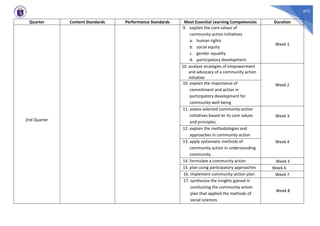
2nd
Quarter
Ang bata ay nagkakaroon ng pag-unawa
sa konsepto ng pamilya, paaralan at
komunidad bilang kasapi nito
Ang bata ay nakapagpapamalas
ng
pagmamalaki at kasiyahang
makapagkuwento ng sariling
karanasan bilang kabahagi ng
pamilya, paaralan at
komunidad
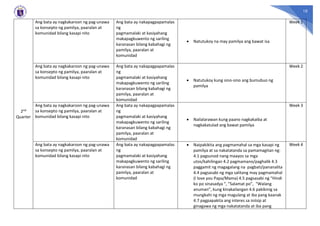
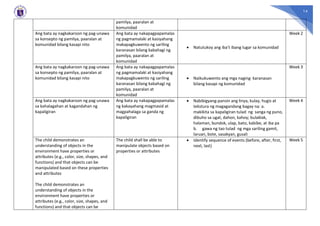
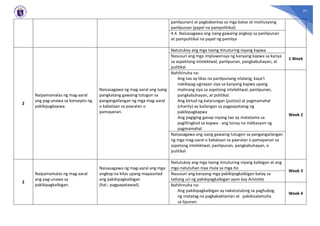
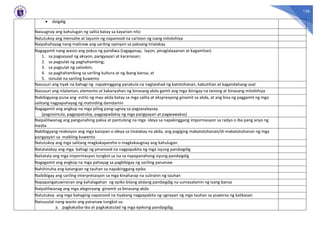
• Natutukoy na may pamilya ang bawat isa
Week 1
Ang bata ay nagkakaroon ng pag-unawa
sa konsepto ng pamilya, paaralan at
komunidad bilang kasapi nito
Ang bata ay nakapagpapamalas
ng
pagmamalaki at kasiyahang
makapagkuwento ng sariling
karanasan bilang kabahagi ng
pamilya, paaralan at
komunidad
• Natutukoy kung sino-sino ang bumubuo ng
pamilya
Week 2
Ang bata ay nagkakaroon ng pag-unawa
sa konsepto ng pamilya, paaralan at
komunidad bilang kasapi nito
Ang bata ay nakapagpapamalas
ng
pagmamalaki at kasiyahang
makapagkuwento ng sariling
karanasan bilang kabahagi ng
pamilya, paaralan at
komunidad
• Nailalarawan kung paano nagkakaiba at
nagkakatulad ang bawat pamilya
Week 3
Ang bata ay nagkakaroon ng pag-unawa
sa konsepto ng pamilya, paaralan at
komunidad bilang kasapi nito
Ang bata ay nakapagpapamalas
ng
pagmamalaki at kasiyahang
makapagkuwento ng sariling
karanasan bilang kabahagi ng
pamilya, paaralan at
komunidad
• Naipakikita ang pagmamahal sa mga kasapi ng
pamilya at sa nakatatanda sa pamamagitan ng:
4.1 pagsunod nang maayos sa mga
utos/kahilingan 4.2 pagmamano/paghalik 4.3
paggamit ng magagalang na pagbati/pananalita
4.4 pagsasabi ng mga salitang may pagmamahal
(I love you Papa/Mama) 4.5 pagsasabi ng “Hindi
ko po sinasadya “, ”Salamat po”, “Walang
anuman”, kung kinakailangan 4.6 pakikinig sa
mungkahi ng mga magulang at iba pang kaanak
4.7 pagpapakita ang interes sa iniisip at
ginagawa ng mga nakatatanda at iba pang
Week 4
11
The child demonstrates an
understanding of letter representation of
sounds – that letters as symbols have
names and distinct sounds
The child shall be able to
identify the letter names and
sounds
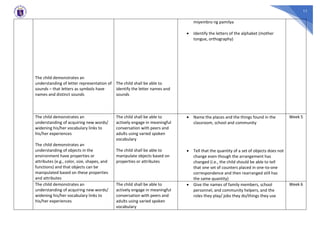
miyembro ng pamilya
• Identify the letters of the alphabet (mother
tongue, orthography)
The child demonstrates an
understanding of acquiring new words/
widening his/her vocabulary links to
his/her experiences
The child demonstrates an
understanding of objects in the
environment have properties or
attributes (e.g., color, size, shapes, and
functions) and that objects can be
manipulated based on these properties
and attributes
The child shall be able to
actively engage in meaningful
conversation with peers and
adults using varied spoken
vocabulary
The child shall be able to
manipulate objects based on
properties or attributes
• Name the places and the things found in the
classroom, school and community
• Tell that the quantity of a set of objects does not
change even though the arrangement has
changed (i.e., the child should be able to tell
that one set of counters placed in one-to-one
correspondence and then rearranged still has
the same quantity)
Week 5
The child demonstrates an
understanding of acquiring new words/
widening his/her vocabulary links to
his/her experiences
The child shall be able to
actively engage in meaningful
conversation with peers and
adults using varied spoken
vocabulary
• Give the names of family members, school
personnel, and community helpers, and the
roles they play/ jobs they do/things they use
Week 6
12
The child demonstrates an
understanding of increasing his/her
conversation skills
The child shall be able to
confidently speaks and
expresses his/her feelings and
ideas in words that make sense
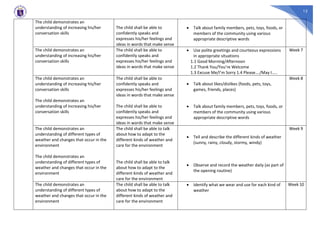
• Talk about family members, pets, toys, foods, or
members of the community using various
appropriate descriptive words
The child demonstrates an
understanding of increasing his/her
conversation skills
The child shall be able to
confidently speaks and
expresses his/her feelings and
ideas in words that make sense
• Use polite greetings and courteous expressions
in appropriate situations
1.1 Good Morning/Afternoon
1.2 Thank You/You’re Welcome
1.3 Excuse Me/I’m Sorry 1.4 Please…./May I…..
Week 7
The child demonstrates an
understanding of increasing his/her
conversation skills
The child demonstrates an
understanding of increasing his/her
conversation skills
The child shall be able to
confidently speaks and
expresses his/her feelings and
ideas in words that make sense
The child shall be able to
confidently speaks and
expresses his/her feelings and
ideas in words that make sense
• Talk about likes/dislikes (foods, pets, toys,
games, friends, places)
• Talk about family members, pets, toys, foods, or
members of the community using various
appropriate descriptive words
Week 8
The child demonstrates an
understanding of different types of
weather and changes that occur in the
environment
The child demonstrates an
understanding of different types of
weather and changes that occur in the
environment
The child shall be able to talk
about how to adapt to the
different kinds of weather and
care for the environment
The child shall be able to talk
about how to adapt to the
different kinds of weather and
care for the environment
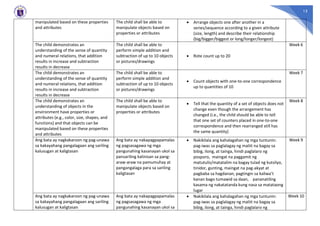
• Tell and describe the different kinds of weather
(sunny, rainy, cloudy, stormy, windy)
• Observe and record the weather daily (as part of
the opening routine)
Week 9
The child demonstrates an
understanding of different types of
weather and changes that occur in the
environment
The child shall be able to talk
about how to adapt to the
different kinds of weather and
care for the environment
• Identify what we wear and use for each kind of
weather
Week 10
13
The child demonstrates an
understanding of different types of
weather and changes that occur in the
environment
The child demonstrates an
understanding of letter representation of
sounds – that letters as symbols have
names and distinct sounds
The child demonstrates an
understanding of letter representation of
sounds – that letters as symbols have
names and distinct sounds
The child shall be able to talk
about how to adapt to the
different kinds of weather and
care for the environment
The child shall be able to
identify the letter names and
sounds
The child shall be able to
identify the letter names and
sounds
• Observe safety practices in different kinds of
weather
• Trace, copy, and write the letters of the
alphabet: straight lines (A,E,F,H,I L,T),
combination of straight and slanting lines (K,
M,N, V, W, X, Y, Z), combination of straight and
curved lines (B, C, D, G, J, O, P, Q, R, S, U),
rounded strokes with loops
• Write one’s given name
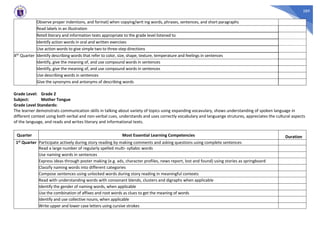
3rd
Quarter
The child demonstrates an
understanding of concepts of size,
length, weight, time, and money
Ang bata ay nagkakaroon ng pag-unawa
sa konsepto ng pamilya, paaralan at
komunidad bilang kasapi nito
The child shall be able to use
arbitrary measuring
tools/means to determine size,
length, weight of things around
him/her, time (including his/her
own schedule)
Ang bata ay nakapagpapamalas
ng pagmamalaki at kasiyahang
makapagkuwento ng sariling
karanasan bilang kabahagi ng
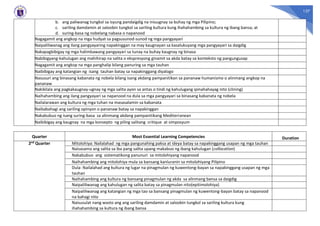
• Tell the names of the days in a week, months in
a year
• Nakikilala ang mga taong nakatutulong sa
komunidad hal. guro, bombero, pulis, at iba pa
Week 1
14
pamilya, paaralan at
komunidad
Ang bata ay nagkakaroon ng pag-unawa
sa konsepto ng pamilya, paaralan at
komunidad bilang kasapi nito
Ang bata ay nakapagpapamalas
ng pagmamalaki at kasiyahang
makapagkuwento ng sariling
karanasan bilang kabahagi ng
pamilya, paaralan at
komunidad
• Natutukoy ang iba’t ibang lugar sa komunidad
Week 2
Ang bata ay nagkakaroon ng pag-unawa
sa konsepto ng pamilya, paaralan at
komunidad bilang kasapi nito
Ang bata ay nakapagpapamalas
ng pagmamalaki at kasiyahang
makapagkuwento ng sariling
karanasan bilang kabahagi ng
pamilya, paaralan at
komunidad
• Naikukuwento ang mga naging karanasan
bilang kasapi ng komunidad
Week 3
Ang bata ay nagkakaroon ng pag-unawa
sa kahalagahan at kagandahan ng
kapaligiran
Ang bata ay nakapagpapamalas
ng kakayahang magmasid at
magpahalaga sa ganda ng
kapaligiran
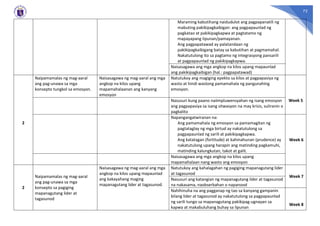
• Nabibigyang-pansin ang linya, kulay, hugis at
tekstura ng magagandang bagay na: a.
makikita sa kapaligiran tulad ng sanga ng puno,
dibuho sa ugat, dahon, kahoy; bulaklak,
halaman, bundok, ulap, bato, kabibe, at iba pa
b. gawa ng tao tulad ng mga sariling gamit,
laruan, bote, sasakyan, gusali
Week 4
The child demonstrates an
understanding of objects in the
environment have properties or
attributes (e.g., color, size, shapes, and
functions) and that objects can be
manipulated based on these properties
and attributes
The child demonstrates an
understanding of objects in the
environment have properties or
attributes (e.g., color, size, shapes, and
functions) and that objects can be
The child shall be able to
manipulate objects based on
properties or attributes
• Identify sequence of events (before, after, first,
next, last)
Week 5
15
manipulated based on these properties
and attributes
The child shall be able to
manipulate objects based on
properties or attributes
• Arrange objects one after another in a
series/sequence according to a given attribute
(size, length) and describe their relationship
(big/bigger/biggest or long/longer/longest)
The child demonstrates an
understanding of the sense of quantity
and numeral relations, that addition
results in increase and subtraction
results in decrease
The child shall be able to
perform simple addition and
subtraction of up to 10 objects
or pictures/drawings
• Rote count up to 20
Week 6
The child demonstrates an
understanding of the sense of quantity
and numeral relations, that addition
results in increase and subtraction
results in decrease
The child shall be able to
perform simple addition and
subtraction of up to 10 objects
or pictures/drawings
• Count objects with one-to-one correspondence
up to quantities of 10
Week 7
The child demonstrates an
understanding of objects in the
environment have properties or
attributes (e.g., color, size, shapes, and
functions) and that objects can be
manipulated based on these properties
and attributes
The child shall be able to
manipulate objects based on
properties or attributes
• Tell that the quantity of a set of objects does not
change even though the arrangement has
changed (i.e., the child should be able to tell
that one set of counters placed in one-to-one
correspondence and then rearranged still has
the same quantity)
Week 8
Ang bata ay nagkakaroon ng pag-unawa
sa kakayahang pangalagaan ang sariling
kalusugan at kaligtasan
Ang bata ay nakapagpapamalas
ng pagsasagawa ng mga
pangunahing kasanayan ukol sa
pansariling kalinisan sa pang-
araw-araw na pamumuhay at
pangangalaga para sa sariling
kaligtasan
• Nakikilala ang kahalagahan ng mga tuntunin:
pag-iwas sa paglalagay ng maliit na bagay sa
bibig, ilong, at tainga, hindi paglalaro ng
posporo, maingat na paggamit ng
matutulis/matatalim na bagay tulad ng kutsilyo,
tinidor, gunting, maingat na pag-akyat at
pagbaba sa hagdanan, pagtingin sa kaliwa’t
kanan bago tumawid sa daan, pananatiling
kasama ng nakatatanda kung nasa sa matataong
lugar
Week 9
Ang bata ay nagkakaroon ng pag-unawa
sa kakayahang pangalagaan ang sariling
kalusugan at kaligtasan
Ang bata ay nakapagpapamalas
ng pagsasagawa ng mga
pangunahing kasanayan ukol sa
• Nakikilala ang kahalagahan ng mga tuntunin:
pag-iwas sa paglalagay ng maliit na bagay sa
bibig, ilong, at tainga, hindi paglalaro ng
Week 10
16
pansariling kalinisan sa pang-
araw-araw na pamumuhay at
pangangalaga para sa sariling
kaligtasan
posporo, maingat na paggamit ng
matutulis/matatalim na bagay tulad ng kutsilyo,
tinidor, gunting, maingat na pag-akyat at
pagbaba sa hagdanan, pagtingin sa kaliwa’t
kanan bago tumawid sa daan, pananatiling
kasama ng nakatatanda kung nasa sa matataong
lugar
4th
Quarter
The child demonstrates an
understanding of characteristics and
needs of animals and how they grow
The child shall be able to
communicate the usefulness of
animals and practice ways to
care for them
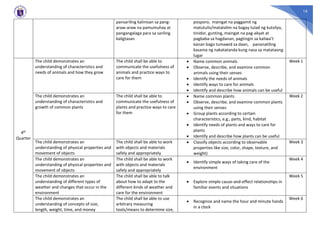
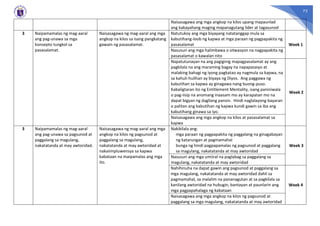
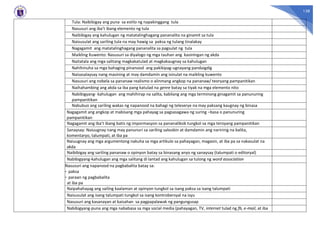
• Name common animals
• Observe, describe, and examine common
animals using their senses
• Identify the needs of animals
• Identify ways to care for animals
• Identify and describe how animals can be useful
Week 1
The child demonstrates an
understanding of characteristics and
growth of common plants
The child shall be able to
communicate the usefulness of
plants and practice ways to care
for them
• Name common plants
• Observe, describe, and examine common plants
using their senses
• Group plants according to certain
characteristics, e.g., parts, kind, habitat
• Identify needs of plants and ways to care for
plants
• Identify and describe how plants can be useful
Week 2
The child demonstrates an
understanding of physical properties and
movement of objects
The child shall be able to work
with objects and materials
safely and appropriately
• Classify objects according to observable
properties like size, color, shape, texture, and
weight)
Week 3
The child demonstrates an
understanding of physical properties and
movement of objects
The child shall be able to work
with objects and materials
safely and appropriately
• Identify simple ways of taking care of the
environment
Week 4
The child demonstrates an
understanding of different types of
weather and changes that occur in the
environment
The child shall be able to talk
about how to adapt to the
different kinds of weather and
care for the environment
• Explore simple cause-and-effect relationships in
familiar events and situations
Week 5
The child demonstrates an
understanding of concepts of size,
length, weight, time, and money
The child shall be able to use
arbitrary measuring
tools/means to determine size,
• Recognize and name the hour and minute hands
in a clock
Week 6
17
length, weight of things around
him/her, time (including his/her
own schedule)
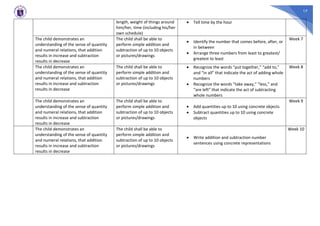
• Tell time by the hour
The child demonstrates an
understanding of the sense of quantity
and numeral relations, that addition
results in increase and subtraction
results in decrease
The child shall be able to
perform simple addition and
subtraction of up to 10 objects
or pictures/drawings
• Identify the number that comes before, after, or
in between
• Arrange three numbers from least to greatest/
greatest to least
Week 7
The child demonstrates an
understanding of the sense of quantity
and numeral relations, that addition
results in increase and subtraction
results in decrease
The child shall be able to
perform simple addition and
subtraction of up to 10 objects
or pictures/drawings
• Recognize the words “put together,” “add to,”
and “in all” that indicate the act of adding whole
numbers
• Recognize the words “take away,” “less,” and
“are left” that indicate the act of subtracting
whole numbers
Week 8
The child demonstrates an
understanding of the sense of quantity
and numeral relations, that addition
results in increase and subtraction
results in decrease
The child shall be able to
perform simple addition and
subtraction of up to 10 objects
or pictures/drawings
• Add quantities up to 10 using concrete objects
• Subtract quantities up to 10 using concrete
objects
Week 9
The child demonstrates an
understanding of the sense of quantity
and numeral relations, that addition
results in increase and subtraction
results in decrease
The child shall be able to
perform simple addition and
subtraction of up to 10 objects
or pictures/drawings
• Write addition and subtraction number
sentences using concrete representations
Week 10
18
19
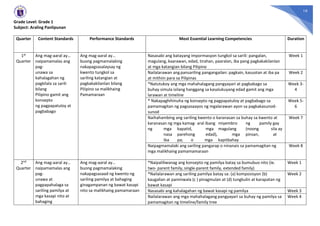
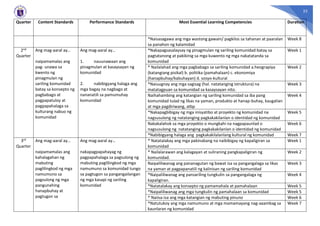
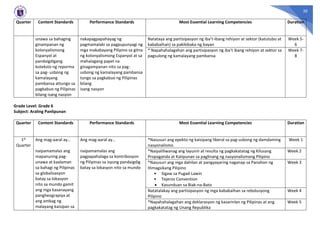
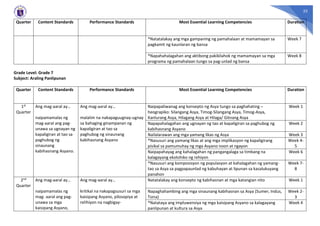
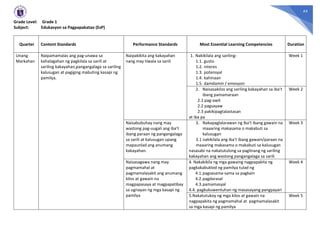
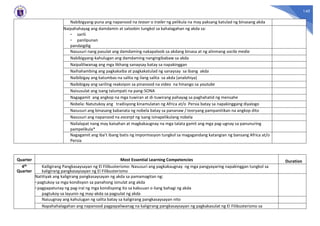
Grade Level: Grade 1
Subject: Araling Panlipunan
Quarter Content Standards Performance Standards Most Essential Learning Competencies Duration
1st
Quarter
Ang mag-aaral ay…
naipamamalas ang
pag-
unawa sa
kahalagahan ng
pagkilala sa sarili
bilang
Pilipino gamit ang
konsepto
ng pagpapatuloy at
pagbabago
Ang mag-aaral ay…
buong pagmamalaking
nakapagsasalaysay ng
kwento tungkol sa
sariling katangian at
pagkakakilanlan bilang
Pilipino sa malikhaing
Pamamaraan
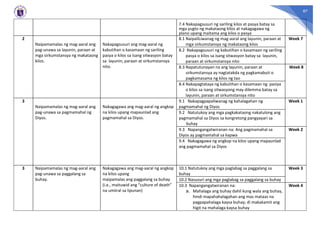
Nasasabi ang batayang impormasyon tungkol sa sarili: pangalan,
magulang, kaarawan, edad, tirahan, paaralan, iba pang pagkakakilanlan
at mga katangian bilang Pilipino
Week 1
Nailalarawan ang pansariling pangangailan: pagkain, kasuotan at iba pa
at mithiin para sa Pilipinas
Week 2
*Natutukoy ang mga mahahalagang pangyayari at pagbabago sa
buhay simula isilang hanggang sa kasalukuyang edad gamit ang mga
larawan at timeline
Week 3-
4
* Nakapaghihinuha ng konsepto ng pagpapatuloy at pagbabago sa
pamamagitan ng pagsasaayos ng mgalarawan ayon sa pagkakasunod-
sunod
Week 5-
6
Naihahambing ang sariling kwento o karanasan sa buhay sa kwento at
karanasan ng mga kamag- aral ibang miyembro ng pamily gay
ng mga kapatid, mga magulang (noong sila ay
nasa parehong edad), mga pinsan, at
iba pa; o mga kapitbahay
Week 7
Naipagmamalaki ang sariling pangarap o ninanais sa pamamagitan ng
mga malikhaing pamamamaraan
Week 8
2nd
Quarter
Ang mag-aaral ay…
naipamamalas ang
pag-
unawa at
pagpapahalaga sa
sariling pamilya at
mga kasapi nito at
bahaging
Ang mag-aaral ay…
buong pagmamalaking
nakapagsasaad ng kwento ng
sariling pamilya at bahaging
ginagampanan ng bawat kasapi
nito sa malikhaing pamamaraan
*Naipaliliwanag ang konsepto ng pamilya batay sa bumubuo nito (ie.
two- parent family, single-parent family, extended family)
Week 1
*Nailalarawan ang sariling pamilya batay sa: (a) komposisyon (b)
kaugalian at paniniwala (c ) pinagmulan at (d) tungkulin at karapatan ng
bawat kasapi
Week 2
Nasasabi ang kahalagahan ng bawat kasapi ng pamilya Week 3
Nailalarawan ang mga mahahalagang pangyayari sa buhay ng pamilya sa
pamamagitan ng timeline/family tree
Week 4
20
Quarter Content Standards Performance Standards Most Essential Learning Competencies Duration
ginagampanan ng
bawat isa
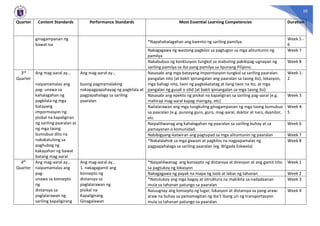
*Napahahalagahan ang kwento ng sariling pamilya.
Week 5 -
6
Nakagagawa ng wastong pagkilos sa pagtugon sa mga alituntunin ng
pamilya
Week 7
Nakabubuo ng konklusyon tungkol sa mabuting pakikipag-ugnayan ng
sariling pamilya sa iba pang pamilya sa lipunang Pilipino.
Week 8
3rd
Quarter
Ang mag-aaral ay…
naipamamalas ang
pag- unawa sa
kahalagahan ng
pagkilala ng mga
batayang
impormasyon ng
pisikal na kapaligiran
ng sariling paaralan at
ng mga taong
bumubuo dito na
nakakatulong sa
paghubog ng
kakayahan ng bawat
batang mag-aaral
Ang mag-aaral ay…
buong pagmamalaking
nakapagpapahayag ng pagkilala at
pagpapahalaga sa sariling
paaralan
Nasasabi ang mga batayang impormasyon tungkol sa sariling paaralan:
pangalan nito (at bakit ipinangalan ang paaralan sa taong ito), lokasyon,
mga bahagi nito, taon ng pagkakatatag at ilang taon na ito, at mga
pangalan ng gusali o silid (at bakit ipinangalan sa mga taong ito)
Week 1-
2
Nasasabi ang epekto ng pisikal na kapaligiran sa sariling pag-aaral (e.g.
mahirap mag-aaral kapag maingay, etc)
Week 3
Nailalarawan ang mga tungkuling ginagampanan ng mga taong bumubuo
sa paaralan (e.g. punong guro, guro, mag-aaral, doktor at nars, dyanitor,
etc
Week 4-
5
Naipaliliwanag ang kahalagahan ng paaralan sa sariling buhay at sa
pamayanan o komunidad.
Week 6
Nabibigyang-katwiran ang pagtupad sa mga alituntunin ng paaralan Week 7
*Nakalalahok sa mga gawain at pagkilos na nagpapamalas ng
pagpapahalaga sa sariling paaralan (eg. Brigada Eskwela)
Week 8
4th
Quarter
Ang mag-aaral ay…
naipamamalas ang
pag-
unawa sa konsepto
ng
distansya sa
paglalarawan ng
sariling kapaligirang
Ang mag-aaral ay…
1. nakagagamit ang
konsepto ng
distansya sa
paglalarawan ng
pisikal na
Kapaligirang
Ginagalawan
*Naipaliliwanag ang konsepto ng distansya at diresyon at ang gamit nito
sa pagtukoy ng lokasyon
Week 1
Nakagagawa ng payak na mapa ng loob at labas ng tahanan Week 2
*Natutukoy ang mga bagay at istruktura na makikita sa nadadaanan
mula sa tahanan patungo sa paaralan
Week 3
Naiuugnay ang konsepto ng lugar, lokasyon at distansya sa pang-araw-
araw na buhay sa pamamagitan ng iba’t ibang uri ng transportasyon
mula sa tahanan patungo sa paaralan
Week 4
21
Quarter Content Standards Performance Standards Most Essential Learning Competencies Duration
ginagalawan tulad ng
tahanan at paaralan
at ng
kahalagahan ng
pagpapanatili at
pangangalaga nito
2. nakapagpakita ng
payak na gawain sa pagpapanatili
at
pangangalaga ng
kapaligirang
ginagalawan
*Naipaliliwanag ang kahalagahan ng mga istruktura mula sa tahanan
patungo sa paaralan
Week 5
Nakagagawa ng payak na mapa mula sa tahanan patungo sa paaralan Week 6
Nakapagbigay halimbawa ng mga gawi at ugali na makatutulong at
nakasasama sa sariling kapaligiran: tahanan at paaralan
Week 7
*Naisasagawa ang iba’t ibang pamamaraan ng pangangalaga ng
kapaligirang ginagalawan
• sa tahanan
• sa paaralan
• sa komunidad
Week 8
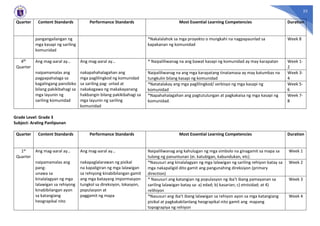
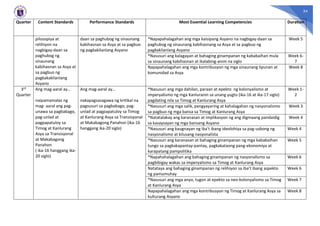
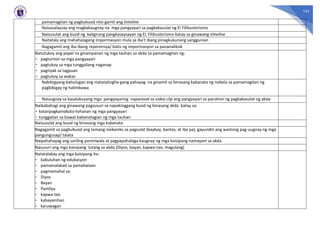
Grade Level: Grade 2
Subject: Araling Panlipunan
Quarter Content Standards Performance Standards Most Essential Learning Competencies Duration
1st
Quarter
Ang mag-aaral ay…
naipamamalas ang
pag- unawa sa
kahalagahan ng
kinabibilangang
komunidad
Ang mag-aaral ay…
malikhaing nakapagpapahayag/
nakapagsasalarawan ng
kahalagahan ng kinabibilangang
komunidad
*Naipaliliwanag ang konsepto ng komunidad Week 1
*Nailalarawan ang sariling komunidad batay sa pangalan nito, lokasyon,
mga namumuno, populasyon, wika, kaugalian, paniniwala, atbp.
Week 2
Naipaliliwanag ang kahalagahan ng ‘komunidad’ Week 3
* Natutukoy ang mga bumuboo sa komunidad : a. mga taong
naninirahan b: mga institusyon c. at iba pang istrukturang panlipunan
Week 4
Naiuugnay ang tungkulin at gawain ng mga bumubuo ng komunidad sa
sarili at sariling pamilya
Week 5
Nakaguguhit ng payak na mapa ng komunidad mula sa sariling tahahan o
paaralan, na nagpapakita ng mga mahahalagang lugar at istruktura,
anyong lupa at tubig, atbp.
Week 6
Nailalarawan ang panahon at kalamidad na nararanasan sa sariling
komunidad:
Week 7
22
Quarter Content Standards Performance Standards Most Essential Learning Competencies Duration
*Naisasagawa ang mga wastong gawain/ pagkilos sa tahanan at paaralan
sa panahon ng kalamidad
Week 8
2nd
Quarter
Ang mag-aaral ay…
naipamamalas ang
pag- unawa sa
kwento ng
pinagmulan ng
sariling komunidad
batay sa konsepto ng
pagbabago at
pagpapatuloy at
pagpapahalaga sa
kulturang nabuo ng
komunidad
Ang mag-aaral ay…
1. nauunawaan ang
pinagmulan at kasaysayan ng
komunidad
2. nabibigyang halaga ang
mga bagay na nagbago at
nananatili sa pamumuhay
komunidad
*Nakapagsasalaysay ng pinagmulan ng sariling komunidad batay sa
pagtatanong at pakikinig sa mga kuwento ng mga nakatatanda sa
komunidad
Week 1
* Nailalahad ang mga pagbabago sa sariling komunidad a.heograpiya
(katangiang pisikal) b. politika (pamahalaan) c. ekonomiya
(hanapbuhay/kabuhayan) d. sosyo-kultural
Week 2
*Naiuugnay ang mga sagisag (hal. natatanging istruktura) na
matatagpuan sa komunidad sa kasaysayan nito.
Week 3
Naihahambing ang katangian ng sariling komunidad sa iba pang
komunidad tulad ng likas na yaman, produkto at hanap-buhay, kaugalian
at mga pagdiriwang, atbp
Week 4
*Nakapagbibigay ng mga inisyatibo at proyekto ng komunidad na
nagsusulong ng natatanging pagkakakilanlan o identidad ng komunidad
Week 5
Nakakalahok sa mga proyekto o mungkahi na nagpapaunlad o
nagsusulong ng natatanging pagkakakilanlan o identidad ng komunidad
Week 6
*Nabibigyang halaga ang pagkakakilalanlang kultural ng komunidad Week 7
3rd
Quarter
Ang mag-aaral ay…
naipamamalas ang
kahalagahan ng
mabuting
paglilingkod ng mga
namumuno sa
pagsulong ng mga
pangunahing
hanapbuhay at
pagtugon sa
Ang mag-aaral ay…
nakapagpapahayag ng
pagpapahalaga sa pagsulong ng
mabuting paglilingkod ng mga
namumuno sa komunidad tungo
sa pagtugon sa pangangailangan
ng mga kasapi ng sariling
komunidad
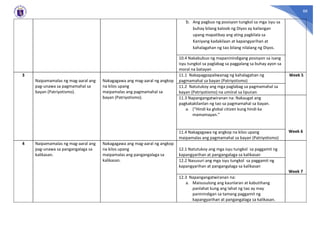
* Natatalakay ang mga pakinabang na naibibigay ng kapaligiran sa
komunidad
Week 1
* Nailalarawan ang kalagayan at suliraning pangkapaligiran ng
komunidad.
Week 2
Naipaliliwanag ang pananagutan ng bawat isa sa pangangalaga sa likas
na yaman at pagpapanatili ng kalinisan ng sariling komunidad
Week 3
*Naipaliliwanag ang pansariling tungkulin sa pangangalaga ng
kapaligiran.
Week 4
*Natatalakay ang konsepto ng pamamahala at pamahalaan Week 5
*Naipaliliwanag ang mga tungkulin ng pamahalaan sa komunidad Week 5
* Naiisa-isa ang mga katangian ng mabuting pinuno Week 6
*Natutukoy ang mga namumuno at mga mamamayang nag-aaambag sa
kaunlaran ng komunidad
Week 7
23
Quarter Content Standards Performance Standards Most Essential Learning Competencies Duration
pangangailangan ng
mga kasapi ng sariling
komunidad
*Nakalalahok sa mga proyekto o mungkahi na nagpapaunlad sa
kapakanan ng komunidad
Week 8
4th
Quarter
Ang mag-aaral ay…
naipamamalas ang
pagpapahalaga sa
kagalingang pansibiko
bilang pakikibahagi sa
mga layunin ng
sariling komunidad
Ang mag-aaral ay…
nakapahahalagahan ang
mga paglilingkod ng komunidad
sa sariling pag- unlad at
nakakagawa ng makakayanang
hakbangin bilang pakikibahagi sa
mga layunin ng sariling
komunidad
* Naipaliliwanag na ang bawat kasapi ng komunidad ay may karapatan Week 1-
2
Naipaliliwanag na ang mga karapatang tinatamasa ay may katumbas na
tungkulin bilang kasapi ng komunidad
Week 3-
4
*Natatalakay ang mga paglilingkod/ serbisyo ng mga kasapi ng
komunidad
Week 5-
6
*Napahahalagahan ang pagtutulungan at pagkakaisa ng mga kasapi ng
komunidad.
Week 7-
8
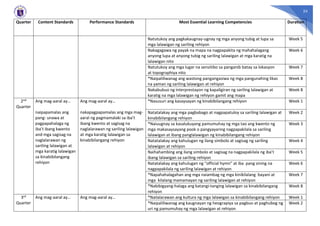
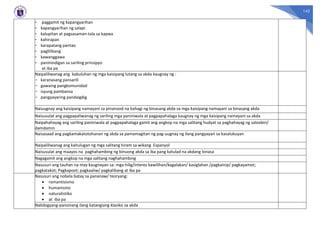
Grade Level: Grade 3
Subject: Araling Panlipunan
Quarter Content Standards Performance Standards Most Essential Learning Competencies Duration
1st
Quarter
Ang mag-aaral ay…
naipamamalas ang
pang-
unawa sa
kinalalagyan ng mga
lalawigan sa rehiyong
kinabibilangan ayon
sa katangiang
heograpikal nito
Ang mag-aaral ay…
nakapaglalarawan ng pisikal
na kapaligiran ng mga lalawigan
sa rehiyong kinabibilangan gamit
ang mga batayang impormasyon
tungkol sa direksiyon, lokasyon,
populasyon at
paggamit ng mapa
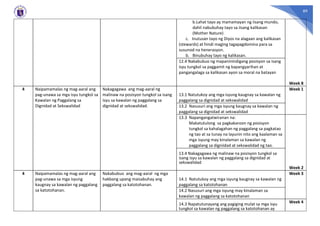
Naipaliliwanag ang kahulugan ng mga simbolo na ginagamit sa mapa sa
tulong ng panuntunan (ei. katubigan, kabundukan, etc)
Week 1
*Nasusuri ang kinalalagyan ng mga lalawigan ng sariling rehiyon batay sa
mga nakapaligid dito gamit ang pangunahing direksiyon (primary
direction)
Week 2
* Nasusuri ang katangian ng populasyon ng iba’t ibang pamayanan sa
sariling lalawigan batay sa: a) edad; b) kasarian; c) etnisidad; at 4)
relihiyon
Week 3
*Nasusuri ang iba’t ibang lalawigan sa rehiyon ayon sa mga katangiang
pisikal at pagkakakilanlang heograpikal nito gamit ang mapang
topograpiya ng rehiyon
Week 4
24
Quarter Content Standards Performance Standards Most Essential Learning Competencies Duration
Natutukoy ang pagkakaugnay-ugnay ng mga anyong tubig at lupa sa
mga lalawigan ng sariling rehiyon
Week 5
Nakagagawa ng payak na mapa na nagpapakita ng mahahalagang
anyong lupa at anyong tubig ng sariling lalawigan at mga karatig na
lalawigan nito
Week 6
Natutukoy ang mga lugar na sensitibo sa panganib batay sa lokasyon
at topographiya nito
Week 7
*Naipaliliwanag ang wastong pangangasiwa ng mga pangunahing likas
na yaman ng sariling lalawigan at rehiyon
Week 8
Nakabubuo ng interprestayon ng kapaligiran ng sariling lalawigan at
karatig na mga lalawigan ng rehiyon gamit ang mapa
Week 8
2nd
Quarter
Ang mag-aaral ay…
naipapamalas ang
pang- unawa at
pagpapahalaga ng
iba’t ibang kwento
and mga sagisag na
naglalarawan ng
sariling lalawigan at
mga karatig lalawigan
sa kinabibilangang
rehiyon
Ang mag-aaral ay…
nakapagpapamalas ang mga mag-
aaral ng pagmamalaki sa iba’t
ibang kwento at sagisag na
naglalarawan ng sariling lalawigan
at mga karatig lalawigan sa
kinabibilangang rehiyon
*Nasusuri ang kasaysayan ng kinabibilangang rehiyon Week 1
Natatalakay ang mga pagbabago at nagpapatuloy sa sariling lalawigan at
kinabibilangang rehiyon
Week 2
*Naiuugnay sa kasalukuyang pamumuhay ng mga tao ang kwento ng
mga makasaysayang pook o pangyayaring nagpapakilala sa sariling
lalawigan at ibang panglalawigan ng kinabibilangang rehiyon
Week 3
Natatalakay ang kahulugan ng ilang simbolo at sagisag ng sariling
lalawigan at rehiyon
Week 4
Naihahambing ang ilang simbolo at sagisag na nagpapakilala ng iba’t
ibang lalawigan sa sariling rehiyon
Week 5
Natatalakay ang kahulugan ng “official hymn” at iba pang sining na
nagpapakilala ng sariling lalawigan at rehiyon
Week 6
*Napahahalagahan ang mga naiambag ng mga kinikilalang bayani at
mga kilalang mamamayan ng sariling lalawigan at rehiyon
Week 7
*Nabibigyang-halaga ang katangi-tanging lalawigan sa kinabibilangang
rehiyon
Week 8
3rd
Quarter
Ang mag-aaral ay… Ang mag-aaral ay… *Nailalarawan ang kultura ng mga lalawigan sa kinabibilangang rehiyon Week 1
*Naipaliliwanag ang kaugnayan ng heograpiya sa pagbuo at paghubog ng
uri ng pamumuhay ng mga lalawigan at rehiyon
Week 2
25
Quarter Content Standards Performance Standards Most Essential Learning Competencies Duration
naipapamalas ang
pag- unawa at
pagpapahalaga sa
pagkakakilanlang
kultural ng
kinabibilangang
rehiyon
nakapagpapahayag ng may
pagmamalaki at pagkilala sa
nabubuong kultura ng mga
lalawigan sa kinabibilangang
rehiyon
Nailalarawan ang pagkakakilanlang kultural ng kinabibilangang rehiyon Week 3
Naipaliliwanag ang kahalagahan ng mga makasaysayan lugar at ang mga
saksi nito sa pagkakakilanlang kultura ng sariling lalawigan at rehiyon
Week 4
Naihahambing ang pagkakatulad at pagkakaiba ng mga kaugalian,
paniniwala at tradisyon sa sariling lalawigan sa karatig lalawigan sa
kinabibilangang rehiyon at sa ibang lalawigan at rehiyon
Week 5-
6
Napahahalagahan ang iba’t ibang pangkat ng tao sa lalawigan at rehiyon Week 7
*Naipamamalas ang pagpapahalaga sa pagkakatulad at pagkakaiba-iba
ng mga kultura gamit ang sining na nagpapakilala sa lalawigan at rehiyon
(e.g. tula, awit, sayaw, pinta, atbp.)
Week 8
4th
Quarter
Ang mag-aaral ay…
naipamamalas ang
pang- unawa sa mga
gawaing
pangkabuhayan at
bahaging
ginagampanan ng
pamahalaan at ang
mga kasapi nito, mga
pinuno at iba pang
naglilingkod tungo sa
pagkakaisa, kaayusan
at kaunlaran ng mga
lalawigan sa
kinabibilangang
rehiyon
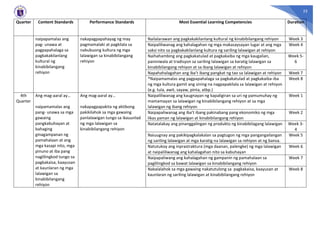
Ang mag-aaral ay…
nakapagpapakita ng aktibong
pakikilahok sa mga gawaing
panlalawigan tungo sa ikauunlad
ng mga lalawigan sa
kinabibilangang rehiyon
Naipaliliwanag ang kaugnayan ng kapaligiran sa uri ng pamumuhay ng
mamamayan sa lalawigan ng kinabibilangang rehiyon at sa mga
lalawigan ng ibang rehiyon
Week 1
Naipapaliwanag ang iba’t ibang pakinabang pang ekonomiko ng mga
likas yaman ng lalawigan at kinabibilangang rehiyon
Week 2
Natatalakay ang pinanggalingan ng produkto ng kinabibilagang lalawigan Week 3-
4
Naiuugnay ang pakikipagkalakalan sa pagtugon ng mga pangangailangan
ng sariling lalawigan at mga karatig na lalawigan sa rehiyon at ng bansa.
Week 5
Natutukoy ang inprastraktura (mga daanan, palengke) ng mga lalawigan
at naipaliliwanag ang kahalagahan nito sa kabuhayan
Week 6
Naipapaliwang ang kahalagahan ng gampanin ng pamahalaan sa
paglilingkod sa bawat lalawigan sa kinabibilangang rehiyon
Week 7
Nakalalahok sa mga gawaing nakatutulong sa pagkakaisa, kaayusan at
kaunlaran ng sariling lalawigan at kinabibilangang rehiyon
Week 8
26
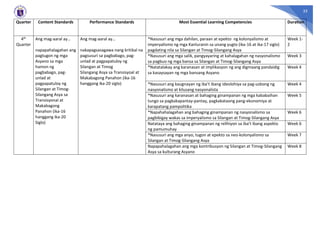
Grade Level: Grade 4
Subject: Araling Panlipunan
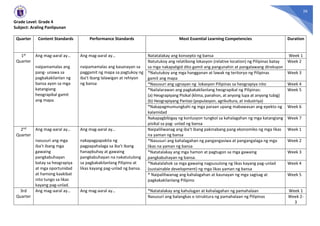
Quarter Content Standards Performance Standards Most Essential Learning Competencies Duration
1st
Quarter
Ang mag-aaral ay…
naipamamalas ang
pang- unawa sa
pagkakakilanlan ng
bansa ayon sa mga
katangiang
heograpikal gamit
ang mapa.
Ang mag-aaral ay…
naipamamalas ang kasanayan sa
paggamit ng mapa sa pagtukoy ng
iba’t ibang lalawigan at rehiyon
ng bansa
Natatalakay ang konsepto ng bansa Week 1
Natutukoy ang relatibong lokasyon (relative location) ng Pilipinas batay
sa mga nakapaligid dito gamit ang pangunahin at pangalawang direksyon
Week 2
*Natutukoy ang mga hangganan at lawak ng teritoryo ng Pilipinas
gamit ang mapa
Week 3
*Nasusuri ang ugnayan ng lokasyon Pilipinas sa heograpiya nito Week 4
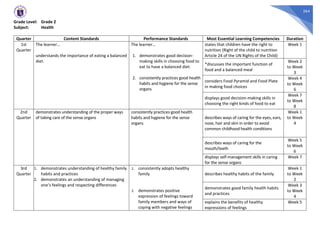
*Nailalarawan ang pagkakakilanlang heograpikal ng Pilipinas:
(a) Heograpiyang Pisikal (klima, panahon, at anyong lupa at anyong tubig)
(b) Heograpiyang Pantao (populasyon, agrikultura, at industriya)
Week 5
*Nakapagmumungkahi ng mga paraan upang mabawasan ang epekto ng
kalamidad
Week 6
Nakapagbibigay ng konlusyon tungkol sa kahalagahan ng mga katangiang
pisikal sa pag- unlad ng bansa
Week 7
2nd
Quarter
Ang mag-aaral ay…
nasusuri ang mga
iba’t ibang mga
gawaing
pangkabuhayan
batay sa heograpiya
at mga oportunidad
at hamong kaakibat
nito tungo sa likas
kayang pag-unlad.
Ang mag-aaral ay…
nakapagpapakita ng
pagpapahalaga sa iba’t ibang
hanapbuhay at gawaing
pangkabuhayan na nakatutulong
sa pagkakakilanlang Pilipino at
likas kayang pag-unlad ng bansa.
Naipaliliwanag ang iba’t ibang pakinabang pang ekonomiko ng mga likas
na yaman ng bansa
Week 1
*Nasusuri ang kahalagahan ng pangangasiwa at pangangalaga ng mga
likas na yaman ng bansa
Week 2
*Natatalakay ang mga hamon at pagtugon sa mga gawaing
pangkabuhayan ng bansa.
Week 3
*Nakalalahok sa mga gawaing nagsusulong ng likas kayang pag-unlad
(sustainable development) ng mga likas yaman ng bansa
Week 4
* Naipaliliwanag ang kahalagahan at kaunayan ng mga sagisag at
pagkakakilanlang Pilipino
Week 5
3rd
Quarter
Ang mag-aaral ay… Ang mag-aaral ay… *Natatalakay ang kahulugan at kahalagahan ng pamahalaan Week 1
Nasusuri ang balangkas o istruktura ng pamahalaan ng Pilipinas Week 2-
3
27
Quarter Content Standards Performance Standards Most Essential Learning Competencies Duration
naipamamalas ang
pang- unawa sa
bahaging
ginagampanan ng
pamahalaan sa
lipunan, mga pinuno
at iba pang
naglilingkod sa
pagkakaisa, kaayusan
at kaunlaran ng bansa
nakapagpapakita ng aktibong
pakikilahok at pakikiisa sa mga
proyekto at gawain ng
pamahalaan at mga pinuno nito
tungo sa kabutihan ng lahat
(common good)
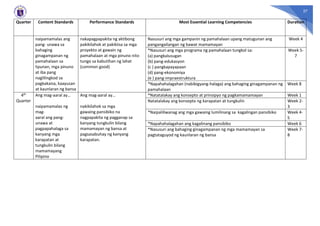
Nasusuri ang mga gampanin ng pamahalaan upang matugunan ang
pangangailangan ng bawat mamamayan
Week 4
*Nasusuri ang mga programa ng pamahalaan tungkol sa:
(a) pangkalusugan
(b) pang-edukasyon
(c ) pangkapayapaan
(d) pang-ekonomiya
(e ) pang-impraestruktura
Week 5-
7
*Napahahalagahan (nabibigyang-halaga) ang bahaging ginagampanan ng
pamahalaan
Week 8
4th
Quarter
Ang mag-aaral ay…
naipamamalas ng
mag-
aaral ang pang-
unawa at
pagpapahalaga sa
kanyang mga
karapatan at
tungkulin bilang
mamamayang
Pilipino
Ang mag-aaral ay…
nakikilahok sa mga
gawaing pansibiko na
nagpapakita ng pagganap sa
kanyang tungkulin bilang
mamamayan ng bansa at
pagsasabuhay ng kanyang
karapatan.
*Natatalakay ang konsepto at prinsipyo ng pagkamamamayan Week 1
Natatalakay ang konsepto ng karapatan at tungkulin Week 2-
3
*Naipaliliwanag ang mga gawaing lumilinang sa kagalingan pansibiko Week 4-
5
*Napahahalagahan ang kagalinang pansibiko Week 6
*Nasusuri ang bahaging ginagampanan ng mga mamamayan sa
pagtataguyod ng kaunlaran ng bansa
Week 7-
8
28
Grade Level: Grade 5
Subject: Araling Panlipunan
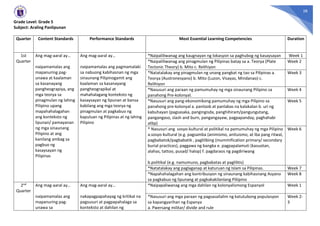
Quarter Content Standards Performance Standards Most Essential Learning Competencies Duration
1st
Quarter
Ang mag-aaral ay…
naipamamalas ang
mapanuring pag-
unawa at kaalaman
sa kasanayang
pangheograpiya, ang
mga teorya sa
pinagmulan ng lahing
Pilipino upang
mapahahalagahan
ang konteksto ng
lipunan/ pamayanan
ng mga sinaunang
Pilipino at ang
kanilang ambag sa
pagbuo ng
kasaysayan ng
Pilipinas
Ang mag-aaral ay…
naipamamalas ang pagmamalaki
sa nabuong kabihasnan ng mga
sinaunang Pilipinogamit ang
kaalaman sa kasanayang
pangheograpikal at
mahahalagang konteksto ng
kasaysayan ng lipunan at bansa
kabilang ang mga teorya ng
pinagmulan at pagkabuo ng
kapuluan ng Pilipinas at ng lahing
Pilipino
*Naipaliliwanag ang kaugnayan ng lokasyon sa paghubog ng kasaysayan Week 1
*Naipaliliwanag ang pinagmulan ng Pilipinas batay sa a. Teorya (Plate
Tectonic Theory) b. Mito c. Relihiyon
Week 2
*Natatalakay ang pinagmulan ng unang pangkat ng tao sa Pilipinas a.
Teorya (Austronesyano) b. Mito (Luzon, Visayas, Mindanao) c.
Relihiyon
Week 3
*Nasusuri ang paraan ng pamumuhay ng mga sinaunang Pilipino sa
panahong Pre-kolonyal.
Week 4
*Nasusuri ang pang-ekonomikong pamumuhay ng mga Pilipino sa
panahong pre-kolonyal a. panloob at panlabas na kalakalan b. uri ng
kabuhayan (pagsasaka, pangingisda, panghihiram/pangungutang,
pangangaso, slash and burn, pangangayaw, pagpapanday, paghahabi
atbp)
Week 5
* Nasusuri ang sosyo-kultural at politikal na pamumuhay ng mga Pilipino
a.sosyo-kultural (e.g. pagsamba (animismo, anituismo, at iba pang ritwal,
pagbabatok/pagbabatik , paglilibing (mummification primary/ secondary
burial practices), paggawa ng bangka e. pagpapalamuti (kasuotan,
alahas, tattoo, pusad/ halop) f. pagdaraos ng pagdiriwang
b.politikal (e.g. namumuno, pagbabatas at paglilitis)
Week 6
*Natatalakay ang paglaganap at katuruan ng Islam sa Pilipinas. Week 7
*Napahahalagahan ang kontribusyon ng sinaunang kabihasnang Asyano
sa pagkabuo ng lipunang at pagkakakilanlang Piliipino
Week 8
2nd
Quarter
Ang mag-aaral ay…
naipamamalas ang
mapanuring pag-
unawa sa
Ang mag-aaral ay…
nakapagpapahayag ng kritikal na
pagsusuri at pagpapahalaga sa
konteksto at dahilan ng
*Naipapaliwanag ang mga dahilan ng kolonyalismong Espanyol Week 1
*Nasusuri ang mga paraan ng pagsasailalim ng katutubong populasyon
sa kapangyarihan ng Espanya
a. Pwersang militar/ divide and rule
Week 2-
3
29
Quarter Content Standards Performance Standards Most Essential Learning Competencies Duration
konteksto,ang
bahaging
ginampanan ng
simbahan sa, layunin
at mga paraan ng
pananakopng
Espanyolsa Pilipinas
at ang epekto
ng mga ito sa lipunan.
kolonyalismong Espanyol at ang
epekto ng mga paraang
pananakop sa katutubong
populasyon
b. Kristyanisasyon
* Nasusuri ang epekto ng mga patakarang kolonyal na ipinatupad ng
Espanya sa bansa
A. Patakarang pang-ekonomiya (Halimbawa: Pagbubuwis, Sistemang
Bandala, Kalakalang Galyon, Monopolyo sa Tabako, Royal Company,
Sapilitang Paggawa at iba pa)
B. Patakarang pampolitika (Pamahalaang kolonyal)
Week 4-
8
3rd
Quarter
Ang mag-aaral ay…
naipamamalas ang
mapanuring pag-
unawa sa mga
pagbabago sa lipunan
ng sinaunang Pilipino
kabilang ang
pagpupunyagi ng
ilang
pangkat na
mapanatili ang
kalayaan sa
Kolonyalismong
Espanyol at ang
impluwensya nito sa
kasalukuyang
panahon.
Ang mag-aaral ay…
nakakapagpakita ng
pagpapahalaga at pagmamalaki
sa pagpupunyagi ng mga Pilipino
sa panahon ng kolonyalismong
Espanyol
*Naipaliliwanag ang mga paraan ng pagtugon ng mga Pilipino sa
kolonyalismong Espanyol (Hal. Pag-aalsa, pagtanggap sa kapangyarihang
kolonyal/ kooperasyon)
Week 1
*Napahahalagahan ang pagtatanggol ng mga Pilipino laban sa
kolonyalismong Espanyol
Week 2
*Natatalakay ang impluwensya ng mga Espanyol sa kultura ng mga
Pilipino
Week 3-
4
*Nasusuri ang kaugnayan ng pakikipaglaban ng mga Pilipino sa pag-
usbong ng nasyonalismong Pilipino
Week 5-
6
*Napahahalagahan ang mga katutubong Pilipinong lumaban upang
mapanatili ang kanilang kasarinlan
Week 7-
8
4th
Quarter
Ang mag-aaral ay…
naipamamalas ang
mapanuring pag-
Ang mag-aaral ay… *Naipaliliwanag ang mga salik na nagbigay daan sa pag-usbong ng
nasyonalismong Pilipino
Week 1-
2
*Naipaliliwanag ang pananaw at paniniwala ng mga Sultanato
(Katutubong Muslim) sa pagpapanatili ng kanilang Kalayaan
Week 3-
4
30
Quarter Content Standards Performance Standards Most Essential Learning Competencies Duration
unawa sa bahaging
ginampanan ng
kolonyalismong
Espanyol at
pandaigdigang
koteksto ng reporma
sa pag- usbong ng
kamalayang
pambansa attungo sa
pagkabuo ng Pilipinas
bilang isang nasyon
nakapagpapahayag ng
pagmamalaki sa pagpupunyagi ng
mga makabayang Pilipino sa gitna
ng kolonyalismong Espanyol at sa
mahalagang papel na
ginagampanan nito sa pag-
usbong ng kamalayang pambansa
tungo sa pagkabuo ng Pilipinas
bilang
isang nasyon
Natataya ang partisipasyon ng iba’t-ibang rehiyon at sektor (katutubo at
kababaihan) sa pakikibaka ng bayan
Week 5-
6
* Napahahalagahan ang partisipasyon ng iba’t ibang rehiyon at sektor sa
pagsulong ng kamalayang pambansa
Week 7-
8
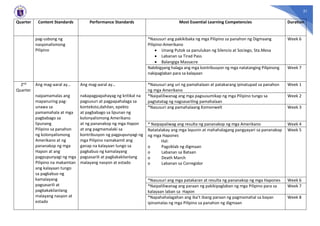
Grade Level: Grade 6
Subject: Araling Panlipunan
Quarter Content Standards Performance Standards Most Essential Learning Competencies Duration
1st
Quarter
Ang mag-aaral ay…
naipamamalas ang
mapanuring pag-
unawa at kaalaman
sa bahagi ng Pilipinas
sa globalisasyon
batay sa lokasyon
nito sa mundo gamit
ang mga kasanayang
pangheograpiya at
ang ambag ng
malayang kaisipan sa
Ang mag-aaral ay…
naipamamalas ang
pagpapahalaga sa kontribosyon
ng Pilipinas sa isyung pandaigdig
batay sa lokasyon nito sa mundo
*Nasusuri ang epekto ng kaisipang liberal sa pag-usbong ng damdaming
nasyonalismo.
Week 1
*Naipaliliwanag ang layunin at resulta ng pagkakatatag ng Kilusang
Propaganda at Katipunan sa paglinang ng nasyonalismong Pilipino
Week 2
*Nasusuri ang mga dahilan at pangyayaring naganap sa Panahon ng
Himagsikang Pilipino
• Sigaw sa Pugad-Lawin
• Tejeros Convention
• Kasunduan sa Biak-na-Bato
Week 3
Natatalakay ang partisipasyon ng mga kababaihan sa rebolusyong
Pilipino
Week 4
*Napahahalagahan ang deklarasyon ng kasarinlan ng Pilipinas at ang
pagkakatatag ng Unang Republika
Week 5
31
Quarter Content Standards Performance Standards Most Essential Learning Competencies Duration
pag-usbong ng
nasyonalismong
Pilipino
*Nasusuri ang pakikibaka ng mga Pilipino sa panahon ng Digmaang
Pilipino-Amerikano
• Unang Putok sa panulukan ng Silencio at Sociego, Sta.Mesa
• Labanan sa Tirad Pass
• Balangiga Massacre
Week 6
Nabibigyang halaga ang mga kontribusyon ng mga natatanging Pilipinong
nakipaglaban para sa kalayaan
Week 7
2nd
Quarter
Ang mag-aaral ay…
naipamamalas ang
mapanuring pag-
unawa sa
pamamahala at mga
pagbabago sa
lipunang
Pilipino sa panahon
ng kolonyalismong
Amerikano at ng
pananakop ng mga
Hapon at ang
pagpupunyagi ng mga
Pilipino na makamtan
ang kalayaan tungo
sa pagkabuo ng
kamalayang
pagsasarili at
pagkakakilanlang
malayang nasyon at
estado
Ang mag-aaral ay…
nakapagpapahayag ng kritikal na
pagsusuri at pagpapahalaga sa
konteksto,dahilan, epekto
at pagbabago sa lipunan ng
kolonyalismong Amerikano
at ng pananakop ng mga Hapon
at ang pagmamalaki sa
kontribusyon ng pagpupunyagi ng
mga Pilipino namakamit ang
ganap na kalayaan tungo sa
pagkabuo ng kamalayang
pagsasarili at pagkakakilanlang
malayang nasyon at estado
*Nasusuri ang uri ng pamahalaan at patakarang ipinatupad sa panahon
ng mga Amerikano
Week 1
*Naipaliliwanag ang mga pagsusumikap ng mga Pilipino tungo sa
pagtatatag ng nagsasariling pamahalaan
Week 2
*Nasusuri ang pamahalaang Komonwelt Week 3
* Naipapaliwag ang resulta ng pananakop ng mga Amerikano Week 4
Natatalakay ang mga layunin at mahahalagang pangyayari sa pananakop
ng mga Hapones
Hal:
o Pagsiklab ng digmaan
o Labanan sa Bataan
o Death March
o Labanan sa Corregidor
Week 5
*Nasusuri ang mga patakaran at resulta ng pananakop ng mga Hapones Week 6
*Naipaliliwanag ang paraan ng pakikipaglaban ng mga Pilipino para sa
kalayaan laban sa Hapon
Week 7
*Napahahalagahan ang iba’t ibang paraan ng pagmamahal sa bayan
ipinamalas ng mga Pilipino sa panahon ng digmaan
Week 8
32
Quarter Content Standards Performance Standards Most Essential Learning Competencies Duration
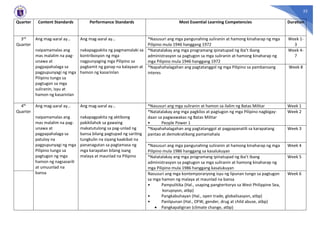
3rd
Quarter
Ang mag-aaral ay…
naipamamalas ang
mas malalim na pag-
unawa at
pagpapahalaga sa
pagpupunyagi ng mga
Pilipino tungo sa
pagtugon sa mga
suliranin, isyu at
hamon ng kasarinlan
Ang mag-aaral ay…
nakapagpakita ng pagmamalaki sa
kontribosyon ng mga
nagpunyaging mga Pilipino sa
pagkamit ng ganap na kalayaan at
hamon ng kasarinlan
*Nasusuri ang mga pangunahing suliranin at hamong kinaharap ng mga
Pilipino mula 1946 hanggang 1972
Week 1-
3
*Natatalakay ang mga programang ipinatupad ng iba’t ibang
administrasyon sa pagtugon sa mga suliranin at hamong kinaharap ng
mga Pilipino mula 1946 hanggang 1972
Week 4-
7
*Napahahalagahan ang pagtatanggol ng mga Pilipino sa pambansang
interes
Week 8
4th
Quarter
Ang mag-aaral ay…
naipamamalas ang
mas malalim na pag-
unawa at
pagpapahalaga sa
patuloy na
pagpupunyagi ng mga
Pilipino tungo sa
pagtugon ng mga
hamon ng nagsasarili
at umuunlad na
bansa
Ang mag-aaral ay…
nakapagpakita ng aktibong
pakikilahok sa gawaing
makatutulong sa pag-unlad ng
bansa bilang pagtupad ng sariling
tungkulin na siyang kaakibat na
pananagutan sa pagtamasa ng
mga karapatan bilang isang
malaya at maunlad na Pilipino
*Nasusuri ang mga suliranin at hamon sa ilalim ng Batas Militar Week 1
*Natatalakay ang mga pagkilos at pagtugon ng mga Pilipino nagbigay-
daan sa pagwawakas ng Batas Militar
• People Power 1
Week 2
*Napahahalagahan ang pagtatanggol at pagpapanatili sa karapatang
pantao at demokratikong pamamahala
Week 3
*Nasusuri ang mga pangunahing suliranin at hamong kinaharap ng mga
Pilipino mula 1986 hanggang sa kasalukuyan
Week 4
*Natatalakay ang mga programang ipinatupad ng iba’t ibang
administrasyon sa pagtugon sa mga suliranin at hamong kinaharap ng
mga Pilipino mula 1986 hanggang kasalukuyan
Week 5
Nasusuri ang mga kontemporaryong isyu ng lipunan tungo sa pagtugon
sa mga hamon ng malaya at maunlad na bansa
• Pampulitika (Hal., usaping pangteritoryo sa West Philippine Sea,
korupsyon, atbp)
• Pangkabuhayan (Hal., open trade, globalisasyon, atbp)
• Panlipunan (Hal., OFW, gender, drug at child abuse, atbp)
• Pangkapaligiran (climate change, atbp)
Week 6
33
Quarter Content Standards Performance Standards Most Essential Learning Competencies Duration
*Natatalakay ang mga gampaning ng pamahalaan at mamamayan sa
pagkamit ng kaunlaran ng bansa
Week 7
*Napahahalagahan ang aktibong pakikilahok ng mamamayan sa mga
programa ng pamahalaan tungo sa pag-unlad ng bansa
Week 8
Grade Level: Grade 7
Subject: Araling Panlipunan
Quarter Content Standards Performance Standards Most Essential Learning Competencies Duration
1st
Quarter
Ang mag-aaral ay…
naipamamalas ng
mag-aaral ang pag-
unawa sa ugnayan ng
kapaligiran at tao sa
paghubog ng
sinaunang
kabihasnang Asyano.
Ang mag-aaral ay…
malalim na nakapaguugnay-ugnay
sa bahaging ginampanan ng
kapaligiran at tao sa
paghubog ng sinaunang
kabihasnang Asyano
Naipapaliwanag ang konsepto ng Asya tungo sa paghahating –
heograpiko: Silangang Asya, Timog-Silangang Asya, Timog-Asya,
Kanlurang Asya, Hilagang Asya at Hilaga/ Gitnang Asya
Week 1
Napapahalagahan ang ugnayan ng tao at kapaligiran sa paghubog ng
kabihasnang Asyano
Week 2
Nailalarawan ang mga yamang likas ng Asya Week 3
*Nasusuri ang yamang likas at ang mga implikasyon ng kapaligirang
pisikal sa pamumuhay ng mga Asyano noon at ngayon
Week 4-
5
Naipapahayag ang kahalagahan ng pangangalaga sa timbang na
kalagayang ekolohiko ng rehiyon
Week 6
*Nasusuri ang komposisyon ng populasyon at kahalagahan ng yamang-
tao sa Asya sa pagpapaunlad ng kabuhayan at lipunan sa kasalukuyang
panahon
Week 7-
8
2nd
Quarter
Ang mag-aaral ay…
naipamamalas ng
mag- aaral ang pag-
unawa sa mga
kaisipang Asyano,
Ang mag-aaral ay…
kritikal na nakapagsusuri sa mga
kaisipang Asyano, pilosopiya at
relihiyon na nagbigay-
Natatalakay ang konsepto ng kabihasnan at mga katangian nito Week 1
Napaghahambing ang mga sinaunang kabihasnan sa Asya (Sumer, Indus,
Tsina)
Week 2-
3
*Natataya ang impluwensiya ng mga kaisipang Asyano sa kalagayang
panlipunan at kultura sa Asya
Week 4
34
Quarter Content Standards Performance Standards Most Essential Learning Competencies Duration
pilosopiya at
relihiyon na
nagbigay-daan sa
paghubog ng
sinaunang
kabihasnan sa Asya at
sa pagbuo ng
pagkakakilanlang
Asyano
daan sa paghubog ng sinaunang
kabihasnan sa Asya at sa pagbuo
ng pagkakilanlang Asyano
*Napapahalagahan ang mga kaisipang Asyano na nagbigay-daan sa
paghubog ng sinaunang kabihasnang sa Asya at sa pagbuo ng
pagkakilanlang Asyano
Week 5
*Nasusuri ang kalagayan at bahaging ginampanan ng kababaihan mula
sa sinaunang kabihasnan at ikalabing-anim na siglo
Week 6-
7
Napapahalagahan ang mga kontribusyon ng mga sinaunang lipunan at
komunidad sa Asya
Week 8
3rd
Quarter
Ang mag-aaral ay…
naipamamalas ng
mag- aaral ang pag-
unawa sa pagbabago,
pag-unlad at
pagpapatuloy sa
Timog at Kanlurang
Asya sa Transisyonal
at Makabagong
Panahon
( ika-16 hanggang ika-
20 siglo)
Ang mag-aaral ay…
nakapagsasagawa ng kritikal na
pagsusuri sa pagbabago, pag-
unlad at pagpapatuloy sa Timog
at Kanlurang Asya sa Transisyonal
at Makabagong Panahon (ika-16
hanggang ika-20 siglo)
*Nasusuri ang mga dahilan, paraan at epekto ng kolonyalismo at
imperyalismo ng mga Kanluranin sa unang yugto (ika-16 at ika-17 siglo)
pagdating nila sa Timog at Kanlurang Asya
Week 1-
2
*Nasusuri ang mga salik, pangyayaring at kahalagahan ng nasyonalismo
sa pagbuo ng mga bansa sa Timog at Kanlurang Asya
Week 3
*Natatalakay ang karanasan at implikasyon ng ang digmaang pandaidig
sa kasaysayan ng mga bansang Asyano
Week 4
*Nasusuri ang kaugnayan ng iba’t ibang ideolohiya sa pag-usbong ng
nasyonalismo at kilusang nasyonalista
Week 4
*Nasusuri ang karanasan at bahaging ginampanan ng mga kababaihan
tungo sa pagkakapantay-pantay, pagkakataong pang-ekonomiya at
karapatang pampolitika
Week 5
*Napahahalagahan ang bahaging ginampanan ng nasyonalismo sa
pagbibigay wakas sa imperyalismo sa Timog at Kanlurang Asya
Week 6
Natataya ang bahaging ginampanan ng relihiyon sa iba’t ibang aspekto
ng pamumuhay
Week 6
*Nasusuri ang mga anyo, tugon at epekto sa neo-kolonyalismo sa Timog
at Kanlurang Asya
Week 7
Napapahalagahan ang mga kontribusyon ng Timog at Kanlurang Asya sa
kulturang Asyano
Week 8
35
Quarter Content Standards Performance Standards Most Essential Learning Competencies Duration
4th
Quarter
Ang mag-aaral ay…
napapahalagahan ang
pagtugon ng mga
Asyano sa mga
hamon ng
pagbabago, pag-
unlad at
pagpapatuloy ng
Silangan at Timog-
Silangang Asya sa
Transisyonal at
Makabagong
Panahon (ika-16
hanggang ika-20
Siglo)
Ang mag-aaral ay…
nakapagsasagawa nang kritikal na
pagsusuri sa pagbabago, pag-
unlad at pagpapatuloy ng
Silangan at Timog
Silangang Asya sa Transisyoal at
Makabagong Panahon (ika-16
hanggang ika-20 siglo)
*Nasusuri ang mga dahilan, paraan at epekto ng kolonyalismo at
imperyalismo ng mga Kanluranin sa unang yugto (ika-16 at ika-17 siglo)
pagdating nila sa Silangan at Timog-Silangang Asya
Week 1-
2
*Nasusuri ang mga salik, pangyayaring at kahalagahan ng nasyonalismo
sa pagbuo ng mga bansa sa Silangan at Timog-Silangang Asya
Week 3
*Natatalakay ang karanasan at implikasyon ng ang digmaang pandaidig
sa kasaysayan ng mga bansang Asyano
Week 4
*Nasusuri ang kaugnayan ng iba’t ibang ideolohiya sa pag-usbong ng
nasyonalismo at kilusang nasyonalista
Week 4
*Nasusuri ang karanasan at bahaging ginampanan ng mga kababaihan
tungo sa pagkakapantay-pantay, pagkakataong pang-ekonomiya at
karapatang pampolitika
Week 5
*Napahahalagahan ang bahaging ginampanan ng nasyonalismo sa
pagbibigay wakas sa imperyalismo sa Silangan at Timog-Silangang Asya
Week 6
Natataya ang bahaging ginampanan ng relihiyon sa iba’t ibang aspekto
ng pamumuhay
Week 6
*Nasusuri ang mga anyo, tugon at epekto sa neo-kolonyalismo sa
Silangan at Timog-Silangang Asya
Week 7
Napapahalagahan ang mga kontribusyon ng Silangan at Timog-Silangang
Asya sa kulturang Asyano
Week 8
36
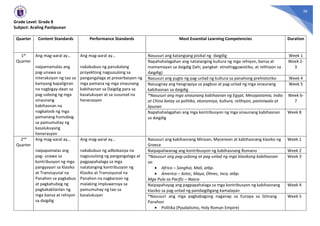
Grade Level: Grade 8
Subject: Araling Panlipunan
Quarter Content Standards Performance Standards Most Essential Learning Competencies Duration
1st
Quarter
Ang mag-aaral ay…
naipamamalas ang
pag-unawa sa
interaksiyon ng tao sa
kaniyang kapaligiran
na nagbigay-daan sa
pag-usbong ng mga
sinaunang
kabihasnan na
nagkaloob ng mga
pamanang humubog
sa pamumuhay ng
kasalukuyang
henerasyon
Ang mag-aaral ay…
nakabubuo ng panukalang
proyektong nagsusulong sa
pangangalaga at preserbasyon ng
mga pamana ng mga sinaunang
kabihasnan sa Daigdig para sa
kasalukuyan at sa susunod na
henerasyon
Nasusuri ang katangiang pisikal ng daigdig Week 1
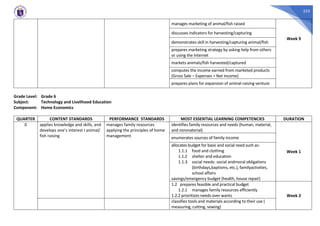
Napahahalagahan ang natatanging kultura ng mga rehiyon, bansa at
mamamayan sa daigdig (lahi, pangkat- etnolingguwistiko, at relihiyon sa
daigdig)
Week 2-
3
Nasusuri ang yugto ng pag-unlad ng kultura sa panahong prehistoriko Week 4
Naiuugnay ang heograpiya sa pagbuo at pag-unlad ng mga sinaunang
kabihasnan sa daigdig
Week 5
*Nasusuri ang mga sinaunang kabihasnan ng Egypt, Mesopotamia, India
at China batay sa politika, ekonomiya, kultura, relihiyon, paniniwala at
lipunan
Week 6-
7
Napahahalagahan ang mga kontribusyon ng mga sinaunang kabihasnan
sa daigdig
Week 8
2nd
Quarter
Ang mag-aaral ay…
naipapamalas ang
pag- unawa sa
kontribusyon ng mga
pangyayari sa Klasiko
at Transisyunal na
Panahon sa pagkabuo
at pagkahubog ng
pagkakakilanlan ng
mga bansa at rehiyon
sa daigdig
Ang mag-aaral ay…
nakabubuo ng adbokasiya na
nagsusulong ng pangangalaga at
pagpapahalaga sa mga
natatanging kontribusyon ng
Klasiko at Transisyunal na
Panahon na nagkaroon ng
malaking impluwensya sa
pamumuhay ng tao sa
kasalukuyan
Nasusuri ang kabihasnang Minoan, Mycenean at kabihasnang klasiko ng
Greece
Week 1
Naipapaliwanag ang kontribusyon ng kabihasnang Romano Week 2
*Nasusuri ang pag-usbong at pag-unlad ng mga klasikong kabihasnan
sa:
• Africa – Songhai, Mali, atbp.
• America – Aztec, Maya, Olmec, Inca, atbp.
Mga Pulo sa Pacific – Nazca
Week 3
Naipapahayag ang pagpapahalaga sa mga kontribusyon ng kabihasnang
klasiko sa pag-unlad ng pandaigdigang kamalayan
Week 4
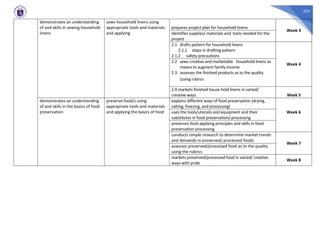
*Nasusuri ang mga pagbabagong naganap sa Europa sa Gitnang
Panahon
• Politika (Pyudalismo, Holy Roman Empire)
Week 5
37
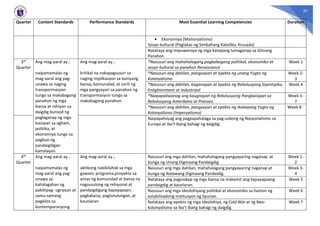
Quarter Content Standards Performance Standards Most Essential Learning Competencies Duration
• Ekonomiya (Manoryalismo)
Sosyo-kultural (Paglakas ng Simbahang Katoliko, Krusada)
Natataya ang impuwensya ng mga kaisipang lumaganap sa Gitnang
Panahon
3rd
Quarter
Ang mag-aaral ay…
naipamamalas ng
mag-aaral ang pag-
unawa sa naging
transpormasyon
tungo sa makabagong
panahon ng mga
bansa at rehiyon sa
daigdig bunsod ng
paglaganap ng mga
kaisipan sa agham,
politika, at
ekonomiya tungo sa
pagbuo ng
pandaigdigan
kamalayan
Ang mag-aaral ay…
kritikal na nakapagsusuri sa
naging implikasyon sa kaniyang
bansa, komunidad, at sarili ng
mga pangyayari sa panahon ng
transpormasyon tungo sa
makabagong panahon.
*Nasusuri ang mahahalagang pagbabagong politikal, ekonomiko at
sosyo-kultural sa panahon Renaissance
Week 1
*Nasusuri ang dahilan, pangyayari at epekto ng unang Yugto ng
Kolonyalismo
Week 2-
3
*Nasusuri ang dahilan, kaganapan at epekto ng Rebolusyong Siyentipiko,
Enlightenment at Industriyal
Week 4
*Naipapaliwanag ang kaugnayan ng Rebolusyong Pangkaisipan sa
Rebolusyong Amerikano at Pranses.
Week 5-
7
*Nasusuri ang dahilan, pangyayari at epekto ng Ikalawang Yugto ng
Kolonyalismo (Imperyalismo)
Week 8
Naipapahayag ang pagpapahalaga sa pag-usbong ng Nasyonalismo sa
Europa at iba’t ibang bahagi ng daigdig.
4th
Quarter
Ang mag-aaral ay…
naipamamalas ng
mag-aaral ang pag-
unawa sa
kahalagahan ng
pakikipag- ugnayan at
sama-samang
pagkilos sa
kontemporanyong
Ang mag-aaral ay…
aktibong nakikilahok sa mga
gawain, programa,proyekto sa
antas ng komunidad at bansa na
nagsusulong ng rehiyonal at
pandaigdigang kapayapaan,
pagkakaisa, pagtutulungan, at
kaunlaran
Nasusuri ang mga dahilan, mahahalagang pangyayaring naganap at
bunga ng Unang Digmaang Pandaigdig
Week 1-
2
Nasusuri ang mga dahilan, mahahalagang pangyayaring naganap at
bunga ng Ikalawang Digmaang Pandaidig.
Week 3-
4
Natataya ang pagsisikap ng mga bansa na makamit ang kapayapaang
pandaigdig at kaunlaran.
Week 5
Nasusuri ang mga ideolohiyang politikal at ekonomiko sa hamon ng
estabilisadong institusyon ng lipunan.
Week 6
Natataya ang epekto ng mga ideolohiya, ng Cold War at ng Neo-
kolonyalismo sa iba’t ibang bahagi ng daigdig.
Week 7
38
Quarter Content Standards Performance Standards Most Essential Learning Competencies Duration
daigdig tungo sa
pandaigdigang
kapayapaan,
pagkakaisa,
pagtutulungan, at
kaunlaran
*Napahahalagahan ang bahaging ginampanan ng mga pandaidigang
organisasyon sa pagsusulong ng pandaigdigang kapayapaan, pagkakaisa,
pagtutulungan, at kaunlaran.
Week 8
Grade Level: Grade 9
Subject: Araling Panlipunan
Quarter Content Standards Performance Standards Most Essential Learning Competencies Duration
1st
Quarter
Ang mag-aaral ay…
may pag-unawa sa
mga pangunahing
konsepto ng
Ekonomiks bilang
batayan ng matalino
at maunlad na pang-
araw-araw na
pamumuhay
Ang mag-aaral ay…
naisasabuhay ang pag- unawa sa
mga pangunahing konsepto ng
ekonomiks bilang batayan ng
matalino at maunlad na pang-
araw-araw na pamumuhay
Nailalapat ang kahulugan ng ekonomiks sa pang-araw- araw na
pamumuhay bilang isang mag-aaral, at kasapi ng pamilya at lipunan
Week 1
Natataya ang kahalagahan ng ekonomiks sa pang-araw- araw na
pamumuhay ng bawat pamilya at ng lipunan
Week 2-
3
*Nasusuri ang iba’t-ibang sistemang pang-ekonomiya Week 4
*Natatalakay ang mga salik ng produksyon at ang implikasyon nito sa
pang- araw- araw na pamumuhay
Week 5
Nasusuri ang mga salik na nakaaapekto sa pagkonsumo. Week 6-
7
Naipagtatanggol ang mga karapatan at nagagampanan ang mga
tungkulin bilang isang mamimili
Week 8
2nd
Quarter
Ang mag-aaral ay…
may pag-unawa sa
mga pangunahing
kaalaman sa ugnayan
ng pwersa ng
Ang mag-aaral ay…
kritikal na
nakapagsusuri sa mga
pangunahing kaalaman sa
ugnayan ng pwersa ng demand at
*Natatalakay ang konsepto at salik na nakaaapekto sa demand sa pang
araw-araw na pamumuhay
Week 1-
2
*Natatalakay ang konsepto at salik na nakaaapekto sa suplay sa pang
araw-araw na pamumuhay
Week 3-
4
*Naipapaliwanag ang interaksyon ng demand at suplay sa kalagayan ng
presyo at ng pamilihan
Week 5
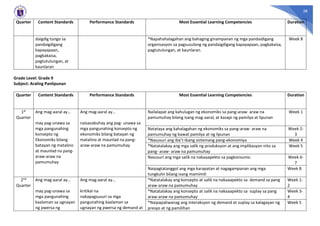
39
Quarter Content Standards Performance Standards Most Essential Learning Competencies Duration
demand at suplay, at
sa sistema ng
pamilihan bilang
batayan ng
matalinong
pagdedesisyon ng
sambahayan at
bahay- kalakal tungo
sa pambansang
kaunlaran
suplay, at sistema ng pamilihan
bilang batayan ng matalinong
pagdedesisyon ng sambahayan at
bahay- kalakal tungo sa
pambansang kaunlaran
*Nasusuri ang kahulugan at iba’t ibang istraktura ng pamilihan Week 6-
7
*Napahahalagahan ang bahaging ginagampanan ng pamahalaan sa
regulasyon ng mga gawaing pangkabuhayan
Week 8
3rd
Quarter
Ang mag-aaral ay…
naipamamalas ng
mag- aaral ang pag-
unawa sa mga
pangunahing
kaalaman tungkol sa
pambansang
ekonomiya bilang
kabahagi sa
pagpapabuti ng
pamumuhay ng
kapwa mamamayan
tungo sa pambansang
kaunlaran
Ang mag-aaral ay…
nakapagmumungkahi ng mga
pamamaraan kung paanong ang
pangunahing kaalaman tungkol sa
pambansang ekonomiya ay
nakapagpapabuti sa pamumuhay
ng kapwa mamamayan tungo sa
pambansang kaunlaran
*Naipaliliwanag ang bahaging ginagampanan ng mga bumubuo sa paikot
na daloy ng ekonomiya
Week 1-
2
*Nasusuri ang pamamaraan at kahalagahan ng pagsukat ng pambansang
kita
Week 3
*Natatalakay ang konsepto, dahilan, epekto at pagtugon sa implasyon Week 4-
5
*Nasusuri ang layunin at pamamaraan ng patakarang piskal Week 6
*Nasusuri ang layunin at pamamaraan ng patakarang pananalapi Week 7
*Napahahalagahan ang pag-iimpok at pamumuhunan bilang isang salik
ng ekonomiya
Week 8
4th
Quarter
Ang mag-aaral ay…
may pag-unawa
sa mga sektor ng
ekonomiya at mga
Ang mag-aaral ay…
aktibong nakikibahagi sa maayos
na pagpapatupad at pagpapabuti
ng mga sektor ng ekonomiya at
Nasisiyasat ang mga palatandaan ng pambansang kaunlaran Week 1
Natutukoy ang iba’t ibang gampanin ngmamamayang Pilipino upang
makatulong sa pambansang kaunlaran
Week 2
*Nasusuri ang bahaging ginagampanan ng agrikultura, pangingisda, at
paggugubat sa ekonomiya
Week 3
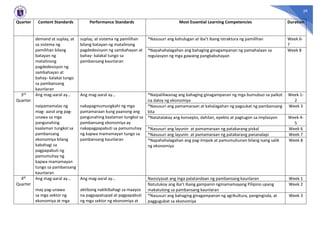
40
Quarter Content Standards Performance Standards Most Essential Learning Competencies Duration
patakarang pang-
ekonomiya nito sa
harap ng mga hamon
at pwersa tungo sa
pambansang
pagsulong at pag-
unlad
mga patakarang pang- ekonomiya
nito tungo sa pambansang
pagsulong at pag-unlad
Nasusuri ang mga dahilan at epekto ng suliranin ng sektor ng
agrikultura, pangingisda, at paggugubat
Week 4
Nabibigyang-halaga ang mga patakarang pang- ekonomiya nakatutulong
sa sektor ng agrikultura (industriya ng agrikultura, pangingisda, at
paggugubat)
Week 5
Nabibigyang-halaga ang mga ang mga gampanin ng sektor ng industriya
at mga patakarang pang- ekonomiyang nakatutulong dito
Week 6
Nabibigyang-halaga ang mga ang mga gampanin ng sektor ng
paglilingkod at mga patakarang pang- ekonomiyang nakatutulong dito
Week 6
Nabibigyang-halaga ang mga ang mga gampanin ng impormal na sektor
at mga patakarang pang- ekonomiyang nakatutulong dito
Week 7
Nasusuri ang pang-ekonomikong ugnayan at patakarang panlabas na
nakakatulong sa Pilipinas
Week 8
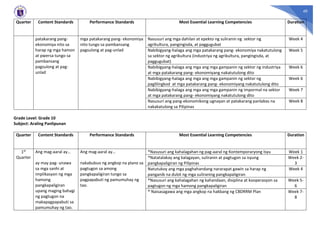
Grade Level: Grade 10
Subject: Araling Panlipunan
Quarter Content Standards Performance Standards Most Essential Learning Competencies Duration
1st
Quarter
Ang mag-aaral ay…
ay may pag- unawa
sa mga sanhi at
implikasyon ng mga
hamong
pangkapaligiran
upang maging bahagi
ng pagtugon na
makapagpapabuti sa
pamumuhay ng tao.
Ang mag-aaral ay…
nakabubuo ng angkop na plano sa
pagtugon sa among
pangkapaligiran tungo sa
pagpapabuti ng pamumuhay ng
tao.
*Nasusuri ang kahalagahan ng pag-aaral ng Kontemporaryong Isyu Week 1
*Natatalakay ang kalagayan, suliranin at pagtugon sa isyung
pangkapaligiran ng Pilipinas
Week 2-
3
Natutukoy ang mga paghahandang nararapat gawin sa harap ng
panganib na dulot ng mga suliraning pangkapaligiran
Week 4
*Nasusuri ang kahalagahan ng kahandaan, disiplina at kooperasyon sa
pagtugon ng mga hamong pangkapaligiran
Week 5-
6
* Naisasagawa ang mga angkop na hakbang ng CBDRRM Plan Week 7-
8
41
Quarter Content Standards Performance Standards Most Essential Learning Competencies Duration
2nd
Quarter
Ang mag-aaral ay…
may pag-unawa sa
sanhi at implikasyon
ng mga lokal at
pandaigdigang isyung
pang ekonomiya
upang mapaunlad
ang kakayahan sa
matalinong
pagpapasya tungo sa
pambansang
kaunlaran.
Ang mag-aaral ay…
ay nakabubuo ng pagsusuring
papel sa mga isyung pang-
ekonomiyang nakaaapekto sa
kanilang pamumuhay.
*Nasusuri ang dahilan, dimensyon at epekto ng ng globalisasyon Week 1-
2
*Naipaliliwanag ang kalagayan, suliranin at pagtugon sa isyu ng paggawa
sa bansa
Week 3-
4
*Nasusuri ang dahilan at epekto ng migrasyon dulot ng globalisasyon Week 5-
6
*Naipahahayag ang saloobin tungkol sa epekto ng globalisasyon Week 7-
8
3rd
Quarter
Ang mag-aaral ay…
nakagagawa ng mga
malikhaing hakbang
na nagsusulong ng
pagtanggap at
paggalang sa iba’t
ibang kasarian upang
maitaguyod ang
pagkakapantay-
pantay ng tao bilang
kasapi ng
pamayanan.
Ang mag-aaral ay…
may pag-unawa sa mga epekto ng
mga isyu at hamon na may
kaugnayan sa kasarian at lipunan
upang maging aktibong
tagapagtaguyod ng
pagkakapantay-pantay at
paggalang sa kapwa bilang kasapi
ng pamayanan.
*Natatalakay ang mga uri ng kasarian (gender) at sex at gender roles sa
iba’t ibang bahagi ng daigdig
Week 1-
2
*Nasusuri ang diskriminasyon at diskriminasyon sa kababaihan,
kalalakihan at LGBT (Lesbian , Gay , Bi – sexual , Transgender)
Week 3-
4
*Napahahalagahan ang tugon ng pamahalaan at mamamayan Pilipinas
sa mga isyu ng karahasan at diskriminasyon
Week 5-
6
Nakagagawa ng hakbang na nagsusulong ng pagtanggap at paggalang sa
kasarian na nagtataguyod ng pagkakapantay-pantay ng tao bilang kasapi
ng pamayanan
Week 7-
8
4th
Quarter
Ang mag-aaral ay…
ay may pag-unawa sa
kahalagahan ng
Ang mag-aaral ay…
nakagagawa ng pananaliksik
tungkol sa kalagayan ng
*Naipaliliwanag ang kahalagahan ng aktibong pagmamamayan Week 1-
2
*Nasusuri ang kahalagahan ng pagsusulong at pangangalaga sa
karapatang pantao sa pagtugon sa mga isyu at hamong panlipunan
Week 3-
4
42
Quarter Content Standards Performance Standards Most Essential Learning Competencies Duration
pagkamamamayan at
pakikilahok sa mg
agawaing pansibiko
tungo sa
pagkakaroon ng
pamayanan at
bansang maunlad,
mapayapa at may
pagkakaisa.
pakikilahok sa mga gawaing
pansibiko at politikal ng mga
mamamayan sa kanilang
pamayanan.
*Natatalakay ang mga epekto ng aktibong pakikilahok ng
mamamayan sa mga gawaing pansibiko sa kabuhayan, politika, at
lipunan
Week 5-
6
*Napahahalagahan ang papel ng mamamayan sa pagkakaron ng isang
mabuting pamahalaan
Week 7-
8
43
44
Grade Level: Grade 1
Subject: Edukasyon sa Pagpapakatao (EsP)
Quarter Content Standards Performance Standards Most Essential Learning Competencies Duration
Unang
Markahan
Naipamamalas ang pag-unawa sa
kahalagahan ng pagkilala sa sarili at
sariling kakayahan,pangangalaga sa sariling
kalusugan at pagiging mabuting kasapi ng
pamilya.
Naipakikita ang kakayahan
nang may tiwala sa sarili
1. Nakikilala ang sariling:
1.1. gusto
1.2. interes
1.3. potensyal
1.4. kahinaan
1.5. damdamin / emosyon
Week 1
2. Naisasakilos ang sariling kakayahan sa iba’t
ibang pamamaraan
2.1 pag-awit
2.2 pagsayaw
2.3 pakikipagtalastasan
at iba pa
Week 2
Naisabubuhay nang may
wastong pag-uugali ang iba’t
ibang paraan ng pangangalaga
sa sarili at kalusugan upang
mapaunlad ang anumang
kakayahan.
3. Nakapaglalarawan ng iba’t ibang gawain na
maaaring makasama o makabuti sa
kalusugan
3.1 nakikilala ang iba’t ibang gawain/paraan na
maaaring makasama o makabuti sa kalusugan
nasasabi na nakatutulong sa paglinang ng sariling
kakayahan ang wastong pangangalaga sa sarili
Week 3
Naisasagawa nang may
pagmamahal at
pagmamalasakit ang anumang
kilos at gawain na
magpapasaya at magpapatibay
sa ugnayan ng mga kasapi ng
pamilya
4. Nakakikila ng mga gawaing nagpapakita ng
pagkakabuklod ng pamilya tulad ng
4.1.pagsasama-sama sa pagkain
4.2.pagdarasal
4.3.pamamasyal
4.4. pagkukuwentuhan ng masasayang pangyayari
Week 4
5.Nakatutukoy ng mga kilos at gawain na
nagpapakita ng pagmamahal at pagmamalasakit
sa mga kasapi ng pamilya
Week 5
45
Hal.
1. pag-aalala sa mga kasambahay
2. pag-aalaga sa nakababatang kapatid at
kapamilyang maysakit
Ikalawang
Markahan
Naipamamalas ang pag-unawa sa
kahalagahan ng wastong pakikitungo sa
ibang kasapi ng pamilya at kapwa tulad ng
pagkilos at pagsasalita ng may paggalang at
pagsasabi ng katotohanan para sa
kabutihan ng nakararami
Naisasabuhay ang wastong
pakikitungo sa ibang kasapi ng
pamilya at kapwa sa lahat ng
pagkakataon.
6. Nakapagpapakita ng pagmamahal at paggalang
sa mga magulang
Week 1
Week 2
7. Nakapagpapakita ng pagmamahal sa
pamilya at kapwa sa lahat ng pagkakataon lalo na
sa oras ng pangangailangan
Week 3
Naisasabuhay ang pagiging
magalang sa kilos at pananalita
8. Nakapagpapakita ng paggalang sa pamilya at
sa kapwa sa pamamagitan
ng:
a. pagmamano/paghalik sa
nakatatanda
b. bilang pagbati
c. pakikinig habang may nagsasalita
d. pagsagot ng “po" at “opo”
e. paggamit ng salitang “pakiusap” at
“salamat”
Week 4
Naisasabuhay ang pagiging
matapat sa lahat ng
pagkakataon
9. Nakapagsasabi ng totoo sa magulang/
nakatatanda at iba pang kasapi ng mag-
anak sa lahat ng pagkakataon upang
maging maayos ang samahan
10.1.kung saan papunta/ nanggaling
10.2.kung kumuha ng hindi kanya
10.3. mga pangyayari sa paaralan na nagbunga
ng hindi pagkakaintindihan
9.4. kung gumamit ng computer sa paglalaro
imbis na sa pag-aaral
Week 5
Ikatlong
Markahan
Naipamamalas ang pag-unawa sa
kahalagahan ng pagiging masunurin,
Naisasabuhay ang pagiging
masunurin at magalang sa
10. Nakapagpapakita ng iba’t ibang paraan ng
pagiging masunurin at magalang tulad ng:
Week 1
46
pagpapanatili ng kaayusan, kapayapaan at
kalinisan sa loob ng tahanan at paaralan
tahanan, nakasusunod sa mga
alituntunin ng paaaralan at
naisasagawa nang may
pagpapahalaga ang karapatang
tinatamasa
10.1.pagsagot kaagad kapag tinatawag ng
kasapi ng pamilya
10.2.pagsunod nang maluwag sa dibdib kapag
inuutusan
10.3.pagsunod sa tuntuning itinakda ng:
tahanan
paaralan
11. Nakapagpapakita ng pagpapahalaga sa mga
karapatang tinatamasa
Hal. Pagkain ng masusustansyang pagkain
Nakapag-aaral
Week 2
12. Nakasusunod sa utos ng magulang at
nakatatanda. Nakapagpapakita ng mga paraan
upang makamtam at mapanatili ang kaayusan at
kapayapaan sa tahanan at paaralan tulad ng:
12.1.pagiging masaya para sa tagumpay ng
ibang kasapi ng pamilya at ng kamag-aral
12.2.pagpaparaya
12.3.pagpapakumbaba
Week 3
13. Nakatutulong sa pagpapanatili ng
kalinisan at kaayusan sa loob ng tahanan at
paaralan para sa mabuting
kalusugan
Hal.
Pagtulong sa paglilinis ng tahanan
Pagtulong sa paglilinis ng paaralan
Pag-iwas sa pagkakalat
Week 4
Naisasagawa nang may kusa
ang mga kilos at gawain na
nagpapanatili ng kalinisan,
kaayusan at katahimikan sa
loob ng tahanan at paaralan
14. Nakagagamit ng mga bagay na patapon ngunit
maaari pang pakinabangan
Week 5
47
Ikaapat na
Markahan
Naipamamalas ang pag-unawa sa
kahalagahan ng pagmamahal sa Diyos,
paggalang sa paniniwala ng iba at
pagkakaroon ng pag-asa
Naipakikita ang pagmamahal sa
magulang at mga nakatatanda,
paggalang sa paniniwala ng
kapwa at palagiang pagdarasal
15. Nakasusunod sa utos ng magulang at
nakatatanda
Week 1
16. Nakapagpapakita ng paggalang sa paniniwala
ng kapwa
Week 2
17. Nakasusunod sa mga gawaing panrelihiyon Week 3
Grade Level: Grade 2
Subject: Edukasyon sa Pagpapakatao (EsP)
Quarter
Content Standards Performance Standards Most Essential Learning Competencies Duration
Unang
Markahan
Naipamamalas ang pag-unawa sa kahalagahan
ng pagkilala sa sarili at pagkakaroon ng
disiplina tungo sa pagkakabuklod-buklod o
pagkakaisa ng mga kasapi ng tahanan at
paaralan
Naisasagawa nang buong husay ang
anumang kakayahan o potensyal at
napaglalabanan ang anumang
kahinaan
1. Naisakikilos ang sariling kakayahan sa
iba’t ibang pamamaraan:
1.1. pag-awit
1.2. pagguhit
1.3. pagsayaw
1.4. pakikipagtalastasan
1.5. at iba pa
Week 1
2. Napahahalagahan ang saya o tuwang
dulot ng pagbabahagi ng anumang
kakayahan o talent
Week 2
3. Nakapagpapakita ng kakayahang
labanan ang takot kapag may nangbubully
Week 3
Naisasagawa nang palagian ang
pangangalaga at pag-iingat sa
katawan
4. Naisakikilos ang mga paraan ng
pagpapanatili ng kalinisan, kalusugan at
pag-iingat ng katawan
Week 4
48
Naisasagawa ang kusang pagsunod
sa mga tuntunin at
napagkasunduang gagawin sa loob
ng tahanan
5. Nakapagpapakita ng pagsunod sa mga
tuntunin at pamantayang itinakda sa loob
ng tahanan
5.1. paggising at pagkain sa tamang oras
5.2. pagtapos ng mga gawaing bahay
5.3. paggamit ng mga kagamitan
5.4. at iba pa
Week 5
Ikalawang
Markahan
Naipamamalas ang pag-unawa sa kahalagahan
ng pagiging sensitibo sa damdamin at
pangangailangan ng iba, pagiging magalang sa
kilos at pananalita at pagmamalasakit sa
kapwa
Naisasagawa ang wasto at tapat na
pakikitungo at pakikisalamuha sa
kapwa
6. Nakapagpapakita ng pagkamagiliwin at
pagkapalakaibigan na may pagtitiwala sa
mga sumusunod:
6.1. kapitbahay
6.2. kamag-anak
6.3. kamag-aral
6.4. panauhin/ bisita
6.5. bagong kakilala
6.6. taga-ibang lugar
Week 1
7. Nakapagbabahagi ng sarili sa kalagayan
ng kapwa tulad ng:
7.1. antas ng kabuhayan
7.2. pinagmulan
7.3. pagkakaroon ng kapansanan
Week 2
8. Nakagagamit ng magalang na
pananalita sa kapwa bata at nakatatanda
Week 3
9. Nakapagpapakita ng iba’t ibang
magalang na pagkilos sa kaklase o kapwa
bata
10. Nakapagbabahagi ng gamit, talento,
kakayahan o anumang bagay sa kapwa
Week 4
Naisasagawa ang mga kilos at
gawaing nagpapakita ng
pagmamalasakit sa kapwa
11. Nakapaglalahad na ang paggawa ng
mabuti sa kapwa ay pagmamahal sa sarili.
12. Nakatutukoy ng mga kilos at gawaing
nagpapakita ng pagmamalasakit sa mga
kasapi ng paaralan at pamayanan
Week 5
49
13. Nakapagpapakita ng pagmamalasakit
sa kasapi ng paaralan at pamayanan sa
iba’t ibang paraan
Ikatlong
Markahan
Naipamamalas ang pag-unawa sa kahalagahan
ng kamalayan sa karapatang pantao ng bata,
pagkamasunurin tungo sa kaayusan at
kapayapaan ng kapaligiran at ng bansang
kinabibilangan
Naisasagawa nang buong
pagmamalaki ang pagiging mulat sa
karapatan na maaaring tamasahin
14. Nakapagpapakita ng paraan ng
pagpapasalamat sa anumang karapatang
tinatamasa
Hal. pag-aaral nang mabuti
pagtitipid sa anumang kagamitan
Week 1
15. Nakatutukoy ng mga karapatang
maaaring ibigay ng pamilya o mga kaanak
Week 2
16. Nakapagpapahayag ng kabutihang
dulot ng karapatang tinatamasa
17. Nakapagbabahagi ng pasasalamat sa
tinatamasang karapatan sa pamamagitan
ng kuwento
Week 3
Naisasabuhay ang pagsunod sa iba’t
ibang paraan ng pagpapanatili ng
kaayusan at kapayapaan sa
pamayanan at bansa
18. Nakagagamit nang masinop ng
anumang bagay tulad ng tubig, pagkain,
enerhiya at iba pa
19. Nakikibahagi sa anumang programa
ng paaralan at pamayanan na
makatutulong sa pagpapanatili ng
kalinisan at kaayusan sa pamayanan at
bansa
Week 4
20. Nakatutukoy ng iba’t ibang paraan
upang mapanatili ang kalinisan at
kaayusan sa pamayanan
hal.
- pagsunod sa mga babalang pantrapiko
- wastong pagtatapon ng basura
- pagtatanim ng mga halaman sa paligid
Week 5
21. Nakapagpapakita ng pagmamahal sa
kaayusan at kapayapaan
Week 6
Ikaapat na
Markahan
Naisasabuhay ang pagpapasalamat
sa lahat ng biyayang tinatanggap at
22. Nakapagpapakita ng ibat-ibang paraan
ngpagpapasalamat sa mga biyayang
Week 1
50
Naipamamalas ang pag-unawa sa kahalagahan
ng pagpapasalamat sa lahat ng likha at mga
biyayang tinatanggap mula sa Diyos
nakapagpapakita ng pag-asa sa
lahat ng pagkakataon
tinanggap, tinatanggap at tatanggapin
mula sa Diyos
23. Nakapagpapakita ng pasasalamat sa
mga kakayahan/ talinong bigay ng
Panginoon sa pamamagitan ng:
23.1. paggamit ng talino at kakayahan
23.2. pagbabahagi ng taglay na talino at
kakayahan sa iba
23.3. pagtulong sa kapwa
23.4.pagpapaunlad ng talino at
kakayahang bigay ng Panginoon
Week 2
Grade Level: Grade 3
Subject: Edukasyon sa Pagpapakatao (EsP)
Quarter Content Standards Performance Standards Most Essential Learning
Competencies
Duration
Unang
Markahan
Naipamamalas ang pag-unawa sa
kahalagahan ng sariling kakayahan,
pagkakaroon ng tiwala, pangangalaga at
pag-iingat sa sarili tungo sa kabutihan at
kaayusan ng pamilya at pamayanan
Naipakikita ang natatanging kakayahan sa
iba’t ibang pamamaraan nang may tiwala,
katapatan at katatagan ng loob
Nakatutukoy ng natatanging
kakayahan
Hal. talentong ibinigay ng Diyos
Week 1
Nakapagpapakita ng mga
natatanging kakayahan nang may
pagtitiwala sa sarili
Napahahalagahan ang kakayahan sa
paggawa
Week 2
Nakatutukoy ng mga damdamin na
nagpapamalas ng katatagan ng
kalooban
Naisasabuhay ang iba’t ibang patunay ng
pangangalaga at pag-iingat sa sarili
Nakagagawa ng mga wastong kilos at
gawi sa pangangalaga ng sariling
kalusugan at kaligtasan.
51
Naipakikita ang katapatan, pakikiisa at
pagsunod sa mga tuntunin o anumang
kasunduang itinakda ng mag-anak na may
kinalaman sa kalusugan at kaligtasan tungo sa
kabutihan ng lahat
Nakasusunod sa mga
pamantayan/tuntunin ng mag-anak
Week 3
Ikalawang
Markahan
Naipamamalas ang pag-unawa sa
kahalagahan ng pakikipagkapwa-tao
Naisasabuhay nang palagian ang mga
makabuluhang gawain tungo sa kabutihan ng
kapwa
1. pagmamalasakit sa kapwa
2. pagiging matapat sa kapwa
3. pantay-pantay na pagtingin
Nakapagpapadama ng malasakit sa
kapwa na may karamdaman sa
pamamagitan ng mga simpleng
gawain
1.1.pagtulong at pag-aalaga
1.2.pagdalaw, pag-aliw at
pagdadala ng pagkain o anumang
bagay na kailangan
Week 1
Nakapagpapakita ng malasakit sa
may
mga kapansanan sa pamamagitan
ng:
2.1.pagbibigay ng simpleng tulong
sa kanilang pangangailangan
2.2.pagbibigay ng pagkakataon
upang sumali at lumahok sa mga
palaro o larangan ng isport at iba
pang programang pampaaralan
2.3 pagbibigay ng pagkakataon
upang sumali at lumahok sa mga
palaro at iba pang paligsahan sa
pamayanan
Week 2
Naisasaalang-alang ang katayuan/
kalagayan/ pangkat etnikong
kinabibilangan ng kapwa bata sa
pamamagitan ng:
pagbabahagi ng pagkain, laruan,
damit, gamit at iba pa
Week 3
52
Nakapagpapakita nang may
kasiyahan sa pakikiisa sa mga
gawaing pambata
Hal. paglalaro
programa sa paaralan
(paligsahan,
pagdiriwang at iba pa)
Week 4
Ikatlong
Markahan
Naipamamalas ang pag-unawa sa
kahalagahan ng pananatili ng mga
natatanging kaugaliang Pilipino
kaalinsabay ng pagsunod sa mga tuntunin
at batas na may kaugnayan sa kalikasan at
pamayanan
Naipagmamalaki ang mga magagandang
kaugaliang Pilipino sa iba’t ibang pagkakataon
Nakapagpapakita ng mga kaugaliang
Pilipino tulad ng:
pagmamano
paggamit ng "po" at "opo"
pagsunod sa tamang tagubilin ng
mga nakatatanda
Week 1
Nakapagpapahayag na isang tanda ng
mabuting pag-uugali ng Pilipino ang
pagsunod sa tuntunin ng pamayanan
Week 2
Naipamamalas ang pagiging masunurin sa
mga itinakdang alituntunin, patakaran at
batas para sa malinis, ligtas at maayos na
pamayanan
Nakapagpapanatili ng malinis at ligtas
na pamayanan sa pamamagitan ng:
paglilinis at pakikiisa sa gawaing
pantahanan at pangkapaligiran
wastong pagtatapon ng basura
palagiang pakikilahok sa proyekto
ng pamayanan na may kinalaman sa
kapaligiran
Nakasusunod sa mga tuntuning may
kinalaman sa kaligtasan tulad ng
mga babala at batas trapiko
pagsakay/pagbaba sa takdang lugar
Week 3
Nakapagpapanatili ng ligtas na
pamayanan sa pamamagitan ng
pagiging handa sa sakuna o
kalamidad
Week 4
53
Ikaapat na
Markahan
Naipamamalas ang pag-unawa sa
kahalagahan ng pananalig sa Diyos,
paggalang sa sariling paniniwala at
paniniwala sa iba hinggil sa Diyos,
pagkakaroon ng pag-asa at pagmamahal
bilang isang nilikha
1. Naisabubuhay ang paggalang sa
paniniwala ng iba tungkol sa Diyos
2. Naipakikita ang pagmamahal sa Diyos at
sa lahat ng Kanyang nilikha kaakibat ang
pag-asa
Nakapagpapakita ng pananalig sa
Diyos
Week 1
Nakapagpapakita ng paggalang sa
paniniwala ng iba tungkol sa Diyos
Week 2
Grade Level: Grade 4
Subject: Edukasyon sa Pagpapakatao (EsP)
Quarter Content Standards Performance Standards Most Essential Learning Competencies Duration
Unang
Markahan
Naipamamalas ang pag-unawa sa
kahalagahan ng pagkakaroon ng
katatagan ng loob, mapanuring pag-iisip,
pagkamatiyaga, pagkamapagtiis,
pagkabukas-isip, pagkamahinahon at
pagmamahal sa katotohanan na
magpapalaya sa anumang alalahanin sa
buhay ng tao bilang kasapi ng pamilya
Naisasagawa nang may
mapanuring pag-iisip ang
tamang pamamaraan/
pamantayan sa pagtuklas ng
katotohanan.
Nakapagsasabi ng katotohanan anuman ang maging
bunga nito
Week 1
2. Nakapagsusuri ng katotohanan bago gumawa ng
anumang hakbangin batay sa mga nakalap na
impormasyon
2.1. balitang napakinggan
2.2. patalastas na nabasa/narinig
2.3. napanood na programang pantelebisyon
2.4 pagsangguni sa taong kinauukulan
Week 2
3. Nakapagninilay ng katotohanan BATAY sa mga
NAKALAP NA IMPORMASYON:
3.1. balitang napakinggan
3.2. patalastas na nabasa/narinig
3.3. napanood na programang pantelebisyon
3.4. nababasa sa internet at mga social
networking sites
Week 3
4. Nakapagsasagawa nang may mapanuring pag-iisip
ng tamang pamamaraan/ pamantayan sa pagtuklas
ng katotohanan
Week 4
54
Ikalawang
Markahan Naipamamalas ang pag-unawa na hindi
naghihintay ng anumang kapalit ang
paggawa ng mabuti
Naisasagawa nang mapanuri
ang tunay na kahulugan ng
pakikipagkapwa
5. Nakapagpapakita ng pagkamahinahon sa
damdamin at kilos ng kapwa tulad ng:
5.1. pagtanggap ng sariling pagkakamali at
pagtutuwid nang bukal sa loob
5.2. pagtanggap ng puna ng kapwa nang
maluwag sa kalooban
5.3. pagpili ng mga salitang di-nakakasakit ng
damdamin sa pagbibiro
Week 1
6. Nakapagbabahagi ng sariling karanasan o
makabuluhang pangyayaring nagpapakita ng pang-
unawa sa kalagayan/pangangailangan ng kapwa.
7. Naisasabuhay ang pagiging bukas-palad sa
7.1. mga nangangailangan
7.2. panahon ng kalamidad
Week 2
Naisasagawa ang paggalang
sa karapatan ng kapwa
8. Nakapagpapakita ng paggalang sa iba sa mga
sumusunod na sitwasyon:
8.1. oras ng pamamahinga
8.2. kapag may nag-aaral
8.3. kapag mayroong maysakit
8.4. pakikinig kapag may nagsasalita/
nagpapaLiwanag
8.5. paggamit ng pasilidad ng paaralan nang may
pag-aalala sa kapakanan ng kapwa
8.5.1. palikuran
8.5.2. silid-aklatan
8.5.3. palaruan
8.6. pagpapanatili ng tahimik, malinis at kaaya-
ayang kapaligiran bilang paraan ng pakikipagkapwa-
tao
Week 3
Ikatlong
Markahan
9. Nakapagpapakita ng kawilihan sa pakikinig o
pagbabasa ng mga pamanang kulturang materyal
(hal. kuwentong bayan, alamat, mga epiko) at di-
Week 1
55
Naipamamalas ang pag-unawa sa
pagmamahal sa bansa sa pamamagitan
ng pagpapahalaga sa kultura
Naisasabuhay ang mga
gawaing nagpapakita ng
pagpapahalaga sa kultura
materyal (hal. mga magagandang kaugalian,
pagpapahalaga sa nakatatanda at iba pa)
10. Naipagmamalaki/napahahalagahan ang nasuring
kultura ng iba’t ibang pangkat etniko tulad ng
kuwentong-bayan, katutubong sayaw, awit, laro at
iba pa
Week 2
Naipamamalas ang pag-unawa sa
kahalagahan ng pagkakaroon ng sariling
disiplina para sa bansa tungo sa
pandaigdigang pagkakaisa
Naisasabuhay ang patuloy na
pagninilay para
makapagpasya nang wasto
tungkol sa epekto ng tulong-
tulong na pangangalaga ng
kapaligiran para sa kaligtasan
ng bansa at daigdig
11. Nakasusunod sa mga batas/panuntunang
pinaiiral tungkol sa pangangalaga ng kapaligiran
kahit walang nakakakita
12. Nakatutulong sa pagpapanatili ng kalinisan at
kaayusan ng kapaligiran saanman sa pamamagitan
ng:
12.1. segregasyon o pagtapon ng mga basurang
nabubulok at di-nabubulok sa tamang lagayan
12.2. pag-iwas sa pagsunog ng anumang bagay
12.3. pagsasagawa ng muling paggamit ng mga
patapong bagay (Recycling)
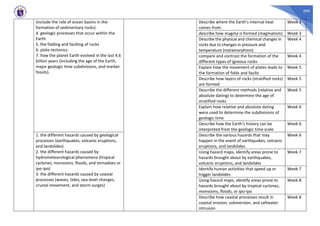
Week 3
Ikaapat na
Markahan Nauunawaan at naipakikita ang
pananalig sa Diyos sa pamamagitan ng
paggalang, pagtanggap at pagmamahal
sa mga likha
Naisasabuhay ang pananalig
sa Diyos sa pamamagitan ng
paggalang, pagtanggap at
pagmamahal sa mga likha
13. Napahahalagahan ang lahat ng mga likha: may
buhay at mga materyal na bagay
13.1. Sarili at kapwa-tao:
13.1.1. pag-iwas sa pagkakaroon ng sakit
13.1.2. paggalang sa kapwa-tao
Week 1
13.2. Hayop:
13.2.1. pagkalinga sa mga hayop na ligaw at
endangered
Week 2
13.3. Halaman : pangangalaga sa mga halaman gaya
ng :
13.3.1. pag-aayos ng mga nabuwal na halaman
13.3.2. paglalagay ng mga lupa sa paso
13.3.3. pagbubungkal ng tanim na halaman sa
paligid
13.4. Mga Materyal na Kagamitan:
13.4.1. pangangalaga sa mga materyal na
kagamitang likas o gawa ng tao
Week 3
56
Grade Level: Grade 5
Subject: Edukasyon sa Pagpapakatao (EsP)
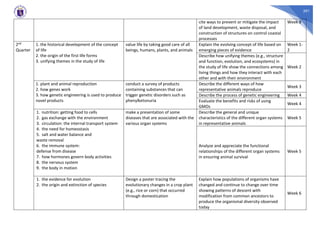
Quarter Content Standards Performance Standards Most Essential Learning Competencies Duration
Unang
Markahan Naipamamalas ang pag-unawa sa
kahalagahan ng pagkakaroon ng
mapanuring pag-iisip sa pagpapahayag
at pagganap ng anumang gawain na
may kinalaman sa sarili at sa pamilyang
kinabibilangan
Nakagagawa ng tamang pasya
ayon sa dikta ng isip at loobin
sa kung ano ang dapat at di-
dapat
1. Napahahalagahan ang katotohanan sa pamamagitan
ng pagsusuri sa mga:
1.1. balitang napakinggan
1.2. patalastas na nabasa/narinig
1.3. napanood na programang pantelebisyon
1.4. nabasa sa internet
Week 1
2. Nakasusuri ng mabuti at di-mabuting maidudulot sa
sarili at miyembro ng pamilya ng anumang babasahin,
napapakinggan at napapanood
2.1. dyaryo
2.2. magasin
2.3. radyo
2.4. telebisyon
2.5. pelikula
2.6. Internet
Week 2
Naisasabuhay ang
pagkakaroon ng tamang pag-
uugali sa pagpapahayag at
pagganap ng anumang gawain.
3. Nakapagpapakita ng kawilihan at positibong
saloobin sa pag-aaral
3.1. pakikinig
3.2. pakikilahok sa pangkatang gawain
3.3. pakikipagtalakayan
3.4. pagtatanong
3.5. paggawa ng proyekto (gamit ang anumang
technology tools)
3.6. paggawa ng takdang-aralin
3.7. pagtuturo sa iba
Week 3
4. Nakapagpapakita ng matapat na paggawa sa mga
proyektong pampaaralan
Week 4
57
5. Nakapagpapatunay na mahalaga ang pagkakaisa sa
pagtatapos ng gawain
6. Nakapagpapahayag nang may katapatan ng sariling
opinyon/ideya at saloobin tungkol sa mga sitwasyong
may kinalaman sa sarili at pamilyang kinabibilangan.
Hal. Suliranin sa paaralan at pamayanan
Week 5
Naisasagawa ang mga
kilos,gawain at pahayag na
may kabutihan at
katotohanan
7. Nakapagpapahayag ng katotohanan kahit masakit sa
kalooban gaya ng:
7.1. pagkuha ng pag-aari ng iba
7.2. pangongopya sa oras ng pagsusulit
7.3. pagsisinungaling sa sinumang miyembro ng
pamilya, at iba pa
Ikalawang
Markahan Naipamamalas ang pag-unawa sa
kahalagahan ng pakikipagkapwa-tao at
pagganap ng mga inaasahang hakbang,
pahayag at kilos para sa kapakanan at
ng pamilya at kapwa
Naisasagawa ang inaasahang
hakbang, kilos at pahayag na
may paggalang at
pagmamalasakit para sa
kapakanan at kabutihan ng
pamilya at kapwa
1. Nakapagsisimula ng pamumuno para
makapagbigay ng kayang tulong para sa
nangangailangan
1.1. biktima ng kalamidad
1.2. pagbibigay ng babala/impormasyon
kung may bagyo, baha, sunog, lindol, at
iba pa
Week 1
Nakapagbibigay-alam sa kinauukulan tungkol sa
kaguluhan, at iba pa (pagmamalasakit sa kapwa na
sinasaktan / kinukutya / binubully
Week 2
Nakapagpapakita ng paggalang sa mga dayuhan sa
pamamagitan ng:
3.1. mabuting pagtanggap/pagtrato sa mga
katutubo at mga dayuhan
3.2. paggalang sa natatanging kaugalian/paniniwala
ng mga katutubo at dayuhang kakaiba sa kinagisnan
Nakabubuo at nakapagpapahayag nang may paggalang
sa anumang ideya/opinion
Week 3
Nakapagpapaubaya ng pansariling kapakanan para sa
kabutihan ng kapwa
Nakapagsasaalang-alang ng karapatan ng iba Week 4
58
Nakikilahok sa mga patimpalak o paligsahan na ang
layunin ay pakikipagkaibigan
Nagagampanan nang buong husay ang anumang
tungkulin sa programa o proyekto gamit ang anumang
teknolohiya sa paaralan
Week 5
Ikatlong
Markahan Naipamamalas ang pag-unawa sa
kahalagahan nang pagpapakita ng mga
natatanging kaugaliang Pilipino,
pagkakaroon ng disiplina para sa
kabutihan ng lahat, komitment at
pagkakaisa bilang tagapangalaga ng
kapaligiran
Naisasagawa nang may
disiplina sa sarili at pakikiisa sa
anumang alituntuntunin at
batas na may kinalaman sa
bansa at global na kapakanan
Nakapagpapakita ng mga kanais-nais na kaugaliang
Pilipino
1.1. nakikisama sa kapwa Pilipino
1.2. tumutulong/lumalahok sa bayanihan at
palusong
1.3. magiliw na pagtanggap ng mga panauhin
Week 1
Nakapagpapamalas ng pagkamalikhain sa pagbuo ng
mga sayaw, awit at sining gamit ang anumang
multimedia o teknolohiya
Week 2
Napananatili ang pagkamabuting mamamayang
Pilipino sa pamamagitan ng pakikilahok
Nakasusunod ng may masusi at matalinong
pagpapasiya para sa kaligtasan. Hal:
4.1. paalala para sa mga panoorin at babasahin
4.2. pagsunod sa mga alituntunin tungkol sa pag-
iingat sa sunog at paalaala kung may kalamidad
Week 3
Naisasabuhay ang pagkakaisa
at komitment bilang
responsableng tagapangalaga
ng kapaligiran
Nakapagpapakita ng magagandang halimbawa ng
pagiging responsableng tagapangalaga ng kapaligiran
5.1. pagiging mapanagutan
5.2. pagmamalasakit sa kapaligiran sa pamamagitan
ng pakikiisa sa mga programang pangkapaligiran
Week 4
Napatutunayan na di-nakukuha sa kasakiman ang
pangangailangan
6.1. pagiging vigilant sa mga illegal na gawaing
nakasisira sa kapaligiran
Nakikiisa nang may kasiyahan sa mga programa ng
pamahalaan na may kaugnayan sa pagpapanatili ng
kapayapaan
7.1. paggalang sa karapatang pantao
Week 5
59
7.2. paggalang sa opinyon ng iba
7.3. paggalang sa ideya ng iba
Nakalalahok sa pangangampanya sa pagpapatupad ng
mga batas para sa kabutihan ng lahat
8.1. pangkalinisan
8.2. pangkaligtasan
8.3. pangkalusugan
8.4. pangkapayapaan
8.5. pangkalikasan
Week 6
Nakagagawa ng isang proyekto gamit ang iba’t ibang
multimedia at technology tools sa pagpapatupad ng
mga batas sa kalinisan,
kaligtasan, kalusugan at kapayapaan
Week 7
Nakikiisa nang buong tapat sa mga gawaing
nakatutulong sa bansa at daigdig
Ikaapat na
Markahan Naipamamalas ang pag-unawa sa
kahalagahan ng pananalig sa Diyos na
nagbigay ng buhay
Naisasabuhay ang tunay na
pasasalamat sa Diyos na
nagkaloob ng buhay
Hal.
- palagiang paggawa ng
mabuti sa lahat
1. Nakapagpapakita nang tunay na pagmamahal sa
kapwa tulad ng:
1.1. pagsasaalang-alang sa kapakanan ng kapwa at
sa kinabibilangang pamayanan
1.2. pakikiisa sa pagdarasal para sa kabutihan ng
lahat
1.3. pagkalinga at pagtulong sa kapwa
Week 1
2. Nakapagpapakita ng iba’t ibang paraan ng
pasasalamat sa Diyos
Week 2
60
Grade Level: Grade 6
Subject: Edukasyon sa Pagpapakatao (EsP)
Quarter Contents Standards Performance Standards Most Essential Learning Competencies Duration
Unang
Markahan
Naipamamalas ang pag-unawa sa
kahalagahan ng pagsunod sa mga
tamang hakbang bago makagawa ng
isang desisyon para sa ikabubuti ng
lahat
Naisasagawa ang tamang
desisyon nang may katatagan
ng loob para sa ikabubuti ng
lahat
1. Nakapagsusuri nang mabuti sa mga bagay na may
kinalaman sa sarili at pangyayari
Week 1
2. Nakasasang-ayon sa pasya ng nakararami kung
nakabubuti ito
Week 2
3. Nakagagamit ng impormasyon ( wasto / tamang
impormasyon)
Ikalawang
Markahan
Naipamamalas ang pag-unawa sa
kahalagan ng pakikipagkapwa-tao na
may kaakibat na paggalang at
responsibilidad
Naisasabuhay ang
pagkakaroon ng bukas na
isipan at kahinahunan sa
pagpapasiya para sa
kapayapaan ng sarili at kapwa
4. Naipakikita ang kahalagahan ng pagiging
responsable sa kapwa:
4.1 pangako o pinagkasunduan;
4.2 pagpapanatili ng mabuting pakikipagkaibigan;
4.3 pagiging matapat
Week 1
5. Nakapagpapakita ng paggalang sa ideya o
suhestyon ng kapwa
Week 2
Ikatlong
Markahan Naipamamalas ang pag-unawa sa
kahalagahan ng pagmamahal sa bansa
at pandaigdigang pagkakaisa tungo sa
isang maunlad, mapayapa at
mapagkalingang pamayanan
Naipakikita ang tunay na
paghanga at pagmamalaki sa
mga sakripisyong ginawa ng
mga Pilipino
6. Napahahalagahan ang magaling at matagumpay na
mga Pilipino sa pamamagitan ng:
6.1 pagmomodelo ng kanilang pagtatagumpay;
6.2 kuwento ng kanilang pagsasakripisyo at
pagbibigay ng sarili para sa bayan;
6.3 pagtulad sa mga mabubuting katangian na
naging susi sa pagtatagumpay ng mga Pilipino
Week 1
Naipakikita ang wastong
pangangalaga sa kapaligiran
7. Nakagagamit nang may pagpapahalaga at
pananagutan sa kabuhayan at pinagkukunang-yaman
Week 2
61
para sa kasalukuyan at
susunod na henerasyon
8. Nakapagpapakita ng tapat na pagsunod sa mga
batas pambansa at pandaigdigan tungkol sa
pangangalaga sa kapaligiran
Week 3
9. Naipagmamalaki ang anumang natapos na gawain
na nakasusunod sa pamantayan at kalidad
Week 4
Naisasagawa ang mga gawaing
nagbibigay inspirasyon sa
kapwa upang makamit ang
kaunlaran ng bansa
10. Naipakikita ang pagiging malikhain sa paggawa ng
anumang proyekto na makatutulong at magsisilbing
inspirasyon tungo sa pagsulong at pag-unlad ng
bansa
Week 5
Naisasagawa ang mga gawain
na may kaugnayan sa
kapayapaan at kaayusan tungo
sa pandaigdigang pagkakaisa
11. Naisasakilos ang pagtupad sa mga batas
pambansa at pandaigdigan:
11.1 pagtupad sa mga batas para sa kaligtasan sa
daan; pangkalusugan; pangkapaligiran; pag-abuso sa
paggamit ng ipinagbabawal na gamot;
11.2 lumalahok sa mga kampanya at programa
para sa pagpapatupad ng batas tulad ng pagbabawal
sa paninigarilyo, pananakit sa hayop, at iba pa;
11.3 tumutulong sa makakayanang paraan ng
pagpapanatili ng kapayapaan
Week 6
Ikaapat na
Markahan Naipamamalas ang pag-unawa sa
kahalagahan ng pagkakaroon ng
sariling kapayapaan (inner peace)
para sa pakikitungo sa iba
Naisasabuhay ang
pagkamabuting tao na may
positibong pananaw bilang
patunay sa pag-unlad ng
ispiritwalidad
12. Napatutunayan na nagpapaunlad ng pagkatao
ang ispiritwalidad. Hal. pagpapaLiwanag na
ispiritwalidad ang pagkakaroon ng mabuting
pagkatao anuman ang paniniwala; pagkakaroon ng
positibong pananaw, pag-asa, at pagmamahal sa
kapwa at Diyos
Week 1-
2
62
Grade Level: Grade 7
Subject: Edukasyon sa Pagpapakatao (EsP)
Quarter Content Standards Performance Standards Most Essential Learning Competencies Duration
1
Naipamamalas ng mag-aaral ang pag-
unawa sa mga inaasahang kakayahan
at kilos sa panahon ng
pagdadalaga/pagbibinata, talento at
kakayahan, hilig, at mga tungkulin sa
panahon ng pagdadalaga/pagbibinata
Naisasagawa ng mag-aaral ang mga
angkop na hakbang sa paglinang ng
limang inaasahang kakayahan at
kilos1 (developmental tasks) sa
panahon ng pagdadalaga /
pagbibinata.
Natutukoy ang mga pagbabago sa kanyang sarili mula
sa gulang na 8 o 9 hanggang sa kasalukuyan sa
aspetong:
a. Pagtatamo ng bago at ganap na pakikipag-
ugnayan (more mature relations) sa mga
kasing edad (Pakikipagkaibigan)
b. Pagtanggap ng papel o gampanin sa
lipunan
c. Pagtanggap sa mga pagbabago sa katawan
at paglalapat ng tamang pamamahala sa
mga ito
d. Pagnanais at pagtatamo ng mapanagutang
asal sa pakikipagkapwa/ sa lipunan
e. Pagkakaroon ng kakayahang makagawa ng
maingat na pagpapasya
Week 1
63
f. Pagkilala ng tungkulin sa bawat gampanin
bilang nagdadalaga / nagbibinata
1
Natatanggap ang mga pagbabagong nagaganap sa
sarili sa panahon ng pagdadalaga/pagbibinata
NaipaliLiwanag na ang paglinang ng mga angkop
na inaasahang kakayahan at kilos (developmental
tasks) sa panahon ng pagdadalaga / pagbibinata
ay nakatutulong sa:
a. pagkakaroon ng tiwala sa sarili, at
b. paghahanda sa limang inaasahang kakayahan
at kilos na nasa mataas na antas (phase) ng
pagdadalaga/pagbibinata (middle and late
adoscence): (paghahanda sa
paghahanapbuhay, paghahanda sa pag-
aasawa / pagpapamilya, at pagkakaroon ng
mga pagpapahalagang gabay sa mabuting
asal), at pagiging mabuti at mapanagutang tao
pag-unawa ng kabataan sa kanyang mga tungkulin sa
sarili, bilang anak, kapatid, mag-aaral, mamamayan,
mananampalataya, kosyumer ng media at bilang
tagapangalaga ng kalikasan ay isang paraan upang
maging mapanagutan bilang paghahanda sa susunod
na yugto ng buhay
Week 2
1 1.4. Naisasagawa ang mga angkop na hakbang sa
paglinang ng limang inaasahang kakayahan at
kilos (developmental tasks) sa panahon ng
pagdadalaga / pagbibinata
1 Naipamamalas ng mag-aaral ang pag- Naisasagawa ng mag-aaral ang mga Natutukoy ang kanyang mga talento at kakayahan Week 3
64
unawa sa talento at kakayahan gawaing angkop sa pagpapaunlad ng
kanyang mga talento at kakayahan
Natutukoy ang mga aspekto ng sarili kung saan kulang
siya ng tiwala sa sarili at nakikilala ang mga paraan
kung paano lalampasan ang mga ito
Napatutunayan na ang pagtuklas at pagpapaunlad ng
mga angking talento at kakayahan ay mahalaga
sapagkat ang mga ito ay mga kaloob na kung
pauunlarin ay makahuhubog ng sarili tungo sa
pagkakaroon ng tiwala sa sarili, paglampas sa mga
kahinaan, pagtupad ng mga tungkulin, at paglilingkod
sa pamayanan
Week 4
Naisasagawa ang mga gawaing angkop sa
pagpapaunlad ng sariling mga talento at kakayahan
1
1
Naipamamalas ng mag-aaral ang pag-
unawa sa mga hilig
Naisasagawa ng mag-aaral ang mga
gawaing angkop para sa
pagpapaunlad ng kanyang mga hilig
Natutukoy ang kaugnayan ng pagpapaunlad ng mga
hilig sa pagpili ng kursong akademiko o teknikal-
bokasyonal, negosyo o hanapbuhay Week 5
Nakasusuri ng mga sariling hilig ayon sa larangan at
tuon ng mga ito
NaipaliLiwanag na ang pagpapaunlad ng mga hilig ay
makatutulong sa pagtupad ng mga tungkulin,
paghahanda tungo sa pagpili ng propesyon, kursong
akademiko o teknikal-bokasyonal, negosyo o
hanapbuhay, pagtulong sa kapwa at paglilingkod sa
pamayanan
Week 6
Naisasagawa ang mga gawaing angkop sa
pagpapaunlad ng kanyang mga hilig
2 Naipamamalas ng mag-aaral ang pag-
unawa sa isip at kilos-loob.
Nakagagawa ng angkop na
pagpapasiya tungo sa katotohanan
at kabutihan gamit ang isip at kilos-
loob
Natutukoy ang mga katangian, gamit at tunguhin ng
isip at kilos-loob
Week 1
Nasusuri ang isang pasyang ginawa batay sa gamit at
tunguhin ng isip at kilos-loob
NaipaliLiwanag na ang isip at kilos-loob ang
nagpapabukod-tangi sa tao, kaya ang kanyang mga
pagpapasiya ay dapat patungo sa katotohanan at
kabutihan
Week 2
65
Naisasagawa ang pagbuo ng angkop na pagpapasiya
tungo sa katotohanan at kabutihan gamit ang isip at
kilos-loob
2 Naipamamalas ng mag-aaralang pag-
unawa sa kaugnayan ng konsiyensiya
sa Likas na Batas Moral.
Naisasagawa ng mag-aaral ang
paglalapat ng wastong paraan
upang itama ang mga maling pasiya
o kilos bilang kabataan batay sa
tamang konsiyensiya.
Nakikilala na natatangi sa tao ang Likas na Batas Moral
dahil ang pagtungo sa kabutihan ay may kamalayan at
kalayaan. Ang unang prinsipyo nito ay likas sa tao na
dapat gawin ang mabuti at iwasan ang masama. Week 3
Nailalapat ang wastong paraan upang baguhin ang
mga pasya at kilos na taliwas sa unang prinsipyo ng
Likas na Batas Moral
Nahihinuha na nalalaman agad ng tao ang mabuti at
masama sa kongkretong sitwasyon batay sa sinasabi
ng konsiyensiya. Ito ang Likas na Batas Moral na
itinanim ng Diyos sa isip at puso ng tao. Week 4
Nakabubuo ng tamang pangangatwiran batay sa Likas
na Batas Moral upang magkaroon ng angkop na
pagpapasiya at kilos araw-araw
2
Naipamamalas ng mag-aaral ang pag-
unawa sa kalayaan.
Naisasagawa ng mag-aaral ang
pagbuo ng mga hakbang upang
baguhin o paunlarin ang kaniyang
paggamit ng kalayaan.
Nakikilala ang mga indikasyon / palatandaan ng
pagkakaroon o kawalan ng kalayaan
Week 5
Nasusuri kung nakikita sa mga gawi ng kabataan ang
kalayaan
Nahihinuha na likas sa tao ang malayang pagpili sa
mabuti o sa masama; ngunit ang kalayaan ay may
kakambal na pananagutan para sa kabutihan
Week 6
Naisasagawa ang pagbuo ng mga hakbang upang
baguhin o paunlarin ang kaniyang paggamit ng
kalayaan
2 Naipamamalas ng mag-aaral ang pag-
unawa sa dignidad ng tao.
Naisasagawa ng mag-aaral ang mga
konkretong paraan upang ipakita
ang paggalang at pagmamalasakit sa
mga taong kapus-palad o higit na
nangangailangan.
Nakikilala na may dignidad ang bawat tao anoman ang
kanyang kalagayang panlipunan, kulay, lahi,
edukasyon, relihiyon at iba pa Week 7
Nakabubuo ng mga paraan upang mahalin ang sarili at
kapwa na may pagpapahalaga sa dignidad ng tao
Napatutunayan na ang Week 8
66
a. paggalang sa dignidad ng tao ay ang
nagsisilbing daan upang mahalin ang kapwa
tulad ng pagmamahal sa sarili at
b. ang paggalang sa dignidad ng tao ay
nagmumula sa pagiging pantay at
magkapareho nilang tao
Naisasagawa ang mga konkretong paraan upang
ipakita ang paggalang at pagmamalasakit sa mga
taong kapus-palad o higit na nangangailangan kaysa
sa kanila
3 Naipamamalas ng mag-aaral ang pag-
unawa sa pagpapahalaga at birtud
Naisasagawa ng mag-aaral ang
pagsasabuhay ng mga
pagpapahalaga at birtud na
magpapaunlad ng kanyang buhay
bilang nagdadalaga/nagbibinata
Nakikilala ang pagkakaiba at pagkakaugnay ng birtud
at pagpapahalaga
Week 1
Natutukoy
a. ang mga birtud at pagpapahalaga na
isasabuhay at
b. ang mga tiyak na kilos na ilalapat sa
pagsasabuhay ng mga ito
Napatutunayan na ang paulit-ulit na pagsasabuhay ng
mga mabuting gawi batay sa mga moral na
pagpapahalaga ay patungo sa paghubog ng mga
birtud (acquired virtues) Week 2
Naisasagawa ang pagsasabuhay ng mga
pagpapahalaga at birtud na magpapaunlad ng
kanyang buhay bilang nagdadalaga/ nagbibinata
3 Naipamamalas ng mag-aaral ang pag-
unawa sa hirarkiya ng mga
pagpapahalaga.
Naisasagawa ng mag-aaral ang
paglalapat ng mga tiyak na hakbang
upang mapataas ang antas ng
kaniyang mga pagpapahalaga.
Natutukoy ang iba’t ibang antas ng pagpapahalaga at
ang mga halimbawa ng mga ito
Week 3
Nakagagawa ng hagdan ng sariling pagpapahalaga
batay sa Hirarkiya ng mga Pagpapahalaga ni Max
Scheler
Napatutunayang ang piniling uri ng pagpapahalaga
batay sa hirarkiya ng mga pagpapahalaga ay gabay sa
makatotohanang pag-unlad ng ating pagkatao
Week 4
67
Naisasagawa ang paglalapat ng mga tiyak na hakbang
upang mapataas ang antas ng kaniyang mga
pagpapahalaga
3 Naipamamalas ng mag-aaral ang pag-
unawa sa kahalagahan ng pag-aaral
bilang paghahanda para sa
pagnenegosyo at paghahanapbuhay.
Naisasagawa ng mag-aaral ang plano
ng paghahanda para sa minimithing
kursong akademiko o teknikal-
bokasyonal, negosyo o hanapbuhay
batay sa pamantayan sa pagbuo ng
Career Plan.
Nakikilala na ang mga pangarap ang batayan ng mga
pagpupunyagi tungo sa makabuluhan at maligayang
buhay, sa mga aspetong:
a. personal na salik na kailangang paunlarin
kaugnay ng pagpaplano ng kursong akademiko
o teknikal-bokasyonal, negosyo o hanapbuhay
b. pagkilala sa mga (a) mga kahalagahan ng pag-
aaral bilang paghahanda sa pagnenegosyo at
paghahanapbuhay at ang (b) mga hakbang sa
paggawa ng Career Plan
Week 5
Nakapagtatakda ng malinaw at makatotohanang
mithiin upang magkaroon ng tamang direksyon sa
buhay at matupad ang mga pangarap, maging ang
pagsaalang-alang sa mga:
a. sariling kalakasan at kahinaan at pagbalangkas
ng mga hakbang upang magamit ang mga
kalakasan sa ikabubuti at malagpasan ang mga
kahinaan
b. pagtanggap ng kawalan o kakulangan sa mga
personal na salik na kailangan sa pinaplanong
kursong akademiko o teknikal-bokasyonal,
negosyo o hanapbuhay
Naipaliliwanag na mahalaga ang
a. pagtatakda ng malinaw at makatotohanang
mithiin ay nagsisilbing gabay sa tamang
pagpapasiya upang magkaroon ng tamang
direksyon sa buhay at matupad ang mga
pangarap
b. pagtutugma ng mga personal na salik at mga
kailanganin (requirements) sa pinaplanong
Week 6
68
kursong akademiko o teknikal-bokasyonal,
sining o isports, negosyo o hanapbuhay upang
magkaroon ng makabuluhang negosyo o
hanapbuhay, maging produktibo at
makibahagi sa pag-unlad ng ekonomiya ng
bansa
c. pag-aaral ay naglilinang ng mga kasanayan,
pagpapahalaga, talento at mga kakayahang
makatutulong, sa pagtatagumpay sa
pinaplanong buhay, negosyo o hanapbuhay
Naisasagawa ang paglalapat ng pansariling plano sa
pagtupad ng mga minimithing kursong akademiko o
teknikal-bokasyonal, negosyo o hanapbuhay batay sa
pamantayan sa pagbuo ng Career Plan gamit ang Goal
Setting at Action Planning Chart
4 Naipamamalas ng mag-aaral ang pag-
unawa sa mabuting pagpapasiya
Naisasagawa ng mag-aaral ang
pagbuo ng Personal na Pahayag ng
Misyon sa Buhay (Personal Mission
Statement) batay sa mga hakbang sa
mabuting pagpapasiya.
NaipaliLiwanag ang kahalagahan ng makabuluhang
pagpapasiya sa uri ng buhay
Week 1
Nasusuri ang ginawang Personal na Pahayag ng
Misyon sa Buhay kung ito ay may pagsasaalang-alang
sa tama at matuwid na pagpapasiya
Nahihinuha na ang pagbuo ng Personal na Pahayag
ng Misyon sa Buhay ay gabay sa tamang pagpapasiya
upang magkaroon ng tamang direksyon sa buhay at
matupad ang mga pangarap Week 2
Naisasagawa ang pagbuo ng Personal na Pahayag ng
Misyon sa Buhay batay sa mga hakbang sa mabuting
pagpapasiya
69
Grade Level: Grade 8
Subject: Edukasyon sa Pagpapakatao (EsP)
Quarter Content Standards Performance Standards Most Essential Learning Competencies Duration
1
Naipamamalas ng mag-aaral
ang pag-unawa sa pamilya
bilang natural na institusyon ng
lipunan.
Naisasagawa ng mag-aaral ang mga
angkop na kilos tungo sa
pagpapatatag ng pagmamahalan at
pagtutulungan sa sariling pamilya.
Natutukoy ang mga gawain o karanasan sa sariling pamilya
na kapupulutan ng aral o may positibong impluwensya sa
sarili
Week 1
Nasusuri ang pag-iral ng pagmamahalan,pagtutulungan at
pananampalataya sa isang pamilyang nakasama,
naobserbahan o napanood
Napatutunayan kung bakit ang pamilya ay natural na
institusyon ng pagmamahalan at pagtutulungan na
nakatutulong sa pagpapaunlad ng sarili tungo sa
makabuluhang pakikipagkapwa Week 2
Naisasagawa ang mga angkop na kilos tungo sa
pagpapatatag ng pagmamahalan at pagtutulungan sa
sariling pamilya
1
Naipamamalas ng mag-aaral
ang pag-unawa sa misyon ng
pamilya sa pagbibigay ng
edukasyon, paggabay sa
pagpapasya at paghubog ng
pananampalataya.
Naisasagawa ang mga angkop na
kilos tungo sa pagpapaunlad ng mga
gawi sa pag-aaral at pagsasabuhay
ng pananampalataya sa pamilya
Nakikilala ang mga gawi o karanasan sa sariling pamilya na
nagpapakita ng pagbibigay ng edukasyon, paggabay sa
pagpapasya at paghubog ng pananampalataya
Week 3
Nasusuri ang mga banta sa pamilyang Pilipino sa pagbibigay
ng edukasyon, paggabay sa pagpapasya at paghubog ng
pananampalataya
NaipaliLiwanag na:
Bukod sa paglalang, may pananagutan ang mga
magulang na bigyan ng maayos na edukasyon ang
kanilang mga anak, gabayan sa pagpapasya at
hubugin sa pananampalataya.
Ang karapatan at tungkulin ng mga magulang na
magbigay ng edukasyon ang bukod-tangi at
pinakamahalagang gampanin ng mga magulang.
Week 4
70
Naisasagawa ang mga angkop na kilos tungo sa
pagpapaunlad ng mga gawi sa pag-aaral at
pagsasabuhay ng pananampalataya sa pamilya
1
Naipamamalas ng mag-aaral
ang pag-unawa sa misyon ng
pamilya sa pagbibigay ng
edukasyon, paggabay sa
pagpapasya at paghubog ng
pananampalataya.
Naisasagawa ang mga angkop na
kilos tungo sa pagpapaunlad ng mga
gawi sa pag-aaral at pagsasabuhay
ng pananampalataya sa pamilya
Natutukoy ang mga gawain o karanasan sa sariling pamilya o
pamilyang nakasama, naobserbahan o napanood na
nagpapatunay ng pagkakaroon o kawalan ng bukas na
komunikasyon
Week 5
Nabibigyang-puna ang uri ng komunikasyon na umiiral sa
isang pamilyang nakasama, naobserbahan o napanood
Nahihinuha na:
Ang bukas na komunikasyon sa pagitan ng mga
magulang at mga anak ay nagbibigay-daan sa mabuting
ugnayan ng pamilya sa kapwa.
Ang pag-unawa at pagiging sensitibo sa pasalita, di-
pasalita at virtual na uri ng komunikasyon ay
nakapagpapaunlad ng pakikipagkapwa.
Ang pag-unawa sa limang antas ng komunikasyon ay
makatutulong sa angkop at maayos na pakikipag-
ugnayan sa kapwa.
Week 6
Naisasagawa ang mga angkop na kilos tungo sa pagkakaroon
at pagpapaunlad ng komunikasyon sa pamilya
1
Naipamamalas ng mag-aaral
ang pag-unawa sa papel ng
pamilya sa pamayanan.
Naisasagawa ng mag-aaral ang isang
gawaing angkop sa panlipunan at
pampulitikal na papel ng pamilya.
4.1. Natutukoy ang mga gawain o karanasan sa sariling
pamilya na nagpapakita ng pagtulong sa kapitbahay o
pamayanan (papel na panlipunan) at pagbabantay sa mga
batas at institusyong panlipunan (papel na pampulitikal)
Week 7
4.2. Nasusuri ang isang halimbawa ng pamilyang
ginagampanan ang panlipunan at pampulitikal na papel nito
4.3. Nahihinuha na may pananagutan ang pamilya sa
pagbuo ng mapagmahal na pamayanan sa pamamagitan ng
pagtulong sa kapitbahay o pamayanan (papel na
Week 8
71
panlipunan) at pagbabantay sa mga batas at institusyong
panlipunan (papel na pampolitikal)
4.4. Naisasagawa ang isang gawaing angkop sa panlipunan
at pampulitikal na papel ng pamilya
2
Naipamamalas ng mag-aaral
ang pag-unawa sa konsepto ng
pakikipagkapwa.
Naisasagawa ng mag-aaral ang isang
pangkatang gawaing tutugon sa
pangangailangan ng mga mag-aaral
o kabataan sa paaralan o
pamayanan.
Natutukoy ang mga taong itinuturing niyang kapwa
1 Week
Nasusuri ang mga impluwensya ng kanyang kapwa sa kanya
sa aspektong intelektwal, panlipunan, pangkabuhayan, at
pulitikal
Nahihinuha na:
Ang tao ay likas na panlipunang nilalang, kaya’t
nakikipag-ugnayan siya sa kanyang kapwa upang
malinang siya sa aspetong intelektwal, panlipunan,
pangkabuhayan, at politikal.
Ang birtud ng katarungan (justice) at pagmamahal
(charity) ay kailangan sa pagpapatatag ng
pakikipagkapwa
Ang pagiging ganap niyang tao ay matatamo sa
paglilingkod sa kapwa - ang tunay na indikasyon ng
pagmamahal.
Week 2
Naisasagawa ang isang gawaing tutugon sa pangangailangan
ng mga mag-aaral o kabataan sa paaralan o pamayanan sa
aspetong intelektwal, panlipunan, pangkabuhayan, o
pulitikal
2
Naipamamalas ng mag-aaral
ang pag-unawa sa
pakikipagkaibigan.
Naisasagawa ng mag-aaral ang mga
angkop na kilos upang mapaunlad
ang pakikipagkaibigan
(hal.: pagpapatawad).
Natutukoy ang mga taong itinuturing niyang kaibigan at ang
mga natutuhan niya mula sa mga ito
Week 3
Nasusuri ang kanyang mga pakikipagkaibigan batay sa
tatlong uri ng pakikipagkaibigan ayon kay Aristotle
Nahihinuha na:
Ang pakikipagkaibigan ay nakatutulong sa paghubog
ng matatag na pagkakakilanlan at pakikisalamuha
sa lipunan.
Week 4
72
Maraming kabutihang naidudulot ang pagpapanatili ng
mabuting pakikipagkaibigan: ang pagpapaunlad ng
pagkatao at pakikipagkapwa at pagtatamo ng
mapayapang lipunan/pamayanan.
Ang pagpapatawad ay palatandaan ng
pakikipagkaibigang batay sa kabutihan at pagmamahal.
Nakatutulong ito sa pagtamo ng integrasyong pansarili
at pagpapaunlad ng pakikipagkapwa.
Naisasagawa ang mga angkop na kilos upang mapaunlad
ang pakikipagkaibigan (hal.: pagpapatawad)
2
Naipamamalas ng mag-aaral
ang pag-unawa sa mga
konsepto tungkol sa emosyon.
Naisasagawa ng mag-aaral ang mga
angkop na kilos upang
mapamahalaanan ang kanyang
emosyon
Natutukoy ang magiging epekto sa kilos at pagpapasiya ng
wasto at hindi wastong pamamahala ng pangunahing
emosyon.
Week 5
Nasusuri kung paano naiimpluwensyahan ng isang emosyon
ang pagpapasiya sa isang sitwasyon na may krisis, suliranin o
pagkalito
Napangangatwiranan na:
Ang pamamahala ng emosyon sa pamamagitan ng
pagtataglay ng mga birtud ay nakatutulong sa
pagpapaunlad ng sarili at pakikipagkapwa.
Ang katatagan (fortitude) at kahinahunan (prudence) ay
nakatutulong upang harapin ang matinding pagkamuhi,
matinding kalungkutan, takot at galit.
Week 6
Naisasagawa ang mga angkop na kilos upang
mapamahalaan nang wasto ang emosyon
2
Naipamamalas ng mag-aaral
ang pag-unawa sa mga
konsepto sa pagiging
mapanagutang lider at
tagasunod
Naisasagawa ng mag-aaral ang mga
angkop na kilos upang mapaunlad
ang kakayahang maging
mapanagutang lider at tagasunod.
Natutukoy ang kahalagahan ng pagiging mapanagutang lider
at tagasunod
Week 7
Nasusuri ang katangian ng mapanagutang lider at tagasunod
na nakasama, naobserbahan o napanood
Nahihinuha na ang pagganap ng tao sa kanyang gampanin
bilang lider at tagasunod ay nakatutulong sa pagpapaunlad
ng sarili tungo sa mapanagutang pakikipag-ugnayan sa
kapwa at makabuluhang buhay sa lipunan
Week 8
73
Naisasagawa ang mga angkop na kilos upang mapaunlad
ang kakayahang maging mapanagutang lider at tagasunod
3 Naipamamalas ng mag-aaral
ang pag-unawa sa mga
konsepto tungkol sa
pasasalamat.
Naisasagawa ng mag-aaral ang mga
angkop na kilos sa isang pangkatang
gawain ng pasasalamat.
Natutukoy ang mga biyayang natatanggap mula sa
kabutihang-loob ng kapwa at mga paraan ng pagpapakita ng
pasasalamat Week 1
Nasusuri ang mga halimbawa o sitwasyon na nagpapakita ng
pasasalamat o kawalan nito
Napatutunayan na ang pagiginig mapagpasalamat ay ang
pagkilala na ang maraming bagay na napapasaiyo at
malaking bahagi ng iyong pagkatao ay nagmula sa kapwa, na
sa kahuli-hulihan ay biyaya ng Diyos. Ang paggawa ng
kabutihan sa kapwa ay ginagawa nang buong-puso.
Kabaligtaran ito ng Entitlement Mentality, isang paniniwala
o pag-iisip na anomang inaasam mo ay karapatan mo na
dapat bigyan ng dagliang pansin. Hindi naglalayong bayaran
o palitan ang kabutihan ng kapwa kundi gawin sa iba ang
kabutihang ginawa sa iyo.
Week 2
Naisasagawa ang mga angkop na kilos at pasasalamat sa
kapwa
3 Naipamamalas ng mag-aaral
ang pag-unawa sa pagsunod at
paggalang sa magulang,
nakatatanda at may awtoridad.
Naisasagawa ng mag-aaral ang mga
angkop na kilos ng pagsunod at
paggalang sa magulang,
nakatatanda at may awtoridad at
nakaiimpluwensya sa kapwa
kabataan na maipamalas ang mga
ito.
Nakikilala ang:
mga paraan ng pagpapakita ng paggalang na ginagabayan
ng katarungan at pagmamahal
bunga ng hindi pagpapamalas ng pagsunod at paggalang
sa magulang, nakatatanda at may awtoridad
Week 3
Nasusuri ang mga umiiral na paglabag sa paggalang sa
magulang, nakatatanda at may awtoridad
Nahihinuha na dapat gawin ang pagsunod at paggalang sa
mga magulang, nakatatanda at may awtoridad dahil sa
pagmamahal, sa malalim na pananagutan at sa pagkilala sa
kanilang awtoridad na hubugin, bantayan at paunlarin ang
mga pagpapahalaga ng kabataan
Week 4
Naisasagawa ang mga angkop na kilos ng pagsunod at
paggalang sa mga magulang, nakatatanda at may awtoridad
74
at nakaiimpluwensiya sa kapwa kabataan na maipamalas
ang mga ito
4
Naipamamalas ng mag-aaral
ang pag-unawa sa katapatan sa
salita at gawa.
Naisasagawa ng mag-aaral ang mga
angkop na kilos sa pagsasabuhay ng
katapatan sa salita at gawa.
Nakikilala ang
kahalagahan ng katapatan,
mga paraan ng pagpapakita ng katapatan, at
bunga ng hindi pagpapamalas ng katapatan Week 1
Nasusuri ang mga umiiral na paglabag ng mga kabataan sa
katapatan
NaipaliLiwanag na:
Ang pagiging tapat sa salita at gawa ay pagpapatunay ng
pagkakaroon ng komitment sa katotohanan at ng
mabuti/ matatag na konsensya. May layunin itong
maibigay sa kapwa ang nararapat para sa kanya, gabay
ang diwa ng pagmamahal.
Week 2
Naisasagawa ang mga mga angkop na kilos sa pagsasabuhay
ng katapatan sa salita at gawa
4
Naipamamalas ng mag-aaral
ang pag-unawa sa mga
konsepto sa sekswalidad ng Tao.
Naisasagawa ng mag-aaral ang
tamang kilos tungo sa paghahanda
sa susunod na yugto ng buhay
bilang nagdadalaga at nagbibinata
at sa pagtupad niya ng kanyang
bokasyon na magmahal
Natutukoy ang tamang pagpaqpakahulugan sa sekswalidad
Week 3
Nasusuri ang ilang napapanahong isyu ayon sa tamang
pananaw sa sekswalidad
Nahihinuha na:
Ang pagkakaroon ng tamang pananaw sa
sekswalidad ay mahalaga para sa paghahanda sa
susunod na yugto ng buhay ng isang nagdadalaga at
nagbibinata at sa pagtupad niya sa kanyang
bokasyon na magmahal
Week 4
Naisasagawa ang tamang kilos tungo sa paghahanda sa
susunod na yugto ng buhay bilang nagdadalaga at
nagbibinata at sa pagtupad niya ng kanyang bokasyon na
magmahal
4
Naisasagawa ng mag-aaral ang mga
angkop na kilos upang maiwasan at
Nakikilala ang mga uri, sanhi at epekto ng mga umiiral na
karahasan sa paaralan
Week 5
75
Naipamamalas ng mag-aaral
ang pag-unawa sa mga
karahasan sa paaralan.
matugunan ang mga karahasan sa
kanyang paaralan.
Nasusuri ang mga aspekto ng pagmamahal sa sarili at kapwa
na kailangan upang maiwasan at matugunan ang karahasan
sa paaralan
Naipaliliwanag na:
a. Ang pag-iwas sa anomang uri ng karahasan sa
paaralan (tulad ng pagsali sa fraternity at gang at
pambubulas) at ang aktibong pakikisangkot upang
masupil ito ay patunay ng pagmamahal sa sarili at
kapwa at paggalang sa buhay. Ang pagmamahal na
ito sa kapwa ay may kaakibat na katarungan – ang
pagbibigay sa kapwa ng nararapat sa kanya (ang
kanyang dignidad bilang tao.)
b. May tungkulin ang tao kaugnay sa buhay- ang
ingatan ang kanyang sarili at umiwas sa kamatayan o
sitwasyong maglalagay sa kanya sa panganib. Kung
minamahal niya ang kanyang kapwa tulad ng sarili,
iingatan din niya ang buhay nito.
Week 6
Naisasagawa ang mga angkop na kilos upang
maiwasan at masupil ang mga karahasan sa
kanyang paaralan
Grade Level: Grade 9
Subject: Edukasyon sa Pagpapakatao (EsP)
Quarter Content Standards Performance Standards Most Essential Learning Competencies Duration
1
Naipamamalas ng mag-aaral
ang pag-unawa sa lipunan
at layunin nito (ang
kabutihang panlahat).
Naisasagawa ng mag-aaral ang isang proyekto na
makatutulong sa isang pamayanan o sektor sa
pangangailangang pangkabuhayan, pangkultural,
at pangkapayapaan.
Natutukoy ang mga elemento ng kabutihang
panlahat
Week 1
Nakapagsusuri ng mga halimbawa ng
pagsasaalang-alang sa kabutihang panlahat sa
pamilya, paaralan, pamayanan o lipunan
Napangangatwiranan na ang pagsisikap ng bawat
tao na makamit at mapanatili ang kabutihang
panlahat sa pamamagitan ng pagsasabuhay ng
Week 2
76
moral na pagpapahalaga ay mga puwersang
magpapatatag sa lipunan
Naisasagawa ang isang proyekto na makatutulong
sa isang pamayanan o sektor sa pangangailangang
pangkabuhayan, pangkultural, at pangkapayapaan.
1
Naipamamalas ng mag-aaral
ang pag-unawa kung bakit
may lipunang pulitikal at
ang Prinsipyo ng
Subsidiarity at Pagkakaisa
Nakapagtataya o nakapaghuhusga ang mag-aaral
kung ang Prinsipyo ng Subsidiarity at Pagkakaisa
ay umiiral o nilalabag sa pamilya, paaralan,
baranggay/pamayanan, at lipunan/bansa gamit
ang case study.
Naipaliliwanag ang:
a. dahilan kung bakit may lipunang pulitikal
b. Prinsipyo ng Subsidiarity
c. Prinsipyo ng Pagkakaisa
Week 3
Natataya ang pag-iral o kawalan sa pamilya,
paaralan, baranggay, pamayanan, o lipunan/bansa
ng: a. Prinsipyo ng
Subsidiarity
b. Prinsipyo ng Pagkakaisa
Napatutunayan na:
a. May mga pangangailangan ang tao na
hindi niya makakamtan bilang indibidwal na
makakamit niya lamang sa pamahalaan o
organisadong pangkat tulad ng mga
pangangailangang pangkabuhayan,
pangkultural, at pangkapayapaan.
b. Kung umiiral ang Prinsipyo ng Subsidiarity,
mapananatili ang pagkukusa, kalayaan at
pananagutan ng pamayanan o pangkat na nasa
mababang antas at maisasaalang-alang ang
dignidad ng bawat kasapi ng pamayanan.
c. Kailangan ang pakikibahagi ng bawat tao sa
mga pagsisikap na mapabuti ang uri ng
pamumuhay sa lipunan/bansa, lalo na sa pag-
angat ng kahirapan, dahil nakasalalay ang
kaniyang pag-unlad sa pag-unlad ng lipunan
(Prinsipyo ng Pagkakaisa).
Week 4
77
Nakapagtataya o nakapaghuhusga kung umiiral
ang Prinsipyo ng Subsidiarity at Pagkakaisa ay
umiiral o nilalabag sa pamilya, paaralan,
pamayanan (baranggay), at lipunan/bansa
1 Naipamamalas ng mag-aaral
ang pag-unawa sa lipunang
ekonomiya.
Nakatataya ang mag-aaral ng lipunang
ekonomiya sa isang baranggay/pamayanan, at
lipunan/bansa gamit ang dokumentaryo o
photo/video journal (hal.YouScoop).
Nakikilala ang mga katangian ng mabuting
ekonomiya
Week 5
Nakapagsusuri ng maidudulot ng magandang
ekonomiya
Napatutunayan na:
a. Ang mabuting ekonomiya ay iyong
napauunlad ang lahat – walang taong sobrang
mayaman at
maraming mahirap.
b. Ang ekonomiya ay hindi para lamang sa
sariling pag-unlad kundi sa pag-unlad ng lahat.
Week 6
Nakatataya ng lipunang ekonomiya sa isang
baranggay/pamayanan, at lipunan/bansa gamit
ang dokumentaryo o photo/video journal
(hal.YouScoop)
1
Naipamamalas ng mag-aaral
ang pag-unawa sa Lipunang
Sibil (Civil Society), Media at
Simbahan.
Natataya ng mag-aaral ang adbokasiya ng iba’t
ibang lipunang sibil batay sa kontribusyon ng mga
ito sa katarungang panlipunan, pang-
ekonomiyang pag-unlad (economic viability),
pakikilahok ng mamamayan, pangangalaga ng
kapaligiran, kapayapaan, pagkakapantay ng
kababaihan at kalalakihan (gender equality) o
ispiritwalidad (mga pagpapahalagang kailangan
sa isang sustainable society).
Natutukoy ang mga halimbawa ng lipunang sibil at
ang kani-kaniyang papel na ginagampanan ng mga
ito upang makamit ang kabutihang panlahat
Week 7
Nasusuri ang mga adhikaing nagbubunsod sa mga
lipunang sibil upang kumilos tungo sa kabutihang
panlahat
Nahihinuha na :
a. Ang layunin ng Lipunang Sibil, ang likas-
kayang pag-unlad, ay isang ulirang lipunan
na pinagkakaisa ang mga panlipunang
pagpapahalaga tulad ng katarungang
panlipunan, pang-ekonomiyang pag-unlad
(economic viability), pakikilahok ng
mamamayan, pangangalaga ng kapaligiran,
kapayapaan, pagkakapantay ng kababaihan
Week 8
78
at kalalakihan (gender equality) at
ispiritwalidad.
b. Ang layunin ng media ay ang pagpapalutang
ng katotohanang kailangan ng mga
mamamayan sa pagpapasya.
c. Sa tulong ng simbahan, nabibigyan ng mas
mataas na antas ng katuturan ang mga
materyal na pangangailangan na tinatamasa
natin sa tulong ng estado at sariling
pagkukusa.
Natataya ang adbokasiya ng iba’t ibang lipunang
sibil batay sa kontribusyon ng mga ito sa
katarungang
panlipunan, pang-ekonomiyang pag-unlad
(economic viability), pakikilahok ng
mamamayan, pangangalaga ng kapaligiran,
kapayapaan, pagkakapantay ng kababaihan
at kalalakihan (gender equality) at
ispiritwalidad (mga pagpapahalagang
kailangan sa isang lipunang sustainable)
b. Nakapagsasagawa ng mga pananaliksik sa
pamayanan upang matukoy kung may
lipunang sibil na kumikilos dito, matukoy ang
adbokasiya ng lipunang sibil sa pamayanan,
at matasa ang antas ng pagganap nito sa
pamayanan
2
Naipamamalas ng mag-aaral
ang pag-unawa sa mga
karapatan at tungkulin ng
tao sa lipunan
Naisasagawa ng mag-aaral ang mga angkop na
kilos upang ituwid ang mga nagawa o
naobserbahang paglabag sa mga karapatang tao
sa pamilya, paaralan, baranggay/pamayanan, o
lipunan/bansa
Natutukoy ang mga karapatan at tungkulin ng tao
Week 1
Nasusuri ang mga paglabag sa karapatang pantao
na umiiral sa pamilya, paaralan,
baranggay/pamayanan, o lipunan/bansa
Napatutunayan na ang karapatan ay magkakaroon
ng tunay na kabuluhan kung gagampanan ng tao
ang kanyang tungkulin na kilalanin at unawain,
Week 2
79
gamit ang kanyang katwiran, ang pagkakapantay-
pantay ng dignidad ng lahat ng tao
Naisasagawa ang mga angkop na kilos upang
ituwid ang mga nagawa o naobserbahang
paglabag sa mga karapatang-pantao sa pamilya,
paaralan, baranggay/pamayanan, o
lipunan/bansa
2
Naipamamalas ng mag-aaral
ang pag-unawa sa mga
batas na nakabatay sa Likas
na Batas Moral (Natural
Law).
Nakabubuo ang mag-aaral ng panukala sa isang
batas na umiiral tungkol sa mga kabataan tungo
sa pagsunod nito sa likas na batas moral.
Natutukoy ang mga batas na nakaayon sa Likas na
Batas Moral
Week 3
Nasusuri ang mga batas na umiiral at panukala
tungkol sa mga kabataan batay sa pagsunod ng
mga ito sa Likas na Batas Moral
Nahihinuha na ang pagsunod sa batas na
nakabatay sa Likas na Batas Moral (Natural Law),
gumagaratiya sa pagtugon sa pangangailangan ng
tao at umaayon sa dignidad ng tao at sa kung ano
ang hinihingi ng tamang katwiran, ay mahalaga
upang makamit ang kabutihang panlahat
Week 4
Naipahahayag ang pagsang-ayon o pagtutol sa
isang umiiral na batas batay sa pagtugon nito sa
kabutihang panlahat
2
Naipamamalas ng mag-aaral
ang pag-unawa sa paggawa
bilang tagapagtaguyod ng
dignidad ng tao at
paglilingkod.
Nakabubuo ang mag-aaral ng paglalahat tungkol
sa kabutihang naidudulot ng paggawa sa sarili,
kapwa/pamilya, at lipunan gamit ang panayam sa
mga manggagawang kumakatawan sa taong
nangangailangan (marginalized) na nasa iba’t
ibang kurso o trabahong teknikal-bokasyonal.
Naipaliliwanag ang kahalagahan ng paggawa bilang
tagapagtaguyod ng dignidad ng tao at paglilingkod
Week 5
Nakapagsusuri kung ang paggawang nasasaksihan
sa pamilya, paaralan o baranggay/pamayanan ay
nagtataguyod ng dignidad ng tao at
paglilingkod
Napatutunayan na sa pamamagitan ng paggawa,
nakapagpapamalas ang tao ng mga pagpapahalaga
na makatutulong upang patuloy na maiangat,
Week 6
80
bunga ng kanyang paglilingkod, ang antas kultural
at moral ng lipunan at makamit niya ang
kaganapan ng kanyang pagkatao
Nakabubuo ng sintesis tungkol sa kabutihang
naidudulot ng paggawa gamit ang panayam sa mga
manggagawang kumakatawan sa taong
nangangailangan (marginalized) na nasa iba’t ibang
kurso o trabahong teknikal-bokasyonal
2
Naipamamalas ng mag-aaral
ang pag-unawa sa
kahalagahan ng pakikilahok
at bolunterismo sa pag-
unlad ng mamamayan at
lipunan.
Nakalalahok ang mag-aaral ng isang proyekto o
gawain para sa baranggay o mga sektor na may
partikular na pangangailangan (hal., mga batang
may kapansanan o mga matatandang walang
kumakalinga).
Naiuugnay ang kahalagahan ng pakikilahok at
bolunterismo sa pag-unlad ng mamamayan at
lipunan
Week 1
Nakapagsusuri ng kwentong buhay ng mga taong
inilaan ang malaking bahagi ng kanilang buhay
para sa pagboboluntaryo
Hal. Efren PeĂąaflorida, greenpeace volunteers
atbp.
Napatutunayan na:
a. Ang pakikilahok at bolunterismo ng bawat
mamamayan sa mga gawaing
pampamayanan, panlipunan/ pambansa,
batay sa kanyang talento, kakayahan, at
papel sa lipunan, ay makatutulong sa
pagkamit ng kabutihang panlahat
b. Bilang obligasyong likas sa dignidad ng tao,
ang pakikilahok ay nakakamit sa pagtulong o
paggawa sa mga aspekto kung saan
mayroon siyang personal na pananagutan
Week 2
Nakalalahok sa isang proyekto o gawain sa
baranggay o mga sektor na may partikular na
pangangailangan, Hal. mga batang may
81
kapansanan o mga matatandang walang
kumakalinga
3 Naipamamalas ng mag-aaral
ang pag-unawa sa konsepto
ng katarungang panlipunan.
Natutugunan ng mag-aaral ang pangangailangan
ng kapwa o pamayanan sa mga angkop na
pagkakataon.
Nakikilala ang mga palatandaan ng katarungang
panlipunan
Week 1
Nakapagsusuri ng mga paglabag sa katarungang
panlipunan ng mga tagapamahala at mamamayan
Napatutunayan na may pananagutan ang bawat
mamamayan na ibigay sa kapwa ang nararapat sa
kanya Week 2
Natutugunan ang pangangailangan ng kapwa o
pamayanan sa mga angkop na pagkakataon
3 Naipamamalas ng mag-aaral
ang kakayahan sa
pamamahala ng paggamit
ng oras.
Natataya ng mag-aaral ang sariling kakayahan sa
pamamahala sa oras batay sa pagsasagawa ng
mga gawain na nasa kanyang iskedyul ng mga
gawain
Natutukoy ang mga indikasyon na may kalidad o
kagalingan sa paggawa ng isang gawain o produkto
kaakibat ang wastong paggamit ng oras para rito
Week 3
Nakabubuo ng mga hakbang upang magkaroon ng
kalidad o kagalingan sa paggawa ng isang gawain o
produkto kasama na ang pamamahala sa oras na
ginugol dito
Naipaliliwanag na kailangan ang kagalingan sa
paggawa at paglilingkod na may wastong
pamamahala sa oras upang maiangat ang sarili,
mapaunlad ang ekonomiya ng bansa at
mapasalamatan ang Diyos sa mga talentong
Kanyang kaloob
Week 4
Nakapagtatapos ng isang gawain o produkto na
mayroong kalidad o kagalingan sa paggawa at
wastong pamamahala sa oras
3 Naipamamalas ng mag-aaral
ang pag-unawa sa
kahalagahan ng kasipagan
sa paggawa
Nakagagawa ang mag-aaral ng mga hakbang
upang mapanatili ang kasipagan sa pag-aaral o
takdang gawain sa tahanan.
Natutukoy ang mga indikasyon ng taong masipag,
nagpupunyagi sa paggawa, nagtitipid at
pinamamahalaan ang naimpok
Week 5
Nakagagawa ng journal ng mga gawaing natapos
nang pinaghandaan, ayon sa pamantayan at may
motibasyon sa paggawa
Napatutunayan na: Week 6
82
a. Ang kasipagan na nakatuon sa disiplinado
at produktibong gawain na naaayon sa
itinakdang mithiin ay kailangan upang
umunlad ang sariling pagkatao, kapwa,
lipunan at bansa
b. Ang mga hirap, pagod at pagdurusa ay
nadadaig ng pagpupunyagi tungo sa
pagtupad ng itinakdang mithiin
Nakagagawa ng Chart ng pagsunod sa hakbang
upang matupad ang itinakdang gawain nang may
kasipagan at pagpupunyagi
4 Naipamamalas ng mag-aaral
ang pag-unawa sa mga
pansariling salik sa pagpili
ng tamang kursong
akademiko o teknikal-
bokasyonal, negosyo o
hanapbuhay
Nagtatakda ang mag-aaral ng sariling tunguhin
pagkatapos ng haiskul na naaayon sa taglay na
mga talento, pagpapahalaga, tunguhin at
katayuang ekonomiya.
Nakikilala ang mga pagbabago sa kanyang talento,
kakayahan at hilig (mula Baitang 7) at naiuugnay
ang mga ito sa pipiliing kursong akademiko,
teknikal-bokasyonal, sining at palakasan o negosyo
Week 1
Napagninilayan ang mga mahahalagang hakbang
na ginawa upang mapaunlad ang kanyang talento
at kakayahan ayon sa kanyang hilig, mithiin, lokal
at global na demand
Napatutunayan na ang pagiging tugma ng mga
personal na salik sa mga pangangailangan
(requirements) sa napiling kursong akademiko,
teknikal-bokasyonal, sining at isports o negosyo ay
daan upang magkaroon ng makabuluhang
hanapbuhay o negosyo at matiyak ang pagiging
produktibo at pakikibahagi sa pagpapaunlad ng
ekonomiya ng bansa
Week 2
Natutukoy ang kanyang mga paghahandang
gagawin upang makamit ang piniling kursong
akademiko, teknikal-bokasyonal, sining at
palakasan o negosyo (hal., pagkuha ng
impormasyon at pag-unawa sa mga tracks sa
Senior High School)
83
4 Naipamamalas ng mag-aaral
ang pag-unawa sa
kahalagahan ng Personal na
Pahayag ng Misyon sa
Buhay.
Nakabubuo ang mag-aaral ng Personal na
Pahayag ng Misyon sa Buhay.
Nakapagpapaliwanag ng kahalagahan ng Personal
na Pahayag ng Misyon sa Buhay
Week 3
Natutukoy ang mga hakbang sa pagbuo ng
Personal na Pahayag ng Misyon sa Buhay
Nahihinuha na ang kanyang Personal na Pahayag
ng Misyon sa Buhay ay dapat na nagsasalamin ng
kanyang pagiging natatanging nilalang na
nagpapasya at kumikilos nang mapanagutan tungo
sa kabutihang panlahat
Week 4
Nakapagbubuo ng Personal na Pahayag ng Misyon
sa Buhay
84
Grade Level: Grade 10
Subject: Edukasyon sa Pagpapakatao (EsP)
Quarter Content Standards Performance Standards Most Essential Learning Competencies Duration
1 Naipamamalas ng mag-aaral ang
pag-unawa sa mga konsepto
tungkol sa paggamit ng isip sa
paghahanap ng katotohanan at
paggamit ng kilos-loob sa
paglilingkod/ pagmamahal.
Nakagagawa ang mag-aaral ng mga
angkop na kilos upang maipakita ang
kakayahang mahanap ang
katotohanan at maglingkod at
magmahal.
1.1 Natutukoy ang mataas na gamit at tunguhin ng isip
at kilos-loob
Week 1
1.2 Nakikilala ang kanyang mga kahinaan sa
pagpapasya at
nakagagawa ng mga kongkretong hakbang upamg
malagpasan ang mga ito
1.3 Napatutunayan na ang isip at kilos-loob ay
ginagamit para lamang sa paghahanap ng
katotohanan at sa paglilingkod/pagmamahal
Week 2
1.4 Nakagagawa ng mga angkop na kilos upang
maipakita ang kakayahang mahanap ang katotohanan
at maglingkod at magmahal
1 Naipamamalas ng mag-aaral ang
pag-unawa sa konsepto ng
paghubog ng konsiyensiya batay
sa Likas na Batas Moral
Nakagagawa ang mag-aaral ng angkop
na kilos upang itama ang mga maling
pasyang ginawa
2.1 Natutukoy ang mga prinsipyo ng Likas na Batas
Moral
Week 3
2.2 Nakapagsusuri ng mga pasiyang ginagawa sa araw-
araw batay sa paghusga ng konsiyensiya
2.3 Napatutunayan na ang konsiyensiyang nahubog
batay sa Likas na Batas Moral ay nagsisilbing gabay sa
tamang pagpapasiya at pagkilos
Week 4
85
2.4 Nakagagawa ng angkop na kilos upang itama ang
mga maling pasyang ginawa
1
Naipamamalas ng mag-aaral ang
pag-unawa sa tunay na gamit ng
kalayaan.
Nakagagawa ang mag-aaral ng angkop
na kilos upang maisabuhay ang
paggamit ng tunay na kalayaan:
tumugon sa tawag ng pagmamahal at
paglilingkod.
3.1 Naipaliliwanag ang tunay na kahulugan ng kalayaan
Week 5
3.2 Natutukoy ang mga pasya at kilos na tumutugon sa
tunay na gamit ng kalayaan
3.3 Napatutunayan na ang tunay na kalayaan ay ang
kakayahang tumugon sa tawag ng pagmamahal at
paglilingkod
Week 6
3.4 Nakagagawa ng angkop na kilos upang maisabuhay
ang paggamit ng tunay na kalayaan: tumugon sa tawag
ng pagmamahal at paglilingkod
1
Naipamamalas ng mag-aaral ang
pag-unawa sa dignidad sa tao.
Nakagagawa ng mga angkop na kilos
upang maipakita sa kapwang
itinuturing na mababa ang sarili na
siya ay bukod-tangi dahil sa kanyang
taglay na dignidad bilang tao.
4.1 Nakapagpapaliwanag ng kahulugan ng dignidad ng
tao
Week 7
4.2 Nakapagsusuri kung bakit ang kahirapan ay
paglabag sa dignidad ng mga mahihirap at indigenous
groups
4.3 Naipatutunayan na nakabatay ang dignidad ng tao
sa kanyang pagkabukod-tangi (hindi siya nauulit sa
kasaysayan) at sa pagkakawangis niya sa Diyos (may
isip at kalooban)
Week 8
4.4 Nakagagawa ng mga angkop na kilos upang
maipakita sa kapwang itinuturing na mababa ang sarili
na siya ay bukod-tangi dahil sa kanyang taglay na
dignidad bilang tao
86
2
Naipamamalas ng mag-aaral ang
pag-unawa sa konsepto ng
pagkukusa ng makataong kilos.
Nakapagsusuri ang mag-aaral ng
sariling kilos na dapat panagutan at
nakagagawa ng paraan upang maging
mapanagutan sa pagkilos.
5.1 Naipaliliwanag na may pagkukusa sa makataong
kilos kung nagmumula ito sa kalooban na malayang
isinagawa sa pamamatnubay ng isip/kaalaman
Week 1
5.2 Natutukoy ang mga kilos na dapat panagutan
5.3 Napatutunayan na gamit ang katwiran, sinadya
(deliberate) at
niloob ng tao ang makataong kilos; kaya
pananagutan niya ang
kawastuhan o kamalian nito
Week 2
5.4 Nakapagsusuri ng sariling kilos na dapat panagutan
at nakagagawa ng paraan upang maging mapanagutan
sa pagkilos
2 Naipamamalas ng mag-aaral ang
pag-unawa sa konsepto tungkol
sa mga salik na nakaaapekto sa
pananagutan ng tao sa
kahihinatnan ng kilos at pasya
Nakapagsusuri ang mag-aaral ng sarili
batay sa mga salik na nakaaapekto sa
pananagutan ng tao sa kahihinatnan
ng kilos at pasya at nakagagawa ng
mga hakbang upang mahubog ang
kanyang kakayahan sa pagpapasya
6.1 Naipaliliwanag ang bawat salik na nakaaapekto sa
pananagutan ng tao sa kahihinatnan ng kaniyang kilos
at pasya
Week 3
6.2 Nakapagsusuri ng isang sitwasyong nakaaapekto sa
pagkukusa sa kilos dahil sa kamangmangan,
masidhing damdamin, takot, karahasan, gawi
6.3 Napatutunayan na nakaaapekto ang
kamangmangan, masidhing damdamin, takot,
karahasan at ugali sa pananagutan ng tao sa
kalalabasan ng kanyang mga pasya at kilos dahil
maaaring mawala ang pagkukusa sa kilos
Week 4
6.4 Nakapagsusuri ng sarili batay sa mga salik na
nakaaapekto sa pananagutan ng tao sa kahihinatnan
ng kilos at pasiya at nakagagawa ng mga hakbang
upang mahubog ang kanyang kakayahan sa
pagpapasiya
2 Naipamamalas ng mag-aaral ang
pag-unawa sa mga konsepto
tungkol sa mga yugtong
makataong kilos.
Nakapagsusuri ang mag-aaral ng
sariling kilos at pasya batay sa mga
yugto ng makataong kilos at
nakagagawa ng plano upang maitama
ang kilos o pasya.
7.1 Naipaliliwanag ang bawat yugto ng makataong kilos Week 5
7.2 Natutukoy ang mga kilos at pasiyang nagawa na
umaayon sa bawat yugto ng makataong kilos
7.3 Naipaliliwanag na ang bawat yugto ng makataong
kilos ay kakikitaan ng kahalagahan ng deliberasyon ng
isip at kilos-loob sa paggawa ng moral na pasya at kilos
Week 6
87
7.4 Nakapagsusuri ng sariling kilos at pasya batay sa
mga yugto ng makataong kilos at nakagagawa ng
plano upang maitama ang kilos o pasya
2
Naipamamalas ng mag-aaral ang
pag-unawa sa layunin, paraan at
mga sirkumstansya ng makataong
kilos.
Nakapagsusuri ang mag-aaral ng
kabutihan o kasamaan ng sariling
pasya o kilos sa isang sitwasyon batay
sa layunin, paraan at sirkumstansya
nito.
8.1 NaipaliLiwanag ng mag-aaral ang layunin, paraan at
mga sirkumstansya ng makataong kilos
Week 7
8.2 Nakapagsusuri ng kabutihan o kasamaan ng sariling
pasya o kilos sa isang sitwasyon batay sa layunin,
paraan at sirkumstansya nito
8.3 Napatutunayan na ang layunin, paraan at
sirkumstansya ay nagtatakda ng pagkamabuti o
pagkamasama ng kilos ng tao
Week 8
8.4 Nakapagtataya ng kabutihan o kasamaan ng pasiya
o kilos sa isang sitwasyong may dilemma batay sa
layunin, paraan at sirkumstansya nito
3
Naipamamalas ng mag-aaral ang
pag-unawa sa pagmamahal ng
Diyos.
Nakagagawa ang mag-aaral ng angkop
na kilos upang mapaunlad ang
pagmamahal sa Diyos.
9.1 Nakapagpapaliwanag ng kahalagahan ng
pagmamahal ng Diyos
Week 1
9.2 Natutukoy ang mga pagkakataong nakatulong ang
pagmamahal sa Diyos sa kongretong pangyayari sa
buhay
9.3 Napangangatwiranan na: Ang pagmamahal sa
Diyos ay pagmamahal sa kapwa
Week 2
9.4 Nakagagawa ng angkop na kilos upang mapaunlad
ang pagmamahal sa Diyos
3 Naipamamalas ng mag-aaral ang
pag-unawa sa paggalang sa
buhay.
Nakagagawa ang mag-aaral ng angkop
na kilos upang
maipamalas ang paggalang sa buhay
(i.e., maituwid ang “culture of death”
na umiiral sa lipunan)
10.1 Natutukoy ang mga paglabag sa paggalang sa
buhay
Week 3
10.2 Nasusuri ang mga paglabag sa paggalang sa buhay
10.3 Napangangatwiranan na:
a. Mahalaga ang buhay dahil kung wala ang buhay,
hindi mapahahalagahan ang mas mataas na
pagpapahalaga kaysa buhay; di makakamit ang
higit na mahalaga kaysa buhay
Week 4
88
b. Ang pagbuo ng posisyon tungkol sa mga isyu sa
buhay bilang kaloob ng Diyos ay kailangan
upang mapatibay ang ating pagkilala sa
Kaniyang kadakilaan at kapangyarihan at
kahalagahan ng tao bilang nilalang ng Diyos.
10.4 Nakabubuo ng mapaninindigang posisyon sa isang
isyu tungkol sa paglabag sa paggalang sa buhay ayon sa
moral na batayan
3
Naipamamalas ng mag-aaral ang
pag-unawa sa pagmamahal sa
bayan (Patriyotismo).
Nakagagawa ang mag-aaral ng angkop
na kilos upang
maipamalas ang pagmamahal sa
bayan (Patriyotismo).
11.1 Nakapagpapaliwanag ng kahalagahan ng
pagmamahal sa bayan (Patriyotismo)
Week 5
11.2 Natutukoy ang mga paglabag sa pagmamahal sa
bayan (Patriyotismo) na umiiral sa lipunan
11.3 Napangangatwiranan na: Nakaugat ang
pagkakakilanlan ng tao sa pagmamahal sa bayan.
a. (“Hindi ka global citizen kung hindi ka
mamamayan.”
Week 6
11.4 Nakagagawa ng angkop na kilos upang
maipamalas ang pagmamahal sa bayan (Patriyotismo)
4 Naipamamalas ng mag-aaral ang
pag-unawa sa pangangalaga sa
kalikasan.
Nakagagawa ang mag-aaral ng angkop
na kilos upang
maipamalas ang pangangalaga sa
kalikasan.
12.1 Natutukoy ang mga isyu tungkol sa paggamit ng
kapangyarihan at pangangalaga sa kalikasan
Week 7
12.2 Nasusuri ang mga isyu tungkol sa paggamit ng
kapangyarihan at pangangalaga sa kalikasan
12.3 Napangangatwiranan na:
a. Maisusulong ang kaunlaran at kabutihang
panlahat kung ang lahat ng tao ay may
paninindigan sa tamang paggamit ng
kapangyarihan at pangangalaga sa kalikasan.
89
b.Lahat tayo ay mamamayan ng iisang mundo,
dahil nabubuhay tayo sa iisang kalikasan
(Mother Nature)
c. Inutusan tayo ng Diyos na alagaan ang kalikasan
(stewards) at hindi maging tagapagdomina para sa
susunod na henerasyon.
b. Binubuhay tayo ng kalikasan.
Week 8
12.4 Nakabubuo ng mapaninindigang posisyon sa isang
isyu tungkol sa paggamit ng kapangyarihan at
pangangalaga sa kalikasan ayon sa moral na batayan
4 Naipamamalas ng mag-aaral ang
pag-unawa sa mga isyu tungkol sa
Kawalan ng Paggalang sa
Dignidad at Sekswalidad
Nakagagawa ang mag-aaral ng
malinaw na posisyon tungkol sa isang
isyu sa kawalan ng paggalang sa
dignidad at sekswalidad.
13.1 Natutukoy ang mga isyung kaugnay sa kawalan ng
paggalang sa dignidad at sekswalidad
Week 1
13.2 Nasusuri ang mga isyung kaugnay sa kawalan ng
paggalang sa dignidad at sekswalidad
13.3 Napangangatwiranan na:
Makatutulong sa pagkakaroon ng posisyon
tungkol sa kahalagahan ng paggalang sa pagkatao
ng tao at sa tunay na layunin nito ang kaalaman sa
mga isyung may kinalaman sa kawalan ng
paggalang sa digniidad at sekswalidad ng tao.
Week 2
13.4 Nakagagawa ng malinaw na posisyon tungkol sa
isang isyu sa kawalan ng paggalang sa dignidad at
sekswalidad
4 Naipamamalas ng mag-aaral ang
pag-unawa sa mga isyung
kaugnay sa kawalan ng paggalang
sa katotohanan.
Nakabubuo ang mag-aaral ng mga
hakbang upang maisabuhay ang
paggalang sa katotohanan.
14.1 Natutukoy ang mga isyung kaugnay sa kawalan ng
paggalang sa katotohanan
Week 3
14.2 Nasusuri ang mga isyung may kinalaman sa
kawalan ng paggalang sa katotohanan
14.3 Napatutunayang ang pagiging mulat sa mga isyu
tungkol sa kawalan ng paggalang sa katotohanan ay
Week 4
90
daan upang isulong at isabuhay ang pagiging
mapanagutan at tapat na nilalang
14.4 Nakabubuo ng mga hakbang upang maisabuhay
ang paggalang sa katotohanan
91
92
Grade Level: Grade 1
Subject: English
Grade Level Standards: The learner listens for comprehension, speaks clearly and uses appropriate expressions in talking about oneself, family, and other
social context interactions.
Grading
Period
Most Essential Learning Competencies Duration
Q3 Recognize rhyming words in nursery rhymes, poems, songs heard
Q3 Recognize sentences (telling and asking) and non-sentences
Q3 Use words that are related to self, family, school, and community
Q3 Listen to short stories/poems
1. note important details pertaining to
a. character
b. setting
c. events
2. Give the correct sequence of three events
3. Infer the character feelings and traits
4. Identify cause and effect/or effect of events
5. Identify the speaker in the story or poem
6. Predict possible ending of a story read
7. Relate story events to one’s experience
8. Discuss, illustrate, dramatize specific events
9. Identify the problem and solution
10. Retell a story listened to
11. Ask simple questions about the text listened to
Q3 Use/Respond appropriately to polite expressions: greetings, leave takings, expressing gratitude and apology, asking
permission, offering help
Q3 Talk about oneself, one’s family and one’s personal experiences
Q4 Recognize common action words in stories listened to
Q4 Recognize describing words for people, objects, things and places (color, shape, size, height, weight, length, distance, etc.)
Q4 Sort and Classify familiar words into basic categories (colors, shapes, foods, etc)
Q4 Give the meaning of words using clues (TPR, pictures, body movements, etc.)
Q4 Follow one-to-two step directions
Q4 Give one-to-two step directions
93
Grade Level: Grade 2
Subject: English
Grade Level Standards: The learner listens critically to one-two paragraphs; use appropriate expressions n varied situations; reads texts for pleasure and
information critically in meaningful thought units; responds properly to environmental prints likes signs, posters, commands and requests; and writes legibly
simple sentences and messages in cursive form.
Grading
Period
Most Essential Learning Competencies Duration
Q1 Classify/Categorize sounds heard (animals, mechanical, objects, musical instruments, environment, speech)
Q1 Read the alphabets of English and associate to phonemes
Q1 Recognize common or proper nouns in simple sentences listened to
Q1 Recognize the use of a/an + noun in simple sentences listened to
Q1 Identify the English equivalent of words in the Mother Tongue or in Filipino
Q2 Give the beginning letter of the name of each picture
Q2 Recognize common action words in retelling, conversation, etc.
Q2 Identify and discuss the elements of a story (theme, setting, characters, and events)
Q3 Recognize the common terms in English relating to part of book (e.g. cover, title page, etc.) book orientation
Q3 Generate ideas through prewriting activities
Q3 Writing some words, a phrase, or a sentence about an illustration or a character
Q3 Discuss the illustrations on the cover and predict what the story may be about
Q3 Identify title, author and book illustrator and tell what they do
Q3 Spell high-frequency words with short a, e, i, o and u sound in CVC pattern
Q3 Use common action words in retelling, conversations, etc.
Q3 Identify the basic sequence of events and make relevant predictions about stories
Q3 Use clues to answer questions, clarify understanding and justify predictions before, during and after reading (titles,
pictures, etc)
Q3 Create or expand word clines
Q3 Recognize that some words may have the same (synonyms) or opposite (antonyms) meaning
Q3 Recognize the difference between “made-up” and “real” in texts listened to
Q3 Identify important details in expository text listened
Q3 Retell and/or reenact events from a story
Q3 Talk about texts identifying major points and key themes
94
Grading
Period
Most Essential Learning Competencies Duration
Q3 Participate in choral speaking and echo reading of short poems, rhymes and stories with repeated patterns and refrains in
English
Q3 Listen and respond to texts to clarify meanings heard while drawing on personal experiences
Q3 Read words with short e, a, i, o , and u sound in CVC pattern
Q3 Match the picture with its
sight word
Q4 Spell 2-syllable words with short e, a, i, o, and u sound in CVC pattern
Q4 Use personal pronouns(e.g. I, you, he, she, it, we, they) in dialogues
Q4 Use demonstrative pronouns (this/that, these/ those)
Q4 Use the most frequently occurring preposition (e.g. on, over, under, to, from, above, etc.)
Q4 Differentiate words with different medial vowels (eg: cap-cop-cup; fan-fin-fun)
Q4 Read phrases, short sentences and short stories consisting of words with short e, a, i, o, and u then answer the Who, What
and Where questions about them
Q4 Write the names of pictures with the short a, e, i, o, and u words
Grade Level: Grade 3
Subject: English
Grade Level Standards: The learner listens critically to get information from text heard, demonstrates independence in using the basic language structure in
oral and written communication, and reads with comprehension.
Grading
Period
Most Essential Learning Competencies Duration
Q1 Describe one’s drawing about the stories/poems listened to using simple and compound sentences
Q1 Write a short descriptive paragraph about a character or setting in stories listened to
Q1 Write a short paragraph providing another ending for a story listened to
Q1 Write a diary
Q1 Use different kinds of sentences in a dialogue (e.g. declarative, interrogative, exclamatory, imperative)
Q1 Use common and proper nouns in a sentence
Q1 Use plural form of regular nouns by adding /s/ or /es/ (e.g., dog, dogs; wish, wishes)
Q1 Use plural from of frequently occurring irregular nouns (e.g. children, feet, teeth)
Q1 Review reading and writing short e, a, i, o, and u words in CVC pattern
95
Grading
Period
Most Essential Learning Competencies Duration
Q1 Read phrases, sentences and short stories consisting of 2-syllable words
Q1 Initiate conversations with peers in a variety of school settings
Q1 Summarize and restate information shared by others
Q2 Use the be-verbs (am, is, are was, were) correctly in sentences
Q2 Use simple verbs (past, present, future) in sentences
Q2 Read words with initial and final consonant blends
Q2 Read familiar words and phrases in texts
Q2 Read words, phrases, sentences and short stories consisting of words with consonant digraph ch and sh and other words
previously studied
Q2 Spell one- to- two syllable words with initial and final consonant blends (e.g. pl, tr) and consonant digraphs (ch and sh)
Q3 Identify commonly used possessive pronouns and use them in a sentence
Q3 Identify several effects based on a given cause
Q3 Make inferences and draw conclusions based on texts (pictures, title and content words)
Q3 Distinguish fact from opinion
Q3 Use different sources of information in reading
Q3 Recognize some words represented by common abbreviations (e.g. Mr. Ave., Oct.)
Q3 Homonyms (e.g. flower/flour)
Q3 Homographs (e.g., read-read)
Q3 Hyponyms – type of (e.g. guava - type of fruit)
Q3 Identify possible solutions to problems
Q3 Identify the elements of an informational/factual text hear
Q3 Read words with long a, i, o , u sound (ending in e)
Q3 Read phrases, sentences, stories and poems consisting of long a, i, o, and u words
Q3 Ask and respond to questions about informational texts listened to (environment, health, how-to’s, etc.)
Q3 Compare and contrast information heard
Q3 Read word with affixes
Q4 Write a simple story
Q4 Use the degrees of adjectives in making comparisons (positive, comparative, superlative)
Q4 Recognize adverbs of manner
Q4 Interpret simple maps of unfamiliar places, signs and symbols
96
Grading
Period
Most Essential Learning Competencies Duration
Q4 Interpret simple graphs, tables, and pictographs
Q4 Read word with affixes
Q4 Restate facts from informational texts (climate change, children’s rights, traffic safety, etc.) listened to
Q4 Read words containing vowel digraphs - ai, ay, ea, ee, oo, oa
Q4 Read phrases, sentences and stories with vowel digraphs - ai, ay, ea, ee, oo, oa
Q4 Read words with vowel diphthongs: oy (boy), oi (boil), ou (out) ow (bow)
Q4 Read phrases, sentences and short stories consisting vowel diphthongs: oy, oi, ou, ow
Q4 Recognize and read some irregularly spelled words (e.g. such as enough, through, beautiful)
Q4 Present information in varied artistic ways (e.g. role playing, show and tell, radio play/podcast/broadcast/reporting/poster
presentations)
Grade Level: Grade 4
Subject: English
Grade Level Standards: The learner listens critically to various text types and expresses ideas accurately in both oral and written forms; demonstrates
confidence in the use of the language to meet everyday needs; and reads independently and gets relevant information from various text types.
Grading
Period
Most Essential Learning Competencies Duration
Q1 Recognize the parts of a simple paragraph
Q1 Use resources such as a dictionary, thesaurus, online sources to find the meaning of words
Q1 Note significant details of various text types.
Q1 Identify the structure, purpose and language features of different text types, e.g. narrative, information report, procedure,
argument
Q1 Identify meanings of unfamiliar words through structural analysis (words and affixes: prefixes and suffixes)
Q1 Identify different meanings of content specific words (denotation and connotation)
Q1 Get the meaning of words through word association (analogy) and classification.
Q2 Use context clues to find meaning of unfamiliar words: definition, exemplification
Q2 Use clear and coherent sentences employing appropriate grammatical structures: Kinds of Nouns – Mass Nouns and Count
Nouns, Possessive Nouns, collective nouns
Q2 Use personal pronouns in sentences
Q2 Use adjectives (degrees of comparison, order) in sentences
97
Grading
Period
Most Essential Learning Competencies Duration
Q2 Use simple present tense of verbs in sentences
Q2 Use correct time expressions to tell an action in the present
Q2 Use the past form of regular and irregular verbs
Q3 Use adverbs (adverbs of manner, place and time) in sentences
Q3 Write directions using signal words
Q3 Distinguish between general and specific statements
Q3 Identify the main idea, key sentences, and supporting details from text listened to
Q3 Use appropriate graphic organizers in text read
Q3 Infer the speaker’s tone, mood and purpose
Q3 Analyze a story in terms of its elements
Q4 Write a short story (fiction/nonfiction) with its complete elements
Q4 Write a reaction about the story read
Q4 Distinguish fact from opinion in a narrative.
Q4 Identify features of Journalistic Writing
Q4 Distinguish among types of Journalistic Writing (news report, opinion article, feature article, and sports news article)
Q4 Write a news report using the given facts
Q4 Write/compose an editorial
Grade Level: Grade 5
Subject: English
Grade Level Standards: The learner listens critically to different text types; expresses ideas logically in oral and written forms; and demonstrates interest in
reading to meet various needs. The learner listens critically to news reports and other radio broadcasts and expresses ideas accurately in oral and in written
forms; demonstrates confidence in the use of the language to meet everyday needs; and reads independently and gets relevant information from various text
types.
Grading
Period
Most Essential Learning Competencies Duration
Q1 Fill-out forms accurately (school forms, deposit and withdrawal slips, etc.)
Q1 Infer the meaning of unfamiliar words using text clues
Q1 Use compound and complex sentences to show cause and effect and problem-solution relationship of ideas
98
Grading
Period
Most Essential Learning Competencies Duration
Q1 Compose clear and coherent sentences using appropriate grammatical structures: subject-verb agreement; kinds of
adjectives; subordinate and coordinate conjunctions; and adverbs of intensity and frequency
Q2 Compose clear and coherent sentences using appropriate grammatical structures: aspects of verbs, modals and
conjunction
Q2 Identify point-of-view
Q2 Examine images which present particular viewpoints, e.g. stereotypes (gender, age, cultural), opinions on an issue
Q2 Distinguish among various types of viewing materials
Q3 Distinguish text-types according to purpose and features: classification, explanation, enumeration and time order
Q3 Summarize various text types based on elements
Q3 Make a stand
Q3 Provide evidence to support opinion/fact
Q4 Analyze how visual and multimedia elements contribute to the meaning of a text
Q4 Write paragraphs showing: cause and effect, comparison and contrast and problem-solution relationships
Q4 Write a feature article
Grade Level: Grade 6
Subject: English
Grade Level Standards: The learner listens critically; communicates feelings and ideas orally and in writing with a high level of proficiency; and reads various
text types materials to serve learning needs in meeting a wide range of life’s purposes.
Grading
Period
Most Essential Learning Competencies Duration
Q1 Identify real or make-believe, fact or non-fact images
Q1 Interpret the meaning suggested in visual media through a focus on visual elements, for example, line, symbols, colour,
gaze, framing and social distance
Q1 Make connections between information viewed and personal experiences
Q2 Identify the purpose, key structural and language features of various types of informational/factual text
Q2 Recognise evaluative word choices to detect biases and propaganda devices used by speakers
Q2 Compare and contrast content of materials viewed to other sources of information (print, online and broadcast)
Q3 Present a coherent, comprehensive report on differing viewpoints on an issue
Q3 Evaluate narratives based on how the author developed the elements
99
Grading
Period
Most Essential Learning Competencies Duration
Q4 Compose clear and coherent sentences using appropriate grammatical structures (verb tenses, conjunctions, adverbs)
Q4 Compose a persuasive essay on self-selected topic
Grade Level: Grade 7
Subject: Subject
Grade Level Standards: The learner demonstrates communicative competence through his/ her understanding of Philippine Literature and other texts types
for a deeper appreciation of Philippine Culture.
Grading
Period
Most Essential Learning Competencies Duration
Q1 Supply other words or expressions that complete an analogy
Q1 Identify the genre, purpose, intended audience and features of various viewed texts such as movie clip, trailer, newsflash,
internet-based program, documentary, video
Q1 Use the passive and active voice meaningfully in varied contexts
Q1 Use the past and past perfect tenses correctly in varied contexts
Q1 Use direct and reported speech appropriately in varied contexts
Q1 Use phrases, clauses, and sentences appropriately and meaningfully
Q1 Use appropriate reading strategies to meet one’s purpose (e.g. scanning, skimming, close reading, etc.)
Q2 Use listening strategies based on purpose, familiarity with the topic and levels of difficulty of short texts listened to
Q2 Use a search engine to conduct a guided search on a given topic
Q2 Navigate a website using essential features, e.g. using headings, links, etc.
Q2 Research a topic with support using two or three sources provided, e.g. newspapers, website, video, images, podcast, print
based material
Q2 Summarize key information from a text
Q2 Use analogy to describe or make a point
Q2 Transcode information from linear to non-linear texts and vice-versa
Q3 Use correct and appropriate multi-media resources when orally giving information, instructions, making explanations and
narrating events in personal or factual recounts
Q3 Use the appropriate oral language, stance and behavior when giving information, instructions, making explanations, and
narrating events in factual and personal recounts
Q3 Explain how a selection may be influenced by culture, history, environment, or other factors
100
Grading
Period
Most Essential Learning Competencies Duration
Q3 Express one’s beliefs/convictions based on a material viewed
Q3 Cite evidence to support a general statement
Q3 React to what is asserted or expressed in a text
Q3 Raise sensible, challenging thought provoking questions in public forums/panel discussions, etc.
Q4 Distinguish features of academic writing
Q4 Employ a variety of strategies for effective interpersonal communication (interview, dialog, conversation)
Q4 Determine the worth of ideas mentioned in the text listened to
Q4 Determine the truthfulness and accuracy of the material viewed
Q4 Discover the conflicts presented in literary selections and the need to resolve those conflicts in non-violent ways
Q4 Discover literature as a tool to assert one’s unique identity and to better understand other people
Q4 Discover through Philippine literature the need to work cooperatively and responsibly in today’s global village
Q4 Compose an informative essay
Grade Level: Grade 8
Subject: English
Grade Level Standards: The learner demonstrates communicative competence through his/ her understanding of Afro-Asian Literature and other texts types
for a deeper appreciation of Philippine Culture and those of other countries.
Grading
Period
Most Essential Learning Competencies Duration
Q1 Determine the meaning of words and expressions that reflect the local culture by noting context clues
Q1 Use conventions in citing sources
Q1 Use modal verbs, nouns and adverbs appropriately
Q1 Identify and use signals that indicate coherence (e.g. additive - also, moreover; causative - as a result, consequently;
conditional/ concessional - otherwise, in that case, however; sequential - to begin with, in conclusion; clarifying -. for
instance, in fact, in addition)
Q1 Use a range of verbs, adjectives and adverbs to convey emotional response or reaction to an issue to persuade
Q2 Explain visual-verbal relationships illustrated in tables, graphs, and information maps found in expository texts
Q2 Use opinion-marking signals to share ideas
Q2 Compare and contrast the presentation of the same topic in different multimodal texts
Q2 Compare and contrast own opinions with those presented in familiar texts
101
Grading
Period
Most Essential Learning Competencies Duration
Q2 Recognize positive and negative messages conveyed in a text
Q3 Examine biases (for or against) made by the author
Q3 Analyze intention of words or expressions used in propaganda techniques
Q3 Determine various social, moral, and economic issues discussed in the text listened to
Q3 Analyze literature as a mirror to a shared heritage of people with diverse backgrounds
Q3 Use appropriate cohesive devices in various types of speech
Q3 Use parallel structures
Q4 Use appropriate grammatical signals or expressions suitable to each pattern of idea development:
● general to particular
● claim and counterclaim
● problem-solution
● cause-effect
● and others
Q4 Expand the content of an outline using notes from primary and secondary sources
Q4 Synthesize essential information found in various sources
Q4 Compose effective paragraphs
Q4 Develop paragraphs that illustrate each text type (narrative in literature, expository, explanatory, factual and personal
recount, persuasive)
Q4 Deliver a self-composed speech using all the needed speech conventions
Grade Level: Grade 9
Subject: English
Grade Level Standards: The learner demonstrates communicative competence through his/ her understanding of British-American Literature including
Philippine Literature and other texts types for a deeper appreciation of Philippine Culture and those of other countries.
Grading
Period
Most Essential Learning Competencies Duration
Q1 Express permission, obligation, and prohibition using modals
Q1 Use conditionals in expressing arguments
Q1 Employ the appropriate communicative styles for various situations (intimate, casual, conversational, consultative, frozen)
Q2 Make connections between texts to particular social issues, concerns, or dispositions in real life
102
Grading
Period
Most Essential Learning Competencies Duration
Q2 Analyze literature as a means of understanding unchanging values in the VUCA (volatile, uncertain, complex, ambiguous)
world
Q3 Differentiate biases from prejudices
Q3 Determine the relevance and the truthfulness of the ideas presented in the material viewed
Q3 Judge the validity of the evidence listened to
Q4 Judge the relevance and worth of ideas, soundness of author’s reasoning, and the effectiveness of the presentation
Q4 React to lay value judgment on critical issues that demand sound analysis and call for prompt actions
Grade Level: Grade 10
Subject: English
Grade Level Standards: The learner demonstrates communicative competence through his/ her understanding of literature and other texts types for a
deeper appreciation of World Literature, including Philippine Literature.
Grading
Period
Most Essential Learning Competencies Duration
Q1 Use information from news reports, speeches, informative talks, panel discussions, etc. in everyday conversations and
exchanges
Q1 Determine the effect of textual aids like advance organizers, titles, non-linear illustrations, etc. on the understanding of a
text
Q1 Appraise the unity of plot, setting and characterization in a material viewed to achieve the writer’s purpose
Q1 Compare and contrast the contents of the materials viewed with outside sources of information in terms of accessibility
and effectiveness
Q1 Employ analytical listening in problem solving
Q1 Evaluate and make judgements about a range of texts using a set of criteria e.g. comparing arguments on the same topic,
critiquing a short story
Q1 Evaluate spoken texts using given criteria, e.g. fluency, tone, cohesion, correctness
Q2 Observe the language of research, campaigns, and advocacies
Q2 Identify key structural elements, e.g.:
• Exposition - Statement of position,
• Arguments,
• Restatement of Positions
103
Grading
Period
Most Essential Learning Competencies Duration
and language features of an argumentative text, e.g.:
• modal verbs: should, must, might, and modal adverbs: usually, probably, etc.;
• attitudes expressed through evaluative language;
• conjunctions or connectives to link ideas: because, therefore, on the other hand, etc.;
• declarative statements;
• rhetorical questions;
• passive voice
Q2 Formulate a statement of opinion or assertion
Q2 Formulate claims of fact, policy, and value
Q2 Write an exposition or discussion on a familiar issue to include key structural elements and language features
Q2 Deliver a prepared or impromptu talk on an issue employing the techniques in public speaking
Q2 Compose texts which include multimodal elements
Q3 Compose an argumentative essay
Q3 Use a variety of informative, persuasive, and argumentative writing techniques
Q3 Compose an independent critique of a chosen selection
Q3 Critique a literary selection based on the following approaches:
- structuralist/formalist
- moralist
- Marxist
- feminist
- historical
- reader-response
Q4 Distinguish technical terms used in research
Q4 Give technical and operational definitions
Q4 Give expanded definitions of words
Q4 Observe correct grammar in making definitions
Q4 Compose a research report on a relevant social issue
104
105
Grade Level: Grade 1
Subject: Filipino
Grade Level Standards:
Pagkatapos ng Unang Baitang, inaasahang nauunawaan ng mga mag-aaral ang mga pasalita at di-pasalitang paraan ng pagpapahayag at nakatutugon nang
naaayon. Nakakamit ang mga kasanayan sa mabuting pagbasa at pagsulat upang maipahayag at maiugnay ang sariling ideya, damdamin at karanasan sa mga
narinig at nabasang mga teksto ayon sa kanilang antas o nibel at kaugnay ng kanilang kultura.
Week of the Quarter/
Grading Period
Most Essential Learning Competencies Duration
2nd Quarter Nasasagot ang mga tanong tungkol sa napakinggang pabula, tugma/tula, at tekstong pang-impormasyon
Nakapagtatanong tungkol sa isang larawan, kuwento, at napakinggang balita
Nagagamit ang magalang na pananalita sa angkop na sitwasyon tulad ng pagpapakilala ng sarili,
pagpapahayag ng sariling karanasan at pagbati
Nasasabi ang mensaheng nais ipabatid ng nabasang pananda, patalastas, babala, o paalala
Nakasusulat ng malalaki at maliliit na letra na may tamang layo sa isa't isa ang mga letra
Nabibigkas nang wasto ang tunog ng bawat letra ng alpabetong Filipino
Natutukoy ang kahulugan ng salita batay sa kumpas, galaw, ekspresyon ng mukha; ugnayang salita-
larawan; o kasalungat
Nagagamit nang wasto ang pangngalan sa pagbibigay ng pangalan ng tao, lugar, hayop, bagay at
pangyayari
Natutukoy ang kailanan ng pangngalan
Nakasusunod sa napakinggang panuto na may 1-2 hakbang
Napapalitan at nadadagdagan ang mga tunog upang makabuo ng bagong salita
Nagagamit ang naunang kaalaman o karanasan sa pag-unawa ng napakinggang alamat/teksto
Nakikilala ang mga tunog na bumubuo sa pantig ng mga salita
Nabibilang ang pantig sa isang salita
Napagsusunod-sunod ang mga pangyayari sa napakinggang kuwento sa tulong ng mga larawan at
pamatnubay na tanong
Naiuulat nang pasalita ang mga naobserbahang pangyayari sa paligid (bahay, komunidad, paaralan) at sa
mga napanood (telebisyon, cellphone, kompyuter)
3rd Quarter Nababaybay nang wasto ang mga salitang natutuhan sa aralin at salitang may tatlo o apat na pantig
106
Nabibigay ang susunod na mangyayari sa napakinggang kuwento
Nakapagsasalaysay ng orihinal na kuwento na kaugnay ng napakinggang kuwento
Nagagamit ang mga salitang pamalit sa ngalan ng tao (ako, ikaw, siya, tayo, kayo, sila)
Naisusulat nang may wastong baybay at bantas ang mga salitang ididikta ng guro
Naibibigay ang paksa ng talata at tula
Natutukoy ang salita/pangungusap sa isang talata
Nailalarawan ang damdamin ng isang tauhan sa kuwentong napakinggan
Naipapahayag ang sariling ideya/damdamin o reaksyon tungkol sa kuwento, tekstong pang-impormasyon
at tula
Natutukoy ang kasarian ng pangngalan
Naiuugnay ang sariling karanasan sa napakinggang kuwento
Napapalitan at nadadagdagan ang mga tunog upang makabuo ng bagong salita
Natutukoy ang ugnayan ng teksto at larawan
Nababasa ang mga salita at babala na madalas makita sa paligid
Nasasabi ang sariling ideya tungkol sa tekstong napakinggan
Nakapaglalarawan ng mga bagay, tao, hayop, pangyayari, at lugar *
4th Quarter Natutukoy ang mga salitang magkakatugma
Natutukoy ang simula ng pangungusap, talata at kuwento
Naisusulat nang may wastong baybay at bantas ang salita at pangungusap na ididikta ng guro *
Nagagamit ang mga salitang kilos sa pag-uusap tungkol sa iba’t ibang gawain sa tahanan, paaralan, at
pamayanan
Natutukoy ang kahulugan ng salita batay sa kasingkahulugan
Nakapagbibigay ng sariling hinuha
Nasasabi ang paraan, panahon at lugar ng pagsasagawa ng kilos o gawain sa tahanan, paaralan at
pamayanan
Nagagamit ang mga natutuhang salita sa pagbuo ng mga simpleng pangungusap.
Nakasusulat nang may wastong baybay, bantas, gamit ng malaki at maliit na letra upang maipahayag ang
ideya, damdamin o reaksyon sa isang paksa o isyu
Natutukoy ang mahahalagang detalye kaugnay ng paksang napakinggan
Natutukoy ang gamit ng maliit at malaking letra
107
Nagagamit nang wasto ang mga pang-ukol
Natutukoy ang gamit ng iba’t ibang bantas
Nakapagbibigay ng maikling panuto
Nakabubuo nang wasto at payak na pangungusap na may tamang ugnayan ng simuno at panag-uri sa
pakikipag-usap
Naibibigay ang paksa ng napakinggang tekstong pang-impormasyon paliwanag
Grade Level: Grade 2
Subject: Filipino
Grade Level Standards:
Pagkatapos ng Ikalawang Baitang, inaasahang nasasabi ng mga mag-aaral ang pangunahing diwa ng tekstong binasa o napakinggan, nagagamit ang mga
kaalaman sa wika, nakababasa nang may wastong paglilipon ng mga salita at maayos na nakasusulat upang maipahayag at maiugnay ang sariling ideya,
damdamin at karanasan sa mga narinig at nabasang mga teksto ayon sa kanilang antas o nibel at kaugnay ng kanilang kultura.
Quarter Most Essential Learning Competencies Duration
1st Quarter Nagagamit ang naunang kaalaman o karanasan sa pag-unawa ng napakinggang teksto
Nagagamit ang magalang na pananalita sa angkop na sitwasyon (pagbati, paghingi ng pahintulot, pagtatanong ng lokasyon ng
lugar, pakikipag-usap sa matatanda, pagtanggap ng paumanhin, pagtanggap ng tawag sa telepono, pagbibigay ng reaksyon o
komento)
Nasasabi ang mensahe, paksa o tema na nais ipabatid sa patalastas, kuwentong kathang – isip ( hal: pabula, maikling kuwento,
alamat), o teksto hango sa tunay na pangyayari (hal: balita, talambuhay, tekstong pang-impormasyon)*
Nakasasagot sa mga tanong tungkol sa nabasang kuwentong kathang-isip (hal: pabula, maikling kuwento, alamat), tekstong hango
sa tunay na pangyayari (hal: balita, talambuhay, tekstong pang-impormasyon), o tula*
Nakasusunod sa nakasulat na panutong may 1-2 at 3-4 na hakbang*
Napagyayaman ang talasalitaan sa pamamagitan ng paghanap ng maikling salitang matatagpuan sa loob ng isang mahabang salita
at bagong salita mula sa salitang-ugat
Nakasusulat ng parirala at pangungusap nang may wastong baybay, bantas at gamit ng malaki at maliit na letra
2nd
Quarter
Nagagamit ang personal na karanasan sa paghinuha ng mangyayari sa nabasa/napakinggang teksto o kuwento
Nabibigkas nang wasto ang tunog ng patinig, katinig, kambal-katinig, diptonggo at kluster
Nakasusulat sa kabit-kabit na paraan na may tamang laki at layo sa isa't isa ang mga salita
Naibibigay ang susunod na mangyayari sa kuwento batay sa tunay na pangyayari, pabula, tula, at tugma
108
Nailalarawan ang mga elemento (tauhan, tagpuan, banghay) at bahagi at ng kuwento (panimula kasukdulan
katapusan/kalakasan)
Naipapahayag ang sariling ideya/damdamin o reaksyon tungkol sa napakinggan/nabasang:
a. kuwento,
b. alamat
c. tugma o tula
d. tekstong pang-impormasyon
Nababasa ang mga salita sa unang kita
Naisasalaysay muli ang binasang teksto nang may tamang pagkakasunod-sunod sa tulong ng mga larawan, pamatnubay na tanong
at story grammar
Nakasusulat ng talata at liham nang may wastong baybay, bantas at gamit ng malaki at maliit na letra
3rd
Quarter
Nagagamit nang wasto ang pangngalan sa pagbibigay ng pangalan ng tao, lugar, hayop, bagay at pangyayari
Nagagamit ang pangngalan nang tama sa pangungusap.
Nagagamit ang mga salitang pamalit sa ngalan ng tao (ako, ikaw, siya, tayo, kayo, sila)
Napag-uugnay ang sanhi at bunga ng mga pangyayari sa binasang talata at teksto
Nailalarawan ang mga tauhan sa napakinggang testo batay sa kilos, sinabi o pahayag
Naipahahayag ang sariling ideya/damdamin o reaksyon tungkol sa napakinggang kuwento batay sa tunay na pangyayari/pabula
Naiuugnay sa sariling karanasan ang nabasang teksto *
Naiuulat nang pasalita ang mga naobserbahang pangyayari sa paligid (bahay, komunidad, paaralan) at sa mga napanood
(telebisyon, cellphone, kompyuter)*
Nababaybay nang wasto ang mga salita tatlo o apat na pantig, batayang talasalitaang pampaningin, at natutunang salita mula sa
mga aralin
Nakapagbibigay ng mga salitang magkakatugma
Nakapaglalarawan ng mga bagay, tao, pangyayari, at lugar
4th
Quarter
Napapantig ang mga mas mahahabang salita
Nababasa ang mga salitang madalas na makita sa paligid at batayang talasalitaan
Nagagamit ang mga salitang kilos sa pag-uusap tungkol sa iba’t ibang gawain sa tahanan, paaralan, at pamayanan
Nabibigyang kahulugan ang mga salita sa pamamagitan ng pagbibigay ng kasingkahulugan at kasalungat, sitwasyong pinaggamitan
ng salita (context clues), pagbibigay ng halimbawa, at paggamit ng pormal na depinisyon ng salita
Nasasabi ang paraan, panahon at lugar ng pagsasagawa ng kilos o gawain sa tahanan, paaralan at pamayanan
Nakapagbibigay ng angkop na pamagat sa binasang teksto, talata, at kuwento
109
Nagagamit nang wasto ang mga pang-ukol ni/nina, kay/kina, ayon sa, para sa, at ukol sa
Naisusulat nang wasto ang mga idiniktang mga salita
Nakabubuo nang wasto at payak na pangungusap na may tamang ugnayan ng simuno at panag-uri sa pakikipagusap
Naibibigay ang mga sumusuportang kaisipan sa pangunahing kaisipan ng tekstong binasa
Grade Level: Grade 3
Subject: Filipino
Grade Level Standards:
Pagkatapos ng Ikatlong Baitang, inaasahang nasasabi na ng mga mag-aaral ang pangunahing diwa ng tekstong binasa o napakinngan at nakapagbibigay ng
kaugnay o katumbas na teksto, nagagamit ang mga kaalaman sa wika, nakababasa nang may wastong palipon ng mga salita at maayos na nakasulat gamit ang
iba’t ibang bahagi ng pananalita upang maipahayag at maiugnay ang sariling ideya, damdamin at karanasan sa mga narinig at nabasang mga teksto ayon sa
kanilang antas o lebel at kaugnay ng kanilang kultura.
Quarter
Most Essential Learning Competencies
Duration
1st
Quarter
Nagagamit ang pangngalan sa pagsasalaysay tungkol sa mga tao, lugar at bagay sa paligid
Nagagamit ang naunang kaalaman o karanasan sa pag-unawa ng napakinggan at nabasang teksto
Nasasagot ang mga tanong tungkol sa kuwento, usapan, teksto, balita at tula
Nagagamit ang iba’t ibang bahagi ng aklat sa pagkalap ng impormasyon
Nababasa ang mga salitang may tatlong pantig pataas, klaster, salitang iisa ang baybay ngunit magkaiba ang bigkas at salitang
hiram
Nakasusunod sa nakasulat na panuto na may 2-4 hakbang
Nababaybay nang wasto ang mga salitang natutunan sa aralin, salita di-kilala batay sa bigkas, tatlo o apat na pantig, batayang
talasalitaan, mga salitang hiram at salitang dinaglat
Nakakagamit ng diksyunaryo
Nagagamit sa usapan ang mga salitang pamalit sa ngalan ng tao (ako, ikaw, siya, kami, tayo, kayo at sila,)
Nagagamit ang magalang na pananalita na angkop sa sitwasyon
(pagbati, pakikipag–usap, paghingi ng paumanhin, pakikipag-usap sa matatanda at hindi kakilala, at panghihiram ng gamit)
Nailalarawan ang mga elemento ng kuwento (tauhan, tagpuan, banghay)
Naisasalaysay muli ang teksto nang may tamang pagkakasunod-sunod ng mga pangyayari sa tulong ng pamatnubay na tanong
at balangkas
110
Nagagamit ang malaki at maliit na letra at mga bantas sa pagsulat ng mga salitang natutunan sa aralin, salitang dinaglat,
salitang hiram, parirala, pangungusap, at talata
Nagagamit ang panghalip bilang pamalit sa pangngalan (ito/iyan/iyon/nito/niyan/ noon/niyon)
Nakabubuo ng isang kuwentong katumbas ng napakinggang kuwento
2nd
Quarter
Nakapagbibigay ng wakas ang binasang kuwento
Naiuulat ang mga naobserbahang pangyayari sa pamayanan
Nagbabago ang dating kaalaman base sa mga natuklasang kaalaman sa binasang teksto
Napayayaman ang talasalitaan sa pamamagitan ng paggamit ng magkasingkahulugan at magkasalungat na mga salita,
pagbubuo ng mga bagong salita mula sa salitang-ugat, at paghanap ng maiikling salita sa loob ng isang mahabang salita
Nagagamit ang magalang na pananalita sa angkop na sitwasyon (pagpapaliwanag)
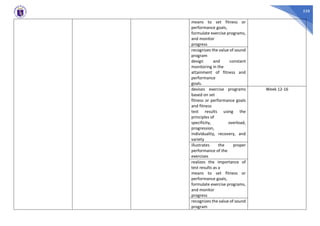
Natutukoy ang mga salitang magkakatugma
Nakakagamit ng pahiwatig upang malaman ang kahulugan ng mga salita tulad ng paggamit ng mga palatandaang nagbibigay
ng kahulugan (katuturan o kahulugan ng salita, sitwasyong pinaggamitan ng salita, at pormal na depinisyon ng salita)
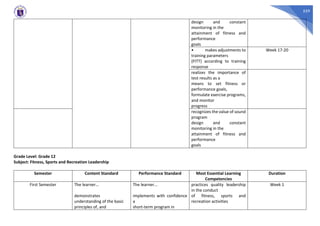
Naikokompara ang mga kuwento sa pamamagitan ng pagtatala ng pagkakatulad at pagkakaiba
Nakasusulat ng talata nang may wastong baybay, bantas at gamit ng malaki at maliit na letra upang maipahayag ang ideya,
damdamin o reaksyon sa isang paksa o isyu
Nakabubuo ng mga tanong matapos mapakinggan ang isang teksto
Nagagamit ang angkop na pagtatanong tungkol sa mga tao, bagay, lugar at pangyayari, ano, sino, saan, ilan, kalian, ano-ano,
at sino-sino
Nababaybay nang wasto ang mga salitang natutunan sa aralin/ batayang talasalitaang pampaningin
Nakapaglalarawan ng mga tao, hayop, bagay at lugar sa pamayanan
3rd
Quarter
Natutukoy ang kahulugan ng mga tambalang salita na nananatili ang kahulugan
Nasasabi ang sariling ideya tungkol sa tekstong napakinggan
Naipahahayag ang sariling opinyon o reaskyon sa isang napakinggang isyu
Nasasabi ang paksa o tema ng teksto, kuwento o sanaysay
Nagagamit ang tamang salitang kilos/ pandiwa sa pagsasalaysay ng mga personal na karanasan
Napapalitan at nadadagdagan ang mga tunog upang makabuo ng bagong salita
Naibibigay ang mga sumusuportang kaisipan sa pangunahing kaisipan ng tekstong binasa
Nasisipi nang wasto at maayos ang mga liham
Naibibigay ang sariling hinuha bago, habang at pagkatapos mapakinggang teksto
111
Nagagamit ang tamang salitang kilos/ pandiwa sa pagsasalaysay ng mga personal na karanasan
Nakapagbibigay ng angkop na pamagat sa binasang teksto
Nagagamit nang wasto ang mga pang-abay na naglalarawan ng isang kilos o gawi
Napag-uugnay ang sanhi at bunga ng mga pangyayari sa binasang teksto
Nagagamit nang wasto ang pang-ukol (laban sa, ayon sa, para sa, ukol sa, tungkol sa)
4th
Quarter
Napagsasama ang mga katinig, patinig upang makabuo ng salitang klaster (Hal. blusa, gripo, plato)
Napagsasama ang mga katinig at patinig upang makabuo ng salitang may diptonggo
Nasisipi nang wasto at maayos ang mga talata
Naiuugnay ang binasa sa sariling karanasan
Nakasusulat ng isang talata
Naiuugnay ang binasa sa sariling karanasan
Nagagamit ang mga salitang kilos sa pag-uusap tungkol sa iba’t ibang gawain sa tahanan, paaralan, at pamayanan
Nababasa ang mga salitang hiram/natutuhan sa aralin
Natutukoy ang kahulugan ng mga tambalang salita na nananatili ang kahulugan
Nabibigay ng mungkahing solusyon sa suliraning nabasa sa isang teskto o napanood
Natutukoy ang mahahalagang detalye kaugnay ng paksang narinig
Naibibigay ang buod o lagom ng tesktong binasa
Naibibigay ang paksa ng kuwento o sanaysay na napakinggan
112
Grade Level: Grade 4
Subject: Filipino
Grade Level Standards:
Pagkatapos ng Ikaapat na Baitang, naipamamalas na ng mga mag-aaral ang kakayahan sa pagbasa, pagsulat at pakikipagtalastasan nang wasto upang
maipahayag ang kaalaman, ideya at damdaming angkop sa kaniyang edad at sa kulturang kinabibilangan at nakikilahok sa pagpapaunlad ng pamayanan.
QUARTER Most Essential Learning Competencies Duration
1st Quarter Nagagamit nang wasto ang mga pangngalan sa pagsasalita tungkol sa sarili at ibang tao sa paligid
Nabibigyang kahulugan ang salita sa pamamagitan ng pormal na depinisyon
Natutukoy ang mga elemento ng kuwento (tagpuan, tauhan, banghay)
Natutukoy ang bahagi ng binasang kuwento- simula-kasukdulan-katapusan
Nakasusulat ng talata tungkol sa sarili
Naisasalaysay muli nang may wastong pagkakasunod-sunod ang napakinggang teksto gamit ang mga larawan, signal words at
pangungusap
Nasasagot ang mga tanong sa napakinggan at nabasang kuwento, tekstong pang-impormasyon, at SMS (Short Messaging Text).
Nakasusulat ng natatanging kuwento tungkol sa natatanging tao sa pamayanan, tugma o maikling tula
Nababasa ang maikling tula nang may tamang bilis, diin, ekspresyon at intonasyon
Naipahahayag ang sariling opinyon o reaksyon sa isang napakinggan/napanood na isyu o usapan
Nasusunod ang napakinggang panuto o hakbang ng isang gawain
Naibibigay ang kahalagahan ng media (hal. pang-impormasyon, pang-aliw, panghikayat)
Nagagamit ang iba’t ibang uri ng panghalip (panao) sa usapan at pagsasabi tungkol sa sariling karanasan
Nagagamit ang iba’t ibang uri ng panghalip (pananong) - isahan-- maramihan sa usapan at pagsasabi tungkol sa sariling
karanasan
Nagagamit ang iba’t ibang uri ng panghalip (panaklaw)-tiyakan-isahan/kalahatan-di-tiyakan sa usapan at pagsasabi tungkol sa
sariling karanasan
Nabibigy ang kahulugan ng salita sa pamamagitan ng pormal na depinisyon
Naibibigay ang kahulugan ng salita ayon sa:
-Kasingkahulugan
113
-Kasalungat
-Gamit ng Pahiwatig (context clues)
-Diksyunaryong kahulugan
Nakasusulat ng liham na nagbabahagi ng karanasan/pangyayari sa nabasang kuwento
QUARTER Most Essential Learning Competencies Duration
2nd Quarter Nasasagot ang mga tanong mula sa napakinggan at nabasang alamat, tula, at awit.
Naisusulat nang wasto ang baybay ng salitang natutuhan sa aralin; salitang hiram; at salitang kaugnay ng ibang asignatura
Nakapagbibigay ng hinuha sa kalalabasan ng mga pangyayari sa napakinggang teskto
Nagagamit nang wasto ang pang-uri (lantay, paghahambing, pasukdol) sa paglalarawan ng tao, lugar, bagay at pangyayari sa
sarili, ibang tao at katulong sa pamayanan
Naibibigay ang kahulugan ng mga salitang pamilyar at di-pamilyar pamamagitan ng pag-uugnay sa sariling karanasan
Nahuhulaan ang maaaring mangyari sa teksto gamit ang dating karanasan/ kaalaman
Naibibigay ang paksa ng napakinggang teksto
Nagagamit ang uri ng pandiwa ayon sa panahunan sa pagsasalaysay ng nasaksihang pangyayari
Nasasabi ang sanhi at bunga ayon sa nabasang pahayag, napakinggang teksto, at napakinggang ulat
Nakasusulat ng timeline tungkol sa mga pangyayari sa binasang teksto
Naisasalaysay nang may tamang pagkakasunod-sunod ang nakalap na impormasyon mula sa napanood
Nailalarawan ang elemento ng kuwento (tagpuan, tauhan, banghay, at pangyayari)
Nailalarawan ang tauhan batay sa ikinilos, ginawi , sinabi at naging damdamin
Nagagamit ang iba’t ibang uri ng panghalip (pamatlig) - Patulad pahimaton paukol - Paari panlunan paturol sa usapan
at pagsasabi tungkol sa sariling karanasan
Nagagamit ang aspekto (panahunan) ng pandiwa n sa pagsasalaysay ng nasaksihang pangyayari
Natutukoy ang kahulugan ng salita batay sa ugnayang salita-larawan
Nakasusulat ng talatang naglalarawan
Nailalarawan ang tauhan batay sa ikinilos o ginawi o sinabi at damdamin
Nagagamit ang pangaano ng pandiwa-pawatas- pautos, pagsasalaysay ng napakinggang usapan
Nakasusunod sa nakasulat na panuto
Nakasusulat ng panuto gamit ang dayagram
114
Nasasabi ang paksa ng napanood na maikling pelikula
Naibibigay ang sariling wakas ng napakinggang teksto, tekstong pang-impormasyon at talambuhay
Nakasusulat ng sariling talambuhay at liham na humihingi ng pahintulot na magamit ang silid-aklatan
Nasusuri ang damdamin ng mga tauhan sa napanood
Napagsusunod-sunod ang mga detalye/ pangyayari sa tekstong napakinggan sa pamamagitan ng tanong
Nagagamit nang wasto ang pang-abay sa paglalarawan ng kilos
Natutukoy ang mga sumusuportang detalye sa mahalagang kaisipan sa nabasang teksto
Nagagamit nang wasto ang pang-abay at pandiwa sa pangungusap
Nagagamit nang wasto ang pang-abay at pang-uri sa pangungusap
Quarter Most Essential Learning Competencies Duration
3rd Quarter Nakapagbibigay ng hakbang ng isang gawain
Nakasusulat ng simpleng resipi at patalastas
Nagagamit ang pang-abay sa paglalarawan ng kilos
Nailalarawan ang tauhan batay sa ikinilos, ginawi, sinabi at naging damdamin
Nasasagot ang mga tanong sa nabasa o napakinggang editoryal, argumento, debate, pahayagan, at
ipinapahayag sa isang editorial cartoon.
Naisasalaysay ang mahahalagang detalye sa napakinggang editoryal
Nasusuri kung opinyon o katotohanan ang isang pahayag
Nagagamit sa pagpapahayag ang magagalang na salita sa hindi pagsang-ayon pakikipag-argumento o
pakikipagdebate
Nakasusulat ng argumento at editoryal
Nakasusulat ng paliwanag; usapan ; puna tungkol sa isang isyu; opinyon tungkol sa isang isyu; ng mga
isyu/argumento para sa isang debate;
Nakapagbibigay ng reaksiyon sa napakinggang paliwanag; sa isyu mula sa napakinggang ulat
Natutukoy ang kaibahan ng pang-abay at pang-uri
Nagagamit ang pariralang pang-abay at pandiwa, pariralang pang-abay at pang-uri sa paglalarawan
Nagagamit nang wasto ang pang-angkop (–ng, -g at na ) sa pangunguap at pakikipagtalastasan
Nakapagbibigay ng angkop na pamagat sa napakinggang teksto
Naiuugnay ang sariling karanasan sa napakinggang teksto
115
Nabibigyan ng angkop na pamagat ang talatang binasa
Naisasalaysay muli ang napakinggang teksto gamit ang sariling salita
Nagagamit nang wasto at angkop ang pangatnig
- o, ni, maging, man
- kung, kapag, pag, atbp.
- ngunit, subalit, atbp.
- dahil sa, sapagkat, atbp.
- sa wakas, atbp.
- kung gayon, atbp.
- daw, raw, atbp.
-kung sino, kung ano, siya rin atbp.
Naipakikita ang pag-unawa sa pinanood sa pamamagitan ng pagbibigay ng ibang pagwawakas ayon sa sariling
saloobin o paniniwala
Nagagamit nang wasto at angkop ang simuno at panaguri sa pangungusap
Nakasusulat ng talata na may sanhi at bunga
Napagsusunod-sunod ang mga pangyayari sa tekstong napakinggan sa pamamagitan ng paggamit ng una,
pangalawa, sumunod at panghuli
Nakasusulat ng balita na may huwaran/ padron/ balangkas nang may wastong pagkakasunod-sunod ng mga
pangyayari
Quarter Most Essential Learning Competencies Duration
4th Quarter Nakapagbibigay ng panuto na may tatlo hanggang apat na hakbang gamit ang pangunahin at pangalawang
direksyon
Nasasagot ang mga tanong sa napanood na patalastas
Nakapaghahambing ng iba’t ibang patalastas na napanood
Nagagamit sa pagpapakilala ng produkto ang uri ng pangungusap
Nagagamit ang iba’t ibang mga uri ng pangungusap sa pagsasalaysay ng sariling karanasan
Nakasusulat ng isang balangkas mula sa mga nakalap na impormasyon mula sa binasa
Naibibigay ang paksa ng napakinggang teksto
Naibibigay ang kahulugan ng salita sa pamamagitan ng pormal na depinisyon ng salita
Nagagamit sa panayam ang iba’t ibang uri ng pangungusap
116
Nagagamit ang magagalang na pananalita sa iba’t ibang sitwasyon;
Pagbibigay ng puna sa editorial cartoon
Nakaguguhit ng sariling editorial cartoon
Nagagamit sa pakikipag talastasan ang mga uri ng pangungusap
Naibibigay ang bagong natuklasang kaalaman mula sa binasang teksto
Nasasagot ang mga tanong sa nabasa o napakinggang pagpupulong (pormal at di pormal), katitikan (minutes) ng
pagpupulong
Naipahahayag ang sariling opinyon o reaskyon batay sa napakinggang pagpupulong (pormal at di-pormal)
Nagagamit ang mga uri ng pangungusap sa pormal na pagpupulong
Nakasusulat ng minutes ng pagpupulong
Nasasagot ang tanong sa binasang iskrip ng radio broadcasting at teleradyo
Nakasusulat ng script para sa radio broadcasting
Naibabahagi ang obserbasyon sa iskrip ng radio broadcasting
Naibabahagi ang obserbasyon sa napakinggang script ng teleradyo
Nagagamit ang iba’t ibang uri ng pangungusap sa pagsasagawa ng radio broadcast
Naibibigay ang buod o lagom ng tekstong script ng teleradyo
Nagagamit ang mga uri ng pangungusap sa pagsasabi ng pananaw
Naibabahagi ang obserbasyon sa mga taong kabahagi ng debate
Nagagamit ang mga uri ng pangungusap sa pakikipagdebate tungkol sa isang isyu
Naibibigay ang buod o lagom ng debateng binasa
Nakapaghahambing ng iba’t ibang debateng napanood
Naipakikita ang nakalap na impormasyon sa pamamagitan ng nakalarawang balangkas o dayagram
Nakakukuha ng tala buhat sa binasang teksto
117
Grade Level: Grade 5
Subject: Filipino
Grade Level Standards:
Pagkatapos ng Ikalimang Baitang, naipamamalas ng mag-aaral ang kakayahan sa pakikipagtalastasan, mapanuring pag-iisip at, pagpapahalaga sa panitikan at
kultura sa pamamagitan ng iba’t ibang teksto/ babasahing lokal at pambansa.
Quarter Most Essential Learning Competencies Duration
1st
Quarter Naiuugnay ang sariling karanasan sa napakinggang teksto
Nagagamit nang wasto ang mga pangngalan at panghalip sa pagtalakay tungkol sa sarili,sa mga tao,hayop, lugar, bagay at pangyayari
sa paligid; sa usapan; at sa paglalahad tungkol sa sariling karanasan
Nasasagot ang mga tanong sa binasa/napakinggang kuwento at tekstong pang-impormasyon
Nakasusulat ng isang maikling tula, talatang nagsasalaysay, at talambuhay
Naipahahayag ang sariling opinyon o reaksyon sa isang napakinggang balita, isyu o usapan
Naisasalaysay muli ang napakinggang teksto gamit ang sariling salita
Naisasalaysay muli ang napakinggang teksto sa tulong ng mga pangungusap
Naibibigay ang paksa ng napakinggang kuwento/usapan
Naibibigay ang kahulugan ng salitang pamilyar at di-pamilyar na mga salita sa pamamagitan ng tono o damdamin, paglalarawan,
kayarian ng mga salitang iisa ang baybay ngunit magkaiba ang diin at tambalang salita
Nabibigyang-kahulugan ang bar graph, pie, talahanayan at iba pa
2nd
Quarter
Nababaybay nang wasto ang salitang natutuhan sa aralin at salitang hiram
Nasasagot ang mga tanong sa binasa/napakinggang talaarawan, journal at anekdota
Naibabahagi ang isang pangyayaring nasaksihan o naobserbahan
Nailalarawan ang tagpuan at tauhan ng napanood na pelikula at nabasang teksto
Nabibigkas nang may wastong tono, diin, antala at damdamin ang napakinggang tula
Naibibigay ang paksa/layunin ng napakinggang kuwento/usapan/talata, at pinanood na dokumentaryo,
Naibibigay ang mahahalagang pangyayari sa nabasang talaarawan, talambuhay at sa napanood na dokumentaryo
Nagagamit ang magagalang na pananalita sa pagsasabi ng hinaing o reklamo, sa pagsasabi ng ideya sa isang isyu, at sa pagtanggi
Nakapagbibigay ng angkop na pamagat sa isang talata at tekstong napakinggan
Naipapahayag ang sariling opinyon o reaskyon sa isang napakinggang balita, isyu o usapan,
Naibibigay ang bagong natuklasang kaalaman mula sa binasang teksto at datos na hinihingi ng isang form
118
Nakasusulat ng simpleng patalastas, at simpleng islogan
Nagagamit ang pangkalahatang sanggunian sa pagtatala ng mahahalagang impormasyon tungkol sa isang isyu
Naitatala ang mga impormasyon mula sa binasang teksto
Quarter Most Essential Learning Competencies Duration
3rd Quarter Nagagamit ang pang-abay sa paglalarawan ng kilos
Nagagamit ang pang-abay at pang-uri sa paglalarawan
Napagsusunod-sunod ang mga pangyayari sa tekstong napakinggan (kronolohikal na pagsusunod-sunod )
Nakabubuo ng mga tanong matapos mapakinggan ang isang salaysay
Nakapag-uulat tungkol sa napanood
Nasusuri ang mga tauhan/tagpuan sa napanood na maikling pelikula
Naibabahagi ang isang pangyayaring nasaksihan
Nakagagawa ng isang timeline batay sa nabasang kasaysayan
Naisasalaysay muli ang napakinggang teksto
Nasusuri kung ang pahayag ay opinyon o katotohanan
Nagagamit nang wasto ang pang-angkop sa pakikipagtalastasan
Nagbibigay ang mga salitang magkakasalungat at magkakasingkahulugan
Nakapagbibigay ng angkop na pamagat sa tekstong napakinggan
Nasasabi ang simuno at panag-uri sa pangungusap
Nakasusulat ng isang sulating pormal, di pormal (email) at liham na nagbibigay ng mungkahi
Nagagamit ang pangkalahatang sanggunian sa pagsasaliksik tungkol sa isang isyu
Naibibigay ang datos na hinihingi ng isang form
4th Quarter
Nakakagawa ng dayagram ng ugnayang sanhi at bunga mula sa tekstong napakinggan
Nagagamit ang iba’t ibang uri ng pangungusap sa pagsasalaysay ng napakinggang balita
Nagagamit ang iba’t ibang uri ng pangungusap sa pakikipag-debate tungkol sa isang isyu
Natutukoy ang paniniwala ng may-akda ng teksto sa isang isyu
Nakapagbibigay ng maaaring solusyon sa isang naobserbahang suliranin
119
Napaghahambing ang iba’t ibang dokumentaryo
Nagagamit ang iba’t ibang uri ng pangungusap sa pagsali sa isang usapan (chat)
Nakapagbibigay ng lagom o buod ng tekstong napakinggan
Naibibigay ang mahahalagang pangyayari
Nagagamit ang iba’t ibang uri ng pangungusap sa pakikipanayam/ pag-iinterview
Nagagamit ang iba’t ibang uri ng pangungusap sa pagkilatis ng isang produkto
Nagagamit ang mga bagong natutuhang salita sa paggawa ng sariling komposisyon
Nakapagtatanong tungkol sa impormasyong inilahad sa isang dayagram, tsart, at mapa
Nakasusulat ng maikling balita, editoryal, at iba pang bahagi ng pahayagan
Nakasusulat ng iskrip para sa radio broadcasting at teleradyo.
Nakapipili ng angkop na aklat batay sa interes
120
Grade Level: Grade 6
Subject: Filipino
Grade Level Standards:
Pagkatapos ng Ikaanim na Baitang, naipamamalas ng mag-aaral ang kakayahan sa pakikipagtalastasan, mapanuring pag-iisip at pagpapahalaga sa wika,
panitikan at kultura upang makaambag sa pag-unlad ng bansa.
Quarter Most Essential Learning Competencies Duration
1st Quarter
Nasasagot ang mga tanong tungkol sa napakinggang/nabasang pabula, kuwento, tekstong pang-impormasyon at usapan
Nasasagot ang tanong na bakit at paano
Nagagamit nang wasto ang mga pangngalan at panghalip sa pakikipag-usap sa iba’t ibang sitwasyon
Nabibigyang kahulugan ang kilos at pahayag ng mga tauhan sa napakinggang pabula
Nabibigyang kahulugan ang sawikain
Napagsunod-sunod ang mga pangyayari sa kuwento sa tulong ng nakalarawang balangkas at pamatnubay na tanong
Nakapagbibigay ng hinuha sa kalalabasan ng mga pangyayari bago, habang at matapos ang pagbasa
Nagagamit ang magagalang na pananalita sa iba’t ibang sitwasyon:
• sa pagpapahayag ng saloobin/damdamin,
• pagbabahagi ng obserbasyon sa paligid
• pagpapahayag ng ideya
• pagsali sa isang usapan
• pagbibigay ng reaksiyon
Nagagamit nang wasto ang mga panghalip na panao, paari, pananong, pamatlig, pamaklaw sa pakikipag-usap sa iba’t ibang
sitwasyon
Nasusuri ang mga kaisipan/tema/layunin/tauhan/tagpuan at pagpapahalagang nakapaloob sa napanood na maikling pelikula
Nakapagbibigay ng sarili at maaring solusyon sa isang suliraning naobserbahan sa paligid
Nakapagbibigay ng angkop na pamagat sa binasang/napakinggang talata
Naipapahayag ang sariling opinyon o reaskyon sa isang napakinggang balita isyu o usapan
Nagagamit ang pangkalahatang sanggunian sa pagsasaliksik
Nakasusulat ng kuwento; talatang nagpapaliwanag at nagsasalaysay
2nd Nasasagot ang mga tanong tungkol sa napakinggang/ nabasang talaarawan at anekdota
121
Quarter Naibabahagi ang isang pangyayaring nasaksihan
Nagagamit ang dating kaalaman sa pagbibigay ng wakas ng napakinggang teksto
Nababago ang dating kaalaman batay sa natuklasan sa teksto
Naibibigay ang maaaring mangyari sa teksto gamit ang dating karanasan/kaalaman
Nagagamit nang wasto ang kayarian at kailanan ng pang-uri sa paglalarawan sa iba’t ibang sitwasyon
Nailalarawan ang tauhan batay sa damdamin nito at tagpuan sa binasang kuwento
Nasasabi ang paksa/mahahalagang pangyayari sa binasang/napakinggang sanaysay at teksto
Nagagamit nang wasto ang aspekto at pokus ng pandiwa (aktor, layon, ganapan, tagatanggap, gamit, sanhi, direksiyon) sa
pakikipag-usap sa ibat ibang sitwasyon
Nagagamit ang uri ng pang-abay (panlunan, pamaraan, pamanahon) sa pakikipag-usap sa ibat ibang sitwasyon
Napag-uugnay ang sanhi at bunga ng mga pangyayari
Nagagamit ang iba’t ibang salita bilang pang-uri at pang-abay sa pagpapahayag ng sariling ideya
Nakapagtatala ng datos mula sa binasang teksto
Nakasusulat ng sulating di pormal, pormal, liham pangangalakal at panuto
3rd
Quarter
Nasasagot ang mga tanong tungkol sa napakinggang/ binasang ulat at tekstong pang-impormasyon
Nakapagbibigay ng lagom o buod ng tekstong napakinggan
Naiisa-isa ang mga argumento sa binasang teksto
Naibibigay ang impormasyong hinihingi ng nakalarawang balangkas
Nagagamit nang wasto ang pang-angkop at pangatnig
Nakabubuo ng mga bagong salita gamit ang panlapi at salitang-ugat
Nasusuri kung ang pahayag ay opinyon o katotohanan
Nakapag-uulat tungkol sa pinanood
Nagagamit sa usapan at iba’t ibang sitwasyon ang mga uri ng pangungusap
Naiuugnay ang binasa sa sariling karanasan
Nakakakuha ng impormasyon sa pamamagitan ng pahapyaw na pagbasa
Nakasusulat ng tula at sanaysay na naglalarawan
4th
Quarter
Nakagagawa ng patalastas at usapan gamit ang iba’t ibang bahagi ng pananalita
Napapangkat ang mga salitang magkakaugnay
Naipahahayag ang sariling opinyon o reaksyon sa isang napakinggang balita isyu o usapan
122
Nasusuri ang pagkakaiba ng kathang isip at di-kathang isip na teksto (fiction at non-fiction)
Napaghahambing-hambing ang iba’t ibang uri ng pelikula
Nakagagawa ng dayagram ng ugnayang sanhi at bunga ng mga pangyayari / problema-solusyon
Nakapagtatanong tungkol sa impormasyong inilahad sa dayagram, tsart, mapa at graph
Naipapahayag ang sariling opinyon o reaksyon sa isang napakinggang balita isyu o usapan
Nakasusulat ng ulat, balitang pang-isport, liham sa editor, iskrip para sa radio broadcasting at teleradyo
Nagagamit ang pangkalahatang sanggunian sa pagtitipon ng mga datos na kailangan
Grade Level: Grade 7
Subject: Filipino
Grade Level Standards:
Pagkatapos ng Ikapitong Baitang, naipamamalas ng mag-aaral ang kakayahang komunikatibo, mapanuring pag-iisip, at pag-unawa at pagpapahalagang
pampanitikan gamit ang teknolohiya at iba’t ibang uri ng teksto at akdang pampanitikang rehiyunal upang maipagmalaki ang sariling kultura, gayundin ang
iba’t ibang kulturang panrehiyon.
Quarter Most Essential Learning Competencies Duration
1st QuarterNahihinuha ang kaugalian at kalagayang panlipunan ng lugar na pinagmulan ng kuwentong bayan batay sa mga pangyayari at
usapan ng mga tauhan
Nagagamit nang wasto ang mga pahayag sa pagbibigay ng mga patunay
Nahihinuha ang kalalabasan ng mga pangyayari batay sa akdang napakinggan
Naipaliliwanag ang sanhi at bunga ng mga pangyayari
Nasusuri ang isang dokyu-film batay sa ibinigay na mga pamantayan
Naisasalaysay nang maayos at wasto ang buod, pagkakasunod-sunod ng mga pangyayari sa kuwento, mito, alamat, at kuwentong-
bayan
Nagagamit nang wasto ang mga retorikal na pang-ugnay na ginamit sa akda (kung, kapag, sakali, at iba pa), sa paglalahad (una,
ikalawa, halimbawa, at iba pa, isang araw, samantala), at sa pagbuo ng editoryal na nanghihikayat
(totoo/tunay, talaga, pero/ subalit, at iba pa)
Nasusuri ang pagkamakatotohanan ng mga pangyayari batay sa sariling karanasan
Naiisa-isa ang mga hakbang na ginawa sa pananaliksik mula sa napakinggang mga pahayag
Nasusuri ang ginamit na datos sa pananaliksik sa isang proyektong panturismo (halimbawa: pagsusuri sa isang promo coupon o
brochure)
123
Naipaliliwanag ang mga salitang ginamit sa paggawa ng proyektong panturismo (halimbawa ang paggamit ng acronym sa
promosyon)
Naibabahagi ang isang halimbawa ng napanood na video clip mula sa youtube o ibang website na maaaring magamit
Nagagamit nang wasto at angkop ang wikang Filipino sa pagsasagawa ng isang makatotohanan at mapanghikayat na proyektong
panturismo
Quarter Most Essential Learning Competencies Duration
2nd
Quarter
Naipaliliwanag ang mahahalagang detalye, mensahe at kaisipang nais iparating ng napakinggang bulong, awiting-bayan, alamat,
bahagi ng akda, at teksto tungkol sa epiko sa Kabisayaan
Nabubuo ang sariling paghahatol o pagmamatuwid sa ideyang nakapaloob sa akda na sumasalamin sa tradisyon ng mga taga
Bisaya
Nasusuri ang antas ng wika batay sa pormalidad na ginamit sa pagsulat ng awiting-bayan (balbal, kolokyal, lalawiganin, pormal)
Nahihinuha ang kaligirang pangkasaysayan ng binasang alamat ng Kabisayaan
Naibibigay ang kahulugan at sariling interpretasyon sa mga salitang paulit-ulit na ginamit sa akda, mga salitang iba-iba ang digri o
antas ng kahulugan (pagkiklino), mga di-pamilyar na salita mula sa akda, at mga salitang nagpapahayag ng damdamin
Nagagamit nang maayos ang mga pahayag sa paghahambing (higit/mas, di-gaano, di-gasino, at iba pa)
Naisusulat ang isang editoryal na nanghihikayat kaugnay ng paksa
Naisusulat ang isang tekstong naglalahad tungkol sa pagpapahalaga ng mga taga-Bisaya sa kinagisnang kultura
Nasusuri ang kulturang nakapaloob sa awiting-bayan
Nagagamit ang mga kumbensyon sa pagsulat ng awitin (sukat, tugma, tayutay, talinghaga, at iba pa)
Quarter Most Essential Learning Competencies Duration
3rd Quarter Naipaliliwanag ang kahalagahan ng paggamit ng suprasegmental (tono, diin, antala)
Naihahambing ang mga katangian ng tula/awiting panudyo, tugmang de gulong at palaisipan
Naipaliliwanag ang kahulugan ng salita sa pamamagitan ng pagpapangkat, batay sa konteksto ng pangungusap,
denotasyon at konotasyon, batay sa kasing kahulugan at kasalungat nito
Naisusulat ang sariling tula/awiting panudyo, tugmang de gulong at palaisipan batay sa itinakdang mga pamantayan
Nasusuri ang mga katangian at elemento ng mito,alamat, kuwentong-bayan, maikling kuwento mula sa Mindanao,
Kabisayaan at Luzon batay sa paksa, mga tauhan, tagpuan, kaisipan at mga aspetong pangkultura (halimbawa:
heograpiya, uri ng pamumuhay, at iba pa)
Nagagamit nang wasto ang angkop na mga pahayag sa panimula, gitna at wakas ng isang akda
124
Naibubuod ang tekstong binasa sa tulong ng pangunahin at mga pantulong na kaisipan
Nasusuri ang mga elemento at sosyo-historikal na konteksto ng napanood na dulang pantelebisyon
Nagagamit ang wastong mga panandang anaporik at kataporik ng pangngalan
Nasusuri ang mga salitang ginamit sa pagsulat ng balita ayon sa napakinggang halimbawa
Natutukoy ang datos na kailangan sa paglikha ng sariling ulat-balita batay sa materyal na binasa
4th Q uarter Nailalahad ang sariling pananaw tungkol sa mga motibo ng may-akda sa bisa ng binasang bahagi ng akda
Naibibigay ang kahulugan at mga katangian ng “korido”
Naibabahagi ang sariling ideya tungkol sa kahalagahan ng pag-aaral ng Ibong Adarna
Naisusulat nang sistematiko ang mga nasaliksik na impormasyon kaugnay ng kaligirang pangkasaysayan ng Ibong
Adarna
Nagmumungkahi ng mga angkop na solusyon sa mga suliraning narinig mula sa akda
Nasusuri ang mga pangyayari sa akda na nagpapakita ng mga suliraning panlipunan na dapat mabigyang solusyon
Nailalahad ang sariling saloobin at damdamin sa napanood na bahagi ng telenobela o serye na may pagkakatulad sa
akdang tinalakay
Naiuugnay sa sariling karanasan ang mga karanasang nabanggit sa binasa
Nasusuri ang damdaming namamayani sa mga tauhan sa pinanood na dulang pantelebisyon/pampelikula
Nagagamit ang dating kaalaman at karanasan sa pag-unawa at pagpapakahulugan sa mga kaisipan sa akda
Nagagamit ang angkop na mga salita at simbolo sa pagsulat ng iskrip
Nasusuri ang mga katangian at papel na ginampanan ng pangunahing tauhan at mga pantulong na tauhan
Nagagamit ang mga salita at pangungusap nang may kaisahan at pagkakaugnay-ugnay sa mabubuong iskrip
125
Grade Level: Grade 8
Subject: Filipino
Grade Level Standards:
Pagkatapos ng Ikawalong Baitang, naipamamalas ng mag-aaral ang kakayahang komunikatibo, mapanuring pag-iisip,at pag-unawa at pagpapahalagang
pampanitikan gamit ang teknolohiya at iba’t ibang uri ng teksto at akdang pampanitikang pambansa upang maipagmalaki ang kulturang Pilipino.
Quarter Most Essential Learning Competencies Duration
1st
Quarter
Naiuugnay ang mahahalagang kaisipang nakapaloob sa mga karunungang-bayan sa mga pangyayari sa tunay na buhay sa
kasalukuyan
Nabibigyang-kahulugan ang mga talinghaga, eupimistiko o masining na pahayag ginamit sa tula, balagtasan, alamat, maikling
kuwento, epiko ayon sa: -kasingkahulugan at kasalungat na kahulugan
Naisusulat ang sariling bugtong, salawikain, sawikain o kasabihan na angkop sa kasalukuyang kalagayan
Nagagamit ang paghahambing sa pagbuo ng alinman sa bugtong, salawikain, sawikain o kasabihan (eupemistikong pahayag)
Nakikinig nang may pag-unawa upang mailahad ang layunin ng napakinggan, maipaliwanag ang pagkakaugnay-ugnay ng mga
pangyayari at mauri ang sanhi at bunga ng mga pangyayari
Napauunlad ang kakayahang umunawa sa binasa sa pamamagitan ng:
-paghihinuha batay sa mga ideya o pangyayari sa akda
-dating kaalaman kaugnay sa binasa
Nagagamit ang iba’t ibang teknik sa pagpapalawak ng paksa:
-paghahawig o pagtutulad
-pagbibigay depinisyon
-pagsusuri
Naisusulat ang talatang:
-binubuo ng magkakaugnay at maayos na mga pangungusap
- nagpapahayag ng sariling palagay o kaisipan
-nagpapakita ng simula, gitna, wakas
Nagagamit ang mga hudyat ng sanhi at bunga ng mga pangyayari (dahil,sapagkat,kaya,bunga nito, iba pa)
Naibabahagi ang sariling opinyon o pananaw batay sa napakinggang pag-uulat
Naipaliliwanag ang mga hakbang sa paggawa ng pananaliksik ayon sa binasang datos
Nagagamit sa pagsulat ng resulta ng pananaliksik ang awtentikong datos na nagpapakita ng pagpapahalaga sa katutubong
kulturang Pilipino
126
Nagagamit nang maayos ang mga pahayag sa pag-aayos ng datos (una, isa pa, iba pa)
Quarter Most Essential Learning Competencies Duration
2nd Quarter Napipili ang mga pangunahin at pantulong na kaisipang nakasaad sa binasa
Nabubuo ang mga makabuluhang tanong batay sa napakinggang palitan ng katuwiran
Naibibigay ang opinyon at katuwiran tungkol sa paksa ng balagtasan
Nakapaglalahad sa paraang pasulat ng pagsang-ayon at pagsalungat sa isang argumento
Nagagamit ang mga hudyat ng pagsang-ayon at pagsalungat sa paghahayag ng opinyon
Naipahahayag ang pangangatuwiran sa napiling alternatibong solusyon o proposisyon sa suliraning inilahad sa
tekstong binasa
Naibibigay ang denotatibo at konotatibong kahulugan, kasingkahulugan at kasalungat na kahulugan ng malalalim
na salitang ginamit sa akda
Nasusuri nang pasulat ang papel na ginagampanan ng sarsuwela sa pagpapataas ng kamalayan ng mga Pilipino sa
kultura ng iba’t ibang rehiyon sa bansa
Naiuugnay ang tema ng napanood na programang pantelebisyon sa akdang tinalakay
Naipaliliwanag nang maayos ang pansariling kaisipan, pananaw, opinyon at saloobin kaugnay ng akdang tinalakay*
Nagagamit ang iba’t ibang paraan ng pagpapahayag (pag-iisa-isa, paghahambing, at iba pa) sa pagsulat ng
sanaysay
Naiuugnay ang mga kaisipan sa akda sa mga kaganapan sa sarili, lipunan, at daigdig
Nabibigyang kahulugan ang mga simbolo at pahiwatig na ginamit sa akda
Nakasusulat ng wakas ng maikling kuwento*
Nabibigyang interpretasyon ang tulang napakinggan
Naihahambing ang anyo at mga elemento ng tulang binasa sa iba pang anyo ng tula
Naisusulat ang isang orihinal na tulang may masining na antas ng wika at may apat o higit pang saknong sa
alinmang anyong tinalakay, gamit ang paksang pag-ibig sa kapwa, bayan o kalikasan
Quarter Most Essential Learning Competencies Duration
3rd Quarter Naihahambing ang tekstong binasa sa iba pang teksto batay sa:
127
- paksa
- layon
- tono
- pananaw
- paraan ng
pagkakasulat
- pagbuo ng salita
- pagbuo ng talata
- pagbuo ng
pangungusap
Nabibigyang-kahulugan ang mga lingo/termino na ginagamit sa mundo ng multimedia
Naiuulat nang maayos at mabisa ang nalikom na datos sa pananaliksik
Nagagamit ang iba’t ibang estratehiya sa pangangalap ng mga ideya sa pagsulat ng balita, komentaryo, at iba pa
Nagagamit sa iba’t ibang sitwasyon ang mga salitang ginagamit sa impormal na komunikasyon (balbal, kolokyal,
banyaga)
Napag-iiba ang katotohanan (facts) sa hinuha (inferences), opinyon at personal na interpretasyon ng kausap
Naiisa-isa ang mga positibo at negatibong pahayag
Naiuugnay ang balitang napanood sa balitang napakinggan
Nabibigyang-kahulugan ang mga salitang ginagamit sa radio broadcasting
Naisusulat nang wasto ang isang dokumentaryong panradyo
Nagagamit ang mga angkop na ekspresyon sa paghahayag ng konsepto ng pananaw (ayon, batay, sang-ayon sa, sa
akala, iba pa)
Nahihinuha ang paksa, layon at tono ng akdang nabasa
Natutukoy ang mga tamang salita sa pagbuo ng isang puzzle na may kaugnayan sa paksa
Nasusuri ang isang programang napanood sa telebisyon ayon sa itinakdang mga pamantayan
Naipahahayag sa lohikal na paraan ang mga pananaw at katuwiran
Nagagamit nang wasto ang mga ekspresyong hudyat ng kaugnayang lohikal (dahilan-bunga, paraan-resulta)
Nailalahad ang sariling bayas o pagkiling tungkol sa interes at pananaw ng nagsasalita
Nasusuri ang napanood na pelikula batay sa:
- Paksa/tema
-layon
-gamit ng mga salita
128
-mga tauhan
Nabibigyang kahulugan ang mga salitang ginagamit sa mundo ng pelikula
Naihahayag ang sariling pananaw tungkol sa mahahalagang isyung mahihinuha sa napanood na pelikula
Nagagamit ang kahusayang gramatikal (may tamang bantas, baybay, magkakaugnay na pangungusap/ talata sa
pagsulat ng isang suring- pelikula
Nasusuri ang mga hakbang sa pagbuo ng isang kampanyang panlipunan ayon sa binasang mga impormasyon
Naipaliliwanag ang mga salitang angkop na gamitin sa pagbuo ng isang kampanyang panlipunan
Nakasusulat ng isang malinaw na social awareness campaign tungkol sa isang paksa na maisasagawa sa tulong ng
multimedia*
Nagagamit ang angkop na mga komunikatibong pahayag sa pagbuo ng isang social awareness campaign
Quarter Most Essential Learning Competencies Duration
4th Quarter
Nahihinuha ang kahalagahan ng pag-aaral ng Florante at Laura batay sa napakinggang mga pahiwatig sa akda
Natitiyak ang kaligirang pangkasaysayan ng akda sa pamamagitan ng:
- pagtukoy sa
kalagayan ng
lipunan sa
panahong
nasulat ito
- pagtukoy sa
layunin ng
pagsulat ng akda
- pagsusuri sa epekto ng akda pagkatapos itong isulat
Nailalahad ang damdamin o saloobin ng may- akda, gamit ang wika ng kabataan
Nailalahad ang mahahalagang pangyayari sa napakinggang aralin
Nasusuri ang mga pangunahing kaisipan ng bawat kabanatang binasa
Nabibigyang-kahulugan ang :
-matatalinghagang ekspresyon
- tayutay
- simbolo
Naisusulat sa isang monologo ang mga pansariling damdamin tungkol sa:
- pagkapoot
129
- pagkatakot
- iba pang damdamin
Nailalarawan ang tagpuan ng akda batay sa napakinggan
Nailalahad ang mahahalagang pangyayari sa aralin
Nakasusulat ng sariling talumpating nanghihikayat tungkol sa isyung pinapaksa sa binasa
Nagagamit nang wasto ang mga salitang nanghihikayat
Nailalahad ang damdaming namamayani sa mga tauhan batay sa napakinggan
Nasusuri ang mga sitwasyong nagpapakita ng iba’t ibang damdamin at motibo ng mga tauhan
Nakasusulat ng isang islogan na tumatalakay sa paksang aralin
Natutukoy ang mga hakbang sa pagsasagawa ng isang kawili-wiling radio broadcast batay sa nasaliksik na
impormasyon tungkol dito
Nabibigyang pansin ang mga angkop na salitang dapat gamitin sa isang radio broadcast
Nailalapat sa isang radio broadcast ang mga kaalamang natutuhan sa napanood sa telebisyon na programang
nagbabalita
Naipahahayag ang pansariling paniniwala at pagpapahalaga gamit ang mga salitang naghahayag ng pagsang-
ayon at pagsalungat (Hal.: totoo, ngunit)
Grade Level: Grade 9
Subject: Filipino
Grade Level Standards:
Pagkatapos ng Ikasiyam na Baitang, Naipamamalas ng mag-aaral ang kakayahang komunikatibo,mapanuring pag-iisip,at pag-unawa at pagpapahalagang
pampanitikan gamit ang teknolohiya at iba’t ibang uri ng teksto at saling-akdang Asyano upang mapatibay ang pagkakakilanlang Asyano.
Quarter Most Essential Learning Competencies Duration
1st Quarter Maikling Kuwento
Nasusuri ang mga pangyayari, at ang kaugnayan nito sa kasalukuyan sa lipunang Asyano batay sa
napakinggang akda
Nabubuo ang sariling paghatol o pagmamatuwid sa mga ideyang nakapaloob sa akda
Nabibigyang kahulugan ang malalim na salitang ginamit sa akda batay sa denotatibo o konotatibong
kahulugan
130
Naihahambing ang ilang piling pangyayari sa napanood na telenobela sa ilang piling kaganapan sa lipunang
Asyano sa kasalukuyan
Nasusuri ang maikling kuwento batay sa:
- Paksa
- Mga tauhan
- Pagkakasunod-sunod ng mga pangyayari
- estilo sa pagsulat ng awtor
- iba pa
Napagsusunod-sunod ang mga pangyayari sa akda
Napagsusunod-sunod ang mga pangyayari gamit ang angkop na mga pag-ugnay
Nobela
Nauuri ang mga tiyak na bahagi sa akda na nagpapakita ng katotohanan, kabutihan at kagandahan batay sa
napakinggang bahagi ng nobela
Nasusuri ang tunggaliang tao vs. sarili sa binasang nobela
Nabibigyan ng sariling interpretasyon ang mga pahiwatig na ginamit sa akda
Nasusuri ang pinanood na teleseryeng Asyano batay sa itinakdang pamantayan
Naisusulat ang isang pangyayari na nagpapakita ng tunggaliang tao vs. sarili
Nagagamit ang mga pahayag na ginagagamit sa pagbibigay-opinyon (sa tingin / akala / pahayag / ko, iba pa)
Tula
Naiuugnay ang sariling damdamin sa damdaming inihayag sa napakinggang tula
Nailalahad ang sariling pananaw ng paksa sa mga tulang Asyano
Natutukoy at naipaliliwanag ang magkakasingkahulugang pahayag sa ilang taludturan
Naisusulat ang ilang taludtod tungkol sa pagpapahalaga sa pagiging mamamayan ng rehiyong Asya
Sanaysay
Naipaliliwanag ang salitang may higit sa isang kahulugan
Nasusuri ang paraan ng pagpapahayag ng mga ideya at opinyon sa napanood na debate o kauri nito
Naisusulat ang sariling opinyon tungkol sa mga dapat o hindi dapat na katangian ng kabataang Asyano
Nagagamit ang mga pang-ugnay sa pagpapahayag ng sariling pananaw
131
Dula
Nakabubuo ng paghuhusga sa karakterisasyon ng mga tauhan sa kasiningan ng akda
Naipaliliwanag ang kahulugan ng salita habang nababago ang estruktura nito
Nasusuri ang pagiging makatotohanan ng ilang pangyayari sa isang dula
Nagagamit ang mga ekspresyong nagpapahayag ng katotohanan (sa totoo, talaga, tunay, iba pa)
Pangwakas na Output
Naibabahagi ang sariling pananaw sa resulta ng isinagawang sarbey tungkol sa tanong na: ”Alin sa mga
babasahin ng Timog-Silangang Asya ang iyong nagustuhan?”
Quarter Most Essential Learning Competencies Duration
2nd Quarter Tanka at Haiku
Nasusuri ang tono ng pagbigkas ng napakinggang tanka at haiku
Nasusuri ang pagkakaiba at pagkakatulad ng estilo ng pagbuo ng tanka at haiku
Nabibigyang kahulugan ang matatalingha-gang mahahalagang salitang ginamit sa tanka at haiku
Naisusulat ang payak na tanka at haiku sa tamang anyo at sukat
Nagagamit ang suprasegmental na antala/hinto, diin at tono sa pagbigkas ng tanka at haiku
Nahihinuha ang damdamin ng mga tauhan batay sa diyalogong napakinggan
Nabibigyang-puna ang kabisaan ng paggamit ng hayop bilang mga tauhan na parang taong nagsasalita at
kumikilos
Naiaantas ang mga salita (clining) batay sa tindi ng emosyon o damdamin
Naisusulat muli ang isang pabula sa paraang babaguhin ang karakter ng isa sa mga tauhan nito
Nagagamit ang iba’t ibang ekspresyon sa pagpapahayag ng damdamin
Naipaliliwanag ang pananaw ng may-akda tungkol sa paksa batay sa napakinggan
Naipaliliwanag ang mga:
- kaisipan
- layunin
- paksa; at
- paraan ng pagkakabuo ng sanaysay
Naipaliliwanag ang mga salitang di lantad ang kahulugan batay sa konteksto ng pangungusap
132
Nabibigyang-puna ang paraan ng pagsasalita ng taong naninindigan sa kanyang mga saloobin o opinyon sa
isang talumpati
Naipahahayag ang sariling pananaw tungkol sa isang napapanahong isyu sa talumpating nagpapahayag ng
matibay na paninindigan
Nakasusulat ng isang argumento hinggil sa napapanahong isyu sa lipunang Asya
Nagagamit ang angkop na mga pahayag sa pagbibigay ng opinyon, matibay na paninindigan at mungkahi
Nasusuri ang maikling kuwento batay sa estilo ng pagsisimula, pagpapadaloy at pagwawakas ng
napakinggang salaysay
Nahihinuha ang kulturang nakapaloob sa binasang kuwento
Nabibigyang-kahulugan ang mga imahe at simbolo sa binasang kuwento
Napaghahambing ang kultura ng ilang bansa sa Silangang Asya batay sa napanood na bahagi ng teleserye o
pelikula
Naisasalaysay ang sariling karanasan na may kaugnayan sa kulturang nabanggit sa nabasang
kuwento
Naisusulat ang isang paglalarawan ng sariling kultura na maaaring gamitin sa isang pagsasalaysay
Nagagamit ang mga pahayag sa pagsisimula, pagpapatuloy ng mga pangyayari at pagtatapos ng isang
kuwento
Nauuri ang mga tiyak na bahagi at katangian ng isang dula batay sa napakinggang diyalogo o pag-uusap
Nasusuri ang binasang dula batay sa pagkakabuo at mga elemento nito
Napaghahambingang mga napanood na dula batay sa mga katangian at elemento ng bawat isa
Naisusulat ang isang maikling dula tungkol sa karaniwang buhay ng isang pangkat ng tao sa ilang bansa sa
Asya
Nagagamit ang mga angkop na pang-ugnay sa pagsulat ng maikling dula
Naipahahayag ang damdamin at pag-unawa sa napakinggang akdang orihinal
Naipaliliwanag ang naging bisa ng nabasang akda sa sariling kaisipan at damdamin
Nabibigyang- kahulugan ang mahihirap na salita batay sa konteksto ng pangungusap; ang
matatalinghagang pahayag sa parabola; ang mga salitang may natatagong kahulugan; ang mga salita batay
sa kontekstong pinaggamitan; ang mahihirap na salita batay sa kasingkahulugan at kasalungat na
kahulugan;
Naisusulat ang sariling akda na nagpapakita ng pagpapahalaga sa pagiging Asyano
Nagagamit ang linggwistikong kahusayan sa pagsulat ng sariling akda na nagpapakita ng pagpapahalaga sa
pagiging isang Asyano
133
Quarter Most Essential Learning Competencies Duration
3rd
Quarter
Napatutunayang ang mga pangyayari sa binasang parabula ay maaaring maganap sa tunay na buhay sa kasalukuyan
Naisusulat ang isang anekdota o liham na nangangaral; isang halimbawang elehiya;
Nagagamit nang wasto sa pangungusap ang matatalinghagang pahayag
Nasusuri ang mga elemento ng elehiya batay sa:
- Tema
- Mga tauhan
- Tagpuan
- Mga mahihiwatigang kaugalian o tradisyon
- Wikang ginamit
- Pahiwatig o simbolo
- Damdamin
Nabibigyang-puna ang nakitang paraan ng pagbigkas ng elehiya o awit
Nagagamit ang mga angkop na pang-uri na nagpapasidhi ng damdamin
Nasusuri ang mga tunggalian (tao vs. tao, at tao vs. sarili) sa kuwento batay sa napakinggang pag-uusap ng mga tauhan
Napatutunayang ang mga pangyayari at/o transpormasyong nagaganap sa tauhan ay maaaring mangyari sa tunay na buhay
Natutukoy ang pinagmulan ng salita (etimolohiya)
Naiuugnay sa kasalukuyan ang mga tunggaliang (tao vs. tao at tao vs. sarili) napanood na programang pantelebisyon
Naisusulat muli ang maikling kuwento nang may pagbabago sa ilang pangyayari at mga katangian ng sinuman sa mga tauhan; ang
sariling wakas sa naunang alamat na binasa
Nagagamit ang angkop na pang-ugnay na hudyat ng pagsusunod-sunod ng mga pangyayari sa lilikhaing kuwento
Nabibigyang-kahulugan ang kilos, gawi at karakter ng mga tauhan batay sa usapang napakinggan
Napatutunayan ang pagiging makatotohanan/ di makatotohanan ng akda
Nagagamit ang mga pang-abay na pamanahon , panlunan at pamaraan sa pagbuo ng alamat
Nahuhulaan ang maaaring mangyari sa akda batay sa ilang pangyayaring napakinggan
Nailalarawan ang natatanging kulturang Asyano na masasalamin sa epiko
Nabibigyang-katangian ang isa sa mga itinuturing na bayani ng alinmang bansa sa Kanlurang Asya
134
Nagagamit ang mga angkop na salita sa paglalarawan ng kulturang Asyano at bayani ng Kanlurang Asya
Naiisa-isa ang kultura ng Kanluraning Asyano mula sa mga akdang pampanitikan nito *
Quarter Most Essential Learning Competencies Duration
4th Quarter
Batay sa napakinggan, natitiyak ang kaligirang pangkasaysayan ng akda sa pamamagitan ng:
- pagtukoy sa layunin ng may- akda sa pagsulat nito
- pag-isa-isa sa mga kondisyon ng lipunan sa panahong isinulat ito
pagpapatunay sa pag-iral pa ng mga kondisyong ito sa kasalukuyang panahon sa lipunang Pilipino
Nailalarawan ang mga kondisyong panlipunan bago at matapos isinulat ang akda
Natutukoy ang mga kontekstuwal na pahiwatig sa pagbibigay-kahulugan
Nabibigyang-patunay na may pagkakatulad / pagkakaiba ang binasang akda sa ilang napanood na telenobela*
Nailalahad ang sariling pananaw, kongklusyon, at bisa ng akda sa sarili at sa nakararami
Naitatala ang nalikom na datos sa pananaliksik
Nagagamit ang mga angkop na salita / ekspresyon sa:
- paglalarawan
- paglalahad ng sariling pananaw
- pag-iisa-isa
pagpapatunay
Natutukoy ang kahalagahan ng bawat tauhan sa nobela
Naisusulat ang isang makahulugan at masining na iskrip ng isang monologo tungkol sa isang piling tauhan
Nagagamit ang tamang pang-uri sa pagbibigay- katangian
Naibabahagi ang sariling damdamin sa tinalakay na mga pangyayaring naganap sa buhay ng tauhan
Nailalahad ang sariling pananaw sa kapangyarihan ng pag-ibig sa magulang, sa kasintahan, sa kapwa at sa bayan
Napapangkat ang mga salita ayon sa antas ng pormalidad ng gamit nito (level of formality)
Nakasusulat ng iskrip ng Mock Trial tungkol sa tunggalian ng mga tauhan sa akda*
Nagagamit ang mga angkop na ekspresyon sa pagpapahayag ng:
- damdamin
- matibay na paninindigan
Natitiyak ang pagkamakatotohanan ng akdang napakinggan sa pamamagitan ng pag-uugnay sa ilang
pangyayari sa kasalukuyan
135
Naipaliliwanag ang mga kaugaliang binanggit sa kabanata na nakatutulong sa pagpapayaman ng kulturang
Asyano
Naipaliliwanag ang iba’t ibang paraan ng pagbibigay-pahiwatig sa kahulugan
Naipaliliwanag ang mga kaisipang nakapaloob sa aralin gaya ng:
• pamamalakad ng pamahalaan
• paniniwala sa Diyos
• kalupitan sa kapuwa
• kayamanan
• kahirapan at iba pa
Naihahambing ang mga katangian ng isang ina noon at sa kasalukuyan batay sa napanood na dulang
pantelebisyon o pampelikula
Naipaliliwanag ang kahalagahan ng pagtupad sa tungkulin ng ina at ng anak
Nagagamit ang mga angkop na ekspresyon sa:
• pagpapaliwanag
• paghahambing
• pagbibigay ng opinyon
Nasusuri ang pinanood na dulang panteatro na naka-video clip batay sa pamantayan
Grade Level: Grade 10
Subject: Filipino
Grade Level Standards:
Pagkatapos ng Ikasampung Baitang, naipamamalas ng mag-aaral ang kakayahang komunikatibo, mapanuring pag-iisip, at pag-unawa at pagpapahalagang
pampanitikan gamit ang teknolohiya at iba’t ibang uri ng teksto at saling-akdang pandaigdig tungo sa pagkakaroon ng kamalayang global.
Quarter Most Essential Learning Competencies Duration
1st Quarter
Naipahahayag mahahalagang kaisipan/pananaw sa napakinggan, mitolohiya
Naiuugnay ang mga mahahalagang kaisipang nakapaloob sa binasang akda sa nangyayari sa:
• Sariling karanasan
• pamilya
• pamayanan
• lipunan
136
• daigdig
Naiuugnay ang kahulugan ng salita batay sa kayarian nito
Natutukoy ang mensahe at layunin ng napanood na cartoon ng isang mitolohiya
Naipahahayag nang malinaw ang sariling opinyon sa paksang tinalakay
Nagagamit nang wasto ang pokus ng pandiwa (tagaganap, layon, pinaglalaaanan at kagamitan)
1. sa pagsasaad ng aksyon, pangyayari at karanasan;
2. sa pagsulat ng paghahambing;
3. sa pagsulat ng saloobin;
4. sa paghahambing sa sariling kultura at ng ibang bansa; at
5. isinulat na sariling kuwento
Nasusuri ang tiyak na bahagi ng napakinggang parabula na naglalahad ng katotohanan, kabutihan at kagandahang-asal
Nasusuri ang nilalaman, elemento at kakanyahan ng binasang akda gamit ang mga ibinigay na tanong at binasang mitolohiya
Nabibigyang-puna ang estilo ng may-akda batay sa mga salita at ekspresyong ginamit sa akda, at ang bisa ng paggamit ng mga
salitang nagpapahayag ng matinding damdamin
Nagagamit ang angkop na mga piling pang-ugnay sa pagsasalaysay
(pagsisimula, pagpapatuloy, pagpapadaloy ng mga pangyayari at pagwawakas)
Naipaliliwanag ang pangunahing paksa at pantulong na mga ideya sa napakinggang impormasyon sa radyo o iba pang anyo ng
media
Nabibigyang-reaksiyon ang mga kaisipan o ideya sa tinalakay na akda, ang pagiging makatotohanan/di-makatotohanan ng mga
pangyayari sa maikling kuwento
Natutukoy ang mga salitang magkakapareho o magkakaugnay ang kahulugan
Natatalakay ang mga bahagi ng pinanood na nagpapakita ng mga isyung pandaigdig
Naitatala ang mga impormasyon tungkol sa isa sa napapanahong isyung pandaigdig
Nagagamit ang angkop na mga pahayag sa pagbibigay ng sariling pananaw
Nahihinuha ang katangian ng tauhan sa napakinggang epiko
Naibibigay ang sariling interpretasyon sa mga kinaharap na suliranin ng tauhan
Napapangatuwiranan ang kahalagahan ng epiko bilang akdang pandaigdig na sumasalamin ng isang bansa
Naipaliliwanag ang mga alegoryang ginamit sa binasang akda
Natutukoy ang mga bahaging napanood na tiyakang nagpapakita ng ugnayan ng mga tauhan sa puwersa ng kalikasan
Naisusulat nang wasto ang pananaw tungkol sa:
a. pagkakaiba-iba at pagkakatulad ng mga epikong pandaigdig;
137
b. ang paliwanag tungkol sa isyung pandaigdig na iniuugnay sa buhay ng mga Pilipino;
c. sariling damdamin at saloobin tungkol sa sariling kultura kung ihahahambing sa kultura ng ibang bansa; at
d. suring-basa ng nobelang nabasa o napanood
Nagagamit ang angkop na mga hudyat sa pagsusunod-sunod ng mga pangyayari
Naipaliliwanag ang ilang pangyayaring napakinggan na may kaugnayan sa kasalukuyang mga pangyayari sa daigdig
Nakapagbibigay ng mga halimbawang pangyayari sa tunay na buhay kaugnay ng binasa
Nabibigyang-kahulugan ang mahihirap na salita o ekspresyong ginamit sa akda batay sa konteksto ng pangungusap
Nagagamit ang angkop na mga panghalip bilang panuring sa mga tauhan
Naibibigay ang katangian ng isang tauhan batay sa napakinggang diyalogo
Nasusuri ang binasang kabanata ng nobela bilang isang akdang pampanitikan sa pananaw humanismo o alinmang angkop na
pananaw
Nakikilala ang pagkakaugnay-ugnay ng mga salita ayon sa antas o tindi ng kahulugang ipinahahayag nito (clining)
Naihahambing ang ilang pangyayari sa napanood na dula sa mga pangyayari sa binasang kabanata ng nobela
Nailalarawan ang kultura ng mga tuhan na masasalamin sa kabanata
Naibabahagi ang sariling opinyon o pananaw batay sa napakinggan
Nakabubuo ng isang suring-basa sa alinmang akdang pampanitikang Mediterranean
Naibibigay ang kaugnay na mga konsepto ng piling salitang critique at simposyum
Quarter Most Essential Learning Competencies Duration
2nd Quarter Mitolohiya: Nailalahad ng mga pangunahing paksa at ideya batay sa napakinggang usapan ng mga tauhan
Naisasama ang salita sa iba pang salita upang makabuo ng ibang kahulugan (collocation)
Nakabubuo ang sistematikong panunuri sa mitolohiyang napanood
Naihahambing ang mitolohiya mula sa bansang kanluranin sa mitolohiyang Pilipino
Dula: Nailalahad ang kultura ng lugar na pinagmulan ng kuwentong-bayan sa napakinggang usapan ng mga
tauhan
Naihahambing ang kultura ng bansang pinagmulan ng akda sa alinmang bansa sa daigdig
Naipaliliwanag ang kahulugan ng salita batay sa pinagmulan nito(epitimolohiya)
Naipaliliwanag ang katangian ng mga tao sa bansang pinagmulan ng kuwentong-bayan batay sa napanood
na bahagi nito
Naisusulat nang wasto ang ang sariling damdamin at saloobin tungkol sa sariling kultura kung
ihahahambing sa kultura ng ibang bansa
138
Tula: Naibibigay ang puna sa estilo ng napakinggang tula
Nasusuri ang iba’t ibang elemento ng tula
Naibibigay ang kahulugan ng matatalinghagang pananalita na ginamit sa tula
Naisusulat ang sariling tula na may hawig sa paksa ng tulang tinalakay
Nagagamit ang matatalinghagang pananalita sa pagsulat ng tula
Maikling Kuwento: Nasusuri sa diyalogo ng mga tauhan ang kasiningan ng akda
Naitatala ang mga salitang magkakatulad at magkakaugnay sa kahulugan
Nahihinuha sa mga bahaging pinanood ang pakikipag-ugnayang pandaigdig
Naisasalaysay nang masining at may damdamin ang isinulat na maikling kuwento
Nasusuri ang nobela sa pananaw realismo o alinmang angkop na pananaw/ teoryang pampanitikan
Naihahambing ang akda sa iba pang katulad na genre batay sa tiyak na mga elemento nito
Nabibigyang- kahulugan ang mahihirap na salita, kabilang ang mga terminong ginagamit sa panunuring
pampanitikan
Nabubuo ang sariling wakas ng napanood na bahagi ng teleserye na may paksang kaugnay ng binasa
Nagagamit ang angkop at mabisang mga pahayag sa pagsasagawa ng suring –basa o panunuring
pampanitikan
Nagagamit ang iba’t ibang batis ng impormasyon sa pananaliksik tungkol sa mga teroyang pampanitikan
Sanaysay: Naiuugnay nang may panunuri sa sariling saloobin at damdamin ang naririnig na balita,
komentaryo, talumpati, at iba pa
Naiuugnay ang mga argumentong nakuha sa mga artikulo sa pahayagan, magasin, at iba pa sa nakasulat na
akda
Naibibigay ang sariling pananaw o opinyon batay sa binasang anyo ng sanaysay (talumpati o editoryal)
Nabibigyang-kahulugan ang mga salitang di lantad ang kahulugan sa tulong ng word association
Nasusuri ang napanood na pagbabalita batay sa:
- paksa
- paraan ng pagbabalita
at iba pa
Naipahahayag ang sailing kaalaman at opinyon tungkol sa isang paksa sa isang talumpati
Naisusulat ang isang talumpati tungkol sa isang kontrobersyal na isyu
Nasusuri ang kasanayan at kaisahan sa pagpapalawak ng pangungusap
Nabibigyang-puna ang mga nababasa sa mga social media (pahayagan, TV, internet tulad ng fb, e-mail, at iba
139
pa)
Natutukoy at nabibigyang-kahulugan ang mga salitang karaniwang nakikita sa social media
Natutukoy ang mga popular na anyo ng panitikan na karaniwang nakikita sa mga social media
Naisusulat at naibabahagi sa iba ang sariling akda
Nagagamit ang kahusayan sa gramatikal at diskorsal na pagsulat ng isang organisado at makahulugang akda
Quarter Most Essential Learning Competencies Duration
3rd Quarter Mitolohiya: Naipaliliwanag ang pagkakaiba at pagkakatulad ng mitolohiya ng Africa at Persia
Nasusuri ang mga kaisipang nakapaloob sa mitolohiya batay sa:
- suliranin ng akda
- kilos at gawi ng tauhan
-desisyon ng tauhan
Nabibigyang-puna ang napanood na video clip
Napangangatuwiranan ang sariling reaksiyon tungkol sa akdang binasa sa pamamagitan ng
debate/pagtatalo)
Nagagamit nang angkop ang mga pamantayan sa pagsasaling-wika
Anekdota: Nahihinuha ang damdamin ng sumulat ng napakinggang anekdota
Nasusuri ang binasang anekdota batay sa: paksa- tauhan tagpuan motibo ng awtor paraan ng pagsula at iba
pa
Nabibigyang -kahulugan ang salita batay sa ginamit na panlapi
Naibibigay ang sariling opinyon tungkol sa anekdotang napanood sa you tube
Naisusulat ang isang orihinal na komik strip batay sa isang anekdota
Nagagamit ang kahusayang gramatikal, diskorsal at strategic sa pagsulat at pagsasalaysay ng orhinal na
anekdota
Tula:Nasusuri ang kasiningan at bisa ng tula batay sa napakinggan
Nabibigyang-kahulugan ang iba’t ibang simbolismo at matatalinghagang pahayag sa tula
Naiaantas ang mga salita ayon sa damdaming ipinahahayag ng bawat isa
Epiko/ Maikling Kuwento: Naiuugnay ang suliraning nangingibabaw sa akda sa pandaigdigang pangyayari
sa lipunan
Naihahanay ang mga salita batay sa kaugnayan ng mga ito sa isa’t isa
140
Nabibigyang-puna ang napanood na teaser o trailer ng pelikula na may paksang katulad ng binasang akda
Naipahahayag ang damdamin at saloobin tungkol sa kahalagahan ng akda sa:
- sarili
- panlipunan
pandaigdig
Nasusuri nang pasulat ang damdaming nakapaloob sa akdang binasa at ng alinmang socila media
Nabibigyang-kahulugan ang damdaming nangingibabaw sa akda
Naipaliliwanag ang mga likhang sanaysay batay sa napakinggan
Naihahambing ang pagkakaiba at pagkakatulad ng sanaysay sa ibang akda
Naibibigay ang katumbas na salita ng ilang salita sa akda (analohiya)
Naibibigay ang sariling reaksiyon sa pinanood na video na hinango sa youtube
Naisusulat ang isang talumpati na pang-SONA
Nagagamit ang angkop na mga tuwiran at di-tuwirang pahayag sa paghahatid ng mensahe
Nobela: Natutukoy ang tradisyong kinamulatan ng Africa at/o Persia batay sa napakinggang diyalogo
Nasusuri ang binasang kabanata ng nobela batay sa pananaw / teoryang pampanitikan na angkop dito
Nasusuri ang napanood na excerpt ng isang isinapelikulang nobela
Nailalapat nang may kaisahan at magkakaugnay na mga talata gamit ang mga pag-ugnay sa panunuring
pampelikula*
Nagagamit ang iba’t ibang batis ng impormasyon tungkol sa magagandang katangian ng bansang Africa at/o
Persia
Quarter Most Essential Learning Competencies Duration
4th
Quarter
Kailigirang Pangkasaysayan ng El Filibusterismo: Nasusuri ang pagkakaugnay ng mga pangyayaring napakinggan tungkol sa
kaligirang pangkasaysayan ng El Filibusterismo
Natitiyak ang kaligirang pangkasaysayan ng akda sa pamamagitan ng:
-pagtukoy sa mga kondisyon sa panahong isinulat ang akda
-pagpapatunay ng pag-iral ng mga kondisyong ito sa kabuuan o ilang bahagi ng akda
pagtukoy sa layunin ng may-akda sa pagsulat ng akda
Naiuugnay ang kahulugan ng salita batay sa kaligirang pangkasaysayan nito
Napahahalagahan ang napanood pagpapaliwanag na kaligirang pangkasaysayan ng pagkakasulat ng El Filibusterismo sa
141
pamamagitan ng pagbubuod nito gamit ang timeline
Naisasalaysay ang magkakaugnay na mga pangyayari sa pagkakasulat ng El Filibusterismo
Naisusulat ang buod ng kaligirang pangkasaysayan ng EL Filibusterismo batay sa ginawang timeline
Naitatala ang mahahalagang impormasyon mula sa iba’t ibang pinagkukunang sanggunian
Nagagamit ang iba-ibang reperensya/ batis ng impormasyon sa pananaliksik
Natutukoy ang papel na ginampanan ng mga tauhan sa akda sa pamamagitan ng:
- pagtunton sa mga pangyayari
- pagtukoy sa mga tunggaliang naganap
- pagtiyak sa tagpuan
- pagtukoy sa wakas
Nabibigyang-kahulugan ang matatalingha-gang pahayag na ginamit sa binasang kabanata ng nobela sa pamamagitan ng
pagbibigay ng halimbawa
Naiuugnay sa kasalukuyang mga pangyayaring napanood sa video clip ang pangyayari sa panahon ng pagkakasulat ng akda
Naibabahagi ang ginawang pagsusuri sa napakinggang buod ng binasang akda batay sa:
- katanpagkamakato-tohanan ng mga pangyayari
- tunggalian sa bawat kabanatagian ng mga tauhan
Naisusulat ang buod ng binasang mga kabanata
Nagagamit sa pagbubuod ang tamang mekaniks sa pagsulat (baybay, bantas, at iba pa), gayundin ang wastong pag-uugnay ng mga
pangungusap/ talata
Naipahahayag ang sariling paniniwala at pagpapahalaga kaugnay ng mga kaisipang namayani sa akda
Nasusuri ang mga kaisipang lutang sa akda (Diyos, bayan, kapwa-tao, magulang)
Natatalakay ang mga kaisipang ito:
- kabuluhan ng edukasyon
- pamamalakad sa pamahalaan
- pagmamahal sa:
- Diyos
- Bayan
- Pamilya
- kapwa-tao
- kabayanihan
- karuwagan
142
- paggamit ng kapangyarihan
- kapangyarihan ng salapi
- kalupitan at pagsasaman-tala sa kapwa
- kahirapan
- karapatang pantao
- paglilibang
- kawanggawa
- paninindigan sa sariling prinsipyo
at iba pa
Naipaliliwanag ang kabuluhan ng mga kaisipang lutang sa akda kaugnay ng :
- karanasang pansarili
- gawaing pangkomunidad
- isyung pambansa
- pangyayaring pandaigdig
Naiuugnay ang kaisipang namayani sa pinanood na bahagi ng binasang akda sa mga kaisipang namayani sa binasang akda
Naisusulat ang pagpapaliwanag ng sariling mga paniniwala at pagpapahalaga kaugnay ng mga kaisipang namayani sa akda
Naipahahayag ang sariling paniniwala at pagpapahalaga gamit ang angkop na mga salitang hudyat sa paghahayag ng saloobin/
damdamin
Naisasaad ang pagkamakatotohanan ng akda sa pamamagitan ng pag-uugnay ng ilang pangyayari sa kasalukuyan
Naipaliliwanag ang kahulugan ng mga salitang hiram sa wikang Espanyol
Naisusulat ang maayos na paghahambing ng binuong akda sa iba pang katulad na akdang binasa
Nagagamit ang angkop na mga salitang naghahambing
Nasusuri ang tauhan na may kaugnayan sa: mga hilig/interes kawilihan/kagalakan/ kasiglahan /pagkainip/ pagkayamot;
pagkatakot; Pagkapoot; pagkaaliw/ pagkalibang at iba pa
Nasusuri ang nobela batay sa pananaw/ teoryang:
• romantisismo
• humanismo
• naturalistiko
• at iba pa
Nabibigyang-pansinang ilang katangiang klasiko sa akda
143
Nabibigyan ng kaukulang pagpapakahulugan ang mahahalagang pahayag ng awtor/ mga tauhan
Naisusulat ang paglalarawan ng mahahalagang pangyayari sa nobela na isinaalang- alang ang artistikong gamit ng may-akda sa
mga salitang panlarawan
Nagagamit ang angkop at masining na paglalarawan ng tao, pangyayari at damdamin
Nailalarawan ang mga tauhan at pangyayari sa tulong ng mga pang-uring umaakit sa imahinasyon at mga pandama
144
145
Grade Level: Grade 1
Subject: Mathematics
Quarter Content Standards
The learner…
Performance Standards
The learner…
Most Essential Learning competencies
The learner…
Duration
Q1 demonstrates
understanding of
whole numbers up
to 100, ordinal
numbers up to 10th,
money up to
PhP100.
1. is able to recognize,
represent, and order
whole numbers up to
100 and money up to
PhP100 in various forms
and contexts.
2. is able to recognize,
and represent ordinal
numbers up to 10th, in
various forms and
contexts.
visualizes and represents numbers from 0 to 100 using a variety of materials. Week 1
identifies the number that is one more or one less from a given number. Week 2
regroups sets of ones into sets of tens and sets of tens into hundreds using objects. Week 3
compares two sets using the expressions “less than,” “more than,” and “as many
as” and orders sets from least to greatest and vice versa.
Week 4
reads and writes numbers up to 100 in symbols and in words. Week 5
visualizes and gives the place value and value of a digit in one- and two-digit
numbers.
Week 6
renames numbers into tens and ones.
compares numbers up to 100 using relation symbol and orders them in increasing
or decresing order.
Week 7
Identifies, reads and writes ordinal numbers: 1st , 2nd, 3rd, up to 10th object in a
given set from a given point of reference.
Week 8
recognizes and compares coins and bills up to PhP100 and their notations. Week 9
Q2 demonstrates
understanding of
addition and
subtraction of whole
numbers up to 100
including money
is able to apply addition
and subtraction of
whole numbers up to
100 including money in
mathematical problems
and real- life situations.
illustrates addition as “putting together or combining or joining sets” Week 1
to 2
visualizes and adds the following numbers using appropriate techniques:
a. two one-digit numbers with sums up to 18
b. three one-digit numbers
c. numbers with sums through 99 without and with regrouping
visualizes and solves one-step routine and non-routine problems involving addition
of whole numbers including money with sums up to 99 using appropriate problem
solving strategies.
Week 3
illustrates subtraction as “taking away” or “comparing” elements of sets. Week 4
illustrates that addition and subtraction are inverse operations.
visualizes, represents, and subtracts the following numbers:
a. one-digit numbers with minuends through 18 (basic facts)
b. one- to two-digit numbers with minuends up to 99 without regrouping
c. one- to two-digit numbers with minuends up to 99 with regrouping
Week 5
to 6
146
Quarter Content Standards
The learner…
Performance Standards
The learner…
Most Essential Learning competencies
The learner…
Duration
subtracts mentally one-digit numbers from two-digit minuends without regrouping
using appropriate strategies.
Week 7
visualizes, represents, and solves routine and non-routine problems involving
subtraction of whole numbers including money with minuends up to 99 with and
without regrouping using appropriate problem solving strategies and tools.
Week 8
Q3 demonstrates
understanding of
fractions ½ and 1/4.
is able to recognize,
represent, and compare
fractions ½ and 1/4 in
various forms and
contexts.
counts groups of equal quantity using concrete objects up to 50 and writes an
equivalent expression. e.g. 2 groups of 5
Week 1
visualizes, represents, and separates objects into groups of equal quantity using
concrete objects up to 50. e.g. 10 grouped by 5s
visualizes, represents, divides a whole into halves and fourths and identifies ½ and Ÿ
of a whole object.
Week 2
visualizes, represents and divides the elements of sets into two groups of equal
quantities to show halves and four groups of equal quantities to show fourths
Week 3
visualizes and draws the whole region or set given its ½ and/or Ÿ Week 4
demonstrates
understanding of 2-
dimensional and 3-
dimensional figures.
is able to describe,
compare, and construct
2-dimensional and 3-
dimensional objects
identifies, names, and describes the four basic shapes (square, rectangle, triangle
and circle) in 2-dimensional (flat/plane) and 3- dimensional (solid) objects.
Week 5
draws the four basic shapes. Week 6
constructs three dimensional objects (solid) using manipulative materials.
demonstrates
understanding of
continuous and
repeating patterns
and mathematical
sentences.
is able to apply
knowledge of
continuous and
repeating patterns and
number sentences in
various situations.
determines the missing term/s using one attribute in a given continuous pattern
(letters/ numbers/events) and in a given repeating pattern (letters, numbers,
colors, figures, sizes, etc.).
Week 7
constructs equivalent number expression using addition and subtraction.
e.g. 6 + 5 = 12 - 1
Week 8
identifies and creates patterns to compose and decompose using addition.
e.g. 7 = 0 + 7, 1 + 6, 2 + 5, 3 + 4, 4 + 3, 5 + 2, 6 + 1, 7 + 0
visualizes and finds the missing number in an addition or subtraction sentence
using a variety of ways
e.g. n + 2 = 5 5 – n = 3
Week 9
Q4 demonstrates
understanding of
time and non-
is able to apply
knowledge of time and
non-standard measures
tells the days in a week; months in a year in the right order. Week 1
determines the day or the month using a calendar. Week 2
tells and writes time by hour, half-hour and quarter-hour using analog clock. Week 3
147
Quarter Content Standards
The learner…
Performance Standards
The learner…
Most Essential Learning competencies
The learner…
Duration
standard units of
length, mass and
capacity.
of length, mass, and
capacity in
mathematical problems
and real-life situations
solves problems involving time (days in a week, months in a year, hour, half-hour,
and quarter-hour)
Week 4
compares objects using comparative words: short, shorter, shortest; long,
longer, longest; heavy, heavier, heaviest; light, lighter, lightest.
Week 5
to 6
estimates and measures length, mass and capacity using non- standard units of
measures.
Week 7
demonstrates
understanding of
pictographs without
scales and outcomes
of an event.
is able to interpret
simple representations
of data (tables and
pictographs without
scales).
infers and interprets data presented in a pictograph without scales.
e.g. finding out from the title what the pictograph is all about, comparing which
has the least or greatest …
Week 8
solves routine and non-routine problems using data presented in pictograph
without scales.
Week 9
Grade Level: Grade 2
Subject: Mathematics
Quarter Content Standards
The learner…
Performance Standards
The learner…
Most Essential Learning competencies
The learner…
Duration
Q1
1. demonstrates
understanding of
whole numbers up to
1000, ordinal
numbers up to 20th,
and money up to
PhP100.
2. demonstrates
understanding of
addition of whole
1. is able to recognize,
represent, compare, and
order whole numbers up
to 1000, ordinal numbers
up to 20th, and money
up to PhP100 in various
forms and contexts.
2. is able to recognize
and represent ordinal
numbers up to 20th in
visualizes and represents numbers from 0-1000 with emphasis on numbers 101 – 1
000 using a variety of materials.
Week 1
gives the place value and finds the value of a digit in three-digit numbers.
visualizes and counts numbers by 10s, 50s, and 100s. Week 2
reads and writes numbers up to 1 000 in symbols and in words.
visualizes and writes three-digit numbers in expanded form. Week 3
compares numbers up using relation symbols and orders numbers up to 1 000 in
increasing or decreasing order.
Identifies, reads and writes ordinal numbers from 1st through the 20th object in a
given set from a given point of reference.
Week 4
reads and writes money in symbols and in words through PhP100.
counts the value of a set of bills or a set of coins through PhP100 (peso-coins only;
centavo-coins only; peso-bills only and combined peso-coins and peso-bills).
Week 5
148
Quarter Content Standards
The learner…
Performance Standards
The learner…
Most Essential Learning competencies
The learner…
Duration
numbers up to 1000
including money.
various forms and
contexts.
3. is able to apply
addition of whole
numbers up to 1000
including money in
mathematical problems
and real-life situations.
compares values of different denominations of coins and paper bills through
PhP100 using relation symbols.
illustrates the properties of addition (commutative, associative, identity) and
applies each in appropriate and relevant situations.
Week 6
visualizes, represents, and adds the following numbers with sums up to 1000
without and with regrouping:
a. 2-digit by 3-digit numbers
b. 3-digit by 3-digit numbers
adds mentally the folllowiig numbers using appropriate strategies:
a. 1- to 2-digit numbers with sums up to 50
b. 3-digit numbers and 1-digit numbers
c. three -digit numbers and tens (multiples of 10 up to 90)
d. 3-digit numbers and hundreds (multiples of 100 up to 900)
Week 7
to 8
solves routine and non-routine problems involving addition of whole numbers
including money with sums up to 1000 using appropriate problem solving
strategies and tools.
Week 9
Q2 demonstrates
understanding of
subtraction and
multiplication of
whole numbers up to
1000 including
money.
is able to apply
subtraction and
multiplication of whole
numbers up to 1000
including money in
mathematical problems
and real-life situations.
visualizes, represents, and subtracts 2- to 3-digit numbers with minuends up to 999
without and with regrouping.
Week 1
subtracts mentally the following numbers without regrouping using appropriate
strategies:
a. 1-digit numbers from 1- to 3-digit numbers
b. 3-digit numbers by tens and by hundreds
Week 2
solves routine and non-routine problems involving subtraction of whole numbers
including money with minuends up to 1000 using appropriate problem solving
strategies and tools.
Week 3
performs orders of operations involving addition and subtractions of small
numbers.
Week 4
solves multi-step routine and non-routine problems involving addition and
subtraction of 2- to 3-digit numbers including money using appropriate problem
solving strategies and tools.
Week 5
149
Quarter Content Standards
The learner…
Performance Standards
The learner…
Most Essential Learning competencies
The learner…
Duration
illustrates and writes a related equation for each type of multiplication: repeated
addition, array, counting by multiples, and equal jumps on the number line.
Week 6
illustrates the following properties of multiplication and applyc each in relevant
situation: (a) identity, (b) zero, and, (c) commutative.
Week 7
visualizes multiplication of numbers 1 to 10 by 2,3,4,5 and10. Week 8
multiplies mentally 2,3,4,5 and 10 using appropriate strategies.
solves routine and non-routine problems using appropriate problem solving
strategies and tools:
a. multiplication of whole numbers including money
b. multiplication and addition or subtraction of whole numbers including money
Week 9
Q3
1. demonstrates
understanding of
division of whole
numbers up to 1000
including money.
2. demonstrates
understanding of
unit fractions.
1. is able to apply
division of whole
numbers up to 1000
including money in
mathematical problems
and real-life situations.
2. is able to recognize
and represent unit
fractions in various forms
and contexts.
visualizes and represents division, and writes a related equation for each type of
situation: equal sharing, repeated subtraction, equal jumps on the number line,
and formation of equal groups of objects.
Week 1
visualizes division of numbers up to 100 by 2,3,4,5, and 10 (multiplication table of
2, 3, 4, 5 and 10).
Week 2
divides mentally numbers by 2,3,4,5 and 10 using appropriate strategies
(multiplication table of 2, 3, 4, 5 and 10).
Week 3
illustrates that multiplication and division are inverse operations.
solves routine and non-routine problems involving division of numbers by 2,3,4,5
and 10 and with any of the other operations of whole numbers including money
using appropriate problem solving strategies and tools.
Week 4
visualizes,representsandidentifiesunitfractionswithdenominatorsof10andbelow. Week 5
to 6
reads and writes unit fractions.
compares using relation symbol and arranges in increasing or decreasing order the
unit fractions.
identifies other fractions less than one with denominators 10 and below.
visualizes(usinggroupofobjectsandnumberline),readsandwritessimilarfractions
compares similar fractions using relation symbols. Week 7
arranges similar fractions in increasing or decreasing order.
demonstrates
understanding of
is able to recognize and
construct straight and
constructs squares, rectangles, triangles, circles, half-circles, and quarter circles
using cut-outs and square grids.
Week 8
150
Quarter Content Standards
The learner…
Performance Standards
The learner…
Most Essential Learning competencies
The learner…
Duration
straight and curved
lines, flat and curved
surfaces and basic
shapes.
curved lines, flat and
curved surfaces and
basic shapes
identifies straight lines and curves, flat and curved surfaces in a 3-dimensional
object.
demonstrates
understanding of
continuous patterns
using two attributes
is able to apply
knowledge of continuous
patterns using two
attributes
determines the missing term/s in a given continuous pattern using two
attributes (any two of the following: figures, numbers, colors, sizes, and
orientations, etc.) e.g. 1, A, 2,B,3,C,__,__
Week 9
Q4 demonstrates
understanding
of time,
standard
measures of
length, mass
and capacity
and area using
square-tile
units.
is able to apply
knowledge of time,
standard measures of
length, weight, and
capacity, and area using
square-tile units in
mathematical problems
and real-life situations.
tells and writes time in minutes including a.m. and p.m. using analog and
digital clocks.
Week 1
visualizes, represents, and solves problems involving time (minutes including
a.m. and p.m. and elapsed time in days).
compares the following unit of measures:
a. length in meters or centimeters
b. mass in grams or kilograms
c. capacity in mL or L
Week 2
measures objects using appropriate measuring tools and unit of leangth in m
or cm.
Week 3
estimates and measures length using meter or centimeter.
solves routine and non-routine problems involving length. Week 4
measures objects using appropriate measuring tools and measuring units in g
or kg.
Week 5
estimates and measures mass using gram or kilogram.
solves routine and non-routine problems involving mass. Week 6
measures objects using appropriate measuring tools in mL or L.
finds the area of a given figure using square-tile units i.e. number of square-
tiles needed.
Week 7
estimates the area of a given figure using any shape.
solves routine and non-routine problems involving any figure using square
tiles.
Week 8
151
Quarter Content Standards
The learner…
Performance Standards
The learner…
Most Essential Learning competencies
The learner…
Duration
deepens
understanding of
pictographs without
and with scales
is able to interpret
simple representations
of data (pictographs
without and with scales)
infers and interprets data presented in a pictograph without and with scales. Week 9
solves routine and non-routine problems using data presented in a
pictograph without and with scales.
Grade Level: Grade 3
Subject: Mathematics
Quarter Content Standards
The learner…
Performance Standards
The learner…
Most Essential Learning competencies
The learner…
Duration
Q1
1. demonstrates
understanding of
whole numbers up to
10 000, ordinal
numbers up to
100th, and money up
to PhP1000.
2. demonstrates
understanding of
addition and
subtraction of whole
numbers including
money
1. is able to recognize,
represent, compare, and
order whole numbers up
to 10 000, and money up
to PhP1000 in various
forms and contexts.
2. is able to recognize
and represent, ordinal
numbers up to 100th in
various forms and
contexts.
3. is able to apply
addition and subtraction
of whole numbers
including money in
visualizes numbers up to 10 000 with emphasis on numbers 1001 - 10000. Week 1
gives the place value and value of a digit in 4- to 5-digit numbers.
reads and writes numbers up to 10 000 in symbols and in words.
rounds numbers to the nearest ten, hundred and thousand.. Week 2
compares using relation symbols and orders in increasing or decreasing order 4- to
5-digit numbers up to 10 000.
identifies ordinal numbers from 1st to 100th with emphasis on the 21st to 100th
object in a given set from a given point of reference.
Week 3
recognizes, reads and writes money in symbols and in words through PhP1 000 in
pesos and centavos
compares values of the different denominations of coins and bills through PhP1
000 using relation symbols.
Week 4
adds 3- to 4-digit numbers up to three addends with sums up to 10 000 without
and with regrouping.
estimates the sum of 3- to 4-digit addends with reasonable results. Week 5
adds mentally the following numbers using appropriate strategies:
a. 2-digit and 1-digit numbers without or with regrouping
b. 2- to 3-digit numbers with multiples of hundreds
152
Quarter Content Standards
The learner…
Performance Standards
The learner…
Most Essential Learning competencies
The learner…
Duration
mathematical problems
and real-life situations.
solves routine and non-routine problems involving addition of whole numbers with
sums up to 10 000 including money using appropriate problem solving strategies
and tools.
Week 6
subtracts 3-to 4-digit numbers from 3- to 4-digit numbers without and with
regrouping.
Week 7
estimates the difference of two numbers with three to four digits with reasonable
results.
subtracts mentally the following numbers using appropriate strategies:
a. 1- to 2-digit numbers without and with regrouping
b. 2-to3-digitnumberswithmultiplesofhundredswithoutandwith regrouping
Week 8
solves routine and non-routine problems involving subtraction without or with
addition of whole numbers including money using appropriate problem solving
strategies and tools.
Week 9
Q2 demonstrates
understanding of
multiplication and
division of whole
numbers including
money.
is able to apply
multiplication and
division of whole
numbers including
money in mathematical
problems and real-life
situations
visualizes multiplication of numbers 1 to 10 by 6,7,8 and 9. Week 1
visualizes and states basic multiplication facts for numbers up to 10.
Illustrates the properties of multiplication in relevant situations (commutative
property, distributive property or associative property)
Week 2 to
3
multiplies numbers:
a. 2- to 3-digit numbers by 1-digit numbers without or with regrouping
b. 2-digit numbers by 2-digit numbers without regrouping
c. 2-digit number by 2-digit numbers with regrouping
d. 2- to 3-digit numbers by multiples of 10 and 100
e. 1- to 2-digit numbers by 1 000
estimates the product of 2- to 3-digit numbers and 1- to 2-digit numbers with
reasonable results .
Week 4
multiplies mentally 2-digit by 1-digit numbers without regrouping with products of
up to 100.
solves routine and non-routine problems involving multiplication without or with
addition and subtraction of whole numbers including money using appropriate
problem solving strategies and tools.
Week 5
visualizes and states the multiples of 1- to 2-digit numbers. Week 6
153
Quarter Content Standards
The learner…
Performance Standards
The learner…
Most Essential Learning competencies
The learner…
Duration
visualizes division of numbers up to 100 by 6,7,8,and 9 (multiplication table of 6, 7,
8, and 9).
visualizes and states basic division facts of numbers up to 10. Week 7
divides numbers without or with remainder:
a. 2- to 3-digit numbers by 1- to 2- digit numbers
b. 2-3 digit numbers by 10 and 100
estimates the quotient of 2- to 3- digit numbers by 1- to 2- digit numbers. Week 8
divides mentally 2-digit numbers by 1-digit numbers without remainder using
appropriate strategies.
solves routine and non-routine problems involving division of 2- to 4-digit numbers
by 1- to 2-digit numbers without or with any of the other operations of whole
numbers including money using appropriate problem solving strategies and tools.
Week 9
Q3 demonstrates
understanding of
proper and
improper, similar
and dissimilar and
equivalent fractions.
is able to recognize and
represent proper and
improper, similar and
dissimilar and equivalent
fractions in various forms
and contexts.
identifies odd and even numbers. Week 1
visualizes and represents fractions that are equal to one and greater than one
using regions,, sets and number line.
reads and writes fractions that are equal to one and greater than one in symbols
and in words.
Week 2
Represents, compares and arranges dissimilar fractions in increasing or decreasing
order.
Week 3
visualizes and generates equivalent fractions. Week 4
demonstrates
understanding of
lines and
symmetrical designs
is able to recognize and
represent lines in real
objects and designs or
drawings and complete
symmetrical designs
recognizes and draws a point, line, line segment and ray. Week 5
recognizes and draws parallel, intersecting and perpendicular lines.
visualizes, identifies and draws congruent line segments. Week 6
identifies and visualizes symmetry in the environment and in design.
identifies and draws the line of symmetry in a given symmetrical figure. Week 7
completes a symmetric figure with respect to a given line of symmetry.
demonstrates
understanding of
continuous and
repeating patterns
and mathematical
is able to apply
knowledge of continuous
and repeating patterns
and number sentences
involving multiplication
determines the missing term/s in a given combination of continuous and
repeating pattern.
e.g. 4A,5B, 6A,7B,__
1 2 3 4 ___
Week 8
154
Quarter Content Standards
The learner…
Performance Standards
The learner…
Most Essential Learning competencies
The learner…
Duration
sentences involving
multiplication and
division of whole
numbers.
or division of whole
numbers in various
situations.
finds the missing value in a number sentence involving multiplication or division
of whole numbers.
e.g. n x 7 = 56 56 á n = 8
Week 9
Q4 demonstrates
understanding of
conversion of time,
linear, mass and
capacity measures
and area of square
and rectangle.
is able to apply
knowledge of conversion
of time, linear, mass and
capacity measures and
area of rectangle and
square in mathematical
problems and real-life
situations.
visualizes, represents, and converts time measure:
a. from seconds to minutes, minutes to hours, and hours to a day and vice versa
b. days to week, month and year and vice versa
c. weeks to months and year and vice versa
d. months to year and vice versa.
Week 1
solves problems involving conversion of time measure. Week 2
visualizes, and represents, and converts common units of measure from larger
to smaller unit and vice versa: meter and centimeter, kilogram and gram, liter
and milliliter.
Week 3
visualizes, and represents, and solves routine and non-routine problems
involving conversions of common units of measure.
solves routine and non-routine problems involving capacity measure. Week 4
visualizes, and represents, and measures area using appropriate unit. Week 5
solves routine and non-routine problems involving areas of squares and
rectangles.
demonstrates
understanding of bar
graphs and
outcomes of an
event using the
terms sure, likely,
equally likely,
unlikely, and
impossible to
happen.
is able to create and
interpret simple
representations of data
(tables and single bar
graphs) and describe
outcomes of familiar
events using the terms
sure, likely, equally likely,
unlikely, and impossible
to happen.
collects data on one variable using existing records. Week 6
sorts, classifies, and organizes data in tabular form and presents this into a
vertical or horizontal bar graph.
infers and interprets data presented in different kinds of bar graphs (vertical/
horizontal).
Week 7
solves routine and non-routine problems using data presented in a single-bar
graph.
Week 8
tells whether an event is sure, likely, equally likely, unlikely, and impossible to
happen.
Week 9
describes events in real-life situations using the phrases “sure to happen,“ likely
to happen”, “equally likely to happen”, “unlikely to happen”, and “impossible to
happen”.
155
Grade Level: Grade 4
Subject: Mathematics
Quarter Content Standards
The learner…
Performance Standards
The learner…
Most Essential Learning competencies
The learner…
Duration
Q1
1. demonstrates
understanding of
whole numbers up to
100,000.
2. demonstrates
understanding of
multiplication and
division of whole
numbers including
money.
1. is able to recognize
and represent whole
numbers up to 100,000
in various forms and
contexts.
2. is able to apply
multiplication and
division of whole
numbers including
money in mathematical
problems and real-life
situations.
visualizes numbers up to 100 000 with emphasis on numbers 10 001–100 000. Week 1
gives the place value and value of a digit in numbers up to 100 000.
reads and writes numbers, in symbols and in words, up to hundred thousand and
compare them using relation symbols
rounds numbers to the nearest thousand and ten thousand. Week 2
orders numbers up to 100 000 in increasing or decreasing order.
multiplies numbers up to 3-digit numbers by up to 2-digit numbers without or with
regrouping.
Week 3
estimates the products of 3- to 4-digit numbers by 2- to 3- digit numbers with
reasonable results.
multiplies mentally 2-digit by 1-to 2-digit numbers with products up to 200 and
explains the strategies used.
Week 4
solves routine and non-routine problems involving multiplication of whole
numbers including money using appropriate problem solving strategies and
tools.
solves multi-step routine and non-routine problems involving multiplication and
addition or subtraction using appropriate problem solving strategies and tools.
Week 5
divides 3- to 4-digit numbers by 1-to 2-digit numbers without and with remainder. Week 6
divides mentally 2- to 4-digit numbers by tens or hundreds or by 1 000 without and
with remainder.
estimates the quotient of 3- to 4-digit dividends by 1- to 2-digit divisors with
reasonable results.
Week 7
solves routine and non-routine problems involving division of 3- to 4-digit numbers
by 1- to 2-digit numbers including money using appropriate problem solving
strategies and tools.
Week 8
solves multi-step routine and non-routine problems involving division and any of
the other operations of whole numbers including money using appropriate
problem solving strategies and tools.
156
Quarter Content Standards
The learner…
Performance Standards
The learner…
Most Essential Learning competencies
The learner…
Duration
performs a series of two or more operations applying Multiplication, Division,
Addition, Subtraction (MDAS) correctly.
Week 9
Q2
1. demonstrates
understanding of
factors and multiples
and addition and
subtraction of
fractions.
2. demonstrates
understanding of
improper fractions,
mixed numbers and
decimals
1. is able to apply
knowledge of factors and
multiples, and addition
and subtraction of
fractions in
mathematical problems
and real-life situations.
2. is able to recognize
and represent improper
fractions, mixed
numbers and decimals
identifies factors of a given number up to 100. Week 1
identifies the multiples of a given number up to 100.
differentiates prime from composite numbers.
writes a given number as a product of its prime factors. Week 2
finds the common factors, greatest common factor (GCF), common multiples and
least common multiple (LCM) of two numbers using the following methods: listing,
prime factorization, and continuous division.
solves real-life problems involving GCF and LCM of 2 given numbers. Week 3
changes improper fraction to mixed numbers and vice versa. Week 4
changes fractions to lowest forms.
visualizes addition and subtraction of similar and dissimilar fractions. Week 5
visualizes subtraction of a fraction from a whole number.
performs addition and subtraction of similar and dissimilar fractions. Week 6
solves routine and non-routine problems involving addition and/or subtraction of
fractions using appropriate problem solving strategies and tools.
visualizes decimal numbers using models like blocks, grids, number lines and
money to show the relationship to fractions.
Week 7
renames decimal numbers to fractions, and fractions whose denominators are
factors of 10 and 100 to decimals.
gives the place value and the value of a digit of a given decimal number through
hundredths.
Week 8
reads and writes decimal numbers through hundredths.
rounds decimal numbers to the nearest whole number and tenth. Week 9
compares and arranges decimal numbers.
Q3 demonstrates
understanding of the
concepts of parallel
is able to describe
parallel and
perpendicular lines,
describes and draws parallel, intersecting, and perpendicular lines using ruler and
set square.
Week 1
describes and illustrates different angles (right, acute, and obtuse) using models. Week 2
157
Quarter Content Standards
The learner…
Performance Standards
The learner…
Most Essential Learning competencies
The learner…
Duration
and perpendicular
lines, angles,
triangles, and
quadrilaterals.
angles, triangles, and
quadrilaterals
describes the attributes/properties of triangles and quadrilaterals using concrete
objects or models.
identifies and describes triangles according to sides and angles. Week 3
identifies and describes the different kinds of quadrilaterals: square, rectangle,
parallelogram, trapezoid, and rhombus.
relates triangles to quadrilaterals Week 4
relates one quadrilateral to another quadrilateral (e.g. square to rhombus).
demonstrates
understanding of
concepts of
continuous and
repeating patterns
and number
sentences.
is able to identify the
missing element in a
pattern and number
sentence.
determines the missing term/s in a sequence of numbers (e.g. odd numbers,
even numbers, multiples of a number, factors of a number, etc.)
e.g. 3,6,9,__ 4,8,12,16,__ (e.g. odd numbers, even numbers, multiples
of a number, factors of a number, etc.)
1 2 3 4 5 6 7 ____
Week 5
finds the missing number in an equation involving properties of operations. (e.g.
(4+__ ) + 8 = 4 + ( 5 + __)
demonstrates
understanding of the
concept of time,
perimeter, area, and
volume.
is able to apply the
concepts of time,
perimeter, area, and
volume to mathematical
problems and real-life
situations.
finds the elapsed time in minutes and seconds. Week 6
estimates the duration of time in minutes.
solves problems involving elapsed time.
visualizes the perimeter of any given plane figure in different situations. Week 7
measures the perimeter of any given figure using appropriate tools.
finds the perimeter of triangles, squares, rectangles, parallelograms, and
trapezoids.
solves routine and non-routine problems in real-life situations involving
perimeter of squares and rectangles, triangles, parallelograms, and trapezoids.
Week 8
differentiates perimeter from area. Week 9
converts sq. cm to sq. m and vice versa.
Q4 finds the area of irregular figures made up of squares and rectangles using sq. cm
and sq. m.
Week 1
finds the area of triangles, parallelograms and trapezoids using sq. cm and sq. m.
solves routine and non-routine problems involving squares, rectangles, triangles,
parallelograms, and trapezoids.
Week 2
158
Quarter Content Standards
The learner…
Performance Standards
The learner…
Most Essential Learning competencies
The learner…
Duration
visualizes the volume of solid figures in different situations using non-standard (e.g.
marbles, etc.) and standard units.
Week 3
finds the volume of a rectangular prism using cu. cm and cu. m.
solves routine and non-routine problems involving the volume of a rectangular
prism.
Week 4
demonstrates
understanding of the
concepts of bar
graphs and simple
experiments.
is able to create and
interpret simple
representations of data
(tables and bar graphs)
and describe outcomes
in simple experiments.
collects data on two variables using any source. Week 5
organizes data in tabular form and presents them in a single/double horizontal or
vertical bar graph.
interprets data presented in different kinds of bar graphs (vertical/horizontal,
single/double bars).
Week 6
solves routine and non-routine problems using data presented in a single or
double-bar graph.
draws inferences based on data presented in a double-bar graph. Week 7
records favorable outcomes in a simple experiment (e.g. tossing a coin, spinning a
wheel, etc.)
expresses the outcome in a simple experiment in words, symbols, tables, or
graphs.
Week 8
explains the outcomes in an experiment.
solves routine and non-routine problems involving a simple experiment. Week 9
Grade Level: Grade 5
Subject: Mathematics
Quarter Content Standards
The learner…
Performance Standards
The learner…
Most Essential Learning competencies
The learner…
Duration
Q1
demonstrates
understanding of
divisibility, order of
operations, factors
is able to apply
divisibility, order of
operations, factors and
multiples, and the four
uses divisibility rules for 2, 5, and 10 to find the common factors of numbers. Week 1
uses divisibility rules for 3, 6, and 9 to find common factors.
uses divisibility rules for 4, 8, 12, and 11 to find common factors. Week 2
solves routine and non-routine problems involving factors, multiples, and
divisibility rules for 2,3,4,5,6,8,9,10,11, and 12.
159
Quarter Content Standards
The learner…
Performance Standards
The learner…
Most Essential Learning competencies
The learner…
Duration
and multiples, and
the four
fundamental
operations involving
fractions
fundamental operations
involving fractions in
mathematical problems
and real-life situations.
Performs a series of more than two operations on whole numbers applying
Parenthesis, Multiplication, Division, Addition, Subtraction (PMDAS) or Grouping,
Multiplication, Division, Addition, Subtraction (GMDAS) correctly.
Week 3
finds the common factors, GCF, common multiples and LCM of 2–4 numbers using
continuous division.
Week 4
solves real-life problems involving GCF and LCM of 2-3 given numbers.
adds and subtracts fractions and mixed fractions without and with regrouping. Week 5
solves routine and non-routine problems involving addition and/or subtraction of
fractions using appropriate problem solving strategies and tools.
visualizes multiplication of fractions using models. Week 6
multiplies a fraction and a whole number and another fraction.
multiplies mentally proper fractions with denominators up to 10.
solves routine or non-routine problems involving multiplication without or with
addition or subtraction of fractions and whole numbers using appropriate problem
solving strategies and tools.
Week 7
shows that multiplying a fraction by its reciprocal is equal to 1.
visualizes division of fractions. Week 8
divides simple fractions and whole numbers by a fraction and vice versa
solves routine or non-routine problems involving division without or with any of
the other operations of fractions and whole numbers using appropriate problem
solving strategies and tools .
Week 9
Q2
1. demonstrates
understanding of
decimals.
2. demonstrates
understanding of the
four fundamental
operations involving
1. is able to recognize
and represent decimals
in various forms and
contexts.
2. is able to apply the
four fundamental
operations involving
decimals and ratio and
gives the place value and the value of a digit of a given decimal number through
ten thousandths.
Week 1
reads and writes decimal numbers through ten thousandths.
rounds decimal numbers to the nearest hundredth and thousandth.
compares and arranges decimal numbers. Week 2
adds and subtracts decimal numbers through thousandths without and with
regrouping.
solves routine or non-routine problems involving addition and subtraction of
decimal numbers including money using appropriate problem solving strategies
and tools.
Week 3
160
Quarter Content Standards
The learner…
Performance Standards
The learner…
Most Essential Learning competencies
The learner…
Duration
decimals and ratio
and proportion.
proportion in
mathematical problems
and real-life situations.
multiplies decimals up to 2 decimal places by 1- to 2-digit whole numbers. Week 4
multiplies decimals with factors up to 2 decimal places.
estimates the products of decimal numbers with reasonable results. Week 5
solves routine and non-routine problems involving multiplication without or with
addition or subtraction of decimals and whole numbers including money using
appropriate problem solving strategies and tools.
divides decimals with up to 2 decimal places. Week 6
divides whole numbers with quotients in decimal form.
solves routine and non-routine problems involving division without or with any of
the other operations of decimals and whole numbers including money using
appropriate problem solving strategies and tools.
Week 7
visualizes the ratio of 2 given numbers.
identifies and writes equivalent ratios. Week 8
expresses ratios in their simplest forms.
finds the missing term in a pair of equivalent ratios. Week 9
defines and describes a proportion.
recognizes when two quantities are in direct proportion.
Q3 demonstrates
understanding of
percent.
is able to apply percent
in mathematical
problems and real-life
situations
visualizes percent and its relationship to fractions, ratios, and decimal numbers
using models.
Week 1
defines percentage, rate or percent, and base.
identifies the base, percentage, and rate in a problem.
finds the percentage in a given problem. Week 2
solves routine and non-routine problems involving percentage using appropriate
strategies and tools.
demonstrates
understanding of
polygons, circles, and
solid figures.
is able to construct and
describe polygons,
circles, and solid figures.
visualizes, names, describes and draws polygons with 5 or more sides. Week 3
describes and compares properties of polygons (regular and irregular polygons).
visualizes congruent polygons.
identifies the terms related to a circle. Week 4
draws circles with different radii using a compass.
visualizes and describes solid figures. Week 5
161
Quarter Content Standards
The learner…
Performance Standards
The learner…
Most Essential Learning competencies
The learner…
Duration
makes models of different solid figures: cube, prism, pyramid, cylinder, cone, and
sphere using plane figures.
demonstrates
understanding of the
concept of sequence
and solving simple
equations.
1. is able to apply the
knowledge of sequence
in various situations.
2. is able to use different
problem solving
strategies
formulates the rule in finding the next term in a sequence.
e.g. 1, 3, 7,15, (15 x 2+1) Possible answers: (x 2 + 1) (+2, +4, +8, +16)
Week 6
uses different strategies (looking for a pattern, working backwards, etc.) to solve
for the unknown in simple equations involving one or more operations on whole
numbers and fractions.
e.g. 3 x _ + 1 = 10 (the unknown is solved by working backwards)
demonstrates
understanding of
time and
circumference.
is able to apply
knowledge of time and
circumference in
mathematical problems
and real-life situations.
measures time using a 12-hour and a 24-hour clock. Week 7
calculates time in the different world time zones in relation to the Philippines.
solves problems involving time.
visualizes circumference of a circle. Week 8
measures circumference of a circle using appropriate tools.
finds the circumference of a circle.
solves routine and non-routine problems involving circumference of a circle. Week 9
Q4 demonstrates
understanding of
area, volume and
temperature.
is able to apply
knowledge of area,
volume and temperature
in mathematical
problems and real-life
situations.
finds the area of a given circle. Week 1
solves routine and non-routine problems involving the area of a circle.
visualizes the volume of a cube and rectangular prism. Week 2
names the appropriate unit of measure used for measuring the volume of a cube
and a rectangle prism.
converts cu. cm to cu. m and vice versa; cu.cm to L and vice versa.
finds the volume of a given cube and rectangular prism using cu. cm and cu. m. Week 3
estimates and uses appropriate units of measure for volume.
solves routine and non-routine problems involving volume of a cube and
rectangular prism in real-life situations using appropriate strategies and tools.
Week 4
reads and measures temperature using thermometer (alcohol and/or digital) in
degree Celsius.
Week 5
solves routine and non-routine problems involving temperature in real-life
situations.
organizes data in tabular form and presents them in a line graph. Week 6
162
Quarter Content Standards
The learner…
Performance Standards
The learner…
Most Essential Learning competencies
The learner…
Duration
demonstrates
understanding of line
graphs and
experimental
probability.
is able to create and
interpret representations
of data (tables and line
graphs) and apply
experimental probability
in mathematical
problems and real-life
situations.
interprets data presented in different kinds of line graphs (single to double-line
graph).
solves routine and non-routine problems using data presented in a line graph. Week 7
draws inferences based on data presented in a line graph.
describes experimental probability. Week 8
performs an experimental probability and records result by listing.
analyzes data obtained from chance using experiments involving letter cards (A to
Z) and number cards (0 to 20).
Week 9
solves routine and non-routine problems involving experimental probability.
Grade Level: Grade 6
Subject: Mathematics
Quarter Content Standards
The learner…
Performance Standards
The learner…
Most Essential Learning competencies
The learner…
Duration
Q1 demonstrates
understanding of the
four fundamental
operations involving
fractions and
decimals.
is able to apply the four
fundamental operations
involving fractions and
decimals in
mathematical problems
and real-life situations.
adds and subtracts simple fractions and mixed numbers without or with
regrouping.
Week 1
solves routine and non-routine problems involving addition and/or subtraction of
fractions using appropriate problem solving strategies and tools.
multiplies simple fractions and mixed fractions. Week 2
solves routine or non-routine problems involving multiplication without or with
addition or subtraction of fractions and mixed fractions using appropriate problem
solving strategies and tools.
divides simple fractions and mixed fractions. Week 3
solves routine or non-routine problems involving division without or with any of
the other operations of fractions and mixed fractions using appropriate problem
solving strategies and tools.
adds and subtracts decimals and mixed decimals through ten thousandths without
or with regrouping.
Week 4
163
Quarter Content Standards
The learner…
Performance Standards
The learner…
Most Essential Learning competencies
The learner…
Duration
solves 1 or more steps routine and non-routine problems involving addition and/or
subtraction of decimals and mixed decimals using appropriate problem solving
strategies and tools.
multiplies decimals and mixed decimals with factors up to 2 decimal places. Week 5
multiplies mentally decimals up to 2 decimals places by 0.1, 0.01,10, and 100.
solves routine and non-routine problems involving multiplication of decimals and
mixed decimals including money using appropriate problem solving strategies.
solves multi-step problems involving multiplication and addition or subtraction of
decimals, mixed decimals and whole numbers including money using appropriate
problem solving strategies and tools.
Week 6
divides:
a. whole numbers by decimals up to 2 decimal places and vice versa
b. decimals/mixed decimals up to 2 decimal places
Week 7
divides decimals:
a. up to 4 decimal places by 0.1, 0.01, and 0.001
b. up to 2 decimal places by 10, 100, and 1 000 mentally
Week 8
differentiates terminating from repeating, non-terminating decimal quotients. Week 9
solves routine and non-routine problems involving division of decimals, mixed
decimals, and whole numbers including money using appropriate problem solving
strategies and tools.
solves multi-step routine and non-routine problems involving division and any of
the other operations of decimals, mixed decimals, and whole numbers including
money using appropriate problem solving strategies and tools.
Week 10
Q2 demonstrates
understanding of
order of operations,
ratio and proportion,
percent, exponents,
and integers.
is able to apply
knowledge of order of
operations, ratio and
proportion, percent,
exponents, and integers
in mathematical
problems and real-life
situations.
expresses one value as a fraction of another given their ratio and vice versa. Week 1
defines and illustrates the meaning of ratio and proportion using concrete or
pictorial models.
finds a missing term in a proportion (direct, inverse, and partitive). Week 2
solves problems involving direct proportion, partitive proportion, and inverse
proportion in different contexts such as distance, rate, and time using appropriate
strategies and tools.
finds the percentage or rate or percent in a given problem. Week 3
164
Quarter Content Standards
The learner…
Performance Standards
The learner…
Most Essential Learning competencies
The learner…
Duration
solves routine and non-routine problems involving finding the percentage, rate and
base using appropriate strategies and tools.
solves percent problems such as percent of increase/decrease (discounts, original
price, rate of discount, sale price, marked-up price), commission, sales tax, and
simple interest.
Week 4
describes the exponent and the base in a number expressed in exponential
notation.
Week 5
gives the value of numbers expressed in exponential notation.
interprets and explains the Grouping, Exponent, Multiplication, Division, Addition,
Subtraction (GEMDAS) rule.
Week 6
performs two or more different operations on whole numbers with or without
exponents and grouping symbols.
describe the set of integers and identify real-life situations that make use of it. Week 7
compares integers with other numbers such as whole numbers, fractions, and
decimals.
compares and arranges integers on the number line. Week 8
describes and interprets the basic operations on integers using materials such as
algebra tiles, counters, chips, and cards.
performs the basic operations on integers. Week 9
solves routine and non-routine problems involving basic operations of integers
using appropriate strategies and tools.
Week 10
Q3 demonstrates
understanding of
solid figures.
is able to construct and
describe the different
solid figures: cube,
prism, pyramid, cylinder,
cone, and sphere.
visualizes and describes the different solid figures: cube, prism, pyramid, cylinder,
cone, and sphere using various concrete and pictorial models.
Week 1
differentiates solid figures from plane figures.
identifies the faces of a solid figure.
demonstrates
understanding of
sequence in forming
is able to apply
knowledge of sequence,
expressions, and
equations in
formulates the rule in finding the nth term using different strategies (looking for
a pattern, guessing and checking, working backwards)
e.g. 4,7,13,16,…n (the nth term is 3n+1)
Week 2
differentiates expression from equation.
165
Quarter Content Standards
The learner…
Performance Standards
The learner…
Most Essential Learning competencies
The learner…
Duration
rules, expressions
and equations.
mathematical problems
and real-life situations.
gives the translation of real-life verbal expressions and equations into letters or
symbols and vice versa.
Week 3
defines a variable in an algebraic expression and equation.
represents quantities in real-life situations using algebraic expressions and
equations.
Week 4
solves routine and non-routine problems involving different types of numerical
expressions and equations such as 7+ 9 =___ + 6.
demonstrates
understanding of
rate and speed, and
of area and surface
area of plane and
solid/space figures.
is able to apply
knowledge of speed,
area, and surface area of
plane and solid/space
figures in mathematical
problems and real-life
situations
calculates speed, distance, and time. Week 5
solves problems involving average rate and speed.
finds the area of composite figures formed by any two or more of the following:
triangle, square, rectangle, circle, and semi-circle.
Week 6
solves routine and non-routine problems involving area of composite figures
formed by any two or more of the following: triangle, square, rectangle, circle,
and semi-circle.
visualizes and describes surface area and names the unit of measure used for
measuring the surface area of solid/space figures.
Week 7
finds the surface area of cubes, prisms, pyramids, cylinders, cones, and spheres. Week 8
solves word problems involving measurement of surface area. Week 9
Q4 demonstrates
understanding of
volume of solid
figures and meter
reading.
is able to apply
knowledge of volume of
solid figures and meter
reading in mathematical
problems and real-life
situations.
determines the relationship of the volume between a rectangular prism and a
pyramid; a cylinder and a cone; and a cylinder and sphere.
Week 1
finds the volume of cylinders, pyramids, cones, and spheres. Week 2
solves routine and non-routine problems involving volumes of solids.
reads and interprets electric and water meter readings. Week 3
solves routine and non-routine problems involving electric and water
consumption.
demonstrates
understanding of pie
graphs and
experimental
probability.
is able to create and
interpret representations
of data (tables and pie
graphs) and apply
experimental probability
constructs a pie graph based on a given set of data and interpret it. Week 4
solves routine and non-routine problems using data presented in a pie graph. Week 5
describes the meaning of probability such as 50% chance of rain and one in a
million chance of winning.
Week 6
performs experiments and records outcomes.
166
Quarter Content Standards
The learner…
Performance Standards
The learner…
Most Essential Learning competencies
The learner…
Duration
in mathematical
problems and real-life
situations.
makes listings and diagrams of outcomes and tells the number of favorable
outcomes and chances using these listings and diagrams.
Week 7
makes simple predictions of events based on the results of experiments. Week 8
solves routine and non-routine problems involving experimental and theoretical
probability.
Week 9
Grade Level: Grade 7
Subject: Mathematics
Quarter Content Standards
The learner…
Performance Standards
The learner…
Most Essential Learning competencies
The learner…
Duration
Q1 demonstrates
understanding of key
concepts of sets and
the real number
system.
is able to formulate
challenging situations
involving sets and real
numbers and solve these
in a variety of strategies.
illustrates well-defined sets, subsets, universal sets, null set, cardinality of sets,
union and intersection of sets and the different of two sets
Week 1
solves problems involving sets with the use of Venn Diagram. Week 2
represents the absolute value of a number on a number line as the distance of a
number from 0.
Week 3
performs fundamental operations on integers.
illustrates the different properties of operations on the set of integers. Week 4
expresses rational numbers from fraction form to decimal form and vice versa.
performs operations on rational numbers Week 5
describes principal roots and tells whether they are rational or irrational. Week 6
determines between what two integers the square root of a number is.
estimates the square root of a whole number to the nearest hundredth. Week 7
plots irrational numbers (up to square roots) on a number line.***
illustrates the different subsets of real numbers. Week 8
arranges real numbers in increasing or decreasing order and on a number line.
writes numbers in scientific notation and vice versa. Week 9
represents real-life situations and solves problems involving real numbers.
167
Quarter Content Standards
The learner…
Performance Standards
The learner…
Most Essential Learning competencies
The learner…
Duration
Q2 demonstrates
understanding of the
key concepts of
measurement.
is able to formulate real-
life problems involving
measurements and solve
these using a variety of
strategies.
approximates the measures of quantities particularly length , weight/mass,
volume, time, angle and temperature and rate.
Week 1
converts measurements from one unit to another in both Metric and English
systems.
Week 2
solves problems involving conversion of units of measurement.
demonstrates
understanding of key
concepts of algebraic
expressions, the
properties of real
numbers as applied
in linear equations,
and inequalities in
one variable.
is able to model
situations using oral,
written, graphical, and
algebraic methods in
solving problems
involving algebraic
expressions, linear
equations, and
inequalities in one
variable.
translates English phrases to mathematical phrases and English sentences to
mathematics sentences, and vice versa.
Week 3
Illustrates and differentiates related terms in algebra:
a. n
a where n is a positive integer
b. constants and variables
c. literal coefficients and numerical coefficients
d. algebraic expressions, terms and polynomials
e. number of terms, degree of the term and degree of the polynomial.
evaluates algebraic expressions for given values of the variables. Week 4
adds and subtracts polynomials.
derives the laws of exponent. Week 5
multiplies and divides polynomials.
uses models and algebraic methods to find the: (a) product of two binomials; (b)
product of the sum and difference of two terms; (c) square of a binomial; (d) cube
of a binomial; (e) product of a binomial and a trinomial.
Week 6
solves problems involving algebraic expressions. Week 7 to 8
differentiates algebraic expressions, equations and inequalities.
illustrates linear equation and inequality in one variable.
finds the solution of linear equation or inequality in one variable. Week 9
solves linear equation or inequality in one variable involving absolute value by: (a)
graphing; and (b) algebraic methods.
solves problems involving equations and inequalities in one variable.
Q3 demonstrates
understanding of key
concepts of
is able to create models
of plane figures and
formulate and solve
represents point, line and plane using concrete and pictorial models. Week 1
illustrates subsets of a line.
classifies the different kinds of angles.
168
Quarter Content Standards
The learner…
Performance Standards
The learner…
Most Essential Learning competencies
The learner…
Duration
geometry of shapes
and sizes, and
geometric
relationships.
accurately authentic
problems involving sides
and angles of a polygon
derives relationships of geometric figures using measurements and by inductive
reasoning; supplementary angles, complementary angles, congruent angles,
vertical angles, adjacent angles, linear pairs, perpendicular lines, and parallel lines.
Week 2
derives relationships among angles formed by parallel lines cut by a transversal
using measurement and by inductive reasoning.
Week 3
uses a compass and straightedge to bisect line segments and angles and construct
perpendiculars and parallels.
Week 4
illustrates polygons: (a) convexity; (b) angles; and (c) sides. Week 5
derives inductively the relationship of exterior and interior angles of a convex
polygon.
Week 6
illustrates a circle and the terms related to it: radius, diameter chord, center, arc,
chord, central angle, and inscribed angle.
Week 7
constructs triangles, squares, rectangles, regular pentagons, and regular hexagons. Week 8
solves problems involving sides and angles of a polygon. Week 9
Q4 demonstrates
understanding of key
concepts, uses and
importance of
Statistics, data
collection/gathering
and the different
forms of data
representation,
measures of central
tendency, measures
of variability, and
probability.
is able to collect and
organize data
systematically and
compute accurately
measures of central
tendency and variability
and apply these
appropriately in data
analysis and
interpretation in
different fields.
poses real-life problems that can be solved by Statistics. Week 1
formulates simple statistical instruments.
gathers statistical data. Week 2
organizes data in a frequency distribution table. Week 3
uses appropriate graphs to represent organized data: pie chart, bar graph, line
graph, histogram, and ogive.
Week 4 to 5
illustrates the measures of central tendency (mean, median, and mode) of a
statistical data.
Week 6
calculates the measures of central tendency of ungrouped and grouped data.
illustrates the measures of variability (range, average deviation, variance, standard
deviation) of a statistical data.
Week 7
calculates the measures of variability of grouped and ungrouped data.
uses appropriate statistical measures in analyzing and interpreting statistical data. Week 8 to 9
draws conclusions from graphic and tabular data and measures of central tendency
and variability.
169
Grade Level: Grade 8
Subject: Mathematics
Quarter Content Standards
The learner…
Performance Standards
The learner…
Most Essential Learning competencies
The learner…
Duration
Q1 demonstrates
understanding of
key concepts of
factors of
polynomials, rational
algebraic
expressions, linear
equations and
inequalities in two
variables, systems of
linear equations and
inequalities in two
variables and linear
functions.
is able to formulate real-
life problems involving
factors of polynomials,
rational algebraic
expressions, linear
equations and
inequalities in two
variables, systems of
linear equations and
inequalities in two
variables and linear
functions, and solve
these problems
accurately using a variety
of strategies.
factors completely different types of polynomials (polynomials with common
monomial factor, difference of two squares, sum and difference of two cubes,
perfect square trinomials, and general trinomials).
Week 1 to
2
solves problems involving factors of polynomials.
illustrates rational algebraic expressions. Week 3
simplifies rational algebraic expressions.
performs operations on rational algebraic expressions. Week 4
solves problems involving rational algebraic expressions.
illustrates the rectangular coordinate system and its uses. Week 5
illustrates linear equations in two variables.
Illustrates and finds the slope of a line given two points, equation, and graph.
writes the linear equation c
by
ax =
+ in the form b
mx
y +
= and vice versa. Week 6
graphs a linear equation given (a) any two points; (b) the x – and y – intercepts;
(c) the slope and a point on the line.
describes the graph of a linear equation in terms of its intercepts and slope.
finds the equation of a line given (a) two points; (b) the slope and a point; (c) the
slope and its intercepts.
Week 7
solves problems involving linear equations in two variables.
illustrates a system of linear equations in two variables. Week 8
graphs a system of linear equations in two variables.
categorizes when a given system of linear equations in two variables has graphs
that are parallel, intersecting, and coinciding.
solves problems involving systems of linear equations in two variables by (a)
graphing; (b) substitution; (c) elimination.
Week 9
Q2 demonstrates key
concepts of linear
inequalities in two
is able to formulate and
solve accurately real-life
problems involving linear
differentiates linear inequalities in two variables from linear equations in two
variables.
Week 1
Illustrates and graphs linear inequalities in two variables.
170
Quarter Content Standards
The learner…
Performance Standards
The learner…
Most Essential Learning competencies
The learner…
Duration
variables, systems of
linear inequalities in
two variables and
linear functions.
inequalities in two
variables, systems of
linear inequalities in two
variables, and linear
functions.
solves problems involving linear inequalities in two variables.
solves problems involving systems of linear inequalities in two variables. Week 2
illustrates a relation and a function. Week 3
verifies if a given relation is a function.
determines dependent and independent variables.
finds the domain and range of a function. Week 4
graphs and illustrates a linear function and its (a) domain; (b) range; (c) table of
values; (d) intercepts; and (e) slope.
solves problems involving linear functions. Week 5
demonstrates
understanding of
key concepts of logic
and reasoning.
is able to communicate
mathematical thinking
with coherence and
clarity in formulating and
analyzing arguments.
determines the relationship between the hypothesis and the conclusion of an if-
then statement.
Week 6
transforms a statement into an equivalent if-then statement.
determines the inverse, converse, and contrapositive of an if-then statement. Week 7
illustrates the equivalences of: (a) the statement and its contrapositive; and (b)
the converse and inverse of a statement.
Week 8
uses inductive or deductive reasoning in an argument. Week 9
writes a proof (both direct and indirect).
Q3 demonstrates
understanding of
key concepts of
axiomatic structure
of geometry and
triangle congruence.
1. is able to formulate an
organized plan to handle
a real-life situation.
2. is able to
communicate
mathematical thinking
with coherence and
clarity in formulating,
investigating, analyzing,
and solving real-life
problems involving
congruent triangles using
appropriate and accurate
representations.
describes a mathematical system. Week 1 to
2
illustrates the need for an axiomatic structure of a mathematical system in general,
and in Geometry in particular: (a) defined terms; (b) undefined terms; (c)
postulates; and (d) theorems.
illustrates triangle congruence. Week 3 to
4
illustrates the SAS, ASA and SSS congruence postulates.
solves corresponding parts of congruent triangles Week 5
proves two triangles are congruent. Week 6
proves statements on triangle congruence. Week 7
applies triangle congruence to construct perpendicular lines and angle bisectors.
Week 8 to
9
171
Quarter Content Standards
The learner…
Performance Standards
The learner…
Most Essential Learning competencies
The learner…
Duration
Q4 demonstrates
understanding of
key concepts of
inequalities in a
triangle, and parallel
and perpendicular
lines.
is able to communicate
mathematical thinking
with coherence and
clarity in formulating,
investigating, analyzing,
and solving real-life
problems involving
triangle inequalities, and
parallelism and
perpendicularity of lines
using appropriate and
accurate
representations.
illustrates theorems on triangle inequalities (Exterior Angle Inequality Theorem,
Triangle Inequality Theorem, Hinge Theorem).
Week 1
applies theorems on triangle inequalities. Week 2
proves inequalities in a triangle. Week 3
proves properties of parallel lines cut by a transversal. Week 4
determines the conditions under which lines and segments are parallel or
perpendicular.
Week 5
demonstrates
understanding of
key concepts of
probability.
is able to formulate and
solve practical problems
involving probability of
simple events.
illustrates an experiment, outcome, sample space and event. Week 6
counts the number of occurrences of an outcome in an experiment: (a) table; (b)
tree diagram; (c) systematic listing; and (d) fundamental counting principle.
Week 7
finds the probability of a simple event. Week 8
illustrates an experimental probability and a theoretical probability. Week 9
solves problems involving probabilities of simple events.
Grade Level: Grade 9
Subject: Mathematics
Quarter Content Standards
The learner…
Performance Standards
The learner…
Most Essential Learning competencies
The learner…
Duration
Q1 demonstrates
understanding of key
concepts of
quadratic equations,
is able to investigate
thoroughly mathematical
relationships in various
situations, formulate
illustrates quadratic equations. Week 1
solves quadratic equations by: (a) extracting square roots; (b) factoring; (c)
completing the square; and (d) using the quadratic formula.
characterizes the roots of a quadratic equation using the discriminant.
172
Quarter Content Standards
The learner…
Performance Standards
The learner…
Most Essential Learning competencies
The learner…
Duration
inequalities and
functions, and
rational algebraic
equations.
real-life problems
involving quadratic
equations, inequalities
and functions, and
rational algebraic
equations and solve
them using a variety of
strategies.
describes the relationship between the coefficients and the roots of a quadratic
equation.
Week 2 to
3
solves equations transformable to quadratic equations (including rational algebraic
equations).
solves problems involving quadratic equations and rational algebraic equations. Week 4
illustrates quadratic inequalities Week 5
solves quadratic inequalities.
solves problems involving quadratic inequalities.
models real-life situations using quadratic functions. Week 6
represents a quadratic function using: (a) table of values; (b) graph; and (c)
equation.
transforms the quadratic function definedbyy=ax2+bx+cintotheformy=a(x–h)2 +k. Week 7 to
8
graphs a quadratic function: (a) domain; (b) range; (c) intercepts; (d) axis of
symmetry; (e) vertex; (f) direction of the opening of the parabola.
analyzes the effects of changing the values of a, h and k in the equation y = a(x –
h)2 + k of a quadratic function on its graph.
determines the equation of a quadratic function given: (a) a table of values; (b)
graph; (c) zeros.
Week 9
solves problems involving quadratic functions.
Q2 demonstrates
understanding of key
concepts of variation
and radicals.
is able to formulate and
solve accurately
problems involving
radicals.
illustrates situations that involve the following variations: (a) direct; (b) inverse; (c)
joint; (d) combined.
Week 1 to
2
translates into variation statement a relationship between two quantities given
by: (a) a table of values; (b) a mathematical equation; (c) a graph, and vice versa.
solves problems involving variation.
applies the laws involving positive integral exponents to zero and negative integral
exponents.
Week 3
simplifies expressions with rational exponents. Week 4
writes expressions with rational exponents as radicals and vice versa.
derives the laws of radicals. Week 5
simplifies radical expressions using the laws of radicals. Week 6
173
Quarter Content Standards
The learner…
Performance Standards
The learner…
Most Essential Learning competencies
The learner…
Duration
performs operations on radical expressions. Week 7
solves equations involving radical expressions. Week 8
solves problems involving radicals. Week 9
Q3 demonstrates
understanding of key
concepts of
parallelograms and
triangle similarity.
is able to investigate,
analyze, and solve
problems involving
parallelograms and
triangle similarity
through appropriate and
accurate representation.
determines the conditions that make a quadrilateral a parallelogram. Week 1
uses properties to find measures of angles, sides and other quantities involving
parallelograms.
provestheoremsonthedifferentkindsofparallelogram (rectangle,rhombus,square). Week 2
proves the Midline Theorem. Week 3
proves theorems on trapezoids and kites.
solves problems involving parallelograms, trapezoids and kites. Week 4
describes a proportion. Week 5
appliesthefundamentaltheoremsofproportionalitytosolveproblemsinvolvingproportions.
illustrates similarity of figures. Week 6 to
7
proves the conditions for similarity of triangles.
1.1 SAS similarity theorem
1.2 SSS similarity theorem
1.3 AA similarity theorem
1.4 right triangle similarity theorem
1.5 special right triangle theorems
applies the theorems to show that given triangles are similar. Week 8
proves the Pythagorean Theorem.
solves problems that involve triangle similarity and right triangles. Week 9
Q4 demonstrates
understanding of the
basic concepts of
trigonometry.
is able to apply the
concepts of
trigonometric ratios to
formulate and solve real-
life problems with
precision and accuracy.
illustrates the six trigonometric ratios: sine, cosine, tangent, secant, cosecant, and
cotangent.
Week 1 to
2
finds the trigonometric ratios of special angles.
illustrates angles of elevation and angles of depression. Week 3 to
5
uses trigonometric ratios to solve real-life problems involving right triangles.
illustrates laws of sines and cosines. Week 6 to
9
solves problems involving oblique triangles.
174
Grade Level: Grade 10
Subject: Mathematics
Quarter Content Standards
The learner…
Performance Standards
The learner…
Most Essential Learning competencies
The learner…
Duration
Q1 demonstrates
understanding of key
concepts of
sequences,
polynomials and
polynomial
equations.
is able to formulate and
solve problems involving
sequences, polynomials
and polynomial
equations in different
disciplines through
appropriate and accurate
representations.
generates patterns. Week 1 to
2
illustrates an arithmetic sequence
determines arithmetic means, nth term of an arithmetic sequence and sum of the
terms of a given arithmetics sequence.
illustrates a geometric sequence. Week 3
differentiates a geometric sequence from an arithmetic sequence.
determines geometric means, nth term of a geometric sequence and sum of the
terms of a given finite or infinite geometric sequence
Week 4
solves problems involving sequences. Week 5
performs division of polynomials using long division and synthetic division. Week 6
proves the Remainder Theorem, Factor Theorem and the Rational Root Theorem.
factors polynomials. Week 7
illustrates polynomial equations. Week 8
solves problems involving polynomials and polynomial equations. Week 9
Q2 demonstrates
understanding of key
concepts of
polynomial function.
is able to conduct
systematically a
mathematical
investigation involving
polynomial functions in
different fields.
illustrates polynomial functions. Week 1 to
2
understand, describe and interpret the graphs polynomial functions.
solves problems involving polynomial functions.
demonstrates
understanding of key
concepts of circles
and coordinate
geometry.
1. is able to formulate
and find solutions to
challenging situations
involving circles and
other related terms in
different disciplines
through appropriate and
derives inductively the relations among chords, arcs, central angles, and inscribed
angles.
Week 3 to
4
proves theorems related to chords, arcs, central angles, and inscribed angles.
illustrates secants, tangents, segments, and sectors of a circle. Week 5 to
6
proves theorems on secants, tangents, and segments.
solves problems on circles.
applies the distance formula to prove some geometric properties. Week 7
illustrates the center-radius form of the equation of a circle. Week 8
175
Quarter Content Standards
The learner…
Performance Standards
The learner…
Most Essential Learning competencies
The learner…
Duration
accurate
representations.
2. is able to formulate
and solve problems
involving geometric
figures on the
rectangular coordinate
plane with perseverance
and accuracy.
determines the center and radius of a circle given its equation and vice versa.
graphs and solves problems involving circles and other geometric figures on the
coordinate plane.
Week 9
Q3 demonstrates
understanding of key
concepts of
combinatorics and
probability.
is able to use precise
counting technique and
probability in
formulating conclusions
and making decisions.
illustrates the permutation of objects. Week 1 to
2
solves problems involving permutations
illustrates the combination of objects. Week 3 to
4
differentiates permutation from combination of n objects taken r at a time.
solves problems involving permutations and combinations Week 5
illustrates events, and union and intersection of events. Week 6
illustrates the probability of a union of two events. Week 7
findsthe probability of ( )
B
A . Week 8
illustrates mutuallyexclusive events. Week 9
solves problems involving probability.
Q4 demonstrates
understanding of key
concepts of
measures of
position.
is able to conduct
systematically a mini-
research applying the
different statistical
methods.
illustrates the following measures of position: quartiles, deciles and percentiles. Week 1
calculates a specified measure of position (e.g. 90th percentile) of a set of data. Week 2
interprets measures of position. Week 3
solves problems involving measures of position.
Week 4 to
5
formulates statistical mini-research.
Week 6 to
7
uses appropriate measures of position and other statistical methods in analyzing
and interpreting research data.
Week 8 to
9
176
177
178
Grade Level: Grade 1
Subject: Music
Quarter Content Standards Performance Standards Most Essential Learning Competencies Duration
The learner…
1st
Quarter
demonstrates basic
understanding of sound,
silence and rhythm
responds appropriately to the pulse of the
sounds heard and performs with accuracy
the rhythmic patterns
identifies the difference between sound and silence
accurately
Week 1
relates images to sound and silence within a rhythmic
pattern
Week 2
performs steady beat and accurate rhythm through
clapping, tapping chanting, walking and playing musical
instruments in response to sound
o in groupings of 2s
o in groupings of 3s
o in groupings of 4s
Week 3-
5
creates simple ostinato patterns in groupings of 2s, 3s,
and 4s through body movements
Week 6-
8
Quarter Content Standards Performance Standards Most Essential Learning Competencies Duration
The learner…
2nd
QUARTE
R
demonstrates basic
understanding of pitch and
simple melodic patterns
responds accurately to high and low tones
through body movements, singing, and
playing other sources of sounds
identifies the pitch of a tone as high or low Week 1
sings simple melodic patterns ( so –mi, mi –so, mi – re-
do)
Week 2
sings the melody of a song with the correct pitch
e.g. greeting songs, counting songs, or action songs
Week 3
demonstrates basic
understanding of the
concepts of musical lines,
beginnings and endings in
music, and repeats in music
responds with precision to changes in
musical lines with body movements
identifies similar or dissimilar musical lines
Week 4
identifies the beginning, ending, and repeated parts
of a recorded music sample Week 5
Performs songs with the knowledge when to start, stop,
repeat or end the song.
Week 6-
8
179
Quarter Content Standards Performance Standards Most Essential Learning Competencies Duration
The learner…
3rd
QUARTER
demonstrates understanding
of the basic concepts of
timbre
distinguishes accurately the different
sources of sounds heard and be able to
produce a variety of timbres
relates the source of sound with different body
movements
e.g. wind, wave, swaying of the trees, animal sounds,
or sounds produced by man-made devices or
machines.
Week 1
Produces sounds with different timbre using a variety
of local materials
Week 2-
3
demonstrates understanding
of the basic concepts of
dynamics
creatively interprets with body
movements the dynamic levels to enhance
poetry, chants, drama, and musical stories
identifies volume changes from sound samples using
the terms loud and soft
Week 4
relates the concepts of dynamics to the movements of
animals
e.g. big animals/movement = loud; small
animals/movement = soft
Week 5-
6
applies the concept of dynamic levels to enhance
poetry, chants, songs, drama or musical stories
Week 7-
8
180
Quarter Content Standards Performance Standards Most Essential Learning Competencies Duration
The learner…
4th
QUARTER
demonstrates
understanding of the basic
concepts of tempo
performs with accuracy varied tempi
through movements or dance steps to
enhance poetry, chants, drama, and
musical stories
demonstrates the basic concepts of tempo through
movements (fast or slow)
Week 1
uses body movements or dance steps to respond to
varied tempo
- slow movement with slow music
- fast movement with fast music
Week 2
uses varied tempo to enhance poetry, chants, drama,
and musical stories
Week 3
demonstrates
understanding of the basic
concepts of texture
sings songs to involve oneself and
experience the concept of texture
demonstrates awareness of texture by identifying
sounds that are solo or with other sounds.
Week 4-
6
distinguishes single musical line and multiple musical
lines which occur simultaneously in a given song
Week 4-
6
sings two-part round songs
e.g.
Are You Sleeping, Brother John?
Row, Row, Row Your Boat
Week 7-
8
Grade Level: Grade 2
Subject: Music
Quarter Content Standards Performance Standards Most Essential Learning Competencies Duration
The learner…
1st
QUARTER
demonstrates basic
understanding of sound,
silence and rhythmic patterns
and develops musical
awareness while performing
the fundamental processes in
music
responds appropriately to the pulse of
sounds heard and performs with
accuracy the rhythmic patterns in
expressing oneself
relates visual images to sound and silence using
quarter note , beamed eighth notes and
quarter rest in a rhythmic pattern
Week 1
maintains a steady beat when replicating a simple
series of rhythmic patterns (e.g. echo clapping,
walking, tapping, chanting, and playing musical
instruments)
Week 2
reads stick notations in rhythmic patterns with
measures of 2s, 3s and 4s
Week 3-
4
181
writes stick notations to represent the heard rhythmic
patterns
Week 5-
6
creates simple ostinato patterns in measures of 2s, 3s,
and 4s with body movements
Week 7-
8
Quarter Content Standards Performance Standards Most Essential Learning Competencies Duration
The learner…
2nd
QUARTER
demonstrates basic
understanding of pitch and
simple melodic patterns
performs with accuracy of pitch, the
simple melodic patterns through body
movements, singing or playing musical
instruments
identifies the pitch of tones as: high (so), low (mi);
higher (la); lower (re)
Week 1-
2
responds to ranges of pitch through body movements,
singing, or playing instruments
Week 1-
2
sings children's songs with accurate pitch Week 3-
4
* demonstrates melodic contour through:
a. movement
b. music writing (on paper or on air)
c. visual imagery
Week 3-
4
demonstrates understanding
of the basic concepts of
musical form
performs a song, chosen from among the
previously learned songs that shows the
basic concepts of musical lines,
beginnings, endings and repeats through
body movement, vocal sounds, and
instrumental sounds
demonstrates the beginning, ending and repeats of a
song with
- movements
- vocal sounds
- instrumental sounds
Week 5-
6
identifies musical lines as
- similar
- dissimilar
Week 5-
6
* creates melodic or rhythmic introduction and
ending of songs
Week 7-
8
Quarter Content Standards Performance Standards Most Essential Learning Competencies Duration
The learner…
3rd
QUARTER
determines accurately the sources of
sounds heard, and produce sounds using
replicates different sources of sounds with body
movements
Week 1
182
demonstrates understanding
of the basic concepts of
timbre
voice, body, and objects, and be able to
sing in accurate pitch
identifies the common musical instruments by their
sounds and image
Week 2
recognizes the difference between speaking and
singing
Week 2
performs songs with appropriate vocal or sound
quality (from available instruments)
Week 3-
4
demonstrates understanding
of the basic concepts of
dynamics
creatively applies changes in dynamics to
enhance rhymes, chants, drama, and
musical stories
distinguishes the dynamics of a song or music sample Week 5
uses the words “loud”, “louder”, “soft” and “softer” to
identify variations in volume
Week 5
Performs songs with appropriate dynamics Week 6-
8
Quarter Content Standards Performance Standards Most Essential Learning Competencies Duration
The learner…
4th
QUARTER
demonstrates
understanding of the basic
concepts of tempo
uses varied tempo to enhance rhymes,
chants, drama, and musical stories
follows the correct tempo of a song including tempo
changes
Week 1-
2
distinguishes “slow,” “slower,” “fast,” and “faster” in
recorded music
Week 1-
2
demonstrates
understanding of the basic
concepts of texture
distinguishes accurately between single
musical line and multiple musical lines
which occur simultaneously in a given
song
identifies musical texture with recorded music
- melody with solo instrument or voice
- single melody with accompaniment
- two or more melodies sung or played together at
the same time
Week 3-
4
distinguishes between single musical line and multiple
musical lines which occur simultaneously
Week 5-
6
distinguishes between thinness and thickness of
musical sound in recorded or performed music
Week 7-
8
183
Grade Level: Grade 3
Subject: Music
Quarter Content Standards Performance Standards Most Essential Learning Competencies Duration
The learner…
1st
Quarter
demonstrates
understanding of the
basic concepts of
rhythm
performs simple ostinato patterns/simple
rhythmic accompaniments on classroom
instruments and other sound sources to a
given song
relates images with sound and silence using quarter note ,
beamed eighth note , half note , quarter rest
and half rest within a rhythmic pattern
Week 1
maintains a steady beat when replicating a simple series of
rhythmic patterns in measures of 2s, 3s, and 4s (e.g. echo
clapping, walking, marching, tapping, chanting, dancing the
waltz, or playing musical instruments)
Week 2
plays simple ostinato patterns (continually repeated
musical phrase or rhythm) with classroom instruments and
other sound sources
Week 5-
6
creates continually repeated musical phrase or rhythm in
measures of 2s, 3s, and 4s
Week 7-
8
Quarter Content Standards Performance Standards Most Essential Learning Competencies Duration
The learner…
2nd
QUARTER
demonstrates
understanding of the
basic concepts of
melody
sings the melody of a song with accurate
pitch
identifies the pitch of a tone as:
- high – higher
- moderately high – higher
- moderately low – lower
- low – lower
Week 1
matches the correct pitch of tones
- with the voice
- with an instrument
Week 2
recreates simple patterns and contour of a melody Week 3
demonstrates
understanding of the
sings, plays, and performs (through body
movements) a chosen song showing the
identifies the beginning, middle, ending and repetitions
within a song or music sample
Week 4
identifies musical lines as Week 5
184
basic concepts of
musical form
basic concepts of musical lines, beginnings,
endings and repeats
- similar
- same
- different
performs songs with accurate pitch from beginning to end
including repetitions
Week 6-
8
Quarter Content Standards Performance Standards Most Essential Learning Competencies Duration
The learner…
3rd
QUARTER
demonstrates
understanding of the
basic concepts of
timbre
applies vocal techniques in singing to
produce a pleasing vocal quality:
1. using head tones
2. employing proper breathing
3. using the diaphragm
recognizes musical instruments through sound Week 1
uses the voice and other sources of sound to produce a
variety of timbres
Week 2
demonstrates
understanding of the
basic concepts of
dynamics in order to
respond to
conducting gestures
using
sings songs with proper dynamics following
bas
distinguishes “loud,” “medium,” and “soft” in music Week 3
responds to conducting gestures of the teacher for “loud”
and “soft”
Week 6
applies varied dynamics to enhance poetry, chants, drama,
songs and musical stories
Week 7-
8
Quarter Content Standards Performance Standards Most Essential Learning Competencies Duration
The learner…
4th
QUARTER
demonstrates
understanding of the
concepts of tempo in
order to respond to
conducting symbols
indicating variations
in tempo
enhances performance of poetry, chants,
drama, musical stories, and songs by using a
variety of tempo
applies correct tempo and tempo changes by following basic
conducting gestures
Week 1
distinguishes among fast, moderate, and slow in music Week 2
performs songs with appropriate tempo (use songs from the
locality)
Week 3-
4
demonstrates
understanding of the
basic concepts of
texture
sings:
1. “two-part rounds”
2. “partner songs”
distinguishes between thinness and thickness of musical
sound
Week 5-
6
demonstrates the concept of texture by singing “partner
songs” (local or foreign song samples)
Week 7-
8
185
1. “Leron, Leron Sinta”
2. “Pamulinawen”
3. “It’s A Small World”
4. “He’s Got the Whole World in His Hands
Grade Level: Grade 4
Subject: Music
Quarter Content Standards Performance Standards Most Essential Learning Competencies Duration
The learner…
1st
QUARTER
demonstrates
understanding of
concepts pertaining
to rhythm and
musical symbols
creates rhythmic patterns in:
1. simple time signatures
2. simple one-measure ostinato pattern
identifies different kinds of notes and rests (whole, half,
quarter, and eighth)
Week 1
reads different rhythmic patterns Week 2-
3
performs rhythmic patterns in time signatures Week 4-
5
uses the bar line to indicate groupings of beats in Week 5-
6
identifies accented and unaccented pulses Week 7-
8
Quarter Content Standards Performance Standards Most Essential Learning Competencies Duration
The learner…
2nd
QUARTER
recognizes the
musical symbols and
demonstrates
understanding of
concepts pertaining to
melody
analyzes melodic movement and range and
be able to create and perform simple
melodies
recognizes the meaning of the G-Clef (treble clef) Week 1
identifies the pitch names of the G-clef staff including the
ledger lines and spaces (below middle C)
Week 2-
3
identifies the movement of the melody as:
- no movement
- ascending stepwise
- descending stepwise
Week 4
3
4,
2
4,
4
4
3
4,
2
4,
4
4
186
- ascending skipwise
- descending skipwise
identifies the highest and lowest pitch in a given notation of
a musical piece to determine its range
Week 5
sings with accurate pitch the simple intervals of a melody Week 6
creates simple melodic lines Week 7-
8
Quarter Content Standards Performance Standards Most Essential Learning Competencies Duration
The learner…
3rd
QUARTER
demonstrates
understanding of
musical phrases, and
the uses and meaning
of musical terms in
form
performs similar and contrasting musical
phrases
identifies aurally and visually the introduction and coda
(ending) of a musical piece
Week 1
identifies aurally and visually the antecedent and
consequent in a musical piece
Week 2
recognizes similar and contrasting phrases in vocal and
instrumental music
1. melodic
2. rhythmic
Week 3
performs similar and contrasting phrases in music
1. melodic
2. rhythmic
Week 4
demonstrates
understanding of
variations of sound in
music (lightness and
heaviness) as applied
to vocal and
instrumental music
participates actively in a group performance
to demonstrate different vocal and
instrumental sounds
identifies as vocal or instrumental, a recording of the
following:
1. solo
2. duet
3. trio
4. ensemble
Week 5
identifies aurally and visually various musical ensembles in
the community
Week 6
recognizes the
musical symbols and
demonstrates
understanding of
applies forte and piano to designate
loudness and softness in a musical sample
1. singing
2. playing instrument
applies dynamics in a simple music score using the symbols
p (piano) and f (forte)
Week 7-
8
187
concepts pertaining to
volume in music
Quarter Content Standards Performance Standards Most Essential Learning Competencies Duration
The learner…
4th
QUARTER
demonstrates
understanding of
concepts pertaining to
speed/flow of music
demonstrates
understanding of
concepts
pertaining to
speed/flow of music
creates and performs body movements
appropriate to a given tempo
creates and performs body movements
appropriate to a given tempo
uses appropriate musical terms to indicate variations in
tempo
1. largo
2. presto
Week 1
demonstrates
understanding of
concepts pertaining to
texture in music
sings two-part rounds and partner songs
with others
identifies aurally and visually an ostinato or descant in a
music sample
Week 2
recognizes solo or 2-part vocal or instrumental music Week 3
demonstrates
understanding of
harmonic intervals
performs examples of harmonic interval
with others
identifies harmonic intervals (2 pitches) in visual and
auditory music samples
Week 4
writes samples of harmonic intervals (2 pitches) Week 5
performs a song with harmonic intervals (2pitches) Week 6-
8
188
Grade Level: Grade 5
Subject: Music
Quarter Content
Standards
Performance Standards Most Essential Learning Competencies Duration
The learner…
1st
QUARTER
recognizes the
musical symbols
and demonstrates
understanding of
concepts
pertaining to
rhythm
performs with a conductor, a speech chorus in
simple time signatures
1. choral
2. instrumental
identifies the kinds of notes and rests in a song Week 1
recognizes rhythmic patterns using quarter note, half note,
dotted half note, dotted quarter note, and eighth note in
simple time signatures
Week 2
identifies accurately the duration of notes and rests in
time signatures
Week 3-
5
creates different rhythmic patterns using notes and rests in
time signatures
Week 6-
8
Quarter Content
Standards
Performance Standards Most Essential Learning Competencies Duration
The learner…
2nd
QUARTER
recognizes the
musical symbols
and demonstrates
understanding of
concepts
pertaining to
melody
accurate performance of songs following the
musical symbols pertaining to melody indicated
in the piece
recognizes the meaning and uses of F-Clef on the staff Week 1
identifies the pitch names of each line and space on the F-
Clef staff
Week 1
describes the use of the symbols: sharp (# ), flat (♭), and
natural (♮)
Week 2
recognizes aurally and visually, examples of melodic
intervals
Week 3
identifies the notes in the C major scale Week 4
determines the range of a musical example
1. wide
2. narrow
Week 5
3
4,
2
4,
4
4
189
reads notes in different scales : Pentatonic scale, C major
scale, G major scale
Week 6
creates simple melodies
Week 7-
8
performs his/her own created melody
Week 7-
8
Quarter Content
Standards
Performance Standards Most Essential Learning Competencies Duration
The learner…
3rd
QUARTER
demonstrates
understanding of
the uses and
meaning of
musical terms in
Form
performs the created song with appropriate
musicality
recognizes the design or structure of simple musical forms:
1. unitary (one section)
2. strophic (same tune with 2 or more sections and 2 or
more verses)
Week 1
creates a 4- line unitary song Week 2
creates a 4 –line strophic song with 2 sections and 2 verses Week 3-
4
demonstrates
understanding of
variations of
sound density in
music (lightness
and heaviness) as
applied to vocal
and instrumental
music
participates in a group performance to
demonstrate different vocal and instrumental
sounds
describes the following vocal timbres:
1. soprano
2. alto
3. tenor
4. bass
Week 5
identifies aurally and visually different instruments in:
1. rondalla
2. drum and lyre band
3. bamboo group/ensemble (Pangkat Kawayan)
4. other local indigenous ensembles
Week 6
creates music using available sound sources Week 7-
8
Quarter Content
Standards
Performance Standards Most Essential Learning Competencies Duration
The learner…
190
4th
QUARTER
demonstrates
understanding of
concepts
pertaining to
volume in music
applies dynamics to musical selections uses appropriate musical terms to indicate variations in
dynamics:
1. piano (p)
2. mezzo piano (mp)
3. forte(f)
4. mezzo forte (mf)
5. crescendo
6. decrescendo
Week 1-
2
recognizes the
musical symbols
and demonstrates
understanding of
concepts
pertaining to
speed in music
applies appropriately, various tempo to vocal
and instrumental performances
uses appropriate musical terminology to indicate variations
in tempo:
1. largo
2. presto
3. allegro
4. moderato
5. andante
6. vivace
7. ritardando
8. accelerando
Week 3-
4
demonstrates
understanding of
concepts
pertaining to
texture in music
recognizes examples of horizontal 3-part vocal
or instrumental texture, aurally and visually
describes the texture of a musical piece Week 4
performs 3-part rounds and partner songs Week 5
recognizes the
musical symbols
and demonstrates
understanding of
harmonic intervals
performs a vocal or instrumental ensemble
using the following major triads( I, IV, V )
uses the major triad as accompaniment to simple songs Week 6-
8
191
Grade Level: Grade 6
Subject: Music
Quarter Content Standards Performance Standards Most Essential Learning Competencies Duration
The learner…
1st
QUARTER
demonstrates
understanding of
the concept of
rhythm by applying
notes and rests,
rhythmic patterns,
and time
signatures
responds to beats in music heard with
appropriate conducting patterns of
and
identifies the values of the notes / rests used in a particular
song
Week 1
differentiates aurally among
and time
signatures
Week 2-
3
demonstrates the conducting gestures in time signatures of:
and
Week 4-
5
creates rhythmic patterns in time signatures of
and
Week 6-
8
Quarter Content Standards Performance Standards Most Essential Learning Competencies Duration
The learner…
2nd
QUARTER
demonstrates the
concept of melody
by using intervals
in major scales and
in the minor scales
applies learned concepts of melody and other
elements to composition and performance
reads simple musical notations in the Key of C Major, F
Major and G Major
Week 1-
2
sings or plays instruments in solo or with group,
melodies/songs in C Major, G Major, and F Major
Week 3-
4
creates simple melodies Week 5-
6
sings self-composed melodies Week 7-
8
Quarter Content Standards Performance Standards Most Essential Learning Competencies Duration
The learner…
3rd
QUARTER
demonstrates
understanding of
performs accurately the design or structure of
a given musical piece
identifies simple musical forms of songs from the
community:
Week 1-
2
3
4,
2
4,
4
4
6
8 3
4,
2
4,
4
4
6
8
3
4,
2
4,
4
4
6
8
3
4
,
2
4
,
4
4
6
8
192
the concept of
musical forms and
musical symbols
(repeat marks)
indicated
1. binary (AB) -has 2 contrasting sections (AB)
2. ternary (ABA)-has 3 sections, the third section
similar to the first; (ABC) – has 3 sections
3. rondo (ABACA) -has contrasting sections in
between repetitions of the A section (ABACA)
uses the different repeat marks that are related to form:
1. Da Capo (D.C.)
2. Dal Segno (D.S.)
3. Al Fine (up to the end)
4. D.C. al Fine (repeat from the beginning until the
word Fine)
5. ║: :║
6. ┌───┐┌───┐
1 2
(ending 1, ending 2)
Week 3
demonstrates
understanding of
the concept of
timbre through
recognizing musical
instruments aurally
and visually
aurally determines the sound of a single
instrument in any section of the orchestra
describes the instrumental sections of the Western
orchestra
Week 4
distinguishes various musical ensembles seen and heard in
the community
Week 5
demonstrates
understanding of
the concept of
dynamics through a
wide variety of
dynamic levels
applies the appropriate dynamic levels in vocal
and instrumental music
uses varied dynamics in a song performance
1. piano (p)
2. mezzo piano (mp)
3. pianissimo (pp)
4. forte (f)
5. mezzo forte (mf)
6. fortissimo (ff)
7. crescendo
8. decrescendo
Week 6-
8
193
Quarter Content Standards Performance Standards Most Essential Learning Competencies Duration
The learner…
4th
QUARTER
demonstrates
understanding of
the various tempo
performs a given song, using tempo marks
appropriately
identifies the different tempo in a music sample:
1. allegro
2. andante
3. ritardando
4. accelerando
5. largo
6. presto
7. vivace
Week 1
demonstrates the different kinds of tempo by following
tempo marks in a song from the community
e.g.: “Pandangguhan”
Week 2
demonstrates the
concept of texture
as:
1. monophonic
(one voice)
2. homophonic
(voice and
accompaniment)
3. polyphonic
(many voices)
performs accurately a given song with
monophonic, homophonic, and polyphonic
textures
identifies different textures from music samples
1. Vocal
a. solo voice
b. solo voice with accompaniment
c. duet, partner songs, round songs
2. Instrumental
a. solo
b. ensemble
Week 4
distinguishes monophonic, homophonic, and polyphonic
textures
Week 5
demonstrates
understanding of
the concepts of
harmony through
the intervals that
constitute the
primary chords of
major and minor
scales in music
demonstrates harmony in group
performances
1. choir
2. rondalla
3. lyre band
distinguishes the sound of a major chord from a minor chord Week 6
uses major or minor chords as accompaniment to simple
songs
Week 7-
8
194
Grade Level: Grade 7
Subject: Music
Quarter Content Standards Performance Standards Most Essential Learning Competencies Duration
The learner…
1st
QUARTER
demonstrates
understanding of
the musical
characteristics of
representative
music from the
lowlands of Luzon
performs music of the lowlands with
appropriate pitch, rhythm, expression and
style
describes the musical characteristics of representative music
selections from the lowlands of Luzon after listening
Week 1
analyzes the musical elements of some Lowland vocal and
instrumental music selections;
Week 2
* identifies the musical instruments and other sound sources
from the lowlands of Luzon
Week 3
explores ways of producing sounds on a variety of sources that
is similar to the instruments being studied;
Week 4
improvises simple rhythmic/melodic accompaniments to
selected music from the Lowlands of Luzon;
Week 5
performs music from Luzon lowlands with own
accompaniment;
Week 6
evaluates music and music performances with rubrics on
musical elements and styles.
Week 7-
8
Quarter Content Standards Performance Standards Most Essential Learning Competencies Duration
The learner…
2nd
QUARTER
demonstrates understanding of
the musical characteristics of
representative music from the
highlands of Luzon, Mindoro,
Palawan, and the Visayas
performs selected vocal and
instrumental music of Cordillera,
Mindoro, Palawan and the Visayas in
appropriate style
describes the musical characteristics of representative
selections of Cordillera, Mindoro, Palawan and of the
Visayas after listening;
Week 1
explains the distinguishing characteristics of
representative music from Cordillera, Mindoro,
Palawan and of the Visayasin relation to its culture
and geography;
Week 2
195
identifies the musical instruments and other sound
sources from Cordillera, Mindoro, Palawan and of the
Visayas;
Week 3
discovers ways of producing sounds on a variety of
sources similar to instruments being studied;
Week 4
improvises simple rhythmic/melodic accompaniments
to selected music from the Cordillera, Mindoro,
Palawan and of the Visayas;
Week 5
performs music from Cordillera, Mindoro, Palawan
and of the Visayas, with accompaniment
Week 6
evaluates music and music performances using
rubrics on musical elements and style.
Week 7-
8
Quarter Content Standards Performance Standards Most Essential Learning Competencies Duration
The learner…
3rd
QUARTER
demonstrates understanding of
the musical characteristics of
representative music from
Mindanao
performs music of Mindanao with
appropriate expression and style
describes the musical characteristics of representative
music selections from Mindanao after listening;
Week 1
identifies the musical instruments and other sound
sources of representative music selections from
Mindanao
Week 2
analyzes the musical elements of some Mindanao vocal
and instrumental music;
Week 3
discovers ways of producing sounds on a variety of
sources that is similar to the instruments being studied;
Week 4
improvises simple rhythmic/melodic accompaniments
to selected music from Mindanao;
Week 5
perform music from Mindanao with own
accompaniment
Week 6
evaluates music selections and music performances
using rubrics on musical elements and style.
Week 7-
8
Quarter Content Standards Performance Standards Most Essential Learning Competencies Duration
The learner…
196
4th
QUARTER
demonstrates understanding of
the musical characteristics of
representative music from
Mindanao
performs music of Mindanao with
appropriate expression and style
identifies musical characteristics of selected Philippine
festivals and theatrical forms through video or live
performances;
Week 1
describes the origins and cultural background of
selected Philippine festival/s;
Week 2
describes how the music contributes to the
performance of the musical production;
Week 3
describes how a specific idea or story is communicated
through music in a particular Philippine musical theater
Week 4
improvises music accompaniment in relation to a
particular Philippine festival;
Week 5-
6
performs selection/s from chosen Philippine musical
theater;
Week 7-
8
Grade Level: Grade 8
Subject: Music
Quarter Content Standards Performance Standards Most Essential Learning Competencies Duration
The learner…
1st
QUARTER
demonstrates understanding of
common musical characteristics
of the region as well as unique
characteristics of a particular
Southeast Asian country.
performs Southeast Asian songs with
appropriate pitch, rhythm, expression
and style.
listens perceptively to music of Southeast Asia; Week 1
analyzes musical elements of selected songs and
instrumental pieces heard and performed;
Week 2
explores ways of producing sounds on a variety of
sources that would simulate instruments being studied;
Week 3
improvises simple accompaniment to selected
Southeast Asian music;
Week 4
performs music from Southeast Asia with own
accompaniment;
Week 5-
6
* evaluates music and music performances using
guided rubrics applying knowledge of musical
elements and style.
Week 7-
8
197
Quarter Content Standards Performance Standards Most Essential Learning Competencies Duration
The learner…
2nd
QUARTER
demonstrates understanding of
common and distinct musical
characteristics of East Asian
countries
performs East Asian music with
appropriate pitch, rhythm, expression
and style
listens perceptively to music of East Asia; Week 1
analyzes musical elements of selected songs and
instrumental pieces heard and performed;
Week 2
explores ways of producing sounds on a variety of
sources that would simulate instruments being studied;
Week 3
improvises simple accompaniment to selected East
Asian music;
Week 4
* performs music from East Asia with own
accompaniment;
Week 5-
6
evaluates music and music performances using
guided rubrics applying knowledge of musical
elements and style.
Week 7-
8
Quarter Content Standards Performance Standards Most Essential Learning Competencies Duration
The learner…
3rd
QUARTER
demonstrates an understanding
of common and distinct musical
characteristics of South Asia and
the Middle East.
performs South Asia and the Middle
East music with appropriate pitch,
rhythm, expression and style.
listens perceptively to music of South Asia and the
Middle East;
Week 1
analyzes musical elements of selected songs and
instrumental pieces heard and performed;
Week 2
explores ways of producing sounds on a variety of
sources that would simulate instruments being studied;
Week 3
improvises simple accompaniment to selected South
Asia and the Middle East music;
Week 4
* performs music from South Asia and Middle East
with own accompaniment;
Week 5-
6
evaluates music and music performances using
guided rubrics applying knowledge of musical
elements and style.
Week 7-
8
198
Quarter Content Standards Performance Standards Most Essential Learning Competencies Duration
The learner…
4th
QUARTER
demonstrates understanding and
application of musical skills
related to selected traditional
Asian theater
performs excerpts from traditional Asian
theater with appropriate pitch, rhythm,
expression, and style
identifies musical characteristics of selected Asian
musical theater through video films or live
performances;
Week 1
describes the instruments that accompany Kabuki,
Wayang Kulit, Peking Opera;
Week 2
describes how a specific idea or story is communicated
through music in a particular Asian musical theater;
Week 3
improvises appropriate sound, music, gesture,
movements, props and costume for performance of a
chosen Asian traditional musical and theatrical form;
Week 4
performs selection/s from chosen Asian musical
theater;
Week 5-
6
evaluates music and music performances using
guided rubrics applying knowledge of musical
elements and style.
Week 7-
8
Grade Level: Grade 9
Subject: Music
Quarter Content Standards Performance Standards Most Essential Learning Competencies Duration
The learner…
1st
QUARTER
demonstrates understanding of
characteristic features of the
Medieval, Renaissance and
Baroque period music
performs selected songs from Medieval,
renaissance and baroque periods
a) Chants;
b) Madrigals;
c) excerpts from oratorio;
d) chorales;
e) troubadour.
describes the musical elements of selected vocal and
instrumental music of Medieval, Renaissance and
Baroque music;
Week 1
explains the performance practice (setting,
composition, role of composers/performers, and
audience) during Medieval, Renaissance and Baroque
periods;
Week 2
* relates Medieval, Renaissance and Baroque music to
other art forms and its history within the era;
Week 3
199
* improvises appropriate accompaniment to selected
music from Medieval, Renaissance and Baroque
Period;
Week 4-
5
* performs music from Medieval, Renaissance and
Baroque Period;
Week 6-
7
* evaluates music and music performances using
guided rubrics
Week 8
Quarter Content Standards Performance Standards Most Essential Learning Competencies Duration
The learner…
2nd
QUARTER
demonstrates understanding of
characteristic features of Classical
period music
demonstrates understanding of
characteristic features of Classical
period music
sings and performs themes of
symphonies and other instrumental
forms sings and performs themes of
symphonies and other instrumental
forms
describes musical elements of given Classical period
pieces;
Week 1
explains the performance practice (setting,
composition, role of composers/performers, and
audience) during Classical Period
Week 2
relates Classical music to other art forms and its history
within the era;
Week 3
improvises appropriate accompaniment to selected
music from Classical Period
Week 4-
5
performs selected music from the Classical period; Week 6-
7
evaluates music and music performances using guided
rubrics.
Week 8
Quarter Content Standards Performance Standards Most Essential Learning Competencies Duration
The learner…
3rd
QUARTER
demonstrates understanding of
characteristic features of
instrumental Romantic music
sings and performs themes of selected
instrumental pieces
describes musical elements of given Romantic period
pieces;
Week 1
explains the performance practice (setting,
composition, role of composers/performers, and
audience) during Romantic Period
Week 2
relates Romantic music to other art forms and its
history within the era;
Week 3
200
improvises appropriate accompaniment to selected
music from Romantic Period
Week 4-
5
performs selected music from the Romantic period; Week 6-
7
evaluates music and music performances using guided
rubrics.
Week 8
Quarter Content Standards Performance Standards Most Essential Learning Competencies Duration
The learner…
4th
QUARTER
demonstrates understanding of
characteristic features of vocal
music of the Romantic period
sings and performs themes of selected
songs
explains the plot, musical and theatrical elements of
an opera after watching video samples;
Week 1-
2
performs themes or melodic fragments of given
selected songs;
Week 3-
4
improvises appropriate sounds, music, gestures,
movements, and costumes for a chosen opera.
Week 5-
6
evaluates music performances using guided rubrics Week 7-
8
Grade Level: Grade 10
Subject: Music
Quarter Content Standards Performance Standards Most Essential Learning Competencies Duration
The learner…
1st
QUARTER
demonstrates understanding of
20th century music styles and
characteristic features.
creates musical pieces using particular
style/s of the 20th Century.
describes distinctive musical elements of given pieces
in 20th century styles;
Week 1
explains the performance practice (setting,
composition, role of composers/performers, and
audience) of 20th century music;
Week 2-
3
relates 20th Century music to other art forms and media
during the same time period;
Week 4-
5
performs music sample from the 20th century Week 5-
6
201
evaluates music and music performances using guided
rubrics
Week 7-
8
Quarter Content Standards Performance Standards Most Essential Learning Competencies Duration
The learner…
2nd
QUARTER
demonstrates understanding of
characteristic features of Afro-
Latin American music and Popular
music
performs vocal and dance forms of
Afro-Latin American music and
selections of Popular music
describes the historical and cultural background of
Afro-Latin American and popular music;
Week 1
analyzes musical characteristics of Afro-Latin American
and popular music through listening activities;
Week 2-
3
explores ways of creating sounds on a variety of
sources suitable to chosen vocal and instrumental
selections;
Week 4-
5
performs selections of Afro-Latin American and popular
music in appropriate pitch, rhythm, style, and
expression;
Week 6-
7
evaluates music and music performances using guided
rubrics
Week 8
Quarter Content Standards Performance Standards Most Essential Learning Competencies Duration
The learner…
3rd
QUARTER
demonstrates understanding of
characteristic features of
contemporary music
sings contemporary songs
narrates the life of selected contemporary Filipino
composer/s ;
Week 1
analyzes the musical characteristics of traditional and
contemporary Philippine music;
Week 2
improvises simple vocal/instrumental accompaniments
to selected contemporary Philippine music;
Week 3-
5
performs selections of contemporary Philippine music; Week 6-
7
evaluates music and music performances using guided
rubrics.
Week 8
202
Quarter Content Standards Performance Standards Most Essential Learning Competencies Duration
The learner…
4th
QUARTER
1. demonstrates understanding of
characteristic features of 20th and 21st
century opera musical play, ballet and other
multimedia forms.
2. demonstrates understanding of the
relationship among music, technology, and
media.
1. performs selections from
musical plays, ballet, opera in a
satisfactory level of
performance.
2. creates a musical work using
media & technology.
describes how an idea or story in a musical play is
presented by watching a live performance or
video excerpt;
Week 1
explains how theatrical elements in a selected part
of a musical play are combined with music and
media to achieve certain effects;
Week 2-
3
creates appropriate sounds, music,
gestures,movements, and costume using media
and technology for a selected part of a musical
play;
Week 4-
6
performs an excerpt from a 20th or 21st century
Philippine musical and highlight its similarities and
differences to other western musical play.
Week 7-
8
203
204
Grade Level: Grade 1
Subject: Arts
Quarter Content Standards Performance Standards Most Essential Learning Competencies Duration
1st
Quarter
The learner…
demonstrates understanding of
lines, shapes, colors and texture,
and principles of balance,
proportion and variety through
drawing
demonstrates understanding of
lines, shapes, colors and texture,
and principles of balance,
proportion and variety through
drawing
The learner…
creates a portrait of himself and his
family which shows the elements and
principles of art by drawing
creates a portrait of himself and his
family which shows the elements and
principles of art by drawing
1. explains that ART is all around and is created by
different people
Week 1/
1st Q
2. identifies different lines, shapes, texture used by
artists in drawing
Week 2/1st
Q
3. uses different drawing tools or materials - pencil,
crayons, piece of charcoal, stick-on different papers,
sinamay, leaves, tree bark, and other local materials
to create his drawing about oneself, one’s family,
home, and school
Weeks 3,
4, & 5/ 1st
Q
4. draws different kinds of plants showing a variety of
shapes, lines and color
Weeks 6,
7, & 8/1st
Q
2nd
Quarter
The learner…
demonstrates understanding of
colors and shapes, and the principles
of harmony, rhythm and balance
through painting
demonstrates understanding of
colors and shapes, and the principles
of harmony, rhythm and balance
through painting
The learner
creates a harmonious design of
natural and man-made objects to
express ideas using colors and
shapes, and harmony
creates a harmonious design of
natural and man-made objects to
express ideas using colors and
shapes, and harmony
1. identifies colors, both in natural and man-made
objects, seen in the surrounding
Week 1/
2nd Q
2. discusses the landscape that the learner and that
others painted.
Week 2/
2nd Q
3. creates a design inspired by Philippine flowers or
objects found in school
Weeks 3 &
4/ 2nd Q
4. paints a home/school landscape or design choosing
specific colors to create a certain feeling or mood
Weeks 5 &
6/ 2nd Q
5.appreciatesandtalksabout the landscape hepainted
and the landscapes of others
Weeks 7 &
8/ 2nd Q
205
3rd
Quarter
demonstrates understanding of
shapes and texture and prints that
can be repeated, alternated and
emphasized through printmaking
demonstrates understanding of
shapes and texture and prints that
can be repeated, alternated and
emphasized through printmaking
creates prints that show repetition,
alternation and emphasis using
objects from nature and found
objects at home and in school
creates prints that show repetition,
alternation and emphasis using
objects from nature and found
objects at home and in school
1. differentiates between a print and a drawing or
painting
Week 1 /
3rd Q
2. describes the shape and texture of prints made
from objects found in nature and man-made objects
and from the artistically designed prints in his
artworks and in the artworks of others.
Weeks 2 &
3 / 3rd Q
3. creates a print by applying dyes on his finger or
palm or any part of the body and pressing it to the
paper, cloth, wall, etc. to create impression
Week 4 /
3rd Q
4. creates a print by rubbing pencil or crayon on paper
placed on top of a textured objects from nature and
found objects
Week 5 /
3rd Q
5. stencil a design (in recycled paper, plastic,
cardboard, leaves, and other materials) and prints on
paper, cloth, sinamay, bark, or a wall
Week 6 /
3rd Q
6. narrates experiences in experimenting different art
materials
Week 7 /
3rd Q
7. participates in school/district exhibit and
culminating activity in celebration of the National Arts
Month (February)
Week 8 /
3rd Q
Quarter Content Standards Performance Standards Most Essential Learning Competencies Duration
4th
Quarter
The learner…
demonstrates understanding of
texture and 3-D shapes, and
principle of proportion and
emphasis through 3-D works and
sculpture
demonstrates understanding of
texture and 3-D shapes, and
principle of proportion and
The learner
creates a useful 3-Dimensional
object/sculpture using found objects
and recycled materials
1. differentiates between 2-dimensional and 3-
dimensional artwork and states the difference
Week 1 /
4th Q
2. identifies the different materials that can be used
in creating a 3-dimensional object:
2.1 clay or wood (human or animal figure)
2.2 bamboo (furniture, bahay kubo)
2.3 softwood (trumpo)
2.4 paper, cardboard, (masks)
2.5 found material (parol, sarangola)
Week 2
/4th Q
Week 3 /
4th Q
Week 4 /
4th Q
Week 5 /
4th Q
Week 6 &
7 / 4th Q
206
emphasis through 3-D works and
sculpture
creates a useful 3-Dimensional
object/sculpture using found objects
and recycled materials
3. selects 3D objects that are well proportioned,
balanced and show emphasis in design
Week 8 /
4th Q
4. describes the creativity of local and indigenous
craftsmen and women who created artistic and useful
things out of recycled materials like the parol, maskar
a, local toys, masks
Week 9 /
4th Q
Grade Level: Grade 2
Subject: Arts
Quarter Content Standards Performance Standards Most Essential Learning Competencies Duration
1st
Quarter
The learner…
demonstrates understanding on
lines, shapes and colors as elements
of art, and variety, proportion and
contrast as principles of art through
drawing
The learner…
creates a composition/design by
translating one’s imagination or ideas
that others can see and appreciates
1. describes the different styles of Filipino artists when
they create portraits and still life (different lines and
colors)
Week 1 /
1st Q
2. differentiates the contrast between shapes and colors
of different fruits or plants and flowers in one’s work and
in the work of others
Week 2 /
1st Q
3. draws the different fruits or plants to show
overlapping of shapes and the contrast of colors and
shapes in his colored drawing
Week 3
& 4 / 1st
Q
4. draws from an actual still life arrangement
Week 5
& 6 / 1st
Q
5. draws a portrait of two or more persons - his friends,
his family, showing the differences in the shape of their
facial features (shape of eyes, nose, lips, head, and
texture of the hair
Week 7
& 8 / 1st
Q
6. narrates stories related to the output
Week 8 /
1st Q
207
2nd
Quarter
The learner…
demonstrates understanding of
using two or more kinds of lines,
colors and shapes through repetition
and contrast to create rhythm
The learner…
creates a composition or design of a
tricycle or jeepney that shows unity
and variety of lines, shapes, and
colors
1. describes the lines, shapes, colors, textures, and
designs seen in the skin coverings of different animals
and sea creatures using visual arts words and actions.
Weeks 1
& 2 / 2nd
Q
2. designs with the use of drawing and painting
materials the sea or forest animals in their habitats
showing their unique shapes and features, variety of
colors and textures in their skin.
Weeks 3
& 4 / 2nd
Q
3. creates designs by using two or more kinds of lines,
colors and shapes by repeating or contrasting them, to
show rhythm
Week 5
& 6 / 2nd
Q
4. uses control of the painting tools and materials to
paint the different lines, shapes and colors in his work
or in a group work
Week 7
& 8 / 2nd
Q
5. design an outline of a tricycle or jeepney on a big
paper with lines and shapes that show repetition,
contrast and rhythm
Week 7
& 8 / 2nd
Q
3rd
Quarter
The learner…
demonstrates understanding of
shapes, textures, colors and
repetition of motif, contrast of motif
and color from nature and found
objects
The learner…
creates prints from natural and man-
made objects that can be repeated or
alternated in shape or color.
creates prints with repeating,
alternating or contrasting color or size
or texture
shows skills in making a clear print
from natural and man-made objects
1. differentiates natural and man-made objects with
repeated or alternated shapes and colors and materials
that can be used in print making
Week 1/
3rd Q
2. creates a consistent pattern by making two or three
prints that are repeated or alternated in shape or color
Week 2/
1st Q
3. carves a shape or letter on an eraser or kamote,
which can be painted and printed several times
Week 3-
4 / 1st Q
4. creates a print on paper or cloth using cut-out designs
Week 5-
6 / 1st Q
5. participates in a school/district exhibit and culminating
activity in celebration of the National Arts Month
(February)
Week 7-
8 / 1st Q
4th
Quarter
The learner…
demonstrates understanding of
shapes, texture, proportion and
The learner
creates a 3-dimensional free-
standing, balanced figure using
1. discusses the artistry of different local craftsmen in
creating:
1.1 taka of different animals and figures in Paete,
Laguna
1.2 sarangola or kites
Week 1/
4th Q
208
balance through sculpture and 3-
dimensional crafts
demonstrates understanding of
shapes, texture, proportion and
balance through sculpture and 3-
dimensional crafts
different materials (found materials,
recycled, local or manufactured)
creates a 3-dimensional free-
standing, balanced figure using
different materials (found materials,
recycled, local or manufactured)
creates a 3-dimensional free-
standing, balanced figure using
different materials (found materials,
recycled, local or manufactured)
1.3 banca, native boats from Cavite, and coastal
towns
2. Answer a brief diagnostic assessment on giving value
and importance to the craftmanship of local artists.
Week 2/
1st Q
3. identifies 3-dimensional crafts found in the locality
giving emphasis on their shapes, textures, proportion
and balance
3-4/ 1st Q
4. executesthe steps in making a paper mache with focus
on proportion and balance
Week 5-
6/ 1st Q
5. creates a clay human figure that is balanced and can
stand on its own
Week 7-
8/ 1st Q
Grade Level: Grade 3
Subject: Arts
Quarter Content Standards Performance Standards Most Essential Learning Competencies Duration
1st
Quarter
The learner...
demonstrates understanding of
lines, texture, shapes and depth,
contrast (size, texture) through
drawing
The learner…
creates an artwork of people in the
province/region.
On-the-spot sketching of plants trees,
or buildings and geometric line
designs
shows a work of art based on close
observation of natural objects in
1. distinguishes the size of persons in the drawing, to
indicate its distance from the viewer
Week 1/
1st Q
2. shows the illusion of space in drawing the objects and
persons in different sizes
Week
2/1st Q
3. explains that artist create visual textures by using a
variety of lines and colors
Week
3/1st Q
4. discusses what foreground, middle ground, and
background, are all about in the context of a landscape
Week
4/1st Q
5. describes the way of life of people in the cultural
community
Week
5/1st Q
209
his/her surrounding noting its size,
shape and texture
6. Creates a geometric design by contrasting two kinds of
lines in terms of type or size.
Week
6/1st Q
7. sketches on-the-spot outside or near the school to
draw a plant, flowers or a tree showing the different
textures and shape of each part, using only a pencil or
black crayon or ballpen
Week
7/1st Q
8. designs a view of the province/region with houses and
buildings indicating the foreground middle ground and
background by the size of the objects
Week
8/1st Q
Quarter Content Standards Performance Standards Most Essential Learning Competencies Duration
2nd
Quarter
The learner...
demonstrates understanding of
lines, textures, shapes and balance of
size, contrast of texture through
drawing
The learner...
creates an artwork of people in the
province/region on-the-spot
sketching of plants, trees and building
and geometric line designs
applies knowledge of planes in a
landscape (foreground, middle
ground and background) in painting a
landscape
creates an artwork of people in the
province/region on-the-spot
1. Discusses the concept that there is harmony in nature
as seen in the color of landscapesat different timesof the
day
Ex:
1.1 landscapes of Felix Hidalgo, Fernando Amorsolo,
Jonahmar Salvosa
1.2 Still’s life of Araceli Dans, Jorge Pineda, Agustin Goy
Week 1/
2nd Q
2. Discusses the concept that nature is so rich for no
two animals have the same shape, skin covering and
color
Week 2/
2nd Q
3. demonstrates how harmony is created in an artwork
because of complementary colors and shapes
Weeks 3
& 4/ 2nd
Q
4. paints a still life by observing the different shapes,
color and texture of fruits, drawing them overlapping
and choosing the right colors for each fruit
Weeks 5
& 6/ 2nd
Q
210
sketching of plants, trees and building
and geometric line designs
applies knowledge of planes in a
landscape (foreground, middle
ground and background) in painting a
landscape
5. creates new tints and shades of colors by mixing two
or more colors
Weeks 7
& 8/ 2nd
Q
6. paints a landscape at a particular time of the day and
selects colors that complement each other to create a
mood
7. discussesthe characteristicsof a wild animalby making
several pencil sketches and painting it later, adding
texture of its skin covering
8. appreciates the truism that Filipino artists painted
landscapes in their own particular style and can identify
what makes each artist unique in his use of colors to
create harmony
Quarter Content Standards Performance Standards Most Essential Learning Competencies Duration
3rd
Quarter
The learner...
demonstrates understanding of
shapes, colors and principle
repetition and emphasis through
printmaking (stencils)
The learner...
exhibits basic skills in making a design
for a print and producing several
clean copies of the prints
manipulates a stencil with an
adequate skill to produce a clean
print for a message, slogan or logo for
a T-shirt, poster bag
produces at least 3 good copies of
print using complementary colors and
contrasting shapes
1. Discusses the concept that a print made from objects
found in nature can be realistic or abstract
Week 1 /
3rd Q
2. explains the importance and variety of materials used
for printing
Week 2 /
3rd Q
3. Demonstrates the concept that a print design may use
repetition of shapes or lines and emphasis on contrast of
shapes and lines
Week 3 /
3rd Q
4. Demonstrates the concept that a print design can be
duplicated manytimesby hand or by machine and can be
shared with others
Week 4 /
3rd Q
5. explains the meaning of the design created
Week 5 /
3rd Q
6. stencilsa paper or plastic sheetsto be used for multiple
prints on cloth or hard paper
Week 6 /
3rd Q
7. writes a slogan about the environment that
correlates messages to be printed on T-shirts, posters,
banners or bags
Week 7 /
3rd Q
8. participates in a school/district exhibit and
culminating activity in celebration of the National Arts
Month (February)
Week 1 /
4th Q
211
4th
Quarter
The learner...
demonstrates understanding of
shapes, colors, textures, and
emphasis by variation of shapes and
texture and contrast of colors
through sculpture and crafts
demonstrates understanding of
shapes, colors, textures, and
emphasis by variation of shapes and
texture and contrast of colors
through sculpture and crafts
The learner...
creates a single puppet based on
character in legends, myths or
stories using recycled and hard
material
creates a mask or headdress that is
imaginary in design using found and
recycled materials
demonstrates basic skills in
constructing a puppet made from a
hard and stick, which can be
manipulated
1. identifies different styles of puppets made in the
Philippines (form Teatro Mulat and Anino Theater
Group)
Week 1
/4th Q
2. discusses the variations of puppets in terms of
material, structure, shapes, colors and intricacy of
textural details
Weeks 2-
4 / 4th Q
3. creates a puppet designs that would give a specific
and unique character, with designs of varied shapes
and colors on puppets to show the unique character of
the puppet/s
Week 4 /
4th Q
4. constructs a simple puppet based on a character in a
legend, myth or story using recyclable materials and
bamboo sticks or twigs
Week 5
& 7 / 4th
Q
5. manipulates a puppet to act out a character in a story
together with the puppets
Week 5 /
4th Q
6. constructs a mask out of cardboard, glue, found
materials, bilao, paper plate, string, seeds and other
found materials for a celebration like the Maskara
Festival of Bacolod
7. utilizes masks in simple role play or skit
Week 6 /
3rd Q
8. performs as puppeteer together with others, in a
puppet show, to tell a story using the puppet he/she
created
Week 7 /
3rd Q
212
Grade Level: Grade 4
Subject: Arts
Quarter Content Standards Performance Standards Most Essential Learning Competencies Duration
1st
Quarter
The learner…
demonstrates understanding of
lines, texture, and shapes; and
balance of size and repetition of
motifs/patterns through drawing
The learner…
practices variety of culture in the
community by way of attire, body
accessories, religious practices and
lifestyle.
creates a unique design of houses,
and other household objects used by
the cultural groups.
writes a comparative description of
houses and utensils used by selected
cultural groups from different
provinces.
1. discusses the rich variety of cultural communities in
the Philippines and their uniqueness
(1.1 LUZON- Ivatan, Ifugao, Kalkminga, Bontok,
Gaddang, Agta
1.2 VISAYAS – Ati
1.3 MINDANAO-Badjao, Mangyan,Samal, Yakan,
Ubanon, Manobo, Higaonon, Talaandig, Matigsalog,
Bilaan, T’boli, Tiruray, Mansaka, Tausug) and the
distinctive characteristics of these cultural communities
in terms of attire, body accessories, religious practices,
and lifestyles.
Week 1
/ 1st Q
2. Draws specific clothing, objects, and designs of at
least one the cultural communities by applying an
indigenous cultural motiff into a contemporary design
through crayon etching technique.
Weeks
2-4/1st Q
3. role plays ideas about the practices of the different
cultural communities.
Weeks
4/1st Q
4. creates a drawing after close study and observation
of one of the cultural communities’ way of dressing and
accessories.
Week 5-
6/1st Q
5. produces a crayon resist on any of the topics: the
unique design of the houses, household objects,
practices, or rituals of one of the cultural groups
Week
7/1st Q
6. uses crayon resist technique in showing different
ethnic designs or patterns.
Week
8/1st Q
Quarter Content Standards Performance Standards Most Essential Learning Competencies Duration
213
2nd
Quarter
The learner…
demonstrates understanding of
lines, color, shapes, space, and
proportion through drawing.
The learner…
sketches and paints a landscape or
mural using shapes and colors
appropriate to the way of life of the
cultural community.
realizes that the choice of colors to
use in a landscape gives the mood or
feeling of a painting.
1. discusses pictures of localities where different
cultural communities live where each group has distinct
houses and practices.
Week 1/
2nd Q
2. explains the attire and accessories of selected
cultural communities in the country in terms of colors
and shapes.
Week 2/
2nd Q
3. appreciates the importance of communities and their
culture.
Week 3/
2nd Q
4. compares the geographical location, practices, and
festivals of the different cultural groups in the country.
Week 4/
2nd Q
5. paints the sketched landscape using colors
appropriate to the cultural community’s ways of life.
Week 5/
2nd Q
6. tells a story or relates experiences about cultural
communities seen in the landscape.
Week6/
2nd Q
Quarter Content Standards Performance Standards Most Essential Learning Competencies Duration
3rd
Quarter
The learner...
demonstrates understanding of
shapes, colors and principle
repetition and emphasis through
printmaking (stencils)
The learner...
exhibits basic skills in making a design
for a print and producing several
clean copies of the prints
manipulates a stencil with an
adequate skill to produce a clean
print for a message, slogan or logo for
a T-shirt, poster bag
produces at least 3 good copies of
print using complementary colors and
contrasting shapes
1. discusses the texture and characteristics of each
material.
Week 1
/ 3rd Q
2. analyzes how existing ethnic motif designs are
repeated and alternated.
Week 1
/ 3rd Q
3. demonstrates the process of creating relief prints and
how these relief prints makes the work more interesting
and harmonious in terms of the elements involved.
Week 2
/ 3rd Q
4. designs ethnic motifs by repeating, alternating, or by
radials arrangement.
Week 2
/ 3rd Q
5. creates a relief master or mold using additive and
subtractive processes.
Week 3
/ 3rd Q
6. creates simple, interesting, and harmoniously
arranged relief prints from a clay design.
Week 4
/ 3rd Q
7. prints reliefs with adequate skill to produce clean
prints with a particular design motif (repeated or
alternated).
Week 5
/ 3rd Q
8. creates the relief mold using found material: hard
foam; cardboard shapes glued on wood; strings and
Weeks
6-7 / 3rd
Q
214
buttons, old screws, and metal parts glued on wood or
cardboard.
9. participates in a school/district exhibit and
culminating activity in celebration of the National Arts
Month (February).
Weeks
8/ 3rd Q
4th
Quarter
The learner...
demonstrates understanding of
shapes, colors, textures, and
emphasis by variation of shapes and
texture and contrast of colors
through sculpture and crafts
demonstrates understanding of
shapes, colors, textures, and
emphasis by variation of shapes and
texture and contrast of colors
through sculpture and crafts
The learner...
creates a single puppet based on
character in legends, myths or
stories using recycled and hard
material
creates a mask or headdress that is
imaginary in design using found and
recycled materials
demonstrates basic skills in
constructing a puppet made from a
hard and stick, which can be
manipulated
1. differentiates textile traditions in other Asian
Countries like China, India, Japan, Indonesia, and in the
Philippines in the olden times and presently.
Week 1
/ 4th Q
2. discusses pictures or actual samples of different kinds
of mat weaving traditions in the Philippines.
Week 1
/4th Q
3. discusses the intricate designs of mats woven in the
Philippines:
3.1 Basey, Samar buri mats
3.2 Iloilo bamban mats
3.3 Badjao&Samal mats
3.4 Tawi-tawilaminusa mats
3.5 Romblon buri mats
Week 2
/ 4th Q
4. explains the steps to produce good tie-dye designs. Week 3
/ 4th Q
5. explains the meaning of designs, colors, and patterns
used in the artworks.
Week 4
/ 4th Q
6. creates a small mat using colored buri strips or any
material that can be woven, showing different designs:
squares, checks zigzags, and stripes.
7. weaves own design similar to the style made by a
local ethnic group.
Week 5
& 6 / 4th
Q
Week 7
/ 4th Q
8. creates original tie-dyed textile design by following
the traditional steps in tie-dyeing using one or two
colors.
Week 8
/ 4th Q
215
Grade Level: Grade 5
Subject: Arts
Quarter Content Standards Performance Standards Most Essential Learning Competencies Duration
1st
Quarter
The learner…
demonstrates understanding of
lines, shapes, and space; and the
principles of rhythm and balance
through drawing of archeological
artifacts, houses, buildings, and
churches from historical periods
using crosshatching technique to
simulate 3-dimensional and
geometric effects of an artwork.
The learner…
creates different artifacts and
architectural buildings in the
Philippines and in the locality using
crosshatching technique, geometric
shapes,and space, with rhythm and
balance as principles of design.
puts up an exhibit on Philippine
artifacts and houses from different
historical periods (miniature or
replica).
1. discusses events, practices, and culture influenced
by colonizers who have come to our country by way of
trading.
Week 1/
1st Q
2. designs an illusion of depth/distance to simulate a3-
dimensional effect by using crosshatching and shading
techniques in drawings (old pottery, boats, jars,
musical instruments).
Week
1/1st Q
3. presents via powerpoint the significant parts of the
different architectural designs and artifacts found in
the locality. e.g. bahay kubo, torogan, bahay na bato,
simbahan, carcel, etc.
Week2/1st
Q
4. explains the importance of artifacts, houses, clothes,
language, lifestyle - utensils, food, pottery, furniture -
influenced by colonizers who have come to our
country (Manunggul jar, balanghai, bahay na bato,
kundiman, Gabaldon schools, vaudeville, Spanish-
inspired churches).
Week 2
/1st Q
5. creates illusion of space in 3-dimensional drawings
of important archeological artifacts seen in books,
museums (National Museum and its branches in the
Philippines, and in old buildings or churches in the
community.
Weeks 3-
4 /1st Q
6. creates mural and drawings of the old houses,
churches or buildings of his/her community.
Weeks 5-
6/1st Q
7. participates in putting up a mini-exhibit with labels
of Philippine artifacts and houses after the whole class
completes drawings.
Weeks 7-
8/1st Q
216
8. tells something about his/her community as
reflected on his/her artwork.
Week
8/1st Q
Quarter Content Standards Performance Standards Most Essential Learning Competencies Duration
2nd
Quarter
The learner…
demonstrates understanding of
lines, colors, space, and harmony
through painting and
explains/illustrates landscapes of
important historical places in the
community (natural or man-
made)using one-point perspective in
landscape drawing, complementary
colors, and the right proportions of
parts.
The learner…
sketches natural or man-made
places in the community with the
use of complementary colors.
draws/paints significant or
important historical places.
1. explains the importance of natural and historical
places in the community that have been designated as
World Heritage Site (e.g., rice terraces in Banawe,
Batad; Paoay Church; Miag-ao Church; landscape of
Batanes, Callao Caves in Cagayan; old houses inVigan,
Ilocos Norte; and the torogan in Marawi)
Week 1/
2nd Q
2. explains that artists have different art styles in
painting landscapes or significant places in their
respective provinces (e.g., Fabian dela Rosa, Fernando
Amorsolo, Carlos Francisco, Vicente Manansala, Jose
Blanco, VictorioEdades, Juan Arellano,
PrudencioLamarroza, and Manuel Baldemor)
Weeks 2
& 3/ 2nd Q
3. presents via powerpoint the artistry of famous
Filipino artists in painting different landscapes and is
able to describe what makes each artist’s masterpiece
unique from others.
Week 3/
2nd Q
4. sketches using complementary colors in painting a
landscape.
Weeks 4-
5/ 2nd Q
5. demonstrates skills and knowledge about
foreground, middle ground, and background to
emphasize depth in painting a landscape.
Weeks 6-
7/ 2nd Q
6. discusses details of the landscape significant to the
history of the country.
Week
8/2nd Q
Quarter Content Standards Performance Standards Most Essential Learning Competencies Duration
3rd
Quarter
The learner…
demonstrates understanding of new
printmaking techniques with the use
The learner… 1. discusses new printmaking technique using a sheet
of thin rubber (used for soles of shoes), linoleum, or
any soft wood that can be carved or gouged to create
different lines and textures.
Week 1 /
3rd Q
217
of lines, texture through stories and
myths.
demonstrates understanding of new
printmaking techniques with the use
of lines, texture through stories and
myths.
creates a variety of prints using lines
(thick, thin, jagged, ribbed, fluted,
woven) to produce visual texture.
creates a variety of prints using lines
(thick, thin, jagged, ribbed, fluted,
woven) to produce visual texture.
2. discusses possible uses of the printed artwork Week 2 /
3rd Q
3. shows skills in creating a linoleum, rubber or wood
cut print with the proper use of carving tools.
Week 2 /
3rd Q
4. creates variations of the same print by using
different colors of ink in printing the master plate.
Week 3 /
3rd Q
5. follows the step-by-step process of creating a print:
5.1 sketching the areas to be carved out and areas
that will remain
5.2 carving the image on the rubber or wood using
sharp cutting tools
5.3 preliminary rubbing
5.4 final inking of the plate with printing ink
5.5 placing paper over the plate, rubbing the back
of the paper
5.6 impressing the print
5.7 repeating the process to get several editions of
the print
Weeks 4-
5 / 3rd Q
6. works with the class to produce a compilation of
their prints and create a book or calendar which they
can give as gifts, sell, or display on the walls of their
school.
Week 6 /
3rd Q
7. demonstrates contrast in a carved or textured area
in an artwork.
Week 6 /
3rd Q
8. produces several editions of the same print that are
well-inked and evenly printed.
Weeks 7/
3rd Q
9. participates in a school/district exhibit and
culminating activity in celebration of the National Arts
Month (February)
Week
8/3rd
4th
Quarter
The learner… The learner… 1. identifies the materials used in making3-
dimensional crafts which express balance and
repeated variation of shapes and colors
Week 1 /
4th Q
218
demonstrates understanding of
colors, shapes, space, repetition,
and balance through sculpture and
3-dimensional crafts.
demonstrates fundamental
construction skills in making a 3-
dimensional craft that expresses
balance, artistic design, and
repeated variation of decorations
and colors
1. papier-mâchÊ jars with
patterns
2. paper beads
constructs 3-D craft using primary
and secondary colors, geometric
shapes, space, and repetition of
colors to show balance of the
structure and shape
mobile
1.1 mobile
1.2 papier-mâchÊ jar
1.3 paper beads
2. identifies the different techniques in making 3-
dimensional crafts
2.1 mobile
2.2 papier-mâchÊ jar
2.3 paper beads
Week 1
/4th Q
3. discusses possibilities on the use of created 3-D
crafts.
Week 2 /
4th Q
4. applies knowledge of colors, shapes, and balance in
creating mobiles, papier-mâchÊ jars, and paper beads.
Week 3 /
4th Q
5. demonstrates artistry in making mobiles with varied
colors and shapes.
Week 4 /
4th Q
6. creates designs for making 3-dimensional crafts
6.1 mobile
6.2 papier-mâchÊ jar
6.3 paper beads
Week 5 &
6 / 4th Q
7. shows skills in making a papier-mâchÊ jar Week 7 /
4th Q
8. creates paper beads with artistic designs and varied
colors out of old magazines and colored papers for
necklace, bracelet, ID lanyard.
Week 8 /
4th Q
219
Grade Level: Grade 6
Subject: Arts
Quarter Content Standards Performance Standards Most Essential Learning Competencies Duration
1st
Quarter
The learner…
demonstrates understanding of the
use of lines, shapes, colors, texture,
and the principles of emphasis and
contrast in drawing a logo and own
cartoon character using new
technologies in drawing.
The learner…
creates concepts through art
processes, elements, and principles
using new technologies (hardware
and software) to create personal or
class logo.
designs cartoon character on-the
spot using new technologies.
creates concepts through art
processes, elements, and principles
using new technologies (hardware
and software) to create personal or
class logo.
1. discusses the concept that art processes, elements
and principles still apply even with the use of new
technologies.
Week 1/
1st Q
2. explains the elements and principles applied in
commercial art.
Week
1/1st Q
3. applies concepts on the use of the software
(commands, menu, etc.).
Week 2
/ 1st Q
4. utilizes art skills in using new technologies (hardware
and software).
Week 2
/ 1st Q
5. creates personal or class logo as visual representation
that can be used as a product, brand, or trademark
Week 3
/ 1st Q
6. explains ideas about the logo Weeks 4
/ 1st Q
7. explains the elements and principles applied in comic
art.
Week 5
/ 1st Q
8. applies concepts on the steps/procedures in cartoon
character making.
Week 6
/ 1st Q
9. utilizes art skills in using new technologies (hardware
and software) in cartoon character making.
Week 6
/ 1st Q
220
designs cartoon character on-the
spot using new technologies.
10. creates own cartoon character to entertain, express
opinions, ideas, etc.
Week 7
/ 1st Q
11. explains ideas about the cartoon character Week 8
/ 1st Q
Quarter Content Standards Performance Standards Most Essential Learning Competencies Duration
2nd
Quarter
The learner…
demonstrates understanding of
shapes, space, colors, and the
principles of emphasis, harmony and
contrast in digital painting and poster
design using new technologies.
The learner…
applies concepts on the use of
software in creating digital paintings
and graphic designs.
1. Reviews the concept that art processes, elements and
principles still apply even with the use of technologies.
Week 1/
2nd Q
2. explains the elements and principles applied in digital
art.
Week 1/
2nd Q
3. applies concepts on the use of the software
(commands, menu, etc.)
Week 2/
2nd Q
4. utilizes art skills using new technologies (hardware
and software) in digital painting.
Week 2/
2nd Q
5. creates a digital painting similar with the Masters’
(e.g., Van Gogh, Amorsolo, etc.) in terms of style,
theme, etc.
Weeks 3
-4 / 2nd
Q
6. discusses the elements and principles applied in
layouting.
Weeks
5-6 /2nd
Q
7. applies skills in layouting and photo editing using new
technologies (hardware and software) in making a
poster.
Weeks
5-6 /2nd
Q
8. creates an advertisement/commercial or
announcement poster.
Weeks
7-8 /2nd
Q
Quarter Content Standards Performance Standards Most Essential Learning Competencies Duration
3rd
Quarter
The learner… The learner… 1. Explains the truism that design principles still apply
for any new design (contrast of colors, shapes, and
Week 1
/ 3rd Q
221
demonstrates understanding of
shapes, colors, values, and the
principles of emphasis, contrast, and
harmony in printmaking and
photography using new
technologies.
creates simple printmaking
(silkscreen) designs on t-shirts and
posters.
describes the basic concepts and
principles of basic photography.
lines produces harmony) whether done by hand or
machine (computer).
2. Demonstrates understanding that digital technology
has speeded up the printing of original designs and
made it accessible to many, as emphasized in t-shirts
and poster designs.
Week 1
/ 3rd Q
3. applies concepts on the steps/procedure in silkscreen
printing.
Week 2
/ 3rd Q
4. produces own prints from original design to
silkscreen printing to convey a message or statement.
Week 2
/ 3rd Q
5. Discusses the concepts and principles of
photography.
Week 3
/ 3rd Q
6. discusses the parts and functions of the camera (point
and shoot or phone camera).
Week 4
/ 3rd Q
7. applies composition skills to produce a printed
photograph for a simple photo essay.
Week 5-
6 / 3rd Q
8. participates in school/district exhibit and culminating
activity in celebration of the National Arts Month
(February)
Weeks
7-8 / 3rd
Q
4th
Quarter
The learner…
demonstrates understanding of
shapes, colors, and the principles of
contrast and harmony through the
use of new media in creating audio-
video art and product or package
design.
The learner…
creates an actual 3-D digitally-
enhanced paper bag for a product or
brand.
applies concepts on the use of new
technologies (hardware and
software) in creating an audio-video
art/animation.
1. Discusses the concept that design principles and
elements relates to everyday objects.
Week 1
/ 4th Q
2. explains the elements and principles applied in
product design.
Week 1
/4th Q
3. manifests understanding of concepts on the use of
software (commands, menu, etc.)
Week 2
/ 4th Q
4. utilizes art skills in using new technologies (hardware
and software) in package design.
Week 2
/ 4th Q
5. creates an actual 3-D digitally-enhanced product
design for a paper bag.
Week 4
/ 4th Q
6. reviews the truism that art processes, elements and
principles still apply even with the use of technologies.
7. discusses the elements and principles applied in
Week 3
/ 4th Q
222
audio-video art.
7. shows skills in making a papier-mâchÊ jar Week 7
/ 4th Q
8. applies concepts on the use of the software
(commands, menu, etc.)
Weeks
4-5 / 4th
Q
9. utilizes art skills in using new technologies (hardware
and software)
Weeks
5-6 / 4th
Q
10. creates an audio-video art /animation promoting a
product.
Weeks
7-8 / 4th
Q
Grade Level: Grade 7
Subject: Arts
Quarter Content Standards Performance Standards Most Essential Learning Competencies Duration
1st
Quarter
The learner...
1. art elements and processes by
synthesizing and applying prior
knowledge and skills
2. the salient features of the arts of
Luzon (highlands and lowlands) by
showing the relationship of the
elements of art and processes
among culturally diverse
communities in the country
The learner…
1. create artworks showing the
characteristic elements of the arts
of Luzon (highlands and lowlands)
2. exhibit completed artworks for
appreciation and critiquing
1. analyzes elements and principles of art in the
production of one’s arts and crafts inspired by the arts
of Luzon (highlands and lowlands)
Week 1
2. identifies characteristics of arts and crafts in specific
areas in Luzon (e.g., papier mâchÊ [taka] from Paete,
Ifugao wood sculptures [bul’ul], Cordillera jewelry and
pottery, tattoo, and Ilocos weaving and pottery
[burnay], etc.)
Week 1
3. reflects on and derive the mood, idea, or message
emanating from selected artifacts and art objects
Weeks 2
-4
4. appreciates the artifacts and art objects in terms of
their uses and their distinct use of art elements and
principles
Week 2
223
3. the Philippines as having a rich
artistic and cultural tradition from
precolonial to present times
5. incorporates the design, form, and spirit of the
highland/lowland artifact and object in one’s creation
Week 3
6. traces the external (foreign) and internal (indigenous)
influences reflected in the design of an artwork and in
the making of a craft or artifact
Weeks 4
7. creates crafts that can be locally assembled with local
materials, guided by local traditional techniques (e.g.,
habi, lilip, etc).
Weeks
5-8
8. Discusses the elements from traditions/history of a
community for one’s artwork
Week 6
9. shows the relationship of the development of crafts
in specific areas of the country, according to
functionality, traditional specialized expertise, and
availability of resources (e.g. pottery, weaving, jewelry,
baskets)
Week 6
10. shows the relationship of Luzon (highlands and
lowlands) arts and crafts to Philippine culture,
traditions, and history (Islamic influences, Spanish
heritage, and American legacies in education, business,
modernization, and entertainment, as well as in
indigenous practices, fiestas, and religious and social
practices)
Week 7
Quarter Content Standards Performance Standards Most Essential Learning Competencies Duration
2nd
Quarter
The learner…
1. art elements and processes by
synthesizing and applying prior
knowledge and skills
The learner…
create artwork showing the
characteristic elements of the arts of
MIMAROPA and the Visayas
1. analyzes the elements and principles of art in the
production one’s arts and crafts inspired by the arts of
MIMAROPA and the Visayas Weeks 1
– 2 /
2. identifies the characteristics of arts and crafts in
specific areas in MIMAROPA and the Visayas,
Marinduque (Moriones masks), Palawan (Manunggul
Week 1
224
2. the salient features of the arts of
MIMAROPA and the Visayan
Islands by showing the relationship
of the elements of art and
processes among culturally diverse
communities in the country
the Philippines as having a rich
artistic and cultural tradition from
precolonial to present times
Jar), Mindoro (Hanunuo-Mangyan writing, basketry,
and weaving), Bohol (churches), Cebu (furniture), Iloilo
(culinary arts and old houses), Samar (Basey mats), etc.
3. reflects on and derive the mood, idea or message
emanating from selected artifacts and art objects
Weeks
3-5
4. appreciates the artifacts and art objects in terms of
its utilization and its distinct use of art elements and
principles
Week 2
5. incorporates the design, form and spirit of artifacts
and art objects from MIMAROPA and the Visayas
Weeks 3
-4
6. explains the external (foreign) and internal
(indigenous) influences that are reflected in the design
of an artwork or in the making of a craft or artifact
Weeks 5
7. creates crafts that can be locally assembled with local
materials, guided by local traditional techniques (e.g.,
habi, lilip, etc).
Weeks 6
8. discusses elements from traditions/history of a
community for one’s artwork
Weeks 7
9. Explains the correlation of the development of crafts
in specific areas of the country, according to
functionality, traditional specialized expertise, and
availability of resources (e.g., architecture, weaving,
pottery, accessories, masks, and culinary arts)
Week 8
10. shows the relationship of MIMAROPA and Visayas
arts and crafts to Philippine culture, traditions, and
history (Islamic influences, Spanish heritage, and
225
American legacies in education, business,
modernization, and entertainment, as well as in
indigenous practices, fiestas, and religious and social
practices)
Quarter Content Standards Performance Standards Most Essential Learning Competencies Duration
3rd
Quarter
The learner…
1. art elements and processes by
synthesizing and applying prior
knowledge and skills
2. the salient features of the arts of
Mindanao by showing the
relationship of the elements of art
and processes among culturally
diverse communities in the
country
3. the Philippines as having a rich
artistic and cultural tradition from
precolonial to present times
The learner…
1. create artworks showing the
characteristic elements of the arts
of Mindanao
2. exhibit completed artworks for
appreciation and critiquing
1. analyzes elements and principles of art in the
production one’s arts and crafts inspired by the arts of
Mindanao
Weeks
1-2
2. identifies characteristics of arts and crafts in specific
areas in Mindanao (e.g., maritime vessel [balanghay]
from Butuan, vinta from Zamboanga; Maranao’s
malong, brasswares, okir, panolong, torogan, and
sarimanok; Yakan’s fabric and face makeup and body
ornamentation; T’boli’s tinalak and accessories; Tawi-
tawi’s Pangalaydance, etc.
Week 1
3. reflects on and derive the mood, idea, or message
emanating from selected artifacts and art objects
Weeks
3-5
4. appreciates the artifacts and art objects in terms of
its utilization and their distinct use of art elements and
principles
Week 2
5. incorporates the design, form, and spirit of artifacts
and objects from Mindanao to one’s creation
Week 3
6. traces the external (foreign) and internal (indigenous)
influences that are reflected in the design of an artwork
and in the making of a craft or artifact
Week 4
7. creates crafts that can be locally assembled with local
materials, guided by local traditional techniques (e.g.,
habi, lilip, etc).
Weeks
6-8
8. derives elements from traditions/history of a
community for one’s artwork
Weeks 6
9. shows the relationship of the development of crafts
in specific areas of the country, according to
functionality, traditional specialized expertise, and
226
availability of resources (e.g., pottery, weaving, jewelry,
and basketry)
10. shows the relationship of Mindanao’s arts and crafts
to Philippine culture, traditions, and history, particularly
with Islamic influences and indigenous (Lumad)
practices
Week 7
11. participates in exhibit using completed Mindanao-
inspired arts and crafts in an organized manner
Week 8
4th
Quarter
The learner…
1. how theatrical elements (sound,
music, gesture, movement ,and
costume) affect the creation and
communication of meaning in
Philippine Festivals and Theatrical
Forms as influenced by history
and culture
2. theater and performance as a
synthesis of arts and a significant
expression of the celebration of life
in various Philippine communities
The learner…
1. create appropriate festival attire
with accessories based on
authentic festival costumes
2. create/improvise appropriate
sound, music, gesture,
movements, and costume for a
chosen theatrical composition
3. take part in a chosen festival or in a
performance in a theatrical play
1. identifies the festivals and theatrical forms
celebrated all over the country throughout the year
Weeks
1-2
2. researches on the history of the festival and theatrical
composition and its evolution, and describe how the
townspeople participate and contribute to the event
3. discusses the elements and principles of arts as seen
in Philippine Festivals
4. explains what makes each of the Philippine festivals
unique through a visual presentation
Weeks
3-4
5. designs the visual elements and components of the
selected festival or theatrical form through costumes,
props, etc.
Weeks
5-8
6. analyzes the uniqueness of each group’s performance
of their selected festival or theatrical form
7. choreographs the movements and gestures
reflecting the mood of the selected Philippine
festival/theatrical form
7. shows skills in making a papier-mâchÊ jar
8. improvises accompanying sound and rhythm of the
Philippine festival/theatrical form
9. performs in a group showcase of the selected
Philippine festival/theatrical form
227
Grade Level: Grade 8
Subject: Arts
Quarter Content Standards Performance Standards Most Essential Learning Competencies Duration
1st
Quarter
The learner…
1. art elements and processes by
synthesizing and applying prior
knowledge and skills
2. the salient features of the arts of
Southeast Asia by showing the
relationship of the elements of art
and processes among culturally
diverse communities in the region
3. Southeast Asian countries as
having a rich artistic and cultural
tradition from prehistoric to
present times
The learners…
1. create artworks showing the
characteristic elements of the arts
of Southeast Asia
2. exhibit completed artworks for
appreciation and critiquing
1. analyzes elements and principles of art in the
production of arts and crafts inspired by the cultures of
Southeast Asia
Weeks
1-2/
2. identifies characteristics of arts and crafts in specific
countries in Southeast Asia: Indonesia (batik, Wayang
puppetry); Malaysia (modern batik, wau, and objects
made from pewter); Thailand (silk fabrics and Loi
Kratong Lantern Festival); Cambodia (AngkorWat and
ancient temples); Singapore (Merlion), etc.
3. reflects on and derive the mood, idea, or message
from selected artifacts and art objects
Weeks 3
-5
4. appreciates the artifacts and art objects in terms of
their utilization and their distinct use of art elements
and principles
5. incorporates the design, form, and spirit of Southeast
Asian artifacts and objects in one’s creation
6. traces the external (foreign) and internal (indigenous)
influences that are reflected in the design of an artwork
and in the making of a craft or artifact
7. creates crafts that can be locally assembled with local
materials, guided by local traditional techniques
(e.g.,batik, silk weaving, etc.)
Weeks
6-8
8. derives elements from traditions/history of a
community for one’s artwork
228
9. shows the relationship of the development of crafts
in specific countries in Southeast Asia, according to
functionality, traditional specialized expertise and
availability of resources (e.g., pottery, weaving, jewelry,
and basketry)
10. shows the commonalities and differences of the
culture of the Southeast Asian countries in relation to
Philippine culture
Quarter Content Standards Performance Standards Most Essential Learning Competencies Duration
2nd
Quarter
The learner…
1. art elements and processes by
synthesizing and applying prior
knowledge and skills
2. the salient features of the arts of
East Asia by showing the
relationship of the elements of
art and processes among
culturally diverse communities in
the region
3. East Asian countries as having a
rich artistic and cultural tradition
from prehistoric to present times
The learner…
1. create artworks showing the
characteristic elements of the arts
of East Asia
2. exhibit completed artworks for
appreciation and critiquing
1. analyzes elements and principles of art in the
production of arts and crafts inspired by the cultures of
East Asia
Weeks
1-2
2. identifies characteristics of arts and crafts in specific
countries in East Asia: China (Chinese painting and
calligraphy); Japan (origami, woodblock printing,
theater masks, face painting, and anime and manga);
and Korea (theater masks, drums, and K-pop)
3. reflects on and derive the mood, idea or message
from selected artifacts and art objects
Weeks
3-5
4. appreciates the artifacts and art objects in terms of
their utilization and their distinct use of art elements
and principles
5. incorporates the design, form, and spirit of East Asian
artifacts and objects to one’s creation
6. traces the external (foreign) and internal (indigenous)
influences that are reflected in the design of an artwork
and in the making of a craft
7. creates crafts that can be locally assembled with local
materials, guided by local traditional techniques (e.g.,
Gong-bi, Ikat, etc.)
Weeks
6-8
8. derives elements from traditions/history of a
community for one’s artwork
229
9. shows the relationship of the development of crafts
in specific countries in East Asia according to
functionality, traditional specialized expertise, and
availability of resources (e.g., pottery, weaving, jewelry,
and basketry)
10. shows the commonalities and differences of the
cultures of the East Asian countries in relation to
Philippine culture
Quarter Content Standards Performance Standards Most Essential Learning Competencies Duration
3rd
Quarter
The learner…
1. art elements and processes by
synthesizing and applying prior
knowledge and skills
2. the salient features of the arts of
South, West, and Central Asia by
showing the relationship of the
elements of art and processes
among culturally diverse
communities in the region
3. that the South, West, and Central
Asian countries have a rich, artistic
and cultural tradition from
prehistoric to present times
The learner…
1. create artworks showing the
characteristic elements of the arts
of South, West, and Central Asia
2. exhibits completed artworks for
appreciation and critiquing
1. analyzes elements and principles of art in the
production of arts and crafts inspired by the cultures of
South Asia, West Asia, and Central Asia
Weeks
1-2
2. identifies characteristics of arts and crafts in specific
countries in South, West, and Central Asia: India
(rangoli, katak, mendhi, diwali); Saudi Arabia (carpet
design); Pakistan (truck art); and Tibet (mandala), etc
3. reflects on and derive the mood, idea or message
from selected artifacts and art objects
Weeks
3-5
4. appreciates the artifacts and art objects in terms of
their utilization and their distinct use of art elements
and principles
5. incorporates the design, form, and spirit of South,
West, and Central Asian artifacts and objects to one’s
creation
6. traces the external (foreign) and internal (indigenous)
influences that are reflected in the design of an artwork
and in the making of a craft
7. creates arts and crafts that can be locally assembled
with local materials, guided by local traditional
techniques (e.g., Ghonghdis, Marbling Technique, etc.)
Weeks
6-8
8. derives elements from traditions/history of a
230
community for one’s artwork
9. shows the relationship of the development of crafts
in specific countries in South Asia, West Asia, and
Central Asia, according to functionality, traditional
specialized expertise, and availability of resources
10. shows the commonalities and differences of the
cultures of the South Asian, West Asian, and Central
Asian countries in relation to Philippine culture
11. participates in an exhibit using completed South-
West-Central Asian-inspired crafts in an organized
manner
4th
Quarter
The learner…
1. how theatrical elements (sound,
music, gesture, movement, and
costume) affect the creation and
communication of meaning in
Asian Festivals and Theatrical
Forms as influenced by history
and culture
2. theater and performance as a
synthesis of arts and a significant
expression of the celebration of life
in various Asian communities
The learner…
1. create appropriate festival attire
with accessories based on
authentic festival costumes
2. create/improvise appropriate
sound, music, gesture,
movements, and costume for a
chosen theatrical composition
3. take part in a chosen festival or in a
performance in a theatrical play
1. identifies selected festivals and theatrical forms
celebrated all over the Asian region
Weeks
1-2
2. researches on the history of the festival and theatrical
forms and its evolution, and describe how the
community participates and contributes to the event
3. discusses the elements and principles of arts as seen
in Philippine Festivals
Week
3-4
4. identifies the elements and principles of arts as
manifested in Asian festivals and theatrical forms
5. through a visual presentation, explains what make
each of the Asian Festivals and Theatrical forms unique
Weeks
5-8
6. designs the visual elements and components of the
selected festival or theatrical form through costumes,
props, etc.
7. analyzes the uniqueness of each group’s
performance of their selected festival or theatrical
form
8. shows the relationship of the selected Asian festival
and the festival in the Philippines in terms of form and
reason for holding the celebration
231
9. choreographs the movements and gestures reflecting
the mood of the selected festival/theatrical form of Asia
10. improvises accompanying sound and rhythm of the
selected festival/ theatrical form of Asia
Grade Level: Grade 9
Subject: Arts
Quarter Content Standards Performance Standards Most Essential Learning Competencies Duration
1st
Quarter
The learner…
1. art elements and processes by
synthesizing and applying prior
knowledge and skills
2. the arts as integral to the
development of organizations,
spiritual belief, historical events,
scientific discoveries, natural
disasters/ occurrences, and other
external phenomena
The learner..
1. perform / participate
competently in a presentation of
a creative impression
(verbal/nonverbal) of a particular
artistic period
2. recognize the difference and
uniqueness of the art styles of the
different periods (techniques,
process, elements, and principles
of art)
1. analyzes art elements and principles in the
production of work following the style of a western and
classical art
Weeks
1-2
2. identifies distinct characteristics of arts during the
different art periods
3. identifies representative artists from various art
periods
4. reflects on and derives the mood, idea, or message
from selected artworks
Weeks 3
-5
5. discusses the use or function of artworks by
evaluating their utilization and combination of art
elements and principles
6. uses artworks to derive the traditions/history of an
art period
7. compares the characteristics of artworks produced in
the different art periods
232
8. creates artworks guided by techniques and styles of
Western Classical art traditions
Weeks
6-8
9. describes the influence of iconic artists belonging to
Western Classical art on the evolution of art forms
10. applies different media techniques and processes to
communicate ideas, experiences, and stories showing
the characteristics of Western Classical art traditions
11. evaluates works of art in terms of artistic concepts
and ideas using criteria from the Western Classical art
traditions
12. shows the influences of the Western Classical art
traditions to Philippine art form
Quarter Content Standards Performance Standards Most Essential Learning Competencies Duration
2nd
Quarter
The learner…
1. art elements and processes by
synthesizing and applying prior
knowledge and skills
2. the arts as integral to the
development of organizations,
spiritual belief, historical events,
scientific discoveries, natural
disasters/ occurrences, and other
external phenomena
The learner…
1. performs/ participate
competently in a presentation of
a creative impression
(verbal/nonverbal) of a particular
artistic period
2. recognizes the difference and
uniqueness of the art styles of the
different periods (techniques,
process, elements, and principles
of art)
1. analyzes art elements and principles in the
production of work following a specific art style
Weeks
3-5
2. identifies distinct characteristics of arts during the
Renaissance and Baroque periods
3. identifies representative artists from Renaissance and
Baroque periods
4. reflects on and derive the mood, idea or message
from selected artworks
Weeks
6-8
5. discusses the use or function of artworks by
evaluating their utilization and combination of art
elements and principles
6. uses artworks to derive the traditions/history of an
art period
7. compares the characteristics of artworks produced in
the different art periods
233
8. creates artworks guided by techniques and styles of
the Renaissance and the Baroque periods
Weeks
3-5
9. explains the influence of iconic artists belonging to
the Renaissance and the Baroque periods
10. applies different media techniques and processes to
communicate ideas, experiences, and stories showing
the characteristics of the Renaissance and the Baroque
periods (e.g.,Fresco, Sfumato, etc.)
11. evaluates works of art in terms of artistic concepts
and ideas using criteria from the Renaissance and the
Baroque periods
12. shows the influences of the Renaissance and
Baroque periods on the Philippine art form
Quarter Content Standards Performance Standards Most Essential Learning Competencies Duration
3rd
Quarter
The learner…
1. art elements and processes by
synthesizing and applying prior
knowledge and skills
2. the arts as integral to the
development of organizations,
spiritual belief, historical events,
scientific discoveries, natural
disasters/ occurrences, and other
external phenomena
The learner…
1. perform/participate competently
in a presentation of a creative
impression (verbal/nonverbal)
from the Neoclassic and Romantic
periods
2. recognize the difference and
uniqueness of the art styles of the
different periods (techniques,
process, elements, and principles
of art)
1. analyzes art elements and principles in the
production of work following a specific art style from
the Neoclassic and Romantic periods
Weeks
1-2
2. identifies distinct characteristics of arts during the
Neoclassic and Romantic periods
3. identifies representative artists from the Neoclassic
and Romantic periods
4. reflects on and derive the mood, idea, or message
from selected artworks
Week
3
5. explains the use or function of artworks by evaluating
their utilization and combination of art elements and
principles
6. uses artworks to derive the traditions/history of the
Neoclassic and Romantic periods
7. compares the characteristics of artworks produced
in the Neoclassic and Romantic periods
8. creates artworks guided by techniques and styles of
the Neoclassic and Romantic periods (e.g., linear style
and painterly style)
Weeks
4-7
234
9. describe the influence of iconic artists belonging to
the Neoclassic and Romantic periods
10. applies different media techniques and processes to
communicate ideas, experiences, and stories showing
the characteristics of the Neoclassic and Romantic
periods
11. evaluates works of art in terms of artistic concepts
and ideas using criteria from the Neoclassic and
Romantic periods
12. shows the influences of Neoclassic and Romantic
periods on Philippine art forms
13. participates in an exhibit using completed artworks
with Neoclassic and Romantic periods characteristics
Week 8
4th
Quarter
The learner…
1. how theatrical elements (sound,
music, gesture, movement, and
costume) affect the creation and
communication of meaning in
Western Classical plays and opera
as influenced by history and
culture
2. theater and performance as a
synthesis of arts
The learner…
1. create appropriate theater
play/opera costume and
accessories and improvise
appropriate sound, music,
gesture, movements, and
costume for a chosen theatrical
composition
2. take part in a performance of a
selected piece from Western
Classical plays and opera
1. identifies selected theatrical forms from different art
periods
Weeks
1-2
2. researches on the history of the theatrical forms and
their evolution
3. identifies the elements and principles of arts as
manifested in Western Classical plays and opera
4. defines what makes selected western classical plays
and operas unique through visual representation
Week 2
5. designs the visual elements and components of the
selected Western classical theater play and opera
through costumes, props, etc.
6. analyzes the uniqueness of each group’s performance
of its selected Western classical theater play and opera
7. shows the influences of the selected Western
Classical play or opera on Philippine theatrical
performance in terms of form and content of story
Week 3
8. choreographs the movements and gestures needed
in the effective delivery of a selected piece from
Western Classical plays and opera
235
9. improvises accompanying sound and rhythm needed
in the effective delivery of a selected piece from
Western Classical plays and operas
Weeks
4 -6 / 4t
Q
10. performs in a group showcase of the selected piece
from Western Classical plays and operas
Weeks
7-8
Grade Level: Grade 10
Subject: Arts
Quarter Content Standards Performance Standards Most Essential Learning Competencies Duration
1st
Quarter
The learner…
1. art elements and processes by
synthesizing and applying prior
knowledge and skills
2. the arts as integral to the
development of organizations,
spiritual belief, historical events,
scientific discoveries, natural
disasters/ occurrences and other
external phenomenon
The learner…
1. performs/ participate
competently in a presentation of
a creative impression
(verbal/nonverbal) from the
various art movements
2. recognize the difference and
uniqueness of the art styles of the
various art movements
(techniques, process, elements,
and principles of art)
1. analyzes art elements and principles in the
production of work following a specific art style from
the various art movements
Weeks
1-2
2. identifies distinct characteristics of arts from the
various art movements
3. identifies representative artists and Filipino
counterparts from the various art movements
4. reflects on and derive the mood, idea, or message
from selected artworks
Weeks 3
-5
*5. explains the role or function of artworks by
evaluating their utilization and combination of art
elements and principles
6. uses artworks to derive the traditions/history of the
various art movements
7. compares the characteristics of artworks produced in
the various art movements
8. creates artworks guided by techniques and styles of
the various art movements (e.g., Impasto, Encaustic,
etc.)
Weeks
6-8
236
9. discusses the influence of iconic artists belonging to
the various art movements
10. applies different media techniques and processes to
communicate ideas, experiences, and stories showing
the characteristics of the various art movements (e.g.,
the use of industrial materials or found objects,
Silkscreen Printing, etc.)
11. evaluates works of art in terms of artistic concepts
and ideas using criteria from the various art movements
12. shows the influences of Modern Art movements on
Philippine art forms
Quarter Content Standards Performance Standards Most Essential Learning Competencies Duration
2nd
Quarter
The learner…
1. Uses new technologies that allow
new expressions in arts using art
elements and processes
The learner…
creates a tech-based artwork (video
clips and printed media such as
posters, menus, brochures etc.)
relating to a selected topic from the
different learning areas using
available technologies, e.g., food and
fashion
1. identifies art elements in the technology-based
production arts
Week 1
2. identifies distinct characteristics of arts during in the
21st century in terms of:
1.1 production
1.2 functionality range of audience reach
3. identifies artworks produced by technology from
other countries and their adaptation by Philippine
artists
4. discusses the concept that technology is an effective
and vibrant tool for empowering a person to express
his/her ideas, goals, and advocacies, which elicits
immediate action Weeks
2-4
5. explains the role or function of artworks by evaluating
their utilization and combination of art elements and
principles
237
6. uses artworks to derive the traditions/history of a
community (e.g., landscapes, images of people at work
and play, portrait studies, etc.)
7. compares the characteristics of artworks in the21st
century
8. creates artworks that can be locally assembled with
local materials, guided by 21st-centurytechniques
Weeks
5-8
9. explains the influence of technology in the 21st
century on the evolution of various forms of art
10. applies different media techniques and processes to
communicate ideas, experiences, and stories showing
the characteristics of 21st-centuryart (e.g., the use of
graphic software like Photoshop, InDesign, etc.)
11. evaluates works of art in terms of artistic concepts
and ideas using criteria appropriate for the style or form
Quarter Content Standards Performance Standards Most Essential Learning Competencies Duration
3rd
Quarter
The learner…
1. art elements and processes by
synthesizing and applying prior
knowledge and skills
2. new technologies that allow new
expressions in the arts
The learner…
1. create artworks using available
media and natural resources on local
topics, issues, and concerns such as
environmental advocacies
ecotourism, and economic and
livelihood projects
1. identifies art elements in the various media-based
arts in the Philippines
Weeks
1-2
2. identifies representative artists as well as distinct
characteristics of media-based arts and design in the
Philippines
3. discusses the truism that Filipino ingenuity is distinct,
exceptional, and on a par with global standards
Weeks
3-5
4. discusses the role or function of artworks by
evaluating their utilization and combination of art
elements and principles
5. uses artworks to derive the traditions/history of a
community
6. creates artworks that can be assembled with local
materials Weeks
5-7
7. explains the characteristics of media-based arts and
design in the Philippines
238
8. applies different media techniques and processes to
communicate ideas, experiences, and stories (the use of
software to enhance/animate images like Flash, Movie
Maker, Dreamweaver, etc.)
9. evaluates works of art in terms of artistic concepts
and ideas using criteria appropriate for the style or form
of media-based arts and design
Week 8/
4th
Quarter
The learner…
1. how theatrical elements (sound,
music, gesture, movement, and
costume) affect the creation and
communication of meaning in a
theater play/performance
incorporated with media
2. theater and performance as a
synthesis of arts
The learner…
1. create appropriate costumes,
props, set accessories, costumes
improvised lighting and other dĂŠcor
for Philippine plays
2. create/improvise appropriate
sound, music, gesture, and
movements for a chosen theatrical
composition
3. participate in an original
performance inspired by local
Philippine stories, myths, and events
relevant to current issues
1. explains how an idea or theme is communicated in a
selected performance through the integration of
musical sounds, songs, dialogue and dance
Weeks 1
2. analyzes examples of plays based on theatrical forms,
and elements of art as applied to performance
3. illustrates how the different elements are used to
communicate the meaning Week 2
4. Explains the uniqueness of each original performance
5. designs with a group the visual components of a
school play (stage design, costume, props, etc.)
6. assumes the role of a character as an
actor/performance, or production staff (director,
choreography, light designer, stage manager)
Week 3
Week 4
7. analyzes the uniqueness of the group that was given
recognition for its performance and explain what
component contributed to its selection
8. contributes to the conceptualization of an original
performance
9. choreographs the movements and gestures needed
in the effective delivery of an original performance with
the use of media
Week 5
10. improvises accompanying sound and rhythm
needed in the effective delivery of an original
performance with the use of different media
Weeks
6-8
239
240
Grade Level: Grade 1
Subject: Physical Education
Quarter Content Standards Performance Standards Most Essential Learning Competencies Duration
1st
Quarter
The learner demonstrates
understanding awareness of body
parts in preparation for participation
in physical activities.
The learner performs with
coordination enjoyable
movements on body awareness.
2. Creates shapes by using different body
parts
Weeks 1&3
3. Shows balance on one, two, three,
four and five body parts
Weeks 4&6
4. Exhibits transfer of weight Weeks 7&8
5. Engages in fun and enjoyable physical
activities with coordination
Suggested learning activities
⮚ action songs
⮚ singing games
⮚ simple games
⮚ chasing and fleeing games
⮚ mimetics
This competency is
already embedded
in other LCs.
2nd
Quarter
The learner demonstrates
understanding ofspace awareness in
preparation for participation in
physical activities
The learner performs movement
skills in a given space with
coordination
1. Moves within a group without
bumping or falling using locomotors
skills
Weeks 1&4
2. Executes locomotor skills while
moving in different directions at
different spatial levels
Weeks 5&8
3. Engages in fun and enjoyable physical
activities with coordination
This competency is
already embedded
in other LCs.
241
3rd
Quarter
The learner demonstrates
understanding of qualities of effort in
preparation for participation in
physical activities.
The learner performs
movements of varying qualities of
effort with coordination.
1. Demonstrates the difference between
slow and fast, heavy and light, free and
bound movements
Weeks 1&2
2. Demonstrates contrast between slow
and fast speeds while using locomotor
skills
Weeks 3&8
3. Engages in fun and enjoyable physical
activities
This competency is
already embedded
in other LCs.
4. Demonstrates the characteristics of
sharing and cooperating in physical
activities
This competency is
already embedded
in other LCs.
4th
Quarter
The learner demonstrates
understanding of relationships of
movement skills in preparation for
participation in physical activities
The learner performs
movements in relation to a
stationary or moving
object/person with
coordination.
1. Demonstrates relationship of
movement
Weeks 1&4
2. Performs jumping over a stationary
object several times in succession,
using forward- and- back and side-to-
side movement patterns
Weeks 5&8
242
3. Engages in fun and enjoyable physical
activities
This competency is
already embedded
in other LCs.
4. Follows simple instructions and rules
This competency is
already embedded
in other LCs.
Grade Level: Grade 2
Subject: Physical Education
Quarter Content Standards Performance Standards Most Essential Learning Competencies Duration
1st
Quarter
The learner demonstrates
understanding of body shapes and
body actions in preparation for
various movement activities
The learner performs body
shapes and actions properly.
1. Creates body shapes and actions Weeks 1&4
2. Demonstrates momentary stillness in
symmetrical and asymmetrical shapes
using body parts other than both feet as a
base of support
Weeks 5&8
3. Demonstrates movement skills in response
to sound and music
This competency
is already
embedded in
other LCs.
4. Engages in fun and enjoyable physical
activities
This competency
is already
embedded in
other LCs.
2nd
Quarter
ThThe learner demonstrates
understanding of locations,
directions, levels, pathways and
planes
ThThe learner performs movements
accurately involving locations,
directions, levels, pathways and
planes.
1. Describes movements in a location,
direction, level, pathway and plane
Weeks 1&2
243
2. Moves in:
⮚ personal and general space
⮚ forward, backward, and sideward
directions
⮚ high, middle, and low levels
⮚ straight, curve, and zigzag pathways
diagonal and horizontal planes
Weeks 3&8
3. Demonstrates movement skills in response
to sounds and music
This competency
is already
embedded in
other LCs.
4. Engages in fun and enjoyable physical
activities
This competency
is already
embedded in
other LCs.
5. Maintains correct posture and body
mechanics while performing movement
This competency
is already
embedded in
other LCs.
3rd
Quarter
The learner demonstrates
understanding of movement in
relation to time, force and flow
The learner performs
movements accurately involving
time, force, and flow.
1. Moves: at slow, slower, slowest/fast,
faster, fastest pace
using light, lighter, lightest/strong, stronger,
strongest force with smoothness
Weeks 1&8
2. Demonstrates movement skills in
response to sound and music
This competency
is already
embedded in
other LCs.
3. Engages in fun and enjoyable physical
activities
This competency
is already
embedded in
other LCs.
4th
Quarter
The learner demonstrates
understanding of movement
The learner performs movement
activities involving person,
1. Moves: individually, with partner, and with
group with ribbon, hoop, balls, and any
Weeks 1&8
244
activities relating to person, objects,
music and environment
objects, music and environment
correctly
available indigenous/improvised materials,
with sound, in indoor and outdoor settings
2. Demonstrates movement skills in
response to sound
This competency
is already
embedded in
other LCs.
3. Engages in fun and enjoyable physical
activities
This competency
is already
embedded in
other LCs.
4. Maintains correct body posture and body
mechanics while performing movement
activities
This competency
is already
embedded in
other LCs.
Grade Level: Grade 3
Subject: Physical Education
Quarter Content Standards Performance Standards Most Essential Learning Competencies Duration
1st
Quarter
The learner demonstrates
understanding of body shapes and
body actions in preparation for
various movement activities
The learner performs body
shapes and actions properly.
1. Describes body shapes and actions Week 1
2. Performs body shapes and actions Weeks 3&8
3. Demonstrates proper manipulative
activity management like holding,
throwing and catching ball
Week 2
4. Demonstrates movement skills in
response to sounds and music
This competency
is already
embedded in
other LCs.
245
5. Engages in fun and enjoyable physical
activities
This competency
is already
embedded in
other LCs.
2nd
Quarter
The learner demonstrates
understanding of locations,
directions, levels, pathways and
planes
The learner performs
movements accurately involving
locations, directions, levels,
pathways and planes.
1. Describes movements in a location,
direction, level, pathway and plane
Weeks 1&2
2. Moves in:
⮚ personal and general space
⮚ forward, backward, and sideward
directions
⮚ high, middle, and low levels
⮚ straight, curve, and zigzag
pathways
diagonal and horizontal planes
Weeks 3&8
3. Engages in fun and enjoyable physical
activities
This competency
is already
embedded in
other LCs.
3rd
Quarter
The learner demonstrates
understanding of movement in
relation to time, force and flow
The learner performs
movements accurately involving
time, force, and flow.
1. Describes movements in a location,
direction, level, pathway and plane
Weeks 1&2
2. Moves:
⮚ at slow, slower, slowest/fast,
faster, fastest pace
using light, lighter, lightest/strong, stronger,
strongest force with smoothness
Weeks 3&8
246
3. Demonstrates movement skills in
response to sound
This competency
is already
embedded in
other LCs.
4. Engages in fun and enjoyable physical
activities
This competency
is already
embedded in
other LCs.
4th
Quarter
The learner demonstrates
understanding of movement
activities relating to person, objects,
music and environment
The learner performs movement
activities involving person,
objects, music and environment
correctly
1. Participates in various movement
activities involving person, objects, music
and environment
Weeks 1&2
2. Moves:
⮚ individually, with partner, and with
group
⮚ with ribbon, hoop, balls, and any
available indigenous/improvised
materials
⮚ with sound
in indoor and outdoor settings
Weeks 3&8
3. Demonstrates movement skills in
response to sounds and music
This competency
is already
embedded in
other LCs.
4. Engages in fun and enjoyable physical
activities
This competency
is already
embedded in
other LCs.
247
Grade Level: Grade 4
Subject: Physical Education
Quarter Content Standards Performance Standards Most Essential Learning Competencies Duration
1st
Quarter
The learner demonstrates
understanding of participation and
assessment of physical activities and
physical fitness
The learner participates and
assesses performance in
physical activities.
assesses physical fitness
1. Describes the physical activity pyramid Week 1
2. Assesses regularly participation in
physical activities based on physical
activity pyramid
This competency is
already embedded
in other LCs.
3. Observes safety precautions This competency is
already embedded
in other LCs.
4. Executes the different skills involved in
the game
Weeks 2&8
5. Displays joy of effort, respect for others
and fair play during participation in
physical activities
This competency is
already embedded
in other LCs.
2nd
Quarter
The learner demonstrates
understanding of participation in and
assessment of physical activities and
physical fitness
The learner participates and
assesses performance in
physical activities.
assesses physical fitness
1. Assesses regularly participation in
physical activities based on physical
activity pyramid
This competency is
already embedded
in other LCs.
2. Executes the different skills involved in
the game
Weeks 1 to 8
3. Recognizes the value of participation in
physical activities
This competency is
already embedded
in other LCs.
248
3rd
Quarter
The learner demonstrates
understanding of participation and
assessment of physical activity and
physical fitness
The learner participates and
assesses performance in
physical activities.
assesses physical fitness
1. Assesses regularly participation in
physical activities based on physical
activity pyramid
This competency is
already embedded
in other LCs.
2. Executes the different skills involved in
the dance
Weeks 1 to 8
3. Recognizes the value of participation in
physical activities
This competency is
already embedded
in other LCs.
4th
Quarter
The learner demonstrates
understanding of participation and
assessment of physical activity and
physical fitness
The learner participates and
assesses performance in
physical activities.
assesses physical fitness
1. Assesses regularly participation in
physical activities based on Philippines
physical activity pyramid
This competency is
already embedded
in other LCs.
2. Observes safety precautions This competency is
already embedded
in other LCs.
3. Executes the different skills involved in
the dance
Weeks 1 to 7/4th
4. Recognizes the value of participation in
physical activities
This competency is
already embedded
in other LCs.
Grade Level: Grade 5
Subject: Physical Education
Quarter Content Standards Performance Standards Most Essential Learning Competencies Duration
1st
Quarter
The learner demonstrates
understanding of participation and
assessment of physical activity and
physical fitness
The learner participates and
assesses performance in
physical activities.
assesses physical fitness
1. Assesses regularly participation in
physical activities based on the
Philippines physical activity pyramid
This competency is
already embedded
in other LCs.
249
2. Observes safety precautions This competency is
already embedded
in other LCs.
3. Executes the different skills involved in
the game
Weeks 1 to 8
4. Displays joy of effort, respect for others
and fair play during participation in
physical activities
This competency is
already embedded
in other LCs.
2nd
Quarter
The learner demonstrates
understanding of participation in and
assessment of physical activity and
physical fitness
The learner participates and
assesses performance in
physical activities.
assesses physical fitness
1. Assesses regularly participation in
physical activities based on the
Philippines physical activity pyramid
This competency is
already embedded
in other LCs.
2. Observes safety precautions This competency is
already embedded
in other LCs.
3. Executes the different skills involved in
the game
Weeks 1 to 8
4. Displays joy of effort, respect for others
and fair play during participation in
physical activities
This competency is
already embedded
in other LCs.
3rd
Quarter
The learner demonstrates
understanding of participation and
assessment of physical activity and
physical fitness
The learner participates and
assesses performance in
physical activities.
assesses physical fitness
1. Assesses regularly participation in
physical activities based on the
Philippines physical activity pyramid
This competency is
already embedded
in other LCs.
250
2. Observes safety precautions This competency is
already embedded
in other LCs.
3. Executes the different skills involved in
the dance
Weeks 1 to 8
4. Recognizes the value of participation in
physical activities
This competency is
already embedded
in other LCs.
4th
Quarter
The learner demonstrates
understanding of participation and
assessment of physical activity and
physical fitness
The learner participates and
assesses performance in
physical activities.
assesses physical fitness
1. Assesses regularly participation in
physical activities based on the
Philippines physical activity pyramid
This competency is
already embedded
in other LCs.
2. Executes the different skills involved in
the dance
Weeks 1 to 8
3. Recognizes the value of participation in
physical activities
This competency is
already embedded
in other LCs.
251
Grade Level: Grade 6
Subject: Physical Education
Quarter Content Standards Performance Standards Most Essential Learning Competencies Duration
1st
Quarter
The learner
demonstrates understanding of
participation and assessment of
physical activity and physical fitness
The learner participates and
assesses performance in
physical activities.
assesses physical fitness
1. Assesses regularly participation in physical
activities based on the Philippines physical
activity pyramid
This competency is
already embedded
in other LCs.
2. Observes safety precautions This competency is
already embedded
in other LCs.
3. Executes the different skills involved in the
game
Weeks 1 to 8
4. Displays joy of effort, respect for others
and fair play during participation in
physical activities
This competency is
already embedded
in other LCs.
2nd
Quarter
The learner
demonstrates understanding of
participation in and assessment of
physical activities and physical fitness
The learner participates and
assesses performance in
physical activities.
assesses physical fitness
1. Assesses regularly participation in physical
activities based on the Philippines physical
activity pyramid
This competency is
already embedded
in other LCs.
2. Observes safety precautions This competency is
already embedded
in other LCs.
3. Executes the different skills involved in the
game
Weeks 1 to 8
4. Displays joy of effort, respect for others
and fair play during participation in
physical activities
This competency is
already embedded
in other LCs.
3rd
Quarter
The learner
demonstrates understanding of
participation and assessment of
physical activity and physical fitness
The learner participates and
assesses performance in
physical activities.
1. Assesses regularly participation in physical
activities based on the Philippines physical
activity pyramid
This competency is
already embedded
in other LCs.
252
assesses physical fitness
2. Observes safety precautions This competency is
already embedded
in other LCs.
3. Executes the different skills involved in the
dance
Weeks 1 to 8
4. Displays joy of effort, respect for others
during participation in physical activities
This competency is
already embedded
in other LCs.
4th
Quarter
The learner . . .
demonstrates understanding of
participation and assessment of
physical activity and physical fitness
The learner . . .
participates and assesses
performance in physical
activities.
assesses physical fitness
1. Assesses regularly participation in physical
activities based on the Philippines physical
activity pyramid
This competency is
already embedded
in other LCs.
2. Executes the different skills involved in the
dance
Weeks 1 to 8
3. Displays joy of effort, respect for others
during participation in physical activities
This competency is
already embedded
in other LCs.
Grade Level: Grade 7
Subject: Physical Education
Quarter Content Standards Performance Standards Most Essential Learning Competencies Duration
1st
Quarter
The learner demonstrates
understanding of guidelines and
principles in exercise program design
to achieve personal fitness
The learner designs an
individualized exercise
program to achieve personal
fitness
1. Undertakes physical activity and physical
fitness assessments
This competency is
already embedded
in other LCs.
2. Sets goals based on assessment results Week 1
3. Prepares an exercise program Week 2
253
4. Describes the nature and background of
the sport
Week 3
5. Executes the skills involved in the sport Weeks 4 to 8
6. Monitors periodically one’s progress
towards the fitness goals
This competency is
already embedded
in other LCs.
2nd
Quarter
The learner demonstrates
understanding of guidelines and
principles in exercise program design
to achieve personal fitness
The learner modifies the
individualized exercise
program to achieve personal
fitness
1. Undertakes physical activity and physical
fitness assessments
Week 1
Reviews goals based on assessment results
2. Describes the nature and background of
the sport
Week 2
3. Executes the skills involved in the sport Weeks 3 to 8
3rd
Quarter
The learner
demonstrates understanding of
guidelines and principles in exercise
program design to achieve personal
fitness
The learner
demonstrates understanding of
guidelines and principles in
exercise program design to
achieve personal fitness
1. Undertakes physical activity and physical
fitness assessments
Week 1
2. Reviews goals based on assessment
results
3. Describes the nature and background of
the dance
Week 2
4. Executes the skills involved in the dance Weeks 3 to 8
4th
Quarter
The learner
demonstrates understanding of
guidelines and principles in exercise
The learner modifies the
individualized exercise
1. Undertakes physical activity and physical
fitness assessments
Week 1
254
program design to achieve personal
fitness
program to achieve personal
fitness
2. Reviews goals based on assessment
results
3. Describes the nature and background of
the dance
Week 2
4. Executes the skills involved in the dance Weeks 3 to 8
Grade Level: Grade 8
Subject: Physical Education
Quarter Content Standards Performance Standards Most Essential Learning Competencies Duration
1st
Quarter
The learner
demonstrates understanding of
guidelines and principles in exercise
program design to achieve fitness
The learner designs a physical
activity program for the
family/school peers to achieve
fitness
1. Undertakes physical activity and physical
fitness assessments Week 1
Sets goals based on assessment results
2. Conducts physical activity and physical
fitness assessments of family/school peers
Week 2
3. Prepares a physical activity program Week 3
4. Describes the nature and background of
the sport
Week 4
5. Executes the skills involved in the sport Weeks 5 to 8
6. Monitors periodically progress towards
the fitness goals
This competency is
already embedded
in other LCs.
7. Displays tolerance and acceptance of
individuals with varying skills and abilities
This competency is
already embedded
in other LCs.
255
2nd
Quarter
The learner
demonstrates understanding of
guidelines and principles in exercise
program design to achieve fitness
The learner modifies physical
activity program for the
family/school peers to achieve
fitness
1. Undertakes physical activity and physical
fitness assessments
This competency is
already embedded
in other LCs.
2. Conducts physical activity and physical
fitness assessments of family/school peers
Week 1
3. Prepares a physical activity program Week 2
4. Executes the skills involved in the sport Weeks 3 to 8
5. Displays tolerance and acceptance of
individuals with varying skills and abilities
This competency is
already embedded
in other LCs.
3rd
Quarter
The learner
demonstrates understanding of
guidelines and principles in exercise
program design to achieve fitness
The learner modifies a physical
activity program for the
family/school peers to achieve
fitness
1. Undertakes physical activity and physical
fitness assessments
This competency is
already embedded
in other LCs.
2. Reviews goals based on assessment results Week 1
3. Executes the skills involved in the sport Weeks 3 to 8
4. Displays tolerance and acceptance of
individuals with varying skills and abilities
This competency is
already embedded
in other LCs.
4th
Quarter
The learner
demonstrates understanding of
guidelines and principles in exercise
program design to achieve fitness
The learner modifies a physical
activity program for the
family/school peers to achieve
fitness
1. Undertakes physical activity and physical
fitness assessments
This competency is
already embedded
in other LCs.
2. Reviews goals based on assessment results Week 1
3. Describes the nature and background of
the dance
Week 2
4. Executes the skills involved in the dance Weeks 3 to 8
256
5. Exerts best effort to achieve positive
feeling about self and others
This competency is
already embedded
in other LCs.
Grade Level: Grade 9
Subject: Physical Education
Quarter Content Standards Performance Standards Most Essential Learning Competencies Duration
1st
Quarter
The learner
demonstrates understanding of
lifestyle and weight management to
promote community fitness
The learner maintains an
active lifestyle to influence
the physical activity
participation of the
community
practices healthy eating habits
that support an active lifestyle
1. Undertakes physical activity and physical
fitness assessments
This competency is
already embedded
in other LCs.
2. Performs appropriate first aid for injuries
and emergency situations in physical
activity and sports settings (e.g. cramps,
sprain, heat exhaustion)
Weeks 1 & 2
3. Involves oneself in community service
through sports officiating and physical
activity programs
This competency is
already embedded
in other LCs.
4. Officiates practice and competitive games Weeks 3 & 8
2nd
Quarter
The learner
demonstrates understanding of
lifestyle and weight management to
promote community fitness
The learner maintains an
active lifestyle to influence
the physical activity
participation of the
community
practices healthy eating habits
that support an active lifestyle
1. Undertakes physical activity and physical
fitness assessments
This competency is
already embedded
in other LCs.
257
2. Executes the skills involved in the dance Weeks 1 to 8
3. Monitors periodically one’s progress
towards the fitness goals
This competency is
already embedded
in other LCs.
4. Performs appropriate first aid for injuries
and emergency situations in physical
activity and dance settings
(cramps,sprain, heat exhaustion)
This competency is
already embedded
in other LCs.
5. Involves oneself in community service
through dance activities in the community
This competency is
already embedded
in other LCs.
3rd
Quarter
The learner
demonstrates understanding of
lifestyle and weight management to
promote community fitness
The learner maintains an
active lifestyle to influence
the physical activity
participation of the
community
practices healthy eating habits
that support an active lifestyle
1. undertakes physical activity and physical
fitness assessments
This competency is
already embedded
in other LCs.
2. executes the skills involved in the dance Weeks 1 to 8
3. performs appropriate first aid for injuries
and emergency situations in physical
activity and dance settings (cramps,
sprain, heat exhaustion)
This competency is
already embedded
in other LCs.
4. involves oneself in community service
through dance activities in the community
This competency is
already embedded
in other LCs.
4th
Quarter
The learner
demonstrates understanding of
lifestyle and weight management to
promote community fitness
The learner maintains an
active lifestyle to influence
the physical activity
participation of the
community
1. Discusses the nature and background of
indoor and outdoor recreational activities
Week 1
258
practices healthy eating habits
that support an active lifestyle
2. Participates in active recreation Weeks 2 to 8
3. Advocates community efforts to increase
participation in physical activities and
improve nutrition practices
This competency is
already embedded
in other LCs.
4. Practices environmental ethics (e.g Leave
No Trace) during participation in
recreational activities of the community
This competency is
already embedded
in other LCs.
Grade Level: Grade 10
Subject: Physical Education
Quarter Content Standards Performance Standards Most Essential Learning Competencies Duration
1st
Quarter
The learner
demonstrates understanding of
lifestyle and weight management to
promote societal fitness
The learner maintains an
active lifestyle to influence the
physical activity participation
of the community and society
practices healthy eating habits
that support an active lifestyle
1. Assesses physical activity, exercise and
eating habits
This competency
is already
embedded in
other LCs.
2. Engages in moderate to vigorous physical
activities for at least 60 minutes a day in
and out of school
Weeks 1 to 8
3. Expresses a sense of purpose and
belongingness by participating in physical
activity-related community services and
programs
This competency
is already
embedded in
other LCs.
2nd
Quarter
The learner
demonstrates understanding of
lifestyle and weight
The learner
maintains an active
lifestyle to influence the
1. Assesses physical activities, exercises and
eating habits
This competency
is already
259
management to promote
societal fitness
physical activity
participation of the
community and society
practices healthy eating habits
that support an active lifestyle
embedded in
other LCs.
2. Engages in moderate to vigorous physical
activities for at least 60 minutes a day in
and out of school
Weeks 1 to 8
3rd
Quarter
The learner
demonstrates understanding of
lifestyle and weight
management to promote
societal fitness
The learner
maintains an active
lifestyle to influence the
physical activity
participation of the
community and society
practices healthy eating habits
that support an active lifestyle
1. Assesses physical activities, exercises and
eating habits
This competency
is already
embedded in
other LCs.
2. Engages in moderate to vigorous physical
activities for at least 60 minutes a day in
and out of school
Weeks 1 to 7
3. Expresses a sense of purpose and
belongingness by participating in physical
activity-related community services and
programs
This competency
is already
embedded in
other LCs.
4th
Quarter
The learner ...
demonstrates understanding of
lifestyle and weight management to
promote societal fitness
The learner ...
maintains an active lifestyle to
influence the physical activity
participation of the
community and society
1. Assesses physical activities, exercises and
eating habits
This competency
is already
embedded in
other LCs.
260
practices healthy eating habits
that support an active lifestyle
2. Engages in moderate to vigorous physical
activities for at least 60 minutes a day in
and out of school
Weeks 1 to 8
261
262
Grade Level: Grade 1
Subject: Health
Quarter Content Standards Performance Standards Most Essential Learning Competencies Duration
1st
Quarter
The learner…
understands the importance of good eating
habits and behavior
The learner…
practices healthful eating habits daily
distinguishes healthful from less
healthful foods
Week 1 to
Week 2
tells the consequences of eating less
healthful foods
Week 3 to
Week 4
*practices good decision making
exhibited in eating habits that can help
one become healthy
Week 5 to
Week 6
2nd
Quarter
demonstrates understanding of the proper
ways of taking care of one’s health
practices good health habits and
hygiene daily
identifies proper behavior during
mealtime
Week 1 to
Week 2
demonstrates proper hand washing
Week 3 to
Week 4
realizes the importance of washing
hands
Week 5
practices habits of keeping the body
clean & healthy
Week 6 to
Week 7
realizes the importance of practicing
good health habits
Week 8
3rd
Quarter
understands the importance of keeping the
home environment healthful.
consistently demonstrates
healthful practices for a
healthful home
environment.
describes the characteristics of a
healthful home environment
Week 1
discusses the effect of clean water on
one’s health
Week 2
discusses how to keep water at home
clean
Week 3
practices water conservation Week 4
explains the effect of indoor air on
one’s health
Week 5 to
Week 6
identifies sources of indoor air
pollution
practices ways to keep indoor air clean
263
explains the effect of a home
environment to the health of the
people living in it
Week 7
demonstrates how to keep the home
environment healthful
Week 8
4th
Quarter
demonstrates understanding of safe and
responsible behavior to lessen risk and prevent
injuries in day-to-day living
appropriately demonstrates safety
behaviors in daily activities to prevent
injuries
identifies situations when it is
appropriate to ask for assistance from
strangers
Week 1
gives personal information, such as
name and address to appropriate
persons
Week 2
identifies appropriate persons to ask
for assistance
Week 3
demonstrates ways to ask for help
follows rules at home and in school. Week 4
follows rules during fire and other
disaster drills
Week 5
observes safety rules with stray or
strange animals
Week 6
describes what may happen if safety
rules are not followed
Week 7
describes ways people can be
intentionally helpful or harmful to one
another
Week 8
distinguishes between good and bad
touch
Week 9
practices ways to protect oneself
against violent or unwanted behaviors
of others
Week 10
* These learning competencies were rephrased and deemed essential in the achievement of content and performance standards.
264
Grade Level: Grade 2
Subject: Health
Quarter Content Standards Performance Standards Most Essential Learning Competencies Duration
1st
Quarter
The learner…
understands the importance of eating a balanced
diet.
The learner…
1. demonstrates good decision-
making skills in choosing food to
eat to have a balanced diet.
2. consistently practices good health
habits and hygiene for the sense
organs
states that children have the right to
nutrition (Right of the child to nutrition
Article 24 of the UN Rights of the Child)
Week 1
*discusses the important function of
food and a balanced meal
Week 2
to Week
3
considers Food Pyramid and Food Plate
in making food choices
Week 4
to Week
6
displays good decision-making skills in
choosing the right kinds of food to eat
Week 7
to Week
8
2nd
Quarter
demonstrates understanding of the proper ways
of taking care of the sense organs
consistently practices good health
habits and hygiene for the sense
organs
describes ways of caring for the eyes, ears,
nose, hair and skin in order to avoid
common childhood health conditions
Week 1
to Week
4
describes ways of caring for the
mouth/teeth
Week 5
to Week
6
displays self-management skills in caring
for the sense organs
Week 7
3rd
Quarter
1. demonstrates understanding of healthy family
habits and practices
2. demonstrates an understanding of managing
one’s feelings and respecting differences
1. consistently adopts healthy
family
2. demonstrates positive
expression of feelings toward
family members and ways of
coping with negative feelings
describes healthy habits of the family
Week 1
to Week
2
demonstrates good family health habits
and practices
Week 3
to Week
4
explains the benefits of healthy
expressions of feelings
Week 5
265
expresses positive feelings in appropriate
ways
Week 6
demonstrates positive ways of
expressing negative feelings, such as
anger, fear, or disappointment
Week 7
to Week
8
displays respect for the feelings of others
4tth demonstrates an understanding of rules to
ensure safety at home and in school
demonstrates consistency in
following safety rules at home and in
school.
discusses one’s right and responsibilities
for safety
Week 1
identifies hazardous areas at home Week 2
identifies hazardous household products
that are harmful if ingested, or inhaled,
and if touched especially electrical
appliances
Week 3
recognizes warning labels that identify
harmful things and substances
Week 4
explains rules for the safe use of
household chemicals
Week 5
follows rules for home safety Week 6
identifies safe and unsafe practices and
conditions in the school
Week 7
practices safety rules during school
activities
Week 8
* These learning competencies were rephrased and deemed essential in the achievement of content and performance standards.
Grade Level: Grade 3
Subject: Health
Quarter Content Standards Performance Standards Most Essential Learning
Competencies
Duration
1st
Quarter
The learner… The learner… describes a healthy person Week 1 to
Week 2
explains the concept of malnutrition
identifies nutritional problems Week 3
266
demonstrates understanding of the importance
of nutritional guidelines and balanced diet in
good nutrition and health
consistently demonstrates good
decision-making skills in making food
choices
describes the characteristics, signs and
symptoms, effect of the various forms
of malnutrition
Week 4 to
Week 5
discusses ways of preventing the
various forms of malnutrition
*discusses the different nutritional
guidelines
• nutritional guidelines for Filipino
Week 6 to
Week 7
describes ways of maintaining healthy
lifestyle
Week 8
evaluates one’s lifestyle
adopts habits for a healthier lifestyle
2nd
Quarter
demonstrates an understanding of the nature of
and the prevention of diseases
consistently practices healthy habits
to prevent and control diseases
identifies common childhood diseases Week 1 to
Week 3
*discusses the different risk factors for
diseases and example of health
condition under each risk factor
explains the effects of common
diseases
explains measures to prevent common
diseases
Week 4 to
Week
explains the importance of proper
hygiene and building up one's body
resistance in the prevention of
diseases
Week 6
demonstrates good self-management
and good-decision making-skills to
prevent common diseases
Week 7 to
Week 8
3rd
Quarter
demonstrates understanding of factors that
affect the choice of health information and
products
demonstrates critical thinking skills
as a wise consumer
defines a consumer
Week 1 to
Week 2
explain the components of consumer
health
discusses the different factors that
influence choice of goods and services
Week 3
Week 4
describes the skills of a wise consumer
267
demonstrates consumer skills for given
simple situations
Week 5 to
Week 6
identifies basic consumer rights Week 7 to
Week 8
practices basic consumer rights when
buying
discusses consumer responsibilities Week 9
identifies reliable sources of health
information
Week 10
4th
Quarter
demonstrates understanding of risks to ensure
road safety and in the community.
demonstrates consistency in
following safety rules to road safety
and in the community.
explains road safety practices as a
pedestrian
Week 1 to
Week 2
demonstrates road safety practices for
pedestrian
explains basic road safety practices as
a passenger
Week 3 to
Week 4
demonstrates road safety practices as
a passenger
explains the meaning of traffic signals
and road signs
Week 5
describes dangerous, destructive, and
disturbing road situations that need to
be reported to authorities
Week 6
displays self-management skills for
road safety.
Week 7
identifies hazards in the community Week 8
follows safety rules to avoid accidents
in the community
Week 9
recommends preventive action for a
safe community
Week 10
* These learning competencies were rephrased and deemed essential in the achievement of content and performance standards.
268
Grade Level: Grade 4
Subject: Health
Quarter Content Standards Performance Standards Most Essential Learning Competencies Duration
1st
Quarter
The learner...
1. understands the importance of reading food
labels in selecting healthier and safer food
2. understands the importance of following food
safety principles in preventing common food-
borne diseases
3. understands the nature and prevention of
food borne diseases
The learner...
1. Understands the significance of
reading and interpreting food
label in selecting healthier and
safer food
2. practices daily appropriate food
safety habits to prevent food-
borne disease
explains the importance of reading
food labels in selecting and purchasing
foods to eat
Week 1 to
Week 2
analyzes the nutritional value of two or
more food products by comparing the
information in their food labels
Week 3 to
Week 4
describes ways to keep food clean and
safe
discusses the importance of keeping
food clean and safe to avoid disease
Week 5 to
Week 6
identifies common food-borne
diseases
Week 7 to
Week 8
describes general signs and symptoms
of food-borne diseases
2nd
Quarter
understands the nature and prevention of
common communicable diseases
consistently practices personal and
environmental measures to prevent
and control common communicable
diseases
describes communicable diseases Week 1
identifies the various disease agents of
communicable diseases
Week 2 to
Week 3
enumerates the different elements in
the chain of infection
Week 4 to
Week 5
describes how communicable diseases
can be transmitted from one person to
another.
Week 6 to
Week 7
demonstrates ways to stay healthy and
prevent and control common
communicable diseases
Week 8 to
Week 9
identifies ways to break the chain of
infection at respective
practices personal habits and
environmental sanitation to prevent
269
and control common communicable
diseases
3rd
Quarter
Demonstrates understanding of the proper use
of medicines to prevent misuse and harm to the
body
Practices the proper use of
medicines
Describes uses of medicines Week 1
Differentiates prescription from non-
prescription medicines
Week 2
describes the potential dangers
associated with medicine misuse and
abuse
Week 3 to
Week 4
describes the proper use of medicines
Week 5 to
Week 6
explains the importance of reading
drug information and labels, and other
ways to ensure proper use of
medicines
Week 7 to
Week 8
4th
Quarter demonstrates understanding of safety guidelines
during disasters, emergency and other high-risk
situations
practices safety measures during
disasters and emergency situations.
recognizes disasters or emergency
situations
Week 1
demonstrates proper response before,
during, and after a disaster or an
emergency situation
Week 2 to
Week 3
relates disaster preparedness and
proper response during emergency
situations in preserving lives
Week 4
describes appropriate safety measures
during special events or situations that
may put people at risk
Week 5 to
Week 6
describes the dangers of engaging in
risky behaviors such as use of
firecrackers, guns, alcohol drinking
Week 7 to
Week 8
advocates the use of alternatives to
firecrackers and alcohol in celebrating
special events
* These learning competencies were rephrased and deemed essential in the achievement of content and performance standards.
270
Grade Level: Grade 5
Subject: Health
Quarter Content Standards Performance Standards Most Essential Learning
Competencies
Duration
1st
Quarter
The learner…
demonstrates understanding of mental
emotional, and social health concerns
The learner…
practices skills in managing mental,
emotional and social health concerns
describes a mentally, emotionally and
socially healthy person
Week 1 to
Week 2
suggests ways to develop and
maintain one’s mental and emotional
health
Week 3
recognizes signs of healthy and
unhealthy relationships
Week 4
explains how healthy relationships can
positively impact health
Week 5
discusses ways of managing unhealthy
relationships
Week 6
discusses the effects of mental,
emotional and social health concerns
on one’s health and wellbeing
Week 7
demonstrates skills in preventing or
managing teasing, bullying,
harassment or abuse
Week 8
identifies appropriate resources and
people who can help in dealing with
mental, emotional and social, health
concerns
Week 9
2nd
Quarter
*Recognizes the changes during
Puberty as a normal part of growth
and development
- Physical Change
- Emotional Change
- Social Change
Week 1 and
Week 2
*assesses common misconceptions
related to puberty in terms of
Week 3 to
Week 4
271
scientific basis and probable effects on
health
describes the common health issues
and concerns during puberty
Week 5 to
Week 6
accepts that most of these concerns
are normal consequence of bodily
changes during puberty but one can
learn to manage them
discusses the negative health impact
and ways of preventing major issues
such as early and unwanted pregnancy
Week 7 to
Week 8
demonstrates ways to manage
puberty-related health issues and
concerns
Week 9
practices proper self-care procedures
discusses the importance of seeking
the advice of professionals/ trusted
and reliable adults in managing
puberty-related health issues and
concerns
differentiates sex from gender Week 10
identifies factors that influence gender
identity and gender roles
discusses how family, media, religion,
school and society in general reinforce
gender roles
gives examples of how male and
female gender roles are changing
3rd
Quarter
understands the nature and effects of the use
and abuse of caffeine, tobacco and alcohol
demonstrates the ability to protect
one’s health by refusing to use or
abuse gateway drugs
explains the concept of gateway drugs Week 1
identifies products with caffeine Week 2
describes the general effects of the
use and abuse of caffeine, tobacco
and alcohol
Week 3 to
Week 4
272
analyzes how the use and abuse of
caffeine, tobacco and alcohol can
negatively impact the health of the
individual, the family and the
community
Week 5 to
Week 6
demonstrates life skills in keeping
healthy through the non-use of
gateway drugs
Week 7
follows school policies and national
laws related to the sale and use of
tobacco and alcohol
Week 8 to
Week 9
4th
Quarter
demonstrates understanding of basic first aid
principles and procedures for common injuries
practices appropriate first aid
principles and procedures for
common injuries
explains the nature and objectives of
first aid
Week 1
discusses basic first aid principles Week 2
demonstrates appropriate first aid for
common injuries or conditions
Week 3 to
Week 8
* These learning competencies were rephrased and deemed essential in the achievement of content and performance standards.
Grade Level: Grade 6
Subject: Health
Quarter Content Standards Performance Standards Most Essential Learning Competencies Duration
1st
Quarter
Demonstrates understanding of personal health
issues and concerns and the importance of
health appraisal procedures and community
resources in preventing or managing them
practices self-management skills to
prevent and control personal health
issues and concerns
describes personal health issues and
concerns
Week 1 to
Week 3
demonstrates self-management skills
explains the importance of undergoing
health appraisal procedures
Week 4 to
Week 5
regularly undergoes health appraisal
procedures
identifies community health resources
and facilities that may be utilized to
address a variety of personal health
issues and concerns
Week 6 to
Week 8
273
2nd
Quarter
understands the importance of keeping the
school and community environments healthy.
demonstrates practices for building
and maintaining healthy school and
community environments
describes healthy school and
community environments
Week 1
explains the effect of living in a
healthful school and community
Week 2 to
Week 3
demonstrates ways to build and keep
school and community environments
healthy
Week 4 to
Week 5
practices proper waste management at
home, in school, and in the community
Week 6
advocates environmental protection
through proper waste management
Week 7 to
Week 8
3rd
Quarter
demonstrates understanding of the health
implications of poor environmental sanitation
consistently practices ways to
maintain a healthy environment
explains how poor environmental
sanitation can negatively impact the
health of an individual
Week 1
discusses ways to keep water and air
clean and safe
Week 2
explains the effect of a noisy
environment
Week 3
suggests ways to control/manage noise
pollution
Week 4 to
Week 5
practices ways to control/manage
noise pollution
Week 6
explains the effect of pests and rodents
to one’s health
Week 7 to
Week 8
practice ways to prevent and control
pests and rodents
4th
Quarter
understands the concepts and principles of
selecting and using consumer health products.
consistently demonstrates critical
thinking skills in the selection of
health products.
explains the importance of consumer
health
Week 1
*explains the different components of
consumer health
Week 2
differentiates over- the- counter from
prescription medicines
Week 3 to
week 4
gives example of over the counter and
prescription medicines
274
explains the uses of some over the
counter and prescription medicines
Week 5
identifies the common propaganda
techniques used in advertising
Week 6
analyzes packaging and labels of health
products
Week 7
practices good decision making skills in
the selection of health products
Week 8
discusses ways to protect oneself from
fraudulent health products
Week 9 to
Week 10
* These learning competencies were rephrased and deemed essential in the achievement of content and performance standards.
Grade Level: Grade 7
Subject: Health
Quarter Content Standards Performance Standards Most Essential Learning Competencies Duration
1st
Quarter
The learner…
demonstrates understanding of holistic health
and its management of health concerns, the
growth and development of adolescents and
how to manage its challenges.
The learner…
appropriately manages concerns and
challenges during adolescence to
achieve holistic health.
explains the dimensions of holistic
health (physical, mental/ intellectual,
emotional, social, and moral-spiritual)
Week 1
analyzes the interplay among the
health dimensions in developing holistic
health
practices health habits to achieve
holistic health
Week 2
*Recognize changes in different aspects
of growth that normally happen during
adolescence years.
Week 3 to
Week 4
recognizes that changes in different
dimensions are normal during
adolescence’
Week 5 to
Week 6
explains the proper health appraisal
procedures
Week 7 to
Week 8
275
demonstrates health appraisal
procedures during adolescence in order
to achieve holistic health
avails of health services in the school
and community in order to appraise
one’s health
applies coping skills in dealing with
health concerns during adolescence
2nd
Quarter
demonstrates understanding of nutrition for a
healthy life during adolescence
makes informed decisions in the
choice of food to eat during
adolescence
identifies the right foods during
adolescence
Week 1
follows the appropriate nutritional
guidelines for adolescents for healthful
eating
• explains the need to select food
based on the nutritional needs
during adolescence
• follows the Food Pyramid guide
for adolescents and nutritional
guidelines for Filipinos in
choosing foods to eat
Week 2 to
Week 3
describes the characteristics, signs and
symptoms of malnutrition and
micronutrient deficiencies
Week 4 to
Week 6
discusses ways of preventing and
controlling malnutrition and
micronutrient deficiencies
explains the characteristics, signs and
symptoms of eating disorders
discusses ways of preventing and
controlling eating disorders
applies decision-making and critical
thinking skills to prevent nutritional
problems of adolescents
Week 7 to
Week 8
276
3rd
Quarter
demonstrates understanding of mental health as
a dimension of holistic health for a healthy life
consistently demonstrates skills that
promote mental health
explains the factors that affect the
promotion of good mental health
Week 1 to
Week 2
explains that stress is normal and
inevitable
differentiates eustress from distress
identifies situations that cause feelings
of anxiety or stress
identifies physical responses of the
body to stress
Week 3
identifies people who can provide
support in stressful situations
differentiates healthful from
unhealthful strategies in coping with
stress
Week 4 to
Week 5
demonstrates various stress
management techniques that one can
use every day in dealing with stress
explains the importance of grieving
demonstrates coping skills in managing
loss and grief
recognizes triggers and warning signs of
common mental disorders
Week 6 to
Week 8
discusses the types, sign, symptoms,
and prevention, treatment and
professional care in managing common
mental health disorders
4th
Quarter
demonstrates understanding of non-
communicable diseases for a healthy life
consistently demonstrates personal
responsibility and healthful practices
in the prevention and control of non-
communicable diseases
explains non-communicable diseases
based on cause and effect, signs and
symptoms, risk factors and protective
factors and possible complications
Week 1 to
Week 3
corrects myth and fallacies about non-
communicable diseases
Week 4
practices ways to prevent and control
non-communicable diseases
Week 5
277
demonstrates self-monitoring to
prevent non-communicable diseases
Week 6 to
Week 8
promotes programs and policies to
prevent and control non-communicable
and lifestyle diseases
identifies agencies responsible for non-
communicable disease prevention and
control
* These learning competencies were rephrased and deemed essential in the achievement of content and performance standards.
Grade Level: Grade 8
Subject: Health
Quarter Content Standards Performance Standards Most Essential Learning Competencies Duration
1st
Quarter
The learner
demonstrates understanding of human sexuality
and managing sexuality related issues for a
healthy life
The learner
appropriately manages sexually-
related issues through responsible
and informed decisions
*discusses basic terms in sexuality as
an important component of one’s
personality
Week 1
explains the dimensions of human
sexuality
analyzes the factors that affect one’s
attitudes and practices related to
sexuality and sexual behaviors
Week 2
assesses personal health attitudes that
may influence sexual behavior
Week 3 to
Week 4
relates the importance of sexuality to
family health
identifies the different issues/concerns
of teenagers (i.e., identity crisis) and
the need for support and
understanding of the family
Week 5 to
Week 7
applies decision-making skills in
managing sexuality-related issues
Week 8
278
2nd
Quarter
demonstrates an understanding of responsible
parenthood for a healthy family life
makes informed and values-based
decisions in preparation for
responsible parenthood
explains the definition and importance
of courtship and dating in choosing a
lifelong partner
Week 1
analyzes behaviors that promote
healthy relationship in marriage and
family life
describes the factors that contribute to
a successful marriage
Week 2
discusses various maternal health
concerns (pre-during-post pregnancy)
Week 3 to
Week 4
explains the importance of maternal
nutrition during pregnancy
Week 5 to
Week 6
discusses the importance of newborn
screening, and the APGAR scoring
system for newborns
explains the importance of prenatal
care and post-natal care
*discusses the essential newborn
protocol (Unang Yakap) and
advantages of breastfeeding for both
mother and child
recognizes the importance of
immunization in protecting children’s
health
analyzes the importance of responsible
parenthood
Week 7 to
Week 8
*explains the effects of rapid
population growth and family size on
health of the nation
examines the important roles and
responsibilities of parents in child
rearing and care
279
enumerates modern family planning
methods (natural and artificial)
3rd
Quarter
demonstrates understanding of principles in the
prevention and control of communicable
diseases for the attainment of individual
wellness
consistently demonstrates personal
responsibility and healthful practices
in the prevention and control of
communicable diseases
discusses the stages of infection Week 1
analyzes the leading causes of
morbidity and mortality in the
Philippines
*discusses the most common
communicable diseases
• signs and symptoms of common
communicable diseases
• effects of common
communicable diseases
• misconceptions, myths, and
beliefs about common
communicable diseases
• prevention and control of
common communicable
diseases
Week 2 to
Week 3
analyzes the nature of emerging and re-
emerging diseases
Week 4 to
Week 5
demonstrates self-monitoring skills to
prevent communicable diseases
Week 6 to
Week 8
promotes programs and policies to
prevent and control communicable
diseases
identifies agencies responsible for
communicable disease prevention and
control
4th
Quarter
demonstrates understanding of factors that
influence cigarette and alcohol use and
strategies for prevention and control
demonstrates personal responsibility
in the prevention of cigarette and
alcohol use through the promotion
of a healthy lifestyle
discusses gateway drugs Week 1
analyzes the negative health impact of
cigarette smoking
• describes the harmful short-
and long-term effects of
cigarette smoking on the
different parts of the body
Week 2 to
Week 3
280
• discusses the dangers of
mainstream, second hand and
third hand smoke;
• explain the impact of cigarette
smoking on the family,
environment, and community
analyzes the negative health impact of
drinking alcohol
• describes the harmful short-
and long-term effects of
drinking alcohol
• interprets blood alcohol
concentration (BAC) in terms of
physiological changes in the
body
• *explains the impact of drinking
alcohol on the family, and
community
Week 4 to
Week 5
discusses strategies in the prevention
and control of cigarette smoking and
drinking alcoholic beverages
• apply resistance skills in
situations related to cigarette
and alcohol use
• follows policies and laws in the
family, school and community
related to cigarette and alcohol
use
Week 6 to
Week 8
suggests healthy alternatives to
cigarettes and alcohol to promote
healthy lifestyle (self, family,
community)
* These learning competencies were rephrased and deemed essential in the achievement of content and performance standards.
281
Grade Level: Grade 9
Subject: Health
Quarter Content Standards Performance Standards Most Essential Learning Competencies Duration
1st
Quarter
The learner…
demonstrates understanding of the principles in
protecting the environment for community
wellness
The learner…
consistently demonstrates healthful
practices to protect the environment
for community wellness
defines community and environmental
health
Week 1
explains how a healthy environment
positively impact the health of people
and communities (less disease, less
health care cost, etc.)
Week 2 to
Week 4
discusses the nature of environmental
issues
analyzes the effects of environmental
issues on people’s health
suggests ways to prevent and manage
environmental health issues
Week 5 to
Week 6
participates in implementing an
environmental project such as building
and maintaining a school garden or
conducting a war on waste campaign
(depends on feasibility)
Week 7 to
Week 8
2nd
Quarter
demonstrates understanding of the dangers of
substance use and abuse on the individual,
family and community
shares responsibility with community
members through participation in
collective action to prevent and
control substance use and abuse
describes the drug scenario in the
Philippines
Week 1
discusses risk and protective factors in
substance use, and abuse
Week 2
analyzes situations for the use and non-
use of psychoactive substances
identifies the types of drugs/substances
of abuse
Week 3
corrects myths and misconceptions
about substance use and abuse
Week 4
recognizes warning signs of substance
use and abuse
282
*discusses the harmful short- and long-
term effects of substance use and
abuse on the individual, family, school,
and community
Week 5 to
Week 6
explains the health, socio-cultural,
psychological, legal, and economic
dimensions of substance use and abuse
discusses strategies in the prevention
and control of substance use and abuse
applies decision-making and resistance
skills to prevent substance use and
abuse
Week 7 to
Week 8
suggests healthy alternatives to
substance use and abuse
3rd
Quarter
demonstrates understanding of first aid
principles and procedures
performs first aid procedures with
accuracy
demonstrates the conduct of primary
and secondary survey of the victim
(CAB)
Week 1
assesses emergency situation for
unintentional injuries
explains the principles of wound
dressing
Week 2 to
Week 3
demonstrates appropriate bandaging
techniques for unintentional injuries
demonstrates proper techniques in
carrying and transporting the victim of
unintentional injuries
Week 4 to
Week 5
demonstrates proper first aid
procedures for common unintentional
injuries
Week 6 to
Week 8
4th
Quarter
demonstrates understanding of the concepts
and principles of safety education in the
prevention of intentional injuries
consistently demonstrates resilience,
vigilance and proactive behaviors to
prevent intentional injuries
differentiates intentional injuries from
unintentional injuries
Week 1 to
Week 4
describes the types of intentional
injuries
283
analyzes the risk factors related to
intentional injuries
Week 5 to
Week 8
identifies protective factors related to
intentional injuries
demonstrates ways to prevent and
control intentional injuries
* These learning competencies were rephrased and deemed essential in the achievement of content and performance standards.
Grade Level: Grade 10
Subject: Health
Quarter Content Standards Performance Standards Most Essential Learning Competencies Duration
1st
Quarter
The learner…
understands the guidelines and criteria in the
selection and evaluation of health information,
products, and services.
The learner…
demonstrates critical thinking and
decision-making skills in the
selection, evaluation and utilization
of health information, products and
services.
explains the guidelines and criteria in
the selection and evaluation of health
information, products and services
Week 1 to
Week 2
discusses the various forms of health
service providers and healthcare plans
selects health professionals, specialists
and health care services wisely
Week 3
reports fraudulent health services
explains the different kinds of
complementary and alternative health
care modalities
Week 4
explains the importance of consumer
laws to protect public health
identifies national and international
government agencies and private
organizations that implement programs
for consumer protection
Week 5 to
Week 6
participates in programs for consumer
welfare and protection
Week 7 to
Week 8
2nd
Quarter
consistently demonstrates critical
thinking skills in exploring local,
discusses the existing health related
laws
Week 1
284
demonstrates understanding of current health
trends, issues and concerns in the local, regional,
and national, levels
regional and national health trends,
issues, and concerns
explains the significance of the existing
health related laws in safeguarding
people’s health
Week 2 to
Week 3
critically analyzes the impact of current
health trends, issues, and concerns
recommends ways of managing health
issues, trends and concerns
Week 4 to
Week 5
3rd
Quarter
demonstrates awareness of global health
initiatives
demonstrates competence in
applying knowledge of global health
to local or national context global
initiatives
discusses the significance of global
health initiatives
Week 1
describes how global health initiatives
positively impact people’s health in
various countries
Week 2 to
Week 3
analyzes the issues in the
implementation of global health
initiatives
recommends ways of adopting global
health initiatives to local or national
context
Week 4 to
Week 5
4th
Quarter
demonstrates understanding of the concepts in
planning a health career
prepares an appropriate plan of
action in pursuing a health career
discusses the components and steps in
making a personal health career plan
Week 1 to
Week 2
prepares a personal health career
following the prescribed components
and steps
explores the various health career
paths selects a particular health career
pathway based on personal
competence and interest; participates
in a health career orientation program
Week 3 to
Week 4
decides on an appropriate health
career path
285
286
Grade Level: Grade 1
Subject: Mother Tongue
Grade Level Standards:
The learner demonstrates knowledge and skills in listening and communicating about familiar topics, uses basic vocabulary, reads and writes independently
in meaningful contexts, appreciates his/her culture.
Quarter Most Essential Learning Competencies Duration
1st Quarter Talk about oneself and one’s personal experiences using appropriate expressions (family, pet, favorite food, personal experiences
(friends, favorite toys, etc.)
Use the terms referring to conventions of print:
- front and back cover
- beginning, ending, title page
- author and illustrator
Read Grade 1 level words, phrases and sentences with appropriate speed and accuracy
Identify rhyming words in nursery rhymes, songs, jingles, poems, and chants
Give the name and sound of each letter
Express ideas through a variety of symbols (e.g. drawings and invented spelling)
Note important details in grade level narrative texts listened to:
1. character
2. setting
3. events
Use common expressions and polite greetings
Tell whether a given pair of word rhyme
Identify upper and lower case letters
Give meanings of words through:
a. realia
b. picture clues
actions or gestures
Recite and sing in groups familiar rhymes and songs
Write the upper and lower case letters legibly, observing proper sequence of strokes
Give the beginning letter/sound of the name of each picture
287
Match words with pictures and objects.
Give the correct sequence of three events in a story listened to
Follow simple one to three- step oral directions
Talk about pictures presented using appropriate local terminologies with ease and confidence.
- Animals
- Common objects
- Musical instruments
- Family/People
Say the new spoken word when two or more sounds are put together
Recite and sing individually, with ease and confidence, songs, poems, chants, and riddles
Blend specific letters to form syllables and words
Follow words from left to right, top to bottom and page by page
Orally communicate basic needs
Orally segment a two-three syllable word into its syllabic parts
Infer the character feelings and traits in a story listened to
Identify naming words (persons, places, things, animals)
a. common and proper
b. noun markers
Listen and respond to others in oral conversation
Participate actively during story reading by making comments and asking questions
Isolate and pronounce the beginning and ending sounds of given words
Write correctly grade one level words consisting of letters already
learned
Recognize that spoken words are represented in written language by specific sequences of letters
Express ideas through words or phrases, using both invented and conventional spelling
Use naming words in sentences
a. common and proper
b. noun markers
Identify the speaker in the story or poem listened to
Write basic information about self (name grade level, section)
288
Predict possible ending of a story listened to
Add or substitute individual sounds in simple words to make new words
Classify naming words into persons, places, animals, and things, etc.
2nd
Quarter
Identify pronouns:
a. personal
b. possessive
Interpret a map of the classroom/school
Supply rhyming words to complete a rhyme, poem, and song
Identify cause and/or effect of events in a story listened to
Identify the problem and solution in the story read
Get information from various sources: (pictures, illustrations, simple graphs, charts)
Illustrate specific events in a story read
Retell a story read
Identify pronouns with contractions
*(Siya’y, Tayo’y . . .)
Respond to text (legends, fables, poems.) through dramatization
3rd Quarter Participate actively in class discussions on familiar topics
Read sight words
Read grade 1 level short paragraph/s tory with proper expression
Note important details in grade level literary and informational texts listened to.
Interpret a pictograph
Talk about various topics and experiences using descriptive words
Tell/retell legends, fables, and jokes
Write with proper spacing, punctuation and capitalization when applicable
Identify and use synonyms, antonyms, homonyms (when applicable) and words with multiple meanings correctly
Identify the tense of the action word in the sentence
Infer the character feelings and traits in a story read
Use the correct tense and time signal of an action word in a sentence
Follow 2 to 3 step written directions
289
Observe proper indentions, and format) when copying/writ ing words, phrases, sentences, and short paragraphs
Read labels in an illustration
Retell literary and information texts appropriate to the grade level listened to
Identify action words in oral and written exercises
Use action words to give simple two to three-step directions
4th Quarter Identify describing words that refer to color, size, shape, texture, temperature and feelings in sentences
Identify, give the meaning of, and use compound words in sentences
Use describing words in sentences
Give the synonyms and antonyms of describing words
Grade Level: Grade 2
Subject: Mother Tongue
Grade Level Standards:
The learner demonstrats communication skills in talking about variety of topics using expanding vocavulary, shows understanding of spoken language in
different context using both verbal and non-verbal cues, understands and uses correctly vocabulary and languange strutures, appreciates the cultural aspects
of the language, and reads and writes literary and informational texts.
Quarter Most Essential Learning Competencies Duration
1st Quarter Participate actively during story reading by making comments and asking questions using complete sentences
Read a large number of regularly spelled multi- syllabic words
Use naming words in sentences
Express ideas through poster making (e.g. ads, character profiles, news report, lost and found) using stories as springboard
Classify naming words into different categories
Compose sentences using unlocked words during story reading in meaningful contexts
Read with understanding words with consonant blends, clusters and digraphs when applicable
Identify the gender of naming words, when applicable
Use the combination of affixes and root words as clues to get the meaning of words
Identify and use collective nouns, when applicable
Write upper and lower case letters using cursive strokes
290
Read content area-related words
Identify the parts of a sentence (subject and predicate)
Follow instructions in a test carefully
Identify the difference between a story and a poem
Use compound words appropriate to the grade level in sentences
Talk about famous people, places, events, etc. using descriptive and action words in complete sentences
Differentiate sentences from non-sentences
Give the main idea of a story/poem
Construct a variety of sentences observing appropriate punctuation marks
Recognize common abbreviations(e.g. Jan., Sun., St., Mr., Mrs.)
Give the summary of a story
2nd
Quarter
Write paragraphs using subject, object and possessive pronouns, observing the conventions of writing
Use the following pronouns when applicable
a. demonstrative pronouns (e.g. ito, iyan, yan, dito, diyan, doon)
b. subject and object pronouns
c. possessive pronouns
Identify simile in sentences
Participate in and initiate more extended social conversation or dialogue with peers, adults on unfamiliar topics by asking and
answering questions, restating and soliciting information
Get information from various sources: published announcement s; and map of the community
Write/copy words, phrases, and sentences with proper strokes, spacing, punctuation and capitalization using cursive writing.
Employ proper mechanics and format when writing for different purposes (i.e. paragraph writing, letter writing)
3rd Quarter Write short narrative paragraphs that include elements of setting, characters, and plot (problem and resolution), observing the
conventions of writing
Identify and use action words in simple tenses (present, past, future) with the help of time signals
Use action words when narrating simple experiences and when giving simple 3-5 steps directions using signal words (e.g. first, second,
next, etc.).
Use expressions appropriate to the grade level to relate/show one’s obligation, hope, and wish
Recognize appropriate ways of speaking that vary according to purposes, audience, and subject matter
4th Quarter Use the conventions of writing in composing journal entries and letters (friendly letter, thank you letter, letter of invitation, birthday
greetings)
291
Identify and use adjectives in sentences
Identify synonyms and antonyms of adjectives
Use correctly adverbs of:
a. time
b. place
c. manner
d. frequency
Grade Level: Grade 3
Subject: Mother Tongue
Grade Level Standards:
The learner demonstrates communication skills in talking about variety of topics using expanding vocabulary, shows understanding of spoken language in
different contexts using both verbal and non-verbal cues, vocabulary and language structures, cultural aspects of the language, and reads and writes literary
and informational texts.
Quarter
Most Essential Learning Competencies
Duration
1st Quarter Correctly spells the words in the list of vocabulary words and the words in the selections read
Writes poems, riddles, chants, and raps
Differentiates count from mass nouns
Notes important details in grade level narrative texts:
a. Character
b. Setting
c. Plot (problem & solution)
Uses the correct counters for mass nouns (ex: a kilo of meat)
Uses the combination of affixes and root words as clues to get meaning of words
Uses expressions appropriate to the grade level to relate/show one’s obligation, hope, and wish
Identifies and uses abstract nouns
Identifies Metaphor personification, and hyperbole in a sentence
Interpret the meaning of a poem
Writes correctly different types of sentences (simple, compound, complex)
292
Identifies idiomatic expressions in a sentence
2nd Quarter Identifies interrogative pronouns
Use expressions appropriate to the grade level to react to local news, information, and propaganda about school,
community and other local activities
Identifies Metaphor personification, hyperbole
3rd Quarter Writes reactions and personal opinions to news reports and issues
Identifies the parts of a newspaper
Interprets a pictograph based on a given legend
Interprets the labels in an illustration
Uses the correct form of the verb that agrees with the subject when writing an event
Gives another title for literary or informational text.
Identifies the author’s purpose for writing a selection.
4th Quarter Makes a two-level outline for a report or an interesting experience
Writes a 3-5 step procedural Paragraph using signal words such as first, last, then, and next
Identifies and uses adverbs of manner in different degrees of comparison
Identifies and uses correctly prepositions and prepositional phrases
293
294
Grade Level: Grade 3
Subject: Science
Quarter Content Standard
The learners demonstrate
understanding of...
Performance Standard
The learners should be able to...
Most Essential Learning Competencies Duration
1st ways of sorting materials and
describing them as solid, liquid or gas
based on observable properties
group common objects found at home and in
school according to solids, liquids and gas
Classify objects and materials as solid,
liquid, and gas based on some observable
characteristics;
Week 1-
2
Describe changes in materials based on the
effect of temperature:
1 solid to liquid
2 liquid to solid
3 liquid to gas
4 solid to gas
Week 3-
5
2nd parts, and functions of the sense
organs of the human body;
practice healthful habits in taking care of the
sense organs;
Describe the functions of the sense organs
of the human body
Week 1
parts and functions of animals and
importance to humans
enumerate ways of grouping animals based
on their structure and importance
Describe animals in their immediate
surroundings
Week 2
Identify the external parts and functions of
animals
Week 2
Classify animals according to body parts
and use
Week 3
State the importance of animals to humans Week 3
external parts of plants and their
functions, and importance to humans
demonstrate the proper ways of handling
plants
Describe the parts of different kinds of
plants
Week 4
State the importance of plants to humans Week 4
characteristics of living and nonliving
things
illustrates the difference between living and
non-living things
Compare living with nonliving things Week 5
Identify observable characteristics that are
passed on from parents to offspring (e.g.,
humans, animals, plants)
Week 5
295
basic needs of plants, animals and
humans
list down activities which they can perform
at home, in school, or in their neighborhood
to keep the environment clean
Identify the basic needs of humans, plants
and animals such as air, food, water, and
shelter
Week 6
Explain how living things depend on the
environment to meet their basic needs
Week 6
Recognize that there is a need to protect
and conserve the environment
Week 7
3rd motion of objects observe, describe, and investigate the
position and movement of things around
them
Describe the position of a person or an
object in relation to a reference point such
as chair, door, another person
Week 1-
3
sources and uses of light, sound, heat
and electricity
apply the knowledge of the sources and uses
of light, sound, heat, and electricity
Describe the different uses of light, sound,
heat and electricity in everyday life
Week 4-
5
4th people, animals, plants, lakes, rivers,
streams, hills,
mountains, and other landforms, and
their importance
express their concerns about their
surroundings through teacher-guided and
self – directed activities
Relate the importance of surroundings to
people and other living things
Week 1-
2
types and effects of weather as they
relate to daily activities, health and
safety
express ideas about safety measures during
different weather conditions creatively
(through artwork, poem, song
Describe the changes in the weather over a
period of time
Week 3-
4
Enumerate and practice safety and
precautionary measures in dealing with
different types of weather
Week 5
natural objects in the sky affect one’s
daily activities
list down activities which affect their daily
activities
Describe the natural objects that are found
in the sky during daytime and nighttime
Week 6
Grade Level: Grade 4
Subject: Science
Quarter Content Standard
The learners demonstrate
understanding of...
Performance Standard
The learners should be able to...
Most Essential Learning Competencies Duration
296
1st grouping different materials based on
their properties
Recognize and practice proper handling of
products Classify materials based on the ability to
absorb water, float, sink, undergo decay;
Week 1
changes that materials undergo when
exposed to certain conditions.
evaluate whether changes in materials are
useful or harmful to one’s environment
Describe changes in solid materials when
they are bent, pressed, hammered, or cut;
Week 2 -
3
Describe changes in properties of materials
when exposed to certain conditions such as
temperature or when mixed with other
materials
Week 4 -
5
Identify changes in materials whether
useful or harmful to one’s environment.
Week 6-
7
2nd how the major internal organs such as
the brain, heart, lungs, liver, stomach,
intestines, kidneys, bones, and muscles
keep the body healthy
construct a prototype model of organism
that has body parts which can survive in a
given environment
Describe the main function of the major
organs
Week 1
Communicate that the major organs work
together to make the body function
properly
Week 1
animals have body parts that make
them adapt to land or
Infer that body structures help animals
adapt and survive in their particular habitat
Week 2
plants have body parts that make them
adapt to land or water
Identify the specialized structures of
terrestrial and aquatic plants
Week 3
different organisms go through life
cycle which can be affected by their
environment
Compare the stages in the life cycle of
organisms
Week 4
beneficial and harmful interactions
occur among living things and their
environment as they obtain basic needs
Describe the effect of the environment on
the life cycle of organisms
Week 5
Describe some types of beneficial and
harmful interactions among living things
Week 6
Describe the effects of interactions among
organism in their environment
Week 7
3rd force that can change the shape, size or
movement of objects.
Explain the effects of force when applied
to an object
Week 1-
2
Characterize magnetic force Week 3
297
how light, heat and sound travel using
various objects
demonstrate conceptual understanding of
properties/characteristics of light, heat and
sound
Describe how light, sound and heat travel
Week 4-
5
Investigate properties and characteristics of
light and sound
Week 6-
7
4th the different types of soil Compare and contrast the characteristics of
different types of soil
Week 1
the different sources of water suitable
for human consumption
Explain the use of water from different
sources in the context of daily activities
Week 2
Trace and describe the importance of the
water cycle
Week 3
components of weather using simple
instruments
practice precautionary measures in planning
activities
Use weather instruments and describe the
different weather components in a weather
chart
Week 4
Identify safety precautions during different
weather conditions
Week 5
the Sun as the main source of heat and
light on Earth
Describe the changes in the position and
length of shadows in the surroundings as
the position of the Sun changes
Week 6
Describe the effects of the Sun to human
activities
Week 6
298
Grade Level: Grade 5
Subject: Science
Quarter Content Standard
The learners demonstrate
understanding of...
Performance Standard
The learners should be able to...
Most Essential Learning Competencies Duration
1st properties of materials to determine
whether they are useful or harmful
uses local, recyclable solid and/or liquid
materials in making useful products
Use the properties of materials whether
they are useful or harmful
Week 1-
2
materials undergo changes due to
oxygen and heat
Investigate changes that happen in
materials under the following conditions:
1 presence or lack of oxygen
2 application of heat
Week 3-
4
Design a product out of local, recyclable
solid and/ or liquid materials in making
useful products.
Week 5-
6
2nd how the parts of the human
reproductive system work
Practice proper hygiene to care of the
reproductive organs
Describe the parts of the reproductive
system and their functions
Week 1
Explain the menstrual cycle Week 2
how animals reproduce create a hypothetical community to show
how organisms interact and reproduce to
survive
Describe the different modes of
reproduction in animals such as butterflies,
mosquitoes, frogs, cats and dogs
Week 3
how plants reproduce Describe the reproductive parts in plants
and their functions
Week 4
Describe the different modes of
reproduction in flowering and non-
flowering plants such as moss, fern, mongo
and others
Week 5
the interactions for survival among
living and non-living things that take
place in estuaries and intertidal zones
Discuss the interactions among living things
and non-living things in estuaries and
intertidal zones
Week 6
Explain the need to protect and conserve
estuaries and intertidal zones
Week 7
299
3rd motion in terms of distance and time Describe the motion of an object by tracing
and measuring its change in position
(distance travelled) over a period of time
Week 1
how different objects interact with light
and sound, heat ;
the effects of heat and electricity, light
and sound on people and objects
Discuss why some materials are good
conductors of heat and electricity
Week 2
Relate the ability of the material to block,
absorb or transmit light to its use
Week 3
a simple DC circuit and the relationship
between electricity and magnetism in
electromagnets
propose
device using electromagnet that is useful for
home school or community
Infer the conditions necessary to make a bulb
light up
Week 4
Determine the effects of changing the
number or type of components in a circuit
Week 5
Design an experiment to determine the
factors that affect the strength of the
electromagnet
Week 6
4th weathering and soil erosion shape the
Earth’s surface and affect living things
and the environment
participate in projects that reduce soil
erosion in the community
Describe how rocks turn into soil Week 1
Investigate extent of soil erosion in the
community and its effects on living things and
the environment
Week 2
weather disturbances and their effects
on the environment.
prepares individual emergency kit. Characterize weather disturbances in the
Philippines and describe their effects to daily
life
Week 3
the phases of the Moon and the beliefs
and practices associated with it
debug local myths and folklore about the
Moon and the Stars by presenting pieces of
evidence to convince the community folks
Infer the pattern in the changes in the
appearance of the Moon
Week 4
constellations and the information
derived from their location in the sky.
Identify star patterns that can be seen at
particular times of the year
Week 5
300
Grade Level: Grade 6
Subject: Science
Quarter Content Standard
The learners demonstrate
understanding of...
Performance Standard
The learners should be able to...
Most Essential Learning Competencies Duration
1st different types of mixtures and their
characteristics
prepare beneficial and useful mixtures such
as drinks, food, and herbal medicines.
Describe the appearance and uses of
homogeneous and heterogenous mixtures
Week 1-
3
different techniques to separate
mixtures
separate desired materials from common
and local products.
Describe techniques in separating mixtures
such as decantation, evaporation, filtering,
sieving and using magnet
Week 4-
6
2nd how the major organs of the human
body work together to form organ
systems
make a chart showing healthful habits that
promote proper functioning of the musculo-
skeletal, integumentary, digestive,
circulatory, excretory, respiratory, and
nervous systems
Explain how the organs of each organ
system work together
Week 1-
2
Explain how the different organ systems
work together
Week 3
the different characteristics of
vertebrates and invertebrates
1. make an inventory of vertebrates and
invertebrates that are commonly seen in the
community
2. practice ways of caring and protecting
animals
Determine the distinguishing characteristics
of vertebrates and invertebrates
Week 4-
5
the interactions for survival among
living and non-living things that take
place in tropical rainforests, coral reefs,
and mangrove swamps
form discussion groups to tackle issues
involving protection and conservation of
ecosystems that serve as nurseries, breeding
places, and habitats for economically
important plants and animals
Discuss the interactions among living things
and non-living things in tropical rainforests,
coral reefs and mangrove swamps
Week 6
Explain the need to protect and conserve
tropical rainforests, coral reefs and
mangrove swamps
Week 7
3rd gravity and friction affect movement of
objects
produce an advertisement demonstrates
road safety
Infer how friction and gravity affect
movements of different objects
Week 1-
2
how energy is transformed in simple
machines
create a marketing strategy for a new
product on electrical or light efficiency
Demonstrate how sound, heat, light and
electricity can be transformed
Week 3-
5
Manipulate simple machines to describe their
characteristics and uses
Week 6-
7
301
4th the effects of earthquakes and volcanic
eruptions
design an emergency and preparedness plan
and kit
Describe the changes on the Earth’s surface
as a result of earthquakes and volcanic
eruptions
Week 1
Enumerate what to do before, during and
after earthquake and volcanic eruptions
Week 2
weather patterns and seasons in the
Philippines:
Describe the different seasons in the
Philippines
Week 3
the earth’s rotation and revolution Differentiate between rotation and
revolution and describe the effects of the
Earth’s motions
Week 5-
6
characteristics of planets in the solar
system
Compare the planets of the solar system
Week 7-
8
Construct a model of the solar system
showing the relative sizes of the planets and
their relative distances from the Sun
Week 8
Grade Level: Grade 7
Subject: Science
Quarter Content Standard
The learners demonstrate
understanding of...
Performance Standard
The learners should be able to...
Most Essential Learning Competencies Duration
1st scientific ways of acquiring knowledge
and solving problems
perform in groups in guided investigations
involving community- based problems using
locally available materials
Describe the components of a scientific
investigation
Week 1
classifying substances as elements or
compounds
make a chart, poster, or multimedia
presentation of common elements showing
their names, symbols, and uses
Recognize that substances are classified into
elements and compounds
Week 2-
3
the properties of substances that
distinguish them from mixtures
investigate the properties of mixtures of
varying concentrations using available
materials in the community for specific
purposes
Distinguish mixtures from substances based
on a set of properties
Week 4-
5
302
some important properties of solutions prepare different concentrations of mixtures
according to uses and availability of
materials
Investigate properties of unsaturated or
saturated solutions
Week 6
Express concentrations of solutions
quantitatively by preparing different
concentrations of mixtures according to
uses and availability of materials
Week 7
2nd the parts and functions of the
compound microscope
employ appropriate techniques using the
compound microscope to gather data about
very small objects
Identify parts of the microscope and their
functions
Week 1
Focus specimens using the compound
microscope
Week 2
the different levels of biological
organization
Describe the different levels of biological
organization from cell to biosphere
Week 3
the difference between animal and
plant cells
Differentiate plant and animal cells
according to presence or absence of certain
organelles
Week 4
Explain why the cell is considered the basic
structural and functional unit of all
organisms
Week 4
reproduction being both asexual or
sexual
Differentiate asexual from sexual
reproduction in terms of:
1 Number of individuals involved;
2 Similarities of offspring to parents
Week 5
organisms interacting with each other
and with their environment to survive
Differentiate biotic from abiotic components
of an ecosystem
Week 6
Describe the different ecological relationships
found in an ecosystem
Week 6
Predict the effect of changes in abiotic factors
on the ecosystem
Week 7
3rd motion in one dimension conduct a forum on mitigation and disaster
risk reduction
Describe the motion of an object in terms of
distance or displacement, speed or velocity,
and acceleration
Week 1-
2
Create and interpret visual representation of
the motion of objects such as tape charts and
motion graphs
Week 3
303
waves as a carriers of energy Infer that waves carry energy Week 4
Describe the characteristics of sound using
the concepts of wavelength, velocity, and
amplitude
Week 4
the characteristics of light suggest proper lighting in various activities Explain color and intensity of light in terms
of its wave characteristics
Week 5
how heat is transferred
Infer the conditions necessary for heat
transfer to occur
Week 6
charges and the different charging
processes
Describe the different types of charging
processes
Week 7
4th the relation of geographical location of
the Philippines to its environment
analyze the advantage of the location of the
Philippines in relation to the climate,
weather, and seasons
Demonstrate how places on Earth may be
located using a coordinate system
Week 1
Cite and explain ways of using Earth’s
resources sustainably
Week 2
the different phenomena that occur in
the atmosphere
Discuss how energy from the Sun interacts
with the layers of the atmosphere
Week 3
Account for the occurrence of land and sea
breezes, monsoons, and intertropical
convergence zone (ITCZ)
Week 3
the relationship of the seasons and the
position of the Sun in the sky
Using models, relate:
1 the tilt of the Earth to the length of
daytime
2 the length of daytime to the amount of
energy received
3 the position of the Earth in its orbit to
the height of the Sun in the sky
4 the height of the Sun in the sky to the
amount of energy received
5 the latitude of an area to the amount of
energy the area receives
6 tilt of the Earth and the seasons
Week 4-
5
304
the occurrence of eclipses Explain how solar and lunar eclipses
occur using models
Week 6
Grade Level: Grade 8
Subject: Science
Quarter Content Standard
The learners demonstrate
understanding of...
Performance Standard
The learners should be able to...
Most Essential Learning Competencies Duration
1st Newton’s three laws of motion develop a written plan and implement a
“Newton’s Olympics”
Investigate the relationship between the
amount of force applied and the mass of the
object to the amount of change in the
object’s motion
Week 1
Infer that when a body exerts a force on
another, an equal amount of force is exerted
back on it
Week 1
Week 2
work using constant force, power,
gravitational potential energy, kinetic
energy, and elastic potential energy
Identify and explain the factors that affect
potential and kinetic energy
Week 3
Week 3
the propagation of sound through
solid, liquid, and gas
Investigates the effect of temperature to the
speed of sound
Week 4
some properties and characteristics of
visible light
discuss phenomena such as blue sky,
rainbow, and red sunset using the concept
of wavelength and frequency of visible light
Explain the hierarchy of colors in relation to
the energy of visible light
Week 4
heat and temperature, and the effects
of heat on the body
Differentiate between heat and temperature
at the molecular level
Week 4
current- voltage-resistance
relationship, electric power, electric
energy, and home circuitry
Infer the relationship between current and
voltage
Week 5-
6
Explain the advantages and disadvantages of
series and parallel connections in homes
Week 7
305
Explain the functions of circuit breakers,
fuses, earthing, double insulation, and other
safety devices in the home
Week 7
2nd the relationship between faults and
earthquakes
1. participate in decision making on where
to build structures based on knowledge of
the location of active faults in the
community
2. make an emergency plan and prepare an
emergency kit for use at home and in
school
Using models or illustrations, explain how
movements along faults generate earthquakes
Week 1
Differentiate the
1 epicenter of an earthquake from its
focus;
2 intensity of an earthquake from its
magnitude;
3 active and inactive faults
Week 1-
2
Explain how earthquake waves provide
information about the interior of the earth
Week 3
the formation of typhoons and their
movement within the PAR
1. demonstrate precautionary measures
before, during, and after a typhoon,
including following advisories, storm
signals, and calls for evacuation given by
government agencies in charge
2. participate in activities that lessen the
risks brought by typhoons
Explain how typhoon develops and how it is
affected by landmasses and bodies of water
Week 4
Trace the path of typhoons that enter the
Philippine Area of Responsibility (PAR) using a
map and tracking data
Week 5
characteristics of comets, meteors, and
asteroids
discuss whether or not beliefs and practices
about comets and meteors have scientific
basis
Compare and contrast comets, meteors, and
asteroids
Week 6
3rd the particle nature of matter as basis
for explaining properties, physical
changes, and structure of substances
and mixtures
present how water behaves in its different
states within the water cycle
Explain the properties of solids, liquids, and
gases based on the particle nature of matter;
Week 1-
2
Explain physical changes in terms of the
arrangement and motion of atoms and
molecules;
Week 3-
4
the identity of a substance according to
its atomic structure
Determine the number of protons, neutrons,
and electrons in a particular atom;
Week 5-
6
306
the periodic table of elements as an
organizing tool to determine the
chemical properties of elements
Use the periodic table to predict the
chemical behavior of an element.
Week 7-
8
4th 1. the digestive system and its
interaction with the circulatory,
respiratory, and excretory systems in
providing the body with nutrients for
energy
2. diseases that result from nutrient
deficiency and ingestion of harmful
substances, and their prevention and
treatment
present an analysis of the data gathered on
diseases resulting from nutrient deficiency
Explain ingestion, absorption, assimilation,
and excretion
Week 1
1. how cells divide to produce new cells
2. meiosis as one of the processes
producing genetic variations of the
Mendelian Pattern of Inheritance
report on the importance of variation in
plant and animal breeding
Compare mitosis and meiosis, and their role
in the cell-division cycle
Week 2
Explain the significance of meiosis in
maintaining the chromosome number
Week 2
Predict phenotypic expressions of traits
following simple patterns of inheritance
Week 3
1. the concept of a species
2. the species as being further classified
into a hierarchical taxonomic system
report (e.g., through a travelogue) on the
activities that communities engage in to
protect and conserve endangered and
economically important species
Explain the concept of a species Week 4
Classify organisms using the hierarchical
taxonomic system
Week 4
Explain the advantage of high biodiversity in
maintaining the stability of an ecosystem
Week 5
the one-way flow of energy and the
cycling of materials in an ecosystem
make a poster comparing food choices
based on the trophic levels’
Describe the transfer of energy through the
trophic levels
Week 5
Analyze the roles of organisms in the cycling
of materials
Week 6
Explain how materials cycle in an ecosystem Week 6
Suggest ways to minimize human impact on
the environment
Week 7
307
Grade Level: Grade 9
Subject: Science
Quarter Content Standard
The learners demonstrate
understanding of...
Performance Standard
The learners should be able to...
Most Essential Learning Competencies Duration
1st 1. how the different structures of the
circulatory and respiratory systems
work together to transport oxygen-rich
blood and nutrients to the different
parts of the body
2. the prevention, detection, and
treatment of diseases affecting the
circulatory and respiratory systems
conduct an information dissemination
activity on effective ways of taking care of
the respiratory and circulatory systems
based on data gathered from the school or
local health workers
Explain how the respiratory and circulatory
systems work together to transport
nutrients, gases, and other molecules to and
from the different parts of the body
Week 1-
2
Infer how one’s lifestyle can affect the
functioning of respiratory and circulatory
systems
Week 2
1. how genetic information is organized
in genes on chromosomes
2. the different patterns of inheritance
Explain the different patterns of non-
Mendelian inheritance
Week 3-
4
how changes in the environment may
affect species extinction
make a multimedia presentation of a
timeline of extinction of representative
microorganisms, plants, and animals
Relate species extinction to the failure of
populations of organisms to adapt to abrupt
changes in the environment
Week 5
1. the structure and function of plant
parts and organelles involved in
photosynthesis
2. the structure and function of
mitochondrion as the main organelle
involved in respiration
design and conduct an investigation to
provide evidence that plants can
manufacture their own food Differentiate basic features and importance
of photosynthesis and respiration
Week 6-
7
2nd 1. the development of
atomic models that led
to the description of the
behavior of electrons
within atoms
Explain how the Quantum Mechanical Model
of the atom describes the energies and
positions of the electrons
Week 1
Recognize different types of compounds
(ionic or covalent) based on their properties
such as melting point, hardness, polarity, and
electrical and thermal conductivity;
Week 2
308
2. how atoms combine with other
atoms by transferring or by sharing
electrons
3. forces that hold metals together
Explain how ions are formed;
Week 3
the type of bonds that carbon forms
that result in the diversity of carbon
compounds
Explain how the structure of the carbon
atom affects the type of bonds it forms;
Week 4-
5
Recognize the general classes and uses of
organic compounds;
Week 6
the unit, mole, that quantitatively
measures the number of very small
particles of matter
analyze the percentage composition of
different brands of two food products and
decide on the products’ appropriate
percentage composition
Use the mole concept to express mass of
substances; and
Week 7
Determine the percentage composition of a
compound given its chemical formula and
vice versa.
Week 8
3rd volcanoes found in the Philippines Describe the different types of volcanoes and
volcanic eruption
Week 1
Explain what happens when volcanoes erupt Week 2
Illustrate how energy from volcanoes may be
tapped for human use
Week 3-
4
factors that affect climate, and the
effects of changing climate and how to
adapt accordingly
participate in activities that reduce risks
and lessen effects of climate change
Explain how different factors affect the
climate of an area
Week 5
Describe certain climatic phenomena that
occur on a global level
Week 6-
7
the relationship between the visible
constellations in the sky and Earth’s
position along its orbit
discuss whether or not popular beliefs and
practices with regard to constellations and
astrology have scientific basis
Show which constellations may be observed at
different times of the year using models
Week 8-
9
4th projectile motion, impulse and
momentum, and conservation of linear
momentum
propose ways to enhance sports related to
projectile motion
Describe the horizontal and vertical motions of
a projectile
Week 1
Investigate the relationship between the angle
of release and the height and range of the
projectile
Week 1-
2
Relate impulse and momentum to collision of
objects (e.g., vehicular collision)
Week 3
309
Infer that the total momentum before and
after collision is equal
Week 3
conservation of mechanical energy create a device that shows conservation of
mechanical energy
Perform activities to demonstrate
conservation of mechanical energy
Week 4
the relationship among heat, work, and
efficiency
analyze how power plants generate and
transmit electrical energy
Construct a model to demonstrate that heat
can do work
Week 5
Explain how heat transfer and energy
transformation make heat engines work
Week 6
generation, transmission, and
distribution of electrical energy from
power plants (hydroelectric,
geothermal, wind, nuclear) to home
Explain how electrical energy is generated,
transmitted, and distributed
Week 6-
7
Grade Level: Grade 10
Subject: Science
Quarter Content Standard
The learners demonstrate
understanding of...
Performance Standard
The learners should be able to...
Most Essential Learning Competencies Duration
1st the relationship among the locations of
volcanoes, earthquake epicenters, and
mountain ranges
1. demonstrate ways to ensure disaster
preparedness during earthquakes,
tsunamis, and volcanic eruptions
2. suggest ways by which he/she can
contribute to government efforts in
reducing damage due to earthquakes,
tsunamis, and volcanic eruptions
Describe and relate the distribution of active
volcanoes, earthquake epicenters, and major
mountain belts to Plate Tectonic Theory
Week 1-
3
Describe the different types of plate
boundaries
Week 4
Explain the different processes that occur
along the plate boundaries
Week 5-
6
Describe the possible causes of plate
movement
Week 7
Enumerate the lines of evidence that support
plate movement
Week 8
310
2nd the different regions of the
electromagnetic spectrum
Compare the relative wavelengths of different
forms of electromagnetic waves
Week 1-
2
Cite examples of practical applications of the
different regions of EM waves, such as the use
of radio waves in telecommunications
Week 3-
4
Explain the effects of EM radiation on living
things and the environment
Week 5
the images formed by the different
types of mirrors and lenses
Predict the qualitative characteristics
(orientation, type, and magnification) of
images formed by plane and curved mirrors
and lenses
Week 6-
7
Identify ways in which the properties of
mirrors and lenses determine their use in
optical instruments (e.g., cameras and
binoculars)
Week 8
the relationship between electricity and
magnetism in electric motors and
generators
Explain the operation of a simple electric
motor and generator
Week 9
3rd 1. organisms as having feedback
mechanisms, which are coordinated by
the nervous and endocrine systems
2. how these feedback mechanisms
help the organism maintain
homeostasis to reproduce and survive
Explain the role of hormones involved in the
female and male reproductive systems
Week 1
Describe the feedback mechanisms involved
in regulating processes in the female
reproductive system (e.g., menstrual cycle)
Week 2
Describe how the nervous system
coordinates and regulates these feedback
mechanisms to maintain homeostasis
Week 3
1. the information stored in DNA as
being used to make proteins
2. how changes in a DNA molecule
may cause changes in its product
3. mutations that occur in sex cells as
being heritable
Explain how protein is made using
information from DNA
Week 4
Explain how mutations may cause changes in
the structure and function of a protein
Week 4
311
how evolution through natural
selection can result in biodiversity
write an essay on the importance of
adaptation as a mechanism for the survival
of a species
Explain how fossil records, comparative
anatomy, and genetic information provide
evidence for evolution
Week 5
Explain the occurrence of evolution Week 6
1. the influence of biodiversity on the
stability of ecosystems
2. an ecosystem as being capable of
supporting a limited number of
organisms
Explain how species diversity increases the
probability of adaptation and survival of
organisms in changing environments
Week 7
Explain the relationship between population
growth and carrying capacity
Week 7
4th how gases behave based on the motion
and relative distances between gas
particles
Investigate the relationship between:
1 volume and pressure at constant
temperature of a gas
2 volume and temperature at constant
pressure of a gas 3 explains these
relationships using the kinetic molecular
theory
Week 1-
2
the structure of biomolecules, which
are made up mostly of a limited
number of elements, such as carbon,
hydrogen, oxygen, and nitrogen
Recognize the major categories of
biomolecules such as carbohydrates, lipids,
proteins, and nucleic acids
Week 3-
4
the chemical reactions associated with
biological and industrial processes
affecting life and the environment
using any form of media, present chemical
reactions involved in biological and
industrial processes affecting life and the
environment
Apply the principles of conservation of mass
to chemical reactions
Week 5-
6
Explain how the factors affecting rates of
chemical reactions are applied in food
preservation and materials production,
control of fire, pollution, and corrosion
Week 7-
8
312
313
Grade Level: Grade 4
Subject: EPP
Quarter: 1-4
QUARTER CONTENT STANDARDS PERFORMANCE
STANDARDS
MOST ESSENTIAL LEARNING COMPETENCIES DURATION
ENTREP/ICT Ang mag-aaral ay…
naipamamalas ang pang-
unawa sa konsepto ng
“entrepreneurship”
Ang mag-aaral ay…
naipaliliwanag ang mga
batayang konsepto ng
pagnenegosyo
1.1 naipaliliwanag ang kahulugan at kahalagahan ng
“entrepreneurship”
1.2 natatalakay ang mga katangian ng isang
entrepreneur
1.3 natatalakay ang iba’t-ibang uri ng negosyo
3 WEEKS
naipamamalas ang
kaalaman at kakayahan sa
paggamit ng computer,
Internet, at email sa ligtas
at responsableng
pamamaraan
nakagagamit ng
computer, Internet, at
email sa ligtas at
responsableng
pamamaraan
1.1 naipaliliwanag ang mga panuntunan sa paggamit ng
computer, Internet, at email
1.2 natatalakay ang mga panganib na dulot ng mga di-
kanais-nais na mga software (virus at malware), mga
nilalaman, at mga pag-asal sa Internet
1.3 nagagamit ang computer, Internet, at email sa ligtas
at responsableng pamamaraan
1.4 naipaliliwanag ang kaalaman sa paggamit ng
computer at Internet bilang mapagkukunan ng iba’t
ibang uri ng impormasyon
2 WEEKS
naipamamalas ang
kaalaman at kasanayan sa
computer at Internet sa
pangangalap at
pagsasaayos ng
impormasyon
nakagagamit ng
computer at Internet sa
pangangalap at
pagsasaayos ng
impormasyon
1.1 nagagamit ang computer file system
1.2 nagagamit ang web browser at ang basic features
ng isang search engine sa pangangalap ng
impormasyon
1.3 nakagagawa ng table at tsart gamit ang word
processing
1.4 nakagagawa ng table at tsart gamit ang electronic
spreadsheet tool
1.5 nakakapag-sort at filter ng impormasyon gamit ang
electronic spreadsheet tool
2 WEEKS
314
naipakikita ang kaalaman
at kasanayan sa paggamit
ng
nakagagamit ng email 1.1 nakasasagot sa email ng iba
1.2 nakapagpapadala ng email na may kalakip na
dokumento o iba pang media file
1.3 nakaguguhit gamit ang drawing tool o graphics
software
1.4 nakakapag-edit ng photo gamit ang basic photo
editing tool
1.5 nakagagawa ng dokumento na may picture gamit
ang word processing toolodesktop publishing tool
1.5nakagagawa ng maikling report na may kasamang
mga table, tsart, at photo o drawing gamit ang iba’t
ibang tools na nakasanayan
1 WEEK
AGRICULTURE
naipamamalas ang pang-
unawa sa kaalaman at
kasanayan sa pagtatanim
ng halamang ornamental
bilang isang gawaing
pagkakakitaan
naisasagawa ang
pagtatanim, pag-aani, at
pagsasapamilihan ng
halamang ornamental sa
masistemang
pamamaraan
1.1 naisasagawa ang mga kasanayan at kaalaman sa
pagtatanim ng halamang ornamental bilang isang
pagkakakitaang gawain
1.2 natatalakay ang pakinabang sa pagtatanim ng
halamang ornamental, para sa pamilya at sa
pamayanan
2 WEEKS
L.O. 1 naipakikita ang wastong pamamaraan sa
pagpapatubo/ pagtatanim ng halamang ornamental
1.4.1 pagpili ng itatanim.
1.4.2 paggawa/ paghahanda ng taniman.
1.4.3 paghahanda ng mga itatanim o patutubuin at
itatanim
1.4.8 pagtatanim ayon sa wastong pamamaraan
3 WEEKS
1.8 naisasagawa ang masistemang pangangalaga ng tanim
1.8.1 pagdidilig, pagbubungkal ng lupa, paglalagay
ng abono, paggawa ng abonong organiko atbp
2.1 naisasagawa ang wastong pag-aani/ pagsasapamilihan
ng m ga halamang ornamental
3 WEEKS
315
naipamamalas ang pang-
unawa sa panimulang
kaalaman at kasanayan sa
pag-aalaga ng hayop sa
tahanan at ang maitutulong
nito sa pag-unlad ng
pamumuhay
naisasagawa ng ma
kawilihan ang pag-aalaga
sa hayop sa tahanan bilang
mapagkakakitaang gawain
L.O. 1 natatalakay ang kabutihang dulot ng pag-aalaga ng
hayop sa tahanan
1.1 natutukoy ang mga hayop na maaaring alagaan sa
tahanan.
L.O. 2 naiisa-isa ang wastong pamamaraan sa pag -
aalaga ng hayop
2.1.1 pagsasagawa nang maayos na pag-aalaga ng
hayop
2.1.2 pagbibigay ng wastong lugar o tirahan
2.1.3 pagpapakain at paglilinis ng tirahan
1 WEEK
HOME
ECONOMICS
naipamamalas ang pang-
unawa sa batayang
konsepto ng “gawaing
pantahanan” at ang
maitutulong nito sa pag-
unlad ng sarili at tahanan
naisasagawa ng may
kasanayan ang mga
gawaing pantahanan na
makatutulong sa
pangangalaga ng pansarili
at ng sariling tahanan
1.1.napangangalagaan ang sariling kasuotan.
1.2.naiisa-isa ang mga paraan ng pagpapanatiling malinis
ng kasuotan
1.2.1. nasasabi ang gamit ng mga kagamitan sa
pananahi sa kamay
1.2.2. naisasaayos ang payak na sira ng kasuotan sa
pamamagitan ng pananahi sa kamay (hal.
pagkabit ng butones)
3 WEEKS
1.1 naisasagawa ang wastong paraan ng paglilinis ng
bahay at bakuran
1.2 naisasagawa ang wastong paghihiwalay ng basura sa
bahay
2 WEEKS
1.1 nakatutulong sa paghahanda ng masustansiyang
pagkain.
1.2 naipakikita ang wastong paraan ng paggamit ng
kubyertos
1.3 naisasagawa nang may sistema ang pagliligpit at
paghuhugas ng pinagkainan
3 WEEKS
316
INDUSTRIAL
ARTS
naipapamalas ang pang-
unawa sa batayang
kaalaman at kasanayan sa
pagsususkat sa pagbuo ng
mga kapakipakinabang na
gawaing pang-industriya at
ang maitutulong nito sa pag-
unlad ng isang pamayanan
naisasagawa nang may
kasanayan sa pagsusukat at
pagpapahalaga sa mga
batayang gawain sa sining
pang-industriya na
makapagpapaunlad sa
kabuhayan ng sariling
pamayanan
1.1 Natatalakay ang mga kaalaman at kasanayan sa
pagsusukat
1.1.1 nakikilala ang mga kagamitan sa pagsusukat
1.1.2 nagagamit ang dalawang sistemang panukat
(English at metric)
1.2 naisasagawa ang pagleletra, pagbuo ng linya at
pagguhit.
1.3 natatalakay ang kahalagahan ng kaalaman at
kasanayan sa "basic sketching" shading at outlining
1.4 naisasagawa ang wastong pamamaraan ng
basicsketching, shading at outlining
3 WEEKS
2.1 nakagagawa ng sariling disenyo sa pagbuo o
pagbabago ng produktong gawa sa kahoy, ceramics,
karton, o lata (o mga materyales na nakukuha sa
pamayanan)
6 WEEKS
Grade Level: Grade 5
Subject: EPP
Quarter: 1-4
QUARTER CONTENT STANDARDS PERFORMANCE STANDARDS MOST ESSENTIAL LEARNING COMPETENCIES DURATION
ENTREP/ICT
naipamamalas ang
kaalaman at kasanayan
upang maging matagumpay
na entrepreneur
mapahusay ang isang
produkto upang maging iba sa
iba
1.1 naipaliliwanag ang kahulugan at pagkakaiba ng
produkto at serbisyo
1.2 natutukoy ang mga taong nangangailangan ng
angkop na produkto at serbisyo
1.3 nakapagbebenta ng natatanging paninda
2 WEEKS
5WEEKS
1 WEEK
naipamamalas ang
kaalaman at kasanayan ng
ligtas at responsible sa:
1. nakapamamahagi ng
mga dokumento at
media file sa ligtas at
1.1 naipaliliwanag ang mga panuntunan sa pagsali sa
discussion forum at chat
1.2 nakasasali sa discussion forum at chat sa ligtas at
responsableng pamamaraan
317
1. pamamahagi ng
mga dokumento at
media file
2. pagsali sa discussion
group at chat
responsableng
pamamaraan
2. nakasasali sa discussion
group at chat sa ligtas at
responsableng
pamamaraan
1.2 natutukoy ang angkop na search engine sa
pangangalap ng impormasyon
1.3 nakagagamit ng mga basic function at
formula sa electronic spreadsheet upang
malagom ang datoS
1.4 nagagamit ang word processing tool
1 WEEK
AGRICULTU
RE naipamamalas ang pang-
unawa sa panimulang
kaalaman at kasanayan sa
pagtatanim ng gulay at ang
maitutulong nito sa pag-
unlad ng pamumuhay
naisasagawa nang maayos
ang pagtatanim, pag-aani, at
pagsasapamilihan ng gulay sa
masistemang pamamaraan
1.1 nakagagawa ng abonong organiko
1.4.1 natatalakay ang kahalagahan at
pamamaraan sa paggawa ng abonong
organiko
1.4.2 nasusunod ang mga pamamaraan at pag-
iingat sa paggawa ng abonong organiko
2 WEEKS
1.2 naisasagawa ang masistemang pangangalaga ng
tanim na mga gulay
1.5.1 pagdidilig
1.5.2 pagbubungkal
1.5.3 paglalagay ng abonong organiko
1.3 naisasagawa ang masistemang pagsugpo ng peste
at kulisap ng mga halaman
2 WEEKS
1.1 naipaliliwanag ang kabutihang dulot ng pag-aalaga 1 WEEK
318
ng hayop na may dalawang paa at pakpak o isda
1.2 natutukoy ang mga hayop na maaring alagaan gaya
ng manok, pato, itik, pugo/ tilapia
1.3 nakagagawa ng talaan ng mga kagamitan at
kasangkapan na dapat ihanda upang makapagsimula
sa pag-aalaga ng hayop o isda
1.1 naisasapamilihan ang inalagaang hayop/isda
1.2 natutuos ang puhunan, gastos, at kita
3 WEEKS
HOME
ECONOMICS naipamamalas ang pang-
unawa sa kaalaman at
kasanayan sa mga “gawaing
pantahanan” at tungkulin at
pangangalaga sa sarili
naisasagawa ang kasanayan
sa pangangalaga sa sarili at
gawaing pantahanan na
nakatutulong sa pagsasaayos
ng tahanan
1.1 napangangalagaan ang sariling kasuotan
1.1.1 naiisa-isa ang mga paraan upang
mapanatiling malinis ang kasuotan
1.2 naisasagawa ang wastong paraan ng paglalaba
1.2.1 napaghihiwalay ang puti at di-kulay
1.7 naisasagawa ang wastong paraan ngpamamalantsa
4 WEEKS
1.1 nakagagamit ng makina at kamay sa pagbuo ng mga
kagamitang pambahay
1.2 natutukoy ang mga bahagi ng makinang de-padyak
1.3 nakabubuo ng kagamitangpambahay na maaaring
pagkakitaan
1.4 nakalilikha ng isang malikhaing proyekto
3 WEEKS
1.1naisasagawa ang pagpaplano at pagluluto ng
masustansiyang pagkain (almusal, tanghalian, at
hapunan) ayon sa badyet ng pamilya
1.2naisasagawa ang pamamalengke ng mga sangkap sa
pagluluto
1.3naipakikita ang husay sa pagpili ng sariwa, mura at
masustansyang sangkap
2 WEEKS
Naisasagawa ang pagluluto
319
1.1naihahanda ang mga sangkap sa pagluluto
1.2nasusunod ang mga tuntuning pangkalusugan at
pangkaligtasan sa paghahanda at pagluluto ng pagkain
1.3 naihahanda nang kaakit-akit ang nilutong pagkain
sa hapag kainan (food presentation)
INDUSTRIAL
ARTS naipamamalas ang
pagkatuto sa mga kaalaman
at kasanayan sa mga
gawaing pang-industriya
tulad ng gawaing kahoy,
metal, kawayan, elektrisidad
at iba pa
naisasagawa ng may
kawilihan ng pagbuo ng mga
proyekto sa gawaing kahoy,
metal, kawayan, elektrisidad,
at iba pa
1.1 natatalakay ang mga mahalagang kaalaman at
kasanayan sa gawaing kahoy, metal, kawayan at iba
pang lokal na materyales sa pamayanan
1.2 nakagagawa ng mga malikhaing proyekto na gawa
sa kahoy, metal, kawayan at iba pang materyales na
makikita sa kumunidad
3 WEEKS
2.1 nakagagawa ng proyekto na ginagamitan ng
elektrisidad
2.2 natatalakay ang mga kaalaman at kasanayan sa
gawaing elektrisidad
3 WEEKS
2.3 nakabubuo ng plano ng proyekto na
nakadisenyo mula sa ibat-ibang materyales na
makikita sa pamayanan (hal., kahoy, metal,
kawayan, atbp) na ginagamitan ng elektrisidad
na maaaring mapapagkakakitaan
3 WEEKS
320
Grade Level: Grade 6
Subject: Technology and Livelihood Education
Component: ICT and Entrepreneurship
QUARTER CONTENT STANDARDS PERFORMANCE STANDARDS MOST ESSENTIAL LEARNING COMPETENCIES DURATION
0 demonstrates knowledge and
skills that will lead to one
becoming an ideal entrepreneur
sells products based on needs
and demands
produces simple products
Weeks 1-2
buys and sells products based on needs
sells products based on needs and demands in school
and community
demonstrates knowledge and
skills in the safe and responsible
use of wikis, blogs, and audio and
video conferencing tools
practices safe and responsible
use of wikis, blogs, and audio
and video conferencing tools
posts and shares materials on wikis in a safe and
responsible manner
Week 3
posts and shares materials on blogs in a safe and
responsible manner
participates in video and audio conferences in a safe
and responsible manner Week 4
demonstrates knowledge and
skills in using online survey tools
conducts a survey using online
tools
creates an online survey form
Week 5
processes online survey data
demonstrates knowledge and
skills in performing advanced
calculations on numerical data
using an electronic spreadsheet
tool
processes and summarizes
numerical data using advanced
functions and formulas in an
electronic spreadsheet tool
uses functions and formulas in an electronic
spreadsheet tool to perform advanced calculations on
numerical data
Week 6
demonstrates knowledge and
skills in using audio,video
conferencing tools,and e-group
communicates and collaborates
online through audio, video
conferencing, and egroup
uses audio and video conferencing tools to share ideas
and work with others online Week 7
uses an e-group to share ideas and work with others
demonstrates knowledge and
skills to create knowledge
products
createsa multimedia knowledge
product
uses the advanced features of a slide presentation tool
to create a multimedia presentation with text,
graphics, and photos; hyperlinked elements;
animation; and embedded audio and/or video
Week 8
uses the moviemaking software to create a multimedia
presentation
321
Grade Level: Grade 6
Subject: Technology and Livelihood Education
Component: Agriculture
QUARTER CONTENT STANDARDS PERFORMANCE STANDARDS MOST ESSENTIAL LEARNING COMPETENCIES DURATION
0 demonstrates an understanding
of scientific practices in planting
trees and fruit trees
applies knowledge and skills in
planting trees and fruit trees
discusses the importance of planting and propagating
trees and fruit-bearing trees and marketing seedlings.
Week 1
uses technology in the conduct of survey to find out
the following:
Week 2
elements to be observed in planting trees and fruit-
bearing trees
market demands for fruits
famous orchard farms in the country
conduct a survey to identify:
Week 3
types of orchard farms
trees appropriate for orchard gardening based on
location, climate, and market demands
proper way of planting/propagating trees and fruit-
bearing trees (budding, marcotting, grafting)
sources of fruit-bearing trees
how to care for seedlings
prepares layout design of an orchard garden using the
information gathered
propagates trees and fruit-bearing trees using
scientific processes
Week 4
identifies the appropriate tools and equipment in plant
propagation and their uses
demonstrates scientific ways of propagating fruit-
bearing trees
322
observes healthy and safety measures in propagating
fruit-bearing trees
performs systematic and scientific ways of caring
orchard trees/ seedlings such as watering, cultivating,
preparing, and applying organic fertilizer
Week 5
markets fruits and seedlings
Week 6
develops plan for expansion of planting trees and
seedling production
demonstrates an understanding
of scientific processes in animal/
fish raising
applies knowledge and skills,
and develops one’s interest I
animal/ fish raising
conducts survey to find out:
Week 7
persons in the community whose occupation is animal
(four-legged) /fish raising
kinds of four-legged animals/fish being raised as means
of livelihood
possible hazards that animal raising can cause to the
people and community
ways to prevent hazards brought about by raising
animals
market demands for animal/fish products and
byproducts
direct consumers or retailers
benefits that can be derived from animal/fish raising
Week 8
stories of successful entrepreneurs in animal/fish raising
plans for the family’s animal raising project
implements plan on animal/fish raising
monitors growth and progress
keeps an updated record of growth/progress
expands/enhances one’s knowledge of animal/fish
raising using the Internet
323
manages marketing of animal/fish raised
Week 9
discusses indicators for harvesting/capturing
demonstrates skill in harvesting/capturing animal/fish
prepares marketing strategy by asking help from others
or using the Internet
markets animals/fish harvested/captured
computes the income earned from marketed products
(Gross Sale – Expenses = Net income)
prepares plans for expansion of animal-raising venture
Grade Level: Grade 6
Subject: Technology and Livelihood Education
Component: Home Economics
QUARTER CONTENT STANDARDS PERFORMANCE STANDARDS MOST ESSENTIAL LEARNING COMPETENCIES DURATION
0 applies knowledge and skills, and
develops one’s interest I animal/
fish raising
manages family resources
applying the principles of home
management
identifies family resources and needs (human, material,
and nonmaterial)
Week 1
enumerates sources of family income
allocates budget for basic and social need such as:
1.1.1 food and clothing
1.1.2 shelter and education
1.1.3 social needs: social andmoral obligations
(birthdays,baptisms, etc.), familyactivities,
school affairs
savings/emergency budget (health, house repair)
1.2 prepares feasible and practical budget
1.2.1 manages family resources efficiently
1.2.2 prioritizes needs over wants Week 2
classifies tools and materials according to their use (
measuring, cutting, sewing)
324
demonstrates an understanding
of and skills in sewing household
linens
sews household linens using
appropriate tools and materials
and applying
prepares project plan for household linens
Week 3
identifies supplies/ materials and tools needed for the
project
2.1 drafts pattern for household linens
2.1.1 steps in drafting pattern
2.1.2 safety precautions
Week 4
2.2 sews creative and marketable household linens as
means to augment family income
2.3 assesses the finished products as to the quality
(using rubrics
2.4 markets finished house hold linens in varied/
creative ways Week 5
demonstrates an understanding
of and skills in the basics of food
preservation
preserve food/s using
appropriate tools and materials
and applying the basics of food
explains different ways of food preservation (drying,
salting, freezing, and processing)
Week 6
uses the tools/utensils and equipment and their
substitutes in food preservation/ processing
preserves food applying principles and skills in food
preservation processing
conducts simple research to determine market trends
and demands in preserved/ processed foods
Week 7
assesses preserved/processed food as to the quality
using the rubrics
markets preserved/processed food in varied/ creative
ways with pride
Week 8
325
Grade Level: Grade 6
Subject: Technology and Livelihood Education
Component: Industrial Arts
QUARTER CONTENT STANDARDS PERFORMANCE STANDARDS MOST ESSENTIAL LEARNING COMPETENCIES DURATION
0 demonstrates an understanding
of knowledge and skills in
enhancing/decorating products
as an alternative source of
income
performs necessary skill in
enhancing/ decorating finished
products
discusses the importance and methods of
enhancing/decorating bamboo, wood, and metal
products
Weeks 1-2
demonstrates creativity and innovativeness in
enhancing/ decorating bamboo, wood, and
metalproducts
1.1 conducts simple survey using technology and other
data-gathering method to determine
1.1.1 market trends on products made of
bamboo, wood, and metal
1.1.2 customer’s preference of products
1.1.3 types/sources of innovative finishing
materials, accessories, and designs
1.1.4processes in enhancing/decorating finished
products
discusses the effects of innovative finishing materials
and creative accessories on the marketability of
products
Week 3
enhances bamboo, wood, metal, and other finished
products through sketching, shading, and outlining
1.6 constructs project plan
1.6.1 considers deliberate policies on sustainable
development in constructing the project
plan
1.6.2 demonstrates resourcefulness and
management skills in the use of time,
materials, money, and effort
1.6.3 assesses the quality of enhanced product
using rubrics
Weeks 4-5
326
1.6.4 refines product based on assessment made
markets products
demonstrates an understanding
of and skills in making simple
electrical gadgets
constructs simple electrical
gadgets with ease and dexterity
construct simple electrical gadgets Week 6
explains the protocols (processes) in making electrical
gadgets
demonstrates an understanding
of and skills in recycling waste
material
recycles waste materials
following the principles of “five
S”
repairs simple gadgets/furniture/ furnishings at home
and school
Week 7
1.2 discusses the principles of “five S”
1.2.1 Sorting (Seiri)
1.2.2 Straightening (Seiton)
1.2.3 Systematic Cleaning (Shine) (Seiso)
1.2.4 Standardizing (Seiketsu)
4.1.5 Service (Sustaining) (Shitsuke)
identifies recyclable products/waste materials made of
wood, metal, paper, plastic, and others Weeks 8-9
explains the process and the importance of recycling
recycles the identified products/waste material into
functional items (binding of used paper into notebook
or memo pad; bottled plastic into lampshades,
flowers, plants; etc.)
Grades 7 and 8 of TLE are similar to that of Grades 4 to 6 in a way that these grade levels contain quarter 0. In this case, the school can choose four mini
courses equivalent to 40 hours each per grade level. Below are sample modifications to show a clearer articulation of standards.
Basis Curriculum Guide Most Essential Learning Competencies (MELCs)
1. Clustering of some mini-courses according to
their sector, in consideration that they have
Mini-courses:
• Agri-Crop Production I and II
• Horticulture
Refer to the MELCs for Crop Production sector
327
the same tools, equipment, materials and
competencies.
Mini-courses:
• Carpentry
• Masonry
• Plumbing
• Welding
Refer to the MELCS for Construction sector
2. Combining the learning competencies to
simplify the teaching days without omitting the
value of the skill or concept
LO 1. Select and use farm tools
1.1 Identify farm tools according to use
1.2 Check farm tools for faults
1.3 Use appropriate tools for the job requirement
according to manufacturer's specifications and
instructions
LO 2. Select farm equipment
2.1. Identify appropriate farm equipment
2.2. Follow the guidelines in the instructional
manual of farm equipment
2.3. Conduct pre-operation check-up in line with
the manufacturer’s manual
2.4. Identify faults in farm equipment and
facilities
2.5. Use farm equipment according to their
function
LO 1. Select and use farm tools and equipment*
1.1 Identify farm tools and equipment according
to use
1.2 Conduct pre-operation check-up in line with
the
manufacturer’s manual
1.3 Use appropriate tools and equipment for the
job
requirement according to manufacturer's
specifications and instructions
3. Rephrasing the standards to make it clearer for
the teachers to understand its context
Content Standard :
The learner demonstrates an understanding of
estimation and basic calculation
Content Standard :
The learner demonstrates an understanding of
estimation and basic calculation needed in the
workplace
Performance Standard:
The learner accurately performs estimation and
basic calculation
Performance Standard:
The learner accurately performs estimation and
basic calculation needed in the workplace
UNIT OF COMPETENCY:
LESSON 4: APPLY SAFETY MEASURES IN FARM
OPERATIONS (SO)
UNIT OF COMPETENCY:
LESSON 4: APPLY SAFETY MEASURES IN FISHERY
FARM OPERATIONS (ASMFO)
328
4. Deleting learning competencies that was
already captured in the previous competency
LO 1. Collect farm waste
1.1 Prepare tools and materials for collection of
farm waste
1.2 Collect waste following OSH and waste
collection requirements and plan
1.3 Collect dangerous and hazardous wastes
following the HAZMAT protocol
1.4 Wear appropriate PPE as prescribed by OSHS.
LO 1. Collect farm waste
1.1 Prepare tools and materials for collection of
farm
waste
1.2 Collect waste following OSH and waste
collection
requirements and plan
1.3 Collect dangerous and hazardous wastes
following
the HAZMAT protocol
5. Adding learning competency to fully attain the
learning outcome
LO 2. Perform preventive maintenance of tools
and equipment
2.1 Clean tools and equipment after use in line
with farm procedures
2.2 Perform routine check-up and maintenance
2.3 Perform preventive maintenance by following
the procedures in sharpening and oiling farm
tools and equipment
LO 2. Perform preventive maintenance of tools
and equipment
2.1 Clean tools and equipment after use in line
with farm procedures
2.2 Perform routine check-up and maintenance
2.3 Perform preventive maintenance by following
the procedures in sharpening and oiling farm
tools and equipment
2.4 Store tools and equipment in designated areas
in line with farm procedures.
Grade Leve: Grade 7/8
Subject: Technology and Livelihood Education
Component: Information and Communication Technology (Computer Systems Servicing ) (40 hours)
QUARTER CONTENT STANDARDS PERFORMANCE STANDARDS MOST ESSENTIAL LEARNING COMPETENCIES DURATION
LESSON 1: USING AND MAINTAINING HAND TOOLS (UHT)
The learners demonstrate an
understanding of the use of hand
tools and equipment for
computer systems servicing
The learners shall be able to use
hand tools and equipment for
computer systems servicing
LO 1. Plan and prepare for tasks to be undertaken
1.1 Identify tasks to be undertaken properly
1.2 Identify and select appropriate hand tools
according to the task requirements
LO 2. Prepare hand tools
329
0
2.1 Check appropriate hand tools for proper operation
and safety
2.2 Identify and mark unsafe or faulty tools for repair
according to standard company procedure
Week 1
LO 3. Use appropriate hand tools and test equipment
3.1 Use tools according to tasks undertaken.
3.2 Observe all safety procedures in using tools at all
times and use appropriate PPE
3.3 Report malfunctions, unplanned or unusual events
to the supervisor
LO 4. Maintain hand tools
4.1 Do not drop tools to avoid damage; carry out
routine maintenance of tools according to standard
operational procedures, principles, and techniques
4.2 Store tools safely in appropriate locations in
accordance with manufacturer’s specifications or
standard operating procedures
LESSON 2: PERFORMING COMPUTER OPERATIONS (PCO)
0
The learners demonstrate and
understanding of concepts and
underlying principles in
performing computer operations
The learners shall be able to
perform computer operations
based on a given tasks
LO 1. Plan and prepare for task to be undertaken
1.1 Determine requirements of task in accordance with
the required output
1.2 Select appropriate hardware and software
according to task assigned and required outcome
1.3 Plan a task to ensure that OSH guidelines and
procedures are followed
1.4 Follow client-specific guidelines and procedures
1.5 Apply required data security guidelines in
accordance with existing procedures
Week 2-3
LO 2. Input data into computer
2.1 Enter the data into the computer using appropriate
program/application in accordance with company
procedures
330
0
2.2 Check the accuracy of information and save the
information in accordance with standard operating
procedures
2.3 Store inputted data is in storage media according
to requirements
2.4 Perform work within ergonomic guidelines
Week 2-3
LO 3. Access information using computer
3.1 Select correct program/application based on job
requirements
3.2 Access program/application containing the
information required according to company
procedures
3.3 Select, open, and close desktop for navigation
purposes
3.4 Carry out keyboard techniques in line with OSH
requirements
LO 4. Produce output/ data using computer system
4.1 Process entered data using appropriate software
commands
4.2 Print out data as required using computer
hardware /peripheral devices in accordance with
standard operating procedures
4.3 Transfer files and data between compatible
systems using computer software,
hardware/peripheral devices in accordance with
standard operating procedures
LO 5. Use basic functions of a www- browser to locate
information
5.1 Establish information requirements for internet
search
5.2 Launch browser
5.3 Load search engine
5.4 Enter appropriate search criteria/or URL of site
5.5 Follow relevant links to locate required information
331
5.6 Bookmark useful pages and print as required
LO 6. Maintain computer equipment and systems
6.1 Implement procedures for ensuring security of
data, including regular backups and virus checks in
accordance with standard operating procedures
6.2 Implement basic file maintenance procedures in
line with the standards operating procedures
LESSON 3: PERFORMING MENSURATION AND CALCULATION (PMC)
0
The learners demonstrate an
understanding of concepts and
underlying principles in
performing measurements and
calculations
The learners shall be able to
accurately measure and
calculate based on a given tasks
LO 1. Select measuring instruments
1.1 Identify object/s or component to be measured
1.2 Obtain correct specifications from relevant source
1.3 Select measuring tools in line with job
requirements
Week 3
LO 2. Carry out measurements and calculation
2.1 Select appropriate measuring instrument to
achieve required outcome
2.2 Obtain accurate measurements for job
2.3 Perform calculation needed to complete task using
the four mathematical fundamental operations
addition (+), subtraction (-), multiplication (x), and
division (á)
2.4 Use calculation involving fractions, percentages
and mixed numbers to complete workplace tasks
2.5 Self-check and correct numerical computation for
accuracy
2.6 Read instruments to the limit of accuracy of the
tool
LO 3. Maintain measuring instruments
3.1 Ensure proper handling of measuring instruments
to avoid damage and clean it before and after
using
332
3.2 Identify tasks to be undertaken for proper storage
of instruments according to manufacturer’s
specifications and standard operating procedures
LESSON 4: PREPARING AND INTERPRETING TECHNICAL DRAWING (PITD)
0
0
The learners demonstrate and
understanding of concepts and
underlying principles in preparing
and interpreting technical
drawings and work plans for
computer systems servicing
The learners shall be able to
prepare and interpret technical
drawings and work plans
accurately
LO 1. Identify different kinds of technical drawings
1.1 Select correct technical drawing in accordance with
the job requirement
1.2 Segregate technical drawings in accordance with
the types and kinds of drawings
Week 4
Week 4
LO 2. Interpret technical drawing
2.1 Recognize components, assemblies, or objects as
required
2.2 Identify dimensions of the key features of the
objects depicted in the drawing
2.3 Identify and interpret symbols used in the drawing
2.4 Check and validate drawing against job
requirements or equipment in accordance with
standard operating procedures
LO 3. Prepare/ make changes to electrical/ electronic
schematics and drawings
3.1 Draw and identify correctly electrical/ electronic
schematic
3.2 Identify correct drawing; select and use equipment
in accordance with job requirements
LO 4. Store technical drawings and equipment/
instruments
4.1 Identify tasks to be undertaken for care and
maintenance of drawings according to company
procedures
4.2 Record technical drawings and prepare an
inventory in accordance with company procedures
333
4.3 4.3 identify tasks to be undertaken for proper
storage of instruments according to company
procedures
LESSON 5: PRACTICE OCCUPATIONAL SAFETY AND HEALTH PROCEDURE (OSH)
0
The learners demonstrate an
understanding of
concepts and underlying
principles of Occupational Health
and Safety (OHS) in relation to
health and risk hazards in the
workplace
The learners shall be able to
consistently observe
precautionary measures and
respond to risks and hazards in
the workplace
LO 1. Identify hazards and risks
1.1 Follow OHS policies and procedures in identifying
hazards and risks
1.2 Explain hazards and risks in the workplace
1.3 Identify hazards and risks indicators as prescribed
by the manufacturer
1.4 Apply contingency measures in accordance with
the OSH procedures Week 4
Week 4
LO 2. Evaluate and control hazards and risks
2.1 Determine the effects of hazards in the workplace
2.2 Identify the methods in controlling hazards and
risks
2.3 Follow OHS procedures for controlling hazards
and risks
LO 3. Maintain Occupational Health and Safety
1.1 Observe established procedures in responding to
emergency-related drill
1.2 Fill-up OHS personal records in accordance with
SOP
0
The learners demonstrate an
understanding of
concepts and underlying
principles of Occupational Health
and Safety (OHS) in relation to
health and risk hazards in the
workplace
The learners shall be able to
consistently observe
precautionary measures and
respond to risks and hazards in
the workplace
LO 1. Identify hazards and risks
1.5 Follow OHS policies and procedures in identifying
hazards and risks
1.6 Explain hazards and risks in the workplace
1.7 Identify hazards and risks indicators as prescribed
by the manufacturer
1.8 Apply contingency measures in accordance with
the OSH procedures
LESSON 6: TERMINATING AND CONNECTING ELECTRICAL WIRING AND ELECTRONICS CIRCUIT (TCEW)
334
0
The learners demonstrate an
understanding of concepts and
underlying principles in
terminating and connecting
electrical wiring and electronics
circuits
The learner shall be able to
demonstrate proper termination
and connection of electrical
wiring and electronics circuits
LO 1. Plan and prepare for termination/ connection of
electrical wiring/ electronics circuits
1.1 Check materials according to specifications and
tasks
1.2 Select appropriate tools and equipment according
to task requirements
1.3 Follow planned task to ensure OHS guidelines and
procedure
1.4 Prepare electrical wiring/electronics circuits
correctly for connecting/terminating in accordance
with instruction and work site procedures Week 5
Week 5
LO 2: Terminate/connect electrical wiring/ electronic
circuits
2.1 Observe safety procedures in using tools and use
appropriate personal protective equipment at all
times
2.2 Identify the tasks to be undertaken to work safely
in accordance with the workplace and standard
procedures
2.3 Use appropriate range of methods in
termination/connection in accordance to
specifications, manufacturer’s requirements, and
safety
2.4 Follow correct sequence of operation
2.5 Adjust used accessories
2.6 Confirm termination/connection in accordance
with job specification
LO 3: Test termination/connections of electrical
wiring/electronics circuits
3.1 Conduct complete testing of
termination/connection of electrical
wiring/electronics circuits in compliance with
335
specifications and regulations using appropriate
procedures and equipment
3.2 Check wirings and circuits using specified testing
procedures
3.3 Respond to unplanned events or conditions in
accordance with established procedures
LESSON 7: TESTING ELECTRONIC COMPONENTS (TEC)
0
The learners demonstrate an
understanding of concepts and
underlying principles in testing
electronic components
The learners shall be able to test
electronic components
LO 1: Determine criteria for testing electronics
components
1.1 Obtain and clarify work instructions based on job
order or client requirements
1.2 Consult responsible person for effective and
proper work coordination
1.3 Obtain and interpret data sheets/application notes
based on manufacturer’s specifications
1.4 Define testing criteria to ensure that components
meet technical and quality requirements
1.5 Document and communicate testing criteria to
relevant personnel
Week 6
Week 6
LO 2: Plan an approach for components testing
2.1 Identify various testing methods based on types of
electronic components
2.2 Determine characteristics and appropriateness of
testing methods to be used during development
and on completion
2.3 Consider/select testing methods in relation to
appropriate testing strategy
2.4 Develop plan for testing components at specified
points during development and on completion
2.5 Prepare and check required test and measuring
instruments and tools in accordance with
established procedures
2.6 Establish records system to document testing
results, including problems and faults
336
LO 3: Test components
3.1 Apply appropriate testing methods to electronic
components in accordance to technical
specifications
3.2 Detect and record problems and faults by testing
3.3 Document remedial steps
3.4 Resolve detected problems and faults during
testing in accordance with agreed project or
industry practice
3.5 Evaluate final products against the determined
criteria
3.6 Submit to relevant personnel the documented and
summarized evaluation report of the testing
process
LO 4: Evaluate the testing process
4.1 Identify testing methods that were successful
based on industry standards
4.2 Evaluate testing process and records system based
on standard procedures
4.3 Document test results/findings for subsequent
testing
Note: Week 7 to 9 Entrepreneurship
337
Grade Level: 7/8
Subject: Technology and Livelihood Education
Component: Information and Communication Technology (Illustration) (40 hours)
QUARTER CONTENT STANDARDS PERFORMANCE STANDARDS MOST ESSENTIAL LEARNING COMPETENCIES DURATION
LESSON 1: USE OF HAND TOOLS (UT)
`
0
The learners demonstrate an
understanding of hand tools and
equipment in Illustration
The learners shall be able to use
hand tools and equipment in
Illustration
LO 1. Prepare hand tools and equipment in
Illustration
1.1 List hand tools and equipment based on job
requirement
1.2 Identify appropriate hand tools and equipment
1.3 Classify hand tools and equipment according to
function and task requirement
Week 1
LESSON 2: MAINTAIN HAND TOOLS, DRAWING INSTRUMENTS, EQUIPMENT AND PARAPHERNALIA (MT)
0
The learners demonstrate an
understanding of
concepts and principles in
maintaining hand tools, drawing
instruments, equipment, and
paraphernalia
The learners shall be able to
maintain tools, drawing
instruments, equipment, and
paraphernalia
LO 1. Inspect hand tools and equipment received in
Illustration
1.1 Check list of tools and equipment to be requested
per job requirement
1.2 Inspect the condition of all the requested tools and
equipment
1.3 Assess the hand tools and equipment for proper
operation and safety Week 1-2
LO 2. Use and maintain hand tools, measuring
instrument and equipment
2.1 Perform safety procedures in using hand tools and
equipment
2.2 Follow procedures in cleaning illustration tools
2.3 Identify malfunction, unplanned or unusual events
and report to property custodian
LO 3. Prepare an inspection report of the hand tools,
drawing instruments, equipment, and paraphernalia
received in technical drafting
338
1.1 Follow procedures in preparing an inspection
report to the property custodian
LESSON 3: PERFORM MENSURATION AND CALCULATION (MC)
0
The learners demonstrate an
understanding of
concepts and principles in
performing measurements and
calculation
The learners shall be able to
perform accurate
measurements and calculation
based on a given task.
LO 1. Select measuring
instruments
1.1 Interpret object or component to be measured
according to the appropriate regular geometric
shape
1.2 Select measuring tools appropriate to the object to
be measured based on job requirements
1.3 Obtain correct specification from relevant sources
1.4 Select appropriate measuring instruments
according to job requirements
1.5 Use alternative measuring tools without
sacrificing cost and quality of work
Week 3
LO 2. Carry out mensuration and calculation
2.1 Perform calculation needed to complete task by
applying trade mathematics/mensuration
2.2 Employ different techniques in checking for
accuracy of the computation
LESSON 4: PREPARE AND INTERPRET TECHNICAL DRAWING (TD)
0
The learners demonstrate an
understanding of
concepts and principles in
interpreting technical drawings
and work plans
The learners shall be able to
read and interpret technical
drawings and work plans
accurately
LO 1. Analyze signs, symbols, and data
1.1 Prepare tools and instruments used in illustration
1.2 Interpret signs, symbols, and data according to job
specifications
1.3 Perform simple trade mathematical conversions
Week 4-5
LO 2. Interpret illustration drawings and plans
2.1 Identify illustration tools and materials to be used
in preparing a simple illustration
2.2 Identify dimensions and specifications according to
job requirements
339
LESSON 5: PRACTICE OCCUPATIONAL HEALTH AND SAFETY PROCEDURE (OS)
0
The learners demonstrate an
understanding of
concepts and underlying
principles of Occupational Health
and Safety (OHS) in relation to
health and risk hazards in the
workplace
The learners shall be able to
consistently observe
precautionary measures and
respond to risks and hazards in
the workplace
LO 1. Identify hazards and risks
1.9 Follow OHS policies and procedures in identifying
hazards and risks
1.10Explain hazards and risks in the workplace
1.11Identify hazards and risks indicators as prescribed
by the manufacturer
1.12Apply contingency measures in accordance with
the OSH procedures Week 6
LO 2. Evaluate and control hazards and risks
2.4 Determine the effects of hazards in the workplace
2.5 Identify the methods in controlling hazards and
risks
2.6 Follow OHS procedures for controlling hazards
and risks
LO 3. Maintain Occupational Health and Safety
1.3 Observe established procedures in responding to
emergency-related drill
1.4 Fill-up OHS personal records in accordance with
SOP
Note : Week 7 to 9 Entrepreneurship
340
Grade Level: 7/8
Subject: Technology and Livelihood Education
Component: Information and Communication Technology (Technical Drafting) (40 hours)
QUARTER CONTENT STANDARDS PERFORMANCE STANDARDS MOST ESSENTIAL LEARNING COMPETENCIES DURATION
LESSON 1: USE OF TOOLS AND EQUIPMENT (UT)
`
0
The learners demonstrate an
understanding of
hand tools and equipment in
Technical Drafting
The learners shall be able to use
hand tools and equipment in
Technical Drafting
LO 1. Prepare hand tools and equipment in technical
drafting
1.1 List hand tools and equipment based on job
requirement
1.2 Identify appropriate hand tools and equipment
1.3 Classify hand tools and equipment according to
function and task requirement
Week 1
LESSON 2: MAINTAIN HAND TOOLS, DRAWING INSTRUMENTS, EQUIPMENT AND PARAPHERNALIA (MT)
0
The learners demonstrate an
understanding of
concepts and principles in
maintaining hand tools, drawing
instruments, equipment, and
paraphernalia
The learners shall be able to
maintain tools, drawing
instruments, equipment, and
paraphernalia
LO 1. Maintain hand tools, drawing instruments,
equipment, and paraphernalia
1.1 Perform safety procedures in maintaining hand
tools, drawing instruments, equipment, and
paraphernalia
1.2 Follow procedures in cleaning, tightening and
simple repair of hand tools, drawing instruments,
equipment, and paraphernalia
1.3 Identify common malfunction (unplanned or
unusual events) when using tools, drawing
instruments, equipment, and paraphernalia
Week 1-2
LO 2. Inspect hand tools, drawing instruments,
equipment, and paraphernalia received in technical
drafting
2.1 Follow the standard procedures in accomplishing
forms
2.2 Check the list of hand tools, drawing instruments,
equipment, and paraphernalia to be requested
per job requirement
341
2.3 Evaluate the condition of all the requested hand
tools, drawing instruments, equipment, and
paraphernalia for proper operation and safety
LO 3. Prepare an inspection report of the hand tools,
drawing instruments, equipment, and paraphernalia
received in technical drafting
1.2 Follow procedures in preparing an inspection
report to the property custodian
LESSON 3: PERFORM MENSURATION AND CALCULATION (MC)
0
The learners demonstrate an
understanding of
concepts and principles in
performing measurements and
calculation
The learners shall be able to
perform accurate
measurements and calculation
based on a given task.
LO 1. Select measuring instruments
1.1 Identify measuring tools based on the object to
be measured or job requirements
1.2 Select appropriate measuring instruments
according to job requirements
1.3 Interpret an object or component to be measured
according to the appropriate regular geometric
shapes
1.4 Use alternative measuring tools without
sacrificing cost and quality of work
Week 3
LO 2. Carry out mensuration and calculation
2.3 Perform calculation needed to complete task by
applying trade mathematics/mensuration
2.4 Employ different techniques in checking for
accuracy of the computation
LESSON 4: PREPARE AND INTERPRET TECHNICAL DRAWING (TD)
0
The learners demonstrate an
understanding of
concepts and principles in
interpreting technical drawings
and work plans
The learners shall be able to
read and interpret technical
drawings and work plans
accurately
LO 1. Analyze signs, symbols, and data
1.1 Identify signs and symbols used in technical
drawing
1.2 Analyze data indicated in the technical drawing
Week 4-5
342
LO 2. Interpret technical drawings and plans
2.1 Identify necessary materials according to the
technical drawing
2.2 Recognize components, assemblies, or objects
based on job requirements
2.3 Identify dimensions and specifications according
to job requirements
LESSON 5: PRACTICE OCCUPATIONAL HEALTH AND SAFETY PROCEDURE (OS)
0
The learners demonstrate an
understanding of
concepts and underlying
principles of Occupational Health
and Safety (OHS) in relation to
health and risk hazards in the
workplace
The learners shall be able to
consistently observe
precautionary measures and
respond to risks and hazards in
the workplace
LO 1. Identify hazards and risks
1.13Follow OHS policies and procedures in identifying
hazards and risks
1.14Explain hazards and risks in the workplace
1.15Identify hazards and risks indicators as prescribed
by the manufacturer
1.16Apply contingency measures in accordance with
the OHS procedures Week 6
LO 2. Evaluate and control hazards and risks
2.7 Determine the effects of hazards in the workplace
2.8 Identify the methods in controlling hazards and
risks
2.9 Follow OHS procedures for controlling hazards
and risks
LO 3. Maintain Occupational Health and Safety
1.5 Observe established procedures in responding to
emergency-related drill
1.6 Fill-up OHS personal records in accordance with
SOP
Note : Week 7 to 9 Entrepreneurship
343
Grade Level: 7/8
Subject: Technology and Livelihood Education
Component: Agriculture and Fishery Arts (Crop Production [ACP I, II and Horticulture] ) (40 hours)
QUARTER CONTENT STANDARDS PERFORMANCE STANDARDS MOST ESSENTIAL LEARNING COMPETENCIES DURATION
LESSON 1: USE OF FARM TOOLS AND EQUIPMENT AND MAINTENANCE (UT)
0
The learner demonstrates an
understanding of concepts,
underlying theories and
principles in the use of farm tools
and equipment.
The learner uses farm tools and
equipment in agricultural crop
production.
LO 1. Select and use farm tools and equipment*
1.1 Identify farm tools and equipment according to use
1.2 Conduct pre-operation check-up in line with the
manufacturer’s manual
1.3 Use appropriate tools or equipment for the job
requirement according to manufacturer's
specifications and instructions
Week 1
LO 2. Perform preventive maintenance of tools and
equipment
2.1 Clean tools and equipment after use in line with
farm procedures
2.2 Perform routine check-up and maintenance
2.3 Perform preventive maintenance by following the
procedures in sharpening and oiling farm tools
and equipment
2.4 Store tools and equipment in designated areas in
line with farm procedures.
LESSON 2: PERFORM ESTIMATION AND BASIC CALCULATION (MC)
0
The learner demonstrates an
understanding of estimation and
basic calculation needed in the
workplace
The learner accurately performs
estimation and basic calculation
needed in the workplace
LO 1. Perform estimation or basic calculation in the
workplace
1.1 Follow procedures in reporting to appropriate
person/s
the estimate of materials and resources
1.2 Perform estimations or calculations to be done
according to the job requirement
1.3 Employ different techniques in checking accuracy
of result
Week 2
344
LESSON 3: INTERPRET PLANS AND DRAWINGS (ID)
0
The learner demonstrates an
understanding of interpreting
plans and drawings.
The learner interprets plans and
drawings relative to agricultural
crop production.
LO 1. Layout garden plots
1.1. Design farm plans and layouts according to crop
grown
1.2. Follow strictly planting system and practices
according to approved cultural practices
1.3. Interpret irrigation system plan according to
established procedures
1.4. Differentiate designs of irrigation systems
Week 3
LESSON 4: APPLY SAFETY MEASURES IN FARM OPERATIONS (OS)
0
The learner demonstrates an
understanding of applying safety
measures in the farm.
The learner consistently applies
safety measures in the farm.
LO 1. Determine areas of concern for safety measures
1.1 Identify work tasks in line with farm operations
1.2 Determine place for safety measures in line with
farm operations
1.3 Determine time for safety measures in line with
farm operations
1.4 Prepare appropriate tools, materials, and outfits in
line with job requirements
Week 3-4
LO 2. Apply appropriate safety measures
2.1 Wear outfits according to farm requirements.
2.2 Observe strictly the effectivity/shelf life/expiration
of materials.
2.3 Follow emergency procedures to ensure a safe
work requirement.
2.4 Report hazards in the workplace in line with farm
guidelines.
LESSON 5: PROCESSING FARM WASTES (PFW)
The learners demonstrate an
understanding of the underlying
theories in processing farm waste
The learners shall be able to
process farm waste according to
set standards
LO 1. Collect farm waste
1.1 Prepare tools and materials for collection of farm
waste
1.2 Collect waste following OSH and waste collection
Week 4-6
345
0
requirements and plan
1.3 Collect dangerous and hazardous wastes following
the HAZMAT protocol
Week 4-6
LO 2. Identify and segregate wastes
2.1 Identify waste by categories according to industry
standards and environmental legislation
2.2 Perform waste segregation according to
organizational requirements and relevant
legislation
2.3 Placing sorted waste into labeled container to
avoid littering and prevent cross-contamination
2.4 Obtain information on waste by asking authority to
ensure correct identification
LO 3. Treat and process farm wastes
3.1 Handle dangerous and hazardous wastes according
to organizational requirements and relevant
legislation following OSHS procedures
3.2 Process farm waste following environmental
legislation and codes
3.3 Apply principles of 3Rs (reduce, reuse and recycle)
accordingly
3.4 Dispose of processed farm waste according to
environmental legislation and codes
LO 4. Perform housekeeping
4.1 Display appropriate warning signs and labels in
conspicuous places around the workplace
4.2 Clean work area according to 5S principles
4.3 Check, clean, and stow away tools according to
established industry procedures and following
user’s manual
4.4 Store materials following industry standard
procedures and manufacturer’s specifications
346
4.5 Check PPE for damage and ensure that clean and
undamaged equipment is properly stored
4.6 Perform record keeping according to industry
requirements
LESSON 6: PERFORMING RECORD KEEPING (PRK)
0
The learners demonstrate an
understanding of the underlying
theories in performing record
keeping
The learners shall be able to
perform record keeping
LO 1. Carry out inventory activities
1.1Determine inventory inputs according to enterprise
requirements
1.2Determine defective tools and equipment
according to operation manuals
1.3Inspect facilities according to standard codes and
laws
Week 6
LO2. Maintain production record
2.1 Prepare production plan according to enterprise
requirements
2.2 Prepare schedule for production activities based
from enterprise requirements and plan
2.3 Prepare production report in accordance with
enterprise reporting procedures
2.4 Monitor input and production using monitoring
chart
LO 3. Prepare financial records
3.1 Compute production cost using established
computation procedures
3.2 Compute revenue using established computation
procedures
Note: Week 7 to 9 Entrepreneurship
347
Grade Level: 7/8
Subject: Technology and Livelihood Education
Component: Agriculture and Fishery Arts (Animal Production [Poultry, Swine and Ruminants] ) (40 hours)
QUARTER CONTENT STANDARDS PERFORMANCE STANDARDS MOST ESSENTIAL LEARNING COMPETENCIES DURATION
LESSON 1: PARTICIPATING IN WORKPLACE COMMUNICATION (PWC)
0
The learners demonstrate an
understanding of the underlying
theories in participating in
workplace communication
The learners shall be able to
participate in workplace
communication based on DOLE
and industry standards
LO 1. Obtain and convey workplace information
1.1 Access specific relevant information is from
appropriate sources
1.2 Use effective questioning and active listening and
speaking to gather and convey information
1.3 Use appropriate medium to transfer information
and ideas
1.4 Use appropriate nonverbal communication
1.5 Identify appropriate lines of communication with
superiors and colleagues
1.6 Define work procedures for the location and
storage of information
1.7 Carry out personnel interaction clearly and
concisely
Week 1
LO 2. Participate in workplace meeting and discussion
2.1 Attend team meetings on time
2.2 Express own opinions and listen to those of others
2.3 Conduct workplace interaction courteously while
being mindful of cultural considerations
2.4 Ask and respond to questions on simple routine
workplace procedures and matters concerning
conditions of employment
2.5 Interpret and implement meeting outcomes
348
Week 1
0
LO 3. Complete relevant work-related documents
3.1 Complete ranges of forms relating to conditions of
employment accurately and legibly
3.2 Record workplace data on standard workplace
forms and documents
3.3 Use basic mathematical process for routine
calculations
3.4 Errors in recording information on forms.
3.5 Identify and rectify documents
3.6 Complete reporting requirements to superior
according to enterprise guidelines
LESSON 2: WORKING IN TEAM ENVIRONMENT (WTE)
0
The students demonstrate an
understanding of the underlying
theories in working in team
environment
The learners shall be able to
work in a team environment
according to industry
procedures and requirements
LO 1. Describe team role and scope
1.1 Identify role and objective of the team
1.2 Identify team parameters, relationships, and
responsibilities
1.3 Identify individual role and responsibilities
1.4 Identify and recognize roles and responsibilities of
other team members
1.5 Identify reporting relationships within team and
external to team Week 2
LO 2. Set and meet work priorities
2.1 Prioritize competing demands to achieve
personal, team and organizational goals and
objectives
2.2 Utilize resources efficiently and effectively to
manage work priorities and commitments.
349
2.3 Follow practices and economic use and
maintenance of equipment and facilities as per
established procedures.
Week 2
0
LO 3. Work as a team member
3.1 Undertake appropriate forms of communication
and interactions.
3.2 Make appropriate contributions to complement
team activities and objectives.
3.3 Follow reporting using standard operating
procedures.
3.4 Contribute development of team work plans based
from team role
LESSON 3: USING FARM TOOLS AND EQUIPMENT (UFTE)
0
The learners demonstrate an
understanding of the underlying
theories in using farm tools and
equipment
The learners shall be able to use
farm tools and equipment
accordingly
LO 1. Select and use farm tools and equipment*
1.1 Identify farm tools and equipment according to use
1.2 Conduct pre-operation check-up in line with the
manufacturer’s manual
1.3 Use appropriate tools for the job requirement
according to manufacturer's specifications and
instructions
Week 3
LO 2. Perform preventive maintenance of tools and
equipment
2.1 Clean tools and equipment after use in line with
farm procedures
2.2 Perform routine check-up and maintenance
2.3 Perform preventive maintenance by following the
procedures in sharpening and oiling farm tools
and equipment
2.4 Store tools and equipment in designated areas in
line with farm procedures.
LESSON 4: PERFORMING ESTIMATION AND BASIC CALCULATION (PEBC)
350
0
The learner demonstrates an
understanding of basic
estimation and calculation used
in animal production
The learner must be able to
perform estimation and basic
calculation relative to animal
production
LO 1. Perform estimation or basic calculation in the
workplace
1.1 Follow procedures in reporting to appropriate
person/s
the estimate of materials and resources
1.2 Perform estimations or calculations to be done
according to the job requirement
1.3 Employ different techniques in checking accuracy
of result
Week 4
LESSON 5: APPLY SAFETY MEASURES IN FARM OPERATIONS (OS)
0
The learner demonstrates an
understanding of applying safety
measures in the farm.
The learner consistently applies
safety measures in the farm.
LO 1. Determine areas of concern for safety measures
1.5 Identify work tasks in line with farm operations
1.6 Determine place for safety measures in line with
farm operations
1.7 Determine time for safety measures in line with
farm operations
1.8 Prepare appropriate tools, materials, and outfits in
line with job requirements
Week 5
LO 2. Apply appropriate safety measures
2.5 Wear outfits according to farm requirements.
2.6 Observe strictly the effectivity/shelf life/expiration
of materials.
2.7 Follow emergency procedures to ensure a safe
work requirement.
2.8 Report hazards in the workplace in line with farm
guidelines.
LESSON 6: PROCESSING FARM WASTE (PRW)
The learners demonstrate an
understanding of the underlying
theories in processing farm waste
The learners shall be able to
process farm waste according to
set standards
LO 1. Collect farm waste
1.4 Prepare tools and materials for collection of farm
waste
1.5 Collect waste following OSH and waste collection
requirements and plan
Weeks 5-6
351
0
0
1.6 Collect dangerous and hazardous wastes following
the HAZMAT protocol
LO 2. Identify and segregate wastes
2.5 Identify waste by categories according to industry
standards and environmental legislation
2.6 Perform waste segregation according to
organizational requirements and relevant
legislation
2.7 Placing sorted waste into labeled container to
avoid littering and prevent cross-contamination
2.8 Obtain information on waste by asking authority to
ensure correct identification
LO 3. Treat and process farm wastes
3.1 Handle dangerous and hazardous wastes according
to organizational requirements and relevant
legislation following OSHS procedures
3.2 Process farm waste following environmental
legislation and codes
3.3 Apply principles of 3Rs (reduce, reuse and recycle)
accordingly
3.4 Dispose of processed farm waste according to
environmental legislation and codes
LO 4. Perform housekeeping
3.1 Display appropriate warning signs and labels in
conspicuous places around the workplace
3.2 Clean work area according to 5S principles
3.3 Check, clean, and stow away tools according to
established industry procedures and following
user’s manual
3.4 Store materials following industry standard
procedures and manufacturer’s specifications
3.5 Check PPE for damage and ensure that clean and
undamaged equipment is properly stored
3.6 Perform record keeping according to industry
352
requirements
Note: Week 7 to 9 for Entrepreneurship
Grade Level: 7/8
Subject: Technology and Livelihood Education
Component: Agriculture and Fishery Arts (Fishery Operations [Aquaculture and Fish Capture]) (40 hours)
QUARTER CONTENT STANDARDS PERFORMANCE STANDARDS MOST ESSENTIAL LEARNING COMPETENCIES DURATION
LESSON 1: USE FISHERY TOOLS AND EQUIPMENT (UFTE)
0
The learner demonstrates
understanding of concepts,
underlying theories and
principles in the use of tools and
equipment in aquaculture.
The learner independently uses
tools and equipment in
aquaculture according to
standard procedure.
LO 1. Select and use farm tools and equipment*
1.1 Identify fishery tools and equipment according to
use
1.2 Conduct pre-operation check-up in line with the
manufacturer’s manual
1.3 Use appropriate tools and equipment for the job
requirement according to manufacturer's
specifications and instructions
Week 1
LO 2. Perform preventive maintenance of tools and
equipment
2.1 Clean tools and equipment after use in line with
farm procedures
2.2 Perform routine check-up and maintenance
2.3 Perform preventive maintenance by following the
procedures in sharpening and oiling farm tools
and equipment
2.4 Store tools and equipment in designated areas in
line with farm procedures.
LESSON NO. 2: PERFORM ESTIMATION AND BASIC CALCULATION (PEBC)
The learner demonstrates an
understanding of basic
estimation and calculation used
in animal production
The learner must be able to
perform estimation and basic
calculation relative to animal
production
LO 1. Perform estimation or basic calculation in the
workplace
1.1 Follow procedures in reporting to appropriate
person/s
the estimate of materials and resources
Week 2
353
1.2 Perform estimations or calculations to be done
according to the job requirement
1.3 Employ different techniques in checking accuracy
of result
LESSON NO. 3: DRAW THE LAYOUT PLANS FOR PONDS, TANKS PENS AND CAGES (DLP)
0
The learner demonstrates
understanding of concepts,
underlying theories and
principles in drawing layout plans
for ponds, tanks, pens, and cages.
The learner draws lay-out plans
for ponds, tanks, pens and cages
in accordance with established
standards.
LO 1. Draw layout plans for ponds
1.1. Identify different pond compartments
1.2. Use signs and symbols of plan according to
fishpond engineering standards
1.3. Draw layouts of different pond designs according
to established procedures
Week 3
LO 2. Draw layout plans for tanks
2.1. Identify different life support systems for tanks
2.2. Use signs and symbols of plan according to
fishpond engineering standards
2.3. Draw layouts of different tank designs according
to established procedures
LO 3. Draw layout plans for pens and cages
3.1. Identify the different life support systems for
pens and cages
3.2. Use signs and symbols of plan according to
fishpond engineering standards
3.3. Draw layouts of different pens and cages designs
according to established procedures
LESSON 4: APPLY SAFETY MEASURES IN FISHERY FARM OPERATIONS (ASMFFO)
0
The learners demonstrate an
understanding of applying safety
measures in fishery farm
operations
The learners shall be able to
apply safety measures in fishery
farm operations
LO 1. Apply appropriate safety measures
1.1. Identify work tasks
1.2. Determine place and time for safety measures
1.3. Prepare appropriate tools, materials and outfits
1.4. Use tools and materials accordingly
1.5. Identify hazards
1.6. Wear outfit accordingly
1.7. Observe shelf life
1.8. Follow emergency procedures
354
LO 2. Safekeeping/disposal of tools materials and
outfit
2.1. Explain how to clean used tools and outfits
before storing
2.2. Label unused materials and supplies according to
manufacturer’s recommendation before storing
2.3. Observe how to dispose waste materials
Week 4
LESSON 6. PERFORMING FIRST AID TREATMENT ON BOARD (PFTB)
0
The learners demonstrate an
understanding of various
principles and techniques in
performing First Aid treatment
on board
The learners shall be able to
perform First Aid treatment on
board
LO 1. Perform immediate life-saving First Aid pending
medical assistance
1.1 Correctly apply First Aid care in real or simulated
situation
1.2 Correctly use DRABC Action plan to identify any
sign of life
1.3 Appropriately place an unconscious casualty in
stable-side position
1.4 Appropriately apply the method of EAR, ECC, and
CPR in real or simulated situation
Week 5
LO 2. Recognize the symptoms of acute illness and/or
injury and take appropriate action
2.1 Correctly identify the conditions requiring special
first aid procedures
2.2 Take care of unconscious casualty in real or
simulated situation in accordance with established
First Aid procedures
2.3 Identify the possible causes of respiratory failure
and breathing difficulty
2.4 Provide appropriate care to casualty with
respiratory failure or breathing difficulty
2.5 Identify the symptoms and signs of casualty having
angina pain/heart attack
2.6 Identify the symptoms or signs of poisoning, bites,
and stings in real or simulated situation
355
0
2.7 Take appropriate action to casualty having signs of
poisoning, bites, or sting in real or simulated situation
2.8 Apply appropriate action to conscious casualty with
acute illness and/or injury in accordance with
established First Aid procedures
Week 5
LO 3. Manage wounds and bleeding
3.1 Control severe external bleeding in real or
simulated situation
3.2 Identify symptoms and signs of severe internal
bleeding
3.3 Apply appropriate action to casualty with severe
internal bleeding in real or simulated situation
3.4 Correctly manage a real or simulated laceration,
abrasion, and deep puncture wound in accordance
with established First Aid procedures
3.5 Identify the signs of wound infections in real or
simulated situation
3.6 Provide appropriate action in managing wound
infections in real or simulated situation
LO 4. Manage burns
4.1 Apply appropriate First Aid procedures to casualty
suffering from burn
4.2 Assess the severity of burn in terms of depth,
position, and size in accordance with established
procedures
4.3 Apply correct method of treatment for burns in
real or simulated situations
LO 5. Manage bone, joint, and muscle injuries
5.1 Identify symptoms and signs of fractures (simple
and complicated)
5.2 Correctly manage problems and treatment
associated with dislocated joints in accordance
with established procedures
356
0
5.3 Correctly perform First Aid treatment of pelvic and
chest injuries and fractures of limbs, including the
immobilization techniques, in accordance with
established procedures
5.4 Identify the symptoms and signs of sprains and
strains in accordance with established procedures
LO 6. Adapt First Aid procedures for remote situations
6.1 Apply safety precautions needed to prevent
accidents, illness, and injuries and infection in
remote areas
6.2 Identify the factors involving the prevention of
heat and cold exposure
63 Discuss the factors involving the prevention of heat
and cold exposure
6.4 Identify the symptoms and signs of hyperthermia
and hypothermia
6.5 Apply appropriate First Aid procedures in
hyperthermia and hypothermia
6.6 Apply appropriate care for casualty in remote areas
such as monitoring of monitoring of airway,
breathing and heart beat, control of pain,
hydration, and maintenance of body temperature
6.7 Manage casualty with severe injuries including
transport from remote situation
6.8 Identify the necessary First Aid resources and
emergency equipment required for remote areas
LESSON 7: PROTECTING MARINE ENVIRONMENT (PME)
The learners demonstrate an
understanding of various
techniques in protecting marine
environment
The learners shall be able to
protect marine environment
LO 1. Identify garbage disposal procedures
1.1. Identify relevant guidelines for the
implementation of garbage disposal onboard to
ensure protection of marine environment
Week 6
357
0
1.2 Apply relevant guidelines for the implementation
of garbage disposal on board to ensure protection of
marine environment
1.1 Follow relevant company requirements on
marine environmental protection as per
established practice
1.2 Observe appropriate measures to prevent
operational pollution to prevent pollution of the
marine environment in accordance with
regulations and procedures
1.3 Apply appropriate measures to prevent
operational pollution to prevent pollution of the
marine environment in accordance with
regulations and procedures
1.4 Monitor compliance with state / territory
garbage disposal procedures for the protection
of the marine environment
1.5 Identify incidents of noncompliance
Week 6
LO 2. Perform garbage segregation
2.1 Follow MARPOL regulations and procedures
concerning protection of marine environment
regarding segregation of garbage
2.2 Apply marine environment protection programs on
board as per established practice
2.3 Identify any breach of regulations and procedures
concerning protection of the marine environment
2.4 Take associated actions in accordance with
regulatory requirement and procedure
2.5 Provide deck rating with necessary information
and training to ensure compliance with regulations
358
and procedures for the protection of the marine
environment
Note: Week 7 to 9 Entrepreneurship
Grade Level: Grade 7/8
Subject: Caregiving
Nominal Hours: 40 Hours
Component: Home Economics
QUARTER CONTENT STANDARDS PERFORMANCE STANDARDS MOST ESSENTIAL LEARNING COMPETENCIES DURATION
The learner demonstrates
understanding on the use of
tools, equipment and
paraphernalia in caregiving.
The learner independently uses
tools, equipment and
paraphernalia in caregiving
LO 1. Identify caregiving tools, equipment, and
paraphernalia applicable to a specific job
1.1 Classify equipment, tools, and paraphernalia
according to types, and functions
1 WEEK
LO 2. Use caregiving tools, equipment, and
paraphernalia
2.1 Use equipment, tools and paraphernalia based on
the task requirement
1 WEEK
The learner demonstrates
understanding in maintaining
tools, equipment and
paraphernalia in caregiving.
The learner independently
maintains tools, equipment and
paraphernalia in caregiving.
LO 1. Perform aftercare activities for tools,
equipment and paraphernalia
1.1 Clean tools, equipment and paraphernalia after use
1.2 Store tools, equipment and paraphernalia in the
appropriate area
1.3 Check tools, equipment and paraphernalia
regularly for orderliness/tidiness
1.4 Carry out routine maintenance as per Standard
Operating Procedures (SOP)
2 WEEKs
The learner demonstrates
understanding on the practice
of occupational health and
safety procedures in caregiving.
The learner independently
practices occupational health and
safety procedures in caregiving.
LO 1. Identify hazards and risks
1.1 Identify hazards and risks
1.2 Determine hazard and risks indicators in the
workplace
1.3 Determine the effects of hazards
1 WEEK
359
LO 2. Evaluate and control hazards and risks
1.1 Follow Occupational Health and Safety (OHS)
procedures in dealing with and for controlling
hazards and risks
1.2 Establish organizational protocol in providing
appropriate assistance in workplace emergencies
1 WEEK
Note: Week 7 to 9 Entrepreneurship
Grade Level: Grade 7/8
Subject: Dressmaking
Nominal Hours: 40 Hours
Component: Home Economics
QUARTER CONTENT STANDARDS PERFORMANCE STANDARDS MOST ESSENTIAL LEARNING COMPETENCIES DURATION
The learner demonstrates
understanding of basic
concepts and underlying
theories in dressmaking
The learner independently
demonstrates common
competencies in
dressmaking/tailoring as
prescribed in the TESDA Training
Regulation
1. Explain basic concepts in dressmaking/tailoring
2. Discuss the relevance of the course
3. Explore on opportunities for
dressmaking/tailoring as a career
2 WEEKS
The learner demonstrates
understanding in the use of
sewing tools in dressmaking
The learner independently uses
tools in dressmaking/tailoring
LO 1. Identify sewing tools and equipment and their
uses
2.1 Identify sewing tools and equipment
2.2 Classify sewing machines
2.3 Select appropriate measuring tools
The learner demonstrates
understanding in carrying out
measurements in
dressmaking/tailoring.
The learner independently carries
out measurements and
calculations based on job
requirements.
LO 1. Obtain measurements
2.4 Take accurate body measurements
2.5 Read and record required measurements
2.5 Apply the systems of measurements
2.6 Perform simple calculations based on the job
requirement
2 WEEKS
360
2.7 Demonstrates accurate reading measurements
2.8 Assess the appropriateness of design based on the
client’s features
2.9 Read specifications
2.10Apply the principles of design and color
harmonies
The learner demonstrates
understanding in performing
basic maintenance of sewing
machine in
dressmaking/tailoring.
The learner consistently performs
basic maintenance of sewing
machine in dressmaking/tailoring.
LO 2. Clean and lubricate machine
1.1.Observe proper handling and cleaning of the
machine
1.2 Resolve common machine troubles
2.1 Follow the safety procedures in machine cleaning
2.2 Perform regular maintenance schedules
1 WEEK
The learner demonstrates
understanding in practicing
occupational safety and health
in dressmaking/tailoring.
The learner consistently practices
occupational safety and health in
dressmaking/tailoring.
LO 1. Identify and evaluate hazards and risks
1.1.Explain workplace hazards and risks
1.2.Identify hazards and risks in the workplace
1.3.Explain the causes of hazards and risks
1 WEEK
Note: Week 9 Entrepreneurship
Grade Level: Grade 7/8
Subject: Cookery
Nominal Hours: 40 Hours
Component: Home Economics
QUARTER CONTENT STANDARDS PERFORMANCE STANDARDS MOST ESSENTIAL LEARNING COMPETENCIES DURATION
1. explain basic concepts in cookery
2. discuss the relevance of the course
3. explore opportunities for cookery as a career
The learners demonstrate an
understanding the use and
maintenance of equipment in
cookery
The learners independently use
and maintain tools, equipment,
and materials in cookery according
to standard operating procedures
LO 1. Utilize appropriate kitchen tools, equipment,
and paraphernalia
1.1 identify types of tools, equipment, and
paraphernalia
1 WEEK
361
1.2 classify the types of appropriate cleaning tools and
equipment based on their uses
LO 2. Maintain appropriate kitchen tools, equipment,
and paraphernalia
1.1 select various types of chemicals for cleaning and
sanitizing kitchen tools, equipment, and
paraphernalia
1.2 clean and sanitize kitchen tools and equipment
following manufacturer’s instructions use cleaning
tools, equipment, and paraphernalia in accordance
to standard operating procedures maintain kitchen
tools, equipment, and work areas
1 WEEK
The learners demonstrate an
understanding performing
mensuration and calculation in
cookery
The learners independently
measure and calculate ingredients
in cookery
LO 1. Carry out measurements and calculations in a
required task
1.1 give the abbreviations and equivalents of
measurements
1.2 measure ingredients according to recipe
requirement
1.3 convert systems of measurement according to
recipe requirement
1.4perform substitution of ingredients
3 WEEKS
LO 2. Calculate cost of production
2.1 discuss principles of costing
2.2 compute cost of production
1 WEEK
The learners demonstrate an
understanding the practice of
occupational health and safety
The learners independently
practice occupational health and
safety
LO 1. Importance of Occupational Health and Safety
Procedures
1.1 recognize the importance of OSH
Note: Week 9 Entrepreneurship
362
Grade Level: Grade 7/8
Subject: Nail Care
Nominal Hours: 40 Hours
Component: Home Economics
QUARTE
R
CONTENT STANDARDS PERFORMANCE STANDARDS MOST ESSENTIAL LEARNING COMPETENCIES DURATION
4. explain basic concepts in cookery
5. discuss the relevance of the course
6. explore opportunities for Beauty Care Nail Care)
as a career
The learner demonstrates
understanding of the use of tools
and equipment in Nail Care
Services.
The learner independently uses
nail care tools and equipment in
Nail Care Servicing
LO 1. Prepare the necessary tools and equipment for
the specific nail care activity
1.1Identify the uses of tools and equipment in nail
care according to task requirements
1.2Use tools and equipment according to task
requirement
1.3 Observe safety procedure of using tools and
equipment
1 WEEK
The learner demonstrates
understanding in maintaining
tools and equipment in Nail Care
The learner independently
maintains tools and equipment in
Nail Care Servicing
LO 2. Perform basic preventive and corrective
maintenance
1.1Clean tools according to standard procedures
1.2 Inspected defective tools and equipment
1 WEEK
The learner demonstrates
understanding in nail shapes in
Nail Care Services
The learner independently practice
nail shapes in
Nail Care Services
LO 1. Identify nail structure and shapes
1.1Identify nail structure and shapes
1.2Perform nail trimmings to varied shapes
4 WEEKS
Note: Week 9 Entrepreneurship
363
Grade Level: Grade 7/8
Subject: Handicraft Making
Nominal Hours: 40 Hours
Component: Home Economics
QUARTE
R
CONTENT STANDARDS PERFORMANCE STANDARDS MOST ESSENTIAL LEARNING COMPETENCIES DURATION
7. explain basic concepts in cookery
8. discuss the relevance of the course
9. explore opportunities for Handicraft Making as a
career
1 WEEK
The learner demonstrates
understanding on the
principles
and concepts of embroidery
The learner use basic tools in
embroider and create
embroidered article
L.O. 1: Use basic tools in embroidery
1.1 Basic tools and materials inembroidery are
identified.
1.2Different embroidery stitches are performed
based on the given steps.
1.3 Proper use of tools is observed
LO2. Create embroidered article
2.1 Embroideredarticle is created based on the
principles and elements of design.
2.2 Color scheme are applied increating the design.
2.3 Design is transferred following the given steps.
2.4 Good working habits are observed
2 WEEKs
The learner demonstrates
understanding on the
principles
and concepts of recycling
The learner understand and create
recycled project
LO 1. Understand Recycling
1. Recycled articles are identified based on
recyclable materials
2 WEEKS
LO2. Create Recycled project
2.1 Recycled articles are produced artistically
based on the given steps.
2.2 Tools are properly used.
2.3 Good working habits are observed.
The learner demonstrates
understanding on the
principles
and concepts of gift wrapping
The learner understand wrapping
of gift items
LO1. Wrap Gift Items
1. Tools are properly used.
2. Principles and elements of design are applied.
1 WEEK
3. Gift items are wrapped artistically.
364
4. Decorative articles are applied to enhanced
wrapped gift items.
5. Good working habits are observed
Note: Week 8-9 Entrepreneurship
Grade Level: Grade 7/8
Subject: Front Office Services
Nominal Hours: 40 Hours
Component: Home Economics
QUARTE
R
CONTENT STANDARDS PERFORMANCE STANDARDS MOST ESSENTIAL LEARNING COMPETENCIES DURATION
10. explain basic concepts in cookery
11. discuss the relevance of the course
12. explore opportunities for FOS as a career
The learner demonstrates
understanding on the use of
tools, equipment, and
paraphernalia in FOS
The learner independently use
tools, equipment, and
paraphernalia in FOS
USE TOOLS, EQUIPMENT, AND PARAPHERNALIA
LO 1. Identify FOS tools, equipment, and
paraphernalia applicable to a specific job
1.1. classify equipment, tools, and paraphernalia
according to types and functions
1.2. describe equipment, tools, and paraphernalia
based on the specified task
1 WEEK
LO 2.Use FOS tools, equipment, and paraphernalia
1.1. use equipment, tools, and paraphernalia based
on the task requirements
2 WEEKS
MAINTAIN TOOLS, EQUIPMENT, AND
PARAPHERNALIA
LO 1. Perform after-care activities for tools,
equipment, and paraphernalia
1.1. clean tools, equipment, and paraphernalia after
use according to standard operating procedures
365
1.2. store tools, equipment, and paraphernalia in
appropriate area in accordance with safety
procedures
The learner demonstrates
performing calculations in FOS
The learner independently perform
calculations in FOS
PERFORM MENSURATION AND CALCULATIONS
LO 1. Perform simple calculations
1.1. prepare simple report from arrival to departure
of customers
2 WEEKS
The learner demonstrates the
practice of occupational health
and safety procedures in FOS
The learner independently
practice occupational health and
safety procedures in FOS in
accordance with standards
PRACTICE OCCUPATIONAL HEALTH AND SAFETY
LO 1: Identify hazards and risks
1.1. clarify and explain regulations and workplace
safety and hazard control practices and
procedures
1.2. identify hazards/risks in the workplace and their
corresponding indicators
1 WEEK
LO 2: Evaluate and control hazards and risks
1.1. determine effects of hazards
1.2. follow OHS procedures for controlling
hazards/risks in the workplace
The learner demonstrates how to
interpret layout areas of front-
office reception
The learner independently
interpret layouts areas of front-
office reception
INTERPRET DESIGN AND LAYOUT
LO 1. Read and interpret front-office reception area
1.1. read and interpret symbols and layout in a given
sample plan for a front- office reception area
1.2. describe parts and functions of a front-office
reception layout
1.3. evaluate a sample front office reception layout
1 WEEK
366
Subject: Masonry
Nominal Hours: 40 Hours
Component: Industrial Arts
QUARTE
R
CONTENT STANDARDS PERFORMANCE STANDARDS MOST ESSENTIAL LEARNING COMPETENCIES DURATION
The learner demonstrates an
understanding of concepts in the
preparation of materials and
tools using the different forms in
masonry.
The learner independently
prepares appropriate masonry
materials and tools using the
different forms in tile setting based
on industry standards.
LO 1. Prepare masonry materials and tools for the
task
1.1 Prepare a list of masonry tools and materials for a
specific job
1 WEEK
LO 2. Request appropriate masonry supplies
materials and tools applicable to a specific job
2.1 Use the appropriate form in requesting for
masonry tools, supplies and materials for a
specific job
The learner demonstrates an
understanding of the concepts
and underlying principles in
interpreting simple technical
drawings and plans in tile setting.
The learner independently reads
and interprets specifications of
simple technical drawings and
plans.
LO 1. Analyze signs, masonry symbols and data
1.1 Read and interpret masonry signs, symbols and
data
1 WEEK
LO 2. Interpret technical drawings and plans
2.1 Read blueprints of masonry plans, diagrams and
circuits
2.2 Identify necessary tools, materials and equipment
according to blueprints of masonry plans,
diagrams and circuits
367
The learner demonstrates an
understanding of the concepts
and underlying principles in
performing measurements and
calculations.
The learner independently
performs accurate measurements
and calculation based on given
tasks.
LO 1. Select masonry measuring tools and
instruments
1.1 Choose measuring tools to be used for specific
tasks
1 WEEK
LO 2. Carry out measurements and calculations
2.1 Use appropriate measuring devices for specific
tasks
2.2 Convert data to its equivalent measure
1 WEEK
LO 2. Perform basic maintenance
1.1 Perform cleaning and lubricating of tools
1.1.1 Sharpening
1.1.2 Oiling
1.1.3 Insulating
2 weeks
LO 3. Store tools and equipment
3.1. Prepare inventory of tools and equipment
3.2. Store tools and equipment in their proper
places
3.3.
1 WEEK
368
The learner demonstrates an
understanding of the concepts
and underlying principles of
occupational health and safety
procedures.
The learner independently
simulates occupational health and
safety procedures.
LO 1. Identify hazards and risks
1.1 List down hazards and risks in the workplace
Note: Week 8 to 9 Entrepreneurship
Grade Level: Grade 7/8
Subject: Carpentry
Nominal Hours: 40 Hours
Component: Industrial Arts
QUARTE
R
CONTENT STANDARDS PERFORMANCE STANDARDS MOST ESSENTIAL LEARNING COMPETENCIES DURATION
The learner demonstrates an
understanding of the underlying
principles in the preparation of
carpentry tools and construction
materials.
The learner independently
prepares carpentry tools and
construction materials based on
industry standards.
LO 1. Identify materials and tools for a task
1.1 Describe tools and materials used in carpentry
1.2 Prepare tools and materials for a task
1 WEEK
LO 2. Request appropriate materials and tools
2.1. Fill out forms in requesting for carpentry tools and
materials as required for a task
The learner demonstrates an
understanding of the underlying
principles in the maintenance of
carpentry tools and equipment.
The learner independently
performs maintenance of
carpentry tools and equipment
based on industry standards.
LO 1. Check condition of tools and equipment
1.1 Segregate defective tool from functional ones
1.2 Label defective tool
1.3 Report the list of defective tools
2 WEEKS
LO 2. Perform basic preventive maintenance
369
2.1 Repair defective tools
2.2 Conduct preventive maintenance of carpentry
tools
The learner demonstrates an
understanding of the concepts
and underlying principles in
performing measurements and
calculations.
The learner independently
performs accurate measurements
and calculation based on a given
task.
LO 1. Select measuring instruments
1.1 Identify linear measuring instrument appropriate
for a given task
1 WEEK
LO 2. Carry out measurements and calculations
2.1. Measure given materials
2.2. Calculate amount of materials for a specific task
The learner demonstrates an
understanding of the concepts in
interpreting technical drawing
signs and symbols in carpentry.
The learner independently reads
and interprets simple technical
drawing signs and symbols based
on standard specifications.
LO 1. Analyze signs, symbols and data
1.1 Explain the importance of signs, symbols and data
in interpreting a work plan
1.2 Determine appropriate signs and symbols needed
in the plan
1 WEEK
LO 2. Interpret technical drawings and plans
2.1 Read working plan
2.2 Interpret working plan
1 WEEK
LO 3. Apply freehand sketching
3.1 Perform freehand sketching exercises
3.2 Draw simple carpentry plans based on given tasks
LO 1. Identify hazards and risks
1 WEEK
370
The learner demonstrates an
understanding of the concepts of
occupational health and safety
procedures.
The learner independently
prepares an occupational health
and safety checklist being applied
in carpentry.
1.1 List down the different health hazards and risks
found in the workplace
1.2 Discuss the effects of health hazards and
occupational risks
Note: Week 8 to 9 Entrepreneurship
Grade Level: Grade 7/8
Subject: SMAW
Nominal Hours: 40 Hours
Component: Industrial Arts
QUARTE
R
CONTENT STANDARDS PERFORMANCE STANDARDS MOST ESSENTIAL LEARNING COMPETENCIES DURATION
The learner demonstrates an
understanding of the preparation
of SMAW materials and tools.
The learner independently
prepares appropriate SMAW
materials and tools based on
industry standards.
LO 1. Identify and select materials and tools
1.1 Manipulate the tools and materials in a job/task
1 WEEK
The learner demonstrates an
understanding of concepts and
underlying principles in
performing measurements and
calculations.
The learner independently
performs accurate measurements
and calculation based on given
tasks.
LO 1. Select measuring instruments
1.1 Manipulate the measuring tool for a specified task
1 WEEK
LO 2. Carry out measurements and calculations
2.1 Measure and calculate the dimensions of a specific
object
The learner demonstrates an
understanding of the concepts
LO 2. Evaluate hazards and risks
2.1 Identify work hazards in the workplace
1 WEEK
371
and underlying principles in OHS
procedures.
The learner independently
identifies hazards correctly in
accordance with OHS procedures.
O 3. Control hazards and risks
1.1 Demonstrate the use of PPEs in the workplace
1.2 Enumerate the benefits of observing safety
procedure in the workplace
The learner demonstrates an
understanding of concepts and
underlying principles in the
maintenance of SMAW tools and
equipment.
The learner independently
performs proper maintenance of
SMAW tools and equipment based
on industry standards.
LO 1. Check condition of tools and equipment
1.1 Functional and non-functional tools are labeled
1 WEEK
LO 2. Perform basic preventive maintenance
2.1 Maintenance of tools is done regularly
1 WEEK
LO 3. Store tools and equipment
1.1 Tools are stored safely in appropriate locations in
accordance with manufacturer specifications or
standard operating procedure
The learner demonstrates an
understanding of the concepts
and underlying principles in
interpreting simple technical
drawings in SMAW.
The learner independently reads
and interprets simple technical
drawings.
LO 1. Analyze signs, symbols and data
1.1 Determine appropriate welding materials based
on technical drawings
1 WEEK
LO 2. Interpret technical drawings
2.1. Necessary tool, materials and equipment are
identified according to plans
Note: Week 8 to 9 Entrepreneurship
372
Grade Level: Grade 7/8
Subject: Plumbing
Nominal Hours: 40 Hours
Component: Industrial Arts
QUARTE
R
CONTENT STANDARDS PERFORMANCE STANDARDS MOST ESSENTIAL LEARNING COMPETENCIES DURATION
The learner demonstrates an
understanding of concepts in the
preparation of plumbing
materials and tools using the
different forms in electrical
installation and maintenance.
The learner independently
prepares appropriate plumbing
materials and tools using the
different forms in electrical
installation and maintenance based
on industry standards.
LO 1. Prepare plumbing materials and tools for the
task
1.1 Prepare a list of plumbing tools and materials for a
specific job
1 WEEK
1 WEEK
LO 2. Request appropriate plumbing supplies,
materials and tools applicable to a specific job
1.1 Use the appropriate form in requesting for
plumbing tools, supplies and materials for a
specific job
The learner demonstrates an
understanding of the concepts
and underlying principles in
performing measurements and
calculations.
The learner independently
performs accurate measurements
and calculation based on given
tasks.
LO 1. Select plumbing measuring tools and
instruments
1.1 Choose measuring tools to be used for specific
tasks
LO 2. Carry out measurements and calculations
2.1 Use appropriate measuring devices for specific
tasks
2 WEEKS
373
The learner demonstrates an
understanding of the concepts
and underlying principles in
interpreting simple technical
drawings and plans in plumbing
installation and maintenance.
The learner independently reads
and interprets specifications of
simple technical drawings and
plans.
LO 1. Analyze signs, plumbing symbols and data
1.1 Read and interpret plumbing signs, symbols and
data
1.2 Analyze plumbing components and materials
based on electrical signs, symbols and data
LO 2. Interpret technical drawings and plans
1.1 Read blueprints of plumbing plans, diagrams and
circuits
1.2 Identify necessary tools, materials and equipment
according to blueprints of plumbing plans,
diagrams and circuits
The learner demonstrates an
understanding of the concepts
and underlying principles in the
maintenance of plumbing tools
and equipment.
The learner independently
performs proper maintenance of
plumbing tools and equipment
based on industry standards.
LO 2. Perform basic preventive maintenance
1.1 Maintenance of tools is done regularly
1 WEEK
LO 3. Store tools and equipment
1.1 Tools are stored safely in appropriate locations in
accordance with manufacturer specifications or
standard operating procedure
The learner demonstrates an
understanding of the concepts
The learner independently
identifies hazards correctly in
LO 1. Identify hazards and risks
1.1 Observing safety work habits in the work place
1 WEEK
374
and underlying principles in
occupational health and safety
procedures
accordance with occupational
health and safety procedures.
1.2 Preventing hazards in the workplace
LO 2. Evaluate hazards and risks
2.1 Identify work hazards in the workplace
Note: Week 7 to 9 Entrepreneurship
Entrepreneurship for Grades 7/8 Exploratory
The teaching of entrepreneurship shall be contextualized to the mini courses under each component
QUARTER CONTENT STANDARDS PERFORMANCE STANDARDS MOST ESSENTIAL LEARNING
COMPETENCIES
DURATION
The learner demonstrates understanding of the
key concepts and underlying principles of
identifying business opportunities and market in
one’s community or locality
The learner independently creates a
business vicinity map showing target
market in his/her community or
locality
Discuss principles and
strategies on identifying
business opportunities
Explore business
opportunities for
entrepreneurship as a career
Week 7
The learner demonstrates understanding of
concepts, underlying principles of developing
simple business plan
The learner independently prepares
and present a simple business plan
Analyze the market needs
Determine the possible
products and services that will
meet the need
Select the best product or
service that will meet the
market need
Week 8-9
375
Grade Level: Grades 9/10/11/12
Subject: Needlecraft
Nominal Hours: 160 Hours
Component: Home Economics
QUARTER CONTENT STANDARDS PERFORMANCE STANDARDS MOST ESSENTIAL LEARNING COMPETENCIES DURATION
1ST QUARTER The learner applies the
principles of art and handicraft
to create a beautiful and
marketable embroidered
product.
The learner performs skillfully
the use of design, materials,
and techniques to create
embroidered products.
LO 1. Understand concepts related to needlecraft
1.1 Identify major needlecraft techniques
1.2 State safety and precautionary measures
1 WEEK
LO 1. Understand embroidery as a craft and its
techniques
1.1 Define embroidery as a needlecraft technique
1.2 Identify the tools and materials used;
1 WEEK
LO 2. Create embroidered products with package
2.1 Manipulate properly the tools and materials for
embroidery
2.2 Combine stitching techniques in embroidery,
Calado and smocking to create a well-made
project.
2.3 Select appropriate and quality packaging
material for embroidered articles
4 WEEKS
2ND QTR. The learner applies the
principles of art and handicraft
to create a beautiful and
marketable crocheted
product.
The learner performs skillfully
the use of design, materials,
and techniques to create
crocheted products.
LO 1. Understand Crocheting as a Technique
1.1 Define the technique of crocheting;
1.2 Identify the tools and materials used
1 WEEK
LO 2. Make Crocheted products with project plan
2.1 Discuss crochet terms and abbreviations;
2.2 Perform basic stitches in crocheting showing
proper use of materials
4 WEEKS
2.3 Prepare project plan
2.4 Select appropriate packaging materials
2.5 Evaluate quality of finished product
1 WEEK
3RD
QUARTER
The learner applies the
principles of art and handicraft
The learner performs skillfully
the use of design, materials,
LO 1. Understand knitting as a needlecraft
1.1 Describe definition and characteristics of
knitted products
1.2 Identify tools and materials for knitting
1 WEEK
376
to create a beautiful and
marketable knitted product
and techniques to create
knitted products.
LO 2. Produce knitted articles with packaging
2.1 Perform basic stitches in knitting
2.2 Demonstrate proper use of materials, tools and
equipment in knitting
4 WEEKS
2.3 Prepare project plan for the expected knitted
articles
2.4 Select appropriate quality packaging
material for knitted articles
1 WEEK
4TH QUARTER The learner applies the
principles of art and handicraft
to create a beautiful and
marketable quilted product
The learner performs skillfully
the use of design, materials,
and techniques to create
quilted products.
LO 1. Understand Quilting as aTechnique
1.1 Discuss the overview of Quilting
1.2 Demonstrate proper use of tools and materials in
Quilting
1 WEEK
LO 2. Make Quilted products with package
2.1 Apply Quilt stitches on selected project
2.2 Prepare project plan for the expected quilted
articles
4 WEEKS
2.3 Select appropriate quality packaging material
for finished project
2.4 Evaluate the quality/characteristicsof
finished product (use rubrics)
1 WEEK
Grade Level: Grades 9/10/11/12
Subject: Macrame/Basketry
Nominal Hours: 160 Hours
Component: Home Economics
QUARTER CONTENT STANDARDS PERFORMANCE STANDARDS MOST ESSENTIAL LEARNING COMPETENCIES DURATION
1ST QUARTER The learner demonstrates an
understanding of the concepts
The learner independently
demonstrates core
1. Explain core concepts and principles in macramĂŠ and
basketry
2. Discuss the relevance of the course
1 WEEK
377
and principles in macramĂŠ and
basketry
competencies in macramĂŠ and
basketry
3. Explore business opportunities in macramĂŠ and
basketry
LO 1. Trace the origin of macramĂŠ and basketry
1.1 Discuss history and development of macramĂŠ and
basketry
LO 2. Enumerate different kinds of macramĂŠ and
basketry products
2.1 Describe different products of macramĂŠ and
basketry
1 WEEK
LO 4. Use basic tools in macramĂŠ and basketry
4.1. Identify materials, tools and equipment
for macramĂŠ and basketry
4.2. Demonstrate proper use of materials,
tools and equipment in macramĂŠ and basketry
1 WEEK
LO 5. Differentiate the kinds of macramĂŠ knots and
basketry weaving techniques and patterns
5.1. Identify the different macramĂŠ knots and
basketry weaving techniques and patterns
5.2. Describe the different kinds of macramĂŠ
knots and basketry weaving patterns
5.3. Select appropriate macramĂŠ knots and
basketry weaving techniques and patterns
5.4. Demonstrate the different kinds of
macramĂŠ knots and basketry weaving patterns
1 WEEK
LO 6. Follow methods and procedures in making
macramĂŠ and basketry products
6.1 Discuss different methods and procedures in
making macramĂŠ and basketry products
6.2 Follow procedures and techniques in making
macramĂŠ and basketry products
6.3
2 WEEKS
378
2ND
QUARTER
The learner demonstrates an
understanding of the concepts
and principles in macramĂŠ and
basketry
The learner independently
demonstrates core
competencies in macramĂŠ and
basketry
LO 1. Produce quality macramĂŠ and basketry products
1.1 Make project proposal for making macramĂŠ and
basketry products
5 WEEKS
LO 2. Calculate the cost of production and selling price
of macramĂŠ and basketry products
2.1 Compute cost of raw materials
2.2 Compute for the selling price of the finished
product
1 WEEK
3RD
QUARTER
The learner demonstrates an
understanding of the concepts
and principles in macramĂŠ and
basketry
The learner independently
demonstrates core
competencies in macramĂŠ and
basketry
LO 1. Plan a design for a macramĂŠ product
1.1 Choose a design
1.2 Sketch the design
1 WEEK
LO 2. Produce the following macramĂŠ projects
3.1 Bag
3.2 Basket
3.3 Apply creativity in each product
5 WEEKS
4TH QUARTER The learner demonstrates an
understanding of the concepts
and principles in macramĂŠ and
basketry
The learner independently
demonstrates core
competencies in macramĂŠ and
basketry
LO 1. Plan a design for a basketry product 1 WEEK
LO 2. Get the measurement of the product to be made
LO 3. Produce the following basketry projects
3.1 School bag
3.2 Market bag
3.3 Food tray
3.4 Apply creativity in each product
4 WEEKS
LO 4. Package the finished project
4.1. Select appropriate quality packaging
material for finished project
4.2. Apply creativity in packaging
4.3. Arrange products for packaging
1 WEEK
379
Grade Level: Grades 9/10/11/12
Subject: Fashion Accessories
Nominal Hours: 160 Hours
Component: Home Economics
QUARTER CONTENT STANDARDS PERFORMANCE STANDARDS MOST ESSENTIAL LEARNING COMPETENCIES DURATION
1ST QUARTER The learner demonstrates
understanding of concepts,
theories and techniques in
making Fashion Accessories
The learner independently
demonstrates common
competencies in making
Fashion Accessories
LO 1:Trace the history & development of fashion
accessory production
1 WEEK
LO 2: Select materials tools and equipment in
making fashion
accessories
2.1 Identify materials tools and equipment in
making fashion accessories.
LO 3: Use basic tools in fashion accessory
3.1 Discuss the functions and uses of each materials,
tools and equipment
3.2 Demonstrate techniques and procedures in using
the tools inmaking fashion accessory
4 WEEKS
LO 4: Identify Fashion Accessory cost component
4.1 Compute production cost
4.2 Purchase fashion accessory materials
1 WEEK
2ND
QUARTER
The learner demonstrates
understanding of concepts,
theories and techniques in
making Fashion Accessories
The learner independently
demonstrates common
competencies in making
Fashion Accessories
LO 1: Follow methods and procedures in making
fashion accessory
1.1 Discuss different methods, techniques and
procedures in making Fashion Accessory
projects/products
1 WEEK
1.2 Demonstrate methods / procedures in making
Fashion Accessory projects / products
3 WEEKS
LO 2: Describe quality projects / products of Fashion
Accessory
1 WEEK
380
2.1 Discuss the different characteristics of a quality
fashion accessory projects / products
2.2 Apply elements of arts and principles of
design in fashion accessory projects /
products
2.3 Select quality supply and materials for fashion
accessory
LO 3: Prepare packaging of finished Fashion
Accessory
3.1 Select appropriate quality packaging materials
for fashion accessory
3.2 Apply creativity in packaging
1 WEEK
3RD
QUARTER
The learner demonstrates
understanding of concepts,
theories and techniques in
making Origami
The learner independently
demonstrates common
competencies in making
Origami
LO 1:Trace the history & development of origami,
paper mache (vases) production
1.1 Discuss history and development of Origami
1 WEEK
LO 2: Plan a design and pattern for an origami paper
craft (vases/frames)
2.1 Discuss the design to be made
2.2 Sketch the design
1 WEEK
LO 3: Select materials for making origami
3.1 Identify materials suited for making a origami
LO 4: Follow methods and procedures in making
origami
4.1 Demonstrate methods / procedures in making
origami projects / products
4 WEEKS
LO 5: Produce the following products
5.1 vases
5.2 frames
4TH QUARTER The learner demonstrates
understanding of concepts,
theories and techniques in
making Origami
The learner independently
demonstrates common
competencies in making
Origami
PERFORM ORIGAMI PRODUCTION – PAPER CRAFT
(VASE/FRAMES)
LO 6: Describe quality projects and products of origami
5 WEEKS
381
6.1 Discuss the different characteristics of a quality
origami projects / products
6.2 Apply elements of arts and principles of design in
producing origami projects / products
6.3 Select quality supply and materials for origami
LO 7: Package the finished origami paper craft
(vases/frames)
7.1 Select appropriate quality packaging material for
fashion accessory
7.2 Apply creativity in packaging
1 WEEK
382
383
Grade Level: Grade 11/12
Subject: 21st Century Literature from the Philippines and the World
Quarter
Content
Standards
Performance
Standards
Most Essential Learning Competencies Duration
S1 1st Quarter The learner will be
able to understand
and appreciate the
elements and
contexts of 21st
century Philippine
literature from the
regions.
The learner will be
able to
demonstrate
understanding and
appreciation of
21st Century
Philippine literature
from the regions
through:
1. a written close
analysis and
critical
interpretation
of a literary text
in terms of
form and
theme, with a
description of
its context
derived from
research; and
2. an adaptation
of a text into
other creative
forms using
multimedia.
Writing a close analysis and critical interpretation of literary texts and
doing an adaptation of these require from the learner the ability to
identify:
a. the geographic, linguistic, and ethnic dimensions of Philippine
literary history from pre-colonial to the contemporary
b. representative texts and authors from each region (e.g.
engage in oral history research with focus on key personalities
from the students’ region/province/town)
Week 1-10
Compare and contrast the various 21st century literary genres and the
ones from the earlier genres/periods citing their elements, structures
and traditions
Discuss how different contexts enhance the text’s meaning and enrich
the reader’s understanding
Produce a creative representation of a literary text by applying multi-
media and ICT skills
Do self- and/or peer-assessment of the creative adaptation of a literary
text, based on rationalized criteria, prior to presentation
S1 2nd Quarter The learner will be
able to understand
and appreciate
The learner will be
able to
demonstrate
Writing a close analysis and critical interpretation of literary texts,
applying a reading approach, and doing an adaptation of these,
require from the learner the ability to identify: representative texts
Week 11-20
384
literary texts in
various genres
across national
literature and
cultures.
understanding and
appreciation of 21st
century literature
of the world
through:
1. a written close
analysis and
critical
interpretation
of a literary
text in terms of
form and
theme, with a
description of
its context
derived from
research;
2. critical paper
that analyzes
literary texts in
relation to the
context of the
reader and the
writer or a
critical paper
that interprets
literary texts
using any of the
critical
approaches;
and
3. an adaptation
of a text into
other creative
and authors from Asia, North America, Europe, Latin America, and
Africa
Compare and contrast the various 21st century literary genres and
their elements, structures, and traditions from across the globe
Produce a creative representation of a literary text by applying
multimedia and ICT skills
Do self- and/or peer-assessment of the creative adaptation of a
literary text, based on rationalized criteria, prior to presentation
385
forms using
multimedia.
Grade Level: Grade 11/12
Subject: Contemporary Philippine Arts from the Regions
Quarter Content Standards Performance Standards Most Essential Learning
Competencies
Duration
The learner…
1
semester
demonstrates appreciation of
contemporary art forms, found in the
various regions by understanding the
elements and principles
presents a form of integrated contemporary art based
on the region of his / her choice. e.g. choreography,
musical instrument, literary and music composition,
visual design, and/or theatrical performance
describes various contemporary
art forms and their practices
from the various regions
Week 1
discusses various art forms
found in the philippines
Week 2
demonstrates understanding of the
significant roles of artists from the
regions
creates avenues to advocate the arts from the different
regions
researches on various
contemporary art forms
Week 3-
5
explains filipino artists’ roles and
identify their contribution to
contemporary arts
Week 3-
5
evaluates contemporary art
forms based on the elements
and principles
Week 3-
5
compares forms of arts from the
different regions
Week 3-
5
relates the significance of arts
forms from the regions
Week 3-
5
promotes arts from the regions
Week 3-
5
shows understanding of the materials
and techniques
discriminates among various materials and techniques researches on techniques and
performance practices applied
to contemporary arts
Week 3-
5
discusses local materials used in
creating art
Week 3-
5
386
critiques available materials and
appropriate techniques
Week 3-
5
explicates the use of materials
and the application of
techniques
Week 3-
5
Consolidates relevant concepts to plan
for a production
Designs a production using available materials and
appropriate techniques
conceptualizes contemporary
art based on techniques and
performance practices in their
locality.
Week 6-
8
applies artistic skills and
techniques in the process of
creation
Week 6-
8
incorporates contemporary
characteristics to one’s creation
with attention to detail
Week 6-
8
creates the intended final
product using appropriate
materials for the best possible
output
Week 6-
8
Grade Level: Grade 11/12
Subject: Disaster Readiness and Risk Reduction
Quarter Content Standard
The learners demonstrate
understanding of...
Performance Standard
The learners should be able to...
Most Essential Learning
Competencies
Duration
1st
Quarter
1. Concept of disaster
2. Concept of disaster risk
3. Nature of disasters
4. Effects of disasters
The learners relate the concept of disaster with daily
life.
Explain the meaning of disaster Week 1
Differentiate the risk factors underlying
disasters
Week 1
Describe the effects of disasters on
one’s life
Week 2
Analyze disaster from the different
perspectives (physical, psychological,
Week 2
387
socio-cultural, economic, political, and
biological).
Various elements that may be
exposed to hazards:
1. Physical
2. Social
3. Economic
4. Environmental
Vulnerability of each exposed
element.
The learners conduct hazard hunts of exposed elements
and propose corresponding corrective actions for one’s
preparedness.
Explain the meaning of vulnerability Week 3
Explain why certain sectors of society
are more vulnerable to disaster than
others
Week 3
Recognize vulnerabilities of different
elements exposed to specific hazards
Week 4
Differentiate among hazards,
exposure, and vulnerabilities and
explain the relationship of the three
to disaster risk
Week 4
1. Concept of hazard
2. Types of hazards
3. The impact of various hazards
The learners relate various types of hazard with a
specific area for one’s preparedness.
Define and cite examples of the types
of hazards
Week 5
Explain the impact of various hazards
on people and the environment
Week 5
Potential earthquake hazards:
1. Ground shaking
2. Ground rupture
3. Liquefaction
4. Earthquake-induced ground
subsidence
5. Tsunami
6. Earthquake-induced landslide
The learners develop a family emergency preparedness
plan to guide them on what to do before, during, and
after an earthquake.
Identify various potential earthquake
hazards
Week 6
Recognize the natural signs of an
impending tsunami;
Week 6
Analyze the effects of the different
earthquake hazards
Week 6
Interpret different earthquake hazard
maps;
Week 7
Signs of impending volcanic
eruptions
Potential volcano-related
hazards:
1. Lahar
2. Ash fall
3. Pyroclastic flow
4. Ballistic Projectile
5. Volcanic Glasses
6. Lava flow
The learners develop a family emergency preparedness
plan to guide them on what to do before, during, and
after a volcanic eruption.
Explain various volcano-related
hazards
Week 7
Recognize signs of an impending
volcanic eruption
Week 8
Interpret different volcano hazard
maps;
Week 8
388
2nd
Quarter
Related geological hazards
1. Rainfall-induced landslide
2. Sinkhole
The learners develop a family emergency preparedness
plan to guide them on what to do before, during, and
after the occurrence of events that cause geological
hazards.
Discuss the different geological
hazards
Week 1
Analyze the causes of geological
hazards
Week 1
Recognize signs of impending
geological hazards;
Week 1
Interpret geological maps Week 2
Apply mitigation strategies to prevent
loss of lives and properties
Week 2
Potential hydrometeorological
hazards:
1. Typhoon
2. Thunderstorm
3. Flashflood
4. Flood
5. Stormsurge
6. El Nino
7. La Nina
The learners develop a family emergency preparedness
plan to guide them on what to do before, during, and
after the occurrence of events that cause
hydrometeorological hazards.
Recognize signs of impending
hydrometeorological hazards
Week 3
Interpret different
hydrometeorological hazard maps
Week 3
Use available tools for monitoring
hydrometeorological hazards
Week 3
Fire hazards and related
concepts:
1. Fire triangle
2. Causes of fires
3. Phases of a fire emergency
The learners develop a family emergency preparedness
plan to guide them on what to do before, during, and
after a fire incident.
Recognize elements of the fire
triangle in different situations
Week 4
Analyze the different causes of fires Week 4
Observe precautionary measures and
proper procedures in addressing a fire
incident
Week 4
Apply basic response procedures
during a fire incident
Week 5
Follow fire emergency and evacuation
plans;
Week 5
Disaster risk reduction:
1. Concept of DRR
2. Importance of DRR
3. Key Principles
The learners are able to develop a community
emergency preparedness plan and community disaster
preparedness plan to minimize vulnerability and
disaster risk in the community and avoid or limit
adverse impacts of hazards.
Discuss the key concepts, principles,
and elements of DRR
Week 6
Recognize the importance of DRR on
one’s life
Week 6
389
Community-based disaster risk
reduction and management for
preparedness
1. Emergency Plan
2. Monitoring and Evaluation
3. Early Warning Systems
4. Survival Kits and materials
The learners practice and develop proficiency in
executing emergency response protocols/ procedures
through safety drills.
Discuss different community-based
practices for managing disaster risk to
specific hazards
Week 7
Develop a community preparedness
plan;
Week 7
Prepare survival kits and materials for
one’s family and for public
information and advocacy
Week 8
Policies of DRRM -The Philippine
DRRM Law RA 10121 and its
Implementing Rules and
Regulations
Explain DRR-related laws and policies
Week 8
Grade Level: 11/12
Subject: Earth and Life Science
Quarter Content Standard
The learners demonstrate understanding of...
Performance Standard
The learners should be able to...
Most Essential Learning Competencies Duration
1st
Quarter
1. the formation of the universe and the solar
system
2. the subsystems (geosphere, hydrosphere,
atmosphere, and biosphere) that make up the
Earth
3. the Earth’s internal structure
Conduct a survey to assess the
possible geologic/
hydrometeorological hazards that
your community may experience.
Recognize the uniqueness of Earth, being the
only planet in the solar system with
properties necessary to support life.
Week 1
Explain that the Earth consists of four
subsystems, across whose boundaries matter
and energy flow.
Week 1
1. the three main categories of rocks
2. the origin and environment of formation of
common minerals and rocks
3. geologic processes that occur on the
surface of the Earth such as weathering,
erosion, mass wasting, and sedimentation
Identify common rock-forming minerals using
their physical and chemical properties.
Week 1
Classify rocks into igneous, sedimentary, and
metamorphic
Week 2
explain how the products of weathering are
carried away by erosion and deposited
elsewhere
Week 2
390
(include the role of ocean basins in the
formation of sedimentary rocks)
4. geologic processes that occur within the
Earth
5. the folding and faulting of rocks
6. plate tectonics
7. how the planet Earth evolved in the last 4.6
billion years (including the age of the Earth,
major geologic time subdivisions, and marker
fossils).
Describe where the Earth’s internal heat
comes from.
Week 3
describe how magma is formed (magmatism) Week 3
Describe the physical and chemical changes in
rocks due to changes in pressure and
temperature (metamorphism)
Week 4
compare and contrast the formation of the
different types of igneous rocks
Week 4
Explain how the movement of plates leads to
the formation of folds and faults
Week 5
Describe how layers of rocks (stratified rocks)
are formed
Week 5
Describe the different methods (relative and
absolute dating) to determine the age of
stratified rocks
Week 5
Explain how relative and absolute dating
were used to determine the subdivisions of
geologic time
Week 6
Describe how the Earth’s history can be
interpreted from the geologic time scale
Week 6
1. the different hazards caused by geological
processes (earthquakes, volcanic eruptions,
and landslides)
2. the different hazards caused by
hydrometeorological phenomena (tropical
cyclones, monsoons, floods, and tornadoes or
ipo-ipo)
3. the different hazards caused by coastal
processes (waves, tides, sea-level changes,
crustal movement, and storm surges)
Describe the various hazards that may
happen in the event of earthquakes, volcanic
eruptions, and landslides
Week 6
Using hazard maps, identify areas prone to
hazards brought about by earthquakes,
volcanic eruptions, and landslides
Week 7
Identify human activities that speed up or
trigger landslides
Week 7
Using hazard maps, identify areas prone to
hazards brought about by tropical cyclones,
monsoons, floods, or ipo-ipo
Week 8
Describe how coastal processes result in
coastal erosion, submersion, and saltwater
intrusion
Week 8
391
cite ways to prevent or mitigate the impact
of land development, waste disposal, and
construction of structures on control coastal
processes
Week 8
2nd
Quarter
1. the historical development of the concept
of life
2. the origin of the first life forms
3. unifying themes in the study of life
value life by taking good care of all
beings, humans, plants, and animals
Explain the evolving concept of life based on
emerging pieces of evidence
Week 1-
2
Describe how unifying themes (e.g., structure
and function, evolution, and ecosystems) in
the study of life show the connections among
living things and how they interact with each
other and with their environment
Week 2
1. plant and animal reproduction
2. how genes work
3. how genetic engineering is used to produce
novel products
conduct a survey of products
containing substances that can
trigger genetic disorders such as
phenylketonuria
Describe the different ways of how
representative animals reproduce
Week 3
Describe the process of genetic engineering Week 4
Evaluate the benefits and risks of using
GMOs
Week 4
1. nutrition: getting food to cells
2. gas exchange with the environment
3. circulation: the internal transport system
4. the need for homeostasis
5. salt and water balance and
waste removal
6. the immune system:
defense from disease
7. how hormones govern body activities
8. the nervous system
9. the body in motion
make a presentation of some
diseases that are associated with the
various organ systems
Describe the general and unique
characteristics of the different organ systems
in representative animals
Week 5
Analyze and appreciate the functional
relationships of the different organ systems
in ensuring animal survival
Week 5
1. the evidence for evolution
2. the origin and extinction of species
Design a poster tracing the
evolutionary changes in a crop plant
(e.g., rice or corn) that occurred
through domestication
Explain how populations of organisms have
changed and continue to change over time
showing patterns of descent with
modification from common ancestors to
produce the organismal diversity observed
today
Week 6
392
Describe how the present system of
classification of organisms is based on
evolutionary relationships
Week 6
1. the principles of the ecosystem
2. biotic potential and environmental
resistance
3. terrestrial and aquatic ecosystems
4. how human activities affect the natural
ecosystem
prepare an action plan containing
mitigation measures to address
current environmental concerns and
challenges in the community
Categorize the different biotic potential and
environmental resistance (e.g., diseases,
availability of food, and predators) that affect
population explosion
Week 7
Grade Level: 11/12
Subject: Earth Science
Quarter Content Standard
The learners demonstrate understanding
of...
Performance Standard
The learners should be able to...
Most Essential Learning Competencies Duration
1st
Quarter
1. the formation of the universe and the
solar system
2. the subsystems (geosphere,
hydrosphere, atmosphere, and
biosphere) that make up the Earth
make a concept map and use it to
explain how the geosphere,
hydrosphere, atmosphere, and
biosphere are interconnected
Describe the characteristics of Earth that are
necessary to support life
Week 1
Explain that the Earth consists of four
subsystems, across whose boundaries matter
and energy flow
Week 1
1. the three main categories of rocks
2. the origin and environment of
formation of common minerals and
rocks
3. the various sources of energy (fossil
fuels, geothermal, hydroelectric)
4. the amount of usable water resources
on Earth
5. the distribution of arable land on
Earth
1. make a plan that the community
may use to conserve and protect its
resources for future generations
2. prepare a plan that the community
may implement to minimize waste
when people utilize materials and
resources
Identify common rock-forming minerals using
their physical and chemical properties
Week 1
Classify rocks into igneous, sedimentary, and
metamorphic
Week 2
Identify the minerals important to society Week 2
Describe how ore minerals are found, mined,
and processed for human use
Week 3
Describe how fossil fuels are formed Week 3
Explain how heat from inside the Earth
(geothermal) and from flowing water
Week 4
393
6. waste generation and management (hydroelectric) is tapped as a source of energy
for human use
Identify the various water resources on Earth Week 4
Explain how different activities affect the quality
and availability of water for human use
Week 5
Identify human activities, such as farming,
construction of structures, and waste disposal,
that affect the quality and quantity of soil
Week 5
Give ways of conserving and protecting the
soil for future generations
Week 6
Describe how people generate different types
of waste (solid, liquid, and gaseous) as they
make use of various materials and resources in
everyday life
Week 6
Explain how different types of waste affect
people’s health and the environment
Week 7
2nd
Quarter
1. geologic processes that occur on
the surface of the Earth such as
weathering, erosion, mass wasting, and
sedimentation
2. geologic processes that occur within
the Earth
3. folding and faulting of rocks
4. the internal structure of the Earth
5. continental drift
6. seafloor spreading
1. make a simple map showing places
where erosion and landslides may pose
risks in the community
2. using maps, diagrams, or models,
predict what could happen in the
future as the tectonic plates continue
to move
Describe how rocks undergo weathering Week 1
Explain why the Earth’s interior is hot Week 1
Describe what happens after magma is formed Week 2
describe the changes in mineral components
and texture of rocks due to changes in
pressure and temperature (metamorphism)
Week 2
Describe how rocks behave under different
types of stress such as compression, pulling
apart, and shearing
Week 3
explain how seafloor spreads Week 3
Describe the structure and evolution of ocean
basins
Week 4
explain how the movement of plates leads to
the formation of folds, faults, trenches,
volcanoes, rift valleys, and mountain ranges
Week 4
1. relative and absolute dating Describe how layers of rocks (stratified rocks)
are formed
Week 5
394
2. the major subdivisions of geologic time
(including index fossils)
3. how the planet Earth evolved in the
last 4.6 billion years
describe the possible events that
occurred in a certain area based on the
rock layers found therein
Describe the different methods (relative and
absolute dating) of determining the age of
stratified rocks
Week 5
Explain how relative and absolute dating were
used to determine the subdivisions of geologic
time
Week 6
Describe how index fossils (also known as
guide fossils) are used to define and identify
subdivisions of the geologic time scale
Week 6
Describe the history of the Earth through
geologic time
Week 7
Grade Level: Grade 11
Subject: General Mathematics
Quarter Content Standards
The learner
demonstrates
understanding of…
Performance Standards
The learner is able to…
Most Essential Learning competencies
The learner…
Duration
1st
Quarter
key concepts of
functions.
accurately construct
mathematical models
to represent real-life
situations using
functions.
represents real-life situations using functions, including piece-wise functions. Week 1
evaluates a function.
performs addition, subtraction, multiplication, division, and composition of
functions
solves problems involving functions.
key concepts of
rational functions.
accurately formulate
and solve real-life
problems involving
rational functions.
represents real-life situations using rational functions. Week 2
distinguishes rational function, rational equation, and rational inequality.
solves rational equations and inequalities.
represents a rational function through its: (a) table of values, (b) graph, and (c)
equation.
finds the domain and range of a rational function.
determines the: (a) intercepts; (b) zeroes; and (c) asymptotes of rational
functions
Week 3
solves problems involving rational functions, equations, and inequalities.
395
Quarter Content Standards
The learner
demonstrates
understanding of…
Performance Standards
The learner is able to…
Most Essential Learning competencies
The learner…
Duration
key concepts of
inverse functions,
exponential
functions, and
logarithmic
functions.
apply the concepts of
inverse functions,
exponential functions,
and logarithmic
functions to formulate
and solve real-life
problems with precision
and accuracy.
represents real-life situations using one-to one functions. Week 4
determines the inverse of a one-to-one function.
represents an inverse function through its: (a) table of values, and (b) graph.
finds the domain and range of an inverse function.
solves problems involving inverse functions. Week 5
represents real-life situations using exponential functions.
distinguishes between exponential function, exponential equation, and
exponential inequality.
solves exponential equations and inequalities. Week 6
represents an exponential function through its: (a) table of values, (b) graph, and
(c) equation.
finds the domain and range of an exponential function.
determinestheintercepts,zeroes,and asymptotesofanexponentialfunction.
solves problems involving exponential functions, equations, and inequalities. Week 7
represents real-life situations using logarithmic functions. Week 8
distinguishes logarithmic function, logarithmic equation, and logarithmic
inequality.
solves logarithmic equations and inequalities.
represents a logarithmic function through its: (a) table of values, (b) graph, and
(c) equation.
Week 9
finds the domain and range of a logarithmic function.
determines the intercepts, zeroes, and asymptotes of logarithmic functions.
solves problems involving logarithmic functions, equations, and inequalities. Week 10
2nd
Quarter
key concepts of
simple and
compound interests,
and simple and
general annuities.
investigate, analyze and
solve problems involving
simple and compound
interests and simple and
general annuities using
illustrates simple and compound interests. Week 1 to
2
distinguishes between simple and compound interests.
computes interest, maturity value, future value, and present value in simple
interest and compound interest environment.
solves problems involving simple and compound interests.
396
Quarter Content Standards
The learner
demonstrates
understanding of…
Performance Standards
The learner is able to…
Most Essential Learning competencies
The learner…
Duration
appropriate business and
financial instruments.
illustrates simple and general annuities. Week 3 to
4
distinguishes between simple and general annuities.
finds the future value and present value of both simple annuities and general
annuities.
calculates the fair market value of a cash flow stream that includes an annuity.
calculates the present value and period of deferral of a deferred annuity.
basic concepts of
stocks and bonds.
use appropriate financial
instruments involving
stocks and bonds in
formulating conclusions
and making decisions.
illustrate stocks and bonds. Week 5
distinguishes between stocks and bonds.
describes the different markets for stocks and bonds.
analyzes the different market indices for stocks and bonds.
basic concepts of
business and
consumer loans.
decide wisely on the
appropriateness of
business or consumer
loan and its proper
utilization.
illustrates business and consumer loans. Week 6
distinguishes between business and consumer loans.
solves problems involving business and consumer loans (amortization,
mortgage).
key concepts of
propositional logic;
syllogisms and
fallacies.
judiciously apply logic in
real-life arguments.
illustrates and symbolizes propositions. Week 7
distinguishes between simple and compound propositions.
performs the different types of operations on propositions.
determines the truth values of propositions. Week 8
illustrates the different forms of conditional propositions.
illustrates different types of tautologies and fallacies. Week 9
key methods of
proof and disproof.
appropriately apply a
method of proof and
disproof in real-life
situations.
determines the validity of categorical syllogisms.
establishes the validity and falsity of real-life arguments using logical
propositions, syllogisms, and fallacies.
397
Grade Level: 11/12
Subject: Introduction to the Philosophy of the Human Person/Pambungad sa Pilosopiya ng Tao
Quarter Contents Standards Performance Standards Most Essential Learning Competencies Duration
1st
Quarter
The learner understands the
meaning and process of doing
philosophy
The learner reflects on a concrete
experience in a philosophical way
1.1 Distinguish a holistic perspective from a partial
point of view
Nakikilala ang pagkakaiba ng pangkabuuang pananaw
mula sa pananaw ng mga bahagi lamang
Week 1
1.2 Realize the value of doing philosophy in
obtaining a broad perspective on life
Nahihinuha na: Mahalaga ang pamimilosopiya
upang magkaroon ng malawakang pananaw sa buhay.
1.3 Do a philosophical reflection on a concrete
situation from a holistic perspective
Nakapagmumuni-muni sa isang suliranin sa isang
pilosopikong paraan at nakagagawa ng
pamimiloosopiya sa buhay
1st
Quarter
The learner demonstrates
various ways of doing philosophy
The learner evaluate opinions 2.1 Distinguish opinion from truth
Nakikilala ang pagkakaiba ng katotohanan sa
opinyon
Week 2
2.2 Realize that the methods of philosophy lead to
wisdom and truth
Nahihinuha na patungo sa katotohanan ang mga
pamamaraan ng pamimilosopiya
2.3 Evaluate truth from opinions in different situations
using the methods of philosophizing
Natataya ang katotohanan at opinyon sa iba’t ibang
sitwasyon gamit ang pamamaraan ng pamimilosopiya
1st
Quarter
The learner understands the
human person as an embodied
spirit
The learner distinguishes his/her own
limitations and the possibilities for
his/her transcendence
3.1 Recognize how the human body imposes limits
and possibilities for transcendence
Nakikilala na: Binibigyan ako ng hangganan at
posibilidad ng aking katawan
Week 3
398
Quarter Contents Standards Performance Standards Most Essential Learning Competencies Duration
3.2 Evaluate own limitations and the possibilities for
their transcendence
Natataya ang mga pagkakatakda (hangganan) at
pagsasaibayo (posibilidad) ng sarili
1st
Quarter
The learner understands the
interplay between humans and
their environments
The learner is able to demonstrate the
virtues of prudence and frugality
towards his/her environment
4.1 Notice things that are not in their proper place and
organize them in an aesthetic way
Napapansin ang mga bagay na wala sa wastong
lugar at naisasaayos ito nang ayon sa kagandahan
Week 4
4.2 Show that care for the environment contributes
to health, well-being and sustainable
development
Napatutunayan na ang pagkalinga sa kapaligiran ay
nakatutulong sa pagkamit ng kalusugan, kagalingan, at
likas-kayang kaunlaran
4.3 Demonstrate the virtues of prudence and
frugality towards environments
Naipamamalas ang pagiging masinop sa
pakikibagay sa kanyang mga kapwa nilalang at sa
kapaligiran
2nd
Quarter
The learner understands the
human person’s freedom
The learner shows situations that
demonstrate freedom of choice and the
consequences of choices
5.1 Evaluate and exercise prudence in
choices
Natatasa kung siya ay maingat sa pagpapasya o
hindi
Week 1
5.2 Realize that:
a. Choices have consequences.
b. Some things are given up while others are
obtained in making choices
Nakikilala na:
a. May kahihinatnan ang bawat pagpili.
b. May binibitawan at may makukuha sa
bawat pagpili.
399
5.3 Show situations that demonstrate freedom of
choice
and the consequences of their choices
Nakapaglalahad ng mga sitwasyon kung saan
naipakikita ang pagpili at kahihinatnan ng mga
ito bawat pagpili.
2nd
Quarter
The learner understands
intersubjective human relations
The learner performs activities that
demonstrate an appreciation for the
talents of persons with disabilities and
those from the underprivileged sectors
of society
6.1 Realize that intersubjectivity requires accepting
differences and not imposing on others
Nakikilala na ang pakikipagkapwa-tao ay ang
pagtanggap sa pagkakaiba ng kapwa at hindi
pagpataw ng sarili
Week 2
6.2 Explain that authentic dialogue means accepting
others even if they are different from
themselves
Nakapagpapaliwanag na ang tunay na diyalogo ay ang
pagtanggap sa kapwa bilang kapwa kahit na siya ay
iba sa akin
6.3 Performs activities that demonstrate
an appreciation for the talents of persons with
disabilities and those from the underprivileged
sectors of society
Nakapagsasagawa ng isang gawain na
nagpapamalas ng mga talento ng mga may
kapansanan at kapus-palad
2nd
Quarter
The learner understands the
interplay between the
individuality of human beings
and their social contexts
The learner evaluates the formation of
human relationships and how individuals
are shaped by their social contexts
7.1 Recognize how individuals form societies and how
individuals are transformed by societies
Nakikilala kung paano nahuhubog ng tao ang
lipunan at kung paano nahuhubog ng lipunan ang
tao Week 3
7.2 Compare different forms of societies and
individualities (eg. Agrarian, industrial and virtual)
Nakapaghahambing ng iba’t ibang uri ng lipunan
(hal. agraryo, industriyal at birtwal)
400
7.3 Explain how human relations are transformed by
social systems
Nakapagpapaliwanang na nagbabago ang mga
ugnayan ng tao dahil sa sistema ng lipunan na
kinabibilangan niya
The learner understands human
beings as oriented towards their
impending death
The learner writes a philosophical
reflection on the meaning of his/her own
life
8.1 Enumerate the objectives he/she really wants to
achieve and to define the projects he/she really
wants to do in his/her life
Nakapagtatala ng mga bagay na tunay na gusto
niyang gawin (Ano ang gusto niyang maging?)
Week 4
Reflect on the meaning of his/her own life
8.2 Nakapagsusulat ng pagninilay tungkol sa
kahulugan ng kanyang buhay sa konteksto ng tao
bilang tumutungo sa kamatayan (Saan hahantong
ang lahat ng ito?)
Grade Level: Grade 11
Subject: Komunikasyon at Pananaliksik sa Wika at Kulturang Pilipino
Quarter Content Standards
(Pamantayang
Pangnilalaman)
Performance Standards
(Pamantayan sa Pagganap)
Most Essential Learning Competencies Duration
1st Quarter
Nauunawaan ang mga
konsepto, elementong
kultural, kasaysayan, at
gamit ng wika sa
lipunang Pilipino
Nakagagawa ng isang sanaysay
batay sa isang panayam tungkol sa
aspektong kultural o lingguwistiko
Natutukoy ang mga kahulugan at kabuluhan ng
mga konseptong pangwika
Week 1
Naiuugnay ang mga konseptong pangwika sa
mga napakinggan/napanood na sitwasyong
pang komunikasyon sa radyo, talumpati, mga
panayam at telebisyon (Halimbawa: Tonight
with Arnold Clavio, State of the Nation, Mareng
Winnie,Word of the Lourd
(http://lourddeveyra.blogspot.com)
Week 2
Naiuugnay ang mga konseptong pangwika sa
sariling kaalaman, pananaw, at mga karanasan
Week 2
401
ng napiling komunidad Nagagamit ang kaalaman sa modernong
teknolohiya (facebook, google, at iba pa) sa pag-
unawa sa mga konseptong pangwika
Week 3
Nabibigyang kahulugan ang mga
komunikatibong gamit ng wika sa lipunan
Week 3
Natutukoy ang iba’t ibang gamit ng wika sa
lipunan sa pamamagitan ng napanood na
palabas sa telebisyon at pelikula (Halimbawa: Be
Careful with My Heart, Got to Believe, Ekstra,
On The Job, Word of the
Lourd(http://lourddeveyra.blogspot.com))
Week 4
Naipaliliwanag ang gamit ng wika sa lipunan sa
pamamagitan ng mga pagbibigay halimbawa
Week 4
Nakapagsasaliksik ng mga halimbawang
sitwasyon na nagpapakita ng gamit ng wika sa
lipunan
Week 5
Natutukoy ang mga pinagdaanang pangyayari /
kaganapan tungo sa pagkabuo at pag-unlad ng
Wikang Pambansa
Week 6
Nasusuri ang mga pananaw ng iba’t ibang awtor
sa isinulat na kasaysayan ng wika
Week 6
Nakapagbibigay ng opinyon o pananaw kaugnay
sa mga napakinggang pagtalakay sa wikang
pambansa
Week 7
Nakasusulat ng sanaysay na tumatalunton sa
isang partikular na yugto ng kasaysayan ng
Wikang Pambansa
Week 8
Natitiyak ang mga sanhi at bunga ng mga
pangyayaring may kaugnayan sa pag-unlad ng
Wikang Pambansa
Week 8
2nd
Quarter
Nauunawaan nang
may masusing
pagsasaalang-alang
ang mga lingguwistiko
Natutukoy ang iba’t ibang paggamit ng wika sa
mga napakinggang pahayag mula sa mga
panayam at balita sa radyo at telebisyon
Week 1
Natutukoy ang iba’t ibang paggamit ng wika sa Week 1
402
at kultural na
katangian at
pagkakaiba-iba sa
lipunang Pilipino at
mga sitwasyon ng
paggamit ng wika dito Nakasusulat ng isang panimulang
pananaliksik sa mga penomenang
kultural at panlipunan sa bansa
nabasang pahayag mula sa mga blog, social
media posts at iba pa
Nasusuri at naisasaalang-alang ang mga
lingguwistiko at kultural na pagkakaiba-iba sa
lipunang Pilipino sa mga pelikula at dulang
napanood
Week 2
Naipapaliwanag nang pasalita ang iba’t ibang
dahilan, anyo, at pamaraan ng paggamit ng wika
sa iba’t ibang sitwasyon
Week 2
Nakasusulat ng mga tekstong nagpapakita ng
mga kalagayang pangwika sa kulturang Pilipino
Week 3
Natutukoy ang iba’t ibang register at barayti ng
wika na ginagamit sa iba’t ibang sitwasyon
(Halimbawa: Medisina, Abogasya, Media, Social
Media, Enhinyerya, Negosyo, at iba pa) sa
pamamagitan ng pagtatala ng mga terminong
ginamit sa mga larangang ito
Week 3
Nakagagawa ng pag-aaral gamit ang social
media sa pagsusuri at pagsulat ng mga tekstong
nagpapakita ng iba’t ibang sitwasyon ng
paggamit sa wika
Week 4
Natutukoy ang mga angkop na salita,
pangungusap ayon sa konteksto ng paksang
napakinggan sa mga balita sa radyo at
telebisyon
Week 4
Nabibigyang kahulugan ang mga salitang ginamit
sa talakayan
Week 5
Napipili ang angkop na mga salita at paraan ng
paggamit nito sa mga usapan o talakayan batay
sa kausap, pinag-uusapan, lugar, panahon,
layunin, at grupong kinabibilangan
Week 5
Nahihinuha ang layunin ng isang kausap batay sa
paggamit ng mga salita at paraan ng pagsasalita
Week 6
Nakabubuo ng mga kritikal na sanaysay ukol sa Week 6
403
iba’t ibang paraan ng paggamit ng wika ng iba’t
ibang grupong sosyal at kultural sa Pilipinas
Nasusuri ang ilang pananaliksik na pumapaksa sa
wika at kulturang Pilipino
Week 7-
8
Naiisa-isa ang mga hakbang sa pagbuo ng isang
makabuluhang pananaliksik
Week 7-
8
Nagagamit ang angkop na mga salita at
pangungusap upang mapag-ugnay-ugnay ang
mga ideya sa isang sulatin
Week 7-
8
Nakasusulat ng isang panimulang pananaliksik sa
mga penomenang kultural at panlipunan sa
bansa
Week 7-
8
Grade Level: 11/12
Subject: Media and Information Literacy
Quarter Content Standards Performance Standards
Most Essential Learning
Competencies
Duration
S2 3rd
Quarter
The learner demonstrates
understanding of media
and information literacy
(MIL) and MIL related concepts.
The learner organizes a creative and interactive
symposium for the community focusing on
being a media and information literate
individual.
Describe how communication is
influenced by media and information
Week 1-10
Identify the similarities and differences
between and among media literacy,
information literacy, and technology
literacy
Discuss responsible use of media and
information
Explain how the evolution of media from
traditional to new media shaped the
values and norms of people and society
Compare and contrast how one
particular issue or news is presented
through the different types of media
(print, broadcast, online)
404
Contrast indigenous media to the more
common sources of information such as
library, internet, etc.
Present an issue in varied ways to
disseminate information using the
codes, convention, and language of
media
Cite practical situation when to apply
knowledge in intellectual property,
copy right, and fair use guidelines
Create a campaign add to combat digital
divide, addiction, and bullying
S2 4th
Quarter
The learner demonstrates
understanding of different
resources of media and
information, their design principle
and elements, and selection
criteria.
The learner produces a living museum or
electronic portfolio or any other creative forms
of multimedia showcasing their / his/her
understanding, insights, and perceptions of the
different resources of media and information.
Cite an example of an issue showing the
power of media and information to
affect change
Week 11-
20
Describe the impact of massive open
on-line
Discuss the implication of media and
information to an individual and the
society
Describe the different dimensions of:
• text information and media
• visual information and media
• audio information and media
• motion information and media
• manipulative information and
media
• multimedia information and
media
Analyze how the different dimensions
are formally and informally produced,
organized, and disseminated
405
Evaluate a creative multimedia form
(living museum, electronic portfolio,
others)
Produce a creative text-based, visual-
based, audio-based, motion-based, and
manipulative-based presentation using
design principle and elements
Grade Level: 11/12
Subject: Oral Communication
Quarter Content Standards Performance Standards
Most Essential Learning
Competencies
Duration
S1 1st
Quarter
The learner understands the nature and
elements of oral communication in context.
The learner designs and performs
effective controlled and uncontrolled
oral communication activities based on
context.
Explains the functions, nature and
process of communication
Week 1-10
Differentiates the various models of
communication
Uses various strategies in order to
avoid communication breakdown
The learner values the functions/ purposes
of oral communication.
The learner writes a 250-word essay of
his/her objective observation and
evaluation of the various speakers
watched and listened to.
Examines sample oral communication
activities
The learner recognizes that communicative
competence requires understanding of
speech context, speech style, speech act
and communicative strategy.
The learner demonstrates effective use
of communicative strategy in a variety
of speech situations.
Identifies the various types of speech
context.
Distinguishes types of speeches and
speech style
Responds appropriately and effectively
to a speech act
S1 2nd
Quarter
The learner recognizes that communicative
competence requires understanding of
speech context, speech style, speech act
and communicative strategy.
The learner demonstrates effective use
of communicative strategy in a variety
of speech situations.
Employs various communicative
strategies in different situations
Week 11-
20
Explains that a shift in speech context,
speech style, speech act and
communicative strategy affects the
406
following:
• Language form
• Duration of interaction
• Relationship of speaker
• Role and responsibilities of the
speaker
• Message
• Delivery
The learner realizes the rigors of crafting
one’s speech.
The learner proficiently delivers various
speeches using the principles of
effective speech delivery.
Uses principles of effective speech
writing focusing on:
• Audience profile
• Logical organization
• Duration
• Word choice
• Grammatical correctness
and
• Articulation
• Modulation
• Stage Presence
• Facial Expressions, Gestures
and Movements
• Rapport with the audience
Grade Level: Grade 11
Subject: Pagbasa at Pagsusuri ng Iba’t ibang Teksto Tungo sa Pananaliksik
Quarter
Content Standards
(Pamantayang Pangnilalaman)
Performance Standards
(Pamantayan sa Pagganap)
Most Essential Learning Competencies Duration
3rd Quarter
Nasusuri ang iba’t ibang uri ng
binasang teksto ayon sa kaugnayan
nito sa sarili, pamilya, komunidad,
bansa at daigdig
Nakasusulat ng isang panimulang
pananaliksik sa mga
penomenang kultural at
panlipunan sa bansa
Natutukoy ang paksang tinalakay sa iba’t
ibang tekstong binasa
Week 1
Natutukoy ang kahulugan at katangian ng
mahahalagang salitang ginamit ng iba’t
ibang uri ng tekstong binasa
Week 1
407
Naibabahagi ang katangian at kalikasan ng
iba’t ibang tekstong binasa
Week 2
Nakasusulat ng ilang halimbawa ng iba’t
ibang uri ng teksto
Week 2
Nagagamit ang cohesive device sa pagsulat
ng sariling halimbawang teksto
Week 3
Nakakukuha ng angkop na datos upang
mapaunlad ang sariling tekstong isinulat
Week 4
Naiuugnay ang mga kaisipang nakapaloob
sa binasang teksto sa sarili, pamilya,
komunidad, bansa, at daigdig
Week 4
Naipaliliwanag ang mga kaisipang
nakapaloob sa tekstong binasa
Week 5
Nagagamit ang mabisang paraan ng
pagpapahayag:
a. Kalinawan
b. Kaugnayan
c. Bisa
Sa reaksyong papel na isinulat
Week
6-7
Nakasusulat ng mga reaksyong papel batay
sa binasang teksto ayon sa katangian at
kabuluhan nito sa:a. pamilya, b.
komunidad c. bansa d. daigdig
Week 8
4th Quarter
Nakasusunod sa pamantayan ng
pagsulat ng masinop na pananaliksik
Nakabubuo ng isang maikling
pananaliksik na napapanahon
ang paksa
Nasusuri ang ilang halimbawang
pananaliksik sa Filipino batay sa layunin,
gamit, metodo, at etika sa pananaliksik
Week
1-2
Nabibigyang kahulugan ang mga
konseptong kaugnay ng pananaliksik
(Halimbawa: balangkas konseptwal,
balangkas teoretikal, datos empirikal,
atbp.)
Week
3-4
Naiisa-isa ang mga paraan at tamang
proseso ng pagsulat ng isang pananaliksik
sa Filipino batay sa layunin, gamit, metodo,
Week
5-6
408
at etika ng pananaliksik
Nagagamit ang mga katwirang lohikal at
ugnayan ng mga ideya sa pagsulat ng isang
pananaliksik
Week
7-8
Nakabubuo ng isang maikling pananaliksik
na napapanahon ang paksa
Week
7-8
.
Grade Level: Grade 11
Subject: Physical Education and Health
Quarter Content Standards Performance Standards Most Essential Learning Competencies Duration
1st
Quarter
The learner demonstrates understanding of
fitness and exercise in optimizing one’s
health as a habit; as requisite for physical
activity assessment performance, and as a
career opportunity
The learner leads fitness events
with proficiency and confidence
resulting in independent pursuit
and in influencing others
positively.
1. Self-assesses health-related fitness
(HRF). status, barriers to physical
activity assessment participation and
one’s diet
Weeks 1
to 7
2. Sets Frequency Intensity Time Type
(FITT) goals based on training principles
to achieve and/or maintain health-
related fitness (HRF).
Weeks 8
to 10
3. Engages in moderate to vigorous
physical activities (MVPAs) for at least
60 minutes most days of the week in a
variety of settings in- and out-of school
Weeks 1
to 10
4. Analyzes physiological indicators such as
heart rate, rate of perceived exertion
and pacing associated with MVPAs to
monitor and/or adjust participation or
effort.
Weeks 1
to 10
5. Observes personal safety protocol to
avoid dehydration, overexertion, hypo-
and hyperthermia during MVPA
participation
Weeks 1
to 10
409
6. Demonstrates proper etiquette and
safety in the use of facilities and
equipment
Weeks 1
to 10
7. Participates in an organized event that
addresses health/fitness issues and
concerns
Weeks 1
to 10
8. Recognizes the value of optimizing one’s
health through participation in physical
activity assessments
Weeks 1
to 10
9. Organizes fitness event for a target
health issue or concern
Weeks 1
to 10
2nd
Quarter
The learner demonstrates understanding of
sports in optimizing one’s health as a habit;
as requisite for physical activity assessment
performance, and as a career opportunity.
The learner leads sports events
with proficiency and confidence
resulting in independent pursuit
and in influencing others
positively.
1. Describes the role of physical activity
assessments in managing one’s stress
Week 1
2. Self-assesses health-related fitness
(HRF) status, barriers to physical activity
assessment participation and one’s diet
Weeks 2
to 10
3. Sets FITT goals based on training
principles to achieve and/or maintain
HRF.
Weeks 4
to 5
4. Engages in moderate to vigorous
physical activities (MVPAs) for at least
60 minutes most days of the week in a
variety of settings in- and out-of school
Weeks 2
to 10
5. Observes personal safety protocol to
avoid dehydration, overexertion, hypo-
and hyperthermia during MVPA
participation
Weeks 2
to 10
6. Participates in an organized event that
addresses health/fitness issues and
concerns
Weeks 2
to 10
410
7. Organizes sports event for a target
health issue or concern
Weeks 2
to 10
Grade Level: Grade 12
Subject: Physical Education and Health
Quarter Content Standards Performance Standards Most Essential Learning Competencies Duration
3rd
Quarter
The learner
demonstrates understanding of dance in
optimizing one’s health; as requisite for
physical activity assessment performance,
and as a career opportunity.
The learner leads dance events
with proficiency and confidence
resulting in independent pursuit
and in influencing others positively
1. Self-assesses health-related fitness
(HRF). status, barriers to physical
activity assessment participation and
one’s diet
Weeks 1
to 10
2. Sets FITT goals based on training
principles to achieve and/or maintain
HRF
Weeks 4
to 5
3. Engages in moderate to vigorous
physical activities (MVPAs) for at least
60 minutes most days of the week in a
variety of settings in- and out-of school
Weeks 1
to 10
4. Analyzes physiological indicators such as
heart rate, rate of perceived exertion
and pacing associated with MVPAs to
monitor and/or adjust participation or
effort
Weeks 1
to 10
5. Observes personal safety protocol to
avoid dehydration, overexertion, hypo-
and hyperthermia during MVPA
participation
Weeks 1
to 10
6. Demonstrates proper etiquette and
safety in the use of facilities and
equipment
Weeks 1
to 10
7. Participates in an organized event that
addresses health/fitness issues and
concerns
Weeks 1
to 10
411
8. Organizes fitness event for a target
health issue or concern
Weeks 1
to 10
4th
Quarter
The learner demonstrates understanding of
recreation in optimizing one’s health as a
habit; as requisite for physical activity
assessment performance, and as a career
opportunity.
The learner leads recreational
events with proficiency and
confidence resulting in
independent pursuit and in
influencing others positively.
1. Self-assesses health-related fitness
(HRF) status, barriers to physical activity
assessment participation and one’s diet
Weeks 1
to 10
2. Sets FITT goals based on training
principles to achieve and/or maintain
HRF
Weeks 4
to 5
3. Engages in moderate to vigorous
physical activities (MVPAs) for at least
60 minutes most days of the week in a
variety of settings in- and out-of school
Weeks 1
to 10
4. Analyzes physiological indicators such as
heart rate, rate of perceived exertion
and pacing associated with MVPAs to
monitor and/or adjust participation or
effort
Weeks 1
to 10
5. Observes personal safety protocol to
avoid dehydration, overexertion, hypo-
and hyperthermia during MVPA
participation
Weeks 1
to 10
6. Demonstrates proper etiquette and
safety in the use of facilities and
equipment
Weeks 1
to 10
7. Participates in an organized event that
addresses health/fitness issues and
concerns
Weeks 1
to 10
8. Organizes fitness event for a target
health issue or concern
Weeks 1
to 10
412
Grade Level: Grade 11/12
Subject: Personal Development
Quarter Contents Standards Performance Standards Most Essential Learning Competencies Duration
1st
Quarter
The learners demonstrate an
understanding of…
himself/herself during middle and
late adolescence
The learners shall be able to...
conduct self-exploration and simple
disclosure
explain that knowing oneself can make a person
accept his/her strengths and limitations and dealing
with others better Week 1
share his/her unique characteristics, habits, and
experiences
the various aspects of holistic
development: physiological,
cognitive, psychological, spiritual,
and social development
illustrate the connections between
thoughts, feelings, and behaviors in
a person’s holistic development
evaluate his/her own thoughts, feelings, and
behaviors
Week 2
show the connections between thoughts, feelings, and
behaviors in actual life situations
the skills and tasks and challenges
appropriate for middle and late
adolescence, and preparatory to
early adulthood
make a list of ways to become
responsible adolescents prepared
for adult life and manage the
demands of teen years
Discuss developmental tasks and challenges being
experienced during adolescence
Week 3
Evaluate one’s development through the help of
significant people around him/her ( peers, parents,
siblings, friends, teachers, community leaders)
Identify ways that help one become capable and
responsible adolescent prepared for adult life
Week 4
the concepts about mental health
and well-being particularly stress and
coping strategies in middle and late
adolescence
identify his/her own vulnerabilities
and plan on how to stay mentally
healthy while coping with stress
Discuss understanding of mental health and
psychological well-being to identify ways to cope with
stress during adolescence
Identify causes and effects of stress in one’s life
Week 5
Demonstrate personal ways to cope with stress and
maintain mental health
brain parts, its processes and
functions
Identify ways to improve brain
functions which will be manifested
in thoughts, behavior and feelings
Discuss that understanding the different parts of the
brain, processes and functions may help in improving
thoughts, behavior and feelings.
Week 6
Explore ways on how to improve brain functions for
personal development
Develop a personal plan to enhance brain functions Week 7
413
Grade Level: Grade 11/12
Subject: Personal Development
Quarter Contents Standards Performance Standards Most Essential Learning Competencies Duration
the different types of emotions and
how they are expressed
identify ways to communicate and
manage emotions in a healthy
manner
discuss that understanding the intensity and
differentiation of emotions may help in
communicating emotional expressions
explore one’s positive and negative emotions and how
one expresses or hides them Week 8
demonstrate and create ways to manage various
emotions
2nd
Quarter
the dynamics of attraction, love, and
commitment
appraise one’s present relationships
and make plans for building
responsible future relationships
discuss an understanding of teen-age relationships,
including the acceptable and unacceptable
expressions of attractions Week 1
express his/her ways of showing attraction, love, and
commitment
identify ways to become responsible in a relationship
Week 2
the concepts about social influence,
group leadership and followership
identify the different roles of
leaders and followers in society
distinguish the various roles of different individuals in
society and how they can influence people through
their leadership or followership
compare one’s perception of himself/herself and how
others see him/her
Week 3
conduct a mini-survey on Filipino relationships (family,
school, and community)
the impact of one’s family on his/her
personal development during middle
and late adolescence
identify the firm and gentle sides of
family care that affect a person’s
development during middle and
late adolescence
appraise one’s family structure and the type of care
he/she gives and receives, which may help in
understanding himself/herself better Week 4
make a genogram and trace certain physical,
personality, or behavioral attributes through
generations
prepare a plan on how to make the family members
firmer and gentler with each other
Week 5
414
Grade Level: Grade 11/12
Subject: Personal Development
Quarter Contents Standards Performance Standards Most Essential Learning Competencies Duration
the concepts of career development,
life goals, and personal factors
influencing career choices and
external factors
set a personal career goal based on
the results of self-assessment of
various personal and external
factors
Explain that understanding different factors, career
development concepts and personal life goals
influence career planning and decision-making. Week 6
Identify career options based on different factors,
career development concepts and personal life goals
Prepare a career plan based on the identified career
options to attain personal life’s goals
Week 7
his/her personal development as an
important component of setting
career and life goals
analyze and synthesize his/her
personal development as an
important component of setting
career and life goals
explain the factors in personal development that may
guide him/her in making important career decisions as
adolescents
share insights that make him/her realize the
importance of personal development in making a
career decision as adolescent
Week 8
construct a creative visualization of his/her personal
development through of the various stages he/she
went through, stressors, influences, and decision-
making points, and a personal profile analysis
Grade Level:11/12
Subject: Physical Science
Quarter Content Standard
The learners demonstrate
understanding of...
Performance Standard
The learners should be able to...
Most Essential Learning Competencies Duration
1st
Quarter
1. the formation of the
elements during the Big Bang
and during stellar evolution
make a creative representation of the
historical development of the atom or
the chemical element in a timeline
Give evidence for and describe the formation of heavier
elements during star formation and evolution
Week 1
Explain how the concept of atomic number led to the
synthesis of new elements in the laboratory
Week 1
415
2. the distribution of the
chemical elements and the
isotopes in the universe
1. how the uses of different
materials are related to their
properties and structures
2. the relationship between the
function and structure of
biological macromolecules
Determine if a molecule is polar or non-polar given its
structure
Week 2
Relate the polarity of a molecule to its properties Week 2
Describe the general types of intermolecular forces Week 3
Explain the effect of intermolecular forces on the
properties of substances
Week 3
Explain how the structures of biological macromolecules
such as carbohydrates, lipids, nucleic acid, and proteins
determine their properties and functions
Week 4
1. the following aspects of
chemical changes:
a. how fast a reaction takes
place
b. how much reactants are
needed and how much products
are formed in a reaction
c. how much energy is involved
in a reaction
2. how energy is harnessed
make either a poster, a flyer, or a
brochure on a product(such as fuels,
household, or personal care products)
indicating its uses, properties, mode
of action, and precautions
Use simple collision theory to explain the effects of
concentration, temperature, and particle size on the rate of
reaction
Week 5
Define catalyst and describe how it affects reaction rate Week 5
Determine the limiting reactant in a reaction and
calculate the amount of product formed
Week 6
Describe how energy is harnessed from different sources:
A. Fossil fuels
B. Biogas
C. Geothermal
D. Hydrothermal
E. Batteries
F. Solar cells
G. Biomass
Week 7
The properties and mode of
action of the following
consumer products:
a. cleaning materials
b. cosmetics
From product labels, identify the active ingredient(s) of
cleaning products used at home
Week 8
Give the use of the other ingredients in cleaning agents
Week 8
2nd Explain how the Greeks knew that the Earth is spherical Week 1
416
Quarter 1. Greek views of matter,
motion, and the universe
2. competing models of the
universe by Eudoxus, Aristotle,
Aristarchus, Ptolemy,
3. Copernicus, Brahe, and
Kepler
4. evidence that the Earth is
not the center of the universe
Cite examples of astronomical phenomena known to
astronomers before the advent of telescopes
Week 1
Explain how Brahe’s innovations and extensive collection
of data in observational astronomy paved the way for
Kepler’s discovery of his laws of planetary motion
Week 1
1. Aristotelian vs. Galilean
views of motion
2. how Galileo used his
discoveries in mechanics
(and astronomy) to address
scientific objections to the
Copernican model
3. mass, momentum, and
energy conservation
Compare and contrast the Aristotelian and Galilean
conceptions of vertical motion, horizontal motion, and
projectile motion.
Week 2
explain how Galileo inferred that objects in vacuum fall
with uniform acceleration, and that force is not necessary
to sustain horizontal motion
Week 2
Explain the subtle distinction between Newton’s 1st Law
of Motion (or Law of Inertia) and Galileo’s assertion that
force is not necessary to sustain horizontal motion
Week 2
Light as a wave and a particle Design and create a useful product for
practical purposes that uses mirrors
and lenses
Describe how the propagation of light, reflection, and
refraction are explained by the wave model and the
particle model of light
Week 3
Explain how the photon concept and the fact that the
energy of a photon is directly proportional to its
frequency can be used to explain why red light is used in
photographic dark rooms, why we get easily sunburned in
ultraviolet light but not in visible light, and how we see
colors
Week 3
417
Cite experimental evidence showing that electrons can
behave like waves
Week 4
Differentiate dispersion, scattering, interference, and
diffraction
Week 4
Explain various light phenomena such as:
A. Your reflection on the concave and convex sides of
a spoon looks different
B. Mirages
C. Light from a red laser passes more easily though red
cellophane than green cellophane
D. Clothing of certain colors appear different in
artificial light and in sunlight
E. Haloes, sundogs, primary rainbows, secondary
rainbows, and supernumerary bows
F. Why clouds are usually white and rainclouds dark
G. Why the sky is blue and sunsets are reddish
Week 5
Describe how Hertz produced radio pulses Week 5
1. Relativity and the Big Bang 2.
Planets in and beyond the Solar
System
Create a video presentation that
details the impact of the Theory of
Relativity to human
Explain how special relativity resolved the conflict
between Newtonian mechanics and Maxwell’s
electromagnetic theory
Week 6
Explain the consequences of the postulates of Special
Relativity (e.g., relativity of simultaneity, time dilation,
length contraction, mass-energy equivalence, and cosmic
speed limit)
Week 6-
7
Explain the consequences of the postulates of General
Relativity (e.g., correct predictions of shifts in the orbit of
Mercury, gravitational bending of light, and black holes)
Week 7
Explain how the speeds and distances of far-off objects
are estimated (e.g., doppler effect and cosmic distance
ladder)
Week 8
Explain how we know that we live in an expanding
universe, which used to be hot and is approximately
14billion years old
Week 8
418
Grade Level: 11/12
Subject: Reading and Writing
Quarter Content Standards Performance Standards Most Essential Learning Competencies Duration
S2 3rd
Quarter
The learner realizes that
information in a written text may be
selected and organized to achieve a
particular purpose.
The learner critiques a chosen sample of
each pattern of development focusing on
information selection, organization, and
development.
Compare and contrast patterns of written
texts across disciplines
Week 1-10
Evaluate a written text based on its
properties (organization, coherence and
cohesion, language use and mechanics)
Identify claims explicitly or implicitly
made in a written text
a. Claim of fact
b. Claim of policy
c. Claim of value
S2 4th
Quarter
Identify the context in which a text was
developed
a. Hypertext
b. Intertext
Week 11-
20
The learner understands the
relationship of a written text and
the context in which it was
developed.
The learner writes a 1000-word critique of a
selected text on the basis of its claim/s,
context, and properties as a written material.
Explain critical reading as a form of
reasoning
Formulate evaluative statements about a
text read:
a. assertions about the content and
properties of a text read; and
b. counterclaims in response to
claims made in a text read
Determine textual evidence to validate
assertions and counterclaims made about
a text read
The learner understands the
requirements of composing
The learner produces each type of academic
writing and professional correspondence
Identify the unique features of and
requirements in composing texts that are
419
academic writing and professional
correspondence.
following the properties of well-written texts
and process approach to writing.
useful across disciplines:
a. Book Review or Article Critique
b. Literature Review
c. Research Report
d. Project Proposal
e. Position Paper
Identify the unique features of and
requirements in composing professional
correspondence:
a. Resume
b. Application for College Admission
c. Application for Employment
d. Various forms of Office
Correspondence
Grade Level: Grade 11/12
Subject: Statistics and Probability
Quarter Content Standards
The learner demonstrates
understanding of…
Performance Standards
The learner is able to…
Most Essential Learning competencies
The learner…
Duration
3rd
Quarter
The learner demonstrates
understanding of key concepts of
random variables and probability
distributions.
The learner is able to apply an
appropriate random variable for a
given real-life problem (such as in
decision making and games of chance).
illustrates a random variable (discrete and
continuous).
Week 1
distinguishes between a discrete and a continuous
random variable.
finds the possible values of a random variable.
illustrates a probability distribution for a discrete
random variable and its properties.
computes probabilities corresponding to a given
random variable.
Week 2
illustrates the mean and variance of a discrete
random variable.
420
Quarter Content Standards
The learner demonstrates
understanding of…
Performance Standards
The learner is able to…
Most Essential Learning competencies
The learner…
Duration
calculates the mean and the variance of a discrete
random variable.
interprets the mean and the variance of a discrete
random variable.
Week 3
solves problems involving mean and variance of
probability distributions.
The learner demonstrates
understanding of
key concepts of normal
probability distribution.
The learner is able to accurately
formulate and solve real-life problems
in different disciplines
involving normal distribution.
illustrates a normal random variable and its
characteristics.
identifies regions under the normal curve
corresponding to different standard normal
values.
Week 4
converts a normal random variable to a standard
normal variable and vice versa.
computes probabilities and percentiles using the
standard normal table.
The learner demonstrates
understanding of key concepts of
sampling and sampling
distributions of the sample mean.
The learner is able to apply suitable
sampling and sampling distributions of
the sample mean to solve real-life
problems in different disciplines.
illustrates random sampling. Week 5
distinguishes between parameter and statistic.
identifies sampling distributions of statistics
(sample mean).
finds the mean and variance of the sampling
distribution of the sample mean.
Week 6
defines the sampling distribution of the sample
mean for normal population when the variance is:
(a) known; (b) unknown
illustrates the Central Limit Theorem. Week 7
to 8
defines the sampling distribution of the sample
mean using the Central Limit Theorem.
solves problems involving sampling distributions of
the sample mean.
illustrates the t-distribution. Week 9
421
Quarter Content Standards
The learner demonstrates
understanding of…
Performance Standards
The learner is able to…
Most Essential Learning competencies
The learner…
Duration
The learner demonstrates
understanding of key concepts of
estimation of population mean and
population proportion.
The learner is able to estimate the
population mean and population
proportion to make sound inferences in
real-life problems in different disciplines.
identifies percentiles using the t-table.
identifies the length of a confidence interval. Week 10
computes for the length of the confidence
interval.
computes for an appropriate sample size using the
length of the interval.
solves problems involving sample size
determination.
4th
Quarter
The learner demonstrates
understanding of key concepts of
tests of hypotheses on the
population mean and population
proportion.
The learner is able to perform
appropriate tests of hypotheses involving
the population mean and population
proportion to make inferences in real-life
problems in different disciplines.
illustrates: (a) null hypothesis; (b) alternative
hypothesis; (c) level of significance; (d) rejection
region; and (e) types of errors in hypothesis
testing.
Week 1
identifies the parameter to be tested given a real-
life problem.
formulates the appropriate null and alternative
hypotheses on a population mean.
Week 2
identifies the appropriate form of the test-statistic
when: (a) the population variance is assumed to
be known; (b) the population variance is assumed
to be unknown; and (c) the Central Limit Theorem
is to be used.
identifies the appropriate rejection region for a
given level of significance when: (a) the population
variance is assumed to be known; (b) the
population variance is assumed to be unknown;
and (c) the Central Limit Theorem is to be used.
Week 3
computes for the test-statistic value (population
mean).
Week 4
422
Quarter Content Standards
The learner demonstrates
understanding of…
Performance Standards
The learner is able to…
Most Essential Learning competencies
The learner…
Duration
draws conclusion about the population mean
based on the test-statistic value and the rejection
region.
solves problems involving test of hypothesis on
the population mean.
Week 5
formulates the appropriate null and alternative
hypotheses on a population proportion.
identifies the appropriate form of the test-statistic
when the Central Limit Theorem is to be used.
identifies the appropriate rejection region for a
given level of significance when the Central Limit
Theorem is to be used.
Week 6
computes for the test-statistic value (population
proportion).
draws conclusion about the population proportion
based on the test-statistic value and the rejection
region.
solves problems involving test of hypothesis on
the population proportion.
Week 7
The learner demonstrates
understanding of key concepts of
correlation and regression
analyses.
The learner is able to perform correlation
and regression analyses on real-life
problems in different disciplines.
illustrates the nature of bivariate data.
constructs a scatter plot.
describes shape (form), trend (direction), and
variation (strength) based on a scatter plot.
calculates the Pearson’s sample correlation
coefficient.
Week 8
solves problems involving correlation analysis.
identifies the independent and dependent
variables.
Week 9
calculates the slope and y-intercept of the
regression line.
423
Quarter Content Standards
The learner demonstrates
understanding of…
Performance Standards
The learner is able to…
Most Essential Learning competencies
The learner…
Duration
interprets the calculated slope and y-intercept of
the regression line.
predicts the value of the dependent variable given
the value of the independent variable.
Week 10
solves problems involving regression analysis.
Grade Level: Grade 11/12
Subject: Understanding Culture, Society and Politics
Quarter Content Standards Performance Standards Most Essential Learning Competencies Duration
1st
Quarter
The learners
demonstrate an
understanding of:
1. human cultural
variation, social
differences, social
change, and political
identities
2. the significance of
studying culture,
society, and politics
3. the rationale for
studying
anthropology,
The learners
1. acknowledge human cultural
variation, social differences, social
change, and political identities
2. adopt an open and critical
attitude toward different social,
political, and cultural phenomena
through observation and
reflection
3. appreciates the value of
disciplines of Anthropology,
Sociology, and Political Science as
social sciences
*Discuss the nature, goals and perspectives in/of anthropology,
sociology and political science Week 1
424
Quarter Content Standards Performance Standards Most Essential Learning Competencies Duration
political science, and
sociology
1. culture and society
as anthropological
and sociological
concepts
2. perspectives
in/approaches to the
study of culture and
society (i.e.,
comparative,
historical,
structuralfunctional,
interpretive, critical)
1. the human origins
and the capacity for
culture
2. the role of culture
in human adaptation
3. processes of
cultural and
sociopolitical
evolution
1. how individuals
learn culture and
1. appreciate the nature of
culture and society from the
perspectives of anthropology and
sociology
2. demonstrate a holistic
understanding of culture and
society
3. values cultural heritage and
express pride of place without
being ethnocentric
Analyze key features of
interrelationships of biological,
cultural and sociopolitical
processes in human evolution
that can still be used and
developed
1. identify norms and values to be
observed in interacting with
others in society, and the
*Analyze the concept, aspects and changes in/of culture and society Week 2
*Explain the importance of cultural relativism in attaining cultural
understanding
Week 3
*Analyze the significance of cultural, social, political and economic
symbols and practices
Week 4
* Explain the context, content, processes, and consequences of
socialization
Week 5
425
Quarter Content Standards Performance Standards Most Essential Learning Competencies Duration
become competent
members of society
how individuals learn
culture and become
competent members
of society
2. how individuals
should behave as part
of a political
community
consequences of ignoring these
rules
2. assess the rules of social
interaction to maintain stability of
everyday life and the role of
innovation in response to
problems and challenges
*Analyze the forms and functions of social organizations Week 6
2nd
Quarter 1. cultural, social, and
political institutions
as sets of norms and
patterns of behavior
that relate to major
social interests
2. social stratification
as the ranking of
individuals according
to wealth, power,
and prestige
3. social and political
inequalities as
features of societies
and the global
community
1. analyze aspects of social
organization
2. identify one’s role in social
groups and institutions
3. recognize other forms of
economic transaction such as
sharing, gift exchange, and
redistribution in his/her own
society
*Explain the forms and functions of state and non-state institutions Week 7
*Examine the functions and importance of education in the society Week 8
*Examine the concept, characteristics and forms of stratification systems
using sociological perspectives
Week 9
Explain government programs and initiatives in addressing social
inequalities e.g. local, national, global
Week 10
*Suggest ways to address social inequalities (local, national and global) Week 11
426
Quarter Content Standards Performance Standards Most Essential Learning Competencies Duration
the agents/
institutions,
processes, and
outcomes of cultural,
political, and social
change
1. evaluates factors causing
social, political, and cultural
change
2. advocate how human societies
should adapt to such changes
* Examine human responses to emerging challenges in contemporary
societies
Week 12
427
428
Grade Level: Grade 11/12
Subject: Empowerment Technologies
Quarter Content Standards Performance Standards Most Essential Learning Competencies Duration
1st Quarter
The learners
demonstrate an
understanding of:
ICT in the context of
global
communication for
specific
professional track
The learners shall be able
to:
independently compose an
insightful reflection paper
on the
nature of ICT in the
context of
their lives, society, and
professional tracks (Arts,
Tech
Voc, Sports, Academic)
compare and contrast the nuances of varied online platforms, sites, and
content to best achieve specific class objectives or address situational
challenges
Weeks 1-4
apply online safety, security, ethics, and etiquette standards and practice
in the use of ICTs as it would relate to their specific professional tracks
use the Internet as a tool for credible research and information
gathering to best achieve specific class objectives or address situational
The learners
demonstrate an
understanding of:
the use of advanced
tools and
techniques found in
common
productivity and
software
applications in
developing ICT
content for specific
professional
tracks
The learners shall be able
to:
independently apply
advanced
productivity tools to create
or
develop ICT content for
use in
specific professional tracks
These may be in the form
of,
but not limited to:
1. Calculating spread sheet
of
uses common productivity tools effectively by maximizing advanced
application techniques
creates an original or derivative ICT content to effectively communicate
or present data or information related to specific professional tracks
429
athletic statistics (Sports)
2. Layout of catalogue of
creative works (Arts)
3. Materials/ ingredients
projections for batches of
baked goods (Tech- Voc)
4. Letterhead/ business
card
design (Business/
Academic)
how to manipulate
text, graphics,
and images to create
ICT content
intended for an online
environment
independently apply the
techniques of image
manipulation and graphic
design
to create original or
derivative
ICT content from existing
images, text and graphic
elements for use in specific
professional tracks.
These may be in the form
of,
but not limited to:
1. Team/ athlete/ league
recruitment posters
(Sports)
2. Logo or crest for a
community, school
organization or barkada
(Arts)
3. Labeling and manual of
operation for tools and
equipment (Tech-Voc)
evaluate existing websites and online resources based on the principles
of layout, graphic, and visual message design
use image manipulation techniques on existing images to change or
enhance their current state to communicate a message for a specific
purpose
create an original or derivative ICT content to effectively communicate a
visual message in an online environment related to specific professional
tracks
430
4. Presentation of cafeteria
patronage data (Business/
Academic)
the principles and
techniques of
design using online
creation tools,
platforms, and
applications to
develop ICT content for
specific
professional tracks
independently apply the
principles and techniques
of
design using online
creation
tools, platforms, and
applications to create
original or
derivative ICT content for
use in
specific professional tracks
These may be in the form
of,
but not limited to:
1. Survey instruments
using
Google forms (Business/
Academic)
2. Athletic match-ups and
league standings using
Mindmeister (Sports)
3. Catalogues/Swatches/
options for products and
services using Prezi (Tech
Voc)
4. Online photo album of
artistic works or
evaluate existing online creation tools, platforms and applications in
developing ICT content for specific professional tracks
Weeks 5-6
apply web design principles and elements using online creation tools,
platforms, and applications to communicate a message for a specific
purpose in specific professional tracks
create an original or derivative ICT content using online creation tools,
platforms, and applications to effectively communicate messages related
to specific professional track
431
photographs using Picasa
(Arts)
5. Online music production
using Sibelius (Music)
the key learnings from
the
previous weeks, which
they will
synthesize into an
integrated ICT
content through
collaboration with
classmate and teacher
as both
peer and partner
collaboratively
develop an online portal or
website to showcase and
share
existing and previously
developed content
These may be in the form
of,
but not limited to:
1. Online newsletter
2. Blog
3. Issuu online “magazine”
evaluate the quality, value, and appropriateness of peer’s existing or
previously developed ICT content in relation to the theme or intended
audience/ viewer of an ICT project
Weeks 7-8
share and showcase existing or previously developed material in the form
of a collaboratively designed newsletter or blog site intended for a
specific audience or viewer
2nd
Quarter
The learners
demonstrate an
understanding of:
how rich media
content and
interactivity affects
and changes
the user experience in
the delivery
and consumption of
ICT content
The learners:
independently assess one’s
experience along a range
of
online rich content on the
basis
of the usability of the
interface
explore the principles of interactivity and rich content in the context of
Web 2.0 and the participation of the user in the online experience
Week 1
ICT as a tool, medium,
and force
in bringing about
action and
mobilize change in a
population,
society, or culture.
independently articulate
how
ICT tools and platforms
have
changed the way people
communicate, and how
share anecdotes of how he/she has used ICTs to be part of a social
movement, change, or cause to illustrate aspects of digital citizenship
432
social
change has been brought
about
by the use of ICTs
how to work with
peers and
external publics/
partners for the
development of an ICT
project
that advocates or
mobilizes for a
specific Social Change
or cause
collaboratively participate
actively in the creation and
development of an ICT
Project
for Social Change relating
to an
issue in specific
professional
tracks
Topics may cover, but are
not
limited to:
1. Promotion of wellness in
the home (Sports)
2. Street food safety and
cleanliness drive (Tech
Voc)
3. Cultural heritage
promotion
through new designs
“Pinoy pride” (Arts)
4. Savings and financial
literacy drives and
advocacies (Business/
Academic)
identify a local or regional cause or issue for Social Change related to
specific professional tracks that can be addressed or tackled using an ICT
Project for Social Change
analyze how target or intended users and audiences are expected to
respond to the proposed ICT Project for Social Change on the basis of
content, value, and user experience
integrate rich multimedia content in design and development to best
enhance the user experience and deliver content of an ICT Project for
Social Change
Weeks 2-4
develop a working prototype of an ICT Project for Social Change
how to manage an
online ICT
Project for Social
Change
independently and
collaboratively co-manage
an
demonstrate how online ICT Projects for Social Change are uploaded,
managed, and promoted for maximum audience impact
generate a technical report
interpreting data analytics,
Weeks 5-6
433
online ICT Project for
Social
Change through available
tools,
resources, and platforms
e.g. Google, Facebook, or
similar traffic data on the
general aspects of search
visibility, reach, and virality
how to maintain and
sustain the
operation of an ICT
Project for
Social Change
independently evaluate
the
performance of an
advocacy via
an ICT Project for Social
Change
through available
monitoring
tools and evaluating
techniques
such as user interviews,
feedback forms, and
Analytics
data
generate a report on the performance of their ICT Project for Social
Change on the basis of data gathered from available monitoring tools and
evaluating techniques
Week 7
how to reflect on the
nature of ICT
and the manner by
which the
learning process has
changed
his/her world view
independently reflect on
the ICT
learning process and how
his/her world view has
evolved
over the past semester
Outputs during this week
may
be in the form of, but not
limited to:
1. Video blog
2. Presentation or image
gallery
create a reflexive piece or output using an ICT tool, platform, or
application of choice on the learning experience undergone during the
semester
Week 8
434
3. Website
4. Illustrated document
5. Podcast or webcast
Grade Level: Grade 11/12
Subject: English for Academic and Professional Purposes
Quarter
Content
Standards
Performance
Standards
Most Essential Learning Competencies Duration
S1/2
1st Quarter/3rd
Quarter
The learner
acquires knowledge
of appropriate
reading strategies
for a better
understanding of
academic texts
The learner
produces a detailed
abstract of
information
gathered from the
various
academic texts read
Differentiates language used in academic texts from various disciplines Week 1-10
Uses knowledge of text structure to glean the information he/she needs
Uses various techniques in summarizing a variety of academic texts
States the thesis statement of an academic text
Outlines reading texts in various disciplines
The learner
understands the
principles and uses
of a reaction paper/
review/ critique
The learner
produces an
objective
assessment of an
event, a person, a
place or a thing.
writes a
comprehensive
review /reaction
paper
• Performance
Arts, Play,
Dance, Sports,
etc.
• Film
• Participation in
a religious or
Uses appropriate critical writing a critique such as formalism, feminism,
etc.
Writes an objective/balanced review or critique of a work of art, an event
or a program
435
community
festival
• Art Exhibit
critiques designs
such as industrial
design objects or
craft objects,
furniture, fashion
designs based on a
set criteria
critiques graphic
design
communication
materials such as
posters, billboards,
commercials, digital
and
The learner
understands the
principles and uses
of a concept paper
The learner
produces a well-
balanced concept
paper in a specific
discipline
Determines the ways a writer can elucidate on a concept by definition,
explication and clarification
Compare and contrast various kinds of concept papers:
a. Art
b. Business
c. Law
d. Philosophy
e. Politics
f. Religion
g. Science
h. Sports
i. TechVoc
- Home Economics
- Agri-Fishery
- IA
- ICT
436
Presents a novel concept or project with accompanying visuals/ graphic
aids
S1/2
2nd
Quarter/4th
Quarter
The learner
understands the
principles and uses
of a position paper
The learner
presents a
convincing position
paper based on
properly cited
factual evidence;
produces an
insightful statement
of principles and
reasons for
establishing a
student
organization,
coming up with a
group exhibit of
creative works, etc.
Analyzes the arguments used by the writer/s in manifestoes Week 11-20
Defends a stand on an issue by presenting reasonable arguments
supported by properly cited factual evidences
Writes various kinds of position papers
The learner
understands the
principles and uses
of surveys,
experiments and
scientific
observations
The learner
produces a well-
written report for
various disciplines
Determines the objectives and structures of various kinds of reports
Designs, tests and revises survey questionnaires*
Conducts surveys, experiments or observations*
Gathers information from surveys, experiments, or observations*
Summarizes findings and executes the report through narrative and
visual/graphic forms
Writes various reports
Grade Level: Grade 11/12
Subject: Entrepreneurship
Quarter Content Standards Performance Standards Most Essential Learning Competencies Duration
1st Quarter The learner
demonstrates
understanding of key
concepts, underlying
The learner independently
creates/provides a quality and
marketable product and/or
service in Entrepreneurship as
Discuss the relevance of the course
Explore job opportunities for
Week 1-2
437
principles, and core
competencies in
Entrepreneurship.
prescribed in the TESDA Training
Regulation.
Entrepreneurship as a career
The learner
demonstrates
understanding of
concepts, underlying
principles, and
processes of developing
a business plan.
The learner independently or
with his/her classmates
presents an acceptable
detailed business plan.
Recognize a potential market
• Analyze the market need
• Determine the possible
product/s or service/s that
will meet the need;`
• Screen the proposed
solution/s based on
viability, profitability, and
customer requirements;
and
Select the best product or service that
will meet the market need.
Week 3-6
The learner
demonstrates
understanding of
environment and
market in one’s
locality/town.
The learner independently
creates a business vicinity map
reflective of potential market in
one’s locality/town.
Recognize the importance of
marketing mix in the development
of marketing strategy
Describe the Marketing Mix (7Ps) in
relation to the business opportunity
vis-Ă - vis:
Product;
Place;
Price;
Promotion;
People;
Packaging; and
Positioning
Week 7-9
438
Develop a brand name
2nd Quarter
Demonstrate understanding of the 4
Ms of operations
Describe the 4Ms (Manpower, Method,
Machine, Materials) of operations in
relation to the business opportunity:
• Develop a product description
• Create a prototype of the
product
• Test the product prototype
• Validate the service description
of the product with potential
customers to determine its
market acceptability;
• Select/pinpoint potential
suppliers of raw materials and
other inputs necessary for the
production of the product or
service;
• Discuss the value/supply chain
in relation to the business
enterprise; and
• Recruit qualified people for
one’s business enterprise.
Week 1-4
439
• Develop the business model
• Forecast the revenues of the
business
Forecast the costs to be incurred
Compute for profits
The learner
demonstrates
understanding of
concepts, underlying
principles, and
processes
of starting and
operating a simple
business.
The learner independently or
with his/her classmates starts
and operates a business
according to the business plan
and presents a terminal report
of its operation.
Manifest understanding of starting
and operating a simple business
• Implement the business plan
• Identify the reasons for keeping
business records
• Perform key bookkeeping tasks
• Identify where there is a
profit or loss for a business;
and
• Generate an overall report on
the activity
Week 5 – 9
440
Grade Level: Grade 11/12
Subject: Filipino sa Piling Larang (Akademik)
Quarter Content
Standards
(Pamantayang
Pangnilalaman)
Performance
Standards
(Pamantayan
sa Pagganap)
Most Essential Learning Competencies Duration
One Semester Nauunawaan ang
kalikasan, layunin at
paraan ng pagsulat
ng iba’t ibang anyo
ng sulating ginagamit
sa pag-aaral sa iba’t
ibang larangan
Nasusuri ang
kahulugan at
kalikasan ng
pagsulat ng iba’t
ibang anyo ng
sulatin
Nabibigyang-kahulugan ang akademikong pagsulat Week 1-3
Nakikilala ang iba’t ibang akademikong sulatin ayon sa:
(a) Layunin (b) Gamit
(c) Katangian (d) Anyo
Week 1-3
Nakapagsasagawa ng panimulang pananaliksik kaugnay ng
kahulugan, kalikasan, at katangian ng iba’t ibang anyo ng
sulating akademiko
Week 1-3
Natitiyak ang angkop
na proseso ng
pagsulat ng piling
sulating akademiko
Nagagamit ang
angkop na format at
teknik ng pagsulat ng
akademikong sulatin
Nakasusulat ng 3-5
na sulatin mula sa
nakalistang anyo
na nakabatay sa
pananaliksik
Nakagagawa ng
palitang
pagkikritik
(dalawahan o
pangkatan) ng
mga sulatin
Nakakasusulat nang maayos na akadamikong sulatin Week 4-6
Nakasusunod sa istilo at teknikal na pangangailangan ng
akademikong sulatin
Week 4-6
Nakasusulat ng talumpati batay sa napakinggang halimbawa Week 7-8
Natutukoy ang mahahalagang impormasyon sa isang pulong
upang makabuo ng sintesis sa napag-usapan
Week 9-10
Natutukoy ang katangian ng isang sulating akademiko Week 11-13
Nabibigyang-kahulugan ang mga terminong akademiko na may
kaugnayan sa piniling sulatin
Week 11-13
Natitiyak ang mga elemento ng pinanood na programang
pampaglalakbay
Week 11-13
Nakasusulat ng organisado, malikhain, at kapani-paniwalang
sulatin
Week 14-16
Nakasusulat ng sulating batay sa maingat, wasto, at angkop na
paggamit ng wika
Week 14-16
Nakabubuo ng sulating may batayang pananaliksik ayon sa
pangangailangan
Week 14-16
Naisasaalang-alang ang etika sa binubuong akademikong sulatin Week 14-16
441
Grade Level: Grade 11/12
Subject: Filipino sa Piling Larang (Isports)
Quarter
Content Standards
(Pamantayang
Pangnilalaman)
Performance
Standards
(Pamantayan
sa Pagganap)
Most Essential Learning Competencies Duration
One Semester
Natutukoy ang
kahulugan at
kalikasan ng pagsulat
ng iba’t ibang anyo ng
sulatin
Napag-iiba-iba ang
mga katangian ng
iba’t ibang anyo ng
sulatin
Nasusuri ang
kahulugan at
kalikasan ng
pagsulat ng iba’t
ibang anyo ng
sulatin
Nabibigyang-kahulugan ang sulating pang-isport Week 1-3
Nakikilala ang iba’t ibang sulating pang-isports ayon sa:
(a) Layunin (b) Gamit
(c) Katangian (d) Anyo
(e) Target na gagamit
Nakapagsasagawa ng panimulang pananaliksik kaugnay ng
kahulugan, kalikasan, at katangian ng iba’t ibang anyo ng sulating
pang-isports
Week 4-6
Nauunawaan ang
mga kaalaman at
kasanayan sa
pagsulat ng
sulating pang-
isports
Nakasusulat ng 4-
6 piling sulating
pang-isports
Naisasagawa ang
mga kaalaman at
kasanayan sa
pagsulat ng
piniling sulating
pang-isports
Nabibigyang-kahulugan ang mga terminong pang-isports na may
kaugnayan sa piniling sulatin
Week 7-9
Naitatala ang mga panuto (rules) sa programang pang-isports
Naipaliliwanag ang kahalagahan, kalikasan, at proseso ng piniling
anyo ng sulating pang-isports
Week 10-12
Nakasusulat ng sulating batay sa maingat, wasto at angkop na
paggamit ng wika
Week 13-16
Nakapagsasaliksik ng datos kaugnay ng isusulat na piniling anyo
ng sulating pang-isports
Naisasaalang-alang ang etika sa binubuong sulating pang-isports
442
Grade Level: Grade 11/12
Subject: Filipino sa Piling Larang (Sining at Disenyo)
Quarter
Content Standards
(Pamantayang
Pangnilalaman)
Performance
Standards
(Pamantayan
sa Pagganap)
Most Essential Learning Competencies Duration
One
Semester
Natutukoy ang kahulugan
at kalikasan ng pagsulat
ng iba’t ibang anyo ng
sulatin
Napag-iiba-iba ang mga
katangian ng iba’t ibang
anyo ng sulatin
Nasusuri ang
kahulugan at
kalikasan ng
pagsulat ng iba’t
ibang anyo ng
sulatin
Nabibigyang-kahulugan ang mga anyo ng sulatin sa sining at
disenyo
Week 1-4
Nakikilala ang iba’t ibang anyo ng sining at disenyo ayon sa :
(a) Layunin (b) Gamit
(c) Katangian (d) Anyo
(e) Target na gagamit
Nakapagsasagawa ng panimulang pananaliksik kaugnay ng
kahulugan, kalikasan, at katangian ng iba’t ibang anyo ng sining at
disenyo
Nakapagpapaliwanag sa
pasulat na anyo ng mga
karanasan batay sa
pinanood, isinagawa,
binasa, at nirebyu
Natitiyak ang angkop na
proseso ng pagsulat ng
piling sulatin sa sining at
disenyo
Nagagamit ang angkop
na format at teknik ng
pagsulat ng sulatin sa
sining at disenyo
Nakasusulat ng isa
sa bawat
nakalistang anyo
ng sining o
disenyo
Naitatanghal ang
output ng piniling
anyo ng sining at
disenyo
Nakapagkikritik
nang pasulat sa
piniling anyo ng
sining at disenyo
Naipapaliwanag ang kahulugan ng pinakinggang halimbawa ng
fliptop, novelty songs, pick-up lines, atbp.
Week 5-6
Nasusuri ang katangian ng mabisa at mahusay na sulatin batay sa
binasang mga halimbawang gaya ng iskrip, textula, blog, at islogan
Week 7-8
Nabibigyang-kahulugan ang mga terminong teknikal na may
kaugnayan sa piniling sulat
Week 9-10
Natutukoy ang mahahalagang elemento ng mahusay na sulating
pansining na pinanood na teleserye, dula, shadow play, puppet
show, atbp
Week 11-13
Nakasusulat ng sulating batay sa maingat, wasto, at angkop na
paggamit ng wika
Week 14-16
Naisasaalang-alang ang etika sa binubuong sulatin sa sining at
disenyo
443
Grade Level: Grade 11/12
Subject: Filipino sa Piling Larang (Teknikal-Bokasyunal)
Quarter
Content Standards
(Pamantayang
Pangnilalaman)
Performance
Standards
(Pamantayan
sa Pagganap)
Most Essential Learning Competencies Duration
One Semester
Nauunawaan ang
kalikasan, layunin at
paraan ng pagsulat
ng iba’t ibang anyo
ng sulating
ginagamit sa pag-
aaral sa iba’t ibang
larangan (Tech-Voc)
Nakabubuo ng
manwal ng isang
piniling sulating
teknikal-
bokasyunal
Nabibigyang-kahulugan ang teknikal at bokasyunal na sulatin Week 1-3
Nakikilala ang iba’t ibang teknikal-bokasyunal na sulatin ayon sa:
a. Layunin
b. Gamit
c. Katangian
d. Anyo
e. Target na gagamit
Nakapagsasagawa ng panimulang pananaliksik kaugnay ng
kahulugan, kalikasan, at katangian ng iba’t ibang anyo ng sulating
teknikal- bokasyunal
Week 4-6
Naisasagawa ang
kaalaman at
kasanayan sa wasto
at angkop na
pagsulat ng piling
anyo ng sulatin
Nakasusulat ng 4-6
piling sulating
teknikal-
bokasyunal
Nakapagsasagawa
ng demo sa
piniling anyo
bilang
pagsasakatuparan
ng nabuong
sulatin
Naiisa-isa ang mga hakbang sa pagsasagawa ng mga binasang
halimbawang sulating teknikal- bokasyunal
Week 7-9
Naililista ang mga katawagang teknikal kaugnay ng piniling anyo
Naipapaliwanag sa paraang sistematiko at malinaw ang piniling
anyo sa pamamagitan ng paggamit ng angkop na mga termino
Week 10-12
Nakasusulat ng sulating batay sa maingat, wasto, at angkop na
paggamit ng wika
Week 13-16
Naisasaalang-alang ang etika sa binubuong tenikal-bokasyunal na
sulatin
444
Grade Level : Grade 11/12
Subject : Inquiries, Investigations and Immersion
Quarter Content Learner’s Output Most Essential Learning Competencies Duration
1st Quarter
I. Brainstorming for Research Topics Class Research Agenda
prepares a plan and a focus on issues and ideas
in their respective field
Week 1/
1st Quarter
II. Identifying the Problem and Asking
the Question
1. Background of the
problem
2. Conceptual Framework
3. Research Hypothesis (for
quantitative research)
4. Statement of the problem
5. Definition of terms
6. Importance of the study
Scope and limitations of the
study
formulates clearly the statement of research
problem
Week 2
1st Quarter
III. Reading on Related Studies
List of Related Literature
Reviewed
selects, cites and synthesizes related literature
uses sources according to ethical standards
(atleast 4-6 local and international sources)
Week 3-5
1st Quarter
IV. Understanding Ways to Collect
Data
1. Research design
2. Population
3. Sampling method
4. Data collection procedure
describes adequately research design (either
quantitative or qualitative), data gathering
instrument, sample, data collection and analysis
procedures, prepares data gathering instrument
Week 6-8
2nd Quarter
V. Finding the Answers to the
Research Questions
1. Interpretation of Data
2. Data analysis method
Conceptualized Framework
for qualitative research
gathers and analyzes data with intellectual
honesty using suitable techniques
Week 1-2
2nd Quarter
VI. Reporting Findings, Drawing
Conclusions and Making
Recommendations
1. Summary of Findings
2. Conclusions
3. Recommendations
4. List of References
Written Research Report
forms logical conclusions
makes recommendations based on conclusions
writes clear report
Week 3
445
Quarter Content Learner’s Output Most Essential Learning Competencies Duration
2nd Quarter
VII. Sharing your Research
1. Draft Written Research
Report for Oral
Presentation
Final Written Research Report
for Submission.
presents written research report
revises written research report based on
suggestions and recommendations of panelists
submits final written research report
Week 4-5
Grade Level: Grade 11
Subject: Practical Research 1
Quarter Content Standards
The learner
demonstrates
understanding of…
Performance Standards
The learner is able to…
Most Essential Learning competencies
The learner…
Duration
1st
Quarter
1. the importance
of research in
daily life
2. the
characteristics,
processes, and
ethics of research
3. quantitative
and qualitative
research
4. the kinds of
research across
fields
use appropriate kinds
of research in making
decisions.
shares research experiences and knowledge Week 1 to 2
explains the importance of research in daily life
describes characteristics, processes, and ethics of research
differentiates quantitative from qualitative research
provide examples of research in areas of interest
1. the value of
qualitative
research; its kinds,
characteristics,
uses, strengths,
and weaknesses
decide on suitable
qualitative research in
different areas of
interest.
describes characteristics, strengths, weaknesses, and kinds of qualitative
research
Illustrates the importance of qualitative research across fields
446
Quarter Content Standards
The learner
demonstrates
understanding of…
Performance Standards
The learner is able to…
Most Essential Learning competencies
The learner…
Duration
2. the importance
of qualitative
research across
fields of inquiry
1. the range of
research topics in
the area of inquiry
2. the value of
research in the area
of interest
3. the specificity and
feasibility of the
problem posed
formulate clearly
statement of research
problem
designs a research project related to daily life Week 3 to 4
writes a research title
provides the justifications/reasons for conducting the research
states research question
indicates scope and delimitation of research
cites benefits and beneficiaries of research
presents written statement of the problem
1. the criteria in
selecting, citing, and
synthesizing related
literature
2. ethical standards
in writing related
literature
1. select, cite, and
synthesize properly
related literature
2. use sources according
to ethical standards
3. present written review
of related literature
selects relevant literature Week 5 to 6
cites related literature using standard style
synthesizes information from relevant literature
writes coherent review of literature
follows ethical standards in writing related literature Week 7 to 8
presents written review of literature
2nd
Quarter
1. qualitative
research designs
2. the description of
sample
3. data collection
and analysis
procedures such as
survey, interview,
and observation
1. describe qualitative
research designs,
sample, and data
collection and analysis
procedures
chooses appropriate qualitative research design Week 1 to 2
describes sampling procedure and sample
plans data collection, data gathering instrument, and analysis procedures Week 3 to 4
presents written research methodology
447
Quarter Content Standards
The learner
demonstrates
understanding of…
Performance Standards
The learner is able to…
Most Essential Learning competencies
The learner…
Duration
4. the application of
creative design
principles for
execution
observation and
interview
procedures and
skills
gather relevant
information with
intellectual honesty
collects data through observation and interviews Week 5 to 6
drawing out
patterns and themes
from data
analyze and draw out
patterns and themes
with intellectual honesty
infers and explain patterns and themes from data
relates the findings with pertinent literature
1. guidelines in
making conclusions
and
recommendations
2. techniques in
listing references
1. form logical
conclusions
2. make
recommendations based
on conclusions
draws conclusions from patterns and themes Week 7 to 8
formulates recommendations based on conclusions
lists references
Grade Level: Grade 12
Subject: Practical Research 2
Quarter Content Standard
The learners demonstrate
understanding of...
Performance Standard
The learners should be able to...
Most Essential Learning Competencies Duration
3rd
Quarter
1. the characteristics, strengths,
weaknesses, and kinds of
quantitative research
decide on suitable quantitative research in
different areas of interest
Describes characteristics, strengths,
weaknesses, and kinds of quantitative
research
Week 1-
3
448
2. the importance of quantitative
research across fields
3. the nature of variables
Illustrates the importance of quantitative
research across fields
Week 1-
3
Differentiates kinds of variables and their
uses
Week 1-
3
1. the range of research topics in
the area of inquiry
2. the value of research in the area
of interest
3. the specificity and feasibility of
the problem posed
formulate clearly the statement of research
problem
Designs a research used in daily life Week 4-
5
Writes a research title Week 4-
5
Describes background of research Week 4-
5
States research questions Week4-7
Indicates scope and delimitation of study Week 4-
5
Presents written statement of the
problem
Week 4-
5
1. the formulation of conceptual
framework
2. the research hypotheses
(if appropriate)
3. the definition of terms as used
in the study
1. formulate clearly conceptual framework,
research hypotheses (if appropriate), and define
terms used in study
3. present objectively written review of related
literature and conceptual framework
Illustrates and explain the conceptual
framework
Week 6-
7
Defines terms used in study Week 6-
7
Lists research hypothesis (if appropriate) Week 6-
7
Presents written review of related
literature and conceptual framework
Week 6-
7
4th
Quarter
1. quantitative research design
2. description of sample
3. instrument development
4. description of intervention (if
applicable)
5. data collection and analysis
procedures such as survey,
interview and observation
6. guidelines in writing research
methodology
describe adequately quantitative research designs,
sample, instrument used, intervention (if
applicable), data collection, and analysis
procedures
Chooses appropriate quantitative
research design
Week 1-
3
Describes sampling procedure and sample Week 1-
3
Constructs an instrument and establishes
its validity and reliability
Week 1-
3
Describes intervention (if applicable) Week 1-
3
Plans data collection procedure Week 1-
3
449
Plans data analysis using statistics and
hypothesis testing (if appropriate)
Week 1-
3
Presents written research methodology Week 1-
3
1. data collection procedures and
skills using varied instruments
2. data processing, organizing, and
analysis
gather and analyze data with intellectual honesty,
using suitable techniques
1. form logical conclusions
2. make recommendations based on conclusions
Collects data using appropriate
instruments
Week 4-
7
Presents and interprets data in tabular or
graphical forms
Week 4-
7
Uses statistical techniques to analyze data
– study of differences and relationships
limited for bivariate analysis
Week 4-
7
1. guidelines in making conclusions
and recommendations
Draws conclusions from research findings Week 8-
9
Formulates recommendations Week 8-
9
450
451
452
Grade Level: Grade 12
Subject: Applied Economics
Quarter Content Standards Performance Standards Most Essential Learning Competencies Duration
1st
Quarter
The learner
demonstrates an
understanding of…
economics as an
applied science and
its utility in
addressing the
economic problems
of the country
the law of supply and
demand, and factors
affecting the
economic situation
The learners shall be able to …
analyze and propose solution/s to
the economic problems using the
principles of applied economics
conduct a survey of current
economic situations within the
vicinity
*Differentiate economics as social science and applied science in terms
of nature and scope
Week 1
*Examine the utility and application of applied economics to solve
economic issues and problems
Week 2
*Analyze market demand, market suppy and market equilibrium
Week 3
*Determine the impications of market pricing on economic decision-
making
Week 4
*Differentiate various market structures in terms of:
a. number of sellers
b. types of products
c. entry/exit to market
Week 5
453
Quarter Content Standards Performance Standards Most Essential Learning Competencies Duration
d. pricing power
e. others
*Analyze the effects of contemporary economic issues affecting the
Filipino entrepreneur
Week 6
2nd
Quarter industry analysis, its
principles, tools, and
techniques leading to
the identification of
business
opportunities
various
socioeconomic
impacts of business
on the following
sectors: consumer,
supplier and
investors,
government,
households, and
international trade
apply tools and techniques for
business opportunities like the
SWOT/TOWS analysis
conduct a survey of macro and
micro environments affecting
business in a locality
conduct a socioeconomic impact
study on consumers (new product
and services); suppliers; investors
(capital, income) government (tax
revenues, poverty alleviation,
basic services); households
(standard of living, employment)
and international trade (exports
and imports of goods and
*Analyze different principles, tools, and techniques in creating a
business
Week 7
*Apply business principles, tools, and techniques in participating in
various types of industries in the locality
Week 8-
9
*Explain the effects of the various socio-economic factors affecting
business and industry
Week 10
* Evaluate the viability and impacts of business on the community Week
11-12
Week 12
454
Quarter Content Standards Performance Standards Most Essential Learning Competencies Duration
services) leading to options in
venturing into a business
Grade Level: Grade 12
Subject: Business Ethics and Social Responsibility
Quarter
Content Standards Performance Standards Most Essential Learning Competencies Duration
3rd Quarter The learners demonstrate
an understanding of:
1. the nature and forms of
business organizations
2. the purposes of
establishing business
enterprises
3. the core principles
underlying fairness,
accountability, and
transparency in business
operation and
stewardship (respect for
others’ property)
4. common practices in
business organizations
(decorum, protocol,
policies, marketing,
bookkeeping,
The learners shall be able
to:
1. identify forms of
business
organizations and
their characteristics
2. explain the purpose
of business
organizations and
their role in
socioeconomic
development
3. explain the core
principles of fairness,
accountability and
transparency in the
socioeconomic
development of a
country
The learners:
1.1 differentiate the forms of business
organizations in terms of their purpose and
role in socio-economic development
Week 1
1.2 illustrate how fairness, accountability,
transparency and stewardship is observed in
business and non-profit organizations
Week 2
1.3 formulate a “code of ethics” that reflect core
principles derived from analyses
Week 3
455
Quarter
Content Standards Performance Standards Most Essential Learning Competencies Duration
reportorial
requirements and
documentation, etc.)
4. craft simple “Codes of
Ethics” or “Codes of
Right Conduct”
1. classical philosophies
specifically, virtue
ethics (Socrates, Plato,
Aristotle, Confucius,
etc.)
2. the impact of belief
systems (Buddhism,
Islam, Christianity, etc.)
3. the Filipino Value
System (Utang na Loob,
Filial Piety, Padrino
Suki, Bahala na -
MaĂąana, Amor Propio,
Filipino Family Values)
1. identify the classical
philosophies and
their implication for
business principles
and practices
2. describe various
belief systems, and
their similarities and
differences in relation
to the business
setting
3. describe how the
Filipino value system
affects the attitudes
of business
constituents
2.1 illustrate how these philosophies are reflected
into business practices
Week 4
2.2 explain how the belief systems influence
business practices
Week 5
2.3 infer how Filipino value system influence
business practices
Week 6
2.4 generate ways to improve business practices
guided by the philosophies, belief system or
Filipino values
Week 7
4th Quarter
1. the responsibilities and
accountabilities of
entrepreneurs toward
the employees,
government, creditors,
suppliers, consumers,
general public, and
other stakeholders;
major ethical issues in
1. identify
responsibilities to the
business organization
he/she belongs to
2. explain the different
models and
frameworks of social
responsibility
3.1 discuss the responsibilities and accountabilities
of entrepreneurs to:
a. employees
b. government
c. creditors
d. suppliers
e. consumers
f. general public
g. other stakeholders
Week 1
456
Quarter
Content Standards Performance Standards Most Essential Learning Competencies Duration
entrepreneurship (basic
fairness, personnel and
customer relations
distribution dilemmas,
fraud, unfair
competition, unfair
communication,
nonrespect of
agreements,
environmental
degradation, etc.)
2. models and frameworks
of social responsibility in
the practice of sound
business
3.2 formulate a morally defensible position on
ethical issues in entrepreneurship like basic
fairness, personnel and customer relations
distribution dilemmas, fraud, unfair competition,
unfair communication, nonrespect of agreements,
environmental degradation, etc.
Week 2
3.3 Describe the different models and frameworks
of social responsibility
Week 3
3.4 Formulate a framework of social responsibility
that reflects that reflects the practice of sound
business
Week 4
the importance of doing
business beyond profit
motivation. Introduction to
the notion of SOCIAL
ENTERPRISE (meeting a
given social objective or
resolving a real social
problem while making ends
meet) for poverty
alleviation
1. identify reasons for
establishing business
enterprises beyond
profit
2. prepare and
implement a personal
action plan to assist
an existing small
business enterprise
to practice ethics and
social responsibility in
their business
operation
4.1 explain the importance of establishing and
sustaining business enterprises as a source of
job opportunities and financial freedom
Week 5
4.2 prepare and implement a proposed personal
action plan to assist an existing small business
enterprise to practice ethics and social
responsibility in their business operation
Week 6
457
Grade Level: Grade 12
Subject: Business Finance
Quarter Content Standards
The learners demonstrate an
understanding of…
Performance Standards
The learners are able to…
Most Essential Learning competencies
The learner…
Duration
3rd
Quarter
the definition of finance, the
activities of the financial
manager, and financial
institutions and markets
1. define Finance
2. describe who are responsible for
financial management within an
organization
3. describe the primary activities of the
financial manager
4. describe how the financial manager
helps in achieving the goal of the
organization
5. describe the role of financial
institutions and markets
explain the major role of financial management and
the different individuals involved
Week 1
to 2
distinguish a financial institution from financial
instrument and financial market
explain the flow of funds within an organization –
through and from the enterprise—and the role of
the financial manager
the financial planning process,
including budget preparation,
cash management, and working
capital management
1. illustrate the financial planning process
2. prepare budgets such as projected
collection, sales budget, production budget,
income projected statement of
comprehensive income, projected of
financial position, and projected cash flow
statement
3. describe concepts and tools in working
capital management
identify the steps in the financial planning process Week 3
to 4
illustrate the formula and format for the
preparation of budgets and projected financial
statement
explain tools in managing cash, receivables, and
inventory
the sources and uses of short-
term and long-term funds , and
the requirements , procedure ,
obligation to creditor, and
reportorial necessities
1. distinguish debt and equity financing
2. identify the bank and nonbank
institutions in the vicinity that are possible
sources of funds, and enumerate their
requirements and process for loan
application
compare and contrast the loan requirements of the
different banks and nonbank institutions and cite
these institutions in the locality
Week 5
calculate future value and present value of money
458
Quarter Content Standards
The learners demonstrate an
understanding of…
Performance Standards
The learners are able to…
Most Essential Learning competencies
The learner…
Duration
basic concepts of risk and return,
and the time value of money
1. distinguish simple and compound
interest
2. solve exercises and problems in
computing for time value of money with
the aid of present and future value tables
3. prepare loan amortization tables
4. compute for the net present value of a
project with a conventional cash-flow
pattern
5. describe the risk-return trade-off
compute loan amortization using mathematical
concepts and the present value tables
Week 6
to 8
apply mathematical concepts and tools in
computing for finance and investment problems
explain the risk-return trade-off
4th
Quarter
the definition, purpose, kinds,
advantages, and disadvantages
and the risks of investment
1. identify the types of investments
particularly bank deposits , insurance, real
estate , hard assets, mutual funds, and
stocks and bonds
2. indicate the advantages and
disadvantages of each type of investment
3. explain the risks inherent in each type of
investment
compare and contrast the different types of
investments
Week 1
to 2
measure and list ways to minimize or reduce
investment risks in simple case problems
the philosophy and practices in
personal finance
1. identify money management philosophy
2. apply basic personal finance principles
and practices in earning, spending, saving,
and investing money
enumerate money management philosophies Week 3
to 4
illustrate the money management cycle and gives
examples of sound practices in earning, spending,
saving, and investing money
459
Grade Level: Grade 11
Subject: Business Mathematics
Quarter Content Standards
The learners
demonstrate an
understanding of…
Performance Standards
The learners are able to…
Most Essential Learning competencies
The learner…
Duration
1st
Quarter
1. fractions
2. decimals and
percentage
1. Solve problems involving
fractions, decimals and percent
related to business
Express:
a. fractions to decimal and percent forms
b. decimals to fractions and percent forms
c. percent to fractions and decimal forms
Week 1
to 2
Give real-life situations to illustrate fractions, decimals, and percent
Solve problems involving fractions, decimals, and percent
key concepts of ratio and
proportion
1. formulate and solve problems
involving ratio and proportion
2. use the concept of proportion in
making life decisions
Identify the different kinds of proportions and write examples of
real-life situations for each
Week 3
Solve problems involving direct, inverse and partitive proportion Week 4
key concepts in buying
and selling
Analyze and solve problems on
important factors in managing a
business: buying products and
selling products
Differentiate Mark-on, Mark down and Mark-up Week 5
obtain Mark-on, Mark-down, and Mark-up given price of a product
Differentiate mark-up from margins Week 6
Describe how gross margins is used in sales
Compute single trade discounts and discount series
Differentiate profit from loss Week 7
Illustrate how profit is obtained and how to avoid loss in a given
transaction
Determine the break-even point Week 8
Solve problems involving buying and selling products
Compute interest specifically as applied to mortgage, amortization,
and on services/utilities and on deposits and loans
Week 9
2nd
Quarter
Illustrate the different types of commissions Week 1
Compute commissions on cash basis and commission on instalment
basis
460
Quarter Content Standards
The learners
demonstrate an
understanding of…
Performance Standards
The learners are able to…
Most Essential Learning competencies
The learner…
Duration
Compute down payment, gross balance and current increased
balance
Solve problems involving interests and commissions Week 2
the fundamental
operations of
mathematics as applied
in salaries and wages
apply appropriate mathematical
operation in computing salaries
and wages
Define salary, wage, income, benefits Week 3
Compute gross and net earnings
Define each of the benefits given to wage earners Week 4
Distinguish taxable from nontaxable benefits
Enumerate the standard deductions with the corresponding
computation
Identify the variables needed in the computation of the overtime Week 5
Compute overtime pay
Use E- spread sheet in the computation of salary and overtime pay Week 6
Present graphical representation of the details or particulars of the
salary.
business data present
them in graphs, charts,
and tables
solve problems in real-life business
situations, present data in
graphical form, and analyze them
Compare the forms (textual, tabular and graphical) of business
data.
Week 7
Analyze and interprets the data presented in the table using
measures of central tendency and variability and tests of significant
differences
Describe the different kinds of graphs and its essential parts for
data presentation.
Week 8
Give a set of business data; identify the graphs to be used
Draw the graph/table to present the data
Analyze and interpret the data presented in a graph/table Week 9
Use software (i.e., MS Excel, SPSS) programs to compute and
present graphical representation of business data
461
Grade Level: Grade 11
Subject: Fundamentals of Accountancy, Business and Management 1
Quarter Content Standards
The learners demonstrate an
understanding of…
Performance Standards
The learners are able to…
Most Essential Learning competencies
The learner…
Duration
3rd
Quarter
the definition, nature, function, and
history of accounting
cite specific examples in which
accounting is used in making business
decisions
define accounting Week 1
describe the nature of accounting
narrate the history/origin of accounting
the external and internal
users of financial information
1. solve exercises and problems on the
identification of users of information,
type of decisions to be made, and
type of information needed by the
users
2. cite users of financial information
and identify whether they are
external or internal users
define external users and gives examples
define internal users and give examples
accounting concepts and
principles
identify generally accepted accounting
principles
explain the varied accounting concepts and
principles
Week 2
to 3
solve exercises on accounting principles as
applied in various cases
the accounting equation solve problems applying the accounting
equation
illustrate the accounting equation
perform operations involving simple cases with
the use of accounting equation
the five major accounts, namely,
1. assets 4. income
2. liabilities 5. expenses
3. capital
define, identify, and classify accounts
according to the five major types
discuss the five major accounts Week 4
prepare a Chart of Accounts
illustrate the format of a general and special
journals
Week 5
462
Quarter Content Standards
The learners demonstrate an
understanding of…
Performance Standards
The learners are able to…
Most Essential Learning competencies
The learner…
Duration
the two major types of books of
accounts, namely, journal and
ledger
differentiate a journal from a ledger
and identify the types of journals and
ledgers
illustrate the format of a general and subsidiary
ledger
the business transactions and their
analysis to include
definition and nature of business
transactions, types of source or
business documents, and the rules of
debits and credits
identify business and nonbusiness
transactions, enumerate the types of
business documents, recite the rules of
debit and credit, and apply these to
simple cases
analyze common business transactions using
the rules of debit and credit
Week 6
solve simple problems and exercises in the
analyses of business transaction
the accounting cycle of a service
business
identify business and nonbusiness
transactions, enumerate the types of
business documents, recite the rules
of debit and credit, and apply these
in simple cases
describes the nature of transactions in a service
business
Week 7
to 9
records transactions of a service business in the
general journal
posts transactions in the ledger
prepares a trial balance
4th
Quarter
prepares adjusting entries Week 1
to 2
complete the accounting cycle
the accounting cycle of a
merchandising business to include the
following:
1. Journalizing of transactions using
the general and special journals,
namely: sales journal, purchase
journal, cash receipts journal and
cash payments journal
2. Posting to the ledger, namely:
general and subsidiary ledgers
prepare journal entries, post to the
ledger, prepare the trial balance,
worksheet, adjusting entries and
complete the accounting cycle of a
merchandising business.
describes the nature of transactions in a
merchandising business
Week 3
to 9
records transactions of a merchandising
business in the general and special journals
posts transactions in the general and subsidiary
ledgers
prepares a trial balance
prepares adjusting entries
completes the accounting cycle of a
merchandising business
463
Quarter Content Standards
The learners demonstrate an
understanding of…
Performance Standards
The learners are able to…
Most Essential Learning competencies
The learner…
Duration
3. Preparation of trial balance
4. Adjusting entries to include pre
payments, accrual and deferral
5. Worksheet preparation, and
6. Completing the accounting cycle of
a merchandising business
prepares the Statement of Cost of Goods Sold
and Gross Profit
Grade Level: Grade 12
Subject: Fundamentals of Accountancy, Business and Management 2
Quarter Content Standards
The learners demonstrate an
understanding of…
Performance Standards
The learners are able to…
Most Essential Learning competencies
The learner…
Duration
1st
Quarter
account titles under the assets, liabilities,
and capital accounts of the Statement of
Financial Position, namely, cash,
receivables, inventories, prepaid expenses,
property, plant and equipment, payables,
accrued expenses, unearned income,
long-term liabilities and capital that will
equip him/her in the preparation of the
SFP using the report form and account
form
solve exercises and problems that require
preparation of an SFP for a single
proprietorship with proper classification of
accounts as current and noncurrent using
the report form and the account form
identify the elements of the SFP and
describe each of them
Week 1
prepare an SFP using the report form and
the account form with proper
classification of items as current and
noncurrent
the service income and operating expenses
of a service business as well as sales, contra
sales, purchases, contra purchase accounts,
cost of goods sold and general
administrative and selling expenses of a
solve exercises and problems that require
preparation of SCI for a service business
and a merchandising business
identify the elements of the SCI and
describe each of these items for a service
business and a merchandising business
Week 2
to 3
prepare an SCI for a service business
using the single-step approach
464
Quarter Content Standards
The learners demonstrate an
understanding of…
Performance Standards
The learners are able to…
Most Essential Learning competencies
The learner…
Duration
merchandising business that will equip
him/her in the preparation of the SCI for
both service and merchandising businesses
prepare an SCI for a merchandising
business using the multistep approach
the forms of business organization,
namely, single proprietorship, partnership,
and corporation, and the structure of a SCE
of a single proprietorship that will equip
him/her in the preparation of the said
financial report
solve exercises and problems that require
preparation of an SCE for a single
proprietorship
prepare an SCE for a single proprietorship Week 4
the components and the structure of a CFS
that will equip him/her in the preparation
of the said financial report
solve exercises and problems that require
preparation of a CFS
discuss the components and structures of
a CFS
Week 5
prepare a CFS
the methods or tools of analysis of
financial statements to include horizontal
analysis, vertical analysis, and financial
ratios to test the level of liquidity,
solvency, profitability, and stability of the
business
solve exercises and problems that require
computation and interpretation using
horizontal analysis, vertical analysis, and
various financial ratios
Using the downloaded sample financial
statements, he/she performs horizontal
and vertical analysis, computes various
financial ratios and interprets the level of
liquidity, solvency, stability, and
profitability of the business
define the measurement levels, namely,
liquidity, solvency, stability, and
profitability
Week 6
to 7
perform vertical and horizontal analyses
of financial statements of a single
proprietorship
compute and interpret financial ratios
such as current ratio, working capital,
gross profit ratio, net profit ratio,
receivable turnover, inventory turnover,
debt-to-equity ratio, and the like
the types of bank accounts, basic
transactions, and documents related to
bank deposits and withdrawals
share samples of bank account forms
and documents in class and discuss their
uses and importance
identify the types of bank accounts
normally maintained by a business
Week 8
to 9
prepare bank deposit and withdrawal
slips
identify and prepare checks
identify and understand the contents of a
bank statement
465
Quarter Content Standards
The learners demonstrate an
understanding of…
Performance Standards
The learners are able to…
Most Essential Learning competencies
The learner…
Duration
2nd
Quarter
a bank reconciliation statement, its
nature and structure, and reconciling
items and methods of preparation
solve exercises and problems involving the
following:
1. Identification of the proper treatment
of reconciling items in the bank
reconciliation statement
2. preparation of a bank
reconciliation statement
describe the nature of a bank
reconciliation statement
Week 1
to 2
analyze the effects of the identified
reconciling items
prepare a bank reconciliation statement
the sound principles of taxation, its
purpose, and preparation of forms and
payment of taxes
accomplish the BIR (Bureau of
Internal Revenue) forms
define income and business taxation and
its principles and processes
Week 3
to 5
explain the procedure in the computation
of gross taxable income and tax due
explain the principles and purposes of
taxation
Grade Level: Grade 11
Subject: Organization and Management
Quarter Content Standards Performance Standards Most Essential Learning Competencies Duration
1st
Quarter
The learners have an
understanding of…
basic concepts and
theories of
management
The learners shall be able to…
apply management theories &
concepts in solving business
cases
*Explain the meaning, functions, types and theories of management Week 1
Explain the functions, roles and skills of a manager
Week 2
466
Quarter Content Standards Performance Standards Most Essential Learning Competencies Duration
the role of business in
the environment, and
how the environment
affects the firm
the importance of
planning concepts in
business success
analyze the various
environmental forces affecting
the firm and summarize these
using Political Economic Social
and Technological Analysis
PEST) and Strengths,
Weaknesses, Opportunities
and Threats (SWOT) Analysis
frameworks
formulate effective plans for a
specific business endeavor
*Analyze various forces/elements influencing local and international
business environment using PEST and SWOT strategies
Week 3
*Analyze the forms and economic roles of business organizations
Week 4
*Differentiate the phases of economic development and its impact to
business environment Week 4
*Discuss the nature and levels of planning and types of plans
*Apply appropriate planning techniques and tools in business decision-
making
Week 5
Week 6
*Analyze the nature of organizations and types of organization
structures
Week 7
2nd
Quarter
the significance of
organization
structures
for effective business
management
the process of
recruiting,
design an appropriate
organization structure for a
specific business
conduct and prepare job
analysis
*Apply organization theories for effective business management Week 8
* Discuss the concept and nature of staffing Week 9
*Analyze the process of recruiting, selecting and training employess Week 10
467
Quarter Content Standards Performance Standards Most Essential Learning Competencies Duration
selecting, and
training employees
how motivation,
leadership, and
communication work
in an organization
different controlling
methods and
techniques
demonstrate knowledge in
motivation, leadership, and
communication by solving
business cases
apply appropriate control
measures for a specific
business situation
*Examine the functions and importance of compensation, wages and
performance evaluation, appraisal, reward system, employee relations
and movement
Week
11-12
*Analyze motivation,leadership, and communication work in an
organization
Week 13
*Apply the concept and nature of different control methods and
techniques in accounting and marketing
Week 14
the different
functional
areas of management
select one’s area of interest
for future career path
Explain the nature and role in the firm of the
following functional areas of management:
a. Human Resource Management
b. Marketing Management
c. Operations Management
d. Financial Management
e. Material and Procurement Management
f. Office Management
g. Information & Communication Technology
Management
Week 15
the basic concepts of initiate an appropriate small- Explain the steps and importance of starting a family business Week 16
468
Quarter Content Standards Performance Standards Most Essential Learning Competencies Duration
small-family business family business
Grade Level: Grade 11
Subject: Principles of Marketing
Quarter Content Standards Performance Standards Most Essential Learning Competencies Duration
1st Quarter The learners
demonstrate an
understanding of…
the marketing
principles, goals,
and traditional and
contemporary
approaches to
marketing
The learners shall be able to…
plot marketing goals and
approaches for product or service
define and understand marketing
• Principles
• Goals
• Approaches
Week 1 - 2
the value of
customer relations
and customer
service
develop a program for customer
service
define “relationship marketing”
explain the value of customers
Week 3-5
the importance of
information, the
market
characteristics
affecting consumer
behavior, and the
bases of market
segmentation
conduct marketing research,
interpret market buying behavior
on product or service, and
identify the product or service
target market
distinguish between strategic and marketing
planning in terms of objectives and processes
analyze the elements of macro- and micro-environment and their
influence to marketing planning
define marketing research, its importance to a business enterprise
and identify the steps in marketing research
differentiate the buying behavior and decision making of individual/
household customer versus the business (organizational) customer
Week 6-9
469
identify and segment market for a product or service
select the appropriate target market segment and its positioning
2nd
Quarter
the essence of the
new product
development,
pricing, placing
(distribution), and
promoting a
product or service
design a new product or service,
decide types of pricing approach,
and choose distribution methods
and promotion tools that
respond to market trends
define a product and differentiates the product, services, and
experiences
identify and describe the factors to consider when setting prices
and new product pricing and its general pricing approaches
discuss the structure of distribution channels, its functions, and
the nature of supply chain management
define and identify relevant promotional tools, namely,
advertising, sales promotion, personal selling, public relations, and
direct marketing to create awareness and persuade the target
market to buy the product or patronize the service
Week 1-3
the necessity of a
marketing plan in
business
create a new product or service
design and pricing, and
promotion and distribution
strategies
explain the relationship between market analysis, planning,
implementation, and control
analyze the company’s situation, markets, and environment (the
marketing audit and SWOT analysis)
Week 4-6
and proper
interpretation of
marketing
strategies through
workshop and
presentation
orally defend the mini-marketing
plan to a group of marketing
professionals
integrate the marketing concepts and techniques learned by
preparing a marketing plan
present a mini-marketing plan, orally and in writing
Week 7-9
470
471
Grade Level: Grade 12
Subject: Community Engagement, Solidarity, and Citizenship (CSC)
Quarter Content Standards Performance Standards Most Essential Learning Competencies Duration
1st Quarter
Thelearnersdemonstratean
understandingof...
the integration of social
science perspective and
community action
initiatives
The learners shall be able to…
synthesize the integrative
experience of implementing
community-action initiatives
applying social sciences’ ideas
and methods
1. explain the importance of studying
community dynamics and
community action in relation to
applied social sciences and the
learners’ future career options
Week 1
2. define using various perspectives,
e.g., social sciences, institutions, civil
society, and local/grassroots level
Week 2
3. analyze functions of communities in
terms of structures, dynamics, and
processes
Week 3
4. differentiate typologies of
communities
Week 4
5. recognize the value of undertaking
community action modalities
Week 5
6. acknowledge interrelationship of
self and community in undertaking
community action
7. explain forms of community
engagement that contribute to
community development through
solidarity
Week 6
Week 7
8. recognize the importance of
solidarity in promoting national and
global community development (e.g.
poverty alleviation)
472
Quarter Content Standards Performance Standards Most Essential Learning Competencies Duration
2nd Quarter
9. explain the core values of
community action initiatives
a. human rights
b. social equity
c. gender equality
d. participatory development
Week 1
10. analyze strategies of empowerment
and advocacy of a community action
initiative
Week 2
10. explain the importance of
commitment and action in
participatory development for
community well-being
11. assess selected community-action
initiatives based on its core values
and principles
Week 3
12. explain the methodologies and
approaches in community action
Week 4
13. apply systematic methods of
community action in understanding
community
14. formulate a community action Week 5
15. plan using participatory approaches Week 6
16. implement community-action plan Week 7
17. synthesize the insights gained in
conducting the community action
plan that applied the methods of
social sciences
Week 8
473
Grade Level: Grade 11/12
Subject: Creative Nonfiction
Quarter
Content
Standards
Performance
Standards
Most Essential Learning Competencies Duration
S1/2
1st Quarter/
3rd Quarter
The learner
understands the
literary
conventions that
govern the
different genres.
(e.g., narrative
convention of
fiction, etc.)
The learner clearly
and coherently
uses a chosen
element
conventionally
identified with a
genre for a written
output.
Analyze the theme and techniques used in a particular text Week 1-10
Create samples of the different literary elements based on one’s
experience (e.g. metaphor to describe an emotion)
The learner
understands the
delineation
between creative
and the
nonfictional
elements of
creative
nonfictional text.
The learner clearly
and coherently
uses multiple
elements
conventionally
identified with a
genre for a written
output.
Analyze factual/nonfictional elements (Plot, Characters,
Characterization, Point of View, Angle, Setting and Atmosphere,
Symbols and Symbolisms, Irony, Figures of speech, Dialogue, Scene,
Other elements and Devices) in the texts
Write a draft of a short piece (Fiction, Poetry, Drama, etc.) using any of
the literary conventions of genre following these pointers:
1. Choosing a topic
2. Formulating a thesis statement
3. Organizing and developing ideas
4. Using any literary conventions of a genre
5. Ensuring that theme and technique are effectively developed
Evaluate other’s draft based on:
1. clarity of idea
2. appropriate choice of literary element
3. appropriate use of the element
4. effective combination of the idea and the chosen literary
element
Revise the draft of a short piece using any of the literary conventions of
a genre (e.g. plot for narrative piece)
474
S1/2
2nd Quarter/
4th Quarter
The learner
understands the
distinction between
and among creative
nonfiction types
and forms.
The learner
competently
delivers an artistic
presentation
summarizing and
analyzing the form,
theme and
techniques of a
chosen creative
nonfictional text.
Present a commentary/critique on a chosen creative nonfictional text
representing a particular type or form (Biography/Autobiography,
Literary Journalism/Reportage, Personal Narratives, Travelogue,
Reflection Essay, True Narratives, Blogs, Testimonies, Other Forms)
Week 11-20
The learner
understands that
mastery of the
basic forms, types,
techniques and
devices of creative
nonfiction enables
him/her to
effectively critique
and write creative
nonfiction.
The learner writes
a clear and
coherent critique
and an interesting
and engaging
creative nonfiction.
Write a mini critique of a peer’s work based on coherence and
organization of paragraphs, development of literary elements use of
factual information, and other qualities concerning form and content
Write a draft of creative nonfiction piece based on memorable real-life
experience
Revise the draft based on desirable qualities of well-written creative
nonfiction
Grade Level: Grade 11/12
Subject: Creative Writing
Quarter
Content
Standards
Performance
Standards
Most Essential Learning Competencies Duration
S1/2
1st Quarter/
3rd Quarter
The learners have
an understanding
of imagery, diction,
figures of speech,
and variations on
language.
The learners shall
be able to produce
short paragraphs or
vignettes using
imagery, diction,
figures of speech,
Use imagery, diction, figures of speech, and specific experiences to
evoke meaningful responses from readers
Week 1-10
475
and specific
experiences.
The learners have
an understanding
of poetry as a
genre and how to
analyze its
elements and
techniques.
The learners shall
be able to produce
a short, well-
crafted poem
Identify the various elements, techniques, and literary devices in
specific forms of poetry
Write a short poem applying the various elements and literary devices
exploring innovative techniques
The learners have
an understanding
of fiction as a genre
and are able to
analyze its
elements and
techniques.
The learners shall
be able to produce
at least one striking
scene for a short
story.
Identify the various elements, techniques, and literary devices in
various modes of fiction
Write journal entries and other short compositions exploring key
elements of fiction
S1/2
2nd Quarter/
4th Quarter
The learners have
an understanding
of drama as a genre
and are able to
analyze its
elements and
techniques.
The learners shall
be able to compose
at least one scene
for a one-act play
that can be staged.
Identify the various elements, techniques, and literary devices in drama Week 11-20
Understand intertextuality as a technique of drama
Conceptualize a character/setting/plot for a one-act play
Explore different staging modalities vis-Ă -vis envisioning the script
Write at least one scene for one-act play applying the various elements,
techniques, and literary devices
The learners have
an understanding
of the different
orientations of
creative writing.
The learners shall
be able to produce
a craft essay on the
personal creative
process
deploying a
consciously
selected
orientation of
creative writing
Write a craft essay demonstrating awareness of and sensitivity to the
different literary and/or socio-political contexts of creative writing
476
The learners may
choose from any of
the following:
1. Design a group
blog for poetry
and fiction
2. Produce a suite
of poems, a
full/completed
short story, or a
script for a one-
act play, with
the option of
staging
3. Create
hypertext
literature
Create an online portfolio the outputs produced: poetry, fiction, script,
etc. applying ICT skills/any appropriate multimedia forms
Grade Level: Grade 12
Subject Title: Disciplines and Ideas in the Applied Social Sciences
Quarter Content Standards Performance Standard Most Essential Learning Competencies Duration
The learners demonstrate an
understanding of…
social sciences and applied
social sciences
The learners should be able to…
explain clearly public perceptions
about the work of social sciences
and applied social science
practitioners
The learners ...
clarify the relationships and
differences between social sciences
and applied social sciences
Week 1
disciplines of counseling demonstrate a high level of
understanding of the basic concepts
of counseling through a group
identify the goals and scope of
counseling
477
Quarter Content Standards Performance Standard Most Essential Learning Competencies Duration
1st Quarter
presentation of a situation in which
practitioners of counseling work
together to assist individuals,
groups, or communities involved in
difficult situations (e.g.,
postdisaster, court hearing about
separation of celebrity couple, cyber
bullying)
explain the principles of counseling
professionals and
practitioners in counseling
undertake participant observation
(e.g., a day in a life of a counselor)
to adequately document and
critique their roles, functions, and
competencies
4. discuss roles and functions of
counselors
Week 2
5. identify specific work areas in which
counselors work
6. value rights, responsibilities, and
accountabilities of counselors
Week 3
7. distinguish between ethical and
unethical behaviors among
counselors
clientele and audiences in
counseling
use acceptable research protocols,
conduct a survey among young
adults (i.e., ages 18–21) on their
counseling needs
present results and
recommendation for class
discussion
8. describe the clientele of counseling
Week 4
using the results of the survey
conducted, critically evaluate
9. illustrate the different processes and
methods involved in counseling
478
Quarter Content Standards Performance Standard Most Essential Learning Competencies Duration
settings, processes,
methods, and tools in
counseling
whether the needs of the
respondents are addressed by the
practitioners and pertinent
institutions
propose suggestions on how needs
can be effectively addressed
10. distinguish the needs of individuals,
groups, organizations, and
communities
disciplines of social work demonstrate a high level of
understanding of the basic concepts
of social work through a group
presentation of a situation in which
practitioners of social work
collaborate to assist individuals,
groups, or communities involved in
difficult situations (e.g., post
disaster, court hearing about
separation of celebrity couple, cyber
bullying)
1. identify the goals and scope of social
work
Week 5
2. explain the principles and core values
of social work
professionals and
practitioners in social work
undertake participant observation
(e.g., a day in a life of a social
worker) to adequately document
and critique their roles, functions,
and competencies
3. explain the roles and functions of social
workers
4. identify specific work areas in which
social workers work
6. value rights, responsibilities, and
accountabilities
7. distinguish between ethical and
unethical behaviors among
practitioners
9. describe the clientele of social work Week 6
479
Quarter Content Standards Performance Standard Most Essential Learning Competencies Duration
clientele and audiences in
social work
use acceptable research protocols,
conduct a survey among young
adults (i.e., ages 18–21) on their
social work needs
present results and
recommendation for class
discussion
10. distinguish the needs of individuals,
groups, organizations and
communities
settings, processes,
methods, and tools in social
work
using the results of the survey
conducted, critically evaluate
whether the needs of the
respondents are addressed by the
practitioners and pertinent
institutions
propose suggestions on how needs
can be effectively addressed
11. illustrate the different processes and
methods involved in undertaking
social work
disciplines of communication demonstrate a high level of
understanding of the basic concepts
of communication through a group
presentation of a situation in which
practitioners of communication
work together to assist individuals,
groups, or communities involved in
difficult situations (e.g., post
disaster, court hearing about
separation of celebrity couple, cyber
bullying)
1. identify the goals and scope of
communication
Week 7
2. explain the principles of
communication
4. describe the elements and levels of
the communication processes
professionals and
practitioners in
communication
undertake participant observation
(e.g., a day in a life of a
communicator/ journalist) to
adequately document and critique
5. explain the roles and functions of
communicators and journalists
6. identify specific work areas in which
communicators and journalists work
480
Quarter Content Standards Performance Standard Most Essential Learning Competencies Duration
their roles, functions, and
competencies
7. explain the rights, responsibilities,
and accountabilities Week 8
8. distinguish between ethical and
unethical behaviors among
practitioners
clientele and audiences in
communication
use acceptable research protocols,
conduct a survey among young
adults (i.e., ages 18–21) on their
social work needs
present results and
recommendation for class
discussion
10. describe the clientele and audience
of communication
Week 9
11. distinguish the needs of individuals,
groups, organizations, and
communities
2nd Quarter
settings, processes, methods
and tools in communication
using results of survey conducted,
critically evaluate whether the
needs of the respondents are
addressed by the practitioners and
pertinent institutions
propose suggestions on how needs
can be effectively addressed
12. illustrate the different processes and
methods involved in undertaking
communication
Week 1
13. distinguish the appropriate
communication media channel(s) to
use in different settings and
situations
functions of applied social
sciences
assess objectively through an
individual project how the functions
of the applied social sciences have
been fulfilled in any of the
following:
1. case study of a counselee
2. case study on integrative social
work
1. explain each of the functions of
applied social sciences
Week 2
2. identify situations that would require
or necessitate the performance of
the various functions in local
/Philippine settings
481
Quarter Content Standards Performance Standard Most Essential Learning Competencies Duration
3. comparison of the
programming of any two
television networks
effects of applied social
sciences processes
participate in a one-day exposure
trip to an existing development
program and write a sincere
reflection report on the effects of
the processes on the clientele
3. analyze the effects of applied social
sciences processes on individuals,
groups, and society
Week 3
4. evaluate the effects of certain
program or projects on knowledge,
attitude, and behavior of individuals,
groups, and society
submit a portfolio of output from
the course
5. synthesize the learning from the
course and its applications to the
learner
Grade Level: Grade 12
Subject: Disciplines and Ideas in the Social Sciences (DISS)
Quarter Content Standards Performance Standards Most Essential Learning Competencies Duration
1st
Quarter
The learners
demonstrate
an understanding
of…
the emergence of the
Social Sciences and
the
different disciplines
The learners shall be able
to…
connect the disciplines
with their historical and
social foundations
*Differentiate the nature and functions of Social Science
disciplines with the natural sciences and humanities
Week 1-2
*Explain the major events and its contribution that led to the
emergence of the social science disciplines
Week 3-4
*Analyze the basic concepts and principles of the major social
science theories:
a. Structural-functionalism
b. Marxism
Week 5
482
Quarter Content Standards Performance Standards Most Essential Learning Competencies Duration
key concepts and
approaches in the
Social
Sciences
interpret personal and social
experiences using relevant
approaches in the Social
Sciences
evaluate the strengths and
weaknesses of the approach
c. Symbolic Interactionism
*Apply the major social science theories and its importance in
examining socio-cultural, economic, and political conditions.
a. Structural-functionalism
b. Marxism
c. Symbolic Interactionism
Week 6-7
*Analyze the basic concepts and principles of the major social
science ideas:
a. Psychoanalysis
b. Rational Choice
c. Institutionalism
d. Feminist Theory
e. Hermeneutical Phenomenology
f. Human-Environment Systems
Week 8-10
*Apply the social science ideas and its importance in examining
socio-cultural, economic, and political conditions.
*Analyze the basic concepts and principles of the major social
science ideas:
a. Psychoanalysis
b. Rational Choice
c. Institutionalism
d. Feminist Theory
e. Hermeneutical Phenomenology
f. Human-Environment Systems
Week 11-12
2nd
Quarter
key concepts in the
Social Sciences
rooted in Filipino
carry out an exploration of
personal and social experiences
using indigenous concepts
*Examine the key concepts and ideas of Filipino thinkers in the
Social Sciences rooted in Filipino language/s and experiences:
a. 19th Century (Isabelo delos Reyes, Jose Rizal, others )
Week 13
483
Quarter Content Standards Performance Standards Most Essential Learning Competencies Duration
language/s and
experiences
the role of Social
Science in the real
world
illustrate situations and
contexts in which Social
Science can be applied
b. 20th- 21st Century (Sikolohiyang Pilipino, Pantayong Pananaw,
others)
*Evaluate the roles and significance of Filipinos’ indigenous social
ideas to national development
Week 14
*Analyze the practical use of Social Sciences in addressing social
concerns and phenomenon
Week 15-16
Grade Level: Grade 12
Subject: Introduction of World Religions and Belief System
Quarter Content Standards Performance Standards Most Essential Learning Competencies Duration
1st
Quarter
The learner
demonstrates
understanding of belief
system or worldview*,
Religion, Spirituality,
Philosophy of Religion,
and Theology.
The learner
demonstrates
understanding of
historical and
geographical contexts
of the different
religions.
The learner prepares character
sketches of a person who is
spiritual but not religious and a
person who is religious but not
spiritual.
The learner conducts a group
activity that demonstrates the
influence of a religion in a
certain culture.
*Differentiate the concept, elements and characteristics of
belief system, world view, religion, and spirituality
Week 1
*Analyze the interconnectedness of geography, culture and
religions
Week 2
484
Quarter Content Standards Performance Standards Most Essential Learning Competencies Duration
The learner
demonstrates
understanding of
effects of Religions:
positive and negative.
The learner
demonstrates
understanding of the
elements of Judaism:
a. Founders: Abraham
(2000 B.C.) and/or
Moses (1391-1271 B.C.)
b. Sacred texts: Torah,
Poetry, Prophets,
Talmud, Mishnah
c. Doctrines: Ten
Commandments, 618
Rules
d. God:
Yahweh/Jehovah
e. Sects: Orthodox,
Conservative, Reform
Liberal
The learner gathers print or
web-based articles, photos,
editorial, etc. showing the
positive or negative effects of
religion.
The learner demonstrates
understanding of the elements
of Judaism: The learner
identifies a story from the Old
Testament that demonstrates
the Jewish belief in one God
(e.g. Story of Samson).
*Analyze the influences of religion to culture and society Week 3
*Examine the brief history, core teachings, fundamental
beliefs, practices, and related issues of Judaism.
Week 4
485
Quarter Content Standards Performance Standards Most Essential Learning Competencies Duration
The learner
demonstrates
understanding of the
elements of
Christianity:
a. Founder: Jesus
Christ (c. 7 BC30
A.D.) b. Sacred
texts: Bible (Old
Testament and
New Testament)
c. Doctrines:
Trinity, Virgin
Birth, Deity of
Christ,
Resurrection,
Last Judgment
d: God: Trinity
(Father, Son and
Holy Spirit) e.
Sects: Roman
Catholic,
Greek/Eastern
Orthodox,
Protestantism,
etc. f. Issues:
Ecumenism,
Sexuality issues
(e.g.,
contraception,
The learner interviews a
Christian parent or couple on
why they are Christians and
what beliefs and practices they
adhere to.
*Examine the brief history, core teachings, fundamental beliefs,
practices, and related issues of Christianity.
Week 5
486
Quarter Content Standards Performance Standards Most Essential Learning Competencies Duration
homosexuality,
ordination of
women
The learner
demonstrates
understanding of the
elements of Islam:
a. Founder: Prophet
Muhammad (570-632
A.D.) b. Sacred texts:
Qur’an, Hadith c.
Doctrines: Five Pillars of
Islam (Shahadah-
declaring there is no
other god but Allah and
Muhammad is His
messenger, Salat-ritual
prayer five times a day,
Sawm-fasting during
Ramadan, Zakat-alms
giving to the poor, and
Hajjpilgrimage to
Mecca at least once in
a lifetime) d. God: Allah
e. Practitioners: Sunni,
Shi’ite, Sufi f. Issues:
The learner conducts a panel
discussion on Muslim beliefs
and practices (when possible
inviting a Muslim).
*Examine the brief history, core teachings, fundamental beliefs,
practices, and related issues of Islam
Week 6
487
Quarter Content Standards Performance Standards Most Essential Learning Competencies Duration
2nd Quarter
Gender Inequality,
Militant Islam,
Migration
The learner
demonstrates
understanding of the
elements of Hinduism:
a. Founders: Aryans
(1500 B.C.) b. Sacred
texts: Vedas,
Upanishads and
Bhagavad-Gita c.
Doctrines: Dharma-
duty, Kamapleasure,
Artha-wealth,
Mokshaliberation,
Brahman, Atman, the
Identification of
Brahman and Atman,
the Four Yogas (Yoga of
Knowledge, Yoga of
Work, Yoga of Devotion
or Love, and Yoga of
Psychological Exercises)
d. Gods: 33 million gods
and goddesses e.
Issues: Gender
The learner simulates a
particular yoga and writes a
reflection paper on her insights
*Compare and contrast the uniqueness and similarities of
Judaism, Christianity and Islam
Week 7
*Analyze the brief history, core teachings, fundamental beliefs,
practices, and related issues of Hinduism. Week 8
488
Quarter Content Standards Performance Standards Most Essential Learning Competencies Duration
Inequality, Caste
System, Poverty
The learner
demonstrates
understanding of the
elements of Theravada
Buddhism:
a. Founder: Siddhartha
Gautama (563-483
B.C.) b. Sacred texts:
Tripitaka c. Doctrines:
Four Noble Truths,
Eight-fold Path, Law of
Dependent Origination
and The Impermanence
of Things d. God: non-
theistic e. Issue:
Territory conflict in
Mainland Southeast
Asia
The learner evaluates the
Eightfold Path in terms of how it
achieves the Middle Way
*Analyze the brief history, core teachings, fundamental beliefs,
practices, and related issues of Theravada Buddhism Week 9
489
Quarter Content Standards Performance Standards Most Essential Learning Competencies Duration
The learner
demonstrates
understanding of the
elements of Mahayana
Buddhism:
a. Founder: Siddhartha
Gautama (563-483 B.C.)
b. Sacred texts: Sutras
c. Doctrines: Four
Noble Truths, Eight-fold
Path, The Six
Perfections to become
a Bodhisattva
(generosity, morality,
patience, perseverance,
meditation, and insight)
d. God: non-theistic e.
Issues: Tibet invasion,
Engaged activism f.
Universality and growth
of sects: Development
of Buddhism to Zen
(Chan) Buddhism as the
fruit of its encounter
with Taoism.
The learner draws the insight
from the acts of generosity of
Tzu Chi Foundation that reflect
the core teaching of Mahayana
*Analyze the brief history, core teachings, fundamental beliefs,
practices, and related issues of Mahayana Buddhism
*Explain the uniqueness and similarities of Mahayana and
Theravada Buddhism
Week 10
Week 11
490
Quarter Content Standards Performance Standards Most Essential Learning Competencies Duration
The learner
demonstrates
understanding of the
elements of
Confucianism:
a. Founder: Confucius
(551-479 B.C.)
b. Sacred texts:
Confucian Classics c.
Doctrines: Mandate of
Heaven, T”ien, Human
nature as originally
good (Mencius) or evil
(Hsun Tze),
Rectification of Names,
The Moral Way
consisting of five
cardinal virtues, Filial
Piety, and Ancestor
Worship d. God:
Heaven e. Issues:
Gender inequality,
Authoritarianism
The learner presents a character
sketch of a person who
personifies the Confucian
virtues.
*Analyze the brief history, core teachings, fundamental beliefs,
practices, and related issues of Confucianism
Week 12
The learner
demonstrates
understanding of the
elements of Taoism: a.
Founder: Lao Tzu (604
B.C. - ?) b. Sacred texts:
Tao Te Ching, Book of
The learner identifies the things
she can do without by making
an inventory of personal
belongings (e.g. things in the
bedroom) and writes a
reflection on Taoism based on
the result of the inventory.
*Analyze the brief history, core teachings, fundamental beliefs,
practices, and related issues of Taoism
Week 13
491
Quarter Content Standards Performance Standards Most Essential Learning Competencies Duration
Chuang Tze c.
Doctrines: Wu-Wei,
Law of Reversion,
Following nature d. Tao
as the Origin of all
Beings, unnameable
and eternal e. Issues:
Inaction, Superstitious
practices,
Environmentalism
The learner
demonstrates
understanding of the
elements of Shintoism:
a. Founders: Prehistoric
Animists of Japan b.
Sacred texts: Kojiki and
Nihongi c. Doctrines:
belief in kami, divinity
of emperors d. Gods:
kami (animist and
nature spirits) e. Issues:
Shrine visits of
Japanese prime
minister
The learner interprets the Kojiki
creation story creatively.
*Examine the brief history, core teachings, fundamental beliefs,
practices, and related issues of Shintoism
*Explain the uniqueness and similarities of Confucianism,
Taoism and Shintoism
Week 14
Week 15
492
Grade Level: Grade 11/12
Subject: Malikhaing Pagsulat
Quarter
Content Standards
(Pamantayang
Pangnilalaman)
Performance
Standards
(Pamantayan sa
Pagganap)
Most Essential Learning Competencies Duration
1st Quarter Nauunawaan ng mag
aaral ang pagbuo ng
imahe, diksyon, mga
tayutay at pag-iiba-
iba (variations) ng
wika
Ang mag - aaral ay
makakasulat ng
maiikling talata o
mga vignette na
gumagamit ng
diksyon,pagbuo ng
imahe, mga
tayutay at mga
espesipikong
karanasan
Natutukoy ang pagkakaiba ng makathaing pagsulat sa iba pang
anyo ng pagsulat
Week 1-2
Naiuugnay ang mga ideya mula sa mga karanasan* Week 1-2
Nagagamit ang wika upang mag-udyok ng mga emosyunal at
intelektwal na tugon mula sa mambabasa
Week 1-2
Nagagamit ang pagbuo ng imahe, diksyon, mga tayutay, at mga
tiyak na karanasan
Week 1-2
Nauunawaan ng mag
aaral ang tula bilang
isang anyo at
nasusuri ang mga
elemento/sangkap
at teknik nito
Ang mag - aaral ay
makasusulat ng
maikli at masining
na tula
Natutukoy ang iba’t ibang elemento, mga teknik, at
kagamitang pampanitikan sa panulaan*
Week 3-6
Natutukoy ang mga tiyak na anyo at kumbensyon sa panulaan* Week 3-6
Nakagagamit ng piling mga elemento sa panulaan sa maikling
pagsasanay sa pagsulat
Week 3-6
Nakatutuklas ng mga makabagong teknik sa pagsulat ng tula Week 3-6
Nakasusulat ng tula gamit ng iba’t ibang elemento, teknik, at
literary devices
Week 3-6
Nauunawaan ng mag
aaral ang maikling
kuwento bilang isang
anyo at nasusuri ang
mga
elemento/sangkap
at teknik nito
Ang mag - aaral ay
makasusulat ng
isang tampok na
eksena/tagpo para
sa isang maikling
kuwento
Natutukoy ang iba’t ibang elemento, teknik, at literary devices
maikling kuwento (piksyon)
Week 7-8
Natutukoy ang iba’t ibang istilo ng pagkakabuo ng maikling
kuwento (piksyon)
Week 7-8
Nakasusulat ng dyornal at ilang maikling pagsasanay na
gumagamit ng mga pangunahing elemento ng maikling
kuwento (piksyon)*
Week 7-8
493
Nakasusulat ng isang maikling tagpo gamit ang iba’t ibang
elemento, teknik at literary devices*
Week 7-8
2nd Quarter Nauunawaan ng mag
aaral ang dula bilang
isang anyo at
nasusuri ang mga
elemento/sangkap
nito
Ang mag - aaral ay
makabubuo ng
isang tagpo/eksena
para sa isang
iisahing-yugtong
dula na
maisasatanghalan
Natutukoy ang iba’t ibang elemento, teknik, at literary devices
ng isang dula
Week 1-3
Nauunawaan ang intertekstwalidad bilang isang teknik ng dula Week 1-3
Nakabubuo ng tauhan, tagpuan, banghay ng iisahing- yugtong
dula
Week 1-3
Nagagamit ang iba’t ibang paraan ng pagtatanghal batay sa
inaasahang kalalabasan ng binuong iskrip
Week 1-3
Nakasusulat ng maikling pagsasanay gamit ang tauhan,
diyalogo, banghay, at iba pang elemento ng dula
Week 1-3
Nakasusulat ng isang tagpo para sa iisahing-yugtong dula gamit
ang iba’t ibang elemento, teknik, at literary devices
Week 1-3
Nauunawaan ng mag
aaral ang iba’t ibang
oryentasyon ng
malikhaing pagsulat
Ang mag - aaral ay
makabubuo ng
craft essay ukol sa
personal at
malikhaing proseso
na malay na
gumagamit ng
piniling
oryentasyon sa
malikhaing
pagsulat
Nasusuri ang malikhaing akda sa kontekstong pampanitikan at
sosyopolitikal*
Week 4-5
Naipapamalas ang kamalayan at sensitibidad sa iba’t ibang
oryentasyon ng malikhaing pagsulat
Week 4-5
Nakasusulat ng isang sanaysay Week 4-5
Nakabubuo ng blog na pangkatan para sa tula at/o maikling
kuwento (piksyon) gamit ang kasanayang pang- ICT at iba
pang angkop na anyong multimedia.
Week 6-8
Natutukoy ang iba’t ibang paraan ng publishing media para sa
paglalathala ng manuskripto
Week 6-8
Natutukoy ang mga posibilidad ng mga intertekstwal na anyo Week 6-8
Nakasusulat ng antololohiya/koleksyon ng mga tula, isang
maikling kuwento, o iskrip para sa iisahing- yugtong dula
Week 6-8
494
Grade Level: Grade 12
Subject: Philippine Politics and Governance
Quarter Contents Standards Performance Standards Most Essential Learning Competencies Duration
1st Quarter
Demonstrate an understanding of
politics and political science,
governance, political ideologies,
power, states, nations, and
globalization
Clearly identify a specific
political phenomenon and
how it can be studied
Explain the concept, relationship and importance
of politics, governance and government Week 1
Differentiate the political ideologies Week 2-3
Analyze the nature, dimensions/types, and
consequences of power Week 4
Analyze the relationship among nations and states
in the context of globalization
Week 5-6
Demonstrate an understanding of the
historical background of Philippine
democratic politics, the executive, the
legislative, the judiciary, and
decentralization and local governance
Explain the roles of different
political institutions
Analyze the evolution of Philippine politics and
governance Week 7-8
Analyze the roles and powers of the executive
branch of the government Week 9
Differentiate the roles and responsibilities of the
Philippine Senate and the House of
Representatives Week 10
2nd Quarter
Analyze the roles and responsibilities of the
Philippine Judiciary Week 11
Explain the roles and functions of Local
Government Unit (LGU) Week 12
Analyze the interactions
between state and society
Analyze the nature of elections and political
parties in the Philippines Week 13
495
Demonstrate an understanding of
elections and political and civil society
and social movements
Explain the concept, role, and contributions of
civil society societies and social movements to
Philippine democracy Week 14
Demonstrate an understanding of
citizenship
Propose a project on
political engagement and
youth empowerment
Explain the importance of active citizenship Week 15
Explain issues and programs related to political
engagement and youth empowerment Week 16
Grade Level: Grade 12
Subject: Trends, Networks, and Critical Thinking in the 21st Century
Quarter Contents Standards Performance Standards Most Essential Learning Competencies Duration
1st Quarter
The learner understands
the emergence of trends
and patterns.
The learner will be able to derive an
idea from instances and present this
idea through a 100-word essay,
artwork, and other graphic
representations.
1. Differentiate a trend from a fad Weeks 1-2
2. Explain the process on how to spot a trend
3. Point out the elements that make up a
trend
4. Describe the different characteristics of a
trend
5. Identify parts of a whole.
6. Identify and explain an emerging pattern
7. Identify causes and consequences
The learner understands
strategic analysis and
intuitive thinking.
The learner draws a color-coded
map of the networks of power
relations (political, economic,
1. Explain strategic analysis and intuitive
thinking
• Define strategic analysis and
intuitive thinking Week 3
496
cultural, and kinship ties) within a
particular community.
• Differentiate key components in
strategic analysis and intuitive
thinking
2. Apply strategic analysis
3. Apply intuitive thinking in solving a problem
in the community using a map of social
networks
The learner understands
the components,
operations, effects, and
networks of globalization
in his/her daily life.
The learner locates on a map the
different geographical origins of the
various components/elements of an
industrial/technological/agricultural
product and writes a reflection essay
on the insights gathered from the
exercise.
The learner locates on a map the
workplaces of the OFWs in their
community and writes a reflection
paper on the effects of labor
migration to their community.
1. Explain the concrete effects of globalization
and to one’s daily life Week 4
2. Explain the need for collaboration and
cooperation to achieve interconnectedness
of people and nations
3. Discuss the different contributions of the
parts to a whole and the important role of
creative imagination in putting together the
various parts of a whole
Week 5
4. Illustrate the origin of the different
components of a gadget, business
enterprise,
industrial/technological/agricultural
product, etc. through a mind map and
reflection essay
The learner understands
the consequences of
personal and local action
to global and planetary
climate change.
The learner
1) analyzes how production and
consumption habits contribute to
the problem of climate change and
explain why.
2) writes a resolution that you can
share with your friends about how
you can personally contribute
1. Explain the effects of consumption and
production patterns on climate change
Week 6
2. Discuss personal contributions that can
actually solve the problem of climate
change
3. Make a stand on how the consequences of
one’s action affect the lives of others and
the environment
497
towards solving the problem of
climate change.
Culminating Activity or Exam – 1 week
Discuss demonstrate and examine the relationship between network and trends and how it affects you
2nd Quarter
The learner understands
the meaning and
dimensions of democracy.
using any form of oral presentation,
the learner explains creatively the ill
effects of undemocratic practices
related to factors such as gender
biases, poverty, political
marginalization, racial inequality,
cultural domination, crisis of
representation and politics of
recognition.
1. Identify democratic practices
Week 1
2. Explain the importance of participation in
democracy
3. Differentiate participatory from
representative democracy
4. Assess democratic interventions prevailing
in political and social institutions
Week 2
5. Formulate a viable alternative to
undemocratic practices
The learner understands
how ICT enslaves,
emancipates, and
empowers individuals.
The learner organizes and mobilizes
an event that deals with a significant
global issue, using ICT.
1. Identify the dimensions of technology that
are enabling and inhibiting Week 3
2. Discuss the benefits of technology
3. Explain the weakest link in a system using
strategic and intuitive thinking
4. Explain how information communication
technology can facilitate social
relationships and political movements
(occupy movements)
Week 4
5. Propose a creative intervention to improve
human life using ICT
The learner understands
the parallelism between
neural and social
networks.
The learner creates a social map that
traces the various roles that
students play in the community
(family members, community
leader, etc.) and rank the
significance of the roles played
within the community.
1. Differentiate connections from
relationship, and networks Week 5
2. Illustrate how the brain or neural network
works
3. Compare the neural networks with social
networks Week 6
4. Establish linkage between self and the
social network one belongs to
498
5. Demonstrate how thinking processes are
shaped by social relationships
Week 7
6. Identify the significant social roles students
play within the community by creating a
social map of their relationships
Culminating Activity or Exam – 1 week
On the basis of the different outputs per quarter, propose the kind of future you want, explain why you want
that future, and illustrate how will you get there
499
500
Grade Level: Grade 11
Subject: Basic Calculus
Quarter Content Standards
The learners
demonstrate an
understanding of…
Performance Standards
The learner shall be able
to…
Most Essential Learning competencies
The learners…
Duration
3rd Quarter the basic concepts
of limit and
continuity of a
function
formulate and solve
accurately real-life
problems involving
continuity of functions
illustrate the limit of a function using a table of values and the graph of
the function
Week 1
distinguish between limx→c f(x) and f(c)
illustrate the limit laws
apply the limit laws in evaluating the limit of algebraic functions
(polynomial, rational, and radical
compute the limits of exponential, logarithmic, and trigonometric functions
using tables ofvalues and graphs of the functions Week 2
illustrate limits involving the expressions and using
tables of values
illustrate continuity of a function at a number Week 3
determine whether a function is continuous at a number or not
illustrate continuity of a function on an interval
solves problems involving continuity of a function
basic concepts of
derivatives
formulate and solve
accurately situational
problems involving
extreme values
illustrate the tangent line to the graph of a function at a given point Week 4
applies the definition of the derivative of a function at a given
number
relate the derivative of a function to the slopeof the tangent line
determine the relationship between differentiability and continuity of a
function Week 5
apply the differentiation rules in computing the derivative of an algebraic,
exponential, logarithmic, trigonometric functions and inverse trigonometric
functions
illustrate the Extreme Value Theorem Week 6
solve optimization problems that yield polynomial functions
formulate and solve
accurately situational
illustrate the Chain Rule of differentiation
solve problems using the Chain Rule Week 7 to 8
illustrate implicit differentiation
501
Quarter Content Standards
The learners
demonstrate an
understanding of…
Performance Standards
The learner shall be able
to…
Most Essential Learning competencies
The learners…
Duration
problems involving
related rates
solve problems (including logarithmic, andinverse trigonometric functions)
using implicit differentiation Week 9
solve situational problems involving related rates
4th Quarter antiderivatives and
Riemann integral
formulate and solve
accurately situational
problems involving
population models
illustrate an antiderivative of a function Week 1 to 3
compute the general antiderivative of polynomial, radical, exponential, and
trigonometric functions
compute the antiderivative of a function using substitution rule
solve problems involving antidifferentiation Week 4
solve situational problems involving exponential growth and decay Week 5 to 6
formulate and solve
accurately real-life
problems involving areas
of plane regions
illustrate the definite integral as the limit of the Riemann sums
illustrate the Fundamental Theorem of Calculus
compute the definite integral of a functionusing the Fundamental Theorem
of Calculus
Week 7
compute the definite integral of a functionusing the substitution rule
compute the area of a plane region using the definite integral Week 8
solve problems involving areas of plane regions Week 9
Grade Level: Grade 11/12
Subject: General Biology 1
Quarter Content Standard
The learners demonstrate
understanding of...
Performance Standard
The learners should be able to...
Most Essential Learning Competencies Duration
1st
Quarter
1. Cell Theory 1. construct a 3D model of a
plant/animal/ bacterial cell using
recyclable materials
Explain the postulates of the cell theory Week 1
2. Cell Structure and
Functions
Describe the structure and function of major and
subcellular organelles
Week 1
3. Prokaryotic vs
Eukaryotic Cells
Distinguish prokaryotic and eukaryotic cells according to
their distinguishing features
Week 2
502
4. Cell Types Classify different cell types (of plant/animal tissues) and
specify the function(s) of each
Week 2
5. Cell Modifications Describe some cell modifications that lead to adaptation to
carry out specialized functions (e.g., microvilli, root hair)
Week 2
6. Cell Cycle
a. Mitosis
b. Meiosis
Characterize the phases of the cell cycle and their control
points
Week3
Describe the stages of mitosis/meiosis given 2n=6
Week 3
Explain the significance or applications of mitosis/meiosis Week 4
Identify disorders and diseases that result from the
malfunction of the cell during the cell cycle
Week 4
7. Transport Mechanisms
a. Simple Diffusion
b. Facilitated Transport
c. Active Transport
d. Bulk/Vesicular
Transport
2. construct a cell membrane
model from indigenous or
recyclable materials
Describe the structural components of the cell membrane Week 5
Relate the structure and composition of the cell
membrane to its function
Week 5
Explain transport mechanisms in cells (diffusion osmosis,
facilitated transport, active transport)
Week 6
Differentiate exocytosis and endocytosis Week 6
Structures and Functions
of Biological Molecules:
Carbohydrates
Lipids
Proteins
Enzymes
Nucleic Acids
Note: This could be
moved to second quarter.
Describe the components of an enzyme Week 7
Explain oxidation/reduction reactions Week 7
Determine how factors such as pH, temperature, and
substrate affect enzyme activity
Week 7
2nd
Quarter
1. ATP- ADP Cycle
2. Photosynthesis
3. Respiration
Explain coupled reaction processes and describe the role of
ATP in energy coupling and transfer
Week 1
Explain the importance of chlorophyll and other
pigments
Week 1
Describe the patterns of electron flow through light
reaction events
Week 2
Describe the significant events of the Calvin cycle Week 2
503
Differentiate aerobic from anaerobic respiration Week 3
Explain the major features and sequence the chemical
events of cellular respiration
Week 3
Distinguish major features of glycolysis, Krebs cycle,
electron transport system, and chemiosmosis
Week 4
Describe reactions that produce and consume ATP Week 4
prepare simple fermentation setup
using common fruits to produce
wine or vinegar via microorganisms
Describe the role of oxygen in respiration and describe
pathways of electron flow in the absence of oxygen
Week 4
Explain the advantages and disadvantages of
fermentation and aerobic respiration
Week 5
Grade Level: Grade 11/12
Subject: General Biology 2
Quarter Content Standard
The learners demonstrate
understanding of...
Performance Standard
The learners should be able
to...
Most Essential Learning Competencies Duration
3rd
Quarter
Recombinant DNA Outline the processes involved in genetic engineering Week 1
Discuss the applications of recombinant DNA Week 1
Relevance, Mechanisms,
Evidence/Bases, and Theories
of Evolution
make a diagram (e.g.,
pictogram, poster) showing the
evolution of a domesticated
crop
Describe general features of the history of life on Earth,
including generally accepted dates and sequence of the
geologic time scale and characteristics of major groups of
organisms present during these time periods
Week 2
Explain the mechanisms that produce change in
populations from generation to generation (e.g.,
artificial selection, natural selection, genetic drift,
mutation, recombination)
Week 2
Show patterns of descent with modification from
common ancestors to produce the organismal diversity
observed today
Week 3
Trace the development of evolutionary thought Week 3
Explain evidences of evolution (e.g., biogeography, Week 4
504
fossil record, DNA/protein sequences, homology, and
embryology)
Infer evolutionary relationships among organisms using
the evidence of evolution
Week 4
Basic Taxonomic Concepts and
Principles, Description,
Nomenclature, Identification,
and Classification
Explain how the structural and developmental
characteristics and relatedness of DNA sequences are
used in classifying living things
Week 5
4. differentiate the 3-Domain
Scheme from the 5-Kingdom
Scheme of classification of
living things
Identify the unique/distinctive characteristics of a
specific taxon relative to other taxa
Week 5-6
Describe species diversity and cladistics, including the
types of evidence and procedures that can be used to
establish evolutionary relationships
Week 6
4th
Quarter
Plant and Animal Organ
Systems and their Functions
Compare and contrast the following processes in plants
and animals: reproduction, development, nutrition, gas
exchange, transport/circulation, regulation of body
fluids, chemical and nervous control, immune systems,
and sensory and motor mechanisms
Week 1-4
Feedback Mechanisms Explain how some organisms maintain steady internal
conditions (e.g., temperature regulation, osmotic balance
and glucose levels) that possess various structures and
processes
Week 5-6
Grade Level: Grade 11
Subject: General Chemistry 1
Quarter Content Standard
The learners demonstrate
understanding of...
Performance Standard
The learners should be able
to...
Most Essential Learning Competencies Duration
1st
Quarter
the properties of matter and
its various forms
Design using multimedia,
demonstrations, or models, a
representation or simulation of
any of the following:
Use properties of matter to identify substances and to
separate them
Week 1
Recognize the formulas of common chemical substances Week 1
505
A. Atomic structure
B. Gas behavior
C. Mass relationships
D. Reactions
Compare consumer products on the basis of their
components for use, safety, quality and cost
Week 1
Describe various simple separation techniques such as
distillation, chromatography
Week 1
1.atomic structure
2. formulas and names of
compounds
Recognize common isotopes and their uses. Week 2
Represent compounds using chemical formulas, structural
formulas and models
Week 2
Name compounds given their formula and write formula
given the name of the compound Week 2
the mole concept in relation to
Avogadro’s number and mass
Calculate the empirical formula from the percent
composition of a compound Week 2
the relationship of percent
composition and chemical
formula
Calculate molecular formula given molar mass
Week 3
the use of chemical formulas
to represent chemical
reactions
Write and balanced chemical equations
Week 3
the quantitative relationship of
reactants and products in a
chemical reaction
Construct mole or mass ratios for a reaction in order to
calculate the amount of reactant needed or amount of
product formed in terms of moles or mass
Week 3
Calculate percent yield and theoretical yield of the
reaction
Week 3
Explain the concept of limiting reagent in a chemical
reaction; identify the excess reagent(s)
Week 4
506
(LAB) Determine mass relationship in a chemical reaction Week 5
the mathematical relationship
between pressure, volume,
and temperature of a gas
Define pressure and give the common units of pressure Week 5
Use the gas laws to determine pressure, volume, or
temperature of a gas under certain conditions of change
Week 5
Use the ideal gas equation to calculate pressure, volume,
Temperature, or number of moles of a gas
Week 5
the partial pressures of gases
in a mixture
Use Dalton’s law of partial pressures to relate mole
fraction and partial pressure of gases in a mixture
Week 5
quantitative relationships of
reactants and products in a
gaseous reaction
Apply the principles of stoichiometry to determine the
amounts (volume, number of moles, or mass) of gaseous
reactants and products
Week 6
the behavior and properties of
gases at the molecular level
Relate the rate of gas effusion with molar mass
Week 6
2nd
Quarter
the quantum mechanical
description of the atom and its
electronic structure
Illustrate the reactions at the
molecular level in any of the
following:
1. enzyme action
2. protein denaturation
3. separation of components in
coconut milk
Use quantum numbers to describe an electron in an atom Week 6
Determine the magnetic property of the atom based on its
electronic configuration
Week 6
Draw an orbital diagram to represent the electronic
configuration of atoms
Week 6
the arrangement of elements
in the periodic table and trends
in the properties of the
elements in terms of electronic
structure
Draw the Lewis structure of ions
Week 7
1.ionic bond formation in
terms of atomic
properties
2. the properties of ionic
compounds in relation to their
structure
Apply the octet rule in the formation of molecular
covalent compounds
Week 7
507
1. covalent bond formation in
terms of atomic properties
2. the properties of molecular
covalent compounds in
relation to their structure
Write the formula of molecular compounds formed by the
nonmetallic elements of the representative block
Week 7
Draw Lewis structure of molecular covalent compounds Week 7
Describe the geometry of simple compounds Week 7
Determine the polarity of simple molecules Week 8
the properties of organic
compounds and polymers in
terms of their structure
Describe the different functional groups Week 8
Describe structural isomerism; give examples Week 8
Describe some simple reactions of organic compounds:
combustion of organic fuels, addition, condensation, and
saponification of fats
Week 8
Describe the formation and structure of polymers Week 8
Explain the properties of some polymers in terms of their
structure
Week 8
Describe the structure of proteins, nucleic acids, lipids,
and carbohydrates, and relate them to their function
Week 8
Describe the preparation of selected organic compounds
Week 8
Grade Level: Grade 11
Subject: General Chemistry 2
Quarter Content Standard
The learners demonstrate
understanding of...
Performance Standard
The learners should be able
to...
Most Essential Learning Competencies Duration
3rd
Quarter
1. the properties of liquids and
solids to the nature of forces
between particles
2. phase changes in terms of
the accompanying changes in
Design a simple investigation
to determine the effect on
boiling point or freezing point
when a solid is dissolved in
water
Use the kinetic molecular model to explain properties of
liquids and solids
Week 1
Describe and differentiate the types of intermolecular
forces
Week 1
Describe the following properties of liquids, and explain
the effect of intermolecular forces on these properties:
Week 1
508
energy and forces between
particles
surface tension, viscosity, vapor pressure, boiling point,
and molar heat of vaporization
Explain the properties of water with its molecular
structure and intermolecular forces
Week 1
Describe the difference in structure of crystalline and
amorphous solids
Week 1
Interpret the phase diagram of water and carbon dioxide Week 2
Determine and explain the heating and cooling curve of a
substance
Week 2
properties of solutions,
solubility, and the
stoichiometry of reactions in
solutions
Use different ways of expressing concentration of
solutions: percent by mass, mole fraction, molarity,
molality, percent by volume, percent by mass, ppm
Week 2
Perform stoichiometric calculations for reactions in
solution
Week 2
Describe the effect of concentration on the colligative
properties of solutions
Week 2
Differentiate the colligative properties of nonelectrolyte
solutions and of electrolyte solutions
Week 3
Calculate boiling point elevation and freezing point
depression from the concentration of a solute in a
solution
Week 3
Calculate molar mass from colligative property data Week 3
Describe laboratory procedures in determining
concentration of solutions
Week 3
energy changes in chemical
reactions
Explain the first law of thermodynamics Week 3
Explain enthalpy of a reaction Week 3
Calculate the change in enthalpy of a given reaction using
Hess Law
1. the rate of a reaction and
the various factors that
influence it
2. the collision theory
Describe how various factors influence the rate of a
reaction
Week 4
Differentiate zero, first-, and second-order reactions Week 4
Explain reactions qualitatively in terms of molecular
collisions
Week 4
509
Explain activation energy and how a catalyst affects the
reaction rate
Week 4
Cite and differentiate the types of catalysts Week 4
4th
Quarter
spontaneous change, entropy,
and free energy
Prepare a poster on a specific
application of one of the
following:
A. Acid-base equilibrium
B. Electrochemistry
Include in the poster the
concepts, principles, and
chemical reactions involved,
and diagrams of processes and
other relevant materials
Predict the spontaneity of a process based on entropy Week 5
Explain the second law of thermodynamics and its
significance
Week 5
Use Gibbs’ free energy to determine the direction of a
reaction
Week 5
Chemical equilibrium and Le
Chatelier’s Principle
Explain chemical equilibrium in terms of the reaction rates
of the forward and the reverse reaction
Week 5
Calculate equilibrium constant and the pressure or
concentration of reactants or products in an equilibrium
mixture
Week 5
State the Le Chatelier’s principle and apply it qualitatively
to describe the effect of changes in pressure,
concentration and temperature on a system at
equilibrium
Week 5
1. acid-base equilibrium and its
applications to the pH of
solutions and the use of buffer
solutions
2. solubility equilibrium and its
applications
Define Bronsted acids and bases Week 6
Discuss the acid-base property of water Week 6
Calculate ph from the concentration of hydrogen ion or
hydroxide ions in aqueous solutions
Week 6
Describe how a buffer solution maintains its ph Week 6
Calculate the ph of a buffer solution using the Henderson
Hasselbalch equation
Week 6
Redox reactions as applied to
galvanic and electrolytic cells
Define oxidation and reduction reactions Week 7
Balance redox reactions using the change in oxidation
number method
Week 7
Identify the reaction occurring in the different parts of the
cell
Week 8
Define reduction potential, oxidation potential, and cell
potential
Calculate the standard cell potential Week 8
Relate the value of the cell potential to the feasibility of
using the cell to generate an electric current
Week 8
510
Describe the electrochemistry involved in some common
batteries:
a. Leclanche dry cell
b. Button batteries
c. Fuel cells
d. Lead storage battery
Week 8
Apply electrochemical principles to explain corrosion Week 8
Explain the electrode reactions during electrolysis Week 8
Describe the reactions in some commercial electrolytic
processes
Week 8
Grade Level : Grade 12
Subject: General Physics 1
Quarter Content Standard
The learners demonstrate
understanding of...
Performance Standard
The learners should be able
to...
Most Essential Learning Competencies Duration
1st
Quarter
1. The effect of instruments on
measurements
2. Uncertainties and deviations
in measurement
3. Sources and types of
error
Solve, using experimental and
theoretical approaches, multi-
concept, rich-content
problems involving
measurement, vectors, motion
in 1D and 2D, Newton’s Laws,
Work, Energy, Center of Mass,
momentum, impulse and
collisions
Solve measurement problems involving conversion of
units, expression of measurements in scientific notation
Week 1
Differentiate accuracy from precision Week 1
Differentiate random errors from systematic errors Week 1
Estimate errors from multiple measurements of a physical
quantity using variance
Week 1
Vectors and vector
addition
Differentiate vector and scalar quantities Week 1
Perform addition of vectors Week 1
Rewrite a vector in component form Week 1
1. Position, time,
distance, displacement, speed,
average velocity,
instantaneous velocity
2. Average acceleration, and
instantaneous acceleration
Convert a verbal description of a physical situation
involving uniform acceleration in one dimension into a
mathematical description
Week 2
Interpret displacement and velocity, respectively, as areas
under velocity vs. time and acceleration vs. time curves
Week 2
511
3. Uniformly accelerated linear
motion
3. Free-fall motion
4. 1D Uniform Acceleration
Problems
Interpret velocity and acceleration, respectively, as slopes
of position vs. time and velocity vs. time curves
Week 2
Construct velocity vs. time and acceleration vs. time
graphs, respectively, corresponding to a given position vs.
time-graph and velocity vs. time graph and vice versa
Week 2
Solve for unknown quantities in equations involving one-
dimensional uniformly accelerated motion , including free
fall motion
Week 2
Solve problems involving one-dimensional motion with
constant acceleration in contexts such as, but not limited
to, the “tail-gating phenomenon”, pursuit, rocket launch,
and free- fall problems
Week 2
Relative motion
1. Position, distance,
displacement, speed, average
velocity, instantaneous
velocity, average acceleration,
and instantaneous acceleration
in 2- and 3- dimensions
2. Projectile Motion
3. Circular Motion
Describe motion using the concept of relative velocities in
1D and 2D
Week 3
Deduce the consequences of the independence of vertical
and horizontal components of projectile motion
Week 3
Calculate range, time of flight, and maximum heights of
projectiles
Week 3
Infer quantities associated with circular motion such as
tangential velocity, centripetal acceleration, tangential
acceleration, radius of curvature
Week 3
Solve problems involving two dimensional motion in
contexts such as, but not limited to ledge jumping, movie
stunts, basketball, safe locations during firework displays,
and Ferris wheels
Week 3
1. Newton’s Law’s of Motion
2. Inertial Reference Frames
3. Action at a distance forces
4. Types of contact forces:
tension, normal force, kinetic
and static friction, fluid
resistance
5. Action-Reaction Pairs
Define inertial frames of reference Week 4
Identify action-reaction pairs Week 4
Draw free-body diagrams Week 4
Apply Newton’s 1st law to obtain quantitative and
qualitative conclusions about the contact and noncontact
forces acting on a body in equilibrium
Week 4
Differentiate the properties of static friction and kinetic
friction
Week 4
512
6. Free-Body Diagrams
7. Applications of Newton’s
Laws to single-body and
multibody dynamics
8. Problem solving using
Newton’s Laws
Apply Newton’s 2nd law and kinematics to obtain
quantitative and qualitative conclusions about the velocity
and acceleration of one or more bodies, and the contact
and noncontact forces acting on one or more bodies
Week 5
Solve problems using Newton’s Laws of motion in contexts
such as, but not limited to, ropes and pulleys, the design
of mobile sculptures, transport of loads on conveyor belts,
force needed to move stalled vehicles, determination of
safe driving speeds on banked curved roads
Week 5
1. Dot or Scalar Product
2. Work done by a force
3. Work-energy relation
4. Kinetic energy
5. Power
6. Conservative and
nonconservative forces
7. Gravitational potential
energy
8. Elastic potential energy
9. Equilibria and potential
energy diagrams
10. Energy Conservation,
Work, and Power Problems
Calculate the dot or scalar product of vectors Week 5
Determine the work done by a force acting on a system Week 5
Define work as a scalar or dot product of force and
displacement
Week 6
Interpret the work done by a force in one- dimension as
an area under a Force vs. Position curve
Week 6
Relate the gravitational potential energy of a system or
object to the configuration of the system
Week 6
Relate the elastic potential energy of a system or object to
the configuration of the system
Week 6
Explain the properties and the effects of conservative
forces
Week 6
Use potential energy diagrams to infer force; stable,
unstable, and neutral equilibria; and turning points
Week 7
Solve problems involving work, energy, and power in
contexts such as, but not limited to, bungee jumping,
design of roller-coasters, number of people required to
build structures such as the Great Pyramids and the rice
terraces; power and energy requirements of human
activities such as sleeping vs. sitting vs. standing, running
vs. walking.
Week 7
1. Center of mass
2. Momentum
3. Impulse
4. Impulse-momentum relation
Differentiate center of mass and geometric
center
Week 7
Relate the motion of center of mass of a system to the
momentum and net external force acting on the system
Week 7
513
5. Law of conservation of
momentum
6. Collisions
7. Center of Mass, Impulse,
Momentum, and Collision
Problems
Relate the momentum, impulse, force, and time of
contact in a system
Week 8
Compare and contrast elastic and inelastic collisions Week 8
Apply the concept of restitution coefficient in collisions Week 8
Solve problems involving center of mass, impulse, and
momentum in contexts such as, but not limited to, rocket
motion, vehicle collisions, and ping-pong.
Week 8
2nd
Quarter
1. Moment of inertia
2. Angular position, angular
velocity, angular acceleration
3. Torque
4. Static equilibrium
5. Rotational kinematics
6. Work done by a torque
Calculate the moment of inertia about a given axis of
single-object and multiple-object systems
Week 1
Calculate magnitude and direction of torque using the
definition of torque as a cross product
Week 1
Describe rotational quantities using vectors Week 1
Determine whether a system is in static equilibrium or not Week 1
Apply the rotational kinematic relations for systems with
constant angular accelerations
Week 1
Determine angular momentum of different systems Week 1
Apply the torque-angular momentum relation Week 1
Solve static equilibrium problems in contexts but not
limited to see-saws, cable-hinge-strut-system, leaning
ladders, and weighing a heavy suitcase using a small
bathroom scale
Week 1
1. Newton’s Law of Universal
Gravitation
2. Gravitational field
3. Gravitational potential
energy
4. Orbits
5. Kepler’s laws of planetary
motion
Use Newton’s law of gravitation to infer gravitational
force, weight, and acceleration due to gravity
Week 2
Discuss the physical significance of gravitational field Week 2
Apply the concept of gravitational potential energy in
physics problems
Week 2
Calculate quantities related to planetary or satellite
motion
Week 2
For circular orbits, relate Kepler’s third law of planetary
motion to Newton’s law of gravitation and centripetal
acceleration
Week 3
514
1. Periodic Motion
2. Simple harmonic motion:
spring-mass system, simple
pendulum
3. Damped and Driven
oscillation
4. Periodic Motion experiment
5. Mechanical waves
Relate the amplitude, frequency, angular frequency,
period, displacement, velocity, and acceleration of
oscillating systems
Week 3
Recognize the necessary conditions for an object to
undergo simple harmonic motion
Week 3
Calculate the period and the frequency of spring mass,
simple pendulum, and physical pendulum
Week 3
Differentiate underdamped, overdamped, and critically
damped motion
Week 4
Define mechanical wave, longitudinal wave, transverse
wave, periodic wave, and sinusoidal wave
Week 4
From a given sinusoidal wave function infer the speed,
wavelength, frequency, period, direction, and wave
number
Week 4
1. Sound
2. Wave Intensity
3. Interference and beats
4. Standing waves
5. Doppler effect
Apply the inverse-square relation between the intensity of
waves and the distance from the source
Week 4
Describe qualitatively and quantitatively the superposition
of waves
Week 5
Apply the condition for standing waves on a string Week 5
Relate the frequency (source dependent) and wavelength
of sound with the motion of the source and the listener
Week 5
1. Specific gravity
2. Pressure
3. Pressure vs. Depth Relation
4. Pascal’s principle
5. Buoyancy and Archimedes’
Principle
6. Bernoulli’s principle
Relate density, specific gravity, mass, and volume to each
other
Week 5
Relate pressure to area and force Week 6
Relate pressure to fluid density and depth Week 6
Apply Pascal’s principle in analyzing fluids in various
systems
Week 6
Apply the concept of buoyancy and Archimedes’ principle Week 6
Apply Bernoulli’s principle and continuity equation,
whenever appropriate, to infer relations involving
pressure, elevation, speed, and flux
Week 7
1. Zeroth law of
thermodynamics and
Temperature measurement
Explain the connection between the Zeroth Law of
Thermodynamics, temperature, thermal equilibrium, and
temperature scales
Week 7
515
2. Thermal expansion
3. Heat and heat capacity
Convert temperatures and temperature differences in the
following scales: Fahrenheit, Celsius, Kelvin
Week 7
Define coefficient of thermal expansion and coefficient of
volume expansion
Week 7
Calculate volume or length changes of solids due to
changes in temperature
Week 7
Solve problems involving temperature, thermal expansion,
heat capacity, heat transfer, and thermal equilibrium in
contexts such as, but not limited to, the design of bridges
and train rails using steel, relative severity of steam burns
and water burns, thermal insulation, sizes of stars, and
surface temperatures of planets
Week 7
1. Ideal gas law
2. Internal energy of an
ideal gas
3. Heat capacity of an
ideal gas
4. Thermodynamic
systems
5. Work done during
volume changes
6. 1st law of
thermodynamics
7. Thermodynamic processes:
adiabatic, isothermal, isobaric,
isochoric
8. Heat engines
9. Engine cycles
10. Entropy
11. 2nd law of
Thermodynamics
12. Reversible and irreversible
processes
Enumerate the properties of an ideal gas Week 8
Solve problems involving ideal gas equations in contexts
such as, but not limited to, the design of metal containers
for compressed gases
Week 8
Interpret PV diagrams of a thermodynamic process Week 8
Compute the work done by a gas using dW=PdV Week 8
State the relationship between changes internal energy,
work done, and thermal energy supplied through the First
Law of Thermodynamics
Week 8
Differentiate the following thermodynamic processes and
show them on a PV diagram: isochoric, isobaric,
isothermal, adiabatic, and cyclic
Week 8
Calculate the efficiency of a heat engine Week 8
Describe reversible and irreversible processes Week 8
Explain how entropy is a measure of disorder Week 8
State the 2nd Law of Thermodynamics Week 8
Calculate entropy changes for various processes e.g.,
isothermal process, free expansion, constant pressure
process, etc.
Week 8
516
Grade Level : Grade 12
Subject: General Physics 2
Quarter Content Standard
The learners demonstrate
understanding of...
Performance Standard
The learners should be able
to...
Most Essential Learning Competencies Duration
3rd
Quarter
1. Electric charge
2. Insulators and conductors
3. Coulomb’s Law
4. Electric forces and fields
5. Electric field calculations
6. Charges on conductors
7. Electric flux and Gauss’s Law
8. Electric charge, dipoles,
force, field, and flux problems
Use theoretical and
experimental approaches to
solve multi-concept and rich-
context problems involving
electricity and magnetism
Describe using a diagram charging by rubbing and
charging by induction
Week 1
Explain the role of electron transfer in electrostatic
charging by rubbing
Week 1
Describe experiments to show electrostatic charging by
induction
Week 1
Calculate the net electric force on a point charge exerted
by a system of point charges
Week 1
Describe an electric field as a region in which an electric
charge experiences a force
Week 1
Calculate the electric field due to a system of point
charges using Coulomb’s law and the superposition
principle
Week 1
Calculate electric flux Week 1
Use Gauss’s law to infer electric field due to uniformly
distributed charges on long wires, spheres, and large
plates
Week 2
Solve problems involving electric charges, dipoles, forces,
fields, and flux in contexts such as, but not limited to,
systems of point charges, electrical breakdown of air,
charged pendulums, electrostatic ink-jet printers
Week 2
1. Electric potential energy
2. Electric potential
3. Equipotential surfaces
4. Electric field as a potential
Relate the electric potential with work, potential energy,
and electric field
Week 2
Determine the electric potential function at any point due
to highly symmetric continuous- charge distributions
Week 2
517
gradient
5. Electric potential
infer the direction and strength of electric field vector,
nature of the electric field sources, and electrostatic
potential surfaces given the equipotential lines
Week 3
Calculate the electric field in the region given a
mathematical function describing its potential in a region
of space
Week 3
Solve problems involving electric potential energy and
electric potentials in contexts such as, but not limited to,
electron guns in CRT TV picture tubes and Van de Graaff
generators
Week 3
1. Capacitance and capacitors
a. Capacitors in series and
parallel
b. Energy stored and electric-
field energy in capacitors
2. Dielectrics
Deduce the effects of simple capacitors (e.g., parallel-
plate, spherical, cylindrical) on the capacitance, charge,
and potential difference when the size, potential
difference, or charge is changed
Week 3
Calculate the equivalent capacitance of a network of
capacitors connected in series/parallel
Week 3
Determine the total charge, the charge on, and the
potential difference across each capacitor in the network
given the capacitors connected in series/parallel
Week 4
Determine the potential energy stored inside the
capacitor given the geometry and the potential difference
across the capacitor
Week 4
Describe the effects of inserting dielectric materials on the
capacitance, charge, and electric field of a capacitor
Week 4
Solve problems involving capacitors and dielectrics in
contexts such as, but not limited to, charged plates,
batteries, and camera flashlamps.
Week 5
1. Current, resistivity, and
resistance
2. Ohm’s law
3. Energy and power in electric
circuits
4. Electrical safety
Distinguish between conventional current and electron
flow
Week 5
Apply the relationship charge = current x time to new
situations or to solve related problems
Week 5
Describe the effect of temperature increase on the
resistance of a metallic conductor
Week 5
518
Describe the ability of a material to conduct current in
terms of resistivity and conductivity
Week 5
Apply the relationship of the proportionality between
resistance and the length and cross-sectional area of a
wire to solve problems
Week 5
Differentiate ohmic and non-ohmic materials in terms of
their I-V curves
Week 5
Differentiate emf of a source and potential difference (PD)
across a circuit
Week 5
Given an emf source connected to a resistor, determine
the power supplied or dissipated by each element in a
circuit
Week 5
Solve problems involving current, resistivity, resistance,
and Ohm’s law in contexts such as, but not limited to,
batteries and bulbs, household wiring, and selection of
fuses.
Week 5
Devices for measuring currents
and voltages
Operate devices for measuring currents and voltages Week 5
1. Resistors in series and
parallel
2. Kirchhoff’s rules
3. R-C circuits
Draw circuit diagrams with power sources (cell or battery),
switches, lamps, resistors (fixed and variable) fuses,
ammeters and voltmeters
Week 5
Evaluate the equivalent resistance, current, and voltage in
a given network of resistors connected in series and/or
parallel
Week 6
Calculate the current and voltage through and across
circuit elements using Kirchhoff’s loop and junction rules
(at most 2 loops only)
Week 6
Solve problems involving the calculation of currents and
potential difference in circuits consisting of batteries,
resistors and capacitors.
Week 6
1. Magnetic fields
2. Lorentz Force
Differentiate electric interactions from magnetic
interactions
Week 6
Evaluate the total magnetic flux through an open surface Week 6
519
3. Motion of charge particles in
electric and magnetic fields
4. Magnetic forces on current-
carrying wires
Describe the motion of a charged particle in a magnetic
field in terms of its speed, acceleration, cyclotron radius,
cyclotron frequency, and kinetic energy
Week 6
Evaluate the magnetic force on an arbitrary wire segment
placed in a uniform magnetic field
Week 6
1. Biot-Savart Law
2. Ampere’s Law
Evaluate the magnetic field vector at a given point in
space due to a moving point charge, an infinitesimal
current element, or a straight current-carrying conductor
Week 7
Calculate the magnetic field due to one or more straight
wire conductors using the superposition principle
Week 7
Calculate the force per unit length on a current carrying
wire due to the magnetic field produced by other current-
carrying wires
Week 7
Evaluate the magnetic field vector at any point along the
axis of a circular current loop
Week 7
Solve problems involving magnetic fields, forces due to
magnetic fields and the motion of charges and current-
carrying wires in contexts such as, but not limited to,
determining the strength of Earth’s magnetic field, mass
spectrometers, and solenoids.
Week 7
4th
Quarter
1. Magnetic induction
2. Faraday’s Law
3. Alternating current, LC
circuits, and other applications
of magnetic induction
1. Use theoretical and, when
feasible, experimental
approaches to solve
multiconcept, rich-context
problems using concepts from
electromagnetic waves, optics,
relativity, and atomic and
nuclear theory
2. Apply ideas from atomic and
nuclear physics in contexts
such as, but not limited to,
radiation shielding and
Identify the factors that affect the magnitude of the
induced emf and the magnitude and direction of the
induced current (Faraday’s Law)
Week 7
Compare and contrast electrostatic electric field and non-
electrostatic/induced electric field
Week 7
Calculate the induced emf in a closed loop due to a time-
varying magnetic flux using Faraday’s Law
Week 7
Describe the direction of the induced electric field,
magnetic field, and current on a
conducting/nonconducting loop using Lenz’s Law
Week 8
Compare and contrast alternating current (AC) and direct
current (DC)
Week 8
520
inferring the composition of
stars
Characterize the properties (stored energy and time-
dependence of charges, currents, and voltages) of an LC
circuit
Week 8
1. Maxwell’s synthesis of
electricity, magnetism, and
optics
2. EM waves and light
3. Law of Reflection
4. Law of Refraction (Snell’s
Law)
5. Polarization (Malus’s Law)
7. Applications of reflection,
refraction, dispersion, and
polarization
Relate the properties of EM wave (wavelength, frequency,
speed) and the properties of vacuum and optical medium
(permittivity, permeability, and index of refraction)
Week 8
Explain the conditions for total internal reflection Week 8
Explain the phenomenon of dispersion by relating to
Snell’s Law
Week 8
Calculate the intensity of the transmitted light after
passing through a series of polarizers applying Malus’s
Law
Week 8
Solve problems involving reflection, refraction, dispersion,
and polarization in contexts such as, but not limited to,
(polarizing) sunglasses, atmospheric haloes, and rainbows
Week 8
1. Reflection and refraction at
plane and spherical surfaces
2. Mirrors
3. Thin lens
4. Geometric optics
Explain image formation as an application of reflection,
refraction, and paraxial approximation
Week 8
Relate properties of mirrors and lenses (radii of curvature,
focal length, index of refraction [for lenses]) to image and
object distance and sizes
Week 8
Determine graphically and mathematically the type
(virtual/real), magnification, location, and orientation of
image of a point and extended object produced by a plane
or spherical mirror
Week 8
Determine graphically and mathematically the type
(virtual/real), magnification, location/ apparent depth,
and orientation of image of a point and extended object
produced by a lens or series of lenses
Week 8
Apply the principles of geometric optics to discuss image
formation by the eye, and correction of common vision
defects
Week 8
1. Huygens’ Principle
2. Two-source interference of
Determine the conditions (superposition, path and phase
difference, polarization, amplitude) for interference to
Week 9
521
light
3. Intensity in interference
patterns
4. Interference in thin films
5. Diffraction from single-slits
occur emphasizing the properties of a laser as a
monochromatic and coherent light source
Relate the geometry of the two-slit experiment set up (slit
separation, and screen-to-slit distance) and properties of
light (wavelength) to the properties of the interference
pattern (width, location, and intensity)
Week 9
Relate the geometry of the diffraction experiment setup
(slit size, and screen- to-slit distance) and properties of
light (wavelength) to the properties of the diffraction
pattern (width, location, and intensity of the fringes)
Week 9
1. Postulates of Special
Relativity
2. Relativity of times and
lengths
3. Relativistic velocity addition
4. Relativistic dynamics
5. Relativistic Doppler effect
State the postulates of Special Relativity and their
consequences
Week 9
Apply the time dilation, length contraction and relativistic
velocity addition to worded problems
Week 9
Calculate kinetic energy, rest energy, momentum, and
speed of objects moving with speeds comparable to the
speed of light
Week 9
1. Photoelectric effect
2. Atomic spectra
3. Radioactive decay
Explain the photoelectric effect using the idea of light
quanta or photons
Week 9
Explain qualitatively the properties of atomic emission and
absorption spectra using the concept of energy levels
Week 9
Calculating radioisotope activity using the concept of half-
life
Week 9
522
Grade Level: Grade 11
Subject: Pre-Calculus
Quarter Content Standards
The learners
demonstrate an
understanding of…
Performance Standards
The learner shall be able
to…
Most Essential Learning competencies
The learners…
Duration
Quarter 1 key concepts of
conic sections and
systems of
nonlinear
equations
model situations
appropriately and solve
problems accurately
using conic sections and
systems of nonlinear
equations
illustrate the different types of conic sections Week 1
define a circle.
graph a circle given an equation in center-radius form
define a parabola Week 2
graph a parabola given an equation in vertex form
define an ellipse Week 3
graph an ellipse given an equation in standard form
define a hyperbola Week 4
graph a hyperbola given an equation in standard form
recognize the equation and important characteristics of the different types of conic
sections
Week 5
solves situational problems involving conic sections
illustrate systems of nonlinear equations Week 6
determine the solutions of systems of equations (one linear and one second-
degree) in two variables using substitution, elimination, and graphing (in standard
form)
solve situational problems involving systems of nonlinear equations Week 7
an understanding of
key concepts of
series and
mathematical
induction and the
Binomial Theorem.
shall be able to keenly
observe and investigate
patterns, and formulate
appropriate
mathematical
statements
Illustrate a series Week 8
to 9
differentiate a series from a sequence
use the sigma notation to represent a series
Apply the use of sigma notation in finding sums
Quarter 2 an understanding
key concepts of
circular functions,
1. formulate and solve
accurately situational
illustrate the unit circle and the relationship between the linear and angular
measures of a central angle in a unit circle
Week 1
to 2
convert degree measure to radian measure and vice versa
523
Quarter Content Standards
The learners
demonstrate an
understanding of…
Performance Standards
The learner shall be able
to…
Most Essential Learning competencies
The learners…
Duration
trigonometric
identities, inverse
trigonometric
functions, and the
polar coordinate
system
problems involving
circular functions
illustrate angles in standard position and coterminal angles
illustrate the different circular functions Week 3
uses reference angles to find exact values of circular functions
illustrate the domain and range of the different circular functions Week 4
graph the six circular functions (a) amplitude, (b) period, and (c) phase shift
solve situational problems involving circular functions Week 5
2. apply appropriate
trigonometric identities
in solving situational
problems
determine whether an equation is an identity or a conditional equation Week 6
to 8
apply trigonometric identities to find other trigonometric values
solve situational problems involving trigonometric identities
3. formulate and solve
accurately situational
problems involving
appropriate
trigonometric
functions
illustrate the domain and range of the inverse trigonometric functions.
evaluate an inverse trigonometric expression.
solve trigonometric equations.
solve situational problems involving inverse trigonometric functions and
trigonometric equations
Week 9
524
525
Grade Level: Grade 11
Subject: Creative Industries I – Arts and Design Appreciation and Production
Quarter Content Standards Performance Standards Most Essential Learning Competencies Duration
The learner…
1st
Quarter
demonstrates appreciation
of all the visual art forms,
and the processes that enter
into the production of each;
explains the historical context and cultural
traditions behind existing examples and pieces,
local and international;
identifies various visual art and applied art
forms, explains the historical context, cultural
traditions, processes and production of each
through documentation and cataloguing (text
and images in digital or print: ex. Glossary of
art/design vocabulary in a journal or idea
book);
Week 1-
2
demonstrates appreciation of
forms, materials, techniques
and meanings of various visual
and applied art expressions
explains the meaning and significance of various
visual art, media art and applied art forms based
on functions and uses through presentations
(gallery style or multi media) with supplementary
texts/notes
distinguishes basic materials, tools and
processes (including software and traditional
practices) in the production of visual, media
and applied arts; and
Week 3-
5
articulates the meanings and significance of
various expressions of visual and applied arts.
Week 6-
8
2nd
Quarter
demonstrates understanding of
the historical context, cultural
traditions, and the production
and marketing aspects of visual
and applied arts.
evaluates artistic and design productions based
on form, content, context and functionality by
critiquing existing samples and by visiting
museums/gallery, studio, production houses,
local/indigenous arts groups through visual
documentation and/or writing reflection papers.
identifies the different processes and
components of arts and design production.
Week 1-
4
relates the components of arts and design
production to different arts and design forms.
Week 5-
8
526
Grade Level: Grade 11
Subject: Creative Industries II: Performing Arts
Quarter /
Semester
Content Standards Performance Standards Most Essential Learning Competencies Duration
2nd Sem The learner…
1. demonstrates an understanding of
theater as a synthesis of the arts and
utilizes a collective/collaborative process
of creation
2. demonstrates an understanding of the
collective character of theater production
The learner…
synthesizes key concepts of
theater in an improvised group
performance about their life
stories.
discusses the varieties, categories and
elements of various performing arts
practices
Week 1
explains the different elements of artistic
expression and principles of artistic
organization as applied in a theater
performance
Week 2
explains the value of life stories as valuable
sources of theater performances
creates skits that are evolved from personal
stories using the different elements of arts
and principles of composition
Week 3 to
Week 4
performs short skits noting the important
qualities of a good performance
Week 5 to
Week 6
examines the merits of the skit
performances using the principles of
composition and qualities of performance
Week 7
2nd Sem demonstrates basic skills in note reading and
ear training
reads and notates simple
melodies
reads melodies in simple meters and in
major and minor keys
Week 8
notates simple melodies in major keys and
in duple, triple, and quadruple meters
recognizes melodic intervals visually and
aurally
2nd Sem demonstrates basic skills in group
instrumental playing
performs selected instruments plays with correct rhythm, good intonation
and good ensemble
Week 8 to
Week 12
uses appropriate position and fingering in
playing simple pieces
527
interprets appropriate phrasing, articulation
and dynamics in performing instrumental
pieces
2nd Sem 1. demonstrates basic choral skills
2. demonstrates basic conducting skills
1. sings expressively with good
vocal technique, observing
changes in dynamics and
tempo
2. conducts pieces with
precise movements
indicating desired tempo,
dynamics and expression
sings simple 2- or 3-part choral
arrangements
uses proper enunciation and vocal
techniques such as breathing and control
interprets and applies dynamic and tempo
marks in singing
conducts pieces in duple, triple, and
quadruple meter using appropriate hand
and arm gestures
indicates attacks and releases clearly in
conducting
2nd Sem demonstrates knowledge and understanding
of the different dance forms performed in the
Philippines
performs a 5 to 10-minute
dance with well-executed dance
steps, artistry proper music and
costume
identifies the historical background of
Philippine dances including costumes and
music:
• Pre-colonial Philippine Dance
• Regional Philippine Dances
• Classical and Filipino Contemporary
Dance
Week 13
executes basic stance, forms, positions and
contextual meaning of a dances
Week 14
explains the life of the choreographer, his
specific dance style, its history
Week 15
analyzes the characteristics of dances:
classical and Filipino contemporary dance
dances with a partner (friend pear family
member) to build teamwork through dance
Week 16
2nd Sem demonstrates knowledge of dances learned in
class
executes a dance lecture-
demonstration in the
community
records a video performance together with
explanation on the specific dance form
Week 17
528
2nd Sem demonstrates an understanding of the
application of performing arts skills for local,
national and global demands and
opportunities
examines the local, national and
global landscape of performing
arts-related industries through
research.
researches on the situation of performing
arts-related industries in their immediate
locality and in the nation and global setting
Week 18
understands the skills, resources, and
opportunities in performing arts-related
industries
presents a report either individually or as a
group on their findings on the skills,
resources, and work opportunities available
in performing arts-related industries
Grade Level: Grade 12
Subject: Physical and Personal Development in the Arts
Quarter Content Standards Performance Standards Most Essential Learning Competencies Duration
The learner…
1st
Quarter
demonstrates an understanding of
how the body functions in the
creative work environment
displays a knowledge of movements
and habits that help prevent injuries
related to art forms
identifies the parts of the body involved in the
creation/performance of different art forms
WEEK 1-
2
identifies hazardous materials, industry-related
injuries and their causes used in art production
WEEK 3-
4
practices basic first-aid measures according to
hazards during art production
WEEK 5-
6
shows knowledge of the
maintenance of physical and
personal well-being
develops proper personal hygiene regimen suitable
for the art form
WEEK 7-
8
2nd
Quarter
applies safety and professional
practices in the creative work
environment
executes proper physical exercises in
a classroom setting
demonstrates different warm-ups and exercises for
the performing arts to prevent injury and encourage
professional longevity
WEEK 1-
2
demonstrates an understanding of
the professional tools and a good
working environment
produces a working resume draft that contains
his/her basic profile and artistic skills
WEEK 3
researches and writes a report on the local and
international market conditions related to a specific
art form
WEEK 4-
5
529
assesses the safety and security of a particular
creative work environment
WEEK 6
designs a hypothetical creative workplace that is
hygienic and free of hazardous materials
WEEK 7-
8
Grade Level: Grade 12
Subject: Developing Filipino Identity in the Arts
Quarter Content Standards Performance Standards Most Essential Learning Competencies Duration
The learner…
3rd
Quarter
demonstrates an understanding and
appreciation of traditional and/or local
art forms and his/her role in their
sustainability
synthesizes art found in his/her
community
creates a cultural map of his/her community Week 1-
4
understands his/her position/role as
artist in the community
explains the concept of self in relation to culture
and arts in the community and nation
Week 5
demonstrates understanding of present
issues regarding the arts in their
community
identifies issues affecting the
different arts in the community
discusses issues arising from the experience of
culture mapping with peers
Week 6
proposes possible ideas that could address these
issues related to culture and arts in the community
Week 7-
8
4th
Quarter
demonstrates an understanding of local
traditions in the building of national
identity through the arts
executes a creative project that
integrates traditional forms,
processes, knowledge, or materials
in their disciplines
articulates the process of appropriation and
integration of traditional and/or local art forms
into his/her own art work
Week 1-
3
creates a work of art/performance /creative event
that addresses, tackles, or highlights local and
national identity (i.e. exhibits, trade fairs, arts and
culture festivals)
Week 4-
8
530
Grade Level: Grade 12
Subject: Integrating Elements and Principles of Organization in the Arts
Quarter Content Standards Performance Standards Most Essential Learning Competencies Duration
The learner…
1st
Quarter
demonstrates an understanding of the
different elements of art, how they are seen
in the everyday, and how they create
meanings
evaluates the different elements
seen in everyday objects and their
meanings
identifies different elements and principles of
organization in the arts, its potential to express
one’s feelings and ideas, and to create
meanings in everyday objects
WEEK 1-
3
understands the different elements and
principles of organization in the arts and how
they are applied to the various forms of art to
communicate ideas, create meaning, and
elicit response from the audience
evaluates the different elements
and principles of organization in
art works
analyzes the elements and principles of
organization in the arts (painting, print,
photography and other forms of two-
dimensional art; sculpture, installation and
other forms of three-dimensional art; and
Architecture)
WEEK 4-
8
2nd
Quarter
relates the elements and principles of the
different arts—applied to the literary arts,
cinema and visual arts—as both individual
and integrated fields
evaluates the different elements
and principles of organization in
art works
portrays Philippine folk arts, chants and myths
through integrated artistic storytelling using
digital tools (i.e. digital story, animation, short
film, shadow play)
WEEK 1-
3
enhances a given story by introducing
embellishment and
improvisation as inspired by other art forms
WEEK-4-
5
demonstrates the ability to communicate
feelings and ideas, and creates meanings
through the manipulation of the elements
and the principles of the arts in selected
forms of creative expression
manipulates the elements and
principles of organization in the
arts in order to communicate
ideas, express emotions, and
create meanings
creates an art work that applies the knowledge
of their specialization
WEEK 6-
8
531
Grade Level: Grade 12
Subject: Leadership and Management in Different Arts and Fields
Semester Content Standards Performance Standards Most Essential Learning Competencies Duration
2nd The learner…
demonstrates values towards arts
discipline and integrity
The learner…
makes a self-assessment checklist that
measures personal strength and
weaknesses
The learner…
1. explains the Personnel Development Course on
knowing the self as an Arts student, which exhibits
discipline (time, excellence, and finance) and
integrity, personal strengths, weaknesses, and
challenges in terms of multiple intelligences
exercises in relation to ARTS and other Fields
Week 1
demonstrates an understanding of
time discipline and excellence and
establishes standards
records active participation to exhibit
time discipline and excellence
2. explains the importance of time management in
day to day life in relation to punctuality in
attendance in class and other activities and in
submission of requirements
Week 1
3. practices self-improvement standards in relation
to his/her comprehension of the demands of the
Philippine Qualifications Framework (PQF) and
ASEAN Qualifications Framework (AQF), and the
habit of striving for professional excellence (i.e.
“pwede pa” instead of “pwede na”)
Week 1
demonstrates an understanding of
the principles of management using
the elements of arts
recognizes the uniqueness of each art
elements: harmony, balance, rhythm,
contrast and unity
4. relates the art elements in management (i.e.
harmony, balance, line, form, repetition, etc./Ed
Morato’s)
Week 2
demonstrates an understanding of
the different art institutions and allied
disciplines
Develops a deeper understanding of
Philippine art and cultural forms in the
community
5. explains the importance of Philippine art and
cultural forms in the community Week 2
6. conductscultural mapping ( from Research 1and
2 ) Week 2
532
Week 2
7. identifies, enumerates and locates different
Philippine organizations / content providers of art
and cultural resources (Libraries, sources, websites,
etc.)
develops an understanding and
awareness arts and cultural
organizations, their role and
functions in the community in both
contemporary and traditional forms
participates/involves oneself in an arts
and cultural organization in the
community and understands its role/
functions
8. makes a report on the ff:
a. basic output of the research/basic cultural
mapping of arts
b. cultural organizations in the community
c. group or organizations in the creative industry
value chain as well as core and related industries
Week 3
Week 3
9. demonstrates an appreciation of arts and
cultural organizations
10. Discuss the ff:
a. arts and cultural organizational structures, both
contemporary and traditional forms
b. the contributions of national and local arts
organizations
c. the importance of arts organization in the
community
d. different traditional arts organizations (i.e.
Council of elders)
Week 3
demonstrates an understanding of
the roles of the human resource in
the creative industry: creative,
production and technical staff
recognizes and establishes awareness
of the different artists and cultural
workers in the performing arts, visual,
media arts and design forms
11. distinguishes the different artists and cultural
workers of projects of the different art/cultural
forms and the roles of these artists and cultural
workers
Week 3
2nd Sem demonstrates an understanding and
awareness of the artists in the different
traditional art and cultural forms
12. understands the different traditional artists and
cultural workers of the different cultural art forms
and the roles of the human resource of the
different traditional art and cultural forms
Week 3
develops comprehensive
documentations of the arts event
(appreciates content documentation,
archiving and preservation)
documents the event following
procedures
13. collects data for documentation using the
appropriate media to document event
Week 4
533
demonstrates an understanding and
awareness of applying the processes
of "artistic creation" such as
brainstorming, creative visualization,
imagination
conducts /participates in opportunity-
seeking processes and creativity-
inducing exercises in problem solving
14. discusses creative processes and creativity-
inducing exercises in problem solving through:
- unfreezing exercises
- tableau exercises
- ideation and creating solutions in the problem-
solving exercises
Week 5
15. demonstrates awareness and appreciation of
"opportunity seeking" processes for product
development, and the different "opportunity
seeking" processes in problem solving exercises,
etc.
Week 5
2nd Semester demonstrates an understanding of
project conceptualization by
presenting a simple proposal applying
elements in planning the project
proposal for the performing arts,
visual arts and media art forms
makes a proposal and designs a
concept for an arts program/event;
establishes the event’s objectives
16. explains the ff:
a. the elements in a project proposal, including the
establishment of objectives
b. the importance of project planning for arts
organizations
c. the different stages of project planning for the
performing arts, visual arts and media art forms
d. the key stages/ scheduled time frame of
proposed project /arts event
17. records day to day work in progress
Week 5
Week 5
2nd Sem demonstrates discipline in handling
finances of self
demonstrates an understanding of
the creative work environment as an
employee and/or as a freelance/
project-based employee
exhibits proficiency in basic business
communication skills
18. discusses/ explains the following topics:
a. fiscal responsibility and accountability
b. discipline in handling finances of self: budgeting,
savings
c. management of funds and accountability for the
expenses of the self
d. how to develop abilities to maintain positive self-
image
e. discipline in handling finances of others:
responsibility and accountability
f. how to build and maintain positive self-image and
relationships and work
Weeks 6-
7
534
g. how work contributes to individuals and to the
organization
demonstrates knowledge and
understanding of basic business
communication skills
demonstrates appreciation of the self
as an employee in an organization
understands one's role in the
organization
builds collaborative/ teamwork
19. exhibits/demonstrates the following in the
accomplishment of all these assigned tasks in class:
a. efficiency in reviewing business
communications: job application, resume writing
for the arts, a consumer complaint, sponsorship
letters, etc.
b. documentation and recognition of the fact that
each one’s work contributes to the individuals and
to the organization
Weeks 6-
7
2nd
Semester
demonstrates a deep understanding
and appreciation of the different
types of projects of the different
performing arts, and of visual, media
art and design forms
decides on an appropriate project type
for the art event
20. describes the different project types
21. discusses in groups the following topics:
a. different types of projects of the various art
forms to the type of needs and availability of
resources
b. the different types of projects of the different
performing, visual, media art and design forms
c. relationship of the different types of projects of
the various art forms to the type of needs and
availability of resources
Weeks 6-
7
demonstrates awareness and
understanding of the different
cultural traditional forms
relates the different types of projects
of the various art forms to the context
of the community
22. identifies the uniqueness of the different
cultural traditional forms
Week 8
demonstrates an understanding of
the production management process
of the different performing, visual,
media and art design forms
develops an appreciation and
understanding of the different arts
develops concrete production logistical
requirements
demonstrates knowledge of
coordination skills
23. Reports by group the following Programming
and Production topics:
a. how to make a checklist of production
requirements, both staffing and physical
production requirements
b. identification of physical production
requirements production venue, production
design (sets, props)
Week 8
535
venues for the art events and their
space requirements
develops an understanding of
programming concepts
identifies the different budget items
for different art
coordinates effectively among
production personnel: artists,
production and technical staff
identifies appropriate venues for
particular art events
schedules the program of art
events/activities
relates the budget items to the
different art forms
c. how to connect project requirements to
potential project resources
d. identification of the different types of
materials/equipment used in each type of project
e. relationship of the different possible venues for
possible art events based on production
requirements
f. analysis of the different budget items; costs out a
production budget
analyzes the different budget items
for different art forms
makes a project budget and an
expense=income report for the art
event
24. makes an expense-income financial report Week 1
explores the creative work
environment as an employee and as a
freelance/project hiree
builds and maintains positive self-
image and relationships and work
25. role-plays in class how economic and social
needs influence the nature and structure of work
Week 1
demonstrates an understanding of
the role of technology in managing
the arts
applies technologies to management
processes
26. identifies the appropriate technologies for
certain management processes (i.e. typography,
graphic design)
identifies proper technological programs to be
used in the art event
Week 2
536
applies the different types of
technological programs in managing
the arts
27. exhibits awareness and understanding of
technology in managing the arts:
a. web, internet, social media)
b. applies ICT program managing the arts
database, power point, graphics
Week 2
demonstrates an understanding of
the 4Ps of Marketing
demonstrates understanding and
awareness
applying the different forms of
communication to promote art
events
demonstrates an understanding of
the communication process (SMCR)
understands and analyzes the 4Ps of
Marketing
determines the use of different forms
of communication to promote the art
event
writes a communications proposal on
how to promote and market the art
event:
school level and community
based/level
28. produces the following through their outputs
on Marketing and Arts Events:
a. the 4Ps of Marketing of an arts event
b. different communication forms to promote art
events:
- print ads (flyers &invitations)
- posters and tarpaulins
- advertisements
c. the different communication elements (SMCR)
d. application of the appropriate communication
forms/org to promote the art event
e. mapping of the available communication forms/
organization in the area
f. how to explore the different communication
forms/orgs in the area
Week 2
2nd
Semester
2nd
Semester
demonstrates understanding and
creativity in marketing
communication
develops marketing messages using
different forms of technologies to
promote the art event
29. writes a brief information to promote and
market the event
Week 3
demonstrates awareness and
understanding of audience
demographics
makes an audience survey design
applying the basic sales strategy
30. identifies, explores the different technologies
to promote the art event
Week 3
537
develops awareness and
understanding of the basic sales
strategies
comprehends principles behind
ticketing (budget income=expense
report)
develops awareness and
understanding of the basic laws
governing arts and culture
Basic standard deductions: SSS,
Philhealth, etc
determines ticket pricing for the event
relates/ translates the laws on to
practical applications
performs basic application of certain
laws: e.g Oplan Bantay Sining/Kultura:.
identifying (possible) violations of
these laws such as sale of pirated
DVDs, disrespect of cultural treasures
etc.
includes tax systems (deductions) in
the financial transactions of the art
event
applies TINs from BIR; prepare
applications for SSS PhilHealth ,etc.
31. explains/discusses the following Marketing
topics:
a. basic audience analysis
b. relationship of demographics to audience
behavior towards art forms
c. identification of the different audience survey
designs
d. the importance of conducting audience survey
design
e. identification of the basic sales strategies
f. the appropriate ticket price for the particular
event:
- Fund Raisings
- Arts for a Cause
g. complies to the laws—identification of (possible)
violations in their communities
h. identification and reporting of (possible)
violations in their communities of basic
constitutional rights:
-- Freedom of Expression
-- Intellectual Property Rights
-- National Heritage Law
-- Indigenous People's Rights Law
-- Basic Taxation Systems: Income Tax, VAT, etc.
32. Basic understanding of the tax system and
required government deductions (SSS, Philhealth,
Pagibig)
Weeks
4 -5
Weeks
4 -5
538
understands the self and his/her role
in the creation of the artistic product
or service
demonstrates an understanding of
leadership structures and practices in
the community
develops a “self challenging” attitude
translates leadership structures to
managing an arts event
translates leadership by example to
their own leadership of their team/s
33. Role-plays the following topics in class:
a. standards of excellence for his/her creation
b. good personal work habits
c. understanding of leadership structures and
practices in the community
d. decision making skills
e. recognizing artists, managers/leaders in the
school and in the community
Week 6
demonstrates understanding and
awareness of the importance of
supervision, monitoring and
anticipation
awareness of the importance of
supervision, monitoring and
anticipation
develops risk management tools
(anticipates problems)
34. explains /compares/contrasts the different
management styles/skills of an arts event in
consideration of the possible unforeseen
problems/situations that may arise
35. creates a video footages or role-play of the
following topics using their mobile phones and
other available gadgets for this simple production:
a. understanding of control in leadership as well as
crisis management, (“show must go on”, “expect
the unexpected”)
b. understanding of authority, supervision, control
in leadership
c. basic communication and negotiation skills
towards an environment of tolerance
d. understanding of control in leadership
e. understands conflict management
Weeks
6- 8
Weeks
6-8
2nd
Semester
demonstrates an understanding of
how to use the data gathered based
on the results of the survey for
collects, tabulates and reports the
results of the audience survey
36. conducts and reports audience surveys Weeks
6-8
demonstrates appreciation for
analysis of project evaluation and
criticism
evaluates the project objectively and
makes recommendations
37. Role-play the following topics in Project
Evaluation:
a. appreciation and nurturing of audience feedback
b. how to develop positive criticism skills for
evaluation (objective and subjective)
Weeks
6-8
539
c. demonstration of positive attitude towards
criticisms
d. self-challenging attitude to self-criticism
Grade Level: Grade 12
Subject: Production in the Performing Arts
Quarter Content Standards Performance Standards Most Essential Learning Competencies Duration
The learner…
2nd SEM/
QUARTER
3
demonstrates an understanding of
the range of processes, structures
and functions in the field of
performing arts
plans and organizes pre-production
processes by designing a working
timetable, developing the working
script, conducting and documenting
production meetings and
preliminary outputs from the
various production teams
identifies the various departments as well as
designs an organizational structure in a theater
production
WEEK 1
identifies the possible careers associated with
the performing arts field by undergoing the
process of a production
conceptualizes a chosen material for staging
which may include reworking of a pre-existing
material or creating an original piece
WEEK 2-
4
collaborates with other art disciplines
creates music, dance and designs appropriate to
the production concept
recognizes local heritage and folk tradition or
other artistic forms that may be used in staging a
chosen piece
identifies appropriate performance venue
develops the initial part of theatrical performance
either by way of text analysis or by engaging into
stage experimentations and improvisations
WEEK 5-
8
designs the physical action and movement on
stage of the theatrical performance through
540
blockings and other appropriate techniques for
staging and execution
rehearses musical numbers with singers, dancers
and accompaniment
prepares production and technical requirements
such as sets, lights, sounds, costumes, props and
multimedia
devises marketing strategies for production
2nd SEM/
QUARTER
4
demonstrates an understanding of
the range of processes, structures
and functions in the field of
performing arts
showcases creative collaboration in
the performing arts exemplified in the
pre-production processes, actual
performance, and post-performance
finalizes the integration of the different production
components WEEK 1-
5
incorporates the criticisms and proposals for
production enhancement
performs with a level of mastery WEEK 6
evaluates the whole learning experience on an
individual and organizational level
WEEK 7-
8
produces documentation of the performance
541
542
Grade Level: Grade 11
Subject: Safety and First Aid
Semester Content Standard Performance Standard Most Essential Learning
Competencies
Duration
First Semester
The learner...
demonstrates understanding
of safety, injury prevention
and management in sports,
exercise and recreational
settings for prompt and
proper response during
emergencies.
The learner...
demonstrates safety
practices consistently in
sports, exercise and
recreational activities.
Explains the importance of
observing safety practices in
performing sports, exercise
and recreational activities;
Week 1
Observes “safety awareness”
(preventive and
rehabilitative) at all times;
Weeks 2-19
Enumerates ways to
safeguard participants from
possible injuries;
Week 3
Identifies activities for
restoring strength and
condition of participants
after rehabilitation;
Week 4
Identifies signs and
symptoms of injuries as well
as situations that may
prompt such injuries;
Weeks 5-9
Identifies situations requiring
prompt response for safety
rescue and transfer;
Weeks 10-13
Performs appropriate and
correct procedures during
disaster and emergencies in
sports, exercises and
Weeks 14-17
543
recreational settings
(simulations);
Prepares first kits and
equipment;
Weeks 18-19
Develops an emergency plan
involving personnel; and
Weeks 20-21
Recognizes the value of
safety, injury prevention
and management in sports
and exercise settings for
prompt and proper response
during emergencies.
Weeks 1-21
Grade Level: Grade 11
Subject: Human Movement
Semester Content Standard Performance Standard Most Essential Learning
Competencies
Duration
First The learner demonstrates
understanding of
movement analysis for
efficient and effective
performance.
The learner administers
accurately
movement screens.
describes the nature,
purpose, and
procedures of movement
screens
Week 1-3
exhibits appreciation of the
value of
measurement for efficient
and effective
performance
The learner demonstrates
understanding of different
theories of motor control
and learning for efficient
and effective performance.
The learner designs sound
practice
sessions.
recognizes the value of
quality of practice for
efficient and effective
performance.
The learner demonstrates
understanding of
The learner administers
accurately
interprets the results of the
movement
Week 4-6
544
movement analysis for
efficient and effective
performance
movement screens. screen;
exhibits appreciation of the
value of
measurement for efficient
and effective
performance
The learner demonstrates
understanding of different
theories of motor control
and learning for efficient
and effective performance.
The learner designs sound
practice
sessions.
recognizes the value of
quality of practice for
efficient and effective
performance.
The learner
demonstrates
understanding of
movement analysis for
efficient and effective
performance.
The learner administers
accurately movement
screens.
relates screen result to
current performance
Week 7-9
exhibits appreciation of the
value of
measurement for efficient
and effective
performance;
The learner demonstrates
understanding of different
theories of motor control
and learning for efficient
and effective performance.
The learner designs sound
practice
sessions.
recognizes the value of
quality of practice for
efficient and effective
performance.
The learner
demonstrates
understanding of
movement analysis for
efficient and effective
performance.
The learner administers
accurately movement
screens.
exhibits appreciation of the
value of
measurement for efficient
and effective
performance
Week 10-11
The learner demonstrates
understanding of different
theories of motor control
and learning for efficient
and effective performance
The learner designs sound
practice
sessions.
explains the different
theories of motor
control and learning;
recognizes the value of
quality of practice for
545
efficient and effective
performance.
The learner
demonstrates
understanding of
movement analysis for
efficient and effective
performance
The learner administers
accurately movement
screens.
exhibits appreciation of the
value of
measurement for efficient
and effective
performance
Week 12-14
The learner demonstrates
understanding of different
theories of motor control
and learning for efficient
and effective performance
The learner designs sound
practice
sessions.
identifies course of action
appropriate for
various needs and skill levels;
recognizes the value of
quality of practice for
efficient and effective
performance.
The learner
demonstrates
understanding of
movement analysis for
efficient and effective
performance
The learner administers
accurately movement
screens.
exhibits appreciation of the
value of
measurement for efficient
and effective
performance
Week 15-20
The learner demonstrates
understanding of different
theories of motor control
and learning for efficient
and effective performance
The learner designs sound
practice
sessions.
modifies course of action
based on feedback;
and
recognizes the value of
quality of practice for
efficient and effective
performance
546
Grade Level: Grade 11
Subject: Fundamentals of Coaching
Semester Content Standard Performance Standard Most Essential Learning
Competencies
Duration
First Semester
The learner...
demonstrates understanding
of the fundamental concepts
and principles of coaching
for career preparation.
The learner develops a
sound coaching philosophy.
Explains fundamental
concepts and principles of
coaching in relation to
ethical standards;
Weeks 1-5
Realizes that knowledge in
coaching prepares learner
for a career;
Weeks 6-8
Describes characteristics of
an effective coach;
Weeks 9-10
Utilizes proper
communication techniques
in coaching;
Weeks 11-12
Identifies documentation
strategies in monitoring
performance (game
statistics, progression
towards goals, and strategies
and tactics)
Weeks 13-17
Differentiates various
coaching styles; and
Weeks 18-20
Recognizes appropriate
coaching behaviour.
Weeks 1-20
547
Grade Level: Grade 11
Subject: Sports Officiating and Activity Management
Semester Content Standard Performance Standard Most Essential Learning
Competencies
Duration
Second Semester
The learner...
demonstrates understanding
of the fundamental
principles, and concepts of
sports officiating for
effective conduct of
games/competitions.
The learner...
officiates with authority in
interscholastic
games/competitions.
Identifies fundamental
concepts, principles, skills and
mechanics of sports
officiating
Weeks 1-3
Explains officiating mechanics
of the sport
Weeks 4-5
Interprets rules of the sport; Weeks 6-7
Demonstrates appropriate
personal, social, and ethical
behavior while officiating
Weeks 1-10
Utilizes management skills
during games/competitions;
Weeks 8-9
Analyses own performance
after a game/competition;
and
Week 10
Values the importance of
understanding sports
officiating leading towards a
career
Weeks 1-10
demonstrates understanding
of the fundamental concepts
of management for the
effective conduct of sports,
fitness and recreation
events.
accomplishes a
comprehensive activity
management portfolio
Identifies fundamental
concepts of activity
management
Week 11
548
Assesses the feasibility of a
sports/fitness/recreation
even
Weeks 12-13
Identifies the elements of an
event plan
Week 14
Utilizes promotional
strategies to market the
event
Week 15
Devices evaluation
techniques to gauge the
success of the event
Weeks 16-17
Designs a plan for a
sports/fitness/recreation
event
Weeks 18-20
Recognizes the value of
careful planning and
implementation for effective
conduct of a
sports/fitness/recreation
event.
Weeks 1-20
Grade Level: Grade 11
Subject: Psychosocial Aspects of Sports and Exercise
Semester Content Standard Performance Standard Most Essential Learning
Competencies
Duration
First The learner demonstrates
understanding of basic
psychosocial theories and
concepts in sports and
exercise for performance
enhancement and
adherence.
The learner completes a
portfolio
consisting of journals, work
sheets, interview reports,
reflection papers and
information materials
regarding the psychological
explains how different types
of motivation
affect sports performance
and exercise
participation
Week 1-2
recognizes the value of
understanding
549
benefits of regular sports and
exercise participation.
motivation for the initiation,
continuation, or
resumption of sports and
exercise
participation
recognizes the value of
effective
communication and group
cohesion for
sports performance and
exercise
participation
recognizes the value of
regular sports and
exercise participation for
overall well-being
uses motivational strategies
to encourage
sports and exercise
participation
Week 3-4
recognizes the value of
understanding
motivation for the initiation,
continuation, or
resumption of sports and
exercise
participation;
recognizes the value of
effective
communication and group
cohesion for
sports performance and
exercise
participation;
550
recognizes the value of
regular sports and
exercise participation for
overall well-being.
explains the importance of
group structure,
role clarity and acceptance
for effective
team functioning
Week 5-6
recognizes the value of
understanding
motivation for the initiation,
continuation, or
resumption of sports and
exercise
participation
recognizes the value of
effective
communication and group
cohesion for
sports performance and
exercise
participation
recognizes the value of
regular sports and
exercise participation for
overall well-being
discusses the effects of group
cohesion in
sports performance and
exercise
participation
Week 7-8
recognizes the value of
understanding
551
motivation for the initiation,
continuation, or
resumption of sports and
exercise
participation
recognizes the value of
effective
communication and group
cohesion for
sports performance and
exercise
participation
recognizes the value of
regular sports and
exercise participation for
overall well-being
describes arousal, stress, and
anxiety in
sports and exercise settings
Week 9
recognizes the value of
understanding
motivation for the initiation,
continuation, or
resumption of sports and
exercise
participation
recognizes the value of
effective
communication and group
cohesion for
sports performance and
exercise
participation
552
recognizes the value of
regulating arousal,
coping with stress and
anxiety for better
sports performance and
exercise
participation
recognizes the value of
regular sports and
exercise participation for
overall well-being
explains how arousal and
anxiety affects
sports performance and
exercise
participation
Week 10-11
recognizes the value of
understanding
motivation for the initiation,
continuation, or
resumption of sports and
exercise
participation
recognizes the value of
effective
communication and group
cohesion for
sports performance and
exercise
participation
recognizes the value of
regulating arousal,
coping with stress and
anxiety for better
553
sports performance and
exercise
participation
recognizes the value of
regular sports and
exercise participation for
overall well-being
describes different strategies
in regulating
arousal, coping with stress
and anxiety in
sports and exercise
Week 12-14
recognizes the value of
understanding
motivation for the initiation,
continuation, or
resumption of sports and
exercise
participation
recognizes the value of
effective
communication and group
cohesion for
sports performance and
exercise
participation
recognizes the value of
regulating arousal,
coping with stress and
anxiety for better
sports performance and
exercise
participation
554
recognizes the value of
regular sports and
exercise participation for
overall well-being
describes symptoms of
burnout, and
overtraining in sports and
exercise
participant
Week 15-16
recognizes the value of
understanding
motivation for the initiation,
continuation, or
resumption of sports and
exercise
participation
recognizes the value of
effective
communication and group
cohesion for
sports performance and
exercise
participation
recognizes the value of
regulating arousal,
coping with stress and
anxiety for better
sports performance and
exercise
participation
recognizes the value of
regular sports and
exercise participation for
overall well-being
555
explains the psychological
impact of injuries
in sports and exercise
participants
Week 17-19
recognizes the value of
understanding
motivation for the initiation,
continuation, or
resumption of sports and
exercise
participation
recognizes the value of
effective
communication and group
cohesion for
sports performance and
exercise
participation
recognizes the value of
regulating arousal,
coping with stress and
anxiety for better
sports performance and
exercise
participation
recognizes the value of
regular sports and
exercise participation for
overall well-being
recognizes the value of
understanding
motivation for the initiation,
continuation, or
Week 20
556
resumption of sports and
exercise
participation
recognizes the value of
effective
communication and group
cohesion for
sports performance and
exercise
participation
recognizes the value of
regulating arousal,
coping with stress and
anxiety for better
sports performance and
exercise
participation
recognizes the value of
regular sports and
exercise participation for
overall well-being
Grade Level: Grade 11
Subject: Fitness Testing and Basic Exercise Programming
Semester Content Standard Performance Standard Most Essential Learning
Competencies
Duration
Second Semester The learner...
demonstrates
understanding of the
concept of testing to
formulate/adopt basic
fitness
The learner...
administers accurately
appropriate basic exercise
programs for different fitness
and performance goals
distinguishes the proper tests
for specific
fitness parameters
Week 1-2
realizes the importance of
test results as a
means to set fitness or
performance goals,
557
formulate exercise programs,
and monitor
progress
recognizes the value of sound
program
design and constant
monitoring in the
attainment of fitness and
performance
goals.
demonstrates the correct
performance of
fitness test procedures
Week 3-6
realizes the importance of
test results as a
means to set fitness or
performance goals,
formulate exercise programs,
and monitor
progress
recognizes the value of sound
program
design and constant
monitoring in the
attainment of fitness and
performance
goals.
evaluates test results based
on age,
exercise readiness (PAR-Q),
and physical
activity status
Week 7-11
realizes the importance of
test results as a
558
means to set fitness or
performance goals,
formulate exercise programs,
and monitor
progress
recognizes the value of sound
program
design and constant
monitoring in the
attainment of fitness and
performance
goals.
devises exercise programs
based on set
fitness or performance goals
and fitness
test results using the
principles of
specificity, overload,
progression,
individuality, recovery, and
variety
Week 12-16
illustrates the proper
performance of the
exercises
realizes the importance of
test results as a
means to set fitness or
performance goals,
formulate exercise programs,
and monitor
progress
recognizes the value of sound
program
559
design and constant
monitoring in the
attainment of fitness and
performance
goals
• makes adjustments to
training parameters
(FITT) according to training
response
Week 17-20
realizes the importance of
test results as a
means to set fitness or
performance goals,
formulate exercise programs,
and monitor
progress
recognizes the value of sound
program
design and constant
monitoring in the
attainment of fitness and
performance
goals
Grade Level: Grade 12
Subject: Fitness, Sports and Recreation Leadership
Semester Content Standard Performance Standard Most Essential Learning
Competencies
Duration
First Semester The learner...
demonstrates
understanding of the basic
principles of, and
The learner...
implements with confidence
a
short-term program in
practices quality leadership
in the conduct
of fitness, sports and
recreation activities
Week 1
560
techniques in, fitness,
sports and recreation
instruction and leadership
for carrying out safe and
effective programs in
exercise, sports and
recreation.
exercise/sports and
recreation for a healthy
individual or group.
uses appropriate cueing,
motivation,
instruction, feedback and
teaching
techniques in delivering
exercise/sports
programs for an individual or
group
identifies existing sports and
recreation
programs (summer camps,
sports clinics, etc.)
demonstrates basic
knowledge of first aid
and/or initial assessment of
common injuries
values the importance of the
basic
principles and techniques of
fitness, sports
and recreation instructions
and leadership
for delivering safe and
effective
exercise/sports and
recreation program
realizes the value of
professional ethics,
responsibilities, and
standards
administers a pre-
participation screening
Week 2
uses appropriate cueing,
motivation,
561
instruction, feedback and
teaching
techniques in delivering
exercise/sports
programs for an individual or
group
identifies existing sports and
recreation
programs (summer camps,
sports clinics,
etc.)
demonstrates basic
knowledge of first aid
and/or initial assessment of
common
injuries
values the importance of the
basic
principles and techniques of
fitness, sports
and recreation instructions
and leadership
for delivering safe and
effective
exercise/sports and
recreation programs
realizes the value of
professional ethics,
responsibilities, and
standards
explains the different
components of an
exercise program
Week 3-7
562
uses appropriate cueing,
motivation,
instruction, feedback and
teaching
techniques in delivering
exercise/sports
programs for an individual or
group
identifies existing sports and
recreation
programs (summer camps,
sports clinics,
etc.)
demonstrates basic
knowledge of first aid
and/or initial assessment of
common
injuries
values the importance of the
basic
principles and techniques of
fitness, sports
and recreation instructions
and leadership
for delivering safe and
effective
exercise/sports and
recreation programs
realizes the value of
professional ethics,
responsibilities, and
standards
demonstrates safe and
effective Week 8-11
563
exercise/sports techniques
uses appropriate cueing,
motivation,
instruction, feedback and
teaching
techniques in delivering
exercise/sports
programs for an individual or
group
identifies existing sports and
recreation
programs (summer camps,
sports clinics,
etc.)
demonstrates basic
knowledge of first aid
and/or initial assessment of
common
injuries
values the importance of the
basic
principles and techniques of
fitness, sports
and recreation instructions
and leadership
for delivering safe and
effective
exercise/sports and
recreation programs
realizes the value of
professional ethics,
responsibilities, and
standards
564
designs a balanced exercise
program for an
apparently healthy individual
or group
Week 15-16
uses appropriate cueing,
motivation,
instruction, feedback and
teaching
techniques in delivering
exercise/sports
programs for an individual or
group
identifies existing sports and
recreation
programs (summer camps,
sports clinics,
etc.)
demonstrates basic
knowledge of first aid
and/or initial assessment of
common
injuries
values the importance of the
basic
principles and techniques of
fitness, sports
and recreation instructions
and leadership
for delivering safe and
effective
exercise/sports and
recreation programs
realizes the value of
professional ethics,
565
responsibilities, and
standards
monitors exercise intensity
for safe and
effective fitness performance
Week 12-20
uses appropriate cueing,
motivation,
instruction, feedback and
teaching
techniques in delivering
exercise/sports
programs for an individual or
group
identifies existing sports and
recreation
programs (summer camps,
sports clinics,
etc.)
demonstrates basic
knowledge of first aid
and/or initial assessment of
common
injuries
values the importance of the
basic
principles and techniques of
fitness, sports
and recreation instructions
and leadership
for delivering safe and
effective
exercise/sports and
recreation programs
566
realizes the value of
professional ethics,
responsibilities, and
standards

Most Essential Learning Competencies Matrix.pdf

  • 1.
  • 2.
  • 3.
  • 4.
  • 5.
  • 6.
  • 7.
    7 Grade Level: Kindergarten QuarterContent Standards Performance Standards Most Essential Learning Competencies Duration 1st Quarter Ang bata ay nagkakaroon ng pag-unawa sa sariling ugali at damdamin. Ang bata ay nakapagpapamalas ng kakayahang kontrolin ang sariling damdamin at pag- uugali, gumawa ng desisyon at magtagumpay sa kanyang mga gawain 1. Nakikilala ang sarili a) pangalan at apelyido b) kasarian c) gulang/kapanganakan d) 1.4 gusto/di-gusto e) Use the proper expression in introducing oneself e.g., I am/My name is ______ Week 1 Ang bata ay nagkakaroon ng pag-unawa sa sariling ugali at damdamin. Ang bata ay nagkakaroon ng pag-unawa sa konsepto ng mga sumusunod na batayan upang lubos na mapahalagahan ang sarili: 1. Disiplina Ang bata ay nakapagpapamalas ng kakayahang kontrolin ang sariling damdamin at pag- uugali, gumawa ng desisyon at magtagumpay sa kanyang mga Gawain Ang bata ay nakapagpapamalas ng tamang pagkilos sa lahat ng pagkakataon na may paggalang at pagsasaalang-alang sa sarili at sa iba • Nasasabi ang mga sariling pangangailangan nang walang pag-aalinlangan • Nakasusunod sa mga itinakdang tuntunin at gawain (routines) sa paaralan at silid-aralan Week 2 The child demonstrates an understanding of objects in the environment have properties or attributes (e.g., color, size, shapes, and functions) and that objects can be manipulated based on these properties and attributes The child demonstrates an understanding of letter representation of The child shall be able to manipulate objects based on properties or attributes • Sort and classify objects according to one attribute/property (shape, color, size, function/use) Week 3
  • 8.
    8 sounds – thatletters as symbols have names and distinct sounds The child shall be able to identify the letter names and sounds • Trace, copy, and write different strokes: scribbling (free hand), straight lines, slanting lines, combination of straight and slanting lines, curves, combination of straight and curved and zigzag Ang bata ay nagkakaroon ng pag-unawa sa sariling ugali at damdamin The child demonstrates an understanding of similarities and differences in what he/she can see Ang bata ay nakapagpapamalas ng kakayahang kontrolin ang sariling damdamin at pag- uugali, gumawa ng desisyon at magtagumpay sa kanyang mga Gawain The child shall be able to actively listen to the sounds around him/her and is attentive to make judgments and respond accordingly • Naisakikilos ang sariling kakayahan sa iba’t ibang paraan, hal. pag-awit, pagsayaw, at iba pa • Identify the letter, number, or word that is different in a group Week 4 Ang bata ay nagkakaroon ng pag-unawa sa sariling ugali at damdamin The child demonstrates an understanding of similarities and differences in what he/she can see Ang bata ay nakapagpapamalas ng kakayahang kontrolin ang sariling damdamin at pag- uugali, gumawa ng desisyon at magtagumpay sa kanyang mga Gawain The child shall be able to critically observes and makes sense of things around him/her • Nakikilala ang mga pangunahing emosyon (tuwa, takot, galit, at lungkot) • Tell which two letters, numbers, or words in a group are the same Week 5 The child demonstrates an understanding of Objects can be 2- dimensional or 3- dimensional The child shall be able to describe and compare 2- • Recognize symmetry (own body, basic shapes) Week 6
  • 9.
    9 The child demonstratesan understanding of body parts and their uses dimensional and 3- dimensional objects The child shall be able to take care of oneself and the environment and able to solve problems encountered within the context of everyday living • Identify one’s basic body parts The child demonstrates an understanding of body parts and their uses The child shall be able to take care of oneself and the environment and able to solve problems encountered within the context of everyday living • Tell the function of each basic body part • Demonstrate movements using different body parts Week 7 The child demonstrates an understanding of body parts and their uses The child shall be able to take care of oneself and the environment and able to solve problems encountered within the context of everyday living • Name the five senses and their corresponding body parts Week 8 The child demonstrates an understanding of body parts and their uses The child shall be able to take care of oneself and the environment and able to solve problems encountered within the context of everyday living • Identify one’s basic needs and ways to care for one’s body Week 9 The child demonstrates an understanding of body parts and their uses The child shall be able to take care of oneself and the environment and able to solve problems encountered within the context of everyday living • Practice ways to care for one’s body Week 10
  • 10.
    10 2nd Quarter Ang bata aynagkakaroon ng pag-unawa sa konsepto ng pamilya, paaralan at komunidad bilang kasapi nito Ang bata ay nakapagpapamalas ng pagmamalaki at kasiyahang makapagkuwento ng sariling karanasan bilang kabahagi ng pamilya, paaralan at komunidad • Natutukoy na may pamilya ang bawat isa Week 1 Ang bata ay nagkakaroon ng pag-unawa sa konsepto ng pamilya, paaralan at komunidad bilang kasapi nito Ang bata ay nakapagpapamalas ng pagmamalaki at kasiyahang makapagkuwento ng sariling karanasan bilang kabahagi ng pamilya, paaralan at komunidad • Natutukoy kung sino-sino ang bumubuo ng pamilya Week 2 Ang bata ay nagkakaroon ng pag-unawa sa konsepto ng pamilya, paaralan at komunidad bilang kasapi nito Ang bata ay nakapagpapamalas ng pagmamalaki at kasiyahang makapagkuwento ng sariling karanasan bilang kabahagi ng pamilya, paaralan at komunidad • Nailalarawan kung paano nagkakaiba at nagkakatulad ang bawat pamilya Week 3 Ang bata ay nagkakaroon ng pag-unawa sa konsepto ng pamilya, paaralan at komunidad bilang kasapi nito Ang bata ay nakapagpapamalas ng pagmamalaki at kasiyahang makapagkuwento ng sariling karanasan bilang kabahagi ng pamilya, paaralan at komunidad • Naipakikita ang pagmamahal sa mga kasapi ng pamilya at sa nakatatanda sa pamamagitan ng: 4.1 pagsunod nang maayos sa mga utos/kahilingan 4.2 pagmamano/paghalik 4.3 paggamit ng magagalang na pagbati/pananalita 4.4 pagsasabi ng mga salitang may pagmamahal (I love you Papa/Mama) 4.5 pagsasabi ng “Hindi ko po sinasadya “, ”Salamat po”, “Walang anuman”, kung kinakailangan 4.6 pakikinig sa mungkahi ng mga magulang at iba pang kaanak 4.7 pagpapakita ang interes sa iniisip at ginagawa ng mga nakatatanda at iba pang Week 4
  • 11.
    11 The child demonstratesan understanding of letter representation of sounds – that letters as symbols have names and distinct sounds The child shall be able to identify the letter names and sounds miyembro ng pamilya • Identify the letters of the alphabet (mother tongue, orthography) The child demonstrates an understanding of acquiring new words/ widening his/her vocabulary links to his/her experiences The child demonstrates an understanding of objects in the environment have properties or attributes (e.g., color, size, shapes, and functions) and that objects can be manipulated based on these properties and attributes The child shall be able to actively engage in meaningful conversation with peers and adults using varied spoken vocabulary The child shall be able to manipulate objects based on properties or attributes • Name the places and the things found in the classroom, school and community • Tell that the quantity of a set of objects does not change even though the arrangement has changed (i.e., the child should be able to tell that one set of counters placed in one-to-one correspondence and then rearranged still has the same quantity) Week 5 The child demonstrates an understanding of acquiring new words/ widening his/her vocabulary links to his/her experiences The child shall be able to actively engage in meaningful conversation with peers and adults using varied spoken vocabulary • Give the names of family members, school personnel, and community helpers, and the roles they play/ jobs they do/things they use Week 6
  • 12.
    12 The child demonstratesan understanding of increasing his/her conversation skills The child shall be able to confidently speaks and expresses his/her feelings and ideas in words that make sense • Talk about family members, pets, toys, foods, or members of the community using various appropriate descriptive words The child demonstrates an understanding of increasing his/her conversation skills The child shall be able to confidently speaks and expresses his/her feelings and ideas in words that make sense • Use polite greetings and courteous expressions in appropriate situations 1.1 Good Morning/Afternoon 1.2 Thank You/You’re Welcome 1.3 Excuse Me/I’m Sorry 1.4 Please…./May I….. Week 7 The child demonstrates an understanding of increasing his/her conversation skills The child demonstrates an understanding of increasing his/her conversation skills The child shall be able to confidently speaks and expresses his/her feelings and ideas in words that make sense The child shall be able to confidently speaks and expresses his/her feelings and ideas in words that make sense • Talk about likes/dislikes (foods, pets, toys, games, friends, places) • Talk about family members, pets, toys, foods, or members of the community using various appropriate descriptive words Week 8 The child demonstrates an understanding of different types of weather and changes that occur in the environment The child demonstrates an understanding of different types of weather and changes that occur in the environment The child shall be able to talk about how to adapt to the different kinds of weather and care for the environment The child shall be able to talk about how to adapt to the different kinds of weather and care for the environment • Tell and describe the different kinds of weather (sunny, rainy, cloudy, stormy, windy) • Observe and record the weather daily (as part of the opening routine) Week 9 The child demonstrates an understanding of different types of weather and changes that occur in the environment The child shall be able to talk about how to adapt to the different kinds of weather and care for the environment • Identify what we wear and use for each kind of weather Week 10
  • 13.
    13 The child demonstratesan understanding of different types of weather and changes that occur in the environment The child demonstrates an understanding of letter representation of sounds – that letters as symbols have names and distinct sounds The child demonstrates an understanding of letter representation of sounds – that letters as symbols have names and distinct sounds The child shall be able to talk about how to adapt to the different kinds of weather and care for the environment The child shall be able to identify the letter names and sounds The child shall be able to identify the letter names and sounds • Observe safety practices in different kinds of weather • Trace, copy, and write the letters of the alphabet: straight lines (A,E,F,H,I L,T), combination of straight and slanting lines (K, M,N, V, W, X, Y, Z), combination of straight and curved lines (B, C, D, G, J, O, P, Q, R, S, U), rounded strokes with loops • Write one’s given name 3rd Quarter The child demonstrates an understanding of concepts of size, length, weight, time, and money Ang bata ay nagkakaroon ng pag-unawa sa konsepto ng pamilya, paaralan at komunidad bilang kasapi nito The child shall be able to use arbitrary measuring tools/means to determine size, length, weight of things around him/her, time (including his/her own schedule) Ang bata ay nakapagpapamalas ng pagmamalaki at kasiyahang makapagkuwento ng sariling karanasan bilang kabahagi ng • Tell the names of the days in a week, months in a year • Nakikilala ang mga taong nakatutulong sa komunidad hal. guro, bombero, pulis, at iba pa Week 1
  • 14.
    14 pamilya, paaralan at komunidad Angbata ay nagkakaroon ng pag-unawa sa konsepto ng pamilya, paaralan at komunidad bilang kasapi nito Ang bata ay nakapagpapamalas ng pagmamalaki at kasiyahang makapagkuwento ng sariling karanasan bilang kabahagi ng pamilya, paaralan at komunidad • Natutukoy ang iba’t ibang lugar sa komunidad Week 2 Ang bata ay nagkakaroon ng pag-unawa sa konsepto ng pamilya, paaralan at komunidad bilang kasapi nito Ang bata ay nakapagpapamalas ng pagmamalaki at kasiyahang makapagkuwento ng sariling karanasan bilang kabahagi ng pamilya, paaralan at komunidad • Naikukuwento ang mga naging karanasan bilang kasapi ng komunidad Week 3 Ang bata ay nagkakaroon ng pag-unawa sa kahalagahan at kagandahan ng kapaligiran Ang bata ay nakapagpapamalas ng kakayahang magmasid at magpahalaga sa ganda ng kapaligiran • Nabibigyang-pansin ang linya, kulay, hugis at tekstura ng magagandang bagay na: a. makikita sa kapaligiran tulad ng sanga ng puno, dibuho sa ugat, dahon, kahoy; bulaklak, halaman, bundok, ulap, bato, kabibe, at iba pa b. gawa ng tao tulad ng mga sariling gamit, laruan, bote, sasakyan, gusali Week 4 The child demonstrates an understanding of objects in the environment have properties or attributes (e.g., color, size, shapes, and functions) and that objects can be manipulated based on these properties and attributes The child demonstrates an understanding of objects in the environment have properties or attributes (e.g., color, size, shapes, and functions) and that objects can be The child shall be able to manipulate objects based on properties or attributes • Identify sequence of events (before, after, first, next, last) Week 5
  • 15.
    15 manipulated based onthese properties and attributes The child shall be able to manipulate objects based on properties or attributes • Arrange objects one after another in a series/sequence according to a given attribute (size, length) and describe their relationship (big/bigger/biggest or long/longer/longest) The child demonstrates an understanding of the sense of quantity and numeral relations, that addition results in increase and subtraction results in decrease The child shall be able to perform simple addition and subtraction of up to 10 objects or pictures/drawings • Rote count up to 20 Week 6 The child demonstrates an understanding of the sense of quantity and numeral relations, that addition results in increase and subtraction results in decrease The child shall be able to perform simple addition and subtraction of up to 10 objects or pictures/drawings • Count objects with one-to-one correspondence up to quantities of 10 Week 7 The child demonstrates an understanding of objects in the environment have properties or attributes (e.g., color, size, shapes, and functions) and that objects can be manipulated based on these properties and attributes The child shall be able to manipulate objects based on properties or attributes • Tell that the quantity of a set of objects does not change even though the arrangement has changed (i.e., the child should be able to tell that one set of counters placed in one-to-one correspondence and then rearranged still has the same quantity) Week 8 Ang bata ay nagkakaroon ng pag-unawa sa kakayahang pangalagaan ang sariling kalusugan at kaligtasan Ang bata ay nakapagpapamalas ng pagsasagawa ng mga pangunahing kasanayan ukol sa pansariling kalinisan sa pang- araw-araw na pamumuhay at pangangalaga para sa sariling kaligtasan • Nakikilala ang kahalagahan ng mga tuntunin: pag-iwas sa paglalagay ng maliit na bagay sa bibig, ilong, at tainga, hindi paglalaro ng posporo, maingat na paggamit ng matutulis/matatalim na bagay tulad ng kutsilyo, tinidor, gunting, maingat na pag-akyat at pagbaba sa hagdanan, pagtingin sa kaliwa’t kanan bago tumawid sa daan, pananatiling kasama ng nakatatanda kung nasa sa matataong lugar Week 9 Ang bata ay nagkakaroon ng pag-unawa sa kakayahang pangalagaan ang sariling kalusugan at kaligtasan Ang bata ay nakapagpapamalas ng pagsasagawa ng mga pangunahing kasanayan ukol sa • Nakikilala ang kahalagahan ng mga tuntunin: pag-iwas sa paglalagay ng maliit na bagay sa bibig, ilong, at tainga, hindi paglalaro ng Week 10
  • 16.
    16 pansariling kalinisan sapang- araw-araw na pamumuhay at pangangalaga para sa sariling kaligtasan posporo, maingat na paggamit ng matutulis/matatalim na bagay tulad ng kutsilyo, tinidor, gunting, maingat na pag-akyat at pagbaba sa hagdanan, pagtingin sa kaliwa’t kanan bago tumawid sa daan, pananatiling kasama ng nakatatanda kung nasa sa matataong lugar 4th Quarter The child demonstrates an understanding of characteristics and needs of animals and how they grow The child shall be able to communicate the usefulness of animals and practice ways to care for them • Name common animals • Observe, describe, and examine common animals using their senses • Identify the needs of animals • Identify ways to care for animals • Identify and describe how animals can be useful Week 1 The child demonstrates an understanding of characteristics and growth of common plants The child shall be able to communicate the usefulness of plants and practice ways to care for them • Name common plants • Observe, describe, and examine common plants using their senses • Group plants according to certain characteristics, e.g., parts, kind, habitat • Identify needs of plants and ways to care for plants • Identify and describe how plants can be useful Week 2 The child demonstrates an understanding of physical properties and movement of objects The child shall be able to work with objects and materials safely and appropriately • Classify objects according to observable properties like size, color, shape, texture, and weight) Week 3 The child demonstrates an understanding of physical properties and movement of objects The child shall be able to work with objects and materials safely and appropriately • Identify simple ways of taking care of the environment Week 4 The child demonstrates an understanding of different types of weather and changes that occur in the environment The child shall be able to talk about how to adapt to the different kinds of weather and care for the environment • Explore simple cause-and-effect relationships in familiar events and situations Week 5 The child demonstrates an understanding of concepts of size, length, weight, time, and money The child shall be able to use arbitrary measuring tools/means to determine size, • Recognize and name the hour and minute hands in a clock Week 6
  • 17.
    17 length, weight ofthings around him/her, time (including his/her own schedule) • Tell time by the hour The child demonstrates an understanding of the sense of quantity and numeral relations, that addition results in increase and subtraction results in decrease The child shall be able to perform simple addition and subtraction of up to 10 objects or pictures/drawings • Identify the number that comes before, after, or in between • Arrange three numbers from least to greatest/ greatest to least Week 7 The child demonstrates an understanding of the sense of quantity and numeral relations, that addition results in increase and subtraction results in decrease The child shall be able to perform simple addition and subtraction of up to 10 objects or pictures/drawings • Recognize the words “put together,” “add to,” and “in all” that indicate the act of adding whole numbers • Recognize the words “take away,” “less,” and “are left” that indicate the act of subtracting whole numbers Week 8 The child demonstrates an understanding of the sense of quantity and numeral relations, that addition results in increase and subtraction results in decrease The child shall be able to perform simple addition and subtraction of up to 10 objects or pictures/drawings • Add quantities up to 10 using concrete objects • Subtract quantities up to 10 using concrete objects Week 9 The child demonstrates an understanding of the sense of quantity and numeral relations, that addition results in increase and subtraction results in decrease The child shall be able to perform simple addition and subtraction of up to 10 objects or pictures/drawings • Write addition and subtraction number sentences using concrete representations Week 10
  • 18.
  • 19.
    19 Grade Level: Grade1 Subject: Araling Panlipunan Quarter Content Standards Performance Standards Most Essential Learning Competencies Duration 1st Quarter Ang mag-aaral ay… naipamamalas ang pag- unawa sa kahalagahan ng pagkilala sa sarili bilang Pilipino gamit ang konsepto ng pagpapatuloy at pagbabago Ang mag-aaral ay… buong pagmamalaking nakapagsasalaysay ng kwento tungkol sa sariling katangian at pagkakakilanlan bilang Pilipino sa malikhaing Pamamaraan Nasasabi ang batayang impormasyon tungkol sa sarili: pangalan, magulang, kaarawan, edad, tirahan, paaralan, iba pang pagkakakilanlan at mga katangian bilang Pilipino Week 1 Nailalarawan ang pansariling pangangailan: pagkain, kasuotan at iba pa at mithiin para sa Pilipinas Week 2 *Natutukoy ang mga mahahalagang pangyayari at pagbabago sa buhay simula isilang hanggang sa kasalukuyang edad gamit ang mga larawan at timeline Week 3- 4 * Nakapaghihinuha ng konsepto ng pagpapatuloy at pagbabago sa pamamagitan ng pagsasaayos ng mgalarawan ayon sa pagkakasunod- sunod Week 5- 6 Naihahambing ang sariling kwento o karanasan sa buhay sa kwento at karanasan ng mga kamag- aral ibang miyembro ng pamily gay ng mga kapatid, mga magulang (noong sila ay nasa parehong edad), mga pinsan, at iba pa; o mga kapitbahay Week 7 Naipagmamalaki ang sariling pangarap o ninanais sa pamamagitan ng mga malikhaing pamamamaraan Week 8 2nd Quarter Ang mag-aaral ay… naipamamalas ang pag- unawa at pagpapahalaga sa sariling pamilya at mga kasapi nito at bahaging Ang mag-aaral ay… buong pagmamalaking nakapagsasaad ng kwento ng sariling pamilya at bahaging ginagampanan ng bawat kasapi nito sa malikhaing pamamaraan *Naipaliliwanag ang konsepto ng pamilya batay sa bumubuo nito (ie. two- parent family, single-parent family, extended family) Week 1 *Nailalarawan ang sariling pamilya batay sa: (a) komposisyon (b) kaugalian at paniniwala (c ) pinagmulan at (d) tungkulin at karapatan ng bawat kasapi Week 2 Nasasabi ang kahalagahan ng bawat kasapi ng pamilya Week 3 Nailalarawan ang mga mahahalagang pangyayari sa buhay ng pamilya sa pamamagitan ng timeline/family tree Week 4
  • 20.
    20 Quarter Content StandardsPerformance Standards Most Essential Learning Competencies Duration ginagampanan ng bawat isa *Napahahalagahan ang kwento ng sariling pamilya. Week 5 - 6 Nakagagawa ng wastong pagkilos sa pagtugon sa mga alituntunin ng pamilya Week 7 Nakabubuo ng konklusyon tungkol sa mabuting pakikipag-ugnayan ng sariling pamilya sa iba pang pamilya sa lipunang Pilipino. Week 8 3rd Quarter Ang mag-aaral ay… naipamamalas ang pag- unawa sa kahalagahan ng pagkilala ng mga batayang impormasyon ng pisikal na kapaligiran ng sariling paaralan at ng mga taong bumubuo dito na nakakatulong sa paghubog ng kakayahan ng bawat batang mag-aaral Ang mag-aaral ay… buong pagmamalaking nakapagpapahayag ng pagkilala at pagpapahalaga sa sariling paaralan Nasasabi ang mga batayang impormasyon tungkol sa sariling paaralan: pangalan nito (at bakit ipinangalan ang paaralan sa taong ito), lokasyon, mga bahagi nito, taon ng pagkakatatag at ilang taon na ito, at mga pangalan ng gusali o silid (at bakit ipinangalan sa mga taong ito) Week 1- 2 Nasasabi ang epekto ng pisikal na kapaligiran sa sariling pag-aaral (e.g. mahirap mag-aaral kapag maingay, etc) Week 3 Nailalarawan ang mga tungkuling ginagampanan ng mga taong bumubuo sa paaralan (e.g. punong guro, guro, mag-aaral, doktor at nars, dyanitor, etc Week 4- 5 Naipaliliwanag ang kahalagahan ng paaralan sa sariling buhay at sa pamayanan o komunidad. Week 6 Nabibigyang-katwiran ang pagtupad sa mga alituntunin ng paaralan Week 7 *Nakalalahok sa mga gawain at pagkilos na nagpapamalas ng pagpapahalaga sa sariling paaralan (eg. Brigada Eskwela) Week 8 4th Quarter Ang mag-aaral ay… naipamamalas ang pag- unawa sa konsepto ng distansya sa paglalarawan ng sariling kapaligirang Ang mag-aaral ay… 1. nakagagamit ang konsepto ng distansya sa paglalarawan ng pisikal na Kapaligirang Ginagalawan *Naipaliliwanag ang konsepto ng distansya at diresyon at ang gamit nito sa pagtukoy ng lokasyon Week 1 Nakagagawa ng payak na mapa ng loob at labas ng tahanan Week 2 *Natutukoy ang mga bagay at istruktura na makikita sa nadadaanan mula sa tahanan patungo sa paaralan Week 3 Naiuugnay ang konsepto ng lugar, lokasyon at distansya sa pang-araw- araw na buhay sa pamamagitan ng iba’t ibang uri ng transportasyon mula sa tahanan patungo sa paaralan Week 4
  • 21.
    21 Quarter Content StandardsPerformance Standards Most Essential Learning Competencies Duration ginagalawan tulad ng tahanan at paaralan at ng kahalagahan ng pagpapanatili at pangangalaga nito 2. nakapagpakita ng payak na gawain sa pagpapanatili at pangangalaga ng kapaligirang ginagalawan *Naipaliliwanag ang kahalagahan ng mga istruktura mula sa tahanan patungo sa paaralan Week 5 Nakagagawa ng payak na mapa mula sa tahanan patungo sa paaralan Week 6 Nakapagbigay halimbawa ng mga gawi at ugali na makatutulong at nakasasama sa sariling kapaligiran: tahanan at paaralan Week 7 *Naisasagawa ang iba’t ibang pamamaraan ng pangangalaga ng kapaligirang ginagalawan • sa tahanan • sa paaralan • sa komunidad Week 8 Grade Level: Grade 2 Subject: Araling Panlipunan Quarter Content Standards Performance Standards Most Essential Learning Competencies Duration 1st Quarter Ang mag-aaral ay… naipamamalas ang pag- unawa sa kahalagahan ng kinabibilangang komunidad Ang mag-aaral ay… malikhaing nakapagpapahayag/ nakapagsasalarawan ng kahalagahan ng kinabibilangang komunidad *Naipaliliwanag ang konsepto ng komunidad Week 1 *Nailalarawan ang sariling komunidad batay sa pangalan nito, lokasyon, mga namumuno, populasyon, wika, kaugalian, paniniwala, atbp. Week 2 Naipaliliwanag ang kahalagahan ng ‘komunidad’ Week 3 * Natutukoy ang mga bumuboo sa komunidad : a. mga taong naninirahan b: mga institusyon c. at iba pang istrukturang panlipunan Week 4 Naiuugnay ang tungkulin at gawain ng mga bumubuo ng komunidad sa sarili at sariling pamilya Week 5 Nakaguguhit ng payak na mapa ng komunidad mula sa sariling tahahan o paaralan, na nagpapakita ng mga mahahalagang lugar at istruktura, anyong lupa at tubig, atbp. Week 6 Nailalarawan ang panahon at kalamidad na nararanasan sa sariling komunidad: Week 7
  • 22.
    22 Quarter Content StandardsPerformance Standards Most Essential Learning Competencies Duration *Naisasagawa ang mga wastong gawain/ pagkilos sa tahanan at paaralan sa panahon ng kalamidad Week 8 2nd Quarter Ang mag-aaral ay… naipamamalas ang pag- unawa sa kwento ng pinagmulan ng sariling komunidad batay sa konsepto ng pagbabago at pagpapatuloy at pagpapahalaga sa kulturang nabuo ng komunidad Ang mag-aaral ay… 1. nauunawaan ang pinagmulan at kasaysayan ng komunidad 2. nabibigyang halaga ang mga bagay na nagbago at nananatili sa pamumuhay komunidad *Nakapagsasalaysay ng pinagmulan ng sariling komunidad batay sa pagtatanong at pakikinig sa mga kuwento ng mga nakatatanda sa komunidad Week 1 * Nailalahad ang mga pagbabago sa sariling komunidad a.heograpiya (katangiang pisikal) b. politika (pamahalaan) c. ekonomiya (hanapbuhay/kabuhayan) d. sosyo-kultural Week 2 *Naiuugnay ang mga sagisag (hal. natatanging istruktura) na matatagpuan sa komunidad sa kasaysayan nito. Week 3 Naihahambing ang katangian ng sariling komunidad sa iba pang komunidad tulad ng likas na yaman, produkto at hanap-buhay, kaugalian at mga pagdiriwang, atbp Week 4 *Nakapagbibigay ng mga inisyatibo at proyekto ng komunidad na nagsusulong ng natatanging pagkakakilanlan o identidad ng komunidad Week 5 Nakakalahok sa mga proyekto o mungkahi na nagpapaunlad o nagsusulong ng natatanging pagkakakilanlan o identidad ng komunidad Week 6 *Nabibigyang halaga ang pagkakakilalanlang kultural ng komunidad Week 7 3rd Quarter Ang mag-aaral ay… naipamamalas ang kahalagahan ng mabuting paglilingkod ng mga namumuno sa pagsulong ng mga pangunahing hanapbuhay at pagtugon sa Ang mag-aaral ay… nakapagpapahayag ng pagpapahalaga sa pagsulong ng mabuting paglilingkod ng mga namumuno sa komunidad tungo sa pagtugon sa pangangailangan ng mga kasapi ng sariling komunidad * Natatalakay ang mga pakinabang na naibibigay ng kapaligiran sa komunidad Week 1 * Nailalarawan ang kalagayan at suliraning pangkapaligiran ng komunidad. Week 2 Naipaliliwanag ang pananagutan ng bawat isa sa pangangalaga sa likas na yaman at pagpapanatili ng kalinisan ng sariling komunidad Week 3 *Naipaliliwanag ang pansariling tungkulin sa pangangalaga ng kapaligiran. Week 4 *Natatalakay ang konsepto ng pamamahala at pamahalaan Week 5 *Naipaliliwanag ang mga tungkulin ng pamahalaan sa komunidad Week 5 * Naiisa-isa ang mga katangian ng mabuting pinuno Week 6 *Natutukoy ang mga namumuno at mga mamamayang nag-aaambag sa kaunlaran ng komunidad Week 7
  • 23.
    23 Quarter Content StandardsPerformance Standards Most Essential Learning Competencies Duration pangangailangan ng mga kasapi ng sariling komunidad *Nakalalahok sa mga proyekto o mungkahi na nagpapaunlad sa kapakanan ng komunidad Week 8 4th Quarter Ang mag-aaral ay… naipamamalas ang pagpapahalaga sa kagalingang pansibiko bilang pakikibahagi sa mga layunin ng sariling komunidad Ang mag-aaral ay… nakapahahalagahan ang mga paglilingkod ng komunidad sa sariling pag- unlad at nakakagawa ng makakayanang hakbangin bilang pakikibahagi sa mga layunin ng sariling komunidad * Naipaliliwanag na ang bawat kasapi ng komunidad ay may karapatan Week 1- 2 Naipaliliwanag na ang mga karapatang tinatamasa ay may katumbas na tungkulin bilang kasapi ng komunidad Week 3- 4 *Natatalakay ang mga paglilingkod/ serbisyo ng mga kasapi ng komunidad Week 5- 6 *Napahahalagahan ang pagtutulungan at pagkakaisa ng mga kasapi ng komunidad. Week 7- 8 Grade Level: Grade 3 Subject: Araling Panlipunan Quarter Content Standards Performance Standards Most Essential Learning Competencies Duration 1st Quarter Ang mag-aaral ay… naipamamalas ang pang- unawa sa kinalalagyan ng mga lalawigan sa rehiyong kinabibilangan ayon sa katangiang heograpikal nito Ang mag-aaral ay… nakapaglalarawan ng pisikal na kapaligiran ng mga lalawigan sa rehiyong kinabibilangan gamit ang mga batayang impormasyon tungkol sa direksiyon, lokasyon, populasyon at paggamit ng mapa Naipaliliwanag ang kahulugan ng mga simbolo na ginagamit sa mapa sa tulong ng panuntunan (ei. katubigan, kabundukan, etc) Week 1 *Nasusuri ang kinalalagyan ng mga lalawigan ng sariling rehiyon batay sa mga nakapaligid dito gamit ang pangunahing direksiyon (primary direction) Week 2 * Nasusuri ang katangian ng populasyon ng iba’t ibang pamayanan sa sariling lalawigan batay sa: a) edad; b) kasarian; c) etnisidad; at 4) relihiyon Week 3 *Nasusuri ang iba’t ibang lalawigan sa rehiyon ayon sa mga katangiang pisikal at pagkakakilanlang heograpikal nito gamit ang mapang topograpiya ng rehiyon Week 4
  • 24.
    24 Quarter Content StandardsPerformance Standards Most Essential Learning Competencies Duration Natutukoy ang pagkakaugnay-ugnay ng mga anyong tubig at lupa sa mga lalawigan ng sariling rehiyon Week 5 Nakagagawa ng payak na mapa na nagpapakita ng mahahalagang anyong lupa at anyong tubig ng sariling lalawigan at mga karatig na lalawigan nito Week 6 Natutukoy ang mga lugar na sensitibo sa panganib batay sa lokasyon at topographiya nito Week 7 *Naipaliliwanag ang wastong pangangasiwa ng mga pangunahing likas na yaman ng sariling lalawigan at rehiyon Week 8 Nakabubuo ng interprestayon ng kapaligiran ng sariling lalawigan at karatig na mga lalawigan ng rehiyon gamit ang mapa Week 8 2nd Quarter Ang mag-aaral ay… naipapamalas ang pang- unawa at pagpapahalaga ng iba’t ibang kwento and mga sagisag na naglalarawan ng sariling lalawigan at mga karatig lalawigan sa kinabibilangang rehiyon Ang mag-aaral ay… nakapagpapamalas ang mga mag- aaral ng pagmamalaki sa iba’t ibang kwento at sagisag na naglalarawan ng sariling lalawigan at mga karatig lalawigan sa kinabibilangang rehiyon *Nasusuri ang kasaysayan ng kinabibilangang rehiyon Week 1 Natatalakay ang mga pagbabago at nagpapatuloy sa sariling lalawigan at kinabibilangang rehiyon Week 2 *Naiuugnay sa kasalukuyang pamumuhay ng mga tao ang kwento ng mga makasaysayang pook o pangyayaring nagpapakilala sa sariling lalawigan at ibang panglalawigan ng kinabibilangang rehiyon Week 3 Natatalakay ang kahulugan ng ilang simbolo at sagisag ng sariling lalawigan at rehiyon Week 4 Naihahambing ang ilang simbolo at sagisag na nagpapakilala ng iba’t ibang lalawigan sa sariling rehiyon Week 5 Natatalakay ang kahulugan ng “official hymn” at iba pang sining na nagpapakilala ng sariling lalawigan at rehiyon Week 6 *Napahahalagahan ang mga naiambag ng mga kinikilalang bayani at mga kilalang mamamayan ng sariling lalawigan at rehiyon Week 7 *Nabibigyang-halaga ang katangi-tanging lalawigan sa kinabibilangang rehiyon Week 8 3rd Quarter Ang mag-aaral ay… Ang mag-aaral ay… *Nailalarawan ang kultura ng mga lalawigan sa kinabibilangang rehiyon Week 1 *Naipaliliwanag ang kaugnayan ng heograpiya sa pagbuo at paghubog ng uri ng pamumuhay ng mga lalawigan at rehiyon Week 2
  • 25.
    25 Quarter Content StandardsPerformance Standards Most Essential Learning Competencies Duration naipapamalas ang pag- unawa at pagpapahalaga sa pagkakakilanlang kultural ng kinabibilangang rehiyon nakapagpapahayag ng may pagmamalaki at pagkilala sa nabubuong kultura ng mga lalawigan sa kinabibilangang rehiyon Nailalarawan ang pagkakakilanlang kultural ng kinabibilangang rehiyon Week 3 Naipaliliwanag ang kahalagahan ng mga makasaysayan lugar at ang mga saksi nito sa pagkakakilanlang kultura ng sariling lalawigan at rehiyon Week 4 Naihahambing ang pagkakatulad at pagkakaiba ng mga kaugalian, paniniwala at tradisyon sa sariling lalawigan sa karatig lalawigan sa kinabibilangang rehiyon at sa ibang lalawigan at rehiyon Week 5- 6 Napahahalagahan ang iba’t ibang pangkat ng tao sa lalawigan at rehiyon Week 7 *Naipamamalas ang pagpapahalaga sa pagkakatulad at pagkakaiba-iba ng mga kultura gamit ang sining na nagpapakilala sa lalawigan at rehiyon (e.g. tula, awit, sayaw, pinta, atbp.) Week 8 4th Quarter Ang mag-aaral ay… naipamamalas ang pang- unawa sa mga gawaing pangkabuhayan at bahaging ginagampanan ng pamahalaan at ang mga kasapi nito, mga pinuno at iba pang naglilingkod tungo sa pagkakaisa, kaayusan at kaunlaran ng mga lalawigan sa kinabibilangang rehiyon Ang mag-aaral ay… nakapagpapakita ng aktibong pakikilahok sa mga gawaing panlalawigan tungo sa ikauunlad ng mga lalawigan sa kinabibilangang rehiyon Naipaliliwanag ang kaugnayan ng kapaligiran sa uri ng pamumuhay ng mamamayan sa lalawigan ng kinabibilangang rehiyon at sa mga lalawigan ng ibang rehiyon Week 1 Naipapaliwanag ang iba’t ibang pakinabang pang ekonomiko ng mga likas yaman ng lalawigan at kinabibilangang rehiyon Week 2 Natatalakay ang pinanggalingan ng produkto ng kinabibilagang lalawigan Week 3- 4 Naiuugnay ang pakikipagkalakalan sa pagtugon ng mga pangangailangan ng sariling lalawigan at mga karatig na lalawigan sa rehiyon at ng bansa. Week 5 Natutukoy ang inprastraktura (mga daanan, palengke) ng mga lalawigan at naipaliliwanag ang kahalagahan nito sa kabuhayan Week 6 Naipapaliwang ang kahalagahan ng gampanin ng pamahalaan sa paglilingkod sa bawat lalawigan sa kinabibilangang rehiyon Week 7 Nakalalahok sa mga gawaing nakatutulong sa pagkakaisa, kaayusan at kaunlaran ng sariling lalawigan at kinabibilangang rehiyon Week 8
  • 26.
    26 Grade Level: Grade4 Subject: Araling Panlipunan Quarter Content Standards Performance Standards Most Essential Learning Competencies Duration 1st Quarter Ang mag-aaral ay… naipamamalas ang pang- unawa sa pagkakakilanlan ng bansa ayon sa mga katangiang heograpikal gamit ang mapa. Ang mag-aaral ay… naipamamalas ang kasanayan sa paggamit ng mapa sa pagtukoy ng iba’t ibang lalawigan at rehiyon ng bansa Natatalakay ang konsepto ng bansa Week 1 Natutukoy ang relatibong lokasyon (relative location) ng Pilipinas batay sa mga nakapaligid dito gamit ang pangunahin at pangalawang direksyon Week 2 *Natutukoy ang mga hangganan at lawak ng teritoryo ng Pilipinas gamit ang mapa Week 3 *Nasusuri ang ugnayan ng lokasyon Pilipinas sa heograpiya nito Week 4 *Nailalarawan ang pagkakakilanlang heograpikal ng Pilipinas: (a) Heograpiyang Pisikal (klima, panahon, at anyong lupa at anyong tubig) (b) Heograpiyang Pantao (populasyon, agrikultura, at industriya) Week 5 *Nakapagmumungkahi ng mga paraan upang mabawasan ang epekto ng kalamidad Week 6 Nakapagbibigay ng konlusyon tungkol sa kahalagahan ng mga katangiang pisikal sa pag- unlad ng bansa Week 7 2nd Quarter Ang mag-aaral ay… nasusuri ang mga iba’t ibang mga gawaing pangkabuhayan batay sa heograpiya at mga oportunidad at hamong kaakibat nito tungo sa likas kayang pag-unlad. Ang mag-aaral ay… nakapagpapakita ng pagpapahalaga sa iba’t ibang hanapbuhay at gawaing pangkabuhayan na nakatutulong sa pagkakakilanlang Pilipino at likas kayang pag-unlad ng bansa. Naipaliliwanag ang iba’t ibang pakinabang pang ekonomiko ng mga likas na yaman ng bansa Week 1 *Nasusuri ang kahalagahan ng pangangasiwa at pangangalaga ng mga likas na yaman ng bansa Week 2 *Natatalakay ang mga hamon at pagtugon sa mga gawaing pangkabuhayan ng bansa. Week 3 *Nakalalahok sa mga gawaing nagsusulong ng likas kayang pag-unlad (sustainable development) ng mga likas yaman ng bansa Week 4 * Naipaliliwanag ang kahalagahan at kaunayan ng mga sagisag at pagkakakilanlang Pilipino Week 5 3rd Quarter Ang mag-aaral ay… Ang mag-aaral ay… *Natatalakay ang kahulugan at kahalagahan ng pamahalaan Week 1 Nasusuri ang balangkas o istruktura ng pamahalaan ng Pilipinas Week 2- 3
  • 27.
    27 Quarter Content StandardsPerformance Standards Most Essential Learning Competencies Duration naipamamalas ang pang- unawa sa bahaging ginagampanan ng pamahalaan sa lipunan, mga pinuno at iba pang naglilingkod sa pagkakaisa, kaayusan at kaunlaran ng bansa nakapagpapakita ng aktibong pakikilahok at pakikiisa sa mga proyekto at gawain ng pamahalaan at mga pinuno nito tungo sa kabutihan ng lahat (common good) Nasusuri ang mga gampanin ng pamahalaan upang matugunan ang pangangailangan ng bawat mamamayan Week 4 *Nasusuri ang mga programa ng pamahalaan tungkol sa: (a) pangkalusugan (b) pang-edukasyon (c ) pangkapayapaan (d) pang-ekonomiya (e ) pang-impraestruktura Week 5- 7 *Napahahalagahan (nabibigyang-halaga) ang bahaging ginagampanan ng pamahalaan Week 8 4th Quarter Ang mag-aaral ay… naipamamalas ng mag- aaral ang pang- unawa at pagpapahalaga sa kanyang mga karapatan at tungkulin bilang mamamayang Pilipino Ang mag-aaral ay… nakikilahok sa mga gawaing pansibiko na nagpapakita ng pagganap sa kanyang tungkulin bilang mamamayan ng bansa at pagsasabuhay ng kanyang karapatan. *Natatalakay ang konsepto at prinsipyo ng pagkamamamayan Week 1 Natatalakay ang konsepto ng karapatan at tungkulin Week 2- 3 *Naipaliliwanag ang mga gawaing lumilinang sa kagalingan pansibiko Week 4- 5 *Napahahalagahan ang kagalinang pansibiko Week 6 *Nasusuri ang bahaging ginagampanan ng mga mamamayan sa pagtataguyod ng kaunlaran ng bansa Week 7- 8
  • 28.
    28 Grade Level: Grade5 Subject: Araling Panlipunan Quarter Content Standards Performance Standards Most Essential Learning Competencies Duration 1st Quarter Ang mag-aaral ay… naipamamalas ang mapanuring pag- unawa at kaalaman sa kasanayang pangheograpiya, ang mga teorya sa pinagmulan ng lahing Pilipino upang mapahahalagahan ang konteksto ng lipunan/ pamayanan ng mga sinaunang Pilipino at ang kanilang ambag sa pagbuo ng kasaysayan ng Pilipinas Ang mag-aaral ay… naipamamalas ang pagmamalaki sa nabuong kabihasnan ng mga sinaunang Pilipinogamit ang kaalaman sa kasanayang pangheograpikal at mahahalagang konteksto ng kasaysayan ng lipunan at bansa kabilang ang mga teorya ng pinagmulan at pagkabuo ng kapuluan ng Pilipinas at ng lahing Pilipino *Naipaliliwanag ang kaugnayan ng lokasyon sa paghubog ng kasaysayan Week 1 *Naipaliliwanag ang pinagmulan ng Pilipinas batay sa a. Teorya (Plate Tectonic Theory) b. Mito c. Relihiyon Week 2 *Natatalakay ang pinagmulan ng unang pangkat ng tao sa Pilipinas a. Teorya (Austronesyano) b. Mito (Luzon, Visayas, Mindanao) c. Relihiyon Week 3 *Nasusuri ang paraan ng pamumuhay ng mga sinaunang Pilipino sa panahong Pre-kolonyal. Week 4 *Nasusuri ang pang-ekonomikong pamumuhay ng mga Pilipino sa panahong pre-kolonyal a. panloob at panlabas na kalakalan b. uri ng kabuhayan (pagsasaka, pangingisda, panghihiram/pangungutang, pangangaso, slash and burn, pangangayaw, pagpapanday, paghahabi atbp) Week 5 * Nasusuri ang sosyo-kultural at politikal na pamumuhay ng mga Pilipino a.sosyo-kultural (e.g. pagsamba (animismo, anituismo, at iba pang ritwal, pagbabatok/pagbabatik , paglilibing (mummification primary/ secondary burial practices), paggawa ng bangka e. pagpapalamuti (kasuotan, alahas, tattoo, pusad/ halop) f. pagdaraos ng pagdiriwang b.politikal (e.g. namumuno, pagbabatas at paglilitis) Week 6 *Natatalakay ang paglaganap at katuruan ng Islam sa Pilipinas. Week 7 *Napahahalagahan ang kontribusyon ng sinaunang kabihasnang Asyano sa pagkabuo ng lipunang at pagkakakilanlang Piliipino Week 8 2nd Quarter Ang mag-aaral ay… naipamamalas ang mapanuring pag- unawa sa Ang mag-aaral ay… nakapagpapahayag ng kritikal na pagsusuri at pagpapahalaga sa konteksto at dahilan ng *Naipapaliwanag ang mga dahilan ng kolonyalismong Espanyol Week 1 *Nasusuri ang mga paraan ng pagsasailalim ng katutubong populasyon sa kapangyarihan ng Espanya a. Pwersang militar/ divide and rule Week 2- 3
  • 29.
    29 Quarter Content StandardsPerformance Standards Most Essential Learning Competencies Duration konteksto,ang bahaging ginampanan ng simbahan sa, layunin at mga paraan ng pananakopng Espanyolsa Pilipinas at ang epekto ng mga ito sa lipunan. kolonyalismong Espanyol at ang epekto ng mga paraang pananakop sa katutubong populasyon b. Kristyanisasyon * Nasusuri ang epekto ng mga patakarang kolonyal na ipinatupad ng Espanya sa bansa A. Patakarang pang-ekonomiya (Halimbawa: Pagbubuwis, Sistemang Bandala, Kalakalang Galyon, Monopolyo sa Tabako, Royal Company, Sapilitang Paggawa at iba pa) B. Patakarang pampolitika (Pamahalaang kolonyal) Week 4- 8 3rd Quarter Ang mag-aaral ay… naipamamalas ang mapanuring pag- unawa sa mga pagbabago sa lipunan ng sinaunang Pilipino kabilang ang pagpupunyagi ng ilang pangkat na mapanatili ang kalayaan sa Kolonyalismong Espanyol at ang impluwensya nito sa kasalukuyang panahon. Ang mag-aaral ay… nakakapagpakita ng pagpapahalaga at pagmamalaki sa pagpupunyagi ng mga Pilipino sa panahon ng kolonyalismong Espanyol *Naipaliliwanag ang mga paraan ng pagtugon ng mga Pilipino sa kolonyalismong Espanyol (Hal. Pag-aalsa, pagtanggap sa kapangyarihang kolonyal/ kooperasyon) Week 1 *Napahahalagahan ang pagtatanggol ng mga Pilipino laban sa kolonyalismong Espanyol Week 2 *Natatalakay ang impluwensya ng mga Espanyol sa kultura ng mga Pilipino Week 3- 4 *Nasusuri ang kaugnayan ng pakikipaglaban ng mga Pilipino sa pag- usbong ng nasyonalismong Pilipino Week 5- 6 *Napahahalagahan ang mga katutubong Pilipinong lumaban upang mapanatili ang kanilang kasarinlan Week 7- 8 4th Quarter Ang mag-aaral ay… naipamamalas ang mapanuring pag- Ang mag-aaral ay… *Naipaliliwanag ang mga salik na nagbigay daan sa pag-usbong ng nasyonalismong Pilipino Week 1- 2 *Naipaliliwanag ang pananaw at paniniwala ng mga Sultanato (Katutubong Muslim) sa pagpapanatili ng kanilang Kalayaan Week 3- 4
  • 30.
    30 Quarter Content StandardsPerformance Standards Most Essential Learning Competencies Duration unawa sa bahaging ginampanan ng kolonyalismong Espanyol at pandaigdigang koteksto ng reporma sa pag- usbong ng kamalayang pambansa attungo sa pagkabuo ng Pilipinas bilang isang nasyon nakapagpapahayag ng pagmamalaki sa pagpupunyagi ng mga makabayang Pilipino sa gitna ng kolonyalismong Espanyol at sa mahalagang papel na ginagampanan nito sa pag- usbong ng kamalayang pambansa tungo sa pagkabuo ng Pilipinas bilang isang nasyon Natataya ang partisipasyon ng iba’t-ibang rehiyon at sektor (katutubo at kababaihan) sa pakikibaka ng bayan Week 5- 6 * Napahahalagahan ang partisipasyon ng iba’t ibang rehiyon at sektor sa pagsulong ng kamalayang pambansa Week 7- 8 Grade Level: Grade 6 Subject: Araling Panlipunan Quarter Content Standards Performance Standards Most Essential Learning Competencies Duration 1st Quarter Ang mag-aaral ay… naipamamalas ang mapanuring pag- unawa at kaalaman sa bahagi ng Pilipinas sa globalisasyon batay sa lokasyon nito sa mundo gamit ang mga kasanayang pangheograpiya at ang ambag ng malayang kaisipan sa Ang mag-aaral ay… naipamamalas ang pagpapahalaga sa kontribosyon ng Pilipinas sa isyung pandaigdig batay sa lokasyon nito sa mundo *Nasusuri ang epekto ng kaisipang liberal sa pag-usbong ng damdaming nasyonalismo. Week 1 *Naipaliliwanag ang layunin at resulta ng pagkakatatag ng Kilusang Propaganda at Katipunan sa paglinang ng nasyonalismong Pilipino Week 2 *Nasusuri ang mga dahilan at pangyayaring naganap sa Panahon ng Himagsikang Pilipino • Sigaw sa Pugad-Lawin • Tejeros Convention • Kasunduan sa Biak-na-Bato Week 3 Natatalakay ang partisipasyon ng mga kababaihan sa rebolusyong Pilipino Week 4 *Napahahalagahan ang deklarasyon ng kasarinlan ng Pilipinas at ang pagkakatatag ng Unang Republika Week 5
  • 31.
    31 Quarter Content StandardsPerformance Standards Most Essential Learning Competencies Duration pag-usbong ng nasyonalismong Pilipino *Nasusuri ang pakikibaka ng mga Pilipino sa panahon ng Digmaang Pilipino-Amerikano • Unang Putok sa panulukan ng Silencio at Sociego, Sta.Mesa • Labanan sa Tirad Pass • Balangiga Massacre Week 6 Nabibigyang halaga ang mga kontribusyon ng mga natatanging Pilipinong nakipaglaban para sa kalayaan Week 7 2nd Quarter Ang mag-aaral ay… naipamamalas ang mapanuring pag- unawa sa pamamahala at mga pagbabago sa lipunang Pilipino sa panahon ng kolonyalismong Amerikano at ng pananakop ng mga Hapon at ang pagpupunyagi ng mga Pilipino na makamtan ang kalayaan tungo sa pagkabuo ng kamalayang pagsasarili at pagkakakilanlang malayang nasyon at estado Ang mag-aaral ay… nakapagpapahayag ng kritikal na pagsusuri at pagpapahalaga sa konteksto,dahilan, epekto at pagbabago sa lipunan ng kolonyalismong Amerikano at ng pananakop ng mga Hapon at ang pagmamalaki sa kontribusyon ng pagpupunyagi ng mga Pilipino namakamit ang ganap na kalayaan tungo sa pagkabuo ng kamalayang pagsasarili at pagkakakilanlang malayang nasyon at estado *Nasusuri ang uri ng pamahalaan at patakarang ipinatupad sa panahon ng mga Amerikano Week 1 *Naipaliliwanag ang mga pagsusumikap ng mga Pilipino tungo sa pagtatatag ng nagsasariling pamahalaan Week 2 *Nasusuri ang pamahalaang Komonwelt Week 3 * Naipapaliwag ang resulta ng pananakop ng mga Amerikano Week 4 Natatalakay ang mga layunin at mahahalagang pangyayari sa pananakop ng mga Hapones Hal: o Pagsiklab ng digmaan o Labanan sa Bataan o Death March o Labanan sa Corregidor Week 5 *Nasusuri ang mga patakaran at resulta ng pananakop ng mga Hapones Week 6 *Naipaliliwanag ang paraan ng pakikipaglaban ng mga Pilipino para sa kalayaan laban sa Hapon Week 7 *Napahahalagahan ang iba’t ibang paraan ng pagmamahal sa bayan ipinamalas ng mga Pilipino sa panahon ng digmaan Week 8
  • 32.
    32 Quarter Content StandardsPerformance Standards Most Essential Learning Competencies Duration 3rd Quarter Ang mag-aaral ay… naipamamalas ang mas malalim na pag- unawa at pagpapahalaga sa pagpupunyagi ng mga Pilipino tungo sa pagtugon sa mga suliranin, isyu at hamon ng kasarinlan Ang mag-aaral ay… nakapagpakita ng pagmamalaki sa kontribosyon ng mga nagpunyaging mga Pilipino sa pagkamit ng ganap na kalayaan at hamon ng kasarinlan *Nasusuri ang mga pangunahing suliranin at hamong kinaharap ng mga Pilipino mula 1946 hanggang 1972 Week 1- 3 *Natatalakay ang mga programang ipinatupad ng iba’t ibang administrasyon sa pagtugon sa mga suliranin at hamong kinaharap ng mga Pilipino mula 1946 hanggang 1972 Week 4- 7 *Napahahalagahan ang pagtatanggol ng mga Pilipino sa pambansang interes Week 8 4th Quarter Ang mag-aaral ay… naipamamalas ang mas malalim na pag- unawa at pagpapahalaga sa patuloy na pagpupunyagi ng mga Pilipino tungo sa pagtugon ng mga hamon ng nagsasarili at umuunlad na bansa Ang mag-aaral ay… nakapagpakita ng aktibong pakikilahok sa gawaing makatutulong sa pag-unlad ng bansa bilang pagtupad ng sariling tungkulin na siyang kaakibat na pananagutan sa pagtamasa ng mga karapatan bilang isang malaya at maunlad na Pilipino *Nasusuri ang mga suliranin at hamon sa ilalim ng Batas Militar Week 1 *Natatalakay ang mga pagkilos at pagtugon ng mga Pilipino nagbigay- daan sa pagwawakas ng Batas Militar • People Power 1 Week 2 *Napahahalagahan ang pagtatanggol at pagpapanatili sa karapatang pantao at demokratikong pamamahala Week 3 *Nasusuri ang mga pangunahing suliranin at hamong kinaharap ng mga Pilipino mula 1986 hanggang sa kasalukuyan Week 4 *Natatalakay ang mga programang ipinatupad ng iba’t ibang administrasyon sa pagtugon sa mga suliranin at hamong kinaharap ng mga Pilipino mula 1986 hanggang kasalukuyan Week 5 Nasusuri ang mga kontemporaryong isyu ng lipunan tungo sa pagtugon sa mga hamon ng malaya at maunlad na bansa • Pampulitika (Hal., usaping pangteritoryo sa West Philippine Sea, korupsyon, atbp) • Pangkabuhayan (Hal., open trade, globalisasyon, atbp) • Panlipunan (Hal., OFW, gender, drug at child abuse, atbp) • Pangkapaligiran (climate change, atbp) Week 6
  • 33.
    33 Quarter Content StandardsPerformance Standards Most Essential Learning Competencies Duration *Natatalakay ang mga gampaning ng pamahalaan at mamamayan sa pagkamit ng kaunlaran ng bansa Week 7 *Napahahalagahan ang aktibong pakikilahok ng mamamayan sa mga programa ng pamahalaan tungo sa pag-unlad ng bansa Week 8 Grade Level: Grade 7 Subject: Araling Panlipunan Quarter Content Standards Performance Standards Most Essential Learning Competencies Duration 1st Quarter Ang mag-aaral ay… naipamamalas ng mag-aaral ang pag- unawa sa ugnayan ng kapaligiran at tao sa paghubog ng sinaunang kabihasnang Asyano. Ang mag-aaral ay… malalim na nakapaguugnay-ugnay sa bahaging ginampanan ng kapaligiran at tao sa paghubog ng sinaunang kabihasnang Asyano Naipapaliwanag ang konsepto ng Asya tungo sa paghahating – heograpiko: Silangang Asya, Timog-Silangang Asya, Timog-Asya, Kanlurang Asya, Hilagang Asya at Hilaga/ Gitnang Asya Week 1 Napapahalagahan ang ugnayan ng tao at kapaligiran sa paghubog ng kabihasnang Asyano Week 2 Nailalarawan ang mga yamang likas ng Asya Week 3 *Nasusuri ang yamang likas at ang mga implikasyon ng kapaligirang pisikal sa pamumuhay ng mga Asyano noon at ngayon Week 4- 5 Naipapahayag ang kahalagahan ng pangangalaga sa timbang na kalagayang ekolohiko ng rehiyon Week 6 *Nasusuri ang komposisyon ng populasyon at kahalagahan ng yamang- tao sa Asya sa pagpapaunlad ng kabuhayan at lipunan sa kasalukuyang panahon Week 7- 8 2nd Quarter Ang mag-aaral ay… naipamamalas ng mag- aaral ang pag- unawa sa mga kaisipang Asyano, Ang mag-aaral ay… kritikal na nakapagsusuri sa mga kaisipang Asyano, pilosopiya at relihiyon na nagbigay- Natatalakay ang konsepto ng kabihasnan at mga katangian nito Week 1 Napaghahambing ang mga sinaunang kabihasnan sa Asya (Sumer, Indus, Tsina) Week 2- 3 *Natataya ang impluwensiya ng mga kaisipang Asyano sa kalagayang panlipunan at kultura sa Asya Week 4
  • 34.
    34 Quarter Content StandardsPerformance Standards Most Essential Learning Competencies Duration pilosopiya at relihiyon na nagbigay-daan sa paghubog ng sinaunang kabihasnan sa Asya at sa pagbuo ng pagkakakilanlang Asyano daan sa paghubog ng sinaunang kabihasnan sa Asya at sa pagbuo ng pagkakilanlang Asyano *Napapahalagahan ang mga kaisipang Asyano na nagbigay-daan sa paghubog ng sinaunang kabihasnang sa Asya at sa pagbuo ng pagkakilanlang Asyano Week 5 *Nasusuri ang kalagayan at bahaging ginampanan ng kababaihan mula sa sinaunang kabihasnan at ikalabing-anim na siglo Week 6- 7 Napapahalagahan ang mga kontribusyon ng mga sinaunang lipunan at komunidad sa Asya Week 8 3rd Quarter Ang mag-aaral ay… naipamamalas ng mag- aaral ang pag- unawa sa pagbabago, pag-unlad at pagpapatuloy sa Timog at Kanlurang Asya sa Transisyonal at Makabagong Panahon ( ika-16 hanggang ika- 20 siglo) Ang mag-aaral ay… nakapagsasagawa ng kritikal na pagsusuri sa pagbabago, pag- unlad at pagpapatuloy sa Timog at Kanlurang Asya sa Transisyonal at Makabagong Panahon (ika-16 hanggang ika-20 siglo) *Nasusuri ang mga dahilan, paraan at epekto ng kolonyalismo at imperyalismo ng mga Kanluranin sa unang yugto (ika-16 at ika-17 siglo) pagdating nila sa Timog at Kanlurang Asya Week 1- 2 *Nasusuri ang mga salik, pangyayaring at kahalagahan ng nasyonalismo sa pagbuo ng mga bansa sa Timog at Kanlurang Asya Week 3 *Natatalakay ang karanasan at implikasyon ng ang digmaang pandaidig sa kasaysayan ng mga bansang Asyano Week 4 *Nasusuri ang kaugnayan ng iba’t ibang ideolohiya sa pag-usbong ng nasyonalismo at kilusang nasyonalista Week 4 *Nasusuri ang karanasan at bahaging ginampanan ng mga kababaihan tungo sa pagkakapantay-pantay, pagkakataong pang-ekonomiya at karapatang pampolitika Week 5 *Napahahalagahan ang bahaging ginampanan ng nasyonalismo sa pagbibigay wakas sa imperyalismo sa Timog at Kanlurang Asya Week 6 Natataya ang bahaging ginampanan ng relihiyon sa iba’t ibang aspekto ng pamumuhay Week 6 *Nasusuri ang mga anyo, tugon at epekto sa neo-kolonyalismo sa Timog at Kanlurang Asya Week 7 Napapahalagahan ang mga kontribusyon ng Timog at Kanlurang Asya sa kulturang Asyano Week 8
  • 35.
    35 Quarter Content StandardsPerformance Standards Most Essential Learning Competencies Duration 4th Quarter Ang mag-aaral ay… napapahalagahan ang pagtugon ng mga Asyano sa mga hamon ng pagbabago, pag- unlad at pagpapatuloy ng Silangan at Timog- Silangang Asya sa Transisyonal at Makabagong Panahon (ika-16 hanggang ika-20 Siglo) Ang mag-aaral ay… nakapagsasagawa nang kritikal na pagsusuri sa pagbabago, pag- unlad at pagpapatuloy ng Silangan at Timog Silangang Asya sa Transisyoal at Makabagong Panahon (ika-16 hanggang ika-20 siglo) *Nasusuri ang mga dahilan, paraan at epekto ng kolonyalismo at imperyalismo ng mga Kanluranin sa unang yugto (ika-16 at ika-17 siglo) pagdating nila sa Silangan at Timog-Silangang Asya Week 1- 2 *Nasusuri ang mga salik, pangyayaring at kahalagahan ng nasyonalismo sa pagbuo ng mga bansa sa Silangan at Timog-Silangang Asya Week 3 *Natatalakay ang karanasan at implikasyon ng ang digmaang pandaidig sa kasaysayan ng mga bansang Asyano Week 4 *Nasusuri ang kaugnayan ng iba’t ibang ideolohiya sa pag-usbong ng nasyonalismo at kilusang nasyonalista Week 4 *Nasusuri ang karanasan at bahaging ginampanan ng mga kababaihan tungo sa pagkakapantay-pantay, pagkakataong pang-ekonomiya at karapatang pampolitika Week 5 *Napahahalagahan ang bahaging ginampanan ng nasyonalismo sa pagbibigay wakas sa imperyalismo sa Silangan at Timog-Silangang Asya Week 6 Natataya ang bahaging ginampanan ng relihiyon sa iba’t ibang aspekto ng pamumuhay Week 6 *Nasusuri ang mga anyo, tugon at epekto sa neo-kolonyalismo sa Silangan at Timog-Silangang Asya Week 7 Napapahalagahan ang mga kontribusyon ng Silangan at Timog-Silangang Asya sa kulturang Asyano Week 8
  • 36.
    36 Grade Level: Grade8 Subject: Araling Panlipunan Quarter Content Standards Performance Standards Most Essential Learning Competencies Duration 1st Quarter Ang mag-aaral ay… naipamamalas ang pag-unawa sa interaksiyon ng tao sa kaniyang kapaligiran na nagbigay-daan sa pag-usbong ng mga sinaunang kabihasnan na nagkaloob ng mga pamanang humubog sa pamumuhay ng kasalukuyang henerasyon Ang mag-aaral ay… nakabubuo ng panukalang proyektong nagsusulong sa pangangalaga at preserbasyon ng mga pamana ng mga sinaunang kabihasnan sa Daigdig para sa kasalukuyan at sa susunod na henerasyon Nasusuri ang katangiang pisikal ng daigdig Week 1 Napahahalagahan ang natatanging kultura ng mga rehiyon, bansa at mamamayan sa daigdig (lahi, pangkat- etnolingguwistiko, at relihiyon sa daigdig) Week 2- 3 Nasusuri ang yugto ng pag-unlad ng kultura sa panahong prehistoriko Week 4 Naiuugnay ang heograpiya sa pagbuo at pag-unlad ng mga sinaunang kabihasnan sa daigdig Week 5 *Nasusuri ang mga sinaunang kabihasnan ng Egypt, Mesopotamia, India at China batay sa politika, ekonomiya, kultura, relihiyon, paniniwala at lipunan Week 6- 7 Napahahalagahan ang mga kontribusyon ng mga sinaunang kabihasnan sa daigdig Week 8 2nd Quarter Ang mag-aaral ay… naipapamalas ang pag- unawa sa kontribusyon ng mga pangyayari sa Klasiko at Transisyunal na Panahon sa pagkabuo at pagkahubog ng pagkakakilanlan ng mga bansa at rehiyon sa daigdig Ang mag-aaral ay… nakabubuo ng adbokasiya na nagsusulong ng pangangalaga at pagpapahalaga sa mga natatanging kontribusyon ng Klasiko at Transisyunal na Panahon na nagkaroon ng malaking impluwensya sa pamumuhay ng tao sa kasalukuyan Nasusuri ang kabihasnang Minoan, Mycenean at kabihasnang klasiko ng Greece Week 1 Naipapaliwanag ang kontribusyon ng kabihasnang Romano Week 2 *Nasusuri ang pag-usbong at pag-unlad ng mga klasikong kabihasnan sa: • Africa – Songhai, Mali, atbp. • America – Aztec, Maya, Olmec, Inca, atbp. Mga Pulo sa Pacific – Nazca Week 3 Naipapahayag ang pagpapahalaga sa mga kontribusyon ng kabihasnang klasiko sa pag-unlad ng pandaigdigang kamalayan Week 4 *Nasusuri ang mga pagbabagong naganap sa Europa sa Gitnang Panahon • Politika (Pyudalismo, Holy Roman Empire) Week 5
  • 37.
    37 Quarter Content StandardsPerformance Standards Most Essential Learning Competencies Duration • Ekonomiya (Manoryalismo) Sosyo-kultural (Paglakas ng Simbahang Katoliko, Krusada) Natataya ang impuwensya ng mga kaisipang lumaganap sa Gitnang Panahon 3rd Quarter Ang mag-aaral ay… naipamamalas ng mag-aaral ang pag- unawa sa naging transpormasyon tungo sa makabagong panahon ng mga bansa at rehiyon sa daigdig bunsod ng paglaganap ng mga kaisipan sa agham, politika, at ekonomiya tungo sa pagbuo ng pandaigdigan kamalayan Ang mag-aaral ay… kritikal na nakapagsusuri sa naging implikasyon sa kaniyang bansa, komunidad, at sarili ng mga pangyayari sa panahon ng transpormasyon tungo sa makabagong panahon. *Nasusuri ang mahahalagang pagbabagong politikal, ekonomiko at sosyo-kultural sa panahon Renaissance Week 1 *Nasusuri ang dahilan, pangyayari at epekto ng unang Yugto ng Kolonyalismo Week 2- 3 *Nasusuri ang dahilan, kaganapan at epekto ng Rebolusyong Siyentipiko, Enlightenment at Industriyal Week 4 *Naipapaliwanag ang kaugnayan ng Rebolusyong Pangkaisipan sa Rebolusyong Amerikano at Pranses. Week 5- 7 *Nasusuri ang dahilan, pangyayari at epekto ng Ikalawang Yugto ng Kolonyalismo (Imperyalismo) Week 8 Naipapahayag ang pagpapahalaga sa pag-usbong ng Nasyonalismo sa Europa at iba’t ibang bahagi ng daigdig. 4th Quarter Ang mag-aaral ay… naipamamalas ng mag-aaral ang pag- unawa sa kahalagahan ng pakikipag- ugnayan at sama-samang pagkilos sa kontemporanyong Ang mag-aaral ay… aktibong nakikilahok sa mga gawain, programa,proyekto sa antas ng komunidad at bansa na nagsusulong ng rehiyonal at pandaigdigang kapayapaan, pagkakaisa, pagtutulungan, at kaunlaran Nasusuri ang mga dahilan, mahahalagang pangyayaring naganap at bunga ng Unang Digmaang Pandaigdig Week 1- 2 Nasusuri ang mga dahilan, mahahalagang pangyayaring naganap at bunga ng Ikalawang Digmaang Pandaidig. Week 3- 4 Natataya ang pagsisikap ng mga bansa na makamit ang kapayapaang pandaigdig at kaunlaran. Week 5 Nasusuri ang mga ideolohiyang politikal at ekonomiko sa hamon ng estabilisadong institusyon ng lipunan. Week 6 Natataya ang epekto ng mga ideolohiya, ng Cold War at ng Neo- kolonyalismo sa iba’t ibang bahagi ng daigdig. Week 7
  • 38.
    38 Quarter Content StandardsPerformance Standards Most Essential Learning Competencies Duration daigdig tungo sa pandaigdigang kapayapaan, pagkakaisa, pagtutulungan, at kaunlaran *Napahahalagahan ang bahaging ginampanan ng mga pandaidigang organisasyon sa pagsusulong ng pandaigdigang kapayapaan, pagkakaisa, pagtutulungan, at kaunlaran. Week 8 Grade Level: Grade 9 Subject: Araling Panlipunan Quarter Content Standards Performance Standards Most Essential Learning Competencies Duration 1st Quarter Ang mag-aaral ay… may pag-unawa sa mga pangunahing konsepto ng Ekonomiks bilang batayan ng matalino at maunlad na pang- araw-araw na pamumuhay Ang mag-aaral ay… naisasabuhay ang pag- unawa sa mga pangunahing konsepto ng ekonomiks bilang batayan ng matalino at maunlad na pang- araw-araw na pamumuhay Nailalapat ang kahulugan ng ekonomiks sa pang-araw- araw na pamumuhay bilang isang mag-aaral, at kasapi ng pamilya at lipunan Week 1 Natataya ang kahalagahan ng ekonomiks sa pang-araw- araw na pamumuhay ng bawat pamilya at ng lipunan Week 2- 3 *Nasusuri ang iba’t-ibang sistemang pang-ekonomiya Week 4 *Natatalakay ang mga salik ng produksyon at ang implikasyon nito sa pang- araw- araw na pamumuhay Week 5 Nasusuri ang mga salik na nakaaapekto sa pagkonsumo. Week 6- 7 Naipagtatanggol ang mga karapatan at nagagampanan ang mga tungkulin bilang isang mamimili Week 8 2nd Quarter Ang mag-aaral ay… may pag-unawa sa mga pangunahing kaalaman sa ugnayan ng pwersa ng Ang mag-aaral ay… kritikal na nakapagsusuri sa mga pangunahing kaalaman sa ugnayan ng pwersa ng demand at *Natatalakay ang konsepto at salik na nakaaapekto sa demand sa pang araw-araw na pamumuhay Week 1- 2 *Natatalakay ang konsepto at salik na nakaaapekto sa suplay sa pang araw-araw na pamumuhay Week 3- 4 *Naipapaliwanag ang interaksyon ng demand at suplay sa kalagayan ng presyo at ng pamilihan Week 5
  • 39.
    39 Quarter Content StandardsPerformance Standards Most Essential Learning Competencies Duration demand at suplay, at sa sistema ng pamilihan bilang batayan ng matalinong pagdedesisyon ng sambahayan at bahay- kalakal tungo sa pambansang kaunlaran suplay, at sistema ng pamilihan bilang batayan ng matalinong pagdedesisyon ng sambahayan at bahay- kalakal tungo sa pambansang kaunlaran *Nasusuri ang kahulugan at iba’t ibang istraktura ng pamilihan Week 6- 7 *Napahahalagahan ang bahaging ginagampanan ng pamahalaan sa regulasyon ng mga gawaing pangkabuhayan Week 8 3rd Quarter Ang mag-aaral ay… naipamamalas ng mag- aaral ang pag- unawa sa mga pangunahing kaalaman tungkol sa pambansang ekonomiya bilang kabahagi sa pagpapabuti ng pamumuhay ng kapwa mamamayan tungo sa pambansang kaunlaran Ang mag-aaral ay… nakapagmumungkahi ng mga pamamaraan kung paanong ang pangunahing kaalaman tungkol sa pambansang ekonomiya ay nakapagpapabuti sa pamumuhay ng kapwa mamamayan tungo sa pambansang kaunlaran *Naipaliliwanag ang bahaging ginagampanan ng mga bumubuo sa paikot na daloy ng ekonomiya Week 1- 2 *Nasusuri ang pamamaraan at kahalagahan ng pagsukat ng pambansang kita Week 3 *Natatalakay ang konsepto, dahilan, epekto at pagtugon sa implasyon Week 4- 5 *Nasusuri ang layunin at pamamaraan ng patakarang piskal Week 6 *Nasusuri ang layunin at pamamaraan ng patakarang pananalapi Week 7 *Napahahalagahan ang pag-iimpok at pamumuhunan bilang isang salik ng ekonomiya Week 8 4th Quarter Ang mag-aaral ay… may pag-unawa sa mga sektor ng ekonomiya at mga Ang mag-aaral ay… aktibong nakikibahagi sa maayos na pagpapatupad at pagpapabuti ng mga sektor ng ekonomiya at Nasisiyasat ang mga palatandaan ng pambansang kaunlaran Week 1 Natutukoy ang iba’t ibang gampanin ngmamamayang Pilipino upang makatulong sa pambansang kaunlaran Week 2 *Nasusuri ang bahaging ginagampanan ng agrikultura, pangingisda, at paggugubat sa ekonomiya Week 3
  • 40.
    40 Quarter Content StandardsPerformance Standards Most Essential Learning Competencies Duration patakarang pang- ekonomiya nito sa harap ng mga hamon at pwersa tungo sa pambansang pagsulong at pag- unlad mga patakarang pang- ekonomiya nito tungo sa pambansang pagsulong at pag-unlad Nasusuri ang mga dahilan at epekto ng suliranin ng sektor ng agrikultura, pangingisda, at paggugubat Week 4 Nabibigyang-halaga ang mga patakarang pang- ekonomiya nakatutulong sa sektor ng agrikultura (industriya ng agrikultura, pangingisda, at paggugubat) Week 5 Nabibigyang-halaga ang mga ang mga gampanin ng sektor ng industriya at mga patakarang pang- ekonomiyang nakatutulong dito Week 6 Nabibigyang-halaga ang mga ang mga gampanin ng sektor ng paglilingkod at mga patakarang pang- ekonomiyang nakatutulong dito Week 6 Nabibigyang-halaga ang mga ang mga gampanin ng impormal na sektor at mga patakarang pang- ekonomiyang nakatutulong dito Week 7 Nasusuri ang pang-ekonomikong ugnayan at patakarang panlabas na nakakatulong sa Pilipinas Week 8 Grade Level: Grade 10 Subject: Araling Panlipunan Quarter Content Standards Performance Standards Most Essential Learning Competencies Duration 1st Quarter Ang mag-aaral ay… ay may pag- unawa sa mga sanhi at implikasyon ng mga hamong pangkapaligiran upang maging bahagi ng pagtugon na makapagpapabuti sa pamumuhay ng tao. Ang mag-aaral ay… nakabubuo ng angkop na plano sa pagtugon sa among pangkapaligiran tungo sa pagpapabuti ng pamumuhay ng tao. *Nasusuri ang kahalagahan ng pag-aaral ng Kontemporaryong Isyu Week 1 *Natatalakay ang kalagayan, suliranin at pagtugon sa isyung pangkapaligiran ng Pilipinas Week 2- 3 Natutukoy ang mga paghahandang nararapat gawin sa harap ng panganib na dulot ng mga suliraning pangkapaligiran Week 4 *Nasusuri ang kahalagahan ng kahandaan, disiplina at kooperasyon sa pagtugon ng mga hamong pangkapaligiran Week 5- 6 * Naisasagawa ang mga angkop na hakbang ng CBDRRM Plan Week 7- 8
  • 41.
    41 Quarter Content StandardsPerformance Standards Most Essential Learning Competencies Duration 2nd Quarter Ang mag-aaral ay… may pag-unawa sa sanhi at implikasyon ng mga lokal at pandaigdigang isyung pang ekonomiya upang mapaunlad ang kakayahan sa matalinong pagpapasya tungo sa pambansang kaunlaran. Ang mag-aaral ay… ay nakabubuo ng pagsusuring papel sa mga isyung pang- ekonomiyang nakaaapekto sa kanilang pamumuhay. *Nasusuri ang dahilan, dimensyon at epekto ng ng globalisasyon Week 1- 2 *Naipaliliwanag ang kalagayan, suliranin at pagtugon sa isyu ng paggawa sa bansa Week 3- 4 *Nasusuri ang dahilan at epekto ng migrasyon dulot ng globalisasyon Week 5- 6 *Naipahahayag ang saloobin tungkol sa epekto ng globalisasyon Week 7- 8 3rd Quarter Ang mag-aaral ay… nakagagawa ng mga malikhaing hakbang na nagsusulong ng pagtanggap at paggalang sa iba’t ibang kasarian upang maitaguyod ang pagkakapantay- pantay ng tao bilang kasapi ng pamayanan. Ang mag-aaral ay… may pag-unawa sa mga epekto ng mga isyu at hamon na may kaugnayan sa kasarian at lipunan upang maging aktibong tagapagtaguyod ng pagkakapantay-pantay at paggalang sa kapwa bilang kasapi ng pamayanan. *Natatalakay ang mga uri ng kasarian (gender) at sex at gender roles sa iba’t ibang bahagi ng daigdig Week 1- 2 *Nasusuri ang diskriminasyon at diskriminasyon sa kababaihan, kalalakihan at LGBT (Lesbian , Gay , Bi – sexual , Transgender) Week 3- 4 *Napahahalagahan ang tugon ng pamahalaan at mamamayan Pilipinas sa mga isyu ng karahasan at diskriminasyon Week 5- 6 Nakagagawa ng hakbang na nagsusulong ng pagtanggap at paggalang sa kasarian na nagtataguyod ng pagkakapantay-pantay ng tao bilang kasapi ng pamayanan Week 7- 8 4th Quarter Ang mag-aaral ay… ay may pag-unawa sa kahalagahan ng Ang mag-aaral ay… nakagagawa ng pananaliksik tungkol sa kalagayan ng *Naipaliliwanag ang kahalagahan ng aktibong pagmamamayan Week 1- 2 *Nasusuri ang kahalagahan ng pagsusulong at pangangalaga sa karapatang pantao sa pagtugon sa mga isyu at hamong panlipunan Week 3- 4
  • 42.
    42 Quarter Content StandardsPerformance Standards Most Essential Learning Competencies Duration pagkamamamayan at pakikilahok sa mg agawaing pansibiko tungo sa pagkakaroon ng pamayanan at bansang maunlad, mapayapa at may pagkakaisa. pakikilahok sa mga gawaing pansibiko at politikal ng mga mamamayan sa kanilang pamayanan. *Natatalakay ang mga epekto ng aktibong pakikilahok ng mamamayan sa mga gawaing pansibiko sa kabuhayan, politika, at lipunan Week 5- 6 *Napahahalagahan ang papel ng mamamayan sa pagkakaron ng isang mabuting pamahalaan Week 7- 8
  • 43.
  • 44.
    44 Grade Level: Grade1 Subject: Edukasyon sa Pagpapakatao (EsP) Quarter Content Standards Performance Standards Most Essential Learning Competencies Duration Unang Markahan Naipamamalas ang pag-unawa sa kahalagahan ng pagkilala sa sarili at sariling kakayahan,pangangalaga sa sariling kalusugan at pagiging mabuting kasapi ng pamilya. Naipakikita ang kakayahan nang may tiwala sa sarili 1. Nakikilala ang sariling: 1.1. gusto 1.2. interes 1.3. potensyal 1.4. kahinaan 1.5. damdamin / emosyon Week 1 2. Naisasakilos ang sariling kakayahan sa iba’t ibang pamamaraan 2.1 pag-awit 2.2 pagsayaw 2.3 pakikipagtalastasan at iba pa Week 2 Naisabubuhay nang may wastong pag-uugali ang iba’t ibang paraan ng pangangalaga sa sarili at kalusugan upang mapaunlad ang anumang kakayahan. 3. Nakapaglalarawan ng iba’t ibang gawain na maaaring makasama o makabuti sa kalusugan 3.1 nakikilala ang iba’t ibang gawain/paraan na maaaring makasama o makabuti sa kalusugan nasasabi na nakatutulong sa paglinang ng sariling kakayahan ang wastong pangangalaga sa sarili Week 3 Naisasagawa nang may pagmamahal at pagmamalasakit ang anumang kilos at gawain na magpapasaya at magpapatibay sa ugnayan ng mga kasapi ng pamilya 4. Nakakikila ng mga gawaing nagpapakita ng pagkakabuklod ng pamilya tulad ng 4.1.pagsasama-sama sa pagkain 4.2.pagdarasal 4.3.pamamasyal 4.4. pagkukuwentuhan ng masasayang pangyayari Week 4 5.Nakatutukoy ng mga kilos at gawain na nagpapakita ng pagmamahal at pagmamalasakit sa mga kasapi ng pamilya Week 5
  • 45.
    45 Hal. 1. pag-aalala samga kasambahay 2. pag-aalaga sa nakababatang kapatid at kapamilyang maysakit Ikalawang Markahan Naipamamalas ang pag-unawa sa kahalagahan ng wastong pakikitungo sa ibang kasapi ng pamilya at kapwa tulad ng pagkilos at pagsasalita ng may paggalang at pagsasabi ng katotohanan para sa kabutihan ng nakararami Naisasabuhay ang wastong pakikitungo sa ibang kasapi ng pamilya at kapwa sa lahat ng pagkakataon. 6. Nakapagpapakita ng pagmamahal at paggalang sa mga magulang Week 1 Week 2 7. Nakapagpapakita ng pagmamahal sa pamilya at kapwa sa lahat ng pagkakataon lalo na sa oras ng pangangailangan Week 3 Naisasabuhay ang pagiging magalang sa kilos at pananalita 8. Nakapagpapakita ng paggalang sa pamilya at sa kapwa sa pamamagitan ng: a. pagmamano/paghalik sa nakatatanda b. bilang pagbati c. pakikinig habang may nagsasalita d. pagsagot ng “po" at “opo” e. paggamit ng salitang “pakiusap” at “salamat” Week 4 Naisasabuhay ang pagiging matapat sa lahat ng pagkakataon 9. Nakapagsasabi ng totoo sa magulang/ nakatatanda at iba pang kasapi ng mag- anak sa lahat ng pagkakataon upang maging maayos ang samahan 10.1.kung saan papunta/ nanggaling 10.2.kung kumuha ng hindi kanya 10.3. mga pangyayari sa paaralan na nagbunga ng hindi pagkakaintindihan 9.4. kung gumamit ng computer sa paglalaro imbis na sa pag-aaral Week 5 Ikatlong Markahan Naipamamalas ang pag-unawa sa kahalagahan ng pagiging masunurin, Naisasabuhay ang pagiging masunurin at magalang sa 10. Nakapagpapakita ng iba’t ibang paraan ng pagiging masunurin at magalang tulad ng: Week 1
  • 46.
    46 pagpapanatili ng kaayusan,kapayapaan at kalinisan sa loob ng tahanan at paaralan tahanan, nakasusunod sa mga alituntunin ng paaaralan at naisasagawa nang may pagpapahalaga ang karapatang tinatamasa 10.1.pagsagot kaagad kapag tinatawag ng kasapi ng pamilya 10.2.pagsunod nang maluwag sa dibdib kapag inuutusan 10.3.pagsunod sa tuntuning itinakda ng: tahanan paaralan 11. Nakapagpapakita ng pagpapahalaga sa mga karapatang tinatamasa Hal. Pagkain ng masusustansyang pagkain Nakapag-aaral Week 2 12. Nakasusunod sa utos ng magulang at nakatatanda. Nakapagpapakita ng mga paraan upang makamtam at mapanatili ang kaayusan at kapayapaan sa tahanan at paaralan tulad ng: 12.1.pagiging masaya para sa tagumpay ng ibang kasapi ng pamilya at ng kamag-aral 12.2.pagpaparaya 12.3.pagpapakumbaba Week 3 13. Nakatutulong sa pagpapanatili ng kalinisan at kaayusan sa loob ng tahanan at paaralan para sa mabuting kalusugan Hal. Pagtulong sa paglilinis ng tahanan Pagtulong sa paglilinis ng paaralan Pag-iwas sa pagkakalat Week 4 Naisasagawa nang may kusa ang mga kilos at gawain na nagpapanatili ng kalinisan, kaayusan at katahimikan sa loob ng tahanan at paaralan 14. Nakagagamit ng mga bagay na patapon ngunit maaari pang pakinabangan Week 5
  • 47.
    47 Ikaapat na Markahan Naipamamalas angpag-unawa sa kahalagahan ng pagmamahal sa Diyos, paggalang sa paniniwala ng iba at pagkakaroon ng pag-asa Naipakikita ang pagmamahal sa magulang at mga nakatatanda, paggalang sa paniniwala ng kapwa at palagiang pagdarasal 15. Nakasusunod sa utos ng magulang at nakatatanda Week 1 16. Nakapagpapakita ng paggalang sa paniniwala ng kapwa Week 2 17. Nakasusunod sa mga gawaing panrelihiyon Week 3 Grade Level: Grade 2 Subject: Edukasyon sa Pagpapakatao (EsP) Quarter Content Standards Performance Standards Most Essential Learning Competencies Duration Unang Markahan Naipamamalas ang pag-unawa sa kahalagahan ng pagkilala sa sarili at pagkakaroon ng disiplina tungo sa pagkakabuklod-buklod o pagkakaisa ng mga kasapi ng tahanan at paaralan Naisasagawa nang buong husay ang anumang kakayahan o potensyal at napaglalabanan ang anumang kahinaan 1. Naisakikilos ang sariling kakayahan sa iba’t ibang pamamaraan: 1.1. pag-awit 1.2. pagguhit 1.3. pagsayaw 1.4. pakikipagtalastasan 1.5. at iba pa Week 1 2. Napahahalagahan ang saya o tuwang dulot ng pagbabahagi ng anumang kakayahan o talent Week 2 3. Nakapagpapakita ng kakayahang labanan ang takot kapag may nangbubully Week 3 Naisasagawa nang palagian ang pangangalaga at pag-iingat sa katawan 4. Naisakikilos ang mga paraan ng pagpapanatili ng kalinisan, kalusugan at pag-iingat ng katawan Week 4
  • 48.
    48 Naisasagawa ang kusangpagsunod sa mga tuntunin at napagkasunduang gagawin sa loob ng tahanan 5. Nakapagpapakita ng pagsunod sa mga tuntunin at pamantayang itinakda sa loob ng tahanan 5.1. paggising at pagkain sa tamang oras 5.2. pagtapos ng mga gawaing bahay 5.3. paggamit ng mga kagamitan 5.4. at iba pa Week 5 Ikalawang Markahan Naipamamalas ang pag-unawa sa kahalagahan ng pagiging sensitibo sa damdamin at pangangailangan ng iba, pagiging magalang sa kilos at pananalita at pagmamalasakit sa kapwa Naisasagawa ang wasto at tapat na pakikitungo at pakikisalamuha sa kapwa 6. Nakapagpapakita ng pagkamagiliwin at pagkapalakaibigan na may pagtitiwala sa mga sumusunod: 6.1. kapitbahay 6.2. kamag-anak 6.3. kamag-aral 6.4. panauhin/ bisita 6.5. bagong kakilala 6.6. taga-ibang lugar Week 1 7. Nakapagbabahagi ng sarili sa kalagayan ng kapwa tulad ng: 7.1. antas ng kabuhayan 7.2. pinagmulan 7.3. pagkakaroon ng kapansanan Week 2 8. Nakagagamit ng magalang na pananalita sa kapwa bata at nakatatanda Week 3 9. Nakapagpapakita ng iba’t ibang magalang na pagkilos sa kaklase o kapwa bata 10. Nakapagbabahagi ng gamit, talento, kakayahan o anumang bagay sa kapwa Week 4 Naisasagawa ang mga kilos at gawaing nagpapakita ng pagmamalasakit sa kapwa 11. Nakapaglalahad na ang paggawa ng mabuti sa kapwa ay pagmamahal sa sarili. 12. Nakatutukoy ng mga kilos at gawaing nagpapakita ng pagmamalasakit sa mga kasapi ng paaralan at pamayanan Week 5
  • 49.
    49 13. Nakapagpapakita ngpagmamalasakit sa kasapi ng paaralan at pamayanan sa iba’t ibang paraan Ikatlong Markahan Naipamamalas ang pag-unawa sa kahalagahan ng kamalayan sa karapatang pantao ng bata, pagkamasunurin tungo sa kaayusan at kapayapaan ng kapaligiran at ng bansang kinabibilangan Naisasagawa nang buong pagmamalaki ang pagiging mulat sa karapatan na maaaring tamasahin 14. Nakapagpapakita ng paraan ng pagpapasalamat sa anumang karapatang tinatamasa Hal. pag-aaral nang mabuti pagtitipid sa anumang kagamitan Week 1 15. Nakatutukoy ng mga karapatang maaaring ibigay ng pamilya o mga kaanak Week 2 16. Nakapagpapahayag ng kabutihang dulot ng karapatang tinatamasa 17. Nakapagbabahagi ng pasasalamat sa tinatamasang karapatan sa pamamagitan ng kuwento Week 3 Naisasabuhay ang pagsunod sa iba’t ibang paraan ng pagpapanatili ng kaayusan at kapayapaan sa pamayanan at bansa 18. Nakagagamit nang masinop ng anumang bagay tulad ng tubig, pagkain, enerhiya at iba pa 19. Nakikibahagi sa anumang programa ng paaralan at pamayanan na makatutulong sa pagpapanatili ng kalinisan at kaayusan sa pamayanan at bansa Week 4 20. Nakatutukoy ng iba’t ibang paraan upang mapanatili ang kalinisan at kaayusan sa pamayanan hal. - pagsunod sa mga babalang pantrapiko - wastong pagtatapon ng basura - pagtatanim ng mga halaman sa paligid Week 5 21. Nakapagpapakita ng pagmamahal sa kaayusan at kapayapaan Week 6 Ikaapat na Markahan Naisasabuhay ang pagpapasalamat sa lahat ng biyayang tinatanggap at 22. Nakapagpapakita ng ibat-ibang paraan ngpagpapasalamat sa mga biyayang Week 1
  • 50.
    50 Naipamamalas ang pag-unawasa kahalagahan ng pagpapasalamat sa lahat ng likha at mga biyayang tinatanggap mula sa Diyos nakapagpapakita ng pag-asa sa lahat ng pagkakataon tinanggap, tinatanggap at tatanggapin mula sa Diyos 23. Nakapagpapakita ng pasasalamat sa mga kakayahan/ talinong bigay ng Panginoon sa pamamagitan ng: 23.1. paggamit ng talino at kakayahan 23.2. pagbabahagi ng taglay na talino at kakayahan sa iba 23.3. pagtulong sa kapwa 23.4.pagpapaunlad ng talino at kakayahang bigay ng Panginoon Week 2 Grade Level: Grade 3 Subject: Edukasyon sa Pagpapakatao (EsP) Quarter Content Standards Performance Standards Most Essential Learning Competencies Duration Unang Markahan Naipamamalas ang pag-unawa sa kahalagahan ng sariling kakayahan, pagkakaroon ng tiwala, pangangalaga at pag-iingat sa sarili tungo sa kabutihan at kaayusan ng pamilya at pamayanan Naipakikita ang natatanging kakayahan sa iba’t ibang pamamaraan nang may tiwala, katapatan at katatagan ng loob Nakatutukoy ng natatanging kakayahan Hal. talentong ibinigay ng Diyos Week 1 Nakapagpapakita ng mga natatanging kakayahan nang may pagtitiwala sa sarili Napahahalagahan ang kakayahan sa paggawa Week 2 Nakatutukoy ng mga damdamin na nagpapamalas ng katatagan ng kalooban Naisasabuhay ang iba’t ibang patunay ng pangangalaga at pag-iingat sa sarili Nakagagawa ng mga wastong kilos at gawi sa pangangalaga ng sariling kalusugan at kaligtasan.
  • 51.
    51 Naipakikita ang katapatan,pakikiisa at pagsunod sa mga tuntunin o anumang kasunduang itinakda ng mag-anak na may kinalaman sa kalusugan at kaligtasan tungo sa kabutihan ng lahat Nakasusunod sa mga pamantayan/tuntunin ng mag-anak Week 3 Ikalawang Markahan Naipamamalas ang pag-unawa sa kahalagahan ng pakikipagkapwa-tao Naisasabuhay nang palagian ang mga makabuluhang gawain tungo sa kabutihan ng kapwa 1. pagmamalasakit sa kapwa 2. pagiging matapat sa kapwa 3. pantay-pantay na pagtingin Nakapagpapadama ng malasakit sa kapwa na may karamdaman sa pamamagitan ng mga simpleng gawain 1.1.pagtulong at pag-aalaga 1.2.pagdalaw, pag-aliw at pagdadala ng pagkain o anumang bagay na kailangan Week 1 Nakapagpapakita ng malasakit sa may mga kapansanan sa pamamagitan ng: 2.1.pagbibigay ng simpleng tulong sa kanilang pangangailangan 2.2.pagbibigay ng pagkakataon upang sumali at lumahok sa mga palaro o larangan ng isport at iba pang programang pampaaralan 2.3 pagbibigay ng pagkakataon upang sumali at lumahok sa mga palaro at iba pang paligsahan sa pamayanan Week 2 Naisasaalang-alang ang katayuan/ kalagayan/ pangkat etnikong kinabibilangan ng kapwa bata sa pamamagitan ng: pagbabahagi ng pagkain, laruan, damit, gamit at iba pa Week 3
  • 52.
    52 Nakapagpapakita nang may kasiyahansa pakikiisa sa mga gawaing pambata Hal. paglalaro programa sa paaralan (paligsahan, pagdiriwang at iba pa) Week 4 Ikatlong Markahan Naipamamalas ang pag-unawa sa kahalagahan ng pananatili ng mga natatanging kaugaliang Pilipino kaalinsabay ng pagsunod sa mga tuntunin at batas na may kaugnayan sa kalikasan at pamayanan Naipagmamalaki ang mga magagandang kaugaliang Pilipino sa iba’t ibang pagkakataon Nakapagpapakita ng mga kaugaliang Pilipino tulad ng: pagmamano paggamit ng "po" at "opo" pagsunod sa tamang tagubilin ng mga nakatatanda Week 1 Nakapagpapahayag na isang tanda ng mabuting pag-uugali ng Pilipino ang pagsunod sa tuntunin ng pamayanan Week 2 Naipamamalas ang pagiging masunurin sa mga itinakdang alituntunin, patakaran at batas para sa malinis, ligtas at maayos na pamayanan Nakapagpapanatili ng malinis at ligtas na pamayanan sa pamamagitan ng: paglilinis at pakikiisa sa gawaing pantahanan at pangkapaligiran wastong pagtatapon ng basura palagiang pakikilahok sa proyekto ng pamayanan na may kinalaman sa kapaligiran Nakasusunod sa mga tuntuning may kinalaman sa kaligtasan tulad ng mga babala at batas trapiko pagsakay/pagbaba sa takdang lugar Week 3 Nakapagpapanatili ng ligtas na pamayanan sa pamamagitan ng pagiging handa sa sakuna o kalamidad Week 4
  • 53.
    53 Ikaapat na Markahan Naipamamalas angpag-unawa sa kahalagahan ng pananalig sa Diyos, paggalang sa sariling paniniwala at paniniwala sa iba hinggil sa Diyos, pagkakaroon ng pag-asa at pagmamahal bilang isang nilikha 1. Naisabubuhay ang paggalang sa paniniwala ng iba tungkol sa Diyos 2. Naipakikita ang pagmamahal sa Diyos at sa lahat ng Kanyang nilikha kaakibat ang pag-asa Nakapagpapakita ng pananalig sa Diyos Week 1 Nakapagpapakita ng paggalang sa paniniwala ng iba tungkol sa Diyos Week 2 Grade Level: Grade 4 Subject: Edukasyon sa Pagpapakatao (EsP) Quarter Content Standards Performance Standards Most Essential Learning Competencies Duration Unang Markahan Naipamamalas ang pag-unawa sa kahalagahan ng pagkakaroon ng katatagan ng loob, mapanuring pag-iisip, pagkamatiyaga, pagkamapagtiis, pagkabukas-isip, pagkamahinahon at pagmamahal sa katotohanan na magpapalaya sa anumang alalahanin sa buhay ng tao bilang kasapi ng pamilya Naisasagawa nang may mapanuring pag-iisip ang tamang pamamaraan/ pamantayan sa pagtuklas ng katotohanan. Nakapagsasabi ng katotohanan anuman ang maging bunga nito Week 1 2. Nakapagsusuri ng katotohanan bago gumawa ng anumang hakbangin batay sa mga nakalap na impormasyon 2.1. balitang napakinggan 2.2. patalastas na nabasa/narinig 2.3. napanood na programang pantelebisyon 2.4 pagsangguni sa taong kinauukulan Week 2 3. Nakapagninilay ng katotohanan BATAY sa mga NAKALAP NA IMPORMASYON: 3.1. balitang napakinggan 3.2. patalastas na nabasa/narinig 3.3. napanood na programang pantelebisyon 3.4. nababasa sa internet at mga social networking sites Week 3 4. Nakapagsasagawa nang may mapanuring pag-iisip ng tamang pamamaraan/ pamantayan sa pagtuklas ng katotohanan Week 4
  • 54.
    54 Ikalawang Markahan Naipamamalas angpag-unawa na hindi naghihintay ng anumang kapalit ang paggawa ng mabuti Naisasagawa nang mapanuri ang tunay na kahulugan ng pakikipagkapwa 5. Nakapagpapakita ng pagkamahinahon sa damdamin at kilos ng kapwa tulad ng: 5.1. pagtanggap ng sariling pagkakamali at pagtutuwid nang bukal sa loob 5.2. pagtanggap ng puna ng kapwa nang maluwag sa kalooban 5.3. pagpili ng mga salitang di-nakakasakit ng damdamin sa pagbibiro Week 1 6. Nakapagbabahagi ng sariling karanasan o makabuluhang pangyayaring nagpapakita ng pang- unawa sa kalagayan/pangangailangan ng kapwa. 7. Naisasabuhay ang pagiging bukas-palad sa 7.1. mga nangangailangan 7.2. panahon ng kalamidad Week 2 Naisasagawa ang paggalang sa karapatan ng kapwa 8. Nakapagpapakita ng paggalang sa iba sa mga sumusunod na sitwasyon: 8.1. oras ng pamamahinga 8.2. kapag may nag-aaral 8.3. kapag mayroong maysakit 8.4. pakikinig kapag may nagsasalita/ nagpapaLiwanag 8.5. paggamit ng pasilidad ng paaralan nang may pag-aalala sa kapakanan ng kapwa 8.5.1. palikuran 8.5.2. silid-aklatan 8.5.3. palaruan 8.6. pagpapanatili ng tahimik, malinis at kaaya- ayang kapaligiran bilang paraan ng pakikipagkapwa- tao Week 3 Ikatlong Markahan 9. Nakapagpapakita ng kawilihan sa pakikinig o pagbabasa ng mga pamanang kulturang materyal (hal. kuwentong bayan, alamat, mga epiko) at di- Week 1
  • 55.
    55 Naipamamalas ang pag-unawasa pagmamahal sa bansa sa pamamagitan ng pagpapahalaga sa kultura Naisasabuhay ang mga gawaing nagpapakita ng pagpapahalaga sa kultura materyal (hal. mga magagandang kaugalian, pagpapahalaga sa nakatatanda at iba pa) 10. Naipagmamalaki/napahahalagahan ang nasuring kultura ng iba’t ibang pangkat etniko tulad ng kuwentong-bayan, katutubong sayaw, awit, laro at iba pa Week 2 Naipamamalas ang pag-unawa sa kahalagahan ng pagkakaroon ng sariling disiplina para sa bansa tungo sa pandaigdigang pagkakaisa Naisasabuhay ang patuloy na pagninilay para makapagpasya nang wasto tungkol sa epekto ng tulong- tulong na pangangalaga ng kapaligiran para sa kaligtasan ng bansa at daigdig 11. Nakasusunod sa mga batas/panuntunang pinaiiral tungkol sa pangangalaga ng kapaligiran kahit walang nakakakita 12. Nakatutulong sa pagpapanatili ng kalinisan at kaayusan ng kapaligiran saanman sa pamamagitan ng: 12.1. segregasyon o pagtapon ng mga basurang nabubulok at di-nabubulok sa tamang lagayan 12.2. pag-iwas sa pagsunog ng anumang bagay 12.3. pagsasagawa ng muling paggamit ng mga patapong bagay (Recycling) Week 3 Ikaapat na Markahan Nauunawaan at naipakikita ang pananalig sa Diyos sa pamamagitan ng paggalang, pagtanggap at pagmamahal sa mga likha Naisasabuhay ang pananalig sa Diyos sa pamamagitan ng paggalang, pagtanggap at pagmamahal sa mga likha 13. Napahahalagahan ang lahat ng mga likha: may buhay at mga materyal na bagay 13.1. Sarili at kapwa-tao: 13.1.1. pag-iwas sa pagkakaroon ng sakit 13.1.2. paggalang sa kapwa-tao Week 1 13.2. Hayop: 13.2.1. pagkalinga sa mga hayop na ligaw at endangered Week 2 13.3. Halaman : pangangalaga sa mga halaman gaya ng : 13.3.1. pag-aayos ng mga nabuwal na halaman 13.3.2. paglalagay ng mga lupa sa paso 13.3.3. pagbubungkal ng tanim na halaman sa paligid 13.4. Mga Materyal na Kagamitan: 13.4.1. pangangalaga sa mga materyal na kagamitang likas o gawa ng tao Week 3
  • 56.
    56 Grade Level: Grade5 Subject: Edukasyon sa Pagpapakatao (EsP) Quarter Content Standards Performance Standards Most Essential Learning Competencies Duration Unang Markahan Naipamamalas ang pag-unawa sa kahalagahan ng pagkakaroon ng mapanuring pag-iisip sa pagpapahayag at pagganap ng anumang gawain na may kinalaman sa sarili at sa pamilyang kinabibilangan Nakagagawa ng tamang pasya ayon sa dikta ng isip at loobin sa kung ano ang dapat at di- dapat 1. Napahahalagahan ang katotohanan sa pamamagitan ng pagsusuri sa mga: 1.1. balitang napakinggan 1.2. patalastas na nabasa/narinig 1.3. napanood na programang pantelebisyon 1.4. nabasa sa internet Week 1 2. Nakasusuri ng mabuti at di-mabuting maidudulot sa sarili at miyembro ng pamilya ng anumang babasahin, napapakinggan at napapanood 2.1. dyaryo 2.2. magasin 2.3. radyo 2.4. telebisyon 2.5. pelikula 2.6. Internet Week 2 Naisasabuhay ang pagkakaroon ng tamang pag- uugali sa pagpapahayag at pagganap ng anumang gawain. 3. Nakapagpapakita ng kawilihan at positibong saloobin sa pag-aaral 3.1. pakikinig 3.2. pakikilahok sa pangkatang gawain 3.3. pakikipagtalakayan 3.4. pagtatanong 3.5. paggawa ng proyekto (gamit ang anumang technology tools) 3.6. paggawa ng takdang-aralin 3.7. pagtuturo sa iba Week 3 4. Nakapagpapakita ng matapat na paggawa sa mga proyektong pampaaralan Week 4
  • 57.
    57 5. Nakapagpapatunay namahalaga ang pagkakaisa sa pagtatapos ng gawain 6. Nakapagpapahayag nang may katapatan ng sariling opinyon/ideya at saloobin tungkol sa mga sitwasyong may kinalaman sa sarili at pamilyang kinabibilangan. Hal. Suliranin sa paaralan at pamayanan Week 5 Naisasagawa ang mga kilos,gawain at pahayag na may kabutihan at katotohanan 7. Nakapagpapahayag ng katotohanan kahit masakit sa kalooban gaya ng: 7.1. pagkuha ng pag-aari ng iba 7.2. pangongopya sa oras ng pagsusulit 7.3. pagsisinungaling sa sinumang miyembro ng pamilya, at iba pa Ikalawang Markahan Naipamamalas ang pag-unawa sa kahalagahan ng pakikipagkapwa-tao at pagganap ng mga inaasahang hakbang, pahayag at kilos para sa kapakanan at ng pamilya at kapwa Naisasagawa ang inaasahang hakbang, kilos at pahayag na may paggalang at pagmamalasakit para sa kapakanan at kabutihan ng pamilya at kapwa 1. Nakapagsisimula ng pamumuno para makapagbigay ng kayang tulong para sa nangangailangan 1.1. biktima ng kalamidad 1.2. pagbibigay ng babala/impormasyon kung may bagyo, baha, sunog, lindol, at iba pa Week 1 Nakapagbibigay-alam sa kinauukulan tungkol sa kaguluhan, at iba pa (pagmamalasakit sa kapwa na sinasaktan / kinukutya / binubully Week 2 Nakapagpapakita ng paggalang sa mga dayuhan sa pamamagitan ng: 3.1. mabuting pagtanggap/pagtrato sa mga katutubo at mga dayuhan 3.2. paggalang sa natatanging kaugalian/paniniwala ng mga katutubo at dayuhang kakaiba sa kinagisnan Nakabubuo at nakapagpapahayag nang may paggalang sa anumang ideya/opinion Week 3 Nakapagpapaubaya ng pansariling kapakanan para sa kabutihan ng kapwa Nakapagsasaalang-alang ng karapatan ng iba Week 4
  • 58.
    58 Nakikilahok sa mgapatimpalak o paligsahan na ang layunin ay pakikipagkaibigan Nagagampanan nang buong husay ang anumang tungkulin sa programa o proyekto gamit ang anumang teknolohiya sa paaralan Week 5 Ikatlong Markahan Naipamamalas ang pag-unawa sa kahalagahan nang pagpapakita ng mga natatanging kaugaliang Pilipino, pagkakaroon ng disiplina para sa kabutihan ng lahat, komitment at pagkakaisa bilang tagapangalaga ng kapaligiran Naisasagawa nang may disiplina sa sarili at pakikiisa sa anumang alituntuntunin at batas na may kinalaman sa bansa at global na kapakanan Nakapagpapakita ng mga kanais-nais na kaugaliang Pilipino 1.1. nakikisama sa kapwa Pilipino 1.2. tumutulong/lumalahok sa bayanihan at palusong 1.3. magiliw na pagtanggap ng mga panauhin Week 1 Nakapagpapamalas ng pagkamalikhain sa pagbuo ng mga sayaw, awit at sining gamit ang anumang multimedia o teknolohiya Week 2 Napananatili ang pagkamabuting mamamayang Pilipino sa pamamagitan ng pakikilahok Nakasusunod ng may masusi at matalinong pagpapasiya para sa kaligtasan. Hal: 4.1. paalala para sa mga panoorin at babasahin 4.2. pagsunod sa mga alituntunin tungkol sa pag- iingat sa sunog at paalaala kung may kalamidad Week 3 Naisasabuhay ang pagkakaisa at komitment bilang responsableng tagapangalaga ng kapaligiran Nakapagpapakita ng magagandang halimbawa ng pagiging responsableng tagapangalaga ng kapaligiran 5.1. pagiging mapanagutan 5.2. pagmamalasakit sa kapaligiran sa pamamagitan ng pakikiisa sa mga programang pangkapaligiran Week 4 Napatutunayan na di-nakukuha sa kasakiman ang pangangailangan 6.1. pagiging vigilant sa mga illegal na gawaing nakasisira sa kapaligiran Nakikiisa nang may kasiyahan sa mga programa ng pamahalaan na may kaugnayan sa pagpapanatili ng kapayapaan 7.1. paggalang sa karapatang pantao Week 5
  • 59.
    59 7.2. paggalang saopinyon ng iba 7.3. paggalang sa ideya ng iba Nakalalahok sa pangangampanya sa pagpapatupad ng mga batas para sa kabutihan ng lahat 8.1. pangkalinisan 8.2. pangkaligtasan 8.3. pangkalusugan 8.4. pangkapayapaan 8.5. pangkalikasan Week 6 Nakagagawa ng isang proyekto gamit ang iba’t ibang multimedia at technology tools sa pagpapatupad ng mga batas sa kalinisan, kaligtasan, kalusugan at kapayapaan Week 7 Nakikiisa nang buong tapat sa mga gawaing nakatutulong sa bansa at daigdig Ikaapat na Markahan Naipamamalas ang pag-unawa sa kahalagahan ng pananalig sa Diyos na nagbigay ng buhay Naisasabuhay ang tunay na pasasalamat sa Diyos na nagkaloob ng buhay Hal. - palagiang paggawa ng mabuti sa lahat 1. Nakapagpapakita nang tunay na pagmamahal sa kapwa tulad ng: 1.1. pagsasaalang-alang sa kapakanan ng kapwa at sa kinabibilangang pamayanan 1.2. pakikiisa sa pagdarasal para sa kabutihan ng lahat 1.3. pagkalinga at pagtulong sa kapwa Week 1 2. Nakapagpapakita ng iba’t ibang paraan ng pasasalamat sa Diyos Week 2
  • 60.
    60 Grade Level: Grade6 Subject: Edukasyon sa Pagpapakatao (EsP) Quarter Contents Standards Performance Standards Most Essential Learning Competencies Duration Unang Markahan Naipamamalas ang pag-unawa sa kahalagahan ng pagsunod sa mga tamang hakbang bago makagawa ng isang desisyon para sa ikabubuti ng lahat Naisasagawa ang tamang desisyon nang may katatagan ng loob para sa ikabubuti ng lahat 1. Nakapagsusuri nang mabuti sa mga bagay na may kinalaman sa sarili at pangyayari Week 1 2. Nakasasang-ayon sa pasya ng nakararami kung nakabubuti ito Week 2 3. Nakagagamit ng impormasyon ( wasto / tamang impormasyon) Ikalawang Markahan Naipamamalas ang pag-unawa sa kahalagan ng pakikipagkapwa-tao na may kaakibat na paggalang at responsibilidad Naisasabuhay ang pagkakaroon ng bukas na isipan at kahinahunan sa pagpapasiya para sa kapayapaan ng sarili at kapwa 4. Naipakikita ang kahalagahan ng pagiging responsable sa kapwa: 4.1 pangako o pinagkasunduan; 4.2 pagpapanatili ng mabuting pakikipagkaibigan; 4.3 pagiging matapat Week 1 5. Nakapagpapakita ng paggalang sa ideya o suhestyon ng kapwa Week 2 Ikatlong Markahan Naipamamalas ang pag-unawa sa kahalagahan ng pagmamahal sa bansa at pandaigdigang pagkakaisa tungo sa isang maunlad, mapayapa at mapagkalingang pamayanan Naipakikita ang tunay na paghanga at pagmamalaki sa mga sakripisyong ginawa ng mga Pilipino 6. Napahahalagahan ang magaling at matagumpay na mga Pilipino sa pamamagitan ng: 6.1 pagmomodelo ng kanilang pagtatagumpay; 6.2 kuwento ng kanilang pagsasakripisyo at pagbibigay ng sarili para sa bayan; 6.3 pagtulad sa mga mabubuting katangian na naging susi sa pagtatagumpay ng mga Pilipino Week 1 Naipakikita ang wastong pangangalaga sa kapaligiran 7. Nakagagamit nang may pagpapahalaga at pananagutan sa kabuhayan at pinagkukunang-yaman Week 2
  • 61.
    61 para sa kasalukuyanat susunod na henerasyon 8. Nakapagpapakita ng tapat na pagsunod sa mga batas pambansa at pandaigdigan tungkol sa pangangalaga sa kapaligiran Week 3 9. Naipagmamalaki ang anumang natapos na gawain na nakasusunod sa pamantayan at kalidad Week 4 Naisasagawa ang mga gawaing nagbibigay inspirasyon sa kapwa upang makamit ang kaunlaran ng bansa 10. Naipakikita ang pagiging malikhain sa paggawa ng anumang proyekto na makatutulong at magsisilbing inspirasyon tungo sa pagsulong at pag-unlad ng bansa Week 5 Naisasagawa ang mga gawain na may kaugnayan sa kapayapaan at kaayusan tungo sa pandaigdigang pagkakaisa 11. Naisasakilos ang pagtupad sa mga batas pambansa at pandaigdigan: 11.1 pagtupad sa mga batas para sa kaligtasan sa daan; pangkalusugan; pangkapaligiran; pag-abuso sa paggamit ng ipinagbabawal na gamot; 11.2 lumalahok sa mga kampanya at programa para sa pagpapatupad ng batas tulad ng pagbabawal sa paninigarilyo, pananakit sa hayop, at iba pa; 11.3 tumutulong sa makakayanang paraan ng pagpapanatili ng kapayapaan Week 6 Ikaapat na Markahan Naipamamalas ang pag-unawa sa kahalagahan ng pagkakaroon ng sariling kapayapaan (inner peace) para sa pakikitungo sa iba Naisasabuhay ang pagkamabuting tao na may positibong pananaw bilang patunay sa pag-unlad ng ispiritwalidad 12. Napatutunayan na nagpapaunlad ng pagkatao ang ispiritwalidad. Hal. pagpapaLiwanag na ispiritwalidad ang pagkakaroon ng mabuting pagkatao anuman ang paniniwala; pagkakaroon ng positibong pananaw, pag-asa, at pagmamahal sa kapwa at Diyos Week 1- 2
  • 62.
    62 Grade Level: Grade7 Subject: Edukasyon sa Pagpapakatao (EsP) Quarter Content Standards Performance Standards Most Essential Learning Competencies Duration 1 Naipamamalas ng mag-aaral ang pag- unawa sa mga inaasahang kakayahan at kilos sa panahon ng pagdadalaga/pagbibinata, talento at kakayahan, hilig, at mga tungkulin sa panahon ng pagdadalaga/pagbibinata Naisasagawa ng mag-aaral ang mga angkop na hakbang sa paglinang ng limang inaasahang kakayahan at kilos1 (developmental tasks) sa panahon ng pagdadalaga / pagbibinata. Natutukoy ang mga pagbabago sa kanyang sarili mula sa gulang na 8 o 9 hanggang sa kasalukuyan sa aspetong: a. Pagtatamo ng bago at ganap na pakikipag- ugnayan (more mature relations) sa mga kasing edad (Pakikipagkaibigan) b. Pagtanggap ng papel o gampanin sa lipunan c. Pagtanggap sa mga pagbabago sa katawan at paglalapat ng tamang pamamahala sa mga ito d. Pagnanais at pagtatamo ng mapanagutang asal sa pakikipagkapwa/ sa lipunan e. Pagkakaroon ng kakayahang makagawa ng maingat na pagpapasya Week 1
  • 63.
    63 f. Pagkilala ngtungkulin sa bawat gampanin bilang nagdadalaga / nagbibinata 1 Natatanggap ang mga pagbabagong nagaganap sa sarili sa panahon ng pagdadalaga/pagbibinata NaipaliLiwanag na ang paglinang ng mga angkop na inaasahang kakayahan at kilos (developmental tasks) sa panahon ng pagdadalaga / pagbibinata ay nakatutulong sa: a. pagkakaroon ng tiwala sa sarili, at b. paghahanda sa limang inaasahang kakayahan at kilos na nasa mataas na antas (phase) ng pagdadalaga/pagbibinata (middle and late adoscence): (paghahanda sa paghahanapbuhay, paghahanda sa pag- aasawa / pagpapamilya, at pagkakaroon ng mga pagpapahalagang gabay sa mabuting asal), at pagiging mabuti at mapanagutang tao pag-unawa ng kabataan sa kanyang mga tungkulin sa sarili, bilang anak, kapatid, mag-aaral, mamamayan, mananampalataya, kosyumer ng media at bilang tagapangalaga ng kalikasan ay isang paraan upang maging mapanagutan bilang paghahanda sa susunod na yugto ng buhay Week 2 1 1.4. Naisasagawa ang mga angkop na hakbang sa paglinang ng limang inaasahang kakayahan at kilos (developmental tasks) sa panahon ng pagdadalaga / pagbibinata 1 Naipamamalas ng mag-aaral ang pag- Naisasagawa ng mag-aaral ang mga Natutukoy ang kanyang mga talento at kakayahan Week 3
  • 64.
    64 unawa sa talentoat kakayahan gawaing angkop sa pagpapaunlad ng kanyang mga talento at kakayahan Natutukoy ang mga aspekto ng sarili kung saan kulang siya ng tiwala sa sarili at nakikilala ang mga paraan kung paano lalampasan ang mga ito Napatutunayan na ang pagtuklas at pagpapaunlad ng mga angking talento at kakayahan ay mahalaga sapagkat ang mga ito ay mga kaloob na kung pauunlarin ay makahuhubog ng sarili tungo sa pagkakaroon ng tiwala sa sarili, paglampas sa mga kahinaan, pagtupad ng mga tungkulin, at paglilingkod sa pamayanan Week 4 Naisasagawa ang mga gawaing angkop sa pagpapaunlad ng sariling mga talento at kakayahan 1 1 Naipamamalas ng mag-aaral ang pag- unawa sa mga hilig Naisasagawa ng mag-aaral ang mga gawaing angkop para sa pagpapaunlad ng kanyang mga hilig Natutukoy ang kaugnayan ng pagpapaunlad ng mga hilig sa pagpili ng kursong akademiko o teknikal- bokasyonal, negosyo o hanapbuhay Week 5 Nakasusuri ng mga sariling hilig ayon sa larangan at tuon ng mga ito NaipaliLiwanag na ang pagpapaunlad ng mga hilig ay makatutulong sa pagtupad ng mga tungkulin, paghahanda tungo sa pagpili ng propesyon, kursong akademiko o teknikal-bokasyonal, negosyo o hanapbuhay, pagtulong sa kapwa at paglilingkod sa pamayanan Week 6 Naisasagawa ang mga gawaing angkop sa pagpapaunlad ng kanyang mga hilig 2 Naipamamalas ng mag-aaral ang pag- unawa sa isip at kilos-loob. Nakagagawa ng angkop na pagpapasiya tungo sa katotohanan at kabutihan gamit ang isip at kilos- loob Natutukoy ang mga katangian, gamit at tunguhin ng isip at kilos-loob Week 1 Nasusuri ang isang pasyang ginawa batay sa gamit at tunguhin ng isip at kilos-loob NaipaliLiwanag na ang isip at kilos-loob ang nagpapabukod-tangi sa tao, kaya ang kanyang mga pagpapasiya ay dapat patungo sa katotohanan at kabutihan Week 2
  • 65.
    65 Naisasagawa ang pagbuong angkop na pagpapasiya tungo sa katotohanan at kabutihan gamit ang isip at kilos-loob 2 Naipamamalas ng mag-aaralang pag- unawa sa kaugnayan ng konsiyensiya sa Likas na Batas Moral. Naisasagawa ng mag-aaral ang paglalapat ng wastong paraan upang itama ang mga maling pasiya o kilos bilang kabataan batay sa tamang konsiyensiya. Nakikilala na natatangi sa tao ang Likas na Batas Moral dahil ang pagtungo sa kabutihan ay may kamalayan at kalayaan. Ang unang prinsipyo nito ay likas sa tao na dapat gawin ang mabuti at iwasan ang masama. Week 3 Nailalapat ang wastong paraan upang baguhin ang mga pasya at kilos na taliwas sa unang prinsipyo ng Likas na Batas Moral Nahihinuha na nalalaman agad ng tao ang mabuti at masama sa kongkretong sitwasyon batay sa sinasabi ng konsiyensiya. Ito ang Likas na Batas Moral na itinanim ng Diyos sa isip at puso ng tao. Week 4 Nakabubuo ng tamang pangangatwiran batay sa Likas na Batas Moral upang magkaroon ng angkop na pagpapasiya at kilos araw-araw 2 Naipamamalas ng mag-aaral ang pag- unawa sa kalayaan. Naisasagawa ng mag-aaral ang pagbuo ng mga hakbang upang baguhin o paunlarin ang kaniyang paggamit ng kalayaan. Nakikilala ang mga indikasyon / palatandaan ng pagkakaroon o kawalan ng kalayaan Week 5 Nasusuri kung nakikita sa mga gawi ng kabataan ang kalayaan Nahihinuha na likas sa tao ang malayang pagpili sa mabuti o sa masama; ngunit ang kalayaan ay may kakambal na pananagutan para sa kabutihan Week 6 Naisasagawa ang pagbuo ng mga hakbang upang baguhin o paunlarin ang kaniyang paggamit ng kalayaan 2 Naipamamalas ng mag-aaral ang pag- unawa sa dignidad ng tao. Naisasagawa ng mag-aaral ang mga konkretong paraan upang ipakita ang paggalang at pagmamalasakit sa mga taong kapus-palad o higit na nangangailangan. Nakikilala na may dignidad ang bawat tao anoman ang kanyang kalagayang panlipunan, kulay, lahi, edukasyon, relihiyon at iba pa Week 7 Nakabubuo ng mga paraan upang mahalin ang sarili at kapwa na may pagpapahalaga sa dignidad ng tao Napatutunayan na ang Week 8
  • 66.
    66 a. paggalang sadignidad ng tao ay ang nagsisilbing daan upang mahalin ang kapwa tulad ng pagmamahal sa sarili at b. ang paggalang sa dignidad ng tao ay nagmumula sa pagiging pantay at magkapareho nilang tao Naisasagawa ang mga konkretong paraan upang ipakita ang paggalang at pagmamalasakit sa mga taong kapus-palad o higit na nangangailangan kaysa sa kanila 3 Naipamamalas ng mag-aaral ang pag- unawa sa pagpapahalaga at birtud Naisasagawa ng mag-aaral ang pagsasabuhay ng mga pagpapahalaga at birtud na magpapaunlad ng kanyang buhay bilang nagdadalaga/nagbibinata Nakikilala ang pagkakaiba at pagkakaugnay ng birtud at pagpapahalaga Week 1 Natutukoy a. ang mga birtud at pagpapahalaga na isasabuhay at b. ang mga tiyak na kilos na ilalapat sa pagsasabuhay ng mga ito Napatutunayan na ang paulit-ulit na pagsasabuhay ng mga mabuting gawi batay sa mga moral na pagpapahalaga ay patungo sa paghubog ng mga birtud (acquired virtues) Week 2 Naisasagawa ang pagsasabuhay ng mga pagpapahalaga at birtud na magpapaunlad ng kanyang buhay bilang nagdadalaga/ nagbibinata 3 Naipamamalas ng mag-aaral ang pag- unawa sa hirarkiya ng mga pagpapahalaga. Naisasagawa ng mag-aaral ang paglalapat ng mga tiyak na hakbang upang mapataas ang antas ng kaniyang mga pagpapahalaga. Natutukoy ang iba’t ibang antas ng pagpapahalaga at ang mga halimbawa ng mga ito Week 3 Nakagagawa ng hagdan ng sariling pagpapahalaga batay sa Hirarkiya ng mga Pagpapahalaga ni Max Scheler Napatutunayang ang piniling uri ng pagpapahalaga batay sa hirarkiya ng mga pagpapahalaga ay gabay sa makatotohanang pag-unlad ng ating pagkatao Week 4
  • 67.
    67 Naisasagawa ang paglalapatng mga tiyak na hakbang upang mapataas ang antas ng kaniyang mga pagpapahalaga 3 Naipamamalas ng mag-aaral ang pag- unawa sa kahalagahan ng pag-aaral bilang paghahanda para sa pagnenegosyo at paghahanapbuhay. Naisasagawa ng mag-aaral ang plano ng paghahanda para sa minimithing kursong akademiko o teknikal- bokasyonal, negosyo o hanapbuhay batay sa pamantayan sa pagbuo ng Career Plan. Nakikilala na ang mga pangarap ang batayan ng mga pagpupunyagi tungo sa makabuluhan at maligayang buhay, sa mga aspetong: a. personal na salik na kailangang paunlarin kaugnay ng pagpaplano ng kursong akademiko o teknikal-bokasyonal, negosyo o hanapbuhay b. pagkilala sa mga (a) mga kahalagahan ng pag- aaral bilang paghahanda sa pagnenegosyo at paghahanapbuhay at ang (b) mga hakbang sa paggawa ng Career Plan Week 5 Nakapagtatakda ng malinaw at makatotohanang mithiin upang magkaroon ng tamang direksyon sa buhay at matupad ang mga pangarap, maging ang pagsaalang-alang sa mga: a. sariling kalakasan at kahinaan at pagbalangkas ng mga hakbang upang magamit ang mga kalakasan sa ikabubuti at malagpasan ang mga kahinaan b. pagtanggap ng kawalan o kakulangan sa mga personal na salik na kailangan sa pinaplanong kursong akademiko o teknikal-bokasyonal, negosyo o hanapbuhay Naipaliliwanag na mahalaga ang a. pagtatakda ng malinaw at makatotohanang mithiin ay nagsisilbing gabay sa tamang pagpapasiya upang magkaroon ng tamang direksyon sa buhay at matupad ang mga pangarap b. pagtutugma ng mga personal na salik at mga kailanganin (requirements) sa pinaplanong Week 6
  • 68.
    68 kursong akademiko oteknikal-bokasyonal, sining o isports, negosyo o hanapbuhay upang magkaroon ng makabuluhang negosyo o hanapbuhay, maging produktibo at makibahagi sa pag-unlad ng ekonomiya ng bansa c. pag-aaral ay naglilinang ng mga kasanayan, pagpapahalaga, talento at mga kakayahang makatutulong, sa pagtatagumpay sa pinaplanong buhay, negosyo o hanapbuhay Naisasagawa ang paglalapat ng pansariling plano sa pagtupad ng mga minimithing kursong akademiko o teknikal-bokasyonal, negosyo o hanapbuhay batay sa pamantayan sa pagbuo ng Career Plan gamit ang Goal Setting at Action Planning Chart 4 Naipamamalas ng mag-aaral ang pag- unawa sa mabuting pagpapasiya Naisasagawa ng mag-aaral ang pagbuo ng Personal na Pahayag ng Misyon sa Buhay (Personal Mission Statement) batay sa mga hakbang sa mabuting pagpapasiya. NaipaliLiwanag ang kahalagahan ng makabuluhang pagpapasiya sa uri ng buhay Week 1 Nasusuri ang ginawang Personal na Pahayag ng Misyon sa Buhay kung ito ay may pagsasaalang-alang sa tama at matuwid na pagpapasiya Nahihinuha na ang pagbuo ng Personal na Pahayag ng Misyon sa Buhay ay gabay sa tamang pagpapasiya upang magkaroon ng tamang direksyon sa buhay at matupad ang mga pangarap Week 2 Naisasagawa ang pagbuo ng Personal na Pahayag ng Misyon sa Buhay batay sa mga hakbang sa mabuting pagpapasiya
  • 69.
    69 Grade Level: Grade8 Subject: Edukasyon sa Pagpapakatao (EsP) Quarter Content Standards Performance Standards Most Essential Learning Competencies Duration 1 Naipamamalas ng mag-aaral ang pag-unawa sa pamilya bilang natural na institusyon ng lipunan. Naisasagawa ng mag-aaral ang mga angkop na kilos tungo sa pagpapatatag ng pagmamahalan at pagtutulungan sa sariling pamilya. Natutukoy ang mga gawain o karanasan sa sariling pamilya na kapupulutan ng aral o may positibong impluwensya sa sarili Week 1 Nasusuri ang pag-iral ng pagmamahalan,pagtutulungan at pananampalataya sa isang pamilyang nakasama, naobserbahan o napanood Napatutunayan kung bakit ang pamilya ay natural na institusyon ng pagmamahalan at pagtutulungan na nakatutulong sa pagpapaunlad ng sarili tungo sa makabuluhang pakikipagkapwa Week 2 Naisasagawa ang mga angkop na kilos tungo sa pagpapatatag ng pagmamahalan at pagtutulungan sa sariling pamilya 1 Naipamamalas ng mag-aaral ang pag-unawa sa misyon ng pamilya sa pagbibigay ng edukasyon, paggabay sa pagpapasya at paghubog ng pananampalataya. Naisasagawa ang mga angkop na kilos tungo sa pagpapaunlad ng mga gawi sa pag-aaral at pagsasabuhay ng pananampalataya sa pamilya Nakikilala ang mga gawi o karanasan sa sariling pamilya na nagpapakita ng pagbibigay ng edukasyon, paggabay sa pagpapasya at paghubog ng pananampalataya Week 3 Nasusuri ang mga banta sa pamilyang Pilipino sa pagbibigay ng edukasyon, paggabay sa pagpapasya at paghubog ng pananampalataya NaipaliLiwanag na: Bukod sa paglalang, may pananagutan ang mga magulang na bigyan ng maayos na edukasyon ang kanilang mga anak, gabayan sa pagpapasya at hubugin sa pananampalataya. Ang karapatan at tungkulin ng mga magulang na magbigay ng edukasyon ang bukod-tangi at pinakamahalagang gampanin ng mga magulang. Week 4
  • 70.
    70 Naisasagawa ang mgaangkop na kilos tungo sa pagpapaunlad ng mga gawi sa pag-aaral at pagsasabuhay ng pananampalataya sa pamilya 1 Naipamamalas ng mag-aaral ang pag-unawa sa misyon ng pamilya sa pagbibigay ng edukasyon, paggabay sa pagpapasya at paghubog ng pananampalataya. Naisasagawa ang mga angkop na kilos tungo sa pagpapaunlad ng mga gawi sa pag-aaral at pagsasabuhay ng pananampalataya sa pamilya Natutukoy ang mga gawain o karanasan sa sariling pamilya o pamilyang nakasama, naobserbahan o napanood na nagpapatunay ng pagkakaroon o kawalan ng bukas na komunikasyon Week 5 Nabibigyang-puna ang uri ng komunikasyon na umiiral sa isang pamilyang nakasama, naobserbahan o napanood Nahihinuha na: Ang bukas na komunikasyon sa pagitan ng mga magulang at mga anak ay nagbibigay-daan sa mabuting ugnayan ng pamilya sa kapwa. Ang pag-unawa at pagiging sensitibo sa pasalita, di- pasalita at virtual na uri ng komunikasyon ay nakapagpapaunlad ng pakikipagkapwa. Ang pag-unawa sa limang antas ng komunikasyon ay makatutulong sa angkop at maayos na pakikipag- ugnayan sa kapwa. Week 6 Naisasagawa ang mga angkop na kilos tungo sa pagkakaroon at pagpapaunlad ng komunikasyon sa pamilya 1 Naipamamalas ng mag-aaral ang pag-unawa sa papel ng pamilya sa pamayanan. Naisasagawa ng mag-aaral ang isang gawaing angkop sa panlipunan at pampulitikal na papel ng pamilya. 4.1. Natutukoy ang mga gawain o karanasan sa sariling pamilya na nagpapakita ng pagtulong sa kapitbahay o pamayanan (papel na panlipunan) at pagbabantay sa mga batas at institusyong panlipunan (papel na pampulitikal) Week 7 4.2. Nasusuri ang isang halimbawa ng pamilyang ginagampanan ang panlipunan at pampulitikal na papel nito 4.3. Nahihinuha na may pananagutan ang pamilya sa pagbuo ng mapagmahal na pamayanan sa pamamagitan ng pagtulong sa kapitbahay o pamayanan (papel na Week 8
  • 71.
    71 panlipunan) at pagbabantaysa mga batas at institusyong panlipunan (papel na pampolitikal) 4.4. Naisasagawa ang isang gawaing angkop sa panlipunan at pampulitikal na papel ng pamilya 2 Naipamamalas ng mag-aaral ang pag-unawa sa konsepto ng pakikipagkapwa. Naisasagawa ng mag-aaral ang isang pangkatang gawaing tutugon sa pangangailangan ng mga mag-aaral o kabataan sa paaralan o pamayanan. Natutukoy ang mga taong itinuturing niyang kapwa 1 Week Nasusuri ang mga impluwensya ng kanyang kapwa sa kanya sa aspektong intelektwal, panlipunan, pangkabuhayan, at pulitikal Nahihinuha na: Ang tao ay likas na panlipunang nilalang, kaya’t nakikipag-ugnayan siya sa kanyang kapwa upang malinang siya sa aspetong intelektwal, panlipunan, pangkabuhayan, at politikal. Ang birtud ng katarungan (justice) at pagmamahal (charity) ay kailangan sa pagpapatatag ng pakikipagkapwa Ang pagiging ganap niyang tao ay matatamo sa paglilingkod sa kapwa - ang tunay na indikasyon ng pagmamahal. Week 2 Naisasagawa ang isang gawaing tutugon sa pangangailangan ng mga mag-aaral o kabataan sa paaralan o pamayanan sa aspetong intelektwal, panlipunan, pangkabuhayan, o pulitikal 2 Naipamamalas ng mag-aaral ang pag-unawa sa pakikipagkaibigan. Naisasagawa ng mag-aaral ang mga angkop na kilos upang mapaunlad ang pakikipagkaibigan (hal.: pagpapatawad). Natutukoy ang mga taong itinuturing niyang kaibigan at ang mga natutuhan niya mula sa mga ito Week 3 Nasusuri ang kanyang mga pakikipagkaibigan batay sa tatlong uri ng pakikipagkaibigan ayon kay Aristotle Nahihinuha na: Ang pakikipagkaibigan ay nakatutulong sa paghubog ng matatag na pagkakakilanlan at pakikisalamuha sa lipunan. Week 4
  • 72.
    72 Maraming kabutihang naidudulotang pagpapanatili ng mabuting pakikipagkaibigan: ang pagpapaunlad ng pagkatao at pakikipagkapwa at pagtatamo ng mapayapang lipunan/pamayanan. Ang pagpapatawad ay palatandaan ng pakikipagkaibigang batay sa kabutihan at pagmamahal. Nakatutulong ito sa pagtamo ng integrasyong pansarili at pagpapaunlad ng pakikipagkapwa. Naisasagawa ang mga angkop na kilos upang mapaunlad ang pakikipagkaibigan (hal.: pagpapatawad) 2 Naipamamalas ng mag-aaral ang pag-unawa sa mga konsepto tungkol sa emosyon. Naisasagawa ng mag-aaral ang mga angkop na kilos upang mapamahalaanan ang kanyang emosyon Natutukoy ang magiging epekto sa kilos at pagpapasiya ng wasto at hindi wastong pamamahala ng pangunahing emosyon. Week 5 Nasusuri kung paano naiimpluwensyahan ng isang emosyon ang pagpapasiya sa isang sitwasyon na may krisis, suliranin o pagkalito Napangangatwiranan na: Ang pamamahala ng emosyon sa pamamagitan ng pagtataglay ng mga birtud ay nakatutulong sa pagpapaunlad ng sarili at pakikipagkapwa. Ang katatagan (fortitude) at kahinahunan (prudence) ay nakatutulong upang harapin ang matinding pagkamuhi, matinding kalungkutan, takot at galit. Week 6 Naisasagawa ang mga angkop na kilos upang mapamahalaan nang wasto ang emosyon 2 Naipamamalas ng mag-aaral ang pag-unawa sa mga konsepto sa pagiging mapanagutang lider at tagasunod Naisasagawa ng mag-aaral ang mga angkop na kilos upang mapaunlad ang kakayahang maging mapanagutang lider at tagasunod. Natutukoy ang kahalagahan ng pagiging mapanagutang lider at tagasunod Week 7 Nasusuri ang katangian ng mapanagutang lider at tagasunod na nakasama, naobserbahan o napanood Nahihinuha na ang pagganap ng tao sa kanyang gampanin bilang lider at tagasunod ay nakatutulong sa pagpapaunlad ng sarili tungo sa mapanagutang pakikipag-ugnayan sa kapwa at makabuluhang buhay sa lipunan Week 8
  • 73.
    73 Naisasagawa ang mgaangkop na kilos upang mapaunlad ang kakayahang maging mapanagutang lider at tagasunod 3 Naipamamalas ng mag-aaral ang pag-unawa sa mga konsepto tungkol sa pasasalamat. Naisasagawa ng mag-aaral ang mga angkop na kilos sa isang pangkatang gawain ng pasasalamat. Natutukoy ang mga biyayang natatanggap mula sa kabutihang-loob ng kapwa at mga paraan ng pagpapakita ng pasasalamat Week 1 Nasusuri ang mga halimbawa o sitwasyon na nagpapakita ng pasasalamat o kawalan nito Napatutunayan na ang pagiginig mapagpasalamat ay ang pagkilala na ang maraming bagay na napapasaiyo at malaking bahagi ng iyong pagkatao ay nagmula sa kapwa, na sa kahuli-hulihan ay biyaya ng Diyos. Ang paggawa ng kabutihan sa kapwa ay ginagawa nang buong-puso. Kabaligtaran ito ng Entitlement Mentality, isang paniniwala o pag-iisip na anomang inaasam mo ay karapatan mo na dapat bigyan ng dagliang pansin. Hindi naglalayong bayaran o palitan ang kabutihan ng kapwa kundi gawin sa iba ang kabutihang ginawa sa iyo. Week 2 Naisasagawa ang mga angkop na kilos at pasasalamat sa kapwa 3 Naipamamalas ng mag-aaral ang pag-unawa sa pagsunod at paggalang sa magulang, nakatatanda at may awtoridad. Naisasagawa ng mag-aaral ang mga angkop na kilos ng pagsunod at paggalang sa magulang, nakatatanda at may awtoridad at nakaiimpluwensya sa kapwa kabataan na maipamalas ang mga ito. Nakikilala ang: mga paraan ng pagpapakita ng paggalang na ginagabayan ng katarungan at pagmamahal bunga ng hindi pagpapamalas ng pagsunod at paggalang sa magulang, nakatatanda at may awtoridad Week 3 Nasusuri ang mga umiiral na paglabag sa paggalang sa magulang, nakatatanda at may awtoridad Nahihinuha na dapat gawin ang pagsunod at paggalang sa mga magulang, nakatatanda at may awtoridad dahil sa pagmamahal, sa malalim na pananagutan at sa pagkilala sa kanilang awtoridad na hubugin, bantayan at paunlarin ang mga pagpapahalaga ng kabataan Week 4 Naisasagawa ang mga angkop na kilos ng pagsunod at paggalang sa mga magulang, nakatatanda at may awtoridad
  • 74.
    74 at nakaiimpluwensiya sakapwa kabataan na maipamalas ang mga ito 4 Naipamamalas ng mag-aaral ang pag-unawa sa katapatan sa salita at gawa. Naisasagawa ng mag-aaral ang mga angkop na kilos sa pagsasabuhay ng katapatan sa salita at gawa. Nakikilala ang kahalagahan ng katapatan, mga paraan ng pagpapakita ng katapatan, at bunga ng hindi pagpapamalas ng katapatan Week 1 Nasusuri ang mga umiiral na paglabag ng mga kabataan sa katapatan NaipaliLiwanag na: Ang pagiging tapat sa salita at gawa ay pagpapatunay ng pagkakaroon ng komitment sa katotohanan at ng mabuti/ matatag na konsensya. May layunin itong maibigay sa kapwa ang nararapat para sa kanya, gabay ang diwa ng pagmamahal. Week 2 Naisasagawa ang mga mga angkop na kilos sa pagsasabuhay ng katapatan sa salita at gawa 4 Naipamamalas ng mag-aaral ang pag-unawa sa mga konsepto sa sekswalidad ng Tao. Naisasagawa ng mag-aaral ang tamang kilos tungo sa paghahanda sa susunod na yugto ng buhay bilang nagdadalaga at nagbibinata at sa pagtupad niya ng kanyang bokasyon na magmahal Natutukoy ang tamang pagpaqpakahulugan sa sekswalidad Week 3 Nasusuri ang ilang napapanahong isyu ayon sa tamang pananaw sa sekswalidad Nahihinuha na: Ang pagkakaroon ng tamang pananaw sa sekswalidad ay mahalaga para sa paghahanda sa susunod na yugto ng buhay ng isang nagdadalaga at nagbibinata at sa pagtupad niya sa kanyang bokasyon na magmahal Week 4 Naisasagawa ang tamang kilos tungo sa paghahanda sa susunod na yugto ng buhay bilang nagdadalaga at nagbibinata at sa pagtupad niya ng kanyang bokasyon na magmahal 4 Naisasagawa ng mag-aaral ang mga angkop na kilos upang maiwasan at Nakikilala ang mga uri, sanhi at epekto ng mga umiiral na karahasan sa paaralan Week 5
  • 75.
    75 Naipamamalas ng mag-aaral angpag-unawa sa mga karahasan sa paaralan. matugunan ang mga karahasan sa kanyang paaralan. Nasusuri ang mga aspekto ng pagmamahal sa sarili at kapwa na kailangan upang maiwasan at matugunan ang karahasan sa paaralan Naipaliliwanag na: a. Ang pag-iwas sa anomang uri ng karahasan sa paaralan (tulad ng pagsali sa fraternity at gang at pambubulas) at ang aktibong pakikisangkot upang masupil ito ay patunay ng pagmamahal sa sarili at kapwa at paggalang sa buhay. Ang pagmamahal na ito sa kapwa ay may kaakibat na katarungan – ang pagbibigay sa kapwa ng nararapat sa kanya (ang kanyang dignidad bilang tao.) b. May tungkulin ang tao kaugnay sa buhay- ang ingatan ang kanyang sarili at umiwas sa kamatayan o sitwasyong maglalagay sa kanya sa panganib. Kung minamahal niya ang kanyang kapwa tulad ng sarili, iingatan din niya ang buhay nito. Week 6 Naisasagawa ang mga angkop na kilos upang maiwasan at masupil ang mga karahasan sa kanyang paaralan Grade Level: Grade 9 Subject: Edukasyon sa Pagpapakatao (EsP) Quarter Content Standards Performance Standards Most Essential Learning Competencies Duration 1 Naipamamalas ng mag-aaral ang pag-unawa sa lipunan at layunin nito (ang kabutihang panlahat). Naisasagawa ng mag-aaral ang isang proyekto na makatutulong sa isang pamayanan o sektor sa pangangailangang pangkabuhayan, pangkultural, at pangkapayapaan. Natutukoy ang mga elemento ng kabutihang panlahat Week 1 Nakapagsusuri ng mga halimbawa ng pagsasaalang-alang sa kabutihang panlahat sa pamilya, paaralan, pamayanan o lipunan Napangangatwiranan na ang pagsisikap ng bawat tao na makamit at mapanatili ang kabutihang panlahat sa pamamagitan ng pagsasabuhay ng Week 2
  • 76.
    76 moral na pagpapahalagaay mga puwersang magpapatatag sa lipunan Naisasagawa ang isang proyekto na makatutulong sa isang pamayanan o sektor sa pangangailangang pangkabuhayan, pangkultural, at pangkapayapaan. 1 Naipamamalas ng mag-aaral ang pag-unawa kung bakit may lipunang pulitikal at ang Prinsipyo ng Subsidiarity at Pagkakaisa Nakapagtataya o nakapaghuhusga ang mag-aaral kung ang Prinsipyo ng Subsidiarity at Pagkakaisa ay umiiral o nilalabag sa pamilya, paaralan, baranggay/pamayanan, at lipunan/bansa gamit ang case study. Naipaliliwanag ang: a. dahilan kung bakit may lipunang pulitikal b. Prinsipyo ng Subsidiarity c. Prinsipyo ng Pagkakaisa Week 3 Natataya ang pag-iral o kawalan sa pamilya, paaralan, baranggay, pamayanan, o lipunan/bansa ng: a. Prinsipyo ng Subsidiarity b. Prinsipyo ng Pagkakaisa Napatutunayan na: a. May mga pangangailangan ang tao na hindi niya makakamtan bilang indibidwal na makakamit niya lamang sa pamahalaan o organisadong pangkat tulad ng mga pangangailangang pangkabuhayan, pangkultural, at pangkapayapaan. b. Kung umiiral ang Prinsipyo ng Subsidiarity, mapananatili ang pagkukusa, kalayaan at pananagutan ng pamayanan o pangkat na nasa mababang antas at maisasaalang-alang ang dignidad ng bawat kasapi ng pamayanan. c. Kailangan ang pakikibahagi ng bawat tao sa mga pagsisikap na mapabuti ang uri ng pamumuhay sa lipunan/bansa, lalo na sa pag- angat ng kahirapan, dahil nakasalalay ang kaniyang pag-unlad sa pag-unlad ng lipunan (Prinsipyo ng Pagkakaisa). Week 4
  • 77.
    77 Nakapagtataya o nakapaghuhusgakung umiiral ang Prinsipyo ng Subsidiarity at Pagkakaisa ay umiiral o nilalabag sa pamilya, paaralan, pamayanan (baranggay), at lipunan/bansa 1 Naipamamalas ng mag-aaral ang pag-unawa sa lipunang ekonomiya. Nakatataya ang mag-aaral ng lipunang ekonomiya sa isang baranggay/pamayanan, at lipunan/bansa gamit ang dokumentaryo o photo/video journal (hal.YouScoop). Nakikilala ang mga katangian ng mabuting ekonomiya Week 5 Nakapagsusuri ng maidudulot ng magandang ekonomiya Napatutunayan na: a. Ang mabuting ekonomiya ay iyong napauunlad ang lahat – walang taong sobrang mayaman at maraming mahirap. b. Ang ekonomiya ay hindi para lamang sa sariling pag-unlad kundi sa pag-unlad ng lahat. Week 6 Nakatataya ng lipunang ekonomiya sa isang baranggay/pamayanan, at lipunan/bansa gamit ang dokumentaryo o photo/video journal (hal.YouScoop) 1 Naipamamalas ng mag-aaral ang pag-unawa sa Lipunang Sibil (Civil Society), Media at Simbahan. Natataya ng mag-aaral ang adbokasiya ng iba’t ibang lipunang sibil batay sa kontribusyon ng mga ito sa katarungang panlipunan, pang- ekonomiyang pag-unlad (economic viability), pakikilahok ng mamamayan, pangangalaga ng kapaligiran, kapayapaan, pagkakapantay ng kababaihan at kalalakihan (gender equality) o ispiritwalidad (mga pagpapahalagang kailangan sa isang sustainable society). Natutukoy ang mga halimbawa ng lipunang sibil at ang kani-kaniyang papel na ginagampanan ng mga ito upang makamit ang kabutihang panlahat Week 7 Nasusuri ang mga adhikaing nagbubunsod sa mga lipunang sibil upang kumilos tungo sa kabutihang panlahat Nahihinuha na : a. Ang layunin ng Lipunang Sibil, ang likas- kayang pag-unlad, ay isang ulirang lipunan na pinagkakaisa ang mga panlipunang pagpapahalaga tulad ng katarungang panlipunan, pang-ekonomiyang pag-unlad (economic viability), pakikilahok ng mamamayan, pangangalaga ng kapaligiran, kapayapaan, pagkakapantay ng kababaihan Week 8
  • 78.
    78 at kalalakihan (genderequality) at ispiritwalidad. b. Ang layunin ng media ay ang pagpapalutang ng katotohanang kailangan ng mga mamamayan sa pagpapasya. c. Sa tulong ng simbahan, nabibigyan ng mas mataas na antas ng katuturan ang mga materyal na pangangailangan na tinatamasa natin sa tulong ng estado at sariling pagkukusa. Natataya ang adbokasiya ng iba’t ibang lipunang sibil batay sa kontribusyon ng mga ito sa katarungang panlipunan, pang-ekonomiyang pag-unlad (economic viability), pakikilahok ng mamamayan, pangangalaga ng kapaligiran, kapayapaan, pagkakapantay ng kababaihan at kalalakihan (gender equality) at ispiritwalidad (mga pagpapahalagang kailangan sa isang lipunang sustainable) b. Nakapagsasagawa ng mga pananaliksik sa pamayanan upang matukoy kung may lipunang sibil na kumikilos dito, matukoy ang adbokasiya ng lipunang sibil sa pamayanan, at matasa ang antas ng pagganap nito sa pamayanan 2 Naipamamalas ng mag-aaral ang pag-unawa sa mga karapatan at tungkulin ng tao sa lipunan Naisasagawa ng mag-aaral ang mga angkop na kilos upang ituwid ang mga nagawa o naobserbahang paglabag sa mga karapatang tao sa pamilya, paaralan, baranggay/pamayanan, o lipunan/bansa Natutukoy ang mga karapatan at tungkulin ng tao Week 1 Nasusuri ang mga paglabag sa karapatang pantao na umiiral sa pamilya, paaralan, baranggay/pamayanan, o lipunan/bansa Napatutunayan na ang karapatan ay magkakaroon ng tunay na kabuluhan kung gagampanan ng tao ang kanyang tungkulin na kilalanin at unawain, Week 2
  • 79.
    79 gamit ang kanyangkatwiran, ang pagkakapantay- pantay ng dignidad ng lahat ng tao Naisasagawa ang mga angkop na kilos upang ituwid ang mga nagawa o naobserbahang paglabag sa mga karapatang-pantao sa pamilya, paaralan, baranggay/pamayanan, o lipunan/bansa 2 Naipamamalas ng mag-aaral ang pag-unawa sa mga batas na nakabatay sa Likas na Batas Moral (Natural Law). Nakabubuo ang mag-aaral ng panukala sa isang batas na umiiral tungkol sa mga kabataan tungo sa pagsunod nito sa likas na batas moral. Natutukoy ang mga batas na nakaayon sa Likas na Batas Moral Week 3 Nasusuri ang mga batas na umiiral at panukala tungkol sa mga kabataan batay sa pagsunod ng mga ito sa Likas na Batas Moral Nahihinuha na ang pagsunod sa batas na nakabatay sa Likas na Batas Moral (Natural Law), gumagaratiya sa pagtugon sa pangangailangan ng tao at umaayon sa dignidad ng tao at sa kung ano ang hinihingi ng tamang katwiran, ay mahalaga upang makamit ang kabutihang panlahat Week 4 Naipahahayag ang pagsang-ayon o pagtutol sa isang umiiral na batas batay sa pagtugon nito sa kabutihang panlahat 2 Naipamamalas ng mag-aaral ang pag-unawa sa paggawa bilang tagapagtaguyod ng dignidad ng tao at paglilingkod. Nakabubuo ang mag-aaral ng paglalahat tungkol sa kabutihang naidudulot ng paggawa sa sarili, kapwa/pamilya, at lipunan gamit ang panayam sa mga manggagawang kumakatawan sa taong nangangailangan (marginalized) na nasa iba’t ibang kurso o trabahong teknikal-bokasyonal. Naipaliliwanag ang kahalagahan ng paggawa bilang tagapagtaguyod ng dignidad ng tao at paglilingkod Week 5 Nakapagsusuri kung ang paggawang nasasaksihan sa pamilya, paaralan o baranggay/pamayanan ay nagtataguyod ng dignidad ng tao at paglilingkod Napatutunayan na sa pamamagitan ng paggawa, nakapagpapamalas ang tao ng mga pagpapahalaga na makatutulong upang patuloy na maiangat, Week 6
  • 80.
    80 bunga ng kanyangpaglilingkod, ang antas kultural at moral ng lipunan at makamit niya ang kaganapan ng kanyang pagkatao Nakabubuo ng sintesis tungkol sa kabutihang naidudulot ng paggawa gamit ang panayam sa mga manggagawang kumakatawan sa taong nangangailangan (marginalized) na nasa iba’t ibang kurso o trabahong teknikal-bokasyonal 2 Naipamamalas ng mag-aaral ang pag-unawa sa kahalagahan ng pakikilahok at bolunterismo sa pag- unlad ng mamamayan at lipunan. Nakalalahok ang mag-aaral ng isang proyekto o gawain para sa baranggay o mga sektor na may partikular na pangangailangan (hal., mga batang may kapansanan o mga matatandang walang kumakalinga). Naiuugnay ang kahalagahan ng pakikilahok at bolunterismo sa pag-unlad ng mamamayan at lipunan Week 1 Nakapagsusuri ng kwentong buhay ng mga taong inilaan ang malaking bahagi ng kanilang buhay para sa pagboboluntaryo Hal. Efren Peñaflorida, greenpeace volunteers atbp. Napatutunayan na: a. Ang pakikilahok at bolunterismo ng bawat mamamayan sa mga gawaing pampamayanan, panlipunan/ pambansa, batay sa kanyang talento, kakayahan, at papel sa lipunan, ay makatutulong sa pagkamit ng kabutihang panlahat b. Bilang obligasyong likas sa dignidad ng tao, ang pakikilahok ay nakakamit sa pagtulong o paggawa sa mga aspekto kung saan mayroon siyang personal na pananagutan Week 2 Nakalalahok sa isang proyekto o gawain sa baranggay o mga sektor na may partikular na pangangailangan, Hal. mga batang may
  • 81.
    81 kapansanan o mgamatatandang walang kumakalinga 3 Naipamamalas ng mag-aaral ang pag-unawa sa konsepto ng katarungang panlipunan. Natutugunan ng mag-aaral ang pangangailangan ng kapwa o pamayanan sa mga angkop na pagkakataon. Nakikilala ang mga palatandaan ng katarungang panlipunan Week 1 Nakapagsusuri ng mga paglabag sa katarungang panlipunan ng mga tagapamahala at mamamayan Napatutunayan na may pananagutan ang bawat mamamayan na ibigay sa kapwa ang nararapat sa kanya Week 2 Natutugunan ang pangangailangan ng kapwa o pamayanan sa mga angkop na pagkakataon 3 Naipamamalas ng mag-aaral ang kakayahan sa pamamahala ng paggamit ng oras. Natataya ng mag-aaral ang sariling kakayahan sa pamamahala sa oras batay sa pagsasagawa ng mga gawain na nasa kanyang iskedyul ng mga gawain Natutukoy ang mga indikasyon na may kalidad o kagalingan sa paggawa ng isang gawain o produkto kaakibat ang wastong paggamit ng oras para rito Week 3 Nakabubuo ng mga hakbang upang magkaroon ng kalidad o kagalingan sa paggawa ng isang gawain o produkto kasama na ang pamamahala sa oras na ginugol dito Naipaliliwanag na kailangan ang kagalingan sa paggawa at paglilingkod na may wastong pamamahala sa oras upang maiangat ang sarili, mapaunlad ang ekonomiya ng bansa at mapasalamatan ang Diyos sa mga talentong Kanyang kaloob Week 4 Nakapagtatapos ng isang gawain o produkto na mayroong kalidad o kagalingan sa paggawa at wastong pamamahala sa oras 3 Naipamamalas ng mag-aaral ang pag-unawa sa kahalagahan ng kasipagan sa paggawa Nakagagawa ang mag-aaral ng mga hakbang upang mapanatili ang kasipagan sa pag-aaral o takdang gawain sa tahanan. Natutukoy ang mga indikasyon ng taong masipag, nagpupunyagi sa paggawa, nagtitipid at pinamamahalaan ang naimpok Week 5 Nakagagawa ng journal ng mga gawaing natapos nang pinaghandaan, ayon sa pamantayan at may motibasyon sa paggawa Napatutunayan na: Week 6
  • 82.
    82 a. Ang kasipaganna nakatuon sa disiplinado at produktibong gawain na naaayon sa itinakdang mithiin ay kailangan upang umunlad ang sariling pagkatao, kapwa, lipunan at bansa b. Ang mga hirap, pagod at pagdurusa ay nadadaig ng pagpupunyagi tungo sa pagtupad ng itinakdang mithiin Nakagagawa ng Chart ng pagsunod sa hakbang upang matupad ang itinakdang gawain nang may kasipagan at pagpupunyagi 4 Naipamamalas ng mag-aaral ang pag-unawa sa mga pansariling salik sa pagpili ng tamang kursong akademiko o teknikal- bokasyonal, negosyo o hanapbuhay Nagtatakda ang mag-aaral ng sariling tunguhin pagkatapos ng haiskul na naaayon sa taglay na mga talento, pagpapahalaga, tunguhin at katayuang ekonomiya. Nakikilala ang mga pagbabago sa kanyang talento, kakayahan at hilig (mula Baitang 7) at naiuugnay ang mga ito sa pipiliing kursong akademiko, teknikal-bokasyonal, sining at palakasan o negosyo Week 1 Napagninilayan ang mga mahahalagang hakbang na ginawa upang mapaunlad ang kanyang talento at kakayahan ayon sa kanyang hilig, mithiin, lokal at global na demand Napatutunayan na ang pagiging tugma ng mga personal na salik sa mga pangangailangan (requirements) sa napiling kursong akademiko, teknikal-bokasyonal, sining at isports o negosyo ay daan upang magkaroon ng makabuluhang hanapbuhay o negosyo at matiyak ang pagiging produktibo at pakikibahagi sa pagpapaunlad ng ekonomiya ng bansa Week 2 Natutukoy ang kanyang mga paghahandang gagawin upang makamit ang piniling kursong akademiko, teknikal-bokasyonal, sining at palakasan o negosyo (hal., pagkuha ng impormasyon at pag-unawa sa mga tracks sa Senior High School)
  • 83.
    83 4 Naipamamalas ngmag-aaral ang pag-unawa sa kahalagahan ng Personal na Pahayag ng Misyon sa Buhay. Nakabubuo ang mag-aaral ng Personal na Pahayag ng Misyon sa Buhay. Nakapagpapaliwanag ng kahalagahan ng Personal na Pahayag ng Misyon sa Buhay Week 3 Natutukoy ang mga hakbang sa pagbuo ng Personal na Pahayag ng Misyon sa Buhay Nahihinuha na ang kanyang Personal na Pahayag ng Misyon sa Buhay ay dapat na nagsasalamin ng kanyang pagiging natatanging nilalang na nagpapasya at kumikilos nang mapanagutan tungo sa kabutihang panlahat Week 4 Nakapagbubuo ng Personal na Pahayag ng Misyon sa Buhay
  • 84.
    84 Grade Level: Grade10 Subject: Edukasyon sa Pagpapakatao (EsP) Quarter Content Standards Performance Standards Most Essential Learning Competencies Duration 1 Naipamamalas ng mag-aaral ang pag-unawa sa mga konsepto tungkol sa paggamit ng isip sa paghahanap ng katotohanan at paggamit ng kilos-loob sa paglilingkod/ pagmamahal. Nakagagawa ang mag-aaral ng mga angkop na kilos upang maipakita ang kakayahang mahanap ang katotohanan at maglingkod at magmahal. 1.1 Natutukoy ang mataas na gamit at tunguhin ng isip at kilos-loob Week 1 1.2 Nakikilala ang kanyang mga kahinaan sa pagpapasya at nakagagawa ng mga kongkretong hakbang upamg malagpasan ang mga ito 1.3 Napatutunayan na ang isip at kilos-loob ay ginagamit para lamang sa paghahanap ng katotohanan at sa paglilingkod/pagmamahal Week 2 1.4 Nakagagawa ng mga angkop na kilos upang maipakita ang kakayahang mahanap ang katotohanan at maglingkod at magmahal 1 Naipamamalas ng mag-aaral ang pag-unawa sa konsepto ng paghubog ng konsiyensiya batay sa Likas na Batas Moral Nakagagawa ang mag-aaral ng angkop na kilos upang itama ang mga maling pasyang ginawa 2.1 Natutukoy ang mga prinsipyo ng Likas na Batas Moral Week 3 2.2 Nakapagsusuri ng mga pasiyang ginagawa sa araw- araw batay sa paghusga ng konsiyensiya 2.3 Napatutunayan na ang konsiyensiyang nahubog batay sa Likas na Batas Moral ay nagsisilbing gabay sa tamang pagpapasiya at pagkilos Week 4
  • 85.
    85 2.4 Nakagagawa ngangkop na kilos upang itama ang mga maling pasyang ginawa 1 Naipamamalas ng mag-aaral ang pag-unawa sa tunay na gamit ng kalayaan. Nakagagawa ang mag-aaral ng angkop na kilos upang maisabuhay ang paggamit ng tunay na kalayaan: tumugon sa tawag ng pagmamahal at paglilingkod. 3.1 Naipaliliwanag ang tunay na kahulugan ng kalayaan Week 5 3.2 Natutukoy ang mga pasya at kilos na tumutugon sa tunay na gamit ng kalayaan 3.3 Napatutunayan na ang tunay na kalayaan ay ang kakayahang tumugon sa tawag ng pagmamahal at paglilingkod Week 6 3.4 Nakagagawa ng angkop na kilos upang maisabuhay ang paggamit ng tunay na kalayaan: tumugon sa tawag ng pagmamahal at paglilingkod 1 Naipamamalas ng mag-aaral ang pag-unawa sa dignidad sa tao. Nakagagawa ng mga angkop na kilos upang maipakita sa kapwang itinuturing na mababa ang sarili na siya ay bukod-tangi dahil sa kanyang taglay na dignidad bilang tao. 4.1 Nakapagpapaliwanag ng kahulugan ng dignidad ng tao Week 7 4.2 Nakapagsusuri kung bakit ang kahirapan ay paglabag sa dignidad ng mga mahihirap at indigenous groups 4.3 Naipatutunayan na nakabatay ang dignidad ng tao sa kanyang pagkabukod-tangi (hindi siya nauulit sa kasaysayan) at sa pagkakawangis niya sa Diyos (may isip at kalooban) Week 8 4.4 Nakagagawa ng mga angkop na kilos upang maipakita sa kapwang itinuturing na mababa ang sarili na siya ay bukod-tangi dahil sa kanyang taglay na dignidad bilang tao
  • 86.
    86 2 Naipamamalas ng mag-aaralang pag-unawa sa konsepto ng pagkukusa ng makataong kilos. Nakapagsusuri ang mag-aaral ng sariling kilos na dapat panagutan at nakagagawa ng paraan upang maging mapanagutan sa pagkilos. 5.1 Naipaliliwanag na may pagkukusa sa makataong kilos kung nagmumula ito sa kalooban na malayang isinagawa sa pamamatnubay ng isip/kaalaman Week 1 5.2 Natutukoy ang mga kilos na dapat panagutan 5.3 Napatutunayan na gamit ang katwiran, sinadya (deliberate) at niloob ng tao ang makataong kilos; kaya pananagutan niya ang kawastuhan o kamalian nito Week 2 5.4 Nakapagsusuri ng sariling kilos na dapat panagutan at nakagagawa ng paraan upang maging mapanagutan sa pagkilos 2 Naipamamalas ng mag-aaral ang pag-unawa sa konsepto tungkol sa mga salik na nakaaapekto sa pananagutan ng tao sa kahihinatnan ng kilos at pasya Nakapagsusuri ang mag-aaral ng sarili batay sa mga salik na nakaaapekto sa pananagutan ng tao sa kahihinatnan ng kilos at pasya at nakagagawa ng mga hakbang upang mahubog ang kanyang kakayahan sa pagpapasya 6.1 Naipaliliwanag ang bawat salik na nakaaapekto sa pananagutan ng tao sa kahihinatnan ng kaniyang kilos at pasya Week 3 6.2 Nakapagsusuri ng isang sitwasyong nakaaapekto sa pagkukusa sa kilos dahil sa kamangmangan, masidhing damdamin, takot, karahasan, gawi 6.3 Napatutunayan na nakaaapekto ang kamangmangan, masidhing damdamin, takot, karahasan at ugali sa pananagutan ng tao sa kalalabasan ng kanyang mga pasya at kilos dahil maaaring mawala ang pagkukusa sa kilos Week 4 6.4 Nakapagsusuri ng sarili batay sa mga salik na nakaaapekto sa pananagutan ng tao sa kahihinatnan ng kilos at pasiya at nakagagawa ng mga hakbang upang mahubog ang kanyang kakayahan sa pagpapasiya 2 Naipamamalas ng mag-aaral ang pag-unawa sa mga konsepto tungkol sa mga yugtong makataong kilos. Nakapagsusuri ang mag-aaral ng sariling kilos at pasya batay sa mga yugto ng makataong kilos at nakagagawa ng plano upang maitama ang kilos o pasya. 7.1 Naipaliliwanag ang bawat yugto ng makataong kilos Week 5 7.2 Natutukoy ang mga kilos at pasiyang nagawa na umaayon sa bawat yugto ng makataong kilos 7.3 Naipaliliwanag na ang bawat yugto ng makataong kilos ay kakikitaan ng kahalagahan ng deliberasyon ng isip at kilos-loob sa paggawa ng moral na pasya at kilos Week 6
  • 87.
    87 7.4 Nakapagsusuri ngsariling kilos at pasya batay sa mga yugto ng makataong kilos at nakagagawa ng plano upang maitama ang kilos o pasya 2 Naipamamalas ng mag-aaral ang pag-unawa sa layunin, paraan at mga sirkumstansya ng makataong kilos. Nakapagsusuri ang mag-aaral ng kabutihan o kasamaan ng sariling pasya o kilos sa isang sitwasyon batay sa layunin, paraan at sirkumstansya nito. 8.1 NaipaliLiwanag ng mag-aaral ang layunin, paraan at mga sirkumstansya ng makataong kilos Week 7 8.2 Nakapagsusuri ng kabutihan o kasamaan ng sariling pasya o kilos sa isang sitwasyon batay sa layunin, paraan at sirkumstansya nito 8.3 Napatutunayan na ang layunin, paraan at sirkumstansya ay nagtatakda ng pagkamabuti o pagkamasama ng kilos ng tao Week 8 8.4 Nakapagtataya ng kabutihan o kasamaan ng pasiya o kilos sa isang sitwasyong may dilemma batay sa layunin, paraan at sirkumstansya nito 3 Naipamamalas ng mag-aaral ang pag-unawa sa pagmamahal ng Diyos. Nakagagawa ang mag-aaral ng angkop na kilos upang mapaunlad ang pagmamahal sa Diyos. 9.1 Nakapagpapaliwanag ng kahalagahan ng pagmamahal ng Diyos Week 1 9.2 Natutukoy ang mga pagkakataong nakatulong ang pagmamahal sa Diyos sa kongretong pangyayari sa buhay 9.3 Napangangatwiranan na: Ang pagmamahal sa Diyos ay pagmamahal sa kapwa Week 2 9.4 Nakagagawa ng angkop na kilos upang mapaunlad ang pagmamahal sa Diyos 3 Naipamamalas ng mag-aaral ang pag-unawa sa paggalang sa buhay. Nakagagawa ang mag-aaral ng angkop na kilos upang maipamalas ang paggalang sa buhay (i.e., maituwid ang “culture of death” na umiiral sa lipunan) 10.1 Natutukoy ang mga paglabag sa paggalang sa buhay Week 3 10.2 Nasusuri ang mga paglabag sa paggalang sa buhay 10.3 Napangangatwiranan na: a. Mahalaga ang buhay dahil kung wala ang buhay, hindi mapahahalagahan ang mas mataas na pagpapahalaga kaysa buhay; di makakamit ang higit na mahalaga kaysa buhay Week 4
  • 88.
    88 b. Ang pagbuong posisyon tungkol sa mga isyu sa buhay bilang kaloob ng Diyos ay kailangan upang mapatibay ang ating pagkilala sa Kaniyang kadakilaan at kapangyarihan at kahalagahan ng tao bilang nilalang ng Diyos. 10.4 Nakabubuo ng mapaninindigang posisyon sa isang isyu tungkol sa paglabag sa paggalang sa buhay ayon sa moral na batayan 3 Naipamamalas ng mag-aaral ang pag-unawa sa pagmamahal sa bayan (Patriyotismo). Nakagagawa ang mag-aaral ng angkop na kilos upang maipamalas ang pagmamahal sa bayan (Patriyotismo). 11.1 Nakapagpapaliwanag ng kahalagahan ng pagmamahal sa bayan (Patriyotismo) Week 5 11.2 Natutukoy ang mga paglabag sa pagmamahal sa bayan (Patriyotismo) na umiiral sa lipunan 11.3 Napangangatwiranan na: Nakaugat ang pagkakakilanlan ng tao sa pagmamahal sa bayan. a. (“Hindi ka global citizen kung hindi ka mamamayan.” Week 6 11.4 Nakagagawa ng angkop na kilos upang maipamalas ang pagmamahal sa bayan (Patriyotismo) 4 Naipamamalas ng mag-aaral ang pag-unawa sa pangangalaga sa kalikasan. Nakagagawa ang mag-aaral ng angkop na kilos upang maipamalas ang pangangalaga sa kalikasan. 12.1 Natutukoy ang mga isyu tungkol sa paggamit ng kapangyarihan at pangangalaga sa kalikasan Week 7 12.2 Nasusuri ang mga isyu tungkol sa paggamit ng kapangyarihan at pangangalaga sa kalikasan 12.3 Napangangatwiranan na: a. Maisusulong ang kaunlaran at kabutihang panlahat kung ang lahat ng tao ay may paninindigan sa tamang paggamit ng kapangyarihan at pangangalaga sa kalikasan.
  • 89.
    89 b.Lahat tayo aymamamayan ng iisang mundo, dahil nabubuhay tayo sa iisang kalikasan (Mother Nature) c. Inutusan tayo ng Diyos na alagaan ang kalikasan (stewards) at hindi maging tagapagdomina para sa susunod na henerasyon. b. Binubuhay tayo ng kalikasan. Week 8 12.4 Nakabubuo ng mapaninindigang posisyon sa isang isyu tungkol sa paggamit ng kapangyarihan at pangangalaga sa kalikasan ayon sa moral na batayan 4 Naipamamalas ng mag-aaral ang pag-unawa sa mga isyu tungkol sa Kawalan ng Paggalang sa Dignidad at Sekswalidad Nakagagawa ang mag-aaral ng malinaw na posisyon tungkol sa isang isyu sa kawalan ng paggalang sa dignidad at sekswalidad. 13.1 Natutukoy ang mga isyung kaugnay sa kawalan ng paggalang sa dignidad at sekswalidad Week 1 13.2 Nasusuri ang mga isyung kaugnay sa kawalan ng paggalang sa dignidad at sekswalidad 13.3 Napangangatwiranan na: Makatutulong sa pagkakaroon ng posisyon tungkol sa kahalagahan ng paggalang sa pagkatao ng tao at sa tunay na layunin nito ang kaalaman sa mga isyung may kinalaman sa kawalan ng paggalang sa digniidad at sekswalidad ng tao. Week 2 13.4 Nakagagawa ng malinaw na posisyon tungkol sa isang isyu sa kawalan ng paggalang sa dignidad at sekswalidad 4 Naipamamalas ng mag-aaral ang pag-unawa sa mga isyung kaugnay sa kawalan ng paggalang sa katotohanan. Nakabubuo ang mag-aaral ng mga hakbang upang maisabuhay ang paggalang sa katotohanan. 14.1 Natutukoy ang mga isyung kaugnay sa kawalan ng paggalang sa katotohanan Week 3 14.2 Nasusuri ang mga isyung may kinalaman sa kawalan ng paggalang sa katotohanan 14.3 Napatutunayang ang pagiging mulat sa mga isyu tungkol sa kawalan ng paggalang sa katotohanan ay Week 4
  • 90.
    90 daan upang isulongat isabuhay ang pagiging mapanagutan at tapat na nilalang 14.4 Nakabubuo ng mga hakbang upang maisabuhay ang paggalang sa katotohanan
  • 91.
  • 92.
    92 Grade Level: Grade1 Subject: English Grade Level Standards: The learner listens for comprehension, speaks clearly and uses appropriate expressions in talking about oneself, family, and other social context interactions. Grading Period Most Essential Learning Competencies Duration Q3 Recognize rhyming words in nursery rhymes, poems, songs heard Q3 Recognize sentences (telling and asking) and non-sentences Q3 Use words that are related to self, family, school, and community Q3 Listen to short stories/poems 1. note important details pertaining to a. character b. setting c. events 2. Give the correct sequence of three events 3. Infer the character feelings and traits 4. Identify cause and effect/or effect of events 5. Identify the speaker in the story or poem 6. Predict possible ending of a story read 7. Relate story events to one’s experience 8. Discuss, illustrate, dramatize specific events 9. Identify the problem and solution 10. Retell a story listened to 11. Ask simple questions about the text listened to Q3 Use/Respond appropriately to polite expressions: greetings, leave takings, expressing gratitude and apology, asking permission, offering help Q3 Talk about oneself, one’s family and one’s personal experiences Q4 Recognize common action words in stories listened to Q4 Recognize describing words for people, objects, things and places (color, shape, size, height, weight, length, distance, etc.) Q4 Sort and Classify familiar words into basic categories (colors, shapes, foods, etc) Q4 Give the meaning of words using clues (TPR, pictures, body movements, etc.) Q4 Follow one-to-two step directions Q4 Give one-to-two step directions
  • 93.
    93 Grade Level: Grade2 Subject: English Grade Level Standards: The learner listens critically to one-two paragraphs; use appropriate expressions n varied situations; reads texts for pleasure and information critically in meaningful thought units; responds properly to environmental prints likes signs, posters, commands and requests; and writes legibly simple sentences and messages in cursive form. Grading Period Most Essential Learning Competencies Duration Q1 Classify/Categorize sounds heard (animals, mechanical, objects, musical instruments, environment, speech) Q1 Read the alphabets of English and associate to phonemes Q1 Recognize common or proper nouns in simple sentences listened to Q1 Recognize the use of a/an + noun in simple sentences listened to Q1 Identify the English equivalent of words in the Mother Tongue or in Filipino Q2 Give the beginning letter of the name of each picture Q2 Recognize common action words in retelling, conversation, etc. Q2 Identify and discuss the elements of a story (theme, setting, characters, and events) Q3 Recognize the common terms in English relating to part of book (e.g. cover, title page, etc.) book orientation Q3 Generate ideas through prewriting activities Q3 Writing some words, a phrase, or a sentence about an illustration or a character Q3 Discuss the illustrations on the cover and predict what the story may be about Q3 Identify title, author and book illustrator and tell what they do Q3 Spell high-frequency words with short a, e, i, o and u sound in CVC pattern Q3 Use common action words in retelling, conversations, etc. Q3 Identify the basic sequence of events and make relevant predictions about stories Q3 Use clues to answer questions, clarify understanding and justify predictions before, during and after reading (titles, pictures, etc) Q3 Create or expand word clines Q3 Recognize that some words may have the same (synonyms) or opposite (antonyms) meaning Q3 Recognize the difference between “made-up” and “real” in texts listened to Q3 Identify important details in expository text listened Q3 Retell and/or reenact events from a story Q3 Talk about texts identifying major points and key themes
  • 94.
    94 Grading Period Most Essential LearningCompetencies Duration Q3 Participate in choral speaking and echo reading of short poems, rhymes and stories with repeated patterns and refrains in English Q3 Listen and respond to texts to clarify meanings heard while drawing on personal experiences Q3 Read words with short e, a, i, o , and u sound in CVC pattern Q3 Match the picture with its sight word Q4 Spell 2-syllable words with short e, a, i, o, and u sound in CVC pattern Q4 Use personal pronouns(e.g. I, you, he, she, it, we, they) in dialogues Q4 Use demonstrative pronouns (this/that, these/ those) Q4 Use the most frequently occurring preposition (e.g. on, over, under, to, from, above, etc.) Q4 Differentiate words with different medial vowels (eg: cap-cop-cup; fan-fin-fun) Q4 Read phrases, short sentences and short stories consisting of words with short e, a, i, o, and u then answer the Who, What and Where questions about them Q4 Write the names of pictures with the short a, e, i, o, and u words Grade Level: Grade 3 Subject: English Grade Level Standards: The learner listens critically to get information from text heard, demonstrates independence in using the basic language structure in oral and written communication, and reads with comprehension. Grading Period Most Essential Learning Competencies Duration Q1 Describe one’s drawing about the stories/poems listened to using simple and compound sentences Q1 Write a short descriptive paragraph about a character or setting in stories listened to Q1 Write a short paragraph providing another ending for a story listened to Q1 Write a diary Q1 Use different kinds of sentences in a dialogue (e.g. declarative, interrogative, exclamatory, imperative) Q1 Use common and proper nouns in a sentence Q1 Use plural form of regular nouns by adding /s/ or /es/ (e.g., dog, dogs; wish, wishes) Q1 Use plural from of frequently occurring irregular nouns (e.g. children, feet, teeth) Q1 Review reading and writing short e, a, i, o, and u words in CVC pattern
  • 95.
    95 Grading Period Most Essential LearningCompetencies Duration Q1 Read phrases, sentences and short stories consisting of 2-syllable words Q1 Initiate conversations with peers in a variety of school settings Q1 Summarize and restate information shared by others Q2 Use the be-verbs (am, is, are was, were) correctly in sentences Q2 Use simple verbs (past, present, future) in sentences Q2 Read words with initial and final consonant blends Q2 Read familiar words and phrases in texts Q2 Read words, phrases, sentences and short stories consisting of words with consonant digraph ch and sh and other words previously studied Q2 Spell one- to- two syllable words with initial and final consonant blends (e.g. pl, tr) and consonant digraphs (ch and sh) Q3 Identify commonly used possessive pronouns and use them in a sentence Q3 Identify several effects based on a given cause Q3 Make inferences and draw conclusions based on texts (pictures, title and content words) Q3 Distinguish fact from opinion Q3 Use different sources of information in reading Q3 Recognize some words represented by common abbreviations (e.g. Mr. Ave., Oct.) Q3 Homonyms (e.g. flower/flour) Q3 Homographs (e.g., read-read) Q3 Hyponyms – type of (e.g. guava - type of fruit) Q3 Identify possible solutions to problems Q3 Identify the elements of an informational/factual text hear Q3 Read words with long a, i, o , u sound (ending in e) Q3 Read phrases, sentences, stories and poems consisting of long a, i, o, and u words Q3 Read phrases, sentences, stories and poems consisting of long a, i, o, and u words Q3 Ask and respond to questions about informational texts listened to (environment, health, how-to’s, etc.) Q3 Compare and contrast information heard Q3 Read word with affixes Q4 Write a simple story Q4 Use the degrees of adjectives in making comparisons (positive, comparative, superlative) Q4 Recognize adverbs of manner Q4 Interpret simple maps of unfamiliar places, signs and symbols
  • 96.
    96 Grading Period Most Essential LearningCompetencies Duration Q4 Interpret simple graphs, tables, and pictographs Q4 Read word with affixes Q4 Restate facts from informational texts (climate change, children’s rights, traffic safety, etc.) listened to Q4 Read words containing vowel digraphs - ai, ay, ea, ee, oo, oa Q4 Read phrases, sentences and stories with vowel digraphs - ai, ay, ea, ee, oo, oa Q4 Read words with vowel diphthongs: oy (boy), oi (boil), ou (out) ow (bow) Q4 Read phrases, sentences and short stories consisting vowel diphthongs: oy, oi, ou, ow Q4 Recognize and read some irregularly spelled words (e.g. such as enough, through, beautiful) Q4 Present information in varied artistic ways (e.g. role playing, show and tell, radio play/podcast/broadcast/reporting/poster presentations) Grade Level: Grade 4 Subject: English Grade Level Standards: The learner listens critically to various text types and expresses ideas accurately in both oral and written forms; demonstrates confidence in the use of the language to meet everyday needs; and reads independently and gets relevant information from various text types. Grading Period Most Essential Learning Competencies Duration Q1 Recognize the parts of a simple paragraph Q1 Use resources such as a dictionary, thesaurus, online sources to find the meaning of words Q1 Note significant details of various text types. Q1 Identify the structure, purpose and language features of different text types, e.g. narrative, information report, procedure, argument Q1 Identify meanings of unfamiliar words through structural analysis (words and affixes: prefixes and suffixes) Q1 Identify different meanings of content specific words (denotation and connotation) Q1 Get the meaning of words through word association (analogy) and classification. Q2 Use context clues to find meaning of unfamiliar words: definition, exemplification Q2 Use clear and coherent sentences employing appropriate grammatical structures: Kinds of Nouns – Mass Nouns and Count Nouns, Possessive Nouns, collective nouns Q2 Use personal pronouns in sentences Q2 Use adjectives (degrees of comparison, order) in sentences
  • 97.
    97 Grading Period Most Essential LearningCompetencies Duration Q2 Use simple present tense of verbs in sentences Q2 Use correct time expressions to tell an action in the present Q2 Use the past form of regular and irregular verbs Q3 Use adverbs (adverbs of manner, place and time) in sentences Q3 Write directions using signal words Q3 Distinguish between general and specific statements Q3 Identify the main idea, key sentences, and supporting details from text listened to Q3 Use appropriate graphic organizers in text read Q3 Infer the speaker’s tone, mood and purpose Q3 Analyze a story in terms of its elements Q4 Write a short story (fiction/nonfiction) with its complete elements Q4 Write a reaction about the story read Q4 Distinguish fact from opinion in a narrative. Q4 Identify features of Journalistic Writing Q4 Distinguish among types of Journalistic Writing (news report, opinion article, feature article, and sports news article) Q4 Write a news report using the given facts Q4 Write/compose an editorial Grade Level: Grade 5 Subject: English Grade Level Standards: The learner listens critically to different text types; expresses ideas logically in oral and written forms; and demonstrates interest in reading to meet various needs. The learner listens critically to news reports and other radio broadcasts and expresses ideas accurately in oral and in written forms; demonstrates confidence in the use of the language to meet everyday needs; and reads independently and gets relevant information from various text types. Grading Period Most Essential Learning Competencies Duration Q1 Fill-out forms accurately (school forms, deposit and withdrawal slips, etc.) Q1 Infer the meaning of unfamiliar words using text clues Q1 Use compound and complex sentences to show cause and effect and problem-solution relationship of ideas
  • 98.
    98 Grading Period Most Essential LearningCompetencies Duration Q1 Compose clear and coherent sentences using appropriate grammatical structures: subject-verb agreement; kinds of adjectives; subordinate and coordinate conjunctions; and adverbs of intensity and frequency Q2 Compose clear and coherent sentences using appropriate grammatical structures: aspects of verbs, modals and conjunction Q2 Identify point-of-view Q2 Examine images which present particular viewpoints, e.g. stereotypes (gender, age, cultural), opinions on an issue Q2 Distinguish among various types of viewing materials Q3 Distinguish text-types according to purpose and features: classification, explanation, enumeration and time order Q3 Summarize various text types based on elements Q3 Make a stand Q3 Provide evidence to support opinion/fact Q4 Analyze how visual and multimedia elements contribute to the meaning of a text Q4 Write paragraphs showing: cause and effect, comparison and contrast and problem-solution relationships Q4 Write a feature article Grade Level: Grade 6 Subject: English Grade Level Standards: The learner listens critically; communicates feelings and ideas orally and in writing with a high level of proficiency; and reads various text types materials to serve learning needs in meeting a wide range of life’s purposes. Grading Period Most Essential Learning Competencies Duration Q1 Identify real or make-believe, fact or non-fact images Q1 Interpret the meaning suggested in visual media through a focus on visual elements, for example, line, symbols, colour, gaze, framing and social distance Q1 Make connections between information viewed and personal experiences Q2 Identify the purpose, key structural and language features of various types of informational/factual text Q2 Recognise evaluative word choices to detect biases and propaganda devices used by speakers Q2 Compare and contrast content of materials viewed to other sources of information (print, online and broadcast) Q3 Present a coherent, comprehensive report on differing viewpoints on an issue Q3 Evaluate narratives based on how the author developed the elements
  • 99.
    99 Grading Period Most Essential LearningCompetencies Duration Q4 Compose clear and coherent sentences using appropriate grammatical structures (verb tenses, conjunctions, adverbs) Q4 Compose a persuasive essay on self-selected topic Grade Level: Grade 7 Subject: Subject Grade Level Standards: The learner demonstrates communicative competence through his/ her understanding of Philippine Literature and other texts types for a deeper appreciation of Philippine Culture. Grading Period Most Essential Learning Competencies Duration Q1 Supply other words or expressions that complete an analogy Q1 Identify the genre, purpose, intended audience and features of various viewed texts such as movie clip, trailer, newsflash, internet-based program, documentary, video Q1 Use the passive and active voice meaningfully in varied contexts Q1 Use the past and past perfect tenses correctly in varied contexts Q1 Use direct and reported speech appropriately in varied contexts Q1 Use phrases, clauses, and sentences appropriately and meaningfully Q1 Use appropriate reading strategies to meet one’s purpose (e.g. scanning, skimming, close reading, etc.) Q2 Use listening strategies based on purpose, familiarity with the topic and levels of difficulty of short texts listened to Q2 Use a search engine to conduct a guided search on a given topic Q2 Navigate a website using essential features, e.g. using headings, links, etc. Q2 Research a topic with support using two or three sources provided, e.g. newspapers, website, video, images, podcast, print based material Q2 Summarize key information from a text Q2 Use analogy to describe or make a point Q2 Transcode information from linear to non-linear texts and vice-versa Q3 Use correct and appropriate multi-media resources when orally giving information, instructions, making explanations and narrating events in personal or factual recounts Q3 Use the appropriate oral language, stance and behavior when giving information, instructions, making explanations, and narrating events in factual and personal recounts Q3 Explain how a selection may be influenced by culture, history, environment, or other factors
  • 100.
    100 Grading Period Most Essential LearningCompetencies Duration Q3 Express one’s beliefs/convictions based on a material viewed Q3 Cite evidence to support a general statement Q3 React to what is asserted or expressed in a text Q3 Raise sensible, challenging thought provoking questions in public forums/panel discussions, etc. Q4 Distinguish features of academic writing Q4 Employ a variety of strategies for effective interpersonal communication (interview, dialog, conversation) Q4 Determine the worth of ideas mentioned in the text listened to Q4 Determine the truthfulness and accuracy of the material viewed Q4 Discover the conflicts presented in literary selections and the need to resolve those conflicts in non-violent ways Q4 Discover literature as a tool to assert one’s unique identity and to better understand other people Q4 Discover through Philippine literature the need to work cooperatively and responsibly in today’s global village Q4 Compose an informative essay Grade Level: Grade 8 Subject: English Grade Level Standards: The learner demonstrates communicative competence through his/ her understanding of Afro-Asian Literature and other texts types for a deeper appreciation of Philippine Culture and those of other countries. Grading Period Most Essential Learning Competencies Duration Q1 Determine the meaning of words and expressions that reflect the local culture by noting context clues Q1 Use conventions in citing sources Q1 Use modal verbs, nouns and adverbs appropriately Q1 Identify and use signals that indicate coherence (e.g. additive - also, moreover; causative - as a result, consequently; conditional/ concessional - otherwise, in that case, however; sequential - to begin with, in conclusion; clarifying -. for instance, in fact, in addition) Q1 Use a range of verbs, adjectives and adverbs to convey emotional response or reaction to an issue to persuade Q2 Explain visual-verbal relationships illustrated in tables, graphs, and information maps found in expository texts Q2 Use opinion-marking signals to share ideas Q2 Compare and contrast the presentation of the same topic in different multimodal texts Q2 Compare and contrast own opinions with those presented in familiar texts
  • 101.
    101 Grading Period Most Essential LearningCompetencies Duration Q2 Recognize positive and negative messages conveyed in a text Q3 Examine biases (for or against) made by the author Q3 Analyze intention of words or expressions used in propaganda techniques Q3 Determine various social, moral, and economic issues discussed in the text listened to Q3 Analyze literature as a mirror to a shared heritage of people with diverse backgrounds Q3 Use appropriate cohesive devices in various types of speech Q3 Use parallel structures Q4 Use appropriate grammatical signals or expressions suitable to each pattern of idea development: ● general to particular ● claim and counterclaim ● problem-solution ● cause-effect ● and others Q4 Expand the content of an outline using notes from primary and secondary sources Q4 Synthesize essential information found in various sources Q4 Compose effective paragraphs Q4 Develop paragraphs that illustrate each text type (narrative in literature, expository, explanatory, factual and personal recount, persuasive) Q4 Deliver a self-composed speech using all the needed speech conventions Grade Level: Grade 9 Subject: English Grade Level Standards: The learner demonstrates communicative competence through his/ her understanding of British-American Literature including Philippine Literature and other texts types for a deeper appreciation of Philippine Culture and those of other countries. Grading Period Most Essential Learning Competencies Duration Q1 Express permission, obligation, and prohibition using modals Q1 Use conditionals in expressing arguments Q1 Employ the appropriate communicative styles for various situations (intimate, casual, conversational, consultative, frozen) Q2 Make connections between texts to particular social issues, concerns, or dispositions in real life
  • 102.
    102 Grading Period Most Essential LearningCompetencies Duration Q2 Analyze literature as a means of understanding unchanging values in the VUCA (volatile, uncertain, complex, ambiguous) world Q3 Differentiate biases from prejudices Q3 Determine the relevance and the truthfulness of the ideas presented in the material viewed Q3 Judge the validity of the evidence listened to Q4 Judge the relevance and worth of ideas, soundness of author’s reasoning, and the effectiveness of the presentation Q4 React to lay value judgment on critical issues that demand sound analysis and call for prompt actions Grade Level: Grade 10 Subject: English Grade Level Standards: The learner demonstrates communicative competence through his/ her understanding of literature and other texts types for a deeper appreciation of World Literature, including Philippine Literature. Grading Period Most Essential Learning Competencies Duration Q1 Use information from news reports, speeches, informative talks, panel discussions, etc. in everyday conversations and exchanges Q1 Determine the effect of textual aids like advance organizers, titles, non-linear illustrations, etc. on the understanding of a text Q1 Appraise the unity of plot, setting and characterization in a material viewed to achieve the writer’s purpose Q1 Compare and contrast the contents of the materials viewed with outside sources of information in terms of accessibility and effectiveness Q1 Employ analytical listening in problem solving Q1 Evaluate and make judgements about a range of texts using a set of criteria e.g. comparing arguments on the same topic, critiquing a short story Q1 Evaluate spoken texts using given criteria, e.g. fluency, tone, cohesion, correctness Q2 Observe the language of research, campaigns, and advocacies Q2 Identify key structural elements, e.g.: • Exposition - Statement of position, • Arguments, • Restatement of Positions
  • 103.
    103 Grading Period Most Essential LearningCompetencies Duration and language features of an argumentative text, e.g.: • modal verbs: should, must, might, and modal adverbs: usually, probably, etc.; • attitudes expressed through evaluative language; • conjunctions or connectives to link ideas: because, therefore, on the other hand, etc.; • declarative statements; • rhetorical questions; • passive voice Q2 Formulate a statement of opinion or assertion Q2 Formulate claims of fact, policy, and value Q2 Write an exposition or discussion on a familiar issue to include key structural elements and language features Q2 Deliver a prepared or impromptu talk on an issue employing the techniques in public speaking Q2 Compose texts which include multimodal elements Q3 Compose an argumentative essay Q3 Use a variety of informative, persuasive, and argumentative writing techniques Q3 Compose an independent critique of a chosen selection Q3 Critique a literary selection based on the following approaches: - structuralist/formalist - moralist - Marxist - feminist - historical - reader-response Q4 Distinguish technical terms used in research Q4 Give technical and operational definitions Q4 Give expanded definitions of words Q4 Observe correct grammar in making definitions Q4 Compose a research report on a relevant social issue
  • 104.
  • 105.
    105 Grade Level: Grade1 Subject: Filipino Grade Level Standards: Pagkatapos ng Unang Baitang, inaasahang nauunawaan ng mga mag-aaral ang mga pasalita at di-pasalitang paraan ng pagpapahayag at nakatutugon nang naaayon. Nakakamit ang mga kasanayan sa mabuting pagbasa at pagsulat upang maipahayag at maiugnay ang sariling ideya, damdamin at karanasan sa mga narinig at nabasang mga teksto ayon sa kanilang antas o nibel at kaugnay ng kanilang kultura. Week of the Quarter/ Grading Period Most Essential Learning Competencies Duration 2nd Quarter Nasasagot ang mga tanong tungkol sa napakinggang pabula, tugma/tula, at tekstong pang-impormasyon Nakapagtatanong tungkol sa isang larawan, kuwento, at napakinggang balita Nagagamit ang magalang na pananalita sa angkop na sitwasyon tulad ng pagpapakilala ng sarili, pagpapahayag ng sariling karanasan at pagbati Nasasabi ang mensaheng nais ipabatid ng nabasang pananda, patalastas, babala, o paalala Nakasusulat ng malalaki at maliliit na letra na may tamang layo sa isa't isa ang mga letra Nabibigkas nang wasto ang tunog ng bawat letra ng alpabetong Filipino Natutukoy ang kahulugan ng salita batay sa kumpas, galaw, ekspresyon ng mukha; ugnayang salita- larawan; o kasalungat Nagagamit nang wasto ang pangngalan sa pagbibigay ng pangalan ng tao, lugar, hayop, bagay at pangyayari Natutukoy ang kailanan ng pangngalan Nakasusunod sa napakinggang panuto na may 1-2 hakbang Napapalitan at nadadagdagan ang mga tunog upang makabuo ng bagong salita Nagagamit ang naunang kaalaman o karanasan sa pag-unawa ng napakinggang alamat/teksto Nakikilala ang mga tunog na bumubuo sa pantig ng mga salita Nabibilang ang pantig sa isang salita Napagsusunod-sunod ang mga pangyayari sa napakinggang kuwento sa tulong ng mga larawan at pamatnubay na tanong Naiuulat nang pasalita ang mga naobserbahang pangyayari sa paligid (bahay, komunidad, paaralan) at sa mga napanood (telebisyon, cellphone, kompyuter) 3rd Quarter Nababaybay nang wasto ang mga salitang natutuhan sa aralin at salitang may tatlo o apat na pantig
  • 106.
    106 Nabibigay ang susunodna mangyayari sa napakinggang kuwento Nakapagsasalaysay ng orihinal na kuwento na kaugnay ng napakinggang kuwento Nagagamit ang mga salitang pamalit sa ngalan ng tao (ako, ikaw, siya, tayo, kayo, sila) Naisusulat nang may wastong baybay at bantas ang mga salitang ididikta ng guro Naibibigay ang paksa ng talata at tula Natutukoy ang salita/pangungusap sa isang talata Nailalarawan ang damdamin ng isang tauhan sa kuwentong napakinggan Naipapahayag ang sariling ideya/damdamin o reaksyon tungkol sa kuwento, tekstong pang-impormasyon at tula Natutukoy ang kasarian ng pangngalan Naiuugnay ang sariling karanasan sa napakinggang kuwento Napapalitan at nadadagdagan ang mga tunog upang makabuo ng bagong salita Natutukoy ang ugnayan ng teksto at larawan Nababasa ang mga salita at babala na madalas makita sa paligid Nasasabi ang sariling ideya tungkol sa tekstong napakinggan Nakapaglalarawan ng mga bagay, tao, hayop, pangyayari, at lugar * 4th Quarter Natutukoy ang mga salitang magkakatugma Natutukoy ang simula ng pangungusap, talata at kuwento Naisusulat nang may wastong baybay at bantas ang salita at pangungusap na ididikta ng guro * Nagagamit ang mga salitang kilos sa pag-uusap tungkol sa iba’t ibang gawain sa tahanan, paaralan, at pamayanan Natutukoy ang kahulugan ng salita batay sa kasingkahulugan Nakapagbibigay ng sariling hinuha Nasasabi ang paraan, panahon at lugar ng pagsasagawa ng kilos o gawain sa tahanan, paaralan at pamayanan Nagagamit ang mga natutuhang salita sa pagbuo ng mga simpleng pangungusap. Nakasusulat nang may wastong baybay, bantas, gamit ng malaki at maliit na letra upang maipahayag ang ideya, damdamin o reaksyon sa isang paksa o isyu Natutukoy ang mahahalagang detalye kaugnay ng paksang napakinggan Natutukoy ang gamit ng maliit at malaking letra
  • 107.
    107 Nagagamit nang wastoang mga pang-ukol Natutukoy ang gamit ng iba’t ibang bantas Nakapagbibigay ng maikling panuto Nakabubuo nang wasto at payak na pangungusap na may tamang ugnayan ng simuno at panag-uri sa pakikipag-usap Naibibigay ang paksa ng napakinggang tekstong pang-impormasyon paliwanag Grade Level: Grade 2 Subject: Filipino Grade Level Standards: Pagkatapos ng Ikalawang Baitang, inaasahang nasasabi ng mga mag-aaral ang pangunahing diwa ng tekstong binasa o napakinggan, nagagamit ang mga kaalaman sa wika, nakababasa nang may wastong paglilipon ng mga salita at maayos na nakasusulat upang maipahayag at maiugnay ang sariling ideya, damdamin at karanasan sa mga narinig at nabasang mga teksto ayon sa kanilang antas o nibel at kaugnay ng kanilang kultura. Quarter Most Essential Learning Competencies Duration 1st Quarter Nagagamit ang naunang kaalaman o karanasan sa pag-unawa ng napakinggang teksto Nagagamit ang magalang na pananalita sa angkop na sitwasyon (pagbati, paghingi ng pahintulot, pagtatanong ng lokasyon ng lugar, pakikipag-usap sa matatanda, pagtanggap ng paumanhin, pagtanggap ng tawag sa telepono, pagbibigay ng reaksyon o komento) Nasasabi ang mensahe, paksa o tema na nais ipabatid sa patalastas, kuwentong kathang – isip ( hal: pabula, maikling kuwento, alamat), o teksto hango sa tunay na pangyayari (hal: balita, talambuhay, tekstong pang-impormasyon)* Nakasasagot sa mga tanong tungkol sa nabasang kuwentong kathang-isip (hal: pabula, maikling kuwento, alamat), tekstong hango sa tunay na pangyayari (hal: balita, talambuhay, tekstong pang-impormasyon), o tula* Nakasusunod sa nakasulat na panutong may 1-2 at 3-4 na hakbang* Napagyayaman ang talasalitaan sa pamamagitan ng paghanap ng maikling salitang matatagpuan sa loob ng isang mahabang salita at bagong salita mula sa salitang-ugat Nakasusulat ng parirala at pangungusap nang may wastong baybay, bantas at gamit ng malaki at maliit na letra 2nd Quarter Nagagamit ang personal na karanasan sa paghinuha ng mangyayari sa nabasa/napakinggang teksto o kuwento Nabibigkas nang wasto ang tunog ng patinig, katinig, kambal-katinig, diptonggo at kluster Nakasusulat sa kabit-kabit na paraan na may tamang laki at layo sa isa't isa ang mga salita Naibibigay ang susunod na mangyayari sa kuwento batay sa tunay na pangyayari, pabula, tula, at tugma
  • 108.
    108 Nailalarawan ang mgaelemento (tauhan, tagpuan, banghay) at bahagi at ng kuwento (panimula kasukdulan katapusan/kalakasan) Naipapahayag ang sariling ideya/damdamin o reaksyon tungkol sa napakinggan/nabasang: a. kuwento, b. alamat c. tugma o tula d. tekstong pang-impormasyon Nababasa ang mga salita sa unang kita Naisasalaysay muli ang binasang teksto nang may tamang pagkakasunod-sunod sa tulong ng mga larawan, pamatnubay na tanong at story grammar Nakasusulat ng talata at liham nang may wastong baybay, bantas at gamit ng malaki at maliit na letra 3rd Quarter Nagagamit nang wasto ang pangngalan sa pagbibigay ng pangalan ng tao, lugar, hayop, bagay at pangyayari Nagagamit ang pangngalan nang tama sa pangungusap. Nagagamit ang mga salitang pamalit sa ngalan ng tao (ako, ikaw, siya, tayo, kayo, sila) Napag-uugnay ang sanhi at bunga ng mga pangyayari sa binasang talata at teksto Nailalarawan ang mga tauhan sa napakinggang testo batay sa kilos, sinabi o pahayag Naipahahayag ang sariling ideya/damdamin o reaksyon tungkol sa napakinggang kuwento batay sa tunay na pangyayari/pabula Naiuugnay sa sariling karanasan ang nabasang teksto * Naiuulat nang pasalita ang mga naobserbahang pangyayari sa paligid (bahay, komunidad, paaralan) at sa mga napanood (telebisyon, cellphone, kompyuter)* Nababaybay nang wasto ang mga salita tatlo o apat na pantig, batayang talasalitaang pampaningin, at natutunang salita mula sa mga aralin Nakapagbibigay ng mga salitang magkakatugma Nakapaglalarawan ng mga bagay, tao, pangyayari, at lugar 4th Quarter Napapantig ang mga mas mahahabang salita Nababasa ang mga salitang madalas na makita sa paligid at batayang talasalitaan Nagagamit ang mga salitang kilos sa pag-uusap tungkol sa iba’t ibang gawain sa tahanan, paaralan, at pamayanan Nabibigyang kahulugan ang mga salita sa pamamagitan ng pagbibigay ng kasingkahulugan at kasalungat, sitwasyong pinaggamitan ng salita (context clues), pagbibigay ng halimbawa, at paggamit ng pormal na depinisyon ng salita Nasasabi ang paraan, panahon at lugar ng pagsasagawa ng kilos o gawain sa tahanan, paaralan at pamayanan Nakapagbibigay ng angkop na pamagat sa binasang teksto, talata, at kuwento
  • 109.
    109 Nagagamit nang wastoang mga pang-ukol ni/nina, kay/kina, ayon sa, para sa, at ukol sa Naisusulat nang wasto ang mga idiniktang mga salita Nakabubuo nang wasto at payak na pangungusap na may tamang ugnayan ng simuno at panag-uri sa pakikipagusap Naibibigay ang mga sumusuportang kaisipan sa pangunahing kaisipan ng tekstong binasa Grade Level: Grade 3 Subject: Filipino Grade Level Standards: Pagkatapos ng Ikatlong Baitang, inaasahang nasasabi na ng mga mag-aaral ang pangunahing diwa ng tekstong binasa o napakinngan at nakapagbibigay ng kaugnay o katumbas na teksto, nagagamit ang mga kaalaman sa wika, nakababasa nang may wastong palipon ng mga salita at maayos na nakasulat gamit ang iba’t ibang bahagi ng pananalita upang maipahayag at maiugnay ang sariling ideya, damdamin at karanasan sa mga narinig at nabasang mga teksto ayon sa kanilang antas o lebel at kaugnay ng kanilang kultura. Quarter Most Essential Learning Competencies Duration 1st Quarter Nagagamit ang pangngalan sa pagsasalaysay tungkol sa mga tao, lugar at bagay sa paligid Nagagamit ang naunang kaalaman o karanasan sa pag-unawa ng napakinggan at nabasang teksto Nasasagot ang mga tanong tungkol sa kuwento, usapan, teksto, balita at tula Nagagamit ang iba’t ibang bahagi ng aklat sa pagkalap ng impormasyon Nababasa ang mga salitang may tatlong pantig pataas, klaster, salitang iisa ang baybay ngunit magkaiba ang bigkas at salitang hiram Nakasusunod sa nakasulat na panuto na may 2-4 hakbang Nababaybay nang wasto ang mga salitang natutunan sa aralin, salita di-kilala batay sa bigkas, tatlo o apat na pantig, batayang talasalitaan, mga salitang hiram at salitang dinaglat Nakakagamit ng diksyunaryo Nagagamit sa usapan ang mga salitang pamalit sa ngalan ng tao (ako, ikaw, siya, kami, tayo, kayo at sila,) Nagagamit ang magalang na pananalita na angkop sa sitwasyon (pagbati, pakikipag–usap, paghingi ng paumanhin, pakikipag-usap sa matatanda at hindi kakilala, at panghihiram ng gamit) Nailalarawan ang mga elemento ng kuwento (tauhan, tagpuan, banghay) Naisasalaysay muli ang teksto nang may tamang pagkakasunod-sunod ng mga pangyayari sa tulong ng pamatnubay na tanong at balangkas
  • 110.
    110 Nagagamit ang malakiat maliit na letra at mga bantas sa pagsulat ng mga salitang natutunan sa aralin, salitang dinaglat, salitang hiram, parirala, pangungusap, at talata Nagagamit ang panghalip bilang pamalit sa pangngalan (ito/iyan/iyon/nito/niyan/ noon/niyon) Nakabubuo ng isang kuwentong katumbas ng napakinggang kuwento 2nd Quarter Nakapagbibigay ng wakas ang binasang kuwento Naiuulat ang mga naobserbahang pangyayari sa pamayanan Nagbabago ang dating kaalaman base sa mga natuklasang kaalaman sa binasang teksto Napayayaman ang talasalitaan sa pamamagitan ng paggamit ng magkasingkahulugan at magkasalungat na mga salita, pagbubuo ng mga bagong salita mula sa salitang-ugat, at paghanap ng maiikling salita sa loob ng isang mahabang salita Nagagamit ang magalang na pananalita sa angkop na sitwasyon (pagpapaliwanag) Natutukoy ang mga salitang magkakatugma Nakakagamit ng pahiwatig upang malaman ang kahulugan ng mga salita tulad ng paggamit ng mga palatandaang nagbibigay ng kahulugan (katuturan o kahulugan ng salita, sitwasyong pinaggamitan ng salita, at pormal na depinisyon ng salita) Naikokompara ang mga kuwento sa pamamagitan ng pagtatala ng pagkakatulad at pagkakaiba Nakasusulat ng talata nang may wastong baybay, bantas at gamit ng malaki at maliit na letra upang maipahayag ang ideya, damdamin o reaksyon sa isang paksa o isyu Nakabubuo ng mga tanong matapos mapakinggan ang isang teksto Nagagamit ang angkop na pagtatanong tungkol sa mga tao, bagay, lugar at pangyayari, ano, sino, saan, ilan, kalian, ano-ano, at sino-sino Nababaybay nang wasto ang mga salitang natutunan sa aralin/ batayang talasalitaang pampaningin Nakapaglalarawan ng mga tao, hayop, bagay at lugar sa pamayanan 3rd Quarter Natutukoy ang kahulugan ng mga tambalang salita na nananatili ang kahulugan Nasasabi ang sariling ideya tungkol sa tekstong napakinggan Naipahahayag ang sariling opinyon o reaskyon sa isang napakinggang isyu Nasasabi ang paksa o tema ng teksto, kuwento o sanaysay Nagagamit ang tamang salitang kilos/ pandiwa sa pagsasalaysay ng mga personal na karanasan Napapalitan at nadadagdagan ang mga tunog upang makabuo ng bagong salita Naibibigay ang mga sumusuportang kaisipan sa pangunahing kaisipan ng tekstong binasa Nasisipi nang wasto at maayos ang mga liham Naibibigay ang sariling hinuha bago, habang at pagkatapos mapakinggang teksto
  • 111.
    111 Nagagamit ang tamangsalitang kilos/ pandiwa sa pagsasalaysay ng mga personal na karanasan Nakapagbibigay ng angkop na pamagat sa binasang teksto Nagagamit nang wasto ang mga pang-abay na naglalarawan ng isang kilos o gawi Napag-uugnay ang sanhi at bunga ng mga pangyayari sa binasang teksto Nagagamit nang wasto ang pang-ukol (laban sa, ayon sa, para sa, ukol sa, tungkol sa) 4th Quarter Napagsasama ang mga katinig, patinig upang makabuo ng salitang klaster (Hal. blusa, gripo, plato) Napagsasama ang mga katinig at patinig upang makabuo ng salitang may diptonggo Nasisipi nang wasto at maayos ang mga talata Naiuugnay ang binasa sa sariling karanasan Nakasusulat ng isang talata Naiuugnay ang binasa sa sariling karanasan Nagagamit ang mga salitang kilos sa pag-uusap tungkol sa iba’t ibang gawain sa tahanan, paaralan, at pamayanan Nababasa ang mga salitang hiram/natutuhan sa aralin Natutukoy ang kahulugan ng mga tambalang salita na nananatili ang kahulugan Nabibigay ng mungkahing solusyon sa suliraning nabasa sa isang teskto o napanood Natutukoy ang mahahalagang detalye kaugnay ng paksang narinig Naibibigay ang buod o lagom ng tesktong binasa Naibibigay ang paksa ng kuwento o sanaysay na napakinggan
  • 112.
    112 Grade Level: Grade4 Subject: Filipino Grade Level Standards: Pagkatapos ng Ikaapat na Baitang, naipamamalas na ng mga mag-aaral ang kakayahan sa pagbasa, pagsulat at pakikipagtalastasan nang wasto upang maipahayag ang kaalaman, ideya at damdaming angkop sa kaniyang edad at sa kulturang kinabibilangan at nakikilahok sa pagpapaunlad ng pamayanan. QUARTER Most Essential Learning Competencies Duration 1st Quarter Nagagamit nang wasto ang mga pangngalan sa pagsasalita tungkol sa sarili at ibang tao sa paligid Nabibigyang kahulugan ang salita sa pamamagitan ng pormal na depinisyon Natutukoy ang mga elemento ng kuwento (tagpuan, tauhan, banghay) Natutukoy ang bahagi ng binasang kuwento- simula-kasukdulan-katapusan Nakasusulat ng talata tungkol sa sarili Naisasalaysay muli nang may wastong pagkakasunod-sunod ang napakinggang teksto gamit ang mga larawan, signal words at pangungusap Nasasagot ang mga tanong sa napakinggan at nabasang kuwento, tekstong pang-impormasyon, at SMS (Short Messaging Text). Nakasusulat ng natatanging kuwento tungkol sa natatanging tao sa pamayanan, tugma o maikling tula Nababasa ang maikling tula nang may tamang bilis, diin, ekspresyon at intonasyon Naipahahayag ang sariling opinyon o reaksyon sa isang napakinggan/napanood na isyu o usapan Nasusunod ang napakinggang panuto o hakbang ng isang gawain Naibibigay ang kahalagahan ng media (hal. pang-impormasyon, pang-aliw, panghikayat) Nagagamit ang iba’t ibang uri ng panghalip (panao) sa usapan at pagsasabi tungkol sa sariling karanasan Nagagamit ang iba’t ibang uri ng panghalip (pananong) - isahan-- maramihan sa usapan at pagsasabi tungkol sa sariling karanasan Nagagamit ang iba’t ibang uri ng panghalip (panaklaw)-tiyakan-isahan/kalahatan-di-tiyakan sa usapan at pagsasabi tungkol sa sariling karanasan Nabibigy ang kahulugan ng salita sa pamamagitan ng pormal na depinisyon Naibibigay ang kahulugan ng salita ayon sa: -Kasingkahulugan
  • 113.
    113 -Kasalungat -Gamit ng Pahiwatig(context clues) -Diksyunaryong kahulugan Nakasusulat ng liham na nagbabahagi ng karanasan/pangyayari sa nabasang kuwento QUARTER Most Essential Learning Competencies Duration 2nd Quarter Nasasagot ang mga tanong mula sa napakinggan at nabasang alamat, tula, at awit. Naisusulat nang wasto ang baybay ng salitang natutuhan sa aralin; salitang hiram; at salitang kaugnay ng ibang asignatura Nakapagbibigay ng hinuha sa kalalabasan ng mga pangyayari sa napakinggang teskto Nagagamit nang wasto ang pang-uri (lantay, paghahambing, pasukdol) sa paglalarawan ng tao, lugar, bagay at pangyayari sa sarili, ibang tao at katulong sa pamayanan Naibibigay ang kahulugan ng mga salitang pamilyar at di-pamilyar pamamagitan ng pag-uugnay sa sariling karanasan Nahuhulaan ang maaaring mangyari sa teksto gamit ang dating karanasan/ kaalaman Naibibigay ang paksa ng napakinggang teksto Nagagamit ang uri ng pandiwa ayon sa panahunan sa pagsasalaysay ng nasaksihang pangyayari Nasasabi ang sanhi at bunga ayon sa nabasang pahayag, napakinggang teksto, at napakinggang ulat Nakasusulat ng timeline tungkol sa mga pangyayari sa binasang teksto Naisasalaysay nang may tamang pagkakasunod-sunod ang nakalap na impormasyon mula sa napanood Nailalarawan ang elemento ng kuwento (tagpuan, tauhan, banghay, at pangyayari) Nailalarawan ang tauhan batay sa ikinilos, ginawi , sinabi at naging damdamin Nagagamit ang iba’t ibang uri ng panghalip (pamatlig) - Patulad pahimaton paukol - Paari panlunan paturol sa usapan at pagsasabi tungkol sa sariling karanasan Nagagamit ang aspekto (panahunan) ng pandiwa n sa pagsasalaysay ng nasaksihang pangyayari Natutukoy ang kahulugan ng salita batay sa ugnayang salita-larawan Nakasusulat ng talatang naglalarawan Nailalarawan ang tauhan batay sa ikinilos o ginawi o sinabi at damdamin Nagagamit ang pangaano ng pandiwa-pawatas- pautos, pagsasalaysay ng napakinggang usapan Nakasusunod sa nakasulat na panuto Nakasusulat ng panuto gamit ang dayagram
  • 114.
    114 Nasasabi ang paksang napanood na maikling pelikula Naibibigay ang sariling wakas ng napakinggang teksto, tekstong pang-impormasyon at talambuhay Nakasusulat ng sariling talambuhay at liham na humihingi ng pahintulot na magamit ang silid-aklatan Nasusuri ang damdamin ng mga tauhan sa napanood Napagsusunod-sunod ang mga detalye/ pangyayari sa tekstong napakinggan sa pamamagitan ng tanong Nagagamit nang wasto ang pang-abay sa paglalarawan ng kilos Natutukoy ang mga sumusuportang detalye sa mahalagang kaisipan sa nabasang teksto Nagagamit nang wasto ang pang-abay at pandiwa sa pangungusap Nagagamit nang wasto ang pang-abay at pang-uri sa pangungusap Quarter Most Essential Learning Competencies Duration 3rd Quarter Nakapagbibigay ng hakbang ng isang gawain Nakasusulat ng simpleng resipi at patalastas Nagagamit ang pang-abay sa paglalarawan ng kilos Nailalarawan ang tauhan batay sa ikinilos, ginawi, sinabi at naging damdamin Nasasagot ang mga tanong sa nabasa o napakinggang editoryal, argumento, debate, pahayagan, at ipinapahayag sa isang editorial cartoon. Naisasalaysay ang mahahalagang detalye sa napakinggang editoryal Nasusuri kung opinyon o katotohanan ang isang pahayag Nagagamit sa pagpapahayag ang magagalang na salita sa hindi pagsang-ayon pakikipag-argumento o pakikipagdebate Nakasusulat ng argumento at editoryal Nakasusulat ng paliwanag; usapan ; puna tungkol sa isang isyu; opinyon tungkol sa isang isyu; ng mga isyu/argumento para sa isang debate; Nakapagbibigay ng reaksiyon sa napakinggang paliwanag; sa isyu mula sa napakinggang ulat Natutukoy ang kaibahan ng pang-abay at pang-uri Nagagamit ang pariralang pang-abay at pandiwa, pariralang pang-abay at pang-uri sa paglalarawan Nagagamit nang wasto ang pang-angkop (–ng, -g at na ) sa pangunguap at pakikipagtalastasan Nakapagbibigay ng angkop na pamagat sa napakinggang teksto Naiuugnay ang sariling karanasan sa napakinggang teksto
  • 115.
    115 Nabibigyan ng angkopna pamagat ang talatang binasa Naisasalaysay muli ang napakinggang teksto gamit ang sariling salita Nagagamit nang wasto at angkop ang pangatnig - o, ni, maging, man - kung, kapag, pag, atbp. - ngunit, subalit, atbp. - dahil sa, sapagkat, atbp. - sa wakas, atbp. - kung gayon, atbp. - daw, raw, atbp. -kung sino, kung ano, siya rin atbp. Naipakikita ang pag-unawa sa pinanood sa pamamagitan ng pagbibigay ng ibang pagwawakas ayon sa sariling saloobin o paniniwala Nagagamit nang wasto at angkop ang simuno at panaguri sa pangungusap Nakasusulat ng talata na may sanhi at bunga Napagsusunod-sunod ang mga pangyayari sa tekstong napakinggan sa pamamagitan ng paggamit ng una, pangalawa, sumunod at panghuli Nakasusulat ng balita na may huwaran/ padron/ balangkas nang may wastong pagkakasunod-sunod ng mga pangyayari Quarter Most Essential Learning Competencies Duration 4th Quarter Nakapagbibigay ng panuto na may tatlo hanggang apat na hakbang gamit ang pangunahin at pangalawang direksyon Nasasagot ang mga tanong sa napanood na patalastas Nakapaghahambing ng iba’t ibang patalastas na napanood Nagagamit sa pagpapakilala ng produkto ang uri ng pangungusap Nagagamit ang iba’t ibang mga uri ng pangungusap sa pagsasalaysay ng sariling karanasan Nakasusulat ng isang balangkas mula sa mga nakalap na impormasyon mula sa binasa Naibibigay ang paksa ng napakinggang teksto Naibibigay ang kahulugan ng salita sa pamamagitan ng pormal na depinisyon ng salita Nagagamit sa panayam ang iba’t ibang uri ng pangungusap
  • 116.
    116 Nagagamit ang magagalangna pananalita sa iba’t ibang sitwasyon; Pagbibigay ng puna sa editorial cartoon Nakaguguhit ng sariling editorial cartoon Nagagamit sa pakikipag talastasan ang mga uri ng pangungusap Naibibigay ang bagong natuklasang kaalaman mula sa binasang teksto Nasasagot ang mga tanong sa nabasa o napakinggang pagpupulong (pormal at di pormal), katitikan (minutes) ng pagpupulong Naipahahayag ang sariling opinyon o reaskyon batay sa napakinggang pagpupulong (pormal at di-pormal) Nagagamit ang mga uri ng pangungusap sa pormal na pagpupulong Nakasusulat ng minutes ng pagpupulong Nasasagot ang tanong sa binasang iskrip ng radio broadcasting at teleradyo Nakasusulat ng script para sa radio broadcasting Naibabahagi ang obserbasyon sa iskrip ng radio broadcasting Naibabahagi ang obserbasyon sa napakinggang script ng teleradyo Nagagamit ang iba’t ibang uri ng pangungusap sa pagsasagawa ng radio broadcast Naibibigay ang buod o lagom ng tekstong script ng teleradyo Nagagamit ang mga uri ng pangungusap sa pagsasabi ng pananaw Naibabahagi ang obserbasyon sa mga taong kabahagi ng debate Nagagamit ang mga uri ng pangungusap sa pakikipagdebate tungkol sa isang isyu Naibibigay ang buod o lagom ng debateng binasa Nakapaghahambing ng iba’t ibang debateng napanood Naipakikita ang nakalap na impormasyon sa pamamagitan ng nakalarawang balangkas o dayagram Nakakukuha ng tala buhat sa binasang teksto
  • 117.
    117 Grade Level: Grade5 Subject: Filipino Grade Level Standards: Pagkatapos ng Ikalimang Baitang, naipamamalas ng mag-aaral ang kakayahan sa pakikipagtalastasan, mapanuring pag-iisip at, pagpapahalaga sa panitikan at kultura sa pamamagitan ng iba’t ibang teksto/ babasahing lokal at pambansa. Quarter Most Essential Learning Competencies Duration 1st Quarter Naiuugnay ang sariling karanasan sa napakinggang teksto Nagagamit nang wasto ang mga pangngalan at panghalip sa pagtalakay tungkol sa sarili,sa mga tao,hayop, lugar, bagay at pangyayari sa paligid; sa usapan; at sa paglalahad tungkol sa sariling karanasan Nasasagot ang mga tanong sa binasa/napakinggang kuwento at tekstong pang-impormasyon Nakasusulat ng isang maikling tula, talatang nagsasalaysay, at talambuhay Naipahahayag ang sariling opinyon o reaksyon sa isang napakinggang balita, isyu o usapan Naisasalaysay muli ang napakinggang teksto gamit ang sariling salita Naisasalaysay muli ang napakinggang teksto sa tulong ng mga pangungusap Naibibigay ang paksa ng napakinggang kuwento/usapan Naibibigay ang kahulugan ng salitang pamilyar at di-pamilyar na mga salita sa pamamagitan ng tono o damdamin, paglalarawan, kayarian ng mga salitang iisa ang baybay ngunit magkaiba ang diin at tambalang salita Nabibigyang-kahulugan ang bar graph, pie, talahanayan at iba pa 2nd Quarter Nababaybay nang wasto ang salitang natutuhan sa aralin at salitang hiram Nasasagot ang mga tanong sa binasa/napakinggang talaarawan, journal at anekdota Naibabahagi ang isang pangyayaring nasaksihan o naobserbahan Nailalarawan ang tagpuan at tauhan ng napanood na pelikula at nabasang teksto Nabibigkas nang may wastong tono, diin, antala at damdamin ang napakinggang tula Naibibigay ang paksa/layunin ng napakinggang kuwento/usapan/talata, at pinanood na dokumentaryo, Naibibigay ang mahahalagang pangyayari sa nabasang talaarawan, talambuhay at sa napanood na dokumentaryo Nagagamit ang magagalang na pananalita sa pagsasabi ng hinaing o reklamo, sa pagsasabi ng ideya sa isang isyu, at sa pagtanggi Nakapagbibigay ng angkop na pamagat sa isang talata at tekstong napakinggan Naipapahayag ang sariling opinyon o reaskyon sa isang napakinggang balita, isyu o usapan, Naibibigay ang bagong natuklasang kaalaman mula sa binasang teksto at datos na hinihingi ng isang form
  • 118.
    118 Nakasusulat ng simplengpatalastas, at simpleng islogan Nagagamit ang pangkalahatang sanggunian sa pagtatala ng mahahalagang impormasyon tungkol sa isang isyu Naitatala ang mga impormasyon mula sa binasang teksto Quarter Most Essential Learning Competencies Duration 3rd Quarter Nagagamit ang pang-abay sa paglalarawan ng kilos Nagagamit ang pang-abay at pang-uri sa paglalarawan Napagsusunod-sunod ang mga pangyayari sa tekstong napakinggan (kronolohikal na pagsusunod-sunod ) Nakabubuo ng mga tanong matapos mapakinggan ang isang salaysay Nakapag-uulat tungkol sa napanood Nasusuri ang mga tauhan/tagpuan sa napanood na maikling pelikula Naibabahagi ang isang pangyayaring nasaksihan Nakagagawa ng isang timeline batay sa nabasang kasaysayan Naisasalaysay muli ang napakinggang teksto Nasusuri kung ang pahayag ay opinyon o katotohanan Nagagamit nang wasto ang pang-angkop sa pakikipagtalastasan Nagbibigay ang mga salitang magkakasalungat at magkakasingkahulugan Nakapagbibigay ng angkop na pamagat sa tekstong napakinggan Nasasabi ang simuno at panag-uri sa pangungusap Nakasusulat ng isang sulating pormal, di pormal (email) at liham na nagbibigay ng mungkahi Nagagamit ang pangkalahatang sanggunian sa pagsasaliksik tungkol sa isang isyu Naibibigay ang datos na hinihingi ng isang form 4th Quarter Nakakagawa ng dayagram ng ugnayang sanhi at bunga mula sa tekstong napakinggan Nagagamit ang iba’t ibang uri ng pangungusap sa pagsasalaysay ng napakinggang balita Nagagamit ang iba’t ibang uri ng pangungusap sa pakikipag-debate tungkol sa isang isyu Natutukoy ang paniniwala ng may-akda ng teksto sa isang isyu Nakapagbibigay ng maaaring solusyon sa isang naobserbahang suliranin
  • 119.
    119 Napaghahambing ang iba’tibang dokumentaryo Nagagamit ang iba’t ibang uri ng pangungusap sa pagsali sa isang usapan (chat) Nakapagbibigay ng lagom o buod ng tekstong napakinggan Naibibigay ang mahahalagang pangyayari Nagagamit ang iba’t ibang uri ng pangungusap sa pakikipanayam/ pag-iinterview Nagagamit ang iba’t ibang uri ng pangungusap sa pagkilatis ng isang produkto Nagagamit ang mga bagong natutuhang salita sa paggawa ng sariling komposisyon Nakapagtatanong tungkol sa impormasyong inilahad sa isang dayagram, tsart, at mapa Nakasusulat ng maikling balita, editoryal, at iba pang bahagi ng pahayagan Nakasusulat ng iskrip para sa radio broadcasting at teleradyo. Nakapipili ng angkop na aklat batay sa interes
  • 120.
    120 Grade Level: Grade6 Subject: Filipino Grade Level Standards: Pagkatapos ng Ikaanim na Baitang, naipamamalas ng mag-aaral ang kakayahan sa pakikipagtalastasan, mapanuring pag-iisip at pagpapahalaga sa wika, panitikan at kultura upang makaambag sa pag-unlad ng bansa. Quarter Most Essential Learning Competencies Duration 1st Quarter Nasasagot ang mga tanong tungkol sa napakinggang/nabasang pabula, kuwento, tekstong pang-impormasyon at usapan Nasasagot ang tanong na bakit at paano Nagagamit nang wasto ang mga pangngalan at panghalip sa pakikipag-usap sa iba’t ibang sitwasyon Nabibigyang kahulugan ang kilos at pahayag ng mga tauhan sa napakinggang pabula Nabibigyang kahulugan ang sawikain Napagsunod-sunod ang mga pangyayari sa kuwento sa tulong ng nakalarawang balangkas at pamatnubay na tanong Nakapagbibigay ng hinuha sa kalalabasan ng mga pangyayari bago, habang at matapos ang pagbasa Nagagamit ang magagalang na pananalita sa iba’t ibang sitwasyon: • sa pagpapahayag ng saloobin/damdamin, • pagbabahagi ng obserbasyon sa paligid • pagpapahayag ng ideya • pagsali sa isang usapan • pagbibigay ng reaksiyon Nagagamit nang wasto ang mga panghalip na panao, paari, pananong, pamatlig, pamaklaw sa pakikipag-usap sa iba’t ibang sitwasyon Nasusuri ang mga kaisipan/tema/layunin/tauhan/tagpuan at pagpapahalagang nakapaloob sa napanood na maikling pelikula Nakapagbibigay ng sarili at maaring solusyon sa isang suliraning naobserbahan sa paligid Nakapagbibigay ng angkop na pamagat sa binasang/napakinggang talata Naipapahayag ang sariling opinyon o reaskyon sa isang napakinggang balita isyu o usapan Nagagamit ang pangkalahatang sanggunian sa pagsasaliksik Nakasusulat ng kuwento; talatang nagpapaliwanag at nagsasalaysay 2nd Nasasagot ang mga tanong tungkol sa napakinggang/ nabasang talaarawan at anekdota
  • 121.
    121 Quarter Naibabahagi angisang pangyayaring nasaksihan Nagagamit ang dating kaalaman sa pagbibigay ng wakas ng napakinggang teksto Nababago ang dating kaalaman batay sa natuklasan sa teksto Naibibigay ang maaaring mangyari sa teksto gamit ang dating karanasan/kaalaman Nagagamit nang wasto ang kayarian at kailanan ng pang-uri sa paglalarawan sa iba’t ibang sitwasyon Nailalarawan ang tauhan batay sa damdamin nito at tagpuan sa binasang kuwento Nasasabi ang paksa/mahahalagang pangyayari sa binasang/napakinggang sanaysay at teksto Nagagamit nang wasto ang aspekto at pokus ng pandiwa (aktor, layon, ganapan, tagatanggap, gamit, sanhi, direksiyon) sa pakikipag-usap sa ibat ibang sitwasyon Nagagamit ang uri ng pang-abay (panlunan, pamaraan, pamanahon) sa pakikipag-usap sa ibat ibang sitwasyon Napag-uugnay ang sanhi at bunga ng mga pangyayari Nagagamit ang iba’t ibang salita bilang pang-uri at pang-abay sa pagpapahayag ng sariling ideya Nakapagtatala ng datos mula sa binasang teksto Nakasusulat ng sulating di pormal, pormal, liham pangangalakal at panuto 3rd Quarter Nasasagot ang mga tanong tungkol sa napakinggang/ binasang ulat at tekstong pang-impormasyon Nakapagbibigay ng lagom o buod ng tekstong napakinggan Naiisa-isa ang mga argumento sa binasang teksto Naibibigay ang impormasyong hinihingi ng nakalarawang balangkas Nagagamit nang wasto ang pang-angkop at pangatnig Nakabubuo ng mga bagong salita gamit ang panlapi at salitang-ugat Nasusuri kung ang pahayag ay opinyon o katotohanan Nakapag-uulat tungkol sa pinanood Nagagamit sa usapan at iba’t ibang sitwasyon ang mga uri ng pangungusap Naiuugnay ang binasa sa sariling karanasan Nakakakuha ng impormasyon sa pamamagitan ng pahapyaw na pagbasa Nakasusulat ng tula at sanaysay na naglalarawan 4th Quarter Nakagagawa ng patalastas at usapan gamit ang iba’t ibang bahagi ng pananalita Napapangkat ang mga salitang magkakaugnay Naipahahayag ang sariling opinyon o reaksyon sa isang napakinggang balita isyu o usapan
  • 122.
    122 Nasusuri ang pagkakaibang kathang isip at di-kathang isip na teksto (fiction at non-fiction) Napaghahambing-hambing ang iba’t ibang uri ng pelikula Nakagagawa ng dayagram ng ugnayang sanhi at bunga ng mga pangyayari / problema-solusyon Nakapagtatanong tungkol sa impormasyong inilahad sa dayagram, tsart, mapa at graph Naipapahayag ang sariling opinyon o reaksyon sa isang napakinggang balita isyu o usapan Nakasusulat ng ulat, balitang pang-isport, liham sa editor, iskrip para sa radio broadcasting at teleradyo Nagagamit ang pangkalahatang sanggunian sa pagtitipon ng mga datos na kailangan Grade Level: Grade 7 Subject: Filipino Grade Level Standards: Pagkatapos ng Ikapitong Baitang, naipamamalas ng mag-aaral ang kakayahang komunikatibo, mapanuring pag-iisip, at pag-unawa at pagpapahalagang pampanitikan gamit ang teknolohiya at iba’t ibang uri ng teksto at akdang pampanitikang rehiyunal upang maipagmalaki ang sariling kultura, gayundin ang iba’t ibang kulturang panrehiyon. Quarter Most Essential Learning Competencies Duration 1st QuarterNahihinuha ang kaugalian at kalagayang panlipunan ng lugar na pinagmulan ng kuwentong bayan batay sa mga pangyayari at usapan ng mga tauhan Nagagamit nang wasto ang mga pahayag sa pagbibigay ng mga patunay Nahihinuha ang kalalabasan ng mga pangyayari batay sa akdang napakinggan Naipaliliwanag ang sanhi at bunga ng mga pangyayari Nasusuri ang isang dokyu-film batay sa ibinigay na mga pamantayan Naisasalaysay nang maayos at wasto ang buod, pagkakasunod-sunod ng mga pangyayari sa kuwento, mito, alamat, at kuwentong- bayan Nagagamit nang wasto ang mga retorikal na pang-ugnay na ginamit sa akda (kung, kapag, sakali, at iba pa), sa paglalahad (una, ikalawa, halimbawa, at iba pa, isang araw, samantala), at sa pagbuo ng editoryal na nanghihikayat (totoo/tunay, talaga, pero/ subalit, at iba pa) Nasusuri ang pagkamakatotohanan ng mga pangyayari batay sa sariling karanasan Naiisa-isa ang mga hakbang na ginawa sa pananaliksik mula sa napakinggang mga pahayag Nasusuri ang ginamit na datos sa pananaliksik sa isang proyektong panturismo (halimbawa: pagsusuri sa isang promo coupon o brochure)
  • 123.
    123 Naipaliliwanag ang mgasalitang ginamit sa paggawa ng proyektong panturismo (halimbawa ang paggamit ng acronym sa promosyon) Naibabahagi ang isang halimbawa ng napanood na video clip mula sa youtube o ibang website na maaaring magamit Nagagamit nang wasto at angkop ang wikang Filipino sa pagsasagawa ng isang makatotohanan at mapanghikayat na proyektong panturismo Quarter Most Essential Learning Competencies Duration 2nd Quarter Naipaliliwanag ang mahahalagang detalye, mensahe at kaisipang nais iparating ng napakinggang bulong, awiting-bayan, alamat, bahagi ng akda, at teksto tungkol sa epiko sa Kabisayaan Nabubuo ang sariling paghahatol o pagmamatuwid sa ideyang nakapaloob sa akda na sumasalamin sa tradisyon ng mga taga Bisaya Nasusuri ang antas ng wika batay sa pormalidad na ginamit sa pagsulat ng awiting-bayan (balbal, kolokyal, lalawiganin, pormal) Nahihinuha ang kaligirang pangkasaysayan ng binasang alamat ng Kabisayaan Naibibigay ang kahulugan at sariling interpretasyon sa mga salitang paulit-ulit na ginamit sa akda, mga salitang iba-iba ang digri o antas ng kahulugan (pagkiklino), mga di-pamilyar na salita mula sa akda, at mga salitang nagpapahayag ng damdamin Nagagamit nang maayos ang mga pahayag sa paghahambing (higit/mas, di-gaano, di-gasino, at iba pa) Naisusulat ang isang editoryal na nanghihikayat kaugnay ng paksa Naisusulat ang isang tekstong naglalahad tungkol sa pagpapahalaga ng mga taga-Bisaya sa kinagisnang kultura Nasusuri ang kulturang nakapaloob sa awiting-bayan Nagagamit ang mga kumbensyon sa pagsulat ng awitin (sukat, tugma, tayutay, talinghaga, at iba pa) Quarter Most Essential Learning Competencies Duration 3rd Quarter Naipaliliwanag ang kahalagahan ng paggamit ng suprasegmental (tono, diin, antala) Naihahambing ang mga katangian ng tula/awiting panudyo, tugmang de gulong at palaisipan Naipaliliwanag ang kahulugan ng salita sa pamamagitan ng pagpapangkat, batay sa konteksto ng pangungusap, denotasyon at konotasyon, batay sa kasing kahulugan at kasalungat nito Naisusulat ang sariling tula/awiting panudyo, tugmang de gulong at palaisipan batay sa itinakdang mga pamantayan Nasusuri ang mga katangian at elemento ng mito,alamat, kuwentong-bayan, maikling kuwento mula sa Mindanao, Kabisayaan at Luzon batay sa paksa, mga tauhan, tagpuan, kaisipan at mga aspetong pangkultura (halimbawa: heograpiya, uri ng pamumuhay, at iba pa) Nagagamit nang wasto ang angkop na mga pahayag sa panimula, gitna at wakas ng isang akda
  • 124.
    124 Naibubuod ang tekstongbinasa sa tulong ng pangunahin at mga pantulong na kaisipan Nasusuri ang mga elemento at sosyo-historikal na konteksto ng napanood na dulang pantelebisyon Nagagamit ang wastong mga panandang anaporik at kataporik ng pangngalan Nasusuri ang mga salitang ginamit sa pagsulat ng balita ayon sa napakinggang halimbawa Natutukoy ang datos na kailangan sa paglikha ng sariling ulat-balita batay sa materyal na binasa 4th Q uarter Nailalahad ang sariling pananaw tungkol sa mga motibo ng may-akda sa bisa ng binasang bahagi ng akda Naibibigay ang kahulugan at mga katangian ng “korido” Naibabahagi ang sariling ideya tungkol sa kahalagahan ng pag-aaral ng Ibong Adarna Naisusulat nang sistematiko ang mga nasaliksik na impormasyon kaugnay ng kaligirang pangkasaysayan ng Ibong Adarna Nagmumungkahi ng mga angkop na solusyon sa mga suliraning narinig mula sa akda Nasusuri ang mga pangyayari sa akda na nagpapakita ng mga suliraning panlipunan na dapat mabigyang solusyon Nailalahad ang sariling saloobin at damdamin sa napanood na bahagi ng telenobela o serye na may pagkakatulad sa akdang tinalakay Naiuugnay sa sariling karanasan ang mga karanasang nabanggit sa binasa Nasusuri ang damdaming namamayani sa mga tauhan sa pinanood na dulang pantelebisyon/pampelikula Nagagamit ang dating kaalaman at karanasan sa pag-unawa at pagpapakahulugan sa mga kaisipan sa akda Nagagamit ang angkop na mga salita at simbolo sa pagsulat ng iskrip Nasusuri ang mga katangian at papel na ginampanan ng pangunahing tauhan at mga pantulong na tauhan Nagagamit ang mga salita at pangungusap nang may kaisahan at pagkakaugnay-ugnay sa mabubuong iskrip
  • 125.
    125 Grade Level: Grade8 Subject: Filipino Grade Level Standards: Pagkatapos ng Ikawalong Baitang, naipamamalas ng mag-aaral ang kakayahang komunikatibo, mapanuring pag-iisip,at pag-unawa at pagpapahalagang pampanitikan gamit ang teknolohiya at iba’t ibang uri ng teksto at akdang pampanitikang pambansa upang maipagmalaki ang kulturang Pilipino. Quarter Most Essential Learning Competencies Duration 1st Quarter Naiuugnay ang mahahalagang kaisipang nakapaloob sa mga karunungang-bayan sa mga pangyayari sa tunay na buhay sa kasalukuyan Nabibigyang-kahulugan ang mga talinghaga, eupimistiko o masining na pahayag ginamit sa tula, balagtasan, alamat, maikling kuwento, epiko ayon sa: -kasingkahulugan at kasalungat na kahulugan Naisusulat ang sariling bugtong, salawikain, sawikain o kasabihan na angkop sa kasalukuyang kalagayan Nagagamit ang paghahambing sa pagbuo ng alinman sa bugtong, salawikain, sawikain o kasabihan (eupemistikong pahayag) Nakikinig nang may pag-unawa upang mailahad ang layunin ng napakinggan, maipaliwanag ang pagkakaugnay-ugnay ng mga pangyayari at mauri ang sanhi at bunga ng mga pangyayari Napauunlad ang kakayahang umunawa sa binasa sa pamamagitan ng: -paghihinuha batay sa mga ideya o pangyayari sa akda -dating kaalaman kaugnay sa binasa Nagagamit ang iba’t ibang teknik sa pagpapalawak ng paksa: -paghahawig o pagtutulad -pagbibigay depinisyon -pagsusuri Naisusulat ang talatang: -binubuo ng magkakaugnay at maayos na mga pangungusap - nagpapahayag ng sariling palagay o kaisipan -nagpapakita ng simula, gitna, wakas Nagagamit ang mga hudyat ng sanhi at bunga ng mga pangyayari (dahil,sapagkat,kaya,bunga nito, iba pa) Naibabahagi ang sariling opinyon o pananaw batay sa napakinggang pag-uulat Naipaliliwanag ang mga hakbang sa paggawa ng pananaliksik ayon sa binasang datos Nagagamit sa pagsulat ng resulta ng pananaliksik ang awtentikong datos na nagpapakita ng pagpapahalaga sa katutubong kulturang Pilipino
  • 126.
    126 Nagagamit nang maayosang mga pahayag sa pag-aayos ng datos (una, isa pa, iba pa) Quarter Most Essential Learning Competencies Duration 2nd Quarter Napipili ang mga pangunahin at pantulong na kaisipang nakasaad sa binasa Nabubuo ang mga makabuluhang tanong batay sa napakinggang palitan ng katuwiran Naibibigay ang opinyon at katuwiran tungkol sa paksa ng balagtasan Nakapaglalahad sa paraang pasulat ng pagsang-ayon at pagsalungat sa isang argumento Nagagamit ang mga hudyat ng pagsang-ayon at pagsalungat sa paghahayag ng opinyon Naipahahayag ang pangangatuwiran sa napiling alternatibong solusyon o proposisyon sa suliraning inilahad sa tekstong binasa Naibibigay ang denotatibo at konotatibong kahulugan, kasingkahulugan at kasalungat na kahulugan ng malalalim na salitang ginamit sa akda Nasusuri nang pasulat ang papel na ginagampanan ng sarsuwela sa pagpapataas ng kamalayan ng mga Pilipino sa kultura ng iba’t ibang rehiyon sa bansa Naiuugnay ang tema ng napanood na programang pantelebisyon sa akdang tinalakay Naipaliliwanag nang maayos ang pansariling kaisipan, pananaw, opinyon at saloobin kaugnay ng akdang tinalakay* Nagagamit ang iba’t ibang paraan ng pagpapahayag (pag-iisa-isa, paghahambing, at iba pa) sa pagsulat ng sanaysay Naiuugnay ang mga kaisipan sa akda sa mga kaganapan sa sarili, lipunan, at daigdig Nabibigyang kahulugan ang mga simbolo at pahiwatig na ginamit sa akda Nakasusulat ng wakas ng maikling kuwento* Nabibigyang interpretasyon ang tulang napakinggan Naihahambing ang anyo at mga elemento ng tulang binasa sa iba pang anyo ng tula Naisusulat ang isang orihinal na tulang may masining na antas ng wika at may apat o higit pang saknong sa alinmang anyong tinalakay, gamit ang paksang pag-ibig sa kapwa, bayan o kalikasan Quarter Most Essential Learning Competencies Duration 3rd Quarter Naihahambing ang tekstong binasa sa iba pang teksto batay sa:
  • 127.
    127 - paksa - layon -tono - pananaw - paraan ng pagkakasulat - pagbuo ng salita - pagbuo ng talata - pagbuo ng pangungusap Nabibigyang-kahulugan ang mga lingo/termino na ginagamit sa mundo ng multimedia Naiuulat nang maayos at mabisa ang nalikom na datos sa pananaliksik Nagagamit ang iba’t ibang estratehiya sa pangangalap ng mga ideya sa pagsulat ng balita, komentaryo, at iba pa Nagagamit sa iba’t ibang sitwasyon ang mga salitang ginagamit sa impormal na komunikasyon (balbal, kolokyal, banyaga) Napag-iiba ang katotohanan (facts) sa hinuha (inferences), opinyon at personal na interpretasyon ng kausap Naiisa-isa ang mga positibo at negatibong pahayag Naiuugnay ang balitang napanood sa balitang napakinggan Nabibigyang-kahulugan ang mga salitang ginagamit sa radio broadcasting Naisusulat nang wasto ang isang dokumentaryong panradyo Nagagamit ang mga angkop na ekspresyon sa paghahayag ng konsepto ng pananaw (ayon, batay, sang-ayon sa, sa akala, iba pa) Nahihinuha ang paksa, layon at tono ng akdang nabasa Natutukoy ang mga tamang salita sa pagbuo ng isang puzzle na may kaugnayan sa paksa Nasusuri ang isang programang napanood sa telebisyon ayon sa itinakdang mga pamantayan Naipahahayag sa lohikal na paraan ang mga pananaw at katuwiran Nagagamit nang wasto ang mga ekspresyong hudyat ng kaugnayang lohikal (dahilan-bunga, paraan-resulta) Nailalahad ang sariling bayas o pagkiling tungkol sa interes at pananaw ng nagsasalita Nasusuri ang napanood na pelikula batay sa: - Paksa/tema -layon -gamit ng mga salita
  • 128.
    128 -mga tauhan Nabibigyang kahuluganang mga salitang ginagamit sa mundo ng pelikula Naihahayag ang sariling pananaw tungkol sa mahahalagang isyung mahihinuha sa napanood na pelikula Nagagamit ang kahusayang gramatikal (may tamang bantas, baybay, magkakaugnay na pangungusap/ talata sa pagsulat ng isang suring- pelikula Nasusuri ang mga hakbang sa pagbuo ng isang kampanyang panlipunan ayon sa binasang mga impormasyon Naipaliliwanag ang mga salitang angkop na gamitin sa pagbuo ng isang kampanyang panlipunan Nakasusulat ng isang malinaw na social awareness campaign tungkol sa isang paksa na maisasagawa sa tulong ng multimedia* Nagagamit ang angkop na mga komunikatibong pahayag sa pagbuo ng isang social awareness campaign Quarter Most Essential Learning Competencies Duration 4th Quarter Nahihinuha ang kahalagahan ng pag-aaral ng Florante at Laura batay sa napakinggang mga pahiwatig sa akda Natitiyak ang kaligirang pangkasaysayan ng akda sa pamamagitan ng: - pagtukoy sa kalagayan ng lipunan sa panahong nasulat ito - pagtukoy sa layunin ng pagsulat ng akda - pagsusuri sa epekto ng akda pagkatapos itong isulat Nailalahad ang damdamin o saloobin ng may- akda, gamit ang wika ng kabataan Nailalahad ang mahahalagang pangyayari sa napakinggang aralin Nasusuri ang mga pangunahing kaisipan ng bawat kabanatang binasa Nabibigyang-kahulugan ang : -matatalinghagang ekspresyon - tayutay - simbolo Naisusulat sa isang monologo ang mga pansariling damdamin tungkol sa: - pagkapoot
  • 129.
    129 - pagkatakot - ibapang damdamin Nailalarawan ang tagpuan ng akda batay sa napakinggan Nailalahad ang mahahalagang pangyayari sa aralin Nakasusulat ng sariling talumpating nanghihikayat tungkol sa isyung pinapaksa sa binasa Nagagamit nang wasto ang mga salitang nanghihikayat Nailalahad ang damdaming namamayani sa mga tauhan batay sa napakinggan Nasusuri ang mga sitwasyong nagpapakita ng iba’t ibang damdamin at motibo ng mga tauhan Nakasusulat ng isang islogan na tumatalakay sa paksang aralin Natutukoy ang mga hakbang sa pagsasagawa ng isang kawili-wiling radio broadcast batay sa nasaliksik na impormasyon tungkol dito Nabibigyang pansin ang mga angkop na salitang dapat gamitin sa isang radio broadcast Nailalapat sa isang radio broadcast ang mga kaalamang natutuhan sa napanood sa telebisyon na programang nagbabalita Naipahahayag ang pansariling paniniwala at pagpapahalaga gamit ang mga salitang naghahayag ng pagsang- ayon at pagsalungat (Hal.: totoo, ngunit) Grade Level: Grade 9 Subject: Filipino Grade Level Standards: Pagkatapos ng Ikasiyam na Baitang, Naipamamalas ng mag-aaral ang kakayahang komunikatibo,mapanuring pag-iisip,at pag-unawa at pagpapahalagang pampanitikan gamit ang teknolohiya at iba’t ibang uri ng teksto at saling-akdang Asyano upang mapatibay ang pagkakakilanlang Asyano. Quarter Most Essential Learning Competencies Duration 1st Quarter Maikling Kuwento Nasusuri ang mga pangyayari, at ang kaugnayan nito sa kasalukuyan sa lipunang Asyano batay sa napakinggang akda Nabubuo ang sariling paghatol o pagmamatuwid sa mga ideyang nakapaloob sa akda Nabibigyang kahulugan ang malalim na salitang ginamit sa akda batay sa denotatibo o konotatibong kahulugan
  • 130.
    130 Naihahambing ang ilangpiling pangyayari sa napanood na telenobela sa ilang piling kaganapan sa lipunang Asyano sa kasalukuyan Nasusuri ang maikling kuwento batay sa: - Paksa - Mga tauhan - Pagkakasunod-sunod ng mga pangyayari - estilo sa pagsulat ng awtor - iba pa Napagsusunod-sunod ang mga pangyayari sa akda Napagsusunod-sunod ang mga pangyayari gamit ang angkop na mga pag-ugnay Nobela Nauuri ang mga tiyak na bahagi sa akda na nagpapakita ng katotohanan, kabutihan at kagandahan batay sa napakinggang bahagi ng nobela Nasusuri ang tunggaliang tao vs. sarili sa binasang nobela Nabibigyan ng sariling interpretasyon ang mga pahiwatig na ginamit sa akda Nasusuri ang pinanood na teleseryeng Asyano batay sa itinakdang pamantayan Naisusulat ang isang pangyayari na nagpapakita ng tunggaliang tao vs. sarili Nagagamit ang mga pahayag na ginagagamit sa pagbibigay-opinyon (sa tingin / akala / pahayag / ko, iba pa) Tula Naiuugnay ang sariling damdamin sa damdaming inihayag sa napakinggang tula Nailalahad ang sariling pananaw ng paksa sa mga tulang Asyano Natutukoy at naipaliliwanag ang magkakasingkahulugang pahayag sa ilang taludturan Naisusulat ang ilang taludtod tungkol sa pagpapahalaga sa pagiging mamamayan ng rehiyong Asya Sanaysay Naipaliliwanag ang salitang may higit sa isang kahulugan Nasusuri ang paraan ng pagpapahayag ng mga ideya at opinyon sa napanood na debate o kauri nito Naisusulat ang sariling opinyon tungkol sa mga dapat o hindi dapat na katangian ng kabataang Asyano Nagagamit ang mga pang-ugnay sa pagpapahayag ng sariling pananaw
  • 131.
    131 Dula Nakabubuo ng paghuhusgasa karakterisasyon ng mga tauhan sa kasiningan ng akda Naipaliliwanag ang kahulugan ng salita habang nababago ang estruktura nito Nasusuri ang pagiging makatotohanan ng ilang pangyayari sa isang dula Nagagamit ang mga ekspresyong nagpapahayag ng katotohanan (sa totoo, talaga, tunay, iba pa) Pangwakas na Output Naibabahagi ang sariling pananaw sa resulta ng isinagawang sarbey tungkol sa tanong na: ”Alin sa mga babasahin ng Timog-Silangang Asya ang iyong nagustuhan?” Quarter Most Essential Learning Competencies Duration 2nd Quarter Tanka at Haiku Nasusuri ang tono ng pagbigkas ng napakinggang tanka at haiku Nasusuri ang pagkakaiba at pagkakatulad ng estilo ng pagbuo ng tanka at haiku Nabibigyang kahulugan ang matatalingha-gang mahahalagang salitang ginamit sa tanka at haiku Naisusulat ang payak na tanka at haiku sa tamang anyo at sukat Nagagamit ang suprasegmental na antala/hinto, diin at tono sa pagbigkas ng tanka at haiku Nahihinuha ang damdamin ng mga tauhan batay sa diyalogong napakinggan Nabibigyang-puna ang kabisaan ng paggamit ng hayop bilang mga tauhan na parang taong nagsasalita at kumikilos Naiaantas ang mga salita (clining) batay sa tindi ng emosyon o damdamin Naisusulat muli ang isang pabula sa paraang babaguhin ang karakter ng isa sa mga tauhan nito Nagagamit ang iba’t ibang ekspresyon sa pagpapahayag ng damdamin Naipaliliwanag ang pananaw ng may-akda tungkol sa paksa batay sa napakinggan Naipaliliwanag ang mga: - kaisipan - layunin - paksa; at - paraan ng pagkakabuo ng sanaysay Naipaliliwanag ang mga salitang di lantad ang kahulugan batay sa konteksto ng pangungusap
  • 132.
    132 Nabibigyang-puna ang paraanng pagsasalita ng taong naninindigan sa kanyang mga saloobin o opinyon sa isang talumpati Naipahahayag ang sariling pananaw tungkol sa isang napapanahong isyu sa talumpating nagpapahayag ng matibay na paninindigan Nakasusulat ng isang argumento hinggil sa napapanahong isyu sa lipunang Asya Nagagamit ang angkop na mga pahayag sa pagbibigay ng opinyon, matibay na paninindigan at mungkahi Nasusuri ang maikling kuwento batay sa estilo ng pagsisimula, pagpapadaloy at pagwawakas ng napakinggang salaysay Nahihinuha ang kulturang nakapaloob sa binasang kuwento Nabibigyang-kahulugan ang mga imahe at simbolo sa binasang kuwento Napaghahambing ang kultura ng ilang bansa sa Silangang Asya batay sa napanood na bahagi ng teleserye o pelikula Naisasalaysay ang sariling karanasan na may kaugnayan sa kulturang nabanggit sa nabasang kuwento Naisusulat ang isang paglalarawan ng sariling kultura na maaaring gamitin sa isang pagsasalaysay Nagagamit ang mga pahayag sa pagsisimula, pagpapatuloy ng mga pangyayari at pagtatapos ng isang kuwento Nauuri ang mga tiyak na bahagi at katangian ng isang dula batay sa napakinggang diyalogo o pag-uusap Nasusuri ang binasang dula batay sa pagkakabuo at mga elemento nito Napaghahambingang mga napanood na dula batay sa mga katangian at elemento ng bawat isa Naisusulat ang isang maikling dula tungkol sa karaniwang buhay ng isang pangkat ng tao sa ilang bansa sa Asya Nagagamit ang mga angkop na pang-ugnay sa pagsulat ng maikling dula Naipahahayag ang damdamin at pag-unawa sa napakinggang akdang orihinal Naipaliliwanag ang naging bisa ng nabasang akda sa sariling kaisipan at damdamin Nabibigyang- kahulugan ang mahihirap na salita batay sa konteksto ng pangungusap; ang matatalinghagang pahayag sa parabola; ang mga salitang may natatagong kahulugan; ang mga salita batay sa kontekstong pinaggamitan; ang mahihirap na salita batay sa kasingkahulugan at kasalungat na kahulugan; Naisusulat ang sariling akda na nagpapakita ng pagpapahalaga sa pagiging Asyano Nagagamit ang linggwistikong kahusayan sa pagsulat ng sariling akda na nagpapakita ng pagpapahalaga sa pagiging isang Asyano
  • 133.
    133 Quarter Most EssentialLearning Competencies Duration 3rd Quarter Napatutunayang ang mga pangyayari sa binasang parabula ay maaaring maganap sa tunay na buhay sa kasalukuyan Naisusulat ang isang anekdota o liham na nangangaral; isang halimbawang elehiya; Nagagamit nang wasto sa pangungusap ang matatalinghagang pahayag Nasusuri ang mga elemento ng elehiya batay sa: - Tema - Mga tauhan - Tagpuan - Mga mahihiwatigang kaugalian o tradisyon - Wikang ginamit - Pahiwatig o simbolo - Damdamin Nabibigyang-puna ang nakitang paraan ng pagbigkas ng elehiya o awit Nagagamit ang mga angkop na pang-uri na nagpapasidhi ng damdamin Nasusuri ang mga tunggalian (tao vs. tao, at tao vs. sarili) sa kuwento batay sa napakinggang pag-uusap ng mga tauhan Napatutunayang ang mga pangyayari at/o transpormasyong nagaganap sa tauhan ay maaaring mangyari sa tunay na buhay Natutukoy ang pinagmulan ng salita (etimolohiya) Naiuugnay sa kasalukuyan ang mga tunggaliang (tao vs. tao at tao vs. sarili) napanood na programang pantelebisyon Naisusulat muli ang maikling kuwento nang may pagbabago sa ilang pangyayari at mga katangian ng sinuman sa mga tauhan; ang sariling wakas sa naunang alamat na binasa Nagagamit ang angkop na pang-ugnay na hudyat ng pagsusunod-sunod ng mga pangyayari sa lilikhaing kuwento Nabibigyang-kahulugan ang kilos, gawi at karakter ng mga tauhan batay sa usapang napakinggan Napatutunayan ang pagiging makatotohanan/ di makatotohanan ng akda Nagagamit ang mga pang-abay na pamanahon , panlunan at pamaraan sa pagbuo ng alamat Nahuhulaan ang maaaring mangyari sa akda batay sa ilang pangyayaring napakinggan Nailalarawan ang natatanging kulturang Asyano na masasalamin sa epiko Nabibigyang-katangian ang isa sa mga itinuturing na bayani ng alinmang bansa sa Kanlurang Asya
  • 134.
    134 Nagagamit ang mgaangkop na salita sa paglalarawan ng kulturang Asyano at bayani ng Kanlurang Asya Naiisa-isa ang kultura ng Kanluraning Asyano mula sa mga akdang pampanitikan nito * Quarter Most Essential Learning Competencies Duration 4th Quarter Batay sa napakinggan, natitiyak ang kaligirang pangkasaysayan ng akda sa pamamagitan ng: - pagtukoy sa layunin ng may- akda sa pagsulat nito - pag-isa-isa sa mga kondisyon ng lipunan sa panahong isinulat ito pagpapatunay sa pag-iral pa ng mga kondisyong ito sa kasalukuyang panahon sa lipunang Pilipino Nailalarawan ang mga kondisyong panlipunan bago at matapos isinulat ang akda Natutukoy ang mga kontekstuwal na pahiwatig sa pagbibigay-kahulugan Nabibigyang-patunay na may pagkakatulad / pagkakaiba ang binasang akda sa ilang napanood na telenobela* Nailalahad ang sariling pananaw, kongklusyon, at bisa ng akda sa sarili at sa nakararami Naitatala ang nalikom na datos sa pananaliksik Nagagamit ang mga angkop na salita / ekspresyon sa: - paglalarawan - paglalahad ng sariling pananaw - pag-iisa-isa pagpapatunay Natutukoy ang kahalagahan ng bawat tauhan sa nobela Naisusulat ang isang makahulugan at masining na iskrip ng isang monologo tungkol sa isang piling tauhan Nagagamit ang tamang pang-uri sa pagbibigay- katangian Naibabahagi ang sariling damdamin sa tinalakay na mga pangyayaring naganap sa buhay ng tauhan Nailalahad ang sariling pananaw sa kapangyarihan ng pag-ibig sa magulang, sa kasintahan, sa kapwa at sa bayan Napapangkat ang mga salita ayon sa antas ng pormalidad ng gamit nito (level of formality) Nakasusulat ng iskrip ng Mock Trial tungkol sa tunggalian ng mga tauhan sa akda* Nagagamit ang mga angkop na ekspresyon sa pagpapahayag ng: - damdamin - matibay na paninindigan Natitiyak ang pagkamakatotohanan ng akdang napakinggan sa pamamagitan ng pag-uugnay sa ilang pangyayari sa kasalukuyan
  • 135.
    135 Naipaliliwanag ang mgakaugaliang binanggit sa kabanata na nakatutulong sa pagpapayaman ng kulturang Asyano Naipaliliwanag ang iba’t ibang paraan ng pagbibigay-pahiwatig sa kahulugan Naipaliliwanag ang mga kaisipang nakapaloob sa aralin gaya ng: • pamamalakad ng pamahalaan • paniniwala sa Diyos • kalupitan sa kapuwa • kayamanan • kahirapan at iba pa Naihahambing ang mga katangian ng isang ina noon at sa kasalukuyan batay sa napanood na dulang pantelebisyon o pampelikula Naipaliliwanag ang kahalagahan ng pagtupad sa tungkulin ng ina at ng anak Nagagamit ang mga angkop na ekspresyon sa: • pagpapaliwanag • paghahambing • pagbibigay ng opinyon Nasusuri ang pinanood na dulang panteatro na naka-video clip batay sa pamantayan Grade Level: Grade 10 Subject: Filipino Grade Level Standards: Pagkatapos ng Ikasampung Baitang, naipamamalas ng mag-aaral ang kakayahang komunikatibo, mapanuring pag-iisip, at pag-unawa at pagpapahalagang pampanitikan gamit ang teknolohiya at iba’t ibang uri ng teksto at saling-akdang pandaigdig tungo sa pagkakaroon ng kamalayang global. Quarter Most Essential Learning Competencies Duration 1st Quarter Naipahahayag mahahalagang kaisipan/pananaw sa napakinggan, mitolohiya Naiuugnay ang mga mahahalagang kaisipang nakapaloob sa binasang akda sa nangyayari sa: • Sariling karanasan • pamilya • pamayanan • lipunan
  • 136.
    136 • daigdig Naiuugnay angkahulugan ng salita batay sa kayarian nito Natutukoy ang mensahe at layunin ng napanood na cartoon ng isang mitolohiya Naipahahayag nang malinaw ang sariling opinyon sa paksang tinalakay Nagagamit nang wasto ang pokus ng pandiwa (tagaganap, layon, pinaglalaaanan at kagamitan) 1. sa pagsasaad ng aksyon, pangyayari at karanasan; 2. sa pagsulat ng paghahambing; 3. sa pagsulat ng saloobin; 4. sa paghahambing sa sariling kultura at ng ibang bansa; at 5. isinulat na sariling kuwento Nasusuri ang tiyak na bahagi ng napakinggang parabula na naglalahad ng katotohanan, kabutihan at kagandahang-asal Nasusuri ang nilalaman, elemento at kakanyahan ng binasang akda gamit ang mga ibinigay na tanong at binasang mitolohiya Nabibigyang-puna ang estilo ng may-akda batay sa mga salita at ekspresyong ginamit sa akda, at ang bisa ng paggamit ng mga salitang nagpapahayag ng matinding damdamin Nagagamit ang angkop na mga piling pang-ugnay sa pagsasalaysay (pagsisimula, pagpapatuloy, pagpapadaloy ng mga pangyayari at pagwawakas) Naipaliliwanag ang pangunahing paksa at pantulong na mga ideya sa napakinggang impormasyon sa radyo o iba pang anyo ng media Nabibigyang-reaksiyon ang mga kaisipan o ideya sa tinalakay na akda, ang pagiging makatotohanan/di-makatotohanan ng mga pangyayari sa maikling kuwento Natutukoy ang mga salitang magkakapareho o magkakaugnay ang kahulugan Natatalakay ang mga bahagi ng pinanood na nagpapakita ng mga isyung pandaigdig Naitatala ang mga impormasyon tungkol sa isa sa napapanahong isyung pandaigdig Nagagamit ang angkop na mga pahayag sa pagbibigay ng sariling pananaw Nahihinuha ang katangian ng tauhan sa napakinggang epiko Naibibigay ang sariling interpretasyon sa mga kinaharap na suliranin ng tauhan Napapangatuwiranan ang kahalagahan ng epiko bilang akdang pandaigdig na sumasalamin ng isang bansa Naipaliliwanag ang mga alegoryang ginamit sa binasang akda Natutukoy ang mga bahaging napanood na tiyakang nagpapakita ng ugnayan ng mga tauhan sa puwersa ng kalikasan Naisusulat nang wasto ang pananaw tungkol sa: a. pagkakaiba-iba at pagkakatulad ng mga epikong pandaigdig;
  • 137.
    137 b. ang paliwanagtungkol sa isyung pandaigdig na iniuugnay sa buhay ng mga Pilipino; c. sariling damdamin at saloobin tungkol sa sariling kultura kung ihahahambing sa kultura ng ibang bansa; at d. suring-basa ng nobelang nabasa o napanood Nagagamit ang angkop na mga hudyat sa pagsusunod-sunod ng mga pangyayari Naipaliliwanag ang ilang pangyayaring napakinggan na may kaugnayan sa kasalukuyang mga pangyayari sa daigdig Nakapagbibigay ng mga halimbawang pangyayari sa tunay na buhay kaugnay ng binasa Nabibigyang-kahulugan ang mahihirap na salita o ekspresyong ginamit sa akda batay sa konteksto ng pangungusap Nagagamit ang angkop na mga panghalip bilang panuring sa mga tauhan Naibibigay ang katangian ng isang tauhan batay sa napakinggang diyalogo Nasusuri ang binasang kabanata ng nobela bilang isang akdang pampanitikan sa pananaw humanismo o alinmang angkop na pananaw Nakikilala ang pagkakaugnay-ugnay ng mga salita ayon sa antas o tindi ng kahulugang ipinahahayag nito (clining) Naihahambing ang ilang pangyayari sa napanood na dula sa mga pangyayari sa binasang kabanata ng nobela Nailalarawan ang kultura ng mga tuhan na masasalamin sa kabanata Naibabahagi ang sariling opinyon o pananaw batay sa napakinggan Nakabubuo ng isang suring-basa sa alinmang akdang pampanitikang Mediterranean Naibibigay ang kaugnay na mga konsepto ng piling salitang critique at simposyum Quarter Most Essential Learning Competencies Duration 2nd Quarter Mitolohiya: Nailalahad ng mga pangunahing paksa at ideya batay sa napakinggang usapan ng mga tauhan Naisasama ang salita sa iba pang salita upang makabuo ng ibang kahulugan (collocation) Nakabubuo ang sistematikong panunuri sa mitolohiyang napanood Naihahambing ang mitolohiya mula sa bansang kanluranin sa mitolohiyang Pilipino Dula: Nailalahad ang kultura ng lugar na pinagmulan ng kuwentong-bayan sa napakinggang usapan ng mga tauhan Naihahambing ang kultura ng bansang pinagmulan ng akda sa alinmang bansa sa daigdig Naipaliliwanag ang kahulugan ng salita batay sa pinagmulan nito(epitimolohiya) Naipaliliwanag ang katangian ng mga tao sa bansang pinagmulan ng kuwentong-bayan batay sa napanood na bahagi nito Naisusulat nang wasto ang ang sariling damdamin at saloobin tungkol sa sariling kultura kung ihahahambing sa kultura ng ibang bansa
  • 138.
    138 Tula: Naibibigay angpuna sa estilo ng napakinggang tula Nasusuri ang iba’t ibang elemento ng tula Naibibigay ang kahulugan ng matatalinghagang pananalita na ginamit sa tula Naisusulat ang sariling tula na may hawig sa paksa ng tulang tinalakay Nagagamit ang matatalinghagang pananalita sa pagsulat ng tula Maikling Kuwento: Nasusuri sa diyalogo ng mga tauhan ang kasiningan ng akda Naitatala ang mga salitang magkakatulad at magkakaugnay sa kahulugan Nahihinuha sa mga bahaging pinanood ang pakikipag-ugnayang pandaigdig Naisasalaysay nang masining at may damdamin ang isinulat na maikling kuwento Nasusuri ang nobela sa pananaw realismo o alinmang angkop na pananaw/ teoryang pampanitikan Naihahambing ang akda sa iba pang katulad na genre batay sa tiyak na mga elemento nito Nabibigyang- kahulugan ang mahihirap na salita, kabilang ang mga terminong ginagamit sa panunuring pampanitikan Nabubuo ang sariling wakas ng napanood na bahagi ng teleserye na may paksang kaugnay ng binasa Nagagamit ang angkop at mabisang mga pahayag sa pagsasagawa ng suring –basa o panunuring pampanitikan Nagagamit ang iba’t ibang batis ng impormasyon sa pananaliksik tungkol sa mga teroyang pampanitikan Sanaysay: Naiuugnay nang may panunuri sa sariling saloobin at damdamin ang naririnig na balita, komentaryo, talumpati, at iba pa Naiuugnay ang mga argumentong nakuha sa mga artikulo sa pahayagan, magasin, at iba pa sa nakasulat na akda Naibibigay ang sariling pananaw o opinyon batay sa binasang anyo ng sanaysay (talumpati o editoryal) Nabibigyang-kahulugan ang mga salitang di lantad ang kahulugan sa tulong ng word association Nasusuri ang napanood na pagbabalita batay sa: - paksa - paraan ng pagbabalita at iba pa Naipahahayag ang sailing kaalaman at opinyon tungkol sa isang paksa sa isang talumpati Naisusulat ang isang talumpati tungkol sa isang kontrobersyal na isyu Nasusuri ang kasanayan at kaisahan sa pagpapalawak ng pangungusap Nabibigyang-puna ang mga nababasa sa mga social media (pahayagan, TV, internet tulad ng fb, e-mail, at iba
  • 139.
    139 pa) Natutukoy at nabibigyang-kahuluganang mga salitang karaniwang nakikita sa social media Natutukoy ang mga popular na anyo ng panitikan na karaniwang nakikita sa mga social media Naisusulat at naibabahagi sa iba ang sariling akda Nagagamit ang kahusayan sa gramatikal at diskorsal na pagsulat ng isang organisado at makahulugang akda Quarter Most Essential Learning Competencies Duration 3rd Quarter Mitolohiya: Naipaliliwanag ang pagkakaiba at pagkakatulad ng mitolohiya ng Africa at Persia Nasusuri ang mga kaisipang nakapaloob sa mitolohiya batay sa: - suliranin ng akda - kilos at gawi ng tauhan -desisyon ng tauhan Nabibigyang-puna ang napanood na video clip Napangangatuwiranan ang sariling reaksiyon tungkol sa akdang binasa sa pamamagitan ng debate/pagtatalo) Nagagamit nang angkop ang mga pamantayan sa pagsasaling-wika Anekdota: Nahihinuha ang damdamin ng sumulat ng napakinggang anekdota Nasusuri ang binasang anekdota batay sa: paksa- tauhan tagpuan motibo ng awtor paraan ng pagsula at iba pa Nabibigyang -kahulugan ang salita batay sa ginamit na panlapi Naibibigay ang sariling opinyon tungkol sa anekdotang napanood sa you tube Naisusulat ang isang orihinal na komik strip batay sa isang anekdota Nagagamit ang kahusayang gramatikal, diskorsal at strategic sa pagsulat at pagsasalaysay ng orhinal na anekdota Tula:Nasusuri ang kasiningan at bisa ng tula batay sa napakinggan Nabibigyang-kahulugan ang iba’t ibang simbolismo at matatalinghagang pahayag sa tula Naiaantas ang mga salita ayon sa damdaming ipinahahayag ng bawat isa Epiko/ Maikling Kuwento: Naiuugnay ang suliraning nangingibabaw sa akda sa pandaigdigang pangyayari sa lipunan Naihahanay ang mga salita batay sa kaugnayan ng mga ito sa isa’t isa
  • 140.
    140 Nabibigyang-puna ang napanoodna teaser o trailer ng pelikula na may paksang katulad ng binasang akda Naipahahayag ang damdamin at saloobin tungkol sa kahalagahan ng akda sa: - sarili - panlipunan pandaigdig Nasusuri nang pasulat ang damdaming nakapaloob sa akdang binasa at ng alinmang socila media Nabibigyang-kahulugan ang damdaming nangingibabaw sa akda Naipaliliwanag ang mga likhang sanaysay batay sa napakinggan Naihahambing ang pagkakaiba at pagkakatulad ng sanaysay sa ibang akda Naibibigay ang katumbas na salita ng ilang salita sa akda (analohiya) Naibibigay ang sariling reaksiyon sa pinanood na video na hinango sa youtube Naisusulat ang isang talumpati na pang-SONA Nagagamit ang angkop na mga tuwiran at di-tuwirang pahayag sa paghahatid ng mensahe Nobela: Natutukoy ang tradisyong kinamulatan ng Africa at/o Persia batay sa napakinggang diyalogo Nasusuri ang binasang kabanata ng nobela batay sa pananaw / teoryang pampanitikan na angkop dito Nasusuri ang napanood na excerpt ng isang isinapelikulang nobela Nailalapat nang may kaisahan at magkakaugnay na mga talata gamit ang mga pag-ugnay sa panunuring pampelikula* Nagagamit ang iba’t ibang batis ng impormasyon tungkol sa magagandang katangian ng bansang Africa at/o Persia Quarter Most Essential Learning Competencies Duration 4th Quarter Kailigirang Pangkasaysayan ng El Filibusterismo: Nasusuri ang pagkakaugnay ng mga pangyayaring napakinggan tungkol sa kaligirang pangkasaysayan ng El Filibusterismo Natitiyak ang kaligirang pangkasaysayan ng akda sa pamamagitan ng: -pagtukoy sa mga kondisyon sa panahong isinulat ang akda -pagpapatunay ng pag-iral ng mga kondisyong ito sa kabuuan o ilang bahagi ng akda pagtukoy sa layunin ng may-akda sa pagsulat ng akda Naiuugnay ang kahulugan ng salita batay sa kaligirang pangkasaysayan nito Napahahalagahan ang napanood pagpapaliwanag na kaligirang pangkasaysayan ng pagkakasulat ng El Filibusterismo sa
  • 141.
    141 pamamagitan ng pagbubuodnito gamit ang timeline Naisasalaysay ang magkakaugnay na mga pangyayari sa pagkakasulat ng El Filibusterismo Naisusulat ang buod ng kaligirang pangkasaysayan ng EL Filibusterismo batay sa ginawang timeline Naitatala ang mahahalagang impormasyon mula sa iba’t ibang pinagkukunang sanggunian Nagagamit ang iba-ibang reperensya/ batis ng impormasyon sa pananaliksik Natutukoy ang papel na ginampanan ng mga tauhan sa akda sa pamamagitan ng: - pagtunton sa mga pangyayari - pagtukoy sa mga tunggaliang naganap - pagtiyak sa tagpuan - pagtukoy sa wakas Nabibigyang-kahulugan ang matatalingha-gang pahayag na ginamit sa binasang kabanata ng nobela sa pamamagitan ng pagbibigay ng halimbawa Naiuugnay sa kasalukuyang mga pangyayaring napanood sa video clip ang pangyayari sa panahon ng pagkakasulat ng akda Naibabahagi ang ginawang pagsusuri sa napakinggang buod ng binasang akda batay sa: - katanpagkamakato-tohanan ng mga pangyayari - tunggalian sa bawat kabanatagian ng mga tauhan Naisusulat ang buod ng binasang mga kabanata Nagagamit sa pagbubuod ang tamang mekaniks sa pagsulat (baybay, bantas, at iba pa), gayundin ang wastong pag-uugnay ng mga pangungusap/ talata Naipahahayag ang sariling paniniwala at pagpapahalaga kaugnay ng mga kaisipang namayani sa akda Nasusuri ang mga kaisipang lutang sa akda (Diyos, bayan, kapwa-tao, magulang) Natatalakay ang mga kaisipang ito: - kabuluhan ng edukasyon - pamamalakad sa pamahalaan - pagmamahal sa: - Diyos - Bayan - Pamilya - kapwa-tao - kabayanihan - karuwagan
  • 142.
    142 - paggamit ngkapangyarihan - kapangyarihan ng salapi - kalupitan at pagsasaman-tala sa kapwa - kahirapan - karapatang pantao - paglilibang - kawanggawa - paninindigan sa sariling prinsipyo at iba pa Naipaliliwanag ang kabuluhan ng mga kaisipang lutang sa akda kaugnay ng : - karanasang pansarili - gawaing pangkomunidad - isyung pambansa - pangyayaring pandaigdig Naiuugnay ang kaisipang namayani sa pinanood na bahagi ng binasang akda sa mga kaisipang namayani sa binasang akda Naisusulat ang pagpapaliwanag ng sariling mga paniniwala at pagpapahalaga kaugnay ng mga kaisipang namayani sa akda Naipahahayag ang sariling paniniwala at pagpapahalaga gamit ang angkop na mga salitang hudyat sa paghahayag ng saloobin/ damdamin Naisasaad ang pagkamakatotohanan ng akda sa pamamagitan ng pag-uugnay ng ilang pangyayari sa kasalukuyan Naipaliliwanag ang kahulugan ng mga salitang hiram sa wikang Espanyol Naisusulat ang maayos na paghahambing ng binuong akda sa iba pang katulad na akdang binasa Nagagamit ang angkop na mga salitang naghahambing Nasusuri ang tauhan na may kaugnayan sa: mga hilig/interes kawilihan/kagalakan/ kasiglahan /pagkainip/ pagkayamot; pagkatakot; Pagkapoot; pagkaaliw/ pagkalibang at iba pa Nasusuri ang nobela batay sa pananaw/ teoryang: • romantisismo • humanismo • naturalistiko • at iba pa Nabibigyang-pansinang ilang katangiang klasiko sa akda
  • 143.
    143 Nabibigyan ng kaukulangpagpapakahulugan ang mahahalagang pahayag ng awtor/ mga tauhan Naisusulat ang paglalarawan ng mahahalagang pangyayari sa nobela na isinaalang- alang ang artistikong gamit ng may-akda sa mga salitang panlarawan Nagagamit ang angkop at masining na paglalarawan ng tao, pangyayari at damdamin Nailalarawan ang mga tauhan at pangyayari sa tulong ng mga pang-uring umaakit sa imahinasyon at mga pandama
  • 144.
  • 145.
    145 Grade Level: Grade1 Subject: Mathematics Quarter Content Standards The learner… Performance Standards The learner… Most Essential Learning competencies The learner… Duration Q1 demonstrates understanding of whole numbers up to 100, ordinal numbers up to 10th, money up to PhP100. 1. is able to recognize, represent, and order whole numbers up to 100 and money up to PhP100 in various forms and contexts. 2. is able to recognize, and represent ordinal numbers up to 10th, in various forms and contexts. visualizes and represents numbers from 0 to 100 using a variety of materials. Week 1 identifies the number that is one more or one less from a given number. Week 2 regroups sets of ones into sets of tens and sets of tens into hundreds using objects. Week 3 compares two sets using the expressions “less than,” “more than,” and “as many as” and orders sets from least to greatest and vice versa. Week 4 reads and writes numbers up to 100 in symbols and in words. Week 5 visualizes and gives the place value and value of a digit in one- and two-digit numbers. Week 6 renames numbers into tens and ones. compares numbers up to 100 using relation symbol and orders them in increasing or decresing order. Week 7 Identifies, reads and writes ordinal numbers: 1st , 2nd, 3rd, up to 10th object in a given set from a given point of reference. Week 8 recognizes and compares coins and bills up to PhP100 and their notations. Week 9 Q2 demonstrates understanding of addition and subtraction of whole numbers up to 100 including money is able to apply addition and subtraction of whole numbers up to 100 including money in mathematical problems and real- life situations. illustrates addition as “putting together or combining or joining sets” Week 1 to 2 visualizes and adds the following numbers using appropriate techniques: a. two one-digit numbers with sums up to 18 b. three one-digit numbers c. numbers with sums through 99 without and with regrouping visualizes and solves one-step routine and non-routine problems involving addition of whole numbers including money with sums up to 99 using appropriate problem solving strategies. Week 3 illustrates subtraction as “taking away” or “comparing” elements of sets. Week 4 illustrates that addition and subtraction are inverse operations. visualizes, represents, and subtracts the following numbers: a. one-digit numbers with minuends through 18 (basic facts) b. one- to two-digit numbers with minuends up to 99 without regrouping c. one- to two-digit numbers with minuends up to 99 with regrouping Week 5 to 6
  • 146.
    146 Quarter Content Standards Thelearner… Performance Standards The learner… Most Essential Learning competencies The learner… Duration subtracts mentally one-digit numbers from two-digit minuends without regrouping using appropriate strategies. Week 7 visualizes, represents, and solves routine and non-routine problems involving subtraction of whole numbers including money with minuends up to 99 with and without regrouping using appropriate problem solving strategies and tools. Week 8 Q3 demonstrates understanding of fractions ½ and 1/4. is able to recognize, represent, and compare fractions ½ and 1/4 in various forms and contexts. counts groups of equal quantity using concrete objects up to 50 and writes an equivalent expression. e.g. 2 groups of 5 Week 1 visualizes, represents, and separates objects into groups of equal quantity using concrete objects up to 50. e.g. 10 grouped by 5s visualizes, represents, divides a whole into halves and fourths and identifies ½ and ¼ of a whole object. Week 2 visualizes, represents and divides the elements of sets into two groups of equal quantities to show halves and four groups of equal quantities to show fourths Week 3 visualizes and draws the whole region or set given its ½ and/or ¼ Week 4 demonstrates understanding of 2- dimensional and 3- dimensional figures. is able to describe, compare, and construct 2-dimensional and 3- dimensional objects identifies, names, and describes the four basic shapes (square, rectangle, triangle and circle) in 2-dimensional (flat/plane) and 3- dimensional (solid) objects. Week 5 draws the four basic shapes. Week 6 constructs three dimensional objects (solid) using manipulative materials. demonstrates understanding of continuous and repeating patterns and mathematical sentences. is able to apply knowledge of continuous and repeating patterns and number sentences in various situations. determines the missing term/s using one attribute in a given continuous pattern (letters/ numbers/events) and in a given repeating pattern (letters, numbers, colors, figures, sizes, etc.). Week 7 constructs equivalent number expression using addition and subtraction. e.g. 6 + 5 = 12 - 1 Week 8 identifies and creates patterns to compose and decompose using addition. e.g. 7 = 0 + 7, 1 + 6, 2 + 5, 3 + 4, 4 + 3, 5 + 2, 6 + 1, 7 + 0 visualizes and finds the missing number in an addition or subtraction sentence using a variety of ways e.g. n + 2 = 5 5 – n = 3 Week 9 Q4 demonstrates understanding of time and non- is able to apply knowledge of time and non-standard measures tells the days in a week; months in a year in the right order. Week 1 determines the day or the month using a calendar. Week 2 tells and writes time by hour, half-hour and quarter-hour using analog clock. Week 3
  • 147.
    147 Quarter Content Standards Thelearner… Performance Standards The learner… Most Essential Learning competencies The learner… Duration standard units of length, mass and capacity. of length, mass, and capacity in mathematical problems and real-life situations solves problems involving time (days in a week, months in a year, hour, half-hour, and quarter-hour) Week 4 compares objects using comparative words: short, shorter, shortest; long, longer, longest; heavy, heavier, heaviest; light, lighter, lightest. Week 5 to 6 estimates and measures length, mass and capacity using non- standard units of measures. Week 7 demonstrates understanding of pictographs without scales and outcomes of an event. is able to interpret simple representations of data (tables and pictographs without scales). infers and interprets data presented in a pictograph without scales. e.g. finding out from the title what the pictograph is all about, comparing which has the least or greatest … Week 8 solves routine and non-routine problems using data presented in pictograph without scales. Week 9 Grade Level: Grade 2 Subject: Mathematics Quarter Content Standards The learner… Performance Standards The learner… Most Essential Learning competencies The learner… Duration Q1 1. demonstrates understanding of whole numbers up to 1000, ordinal numbers up to 20th, and money up to PhP100. 2. demonstrates understanding of addition of whole 1. is able to recognize, represent, compare, and order whole numbers up to 1000, ordinal numbers up to 20th, and money up to PhP100 in various forms and contexts. 2. is able to recognize and represent ordinal numbers up to 20th in visualizes and represents numbers from 0-1000 with emphasis on numbers 101 – 1 000 using a variety of materials. Week 1 gives the place value and finds the value of a digit in three-digit numbers. visualizes and counts numbers by 10s, 50s, and 100s. Week 2 reads and writes numbers up to 1 000 in symbols and in words. visualizes and writes three-digit numbers in expanded form. Week 3 compares numbers up using relation symbols and orders numbers up to 1 000 in increasing or decreasing order. Identifies, reads and writes ordinal numbers from 1st through the 20th object in a given set from a given point of reference. Week 4 reads and writes money in symbols and in words through PhP100. counts the value of a set of bills or a set of coins through PhP100 (peso-coins only; centavo-coins only; peso-bills only and combined peso-coins and peso-bills). Week 5
  • 148.
    148 Quarter Content Standards Thelearner… Performance Standards The learner… Most Essential Learning competencies The learner… Duration numbers up to 1000 including money. various forms and contexts. 3. is able to apply addition of whole numbers up to 1000 including money in mathematical problems and real-life situations. compares values of different denominations of coins and paper bills through PhP100 using relation symbols. illustrates the properties of addition (commutative, associative, identity) and applies each in appropriate and relevant situations. Week 6 visualizes, represents, and adds the following numbers with sums up to 1000 without and with regrouping: a. 2-digit by 3-digit numbers b. 3-digit by 3-digit numbers adds mentally the folllowiig numbers using appropriate strategies: a. 1- to 2-digit numbers with sums up to 50 b. 3-digit numbers and 1-digit numbers c. three -digit numbers and tens (multiples of 10 up to 90) d. 3-digit numbers and hundreds (multiples of 100 up to 900) Week 7 to 8 solves routine and non-routine problems involving addition of whole numbers including money with sums up to 1000 using appropriate problem solving strategies and tools. Week 9 Q2 demonstrates understanding of subtraction and multiplication of whole numbers up to 1000 including money. is able to apply subtraction and multiplication of whole numbers up to 1000 including money in mathematical problems and real-life situations. visualizes, represents, and subtracts 2- to 3-digit numbers with minuends up to 999 without and with regrouping. Week 1 subtracts mentally the following numbers without regrouping using appropriate strategies: a. 1-digit numbers from 1- to 3-digit numbers b. 3-digit numbers by tens and by hundreds Week 2 solves routine and non-routine problems involving subtraction of whole numbers including money with minuends up to 1000 using appropriate problem solving strategies and tools. Week 3 performs orders of operations involving addition and subtractions of small numbers. Week 4 solves multi-step routine and non-routine problems involving addition and subtraction of 2- to 3-digit numbers including money using appropriate problem solving strategies and tools. Week 5
  • 149.
    149 Quarter Content Standards Thelearner… Performance Standards The learner… Most Essential Learning competencies The learner… Duration illustrates and writes a related equation for each type of multiplication: repeated addition, array, counting by multiples, and equal jumps on the number line. Week 6 illustrates the following properties of multiplication and applyc each in relevant situation: (a) identity, (b) zero, and, (c) commutative. Week 7 visualizes multiplication of numbers 1 to 10 by 2,3,4,5 and10. Week 8 multiplies mentally 2,3,4,5 and 10 using appropriate strategies. solves routine and non-routine problems using appropriate problem solving strategies and tools: a. multiplication of whole numbers including money b. multiplication and addition or subtraction of whole numbers including money Week 9 Q3 1. demonstrates understanding of division of whole numbers up to 1000 including money. 2. demonstrates understanding of unit fractions. 1. is able to apply division of whole numbers up to 1000 including money in mathematical problems and real-life situations. 2. is able to recognize and represent unit fractions in various forms and contexts. visualizes and represents division, and writes a related equation for each type of situation: equal sharing, repeated subtraction, equal jumps on the number line, and formation of equal groups of objects. Week 1 visualizes division of numbers up to 100 by 2,3,4,5, and 10 (multiplication table of 2, 3, 4, 5 and 10). Week 2 divides mentally numbers by 2,3,4,5 and 10 using appropriate strategies (multiplication table of 2, 3, 4, 5 and 10). Week 3 illustrates that multiplication and division are inverse operations. solves routine and non-routine problems involving division of numbers by 2,3,4,5 and 10 and with any of the other operations of whole numbers including money using appropriate problem solving strategies and tools. Week 4 visualizes,representsandidentifiesunitfractionswithdenominatorsof10andbelow. Week 5 to 6 reads and writes unit fractions. compares using relation symbol and arranges in increasing or decreasing order the unit fractions. identifies other fractions less than one with denominators 10 and below. visualizes(usinggroupofobjectsandnumberline),readsandwritessimilarfractions compares similar fractions using relation symbols. Week 7 arranges similar fractions in increasing or decreasing order. demonstrates understanding of is able to recognize and construct straight and constructs squares, rectangles, triangles, circles, half-circles, and quarter circles using cut-outs and square grids. Week 8
  • 150.
    150 Quarter Content Standards Thelearner… Performance Standards The learner… Most Essential Learning competencies The learner… Duration straight and curved lines, flat and curved surfaces and basic shapes. curved lines, flat and curved surfaces and basic shapes identifies straight lines and curves, flat and curved surfaces in a 3-dimensional object. demonstrates understanding of continuous patterns using two attributes is able to apply knowledge of continuous patterns using two attributes determines the missing term/s in a given continuous pattern using two attributes (any two of the following: figures, numbers, colors, sizes, and orientations, etc.) e.g. 1, A, 2,B,3,C,__,__ Week 9 Q4 demonstrates understanding of time, standard measures of length, mass and capacity and area using square-tile units. is able to apply knowledge of time, standard measures of length, weight, and capacity, and area using square-tile units in mathematical problems and real-life situations. tells and writes time in minutes including a.m. and p.m. using analog and digital clocks. Week 1 visualizes, represents, and solves problems involving time (minutes including a.m. and p.m. and elapsed time in days). compares the following unit of measures: a. length in meters or centimeters b. mass in grams or kilograms c. capacity in mL or L Week 2 measures objects using appropriate measuring tools and unit of leangth in m or cm. Week 3 estimates and measures length using meter or centimeter. solves routine and non-routine problems involving length. Week 4 measures objects using appropriate measuring tools and measuring units in g or kg. Week 5 estimates and measures mass using gram or kilogram. solves routine and non-routine problems involving mass. Week 6 measures objects using appropriate measuring tools in mL or L. finds the area of a given figure using square-tile units i.e. number of square- tiles needed. Week 7 estimates the area of a given figure using any shape. solves routine and non-routine problems involving any figure using square tiles. Week 8
  • 151.
    151 Quarter Content Standards Thelearner… Performance Standards The learner… Most Essential Learning competencies The learner… Duration deepens understanding of pictographs without and with scales is able to interpret simple representations of data (pictographs without and with scales) infers and interprets data presented in a pictograph without and with scales. Week 9 solves routine and non-routine problems using data presented in a pictograph without and with scales. Grade Level: Grade 3 Subject: Mathematics Quarter Content Standards The learner… Performance Standards The learner… Most Essential Learning competencies The learner… Duration Q1 1. demonstrates understanding of whole numbers up to 10 000, ordinal numbers up to 100th, and money up to PhP1000. 2. demonstrates understanding of addition and subtraction of whole numbers including money 1. is able to recognize, represent, compare, and order whole numbers up to 10 000, and money up to PhP1000 in various forms and contexts. 2. is able to recognize and represent, ordinal numbers up to 100th in various forms and contexts. 3. is able to apply addition and subtraction of whole numbers including money in visualizes numbers up to 10 000 with emphasis on numbers 1001 - 10000. Week 1 gives the place value and value of a digit in 4- to 5-digit numbers. reads and writes numbers up to 10 000 in symbols and in words. rounds numbers to the nearest ten, hundred and thousand.. Week 2 compares using relation symbols and orders in increasing or decreasing order 4- to 5-digit numbers up to 10 000. identifies ordinal numbers from 1st to 100th with emphasis on the 21st to 100th object in a given set from a given point of reference. Week 3 recognizes, reads and writes money in symbols and in words through PhP1 000 in pesos and centavos compares values of the different denominations of coins and bills through PhP1 000 using relation symbols. Week 4 adds 3- to 4-digit numbers up to three addends with sums up to 10 000 without and with regrouping. estimates the sum of 3- to 4-digit addends with reasonable results. Week 5 adds mentally the following numbers using appropriate strategies: a. 2-digit and 1-digit numbers without or with regrouping b. 2- to 3-digit numbers with multiples of hundreds
  • 152.
    152 Quarter Content Standards Thelearner… Performance Standards The learner… Most Essential Learning competencies The learner… Duration mathematical problems and real-life situations. solves routine and non-routine problems involving addition of whole numbers with sums up to 10 000 including money using appropriate problem solving strategies and tools. Week 6 subtracts 3-to 4-digit numbers from 3- to 4-digit numbers without and with regrouping. Week 7 estimates the difference of two numbers with three to four digits with reasonable results. subtracts mentally the following numbers using appropriate strategies: a. 1- to 2-digit numbers without and with regrouping b. 2-to3-digitnumberswithmultiplesofhundredswithoutandwith regrouping Week 8 solves routine and non-routine problems involving subtraction without or with addition of whole numbers including money using appropriate problem solving strategies and tools. Week 9 Q2 demonstrates understanding of multiplication and division of whole numbers including money. is able to apply multiplication and division of whole numbers including money in mathematical problems and real-life situations visualizes multiplication of numbers 1 to 10 by 6,7,8 and 9. Week 1 visualizes and states basic multiplication facts for numbers up to 10. Illustrates the properties of multiplication in relevant situations (commutative property, distributive property or associative property) Week 2 to 3 multiplies numbers: a. 2- to 3-digit numbers by 1-digit numbers without or with regrouping b. 2-digit numbers by 2-digit numbers without regrouping c. 2-digit number by 2-digit numbers with regrouping d. 2- to 3-digit numbers by multiples of 10 and 100 e. 1- to 2-digit numbers by 1 000 estimates the product of 2- to 3-digit numbers and 1- to 2-digit numbers with reasonable results . Week 4 multiplies mentally 2-digit by 1-digit numbers without regrouping with products of up to 100. solves routine and non-routine problems involving multiplication without or with addition and subtraction of whole numbers including money using appropriate problem solving strategies and tools. Week 5 visualizes and states the multiples of 1- to 2-digit numbers. Week 6
  • 153.
    153 Quarter Content Standards Thelearner… Performance Standards The learner… Most Essential Learning competencies The learner… Duration visualizes division of numbers up to 100 by 6,7,8,and 9 (multiplication table of 6, 7, 8, and 9). visualizes and states basic division facts of numbers up to 10. Week 7 divides numbers without or with remainder: a. 2- to 3-digit numbers by 1- to 2- digit numbers b. 2-3 digit numbers by 10 and 100 estimates the quotient of 2- to 3- digit numbers by 1- to 2- digit numbers. Week 8 divides mentally 2-digit numbers by 1-digit numbers without remainder using appropriate strategies. solves routine and non-routine problems involving division of 2- to 4-digit numbers by 1- to 2-digit numbers without or with any of the other operations of whole numbers including money using appropriate problem solving strategies and tools. Week 9 Q3 demonstrates understanding of proper and improper, similar and dissimilar and equivalent fractions. is able to recognize and represent proper and improper, similar and dissimilar and equivalent fractions in various forms and contexts. identifies odd and even numbers. Week 1 visualizes and represents fractions that are equal to one and greater than one using regions,, sets and number line. reads and writes fractions that are equal to one and greater than one in symbols and in words. Week 2 Represents, compares and arranges dissimilar fractions in increasing or decreasing order. Week 3 visualizes and generates equivalent fractions. Week 4 demonstrates understanding of lines and symmetrical designs is able to recognize and represent lines in real objects and designs or drawings and complete symmetrical designs recognizes and draws a point, line, line segment and ray. Week 5 recognizes and draws parallel, intersecting and perpendicular lines. visualizes, identifies and draws congruent line segments. Week 6 identifies and visualizes symmetry in the environment and in design. identifies and draws the line of symmetry in a given symmetrical figure. Week 7 completes a symmetric figure with respect to a given line of symmetry. demonstrates understanding of continuous and repeating patterns and mathematical is able to apply knowledge of continuous and repeating patterns and number sentences involving multiplication determines the missing term/s in a given combination of continuous and repeating pattern. e.g. 4A,5B, 6A,7B,__ 1 2 3 4 ___ Week 8
  • 154.
    154 Quarter Content Standards Thelearner… Performance Standards The learner… Most Essential Learning competencies The learner… Duration sentences involving multiplication and division of whole numbers. or division of whole numbers in various situations. finds the missing value in a number sentence involving multiplication or division of whole numbers. e.g. n x 7 = 56 56 ÷ n = 8 Week 9 Q4 demonstrates understanding of conversion of time, linear, mass and capacity measures and area of square and rectangle. is able to apply knowledge of conversion of time, linear, mass and capacity measures and area of rectangle and square in mathematical problems and real-life situations. visualizes, represents, and converts time measure: a. from seconds to minutes, minutes to hours, and hours to a day and vice versa b. days to week, month and year and vice versa c. weeks to months and year and vice versa d. months to year and vice versa. Week 1 solves problems involving conversion of time measure. Week 2 visualizes, and represents, and converts common units of measure from larger to smaller unit and vice versa: meter and centimeter, kilogram and gram, liter and milliliter. Week 3 visualizes, and represents, and solves routine and non-routine problems involving conversions of common units of measure. solves routine and non-routine problems involving capacity measure. Week 4 visualizes, and represents, and measures area using appropriate unit. Week 5 solves routine and non-routine problems involving areas of squares and rectangles. demonstrates understanding of bar graphs and outcomes of an event using the terms sure, likely, equally likely, unlikely, and impossible to happen. is able to create and interpret simple representations of data (tables and single bar graphs) and describe outcomes of familiar events using the terms sure, likely, equally likely, unlikely, and impossible to happen. collects data on one variable using existing records. Week 6 sorts, classifies, and organizes data in tabular form and presents this into a vertical or horizontal bar graph. infers and interprets data presented in different kinds of bar graphs (vertical/ horizontal). Week 7 solves routine and non-routine problems using data presented in a single-bar graph. Week 8 tells whether an event is sure, likely, equally likely, unlikely, and impossible to happen. Week 9 describes events in real-life situations using the phrases “sure to happen,“ likely to happen”, “equally likely to happen”, “unlikely to happen”, and “impossible to happen”.
  • 155.
    155 Grade Level: Grade4 Subject: Mathematics Quarter Content Standards The learner… Performance Standards The learner… Most Essential Learning competencies The learner… Duration Q1 1. demonstrates understanding of whole numbers up to 100,000. 2. demonstrates understanding of multiplication and division of whole numbers including money. 1. is able to recognize and represent whole numbers up to 100,000 in various forms and contexts. 2. is able to apply multiplication and division of whole numbers including money in mathematical problems and real-life situations. visualizes numbers up to 100 000 with emphasis on numbers 10 001–100 000. Week 1 gives the place value and value of a digit in numbers up to 100 000. reads and writes numbers, in symbols and in words, up to hundred thousand and compare them using relation symbols rounds numbers to the nearest thousand and ten thousand. Week 2 orders numbers up to 100 000 in increasing or decreasing order. multiplies numbers up to 3-digit numbers by up to 2-digit numbers without or with regrouping. Week 3 estimates the products of 3- to 4-digit numbers by 2- to 3- digit numbers with reasonable results. multiplies mentally 2-digit by 1-to 2-digit numbers with products up to 200 and explains the strategies used. Week 4 solves routine and non-routine problems involving multiplication of whole numbers including money using appropriate problem solving strategies and tools. solves multi-step routine and non-routine problems involving multiplication and addition or subtraction using appropriate problem solving strategies and tools. Week 5 divides 3- to 4-digit numbers by 1-to 2-digit numbers without and with remainder. Week 6 divides mentally 2- to 4-digit numbers by tens or hundreds or by 1 000 without and with remainder. estimates the quotient of 3- to 4-digit dividends by 1- to 2-digit divisors with reasonable results. Week 7 solves routine and non-routine problems involving division of 3- to 4-digit numbers by 1- to 2-digit numbers including money using appropriate problem solving strategies and tools. Week 8 solves multi-step routine and non-routine problems involving division and any of the other operations of whole numbers including money using appropriate problem solving strategies and tools.
  • 156.
    156 Quarter Content Standards Thelearner… Performance Standards The learner… Most Essential Learning competencies The learner… Duration performs a series of two or more operations applying Multiplication, Division, Addition, Subtraction (MDAS) correctly. Week 9 Q2 1. demonstrates understanding of factors and multiples and addition and subtraction of fractions. 2. demonstrates understanding of improper fractions, mixed numbers and decimals 1. is able to apply knowledge of factors and multiples, and addition and subtraction of fractions in mathematical problems and real-life situations. 2. is able to recognize and represent improper fractions, mixed numbers and decimals identifies factors of a given number up to 100. Week 1 identifies the multiples of a given number up to 100. differentiates prime from composite numbers. writes a given number as a product of its prime factors. Week 2 finds the common factors, greatest common factor (GCF), common multiples and least common multiple (LCM) of two numbers using the following methods: listing, prime factorization, and continuous division. solves real-life problems involving GCF and LCM of 2 given numbers. Week 3 changes improper fraction to mixed numbers and vice versa. Week 4 changes fractions to lowest forms. visualizes addition and subtraction of similar and dissimilar fractions. Week 5 visualizes subtraction of a fraction from a whole number. performs addition and subtraction of similar and dissimilar fractions. Week 6 solves routine and non-routine problems involving addition and/or subtraction of fractions using appropriate problem solving strategies and tools. visualizes decimal numbers using models like blocks, grids, number lines and money to show the relationship to fractions. Week 7 renames decimal numbers to fractions, and fractions whose denominators are factors of 10 and 100 to decimals. gives the place value and the value of a digit of a given decimal number through hundredths. Week 8 reads and writes decimal numbers through hundredths. rounds decimal numbers to the nearest whole number and tenth. Week 9 compares and arranges decimal numbers. Q3 demonstrates understanding of the concepts of parallel is able to describe parallel and perpendicular lines, describes and draws parallel, intersecting, and perpendicular lines using ruler and set square. Week 1 describes and illustrates different angles (right, acute, and obtuse) using models. Week 2
  • 157.
    157 Quarter Content Standards Thelearner… Performance Standards The learner… Most Essential Learning competencies The learner… Duration and perpendicular lines, angles, triangles, and quadrilaterals. angles, triangles, and quadrilaterals describes the attributes/properties of triangles and quadrilaterals using concrete objects or models. identifies and describes triangles according to sides and angles. Week 3 identifies and describes the different kinds of quadrilaterals: square, rectangle, parallelogram, trapezoid, and rhombus. relates triangles to quadrilaterals Week 4 relates one quadrilateral to another quadrilateral (e.g. square to rhombus). demonstrates understanding of concepts of continuous and repeating patterns and number sentences. is able to identify the missing element in a pattern and number sentence. determines the missing term/s in a sequence of numbers (e.g. odd numbers, even numbers, multiples of a number, factors of a number, etc.) e.g. 3,6,9,__ 4,8,12,16,__ (e.g. odd numbers, even numbers, multiples of a number, factors of a number, etc.) 1 2 3 4 5 6 7 ____ Week 5 finds the missing number in an equation involving properties of operations. (e.g. (4+__ ) + 8 = 4 + ( 5 + __) demonstrates understanding of the concept of time, perimeter, area, and volume. is able to apply the concepts of time, perimeter, area, and volume to mathematical problems and real-life situations. finds the elapsed time in minutes and seconds. Week 6 estimates the duration of time in minutes. solves problems involving elapsed time. visualizes the perimeter of any given plane figure in different situations. Week 7 measures the perimeter of any given figure using appropriate tools. finds the perimeter of triangles, squares, rectangles, parallelograms, and trapezoids. solves routine and non-routine problems in real-life situations involving perimeter of squares and rectangles, triangles, parallelograms, and trapezoids. Week 8 differentiates perimeter from area. Week 9 converts sq. cm to sq. m and vice versa. Q4 finds the area of irregular figures made up of squares and rectangles using sq. cm and sq. m. Week 1 finds the area of triangles, parallelograms and trapezoids using sq. cm and sq. m. solves routine and non-routine problems involving squares, rectangles, triangles, parallelograms, and trapezoids. Week 2
  • 158.
    158 Quarter Content Standards Thelearner… Performance Standards The learner… Most Essential Learning competencies The learner… Duration visualizes the volume of solid figures in different situations using non-standard (e.g. marbles, etc.) and standard units. Week 3 finds the volume of a rectangular prism using cu. cm and cu. m. solves routine and non-routine problems involving the volume of a rectangular prism. Week 4 demonstrates understanding of the concepts of bar graphs and simple experiments. is able to create and interpret simple representations of data (tables and bar graphs) and describe outcomes in simple experiments. collects data on two variables using any source. Week 5 organizes data in tabular form and presents them in a single/double horizontal or vertical bar graph. interprets data presented in different kinds of bar graphs (vertical/horizontal, single/double bars). Week 6 solves routine and non-routine problems using data presented in a single or double-bar graph. draws inferences based on data presented in a double-bar graph. Week 7 records favorable outcomes in a simple experiment (e.g. tossing a coin, spinning a wheel, etc.) expresses the outcome in a simple experiment in words, symbols, tables, or graphs. Week 8 explains the outcomes in an experiment. solves routine and non-routine problems involving a simple experiment. Week 9 Grade Level: Grade 5 Subject: Mathematics Quarter Content Standards The learner… Performance Standards The learner… Most Essential Learning competencies The learner… Duration Q1 demonstrates understanding of divisibility, order of operations, factors is able to apply divisibility, order of operations, factors and multiples, and the four uses divisibility rules for 2, 5, and 10 to find the common factors of numbers. Week 1 uses divisibility rules for 3, 6, and 9 to find common factors. uses divisibility rules for 4, 8, 12, and 11 to find common factors. Week 2 solves routine and non-routine problems involving factors, multiples, and divisibility rules for 2,3,4,5,6,8,9,10,11, and 12.
  • 159.
    159 Quarter Content Standards Thelearner… Performance Standards The learner… Most Essential Learning competencies The learner… Duration and multiples, and the four fundamental operations involving fractions fundamental operations involving fractions in mathematical problems and real-life situations. Performs a series of more than two operations on whole numbers applying Parenthesis, Multiplication, Division, Addition, Subtraction (PMDAS) or Grouping, Multiplication, Division, Addition, Subtraction (GMDAS) correctly. Week 3 finds the common factors, GCF, common multiples and LCM of 2–4 numbers using continuous division. Week 4 solves real-life problems involving GCF and LCM of 2-3 given numbers. adds and subtracts fractions and mixed fractions without and with regrouping. Week 5 solves routine and non-routine problems involving addition and/or subtraction of fractions using appropriate problem solving strategies and tools. visualizes multiplication of fractions using models. Week 6 multiplies a fraction and a whole number and another fraction. multiplies mentally proper fractions with denominators up to 10. solves routine or non-routine problems involving multiplication without or with addition or subtraction of fractions and whole numbers using appropriate problem solving strategies and tools. Week 7 shows that multiplying a fraction by its reciprocal is equal to 1. visualizes division of fractions. Week 8 divides simple fractions and whole numbers by a fraction and vice versa solves routine or non-routine problems involving division without or with any of the other operations of fractions and whole numbers using appropriate problem solving strategies and tools . Week 9 Q2 1. demonstrates understanding of decimals. 2. demonstrates understanding of the four fundamental operations involving 1. is able to recognize and represent decimals in various forms and contexts. 2. is able to apply the four fundamental operations involving decimals and ratio and gives the place value and the value of a digit of a given decimal number through ten thousandths. Week 1 reads and writes decimal numbers through ten thousandths. rounds decimal numbers to the nearest hundredth and thousandth. compares and arranges decimal numbers. Week 2 adds and subtracts decimal numbers through thousandths without and with regrouping. solves routine or non-routine problems involving addition and subtraction of decimal numbers including money using appropriate problem solving strategies and tools. Week 3
  • 160.
    160 Quarter Content Standards Thelearner… Performance Standards The learner… Most Essential Learning competencies The learner… Duration decimals and ratio and proportion. proportion in mathematical problems and real-life situations. multiplies decimals up to 2 decimal places by 1- to 2-digit whole numbers. Week 4 multiplies decimals with factors up to 2 decimal places. estimates the products of decimal numbers with reasonable results. Week 5 solves routine and non-routine problems involving multiplication without or with addition or subtraction of decimals and whole numbers including money using appropriate problem solving strategies and tools. divides decimals with up to 2 decimal places. Week 6 divides whole numbers with quotients in decimal form. solves routine and non-routine problems involving division without or with any of the other operations of decimals and whole numbers including money using appropriate problem solving strategies and tools. Week 7 visualizes the ratio of 2 given numbers. identifies and writes equivalent ratios. Week 8 expresses ratios in their simplest forms. finds the missing term in a pair of equivalent ratios. Week 9 defines and describes a proportion. recognizes when two quantities are in direct proportion. Q3 demonstrates understanding of percent. is able to apply percent in mathematical problems and real-life situations visualizes percent and its relationship to fractions, ratios, and decimal numbers using models. Week 1 defines percentage, rate or percent, and base. identifies the base, percentage, and rate in a problem. finds the percentage in a given problem. Week 2 solves routine and non-routine problems involving percentage using appropriate strategies and tools. demonstrates understanding of polygons, circles, and solid figures. is able to construct and describe polygons, circles, and solid figures. visualizes, names, describes and draws polygons with 5 or more sides. Week 3 describes and compares properties of polygons (regular and irregular polygons). visualizes congruent polygons. identifies the terms related to a circle. Week 4 draws circles with different radii using a compass. visualizes and describes solid figures. Week 5
  • 161.
    161 Quarter Content Standards Thelearner… Performance Standards The learner… Most Essential Learning competencies The learner… Duration makes models of different solid figures: cube, prism, pyramid, cylinder, cone, and sphere using plane figures. demonstrates understanding of the concept of sequence and solving simple equations. 1. is able to apply the knowledge of sequence in various situations. 2. is able to use different problem solving strategies formulates the rule in finding the next term in a sequence. e.g. 1, 3, 7,15, (15 x 2+1) Possible answers: (x 2 + 1) (+2, +4, +8, +16) Week 6 uses different strategies (looking for a pattern, working backwards, etc.) to solve for the unknown in simple equations involving one or more operations on whole numbers and fractions. e.g. 3 x _ + 1 = 10 (the unknown is solved by working backwards) demonstrates understanding of time and circumference. is able to apply knowledge of time and circumference in mathematical problems and real-life situations. measures time using a 12-hour and a 24-hour clock. Week 7 calculates time in the different world time zones in relation to the Philippines. solves problems involving time. visualizes circumference of a circle. Week 8 measures circumference of a circle using appropriate tools. finds the circumference of a circle. solves routine and non-routine problems involving circumference of a circle. Week 9 Q4 demonstrates understanding of area, volume and temperature. is able to apply knowledge of area, volume and temperature in mathematical problems and real-life situations. finds the area of a given circle. Week 1 solves routine and non-routine problems involving the area of a circle. visualizes the volume of a cube and rectangular prism. Week 2 names the appropriate unit of measure used for measuring the volume of a cube and a rectangle prism. converts cu. cm to cu. m and vice versa; cu.cm to L and vice versa. finds the volume of a given cube and rectangular prism using cu. cm and cu. m. Week 3 estimates and uses appropriate units of measure for volume. solves routine and non-routine problems involving volume of a cube and rectangular prism in real-life situations using appropriate strategies and tools. Week 4 reads and measures temperature using thermometer (alcohol and/or digital) in degree Celsius. Week 5 solves routine and non-routine problems involving temperature in real-life situations. organizes data in tabular form and presents them in a line graph. Week 6
  • 162.
    162 Quarter Content Standards Thelearner… Performance Standards The learner… Most Essential Learning competencies The learner… Duration demonstrates understanding of line graphs and experimental probability. is able to create and interpret representations of data (tables and line graphs) and apply experimental probability in mathematical problems and real-life situations. interprets data presented in different kinds of line graphs (single to double-line graph). solves routine and non-routine problems using data presented in a line graph. Week 7 draws inferences based on data presented in a line graph. describes experimental probability. Week 8 performs an experimental probability and records result by listing. analyzes data obtained from chance using experiments involving letter cards (A to Z) and number cards (0 to 20). Week 9 solves routine and non-routine problems involving experimental probability. Grade Level: Grade 6 Subject: Mathematics Quarter Content Standards The learner… Performance Standards The learner… Most Essential Learning competencies The learner… Duration Q1 demonstrates understanding of the four fundamental operations involving fractions and decimals. is able to apply the four fundamental operations involving fractions and decimals in mathematical problems and real-life situations. adds and subtracts simple fractions and mixed numbers without or with regrouping. Week 1 solves routine and non-routine problems involving addition and/or subtraction of fractions using appropriate problem solving strategies and tools. multiplies simple fractions and mixed fractions. Week 2 solves routine or non-routine problems involving multiplication without or with addition or subtraction of fractions and mixed fractions using appropriate problem solving strategies and tools. divides simple fractions and mixed fractions. Week 3 solves routine or non-routine problems involving division without or with any of the other operations of fractions and mixed fractions using appropriate problem solving strategies and tools. adds and subtracts decimals and mixed decimals through ten thousandths without or with regrouping. Week 4
  • 163.
    163 Quarter Content Standards Thelearner… Performance Standards The learner… Most Essential Learning competencies The learner… Duration solves 1 or more steps routine and non-routine problems involving addition and/or subtraction of decimals and mixed decimals using appropriate problem solving strategies and tools. multiplies decimals and mixed decimals with factors up to 2 decimal places. Week 5 multiplies mentally decimals up to 2 decimals places by 0.1, 0.01,10, and 100. solves routine and non-routine problems involving multiplication of decimals and mixed decimals including money using appropriate problem solving strategies. solves multi-step problems involving multiplication and addition or subtraction of decimals, mixed decimals and whole numbers including money using appropriate problem solving strategies and tools. Week 6 divides: a. whole numbers by decimals up to 2 decimal places and vice versa b. decimals/mixed decimals up to 2 decimal places Week 7 divides decimals: a. up to 4 decimal places by 0.1, 0.01, and 0.001 b. up to 2 decimal places by 10, 100, and 1 000 mentally Week 8 differentiates terminating from repeating, non-terminating decimal quotients. Week 9 solves routine and non-routine problems involving division of decimals, mixed decimals, and whole numbers including money using appropriate problem solving strategies and tools. solves multi-step routine and non-routine problems involving division and any of the other operations of decimals, mixed decimals, and whole numbers including money using appropriate problem solving strategies and tools. Week 10 Q2 demonstrates understanding of order of operations, ratio and proportion, percent, exponents, and integers. is able to apply knowledge of order of operations, ratio and proportion, percent, exponents, and integers in mathematical problems and real-life situations. expresses one value as a fraction of another given their ratio and vice versa. Week 1 defines and illustrates the meaning of ratio and proportion using concrete or pictorial models. finds a missing term in a proportion (direct, inverse, and partitive). Week 2 solves problems involving direct proportion, partitive proportion, and inverse proportion in different contexts such as distance, rate, and time using appropriate strategies and tools. finds the percentage or rate or percent in a given problem. Week 3
  • 164.
    164 Quarter Content Standards Thelearner… Performance Standards The learner… Most Essential Learning competencies The learner… Duration solves routine and non-routine problems involving finding the percentage, rate and base using appropriate strategies and tools. solves percent problems such as percent of increase/decrease (discounts, original price, rate of discount, sale price, marked-up price), commission, sales tax, and simple interest. Week 4 describes the exponent and the base in a number expressed in exponential notation. Week 5 gives the value of numbers expressed in exponential notation. interprets and explains the Grouping, Exponent, Multiplication, Division, Addition, Subtraction (GEMDAS) rule. Week 6 performs two or more different operations on whole numbers with or without exponents and grouping symbols. describe the set of integers and identify real-life situations that make use of it. Week 7 compares integers with other numbers such as whole numbers, fractions, and decimals. compares and arranges integers on the number line. Week 8 describes and interprets the basic operations on integers using materials such as algebra tiles, counters, chips, and cards. performs the basic operations on integers. Week 9 solves routine and non-routine problems involving basic operations of integers using appropriate strategies and tools. Week 10 Q3 demonstrates understanding of solid figures. is able to construct and describe the different solid figures: cube, prism, pyramid, cylinder, cone, and sphere. visualizes and describes the different solid figures: cube, prism, pyramid, cylinder, cone, and sphere using various concrete and pictorial models. Week 1 differentiates solid figures from plane figures. identifies the faces of a solid figure. demonstrates understanding of sequence in forming is able to apply knowledge of sequence, expressions, and equations in formulates the rule in finding the nth term using different strategies (looking for a pattern, guessing and checking, working backwards) e.g. 4,7,13,16,…n (the nth term is 3n+1) Week 2 differentiates expression from equation.
  • 165.
    165 Quarter Content Standards Thelearner… Performance Standards The learner… Most Essential Learning competencies The learner… Duration rules, expressions and equations. mathematical problems and real-life situations. gives the translation of real-life verbal expressions and equations into letters or symbols and vice versa. Week 3 defines a variable in an algebraic expression and equation. represents quantities in real-life situations using algebraic expressions and equations. Week 4 solves routine and non-routine problems involving different types of numerical expressions and equations such as 7+ 9 =___ + 6. demonstrates understanding of rate and speed, and of area and surface area of plane and solid/space figures. is able to apply knowledge of speed, area, and surface area of plane and solid/space figures in mathematical problems and real-life situations calculates speed, distance, and time. Week 5 solves problems involving average rate and speed. finds the area of composite figures formed by any two or more of the following: triangle, square, rectangle, circle, and semi-circle. Week 6 solves routine and non-routine problems involving area of composite figures formed by any two or more of the following: triangle, square, rectangle, circle, and semi-circle. visualizes and describes surface area and names the unit of measure used for measuring the surface area of solid/space figures. Week 7 finds the surface area of cubes, prisms, pyramids, cylinders, cones, and spheres. Week 8 solves word problems involving measurement of surface area. Week 9 Q4 demonstrates understanding of volume of solid figures and meter reading. is able to apply knowledge of volume of solid figures and meter reading in mathematical problems and real-life situations. determines the relationship of the volume between a rectangular prism and a pyramid; a cylinder and a cone; and a cylinder and sphere. Week 1 finds the volume of cylinders, pyramids, cones, and spheres. Week 2 solves routine and non-routine problems involving volumes of solids. reads and interprets electric and water meter readings. Week 3 solves routine and non-routine problems involving electric and water consumption. demonstrates understanding of pie graphs and experimental probability. is able to create and interpret representations of data (tables and pie graphs) and apply experimental probability constructs a pie graph based on a given set of data and interpret it. Week 4 solves routine and non-routine problems using data presented in a pie graph. Week 5 describes the meaning of probability such as 50% chance of rain and one in a million chance of winning. Week 6 performs experiments and records outcomes.
  • 166.
    166 Quarter Content Standards Thelearner… Performance Standards The learner… Most Essential Learning competencies The learner… Duration in mathematical problems and real-life situations. makes listings and diagrams of outcomes and tells the number of favorable outcomes and chances using these listings and diagrams. Week 7 makes simple predictions of events based on the results of experiments. Week 8 solves routine and non-routine problems involving experimental and theoretical probability. Week 9 Grade Level: Grade 7 Subject: Mathematics Quarter Content Standards The learner… Performance Standards The learner… Most Essential Learning competencies The learner… Duration Q1 demonstrates understanding of key concepts of sets and the real number system. is able to formulate challenging situations involving sets and real numbers and solve these in a variety of strategies. illustrates well-defined sets, subsets, universal sets, null set, cardinality of sets, union and intersection of sets and the different of two sets Week 1 solves problems involving sets with the use of Venn Diagram. Week 2 represents the absolute value of a number on a number line as the distance of a number from 0. Week 3 performs fundamental operations on integers. illustrates the different properties of operations on the set of integers. Week 4 expresses rational numbers from fraction form to decimal form and vice versa. performs operations on rational numbers Week 5 describes principal roots and tells whether they are rational or irrational. Week 6 determines between what two integers the square root of a number is. estimates the square root of a whole number to the nearest hundredth. Week 7 plots irrational numbers (up to square roots) on a number line.*** illustrates the different subsets of real numbers. Week 8 arranges real numbers in increasing or decreasing order and on a number line. writes numbers in scientific notation and vice versa. Week 9 represents real-life situations and solves problems involving real numbers.
  • 167.
    167 Quarter Content Standards Thelearner… Performance Standards The learner… Most Essential Learning competencies The learner… Duration Q2 demonstrates understanding of the key concepts of measurement. is able to formulate real- life problems involving measurements and solve these using a variety of strategies. approximates the measures of quantities particularly length , weight/mass, volume, time, angle and temperature and rate. Week 1 converts measurements from one unit to another in both Metric and English systems. Week 2 solves problems involving conversion of units of measurement. demonstrates understanding of key concepts of algebraic expressions, the properties of real numbers as applied in linear equations, and inequalities in one variable. is able to model situations using oral, written, graphical, and algebraic methods in solving problems involving algebraic expressions, linear equations, and inequalities in one variable. translates English phrases to mathematical phrases and English sentences to mathematics sentences, and vice versa. Week 3 Illustrates and differentiates related terms in algebra: a. n a where n is a positive integer b. constants and variables c. literal coefficients and numerical coefficients d. algebraic expressions, terms and polynomials e. number of terms, degree of the term and degree of the polynomial. evaluates algebraic expressions for given values of the variables. Week 4 adds and subtracts polynomials. derives the laws of exponent. Week 5 multiplies and divides polynomials. uses models and algebraic methods to find the: (a) product of two binomials; (b) product of the sum and difference of two terms; (c) square of a binomial; (d) cube of a binomial; (e) product of a binomial and a trinomial. Week 6 solves problems involving algebraic expressions. Week 7 to 8 differentiates algebraic expressions, equations and inequalities. illustrates linear equation and inequality in one variable. finds the solution of linear equation or inequality in one variable. Week 9 solves linear equation or inequality in one variable involving absolute value by: (a) graphing; and (b) algebraic methods. solves problems involving equations and inequalities in one variable. Q3 demonstrates understanding of key concepts of is able to create models of plane figures and formulate and solve represents point, line and plane using concrete and pictorial models. Week 1 illustrates subsets of a line. classifies the different kinds of angles.
  • 168.
    168 Quarter Content Standards Thelearner… Performance Standards The learner… Most Essential Learning competencies The learner… Duration geometry of shapes and sizes, and geometric relationships. accurately authentic problems involving sides and angles of a polygon derives relationships of geometric figures using measurements and by inductive reasoning; supplementary angles, complementary angles, congruent angles, vertical angles, adjacent angles, linear pairs, perpendicular lines, and parallel lines. Week 2 derives relationships among angles formed by parallel lines cut by a transversal using measurement and by inductive reasoning. Week 3 uses a compass and straightedge to bisect line segments and angles and construct perpendiculars and parallels. Week 4 illustrates polygons: (a) convexity; (b) angles; and (c) sides. Week 5 derives inductively the relationship of exterior and interior angles of a convex polygon. Week 6 illustrates a circle and the terms related to it: radius, diameter chord, center, arc, chord, central angle, and inscribed angle. Week 7 constructs triangles, squares, rectangles, regular pentagons, and regular hexagons. Week 8 solves problems involving sides and angles of a polygon. Week 9 Q4 demonstrates understanding of key concepts, uses and importance of Statistics, data collection/gathering and the different forms of data representation, measures of central tendency, measures of variability, and probability. is able to collect and organize data systematically and compute accurately measures of central tendency and variability and apply these appropriately in data analysis and interpretation in different fields. poses real-life problems that can be solved by Statistics. Week 1 formulates simple statistical instruments. gathers statistical data. Week 2 organizes data in a frequency distribution table. Week 3 uses appropriate graphs to represent organized data: pie chart, bar graph, line graph, histogram, and ogive. Week 4 to 5 illustrates the measures of central tendency (mean, median, and mode) of a statistical data. Week 6 calculates the measures of central tendency of ungrouped and grouped data. illustrates the measures of variability (range, average deviation, variance, standard deviation) of a statistical data. Week 7 calculates the measures of variability of grouped and ungrouped data. uses appropriate statistical measures in analyzing and interpreting statistical data. Week 8 to 9 draws conclusions from graphic and tabular data and measures of central tendency and variability.
  • 169.
    169 Grade Level: Grade8 Subject: Mathematics Quarter Content Standards The learner… Performance Standards The learner… Most Essential Learning competencies The learner… Duration Q1 demonstrates understanding of key concepts of factors of polynomials, rational algebraic expressions, linear equations and inequalities in two variables, systems of linear equations and inequalities in two variables and linear functions. is able to formulate real- life problems involving factors of polynomials, rational algebraic expressions, linear equations and inequalities in two variables, systems of linear equations and inequalities in two variables and linear functions, and solve these problems accurately using a variety of strategies. factors completely different types of polynomials (polynomials with common monomial factor, difference of two squares, sum and difference of two cubes, perfect square trinomials, and general trinomials). Week 1 to 2 solves problems involving factors of polynomials. illustrates rational algebraic expressions. Week 3 simplifies rational algebraic expressions. performs operations on rational algebraic expressions. Week 4 solves problems involving rational algebraic expressions. illustrates the rectangular coordinate system and its uses. Week 5 illustrates linear equations in two variables. Illustrates and finds the slope of a line given two points, equation, and graph. writes the linear equation c by ax = + in the form b mx y + = and vice versa. Week 6 graphs a linear equation given (a) any two points; (b) the x – and y – intercepts; (c) the slope and a point on the line. describes the graph of a linear equation in terms of its intercepts and slope. finds the equation of a line given (a) two points; (b) the slope and a point; (c) the slope and its intercepts. Week 7 solves problems involving linear equations in two variables. illustrates a system of linear equations in two variables. Week 8 graphs a system of linear equations in two variables. categorizes when a given system of linear equations in two variables has graphs that are parallel, intersecting, and coinciding. solves problems involving systems of linear equations in two variables by (a) graphing; (b) substitution; (c) elimination. Week 9 Q2 demonstrates key concepts of linear inequalities in two is able to formulate and solve accurately real-life problems involving linear differentiates linear inequalities in two variables from linear equations in two variables. Week 1 Illustrates and graphs linear inequalities in two variables.
  • 170.
    170 Quarter Content Standards Thelearner… Performance Standards The learner… Most Essential Learning competencies The learner… Duration variables, systems of linear inequalities in two variables and linear functions. inequalities in two variables, systems of linear inequalities in two variables, and linear functions. solves problems involving linear inequalities in two variables. solves problems involving systems of linear inequalities in two variables. Week 2 illustrates a relation and a function. Week 3 verifies if a given relation is a function. determines dependent and independent variables. finds the domain and range of a function. Week 4 graphs and illustrates a linear function and its (a) domain; (b) range; (c) table of values; (d) intercepts; and (e) slope. solves problems involving linear functions. Week 5 demonstrates understanding of key concepts of logic and reasoning. is able to communicate mathematical thinking with coherence and clarity in formulating and analyzing arguments. determines the relationship between the hypothesis and the conclusion of an if- then statement. Week 6 transforms a statement into an equivalent if-then statement. determines the inverse, converse, and contrapositive of an if-then statement. Week 7 illustrates the equivalences of: (a) the statement and its contrapositive; and (b) the converse and inverse of a statement. Week 8 uses inductive or deductive reasoning in an argument. Week 9 writes a proof (both direct and indirect). Q3 demonstrates understanding of key concepts of axiomatic structure of geometry and triangle congruence. 1. is able to formulate an organized plan to handle a real-life situation. 2. is able to communicate mathematical thinking with coherence and clarity in formulating, investigating, analyzing, and solving real-life problems involving congruent triangles using appropriate and accurate representations. describes a mathematical system. Week 1 to 2 illustrates the need for an axiomatic structure of a mathematical system in general, and in Geometry in particular: (a) defined terms; (b) undefined terms; (c) postulates; and (d) theorems. illustrates triangle congruence. Week 3 to 4 illustrates the SAS, ASA and SSS congruence postulates. solves corresponding parts of congruent triangles Week 5 proves two triangles are congruent. Week 6 proves statements on triangle congruence. Week 7 applies triangle congruence to construct perpendicular lines and angle bisectors. Week 8 to 9
  • 171.
    171 Quarter Content Standards Thelearner… Performance Standards The learner… Most Essential Learning competencies The learner… Duration Q4 demonstrates understanding of key concepts of inequalities in a triangle, and parallel and perpendicular lines. is able to communicate mathematical thinking with coherence and clarity in formulating, investigating, analyzing, and solving real-life problems involving triangle inequalities, and parallelism and perpendicularity of lines using appropriate and accurate representations. illustrates theorems on triangle inequalities (Exterior Angle Inequality Theorem, Triangle Inequality Theorem, Hinge Theorem). Week 1 applies theorems on triangle inequalities. Week 2 proves inequalities in a triangle. Week 3 proves properties of parallel lines cut by a transversal. Week 4 determines the conditions under which lines and segments are parallel or perpendicular. Week 5 demonstrates understanding of key concepts of probability. is able to formulate and solve practical problems involving probability of simple events. illustrates an experiment, outcome, sample space and event. Week 6 counts the number of occurrences of an outcome in an experiment: (a) table; (b) tree diagram; (c) systematic listing; and (d) fundamental counting principle. Week 7 finds the probability of a simple event. Week 8 illustrates an experimental probability and a theoretical probability. Week 9 solves problems involving probabilities of simple events. Grade Level: Grade 9 Subject: Mathematics Quarter Content Standards The learner… Performance Standards The learner… Most Essential Learning competencies The learner… Duration Q1 demonstrates understanding of key concepts of quadratic equations, is able to investigate thoroughly mathematical relationships in various situations, formulate illustrates quadratic equations. Week 1 solves quadratic equations by: (a) extracting square roots; (b) factoring; (c) completing the square; and (d) using the quadratic formula. characterizes the roots of a quadratic equation using the discriminant.
  • 172.
    172 Quarter Content Standards Thelearner… Performance Standards The learner… Most Essential Learning competencies The learner… Duration inequalities and functions, and rational algebraic equations. real-life problems involving quadratic equations, inequalities and functions, and rational algebraic equations and solve them using a variety of strategies. describes the relationship between the coefficients and the roots of a quadratic equation. Week 2 to 3 solves equations transformable to quadratic equations (including rational algebraic equations). solves problems involving quadratic equations and rational algebraic equations. Week 4 illustrates quadratic inequalities Week 5 solves quadratic inequalities. solves problems involving quadratic inequalities. models real-life situations using quadratic functions. Week 6 represents a quadratic function using: (a) table of values; (b) graph; and (c) equation. transforms the quadratic function definedbyy=ax2+bx+cintotheformy=a(x–h)2 +k. Week 7 to 8 graphs a quadratic function: (a) domain; (b) range; (c) intercepts; (d) axis of symmetry; (e) vertex; (f) direction of the opening of the parabola. analyzes the effects of changing the values of a, h and k in the equation y = a(x – h)2 + k of a quadratic function on its graph. determines the equation of a quadratic function given: (a) a table of values; (b) graph; (c) zeros. Week 9 solves problems involving quadratic functions. Q2 demonstrates understanding of key concepts of variation and radicals. is able to formulate and solve accurately problems involving radicals. illustrates situations that involve the following variations: (a) direct; (b) inverse; (c) joint; (d) combined. Week 1 to 2 translates into variation statement a relationship between two quantities given by: (a) a table of values; (b) a mathematical equation; (c) a graph, and vice versa. solves problems involving variation. applies the laws involving positive integral exponents to zero and negative integral exponents. Week 3 simplifies expressions with rational exponents. Week 4 writes expressions with rational exponents as radicals and vice versa. derives the laws of radicals. Week 5 simplifies radical expressions using the laws of radicals. Week 6
  • 173.
    173 Quarter Content Standards Thelearner… Performance Standards The learner… Most Essential Learning competencies The learner… Duration performs operations on radical expressions. Week 7 solves equations involving radical expressions. Week 8 solves problems involving radicals. Week 9 Q3 demonstrates understanding of key concepts of parallelograms and triangle similarity. is able to investigate, analyze, and solve problems involving parallelograms and triangle similarity through appropriate and accurate representation. determines the conditions that make a quadrilateral a parallelogram. Week 1 uses properties to find measures of angles, sides and other quantities involving parallelograms. provestheoremsonthedifferentkindsofparallelogram (rectangle,rhombus,square). Week 2 proves the Midline Theorem. Week 3 proves theorems on trapezoids and kites. solves problems involving parallelograms, trapezoids and kites. Week 4 describes a proportion. Week 5 appliesthefundamentaltheoremsofproportionalitytosolveproblemsinvolvingproportions. illustrates similarity of figures. Week 6 to 7 proves the conditions for similarity of triangles. 1.1 SAS similarity theorem 1.2 SSS similarity theorem 1.3 AA similarity theorem 1.4 right triangle similarity theorem 1.5 special right triangle theorems applies the theorems to show that given triangles are similar. Week 8 proves the Pythagorean Theorem. solves problems that involve triangle similarity and right triangles. Week 9 Q4 demonstrates understanding of the basic concepts of trigonometry. is able to apply the concepts of trigonometric ratios to formulate and solve real- life problems with precision and accuracy. illustrates the six trigonometric ratios: sine, cosine, tangent, secant, cosecant, and cotangent. Week 1 to 2 finds the trigonometric ratios of special angles. illustrates angles of elevation and angles of depression. Week 3 to 5 uses trigonometric ratios to solve real-life problems involving right triangles. illustrates laws of sines and cosines. Week 6 to 9 solves problems involving oblique triangles.
  • 174.
    174 Grade Level: Grade10 Subject: Mathematics Quarter Content Standards The learner… Performance Standards The learner… Most Essential Learning competencies The learner… Duration Q1 demonstrates understanding of key concepts of sequences, polynomials and polynomial equations. is able to formulate and solve problems involving sequences, polynomials and polynomial equations in different disciplines through appropriate and accurate representations. generates patterns. Week 1 to 2 illustrates an arithmetic sequence determines arithmetic means, nth term of an arithmetic sequence and sum of the terms of a given arithmetics sequence. illustrates a geometric sequence. Week 3 differentiates a geometric sequence from an arithmetic sequence. determines geometric means, nth term of a geometric sequence and sum of the terms of a given finite or infinite geometric sequence Week 4 solves problems involving sequences. Week 5 performs division of polynomials using long division and synthetic division. Week 6 proves the Remainder Theorem, Factor Theorem and the Rational Root Theorem. factors polynomials. Week 7 illustrates polynomial equations. Week 8 solves problems involving polynomials and polynomial equations. Week 9 Q2 demonstrates understanding of key concepts of polynomial function. is able to conduct systematically a mathematical investigation involving polynomial functions in different fields. illustrates polynomial functions. Week 1 to 2 understand, describe and interpret the graphs polynomial functions. solves problems involving polynomial functions. demonstrates understanding of key concepts of circles and coordinate geometry. 1. is able to formulate and find solutions to challenging situations involving circles and other related terms in different disciplines through appropriate and derives inductively the relations among chords, arcs, central angles, and inscribed angles. Week 3 to 4 proves theorems related to chords, arcs, central angles, and inscribed angles. illustrates secants, tangents, segments, and sectors of a circle. Week 5 to 6 proves theorems on secants, tangents, and segments. solves problems on circles. applies the distance formula to prove some geometric properties. Week 7 illustrates the center-radius form of the equation of a circle. Week 8
  • 175.
    175 Quarter Content Standards Thelearner… Performance Standards The learner… Most Essential Learning competencies The learner… Duration accurate representations. 2. is able to formulate and solve problems involving geometric figures on the rectangular coordinate plane with perseverance and accuracy. determines the center and radius of a circle given its equation and vice versa. graphs and solves problems involving circles and other geometric figures on the coordinate plane. Week 9 Q3 demonstrates understanding of key concepts of combinatorics and probability. is able to use precise counting technique and probability in formulating conclusions and making decisions. illustrates the permutation of objects. Week 1 to 2 solves problems involving permutations illustrates the combination of objects. Week 3 to 4 differentiates permutation from combination of n objects taken r at a time. solves problems involving permutations and combinations Week 5 illustrates events, and union and intersection of events. Week 6 illustrates the probability of a union of two events. Week 7 findsthe probability of ( ) B A . Week 8 illustrates mutuallyexclusive events. Week 9 solves problems involving probability. Q4 demonstrates understanding of key concepts of measures of position. is able to conduct systematically a mini- research applying the different statistical methods. illustrates the following measures of position: quartiles, deciles and percentiles. Week 1 calculates a specified measure of position (e.g. 90th percentile) of a set of data. Week 2 interprets measures of position. Week 3 solves problems involving measures of position. Week 4 to 5 formulates statistical mini-research. Week 6 to 7 uses appropriate measures of position and other statistical methods in analyzing and interpreting research data. Week 8 to 9
  • 176.
  • 177.
  • 178.
    178 Grade Level: Grade1 Subject: Music Quarter Content Standards Performance Standards Most Essential Learning Competencies Duration The learner… 1st Quarter demonstrates basic understanding of sound, silence and rhythm responds appropriately to the pulse of the sounds heard and performs with accuracy the rhythmic patterns identifies the difference between sound and silence accurately Week 1 relates images to sound and silence within a rhythmic pattern Week 2 performs steady beat and accurate rhythm through clapping, tapping chanting, walking and playing musical instruments in response to sound o in groupings of 2s o in groupings of 3s o in groupings of 4s Week 3- 5 creates simple ostinato patterns in groupings of 2s, 3s, and 4s through body movements Week 6- 8 Quarter Content Standards Performance Standards Most Essential Learning Competencies Duration The learner… 2nd QUARTE R demonstrates basic understanding of pitch and simple melodic patterns responds accurately to high and low tones through body movements, singing, and playing other sources of sounds identifies the pitch of a tone as high or low Week 1 sings simple melodic patterns ( so –mi, mi –so, mi – re- do) Week 2 sings the melody of a song with the correct pitch e.g. greeting songs, counting songs, or action songs Week 3 demonstrates basic understanding of the concepts of musical lines, beginnings and endings in music, and repeats in music responds with precision to changes in musical lines with body movements identifies similar or dissimilar musical lines Week 4 identifies the beginning, ending, and repeated parts of a recorded music sample Week 5 Performs songs with the knowledge when to start, stop, repeat or end the song. Week 6- 8
  • 179.
    179 Quarter Content StandardsPerformance Standards Most Essential Learning Competencies Duration The learner… 3rd QUARTER demonstrates understanding of the basic concepts of timbre distinguishes accurately the different sources of sounds heard and be able to produce a variety of timbres relates the source of sound with different body movements e.g. wind, wave, swaying of the trees, animal sounds, or sounds produced by man-made devices or machines. Week 1 Produces sounds with different timbre using a variety of local materials Week 2- 3 demonstrates understanding of the basic concepts of dynamics creatively interprets with body movements the dynamic levels to enhance poetry, chants, drama, and musical stories identifies volume changes from sound samples using the terms loud and soft Week 4 relates the concepts of dynamics to the movements of animals e.g. big animals/movement = loud; small animals/movement = soft Week 5- 6 applies the concept of dynamic levels to enhance poetry, chants, songs, drama or musical stories Week 7- 8
  • 180.
    180 Quarter Content StandardsPerformance Standards Most Essential Learning Competencies Duration The learner… 4th QUARTER demonstrates understanding of the basic concepts of tempo performs with accuracy varied tempi through movements or dance steps to enhance poetry, chants, drama, and musical stories demonstrates the basic concepts of tempo through movements (fast or slow) Week 1 uses body movements or dance steps to respond to varied tempo - slow movement with slow music - fast movement with fast music Week 2 uses varied tempo to enhance poetry, chants, drama, and musical stories Week 3 demonstrates understanding of the basic concepts of texture sings songs to involve oneself and experience the concept of texture demonstrates awareness of texture by identifying sounds that are solo or with other sounds. Week 4- 6 distinguishes single musical line and multiple musical lines which occur simultaneously in a given song Week 4- 6 sings two-part round songs e.g. Are You Sleeping, Brother John? Row, Row, Row Your Boat Week 7- 8 Grade Level: Grade 2 Subject: Music Quarter Content Standards Performance Standards Most Essential Learning Competencies Duration The learner… 1st QUARTER demonstrates basic understanding of sound, silence and rhythmic patterns and develops musical awareness while performing the fundamental processes in music responds appropriately to the pulse of sounds heard and performs with accuracy the rhythmic patterns in expressing oneself relates visual images to sound and silence using quarter note , beamed eighth notes and quarter rest in a rhythmic pattern Week 1 maintains a steady beat when replicating a simple series of rhythmic patterns (e.g. echo clapping, walking, tapping, chanting, and playing musical instruments) Week 2 reads stick notations in rhythmic patterns with measures of 2s, 3s and 4s Week 3- 4
  • 181.
    181 writes stick notationsto represent the heard rhythmic patterns Week 5- 6 creates simple ostinato patterns in measures of 2s, 3s, and 4s with body movements Week 7- 8 Quarter Content Standards Performance Standards Most Essential Learning Competencies Duration The learner… 2nd QUARTER demonstrates basic understanding of pitch and simple melodic patterns performs with accuracy of pitch, the simple melodic patterns through body movements, singing or playing musical instruments identifies the pitch of tones as: high (so), low (mi); higher (la); lower (re) Week 1- 2 responds to ranges of pitch through body movements, singing, or playing instruments Week 1- 2 sings children's songs with accurate pitch Week 3- 4 * demonstrates melodic contour through: a. movement b. music writing (on paper or on air) c. visual imagery Week 3- 4 demonstrates understanding of the basic concepts of musical form performs a song, chosen from among the previously learned songs that shows the basic concepts of musical lines, beginnings, endings and repeats through body movement, vocal sounds, and instrumental sounds demonstrates the beginning, ending and repeats of a song with - movements - vocal sounds - instrumental sounds Week 5- 6 identifies musical lines as - similar - dissimilar Week 5- 6 * creates melodic or rhythmic introduction and ending of songs Week 7- 8 Quarter Content Standards Performance Standards Most Essential Learning Competencies Duration The learner… 3rd QUARTER determines accurately the sources of sounds heard, and produce sounds using replicates different sources of sounds with body movements Week 1
  • 182.
    182 demonstrates understanding of thebasic concepts of timbre voice, body, and objects, and be able to sing in accurate pitch identifies the common musical instruments by their sounds and image Week 2 recognizes the difference between speaking and singing Week 2 performs songs with appropriate vocal or sound quality (from available instruments) Week 3- 4 demonstrates understanding of the basic concepts of dynamics creatively applies changes in dynamics to enhance rhymes, chants, drama, and musical stories distinguishes the dynamics of a song or music sample Week 5 uses the words “loud”, “louder”, “soft” and “softer” to identify variations in volume Week 5 Performs songs with appropriate dynamics Week 6- 8 Quarter Content Standards Performance Standards Most Essential Learning Competencies Duration The learner… 4th QUARTER demonstrates understanding of the basic concepts of tempo uses varied tempo to enhance rhymes, chants, drama, and musical stories follows the correct tempo of a song including tempo changes Week 1- 2 distinguishes “slow,” “slower,” “fast,” and “faster” in recorded music Week 1- 2 demonstrates understanding of the basic concepts of texture distinguishes accurately between single musical line and multiple musical lines which occur simultaneously in a given song identifies musical texture with recorded music - melody with solo instrument or voice - single melody with accompaniment - two or more melodies sung or played together at the same time Week 3- 4 distinguishes between single musical line and multiple musical lines which occur simultaneously Week 5- 6 distinguishes between thinness and thickness of musical sound in recorded or performed music Week 7- 8
  • 183.
    183 Grade Level: Grade3 Subject: Music Quarter Content Standards Performance Standards Most Essential Learning Competencies Duration The learner… 1st Quarter demonstrates understanding of the basic concepts of rhythm performs simple ostinato patterns/simple rhythmic accompaniments on classroom instruments and other sound sources to a given song relates images with sound and silence using quarter note , beamed eighth note , half note , quarter rest and half rest within a rhythmic pattern Week 1 maintains a steady beat when replicating a simple series of rhythmic patterns in measures of 2s, 3s, and 4s (e.g. echo clapping, walking, marching, tapping, chanting, dancing the waltz, or playing musical instruments) Week 2 plays simple ostinato patterns (continually repeated musical phrase or rhythm) with classroom instruments and other sound sources Week 5- 6 creates continually repeated musical phrase or rhythm in measures of 2s, 3s, and 4s Week 7- 8 Quarter Content Standards Performance Standards Most Essential Learning Competencies Duration The learner… 2nd QUARTER demonstrates understanding of the basic concepts of melody sings the melody of a song with accurate pitch identifies the pitch of a tone as: - high – higher - moderately high – higher - moderately low – lower - low – lower Week 1 matches the correct pitch of tones - with the voice - with an instrument Week 2 recreates simple patterns and contour of a melody Week 3 demonstrates understanding of the sings, plays, and performs (through body movements) a chosen song showing the identifies the beginning, middle, ending and repetitions within a song or music sample Week 4 identifies musical lines as Week 5
  • 184.
    184 basic concepts of musicalform basic concepts of musical lines, beginnings, endings and repeats - similar - same - different performs songs with accurate pitch from beginning to end including repetitions Week 6- 8 Quarter Content Standards Performance Standards Most Essential Learning Competencies Duration The learner… 3rd QUARTER demonstrates understanding of the basic concepts of timbre applies vocal techniques in singing to produce a pleasing vocal quality: 1. using head tones 2. employing proper breathing 3. using the diaphragm recognizes musical instruments through sound Week 1 uses the voice and other sources of sound to produce a variety of timbres Week 2 demonstrates understanding of the basic concepts of dynamics in order to respond to conducting gestures using sings songs with proper dynamics following bas distinguishes “loud,” “medium,” and “soft” in music Week 3 responds to conducting gestures of the teacher for “loud” and “soft” Week 6 applies varied dynamics to enhance poetry, chants, drama, songs and musical stories Week 7- 8 Quarter Content Standards Performance Standards Most Essential Learning Competencies Duration The learner… 4th QUARTER demonstrates understanding of the concepts of tempo in order to respond to conducting symbols indicating variations in tempo enhances performance of poetry, chants, drama, musical stories, and songs by using a variety of tempo applies correct tempo and tempo changes by following basic conducting gestures Week 1 distinguishes among fast, moderate, and slow in music Week 2 performs songs with appropriate tempo (use songs from the locality) Week 3- 4 demonstrates understanding of the basic concepts of texture sings: 1. “two-part rounds” 2. “partner songs” distinguishes between thinness and thickness of musical sound Week 5- 6 demonstrates the concept of texture by singing “partner songs” (local or foreign song samples) Week 7- 8
  • 185.
    185 1. “Leron, LeronSinta” 2. “Pamulinawen” 3. “It’s A Small World” 4. “He’s Got the Whole World in His Hands Grade Level: Grade 4 Subject: Music Quarter Content Standards Performance Standards Most Essential Learning Competencies Duration The learner… 1st QUARTER demonstrates understanding of concepts pertaining to rhythm and musical symbols creates rhythmic patterns in: 1. simple time signatures 2. simple one-measure ostinato pattern identifies different kinds of notes and rests (whole, half, quarter, and eighth) Week 1 reads different rhythmic patterns Week 2- 3 performs rhythmic patterns in time signatures Week 4- 5 uses the bar line to indicate groupings of beats in Week 5- 6 identifies accented and unaccented pulses Week 7- 8 Quarter Content Standards Performance Standards Most Essential Learning Competencies Duration The learner… 2nd QUARTER recognizes the musical symbols and demonstrates understanding of concepts pertaining to melody analyzes melodic movement and range and be able to create and perform simple melodies recognizes the meaning of the G-Clef (treble clef) Week 1 identifies the pitch names of the G-clef staff including the ledger lines and spaces (below middle C) Week 2- 3 identifies the movement of the melody as: - no movement - ascending stepwise - descending stepwise Week 4 3 4, 2 4, 4 4 3 4, 2 4, 4 4
  • 186.
    186 - ascending skipwise -descending skipwise identifies the highest and lowest pitch in a given notation of a musical piece to determine its range Week 5 sings with accurate pitch the simple intervals of a melody Week 6 creates simple melodic lines Week 7- 8 Quarter Content Standards Performance Standards Most Essential Learning Competencies Duration The learner… 3rd QUARTER demonstrates understanding of musical phrases, and the uses and meaning of musical terms in form performs similar and contrasting musical phrases identifies aurally and visually the introduction and coda (ending) of a musical piece Week 1 identifies aurally and visually the antecedent and consequent in a musical piece Week 2 recognizes similar and contrasting phrases in vocal and instrumental music 1. melodic 2. rhythmic Week 3 performs similar and contrasting phrases in music 1. melodic 2. rhythmic Week 4 demonstrates understanding of variations of sound in music (lightness and heaviness) as applied to vocal and instrumental music participates actively in a group performance to demonstrate different vocal and instrumental sounds identifies as vocal or instrumental, a recording of the following: 1. solo 2. duet 3. trio 4. ensemble Week 5 identifies aurally and visually various musical ensembles in the community Week 6 recognizes the musical symbols and demonstrates understanding of applies forte and piano to designate loudness and softness in a musical sample 1. singing 2. playing instrument applies dynamics in a simple music score using the symbols p (piano) and f (forte) Week 7- 8
  • 187.
    187 concepts pertaining to volumein music Quarter Content Standards Performance Standards Most Essential Learning Competencies Duration The learner… 4th QUARTER demonstrates understanding of concepts pertaining to speed/flow of music demonstrates understanding of concepts pertaining to speed/flow of music creates and performs body movements appropriate to a given tempo creates and performs body movements appropriate to a given tempo uses appropriate musical terms to indicate variations in tempo 1. largo 2. presto Week 1 demonstrates understanding of concepts pertaining to texture in music sings two-part rounds and partner songs with others identifies aurally and visually an ostinato or descant in a music sample Week 2 recognizes solo or 2-part vocal or instrumental music Week 3 demonstrates understanding of harmonic intervals performs examples of harmonic interval with others identifies harmonic intervals (2 pitches) in visual and auditory music samples Week 4 writes samples of harmonic intervals (2 pitches) Week 5 performs a song with harmonic intervals (2pitches) Week 6- 8
  • 188.
    188 Grade Level: Grade5 Subject: Music Quarter Content Standards Performance Standards Most Essential Learning Competencies Duration The learner… 1st QUARTER recognizes the musical symbols and demonstrates understanding of concepts pertaining to rhythm performs with a conductor, a speech chorus in simple time signatures 1. choral 2. instrumental identifies the kinds of notes and rests in a song Week 1 recognizes rhythmic patterns using quarter note, half note, dotted half note, dotted quarter note, and eighth note in simple time signatures Week 2 identifies accurately the duration of notes and rests in time signatures Week 3- 5 creates different rhythmic patterns using notes and rests in time signatures Week 6- 8 Quarter Content Standards Performance Standards Most Essential Learning Competencies Duration The learner… 2nd QUARTER recognizes the musical symbols and demonstrates understanding of concepts pertaining to melody accurate performance of songs following the musical symbols pertaining to melody indicated in the piece recognizes the meaning and uses of F-Clef on the staff Week 1 identifies the pitch names of each line and space on the F- Clef staff Week 1 describes the use of the symbols: sharp (# ), flat (♭), and natural (♮) Week 2 recognizes aurally and visually, examples of melodic intervals Week 3 identifies the notes in the C major scale Week 4 determines the range of a musical example 1. wide 2. narrow Week 5 3 4, 2 4, 4 4
  • 189.
    189 reads notes indifferent scales : Pentatonic scale, C major scale, G major scale Week 6 creates simple melodies Week 7- 8 performs his/her own created melody Week 7- 8 Quarter Content Standards Performance Standards Most Essential Learning Competencies Duration The learner… 3rd QUARTER demonstrates understanding of the uses and meaning of musical terms in Form performs the created song with appropriate musicality recognizes the design or structure of simple musical forms: 1. unitary (one section) 2. strophic (same tune with 2 or more sections and 2 or more verses) Week 1 creates a 4- line unitary song Week 2 creates a 4 –line strophic song with 2 sections and 2 verses Week 3- 4 demonstrates understanding of variations of sound density in music (lightness and heaviness) as applied to vocal and instrumental music participates in a group performance to demonstrate different vocal and instrumental sounds describes the following vocal timbres: 1. soprano 2. alto 3. tenor 4. bass Week 5 identifies aurally and visually different instruments in: 1. rondalla 2. drum and lyre band 3. bamboo group/ensemble (Pangkat Kawayan) 4. other local indigenous ensembles Week 6 creates music using available sound sources Week 7- 8 Quarter Content Standards Performance Standards Most Essential Learning Competencies Duration The learner…
  • 190.
    190 4th QUARTER demonstrates understanding of concepts pertaining to volumein music applies dynamics to musical selections uses appropriate musical terms to indicate variations in dynamics: 1. piano (p) 2. mezzo piano (mp) 3. forte(f) 4. mezzo forte (mf) 5. crescendo 6. decrescendo Week 1- 2 recognizes the musical symbols and demonstrates understanding of concepts pertaining to speed in music applies appropriately, various tempo to vocal and instrumental performances uses appropriate musical terminology to indicate variations in tempo: 1. largo 2. presto 3. allegro 4. moderato 5. andante 6. vivace 7. ritardando 8. accelerando Week 3- 4 demonstrates understanding of concepts pertaining to texture in music recognizes examples of horizontal 3-part vocal or instrumental texture, aurally and visually describes the texture of a musical piece Week 4 performs 3-part rounds and partner songs Week 5 recognizes the musical symbols and demonstrates understanding of harmonic intervals performs a vocal or instrumental ensemble using the following major triads( I, IV, V ) uses the major triad as accompaniment to simple songs Week 6- 8
  • 191.
    191 Grade Level: Grade6 Subject: Music Quarter Content Standards Performance Standards Most Essential Learning Competencies Duration The learner… 1st QUARTER demonstrates understanding of the concept of rhythm by applying notes and rests, rhythmic patterns, and time signatures responds to beats in music heard with appropriate conducting patterns of and identifies the values of the notes / rests used in a particular song Week 1 differentiates aurally among and time signatures Week 2- 3 demonstrates the conducting gestures in time signatures of: and Week 4- 5 creates rhythmic patterns in time signatures of and Week 6- 8 Quarter Content Standards Performance Standards Most Essential Learning Competencies Duration The learner… 2nd QUARTER demonstrates the concept of melody by using intervals in major scales and in the minor scales applies learned concepts of melody and other elements to composition and performance reads simple musical notations in the Key of C Major, F Major and G Major Week 1- 2 sings or plays instruments in solo or with group, melodies/songs in C Major, G Major, and F Major Week 3- 4 creates simple melodies Week 5- 6 sings self-composed melodies Week 7- 8 Quarter Content Standards Performance Standards Most Essential Learning Competencies Duration The learner… 3rd QUARTER demonstrates understanding of performs accurately the design or structure of a given musical piece identifies simple musical forms of songs from the community: Week 1- 2 3 4, 2 4, 4 4 6 8 3 4, 2 4, 4 4 6 8 3 4, 2 4, 4 4 6 8 3 4 , 2 4 , 4 4 6 8
  • 192.
    192 the concept of musicalforms and musical symbols (repeat marks) indicated 1. binary (AB) -has 2 contrasting sections (AB) 2. ternary (ABA)-has 3 sections, the third section similar to the first; (ABC) – has 3 sections 3. rondo (ABACA) -has contrasting sections in between repetitions of the A section (ABACA) uses the different repeat marks that are related to form: 1. Da Capo (D.C.) 2. Dal Segno (D.S.) 3. Al Fine (up to the end) 4. D.C. al Fine (repeat from the beginning until the word Fine) 5. ║: :║ 6. ┌───┐┌───┐ 1 2 (ending 1, ending 2) Week 3 demonstrates understanding of the concept of timbre through recognizing musical instruments aurally and visually aurally determines the sound of a single instrument in any section of the orchestra describes the instrumental sections of the Western orchestra Week 4 distinguishes various musical ensembles seen and heard in the community Week 5 demonstrates understanding of the concept of dynamics through a wide variety of dynamic levels applies the appropriate dynamic levels in vocal and instrumental music uses varied dynamics in a song performance 1. piano (p) 2. mezzo piano (mp) 3. pianissimo (pp) 4. forte (f) 5. mezzo forte (mf) 6. fortissimo (ff) 7. crescendo 8. decrescendo Week 6- 8
  • 193.
    193 Quarter Content StandardsPerformance Standards Most Essential Learning Competencies Duration The learner… 4th QUARTER demonstrates understanding of the various tempo performs a given song, using tempo marks appropriately identifies the different tempo in a music sample: 1. allegro 2. andante 3. ritardando 4. accelerando 5. largo 6. presto 7. vivace Week 1 demonstrates the different kinds of tempo by following tempo marks in a song from the community e.g.: “Pandangguhan” Week 2 demonstrates the concept of texture as: 1. monophonic (one voice) 2. homophonic (voice and accompaniment) 3. polyphonic (many voices) performs accurately a given song with monophonic, homophonic, and polyphonic textures identifies different textures from music samples 1. Vocal a. solo voice b. solo voice with accompaniment c. duet, partner songs, round songs 2. Instrumental a. solo b. ensemble Week 4 distinguishes monophonic, homophonic, and polyphonic textures Week 5 demonstrates understanding of the concepts of harmony through the intervals that constitute the primary chords of major and minor scales in music demonstrates harmony in group performances 1. choir 2. rondalla 3. lyre band distinguishes the sound of a major chord from a minor chord Week 6 uses major or minor chords as accompaniment to simple songs Week 7- 8
  • 194.
    194 Grade Level: Grade7 Subject: Music Quarter Content Standards Performance Standards Most Essential Learning Competencies Duration The learner… 1st QUARTER demonstrates understanding of the musical characteristics of representative music from the lowlands of Luzon performs music of the lowlands with appropriate pitch, rhythm, expression and style describes the musical characteristics of representative music selections from the lowlands of Luzon after listening Week 1 analyzes the musical elements of some Lowland vocal and instrumental music selections; Week 2 * identifies the musical instruments and other sound sources from the lowlands of Luzon Week 3 explores ways of producing sounds on a variety of sources that is similar to the instruments being studied; Week 4 improvises simple rhythmic/melodic accompaniments to selected music from the Lowlands of Luzon; Week 5 performs music from Luzon lowlands with own accompaniment; Week 6 evaluates music and music performances with rubrics on musical elements and styles. Week 7- 8 Quarter Content Standards Performance Standards Most Essential Learning Competencies Duration The learner… 2nd QUARTER demonstrates understanding of the musical characteristics of representative music from the highlands of Luzon, Mindoro, Palawan, and the Visayas performs selected vocal and instrumental music of Cordillera, Mindoro, Palawan and the Visayas in appropriate style describes the musical characteristics of representative selections of Cordillera, Mindoro, Palawan and of the Visayas after listening; Week 1 explains the distinguishing characteristics of representative music from Cordillera, Mindoro, Palawan and of the Visayasin relation to its culture and geography; Week 2
  • 195.
    195 identifies the musicalinstruments and other sound sources from Cordillera, Mindoro, Palawan and of the Visayas; Week 3 discovers ways of producing sounds on a variety of sources similar to instruments being studied; Week 4 improvises simple rhythmic/melodic accompaniments to selected music from the Cordillera, Mindoro, Palawan and of the Visayas; Week 5 performs music from Cordillera, Mindoro, Palawan and of the Visayas, with accompaniment Week 6 evaluates music and music performances using rubrics on musical elements and style. Week 7- 8 Quarter Content Standards Performance Standards Most Essential Learning Competencies Duration The learner… 3rd QUARTER demonstrates understanding of the musical characteristics of representative music from Mindanao performs music of Mindanao with appropriate expression and style describes the musical characteristics of representative music selections from Mindanao after listening; Week 1 identifies the musical instruments and other sound sources of representative music selections from Mindanao Week 2 analyzes the musical elements of some Mindanao vocal and instrumental music; Week 3 discovers ways of producing sounds on a variety of sources that is similar to the instruments being studied; Week 4 improvises simple rhythmic/melodic accompaniments to selected music from Mindanao; Week 5 perform music from Mindanao with own accompaniment Week 6 evaluates music selections and music performances using rubrics on musical elements and style. Week 7- 8 Quarter Content Standards Performance Standards Most Essential Learning Competencies Duration The learner…
  • 196.
    196 4th QUARTER demonstrates understanding of themusical characteristics of representative music from Mindanao performs music of Mindanao with appropriate expression and style identifies musical characteristics of selected Philippine festivals and theatrical forms through video or live performances; Week 1 describes the origins and cultural background of selected Philippine festival/s; Week 2 describes how the music contributes to the performance of the musical production; Week 3 describes how a specific idea or story is communicated through music in a particular Philippine musical theater Week 4 improvises music accompaniment in relation to a particular Philippine festival; Week 5- 6 performs selection/s from chosen Philippine musical theater; Week 7- 8 Grade Level: Grade 8 Subject: Music Quarter Content Standards Performance Standards Most Essential Learning Competencies Duration The learner… 1st QUARTER demonstrates understanding of common musical characteristics of the region as well as unique characteristics of a particular Southeast Asian country. performs Southeast Asian songs with appropriate pitch, rhythm, expression and style. listens perceptively to music of Southeast Asia; Week 1 analyzes musical elements of selected songs and instrumental pieces heard and performed; Week 2 explores ways of producing sounds on a variety of sources that would simulate instruments being studied; Week 3 improvises simple accompaniment to selected Southeast Asian music; Week 4 performs music from Southeast Asia with own accompaniment; Week 5- 6 * evaluates music and music performances using guided rubrics applying knowledge of musical elements and style. Week 7- 8
  • 197.
    197 Quarter Content StandardsPerformance Standards Most Essential Learning Competencies Duration The learner… 2nd QUARTER demonstrates understanding of common and distinct musical characteristics of East Asian countries performs East Asian music with appropriate pitch, rhythm, expression and style listens perceptively to music of East Asia; Week 1 analyzes musical elements of selected songs and instrumental pieces heard and performed; Week 2 explores ways of producing sounds on a variety of sources that would simulate instruments being studied; Week 3 improvises simple accompaniment to selected East Asian music; Week 4 * performs music from East Asia with own accompaniment; Week 5- 6 evaluates music and music performances using guided rubrics applying knowledge of musical elements and style. Week 7- 8 Quarter Content Standards Performance Standards Most Essential Learning Competencies Duration The learner… 3rd QUARTER demonstrates an understanding of common and distinct musical characteristics of South Asia and the Middle East. performs South Asia and the Middle East music with appropriate pitch, rhythm, expression and style. listens perceptively to music of South Asia and the Middle East; Week 1 analyzes musical elements of selected songs and instrumental pieces heard and performed; Week 2 explores ways of producing sounds on a variety of sources that would simulate instruments being studied; Week 3 improvises simple accompaniment to selected South Asia and the Middle East music; Week 4 * performs music from South Asia and Middle East with own accompaniment; Week 5- 6 evaluates music and music performances using guided rubrics applying knowledge of musical elements and style. Week 7- 8
  • 198.
    198 Quarter Content StandardsPerformance Standards Most Essential Learning Competencies Duration The learner… 4th QUARTER demonstrates understanding and application of musical skills related to selected traditional Asian theater performs excerpts from traditional Asian theater with appropriate pitch, rhythm, expression, and style identifies musical characteristics of selected Asian musical theater through video films or live performances; Week 1 describes the instruments that accompany Kabuki, Wayang Kulit, Peking Opera; Week 2 describes how a specific idea or story is communicated through music in a particular Asian musical theater; Week 3 improvises appropriate sound, music, gesture, movements, props and costume for performance of a chosen Asian traditional musical and theatrical form; Week 4 performs selection/s from chosen Asian musical theater; Week 5- 6 evaluates music and music performances using guided rubrics applying knowledge of musical elements and style. Week 7- 8 Grade Level: Grade 9 Subject: Music Quarter Content Standards Performance Standards Most Essential Learning Competencies Duration The learner… 1st QUARTER demonstrates understanding of characteristic features of the Medieval, Renaissance and Baroque period music performs selected songs from Medieval, renaissance and baroque periods a) Chants; b) Madrigals; c) excerpts from oratorio; d) chorales; e) troubadour. describes the musical elements of selected vocal and instrumental music of Medieval, Renaissance and Baroque music; Week 1 explains the performance practice (setting, composition, role of composers/performers, and audience) during Medieval, Renaissance and Baroque periods; Week 2 * relates Medieval, Renaissance and Baroque music to other art forms and its history within the era; Week 3
  • 199.
    199 * improvises appropriateaccompaniment to selected music from Medieval, Renaissance and Baroque Period; Week 4- 5 * performs music from Medieval, Renaissance and Baroque Period; Week 6- 7 * evaluates music and music performances using guided rubrics Week 8 Quarter Content Standards Performance Standards Most Essential Learning Competencies Duration The learner… 2nd QUARTER demonstrates understanding of characteristic features of Classical period music demonstrates understanding of characteristic features of Classical period music sings and performs themes of symphonies and other instrumental forms sings and performs themes of symphonies and other instrumental forms describes musical elements of given Classical period pieces; Week 1 explains the performance practice (setting, composition, role of composers/performers, and audience) during Classical Period Week 2 relates Classical music to other art forms and its history within the era; Week 3 improvises appropriate accompaniment to selected music from Classical Period Week 4- 5 performs selected music from the Classical period; Week 6- 7 evaluates music and music performances using guided rubrics. Week 8 Quarter Content Standards Performance Standards Most Essential Learning Competencies Duration The learner… 3rd QUARTER demonstrates understanding of characteristic features of instrumental Romantic music sings and performs themes of selected instrumental pieces describes musical elements of given Romantic period pieces; Week 1 explains the performance practice (setting, composition, role of composers/performers, and audience) during Romantic Period Week 2 relates Romantic music to other art forms and its history within the era; Week 3
  • 200.
    200 improvises appropriate accompanimentto selected music from Romantic Period Week 4- 5 performs selected music from the Romantic period; Week 6- 7 evaluates music and music performances using guided rubrics. Week 8 Quarter Content Standards Performance Standards Most Essential Learning Competencies Duration The learner… 4th QUARTER demonstrates understanding of characteristic features of vocal music of the Romantic period sings and performs themes of selected songs explains the plot, musical and theatrical elements of an opera after watching video samples; Week 1- 2 performs themes or melodic fragments of given selected songs; Week 3- 4 improvises appropriate sounds, music, gestures, movements, and costumes for a chosen opera. Week 5- 6 evaluates music performances using guided rubrics Week 7- 8 Grade Level: Grade 10 Subject: Music Quarter Content Standards Performance Standards Most Essential Learning Competencies Duration The learner… 1st QUARTER demonstrates understanding of 20th century music styles and characteristic features. creates musical pieces using particular style/s of the 20th Century. describes distinctive musical elements of given pieces in 20th century styles; Week 1 explains the performance practice (setting, composition, role of composers/performers, and audience) of 20th century music; Week 2- 3 relates 20th Century music to other art forms and media during the same time period; Week 4- 5 performs music sample from the 20th century Week 5- 6
  • 201.
    201 evaluates music andmusic performances using guided rubrics Week 7- 8 Quarter Content Standards Performance Standards Most Essential Learning Competencies Duration The learner… 2nd QUARTER demonstrates understanding of characteristic features of Afro- Latin American music and Popular music performs vocal and dance forms of Afro-Latin American music and selections of Popular music describes the historical and cultural background of Afro-Latin American and popular music; Week 1 analyzes musical characteristics of Afro-Latin American and popular music through listening activities; Week 2- 3 explores ways of creating sounds on a variety of sources suitable to chosen vocal and instrumental selections; Week 4- 5 performs selections of Afro-Latin American and popular music in appropriate pitch, rhythm, style, and expression; Week 6- 7 evaluates music and music performances using guided rubrics Week 8 Quarter Content Standards Performance Standards Most Essential Learning Competencies Duration The learner… 3rd QUARTER demonstrates understanding of characteristic features of contemporary music sings contemporary songs narrates the life of selected contemporary Filipino composer/s ; Week 1 analyzes the musical characteristics of traditional and contemporary Philippine music; Week 2 improvises simple vocal/instrumental accompaniments to selected contemporary Philippine music; Week 3- 5 performs selections of contemporary Philippine music; Week 6- 7 evaluates music and music performances using guided rubrics. Week 8
  • 202.
    202 Quarter Content StandardsPerformance Standards Most Essential Learning Competencies Duration The learner… 4th QUARTER 1. demonstrates understanding of characteristic features of 20th and 21st century opera musical play, ballet and other multimedia forms. 2. demonstrates understanding of the relationship among music, technology, and media. 1. performs selections from musical plays, ballet, opera in a satisfactory level of performance. 2. creates a musical work using media & technology. describes how an idea or story in a musical play is presented by watching a live performance or video excerpt; Week 1 explains how theatrical elements in a selected part of a musical play are combined with music and media to achieve certain effects; Week 2- 3 creates appropriate sounds, music, gestures,movements, and costume using media and technology for a selected part of a musical play; Week 4- 6 performs an excerpt from a 20th or 21st century Philippine musical and highlight its similarities and differences to other western musical play. Week 7- 8
  • 203.
  • 204.
    204 Grade Level: Grade1 Subject: Arts Quarter Content Standards Performance Standards Most Essential Learning Competencies Duration 1st Quarter The learner… demonstrates understanding of lines, shapes, colors and texture, and principles of balance, proportion and variety through drawing demonstrates understanding of lines, shapes, colors and texture, and principles of balance, proportion and variety through drawing The learner… creates a portrait of himself and his family which shows the elements and principles of art by drawing creates a portrait of himself and his family which shows the elements and principles of art by drawing 1. explains that ART is all around and is created by different people Week 1/ 1st Q 2. identifies different lines, shapes, texture used by artists in drawing Week 2/1st Q 3. uses different drawing tools or materials - pencil, crayons, piece of charcoal, stick-on different papers, sinamay, leaves, tree bark, and other local materials to create his drawing about oneself, one’s family, home, and school Weeks 3, 4, & 5/ 1st Q 4. draws different kinds of plants showing a variety of shapes, lines and color Weeks 6, 7, & 8/1st Q 2nd Quarter The learner… demonstrates understanding of colors and shapes, and the principles of harmony, rhythm and balance through painting demonstrates understanding of colors and shapes, and the principles of harmony, rhythm and balance through painting The learner creates a harmonious design of natural and man-made objects to express ideas using colors and shapes, and harmony creates a harmonious design of natural and man-made objects to express ideas using colors and shapes, and harmony 1. identifies colors, both in natural and man-made objects, seen in the surrounding Week 1/ 2nd Q 2. discusses the landscape that the learner and that others painted. Week 2/ 2nd Q 3. creates a design inspired by Philippine flowers or objects found in school Weeks 3 & 4/ 2nd Q 4. paints a home/school landscape or design choosing specific colors to create a certain feeling or mood Weeks 5 & 6/ 2nd Q 5.appreciatesandtalksabout the landscape hepainted and the landscapes of others Weeks 7 & 8/ 2nd Q
  • 205.
    205 3rd Quarter demonstrates understanding of shapesand texture and prints that can be repeated, alternated and emphasized through printmaking demonstrates understanding of shapes and texture and prints that can be repeated, alternated and emphasized through printmaking creates prints that show repetition, alternation and emphasis using objects from nature and found objects at home and in school creates prints that show repetition, alternation and emphasis using objects from nature and found objects at home and in school 1. differentiates between a print and a drawing or painting Week 1 / 3rd Q 2. describes the shape and texture of prints made from objects found in nature and man-made objects and from the artistically designed prints in his artworks and in the artworks of others. Weeks 2 & 3 / 3rd Q 3. creates a print by applying dyes on his finger or palm or any part of the body and pressing it to the paper, cloth, wall, etc. to create impression Week 4 / 3rd Q 4. creates a print by rubbing pencil or crayon on paper placed on top of a textured objects from nature and found objects Week 5 / 3rd Q 5. stencil a design (in recycled paper, plastic, cardboard, leaves, and other materials) and prints on paper, cloth, sinamay, bark, or a wall Week 6 / 3rd Q 6. narrates experiences in experimenting different art materials Week 7 / 3rd Q 7. participates in school/district exhibit and culminating activity in celebration of the National Arts Month (February) Week 8 / 3rd Q Quarter Content Standards Performance Standards Most Essential Learning Competencies Duration 4th Quarter The learner… demonstrates understanding of texture and 3-D shapes, and principle of proportion and emphasis through 3-D works and sculpture demonstrates understanding of texture and 3-D shapes, and principle of proportion and The learner creates a useful 3-Dimensional object/sculpture using found objects and recycled materials 1. differentiates between 2-dimensional and 3- dimensional artwork and states the difference Week 1 / 4th Q 2. identifies the different materials that can be used in creating a 3-dimensional object: 2.1 clay or wood (human or animal figure) 2.2 bamboo (furniture, bahay kubo) 2.3 softwood (trumpo) 2.4 paper, cardboard, (masks) 2.5 found material (parol, sarangola) Week 2 /4th Q Week 3 / 4th Q Week 4 / 4th Q Week 5 / 4th Q Week 6 & 7 / 4th Q
  • 206.
    206 emphasis through 3-Dworks and sculpture creates a useful 3-Dimensional object/sculpture using found objects and recycled materials 3. selects 3D objects that are well proportioned, balanced and show emphasis in design Week 8 / 4th Q 4. describes the creativity of local and indigenous craftsmen and women who created artistic and useful things out of recycled materials like the parol, maskar a, local toys, masks Week 9 / 4th Q Grade Level: Grade 2 Subject: Arts Quarter Content Standards Performance Standards Most Essential Learning Competencies Duration 1st Quarter The learner… demonstrates understanding on lines, shapes and colors as elements of art, and variety, proportion and contrast as principles of art through drawing The learner… creates a composition/design by translating one’s imagination or ideas that others can see and appreciates 1. describes the different styles of Filipino artists when they create portraits and still life (different lines and colors) Week 1 / 1st Q 2. differentiates the contrast between shapes and colors of different fruits or plants and flowers in one’s work and in the work of others Week 2 / 1st Q 3. draws the different fruits or plants to show overlapping of shapes and the contrast of colors and shapes in his colored drawing Week 3 & 4 / 1st Q 4. draws from an actual still life arrangement Week 5 & 6 / 1st Q 5. draws a portrait of two or more persons - his friends, his family, showing the differences in the shape of their facial features (shape of eyes, nose, lips, head, and texture of the hair Week 7 & 8 / 1st Q 6. narrates stories related to the output Week 8 / 1st Q
  • 207.
    207 2nd Quarter The learner… demonstrates understandingof using two or more kinds of lines, colors and shapes through repetition and contrast to create rhythm The learner… creates a composition or design of a tricycle or jeepney that shows unity and variety of lines, shapes, and colors 1. describes the lines, shapes, colors, textures, and designs seen in the skin coverings of different animals and sea creatures using visual arts words and actions. Weeks 1 & 2 / 2nd Q 2. designs with the use of drawing and painting materials the sea or forest animals in their habitats showing their unique shapes and features, variety of colors and textures in their skin. Weeks 3 & 4 / 2nd Q 3. creates designs by using two or more kinds of lines, colors and shapes by repeating or contrasting them, to show rhythm Week 5 & 6 / 2nd Q 4. uses control of the painting tools and materials to paint the different lines, shapes and colors in his work or in a group work Week 7 & 8 / 2nd Q 5. design an outline of a tricycle or jeepney on a big paper with lines and shapes that show repetition, contrast and rhythm Week 7 & 8 / 2nd Q 3rd Quarter The learner… demonstrates understanding of shapes, textures, colors and repetition of motif, contrast of motif and color from nature and found objects The learner… creates prints from natural and man- made objects that can be repeated or alternated in shape or color. creates prints with repeating, alternating or contrasting color or size or texture shows skills in making a clear print from natural and man-made objects 1. differentiates natural and man-made objects with repeated or alternated shapes and colors and materials that can be used in print making Week 1/ 3rd Q 2. creates a consistent pattern by making two or three prints that are repeated or alternated in shape or color Week 2/ 1st Q 3. carves a shape or letter on an eraser or kamote, which can be painted and printed several times Week 3- 4 / 1st Q 4. creates a print on paper or cloth using cut-out designs Week 5- 6 / 1st Q 5. participates in a school/district exhibit and culminating activity in celebration of the National Arts Month (February) Week 7- 8 / 1st Q 4th Quarter The learner… demonstrates understanding of shapes, texture, proportion and The learner creates a 3-dimensional free- standing, balanced figure using 1. discusses the artistry of different local craftsmen in creating: 1.1 taka of different animals and figures in Paete, Laguna 1.2 sarangola or kites Week 1/ 4th Q
  • 208.
    208 balance through sculptureand 3- dimensional crafts demonstrates understanding of shapes, texture, proportion and balance through sculpture and 3- dimensional crafts different materials (found materials, recycled, local or manufactured) creates a 3-dimensional free- standing, balanced figure using different materials (found materials, recycled, local or manufactured) creates a 3-dimensional free- standing, balanced figure using different materials (found materials, recycled, local or manufactured) 1.3 banca, native boats from Cavite, and coastal towns 2. Answer a brief diagnostic assessment on giving value and importance to the craftmanship of local artists. Week 2/ 1st Q 3. identifies 3-dimensional crafts found in the locality giving emphasis on their shapes, textures, proportion and balance 3-4/ 1st Q 4. executesthe steps in making a paper mache with focus on proportion and balance Week 5- 6/ 1st Q 5. creates a clay human figure that is balanced and can stand on its own Week 7- 8/ 1st Q Grade Level: Grade 3 Subject: Arts Quarter Content Standards Performance Standards Most Essential Learning Competencies Duration 1st Quarter The learner... demonstrates understanding of lines, texture, shapes and depth, contrast (size, texture) through drawing The learner… creates an artwork of people in the province/region. On-the-spot sketching of plants trees, or buildings and geometric line designs shows a work of art based on close observation of natural objects in 1. distinguishes the size of persons in the drawing, to indicate its distance from the viewer Week 1/ 1st Q 2. shows the illusion of space in drawing the objects and persons in different sizes Week 2/1st Q 3. explains that artist create visual textures by using a variety of lines and colors Week 3/1st Q 4. discusses what foreground, middle ground, and background, are all about in the context of a landscape Week 4/1st Q 5. describes the way of life of people in the cultural community Week 5/1st Q
  • 209.
    209 his/her surrounding notingits size, shape and texture 6. Creates a geometric design by contrasting two kinds of lines in terms of type or size. Week 6/1st Q 7. sketches on-the-spot outside or near the school to draw a plant, flowers or a tree showing the different textures and shape of each part, using only a pencil or black crayon or ballpen Week 7/1st Q 8. designs a view of the province/region with houses and buildings indicating the foreground middle ground and background by the size of the objects Week 8/1st Q Quarter Content Standards Performance Standards Most Essential Learning Competencies Duration 2nd Quarter The learner... demonstrates understanding of lines, textures, shapes and balance of size, contrast of texture through drawing The learner... creates an artwork of people in the province/region on-the-spot sketching of plants, trees and building and geometric line designs applies knowledge of planes in a landscape (foreground, middle ground and background) in painting a landscape creates an artwork of people in the province/region on-the-spot 1. Discusses the concept that there is harmony in nature as seen in the color of landscapesat different timesof the day Ex: 1.1 landscapes of Felix Hidalgo, Fernando Amorsolo, Jonahmar Salvosa 1.2 Still’s life of Araceli Dans, Jorge Pineda, Agustin Goy Week 1/ 2nd Q 2. Discusses the concept that nature is so rich for no two animals have the same shape, skin covering and color Week 2/ 2nd Q 3. demonstrates how harmony is created in an artwork because of complementary colors and shapes Weeks 3 & 4/ 2nd Q 4. paints a still life by observing the different shapes, color and texture of fruits, drawing them overlapping and choosing the right colors for each fruit Weeks 5 & 6/ 2nd Q
  • 210.
    210 sketching of plants,trees and building and geometric line designs applies knowledge of planes in a landscape (foreground, middle ground and background) in painting a landscape 5. creates new tints and shades of colors by mixing two or more colors Weeks 7 & 8/ 2nd Q 6. paints a landscape at a particular time of the day and selects colors that complement each other to create a mood 7. discussesthe characteristicsof a wild animalby making several pencil sketches and painting it later, adding texture of its skin covering 8. appreciates the truism that Filipino artists painted landscapes in their own particular style and can identify what makes each artist unique in his use of colors to create harmony Quarter Content Standards Performance Standards Most Essential Learning Competencies Duration 3rd Quarter The learner... demonstrates understanding of shapes, colors and principle repetition and emphasis through printmaking (stencils) The learner... exhibits basic skills in making a design for a print and producing several clean copies of the prints manipulates a stencil with an adequate skill to produce a clean print for a message, slogan or logo for a T-shirt, poster bag produces at least 3 good copies of print using complementary colors and contrasting shapes 1. Discusses the concept that a print made from objects found in nature can be realistic or abstract Week 1 / 3rd Q 2. explains the importance and variety of materials used for printing Week 2 / 3rd Q 3. Demonstrates the concept that a print design may use repetition of shapes or lines and emphasis on contrast of shapes and lines Week 3 / 3rd Q 4. Demonstrates the concept that a print design can be duplicated manytimesby hand or by machine and can be shared with others Week 4 / 3rd Q 5. explains the meaning of the design created Week 5 / 3rd Q 6. stencilsa paper or plastic sheetsto be used for multiple prints on cloth or hard paper Week 6 / 3rd Q 7. writes a slogan about the environment that correlates messages to be printed on T-shirts, posters, banners or bags Week 7 / 3rd Q 8. participates in a school/district exhibit and culminating activity in celebration of the National Arts Month (February) Week 1 / 4th Q
  • 211.
    211 4th Quarter The learner... demonstrates understandingof shapes, colors, textures, and emphasis by variation of shapes and texture and contrast of colors through sculpture and crafts demonstrates understanding of shapes, colors, textures, and emphasis by variation of shapes and texture and contrast of colors through sculpture and crafts The learner... creates a single puppet based on character in legends, myths or stories using recycled and hard material creates a mask or headdress that is imaginary in design using found and recycled materials demonstrates basic skills in constructing a puppet made from a hard and stick, which can be manipulated 1. identifies different styles of puppets made in the Philippines (form Teatro Mulat and Anino Theater Group) Week 1 /4th Q 2. discusses the variations of puppets in terms of material, structure, shapes, colors and intricacy of textural details Weeks 2- 4 / 4th Q 3. creates a puppet designs that would give a specific and unique character, with designs of varied shapes and colors on puppets to show the unique character of the puppet/s Week 4 / 4th Q 4. constructs a simple puppet based on a character in a legend, myth or story using recyclable materials and bamboo sticks or twigs Week 5 & 7 / 4th Q 5. manipulates a puppet to act out a character in a story together with the puppets Week 5 / 4th Q 6. constructs a mask out of cardboard, glue, found materials, bilao, paper plate, string, seeds and other found materials for a celebration like the Maskara Festival of Bacolod 7. utilizes masks in simple role play or skit Week 6 / 3rd Q 8. performs as puppeteer together with others, in a puppet show, to tell a story using the puppet he/she created Week 7 / 3rd Q
  • 212.
    212 Grade Level: Grade4 Subject: Arts Quarter Content Standards Performance Standards Most Essential Learning Competencies Duration 1st Quarter The learner… demonstrates understanding of lines, texture, and shapes; and balance of size and repetition of motifs/patterns through drawing The learner… practices variety of culture in the community by way of attire, body accessories, religious practices and lifestyle. creates a unique design of houses, and other household objects used by the cultural groups. writes a comparative description of houses and utensils used by selected cultural groups from different provinces. 1. discusses the rich variety of cultural communities in the Philippines and their uniqueness (1.1 LUZON- Ivatan, Ifugao, Kalkminga, Bontok, Gaddang, Agta 1.2 VISAYAS – Ati 1.3 MINDANAO-Badjao, Mangyan,Samal, Yakan, Ubanon, Manobo, Higaonon, Talaandig, Matigsalog, Bilaan, T’boli, Tiruray, Mansaka, Tausug) and the distinctive characteristics of these cultural communities in terms of attire, body accessories, religious practices, and lifestyles. Week 1 / 1st Q 2. Draws specific clothing, objects, and designs of at least one the cultural communities by applying an indigenous cultural motiff into a contemporary design through crayon etching technique. Weeks 2-4/1st Q 3. role plays ideas about the practices of the different cultural communities. Weeks 4/1st Q 4. creates a drawing after close study and observation of one of the cultural communities’ way of dressing and accessories. Week 5- 6/1st Q 5. produces a crayon resist on any of the topics: the unique design of the houses, household objects, practices, or rituals of one of the cultural groups Week 7/1st Q 6. uses crayon resist technique in showing different ethnic designs or patterns. Week 8/1st Q Quarter Content Standards Performance Standards Most Essential Learning Competencies Duration
  • 213.
    213 2nd Quarter The learner… demonstrates understandingof lines, color, shapes, space, and proportion through drawing. The learner… sketches and paints a landscape or mural using shapes and colors appropriate to the way of life of the cultural community. realizes that the choice of colors to use in a landscape gives the mood or feeling of a painting. 1. discusses pictures of localities where different cultural communities live where each group has distinct houses and practices. Week 1/ 2nd Q 2. explains the attire and accessories of selected cultural communities in the country in terms of colors and shapes. Week 2/ 2nd Q 3. appreciates the importance of communities and their culture. Week 3/ 2nd Q 4. compares the geographical location, practices, and festivals of the different cultural groups in the country. Week 4/ 2nd Q 5. paints the sketched landscape using colors appropriate to the cultural community’s ways of life. Week 5/ 2nd Q 6. tells a story or relates experiences about cultural communities seen in the landscape. Week6/ 2nd Q Quarter Content Standards Performance Standards Most Essential Learning Competencies Duration 3rd Quarter The learner... demonstrates understanding of shapes, colors and principle repetition and emphasis through printmaking (stencils) The learner... exhibits basic skills in making a design for a print and producing several clean copies of the prints manipulates a stencil with an adequate skill to produce a clean print for a message, slogan or logo for a T-shirt, poster bag produces at least 3 good copies of print using complementary colors and contrasting shapes 1. discusses the texture and characteristics of each material. Week 1 / 3rd Q 2. analyzes how existing ethnic motif designs are repeated and alternated. Week 1 / 3rd Q 3. demonstrates the process of creating relief prints and how these relief prints makes the work more interesting and harmonious in terms of the elements involved. Week 2 / 3rd Q 4. designs ethnic motifs by repeating, alternating, or by radials arrangement. Week 2 / 3rd Q 5. creates a relief master or mold using additive and subtractive processes. Week 3 / 3rd Q 6. creates simple, interesting, and harmoniously arranged relief prints from a clay design. Week 4 / 3rd Q 7. prints reliefs with adequate skill to produce clean prints with a particular design motif (repeated or alternated). Week 5 / 3rd Q 8. creates the relief mold using found material: hard foam; cardboard shapes glued on wood; strings and Weeks 6-7 / 3rd Q
  • 214.
    214 buttons, old screws,and metal parts glued on wood or cardboard. 9. participates in a school/district exhibit and culminating activity in celebration of the National Arts Month (February). Weeks 8/ 3rd Q 4th Quarter The learner... demonstrates understanding of shapes, colors, textures, and emphasis by variation of shapes and texture and contrast of colors through sculpture and crafts demonstrates understanding of shapes, colors, textures, and emphasis by variation of shapes and texture and contrast of colors through sculpture and crafts The learner... creates a single puppet based on character in legends, myths or stories using recycled and hard material creates a mask or headdress that is imaginary in design using found and recycled materials demonstrates basic skills in constructing a puppet made from a hard and stick, which can be manipulated 1. differentiates textile traditions in other Asian Countries like China, India, Japan, Indonesia, and in the Philippines in the olden times and presently. Week 1 / 4th Q 2. discusses pictures or actual samples of different kinds of mat weaving traditions in the Philippines. Week 1 /4th Q 3. discusses the intricate designs of mats woven in the Philippines: 3.1 Basey, Samar buri mats 3.2 Iloilo bamban mats 3.3 Badjao&Samal mats 3.4 Tawi-tawilaminusa mats 3.5 Romblon buri mats Week 2 / 4th Q 4. explains the steps to produce good tie-dye designs. Week 3 / 4th Q 5. explains the meaning of designs, colors, and patterns used in the artworks. Week 4 / 4th Q 6. creates a small mat using colored buri strips or any material that can be woven, showing different designs: squares, checks zigzags, and stripes. 7. weaves own design similar to the style made by a local ethnic group. Week 5 & 6 / 4th Q Week 7 / 4th Q 8. creates original tie-dyed textile design by following the traditional steps in tie-dyeing using one or two colors. Week 8 / 4th Q
  • 215.
    215 Grade Level: Grade5 Subject: Arts Quarter Content Standards Performance Standards Most Essential Learning Competencies Duration 1st Quarter The learner… demonstrates understanding of lines, shapes, and space; and the principles of rhythm and balance through drawing of archeological artifacts, houses, buildings, and churches from historical periods using crosshatching technique to simulate 3-dimensional and geometric effects of an artwork. The learner… creates different artifacts and architectural buildings in the Philippines and in the locality using crosshatching technique, geometric shapes,and space, with rhythm and balance as principles of design. puts up an exhibit on Philippine artifacts and houses from different historical periods (miniature or replica). 1. discusses events, practices, and culture influenced by colonizers who have come to our country by way of trading. Week 1/ 1st Q 2. designs an illusion of depth/distance to simulate a3- dimensional effect by using crosshatching and shading techniques in drawings (old pottery, boats, jars, musical instruments). Week 1/1st Q 3. presents via powerpoint the significant parts of the different architectural designs and artifacts found in the locality. e.g. bahay kubo, torogan, bahay na bato, simbahan, carcel, etc. Week2/1st Q 4. explains the importance of artifacts, houses, clothes, language, lifestyle - utensils, food, pottery, furniture - influenced by colonizers who have come to our country (Manunggul jar, balanghai, bahay na bato, kundiman, Gabaldon schools, vaudeville, Spanish- inspired churches). Week 2 /1st Q 5. creates illusion of space in 3-dimensional drawings of important archeological artifacts seen in books, museums (National Museum and its branches in the Philippines, and in old buildings or churches in the community. Weeks 3- 4 /1st Q 6. creates mural and drawings of the old houses, churches or buildings of his/her community. Weeks 5- 6/1st Q 7. participates in putting up a mini-exhibit with labels of Philippine artifacts and houses after the whole class completes drawings. Weeks 7- 8/1st Q
  • 216.
    216 8. tells somethingabout his/her community as reflected on his/her artwork. Week 8/1st Q Quarter Content Standards Performance Standards Most Essential Learning Competencies Duration 2nd Quarter The learner… demonstrates understanding of lines, colors, space, and harmony through painting and explains/illustrates landscapes of important historical places in the community (natural or man- made)using one-point perspective in landscape drawing, complementary colors, and the right proportions of parts. The learner… sketches natural or man-made places in the community with the use of complementary colors. draws/paints significant or important historical places. 1. explains the importance of natural and historical places in the community that have been designated as World Heritage Site (e.g., rice terraces in Banawe, Batad; Paoay Church; Miag-ao Church; landscape of Batanes, Callao Caves in Cagayan; old houses inVigan, Ilocos Norte; and the torogan in Marawi) Week 1/ 2nd Q 2. explains that artists have different art styles in painting landscapes or significant places in their respective provinces (e.g., Fabian dela Rosa, Fernando Amorsolo, Carlos Francisco, Vicente Manansala, Jose Blanco, VictorioEdades, Juan Arellano, PrudencioLamarroza, and Manuel Baldemor) Weeks 2 & 3/ 2nd Q 3. presents via powerpoint the artistry of famous Filipino artists in painting different landscapes and is able to describe what makes each artist’s masterpiece unique from others. Week 3/ 2nd Q 4. sketches using complementary colors in painting a landscape. Weeks 4- 5/ 2nd Q 5. demonstrates skills and knowledge about foreground, middle ground, and background to emphasize depth in painting a landscape. Weeks 6- 7/ 2nd Q 6. discusses details of the landscape significant to the history of the country. Week 8/2nd Q Quarter Content Standards Performance Standards Most Essential Learning Competencies Duration 3rd Quarter The learner… demonstrates understanding of new printmaking techniques with the use The learner… 1. discusses new printmaking technique using a sheet of thin rubber (used for soles of shoes), linoleum, or any soft wood that can be carved or gouged to create different lines and textures. Week 1 / 3rd Q
  • 217.
    217 of lines, texturethrough stories and myths. demonstrates understanding of new printmaking techniques with the use of lines, texture through stories and myths. creates a variety of prints using lines (thick, thin, jagged, ribbed, fluted, woven) to produce visual texture. creates a variety of prints using lines (thick, thin, jagged, ribbed, fluted, woven) to produce visual texture. 2. discusses possible uses of the printed artwork Week 2 / 3rd Q 3. shows skills in creating a linoleum, rubber or wood cut print with the proper use of carving tools. Week 2 / 3rd Q 4. creates variations of the same print by using different colors of ink in printing the master plate. Week 3 / 3rd Q 5. follows the step-by-step process of creating a print: 5.1 sketching the areas to be carved out and areas that will remain 5.2 carving the image on the rubber or wood using sharp cutting tools 5.3 preliminary rubbing 5.4 final inking of the plate with printing ink 5.5 placing paper over the plate, rubbing the back of the paper 5.6 impressing the print 5.7 repeating the process to get several editions of the print Weeks 4- 5 / 3rd Q 6. works with the class to produce a compilation of their prints and create a book or calendar which they can give as gifts, sell, or display on the walls of their school. Week 6 / 3rd Q 7. demonstrates contrast in a carved or textured area in an artwork. Week 6 / 3rd Q 8. produces several editions of the same print that are well-inked and evenly printed. Weeks 7/ 3rd Q 9. participates in a school/district exhibit and culminating activity in celebration of the National Arts Month (February) Week 8/3rd 4th Quarter The learner… The learner… 1. identifies the materials used in making3- dimensional crafts which express balance and repeated variation of shapes and colors Week 1 / 4th Q
  • 218.
    218 demonstrates understanding of colors,shapes, space, repetition, and balance through sculpture and 3-dimensional crafts. demonstrates fundamental construction skills in making a 3- dimensional craft that expresses balance, artistic design, and repeated variation of decorations and colors 1. papier-mâchÊ jars with patterns 2. paper beads constructs 3-D craft using primary and secondary colors, geometric shapes, space, and repetition of colors to show balance of the structure and shape mobile 1.1 mobile 1.2 papier-mâchÊ jar 1.3 paper beads 2. identifies the different techniques in making 3- dimensional crafts 2.1 mobile 2.2 papier-mâchÊ jar 2.3 paper beads Week 1 /4th Q 3. discusses possibilities on the use of created 3-D crafts. Week 2 / 4th Q 4. applies knowledge of colors, shapes, and balance in creating mobiles, papier-mâchÊ jars, and paper beads. Week 3 / 4th Q 5. demonstrates artistry in making mobiles with varied colors and shapes. Week 4 / 4th Q 6. creates designs for making 3-dimensional crafts 6.1 mobile 6.2 papier-mâchÊ jar 6.3 paper beads Week 5 & 6 / 4th Q 7. shows skills in making a papier-mâchÊ jar Week 7 / 4th Q 8. creates paper beads with artistic designs and varied colors out of old magazines and colored papers for necklace, bracelet, ID lanyard. Week 8 / 4th Q
  • 219.
    219 Grade Level: Grade6 Subject: Arts Quarter Content Standards Performance Standards Most Essential Learning Competencies Duration 1st Quarter The learner… demonstrates understanding of the use of lines, shapes, colors, texture, and the principles of emphasis and contrast in drawing a logo and own cartoon character using new technologies in drawing. The learner… creates concepts through art processes, elements, and principles using new technologies (hardware and software) to create personal or class logo. designs cartoon character on-the spot using new technologies. creates concepts through art processes, elements, and principles using new technologies (hardware and software) to create personal or class logo. 1. discusses the concept that art processes, elements and principles still apply even with the use of new technologies. Week 1/ 1st Q 2. explains the elements and principles applied in commercial art. Week 1/1st Q 3. applies concepts on the use of the software (commands, menu, etc.). Week 2 / 1st Q 4. utilizes art skills in using new technologies (hardware and software). Week 2 / 1st Q 5. creates personal or class logo as visual representation that can be used as a product, brand, or trademark Week 3 / 1st Q 6. explains ideas about the logo Weeks 4 / 1st Q 7. explains the elements and principles applied in comic art. Week 5 / 1st Q 8. applies concepts on the steps/procedures in cartoon character making. Week 6 / 1st Q 9. utilizes art skills in using new technologies (hardware and software) in cartoon character making. Week 6 / 1st Q
  • 220.
    220 designs cartoon characteron-the spot using new technologies. 10. creates own cartoon character to entertain, express opinions, ideas, etc. Week 7 / 1st Q 11. explains ideas about the cartoon character Week 8 / 1st Q Quarter Content Standards Performance Standards Most Essential Learning Competencies Duration 2nd Quarter The learner… demonstrates understanding of shapes, space, colors, and the principles of emphasis, harmony and contrast in digital painting and poster design using new technologies. The learner… applies concepts on the use of software in creating digital paintings and graphic designs. 1. Reviews the concept that art processes, elements and principles still apply even with the use of technologies. Week 1/ 2nd Q 2. explains the elements and principles applied in digital art. Week 1/ 2nd Q 3. applies concepts on the use of the software (commands, menu, etc.) Week 2/ 2nd Q 4. utilizes art skills using new technologies (hardware and software) in digital painting. Week 2/ 2nd Q 5. creates a digital painting similar with the Masters’ (e.g., Van Gogh, Amorsolo, etc.) in terms of style, theme, etc. Weeks 3 -4 / 2nd Q 6. discusses the elements and principles applied in layouting. Weeks 5-6 /2nd Q 7. applies skills in layouting and photo editing using new technologies (hardware and software) in making a poster. Weeks 5-6 /2nd Q 8. creates an advertisement/commercial or announcement poster. Weeks 7-8 /2nd Q Quarter Content Standards Performance Standards Most Essential Learning Competencies Duration 3rd Quarter The learner… The learner… 1. Explains the truism that design principles still apply for any new design (contrast of colors, shapes, and Week 1 / 3rd Q
  • 221.
    221 demonstrates understanding of shapes,colors, values, and the principles of emphasis, contrast, and harmony in printmaking and photography using new technologies. creates simple printmaking (silkscreen) designs on t-shirts and posters. describes the basic concepts and principles of basic photography. lines produces harmony) whether done by hand or machine (computer). 2. Demonstrates understanding that digital technology has speeded up the printing of original designs and made it accessible to many, as emphasized in t-shirts and poster designs. Week 1 / 3rd Q 3. applies concepts on the steps/procedure in silkscreen printing. Week 2 / 3rd Q 4. produces own prints from original design to silkscreen printing to convey a message or statement. Week 2 / 3rd Q 5. Discusses the concepts and principles of photography. Week 3 / 3rd Q 6. discusses the parts and functions of the camera (point and shoot or phone camera). Week 4 / 3rd Q 7. applies composition skills to produce a printed photograph for a simple photo essay. Week 5- 6 / 3rd Q 8. participates in school/district exhibit and culminating activity in celebration of the National Arts Month (February) Weeks 7-8 / 3rd Q 4th Quarter The learner… demonstrates understanding of shapes, colors, and the principles of contrast and harmony through the use of new media in creating audio- video art and product or package design. The learner… creates an actual 3-D digitally- enhanced paper bag for a product or brand. applies concepts on the use of new technologies (hardware and software) in creating an audio-video art/animation. 1. Discusses the concept that design principles and elements relates to everyday objects. Week 1 / 4th Q 2. explains the elements and principles applied in product design. Week 1 /4th Q 3. manifests understanding of concepts on the use of software (commands, menu, etc.) Week 2 / 4th Q 4. utilizes art skills in using new technologies (hardware and software) in package design. Week 2 / 4th Q 5. creates an actual 3-D digitally-enhanced product design for a paper bag. Week 4 / 4th Q 6. reviews the truism that art processes, elements and principles still apply even with the use of technologies. 7. discusses the elements and principles applied in Week 3 / 4th Q
  • 222.
    222 audio-video art. 7. showsskills in making a papier-mâché jar Week 7 / 4th Q 8. applies concepts on the use of the software (commands, menu, etc.) Weeks 4-5 / 4th Q 9. utilizes art skills in using new technologies (hardware and software) Weeks 5-6 / 4th Q 10. creates an audio-video art /animation promoting a product. Weeks 7-8 / 4th Q Grade Level: Grade 7 Subject: Arts Quarter Content Standards Performance Standards Most Essential Learning Competencies Duration 1st Quarter The learner... 1. art elements and processes by synthesizing and applying prior knowledge and skills 2. the salient features of the arts of Luzon (highlands and lowlands) by showing the relationship of the elements of art and processes among culturally diverse communities in the country The learner… 1. create artworks showing the characteristic elements of the arts of Luzon (highlands and lowlands) 2. exhibit completed artworks for appreciation and critiquing 1. analyzes elements and principles of art in the production of one’s arts and crafts inspired by the arts of Luzon (highlands and lowlands) Week 1 2. identifies characteristics of arts and crafts in specific areas in Luzon (e.g., papier mâché [taka] from Paete, Ifugao wood sculptures [bul’ul], Cordillera jewelry and pottery, tattoo, and Ilocos weaving and pottery [burnay], etc.) Week 1 3. reflects on and derive the mood, idea, or message emanating from selected artifacts and art objects Weeks 2 -4 4. appreciates the artifacts and art objects in terms of their uses and their distinct use of art elements and principles Week 2
  • 223.
    223 3. the Philippinesas having a rich artistic and cultural tradition from precolonial to present times 5. incorporates the design, form, and spirit of the highland/lowland artifact and object in one’s creation Week 3 6. traces the external (foreign) and internal (indigenous) influences reflected in the design of an artwork and in the making of a craft or artifact Weeks 4 7. creates crafts that can be locally assembled with local materials, guided by local traditional techniques (e.g., habi, lilip, etc). Weeks 5-8 8. Discusses the elements from traditions/history of a community for one’s artwork Week 6 9. shows the relationship of the development of crafts in specific areas of the country, according to functionality, traditional specialized expertise, and availability of resources (e.g. pottery, weaving, jewelry, baskets) Week 6 10. shows the relationship of Luzon (highlands and lowlands) arts and crafts to Philippine culture, traditions, and history (Islamic influences, Spanish heritage, and American legacies in education, business, modernization, and entertainment, as well as in indigenous practices, fiestas, and religious and social practices) Week 7 Quarter Content Standards Performance Standards Most Essential Learning Competencies Duration 2nd Quarter The learner… 1. art elements and processes by synthesizing and applying prior knowledge and skills The learner… create artwork showing the characteristic elements of the arts of MIMAROPA and the Visayas 1. analyzes the elements and principles of art in the production one’s arts and crafts inspired by the arts of MIMAROPA and the Visayas Weeks 1 – 2 / 2. identifies the characteristics of arts and crafts in specific areas in MIMAROPA and the Visayas, Marinduque (Moriones masks), Palawan (Manunggul Week 1
  • 224.
    224 2. the salientfeatures of the arts of MIMAROPA and the Visayan Islands by showing the relationship of the elements of art and processes among culturally diverse communities in the country the Philippines as having a rich artistic and cultural tradition from precolonial to present times Jar), Mindoro (Hanunuo-Mangyan writing, basketry, and weaving), Bohol (churches), Cebu (furniture), Iloilo (culinary arts and old houses), Samar (Basey mats), etc. 3. reflects on and derive the mood, idea or message emanating from selected artifacts and art objects Weeks 3-5 4. appreciates the artifacts and art objects in terms of its utilization and its distinct use of art elements and principles Week 2 5. incorporates the design, form and spirit of artifacts and art objects from MIMAROPA and the Visayas Weeks 3 -4 6. explains the external (foreign) and internal (indigenous) influences that are reflected in the design of an artwork or in the making of a craft or artifact Weeks 5 7. creates crafts that can be locally assembled with local materials, guided by local traditional techniques (e.g., habi, lilip, etc). Weeks 6 8. discusses elements from traditions/history of a community for one’s artwork Weeks 7 9. Explains the correlation of the development of crafts in specific areas of the country, according to functionality, traditional specialized expertise, and availability of resources (e.g., architecture, weaving, pottery, accessories, masks, and culinary arts) Week 8 10. shows the relationship of MIMAROPA and Visayas arts and crafts to Philippine culture, traditions, and history (Islamic influences, Spanish heritage, and
  • 225.
    225 American legacies ineducation, business, modernization, and entertainment, as well as in indigenous practices, fiestas, and religious and social practices) Quarter Content Standards Performance Standards Most Essential Learning Competencies Duration 3rd Quarter The learner… 1. art elements and processes by synthesizing and applying prior knowledge and skills 2. the salient features of the arts of Mindanao by showing the relationship of the elements of art and processes among culturally diverse communities in the country 3. the Philippines as having a rich artistic and cultural tradition from precolonial to present times The learner… 1. create artworks showing the characteristic elements of the arts of Mindanao 2. exhibit completed artworks for appreciation and critiquing 1. analyzes elements and principles of art in the production one’s arts and crafts inspired by the arts of Mindanao Weeks 1-2 2. identifies characteristics of arts and crafts in specific areas in Mindanao (e.g., maritime vessel [balanghay] from Butuan, vinta from Zamboanga; Maranao’s malong, brasswares, okir, panolong, torogan, and sarimanok; Yakan’s fabric and face makeup and body ornamentation; T’boli’s tinalak and accessories; Tawi- tawi’s Pangalaydance, etc. Week 1 3. reflects on and derive the mood, idea, or message emanating from selected artifacts and art objects Weeks 3-5 4. appreciates the artifacts and art objects in terms of its utilization and their distinct use of art elements and principles Week 2 5. incorporates the design, form, and spirit of artifacts and objects from Mindanao to one’s creation Week 3 6. traces the external (foreign) and internal (indigenous) influences that are reflected in the design of an artwork and in the making of a craft or artifact Week 4 7. creates crafts that can be locally assembled with local materials, guided by local traditional techniques (e.g., habi, lilip, etc). Weeks 6-8 8. derives elements from traditions/history of a community for one’s artwork Weeks 6 9. shows the relationship of the development of crafts in specific areas of the country, according to functionality, traditional specialized expertise, and
  • 226.
    226 availability of resources(e.g., pottery, weaving, jewelry, and basketry) 10. shows the relationship of Mindanao’s arts and crafts to Philippine culture, traditions, and history, particularly with Islamic influences and indigenous (Lumad) practices Week 7 11. participates in exhibit using completed Mindanao- inspired arts and crafts in an organized manner Week 8 4th Quarter The learner… 1. how theatrical elements (sound, music, gesture, movement ,and costume) affect the creation and communication of meaning in Philippine Festivals and Theatrical Forms as influenced by history and culture 2. theater and performance as a synthesis of arts and a significant expression of the celebration of life in various Philippine communities The learner… 1. create appropriate festival attire with accessories based on authentic festival costumes 2. create/improvise appropriate sound, music, gesture, movements, and costume for a chosen theatrical composition 3. take part in a chosen festival or in a performance in a theatrical play 1. identifies the festivals and theatrical forms celebrated all over the country throughout the year Weeks 1-2 2. researches on the history of the festival and theatrical composition and its evolution, and describe how the townspeople participate and contribute to the event 3. discusses the elements and principles of arts as seen in Philippine Festivals 4. explains what makes each of the Philippine festivals unique through a visual presentation Weeks 3-4 5. designs the visual elements and components of the selected festival or theatrical form through costumes, props, etc. Weeks 5-8 6. analyzes the uniqueness of each group’s performance of their selected festival or theatrical form 7. choreographs the movements and gestures reflecting the mood of the selected Philippine festival/theatrical form 7. shows skills in making a papier-mâché jar 8. improvises accompanying sound and rhythm of the Philippine festival/theatrical form 9. performs in a group showcase of the selected Philippine festival/theatrical form
  • 227.
    227 Grade Level: Grade8 Subject: Arts Quarter Content Standards Performance Standards Most Essential Learning Competencies Duration 1st Quarter The learner… 1. art elements and processes by synthesizing and applying prior knowledge and skills 2. the salient features of the arts of Southeast Asia by showing the relationship of the elements of art and processes among culturally diverse communities in the region 3. Southeast Asian countries as having a rich artistic and cultural tradition from prehistoric to present times The learners… 1. create artworks showing the characteristic elements of the arts of Southeast Asia 2. exhibit completed artworks for appreciation and critiquing 1. analyzes elements and principles of art in the production of arts and crafts inspired by the cultures of Southeast Asia Weeks 1-2/ 2. identifies characteristics of arts and crafts in specific countries in Southeast Asia: Indonesia (batik, Wayang puppetry); Malaysia (modern batik, wau, and objects made from pewter); Thailand (silk fabrics and Loi Kratong Lantern Festival); Cambodia (AngkorWat and ancient temples); Singapore (Merlion), etc. 3. reflects on and derive the mood, idea, or message from selected artifacts and art objects Weeks 3 -5 4. appreciates the artifacts and art objects in terms of their utilization and their distinct use of art elements and principles 5. incorporates the design, form, and spirit of Southeast Asian artifacts and objects in one’s creation 6. traces the external (foreign) and internal (indigenous) influences that are reflected in the design of an artwork and in the making of a craft or artifact 7. creates crafts that can be locally assembled with local materials, guided by local traditional techniques (e.g.,batik, silk weaving, etc.) Weeks 6-8 8. derives elements from traditions/history of a community for one’s artwork
  • 228.
    228 9. shows therelationship of the development of crafts in specific countries in Southeast Asia, according to functionality, traditional specialized expertise and availability of resources (e.g., pottery, weaving, jewelry, and basketry) 10. shows the commonalities and differences of the culture of the Southeast Asian countries in relation to Philippine culture Quarter Content Standards Performance Standards Most Essential Learning Competencies Duration 2nd Quarter The learner… 1. art elements and processes by synthesizing and applying prior knowledge and skills 2. the salient features of the arts of East Asia by showing the relationship of the elements of art and processes among culturally diverse communities in the region 3. East Asian countries as having a rich artistic and cultural tradition from prehistoric to present times The learner… 1. create artworks showing the characteristic elements of the arts of East Asia 2. exhibit completed artworks for appreciation and critiquing 1. analyzes elements and principles of art in the production of arts and crafts inspired by the cultures of East Asia Weeks 1-2 2. identifies characteristics of arts and crafts in specific countries in East Asia: China (Chinese painting and calligraphy); Japan (origami, woodblock printing, theater masks, face painting, and anime and manga); and Korea (theater masks, drums, and K-pop) 3. reflects on and derive the mood, idea or message from selected artifacts and art objects Weeks 3-5 4. appreciates the artifacts and art objects in terms of their utilization and their distinct use of art elements and principles 5. incorporates the design, form, and spirit of East Asian artifacts and objects to one’s creation 6. traces the external (foreign) and internal (indigenous) influences that are reflected in the design of an artwork and in the making of a craft 7. creates crafts that can be locally assembled with local materials, guided by local traditional techniques (e.g., Gong-bi, Ikat, etc.) Weeks 6-8 8. derives elements from traditions/history of a community for one’s artwork
  • 229.
    229 9. shows therelationship of the development of crafts in specific countries in East Asia according to functionality, traditional specialized expertise, and availability of resources (e.g., pottery, weaving, jewelry, and basketry) 10. shows the commonalities and differences of the cultures of the East Asian countries in relation to Philippine culture Quarter Content Standards Performance Standards Most Essential Learning Competencies Duration 3rd Quarter The learner… 1. art elements and processes by synthesizing and applying prior knowledge and skills 2. the salient features of the arts of South, West, and Central Asia by showing the relationship of the elements of art and processes among culturally diverse communities in the region 3. that the South, West, and Central Asian countries have a rich, artistic and cultural tradition from prehistoric to present times The learner… 1. create artworks showing the characteristic elements of the arts of South, West, and Central Asia 2. exhibits completed artworks for appreciation and critiquing 1. analyzes elements and principles of art in the production of arts and crafts inspired by the cultures of South Asia, West Asia, and Central Asia Weeks 1-2 2. identifies characteristics of arts and crafts in specific countries in South, West, and Central Asia: India (rangoli, katak, mendhi, diwali); Saudi Arabia (carpet design); Pakistan (truck art); and Tibet (mandala), etc 3. reflects on and derive the mood, idea or message from selected artifacts and art objects Weeks 3-5 4. appreciates the artifacts and art objects in terms of their utilization and their distinct use of art elements and principles 5. incorporates the design, form, and spirit of South, West, and Central Asian artifacts and objects to one’s creation 6. traces the external (foreign) and internal (indigenous) influences that are reflected in the design of an artwork and in the making of a craft 7. creates arts and crafts that can be locally assembled with local materials, guided by local traditional techniques (e.g., Ghonghdis, Marbling Technique, etc.) Weeks 6-8 8. derives elements from traditions/history of a
  • 230.
    230 community for one’sartwork 9. shows the relationship of the development of crafts in specific countries in South Asia, West Asia, and Central Asia, according to functionality, traditional specialized expertise, and availability of resources 10. shows the commonalities and differences of the cultures of the South Asian, West Asian, and Central Asian countries in relation to Philippine culture 11. participates in an exhibit using completed South- West-Central Asian-inspired crafts in an organized manner 4th Quarter The learner… 1. how theatrical elements (sound, music, gesture, movement, and costume) affect the creation and communication of meaning in Asian Festivals and Theatrical Forms as influenced by history and culture 2. theater and performance as a synthesis of arts and a significant expression of the celebration of life in various Asian communities The learner… 1. create appropriate festival attire with accessories based on authentic festival costumes 2. create/improvise appropriate sound, music, gesture, movements, and costume for a chosen theatrical composition 3. take part in a chosen festival or in a performance in a theatrical play 1. identifies selected festivals and theatrical forms celebrated all over the Asian region Weeks 1-2 2. researches on the history of the festival and theatrical forms and its evolution, and describe how the community participates and contributes to the event 3. discusses the elements and principles of arts as seen in Philippine Festivals Week 3-4 4. identifies the elements and principles of arts as manifested in Asian festivals and theatrical forms 5. through a visual presentation, explains what make each of the Asian Festivals and Theatrical forms unique Weeks 5-8 6. designs the visual elements and components of the selected festival or theatrical form through costumes, props, etc. 7. analyzes the uniqueness of each group’s performance of their selected festival or theatrical form 8. shows the relationship of the selected Asian festival and the festival in the Philippines in terms of form and reason for holding the celebration
  • 231.
    231 9. choreographs themovements and gestures reflecting the mood of the selected festival/theatrical form of Asia 10. improvises accompanying sound and rhythm of the selected festival/ theatrical form of Asia Grade Level: Grade 9 Subject: Arts Quarter Content Standards Performance Standards Most Essential Learning Competencies Duration 1st Quarter The learner… 1. art elements and processes by synthesizing and applying prior knowledge and skills 2. the arts as integral to the development of organizations, spiritual belief, historical events, scientific discoveries, natural disasters/ occurrences, and other external phenomena The learner.. 1. perform / participate competently in a presentation of a creative impression (verbal/nonverbal) of a particular artistic period 2. recognize the difference and uniqueness of the art styles of the different periods (techniques, process, elements, and principles of art) 1. analyzes art elements and principles in the production of work following the style of a western and classical art Weeks 1-2 2. identifies distinct characteristics of arts during the different art periods 3. identifies representative artists from various art periods 4. reflects on and derives the mood, idea, or message from selected artworks Weeks 3 -5 5. discusses the use or function of artworks by evaluating their utilization and combination of art elements and principles 6. uses artworks to derive the traditions/history of an art period 7. compares the characteristics of artworks produced in the different art periods
  • 232.
    232 8. creates artworksguided by techniques and styles of Western Classical art traditions Weeks 6-8 9. describes the influence of iconic artists belonging to Western Classical art on the evolution of art forms 10. applies different media techniques and processes to communicate ideas, experiences, and stories showing the characteristics of Western Classical art traditions 11. evaluates works of art in terms of artistic concepts and ideas using criteria from the Western Classical art traditions 12. shows the influences of the Western Classical art traditions to Philippine art form Quarter Content Standards Performance Standards Most Essential Learning Competencies Duration 2nd Quarter The learner… 1. art elements and processes by synthesizing and applying prior knowledge and skills 2. the arts as integral to the development of organizations, spiritual belief, historical events, scientific discoveries, natural disasters/ occurrences, and other external phenomena The learner… 1. performs/ participate competently in a presentation of a creative impression (verbal/nonverbal) of a particular artistic period 2. recognizes the difference and uniqueness of the art styles of the different periods (techniques, process, elements, and principles of art) 1. analyzes art elements and principles in the production of work following a specific art style Weeks 3-5 2. identifies distinct characteristics of arts during the Renaissance and Baroque periods 3. identifies representative artists from Renaissance and Baroque periods 4. reflects on and derive the mood, idea or message from selected artworks Weeks 6-8 5. discusses the use or function of artworks by evaluating their utilization and combination of art elements and principles 6. uses artworks to derive the traditions/history of an art period 7. compares the characteristics of artworks produced in the different art periods
  • 233.
    233 8. creates artworksguided by techniques and styles of the Renaissance and the Baroque periods Weeks 3-5 9. explains the influence of iconic artists belonging to the Renaissance and the Baroque periods 10. applies different media techniques and processes to communicate ideas, experiences, and stories showing the characteristics of the Renaissance and the Baroque periods (e.g.,Fresco, Sfumato, etc.) 11. evaluates works of art in terms of artistic concepts and ideas using criteria from the Renaissance and the Baroque periods 12. shows the influences of the Renaissance and Baroque periods on the Philippine art form Quarter Content Standards Performance Standards Most Essential Learning Competencies Duration 3rd Quarter The learner… 1. art elements and processes by synthesizing and applying prior knowledge and skills 2. the arts as integral to the development of organizations, spiritual belief, historical events, scientific discoveries, natural disasters/ occurrences, and other external phenomena The learner… 1. perform/participate competently in a presentation of a creative impression (verbal/nonverbal) from the Neoclassic and Romantic periods 2. recognize the difference and uniqueness of the art styles of the different periods (techniques, process, elements, and principles of art) 1. analyzes art elements and principles in the production of work following a specific art style from the Neoclassic and Romantic periods Weeks 1-2 2. identifies distinct characteristics of arts during the Neoclassic and Romantic periods 3. identifies representative artists from the Neoclassic and Romantic periods 4. reflects on and derive the mood, idea, or message from selected artworks Week 3 5. explains the use or function of artworks by evaluating their utilization and combination of art elements and principles 6. uses artworks to derive the traditions/history of the Neoclassic and Romantic periods 7. compares the characteristics of artworks produced in the Neoclassic and Romantic periods 8. creates artworks guided by techniques and styles of the Neoclassic and Romantic periods (e.g., linear style and painterly style) Weeks 4-7
  • 234.
    234 9. describe theinfluence of iconic artists belonging to the Neoclassic and Romantic periods 10. applies different media techniques and processes to communicate ideas, experiences, and stories showing the characteristics of the Neoclassic and Romantic periods 11. evaluates works of art in terms of artistic concepts and ideas using criteria from the Neoclassic and Romantic periods 12. shows the influences of Neoclassic and Romantic periods on Philippine art forms 13. participates in an exhibit using completed artworks with Neoclassic and Romantic periods characteristics Week 8 4th Quarter The learner… 1. how theatrical elements (sound, music, gesture, movement, and costume) affect the creation and communication of meaning in Western Classical plays and opera as influenced by history and culture 2. theater and performance as a synthesis of arts The learner… 1. create appropriate theater play/opera costume and accessories and improvise appropriate sound, music, gesture, movements, and costume for a chosen theatrical composition 2. take part in a performance of a selected piece from Western Classical plays and opera 1. identifies selected theatrical forms from different art periods Weeks 1-2 2. researches on the history of the theatrical forms and their evolution 3. identifies the elements and principles of arts as manifested in Western Classical plays and opera 4. defines what makes selected western classical plays and operas unique through visual representation Week 2 5. designs the visual elements and components of the selected Western classical theater play and opera through costumes, props, etc. 6. analyzes the uniqueness of each group’s performance of its selected Western classical theater play and opera 7. shows the influences of the selected Western Classical play or opera on Philippine theatrical performance in terms of form and content of story Week 3 8. choreographs the movements and gestures needed in the effective delivery of a selected piece from Western Classical plays and opera
  • 235.
    235 9. improvises accompanyingsound and rhythm needed in the effective delivery of a selected piece from Western Classical plays and operas Weeks 4 -6 / 4t Q 10. performs in a group showcase of the selected piece from Western Classical plays and operas Weeks 7-8 Grade Level: Grade 10 Subject: Arts Quarter Content Standards Performance Standards Most Essential Learning Competencies Duration 1st Quarter The learner… 1. art elements and processes by synthesizing and applying prior knowledge and skills 2. the arts as integral to the development of organizations, spiritual belief, historical events, scientific discoveries, natural disasters/ occurrences and other external phenomenon The learner… 1. performs/ participate competently in a presentation of a creative impression (verbal/nonverbal) from the various art movements 2. recognize the difference and uniqueness of the art styles of the various art movements (techniques, process, elements, and principles of art) 1. analyzes art elements and principles in the production of work following a specific art style from the various art movements Weeks 1-2 2. identifies distinct characteristics of arts from the various art movements 3. identifies representative artists and Filipino counterparts from the various art movements 4. reflects on and derive the mood, idea, or message from selected artworks Weeks 3 -5 *5. explains the role or function of artworks by evaluating their utilization and combination of art elements and principles 6. uses artworks to derive the traditions/history of the various art movements 7. compares the characteristics of artworks produced in the various art movements 8. creates artworks guided by techniques and styles of the various art movements (e.g., Impasto, Encaustic, etc.) Weeks 6-8
  • 236.
    236 9. discusses theinfluence of iconic artists belonging to the various art movements 10. applies different media techniques and processes to communicate ideas, experiences, and stories showing the characteristics of the various art movements (e.g., the use of industrial materials or found objects, Silkscreen Printing, etc.) 11. evaluates works of art in terms of artistic concepts and ideas using criteria from the various art movements 12. shows the influences of Modern Art movements on Philippine art forms Quarter Content Standards Performance Standards Most Essential Learning Competencies Duration 2nd Quarter The learner… 1. Uses new technologies that allow new expressions in arts using art elements and processes The learner… creates a tech-based artwork (video clips and printed media such as posters, menus, brochures etc.) relating to a selected topic from the different learning areas using available technologies, e.g., food and fashion 1. identifies art elements in the technology-based production arts Week 1 2. identifies distinct characteristics of arts during in the 21st century in terms of: 1.1 production 1.2 functionality range of audience reach 3. identifies artworks produced by technology from other countries and their adaptation by Philippine artists 4. discusses the concept that technology is an effective and vibrant tool for empowering a person to express his/her ideas, goals, and advocacies, which elicits immediate action Weeks 2-4 5. explains the role or function of artworks by evaluating their utilization and combination of art elements and principles
  • 237.
    237 6. uses artworksto derive the traditions/history of a community (e.g., landscapes, images of people at work and play, portrait studies, etc.) 7. compares the characteristics of artworks in the21st century 8. creates artworks that can be locally assembled with local materials, guided by 21st-centurytechniques Weeks 5-8 9. explains the influence of technology in the 21st century on the evolution of various forms of art 10. applies different media techniques and processes to communicate ideas, experiences, and stories showing the characteristics of 21st-centuryart (e.g., the use of graphic software like Photoshop, InDesign, etc.) 11. evaluates works of art in terms of artistic concepts and ideas using criteria appropriate for the style or form Quarter Content Standards Performance Standards Most Essential Learning Competencies Duration 3rd Quarter The learner… 1. art elements and processes by synthesizing and applying prior knowledge and skills 2. new technologies that allow new expressions in the arts The learner… 1. create artworks using available media and natural resources on local topics, issues, and concerns such as environmental advocacies ecotourism, and economic and livelihood projects 1. identifies art elements in the various media-based arts in the Philippines Weeks 1-2 2. identifies representative artists as well as distinct characteristics of media-based arts and design in the Philippines 3. discusses the truism that Filipino ingenuity is distinct, exceptional, and on a par with global standards Weeks 3-5 4. discusses the role or function of artworks by evaluating their utilization and combination of art elements and principles 5. uses artworks to derive the traditions/history of a community 6. creates artworks that can be assembled with local materials Weeks 5-7 7. explains the characteristics of media-based arts and design in the Philippines
  • 238.
    238 8. applies differentmedia techniques and processes to communicate ideas, experiences, and stories (the use of software to enhance/animate images like Flash, Movie Maker, Dreamweaver, etc.) 9. evaluates works of art in terms of artistic concepts and ideas using criteria appropriate for the style or form of media-based arts and design Week 8/ 4th Quarter The learner… 1. how theatrical elements (sound, music, gesture, movement, and costume) affect the creation and communication of meaning in a theater play/performance incorporated with media 2. theater and performance as a synthesis of arts The learner… 1. create appropriate costumes, props, set accessories, costumes improvised lighting and other décor for Philippine plays 2. create/improvise appropriate sound, music, gesture, and movements for a chosen theatrical composition 3. participate in an original performance inspired by local Philippine stories, myths, and events relevant to current issues 1. explains how an idea or theme is communicated in a selected performance through the integration of musical sounds, songs, dialogue and dance Weeks 1 2. analyzes examples of plays based on theatrical forms, and elements of art as applied to performance 3. illustrates how the different elements are used to communicate the meaning Week 2 4. Explains the uniqueness of each original performance 5. designs with a group the visual components of a school play (stage design, costume, props, etc.) 6. assumes the role of a character as an actor/performance, or production staff (director, choreography, light designer, stage manager) Week 3 Week 4 7. analyzes the uniqueness of the group that was given recognition for its performance and explain what component contributed to its selection 8. contributes to the conceptualization of an original performance 9. choreographs the movements and gestures needed in the effective delivery of an original performance with the use of media Week 5 10. improvises accompanying sound and rhythm needed in the effective delivery of an original performance with the use of different media Weeks 6-8
  • 239.
  • 240.
    240 Grade Level: Grade1 Subject: Physical Education Quarter Content Standards Performance Standards Most Essential Learning Competencies Duration 1st Quarter The learner demonstrates understanding awareness of body parts in preparation for participation in physical activities. The learner performs with coordination enjoyable movements on body awareness. 2. Creates shapes by using different body parts Weeks 1&3 3. Shows balance on one, two, three, four and five body parts Weeks 4&6 4. Exhibits transfer of weight Weeks 7&8 5. Engages in fun and enjoyable physical activities with coordination Suggested learning activities ⮚ action songs ⮚ singing games ⮚ simple games ⮚ chasing and fleeing games ⮚ mimetics This competency is already embedded in other LCs. 2nd Quarter The learner demonstrates understanding ofspace awareness in preparation for participation in physical activities The learner performs movement skills in a given space with coordination 1. Moves within a group without bumping or falling using locomotors skills Weeks 1&4 2. Executes locomotor skills while moving in different directions at different spatial levels Weeks 5&8 3. Engages in fun and enjoyable physical activities with coordination This competency is already embedded in other LCs.
  • 241.
    241 3rd Quarter The learner demonstrates understandingof qualities of effort in preparation for participation in physical activities. The learner performs movements of varying qualities of effort with coordination. 1. Demonstrates the difference between slow and fast, heavy and light, free and bound movements Weeks 1&2 2. Demonstrates contrast between slow and fast speeds while using locomotor skills Weeks 3&8 3. Engages in fun and enjoyable physical activities This competency is already embedded in other LCs. 4. Demonstrates the characteristics of sharing and cooperating in physical activities This competency is already embedded in other LCs. 4th Quarter The learner demonstrates understanding of relationships of movement skills in preparation for participation in physical activities The learner performs movements in relation to a stationary or moving object/person with coordination. 1. Demonstrates relationship of movement Weeks 1&4 2. Performs jumping over a stationary object several times in succession, using forward- and- back and side-to- side movement patterns Weeks 5&8
  • 242.
    242 3. Engages infun and enjoyable physical activities This competency is already embedded in other LCs. 4. Follows simple instructions and rules This competency is already embedded in other LCs. Grade Level: Grade 2 Subject: Physical Education Quarter Content Standards Performance Standards Most Essential Learning Competencies Duration 1st Quarter The learner demonstrates understanding of body shapes and body actions in preparation for various movement activities The learner performs body shapes and actions properly. 1. Creates body shapes and actions Weeks 1&4 2. Demonstrates momentary stillness in symmetrical and asymmetrical shapes using body parts other than both feet as a base of support Weeks 5&8 3. Demonstrates movement skills in response to sound and music This competency is already embedded in other LCs. 4. Engages in fun and enjoyable physical activities This competency is already embedded in other LCs. 2nd Quarter ThThe learner demonstrates understanding of locations, directions, levels, pathways and planes ThThe learner performs movements accurately involving locations, directions, levels, pathways and planes. 1. Describes movements in a location, direction, level, pathway and plane Weeks 1&2
  • 243.
    243 2. Moves in: ⮚personal and general space ⮚ forward, backward, and sideward directions ⮚ high, middle, and low levels ⮚ straight, curve, and zigzag pathways diagonal and horizontal planes Weeks 3&8 3. Demonstrates movement skills in response to sounds and music This competency is already embedded in other LCs. 4. Engages in fun and enjoyable physical activities This competency is already embedded in other LCs. 5. Maintains correct posture and body mechanics while performing movement This competency is already embedded in other LCs. 3rd Quarter The learner demonstrates understanding of movement in relation to time, force and flow The learner performs movements accurately involving time, force, and flow. 1. Moves: at slow, slower, slowest/fast, faster, fastest pace using light, lighter, lightest/strong, stronger, strongest force with smoothness Weeks 1&8 2. Demonstrates movement skills in response to sound and music This competency is already embedded in other LCs. 3. Engages in fun and enjoyable physical activities This competency is already embedded in other LCs. 4th Quarter The learner demonstrates understanding of movement The learner performs movement activities involving person, 1. Moves: individually, with partner, and with group with ribbon, hoop, balls, and any Weeks 1&8
  • 244.
    244 activities relating toperson, objects, music and environment objects, music and environment correctly available indigenous/improvised materials, with sound, in indoor and outdoor settings 2. Demonstrates movement skills in response to sound This competency is already embedded in other LCs. 3. Engages in fun and enjoyable physical activities This competency is already embedded in other LCs. 4. Maintains correct body posture and body mechanics while performing movement activities This competency is already embedded in other LCs. Grade Level: Grade 3 Subject: Physical Education Quarter Content Standards Performance Standards Most Essential Learning Competencies Duration 1st Quarter The learner demonstrates understanding of body shapes and body actions in preparation for various movement activities The learner performs body shapes and actions properly. 1. Describes body shapes and actions Week 1 2. Performs body shapes and actions Weeks 3&8 3. Demonstrates proper manipulative activity management like holding, throwing and catching ball Week 2 4. Demonstrates movement skills in response to sounds and music This competency is already embedded in other LCs.
  • 245.
    245 5. Engages infun and enjoyable physical activities This competency is already embedded in other LCs. 2nd Quarter The learner demonstrates understanding of locations, directions, levels, pathways and planes The learner performs movements accurately involving locations, directions, levels, pathways and planes. 1. Describes movements in a location, direction, level, pathway and plane Weeks 1&2 2. Moves in: ⮚ personal and general space ⮚ forward, backward, and sideward directions ⮚ high, middle, and low levels ⮚ straight, curve, and zigzag pathways diagonal and horizontal planes Weeks 3&8 3. Engages in fun and enjoyable physical activities This competency is already embedded in other LCs. 3rd Quarter The learner demonstrates understanding of movement in relation to time, force and flow The learner performs movements accurately involving time, force, and flow. 1. Describes movements in a location, direction, level, pathway and plane Weeks 1&2 2. Moves: ⮚ at slow, slower, slowest/fast, faster, fastest pace using light, lighter, lightest/strong, stronger, strongest force with smoothness Weeks 3&8
  • 246.
    246 3. Demonstrates movementskills in response to sound This competency is already embedded in other LCs. 4. Engages in fun and enjoyable physical activities This competency is already embedded in other LCs. 4th Quarter The learner demonstrates understanding of movement activities relating to person, objects, music and environment The learner performs movement activities involving person, objects, music and environment correctly 1. Participates in various movement activities involving person, objects, music and environment Weeks 1&2 2. Moves: ⮚ individually, with partner, and with group ⮚ with ribbon, hoop, balls, and any available indigenous/improvised materials ⮚ with sound in indoor and outdoor settings Weeks 3&8 3. Demonstrates movement skills in response to sounds and music This competency is already embedded in other LCs. 4. Engages in fun and enjoyable physical activities This competency is already embedded in other LCs.
  • 247.
    247 Grade Level: Grade4 Subject: Physical Education Quarter Content Standards Performance Standards Most Essential Learning Competencies Duration 1st Quarter The learner demonstrates understanding of participation and assessment of physical activities and physical fitness The learner participates and assesses performance in physical activities. assesses physical fitness 1. Describes the physical activity pyramid Week 1 2. Assesses regularly participation in physical activities based on physical activity pyramid This competency is already embedded in other LCs. 3. Observes safety precautions This competency is already embedded in other LCs. 4. Executes the different skills involved in the game Weeks 2&8 5. Displays joy of effort, respect for others and fair play during participation in physical activities This competency is already embedded in other LCs. 2nd Quarter The learner demonstrates understanding of participation in and assessment of physical activities and physical fitness The learner participates and assesses performance in physical activities. assesses physical fitness 1. Assesses regularly participation in physical activities based on physical activity pyramid This competency is already embedded in other LCs. 2. Executes the different skills involved in the game Weeks 1 to 8 3. Recognizes the value of participation in physical activities This competency is already embedded in other LCs.
  • 248.
    248 3rd Quarter The learner demonstrates understandingof participation and assessment of physical activity and physical fitness The learner participates and assesses performance in physical activities. assesses physical fitness 1. Assesses regularly participation in physical activities based on physical activity pyramid This competency is already embedded in other LCs. 2. Executes the different skills involved in the dance Weeks 1 to 8 3. Recognizes the value of participation in physical activities This competency is already embedded in other LCs. 4th Quarter The learner demonstrates understanding of participation and assessment of physical activity and physical fitness The learner participates and assesses performance in physical activities. assesses physical fitness 1. Assesses regularly participation in physical activities based on Philippines physical activity pyramid This competency is already embedded in other LCs. 2. Observes safety precautions This competency is already embedded in other LCs. 3. Executes the different skills involved in the dance Weeks 1 to 7/4th 4. Recognizes the value of participation in physical activities This competency is already embedded in other LCs. Grade Level: Grade 5 Subject: Physical Education Quarter Content Standards Performance Standards Most Essential Learning Competencies Duration 1st Quarter The learner demonstrates understanding of participation and assessment of physical activity and physical fitness The learner participates and assesses performance in physical activities. assesses physical fitness 1. Assesses regularly participation in physical activities based on the Philippines physical activity pyramid This competency is already embedded in other LCs.
  • 249.
    249 2. Observes safetyprecautions This competency is already embedded in other LCs. 3. Executes the different skills involved in the game Weeks 1 to 8 4. Displays joy of effort, respect for others and fair play during participation in physical activities This competency is already embedded in other LCs. 2nd Quarter The learner demonstrates understanding of participation in and assessment of physical activity and physical fitness The learner participates and assesses performance in physical activities. assesses physical fitness 1. Assesses regularly participation in physical activities based on the Philippines physical activity pyramid This competency is already embedded in other LCs. 2. Observes safety precautions This competency is already embedded in other LCs. 3. Executes the different skills involved in the game Weeks 1 to 8 4. Displays joy of effort, respect for others and fair play during participation in physical activities This competency is already embedded in other LCs. 3rd Quarter The learner demonstrates understanding of participation and assessment of physical activity and physical fitness The learner participates and assesses performance in physical activities. assesses physical fitness 1. Assesses regularly participation in physical activities based on the Philippines physical activity pyramid This competency is already embedded in other LCs.
  • 250.
    250 2. Observes safetyprecautions This competency is already embedded in other LCs. 3. Executes the different skills involved in the dance Weeks 1 to 8 4. Recognizes the value of participation in physical activities This competency is already embedded in other LCs. 4th Quarter The learner demonstrates understanding of participation and assessment of physical activity and physical fitness The learner participates and assesses performance in physical activities. assesses physical fitness 1. Assesses regularly participation in physical activities based on the Philippines physical activity pyramid This competency is already embedded in other LCs. 2. Executes the different skills involved in the dance Weeks 1 to 8 3. Recognizes the value of participation in physical activities This competency is already embedded in other LCs.
  • 251.
    251 Grade Level: Grade6 Subject: Physical Education Quarter Content Standards Performance Standards Most Essential Learning Competencies Duration 1st Quarter The learner demonstrates understanding of participation and assessment of physical activity and physical fitness The learner participates and assesses performance in physical activities. assesses physical fitness 1. Assesses regularly participation in physical activities based on the Philippines physical activity pyramid This competency is already embedded in other LCs. 2. Observes safety precautions This competency is already embedded in other LCs. 3. Executes the different skills involved in the game Weeks 1 to 8 4. Displays joy of effort, respect for others and fair play during participation in physical activities This competency is already embedded in other LCs. 2nd Quarter The learner demonstrates understanding of participation in and assessment of physical activities and physical fitness The learner participates and assesses performance in physical activities. assesses physical fitness 1. Assesses regularly participation in physical activities based on the Philippines physical activity pyramid This competency is already embedded in other LCs. 2. Observes safety precautions This competency is already embedded in other LCs. 3. Executes the different skills involved in the game Weeks 1 to 8 4. Displays joy of effort, respect for others and fair play during participation in physical activities This competency is already embedded in other LCs. 3rd Quarter The learner demonstrates understanding of participation and assessment of physical activity and physical fitness The learner participates and assesses performance in physical activities. 1. Assesses regularly participation in physical activities based on the Philippines physical activity pyramid This competency is already embedded in other LCs.
  • 252.
    252 assesses physical fitness 2.Observes safety precautions This competency is already embedded in other LCs. 3. Executes the different skills involved in the dance Weeks 1 to 8 4. Displays joy of effort, respect for others during participation in physical activities This competency is already embedded in other LCs. 4th Quarter The learner . . . demonstrates understanding of participation and assessment of physical activity and physical fitness The learner . . . participates and assesses performance in physical activities. assesses physical fitness 1. Assesses regularly participation in physical activities based on the Philippines physical activity pyramid This competency is already embedded in other LCs. 2. Executes the different skills involved in the dance Weeks 1 to 8 3. Displays joy of effort, respect for others during participation in physical activities This competency is already embedded in other LCs. Grade Level: Grade 7 Subject: Physical Education Quarter Content Standards Performance Standards Most Essential Learning Competencies Duration 1st Quarter The learner demonstrates understanding of guidelines and principles in exercise program design to achieve personal fitness The learner designs an individualized exercise program to achieve personal fitness 1. Undertakes physical activity and physical fitness assessments This competency is already embedded in other LCs. 2. Sets goals based on assessment results Week 1 3. Prepares an exercise program Week 2
  • 253.
    253 4. Describes thenature and background of the sport Week 3 5. Executes the skills involved in the sport Weeks 4 to 8 6. Monitors periodically one’s progress towards the fitness goals This competency is already embedded in other LCs. 2nd Quarter The learner demonstrates understanding of guidelines and principles in exercise program design to achieve personal fitness The learner modifies the individualized exercise program to achieve personal fitness 1. Undertakes physical activity and physical fitness assessments Week 1 Reviews goals based on assessment results 2. Describes the nature and background of the sport Week 2 3. Executes the skills involved in the sport Weeks 3 to 8 3rd Quarter The learner demonstrates understanding of guidelines and principles in exercise program design to achieve personal fitness The learner demonstrates understanding of guidelines and principles in exercise program design to achieve personal fitness 1. Undertakes physical activity and physical fitness assessments Week 1 2. Reviews goals based on assessment results 3. Describes the nature and background of the dance Week 2 4. Executes the skills involved in the dance Weeks 3 to 8 4th Quarter The learner demonstrates understanding of guidelines and principles in exercise The learner modifies the individualized exercise 1. Undertakes physical activity and physical fitness assessments Week 1
  • 254.
    254 program design toachieve personal fitness program to achieve personal fitness 2. Reviews goals based on assessment results 3. Describes the nature and background of the dance Week 2 4. Executes the skills involved in the dance Weeks 3 to 8 Grade Level: Grade 8 Subject: Physical Education Quarter Content Standards Performance Standards Most Essential Learning Competencies Duration 1st Quarter The learner demonstrates understanding of guidelines and principles in exercise program design to achieve fitness The learner designs a physical activity program for the family/school peers to achieve fitness 1. Undertakes physical activity and physical fitness assessments Week 1 Sets goals based on assessment results 2. Conducts physical activity and physical fitness assessments of family/school peers Week 2 3. Prepares a physical activity program Week 3 4. Describes the nature and background of the sport Week 4 5. Executes the skills involved in the sport Weeks 5 to 8 6. Monitors periodically progress towards the fitness goals This competency is already embedded in other LCs. 7. Displays tolerance and acceptance of individuals with varying skills and abilities This competency is already embedded in other LCs.
  • 255.
    255 2nd Quarter The learner demonstrates understandingof guidelines and principles in exercise program design to achieve fitness The learner modifies physical activity program for the family/school peers to achieve fitness 1. Undertakes physical activity and physical fitness assessments This competency is already embedded in other LCs. 2. Conducts physical activity and physical fitness assessments of family/school peers Week 1 3. Prepares a physical activity program Week 2 4. Executes the skills involved in the sport Weeks 3 to 8 5. Displays tolerance and acceptance of individuals with varying skills and abilities This competency is already embedded in other LCs. 3rd Quarter The learner demonstrates understanding of guidelines and principles in exercise program design to achieve fitness The learner modifies a physical activity program for the family/school peers to achieve fitness 1. Undertakes physical activity and physical fitness assessments This competency is already embedded in other LCs. 2. Reviews goals based on assessment results Week 1 3. Executes the skills involved in the sport Weeks 3 to 8 4. Displays tolerance and acceptance of individuals with varying skills and abilities This competency is already embedded in other LCs. 4th Quarter The learner demonstrates understanding of guidelines and principles in exercise program design to achieve fitness The learner modifies a physical activity program for the family/school peers to achieve fitness 1. Undertakes physical activity and physical fitness assessments This competency is already embedded in other LCs. 2. Reviews goals based on assessment results Week 1 3. Describes the nature and background of the dance Week 2 4. Executes the skills involved in the dance Weeks 3 to 8
  • 256.
    256 5. Exerts besteffort to achieve positive feeling about self and others This competency is already embedded in other LCs. Grade Level: Grade 9 Subject: Physical Education Quarter Content Standards Performance Standards Most Essential Learning Competencies Duration 1st Quarter The learner demonstrates understanding of lifestyle and weight management to promote community fitness The learner maintains an active lifestyle to influence the physical activity participation of the community practices healthy eating habits that support an active lifestyle 1. Undertakes physical activity and physical fitness assessments This competency is already embedded in other LCs. 2. Performs appropriate first aid for injuries and emergency situations in physical activity and sports settings (e.g. cramps, sprain, heat exhaustion) Weeks 1 & 2 3. Involves oneself in community service through sports officiating and physical activity programs This competency is already embedded in other LCs. 4. Officiates practice and competitive games Weeks 3 & 8 2nd Quarter The learner demonstrates understanding of lifestyle and weight management to promote community fitness The learner maintains an active lifestyle to influence the physical activity participation of the community practices healthy eating habits that support an active lifestyle 1. Undertakes physical activity and physical fitness assessments This competency is already embedded in other LCs.
  • 257.
    257 2. Executes theskills involved in the dance Weeks 1 to 8 3. Monitors periodically one’s progress towards the fitness goals This competency is already embedded in other LCs. 4. Performs appropriate first aid for injuries and emergency situations in physical activity and dance settings (cramps,sprain, heat exhaustion) This competency is already embedded in other LCs. 5. Involves oneself in community service through dance activities in the community This competency is already embedded in other LCs. 3rd Quarter The learner demonstrates understanding of lifestyle and weight management to promote community fitness The learner maintains an active lifestyle to influence the physical activity participation of the community practices healthy eating habits that support an active lifestyle 1. undertakes physical activity and physical fitness assessments This competency is already embedded in other LCs. 2. executes the skills involved in the dance Weeks 1 to 8 3. performs appropriate first aid for injuries and emergency situations in physical activity and dance settings (cramps, sprain, heat exhaustion) This competency is already embedded in other LCs. 4. involves oneself in community service through dance activities in the community This competency is already embedded in other LCs. 4th Quarter The learner demonstrates understanding of lifestyle and weight management to promote community fitness The learner maintains an active lifestyle to influence the physical activity participation of the community 1. Discusses the nature and background of indoor and outdoor recreational activities Week 1
  • 258.
    258 practices healthy eatinghabits that support an active lifestyle 2. Participates in active recreation Weeks 2 to 8 3. Advocates community efforts to increase participation in physical activities and improve nutrition practices This competency is already embedded in other LCs. 4. Practices environmental ethics (e.g Leave No Trace) during participation in recreational activities of the community This competency is already embedded in other LCs. Grade Level: Grade 10 Subject: Physical Education Quarter Content Standards Performance Standards Most Essential Learning Competencies Duration 1st Quarter The learner demonstrates understanding of lifestyle and weight management to promote societal fitness The learner maintains an active lifestyle to influence the physical activity participation of the community and society practices healthy eating habits that support an active lifestyle 1. Assesses physical activity, exercise and eating habits This competency is already embedded in other LCs. 2. Engages in moderate to vigorous physical activities for at least 60 minutes a day in and out of school Weeks 1 to 8 3. Expresses a sense of purpose and belongingness by participating in physical activity-related community services and programs This competency is already embedded in other LCs. 2nd Quarter The learner demonstrates understanding of lifestyle and weight The learner maintains an active lifestyle to influence the 1. Assesses physical activities, exercises and eating habits This competency is already
  • 259.
    259 management to promote societalfitness physical activity participation of the community and society practices healthy eating habits that support an active lifestyle embedded in other LCs. 2. Engages in moderate to vigorous physical activities for at least 60 minutes a day in and out of school Weeks 1 to 8 3rd Quarter The learner demonstrates understanding of lifestyle and weight management to promote societal fitness The learner maintains an active lifestyle to influence the physical activity participation of the community and society practices healthy eating habits that support an active lifestyle 1. Assesses physical activities, exercises and eating habits This competency is already embedded in other LCs. 2. Engages in moderate to vigorous physical activities for at least 60 minutes a day in and out of school Weeks 1 to 7 3. Expresses a sense of purpose and belongingness by participating in physical activity-related community services and programs This competency is already embedded in other LCs. 4th Quarter The learner ... demonstrates understanding of lifestyle and weight management to promote societal fitness The learner ... maintains an active lifestyle to influence the physical activity participation of the community and society 1. Assesses physical activities, exercises and eating habits This competency is already embedded in other LCs.
  • 260.
    260 practices healthy eatinghabits that support an active lifestyle 2. Engages in moderate to vigorous physical activities for at least 60 minutes a day in and out of school Weeks 1 to 8
  • 261.
  • 262.
    262 Grade Level: Grade1 Subject: Health Quarter Content Standards Performance Standards Most Essential Learning Competencies Duration 1st Quarter The learner… understands the importance of good eating habits and behavior The learner… practices healthful eating habits daily distinguishes healthful from less healthful foods Week 1 to Week 2 tells the consequences of eating less healthful foods Week 3 to Week 4 *practices good decision making exhibited in eating habits that can help one become healthy Week 5 to Week 6 2nd Quarter demonstrates understanding of the proper ways of taking care of one’s health practices good health habits and hygiene daily identifies proper behavior during mealtime Week 1 to Week 2 demonstrates proper hand washing Week 3 to Week 4 realizes the importance of washing hands Week 5 practices habits of keeping the body clean & healthy Week 6 to Week 7 realizes the importance of practicing good health habits Week 8 3rd Quarter understands the importance of keeping the home environment healthful. consistently demonstrates healthful practices for a healthful home environment. describes the characteristics of a healthful home environment Week 1 discusses the effect of clean water on one’s health Week 2 discusses how to keep water at home clean Week 3 practices water conservation Week 4 explains the effect of indoor air on one’s health Week 5 to Week 6 identifies sources of indoor air pollution practices ways to keep indoor air clean
  • 263.
    263 explains the effectof a home environment to the health of the people living in it Week 7 demonstrates how to keep the home environment healthful Week 8 4th Quarter demonstrates understanding of safe and responsible behavior to lessen risk and prevent injuries in day-to-day living appropriately demonstrates safety behaviors in daily activities to prevent injuries identifies situations when it is appropriate to ask for assistance from strangers Week 1 gives personal information, such as name and address to appropriate persons Week 2 identifies appropriate persons to ask for assistance Week 3 demonstrates ways to ask for help follows rules at home and in school. Week 4 follows rules during fire and other disaster drills Week 5 observes safety rules with stray or strange animals Week 6 describes what may happen if safety rules are not followed Week 7 describes ways people can be intentionally helpful or harmful to one another Week 8 distinguishes between good and bad touch Week 9 practices ways to protect oneself against violent or unwanted behaviors of others Week 10 * These learning competencies were rephrased and deemed essential in the achievement of content and performance standards.
  • 264.
    264 Grade Level: Grade2 Subject: Health Quarter Content Standards Performance Standards Most Essential Learning Competencies Duration 1st Quarter The learner… understands the importance of eating a balanced diet. The learner… 1. demonstrates good decision- making skills in choosing food to eat to have a balanced diet. 2. consistently practices good health habits and hygiene for the sense organs states that children have the right to nutrition (Right of the child to nutrition Article 24 of the UN Rights of the Child) Week 1 *discusses the important function of food and a balanced meal Week 2 to Week 3 considers Food Pyramid and Food Plate in making food choices Week 4 to Week 6 displays good decision-making skills in choosing the right kinds of food to eat Week 7 to Week 8 2nd Quarter demonstrates understanding of the proper ways of taking care of the sense organs consistently practices good health habits and hygiene for the sense organs describes ways of caring for the eyes, ears, nose, hair and skin in order to avoid common childhood health conditions Week 1 to Week 4 describes ways of caring for the mouth/teeth Week 5 to Week 6 displays self-management skills in caring for the sense organs Week 7 3rd Quarter 1. demonstrates understanding of healthy family habits and practices 2. demonstrates an understanding of managing one’s feelings and respecting differences 1. consistently adopts healthy family 2. demonstrates positive expression of feelings toward family members and ways of coping with negative feelings describes healthy habits of the family Week 1 to Week 2 demonstrates good family health habits and practices Week 3 to Week 4 explains the benefits of healthy expressions of feelings Week 5
  • 265.
    265 expresses positive feelingsin appropriate ways Week 6 demonstrates positive ways of expressing negative feelings, such as anger, fear, or disappointment Week 7 to Week 8 displays respect for the feelings of others 4tth demonstrates an understanding of rules to ensure safety at home and in school demonstrates consistency in following safety rules at home and in school. discusses one’s right and responsibilities for safety Week 1 identifies hazardous areas at home Week 2 identifies hazardous household products that are harmful if ingested, or inhaled, and if touched especially electrical appliances Week 3 recognizes warning labels that identify harmful things and substances Week 4 explains rules for the safe use of household chemicals Week 5 follows rules for home safety Week 6 identifies safe and unsafe practices and conditions in the school Week 7 practices safety rules during school activities Week 8 * These learning competencies were rephrased and deemed essential in the achievement of content and performance standards. Grade Level: Grade 3 Subject: Health Quarter Content Standards Performance Standards Most Essential Learning Competencies Duration 1st Quarter The learner… The learner… describes a healthy person Week 1 to Week 2 explains the concept of malnutrition identifies nutritional problems Week 3
  • 266.
    266 demonstrates understanding ofthe importance of nutritional guidelines and balanced diet in good nutrition and health consistently demonstrates good decision-making skills in making food choices describes the characteristics, signs and symptoms, effect of the various forms of malnutrition Week 4 to Week 5 discusses ways of preventing the various forms of malnutrition *discusses the different nutritional guidelines • nutritional guidelines for Filipino Week 6 to Week 7 describes ways of maintaining healthy lifestyle Week 8 evaluates one’s lifestyle adopts habits for a healthier lifestyle 2nd Quarter demonstrates an understanding of the nature of and the prevention of diseases consistently practices healthy habits to prevent and control diseases identifies common childhood diseases Week 1 to Week 3 *discusses the different risk factors for diseases and example of health condition under each risk factor explains the effects of common diseases explains measures to prevent common diseases Week 4 to Week explains the importance of proper hygiene and building up one's body resistance in the prevention of diseases Week 6 demonstrates good self-management and good-decision making-skills to prevent common diseases Week 7 to Week 8 3rd Quarter demonstrates understanding of factors that affect the choice of health information and products demonstrates critical thinking skills as a wise consumer defines a consumer Week 1 to Week 2 explain the components of consumer health discusses the different factors that influence choice of goods and services Week 3 Week 4 describes the skills of a wise consumer
  • 267.
    267 demonstrates consumer skillsfor given simple situations Week 5 to Week 6 identifies basic consumer rights Week 7 to Week 8 practices basic consumer rights when buying discusses consumer responsibilities Week 9 identifies reliable sources of health information Week 10 4th Quarter demonstrates understanding of risks to ensure road safety and in the community. demonstrates consistency in following safety rules to road safety and in the community. explains road safety practices as a pedestrian Week 1 to Week 2 demonstrates road safety practices for pedestrian explains basic road safety practices as a passenger Week 3 to Week 4 demonstrates road safety practices as a passenger explains the meaning of traffic signals and road signs Week 5 describes dangerous, destructive, and disturbing road situations that need to be reported to authorities Week 6 displays self-management skills for road safety. Week 7 identifies hazards in the community Week 8 follows safety rules to avoid accidents in the community Week 9 recommends preventive action for a safe community Week 10 * These learning competencies were rephrased and deemed essential in the achievement of content and performance standards.
  • 268.
    268 Grade Level: Grade4 Subject: Health Quarter Content Standards Performance Standards Most Essential Learning Competencies Duration 1st Quarter The learner... 1. understands the importance of reading food labels in selecting healthier and safer food 2. understands the importance of following food safety principles in preventing common food- borne diseases 3. understands the nature and prevention of food borne diseases The learner... 1. Understands the significance of reading and interpreting food label in selecting healthier and safer food 2. practices daily appropriate food safety habits to prevent food- borne disease explains the importance of reading food labels in selecting and purchasing foods to eat Week 1 to Week 2 analyzes the nutritional value of two or more food products by comparing the information in their food labels Week 3 to Week 4 describes ways to keep food clean and safe discusses the importance of keeping food clean and safe to avoid disease Week 5 to Week 6 identifies common food-borne diseases Week 7 to Week 8 describes general signs and symptoms of food-borne diseases 2nd Quarter understands the nature and prevention of common communicable diseases consistently practices personal and environmental measures to prevent and control common communicable diseases describes communicable diseases Week 1 identifies the various disease agents of communicable diseases Week 2 to Week 3 enumerates the different elements in the chain of infection Week 4 to Week 5 describes how communicable diseases can be transmitted from one person to another. Week 6 to Week 7 demonstrates ways to stay healthy and prevent and control common communicable diseases Week 8 to Week 9 identifies ways to break the chain of infection at respective practices personal habits and environmental sanitation to prevent
  • 269.
    269 and control commoncommunicable diseases 3rd Quarter Demonstrates understanding of the proper use of medicines to prevent misuse and harm to the body Practices the proper use of medicines Describes uses of medicines Week 1 Differentiates prescription from non- prescription medicines Week 2 describes the potential dangers associated with medicine misuse and abuse Week 3 to Week 4 describes the proper use of medicines Week 5 to Week 6 explains the importance of reading drug information and labels, and other ways to ensure proper use of medicines Week 7 to Week 8 4th Quarter demonstrates understanding of safety guidelines during disasters, emergency and other high-risk situations practices safety measures during disasters and emergency situations. recognizes disasters or emergency situations Week 1 demonstrates proper response before, during, and after a disaster or an emergency situation Week 2 to Week 3 relates disaster preparedness and proper response during emergency situations in preserving lives Week 4 describes appropriate safety measures during special events or situations that may put people at risk Week 5 to Week 6 describes the dangers of engaging in risky behaviors such as use of firecrackers, guns, alcohol drinking Week 7 to Week 8 advocates the use of alternatives to firecrackers and alcohol in celebrating special events * These learning competencies were rephrased and deemed essential in the achievement of content and performance standards.
  • 270.
    270 Grade Level: Grade5 Subject: Health Quarter Content Standards Performance Standards Most Essential Learning Competencies Duration 1st Quarter The learner… demonstrates understanding of mental emotional, and social health concerns The learner… practices skills in managing mental, emotional and social health concerns describes a mentally, emotionally and socially healthy person Week 1 to Week 2 suggests ways to develop and maintain one’s mental and emotional health Week 3 recognizes signs of healthy and unhealthy relationships Week 4 explains how healthy relationships can positively impact health Week 5 discusses ways of managing unhealthy relationships Week 6 discusses the effects of mental, emotional and social health concerns on one’s health and wellbeing Week 7 demonstrates skills in preventing or managing teasing, bullying, harassment or abuse Week 8 identifies appropriate resources and people who can help in dealing with mental, emotional and social, health concerns Week 9 2nd Quarter *Recognizes the changes during Puberty as a normal part of growth and development - Physical Change - Emotional Change - Social Change Week 1 and Week 2 *assesses common misconceptions related to puberty in terms of Week 3 to Week 4
  • 271.
    271 scientific basis andprobable effects on health describes the common health issues and concerns during puberty Week 5 to Week 6 accepts that most of these concerns are normal consequence of bodily changes during puberty but one can learn to manage them discusses the negative health impact and ways of preventing major issues such as early and unwanted pregnancy Week 7 to Week 8 demonstrates ways to manage puberty-related health issues and concerns Week 9 practices proper self-care procedures discusses the importance of seeking the advice of professionals/ trusted and reliable adults in managing puberty-related health issues and concerns differentiates sex from gender Week 10 identifies factors that influence gender identity and gender roles discusses how family, media, religion, school and society in general reinforce gender roles gives examples of how male and female gender roles are changing 3rd Quarter understands the nature and effects of the use and abuse of caffeine, tobacco and alcohol demonstrates the ability to protect one’s health by refusing to use or abuse gateway drugs explains the concept of gateway drugs Week 1 identifies products with caffeine Week 2 describes the general effects of the use and abuse of caffeine, tobacco and alcohol Week 3 to Week 4
  • 272.
    272 analyzes how theuse and abuse of caffeine, tobacco and alcohol can negatively impact the health of the individual, the family and the community Week 5 to Week 6 demonstrates life skills in keeping healthy through the non-use of gateway drugs Week 7 follows school policies and national laws related to the sale and use of tobacco and alcohol Week 8 to Week 9 4th Quarter demonstrates understanding of basic first aid principles and procedures for common injuries practices appropriate first aid principles and procedures for common injuries explains the nature and objectives of first aid Week 1 discusses basic first aid principles Week 2 demonstrates appropriate first aid for common injuries or conditions Week 3 to Week 8 * These learning competencies were rephrased and deemed essential in the achievement of content and performance standards. Grade Level: Grade 6 Subject: Health Quarter Content Standards Performance Standards Most Essential Learning Competencies Duration 1st Quarter Demonstrates understanding of personal health issues and concerns and the importance of health appraisal procedures and community resources in preventing or managing them practices self-management skills to prevent and control personal health issues and concerns describes personal health issues and concerns Week 1 to Week 3 demonstrates self-management skills explains the importance of undergoing health appraisal procedures Week 4 to Week 5 regularly undergoes health appraisal procedures identifies community health resources and facilities that may be utilized to address a variety of personal health issues and concerns Week 6 to Week 8
  • 273.
    273 2nd Quarter understands the importanceof keeping the school and community environments healthy. demonstrates practices for building and maintaining healthy school and community environments describes healthy school and community environments Week 1 explains the effect of living in a healthful school and community Week 2 to Week 3 demonstrates ways to build and keep school and community environments healthy Week 4 to Week 5 practices proper waste management at home, in school, and in the community Week 6 advocates environmental protection through proper waste management Week 7 to Week 8 3rd Quarter demonstrates understanding of the health implications of poor environmental sanitation consistently practices ways to maintain a healthy environment explains how poor environmental sanitation can negatively impact the health of an individual Week 1 discusses ways to keep water and air clean and safe Week 2 explains the effect of a noisy environment Week 3 suggests ways to control/manage noise pollution Week 4 to Week 5 practices ways to control/manage noise pollution Week 6 explains the effect of pests and rodents to one’s health Week 7 to Week 8 practice ways to prevent and control pests and rodents 4th Quarter understands the concepts and principles of selecting and using consumer health products. consistently demonstrates critical thinking skills in the selection of health products. explains the importance of consumer health Week 1 *explains the different components of consumer health Week 2 differentiates over- the- counter from prescription medicines Week 3 to week 4 gives example of over the counter and prescription medicines
  • 274.
    274 explains the usesof some over the counter and prescription medicines Week 5 identifies the common propaganda techniques used in advertising Week 6 analyzes packaging and labels of health products Week 7 practices good decision making skills in the selection of health products Week 8 discusses ways to protect oneself from fraudulent health products Week 9 to Week 10 * These learning competencies were rephrased and deemed essential in the achievement of content and performance standards. Grade Level: Grade 7 Subject: Health Quarter Content Standards Performance Standards Most Essential Learning Competencies Duration 1st Quarter The learner… demonstrates understanding of holistic health and its management of health concerns, the growth and development of adolescents and how to manage its challenges. The learner… appropriately manages concerns and challenges during adolescence to achieve holistic health. explains the dimensions of holistic health (physical, mental/ intellectual, emotional, social, and moral-spiritual) Week 1 analyzes the interplay among the health dimensions in developing holistic health practices health habits to achieve holistic health Week 2 *Recognize changes in different aspects of growth that normally happen during adolescence years. Week 3 to Week 4 recognizes that changes in different dimensions are normal during adolescence’ Week 5 to Week 6 explains the proper health appraisal procedures Week 7 to Week 8
  • 275.
    275 demonstrates health appraisal proceduresduring adolescence in order to achieve holistic health avails of health services in the school and community in order to appraise one’s health applies coping skills in dealing with health concerns during adolescence 2nd Quarter demonstrates understanding of nutrition for a healthy life during adolescence makes informed decisions in the choice of food to eat during adolescence identifies the right foods during adolescence Week 1 follows the appropriate nutritional guidelines for adolescents for healthful eating • explains the need to select food based on the nutritional needs during adolescence • follows the Food Pyramid guide for adolescents and nutritional guidelines for Filipinos in choosing foods to eat Week 2 to Week 3 describes the characteristics, signs and symptoms of malnutrition and micronutrient deficiencies Week 4 to Week 6 discusses ways of preventing and controlling malnutrition and micronutrient deficiencies explains the characteristics, signs and symptoms of eating disorders discusses ways of preventing and controlling eating disorders applies decision-making and critical thinking skills to prevent nutritional problems of adolescents Week 7 to Week 8
  • 276.
    276 3rd Quarter demonstrates understanding ofmental health as a dimension of holistic health for a healthy life consistently demonstrates skills that promote mental health explains the factors that affect the promotion of good mental health Week 1 to Week 2 explains that stress is normal and inevitable differentiates eustress from distress identifies situations that cause feelings of anxiety or stress identifies physical responses of the body to stress Week 3 identifies people who can provide support in stressful situations differentiates healthful from unhealthful strategies in coping with stress Week 4 to Week 5 demonstrates various stress management techniques that one can use every day in dealing with stress explains the importance of grieving demonstrates coping skills in managing loss and grief recognizes triggers and warning signs of common mental disorders Week 6 to Week 8 discusses the types, sign, symptoms, and prevention, treatment and professional care in managing common mental health disorders 4th Quarter demonstrates understanding of non- communicable diseases for a healthy life consistently demonstrates personal responsibility and healthful practices in the prevention and control of non- communicable diseases explains non-communicable diseases based on cause and effect, signs and symptoms, risk factors and protective factors and possible complications Week 1 to Week 3 corrects myth and fallacies about non- communicable diseases Week 4 practices ways to prevent and control non-communicable diseases Week 5
  • 277.
    277 demonstrates self-monitoring to preventnon-communicable diseases Week 6 to Week 8 promotes programs and policies to prevent and control non-communicable and lifestyle diseases identifies agencies responsible for non- communicable disease prevention and control * These learning competencies were rephrased and deemed essential in the achievement of content and performance standards. Grade Level: Grade 8 Subject: Health Quarter Content Standards Performance Standards Most Essential Learning Competencies Duration 1st Quarter The learner demonstrates understanding of human sexuality and managing sexuality related issues for a healthy life The learner appropriately manages sexually- related issues through responsible and informed decisions *discusses basic terms in sexuality as an important component of one’s personality Week 1 explains the dimensions of human sexuality analyzes the factors that affect one’s attitudes and practices related to sexuality and sexual behaviors Week 2 assesses personal health attitudes that may influence sexual behavior Week 3 to Week 4 relates the importance of sexuality to family health identifies the different issues/concerns of teenagers (i.e., identity crisis) and the need for support and understanding of the family Week 5 to Week 7 applies decision-making skills in managing sexuality-related issues Week 8
  • 278.
    278 2nd Quarter demonstrates an understandingof responsible parenthood for a healthy family life makes informed and values-based decisions in preparation for responsible parenthood explains the definition and importance of courtship and dating in choosing a lifelong partner Week 1 analyzes behaviors that promote healthy relationship in marriage and family life describes the factors that contribute to a successful marriage Week 2 discusses various maternal health concerns (pre-during-post pregnancy) Week 3 to Week 4 explains the importance of maternal nutrition during pregnancy Week 5 to Week 6 discusses the importance of newborn screening, and the APGAR scoring system for newborns explains the importance of prenatal care and post-natal care *discusses the essential newborn protocol (Unang Yakap) and advantages of breastfeeding for both mother and child recognizes the importance of immunization in protecting children’s health analyzes the importance of responsible parenthood Week 7 to Week 8 *explains the effects of rapid population growth and family size on health of the nation examines the important roles and responsibilities of parents in child rearing and care
  • 279.
    279 enumerates modern familyplanning methods (natural and artificial) 3rd Quarter demonstrates understanding of principles in the prevention and control of communicable diseases for the attainment of individual wellness consistently demonstrates personal responsibility and healthful practices in the prevention and control of communicable diseases discusses the stages of infection Week 1 analyzes the leading causes of morbidity and mortality in the Philippines *discusses the most common communicable diseases • signs and symptoms of common communicable diseases • effects of common communicable diseases • misconceptions, myths, and beliefs about common communicable diseases • prevention and control of common communicable diseases Week 2 to Week 3 analyzes the nature of emerging and re- emerging diseases Week 4 to Week 5 demonstrates self-monitoring skills to prevent communicable diseases Week 6 to Week 8 promotes programs and policies to prevent and control communicable diseases identifies agencies responsible for communicable disease prevention and control 4th Quarter demonstrates understanding of factors that influence cigarette and alcohol use and strategies for prevention and control demonstrates personal responsibility in the prevention of cigarette and alcohol use through the promotion of a healthy lifestyle discusses gateway drugs Week 1 analyzes the negative health impact of cigarette smoking • describes the harmful short- and long-term effects of cigarette smoking on the different parts of the body Week 2 to Week 3
  • 280.
    280 • discusses thedangers of mainstream, second hand and third hand smoke; • explain the impact of cigarette smoking on the family, environment, and community analyzes the negative health impact of drinking alcohol • describes the harmful short- and long-term effects of drinking alcohol • interprets blood alcohol concentration (BAC) in terms of physiological changes in the body • *explains the impact of drinking alcohol on the family, and community Week 4 to Week 5 discusses strategies in the prevention and control of cigarette smoking and drinking alcoholic beverages • apply resistance skills in situations related to cigarette and alcohol use • follows policies and laws in the family, school and community related to cigarette and alcohol use Week 6 to Week 8 suggests healthy alternatives to cigarettes and alcohol to promote healthy lifestyle (self, family, community) * These learning competencies were rephrased and deemed essential in the achievement of content and performance standards.
  • 281.
    281 Grade Level: Grade9 Subject: Health Quarter Content Standards Performance Standards Most Essential Learning Competencies Duration 1st Quarter The learner… demonstrates understanding of the principles in protecting the environment for community wellness The learner… consistently demonstrates healthful practices to protect the environment for community wellness defines community and environmental health Week 1 explains how a healthy environment positively impact the health of people and communities (less disease, less health care cost, etc.) Week 2 to Week 4 discusses the nature of environmental issues analyzes the effects of environmental issues on people’s health suggests ways to prevent and manage environmental health issues Week 5 to Week 6 participates in implementing an environmental project such as building and maintaining a school garden or conducting a war on waste campaign (depends on feasibility) Week 7 to Week 8 2nd Quarter demonstrates understanding of the dangers of substance use and abuse on the individual, family and community shares responsibility with community members through participation in collective action to prevent and control substance use and abuse describes the drug scenario in the Philippines Week 1 discusses risk and protective factors in substance use, and abuse Week 2 analyzes situations for the use and non- use of psychoactive substances identifies the types of drugs/substances of abuse Week 3 corrects myths and misconceptions about substance use and abuse Week 4 recognizes warning signs of substance use and abuse
  • 282.
    282 *discusses the harmfulshort- and long- term effects of substance use and abuse on the individual, family, school, and community Week 5 to Week 6 explains the health, socio-cultural, psychological, legal, and economic dimensions of substance use and abuse discusses strategies in the prevention and control of substance use and abuse applies decision-making and resistance skills to prevent substance use and abuse Week 7 to Week 8 suggests healthy alternatives to substance use and abuse 3rd Quarter demonstrates understanding of first aid principles and procedures performs first aid procedures with accuracy demonstrates the conduct of primary and secondary survey of the victim (CAB) Week 1 assesses emergency situation for unintentional injuries explains the principles of wound dressing Week 2 to Week 3 demonstrates appropriate bandaging techniques for unintentional injuries demonstrates proper techniques in carrying and transporting the victim of unintentional injuries Week 4 to Week 5 demonstrates proper first aid procedures for common unintentional injuries Week 6 to Week 8 4th Quarter demonstrates understanding of the concepts and principles of safety education in the prevention of intentional injuries consistently demonstrates resilience, vigilance and proactive behaviors to prevent intentional injuries differentiates intentional injuries from unintentional injuries Week 1 to Week 4 describes the types of intentional injuries
  • 283.
    283 analyzes the riskfactors related to intentional injuries Week 5 to Week 8 identifies protective factors related to intentional injuries demonstrates ways to prevent and control intentional injuries * These learning competencies were rephrased and deemed essential in the achievement of content and performance standards. Grade Level: Grade 10 Subject: Health Quarter Content Standards Performance Standards Most Essential Learning Competencies Duration 1st Quarter The learner… understands the guidelines and criteria in the selection and evaluation of health information, products, and services. The learner… demonstrates critical thinking and decision-making skills in the selection, evaluation and utilization of health information, products and services. explains the guidelines and criteria in the selection and evaluation of health information, products and services Week 1 to Week 2 discusses the various forms of health service providers and healthcare plans selects health professionals, specialists and health care services wisely Week 3 reports fraudulent health services explains the different kinds of complementary and alternative health care modalities Week 4 explains the importance of consumer laws to protect public health identifies national and international government agencies and private organizations that implement programs for consumer protection Week 5 to Week 6 participates in programs for consumer welfare and protection Week 7 to Week 8 2nd Quarter consistently demonstrates critical thinking skills in exploring local, discusses the existing health related laws Week 1
  • 284.
    284 demonstrates understanding ofcurrent health trends, issues and concerns in the local, regional, and national, levels regional and national health trends, issues, and concerns explains the significance of the existing health related laws in safeguarding people’s health Week 2 to Week 3 critically analyzes the impact of current health trends, issues, and concerns recommends ways of managing health issues, trends and concerns Week 4 to Week 5 3rd Quarter demonstrates awareness of global health initiatives demonstrates competence in applying knowledge of global health to local or national context global initiatives discusses the significance of global health initiatives Week 1 describes how global health initiatives positively impact people’s health in various countries Week 2 to Week 3 analyzes the issues in the implementation of global health initiatives recommends ways of adopting global health initiatives to local or national context Week 4 to Week 5 4th Quarter demonstrates understanding of the concepts in planning a health career prepares an appropriate plan of action in pursuing a health career discusses the components and steps in making a personal health career plan Week 1 to Week 2 prepares a personal health career following the prescribed components and steps explores the various health career paths selects a particular health career pathway based on personal competence and interest; participates in a health career orientation program Week 3 to Week 4 decides on an appropriate health career path
  • 285.
  • 286.
    286 Grade Level: Grade1 Subject: Mother Tongue Grade Level Standards: The learner demonstrates knowledge and skills in listening and communicating about familiar topics, uses basic vocabulary, reads and writes independently in meaningful contexts, appreciates his/her culture. Quarter Most Essential Learning Competencies Duration 1st Quarter Talk about oneself and one’s personal experiences using appropriate expressions (family, pet, favorite food, personal experiences (friends, favorite toys, etc.) Use the terms referring to conventions of print: - front and back cover - beginning, ending, title page - author and illustrator Read Grade 1 level words, phrases and sentences with appropriate speed and accuracy Identify rhyming words in nursery rhymes, songs, jingles, poems, and chants Give the name and sound of each letter Express ideas through a variety of symbols (e.g. drawings and invented spelling) Note important details in grade level narrative texts listened to: 1. character 2. setting 3. events Use common expressions and polite greetings Tell whether a given pair of word rhyme Identify upper and lower case letters Give meanings of words through: a. realia b. picture clues actions or gestures Recite and sing in groups familiar rhymes and songs Write the upper and lower case letters legibly, observing proper sequence of strokes Give the beginning letter/sound of the name of each picture
  • 287.
    287 Match words withpictures and objects. Give the correct sequence of three events in a story listened to Follow simple one to three- step oral directions Talk about pictures presented using appropriate local terminologies with ease and confidence. - Animals - Common objects - Musical instruments - Family/People Say the new spoken word when two or more sounds are put together Recite and sing individually, with ease and confidence, songs, poems, chants, and riddles Blend specific letters to form syllables and words Follow words from left to right, top to bottom and page by page Orally communicate basic needs Orally segment a two-three syllable word into its syllabic parts Infer the character feelings and traits in a story listened to Identify naming words (persons, places, things, animals) a. common and proper b. noun markers Listen and respond to others in oral conversation Participate actively during story reading by making comments and asking questions Isolate and pronounce the beginning and ending sounds of given words Write correctly grade one level words consisting of letters already learned Recognize that spoken words are represented in written language by specific sequences of letters Express ideas through words or phrases, using both invented and conventional spelling Use naming words in sentences a. common and proper b. noun markers Identify the speaker in the story or poem listened to Write basic information about self (name grade level, section)
  • 288.
    288 Predict possible endingof a story listened to Add or substitute individual sounds in simple words to make new words Classify naming words into persons, places, animals, and things, etc. 2nd Quarter Identify pronouns: a. personal b. possessive Interpret a map of the classroom/school Supply rhyming words to complete a rhyme, poem, and song Identify cause and/or effect of events in a story listened to Identify the problem and solution in the story read Get information from various sources: (pictures, illustrations, simple graphs, charts) Illustrate specific events in a story read Retell a story read Identify pronouns with contractions *(Siya’y, Tayo’y . . .) Respond to text (legends, fables, poems.) through dramatization 3rd Quarter Participate actively in class discussions on familiar topics Read sight words Read grade 1 level short paragraph/s tory with proper expression Note important details in grade level literary and informational texts listened to. Interpret a pictograph Talk about various topics and experiences using descriptive words Tell/retell legends, fables, and jokes Write with proper spacing, punctuation and capitalization when applicable Identify and use synonyms, antonyms, homonyms (when applicable) and words with multiple meanings correctly Identify the tense of the action word in the sentence Infer the character feelings and traits in a story read Use the correct tense and time signal of an action word in a sentence Follow 2 to 3 step written directions
  • 289.
    289 Observe proper indentions,and format) when copying/writ ing words, phrases, sentences, and short paragraphs Read labels in an illustration Retell literary and information texts appropriate to the grade level listened to Identify action words in oral and written exercises Use action words to give simple two to three-step directions 4th Quarter Identify describing words that refer to color, size, shape, texture, temperature and feelings in sentences Identify, give the meaning of, and use compound words in sentences Identify, give the meaning of, and use compound words in sentences Use describing words in sentences Give the synonyms and antonyms of describing words Grade Level: Grade 2 Subject: Mother Tongue Grade Level Standards: The learner demonstrats communication skills in talking about variety of topics using expanding vocavulary, shows understanding of spoken language in different context using both verbal and non-verbal cues, understands and uses correctly vocabulary and languange strutures, appreciates the cultural aspects of the language, and reads and writes literary and informational texts. Quarter Most Essential Learning Competencies Duration 1st Quarter Participate actively during story reading by making comments and asking questions using complete sentences Read a large number of regularly spelled multi- syllabic words Use naming words in sentences Express ideas through poster making (e.g. ads, character profiles, news report, lost and found) using stories as springboard Classify naming words into different categories Compose sentences using unlocked words during story reading in meaningful contexts Read with understanding words with consonant blends, clusters and digraphs when applicable Identify the gender of naming words, when applicable Use the combination of affixes and root words as clues to get the meaning of words Identify and use collective nouns, when applicable Write upper and lower case letters using cursive strokes
  • 290.
    290 Read content area-relatedwords Identify the parts of a sentence (subject and predicate) Follow instructions in a test carefully Identify the difference between a story and a poem Use compound words appropriate to the grade level in sentences Talk about famous people, places, events, etc. using descriptive and action words in complete sentences Differentiate sentences from non-sentences Give the main idea of a story/poem Construct a variety of sentences observing appropriate punctuation marks Recognize common abbreviations(e.g. Jan., Sun., St., Mr., Mrs.) Give the summary of a story 2nd Quarter Write paragraphs using subject, object and possessive pronouns, observing the conventions of writing Use the following pronouns when applicable a. demonstrative pronouns (e.g. ito, iyan, yan, dito, diyan, doon) b. subject and object pronouns c. possessive pronouns Identify simile in sentences Participate in and initiate more extended social conversation or dialogue with peers, adults on unfamiliar topics by asking and answering questions, restating and soliciting information Get information from various sources: published announcement s; and map of the community Write/copy words, phrases, and sentences with proper strokes, spacing, punctuation and capitalization using cursive writing. Employ proper mechanics and format when writing for different purposes (i.e. paragraph writing, letter writing) 3rd Quarter Write short narrative paragraphs that include elements of setting, characters, and plot (problem and resolution), observing the conventions of writing Identify and use action words in simple tenses (present, past, future) with the help of time signals Use action words when narrating simple experiences and when giving simple 3-5 steps directions using signal words (e.g. first, second, next, etc.). Use expressions appropriate to the grade level to relate/show one’s obligation, hope, and wish Recognize appropriate ways of speaking that vary according to purposes, audience, and subject matter 4th Quarter Use the conventions of writing in composing journal entries and letters (friendly letter, thank you letter, letter of invitation, birthday greetings)
  • 291.
    291 Identify and useadjectives in sentences Identify synonyms and antonyms of adjectives Use correctly adverbs of: a. time b. place c. manner d. frequency Grade Level: Grade 3 Subject: Mother Tongue Grade Level Standards: The learner demonstrates communication skills in talking about variety of topics using expanding vocabulary, shows understanding of spoken language in different contexts using both verbal and non-verbal cues, vocabulary and language structures, cultural aspects of the language, and reads and writes literary and informational texts. Quarter Most Essential Learning Competencies Duration 1st Quarter Correctly spells the words in the list of vocabulary words and the words in the selections read Writes poems, riddles, chants, and raps Differentiates count from mass nouns Notes important details in grade level narrative texts: a. Character b. Setting c. Plot (problem & solution) Uses the correct counters for mass nouns (ex: a kilo of meat) Uses the combination of affixes and root words as clues to get meaning of words Uses expressions appropriate to the grade level to relate/show one’s obligation, hope, and wish Identifies and uses abstract nouns Identifies Metaphor personification, and hyperbole in a sentence Interpret the meaning of a poem Writes correctly different types of sentences (simple, compound, complex)
  • 292.
    292 Identifies idiomatic expressionsin a sentence 2nd Quarter Identifies interrogative pronouns Use expressions appropriate to the grade level to react to local news, information, and propaganda about school, community and other local activities Identifies Metaphor personification, hyperbole 3rd Quarter Writes reactions and personal opinions to news reports and issues Identifies the parts of a newspaper Interprets a pictograph based on a given legend Interprets the labels in an illustration Uses the correct form of the verb that agrees with the subject when writing an event Gives another title for literary or informational text. Identifies the author’s purpose for writing a selection. 4th Quarter Makes a two-level outline for a report or an interesting experience Writes a 3-5 step procedural Paragraph using signal words such as first, last, then, and next Identifies and uses adverbs of manner in different degrees of comparison Identifies and uses correctly prepositions and prepositional phrases
  • 293.
  • 294.
    294 Grade Level: Grade3 Subject: Science Quarter Content Standard The learners demonstrate understanding of... Performance Standard The learners should be able to... Most Essential Learning Competencies Duration 1st ways of sorting materials and describing them as solid, liquid or gas based on observable properties group common objects found at home and in school according to solids, liquids and gas Classify objects and materials as solid, liquid, and gas based on some observable characteristics; Week 1- 2 Describe changes in materials based on the effect of temperature: 1 solid to liquid 2 liquid to solid 3 liquid to gas 4 solid to gas Week 3- 5 2nd parts, and functions of the sense organs of the human body; practice healthful habits in taking care of the sense organs; Describe the functions of the sense organs of the human body Week 1 parts and functions of animals and importance to humans enumerate ways of grouping animals based on their structure and importance Describe animals in their immediate surroundings Week 2 Identify the external parts and functions of animals Week 2 Classify animals according to body parts and use Week 3 State the importance of animals to humans Week 3 external parts of plants and their functions, and importance to humans demonstrate the proper ways of handling plants Describe the parts of different kinds of plants Week 4 State the importance of plants to humans Week 4 characteristics of living and nonliving things illustrates the difference between living and non-living things Compare living with nonliving things Week 5 Identify observable characteristics that are passed on from parents to offspring (e.g., humans, animals, plants) Week 5
  • 295.
    295 basic needs ofplants, animals and humans list down activities which they can perform at home, in school, or in their neighborhood to keep the environment clean Identify the basic needs of humans, plants and animals such as air, food, water, and shelter Week 6 Explain how living things depend on the environment to meet their basic needs Week 6 Recognize that there is a need to protect and conserve the environment Week 7 3rd motion of objects observe, describe, and investigate the position and movement of things around them Describe the position of a person or an object in relation to a reference point such as chair, door, another person Week 1- 3 sources and uses of light, sound, heat and electricity apply the knowledge of the sources and uses of light, sound, heat, and electricity Describe the different uses of light, sound, heat and electricity in everyday life Week 4- 5 4th people, animals, plants, lakes, rivers, streams, hills, mountains, and other landforms, and their importance express their concerns about their surroundings through teacher-guided and self – directed activities Relate the importance of surroundings to people and other living things Week 1- 2 types and effects of weather as they relate to daily activities, health and safety express ideas about safety measures during different weather conditions creatively (through artwork, poem, song Describe the changes in the weather over a period of time Week 3- 4 Enumerate and practice safety and precautionary measures in dealing with different types of weather Week 5 natural objects in the sky affect one’s daily activities list down activities which affect their daily activities Describe the natural objects that are found in the sky during daytime and nighttime Week 6 Grade Level: Grade 4 Subject: Science Quarter Content Standard The learners demonstrate understanding of... Performance Standard The learners should be able to... Most Essential Learning Competencies Duration
  • 296.
    296 1st grouping differentmaterials based on their properties Recognize and practice proper handling of products Classify materials based on the ability to absorb water, float, sink, undergo decay; Week 1 changes that materials undergo when exposed to certain conditions. evaluate whether changes in materials are useful or harmful to one’s environment Describe changes in solid materials when they are bent, pressed, hammered, or cut; Week 2 - 3 Describe changes in properties of materials when exposed to certain conditions such as temperature or when mixed with other materials Week 4 - 5 Identify changes in materials whether useful or harmful to one’s environment. Week 6- 7 2nd how the major internal organs such as the brain, heart, lungs, liver, stomach, intestines, kidneys, bones, and muscles keep the body healthy construct a prototype model of organism that has body parts which can survive in a given environment Describe the main function of the major organs Week 1 Communicate that the major organs work together to make the body function properly Week 1 animals have body parts that make them adapt to land or Infer that body structures help animals adapt and survive in their particular habitat Week 2 plants have body parts that make them adapt to land or water Identify the specialized structures of terrestrial and aquatic plants Week 3 different organisms go through life cycle which can be affected by their environment Compare the stages in the life cycle of organisms Week 4 beneficial and harmful interactions occur among living things and their environment as they obtain basic needs Describe the effect of the environment on the life cycle of organisms Week 5 Describe some types of beneficial and harmful interactions among living things Week 6 Describe the effects of interactions among organism in their environment Week 7 3rd force that can change the shape, size or movement of objects. Explain the effects of force when applied to an object Week 1- 2 Characterize magnetic force Week 3
  • 297.
    297 how light, heatand sound travel using various objects demonstrate conceptual understanding of properties/characteristics of light, heat and sound Describe how light, sound and heat travel Week 4- 5 Investigate properties and characteristics of light and sound Week 6- 7 4th the different types of soil Compare and contrast the characteristics of different types of soil Week 1 the different sources of water suitable for human consumption Explain the use of water from different sources in the context of daily activities Week 2 Trace and describe the importance of the water cycle Week 3 components of weather using simple instruments practice precautionary measures in planning activities Use weather instruments and describe the different weather components in a weather chart Week 4 Identify safety precautions during different weather conditions Week 5 the Sun as the main source of heat and light on Earth Describe the changes in the position and length of shadows in the surroundings as the position of the Sun changes Week 6 Describe the effects of the Sun to human activities Week 6
  • 298.
    298 Grade Level: Grade5 Subject: Science Quarter Content Standard The learners demonstrate understanding of... Performance Standard The learners should be able to... Most Essential Learning Competencies Duration 1st properties of materials to determine whether they are useful or harmful uses local, recyclable solid and/or liquid materials in making useful products Use the properties of materials whether they are useful or harmful Week 1- 2 materials undergo changes due to oxygen and heat Investigate changes that happen in materials under the following conditions: 1 presence or lack of oxygen 2 application of heat Week 3- 4 Design a product out of local, recyclable solid and/ or liquid materials in making useful products. Week 5- 6 2nd how the parts of the human reproductive system work Practice proper hygiene to care of the reproductive organs Describe the parts of the reproductive system and their functions Week 1 Explain the menstrual cycle Week 2 how animals reproduce create a hypothetical community to show how organisms interact and reproduce to survive Describe the different modes of reproduction in animals such as butterflies, mosquitoes, frogs, cats and dogs Week 3 how plants reproduce Describe the reproductive parts in plants and their functions Week 4 Describe the different modes of reproduction in flowering and non- flowering plants such as moss, fern, mongo and others Week 5 the interactions for survival among living and non-living things that take place in estuaries and intertidal zones Discuss the interactions among living things and non-living things in estuaries and intertidal zones Week 6 Explain the need to protect and conserve estuaries and intertidal zones Week 7
  • 299.
    299 3rd motion interms of distance and time Describe the motion of an object by tracing and measuring its change in position (distance travelled) over a period of time Week 1 how different objects interact with light and sound, heat ; the effects of heat and electricity, light and sound on people and objects Discuss why some materials are good conductors of heat and electricity Week 2 Relate the ability of the material to block, absorb or transmit light to its use Week 3 a simple DC circuit and the relationship between electricity and magnetism in electromagnets propose device using electromagnet that is useful for home school or community Infer the conditions necessary to make a bulb light up Week 4 Determine the effects of changing the number or type of components in a circuit Week 5 Design an experiment to determine the factors that affect the strength of the electromagnet Week 6 4th weathering and soil erosion shape the Earth’s surface and affect living things and the environment participate in projects that reduce soil erosion in the community Describe how rocks turn into soil Week 1 Investigate extent of soil erosion in the community and its effects on living things and the environment Week 2 weather disturbances and their effects on the environment. prepares individual emergency kit. Characterize weather disturbances in the Philippines and describe their effects to daily life Week 3 the phases of the Moon and the beliefs and practices associated with it debug local myths and folklore about the Moon and the Stars by presenting pieces of evidence to convince the community folks Infer the pattern in the changes in the appearance of the Moon Week 4 constellations and the information derived from their location in the sky. Identify star patterns that can be seen at particular times of the year Week 5
  • 300.
    300 Grade Level: Grade6 Subject: Science Quarter Content Standard The learners demonstrate understanding of... Performance Standard The learners should be able to... Most Essential Learning Competencies Duration 1st different types of mixtures and their characteristics prepare beneficial and useful mixtures such as drinks, food, and herbal medicines. Describe the appearance and uses of homogeneous and heterogenous mixtures Week 1- 3 different techniques to separate mixtures separate desired materials from common and local products. Describe techniques in separating mixtures such as decantation, evaporation, filtering, sieving and using magnet Week 4- 6 2nd how the major organs of the human body work together to form organ systems make a chart showing healthful habits that promote proper functioning of the musculo- skeletal, integumentary, digestive, circulatory, excretory, respiratory, and nervous systems Explain how the organs of each organ system work together Week 1- 2 Explain how the different organ systems work together Week 3 the different characteristics of vertebrates and invertebrates 1. make an inventory of vertebrates and invertebrates that are commonly seen in the community 2. practice ways of caring and protecting animals Determine the distinguishing characteristics of vertebrates and invertebrates Week 4- 5 the interactions for survival among living and non-living things that take place in tropical rainforests, coral reefs, and mangrove swamps form discussion groups to tackle issues involving protection and conservation of ecosystems that serve as nurseries, breeding places, and habitats for economically important plants and animals Discuss the interactions among living things and non-living things in tropical rainforests, coral reefs and mangrove swamps Week 6 Explain the need to protect and conserve tropical rainforests, coral reefs and mangrove swamps Week 7 3rd gravity and friction affect movement of objects produce an advertisement demonstrates road safety Infer how friction and gravity affect movements of different objects Week 1- 2 how energy is transformed in simple machines create a marketing strategy for a new product on electrical or light efficiency Demonstrate how sound, heat, light and electricity can be transformed Week 3- 5 Manipulate simple machines to describe their characteristics and uses Week 6- 7
  • 301.
    301 4th the effectsof earthquakes and volcanic eruptions design an emergency and preparedness plan and kit Describe the changes on the Earth’s surface as a result of earthquakes and volcanic eruptions Week 1 Enumerate what to do before, during and after earthquake and volcanic eruptions Week 2 weather patterns and seasons in the Philippines: Describe the different seasons in the Philippines Week 3 the earth’s rotation and revolution Differentiate between rotation and revolution and describe the effects of the Earth’s motions Week 5- 6 characteristics of planets in the solar system Compare the planets of the solar system Week 7- 8 Construct a model of the solar system showing the relative sizes of the planets and their relative distances from the Sun Week 8 Grade Level: Grade 7 Subject: Science Quarter Content Standard The learners demonstrate understanding of... Performance Standard The learners should be able to... Most Essential Learning Competencies Duration 1st scientific ways of acquiring knowledge and solving problems perform in groups in guided investigations involving community- based problems using locally available materials Describe the components of a scientific investigation Week 1 classifying substances as elements or compounds make a chart, poster, or multimedia presentation of common elements showing their names, symbols, and uses Recognize that substances are classified into elements and compounds Week 2- 3 the properties of substances that distinguish them from mixtures investigate the properties of mixtures of varying concentrations using available materials in the community for specific purposes Distinguish mixtures from substances based on a set of properties Week 4- 5
  • 302.
    302 some important propertiesof solutions prepare different concentrations of mixtures according to uses and availability of materials Investigate properties of unsaturated or saturated solutions Week 6 Express concentrations of solutions quantitatively by preparing different concentrations of mixtures according to uses and availability of materials Week 7 2nd the parts and functions of the compound microscope employ appropriate techniques using the compound microscope to gather data about very small objects Identify parts of the microscope and their functions Week 1 Focus specimens using the compound microscope Week 2 the different levels of biological organization Describe the different levels of biological organization from cell to biosphere Week 3 the difference between animal and plant cells Differentiate plant and animal cells according to presence or absence of certain organelles Week 4 Explain why the cell is considered the basic structural and functional unit of all organisms Week 4 reproduction being both asexual or sexual Differentiate asexual from sexual reproduction in terms of: 1 Number of individuals involved; 2 Similarities of offspring to parents Week 5 organisms interacting with each other and with their environment to survive Differentiate biotic from abiotic components of an ecosystem Week 6 Describe the different ecological relationships found in an ecosystem Week 6 Predict the effect of changes in abiotic factors on the ecosystem Week 7 3rd motion in one dimension conduct a forum on mitigation and disaster risk reduction Describe the motion of an object in terms of distance or displacement, speed or velocity, and acceleration Week 1- 2 Create and interpret visual representation of the motion of objects such as tape charts and motion graphs Week 3
  • 303.
    303 waves as acarriers of energy Infer that waves carry energy Week 4 Describe the characteristics of sound using the concepts of wavelength, velocity, and amplitude Week 4 the characteristics of light suggest proper lighting in various activities Explain color and intensity of light in terms of its wave characteristics Week 5 how heat is transferred Infer the conditions necessary for heat transfer to occur Week 6 charges and the different charging processes Describe the different types of charging processes Week 7 4th the relation of geographical location of the Philippines to its environment analyze the advantage of the location of the Philippines in relation to the climate, weather, and seasons Demonstrate how places on Earth may be located using a coordinate system Week 1 Cite and explain ways of using Earth’s resources sustainably Week 2 the different phenomena that occur in the atmosphere Discuss how energy from the Sun interacts with the layers of the atmosphere Week 3 Account for the occurrence of land and sea breezes, monsoons, and intertropical convergence zone (ITCZ) Week 3 the relationship of the seasons and the position of the Sun in the sky Using models, relate: 1 the tilt of the Earth to the length of daytime 2 the length of daytime to the amount of energy received 3 the position of the Earth in its orbit to the height of the Sun in the sky 4 the height of the Sun in the sky to the amount of energy received 5 the latitude of an area to the amount of energy the area receives 6 tilt of the Earth and the seasons Week 4- 5
  • 304.
    304 the occurrence ofeclipses Explain how solar and lunar eclipses occur using models Week 6 Grade Level: Grade 8 Subject: Science Quarter Content Standard The learners demonstrate understanding of... Performance Standard The learners should be able to... Most Essential Learning Competencies Duration 1st Newton’s three laws of motion develop a written plan and implement a “Newton’s Olympics” Investigate the relationship between the amount of force applied and the mass of the object to the amount of change in the object’s motion Week 1 Infer that when a body exerts a force on another, an equal amount of force is exerted back on it Week 1 Week 2 work using constant force, power, gravitational potential energy, kinetic energy, and elastic potential energy Identify and explain the factors that affect potential and kinetic energy Week 3 Week 3 the propagation of sound through solid, liquid, and gas Investigates the effect of temperature to the speed of sound Week 4 some properties and characteristics of visible light discuss phenomena such as blue sky, rainbow, and red sunset using the concept of wavelength and frequency of visible light Explain the hierarchy of colors in relation to the energy of visible light Week 4 heat and temperature, and the effects of heat on the body Differentiate between heat and temperature at the molecular level Week 4 current- voltage-resistance relationship, electric power, electric energy, and home circuitry Infer the relationship between current and voltage Week 5- 6 Explain the advantages and disadvantages of series and parallel connections in homes Week 7
  • 305.
    305 Explain the functionsof circuit breakers, fuses, earthing, double insulation, and other safety devices in the home Week 7 2nd the relationship between faults and earthquakes 1. participate in decision making on where to build structures based on knowledge of the location of active faults in the community 2. make an emergency plan and prepare an emergency kit for use at home and in school Using models or illustrations, explain how movements along faults generate earthquakes Week 1 Differentiate the 1 epicenter of an earthquake from its focus; 2 intensity of an earthquake from its magnitude; 3 active and inactive faults Week 1- 2 Explain how earthquake waves provide information about the interior of the earth Week 3 the formation of typhoons and their movement within the PAR 1. demonstrate precautionary measures before, during, and after a typhoon, including following advisories, storm signals, and calls for evacuation given by government agencies in charge 2. participate in activities that lessen the risks brought by typhoons Explain how typhoon develops and how it is affected by landmasses and bodies of water Week 4 Trace the path of typhoons that enter the Philippine Area of Responsibility (PAR) using a map and tracking data Week 5 characteristics of comets, meteors, and asteroids discuss whether or not beliefs and practices about comets and meteors have scientific basis Compare and contrast comets, meteors, and asteroids Week 6 3rd the particle nature of matter as basis for explaining properties, physical changes, and structure of substances and mixtures present how water behaves in its different states within the water cycle Explain the properties of solids, liquids, and gases based on the particle nature of matter; Week 1- 2 Explain physical changes in terms of the arrangement and motion of atoms and molecules; Week 3- 4 the identity of a substance according to its atomic structure Determine the number of protons, neutrons, and electrons in a particular atom; Week 5- 6
  • 306.
    306 the periodic tableof elements as an organizing tool to determine the chemical properties of elements Use the periodic table to predict the chemical behavior of an element. Week 7- 8 4th 1. the digestive system and its interaction with the circulatory, respiratory, and excretory systems in providing the body with nutrients for energy 2. diseases that result from nutrient deficiency and ingestion of harmful substances, and their prevention and treatment present an analysis of the data gathered on diseases resulting from nutrient deficiency Explain ingestion, absorption, assimilation, and excretion Week 1 1. how cells divide to produce new cells 2. meiosis as one of the processes producing genetic variations of the Mendelian Pattern of Inheritance report on the importance of variation in plant and animal breeding Compare mitosis and meiosis, and their role in the cell-division cycle Week 2 Explain the significance of meiosis in maintaining the chromosome number Week 2 Predict phenotypic expressions of traits following simple patterns of inheritance Week 3 1. the concept of a species 2. the species as being further classified into a hierarchical taxonomic system report (e.g., through a travelogue) on the activities that communities engage in to protect and conserve endangered and economically important species Explain the concept of a species Week 4 Classify organisms using the hierarchical taxonomic system Week 4 Explain the advantage of high biodiversity in maintaining the stability of an ecosystem Week 5 the one-way flow of energy and the cycling of materials in an ecosystem make a poster comparing food choices based on the trophic levels’ Describe the transfer of energy through the trophic levels Week 5 Analyze the roles of organisms in the cycling of materials Week 6 Explain how materials cycle in an ecosystem Week 6 Suggest ways to minimize human impact on the environment Week 7
  • 307.
    307 Grade Level: Grade9 Subject: Science Quarter Content Standard The learners demonstrate understanding of... Performance Standard The learners should be able to... Most Essential Learning Competencies Duration 1st 1. how the different structures of the circulatory and respiratory systems work together to transport oxygen-rich blood and nutrients to the different parts of the body 2. the prevention, detection, and treatment of diseases affecting the circulatory and respiratory systems conduct an information dissemination activity on effective ways of taking care of the respiratory and circulatory systems based on data gathered from the school or local health workers Explain how the respiratory and circulatory systems work together to transport nutrients, gases, and other molecules to and from the different parts of the body Week 1- 2 Infer how one’s lifestyle can affect the functioning of respiratory and circulatory systems Week 2 1. how genetic information is organized in genes on chromosomes 2. the different patterns of inheritance Explain the different patterns of non- Mendelian inheritance Week 3- 4 how changes in the environment may affect species extinction make a multimedia presentation of a timeline of extinction of representative microorganisms, plants, and animals Relate species extinction to the failure of populations of organisms to adapt to abrupt changes in the environment Week 5 1. the structure and function of plant parts and organelles involved in photosynthesis 2. the structure and function of mitochondrion as the main organelle involved in respiration design and conduct an investigation to provide evidence that plants can manufacture their own food Differentiate basic features and importance of photosynthesis and respiration Week 6- 7 2nd 1. the development of atomic models that led to the description of the behavior of electrons within atoms Explain how the Quantum Mechanical Model of the atom describes the energies and positions of the electrons Week 1 Recognize different types of compounds (ionic or covalent) based on their properties such as melting point, hardness, polarity, and electrical and thermal conductivity; Week 2
  • 308.
    308 2. how atomscombine with other atoms by transferring or by sharing electrons 3. forces that hold metals together Explain how ions are formed; Week 3 the type of bonds that carbon forms that result in the diversity of carbon compounds Explain how the structure of the carbon atom affects the type of bonds it forms; Week 4- 5 Recognize the general classes and uses of organic compounds; Week 6 the unit, mole, that quantitatively measures the number of very small particles of matter analyze the percentage composition of different brands of two food products and decide on the products’ appropriate percentage composition Use the mole concept to express mass of substances; and Week 7 Determine the percentage composition of a compound given its chemical formula and vice versa. Week 8 3rd volcanoes found in the Philippines Describe the different types of volcanoes and volcanic eruption Week 1 Explain what happens when volcanoes erupt Week 2 Illustrate how energy from volcanoes may be tapped for human use Week 3- 4 factors that affect climate, and the effects of changing climate and how to adapt accordingly participate in activities that reduce risks and lessen effects of climate change Explain how different factors affect the climate of an area Week 5 Describe certain climatic phenomena that occur on a global level Week 6- 7 the relationship between the visible constellations in the sky and Earth’s position along its orbit discuss whether or not popular beliefs and practices with regard to constellations and astrology have scientific basis Show which constellations may be observed at different times of the year using models Week 8- 9 4th projectile motion, impulse and momentum, and conservation of linear momentum propose ways to enhance sports related to projectile motion Describe the horizontal and vertical motions of a projectile Week 1 Investigate the relationship between the angle of release and the height and range of the projectile Week 1- 2 Relate impulse and momentum to collision of objects (e.g., vehicular collision) Week 3
  • 309.
    309 Infer that thetotal momentum before and after collision is equal Week 3 conservation of mechanical energy create a device that shows conservation of mechanical energy Perform activities to demonstrate conservation of mechanical energy Week 4 the relationship among heat, work, and efficiency analyze how power plants generate and transmit electrical energy Construct a model to demonstrate that heat can do work Week 5 Explain how heat transfer and energy transformation make heat engines work Week 6 generation, transmission, and distribution of electrical energy from power plants (hydroelectric, geothermal, wind, nuclear) to home Explain how electrical energy is generated, transmitted, and distributed Week 6- 7 Grade Level: Grade 10 Subject: Science Quarter Content Standard The learners demonstrate understanding of... Performance Standard The learners should be able to... Most Essential Learning Competencies Duration 1st the relationship among the locations of volcanoes, earthquake epicenters, and mountain ranges 1. demonstrate ways to ensure disaster preparedness during earthquakes, tsunamis, and volcanic eruptions 2. suggest ways by which he/she can contribute to government efforts in reducing damage due to earthquakes, tsunamis, and volcanic eruptions Describe and relate the distribution of active volcanoes, earthquake epicenters, and major mountain belts to Plate Tectonic Theory Week 1- 3 Describe the different types of plate boundaries Week 4 Explain the different processes that occur along the plate boundaries Week 5- 6 Describe the possible causes of plate movement Week 7 Enumerate the lines of evidence that support plate movement Week 8
  • 310.
    310 2nd the differentregions of the electromagnetic spectrum Compare the relative wavelengths of different forms of electromagnetic waves Week 1- 2 Cite examples of practical applications of the different regions of EM waves, such as the use of radio waves in telecommunications Week 3- 4 Explain the effects of EM radiation on living things and the environment Week 5 the images formed by the different types of mirrors and lenses Predict the qualitative characteristics (orientation, type, and magnification) of images formed by plane and curved mirrors and lenses Week 6- 7 Identify ways in which the properties of mirrors and lenses determine their use in optical instruments (e.g., cameras and binoculars) Week 8 the relationship between electricity and magnetism in electric motors and generators Explain the operation of a simple electric motor and generator Week 9 3rd 1. organisms as having feedback mechanisms, which are coordinated by the nervous and endocrine systems 2. how these feedback mechanisms help the organism maintain homeostasis to reproduce and survive Explain the role of hormones involved in the female and male reproductive systems Week 1 Describe the feedback mechanisms involved in regulating processes in the female reproductive system (e.g., menstrual cycle) Week 2 Describe how the nervous system coordinates and regulates these feedback mechanisms to maintain homeostasis Week 3 1. the information stored in DNA as being used to make proteins 2. how changes in a DNA molecule may cause changes in its product 3. mutations that occur in sex cells as being heritable Explain how protein is made using information from DNA Week 4 Explain how mutations may cause changes in the structure and function of a protein Week 4
  • 311.
    311 how evolution throughnatural selection can result in biodiversity write an essay on the importance of adaptation as a mechanism for the survival of a species Explain how fossil records, comparative anatomy, and genetic information provide evidence for evolution Week 5 Explain the occurrence of evolution Week 6 1. the influence of biodiversity on the stability of ecosystems 2. an ecosystem as being capable of supporting a limited number of organisms Explain how species diversity increases the probability of adaptation and survival of organisms in changing environments Week 7 Explain the relationship between population growth and carrying capacity Week 7 4th how gases behave based on the motion and relative distances between gas particles Investigate the relationship between: 1 volume and pressure at constant temperature of a gas 2 volume and temperature at constant pressure of a gas 3 explains these relationships using the kinetic molecular theory Week 1- 2 the structure of biomolecules, which are made up mostly of a limited number of elements, such as carbon, hydrogen, oxygen, and nitrogen Recognize the major categories of biomolecules such as carbohydrates, lipids, proteins, and nucleic acids Week 3- 4 the chemical reactions associated with biological and industrial processes affecting life and the environment using any form of media, present chemical reactions involved in biological and industrial processes affecting life and the environment Apply the principles of conservation of mass to chemical reactions Week 5- 6 Explain how the factors affecting rates of chemical reactions are applied in food preservation and materials production, control of fire, pollution, and corrosion Week 7- 8
  • 312.
  • 313.
    313 Grade Level: Grade4 Subject: EPP Quarter: 1-4 QUARTER CONTENT STANDARDS PERFORMANCE STANDARDS MOST ESSENTIAL LEARNING COMPETENCIES DURATION ENTREP/ICT Ang mag-aaral ay… naipamamalas ang pang- unawa sa konsepto ng “entrepreneurship” Ang mag-aaral ay… naipaliliwanag ang mga batayang konsepto ng pagnenegosyo 1.1 naipaliliwanag ang kahulugan at kahalagahan ng “entrepreneurship” 1.2 natatalakay ang mga katangian ng isang entrepreneur 1.3 natatalakay ang iba’t-ibang uri ng negosyo 3 WEEKS naipamamalas ang kaalaman at kakayahan sa paggamit ng computer, Internet, at email sa ligtas at responsableng pamamaraan nakagagamit ng computer, Internet, at email sa ligtas at responsableng pamamaraan 1.1 naipaliliwanag ang mga panuntunan sa paggamit ng computer, Internet, at email 1.2 natatalakay ang mga panganib na dulot ng mga di- kanais-nais na mga software (virus at malware), mga nilalaman, at mga pag-asal sa Internet 1.3 nagagamit ang computer, Internet, at email sa ligtas at responsableng pamamaraan 1.4 naipaliliwanag ang kaalaman sa paggamit ng computer at Internet bilang mapagkukunan ng iba’t ibang uri ng impormasyon 2 WEEKS naipamamalas ang kaalaman at kasanayan sa computer at Internet sa pangangalap at pagsasaayos ng impormasyon nakagagamit ng computer at Internet sa pangangalap at pagsasaayos ng impormasyon 1.1 nagagamit ang computer file system 1.2 nagagamit ang web browser at ang basic features ng isang search engine sa pangangalap ng impormasyon 1.3 nakagagawa ng table at tsart gamit ang word processing 1.4 nakagagawa ng table at tsart gamit ang electronic spreadsheet tool 1.5 nakakapag-sort at filter ng impormasyon gamit ang electronic spreadsheet tool 2 WEEKS
  • 314.
    314 naipakikita ang kaalaman atkasanayan sa paggamit ng nakagagamit ng email 1.1 nakasasagot sa email ng iba 1.2 nakapagpapadala ng email na may kalakip na dokumento o iba pang media file 1.3 nakaguguhit gamit ang drawing tool o graphics software 1.4 nakakapag-edit ng photo gamit ang basic photo editing tool 1.5 nakagagawa ng dokumento na may picture gamit ang word processing toolodesktop publishing tool 1.5nakagagawa ng maikling report na may kasamang mga table, tsart, at photo o drawing gamit ang iba’t ibang tools na nakasanayan 1 WEEK AGRICULTURE naipamamalas ang pang- unawa sa kaalaman at kasanayan sa pagtatanim ng halamang ornamental bilang isang gawaing pagkakakitaan naisasagawa ang pagtatanim, pag-aani, at pagsasapamilihan ng halamang ornamental sa masistemang pamamaraan 1.1 naisasagawa ang mga kasanayan at kaalaman sa pagtatanim ng halamang ornamental bilang isang pagkakakitaang gawain 1.2 natatalakay ang pakinabang sa pagtatanim ng halamang ornamental, para sa pamilya at sa pamayanan 2 WEEKS L.O. 1 naipakikita ang wastong pamamaraan sa pagpapatubo/ pagtatanim ng halamang ornamental 1.4.1 pagpili ng itatanim. 1.4.2 paggawa/ paghahanda ng taniman. 1.4.3 paghahanda ng mga itatanim o patutubuin at itatanim 1.4.8 pagtatanim ayon sa wastong pamamaraan 3 WEEKS 1.8 naisasagawa ang masistemang pangangalaga ng tanim 1.8.1 pagdidilig, pagbubungkal ng lupa, paglalagay ng abono, paggawa ng abonong organiko atbp 2.1 naisasagawa ang wastong pag-aani/ pagsasapamilihan ng m ga halamang ornamental 3 WEEKS
  • 315.
    315 naipamamalas ang pang- unawasa panimulang kaalaman at kasanayan sa pag-aalaga ng hayop sa tahanan at ang maitutulong nito sa pag-unlad ng pamumuhay naisasagawa ng ma kawilihan ang pag-aalaga sa hayop sa tahanan bilang mapagkakakitaang gawain L.O. 1 natatalakay ang kabutihang dulot ng pag-aalaga ng hayop sa tahanan 1.1 natutukoy ang mga hayop na maaaring alagaan sa tahanan. L.O. 2 naiisa-isa ang wastong pamamaraan sa pag - aalaga ng hayop 2.1.1 pagsasagawa nang maayos na pag-aalaga ng hayop 2.1.2 pagbibigay ng wastong lugar o tirahan 2.1.3 pagpapakain at paglilinis ng tirahan 1 WEEK HOME ECONOMICS naipamamalas ang pang- unawa sa batayang konsepto ng “gawaing pantahanan” at ang maitutulong nito sa pag- unlad ng sarili at tahanan naisasagawa ng may kasanayan ang mga gawaing pantahanan na makatutulong sa pangangalaga ng pansarili at ng sariling tahanan 1.1.napangangalagaan ang sariling kasuotan. 1.2.naiisa-isa ang mga paraan ng pagpapanatiling malinis ng kasuotan 1.2.1. nasasabi ang gamit ng mga kagamitan sa pananahi sa kamay 1.2.2. naisasaayos ang payak na sira ng kasuotan sa pamamagitan ng pananahi sa kamay (hal. pagkabit ng butones) 3 WEEKS 1.1 naisasagawa ang wastong paraan ng paglilinis ng bahay at bakuran 1.2 naisasagawa ang wastong paghihiwalay ng basura sa bahay 2 WEEKS 1.1 nakatutulong sa paghahanda ng masustansiyang pagkain. 1.2 naipakikita ang wastong paraan ng paggamit ng kubyertos 1.3 naisasagawa nang may sistema ang pagliligpit at paghuhugas ng pinagkainan 3 WEEKS
  • 316.
    316 INDUSTRIAL ARTS naipapamalas ang pang- unawasa batayang kaalaman at kasanayan sa pagsususkat sa pagbuo ng mga kapakipakinabang na gawaing pang-industriya at ang maitutulong nito sa pag- unlad ng isang pamayanan naisasagawa nang may kasanayan sa pagsusukat at pagpapahalaga sa mga batayang gawain sa sining pang-industriya na makapagpapaunlad sa kabuhayan ng sariling pamayanan 1.1 Natatalakay ang mga kaalaman at kasanayan sa pagsusukat 1.1.1 nakikilala ang mga kagamitan sa pagsusukat 1.1.2 nagagamit ang dalawang sistemang panukat (English at metric) 1.2 naisasagawa ang pagleletra, pagbuo ng linya at pagguhit. 1.3 natatalakay ang kahalagahan ng kaalaman at kasanayan sa "basic sketching" shading at outlining 1.4 naisasagawa ang wastong pamamaraan ng basicsketching, shading at outlining 3 WEEKS 2.1 nakagagawa ng sariling disenyo sa pagbuo o pagbabago ng produktong gawa sa kahoy, ceramics, karton, o lata (o mga materyales na nakukuha sa pamayanan) 6 WEEKS Grade Level: Grade 5 Subject: EPP Quarter: 1-4 QUARTER CONTENT STANDARDS PERFORMANCE STANDARDS MOST ESSENTIAL LEARNING COMPETENCIES DURATION ENTREP/ICT naipamamalas ang kaalaman at kasanayan upang maging matagumpay na entrepreneur mapahusay ang isang produkto upang maging iba sa iba 1.1 naipaliliwanag ang kahulugan at pagkakaiba ng produkto at serbisyo 1.2 natutukoy ang mga taong nangangailangan ng angkop na produkto at serbisyo 1.3 nakapagbebenta ng natatanging paninda 2 WEEKS 5WEEKS 1 WEEK naipamamalas ang kaalaman at kasanayan ng ligtas at responsible sa: 1. nakapamamahagi ng mga dokumento at media file sa ligtas at 1.1 naipaliliwanag ang mga panuntunan sa pagsali sa discussion forum at chat 1.2 nakasasali sa discussion forum at chat sa ligtas at responsableng pamamaraan
  • 317.
    317 1. pamamahagi ng mgadokumento at media file 2. pagsali sa discussion group at chat responsableng pamamaraan 2. nakasasali sa discussion group at chat sa ligtas at responsableng pamamaraan 1.2 natutukoy ang angkop na search engine sa pangangalap ng impormasyon 1.3 nakagagamit ng mga basic function at formula sa electronic spreadsheet upang malagom ang datoS 1.4 nagagamit ang word processing tool 1 WEEK AGRICULTU RE naipamamalas ang pang- unawa sa panimulang kaalaman at kasanayan sa pagtatanim ng gulay at ang maitutulong nito sa pag- unlad ng pamumuhay naisasagawa nang maayos ang pagtatanim, pag-aani, at pagsasapamilihan ng gulay sa masistemang pamamaraan 1.1 nakagagawa ng abonong organiko 1.4.1 natatalakay ang kahalagahan at pamamaraan sa paggawa ng abonong organiko 1.4.2 nasusunod ang mga pamamaraan at pag- iingat sa paggawa ng abonong organiko 2 WEEKS 1.2 naisasagawa ang masistemang pangangalaga ng tanim na mga gulay 1.5.1 pagdidilig 1.5.2 pagbubungkal 1.5.3 paglalagay ng abonong organiko 1.3 naisasagawa ang masistemang pagsugpo ng peste at kulisap ng mga halaman 2 WEEKS 1.1 naipaliliwanag ang kabutihang dulot ng pag-aalaga 1 WEEK
  • 318.
    318 ng hayop namay dalawang paa at pakpak o isda 1.2 natutukoy ang mga hayop na maaring alagaan gaya ng manok, pato, itik, pugo/ tilapia 1.3 nakagagawa ng talaan ng mga kagamitan at kasangkapan na dapat ihanda upang makapagsimula sa pag-aalaga ng hayop o isda 1.1 naisasapamilihan ang inalagaang hayop/isda 1.2 natutuos ang puhunan, gastos, at kita 3 WEEKS HOME ECONOMICS naipamamalas ang pang- unawa sa kaalaman at kasanayan sa mga “gawaing pantahanan” at tungkulin at pangangalaga sa sarili naisasagawa ang kasanayan sa pangangalaga sa sarili at gawaing pantahanan na nakatutulong sa pagsasaayos ng tahanan 1.1 napangangalagaan ang sariling kasuotan 1.1.1 naiisa-isa ang mga paraan upang mapanatiling malinis ang kasuotan 1.2 naisasagawa ang wastong paraan ng paglalaba 1.2.1 napaghihiwalay ang puti at di-kulay 1.7 naisasagawa ang wastong paraan ngpamamalantsa 4 WEEKS 1.1 nakagagamit ng makina at kamay sa pagbuo ng mga kagamitang pambahay 1.2 natutukoy ang mga bahagi ng makinang de-padyak 1.3 nakabubuo ng kagamitangpambahay na maaaring pagkakitaan 1.4 nakalilikha ng isang malikhaing proyekto 3 WEEKS 1.1naisasagawa ang pagpaplano at pagluluto ng masustansiyang pagkain (almusal, tanghalian, at hapunan) ayon sa badyet ng pamilya 1.2naisasagawa ang pamamalengke ng mga sangkap sa pagluluto 1.3naipakikita ang husay sa pagpili ng sariwa, mura at masustansyang sangkap 2 WEEKS Naisasagawa ang pagluluto
  • 319.
    319 1.1naihahanda ang mgasangkap sa pagluluto 1.2nasusunod ang mga tuntuning pangkalusugan at pangkaligtasan sa paghahanda at pagluluto ng pagkain 1.3 naihahanda nang kaakit-akit ang nilutong pagkain sa hapag kainan (food presentation) INDUSTRIAL ARTS naipamamalas ang pagkatuto sa mga kaalaman at kasanayan sa mga gawaing pang-industriya tulad ng gawaing kahoy, metal, kawayan, elektrisidad at iba pa naisasagawa ng may kawilihan ng pagbuo ng mga proyekto sa gawaing kahoy, metal, kawayan, elektrisidad, at iba pa 1.1 natatalakay ang mga mahalagang kaalaman at kasanayan sa gawaing kahoy, metal, kawayan at iba pang lokal na materyales sa pamayanan 1.2 nakagagawa ng mga malikhaing proyekto na gawa sa kahoy, metal, kawayan at iba pang materyales na makikita sa kumunidad 3 WEEKS 2.1 nakagagawa ng proyekto na ginagamitan ng elektrisidad 2.2 natatalakay ang mga kaalaman at kasanayan sa gawaing elektrisidad 3 WEEKS 2.3 nakabubuo ng plano ng proyekto na nakadisenyo mula sa ibat-ibang materyales na makikita sa pamayanan (hal., kahoy, metal, kawayan, atbp) na ginagamitan ng elektrisidad na maaaring mapapagkakakitaan 3 WEEKS
  • 320.
    320 Grade Level: Grade6 Subject: Technology and Livelihood Education Component: ICT and Entrepreneurship QUARTER CONTENT STANDARDS PERFORMANCE STANDARDS MOST ESSENTIAL LEARNING COMPETENCIES DURATION 0 demonstrates knowledge and skills that will lead to one becoming an ideal entrepreneur sells products based on needs and demands produces simple products Weeks 1-2 buys and sells products based on needs sells products based on needs and demands in school and community demonstrates knowledge and skills in the safe and responsible use of wikis, blogs, and audio and video conferencing tools practices safe and responsible use of wikis, blogs, and audio and video conferencing tools posts and shares materials on wikis in a safe and responsible manner Week 3 posts and shares materials on blogs in a safe and responsible manner participates in video and audio conferences in a safe and responsible manner Week 4 demonstrates knowledge and skills in using online survey tools conducts a survey using online tools creates an online survey form Week 5 processes online survey data demonstrates knowledge and skills in performing advanced calculations on numerical data using an electronic spreadsheet tool processes and summarizes numerical data using advanced functions and formulas in an electronic spreadsheet tool uses functions and formulas in an electronic spreadsheet tool to perform advanced calculations on numerical data Week 6 demonstrates knowledge and skills in using audio,video conferencing tools,and e-group communicates and collaborates online through audio, video conferencing, and egroup uses audio and video conferencing tools to share ideas and work with others online Week 7 uses an e-group to share ideas and work with others demonstrates knowledge and skills to create knowledge products createsa multimedia knowledge product uses the advanced features of a slide presentation tool to create a multimedia presentation with text, graphics, and photos; hyperlinked elements; animation; and embedded audio and/or video Week 8 uses the moviemaking software to create a multimedia presentation
  • 321.
    321 Grade Level: Grade6 Subject: Technology and Livelihood Education Component: Agriculture QUARTER CONTENT STANDARDS PERFORMANCE STANDARDS MOST ESSENTIAL LEARNING COMPETENCIES DURATION 0 demonstrates an understanding of scientific practices in planting trees and fruit trees applies knowledge and skills in planting trees and fruit trees discusses the importance of planting and propagating trees and fruit-bearing trees and marketing seedlings. Week 1 uses technology in the conduct of survey to find out the following: Week 2 elements to be observed in planting trees and fruit- bearing trees market demands for fruits famous orchard farms in the country conduct a survey to identify: Week 3 types of orchard farms trees appropriate for orchard gardening based on location, climate, and market demands proper way of planting/propagating trees and fruit- bearing trees (budding, marcotting, grafting) sources of fruit-bearing trees how to care for seedlings prepares layout design of an orchard garden using the information gathered propagates trees and fruit-bearing trees using scientific processes Week 4 identifies the appropriate tools and equipment in plant propagation and their uses demonstrates scientific ways of propagating fruit- bearing trees
  • 322.
    322 observes healthy andsafety measures in propagating fruit-bearing trees performs systematic and scientific ways of caring orchard trees/ seedlings such as watering, cultivating, preparing, and applying organic fertilizer Week 5 markets fruits and seedlings Week 6 develops plan for expansion of planting trees and seedling production demonstrates an understanding of scientific processes in animal/ fish raising applies knowledge and skills, and develops one’s interest I animal/ fish raising conducts survey to find out: Week 7 persons in the community whose occupation is animal (four-legged) /fish raising kinds of four-legged animals/fish being raised as means of livelihood possible hazards that animal raising can cause to the people and community ways to prevent hazards brought about by raising animals market demands for animal/fish products and byproducts direct consumers or retailers benefits that can be derived from animal/fish raising Week 8 stories of successful entrepreneurs in animal/fish raising plans for the family’s animal raising project implements plan on animal/fish raising monitors growth and progress keeps an updated record of growth/progress expands/enhances one’s knowledge of animal/fish raising using the Internet
  • 323.
    323 manages marketing ofanimal/fish raised Week 9 discusses indicators for harvesting/capturing demonstrates skill in harvesting/capturing animal/fish prepares marketing strategy by asking help from others or using the Internet markets animals/fish harvested/captured computes the income earned from marketed products (Gross Sale – Expenses = Net income) prepares plans for expansion of animal-raising venture Grade Level: Grade 6 Subject: Technology and Livelihood Education Component: Home Economics QUARTER CONTENT STANDARDS PERFORMANCE STANDARDS MOST ESSENTIAL LEARNING COMPETENCIES DURATION 0 applies knowledge and skills, and develops one’s interest I animal/ fish raising manages family resources applying the principles of home management identifies family resources and needs (human, material, and nonmaterial) Week 1 enumerates sources of family income allocates budget for basic and social need such as: 1.1.1 food and clothing 1.1.2 shelter and education 1.1.3 social needs: social andmoral obligations (birthdays,baptisms, etc.), familyactivities, school affairs savings/emergency budget (health, house repair) 1.2 prepares feasible and practical budget 1.2.1 manages family resources efficiently 1.2.2 prioritizes needs over wants Week 2 classifies tools and materials according to their use ( measuring, cutting, sewing)
  • 324.
    324 demonstrates an understanding ofand skills in sewing household linens sews household linens using appropriate tools and materials and applying prepares project plan for household linens Week 3 identifies supplies/ materials and tools needed for the project 2.1 drafts pattern for household linens 2.1.1 steps in drafting pattern 2.1.2 safety precautions Week 4 2.2 sews creative and marketable household linens as means to augment family income 2.3 assesses the finished products as to the quality (using rubrics 2.4 markets finished house hold linens in varied/ creative ways Week 5 demonstrates an understanding of and skills in the basics of food preservation preserve food/s using appropriate tools and materials and applying the basics of food explains different ways of food preservation (drying, salting, freezing, and processing) Week 6 uses the tools/utensils and equipment and their substitutes in food preservation/ processing preserves food applying principles and skills in food preservation processing conducts simple research to determine market trends and demands in preserved/ processed foods Week 7 assesses preserved/processed food as to the quality using the rubrics markets preserved/processed food in varied/ creative ways with pride Week 8
  • 325.
    325 Grade Level: Grade6 Subject: Technology and Livelihood Education Component: Industrial Arts QUARTER CONTENT STANDARDS PERFORMANCE STANDARDS MOST ESSENTIAL LEARNING COMPETENCIES DURATION 0 demonstrates an understanding of knowledge and skills in enhancing/decorating products as an alternative source of income performs necessary skill in enhancing/ decorating finished products discusses the importance and methods of enhancing/decorating bamboo, wood, and metal products Weeks 1-2 demonstrates creativity and innovativeness in enhancing/ decorating bamboo, wood, and metalproducts 1.1 conducts simple survey using technology and other data-gathering method to determine 1.1.1 market trends on products made of bamboo, wood, and metal 1.1.2 customer’s preference of products 1.1.3 types/sources of innovative finishing materials, accessories, and designs 1.1.4processes in enhancing/decorating finished products discusses the effects of innovative finishing materials and creative accessories on the marketability of products Week 3 enhances bamboo, wood, metal, and other finished products through sketching, shading, and outlining 1.6 constructs project plan 1.6.1 considers deliberate policies on sustainable development in constructing the project plan 1.6.2 demonstrates resourcefulness and management skills in the use of time, materials, money, and effort 1.6.3 assesses the quality of enhanced product using rubrics Weeks 4-5
  • 326.
    326 1.6.4 refines productbased on assessment made markets products demonstrates an understanding of and skills in making simple electrical gadgets constructs simple electrical gadgets with ease and dexterity construct simple electrical gadgets Week 6 explains the protocols (processes) in making electrical gadgets demonstrates an understanding of and skills in recycling waste material recycles waste materials following the principles of “five S” repairs simple gadgets/furniture/ furnishings at home and school Week 7 1.2 discusses the principles of “five S” 1.2.1 Sorting (Seiri) 1.2.2 Straightening (Seiton) 1.2.3 Systematic Cleaning (Shine) (Seiso) 1.2.4 Standardizing (Seiketsu) 4.1.5 Service (Sustaining) (Shitsuke) identifies recyclable products/waste materials made of wood, metal, paper, plastic, and others Weeks 8-9 explains the process and the importance of recycling recycles the identified products/waste material into functional items (binding of used paper into notebook or memo pad; bottled plastic into lampshades, flowers, plants; etc.) Grades 7 and 8 of TLE are similar to that of Grades 4 to 6 in a way that these grade levels contain quarter 0. In this case, the school can choose four mini courses equivalent to 40 hours each per grade level. Below are sample modifications to show a clearer articulation of standards. Basis Curriculum Guide Most Essential Learning Competencies (MELCs) 1. Clustering of some mini-courses according to their sector, in consideration that they have Mini-courses: • Agri-Crop Production I and II • Horticulture Refer to the MELCs for Crop Production sector
  • 327.
    327 the same tools,equipment, materials and competencies. Mini-courses: • Carpentry • Masonry • Plumbing • Welding Refer to the MELCS for Construction sector 2. Combining the learning competencies to simplify the teaching days without omitting the value of the skill or concept LO 1. Select and use farm tools 1.1 Identify farm tools according to use 1.2 Check farm tools for faults 1.3 Use appropriate tools for the job requirement according to manufacturer's specifications and instructions LO 2. Select farm equipment 2.1. Identify appropriate farm equipment 2.2. Follow the guidelines in the instructional manual of farm equipment 2.3. Conduct pre-operation check-up in line with the manufacturer’s manual 2.4. Identify faults in farm equipment and facilities 2.5. Use farm equipment according to their function LO 1. Select and use farm tools and equipment* 1.1 Identify farm tools and equipment according to use 1.2 Conduct pre-operation check-up in line with the manufacturer’s manual 1.3 Use appropriate tools and equipment for the job requirement according to manufacturer's specifications and instructions 3. Rephrasing the standards to make it clearer for the teachers to understand its context Content Standard : The learner demonstrates an understanding of estimation and basic calculation Content Standard : The learner demonstrates an understanding of estimation and basic calculation needed in the workplace Performance Standard: The learner accurately performs estimation and basic calculation Performance Standard: The learner accurately performs estimation and basic calculation needed in the workplace UNIT OF COMPETENCY: LESSON 4: APPLY SAFETY MEASURES IN FARM OPERATIONS (SO) UNIT OF COMPETENCY: LESSON 4: APPLY SAFETY MEASURES IN FISHERY FARM OPERATIONS (ASMFO)
  • 328.
    328 4. Deleting learningcompetencies that was already captured in the previous competency LO 1. Collect farm waste 1.1 Prepare tools and materials for collection of farm waste 1.2 Collect waste following OSH and waste collection requirements and plan 1.3 Collect dangerous and hazardous wastes following the HAZMAT protocol 1.4 Wear appropriate PPE as prescribed by OSHS. LO 1. Collect farm waste 1.1 Prepare tools and materials for collection of farm waste 1.2 Collect waste following OSH and waste collection requirements and plan 1.3 Collect dangerous and hazardous wastes following the HAZMAT protocol 5. Adding learning competency to fully attain the learning outcome LO 2. Perform preventive maintenance of tools and equipment 2.1 Clean tools and equipment after use in line with farm procedures 2.2 Perform routine check-up and maintenance 2.3 Perform preventive maintenance by following the procedures in sharpening and oiling farm tools and equipment LO 2. Perform preventive maintenance of tools and equipment 2.1 Clean tools and equipment after use in line with farm procedures 2.2 Perform routine check-up and maintenance 2.3 Perform preventive maintenance by following the procedures in sharpening and oiling farm tools and equipment 2.4 Store tools and equipment in designated areas in line with farm procedures. Grade Leve: Grade 7/8 Subject: Technology and Livelihood Education Component: Information and Communication Technology (Computer Systems Servicing ) (40 hours) QUARTER CONTENT STANDARDS PERFORMANCE STANDARDS MOST ESSENTIAL LEARNING COMPETENCIES DURATION LESSON 1: USING AND MAINTAINING HAND TOOLS (UHT) The learners demonstrate an understanding of the use of hand tools and equipment for computer systems servicing The learners shall be able to use hand tools and equipment for computer systems servicing LO 1. Plan and prepare for tasks to be undertaken 1.1 Identify tasks to be undertaken properly 1.2 Identify and select appropriate hand tools according to the task requirements LO 2. Prepare hand tools
  • 329.
    329 0 2.1 Check appropriatehand tools for proper operation and safety 2.2 Identify and mark unsafe or faulty tools for repair according to standard company procedure Week 1 LO 3. Use appropriate hand tools and test equipment 3.1 Use tools according to tasks undertaken. 3.2 Observe all safety procedures in using tools at all times and use appropriate PPE 3.3 Report malfunctions, unplanned or unusual events to the supervisor LO 4. Maintain hand tools 4.1 Do not drop tools to avoid damage; carry out routine maintenance of tools according to standard operational procedures, principles, and techniques 4.2 Store tools safely in appropriate locations in accordance with manufacturer’s specifications or standard operating procedures LESSON 2: PERFORMING COMPUTER OPERATIONS (PCO) 0 The learners demonstrate and understanding of concepts and underlying principles in performing computer operations The learners shall be able to perform computer operations based on a given tasks LO 1. Plan and prepare for task to be undertaken 1.1 Determine requirements of task in accordance with the required output 1.2 Select appropriate hardware and software according to task assigned and required outcome 1.3 Plan a task to ensure that OSH guidelines and procedures are followed 1.4 Follow client-specific guidelines and procedures 1.5 Apply required data security guidelines in accordance with existing procedures Week 2-3 LO 2. Input data into computer 2.1 Enter the data into the computer using appropriate program/application in accordance with company procedures
  • 330.
    330 0 2.2 Check theaccuracy of information and save the information in accordance with standard operating procedures 2.3 Store inputted data is in storage media according to requirements 2.4 Perform work within ergonomic guidelines Week 2-3 LO 3. Access information using computer 3.1 Select correct program/application based on job requirements 3.2 Access program/application containing the information required according to company procedures 3.3 Select, open, and close desktop for navigation purposes 3.4 Carry out keyboard techniques in line with OSH requirements LO 4. Produce output/ data using computer system 4.1 Process entered data using appropriate software commands 4.2 Print out data as required using computer hardware /peripheral devices in accordance with standard operating procedures 4.3 Transfer files and data between compatible systems using computer software, hardware/peripheral devices in accordance with standard operating procedures LO 5. Use basic functions of a www- browser to locate information 5.1 Establish information requirements for internet search 5.2 Launch browser 5.3 Load search engine 5.4 Enter appropriate search criteria/or URL of site 5.5 Follow relevant links to locate required information
  • 331.
    331 5.6 Bookmark usefulpages and print as required LO 6. Maintain computer equipment and systems 6.1 Implement procedures for ensuring security of data, including regular backups and virus checks in accordance with standard operating procedures 6.2 Implement basic file maintenance procedures in line with the standards operating procedures LESSON 3: PERFORMING MENSURATION AND CALCULATION (PMC) 0 The learners demonstrate an understanding of concepts and underlying principles in performing measurements and calculations The learners shall be able to accurately measure and calculate based on a given tasks LO 1. Select measuring instruments 1.1 Identify object/s or component to be measured 1.2 Obtain correct specifications from relevant source 1.3 Select measuring tools in line with job requirements Week 3 LO 2. Carry out measurements and calculation 2.1 Select appropriate measuring instrument to achieve required outcome 2.2 Obtain accurate measurements for job 2.3 Perform calculation needed to complete task using the four mathematical fundamental operations addition (+), subtraction (-), multiplication (x), and division (á) 2.4 Use calculation involving fractions, percentages and mixed numbers to complete workplace tasks 2.5 Self-check and correct numerical computation for accuracy 2.6 Read instruments to the limit of accuracy of the tool LO 3. Maintain measuring instruments 3.1 Ensure proper handling of measuring instruments to avoid damage and clean it before and after using
  • 332.
    332 3.2 Identify tasksto be undertaken for proper storage of instruments according to manufacturer’s specifications and standard operating procedures LESSON 4: PREPARING AND INTERPRETING TECHNICAL DRAWING (PITD) 0 0 The learners demonstrate and understanding of concepts and underlying principles in preparing and interpreting technical drawings and work plans for computer systems servicing The learners shall be able to prepare and interpret technical drawings and work plans accurately LO 1. Identify different kinds of technical drawings 1.1 Select correct technical drawing in accordance with the job requirement 1.2 Segregate technical drawings in accordance with the types and kinds of drawings Week 4 Week 4 LO 2. Interpret technical drawing 2.1 Recognize components, assemblies, or objects as required 2.2 Identify dimensions of the key features of the objects depicted in the drawing 2.3 Identify and interpret symbols used in the drawing 2.4 Check and validate drawing against job requirements or equipment in accordance with standard operating procedures LO 3. Prepare/ make changes to electrical/ electronic schematics and drawings 3.1 Draw and identify correctly electrical/ electronic schematic 3.2 Identify correct drawing; select and use equipment in accordance with job requirements LO 4. Store technical drawings and equipment/ instruments 4.1 Identify tasks to be undertaken for care and maintenance of drawings according to company procedures 4.2 Record technical drawings and prepare an inventory in accordance with company procedures
  • 333.
    333 4.3 4.3 identifytasks to be undertaken for proper storage of instruments according to company procedures LESSON 5: PRACTICE OCCUPATIONAL SAFETY AND HEALTH PROCEDURE (OSH) 0 The learners demonstrate an understanding of concepts and underlying principles of Occupational Health and Safety (OHS) in relation to health and risk hazards in the workplace The learners shall be able to consistently observe precautionary measures and respond to risks and hazards in the workplace LO 1. Identify hazards and risks 1.1 Follow OHS policies and procedures in identifying hazards and risks 1.2 Explain hazards and risks in the workplace 1.3 Identify hazards and risks indicators as prescribed by the manufacturer 1.4 Apply contingency measures in accordance with the OSH procedures Week 4 Week 4 LO 2. Evaluate and control hazards and risks 2.1 Determine the effects of hazards in the workplace 2.2 Identify the methods in controlling hazards and risks 2.3 Follow OHS procedures for controlling hazards and risks LO 3. Maintain Occupational Health and Safety 1.1 Observe established procedures in responding to emergency-related drill 1.2 Fill-up OHS personal records in accordance with SOP 0 The learners demonstrate an understanding of concepts and underlying principles of Occupational Health and Safety (OHS) in relation to health and risk hazards in the workplace The learners shall be able to consistently observe precautionary measures and respond to risks and hazards in the workplace LO 1. Identify hazards and risks 1.5 Follow OHS policies and procedures in identifying hazards and risks 1.6 Explain hazards and risks in the workplace 1.7 Identify hazards and risks indicators as prescribed by the manufacturer 1.8 Apply contingency measures in accordance with the OSH procedures LESSON 6: TERMINATING AND CONNECTING ELECTRICAL WIRING AND ELECTRONICS CIRCUIT (TCEW)
  • 334.
    334 0 The learners demonstratean understanding of concepts and underlying principles in terminating and connecting electrical wiring and electronics circuits The learner shall be able to demonstrate proper termination and connection of electrical wiring and electronics circuits LO 1. Plan and prepare for termination/ connection of electrical wiring/ electronics circuits 1.1 Check materials according to specifications and tasks 1.2 Select appropriate tools and equipment according to task requirements 1.3 Follow planned task to ensure OHS guidelines and procedure 1.4 Prepare electrical wiring/electronics circuits correctly for connecting/terminating in accordance with instruction and work site procedures Week 5 Week 5 LO 2: Terminate/connect electrical wiring/ electronic circuits 2.1 Observe safety procedures in using tools and use appropriate personal protective equipment at all times 2.2 Identify the tasks to be undertaken to work safely in accordance with the workplace and standard procedures 2.3 Use appropriate range of methods in termination/connection in accordance to specifications, manufacturer’s requirements, and safety 2.4 Follow correct sequence of operation 2.5 Adjust used accessories 2.6 Confirm termination/connection in accordance with job specification LO 3: Test termination/connections of electrical wiring/electronics circuits 3.1 Conduct complete testing of termination/connection of electrical wiring/electronics circuits in compliance with
  • 335.
    335 specifications and regulationsusing appropriate procedures and equipment 3.2 Check wirings and circuits using specified testing procedures 3.3 Respond to unplanned events or conditions in accordance with established procedures LESSON 7: TESTING ELECTRONIC COMPONENTS (TEC) 0 The learners demonstrate an understanding of concepts and underlying principles in testing electronic components The learners shall be able to test electronic components LO 1: Determine criteria for testing electronics components 1.1 Obtain and clarify work instructions based on job order or client requirements 1.2 Consult responsible person for effective and proper work coordination 1.3 Obtain and interpret data sheets/application notes based on manufacturer’s specifications 1.4 Define testing criteria to ensure that components meet technical and quality requirements 1.5 Document and communicate testing criteria to relevant personnel Week 6 Week 6 LO 2: Plan an approach for components testing 2.1 Identify various testing methods based on types of electronic components 2.2 Determine characteristics and appropriateness of testing methods to be used during development and on completion 2.3 Consider/select testing methods in relation to appropriate testing strategy 2.4 Develop plan for testing components at specified points during development and on completion 2.5 Prepare and check required test and measuring instruments and tools in accordance with established procedures 2.6 Establish records system to document testing results, including problems and faults
  • 336.
    336 LO 3: Testcomponents 3.1 Apply appropriate testing methods to electronic components in accordance to technical specifications 3.2 Detect and record problems and faults by testing 3.3 Document remedial steps 3.4 Resolve detected problems and faults during testing in accordance with agreed project or industry practice 3.5 Evaluate final products against the determined criteria 3.6 Submit to relevant personnel the documented and summarized evaluation report of the testing process LO 4: Evaluate the testing process 4.1 Identify testing methods that were successful based on industry standards 4.2 Evaluate testing process and records system based on standard procedures 4.3 Document test results/findings for subsequent testing Note: Week 7 to 9 Entrepreneurship
  • 337.
    337 Grade Level: 7/8 Subject:Technology and Livelihood Education Component: Information and Communication Technology (Illustration) (40 hours) QUARTER CONTENT STANDARDS PERFORMANCE STANDARDS MOST ESSENTIAL LEARNING COMPETENCIES DURATION LESSON 1: USE OF HAND TOOLS (UT) ` 0 The learners demonstrate an understanding of hand tools and equipment in Illustration The learners shall be able to use hand tools and equipment in Illustration LO 1. Prepare hand tools and equipment in Illustration 1.1 List hand tools and equipment based on job requirement 1.2 Identify appropriate hand tools and equipment 1.3 Classify hand tools and equipment according to function and task requirement Week 1 LESSON 2: MAINTAIN HAND TOOLS, DRAWING INSTRUMENTS, EQUIPMENT AND PARAPHERNALIA (MT) 0 The learners demonstrate an understanding of concepts and principles in maintaining hand tools, drawing instruments, equipment, and paraphernalia The learners shall be able to maintain tools, drawing instruments, equipment, and paraphernalia LO 1. Inspect hand tools and equipment received in Illustration 1.1 Check list of tools and equipment to be requested per job requirement 1.2 Inspect the condition of all the requested tools and equipment 1.3 Assess the hand tools and equipment for proper operation and safety Week 1-2 LO 2. Use and maintain hand tools, measuring instrument and equipment 2.1 Perform safety procedures in using hand tools and equipment 2.2 Follow procedures in cleaning illustration tools 2.3 Identify malfunction, unplanned or unusual events and report to property custodian LO 3. Prepare an inspection report of the hand tools, drawing instruments, equipment, and paraphernalia received in technical drafting
  • 338.
    338 1.1 Follow proceduresin preparing an inspection report to the property custodian LESSON 3: PERFORM MENSURATION AND CALCULATION (MC) 0 The learners demonstrate an understanding of concepts and principles in performing measurements and calculation The learners shall be able to perform accurate measurements and calculation based on a given task. LO 1. Select measuring instruments 1.1 Interpret object or component to be measured according to the appropriate regular geometric shape 1.2 Select measuring tools appropriate to the object to be measured based on job requirements 1.3 Obtain correct specification from relevant sources 1.4 Select appropriate measuring instruments according to job requirements 1.5 Use alternative measuring tools without sacrificing cost and quality of work Week 3 LO 2. Carry out mensuration and calculation 2.1 Perform calculation needed to complete task by applying trade mathematics/mensuration 2.2 Employ different techniques in checking for accuracy of the computation LESSON 4: PREPARE AND INTERPRET TECHNICAL DRAWING (TD) 0 The learners demonstrate an understanding of concepts and principles in interpreting technical drawings and work plans The learners shall be able to read and interpret technical drawings and work plans accurately LO 1. Analyze signs, symbols, and data 1.1 Prepare tools and instruments used in illustration 1.2 Interpret signs, symbols, and data according to job specifications 1.3 Perform simple trade mathematical conversions Week 4-5 LO 2. Interpret illustration drawings and plans 2.1 Identify illustration tools and materials to be used in preparing a simple illustration 2.2 Identify dimensions and specifications according to job requirements
  • 339.
    339 LESSON 5: PRACTICEOCCUPATIONAL HEALTH AND SAFETY PROCEDURE (OS) 0 The learners demonstrate an understanding of concepts and underlying principles of Occupational Health and Safety (OHS) in relation to health and risk hazards in the workplace The learners shall be able to consistently observe precautionary measures and respond to risks and hazards in the workplace LO 1. Identify hazards and risks 1.9 Follow OHS policies and procedures in identifying hazards and risks 1.10Explain hazards and risks in the workplace 1.11Identify hazards and risks indicators as prescribed by the manufacturer 1.12Apply contingency measures in accordance with the OSH procedures Week 6 LO 2. Evaluate and control hazards and risks 2.4 Determine the effects of hazards in the workplace 2.5 Identify the methods in controlling hazards and risks 2.6 Follow OHS procedures for controlling hazards and risks LO 3. Maintain Occupational Health and Safety 1.3 Observe established procedures in responding to emergency-related drill 1.4 Fill-up OHS personal records in accordance with SOP Note : Week 7 to 9 Entrepreneurship
  • 340.
    340 Grade Level: 7/8 Subject:Technology and Livelihood Education Component: Information and Communication Technology (Technical Drafting) (40 hours) QUARTER CONTENT STANDARDS PERFORMANCE STANDARDS MOST ESSENTIAL LEARNING COMPETENCIES DURATION LESSON 1: USE OF TOOLS AND EQUIPMENT (UT) ` 0 The learners demonstrate an understanding of hand tools and equipment in Technical Drafting The learners shall be able to use hand tools and equipment in Technical Drafting LO 1. Prepare hand tools and equipment in technical drafting 1.1 List hand tools and equipment based on job requirement 1.2 Identify appropriate hand tools and equipment 1.3 Classify hand tools and equipment according to function and task requirement Week 1 LESSON 2: MAINTAIN HAND TOOLS, DRAWING INSTRUMENTS, EQUIPMENT AND PARAPHERNALIA (MT) 0 The learners demonstrate an understanding of concepts and principles in maintaining hand tools, drawing instruments, equipment, and paraphernalia The learners shall be able to maintain tools, drawing instruments, equipment, and paraphernalia LO 1. Maintain hand tools, drawing instruments, equipment, and paraphernalia 1.1 Perform safety procedures in maintaining hand tools, drawing instruments, equipment, and paraphernalia 1.2 Follow procedures in cleaning, tightening and simple repair of hand tools, drawing instruments, equipment, and paraphernalia 1.3 Identify common malfunction (unplanned or unusual events) when using tools, drawing instruments, equipment, and paraphernalia Week 1-2 LO 2. Inspect hand tools, drawing instruments, equipment, and paraphernalia received in technical drafting 2.1 Follow the standard procedures in accomplishing forms 2.2 Check the list of hand tools, drawing instruments, equipment, and paraphernalia to be requested per job requirement
  • 341.
    341 2.3 Evaluate thecondition of all the requested hand tools, drawing instruments, equipment, and paraphernalia for proper operation and safety LO 3. Prepare an inspection report of the hand tools, drawing instruments, equipment, and paraphernalia received in technical drafting 1.2 Follow procedures in preparing an inspection report to the property custodian LESSON 3: PERFORM MENSURATION AND CALCULATION (MC) 0 The learners demonstrate an understanding of concepts and principles in performing measurements and calculation The learners shall be able to perform accurate measurements and calculation based on a given task. LO 1. Select measuring instruments 1.1 Identify measuring tools based on the object to be measured or job requirements 1.2 Select appropriate measuring instruments according to job requirements 1.3 Interpret an object or component to be measured according to the appropriate regular geometric shapes 1.4 Use alternative measuring tools without sacrificing cost and quality of work Week 3 LO 2. Carry out mensuration and calculation 2.3 Perform calculation needed to complete task by applying trade mathematics/mensuration 2.4 Employ different techniques in checking for accuracy of the computation LESSON 4: PREPARE AND INTERPRET TECHNICAL DRAWING (TD) 0 The learners demonstrate an understanding of concepts and principles in interpreting technical drawings and work plans The learners shall be able to read and interpret technical drawings and work plans accurately LO 1. Analyze signs, symbols, and data 1.1 Identify signs and symbols used in technical drawing 1.2 Analyze data indicated in the technical drawing Week 4-5
  • 342.
    342 LO 2. Interprettechnical drawings and plans 2.1 Identify necessary materials according to the technical drawing 2.2 Recognize components, assemblies, or objects based on job requirements 2.3 Identify dimensions and specifications according to job requirements LESSON 5: PRACTICE OCCUPATIONAL HEALTH AND SAFETY PROCEDURE (OS) 0 The learners demonstrate an understanding of concepts and underlying principles of Occupational Health and Safety (OHS) in relation to health and risk hazards in the workplace The learners shall be able to consistently observe precautionary measures and respond to risks and hazards in the workplace LO 1. Identify hazards and risks 1.13Follow OHS policies and procedures in identifying hazards and risks 1.14Explain hazards and risks in the workplace 1.15Identify hazards and risks indicators as prescribed by the manufacturer 1.16Apply contingency measures in accordance with the OHS procedures Week 6 LO 2. Evaluate and control hazards and risks 2.7 Determine the effects of hazards in the workplace 2.8 Identify the methods in controlling hazards and risks 2.9 Follow OHS procedures for controlling hazards and risks LO 3. Maintain Occupational Health and Safety 1.5 Observe established procedures in responding to emergency-related drill 1.6 Fill-up OHS personal records in accordance with SOP Note : Week 7 to 9 Entrepreneurship
  • 343.
    343 Grade Level: 7/8 Subject:Technology and Livelihood Education Component: Agriculture and Fishery Arts (Crop Production [ACP I, II and Horticulture] ) (40 hours) QUARTER CONTENT STANDARDS PERFORMANCE STANDARDS MOST ESSENTIAL LEARNING COMPETENCIES DURATION LESSON 1: USE OF FARM TOOLS AND EQUIPMENT AND MAINTENANCE (UT) 0 The learner demonstrates an understanding of concepts, underlying theories and principles in the use of farm tools and equipment. The learner uses farm tools and equipment in agricultural crop production. LO 1. Select and use farm tools and equipment* 1.1 Identify farm tools and equipment according to use 1.2 Conduct pre-operation check-up in line with the manufacturer’s manual 1.3 Use appropriate tools or equipment for the job requirement according to manufacturer's specifications and instructions Week 1 LO 2. Perform preventive maintenance of tools and equipment 2.1 Clean tools and equipment after use in line with farm procedures 2.2 Perform routine check-up and maintenance 2.3 Perform preventive maintenance by following the procedures in sharpening and oiling farm tools and equipment 2.4 Store tools and equipment in designated areas in line with farm procedures. LESSON 2: PERFORM ESTIMATION AND BASIC CALCULATION (MC) 0 The learner demonstrates an understanding of estimation and basic calculation needed in the workplace The learner accurately performs estimation and basic calculation needed in the workplace LO 1. Perform estimation or basic calculation in the workplace 1.1 Follow procedures in reporting to appropriate person/s the estimate of materials and resources 1.2 Perform estimations or calculations to be done according to the job requirement 1.3 Employ different techniques in checking accuracy of result Week 2
  • 344.
    344 LESSON 3: INTERPRETPLANS AND DRAWINGS (ID) 0 The learner demonstrates an understanding of interpreting plans and drawings. The learner interprets plans and drawings relative to agricultural crop production. LO 1. Layout garden plots 1.1. Design farm plans and layouts according to crop grown 1.2. Follow strictly planting system and practices according to approved cultural practices 1.3. Interpret irrigation system plan according to established procedures 1.4. Differentiate designs of irrigation systems Week 3 LESSON 4: APPLY SAFETY MEASURES IN FARM OPERATIONS (OS) 0 The learner demonstrates an understanding of applying safety measures in the farm. The learner consistently applies safety measures in the farm. LO 1. Determine areas of concern for safety measures 1.1 Identify work tasks in line with farm operations 1.2 Determine place for safety measures in line with farm operations 1.3 Determine time for safety measures in line with farm operations 1.4 Prepare appropriate tools, materials, and outfits in line with job requirements Week 3-4 LO 2. Apply appropriate safety measures 2.1 Wear outfits according to farm requirements. 2.2 Observe strictly the effectivity/shelf life/expiration of materials. 2.3 Follow emergency procedures to ensure a safe work requirement. 2.4 Report hazards in the workplace in line with farm guidelines. LESSON 5: PROCESSING FARM WASTES (PFW) The learners demonstrate an understanding of the underlying theories in processing farm waste The learners shall be able to process farm waste according to set standards LO 1. Collect farm waste 1.1 Prepare tools and materials for collection of farm waste 1.2 Collect waste following OSH and waste collection Week 4-6
  • 345.
    345 0 requirements and plan 1.3Collect dangerous and hazardous wastes following the HAZMAT protocol Week 4-6 LO 2. Identify and segregate wastes 2.1 Identify waste by categories according to industry standards and environmental legislation 2.2 Perform waste segregation according to organizational requirements and relevant legislation 2.3 Placing sorted waste into labeled container to avoid littering and prevent cross-contamination 2.4 Obtain information on waste by asking authority to ensure correct identification LO 3. Treat and process farm wastes 3.1 Handle dangerous and hazardous wastes according to organizational requirements and relevant legislation following OSHS procedures 3.2 Process farm waste following environmental legislation and codes 3.3 Apply principles of 3Rs (reduce, reuse and recycle) accordingly 3.4 Dispose of processed farm waste according to environmental legislation and codes LO 4. Perform housekeeping 4.1 Display appropriate warning signs and labels in conspicuous places around the workplace 4.2 Clean work area according to 5S principles 4.3 Check, clean, and stow away tools according to established industry procedures and following user’s manual 4.4 Store materials following industry standard procedures and manufacturer’s specifications
  • 346.
    346 4.5 Check PPEfor damage and ensure that clean and undamaged equipment is properly stored 4.6 Perform record keeping according to industry requirements LESSON 6: PERFORMING RECORD KEEPING (PRK) 0 The learners demonstrate an understanding of the underlying theories in performing record keeping The learners shall be able to perform record keeping LO 1. Carry out inventory activities 1.1Determine inventory inputs according to enterprise requirements 1.2Determine defective tools and equipment according to operation manuals 1.3Inspect facilities according to standard codes and laws Week 6 LO2. Maintain production record 2.1 Prepare production plan according to enterprise requirements 2.2 Prepare schedule for production activities based from enterprise requirements and plan 2.3 Prepare production report in accordance with enterprise reporting procedures 2.4 Monitor input and production using monitoring chart LO 3. Prepare financial records 3.1 Compute production cost using established computation procedures 3.2 Compute revenue using established computation procedures Note: Week 7 to 9 Entrepreneurship
  • 347.
    347 Grade Level: 7/8 Subject:Technology and Livelihood Education Component: Agriculture and Fishery Arts (Animal Production [Poultry, Swine and Ruminants] ) (40 hours) QUARTER CONTENT STANDARDS PERFORMANCE STANDARDS MOST ESSENTIAL LEARNING COMPETENCIES DURATION LESSON 1: PARTICIPATING IN WORKPLACE COMMUNICATION (PWC) 0 The learners demonstrate an understanding of the underlying theories in participating in workplace communication The learners shall be able to participate in workplace communication based on DOLE and industry standards LO 1. Obtain and convey workplace information 1.1 Access specific relevant information is from appropriate sources 1.2 Use effective questioning and active listening and speaking to gather and convey information 1.3 Use appropriate medium to transfer information and ideas 1.4 Use appropriate nonverbal communication 1.5 Identify appropriate lines of communication with superiors and colleagues 1.6 Define work procedures for the location and storage of information 1.7 Carry out personnel interaction clearly and concisely Week 1 LO 2. Participate in workplace meeting and discussion 2.1 Attend team meetings on time 2.2 Express own opinions and listen to those of others 2.3 Conduct workplace interaction courteously while being mindful of cultural considerations 2.4 Ask and respond to questions on simple routine workplace procedures and matters concerning conditions of employment 2.5 Interpret and implement meeting outcomes
  • 348.
    348 Week 1 0 LO 3.Complete relevant work-related documents 3.1 Complete ranges of forms relating to conditions of employment accurately and legibly 3.2 Record workplace data on standard workplace forms and documents 3.3 Use basic mathematical process for routine calculations 3.4 Errors in recording information on forms. 3.5 Identify and rectify documents 3.6 Complete reporting requirements to superior according to enterprise guidelines LESSON 2: WORKING IN TEAM ENVIRONMENT (WTE) 0 The students demonstrate an understanding of the underlying theories in working in team environment The learners shall be able to work in a team environment according to industry procedures and requirements LO 1. Describe team role and scope 1.1 Identify role and objective of the team 1.2 Identify team parameters, relationships, and responsibilities 1.3 Identify individual role and responsibilities 1.4 Identify and recognize roles and responsibilities of other team members 1.5 Identify reporting relationships within team and external to team Week 2 LO 2. Set and meet work priorities 2.1 Prioritize competing demands to achieve personal, team and organizational goals and objectives 2.2 Utilize resources efficiently and effectively to manage work priorities and commitments.
  • 349.
    349 2.3 Follow practicesand economic use and maintenance of equipment and facilities as per established procedures. Week 2 0 LO 3. Work as a team member 3.1 Undertake appropriate forms of communication and interactions. 3.2 Make appropriate contributions to complement team activities and objectives. 3.3 Follow reporting using standard operating procedures. 3.4 Contribute development of team work plans based from team role LESSON 3: USING FARM TOOLS AND EQUIPMENT (UFTE) 0 The learners demonstrate an understanding of the underlying theories in using farm tools and equipment The learners shall be able to use farm tools and equipment accordingly LO 1. Select and use farm tools and equipment* 1.1 Identify farm tools and equipment according to use 1.2 Conduct pre-operation check-up in line with the manufacturer’s manual 1.3 Use appropriate tools for the job requirement according to manufacturer's specifications and instructions Week 3 LO 2. Perform preventive maintenance of tools and equipment 2.1 Clean tools and equipment after use in line with farm procedures 2.2 Perform routine check-up and maintenance 2.3 Perform preventive maintenance by following the procedures in sharpening and oiling farm tools and equipment 2.4 Store tools and equipment in designated areas in line with farm procedures. LESSON 4: PERFORMING ESTIMATION AND BASIC CALCULATION (PEBC)
  • 350.
    350 0 The learner demonstratesan understanding of basic estimation and calculation used in animal production The learner must be able to perform estimation and basic calculation relative to animal production LO 1. Perform estimation or basic calculation in the workplace 1.1 Follow procedures in reporting to appropriate person/s the estimate of materials and resources 1.2 Perform estimations or calculations to be done according to the job requirement 1.3 Employ different techniques in checking accuracy of result Week 4 LESSON 5: APPLY SAFETY MEASURES IN FARM OPERATIONS (OS) 0 The learner demonstrates an understanding of applying safety measures in the farm. The learner consistently applies safety measures in the farm. LO 1. Determine areas of concern for safety measures 1.5 Identify work tasks in line with farm operations 1.6 Determine place for safety measures in line with farm operations 1.7 Determine time for safety measures in line with farm operations 1.8 Prepare appropriate tools, materials, and outfits in line with job requirements Week 5 LO 2. Apply appropriate safety measures 2.5 Wear outfits according to farm requirements. 2.6 Observe strictly the effectivity/shelf life/expiration of materials. 2.7 Follow emergency procedures to ensure a safe work requirement. 2.8 Report hazards in the workplace in line with farm guidelines. LESSON 6: PROCESSING FARM WASTE (PRW) The learners demonstrate an understanding of the underlying theories in processing farm waste The learners shall be able to process farm waste according to set standards LO 1. Collect farm waste 1.4 Prepare tools and materials for collection of farm waste 1.5 Collect waste following OSH and waste collection requirements and plan Weeks 5-6
  • 351.
    351 0 0 1.6 Collect dangerousand hazardous wastes following the HAZMAT protocol LO 2. Identify and segregate wastes 2.5 Identify waste by categories according to industry standards and environmental legislation 2.6 Perform waste segregation according to organizational requirements and relevant legislation 2.7 Placing sorted waste into labeled container to avoid littering and prevent cross-contamination 2.8 Obtain information on waste by asking authority to ensure correct identification LO 3. Treat and process farm wastes 3.1 Handle dangerous and hazardous wastes according to organizational requirements and relevant legislation following OSHS procedures 3.2 Process farm waste following environmental legislation and codes 3.3 Apply principles of 3Rs (reduce, reuse and recycle) accordingly 3.4 Dispose of processed farm waste according to environmental legislation and codes LO 4. Perform housekeeping 3.1 Display appropriate warning signs and labels in conspicuous places around the workplace 3.2 Clean work area according to 5S principles 3.3 Check, clean, and stow away tools according to established industry procedures and following user’s manual 3.4 Store materials following industry standard procedures and manufacturer’s specifications 3.5 Check PPE for damage and ensure that clean and undamaged equipment is properly stored 3.6 Perform record keeping according to industry
  • 352.
    352 requirements Note: Week 7to 9 for Entrepreneurship Grade Level: 7/8 Subject: Technology and Livelihood Education Component: Agriculture and Fishery Arts (Fishery Operations [Aquaculture and Fish Capture]) (40 hours) QUARTER CONTENT STANDARDS PERFORMANCE STANDARDS MOST ESSENTIAL LEARNING COMPETENCIES DURATION LESSON 1: USE FISHERY TOOLS AND EQUIPMENT (UFTE) 0 The learner demonstrates understanding of concepts, underlying theories and principles in the use of tools and equipment in aquaculture. The learner independently uses tools and equipment in aquaculture according to standard procedure. LO 1. Select and use farm tools and equipment* 1.1 Identify fishery tools and equipment according to use 1.2 Conduct pre-operation check-up in line with the manufacturer’s manual 1.3 Use appropriate tools and equipment for the job requirement according to manufacturer's specifications and instructions Week 1 LO 2. Perform preventive maintenance of tools and equipment 2.1 Clean tools and equipment after use in line with farm procedures 2.2 Perform routine check-up and maintenance 2.3 Perform preventive maintenance by following the procedures in sharpening and oiling farm tools and equipment 2.4 Store tools and equipment in designated areas in line with farm procedures. LESSON NO. 2: PERFORM ESTIMATION AND BASIC CALCULATION (PEBC) The learner demonstrates an understanding of basic estimation and calculation used in animal production The learner must be able to perform estimation and basic calculation relative to animal production LO 1. Perform estimation or basic calculation in the workplace 1.1 Follow procedures in reporting to appropriate person/s the estimate of materials and resources Week 2
  • 353.
    353 1.2 Perform estimationsor calculations to be done according to the job requirement 1.3 Employ different techniques in checking accuracy of result LESSON NO. 3: DRAW THE LAYOUT PLANS FOR PONDS, TANKS PENS AND CAGES (DLP) 0 The learner demonstrates understanding of concepts, underlying theories and principles in drawing layout plans for ponds, tanks, pens, and cages. The learner draws lay-out plans for ponds, tanks, pens and cages in accordance with established standards. LO 1. Draw layout plans for ponds 1.1. Identify different pond compartments 1.2. Use signs and symbols of plan according to fishpond engineering standards 1.3. Draw layouts of different pond designs according to established procedures Week 3 LO 2. Draw layout plans for tanks 2.1. Identify different life support systems for tanks 2.2. Use signs and symbols of plan according to fishpond engineering standards 2.3. Draw layouts of different tank designs according to established procedures LO 3. Draw layout plans for pens and cages 3.1. Identify the different life support systems for pens and cages 3.2. Use signs and symbols of plan according to fishpond engineering standards 3.3. Draw layouts of different pens and cages designs according to established procedures LESSON 4: APPLY SAFETY MEASURES IN FISHERY FARM OPERATIONS (ASMFFO) 0 The learners demonstrate an understanding of applying safety measures in fishery farm operations The learners shall be able to apply safety measures in fishery farm operations LO 1. Apply appropriate safety measures 1.1. Identify work tasks 1.2. Determine place and time for safety measures 1.3. Prepare appropriate tools, materials and outfits 1.4. Use tools and materials accordingly 1.5. Identify hazards 1.6. Wear outfit accordingly 1.7. Observe shelf life 1.8. Follow emergency procedures
  • 354.
    354 LO 2. Safekeeping/disposalof tools materials and outfit 2.1. Explain how to clean used tools and outfits before storing 2.2. Label unused materials and supplies according to manufacturer’s recommendation before storing 2.3. Observe how to dispose waste materials Week 4 LESSON 6. PERFORMING FIRST AID TREATMENT ON BOARD (PFTB) 0 The learners demonstrate an understanding of various principles and techniques in performing First Aid treatment on board The learners shall be able to perform First Aid treatment on board LO 1. Perform immediate life-saving First Aid pending medical assistance 1.1 Correctly apply First Aid care in real or simulated situation 1.2 Correctly use DRABC Action plan to identify any sign of life 1.3 Appropriately place an unconscious casualty in stable-side position 1.4 Appropriately apply the method of EAR, ECC, and CPR in real or simulated situation Week 5 LO 2. Recognize the symptoms of acute illness and/or injury and take appropriate action 2.1 Correctly identify the conditions requiring special first aid procedures 2.2 Take care of unconscious casualty in real or simulated situation in accordance with established First Aid procedures 2.3 Identify the possible causes of respiratory failure and breathing difficulty 2.4 Provide appropriate care to casualty with respiratory failure or breathing difficulty 2.5 Identify the symptoms and signs of casualty having angina pain/heart attack 2.6 Identify the symptoms or signs of poisoning, bites, and stings in real or simulated situation
  • 355.
    355 0 2.7 Take appropriateaction to casualty having signs of poisoning, bites, or sting in real or simulated situation 2.8 Apply appropriate action to conscious casualty with acute illness and/or injury in accordance with established First Aid procedures Week 5 LO 3. Manage wounds and bleeding 3.1 Control severe external bleeding in real or simulated situation 3.2 Identify symptoms and signs of severe internal bleeding 3.3 Apply appropriate action to casualty with severe internal bleeding in real or simulated situation 3.4 Correctly manage a real or simulated laceration, abrasion, and deep puncture wound in accordance with established First Aid procedures 3.5 Identify the signs of wound infections in real or simulated situation 3.6 Provide appropriate action in managing wound infections in real or simulated situation LO 4. Manage burns 4.1 Apply appropriate First Aid procedures to casualty suffering from burn 4.2 Assess the severity of burn in terms of depth, position, and size in accordance with established procedures 4.3 Apply correct method of treatment for burns in real or simulated situations LO 5. Manage bone, joint, and muscle injuries 5.1 Identify symptoms and signs of fractures (simple and complicated) 5.2 Correctly manage problems and treatment associated with dislocated joints in accordance with established procedures
  • 356.
    356 0 5.3 Correctly performFirst Aid treatment of pelvic and chest injuries and fractures of limbs, including the immobilization techniques, in accordance with established procedures 5.4 Identify the symptoms and signs of sprains and strains in accordance with established procedures LO 6. Adapt First Aid procedures for remote situations 6.1 Apply safety precautions needed to prevent accidents, illness, and injuries and infection in remote areas 6.2 Identify the factors involving the prevention of heat and cold exposure 63 Discuss the factors involving the prevention of heat and cold exposure 6.4 Identify the symptoms and signs of hyperthermia and hypothermia 6.5 Apply appropriate First Aid procedures in hyperthermia and hypothermia 6.6 Apply appropriate care for casualty in remote areas such as monitoring of monitoring of airway, breathing and heart beat, control of pain, hydration, and maintenance of body temperature 6.7 Manage casualty with severe injuries including transport from remote situation 6.8 Identify the necessary First Aid resources and emergency equipment required for remote areas LESSON 7: PROTECTING MARINE ENVIRONMENT (PME) The learners demonstrate an understanding of various techniques in protecting marine environment The learners shall be able to protect marine environment LO 1. Identify garbage disposal procedures 1.1. Identify relevant guidelines for the implementation of garbage disposal onboard to ensure protection of marine environment Week 6
  • 357.
    357 0 1.2 Apply relevantguidelines for the implementation of garbage disposal on board to ensure protection of marine environment 1.1 Follow relevant company requirements on marine environmental protection as per established practice 1.2 Observe appropriate measures to prevent operational pollution to prevent pollution of the marine environment in accordance with regulations and procedures 1.3 Apply appropriate measures to prevent operational pollution to prevent pollution of the marine environment in accordance with regulations and procedures 1.4 Monitor compliance with state / territory garbage disposal procedures for the protection of the marine environment 1.5 Identify incidents of noncompliance Week 6 LO 2. Perform garbage segregation 2.1 Follow MARPOL regulations and procedures concerning protection of marine environment regarding segregation of garbage 2.2 Apply marine environment protection programs on board as per established practice 2.3 Identify any breach of regulations and procedures concerning protection of the marine environment 2.4 Take associated actions in accordance with regulatory requirement and procedure 2.5 Provide deck rating with necessary information and training to ensure compliance with regulations
  • 358.
    358 and procedures forthe protection of the marine environment Note: Week 7 to 9 Entrepreneurship Grade Level: Grade 7/8 Subject: Caregiving Nominal Hours: 40 Hours Component: Home Economics QUARTER CONTENT STANDARDS PERFORMANCE STANDARDS MOST ESSENTIAL LEARNING COMPETENCIES DURATION The learner demonstrates understanding on the use of tools, equipment and paraphernalia in caregiving. The learner independently uses tools, equipment and paraphernalia in caregiving LO 1. Identify caregiving tools, equipment, and paraphernalia applicable to a specific job 1.1 Classify equipment, tools, and paraphernalia according to types, and functions 1 WEEK LO 2. Use caregiving tools, equipment, and paraphernalia 2.1 Use equipment, tools and paraphernalia based on the task requirement 1 WEEK The learner demonstrates understanding in maintaining tools, equipment and paraphernalia in caregiving. The learner independently maintains tools, equipment and paraphernalia in caregiving. LO 1. Perform aftercare activities for tools, equipment and paraphernalia 1.1 Clean tools, equipment and paraphernalia after use 1.2 Store tools, equipment and paraphernalia in the appropriate area 1.3 Check tools, equipment and paraphernalia regularly for orderliness/tidiness 1.4 Carry out routine maintenance as per Standard Operating Procedures (SOP) 2 WEEKs The learner demonstrates understanding on the practice of occupational health and safety procedures in caregiving. The learner independently practices occupational health and safety procedures in caregiving. LO 1. Identify hazards and risks 1.1 Identify hazards and risks 1.2 Determine hazard and risks indicators in the workplace 1.3 Determine the effects of hazards 1 WEEK
  • 359.
    359 LO 2. Evaluateand control hazards and risks 1.1 Follow Occupational Health and Safety (OHS) procedures in dealing with and for controlling hazards and risks 1.2 Establish organizational protocol in providing appropriate assistance in workplace emergencies 1 WEEK Note: Week 7 to 9 Entrepreneurship Grade Level: Grade 7/8 Subject: Dressmaking Nominal Hours: 40 Hours Component: Home Economics QUARTER CONTENT STANDARDS PERFORMANCE STANDARDS MOST ESSENTIAL LEARNING COMPETENCIES DURATION The learner demonstrates understanding of basic concepts and underlying theories in dressmaking The learner independently demonstrates common competencies in dressmaking/tailoring as prescribed in the TESDA Training Regulation 1. Explain basic concepts in dressmaking/tailoring 2. Discuss the relevance of the course 3. Explore on opportunities for dressmaking/tailoring as a career 2 WEEKS The learner demonstrates understanding in the use of sewing tools in dressmaking The learner independently uses tools in dressmaking/tailoring LO 1. Identify sewing tools and equipment and their uses 2.1 Identify sewing tools and equipment 2.2 Classify sewing machines 2.3 Select appropriate measuring tools The learner demonstrates understanding in carrying out measurements in dressmaking/tailoring. The learner independently carries out measurements and calculations based on job requirements. LO 1. Obtain measurements 2.4 Take accurate body measurements 2.5 Read and record required measurements 2.5 Apply the systems of measurements 2.6 Perform simple calculations based on the job requirement 2 WEEKS
  • 360.
    360 2.7 Demonstrates accuratereading measurements 2.8 Assess the appropriateness of design based on the client’s features 2.9 Read specifications 2.10Apply the principles of design and color harmonies The learner demonstrates understanding in performing basic maintenance of sewing machine in dressmaking/tailoring. The learner consistently performs basic maintenance of sewing machine in dressmaking/tailoring. LO 2. Clean and lubricate machine 1.1.Observe proper handling and cleaning of the machine 1.2 Resolve common machine troubles 2.1 Follow the safety procedures in machine cleaning 2.2 Perform regular maintenance schedules 1 WEEK The learner demonstrates understanding in practicing occupational safety and health in dressmaking/tailoring. The learner consistently practices occupational safety and health in dressmaking/tailoring. LO 1. Identify and evaluate hazards and risks 1.1.Explain workplace hazards and risks 1.2.Identify hazards and risks in the workplace 1.3.Explain the causes of hazards and risks 1 WEEK Note: Week 9 Entrepreneurship Grade Level: Grade 7/8 Subject: Cookery Nominal Hours: 40 Hours Component: Home Economics QUARTER CONTENT STANDARDS PERFORMANCE STANDARDS MOST ESSENTIAL LEARNING COMPETENCIES DURATION 1. explain basic concepts in cookery 2. discuss the relevance of the course 3. explore opportunities for cookery as a career The learners demonstrate an understanding the use and maintenance of equipment in cookery The learners independently use and maintain tools, equipment, and materials in cookery according to standard operating procedures LO 1. Utilize appropriate kitchen tools, equipment, and paraphernalia 1.1 identify types of tools, equipment, and paraphernalia 1 WEEK
  • 361.
    361 1.2 classify thetypes of appropriate cleaning tools and equipment based on their uses LO 2. Maintain appropriate kitchen tools, equipment, and paraphernalia 1.1 select various types of chemicals for cleaning and sanitizing kitchen tools, equipment, and paraphernalia 1.2 clean and sanitize kitchen tools and equipment following manufacturer’s instructions use cleaning tools, equipment, and paraphernalia in accordance to standard operating procedures maintain kitchen tools, equipment, and work areas 1 WEEK The learners demonstrate an understanding performing mensuration and calculation in cookery The learners independently measure and calculate ingredients in cookery LO 1. Carry out measurements and calculations in a required task 1.1 give the abbreviations and equivalents of measurements 1.2 measure ingredients according to recipe requirement 1.3 convert systems of measurement according to recipe requirement 1.4perform substitution of ingredients 3 WEEKS LO 2. Calculate cost of production 2.1 discuss principles of costing 2.2 compute cost of production 1 WEEK The learners demonstrate an understanding the practice of occupational health and safety The learners independently practice occupational health and safety LO 1. Importance of Occupational Health and Safety Procedures 1.1 recognize the importance of OSH Note: Week 9 Entrepreneurship
  • 362.
    362 Grade Level: Grade7/8 Subject: Nail Care Nominal Hours: 40 Hours Component: Home Economics QUARTE R CONTENT STANDARDS PERFORMANCE STANDARDS MOST ESSENTIAL LEARNING COMPETENCIES DURATION 4. explain basic concepts in cookery 5. discuss the relevance of the course 6. explore opportunities for Beauty Care Nail Care) as a career The learner demonstrates understanding of the use of tools and equipment in Nail Care Services. The learner independently uses nail care tools and equipment in Nail Care Servicing LO 1. Prepare the necessary tools and equipment for the specific nail care activity 1.1Identify the uses of tools and equipment in nail care according to task requirements 1.2Use tools and equipment according to task requirement 1.3 Observe safety procedure of using tools and equipment 1 WEEK The learner demonstrates understanding in maintaining tools and equipment in Nail Care The learner independently maintains tools and equipment in Nail Care Servicing LO 2. Perform basic preventive and corrective maintenance 1.1Clean tools according to standard procedures 1.2 Inspected defective tools and equipment 1 WEEK The learner demonstrates understanding in nail shapes in Nail Care Services The learner independently practice nail shapes in Nail Care Services LO 1. Identify nail structure and shapes 1.1Identify nail structure and shapes 1.2Perform nail trimmings to varied shapes 4 WEEKS Note: Week 9 Entrepreneurship
  • 363.
    363 Grade Level: Grade7/8 Subject: Handicraft Making Nominal Hours: 40 Hours Component: Home Economics QUARTE R CONTENT STANDARDS PERFORMANCE STANDARDS MOST ESSENTIAL LEARNING COMPETENCIES DURATION 7. explain basic concepts in cookery 8. discuss the relevance of the course 9. explore opportunities for Handicraft Making as a career 1 WEEK The learner demonstrates understanding on the principles and concepts of embroidery The learner use basic tools in embroider and create embroidered article L.O. 1: Use basic tools in embroidery 1.1 Basic tools and materials inembroidery are identified. 1.2Different embroidery stitches are performed based on the given steps. 1.3 Proper use of tools is observed LO2. Create embroidered article 2.1 Embroideredarticle is created based on the principles and elements of design. 2.2 Color scheme are applied increating the design. 2.3 Design is transferred following the given steps. 2.4 Good working habits are observed 2 WEEKs The learner demonstrates understanding on the principles and concepts of recycling The learner understand and create recycled project LO 1. Understand Recycling 1. Recycled articles are identified based on recyclable materials 2 WEEKS LO2. Create Recycled project 2.1 Recycled articles are produced artistically based on the given steps. 2.2 Tools are properly used. 2.3 Good working habits are observed. The learner demonstrates understanding on the principles and concepts of gift wrapping The learner understand wrapping of gift items LO1. Wrap Gift Items 1. Tools are properly used. 2. Principles and elements of design are applied. 1 WEEK 3. Gift items are wrapped artistically.
  • 364.
    364 4. Decorative articlesare applied to enhanced wrapped gift items. 5. Good working habits are observed Note: Week 8-9 Entrepreneurship Grade Level: Grade 7/8 Subject: Front Office Services Nominal Hours: 40 Hours Component: Home Economics QUARTE R CONTENT STANDARDS PERFORMANCE STANDARDS MOST ESSENTIAL LEARNING COMPETENCIES DURATION 10. explain basic concepts in cookery 11. discuss the relevance of the course 12. explore opportunities for FOS as a career The learner demonstrates understanding on the use of tools, equipment, and paraphernalia in FOS The learner independently use tools, equipment, and paraphernalia in FOS USE TOOLS, EQUIPMENT, AND PARAPHERNALIA LO 1. Identify FOS tools, equipment, and paraphernalia applicable to a specific job 1.1. classify equipment, tools, and paraphernalia according to types and functions 1.2. describe equipment, tools, and paraphernalia based on the specified task 1 WEEK LO 2.Use FOS tools, equipment, and paraphernalia 1.1. use equipment, tools, and paraphernalia based on the task requirements 2 WEEKS MAINTAIN TOOLS, EQUIPMENT, AND PARAPHERNALIA LO 1. Perform after-care activities for tools, equipment, and paraphernalia 1.1. clean tools, equipment, and paraphernalia after use according to standard operating procedures
  • 365.
    365 1.2. store tools,equipment, and paraphernalia in appropriate area in accordance with safety procedures The learner demonstrates performing calculations in FOS The learner independently perform calculations in FOS PERFORM MENSURATION AND CALCULATIONS LO 1. Perform simple calculations 1.1. prepare simple report from arrival to departure of customers 2 WEEKS The learner demonstrates the practice of occupational health and safety procedures in FOS The learner independently practice occupational health and safety procedures in FOS in accordance with standards PRACTICE OCCUPATIONAL HEALTH AND SAFETY LO 1: Identify hazards and risks 1.1. clarify and explain regulations and workplace safety and hazard control practices and procedures 1.2. identify hazards/risks in the workplace and their corresponding indicators 1 WEEK LO 2: Evaluate and control hazards and risks 1.1. determine effects of hazards 1.2. follow OHS procedures for controlling hazards/risks in the workplace The learner demonstrates how to interpret layout areas of front- office reception The learner independently interpret layouts areas of front- office reception INTERPRET DESIGN AND LAYOUT LO 1. Read and interpret front-office reception area 1.1. read and interpret symbols and layout in a given sample plan for a front- office reception area 1.2. describe parts and functions of a front-office reception layout 1.3. evaluate a sample front office reception layout 1 WEEK
  • 366.
    366 Subject: Masonry Nominal Hours:40 Hours Component: Industrial Arts QUARTE R CONTENT STANDARDS PERFORMANCE STANDARDS MOST ESSENTIAL LEARNING COMPETENCIES DURATION The learner demonstrates an understanding of concepts in the preparation of materials and tools using the different forms in masonry. The learner independently prepares appropriate masonry materials and tools using the different forms in tile setting based on industry standards. LO 1. Prepare masonry materials and tools for the task 1.1 Prepare a list of masonry tools and materials for a specific job 1 WEEK LO 2. Request appropriate masonry supplies materials and tools applicable to a specific job 2.1 Use the appropriate form in requesting for masonry tools, supplies and materials for a specific job The learner demonstrates an understanding of the concepts and underlying principles in interpreting simple technical drawings and plans in tile setting. The learner independently reads and interprets specifications of simple technical drawings and plans. LO 1. Analyze signs, masonry symbols and data 1.1 Read and interpret masonry signs, symbols and data 1 WEEK LO 2. Interpret technical drawings and plans 2.1 Read blueprints of masonry plans, diagrams and circuits 2.2 Identify necessary tools, materials and equipment according to blueprints of masonry plans, diagrams and circuits
  • 367.
    367 The learner demonstratesan understanding of the concepts and underlying principles in performing measurements and calculations. The learner independently performs accurate measurements and calculation based on given tasks. LO 1. Select masonry measuring tools and instruments 1.1 Choose measuring tools to be used for specific tasks 1 WEEK LO 2. Carry out measurements and calculations 2.1 Use appropriate measuring devices for specific tasks 2.2 Convert data to its equivalent measure 1 WEEK LO 2. Perform basic maintenance 1.1 Perform cleaning and lubricating of tools 1.1.1 Sharpening 1.1.2 Oiling 1.1.3 Insulating 2 weeks LO 3. Store tools and equipment 3.1. Prepare inventory of tools and equipment 3.2. Store tools and equipment in their proper places 3.3. 1 WEEK
  • 368.
    368 The learner demonstratesan understanding of the concepts and underlying principles of occupational health and safety procedures. The learner independently simulates occupational health and safety procedures. LO 1. Identify hazards and risks 1.1 List down hazards and risks in the workplace Note: Week 8 to 9 Entrepreneurship Grade Level: Grade 7/8 Subject: Carpentry Nominal Hours: 40 Hours Component: Industrial Arts QUARTE R CONTENT STANDARDS PERFORMANCE STANDARDS MOST ESSENTIAL LEARNING COMPETENCIES DURATION The learner demonstrates an understanding of the underlying principles in the preparation of carpentry tools and construction materials. The learner independently prepares carpentry tools and construction materials based on industry standards. LO 1. Identify materials and tools for a task 1.1 Describe tools and materials used in carpentry 1.2 Prepare tools and materials for a task 1 WEEK LO 2. Request appropriate materials and tools 2.1. Fill out forms in requesting for carpentry tools and materials as required for a task The learner demonstrates an understanding of the underlying principles in the maintenance of carpentry tools and equipment. The learner independently performs maintenance of carpentry tools and equipment based on industry standards. LO 1. Check condition of tools and equipment 1.1 Segregate defective tool from functional ones 1.2 Label defective tool 1.3 Report the list of defective tools 2 WEEKS LO 2. Perform basic preventive maintenance
  • 369.
    369 2.1 Repair defectivetools 2.2 Conduct preventive maintenance of carpentry tools The learner demonstrates an understanding of the concepts and underlying principles in performing measurements and calculations. The learner independently performs accurate measurements and calculation based on a given task. LO 1. Select measuring instruments 1.1 Identify linear measuring instrument appropriate for a given task 1 WEEK LO 2. Carry out measurements and calculations 2.1. Measure given materials 2.2. Calculate amount of materials for a specific task The learner demonstrates an understanding of the concepts in interpreting technical drawing signs and symbols in carpentry. The learner independently reads and interprets simple technical drawing signs and symbols based on standard specifications. LO 1. Analyze signs, symbols and data 1.1 Explain the importance of signs, symbols and data in interpreting a work plan 1.2 Determine appropriate signs and symbols needed in the plan 1 WEEK LO 2. Interpret technical drawings and plans 2.1 Read working plan 2.2 Interpret working plan 1 WEEK LO 3. Apply freehand sketching 3.1 Perform freehand sketching exercises 3.2 Draw simple carpentry plans based on given tasks LO 1. Identify hazards and risks 1 WEEK
  • 370.
    370 The learner demonstratesan understanding of the concepts of occupational health and safety procedures. The learner independently prepares an occupational health and safety checklist being applied in carpentry. 1.1 List down the different health hazards and risks found in the workplace 1.2 Discuss the effects of health hazards and occupational risks Note: Week 8 to 9 Entrepreneurship Grade Level: Grade 7/8 Subject: SMAW Nominal Hours: 40 Hours Component: Industrial Arts QUARTE R CONTENT STANDARDS PERFORMANCE STANDARDS MOST ESSENTIAL LEARNING COMPETENCIES DURATION The learner demonstrates an understanding of the preparation of SMAW materials and tools. The learner independently prepares appropriate SMAW materials and tools based on industry standards. LO 1. Identify and select materials and tools 1.1 Manipulate the tools and materials in a job/task 1 WEEK The learner demonstrates an understanding of concepts and underlying principles in performing measurements and calculations. The learner independently performs accurate measurements and calculation based on given tasks. LO 1. Select measuring instruments 1.1 Manipulate the measuring tool for a specified task 1 WEEK LO 2. Carry out measurements and calculations 2.1 Measure and calculate the dimensions of a specific object The learner demonstrates an understanding of the concepts LO 2. Evaluate hazards and risks 2.1 Identify work hazards in the workplace 1 WEEK
  • 371.
    371 and underlying principlesin OHS procedures. The learner independently identifies hazards correctly in accordance with OHS procedures. O 3. Control hazards and risks 1.1 Demonstrate the use of PPEs in the workplace 1.2 Enumerate the benefits of observing safety procedure in the workplace The learner demonstrates an understanding of concepts and underlying principles in the maintenance of SMAW tools and equipment. The learner independently performs proper maintenance of SMAW tools and equipment based on industry standards. LO 1. Check condition of tools and equipment 1.1 Functional and non-functional tools are labeled 1 WEEK LO 2. Perform basic preventive maintenance 2.1 Maintenance of tools is done regularly 1 WEEK LO 3. Store tools and equipment 1.1 Tools are stored safely in appropriate locations in accordance with manufacturer specifications or standard operating procedure The learner demonstrates an understanding of the concepts and underlying principles in interpreting simple technical drawings in SMAW. The learner independently reads and interprets simple technical drawings. LO 1. Analyze signs, symbols and data 1.1 Determine appropriate welding materials based on technical drawings 1 WEEK LO 2. Interpret technical drawings 2.1. Necessary tool, materials and equipment are identified according to plans Note: Week 8 to 9 Entrepreneurship
  • 372.
    372 Grade Level: Grade7/8 Subject: Plumbing Nominal Hours: 40 Hours Component: Industrial Arts QUARTE R CONTENT STANDARDS PERFORMANCE STANDARDS MOST ESSENTIAL LEARNING COMPETENCIES DURATION The learner demonstrates an understanding of concepts in the preparation of plumbing materials and tools using the different forms in electrical installation and maintenance. The learner independently prepares appropriate plumbing materials and tools using the different forms in electrical installation and maintenance based on industry standards. LO 1. Prepare plumbing materials and tools for the task 1.1 Prepare a list of plumbing tools and materials for a specific job 1 WEEK 1 WEEK LO 2. Request appropriate plumbing supplies, materials and tools applicable to a specific job 1.1 Use the appropriate form in requesting for plumbing tools, supplies and materials for a specific job The learner demonstrates an understanding of the concepts and underlying principles in performing measurements and calculations. The learner independently performs accurate measurements and calculation based on given tasks. LO 1. Select plumbing measuring tools and instruments 1.1 Choose measuring tools to be used for specific tasks LO 2. Carry out measurements and calculations 2.1 Use appropriate measuring devices for specific tasks 2 WEEKS
  • 373.
    373 The learner demonstratesan understanding of the concepts and underlying principles in interpreting simple technical drawings and plans in plumbing installation and maintenance. The learner independently reads and interprets specifications of simple technical drawings and plans. LO 1. Analyze signs, plumbing symbols and data 1.1 Read and interpret plumbing signs, symbols and data 1.2 Analyze plumbing components and materials based on electrical signs, symbols and data LO 2. Interpret technical drawings and plans 1.1 Read blueprints of plumbing plans, diagrams and circuits 1.2 Identify necessary tools, materials and equipment according to blueprints of plumbing plans, diagrams and circuits The learner demonstrates an understanding of the concepts and underlying principles in the maintenance of plumbing tools and equipment. The learner independently performs proper maintenance of plumbing tools and equipment based on industry standards. LO 2. Perform basic preventive maintenance 1.1 Maintenance of tools is done regularly 1 WEEK LO 3. Store tools and equipment 1.1 Tools are stored safely in appropriate locations in accordance with manufacturer specifications or standard operating procedure The learner demonstrates an understanding of the concepts The learner independently identifies hazards correctly in LO 1. Identify hazards and risks 1.1 Observing safety work habits in the work place 1 WEEK
  • 374.
    374 and underlying principlesin occupational health and safety procedures accordance with occupational health and safety procedures. 1.2 Preventing hazards in the workplace LO 2. Evaluate hazards and risks 2.1 Identify work hazards in the workplace Note: Week 7 to 9 Entrepreneurship Entrepreneurship for Grades 7/8 Exploratory The teaching of entrepreneurship shall be contextualized to the mini courses under each component QUARTER CONTENT STANDARDS PERFORMANCE STANDARDS MOST ESSENTIAL LEARNING COMPETENCIES DURATION The learner demonstrates understanding of the key concepts and underlying principles of identifying business opportunities and market in one’s community or locality The learner independently creates a business vicinity map showing target market in his/her community or locality Discuss principles and strategies on identifying business opportunities Explore business opportunities for entrepreneurship as a career Week 7 The learner demonstrates understanding of concepts, underlying principles of developing simple business plan The learner independently prepares and present a simple business plan Analyze the market needs Determine the possible products and services that will meet the need Select the best product or service that will meet the market need Week 8-9
  • 375.
    375 Grade Level: Grades9/10/11/12 Subject: Needlecraft Nominal Hours: 160 Hours Component: Home Economics QUARTER CONTENT STANDARDS PERFORMANCE STANDARDS MOST ESSENTIAL LEARNING COMPETENCIES DURATION 1ST QUARTER The learner applies the principles of art and handicraft to create a beautiful and marketable embroidered product. The learner performs skillfully the use of design, materials, and techniques to create embroidered products. LO 1. Understand concepts related to needlecraft 1.1 Identify major needlecraft techniques 1.2 State safety and precautionary measures 1 WEEK LO 1. Understand embroidery as a craft and its techniques 1.1 Define embroidery as a needlecraft technique 1.2 Identify the tools and materials used; 1 WEEK LO 2. Create embroidered products with package 2.1 Manipulate properly the tools and materials for embroidery 2.2 Combine stitching techniques in embroidery, Calado and smocking to create a well-made project. 2.3 Select appropriate and quality packaging material for embroidered articles 4 WEEKS 2ND QTR. The learner applies the principles of art and handicraft to create a beautiful and marketable crocheted product. The learner performs skillfully the use of design, materials, and techniques to create crocheted products. LO 1. Understand Crocheting as a Technique 1.1 Define the technique of crocheting; 1.2 Identify the tools and materials used 1 WEEK LO 2. Make Crocheted products with project plan 2.1 Discuss crochet terms and abbreviations; 2.2 Perform basic stitches in crocheting showing proper use of materials 4 WEEKS 2.3 Prepare project plan 2.4 Select appropriate packaging materials 2.5 Evaluate quality of finished product 1 WEEK 3RD QUARTER The learner applies the principles of art and handicraft The learner performs skillfully the use of design, materials, LO 1. Understand knitting as a needlecraft 1.1 Describe definition and characteristics of knitted products 1.2 Identify tools and materials for knitting 1 WEEK
  • 376.
    376 to create abeautiful and marketable knitted product and techniques to create knitted products. LO 2. Produce knitted articles with packaging 2.1 Perform basic stitches in knitting 2.2 Demonstrate proper use of materials, tools and equipment in knitting 4 WEEKS 2.3 Prepare project plan for the expected knitted articles 2.4 Select appropriate quality packaging material for knitted articles 1 WEEK 4TH QUARTER The learner applies the principles of art and handicraft to create a beautiful and marketable quilted product The learner performs skillfully the use of design, materials, and techniques to create quilted products. LO 1. Understand Quilting as aTechnique 1.1 Discuss the overview of Quilting 1.2 Demonstrate proper use of tools and materials in Quilting 1 WEEK LO 2. Make Quilted products with package 2.1 Apply Quilt stitches on selected project 2.2 Prepare project plan for the expected quilted articles 4 WEEKS 2.3 Select appropriate quality packaging material for finished project 2.4 Evaluate the quality/characteristicsof finished product (use rubrics) 1 WEEK Grade Level: Grades 9/10/11/12 Subject: Macrame/Basketry Nominal Hours: 160 Hours Component: Home Economics QUARTER CONTENT STANDARDS PERFORMANCE STANDARDS MOST ESSENTIAL LEARNING COMPETENCIES DURATION 1ST QUARTER The learner demonstrates an understanding of the concepts The learner independently demonstrates core 1. Explain core concepts and principles in macramĂŠ and basketry 2. Discuss the relevance of the course 1 WEEK
  • 377.
    377 and principles inmacramĂŠ and basketry competencies in macramĂŠ and basketry 3. Explore business opportunities in macramĂŠ and basketry LO 1. Trace the origin of macramĂŠ and basketry 1.1 Discuss history and development of macramĂŠ and basketry LO 2. Enumerate different kinds of macramĂŠ and basketry products 2.1 Describe different products of macramĂŠ and basketry 1 WEEK LO 4. Use basic tools in macramĂŠ and basketry 4.1. Identify materials, tools and equipment for macramĂŠ and basketry 4.2. Demonstrate proper use of materials, tools and equipment in macramĂŠ and basketry 1 WEEK LO 5. Differentiate the kinds of macramĂŠ knots and basketry weaving techniques and patterns 5.1. Identify the different macramĂŠ knots and basketry weaving techniques and patterns 5.2. Describe the different kinds of macramĂŠ knots and basketry weaving patterns 5.3. Select appropriate macramĂŠ knots and basketry weaving techniques and patterns 5.4. Demonstrate the different kinds of macramĂŠ knots and basketry weaving patterns 1 WEEK LO 6. Follow methods and procedures in making macramĂŠ and basketry products 6.1 Discuss different methods and procedures in making macramĂŠ and basketry products 6.2 Follow procedures and techniques in making macramĂŠ and basketry products 6.3 2 WEEKS
  • 378.
    378 2ND QUARTER The learner demonstratesan understanding of the concepts and principles in macramĂŠ and basketry The learner independently demonstrates core competencies in macramĂŠ and basketry LO 1. Produce quality macramĂŠ and basketry products 1.1 Make project proposal for making macramĂŠ and basketry products 5 WEEKS LO 2. Calculate the cost of production and selling price of macramĂŠ and basketry products 2.1 Compute cost of raw materials 2.2 Compute for the selling price of the finished product 1 WEEK 3RD QUARTER The learner demonstrates an understanding of the concepts and principles in macramĂŠ and basketry The learner independently demonstrates core competencies in macramĂŠ and basketry LO 1. Plan a design for a macramĂŠ product 1.1 Choose a design 1.2 Sketch the design 1 WEEK LO 2. Produce the following macramĂŠ projects 3.1 Bag 3.2 Basket 3.3 Apply creativity in each product 5 WEEKS 4TH QUARTER The learner demonstrates an understanding of the concepts and principles in macramĂŠ and basketry The learner independently demonstrates core competencies in macramĂŠ and basketry LO 1. Plan a design for a basketry product 1 WEEK LO 2. Get the measurement of the product to be made LO 3. Produce the following basketry projects 3.1 School bag 3.2 Market bag 3.3 Food tray 3.4 Apply creativity in each product 4 WEEKS LO 4. Package the finished project 4.1. Select appropriate quality packaging material for finished project 4.2. Apply creativity in packaging 4.3. Arrange products for packaging 1 WEEK
  • 379.
    379 Grade Level: Grades9/10/11/12 Subject: Fashion Accessories Nominal Hours: 160 Hours Component: Home Economics QUARTER CONTENT STANDARDS PERFORMANCE STANDARDS MOST ESSENTIAL LEARNING COMPETENCIES DURATION 1ST QUARTER The learner demonstrates understanding of concepts, theories and techniques in making Fashion Accessories The learner independently demonstrates common competencies in making Fashion Accessories LO 1:Trace the history & development of fashion accessory production 1 WEEK LO 2: Select materials tools and equipment in making fashion accessories 2.1 Identify materials tools and equipment in making fashion accessories. LO 3: Use basic tools in fashion accessory 3.1 Discuss the functions and uses of each materials, tools and equipment 3.2 Demonstrate techniques and procedures in using the tools inmaking fashion accessory 4 WEEKS LO 4: Identify Fashion Accessory cost component 4.1 Compute production cost 4.2 Purchase fashion accessory materials 1 WEEK 2ND QUARTER The learner demonstrates understanding of concepts, theories and techniques in making Fashion Accessories The learner independently demonstrates common competencies in making Fashion Accessories LO 1: Follow methods and procedures in making fashion accessory 1.1 Discuss different methods, techniques and procedures in making Fashion Accessory projects/products 1 WEEK 1.2 Demonstrate methods / procedures in making Fashion Accessory projects / products 3 WEEKS LO 2: Describe quality projects / products of Fashion Accessory 1 WEEK
  • 380.
    380 2.1 Discuss thedifferent characteristics of a quality fashion accessory projects / products 2.2 Apply elements of arts and principles of design in fashion accessory projects / products 2.3 Select quality supply and materials for fashion accessory LO 3: Prepare packaging of finished Fashion Accessory 3.1 Select appropriate quality packaging materials for fashion accessory 3.2 Apply creativity in packaging 1 WEEK 3RD QUARTER The learner demonstrates understanding of concepts, theories and techniques in making Origami The learner independently demonstrates common competencies in making Origami LO 1:Trace the history & development of origami, paper mache (vases) production 1.1 Discuss history and development of Origami 1 WEEK LO 2: Plan a design and pattern for an origami paper craft (vases/frames) 2.1 Discuss the design to be made 2.2 Sketch the design 1 WEEK LO 3: Select materials for making origami 3.1 Identify materials suited for making a origami LO 4: Follow methods and procedures in making origami 4.1 Demonstrate methods / procedures in making origami projects / products 4 WEEKS LO 5: Produce the following products 5.1 vases 5.2 frames 4TH QUARTER The learner demonstrates understanding of concepts, theories and techniques in making Origami The learner independently demonstrates common competencies in making Origami PERFORM ORIGAMI PRODUCTION – PAPER CRAFT (VASE/FRAMES) LO 6: Describe quality projects and products of origami 5 WEEKS
  • 381.
    381 6.1 Discuss thedifferent characteristics of a quality origami projects / products 6.2 Apply elements of arts and principles of design in producing origami projects / products 6.3 Select quality supply and materials for origami LO 7: Package the finished origami paper craft (vases/frames) 7.1 Select appropriate quality packaging material for fashion accessory 7.2 Apply creativity in packaging 1 WEEK
  • 382.
  • 383.
    383 Grade Level: Grade11/12 Subject: 21st Century Literature from the Philippines and the World Quarter Content Standards Performance Standards Most Essential Learning Competencies Duration S1 1st Quarter The learner will be able to understand and appreciate the elements and contexts of 21st century Philippine literature from the regions. The learner will be able to demonstrate understanding and appreciation of 21st Century Philippine literature from the regions through: 1. a written close analysis and critical interpretation of a literary text in terms of form and theme, with a description of its context derived from research; and 2. an adaptation of a text into other creative forms using multimedia. Writing a close analysis and critical interpretation of literary texts and doing an adaptation of these require from the learner the ability to identify: a. the geographic, linguistic, and ethnic dimensions of Philippine literary history from pre-colonial to the contemporary b. representative texts and authors from each region (e.g. engage in oral history research with focus on key personalities from the students’ region/province/town) Week 1-10 Compare and contrast the various 21st century literary genres and the ones from the earlier genres/periods citing their elements, structures and traditions Discuss how different contexts enhance the text’s meaning and enrich the reader’s understanding Produce a creative representation of a literary text by applying multi- media and ICT skills Do self- and/or peer-assessment of the creative adaptation of a literary text, based on rationalized criteria, prior to presentation S1 2nd Quarter The learner will be able to understand and appreciate The learner will be able to demonstrate Writing a close analysis and critical interpretation of literary texts, applying a reading approach, and doing an adaptation of these, require from the learner the ability to identify: representative texts Week 11-20
  • 384.
    384 literary texts in variousgenres across national literature and cultures. understanding and appreciation of 21st century literature of the world through: 1. a written close analysis and critical interpretation of a literary text in terms of form and theme, with a description of its context derived from research; 2. critical paper that analyzes literary texts in relation to the context of the reader and the writer or a critical paper that interprets literary texts using any of the critical approaches; and 3. an adaptation of a text into other creative and authors from Asia, North America, Europe, Latin America, and Africa Compare and contrast the various 21st century literary genres and their elements, structures, and traditions from across the globe Produce a creative representation of a literary text by applying multimedia and ICT skills Do self- and/or peer-assessment of the creative adaptation of a literary text, based on rationalized criteria, prior to presentation
  • 385.
    385 forms using multimedia. Grade Level:Grade 11/12 Subject: Contemporary Philippine Arts from the Regions Quarter Content Standards Performance Standards Most Essential Learning Competencies Duration The learner… 1 semester demonstrates appreciation of contemporary art forms, found in the various regions by understanding the elements and principles presents a form of integrated contemporary art based on the region of his / her choice. e.g. choreography, musical instrument, literary and music composition, visual design, and/or theatrical performance describes various contemporary art forms and their practices from the various regions Week 1 discusses various art forms found in the philippines Week 2 demonstrates understanding of the significant roles of artists from the regions creates avenues to advocate the arts from the different regions researches on various contemporary art forms Week 3- 5 explains filipino artists’ roles and identify their contribution to contemporary arts Week 3- 5 evaluates contemporary art forms based on the elements and principles Week 3- 5 compares forms of arts from the different regions Week 3- 5 relates the significance of arts forms from the regions Week 3- 5 promotes arts from the regions Week 3- 5 shows understanding of the materials and techniques discriminates among various materials and techniques researches on techniques and performance practices applied to contemporary arts Week 3- 5 discusses local materials used in creating art Week 3- 5
  • 386.
    386 critiques available materialsand appropriate techniques Week 3- 5 explicates the use of materials and the application of techniques Week 3- 5 Consolidates relevant concepts to plan for a production Designs a production using available materials and appropriate techniques conceptualizes contemporary art based on techniques and performance practices in their locality. Week 6- 8 applies artistic skills and techniques in the process of creation Week 6- 8 incorporates contemporary characteristics to one’s creation with attention to detail Week 6- 8 creates the intended final product using appropriate materials for the best possible output Week 6- 8 Grade Level: Grade 11/12 Subject: Disaster Readiness and Risk Reduction Quarter Content Standard The learners demonstrate understanding of... Performance Standard The learners should be able to... Most Essential Learning Competencies Duration 1st Quarter 1. Concept of disaster 2. Concept of disaster risk 3. Nature of disasters 4. Effects of disasters The learners relate the concept of disaster with daily life. Explain the meaning of disaster Week 1 Differentiate the risk factors underlying disasters Week 1 Describe the effects of disasters on one’s life Week 2 Analyze disaster from the different perspectives (physical, psychological, Week 2
  • 387.
    387 socio-cultural, economic, political,and biological). Various elements that may be exposed to hazards: 1. Physical 2. Social 3. Economic 4. Environmental Vulnerability of each exposed element. The learners conduct hazard hunts of exposed elements and propose corresponding corrective actions for one’s preparedness. Explain the meaning of vulnerability Week 3 Explain why certain sectors of society are more vulnerable to disaster than others Week 3 Recognize vulnerabilities of different elements exposed to specific hazards Week 4 Differentiate among hazards, exposure, and vulnerabilities and explain the relationship of the three to disaster risk Week 4 1. Concept of hazard 2. Types of hazards 3. The impact of various hazards The learners relate various types of hazard with a specific area for one’s preparedness. Define and cite examples of the types of hazards Week 5 Explain the impact of various hazards on people and the environment Week 5 Potential earthquake hazards: 1. Ground shaking 2. Ground rupture 3. Liquefaction 4. Earthquake-induced ground subsidence 5. Tsunami 6. Earthquake-induced landslide The learners develop a family emergency preparedness plan to guide them on what to do before, during, and after an earthquake. Identify various potential earthquake hazards Week 6 Recognize the natural signs of an impending tsunami; Week 6 Analyze the effects of the different earthquake hazards Week 6 Interpret different earthquake hazard maps; Week 7 Signs of impending volcanic eruptions Potential volcano-related hazards: 1. Lahar 2. Ash fall 3. Pyroclastic flow 4. Ballistic Projectile 5. Volcanic Glasses 6. Lava flow The learners develop a family emergency preparedness plan to guide them on what to do before, during, and after a volcanic eruption. Explain various volcano-related hazards Week 7 Recognize signs of an impending volcanic eruption Week 8 Interpret different volcano hazard maps; Week 8
  • 388.
    388 2nd Quarter Related geological hazards 1.Rainfall-induced landslide 2. Sinkhole The learners develop a family emergency preparedness plan to guide them on what to do before, during, and after the occurrence of events that cause geological hazards. Discuss the different geological hazards Week 1 Analyze the causes of geological hazards Week 1 Recognize signs of impending geological hazards; Week 1 Interpret geological maps Week 2 Apply mitigation strategies to prevent loss of lives and properties Week 2 Potential hydrometeorological hazards: 1. Typhoon 2. Thunderstorm 3. Flashflood 4. Flood 5. Stormsurge 6. El Nino 7. La Nina The learners develop a family emergency preparedness plan to guide them on what to do before, during, and after the occurrence of events that cause hydrometeorological hazards. Recognize signs of impending hydrometeorological hazards Week 3 Interpret different hydrometeorological hazard maps Week 3 Use available tools for monitoring hydrometeorological hazards Week 3 Fire hazards and related concepts: 1. Fire triangle 2. Causes of fires 3. Phases of a fire emergency The learners develop a family emergency preparedness plan to guide them on what to do before, during, and after a fire incident. Recognize elements of the fire triangle in different situations Week 4 Analyze the different causes of fires Week 4 Observe precautionary measures and proper procedures in addressing a fire incident Week 4 Apply basic response procedures during a fire incident Week 5 Follow fire emergency and evacuation plans; Week 5 Disaster risk reduction: 1. Concept of DRR 2. Importance of DRR 3. Key Principles The learners are able to develop a community emergency preparedness plan and community disaster preparedness plan to minimize vulnerability and disaster risk in the community and avoid or limit adverse impacts of hazards. Discuss the key concepts, principles, and elements of DRR Week 6 Recognize the importance of DRR on one’s life Week 6
  • 389.
    389 Community-based disaster risk reductionand management for preparedness 1. Emergency Plan 2. Monitoring and Evaluation 3. Early Warning Systems 4. Survival Kits and materials The learners practice and develop proficiency in executing emergency response protocols/ procedures through safety drills. Discuss different community-based practices for managing disaster risk to specific hazards Week 7 Develop a community preparedness plan; Week 7 Prepare survival kits and materials for one’s family and for public information and advocacy Week 8 Policies of DRRM -The Philippine DRRM Law RA 10121 and its Implementing Rules and Regulations Explain DRR-related laws and policies Week 8 Grade Level: 11/12 Subject: Earth and Life Science Quarter Content Standard The learners demonstrate understanding of... Performance Standard The learners should be able to... Most Essential Learning Competencies Duration 1st Quarter 1. the formation of the universe and the solar system 2. the subsystems (geosphere, hydrosphere, atmosphere, and biosphere) that make up the Earth 3. the Earth’s internal structure Conduct a survey to assess the possible geologic/ hydrometeorological hazards that your community may experience. Recognize the uniqueness of Earth, being the only planet in the solar system with properties necessary to support life. Week 1 Explain that the Earth consists of four subsystems, across whose boundaries matter and energy flow. Week 1 1. the three main categories of rocks 2. the origin and environment of formation of common minerals and rocks 3. geologic processes that occur on the surface of the Earth such as weathering, erosion, mass wasting, and sedimentation Identify common rock-forming minerals using their physical and chemical properties. Week 1 Classify rocks into igneous, sedimentary, and metamorphic Week 2 explain how the products of weathering are carried away by erosion and deposited elsewhere Week 2
  • 390.
    390 (include the roleof ocean basins in the formation of sedimentary rocks) 4. geologic processes that occur within the Earth 5. the folding and faulting of rocks 6. plate tectonics 7. how the planet Earth evolved in the last 4.6 billion years (including the age of the Earth, major geologic time subdivisions, and marker fossils). Describe where the Earth’s internal heat comes from. Week 3 describe how magma is formed (magmatism) Week 3 Describe the physical and chemical changes in rocks due to changes in pressure and temperature (metamorphism) Week 4 compare and contrast the formation of the different types of igneous rocks Week 4 Explain how the movement of plates leads to the formation of folds and faults Week 5 Describe how layers of rocks (stratified rocks) are formed Week 5 Describe the different methods (relative and absolute dating) to determine the age of stratified rocks Week 5 Explain how relative and absolute dating were used to determine the subdivisions of geologic time Week 6 Describe how the Earth’s history can be interpreted from the geologic time scale Week 6 1. the different hazards caused by geological processes (earthquakes, volcanic eruptions, and landslides) 2. the different hazards caused by hydrometeorological phenomena (tropical cyclones, monsoons, floods, and tornadoes or ipo-ipo) 3. the different hazards caused by coastal processes (waves, tides, sea-level changes, crustal movement, and storm surges) Describe the various hazards that may happen in the event of earthquakes, volcanic eruptions, and landslides Week 6 Using hazard maps, identify areas prone to hazards brought about by earthquakes, volcanic eruptions, and landslides Week 7 Identify human activities that speed up or trigger landslides Week 7 Using hazard maps, identify areas prone to hazards brought about by tropical cyclones, monsoons, floods, or ipo-ipo Week 8 Describe how coastal processes result in coastal erosion, submersion, and saltwater intrusion Week 8
  • 391.
    391 cite ways toprevent or mitigate the impact of land development, waste disposal, and construction of structures on control coastal processes Week 8 2nd Quarter 1. the historical development of the concept of life 2. the origin of the first life forms 3. unifying themes in the study of life value life by taking good care of all beings, humans, plants, and animals Explain the evolving concept of life based on emerging pieces of evidence Week 1- 2 Describe how unifying themes (e.g., structure and function, evolution, and ecosystems) in the study of life show the connections among living things and how they interact with each other and with their environment Week 2 1. plant and animal reproduction 2. how genes work 3. how genetic engineering is used to produce novel products conduct a survey of products containing substances that can trigger genetic disorders such as phenylketonuria Describe the different ways of how representative animals reproduce Week 3 Describe the process of genetic engineering Week 4 Evaluate the benefits and risks of using GMOs Week 4 1. nutrition: getting food to cells 2. gas exchange with the environment 3. circulation: the internal transport system 4. the need for homeostasis 5. salt and water balance and waste removal 6. the immune system: defense from disease 7. how hormones govern body activities 8. the nervous system 9. the body in motion make a presentation of some diseases that are associated with the various organ systems Describe the general and unique characteristics of the different organ systems in representative animals Week 5 Analyze and appreciate the functional relationships of the different organ systems in ensuring animal survival Week 5 1. the evidence for evolution 2. the origin and extinction of species Design a poster tracing the evolutionary changes in a crop plant (e.g., rice or corn) that occurred through domestication Explain how populations of organisms have changed and continue to change over time showing patterns of descent with modification from common ancestors to produce the organismal diversity observed today Week 6
  • 392.
    392 Describe how thepresent system of classification of organisms is based on evolutionary relationships Week 6 1. the principles of the ecosystem 2. biotic potential and environmental resistance 3. terrestrial and aquatic ecosystems 4. how human activities affect the natural ecosystem prepare an action plan containing mitigation measures to address current environmental concerns and challenges in the community Categorize the different biotic potential and environmental resistance (e.g., diseases, availability of food, and predators) that affect population explosion Week 7 Grade Level: 11/12 Subject: Earth Science Quarter Content Standard The learners demonstrate understanding of... Performance Standard The learners should be able to... Most Essential Learning Competencies Duration 1st Quarter 1. the formation of the universe and the solar system 2. the subsystems (geosphere, hydrosphere, atmosphere, and biosphere) that make up the Earth make a concept map and use it to explain how the geosphere, hydrosphere, atmosphere, and biosphere are interconnected Describe the characteristics of Earth that are necessary to support life Week 1 Explain that the Earth consists of four subsystems, across whose boundaries matter and energy flow Week 1 1. the three main categories of rocks 2. the origin and environment of formation of common minerals and rocks 3. the various sources of energy (fossil fuels, geothermal, hydroelectric) 4. the amount of usable water resources on Earth 5. the distribution of arable land on Earth 1. make a plan that the community may use to conserve and protect its resources for future generations 2. prepare a plan that the community may implement to minimize waste when people utilize materials and resources Identify common rock-forming minerals using their physical and chemical properties Week 1 Classify rocks into igneous, sedimentary, and metamorphic Week 2 Identify the minerals important to society Week 2 Describe how ore minerals are found, mined, and processed for human use Week 3 Describe how fossil fuels are formed Week 3 Explain how heat from inside the Earth (geothermal) and from flowing water Week 4
  • 393.
    393 6. waste generationand management (hydroelectric) is tapped as a source of energy for human use Identify the various water resources on Earth Week 4 Explain how different activities affect the quality and availability of water for human use Week 5 Identify human activities, such as farming, construction of structures, and waste disposal, that affect the quality and quantity of soil Week 5 Give ways of conserving and protecting the soil for future generations Week 6 Describe how people generate different types of waste (solid, liquid, and gaseous) as they make use of various materials and resources in everyday life Week 6 Explain how different types of waste affect people’s health and the environment Week 7 2nd Quarter 1. geologic processes that occur on the surface of the Earth such as weathering, erosion, mass wasting, and sedimentation 2. geologic processes that occur within the Earth 3. folding and faulting of rocks 4. the internal structure of the Earth 5. continental drift 6. seafloor spreading 1. make a simple map showing places where erosion and landslides may pose risks in the community 2. using maps, diagrams, or models, predict what could happen in the future as the tectonic plates continue to move Describe how rocks undergo weathering Week 1 Explain why the Earth’s interior is hot Week 1 Describe what happens after magma is formed Week 2 describe the changes in mineral components and texture of rocks due to changes in pressure and temperature (metamorphism) Week 2 Describe how rocks behave under different types of stress such as compression, pulling apart, and shearing Week 3 explain how seafloor spreads Week 3 Describe the structure and evolution of ocean basins Week 4 explain how the movement of plates leads to the formation of folds, faults, trenches, volcanoes, rift valleys, and mountain ranges Week 4 1. relative and absolute dating Describe how layers of rocks (stratified rocks) are formed Week 5
  • 394.
    394 2. the majorsubdivisions of geologic time (including index fossils) 3. how the planet Earth evolved in the last 4.6 billion years describe the possible events that occurred in a certain area based on the rock layers found therein Describe the different methods (relative and absolute dating) of determining the age of stratified rocks Week 5 Explain how relative and absolute dating were used to determine the subdivisions of geologic time Week 6 Describe how index fossils (also known as guide fossils) are used to define and identify subdivisions of the geologic time scale Week 6 Describe the history of the Earth through geologic time Week 7 Grade Level: Grade 11 Subject: General Mathematics Quarter Content Standards The learner demonstrates understanding of… Performance Standards The learner is able to… Most Essential Learning competencies The learner… Duration 1st Quarter key concepts of functions. accurately construct mathematical models to represent real-life situations using functions. represents real-life situations using functions, including piece-wise functions. Week 1 evaluates a function. performs addition, subtraction, multiplication, division, and composition of functions solves problems involving functions. key concepts of rational functions. accurately formulate and solve real-life problems involving rational functions. represents real-life situations using rational functions. Week 2 distinguishes rational function, rational equation, and rational inequality. solves rational equations and inequalities. represents a rational function through its: (a) table of values, (b) graph, and (c) equation. finds the domain and range of a rational function. determines the: (a) intercepts; (b) zeroes; and (c) asymptotes of rational functions Week 3 solves problems involving rational functions, equations, and inequalities.
  • 395.
    395 Quarter Content Standards Thelearner demonstrates understanding of… Performance Standards The learner is able to… Most Essential Learning competencies The learner… Duration key concepts of inverse functions, exponential functions, and logarithmic functions. apply the concepts of inverse functions, exponential functions, and logarithmic functions to formulate and solve real-life problems with precision and accuracy. represents real-life situations using one-to one functions. Week 4 determines the inverse of a one-to-one function. represents an inverse function through its: (a) table of values, and (b) graph. finds the domain and range of an inverse function. solves problems involving inverse functions. Week 5 represents real-life situations using exponential functions. distinguishes between exponential function, exponential equation, and exponential inequality. solves exponential equations and inequalities. Week 6 represents an exponential function through its: (a) table of values, (b) graph, and (c) equation. finds the domain and range of an exponential function. determinestheintercepts,zeroes,and asymptotesofanexponentialfunction. solves problems involving exponential functions, equations, and inequalities. Week 7 represents real-life situations using logarithmic functions. Week 8 distinguishes logarithmic function, logarithmic equation, and logarithmic inequality. solves logarithmic equations and inequalities. represents a logarithmic function through its: (a) table of values, (b) graph, and (c) equation. Week 9 finds the domain and range of a logarithmic function. determines the intercepts, zeroes, and asymptotes of logarithmic functions. solves problems involving logarithmic functions, equations, and inequalities. Week 10 2nd Quarter key concepts of simple and compound interests, and simple and general annuities. investigate, analyze and solve problems involving simple and compound interests and simple and general annuities using illustrates simple and compound interests. Week 1 to 2 distinguishes between simple and compound interests. computes interest, maturity value, future value, and present value in simple interest and compound interest environment. solves problems involving simple and compound interests.
  • 396.
    396 Quarter Content Standards Thelearner demonstrates understanding of… Performance Standards The learner is able to… Most Essential Learning competencies The learner… Duration appropriate business and financial instruments. illustrates simple and general annuities. Week 3 to 4 distinguishes between simple and general annuities. finds the future value and present value of both simple annuities and general annuities. calculates the fair market value of a cash flow stream that includes an annuity. calculates the present value and period of deferral of a deferred annuity. basic concepts of stocks and bonds. use appropriate financial instruments involving stocks and bonds in formulating conclusions and making decisions. illustrate stocks and bonds. Week 5 distinguishes between stocks and bonds. describes the different markets for stocks and bonds. analyzes the different market indices for stocks and bonds. basic concepts of business and consumer loans. decide wisely on the appropriateness of business or consumer loan and its proper utilization. illustrates business and consumer loans. Week 6 distinguishes between business and consumer loans. solves problems involving business and consumer loans (amortization, mortgage). key concepts of propositional logic; syllogisms and fallacies. judiciously apply logic in real-life arguments. illustrates and symbolizes propositions. Week 7 distinguishes between simple and compound propositions. performs the different types of operations on propositions. determines the truth values of propositions. Week 8 illustrates the different forms of conditional propositions. illustrates different types of tautologies and fallacies. Week 9 key methods of proof and disproof. appropriately apply a method of proof and disproof in real-life situations. determines the validity of categorical syllogisms. establishes the validity and falsity of real-life arguments using logical propositions, syllogisms, and fallacies.
  • 397.
    397 Grade Level: 11/12 Subject:Introduction to the Philosophy of the Human Person/Pambungad sa Pilosopiya ng Tao Quarter Contents Standards Performance Standards Most Essential Learning Competencies Duration 1st Quarter The learner understands the meaning and process of doing philosophy The learner reflects on a concrete experience in a philosophical way 1.1 Distinguish a holistic perspective from a partial point of view Nakikilala ang pagkakaiba ng pangkabuuang pananaw mula sa pananaw ng mga bahagi lamang Week 1 1.2 Realize the value of doing philosophy in obtaining a broad perspective on life Nahihinuha na: Mahalaga ang pamimilosopiya upang magkaroon ng malawakang pananaw sa buhay. 1.3 Do a philosophical reflection on a concrete situation from a holistic perspective Nakapagmumuni-muni sa isang suliranin sa isang pilosopikong paraan at nakagagawa ng pamimiloosopiya sa buhay 1st Quarter The learner demonstrates various ways of doing philosophy The learner evaluate opinions 2.1 Distinguish opinion from truth Nakikilala ang pagkakaiba ng katotohanan sa opinyon Week 2 2.2 Realize that the methods of philosophy lead to wisdom and truth Nahihinuha na patungo sa katotohanan ang mga pamamaraan ng pamimilosopiya 2.3 Evaluate truth from opinions in different situations using the methods of philosophizing Natataya ang katotohanan at opinyon sa iba’t ibang sitwasyon gamit ang pamamaraan ng pamimilosopiya 1st Quarter The learner understands the human person as an embodied spirit The learner distinguishes his/her own limitations and the possibilities for his/her transcendence 3.1 Recognize how the human body imposes limits and possibilities for transcendence Nakikilala na: Binibigyan ako ng hangganan at posibilidad ng aking katawan Week 3
  • 398.
    398 Quarter Contents StandardsPerformance Standards Most Essential Learning Competencies Duration 3.2 Evaluate own limitations and the possibilities for their transcendence Natataya ang mga pagkakatakda (hangganan) at pagsasaibayo (posibilidad) ng sarili 1st Quarter The learner understands the interplay between humans and their environments The learner is able to demonstrate the virtues of prudence and frugality towards his/her environment 4.1 Notice things that are not in their proper place and organize them in an aesthetic way Napapansin ang mga bagay na wala sa wastong lugar at naisasaayos ito nang ayon sa kagandahan Week 4 4.2 Show that care for the environment contributes to health, well-being and sustainable development Napatutunayan na ang pagkalinga sa kapaligiran ay nakatutulong sa pagkamit ng kalusugan, kagalingan, at likas-kayang kaunlaran 4.3 Demonstrate the virtues of prudence and frugality towards environments Naipamamalas ang pagiging masinop sa pakikibagay sa kanyang mga kapwa nilalang at sa kapaligiran 2nd Quarter The learner understands the human person’s freedom The learner shows situations that demonstrate freedom of choice and the consequences of choices 5.1 Evaluate and exercise prudence in choices Natatasa kung siya ay maingat sa pagpapasya o hindi Week 1 5.2 Realize that: a. Choices have consequences. b. Some things are given up while others are obtained in making choices Nakikilala na: a. May kahihinatnan ang bawat pagpili. b. May binibitawan at may makukuha sa bawat pagpili.
  • 399.
    399 5.3 Show situationsthat demonstrate freedom of choice and the consequences of their choices Nakapaglalahad ng mga sitwasyon kung saan naipakikita ang pagpili at kahihinatnan ng mga ito bawat pagpili. 2nd Quarter The learner understands intersubjective human relations The learner performs activities that demonstrate an appreciation for the talents of persons with disabilities and those from the underprivileged sectors of society 6.1 Realize that intersubjectivity requires accepting differences and not imposing on others Nakikilala na ang pakikipagkapwa-tao ay ang pagtanggap sa pagkakaiba ng kapwa at hindi pagpataw ng sarili Week 2 6.2 Explain that authentic dialogue means accepting others even if they are different from themselves Nakapagpapaliwanag na ang tunay na diyalogo ay ang pagtanggap sa kapwa bilang kapwa kahit na siya ay iba sa akin 6.3 Performs activities that demonstrate an appreciation for the talents of persons with disabilities and those from the underprivileged sectors of society Nakapagsasagawa ng isang gawain na nagpapamalas ng mga talento ng mga may kapansanan at kapus-palad 2nd Quarter The learner understands the interplay between the individuality of human beings and their social contexts The learner evaluates the formation of human relationships and how individuals are shaped by their social contexts 7.1 Recognize how individuals form societies and how individuals are transformed by societies Nakikilala kung paano nahuhubog ng tao ang lipunan at kung paano nahuhubog ng lipunan ang tao Week 3 7.2 Compare different forms of societies and individualities (eg. Agrarian, industrial and virtual) Nakapaghahambing ng iba’t ibang uri ng lipunan (hal. agraryo, industriyal at birtwal)
  • 400.
    400 7.3 Explain howhuman relations are transformed by social systems Nakapagpapaliwanang na nagbabago ang mga ugnayan ng tao dahil sa sistema ng lipunan na kinabibilangan niya The learner understands human beings as oriented towards their impending death The learner writes a philosophical reflection on the meaning of his/her own life 8.1 Enumerate the objectives he/she really wants to achieve and to define the projects he/she really wants to do in his/her life Nakapagtatala ng mga bagay na tunay na gusto niyang gawin (Ano ang gusto niyang maging?) Week 4 Reflect on the meaning of his/her own life 8.2 Nakapagsusulat ng pagninilay tungkol sa kahulugan ng kanyang buhay sa konteksto ng tao bilang tumutungo sa kamatayan (Saan hahantong ang lahat ng ito?) Grade Level: Grade 11 Subject: Komunikasyon at Pananaliksik sa Wika at Kulturang Pilipino Quarter Content Standards (Pamantayang Pangnilalaman) Performance Standards (Pamantayan sa Pagganap) Most Essential Learning Competencies Duration 1st Quarter Nauunawaan ang mga konsepto, elementong kultural, kasaysayan, at gamit ng wika sa lipunang Pilipino Nakagagawa ng isang sanaysay batay sa isang panayam tungkol sa aspektong kultural o lingguwistiko Natutukoy ang mga kahulugan at kabuluhan ng mga konseptong pangwika Week 1 Naiuugnay ang mga konseptong pangwika sa mga napakinggan/napanood na sitwasyong pang komunikasyon sa radyo, talumpati, mga panayam at telebisyon (Halimbawa: Tonight with Arnold Clavio, State of the Nation, Mareng Winnie,Word of the Lourd (http://lourddeveyra.blogspot.com) Week 2 Naiuugnay ang mga konseptong pangwika sa sariling kaalaman, pananaw, at mga karanasan Week 2
  • 401.
    401 ng napiling komunidadNagagamit ang kaalaman sa modernong teknolohiya (facebook, google, at iba pa) sa pag- unawa sa mga konseptong pangwika Week 3 Nabibigyang kahulugan ang mga komunikatibong gamit ng wika sa lipunan Week 3 Natutukoy ang iba’t ibang gamit ng wika sa lipunan sa pamamagitan ng napanood na palabas sa telebisyon at pelikula (Halimbawa: Be Careful with My Heart, Got to Believe, Ekstra, On The Job, Word of the Lourd(http://lourddeveyra.blogspot.com)) Week 4 Naipaliliwanag ang gamit ng wika sa lipunan sa pamamagitan ng mga pagbibigay halimbawa Week 4 Nakapagsasaliksik ng mga halimbawang sitwasyon na nagpapakita ng gamit ng wika sa lipunan Week 5 Natutukoy ang mga pinagdaanang pangyayari / kaganapan tungo sa pagkabuo at pag-unlad ng Wikang Pambansa Week 6 Nasusuri ang mga pananaw ng iba’t ibang awtor sa isinulat na kasaysayan ng wika Week 6 Nakapagbibigay ng opinyon o pananaw kaugnay sa mga napakinggang pagtalakay sa wikang pambansa Week 7 Nakasusulat ng sanaysay na tumatalunton sa isang partikular na yugto ng kasaysayan ng Wikang Pambansa Week 8 Natitiyak ang mga sanhi at bunga ng mga pangyayaring may kaugnayan sa pag-unlad ng Wikang Pambansa Week 8 2nd Quarter Nauunawaan nang may masusing pagsasaalang-alang ang mga lingguwistiko Natutukoy ang iba’t ibang paggamit ng wika sa mga napakinggang pahayag mula sa mga panayam at balita sa radyo at telebisyon Week 1 Natutukoy ang iba’t ibang paggamit ng wika sa Week 1
  • 402.
    402 at kultural na katangianat pagkakaiba-iba sa lipunang Pilipino at mga sitwasyon ng paggamit ng wika dito Nakasusulat ng isang panimulang pananaliksik sa mga penomenang kultural at panlipunan sa bansa nabasang pahayag mula sa mga blog, social media posts at iba pa Nasusuri at naisasaalang-alang ang mga lingguwistiko at kultural na pagkakaiba-iba sa lipunang Pilipino sa mga pelikula at dulang napanood Week 2 Naipapaliwanag nang pasalita ang iba’t ibang dahilan, anyo, at pamaraan ng paggamit ng wika sa iba’t ibang sitwasyon Week 2 Nakasusulat ng mga tekstong nagpapakita ng mga kalagayang pangwika sa kulturang Pilipino Week 3 Natutukoy ang iba’t ibang register at barayti ng wika na ginagamit sa iba’t ibang sitwasyon (Halimbawa: Medisina, Abogasya, Media, Social Media, Enhinyerya, Negosyo, at iba pa) sa pamamagitan ng pagtatala ng mga terminong ginamit sa mga larangang ito Week 3 Nakagagawa ng pag-aaral gamit ang social media sa pagsusuri at pagsulat ng mga tekstong nagpapakita ng iba’t ibang sitwasyon ng paggamit sa wika Week 4 Natutukoy ang mga angkop na salita, pangungusap ayon sa konteksto ng paksang napakinggan sa mga balita sa radyo at telebisyon Week 4 Nabibigyang kahulugan ang mga salitang ginamit sa talakayan Week 5 Napipili ang angkop na mga salita at paraan ng paggamit nito sa mga usapan o talakayan batay sa kausap, pinag-uusapan, lugar, panahon, layunin, at grupong kinabibilangan Week 5 Nahihinuha ang layunin ng isang kausap batay sa paggamit ng mga salita at paraan ng pagsasalita Week 6 Nakabubuo ng mga kritikal na sanaysay ukol sa Week 6
  • 403.
    403 iba’t ibang paraanng paggamit ng wika ng iba’t ibang grupong sosyal at kultural sa Pilipinas Nasusuri ang ilang pananaliksik na pumapaksa sa wika at kulturang Pilipino Week 7- 8 Naiisa-isa ang mga hakbang sa pagbuo ng isang makabuluhang pananaliksik Week 7- 8 Nagagamit ang angkop na mga salita at pangungusap upang mapag-ugnay-ugnay ang mga ideya sa isang sulatin Week 7- 8 Nakasusulat ng isang panimulang pananaliksik sa mga penomenang kultural at panlipunan sa bansa Week 7- 8 Grade Level: 11/12 Subject: Media and Information Literacy Quarter Content Standards Performance Standards Most Essential Learning Competencies Duration S2 3rd Quarter The learner demonstrates understanding of media and information literacy (MIL) and MIL related concepts. The learner organizes a creative and interactive symposium for the community focusing on being a media and information literate individual. Describe how communication is influenced by media and information Week 1-10 Identify the similarities and differences between and among media literacy, information literacy, and technology literacy Discuss responsible use of media and information Explain how the evolution of media from traditional to new media shaped the values and norms of people and society Compare and contrast how one particular issue or news is presented through the different types of media (print, broadcast, online)
  • 404.
    404 Contrast indigenous mediato the more common sources of information such as library, internet, etc. Present an issue in varied ways to disseminate information using the codes, convention, and language of media Cite practical situation when to apply knowledge in intellectual property, copy right, and fair use guidelines Create a campaign add to combat digital divide, addiction, and bullying S2 4th Quarter The learner demonstrates understanding of different resources of media and information, their design principle and elements, and selection criteria. The learner produces a living museum or electronic portfolio or any other creative forms of multimedia showcasing their / his/her understanding, insights, and perceptions of the different resources of media and information. Cite an example of an issue showing the power of media and information to affect change Week 11- 20 Describe the impact of massive open on-line Discuss the implication of media and information to an individual and the society Describe the different dimensions of: • text information and media • visual information and media • audio information and media • motion information and media • manipulative information and media • multimedia information and media Analyze how the different dimensions are formally and informally produced, organized, and disseminated
  • 405.
    405 Evaluate a creativemultimedia form (living museum, electronic portfolio, others) Produce a creative text-based, visual- based, audio-based, motion-based, and manipulative-based presentation using design principle and elements Grade Level: 11/12 Subject: Oral Communication Quarter Content Standards Performance Standards Most Essential Learning Competencies Duration S1 1st Quarter The learner understands the nature and elements of oral communication in context. The learner designs and performs effective controlled and uncontrolled oral communication activities based on context. Explains the functions, nature and process of communication Week 1-10 Differentiates the various models of communication Uses various strategies in order to avoid communication breakdown The learner values the functions/ purposes of oral communication. The learner writes a 250-word essay of his/her objective observation and evaluation of the various speakers watched and listened to. Examines sample oral communication activities The learner recognizes that communicative competence requires understanding of speech context, speech style, speech act and communicative strategy. The learner demonstrates effective use of communicative strategy in a variety of speech situations. Identifies the various types of speech context. Distinguishes types of speeches and speech style Responds appropriately and effectively to a speech act S1 2nd Quarter The learner recognizes that communicative competence requires understanding of speech context, speech style, speech act and communicative strategy. The learner demonstrates effective use of communicative strategy in a variety of speech situations. Employs various communicative strategies in different situations Week 11- 20 Explains that a shift in speech context, speech style, speech act and communicative strategy affects the
  • 406.
    406 following: • Language form •Duration of interaction • Relationship of speaker • Role and responsibilities of the speaker • Message • Delivery The learner realizes the rigors of crafting one’s speech. The learner proficiently delivers various speeches using the principles of effective speech delivery. Uses principles of effective speech writing focusing on: • Audience profile • Logical organization • Duration • Word choice • Grammatical correctness and • Articulation • Modulation • Stage Presence • Facial Expressions, Gestures and Movements • Rapport with the audience Grade Level: Grade 11 Subject: Pagbasa at Pagsusuri ng Iba’t ibang Teksto Tungo sa Pananaliksik Quarter Content Standards (Pamantayang Pangnilalaman) Performance Standards (Pamantayan sa Pagganap) Most Essential Learning Competencies Duration 3rd Quarter Nasusuri ang iba’t ibang uri ng binasang teksto ayon sa kaugnayan nito sa sarili, pamilya, komunidad, bansa at daigdig Nakasusulat ng isang panimulang pananaliksik sa mga penomenang kultural at panlipunan sa bansa Natutukoy ang paksang tinalakay sa iba’t ibang tekstong binasa Week 1 Natutukoy ang kahulugan at katangian ng mahahalagang salitang ginamit ng iba’t ibang uri ng tekstong binasa Week 1
  • 407.
    407 Naibabahagi ang katangianat kalikasan ng iba’t ibang tekstong binasa Week 2 Nakasusulat ng ilang halimbawa ng iba’t ibang uri ng teksto Week 2 Nagagamit ang cohesive device sa pagsulat ng sariling halimbawang teksto Week 3 Nakakukuha ng angkop na datos upang mapaunlad ang sariling tekstong isinulat Week 4 Naiuugnay ang mga kaisipang nakapaloob sa binasang teksto sa sarili, pamilya, komunidad, bansa, at daigdig Week 4 Naipaliliwanag ang mga kaisipang nakapaloob sa tekstong binasa Week 5 Nagagamit ang mabisang paraan ng pagpapahayag: a. Kalinawan b. Kaugnayan c. Bisa Sa reaksyong papel na isinulat Week 6-7 Nakasusulat ng mga reaksyong papel batay sa binasang teksto ayon sa katangian at kabuluhan nito sa:a. pamilya, b. komunidad c. bansa d. daigdig Week 8 4th Quarter Nakasusunod sa pamantayan ng pagsulat ng masinop na pananaliksik Nakabubuo ng isang maikling pananaliksik na napapanahon ang paksa Nasusuri ang ilang halimbawang pananaliksik sa Filipino batay sa layunin, gamit, metodo, at etika sa pananaliksik Week 1-2 Nabibigyang kahulugan ang mga konseptong kaugnay ng pananaliksik (Halimbawa: balangkas konseptwal, balangkas teoretikal, datos empirikal, atbp.) Week 3-4 Naiisa-isa ang mga paraan at tamang proseso ng pagsulat ng isang pananaliksik sa Filipino batay sa layunin, gamit, metodo, Week 5-6
  • 408.
    408 at etika ngpananaliksik Nagagamit ang mga katwirang lohikal at ugnayan ng mga ideya sa pagsulat ng isang pananaliksik Week 7-8 Nakabubuo ng isang maikling pananaliksik na napapanahon ang paksa Week 7-8 . Grade Level: Grade 11 Subject: Physical Education and Health Quarter Content Standards Performance Standards Most Essential Learning Competencies Duration 1st Quarter The learner demonstrates understanding of fitness and exercise in optimizing one’s health as a habit; as requisite for physical activity assessment performance, and as a career opportunity The learner leads fitness events with proficiency and confidence resulting in independent pursuit and in influencing others positively. 1. Self-assesses health-related fitness (HRF). status, barriers to physical activity assessment participation and one’s diet Weeks 1 to 7 2. Sets Frequency Intensity Time Type (FITT) goals based on training principles to achieve and/or maintain health- related fitness (HRF). Weeks 8 to 10 3. Engages in moderate to vigorous physical activities (MVPAs) for at least 60 minutes most days of the week in a variety of settings in- and out-of school Weeks 1 to 10 4. Analyzes physiological indicators such as heart rate, rate of perceived exertion and pacing associated with MVPAs to monitor and/or adjust participation or effort. Weeks 1 to 10 5. Observes personal safety protocol to avoid dehydration, overexertion, hypo- and hyperthermia during MVPA participation Weeks 1 to 10
  • 409.
    409 6. Demonstrates properetiquette and safety in the use of facilities and equipment Weeks 1 to 10 7. Participates in an organized event that addresses health/fitness issues and concerns Weeks 1 to 10 8. Recognizes the value of optimizing one’s health through participation in physical activity assessments Weeks 1 to 10 9. Organizes fitness event for a target health issue or concern Weeks 1 to 10 2nd Quarter The learner demonstrates understanding of sports in optimizing one’s health as a habit; as requisite for physical activity assessment performance, and as a career opportunity. The learner leads sports events with proficiency and confidence resulting in independent pursuit and in influencing others positively. 1. Describes the role of physical activity assessments in managing one’s stress Week 1 2. Self-assesses health-related fitness (HRF) status, barriers to physical activity assessment participation and one’s diet Weeks 2 to 10 3. Sets FITT goals based on training principles to achieve and/or maintain HRF. Weeks 4 to 5 4. Engages in moderate to vigorous physical activities (MVPAs) for at least 60 minutes most days of the week in a variety of settings in- and out-of school Weeks 2 to 10 5. Observes personal safety protocol to avoid dehydration, overexertion, hypo- and hyperthermia during MVPA participation Weeks 2 to 10 6. Participates in an organized event that addresses health/fitness issues and concerns Weeks 2 to 10
  • 410.
    410 7. Organizes sportsevent for a target health issue or concern Weeks 2 to 10 Grade Level: Grade 12 Subject: Physical Education and Health Quarter Content Standards Performance Standards Most Essential Learning Competencies Duration 3rd Quarter The learner demonstrates understanding of dance in optimizing one’s health; as requisite for physical activity assessment performance, and as a career opportunity. The learner leads dance events with proficiency and confidence resulting in independent pursuit and in influencing others positively 1. Self-assesses health-related fitness (HRF). status, barriers to physical activity assessment participation and one’s diet Weeks 1 to 10 2. Sets FITT goals based on training principles to achieve and/or maintain HRF Weeks 4 to 5 3. Engages in moderate to vigorous physical activities (MVPAs) for at least 60 minutes most days of the week in a variety of settings in- and out-of school Weeks 1 to 10 4. Analyzes physiological indicators such as heart rate, rate of perceived exertion and pacing associated with MVPAs to monitor and/or adjust participation or effort Weeks 1 to 10 5. Observes personal safety protocol to avoid dehydration, overexertion, hypo- and hyperthermia during MVPA participation Weeks 1 to 10 6. Demonstrates proper etiquette and safety in the use of facilities and equipment Weeks 1 to 10 7. Participates in an organized event that addresses health/fitness issues and concerns Weeks 1 to 10
  • 411.
    411 8. Organizes fitnessevent for a target health issue or concern Weeks 1 to 10 4th Quarter The learner demonstrates understanding of recreation in optimizing one’s health as a habit; as requisite for physical activity assessment performance, and as a career opportunity. The learner leads recreational events with proficiency and confidence resulting in independent pursuit and in influencing others positively. 1. Self-assesses health-related fitness (HRF) status, barriers to physical activity assessment participation and one’s diet Weeks 1 to 10 2. Sets FITT goals based on training principles to achieve and/or maintain HRF Weeks 4 to 5 3. Engages in moderate to vigorous physical activities (MVPAs) for at least 60 minutes most days of the week in a variety of settings in- and out-of school Weeks 1 to 10 4. Analyzes physiological indicators such as heart rate, rate of perceived exertion and pacing associated with MVPAs to monitor and/or adjust participation or effort Weeks 1 to 10 5. Observes personal safety protocol to avoid dehydration, overexertion, hypo- and hyperthermia during MVPA participation Weeks 1 to 10 6. Demonstrates proper etiquette and safety in the use of facilities and equipment Weeks 1 to 10 7. Participates in an organized event that addresses health/fitness issues and concerns Weeks 1 to 10 8. Organizes fitness event for a target health issue or concern Weeks 1 to 10
  • 412.
    412 Grade Level: Grade11/12 Subject: Personal Development Quarter Contents Standards Performance Standards Most Essential Learning Competencies Duration 1st Quarter The learners demonstrate an understanding of… himself/herself during middle and late adolescence The learners shall be able to... conduct self-exploration and simple disclosure explain that knowing oneself can make a person accept his/her strengths and limitations and dealing with others better Week 1 share his/her unique characteristics, habits, and experiences the various aspects of holistic development: physiological, cognitive, psychological, spiritual, and social development illustrate the connections between thoughts, feelings, and behaviors in a person’s holistic development evaluate his/her own thoughts, feelings, and behaviors Week 2 show the connections between thoughts, feelings, and behaviors in actual life situations the skills and tasks and challenges appropriate for middle and late adolescence, and preparatory to early adulthood make a list of ways to become responsible adolescents prepared for adult life and manage the demands of teen years Discuss developmental tasks and challenges being experienced during adolescence Week 3 Evaluate one’s development through the help of significant people around him/her ( peers, parents, siblings, friends, teachers, community leaders) Identify ways that help one become capable and responsible adolescent prepared for adult life Week 4 the concepts about mental health and well-being particularly stress and coping strategies in middle and late adolescence identify his/her own vulnerabilities and plan on how to stay mentally healthy while coping with stress Discuss understanding of mental health and psychological well-being to identify ways to cope with stress during adolescence Identify causes and effects of stress in one’s life Week 5 Demonstrate personal ways to cope with stress and maintain mental health brain parts, its processes and functions Identify ways to improve brain functions which will be manifested in thoughts, behavior and feelings Discuss that understanding the different parts of the brain, processes and functions may help in improving thoughts, behavior and feelings. Week 6 Explore ways on how to improve brain functions for personal development Develop a personal plan to enhance brain functions Week 7
  • 413.
    413 Grade Level: Grade11/12 Subject: Personal Development Quarter Contents Standards Performance Standards Most Essential Learning Competencies Duration the different types of emotions and how they are expressed identify ways to communicate and manage emotions in a healthy manner discuss that understanding the intensity and differentiation of emotions may help in communicating emotional expressions explore one’s positive and negative emotions and how one expresses or hides them Week 8 demonstrate and create ways to manage various emotions 2nd Quarter the dynamics of attraction, love, and commitment appraise one’s present relationships and make plans for building responsible future relationships discuss an understanding of teen-age relationships, including the acceptable and unacceptable expressions of attractions Week 1 express his/her ways of showing attraction, love, and commitment identify ways to become responsible in a relationship Week 2 the concepts about social influence, group leadership and followership identify the different roles of leaders and followers in society distinguish the various roles of different individuals in society and how they can influence people through their leadership or followership compare one’s perception of himself/herself and how others see him/her Week 3 conduct a mini-survey on Filipino relationships (family, school, and community) the impact of one’s family on his/her personal development during middle and late adolescence identify the firm and gentle sides of family care that affect a person’s development during middle and late adolescence appraise one’s family structure and the type of care he/she gives and receives, which may help in understanding himself/herself better Week 4 make a genogram and trace certain physical, personality, or behavioral attributes through generations prepare a plan on how to make the family members firmer and gentler with each other Week 5
  • 414.
    414 Grade Level: Grade11/12 Subject: Personal Development Quarter Contents Standards Performance Standards Most Essential Learning Competencies Duration the concepts of career development, life goals, and personal factors influencing career choices and external factors set a personal career goal based on the results of self-assessment of various personal and external factors Explain that understanding different factors, career development concepts and personal life goals influence career planning and decision-making. Week 6 Identify career options based on different factors, career development concepts and personal life goals Prepare a career plan based on the identified career options to attain personal life’s goals Week 7 his/her personal development as an important component of setting career and life goals analyze and synthesize his/her personal development as an important component of setting career and life goals explain the factors in personal development that may guide him/her in making important career decisions as adolescents share insights that make him/her realize the importance of personal development in making a career decision as adolescent Week 8 construct a creative visualization of his/her personal development through of the various stages he/she went through, stressors, influences, and decision- making points, and a personal profile analysis Grade Level:11/12 Subject: Physical Science Quarter Content Standard The learners demonstrate understanding of... Performance Standard The learners should be able to... Most Essential Learning Competencies Duration 1st Quarter 1. the formation of the elements during the Big Bang and during stellar evolution make a creative representation of the historical development of the atom or the chemical element in a timeline Give evidence for and describe the formation of heavier elements during star formation and evolution Week 1 Explain how the concept of atomic number led to the synthesis of new elements in the laboratory Week 1
  • 415.
    415 2. the distributionof the chemical elements and the isotopes in the universe 1. how the uses of different materials are related to their properties and structures 2. the relationship between the function and structure of biological macromolecules Determine if a molecule is polar or non-polar given its structure Week 2 Relate the polarity of a molecule to its properties Week 2 Describe the general types of intermolecular forces Week 3 Explain the effect of intermolecular forces on the properties of substances Week 3 Explain how the structures of biological macromolecules such as carbohydrates, lipids, nucleic acid, and proteins determine their properties and functions Week 4 1. the following aspects of chemical changes: a. how fast a reaction takes place b. how much reactants are needed and how much products are formed in a reaction c. how much energy is involved in a reaction 2. how energy is harnessed make either a poster, a flyer, or a brochure on a product(such as fuels, household, or personal care products) indicating its uses, properties, mode of action, and precautions Use simple collision theory to explain the effects of concentration, temperature, and particle size on the rate of reaction Week 5 Define catalyst and describe how it affects reaction rate Week 5 Determine the limiting reactant in a reaction and calculate the amount of product formed Week 6 Describe how energy is harnessed from different sources: A. Fossil fuels B. Biogas C. Geothermal D. Hydrothermal E. Batteries F. Solar cells G. Biomass Week 7 The properties and mode of action of the following consumer products: a. cleaning materials b. cosmetics From product labels, identify the active ingredient(s) of cleaning products used at home Week 8 Give the use of the other ingredients in cleaning agents Week 8 2nd Explain how the Greeks knew that the Earth is spherical Week 1
  • 416.
    416 Quarter 1. Greekviews of matter, motion, and the universe 2. competing models of the universe by Eudoxus, Aristotle, Aristarchus, Ptolemy, 3. Copernicus, Brahe, and Kepler 4. evidence that the Earth is not the center of the universe Cite examples of astronomical phenomena known to astronomers before the advent of telescopes Week 1 Explain how Brahe’s innovations and extensive collection of data in observational astronomy paved the way for Kepler’s discovery of his laws of planetary motion Week 1 1. Aristotelian vs. Galilean views of motion 2. how Galileo used his discoveries in mechanics (and astronomy) to address scientific objections to the Copernican model 3. mass, momentum, and energy conservation Compare and contrast the Aristotelian and Galilean conceptions of vertical motion, horizontal motion, and projectile motion. Week 2 explain how Galileo inferred that objects in vacuum fall with uniform acceleration, and that force is not necessary to sustain horizontal motion Week 2 Explain the subtle distinction between Newton’s 1st Law of Motion (or Law of Inertia) and Galileo’s assertion that force is not necessary to sustain horizontal motion Week 2 Light as a wave and a particle Design and create a useful product for practical purposes that uses mirrors and lenses Describe how the propagation of light, reflection, and refraction are explained by the wave model and the particle model of light Week 3 Explain how the photon concept and the fact that the energy of a photon is directly proportional to its frequency can be used to explain why red light is used in photographic dark rooms, why we get easily sunburned in ultraviolet light but not in visible light, and how we see colors Week 3
  • 417.
    417 Cite experimental evidenceshowing that electrons can behave like waves Week 4 Differentiate dispersion, scattering, interference, and diffraction Week 4 Explain various light phenomena such as: A. Your reflection on the concave and convex sides of a spoon looks different B. Mirages C. Light from a red laser passes more easily though red cellophane than green cellophane D. Clothing of certain colors appear different in artificial light and in sunlight E. Haloes, sundogs, primary rainbows, secondary rainbows, and supernumerary bows F. Why clouds are usually white and rainclouds dark G. Why the sky is blue and sunsets are reddish Week 5 Describe how Hertz produced radio pulses Week 5 1. Relativity and the Big Bang 2. Planets in and beyond the Solar System Create a video presentation that details the impact of the Theory of Relativity to human Explain how special relativity resolved the conflict between Newtonian mechanics and Maxwell’s electromagnetic theory Week 6 Explain the consequences of the postulates of Special Relativity (e.g., relativity of simultaneity, time dilation, length contraction, mass-energy equivalence, and cosmic speed limit) Week 6- 7 Explain the consequences of the postulates of General Relativity (e.g., correct predictions of shifts in the orbit of Mercury, gravitational bending of light, and black holes) Week 7 Explain how the speeds and distances of far-off objects are estimated (e.g., doppler effect and cosmic distance ladder) Week 8 Explain how we know that we live in an expanding universe, which used to be hot and is approximately 14billion years old Week 8
  • 418.
    418 Grade Level: 11/12 Subject:Reading and Writing Quarter Content Standards Performance Standards Most Essential Learning Competencies Duration S2 3rd Quarter The learner realizes that information in a written text may be selected and organized to achieve a particular purpose. The learner critiques a chosen sample of each pattern of development focusing on information selection, organization, and development. Compare and contrast patterns of written texts across disciplines Week 1-10 Evaluate a written text based on its properties (organization, coherence and cohesion, language use and mechanics) Identify claims explicitly or implicitly made in a written text a. Claim of fact b. Claim of policy c. Claim of value S2 4th Quarter Identify the context in which a text was developed a. Hypertext b. Intertext Week 11- 20 The learner understands the relationship of a written text and the context in which it was developed. The learner writes a 1000-word critique of a selected text on the basis of its claim/s, context, and properties as a written material. Explain critical reading as a form of reasoning Formulate evaluative statements about a text read: a. assertions about the content and properties of a text read; and b. counterclaims in response to claims made in a text read Determine textual evidence to validate assertions and counterclaims made about a text read The learner understands the requirements of composing The learner produces each type of academic writing and professional correspondence Identify the unique features of and requirements in composing texts that are
  • 419.
    419 academic writing andprofessional correspondence. following the properties of well-written texts and process approach to writing. useful across disciplines: a. Book Review or Article Critique b. Literature Review c. Research Report d. Project Proposal e. Position Paper Identify the unique features of and requirements in composing professional correspondence: a. Resume b. Application for College Admission c. Application for Employment d. Various forms of Office Correspondence Grade Level: Grade 11/12 Subject: Statistics and Probability Quarter Content Standards The learner demonstrates understanding of… Performance Standards The learner is able to… Most Essential Learning competencies The learner… Duration 3rd Quarter The learner demonstrates understanding of key concepts of random variables and probability distributions. The learner is able to apply an appropriate random variable for a given real-life problem (such as in decision making and games of chance). illustrates a random variable (discrete and continuous). Week 1 distinguishes between a discrete and a continuous random variable. finds the possible values of a random variable. illustrates a probability distribution for a discrete random variable and its properties. computes probabilities corresponding to a given random variable. Week 2 illustrates the mean and variance of a discrete random variable.
  • 420.
    420 Quarter Content Standards Thelearner demonstrates understanding of… Performance Standards The learner is able to… Most Essential Learning competencies The learner… Duration calculates the mean and the variance of a discrete random variable. interprets the mean and the variance of a discrete random variable. Week 3 solves problems involving mean and variance of probability distributions. The learner demonstrates understanding of key concepts of normal probability distribution. The learner is able to accurately formulate and solve real-life problems in different disciplines involving normal distribution. illustrates a normal random variable and its characteristics. identifies regions under the normal curve corresponding to different standard normal values. Week 4 converts a normal random variable to a standard normal variable and vice versa. computes probabilities and percentiles using the standard normal table. The learner demonstrates understanding of key concepts of sampling and sampling distributions of the sample mean. The learner is able to apply suitable sampling and sampling distributions of the sample mean to solve real-life problems in different disciplines. illustrates random sampling. Week 5 distinguishes between parameter and statistic. identifies sampling distributions of statistics (sample mean). finds the mean and variance of the sampling distribution of the sample mean. Week 6 defines the sampling distribution of the sample mean for normal population when the variance is: (a) known; (b) unknown illustrates the Central Limit Theorem. Week 7 to 8 defines the sampling distribution of the sample mean using the Central Limit Theorem. solves problems involving sampling distributions of the sample mean. illustrates the t-distribution. Week 9
  • 421.
    421 Quarter Content Standards Thelearner demonstrates understanding of… Performance Standards The learner is able to… Most Essential Learning competencies The learner… Duration The learner demonstrates understanding of key concepts of estimation of population mean and population proportion. The learner is able to estimate the population mean and population proportion to make sound inferences in real-life problems in different disciplines. identifies percentiles using the t-table. identifies the length of a confidence interval. Week 10 computes for the length of the confidence interval. computes for an appropriate sample size using the length of the interval. solves problems involving sample size determination. 4th Quarter The learner demonstrates understanding of key concepts of tests of hypotheses on the population mean and population proportion. The learner is able to perform appropriate tests of hypotheses involving the population mean and population proportion to make inferences in real-life problems in different disciplines. illustrates: (a) null hypothesis; (b) alternative hypothesis; (c) level of significance; (d) rejection region; and (e) types of errors in hypothesis testing. Week 1 identifies the parameter to be tested given a real- life problem. formulates the appropriate null and alternative hypotheses on a population mean. Week 2 identifies the appropriate form of the test-statistic when: (a) the population variance is assumed to be known; (b) the population variance is assumed to be unknown; and (c) the Central Limit Theorem is to be used. identifies the appropriate rejection region for a given level of significance when: (a) the population variance is assumed to be known; (b) the population variance is assumed to be unknown; and (c) the Central Limit Theorem is to be used. Week 3 computes for the test-statistic value (population mean). Week 4
  • 422.
    422 Quarter Content Standards Thelearner demonstrates understanding of… Performance Standards The learner is able to… Most Essential Learning competencies The learner… Duration draws conclusion about the population mean based on the test-statistic value and the rejection region. solves problems involving test of hypothesis on the population mean. Week 5 formulates the appropriate null and alternative hypotheses on a population proportion. identifies the appropriate form of the test-statistic when the Central Limit Theorem is to be used. identifies the appropriate rejection region for a given level of significance when the Central Limit Theorem is to be used. Week 6 computes for the test-statistic value (population proportion). draws conclusion about the population proportion based on the test-statistic value and the rejection region. solves problems involving test of hypothesis on the population proportion. Week 7 The learner demonstrates understanding of key concepts of correlation and regression analyses. The learner is able to perform correlation and regression analyses on real-life problems in different disciplines. illustrates the nature of bivariate data. constructs a scatter plot. describes shape (form), trend (direction), and variation (strength) based on a scatter plot. calculates the Pearson’s sample correlation coefficient. Week 8 solves problems involving correlation analysis. identifies the independent and dependent variables. Week 9 calculates the slope and y-intercept of the regression line.
  • 423.
    423 Quarter Content Standards Thelearner demonstrates understanding of… Performance Standards The learner is able to… Most Essential Learning competencies The learner… Duration interprets the calculated slope and y-intercept of the regression line. predicts the value of the dependent variable given the value of the independent variable. Week 10 solves problems involving regression analysis. Grade Level: Grade 11/12 Subject: Understanding Culture, Society and Politics Quarter Content Standards Performance Standards Most Essential Learning Competencies Duration 1st Quarter The learners demonstrate an understanding of: 1. human cultural variation, social differences, social change, and political identities 2. the significance of studying culture, society, and politics 3. the rationale for studying anthropology, The learners 1. acknowledge human cultural variation, social differences, social change, and political identities 2. adopt an open and critical attitude toward different social, political, and cultural phenomena through observation and reflection 3. appreciates the value of disciplines of Anthropology, Sociology, and Political Science as social sciences *Discuss the nature, goals and perspectives in/of anthropology, sociology and political science Week 1
  • 424.
    424 Quarter Content StandardsPerformance Standards Most Essential Learning Competencies Duration political science, and sociology 1. culture and society as anthropological and sociological concepts 2. perspectives in/approaches to the study of culture and society (i.e., comparative, historical, structuralfunctional, interpretive, critical) 1. the human origins and the capacity for culture 2. the role of culture in human adaptation 3. processes of cultural and sociopolitical evolution 1. how individuals learn culture and 1. appreciate the nature of culture and society from the perspectives of anthropology and sociology 2. demonstrate a holistic understanding of culture and society 3. values cultural heritage and express pride of place without being ethnocentric Analyze key features of interrelationships of biological, cultural and sociopolitical processes in human evolution that can still be used and developed 1. identify norms and values to be observed in interacting with others in society, and the *Analyze the concept, aspects and changes in/of culture and society Week 2 *Explain the importance of cultural relativism in attaining cultural understanding Week 3 *Analyze the significance of cultural, social, political and economic symbols and practices Week 4 * Explain the context, content, processes, and consequences of socialization Week 5
  • 425.
    425 Quarter Content StandardsPerformance Standards Most Essential Learning Competencies Duration become competent members of society how individuals learn culture and become competent members of society 2. how individuals should behave as part of a political community consequences of ignoring these rules 2. assess the rules of social interaction to maintain stability of everyday life and the role of innovation in response to problems and challenges *Analyze the forms and functions of social organizations Week 6 2nd Quarter 1. cultural, social, and political institutions as sets of norms and patterns of behavior that relate to major social interests 2. social stratification as the ranking of individuals according to wealth, power, and prestige 3. social and political inequalities as features of societies and the global community 1. analyze aspects of social organization 2. identify one’s role in social groups and institutions 3. recognize other forms of economic transaction such as sharing, gift exchange, and redistribution in his/her own society *Explain the forms and functions of state and non-state institutions Week 7 *Examine the functions and importance of education in the society Week 8 *Examine the concept, characteristics and forms of stratification systems using sociological perspectives Week 9 Explain government programs and initiatives in addressing social inequalities e.g. local, national, global Week 10 *Suggest ways to address social inequalities (local, national and global) Week 11
  • 426.
    426 Quarter Content StandardsPerformance Standards Most Essential Learning Competencies Duration the agents/ institutions, processes, and outcomes of cultural, political, and social change 1. evaluates factors causing social, political, and cultural change 2. advocate how human societies should adapt to such changes * Examine human responses to emerging challenges in contemporary societies Week 12
  • 427.
  • 428.
    428 Grade Level: Grade11/12 Subject: Empowerment Technologies Quarter Content Standards Performance Standards Most Essential Learning Competencies Duration 1st Quarter The learners demonstrate an understanding of: ICT in the context of global communication for specific professional track The learners shall be able to: independently compose an insightful reflection paper on the nature of ICT in the context of their lives, society, and professional tracks (Arts, Tech Voc, Sports, Academic) compare and contrast the nuances of varied online platforms, sites, and content to best achieve specific class objectives or address situational challenges Weeks 1-4 apply online safety, security, ethics, and etiquette standards and practice in the use of ICTs as it would relate to their specific professional tracks use the Internet as a tool for credible research and information gathering to best achieve specific class objectives or address situational The learners demonstrate an understanding of: the use of advanced tools and techniques found in common productivity and software applications in developing ICT content for specific professional tracks The learners shall be able to: independently apply advanced productivity tools to create or develop ICT content for use in specific professional tracks These may be in the form of, but not limited to: 1. Calculating spread sheet of uses common productivity tools effectively by maximizing advanced application techniques creates an original or derivative ICT content to effectively communicate or present data or information related to specific professional tracks
  • 429.
    429 athletic statistics (Sports) 2.Layout of catalogue of creative works (Arts) 3. Materials/ ingredients projections for batches of baked goods (Tech- Voc) 4. Letterhead/ business card design (Business/ Academic) how to manipulate text, graphics, and images to create ICT content intended for an online environment independently apply the techniques of image manipulation and graphic design to create original or derivative ICT content from existing images, text and graphic elements for use in specific professional tracks. These may be in the form of, but not limited to: 1. Team/ athlete/ league recruitment posters (Sports) 2. Logo or crest for a community, school organization or barkada (Arts) 3. Labeling and manual of operation for tools and equipment (Tech-Voc) evaluate existing websites and online resources based on the principles of layout, graphic, and visual message design use image manipulation techniques on existing images to change or enhance their current state to communicate a message for a specific purpose create an original or derivative ICT content to effectively communicate a visual message in an online environment related to specific professional tracks
  • 430.
    430 4. Presentation ofcafeteria patronage data (Business/ Academic) the principles and techniques of design using online creation tools, platforms, and applications to develop ICT content for specific professional tracks independently apply the principles and techniques of design using online creation tools, platforms, and applications to create original or derivative ICT content for use in specific professional tracks These may be in the form of, but not limited to: 1. Survey instruments using Google forms (Business/ Academic) 2. Athletic match-ups and league standings using Mindmeister (Sports) 3. Catalogues/Swatches/ options for products and services using Prezi (Tech Voc) 4. Online photo album of artistic works or evaluate existing online creation tools, platforms and applications in developing ICT content for specific professional tracks Weeks 5-6 apply web design principles and elements using online creation tools, platforms, and applications to communicate a message for a specific purpose in specific professional tracks create an original or derivative ICT content using online creation tools, platforms, and applications to effectively communicate messages related to specific professional track
  • 431.
    431 photographs using Picasa (Arts) 5.Online music production using Sibelius (Music) the key learnings from the previous weeks, which they will synthesize into an integrated ICT content through collaboration with classmate and teacher as both peer and partner collaboratively develop an online portal or website to showcase and share existing and previously developed content These may be in the form of, but not limited to: 1. Online newsletter 2. Blog 3. Issuu online “magazine” evaluate the quality, value, and appropriateness of peer’s existing or previously developed ICT content in relation to the theme or intended audience/ viewer of an ICT project Weeks 7-8 share and showcase existing or previously developed material in the form of a collaboratively designed newsletter or blog site intended for a specific audience or viewer 2nd Quarter The learners demonstrate an understanding of: how rich media content and interactivity affects and changes the user experience in the delivery and consumption of ICT content The learners: independently assess one’s experience along a range of online rich content on the basis of the usability of the interface explore the principles of interactivity and rich content in the context of Web 2.0 and the participation of the user in the online experience Week 1 ICT as a tool, medium, and force in bringing about action and mobilize change in a population, society, or culture. independently articulate how ICT tools and platforms have changed the way people communicate, and how share anecdotes of how he/she has used ICTs to be part of a social movement, change, or cause to illustrate aspects of digital citizenship
  • 432.
    432 social change has beenbrought about by the use of ICTs how to work with peers and external publics/ partners for the development of an ICT project that advocates or mobilizes for a specific Social Change or cause collaboratively participate actively in the creation and development of an ICT Project for Social Change relating to an issue in specific professional tracks Topics may cover, but are not limited to: 1. Promotion of wellness in the home (Sports) 2. Street food safety and cleanliness drive (Tech Voc) 3. Cultural heritage promotion through new designs “Pinoy pride” (Arts) 4. Savings and financial literacy drives and advocacies (Business/ Academic) identify a local or regional cause or issue for Social Change related to specific professional tracks that can be addressed or tackled using an ICT Project for Social Change analyze how target or intended users and audiences are expected to respond to the proposed ICT Project for Social Change on the basis of content, value, and user experience integrate rich multimedia content in design and development to best enhance the user experience and deliver content of an ICT Project for Social Change Weeks 2-4 develop a working prototype of an ICT Project for Social Change how to manage an online ICT Project for Social Change independently and collaboratively co-manage an demonstrate how online ICT Projects for Social Change are uploaded, managed, and promoted for maximum audience impact generate a technical report interpreting data analytics, Weeks 5-6
  • 433.
    433 online ICT Projectfor Social Change through available tools, resources, and platforms e.g. Google, Facebook, or similar traffic data on the general aspects of search visibility, reach, and virality how to maintain and sustain the operation of an ICT Project for Social Change independently evaluate the performance of an advocacy via an ICT Project for Social Change through available monitoring tools and evaluating techniques such as user interviews, feedback forms, and Analytics data generate a report on the performance of their ICT Project for Social Change on the basis of data gathered from available monitoring tools and evaluating techniques Week 7 how to reflect on the nature of ICT and the manner by which the learning process has changed his/her world view independently reflect on the ICT learning process and how his/her world view has evolved over the past semester Outputs during this week may be in the form of, but not limited to: 1. Video blog 2. Presentation or image gallery create a reflexive piece or output using an ICT tool, platform, or application of choice on the learning experience undergone during the semester Week 8
  • 434.
    434 3. Website 4. Illustrateddocument 5. Podcast or webcast Grade Level: Grade 11/12 Subject: English for Academic and Professional Purposes Quarter Content Standards Performance Standards Most Essential Learning Competencies Duration S1/2 1st Quarter/3rd Quarter The learner acquires knowledge of appropriate reading strategies for a better understanding of academic texts The learner produces a detailed abstract of information gathered from the various academic texts read Differentiates language used in academic texts from various disciplines Week 1-10 Uses knowledge of text structure to glean the information he/she needs Uses various techniques in summarizing a variety of academic texts States the thesis statement of an academic text Outlines reading texts in various disciplines The learner understands the principles and uses of a reaction paper/ review/ critique The learner produces an objective assessment of an event, a person, a place or a thing. writes a comprehensive review /reaction paper • Performance Arts, Play, Dance, Sports, etc. • Film • Participation in a religious or Uses appropriate critical writing a critique such as formalism, feminism, etc. Writes an objective/balanced review or critique of a work of art, an event or a program
  • 435.
    435 community festival • Art Exhibit critiquesdesigns such as industrial design objects or craft objects, furniture, fashion designs based on a set criteria critiques graphic design communication materials such as posters, billboards, commercials, digital and The learner understands the principles and uses of a concept paper The learner produces a well- balanced concept paper in a specific discipline Determines the ways a writer can elucidate on a concept by definition, explication and clarification Compare and contrast various kinds of concept papers: a. Art b. Business c. Law d. Philosophy e. Politics f. Religion g. Science h. Sports i. TechVoc - Home Economics - Agri-Fishery - IA - ICT
  • 436.
    436 Presents a novelconcept or project with accompanying visuals/ graphic aids S1/2 2nd Quarter/4th Quarter The learner understands the principles and uses of a position paper The learner presents a convincing position paper based on properly cited factual evidence; produces an insightful statement of principles and reasons for establishing a student organization, coming up with a group exhibit of creative works, etc. Analyzes the arguments used by the writer/s in manifestoes Week 11-20 Defends a stand on an issue by presenting reasonable arguments supported by properly cited factual evidences Writes various kinds of position papers The learner understands the principles and uses of surveys, experiments and scientific observations The learner produces a well- written report for various disciplines Determines the objectives and structures of various kinds of reports Designs, tests and revises survey questionnaires* Conducts surveys, experiments or observations* Gathers information from surveys, experiments, or observations* Summarizes findings and executes the report through narrative and visual/graphic forms Writes various reports Grade Level: Grade 11/12 Subject: Entrepreneurship Quarter Content Standards Performance Standards Most Essential Learning Competencies Duration 1st Quarter The learner demonstrates understanding of key concepts, underlying The learner independently creates/provides a quality and marketable product and/or service in Entrepreneurship as Discuss the relevance of the course Explore job opportunities for Week 1-2
  • 437.
    437 principles, and core competenciesin Entrepreneurship. prescribed in the TESDA Training Regulation. Entrepreneurship as a career The learner demonstrates understanding of concepts, underlying principles, and processes of developing a business plan. The learner independently or with his/her classmates presents an acceptable detailed business plan. Recognize a potential market • Analyze the market need • Determine the possible product/s or service/s that will meet the need;` • Screen the proposed solution/s based on viability, profitability, and customer requirements; and Select the best product or service that will meet the market need. Week 3-6 The learner demonstrates understanding of environment and market in one’s locality/town. The learner independently creates a business vicinity map reflective of potential market in one’s locality/town. Recognize the importance of marketing mix in the development of marketing strategy Describe the Marketing Mix (7Ps) in relation to the business opportunity vis-à- vis: Product; Place; Price; Promotion; People; Packaging; and Positioning Week 7-9
  • 438.
    438 Develop a brandname 2nd Quarter Demonstrate understanding of the 4 Ms of operations Describe the 4Ms (Manpower, Method, Machine, Materials) of operations in relation to the business opportunity: • Develop a product description • Create a prototype of the product • Test the product prototype • Validate the service description of the product with potential customers to determine its market acceptability; • Select/pinpoint potential suppliers of raw materials and other inputs necessary for the production of the product or service; • Discuss the value/supply chain in relation to the business enterprise; and • Recruit qualified people for one’s business enterprise. Week 1-4
  • 439.
    439 • Develop thebusiness model • Forecast the revenues of the business Forecast the costs to be incurred Compute for profits The learner demonstrates understanding of concepts, underlying principles, and processes of starting and operating a simple business. The learner independently or with his/her classmates starts and operates a business according to the business plan and presents a terminal report of its operation. Manifest understanding of starting and operating a simple business • Implement the business plan • Identify the reasons for keeping business records • Perform key bookkeeping tasks • Identify where there is a profit or loss for a business; and • Generate an overall report on the activity Week 5 – 9
  • 440.
    440 Grade Level: Grade11/12 Subject: Filipino sa Piling Larang (Akademik) Quarter Content Standards (Pamantayang Pangnilalaman) Performance Standards (Pamantayan sa Pagganap) Most Essential Learning Competencies Duration One Semester Nauunawaan ang kalikasan, layunin at paraan ng pagsulat ng iba’t ibang anyo ng sulating ginagamit sa pag-aaral sa iba’t ibang larangan Nasusuri ang kahulugan at kalikasan ng pagsulat ng iba’t ibang anyo ng sulatin Nabibigyang-kahulugan ang akademikong pagsulat Week 1-3 Nakikilala ang iba’t ibang akademikong sulatin ayon sa: (a) Layunin (b) Gamit (c) Katangian (d) Anyo Week 1-3 Nakapagsasagawa ng panimulang pananaliksik kaugnay ng kahulugan, kalikasan, at katangian ng iba’t ibang anyo ng sulating akademiko Week 1-3 Natitiyak ang angkop na proseso ng pagsulat ng piling sulating akademiko Nagagamit ang angkop na format at teknik ng pagsulat ng akademikong sulatin Nakasusulat ng 3-5 na sulatin mula sa nakalistang anyo na nakabatay sa pananaliksik Nakagagawa ng palitang pagkikritik (dalawahan o pangkatan) ng mga sulatin Nakakasusulat nang maayos na akadamikong sulatin Week 4-6 Nakasusunod sa istilo at teknikal na pangangailangan ng akademikong sulatin Week 4-6 Nakasusulat ng talumpati batay sa napakinggang halimbawa Week 7-8 Natutukoy ang mahahalagang impormasyon sa isang pulong upang makabuo ng sintesis sa napag-usapan Week 9-10 Natutukoy ang katangian ng isang sulating akademiko Week 11-13 Nabibigyang-kahulugan ang mga terminong akademiko na may kaugnayan sa piniling sulatin Week 11-13 Natitiyak ang mga elemento ng pinanood na programang pampaglalakbay Week 11-13 Nakasusulat ng organisado, malikhain, at kapani-paniwalang sulatin Week 14-16 Nakasusulat ng sulating batay sa maingat, wasto, at angkop na paggamit ng wika Week 14-16 Nakabubuo ng sulating may batayang pananaliksik ayon sa pangangailangan Week 14-16 Naisasaalang-alang ang etika sa binubuong akademikong sulatin Week 14-16
  • 441.
    441 Grade Level: Grade11/12 Subject: Filipino sa Piling Larang (Isports) Quarter Content Standards (Pamantayang Pangnilalaman) Performance Standards (Pamantayan sa Pagganap) Most Essential Learning Competencies Duration One Semester Natutukoy ang kahulugan at kalikasan ng pagsulat ng iba’t ibang anyo ng sulatin Napag-iiba-iba ang mga katangian ng iba’t ibang anyo ng sulatin Nasusuri ang kahulugan at kalikasan ng pagsulat ng iba’t ibang anyo ng sulatin Nabibigyang-kahulugan ang sulating pang-isport Week 1-3 Nakikilala ang iba’t ibang sulating pang-isports ayon sa: (a) Layunin (b) Gamit (c) Katangian (d) Anyo (e) Target na gagamit Nakapagsasagawa ng panimulang pananaliksik kaugnay ng kahulugan, kalikasan, at katangian ng iba’t ibang anyo ng sulating pang-isports Week 4-6 Nauunawaan ang mga kaalaman at kasanayan sa pagsulat ng sulating pang- isports Nakasusulat ng 4- 6 piling sulating pang-isports Naisasagawa ang mga kaalaman at kasanayan sa pagsulat ng piniling sulating pang-isports Nabibigyang-kahulugan ang mga terminong pang-isports na may kaugnayan sa piniling sulatin Week 7-9 Naitatala ang mga panuto (rules) sa programang pang-isports Naipaliliwanag ang kahalagahan, kalikasan, at proseso ng piniling anyo ng sulating pang-isports Week 10-12 Nakasusulat ng sulating batay sa maingat, wasto at angkop na paggamit ng wika Week 13-16 Nakapagsasaliksik ng datos kaugnay ng isusulat na piniling anyo ng sulating pang-isports Naisasaalang-alang ang etika sa binubuong sulating pang-isports
  • 442.
    442 Grade Level: Grade11/12 Subject: Filipino sa Piling Larang (Sining at Disenyo) Quarter Content Standards (Pamantayang Pangnilalaman) Performance Standards (Pamantayan sa Pagganap) Most Essential Learning Competencies Duration One Semester Natutukoy ang kahulugan at kalikasan ng pagsulat ng iba’t ibang anyo ng sulatin Napag-iiba-iba ang mga katangian ng iba’t ibang anyo ng sulatin Nasusuri ang kahulugan at kalikasan ng pagsulat ng iba’t ibang anyo ng sulatin Nabibigyang-kahulugan ang mga anyo ng sulatin sa sining at disenyo Week 1-4 Nakikilala ang iba’t ibang anyo ng sining at disenyo ayon sa : (a) Layunin (b) Gamit (c) Katangian (d) Anyo (e) Target na gagamit Nakapagsasagawa ng panimulang pananaliksik kaugnay ng kahulugan, kalikasan, at katangian ng iba’t ibang anyo ng sining at disenyo Nakapagpapaliwanag sa pasulat na anyo ng mga karanasan batay sa pinanood, isinagawa, binasa, at nirebyu Natitiyak ang angkop na proseso ng pagsulat ng piling sulatin sa sining at disenyo Nagagamit ang angkop na format at teknik ng pagsulat ng sulatin sa sining at disenyo Nakasusulat ng isa sa bawat nakalistang anyo ng sining o disenyo Naitatanghal ang output ng piniling anyo ng sining at disenyo Nakapagkikritik nang pasulat sa piniling anyo ng sining at disenyo Naipapaliwanag ang kahulugan ng pinakinggang halimbawa ng fliptop, novelty songs, pick-up lines, atbp. Week 5-6 Nasusuri ang katangian ng mabisa at mahusay na sulatin batay sa binasang mga halimbawang gaya ng iskrip, textula, blog, at islogan Week 7-8 Nabibigyang-kahulugan ang mga terminong teknikal na may kaugnayan sa piniling sulat Week 9-10 Natutukoy ang mahahalagang elemento ng mahusay na sulating pansining na pinanood na teleserye, dula, shadow play, puppet show, atbp Week 11-13 Nakasusulat ng sulating batay sa maingat, wasto, at angkop na paggamit ng wika Week 14-16 Naisasaalang-alang ang etika sa binubuong sulatin sa sining at disenyo
  • 443.
    443 Grade Level: Grade11/12 Subject: Filipino sa Piling Larang (Teknikal-Bokasyunal) Quarter Content Standards (Pamantayang Pangnilalaman) Performance Standards (Pamantayan sa Pagganap) Most Essential Learning Competencies Duration One Semester Nauunawaan ang kalikasan, layunin at paraan ng pagsulat ng iba’t ibang anyo ng sulating ginagamit sa pag- aaral sa iba’t ibang larangan (Tech-Voc) Nakabubuo ng manwal ng isang piniling sulating teknikal- bokasyunal Nabibigyang-kahulugan ang teknikal at bokasyunal na sulatin Week 1-3 Nakikilala ang iba’t ibang teknikal-bokasyunal na sulatin ayon sa: a. Layunin b. Gamit c. Katangian d. Anyo e. Target na gagamit Nakapagsasagawa ng panimulang pananaliksik kaugnay ng kahulugan, kalikasan, at katangian ng iba’t ibang anyo ng sulating teknikal- bokasyunal Week 4-6 Naisasagawa ang kaalaman at kasanayan sa wasto at angkop na pagsulat ng piling anyo ng sulatin Nakasusulat ng 4-6 piling sulating teknikal- bokasyunal Nakapagsasagawa ng demo sa piniling anyo bilang pagsasakatuparan ng nabuong sulatin Naiisa-isa ang mga hakbang sa pagsasagawa ng mga binasang halimbawang sulating teknikal- bokasyunal Week 7-9 Naililista ang mga katawagang teknikal kaugnay ng piniling anyo Naipapaliwanag sa paraang sistematiko at malinaw ang piniling anyo sa pamamagitan ng paggamit ng angkop na mga termino Week 10-12 Nakasusulat ng sulating batay sa maingat, wasto, at angkop na paggamit ng wika Week 13-16 Naisasaalang-alang ang etika sa binubuong tenikal-bokasyunal na sulatin
  • 444.
    444 Grade Level :Grade 11/12 Subject : Inquiries, Investigations and Immersion Quarter Content Learner’s Output Most Essential Learning Competencies Duration 1st Quarter I. Brainstorming for Research Topics Class Research Agenda prepares a plan and a focus on issues and ideas in their respective field Week 1/ 1st Quarter II. Identifying the Problem and Asking the Question 1. Background of the problem 2. Conceptual Framework 3. Research Hypothesis (for quantitative research) 4. Statement of the problem 5. Definition of terms 6. Importance of the study Scope and limitations of the study formulates clearly the statement of research problem Week 2 1st Quarter III. Reading on Related Studies List of Related Literature Reviewed selects, cites and synthesizes related literature uses sources according to ethical standards (atleast 4-6 local and international sources) Week 3-5 1st Quarter IV. Understanding Ways to Collect Data 1. Research design 2. Population 3. Sampling method 4. Data collection procedure describes adequately research design (either quantitative or qualitative), data gathering instrument, sample, data collection and analysis procedures, prepares data gathering instrument Week 6-8 2nd Quarter V. Finding the Answers to the Research Questions 1. Interpretation of Data 2. Data analysis method Conceptualized Framework for qualitative research gathers and analyzes data with intellectual honesty using suitable techniques Week 1-2 2nd Quarter VI. Reporting Findings, Drawing Conclusions and Making Recommendations 1. Summary of Findings 2. Conclusions 3. Recommendations 4. List of References Written Research Report forms logical conclusions makes recommendations based on conclusions writes clear report Week 3
  • 445.
    445 Quarter Content Learner’sOutput Most Essential Learning Competencies Duration 2nd Quarter VII. Sharing your Research 1. Draft Written Research Report for Oral Presentation Final Written Research Report for Submission. presents written research report revises written research report based on suggestions and recommendations of panelists submits final written research report Week 4-5 Grade Level: Grade 11 Subject: Practical Research 1 Quarter Content Standards The learner demonstrates understanding of… Performance Standards The learner is able to… Most Essential Learning competencies The learner… Duration 1st Quarter 1. the importance of research in daily life 2. the characteristics, processes, and ethics of research 3. quantitative and qualitative research 4. the kinds of research across fields use appropriate kinds of research in making decisions. shares research experiences and knowledge Week 1 to 2 explains the importance of research in daily life describes characteristics, processes, and ethics of research differentiates quantitative from qualitative research provide examples of research in areas of interest 1. the value of qualitative research; its kinds, characteristics, uses, strengths, and weaknesses decide on suitable qualitative research in different areas of interest. describes characteristics, strengths, weaknesses, and kinds of qualitative research Illustrates the importance of qualitative research across fields
  • 446.
    446 Quarter Content Standards Thelearner demonstrates understanding of… Performance Standards The learner is able to… Most Essential Learning competencies The learner… Duration 2. the importance of qualitative research across fields of inquiry 1. the range of research topics in the area of inquiry 2. the value of research in the area of interest 3. the specificity and feasibility of the problem posed formulate clearly statement of research problem designs a research project related to daily life Week 3 to 4 writes a research title provides the justifications/reasons for conducting the research states research question indicates scope and delimitation of research cites benefits and beneficiaries of research presents written statement of the problem 1. the criteria in selecting, citing, and synthesizing related literature 2. ethical standards in writing related literature 1. select, cite, and synthesize properly related literature 2. use sources according to ethical standards 3. present written review of related literature selects relevant literature Week 5 to 6 cites related literature using standard style synthesizes information from relevant literature writes coherent review of literature follows ethical standards in writing related literature Week 7 to 8 presents written review of literature 2nd Quarter 1. qualitative research designs 2. the description of sample 3. data collection and analysis procedures such as survey, interview, and observation 1. describe qualitative research designs, sample, and data collection and analysis procedures chooses appropriate qualitative research design Week 1 to 2 describes sampling procedure and sample plans data collection, data gathering instrument, and analysis procedures Week 3 to 4 presents written research methodology
  • 447.
    447 Quarter Content Standards Thelearner demonstrates understanding of… Performance Standards The learner is able to… Most Essential Learning competencies The learner… Duration 4. the application of creative design principles for execution observation and interview procedures and skills gather relevant information with intellectual honesty collects data through observation and interviews Week 5 to 6 drawing out patterns and themes from data analyze and draw out patterns and themes with intellectual honesty infers and explain patterns and themes from data relates the findings with pertinent literature 1. guidelines in making conclusions and recommendations 2. techniques in listing references 1. form logical conclusions 2. make recommendations based on conclusions draws conclusions from patterns and themes Week 7 to 8 formulates recommendations based on conclusions lists references Grade Level: Grade 12 Subject: Practical Research 2 Quarter Content Standard The learners demonstrate understanding of... Performance Standard The learners should be able to... Most Essential Learning Competencies Duration 3rd Quarter 1. the characteristics, strengths, weaknesses, and kinds of quantitative research decide on suitable quantitative research in different areas of interest Describes characteristics, strengths, weaknesses, and kinds of quantitative research Week 1- 3
  • 448.
    448 2. the importanceof quantitative research across fields 3. the nature of variables Illustrates the importance of quantitative research across fields Week 1- 3 Differentiates kinds of variables and their uses Week 1- 3 1. the range of research topics in the area of inquiry 2. the value of research in the area of interest 3. the specificity and feasibility of the problem posed formulate clearly the statement of research problem Designs a research used in daily life Week 4- 5 Writes a research title Week 4- 5 Describes background of research Week 4- 5 States research questions Week4-7 Indicates scope and delimitation of study Week 4- 5 Presents written statement of the problem Week 4- 5 1. the formulation of conceptual framework 2. the research hypotheses (if appropriate) 3. the definition of terms as used in the study 1. formulate clearly conceptual framework, research hypotheses (if appropriate), and define terms used in study 3. present objectively written review of related literature and conceptual framework Illustrates and explain the conceptual framework Week 6- 7 Defines terms used in study Week 6- 7 Lists research hypothesis (if appropriate) Week 6- 7 Presents written review of related literature and conceptual framework Week 6- 7 4th Quarter 1. quantitative research design 2. description of sample 3. instrument development 4. description of intervention (if applicable) 5. data collection and analysis procedures such as survey, interview and observation 6. guidelines in writing research methodology describe adequately quantitative research designs, sample, instrument used, intervention (if applicable), data collection, and analysis procedures Chooses appropriate quantitative research design Week 1- 3 Describes sampling procedure and sample Week 1- 3 Constructs an instrument and establishes its validity and reliability Week 1- 3 Describes intervention (if applicable) Week 1- 3 Plans data collection procedure Week 1- 3
  • 449.
    449 Plans data analysisusing statistics and hypothesis testing (if appropriate) Week 1- 3 Presents written research methodology Week 1- 3 1. data collection procedures and skills using varied instruments 2. data processing, organizing, and analysis gather and analyze data with intellectual honesty, using suitable techniques 1. form logical conclusions 2. make recommendations based on conclusions Collects data using appropriate instruments Week 4- 7 Presents and interprets data in tabular or graphical forms Week 4- 7 Uses statistical techniques to analyze data – study of differences and relationships limited for bivariate analysis Week 4- 7 1. guidelines in making conclusions and recommendations Draws conclusions from research findings Week 8- 9 Formulates recommendations Week 8- 9
  • 450.
  • 451.
  • 452.
    452 Grade Level: Grade12 Subject: Applied Economics Quarter Content Standards Performance Standards Most Essential Learning Competencies Duration 1st Quarter The learner demonstrates an understanding of… economics as an applied science and its utility in addressing the economic problems of the country the law of supply and demand, and factors affecting the economic situation The learners shall be able to … analyze and propose solution/s to the economic problems using the principles of applied economics conduct a survey of current economic situations within the vicinity *Differentiate economics as social science and applied science in terms of nature and scope Week 1 *Examine the utility and application of applied economics to solve economic issues and problems Week 2 *Analyze market demand, market suppy and market equilibrium Week 3 *Determine the impications of market pricing on economic decision- making Week 4 *Differentiate various market structures in terms of: a. number of sellers b. types of products c. entry/exit to market Week 5
  • 453.
    453 Quarter Content StandardsPerformance Standards Most Essential Learning Competencies Duration d. pricing power e. others *Analyze the effects of contemporary economic issues affecting the Filipino entrepreneur Week 6 2nd Quarter industry analysis, its principles, tools, and techniques leading to the identification of business opportunities various socioeconomic impacts of business on the following sectors: consumer, supplier and investors, government, households, and international trade apply tools and techniques for business opportunities like the SWOT/TOWS analysis conduct a survey of macro and micro environments affecting business in a locality conduct a socioeconomic impact study on consumers (new product and services); suppliers; investors (capital, income) government (tax revenues, poverty alleviation, basic services); households (standard of living, employment) and international trade (exports and imports of goods and *Analyze different principles, tools, and techniques in creating a business Week 7 *Apply business principles, tools, and techniques in participating in various types of industries in the locality Week 8- 9 *Explain the effects of the various socio-economic factors affecting business and industry Week 10 * Evaluate the viability and impacts of business on the community Week 11-12 Week 12
  • 454.
    454 Quarter Content StandardsPerformance Standards Most Essential Learning Competencies Duration services) leading to options in venturing into a business Grade Level: Grade 12 Subject: Business Ethics and Social Responsibility Quarter Content Standards Performance Standards Most Essential Learning Competencies Duration 3rd Quarter The learners demonstrate an understanding of: 1. the nature and forms of business organizations 2. the purposes of establishing business enterprises 3. the core principles underlying fairness, accountability, and transparency in business operation and stewardship (respect for others’ property) 4. common practices in business organizations (decorum, protocol, policies, marketing, bookkeeping, The learners shall be able to: 1. identify forms of business organizations and their characteristics 2. explain the purpose of business organizations and their role in socioeconomic development 3. explain the core principles of fairness, accountability and transparency in the socioeconomic development of a country The learners: 1.1 differentiate the forms of business organizations in terms of their purpose and role in socio-economic development Week 1 1.2 illustrate how fairness, accountability, transparency and stewardship is observed in business and non-profit organizations Week 2 1.3 formulate a “code of ethics” that reflect core principles derived from analyses Week 3
  • 455.
    455 Quarter Content Standards PerformanceStandards Most Essential Learning Competencies Duration reportorial requirements and documentation, etc.) 4. craft simple “Codes of Ethics” or “Codes of Right Conduct” 1. classical philosophies specifically, virtue ethics (Socrates, Plato, Aristotle, Confucius, etc.) 2. the impact of belief systems (Buddhism, Islam, Christianity, etc.) 3. the Filipino Value System (Utang na Loob, Filial Piety, Padrino Suki, Bahala na - Mañana, Amor Propio, Filipino Family Values) 1. identify the classical philosophies and their implication for business principles and practices 2. describe various belief systems, and their similarities and differences in relation to the business setting 3. describe how the Filipino value system affects the attitudes of business constituents 2.1 illustrate how these philosophies are reflected into business practices Week 4 2.2 explain how the belief systems influence business practices Week 5 2.3 infer how Filipino value system influence business practices Week 6 2.4 generate ways to improve business practices guided by the philosophies, belief system or Filipino values Week 7 4th Quarter 1. the responsibilities and accountabilities of entrepreneurs toward the employees, government, creditors, suppliers, consumers, general public, and other stakeholders; major ethical issues in 1. identify responsibilities to the business organization he/she belongs to 2. explain the different models and frameworks of social responsibility 3.1 discuss the responsibilities and accountabilities of entrepreneurs to: a. employees b. government c. creditors d. suppliers e. consumers f. general public g. other stakeholders Week 1
  • 456.
    456 Quarter Content Standards PerformanceStandards Most Essential Learning Competencies Duration entrepreneurship (basic fairness, personnel and customer relations distribution dilemmas, fraud, unfair competition, unfair communication, nonrespect of agreements, environmental degradation, etc.) 2. models and frameworks of social responsibility in the practice of sound business 3.2 formulate a morally defensible position on ethical issues in entrepreneurship like basic fairness, personnel and customer relations distribution dilemmas, fraud, unfair competition, unfair communication, nonrespect of agreements, environmental degradation, etc. Week 2 3.3 Describe the different models and frameworks of social responsibility Week 3 3.4 Formulate a framework of social responsibility that reflects that reflects the practice of sound business Week 4 the importance of doing business beyond profit motivation. Introduction to the notion of SOCIAL ENTERPRISE (meeting a given social objective or resolving a real social problem while making ends meet) for poverty alleviation 1. identify reasons for establishing business enterprises beyond profit 2. prepare and implement a personal action plan to assist an existing small business enterprise to practice ethics and social responsibility in their business operation 4.1 explain the importance of establishing and sustaining business enterprises as a source of job opportunities and financial freedom Week 5 4.2 prepare and implement a proposed personal action plan to assist an existing small business enterprise to practice ethics and social responsibility in their business operation Week 6
  • 457.
    457 Grade Level: Grade12 Subject: Business Finance Quarter Content Standards The learners demonstrate an understanding of… Performance Standards The learners are able to… Most Essential Learning competencies The learner… Duration 3rd Quarter the definition of finance, the activities of the financial manager, and financial institutions and markets 1. define Finance 2. describe who are responsible for financial management within an organization 3. describe the primary activities of the financial manager 4. describe how the financial manager helps in achieving the goal of the organization 5. describe the role of financial institutions and markets explain the major role of financial management and the different individuals involved Week 1 to 2 distinguish a financial institution from financial instrument and financial market explain the flow of funds within an organization – through and from the enterprise—and the role of the financial manager the financial planning process, including budget preparation, cash management, and working capital management 1. illustrate the financial planning process 2. prepare budgets such as projected collection, sales budget, production budget, income projected statement of comprehensive income, projected of financial position, and projected cash flow statement 3. describe concepts and tools in working capital management identify the steps in the financial planning process Week 3 to 4 illustrate the formula and format for the preparation of budgets and projected financial statement explain tools in managing cash, receivables, and inventory the sources and uses of short- term and long-term funds , and the requirements , procedure , obligation to creditor, and reportorial necessities 1. distinguish debt and equity financing 2. identify the bank and nonbank institutions in the vicinity that are possible sources of funds, and enumerate their requirements and process for loan application compare and contrast the loan requirements of the different banks and nonbank institutions and cite these institutions in the locality Week 5 calculate future value and present value of money
  • 458.
    458 Quarter Content Standards Thelearners demonstrate an understanding of… Performance Standards The learners are able to… Most Essential Learning competencies The learner… Duration basic concepts of risk and return, and the time value of money 1. distinguish simple and compound interest 2. solve exercises and problems in computing for time value of money with the aid of present and future value tables 3. prepare loan amortization tables 4. compute for the net present value of a project with a conventional cash-flow pattern 5. describe the risk-return trade-off compute loan amortization using mathematical concepts and the present value tables Week 6 to 8 apply mathematical concepts and tools in computing for finance and investment problems explain the risk-return trade-off 4th Quarter the definition, purpose, kinds, advantages, and disadvantages and the risks of investment 1. identify the types of investments particularly bank deposits , insurance, real estate , hard assets, mutual funds, and stocks and bonds 2. indicate the advantages and disadvantages of each type of investment 3. explain the risks inherent in each type of investment compare and contrast the different types of investments Week 1 to 2 measure and list ways to minimize or reduce investment risks in simple case problems the philosophy and practices in personal finance 1. identify money management philosophy 2. apply basic personal finance principles and practices in earning, spending, saving, and investing money enumerate money management philosophies Week 3 to 4 illustrate the money management cycle and gives examples of sound practices in earning, spending, saving, and investing money
  • 459.
    459 Grade Level: Grade11 Subject: Business Mathematics Quarter Content Standards The learners demonstrate an understanding of… Performance Standards The learners are able to… Most Essential Learning competencies The learner… Duration 1st Quarter 1. fractions 2. decimals and percentage 1. Solve problems involving fractions, decimals and percent related to business Express: a. fractions to decimal and percent forms b. decimals to fractions and percent forms c. percent to fractions and decimal forms Week 1 to 2 Give real-life situations to illustrate fractions, decimals, and percent Solve problems involving fractions, decimals, and percent key concepts of ratio and proportion 1. formulate and solve problems involving ratio and proportion 2. use the concept of proportion in making life decisions Identify the different kinds of proportions and write examples of real-life situations for each Week 3 Solve problems involving direct, inverse and partitive proportion Week 4 key concepts in buying and selling Analyze and solve problems on important factors in managing a business: buying products and selling products Differentiate Mark-on, Mark down and Mark-up Week 5 obtain Mark-on, Mark-down, and Mark-up given price of a product Differentiate mark-up from margins Week 6 Describe how gross margins is used in sales Compute single trade discounts and discount series Differentiate profit from loss Week 7 Illustrate how profit is obtained and how to avoid loss in a given transaction Determine the break-even point Week 8 Solve problems involving buying and selling products Compute interest specifically as applied to mortgage, amortization, and on services/utilities and on deposits and loans Week 9 2nd Quarter Illustrate the different types of commissions Week 1 Compute commissions on cash basis and commission on instalment basis
  • 460.
    460 Quarter Content Standards Thelearners demonstrate an understanding of… Performance Standards The learners are able to… Most Essential Learning competencies The learner… Duration Compute down payment, gross balance and current increased balance Solve problems involving interests and commissions Week 2 the fundamental operations of mathematics as applied in salaries and wages apply appropriate mathematical operation in computing salaries and wages Define salary, wage, income, benefits Week 3 Compute gross and net earnings Define each of the benefits given to wage earners Week 4 Distinguish taxable from nontaxable benefits Enumerate the standard deductions with the corresponding computation Identify the variables needed in the computation of the overtime Week 5 Compute overtime pay Use E- spread sheet in the computation of salary and overtime pay Week 6 Present graphical representation of the details or particulars of the salary. business data present them in graphs, charts, and tables solve problems in real-life business situations, present data in graphical form, and analyze them Compare the forms (textual, tabular and graphical) of business data. Week 7 Analyze and interprets the data presented in the table using measures of central tendency and variability and tests of significant differences Describe the different kinds of graphs and its essential parts for data presentation. Week 8 Give a set of business data; identify the graphs to be used Draw the graph/table to present the data Analyze and interpret the data presented in a graph/table Week 9 Use software (i.e., MS Excel, SPSS) programs to compute and present graphical representation of business data
  • 461.
    461 Grade Level: Grade11 Subject: Fundamentals of Accountancy, Business and Management 1 Quarter Content Standards The learners demonstrate an understanding of… Performance Standards The learners are able to… Most Essential Learning competencies The learner… Duration 3rd Quarter the definition, nature, function, and history of accounting cite specific examples in which accounting is used in making business decisions define accounting Week 1 describe the nature of accounting narrate the history/origin of accounting the external and internal users of financial information 1. solve exercises and problems on the identification of users of information, type of decisions to be made, and type of information needed by the users 2. cite users of financial information and identify whether they are external or internal users define external users and gives examples define internal users and give examples accounting concepts and principles identify generally accepted accounting principles explain the varied accounting concepts and principles Week 2 to 3 solve exercises on accounting principles as applied in various cases the accounting equation solve problems applying the accounting equation illustrate the accounting equation perform operations involving simple cases with the use of accounting equation the five major accounts, namely, 1. assets 4. income 2. liabilities 5. expenses 3. capital define, identify, and classify accounts according to the five major types discuss the five major accounts Week 4 prepare a Chart of Accounts illustrate the format of a general and special journals Week 5
  • 462.
    462 Quarter Content Standards Thelearners demonstrate an understanding of… Performance Standards The learners are able to… Most Essential Learning competencies The learner… Duration the two major types of books of accounts, namely, journal and ledger differentiate a journal from a ledger and identify the types of journals and ledgers illustrate the format of a general and subsidiary ledger the business transactions and their analysis to include definition and nature of business transactions, types of source or business documents, and the rules of debits and credits identify business and nonbusiness transactions, enumerate the types of business documents, recite the rules of debit and credit, and apply these to simple cases analyze common business transactions using the rules of debit and credit Week 6 solve simple problems and exercises in the analyses of business transaction the accounting cycle of a service business identify business and nonbusiness transactions, enumerate the types of business documents, recite the rules of debit and credit, and apply these in simple cases describes the nature of transactions in a service business Week 7 to 9 records transactions of a service business in the general journal posts transactions in the ledger prepares a trial balance 4th Quarter prepares adjusting entries Week 1 to 2 complete the accounting cycle the accounting cycle of a merchandising business to include the following: 1. Journalizing of transactions using the general and special journals, namely: sales journal, purchase journal, cash receipts journal and cash payments journal 2. Posting to the ledger, namely: general and subsidiary ledgers prepare journal entries, post to the ledger, prepare the trial balance, worksheet, adjusting entries and complete the accounting cycle of a merchandising business. describes the nature of transactions in a merchandising business Week 3 to 9 records transactions of a merchandising business in the general and special journals posts transactions in the general and subsidiary ledgers prepares a trial balance prepares adjusting entries completes the accounting cycle of a merchandising business
  • 463.
    463 Quarter Content Standards Thelearners demonstrate an understanding of… Performance Standards The learners are able to… Most Essential Learning competencies The learner… Duration 3. Preparation of trial balance 4. Adjusting entries to include pre payments, accrual and deferral 5. Worksheet preparation, and 6. Completing the accounting cycle of a merchandising business prepares the Statement of Cost of Goods Sold and Gross Profit Grade Level: Grade 12 Subject: Fundamentals of Accountancy, Business and Management 2 Quarter Content Standards The learners demonstrate an understanding of… Performance Standards The learners are able to… Most Essential Learning competencies The learner… Duration 1st Quarter account titles under the assets, liabilities, and capital accounts of the Statement of Financial Position, namely, cash, receivables, inventories, prepaid expenses, property, plant and equipment, payables, accrued expenses, unearned income, long-term liabilities and capital that will equip him/her in the preparation of the SFP using the report form and account form solve exercises and problems that require preparation of an SFP for a single proprietorship with proper classification of accounts as current and noncurrent using the report form and the account form identify the elements of the SFP and describe each of them Week 1 prepare an SFP using the report form and the account form with proper classification of items as current and noncurrent the service income and operating expenses of a service business as well as sales, contra sales, purchases, contra purchase accounts, cost of goods sold and general administrative and selling expenses of a solve exercises and problems that require preparation of SCI for a service business and a merchandising business identify the elements of the SCI and describe each of these items for a service business and a merchandising business Week 2 to 3 prepare an SCI for a service business using the single-step approach
  • 464.
    464 Quarter Content Standards Thelearners demonstrate an understanding of… Performance Standards The learners are able to… Most Essential Learning competencies The learner… Duration merchandising business that will equip him/her in the preparation of the SCI for both service and merchandising businesses prepare an SCI for a merchandising business using the multistep approach the forms of business organization, namely, single proprietorship, partnership, and corporation, and the structure of a SCE of a single proprietorship that will equip him/her in the preparation of the said financial report solve exercises and problems that require preparation of an SCE for a single proprietorship prepare an SCE for a single proprietorship Week 4 the components and the structure of a CFS that will equip him/her in the preparation of the said financial report solve exercises and problems that require preparation of a CFS discuss the components and structures of a CFS Week 5 prepare a CFS the methods or tools of analysis of financial statements to include horizontal analysis, vertical analysis, and financial ratios to test the level of liquidity, solvency, profitability, and stability of the business solve exercises and problems that require computation and interpretation using horizontal analysis, vertical analysis, and various financial ratios Using the downloaded sample financial statements, he/she performs horizontal and vertical analysis, computes various financial ratios and interprets the level of liquidity, solvency, stability, and profitability of the business define the measurement levels, namely, liquidity, solvency, stability, and profitability Week 6 to 7 perform vertical and horizontal analyses of financial statements of a single proprietorship compute and interpret financial ratios such as current ratio, working capital, gross profit ratio, net profit ratio, receivable turnover, inventory turnover, debt-to-equity ratio, and the like the types of bank accounts, basic transactions, and documents related to bank deposits and withdrawals share samples of bank account forms and documents in class and discuss their uses and importance identify the types of bank accounts normally maintained by a business Week 8 to 9 prepare bank deposit and withdrawal slips identify and prepare checks identify and understand the contents of a bank statement
  • 465.
    465 Quarter Content Standards Thelearners demonstrate an understanding of… Performance Standards The learners are able to… Most Essential Learning competencies The learner… Duration 2nd Quarter a bank reconciliation statement, its nature and structure, and reconciling items and methods of preparation solve exercises and problems involving the following: 1. Identification of the proper treatment of reconciling items in the bank reconciliation statement 2. preparation of a bank reconciliation statement describe the nature of a bank reconciliation statement Week 1 to 2 analyze the effects of the identified reconciling items prepare a bank reconciliation statement the sound principles of taxation, its purpose, and preparation of forms and payment of taxes accomplish the BIR (Bureau of Internal Revenue) forms define income and business taxation and its principles and processes Week 3 to 5 explain the procedure in the computation of gross taxable income and tax due explain the principles and purposes of taxation Grade Level: Grade 11 Subject: Organization and Management Quarter Content Standards Performance Standards Most Essential Learning Competencies Duration 1st Quarter The learners have an understanding of… basic concepts and theories of management The learners shall be able to… apply management theories & concepts in solving business cases *Explain the meaning, functions, types and theories of management Week 1 Explain the functions, roles and skills of a manager Week 2
  • 466.
    466 Quarter Content StandardsPerformance Standards Most Essential Learning Competencies Duration the role of business in the environment, and how the environment affects the firm the importance of planning concepts in business success analyze the various environmental forces affecting the firm and summarize these using Political Economic Social and Technological Analysis PEST) and Strengths, Weaknesses, Opportunities and Threats (SWOT) Analysis frameworks formulate effective plans for a specific business endeavor *Analyze various forces/elements influencing local and international business environment using PEST and SWOT strategies Week 3 *Analyze the forms and economic roles of business organizations Week 4 *Differentiate the phases of economic development and its impact to business environment Week 4 *Discuss the nature and levels of planning and types of plans *Apply appropriate planning techniques and tools in business decision- making Week 5 Week 6 *Analyze the nature of organizations and types of organization structures Week 7 2nd Quarter the significance of organization structures for effective business management the process of recruiting, design an appropriate organization structure for a specific business conduct and prepare job analysis *Apply organization theories for effective business management Week 8 * Discuss the concept and nature of staffing Week 9 *Analyze the process of recruiting, selecting and training employess Week 10
  • 467.
    467 Quarter Content StandardsPerformance Standards Most Essential Learning Competencies Duration selecting, and training employees how motivation, leadership, and communication work in an organization different controlling methods and techniques demonstrate knowledge in motivation, leadership, and communication by solving business cases apply appropriate control measures for a specific business situation *Examine the functions and importance of compensation, wages and performance evaluation, appraisal, reward system, employee relations and movement Week 11-12 *Analyze motivation,leadership, and communication work in an organization Week 13 *Apply the concept and nature of different control methods and techniques in accounting and marketing Week 14 the different functional areas of management select one’s area of interest for future career path Explain the nature and role in the firm of the following functional areas of management: a. Human Resource Management b. Marketing Management c. Operations Management d. Financial Management e. Material and Procurement Management f. Office Management g. Information & Communication Technology Management Week 15 the basic concepts of initiate an appropriate small- Explain the steps and importance of starting a family business Week 16
  • 468.
    468 Quarter Content StandardsPerformance Standards Most Essential Learning Competencies Duration small-family business family business Grade Level: Grade 11 Subject: Principles of Marketing Quarter Content Standards Performance Standards Most Essential Learning Competencies Duration 1st Quarter The learners demonstrate an understanding of… the marketing principles, goals, and traditional and contemporary approaches to marketing The learners shall be able to… plot marketing goals and approaches for product or service define and understand marketing • Principles • Goals • Approaches Week 1 - 2 the value of customer relations and customer service develop a program for customer service define “relationship marketing” explain the value of customers Week 3-5 the importance of information, the market characteristics affecting consumer behavior, and the bases of market segmentation conduct marketing research, interpret market buying behavior on product or service, and identify the product or service target market distinguish between strategic and marketing planning in terms of objectives and processes analyze the elements of macro- and micro-environment and their influence to marketing planning define marketing research, its importance to a business enterprise and identify the steps in marketing research differentiate the buying behavior and decision making of individual/ household customer versus the business (organizational) customer Week 6-9
  • 469.
    469 identify and segmentmarket for a product or service select the appropriate target market segment and its positioning 2nd Quarter the essence of the new product development, pricing, placing (distribution), and promoting a product or service design a new product or service, decide types of pricing approach, and choose distribution methods and promotion tools that respond to market trends define a product and differentiates the product, services, and experiences identify and describe the factors to consider when setting prices and new product pricing and its general pricing approaches discuss the structure of distribution channels, its functions, and the nature of supply chain management define and identify relevant promotional tools, namely, advertising, sales promotion, personal selling, public relations, and direct marketing to create awareness and persuade the target market to buy the product or patronize the service Week 1-3 the necessity of a marketing plan in business create a new product or service design and pricing, and promotion and distribution strategies explain the relationship between market analysis, planning, implementation, and control analyze the company’s situation, markets, and environment (the marketing audit and SWOT analysis) Week 4-6 and proper interpretation of marketing strategies through workshop and presentation orally defend the mini-marketing plan to a group of marketing professionals integrate the marketing concepts and techniques learned by preparing a marketing plan present a mini-marketing plan, orally and in writing Week 7-9
  • 470.
  • 471.
    471 Grade Level: Grade12 Subject: Community Engagement, Solidarity, and Citizenship (CSC) Quarter Content Standards Performance Standards Most Essential Learning Competencies Duration 1st Quarter Thelearnersdemonstratean understandingof... the integration of social science perspective and community action initiatives The learners shall be able to… synthesize the integrative experience of implementing community-action initiatives applying social sciences’ ideas and methods 1. explain the importance of studying community dynamics and community action in relation to applied social sciences and the learners’ future career options Week 1 2. define using various perspectives, e.g., social sciences, institutions, civil society, and local/grassroots level Week 2 3. analyze functions of communities in terms of structures, dynamics, and processes Week 3 4. differentiate typologies of communities Week 4 5. recognize the value of undertaking community action modalities Week 5 6. acknowledge interrelationship of self and community in undertaking community action 7. explain forms of community engagement that contribute to community development through solidarity Week 6 Week 7 8. recognize the importance of solidarity in promoting national and global community development (e.g. poverty alleviation)
  • 472.
    472 Quarter Content StandardsPerformance Standards Most Essential Learning Competencies Duration 2nd Quarter 9. explain the core values of community action initiatives a. human rights b. social equity c. gender equality d. participatory development Week 1 10. analyze strategies of empowerment and advocacy of a community action initiative Week 2 10. explain the importance of commitment and action in participatory development for community well-being 11. assess selected community-action initiatives based on its core values and principles Week 3 12. explain the methodologies and approaches in community action Week 4 13. apply systematic methods of community action in understanding community 14. formulate a community action Week 5 15. plan using participatory approaches Week 6 16. implement community-action plan Week 7 17. synthesize the insights gained in conducting the community action plan that applied the methods of social sciences Week 8
  • 473.
    473 Grade Level: Grade11/12 Subject: Creative Nonfiction Quarter Content Standards Performance Standards Most Essential Learning Competencies Duration S1/2 1st Quarter/ 3rd Quarter The learner understands the literary conventions that govern the different genres. (e.g., narrative convention of fiction, etc.) The learner clearly and coherently uses a chosen element conventionally identified with a genre for a written output. Analyze the theme and techniques used in a particular text Week 1-10 Create samples of the different literary elements based on one’s experience (e.g. metaphor to describe an emotion) The learner understands the delineation between creative and the nonfictional elements of creative nonfictional text. The learner clearly and coherently uses multiple elements conventionally identified with a genre for a written output. Analyze factual/nonfictional elements (Plot, Characters, Characterization, Point of View, Angle, Setting and Atmosphere, Symbols and Symbolisms, Irony, Figures of speech, Dialogue, Scene, Other elements and Devices) in the texts Write a draft of a short piece (Fiction, Poetry, Drama, etc.) using any of the literary conventions of genre following these pointers: 1. Choosing a topic 2. Formulating a thesis statement 3. Organizing and developing ideas 4. Using any literary conventions of a genre 5. Ensuring that theme and technique are effectively developed Evaluate other’s draft based on: 1. clarity of idea 2. appropriate choice of literary element 3. appropriate use of the element 4. effective combination of the idea and the chosen literary element Revise the draft of a short piece using any of the literary conventions of a genre (e.g. plot for narrative piece)
  • 474.
    474 S1/2 2nd Quarter/ 4th Quarter Thelearner understands the distinction between and among creative nonfiction types and forms. The learner competently delivers an artistic presentation summarizing and analyzing the form, theme and techniques of a chosen creative nonfictional text. Present a commentary/critique on a chosen creative nonfictional text representing a particular type or form (Biography/Autobiography, Literary Journalism/Reportage, Personal Narratives, Travelogue, Reflection Essay, True Narratives, Blogs, Testimonies, Other Forms) Week 11-20 The learner understands that mastery of the basic forms, types, techniques and devices of creative nonfiction enables him/her to effectively critique and write creative nonfiction. The learner writes a clear and coherent critique and an interesting and engaging creative nonfiction. Write a mini critique of a peer’s work based on coherence and organization of paragraphs, development of literary elements use of factual information, and other qualities concerning form and content Write a draft of creative nonfiction piece based on memorable real-life experience Revise the draft based on desirable qualities of well-written creative nonfiction Grade Level: Grade 11/12 Subject: Creative Writing Quarter Content Standards Performance Standards Most Essential Learning Competencies Duration S1/2 1st Quarter/ 3rd Quarter The learners have an understanding of imagery, diction, figures of speech, and variations on language. The learners shall be able to produce short paragraphs or vignettes using imagery, diction, figures of speech, Use imagery, diction, figures of speech, and specific experiences to evoke meaningful responses from readers Week 1-10
  • 475.
    475 and specific experiences. The learnershave an understanding of poetry as a genre and how to analyze its elements and techniques. The learners shall be able to produce a short, well- crafted poem Identify the various elements, techniques, and literary devices in specific forms of poetry Write a short poem applying the various elements and literary devices exploring innovative techniques The learners have an understanding of fiction as a genre and are able to analyze its elements and techniques. The learners shall be able to produce at least one striking scene for a short story. Identify the various elements, techniques, and literary devices in various modes of fiction Write journal entries and other short compositions exploring key elements of fiction S1/2 2nd Quarter/ 4th Quarter The learners have an understanding of drama as a genre and are able to analyze its elements and techniques. The learners shall be able to compose at least one scene for a one-act play that can be staged. Identify the various elements, techniques, and literary devices in drama Week 11-20 Understand intertextuality as a technique of drama Conceptualize a character/setting/plot for a one-act play Explore different staging modalities vis-Ă -vis envisioning the script Write at least one scene for one-act play applying the various elements, techniques, and literary devices The learners have an understanding of the different orientations of creative writing. The learners shall be able to produce a craft essay on the personal creative process deploying a consciously selected orientation of creative writing Write a craft essay demonstrating awareness of and sensitivity to the different literary and/or socio-political contexts of creative writing
  • 476.
    476 The learners may choosefrom any of the following: 1. Design a group blog for poetry and fiction 2. Produce a suite of poems, a full/completed short story, or a script for a one- act play, with the option of staging 3. Create hypertext literature Create an online portfolio the outputs produced: poetry, fiction, script, etc. applying ICT skills/any appropriate multimedia forms Grade Level: Grade 12 Subject Title: Disciplines and Ideas in the Applied Social Sciences Quarter Content Standards Performance Standard Most Essential Learning Competencies Duration The learners demonstrate an understanding of… social sciences and applied social sciences The learners should be able to… explain clearly public perceptions about the work of social sciences and applied social science practitioners The learners ... clarify the relationships and differences between social sciences and applied social sciences Week 1 disciplines of counseling demonstrate a high level of understanding of the basic concepts of counseling through a group identify the goals and scope of counseling
  • 477.
    477 Quarter Content StandardsPerformance Standard Most Essential Learning Competencies Duration 1st Quarter presentation of a situation in which practitioners of counseling work together to assist individuals, groups, or communities involved in difficult situations (e.g., postdisaster, court hearing about separation of celebrity couple, cyber bullying) explain the principles of counseling professionals and practitioners in counseling undertake participant observation (e.g., a day in a life of a counselor) to adequately document and critique their roles, functions, and competencies 4. discuss roles and functions of counselors Week 2 5. identify specific work areas in which counselors work 6. value rights, responsibilities, and accountabilities of counselors Week 3 7. distinguish between ethical and unethical behaviors among counselors clientele and audiences in counseling use acceptable research protocols, conduct a survey among young adults (i.e., ages 18–21) on their counseling needs present results and recommendation for class discussion 8. describe the clientele of counseling Week 4 using the results of the survey conducted, critically evaluate 9. illustrate the different processes and methods involved in counseling
  • 478.
    478 Quarter Content StandardsPerformance Standard Most Essential Learning Competencies Duration settings, processes, methods, and tools in counseling whether the needs of the respondents are addressed by the practitioners and pertinent institutions propose suggestions on how needs can be effectively addressed 10. distinguish the needs of individuals, groups, organizations, and communities disciplines of social work demonstrate a high level of understanding of the basic concepts of social work through a group presentation of a situation in which practitioners of social work collaborate to assist individuals, groups, or communities involved in difficult situations (e.g., post disaster, court hearing about separation of celebrity couple, cyber bullying) 1. identify the goals and scope of social work Week 5 2. explain the principles and core values of social work professionals and practitioners in social work undertake participant observation (e.g., a day in a life of a social worker) to adequately document and critique their roles, functions, and competencies 3. explain the roles and functions of social workers 4. identify specific work areas in which social workers work 6. value rights, responsibilities, and accountabilities 7. distinguish between ethical and unethical behaviors among practitioners 9. describe the clientele of social work Week 6
  • 479.
    479 Quarter Content StandardsPerformance Standard Most Essential Learning Competencies Duration clientele and audiences in social work use acceptable research protocols, conduct a survey among young adults (i.e., ages 18–21) on their social work needs present results and recommendation for class discussion 10. distinguish the needs of individuals, groups, organizations and communities settings, processes, methods, and tools in social work using the results of the survey conducted, critically evaluate whether the needs of the respondents are addressed by the practitioners and pertinent institutions propose suggestions on how needs can be effectively addressed 11. illustrate the different processes and methods involved in undertaking social work disciplines of communication demonstrate a high level of understanding of the basic concepts of communication through a group presentation of a situation in which practitioners of communication work together to assist individuals, groups, or communities involved in difficult situations (e.g., post disaster, court hearing about separation of celebrity couple, cyber bullying) 1. identify the goals and scope of communication Week 7 2. explain the principles of communication 4. describe the elements and levels of the communication processes professionals and practitioners in communication undertake participant observation (e.g., a day in a life of a communicator/ journalist) to adequately document and critique 5. explain the roles and functions of communicators and journalists 6. identify specific work areas in which communicators and journalists work
  • 480.
    480 Quarter Content StandardsPerformance Standard Most Essential Learning Competencies Duration their roles, functions, and competencies 7. explain the rights, responsibilities, and accountabilities Week 8 8. distinguish between ethical and unethical behaviors among practitioners clientele and audiences in communication use acceptable research protocols, conduct a survey among young adults (i.e., ages 18–21) on their social work needs present results and recommendation for class discussion 10. describe the clientele and audience of communication Week 9 11. distinguish the needs of individuals, groups, organizations, and communities 2nd Quarter settings, processes, methods and tools in communication using results of survey conducted, critically evaluate whether the needs of the respondents are addressed by the practitioners and pertinent institutions propose suggestions on how needs can be effectively addressed 12. illustrate the different processes and methods involved in undertaking communication Week 1 13. distinguish the appropriate communication media channel(s) to use in different settings and situations functions of applied social sciences assess objectively through an individual project how the functions of the applied social sciences have been fulfilled in any of the following: 1. case study of a counselee 2. case study on integrative social work 1. explain each of the functions of applied social sciences Week 2 2. identify situations that would require or necessitate the performance of the various functions in local /Philippine settings
  • 481.
    481 Quarter Content StandardsPerformance Standard Most Essential Learning Competencies Duration 3. comparison of the programming of any two television networks effects of applied social sciences processes participate in a one-day exposure trip to an existing development program and write a sincere reflection report on the effects of the processes on the clientele 3. analyze the effects of applied social sciences processes on individuals, groups, and society Week 3 4. evaluate the effects of certain program or projects on knowledge, attitude, and behavior of individuals, groups, and society submit a portfolio of output from the course 5. synthesize the learning from the course and its applications to the learner Grade Level: Grade 12 Subject: Disciplines and Ideas in the Social Sciences (DISS) Quarter Content Standards Performance Standards Most Essential Learning Competencies Duration 1st Quarter The learners demonstrate an understanding of… the emergence of the Social Sciences and the different disciplines The learners shall be able to… connect the disciplines with their historical and social foundations *Differentiate the nature and functions of Social Science disciplines with the natural sciences and humanities Week 1-2 *Explain the major events and its contribution that led to the emergence of the social science disciplines Week 3-4 *Analyze the basic concepts and principles of the major social science theories: a. Structural-functionalism b. Marxism Week 5
  • 482.
    482 Quarter Content StandardsPerformance Standards Most Essential Learning Competencies Duration key concepts and approaches in the Social Sciences interpret personal and social experiences using relevant approaches in the Social Sciences evaluate the strengths and weaknesses of the approach c. Symbolic Interactionism *Apply the major social science theories and its importance in examining socio-cultural, economic, and political conditions. a. Structural-functionalism b. Marxism c. Symbolic Interactionism Week 6-7 *Analyze the basic concepts and principles of the major social science ideas: a. Psychoanalysis b. Rational Choice c. Institutionalism d. Feminist Theory e. Hermeneutical Phenomenology f. Human-Environment Systems Week 8-10 *Apply the social science ideas and its importance in examining socio-cultural, economic, and political conditions. *Analyze the basic concepts and principles of the major social science ideas: a. Psychoanalysis b. Rational Choice c. Institutionalism d. Feminist Theory e. Hermeneutical Phenomenology f. Human-Environment Systems Week 11-12 2nd Quarter key concepts in the Social Sciences rooted in Filipino carry out an exploration of personal and social experiences using indigenous concepts *Examine the key concepts and ideas of Filipino thinkers in the Social Sciences rooted in Filipino language/s and experiences: a. 19th Century (Isabelo delos Reyes, Jose Rizal, others ) Week 13
  • 483.
    483 Quarter Content StandardsPerformance Standards Most Essential Learning Competencies Duration language/s and experiences the role of Social Science in the real world illustrate situations and contexts in which Social Science can be applied b. 20th- 21st Century (Sikolohiyang Pilipino, Pantayong Pananaw, others) *Evaluate the roles and significance of Filipinos’ indigenous social ideas to national development Week 14 *Analyze the practical use of Social Sciences in addressing social concerns and phenomenon Week 15-16 Grade Level: Grade 12 Subject: Introduction of World Religions and Belief System Quarter Content Standards Performance Standards Most Essential Learning Competencies Duration 1st Quarter The learner demonstrates understanding of belief system or worldview*, Religion, Spirituality, Philosophy of Religion, and Theology. The learner demonstrates understanding of historical and geographical contexts of the different religions. The learner prepares character sketches of a person who is spiritual but not religious and a person who is religious but not spiritual. The learner conducts a group activity that demonstrates the influence of a religion in a certain culture. *Differentiate the concept, elements and characteristics of belief system, world view, religion, and spirituality Week 1 *Analyze the interconnectedness of geography, culture and religions Week 2
  • 484.
    484 Quarter Content StandardsPerformance Standards Most Essential Learning Competencies Duration The learner demonstrates understanding of effects of Religions: positive and negative. The learner demonstrates understanding of the elements of Judaism: a. Founders: Abraham (2000 B.C.) and/or Moses (1391-1271 B.C.) b. Sacred texts: Torah, Poetry, Prophets, Talmud, Mishnah c. Doctrines: Ten Commandments, 618 Rules d. God: Yahweh/Jehovah e. Sects: Orthodox, Conservative, Reform Liberal The learner gathers print or web-based articles, photos, editorial, etc. showing the positive or negative effects of religion. The learner demonstrates understanding of the elements of Judaism: The learner identifies a story from the Old Testament that demonstrates the Jewish belief in one God (e.g. Story of Samson). *Analyze the influences of religion to culture and society Week 3 *Examine the brief history, core teachings, fundamental beliefs, practices, and related issues of Judaism. Week 4
  • 485.
    485 Quarter Content StandardsPerformance Standards Most Essential Learning Competencies Duration The learner demonstrates understanding of the elements of Christianity: a. Founder: Jesus Christ (c. 7 BC30 A.D.) b. Sacred texts: Bible (Old Testament and New Testament) c. Doctrines: Trinity, Virgin Birth, Deity of Christ, Resurrection, Last Judgment d: God: Trinity (Father, Son and Holy Spirit) e. Sects: Roman Catholic, Greek/Eastern Orthodox, Protestantism, etc. f. Issues: Ecumenism, Sexuality issues (e.g., contraception, The learner interviews a Christian parent or couple on why they are Christians and what beliefs and practices they adhere to. *Examine the brief history, core teachings, fundamental beliefs, practices, and related issues of Christianity. Week 5
  • 486.
    486 Quarter Content StandardsPerformance Standards Most Essential Learning Competencies Duration homosexuality, ordination of women The learner demonstrates understanding of the elements of Islam: a. Founder: Prophet Muhammad (570-632 A.D.) b. Sacred texts: Qur’an, Hadith c. Doctrines: Five Pillars of Islam (Shahadah- declaring there is no other god but Allah and Muhammad is His messenger, Salat-ritual prayer five times a day, Sawm-fasting during Ramadan, Zakat-alms giving to the poor, and Hajjpilgrimage to Mecca at least once in a lifetime) d. God: Allah e. Practitioners: Sunni, Shi’ite, Sufi f. Issues: The learner conducts a panel discussion on Muslim beliefs and practices (when possible inviting a Muslim). *Examine the brief history, core teachings, fundamental beliefs, practices, and related issues of Islam Week 6
  • 487.
    487 Quarter Content StandardsPerformance Standards Most Essential Learning Competencies Duration 2nd Quarter Gender Inequality, Militant Islam, Migration The learner demonstrates understanding of the elements of Hinduism: a. Founders: Aryans (1500 B.C.) b. Sacred texts: Vedas, Upanishads and Bhagavad-Gita c. Doctrines: Dharma- duty, Kamapleasure, Artha-wealth, Mokshaliberation, Brahman, Atman, the Identification of Brahman and Atman, the Four Yogas (Yoga of Knowledge, Yoga of Work, Yoga of Devotion or Love, and Yoga of Psychological Exercises) d. Gods: 33 million gods and goddesses e. Issues: Gender The learner simulates a particular yoga and writes a reflection paper on her insights *Compare and contrast the uniqueness and similarities of Judaism, Christianity and Islam Week 7 *Analyze the brief history, core teachings, fundamental beliefs, practices, and related issues of Hinduism. Week 8
  • 488.
    488 Quarter Content StandardsPerformance Standards Most Essential Learning Competencies Duration Inequality, Caste System, Poverty The learner demonstrates understanding of the elements of Theravada Buddhism: a. Founder: Siddhartha Gautama (563-483 B.C.) b. Sacred texts: Tripitaka c. Doctrines: Four Noble Truths, Eight-fold Path, Law of Dependent Origination and The Impermanence of Things d. God: non- theistic e. Issue: Territory conflict in Mainland Southeast Asia The learner evaluates the Eightfold Path in terms of how it achieves the Middle Way *Analyze the brief history, core teachings, fundamental beliefs, practices, and related issues of Theravada Buddhism Week 9
  • 489.
    489 Quarter Content StandardsPerformance Standards Most Essential Learning Competencies Duration The learner demonstrates understanding of the elements of Mahayana Buddhism: a. Founder: Siddhartha Gautama (563-483 B.C.) b. Sacred texts: Sutras c. Doctrines: Four Noble Truths, Eight-fold Path, The Six Perfections to become a Bodhisattva (generosity, morality, patience, perseverance, meditation, and insight) d. God: non-theistic e. Issues: Tibet invasion, Engaged activism f. Universality and growth of sects: Development of Buddhism to Zen (Chan) Buddhism as the fruit of its encounter with Taoism. The learner draws the insight from the acts of generosity of Tzu Chi Foundation that reflect the core teaching of Mahayana *Analyze the brief history, core teachings, fundamental beliefs, practices, and related issues of Mahayana Buddhism *Explain the uniqueness and similarities of Mahayana and Theravada Buddhism Week 10 Week 11
  • 490.
    490 Quarter Content StandardsPerformance Standards Most Essential Learning Competencies Duration The learner demonstrates understanding of the elements of Confucianism: a. Founder: Confucius (551-479 B.C.) b. Sacred texts: Confucian Classics c. Doctrines: Mandate of Heaven, T”ien, Human nature as originally good (Mencius) or evil (Hsun Tze), Rectification of Names, The Moral Way consisting of five cardinal virtues, Filial Piety, and Ancestor Worship d. God: Heaven e. Issues: Gender inequality, Authoritarianism The learner presents a character sketch of a person who personifies the Confucian virtues. *Analyze the brief history, core teachings, fundamental beliefs, practices, and related issues of Confucianism Week 12 The learner demonstrates understanding of the elements of Taoism: a. Founder: Lao Tzu (604 B.C. - ?) b. Sacred texts: Tao Te Ching, Book of The learner identifies the things she can do without by making an inventory of personal belongings (e.g. things in the bedroom) and writes a reflection on Taoism based on the result of the inventory. *Analyze the brief history, core teachings, fundamental beliefs, practices, and related issues of Taoism Week 13
  • 491.
    491 Quarter Content StandardsPerformance Standards Most Essential Learning Competencies Duration Chuang Tze c. Doctrines: Wu-Wei, Law of Reversion, Following nature d. Tao as the Origin of all Beings, unnameable and eternal e. Issues: Inaction, Superstitious practices, Environmentalism The learner demonstrates understanding of the elements of Shintoism: a. Founders: Prehistoric Animists of Japan b. Sacred texts: Kojiki and Nihongi c. Doctrines: belief in kami, divinity of emperors d. Gods: kami (animist and nature spirits) e. Issues: Shrine visits of Japanese prime minister The learner interprets the Kojiki creation story creatively. *Examine the brief history, core teachings, fundamental beliefs, practices, and related issues of Shintoism *Explain the uniqueness and similarities of Confucianism, Taoism and Shintoism Week 14 Week 15
  • 492.
    492 Grade Level: Grade11/12 Subject: Malikhaing Pagsulat Quarter Content Standards (Pamantayang Pangnilalaman) Performance Standards (Pamantayan sa Pagganap) Most Essential Learning Competencies Duration 1st Quarter Nauunawaan ng mag aaral ang pagbuo ng imahe, diksyon, mga tayutay at pag-iiba- iba (variations) ng wika Ang mag - aaral ay makakasulat ng maiikling talata o mga vignette na gumagamit ng diksyon,pagbuo ng imahe, mga tayutay at mga espesipikong karanasan Natutukoy ang pagkakaiba ng makathaing pagsulat sa iba pang anyo ng pagsulat Week 1-2 Naiuugnay ang mga ideya mula sa mga karanasan* Week 1-2 Nagagamit ang wika upang mag-udyok ng mga emosyunal at intelektwal na tugon mula sa mambabasa Week 1-2 Nagagamit ang pagbuo ng imahe, diksyon, mga tayutay, at mga tiyak na karanasan Week 1-2 Nauunawaan ng mag aaral ang tula bilang isang anyo at nasusuri ang mga elemento/sangkap at teknik nito Ang mag - aaral ay makasusulat ng maikli at masining na tula Natutukoy ang iba’t ibang elemento, mga teknik, at kagamitang pampanitikan sa panulaan* Week 3-6 Natutukoy ang mga tiyak na anyo at kumbensyon sa panulaan* Week 3-6 Nakagagamit ng piling mga elemento sa panulaan sa maikling pagsasanay sa pagsulat Week 3-6 Nakatutuklas ng mga makabagong teknik sa pagsulat ng tula Week 3-6 Nakasusulat ng tula gamit ng iba’t ibang elemento, teknik, at literary devices Week 3-6 Nauunawaan ng mag aaral ang maikling kuwento bilang isang anyo at nasusuri ang mga elemento/sangkap at teknik nito Ang mag - aaral ay makasusulat ng isang tampok na eksena/tagpo para sa isang maikling kuwento Natutukoy ang iba’t ibang elemento, teknik, at literary devices maikling kuwento (piksyon) Week 7-8 Natutukoy ang iba’t ibang istilo ng pagkakabuo ng maikling kuwento (piksyon) Week 7-8 Nakasusulat ng dyornal at ilang maikling pagsasanay na gumagamit ng mga pangunahing elemento ng maikling kuwento (piksyon)* Week 7-8
  • 493.
    493 Nakasusulat ng isangmaikling tagpo gamit ang iba’t ibang elemento, teknik at literary devices* Week 7-8 2nd Quarter Nauunawaan ng mag aaral ang dula bilang isang anyo at nasusuri ang mga elemento/sangkap nito Ang mag - aaral ay makabubuo ng isang tagpo/eksena para sa isang iisahing-yugtong dula na maisasatanghalan Natutukoy ang iba’t ibang elemento, teknik, at literary devices ng isang dula Week 1-3 Nauunawaan ang intertekstwalidad bilang isang teknik ng dula Week 1-3 Nakabubuo ng tauhan, tagpuan, banghay ng iisahing- yugtong dula Week 1-3 Nagagamit ang iba’t ibang paraan ng pagtatanghal batay sa inaasahang kalalabasan ng binuong iskrip Week 1-3 Nakasusulat ng maikling pagsasanay gamit ang tauhan, diyalogo, banghay, at iba pang elemento ng dula Week 1-3 Nakasusulat ng isang tagpo para sa iisahing-yugtong dula gamit ang iba’t ibang elemento, teknik, at literary devices Week 1-3 Nauunawaan ng mag aaral ang iba’t ibang oryentasyon ng malikhaing pagsulat Ang mag - aaral ay makabubuo ng craft essay ukol sa personal at malikhaing proseso na malay na gumagamit ng piniling oryentasyon sa malikhaing pagsulat Nasusuri ang malikhaing akda sa kontekstong pampanitikan at sosyopolitikal* Week 4-5 Naipapamalas ang kamalayan at sensitibidad sa iba’t ibang oryentasyon ng malikhaing pagsulat Week 4-5 Nakasusulat ng isang sanaysay Week 4-5 Nakabubuo ng blog na pangkatan para sa tula at/o maikling kuwento (piksyon) gamit ang kasanayang pang- ICT at iba pang angkop na anyong multimedia. Week 6-8 Natutukoy ang iba’t ibang paraan ng publishing media para sa paglalathala ng manuskripto Week 6-8 Natutukoy ang mga posibilidad ng mga intertekstwal na anyo Week 6-8 Nakasusulat ng antololohiya/koleksyon ng mga tula, isang maikling kuwento, o iskrip para sa iisahing- yugtong dula Week 6-8
  • 494.
    494 Grade Level: Grade12 Subject: Philippine Politics and Governance Quarter Contents Standards Performance Standards Most Essential Learning Competencies Duration 1st Quarter Demonstrate an understanding of politics and political science, governance, political ideologies, power, states, nations, and globalization Clearly identify a specific political phenomenon and how it can be studied Explain the concept, relationship and importance of politics, governance and government Week 1 Differentiate the political ideologies Week 2-3 Analyze the nature, dimensions/types, and consequences of power Week 4 Analyze the relationship among nations and states in the context of globalization Week 5-6 Demonstrate an understanding of the historical background of Philippine democratic politics, the executive, the legislative, the judiciary, and decentralization and local governance Explain the roles of different political institutions Analyze the evolution of Philippine politics and governance Week 7-8 Analyze the roles and powers of the executive branch of the government Week 9 Differentiate the roles and responsibilities of the Philippine Senate and the House of Representatives Week 10 2nd Quarter Analyze the roles and responsibilities of the Philippine Judiciary Week 11 Explain the roles and functions of Local Government Unit (LGU) Week 12 Analyze the interactions between state and society Analyze the nature of elections and political parties in the Philippines Week 13
  • 495.
    495 Demonstrate an understandingof elections and political and civil society and social movements Explain the concept, role, and contributions of civil society societies and social movements to Philippine democracy Week 14 Demonstrate an understanding of citizenship Propose a project on political engagement and youth empowerment Explain the importance of active citizenship Week 15 Explain issues and programs related to political engagement and youth empowerment Week 16 Grade Level: Grade 12 Subject: Trends, Networks, and Critical Thinking in the 21st Century Quarter Contents Standards Performance Standards Most Essential Learning Competencies Duration 1st Quarter The learner understands the emergence of trends and patterns. The learner will be able to derive an idea from instances and present this idea through a 100-word essay, artwork, and other graphic representations. 1. Differentiate a trend from a fad Weeks 1-2 2. Explain the process on how to spot a trend 3. Point out the elements that make up a trend 4. Describe the different characteristics of a trend 5. Identify parts of a whole. 6. Identify and explain an emerging pattern 7. Identify causes and consequences The learner understands strategic analysis and intuitive thinking. The learner draws a color-coded map of the networks of power relations (political, economic, 1. Explain strategic analysis and intuitive thinking • Define strategic analysis and intuitive thinking Week 3
  • 496.
    496 cultural, and kinshipties) within a particular community. • Differentiate key components in strategic analysis and intuitive thinking 2. Apply strategic analysis 3. Apply intuitive thinking in solving a problem in the community using a map of social networks The learner understands the components, operations, effects, and networks of globalization in his/her daily life. The learner locates on a map the different geographical origins of the various components/elements of an industrial/technological/agricultural product and writes a reflection essay on the insights gathered from the exercise. The learner locates on a map the workplaces of the OFWs in their community and writes a reflection paper on the effects of labor migration to their community. 1. Explain the concrete effects of globalization and to one’s daily life Week 4 2. Explain the need for collaboration and cooperation to achieve interconnectedness of people and nations 3. Discuss the different contributions of the parts to a whole and the important role of creative imagination in putting together the various parts of a whole Week 5 4. Illustrate the origin of the different components of a gadget, business enterprise, industrial/technological/agricultural product, etc. through a mind map and reflection essay The learner understands the consequences of personal and local action to global and planetary climate change. The learner 1) analyzes how production and consumption habits contribute to the problem of climate change and explain why. 2) writes a resolution that you can share with your friends about how you can personally contribute 1. Explain the effects of consumption and production patterns on climate change Week 6 2. Discuss personal contributions that can actually solve the problem of climate change 3. Make a stand on how the consequences of one’s action affect the lives of others and the environment
  • 497.
    497 towards solving theproblem of climate change. Culminating Activity or Exam – 1 week Discuss demonstrate and examine the relationship between network and trends and how it affects you 2nd Quarter The learner understands the meaning and dimensions of democracy. using any form of oral presentation, the learner explains creatively the ill effects of undemocratic practices related to factors such as gender biases, poverty, political marginalization, racial inequality, cultural domination, crisis of representation and politics of recognition. 1. Identify democratic practices Week 1 2. Explain the importance of participation in democracy 3. Differentiate participatory from representative democracy 4. Assess democratic interventions prevailing in political and social institutions Week 2 5. Formulate a viable alternative to undemocratic practices The learner understands how ICT enslaves, emancipates, and empowers individuals. The learner organizes and mobilizes an event that deals with a significant global issue, using ICT. 1. Identify the dimensions of technology that are enabling and inhibiting Week 3 2. Discuss the benefits of technology 3. Explain the weakest link in a system using strategic and intuitive thinking 4. Explain how information communication technology can facilitate social relationships and political movements (occupy movements) Week 4 5. Propose a creative intervention to improve human life using ICT The learner understands the parallelism between neural and social networks. The learner creates a social map that traces the various roles that students play in the community (family members, community leader, etc.) and rank the significance of the roles played within the community. 1. Differentiate connections from relationship, and networks Week 5 2. Illustrate how the brain or neural network works 3. Compare the neural networks with social networks Week 6 4. Establish linkage between self and the social network one belongs to
  • 498.
    498 5. Demonstrate howthinking processes are shaped by social relationships Week 7 6. Identify the significant social roles students play within the community by creating a social map of their relationships Culminating Activity or Exam – 1 week On the basis of the different outputs per quarter, propose the kind of future you want, explain why you want that future, and illustrate how will you get there
  • 499.
  • 500.
    500 Grade Level: Grade11 Subject: Basic Calculus Quarter Content Standards The learners demonstrate an understanding of… Performance Standards The learner shall be able to… Most Essential Learning competencies The learners… Duration 3rd Quarter the basic concepts of limit and continuity of a function formulate and solve accurately real-life problems involving continuity of functions illustrate the limit of a function using a table of values and the graph of the function Week 1 distinguish between limx→c f(x) and f(c) illustrate the limit laws apply the limit laws in evaluating the limit of algebraic functions (polynomial, rational, and radical compute the limits of exponential, logarithmic, and trigonometric functions using tables ofvalues and graphs of the functions Week 2 illustrate limits involving the expressions and using tables of values illustrate continuity of a function at a number Week 3 determine whether a function is continuous at a number or not illustrate continuity of a function on an interval solves problems involving continuity of a function basic concepts of derivatives formulate and solve accurately situational problems involving extreme values illustrate the tangent line to the graph of a function at a given point Week 4 applies the definition of the derivative of a function at a given number relate the derivative of a function to the slopeof the tangent line determine the relationship between differentiability and continuity of a function Week 5 apply the differentiation rules in computing the derivative of an algebraic, exponential, logarithmic, trigonometric functions and inverse trigonometric functions illustrate the Extreme Value Theorem Week 6 solve optimization problems that yield polynomial functions formulate and solve accurately situational illustrate the Chain Rule of differentiation solve problems using the Chain Rule Week 7 to 8 illustrate implicit differentiation
  • 501.
    501 Quarter Content Standards Thelearners demonstrate an understanding of… Performance Standards The learner shall be able to… Most Essential Learning competencies The learners… Duration problems involving related rates solve problems (including logarithmic, andinverse trigonometric functions) using implicit differentiation Week 9 solve situational problems involving related rates 4th Quarter antiderivatives and Riemann integral formulate and solve accurately situational problems involving population models illustrate an antiderivative of a function Week 1 to 3 compute the general antiderivative of polynomial, radical, exponential, and trigonometric functions compute the antiderivative of a function using substitution rule solve problems involving antidifferentiation Week 4 solve situational problems involving exponential growth and decay Week 5 to 6 formulate and solve accurately real-life problems involving areas of plane regions illustrate the definite integral as the limit of the Riemann sums illustrate the Fundamental Theorem of Calculus compute the definite integral of a functionusing the Fundamental Theorem of Calculus Week 7 compute the definite integral of a functionusing the substitution rule compute the area of a plane region using the definite integral Week 8 solve problems involving areas of plane regions Week 9 Grade Level: Grade 11/12 Subject: General Biology 1 Quarter Content Standard The learners demonstrate understanding of... Performance Standard The learners should be able to... Most Essential Learning Competencies Duration 1st Quarter 1. Cell Theory 1. construct a 3D model of a plant/animal/ bacterial cell using recyclable materials Explain the postulates of the cell theory Week 1 2. Cell Structure and Functions Describe the structure and function of major and subcellular organelles Week 1 3. Prokaryotic vs Eukaryotic Cells Distinguish prokaryotic and eukaryotic cells according to their distinguishing features Week 2
  • 502.
    502 4. Cell TypesClassify different cell types (of plant/animal tissues) and specify the function(s) of each Week 2 5. Cell Modifications Describe some cell modifications that lead to adaptation to carry out specialized functions (e.g., microvilli, root hair) Week 2 6. Cell Cycle a. Mitosis b. Meiosis Characterize the phases of the cell cycle and their control points Week3 Describe the stages of mitosis/meiosis given 2n=6 Week 3 Explain the significance or applications of mitosis/meiosis Week 4 Identify disorders and diseases that result from the malfunction of the cell during the cell cycle Week 4 7. Transport Mechanisms a. Simple Diffusion b. Facilitated Transport c. Active Transport d. Bulk/Vesicular Transport 2. construct a cell membrane model from indigenous or recyclable materials Describe the structural components of the cell membrane Week 5 Relate the structure and composition of the cell membrane to its function Week 5 Explain transport mechanisms in cells (diffusion osmosis, facilitated transport, active transport) Week 6 Differentiate exocytosis and endocytosis Week 6 Structures and Functions of Biological Molecules: Carbohydrates Lipids Proteins Enzymes Nucleic Acids Note: This could be moved to second quarter. Describe the components of an enzyme Week 7 Explain oxidation/reduction reactions Week 7 Determine how factors such as pH, temperature, and substrate affect enzyme activity Week 7 2nd Quarter 1. ATP- ADP Cycle 2. Photosynthesis 3. Respiration Explain coupled reaction processes and describe the role of ATP in energy coupling and transfer Week 1 Explain the importance of chlorophyll and other pigments Week 1 Describe the patterns of electron flow through light reaction events Week 2 Describe the significant events of the Calvin cycle Week 2
  • 503.
    503 Differentiate aerobic fromanaerobic respiration Week 3 Explain the major features and sequence the chemical events of cellular respiration Week 3 Distinguish major features of glycolysis, Krebs cycle, electron transport system, and chemiosmosis Week 4 Describe reactions that produce and consume ATP Week 4 prepare simple fermentation setup using common fruits to produce wine or vinegar via microorganisms Describe the role of oxygen in respiration and describe pathways of electron flow in the absence of oxygen Week 4 Explain the advantages and disadvantages of fermentation and aerobic respiration Week 5 Grade Level: Grade 11/12 Subject: General Biology 2 Quarter Content Standard The learners demonstrate understanding of... Performance Standard The learners should be able to... Most Essential Learning Competencies Duration 3rd Quarter Recombinant DNA Outline the processes involved in genetic engineering Week 1 Discuss the applications of recombinant DNA Week 1 Relevance, Mechanisms, Evidence/Bases, and Theories of Evolution make a diagram (e.g., pictogram, poster) showing the evolution of a domesticated crop Describe general features of the history of life on Earth, including generally accepted dates and sequence of the geologic time scale and characteristics of major groups of organisms present during these time periods Week 2 Explain the mechanisms that produce change in populations from generation to generation (e.g., artificial selection, natural selection, genetic drift, mutation, recombination) Week 2 Show patterns of descent with modification from common ancestors to produce the organismal diversity observed today Week 3 Trace the development of evolutionary thought Week 3 Explain evidences of evolution (e.g., biogeography, Week 4
  • 504.
    504 fossil record, DNA/proteinsequences, homology, and embryology) Infer evolutionary relationships among organisms using the evidence of evolution Week 4 Basic Taxonomic Concepts and Principles, Description, Nomenclature, Identification, and Classification Explain how the structural and developmental characteristics and relatedness of DNA sequences are used in classifying living things Week 5 4. differentiate the 3-Domain Scheme from the 5-Kingdom Scheme of classification of living things Identify the unique/distinctive characteristics of a specific taxon relative to other taxa Week 5-6 Describe species diversity and cladistics, including the types of evidence and procedures that can be used to establish evolutionary relationships Week 6 4th Quarter Plant and Animal Organ Systems and their Functions Compare and contrast the following processes in plants and animals: reproduction, development, nutrition, gas exchange, transport/circulation, regulation of body fluids, chemical and nervous control, immune systems, and sensory and motor mechanisms Week 1-4 Feedback Mechanisms Explain how some organisms maintain steady internal conditions (e.g., temperature regulation, osmotic balance and glucose levels) that possess various structures and processes Week 5-6 Grade Level: Grade 11 Subject: General Chemistry 1 Quarter Content Standard The learners demonstrate understanding of... Performance Standard The learners should be able to... Most Essential Learning Competencies Duration 1st Quarter the properties of matter and its various forms Design using multimedia, demonstrations, or models, a representation or simulation of any of the following: Use properties of matter to identify substances and to separate them Week 1 Recognize the formulas of common chemical substances Week 1
  • 505.
    505 A. Atomic structure B.Gas behavior C. Mass relationships D. Reactions Compare consumer products on the basis of their components for use, safety, quality and cost Week 1 Describe various simple separation techniques such as distillation, chromatography Week 1 1.atomic structure 2. formulas and names of compounds Recognize common isotopes and their uses. Week 2 Represent compounds using chemical formulas, structural formulas and models Week 2 Name compounds given their formula and write formula given the name of the compound Week 2 the mole concept in relation to Avogadro’s number and mass Calculate the empirical formula from the percent composition of a compound Week 2 the relationship of percent composition and chemical formula Calculate molecular formula given molar mass Week 3 the use of chemical formulas to represent chemical reactions Write and balanced chemical equations Week 3 the quantitative relationship of reactants and products in a chemical reaction Construct mole or mass ratios for a reaction in order to calculate the amount of reactant needed or amount of product formed in terms of moles or mass Week 3 Calculate percent yield and theoretical yield of the reaction Week 3 Explain the concept of limiting reagent in a chemical reaction; identify the excess reagent(s) Week 4
  • 506.
    506 (LAB) Determine massrelationship in a chemical reaction Week 5 the mathematical relationship between pressure, volume, and temperature of a gas Define pressure and give the common units of pressure Week 5 Use the gas laws to determine pressure, volume, or temperature of a gas under certain conditions of change Week 5 Use the ideal gas equation to calculate pressure, volume, Temperature, or number of moles of a gas Week 5 the partial pressures of gases in a mixture Use Dalton’s law of partial pressures to relate mole fraction and partial pressure of gases in a mixture Week 5 quantitative relationships of reactants and products in a gaseous reaction Apply the principles of stoichiometry to determine the amounts (volume, number of moles, or mass) of gaseous reactants and products Week 6 the behavior and properties of gases at the molecular level Relate the rate of gas effusion with molar mass Week 6 2nd Quarter the quantum mechanical description of the atom and its electronic structure Illustrate the reactions at the molecular level in any of the following: 1. enzyme action 2. protein denaturation 3. separation of components in coconut milk Use quantum numbers to describe an electron in an atom Week 6 Determine the magnetic property of the atom based on its electronic configuration Week 6 Draw an orbital diagram to represent the electronic configuration of atoms Week 6 the arrangement of elements in the periodic table and trends in the properties of the elements in terms of electronic structure Draw the Lewis structure of ions Week 7 1.ionic bond formation in terms of atomic properties 2. the properties of ionic compounds in relation to their structure Apply the octet rule in the formation of molecular covalent compounds Week 7
  • 507.
    507 1. covalent bondformation in terms of atomic properties 2. the properties of molecular covalent compounds in relation to their structure Write the formula of molecular compounds formed by the nonmetallic elements of the representative block Week 7 Draw Lewis structure of molecular covalent compounds Week 7 Describe the geometry of simple compounds Week 7 Determine the polarity of simple molecules Week 8 the properties of organic compounds and polymers in terms of their structure Describe the different functional groups Week 8 Describe structural isomerism; give examples Week 8 Describe some simple reactions of organic compounds: combustion of organic fuels, addition, condensation, and saponification of fats Week 8 Describe the formation and structure of polymers Week 8 Explain the properties of some polymers in terms of their structure Week 8 Describe the structure of proteins, nucleic acids, lipids, and carbohydrates, and relate them to their function Week 8 Describe the preparation of selected organic compounds Week 8 Grade Level: Grade 11 Subject: General Chemistry 2 Quarter Content Standard The learners demonstrate understanding of... Performance Standard The learners should be able to... Most Essential Learning Competencies Duration 3rd Quarter 1. the properties of liquids and solids to the nature of forces between particles 2. phase changes in terms of the accompanying changes in Design a simple investigation to determine the effect on boiling point or freezing point when a solid is dissolved in water Use the kinetic molecular model to explain properties of liquids and solids Week 1 Describe and differentiate the types of intermolecular forces Week 1 Describe the following properties of liquids, and explain the effect of intermolecular forces on these properties: Week 1
  • 508.
    508 energy and forcesbetween particles surface tension, viscosity, vapor pressure, boiling point, and molar heat of vaporization Explain the properties of water with its molecular structure and intermolecular forces Week 1 Describe the difference in structure of crystalline and amorphous solids Week 1 Interpret the phase diagram of water and carbon dioxide Week 2 Determine and explain the heating and cooling curve of a substance Week 2 properties of solutions, solubility, and the stoichiometry of reactions in solutions Use different ways of expressing concentration of solutions: percent by mass, mole fraction, molarity, molality, percent by volume, percent by mass, ppm Week 2 Perform stoichiometric calculations for reactions in solution Week 2 Describe the effect of concentration on the colligative properties of solutions Week 2 Differentiate the colligative properties of nonelectrolyte solutions and of electrolyte solutions Week 3 Calculate boiling point elevation and freezing point depression from the concentration of a solute in a solution Week 3 Calculate molar mass from colligative property data Week 3 Describe laboratory procedures in determining concentration of solutions Week 3 energy changes in chemical reactions Explain the first law of thermodynamics Week 3 Explain enthalpy of a reaction Week 3 Calculate the change in enthalpy of a given reaction using Hess Law 1. the rate of a reaction and the various factors that influence it 2. the collision theory Describe how various factors influence the rate of a reaction Week 4 Differentiate zero, first-, and second-order reactions Week 4 Explain reactions qualitatively in terms of molecular collisions Week 4
  • 509.
    509 Explain activation energyand how a catalyst affects the reaction rate Week 4 Cite and differentiate the types of catalysts Week 4 4th Quarter spontaneous change, entropy, and free energy Prepare a poster on a specific application of one of the following: A. Acid-base equilibrium B. Electrochemistry Include in the poster the concepts, principles, and chemical reactions involved, and diagrams of processes and other relevant materials Predict the spontaneity of a process based on entropy Week 5 Explain the second law of thermodynamics and its significance Week 5 Use Gibbs’ free energy to determine the direction of a reaction Week 5 Chemical equilibrium and Le Chatelier’s Principle Explain chemical equilibrium in terms of the reaction rates of the forward and the reverse reaction Week 5 Calculate equilibrium constant and the pressure or concentration of reactants or products in an equilibrium mixture Week 5 State the Le Chatelier’s principle and apply it qualitatively to describe the effect of changes in pressure, concentration and temperature on a system at equilibrium Week 5 1. acid-base equilibrium and its applications to the pH of solutions and the use of buffer solutions 2. solubility equilibrium and its applications Define Bronsted acids and bases Week 6 Discuss the acid-base property of water Week 6 Calculate ph from the concentration of hydrogen ion or hydroxide ions in aqueous solutions Week 6 Describe how a buffer solution maintains its ph Week 6 Calculate the ph of a buffer solution using the Henderson Hasselbalch equation Week 6 Redox reactions as applied to galvanic and electrolytic cells Define oxidation and reduction reactions Week 7 Balance redox reactions using the change in oxidation number method Week 7 Identify the reaction occurring in the different parts of the cell Week 8 Define reduction potential, oxidation potential, and cell potential Calculate the standard cell potential Week 8 Relate the value of the cell potential to the feasibility of using the cell to generate an electric current Week 8
  • 510.
    510 Describe the electrochemistryinvolved in some common batteries: a. Leclanche dry cell b. Button batteries c. Fuel cells d. Lead storage battery Week 8 Apply electrochemical principles to explain corrosion Week 8 Explain the electrode reactions during electrolysis Week 8 Describe the reactions in some commercial electrolytic processes Week 8 Grade Level : Grade 12 Subject: General Physics 1 Quarter Content Standard The learners demonstrate understanding of... Performance Standard The learners should be able to... Most Essential Learning Competencies Duration 1st Quarter 1. The effect of instruments on measurements 2. Uncertainties and deviations in measurement 3. Sources and types of error Solve, using experimental and theoretical approaches, multi- concept, rich-content problems involving measurement, vectors, motion in 1D and 2D, Newton’s Laws, Work, Energy, Center of Mass, momentum, impulse and collisions Solve measurement problems involving conversion of units, expression of measurements in scientific notation Week 1 Differentiate accuracy from precision Week 1 Differentiate random errors from systematic errors Week 1 Estimate errors from multiple measurements of a physical quantity using variance Week 1 Vectors and vector addition Differentiate vector and scalar quantities Week 1 Perform addition of vectors Week 1 Rewrite a vector in component form Week 1 1. Position, time, distance, displacement, speed, average velocity, instantaneous velocity 2. Average acceleration, and instantaneous acceleration Convert a verbal description of a physical situation involving uniform acceleration in one dimension into a mathematical description Week 2 Interpret displacement and velocity, respectively, as areas under velocity vs. time and acceleration vs. time curves Week 2
  • 511.
    511 3. Uniformly acceleratedlinear motion 3. Free-fall motion 4. 1D Uniform Acceleration Problems Interpret velocity and acceleration, respectively, as slopes of position vs. time and velocity vs. time curves Week 2 Construct velocity vs. time and acceleration vs. time graphs, respectively, corresponding to a given position vs. time-graph and velocity vs. time graph and vice versa Week 2 Solve for unknown quantities in equations involving one- dimensional uniformly accelerated motion , including free fall motion Week 2 Solve problems involving one-dimensional motion with constant acceleration in contexts such as, but not limited to, the “tail-gating phenomenon”, pursuit, rocket launch, and free- fall problems Week 2 Relative motion 1. Position, distance, displacement, speed, average velocity, instantaneous velocity, average acceleration, and instantaneous acceleration in 2- and 3- dimensions 2. Projectile Motion 3. Circular Motion Describe motion using the concept of relative velocities in 1D and 2D Week 3 Deduce the consequences of the independence of vertical and horizontal components of projectile motion Week 3 Calculate range, time of flight, and maximum heights of projectiles Week 3 Infer quantities associated with circular motion such as tangential velocity, centripetal acceleration, tangential acceleration, radius of curvature Week 3 Solve problems involving two dimensional motion in contexts such as, but not limited to ledge jumping, movie stunts, basketball, safe locations during firework displays, and Ferris wheels Week 3 1. Newton’s Law’s of Motion 2. Inertial Reference Frames 3. Action at a distance forces 4. Types of contact forces: tension, normal force, kinetic and static friction, fluid resistance 5. Action-Reaction Pairs Define inertial frames of reference Week 4 Identify action-reaction pairs Week 4 Draw free-body diagrams Week 4 Apply Newton’s 1st law to obtain quantitative and qualitative conclusions about the contact and noncontact forces acting on a body in equilibrium Week 4 Differentiate the properties of static friction and kinetic friction Week 4
  • 512.
    512 6. Free-Body Diagrams 7.Applications of Newton’s Laws to single-body and multibody dynamics 8. Problem solving using Newton’s Laws Apply Newton’s 2nd law and kinematics to obtain quantitative and qualitative conclusions about the velocity and acceleration of one or more bodies, and the contact and noncontact forces acting on one or more bodies Week 5 Solve problems using Newton’s Laws of motion in contexts such as, but not limited to, ropes and pulleys, the design of mobile sculptures, transport of loads on conveyor belts, force needed to move stalled vehicles, determination of safe driving speeds on banked curved roads Week 5 1. Dot or Scalar Product 2. Work done by a force 3. Work-energy relation 4. Kinetic energy 5. Power 6. Conservative and nonconservative forces 7. Gravitational potential energy 8. Elastic potential energy 9. Equilibria and potential energy diagrams 10. Energy Conservation, Work, and Power Problems Calculate the dot or scalar product of vectors Week 5 Determine the work done by a force acting on a system Week 5 Define work as a scalar or dot product of force and displacement Week 6 Interpret the work done by a force in one- dimension as an area under a Force vs. Position curve Week 6 Relate the gravitational potential energy of a system or object to the configuration of the system Week 6 Relate the elastic potential energy of a system or object to the configuration of the system Week 6 Explain the properties and the effects of conservative forces Week 6 Use potential energy diagrams to infer force; stable, unstable, and neutral equilibria; and turning points Week 7 Solve problems involving work, energy, and power in contexts such as, but not limited to, bungee jumping, design of roller-coasters, number of people required to build structures such as the Great Pyramids and the rice terraces; power and energy requirements of human activities such as sleeping vs. sitting vs. standing, running vs. walking. Week 7 1. Center of mass 2. Momentum 3. Impulse 4. Impulse-momentum relation Differentiate center of mass and geometric center Week 7 Relate the motion of center of mass of a system to the momentum and net external force acting on the system Week 7
  • 513.
    513 5. Law ofconservation of momentum 6. Collisions 7. Center of Mass, Impulse, Momentum, and Collision Problems Relate the momentum, impulse, force, and time of contact in a system Week 8 Compare and contrast elastic and inelastic collisions Week 8 Apply the concept of restitution coefficient in collisions Week 8 Solve problems involving center of mass, impulse, and momentum in contexts such as, but not limited to, rocket motion, vehicle collisions, and ping-pong. Week 8 2nd Quarter 1. Moment of inertia 2. Angular position, angular velocity, angular acceleration 3. Torque 4. Static equilibrium 5. Rotational kinematics 6. Work done by a torque Calculate the moment of inertia about a given axis of single-object and multiple-object systems Week 1 Calculate magnitude and direction of torque using the definition of torque as a cross product Week 1 Describe rotational quantities using vectors Week 1 Determine whether a system is in static equilibrium or not Week 1 Apply the rotational kinematic relations for systems with constant angular accelerations Week 1 Determine angular momentum of different systems Week 1 Apply the torque-angular momentum relation Week 1 Solve static equilibrium problems in contexts but not limited to see-saws, cable-hinge-strut-system, leaning ladders, and weighing a heavy suitcase using a small bathroom scale Week 1 1. Newton’s Law of Universal Gravitation 2. Gravitational field 3. Gravitational potential energy 4. Orbits 5. Kepler’s laws of planetary motion Use Newton’s law of gravitation to infer gravitational force, weight, and acceleration due to gravity Week 2 Discuss the physical significance of gravitational field Week 2 Apply the concept of gravitational potential energy in physics problems Week 2 Calculate quantities related to planetary or satellite motion Week 2 For circular orbits, relate Kepler’s third law of planetary motion to Newton’s law of gravitation and centripetal acceleration Week 3
  • 514.
    514 1. Periodic Motion 2.Simple harmonic motion: spring-mass system, simple pendulum 3. Damped and Driven oscillation 4. Periodic Motion experiment 5. Mechanical waves Relate the amplitude, frequency, angular frequency, period, displacement, velocity, and acceleration of oscillating systems Week 3 Recognize the necessary conditions for an object to undergo simple harmonic motion Week 3 Calculate the period and the frequency of spring mass, simple pendulum, and physical pendulum Week 3 Differentiate underdamped, overdamped, and critically damped motion Week 4 Define mechanical wave, longitudinal wave, transverse wave, periodic wave, and sinusoidal wave Week 4 From a given sinusoidal wave function infer the speed, wavelength, frequency, period, direction, and wave number Week 4 1. Sound 2. Wave Intensity 3. Interference and beats 4. Standing waves 5. Doppler effect Apply the inverse-square relation between the intensity of waves and the distance from the source Week 4 Describe qualitatively and quantitatively the superposition of waves Week 5 Apply the condition for standing waves on a string Week 5 Relate the frequency (source dependent) and wavelength of sound with the motion of the source and the listener Week 5 1. Specific gravity 2. Pressure 3. Pressure vs. Depth Relation 4. Pascal’s principle 5. Buoyancy and Archimedes’ Principle 6. Bernoulli’s principle Relate density, specific gravity, mass, and volume to each other Week 5 Relate pressure to area and force Week 6 Relate pressure to fluid density and depth Week 6 Apply Pascal’s principle in analyzing fluids in various systems Week 6 Apply the concept of buoyancy and Archimedes’ principle Week 6 Apply Bernoulli’s principle and continuity equation, whenever appropriate, to infer relations involving pressure, elevation, speed, and flux Week 7 1. Zeroth law of thermodynamics and Temperature measurement Explain the connection between the Zeroth Law of Thermodynamics, temperature, thermal equilibrium, and temperature scales Week 7
  • 515.
    515 2. Thermal expansion 3.Heat and heat capacity Convert temperatures and temperature differences in the following scales: Fahrenheit, Celsius, Kelvin Week 7 Define coefficient of thermal expansion and coefficient of volume expansion Week 7 Calculate volume or length changes of solids due to changes in temperature Week 7 Solve problems involving temperature, thermal expansion, heat capacity, heat transfer, and thermal equilibrium in contexts such as, but not limited to, the design of bridges and train rails using steel, relative severity of steam burns and water burns, thermal insulation, sizes of stars, and surface temperatures of planets Week 7 1. Ideal gas law 2. Internal energy of an ideal gas 3. Heat capacity of an ideal gas 4. Thermodynamic systems 5. Work done during volume changes 6. 1st law of thermodynamics 7. Thermodynamic processes: adiabatic, isothermal, isobaric, isochoric 8. Heat engines 9. Engine cycles 10. Entropy 11. 2nd law of Thermodynamics 12. Reversible and irreversible processes Enumerate the properties of an ideal gas Week 8 Solve problems involving ideal gas equations in contexts such as, but not limited to, the design of metal containers for compressed gases Week 8 Interpret PV diagrams of a thermodynamic process Week 8 Compute the work done by a gas using dW=PdV Week 8 State the relationship between changes internal energy, work done, and thermal energy supplied through the First Law of Thermodynamics Week 8 Differentiate the following thermodynamic processes and show them on a PV diagram: isochoric, isobaric, isothermal, adiabatic, and cyclic Week 8 Calculate the efficiency of a heat engine Week 8 Describe reversible and irreversible processes Week 8 Explain how entropy is a measure of disorder Week 8 State the 2nd Law of Thermodynamics Week 8 Calculate entropy changes for various processes e.g., isothermal process, free expansion, constant pressure process, etc. Week 8
  • 516.
    516 Grade Level :Grade 12 Subject: General Physics 2 Quarter Content Standard The learners demonstrate understanding of... Performance Standard The learners should be able to... Most Essential Learning Competencies Duration 3rd Quarter 1. Electric charge 2. Insulators and conductors 3. Coulomb’s Law 4. Electric forces and fields 5. Electric field calculations 6. Charges on conductors 7. Electric flux and Gauss’s Law 8. Electric charge, dipoles, force, field, and flux problems Use theoretical and experimental approaches to solve multi-concept and rich- context problems involving electricity and magnetism Describe using a diagram charging by rubbing and charging by induction Week 1 Explain the role of electron transfer in electrostatic charging by rubbing Week 1 Describe experiments to show electrostatic charging by induction Week 1 Calculate the net electric force on a point charge exerted by a system of point charges Week 1 Describe an electric field as a region in which an electric charge experiences a force Week 1 Calculate the electric field due to a system of point charges using Coulomb’s law and the superposition principle Week 1 Calculate electric flux Week 1 Use Gauss’s law to infer electric field due to uniformly distributed charges on long wires, spheres, and large plates Week 2 Solve problems involving electric charges, dipoles, forces, fields, and flux in contexts such as, but not limited to, systems of point charges, electrical breakdown of air, charged pendulums, electrostatic ink-jet printers Week 2 1. Electric potential energy 2. Electric potential 3. Equipotential surfaces 4. Electric field as a potential Relate the electric potential with work, potential energy, and electric field Week 2 Determine the electric potential function at any point due to highly symmetric continuous- charge distributions Week 2
  • 517.
    517 gradient 5. Electric potential inferthe direction and strength of electric field vector, nature of the electric field sources, and electrostatic potential surfaces given the equipotential lines Week 3 Calculate the electric field in the region given a mathematical function describing its potential in a region of space Week 3 Solve problems involving electric potential energy and electric potentials in contexts such as, but not limited to, electron guns in CRT TV picture tubes and Van de Graaff generators Week 3 1. Capacitance and capacitors a. Capacitors in series and parallel b. Energy stored and electric- field energy in capacitors 2. Dielectrics Deduce the effects of simple capacitors (e.g., parallel- plate, spherical, cylindrical) on the capacitance, charge, and potential difference when the size, potential difference, or charge is changed Week 3 Calculate the equivalent capacitance of a network of capacitors connected in series/parallel Week 3 Determine the total charge, the charge on, and the potential difference across each capacitor in the network given the capacitors connected in series/parallel Week 4 Determine the potential energy stored inside the capacitor given the geometry and the potential difference across the capacitor Week 4 Describe the effects of inserting dielectric materials on the capacitance, charge, and electric field of a capacitor Week 4 Solve problems involving capacitors and dielectrics in contexts such as, but not limited to, charged plates, batteries, and camera flashlamps. Week 5 1. Current, resistivity, and resistance 2. Ohm’s law 3. Energy and power in electric circuits 4. Electrical safety Distinguish between conventional current and electron flow Week 5 Apply the relationship charge = current x time to new situations or to solve related problems Week 5 Describe the effect of temperature increase on the resistance of a metallic conductor Week 5
  • 518.
    518 Describe the abilityof a material to conduct current in terms of resistivity and conductivity Week 5 Apply the relationship of the proportionality between resistance and the length and cross-sectional area of a wire to solve problems Week 5 Differentiate ohmic and non-ohmic materials in terms of their I-V curves Week 5 Differentiate emf of a source and potential difference (PD) across a circuit Week 5 Given an emf source connected to a resistor, determine the power supplied or dissipated by each element in a circuit Week 5 Solve problems involving current, resistivity, resistance, and Ohm’s law in contexts such as, but not limited to, batteries and bulbs, household wiring, and selection of fuses. Week 5 Devices for measuring currents and voltages Operate devices for measuring currents and voltages Week 5 1. Resistors in series and parallel 2. Kirchhoff’s rules 3. R-C circuits Draw circuit diagrams with power sources (cell or battery), switches, lamps, resistors (fixed and variable) fuses, ammeters and voltmeters Week 5 Evaluate the equivalent resistance, current, and voltage in a given network of resistors connected in series and/or parallel Week 6 Calculate the current and voltage through and across circuit elements using Kirchhoff’s loop and junction rules (at most 2 loops only) Week 6 Solve problems involving the calculation of currents and potential difference in circuits consisting of batteries, resistors and capacitors. Week 6 1. Magnetic fields 2. Lorentz Force Differentiate electric interactions from magnetic interactions Week 6 Evaluate the total magnetic flux through an open surface Week 6
  • 519.
    519 3. Motion ofcharge particles in electric and magnetic fields 4. Magnetic forces on current- carrying wires Describe the motion of a charged particle in a magnetic field in terms of its speed, acceleration, cyclotron radius, cyclotron frequency, and kinetic energy Week 6 Evaluate the magnetic force on an arbitrary wire segment placed in a uniform magnetic field Week 6 1. Biot-Savart Law 2. Ampere’s Law Evaluate the magnetic field vector at a given point in space due to a moving point charge, an infinitesimal current element, or a straight current-carrying conductor Week 7 Calculate the magnetic field due to one or more straight wire conductors using the superposition principle Week 7 Calculate the force per unit length on a current carrying wire due to the magnetic field produced by other current- carrying wires Week 7 Evaluate the magnetic field vector at any point along the axis of a circular current loop Week 7 Solve problems involving magnetic fields, forces due to magnetic fields and the motion of charges and current- carrying wires in contexts such as, but not limited to, determining the strength of Earth’s magnetic field, mass spectrometers, and solenoids. Week 7 4th Quarter 1. Magnetic induction 2. Faraday’s Law 3. Alternating current, LC circuits, and other applications of magnetic induction 1. Use theoretical and, when feasible, experimental approaches to solve multiconcept, rich-context problems using concepts from electromagnetic waves, optics, relativity, and atomic and nuclear theory 2. Apply ideas from atomic and nuclear physics in contexts such as, but not limited to, radiation shielding and Identify the factors that affect the magnitude of the induced emf and the magnitude and direction of the induced current (Faraday’s Law) Week 7 Compare and contrast electrostatic electric field and non- electrostatic/induced electric field Week 7 Calculate the induced emf in a closed loop due to a time- varying magnetic flux using Faraday’s Law Week 7 Describe the direction of the induced electric field, magnetic field, and current on a conducting/nonconducting loop using Lenz’s Law Week 8 Compare and contrast alternating current (AC) and direct current (DC) Week 8
  • 520.
    520 inferring the compositionof stars Characterize the properties (stored energy and time- dependence of charges, currents, and voltages) of an LC circuit Week 8 1. Maxwell’s synthesis of electricity, magnetism, and optics 2. EM waves and light 3. Law of Reflection 4. Law of Refraction (Snell’s Law) 5. Polarization (Malus’s Law) 7. Applications of reflection, refraction, dispersion, and polarization Relate the properties of EM wave (wavelength, frequency, speed) and the properties of vacuum and optical medium (permittivity, permeability, and index of refraction) Week 8 Explain the conditions for total internal reflection Week 8 Explain the phenomenon of dispersion by relating to Snell’s Law Week 8 Calculate the intensity of the transmitted light after passing through a series of polarizers applying Malus’s Law Week 8 Solve problems involving reflection, refraction, dispersion, and polarization in contexts such as, but not limited to, (polarizing) sunglasses, atmospheric haloes, and rainbows Week 8 1. Reflection and refraction at plane and spherical surfaces 2. Mirrors 3. Thin lens 4. Geometric optics Explain image formation as an application of reflection, refraction, and paraxial approximation Week 8 Relate properties of mirrors and lenses (radii of curvature, focal length, index of refraction [for lenses]) to image and object distance and sizes Week 8 Determine graphically and mathematically the type (virtual/real), magnification, location, and orientation of image of a point and extended object produced by a plane or spherical mirror Week 8 Determine graphically and mathematically the type (virtual/real), magnification, location/ apparent depth, and orientation of image of a point and extended object produced by a lens or series of lenses Week 8 Apply the principles of geometric optics to discuss image formation by the eye, and correction of common vision defects Week 8 1. Huygens’ Principle 2. Two-source interference of Determine the conditions (superposition, path and phase difference, polarization, amplitude) for interference to Week 9
  • 521.
    521 light 3. Intensity ininterference patterns 4. Interference in thin films 5. Diffraction from single-slits occur emphasizing the properties of a laser as a monochromatic and coherent light source Relate the geometry of the two-slit experiment set up (slit separation, and screen-to-slit distance) and properties of light (wavelength) to the properties of the interference pattern (width, location, and intensity) Week 9 Relate the geometry of the diffraction experiment setup (slit size, and screen- to-slit distance) and properties of light (wavelength) to the properties of the diffraction pattern (width, location, and intensity of the fringes) Week 9 1. Postulates of Special Relativity 2. Relativity of times and lengths 3. Relativistic velocity addition 4. Relativistic dynamics 5. Relativistic Doppler effect State the postulates of Special Relativity and their consequences Week 9 Apply the time dilation, length contraction and relativistic velocity addition to worded problems Week 9 Calculate kinetic energy, rest energy, momentum, and speed of objects moving with speeds comparable to the speed of light Week 9 1. Photoelectric effect 2. Atomic spectra 3. Radioactive decay Explain the photoelectric effect using the idea of light quanta or photons Week 9 Explain qualitatively the properties of atomic emission and absorption spectra using the concept of energy levels Week 9 Calculating radioisotope activity using the concept of half- life Week 9
  • 522.
    522 Grade Level: Grade11 Subject: Pre-Calculus Quarter Content Standards The learners demonstrate an understanding of… Performance Standards The learner shall be able to… Most Essential Learning competencies The learners… Duration Quarter 1 key concepts of conic sections and systems of nonlinear equations model situations appropriately and solve problems accurately using conic sections and systems of nonlinear equations illustrate the different types of conic sections Week 1 define a circle. graph a circle given an equation in center-radius form define a parabola Week 2 graph a parabola given an equation in vertex form define an ellipse Week 3 graph an ellipse given an equation in standard form define a hyperbola Week 4 graph a hyperbola given an equation in standard form recognize the equation and important characteristics of the different types of conic sections Week 5 solves situational problems involving conic sections illustrate systems of nonlinear equations Week 6 determine the solutions of systems of equations (one linear and one second- degree) in two variables using substitution, elimination, and graphing (in standard form) solve situational problems involving systems of nonlinear equations Week 7 an understanding of key concepts of series and mathematical induction and the Binomial Theorem. shall be able to keenly observe and investigate patterns, and formulate appropriate mathematical statements Illustrate a series Week 8 to 9 differentiate a series from a sequence use the sigma notation to represent a series Apply the use of sigma notation in finding sums Quarter 2 an understanding key concepts of circular functions, 1. formulate and solve accurately situational illustrate the unit circle and the relationship between the linear and angular measures of a central angle in a unit circle Week 1 to 2 convert degree measure to radian measure and vice versa
  • 523.
    523 Quarter Content Standards Thelearners demonstrate an understanding of… Performance Standards The learner shall be able to… Most Essential Learning competencies The learners… Duration trigonometric identities, inverse trigonometric functions, and the polar coordinate system problems involving circular functions illustrate angles in standard position and coterminal angles illustrate the different circular functions Week 3 uses reference angles to find exact values of circular functions illustrate the domain and range of the different circular functions Week 4 graph the six circular functions (a) amplitude, (b) period, and (c) phase shift solve situational problems involving circular functions Week 5 2. apply appropriate trigonometric identities in solving situational problems determine whether an equation is an identity or a conditional equation Week 6 to 8 apply trigonometric identities to find other trigonometric values solve situational problems involving trigonometric identities 3. formulate and solve accurately situational problems involving appropriate trigonometric functions illustrate the domain and range of the inverse trigonometric functions. evaluate an inverse trigonometric expression. solve trigonometric equations. solve situational problems involving inverse trigonometric functions and trigonometric equations Week 9
  • 524.
  • 525.
    525 Grade Level: Grade11 Subject: Creative Industries I – Arts and Design Appreciation and Production Quarter Content Standards Performance Standards Most Essential Learning Competencies Duration The learner… 1st Quarter demonstrates appreciation of all the visual art forms, and the processes that enter into the production of each; explains the historical context and cultural traditions behind existing examples and pieces, local and international; identifies various visual art and applied art forms, explains the historical context, cultural traditions, processes and production of each through documentation and cataloguing (text and images in digital or print: ex. Glossary of art/design vocabulary in a journal or idea book); Week 1- 2 demonstrates appreciation of forms, materials, techniques and meanings of various visual and applied art expressions explains the meaning and significance of various visual art, media art and applied art forms based on functions and uses through presentations (gallery style or multi media) with supplementary texts/notes distinguishes basic materials, tools and processes (including software and traditional practices) in the production of visual, media and applied arts; and Week 3- 5 articulates the meanings and significance of various expressions of visual and applied arts. Week 6- 8 2nd Quarter demonstrates understanding of the historical context, cultural traditions, and the production and marketing aspects of visual and applied arts. evaluates artistic and design productions based on form, content, context and functionality by critiquing existing samples and by visiting museums/gallery, studio, production houses, local/indigenous arts groups through visual documentation and/or writing reflection papers. identifies the different processes and components of arts and design production. Week 1- 4 relates the components of arts and design production to different arts and design forms. Week 5- 8
  • 526.
    526 Grade Level: Grade11 Subject: Creative Industries II: Performing Arts Quarter / Semester Content Standards Performance Standards Most Essential Learning Competencies Duration 2nd Sem The learner… 1. demonstrates an understanding of theater as a synthesis of the arts and utilizes a collective/collaborative process of creation 2. demonstrates an understanding of the collective character of theater production The learner… synthesizes key concepts of theater in an improvised group performance about their life stories. discusses the varieties, categories and elements of various performing arts practices Week 1 explains the different elements of artistic expression and principles of artistic organization as applied in a theater performance Week 2 explains the value of life stories as valuable sources of theater performances creates skits that are evolved from personal stories using the different elements of arts and principles of composition Week 3 to Week 4 performs short skits noting the important qualities of a good performance Week 5 to Week 6 examines the merits of the skit performances using the principles of composition and qualities of performance Week 7 2nd Sem demonstrates basic skills in note reading and ear training reads and notates simple melodies reads melodies in simple meters and in major and minor keys Week 8 notates simple melodies in major keys and in duple, triple, and quadruple meters recognizes melodic intervals visually and aurally 2nd Sem demonstrates basic skills in group instrumental playing performs selected instruments plays with correct rhythm, good intonation and good ensemble Week 8 to Week 12 uses appropriate position and fingering in playing simple pieces
  • 527.
    527 interprets appropriate phrasing,articulation and dynamics in performing instrumental pieces 2nd Sem 1. demonstrates basic choral skills 2. demonstrates basic conducting skills 1. sings expressively with good vocal technique, observing changes in dynamics and tempo 2. conducts pieces with precise movements indicating desired tempo, dynamics and expression sings simple 2- or 3-part choral arrangements uses proper enunciation and vocal techniques such as breathing and control interprets and applies dynamic and tempo marks in singing conducts pieces in duple, triple, and quadruple meter using appropriate hand and arm gestures indicates attacks and releases clearly in conducting 2nd Sem demonstrates knowledge and understanding of the different dance forms performed in the Philippines performs a 5 to 10-minute dance with well-executed dance steps, artistry proper music and costume identifies the historical background of Philippine dances including costumes and music: • Pre-colonial Philippine Dance • Regional Philippine Dances • Classical and Filipino Contemporary Dance Week 13 executes basic stance, forms, positions and contextual meaning of a dances Week 14 explains the life of the choreographer, his specific dance style, its history Week 15 analyzes the characteristics of dances: classical and Filipino contemporary dance dances with a partner (friend pear family member) to build teamwork through dance Week 16 2nd Sem demonstrates knowledge of dances learned in class executes a dance lecture- demonstration in the community records a video performance together with explanation on the specific dance form Week 17
  • 528.
    528 2nd Sem demonstratesan understanding of the application of performing arts skills for local, national and global demands and opportunities examines the local, national and global landscape of performing arts-related industries through research. researches on the situation of performing arts-related industries in their immediate locality and in the nation and global setting Week 18 understands the skills, resources, and opportunities in performing arts-related industries presents a report either individually or as a group on their findings on the skills, resources, and work opportunities available in performing arts-related industries Grade Level: Grade 12 Subject: Physical and Personal Development in the Arts Quarter Content Standards Performance Standards Most Essential Learning Competencies Duration The learner… 1st Quarter demonstrates an understanding of how the body functions in the creative work environment displays a knowledge of movements and habits that help prevent injuries related to art forms identifies the parts of the body involved in the creation/performance of different art forms WEEK 1- 2 identifies hazardous materials, industry-related injuries and their causes used in art production WEEK 3- 4 practices basic first-aid measures according to hazards during art production WEEK 5- 6 shows knowledge of the maintenance of physical and personal well-being develops proper personal hygiene regimen suitable for the art form WEEK 7- 8 2nd Quarter applies safety and professional practices in the creative work environment executes proper physical exercises in a classroom setting demonstrates different warm-ups and exercises for the performing arts to prevent injury and encourage professional longevity WEEK 1- 2 demonstrates an understanding of the professional tools and a good working environment produces a working resume draft that contains his/her basic profile and artistic skills WEEK 3 researches and writes a report on the local and international market conditions related to a specific art form WEEK 4- 5
  • 529.
    529 assesses the safetyand security of a particular creative work environment WEEK 6 designs a hypothetical creative workplace that is hygienic and free of hazardous materials WEEK 7- 8 Grade Level: Grade 12 Subject: Developing Filipino Identity in the Arts Quarter Content Standards Performance Standards Most Essential Learning Competencies Duration The learner… 3rd Quarter demonstrates an understanding and appreciation of traditional and/or local art forms and his/her role in their sustainability synthesizes art found in his/her community creates a cultural map of his/her community Week 1- 4 understands his/her position/role as artist in the community explains the concept of self in relation to culture and arts in the community and nation Week 5 demonstrates understanding of present issues regarding the arts in their community identifies issues affecting the different arts in the community discusses issues arising from the experience of culture mapping with peers Week 6 proposes possible ideas that could address these issues related to culture and arts in the community Week 7- 8 4th Quarter demonstrates an understanding of local traditions in the building of national identity through the arts executes a creative project that integrates traditional forms, processes, knowledge, or materials in their disciplines articulates the process of appropriation and integration of traditional and/or local art forms into his/her own art work Week 1- 3 creates a work of art/performance /creative event that addresses, tackles, or highlights local and national identity (i.e. exhibits, trade fairs, arts and culture festivals) Week 4- 8
  • 530.
    530 Grade Level: Grade12 Subject: Integrating Elements and Principles of Organization in the Arts Quarter Content Standards Performance Standards Most Essential Learning Competencies Duration The learner… 1st Quarter demonstrates an understanding of the different elements of art, how they are seen in the everyday, and how they create meanings evaluates the different elements seen in everyday objects and their meanings identifies different elements and principles of organization in the arts, its potential to express one’s feelings and ideas, and to create meanings in everyday objects WEEK 1- 3 understands the different elements and principles of organization in the arts and how they are applied to the various forms of art to communicate ideas, create meaning, and elicit response from the audience evaluates the different elements and principles of organization in art works analyzes the elements and principles of organization in the arts (painting, print, photography and other forms of two- dimensional art; sculpture, installation and other forms of three-dimensional art; and Architecture) WEEK 4- 8 2nd Quarter relates the elements and principles of the different arts—applied to the literary arts, cinema and visual arts—as both individual and integrated fields evaluates the different elements and principles of organization in art works portrays Philippine folk arts, chants and myths through integrated artistic storytelling using digital tools (i.e. digital story, animation, short film, shadow play) WEEK 1- 3 enhances a given story by introducing embellishment and improvisation as inspired by other art forms WEEK-4- 5 demonstrates the ability to communicate feelings and ideas, and creates meanings through the manipulation of the elements and the principles of the arts in selected forms of creative expression manipulates the elements and principles of organization in the arts in order to communicate ideas, express emotions, and create meanings creates an art work that applies the knowledge of their specialization WEEK 6- 8
  • 531.
    531 Grade Level: Grade12 Subject: Leadership and Management in Different Arts and Fields Semester Content Standards Performance Standards Most Essential Learning Competencies Duration 2nd The learner… demonstrates values towards arts discipline and integrity The learner… makes a self-assessment checklist that measures personal strength and weaknesses The learner… 1. explains the Personnel Development Course on knowing the self as an Arts student, which exhibits discipline (time, excellence, and finance) and integrity, personal strengths, weaknesses, and challenges in terms of multiple intelligences exercises in relation to ARTS and other Fields Week 1 demonstrates an understanding of time discipline and excellence and establishes standards records active participation to exhibit time discipline and excellence 2. explains the importance of time management in day to day life in relation to punctuality in attendance in class and other activities and in submission of requirements Week 1 3. practices self-improvement standards in relation to his/her comprehension of the demands of the Philippine Qualifications Framework (PQF) and ASEAN Qualifications Framework (AQF), and the habit of striving for professional excellence (i.e. “pwede pa” instead of “pwede na”) Week 1 demonstrates an understanding of the principles of management using the elements of arts recognizes the uniqueness of each art elements: harmony, balance, rhythm, contrast and unity 4. relates the art elements in management (i.e. harmony, balance, line, form, repetition, etc./Ed Morato’s) Week 2 demonstrates an understanding of the different art institutions and allied disciplines Develops a deeper understanding of Philippine art and cultural forms in the community 5. explains the importance of Philippine art and cultural forms in the community Week 2 6. conductscultural mapping ( from Research 1and 2 ) Week 2
  • 532.
    532 Week 2 7. identifies,enumerates and locates different Philippine organizations / content providers of art and cultural resources (Libraries, sources, websites, etc.) develops an understanding and awareness arts and cultural organizations, their role and functions in the community in both contemporary and traditional forms participates/involves oneself in an arts and cultural organization in the community and understands its role/ functions 8. makes a report on the ff: a. basic output of the research/basic cultural mapping of arts b. cultural organizations in the community c. group or organizations in the creative industry value chain as well as core and related industries Week 3 Week 3 9. demonstrates an appreciation of arts and cultural organizations 10. Discuss the ff: a. arts and cultural organizational structures, both contemporary and traditional forms b. the contributions of national and local arts organizations c. the importance of arts organization in the community d. different traditional arts organizations (i.e. Council of elders) Week 3 demonstrates an understanding of the roles of the human resource in the creative industry: creative, production and technical staff recognizes and establishes awareness of the different artists and cultural workers in the performing arts, visual, media arts and design forms 11. distinguishes the different artists and cultural workers of projects of the different art/cultural forms and the roles of these artists and cultural workers Week 3 2nd Sem demonstrates an understanding and awareness of the artists in the different traditional art and cultural forms 12. understands the different traditional artists and cultural workers of the different cultural art forms and the roles of the human resource of the different traditional art and cultural forms Week 3 develops comprehensive documentations of the arts event (appreciates content documentation, archiving and preservation) documents the event following procedures 13. collects data for documentation using the appropriate media to document event Week 4
  • 533.
    533 demonstrates an understandingand awareness of applying the processes of "artistic creation" such as brainstorming, creative visualization, imagination conducts /participates in opportunity- seeking processes and creativity- inducing exercises in problem solving 14. discusses creative processes and creativity- inducing exercises in problem solving through: - unfreezing exercises - tableau exercises - ideation and creating solutions in the problem- solving exercises Week 5 15. demonstrates awareness and appreciation of "opportunity seeking" processes for product development, and the different "opportunity seeking" processes in problem solving exercises, etc. Week 5 2nd Semester demonstrates an understanding of project conceptualization by presenting a simple proposal applying elements in planning the project proposal for the performing arts, visual arts and media art forms makes a proposal and designs a concept for an arts program/event; establishes the event’s objectives 16. explains the ff: a. the elements in a project proposal, including the establishment of objectives b. the importance of project planning for arts organizations c. the different stages of project planning for the performing arts, visual arts and media art forms d. the key stages/ scheduled time frame of proposed project /arts event 17. records day to day work in progress Week 5 Week 5 2nd Sem demonstrates discipline in handling finances of self demonstrates an understanding of the creative work environment as an employee and/or as a freelance/ project-based employee exhibits proficiency in basic business communication skills 18. discusses/ explains the following topics: a. fiscal responsibility and accountability b. discipline in handling finances of self: budgeting, savings c. management of funds and accountability for the expenses of the self d. how to develop abilities to maintain positive self- image e. discipline in handling finances of others: responsibility and accountability f. how to build and maintain positive self-image and relationships and work Weeks 6- 7
  • 534.
    534 g. how workcontributes to individuals and to the organization demonstrates knowledge and understanding of basic business communication skills demonstrates appreciation of the self as an employee in an organization understands one's role in the organization builds collaborative/ teamwork 19. exhibits/demonstrates the following in the accomplishment of all these assigned tasks in class: a. efficiency in reviewing business communications: job application, resume writing for the arts, a consumer complaint, sponsorship letters, etc. b. documentation and recognition of the fact that each one’s work contributes to the individuals and to the organization Weeks 6- 7 2nd Semester demonstrates a deep understanding and appreciation of the different types of projects of the different performing arts, and of visual, media art and design forms decides on an appropriate project type for the art event 20. describes the different project types 21. discusses in groups the following topics: a. different types of projects of the various art forms to the type of needs and availability of resources b. the different types of projects of the different performing, visual, media art and design forms c. relationship of the different types of projects of the various art forms to the type of needs and availability of resources Weeks 6- 7 demonstrates awareness and understanding of the different cultural traditional forms relates the different types of projects of the various art forms to the context of the community 22. identifies the uniqueness of the different cultural traditional forms Week 8 demonstrates an understanding of the production management process of the different performing, visual, media and art design forms develops an appreciation and understanding of the different arts develops concrete production logistical requirements demonstrates knowledge of coordination skills 23. Reports by group the following Programming and Production topics: a. how to make a checklist of production requirements, both staffing and physical production requirements b. identification of physical production requirements production venue, production design (sets, props) Week 8
  • 535.
    535 venues for theart events and their space requirements develops an understanding of programming concepts identifies the different budget items for different art coordinates effectively among production personnel: artists, production and technical staff identifies appropriate venues for particular art events schedules the program of art events/activities relates the budget items to the different art forms c. how to connect project requirements to potential project resources d. identification of the different types of materials/equipment used in each type of project e. relationship of the different possible venues for possible art events based on production requirements f. analysis of the different budget items; costs out a production budget analyzes the different budget items for different art forms makes a project budget and an expense=income report for the art event 24. makes an expense-income financial report Week 1 explores the creative work environment as an employee and as a freelance/project hiree builds and maintains positive self- image and relationships and work 25. role-plays in class how economic and social needs influence the nature and structure of work Week 1 demonstrates an understanding of the role of technology in managing the arts applies technologies to management processes 26. identifies the appropriate technologies for certain management processes (i.e. typography, graphic design) identifies proper technological programs to be used in the art event Week 2
  • 536.
    536 applies the differenttypes of technological programs in managing the arts 27. exhibits awareness and understanding of technology in managing the arts: a. web, internet, social media) b. applies ICT program managing the arts database, power point, graphics Week 2 demonstrates an understanding of the 4Ps of Marketing demonstrates understanding and awareness applying the different forms of communication to promote art events demonstrates an understanding of the communication process (SMCR) understands and analyzes the 4Ps of Marketing determines the use of different forms of communication to promote the art event writes a communications proposal on how to promote and market the art event: school level and community based/level 28. produces the following through their outputs on Marketing and Arts Events: a. the 4Ps of Marketing of an arts event b. different communication forms to promote art events: - print ads (flyers &invitations) - posters and tarpaulins - advertisements c. the different communication elements (SMCR) d. application of the appropriate communication forms/org to promote the art event e. mapping of the available communication forms/ organization in the area f. how to explore the different communication forms/orgs in the area Week 2 2nd Semester 2nd Semester demonstrates understanding and creativity in marketing communication develops marketing messages using different forms of technologies to promote the art event 29. writes a brief information to promote and market the event Week 3 demonstrates awareness and understanding of audience demographics makes an audience survey design applying the basic sales strategy 30. identifies, explores the different technologies to promote the art event Week 3
  • 537.
    537 develops awareness and understandingof the basic sales strategies comprehends principles behind ticketing (budget income=expense report) develops awareness and understanding of the basic laws governing arts and culture Basic standard deductions: SSS, Philhealth, etc determines ticket pricing for the event relates/ translates the laws on to practical applications performs basic application of certain laws: e.g Oplan Bantay Sining/Kultura:. identifying (possible) violations of these laws such as sale of pirated DVDs, disrespect of cultural treasures etc. includes tax systems (deductions) in the financial transactions of the art event applies TINs from BIR; prepare applications for SSS PhilHealth ,etc. 31. explains/discusses the following Marketing topics: a. basic audience analysis b. relationship of demographics to audience behavior towards art forms c. identification of the different audience survey designs d. the importance of conducting audience survey design e. identification of the basic sales strategies f. the appropriate ticket price for the particular event: - Fund Raisings - Arts for a Cause g. complies to the laws—identification of (possible) violations in their communities h. identification and reporting of (possible) violations in their communities of basic constitutional rights: -- Freedom of Expression -- Intellectual Property Rights -- National Heritage Law -- Indigenous People's Rights Law -- Basic Taxation Systems: Income Tax, VAT, etc. 32. Basic understanding of the tax system and required government deductions (SSS, Philhealth, Pagibig) Weeks 4 -5 Weeks 4 -5
  • 538.
    538 understands the selfand his/her role in the creation of the artistic product or service demonstrates an understanding of leadership structures and practices in the community develops a “self challenging” attitude translates leadership structures to managing an arts event translates leadership by example to their own leadership of their team/s 33. Role-plays the following topics in class: a. standards of excellence for his/her creation b. good personal work habits c. understanding of leadership structures and practices in the community d. decision making skills e. recognizing artists, managers/leaders in the school and in the community Week 6 demonstrates understanding and awareness of the importance of supervision, monitoring and anticipation awareness of the importance of supervision, monitoring and anticipation develops risk management tools (anticipates problems) 34. explains /compares/contrasts the different management styles/skills of an arts event in consideration of the possible unforeseen problems/situations that may arise 35. creates a video footages or role-play of the following topics using their mobile phones and other available gadgets for this simple production: a. understanding of control in leadership as well as crisis management, (“show must go on”, “expect the unexpected”) b. understanding of authority, supervision, control in leadership c. basic communication and negotiation skills towards an environment of tolerance d. understanding of control in leadership e. understands conflict management Weeks 6- 8 Weeks 6-8 2nd Semester demonstrates an understanding of how to use the data gathered based on the results of the survey for collects, tabulates and reports the results of the audience survey 36. conducts and reports audience surveys Weeks 6-8 demonstrates appreciation for analysis of project evaluation and criticism evaluates the project objectively and makes recommendations 37. Role-play the following topics in Project Evaluation: a. appreciation and nurturing of audience feedback b. how to develop positive criticism skills for evaluation (objective and subjective) Weeks 6-8
  • 539.
    539 c. demonstration ofpositive attitude towards criticisms d. self-challenging attitude to self-criticism Grade Level: Grade 12 Subject: Production in the Performing Arts Quarter Content Standards Performance Standards Most Essential Learning Competencies Duration The learner… 2nd SEM/ QUARTER 3 demonstrates an understanding of the range of processes, structures and functions in the field of performing arts plans and organizes pre-production processes by designing a working timetable, developing the working script, conducting and documenting production meetings and preliminary outputs from the various production teams identifies the various departments as well as designs an organizational structure in a theater production WEEK 1 identifies the possible careers associated with the performing arts field by undergoing the process of a production conceptualizes a chosen material for staging which may include reworking of a pre-existing material or creating an original piece WEEK 2- 4 collaborates with other art disciplines creates music, dance and designs appropriate to the production concept recognizes local heritage and folk tradition or other artistic forms that may be used in staging a chosen piece identifies appropriate performance venue develops the initial part of theatrical performance either by way of text analysis or by engaging into stage experimentations and improvisations WEEK 5- 8 designs the physical action and movement on stage of the theatrical performance through
  • 540.
    540 blockings and otherappropriate techniques for staging and execution rehearses musical numbers with singers, dancers and accompaniment prepares production and technical requirements such as sets, lights, sounds, costumes, props and multimedia devises marketing strategies for production 2nd SEM/ QUARTER 4 demonstrates an understanding of the range of processes, structures and functions in the field of performing arts showcases creative collaboration in the performing arts exemplified in the pre-production processes, actual performance, and post-performance finalizes the integration of the different production components WEEK 1- 5 incorporates the criticisms and proposals for production enhancement performs with a level of mastery WEEK 6 evaluates the whole learning experience on an individual and organizational level WEEK 7- 8 produces documentation of the performance
  • 541.
  • 542.
    542 Grade Level: Grade11 Subject: Safety and First Aid Semester Content Standard Performance Standard Most Essential Learning Competencies Duration First Semester The learner... demonstrates understanding of safety, injury prevention and management in sports, exercise and recreational settings for prompt and proper response during emergencies. The learner... demonstrates safety practices consistently in sports, exercise and recreational activities. Explains the importance of observing safety practices in performing sports, exercise and recreational activities; Week 1 Observes “safety awareness” (preventive and rehabilitative) at all times; Weeks 2-19 Enumerates ways to safeguard participants from possible injuries; Week 3 Identifies activities for restoring strength and condition of participants after rehabilitation; Week 4 Identifies signs and symptoms of injuries as well as situations that may prompt such injuries; Weeks 5-9 Identifies situations requiring prompt response for safety rescue and transfer; Weeks 10-13 Performs appropriate and correct procedures during disaster and emergencies in sports, exercises and Weeks 14-17
  • 543.
    543 recreational settings (simulations); Prepares firstkits and equipment; Weeks 18-19 Develops an emergency plan involving personnel; and Weeks 20-21 Recognizes the value of safety, injury prevention and management in sports and exercise settings for prompt and proper response during emergencies. Weeks 1-21 Grade Level: Grade 11 Subject: Human Movement Semester Content Standard Performance Standard Most Essential Learning Competencies Duration First The learner demonstrates understanding of movement analysis for efficient and effective performance. The learner administers accurately movement screens. describes the nature, purpose, and procedures of movement screens Week 1-3 exhibits appreciation of the value of measurement for efficient and effective performance The learner demonstrates understanding of different theories of motor control and learning for efficient and effective performance. The learner designs sound practice sessions. recognizes the value of quality of practice for efficient and effective performance. The learner demonstrates understanding of The learner administers accurately interprets the results of the movement Week 4-6
  • 544.
    544 movement analysis for efficientand effective performance movement screens. screen; exhibits appreciation of the value of measurement for efficient and effective performance The learner demonstrates understanding of different theories of motor control and learning for efficient and effective performance. The learner designs sound practice sessions. recognizes the value of quality of practice for efficient and effective performance. The learner demonstrates understanding of movement analysis for efficient and effective performance. The learner administers accurately movement screens. relates screen result to current performance Week 7-9 exhibits appreciation of the value of measurement for efficient and effective performance; The learner demonstrates understanding of different theories of motor control and learning for efficient and effective performance. The learner designs sound practice sessions. recognizes the value of quality of practice for efficient and effective performance. The learner demonstrates understanding of movement analysis for efficient and effective performance. The learner administers accurately movement screens. exhibits appreciation of the value of measurement for efficient and effective performance Week 10-11 The learner demonstrates understanding of different theories of motor control and learning for efficient and effective performance The learner designs sound practice sessions. explains the different theories of motor control and learning; recognizes the value of quality of practice for
  • 545.
    545 efficient and effective performance. Thelearner demonstrates understanding of movement analysis for efficient and effective performance The learner administers accurately movement screens. exhibits appreciation of the value of measurement for efficient and effective performance Week 12-14 The learner demonstrates understanding of different theories of motor control and learning for efficient and effective performance The learner designs sound practice sessions. identifies course of action appropriate for various needs and skill levels; recognizes the value of quality of practice for efficient and effective performance. The learner demonstrates understanding of movement analysis for efficient and effective performance The learner administers accurately movement screens. exhibits appreciation of the value of measurement for efficient and effective performance Week 15-20 The learner demonstrates understanding of different theories of motor control and learning for efficient and effective performance The learner designs sound practice sessions. modifies course of action based on feedback; and recognizes the value of quality of practice for efficient and effective performance
  • 546.
    546 Grade Level: Grade11 Subject: Fundamentals of Coaching Semester Content Standard Performance Standard Most Essential Learning Competencies Duration First Semester The learner... demonstrates understanding of the fundamental concepts and principles of coaching for career preparation. The learner develops a sound coaching philosophy. Explains fundamental concepts and principles of coaching in relation to ethical standards; Weeks 1-5 Realizes that knowledge in coaching prepares learner for a career; Weeks 6-8 Describes characteristics of an effective coach; Weeks 9-10 Utilizes proper communication techniques in coaching; Weeks 11-12 Identifies documentation strategies in monitoring performance (game statistics, progression towards goals, and strategies and tactics) Weeks 13-17 Differentiates various coaching styles; and Weeks 18-20 Recognizes appropriate coaching behaviour. Weeks 1-20
  • 547.
    547 Grade Level: Grade11 Subject: Sports Officiating and Activity Management Semester Content Standard Performance Standard Most Essential Learning Competencies Duration Second Semester The learner... demonstrates understanding of the fundamental principles, and concepts of sports officiating for effective conduct of games/competitions. The learner... officiates with authority in interscholastic games/competitions. Identifies fundamental concepts, principles, skills and mechanics of sports officiating Weeks 1-3 Explains officiating mechanics of the sport Weeks 4-5 Interprets rules of the sport; Weeks 6-7 Demonstrates appropriate personal, social, and ethical behavior while officiating Weeks 1-10 Utilizes management skills during games/competitions; Weeks 8-9 Analyses own performance after a game/competition; and Week 10 Values the importance of understanding sports officiating leading towards a career Weeks 1-10 demonstrates understanding of the fundamental concepts of management for the effective conduct of sports, fitness and recreation events. accomplishes a comprehensive activity management portfolio Identifies fundamental concepts of activity management Week 11
  • 548.
    548 Assesses the feasibilityof a sports/fitness/recreation even Weeks 12-13 Identifies the elements of an event plan Week 14 Utilizes promotional strategies to market the event Week 15 Devices evaluation techniques to gauge the success of the event Weeks 16-17 Designs a plan for a sports/fitness/recreation event Weeks 18-20 Recognizes the value of careful planning and implementation for effective conduct of a sports/fitness/recreation event. Weeks 1-20 Grade Level: Grade 11 Subject: Psychosocial Aspects of Sports and Exercise Semester Content Standard Performance Standard Most Essential Learning Competencies Duration First The learner demonstrates understanding of basic psychosocial theories and concepts in sports and exercise for performance enhancement and adherence. The learner completes a portfolio consisting of journals, work sheets, interview reports, reflection papers and information materials regarding the psychological explains how different types of motivation affect sports performance and exercise participation Week 1-2 recognizes the value of understanding
  • 549.
    549 benefits of regularsports and exercise participation. motivation for the initiation, continuation, or resumption of sports and exercise participation recognizes the value of effective communication and group cohesion for sports performance and exercise participation recognizes the value of regular sports and exercise participation for overall well-being uses motivational strategies to encourage sports and exercise participation Week 3-4 recognizes the value of understanding motivation for the initiation, continuation, or resumption of sports and exercise participation; recognizes the value of effective communication and group cohesion for sports performance and exercise participation;
  • 550.
    550 recognizes the valueof regular sports and exercise participation for overall well-being. explains the importance of group structure, role clarity and acceptance for effective team functioning Week 5-6 recognizes the value of understanding motivation for the initiation, continuation, or resumption of sports and exercise participation recognizes the value of effective communication and group cohesion for sports performance and exercise participation recognizes the value of regular sports and exercise participation for overall well-being discusses the effects of group cohesion in sports performance and exercise participation Week 7-8 recognizes the value of understanding
  • 551.
    551 motivation for theinitiation, continuation, or resumption of sports and exercise participation recognizes the value of effective communication and group cohesion for sports performance and exercise participation recognizes the value of regular sports and exercise participation for overall well-being describes arousal, stress, and anxiety in sports and exercise settings Week 9 recognizes the value of understanding motivation for the initiation, continuation, or resumption of sports and exercise participation recognizes the value of effective communication and group cohesion for sports performance and exercise participation
  • 552.
    552 recognizes the valueof regulating arousal, coping with stress and anxiety for better sports performance and exercise participation recognizes the value of regular sports and exercise participation for overall well-being explains how arousal and anxiety affects sports performance and exercise participation Week 10-11 recognizes the value of understanding motivation for the initiation, continuation, or resumption of sports and exercise participation recognizes the value of effective communication and group cohesion for sports performance and exercise participation recognizes the value of regulating arousal, coping with stress and anxiety for better
  • 553.
    553 sports performance and exercise participation recognizesthe value of regular sports and exercise participation for overall well-being describes different strategies in regulating arousal, coping with stress and anxiety in sports and exercise Week 12-14 recognizes the value of understanding motivation for the initiation, continuation, or resumption of sports and exercise participation recognizes the value of effective communication and group cohesion for sports performance and exercise participation recognizes the value of regulating arousal, coping with stress and anxiety for better sports performance and exercise participation
  • 554.
    554 recognizes the valueof regular sports and exercise participation for overall well-being describes symptoms of burnout, and overtraining in sports and exercise participant Week 15-16 recognizes the value of understanding motivation for the initiation, continuation, or resumption of sports and exercise participation recognizes the value of effective communication and group cohesion for sports performance and exercise participation recognizes the value of regulating arousal, coping with stress and anxiety for better sports performance and exercise participation recognizes the value of regular sports and exercise participation for overall well-being
  • 555.
    555 explains the psychological impactof injuries in sports and exercise participants Week 17-19 recognizes the value of understanding motivation for the initiation, continuation, or resumption of sports and exercise participation recognizes the value of effective communication and group cohesion for sports performance and exercise participation recognizes the value of regulating arousal, coping with stress and anxiety for better sports performance and exercise participation recognizes the value of regular sports and exercise participation for overall well-being recognizes the value of understanding motivation for the initiation, continuation, or Week 20
  • 556.
    556 resumption of sportsand exercise participation recognizes the value of effective communication and group cohesion for sports performance and exercise participation recognizes the value of regulating arousal, coping with stress and anxiety for better sports performance and exercise participation recognizes the value of regular sports and exercise participation for overall well-being Grade Level: Grade 11 Subject: Fitness Testing and Basic Exercise Programming Semester Content Standard Performance Standard Most Essential Learning Competencies Duration Second Semester The learner... demonstrates understanding of the concept of testing to formulate/adopt basic fitness The learner... administers accurately appropriate basic exercise programs for different fitness and performance goals distinguishes the proper tests for specific fitness parameters Week 1-2 realizes the importance of test results as a means to set fitness or performance goals,
  • 557.
    557 formulate exercise programs, andmonitor progress recognizes the value of sound program design and constant monitoring in the attainment of fitness and performance goals. demonstrates the correct performance of fitness test procedures Week 3-6 realizes the importance of test results as a means to set fitness or performance goals, formulate exercise programs, and monitor progress recognizes the value of sound program design and constant monitoring in the attainment of fitness and performance goals. evaluates test results based on age, exercise readiness (PAR-Q), and physical activity status Week 7-11 realizes the importance of test results as a
  • 558.
    558 means to setfitness or performance goals, formulate exercise programs, and monitor progress recognizes the value of sound program design and constant monitoring in the attainment of fitness and performance goals. devises exercise programs based on set fitness or performance goals and fitness test results using the principles of specificity, overload, progression, individuality, recovery, and variety Week 12-16 illustrates the proper performance of the exercises realizes the importance of test results as a means to set fitness or performance goals, formulate exercise programs, and monitor progress recognizes the value of sound program
  • 559.
    559 design and constant monitoringin the attainment of fitness and performance goals • makes adjustments to training parameters (FITT) according to training response Week 17-20 realizes the importance of test results as a means to set fitness or performance goals, formulate exercise programs, and monitor progress recognizes the value of sound program design and constant monitoring in the attainment of fitness and performance goals Grade Level: Grade 12 Subject: Fitness, Sports and Recreation Leadership Semester Content Standard Performance Standard Most Essential Learning Competencies Duration First Semester The learner... demonstrates understanding of the basic principles of, and The learner... implements with confidence a short-term program in practices quality leadership in the conduct of fitness, sports and recreation activities Week 1
  • 560.
    560 techniques in, fitness, sportsand recreation instruction and leadership for carrying out safe and effective programs in exercise, sports and recreation. exercise/sports and recreation for a healthy individual or group. uses appropriate cueing, motivation, instruction, feedback and teaching techniques in delivering exercise/sports programs for an individual or group identifies existing sports and recreation programs (summer camps, sports clinics, etc.) demonstrates basic knowledge of first aid and/or initial assessment of common injuries values the importance of the basic principles and techniques of fitness, sports and recreation instructions and leadership for delivering safe and effective exercise/sports and recreation program realizes the value of professional ethics, responsibilities, and standards administers a pre- participation screening Week 2 uses appropriate cueing, motivation,
  • 561.
    561 instruction, feedback and teaching techniquesin delivering exercise/sports programs for an individual or group identifies existing sports and recreation programs (summer camps, sports clinics, etc.) demonstrates basic knowledge of first aid and/or initial assessment of common injuries values the importance of the basic principles and techniques of fitness, sports and recreation instructions and leadership for delivering safe and effective exercise/sports and recreation programs realizes the value of professional ethics, responsibilities, and standards explains the different components of an exercise program Week 3-7
  • 562.
    562 uses appropriate cueing, motivation, instruction,feedback and teaching techniques in delivering exercise/sports programs for an individual or group identifies existing sports and recreation programs (summer camps, sports clinics, etc.) demonstrates basic knowledge of first aid and/or initial assessment of common injuries values the importance of the basic principles and techniques of fitness, sports and recreation instructions and leadership for delivering safe and effective exercise/sports and recreation programs realizes the value of professional ethics, responsibilities, and standards demonstrates safe and effective Week 8-11
  • 563.
    563 exercise/sports techniques uses appropriatecueing, motivation, instruction, feedback and teaching techniques in delivering exercise/sports programs for an individual or group identifies existing sports and recreation programs (summer camps, sports clinics, etc.) demonstrates basic knowledge of first aid and/or initial assessment of common injuries values the importance of the basic principles and techniques of fitness, sports and recreation instructions and leadership for delivering safe and effective exercise/sports and recreation programs realizes the value of professional ethics, responsibilities, and standards
  • 564.
    564 designs a balancedexercise program for an apparently healthy individual or group Week 15-16 uses appropriate cueing, motivation, instruction, feedback and teaching techniques in delivering exercise/sports programs for an individual or group identifies existing sports and recreation programs (summer camps, sports clinics, etc.) demonstrates basic knowledge of first aid and/or initial assessment of common injuries values the importance of the basic principles and techniques of fitness, sports and recreation instructions and leadership for delivering safe and effective exercise/sports and recreation programs realizes the value of professional ethics,
  • 565.
    565 responsibilities, and standards monitors exerciseintensity for safe and effective fitness performance Week 12-20 uses appropriate cueing, motivation, instruction, feedback and teaching techniques in delivering exercise/sports programs for an individual or group identifies existing sports and recreation programs (summer camps, sports clinics, etc.) demonstrates basic knowledge of first aid and/or initial assessment of common injuries values the importance of the basic principles and techniques of fitness, sports and recreation instructions and leadership for delivering safe and effective exercise/sports and recreation programs
  • 566.
    566 realizes the valueof professional ethics, responsibilities, and standards