MONOPOLISTIC PRACTICES & COMPETITION COMMISSION IN
INDIAN ECONOMY
Presented By
G.Abirami
B.Gayathri
R.Gowsalya
I.Preeithi
K.Sowmiyaa
J.Sridevi
R.Veena
M.B.A – Ist Year
INTRODUCTION
 Monopolistic competition is a type of imperfect competition such that many producers sell
products that are differentiated from one another (e.g. by branding or quality) and hence are
not perfect substitutes . In monopolistic competition, a firm takes the prices charged by its
rivals as given and ignores the impact of its own prices on the prices of other firms
 Main features of monopolistic competition
 Many sellers
 Product differentiation: similar but non-identical products
 Free entry and exit
MAIN FEATURES
 Many Sellers
 There are many firms competing for the same group of customers.
 Product examples include books, CDs, movies, computer games, restaurants,
piano lessons, cookies, furniture, etc.
 This feature of monopolistic competition is shared with perfect competition.
 So, the decisions made by one firm do not affect other firms in any perceptible way
MAIN FEATURES
 Product Differentiation
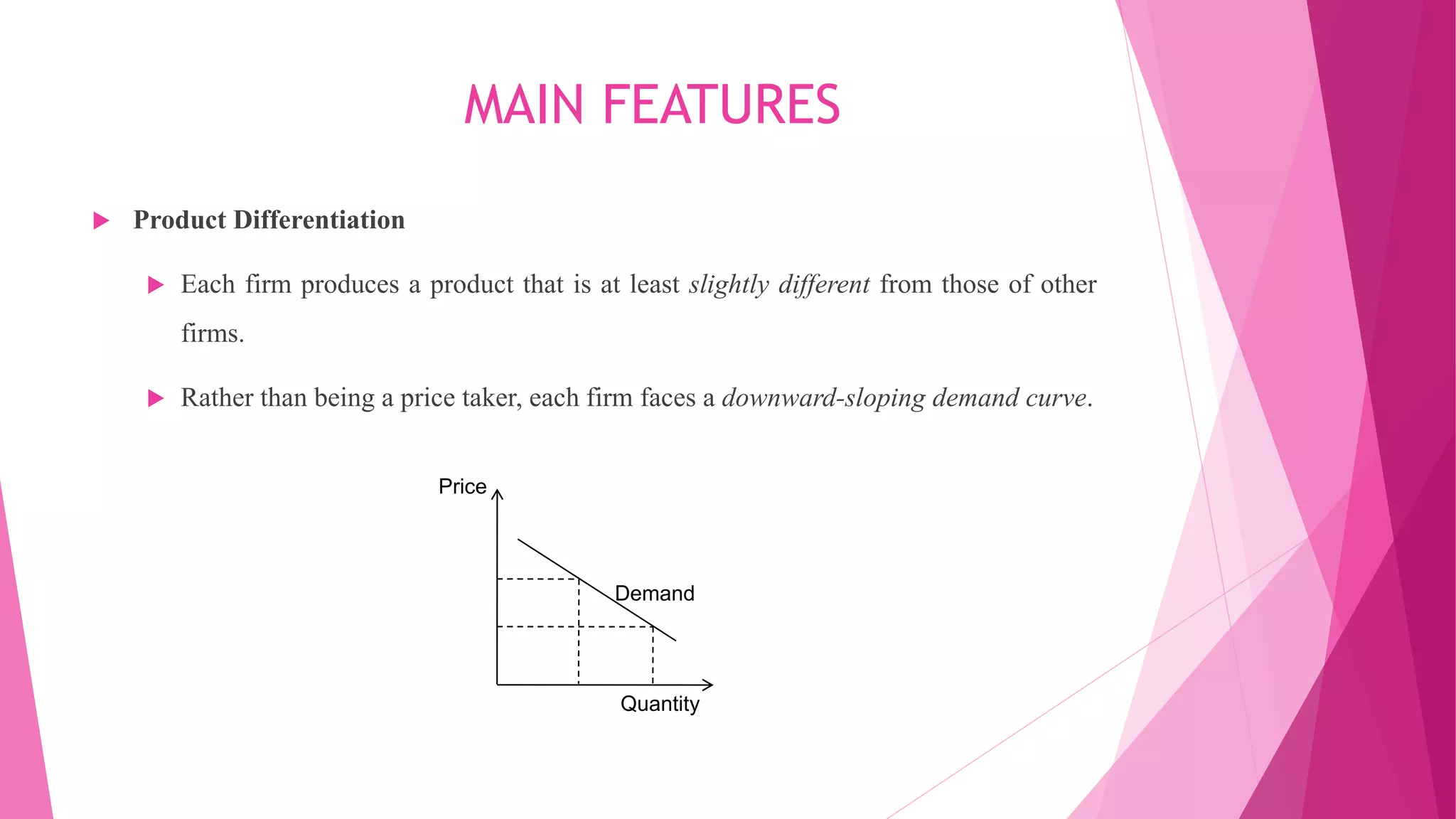
 Each firm produces a product that is at least slightly different from those of other
firms.
 Rather than being a price taker, each firm faces a downward-sloping demand curve.
Demand
Quantity
Price
MAIN FEATURES
 Free Entry or Exit
 Firms can enter or exit the market without any difficulty.
 The number of firms in the market adjusts until economic profits are zero.
 This is another feature of monopolistic competition that it shares with perfect
competition
MARKET STRUCTURE
 Market structure is the focus real-world competition.
 Market structure refers to the physical characteristics of the market
within which firms interact.
 Market structure involves the number of firms in the market and the
barriers to entry.
 Perfect competition, with an infinite number of firms, and monopoly, with
a single firm, are polar opposites.
 Monopolistic competition and oligopoly lie between these two extremes.
MONOPOLISTIC COMPETITION
 Monopolistic competition is a market structure in which there are
many firms selling differentiated products.
 There are few barriers to entry.
 Oligopoly is a market structure in which there are a few
interdependent firms.
 There are often significant barriers to entry.
CHARACTERISTICS
 Monopolistic competition is a market with the following
characteristics:
 A large number of firms.
 Each firm produces a differentiated product.
 Firms compete on product quality, price, and marketing.
 Firms are free to enter and exit the industry.
COMPETITION COMMISSSION
 Competition refers to economic rivalry amongst
 Enterprises to control market for products (goods and services)
 Level of Competition does not depends
 Number of players in an industry but on degree of contestability
 •Contest ability involves ease of entry and exit
 •Concept of relevant market: Relevant geographical
BENEFITS OF COMPETITION
 Competition in markets
 promotes efficiency
 leads to higher productivity
 punishes the laggards
 enhances choice, improves quality
 reduces costs
 facilitates better governance
MAIN FEATURES OF COMPETITION ACT -1 & 2
 Prohibits Anti -Competitive Agreements.
 Prohibits Abuse of Dominant Position.
 Provides for Regulation of Combinations
Main features of Competition Act -2
 Price fixing , Bid rigging
 Quantity limiting
 Market sharing
COMPETING ON QUALITY, PRICE & MARKETING
 Product differentiation enables firms to compete in three areas:
quality, price, and marketing.
 Quality includes design, reliability, and service.
 Because firms produce differentiated products, each firm has a
downward-sloping demand curve for its own product.
 But there is a tradeoff between price and quality.
 Differentiated products must be marketed using advertising and
packaging.
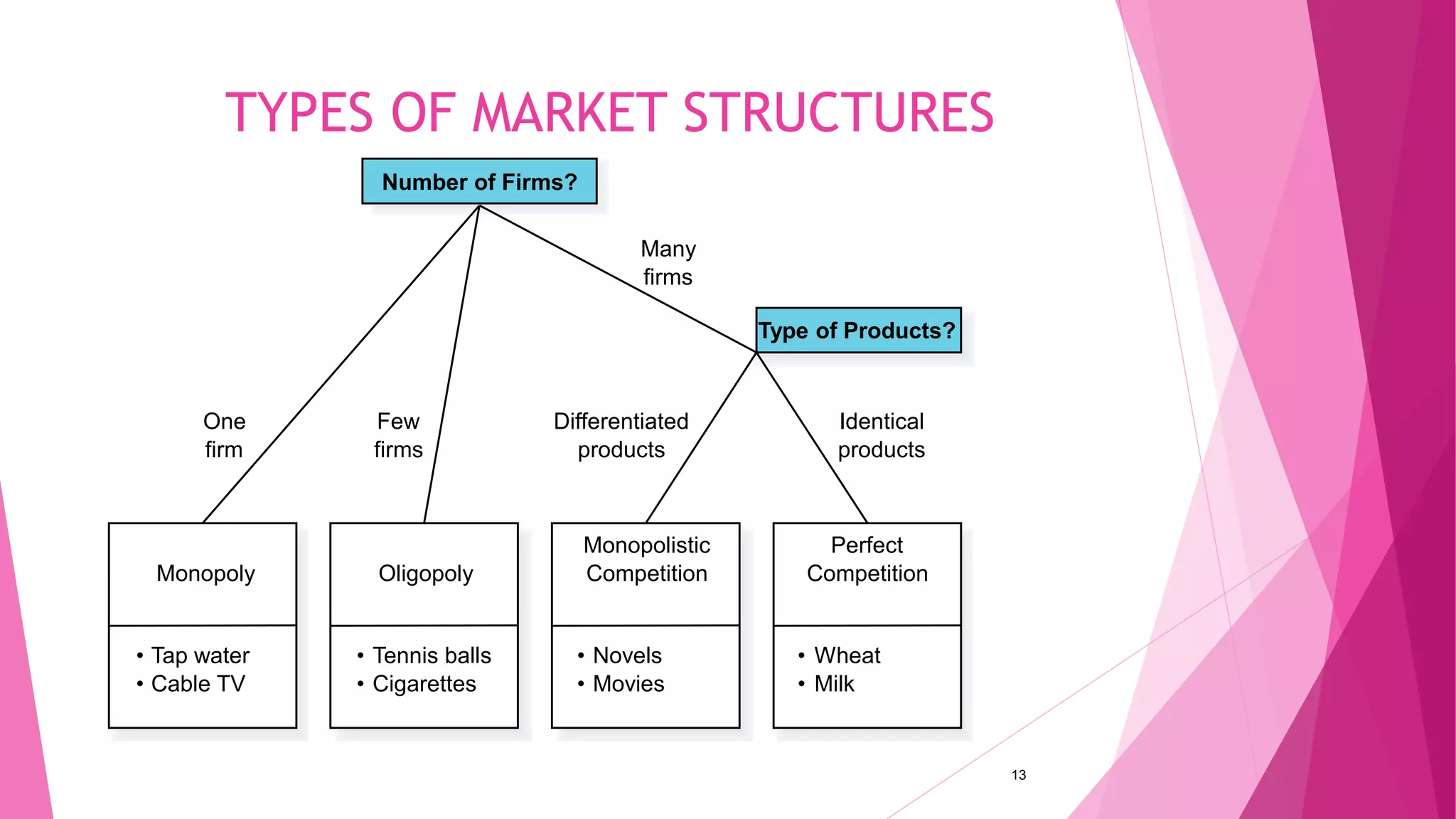
TYPES OF MARKET STRUCTURES
• Tap water
• Cable TV
Monopoly
• Novels
• Movies
Monopolistic
Competition
• Tennis balls
• Cigarettes
Oligopoly
Number of Firms?
Perfect
• Wheat
• Milk
Competition
Type of Products?
Identical
products
Differentiated
products
One
firm
Few
firms
Many
firms
13
MONOPOLISTIC Vs PERFECT COMPETITION
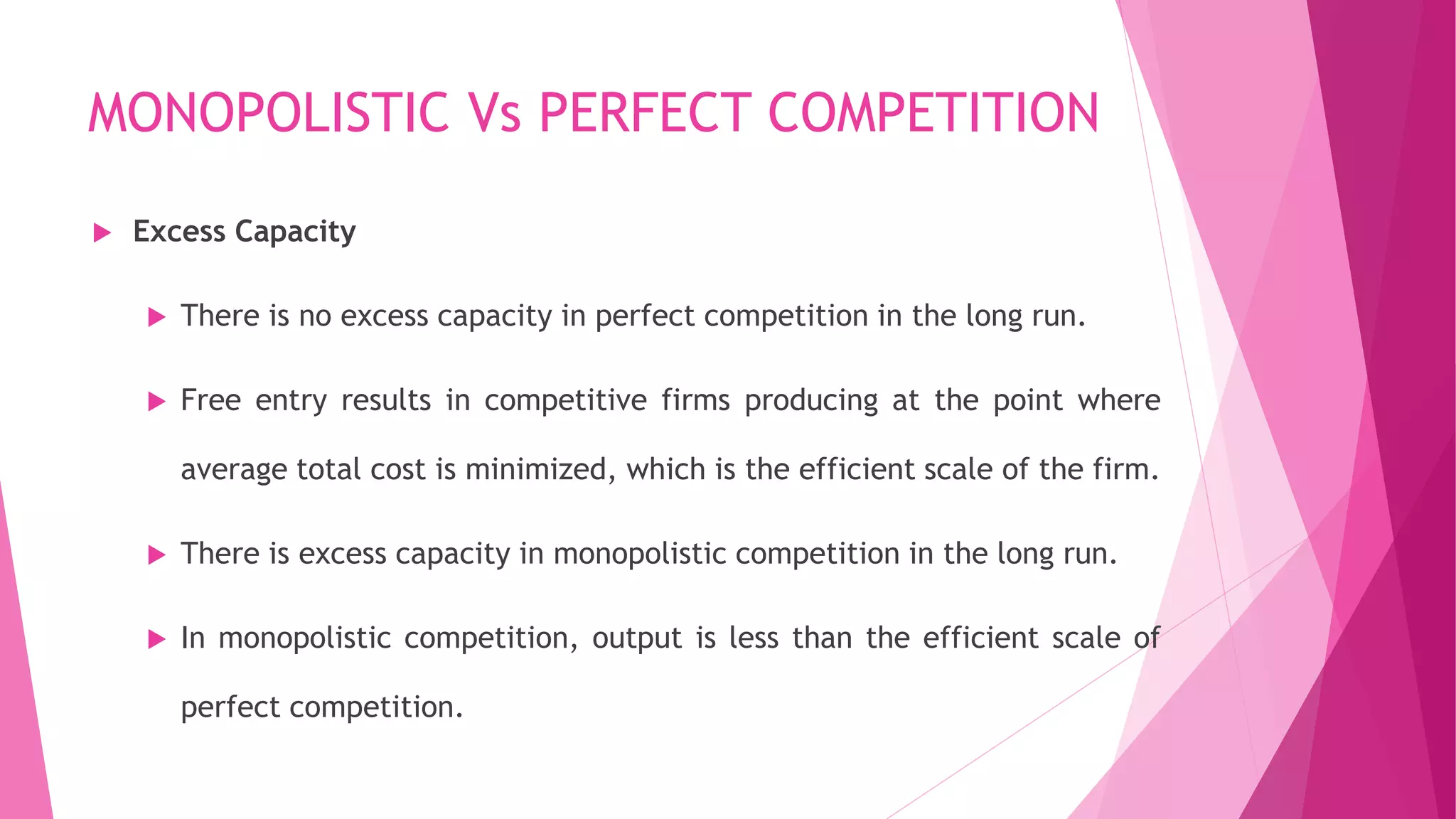
 Excess Capacity
 There is no excess capacity in perfect competition in the long run.
 Free entry results in competitive firms producing at the point where
average total cost is minimized, which is the efficient scale of the firm.
 There is excess capacity in monopolistic competition in the long run.
 In monopolistic competition, output is less than the efficient scale of
perfect competition.
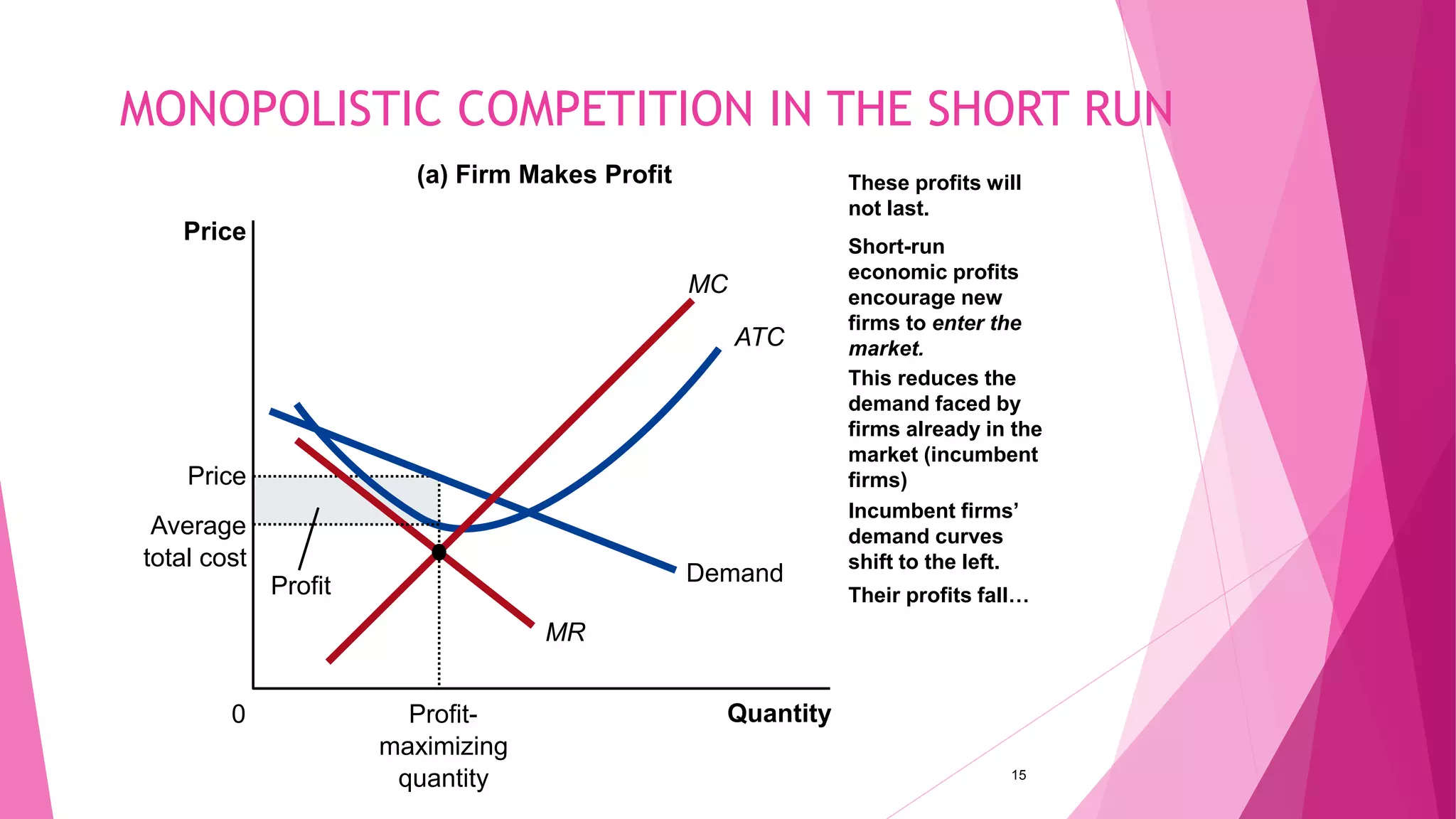
MONOPOLISTIC COMPETITION IN THE SHORT RUN
Quantity0
Price
Profit-
maximizing
quantity
Price
Demand
MR
ATC
(a) Firm Makes Profit
Average
total cost
Profit
MC
15
These profits will
not last.
Short-run
economic profits
encourage new
firms to enter the
market.
This reduces the
demand faced by
firms already in the
market (incumbent
firms)
Incumbent firms’
demand curves
shift to the left.
Their profits fall…
MONOPOLISTICALLY COMPETITIVE FIRM IN SHORT RUN
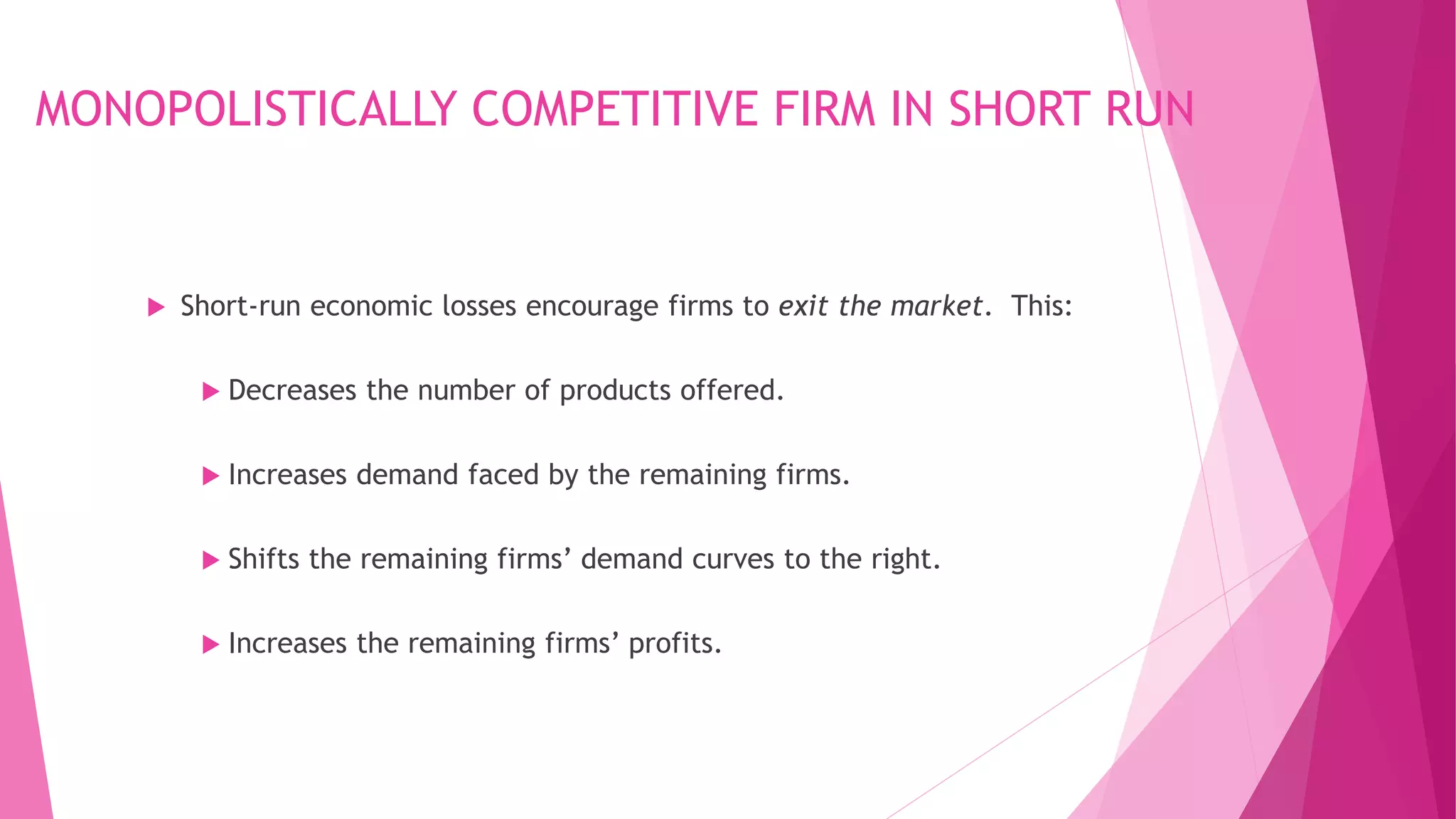
 Short-run economic losses encourage firms to exit the market. This:
 Decreases the number of products offered.
 Increases demand faced by the remaining firms.
 Shifts the remaining firms’ demand curves to the right.
 Increases the remaining firms’ profits.
MONOPOLISTICALLY COMPETITIVE FIRM IN LONG RUN
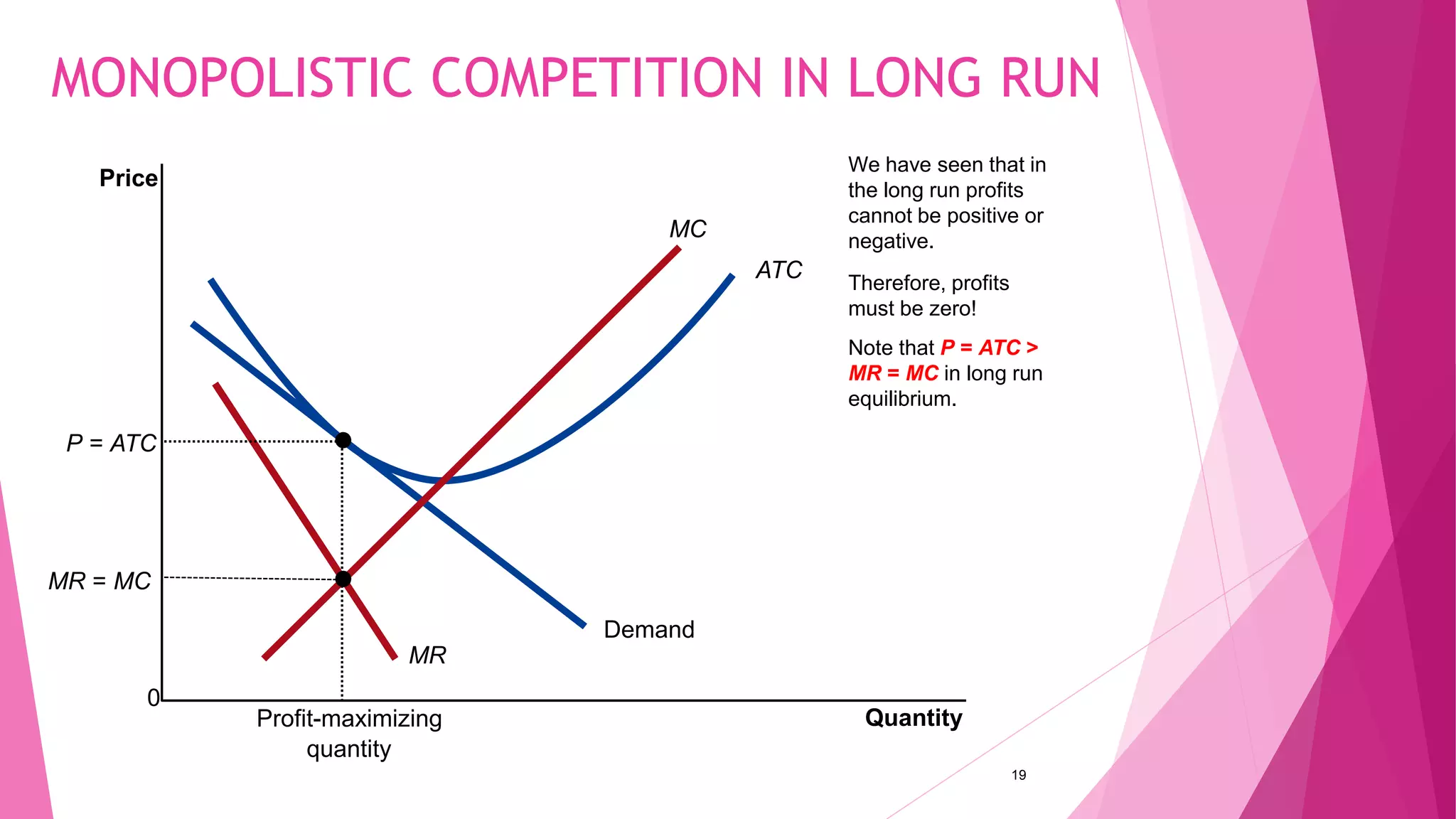
 As in a monopoly, price exceeds marginal cost.
 Profit maximization requires marginal revenue to equal marginal cost.
 The downward-sloping demand curve makes marginal revenue less than price.
 As in a competitive market, price equals average total cost.
 Free entry and exit drive economic profit to zero
Contd…
 Zero Economic Profit
 In the long run, economic profit induces entry.
 And entry continues as long as firms in the industry make an
economic profit—as long as (P > ATC).
 In the long run, a firm in monopolistic competition maximizes its
profit by producing the quantity at which its marginal revenue
equals its marginal cost, MR = MC.
MONOPOLISTIC COMPETITION IN LONG RUN
Quantity
Price
0
Demand
MR
ATC
MC
Profit-maximizing
quantity
P = ATC
19
We have seen that in
the long run profits
cannot be positive or
negative.
Therefore, profits
must be zero!
Note that P = ATC >
MR = MC in long run
equilibrium.
MR = MC
ADVERTISING
 When firms sell differentiated products, each firm has an incentive to
advertise in order to attract more buyers to its particular product.
 Under perfect competition, there is no such incentive
 Under monopoly, there is some incentive to advertise, but not a whole
lot.
 After all, the monopolist has no rivals.
Contd…
 Firms that sell highly differentiated consumer goods—such as over-the-counter
drugs, perfumes, soft drinks, breakfast cereals—typically spend between 10 and 20
percent of revenue on advertising.
 Firms that sell industrial products—such as drill presses and communications
satellites—typically spend very little on advertising
 Firms that sell undifferentiated products—such as wheat, peanuts, or crude oil—
spend nothing at all
 Overall, about 2 percent of total revenue, or over $200 billion a year, is spent on
advertising.
Contd…
 Critics of advertising argue that firms advertise in order to manipulate
people’s tastes.
 They also argue that it impedes competition by implying that products are
more different than they truly are.
 Defenders argue that advertising provides information to consumers
 They also argue that advertising increases competition by informing
consumers of their options and enabling them to do comparison shopping
BRAND NAMES
 Economists have argued that brand names may be a useful way for
consumers to ensure that the goods they are buying are of high quality.
 providing information about quality.
 giving firms incentive to maintain high quality.
 The question, however, is whether brand name products are better than
generics by an extent that justifies their higher prices
CONCLUSIONS
 Competition enforcement leads to consumer welfare directly and
indirectly
 Stakeholders need to recognize their role in promoting competition
 Policymakers/Government need to prioritize competition reforms
 CCI to remain independent
 CCI to create a public buy in
 Consumer movement: natural allies of a competition regime
THANK YOU

Monopolistic practices

  • 1.
    MONOPOLISTIC PRACTICES &COMPETITION COMMISSION IN INDIAN ECONOMY Presented By G.Abirami B.Gayathri R.Gowsalya I.Preeithi K.Sowmiyaa J.Sridevi R.Veena M.B.A – Ist Year
  • 2.
    INTRODUCTION  Monopolistic competitionis a type of imperfect competition such that many producers sell products that are differentiated from one another (e.g. by branding or quality) and hence are not perfect substitutes . In monopolistic competition, a firm takes the prices charged by its rivals as given and ignores the impact of its own prices on the prices of other firms  Main features of monopolistic competition  Many sellers  Product differentiation: similar but non-identical products  Free entry and exit
  • 3.
    MAIN FEATURES  ManySellers  There are many firms competing for the same group of customers.  Product examples include books, CDs, movies, computer games, restaurants, piano lessons, cookies, furniture, etc.  This feature of monopolistic competition is shared with perfect competition.  So, the decisions made by one firm do not affect other firms in any perceptible way
  • 4.
    MAIN FEATURES  ProductDifferentiation  Each firm produces a product that is at least slightly different from those of other firms.  Rather than being a price taker, each firm faces a downward-sloping demand curve. Demand Quantity Price
  • 5.
    MAIN FEATURES  FreeEntry or Exit  Firms can enter or exit the market without any difficulty.  The number of firms in the market adjusts until economic profits are zero.  This is another feature of monopolistic competition that it shares with perfect competition
  • 6.
    MARKET STRUCTURE  Marketstructure is the focus real-world competition.  Market structure refers to the physical characteristics of the market within which firms interact.  Market structure involves the number of firms in the market and the barriers to entry.  Perfect competition, with an infinite number of firms, and monopoly, with a single firm, are polar opposites.  Monopolistic competition and oligopoly lie between these two extremes.
  • 7.
    MONOPOLISTIC COMPETITION  Monopolisticcompetition is a market structure in which there are many firms selling differentiated products.  There are few barriers to entry.  Oligopoly is a market structure in which there are a few interdependent firms.  There are often significant barriers to entry.
  • 8.
    CHARACTERISTICS  Monopolistic competitionis a market with the following characteristics:  A large number of firms.  Each firm produces a differentiated product.  Firms compete on product quality, price, and marketing.  Firms are free to enter and exit the industry.
  • 9.
    COMPETITION COMMISSSION  Competitionrefers to economic rivalry amongst  Enterprises to control market for products (goods and services)  Level of Competition does not depends  Number of players in an industry but on degree of contestability  •Contest ability involves ease of entry and exit  •Concept of relevant market: Relevant geographical
  • 10.
    BENEFITS OF COMPETITION Competition in markets  promotes efficiency  leads to higher productivity  punishes the laggards  enhances choice, improves quality  reduces costs  facilitates better governance
  • 11.
    MAIN FEATURES OFCOMPETITION ACT -1 & 2  Prohibits Anti -Competitive Agreements.  Prohibits Abuse of Dominant Position.  Provides for Regulation of Combinations Main features of Competition Act -2  Price fixing , Bid rigging  Quantity limiting  Market sharing
  • 12.
    COMPETING ON QUALITY,PRICE & MARKETING  Product differentiation enables firms to compete in three areas: quality, price, and marketing.  Quality includes design, reliability, and service.  Because firms produce differentiated products, each firm has a downward-sloping demand curve for its own product.  But there is a tradeoff between price and quality.  Differentiated products must be marketed using advertising and packaging.
  • 13.
    TYPES OF MARKETSTRUCTURES • Tap water • Cable TV Monopoly • Novels • Movies Monopolistic Competition • Tennis balls • Cigarettes Oligopoly Number of Firms? Perfect • Wheat • Milk Competition Type of Products? Identical products Differentiated products One firm Few firms Many firms 13
  • 14.
    MONOPOLISTIC Vs PERFECTCOMPETITION  Excess Capacity  There is no excess capacity in perfect competition in the long run.  Free entry results in competitive firms producing at the point where average total cost is minimized, which is the efficient scale of the firm.  There is excess capacity in monopolistic competition in the long run.  In monopolistic competition, output is less than the efficient scale of perfect competition.
  • 15.
    MONOPOLISTIC COMPETITION INTHE SHORT RUN Quantity0 Price Profit- maximizing quantity Price Demand MR ATC (a) Firm Makes Profit Average total cost Profit MC 15 These profits will not last. Short-run economic profits encourage new firms to enter the market. This reduces the demand faced by firms already in the market (incumbent firms) Incumbent firms’ demand curves shift to the left. Their profits fall…
  • 16.
    MONOPOLISTICALLY COMPETITIVE FIRMIN SHORT RUN  Short-run economic losses encourage firms to exit the market. This:  Decreases the number of products offered.  Increases demand faced by the remaining firms.  Shifts the remaining firms’ demand curves to the right.  Increases the remaining firms’ profits.
  • 17.
    MONOPOLISTICALLY COMPETITIVE FIRMIN LONG RUN  As in a monopoly, price exceeds marginal cost.  Profit maximization requires marginal revenue to equal marginal cost.  The downward-sloping demand curve makes marginal revenue less than price.  As in a competitive market, price equals average total cost.  Free entry and exit drive economic profit to zero
  • 18.
    Contd…  Zero EconomicProfit  In the long run, economic profit induces entry.  And entry continues as long as firms in the industry make an economic profit—as long as (P > ATC).  In the long run, a firm in monopolistic competition maximizes its profit by producing the quantity at which its marginal revenue equals its marginal cost, MR = MC.
  • 19.
    MONOPOLISTIC COMPETITION INLONG RUN Quantity Price 0 Demand MR ATC MC Profit-maximizing quantity P = ATC 19 We have seen that in the long run profits cannot be positive or negative. Therefore, profits must be zero! Note that P = ATC > MR = MC in long run equilibrium. MR = MC
  • 20.
    ADVERTISING  When firmssell differentiated products, each firm has an incentive to advertise in order to attract more buyers to its particular product.  Under perfect competition, there is no such incentive  Under monopoly, there is some incentive to advertise, but not a whole lot.  After all, the monopolist has no rivals.
  • 21.
    Contd…  Firms thatsell highly differentiated consumer goods—such as over-the-counter drugs, perfumes, soft drinks, breakfast cereals—typically spend between 10 and 20 percent of revenue on advertising.  Firms that sell industrial products—such as drill presses and communications satellites—typically spend very little on advertising  Firms that sell undifferentiated products—such as wheat, peanuts, or crude oil— spend nothing at all  Overall, about 2 percent of total revenue, or over $200 billion a year, is spent on advertising.
  • 22.
    Contd…  Critics ofadvertising argue that firms advertise in order to manipulate people’s tastes.  They also argue that it impedes competition by implying that products are more different than they truly are.  Defenders argue that advertising provides information to consumers  They also argue that advertising increases competition by informing consumers of their options and enabling them to do comparison shopping
  • 23.
    BRAND NAMES  Economistshave argued that brand names may be a useful way for consumers to ensure that the goods they are buying are of high quality.  providing information about quality.  giving firms incentive to maintain high quality.  The question, however, is whether brand name products are better than generics by an extent that justifies their higher prices
  • 24.
    CONCLUSIONS  Competition enforcementleads to consumer welfare directly and indirectly  Stakeholders need to recognize their role in promoting competition  Policymakers/Government need to prioritize competition reforms  CCI to remain independent  CCI to create a public buy in  Consumer movement: natural allies of a competition regime
  • 25.