
Monoliths, Migrations, and
Microservices
Randy Shoup
@randyshoup
linkedin.com/in/randyshoup
Background
• VP Engineering at WeWork
o Physical space as a service
• VP Engineering at Stitch Fix
o Combining “Art and Science” to revolutionize apparel retail
• Consulting “CTO as a service”
o Helping companies scale engineering organizations and technology
• Director of Engineering for Google App Engine
o World’s largest Platform-as-a-Service
• Chief Engineer / Distinguished Architect at eBay
o Multiple generations of eBay’s infrastructure
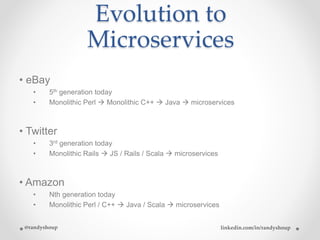
Evolution to
Microservices
• eBay
• 5th generation today
• Monolithic Perl  Monolithic C++  Java  microservices
• Twitter
• 3rd generation today
• Monolithic Rails  JS / Rails / Scala  microservices
• Amazon
• Nth generation today
• Monolithic Perl / C++  Java / Scala  microservices
@randyshoup linkedin.com/in/randyshoup
No one starts with microservices
…
Past a certain scale, everyone
ends up with microservices
First Law of Distributed Object
Design:
Don’t distribute your objects!
-- Martin Fowler
If you don’t end up regretting
your early technology
decisions, you probably over-
engineered.
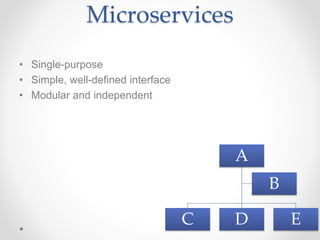
Microservices
• Single-purpose
• Simple, well-defined interface
• Modular and independent
A
C D E
B
Microservices are nothing
more than SOA done properly.
-- me
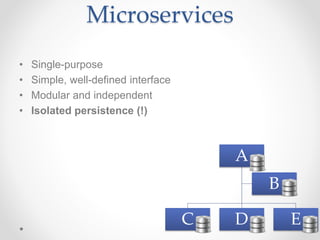
Microservices
• Single-purpose
• Simple, well-defined interface
• Modular and independent
• Isolated persistence (!)
A
C D E
B
Migrating to
Microservices
Randy Shoup
@randyshoup
linkedin.com/in/randyshoup
Migrating to
Services
• Incremental Migration
• Migrating a Monolithic Application
• Migrating a Monolithic Database
Migrating to
Services
• Incremental Migration
• Migrating a Monolithic Application
• Migrating a Monolithic Database
“The only thing a Big Bang
migration guarantees is a big
*Bang*.”
-- Martin Fowler
Incremental
Migration
• Step 0: Pilot Implementation
o Choose initial end-to-end vertical experience to migrate / create
o (+) Opportunity to learn and adjust
o (+) Demonstrate feasibility and gain confidence
o (+) Bound investment and risk
o (+) Provide real customer value
• Initial step is the hardest
o Learning how to do things in the new way
o Building out basic supporting capabilities
Incremental
Migration
• Steps 1-N: Incremental Migration
o Prioritize business value -- highest ROI areas first
o Focus on areas with greatest rate of change
o (+) Maximize near-term payoff from investment
o (+) Confront and solve hard problems sooner rather than later
• New feature development in parallel
o Typically cannot pause all feature work in all areas to migrate 
o Within a particular area, try to separate feature work from migration work in
distinct steps
Incremental
Migration
• Residual monolith may remain indefinitely
o Lowest business value
o Most stable and least changing
o Can migrate – or not – opportunistically
Migrating to
Services
• Incremental Migration
• Migrating a Monolithic Application
• Migrating a Monolithic Database
Carving up the
Monolith
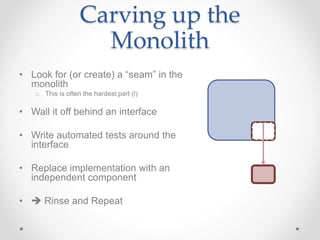
• Look for (or create) a “seam” in the
monolith
o This is often the hardest part (!)
• Wall it off behind an interface
• Write automated tests around the
interface
• Replace implementation with an
independent component
•  Rinse and Repeat
Migrating to
Services
• Incremental Migration
• Migrating a Monolithic Application
• Migrating a Monolithic Database
Extracting
Microservices
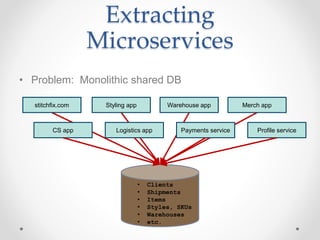
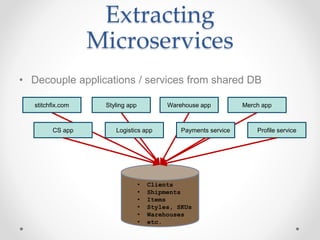
• Problem: Monolithic shared DB
• Clients
• Shipments
• Items
• Styles, SKUs
• Warehouses
• etc.
stitchfix.com Styling app Warehouse app Merch app
CS app Logistics app Payments service Profile service
Extracting
Microservices
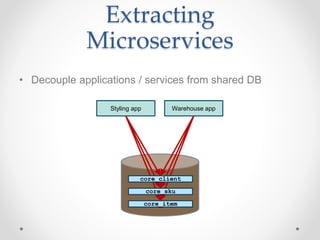
• Decouple applications / services from shared DB
• Clients
• Shipments
• Items
• Styles, SKUs
• Warehouses
• etc.
stitchfix.com Styling app Warehouse app Merch app
CS app Logistics app Payments service Profile service
Extracting
Microservices
• Decouple applications / services from shared DB
Styling app Warehouse app
core_item
core_sku
core_client
Extracting
Microservices
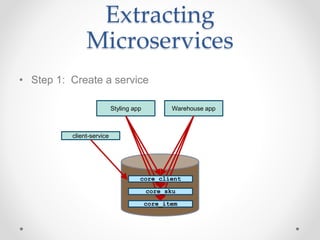
• Step 1: Create a service
Styling app Warehouse app
core_item
core_sku
core_client
client-service
Extracting
Microservices
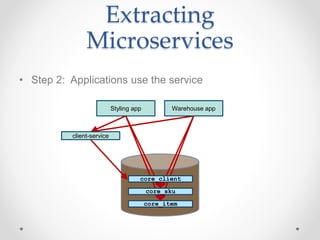
• Step 2: Applications use the service
Styling app Warehouse app
core_item
core_sku
core_client
client-service
Extracting
Microservices
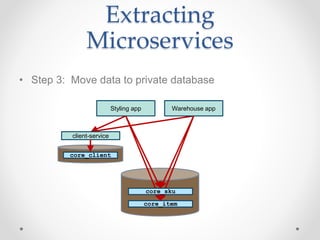
• Step 3: Move data to private database
Styling app Warehouse app
core_item
core_sku
client-service
core_client
Extracting
Microservices
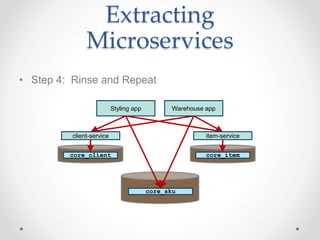
• Step 4: Rinse and Repeat
Styling app Warehouse app
core_sku
client-service
core_client
item-service
core_item
Extracting
Microservices
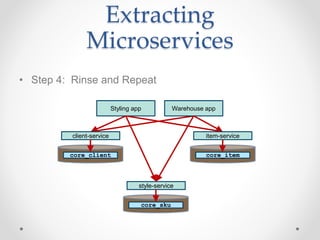
• Step 4: Rinse and Repeat
Styling app Warehouse app
client-service
core_client
item-service
core_item
style-service
core_sku
Extracting
Microservices
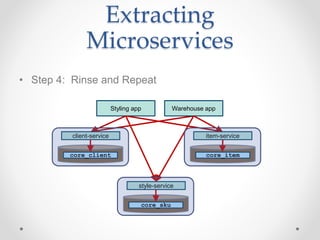
• Step 4: Rinse and Repeat
Styling app Warehouse app
client-service
core_client
item-service
core_item
style-service
core_sku
Managing Data at Scale:
Microservices and Events
Randy Shoup
@randyshoup
linkedin.com/in/randyshoup
With Microservices, how do
we do
• Shared Data
• Joins
• Transactions
Events as
First-Class Construct
• “A significant change in state”
o Statement that some interesting thing occurred
• Traditional 3-tier system
o Presentation  interface / interaction
o Application  stateless business logic
o Persistence  database
• Fourth fundamental building block
o State changes  events
o 0 | 1 | N consumers subscribe to the event, typically asynchronously
@randyshoup linkedin.com/in/randyshoup
Microservices
and Events
• Events are a first-class part of a service interface
• A service interface includes
o Synchronous request-response (REST, gRPC, etc)
o Events the service produces
o Events the service consumes
o Bulk reads and writes (ETL)
• The interface includes any mechanism for getting data in
or out of the service (!)
@randyshoup linkedin.com/in/randyshoup
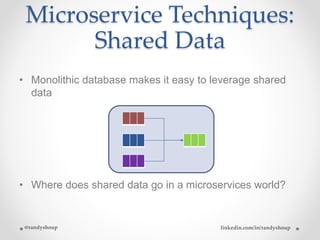
Microservice Techniques:
Shared Data
• Monolithic database makes it easy to leverage shared
data
• Where does shared data go in a microservices world?
@randyshoup linkedin.com/in/randyshoup
Microservice Techniques:
Shared Data
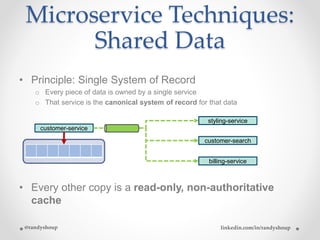
• Principle: Single System of Record
o Every piece of data is owned by a single service
o That service is the canonical system of record for that data
• Every other copy is a read-only, non-authoritative
cache
@randyshoup linkedin.com/in/randyshoup
customer-service
styling-service
customer-search
billing-service
Microservice Techniques:
Shared Data
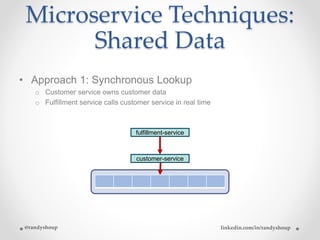
• Approach 1: Synchronous Lookup
o Customer service owns customer data
o Fulfillment service calls customer service in real time
fulfillment-service
customer-service
@randyshoup linkedin.com/in/randyshoup
Microservice Techniques:
Shared Data
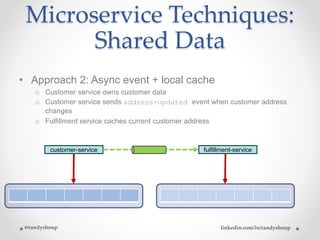
• Approach 2: Async event + local cache
o Customer service owns customer data
o Customer service sends address-updated event when customer address
changes
o Fulfillment service caches current customer address
fulfillment-servicecustomer-service
@randyshoup linkedin.com/in/randyshoup
Microservice Techniques:
Shared Data
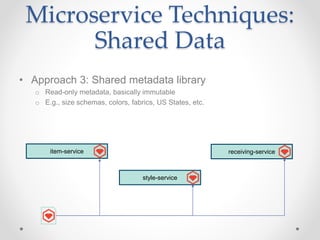
• Approach 3: Shared metadata library
o Read-only metadata, basically immutable
o E.g., size schemas, colors, fabrics, US States, etc.
receiving-serviceitem-service
style-service
Microservice Techniques:
Joins
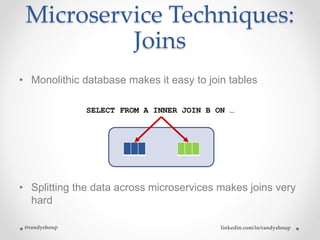
• Monolithic database makes it easy to join tables
• Splitting the data across microservices makes joins very
hard
@randyshoup linkedin.com/in/randyshoup
SELECT FROM A INNER JOIN B ON …
Microservice Techniques:
Joins
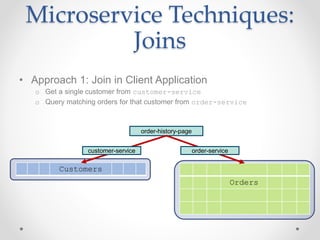
• Approach 1: Join in Client Application
o Get a single customer from customer-service
o Query matching orders for that customer from order-service
Customers
Orders
order-history-page
customer-service order-service
Microservice Techniques:
Joins
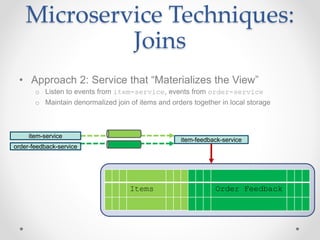
• Approach 2: Service that “Materializes the View”
o Listen to events from item-service, events from order-service
o Maintain denormalized join of items and orders together in local storage
Items Order Feedback
item-feedback-service
item-service
order-feedback-service
Microservice Techniques:
Joins
• Many common systems do this
o “Materialized view” in database systems
o Most NoSQL systems
o Search engines
o Analytic systems
@randyshoup linkedin.com/in/randyshoup
Microservice Techniques:
Workflows and Sagas
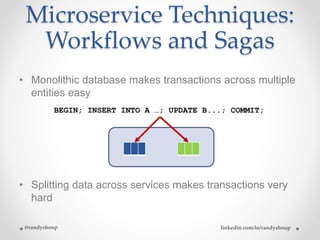
• Monolithic database makes transactions across multiple
entities easy
• Splitting data across services makes transactions very
hard
@randyshoup linkedin.com/in/randyshoup
BEGIN; INSERT INTO A …; UPDATE B...; COMMIT;
Microservice Techniques:
Workflows and Sagas
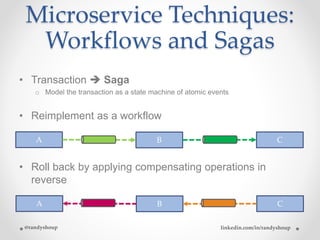
• Transaction  Saga
o Model the transaction as a state machine of atomic events
• Reimplement as a workflow
• Roll back by applying compensating operations in
reverse
A B C
A B C
@randyshoup linkedin.com/in/randyshoup
Microservice Techniques:
Workflows and Sagas
• Many common systems do this
o Payment processing
o Expense approval
o Travel
o Any multi-step workflow
@randyshoup linkedin.com/in/randyshoup
Microservice Techniques:
Workflows and Sagas
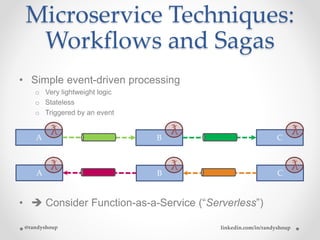
• Simple event-driven processing
o Very lightweight logic
o Stateless
o Triggered by an event
•  Consider Function-as-a-Service (“Serverless”)
A B C
A B C
@randyshoup linkedin.com/in/randyshoup
ƛ ƛ ƛ
ƛ ƛ ƛ
With Microservices, how do
we do
• Shared Data
• Joins
• Transactions
Thank You!
• @randyshoup
• linkedin.com/in/randyshoup

Monoliths, Migrations, and Microservices

  • 1.
    Monoliths, Migrations, and Microservices RandyShoup @randyshoup linkedin.com/in/randyshoup
  • 2.
    Background • VP Engineeringat WeWork o Physical space as a service • VP Engineering at Stitch Fix o Combining “Art and Science” to revolutionize apparel retail • Consulting “CTO as a service” o Helping companies scale engineering organizations and technology • Director of Engineering for Google App Engine o World’s largest Platform-as-a-Service • Chief Engineer / Distinguished Architect at eBay o Multiple generations of eBay’s infrastructure
  • 3.
    Evolution to Microservices • eBay •5th generation today • Monolithic Perl  Monolithic C++  Java  microservices • Twitter • 3rd generation today • Monolithic Rails  JS / Rails / Scala  microservices • Amazon • Nth generation today • Monolithic Perl / C++  Java / Scala  microservices @randyshoup linkedin.com/in/randyshoup
  • 4.
    No one startswith microservices … Past a certain scale, everyone ends up with microservices
  • 5.
    First Law ofDistributed Object Design: Don’t distribute your objects! -- Martin Fowler
  • 6.
    If you don’tend up regretting your early technology decisions, you probably over- engineered.
  • 7.
    Microservices • Single-purpose • Simple,well-defined interface • Modular and independent A C D E B
  • 8.
    Microservices are nothing morethan SOA done properly. -- me
  • 9.
    Microservices • Single-purpose • Simple,well-defined interface • Modular and independent • Isolated persistence (!) A C D E B
  • 10.
  • 11.
    Migrating to Services • IncrementalMigration • Migrating a Monolithic Application • Migrating a Monolithic Database
  • 12.
    Migrating to Services • IncrementalMigration • Migrating a Monolithic Application • Migrating a Monolithic Database
  • 13.
    “The only thinga Big Bang migration guarantees is a big *Bang*.” -- Martin Fowler
  • 14.
    Incremental Migration • Step 0:Pilot Implementation o Choose initial end-to-end vertical experience to migrate / create o (+) Opportunity to learn and adjust o (+) Demonstrate feasibility and gain confidence o (+) Bound investment and risk o (+) Provide real customer value • Initial step is the hardest o Learning how to do things in the new way o Building out basic supporting capabilities
  • 15.
    Incremental Migration • Steps 1-N:Incremental Migration o Prioritize business value -- highest ROI areas first o Focus on areas with greatest rate of change o (+) Maximize near-term payoff from investment o (+) Confront and solve hard problems sooner rather than later • New feature development in parallel o Typically cannot pause all feature work in all areas to migrate  o Within a particular area, try to separate feature work from migration work in distinct steps
  • 16.
    Incremental Migration • Residual monolithmay remain indefinitely o Lowest business value o Most stable and least changing o Can migrate – or not – opportunistically
  • 17.
    Migrating to Services • IncrementalMigration • Migrating a Monolithic Application • Migrating a Monolithic Database
  • 18.
    Carving up the Monolith •Look for (or create) a “seam” in the monolith o This is often the hardest part (!) • Wall it off behind an interface • Write automated tests around the interface • Replace implementation with an independent component •  Rinse and Repeat
  • 19.
    Migrating to Services • IncrementalMigration • Migrating a Monolithic Application • Migrating a Monolithic Database
  • 20.
    Extracting Microservices • Problem: Monolithicshared DB • Clients • Shipments • Items • Styles, SKUs • Warehouses • etc. stitchfix.com Styling app Warehouse app Merch app CS app Logistics app Payments service Profile service
  • 21.
    Extracting Microservices • Decouple applications/ services from shared DB • Clients • Shipments • Items • Styles, SKUs • Warehouses • etc. stitchfix.com Styling app Warehouse app Merch app CS app Logistics app Payments service Profile service
  • 22.
    Extracting Microservices • Decouple applications/ services from shared DB Styling app Warehouse app core_item core_sku core_client
  • 23.
    Extracting Microservices • Step 1:Create a service Styling app Warehouse app core_item core_sku core_client client-service
  • 24.
    Extracting Microservices • Step 2:Applications use the service Styling app Warehouse app core_item core_sku core_client client-service
  • 25.
    Extracting Microservices • Step 3:Move data to private database Styling app Warehouse app core_item core_sku client-service core_client
  • 26.
    Extracting Microservices • Step 4:Rinse and Repeat Styling app Warehouse app core_sku client-service core_client item-service core_item
  • 27.
    Extracting Microservices • Step 4:Rinse and Repeat Styling app Warehouse app client-service core_client item-service core_item style-service core_sku
  • 28.
    Extracting Microservices • Step 4:Rinse and Repeat Styling app Warehouse app client-service core_client item-service core_item style-service core_sku
  • 29.
    Managing Data atScale: Microservices and Events Randy Shoup @randyshoup linkedin.com/in/randyshoup
  • 30.
    With Microservices, howdo we do • Shared Data • Joins • Transactions
  • 31.
    Events as First-Class Construct •“A significant change in state” o Statement that some interesting thing occurred • Traditional 3-tier system o Presentation  interface / interaction o Application  stateless business logic o Persistence  database • Fourth fundamental building block o State changes  events o 0 | 1 | N consumers subscribe to the event, typically asynchronously @randyshoup linkedin.com/in/randyshoup
  • 32.
    Microservices and Events • Eventsare a first-class part of a service interface • A service interface includes o Synchronous request-response (REST, gRPC, etc) o Events the service produces o Events the service consumes o Bulk reads and writes (ETL) • The interface includes any mechanism for getting data in or out of the service (!) @randyshoup linkedin.com/in/randyshoup
  • 33.
    Microservice Techniques: Shared Data •Monolithic database makes it easy to leverage shared data • Where does shared data go in a microservices world? @randyshoup linkedin.com/in/randyshoup
  • 34.
    Microservice Techniques: Shared Data •Principle: Single System of Record o Every piece of data is owned by a single service o That service is the canonical system of record for that data • Every other copy is a read-only, non-authoritative cache @randyshoup linkedin.com/in/randyshoup customer-service styling-service customer-search billing-service
  • 35.
    Microservice Techniques: Shared Data •Approach 1: Synchronous Lookup o Customer service owns customer data o Fulfillment service calls customer service in real time fulfillment-service customer-service @randyshoup linkedin.com/in/randyshoup
  • 36.
    Microservice Techniques: Shared Data •Approach 2: Async event + local cache o Customer service owns customer data o Customer service sends address-updated event when customer address changes o Fulfillment service caches current customer address fulfillment-servicecustomer-service @randyshoup linkedin.com/in/randyshoup
  • 37.
    Microservice Techniques: Shared Data •Approach 3: Shared metadata library o Read-only metadata, basically immutable o E.g., size schemas, colors, fabrics, US States, etc. receiving-serviceitem-service style-service
  • 38.
    Microservice Techniques: Joins • Monolithicdatabase makes it easy to join tables • Splitting the data across microservices makes joins very hard @randyshoup linkedin.com/in/randyshoup SELECT FROM A INNER JOIN B ON …
  • 39.
    Microservice Techniques: Joins • Approach1: Join in Client Application o Get a single customer from customer-service o Query matching orders for that customer from order-service Customers Orders order-history-page customer-service order-service
  • 40.
    Microservice Techniques: Joins • Approach2: Service that “Materializes the View” o Listen to events from item-service, events from order-service o Maintain denormalized join of items and orders together in local storage Items Order Feedback item-feedback-service item-service order-feedback-service
  • 41.
    Microservice Techniques: Joins • Manycommon systems do this o “Materialized view” in database systems o Most NoSQL systems o Search engines o Analytic systems @randyshoup linkedin.com/in/randyshoup
  • 42.
    Microservice Techniques: Workflows andSagas • Monolithic database makes transactions across multiple entities easy • Splitting data across services makes transactions very hard @randyshoup linkedin.com/in/randyshoup BEGIN; INSERT INTO A …; UPDATE B...; COMMIT;
  • 43.
    Microservice Techniques: Workflows andSagas • Transaction  Saga o Model the transaction as a state machine of atomic events • Reimplement as a workflow • Roll back by applying compensating operations in reverse A B C A B C @randyshoup linkedin.com/in/randyshoup
  • 44.
    Microservice Techniques: Workflows andSagas • Many common systems do this o Payment processing o Expense approval o Travel o Any multi-step workflow @randyshoup linkedin.com/in/randyshoup
  • 45.
    Microservice Techniques: Workflows andSagas • Simple event-driven processing o Very lightweight logic o Stateless o Triggered by an event •  Consider Function-as-a-Service (“Serverless”) A B C A B C @randyshoup linkedin.com/in/randyshoup ƛ ƛ ƛ ƛ ƛ ƛ
  • 46.
    With Microservices, howdo we do • Shared Data • Joins • Transactions
  • 47.
    Thank You! • @randyshoup •linkedin.com/in/randyshoup