Jean Piaget: Theory of
Cognitive
Development
Prepared by:
Marck Jhun Obra Capistrano
Module #6:
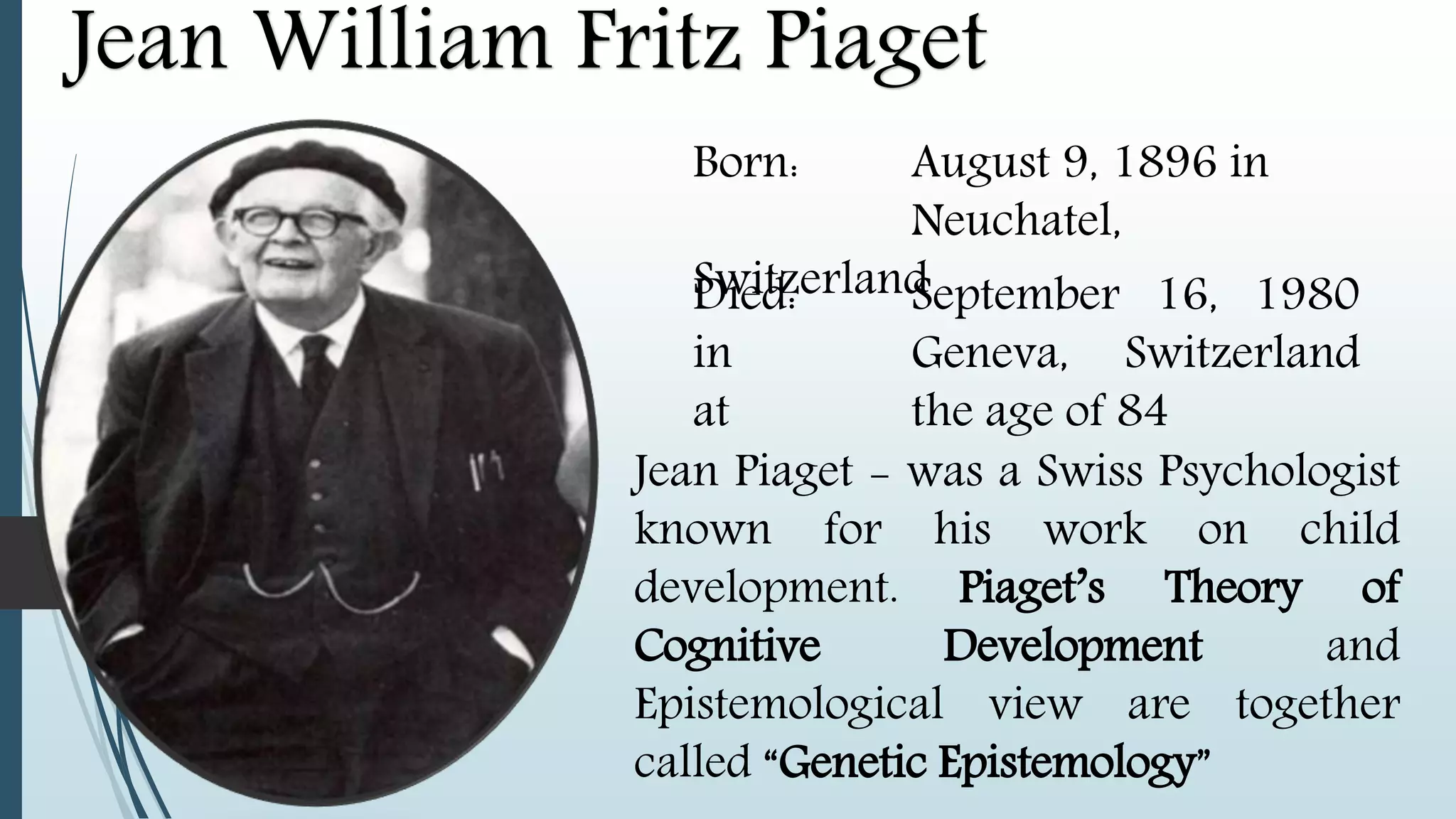
Jean William Fritz Piaget
Born: August 9, 1896 in
Neuchatel,
SwitzerlandDied: September 16, 1980
in Geneva, Switzerland
at the age of 84
Jean Piaget - was a Swiss Psychologist
known for his work on child
development. Piaget’s Theory of
Cognitive Development and
Epistemological view are together
called “Genetic Epistemology”
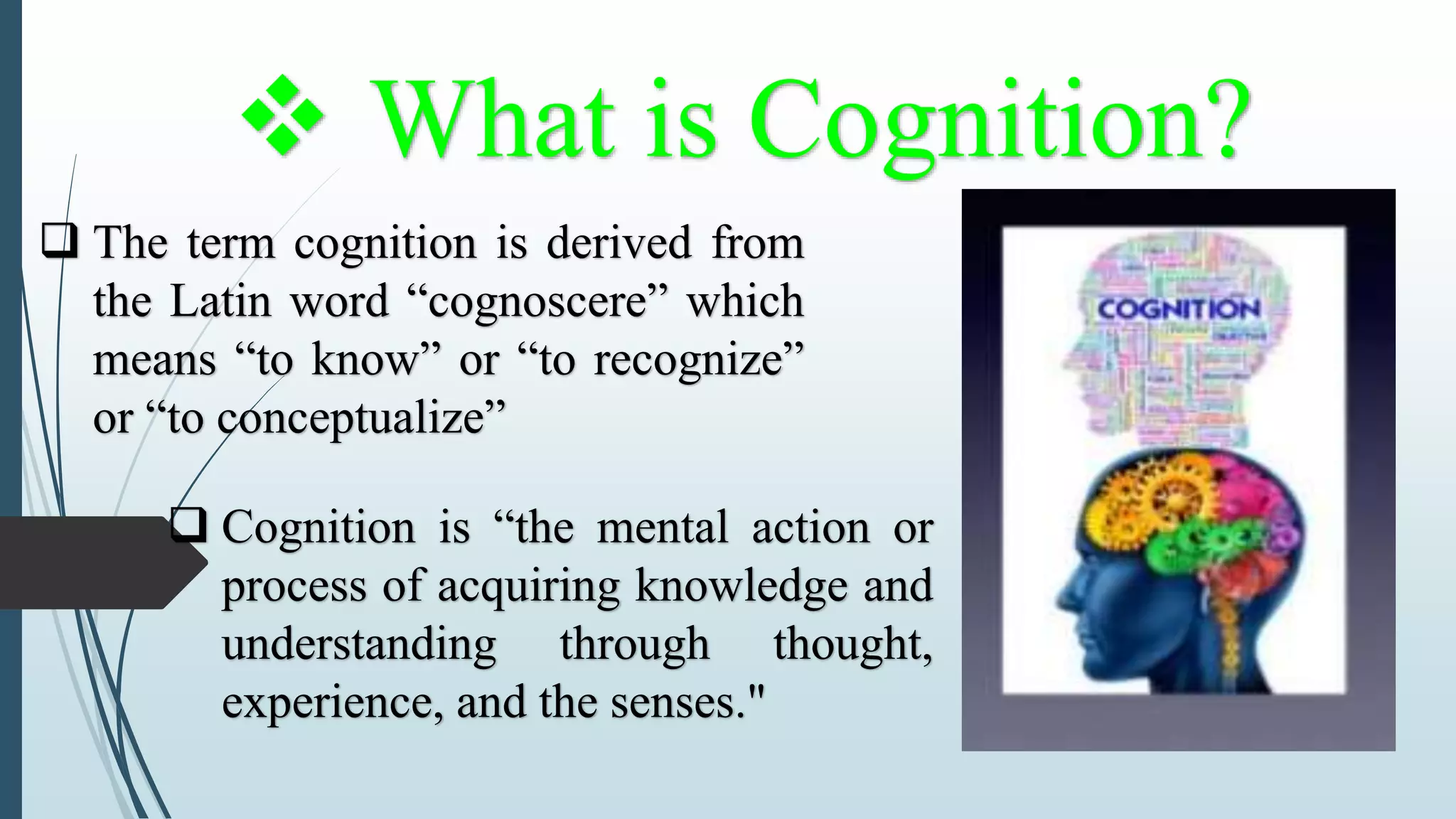
 What is Cognition?
 The term cognition is derived from
the Latin word “cognoscere” which
means “to know” or “to recognize”
or “to conceptualize”
 Cognition is “the mental action or
process of acquiring knowledge and
understanding through thought,
experience, and the senses."
What is Cognition Development?
 Cognitive Development is the emergence of the ability to think and
understand.
 The acquisition of the ability to think, reason, and problem solve.
 It is the process by which peoples think changes across the life
span.
 Piaget studied Cognitive Development by observing children in
particular, to examine how their thought processes changed with
age.
 It is the growing apprehension and adaptation to the physical and
social environment.
How Cognitive Development occurs?
 Cognitive Development is
gradual and orderly changes
by which mental process
becomes more complex and
sophisticated.
 The essential development of
cognition is the establishment
of new schemes.
 Assimilation and
Accommodation are both the
processes of the ways of
Cognitive Development
 The equilibration is the
symbol of a new stage of the
Cognitive Development.
BASIC COGNITIVE
CONCEPTS
 What is Schema?
Piaget use the term “Schema” to refer to the cognitive
structures by which individuals intellectually adapt to
and organize their environment. It is an individual’s
way to understand or create meaning about a thing or
experience.
Example:
If a child sees a dog for the first time, he creates
his own schema of what a dog is. It has four legs
and a tail. It barks. It is furry. The child then “puts
this description of a dog “on file” in his mind.
When he sees another similar dog, he “ pulls” out
the file {his schema of a dog} in his mind, looks
at the animal, and says, “four legs, tail, barks,
furry….. That is a dog!”
 What is Assimilation?
 This is the process of fitting a new
experience into an existing or previously
created cognitive structure or schema.
Example:
 if the child sees another dog, this
time a little smaller one, he would
make sense of what he is seeing by
adding this new information {a
different looking dog} into his
schema of a dog.
 What is Accommodation?
 this is the process of creating a new schema.
 this happens when the existing schema
{knowledge} does not work and needs to be
changed to deal with a new object or situation.
Accommodation, the schema is altered; a new
schemas may be developed.
Example:
 if the same child now sees another animal that looks
like a little bit like a dog, but somehow different. He
might try to fit into his schema of a dog, and say, “
Look mommy, what a funny looking dog. Its bark is
funny too!” Then mommy explains, “That’s not a funny
looking dog. That is a goat!” with mommy’s further
descriptions, the child will now create a new schema,
that of a goat. He now adds a new file in his filing
cabinet.
 What is Equilibration?
 Equilibrium occurs when a child’s schemas can deal with
most new information through assimilation. As a child
progresses through the stage of cognitive development, it is
important to maintain or achieving proper balance between
applying previous knowledge (assimilation) and changing
behavior to account for a new knowledge (accommodation).
Equilibrium helps explain how children are able to move
from one stage of through to the next.
THE FOUR STAGE OF
DEVELOPMENT
“Jean Piaget-Cognitive Development”
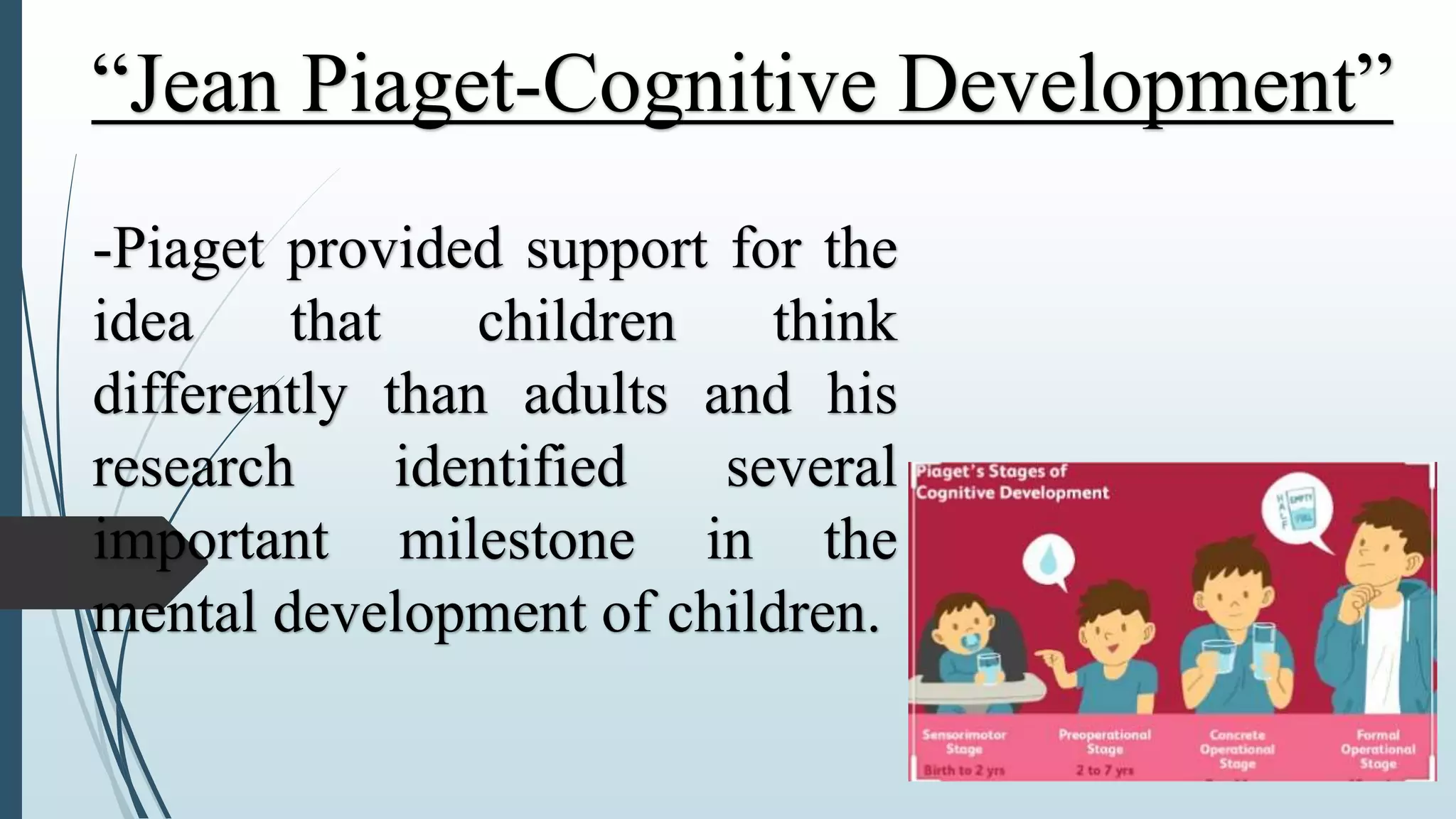
-Piaget provided support for the
idea that children think
differently than adults and his
research identified several
important milestone in the
mental development of children.
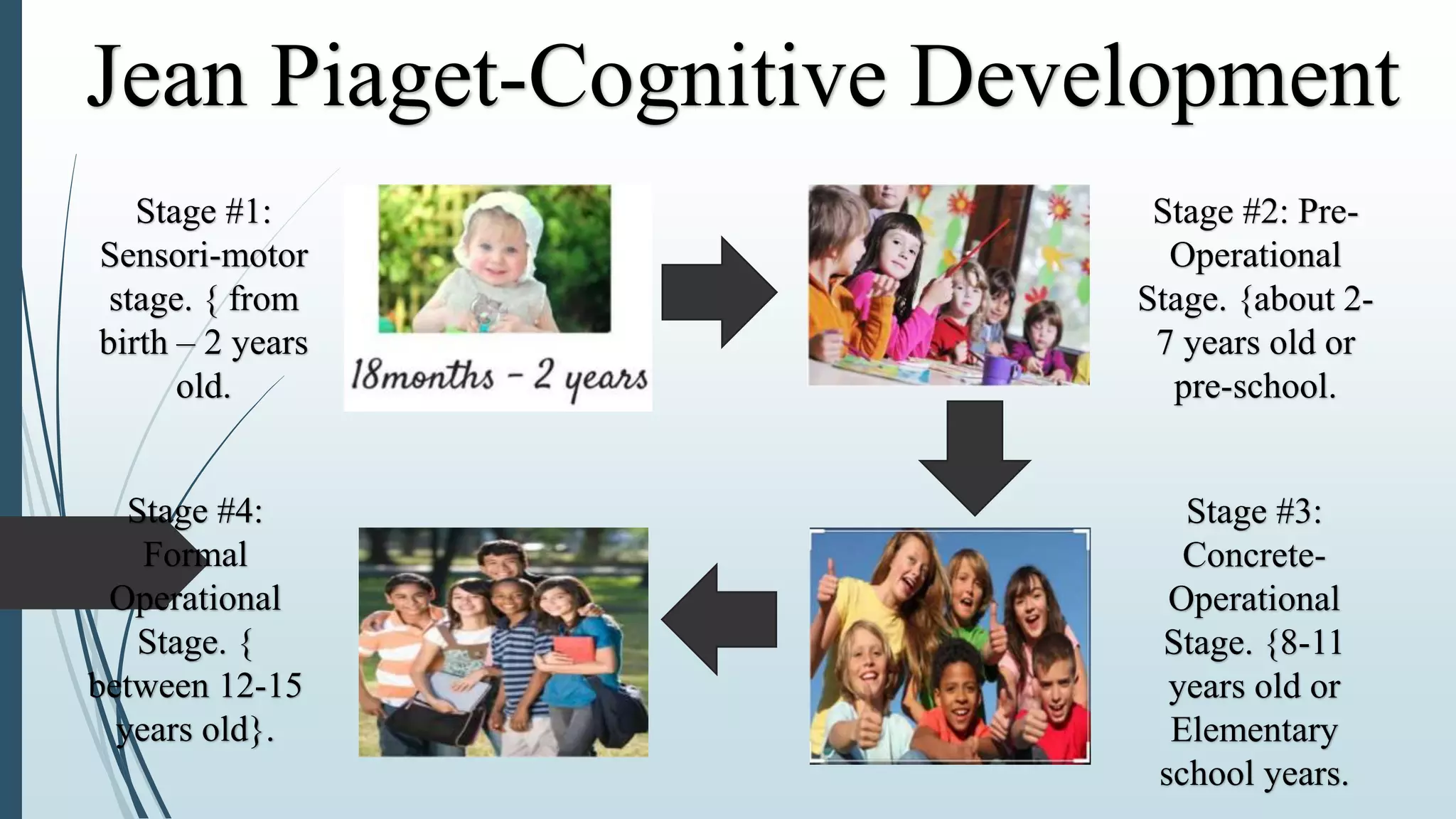
Jean Piaget-Cognitive Development
Stage #1:
Sensori-motor
stage. { from
birth – 2 years
old.
Stage #2: Pre-
Operational
Stage. {about 2-
7 years old or
pre-school.
Stage #3:
Concrete-
Operational
Stage. {8-11
years old or
Elementary
school years.
Stage #4:
Formal
Operational
Stage. {
between 12-15
years old}.
The child begins to represent the world with words and
images. These words and image reflect increased
symbolic thinking and go beyond the connection of
sensory information and physical action.
This first stage correspond from birth to infancy. The term
sensori-motor focuses on the prominence of the senses
and muscle movement through which the infant comes to
learn about himself and the world.
Stage #1: Sensori-motor Stage
Stage #2: Pre-Operational Stage
Jean Piaget-Cognitive Development
This stage is characterized by the ability of the child to
think logically but only in terms of concrete objects or
concrete situation.
-Thinking becomes more logically.
Theoretical, hypothetical, and counterfactual thinking.
Abstract logic and reasoning. Strategy and planning
become possible. Concepts learned in one context can be
applied to another.
Stage #3: Concrete-Operational Stage
Stage #4: Formal Operational Stage
Jean Piaget-Cognitive Development
- http://en.m.wikipedia.org/wiki/Jean_Piaget
- http://me.me/i/jamok-abu-na-what-is-cognition-the-term-cognition-
is12443547
- http://www.verywellmind.com/piagets-stage-of-cognitive-
development.2795457
- http://www.sharingourexperiences.com/product-category/age-18-months-
2-years/
- http://www.westkatypreschool.com/programs/preschool-years-age-3-5/
- http://www.risas.org/poc/center_index.php?cn=1262
- http://www.education.com/slideshare/development-milestones-12-15-years
- http://www.slideshare.net/mobile/MelvinJacinto/stage-of-development-j-
piaget-68228315
References:

Module 6 jean piaget cognitive development

  • 1.
    Jean Piaget: Theoryof Cognitive Development Prepared by: Marck Jhun Obra Capistrano Module #6:
  • 2.
    Jean William FritzPiaget Born: August 9, 1896 in Neuchatel, SwitzerlandDied: September 16, 1980 in Geneva, Switzerland at the age of 84 Jean Piaget - was a Swiss Psychologist known for his work on child development. Piaget’s Theory of Cognitive Development and Epistemological view are together called “Genetic Epistemology”
  • 3.
     What isCognition?  The term cognition is derived from the Latin word “cognoscere” which means “to know” or “to recognize” or “to conceptualize”  Cognition is “the mental action or process of acquiring knowledge and understanding through thought, experience, and the senses."
  • 4.
    What is CognitionDevelopment?  Cognitive Development is the emergence of the ability to think and understand.  The acquisition of the ability to think, reason, and problem solve.  It is the process by which peoples think changes across the life span.  Piaget studied Cognitive Development by observing children in particular, to examine how their thought processes changed with age.  It is the growing apprehension and adaptation to the physical and social environment.
  • 5.
    How Cognitive Developmentoccurs?  Cognitive Development is gradual and orderly changes by which mental process becomes more complex and sophisticated.  The essential development of cognition is the establishment of new schemes.  Assimilation and Accommodation are both the processes of the ways of Cognitive Development  The equilibration is the symbol of a new stage of the Cognitive Development.
  • 6.
  • 7.
     What isSchema? Piaget use the term “Schema” to refer to the cognitive structures by which individuals intellectually adapt to and organize their environment. It is an individual’s way to understand or create meaning about a thing or experience.
  • 8.
    Example: If a childsees a dog for the first time, he creates his own schema of what a dog is. It has four legs and a tail. It barks. It is furry. The child then “puts this description of a dog “on file” in his mind. When he sees another similar dog, he “ pulls” out the file {his schema of a dog} in his mind, looks at the animal, and says, “four legs, tail, barks, furry….. That is a dog!”
  • 9.
     What isAssimilation?  This is the process of fitting a new experience into an existing or previously created cognitive structure or schema.
  • 10.
    Example:  if thechild sees another dog, this time a little smaller one, he would make sense of what he is seeing by adding this new information {a different looking dog} into his schema of a dog.
  • 11.
     What isAccommodation?  this is the process of creating a new schema.  this happens when the existing schema {knowledge} does not work and needs to be changed to deal with a new object or situation. Accommodation, the schema is altered; a new schemas may be developed.
  • 12.
    Example:  if thesame child now sees another animal that looks like a little bit like a dog, but somehow different. He might try to fit into his schema of a dog, and say, “ Look mommy, what a funny looking dog. Its bark is funny too!” Then mommy explains, “That’s not a funny looking dog. That is a goat!” with mommy’s further descriptions, the child will now create a new schema, that of a goat. He now adds a new file in his filing cabinet.
  • 13.
     What isEquilibration?  Equilibrium occurs when a child’s schemas can deal with most new information through assimilation. As a child progresses through the stage of cognitive development, it is important to maintain or achieving proper balance between applying previous knowledge (assimilation) and changing behavior to account for a new knowledge (accommodation). Equilibrium helps explain how children are able to move from one stage of through to the next.
  • 14.
    THE FOUR STAGEOF DEVELOPMENT
  • 15.
    “Jean Piaget-Cognitive Development” -Piagetprovided support for the idea that children think differently than adults and his research identified several important milestone in the mental development of children.
  • 16.
    Jean Piaget-Cognitive Development Stage#1: Sensori-motor stage. { from birth – 2 years old. Stage #2: Pre- Operational Stage. {about 2- 7 years old or pre-school. Stage #3: Concrete- Operational Stage. {8-11 years old or Elementary school years. Stage #4: Formal Operational Stage. { between 12-15 years old}.
  • 17.
    The child beginsto represent the world with words and images. These words and image reflect increased symbolic thinking and go beyond the connection of sensory information and physical action. This first stage correspond from birth to infancy. The term sensori-motor focuses on the prominence of the senses and muscle movement through which the infant comes to learn about himself and the world. Stage #1: Sensori-motor Stage Stage #2: Pre-Operational Stage Jean Piaget-Cognitive Development
  • 18.
    This stage ischaracterized by the ability of the child to think logically but only in terms of concrete objects or concrete situation. -Thinking becomes more logically. Theoretical, hypothetical, and counterfactual thinking. Abstract logic and reasoning. Strategy and planning become possible. Concepts learned in one context can be applied to another. Stage #3: Concrete-Operational Stage Stage #4: Formal Operational Stage Jean Piaget-Cognitive Development
  • 19.
    - http://en.m.wikipedia.org/wiki/Jean_Piaget - http://me.me/i/jamok-abu-na-what-is-cognition-the-term-cognition- is12443547 -http://www.verywellmind.com/piagets-stage-of-cognitive- development.2795457 - http://www.sharingourexperiences.com/product-category/age-18-months- 2-years/ - http://www.westkatypreschool.com/programs/preschool-years-age-3-5/ - http://www.risas.org/poc/center_index.php?cn=1262 - http://www.education.com/slideshare/development-milestones-12-15-years - http://www.slideshare.net/mobile/MelvinJacinto/stage-of-development-j- piaget-68228315 References: