Budgetary Control System
Module 5
Content
• Introduction
• Meaning of Budget, Budgetary Control
• Features of Budget
• Types of Budget
• Zero Based Budgeting
• Performance budgeting
• Flexible Budgets
• Numerical Problems
Introduction
• Management has in its armory a number of weapons
which it uses according to its efficacy and necessity
to control the business, particularly as a device for
financial control.
• One of such weapons or tools—very effective as a
controlling device — is the budgetary control so far
as financial aspect is concerned.
Introduction
• A budget (from old French word: bougette) is a list of all
planned expenses and revenues.
• It is a plan for saving and spending.
• The budgeting process is an essential component of
management control systems and has been an effective
system by which management can successfully plan,
coordinate, and control.
• The process involves the creation and implementation of
the broad objectives of an organization, the detailed
objectives, and a short-term and long-term financial plan.
Introduction
• Business budgeting is a basic and essential
process that allows businesses to attain
many goals in one course of action.
• There are several goals that many
businesses seek to achieve (or should be
trying to work toward) when they create
and implement a budget.
• These goals include control and evaluation,
planning, communication, and motivation
(Lucey, 2004).
Introduction
• (Kariuki, 2010), suggests that budgeting is a process
of planning the financial operations of a business.
• Budgeting as a management tool helps to organize
and formulize management‟s planning of activities.
• (Larson, 1999) Budgeting as a financial tool is useful
for both evaluation and control of organizations for
the planning of future activities.
• Application of these tools can greatly impact the
performance of a company
Introduction
• The budgeting process in manufacturing companies
incorporates a policy in financial welfare. For instance, it
indicates how money is distributed by the management
to the different departments and key areas to focus on.
• This helps the management in planning and forecasting in
order to reduce costs and unnecessary spending and also
to increase profits so that the company may fulfill its
corporate vision and mission and also to enable the
company to fulfill its debts if any and to ensure the
company’s long term technical and financial viability.
(Horngren, 1990).
Meaning of Budget
• Budget is a plan which is expressed in terms of
definite numbers.
• Eg. of a plan – Production has to be increased in the
next quarter
• Eg. of a budget – Production has to improve by
10000 units from the last quarter to the next
quarter.
Defination of Budget
• According to ICMA “budget is a financial & /
quantitative statements, prepared & approved prior
to a defined period of time of the policy to be
pursued during that period for the purpose of
attaining a given objective. They may include
income, expenditure & the employment of capital”.
According to Brown and Howard of
Management Accountant
• "a budget is a predetermined statement
of managerial policy during the given period
which provides a standard for comparison
with the results actually achieved.”
Essential Features of budget
(1) Budget is related to planned events
(2) Budget is planned or prepared for a shorter period
(3) Budget is a target fixed for a period.
(4) Result of planning is budgeting
(5) The process of budget starts where forecast ends
and converts it into a budget
(6) Budget is prepared for the business as a whole
(7) Purpose of budget is not merely a planning device
but also a controlling tool.
(8) It is predetermined statement to attain a given objective
Meaning of Budgetary Control
• Budgetary Control is the process of establishment of
budgets relating to various activities and comparing
the budgeted figures with the actual performance
for arriving at deviations, if any.
• Accordingly, there cannot be budgetary control
without budgets.
• Budgetary Control is a system which uses budgets as
a means of planning and controlling.
Brown and Howard defines budgetary
control is
• "a system of controlling costs which includes the
preparation of budgets, co-ordinating the
department and establishing responsibilities,
comparing actual performance with the budgeted
and acting upon results to achieve maximum
profitability."
Objectives of Budgetary Control
• Budgetary Control is planned to assist the
management for policy formulation, planning,
controlling and co-ordinating the general
objectives of budgetary control
Organization for Budgetary Control
• In order to introduce budgetary control system, the
following are essential to be considered for a sound
and efficient organization.
• The important aspects to be considered are :
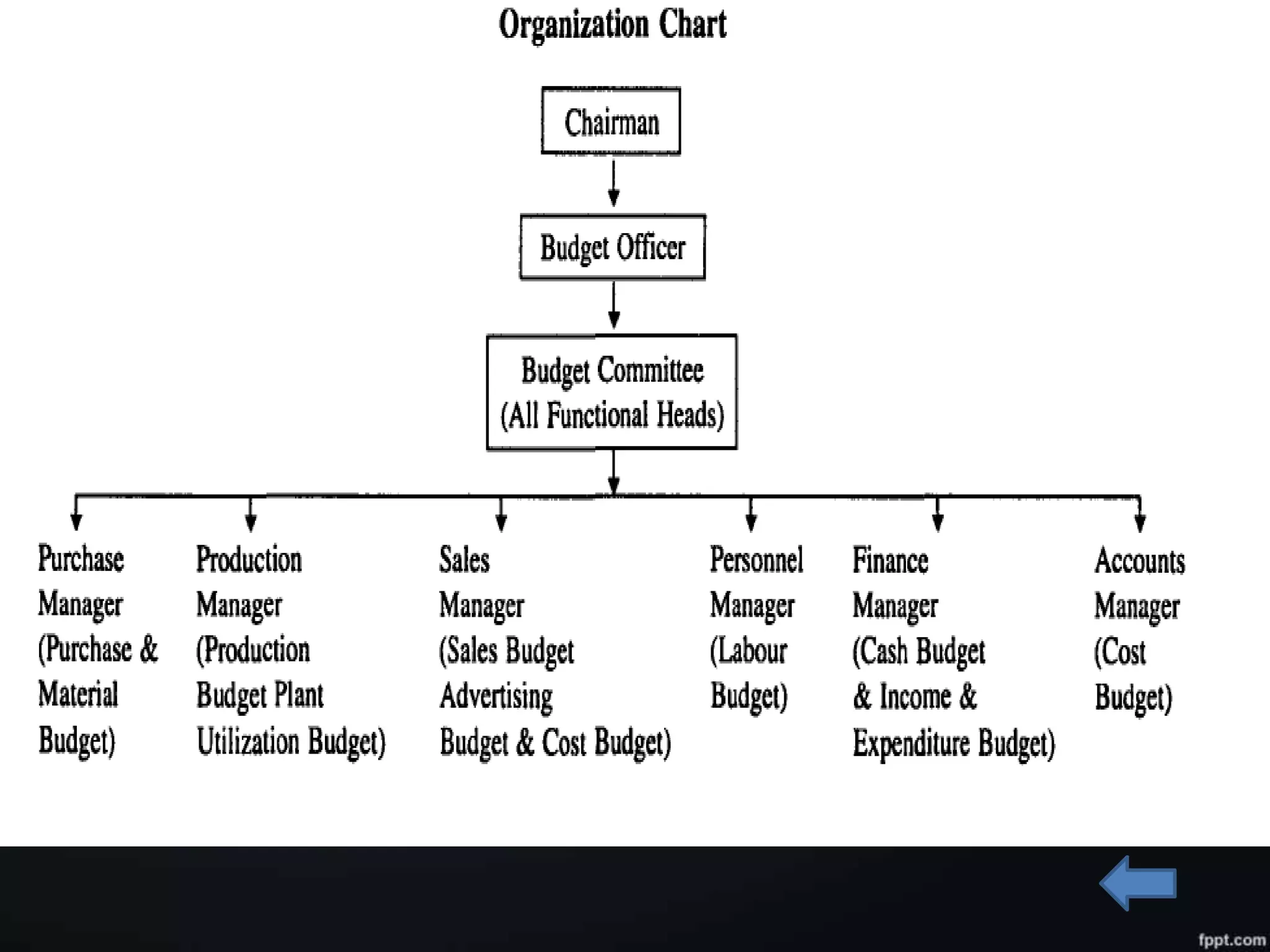
• 1. Organisation Chart
• 2. Budget Center
• 3. Budget Officer
• 4. Budget Committee
• 5. Budget Manual
• 6. Budget Period
• 7. Key Factor
Types of Budgets
(A) Classification on the basis of Time:
1. Long-Term Budgets
2. Short-Term Budgets
3. Current Budgets
(B) Classification according to Functions:
1. Functional or Subsidiary Budgets
2. Master Budgets
(C) Classification on the basis of Capacity :
1. Fixed Budgets
2. Flexible Budgets
Zero Based Budgeting - Background
• For many organizations, the thought of rebuilding
the company budget from the ground up can be
nightmare-inducing.
• Wiping the financial slate clean and starting from
scratch would be a last resort in a worst-case
scenario, never an option to be considered under
normal circumstances.
• Yet starting around 2008, an increasing number of
organizations chose to do exactly that. Faced with
an economic recession, both public and private
corporations began to turn towards an extreme
method of budgeting known as “Zero-Based
Budgeting,” or ZBB.
Zero Based Budgeting
• ZBB was originally developed by Peter A
Phyrr at Texas Instruments.
• Acc to Peter A Phyrr : ZBB “is an operating,
planning and budgeting process which
requires each manager to justify his entire
budget request in detail from scratch and
shifts the burden of proof to each manager
to justify why he should spend any money
at all”
• ZBB is a budgeting process that allocates
funding based on program efficiency and
necessity rather than budget history.
• As opposed to traditional budgeting, no item is
automatically included in the next budget.
• In ZBB, budgeters review every program and
expenditure at the beginning of each budget
cycle and must justify each line item in order to
receive funding.
• Budgeters can apply ZBB to any type of cost:
capital expenditures; operating expenses;
sales, general, and administrative costs;
marketing costs; variable distribution; or cost
of goods sold.
Advantages of Zero Based budgeting
• Resulting budget is well justified and aligned to strategy
• Catalyzes broader collaboration across the organization
• Supports cost reduction by avoiding automatic budget
increases, often resulting in savings
• Improves operational efficiency by rigorous challenging
of assumptions
Disadvantages
• Costly, complex, and time consuming as budget is rebuilt from
scratch annually, whereas simpler and faster traditional
budgeting requires justification only for incremental changes
• May be cost-prohibitive for organizations with limited funding
• Risky when potential savings are uncertain
• Execution challenged by budget cycle timing constraints
• Typically requires specialized training or personnel to accomplish,
and requires more resources in general
• May be disruptive to the organization’s operations
• Could harm organizational culture or brand
• Performance of Budget has been defined as a
"budget based on functions, activities and
projects.“
• I.O.W "the budgeting system in which input costs
are related to the performance, i.e., end results.“
• According to National Institute of Bank
Management, Performance Budgeting is,
"the Process of analyzing, identifying, simplifying
and crystallizing specific performance objectives
of a job to be achieved over a period, in the
framework of the organizational objectives, the
purpose and objectives of the job."
Performance Budgeting
Cash Budget
• This budget represent the anticipated receipts and
payment of cash during the budget period.
• The cash budget also called as Functional Budget.
• Cash budget is the most important of all the
functional
• Cash budget is prepared on the basis of detailed cash
receipts and cash payments.
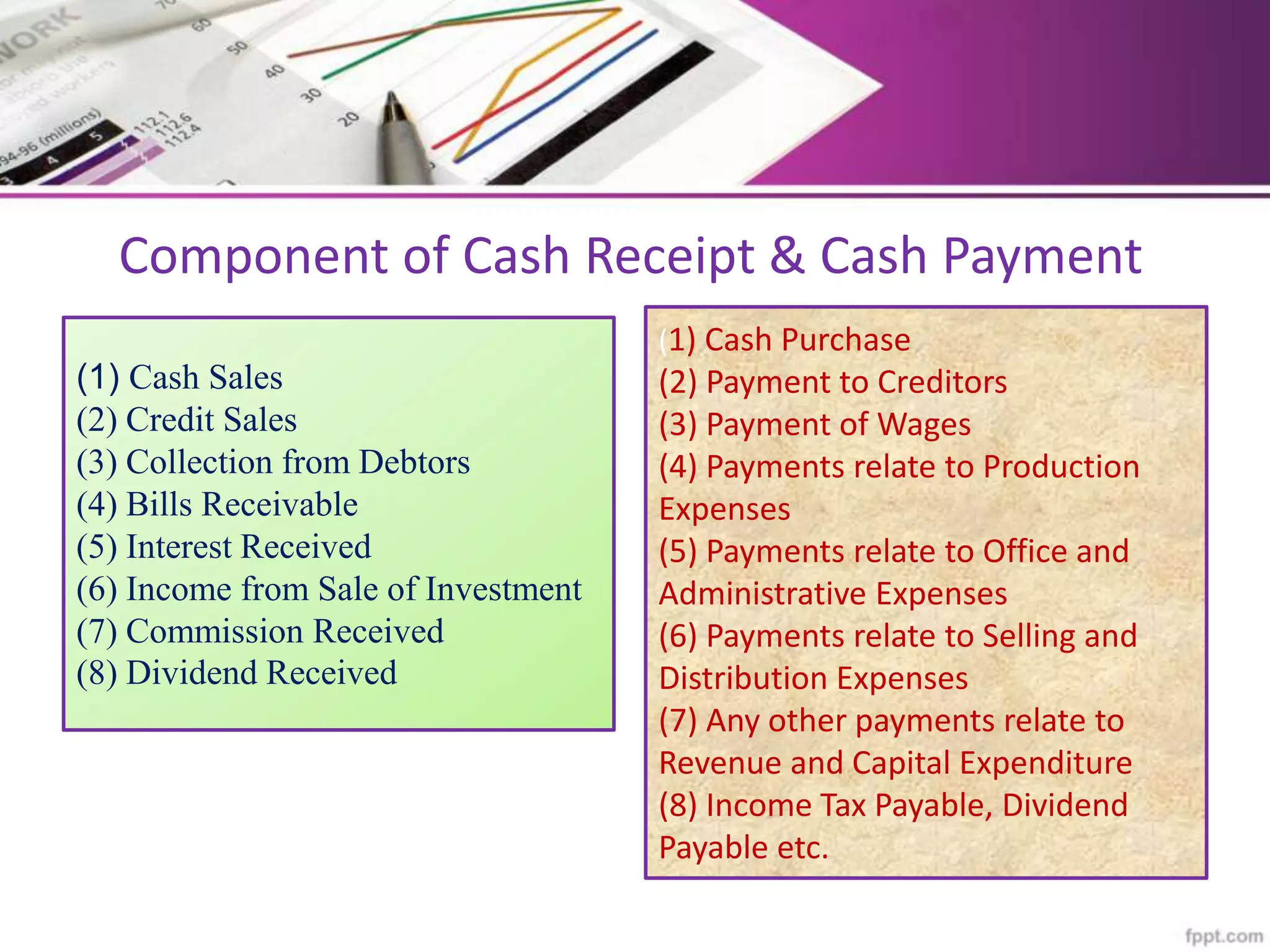
Component of Cash Receipt & Cash Payment
(1) Cash Sales
(2) Credit Sales
(3) Collection from Debtors
(4) Bills Receivable
(5) Interest Received
(6) Income from Sale of Investment
(7) Commission Received
(8) Dividend Received
(1) Cash Purchase
(2) Payment to Creditors
(3) Payment of Wages
(4) Payments relate to Production
Expenses
(5) Payments relate to Office and
Administrative Expenses
(6) Payments relate to Selling and
Distribution Expenses
(7) Any other payments relate to
Revenue and Capital Expenditure
(8) Income Tax Payable, Dividend
Payable etc.
Problems

Module 5 Budgetary Control System.pptx - new.ppt

  • 1.
  • 2.
    Content • Introduction • Meaningof Budget, Budgetary Control • Features of Budget • Types of Budget • Zero Based Budgeting • Performance budgeting • Flexible Budgets • Numerical Problems
  • 3.
    Introduction • Management hasin its armory a number of weapons which it uses according to its efficacy and necessity to control the business, particularly as a device for financial control. • One of such weapons or tools—very effective as a controlling device — is the budgetary control so far as financial aspect is concerned.
  • 4.
    Introduction • A budget(from old French word: bougette) is a list of all planned expenses and revenues. • It is a plan for saving and spending. • The budgeting process is an essential component of management control systems and has been an effective system by which management can successfully plan, coordinate, and control. • The process involves the creation and implementation of the broad objectives of an organization, the detailed objectives, and a short-term and long-term financial plan.
  • 5.
    Introduction • Business budgetingis a basic and essential process that allows businesses to attain many goals in one course of action. • There are several goals that many businesses seek to achieve (or should be trying to work toward) when they create and implement a budget. • These goals include control and evaluation, planning, communication, and motivation (Lucey, 2004).
  • 6.
    Introduction • (Kariuki, 2010),suggests that budgeting is a process of planning the financial operations of a business. • Budgeting as a management tool helps to organize and formulize management‟s planning of activities. • (Larson, 1999) Budgeting as a financial tool is useful for both evaluation and control of organizations for the planning of future activities. • Application of these tools can greatly impact the performance of a company
  • 7.
    Introduction • The budgetingprocess in manufacturing companies incorporates a policy in financial welfare. For instance, it indicates how money is distributed by the management to the different departments and key areas to focus on. • This helps the management in planning and forecasting in order to reduce costs and unnecessary spending and also to increase profits so that the company may fulfill its corporate vision and mission and also to enable the company to fulfill its debts if any and to ensure the company’s long term technical and financial viability. (Horngren, 1990).
  • 8.
    Meaning of Budget •Budget is a plan which is expressed in terms of definite numbers. • Eg. of a plan – Production has to be increased in the next quarter • Eg. of a budget – Production has to improve by 10000 units from the last quarter to the next quarter.
  • 9.
    Defination of Budget •According to ICMA “budget is a financial & / quantitative statements, prepared & approved prior to a defined period of time of the policy to be pursued during that period for the purpose of attaining a given objective. They may include income, expenditure & the employment of capital”.
  • 10.
    According to Brownand Howard of Management Accountant • "a budget is a predetermined statement of managerial policy during the given period which provides a standard for comparison with the results actually achieved.”
  • 11.
    Essential Features ofbudget (1) Budget is related to planned events (2) Budget is planned or prepared for a shorter period (3) Budget is a target fixed for a period. (4) Result of planning is budgeting (5) The process of budget starts where forecast ends and converts it into a budget (6) Budget is prepared for the business as a whole (7) Purpose of budget is not merely a planning device but also a controlling tool. (8) It is predetermined statement to attain a given objective
  • 12.
    Meaning of BudgetaryControl • Budgetary Control is the process of establishment of budgets relating to various activities and comparing the budgeted figures with the actual performance for arriving at deviations, if any. • Accordingly, there cannot be budgetary control without budgets. • Budgetary Control is a system which uses budgets as a means of planning and controlling.
  • 13.
    Brown and Howarddefines budgetary control is • "a system of controlling costs which includes the preparation of budgets, co-ordinating the department and establishing responsibilities, comparing actual performance with the budgeted and acting upon results to achieve maximum profitability."
  • 14.
    Objectives of BudgetaryControl • Budgetary Control is planned to assist the management for policy formulation, planning, controlling and co-ordinating the general objectives of budgetary control
  • 15.
    Organization for BudgetaryControl • In order to introduce budgetary control system, the following are essential to be considered for a sound and efficient organization. • The important aspects to be considered are : • 1. Organisation Chart • 2. Budget Center • 3. Budget Officer • 4. Budget Committee • 5. Budget Manual • 6. Budget Period • 7. Key Factor
  • 17.
    Types of Budgets (A)Classification on the basis of Time: 1. Long-Term Budgets 2. Short-Term Budgets 3. Current Budgets (B) Classification according to Functions: 1. Functional or Subsidiary Budgets 2. Master Budgets (C) Classification on the basis of Capacity : 1. Fixed Budgets 2. Flexible Budgets
  • 18.
    Zero Based Budgeting- Background • For many organizations, the thought of rebuilding the company budget from the ground up can be nightmare-inducing. • Wiping the financial slate clean and starting from scratch would be a last resort in a worst-case scenario, never an option to be considered under normal circumstances. • Yet starting around 2008, an increasing number of organizations chose to do exactly that. Faced with an economic recession, both public and private corporations began to turn towards an extreme method of budgeting known as “Zero-Based Budgeting,” or ZBB.
  • 19.
    Zero Based Budgeting •ZBB was originally developed by Peter A Phyrr at Texas Instruments. • Acc to Peter A Phyrr : ZBB “is an operating, planning and budgeting process which requires each manager to justify his entire budget request in detail from scratch and shifts the burden of proof to each manager to justify why he should spend any money at all”
  • 20.
    • ZBB isa budgeting process that allocates funding based on program efficiency and necessity rather than budget history. • As opposed to traditional budgeting, no item is automatically included in the next budget. • In ZBB, budgeters review every program and expenditure at the beginning of each budget cycle and must justify each line item in order to receive funding. • Budgeters can apply ZBB to any type of cost: capital expenditures; operating expenses; sales, general, and administrative costs; marketing costs; variable distribution; or cost of goods sold.
  • 21.
    Advantages of ZeroBased budgeting • Resulting budget is well justified and aligned to strategy • Catalyzes broader collaboration across the organization • Supports cost reduction by avoiding automatic budget increases, often resulting in savings • Improves operational efficiency by rigorous challenging of assumptions
  • 22.
    Disadvantages • Costly, complex,and time consuming as budget is rebuilt from scratch annually, whereas simpler and faster traditional budgeting requires justification only for incremental changes • May be cost-prohibitive for organizations with limited funding • Risky when potential savings are uncertain • Execution challenged by budget cycle timing constraints • Typically requires specialized training or personnel to accomplish, and requires more resources in general • May be disruptive to the organization’s operations • Could harm organizational culture or brand
  • 23.
    • Performance ofBudget has been defined as a "budget based on functions, activities and projects.“ • I.O.W "the budgeting system in which input costs are related to the performance, i.e., end results.“ • According to National Institute of Bank Management, Performance Budgeting is, "the Process of analyzing, identifying, simplifying and crystallizing specific performance objectives of a job to be achieved over a period, in the framework of the organizational objectives, the purpose and objectives of the job." Performance Budgeting
  • 24.
    Cash Budget • Thisbudget represent the anticipated receipts and payment of cash during the budget period. • The cash budget also called as Functional Budget. • Cash budget is the most important of all the functional • Cash budget is prepared on the basis of detailed cash receipts and cash payments.
  • 25.
    Component of CashReceipt & Cash Payment (1) Cash Sales (2) Credit Sales (3) Collection from Debtors (4) Bills Receivable (5) Interest Received (6) Income from Sale of Investment (7) Commission Received (8) Dividend Received (1) Cash Purchase (2) Payment to Creditors (3) Payment of Wages (4) Payments relate to Production Expenses (5) Payments relate to Office and Administrative Expenses (6) Payments relate to Selling and Distribution Expenses (7) Any other payments relate to Revenue and Capital Expenditure (8) Income Tax Payable, Dividend Payable etc.
  • 26.