CLASSIFICATION
AND DIAGNOSIS
OF DIABETES
Objectives
By the end of this session the participant will be
able to:
■ Understand the WHO diagnostic criteria for
different disorders of glycaemia.
■ Understand the laboratory investigations used in
the diagnosis of diabetes and their appropriate
use
■ Understand the difference between type 1 and
type 2 diabetes in relation to the clinical
presentation, patient characteristics, and
pathogenesis
Classification of diabetes mellitus
■ The classification of diabetes is based on the
pathogenesis of the disease, and not on the insulin
therapy needed or its dependence
■ For this reason, the WHO working group has
eliminated the terms ‘insulin dependent diabetes
mellitus (IDDM)’ and ‘non-insulin dependent
diabetes (NIDDM)’, as these terms were confusing
and frequently resulted in patients being classified
on treatment rather than pathogenesis
The classification of diabetes has been revised
by the WHO (based on aetiology)
Type 1 diabetes Results from destruction of the pancreatic beta
cells most commonly autoimmune. Insulin is
required for survival.
Type 2 diabetes Characterized by insulin resistance and/or
abnormal insulin secretion, either of which may
predominate, but both of which are usually
present. It is the most common type of diabetes
Other specific
types of Diabetes
These are less common and include genetic
disorders, infections, and diseases of the
exocrine pancreas, endocrinopathies or as a
result of drugs.
Gestational
diabetes
Appearing or recognized for the first time in
pregnancy
Clinical presentation, patient characteristics, and
pathogenesis - Type 1 and Type 2
Characteristic Type 1 Type 2
Onset Sudden, acute or sub-
acute
Slow, insidious, progressive
disease. Patient could be
undiagnosed for years
Age Usually below 30- 35
years; exception of LADA
Older patients above 40 years;
except for MODY
Typical Symptoms Moderate to severe
symptoms of diabetes
present
Often asymptomatic because of the
slow onset of the disease;
asymptomatic glycosuria present
Weight Lean, often rapid weight
loss before diagnosis
Normal to overweight
Insulin secretion Insulin deficient, need
insulin for survival
Deficient β- cell insulin secretion
patterns and or insulin receptor
abnormalities
Chronic Complications
present at diagnosis
Less frequent at
diagnosis
Present due to late diagnosis
Clinical presentation, patient characteristics, and
pathogenesis - Type 1 and Type 2
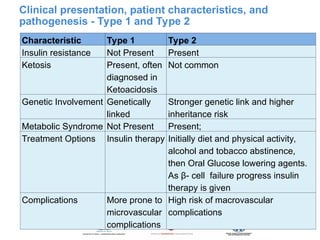
Characteristic Type 1 Type 2
Insulin resistance Not Present Present
Ketosis Present, often
diagnosed in
Ketoacidosis
Not common
Genetic Involvement Genetically
linked
Stronger genetic link and higher
inheritance risk
Metabolic Syndrome Not Present Present;
Treatment Options Insulin therapy Initially diet and physical activity,
alcohol and tobacco abstinence,
then Oral Glucose lowering agents.
As β- cell failure progress insulin
therapy is given
Complications More prone to
microvascular
complications
High risk of macrovascular
complications
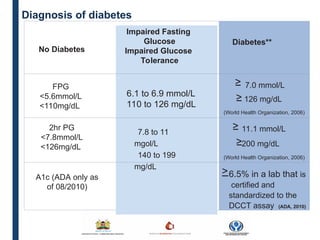
Diagnosis of diabetes
6.1 to 6.9 mmol/L
110 to 126 mg/dL
Impaired Fasting
Glucose
Impaired Glucose
Tolerance
FPG
<5.6mmol/L
<110mg/dL
No Diabetes
Diabetes**
2hr PG
<7.8mmol/L
<126mg/dL
A1c (ADA only as
of 08/2010)
7.8 to 11
mgol/L
140 to 199
mg/dL
6.5% in a lab that is
certified and
standardized to the
DCCT assay (ADA, 2010)
11.1 mmol/L
200 mg/dL
7.0 mmol/L
126 mg/dL
(World Health Organization, 2006)
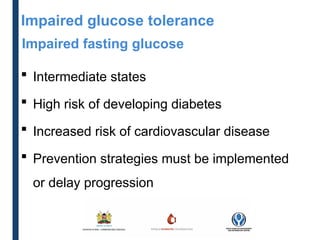
Impaired glucose tolerance
Impaired fasting glucose
 Intermediate states
 High risk of developing diabetes
 Increased risk of cardiovascular disease
 Prevention strategies must be implemented
or delay progression
Oral Glucose tolerance test
 75 g glucose load after 8-10 hours fasting
 Readings taken in fasting state and at 1 and 2 hours
 Some factors such as previous carbohydrate intake,
illness, smoking and activity level may affect result
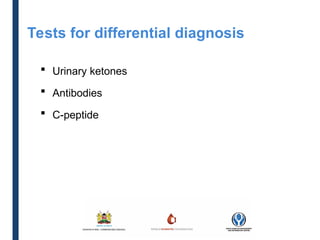
 Urinary ketones
 Antibodies
 C-peptide
Tests for differential diagnosis
 Cluster of risk factors or syndrome
 Found in 70 – 80% of people with type 2 diabetes
 Diagnostic criteria varies globally
 Associated with three-fold increase in heart disease and
stroke
 Associated with two-fold increase in major
cardiovascular events
Metabolic syndrome
Practical session - Procedure for
Blood Sugar Testing
■ Demonstration of Capillary Blood Sugar testing
■ Description of the procedure of OGTT
Capillary Blood Sugar testing
■ Capillary blood glucose monitoring provides an
accurate measure of blood glucose
concentration
■ It can detect both hypoglycemia and
hyperglycemia
Procedure for blood glucose
testing
■ Obtain the patient consent before starting the
procedure
■ Inform the patient the need for a finger prick
■ Ensure the blood glucose strips are stored in
correct manner
■ Ensure the meter is calibrated (coded) to march
test strips
Procedure for blood glucose
testing Cont…….
■ Use appropriate finger pricker (lancet)
■ Follow the manufactures procedure for each
meter
■ Inform the patient of the results
■ Record results accurately in the patients
records
Conclusion
■ The classification of diabetes is based on the
pathogenesis of the disease, and not on the insulin
therapy needed or its dependence
■ Capillary blood glucose monitoring provides an
accurate measure of blood glucose concentration
■ It can detect both hypoglycemia and
hyperglycemia
■ IGT/IFG Should be recognized and managed as
they are both risk factors for cardiovascular
disease
Thank you

Module 4- Classification, presentation and diagnosis_18th Jan.ppt

  • 1.
  • 2.
    Objectives By the endof this session the participant will be able to: ■ Understand the WHO diagnostic criteria for different disorders of glycaemia. ■ Understand the laboratory investigations used in the diagnosis of diabetes and their appropriate use ■ Understand the difference between type 1 and type 2 diabetes in relation to the clinical presentation, patient characteristics, and pathogenesis
  • 3.
    Classification of diabetesmellitus ■ The classification of diabetes is based on the pathogenesis of the disease, and not on the insulin therapy needed or its dependence ■ For this reason, the WHO working group has eliminated the terms ‘insulin dependent diabetes mellitus (IDDM)’ and ‘non-insulin dependent diabetes (NIDDM)’, as these terms were confusing and frequently resulted in patients being classified on treatment rather than pathogenesis
  • 4.
    The classification ofdiabetes has been revised by the WHO (based on aetiology) Type 1 diabetes Results from destruction of the pancreatic beta cells most commonly autoimmune. Insulin is required for survival. Type 2 diabetes Characterized by insulin resistance and/or abnormal insulin secretion, either of which may predominate, but both of which are usually present. It is the most common type of diabetes Other specific types of Diabetes These are less common and include genetic disorders, infections, and diseases of the exocrine pancreas, endocrinopathies or as a result of drugs. Gestational diabetes Appearing or recognized for the first time in pregnancy
  • 5.
    Clinical presentation, patientcharacteristics, and pathogenesis - Type 1 and Type 2 Characteristic Type 1 Type 2 Onset Sudden, acute or sub- acute Slow, insidious, progressive disease. Patient could be undiagnosed for years Age Usually below 30- 35 years; exception of LADA Older patients above 40 years; except for MODY Typical Symptoms Moderate to severe symptoms of diabetes present Often asymptomatic because of the slow onset of the disease; asymptomatic glycosuria present Weight Lean, often rapid weight loss before diagnosis Normal to overweight Insulin secretion Insulin deficient, need insulin for survival Deficient β- cell insulin secretion patterns and or insulin receptor abnormalities Chronic Complications present at diagnosis Less frequent at diagnosis Present due to late diagnosis
  • 6.
    Clinical presentation, patientcharacteristics, and pathogenesis - Type 1 and Type 2 Characteristic Type 1 Type 2 Insulin resistance Not Present Present Ketosis Present, often diagnosed in Ketoacidosis Not common Genetic Involvement Genetically linked Stronger genetic link and higher inheritance risk Metabolic Syndrome Not Present Present; Treatment Options Insulin therapy Initially diet and physical activity, alcohol and tobacco abstinence, then Oral Glucose lowering agents. As β- cell failure progress insulin therapy is given Complications More prone to microvascular complications High risk of macrovascular complications
  • 7.
    Diagnosis of diabetes 6.1to 6.9 mmol/L 110 to 126 mg/dL Impaired Fasting Glucose Impaired Glucose Tolerance FPG <5.6mmol/L <110mg/dL No Diabetes Diabetes** 2hr PG <7.8mmol/L <126mg/dL A1c (ADA only as of 08/2010) 7.8 to 11 mgol/L 140 to 199 mg/dL 6.5% in a lab that is certified and standardized to the DCCT assay (ADA, 2010) 11.1 mmol/L 200 mg/dL 7.0 mmol/L 126 mg/dL (World Health Organization, 2006) (World Health Organization, 2006)
  • 8.
    Impaired glucose tolerance Impairedfasting glucose  Intermediate states  High risk of developing diabetes  Increased risk of cardiovascular disease  Prevention strategies must be implemented or delay progression
  • 9.
    Oral Glucose tolerancetest  75 g glucose load after 8-10 hours fasting  Readings taken in fasting state and at 1 and 2 hours  Some factors such as previous carbohydrate intake, illness, smoking and activity level may affect result
  • 10.
     Urinary ketones Antibodies  C-peptide Tests for differential diagnosis
  • 11.
     Cluster ofrisk factors or syndrome  Found in 70 – 80% of people with type 2 diabetes  Diagnostic criteria varies globally  Associated with three-fold increase in heart disease and stroke  Associated with two-fold increase in major cardiovascular events Metabolic syndrome
  • 12.
    Practical session -Procedure for Blood Sugar Testing ■ Demonstration of Capillary Blood Sugar testing ■ Description of the procedure of OGTT
  • 13.
    Capillary Blood Sugartesting ■ Capillary blood glucose monitoring provides an accurate measure of blood glucose concentration ■ It can detect both hypoglycemia and hyperglycemia
  • 14.
    Procedure for bloodglucose testing ■ Obtain the patient consent before starting the procedure ■ Inform the patient the need for a finger prick ■ Ensure the blood glucose strips are stored in correct manner ■ Ensure the meter is calibrated (coded) to march test strips
  • 15.
    Procedure for bloodglucose testing Cont……. ■ Use appropriate finger pricker (lancet) ■ Follow the manufactures procedure for each meter ■ Inform the patient of the results ■ Record results accurately in the patients records
  • 16.
    Conclusion ■ The classificationof diabetes is based on the pathogenesis of the disease, and not on the insulin therapy needed or its dependence ■ Capillary blood glucose monitoring provides an accurate measure of blood glucose concentration ■ It can detect both hypoglycemia and hyperglycemia ■ IGT/IFG Should be recognized and managed as they are both risk factors for cardiovascular disease
  • 17.

Editor's Notes

  • #6 a cluster of cardiovascular disease risk factors often present, hypertension dyslipidaemia, abdominal obesity, insulin resistance, microalbuminuria, and hypercoagulability
  • #7 Note: values for venous plasma samples NOTE: The diagnosis can be made in the following scenarios:- For symptomatic individuals, clinical signs and symptoms with an rbs 11.1 and/or FBS 7.0 mmol/L In asymptomatic individuals, 2 abnormal blood glucose readings are required to make a diagnosis. The second test MUST either be FBS, OGTT or HBA1C Note: ** confirmation of the diagnosis depends on repeated values done on another day, unless unequivocal hyperglycaemia and metabolic decompensation are present. IFG and IGT are often referred to as “prediabetes” or “people at risk”. These people are at increased risk for cardiovascular disease and development of diabetes, they should be targeted for prevention strategies. Diagnosis based on A1C was recommended by a US consensus panel in 2010. It has not yet been accepted worldwide partly because of the different standards in laboratory testing. ADA. (2010). American Diabetes Association Position Statement Diagnosis and Classification of Diabetes Mellitus. Diabetes Care, 33: S62-69. World Health Organization. (2006). Definition and diagnosis of diabetes mellitus and intermediate hyperglycemia. Geneva: WHO Document Production Services.
  • #8 Impaired glucose tolerance is commonly referred to as “IGT”; impaired fasting glucose as “IFG”. IGT and IFG are intermediate conditions that reflect a change in the physiological response to glucose. This change represents a transitive state between a normal response and diabetes. People with IGT or IFG are at high risk of progressing to type 2 diabetes, although this is not inevitable. These two stages, often referred to as “prediabetes” or “people at risk”, should be recognised and managed in order to prevent or delay the onset of diabetes and to prevent or delay the onset of cardiovascular disease (CVD). IFG and IGT are considered risk factors for diabetes and for CVD. Data suggest that the prevalence of type 2 diabetes is only a small proportion of the overall prevalence of glucose intolerance. People with either undiagnosed type 2 diabetes or IGT are thought to be far more numerous than the diagnosed population with type 2 diabetes. This is especially the case in older people (above 65 years), of whom about two-fifths may have IGT or undiagnosed type 2 diabetes. International Diabetes Federation. (2009). Diabetes Atlas, 4th ed. Brussels: IDF. ADA. (2010). American Diabetes Association Standards of Medical Care in Diabetes 2010. Diabetes Care, 33, S11-S61.
  • #9 The oral glucose tolerance test (OGTT), consists of a 75 g glucose load taken in the morning after an 8-10 hour non-caloric fast. Water is allowed, but not tea or coffee. In preparation for the test people should be told not to smoke, not to take certain medications such as steroids and to eat their normal intake of carbohydrate each day for 3 days prior to the test. Venous blood glucose levels are taken in the fasting state and at 1 and 2 hours after drinking the glucose. If an OGTT is necessary it should be done under optimised, supervised conditions. Various factors might affect the reliability of the test: Avoidance of carbohydrate over several days reduces the first-phase insulin response to glucose. It also results in a delayed second-phase response, increasing the risk of a false positive OGTT result. Therefore, people should be asked to eat their normal carbohydrate load during the days leading up to the test Glucose tolerance changes throughout the 24-hour period Glucose tolerance is also affected by illness; therefore OGTT should be performed in the morning, only in people who are well People should rest throughout the test in a semi-reclined position and not breastfeed; both exercise and breastfeeding will increase glucose disposal (WHO, Lab Diagnosis and Monitoring of Diabetes, 2002)
  • #10 Several tests can assist in a differential diagnosis of type 1 diabetes and type 2 diabetes when the diagnosis is unclear. The presence of ketones in the urine indicate insulin deficiency and point towards the diagnosis of type 1 diabetes but is not definitive. Likewise, the presence of the antibodies associated with beta-cell destruction (islet-cell antibodies/GAD antibodies) can be used for differential diagnosis. Insulin assays are unable to distinguish endogenous versus injected insulin. Pro-insulin, the precursor to endogenous insulin, is formed by two circular chains of peptides. On release, pro-insulin is cleaved into the insulin protein and C-peptide chain. Decreased C-peptide is used as a marker of reduced endogenous insulin production and points to a diagnosis of type 1 diabetes. In a person with type 2 diabetes it shows that insulin would be the appropriate treatment. (WHO, Lab Diagnosis and Monitoring of Diabetes, 2002)
  • #11 The metabolic syndrome is a cluster of risk factors: Impaired glucose metabolism Central obesity Dyslipidaemia Hypertension While the metabolic syndrome is found in 70% to 80% of people with type 2 diabetes, it affects fewer than one in four of those with normal blood glucose levels. There is still some controversy as to whether the metabolic syndrome is a true syndrome or a cluster of risk factors. There is also varying diagnostic criteria around the world: National Cholesterol Education Program Adult Treatment Panel III (ATP III), WHO, and recently IDF. The IDF definition highlights waist circumference as the key risk indicator and includes ethnicity-specific cut-off points for obesity. The more components of the syndrome people have, the higher their risk. In one study from Scandinavia, cardiovascular deaths occurred in 12% of those with the metabolic syndrome, but in only 2% of those without the syndrome. These risk factors combine to double the risk of coronary heart disease and stroke. Deaths from cardiovascular disease are also increased, emphasizing the need to treat these risk factors aggressively. International Diabetes Federation. (2006). The IDF Consensus worldwide definition of the metabolic syndrome. Brussels: IDF.