
Scientific Foundations of Health (SFH)
Department of Robotics & Automation
JSS Academy of Technical Education, Bangalore-560060
(Course Code: 22SFH18)
Books
• Scientific Foundations of Health – Study Material Prepared by Dr. L Thimmesha, VTU, University Website.
• Scientific Foundations of Health (ISBN-978-81-955465-6-5) published by Infinite Learning Solutions,
Bangalore
• Health Psychology - A Textbook, 4th ed. by Jane Ogden McGraw Hill Education (India) Private Ltd. Open
University Press.
Reference
• Health Psychology (Second edition) by Charles Abraham, Mark Conner, Fiona Jones and Daryl O’Connor
Published by Routledge 711 Third Avenue, New York, NY 10017.
• HEALTH PSYCHOLOGY (Ninth Edition) by SHELLEY E. TAYLOR - University of California, Los Angeles,
McGraw Hill Education (India) Private Limited - Open University Press.
• SWAYAM / NPTL/ MOOCS/ We blinks/ Internet sources/ YouTube videos and other materials / notes.
• Scientific Foundations of Health (Health & Wellness) - General Books published for university and colleges
references by popular authors and published by the reputed publisher.
• This course has been introduced under ability enhancement scheme in 2021 NEP.
• As per the study and research, It is proved that health education is very important for all graduating
students.
• If our students do not maintain good health, education without good health: is not a benefit and asset to
the society or family.
• VTU has introduced this subject to enable the student community about Avoiding risks and recognizing
the harmful habits in their campus and outside the campus for their bright future and also to make them
to learn how to Prevent and fight against harmful diseases for good health through positive mindset.
Preamble
Course Objectives
• To know about Health and wellness (and its Beliefs) & It’s balance for positive mindset.
• To Build the healthy lifestyles for good health for their better future.
• To Create a Healthy and caring relationships to meet the requirements of good/social/positive life
• To learn about Avoiding risks and harmful habits in the campus and outside the campus for your bright future
• To Prevent and fight against harmful diseases for good health through positive mindset
Course outcome (Course Skill Set)
CO1: To understand & analyse about Health & wellness (and its Beliefs) & It’s balance for
positive mindset.
CO2: Develop the healthy lifestyles for good health for their better future..
CO3: Build a Healthy & caring relationships to meet the requirements of good/social/positive life.
CO4: To learn about Avoiding risks & harmful habits in their campus and outside the campus for
their bright future
CO5: Prevent and fight against harmful diseases for good health through positive mindset.
At the end of the course, students will be able to,
SFH
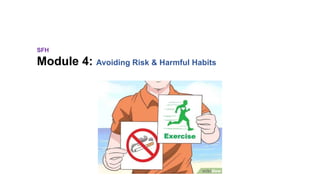
Module 4: Avoiding Risk & Harmful Habits
Characteristics of health compromising behaviours, Recognizing and avoiding of addictions,
How addiction develops, Types of addictions, influencing factors of addictions, Differences
between addictive people and non addictive people & their behaviours.
Effects of addictions, how to recovery from addictions.
Module 4
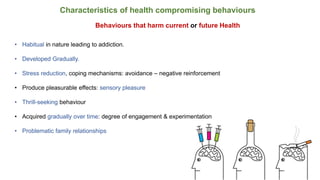
Characteristics of health compromising behaviours
Behaviours that harm current or future Health
• Habitual in nature leading to addiction.
• Developed Gradually.
• Stress reduction, coping mechanisms: avoidance – negative reinforcement
• Produce pleasurable effects: sensory pleasure
• Thrill-seeking behaviour
• Acquired gradually over time: degree of engagement & experimentation
• Problematic family relationships
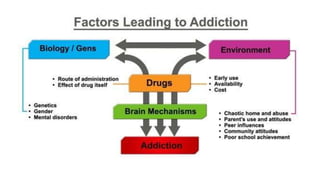
Addictions
Addiction is a treatable, chronic medical disease involving complex interactions
among brain circuits, genetics, the environment, and an individual’s life experiences.
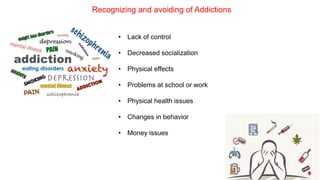
Recognizing and avoiding of Addictions
• Lack of control
• Decreased socialization
• Physical effects
• Problems at school or work
• Physical health issues
• Changes in behavior
• Money issues
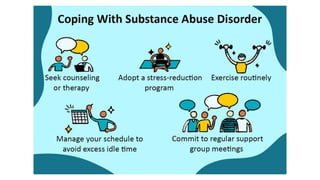
Recovering from Addictions
• Admit There Is A Problem
• Seek Professional Support
• Evidence-Based Care.
• Identify Your Triggers
• Change Your Environment
• Exercise.
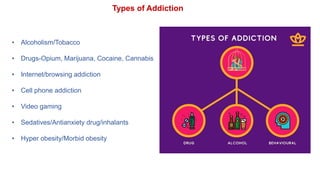
Types of Addiction
• Alcoholism/Tobacco
• Drugs-Opium, Marijuana, Cocaine, Cannabis
• Internet/browsing addiction
• Cell phone addiction
• Video gaming
• Sedatives/Antianxiety drug/inhalants
• Hyper obesity/Morbid obesity
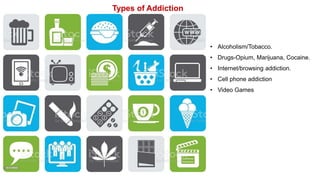
Types of Addiction
• Alcoholism/Tobacco.
• Drugs-Opium, Marijuana, Cocaine.
• Internet/browsing addiction.
• Cell phone addiction
• Video Games
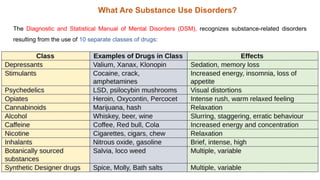
What Are Substance Use Disorders?
The Diagnostic and Statistical Manual of Mental Disorders (DSM), recognizes substance-related disorders
resulting from the use of 10 separate classes of drugs:
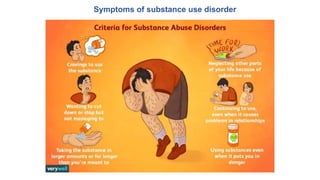
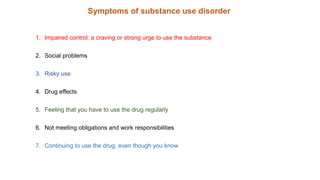
Symptoms of substance use disorder
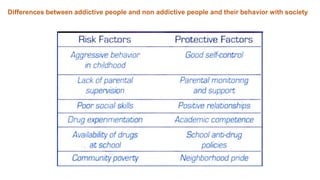
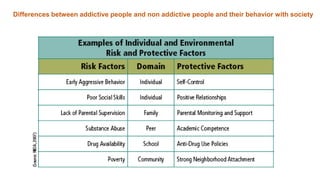
Differences between addictive people and non addictive people and their behavior with society
Symptoms of substance use disorder
1. Impaired control: a craving or strong urge to use the substance
2. Social problems
3. Risky use
4. Drug effects
5. Feeling that you have to use the drug regularly
6. Not meeting obligations and work responsibilities
7. Continuing to use the drug, even though you know
End of Module

Avoiding Risk & Harmful Habits.pptx

  • 1.
    Scientific Foundations ofHealth (SFH) Department of Robotics & Automation JSS Academy of Technical Education, Bangalore-560060 (Course Code: 22SFH18)
  • 2.
    Books • Scientific Foundationsof Health – Study Material Prepared by Dr. L Thimmesha, VTU, University Website. • Scientific Foundations of Health (ISBN-978-81-955465-6-5) published by Infinite Learning Solutions, Bangalore • Health Psychology - A Textbook, 4th ed. by Jane Ogden McGraw Hill Education (India) Private Ltd. Open University Press. Reference • Health Psychology (Second edition) by Charles Abraham, Mark Conner, Fiona Jones and Daryl O’Connor Published by Routledge 711 Third Avenue, New York, NY 10017. • HEALTH PSYCHOLOGY (Ninth Edition) by SHELLEY E. TAYLOR - University of California, Los Angeles, McGraw Hill Education (India) Private Limited - Open University Press. • SWAYAM / NPTL/ MOOCS/ We blinks/ Internet sources/ YouTube videos and other materials / notes. • Scientific Foundations of Health (Health & Wellness) - General Books published for university and colleges references by popular authors and published by the reputed publisher.
  • 3.
    • This coursehas been introduced under ability enhancement scheme in 2021 NEP. • As per the study and research, It is proved that health education is very important for all graduating students. • If our students do not maintain good health, education without good health: is not a benefit and asset to the society or family. • VTU has introduced this subject to enable the student community about Avoiding risks and recognizing the harmful habits in their campus and outside the campus for their bright future and also to make them to learn how to Prevent and fight against harmful diseases for good health through positive mindset. Preamble
  • 4.
    Course Objectives • Toknow about Health and wellness (and its Beliefs) & It’s balance for positive mindset. • To Build the healthy lifestyles for good health for their better future. • To Create a Healthy and caring relationships to meet the requirements of good/social/positive life • To learn about Avoiding risks and harmful habits in the campus and outside the campus for your bright future • To Prevent and fight against harmful diseases for good health through positive mindset
  • 5.
    Course outcome (CourseSkill Set) CO1: To understand & analyse about Health & wellness (and its Beliefs) & It’s balance for positive mindset. CO2: Develop the healthy lifestyles for good health for their better future.. CO3: Build a Healthy & caring relationships to meet the requirements of good/social/positive life. CO4: To learn about Avoiding risks & harmful habits in their campus and outside the campus for their bright future CO5: Prevent and fight against harmful diseases for good health through positive mindset. At the end of the course, students will be able to,
  • 6.
    SFH Module 4: AvoidingRisk & Harmful Habits
  • 7.
    Characteristics of healthcompromising behaviours, Recognizing and avoiding of addictions, How addiction develops, Types of addictions, influencing factors of addictions, Differences between addictive people and non addictive people & their behaviours. Effects of addictions, how to recovery from addictions. Module 4
  • 8.
    Characteristics of healthcompromising behaviours Behaviours that harm current or future Health • Habitual in nature leading to addiction. • Developed Gradually. • Stress reduction, coping mechanisms: avoidance – negative reinforcement • Produce pleasurable effects: sensory pleasure • Thrill-seeking behaviour • Acquired gradually over time: degree of engagement & experimentation • Problematic family relationships
  • 9.
    Addictions Addiction is atreatable, chronic medical disease involving complex interactions among brain circuits, genetics, the environment, and an individual’s life experiences.
  • 10.
    Recognizing and avoidingof Addictions • Lack of control • Decreased socialization • Physical effects • Problems at school or work • Physical health issues • Changes in behavior • Money issues
  • 11.
    Recovering from Addictions •Admit There Is A Problem • Seek Professional Support • Evidence-Based Care. • Identify Your Triggers • Change Your Environment • Exercise.
  • 12.
    Types of Addiction •Alcoholism/Tobacco • Drugs-Opium, Marijuana, Cocaine, Cannabis • Internet/browsing addiction • Cell phone addiction • Video gaming • Sedatives/Antianxiety drug/inhalants • Hyper obesity/Morbid obesity
  • 13.
    Types of Addiction •Alcoholism/Tobacco. • Drugs-Opium, Marijuana, Cocaine. • Internet/browsing addiction. • Cell phone addiction • Video Games
  • 15.
    What Are SubstanceUse Disorders? The Diagnostic and Statistical Manual of Mental Disorders (DSM), recognizes substance-related disorders resulting from the use of 10 separate classes of drugs:
  • 16.
  • 18.
    Differences between addictivepeople and non addictive people and their behavior with society
  • 19.
    Differences between addictivepeople and non addictive people and their behavior with society
  • 20.
    Symptoms of substanceuse disorder 1. Impaired control: a craving or strong urge to use the substance 2. Social problems 3. Risky use 4. Drug effects 5. Feeling that you have to use the drug regularly 6. Not meeting obligations and work responsibilities 7. Continuing to use the drug, even though you know
  • 22.