Entrepreneurial mind sets
This programme has been funded with support from the
European Commission
Entrepreneurial mind sets
Module 3
Creative capacity… Entrepreneurial mind sets
Among young people are potential philosophers,
artists, writers, entrepreneurs, craftsmen and women –
people who will create, who will constitute,
who will continue Europe’s culturally
rich and unique traditions.
Creative capacity… Entrepreneurial mind sets
Young people have always been entrepreneurial (in
both senses of the word), after all risk appears to
be a more acceptable word to the young than the
more mature, and some young people have set up
extremely successful businesses by the time their
peers have started university.
Indeed, there are well-documented case studies of
successful businessmen and women who started up
their businesses at a young age, going on to be
huge successes. These stories fire the imagination
of successive generations, along with reality TV
series such as The Apprentice and Dragons Den,
which bring the idea of setting up their own
business into the homes of young people.
Creative capacity… Entrepreneurial mind sets
Rather than viewing entrepreneurship just as a
means to self-employment, this guide is built on
the premise that entrepreneurship is a transversal
skill of relevance to all young people because of
the numerous ways it can be used to further their
goals and enhance their life skills.
The natural forum and non-formal learning
environment youth work organisations provide,
enhance the creative and innovative capacities of
young people in ways that are relevant to all
aspects of young people’s lives and help them in
overcoming disadvantages.
Developing entrepreneurial thinking
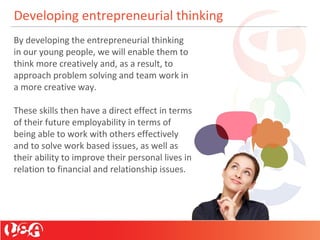
By developing the entrepreneurial thinking
in our young people, we will enable them to
think more creatively and, as a result, to
approach problem solving and team work in
a more creative way.
These skills then have a direct effect in terms
of their future employability in terms of
being able to work with others effectively
and to solve work based issues, as well as
their ability to improve their personal lives in
relation to financial and relationship issues.
Developing entrepreneurial thinking
Young people should be encouraged to
develop self-awareness of their own
enterprising and entrepreneurial qualities,
as well as the motivation and self-discipline
to apply these flexibly in different contexts
in their lives to achieve desired results.
This might include recognising themselves,
for example, as a creative or resourceful
person; or as someone who can translate
ideas into actions; or as a person who is
prepared to challenge assumptions through
investigation and research.
Developing entrepreneurial thinking
An entrepreneurial mind set includes:
•Aspects of personality and social identity
•Personal ambition and goals
•Personal confidence and resilience
•Self-discipline and personal organisation
•Understanding of one's own motivation
•Ability to go beyond perceived limitations
and achieve results
•Tolerance of uncertainty, ambiguity, risk,
and failure
•Personal values: ethical, social and
environmental awareness.
How to develop an entrepreneurial mind set
1. Activities shouldn’t focus solely on enterprise
awareness stage, they should aim to develop a
knowledge and skills base that relates to
specific areas and contexts within a young
person’s life. These activities can help young
people develop their own entrepreneurial
mind set and an awareness of their individual
interests and aspirations.
2. Activities should be based around an active
learning mode, exploring problems and
opportunities as vehicles for active learning
and creative problem solving, to enable young
people to develop generic skills in enterprise.
How to develop an entrepreneurial mind set
3. Business simulations can also be valuable.
Activities are often group-based, especially
when team-working skills are desired
outcomes. Learning through action and
reflection features prominently.
4. Entrepreneurs i.e. local business owners who
relate well to young people can make
important contribution to entrepreneurship
education. This helps to bring the concept of
new venture creation to life, as well as getting
the young person started in developing
personal contacts and networks.
How to develop an entrepreneurial mind set
5. Some young people who are more experienced
in enterprise can offer peer support to others
through various initiatives, for example
through engagement in the teaching process
or assisting in the evaluation of other young
peoples' progress.
6. Youth workers/facilitators within your
organisation can also play an important role,
especially if they have experience of
entrepreneurship or the subject area, and can
model self-presentation and communication
skills.
Other examples:
Participating in enterprising learning & activities:
•Business ideas generation
•Competitions
•Careers guidance
•Development of social and career networks
•Enterprise events
•Engaging with businesses
•Creative problem solving activities that integrates business
Creativity - finding inspiration
The created item may be intangible
(such as an idea, a scientific theory,
a musical composition or a joke) or a physical object
(such as an invention, a literary work or a painting).
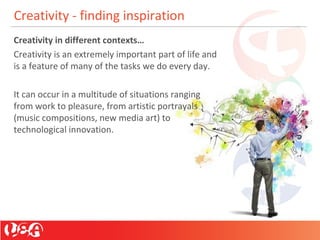
Creativity - finding inspiration
Creativity in different contexts…
Creativity is an extremely important part of life and
is a feature of many of the tasks we do every day.
It can occur in a multitude of situations ranging
from work to pleasure, from artistic portrayals
(music compositions, new media art) to
technological innovation.
Creativity - finding inspiration
Creativity can come in different forms…
Artistic / Musical beautiful paintings,
sculptures, songs
Creative Writing novels, short stories,
poems
Scientific inventions or
medical cures
It is often thought that creativity is about the arts.
This is true, but it is also possible to be creative in
all aspects of life. We can all be creative if we are
given the opportunity!
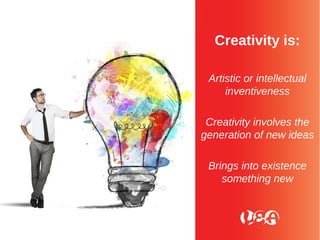
Creativity is:
Artistic or intellectual
inventiveness
Creativity involves the
generation of new ideas
Brings into existence
something new
Discover the benefits of creative thinking
While most often associated with the arts, like music,
painting or design, creativity can take many different
forms and be put to use in a variety of jobs and
activities, as diverse as gardening, carpentry or
mathematics.
When something can’t be solved by a practical
approach, creative thinking can help you see around
a problem positively and get to where you need to be
by looking at it from another angle. It works just as
well where there are strict rules as it does when you
have a blank canvas; though some of the most
successful creative outcomes have resulted from
people questioning established thinking and ways of
doing things. Creative thinking loves a challenge.
Congratulations
you have completed Module 3

Module 3 entrepreneurial mindset

  • 1.
    Entrepreneurial mind sets Thisprogramme has been funded with support from the European Commission Entrepreneurial mind sets Module 3
  • 2.
    Creative capacity… Entrepreneurialmind sets Among young people are potential philosophers, artists, writers, entrepreneurs, craftsmen and women – people who will create, who will constitute, who will continue Europe’s culturally rich and unique traditions.
  • 3.
    Creative capacity… Entrepreneurialmind sets Young people have always been entrepreneurial (in both senses of the word), after all risk appears to be a more acceptable word to the young than the more mature, and some young people have set up extremely successful businesses by the time their peers have started university. Indeed, there are well-documented case studies of successful businessmen and women who started up their businesses at a young age, going on to be huge successes. These stories fire the imagination of successive generations, along with reality TV series such as The Apprentice and Dragons Den, which bring the idea of setting up their own business into the homes of young people.
  • 4.
    Creative capacity… Entrepreneurialmind sets Rather than viewing entrepreneurship just as a means to self-employment, this guide is built on the premise that entrepreneurship is a transversal skill of relevance to all young people because of the numerous ways it can be used to further their goals and enhance their life skills. The natural forum and non-formal learning environment youth work organisations provide, enhance the creative and innovative capacities of young people in ways that are relevant to all aspects of young people’s lives and help them in overcoming disadvantages.
  • 5.
    Developing entrepreneurial thinking Bydeveloping the entrepreneurial thinking in our young people, we will enable them to think more creatively and, as a result, to approach problem solving and team work in a more creative way. These skills then have a direct effect in terms of their future employability in terms of being able to work with others effectively and to solve work based issues, as well as their ability to improve their personal lives in relation to financial and relationship issues.
  • 6.
    Developing entrepreneurial thinking Youngpeople should be encouraged to develop self-awareness of their own enterprising and entrepreneurial qualities, as well as the motivation and self-discipline to apply these flexibly in different contexts in their lives to achieve desired results. This might include recognising themselves, for example, as a creative or resourceful person; or as someone who can translate ideas into actions; or as a person who is prepared to challenge assumptions through investigation and research.
  • 7.
    Developing entrepreneurial thinking Anentrepreneurial mind set includes: •Aspects of personality and social identity •Personal ambition and goals •Personal confidence and resilience •Self-discipline and personal organisation •Understanding of one's own motivation •Ability to go beyond perceived limitations and achieve results •Tolerance of uncertainty, ambiguity, risk, and failure •Personal values: ethical, social and environmental awareness.
  • 8.
    How to developan entrepreneurial mind set 1. Activities shouldn’t focus solely on enterprise awareness stage, they should aim to develop a knowledge and skills base that relates to specific areas and contexts within a young person’s life. These activities can help young people develop their own entrepreneurial mind set and an awareness of their individual interests and aspirations. 2. Activities should be based around an active learning mode, exploring problems and opportunities as vehicles for active learning and creative problem solving, to enable young people to develop generic skills in enterprise.
  • 9.
    How to developan entrepreneurial mind set 3. Business simulations can also be valuable. Activities are often group-based, especially when team-working skills are desired outcomes. Learning through action and reflection features prominently. 4. Entrepreneurs i.e. local business owners who relate well to young people can make important contribution to entrepreneurship education. This helps to bring the concept of new venture creation to life, as well as getting the young person started in developing personal contacts and networks.
  • 10.
    How to developan entrepreneurial mind set 5. Some young people who are more experienced in enterprise can offer peer support to others through various initiatives, for example through engagement in the teaching process or assisting in the evaluation of other young peoples' progress. 6. Youth workers/facilitators within your organisation can also play an important role, especially if they have experience of entrepreneurship or the subject area, and can model self-presentation and communication skills.
  • 11.
    Other examples: Participating inenterprising learning & activities: •Business ideas generation •Competitions •Careers guidance •Development of social and career networks •Enterprise events •Engaging with businesses •Creative problem solving activities that integrates business
  • 12.
    Creativity - findinginspiration The created item may be intangible (such as an idea, a scientific theory, a musical composition or a joke) or a physical object (such as an invention, a literary work or a painting).
  • 13.
    Creativity - findinginspiration Creativity in different contexts… Creativity is an extremely important part of life and is a feature of many of the tasks we do every day. It can occur in a multitude of situations ranging from work to pleasure, from artistic portrayals (music compositions, new media art) to technological innovation.
  • 14.
    Creativity - findinginspiration Creativity can come in different forms… Artistic / Musical beautiful paintings, sculptures, songs Creative Writing novels, short stories, poems Scientific inventions or medical cures It is often thought that creativity is about the arts. This is true, but it is also possible to be creative in all aspects of life. We can all be creative if we are given the opportunity!
  • 15.
    Creativity is: Artistic orintellectual inventiveness Creativity involves the generation of new ideas Brings into existence something new
  • 16.
    Discover the benefitsof creative thinking While most often associated with the arts, like music, painting or design, creativity can take many different forms and be put to use in a variety of jobs and activities, as diverse as gardening, carpentry or mathematics. When something can’t be solved by a practical approach, creative thinking can help you see around a problem positively and get to where you need to be by looking at it from another angle. It works just as well where there are strict rules as it does when you have a blank canvas; though some of the most successful creative outcomes have resulted from people questioning established thinking and ways of doing things. Creative thinking loves a challenge.
  • 17.