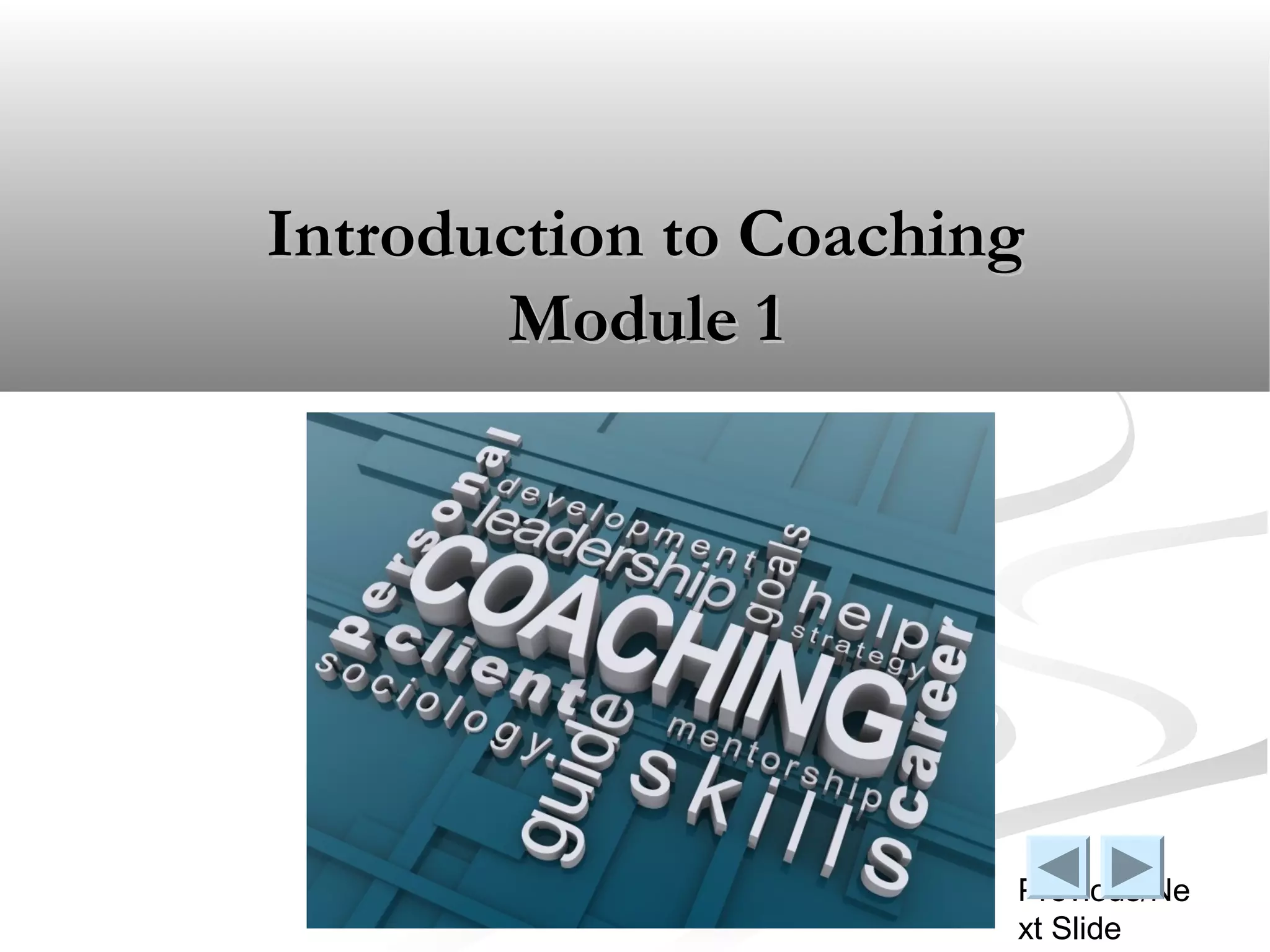
Introduction to Coaching
       Module 1


                       Previous/Ne
                       xt Slide
Module Overview and Objectives
   This module will introduce the topic of coaching for
    performance.

   We will define :
     What is and is not coaching
     The benefits of coaching
     Your role as a coach
     When to coach
     Who to coach


   You may go through this module at your own pace using the
    previous/next slide buttons on the bottom right of each slide.

                                                           Previous/Ne
                                                           xt Slide
The History of Coaching
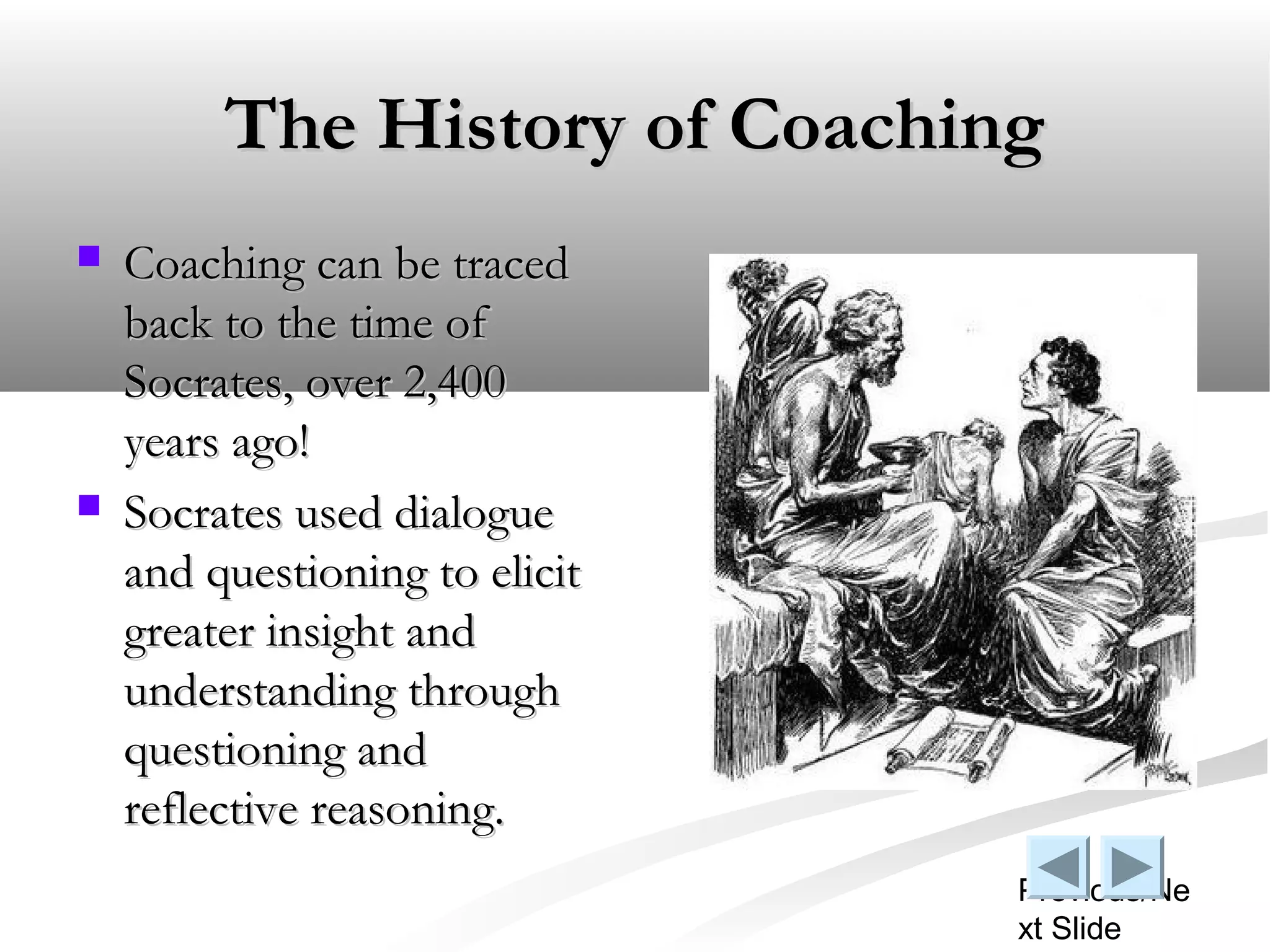
   Coaching can be traced
    back to the time of
    Socrates, over 2,400
    years ago!
   Socrates used dialogue
    and questioning to elicit
    greater insight and
    understanding through
    questioning and
    reflective reasoning.
                                Previous/Ne
                                xt Slide
History of Coaching
     Coaching entered the workplace in the 1950s
     It was recommended as an effective
      management tool for guiding and developing
      subordinates (Mace, 1950)
     Coaching grew slowly throughout the next few
      decades, and then worked its way into common
      management practices in the 1990s


(Carey, et al., 2011)                         Previous/Ne
                                              xt Slide
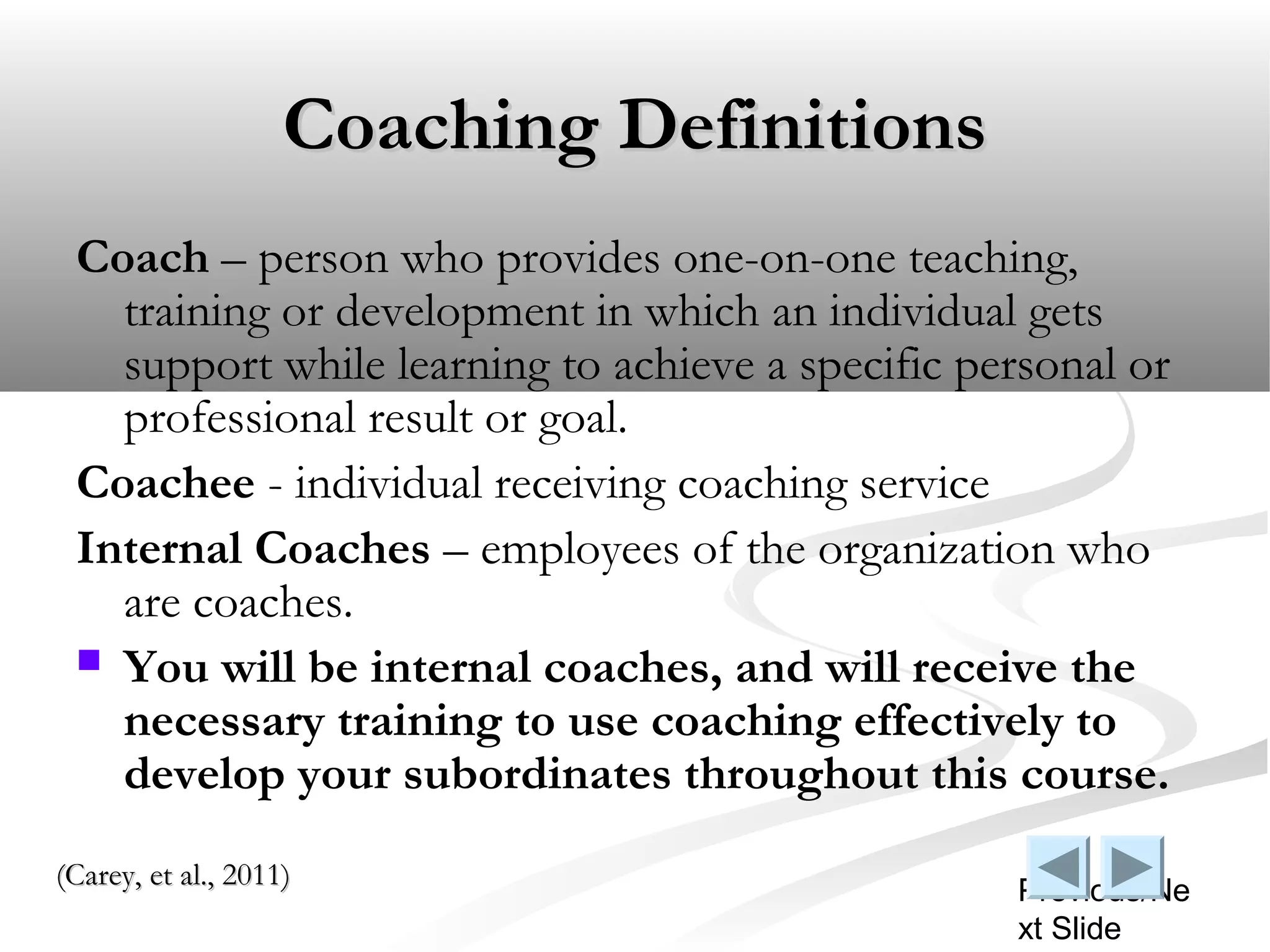
Coaching Definitions
 Coach – person who provides one-on-one teaching,
   training or development in which an individual gets
   support while learning to achieve a specific personal or
   professional result or goal.
 Coachee - individual receiving coaching service
 Internal Coaches – employees of the organization who
   are coaches.
  You will be internal coaches, and will receive the
   necessary training to use coaching effectively to
   develop your subordinates throughout this course.
(Carey, et al., 2011)
                                                  Previous/Ne
                                                  xt Slide
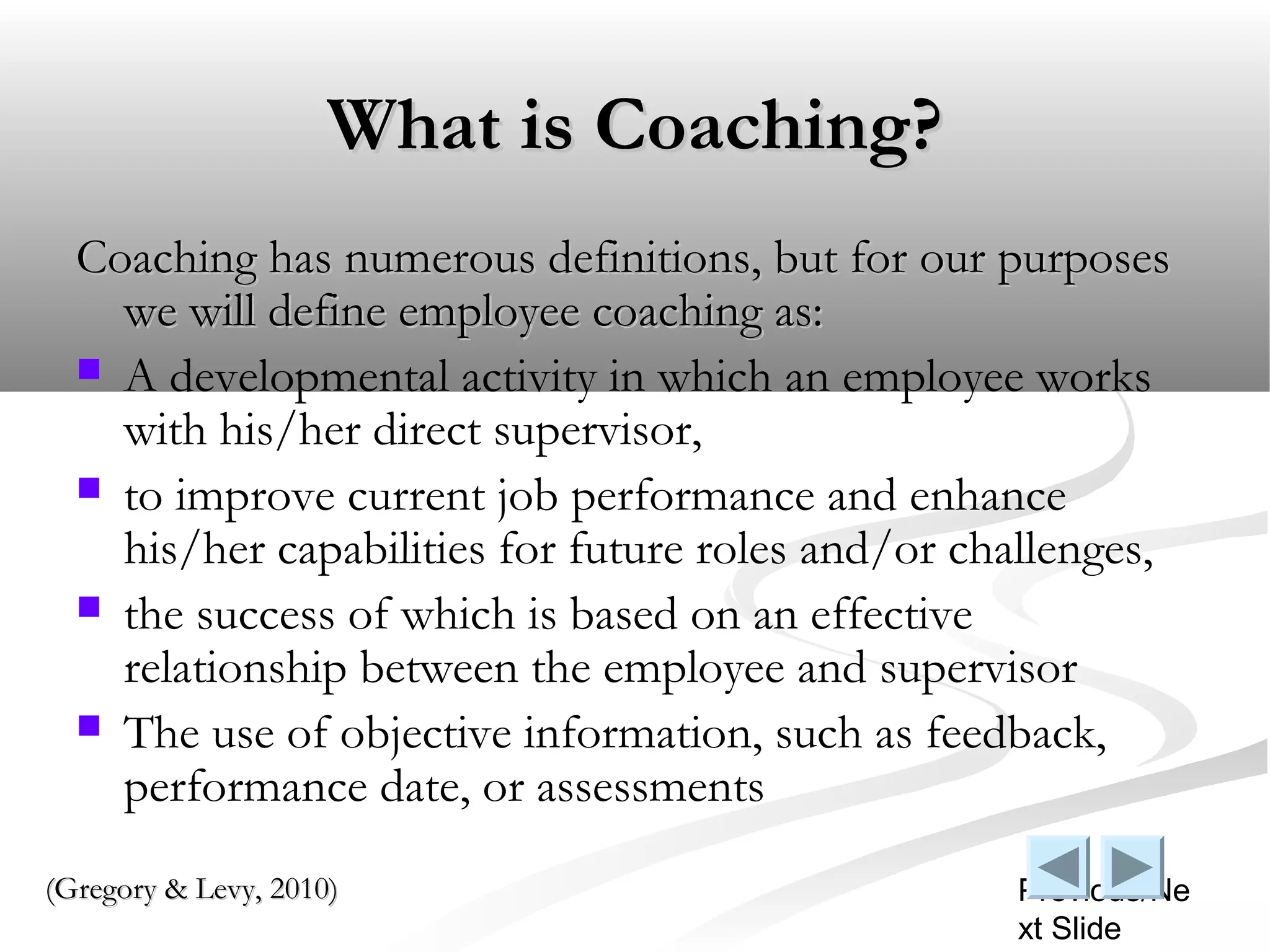
What is Coaching?
  Coaching has numerous definitions, but for our purposes
    we will define employee coaching as:
   A developmental activity in which an employee works
    with his/her direct supervisor,
   to improve current job performance and enhance
    his/her capabilities for future roles and/or challenges,
   the success of which is based on an effective
    relationship between the employee and supervisor
   The use of objective information, such as feedback,
    performance date, or assessments
(Gregory & Levy, 2010)                             Previous/Ne
                                                   xt Slide
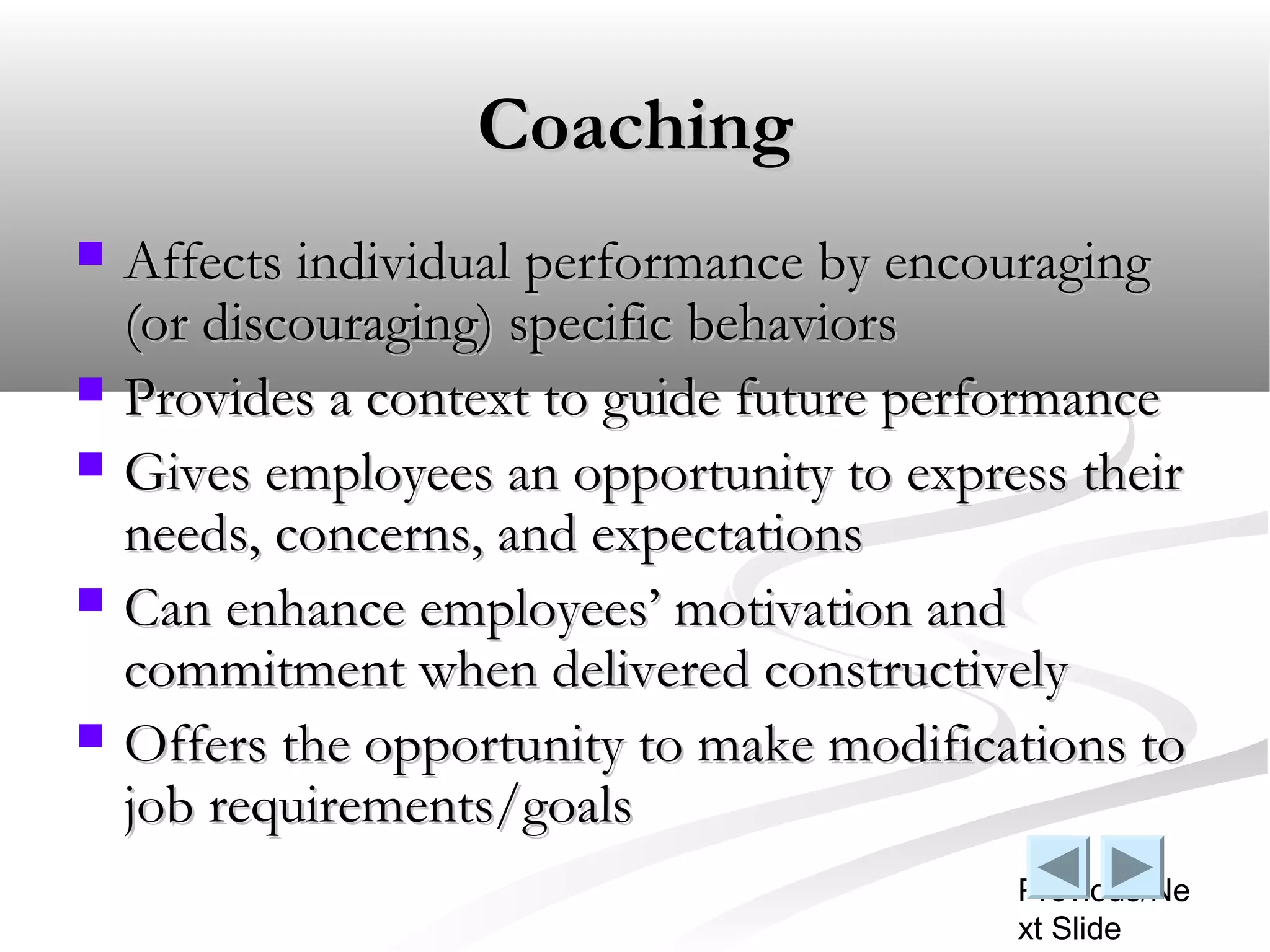
Coaching
   Affects individual performance by encouraging
    (or discouraging) specific behaviors
   Provides a context to guide future performance
   Gives employees an opportunity to express their
    needs, concerns, and expectations
   Can enhance employees’ motivation and
    commitment when delivered constructively
   Offers the opportunity to make modifications to
    job requirements/goals
                                           Previous/Ne
                                           xt Slide
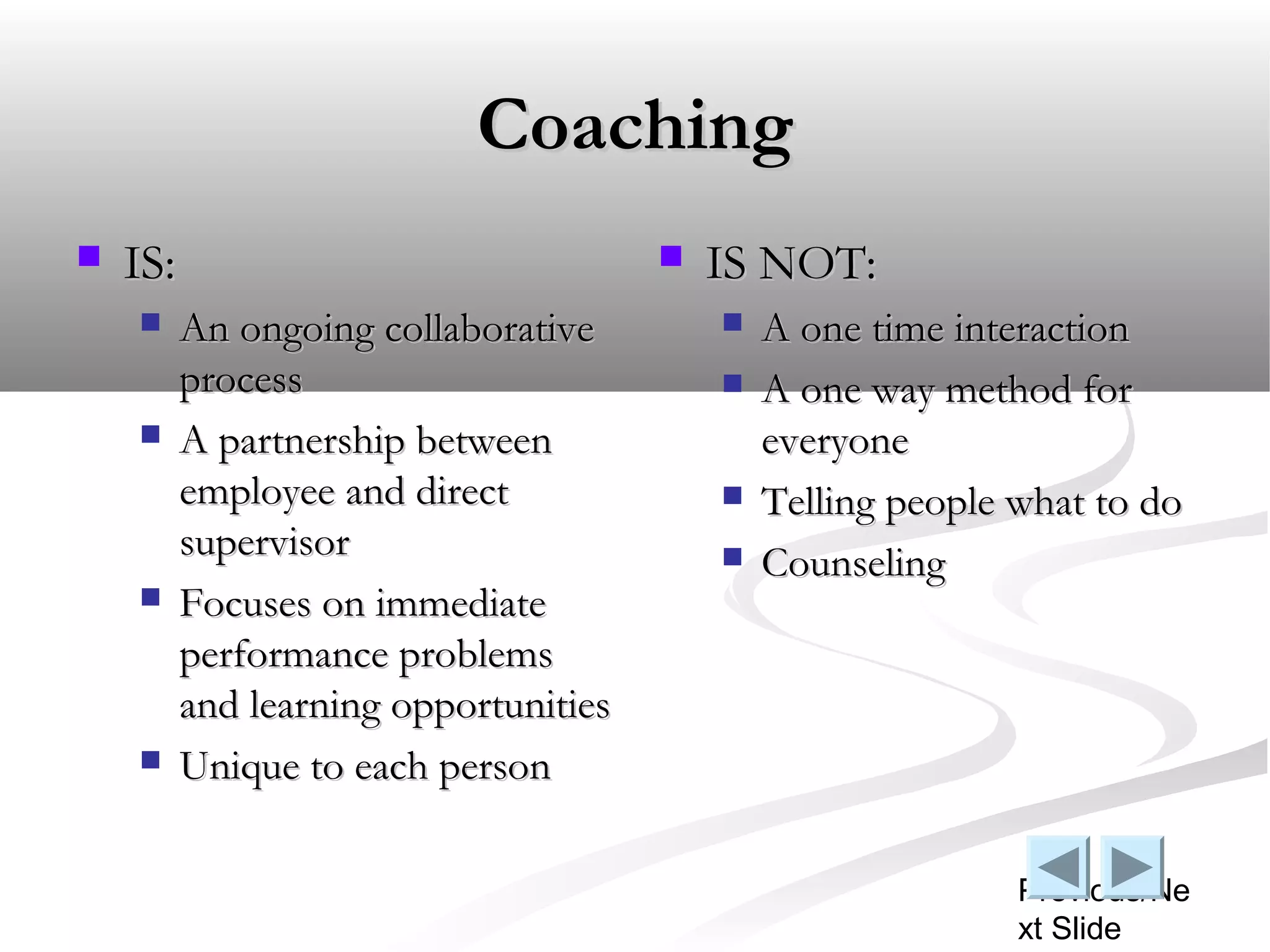
Coaching
   IS:                                   IS NOT:
         An ongoing collaborative            A one time interaction
          process                             A one way method for
         A partnership between                everyone
          employee and direct                 Telling people what to do
          supervisor                          Counseling
         Focuses on immediate
          performance problems
          and learning opportunities
         Unique to each person

                                                              Previous/Ne
                                                              xt Slide
Benefits of Coaching
You may be asking yourself, “Why am I doing this training?”.
  Coaching can provide a variety of benefits including:
    Growth & development of associates
    Improved associate performance, which can lead to increased
     productivity
    Fostering a positive work culture in the form of greater job
     satisfaction and higher motivation
    Generates new ideas to solve problems
    A way to manage change, conflict, and improve
     communication & relationships
    Improved retention- associatess are more committed and
     motivated when their supervisor takes time to help them
     improve their skills
                                                       Previous/Ne
                                                       xt Slide
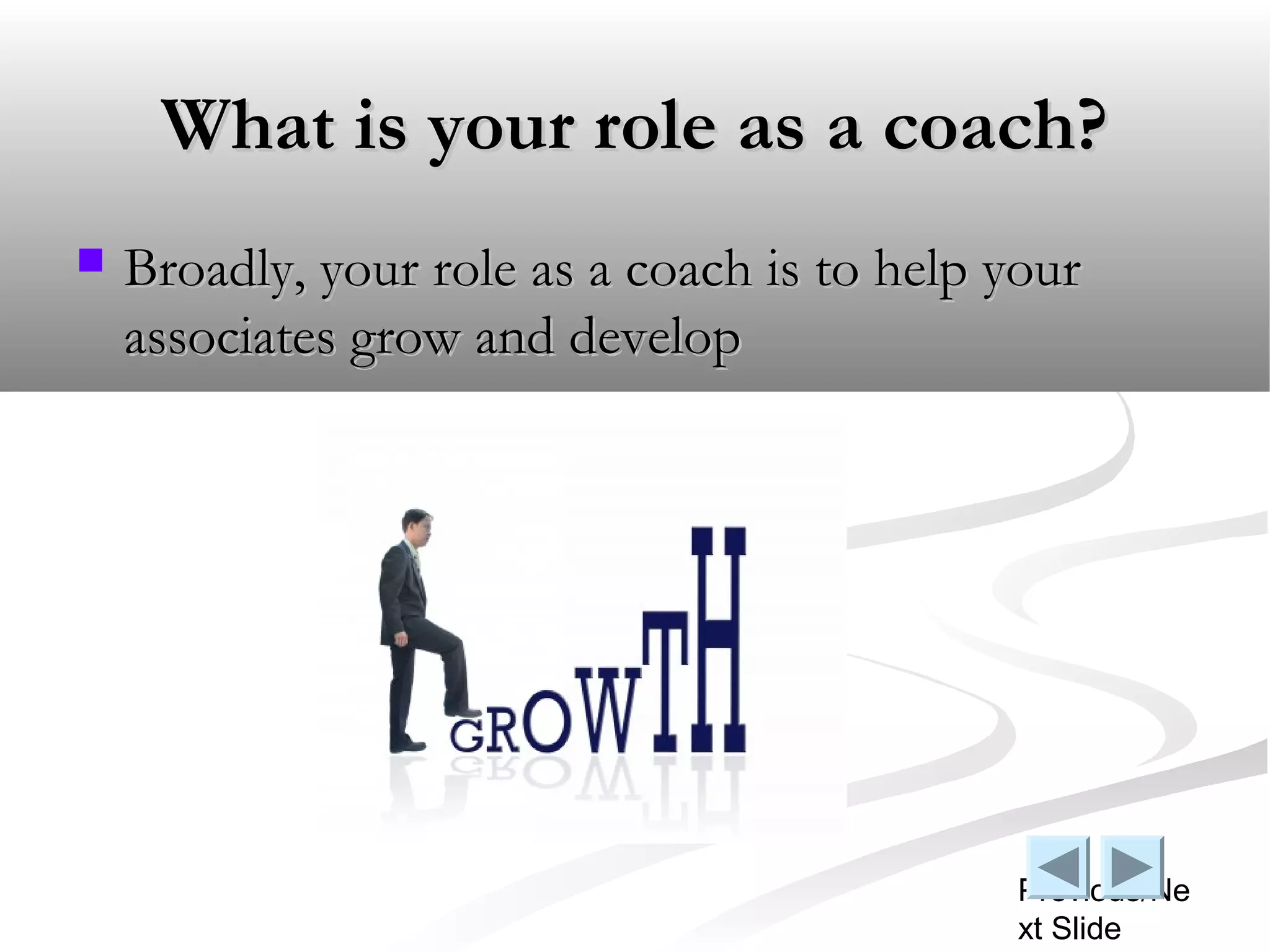
What is your role as a coach?
   Broadly, your role as a coach is to help your
    associates grow and develop


                                             Previous/Ne
                                             xt Slide
Coaching includes a variety of
              activities…
   Observing performance
   Correcting poor performance
   Providing instruction
   Recognizing excellent performance
   Directing associate efforts
   Listening to associate concerns and ideas
   Providing support and encouragement
   Removing barriers to performance
                                            Previous/Ne
                                            xt Slide
Important Elements
So, how will you help your employees grow and develop?
      By building a strong relationship
      Communicating clear expectations
      Helping to define problems and set goals
      Addressing skill and performance problems
      Providing feedback
      Following up to check progress and understanding

   We will discuss each one of these elements in detail in other
    modules
                                                          Previous/Ne
                                                          xt Slide
When should I coach?
   Don’t expect to solve problems in one session -
    Coaching is an ongoing process, taking place as the
    need or opportunity arises.
   Often, coaching occurs informally as you discuss goals,
    challenges, and on-the-job performance with employees
    and provide helpful feedback during day-to-day
    encounters.
   The coaching process can be more focused and formal,
    setting up structured meetings with a coachee to
    establish goals and review progress.

                                                  Previous/Ne
                                                  xt Slide
When to coach
   Offer coaching if you see a need, but first explain what
    you’ve observed and why you think coaching would be
    valuable.
   Avoid coaching if unproductive behavior is deeply
    rooted and occurs across a broad range of situations.
    Such problems usually don’t clear up with coaching.
   Find opportunities to strengthen your coaching skills.
    Regular practice improves a coach’s effectiveness.


                                                   Previous/Ne
                                                   xt Slide
Who do I coach?
   Associates who either have a performance problem or
    skills gap - both are ideal targets for coaching.
   As an experienced supervisor, you have plenty of
    knowledge to share with each of these associates.
   Since you have limited time, it’s best to invest it in
    coaching opportunities that will deliver the highest
    return. For example:
           A new associate that needs direction
           A direct report that is almost ready for new responsibilities and needs
            just a bit more help
           A problem performer that can be brought up to an acceptable level of
            work if he/she receives some guidance
                                                                     Previous/Ne
                                                                     xt Slide
Who to coach
   Coach associates who are aware of a
    performance problem or skill gap and who are
    motivated to address the situation.
   Don’t try to force coaching on someone who
    doesn’t want to improve, or who isn’t aware that
    he or she has a performance problem.


                                            Previous/Ne
                                            xt Slide
   But remember, because coaching is based on
    mutual agreement, it’s not always the best way to
    handle certain performance problems.
   You need to intervene more directly when an
    associate has clearly violated Shaw policy or
    organizational values, or performance remains
    the same despite multiple coaching sessions


                                            Previous/Ne
                                            xt Slide
This completes Module 1
   We have finished our introduction to coaching.
    The next module will go into detail about
    coaching skills you will need to conduct
    coaching effectively.
   You must complete the short quiz about Module
    1, Introduction to Coaching, before moving on
    to Module 2.


                                          Previous/Ne
                                          xt Slide

Module 1 introduction to coaching

  • 1.
    Introduction to Coaching Module 1 Previous/Ne xt Slide
  • 2.
    Module Overview andObjectives  This module will introduce the topic of coaching for performance.  We will define :  What is and is not coaching  The benefits of coaching  Your role as a coach  When to coach  Who to coach  You may go through this module at your own pace using the previous/next slide buttons on the bottom right of each slide. Previous/Ne xt Slide
  • 3.
    The History ofCoaching  Coaching can be traced back to the time of Socrates, over 2,400 years ago!  Socrates used dialogue and questioning to elicit greater insight and understanding through questioning and reflective reasoning. Previous/Ne xt Slide
  • 4.
    History of Coaching  Coaching entered the workplace in the 1950s  It was recommended as an effective management tool for guiding and developing subordinates (Mace, 1950)  Coaching grew slowly throughout the next few decades, and then worked its way into common management practices in the 1990s (Carey, et al., 2011) Previous/Ne xt Slide
  • 5.
    Coaching Definitions Coach– person who provides one-on-one teaching, training or development in which an individual gets support while learning to achieve a specific personal or professional result or goal. Coachee - individual receiving coaching service Internal Coaches – employees of the organization who are coaches.  You will be internal coaches, and will receive the necessary training to use coaching effectively to develop your subordinates throughout this course. (Carey, et al., 2011) Previous/Ne xt Slide
  • 6.
    What is Coaching? Coaching has numerous definitions, but for our purposes we will define employee coaching as:  A developmental activity in which an employee works with his/her direct supervisor,  to improve current job performance and enhance his/her capabilities for future roles and/or challenges,  the success of which is based on an effective relationship between the employee and supervisor  The use of objective information, such as feedback, performance date, or assessments (Gregory & Levy, 2010) Previous/Ne xt Slide
  • 7.
    Coaching  Affects individual performance by encouraging (or discouraging) specific behaviors  Provides a context to guide future performance  Gives employees an opportunity to express their needs, concerns, and expectations  Can enhance employees’ motivation and commitment when delivered constructively  Offers the opportunity to make modifications to job requirements/goals Previous/Ne xt Slide
  • 8.
    Coaching  IS:  IS NOT:  An ongoing collaborative  A one time interaction process  A one way method for  A partnership between everyone employee and direct  Telling people what to do supervisor  Counseling  Focuses on immediate performance problems and learning opportunities  Unique to each person Previous/Ne xt Slide
  • 9.
    Benefits of Coaching Youmay be asking yourself, “Why am I doing this training?”. Coaching can provide a variety of benefits including:  Growth & development of associates  Improved associate performance, which can lead to increased productivity  Fostering a positive work culture in the form of greater job satisfaction and higher motivation  Generates new ideas to solve problems  A way to manage change, conflict, and improve communication & relationships  Improved retention- associatess are more committed and motivated when their supervisor takes time to help them improve their skills Previous/Ne xt Slide
  • 10.
    What is yourrole as a coach?  Broadly, your role as a coach is to help your associates grow and develop Previous/Ne xt Slide
  • 11.
    Coaching includes avariety of activities…  Observing performance  Correcting poor performance  Providing instruction  Recognizing excellent performance  Directing associate efforts  Listening to associate concerns and ideas  Providing support and encouragement  Removing barriers to performance Previous/Ne xt Slide
  • 12.
    Important Elements So, howwill you help your employees grow and develop?  By building a strong relationship  Communicating clear expectations  Helping to define problems and set goals  Addressing skill and performance problems  Providing feedback  Following up to check progress and understanding We will discuss each one of these elements in detail in other modules Previous/Ne xt Slide
  • 13.
    When should Icoach?  Don’t expect to solve problems in one session - Coaching is an ongoing process, taking place as the need or opportunity arises.  Often, coaching occurs informally as you discuss goals, challenges, and on-the-job performance with employees and provide helpful feedback during day-to-day encounters.  The coaching process can be more focused and formal, setting up structured meetings with a coachee to establish goals and review progress. Previous/Ne xt Slide
  • 14.
    When to coach  Offer coaching if you see a need, but first explain what you’ve observed and why you think coaching would be valuable.  Avoid coaching if unproductive behavior is deeply rooted and occurs across a broad range of situations. Such problems usually don’t clear up with coaching.  Find opportunities to strengthen your coaching skills. Regular practice improves a coach’s effectiveness. Previous/Ne xt Slide
  • 15.
    Who do Icoach?  Associates who either have a performance problem or skills gap - both are ideal targets for coaching.  As an experienced supervisor, you have plenty of knowledge to share with each of these associates.  Since you have limited time, it’s best to invest it in coaching opportunities that will deliver the highest return. For example:  A new associate that needs direction  A direct report that is almost ready for new responsibilities and needs just a bit more help  A problem performer that can be brought up to an acceptable level of work if he/she receives some guidance Previous/Ne xt Slide
  • 16.
    Who to coach  Coach associates who are aware of a performance problem or skill gap and who are motivated to address the situation.  Don’t try to force coaching on someone who doesn’t want to improve, or who isn’t aware that he or she has a performance problem. Previous/Ne xt Slide
  • 17.
    But remember, because coaching is based on mutual agreement, it’s not always the best way to handle certain performance problems.  You need to intervene more directly when an associate has clearly violated Shaw policy or organizational values, or performance remains the same despite multiple coaching sessions Previous/Ne xt Slide
  • 18.
    This completes Module1  We have finished our introduction to coaching. The next module will go into detail about coaching skills you will need to conduct coaching effectively.  You must complete the short quiz about Module 1, Introduction to Coaching, before moving on to Module 2. Previous/Ne xt Slide