COOKERY 1
INTRODUCTION TO COOKERY 1 Page 1
COOKERY 1
MODULE 1: INTRODUCTION
IN COOKERY 1
(WEEK 1)
LESSON 1 TO 3: CAREER
OPPORTUNITY, MISE
EN PLACE
Prepared by:
CRYSTAL B. QUIÑANO
Early
Christian
College
OF
ARTS
AND
TECHNOLOGY
INC.
SHS
DEPARTMENT
|
SY
2022-2023
COOKERY 1
INTRODUCTION TO COOKERY 1 Page 2
Food service operations are generally led by an EXECUTIVE CHEF, who coordinates kitchen
activities and directs the kitchen staff’s training and work efforts. The executive chef PLANS
menus and CREATES recipes, ensure that quality standards are rigorously and consistently
maintained.
EXECUTIVE CHEF – oversees all the kitchen operation whether restaurant or hotels.
- A few of the main duties of an executive chef are monitoring the quality of the food,
following all food safety regulations, creating new food entrees, and coordinating the entire
kitchen. They also have to hire and train new kitchen staff. Some of the jobs titles that an
executive chef could grow into are head chef and restaurant manager.
- An executive chef should have five years of experience in the culinary field as well as a
bachelor's degree in the culinary arts. One of the most important skills that an executive
chef will have is the ability to manage a kitchen. Another skill is creativity as the executive
chef will need to be able to create dishes that wow customers.
FAMOUS INTERNATIONAL CHEFS
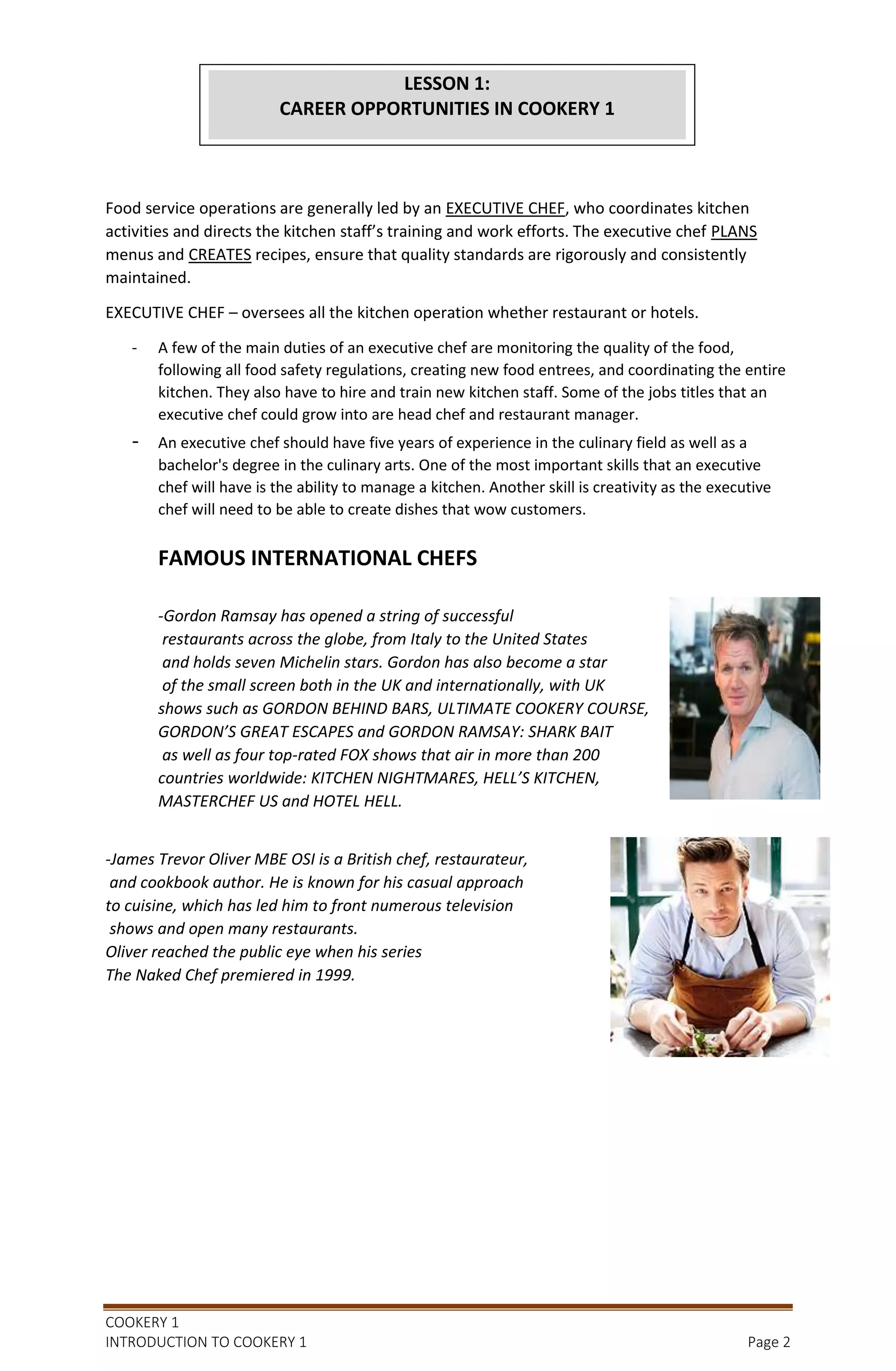
-Gordon Ramsay has opened a string of successful
restaurants across the globe, from Italy to the United States
and holds seven Michelin stars. Gordon has also become a star
of the small screen both in the UK and internationally, with UK
shows such as GORDON BEHIND BARS, ULTIMATE COOKERY COURSE,
GORDON’S GREAT ESCAPES and GORDON RAMSAY: SHARK BAIT
as well as four top-rated FOX shows that air in more than 200
countries worldwide: KITCHEN NIGHTMARES, HELL’S KITCHEN,
MASTERCHEF US and HOTEL HELL.
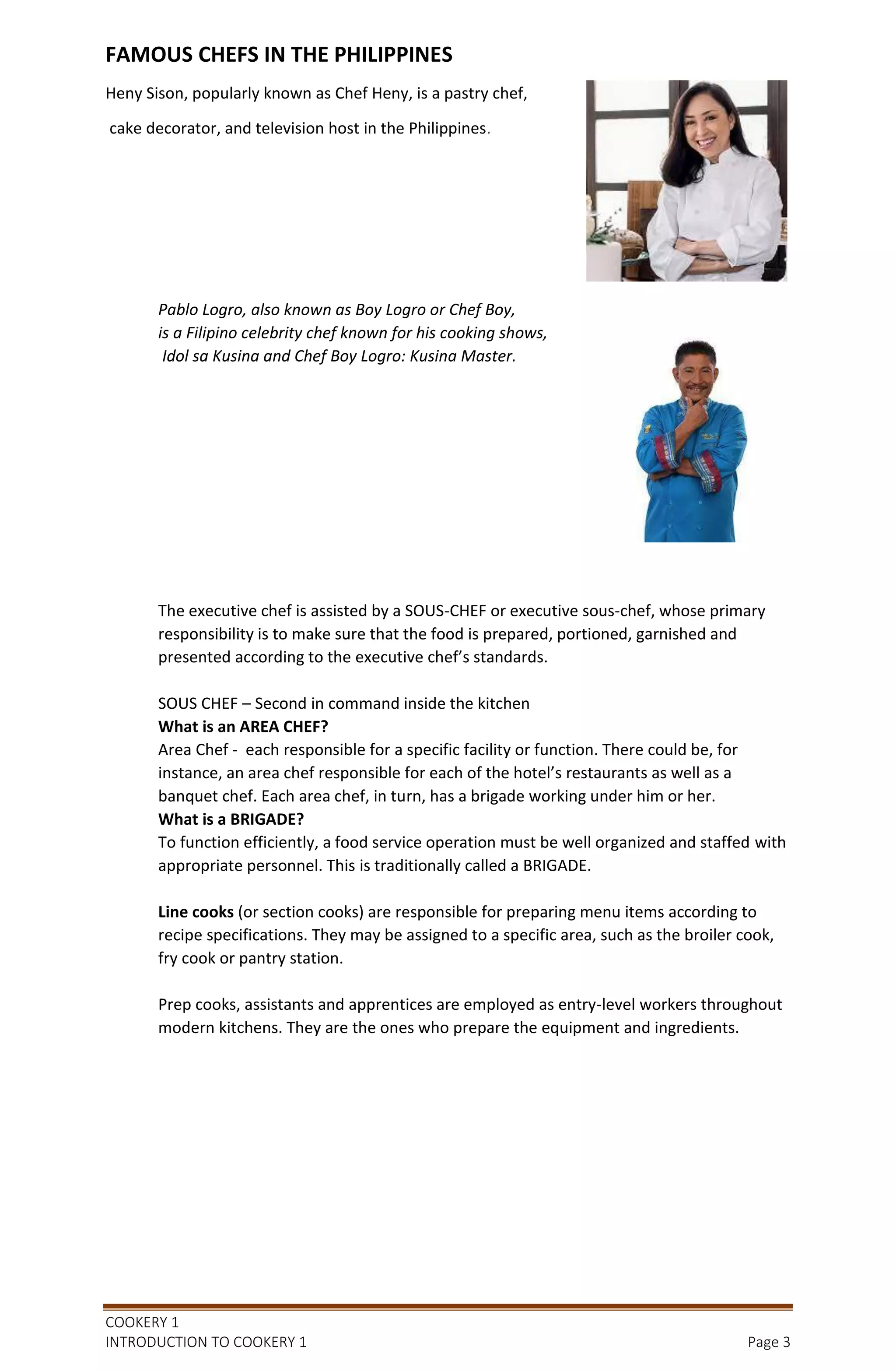
-James Trevor Oliver MBE OSI is a British chef, restaurateur,
and cookbook author. He is known for his casual approach
to cuisine, which has led him to front numerous television
shows and open many restaurants.
Oliver reached the public eye when his series
The Naked Chef premiered in 1999.
LESSON 1:
CAREER OPPORTUNITIES IN COOKERY 1
COOKERY 1
INTRODUCTION TO COOKERY 1 Page 3
FAMOUS CHEFS IN THE PHILIPPINES
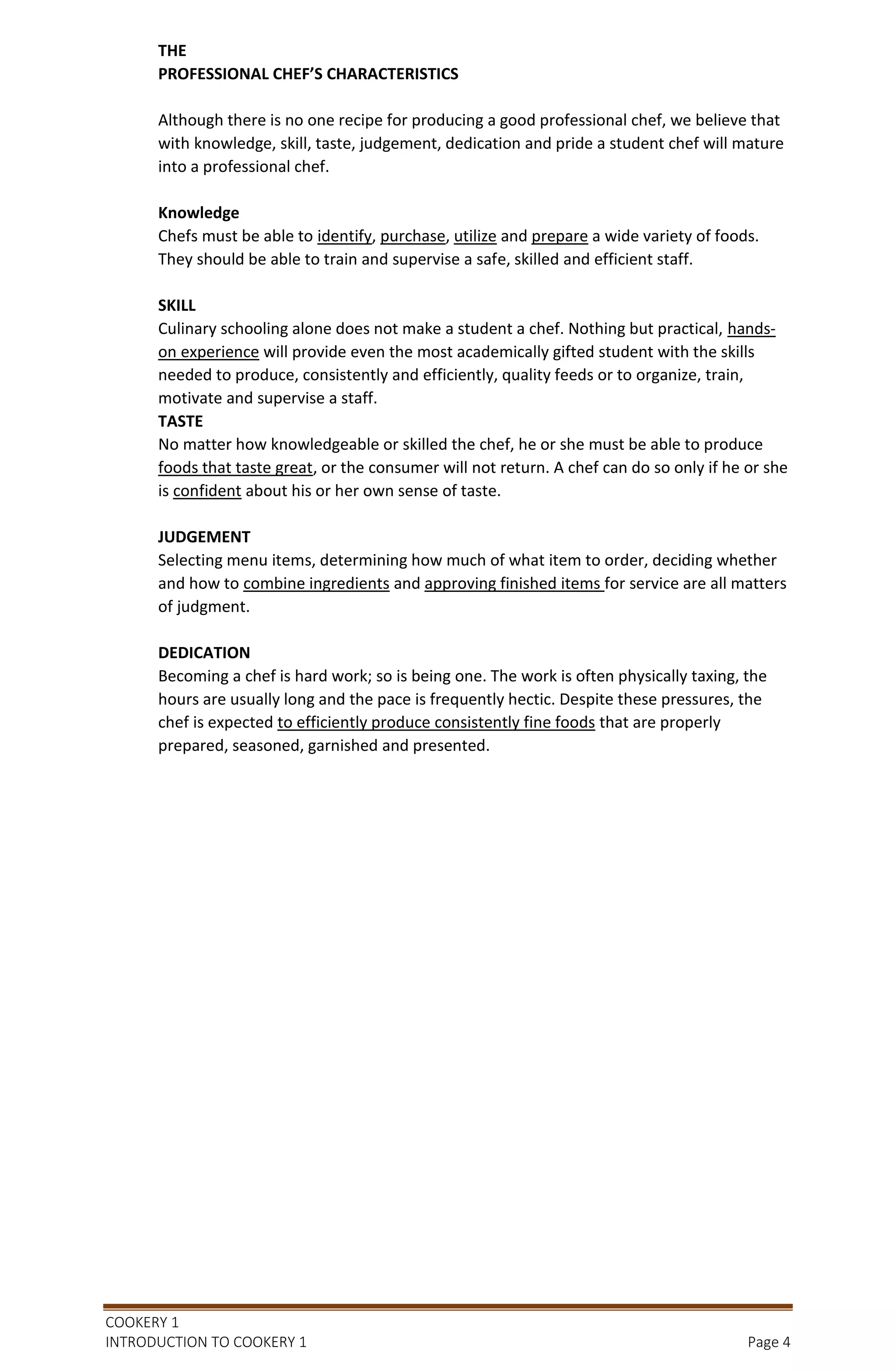
Heny Sison, popularly known as Chef Heny, is a pastry chef,
cake decorator, and television host in the Philippines.
Pablo Logro, also known as Boy Logro or Chef Boy,
is a Filipino celebrity chef known for his cooking shows,
Idol sa Kusina and Chef Boy Logro: Kusina Master.
The executive chef is assisted by a SOUS-CHEF or executive sous-chef, whose primary
responsibility is to make sure that the food is prepared, portioned, garnished and
presented according to the executive chef’s standards.
SOUS CHEF – Second in command inside the kitchen
What is an AREA CHEF?
Area Chef - each responsible for a specific facility or function. There could be, for
instance, an area chef responsible for each of the hotel’s restaurants as well as a
banquet chef. Each area chef, in turn, has a brigade working under him or her.
What is a BRIGADE?
To function efficiently, a food service operation must be well organized and staffed with
appropriate personnel. This is traditionally called a BRIGADE.
Line cooks (or section cooks) are responsible for preparing menu items according to
recipe specifications. They may be assigned to a specific area, such as the broiler cook,
fry cook or pantry station.
Prep cooks, assistants and apprentices are employed as entry-level workers throughout
modern kitchens. They are the ones who prepare the equipment and ingredients.
COOKERY 1
INTRODUCTION TO COOKERY 1 Page 4
THE
PROFESSIONAL CHEF’S CHARACTERISTICS
Although there is no one recipe for producing a good professional chef, we believe that
with knowledge, skill, taste, judgement, dedication and pride a student chef will mature
into a professional chef.
Knowledge
Chefs must be able to identify, purchase, utilize and prepare a wide variety of foods.
They should be able to train and supervise a safe, skilled and efficient staff.
SKILL
Culinary schooling alone does not make a student a chef. Nothing but practical, hands-
on experience will provide even the most academically gifted student with the skills
needed to produce, consistently and efficiently, quality feeds or to organize, train,
motivate and supervise a staff.
TASTE
No matter how knowledgeable or skilled the chef, he or she must be able to produce
foods that taste great, or the consumer will not return. A chef can do so only if he or she
is confident about his or her own sense of taste.
JUDGEMENT
Selecting menu items, determining how much of what item to order, deciding whether
and how to combine ingredients and approving finished items for service are all matters
of judgment.
DEDICATION
Becoming a chef is hard work; so is being one. The work is often physically taxing, the
hours are usually long and the pace is frequently hectic. Despite these pressures, the
chef is expected to efficiently produce consistently fine foods that are properly
prepared, seasoned, garnished and presented.
COOKERY 1
INTRODUCTION TO COOKERY 1 Page 5
MISE EN PLACE (meez ahn plahs)
A French term which means “to put in place” or “everything in its place”.
- gathering and preparing the ingredients to be cooked as well as assembling the tools and
equipment necessary to cook them.
- All tools, equipment and work surfaces must be clean and sanitized
- Knives should be honed and sharpened
- Measuring devices should be checked periodically for accuracy
- Ovens and cooking surfaces should be preheated, as necessary
- Mixing bowls, saucepans and storage containers should be the correct size for the task
at hand.
- Serving plates, cookware, utensils, hand tools and other necessary small wares should
be gathered and stored nearby.
- Foods should be gathered and stored conveniently at the proper temperatures
- Expiration dates on foods should be checked periodically for validity
- Sanitizing solution, hand towels, disposable gloves and trash receptacles should be
conveniently located.
KNIFE SKILLS
One of the most important tools the student chef must master is the knife. Good knife skills are
critical to a chef’s success because the knife if the most commonly used tool in the kitchen.
SLICING
to cut an item into relatively broad, thin pieces. Slices may be either the finished cut or the first
step in producing other cuts.
CHIFFONADE – to finely slice or shred leafy vegetables or herbs.
RONDELLES OR ROUNDS – disk-shaped slices
DIAGONALS – oval shaped slices
OBLIQUE or ROLL CUT– small pieces with two angle-cut sides
LOZENGES – diamond shaped pieces, usually of firm vegetables.
BUTTERFLY – to slice boneless meat, poultry or first nearly in half, lengthwise so that it spreads
open like a book.
CHOPPING
to cut an item into small pieces when uniformity of size and shape is not important.
CUTTING STICKS AND DICING
to cut into cubes with six equal parts.
LESSON 2: MISE EN PLACE
COOKERY 1
INTRODUCTION TO COOKERY 1 Page 6
JULIENNE
BATONNET
BRUNOISE
MINCING:
to cut into very small pieces when uniformity of shape is not important.
TOURNER OR TOURNEE:
is a cutting technique that results in a football-shaped finished product with seven equal sides
and flat ends.
PARISIENNE:
spheres of fruit or vegetables cut with a small melon ball cutter.
GAUFRETTE:
a thin lattice or waffle-textured slice of vegetable cut on a mandoline.
COOKERY 1
INTRODUCTION TO COOKERY 1 Page 7
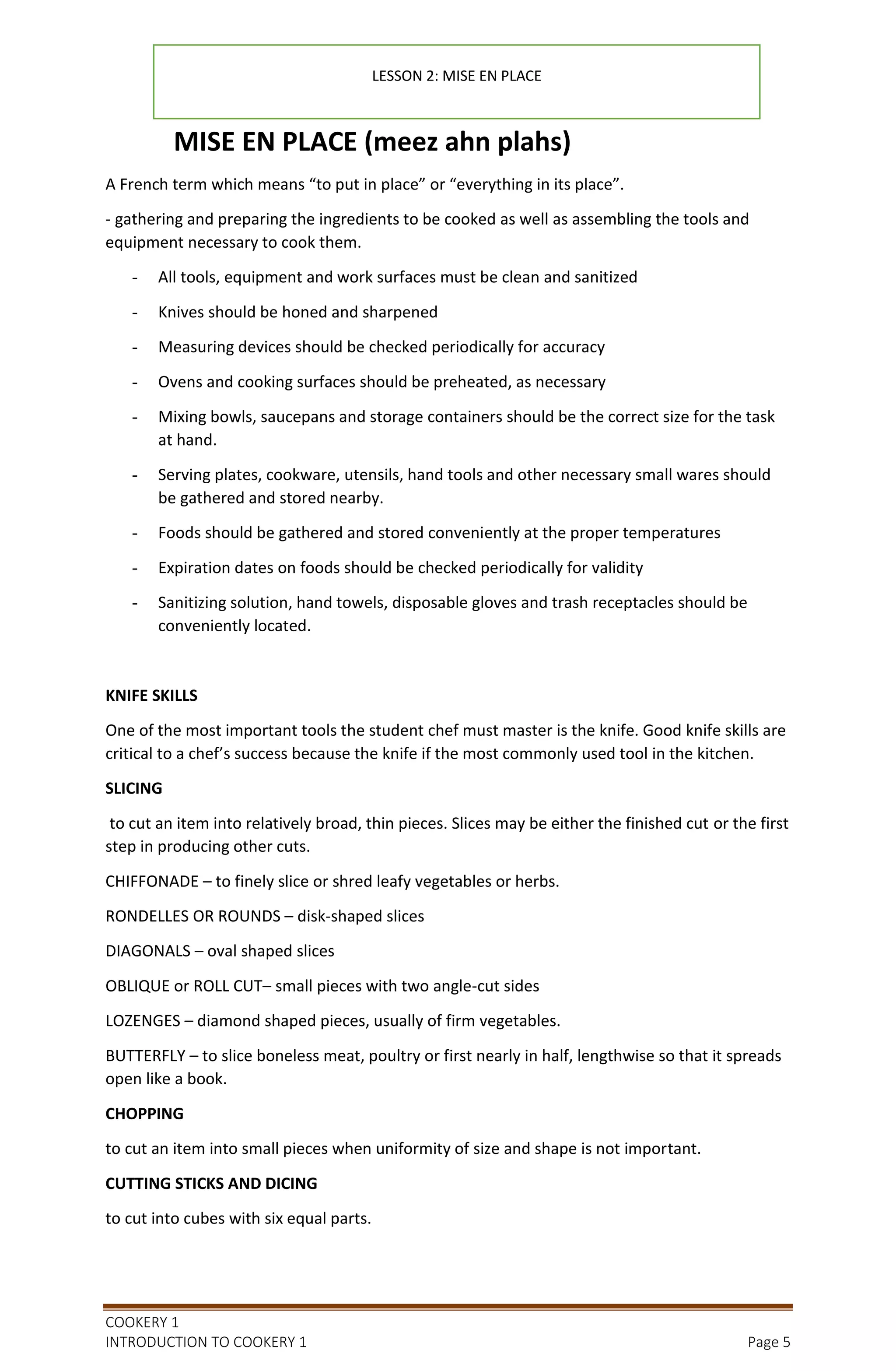
Garnish
- To enhance in appearance by adding decorative
touches; embellish.
- To decorate (prepared food or drink) with small
colorful or savory items.
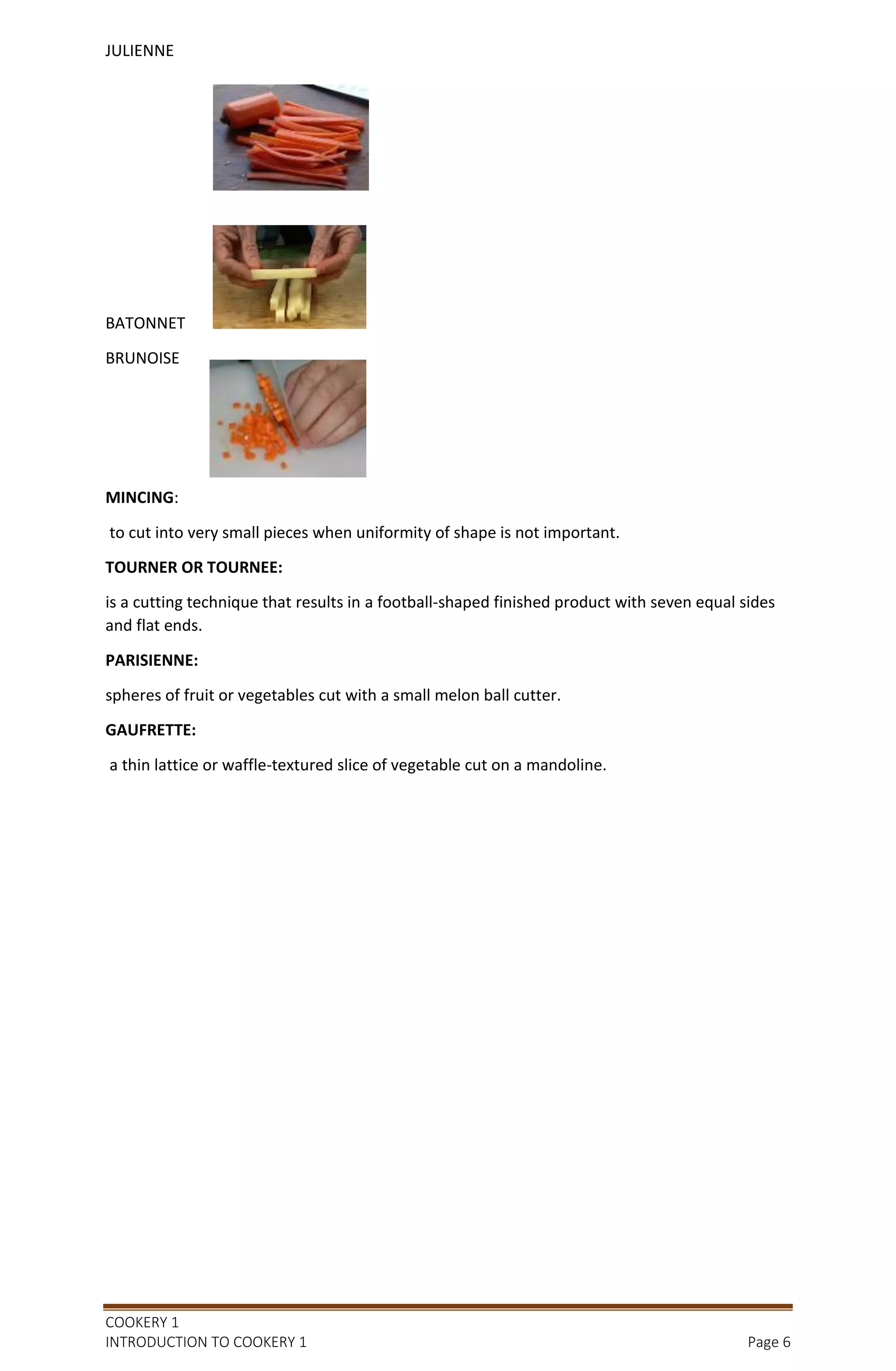
Things to consider in garnishing:
 NEVER decorate a plate with something inedible.
 Neatness and symmetry are important factors in overall effect.
 Ensure the garnish complements and enhances the dish without being overpowering.
 Choose garnishes that are the correct size; they should be easy to eat without having to
be moved to the side of the plate
THE 5 BASIC ELEMENTS OF PLATING
1. Create a Framework
Start with drawings and sketches to visualise the plate. Find inspiration from a picture or object.
Assemble a ‘practice’ plate to work on executing your vision.
2. Keep it Simple
Select one ingredient to focus on and use space to simplify the presentation. Clutter distracts from the
main elements of your dish and might confuse the diners on what to focus on.
3. Balance the Dish
Play with colours, shapes and textures to ensure diners are not overwhelmed. The presentation should
never overpower flavour and function.
LESSON 3: CREATIVE PRESENTATION TECHIQUES
COOKERY 1
INTRODUCTION TO COOKERY 1 Page 8
4. Get the right portion size
Ensure there is the right amount of ingredients and the plate complements the dish, not too big or too
small. Strike the right proportion of protein, carbohydrates and vegetables to create a nutritionally
balanced meal.
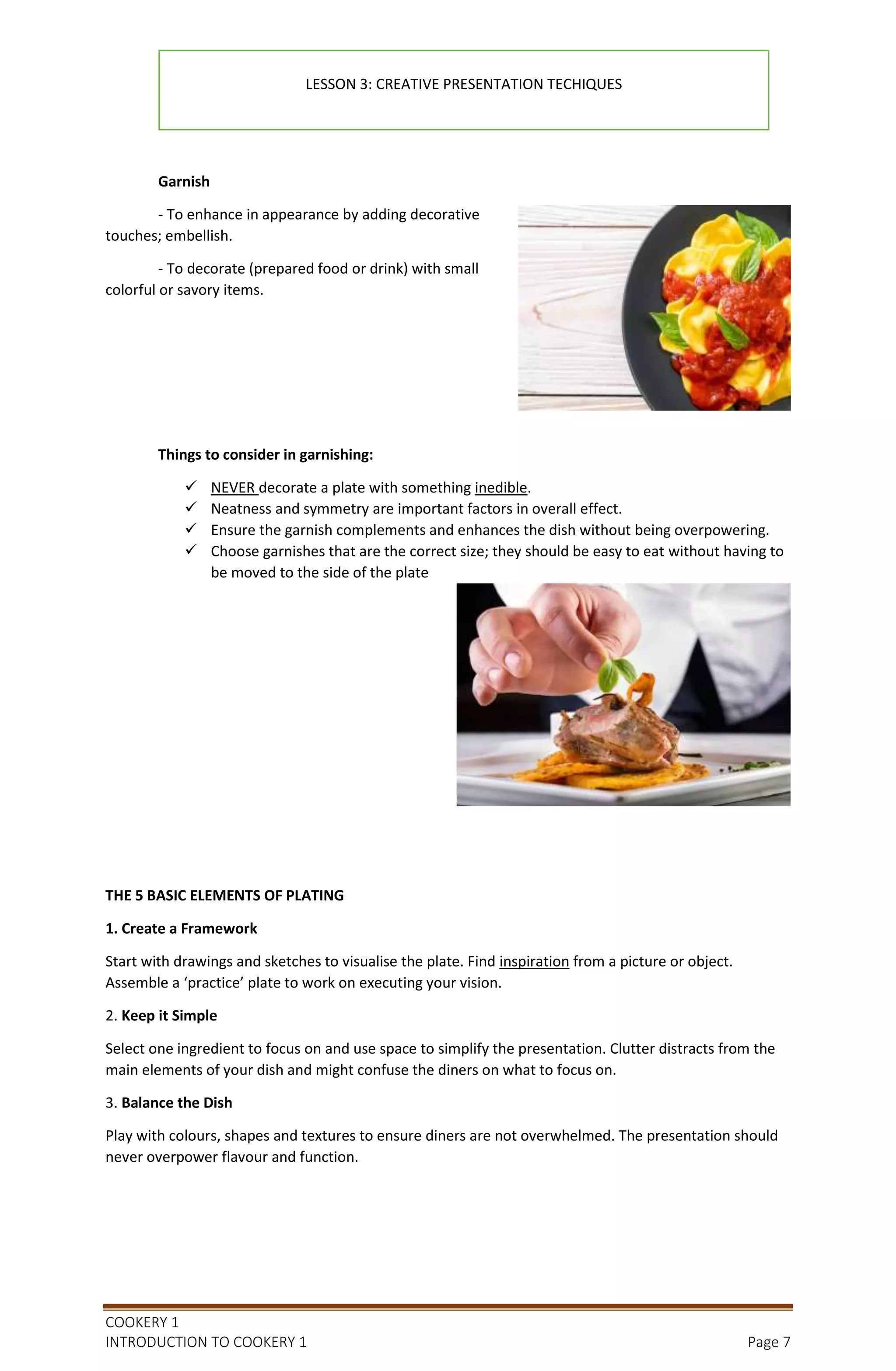
5. Highlight the key ingredient
Ensure the main ingredient stands out and pay equal attention to the ‘support’. This refers to the other
elements on the plate such as garnishes, sauces and even the plate itself.
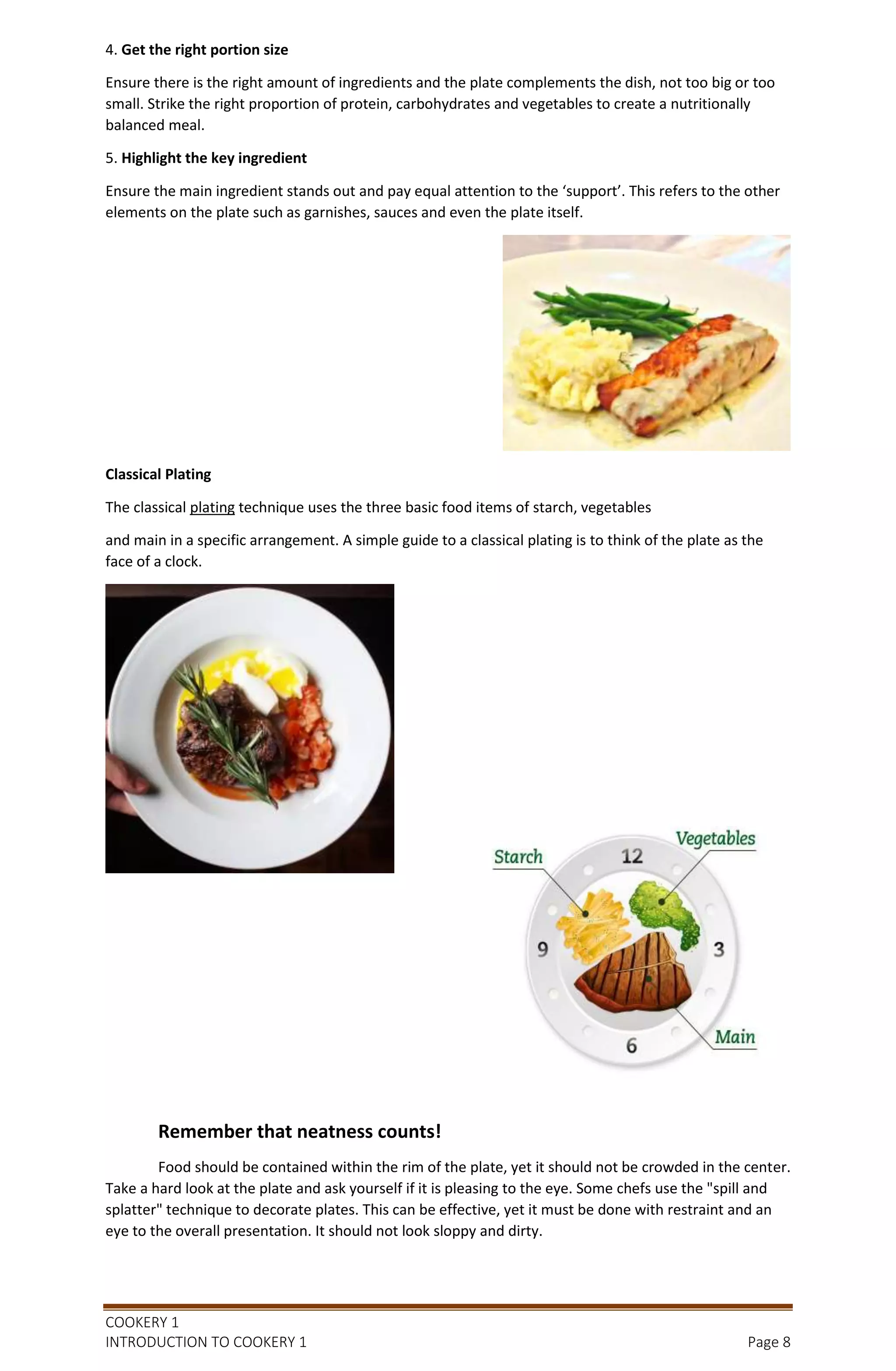
Classical Plating
The classical plating technique uses the three basic food items of starch, vegetables
and main in a specific arrangement. A simple guide to a classical plating is to think of the plate as the
face of a clock.
Remember that neatness counts!
Food should be contained within the rim of the plate, yet it should not be crowded in the center.
Take a hard look at the plate and ask yourself if it is pleasing to the eye. Some chefs use the "spill and
splatter" technique to decorate plates. This can be effective, yet it must be done with restraint and an
eye to the overall presentation. It should not look sloppy and dirty.
COOKERY 1
INTRODUCTION TO COOKERY 1 Page 9
The following are list of cooking materials, kitchen utensils and equipment that are
commonly found in the kitchen:
Cooking Materials
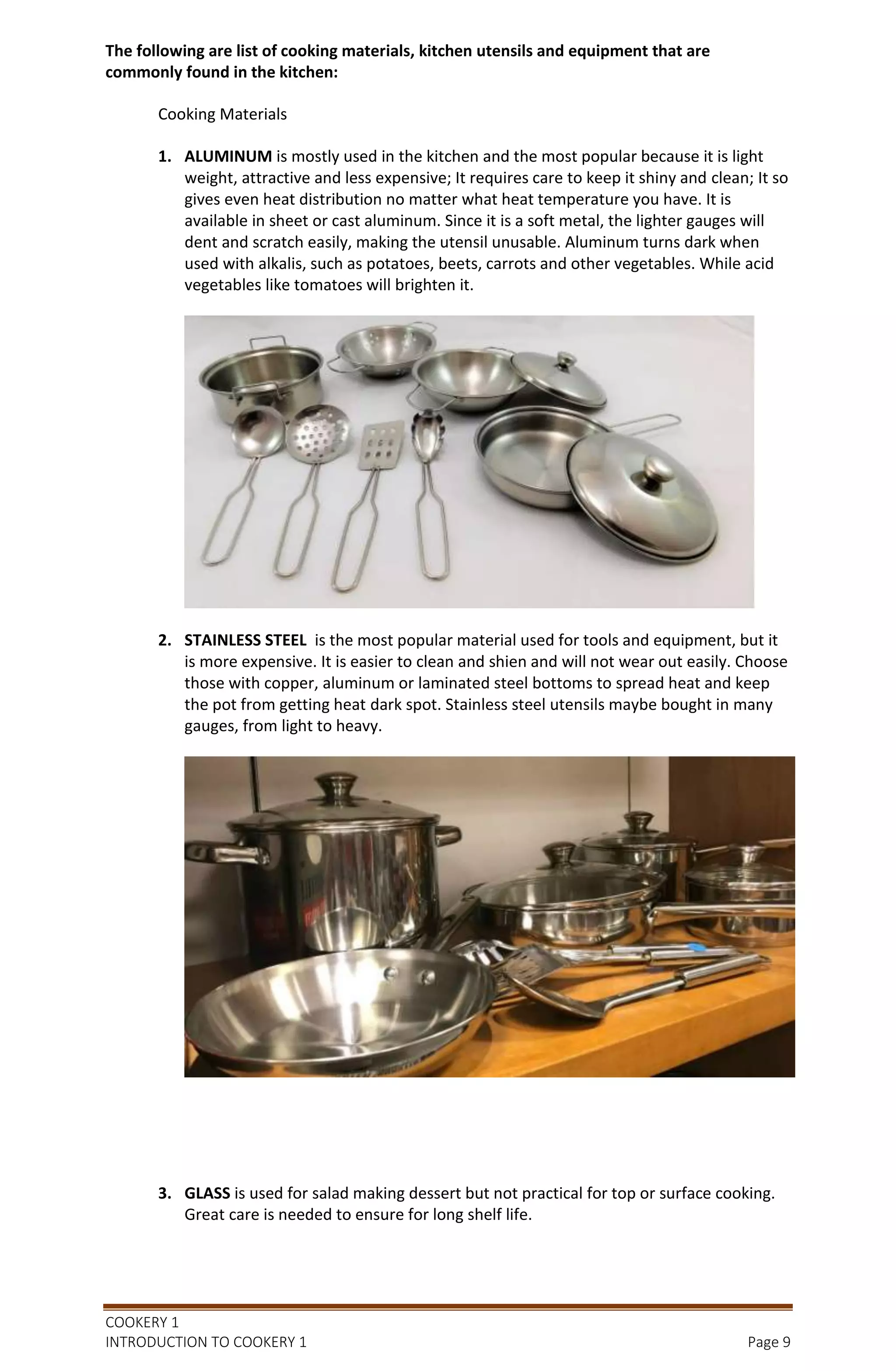
1. ALUMINUM is mostly used in the kitchen and the most popular because it is light
weight, attractive and less expensive; It requires care to keep it shiny and clean; It so
gives even heat distribution no matter what heat temperature you have. It is
available in sheet or cast aluminum. Since it is a soft metal, the lighter gauges will
dent and scratch easily, making the utensil unusable. Aluminum turns dark when
used with alkalis, such as potatoes, beets, carrots and other vegetables. While acid
vegetables like tomatoes will brighten it.
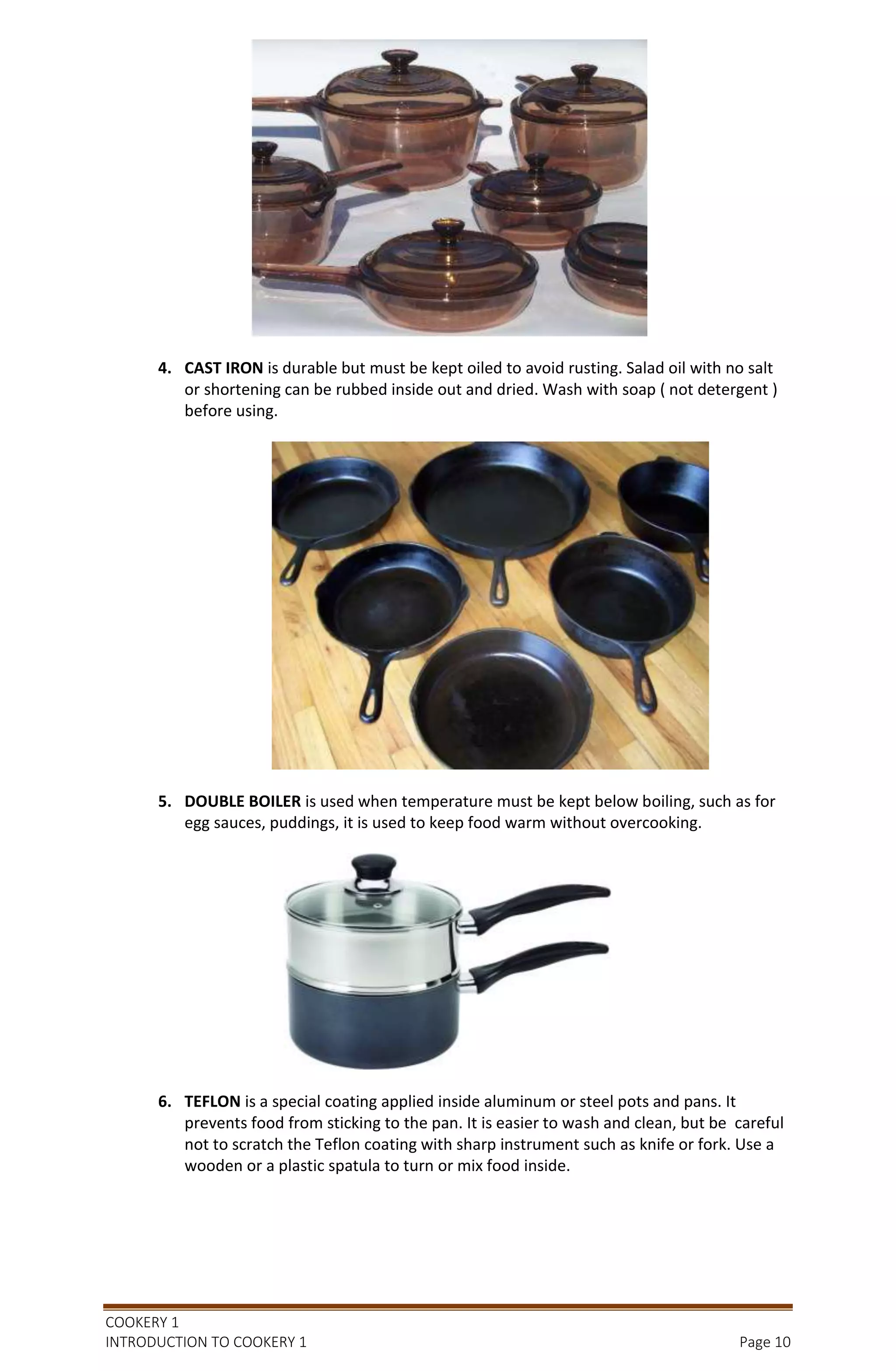
2. STAINLESS STEEL is the most popular material used for tools and equipment, but it
is more expensive. It is easier to clean and shien and will not wear out easily. Choose
those with copper, aluminum or laminated steel bottoms to spread heat and keep
the pot from getting heat dark spot. Stainless steel utensils maybe bought in many
gauges, from light to heavy.
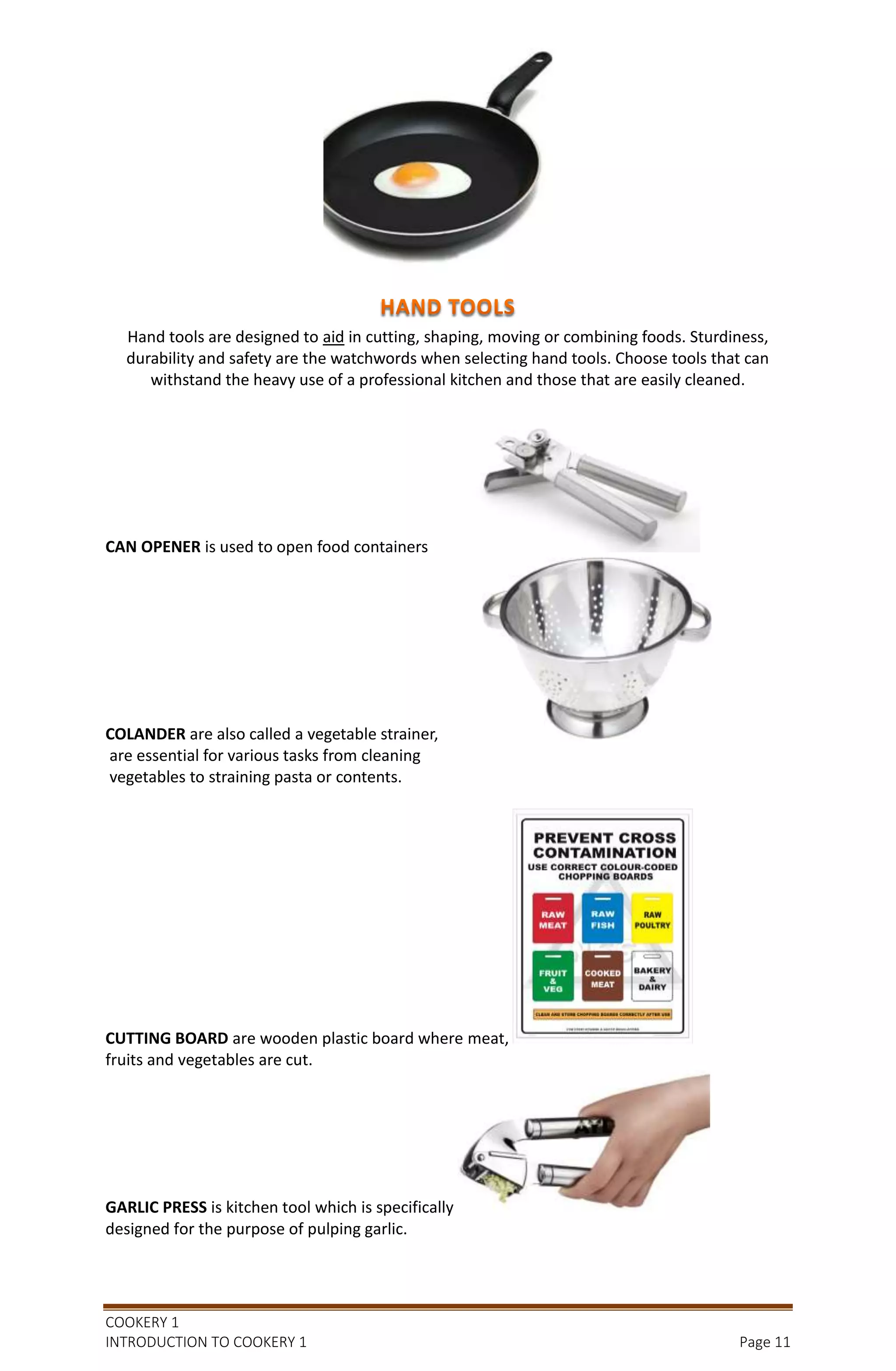
3. GLASS is used for salad making dessert but not practical for top or surface cooking.
Great care is needed to ensure for long shelf life.
COOKERY 1
INTRODUCTION TO COOKERY 1 Page 10
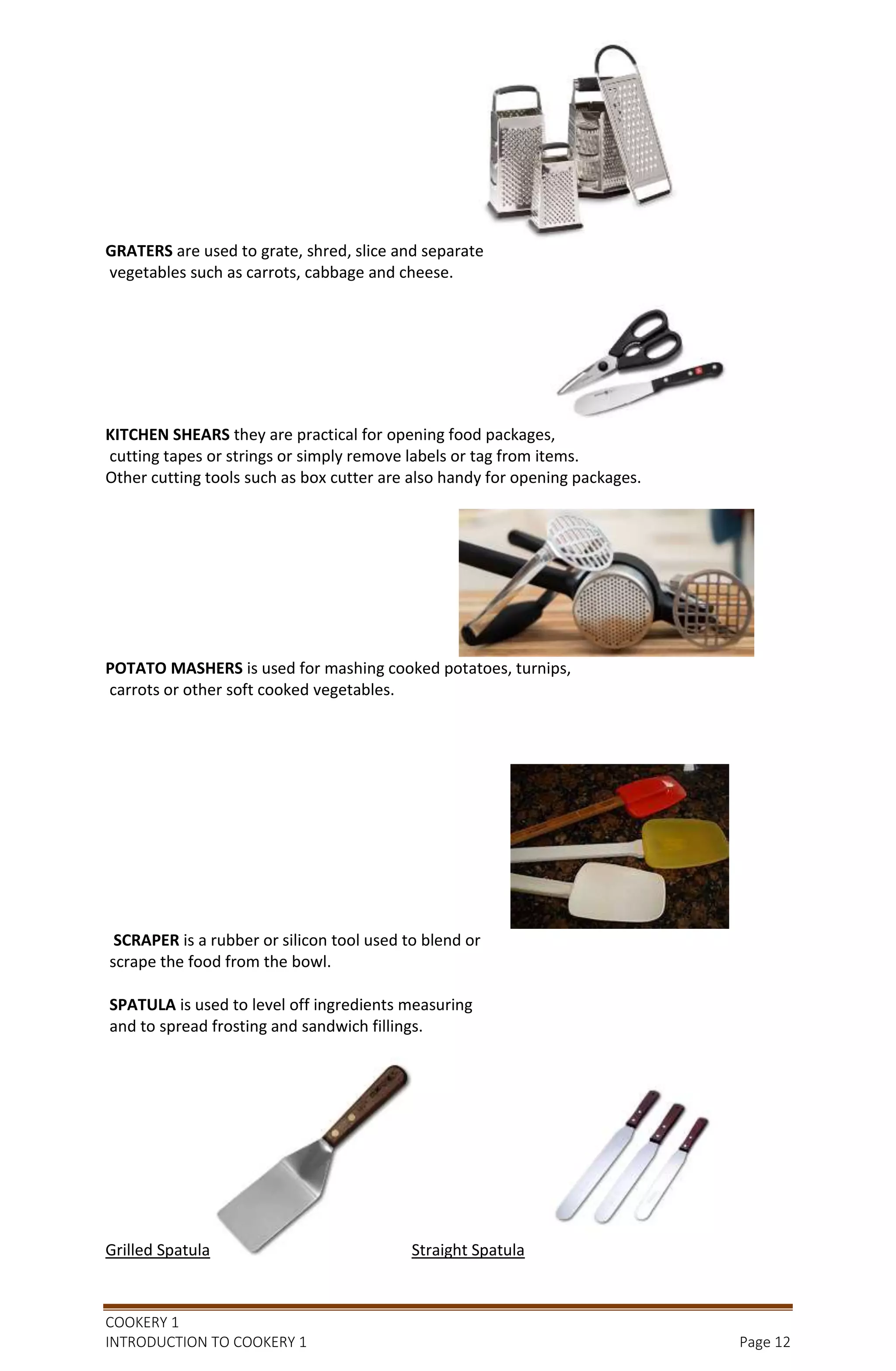
4. CAST IRON is durable but must be kept oiled to avoid rusting. Salad oil with no salt
or shortening can be rubbed inside out and dried. Wash with soap ( not detergent )
before using.
5. DOUBLE BOILER is used when temperature must be kept below boiling, such as for
egg sauces, puddings, it is used to keep food warm without overcooking.
6. TEFLON is a special coating applied inside aluminum or steel pots and pans. It
prevents food from sticking to the pan. It is easier to wash and clean, but be careful
not to scratch the Teflon coating with sharp instrument such as knife or fork. Use a
wooden or a plastic spatula to turn or mix food inside.
COOKERY 1
INTRODUCTION TO COOKERY 1 Page 11
Hand tools are designed to aid in cutting, shaping, moving or combining foods. Sturdiness,
durability and safety are the watchwords when selecting hand tools. Choose tools that can
withstand the heavy use of a professional kitchen and those that are easily cleaned.
CAN OPENER is used to open food containers
COLANDER are also called a vegetable strainer,
are essential for various tasks from cleaning
vegetables to straining pasta or contents.
CUTTING BOARD are wooden plastic board where meat,
fruits and vegetables are cut.
GARLIC PRESS is kitchen tool which is specifically
designed for the purpose of pulping garlic.
COOKERY 1
INTRODUCTION TO COOKERY 1 Page 12
GRATERS are used to grate, shred, slice and separate
vegetables such as carrots, cabbage and cheese.
KITCHEN SHEARS they are practical for opening food packages,
cutting tapes or strings or simply remove labels or tag from items.
Other cutting tools such as box cutter are also handy for opening packages.
POTATO MASHERS is used for mashing cooked potatoes, turnips,
carrots or other soft cooked vegetables.
SCRAPER is a rubber or silicon tool used to blend or
scrape the food from the bowl.
SPATULA is used to level off ingredients measuring
and to spread frosting and sandwich fillings.
Grilled Spatula Straight Spatula
COOKERY 1
INTRODUCTION TO COOKERY 1 Page 13
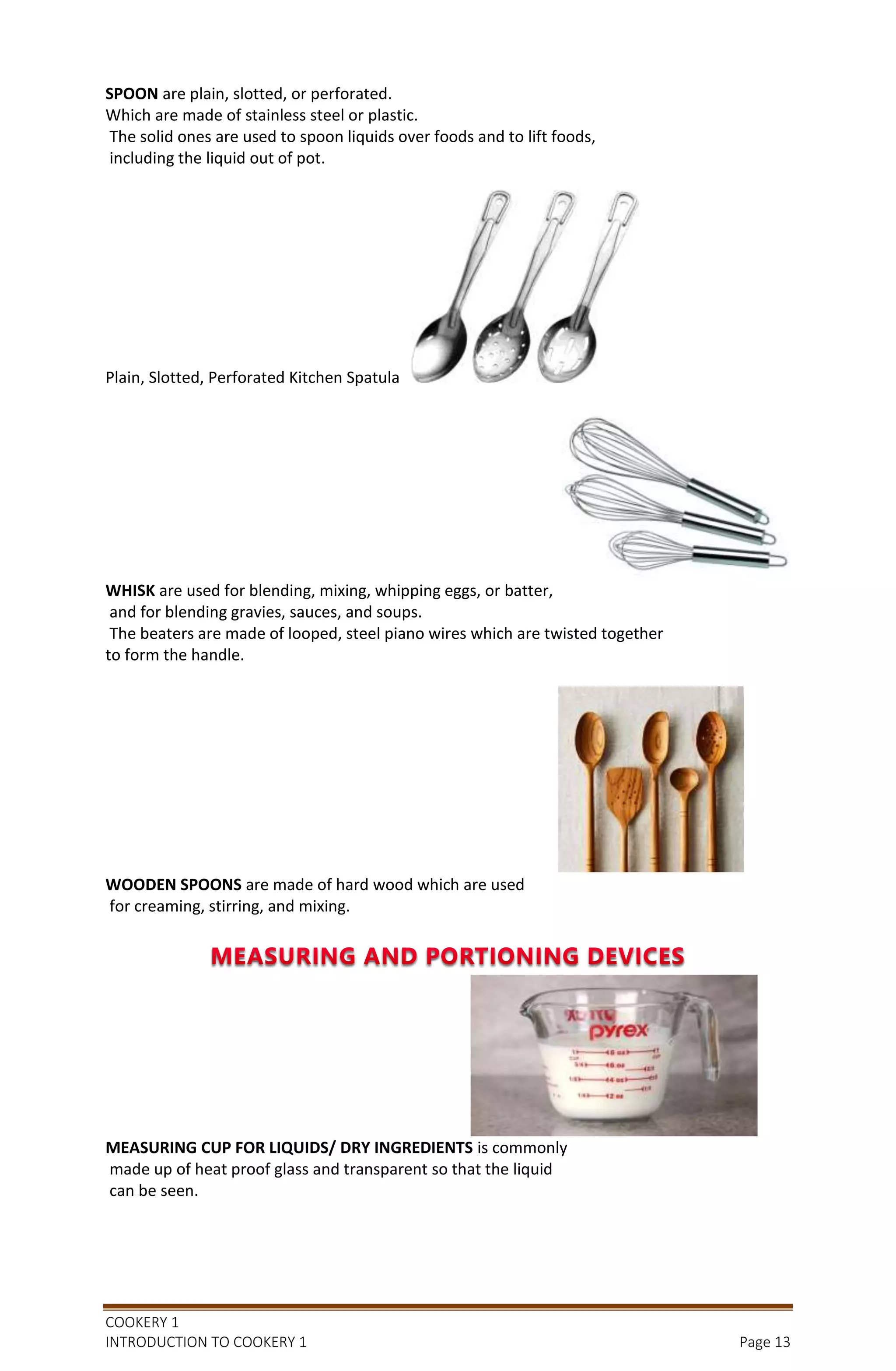
SPOON are plain, slotted, or perforated.
Which are made of stainless steel or plastic.
The solid ones are used to spoon liquids over foods and to lift foods,
including the liquid out of pot.
Plain, Slotted, Perforated Kitchen Spatula
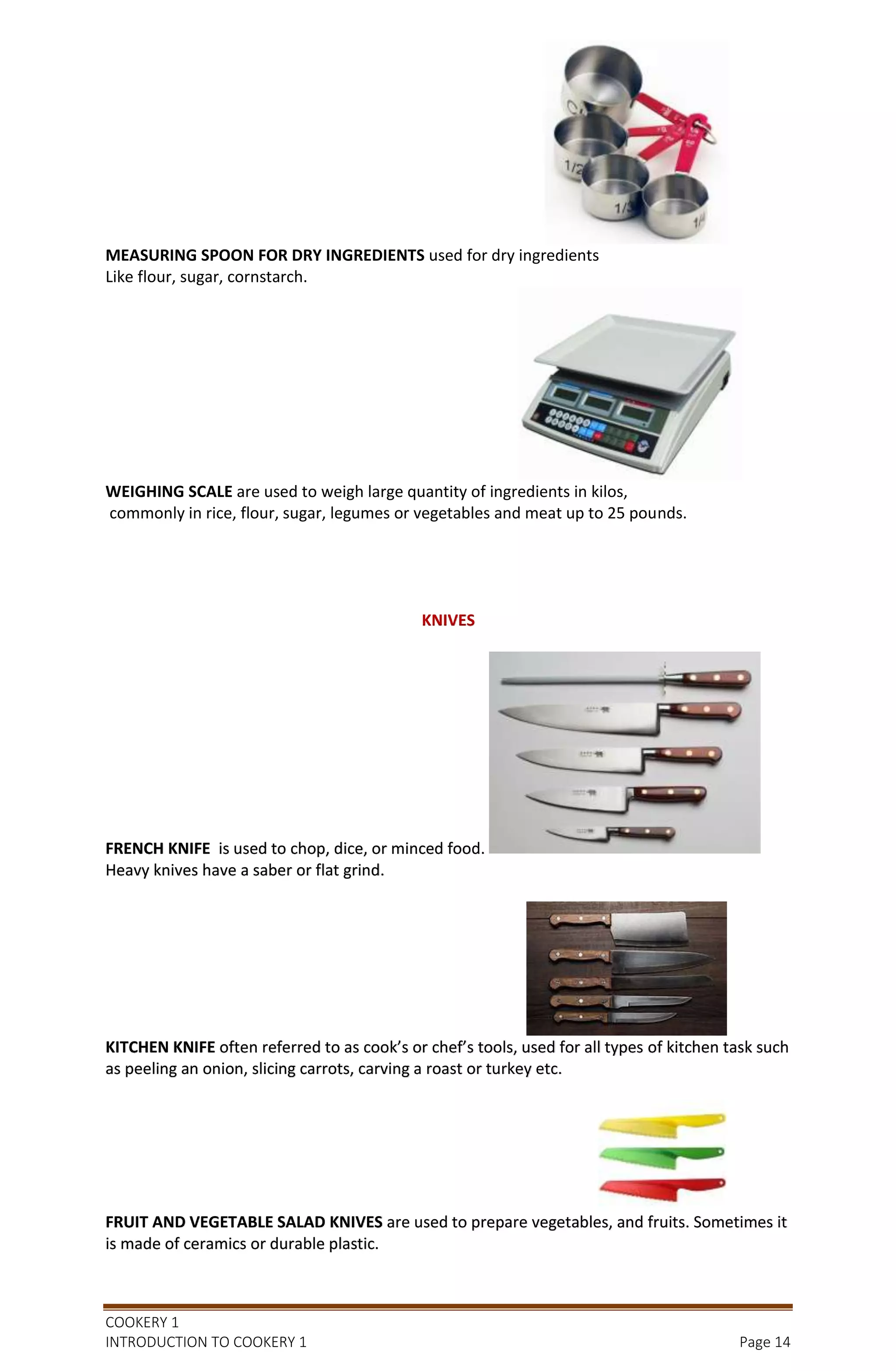
WHISK are used for blending, mixing, whipping eggs, or batter,
and for blending gravies, sauces, and soups.
The beaters are made of looped, steel piano wires which are twisted together
to form the handle.
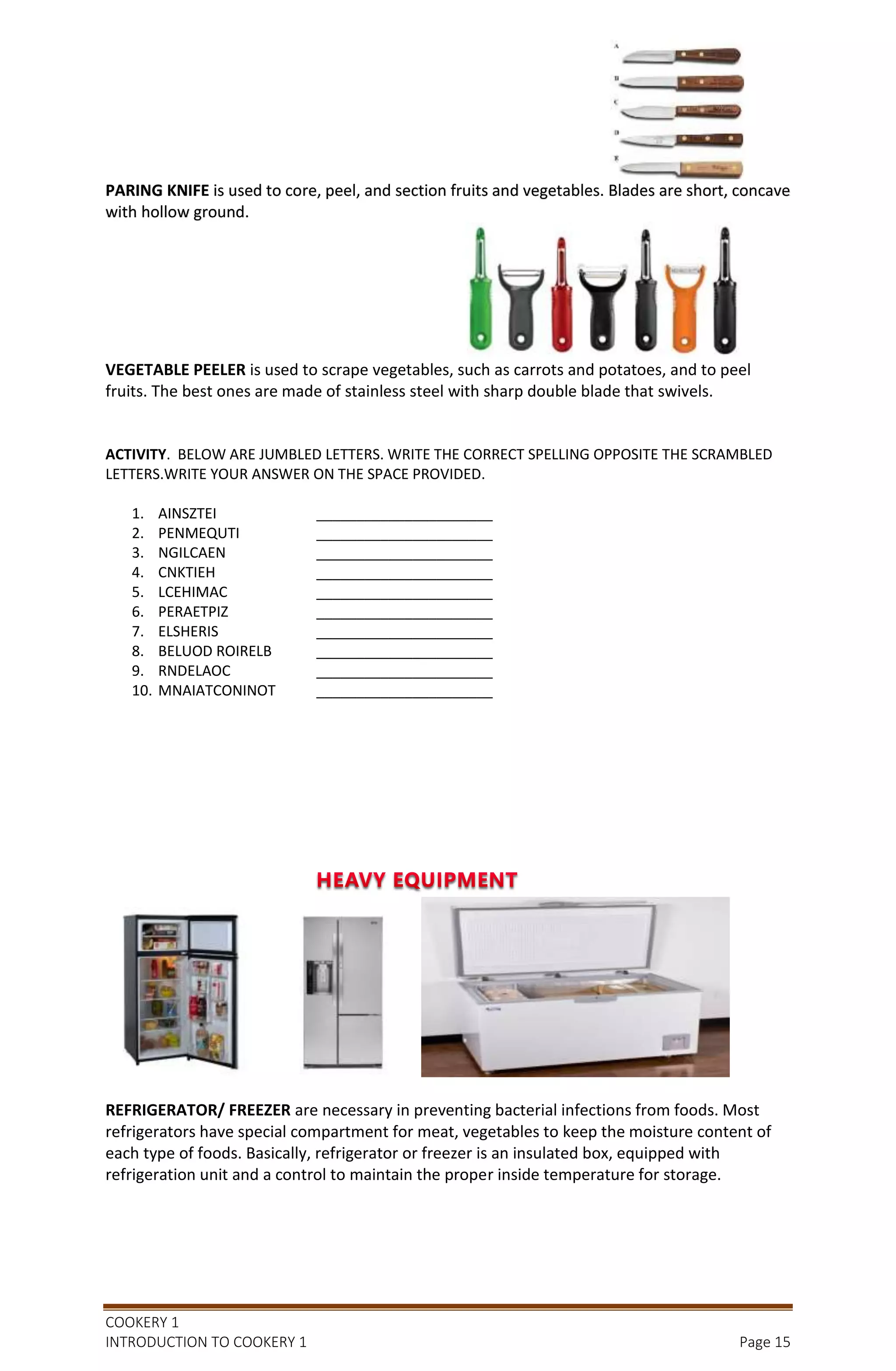
WOODEN SPOONS are made of hard wood which are used
for creaming, stirring, and mixing.
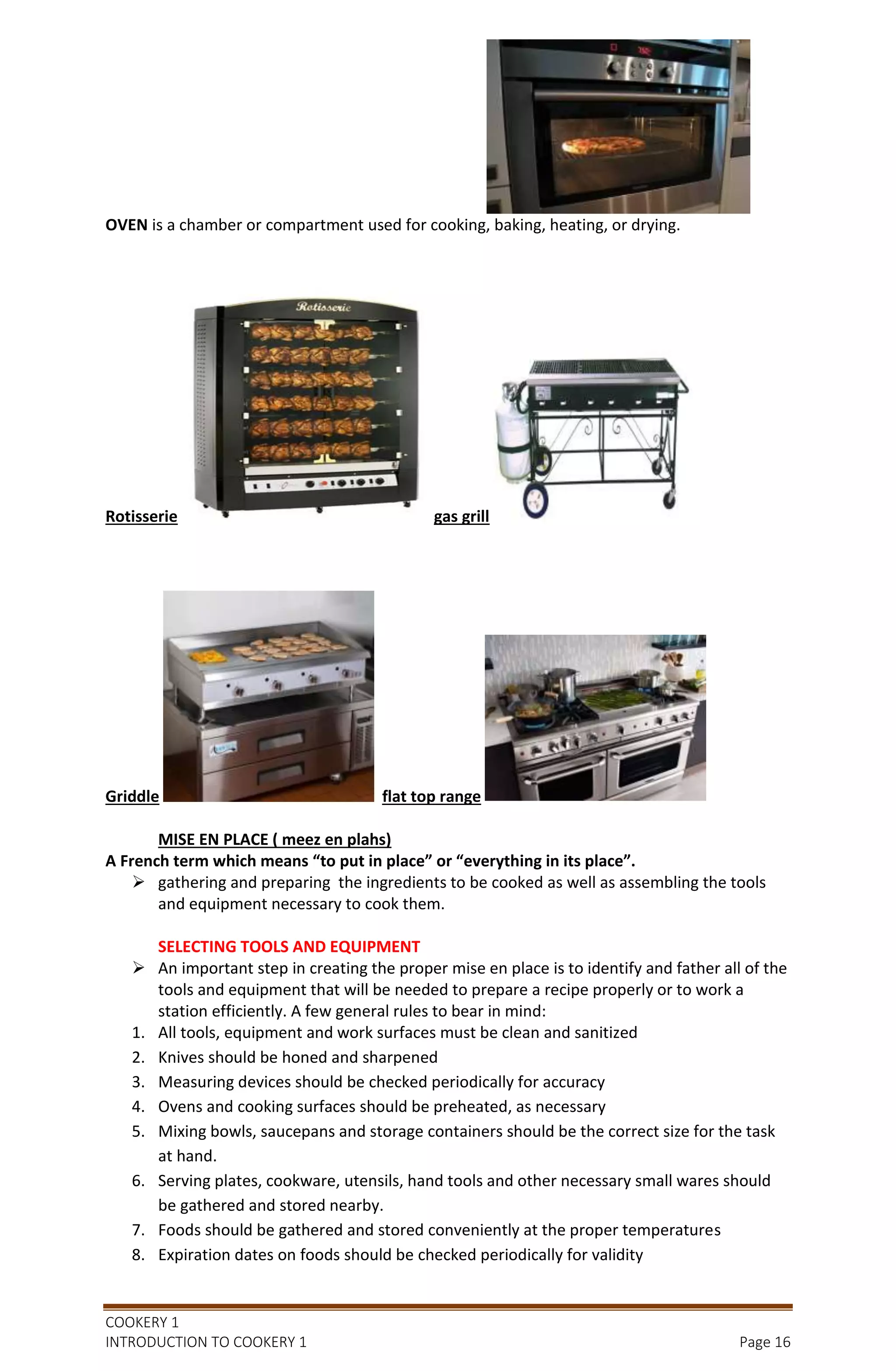
MEASURING CUP FOR LIQUIDS/ DRY INGREDIENTS is commonly
made up of heat proof glass and transparent so that the liquid
can be seen.
COOKERY 1
INTRODUCTION TO COOKERY 1 Page 14
MEASURING SPOON FOR DRY INGREDIENTS used for dry ingredients
Like flour, sugar, cornstarch.
WEIGHING SCALE are used to weigh large quantity of ingredients in kilos,
commonly in rice, flour, sugar, legumes or vegetables and meat up to 25 pounds.
KNIVES
FRENCH KNIFE is used to chop, dice, or minced food.
Heavy knives have a saber or flat grind.
KITCHEN KNIFE often referred to as cook’s or chef’s tools, used for all types of kitchen task such
as peeling an onion, slicing carrots, carving a roast or turkey etc.
FRUIT AND VEGETABLE SALAD KNIVES are used to prepare vegetables, and fruits. Sometimes it
is made of ceramics or durable plastic.
COOKERY 1
INTRODUCTION TO COOKERY 1 Page 15
PARING KNIFE is used to core, peel, and section fruits and vegetables. Blades are short, concave
with hollow ground.
VEGETABLE PEELER is used to scrape vegetables, such as carrots and potatoes, and to peel
fruits. The best ones are made of stainless steel with sharp double blade that swivels.
ACTIVITY. BELOW ARE JUMBLED LETTERS. WRITE THE CORRECT SPELLING OPPOSITE THE SCRAMBLED
LETTERS.WRITE YOUR ANSWER ON THE SPACE PROVIDED.
1. AINSZTEI ______________________
2. PENMEQUTI ______________________
3. NGILCAEN ______________________
4. CNKTIEH ______________________
5. LCEHIMAC ______________________
6. PERAETPIZ ______________________
7. ELSHERIS ______________________
8. BELUOD ROIRELB ______________________
9. RNDELAOC ______________________
10. MNAIATCONINOT ______________________
REFRIGERATOR/ FREEZER are necessary in preventing bacterial infections from foods. Most
refrigerators have special compartment for meat, vegetables to keep the moisture content of
each type of foods. Basically, refrigerator or freezer is an insulated box, equipped with
refrigeration unit and a control to maintain the proper inside temperature for storage.
COOKERY 1
INTRODUCTION TO COOKERY 1 Page 16
OVEN is a chamber or compartment used for cooking, baking, heating, or drying.
Rotisserie gas grill
Griddle flat top range
MISE EN PLACE ( meez en plahs)
A French term which means “to put in place” or “everything in its place”.
 gathering and preparing the ingredients to be cooked as well as assembling the tools
and equipment necessary to cook them.
SELECTING TOOLS AND EQUIPMENT
 An important step in creating the proper mise en place is to identify and father all of the
tools and equipment that will be needed to prepare a recipe properly or to work a
station efficiently. A few general rules to bear in mind:
1. All tools, equipment and work surfaces must be clean and sanitized
2. Knives should be honed and sharpened
3. Measuring devices should be checked periodically for accuracy
4. Ovens and cooking surfaces should be preheated, as necessary
5. Mixing bowls, saucepans and storage containers should be the correct size for the task
at hand.
6. Serving plates, cookware, utensils, hand tools and other necessary small wares should
be gathered and stored nearby.
7. Foods should be gathered and stored conveniently at the proper temperatures
8. Expiration dates on foods should be checked periodically for validity
COOKERY 1
INTRODUCTION TO COOKERY 1 Page 17
9. Sanitizing solution, hand towels, disposable gloves and trash receptacles should be
conveniently located.
PREPARING TO COOK
BREADING
- A breaded item is any food that is coated with bread crumbs, cracker meal, cornmeal or
other dry meal to protect in during cooking.
- Breaded foods can be seasoned before the breading is applied, or seasonings maybe
added to the flour, bread crumbs or meal before the main item is coated.
PROCEDURE IN STANDARD BREADING:
 Pat the food dry and dredge it in seasoned flour.
 Dip the floured food in egg wash (1 egg + 1 tablespoon milk or water)
 Coat the food with bread crumbs, cracker crumbs or other dry meal. Shake off
excess crumbs and place the breaded item in a pan.
 To ensure that breading adheres after cooking, refrigerate breaded foods for at
least 30 minutes before frying.
BATTERING
- like breading, coat the food being cooked, keeping it moist and preventing it
from becoming excessively greasy. Batters consists of liquid such as water,
milk or beer, combined with a starch such as flour or cornstarch.
PROCEDURE IN STANDARD BATTERING:
 Prepare the batter
 Pat the food dry and dredge in flour if desired.
 Dip the item in the batter and place it directly in the hot fat.
COOKERY 1
INTRODUCTION TO COOKERY 1 Page 18
BLANCHING
 very briefly and partially cooking a food in boiling water or hot fat.
APPLYING VARIOUS COOKING METHOD
DRY HEAT COOKING METHOD
- Is a cooking method principally BROILING, GRILLING, ROASTING and BAKING,
SAUTEING, PAN-FRYING and DEEP-FRYING, that use air or fat to transfer heat
through conduction and convection; dry heat cooking methods allow surface
sugars to caramelize.
MOIST HEAT COOKING METHOD
- Is a cooking method principally SIMMERING, POACHING, BOILING AND
STEAMING that use water or steam to transfer heat through convection; moist
heat cooking method are used to emphasize the natural flavors of foods.
COMBINATION COOKING METHOD
- Is a cooking method principally BRAISING and STEWING , that employ both dry-
heat and moist-heat procedures.
DRY HEAT COOKING
METHOD
MOIST HEAT COOKING
METHOD
COMBINATION COOKING
METHOD
Broiling and Grilling Simmering Braising
Roasting Poaching Stewing
Sauteing Boiling
Pan and Deep Frying Steaming
ACTIVITY. Search and watch videos of different cooking methods. Then make a
short comparison between different cooking methods write in a sheet of paper
to be discuss online.

MODULE #1 INTRODUCTION IN COOKERY 1.docx

  • 1.
    COOKERY 1 INTRODUCTION TOCOOKERY 1 Page 1 COOKERY 1 MODULE 1: INTRODUCTION IN COOKERY 1 (WEEK 1) LESSON 1 TO 3: CAREER OPPORTUNITY, MISE EN PLACE Prepared by: CRYSTAL B. QUIÑANO Early Christian College OF ARTS AND TECHNOLOGY INC. SHS DEPARTMENT | SY 2022-2023
  • 2.
    COOKERY 1 INTRODUCTION TOCOOKERY 1 Page 2 Food service operations are generally led by an EXECUTIVE CHEF, who coordinates kitchen activities and directs the kitchen staff’s training and work efforts. The executive chef PLANS menus and CREATES recipes, ensure that quality standards are rigorously and consistently maintained. EXECUTIVE CHEF – oversees all the kitchen operation whether restaurant or hotels. - A few of the main duties of an executive chef are monitoring the quality of the food, following all food safety regulations, creating new food entrees, and coordinating the entire kitchen. They also have to hire and train new kitchen staff. Some of the jobs titles that an executive chef could grow into are head chef and restaurant manager. - An executive chef should have five years of experience in the culinary field as well as a bachelor's degree in the culinary arts. One of the most important skills that an executive chef will have is the ability to manage a kitchen. Another skill is creativity as the executive chef will need to be able to create dishes that wow customers. FAMOUS INTERNATIONAL CHEFS -Gordon Ramsay has opened a string of successful restaurants across the globe, from Italy to the United States and holds seven Michelin stars. Gordon has also become a star of the small screen both in the UK and internationally, with UK shows such as GORDON BEHIND BARS, ULTIMATE COOKERY COURSE, GORDON’S GREAT ESCAPES and GORDON RAMSAY: SHARK BAIT as well as four top-rated FOX shows that air in more than 200 countries worldwide: KITCHEN NIGHTMARES, HELL’S KITCHEN, MASTERCHEF US and HOTEL HELL. -James Trevor Oliver MBE OSI is a British chef, restaurateur, and cookbook author. He is known for his casual approach to cuisine, which has led him to front numerous television shows and open many restaurants. Oliver reached the public eye when his series The Naked Chef premiered in 1999. LESSON 1: CAREER OPPORTUNITIES IN COOKERY 1
  • 3.
    COOKERY 1 INTRODUCTION TOCOOKERY 1 Page 3 FAMOUS CHEFS IN THE PHILIPPINES Heny Sison, popularly known as Chef Heny, is a pastry chef, cake decorator, and television host in the Philippines. Pablo Logro, also known as Boy Logro or Chef Boy, is a Filipino celebrity chef known for his cooking shows, Idol sa Kusina and Chef Boy Logro: Kusina Master. The executive chef is assisted by a SOUS-CHEF or executive sous-chef, whose primary responsibility is to make sure that the food is prepared, portioned, garnished and presented according to the executive chef’s standards. SOUS CHEF – Second in command inside the kitchen What is an AREA CHEF? Area Chef - each responsible for a specific facility or function. There could be, for instance, an area chef responsible for each of the hotel’s restaurants as well as a banquet chef. Each area chef, in turn, has a brigade working under him or her. What is a BRIGADE? To function efficiently, a food service operation must be well organized and staffed with appropriate personnel. This is traditionally called a BRIGADE. Line cooks (or section cooks) are responsible for preparing menu items according to recipe specifications. They may be assigned to a specific area, such as the broiler cook, fry cook or pantry station. Prep cooks, assistants and apprentices are employed as entry-level workers throughout modern kitchens. They are the ones who prepare the equipment and ingredients.
  • 4.
    COOKERY 1 INTRODUCTION TOCOOKERY 1 Page 4 THE PROFESSIONAL CHEF’S CHARACTERISTICS Although there is no one recipe for producing a good professional chef, we believe that with knowledge, skill, taste, judgement, dedication and pride a student chef will mature into a professional chef. Knowledge Chefs must be able to identify, purchase, utilize and prepare a wide variety of foods. They should be able to train and supervise a safe, skilled and efficient staff. SKILL Culinary schooling alone does not make a student a chef. Nothing but practical, hands- on experience will provide even the most academically gifted student with the skills needed to produce, consistently and efficiently, quality feeds or to organize, train, motivate and supervise a staff. TASTE No matter how knowledgeable or skilled the chef, he or she must be able to produce foods that taste great, or the consumer will not return. A chef can do so only if he or she is confident about his or her own sense of taste. JUDGEMENT Selecting menu items, determining how much of what item to order, deciding whether and how to combine ingredients and approving finished items for service are all matters of judgment. DEDICATION Becoming a chef is hard work; so is being one. The work is often physically taxing, the hours are usually long and the pace is frequently hectic. Despite these pressures, the chef is expected to efficiently produce consistently fine foods that are properly prepared, seasoned, garnished and presented.
  • 5.
    COOKERY 1 INTRODUCTION TOCOOKERY 1 Page 5 MISE EN PLACE (meez ahn plahs) A French term which means “to put in place” or “everything in its place”. - gathering and preparing the ingredients to be cooked as well as assembling the tools and equipment necessary to cook them. - All tools, equipment and work surfaces must be clean and sanitized - Knives should be honed and sharpened - Measuring devices should be checked periodically for accuracy - Ovens and cooking surfaces should be preheated, as necessary - Mixing bowls, saucepans and storage containers should be the correct size for the task at hand. - Serving plates, cookware, utensils, hand tools and other necessary small wares should be gathered and stored nearby. - Foods should be gathered and stored conveniently at the proper temperatures - Expiration dates on foods should be checked periodically for validity - Sanitizing solution, hand towels, disposable gloves and trash receptacles should be conveniently located. KNIFE SKILLS One of the most important tools the student chef must master is the knife. Good knife skills are critical to a chef’s success because the knife if the most commonly used tool in the kitchen. SLICING to cut an item into relatively broad, thin pieces. Slices may be either the finished cut or the first step in producing other cuts. CHIFFONADE – to finely slice or shred leafy vegetables or herbs. RONDELLES OR ROUNDS – disk-shaped slices DIAGONALS – oval shaped slices OBLIQUE or ROLL CUT– small pieces with two angle-cut sides LOZENGES – diamond shaped pieces, usually of firm vegetables. BUTTERFLY – to slice boneless meat, poultry or first nearly in half, lengthwise so that it spreads open like a book. CHOPPING to cut an item into small pieces when uniformity of size and shape is not important. CUTTING STICKS AND DICING to cut into cubes with six equal parts. LESSON 2: MISE EN PLACE
  • 6.
    COOKERY 1 INTRODUCTION TOCOOKERY 1 Page 6 JULIENNE BATONNET BRUNOISE MINCING: to cut into very small pieces when uniformity of shape is not important. TOURNER OR TOURNEE: is a cutting technique that results in a football-shaped finished product with seven equal sides and flat ends. PARISIENNE: spheres of fruit or vegetables cut with a small melon ball cutter. GAUFRETTE: a thin lattice or waffle-textured slice of vegetable cut on a mandoline.
  • 7.
    COOKERY 1 INTRODUCTION TOCOOKERY 1 Page 7 Garnish - To enhance in appearance by adding decorative touches; embellish. - To decorate (prepared food or drink) with small colorful or savory items. Things to consider in garnishing:  NEVER decorate a plate with something inedible.  Neatness and symmetry are important factors in overall effect.  Ensure the garnish complements and enhances the dish without being overpowering.  Choose garnishes that are the correct size; they should be easy to eat without having to be moved to the side of the plate THE 5 BASIC ELEMENTS OF PLATING 1. Create a Framework Start with drawings and sketches to visualise the plate. Find inspiration from a picture or object. Assemble a ‘practice’ plate to work on executing your vision. 2. Keep it Simple Select one ingredient to focus on and use space to simplify the presentation. Clutter distracts from the main elements of your dish and might confuse the diners on what to focus on. 3. Balance the Dish Play with colours, shapes and textures to ensure diners are not overwhelmed. The presentation should never overpower flavour and function. LESSON 3: CREATIVE PRESENTATION TECHIQUES
  • 8.
    COOKERY 1 INTRODUCTION TOCOOKERY 1 Page 8 4. Get the right portion size Ensure there is the right amount of ingredients and the plate complements the dish, not too big or too small. Strike the right proportion of protein, carbohydrates and vegetables to create a nutritionally balanced meal. 5. Highlight the key ingredient Ensure the main ingredient stands out and pay equal attention to the ‘support’. This refers to the other elements on the plate such as garnishes, sauces and even the plate itself. Classical Plating The classical plating technique uses the three basic food items of starch, vegetables and main in a specific arrangement. A simple guide to a classical plating is to think of the plate as the face of a clock. Remember that neatness counts! Food should be contained within the rim of the plate, yet it should not be crowded in the center. Take a hard look at the plate and ask yourself if it is pleasing to the eye. Some chefs use the "spill and splatter" technique to decorate plates. This can be effective, yet it must be done with restraint and an eye to the overall presentation. It should not look sloppy and dirty.
  • 9.
    COOKERY 1 INTRODUCTION TOCOOKERY 1 Page 9 The following are list of cooking materials, kitchen utensils and equipment that are commonly found in the kitchen: Cooking Materials 1. ALUMINUM is mostly used in the kitchen and the most popular because it is light weight, attractive and less expensive; It requires care to keep it shiny and clean; It so gives even heat distribution no matter what heat temperature you have. It is available in sheet or cast aluminum. Since it is a soft metal, the lighter gauges will dent and scratch easily, making the utensil unusable. Aluminum turns dark when used with alkalis, such as potatoes, beets, carrots and other vegetables. While acid vegetables like tomatoes will brighten it. 2. STAINLESS STEEL is the most popular material used for tools and equipment, but it is more expensive. It is easier to clean and shien and will not wear out easily. Choose those with copper, aluminum or laminated steel bottoms to spread heat and keep the pot from getting heat dark spot. Stainless steel utensils maybe bought in many gauges, from light to heavy. 3. GLASS is used for salad making dessert but not practical for top or surface cooking. Great care is needed to ensure for long shelf life.
  • 10.
    COOKERY 1 INTRODUCTION TOCOOKERY 1 Page 10 4. CAST IRON is durable but must be kept oiled to avoid rusting. Salad oil with no salt or shortening can be rubbed inside out and dried. Wash with soap ( not detergent ) before using. 5. DOUBLE BOILER is used when temperature must be kept below boiling, such as for egg sauces, puddings, it is used to keep food warm without overcooking. 6. TEFLON is a special coating applied inside aluminum or steel pots and pans. It prevents food from sticking to the pan. It is easier to wash and clean, but be careful not to scratch the Teflon coating with sharp instrument such as knife or fork. Use a wooden or a plastic spatula to turn or mix food inside.
  • 11.
    COOKERY 1 INTRODUCTION TOCOOKERY 1 Page 11 Hand tools are designed to aid in cutting, shaping, moving or combining foods. Sturdiness, durability and safety are the watchwords when selecting hand tools. Choose tools that can withstand the heavy use of a professional kitchen and those that are easily cleaned. CAN OPENER is used to open food containers COLANDER are also called a vegetable strainer, are essential for various tasks from cleaning vegetables to straining pasta or contents. CUTTING BOARD are wooden plastic board where meat, fruits and vegetables are cut. GARLIC PRESS is kitchen tool which is specifically designed for the purpose of pulping garlic.
  • 12.
    COOKERY 1 INTRODUCTION TOCOOKERY 1 Page 12 GRATERS are used to grate, shred, slice and separate vegetables such as carrots, cabbage and cheese. KITCHEN SHEARS they are practical for opening food packages, cutting tapes or strings or simply remove labels or tag from items. Other cutting tools such as box cutter are also handy for opening packages. POTATO MASHERS is used for mashing cooked potatoes, turnips, carrots or other soft cooked vegetables. SCRAPER is a rubber or silicon tool used to blend or scrape the food from the bowl. SPATULA is used to level off ingredients measuring and to spread frosting and sandwich fillings. Grilled Spatula Straight Spatula
  • 13.
    COOKERY 1 INTRODUCTION TOCOOKERY 1 Page 13 SPOON are plain, slotted, or perforated. Which are made of stainless steel or plastic. The solid ones are used to spoon liquids over foods and to lift foods, including the liquid out of pot. Plain, Slotted, Perforated Kitchen Spatula WHISK are used for blending, mixing, whipping eggs, or batter, and for blending gravies, sauces, and soups. The beaters are made of looped, steel piano wires which are twisted together to form the handle. WOODEN SPOONS are made of hard wood which are used for creaming, stirring, and mixing. MEASURING CUP FOR LIQUIDS/ DRY INGREDIENTS is commonly made up of heat proof glass and transparent so that the liquid can be seen.
  • 14.
    COOKERY 1 INTRODUCTION TOCOOKERY 1 Page 14 MEASURING SPOON FOR DRY INGREDIENTS used for dry ingredients Like flour, sugar, cornstarch. WEIGHING SCALE are used to weigh large quantity of ingredients in kilos, commonly in rice, flour, sugar, legumes or vegetables and meat up to 25 pounds. KNIVES FRENCH KNIFE is used to chop, dice, or minced food. Heavy knives have a saber or flat grind. KITCHEN KNIFE often referred to as cook’s or chef’s tools, used for all types of kitchen task such as peeling an onion, slicing carrots, carving a roast or turkey etc. FRUIT AND VEGETABLE SALAD KNIVES are used to prepare vegetables, and fruits. Sometimes it is made of ceramics or durable plastic.
  • 15.
    COOKERY 1 INTRODUCTION TOCOOKERY 1 Page 15 PARING KNIFE is used to core, peel, and section fruits and vegetables. Blades are short, concave with hollow ground. VEGETABLE PEELER is used to scrape vegetables, such as carrots and potatoes, and to peel fruits. The best ones are made of stainless steel with sharp double blade that swivels. ACTIVITY. BELOW ARE JUMBLED LETTERS. WRITE THE CORRECT SPELLING OPPOSITE THE SCRAMBLED LETTERS.WRITE YOUR ANSWER ON THE SPACE PROVIDED. 1. AINSZTEI ______________________ 2. PENMEQUTI ______________________ 3. NGILCAEN ______________________ 4. CNKTIEH ______________________ 5. LCEHIMAC ______________________ 6. PERAETPIZ ______________________ 7. ELSHERIS ______________________ 8. BELUOD ROIRELB ______________________ 9. RNDELAOC ______________________ 10. MNAIATCONINOT ______________________ REFRIGERATOR/ FREEZER are necessary in preventing bacterial infections from foods. Most refrigerators have special compartment for meat, vegetables to keep the moisture content of each type of foods. Basically, refrigerator or freezer is an insulated box, equipped with refrigeration unit and a control to maintain the proper inside temperature for storage.
  • 16.
    COOKERY 1 INTRODUCTION TOCOOKERY 1 Page 16 OVEN is a chamber or compartment used for cooking, baking, heating, or drying. Rotisserie gas grill Griddle flat top range MISE EN PLACE ( meez en plahs) A French term which means “to put in place” or “everything in its place”.  gathering and preparing the ingredients to be cooked as well as assembling the tools and equipment necessary to cook them. SELECTING TOOLS AND EQUIPMENT  An important step in creating the proper mise en place is to identify and father all of the tools and equipment that will be needed to prepare a recipe properly or to work a station efficiently. A few general rules to bear in mind: 1. All tools, equipment and work surfaces must be clean and sanitized 2. Knives should be honed and sharpened 3. Measuring devices should be checked periodically for accuracy 4. Ovens and cooking surfaces should be preheated, as necessary 5. Mixing bowls, saucepans and storage containers should be the correct size for the task at hand. 6. Serving plates, cookware, utensils, hand tools and other necessary small wares should be gathered and stored nearby. 7. Foods should be gathered and stored conveniently at the proper temperatures 8. Expiration dates on foods should be checked periodically for validity
  • 17.
    COOKERY 1 INTRODUCTION TOCOOKERY 1 Page 17 9. Sanitizing solution, hand towels, disposable gloves and trash receptacles should be conveniently located. PREPARING TO COOK BREADING - A breaded item is any food that is coated with bread crumbs, cracker meal, cornmeal or other dry meal to protect in during cooking. - Breaded foods can be seasoned before the breading is applied, or seasonings maybe added to the flour, bread crumbs or meal before the main item is coated. PROCEDURE IN STANDARD BREADING:  Pat the food dry and dredge it in seasoned flour.  Dip the floured food in egg wash (1 egg + 1 tablespoon milk or water)  Coat the food with bread crumbs, cracker crumbs or other dry meal. Shake off excess crumbs and place the breaded item in a pan.  To ensure that breading adheres after cooking, refrigerate breaded foods for at least 30 minutes before frying. BATTERING - like breading, coat the food being cooked, keeping it moist and preventing it from becoming excessively greasy. Batters consists of liquid such as water, milk or beer, combined with a starch such as flour or cornstarch. PROCEDURE IN STANDARD BATTERING:  Prepare the batter  Pat the food dry and dredge in flour if desired.  Dip the item in the batter and place it directly in the hot fat.
  • 18.
    COOKERY 1 INTRODUCTION TOCOOKERY 1 Page 18 BLANCHING  very briefly and partially cooking a food in boiling water or hot fat. APPLYING VARIOUS COOKING METHOD DRY HEAT COOKING METHOD - Is a cooking method principally BROILING, GRILLING, ROASTING and BAKING, SAUTEING, PAN-FRYING and DEEP-FRYING, that use air or fat to transfer heat through conduction and convection; dry heat cooking methods allow surface sugars to caramelize. MOIST HEAT COOKING METHOD - Is a cooking method principally SIMMERING, POACHING, BOILING AND STEAMING that use water or steam to transfer heat through convection; moist heat cooking method are used to emphasize the natural flavors of foods. COMBINATION COOKING METHOD - Is a cooking method principally BRAISING and STEWING , that employ both dry- heat and moist-heat procedures. DRY HEAT COOKING METHOD MOIST HEAT COOKING METHOD COMBINATION COOKING METHOD Broiling and Grilling Simmering Braising Roasting Poaching Stewing Sauteing Boiling Pan and Deep Frying Steaming ACTIVITY. Search and watch videos of different cooking methods. Then make a short comparison between different cooking methods write in a sheet of paper to be discuss online.