Modular Design
Laws and Principles
in OOP and FP
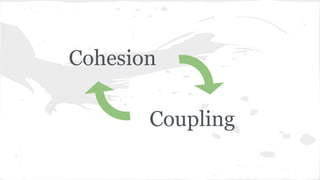
Cohesion
Coupling
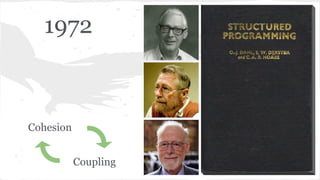
Cohesion
Coupling
1972
?
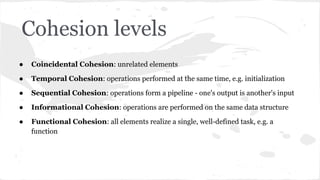
● Coincidental Cohesion: unrelated elements
● Temporal Cohesion: operations performed at the same time, e.g. initialization
● Sequential Cohesion: operations form a pipeline - one's output is another's input
● Informational Cohesion: operations are performed on the same data structure
● Functional Cohesion: all elements realize a single, well-defined task, e.g. a
function
Cohesion levels
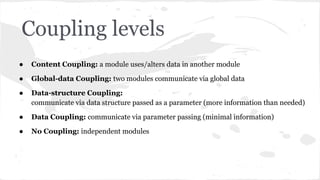
● Content Coupling: a module uses/alters data in another module
● Global-data Coupling: two modules communicate via global data
● Data-structure Coupling:
communicate via data structure passed as a parameter (more information than needed)
● Data Coupling: communicate via parameter passing (minimal information)
● No Coupling: independent modules
Coupling levels
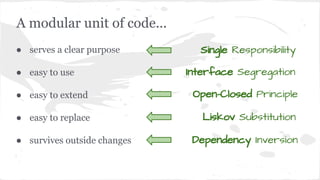
A modular unit of code...
● serves a clear purpose
● easy to use
● easy to extend
● easy to replace
● survives outside changes
Single Responsibility
Liskov Substitution
Interface Segregation
Open-Closed Principle
Dependency Inversion
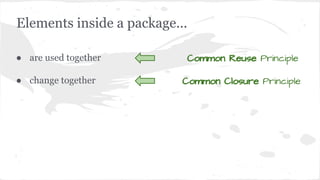
Elements inside a package...
● are used together
● change together
Common Reuse Principle
Common Closure Principle
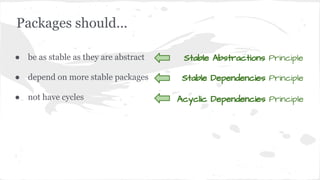
Packages should...
● be as stable as they are abstract
● depend on more stable packages
● not have cycles
Stable Abstractions Principle
Stable Dependencies Principle
Acyclic Dependencies Principle
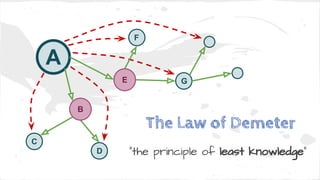
The Law of Demeter
"the principle of least knowledge"
A
B
E G
F
D
C
B
E
The Demeter
Project
Train Wreck
client.getMortgage().paymentCollection().getNextPayment().applyPayment(300.0)
(update-in client [:mortgage :payments] conj (payment 300.0))
wiki.c2.com/?TrainWreck
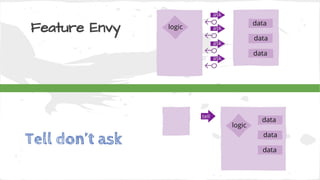
Tell don’t ask
Feature Envy
in conclusion

Modular Design - Laws and Principles - in OOP and FP

  • 1.
    Modular Design Laws andPrinciples in OOP and FP
  • 2.
  • 3.
  • 4.
    ● Coincidental Cohesion:unrelated elements ● Temporal Cohesion: operations performed at the same time, e.g. initialization ● Sequential Cohesion: operations form a pipeline - one's output is another's input ● Informational Cohesion: operations are performed on the same data structure ● Functional Cohesion: all elements realize a single, well-defined task, e.g. a function Cohesion levels
  • 5.
    ● Content Coupling:a module uses/alters data in another module ● Global-data Coupling: two modules communicate via global data ● Data-structure Coupling: communicate via data structure passed as a parameter (more information than needed) ● Data Coupling: communicate via parameter passing (minimal information) ● No Coupling: independent modules Coupling levels
  • 6.
    A modular unitof code... ● serves a clear purpose ● easy to use ● easy to extend ● easy to replace ● survives outside changes Single Responsibility Liskov Substitution Interface Segregation Open-Closed Principle Dependency Inversion
  • 7.
    Elements inside apackage... ● are used together ● change together Common Reuse Principle Common Closure Principle
  • 8.
    Packages should... ● beas stable as they are abstract ● depend on more stable packages ● not have cycles Stable Abstractions Principle Stable Dependencies Principle Acyclic Dependencies Principle
  • 9.
    The Law ofDemeter "the principle of least knowledge" A B E G F D C B E
  • 10.
  • 11.
  • 12.
  • 13.