













Modular Architectures 
using Micro Services
About Me 
Marcel Offermans 
Director at Luminis Technologies 
Member at the Apache Software Foundation 
@m4rr5
Agenda 
• Modular Architectures 
• Micro Services 
• OSGi in 60 seconds 
• Amdatu 
• Demo
Modular Architectures
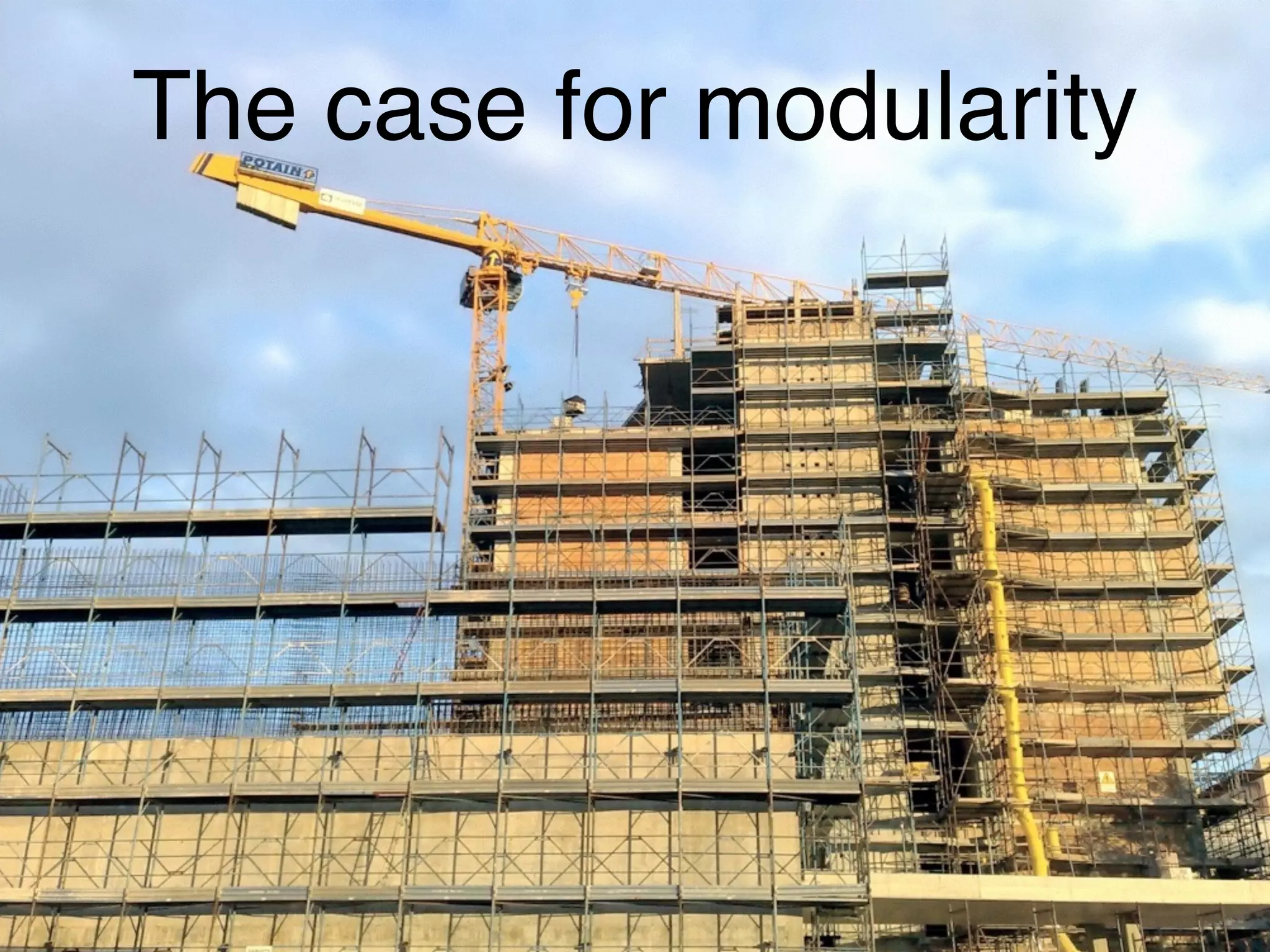
The case for modularity
Maintainability
Adaptability
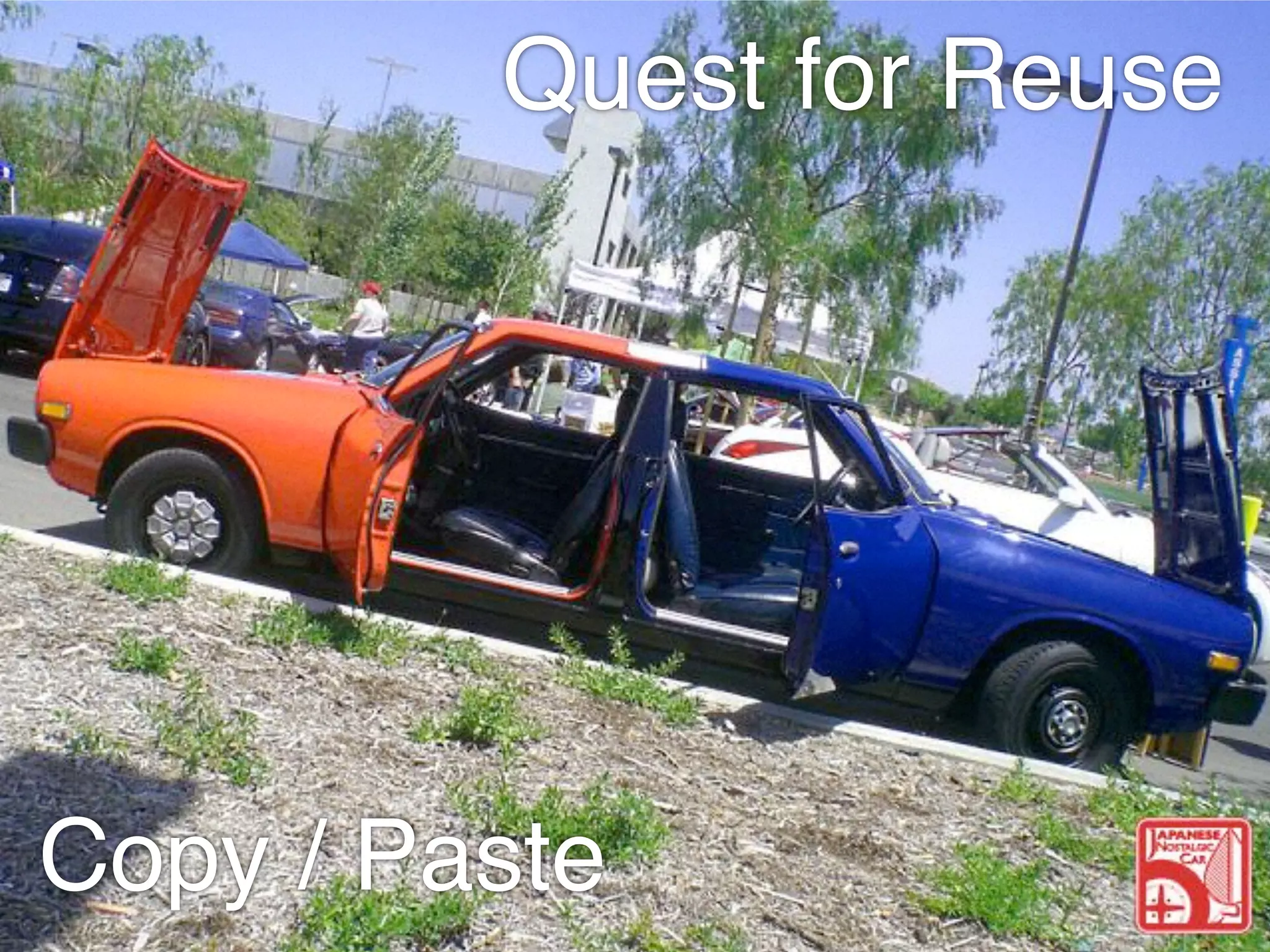
Quest for Reuse 
Copy / Paste
Quest for Reuse 
Object Oriented
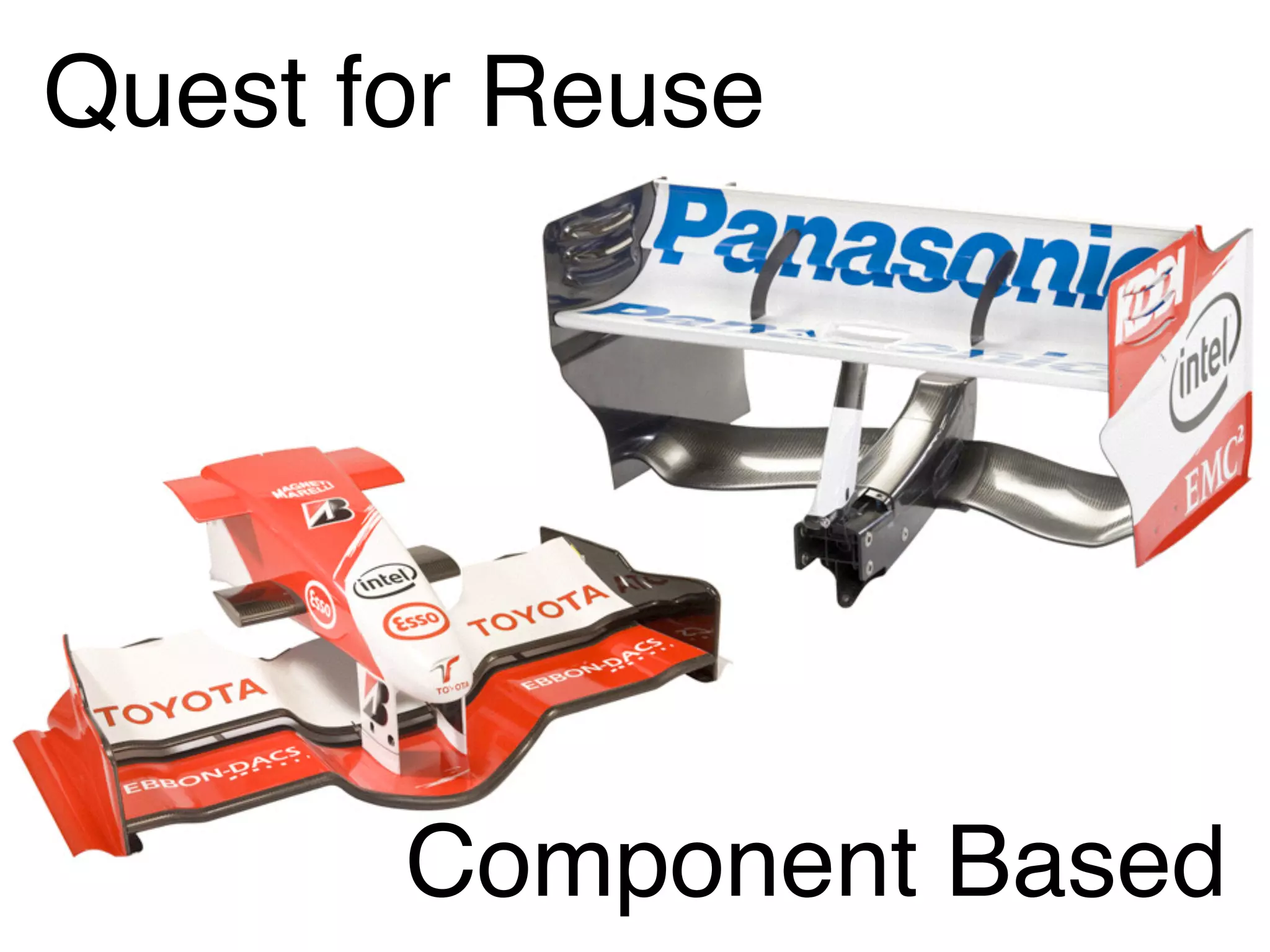
Quest for Reuse 
Component Based
Micro Services
The term "Microservice Architecture" has sprung up 
over the last few years to describe a particular way 
of designing software applications as suites of 
independently deployable services. While there is no 
precise definition of this architectural style, there are 
certain common characteristics around organization 
around business capability, automated deployment, 
intelligence in the endpoints, and decentralized 
control of languages and data. 
Source: http://martinfowler.com/articles/microservices.html
Business Capabilities 
• Should be leading when splitting an application 
into components 
• Different from more traditional technology driven 
“layering” (UI, application logic, database) 
Conway’s Law: Any organization that designs a 
system will produce a design whose structure is a 
copy of the organization's communication structure. 
! 
Melvyn Conway, 1967
Component owns Data 
• Each service manages its own data 
• Can lead to polyglot persistence 
• Leverage Domain-Driven Design: bounded context 
often maps naturally to components 
• Use transaction-less coordination between 
services: build for eventual consistency and have a 
reversal process to deal with mistakes
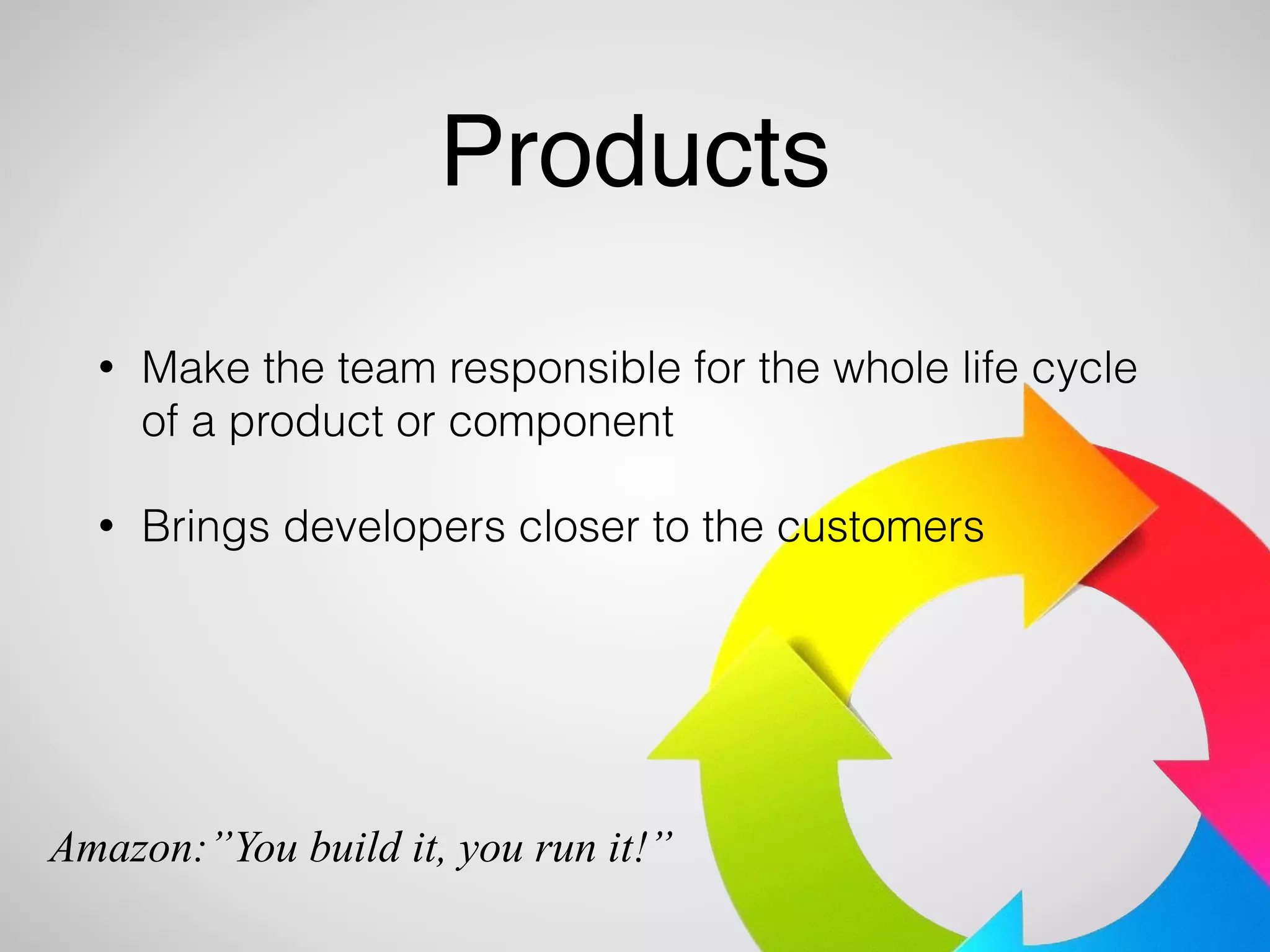
Products 
• Make the team responsible for the whole life cycle 
of a product or component 
• Brings developers closer to the customers 
Amazon:”You build it, you run it!”
Services 
• Provide a public, versioned contract for a 
component 
• Have their own life cycle, so they can be 
separately deployed 
• Hide all implementation details
Dumb Pipes 
• HTTP request/response 
• lightweight messaging
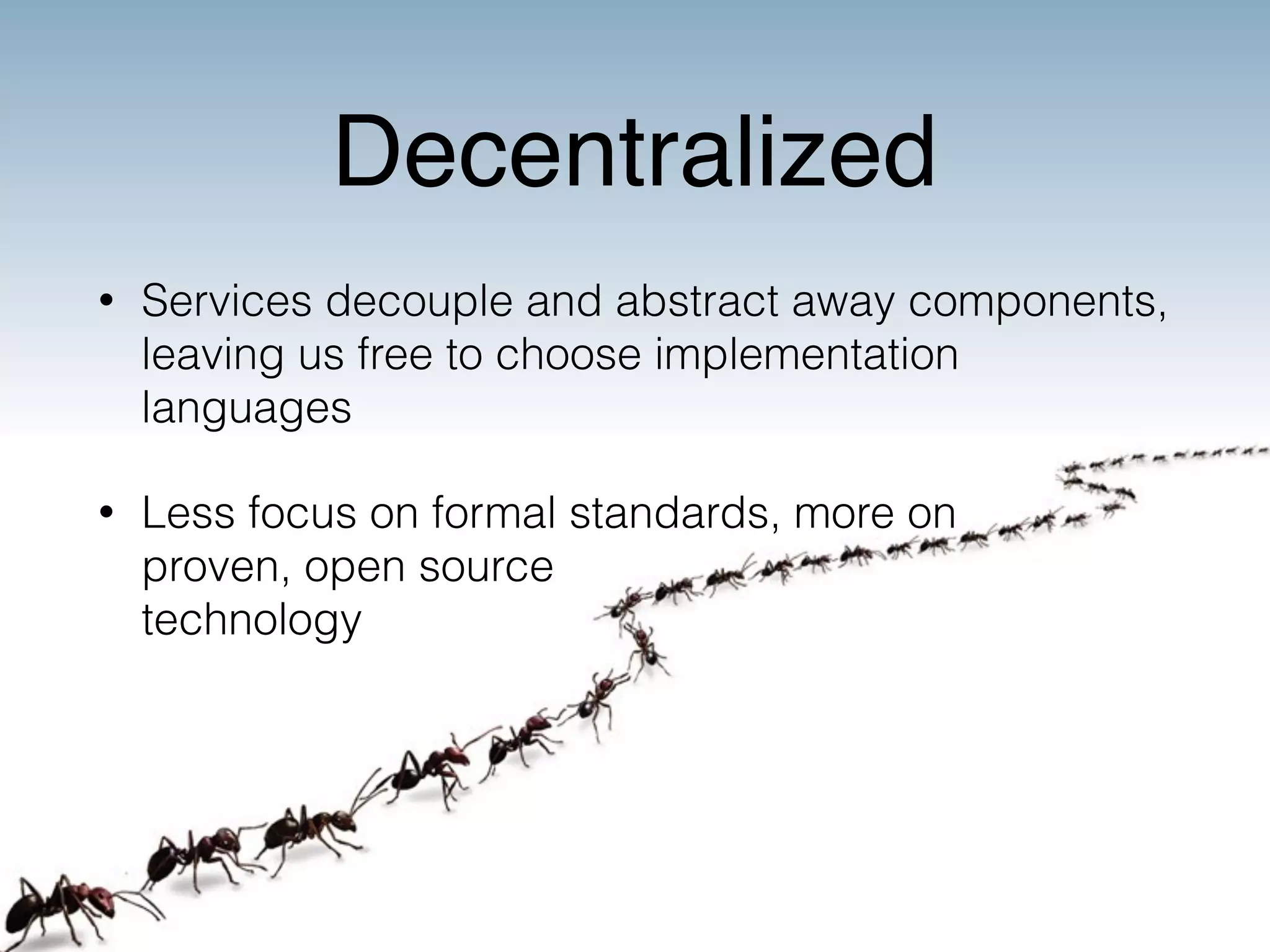
Decentralized 
• Services decouple and abstract away components, 
leaving us free to choose implementation 
languages 
• Less focus on formal standards, more on 
proven, open source 
technology
Automated Deployment 
• Continuous Integration 
• Continuous Deployment
Design for Change 
• How to break a system into components? Consider 
rate of change, high cohesion, low coupling, … 
• Version your services, and make them tolerant to 
change 
• Stay flexible! 
The only constant is change.
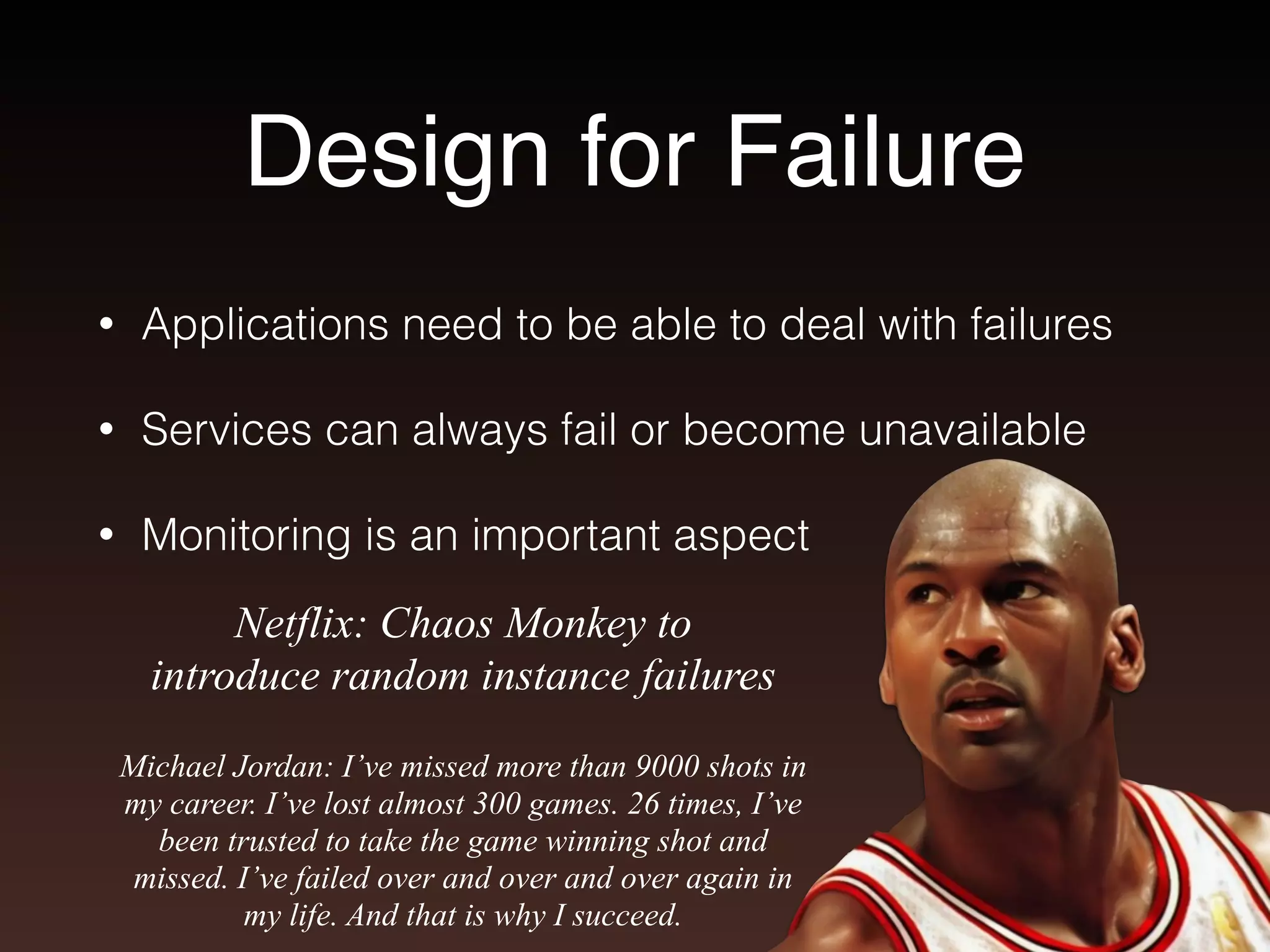
Design for Failure 
• Applications need to be able to deal with failures 
• Services can always fail or become unavailable 
• Monitoring is an important aspect 
Netflix: Chaos Monkey to 
introduce random instance failures 
Michael Jordan: I’ve missed more than 9000 shots in 
my career. I’ve lost almost 300 games. 26 times, I’ve 
been trusted to take the game winning shot and 
missed. I’ve failed over and over and over again in 
my life. And that is why I succeed.
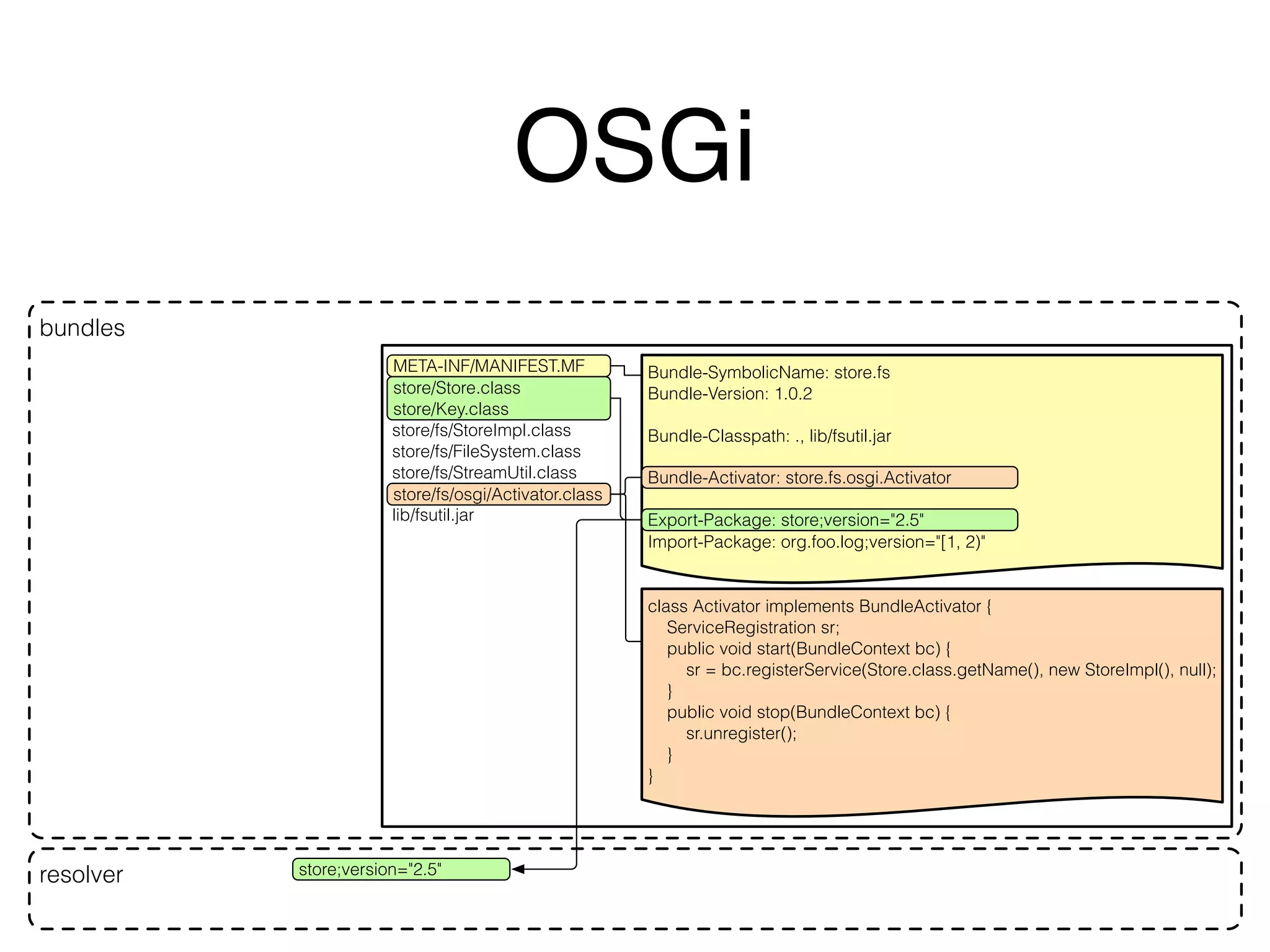
OSGi in 60 seconds
What is OSGi? 
• Provides components that can be easily deployed 
and versioned 
• Hides implementation details and leverages a 
service registry that allows components to publish 
and consume services 
• It’s the de-facto module system for Java: proven 
technology, works on all Java versions, usable from 
embedded to enterprise
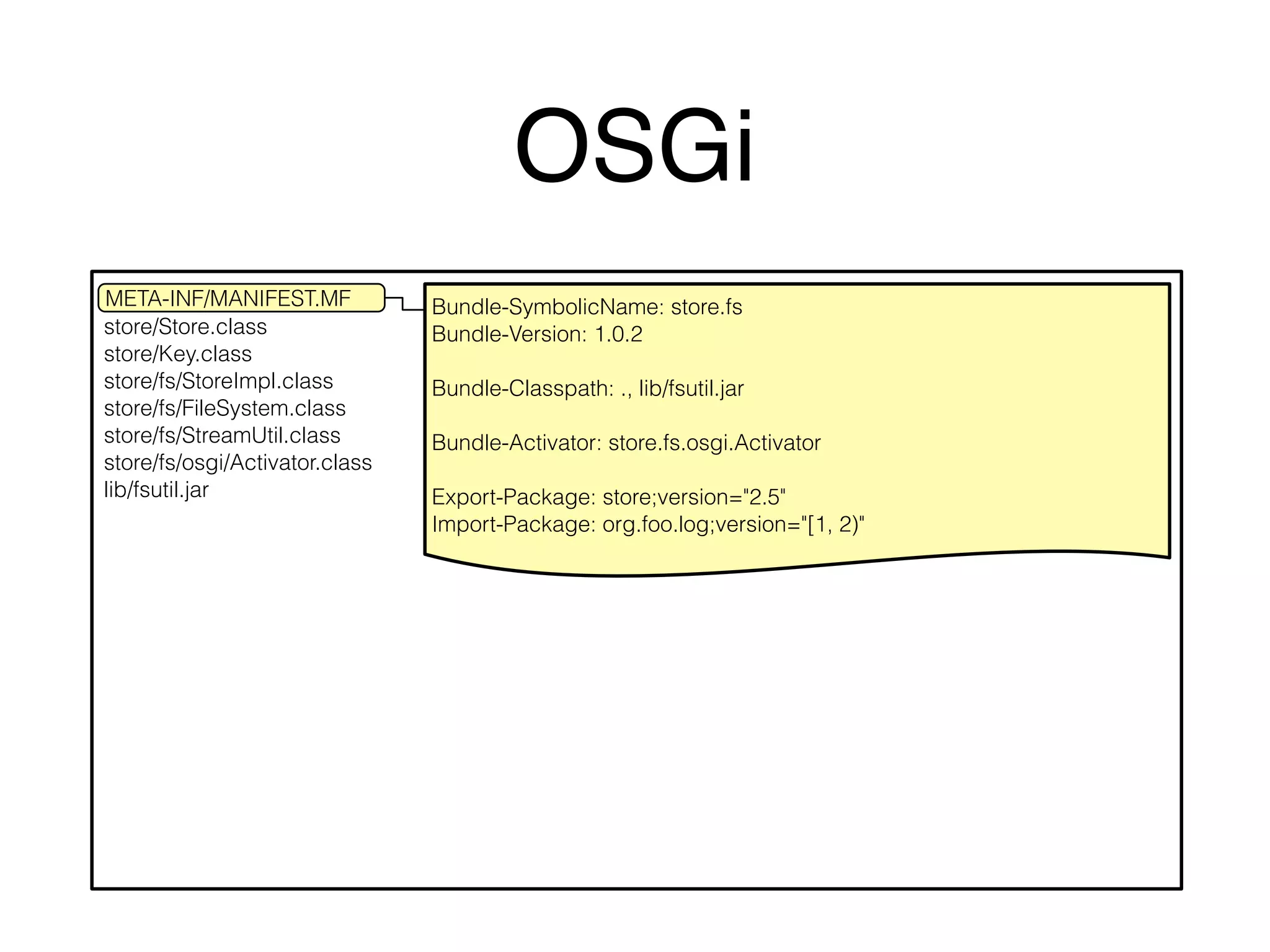
OSGi 
META-INF/MANIFEST.MF 
Bundle-SymbolicName: store.fs 
store/Store.class 
store/Key.class 
store/fs/StoreImpl.class 
store/fs/FileSystem.class 
store/fs/StreamUtil.class 
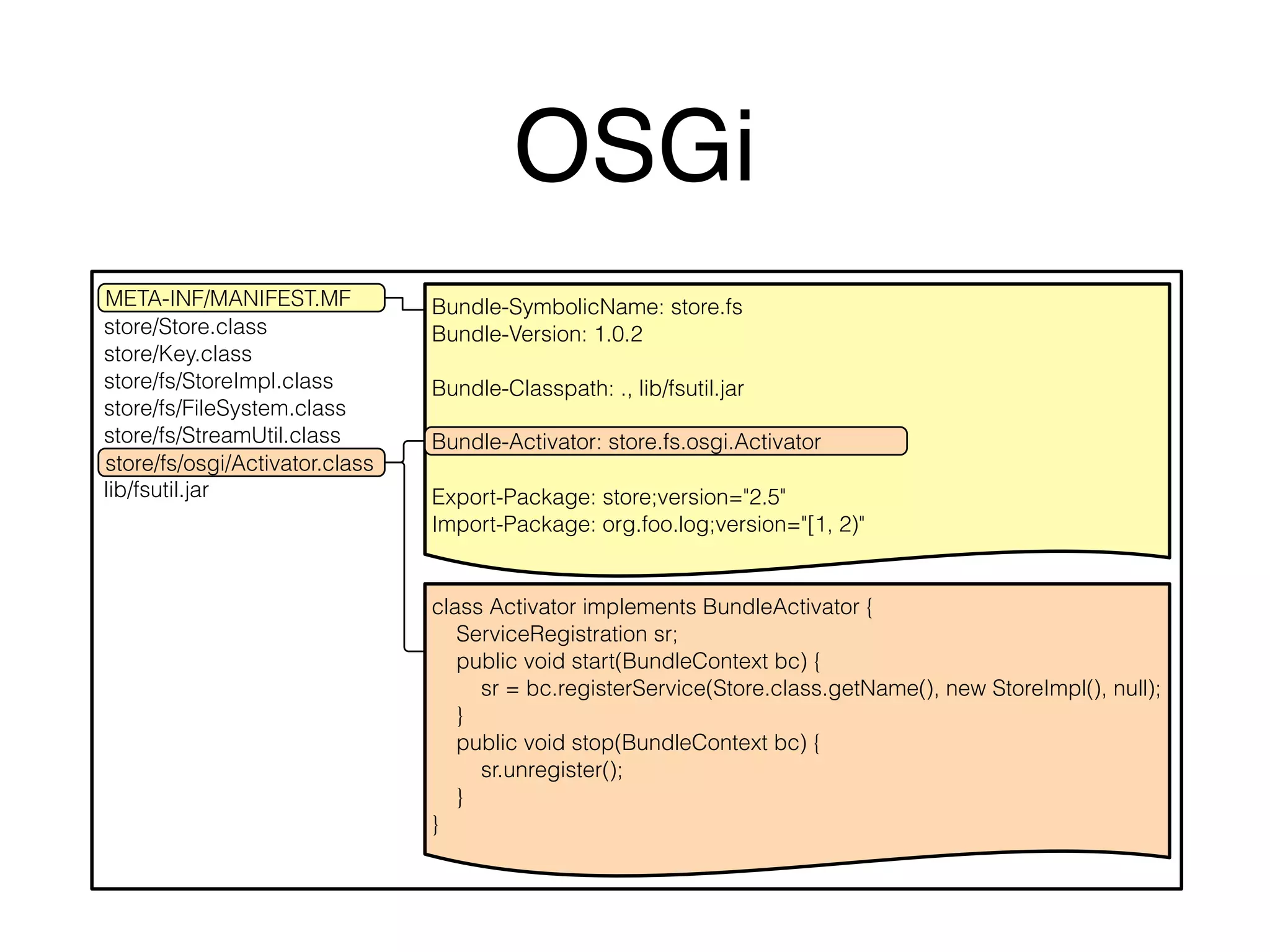
store/fs/osgi/Activator.class 
lib/fsutil.jar 
Bundle-Version: 1.0.2 
Bundle-Classpath: ., lib/fsutil.jar 
Bundle-Activator: store.fs.osgi.Activator 
Export-Package: store;version="2.5" 
Import-Package: org.foo.log;version="[1, 2)"
META-INF/MANIFEST.MF 
Bundle-SymbolicName: store.fs 
store/Store.class 
store/Key.class 
store/fs/StoreImpl.class 
store/fs/FileSystem.class 
store/fs/StreamUtil.class 
store/fs/osgi/Activator.class 
lib/fsutil.jar 
Bundle-Version: 1.0.2 
Bundle-Classpath: ., lib/fsutil.jar 
Bundle-Activator: store.fs.osgi.Activator 
Export-Package: store;version="2.5" 
Import-Package: org.foo.log;version="[1, 2)" 
class Activator implements BundleActivator { 
ServiceRegistration sr; 
public void start(BundleContext bc) { 
sr = bc.registerService(Store.class.getName(), new StoreImpl(), null); 
} 
public void stop(BundleContext bc) { 
sr.unregister(); 
} 
} 
OSGi
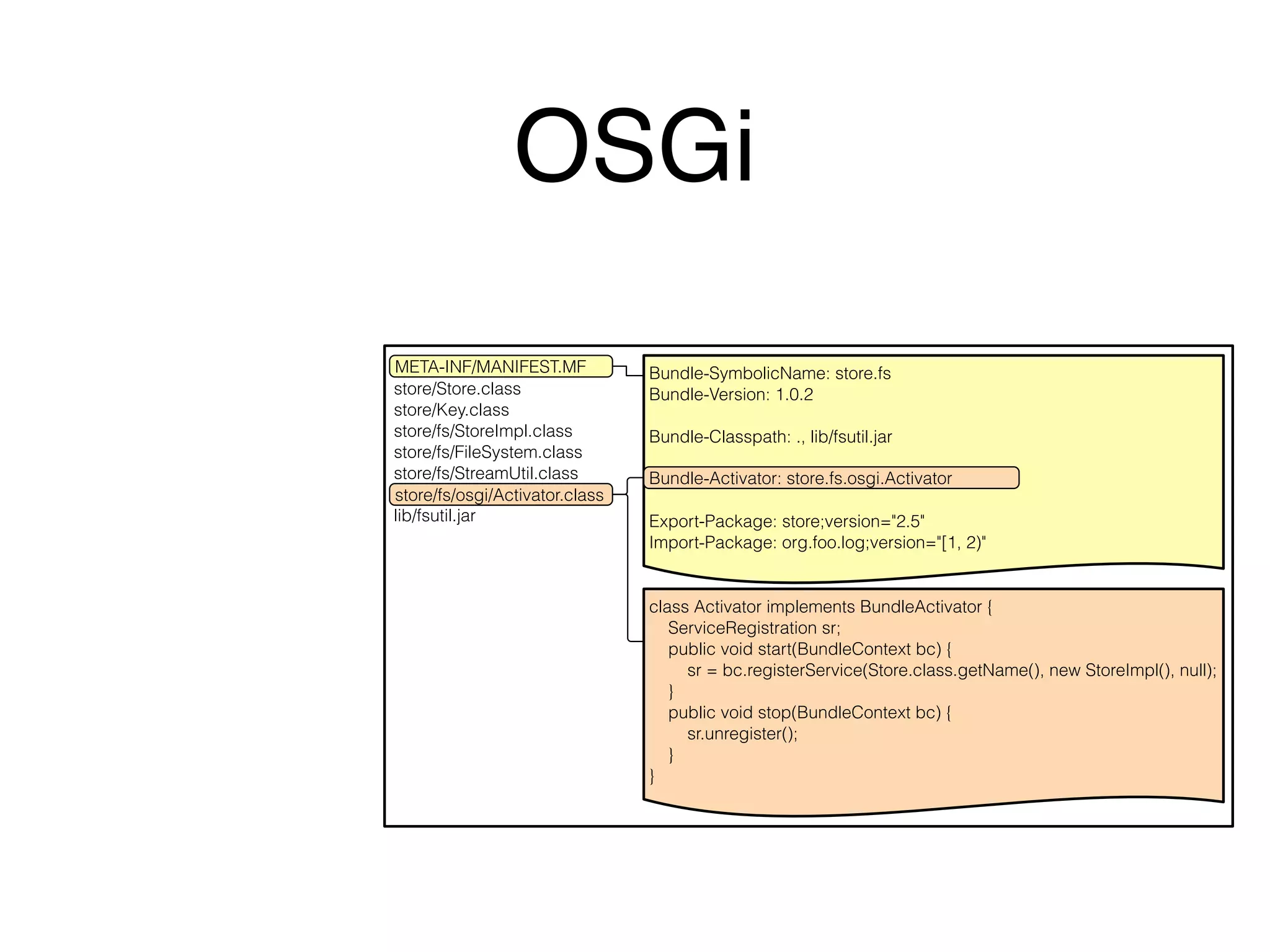
OSGi 
META-INF/MANIFEST.MF 
Bundle-SymbolicName: store.fs 
store/Store.class 
store/Key.class 
store/fs/StoreImpl.class 
store/fs/FileSystem.class 
store/fs/StreamUtil.class 
store/fs/osgi/Activator.class 
lib/fsutil.jar 
Bundle-Version: 1.0.2 
Bundle-Classpath: ., lib/fsutil.jar 
Bundle-Activator: store.fs.osgi.Activator 
Export-Package: store;version="2.5" 
Import-Package: org.foo.log;version="[1, 2)" 
class Activator implements BundleActivator { 
ServiceRegistration sr; 
public void start(BundleContext bc) { 
sr = bc.registerService(Store.class.getName(), new StoreImpl(), null); 
} 
public void stop(BundleContext bc) { 
sr.unregister(); 
} 
}
OSGi 
META-INF/MANIFEST.MF 
Bundle-SymbolicName: store.fs 
store/Store.class 
store/Key.class 
store/fs/StoreImpl.class 
store/fs/FileSystem.class 
store/fs/StreamUtil.class 
store/fs/osgi/Activator.class 
lib/fsutil.jar 
Bundle-Version: 1.0.2 
Bundle-Classpath: ., lib/fsutil.jar 
Export-Package: store;version="2.5" 
Import-Package: org.foo.log;version="[1, 2)" 
class Activator implements BundleActivator { 
ServiceRegistration sr; 
public void start(BundleContext bc) { 
sr = bc.registerService(Store.class.getName(), new StoreImpl(), null); 
} 
public void stop(BundleContext bc) { 
sr.unregister(); 
} 
} 
bundles 
resolver store;version="2.5" 
Bundle-Activator: store.fs.osgi.Activator
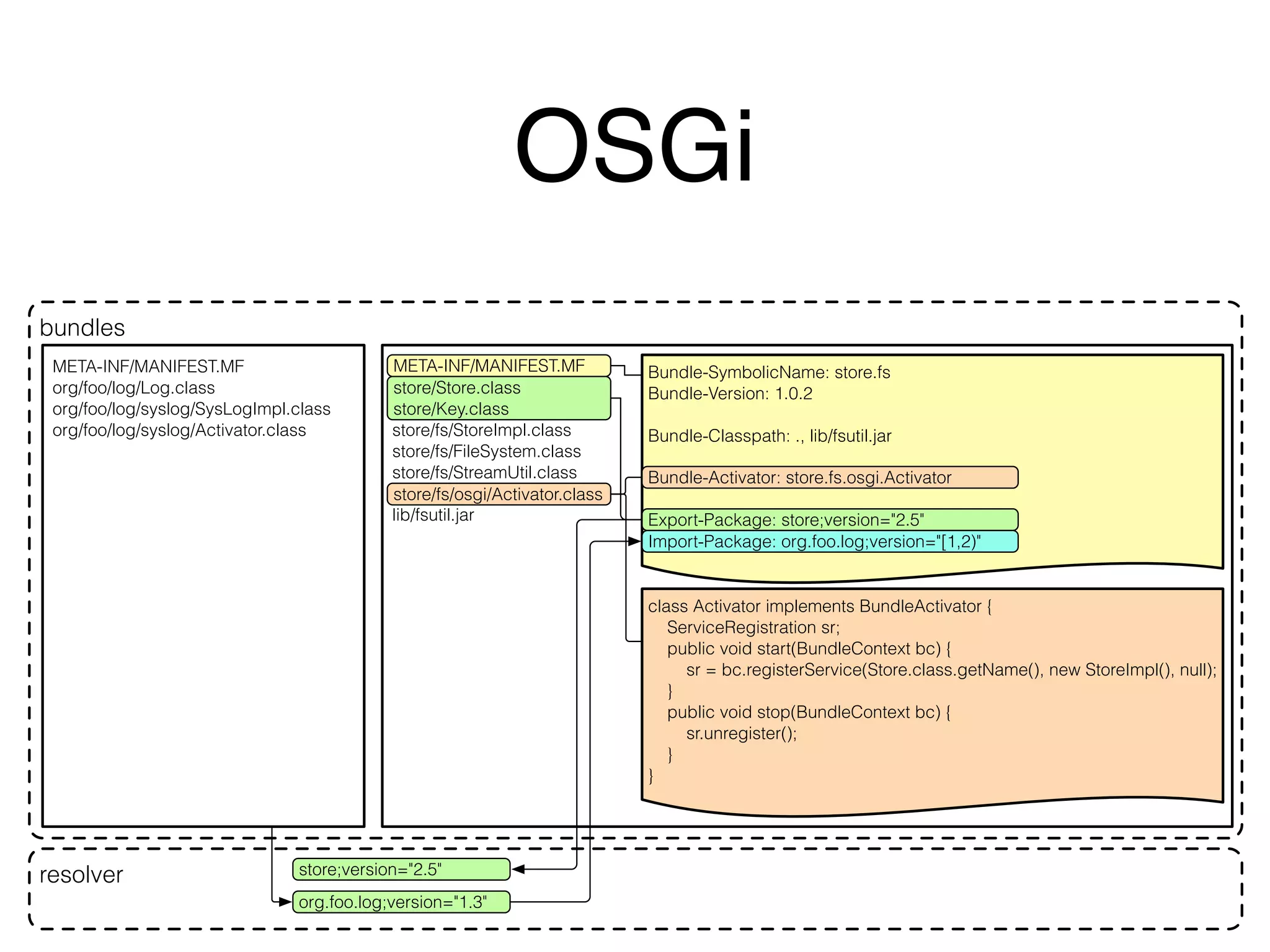
OSGi 
META-INF/MANIFEST.MF 
Bundle-SymbolicName: store.fs 
store/Store.class 
store/Key.class 
store/fs/StoreImpl.class 
store/fs/FileSystem.class 
store/fs/StreamUtil.class 
store/fs/osgi/Activator.class 
lib/fsutil.jar 
Bundle-Version: 1.0.2 
Bundle-Classpath: ., lib/fsutil.jar 
Export-Package: store;version="2.5" 
Import-Package: org.foo.log;version="[1,2)" 
1, 2)" 
class Activator implements BundleActivator { 
ServiceRegistration sr; 
public void start(BundleContext bc) { 
sr = bc.registerService(Store.class.getName(), new StoreImpl(), null); 
} 
public void stop(BundleContext bc) { 
sr.unregister(); 
} 
} 
bundles 
META-INF/MANIFEST.MF 
org/foo/log/Log.class 
org/foo/log/syslog/SysLogImpl.class 
org/foo/log/syslog/Activator.class 
store;version="2.5" 
org.foo.log;version="1.3" 
resolver 
Bundle-Activator: store.fs.osgi.Activator
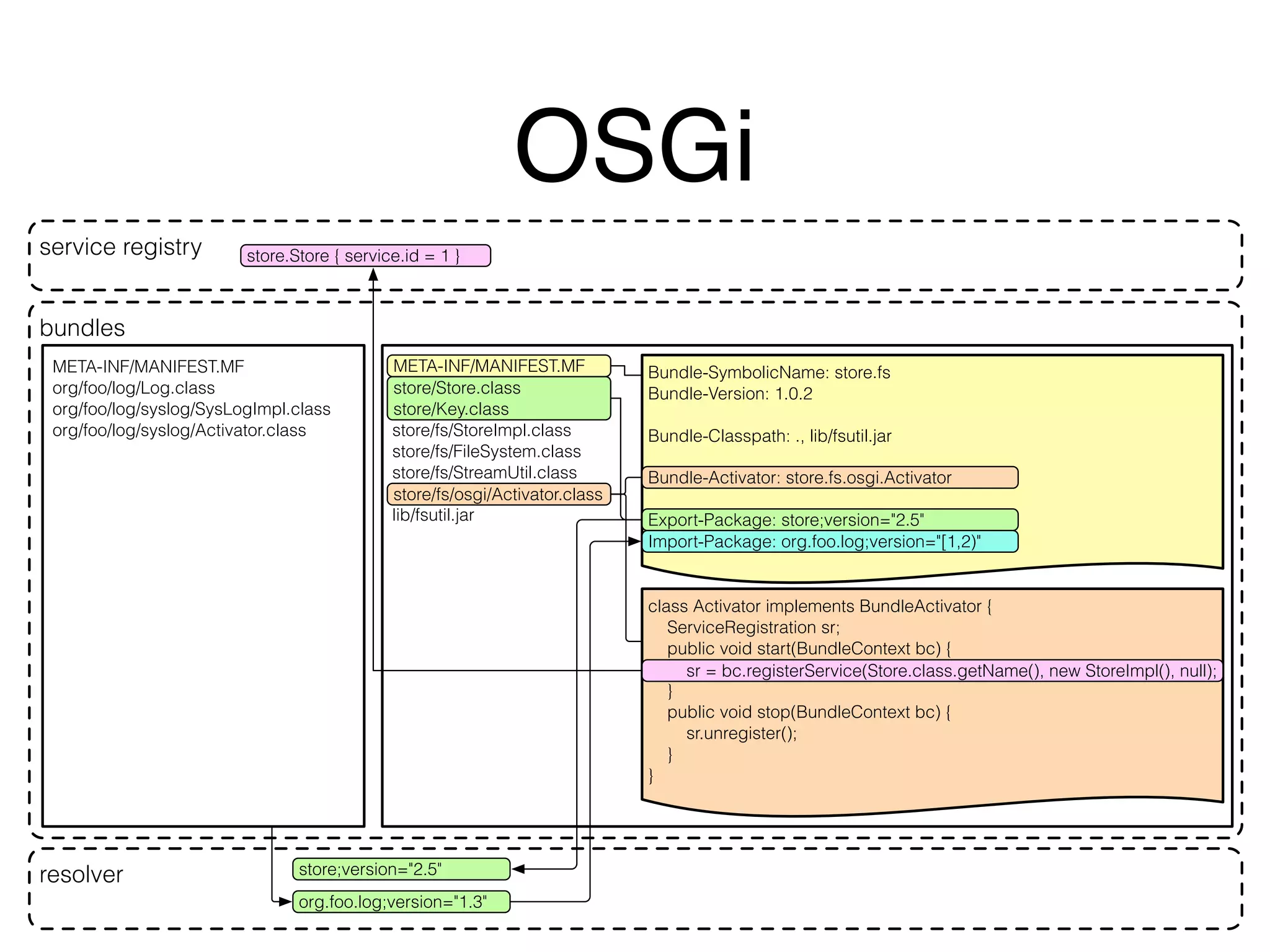
OSGi 
META-INF/MANIFEST.MF 
Bundle-SymbolicName: store.fs 
store/Store.class 
store/Key.class 
store/fs/StoreImpl.class 
store/fs/FileSystem.class 
store/fs/StreamUtil.class 
store/fs/osgi/Activator.class 
lib/fsutil.jar 
Bundle-Version: 1.0.2 
Bundle-Classpath: ., lib/fsutil.jar 
Export-Package: store;version="2.5" 
Import-Package: org.foo.log;version="[1,2)" 
1, 2)" 
class Activator implements BundleActivator { 
ServiceRegistration sr; 
public void start(BundleContext bc) { 
sr = bc.registerService(Store.class.getName(), new StoreImpl(), null); 
} 
public void stop(BundleContext bc) { 
sr.unregister(); 
} 
} 
service registry 
bundles 
META-INF/MANIFEST.MF 
org/foo/log/Log.class 
org/foo/log/syslog/SysLogImpl.class 
org/foo/log/syslog/Activator.class 
store;version="2.5" 
org.foo.log;version="1.3" 
resolver 
store.Store { service.id = 1 } 
Bundle-Activator: store.fs.osgi.Activator
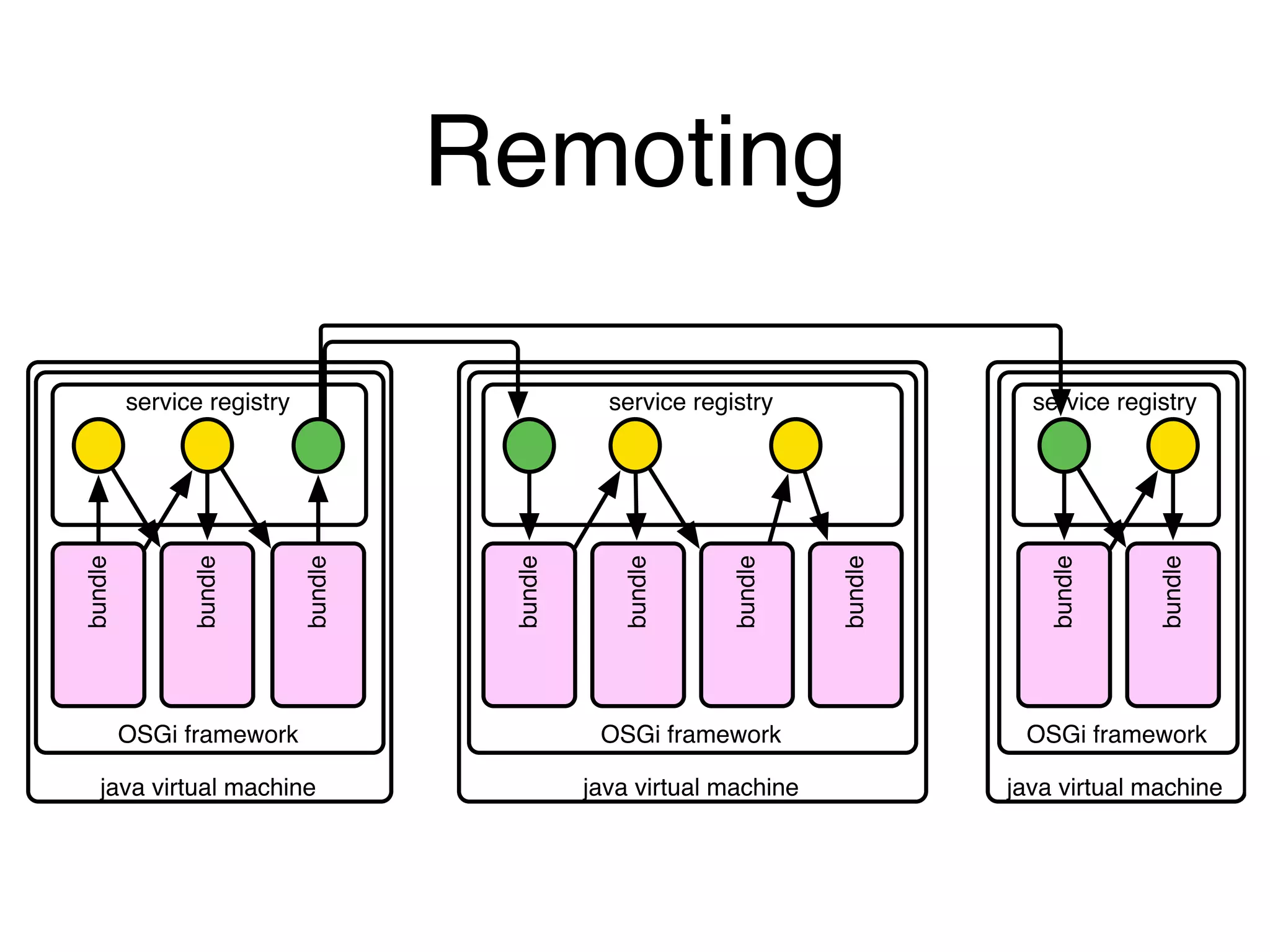
Remoting 
service registry 
OSGi framework 
java virtual machine 
bundle 
bundle 
bundle 
service registry 
bundle 
bundle 
OSGi framework 
java virtual machine 
service registry 
bundle 
OSGi framework 
bundle 
bundle 
java virtual machine 
bundle
Amdatu
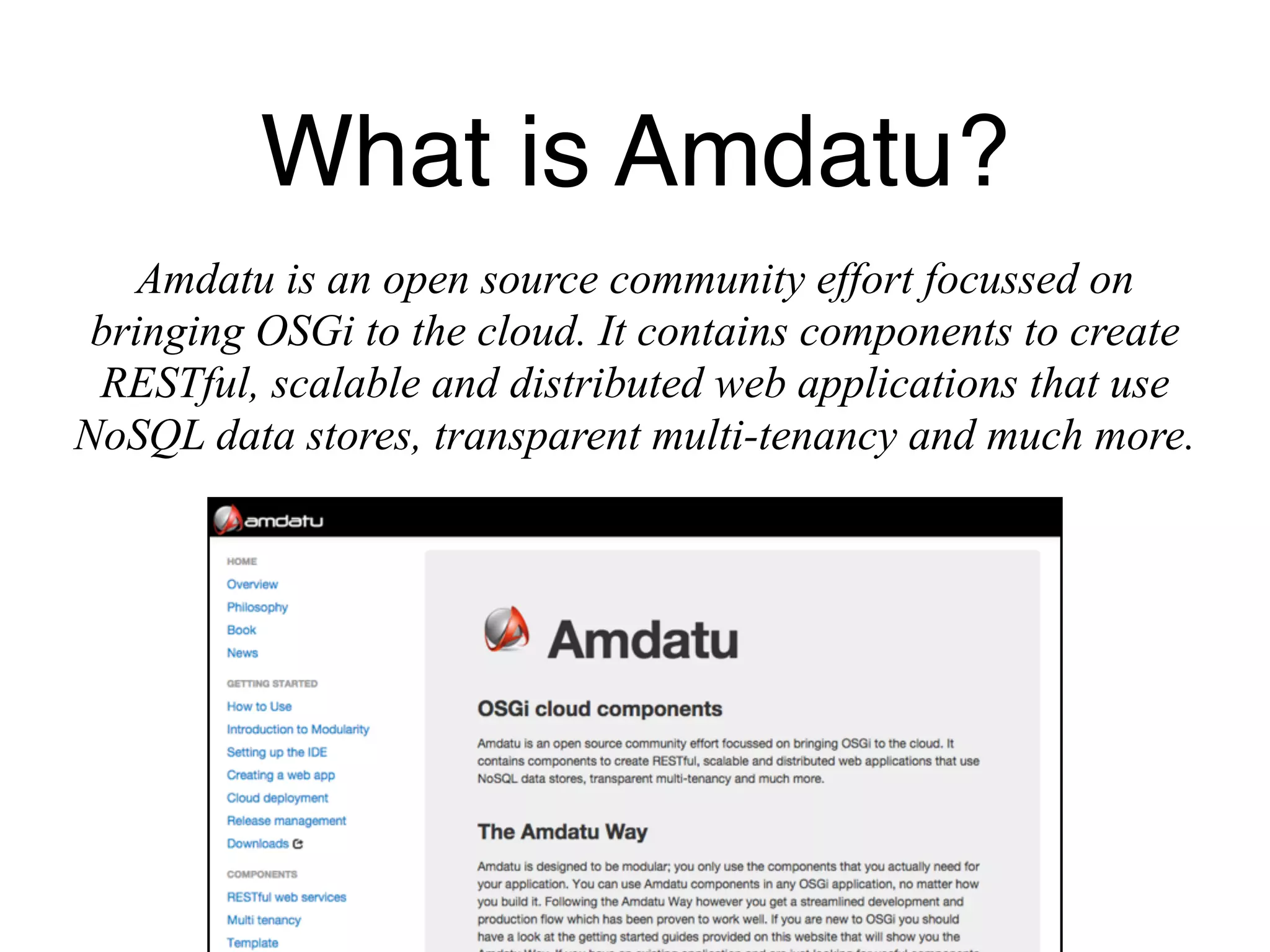
What is Amdatu? 
Amdatu is an open source community effort focussed on 
bringing OSGi to the cloud. It contains components to create 
RESTful, scalable and distributed web applications that use 
NoSQL data stores, transparent multi-tenancy and much more.
Development Model 
• Modular design based on OSGi 
• Fast deployment using Bndtools 
• Git fork/merge based workflow 
• Extensive Atlassian tool support 
• Apache ACE integrated with build servers 
• Gradle based build
Demo
Wrapping Up
We’ve… 
• …explored modularity and micro services 
• …introduced OSGi and Amdatu 
• …seen how to develop and run a modular 
application 
• …seen how OSGi allows you to be flexible in how 
you group and deploy components
Eclipse OSGi plugin! 
http://bndtools.org/ ! 
Provisioning Server! 
http://ace.apache.org/! 
Cloud OSGi services! 
http://www.amdatu.org/ 
That’s us! 
http://luminis-technologies.com/ 
Demo code! 
https://bitbucket.org/marrs/javaone-2014-microservices/
Takk 
Grazie 
Thank! 
you 
Obrigado 
Mahalo 
Danke 
Dank U 
Merci 
Gracias

Modular Architectures using Micro Services

  • 1.
  • 2.
    About Me MarcelOffermans Director at Luminis Technologies Member at the Apache Software Foundation @m4rr5
  • 3.
    Agenda • ModularArchitectures • Micro Services • OSGi in 60 seconds • Amdatu • Demo
  • 4.
  • 5.
    The case formodularity
  • 6.
  • 7.
  • 8.
    Quest for Reuse Copy / Paste
  • 9.
    Quest for Reuse Object Oriented
  • 10.
    Quest for Reuse Component Based
  • 11.
  • 12.
    The term "MicroserviceArchitecture" has sprung up over the last few years to describe a particular way of designing software applications as suites of independently deployable services. While there is no precise definition of this architectural style, there are certain common characteristics around organization around business capability, automated deployment, intelligence in the endpoints, and decentralized control of languages and data. Source: http://martinfowler.com/articles/microservices.html
  • 13.
    Business Capabilities •Should be leading when splitting an application into components • Different from more traditional technology driven “layering” (UI, application logic, database) Conway’s Law: Any organization that designs a system will produce a design whose structure is a copy of the organization's communication structure. ! Melvyn Conway, 1967
  • 14.
    Component owns Data • Each service manages its own data • Can lead to polyglot persistence • Leverage Domain-Driven Design: bounded context often maps naturally to components • Use transaction-less coordination between services: build for eventual consistency and have a reversal process to deal with mistakes
  • 15.
    Products • Makethe team responsible for the whole life cycle of a product or component • Brings developers closer to the customers Amazon:”You build it, you run it!”
  • 16.
    Services • Providea public, versioned contract for a component • Have their own life cycle, so they can be separately deployed • Hide all implementation details
  • 17.
    Dumb Pipes •HTTP request/response • lightweight messaging
  • 18.
    Decentralized • Servicesdecouple and abstract away components, leaving us free to choose implementation languages • Less focus on formal standards, more on proven, open source technology
  • 19.
    Automated Deployment •Continuous Integration • Continuous Deployment
  • 20.
    Design for Change • How to break a system into components? Consider rate of change, high cohesion, low coupling, … • Version your services, and make them tolerant to change • Stay flexible! The only constant is change.
  • 21.
    Design for Failure • Applications need to be able to deal with failures • Services can always fail or become unavailable • Monitoring is an important aspect Netflix: Chaos Monkey to introduce random instance failures Michael Jordan: I’ve missed more than 9000 shots in my career. I’ve lost almost 300 games. 26 times, I’ve been trusted to take the game winning shot and missed. I’ve failed over and over and over again in my life. And that is why I succeed.
  • 22.
    OSGi in 60seconds
  • 23.
    What is OSGi? • Provides components that can be easily deployed and versioned • Hides implementation details and leverages a service registry that allows components to publish and consume services • It’s the de-facto module system for Java: proven technology, works on all Java versions, usable from embedded to enterprise
  • 24.
    OSGi META-INF/MANIFEST.MF Bundle-SymbolicName:store.fs store/Store.class store/Key.class store/fs/StoreImpl.class store/fs/FileSystem.class store/fs/StreamUtil.class store/fs/osgi/Activator.class lib/fsutil.jar Bundle-Version: 1.0.2 Bundle-Classpath: ., lib/fsutil.jar Bundle-Activator: store.fs.osgi.Activator Export-Package: store;version="2.5" Import-Package: org.foo.log;version="[1, 2)"
  • 25.
    META-INF/MANIFEST.MF Bundle-SymbolicName: store.fs store/Store.class store/Key.class store/fs/StoreImpl.class store/fs/FileSystem.class store/fs/StreamUtil.class store/fs/osgi/Activator.class lib/fsutil.jar Bundle-Version: 1.0.2 Bundle-Classpath: ., lib/fsutil.jar Bundle-Activator: store.fs.osgi.Activator Export-Package: store;version="2.5" Import-Package: org.foo.log;version="[1, 2)" class Activator implements BundleActivator { ServiceRegistration sr; public void start(BundleContext bc) { sr = bc.registerService(Store.class.getName(), new StoreImpl(), null); } public void stop(BundleContext bc) { sr.unregister(); } } OSGi
  • 26.
    OSGi META-INF/MANIFEST.MF Bundle-SymbolicName:store.fs store/Store.class store/Key.class store/fs/StoreImpl.class store/fs/FileSystem.class store/fs/StreamUtil.class store/fs/osgi/Activator.class lib/fsutil.jar Bundle-Version: 1.0.2 Bundle-Classpath: ., lib/fsutil.jar Bundle-Activator: store.fs.osgi.Activator Export-Package: store;version="2.5" Import-Package: org.foo.log;version="[1, 2)" class Activator implements BundleActivator { ServiceRegistration sr; public void start(BundleContext bc) { sr = bc.registerService(Store.class.getName(), new StoreImpl(), null); } public void stop(BundleContext bc) { sr.unregister(); } }
  • 27.
    OSGi META-INF/MANIFEST.MF Bundle-SymbolicName:store.fs store/Store.class store/Key.class store/fs/StoreImpl.class store/fs/FileSystem.class store/fs/StreamUtil.class store/fs/osgi/Activator.class lib/fsutil.jar Bundle-Version: 1.0.2 Bundle-Classpath: ., lib/fsutil.jar Export-Package: store;version="2.5" Import-Package: org.foo.log;version="[1, 2)" class Activator implements BundleActivator { ServiceRegistration sr; public void start(BundleContext bc) { sr = bc.registerService(Store.class.getName(), new StoreImpl(), null); } public void stop(BundleContext bc) { sr.unregister(); } } bundles resolver store;version="2.5" Bundle-Activator: store.fs.osgi.Activator
  • 28.
    OSGi META-INF/MANIFEST.MF Bundle-SymbolicName:store.fs store/Store.class store/Key.class store/fs/StoreImpl.class store/fs/FileSystem.class store/fs/StreamUtil.class store/fs/osgi/Activator.class lib/fsutil.jar Bundle-Version: 1.0.2 Bundle-Classpath: ., lib/fsutil.jar Export-Package: store;version="2.5" Import-Package: org.foo.log;version="[1,2)" 1, 2)" class Activator implements BundleActivator { ServiceRegistration sr; public void start(BundleContext bc) { sr = bc.registerService(Store.class.getName(), new StoreImpl(), null); } public void stop(BundleContext bc) { sr.unregister(); } } bundles META-INF/MANIFEST.MF org/foo/log/Log.class org/foo/log/syslog/SysLogImpl.class org/foo/log/syslog/Activator.class store;version="2.5" org.foo.log;version="1.3" resolver Bundle-Activator: store.fs.osgi.Activator
  • 29.
    OSGi META-INF/MANIFEST.MF Bundle-SymbolicName:store.fs store/Store.class store/Key.class store/fs/StoreImpl.class store/fs/FileSystem.class store/fs/StreamUtil.class store/fs/osgi/Activator.class lib/fsutil.jar Bundle-Version: 1.0.2 Bundle-Classpath: ., lib/fsutil.jar Export-Package: store;version="2.5" Import-Package: org.foo.log;version="[1,2)" 1, 2)" class Activator implements BundleActivator { ServiceRegistration sr; public void start(BundleContext bc) { sr = bc.registerService(Store.class.getName(), new StoreImpl(), null); } public void stop(BundleContext bc) { sr.unregister(); } } service registry bundles META-INF/MANIFEST.MF org/foo/log/Log.class org/foo/log/syslog/SysLogImpl.class org/foo/log/syslog/Activator.class store;version="2.5" org.foo.log;version="1.3" resolver store.Store { service.id = 1 } Bundle-Activator: store.fs.osgi.Activator
  • 30.
    Remoting service registry OSGi framework java virtual machine bundle bundle bundle service registry bundle bundle OSGi framework java virtual machine service registry bundle OSGi framework bundle bundle java virtual machine bundle
  • 31.
  • 32.
    What is Amdatu? Amdatu is an open source community effort focussed on bringing OSGi to the cloud. It contains components to create RESTful, scalable and distributed web applications that use NoSQL data stores, transparent multi-tenancy and much more.
  • 33.
    Development Model •Modular design based on OSGi • Fast deployment using Bndtools • Git fork/merge based workflow • Extensive Atlassian tool support • Apache ACE integrated with build servers • Gradle based build
  • 34.
  • 35.
  • 36.
    We’ve… • …exploredmodularity and micro services • …introduced OSGi and Amdatu • …seen how to develop and run a modular application • …seen how OSGi allows you to be flexible in how you group and deploy components
  • 37.
    Eclipse OSGi plugin! http://bndtools.org/ ! Provisioning Server! http://ace.apache.org/! Cloud OSGi services! http://www.amdatu.org/ That’s us! http://luminis-technologies.com/ Demo code! https://bitbucket.org/marrs/javaone-2014-microservices/
  • 38.
    Takk Grazie Thank! you Obrigado Mahalo Danke Dank U Merci Gracias