MODERN HRM:OUTSOURCING
What is Human Resources Management all about? Planning HR Needs Compensating and motivating employees Appraising employee behavior Enhancing potential – training & development much more careful selection and recruitment  high level of training and staff development  better communications between staff and management  extensive use of teamwork  introduction of performance management  encouragement of employee suggestions and innovation
HRM in Corporate For Profit Environment: Dynamic Growth Strategy – balance between current work and potential future work Extract Profit Strategy – focus on profit, cost cutting, frequent terminations Liquidation Strategy – selling off assets, cutting further losses, workers a commodity Turnaround Strategy – short term strategy for long term survival
HRM in Corporate Designing a Training & Development Program: Balance between individual needs, departmental needs, and community needs Long term vision vs. short term reality Developing a Learning Culture Job specific vs. culturally specific program (language training)  Requires Assessment of skills, knowledge and attitude of individuals and community to ensure efficient use of funds
HRM in Corporate Skills Assessment & Needs Analysis: Conduct a needs analysis of organization and compare skills across group. Conduct individual skills assessment part of personal career planning as hire, pay increases, promotions
There is only one constant in the universe. What is that? That is………… “ Change”
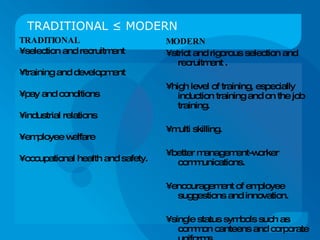
TRADITIONAL  ≤  MODERN TRADITIONAL •  selection and recruitment  •  training and development  •  pay and conditions  •  industrial relations  •  employee welfare  •  occupational health and safety.  MODERN •  strict and rigorous selection and recruitment . •  high level of training, especially induction training and on the job training. •  multi skilling. •  better management-worker communications. •  encouragement of employee suggestions and innovation. •  single status symbols such as common canteens and corporate uniforms.
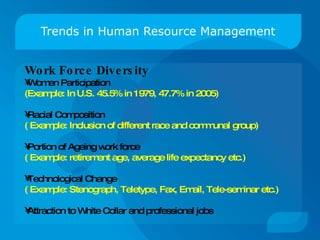
Trends in Human Resource Management  Work Force Diversity Women Participation (Example: In U.S. 45.5% in 1979, 47.7% in 2005) Racial Composition ( Example: Inclusion of different race and communal group) Portion of Ageing work force ( Example: retirement age, average life expectancy etc.) Technological Change ( Example: Stenograph, Teletype, Fax, Email, Tele-seminar etc.) Attraction to White Collar and professional jobs
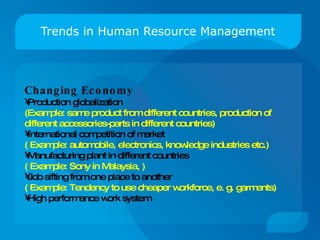
Trends in Human Resource Management  Changing Economy Production globalization (Example: same product from different countries, production of different accessories-parts in different countries) International competition of market ( Example: automobile, electronics, knowledge industries etc.) Manufacturing plant in different countries ( Example: Sony in Malaysia, ) Job sifting from one place to another ( Example: Tendency to use cheaper workforce, e. g. garments) High performance work system
Outsourcing What is Outsourcing? Outsourcing is a strategic decision to give a task or activity to an independent contractor who determines how best to do the task or activity. The firm and the independent contractor become partners and may establish a long-term relationship. Examples of outsourced activities:  IT, HR, Legal services, Manufacturing, R & D. Note: Outsourcing to India is now more about high quality rather than cost. (Forbes)
Outsourcing Outsourcing Advantages: Better quality people and knowledge. Reduction in administrative costs. Outsourcing certain activities and employees that do not fit with company culture may be used to preserve a strong culture or employee morale.
Outsourcing Outsourcing Disadvantages: Outsourcing may lead to loss of control of certain activities which may be a problem on time sensitive projects. Outsourcing an activity may result in loss of the opportunity to gain knowledge and information.
Why Has Outsourcing Become So Popular 1. Globalization and labor arbitrage: The wage differential is now so great that firms may be willing to accept the risks associated with vendor opportunism  Within developing economies, investment in human capital and in production capacity has expanded dramatically  The wage differential between developed and developing economies is substantial  2. Technology. 3. Core competency.
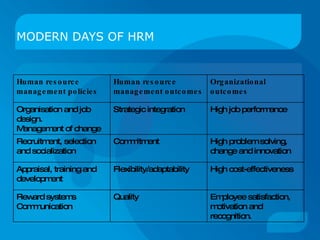
MODERN DAYS OF HRM Employee satisfaction, motivation and recognition. Quality  Reward systems  Communication  High cost-effectiveness  Flexibility/adaptability  Appraisal, training and development  High problem solving, change and innovation  Commitment  Recruitment, selection and socialization  High job performance  Strategic integration  Organisation and job design.  Management of change  Organizational outcomes  Human resource management outcomes  Human resource management policies


Awards for HR Practices: Asia Pacific HR Conclave Award for the company with  “Most Innovative  HR practices”. National award for  “Best HRD Practices”  from Indian Society for Training and Development. “ National Award for Outstanding Work in Human Resource Management”  from National HRD Network.  “ Award for Outstanding Human Resources Development”  from Confederation of  Engineering Industry. “ I ntegration of Information Technology with HR”  in ECC Division has been recognized by the National HRD Network.
Story Behind the Success HR  Policy  The basic principles of ECC's Human Resources policies include Recruitment based solely on merit by following well-defined and systematic selection procedures without discrimination. Sustain motivated and quality work force through appropriate and fair performance evaluation, reward and recognition systems.   Identify training needs within the Organisation and design and implement those need based training programmes resulting in continuous upgradation of knowledge, skills and attitudes of the employees. Maintain a quality Human Resource Management System to meet the international standards as per ISO 9001. Plan, design, train, equip and motivate the department staff to meet this standard of expectation.   Work culture emphasizes: · Freedom to experiment · Continuous learning and training  · Transparency · Quality in all aspects of work · Rewards based on performance and potential   “ If you feel like a seagull in the sky, If you feel you belong to the top and want to higher, you are ready for the ECC Challenge - India's largest construction organization.  Join our team and realize your dreams with us.”
Latest Techniques In The Field of Human Resource: Employees for Lease  Moonlighting by Employees  Dual Career Groups  Flexi-time & Flexi-work Non-smoking policy Management Participation in Employees' Organizations  Collective Bargaining Collaborative management.
Future Of HRM Retention :  One survey estimated that it can cost as much as 1.5 times the employees annual salary to recruit and train a replacement. Project based work: Hire people on project based work gives optimal utilization. Work from home: Offers employees to work within a  flexible environment. So on……
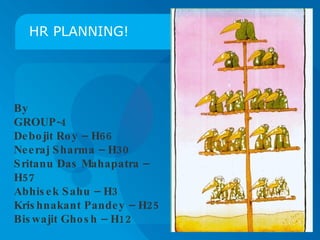
HR PLANNING! By GROUP-4 Debojit Roy – H66 Neeraj Sharma – H30 Sritanu Das Mahapatra – H57 Abhisek Sahu – H3 Krishnakant Pandey – H25 Biswajit Ghosh – H12

Modern Hrm

  • 1.
  • 2.
    What is HumanResources Management all about? Planning HR Needs Compensating and motivating employees Appraising employee behavior Enhancing potential – training & development much more careful selection and recruitment high level of training and staff development better communications between staff and management extensive use of teamwork introduction of performance management encouragement of employee suggestions and innovation
  • 3.
    HRM in CorporateFor Profit Environment: Dynamic Growth Strategy – balance between current work and potential future work Extract Profit Strategy – focus on profit, cost cutting, frequent terminations Liquidation Strategy – selling off assets, cutting further losses, workers a commodity Turnaround Strategy – short term strategy for long term survival
  • 4.
    HRM in CorporateDesigning a Training & Development Program: Balance between individual needs, departmental needs, and community needs Long term vision vs. short term reality Developing a Learning Culture Job specific vs. culturally specific program (language training) Requires Assessment of skills, knowledge and attitude of individuals and community to ensure efficient use of funds
  • 5.
    HRM in CorporateSkills Assessment & Needs Analysis: Conduct a needs analysis of organization and compare skills across group. Conduct individual skills assessment part of personal career planning as hire, pay increases, promotions
  • 6.
    There is onlyone constant in the universe. What is that? That is………… “ Change”
  • 7.
    TRADITIONAL ≤ MODERN TRADITIONAL • selection and recruitment • training and development • pay and conditions • industrial relations • employee welfare • occupational health and safety. MODERN • strict and rigorous selection and recruitment . • high level of training, especially induction training and on the job training. • multi skilling. • better management-worker communications. • encouragement of employee suggestions and innovation. • single status symbols such as common canteens and corporate uniforms.
  • 8.
    Trends in HumanResource Management Work Force Diversity Women Participation (Example: In U.S. 45.5% in 1979, 47.7% in 2005) Racial Composition ( Example: Inclusion of different race and communal group) Portion of Ageing work force ( Example: retirement age, average life expectancy etc.) Technological Change ( Example: Stenograph, Teletype, Fax, Email, Tele-seminar etc.) Attraction to White Collar and professional jobs
  • 9.
    Trends in HumanResource Management Changing Economy Production globalization (Example: same product from different countries, production of different accessories-parts in different countries) International competition of market ( Example: automobile, electronics, knowledge industries etc.) Manufacturing plant in different countries ( Example: Sony in Malaysia, ) Job sifting from one place to another ( Example: Tendency to use cheaper workforce, e. g. garments) High performance work system
  • 10.
    Outsourcing What isOutsourcing? Outsourcing is a strategic decision to give a task or activity to an independent contractor who determines how best to do the task or activity. The firm and the independent contractor become partners and may establish a long-term relationship. Examples of outsourced activities: IT, HR, Legal services, Manufacturing, R & D. Note: Outsourcing to India is now more about high quality rather than cost. (Forbes)
  • 11.
    Outsourcing Outsourcing Advantages:Better quality people and knowledge. Reduction in administrative costs. Outsourcing certain activities and employees that do not fit with company culture may be used to preserve a strong culture or employee morale.
  • 12.
    Outsourcing Outsourcing Disadvantages:Outsourcing may lead to loss of control of certain activities which may be a problem on time sensitive projects. Outsourcing an activity may result in loss of the opportunity to gain knowledge and information.
  • 13.
    Why Has OutsourcingBecome So Popular 1. Globalization and labor arbitrage: The wage differential is now so great that firms may be willing to accept the risks associated with vendor opportunism Within developing economies, investment in human capital and in production capacity has expanded dramatically The wage differential between developed and developing economies is substantial 2. Technology. 3. Core competency.
  • 14.
    MODERN DAYS OFHRM Employee satisfaction, motivation and recognition. Quality Reward systems Communication High cost-effectiveness Flexibility/adaptability Appraisal, training and development High problem solving, change and innovation Commitment Recruitment, selection and socialization High job performance Strategic integration Organisation and job design. Management of change Organizational outcomes Human resource management outcomes Human resource management policies
  • 15.
  • 16.
  • 17.
  • 18.
  • 19.
  • 20.
  • 21.
  • 22.
    Awards for HRPractices: Asia Pacific HR Conclave Award for the company with “Most Innovative HR practices”. National award for “Best HRD Practices” from Indian Society for Training and Development. “ National Award for Outstanding Work in Human Resource Management” from National HRD Network. “ Award for Outstanding Human Resources Development” from Confederation of Engineering Industry. “ I ntegration of Information Technology with HR” in ECC Division has been recognized by the National HRD Network.
  • 23.
    Story Behind theSuccess HR  Policy The basic principles of ECC's Human Resources policies include Recruitment based solely on merit by following well-defined and systematic selection procedures without discrimination. Sustain motivated and quality work force through appropriate and fair performance evaluation, reward and recognition systems.  Identify training needs within the Organisation and design and implement those need based training programmes resulting in continuous upgradation of knowledge, skills and attitudes of the employees. Maintain a quality Human Resource Management System to meet the international standards as per ISO 9001. Plan, design, train, equip and motivate the department staff to meet this standard of expectation.   Work culture emphasizes: · Freedom to experiment · Continuous learning and training  · Transparency · Quality in all aspects of work · Rewards based on performance and potential “ If you feel like a seagull in the sky, If you feel you belong to the top and want to higher, you are ready for the ECC Challenge - India's largest construction organization.  Join our team and realize your dreams with us.”
  • 24.
    Latest Techniques InThe Field of Human Resource: Employees for Lease Moonlighting by Employees Dual Career Groups Flexi-time & Flexi-work Non-smoking policy Management Participation in Employees' Organizations Collective Bargaining Collaborative management.
  • 25.
    Future Of HRMRetention : One survey estimated that it can cost as much as 1.5 times the employees annual salary to recruit and train a replacement. Project based work: Hire people on project based work gives optimal utilization. Work from home: Offers employees to work within a flexible environment. So on……
  • 26.
    HR PLANNING! ByGROUP-4 Debojit Roy – H66 Neeraj Sharma – H30 Sritanu Das Mahapatra – H57 Abhisek Sahu – H3 Krishnakant Pandey – H25 Biswajit Ghosh – H12