MOBILE JOURNALISM
Dr.Diwakar Awasthi, Assistant Professor, Department of Journalism & Mass Communication, CSJM University, Kanpur
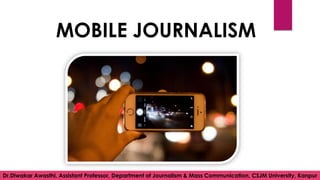
MOBILE JOURNALISM
“Mobile journalism can be defined as the
process of gathering and delivering news using a
smartphone or tablet. It is a trend in news covering
and broadcasting and has the potential to
become the new standard in journalism practice,
especially to report breaking news.”
MOBILE JOURNALISM
“Mobile journalism is “in the moment”
journalism”
“Mobile journalism is a form of
digital storytelling where the primary
device used for creating and editing
images, audio and video is a
smartphone.”
Advantages of Mobile Journalism
Compared with traditional journalism, mobile journalism has many benefits.
Realizing the added benefits of mobile journalism can help you be on your way to
becoming a mobile journalist. Here are some of the top benefits of becoming a Mojo:
1. It’s Affordable :
When you add up the costs of all the heavy
duty equipment that’s needed to be a journalist, it can start
to get very expensive. Being able to capture high-quality
pictures, video and audio with your phone without any
additional cost is a huge money-saver. Even with added
costs of supplementary apps and equipment, it’s still a much
cheaper way to tell a story.
2. It’s Flexible:
Taking away all of the heavy duty
equipment, in addition to the team needed to
operate it all, means you’ll be much more flexible.
You won’t be slowed down by a van filled with
cameras and other people. It’ll just be you and your
phone. You can move at your own pace, going
wherever you want, whenever you want, without
being held back.
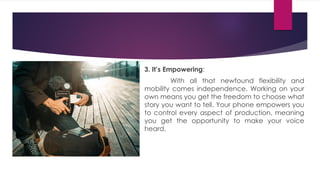
3. It’s Empowering:
With all that newfound flexibility and
mobility comes independence. Working on your
own means you get the freedom to choose what
story you want to tell. Your phone empowers you
to control every aspect of production, meaning
you get the opportunity to make your voice
heard.
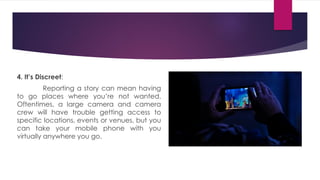
4. It’s Discreet:
Reporting a story can mean having
to go places where you’re not wanted.
Oftentimes, a large camera and camera
crew will have trouble getting access to
specific locations, events or venues, but you
can take your mobile phone with you
virtually anywhere you go.
5. It’s Friendlier.:
Big news cameras can be
intimidating. If you’re trying to get an
interview with a local or a witness, they
may be less open to doing so with a
giant camera in their face. Mobile
phones are smaller and more familiar,
and therefore less intimidating, making
you much more approachable to a
person who you’d like to talk to.
It’s Safer:
Journalism can be a risky
business. Whether it’s covering a
natural disaster or reporting from a
war zone, covering a story can be
dangerous. Doing it from a mobile
device can allow you to be more
mobile, and to not draw attention to
yourself when in these riskier
situations.
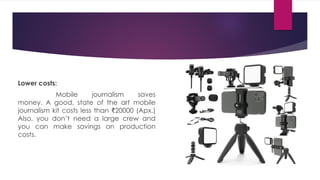
Lower costs:
Mobile journalism saves
money. A good, state of the art mobile
journalism kit costs less than ₹20000 (Apx.)
Also, you don’t need a large crew and
you can make savings on production
costs.
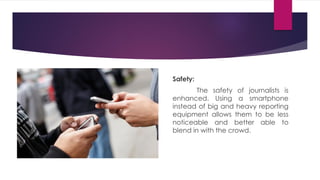
Safety:
The safety of journalists is
enhanced. Using a smartphone
instead of big and heavy reporting
equipment allows them to be less
noticeable and better able to
blend in with the crowd.
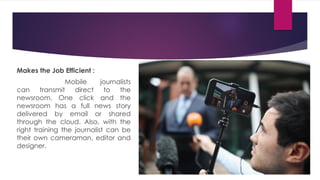
Makes the Job Efficient :
Mobile journalists
can transmit direct to the
newsroom. One click and the
newsroom has a full news story
delivered by email or shared
through the cloud. Also, with the
right training the journalist can be
their own cameraman, editor and
designer.
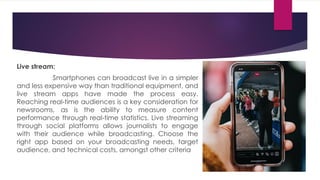
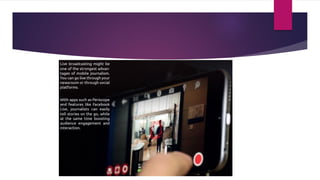
Live stream:
Smartphones can broadcast live in a simpler
and less expensive way than traditional equipment, and
live stream apps have made the process easy.
Reaching real-time audiences is a key consideration for
newsrooms, as is the ability to measure content
performance through real-time statistics. Live streaming
through social platforms allows journalists to engage
with their audience while broadcasting. Choose the
right app based on your broadcasting needs, target
audience, and technical costs, amongst other criteria
Always be prepared: News doesn’t break according to a schedule, or with any
warning. You’ll need to be ready at a moment’s notice to put on your journalist hat and
start reporting.
Have your gear handy. At the very least, you should have your phone with you at all
times to be prepared to get a quick picture or video, to send out a tweet, or to make
an important phone call. If you can, keep your other gear - mics, lights, tripods - with you
as well to make sure you’re ready to go into reporter mode at any time.
HOW CAN I BECOME A MOBILE JOURNALIST?
Know your equipment. This seems basic, but it’s still important that you know your way
around your phone and all of your gear. Not only do you need to know how to operate
all the necessary apps on your phone, as well as any other gear and accessories that
you may have, you need to know how to operate them efficiently, quickly and under
pressure. Taking an extra few seconds to get yourself set up can be the difference
between capturing a story, or not. It sounds silly, but practice using all of your apps and
gear when you’re at home.
Keep your phone charged. You don’t want to find yourself with your battery about to
die when you’re on the verge of scooping a huge story. Make sure your battery is
always charged, and keep an external charger with you as a backup.
Use airplane mode. In those moments where you find your battery running low, switch to
airplane mode to save battery. It’s also important to remember that your phone is still a
phone, even when you’re recording an important video. That means that your video or
audio recordings can still be interrupted by a phone call. Switching your phone to
airplane mode before shooting videos or doing an interview can make a big difference
there.
Don’t delete anything. You never know when an issue may arise in the editing or
publishing process and you’ll need to find the original video again. Make sure that you
don’t delete anything, at least until the story is edited and published.
Get out there. Go places. Meet people. Network. Make contacts. This is easier said than
done, and forcing yourself out of your comfort zone is always difficult, but it’s also where
all of the stories are. You’ll find very few stories from the comfort of your home.
Show up. Woody Allen once said that 80% of success is just showing up. While we live in
a time of extraordinary technological capabilities that allow us to connect with others
from virtually anywhere, it’s important to remember that you’ll need to show up in
person sometimes. When reporting a story, when conducting an interview, it’s always
better to do so in person, to get face to face with your subjects, to observe their
behaviours. In doing so, you’ll also let the other person know that they are an important
part of your story. This could potentially mean that you get a more willing and helpful
interviewee.
Keep your eyes open. Stories are everywhere, even if not in the most obvious places. It’s
important to always be open to learning about and sharing an unexpected story. You
may never know what person, or place, or statistic, or document, or any other thing will
end up being crucial to your story that you may have otherwise overlooked. Don’t have
tunnel vision, and don’t think you already know the story you are telling, because you
don’t.
Know how to tell your story. Finding and documenting something newsworthy is only half
the battle. You may have captured amazing video or done a great interview with
someone, but it’s meaningless if you don’t know how to put it together into a fluid,
structured story. Being able to structure and tell the story correctly is an important part of
the process that can’t be overlooked. Journalists, above all, are storytellers.
Check, and double check, everything. Being a journalist gives you a lot of power, so you
must be extra careful when it comes to checking all of your facts - names, dates,
numbers, events, addresses - as well as all everything technical - grammar, spelling, and
all of that fun stuff. Reporting something incorrectly can have huge consequences, so
it’s important to really make sure you verify your facts get everything right.
Be tough. Being a reporter can be difficult. It’s a competitive field to work in. People
may be unfriendly, rude, or try to prevent you from telling your story. Unforeseen
circumstances may screw things up at any time. Don’t take these things personally and
let them hold you back. Instead, learn to let that bounce off you and keep pushing.
While there are many benefits to becoming a mobile journalist, it also presents many
challenges. Here are some of the challenges facing mobile journalists today
Working alone. The downside to all the freedom and independence mobile journalism grants
you is that working alone can be very difficult. This means you’ll be responsible for every step
of the process, and for every aspect of the project, from reporting and interviewing to filming
and editing - and that can be exhausting and overwhelming. You’ll quickly need to learn
multiple skill sets to keep up.
Limited camera. As great as smartphone cameras have become, they are still fairly limited.
They do not film or photograph well in low light settings. They don’t have optical zoom,
meaning that you’ll generally need to be pretty close to whoever or whatever you are
filming if you want good quality. Without any kind of stabilizer, they produce very shaky
video.
CHALLENGES OF MOBILE JOURNALISM
Limited audio. As with a smartphone’s camera, smartphone audio is also fairly limited.
The recording quality drops off significantly as you move farther away from your subject,
and when filming outdoors, the slightest gust of wind can ruin any recording. Unless you
are right next to whatever you are recording and in a quiet, indoor space, you will likely
have issues with your audio.
Data dependence. A big part of being a mobile journalist is being connected to the
internet. Being on the go and reporting from a wide variety of locations means that
oftentimes, you won’t have a reliable connection. In certain instances, this may hinder
your ability to work.
Battery. Gone are the days of simple flip phones with batteries that last for days. Today’s
smartphones, with all of their capabilities, generally don’t have batteries that are built to
last that long, especially if they are being used as frequently as a mobile journalist needs
to use them. The chance that a story may break at any time means being extra
cautious about your battery usage.
Storage capacity. As a mobile journalist, you’ll quickly find yourself deleting things from
your phone to make room for a new video. With the amount of apps you’ll need, and
the amount of photographs and videos you’ll be taking, your phone’s memory won’t be
enough, and you’ll have to start finding alternative methods for storing everything.
Mobile journalism is changing the way stories are being told. Some old-fashioned,
traditional journalists are resisting the change, but many more are embracing it. Mobile
journalism is here, and it’s here to stay.
The fact that mobile journalism isn’t going away doesn’t mean that it replaces
traditional journalism. They are still different, and each have their benefits, and thus can
coexist. Many media outlets have integrated mobile journalism into their framework, as
a complement to its traditional reporting. For example, many news corporations use
mobile journalism for much of their social media coverage, while sticking with their big
news cameras in more traditional settings. We’re not at the point where we’re
interviewing the president with a tricked out smartphone.
THE FUTURE OF MOBILE JOURNALISM
All of these advancements and changes do not come without a more serious
message of caution. In a world dominated by fake news, mobile journalism can pose a
threat to the integrity of reporting. People do not always realize the immense power
they wield with a phone in their hands, and this can have serious consequences.
Journalism is built upon a foundation of ethics, integrity, accuracy, and truth. Without
the proper training or care, these foundations can be shaken by failing to meet basic
journalistic standards. With the breakneck speed that news moves at today, even the
most well-meaning reporter may feel rushed, and publish a story with critical errors. At
worst, people may take advantage of this newly accessible system to spread
misinformation.
This is not to say that people should shy away from pursuing mobile journalism,
but that one should do so with extreme care and caution. Journalism, the act of telling
stories, is still a noble pursuit. With the right approach, and with a little knowledge,
preparation, and gear, you can be well on your way to being a mobile journalist.
MOBILE-JOURNALISM-by-Dr.Diwakar-Awasthi-2.pdf

MOBILE-JOURNALISM-by-Dr.Diwakar-Awasthi-2.pdf

  • 1.
    MOBILE JOURNALISM Dr.Diwakar Awasthi,Assistant Professor, Department of Journalism & Mass Communication, CSJM University, Kanpur
  • 2.
    MOBILE JOURNALISM “Mobile journalismcan be defined as the process of gathering and delivering news using a smartphone or tablet. It is a trend in news covering and broadcasting and has the potential to become the new standard in journalism practice, especially to report breaking news.”
  • 3.
    MOBILE JOURNALISM “Mobile journalismis “in the moment” journalism” “Mobile journalism is a form of digital storytelling where the primary device used for creating and editing images, audio and video is a smartphone.”
  • 4.
    Advantages of MobileJournalism Compared with traditional journalism, mobile journalism has many benefits. Realizing the added benefits of mobile journalism can help you be on your way to becoming a mobile journalist. Here are some of the top benefits of becoming a Mojo: 1. It’s Affordable : When you add up the costs of all the heavy duty equipment that’s needed to be a journalist, it can start to get very expensive. Being able to capture high-quality pictures, video and audio with your phone without any additional cost is a huge money-saver. Even with added costs of supplementary apps and equipment, it’s still a much cheaper way to tell a story.
  • 5.
    2. It’s Flexible: Takingaway all of the heavy duty equipment, in addition to the team needed to operate it all, means you’ll be much more flexible. You won’t be slowed down by a van filled with cameras and other people. It’ll just be you and your phone. You can move at your own pace, going wherever you want, whenever you want, without being held back.
  • 6.
    3. It’s Empowering: Withall that newfound flexibility and mobility comes independence. Working on your own means you get the freedom to choose what story you want to tell. Your phone empowers you to control every aspect of production, meaning you get the opportunity to make your voice heard.
  • 7.
    4. It’s Discreet: Reportinga story can mean having to go places where you’re not wanted. Oftentimes, a large camera and camera crew will have trouble getting access to specific locations, events or venues, but you can take your mobile phone with you virtually anywhere you go.
  • 8.
    5. It’s Friendlier.: Bignews cameras can be intimidating. If you’re trying to get an interview with a local or a witness, they may be less open to doing so with a giant camera in their face. Mobile phones are smaller and more familiar, and therefore less intimidating, making you much more approachable to a person who you’d like to talk to.
  • 9.
    It’s Safer: Journalism canbe a risky business. Whether it’s covering a natural disaster or reporting from a war zone, covering a story can be dangerous. Doing it from a mobile device can allow you to be more mobile, and to not draw attention to yourself when in these riskier situations.
  • 10.
    Lower costs: Mobile journalismsaves money. A good, state of the art mobile journalism kit costs less than ₹20000 (Apx.) Also, you don’t need a large crew and you can make savings on production costs.
  • 11.
    Safety: The safety ofjournalists is enhanced. Using a smartphone instead of big and heavy reporting equipment allows them to be less noticeable and better able to blend in with the crowd.
  • 12.
    Makes the JobEfficient : Mobile journalists can transmit direct to the newsroom. One click and the newsroom has a full news story delivered by email or shared through the cloud. Also, with the right training the journalist can be their own cameraman, editor and designer.
  • 13.
    Live stream: Smartphones canbroadcast live in a simpler and less expensive way than traditional equipment, and live stream apps have made the process easy. Reaching real-time audiences is a key consideration for newsrooms, as is the ability to measure content performance through real-time statistics. Live streaming through social platforms allows journalists to engage with their audience while broadcasting. Choose the right app based on your broadcasting needs, target audience, and technical costs, amongst other criteria
  • 15.
    Always be prepared:News doesn’t break according to a schedule, or with any warning. You’ll need to be ready at a moment’s notice to put on your journalist hat and start reporting. Have your gear handy. At the very least, you should have your phone with you at all times to be prepared to get a quick picture or video, to send out a tweet, or to make an important phone call. If you can, keep your other gear - mics, lights, tripods - with you as well to make sure you’re ready to go into reporter mode at any time. HOW CAN I BECOME A MOBILE JOURNALIST?
  • 16.
    Know your equipment.This seems basic, but it’s still important that you know your way around your phone and all of your gear. Not only do you need to know how to operate all the necessary apps on your phone, as well as any other gear and accessories that you may have, you need to know how to operate them efficiently, quickly and under pressure. Taking an extra few seconds to get yourself set up can be the difference between capturing a story, or not. It sounds silly, but practice using all of your apps and gear when you’re at home. Keep your phone charged. You don’t want to find yourself with your battery about to die when you’re on the verge of scooping a huge story. Make sure your battery is always charged, and keep an external charger with you as a backup.
  • 17.
    Use airplane mode.In those moments where you find your battery running low, switch to airplane mode to save battery. It’s also important to remember that your phone is still a phone, even when you’re recording an important video. That means that your video or audio recordings can still be interrupted by a phone call. Switching your phone to airplane mode before shooting videos or doing an interview can make a big difference there. Don’t delete anything. You never know when an issue may arise in the editing or publishing process and you’ll need to find the original video again. Make sure that you don’t delete anything, at least until the story is edited and published.
  • 18.
    Get out there.Go places. Meet people. Network. Make contacts. This is easier said than done, and forcing yourself out of your comfort zone is always difficult, but it’s also where all of the stories are. You’ll find very few stories from the comfort of your home. Show up. Woody Allen once said that 80% of success is just showing up. While we live in a time of extraordinary technological capabilities that allow us to connect with others from virtually anywhere, it’s important to remember that you’ll need to show up in person sometimes. When reporting a story, when conducting an interview, it’s always better to do so in person, to get face to face with your subjects, to observe their behaviours. In doing so, you’ll also let the other person know that they are an important part of your story. This could potentially mean that you get a more willing and helpful interviewee.
  • 19.
    Keep your eyesopen. Stories are everywhere, even if not in the most obvious places. It’s important to always be open to learning about and sharing an unexpected story. You may never know what person, or place, or statistic, or document, or any other thing will end up being crucial to your story that you may have otherwise overlooked. Don’t have tunnel vision, and don’t think you already know the story you are telling, because you don’t. Know how to tell your story. Finding and documenting something newsworthy is only half the battle. You may have captured amazing video or done a great interview with someone, but it’s meaningless if you don’t know how to put it together into a fluid, structured story. Being able to structure and tell the story correctly is an important part of the process that can’t be overlooked. Journalists, above all, are storytellers.
  • 20.
    Check, and doublecheck, everything. Being a journalist gives you a lot of power, so you must be extra careful when it comes to checking all of your facts - names, dates, numbers, events, addresses - as well as all everything technical - grammar, spelling, and all of that fun stuff. Reporting something incorrectly can have huge consequences, so it’s important to really make sure you verify your facts get everything right. Be tough. Being a reporter can be difficult. It’s a competitive field to work in. People may be unfriendly, rude, or try to prevent you from telling your story. Unforeseen circumstances may screw things up at any time. Don’t take these things personally and let them hold you back. Instead, learn to let that bounce off you and keep pushing.
  • 21.
    While there aremany benefits to becoming a mobile journalist, it also presents many challenges. Here are some of the challenges facing mobile journalists today Working alone. The downside to all the freedom and independence mobile journalism grants you is that working alone can be very difficult. This means you’ll be responsible for every step of the process, and for every aspect of the project, from reporting and interviewing to filming and editing - and that can be exhausting and overwhelming. You’ll quickly need to learn multiple skill sets to keep up. Limited camera. As great as smartphone cameras have become, they are still fairly limited. They do not film or photograph well in low light settings. They don’t have optical zoom, meaning that you’ll generally need to be pretty close to whoever or whatever you are filming if you want good quality. Without any kind of stabilizer, they produce very shaky video. CHALLENGES OF MOBILE JOURNALISM
  • 22.
    Limited audio. Aswith a smartphone’s camera, smartphone audio is also fairly limited. The recording quality drops off significantly as you move farther away from your subject, and when filming outdoors, the slightest gust of wind can ruin any recording. Unless you are right next to whatever you are recording and in a quiet, indoor space, you will likely have issues with your audio. Data dependence. A big part of being a mobile journalist is being connected to the internet. Being on the go and reporting from a wide variety of locations means that oftentimes, you won’t have a reliable connection. In certain instances, this may hinder your ability to work.
  • 23.
    Battery. Gone arethe days of simple flip phones with batteries that last for days. Today’s smartphones, with all of their capabilities, generally don’t have batteries that are built to last that long, especially if they are being used as frequently as a mobile journalist needs to use them. The chance that a story may break at any time means being extra cautious about your battery usage. Storage capacity. As a mobile journalist, you’ll quickly find yourself deleting things from your phone to make room for a new video. With the amount of apps you’ll need, and the amount of photographs and videos you’ll be taking, your phone’s memory won’t be enough, and you’ll have to start finding alternative methods for storing everything.
  • 24.
    Mobile journalism ischanging the way stories are being told. Some old-fashioned, traditional journalists are resisting the change, but many more are embracing it. Mobile journalism is here, and it’s here to stay. The fact that mobile journalism isn’t going away doesn’t mean that it replaces traditional journalism. They are still different, and each have their benefits, and thus can coexist. Many media outlets have integrated mobile journalism into their framework, as a complement to its traditional reporting. For example, many news corporations use mobile journalism for much of their social media coverage, while sticking with their big news cameras in more traditional settings. We’re not at the point where we’re interviewing the president with a tricked out smartphone. THE FUTURE OF MOBILE JOURNALISM
  • 25.
    All of theseadvancements and changes do not come without a more serious message of caution. In a world dominated by fake news, mobile journalism can pose a threat to the integrity of reporting. People do not always realize the immense power they wield with a phone in their hands, and this can have serious consequences. Journalism is built upon a foundation of ethics, integrity, accuracy, and truth. Without the proper training or care, these foundations can be shaken by failing to meet basic journalistic standards. With the breakneck speed that news moves at today, even the most well-meaning reporter may feel rushed, and publish a story with critical errors. At worst, people may take advantage of this newly accessible system to spread misinformation. This is not to say that people should shy away from pursuing mobile journalism, but that one should do so with extreme care and caution. Journalism, the act of telling stories, is still a noble pursuit. With the right approach, and with a little knowledge, preparation, and gear, you can be well on your way to being a mobile journalist.