




Mobile Learning
Need The students of today are technologically savvy and in need of an education that is individualized and geared toward that technology.  Through Mobile Learning, students will be able to experience learning through listening, reading, predicting, reflecting and responding.  This entire experience can take place via a smart phone.  Therefore, learning can take place anywhere at any time, but most importantly, all the time.
Research Many researchers have discovered the positive aspects of mobile learning through careful and analytical research.  Some of these studies include: Ally, M. (2009). Mobile   learning:   Transforming   the   delivery   of   education   and   training. Athabasca, AB: Athabasca University Press. Keegan, D. (2005). The Incorporation of mobile learning into mainstream education and training. In mLearn2005 Retrieved December 31, 2011 from  http://www.mlearn.org.za/CD/papers/keegan1.pdf Wentzel, P., Lammeren, R., Molendijk, M. , Bruin, S., Wagtendonk, A.  (2005). Using mobile technology to enhance students' educational experiences, Case Study from the EDUCAUSE Center for Applied Research. The  research  undergirding this innovation is demonstrated, including (a) the organization/people that developed the innovation, (b) the findings of their research, (c) the “lead thinkers,” for the innovation, and (d) how they convinced a manufacturer to produce the innovation.
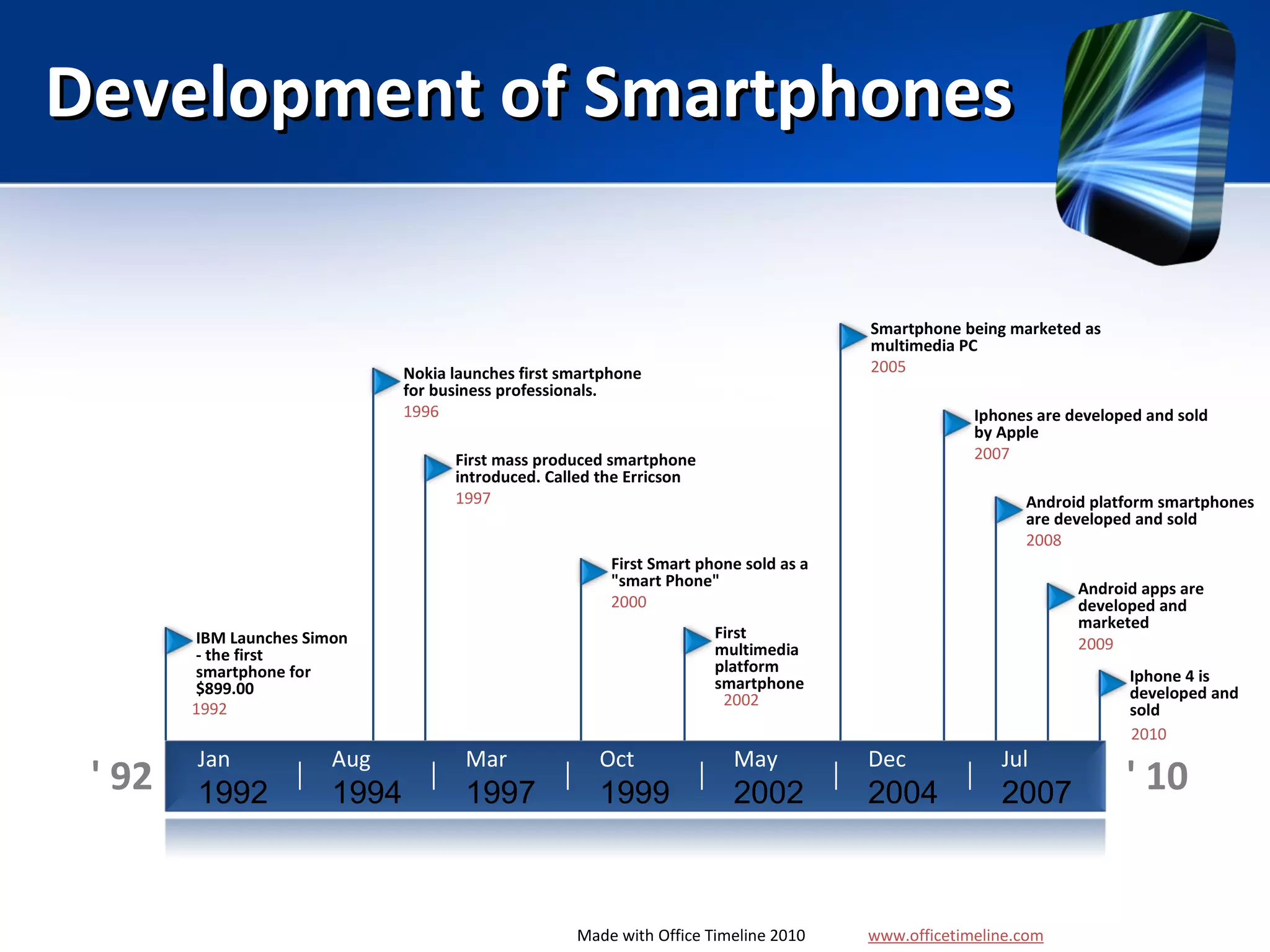
Development of Smartphones Made with Office Timeline 2010 www.officetimeline.com ' 92 Jan 1992 Aug 1994 Mar 1997 Oct 1999 May 2002 Dec 2004 Jul 2007 ' 10 Iphone 4 is developed and sold 2010 Android apps are developed and marketed 2009 Android platform smartphones are developed and sold 2008 Iphones are developed and sold by Apple 2007 Smartphone being marketed as multimedia PC 2005 First multimedia platform smartphone 2002 First Smart phone sold as a "smart Phone" 2000 First mass produced smartphone introduced. Called the Erricson 1997 Nokia launches first smartphone for business professionals. 1996 IBM Launches Simon - the first smartphone for $899.00 1992
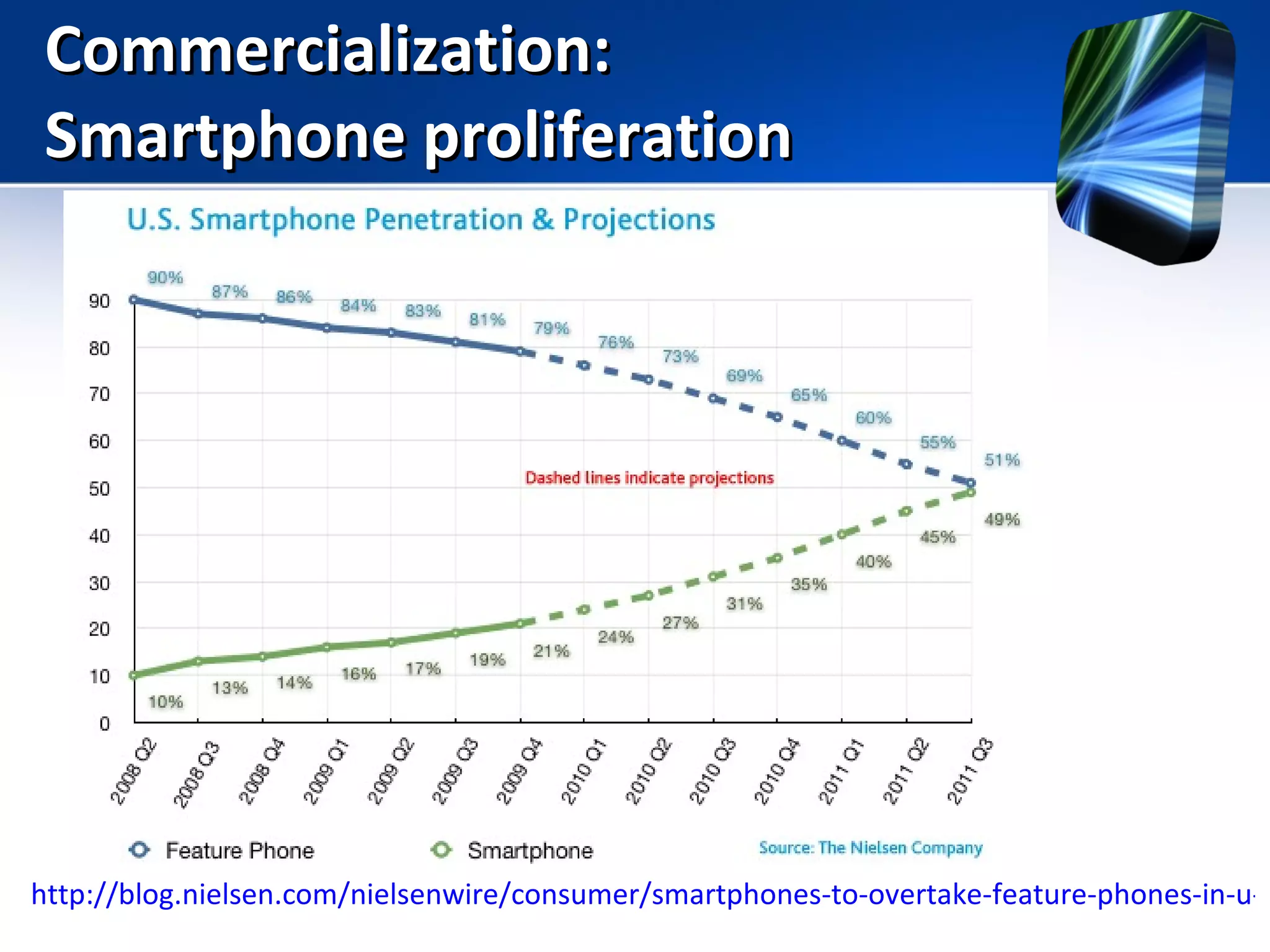
Commercialization: Smartphone proliferation http://blog.nielsen.com/nielsenwire/consumer/smartphones-to-overtake-feature-phones-in-u-s-by-2011/
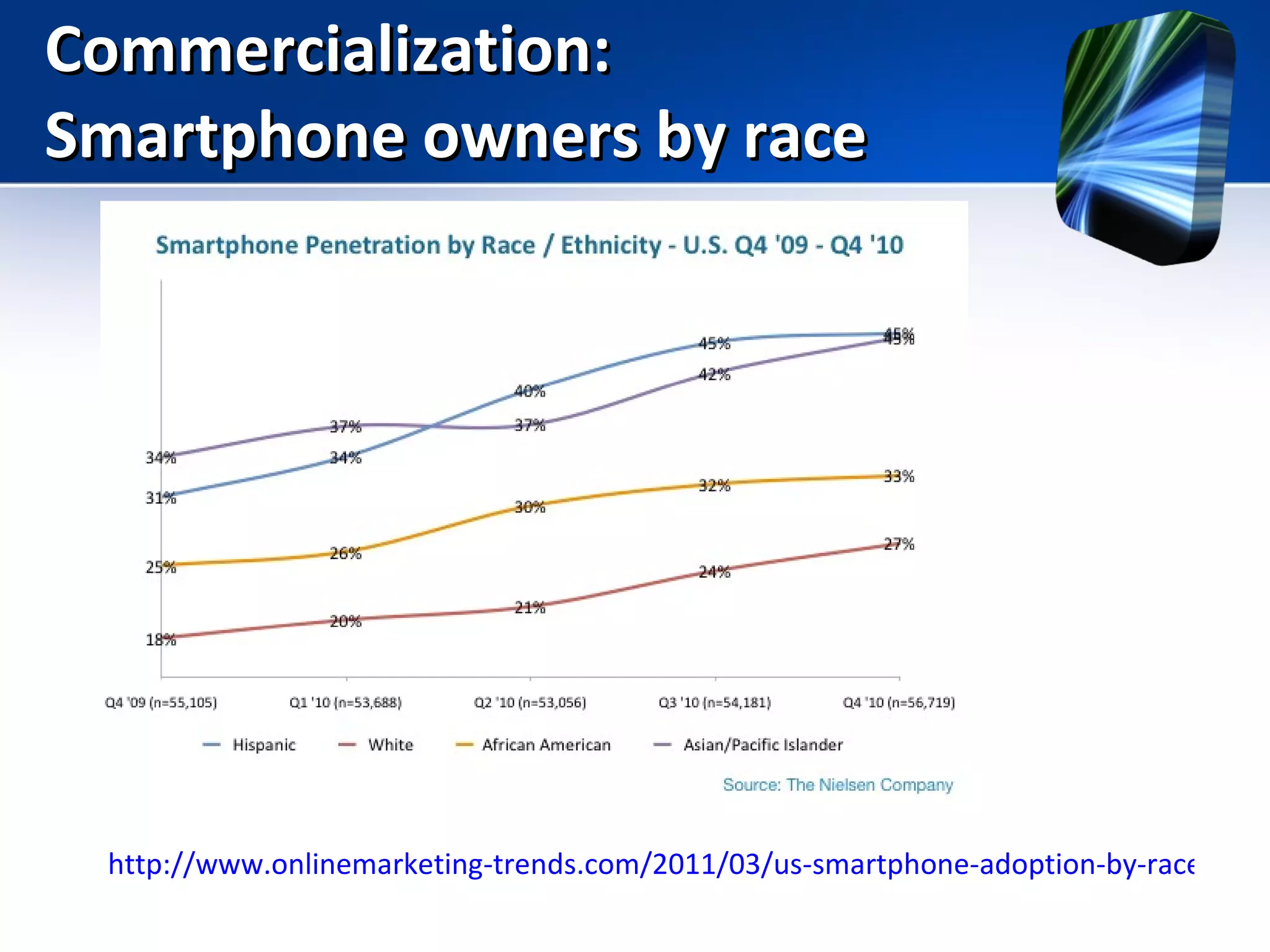
Commercialization: Smartphone owners by race http://www.onlinemarketing-trends.com/2011/03/us-smartphone-adoption-by-race-and.html
THE INNOVATION-DECISION PROCESS
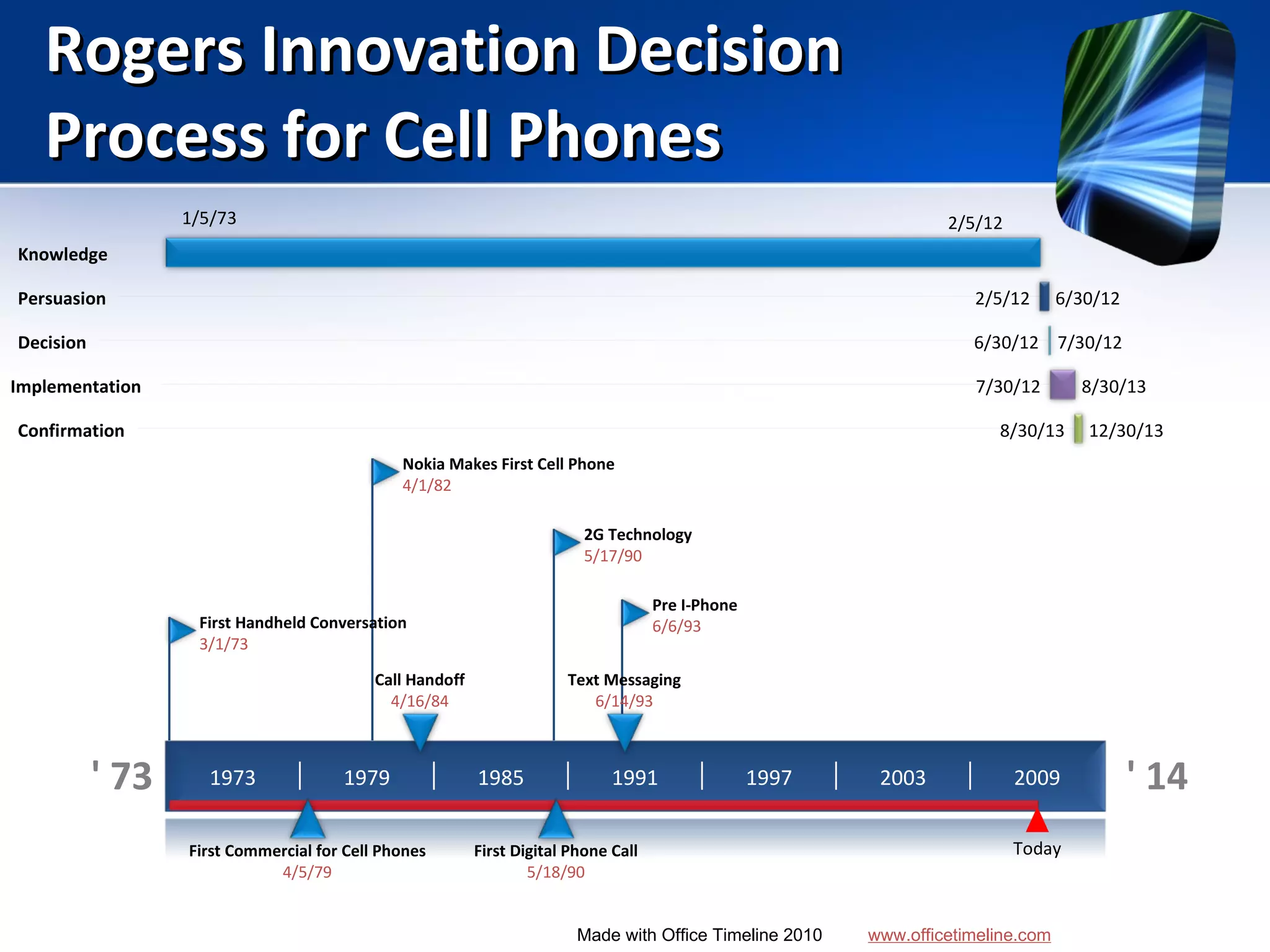
Rogers Innovation Decision Process for Cell Phones Made with Office Timeline 2010 www.officetimeline.com ' 73 1973 1979 1985 1991 1997 2003 2009 ' 14 Today Text Messaging 6/14/93 Pre I-Phone 6/6/93 First Digital Phone Call 5/18/90 2G Technology 5/17/90 Call Handoff 4/16/84 Nokia Makes First Cell Phone 4/1/82 First Commercial for Cell Phones 4/5/79 First Handheld Conversation 3/1/73 Confirmation 8/30/13 12/30/13 Implementation 7/30/12 8/30/13 Decision 6/30/12 7/30/12 Persuasion 2/5/12 6/30/12 Knowledge 1/5/73 2/5/12
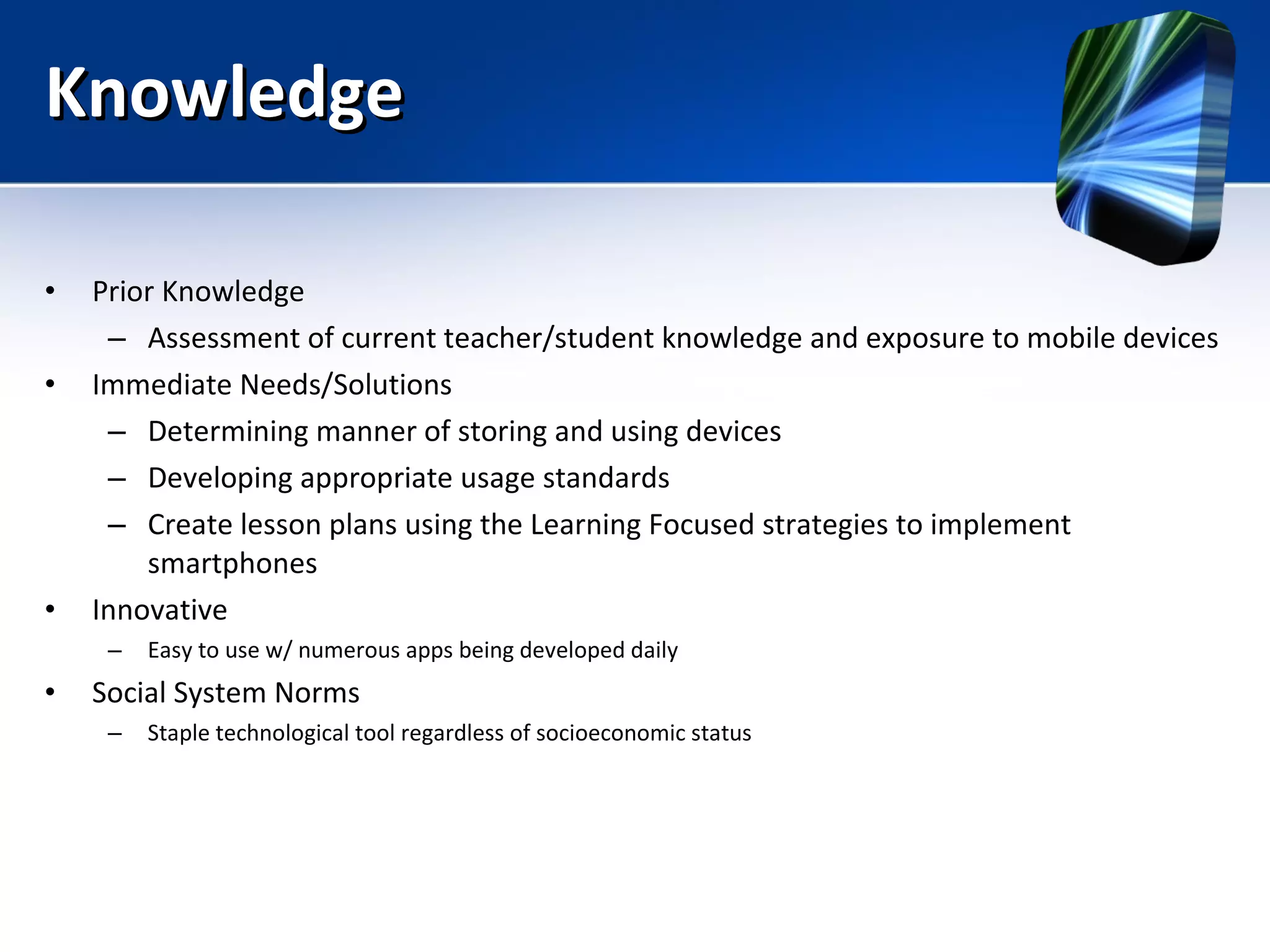
Knowledge Prior Knowledge Assessment of current teacher/student knowledge and exposure to mobile devices Immediate Needs/Solutions Determining manner of storing and using devices Developing appropriate usage standards Create lesson plans using the Learning Focused strategies to implement smartphones Innovative Easy to use w/ numerous apps being developed daily Social System Norms Staple technological tool regardless of socioeconomic status
Persuasion Personality Usage with teachers and students who favor and are willing to experiment with new technology Communication Improved communication between students and teacher through using a technological medium that is comfortable and familiar to the student
Decision Relative Advantage Improved communication and active engagement of students Compatibility Standard software that can be maintained and troubleshot through the District Technology Support Complexity No standard operating system or platform for mobile learning yet. Continuous monitoring necessary Triability Professional learning opportunities should be made available for teachers to try mobile learning prior to implementation in the classroom. Observability Teachers, administrators, and stakeholders will be able to observe the mobile learning process in action as well as view academic successes through a dashboard posted on the school web site.
Implementation Adoption Select teachers will be given the opportunity to implement mobile learning in their classrooms. These teachers will teach in 21 st  century classrooms complete with two networked computers, smartboard, lcd projector, and Elmo document camera. Once the mobile learning is successfully implemented, these teacher would model mobile learning to other teachers throughout the district. Rejection Teachers not comfortable with the full implementation of mobile learning will be given the opportunity to opt out and continue their technology professional development until they are comfortable attempting to utilize the technological tools .
Confirmation Teachers implementing the mobile learning technology will be offered continuous technical support and professional development opportunities.
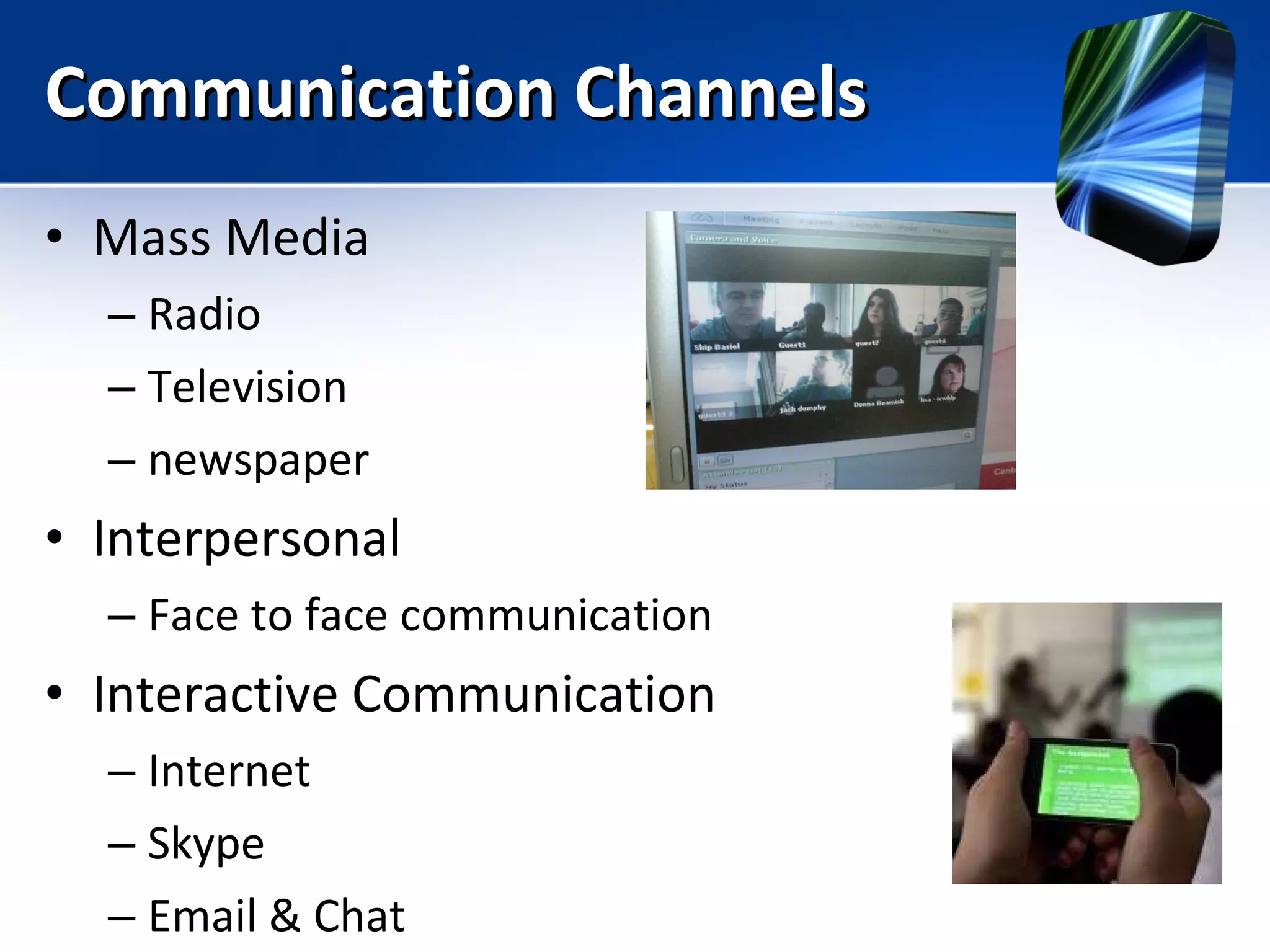
Communication Channels Mass Media Radio Television newspaper Interpersonal Face to face communication Interactive Communication Internet Skype Email & Chat
ADOPTER CATEGORIES AND THE S-CURVE
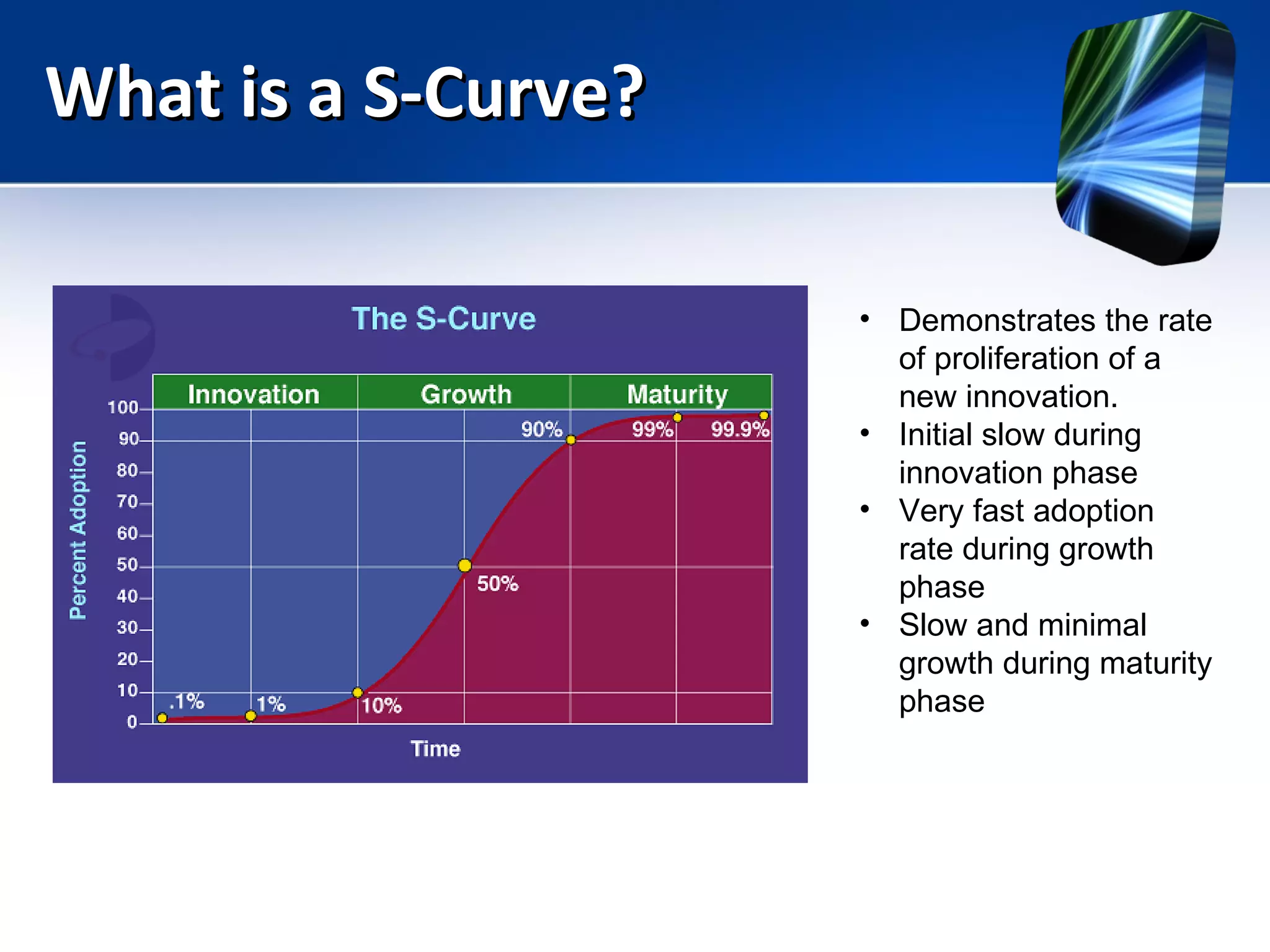
What is a S-Curve? Demonstrates the rate of proliferation of a new innovation. Initial slow during innovation phase Very fast adoption rate during growth phase Slow and minimal growth during maturity phase
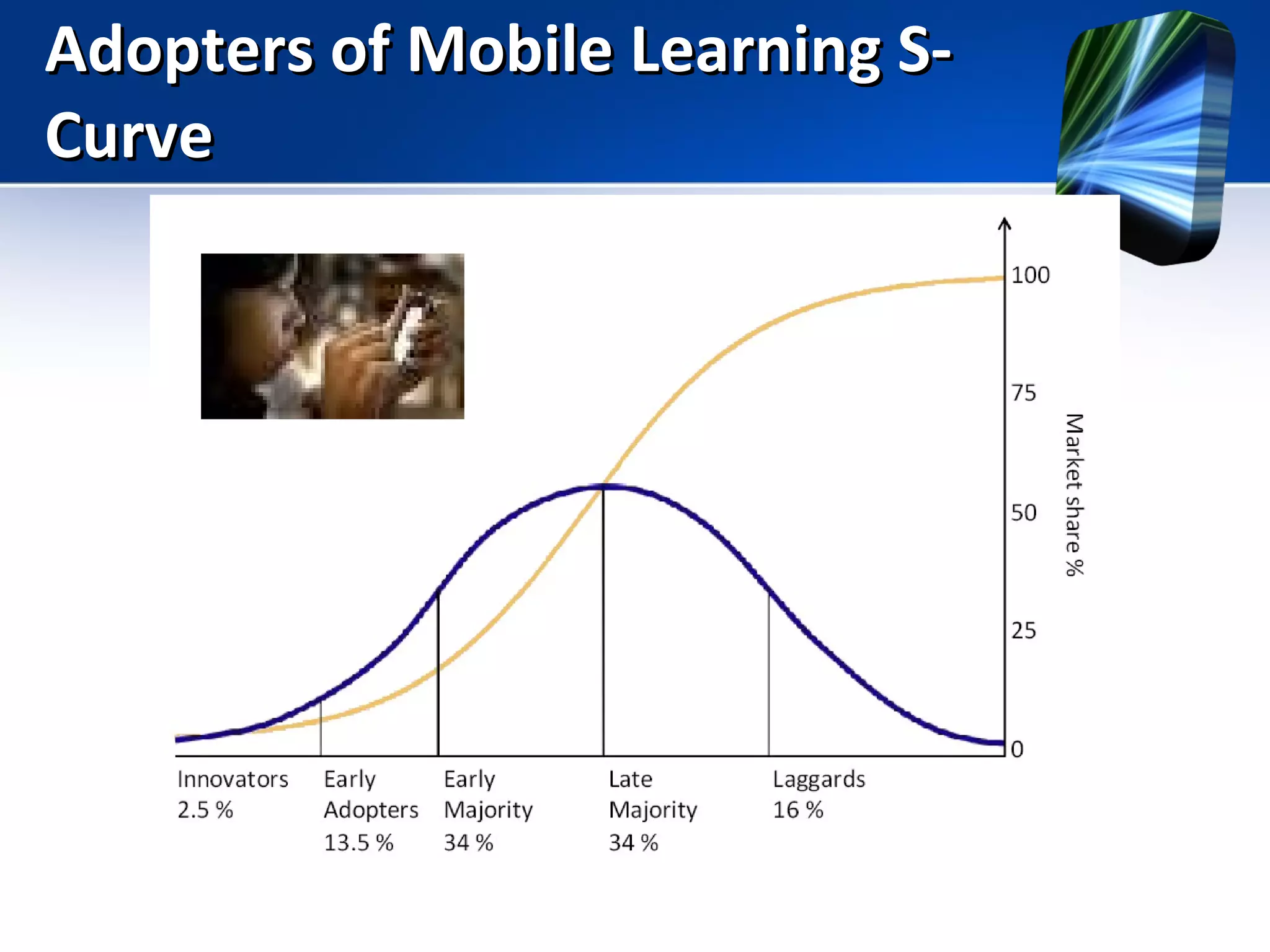
Adopters of Mobile Learning S-Curve
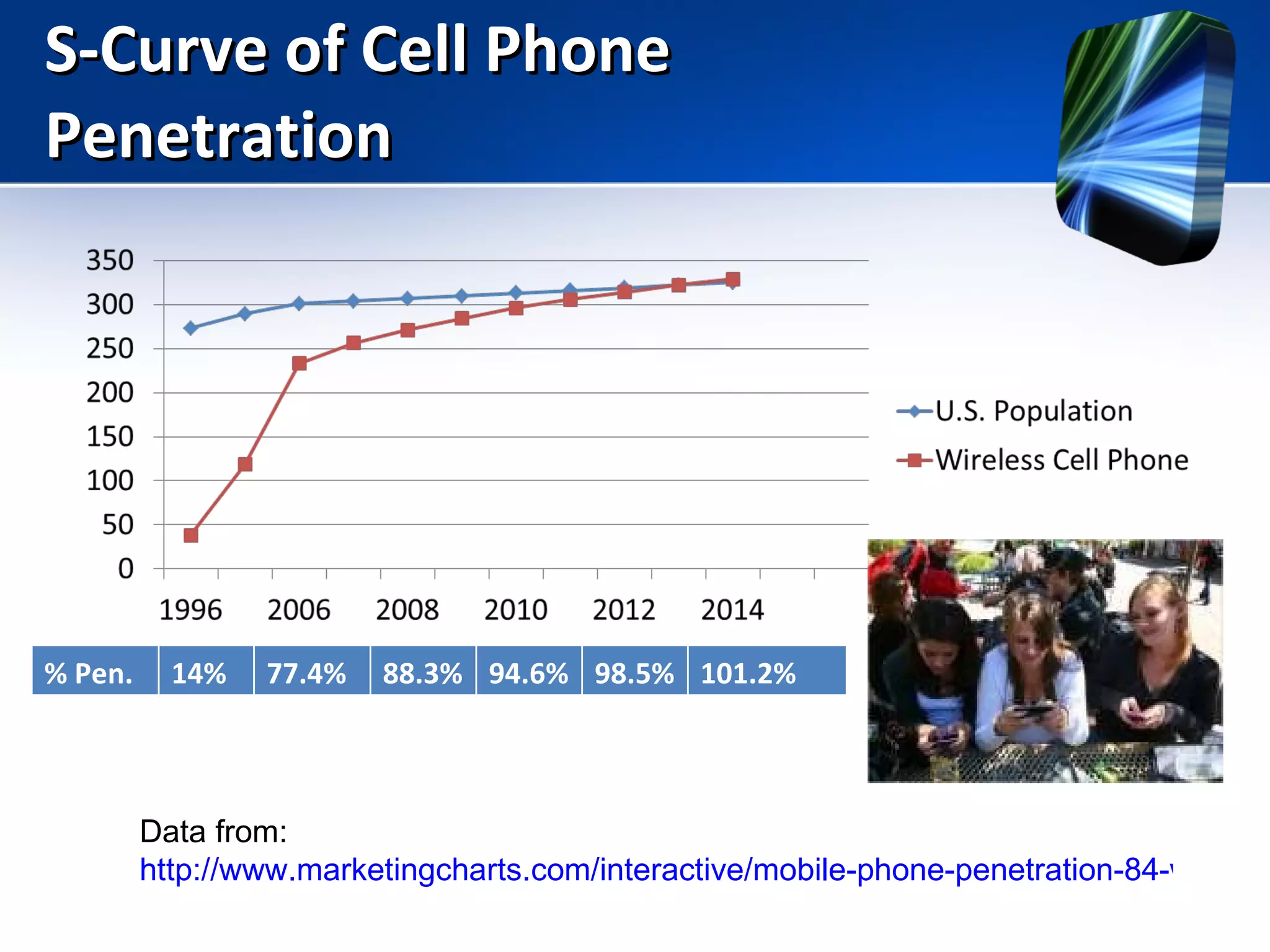
S-Curve of Cell Phone Penetration Data from:  http://www.marketingcharts.com/interactive/mobile-phone-penetration-84-wireless-revenue-155b-by-years-end-1371/snl-kagan-cell-phone-penetration-usjpg/ % Pen. 14% 77.4% 88.3% 94.6% 98.5% 101.2%
PERCEIVED ATTRIBUTES OF INNOVATIONS
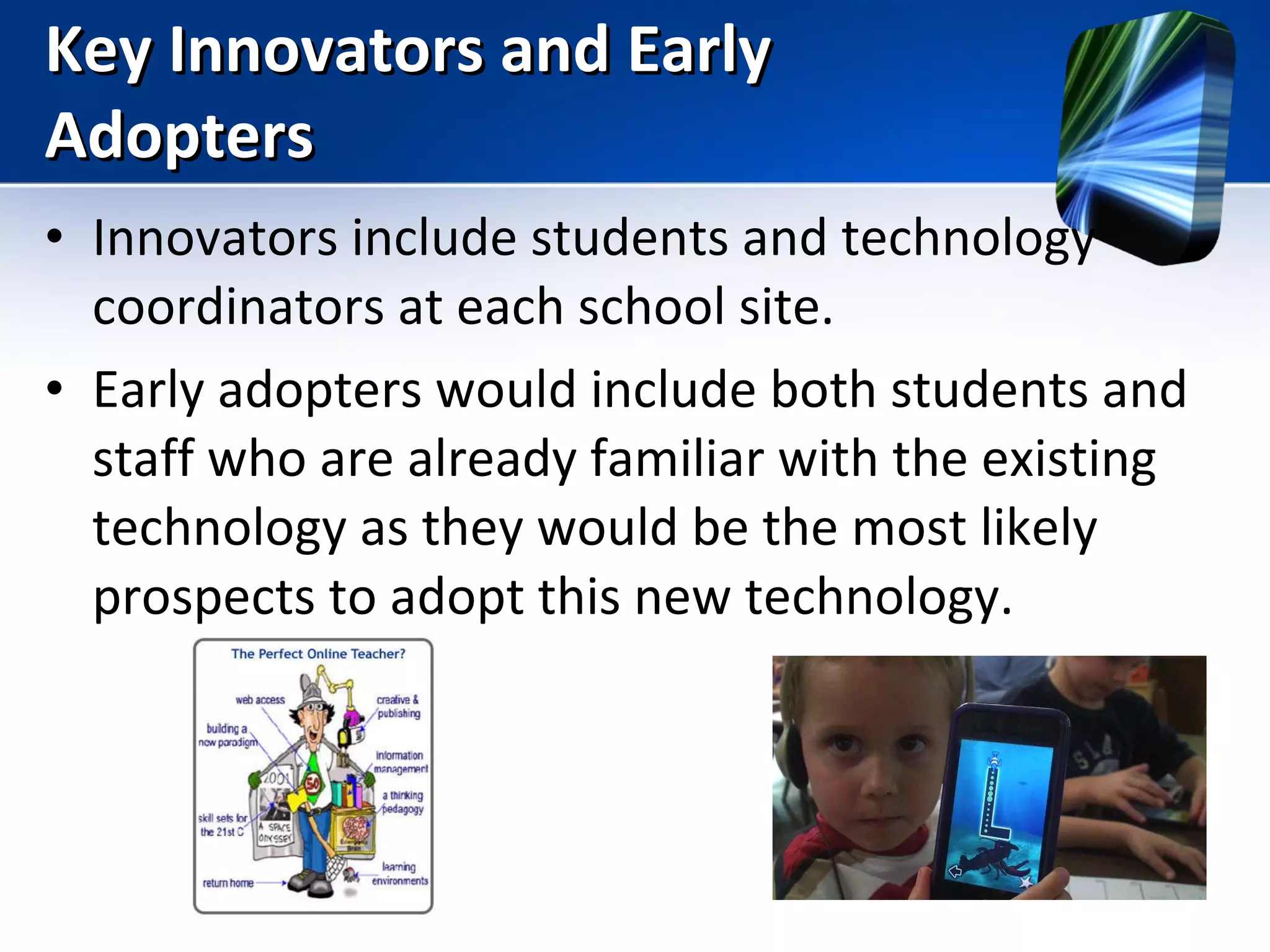
Key Innovators and Early Adopters Innovators include students and technology coordinators at each school site. Early adopters would include both students and staff who are already familiar with the existing technology as they would be the most likely prospects to adopt this new technology.
Strategies Structured opportunities to work with the  mobile learning technology.  Pretested and designed tasks for the innovators and early adopters to complete which will provide immediate positive feedback and success. Recognition of staff and students of their accomplishments through emails and school newsletters.
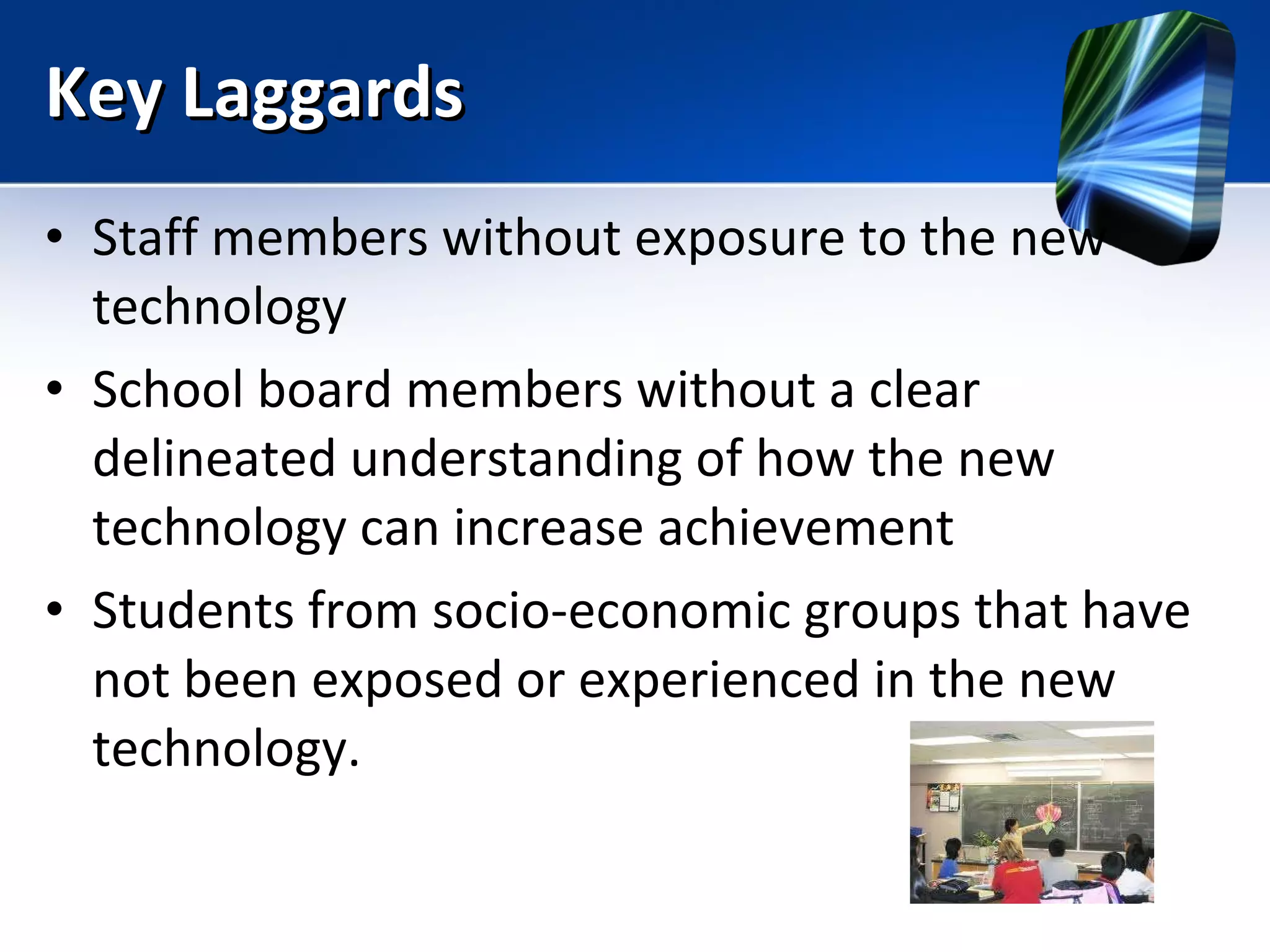
Key Laggards Staff members without exposure to the new technology School board members without a clear delineated understanding of how the new technology can increase achievement Students from socio-economic groups that have not been exposed or experienced in the new technology.
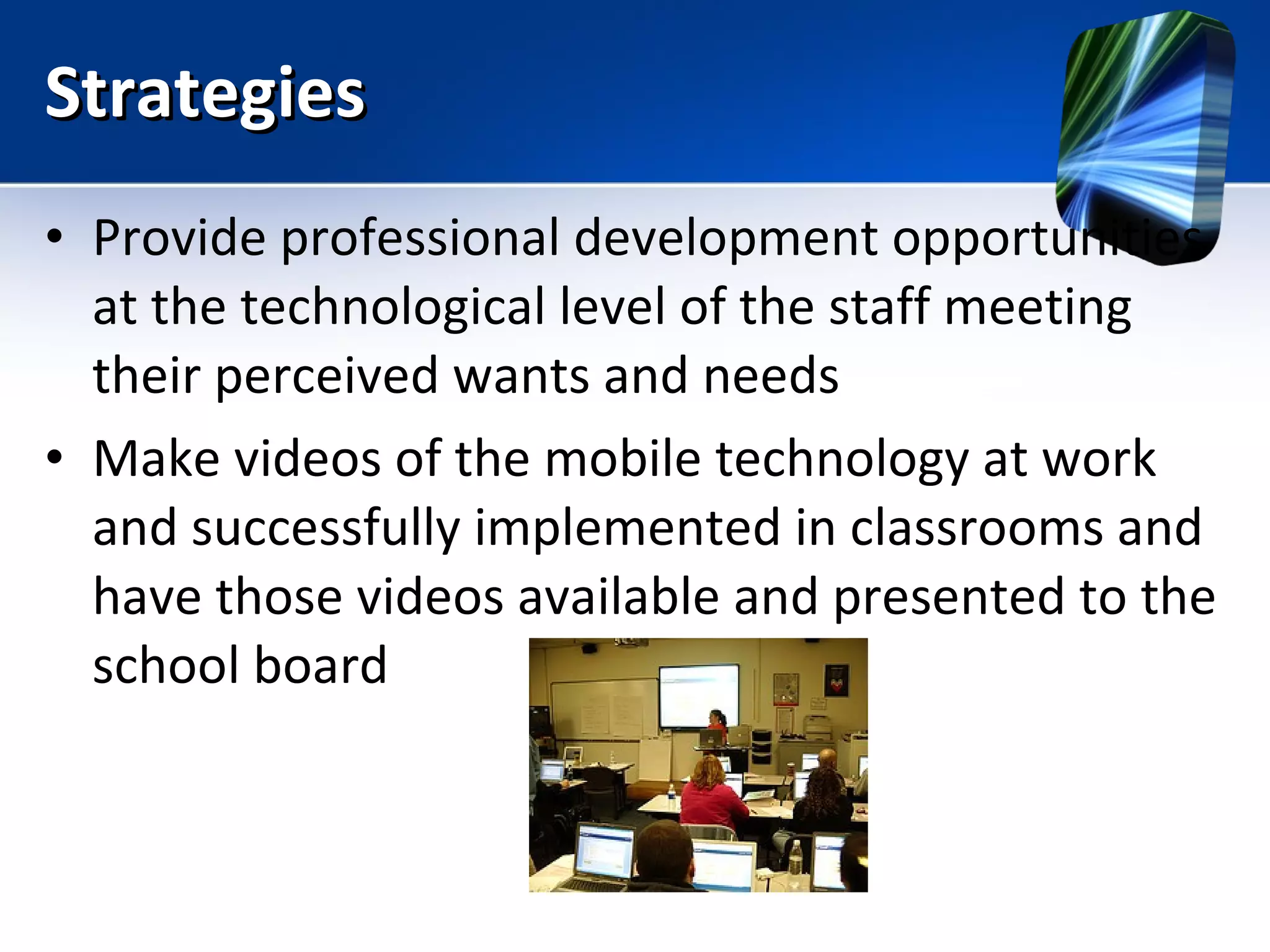
Strategies Provide professional development opportunities at the technological level of the staff meeting their perceived wants and needs Make videos of the mobile technology at work and successfully implemented in classrooms and have those videos available and presented to the school board
CRITICAL MASS AND CHANGE AGENTS
Decentralized Approach Use the People and the Resources we already have in place “ expert members such as architects, teachers, surgeons, or those who have technical expertise” (Rogers, 2003, p. 398).  Cost Effective Use a BYOT policy (Bring Your Own Technology)
Change Agents Teachers  Administration Parents  Students Superintendent  Instructional Coaches
Seven Roles of a Change Agent 1. Develops Need for Change Provide student scores on benchmark assessments and CRCT Review remedies that have been used in the past and their relative effectiveness Introduces the concept of mobile learning
Seven Roles of a Change Agent 2.  Establishes an Information-Exchange Relationship with Teachers & Community Presents his/her personal experience and certifications Connection to the school and school district
Seven Roles of a Change Agent 3.  Diagnoses School’s Difficulties with Standardized Tests  Discuss the changing student body Various Subgroups Changes in Technology and teaching methodologies
Seven Roles of a Change Agent 4. Creates Intent to Change in the Client Introduces mobile learning  Explains BYOT Becoming more Student Learning Focused as opposed to the status quo Differentiating to meet the needs of our students while still achieving state standards
Seven Roles of a Change Agent 5. Translates Intent into Action Explain Innovation Timeline Demonstrates the effectiveness of mobile learning via a short survey using a mobile app known as pollster.
Seven Roles of a Change Agent 6. Stabilizes Adoption and Prevents Discontinuances Continuing Professional Development in a Blended Fashion Self chosen/directed online professional development 4 group meetings Technological Support as Needed Provides storing system for mobile phones in the classroom as well as strategies for proper implementation
Seven Roles of a Change Agent 7. Achieves a Lasting Relationship Demonstrates that mobile learning can be maintained and continued at the school site level with little intervention from district Utilize the Assets that are already in place more effectively to increase student achievement and engagement in the classroom
Critical Mass Occurs when enough individuals have  adopted an innovation that the innovation's further rate of adoption becomes self-sustaining  When enough early adopters and innovators have begun using the innovation and have shared it with their peers, the continued growth is self sustaining.
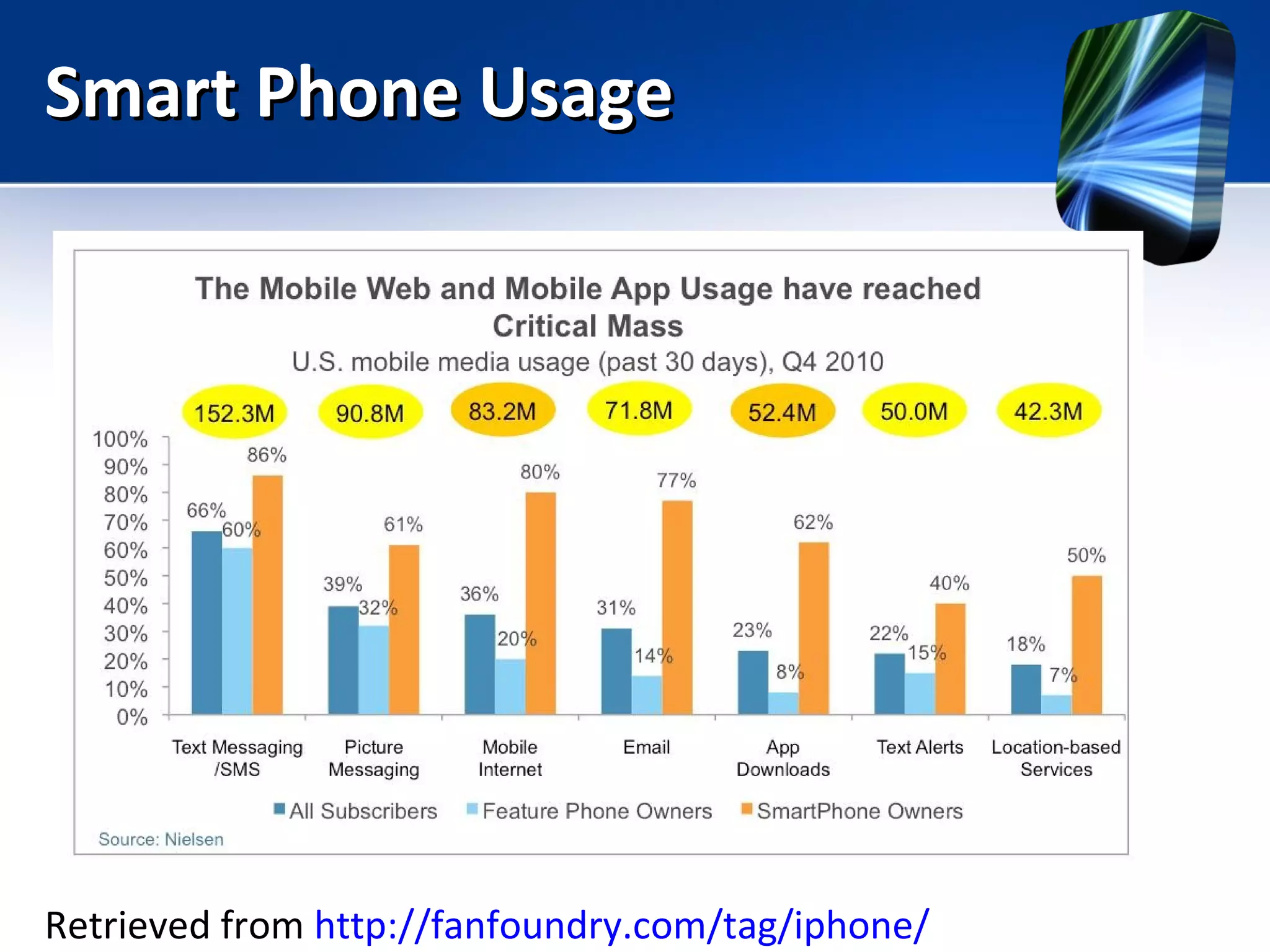
Smart Phone Usage Retrieved from  http://fanfoundry.com/tag/iphone/
Mobile Learning in GCSD Have not met Critical Mass in implementation and usage of mobile learning in our district. Place innovation (mobile/smart phones) into the hand of teachers who are open and readily willing to use it Provide positive reactions and benefits to these early adopters Provide support and assistance as needed (Rogers, 2003)
ORGANIZATIONAL INNOVATIONS
Champion Technology Coordinators, Instructional Coaches, Media Specialists Familiarity of staff and understanding of who is an early adopter as opposed to a laggard the need for your innovation, and
Champion  Determine Appropriate classrooms and  timelines to begin implementation of mobile learning. Using their expertise, match appropriate mobile apps and learning experiences to the needs of the students taking into account language differences and special needs Takes learning outside the confines of the classroom
Support Mobile Learning Capitalize on the strengths of our students rather than focus on their weaknesses Makes learning meaningful and accessible to all learners The learning process does not end at the classroom door,  It is continued throughout the day, anytime, anywhere, any subject.

Mobile learning story board week 8 & 9

  • 1.
  • 2.
    Need The studentsof today are technologically savvy and in need of an education that is individualized and geared toward that technology. Through Mobile Learning, students will be able to experience learning through listening, reading, predicting, reflecting and responding. This entire experience can take place via a smart phone. Therefore, learning can take place anywhere at any time, but most importantly, all the time.
  • 3.
    Research Many researchershave discovered the positive aspects of mobile learning through careful and analytical research. Some of these studies include: Ally, M. (2009). Mobile learning: Transforming the delivery of education and training. Athabasca, AB: Athabasca University Press. Keegan, D. (2005). The Incorporation of mobile learning into mainstream education and training. In mLearn2005 Retrieved December 31, 2011 from http://www.mlearn.org.za/CD/papers/keegan1.pdf Wentzel, P., Lammeren, R., Molendijk, M. , Bruin, S., Wagtendonk, A. (2005). Using mobile technology to enhance students' educational experiences, Case Study from the EDUCAUSE Center for Applied Research. The research undergirding this innovation is demonstrated, including (a) the organization/people that developed the innovation, (b) the findings of their research, (c) the “lead thinkers,” for the innovation, and (d) how they convinced a manufacturer to produce the innovation.
  • 4.
    Development of SmartphonesMade with Office Timeline 2010 www.officetimeline.com ' 92 Jan 1992 Aug 1994 Mar 1997 Oct 1999 May 2002 Dec 2004 Jul 2007 ' 10 Iphone 4 is developed and sold 2010 Android apps are developed and marketed 2009 Android platform smartphones are developed and sold 2008 Iphones are developed and sold by Apple 2007 Smartphone being marketed as multimedia PC 2005 First multimedia platform smartphone 2002 First Smart phone sold as a "smart Phone" 2000 First mass produced smartphone introduced. Called the Erricson 1997 Nokia launches first smartphone for business professionals. 1996 IBM Launches Simon - the first smartphone for $899.00 1992
  • 5.
    Commercialization: Smartphone proliferationhttp://blog.nielsen.com/nielsenwire/consumer/smartphones-to-overtake-feature-phones-in-u-s-by-2011/
  • 6.
    Commercialization: Smartphone ownersby race http://www.onlinemarketing-trends.com/2011/03/us-smartphone-adoption-by-race-and.html
  • 7.
  • 8.
    Rogers Innovation DecisionProcess for Cell Phones Made with Office Timeline 2010 www.officetimeline.com ' 73 1973 1979 1985 1991 1997 2003 2009 ' 14 Today Text Messaging 6/14/93 Pre I-Phone 6/6/93 First Digital Phone Call 5/18/90 2G Technology 5/17/90 Call Handoff 4/16/84 Nokia Makes First Cell Phone 4/1/82 First Commercial for Cell Phones 4/5/79 First Handheld Conversation 3/1/73 Confirmation 8/30/13 12/30/13 Implementation 7/30/12 8/30/13 Decision 6/30/12 7/30/12 Persuasion 2/5/12 6/30/12 Knowledge 1/5/73 2/5/12
  • 9.
    Knowledge Prior KnowledgeAssessment of current teacher/student knowledge and exposure to mobile devices Immediate Needs/Solutions Determining manner of storing and using devices Developing appropriate usage standards Create lesson plans using the Learning Focused strategies to implement smartphones Innovative Easy to use w/ numerous apps being developed daily Social System Norms Staple technological tool regardless of socioeconomic status
  • 10.
    Persuasion Personality Usagewith teachers and students who favor and are willing to experiment with new technology Communication Improved communication between students and teacher through using a technological medium that is comfortable and familiar to the student
  • 11.
    Decision Relative AdvantageImproved communication and active engagement of students Compatibility Standard software that can be maintained and troubleshot through the District Technology Support Complexity No standard operating system or platform for mobile learning yet. Continuous monitoring necessary Triability Professional learning opportunities should be made available for teachers to try mobile learning prior to implementation in the classroom. Observability Teachers, administrators, and stakeholders will be able to observe the mobile learning process in action as well as view academic successes through a dashboard posted on the school web site.
  • 12.
    Implementation Adoption Selectteachers will be given the opportunity to implement mobile learning in their classrooms. These teachers will teach in 21 st century classrooms complete with two networked computers, smartboard, lcd projector, and Elmo document camera. Once the mobile learning is successfully implemented, these teacher would model mobile learning to other teachers throughout the district. Rejection Teachers not comfortable with the full implementation of mobile learning will be given the opportunity to opt out and continue their technology professional development until they are comfortable attempting to utilize the technological tools .
  • 13.
    Confirmation Teachers implementingthe mobile learning technology will be offered continuous technical support and professional development opportunities.
  • 14.
    Communication Channels MassMedia Radio Television newspaper Interpersonal Face to face communication Interactive Communication Internet Skype Email & Chat
  • 15.
  • 16.
    What is aS-Curve? Demonstrates the rate of proliferation of a new innovation. Initial slow during innovation phase Very fast adoption rate during growth phase Slow and minimal growth during maturity phase
  • 17.
    Adopters of MobileLearning S-Curve
  • 18.
    S-Curve of CellPhone Penetration Data from: http://www.marketingcharts.com/interactive/mobile-phone-penetration-84-wireless-revenue-155b-by-years-end-1371/snl-kagan-cell-phone-penetration-usjpg/ % Pen. 14% 77.4% 88.3% 94.6% 98.5% 101.2%
  • 19.
  • 20.
    Key Innovators andEarly Adopters Innovators include students and technology coordinators at each school site. Early adopters would include both students and staff who are already familiar with the existing technology as they would be the most likely prospects to adopt this new technology.
  • 21.
    Strategies Structured opportunitiesto work with the mobile learning technology. Pretested and designed tasks for the innovators and early adopters to complete which will provide immediate positive feedback and success. Recognition of staff and students of their accomplishments through emails and school newsletters.
  • 22.
    Key Laggards Staffmembers without exposure to the new technology School board members without a clear delineated understanding of how the new technology can increase achievement Students from socio-economic groups that have not been exposed or experienced in the new technology.
  • 23.
    Strategies Provide professionaldevelopment opportunities at the technological level of the staff meeting their perceived wants and needs Make videos of the mobile technology at work and successfully implemented in classrooms and have those videos available and presented to the school board
  • 24.
    CRITICAL MASS ANDCHANGE AGENTS
  • 25.
    Decentralized Approach Usethe People and the Resources we already have in place “ expert members such as architects, teachers, surgeons, or those who have technical expertise” (Rogers, 2003, p. 398). Cost Effective Use a BYOT policy (Bring Your Own Technology)
  • 26.
    Change Agents Teachers Administration Parents Students Superintendent Instructional Coaches
  • 27.
    Seven Roles ofa Change Agent 1. Develops Need for Change Provide student scores on benchmark assessments and CRCT Review remedies that have been used in the past and their relative effectiveness Introduces the concept of mobile learning
  • 28.
    Seven Roles ofa Change Agent 2. Establishes an Information-Exchange Relationship with Teachers & Community Presents his/her personal experience and certifications Connection to the school and school district
  • 29.
    Seven Roles ofa Change Agent 3. Diagnoses School’s Difficulties with Standardized Tests Discuss the changing student body Various Subgroups Changes in Technology and teaching methodologies
  • 30.
    Seven Roles ofa Change Agent 4. Creates Intent to Change in the Client Introduces mobile learning Explains BYOT Becoming more Student Learning Focused as opposed to the status quo Differentiating to meet the needs of our students while still achieving state standards
  • 31.
    Seven Roles ofa Change Agent 5. Translates Intent into Action Explain Innovation Timeline Demonstrates the effectiveness of mobile learning via a short survey using a mobile app known as pollster.
  • 32.
    Seven Roles ofa Change Agent 6. Stabilizes Adoption and Prevents Discontinuances Continuing Professional Development in a Blended Fashion Self chosen/directed online professional development 4 group meetings Technological Support as Needed Provides storing system for mobile phones in the classroom as well as strategies for proper implementation
  • 33.
    Seven Roles ofa Change Agent 7. Achieves a Lasting Relationship Demonstrates that mobile learning can be maintained and continued at the school site level with little intervention from district Utilize the Assets that are already in place more effectively to increase student achievement and engagement in the classroom
  • 34.
    Critical Mass Occurswhen enough individuals have adopted an innovation that the innovation's further rate of adoption becomes self-sustaining When enough early adopters and innovators have begun using the innovation and have shared it with their peers, the continued growth is self sustaining.
  • 35.
    Smart Phone UsageRetrieved from http://fanfoundry.com/tag/iphone/
  • 36.
    Mobile Learning inGCSD Have not met Critical Mass in implementation and usage of mobile learning in our district. Place innovation (mobile/smart phones) into the hand of teachers who are open and readily willing to use it Provide positive reactions and benefits to these early adopters Provide support and assistance as needed (Rogers, 2003)
  • 37.
  • 38.
    Champion Technology Coordinators,Instructional Coaches, Media Specialists Familiarity of staff and understanding of who is an early adopter as opposed to a laggard the need for your innovation, and
  • 39.
    Champion DetermineAppropriate classrooms and timelines to begin implementation of mobile learning. Using their expertise, match appropriate mobile apps and learning experiences to the needs of the students taking into account language differences and special needs Takes learning outside the confines of the classroom
  • 40.
    Support Mobile LearningCapitalize on the strengths of our students rather than focus on their weaknesses Makes learning meaningful and accessible to all learners The learning process does not end at the classroom door, It is continued throughout the day, anytime, anywhere, any subject.

Editor's Notes

  • #5 The concerns about development are presented, including (a) the development problems encountered by the developers, and (b) the intended market for the innovation.
  • #6 A description is included for the production, manufacturing, packaging, marketing, and distribution of your innovation.