M&L Manufacturing 
GSM 5113-Operations 
Management 
Dr Affendy Abu Hassim
M&L Manufacturing 
M&L Manufacturing makes various components for printers and 
copiers. In addition to supplying these items to a major 
manufacturer, the company distributes these and similar items to 
office supply stores and computer stores as replacement parts for 
printers and desktop copiers. In all, the company makes about 20 
different items. The two markets (the major manufacturer and the 
replacement market) require somewhat different handling. 
For example, replacement products must be packaged 
individually whereas products are shipped in bulk to the major 
manufacturer. 
The company does not use forecasts for production planning.
M&L Manufacturing 
Because of competitive pressures and falling 
profits, the manager has decided to undertake a 
number of changes. One change is to introduce 
more formal forecasting procedures in order to 
improve production planning and inventory 
management. 
With that in mind, the manager wants to begin 
forecasting for two products.
M&L Manufacturing 
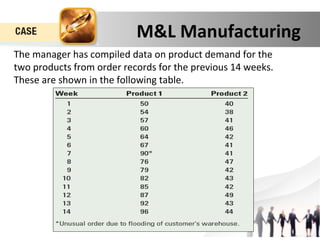
The manager has compiled data on product demand for the 
two products from order records for the previous 14 weeks. 
These are shown in the following table.
Questions 
1. What are some of the potential benefits of a more formalized 
approach to forecasting? 
2. Prepare a weekly forecast for the next four weeks for each 
product. 
Briefly explain why you chose the methods you used. ( Hint: 
For product 2, a simple approach, possibly some sort of naive/ 
intuitive approach, would be preferable to a technical approach 
in view of the manager’s disdain of more technical methods.)
ANSWER #1. 
The potential benefit of using a formalized 
approach to forecasting is that it will be easier to 
utilize the computer and easier to quantify the 
information. 
A less formalized approach is more likely to 
utilize personal intuition. For small forecasting 
problems, intuition may involve personal bias, which 
may be reflected in the forecast. 
As the forecasting problem gets larger, it will be 
impossible to rely solely on a less formalized 
approach because a person’s intuition will be unable 
to process the large quantity of information.
ANSWER #2.Product 1 
Product 1 
Plotting the data for Product 1 reveals a linear pattern with the 
exception of demand in week 7. Demand in week 7 is unusually 
high and does not fit the linear trend pattern of the remaining 
data. Thus, the demand for the 7th week is considered an 
outlier. There are different ways of dealing with outliers. A 
simple and intuitive way is to replace the demand for the week 
in question with the average demand from the previous week 
and the next week in the time-series. Therefore in this case, the 
demand of 90 in week 7 will be replaced with 71.5 = [(67 + 76)/2].
ANSWER #2.Product 1 
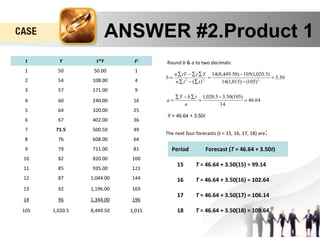
t Y t*Y t2 
1 50 50.00 1 
2 54 108.00 4 
3 57 171.00 9 
4 60 240.00 16 
5 64 320.00 25 
6 67 402.00 36 
7 71.5 500.50 49 
8 76 608.00 64 
9 79 711.00 81 
10 82 820.00 100 
11 85 935.00 121 
12 87 1,044.00 144 
13 92 1,196.00 169 
14 96 1,344.00 196 
105 1,020.5 8,449.50 1,015 
3.50 
Round b & a to two decimals: 
= - 
14(8,449.50) 105(1,020.5) 
b n tY t Y 
= å -å å 
n t t 
= 
2 ( )2 14(1,015) - 
(105) 
2 å - å 
46.64 
a Y b t 
= å - å = 1,020.5 -3.50(105) = 
14 
n 
Y = 46.64 + 3.50t 
The next four forecasts (t = 15, 16, 17, 18) are: 
Period Forecast (T = 46.64 + 3.50t) 
15 T = 46.64 + 3.50(15) = 99.14 
16 T = 46.64 + 3.50(16) = 102.64 
17 T = 46.64 + 3.50(17) = 106.14 
18 T = 46.64 + 3.50(18) = 109.64
ANSWER #2 Product 2. 
Product 2 
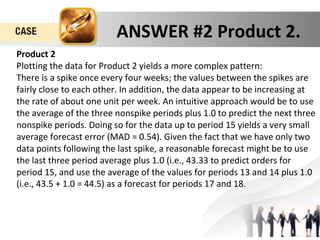
Plotting the data for Product 2 yields a more complex pattern: 
There is a spike once every four weeks; the values between the spikes are 
fairly close to each other. In addition, the data appear to be increasing at 
the rate of about one unit per week. An intuitive approach would be to use 
the average of the three nonspike periods plus 1.0 to predict the next three 
nonspike periods. Doing so for the data up to period 15 yields a very small 
average forecast error (MAD = 0.54). Given the fact that we have only two 
data points following the last spike, a reasonable forecast might be to use 
the last three period average plus 1.0 (i.e., 43.33 to predict orders for 
period 15, and use the average of the values for periods 13 and 14 plus 1.0 
(i.e., 43.5 + 1.0 = 44.5) as a forecast for periods 17 and 18.
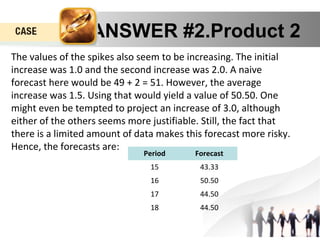
ANSWER #2.Product 2 
The values of the spikes also seem to be increasing. The initial 
increase was 1.0 and the second increase was 2.0. A naive 
forecast here would be 49 + 2 = 51. However, the average 
increase was 1.5. Using that would yield a value of 50.50. One 
might even be tempted to project an increase of 3.0, although 
either of the others seems more justifiable. Still, the fact that 
there is a limited amount of data makes this forecast more risky. 
Hence, the forecasts are: 
Period Forecast 
15 43.33 
16 50.50 
17 44.50 
18 44.50

M&l case

  • 1.
    M&L Manufacturing GSM5113-Operations Management Dr Affendy Abu Hassim
  • 2.
    M&L Manufacturing M&LManufacturing makes various components for printers and copiers. In addition to supplying these items to a major manufacturer, the company distributes these and similar items to office supply stores and computer stores as replacement parts for printers and desktop copiers. In all, the company makes about 20 different items. The two markets (the major manufacturer and the replacement market) require somewhat different handling. For example, replacement products must be packaged individually whereas products are shipped in bulk to the major manufacturer. The company does not use forecasts for production planning.
  • 3.
    M&L Manufacturing Becauseof competitive pressures and falling profits, the manager has decided to undertake a number of changes. One change is to introduce more formal forecasting procedures in order to improve production planning and inventory management. With that in mind, the manager wants to begin forecasting for two products.
  • 4.
    M&L Manufacturing Themanager has compiled data on product demand for the two products from order records for the previous 14 weeks. These are shown in the following table.
  • 5.
    Questions 1. Whatare some of the potential benefits of a more formalized approach to forecasting? 2. Prepare a weekly forecast for the next four weeks for each product. Briefly explain why you chose the methods you used. ( Hint: For product 2, a simple approach, possibly some sort of naive/ intuitive approach, would be preferable to a technical approach in view of the manager’s disdain of more technical methods.)
  • 6.
    ANSWER #1. Thepotential benefit of using a formalized approach to forecasting is that it will be easier to utilize the computer and easier to quantify the information. A less formalized approach is more likely to utilize personal intuition. For small forecasting problems, intuition may involve personal bias, which may be reflected in the forecast. As the forecasting problem gets larger, it will be impossible to rely solely on a less formalized approach because a person’s intuition will be unable to process the large quantity of information.
  • 7.
    ANSWER #2.Product 1 Product 1 Plotting the data for Product 1 reveals a linear pattern with the exception of demand in week 7. Demand in week 7 is unusually high and does not fit the linear trend pattern of the remaining data. Thus, the demand for the 7th week is considered an outlier. There are different ways of dealing with outliers. A simple and intuitive way is to replace the demand for the week in question with the average demand from the previous week and the next week in the time-series. Therefore in this case, the demand of 90 in week 7 will be replaced with 71.5 = [(67 + 76)/2].
  • 8.
    ANSWER #2.Product 1 t Y t*Y t2 1 50 50.00 1 2 54 108.00 4 3 57 171.00 9 4 60 240.00 16 5 64 320.00 25 6 67 402.00 36 7 71.5 500.50 49 8 76 608.00 64 9 79 711.00 81 10 82 820.00 100 11 85 935.00 121 12 87 1,044.00 144 13 92 1,196.00 169 14 96 1,344.00 196 105 1,020.5 8,449.50 1,015 3.50 Round b & a to two decimals: = - 14(8,449.50) 105(1,020.5) b n tY t Y = å -å å n t t = 2 ( )2 14(1,015) - (105) 2 å - å 46.64 a Y b t = å - å = 1,020.5 -3.50(105) = 14 n Y = 46.64 + 3.50t The next four forecasts (t = 15, 16, 17, 18) are: Period Forecast (T = 46.64 + 3.50t) 15 T = 46.64 + 3.50(15) = 99.14 16 T = 46.64 + 3.50(16) = 102.64 17 T = 46.64 + 3.50(17) = 106.14 18 T = 46.64 + 3.50(18) = 109.64
  • 9.
    ANSWER #2 Product2. Product 2 Plotting the data for Product 2 yields a more complex pattern: There is a spike once every four weeks; the values between the spikes are fairly close to each other. In addition, the data appear to be increasing at the rate of about one unit per week. An intuitive approach would be to use the average of the three nonspike periods plus 1.0 to predict the next three nonspike periods. Doing so for the data up to period 15 yields a very small average forecast error (MAD = 0.54). Given the fact that we have only two data points following the last spike, a reasonable forecast might be to use the last three period average plus 1.0 (i.e., 43.33 to predict orders for period 15, and use the average of the values for periods 13 and 14 plus 1.0 (i.e., 43.5 + 1.0 = 44.5) as a forecast for periods 17 and 18.
  • 10.
    ANSWER #2.Product 2 The values of the spikes also seem to be increasing. The initial increase was 1.0 and the second increase was 2.0. A naive forecast here would be 49 + 2 = 51. However, the average increase was 1.5. Using that would yield a value of 50.50. One might even be tempted to project an increase of 3.0, although either of the others seems more justifiable. Still, the fact that there is a limited amount of data makes this forecast more risky. Hence, the forecasts are: Period Forecast 15 43.33 16 50.50 17 44.50 18 44.50