Markstrat
Monday, April 20th 2015
Laura Frias, Michael McBride, Alex Sugano, Travis Shirley
1
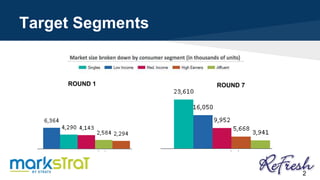
Target Segments
2
ROUND 1 ROUND 7
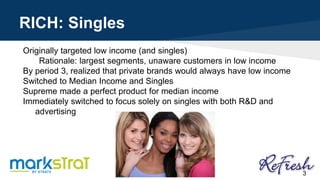
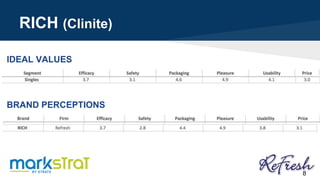
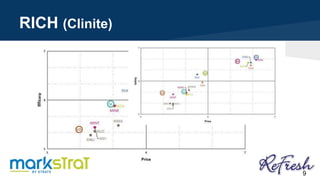
RICH: Singles
Originally targeted low income (and singles)
Rationale: largest segments, unaware customers in low income
By period 3, realized that private brands would always have low income
Switched to Median Income and Singles
Supreme made a perfect product for median income
Immediately switched to focus solely on singles with both R&D and
advertising
3
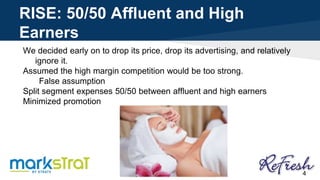
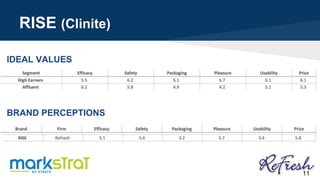
RISE: 50/50 Affluent and High
Earners
We decided early on to drop its price, drop its advertising, and relatively
ignore it.
Assumed the high margin competition would be too strong.
False assumption
Split segment expenses 50/50 between affluent and high earners
Minimized promotion
4
RUNWAY: Health Conscious
Targeted health conscious because they were early adopters and we
expected to be first to market
Did not expect to capture every segment
Only product in industry took all sales (first mover advantage)
This was crucial, because we knew that early sales would fund more R&D
and expansion
5
RUMBLE: Families
Family segment in Nutrites grew to twice the size of health conscious or
elderly by round 6
We knew this represented a threat from Supreme
We decided to preempt the competition and develop a product that would
target families in order to prevent entrants from gaining market share
6
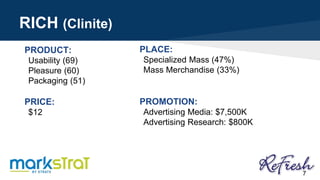
RICH (Clinite)
PRODUCT:
Usability (69)
Pleasure (60)
Packaging (51)
PRICE:
$12
PLACE:
Specialized Mass (47%)
Mass Merchandise (33%)
PROMOTION:
Advertising Media: $7,500K
Advertising Research: $800K
7
RICH (Clinite)
8
IDEAL VALUES
BRAND PERCEPTIONS
RICH (Clinite)
9
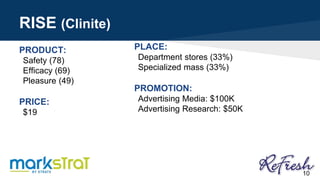
RISE (Clinite)
PRODUCT:
Safety (78)
Efficacy (69)
Pleasure (49)
PRICE:
$19
PLACE:
Department stores (33%)
Specialized mass (33%)
PROMOTION:
Advertising Media: $100K
Advertising Research: $50K
10
RISE (Clinite)
11
IDEAL VALUES
BRAND PERCEPTIONS
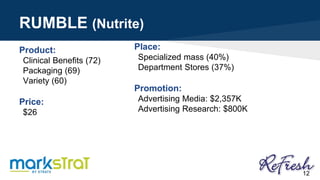
RUMBLE (Nutrite)
Product:
Clinical Benefits (72)
Packaging (69)
Variety (60)
Price:
$26
Place:
Specialized mass (40%)
Department Stores (37%)
Promotion:
Advertising Media: $2,357K
Advertising Research: $800K
12
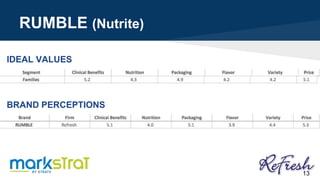
RUMBLE (Nutrite)
13
IDEAL VALUES
BRAND PERCEPTIONS
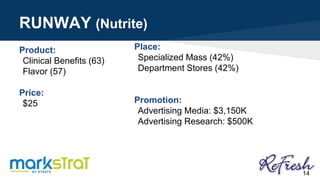
RUNWAY (Nutrite)
Product:
Clinical Benefits (63)
Flavor (57)
Price:
$25
Place:
Specialized Mass (42%)
Department Stores (42%)
Promotion:
Advertising Media: $3,150K
Advertising Research: $500K
14
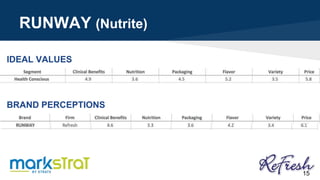
RUNWAY (Nutrite)
15
IDEAL VALUES
BRAND PERCEPTIONS
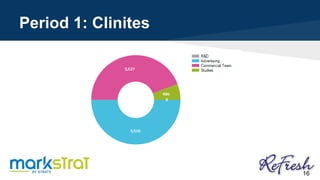
Period 1: Clinites
16
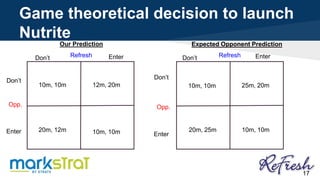
Game theoretical decision to launch
Nutrite
17
Our Prediction Expected Opponent Prediction
Refresh
Opp. Opp.
Refresh
10m, 10m 12m, 20m
20m, 12m 10m, 10m
10m, 10m 25m, 20m
EnterDon’t
Don’t
Don’t
Don’t
Enter
EnterEnter 20m, 25m 10m, 10m
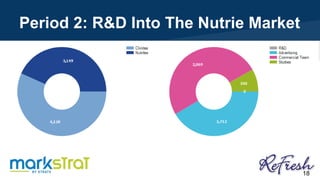
Period 2: R&D Into The Nutrie Market
18
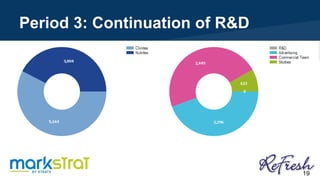
Period 3: Continuation of R&D
19
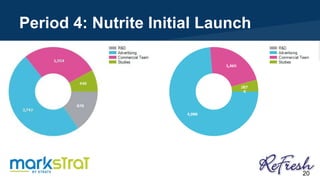
Period 4: Nutrite Initial Launch
20
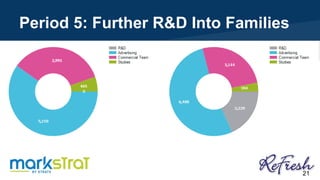
Period 5: Further R&D Into Families
21
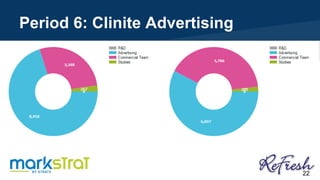
Period 6: Clinite Advertising
22
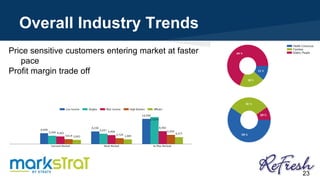
Overall Industry Trends
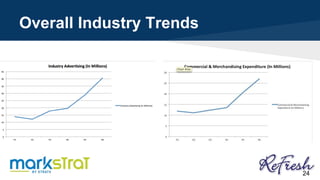
Price sensitive customers entering market at faster
pace
Profit margin trade off
23
Overall Industry Trends
24
Successes and Failures
SUCCESSES:
1. First mover advantage in the
Nutrite market
2. Targeting singles with Rich and
lots of advertising
3. Underfunding Rise
4. Preempting competitors
entrance into Nutrite market and
their strategies
FAILURES:
1. Not anticipating Supreme
targeting singles in Period 1
2. Not anticipating Supreme would
target median income in Period 4
3. Targeting low income with Rich
in Period 1
25
Key Learning Experiences
1. Focused on Semantic Elements that had most importance
a. Advertising and pricing
2. Bold choices paid off, but required trade-offs
3. Paid close attention to competitor’s maneuvers
Eg. Noticed the amount of money Supreme spent on R&D
4. Short and long term goals - stayed consistent with our plan
5. Competitive Advertising and Commercial experiment study
a. Avoided diminishing marginal returns (most people were overspending)
26

MKT 440: Markstrat Presentation

  • 1.
    Markstrat Monday, April 20th2015 Laura Frias, Michael McBride, Alex Sugano, Travis Shirley 1
  • 2.
  • 3.
    RICH: Singles Originally targetedlow income (and singles) Rationale: largest segments, unaware customers in low income By period 3, realized that private brands would always have low income Switched to Median Income and Singles Supreme made a perfect product for median income Immediately switched to focus solely on singles with both R&D and advertising 3
  • 4.
    RISE: 50/50 Affluentand High Earners We decided early on to drop its price, drop its advertising, and relatively ignore it. Assumed the high margin competition would be too strong. False assumption Split segment expenses 50/50 between affluent and high earners Minimized promotion 4
  • 5.
    RUNWAY: Health Conscious Targetedhealth conscious because they were early adopters and we expected to be first to market Did not expect to capture every segment Only product in industry took all sales (first mover advantage) This was crucial, because we knew that early sales would fund more R&D and expansion 5
  • 6.
    RUMBLE: Families Family segmentin Nutrites grew to twice the size of health conscious or elderly by round 6 We knew this represented a threat from Supreme We decided to preempt the competition and develop a product that would target families in order to prevent entrants from gaining market share 6
  • 7.
    RICH (Clinite) PRODUCT: Usability (69) Pleasure(60) Packaging (51) PRICE: $12 PLACE: Specialized Mass (47%) Mass Merchandise (33%) PROMOTION: Advertising Media: $7,500K Advertising Research: $800K 7
  • 8.
  • 9.
  • 10.
    RISE (Clinite) PRODUCT: Safety (78) Efficacy(69) Pleasure (49) PRICE: $19 PLACE: Department stores (33%) Specialized mass (33%) PROMOTION: Advertising Media: $100K Advertising Research: $50K 10
  • 11.
  • 12.
    RUMBLE (Nutrite) Product: Clinical Benefits(72) Packaging (69) Variety (60) Price: $26 Place: Specialized mass (40%) Department Stores (37%) Promotion: Advertising Media: $2,357K Advertising Research: $800K 12
  • 13.
  • 14.
    RUNWAY (Nutrite) Product: Clinical Benefits(63) Flavor (57) Price: $25 Place: Specialized Mass (42%) Department Stores (42%) Promotion: Advertising Media: $3,150K Advertising Research: $500K 14
  • 15.
  • 16.
  • 17.
    Game theoretical decisionto launch Nutrite 17 Our Prediction Expected Opponent Prediction Refresh Opp. Opp. Refresh 10m, 10m 12m, 20m 20m, 12m 10m, 10m 10m, 10m 25m, 20m EnterDon’t Don’t Don’t Don’t Enter EnterEnter 20m, 25m 10m, 10m
  • 18.
    Period 2: R&DInto The Nutrie Market 18
  • 19.
  • 20.
    Period 4: NutriteInitial Launch 20
  • 21.
    Period 5: FurtherR&D Into Families 21
  • 22.
    Period 6: CliniteAdvertising 22
  • 23.
    Overall Industry Trends Pricesensitive customers entering market at faster pace Profit margin trade off 23
  • 24.
  • 25.
    Successes and Failures SUCCESSES: 1.First mover advantage in the Nutrite market 2. Targeting singles with Rich and lots of advertising 3. Underfunding Rise 4. Preempting competitors entrance into Nutrite market and their strategies FAILURES: 1. Not anticipating Supreme targeting singles in Period 1 2. Not anticipating Supreme would target median income in Period 4 3. Targeting low income with Rich in Period 1 25
  • 26.
    Key Learning Experiences 1.Focused on Semantic Elements that had most importance a. Advertising and pricing 2. Bold choices paid off, but required trade-offs 3. Paid close attention to competitor’s maneuvers Eg. Noticed the amount of money Supreme spent on R&D 4. Short and long term goals - stayed consistent with our plan 5. Competitive Advertising and Commercial experiment study a. Avoided diminishing marginal returns (most people were overspending) 26

Editor's Notes

  • #3 Target Segments Rich- At first we wanted to target low income and singles-- we saw there was a large untapped market in low income, and both groups liked a low price point. We did this because we thought it was a very “unsexy” strategy that others would not imitate. We were wrong on two fronts; first, private brands pretty much cornered low income, and Supreme heavily targeted singles. This led to decreased profits at first. Then, we switched to target middle income for one round, still with same product, because we thought Supreme had decided to target singles and they were our biggest competitor. However, again, we miscalculated, and that same period, Supreme launched a product perfect for middle income-- our advertising didn’t really compete with their superior product for that segment. Then, we looked at market forecasts and saw how quickly the singles demographic was growing. We instantly researched and developed the ideal product for singles, and put the vast majority of our advertising budget there. Ironically, being forced back into singles ended up benefitting us greatly. Rise We knew that rise was a more expensive product, and therefore split our advertising between affluent and high earners-- other than this, we didn’t put much thought into it because we generally spent so little on promotion and sales were low. Runway Health conscious because they were initially the largest segment, and we needed immediate profits to fund further expansion. We had no idea that every segment would buy it because it was all that was available. Rumble Since families would be twice the size of either health conscious or elderly in Round 7 we thought that represented a threat from Supreme, since they had the chance after seeing Runway launch to target a new demographic. We wanted to preempt this expansion-- additionally, we knew that even if they didn’t launch we’d only be cannibalizing ourself. This ended up being wise-- Supreme launched a family product modification in round 7 which we were able to combat with Rumble.
  • #8 Add: Contribution Before and After Marketing
  • #9 Add: Contribution Before and After Marketing
  • #10 Promotion - going for singles change and promotion changes reflected in consumer perception customer perceptions matched our goals in terms of product image
  • #13 Added on Period 5
  • #14 Added on Period 5
  • #15 Added on Period 3
  • #16 Added on Period 5