Cover Image
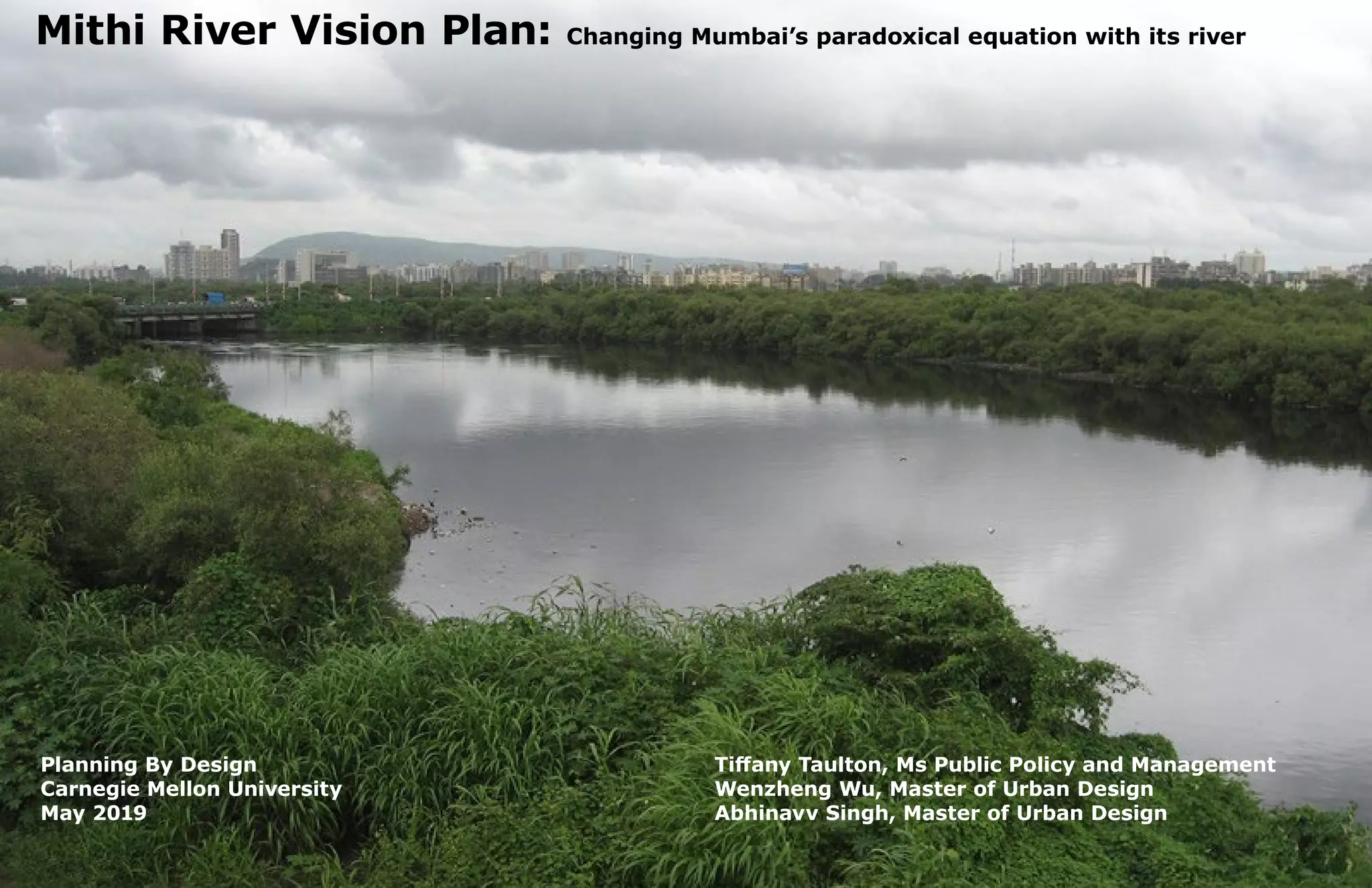
Mithi River Vision Plan: Changing Mumbai’s paradoxical equation with its river
Planning By Design
Carnegie Mellon University
May 2019
Tiffany Taulton, Ms Public Policy and Management
Wenzheng Wu, Master of Urban Design
Abhinavv Singh, Master of Urban Design
Gliding constantly but slowly through the concrete city of Mumbai, is the Mithi River. Being one of the
oldest existing rivers in the city, The Mithi, has seen Mumbai grow from large open barren lands to a concrete
jungle.
The Mithi River has witnesses tremendous physical and experiential changes through the city, almost
every day. It has seen people come and go, it has experienced relationships the people of Mumbai keep with
their city. It does know and has hidden secrets of man’s strive for development in order to create.
The Mithi allowed Man to discard what he destroyed and washed it away, far into the Arabian Sea until
one the day secret was not kept hidden. The Mithi ebbed and flooded the land around the city, it threw back
what man forced upon it, and it might not be long before it again reveals what still lies at its bottom.
-Architect Pushkraj Tambde
Mumbai: India’s financial and entertainment capital. An island city of 22million people.
Arabian Sea
Mahim Bay
Thane Creek
Do you need a source? Put it here
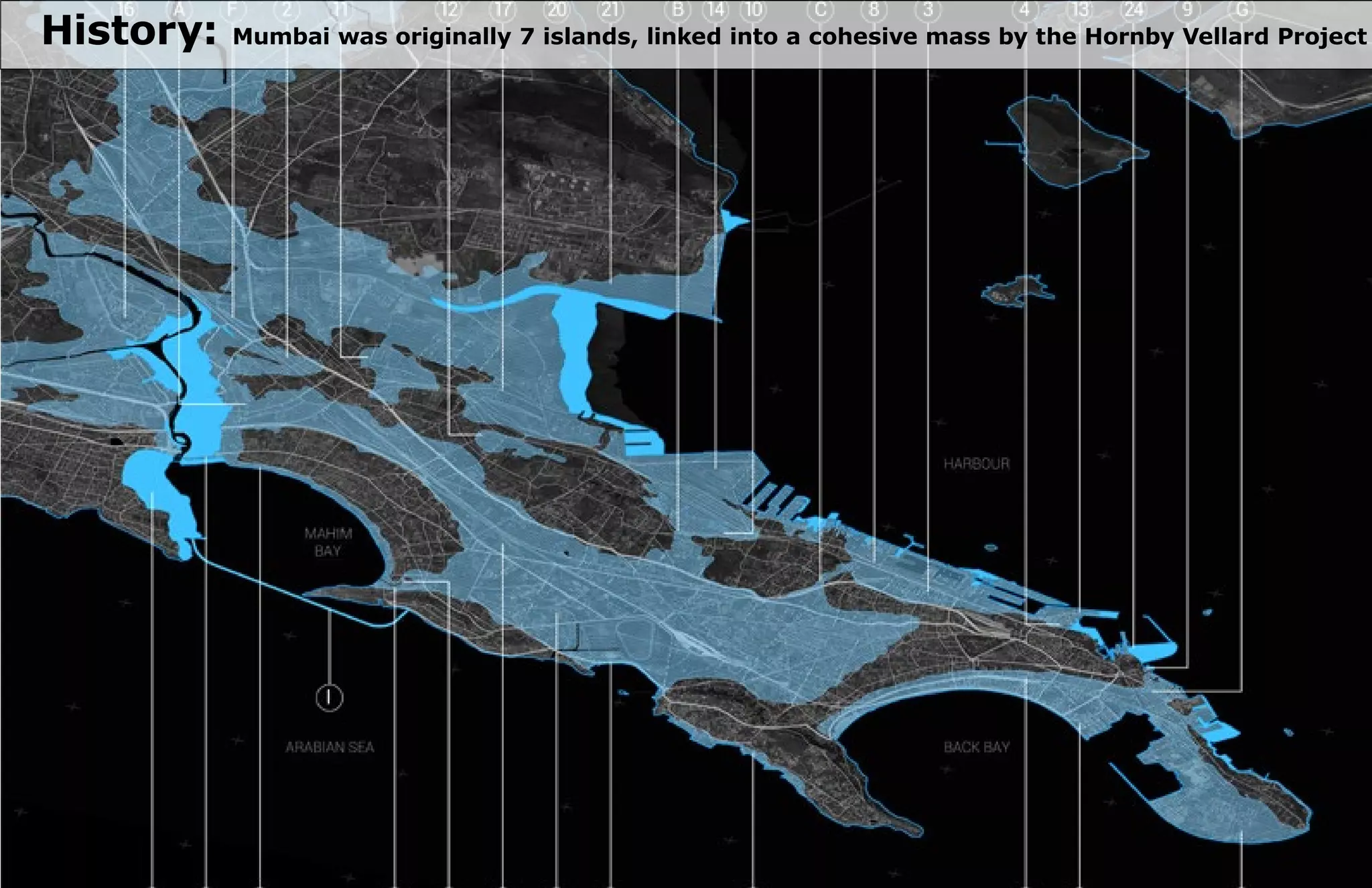
History: Mumbai was originally 7 islands, linked into a cohesive mass by the Hornby Vellard Project
The Mithi River: Mumbai’s abused ecological asset
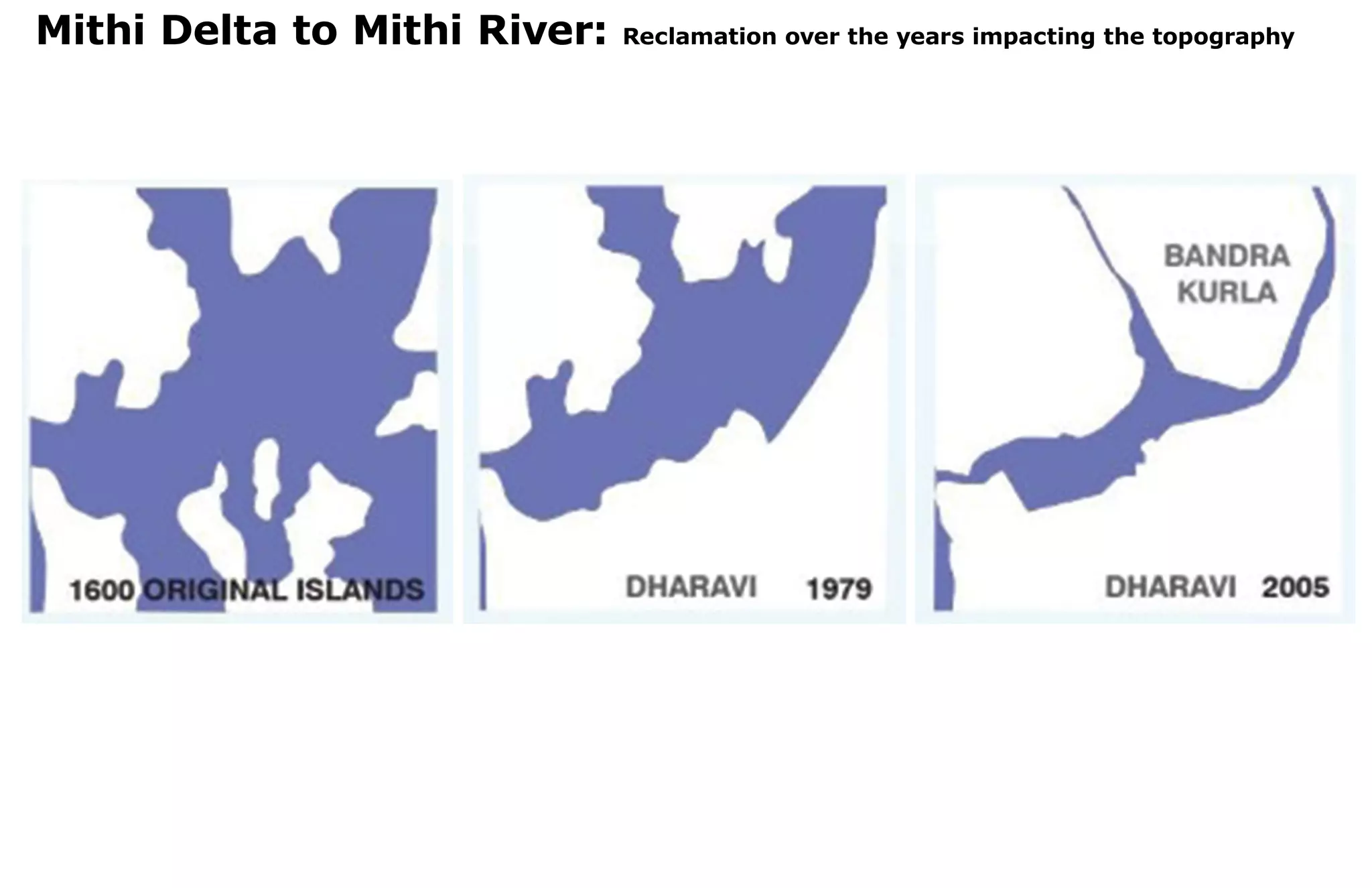
Mithi Delta to Mithi River
Mithi Delta to Mithi River: Reclamation over the years impacting the topography
Do you need a source? Put it here
Mithi River to River of Sewage
Mithi River to River of Sewage: Treating the river like a dumping ground
Mithi River to River of Sewage: Channeling the river
Catastrophic Mumbai Floods 2005: The river gives back
Present Situation: Slum encroachments
Present Situation: Airport channelizes and diverts the river
Present Situation: Depletion of mangrove cover due to construction
Government Apathy: Failed rejuvenation plan
Sustainable Design Goals: Goals 6,11,13,14 unmet
Present Situation: Open waste disposal
Present Situation: Open defecation
Present Situation: washing clothes in the open
VISION
Goal 1: Pollution
Reduction
Build New Sewage
Treatment Plants
Oxygenate River to
Reduce Smell
Dredge the River to
Remove Blockages
Goal 2: Reduce
Runoff from
Slums
Create Trash Remoaval
Service
Create Recycling Plant
Install Public Compost
Toilets
Goal 3:
Community
Engagement
Health and
Sanitation
Importance of using
toilets and trash cans
instead of the river
Environmental
Campaign
Reduce, reuse, recycle
Education about toxic
waste and flooding
Hire Locals for Trash,
Recycling, and River
Cleaning Projects
Goal 4: River
Restoration
Remove concrete walls
in key areas
Plant more mangroves
Add tourism
infrastructure
Bridges and Bike Trails
Benches
Goal 5: A
Clean River
for Future
Generations
Relocate illegal
industries
Current Success Policy &
Situation
Ganga Action Plan: Saving India’s sacred river
1.effective use of water resources
2.involve stake holders
3.flood management strategy
4.awareness amongst masses
Do you need a source? Put it here
Adopt a village
Adopt a village: A government initiative to invite private players to develop villages
Current state of projects led by the government: bleak
Economic Liberalization of 1991: Upheaval of the Indian Economy
New Policy Vision: Adopt a river
Creation of Mithi Sansad, a public private
enterprise
Adopt a River Plan: Inviting a private entity to adopt the river
Communication and Public
Outreach
Adopt a River Plan: Inviting a private entity to adopt the river
What will reliance do
Adopt a River Plan: The Mithi Sansad authority structure
How will it do it
Adopt a River Plan: The Mithi Sansad work structure
Private
Player
Government
Agence &
Department
Autonomous
Governing
Entities
Regional
Planning
Authorities
Public
Organizations
Non
Profits
Adopt a River Plan: delegation of tasks, who’s responsibility is it?
Adopt a River Plan: Co-ordination and sharing of responsibilities
Proposed Intervention site:
Changing the image of the river and
looking at the larger picture
The river currently cuts the city in two. On the Banks
of the river, historically, large national routes have
been located, which not only divide the city physically
and socially but also in terms of environment.
Then in 2014, Medellín city government launched a
competition to envision a new Medellín River Park.
The winning project is from a local firm with the
concept of “botanical park that recovers connections
to water systems through a revitalized biotic
metropolitan corridor.”The park developers will take
parts of the concrete channel out, bury an adjacent
highway, and create a new green system. It is not only
a “new ecological structure for the region, but also
re-frames people’s relationships with each other and
nature after years of conflict.”
Case Study: Medellin river park, Colombia
One important propose is to bury the roads of the river
corridor in some sectors of the city, in order to get the
inhabitants to recover the possibility of approaching
the river. River Parks is the opportunity to create a
hybrid project between infrastructure and nature,
which will restore the quality of habitability to these
abandoned spaces on the banks of the river.
That’s the reason why this case is very suit for our
propose. First, it have a very same situation with the
Mithi river, both river are located in the middle of the
city which cut the city into two parts; and both river
are partly channelized by concrete. And it also intends
to integrate engineering, urbanism, and landscape, to
create a recomposition of the urban, environmental
and social integration of the whole city. In the end, this
project are trying to fix the destroyed balance between
built environment and Eco-environment.
Case Study: Medellin river park, Colombia
Intervention: The river as sacred enitity in India
Design Suggestions: looking at the larger picture (Studio Pod’s design entry)
Design Suggestions: Reusing existing infrastructure through community input
Performance Metrics: Evaluating the success of the policy
Future Potential: Creating an ecological loop for the city

Mithi river action plan presentation

  • 1.
    Cover Image Mithi RiverVision Plan: Changing Mumbai’s paradoxical equation with its river Planning By Design Carnegie Mellon University May 2019 Tiffany Taulton, Ms Public Policy and Management Wenzheng Wu, Master of Urban Design Abhinavv Singh, Master of Urban Design
  • 2.
    Gliding constantly butslowly through the concrete city of Mumbai, is the Mithi River. Being one of the oldest existing rivers in the city, The Mithi, has seen Mumbai grow from large open barren lands to a concrete jungle. The Mithi River has witnesses tremendous physical and experiential changes through the city, almost every day. It has seen people come and go, it has experienced relationships the people of Mumbai keep with their city. It does know and has hidden secrets of man’s strive for development in order to create. The Mithi allowed Man to discard what he destroyed and washed it away, far into the Arabian Sea until one the day secret was not kept hidden. The Mithi ebbed and flooded the land around the city, it threw back what man forced upon it, and it might not be long before it again reveals what still lies at its bottom. -Architect Pushkraj Tambde
  • 3.
    Mumbai: India’s financialand entertainment capital. An island city of 22million people. Arabian Sea Mahim Bay Thane Creek
  • 4.
    Do you needa source? Put it here History: Mumbai was originally 7 islands, linked into a cohesive mass by the Hornby Vellard Project
  • 5.
    The Mithi River:Mumbai’s abused ecological asset
  • 6.
    Mithi Delta toMithi River Mithi Delta to Mithi River: Reclamation over the years impacting the topography
  • 7.
    Do you needa source? Put it here Mithi River to River of Sewage Mithi River to River of Sewage: Treating the river like a dumping ground
  • 8.
    Mithi River toRiver of Sewage: Channeling the river
  • 9.
    Catastrophic Mumbai Floods2005: The river gives back
  • 10.
  • 11.
    Present Situation: Airportchannelizes and diverts the river
  • 12.
    Present Situation: Depletionof mangrove cover due to construction
  • 13.
    Government Apathy: Failedrejuvenation plan
  • 14.
    Sustainable Design Goals:Goals 6,11,13,14 unmet
  • 15.
  • 16.
  • 17.
    Present Situation: washingclothes in the open
  • 18.
    VISION Goal 1: Pollution Reduction BuildNew Sewage Treatment Plants Oxygenate River to Reduce Smell Dredge the River to Remove Blockages Goal 2: Reduce Runoff from Slums Create Trash Remoaval Service Create Recycling Plant Install Public Compost Toilets Goal 3: Community Engagement Health and Sanitation Importance of using toilets and trash cans instead of the river Environmental Campaign Reduce, reuse, recycle Education about toxic waste and flooding Hire Locals for Trash, Recycling, and River Cleaning Projects Goal 4: River Restoration Remove concrete walls in key areas Plant more mangroves Add tourism infrastructure Bridges and Bike Trails Benches Goal 5: A Clean River for Future Generations Relocate illegal industries
  • 19.
  • 20.
    Ganga Action Plan:Saving India’s sacred river 1.effective use of water resources 2.involve stake holders 3.flood management strategy 4.awareness amongst masses
  • 21.
    Do you needa source? Put it here Adopt a village Adopt a village: A government initiative to invite private players to develop villages
  • 22.
    Current state ofprojects led by the government: bleak
  • 23.
    Economic Liberalization of1991: Upheaval of the Indian Economy
  • 24.
    New Policy Vision:Adopt a river Creation of Mithi Sansad, a public private enterprise
  • 25.
    Adopt a RiverPlan: Inviting a private entity to adopt the river
  • 26.
    Communication and Public Outreach Adopta River Plan: Inviting a private entity to adopt the river
  • 27.
    What will reliancedo Adopt a River Plan: The Mithi Sansad authority structure
  • 28.
    How will itdo it Adopt a River Plan: The Mithi Sansad work structure
  • 29.
  • 30.
    Adopt a RiverPlan: Co-ordination and sharing of responsibilities
  • 31.
    Proposed Intervention site: Changingthe image of the river and looking at the larger picture
  • 32.
    The river currentlycuts the city in two. On the Banks of the river, historically, large national routes have been located, which not only divide the city physically and socially but also in terms of environment. Then in 2014, Medellín city government launched a competition to envision a new Medellín River Park. The winning project is from a local firm with the concept of “botanical park that recovers connections to water systems through a revitalized biotic metropolitan corridor.”The park developers will take parts of the concrete channel out, bury an adjacent highway, and create a new green system. It is not only a “new ecological structure for the region, but also re-frames people’s relationships with each other and nature after years of conflict.” Case Study: Medellin river park, Colombia
  • 33.
    One important proposeis to bury the roads of the river corridor in some sectors of the city, in order to get the inhabitants to recover the possibility of approaching the river. River Parks is the opportunity to create a hybrid project between infrastructure and nature, which will restore the quality of habitability to these abandoned spaces on the banks of the river. That’s the reason why this case is very suit for our propose. First, it have a very same situation with the Mithi river, both river are located in the middle of the city which cut the city into two parts; and both river are partly channelized by concrete. And it also intends to integrate engineering, urbanism, and landscape, to create a recomposition of the urban, environmental and social integration of the whole city. In the end, this project are trying to fix the destroyed balance between built environment and Eco-environment. Case Study: Medellin river park, Colombia
  • 34.
    Intervention: The riveras sacred enitity in India
  • 35.
    Design Suggestions: lookingat the larger picture (Studio Pod’s design entry)
  • 36.
    Design Suggestions: lookingat the larger picture (Studio Pod’s design entry)
  • 37.
    Design Suggestions: lookingat the larger picture (Studio Pod’s design entry)
  • 38.
    Design Suggestions: Reusingexisting infrastructure through community input
  • 39.
    Performance Metrics: Evaluatingthe success of the policy
  • 40.
    Future Potential: Creatingan ecological loop for the city