Mistakes to
Avoid
in Online Medical
Billing and Coding
www.apaana.com
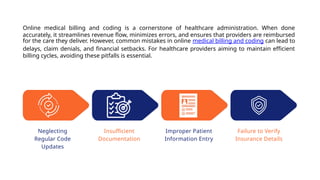
Online medical billing and coding is a cornerstone of healthcare administration. When done
accurately, it streamlines revenue flow, minimizes errors, and ensures that providers are reimbursed
for the care they deliver. However, common mistakes in online medical billing and coding can lead to
delays, claim denials, and financial setbacks. For healthcare providers aiming to maintain efficient
billing cycles, avoiding these pitfalls is essential.
Neglecting
Regular Code
Updates
Insufficient
Documentation
Improper Patient
Information Entry
Failure to Verify
Insurance Details
Neglecting Regular Code Updates
Medical billing and coding rely on standardized codes, like CPT, ICD-10, and HCPCS,
to describe patient diagnoses and treatments. These codes are updated annually
to reflect new diagnoses, treatments, and changes in the healthcare field. Failing to
keep up with these updates can result in using outdated codes, which often leads
to rejected claims and delayed payments.
Insufficient Documentation
Accurate coding depends on thorough documentation. When physicians and other
providers fail to document the details of a patient’s diagnosis and treatment,
coders are left to interpret incomplete information. This can lead to incorrect
coding, claim denials, or delayed reimbursements. Insufficient documentation is
one of the leading causes of coding errors.
Improper Patient Information Entry
Even with the best coding and billing processes, entering incorrect patient
information—like misspelled names, incorrect insurance details, or wrong dates of
birth—can lead to rejected claims. This seemingly simple error can create
significant delays in processing claims, affecting cash flow and causing frustration
for both patients and providers.
Failure to Verify Insurance Details
Insurance plans vary widely, with different coverage levels, co-pays, deductibles,
and out-of-pocket expenses. Neglecting to verify a patient’s insurance details
before services are rendered is a common mistake that can lead to unexpected
denials or higher patient balances. Verification errors often lead to patient
dissatisfaction and potential financial loss for the healthcare provider.
Contact
Us
Information
855 - 242 - 2212
www.apaana.com
Thank
You
For Your
Attention
www.apaana.com

Mistakes to Avoid in Online Medical Billing and Coding

  • 1.
    Mistakes to Avoid in OnlineMedical Billing and Coding www.apaana.com
  • 2.
    Online medical billingand coding is a cornerstone of healthcare administration. When done accurately, it streamlines revenue flow, minimizes errors, and ensures that providers are reimbursed for the care they deliver. However, common mistakes in online medical billing and coding can lead to delays, claim denials, and financial setbacks. For healthcare providers aiming to maintain efficient billing cycles, avoiding these pitfalls is essential. Neglecting Regular Code Updates Insufficient Documentation Improper Patient Information Entry Failure to Verify Insurance Details
  • 3.
    Neglecting Regular CodeUpdates Medical billing and coding rely on standardized codes, like CPT, ICD-10, and HCPCS, to describe patient diagnoses and treatments. These codes are updated annually to reflect new diagnoses, treatments, and changes in the healthcare field. Failing to keep up with these updates can result in using outdated codes, which often leads to rejected claims and delayed payments.
  • 4.
    Insufficient Documentation Accurate codingdepends on thorough documentation. When physicians and other providers fail to document the details of a patient’s diagnosis and treatment, coders are left to interpret incomplete information. This can lead to incorrect coding, claim denials, or delayed reimbursements. Insufficient documentation is one of the leading causes of coding errors.
  • 5.
    Improper Patient InformationEntry Even with the best coding and billing processes, entering incorrect patient information—like misspelled names, incorrect insurance details, or wrong dates of birth—can lead to rejected claims. This seemingly simple error can create significant delays in processing claims, affecting cash flow and causing frustration for both patients and providers.
  • 6.
    Failure to VerifyInsurance Details Insurance plans vary widely, with different coverage levels, co-pays, deductibles, and out-of-pocket expenses. Neglecting to verify a patient’s insurance details before services are rendered is a common mistake that can lead to unexpected denials or higher patient balances. Verification errors often lead to patient dissatisfaction and potential financial loss for the healthcare provider.
  • 7.
    Contact Us Information 855 - 242- 2212 www.apaana.com
  • 8.