The Manager’s
Job: Folklore and
Fact,
Henry Mintzberg
By

Mayuri Gadkar
Md. Abdul Gafoor
MBA-2013-15

“Central University of Karnataka”
OUTLINE
 Folklore
 Research Methods
 Findings
 Managerial Roles
• Interpersonal Roles
• Informational Roles
• Decisional Roles
 Conclusions
WHO ARE THE MANAGERS?
 Foremen

 Factory supervisors
 Staff managers
 Field sales managers

 Hospital Administrators
 Presidents of companies and nations
 “Street gang leaders”
WHO ARE THE MANAGERS?

Definition of a manager:

The person in charge of an
organization or one of its subunits.
Research
Based on the method called “Structural
observation”

Five American CEO’s over one week
Analyzed mail and verbal contacts

Existing sources
International, all levels of management (US,
Britain, France and Swedan)
FOLKLORE AND FACTS
Folklore: The manager is reflective, systematic planner.

Fact: Managers work at an unrelenting pace, their activities are characterized
by brevity, variety, discontinuity. They are strongly oriented to action and dislike
reflective activities.
EXAMPLE 1
Studies on 5 chief executives proved:

1/2 of the activities < 9 minute 10% activities > 1 hour
Studies on 56 U.S. foremen proved:

583 activities per 8-hour shift 1 activity every 48 seconds + Mails, callers,
coffee breaks and lunches work related.
FOLKLORE AND FACTS
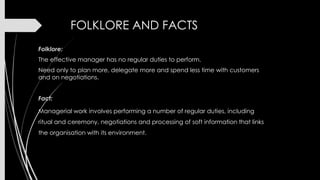
Folklore:
The effective manager has no regular duties to perform.
Need only to plan more, delegate more and spend less time with customers
and on negotiations.
Fact:
Managerial work involves performing a number of regular duties, including
ritual and ceremony, negotiations and processing of soft information that links
the organisation with its environment.
FOLKLORE AND FACTS
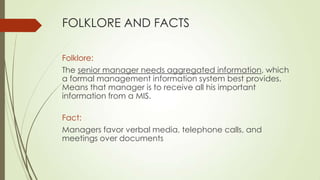
Folklore:
The senior manager needs aggregated information, which
a formal management information system best provides.
Means that manager is to receive all his important
information from a MIS.
Fact:
Managers favor verbal media, telephone calls, and
meetings over documents
EXAMPLE 2
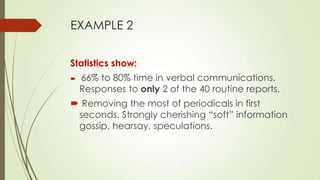
Statistics show:


66% to 80% time in verbal communications.
Responses to only 2 of the 40 routine reports.

 Removing the most of periodicals in first
seconds. Strongly cherishing “soft” information
gossip, hearsay, speculations.
FOLKLORE AND FACTS
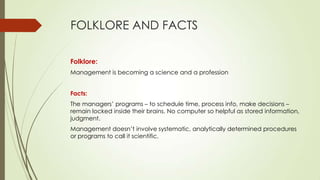
Folklore:
Management is becoming a science and a profession
Facts:

The managers’ programs – to schedule time, process info, make decisions –
remain locked inside their brains. No computer so helpful as stored information,
judgment.
Management doesn’t involve systematic, analytically determined procedures
or programs to call it scientific.
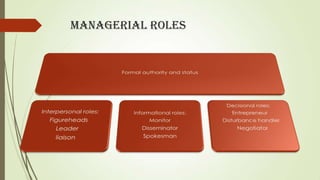
Managerial Roles
INTERPERSONAL ROLES
The Figurehead Role
- Duties of a ceremonial nature.
- Involving little serious communications.

- No important decision making.
- However, they are important to the smooth
functioning of an organization and cannot be
neglected by the manager.
INTERPERSONAL ROLES
2. The

Leader Role
 Manager is responsible for the work
of its people.
 Leadership decides in large part
how much of it the manager will
realize.
INTERPERSONAL ROLES
The Liaison( channel of communication)
Role
 The manager makes contacts outside
his chain of command.
 The liaison role is devoted to building up
the manager’s own external information
system: informal, private, verbal and
effective.
3.
INFORMATIONAL ROLES
1. The Monitor Role


The manager continuously scans his environment
for information, interrogating his liaison contacts and
his subordinates and receives unsolicited
information.
Disseminator

The manager passes some of his
privileged information directly to his
subordinates, who would otherwise
have no access to it.
INFORMATIONAL ROLES
3. The Spokesman Role

 The manager sends information to people
outside of his unit. Also inform and satisfy the
influential people who control the organizational
unit.
DECISIONAL ROLES
1. Entrepreneur

 Voluntary initiator of change
 Improving the unit, to adapt it to changing
conditions in the environment.
DECISIONAL ROLES
2. Disturbance handler
 Describes the manager involuntarily responding to
pressures.
 Change is beyond the manager’s control.

 Every manager must spend a good part of his time
responding to high-pressure disturbances.
DECISIONAL ROLES
3. Resource Allocator

 Responsible of deciding who will get what in his
organizational unit.
 The manager designs his unit’s structure and
authorizes the important decisions of his unit before
they are implemented.
Can we educate our Managers?...
 Our managements schools need to: identify the skills
managers use, select student who show potential in
these skills, put the students into situations where these
skills can be practiced and then give them systematic
feedback on their performance.
 We can also enhance the entrepreneurial skills by
designing programs that encourage sensible risk taking
and innovation.
CONCLUSIONS
FOLKLORE AND FACTS
 The 4 myths about the managers’ job are no longer in
use. Facts show that brevity, fragmentation and verbal
communication characterize managers’ job
 We have illustrated all the different managerial
behaviours. They obviously differ from company to
company
CONCLUSIONS

CONCERNS AND EDUCATION ABOUT
MANAGERS

However different types of managers seems to
act differently they always keep up with the
same guide line
Managers’ education remains an ABSTRACT
area
Thank u

Mintzberg article

  • 1.
    The Manager’s Job: Folkloreand Fact, Henry Mintzberg By Mayuri Gadkar Md. Abdul Gafoor MBA-2013-15 “Central University of Karnataka”
  • 2.
    OUTLINE  Folklore  ResearchMethods  Findings  Managerial Roles • Interpersonal Roles • Informational Roles • Decisional Roles  Conclusions
  • 3.
    WHO ARE THEMANAGERS?  Foremen  Factory supervisors  Staff managers  Field sales managers  Hospital Administrators  Presidents of companies and nations  “Street gang leaders”
  • 4.
    WHO ARE THEMANAGERS? Definition of a manager: The person in charge of an organization or one of its subunits.
  • 5.
    Research Based on themethod called “Structural observation” Five American CEO’s over one week Analyzed mail and verbal contacts Existing sources International, all levels of management (US, Britain, France and Swedan)
  • 6.
    FOLKLORE AND FACTS Folklore:The manager is reflective, systematic planner. Fact: Managers work at an unrelenting pace, their activities are characterized by brevity, variety, discontinuity. They are strongly oriented to action and dislike reflective activities.
  • 7.
    EXAMPLE 1 Studies on5 chief executives proved: 1/2 of the activities < 9 minute 10% activities > 1 hour Studies on 56 U.S. foremen proved: 583 activities per 8-hour shift 1 activity every 48 seconds + Mails, callers, coffee breaks and lunches work related.
  • 8.
    FOLKLORE AND FACTS Folklore: Theeffective manager has no regular duties to perform. Need only to plan more, delegate more and spend less time with customers and on negotiations. Fact: Managerial work involves performing a number of regular duties, including ritual and ceremony, negotiations and processing of soft information that links the organisation with its environment.
  • 9.
    FOLKLORE AND FACTS Folklore: Thesenior manager needs aggregated information, which a formal management information system best provides. Means that manager is to receive all his important information from a MIS. Fact: Managers favor verbal media, telephone calls, and meetings over documents
  • 10.
    EXAMPLE 2 Statistics show:  66%to 80% time in verbal communications. Responses to only 2 of the 40 routine reports.  Removing the most of periodicals in first seconds. Strongly cherishing “soft” information gossip, hearsay, speculations.
  • 11.
    FOLKLORE AND FACTS Folklore: Managementis becoming a science and a profession Facts: The managers’ programs – to schedule time, process info, make decisions – remain locked inside their brains. No computer so helpful as stored information, judgment. Management doesn’t involve systematic, analytically determined procedures or programs to call it scientific.
  • 12.
  • 13.
    INTERPERSONAL ROLES The FigureheadRole - Duties of a ceremonial nature. - Involving little serious communications. - No important decision making. - However, they are important to the smooth functioning of an organization and cannot be neglected by the manager.
  • 14.
    INTERPERSONAL ROLES 2. The LeaderRole  Manager is responsible for the work of its people.  Leadership decides in large part how much of it the manager will realize.
  • 15.
    INTERPERSONAL ROLES The Liaison(channel of communication) Role  The manager makes contacts outside his chain of command.  The liaison role is devoted to building up the manager’s own external information system: informal, private, verbal and effective. 3.
  • 16.
    INFORMATIONAL ROLES 1. TheMonitor Role  The manager continuously scans his environment for information, interrogating his liaison contacts and his subordinates and receives unsolicited information.
  • 17.
    Disseminator The manager passessome of his privileged information directly to his subordinates, who would otherwise have no access to it.
  • 18.
    INFORMATIONAL ROLES 3. TheSpokesman Role  The manager sends information to people outside of his unit. Also inform and satisfy the influential people who control the organizational unit.
  • 19.
    DECISIONAL ROLES 1. Entrepreneur Voluntary initiator of change  Improving the unit, to adapt it to changing conditions in the environment.
  • 20.
    DECISIONAL ROLES 2. Disturbancehandler  Describes the manager involuntarily responding to pressures.  Change is beyond the manager’s control.  Every manager must spend a good part of his time responding to high-pressure disturbances.
  • 21.
    DECISIONAL ROLES 3. ResourceAllocator  Responsible of deciding who will get what in his organizational unit.  The manager designs his unit’s structure and authorizes the important decisions of his unit before they are implemented.
  • 22.
    Can we educateour Managers?...  Our managements schools need to: identify the skills managers use, select student who show potential in these skills, put the students into situations where these skills can be practiced and then give them systematic feedback on their performance.  We can also enhance the entrepreneurial skills by designing programs that encourage sensible risk taking and innovation.
  • 23.
    CONCLUSIONS FOLKLORE AND FACTS The 4 myths about the managers’ job are no longer in use. Facts show that brevity, fragmentation and verbal communication characterize managers’ job  We have illustrated all the different managerial behaviours. They obviously differ from company to company
  • 24.
    CONCLUSIONS CONCERNS AND EDUCATIONABOUT MANAGERS However different types of managers seems to act differently they always keep up with the same guide line Managers’ education remains an ABSTRACT area
  • 25.