@philip_schwarz
deck by https://fpilluminated.org/
Bertrand Meyer Henrik Christensen
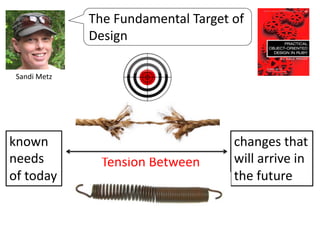
Tension Between
known
needs
of today
changes that
will arrive in
the future
Sandi Metz
The Fundamental Target of
Design
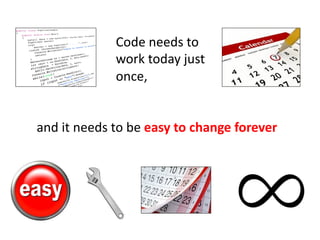
Code needs to
work today just
once,
and it needs to be easy to change forever
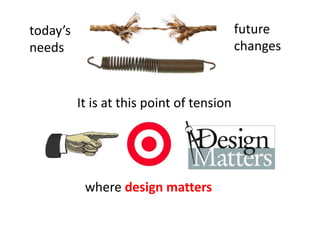
It is at this point of tension
where design matters
today’s
needs
future
changes
its purpose, its entire reason
for being, is to reduce the
cost of change.
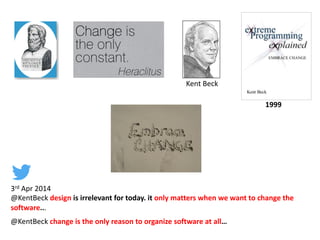
1999
3rd Apr 2014
@KentBeck design is irrelevant for today. it only matters when we want to change the
software...
@KentBeck change is the only reason to organize software at all…
Kent Beck
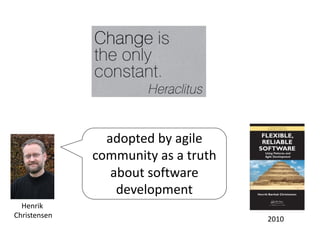
adopted by agile
community as a truth
about software
development
Henrik
Christensen 2010
“software must be designed and developed to
make it easy to change”
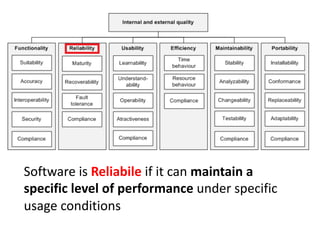
Let’s examine software qualities that enable
ease of change
Look for definitions in ISO 9126
Projects sometimes fail due to not having any clear
definitions of "success”
This standard tries to develop a common understanding of
project objectives and goals, e.g. software qualities
Software is Reliabile if it can maintain a
specific level of performance under specific
usage conditions
in our
setting…
In particular, we are interested in
preserving reliability in the face of change
Software is Reliabile if it can perform the
required functions without failing
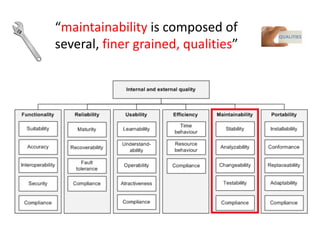
“maintainability is composed of
several, finer grained, qualities”
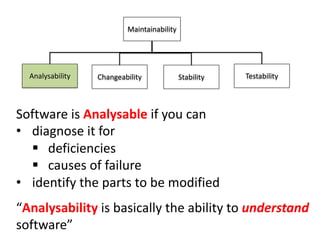
Analysability
Maintainability
Changeability Stability Testability
Software is Analysable if you can
• diagnose it for
§ deficiencies
§ causes of failure
• identify the parts to be modified
“Analysability is basically the ability to understand
software”
Analysability
Maintainability
Changeability Stability Testability
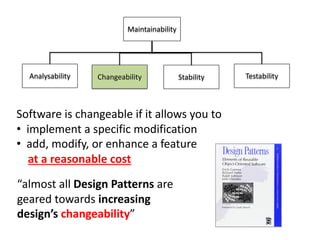
Software is changeable if it allows you to
• implement a specific modification
• add, modify, or enhance a feature
at a reasonable cost
“almost all Design Patterns are
geared towards increasing
design’s changeability”
Analysability
Maintainability
Changeability Stability Testability
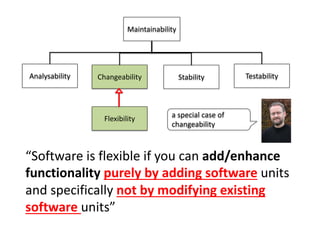
“Software is flexible if you can add/enhance
functionality purely by adding software units
and specifically not by modifying existing
software units”
Flexibility a special case of
changeability
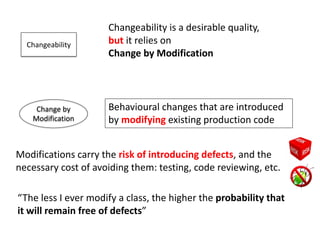
Changeability
Behavioural changes that are introduced
by modifying existing production code
Changeability is a desirable quality,
but it relies on
Change by Modification
Change by
Modification
“The less I ever modify a class, the higher the probability that
it will remain free of defects”
Modifications carry the risk of introducing defects, and the
necessary cost of avoiding them: testing, code reviewing, etc.
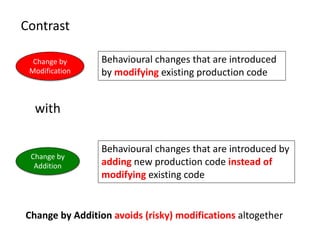
Behavioural changes that are introduced
by modifying existing production code
Change by
Modification
Change by
Addition
Behavioural changes that are introduced by
adding new production code instead of
modifying existing code
Contrast
Change by Addition avoids (risky) modifications altogether
with
Changeability
Change by
Addition
Change by
Modification
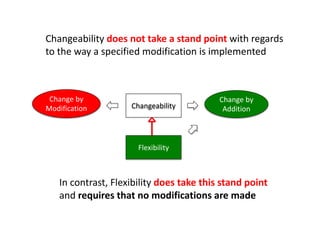
Changeability does not take a stand point with regards
to the way a specified modification is implemented
Flexibility
In contrast, Flexibility does take this stand point
and requires that no modifications are made
Analysability
Maintainability
Changeability Stability Testability
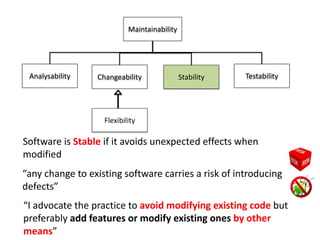
Software is Stable if it avoids unexpected effects when
modified
“I advocate the practice to avoid modifying existing code but
preferably add features or modify existing ones by other
means”
Flexibility
“any change to existing software carries a risk of introducing
defects”
Changeability
Stability
Flexibility
Reliability
Change by
Modification
Change by
Addition
-
+ -
+
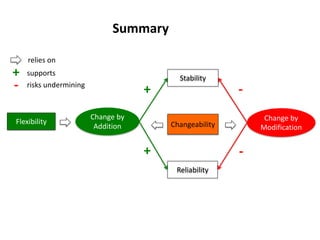
Summary
+ supports
- risks undermining
relies on
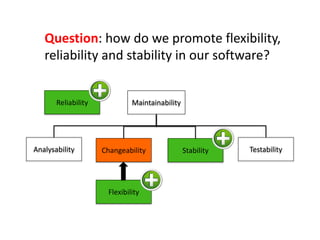
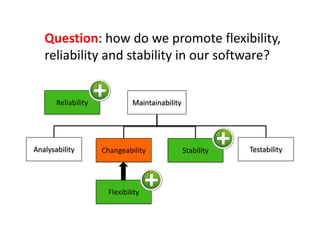
Question: how do we promote flexibility,
reliability and stability in our software?
Analysability
Maintainability
Changeability Stability Testability
Flexibility
Reliability
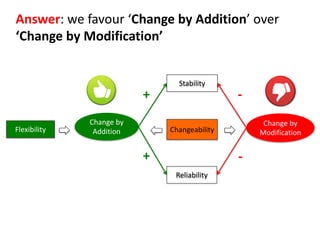
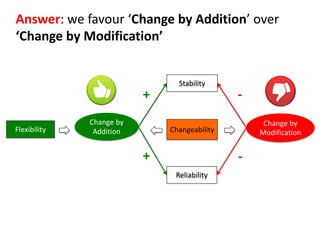
Answer: we favour ‘Change by Addition’ over
‘Change by Modification’
Changeability
Stability
Flexibility
Reliability
Change by
Modification
Change by
Addition
-
+ -
+
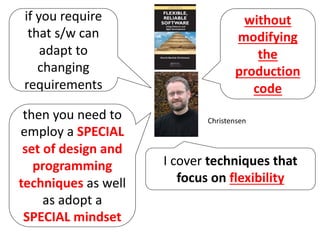
I cover techniques that
focus on flexibility
Christensen
if you require
that s/w can
adapt to
changing
requirements
without
modifying
the
production
code
then you need to
employ a SPECIAL
set of design and
programming
techniques as well
as adopt a
SPECIAL mindset
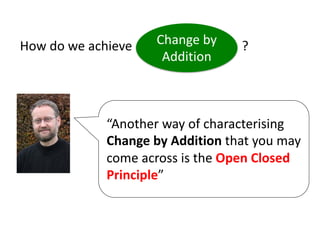
“Another way of characterising
Change by Addition that you may
come across is the Open Closed
Principle”
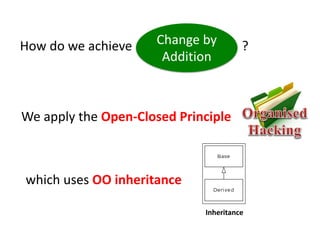
How do we achieve ?
Change by
Addition
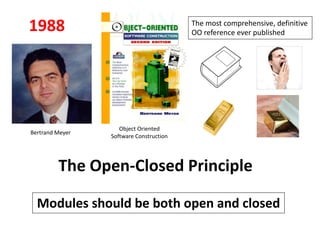
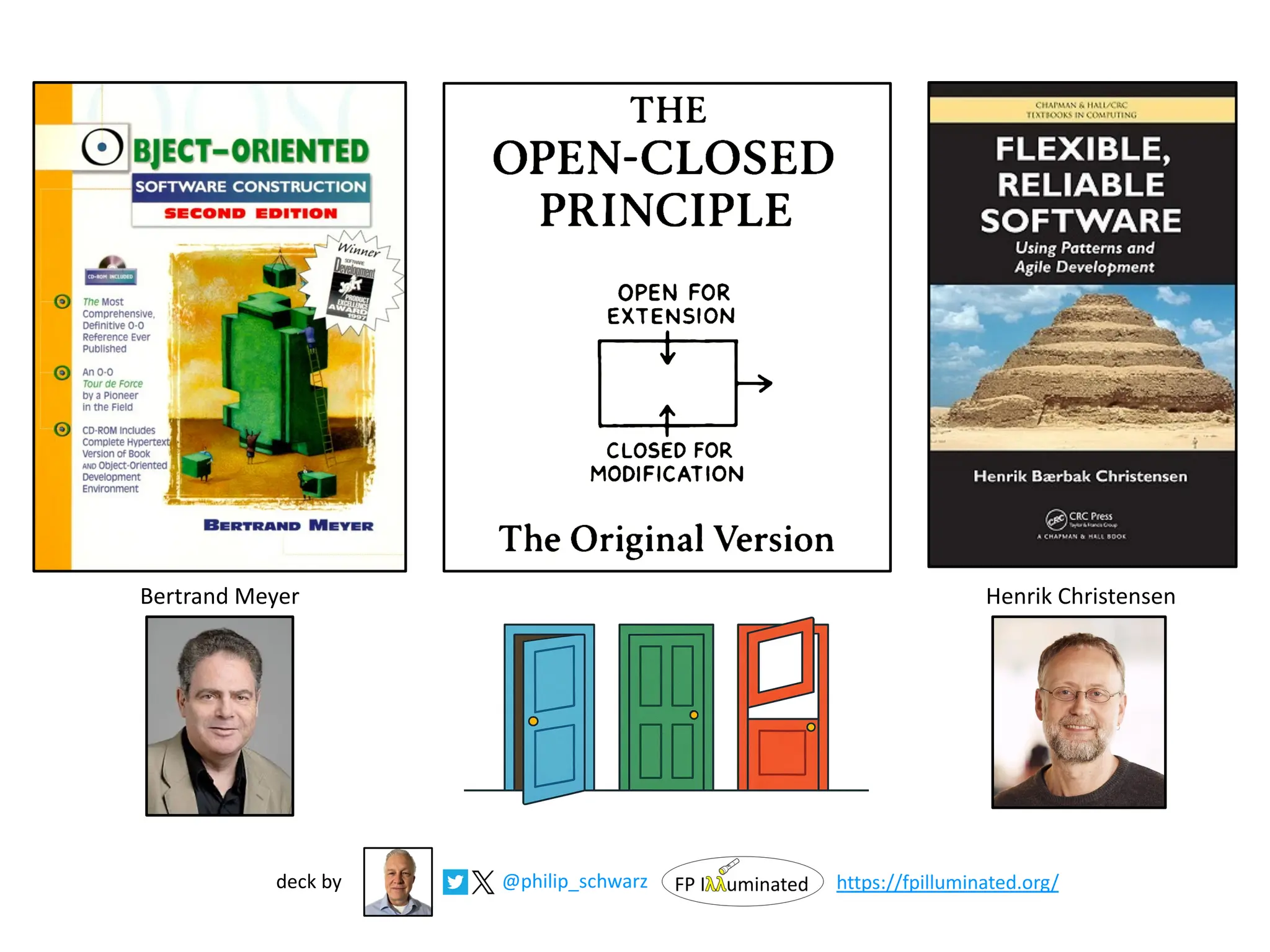
The Open-Closed Principle
Modules should be both open and closed
Bertrand Meyer
Object Oriented
Software Construction
The most comprehensive, definitive
OO reference ever published
1988
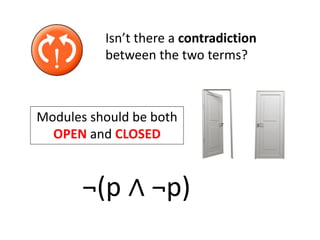
Isn’t there a contradiction
between the two terms?
Modules should be both
OPEN and CLOSED
¬(p ∧ ¬p)
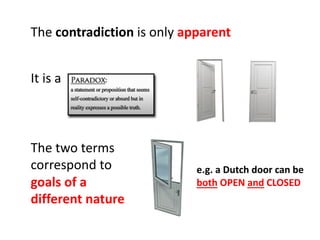
The contradiction is only apparent
The two terms
correspond to
goals of a
different nature
e.g. a Dutch door can be
both OPEN and CLOSED
It is a
So let’s look at the goals of the OCP
OCP
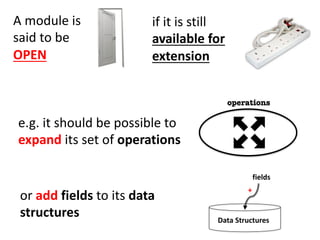
A module is
said to be
OPEN
if it is still
available for
extension
or add fields to its data
structures Data Structures
fields
+
operations
e.g. it should be possible to
expand its set of operations
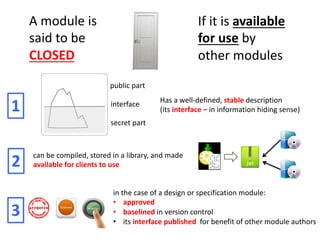
A module is
said to be
CLOSED
If it is available
for use by
other modules
Has a well-defined, stable description
(its interface – in information hiding sense)
public part
secret part
interface
1
can be compiled, stored in a library, and made
available for clients to use
2
in the case of a design or specification module:
• approved
• baselined in version control
• its interface published for benefit of other module authors
3
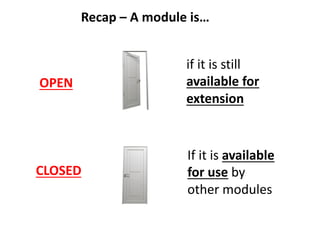
OPEN
if it is still
available for
extension
CLOSED
If it is available
for use by
other modules
Recap – A module is…
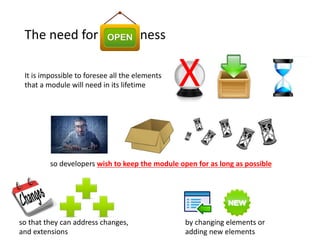
It is impossible to foresee all the elements
that a module will need in its lifetime X
The need for ness
so developers wish to keep the module open for as long as possible
so that they can address changes,
and extensions
by changing elements or
adding new elements
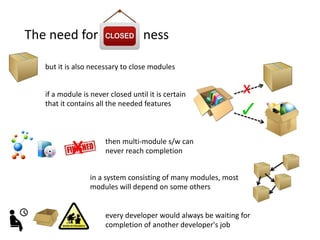
The need for ness
if a module is never closed until it is certain
that it contains all the needed features
x
every developer would always be waiting for
completion of another developer's job
then multi-module s/w can
never reach completion
x
in a system consisting of many modules, most
modules will depend on some others
but it is also necessary to close modules
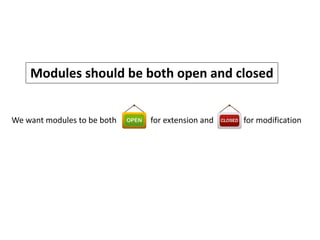
Modules should be both open and closed
We want modules to be both for extension and for modification
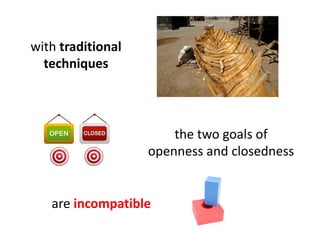
the two goals of
openness and closedness
with traditional
techniques
are incompatible
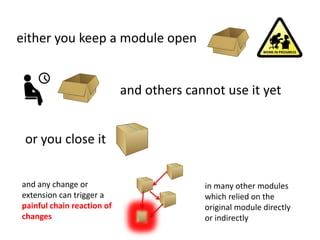
either you keep a module open
and others cannot use it yet
and any change or
extension can trigger a
painful chain reaction of
changes
or you close it
in many other modules
which relied on the
original module directly
or indirectly
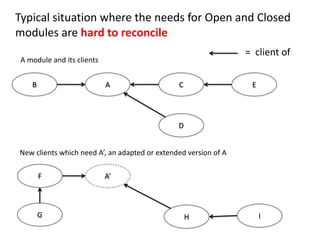
A
B C
D
E
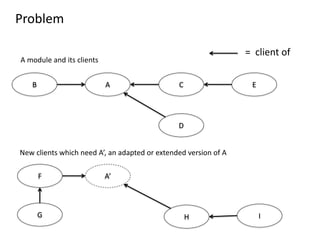
A module and its clients
A’
F
G H I
New clients which need A’, an adapted or extended version of A
Typical situation where the needs for Open and Closed
modules are hard to reconcile
= client of
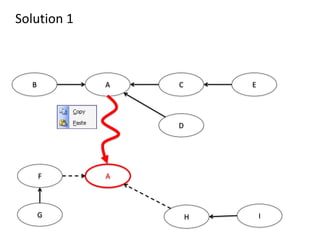
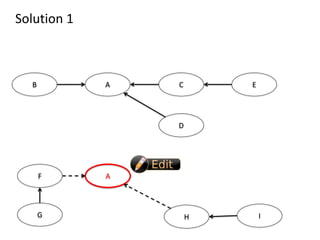
With non-OO methods,
there seem to be only 2 solutions,
equally unsatisfactory
A
B C
D
E
A
F
G H I
Solution 1
A
B C
D
E
A
F
G H I
Solution 1
A
B C
D
E
A’
F
G H I
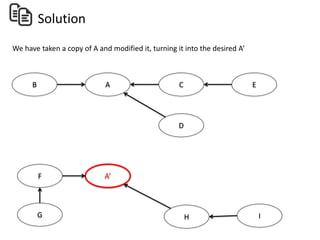
Solution
We have taken a copy of A and modified it, turning it into the desired A’
Solution
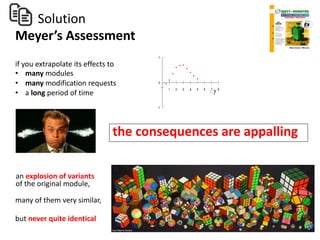
Meyer’s Assessment
the consequences are appalling
an explosion of variants
of the original module,
many of them very similar,
but never quite identical
if you extrapolate its effects to
• many modules
• many modification requests
• a long period of time
Solution (Source tree copy)
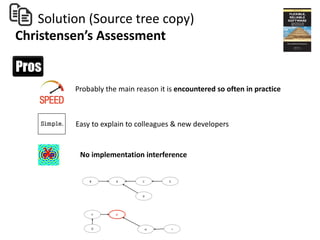
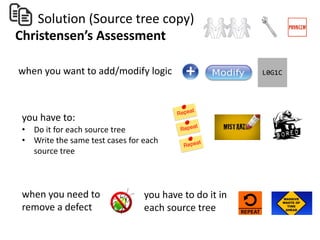
Christensen’s Assessment
Probably the main reason it is encountered so often in practice
Easy to explain to colleagues & new developers
No implementation interference
X
Solution (Source tree copy)
Christensen’s Assessment
Quick but very dangerous
In the long run it is
often a real disaster…
The solution has severe
limitations.
because it leads to the
multiple maintenance problem
Solution (Source tree copy)
Christensen’s Assessment
when you want to add/modify logic
you have to:
• Do it for each source tree
• Write the same test cases for each
source tree
you have to do it in
each source tree
when you need to
remove a defect
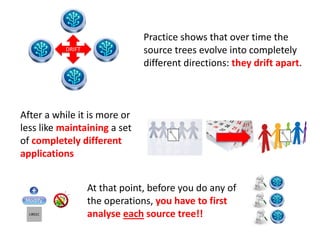
DRIFT
Practice shows that over time the
source trees evolve into completely
different directions: they drift apart.
After a while it is more or
less like maintaining a set
of completely different
applications
At that point, before you do any of
the operations, you have to first
analyse each source tree!!
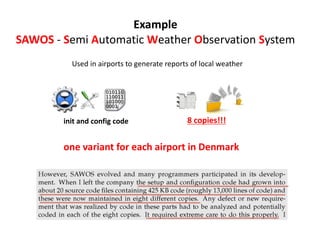
Used in airports to generate reports of local weather
one variant for each airport in Denmark
init and config code
Example
SAWOS - Semi Automatic Weather Observation System
8 copies!!!
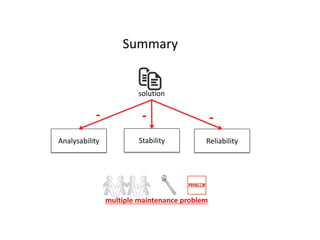
Analysability Stability Reliability
solution
- - -
Summary
multiple maintenance problem
That was Meyer’s first unsatisfactory
solution
to the problem of making modules
both OPEN and CLOSED
Let’s turn to the second one
A
B C
D
E
A’
F
G H I
A module and its clients
New clients which need A’, an adapted or extended version of A
= client of
Problem
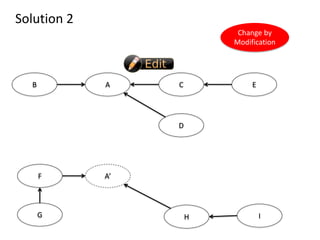
Solution 2
A
B C
D
E
A’
F
G H I
Change by
Modification
A+
B C
D
E
A’
F
G H I
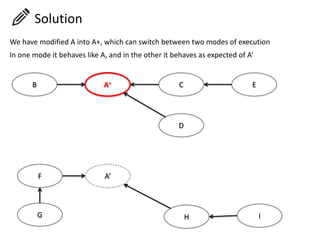
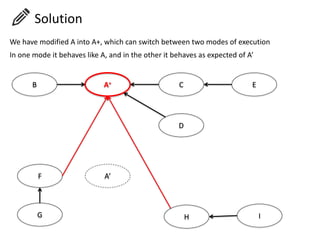
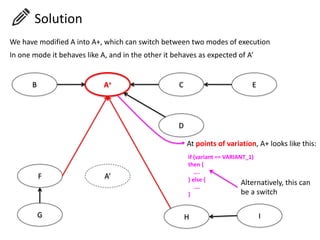
We have modified A into A+, which can switch between two modes of execution
In one mode it behaves like A, and in the other it behaves as expected of A’
Solution
A+
B C
D
E
A’
F
G H I
We have modified A into A+, which can switch between two modes of execution
In one mode it behaves like A, and in the other it behaves as expected of A’
Solution
A+
B C
D
E
A’
F
G H I
if (variant == VARIANT_1)
then {
….
} else {
….
}
At points of variation, A+ looks like this:
We have modified A into A+, which can switch between two modes of execution
In one mode it behaves like A, and in the other it behaves as expected of A’
Alternatively, this can
be a switch
Solution
A+
B C
D
E
A’
F
G H I
Solution – Meyer’s Assessment
A+
B C
D
E
A’
F
G H I
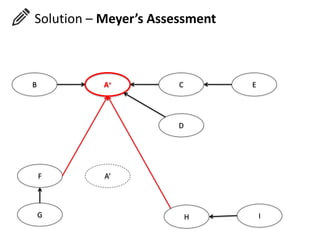
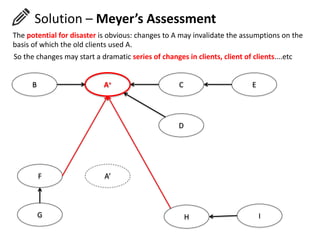
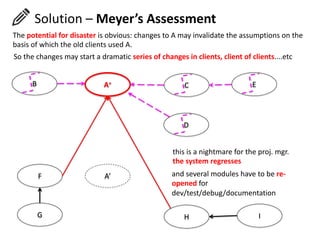
The potential for disaster is obvious: changes to A may invalidate the assumptions on the
basis of which the old clients used A.
So the changes may start a dramatic series of changes in clients, client of clients....etc
Solution – Meyer’s Assessment
A+
A’
F
G H I
Solution – Meyer’s Assessment
The potential for disaster is obvious: changes to A may invalidate the assumptions on the
basis of which the old clients used A.
So the changes may start a dramatic series of changes in clients, client of clients....etc
B C E
D
this is a nightmare for the proj. mgr.
the system regresses
and several modules have to be re-
opened for
dev/test/debug/documentation
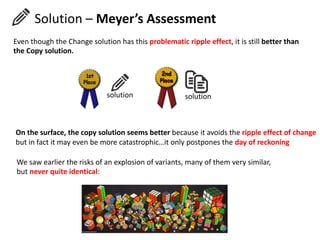
Even though the Change solution has this problematic ripple effect, it is still better than
the Copy solution.
On the surface, the copy solution seems better because it avoids the ripple effect of change
but in fact it may even be more catastrophic…it only postpones the day of reckoning
We saw earlier the risks of an explosion of variants, many of them very similar,
but never quite identical:
Solution – Meyer’s Assessment
solution
solution
Solution (Parametric solution)
Christensen’s Assessment
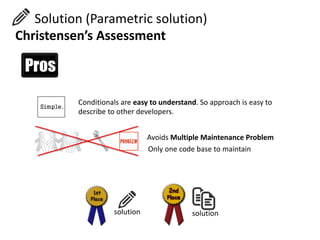
Conditionals are easy to understand. So approach is easy to
describe to other developers.
Avoids Multiple Maintenance Problem
Only one code base to maintain
solution
solution
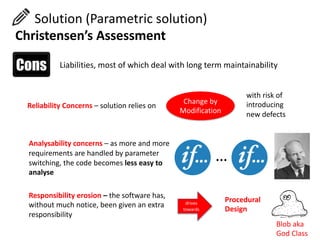
Liabilities, most of which deal with long term maintainability
Change by
Modification
Reliability Concerns – solution relies on
with risk of
introducing
new defects
Analysability concerns – as more and more
requirements are handled by parameter
switching, the code becomes less easy to
analyse
…
Responsibility erosion – the software has,
without much notice, been given an extra
responsibility
drives
towards
Procedural
Design
Blob aka
God Class
Solution (Parametric solution)
Christensen’s Assessment
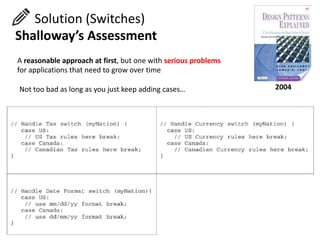
A reasonable approach at first, but one with serious problems
for applications that need to grow over time
Solution (Switches)
Shalloway’s Assessment
Not too bad as long as you just keep adding cases… 2004
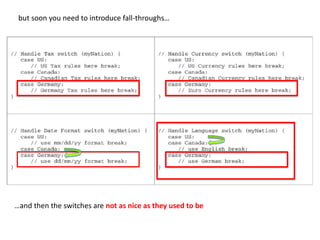
but soon you need to introduce fall-throughs…
…and then the switches are not as nice as they used to be
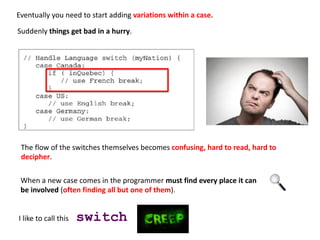
Eventually you need to start adding variations within a case.
I like to call this switch
The flow of the switches themselves becomes confusing, hard to read, hard to
decipher.
When a new case comes in the programmer must find every place it can
be involved (often finding all but one of them).
Suddenly things get bad in a hurry.
Analysability Stability Reliability
solution
- - -
Summary
Analysability Stability Reliability
solution
- - -
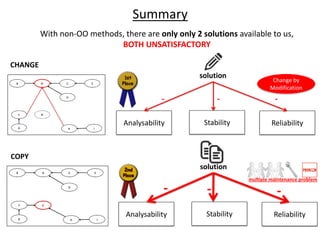
With non-OO methods, there are only only 2 solutions available to us,
BOTH UNSATISFACTORY
multiple maintenance problem
Change by
Modification
CHANGE
COPY
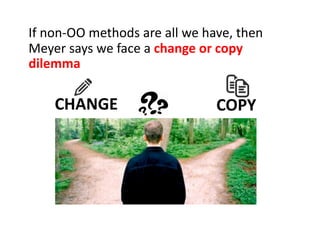
If non-OO methods are all we have, then
Meyer says we face a change or copy
dilemma
CHANGE COPY
A
B C
D
E
A’
F
G H I
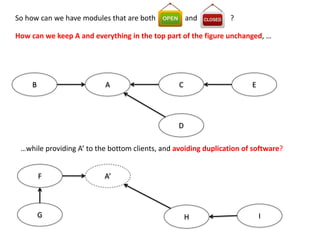
So how can we have modules that are both and ?
How can we keep A and everything in the top part of the figure unchanged, …
…while providing A’ to the bottom clients, and avoiding duplication of software?
A
B C
D
E
A’
F
G H I
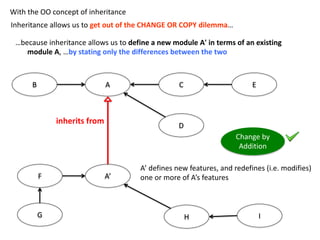
With the OO concept of inheritance
Inheritance allows us to get out of the CHANGE OR COPY dilemma…
…because inheritance allows us to define a new module A' in terms of an existing
module A, …by stating only the differences between the two
A’ defines new features, and redefines (i.e. modifies)
one or more of A’s features
inherits from
Change by
Addition
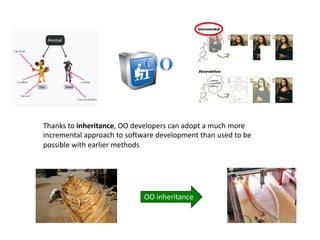
Thanks to inheritance, OO developers can adopt a much more
incremental approach to software development than used to be
possible with earlier methods
OO inheritance
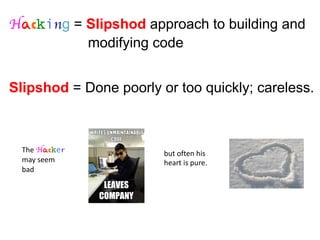
Hacking = Slipshod approach to building and
modifying code
Slipshod = Done poorly or too quickly; careless.
The Hacker
may seem
bad
but often his
heart is pure.
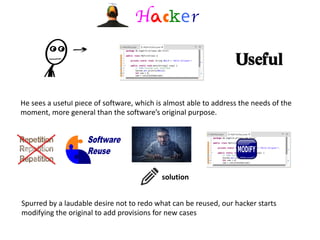
He sees a useful piece of software, which is almost able to address the needs of the
moment, more general than the software’s original purpose.
Hacker
Spurred by a laudable desire not to redo what can be reused, our hacker starts
modifying the original to add provisions for new cases
solution
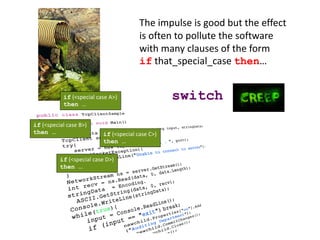
The impulse is good but the effect
is often to pollute the software
with many clauses of the form
if that_special_case then…
if (<special case D>)
then …
if (<special case C>)
then …
if (<special case B>)
then …
if (<special case A>)
then …
switch
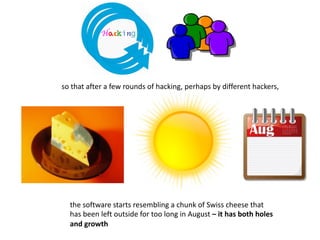
so that after a few rounds of hacking, perhaps by different hackers,
the software starts resembling a chunk of Swiss cheese that
has been left outside for too long in August – it has both holes
and growth
Hacking
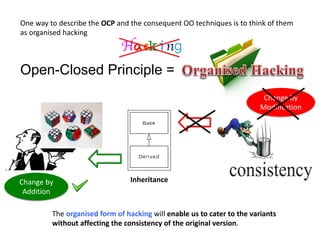
Open-Closed Principle =
One way to describe the OCP and the consequent OO techniques is to think of them
as organised hacking
Hacking
The organised form of hacking will enable us to cater to the variants
without affecting the consistency of the original version.
Inheritance
Change by
Modification
Change by
Addition
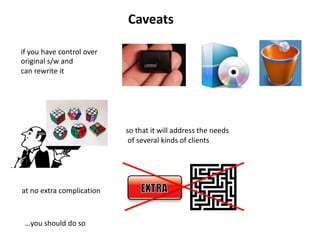
if you have control over
original s/w and
can rewrite it
so that it will address the needs
of several kinds of clients
…you should do so
Caveats
at no extra complication
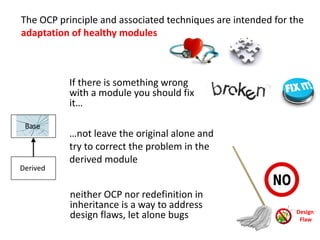
The OCP principle and associated techniques are intended for the
adaptation of healthy modules
If there is something wrong
with a module you should fix
it…
…not leave the original alone and
try to correct the problem in the
derived module
Derived
Base
neither OCP nor redefinition in
inheritance is a way to address
design flaws, let alone bugs Design
Flaw
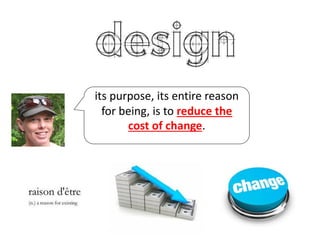
its purpose, its entire reason
for being, is to reduce the
cost of change.
Question: how do we promote flexibility,
reliability and stability in our software?
Analysability
Maintainability
Changeability Stability Testability
Flexibility
Reliability
Answer: we favour ‘Change by Addition’ over
‘Change by Modification’
Changeability
Stability
Flexibility
Reliability
Change by
Modification
Change by
Addition
-
+ -
+
How do we achieve ?
Change by
Addition
which uses OO inheritance
Inheritance
We apply the Open-Closed Principle
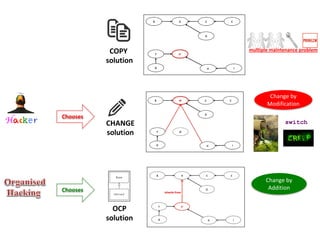
multiple maintenance problem
Change by
Modification
CHANGE
solution
COPY
solution
Hacker
Change by
Addition
OCP
solution
Chooses
Chooses
switch
I hope you enjoyed that.
See you in part two.

MiniTool Partition Wizard Crack Latest Version? | PPT

  • 1.
  • 2.
    Tension Between known needs of today changesthat will arrive in the future Sandi Metz The Fundamental Target of Design
  • 3.
    Code needs to worktoday just once, and it needs to be easy to change forever
  • 4.
    It is atthis point of tension where design matters today’s needs future changes
  • 5.
    its purpose, itsentire reason for being, is to reduce the cost of change.
  • 6.
    1999 3rd Apr 2014 @KentBeckdesign is irrelevant for today. it only matters when we want to change the software... @KentBeck change is the only reason to organize software at all… Kent Beck
  • 7.
    adopted by agile communityas a truth about software development Henrik Christensen 2010
  • 8.
    “software must bedesigned and developed to make it easy to change”
  • 9.
    Let’s examine softwarequalities that enable ease of change Look for definitions in ISO 9126 Projects sometimes fail due to not having any clear definitions of "success” This standard tries to develop a common understanding of project objectives and goals, e.g. software qualities
  • 10.
    Software is Reliabileif it can maintain a specific level of performance under specific usage conditions
  • 11.
    in our setting… In particular,we are interested in preserving reliability in the face of change Software is Reliabile if it can perform the required functions without failing
  • 12.
    “maintainability is composedof several, finer grained, qualities”
  • 13.
    Analysability Maintainability Changeability Stability Testability Softwareis Analysable if you can • diagnose it for § deficiencies § causes of failure • identify the parts to be modified “Analysability is basically the ability to understand software”
  • 14.
    Analysability Maintainability Changeability Stability Testability Softwareis changeable if it allows you to • implement a specific modification • add, modify, or enhance a feature at a reasonable cost “almost all Design Patterns are geared towards increasing design’s changeability”
  • 15.
    Analysability Maintainability Changeability Stability Testability “Softwareis flexible if you can add/enhance functionality purely by adding software units and specifically not by modifying existing software units” Flexibility a special case of changeability
  • 16.
    Changeability Behavioural changes thatare introduced by modifying existing production code Changeability is a desirable quality, but it relies on Change by Modification Change by Modification “The less I ever modify a class, the higher the probability that it will remain free of defects” Modifications carry the risk of introducing defects, and the necessary cost of avoiding them: testing, code reviewing, etc.
  • 17.
    Behavioural changes thatare introduced by modifying existing production code Change by Modification Change by Addition Behavioural changes that are introduced by adding new production code instead of modifying existing code Contrast Change by Addition avoids (risky) modifications altogether with
  • 18.
    Changeability Change by Addition Change by Modification Changeabilitydoes not take a stand point with regards to the way a specified modification is implemented Flexibility In contrast, Flexibility does take this stand point and requires that no modifications are made
  • 19.
    Analysability Maintainability Changeability Stability Testability Softwareis Stable if it avoids unexpected effects when modified “I advocate the practice to avoid modifying existing code but preferably add features or modify existing ones by other means” Flexibility “any change to existing software carries a risk of introducing defects”
  • 20.
  • 21.
    Question: how dowe promote flexibility, reliability and stability in our software? Analysability Maintainability Changeability Stability Testability Flexibility Reliability
  • 22.
    Answer: we favour‘Change by Addition’ over ‘Change by Modification’ Changeability Stability Flexibility Reliability Change by Modification Change by Addition - + - +
  • 23.
    I cover techniquesthat focus on flexibility Christensen if you require that s/w can adapt to changing requirements without modifying the production code then you need to employ a SPECIAL set of design and programming techniques as well as adopt a SPECIAL mindset
  • 24.
    “Another way ofcharacterising Change by Addition that you may come across is the Open Closed Principle” How do we achieve ? Change by Addition
  • 25.
    The Open-Closed Principle Modulesshould be both open and closed Bertrand Meyer Object Oriented Software Construction The most comprehensive, definitive OO reference ever published 1988
  • 26.
    Isn’t there acontradiction between the two terms? Modules should be both OPEN and CLOSED ¬(p ∧ ¬p)
  • 27.
    The contradiction isonly apparent The two terms correspond to goals of a different nature e.g. a Dutch door can be both OPEN and CLOSED It is a
  • 28.
    So let’s lookat the goals of the OCP OCP
  • 29.
    A module is saidto be OPEN if it is still available for extension or add fields to its data structures Data Structures fields + operations e.g. it should be possible to expand its set of operations
  • 30.
    A module is saidto be CLOSED If it is available for use by other modules Has a well-defined, stable description (its interface – in information hiding sense) public part secret part interface 1 can be compiled, stored in a library, and made available for clients to use 2 in the case of a design or specification module: • approved • baselined in version control • its interface published for benefit of other module authors 3
  • 31.
    OPEN if it isstill available for extension CLOSED If it is available for use by other modules Recap – A module is…
  • 32.
    It is impossibleto foresee all the elements that a module will need in its lifetime X The need for ness so developers wish to keep the module open for as long as possible so that they can address changes, and extensions by changing elements or adding new elements
  • 33.
    The need forness if a module is never closed until it is certain that it contains all the needed features x every developer would always be waiting for completion of another developer's job then multi-module s/w can never reach completion x in a system consisting of many modules, most modules will depend on some others but it is also necessary to close modules
  • 34.
    Modules should beboth open and closed We want modules to be both for extension and for modification
  • 35.
    the two goalsof openness and closedness with traditional techniques are incompatible
  • 36.
    either you keepa module open and others cannot use it yet and any change or extension can trigger a painful chain reaction of changes or you close it in many other modules which relied on the original module directly or indirectly
  • 37.
    A B C D E A moduleand its clients A’ F G H I New clients which need A’, an adapted or extended version of A Typical situation where the needs for Open and Closed modules are hard to reconcile = client of
  • 38.
    With non-OO methods, thereseem to be only 2 solutions, equally unsatisfactory
  • 39.
    A B C D E A F G HI Solution 1
  • 40.
    A B C D E A F G HI Solution 1
  • 41.
    A B C D E A’ F G HI Solution We have taken a copy of A and modified it, turning it into the desired A’
  • 42.
    Solution Meyer’s Assessment the consequencesare appalling an explosion of variants of the original module, many of them very similar, but never quite identical if you extrapolate its effects to • many modules • many modification requests • a long period of time
  • 43.
    Solution (Source treecopy) Christensen’s Assessment Probably the main reason it is encountered so often in practice Easy to explain to colleagues & new developers No implementation interference X
  • 44.
    Solution (Source treecopy) Christensen’s Assessment Quick but very dangerous In the long run it is often a real disaster… The solution has severe limitations.
  • 45.
    because it leadsto the multiple maintenance problem
  • 46.
    Solution (Source treecopy) Christensen’s Assessment when you want to add/modify logic you have to: • Do it for each source tree • Write the same test cases for each source tree you have to do it in each source tree when you need to remove a defect
  • 47.
    DRIFT Practice shows thatover time the source trees evolve into completely different directions: they drift apart. After a while it is more or less like maintaining a set of completely different applications At that point, before you do any of the operations, you have to first analyse each source tree!!
  • 48.
    Used in airportsto generate reports of local weather one variant for each airport in Denmark init and config code Example SAWOS - Semi Automatic Weather Observation System 8 copies!!!
  • 49.
    Analysability Stability Reliability solution -- - Summary multiple maintenance problem
  • 50.
    That was Meyer’sfirst unsatisfactory solution to the problem of making modules both OPEN and CLOSED Let’s turn to the second one
  • 51.
    A B C D E A’ F G HI A module and its clients New clients which need A’, an adapted or extended version of A = client of Problem
  • 52.
    Solution 2 A B C D E A’ F GH I Change by Modification
  • 53.
    A+ B C D E A’ F G HI We have modified A into A+, which can switch between two modes of execution In one mode it behaves like A, and in the other it behaves as expected of A’ Solution
  • 54.
    A+ B C D E A’ F G HI We have modified A into A+, which can switch between two modes of execution In one mode it behaves like A, and in the other it behaves as expected of A’ Solution
  • 55.
    A+ B C D E A’ F G HI if (variant == VARIANT_1) then { …. } else { …. } At points of variation, A+ looks like this: We have modified A into A+, which can switch between two modes of execution In one mode it behaves like A, and in the other it behaves as expected of A’ Alternatively, this can be a switch Solution
  • 56.
    A+ B C D E A’ F G HI Solution – Meyer’s Assessment
  • 57.
    A+ B C D E A’ F G HI The potential for disaster is obvious: changes to A may invalidate the assumptions on the basis of which the old clients used A. So the changes may start a dramatic series of changes in clients, client of clients....etc Solution – Meyer’s Assessment
  • 58.
    A+ A’ F G H I Solution– Meyer’s Assessment The potential for disaster is obvious: changes to A may invalidate the assumptions on the basis of which the old clients used A. So the changes may start a dramatic series of changes in clients, client of clients....etc B C E D this is a nightmare for the proj. mgr. the system regresses and several modules have to be re- opened for dev/test/debug/documentation
  • 59.
    Even though theChange solution has this problematic ripple effect, it is still better than the Copy solution. On the surface, the copy solution seems better because it avoids the ripple effect of change but in fact it may even be more catastrophic…it only postpones the day of reckoning We saw earlier the risks of an explosion of variants, many of them very similar, but never quite identical: Solution – Meyer’s Assessment solution solution
  • 60.
    Solution (Parametric solution) Christensen’sAssessment Conditionals are easy to understand. So approach is easy to describe to other developers. Avoids Multiple Maintenance Problem Only one code base to maintain solution solution
  • 61.
    Liabilities, most ofwhich deal with long term maintainability Change by Modification Reliability Concerns – solution relies on with risk of introducing new defects Analysability concerns – as more and more requirements are handled by parameter switching, the code becomes less easy to analyse … Responsibility erosion – the software has, without much notice, been given an extra responsibility drives towards Procedural Design Blob aka God Class Solution (Parametric solution) Christensen’s Assessment
  • 62.
    A reasonable approachat first, but one with serious problems for applications that need to grow over time Solution (Switches) Shalloway’s Assessment Not too bad as long as you just keep adding cases… 2004
  • 63.
    but soon youneed to introduce fall-throughs… …and then the switches are not as nice as they used to be
  • 64.
    Eventually you needto start adding variations within a case. I like to call this switch The flow of the switches themselves becomes confusing, hard to read, hard to decipher. When a new case comes in the programmer must find every place it can be involved (often finding all but one of them). Suddenly things get bad in a hurry.
  • 65.
    Analysability Stability Reliability solution -- - Summary Analysability Stability Reliability solution - - - With non-OO methods, there are only only 2 solutions available to us, BOTH UNSATISFACTORY multiple maintenance problem Change by Modification CHANGE COPY
  • 66.
    If non-OO methodsare all we have, then Meyer says we face a change or copy dilemma CHANGE COPY
  • 67.
    A B C D E A’ F G HI So how can we have modules that are both and ? How can we keep A and everything in the top part of the figure unchanged, … …while providing A’ to the bottom clients, and avoiding duplication of software?
  • 68.
    A B C D E A’ F G HI With the OO concept of inheritance Inheritance allows us to get out of the CHANGE OR COPY dilemma… …because inheritance allows us to define a new module A' in terms of an existing module A, …by stating only the differences between the two A’ defines new features, and redefines (i.e. modifies) one or more of A’s features inherits from Change by Addition
  • 69.
    Thanks to inheritance,OO developers can adopt a much more incremental approach to software development than used to be possible with earlier methods OO inheritance
  • 70.
    Hacking = Slipshodapproach to building and modifying code Slipshod = Done poorly or too quickly; careless. The Hacker may seem bad but often his heart is pure.
  • 71.
    He sees auseful piece of software, which is almost able to address the needs of the moment, more general than the software’s original purpose. Hacker Spurred by a laudable desire not to redo what can be reused, our hacker starts modifying the original to add provisions for new cases solution
  • 72.
    The impulse isgood but the effect is often to pollute the software with many clauses of the form if that_special_case then… if (<special case D>) then … if (<special case C>) then … if (<special case B>) then … if (<special case A>) then … switch
  • 73.
    so that aftera few rounds of hacking, perhaps by different hackers, the software starts resembling a chunk of Swiss cheese that has been left outside for too long in August – it has both holes and growth Hacking
  • 74.
    Open-Closed Principle = Oneway to describe the OCP and the consequent OO techniques is to think of them as organised hacking Hacking The organised form of hacking will enable us to cater to the variants without affecting the consistency of the original version. Inheritance Change by Modification Change by Addition
  • 75.
    if you havecontrol over original s/w and can rewrite it so that it will address the needs of several kinds of clients …you should do so Caveats at no extra complication
  • 76.
    The OCP principleand associated techniques are intended for the adaptation of healthy modules If there is something wrong with a module you should fix it… …not leave the original alone and try to correct the problem in the derived module Derived Base neither OCP nor redefinition in inheritance is a way to address design flaws, let alone bugs Design Flaw
  • 78.
    its purpose, itsentire reason for being, is to reduce the cost of change.
  • 79.
    Question: how dowe promote flexibility, reliability and stability in our software? Analysability Maintainability Changeability Stability Testability Flexibility Reliability
  • 80.
    Answer: we favour‘Change by Addition’ over ‘Change by Modification’ Changeability Stability Flexibility Reliability Change by Modification Change by Addition - + - +
  • 81.
    How do weachieve ? Change by Addition which uses OO inheritance Inheritance We apply the Open-Closed Principle
  • 82.
    multiple maintenance problem Changeby Modification CHANGE solution COPY solution Hacker Change by Addition OCP solution Chooses Chooses switch
  • 83.
    I hope youenjoyed that. See you in part two.