Minimizing Risks and
 Maximizing Success in
Government Contracting

     Leonard R. Ruzicka, Jr.
  Stinson Morrison Hecker LLP


           © Stinson Morrison Hecker LLP, 2010
Introduction
    Your Company's long and profitable record in
private construction does not translate into
success in the government sector even for the
same type of work

    There are already too many stories about
successful contractors jumping from the private
into the government sector to keep their staff intact
and their employees busy with disastrous financial
consequences


                   © Stinson Morrison Hecker LLP, 2010
This presentation will focus on what you
need to do to minimize your risks/maximize
your success in performing government work


                © Stinson Morrison Hecker LLP, 2010
I. Golden Rules of Government
         Contracting

 Rule Number One: The contract is your
 client. A governmental representative
 should not/cannot give you anything that is
 not provided for in the contract. Stated
 simply horse trading is not allowed.


                 © Stinson Morrison Hecker LLP, 2010
Rule Number Two. Know your
contract. The natural follow on to Rule
Number One is to understand your
contract. A project manager who is not
familiar with all the commercial and
technical requirements of his contract is
headed for trouble.


                © Stinson Morrison Hecker LLP, 2010
Rule Number Three. Provide timely and
complete notices. Failure to provide timely
and complete notices in government
contracting is fatal to otherwise valid claims.
Submit your notices, follow the requirements
of the Contract Disputes Act, and do not
expect anything other than treatment
consistent with the contract.


                 © Stinson Morrison Hecker LLP, 2010
Rule Number Four. Provide Complete,
Open and Truthful information. If you
intend to deviate in any manner from the
plans and specifications, such deviation
must be documented and approved by an
authorized representative of the
government agency.


               © Stinson Morrison Hecker LLP, 2010
II. Laws and Regulations Applicable to
       Government Contracting

                 Federal
Most federal contracts for construction are
awarded as a result of a competitive bid
process. In the Request for Proposals
(“RFP”), the Federal Acquisition
Regulations (FAR) Provisions that govern
the performance of the work are either
included or referenced in the contract that
the bidder is expected to execute if the
contract is awarded to that bidder.

                © Stinson Morrison Hecker LLP, 2010
The relevant provisions applying to a
contract for construction are found in
Section 52 of the FAR. Every contract
with a federal agency for construction
contains a number of FAR provisions.


               © Stinson Morrison Hecker LLP, 2010
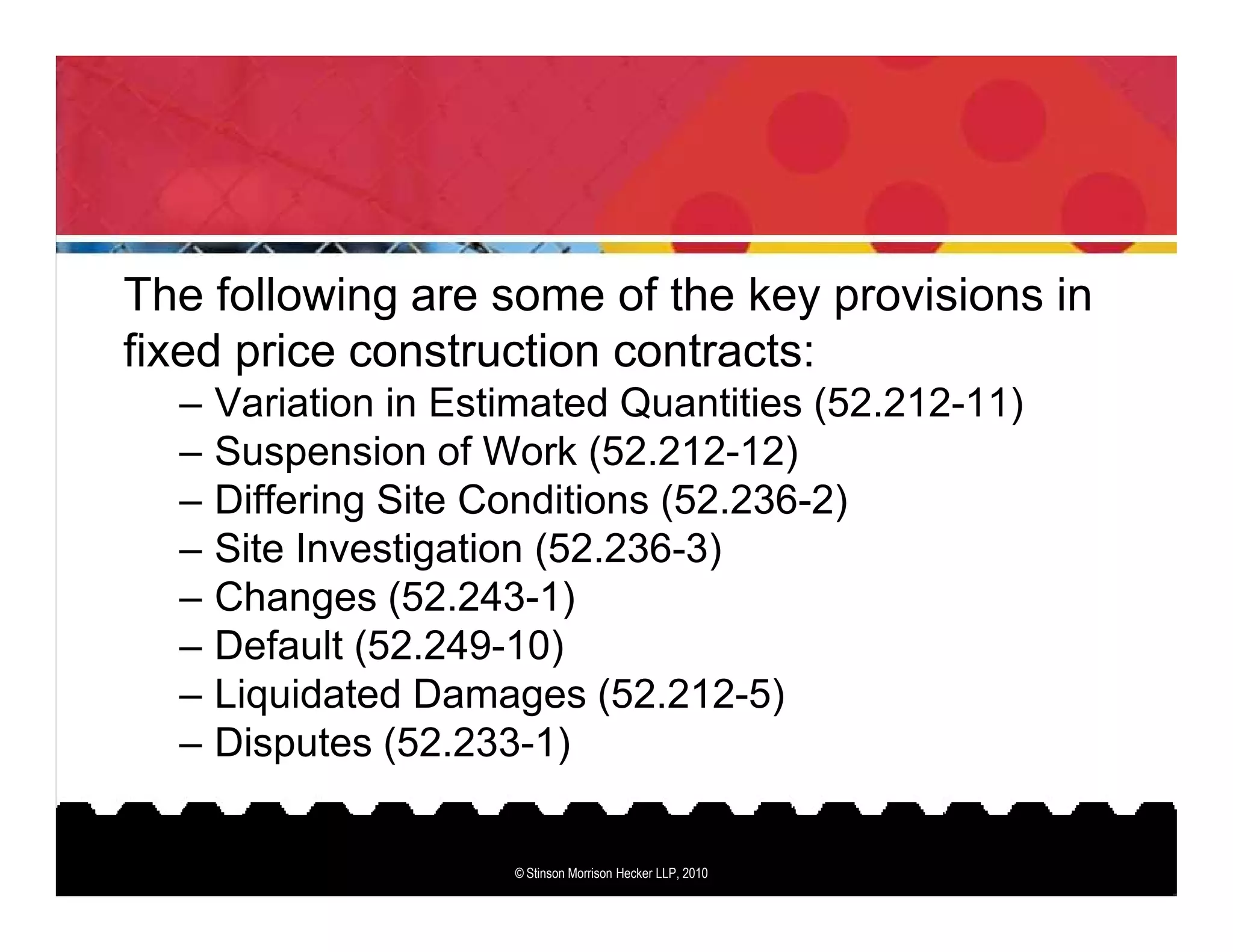
The following are some of the key provisions in
fixed price construction contracts:
  –   Variation in Estimated Quantities (52.212-11)
  –   Suspension of Work (52.212-12)
  –   Differing Site Conditions (52.236-2)
  –   Site Investigation (52.236-3)
  –   Changes (52.243-1)
  –   Default (52.249-10)
  –   Liquidated Damages (52.212-5)
  –   Disputes (52.233-1)


                      © Stinson Morrison Hecker LLP, 2010
There is a substantial body of federal case law
interpreting the FAR provisions as well as cases that are
instructive as to the mutual obligations of the parties
during the construction process, i.e. implied obligations
which include:
 – Plans and specs are complete and accurate (Spearin
   Doctrine)
 – Cooperation/coordination of government in
   contractor’s efforts
 – Reasonable Access


                     © Stinson Morrison Hecker LLP, 2010
The following FAR provisions are also important to the
contracting process:

– Contracting Officer’s Authority (33.210)

– Contracting Officer’s Decision (33.211)

– Truth in Negotiations 10 U.S.C. 2304

   Civil liability for knowingly submitting false data in
   conjunction with a submission of certified cost or pricing
   data for a contract change or modification or a non-fixed
   price contract solicitation.


                        © Stinson Morrison Hecker LLP, 2010
– False Claims Act 31 U.S.C. Section 3729 et
  seq.

 Civil liability for knowingly presenting a false
 claim to the U.S. Government ($10,000 plus
 treble the damages sustained by
 Government)

– Prompt Payment Act U.S.C. Section 3901 et
  seq.

– Miller Act 40 U.S.C. Section 270

                 © Stinson Morrison Hecker LLP, 2010
When do the FARS apply / some general
  rules:
• FARS apply if you enter into a direct
  contract with a federal agency.
• FARS apply to subcontractors/vendors at
  any level if there is some performance on
  the project site that is covered by a
  contract with a federal agency.

                 © Stinson Morrison Hecker LLP, 2010
• FARS apply even if there is no performance on
  the project site if the contract with the
  government agency is incorporated by reference
  in your contract except for the Davis-Bacon
  requirements. There are some exceptions if
  working on a contiguous site/certain
  transportation activities.
• When in doubt assume the FARS apply.


                   © Stinson Morrison Hecker LLP, 2010
STATE
Most States agencies that regularly do construction,
e.g., state transportation departments, have standard
specifications governing the performance of
construction within that state for that agency. These
State-standard specifications typically mirror the
federal FAR provisions with some minor variations.
However, there are a number of States that have
deviated substantially from the FAR and have very
harsh and risk shifting provisions. Some States have
very little case law to interpret these provisions and
therefore interpretations under federal or other state
case law is necessary.


                    © Stinson Morrison Hecker LLP, 2010
• In addition to these standard specifications,
  most States have enacted statutes that
  govern the construction process:
• Prompt Pay 34.057 RSMo./Little Miller Acts
  107.170 RSMo.
• Prohibition on “no damage for delay” clauses
  34.058 RSMo.
• False Claims. See Cal. Govt. Code Section
  12650 et seq. (similar to Federal FCA)

                   © Stinson Morrison Hecker LLP, 2010

Minimizing Risks and Maximizing Success in Government Contracting

  • 1.
    Minimizing Risks and Maximizing Success in Government Contracting Leonard R. Ruzicka, Jr. Stinson Morrison Hecker LLP © Stinson Morrison Hecker LLP, 2010
  • 2.
    Introduction Your Company's long and profitable record in private construction does not translate into success in the government sector even for the same type of work There are already too many stories about successful contractors jumping from the private into the government sector to keep their staff intact and their employees busy with disastrous financial consequences © Stinson Morrison Hecker LLP, 2010
  • 3.
    This presentation willfocus on what you need to do to minimize your risks/maximize your success in performing government work © Stinson Morrison Hecker LLP, 2010
  • 4.
    I. Golden Rulesof Government Contracting Rule Number One: The contract is your client. A governmental representative should not/cannot give you anything that is not provided for in the contract. Stated simply horse trading is not allowed. © Stinson Morrison Hecker LLP, 2010
  • 5.
    Rule Number Two.Know your contract. The natural follow on to Rule Number One is to understand your contract. A project manager who is not familiar with all the commercial and technical requirements of his contract is headed for trouble. © Stinson Morrison Hecker LLP, 2010
  • 6.
    Rule Number Three.Provide timely and complete notices. Failure to provide timely and complete notices in government contracting is fatal to otherwise valid claims. Submit your notices, follow the requirements of the Contract Disputes Act, and do not expect anything other than treatment consistent with the contract. © Stinson Morrison Hecker LLP, 2010
  • 7.
    Rule Number Four.Provide Complete, Open and Truthful information. If you intend to deviate in any manner from the plans and specifications, such deviation must be documented and approved by an authorized representative of the government agency. © Stinson Morrison Hecker LLP, 2010
  • 8.
    II. Laws andRegulations Applicable to Government Contracting Federal Most federal contracts for construction are awarded as a result of a competitive bid process. In the Request for Proposals (“RFP”), the Federal Acquisition Regulations (FAR) Provisions that govern the performance of the work are either included or referenced in the contract that the bidder is expected to execute if the contract is awarded to that bidder. © Stinson Morrison Hecker LLP, 2010
  • 9.
    The relevant provisionsapplying to a contract for construction are found in Section 52 of the FAR. Every contract with a federal agency for construction contains a number of FAR provisions. © Stinson Morrison Hecker LLP, 2010
  • 10.
    The following aresome of the key provisions in fixed price construction contracts: – Variation in Estimated Quantities (52.212-11) – Suspension of Work (52.212-12) – Differing Site Conditions (52.236-2) – Site Investigation (52.236-3) – Changes (52.243-1) – Default (52.249-10) – Liquidated Damages (52.212-5) – Disputes (52.233-1) © Stinson Morrison Hecker LLP, 2010
  • 11.
    There is asubstantial body of federal case law interpreting the FAR provisions as well as cases that are instructive as to the mutual obligations of the parties during the construction process, i.e. implied obligations which include: – Plans and specs are complete and accurate (Spearin Doctrine) – Cooperation/coordination of government in contractor’s efforts – Reasonable Access © Stinson Morrison Hecker LLP, 2010
  • 12.
    The following FARprovisions are also important to the contracting process: – Contracting Officer’s Authority (33.210) – Contracting Officer’s Decision (33.211) – Truth in Negotiations 10 U.S.C. 2304 Civil liability for knowingly submitting false data in conjunction with a submission of certified cost or pricing data for a contract change or modification or a non-fixed price contract solicitation. © Stinson Morrison Hecker LLP, 2010
  • 13.
    – False ClaimsAct 31 U.S.C. Section 3729 et seq. Civil liability for knowingly presenting a false claim to the U.S. Government ($10,000 plus treble the damages sustained by Government) – Prompt Payment Act U.S.C. Section 3901 et seq. – Miller Act 40 U.S.C. Section 270 © Stinson Morrison Hecker LLP, 2010
  • 14.
    When do theFARS apply / some general rules: • FARS apply if you enter into a direct contract with a federal agency. • FARS apply to subcontractors/vendors at any level if there is some performance on the project site that is covered by a contract with a federal agency. © Stinson Morrison Hecker LLP, 2010
  • 15.
    • FARS applyeven if there is no performance on the project site if the contract with the government agency is incorporated by reference in your contract except for the Davis-Bacon requirements. There are some exceptions if working on a contiguous site/certain transportation activities. • When in doubt assume the FARS apply. © Stinson Morrison Hecker LLP, 2010
  • 16.
    STATE Most States agenciesthat regularly do construction, e.g., state transportation departments, have standard specifications governing the performance of construction within that state for that agency. These State-standard specifications typically mirror the federal FAR provisions with some minor variations. However, there are a number of States that have deviated substantially from the FAR and have very harsh and risk shifting provisions. Some States have very little case law to interpret these provisions and therefore interpretations under federal or other state case law is necessary. © Stinson Morrison Hecker LLP, 2010
  • 17.
    • In additionto these standard specifications, most States have enacted statutes that govern the construction process: • Prompt Pay 34.057 RSMo./Little Miller Acts 107.170 RSMo. • Prohibition on “no damage for delay” clauses 34.058 RSMo. • False Claims. See Cal. Govt. Code Section 12650 et seq. (similar to Federal FCA) © Stinson Morrison Hecker LLP, 2010