MIND MAPPING
2018
Eng. Emad Al-Atoum
Email: eng.emadatoum@outlook.com Tel: +962 7 999 66 906
Amman (11183), Jo
2
TABLE OF CONTENTS
How I Use Mind Mapping to Help Declutter My Brain ___________________ 3
What is Mind Mapping? __________________________________________ 3
How do you mind map?__________________________________________ 4
What Happens in Your Brain When You Do Mind Mapping? ______________ 6
How To Mind Map ______________________________________________ 7
So how is this whole book-writing thing going? ________________________ 7
mind mapping._________________________________________________ 7
How do you make a mind map? ___________________________________ 8
Why does mind mapping work?____________________________________ 9
Are there any rules to mind mapping? _______________________________ 9
1) Don't filter your weirdness. ____________________________________ 10
2) Be all artsy. ________________________________________________ 10
3) Or don't be all artsy. _________________________________________ 10
4) Make sure to marvel at the human brain, specifically your human brain.__ 10
5) Find the nuggets.____________________________________________ 11
3
HOW I USE MIND MAPPING TO HELP
DECLUTTER MY BRAIN
When I first learned more about my personality type (INFP) and how my brain receives and
processes information, my mind was officially blown.
Seeing the big picture has always been one of my biggest
strengths, so mind mapping is something that I’ve been doing
for years without realizing that it had a name.
I doodled out mind maps in old diaries and notebooks, and eventually even used it for
planning a college essay or two. I’ve always mind mapped on paper but have recently been
experimenting with some free online mind mapping tools as well, and while I enjoy both
methods, paper wins out for me.
What is Mind Mapping?
I define it as a tool for decluttering your brain. Some people would describe its function as
more of a brainstorming or organizing tool. Really though, it’s both. It’s a highly effective
method for getting thoughts onto paper in a way that makes sense for you.
Because the fine details of your mind mapping process and results are always unique, it’s
pretty much universally helpful, whatever your personality type.
4
The amazing thing about mind mapping is that it uses both the creative and the logical sides
of your brain and brings them into harmony!
• When my brain starts to feel frenetic and I’m feeling overloaded with bits and pieces of
information, I mind map so that I don’t forget things.
• When the copious conglomerate of things in my head feels like a dish of marbles that is
overflowing and spilling everywhere, I mind map to organize my thoughts.
• When I feel that indicative tug of discontent in a particular area of my life (like parenting,
wellness, or my writing), I mind map to make a plan.
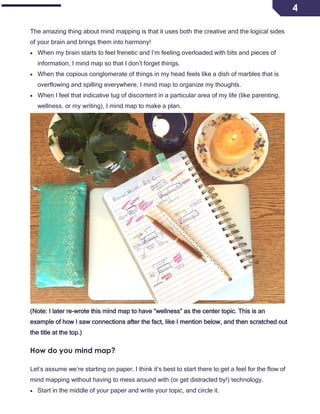
(Note: I later re-wrote this mind map to have “wellness” as the center topic. This is an
example of how I saw connections after the fact, like I mention below, and then scratched out
the title at the top.)
How do you mind map?
Let’s assume we’re starting on paper. I think it’s best to start there to get a feel for the flow of
mind mapping without having to mess around with (or get distracted by!) technology.
• Start in the middle of your paper and write your topic, and circle it.
5
• Then, without thinking too hard or deeply – start branching out.
• Add categories and sub-categories as you go, mapping everything out.
• Use the page freely – it doesn’t have to be perfectly neat and tidy!
• Don’t worry too much about putting things in the exact correct position – as you go on,
patterns will begin to emerge and sequential thoughts will become apparent.
• You can erase and adjust lines and bubbles as you go. (I recommend using pencil, or just
being okay with scribble marks.)
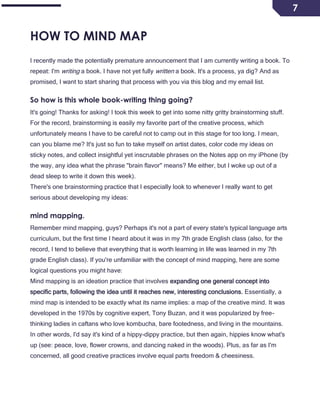
• I will sometimes even do a mind map as a rough draft, then re-draw it when I have my
thoughts collected. These are the ones that I keep referring back to for months as I work on
certain things. (Like my “wellness” mind map.)
Here’s a close-up of one of the branches in the
wellness map that I made months ago in my bullet
journal and keep referring back to. (I highlight what
I’m currently working on, then check it off when it’s
done. You can see which item I’ve left until very last,
ha!)
The most important thing is that if you have a
thought in your mind related to your topic, be sure to
write it down somewhere in the map so that it’s not
crowding your mind anymore.
Every mind map is unique, but each one starts in the
center, and radiates out like the branches of a tree. If
you feel like you have more than one central topic on
your mind, feel free to do more than one map!
Oftentimes, though, I find that when I get everything down on paper, I see things connecting
that I hadn’t realized before.
For example: I mind mapped on the topic of “diet” and then I mind mapped on the topic of
“home organization + routine”.
I subsequently realized that both of those topics, for me, fall under the umbrella of “overall
wellness” because they contribute to a calm/peaceful mind, and a strong body – both of which
are major components of my overall sense of wellness. And, there are other topics that I’d
place under “wellness” too, so a new mind map with “wellnesses at the centre was super
helpful to me.
6
What Happens in Your Brain When You Do Mind Mapping?
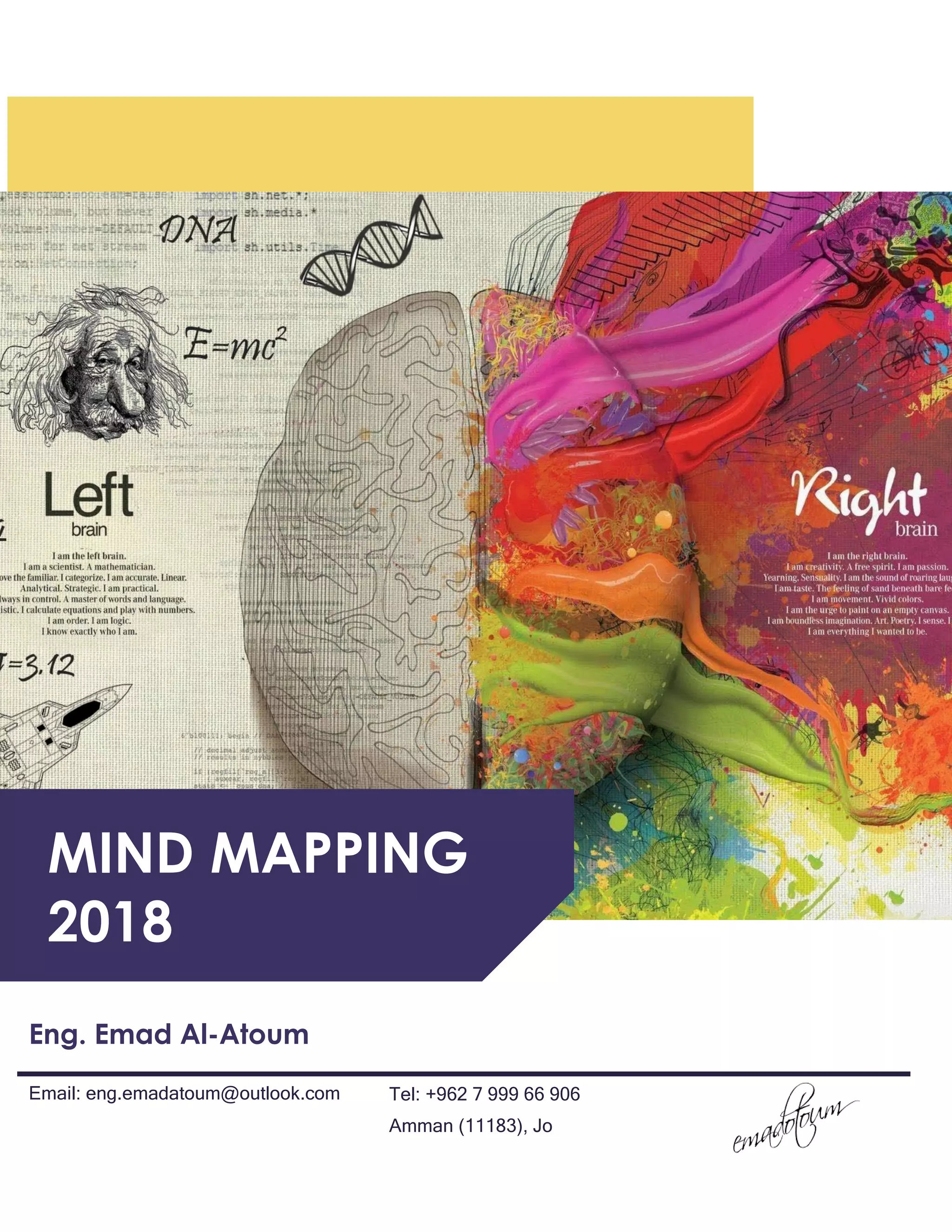
As you create your mind map, the left and the right hemispheres of your brain are working in
tandem. A 20th century scientific researcher named Roger Sperry (who later won a Nobel
prize for his neuroscience work) became famous for his research on the “left brain” and “right
brain” concept.
Mind mapping uses a wide spectrum of brain functions, from both the left and right sides,
including emotion management, imagination, lines and color, logic, memory, listing and
numbers, words/expression, big picture thinking, and future planning.
Because of this, mind mapping is excellent exercise for the brain – a great bonus to an
already helpful activity.
To map up the effectiveness of your mind map, you can add illustrations. You don’t have to
be an artist – any rudimentary sketch will do to assist your brain in mapping and in re-reading,
later.
A coffee cup next to your “quit caffeine” bubble, or a stick figure next to the “yoga” bubble?
Maybe a TV next to the “limit television” bubble. No need to go crazy with these if it ends up
being more of a distraction than a help.
Whatever your style, getting your thoughts out onto paper in a non-linear free-style fashion
will help declutter your brain so you can think more clearly.
This is the power of mind mapping: plotting out a framework
on which to hang your thoughts. Just like the power of tidying
and decluttering your house, mind mapping feels incredibly
satisfying and freeing.
7
HOW TO MIND MAP
I recently made the potentially premature announcement that I am currently writing a book. To
repeat: I'm writing a book. I have not yet fully written a book. It's a process, ya dig? And as
promised, I want to start sharing that process with you via this blog and my email list.
So how is this whole book-writing thing going?
It's going! Thanks for asking! I took this week to get into some nitty gritty brainstorming stuff.
For the record, brainstorming is easily my favorite part of the creative process, which
unfortunately means I have to be careful not to camp out in this stage for too long. I mean,
can you blame me? It's just so fun to take myself on artist dates, color code my ideas on
sticky notes, and collect insightful yet inscrutable phrases on the Notes app on my iPhone (by
the way, any idea what the phrase "brain flavor" means? Me either, but I woke up out of a
dead sleep to write it down this week).
There's one brainstorming practice that I especially look to whenever I really want to get
serious about developing my ideas:
mind mapping.
Remember mind mapping, guys? Perhaps it's not a part of every state's typical language arts
curriculum, but the first time I heard about it was in my 7th grade English class (also, for the
record, I tend to believe that everything that is worth learning in life was learned in my 7th
grade English class). If you're unfamiliar with the concept of mind mapping, here are some
logical questions you might have:
Mind mapping is an ideation practice that involves expanding one general concept into
specific parts, following the idea until it reaches new, interesting conclusions. Essentially, a
mind map is intended to be exactly what its name implies: a map of the creative mind. It was
developed in the 1970s by cognitive expert, Tony Buzan, and it was popularized by free-
thinking ladies in caftans who love kombucha, bare footedness, and living in the mountains.
In other words, I'd say it's kind of a hippy-dippy practice, but then again, hippies know what's
up (see: peace, love, flower crowns, and dancing naked in the woods). Plus, as far as I'm
concerned, all good creative practices involve equal parts freedom & cheesiness.
8
How do you make a mind map?
First off, you lock yourself in an air-pressurized cabin (Just kidding. Your living room or a bus
or a Wendy's is fine. You can mind map anywhere!). Start out by drawing a main idea in the
center of a page. Draw a circle (or a box, or a diamond, or a pear-shaped lady -- whatever
floats your imaginative boat) and begin branching out into different subtopics related to that
idea, creating a spider-like, sunshine-ish shape. From there, continue breaking down each
subtopic into even more specific points, branching out into infinity until your brain can no
longer make any more connections and you essentially pass out from creative exhaustion.
Voila! You just mind mapped.
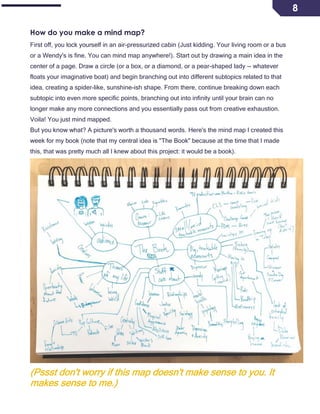
But you know what? A picture's worth a thousand words. Here's the mind map I created this
week for my book (note that my central idea is "The Book" because at the time that I made
this, that was pretty much all I knew about this project: it would be a book).
(Pssst don't worry if this map doesn't make sense to you. It
makes sense to me.)
9
Why does mind mapping work?
You know how your brain is just essentially a big ol' ball of wires?
Or at least that's what it feels like. One moment you have a brilliant thought for a TV series
you would like to write which makes you think of the fact that you need to call your cable
company which makes you think about how stressed you've been lately which makes you
think you should find a therapist which makes you think about Freud which makes you think
about food (it's also a one-syllable f-word) which makes you think about how good prosciutto
is which makes you think about your sodium intake which makes you think about Jillian
Michaels which makes you think about TV, but oh wait, what was that idea you had for a TV
series? You can't remember because, again, your thought process is all wrapped up in that
giant mass of brain wires.
Well, mind mapping helps you uncoil those wires. By mapping out your thoughts, you start to
make sense of those random neurons firing in your brain. Instead of feeling like your thoughts
are a jumbled mess, you start to realize that they may actually not be so random at all. In fact,
you find that your brain is doing something pretty spectacular: it's making connections.
Unlikely and interesting connections are the foundation of the creative process. (tweet
that!)
And here's the good news: our brains are naturally hardwired to make them.
But as we all know; these connections can often get lost in our regular mental process. The
human brain is pretty overzealous when it comes to inventing things, and that unfortunately
means that your awesome creative ideas can easily get crowded. The mind mapping process,
however, allows you to visualize these connections so that you can keep track of them in a
way that makes sense. It's a process that encourages you to feel comfortable with the fact
that you can totally have multiple ideas all at once. But it also helps you to stretch mental
muscles that you ordinarily wouldn't by keeping you focused on the ideas at hand.
Are there any rules to mind mapping?
Nah, man. No rules. Rules are for fools, am I right?
Well, actually, there are a few rules to mind mapping. Sorry. Tony Buzan, the inventor of mind
mapping, has some rules you can read about right here, but if I'm being honest, I think even
these are a little bit too restrictive (sorry, Tony). So instead I made up a few of my own:
10
1) Don't filter your weirdness.
As you expand on an idea, you'll likely start making connections that feel unusual in nature,
maybe even weird. Now, historically, when humans encounter things that they perceive to be
weird, they often run after them with torches and pitchforks because, well, humans can be
pretty awful sometimes.
But look: don't do that with your ideas. If you are mind mapping and you realize that you have
a bizarre thought, don't chase it away like it's a beast living in a castle in the French
countryside. Don't opt out of writing it down for fear that it doesn't make sense or that it will
seem stupid to someone else. Instead, write it down and do the radical thing of following it.
Who knows where it might lead?
2) Be all artsy.
There are some fogging gorgeous mind maps in this world, you guys. I mean, just look at this
one. Or firkin this one. If color and shapes and doodling are your jam, then don't you dare
hold back when it comes to mapping your mind. These are the practices that ignite your
creativity, so why not embrace them?
3) Or don't be all artsy.
Or, you know, you could be like me. I'm not much of a visual artist, honestly, and the very
thought of trying to make my mind map look presentable or pretty gives me neck hives.
Personally, I just try to go as fast as I can so that I'm not tempted to censor my thoughts. It
works for me.
4) Make sure to marvel at the human brain,
specifically your human brain.
I can say with full certainty that I've never created a mind map without discovering a new,
unique solution to a creative problem. Never. Even when I'm at my most stuck, there is
something about the process of mind mapping that feels a bit magical in nature. Of course, it
has nothing to do with the map itself, but rather the system of developing it exposes
something we often fail to remember: the human brain is pretty goddamn cool.
Specifically, your human brain is pretty goddamn cool. When you've finished making your
mind map, take a step back from it and examine it. All those lines, all of those ideas, all of
those connections -- it all came from your brain. The good, the bad, and the weird -- all of it
came from you.
11
5) Find the nuggets.
You know how people say there are no bad ideas in brainstorming? Well, that is insane.
There are tons of bad ideas in brainstorming. Like, oh my god, TONS. In fact, as you create
your mind map, it's possible that you will encounter more garbage ideas than good ones. And
that's okay. Instead of trying to find artistic meaning in every thought you write down, simply
look for the nuggets. That's what creative practices are all about: sorting out the nuggets of
creative gold from the crap pile of creative waste.
That said, figure out which part of your map you spent the most time on, the part that gave
you the most excitement. Find the words or images that make you smile or furrow your brow
with intrigue. These, my friends, are your nuggets. And nuggets become projects. And
projects are fulfilling. And fulfillment is a basic human need.
Ready to try your hand at mind mapping a creative project?

Mind Mapping

  • 1.
    MIND MAPPING 2018 Eng. EmadAl-Atoum Email: eng.emadatoum@outlook.com Tel: +962 7 999 66 906 Amman (11183), Jo
  • 2.
    2 TABLE OF CONTENTS HowI Use Mind Mapping to Help Declutter My Brain ___________________ 3 What is Mind Mapping? __________________________________________ 3 How do you mind map?__________________________________________ 4 What Happens in Your Brain When You Do Mind Mapping? ______________ 6 How To Mind Map ______________________________________________ 7 So how is this whole book-writing thing going? ________________________ 7 mind mapping._________________________________________________ 7 How do you make a mind map? ___________________________________ 8 Why does mind mapping work?____________________________________ 9 Are there any rules to mind mapping? _______________________________ 9 1) Don't filter your weirdness. ____________________________________ 10 2) Be all artsy. ________________________________________________ 10 3) Or don't be all artsy. _________________________________________ 10 4) Make sure to marvel at the human brain, specifically your human brain.__ 10 5) Find the nuggets.____________________________________________ 11
  • 3.
    3 HOW I USEMIND MAPPING TO HELP DECLUTTER MY BRAIN When I first learned more about my personality type (INFP) and how my brain receives and processes information, my mind was officially blown. Seeing the big picture has always been one of my biggest strengths, so mind mapping is something that I’ve been doing for years without realizing that it had a name. I doodled out mind maps in old diaries and notebooks, and eventually even used it for planning a college essay or two. I’ve always mind mapped on paper but have recently been experimenting with some free online mind mapping tools as well, and while I enjoy both methods, paper wins out for me. What is Mind Mapping? I define it as a tool for decluttering your brain. Some people would describe its function as more of a brainstorming or organizing tool. Really though, it’s both. It’s a highly effective method for getting thoughts onto paper in a way that makes sense for you. Because the fine details of your mind mapping process and results are always unique, it’s pretty much universally helpful, whatever your personality type.
  • 4.
    4 The amazing thingabout mind mapping is that it uses both the creative and the logical sides of your brain and brings them into harmony! • When my brain starts to feel frenetic and I’m feeling overloaded with bits and pieces of information, I mind map so that I don’t forget things. • When the copious conglomerate of things in my head feels like a dish of marbles that is overflowing and spilling everywhere, I mind map to organize my thoughts. • When I feel that indicative tug of discontent in a particular area of my life (like parenting, wellness, or my writing), I mind map to make a plan. (Note: I later re-wrote this mind map to have “wellness” as the center topic. This is an example of how I saw connections after the fact, like I mention below, and then scratched out the title at the top.) How do you mind map? Let’s assume we’re starting on paper. I think it’s best to start there to get a feel for the flow of mind mapping without having to mess around with (or get distracted by!) technology. • Start in the middle of your paper and write your topic, and circle it.
  • 5.
    5 • Then, withoutthinking too hard or deeply – start branching out. • Add categories and sub-categories as you go, mapping everything out. • Use the page freely – it doesn’t have to be perfectly neat and tidy! • Don’t worry too much about putting things in the exact correct position – as you go on, patterns will begin to emerge and sequential thoughts will become apparent. • You can erase and adjust lines and bubbles as you go. (I recommend using pencil, or just being okay with scribble marks.) • I will sometimes even do a mind map as a rough draft, then re-draw it when I have my thoughts collected. These are the ones that I keep referring back to for months as I work on certain things. (Like my “wellness” mind map.) Here’s a close-up of one of the branches in the wellness map that I made months ago in my bullet journal and keep referring back to. (I highlight what I’m currently working on, then check it off when it’s done. You can see which item I’ve left until very last, ha!) The most important thing is that if you have a thought in your mind related to your topic, be sure to write it down somewhere in the map so that it’s not crowding your mind anymore. Every mind map is unique, but each one starts in the center, and radiates out like the branches of a tree. If you feel like you have more than one central topic on your mind, feel free to do more than one map! Oftentimes, though, I find that when I get everything down on paper, I see things connecting that I hadn’t realized before. For example: I mind mapped on the topic of “diet” and then I mind mapped on the topic of “home organization + routine”. I subsequently realized that both of those topics, for me, fall under the umbrella of “overall wellness” because they contribute to a calm/peaceful mind, and a strong body – both of which are major components of my overall sense of wellness. And, there are other topics that I’d place under “wellness” too, so a new mind map with “wellnesses at the centre was super helpful to me.
  • 6.
    6 What Happens inYour Brain When You Do Mind Mapping? As you create your mind map, the left and the right hemispheres of your brain are working in tandem. A 20th century scientific researcher named Roger Sperry (who later won a Nobel prize for his neuroscience work) became famous for his research on the “left brain” and “right brain” concept. Mind mapping uses a wide spectrum of brain functions, from both the left and right sides, including emotion management, imagination, lines and color, logic, memory, listing and numbers, words/expression, big picture thinking, and future planning. Because of this, mind mapping is excellent exercise for the brain – a great bonus to an already helpful activity. To map up the effectiveness of your mind map, you can add illustrations. You don’t have to be an artist – any rudimentary sketch will do to assist your brain in mapping and in re-reading, later. A coffee cup next to your “quit caffeine” bubble, or a stick figure next to the “yoga” bubble? Maybe a TV next to the “limit television” bubble. No need to go crazy with these if it ends up being more of a distraction than a help. Whatever your style, getting your thoughts out onto paper in a non-linear free-style fashion will help declutter your brain so you can think more clearly. This is the power of mind mapping: plotting out a framework on which to hang your thoughts. Just like the power of tidying and decluttering your house, mind mapping feels incredibly satisfying and freeing.
  • 7.
    7 HOW TO MINDMAP I recently made the potentially premature announcement that I am currently writing a book. To repeat: I'm writing a book. I have not yet fully written a book. It's a process, ya dig? And as promised, I want to start sharing that process with you via this blog and my email list. So how is this whole book-writing thing going? It's going! Thanks for asking! I took this week to get into some nitty gritty brainstorming stuff. For the record, brainstorming is easily my favorite part of the creative process, which unfortunately means I have to be careful not to camp out in this stage for too long. I mean, can you blame me? It's just so fun to take myself on artist dates, color code my ideas on sticky notes, and collect insightful yet inscrutable phrases on the Notes app on my iPhone (by the way, any idea what the phrase "brain flavor" means? Me either, but I woke up out of a dead sleep to write it down this week). There's one brainstorming practice that I especially look to whenever I really want to get serious about developing my ideas: mind mapping. Remember mind mapping, guys? Perhaps it's not a part of every state's typical language arts curriculum, but the first time I heard about it was in my 7th grade English class (also, for the record, I tend to believe that everything that is worth learning in life was learned in my 7th grade English class). If you're unfamiliar with the concept of mind mapping, here are some logical questions you might have: Mind mapping is an ideation practice that involves expanding one general concept into specific parts, following the idea until it reaches new, interesting conclusions. Essentially, a mind map is intended to be exactly what its name implies: a map of the creative mind. It was developed in the 1970s by cognitive expert, Tony Buzan, and it was popularized by free- thinking ladies in caftans who love kombucha, bare footedness, and living in the mountains. In other words, I'd say it's kind of a hippy-dippy practice, but then again, hippies know what's up (see: peace, love, flower crowns, and dancing naked in the woods). Plus, as far as I'm concerned, all good creative practices involve equal parts freedom & cheesiness.
  • 8.
    8 How do youmake a mind map? First off, you lock yourself in an air-pressurized cabin (Just kidding. Your living room or a bus or a Wendy's is fine. You can mind map anywhere!). Start out by drawing a main idea in the center of a page. Draw a circle (or a box, or a diamond, or a pear-shaped lady -- whatever floats your imaginative boat) and begin branching out into different subtopics related to that idea, creating a spider-like, sunshine-ish shape. From there, continue breaking down each subtopic into even more specific points, branching out into infinity until your brain can no longer make any more connections and you essentially pass out from creative exhaustion. Voila! You just mind mapped. But you know what? A picture's worth a thousand words. Here's the mind map I created this week for my book (note that my central idea is "The Book" because at the time that I made this, that was pretty much all I knew about this project: it would be a book). (Pssst don't worry if this map doesn't make sense to you. It makes sense to me.)
  • 9.
    9 Why does mindmapping work? You know how your brain is just essentially a big ol' ball of wires? Or at least that's what it feels like. One moment you have a brilliant thought for a TV series you would like to write which makes you think of the fact that you need to call your cable company which makes you think about how stressed you've been lately which makes you think you should find a therapist which makes you think about Freud which makes you think about food (it's also a one-syllable f-word) which makes you think about how good prosciutto is which makes you think about your sodium intake which makes you think about Jillian Michaels which makes you think about TV, but oh wait, what was that idea you had for a TV series? You can't remember because, again, your thought process is all wrapped up in that giant mass of brain wires. Well, mind mapping helps you uncoil those wires. By mapping out your thoughts, you start to make sense of those random neurons firing in your brain. Instead of feeling like your thoughts are a jumbled mess, you start to realize that they may actually not be so random at all. In fact, you find that your brain is doing something pretty spectacular: it's making connections. Unlikely and interesting connections are the foundation of the creative process. (tweet that!) And here's the good news: our brains are naturally hardwired to make them. But as we all know; these connections can often get lost in our regular mental process. The human brain is pretty overzealous when it comes to inventing things, and that unfortunately means that your awesome creative ideas can easily get crowded. The mind mapping process, however, allows you to visualize these connections so that you can keep track of them in a way that makes sense. It's a process that encourages you to feel comfortable with the fact that you can totally have multiple ideas all at once. But it also helps you to stretch mental muscles that you ordinarily wouldn't by keeping you focused on the ideas at hand. Are there any rules to mind mapping? Nah, man. No rules. Rules are for fools, am I right? Well, actually, there are a few rules to mind mapping. Sorry. Tony Buzan, the inventor of mind mapping, has some rules you can read about right here, but if I'm being honest, I think even these are a little bit too restrictive (sorry, Tony). So instead I made up a few of my own:
  • 10.
    10 1) Don't filteryour weirdness. As you expand on an idea, you'll likely start making connections that feel unusual in nature, maybe even weird. Now, historically, when humans encounter things that they perceive to be weird, they often run after them with torches and pitchforks because, well, humans can be pretty awful sometimes. But look: don't do that with your ideas. If you are mind mapping and you realize that you have a bizarre thought, don't chase it away like it's a beast living in a castle in the French countryside. Don't opt out of writing it down for fear that it doesn't make sense or that it will seem stupid to someone else. Instead, write it down and do the radical thing of following it. Who knows where it might lead? 2) Be all artsy. There are some fogging gorgeous mind maps in this world, you guys. I mean, just look at this one. Or firkin this one. If color and shapes and doodling are your jam, then don't you dare hold back when it comes to mapping your mind. These are the practices that ignite your creativity, so why not embrace them? 3) Or don't be all artsy. Or, you know, you could be like me. I'm not much of a visual artist, honestly, and the very thought of trying to make my mind map look presentable or pretty gives me neck hives. Personally, I just try to go as fast as I can so that I'm not tempted to censor my thoughts. It works for me. 4) Make sure to marvel at the human brain, specifically your human brain. I can say with full certainty that I've never created a mind map without discovering a new, unique solution to a creative problem. Never. Even when I'm at my most stuck, there is something about the process of mind mapping that feels a bit magical in nature. Of course, it has nothing to do with the map itself, but rather the system of developing it exposes something we often fail to remember: the human brain is pretty goddamn cool. Specifically, your human brain is pretty goddamn cool. When you've finished making your mind map, take a step back from it and examine it. All those lines, all of those ideas, all of those connections -- it all came from your brain. The good, the bad, and the weird -- all of it came from you.
  • 11.
    11 5) Find thenuggets. You know how people say there are no bad ideas in brainstorming? Well, that is insane. There are tons of bad ideas in brainstorming. Like, oh my god, TONS. In fact, as you create your mind map, it's possible that you will encounter more garbage ideas than good ones. And that's okay. Instead of trying to find artistic meaning in every thought you write down, simply look for the nuggets. That's what creative practices are all about: sorting out the nuggets of creative gold from the crap pile of creative waste. That said, figure out which part of your map you spent the most time on, the part that gave you the most excitement. Find the words or images that make you smile or furrow your brow with intrigue. These, my friends, are your nuggets. And nuggets become projects. And projects are fulfilling. And fulfillment is a basic human need. Ready to try your hand at mind mapping a creative project?