MANAGAMENT OF
  MIGRAINE
           Shiva
        B.Phamacy
Shiva.pharmacist@gmail.com
Migraine Facts
   Migraine is one of the common causes of recurrent
    headaches
   According to IHS, migraine constitutes 16% of
    primary headaches
   Migraine afflicts 10-20% of the general population
   More than 2/3 of migraine sufferers either have
    never consulted a doctor or have stopped doing so
   Migraine is underdiagnosed and undertreated
   Migraine greatly affects quality of life. The WHO
    ranks migraine among the world’s most disabling
    medical illnesses
Burden Of Migraine
   World - 15-20% of women and 10-15% of
    men suffer from migraine
   In India, 15-20% of people suffer from
    migraine
   Adults – Female: Male ratio is 2 : 1
   In childhood migraine, boys and girls are
    affected equally until puberty, when the
    predominance shifts to girls.
        NEJM 2002; 346(4): 257-269; XI Congress of the IHS, 2004
Migraine - Definition
“Migraine is a familial disorder characterized
by recurrent attacks of headache widely
variable in intensity, frequency and duration.
Attacks are commonly unilateral and are
usually associated with anorexia, nausea and
vomiting”
             -World Federation of Neurology
Migraine Triggers
   Food
   Disturbed sleep pattern
   Hormonal changes
   Drugs
   Physical exertion
   Visual stimuli
   Auditory stimuli
   Olfactory stimuli
   Weather changes
   Hunger
   Psychological factors
Phases of Acute Migraine

   Prodrome
   Aura
   Headache
   Postdrome
PRODROME
   Vague premonitory symptoms that begin from 12
    to 36 hours before the aura and headache
   Symptoms include
      Yawning

      Excitation

      Depression

      Lethargy

      Craving or distaste for various foods

    Duration – 15 to 20 min
AURA
Aura is a warning or signal before
onset of headache
Symptoms
   Flashing of lights
   Zig-zag lines
   Difficulty in focussing
Duration : 15-30 min
HEADACHE
   Headache is generally unilateral and is associated
    with symptoms like:
     Anorexia

     Nausea

     Vomiting

     Photophobia

     Phonophobia

     Tinnitus

   Duration is 4-72 hrs
POSTDROME (RESOLUTION
                        PHASE)
Following headache, patient complains of
   Fatigue
   Depression
   Severe exhaustion
   Some patients feel unusually fresh
Duration: Few hours or up to 2 days
MIGRAINE – CLASSIFICATION
According to Headache Classification
Committee of the International
Headache Society, Migraine has been
classified as:
   Migraine without aura (common migraine)
   Migraine with aura (classic migraine)
   Complicated migraine
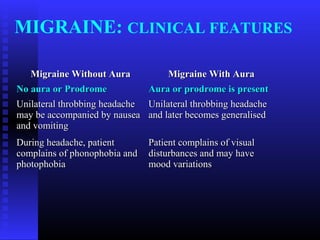
MIGRAINE: CLINICAL FEATURES

   Migraine Without Aura           Migraine With Aura
No aura or Prodrome            Aura or prodrome is present
Unilateral throbbing headache Unilateral throbbing headache
may be accompanied by nausea and later becomes generalised
and vomiting
During headache, patient       Patient complains of visual
complains of phonophobia and   disturbances and may have
photophobia                    mood variations
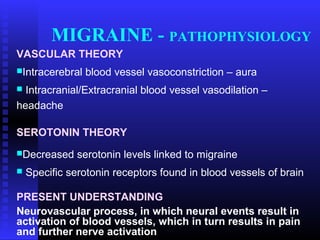
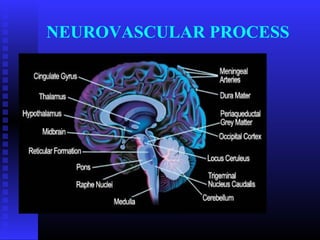
MIGRAINE - PATHOPHYSIOLOGY
VASCULAR THEORY
Intracerebral   blood vessel vasoconstriction – aura
 Intracranial/Extracranial blood vessel vasodilation –
headache

SEROTONIN THEORY
Decreased     serotonin levels linked to migraine
   Specific serotonin receptors found in blood vessels of brain

PRESENT UNDERSTANDING
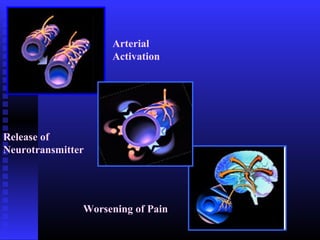
Neurovascular process, in which neural events result in
activation of blood vessels, which in turn results in pain
and further nerve activation
NEUROVASCULAR PROCESS
Arterial
                    Activation


Release of
Neurotransmitter


               Worsening of Pain
MIGRAINE: DIAGNOSIS
 Medical History
 Headache diary
 Migraine triggers
 Investigations (only to exclude secondary causes)
    EEG

    CT Brain

    MRI
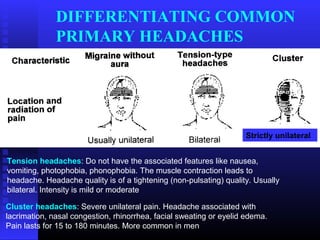
DIFFERENTIATING COMMON
              PRIMARY HEADACHES


                                                                    Strictly unilateral


Tension headaches: Do not have the associated features like nausea,
vomiting, photophobia, phonophobia. The muscle contraction leads to
headache. Headache quality is of a tightening (non-pulsating) quality. Usually
bilateral. Intensity is mild or moderate

Cluster headaches: Severe unilateral pain. Headache associated with
lacrimation, nasal congestion, rhinorrhea, facial sweating or eyelid edema.
Pain lasts for 15 to 180 minutes. More common in men
THE TREATMENT
APPROACH TO
  MIGRAINE
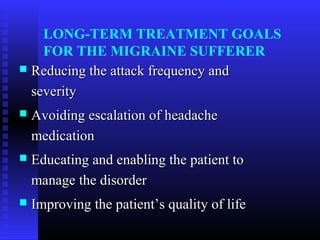
LONG-TERM TREATMENT GOALS
    FOR THE MIGRAINE SUFFERER
 Reducing the attack frequency and

  severity
   Avoiding escalation of headache
    medication
   Educating and enabling the patient to
    manage the disorder
   Improving the patient’s quality of life
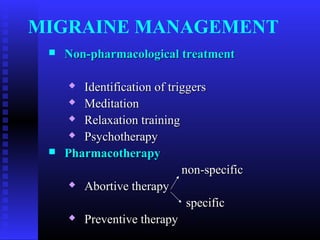
MIGRAINE MANAGEMENT
    Non-pharmacological treatment

       Identification of triggers
       Meditation

       Relaxation training

       Psychotherapy

    Pharmacotherapy
                             non-specific
       Abortive therapy

                              specific
       Preventive therapy
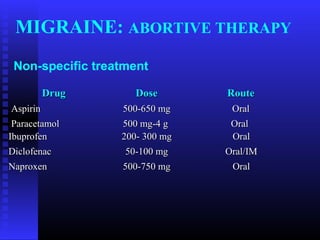
MIGRAINE: ABORTIVE THERAPY
 Non-specific treatment

       Drug          Dose       Route
 Aspirin          500-650 mg     Oral
 Paracetamol      500 mg-4 g     Oral
Ibuprofen         200- 300 mg    Oral
Diclofenac         50-100 mg    Oral/IM
Naproxen          500-750 mg     Oral
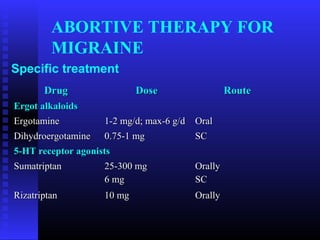
ABORTIVE THERAPY FOR
         MIGRAINE
Specific treatment
       Drug                 Dose                 Route
Ergot alkaloids
Ergotamine           1-2 mg/d; max-6 g/d Oral
Dihydroergotamine 0.75-1 mg              SC
5-HT receptor agonists
Sumatriptan         25-300 mg           Orally
                    6 mg                SC
Rizatriptan         10 mg               Orally
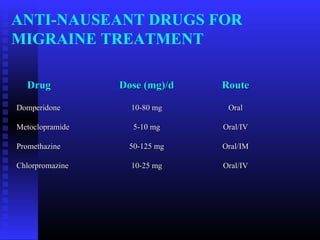
ANTI-NAUSEANT DRUGS FOR
MIGRAINE TREATMENT

  Drug           Dose (mg)/d   Route

Domperidone        10-80 mg     Oral

Metoclopramide     5-10 mg     Oral/IV

Promethazine      50-125 mg    Oral/IM

Chlorpromazine     10-25 mg    Oral/IV
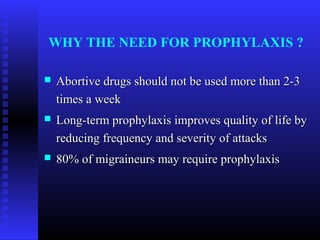
WHY THE NEED FOR PROPHYLAXIS ?

   Abortive drugs should not be used more than 2-3
    times a week
   Long-term prophylaxis improves quality of life by
    reducing frequency and severity of attacks
   80% of migraineurs may require prophylaxis
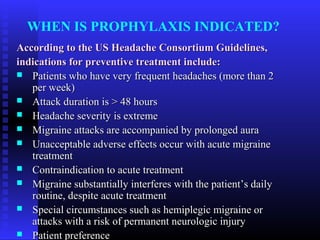
WHEN IS PROPHYLAXIS INDICATED?
According to the US Headache Consortium Guidelines,
indications for preventive treatment include:
 Patients who have very frequent headaches (more than 2
   per week)
 Attack duration is > 48 hours
 Headache severity is extreme
 Migraine attacks are accompanied by prolonged aura
 Unacceptable adverse effects occur with acute migraine
   treatment
 Contraindication to acute treatment
 Migraine substantially interferes with the patient’s daily
   routine, despite acute treatment
 Special circumstances such as hemiplegic migraine or
   attacks with a risk of permanent neurologic injury
 Patient preference
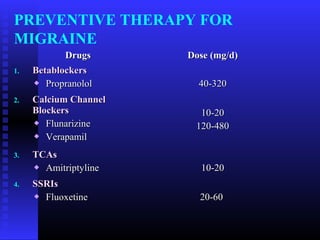
PREVENTIVE THERAPY FOR
MIGRAINE
            Drugs      Dose (mg/d)
1.   Betablockers
      Propranolol       40-320
2.   Calcium Channel
     Blockers            10-20
      Flunarizine
                        120-480
      Verapamil


3.   TCAs
      Amitriptyline     10-20
4.   SSRIs
      Fluoxetine        20-60
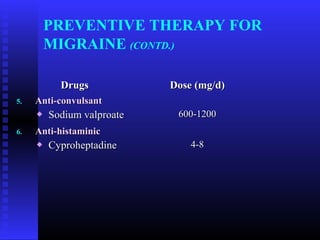
PREVENTIVE THERAPY FOR
         MIGRAINE (CONTD.)

           Drugs            Dose (mg/d)
5.   Anti-convulsant
        Sodium valproate    600-1200
6.   Anti-histaminic
        Cyproheptadine         4-8
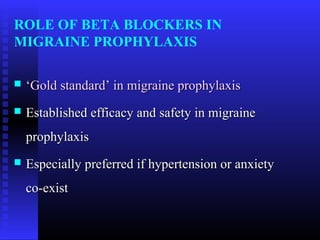
ROLE OF BETA BLOCKERS IN
MIGRAINE PROPHYLAXIS

   ‘Gold standard’ in migraine prophylaxis
   Established efficacy and safety in migraine
    prophylaxis
   Especially preferred if hypertension or anxiety
    co-exist
ROLE OF PROPRANOLOL IN
 MIGRAINE PROPHYLAXIS
PROPRANOLOL – MECHANISMS OF
   ACTION
Mechanisms proposed
   Vasoconstriction
   Anxiolytic action
   Decreased sympathetic activity
LIMITATIONS OF IMMEDIATE-
RELEASE PROPRANOLOL

   Short t½ of 3-5 hrs
   Multiple daily dosing required to maintain
    adequate degree of beta-receptor blockade
    throughout 24 hr
   Poor patient compliance may compromise
    efficacy
ADVANTAGES OF EXTENDED-RELEASE
PREPARATION OF PROPRANOLOL

   Migraine patients are asymptomatic
    between attacks
   Important to minimize number of daily
    doses during prophylactic treatment
   Once-daily administration improves
    compliance
   Stable drug concentration for 24 hrs
PROPRANOLOL-LA
CLINICAL EFFICACY
   IN MIGRAINE
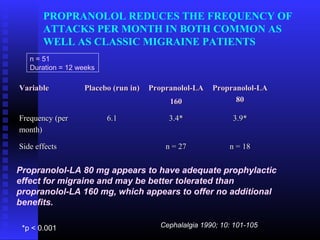
PROPRANOLOL REDUCES THE FREQUENCY OF
       ATTACKS PER MONTH IN BOTH COMMON AS
       WELL AS CLASSIC MIGRAINE PATIENTS
   n = 51
   Duration = 12 weeks

Variable          Placebo (run in)   Propranolol-LA    Propranolol-LA
                                          160                80

Frequency (per           6.1              3.4*               3.9*
month)

Side effects                             n = 27             n = 18


Propranolol-LA 80 mg appears to have adequate prophylactic
effect for migraine and may be better tolerated than
propranolol-LA 160 mg, which appears to offer no additional
benefits.

 *p < 0.001                             Cephalalgia 1990; 10: 101-105
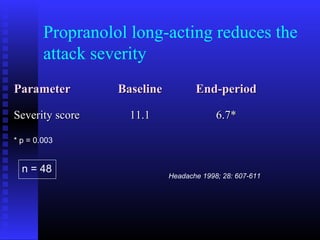
Propranolol long-acting reduces the
        attack severity
Parameter         Baseline          End-period

Severity score      11.1                  6.7*

* p = 0.003


  n = 48
                             Headache 1998; 28: 607-611
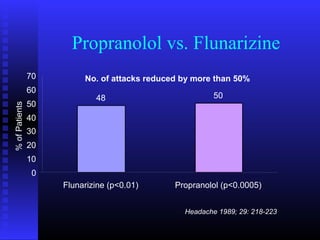
Propranolol vs. Flunarizine
                70        No. of attacks reduced by more than 50%
                60
                             48                          50
                50
% of Patients


                40
                30
                20
                10
                 0
                     Flunarizine (p<0.01)      Propranolol (p<0.0005)


                                                 Headache 1989; 29: 218-223
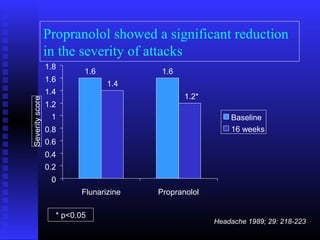
Propranolol showed a significant reduction
                 in the severity of attacks
                 1.8
                          1.6           1.6
                 1.6
                                1.4
                 1.4
                                              1.2*
Severity score


                 1.2
                  1                                      Baseline
                 0.8                                     16 weeks
                 0.6
                 0.4
                 0.2
                  0
                         Flunarizine   Propranolol

                   * p<0.05
                                                     Headache 1989; 29: 218-223
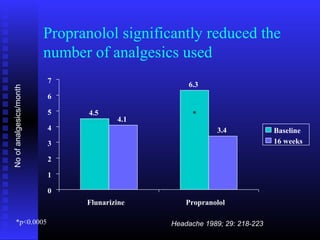
Propranolol significantly reduced the
                         number of analgesics used
                         7
                                                 6.3
No of analgesics/month


                         6

                         5      4.5               *
                                       4.1
                         4                                3.4             Baseline
                         3                                                16 weeks

                         2

                         1

                         0
                               Flunarizine       Propranolol

      *p<0.0005                              Headache 1989; 29: 218-223
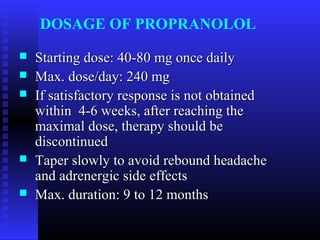
DOSAGE OF PROPRANOLOL
   Starting dose: 40-80 mg once daily
   Max. dose/day: 240 mg
   If satisfactory response is not obtained
    within 4-6 weeks, after reaching the
    maximal dose, therapy should be
    discontinued
   Taper slowly to avoid rebound headache
    and adrenergic side effects
   Max. duration: 9 to 12 months
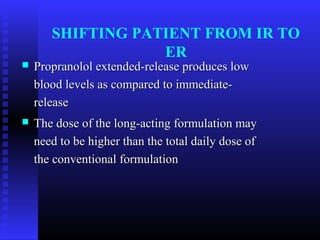
SHIFTING PATIENT FROM IR TO
                   ER
   Propranolol extended-release produces low
    blood levels as compared to immediate-
    release
   The dose of the long-acting formulation may
    need to be higher than the total daily dose of
    the conventional formulation

Migrane

  • 1.
    MANAGAMENT OF MIGRAINE Shiva B.Phamacy Shiva.pharmacist@gmail.com
  • 2.
    Migraine Facts  Migraine is one of the common causes of recurrent headaches  According to IHS, migraine constitutes 16% of primary headaches  Migraine afflicts 10-20% of the general population  More than 2/3 of migraine sufferers either have never consulted a doctor or have stopped doing so  Migraine is underdiagnosed and undertreated  Migraine greatly affects quality of life. The WHO ranks migraine among the world’s most disabling medical illnesses
  • 3.
    Burden Of Migraine  World - 15-20% of women and 10-15% of men suffer from migraine  In India, 15-20% of people suffer from migraine  Adults – Female: Male ratio is 2 : 1  In childhood migraine, boys and girls are affected equally until puberty, when the predominance shifts to girls. NEJM 2002; 346(4): 257-269; XI Congress of the IHS, 2004
  • 4.
    Migraine - Definition “Migraineis a familial disorder characterized by recurrent attacks of headache widely variable in intensity, frequency and duration. Attacks are commonly unilateral and are usually associated with anorexia, nausea and vomiting” -World Federation of Neurology
  • 5.
    Migraine Triggers  Food  Disturbed sleep pattern  Hormonal changes  Drugs  Physical exertion  Visual stimuli  Auditory stimuli  Olfactory stimuli  Weather changes  Hunger  Psychological factors
  • 6.
    Phases of AcuteMigraine  Prodrome  Aura  Headache  Postdrome
  • 7.
    PRODROME  Vague premonitory symptoms that begin from 12 to 36 hours before the aura and headache  Symptoms include  Yawning  Excitation  Depression  Lethargy  Craving or distaste for various foods Duration – 15 to 20 min
  • 8.
    AURA Aura is awarning or signal before onset of headache Symptoms  Flashing of lights  Zig-zag lines  Difficulty in focussing Duration : 15-30 min
  • 9.
    HEADACHE  Headache is generally unilateral and is associated with symptoms like:  Anorexia  Nausea  Vomiting  Photophobia  Phonophobia  Tinnitus  Duration is 4-72 hrs
  • 10.
    POSTDROME (RESOLUTION PHASE) Following headache, patient complains of  Fatigue  Depression  Severe exhaustion  Some patients feel unusually fresh Duration: Few hours or up to 2 days
  • 11.
    MIGRAINE – CLASSIFICATION Accordingto Headache Classification Committee of the International Headache Society, Migraine has been classified as:  Migraine without aura (common migraine)  Migraine with aura (classic migraine)  Complicated migraine
  • 12.
    MIGRAINE: CLINICAL FEATURES Migraine Without Aura Migraine With Aura No aura or Prodrome Aura or prodrome is present Unilateral throbbing headache Unilateral throbbing headache may be accompanied by nausea and later becomes generalised and vomiting During headache, patient Patient complains of visual complains of phonophobia and disturbances and may have photophobia mood variations
  • 13.
    MIGRAINE - PATHOPHYSIOLOGY VASCULARTHEORY Intracerebral blood vessel vasoconstriction – aura  Intracranial/Extracranial blood vessel vasodilation – headache SEROTONIN THEORY Decreased serotonin levels linked to migraine  Specific serotonin receptors found in blood vessels of brain PRESENT UNDERSTANDING Neurovascular process, in which neural events result in activation of blood vessels, which in turn results in pain and further nerve activation
  • 14.
  • 15.
    Arterial Activation Release of Neurotransmitter Worsening of Pain
  • 16.
    MIGRAINE: DIAGNOSIS  MedicalHistory  Headache diary  Migraine triggers  Investigations (only to exclude secondary causes)  EEG  CT Brain  MRI
  • 17.
    DIFFERENTIATING COMMON PRIMARY HEADACHES Strictly unilateral Tension headaches: Do not have the associated features like nausea, vomiting, photophobia, phonophobia. The muscle contraction leads to headache. Headache quality is of a tightening (non-pulsating) quality. Usually bilateral. Intensity is mild or moderate Cluster headaches: Severe unilateral pain. Headache associated with lacrimation, nasal congestion, rhinorrhea, facial sweating or eyelid edema. Pain lasts for 15 to 180 minutes. More common in men
  • 18.
  • 19.
    LONG-TERM TREATMENT GOALS FOR THE MIGRAINE SUFFERER  Reducing the attack frequency and severity  Avoiding escalation of headache medication  Educating and enabling the patient to manage the disorder  Improving the patient’s quality of life
  • 20.
    MIGRAINE MANAGEMENT  Non-pharmacological treatment  Identification of triggers  Meditation  Relaxation training  Psychotherapy  Pharmacotherapy non-specific  Abortive therapy specific  Preventive therapy
  • 21.
    MIGRAINE: ABORTIVE THERAPY Non-specific treatment Drug Dose Route Aspirin 500-650 mg Oral Paracetamol 500 mg-4 g Oral Ibuprofen 200- 300 mg Oral Diclofenac 50-100 mg Oral/IM Naproxen 500-750 mg Oral
  • 22.
    ABORTIVE THERAPY FOR MIGRAINE Specific treatment Drug Dose Route Ergot alkaloids Ergotamine 1-2 mg/d; max-6 g/d Oral Dihydroergotamine 0.75-1 mg SC 5-HT receptor agonists Sumatriptan 25-300 mg Orally 6 mg SC Rizatriptan 10 mg Orally
  • 23.
    ANTI-NAUSEANT DRUGS FOR MIGRAINETREATMENT Drug Dose (mg)/d Route Domperidone 10-80 mg Oral Metoclopramide 5-10 mg Oral/IV Promethazine 50-125 mg Oral/IM Chlorpromazine 10-25 mg Oral/IV
  • 24.
    WHY THE NEEDFOR PROPHYLAXIS ?  Abortive drugs should not be used more than 2-3 times a week  Long-term prophylaxis improves quality of life by reducing frequency and severity of attacks  80% of migraineurs may require prophylaxis
  • 25.
    WHEN IS PROPHYLAXISINDICATED? According to the US Headache Consortium Guidelines, indications for preventive treatment include:  Patients who have very frequent headaches (more than 2 per week)  Attack duration is > 48 hours  Headache severity is extreme  Migraine attacks are accompanied by prolonged aura  Unacceptable adverse effects occur with acute migraine treatment  Contraindication to acute treatment  Migraine substantially interferes with the patient’s daily routine, despite acute treatment  Special circumstances such as hemiplegic migraine or attacks with a risk of permanent neurologic injury  Patient preference
  • 26.
    PREVENTIVE THERAPY FOR MIGRAINE Drugs Dose (mg/d) 1. Betablockers  Propranolol 40-320 2. Calcium Channel Blockers 10-20  Flunarizine 120-480  Verapamil 3. TCAs  Amitriptyline 10-20 4. SSRIs  Fluoxetine 20-60
  • 27.
    PREVENTIVE THERAPY FOR MIGRAINE (CONTD.) Drugs Dose (mg/d) 5. Anti-convulsant  Sodium valproate 600-1200 6. Anti-histaminic  Cyproheptadine 4-8
  • 28.
    ROLE OF BETABLOCKERS IN MIGRAINE PROPHYLAXIS  ‘Gold standard’ in migraine prophylaxis  Established efficacy and safety in migraine prophylaxis  Especially preferred if hypertension or anxiety co-exist
  • 29.
    ROLE OF PROPRANOLOLIN MIGRAINE PROPHYLAXIS
  • 30.
    PROPRANOLOL – MECHANISMSOF ACTION Mechanisms proposed  Vasoconstriction  Anxiolytic action  Decreased sympathetic activity
  • 31.
    LIMITATIONS OF IMMEDIATE- RELEASEPROPRANOLOL  Short t½ of 3-5 hrs  Multiple daily dosing required to maintain adequate degree of beta-receptor blockade throughout 24 hr  Poor patient compliance may compromise efficacy
  • 32.
    ADVANTAGES OF EXTENDED-RELEASE PREPARATIONOF PROPRANOLOL  Migraine patients are asymptomatic between attacks  Important to minimize number of daily doses during prophylactic treatment  Once-daily administration improves compliance  Stable drug concentration for 24 hrs
  • 33.
  • 34.
    PROPRANOLOL REDUCES THEFREQUENCY OF ATTACKS PER MONTH IN BOTH COMMON AS WELL AS CLASSIC MIGRAINE PATIENTS n = 51 Duration = 12 weeks Variable Placebo (run in) Propranolol-LA Propranolol-LA 160 80 Frequency (per 6.1 3.4* 3.9* month) Side effects n = 27 n = 18 Propranolol-LA 80 mg appears to have adequate prophylactic effect for migraine and may be better tolerated than propranolol-LA 160 mg, which appears to offer no additional benefits. *p < 0.001 Cephalalgia 1990; 10: 101-105
  • 35.
    Propranolol long-acting reducesthe attack severity Parameter Baseline End-period Severity score 11.1 6.7* * p = 0.003 n = 48 Headache 1998; 28: 607-611
  • 36.
    Propranolol vs. Flunarizine 70 No. of attacks reduced by more than 50% 60 48 50 50 % of Patients 40 30 20 10 0 Flunarizine (p<0.01) Propranolol (p<0.0005) Headache 1989; 29: 218-223
  • 37.
    Propranolol showed asignificant reduction in the severity of attacks 1.8 1.6 1.6 1.6 1.4 1.4 1.2* Severity score 1.2 1 Baseline 0.8 16 weeks 0.6 0.4 0.2 0 Flunarizine Propranolol * p<0.05 Headache 1989; 29: 218-223
  • 38.
    Propranolol significantly reducedthe number of analgesics used 7 6.3 No of analgesics/month 6 5 4.5 * 4.1 4 3.4 Baseline 3 16 weeks 2 1 0 Flunarizine Propranolol *p<0.0005 Headache 1989; 29: 218-223
  • 39.
    DOSAGE OF PROPRANOLOL  Starting dose: 40-80 mg once daily  Max. dose/day: 240 mg  If satisfactory response is not obtained within 4-6 weeks, after reaching the maximal dose, therapy should be discontinued  Taper slowly to avoid rebound headache and adrenergic side effects  Max. duration: 9 to 12 months
  • 40.
    SHIFTING PATIENT FROMIR TO ER  Propranolol extended-release produces low blood levels as compared to immediate- release  The dose of the long-acting formulation may need to be higher than the total daily dose of the conventional formulation