Migliorare la Developer Experience
in un mondo Cloud Native
con Platform Engineering e AI RAG
Mich Murabito
Developer Advocate Mia-Platform
CNCF Ambassador & DevNetwork Board Member
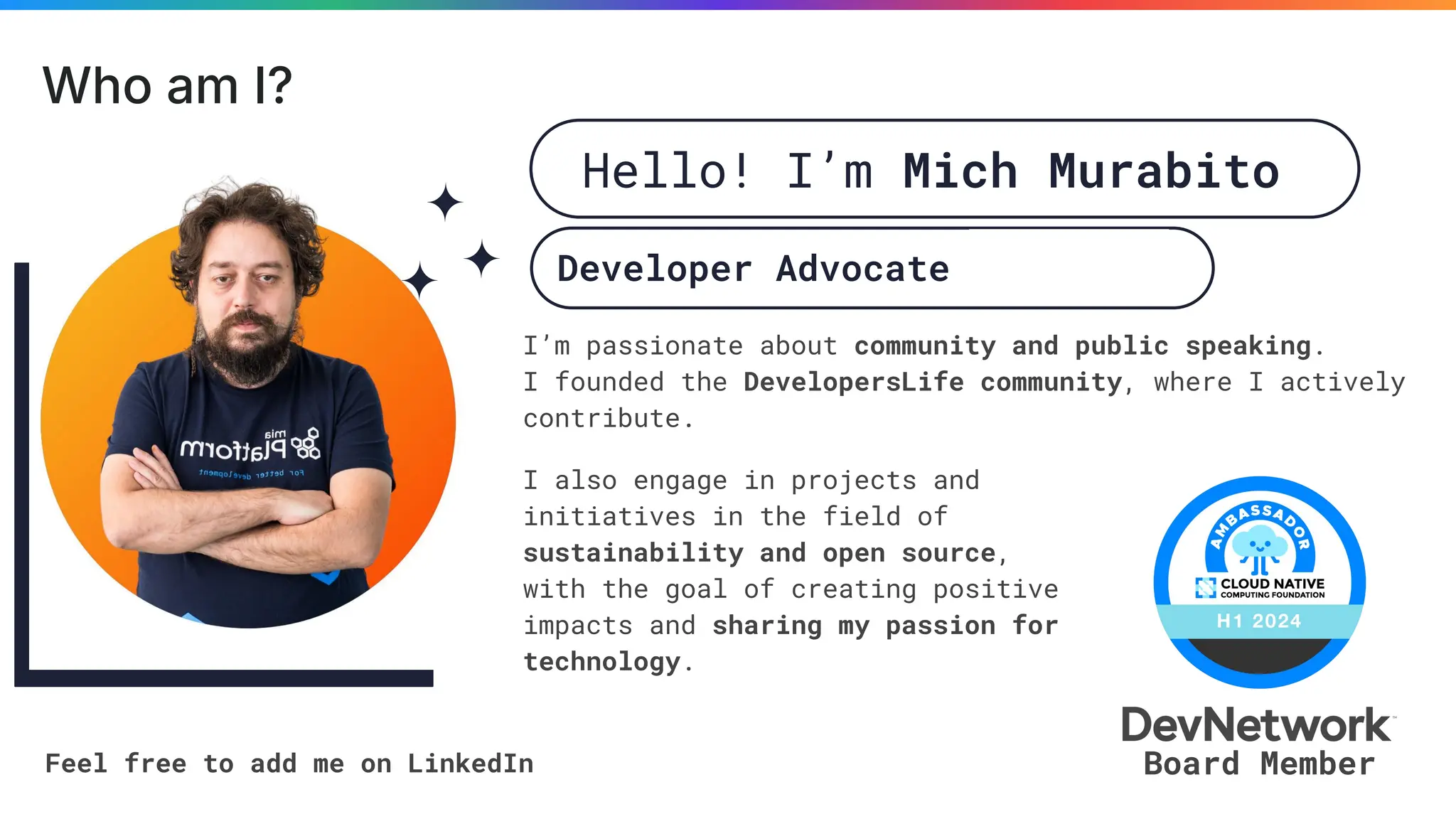
Who am I?
I’m passionate about community and public speaking.
I founded the DevelopersLife community, where I actively
contribute.
Developer Advocate
Hello! I’m Mich Murabito
I also engage in projects and
initiatives in the field of
sustainability and open source,
with the goal of creating positive
impacts and sharing my passion for
technology.
Board Member
Feel free to add me on LinkedIn
The ”H”" in
Kubernetes stands
for Happiness
― quoted by anonymous feat Mich Murabito
4
Kubernetes
is just
the tip of
the
iceberg
The Cloud Native realm dazzles with its diversity and complexity: over 1261
Cards in the CNCF landscape, hundreds of tools, and an ever-growing ecosystem
showcase a vibrant multifaceted nature. 5
The “B” in Development stands for Bliss
– if only bottlenecks didn't exist.
― quoted by anonymous feat Mich Murabito
6
Bottlenecks,
potentially
everyone's
development
hurdle.
Bottlenecks are critical points that reduce flow and productivity, such as
lengthy onboarding, extended approval processes, or inadequate resources,
slowing down product release. 7
Why Software Development Complexity Has Increased
03
8
Todayʼs software must be scalable, secure,
and interoperable, meeting user expectations
across a global network.
⬢ Scalability and Distribution
⬢ Data Growth
⬢ Integrations and Interoperability
⬢ User Expectations and UX
⬢ Security and Privacy
⬢ Automation and CI/CD
⬢ AI and Machine Learning
⬢ Complex Architectures
⬢ Collaboration and Distributed Teams
⬢ Continuous Evolution
⬢ Scalability and Distribution
⬢ Data Growth
⬢ Integrations and Interoperability
⬢ User Expectations and UX
⬢ Security and Privacy
⬢ Automation and CI/CD
⬢ AI and Machine Learning
⬢ Complex Architectures
⬢ Collaboration and Distributed Teams
⬢ Continuous Evolution
Why Software Development Complexity Has Increased
03
9
Todayʼs software must be scalable, secure,
and interoperable, meeting user expectations
across a global network.
Standard practices
without optimizations
a.k.a We could do better,
but for today we'll go the “old-fashioned wayˮ
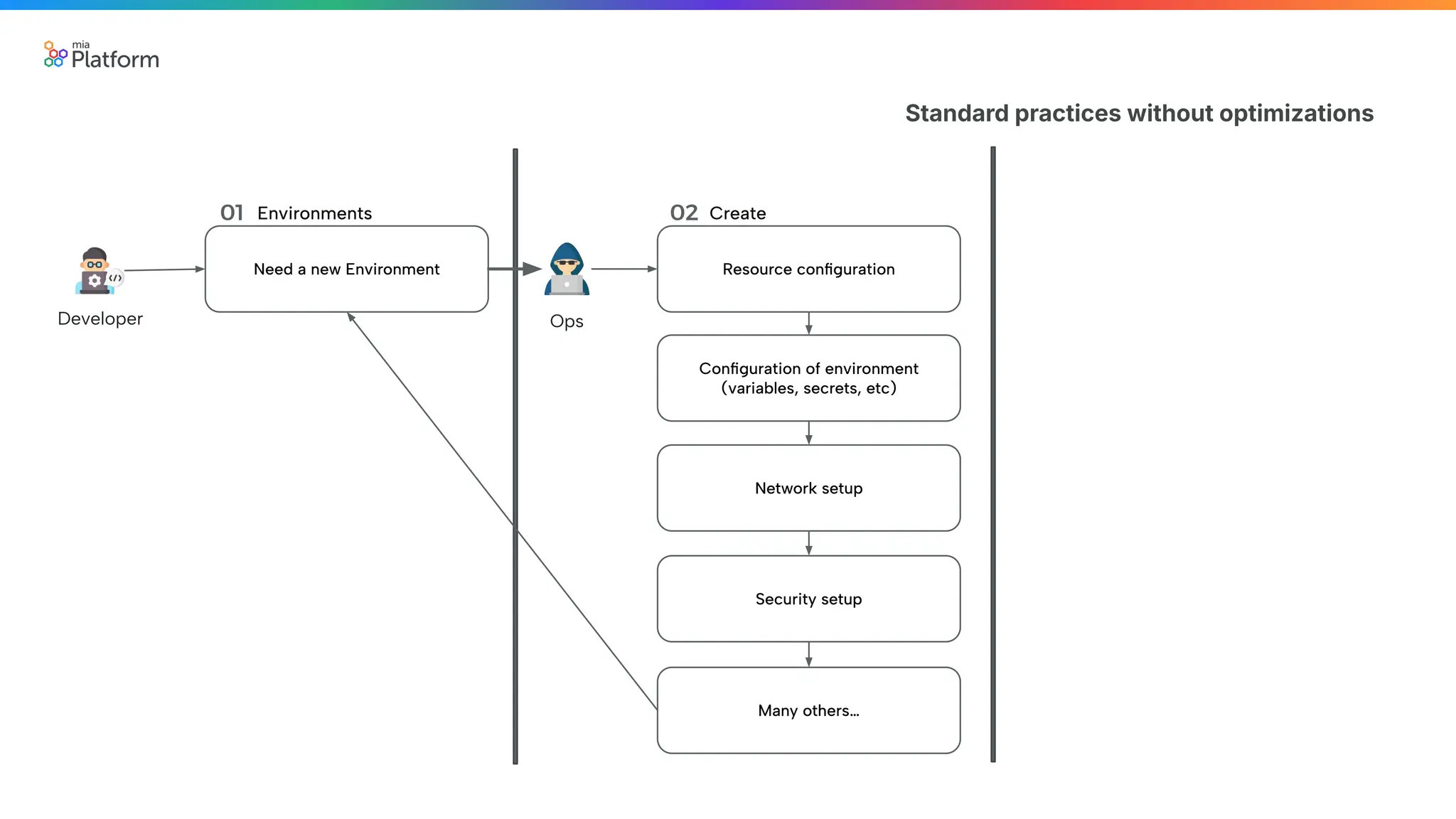
Standard practices without optimizations
Developer
Need a new Environment
01 Environments
Resource configuration
02 Create
Ops
Configuration of environment
(variables, secrets, etc)
Network setup
Security setup
Many others…
Developer
Need a new Environment
01 Environments
Resource configuration
02 Create
Ops
Configuration of environment
(variables, secrets, etc)
Network setup
Security setup
Many others…
● Jira
● Trello
● Asana
● etc etc
Standard practices without optimizations
Platform Engineering
A brief and gentle introduction
Platform Engineering
“It is the approach aimed at
designing and building highly
automated and scalable internal
digital platforms that provide
developers with a self-service
environment to accelerate the
software lifecycle. The goal is to
simplify infrastructure management
and optimize operational efficiency,
enabling companies to adopt
cloud-native architectures and
technologies, while also improving
Developer Experience DevX) and
ensuring rapid innovation.ˮ
Platform Engineering
● Automated and scalable platforms
● Self-service
● Simplify infrastructure management
● Adopt cloud-native architectures
and technologies
● Improving Developer Experience
DevX) and ensuring rapid
innovation.
Platform Engineering: Enabling Efficiency and Innovation
01 Centralization
Manage all projects
from a single place
02 Automation
Industrialize and
automate the entire
DevOps cycle
03 Efficiency
Avoid bottlenecks
due to organization
04 Self-Service
Provide necessary
technology in a
self-service mode
05 Simplicity
Solve complexities
associated with the
cloud
06 Quality
Improve the quality
and reliability of the
produced software
Centralizing development operations
into a single portal represents a strategic
innovation for significantly improving the
developer experience.
Centralization
Manage all projects from a
single place
17
Automation brings efficiency and
innovation, transforming complex
processes into simple and precise
operations.
Automation
Industrialize and automate
the entire DevOps cycle
18
Providing essential technology in a self-service
mode allows developers to independently access
the tools they need, enhancing efficiency and
autonomy in their work.
Self-Service
Provide necessary
technology in a self-service
mode
19
Tackling and solving cloud-related complexities
with a simple and straightforward approach,
streamlining the management and use of cloud
technologies.
Simplicity
Solve complexities
associated with the cloud
20
Overcoming organizational slowdowns by
implementing efficient solutions that promote
a smooth and uninterrupted workflow.
Efficiency
Avoid bottlenecks due to
organization
21
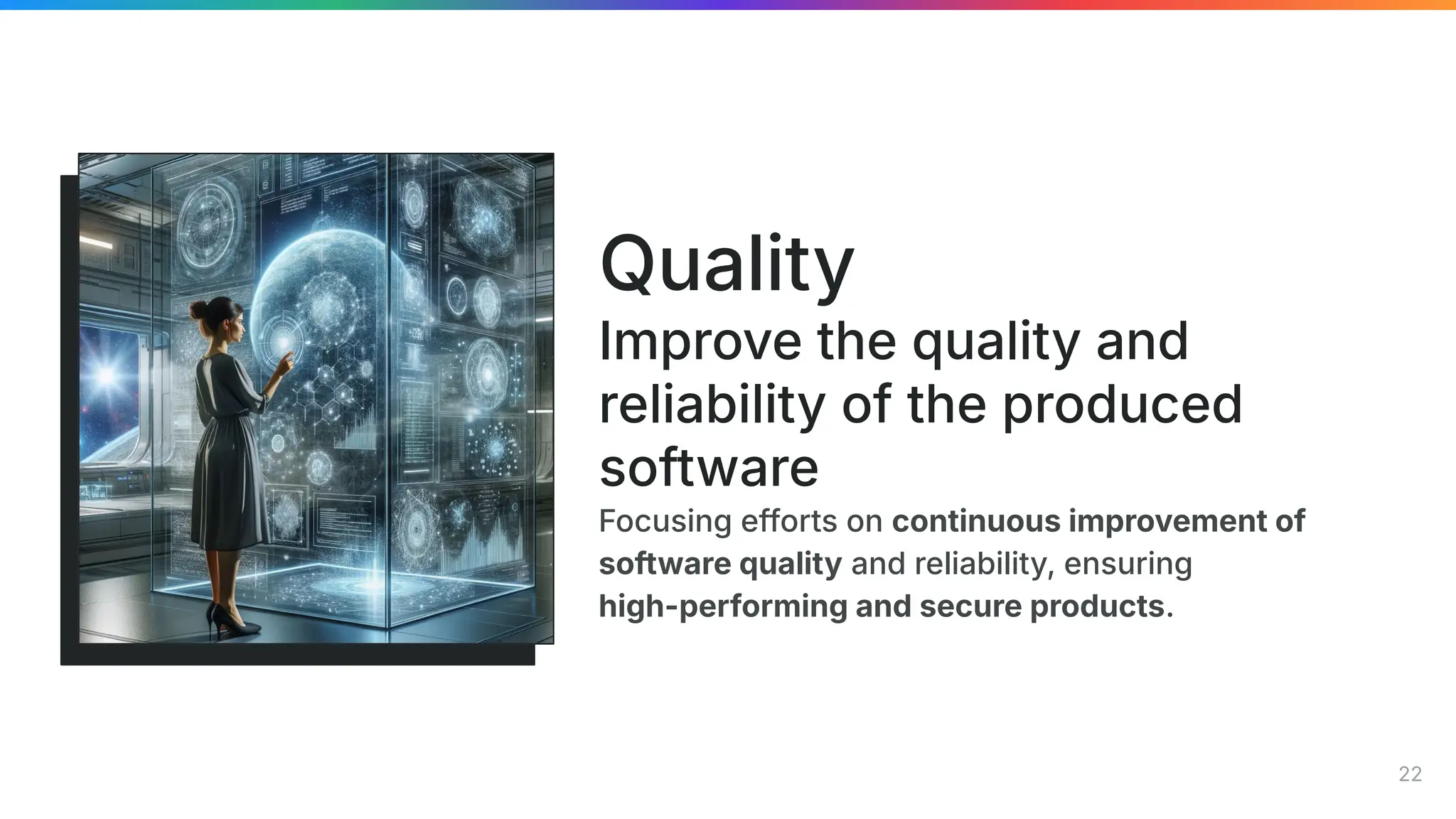
Focusing efforts on continuous improvement of
software quality and reliability, ensuring
high-performing and secure products.
Quality
Improve the quality and
reliability of the produced
software
22
Cooperation between developers, DevOps professionals, and platform engineering teams is crucial. These three
roles work in close synergy, merging their specific skills to design, implement, and manage innovative solutions.
Collaboration Between Developers, DevOps, and
Platform Engineering Team
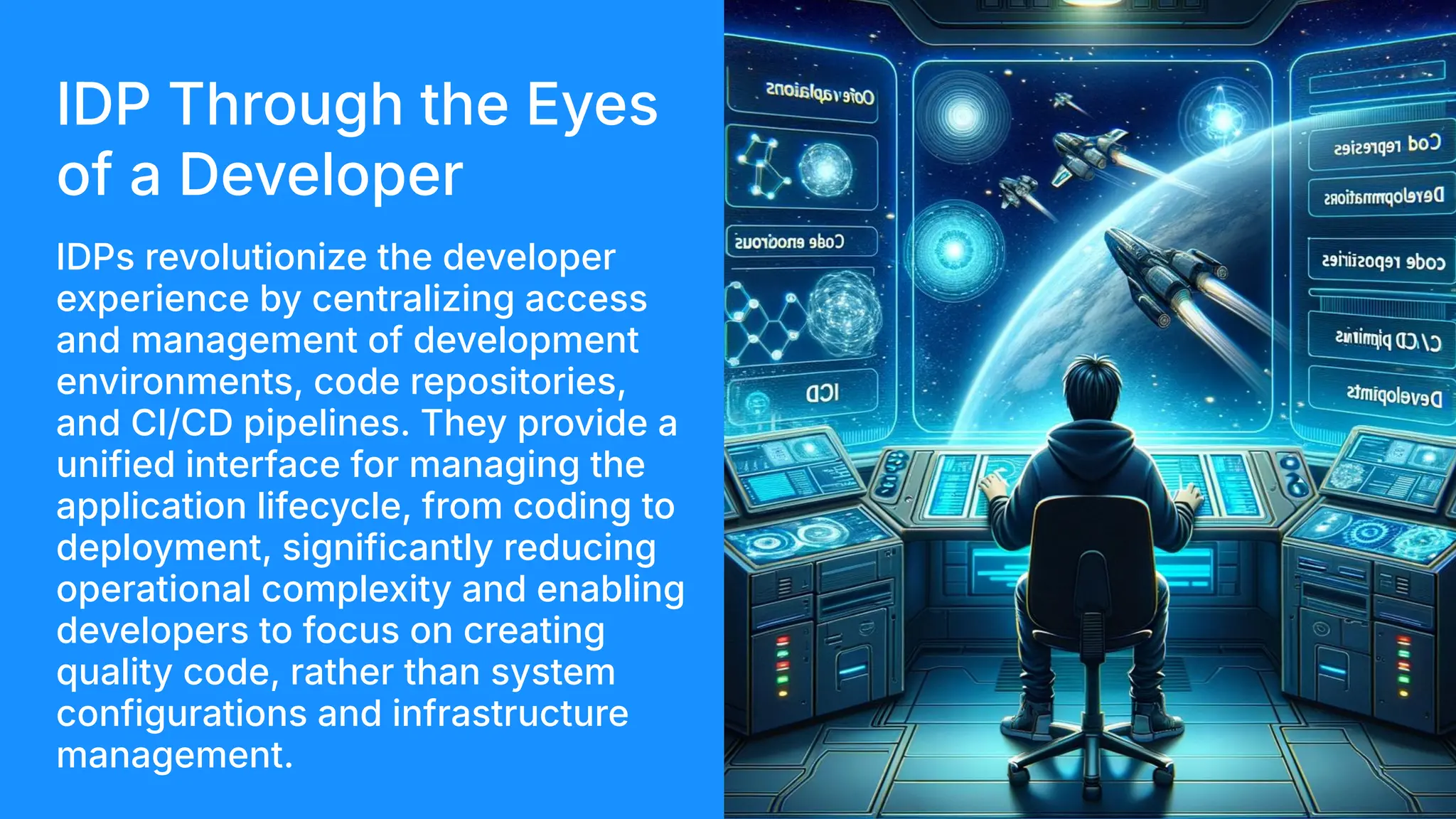
IDP Through the Eyes
of a Developer
IDPs revolutionize the developer
experience by centralizing access
and management of development
environments, code repositories,
and CI/CD pipelines. They provide a
unified interface for managing the
application lifecycle, from coding to
deployment, significantly reducing
operational complexity and enabling
developers to focus on creating
quality code, rather than system
configurations and infrastructure
management.
IDP Through the Lens
of DevOps
IDPs transform the DevOps realm by
offering centralized control over
deployment pipelines, infrastructure
automation, and monitoring. They
enable DevOps professionals to
effortlessly orchestrate complex
environments, ensuring continuity,
security, and scalability. With IDPs,
DevOps can manage the entire
application lifecycle more efficiently,
reducing release times and
enhancing system resilience.
Platform Engineering
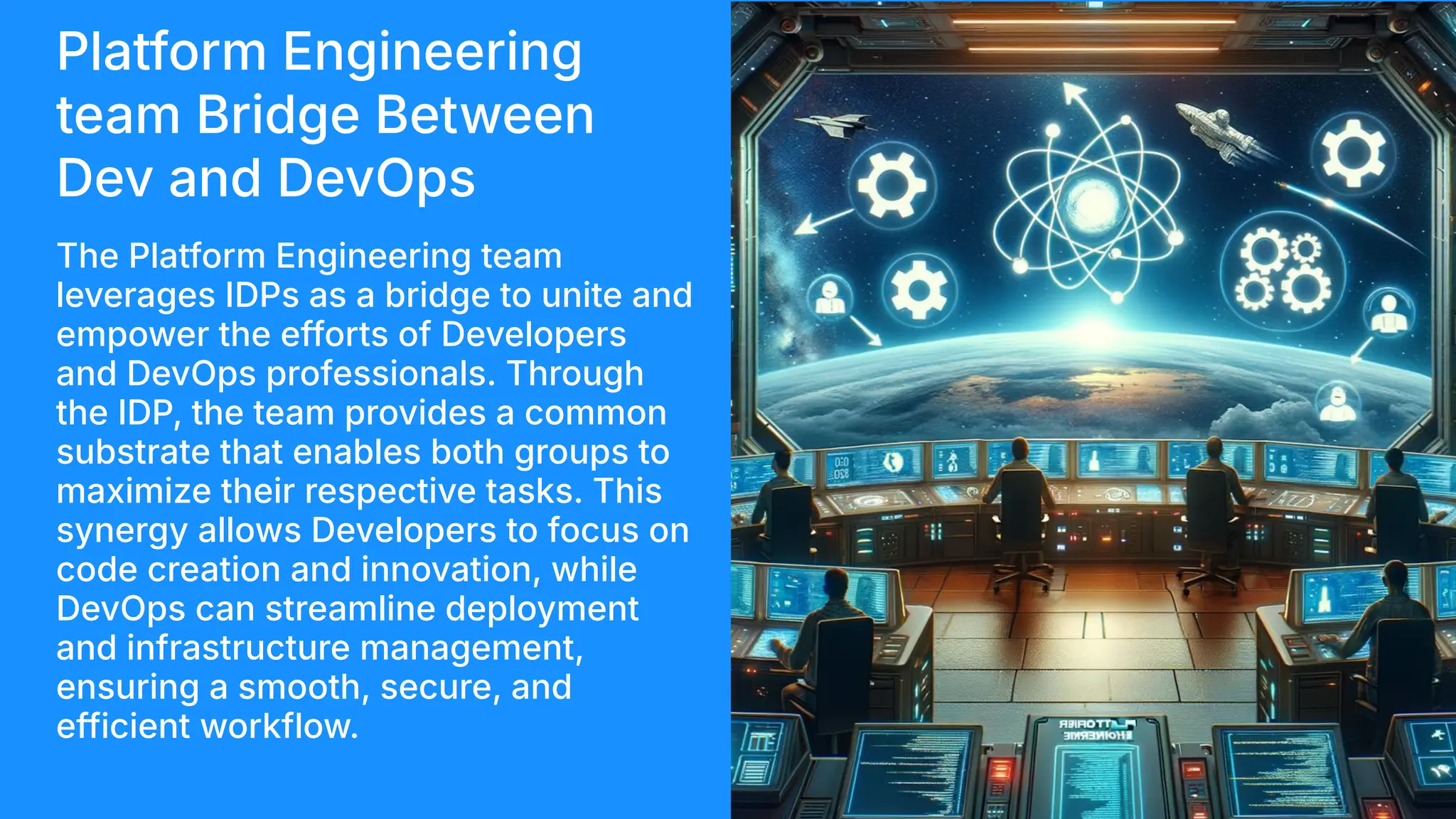
team Bridge Between
Dev and DevOps
The Platform Engineering team
leverages IDPs as a bridge to unite and
empower the efforts of Developers
and DevOps professionals. Through
the IDP, the team provides a common
substrate that enables both groups to
maximize their respective tasks. This
synergy allows Developers to focus on
code creation and innovation, while
DevOps can streamline deployment
and infrastructure management,
ensuring a smooth, secure, and
efficient workflow.
Platform Engineering: a few practical examples
⬢ On-Demand Resource Provisioning: Developers can
create new environments in a few clicks without
waiting for the DevOps team.
⬢ Rapid Experimentation: A developer can test new
features in isolated environments and easily
integrate them if they work.
⬢ Automated Security and Compliance: Every
environment created automatically follows security
policies without delays.
⬢ Automatic Scalability: The platform adjusts
resources in real-time during traffic spikes, with no
manual intervention.
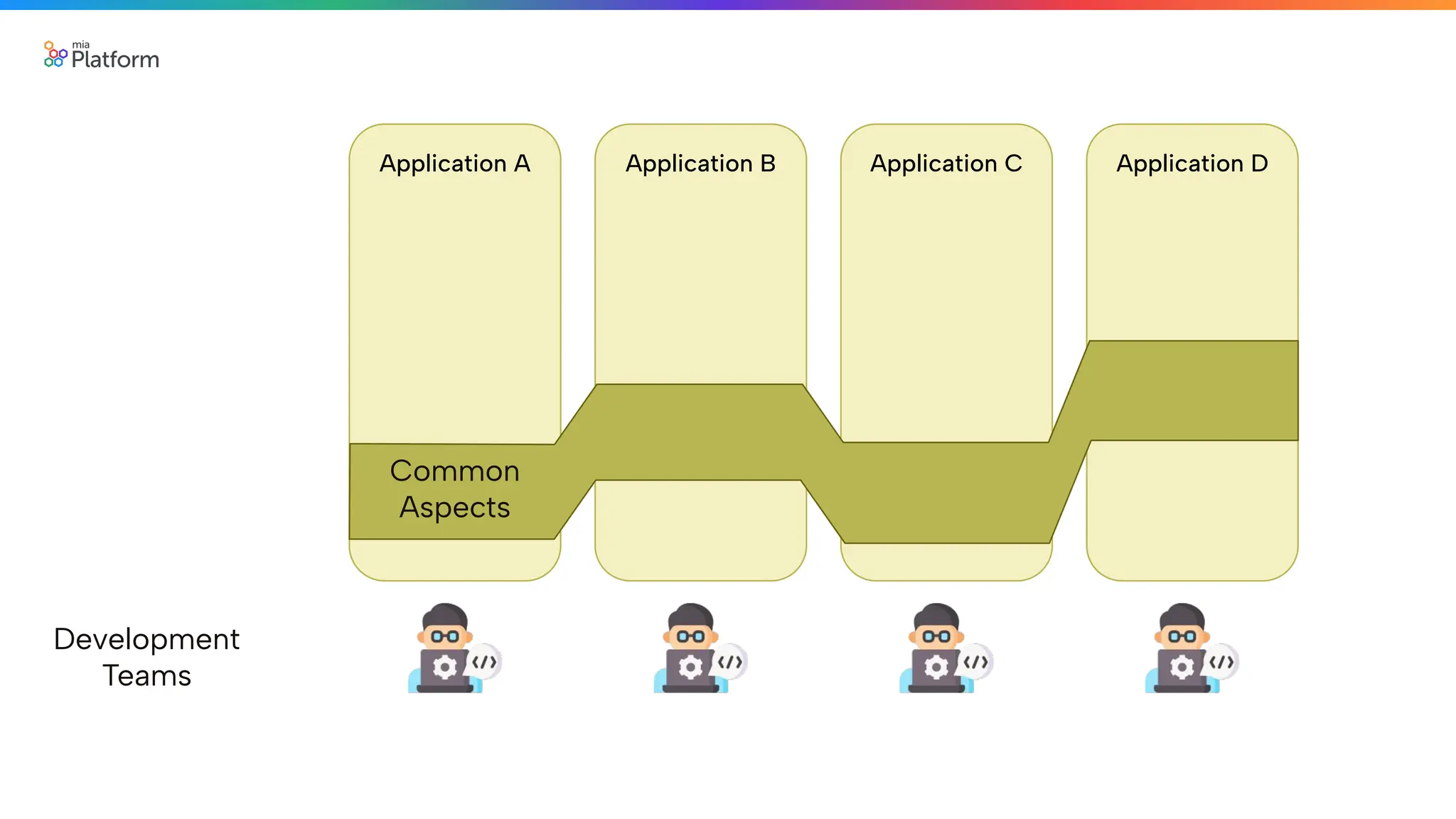
Application A
Development
Teams
Application A
Development
Teams
Application B Application C Application D
Application A
Development
Teams
Application B Application C Application D
Common
Aspects
Application A Application B Application C Application D
Platform
A Platform is a common place where people share value.
Software Life Cycle
Team Rules
Infrastructure
Toolchain
Services
Configuration
Interaction
Capabilities
Platform
Create
Curate
Resources
Consume Resources
Product Teams
Product A Product B Product C Product D
Infrastructure Providers, Complex Systems, External SaaS, Cloud Service
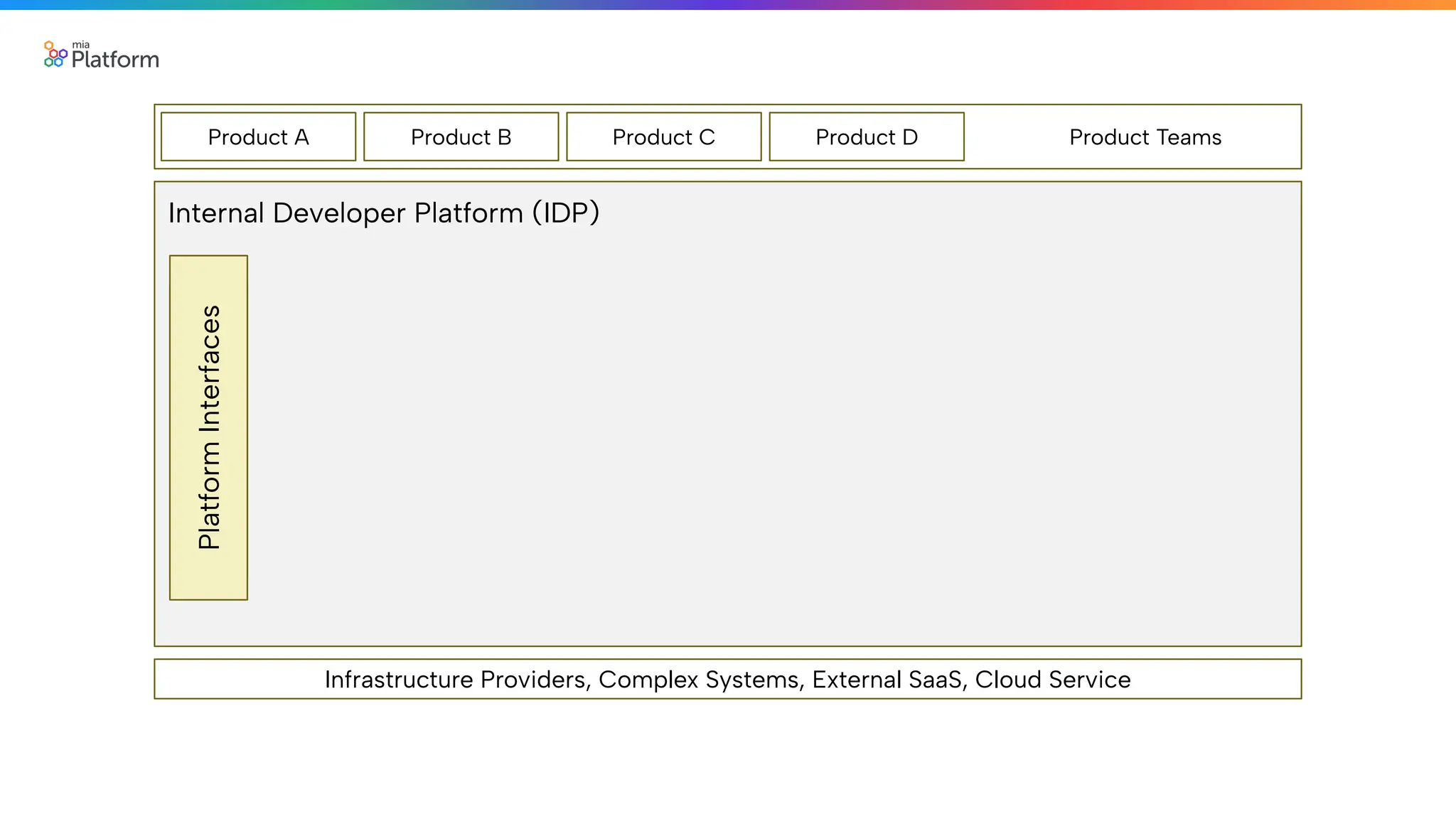
Product Teams
Product A Product B Product C Product D
Internal Developer Platform (IDP)
Platform
Interfaces
Infrastructure Providers, Complex Systems, External SaaS, Cloud Service
Platform
Interfaces
Product Teams
Product A Product B Product C Product D
Internal Developer Platform (IDP)
Platform
Interfaces
Platform
Orchestrator
Infrastructure Providers, Complex Systems, External SaaS, Cloud Service
Product Teams
Product A Product B Product C Product D
Internal Developer Platform (IDP)
Platform
Interfaces
Platform
Orchestrator
Infrastructure Platform
Execution Environment: K8s, Container Managed Service, Functions
Infrastructure Providers, Complex Systems, External SaaS, Cloud Service
Product Teams
Product A Product B Product C Product D
Internal Developer Platform (IDP)
Platform
Interfaces
Platform
Orchestrator
DevOps Platform
Git Pipelines Testing
Monitoring Tracing Secrets & Security
Infrastructure Platform
Execution Environment: K8s, Container Managed Service, Functions
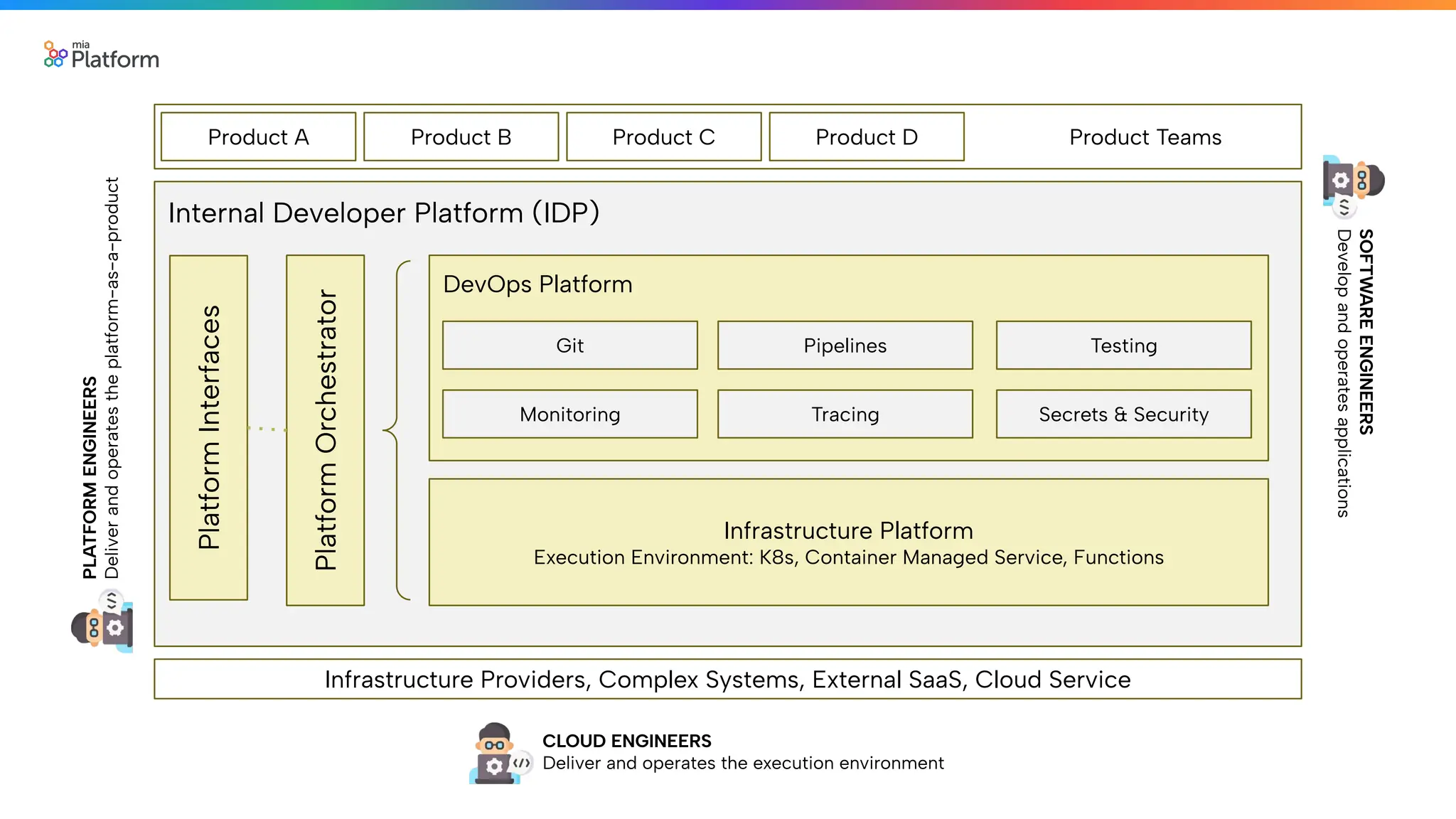
Infrastructure Providers, Complex Systems, External SaaS, Cloud Service
Product Teams
Product A Product B Product C Product D
Internal Developer Platform (IDP)
Platform
Interfaces
Platform
Orchestrator
DevOps Platform
Git Pipelines Testing
Monitoring Tracing Secrets & Security
Infrastructure Platform
Execution Environment: K8s, Container Managed Service, Functions
Infrastructure Providers, Complex Systems, External SaaS, Cloud Service
CLOUD ENGINEERS
Deliver and operates the execution environment
PLATFORM
ENGINEERS
Deliver
and
operates
the
platform-as-a-product
SOFTWARE
ENGINEERS
Develop
and
operates
applications
Metrics
a.k.a “If we have data, letʼs look at data.
If all we have are opinions, letʼs go with mineˮ
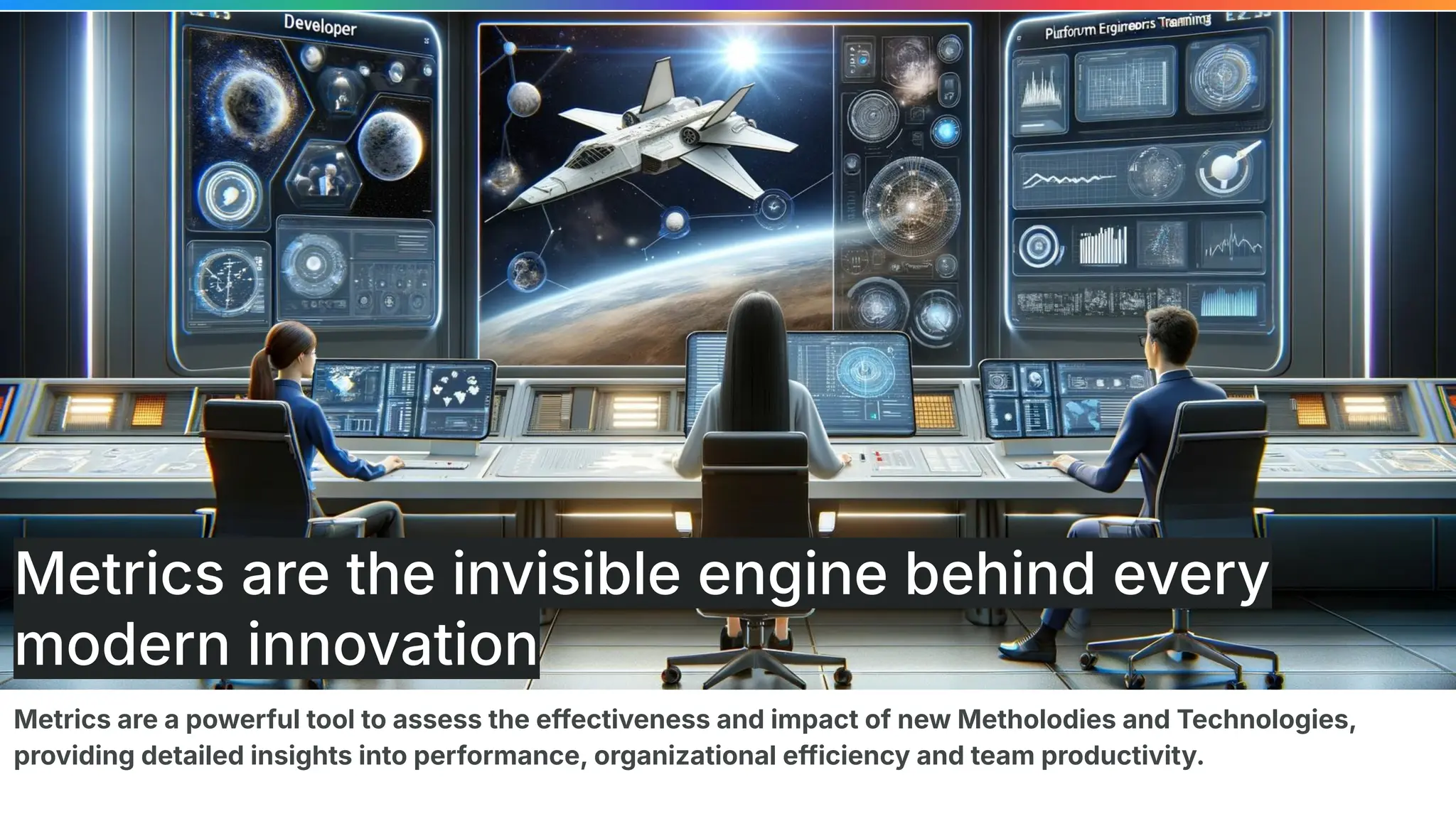
Metrics are a powerful tool to assess the effectiveness and impact of new Metholodies and Technologies,
providing detailed insights into performance, organizational efficiency and team productivity.
Metrics are the invisible engine behind every
modern innovation
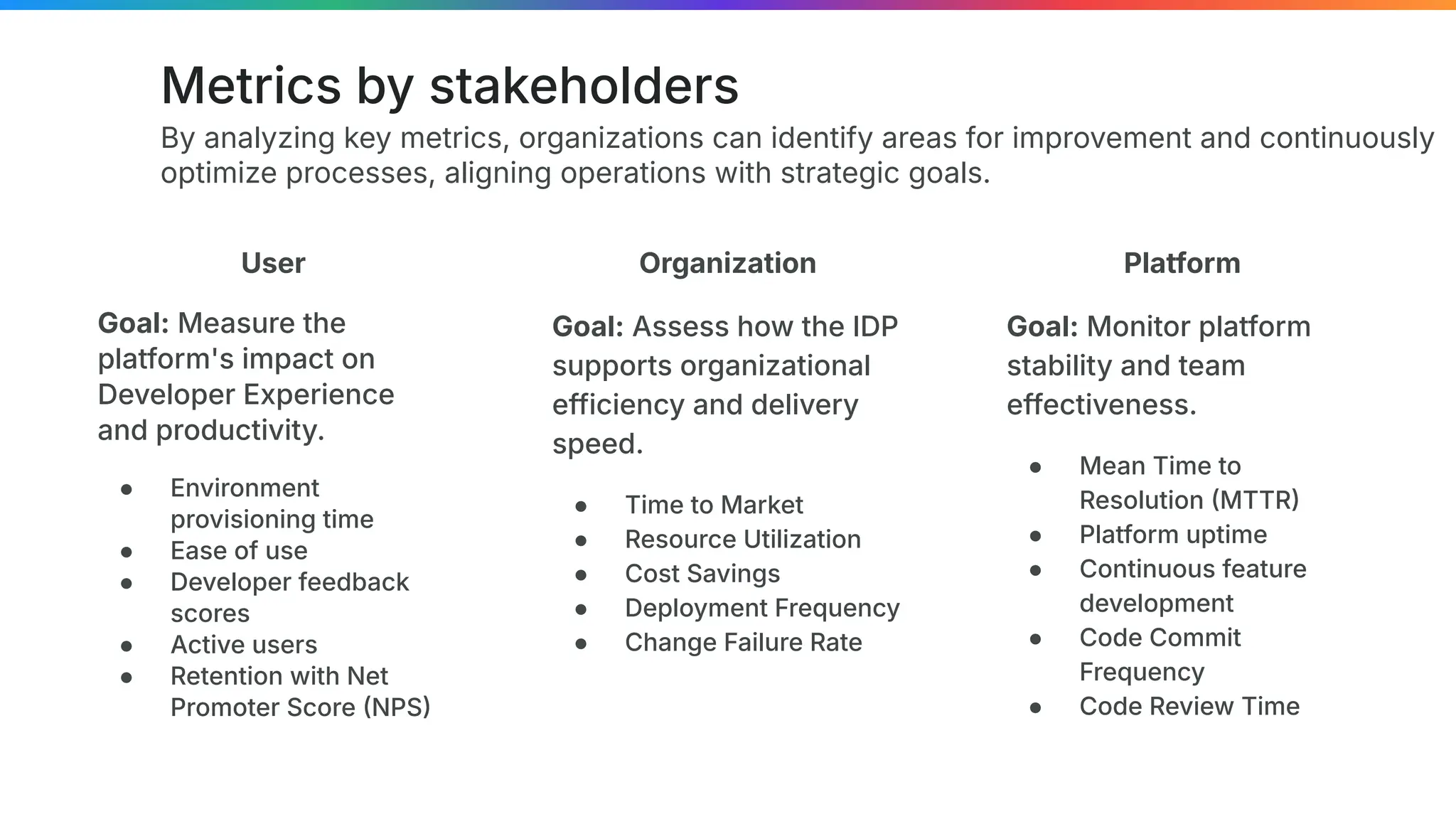
By analyzing key metrics, organizations can identify areas for improvement and continuously
optimize processes, aligning operations with strategic goals.
User
Goal: Measure the
platform's impact on
Developer Experience
and productivity.
● Environment
provisioning time
● Ease of use
● Developer feedback
scores
● Active users
● Retention with Net
Promoter Score NPS
Metrics by stakeholders
Organization
Goal: Assess how the IDP
supports organizational
efficiency and delivery
speed.
● Time to Market
● Resource Utilization
● Cost Savings
● Deployment Frequency
● Change Failure Rate
Platform
Goal: Monitor platform
stability and team
effectiveness.
● Mean Time to
Resolution MTTR
● Platform uptime
● Continuous feature
development
● Code Commit
Frequency
● Code Review Time
Developed by the DevOps Research and Assessment DORA) team, with the first metrics released
in 2014, the DORA framework helps quantify software delivery and operational performance.
DORA Metrics
● Deployment Frequency: Measures how often the team
deploys code to production.
● Lead Time for Changes: Tracks the time from commit to
production deployment.
● Change Failure Rate: Percentage of deployments that
lead to production issues.
● Mean Time to Recovery MTTR: Average time taken to
recover from production failures.
Goal: To balance the need for rapid development and release
cycles with system stability, these metrics became pivotal in
demonstrating DevOps' impact on productivity and quality.
Introduced in 2021 by researchers at GitHub and Microsoft, the SPACE framework
provides a holistic way to assess developer productivity
SPACE Metrics
● Satisfaction and Well-being: Measures developer happiness
and job satisfaction.
● Performance: Evaluates the volume of work completed,
considering quality and value.
● Activity: Tracks team activity, such as commit frequency and
pull request counts.
● Communication and Collaboration: Observes the
effectiveness of team interactions.
● Efficiency and Flow: Analyzes process efficiency and
workflow smoothness, aiming to minimize interruptions.
Goal: To address productivity in a multi-dimensional way,
recognizing that a high-velocity environment also requires
developer well-being and sustainable practices for long-term
success.
AI and RAG
A brief and gentle introduction
Skip →
Retrieval-Augmented
Generation
“aka RAG is a technique that
combines advanced language
models LLMs with the ability to
retrieve information from external
sources in real-time. This allows
for generating more accurate and
up-to-date responses by
integrating the model's output
with specific and relevant data.ˮ
Retrieval-Augmented
Generation
● Combines LLMs
● With external sources
● Real-time
● Generating more accurate
responses
RAG
RAG
L
L
M
G
e
n
A
I
D
L
M
L
A
I
G
P
T
RAG
LLM Input
External Data
Fine-Tuned LLM backbone
Hallucination
RAG
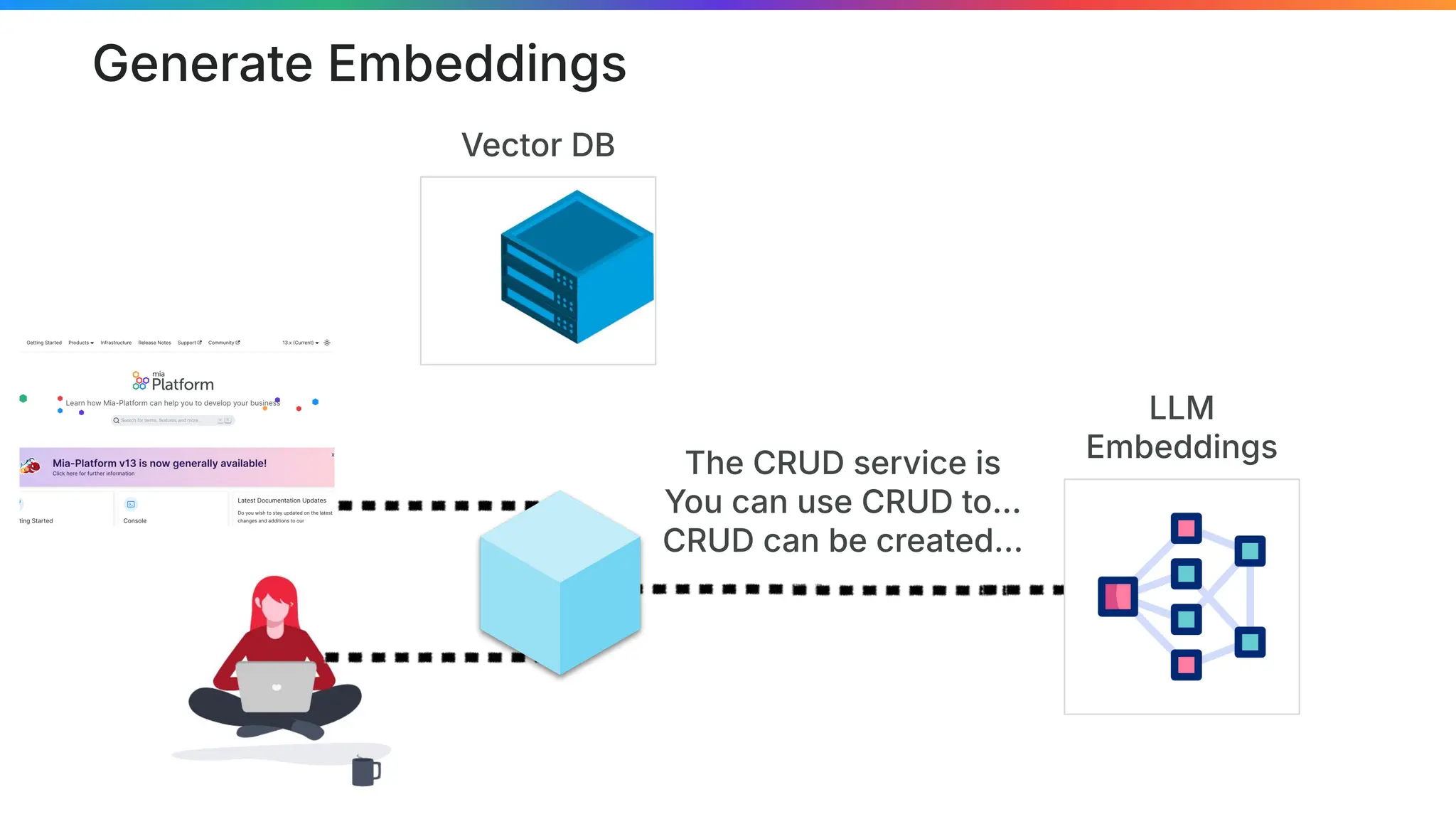
Generate Embeddings
Generate Embeddings
⬢ Embeddings convert words or phrases into
numerical vectors that represent their
meaning in a multidimensional space.
⬢ During training, the model learns to position
similar concepts close to each other in the
embedding space, based on context.
⬢ Embeddings are used to compare words or
phrases, enabling semantic search and
language understanding by AI models.
Generate Embeddings
Vector DB
LLM
Embeddings
Generate Embeddings
Vector DB
The CRUD service is
You can use CRUD to…
CRUD can be created…
LLM
Embeddings
Generate Embeddings
Vector DB
0,3,1,2,4,1 …]
1,4,1,2,2,1 …]
3,3,5,2,2,1 …]
LLM
Embeddings
Vector DB
What is a CRUD
Service?
0,3,1,2,4,1 …]
Generate Embeddings
LLM
Embeddings
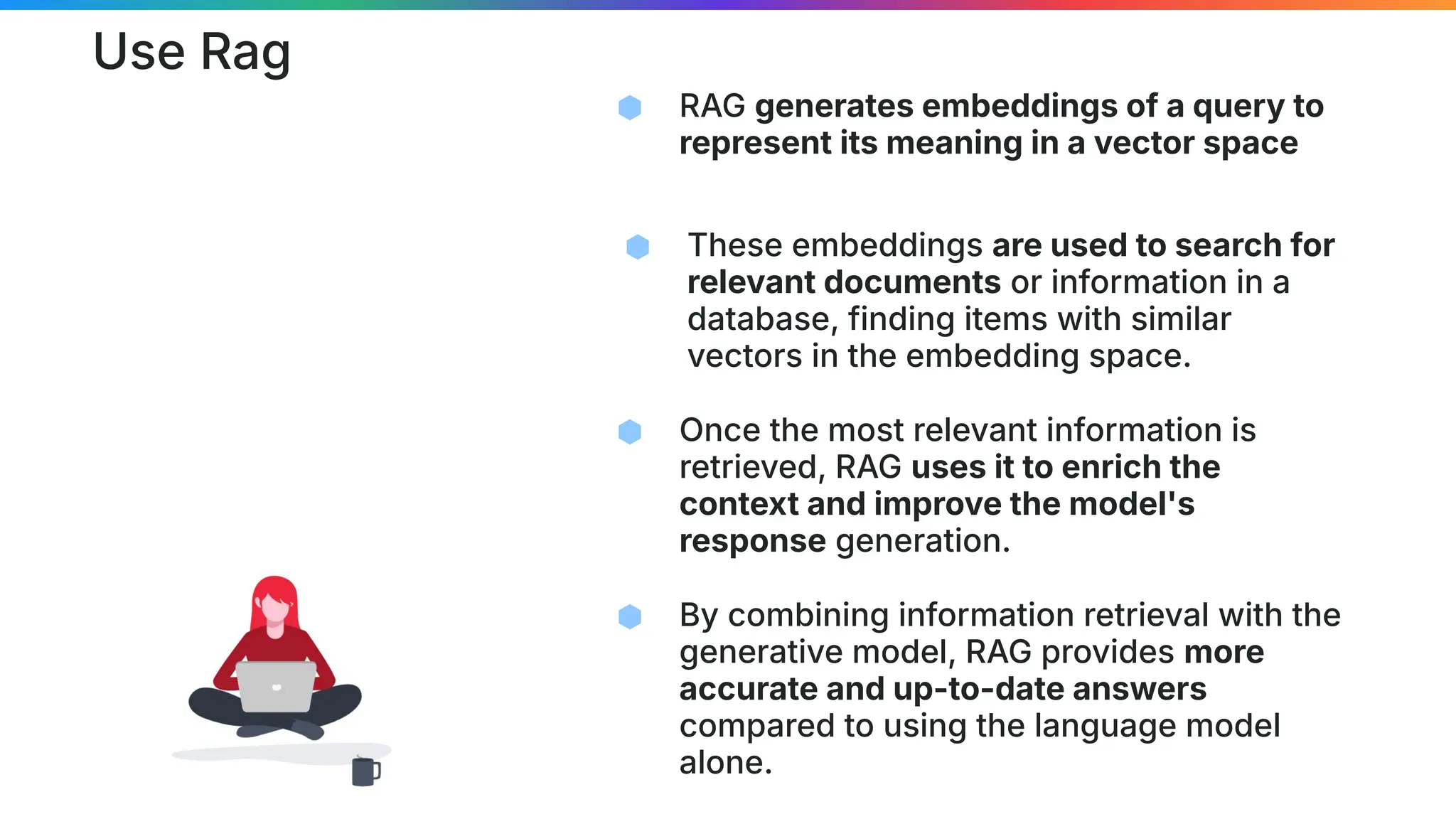
Use Rag
Use Rag
⬢ RAG generates embeddings of a query to
represent its meaning in a vector space
⬢ These embeddings are used to search for
relevant documents or information in a
database, finding items with similar
vectors in the embedding space.
⬢ Once the most relevant information is
retrieved, RAG uses it to enrich the
context and improve the model's
response generation.
⬢ By combining information retrieval with the
generative model, RAG provides more
accurate and up-to-date answers
compared to using the language model
alone.
Vector DB
Search Related:
0,3,1,2,4,1 …]
Use Rag
LLM
Embeddings
What is CRUD
Service?
Vector DB
Search Related:
0,3,1,2,4,1 …]
Use Rag
LLM
Embeddings
Vector DB
The CRUD is…
You can use CRUD to…
CRUD can be created…
Use Rag
LLM
Embeddings
Vector DB
The CRUD Service
is a Plugin that…
Given these docs:
The CRUD is…
You can use CRUD to…
CRUD can be created…
Answer the following question:
What is a CRUD Service?
LLM
Embeddings
Use Rag
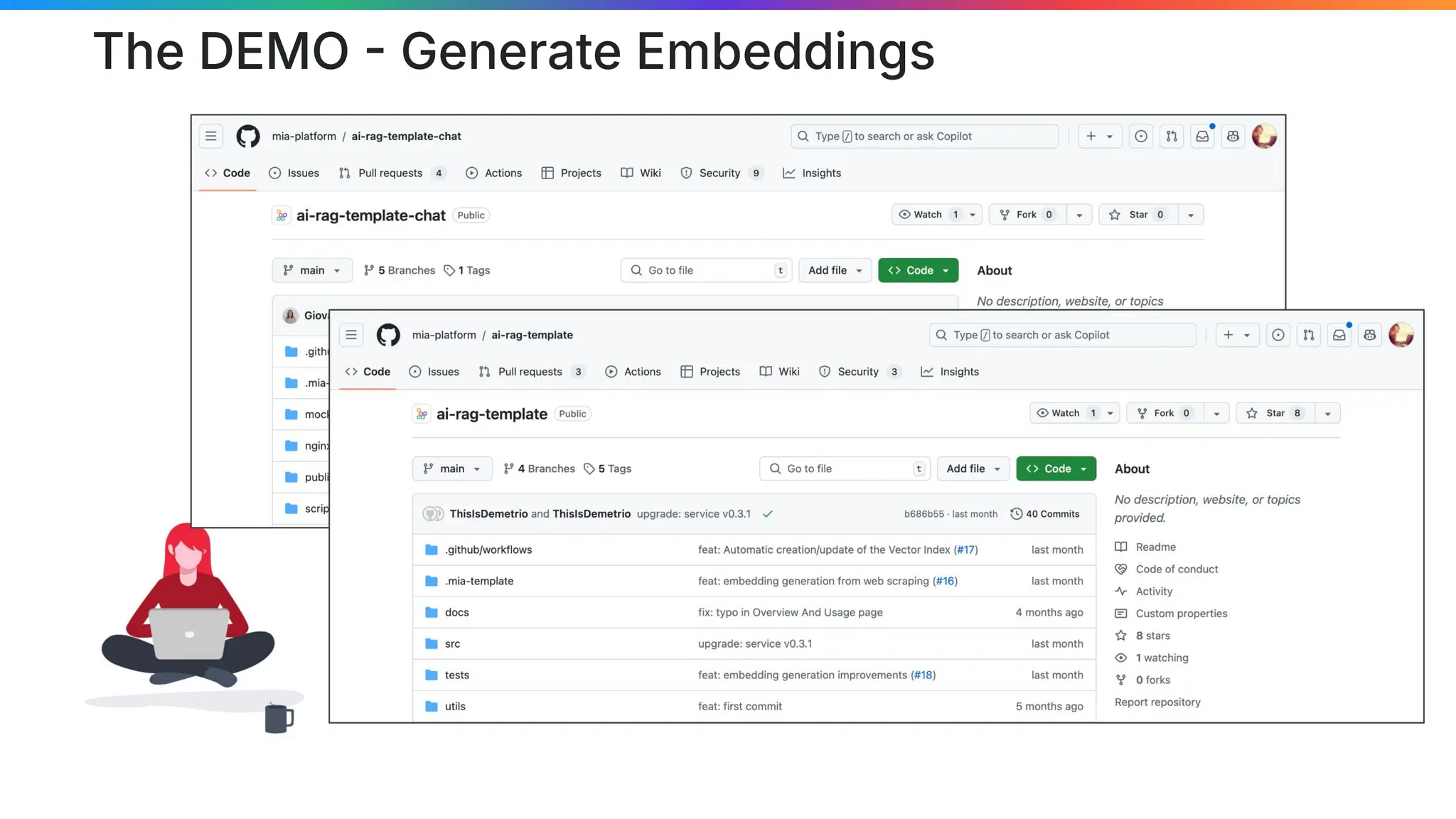
The DEMO
The DEMO  Generate Embeddings
Vector DB
LLM Embeddings
AI RAG
Template
AI RAG
Template
Chat
Open AI
MongoDB
The DEMO  Chat BOT
The DEMO  Chat BOT
Without RAG enabled
With RAG enabled
Vector DB
AI RAG
Template
AI RAG
Template
Chat
MongoDB
The DEMO  Chat BOT
LLM Embeddings
Open AI
Demo
Skip →
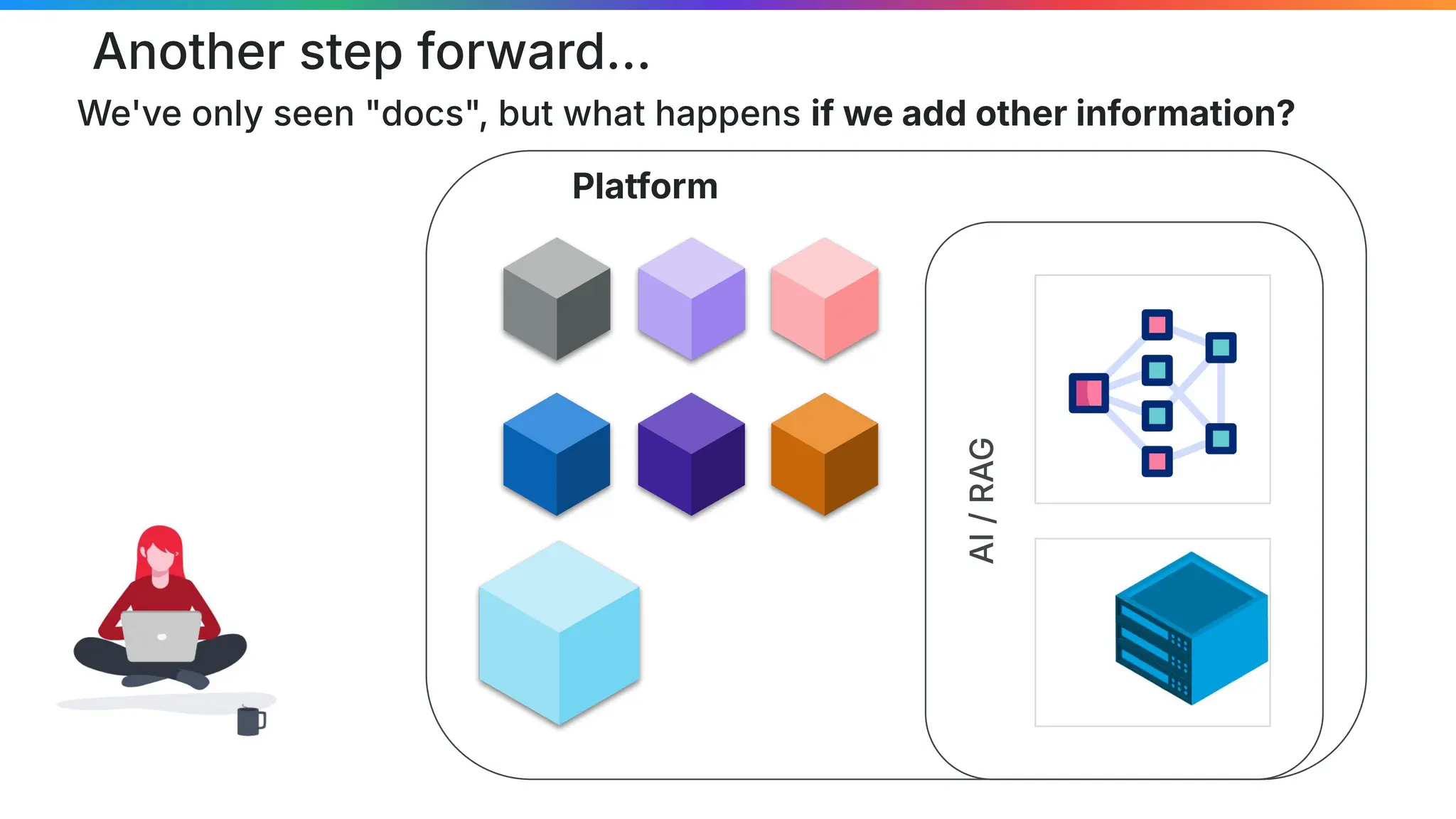
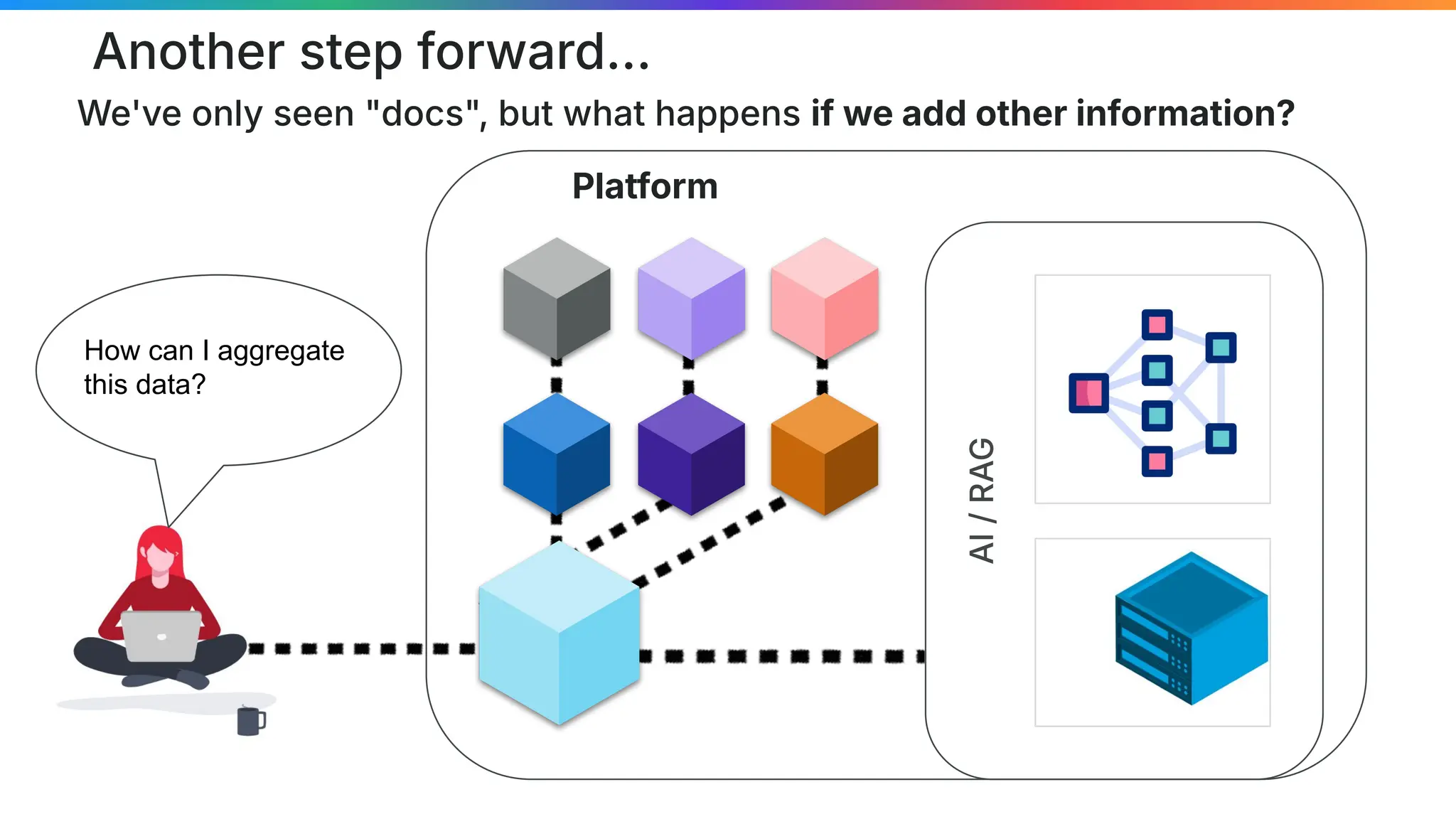
Another step forward...
We've only seen "docs", but what happens if we add other information?
● Information about my platform
● Architecture and features of the platform.
● Information about my applications
● Information on data managed by the Platform
● Real-time logs and error
Another step forward...
We've only seen "docs", but what happens if we add other information?
AI
/
RAG
Platform
Another step forward...
We've only seen "docs", but what happens if we add other information?
AI
/
RAG
Platform
Another step forward...
We've only seen "docs", but what happens if we add other information?
AI
/
RAG
Platform
Another step forward...
We've only seen "docs", but what happens if we add other information?
AI
/
RAG
Platform
Do you detect
specific errors on...?
Another step forward...
We've only seen "docs", but what happens if we add other information?
AI
/
RAG
Platform
How can I aggregate
this data?
Another step forward...
We've only seen "docs", but what happens if we add other information?
AI
/
RAG
Platform
How can I manage
this situation in my
project?
Practical Tips
This is an example of how to edit
this new template
INTRODUCTION
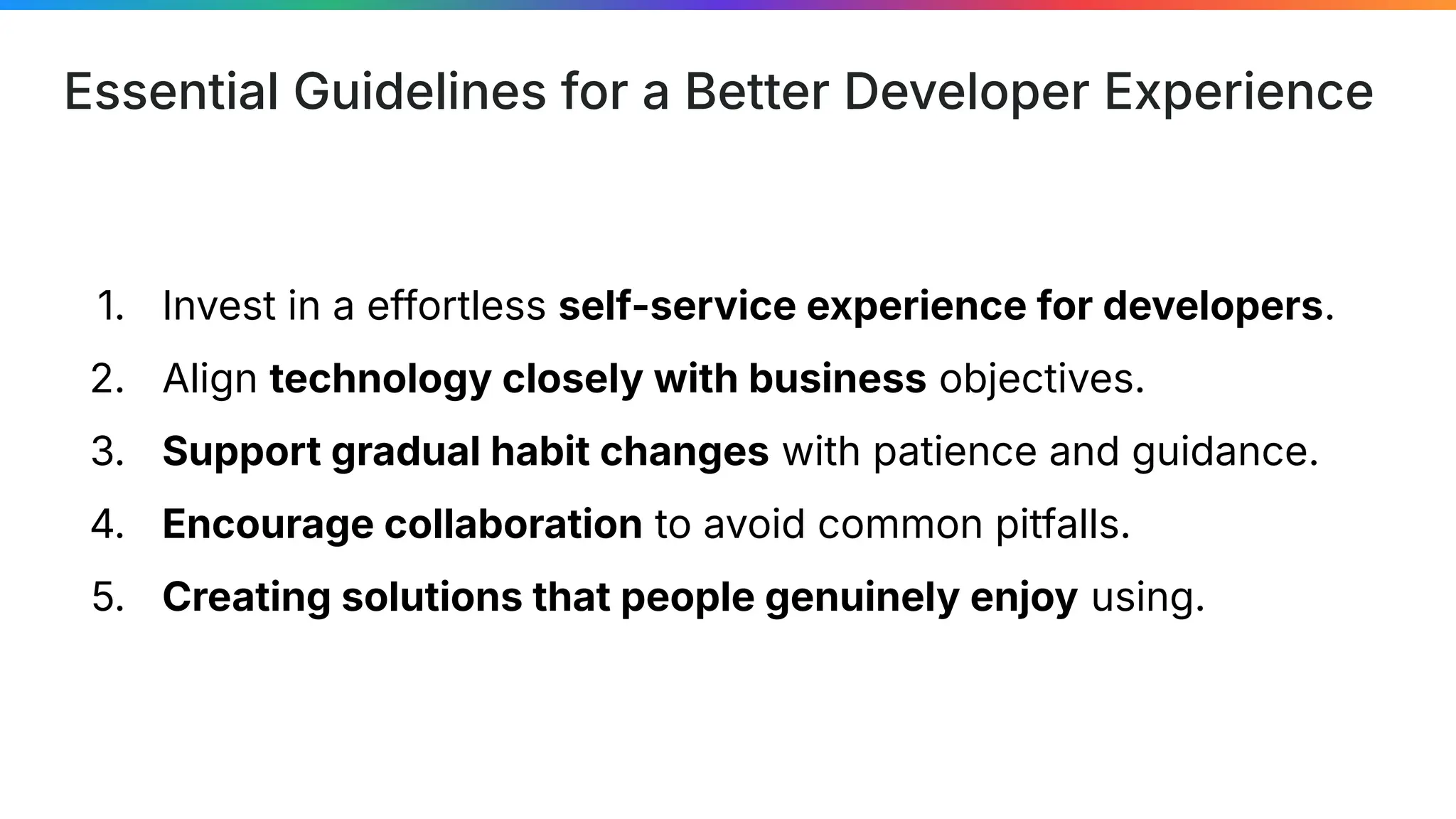
Essential Guidelines for a Better Developer Experience
1. Invest in a effortless self-service experience for developers.
2. Align technology closely with business objectives.
3. Support gradual habit changes with patience and guidance.
4. Encourage collaboration to avoid common pitfalls.
5. Creating solutions that people genuinely enjoy using.
Presentation Template: SlidesMania
Images: Generated with Open-AI and
Midjourney
Fonts: Roboto Mono
76
Credits
Images: Generated with Open-AI and Midjourney
Fonts: Roboto Mono
77
Resources
● Platform Engineering Trends:
tag-app-delivery.cncf.io/blog/proposal-
platform-engineering-/
● Blog Mia-Platform:
mia-platform.eu/blog/
● CNCF AI WhitePaper:
cncf.io/reports/cloud-native-artificial-intel
ligence-whitepaper/
● AI-RAG-Template OSS (by Mia-Platform):
github.com/mia-platform/ai-rag-template
github.com/mia-platform/ai-rag-template-chat
Feel free to add me on LinkedIn
-Feedback
-Q&A
-Photo
If you have any comments or suggestions about my presentation, please do not hesitate to fill the
form. Every piece of feedback is valuable!
78
https://bit.ly/feedback-mich
Thanks
→ LETʼS KEEP IN TOUCH
Michel Murabito – Developer Advocate
michel.murabito@mia-platform.eu

Migliorare la Developer Experience in un mondo Cloud Native

  • 1.
    Migliorare la DeveloperExperience in un mondo Cloud Native con Platform Engineering e AI RAG Mich Murabito Developer Advocate Mia-Platform CNCF Ambassador & DevNetwork Board Member
  • 2.
    Who am I? I’mpassionate about community and public speaking. I founded the DevelopersLife community, where I actively contribute. Developer Advocate Hello! I’m Mich Murabito I also engage in projects and initiatives in the field of sustainability and open source, with the goal of creating positive impacts and sharing my passion for technology. Board Member Feel free to add me on LinkedIn
  • 4.
    The ”H”" in Kubernetesstands for Happiness ― quoted by anonymous feat Mich Murabito 4
  • 5.
    Kubernetes is just the tipof the iceberg The Cloud Native realm dazzles with its diversity and complexity: over 1261 Cards in the CNCF landscape, hundreds of tools, and an ever-growing ecosystem showcase a vibrant multifaceted nature. 5
  • 6.
    The “B” inDevelopment stands for Bliss – if only bottlenecks didn't exist. ― quoted by anonymous feat Mich Murabito 6
  • 7.
    Bottlenecks, potentially everyone's development hurdle. Bottlenecks are criticalpoints that reduce flow and productivity, such as lengthy onboarding, extended approval processes, or inadequate resources, slowing down product release. 7
  • 8.
    Why Software DevelopmentComplexity Has Increased 03 8 Todayʼs software must be scalable, secure, and interoperable, meeting user expectations across a global network. ⬢ Scalability and Distribution ⬢ Data Growth ⬢ Integrations and Interoperability ⬢ User Expectations and UX ⬢ Security and Privacy ⬢ Automation and CI/CD ⬢ AI and Machine Learning ⬢ Complex Architectures ⬢ Collaboration and Distributed Teams ⬢ Continuous Evolution
  • 9.
    ⬢ Scalability andDistribution ⬢ Data Growth ⬢ Integrations and Interoperability ⬢ User Expectations and UX ⬢ Security and Privacy ⬢ Automation and CI/CD ⬢ AI and Machine Learning ⬢ Complex Architectures ⬢ Collaboration and Distributed Teams ⬢ Continuous Evolution Why Software Development Complexity Has Increased 03 9 Todayʼs software must be scalable, secure, and interoperable, meeting user expectations across a global network.
  • 10.
    Standard practices without optimizations a.k.aWe could do better, but for today we'll go the “old-fashioned wayˮ
  • 11.
    Standard practices withoutoptimizations Developer Need a new Environment 01 Environments Resource configuration 02 Create Ops Configuration of environment (variables, secrets, etc) Network setup Security setup Many others…
  • 12.
    Developer Need a newEnvironment 01 Environments Resource configuration 02 Create Ops Configuration of environment (variables, secrets, etc) Network setup Security setup Many others… ● Jira ● Trello ● Asana ● etc etc Standard practices without optimizations
  • 13.
    Platform Engineering A briefand gentle introduction
  • 14.
    Platform Engineering “It isthe approach aimed at designing and building highly automated and scalable internal digital platforms that provide developers with a self-service environment to accelerate the software lifecycle. The goal is to simplify infrastructure management and optimize operational efficiency, enabling companies to adopt cloud-native architectures and technologies, while also improving Developer Experience DevX) and ensuring rapid innovation.ˮ
  • 15.
    Platform Engineering ● Automatedand scalable platforms ● Self-service ● Simplify infrastructure management ● Adopt cloud-native architectures and technologies ● Improving Developer Experience DevX) and ensuring rapid innovation.
  • 16.
    Platform Engineering: EnablingEfficiency and Innovation 01 Centralization Manage all projects from a single place 02 Automation Industrialize and automate the entire DevOps cycle 03 Efficiency Avoid bottlenecks due to organization 04 Self-Service Provide necessary technology in a self-service mode 05 Simplicity Solve complexities associated with the cloud 06 Quality Improve the quality and reliability of the produced software
  • 17.
    Centralizing development operations intoa single portal represents a strategic innovation for significantly improving the developer experience. Centralization Manage all projects from a single place 17
  • 18.
    Automation brings efficiencyand innovation, transforming complex processes into simple and precise operations. Automation Industrialize and automate the entire DevOps cycle 18
  • 19.
    Providing essential technologyin a self-service mode allows developers to independently access the tools they need, enhancing efficiency and autonomy in their work. Self-Service Provide necessary technology in a self-service mode 19
  • 20.
    Tackling and solvingcloud-related complexities with a simple and straightforward approach, streamlining the management and use of cloud technologies. Simplicity Solve complexities associated with the cloud 20
  • 21.
    Overcoming organizational slowdownsby implementing efficient solutions that promote a smooth and uninterrupted workflow. Efficiency Avoid bottlenecks due to organization 21
  • 22.
    Focusing efforts oncontinuous improvement of software quality and reliability, ensuring high-performing and secure products. Quality Improve the quality and reliability of the produced software 22
  • 23.
    Cooperation between developers,DevOps professionals, and platform engineering teams is crucial. These three roles work in close synergy, merging their specific skills to design, implement, and manage innovative solutions. Collaboration Between Developers, DevOps, and Platform Engineering Team
  • 24.
    IDP Through theEyes of a Developer IDPs revolutionize the developer experience by centralizing access and management of development environments, code repositories, and CI/CD pipelines. They provide a unified interface for managing the application lifecycle, from coding to deployment, significantly reducing operational complexity and enabling developers to focus on creating quality code, rather than system configurations and infrastructure management.
  • 25.
    IDP Through theLens of DevOps IDPs transform the DevOps realm by offering centralized control over deployment pipelines, infrastructure automation, and monitoring. They enable DevOps professionals to effortlessly orchestrate complex environments, ensuring continuity, security, and scalability. With IDPs, DevOps can manage the entire application lifecycle more efficiently, reducing release times and enhancing system resilience.
  • 26.
    Platform Engineering team BridgeBetween Dev and DevOps The Platform Engineering team leverages IDPs as a bridge to unite and empower the efforts of Developers and DevOps professionals. Through the IDP, the team provides a common substrate that enables both groups to maximize their respective tasks. This synergy allows Developers to focus on code creation and innovation, while DevOps can streamline deployment and infrastructure management, ensuring a smooth, secure, and efficient workflow.
  • 27.
    Platform Engineering: afew practical examples ⬢ On-Demand Resource Provisioning: Developers can create new environments in a few clicks without waiting for the DevOps team. ⬢ Rapid Experimentation: A developer can test new features in isolated environments and easily integrate them if they work. ⬢ Automated Security and Compliance: Every environment created automatically follows security policies without delays. ⬢ Automatic Scalability: The platform adjusts resources in real-time during traffic spikes, with no manual intervention.
  • 28.
  • 29.
  • 30.
    Application A Development Teams Application BApplication C Application D Common Aspects
  • 31.
    Application A ApplicationB Application C Application D Platform A Platform is a common place where people share value. Software Life Cycle Team Rules Infrastructure Toolchain Services Configuration
  • 32.
  • 33.
    Product Teams Product AProduct B Product C Product D Infrastructure Providers, Complex Systems, External SaaS, Cloud Service
  • 34.
    Product Teams Product AProduct B Product C Product D Internal Developer Platform (IDP) Platform Interfaces Infrastructure Providers, Complex Systems, External SaaS, Cloud Service Platform Interfaces
  • 35.
    Product Teams Product AProduct B Product C Product D Internal Developer Platform (IDP) Platform Interfaces Platform Orchestrator Infrastructure Providers, Complex Systems, External SaaS, Cloud Service
  • 36.
    Product Teams Product AProduct B Product C Product D Internal Developer Platform (IDP) Platform Interfaces Platform Orchestrator Infrastructure Platform Execution Environment: K8s, Container Managed Service, Functions Infrastructure Providers, Complex Systems, External SaaS, Cloud Service
  • 37.
    Product Teams Product AProduct B Product C Product D Internal Developer Platform (IDP) Platform Interfaces Platform Orchestrator DevOps Platform Git Pipelines Testing Monitoring Tracing Secrets & Security Infrastructure Platform Execution Environment: K8s, Container Managed Service, Functions Infrastructure Providers, Complex Systems, External SaaS, Cloud Service
  • 38.
    Product Teams Product AProduct B Product C Product D Internal Developer Platform (IDP) Platform Interfaces Platform Orchestrator DevOps Platform Git Pipelines Testing Monitoring Tracing Secrets & Security Infrastructure Platform Execution Environment: K8s, Container Managed Service, Functions Infrastructure Providers, Complex Systems, External SaaS, Cloud Service CLOUD ENGINEERS Deliver and operates the execution environment PLATFORM ENGINEERS Deliver and operates the platform-as-a-product SOFTWARE ENGINEERS Develop and operates applications
  • 39.
    Metrics a.k.a “If wehave data, letʼs look at data. If all we have are opinions, letʼs go with mineˮ
  • 40.
    Metrics are apowerful tool to assess the effectiveness and impact of new Metholodies and Technologies, providing detailed insights into performance, organizational efficiency and team productivity. Metrics are the invisible engine behind every modern innovation
  • 41.
    By analyzing keymetrics, organizations can identify areas for improvement and continuously optimize processes, aligning operations with strategic goals. User Goal: Measure the platform's impact on Developer Experience and productivity. ● Environment provisioning time ● Ease of use ● Developer feedback scores ● Active users ● Retention with Net Promoter Score NPS Metrics by stakeholders Organization Goal: Assess how the IDP supports organizational efficiency and delivery speed. ● Time to Market ● Resource Utilization ● Cost Savings ● Deployment Frequency ● Change Failure Rate Platform Goal: Monitor platform stability and team effectiveness. ● Mean Time to Resolution MTTR ● Platform uptime ● Continuous feature development ● Code Commit Frequency ● Code Review Time
  • 42.
    Developed by theDevOps Research and Assessment DORA) team, with the first metrics released in 2014, the DORA framework helps quantify software delivery and operational performance. DORA Metrics ● Deployment Frequency: Measures how often the team deploys code to production. ● Lead Time for Changes: Tracks the time from commit to production deployment. ● Change Failure Rate: Percentage of deployments that lead to production issues. ● Mean Time to Recovery MTTR: Average time taken to recover from production failures. Goal: To balance the need for rapid development and release cycles with system stability, these metrics became pivotal in demonstrating DevOps' impact on productivity and quality.
  • 43.
    Introduced in 2021by researchers at GitHub and Microsoft, the SPACE framework provides a holistic way to assess developer productivity SPACE Metrics ● Satisfaction and Well-being: Measures developer happiness and job satisfaction. ● Performance: Evaluates the volume of work completed, considering quality and value. ● Activity: Tracks team activity, such as commit frequency and pull request counts. ● Communication and Collaboration: Observes the effectiveness of team interactions. ● Efficiency and Flow: Analyzes process efficiency and workflow smoothness, aiming to minimize interruptions. Goal: To address productivity in a multi-dimensional way, recognizing that a high-velocity environment also requires developer well-being and sustainable practices for long-term success.
  • 44.
    AI and RAG Abrief and gentle introduction Skip →
  • 45.
    Retrieval-Augmented Generation “aka RAG isa technique that combines advanced language models LLMs with the ability to retrieve information from external sources in real-time. This allows for generating more accurate and up-to-date responses by integrating the model's output with specific and relevant data.ˮ
  • 46.
    Retrieval-Augmented Generation ● Combines LLMs ●With external sources ● Real-time ● Generating more accurate responses
  • 47.
  • 48.
    RAG LLM Input External Data Fine-TunedLLM backbone Hallucination RAG
  • 49.
  • 50.
    Generate Embeddings ⬢ Embeddingsconvert words or phrases into numerical vectors that represent their meaning in a multidimensional space. ⬢ During training, the model learns to position similar concepts close to each other in the embedding space, based on context. ⬢ Embeddings are used to compare words or phrases, enabling semantic search and language understanding by AI models.
  • 51.
  • 52.
    Generate Embeddings Vector DB TheCRUD service is You can use CRUD to… CRUD can be created… LLM Embeddings
  • 53.
    Generate Embeddings Vector DB 0,3,1,2,4,1…] 1,4,1,2,2,1 …] 3,3,5,2,2,1 …] LLM Embeddings
  • 54.
    Vector DB What isa CRUD Service? 0,3,1,2,4,1 …] Generate Embeddings LLM Embeddings
  • 55.
  • 56.
    Use Rag ⬢ RAGgenerates embeddings of a query to represent its meaning in a vector space ⬢ These embeddings are used to search for relevant documents or information in a database, finding items with similar vectors in the embedding space. ⬢ Once the most relevant information is retrieved, RAG uses it to enrich the context and improve the model's response generation. ⬢ By combining information retrieval with the generative model, RAG provides more accurate and up-to-date answers compared to using the language model alone.
  • 57.
    Vector DB Search Related: 0,3,1,2,4,1…] Use Rag LLM Embeddings What is CRUD Service?
  • 58.
    Vector DB Search Related: 0,3,1,2,4,1…] Use Rag LLM Embeddings
  • 59.
    Vector DB The CRUDis… You can use CRUD to… CRUD can be created… Use Rag LLM Embeddings
  • 60.
    Vector DB The CRUDService is a Plugin that… Given these docs: The CRUD is… You can use CRUD to… CRUD can be created… Answer the following question: What is a CRUD Service? LLM Embeddings Use Rag
  • 61.
    The DEMO The DEMO Generate Embeddings
  • 62.
    The DEMO Generate Embeddings Vector DB LLM Embeddings AI RAG Template AI RAG Template Chat Open AI MongoDB
  • 63.
    The DEMO Chat BOT
  • 64.
    The DEMO Chat BOT Without RAG enabled With RAG enabled
  • 65.
    Vector DB AI RAG Template AIRAG Template Chat MongoDB The DEMO  Chat BOT LLM Embeddings Open AI
  • 66.
  • 67.
    Another step forward... We'veonly seen "docs", but what happens if we add other information? ● Information about my platform ● Architecture and features of the platform. ● Information about my applications ● Information on data managed by the Platform ● Real-time logs and error
  • 68.
    Another step forward... We'veonly seen "docs", but what happens if we add other information? AI / RAG Platform
  • 69.
    Another step forward... We'veonly seen "docs", but what happens if we add other information? AI / RAG Platform
  • 70.
    Another step forward... We'veonly seen "docs", but what happens if we add other information? AI / RAG Platform
  • 71.
    Another step forward... We'veonly seen "docs", but what happens if we add other information? AI / RAG Platform Do you detect specific errors on...?
  • 72.
    Another step forward... We'veonly seen "docs", but what happens if we add other information? AI / RAG Platform How can I aggregate this data?
  • 73.
    Another step forward... We'veonly seen "docs", but what happens if we add other information? AI / RAG Platform How can I manage this situation in my project?
  • 74.
    Practical Tips This isan example of how to edit this new template INTRODUCTION
  • 75.
    Essential Guidelines fora Better Developer Experience 1. Invest in a effortless self-service experience for developers. 2. Align technology closely with business objectives. 3. Support gradual habit changes with patience and guidance. 4. Encourage collaboration to avoid common pitfalls. 5. Creating solutions that people genuinely enjoy using.
  • 76.
    Presentation Template: SlidesMania Images:Generated with Open-AI and Midjourney Fonts: Roboto Mono 76 Credits Images: Generated with Open-AI and Midjourney Fonts: Roboto Mono
  • 77.
    77 Resources ● Platform EngineeringTrends: tag-app-delivery.cncf.io/blog/proposal- platform-engineering-/ ● Blog Mia-Platform: mia-platform.eu/blog/ ● CNCF AI WhitePaper: cncf.io/reports/cloud-native-artificial-intel ligence-whitepaper/ ● AI-RAG-Template OSS (by Mia-Platform): github.com/mia-platform/ai-rag-template github.com/mia-platform/ai-rag-template-chat Feel free to add me on LinkedIn
  • 78.
    -Feedback -Q&A -Photo If you haveany comments or suggestions about my presentation, please do not hesitate to fill the form. Every piece of feedback is valuable! 78 https://bit.ly/feedback-mich
  • 79.
    Thanks → LETʼS KEEPIN TOUCH Michel Murabito – Developer Advocate michel.murabito@mia-platform.eu