z
MICROTEACHING
Dr SAJEENA S.
z MICRO TEACHING
Micro teaching is a training technique in which a student teacher is required
to teach a single concept using a specified teaching skill on a small group of
pupils in a short duration of time. Micro teaching is practiced in terms of
desired teaching skills. A skill cannot become one’s own skill unless it is
practiced periodically. Dwight W. Allen of Stanford University first adopted
the term Micro teaching in 1963.
Micro teaching is an important technique which imparts intensive training in
the component skills of teaching to the teacher trainees.
z
 Definitions
 M C Knight (1931): Micro teaching is a scaled down teaching
encounter designed to develop new skills and refine old ones.
 Passi B K. and Lalitha M S (1936): Micro teaching is a training
technique which requires student teachers to teach a single
concept using specified teaching skill to a small number of pupils
in a short duration of time.
z
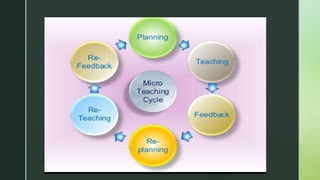
 MICRO TEACHING CYCLE
 The training procedure for one teaching skill is called as micro teaching cycle.
In this cycle, the teacher trainee chooses a specific skill, prepares a micro lesson
plan, and teaches a small group of students for a duration of 5-10 minutes. The
teacher educator and the peer observers rate the lesson using an observation
schedule or an appraisal guide.
 On the basis of the performance appraisal, immediate feedback is given to the
teacher trainee by the observers. The trainee thus modifies her/his lesson and re-
teaches another set of students (peer/real students). This lesson is also rated by
the supervisor and other observers and then analyze and discuss with trainee.
This process is repeated till the trainee attains adequate level of the skill.
z
 STEPS IN MICRO TEACHING CYCLE
1. Planning: This involves the selection of the skill to be practiced, awareness of the
components of the skill, selection of suitable concept and the writing of micro lesson
plan.
2. Teaching: The trainee teaches the lesson in the Micro teaching setting. NCERT has
suggested the following setting for micro teaching.
 Time: 6 mts
 Number of students: 5 to 10 (real pupils or preferably peers)
 Supervisor: Teacher Educator/ one or two peers
 The lesson is being observed by the teacher educator and/or peers or video/audio
recorded.
z
4. Feedback: The observers analyse the performance and discuss it with the teacher trainee
on the basis of their ratings using appraisal guide. The supervisor can give feedback to
develop the skill.
5. Re-plan: In the light of the feedback received from the supervisor and peer observers' the
teacher trainee re-plans her micro lesson plan or modifying the existing one.
6. Re-teach: The teacher trainee re teaches the revised lesson to another, but comparable
group of students. The supervisor checks to see whether there is any improvement in skill
attainment.
7. Re-feedback: The supervisor assesses the lesson once again and provides the feedback to
the trainee. This process repeats until the trainee acquires the required level of competency.
z
z
1. Skill of Introducing the Lesson
 It is defined as the proficiency in the use of verbal and non-verbal
behaviours, teaching aids and appropriate devices for making the pupils
realize the need of studying the lesson by establishing positive and affective
rapport with them.
 This skill involves the following component behaviours:
i. The student teacher is able to utilize previous knowledge and experiences of
his learners
ii. He is able to maintain continuity of ideas and information in the introduction
of the lesson
z
I. Utilization of previous experiences: The new learning is to be based
or completed with the help of previous learning, knowledge or
experiences acquired through formal or informal education and
direct or indirect experiences.
 Knowledge of the subject or subjects acquired by the pupils in the
previous classes or days of the present session
 General awareness of the pupil with their physical and social
environment
 The devices and techniques of exploring the previous knowledge
 The techniques of establishing link between the previous and new
knowledge
 The ability of creating situations in the class for utilization of
previous experiences
z
II. Use of appropriate devices/techniques: A teacher should
essentially acquire the ability of using appropriate devices or
techniques for introducing a lesson. The various devices
used for the purpose include: 1) questioning 2) narration,
description or lecturing 3) story telling 4) using audio-visual
aids 5) demonstration or experimentation 6) dramatization or
role playing 7) visits or excursions and 8) use of examples,
analogies and similarities.
z
III. Maintenance of continuity: Proper introduction requires
continuity in the ideas or information presented to the pupils.
There should be a logical sequence between the main parts of
the introduction. One question/statement or activity on the part
of the teacher should lead to the other related ones in a chain
of continuity creating the need of studying the lesson.
z
IV. Relevance of verbal or non-verbal behaviour: A teacher should try to
observe relevancy in his behaviour. What is to be stated, asked,
demonstrated, dramatized, or illustrated should contribute maximum
towards the introduction of lesson in some of the following ways:
 (i) Testing of the previous knowledge.
 (ii) Utilization of the past experiences.
 iii) Establishing cognitive and affective rapport with the pupils
 (iv) Making the pupils feel the need of studying the lesson.
 v) Pinpointing the aims of lesson.
z
 For providing feedback on the teaching performance, the micro-lesson
given by a trainee is supervised by the fellow trainees or teacher educator.
For the purpose of obtaining objectivity and reliability in the observation
process, it is always better to lay down an observation schedule and get
the supervisors trained in its use:
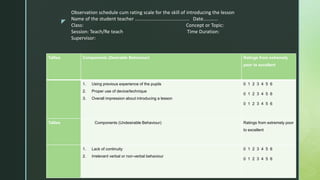
 The observation schedule-cum-rating scale for the skill of introducing a
lesson may consist of three columns. The first column indicates the tallies
against the occurrence of the different component behaviours of the skill.
The second column specifies the components of the skill. The third one
contains a seven-point rating scale for each of the components.

z
Tallies Components (Desirable Behaviour) Ratings from extremely
poor to excellent
1. Using previous experience of the pupils
2. Proper use of device/technique
3. Overall impression about introducing a lesson
0 1 2 3 4 5 6
0 1 2 3 4 5 6
0 1 2 3 4 5 6
Tallies Components (Undesirable Behaviour) Ratings from extremely poor
to excellent
1. Lack of continuity
2. Irrelevant verbal or non-verbal behaviour
0 1 2 3 4 5 6
0 1 2 3 4 5 6
Observation schedule cum rating scale for the skill of introducing the lesson
Name of the student teacher …...................................... Date...........
Class: Concept or Topic:
Session: Teach/Re teach Time Duration:
Supervisor:
z
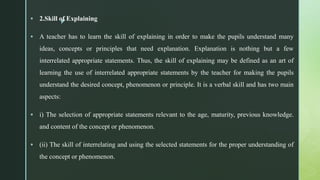
 2.Skill of Explaining
 A teacher has to learn the skill of explaining in order to make the pupils understand many
ideas, concepts or principles that need explanation. Explanation is nothing but a few
interrelated appropriate statements. Thus, the skill of explaining may be defined as an art of
learning the use of interrelated appropriate statements by the teacher for making the pupils
understand the desired concept, phenomenon or principle. It is a verbal skill and has two main
aspects:
 i) The selection of appropriate statements relevant to the age, maturity, previous knowledge.
and content of the concept or phenomenon.
 (ii) The skill of interrelating and using the selected statements for the proper understanding of
the concept or phenomenon.
z
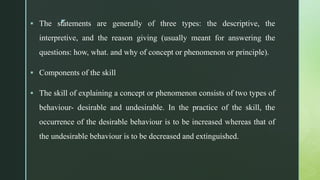
 The statements are generally of three types: the descriptive, the
interpretive, and the reason giving (usually meant for answering the
questions: how, what. and why of concept or phenomenon or principle).
 Components of the skill
 The skill of explaining a concept or phenomenon consists of two types of
behaviour- desirable and undesirable. In the practice of the skill, the
occurrence of the desirable behaviour is to be increased whereas that of
the undesirable behaviour is to be decreased and extinguished.
z
Desirable Behaviours Undesirable Behaviours
1. Using appropriate beginning and concluding statements.
2. Using explaining links.
3. Covering essential points.
4 Testing pupils' understanding,
Using irrelevant statements.
Lacking continuity in statements.
Lacking fluency.
Using inappropriate vocabulary, vague words and phrases.
z
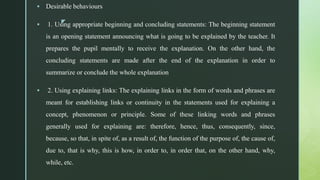
 Desirable behaviours
 1. Using appropriate beginning and concluding statements: The beginning statement
is an opening statement announcing what is going to be explained by the teacher. It
prepares the pupil mentally to receive the explanation. On the other hand, the
concluding statements are made after the end of the explanation in order to
summarize or conclude the whole explanation
 2. Using explaining links: The explaining links in the form of words and phrases are
meant for establishing links or continuity in the statements used for explaining a
concept, phenomenon or principle. Some of these linking words and phrases
generally used for explaining are: therefore, hence, thus, consequently, since,
because, so that, in spite of, as a result of, the function of the purpose of, the cause of,
due to, that is why, this is how, in order to, in order that, on the other hand, why,
while, etc.
z
 3. Covering essential points: The explanation given for the understanding of a given
concept or principle should be as complete as possible. The completeness is determined
by the scope of the concept or principle as specified in the instructional objectives. It
should aim for covering all the essential points leading to clear understanding of the
desired concept or principle.
 4.Testing pupil's understanding: This involves asking appropriate questions to pupils to
ascertain whether the purpose of explaining the concept or principle has been achieved
or not.
z
 Undesirable behaviours
 1. Using irrelevant statements: This behaviour covers the statements not related to the
concept or principle being explained. These statements, instead of helping the pupil to
understand the concept, create confusion and distract the attention of the pupil
 2. Lacking continuity in statements: It involves a missing link or break in the logical
sequence of the interrelated statement by the teacher for explaining a concept or
phenomenon
 3. Lacking fluency: Fluency is related to the flow of uninterrupted statements for
explaining a concept or principle. In case a teacher lacks fluency, he may be seen to show
following types of behaviours:
 .
z
 Does not speak clearly.
 Utters incomplete or half sentences
 Tries to reformulate or correct his statements midway of a sentence or a statement
 Uses fumbling ideas or inappropriate words or statements.
 4. Using inappropriate vocabulary, vague words and phrases: This behaviour consists of the
following aspects: (i) Use of vocabulary not known to pupils or inappropriate to their age,
grade maturity level (ii) Use of certain vague words and phrases (such as, in fact, somewhat,
you see, you know, I mean, actually, probably, perhaps, and almost a little) obstructing the
understanding of an explanation

Microteaching

  • 1.
  • 2.
    z MICRO TEACHING Microteaching is a training technique in which a student teacher is required to teach a single concept using a specified teaching skill on a small group of pupils in a short duration of time. Micro teaching is practiced in terms of desired teaching skills. A skill cannot become one’s own skill unless it is practiced periodically. Dwight W. Allen of Stanford University first adopted the term Micro teaching in 1963. Micro teaching is an important technique which imparts intensive training in the component skills of teaching to the teacher trainees.
  • 3.
    z  Definitions  MC Knight (1931): Micro teaching is a scaled down teaching encounter designed to develop new skills and refine old ones.  Passi B K. and Lalitha M S (1936): Micro teaching is a training technique which requires student teachers to teach a single concept using specified teaching skill to a small number of pupils in a short duration of time.
  • 4.
    z  MICRO TEACHINGCYCLE  The training procedure for one teaching skill is called as micro teaching cycle. In this cycle, the teacher trainee chooses a specific skill, prepares a micro lesson plan, and teaches a small group of students for a duration of 5-10 minutes. The teacher educator and the peer observers rate the lesson using an observation schedule or an appraisal guide.  On the basis of the performance appraisal, immediate feedback is given to the teacher trainee by the observers. The trainee thus modifies her/his lesson and re- teaches another set of students (peer/real students). This lesson is also rated by the supervisor and other observers and then analyze and discuss with trainee. This process is repeated till the trainee attains adequate level of the skill.
  • 5.
    z  STEPS INMICRO TEACHING CYCLE 1. Planning: This involves the selection of the skill to be practiced, awareness of the components of the skill, selection of suitable concept and the writing of micro lesson plan. 2. Teaching: The trainee teaches the lesson in the Micro teaching setting. NCERT has suggested the following setting for micro teaching.  Time: 6 mts  Number of students: 5 to 10 (real pupils or preferably peers)  Supervisor: Teacher Educator/ one or two peers  The lesson is being observed by the teacher educator and/or peers or video/audio recorded.
  • 6.
    z 4. Feedback: Theobservers analyse the performance and discuss it with the teacher trainee on the basis of their ratings using appraisal guide. The supervisor can give feedback to develop the skill. 5. Re-plan: In the light of the feedback received from the supervisor and peer observers' the teacher trainee re-plans her micro lesson plan or modifying the existing one. 6. Re-teach: The teacher trainee re teaches the revised lesson to another, but comparable group of students. The supervisor checks to see whether there is any improvement in skill attainment. 7. Re-feedback: The supervisor assesses the lesson once again and provides the feedback to the trainee. This process repeats until the trainee acquires the required level of competency.
  • 7.
  • 8.
    z 1. Skill ofIntroducing the Lesson  It is defined as the proficiency in the use of verbal and non-verbal behaviours, teaching aids and appropriate devices for making the pupils realize the need of studying the lesson by establishing positive and affective rapport with them.  This skill involves the following component behaviours: i. The student teacher is able to utilize previous knowledge and experiences of his learners ii. He is able to maintain continuity of ideas and information in the introduction of the lesson
  • 9.
    z I. Utilization ofprevious experiences: The new learning is to be based or completed with the help of previous learning, knowledge or experiences acquired through formal or informal education and direct or indirect experiences.  Knowledge of the subject or subjects acquired by the pupils in the previous classes or days of the present session  General awareness of the pupil with their physical and social environment  The devices and techniques of exploring the previous knowledge  The techniques of establishing link between the previous and new knowledge  The ability of creating situations in the class for utilization of previous experiences
  • 10.
    z II. Use ofappropriate devices/techniques: A teacher should essentially acquire the ability of using appropriate devices or techniques for introducing a lesson. The various devices used for the purpose include: 1) questioning 2) narration, description or lecturing 3) story telling 4) using audio-visual aids 5) demonstration or experimentation 6) dramatization or role playing 7) visits or excursions and 8) use of examples, analogies and similarities.
  • 11.
    z III. Maintenance ofcontinuity: Proper introduction requires continuity in the ideas or information presented to the pupils. There should be a logical sequence between the main parts of the introduction. One question/statement or activity on the part of the teacher should lead to the other related ones in a chain of continuity creating the need of studying the lesson.
  • 12.
    z IV. Relevance ofverbal or non-verbal behaviour: A teacher should try to observe relevancy in his behaviour. What is to be stated, asked, demonstrated, dramatized, or illustrated should contribute maximum towards the introduction of lesson in some of the following ways:  (i) Testing of the previous knowledge.  (ii) Utilization of the past experiences.  iii) Establishing cognitive and affective rapport with the pupils  (iv) Making the pupils feel the need of studying the lesson.  v) Pinpointing the aims of lesson.
  • 13.
    z  For providingfeedback on the teaching performance, the micro-lesson given by a trainee is supervised by the fellow trainees or teacher educator. For the purpose of obtaining objectivity and reliability in the observation process, it is always better to lay down an observation schedule and get the supervisors trained in its use:  The observation schedule-cum-rating scale for the skill of introducing a lesson may consist of three columns. The first column indicates the tallies against the occurrence of the different component behaviours of the skill. The second column specifies the components of the skill. The third one contains a seven-point rating scale for each of the components. 
  • 14.
    z Tallies Components (DesirableBehaviour) Ratings from extremely poor to excellent 1. Using previous experience of the pupils 2. Proper use of device/technique 3. Overall impression about introducing a lesson 0 1 2 3 4 5 6 0 1 2 3 4 5 6 0 1 2 3 4 5 6 Tallies Components (Undesirable Behaviour) Ratings from extremely poor to excellent 1. Lack of continuity 2. Irrelevant verbal or non-verbal behaviour 0 1 2 3 4 5 6 0 1 2 3 4 5 6 Observation schedule cum rating scale for the skill of introducing the lesson Name of the student teacher …...................................... Date........... Class: Concept or Topic: Session: Teach/Re teach Time Duration: Supervisor:
  • 15.
    z  2.Skill ofExplaining  A teacher has to learn the skill of explaining in order to make the pupils understand many ideas, concepts or principles that need explanation. Explanation is nothing but a few interrelated appropriate statements. Thus, the skill of explaining may be defined as an art of learning the use of interrelated appropriate statements by the teacher for making the pupils understand the desired concept, phenomenon or principle. It is a verbal skill and has two main aspects:  i) The selection of appropriate statements relevant to the age, maturity, previous knowledge. and content of the concept or phenomenon.  (ii) The skill of interrelating and using the selected statements for the proper understanding of the concept or phenomenon.
  • 16.
    z  The statementsare generally of three types: the descriptive, the interpretive, and the reason giving (usually meant for answering the questions: how, what. and why of concept or phenomenon or principle).  Components of the skill  The skill of explaining a concept or phenomenon consists of two types of behaviour- desirable and undesirable. In the practice of the skill, the occurrence of the desirable behaviour is to be increased whereas that of the undesirable behaviour is to be decreased and extinguished.
  • 17.
    z Desirable Behaviours UndesirableBehaviours 1. Using appropriate beginning and concluding statements. 2. Using explaining links. 3. Covering essential points. 4 Testing pupils' understanding, Using irrelevant statements. Lacking continuity in statements. Lacking fluency. Using inappropriate vocabulary, vague words and phrases.
  • 18.
    z  Desirable behaviours 1. Using appropriate beginning and concluding statements: The beginning statement is an opening statement announcing what is going to be explained by the teacher. It prepares the pupil mentally to receive the explanation. On the other hand, the concluding statements are made after the end of the explanation in order to summarize or conclude the whole explanation  2. Using explaining links: The explaining links in the form of words and phrases are meant for establishing links or continuity in the statements used for explaining a concept, phenomenon or principle. Some of these linking words and phrases generally used for explaining are: therefore, hence, thus, consequently, since, because, so that, in spite of, as a result of, the function of the purpose of, the cause of, due to, that is why, this is how, in order to, in order that, on the other hand, why, while, etc.
  • 19.
    z  3. Coveringessential points: The explanation given for the understanding of a given concept or principle should be as complete as possible. The completeness is determined by the scope of the concept or principle as specified in the instructional objectives. It should aim for covering all the essential points leading to clear understanding of the desired concept or principle.  4.Testing pupil's understanding: This involves asking appropriate questions to pupils to ascertain whether the purpose of explaining the concept or principle has been achieved or not.
  • 20.
    z  Undesirable behaviours 1. Using irrelevant statements: This behaviour covers the statements not related to the concept or principle being explained. These statements, instead of helping the pupil to understand the concept, create confusion and distract the attention of the pupil  2. Lacking continuity in statements: It involves a missing link or break in the logical sequence of the interrelated statement by the teacher for explaining a concept or phenomenon  3. Lacking fluency: Fluency is related to the flow of uninterrupted statements for explaining a concept or principle. In case a teacher lacks fluency, he may be seen to show following types of behaviours:  .
  • 21.
    z  Does notspeak clearly.  Utters incomplete or half sentences  Tries to reformulate or correct his statements midway of a sentence or a statement  Uses fumbling ideas or inappropriate words or statements.  4. Using inappropriate vocabulary, vague words and phrases: This behaviour consists of the following aspects: (i) Use of vocabulary not known to pupils or inappropriate to their age, grade maturity level (ii) Use of certain vague words and phrases (such as, in fact, somewhat, you see, you know, I mean, actually, probably, perhaps, and almost a little) obstructing the understanding of an explanation