
Microservices Server – MSS
Workshop
Edgar Silva
edgar @wso2.com
o This workshop is intend to cover how to use the WSO2
Microservices Server – MSS, we will cover some basic
overview about some concepts, but we strongly
recommend you look for more detailed basics about
Microservices.
o Recommended reading:
o http://nginx.com/blog/introduction-to-microservices/
o https://www.nginx.com/blog/building-microservices-using-an-api-
gateway/
2
3
4
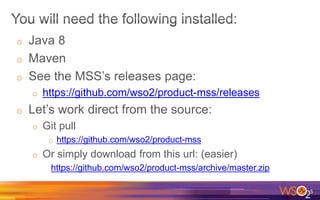
Basics Pre-Reqs
o Java 8
o Maven
o See the MSS’s releases page:
o https://github.com/wso2/product-mss/releases
o Let’s work direct from the source:
o Git pull
o https://github.com/wso2/product-mss
o Or simply download from this url: (easier)
https://github.com/wso2/product-mss/archive/master.zip
5
6
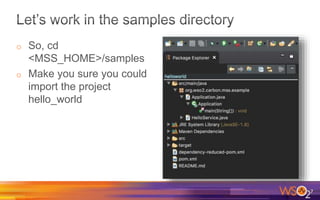
o So, cd
<MSS_HOME>/samples
o Make you sure you could
import the project
hello_world
7
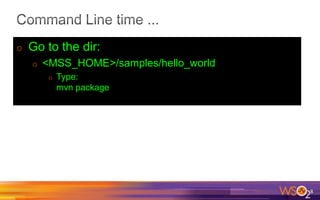
o Go to the dir:
o <MSS_HOME>/samples/hello_world
o Type:
mvn package
8
o After Maven process
o ( be pacient while downloading  )
o What is happening:
o The pom.xml inside the sample, inherits the dependencies
from the root’s pom.xml, that’s why you don’t need to worry
with this process
o In a few (seconds) you will have a hello_service....jar into
your target folder.
9
10
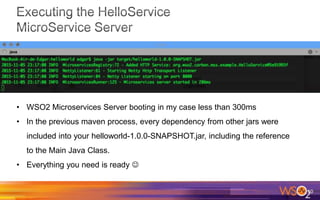
• WSO2 Microservices Server booting in my case less than 300ms
• In the previous maven process, every dependency from other jars were
included into your helloworld-1.0.0-SNAPSHOT.jar, including the reference
to the Main Java Class.
• Everything you need is ready 
11
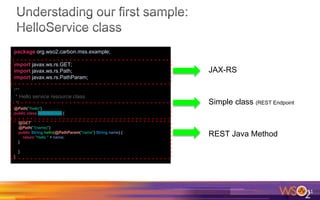
package org.wso2.carbon.mss.example;
import javax.ws.rs.GET;
import javax.ws.rs.Path;
import javax.ws.rs.PathParam;
/**
* Hello service resource class.
*/
@Path("/hello")
public class HelloService {
@GET
@Path("/{name}")
public String hello(@PathParam("name") String name) {
return "Hello " + name;
}
}
}
JAX-RS
Simple class (REST Endpoint
REST Java Method
o The simplest Java Class startup
o See the main method:
12
public class Application {
public static void main(String[] args) {
new MicroservicesRunner()
.deploy(new HelloService())
.start();
}
13
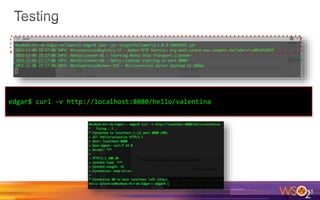
edgar$ curl -v http://localhost:8080/hello/valentina
o Take a look on this:
o http://www.confusedbycode.com/curl/
14
o Thanks @jpviragine for that great tip:
https://github.com/jkbrzt/httpie
o Really great tool, works like cURL, but much better and more user friendly
o Syntax: http <options> service or URL
o But if you prefer to be “roots”, ok, continue if cURL
15
16
public class Application {
public static void main(String[] args) {
new MicroservicesRunner(7888, 8888)
.deploy(new HelloService())
.start();
}
Services exposed through different ports(*)
(*) Default port is 8080 when no ports are specified
17
1. Enter in the <mss_home>/samples/stockquote-
service
2. mvn package
3. java -jar target/stockquote-service-1.0.0-
SNAPSHOT.jar
18
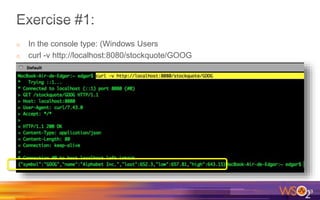
o In the console type: (Windows Users
o curl -v http://localhost:8080/stockquote/GOOG
19
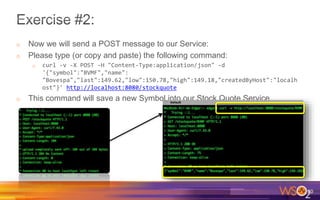
o Now we will send a POST message to our Service:
o Please type (or copy and paste) the following command:
o curl -v -X POST -H "Content-Type:application/json" -d
'{"symbol":"BVMF","name":
"Bovespa","last":149.62,"low":150.78,"high":149.18,"createdByHost":"localh
ost"}' http://localhost:8080/stockquote
o This command will save a new Symbol into our Stock Quote Service
20
o You had used:
o Java 8 + maven for building our samples and
exercises
o Executed Microservices with basic jar –jar approach
o You saw how easy you can build REST Services and
deploy them into your Mic’service Server (powered by
WSO2)
21
22
o Several approaches for a “decoupled SOA”
o In this tutorial we will use the “Container-based
approach”
o Microservices are about:
o Lighter
o Business Need Oriented
o Composable
23
24
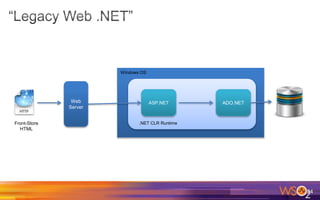
Web
Server
ASP.NET ADO.NET
Windows OS
.NET CLR RuntimeFront-Store
HTML
25
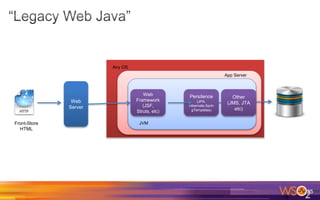
Web
Server
Web
Framework
(JSF,
Struts, etc)
Persitence
(JPA,
Hibernate,Sprin
gTemplates)
Any OS
JVM
Other
(JMS, JTA
etc)
App Server
Front-Store
HTML
26
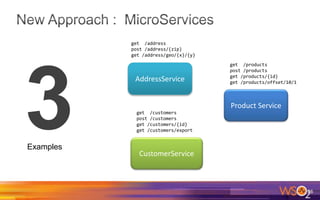
Product Service
get /products
post /products
get /products/{id}
get /products/offset/10/1
CustomerService
get /customers
post /customers
get /customers/{id}
get /customers/export
AddressService
get /address
post /address/{zip}
get /address/geo/{x}/{y}
3Examples
27
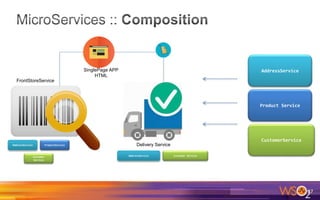
Product Service
CustomerService
AddressService
AddressService ProductService
Customer
Service
AddressService Customer Service
SinglePage APP
HTML
FrontStoreService
Delivery Service
o Quick deployments
o You are deploying a loosely-coupled, modular
component only 
o Not a huge EAR with dozens of Jars as you used to do in a
monolithic enterprise App
28
29
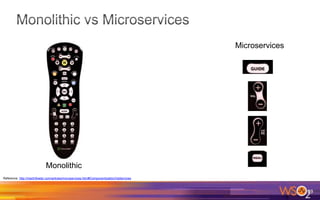
Monolithic
Microservices
Reference: http://martinfowler.com/articles/microservices.html#ComponentizationViaServices
30
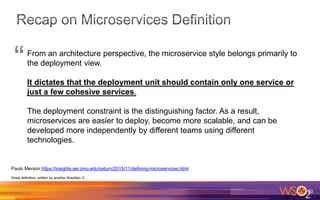
Paulo Merson https://insights.sei.cmu.edu/saturn/2015/11/defining-microservices.html
Great definition, written by another Brazilian 
From an architecture perspective, the microservice style belongs primarily to
the deployment view.
It dictates that the deployment unit should contain only one service or
just a few cohesive services.
The deployment constraint is the distinguishing factor. As a result,
microservices are easier to deploy, become more scalable, and can be
developed more independently by different teams using different
technologies.
“
o Benefits of using microservices:
o Deployability
o Availability
o Scalability
o Modifiability
o Management
31
Paulo Merson https://insights.sei.cmu.edu/saturn/2015/11/microservices-beyond-the-hype-what-you-gain-and-what-you-lose.html
( Great post )
o I would add:
o Deployability
o Availability (Auto-Scaling via Containers)
o Analytics
o Scalability
o Modifiability
o Management
32
Paulo Merson https://insights.sei.cmu.edu/saturn/2015/11/microservices-beyond-the-hype-what-you-gain-and-what-you-lose.html
33
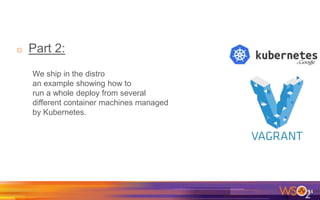
o Part 2:
We ship in the distro
an example showing how to
run a whole deploy from several
different container machines managed
by Kubernetes.
34
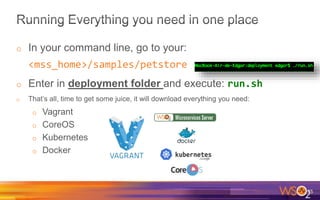
o In your command line, go to your:
<mss_home>/samples/petstore
o Enter in deployment folder and execute: run.sh
o That’s all, time to get some juice, it will download everything you need:
o Vagrant
o CoreOS
o Kubernetes
o Docker
35
o https://github.com/wso2/product-
mss/tree/master/samples/petstore/deployment/kubernete
s-vagrant-coreos-cluster
o Disclaimer: This tutorial is focused on WSO2 Micro
Services Server – MSS, and some introduction to the
basics on Kubernetes is strongly recommended before
you move forward on this tutorial.
36
37
This step will get a few minutes, according to your internet and machine,
So get relaxed while you can enjoy some “Matrix-like” in your console
http://thenextweb.com/wp-content/blogs.dir/1/files/2013/11/relax-at-work.jpg
 Double check if your JAVA_HOME is Java 8
 Please , if you are using MacOS, make sure you that you have wget
installed.
 Recommend you use brew install wget
 If you get errors communicating with Kubernetes nodes, please add this
variable before execute run.sh:
 export KUBERNETES_MASTER=http://172.17.8.101:8080
 That will be the default Kubernetes UI Console and API Address
38
39
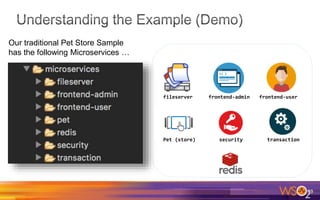
Our traditional Pet Store Sample
has the following Microservices …
fileserver frontend-admin frontend-user
Pet (store) transactionsecurity
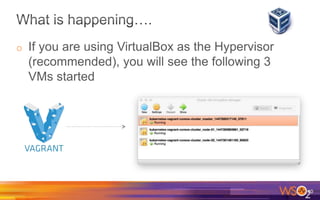
o If you are using VirtualBox as the Hypervisor
(recommended), you will see the following 3
VMs started
40
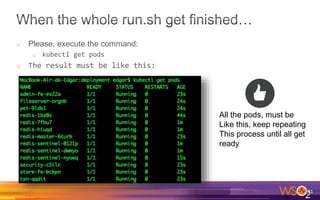
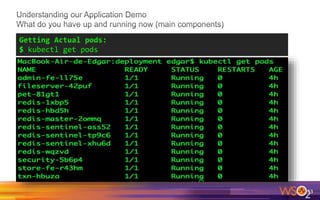
o Please, execute the command:
o kubectl get pods
o The result must be like this:
41
All the pods, must be
Like this, keep repeating
This process until all get
ready
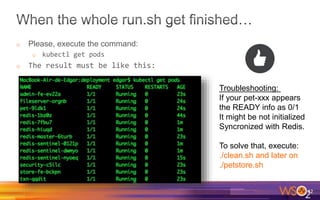
o Please, execute the command:
o kubectl get pods
o The result must be like this:
42
Troubleshooting:
If your pet-xxx appears
the READY info as 0/1
It might be not initialized
Syncronized with Redis.
To solve that, execute:
./clean.sh and later on
./petstore.sh
o Kubernetes UI
o Nodes
o Services
o Pods
o General Info
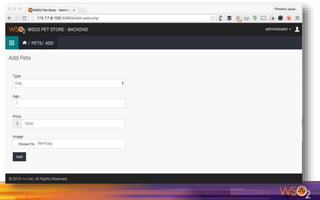
o Pet Store Admin (PHP App)
o Pet Store Site (PHP App)
43
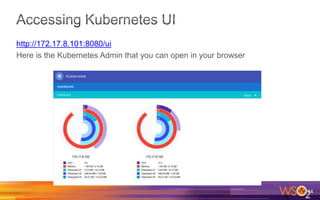
http://172.17.8.101:8080/ui
Here is the Kubernetes Admin that you can open in your browser
44
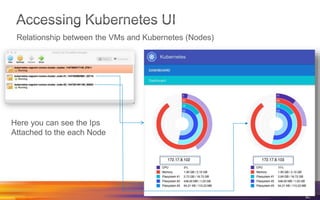
Relationship between the VMs and Kubernetes (Nodes)
45
Here you can see the Ips
Attached to the each Node
46
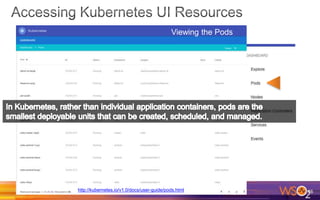
Viewing the Pods
http://kubernetes.io/v1.0/docs/user-guide/pods.html
47
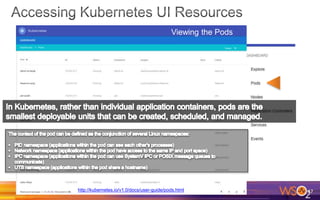
Viewing the Pods
http://kubernetes.io/v1.0/docs/user-guide/pods.html
48
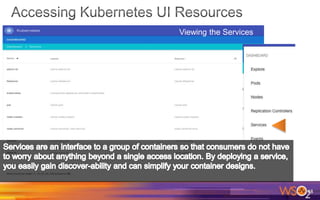
Viewing the Services
49
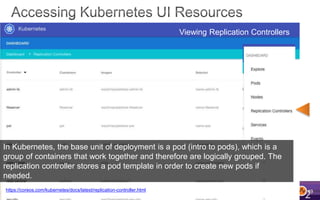
Viewing Replication Controllers
In Kubernetes, the base unit of deployment is a pod (intro to pods), which is a
group of containers that work together and therefore are logically grouped. The
replication controller stores a pod template in order to create new pods if
needed.
https://coreos.com/kubernetes/docs/latest/replication-controller.html
50
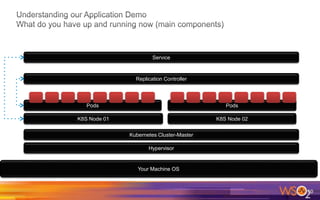
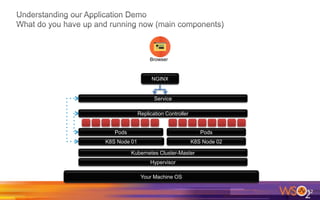
Your Machine OS
Hypervisor
Kubernetes Cluster-Master
K8S Node 01 K8S Node 02
Pods Pods
Replication Controller
Service
51
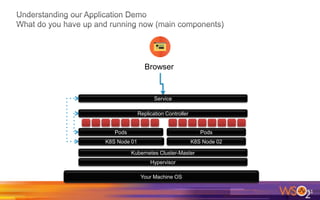
Your Machine OS
Hypervisor
Kubernetes Cluster-Master
K8S Node 01 K8S Node 02
Pods Pods
Replication Controller
Service
Browser
52
Your Machine OS
Hypervisor
Kubernetes Cluster-Master
K8S Node 01 K8S Node 02
Pods Pods
Replication Controller
Service
Browser
NGINX
53
Getting Actual pods:
$ kubectl get pods
54
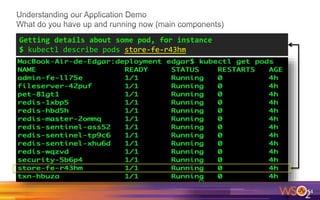
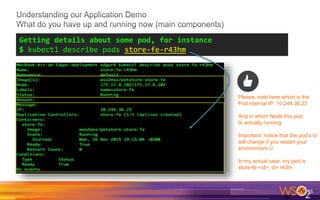
Getting details about some pod, for instance
$ kubectl describe pods store-fe-r43hm
55
Getting details about some pod, for instance
$ kubectl describe pods store-fe-r43hm
Please, note here which is the
Pod internal IP: 10.244.36.23
And in which Node this pod
Is actually running
Important: notice that the pod’s id
will change if you restart your
environment 
In my actual case, my pod is
store-fe-<id>, id= r43m
56
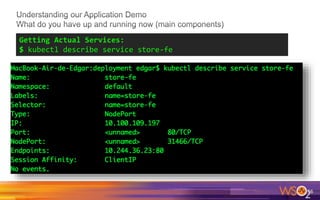
Getting Actual Services:
$ kubectl describe service store-fe
57
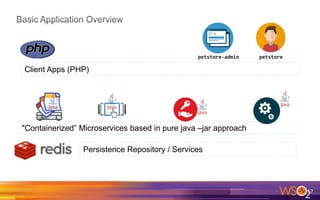
Persistence Repository / Services
"Containerized” Microservices based in pure java –jar approach
Client Apps (PHP)
petstore-admin petstore
58
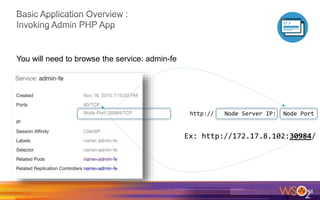
You will need to browse the service: admin-fe
http:// Node Server IP: Node Port
Ex: http://172.17.8.102:30984/
59
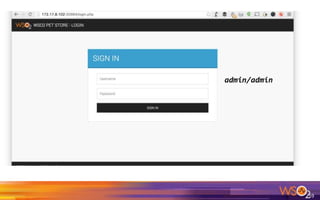
admin/admin
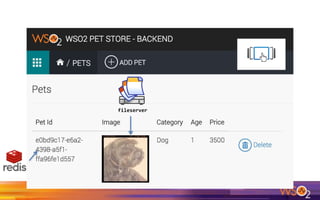
fileserver
63
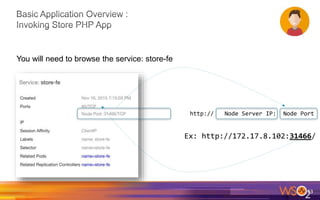
You will need to browse the service: store-fe
http:// Node Server IP: Node Port
Ex: http://172.17.8.102:31466/
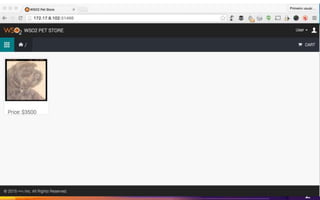
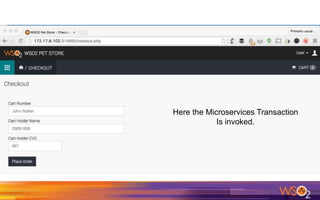
Here the Microservices Transaction
Is invoked.
o Executing the petstore sample
o Understanding the basics from Kubernetes and
its concepts, such as pods, services and
Replication Controller.
o Executing the Services and Apps
o Proposed Lab:
o Execute the previous samples from Part1 in
Kubernetes + Docker
67
68
o Please go to : http://wso2.com/products/data-analytics-server/
o Download the product
o Install the product:
1. Unzip
2. That’s all
3. Let’s call your installation destination folder as DAS_HOME from now
on
o MySQL for this sample is also required
69
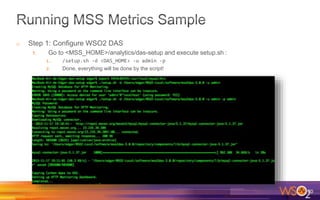
o Step 1: Configure WSO2 DAS
1. Go to <MSS_HOME>/analytics/das-setup and execute setup.sh :
1. /setup.sh -d <DAS_HOME> -u admin -p
2. Done, everything will be done by the script!
70
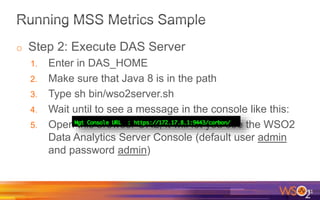
o Step 2: Execute DAS Server
1. Enter in DAS_HOME
2. Make sure that Java 8 is in the path
3. Type sh bin/wso2server.sh
4. Wait until to see a message in the console like this:
5. Open this browser URL, it will let you see the WSO2
Data Analytics Server Console (default user admin
and password admin)
71
72
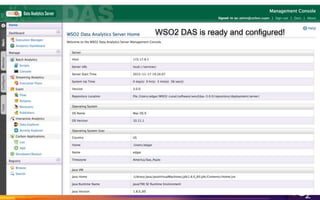
WSO2 DAS is ready and configured!
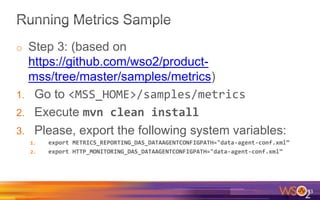
o Step 3: (based on
https://github.com/wso2/product-
mss/tree/master/samples/metrics)
1. Go to <MSS_HOME>/samples/metrics
2. Execute mvn clean install
3. Please, export the following system variables:
1. export METRICS_REPORTING_DAS_DATAAGENTCONFIGPATH="data-agent-conf.xml”
2. export HTTP_MONITORING_DAS_DATAAGENTCONFIGPATH="data-agent-conf.xml”
73
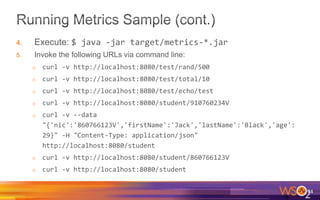
4. Execute: $ java -jar target/metrics-*.jar
5. Invoke the following URLs via command line:
o curl -v http://localhost:8080/test/rand/500
o curl -v http://localhost:8080/test/total/10
o curl -v http://localhost:8080/test/echo/test
o curl -v http://localhost:8080/student/910760234V
o curl -v --data
"{'nic':'860766123V','firstName':'Jack','lastName':'Black','age':
29}" -H "Content-Type: application/json"
http://localhost:8080/student
o curl -v http://localhost:8080/student/860766123V
o curl -v http://localhost:8080/student
74
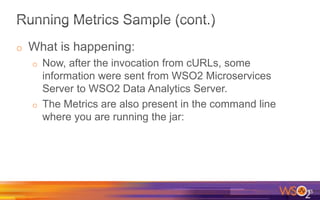
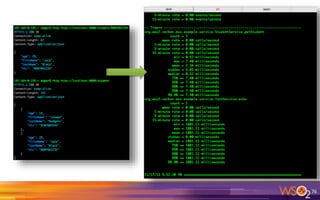
o What is happening:
o Now, after the invocation from cURLs, some
information were sent from WSO2 Microservices
Server to WSO2 Data Analytics Server.
o The Metrics are also present in the command line
where you are running the jar:
75
76
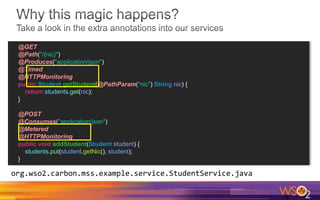
@GET
@Path("/{nic}")
@Produces("application/json")
@Timed
@HTTPMonitoring
public Student getStudent(@PathParam("nic") String nic) {
return students.get(nic);
}
@POST
@Consumes("application/json")
@Metered
@HTTPMonitoring
public void addStudent(Student student) {
students.put(student.getNic(), student);
}
org.wso2.carbon.mss.example.service.StudentService.java
78
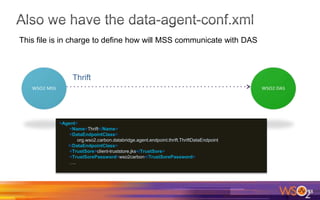
<Agent>
<Name>Thrift</Name>
<DataEndpointClass>
org.wso2.carbon.databridge.agent.endpoint.thrift.ThriftDataEndpoint
</DataEndpointClass>
<TrustSore>client-truststore.jks</TrustSore>
<TrustSorePassword>wso2carbon</TrustSorePassword>
….
Thrift
This file is in charge to define how will MSS communicate with DAS
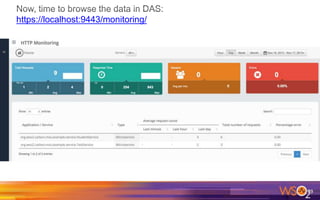
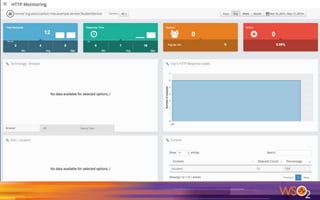
https://localhost:9443/monitoring/
79
o http://kubernetes.io/v1.1/
o https://www.digitalocean.com/community/tutorials/an-introduction-to-
kubernetes
o https://insights.sei.cmu.edu/saturn/2015/11/defining-
microservices.html
o http://www.slideshare.net/afkham_azeez/wso2con-
2015usintroductiontomssv2?related=1
o http://www.slideshare.net/afkham_azeez/wso2conus-2015-
introduction-to-wso2-microservices-server-mss?related=2
82
o http://wso2.com/products/microservices-server/
o Lightweight and fast runtime
o 6MB pack size
o Starts within 400ms
o Based on the new WSO2 Carbon 5.0 kernel
o ~25MB memory consumption for the WSO2 MSS framework
o Simple development, deployment, and monitoring
o WSO2 Developer Studio-based tooling for generating microservices projects starting from a Swagger API
definition
o Built-in metrics and analytics APIs via WSO2 Data Analytics Server
o Tracing of requests using a unique message ID
o High scalability and reliability
o Transport based on Netty 4.0
o JWT-based security
o Custom interceptors
o Streaming input and streaming output support
o Comprehensive samples demonstrating how to develop microservices applications
83
o Tutorial done!
o Next steps:
o Keep watching how WSO2 MSS will evolve
o Don’t miss our upcoming Webinars covering this and
even more
84
o Please, if you need to understand more, or want
to talk to one of our specialists to help you and
your company’s projects, please contact us
here:
o http://wso2.com/contact/
85
86
@jedgarsilva
http://www.wso2.com
Edgar Silva
edgar@wso2.com
Contact us !

Microservices Server - MSS Workshop

  • 1.
    Microservices Server –MSS Workshop Edgar Silva edgar @wso2.com
  • 2.
    o This workshopis intend to cover how to use the WSO2 Microservices Server – MSS, we will cover some basic overview about some concepts, but we strongly recommend you look for more detailed basics about Microservices. o Recommended reading: o http://nginx.com/blog/introduction-to-microservices/ o https://www.nginx.com/blog/building-microservices-using-an-api- gateway/ 2
  • 3.
  • 4.
  • 5.
    o Java 8 oMaven o See the MSS’s releases page: o https://github.com/wso2/product-mss/releases o Let’s work direct from the source: o Git pull o https://github.com/wso2/product-mss o Or simply download from this url: (easier) https://github.com/wso2/product-mss/archive/master.zip 5
  • 6.
  • 7.
    o So, cd <MSS_HOME>/samples oMake you sure you could import the project hello_world 7
  • 8.
    o Go tothe dir: o <MSS_HOME>/samples/hello_world o Type: mvn package 8
  • 9.
    o After Mavenprocess o ( be pacient while downloading  ) o What is happening: o The pom.xml inside the sample, inherits the dependencies from the root’s pom.xml, that’s why you don’t need to worry with this process o In a few (seconds) you will have a hello_service....jar into your target folder. 9
  • 10.
    10 • WSO2 MicroservicesServer booting in my case less than 300ms • In the previous maven process, every dependency from other jars were included into your helloworld-1.0.0-SNAPSHOT.jar, including the reference to the Main Java Class. • Everything you need is ready 
  • 11.
    11 package org.wso2.carbon.mss.example; import javax.ws.rs.GET; importjavax.ws.rs.Path; import javax.ws.rs.PathParam; /** * Hello service resource class. */ @Path("/hello") public class HelloService { @GET @Path("/{name}") public String hello(@PathParam("name") String name) { return "Hello " + name; } } } JAX-RS Simple class (REST Endpoint REST Java Method
  • 12.
    o The simplestJava Class startup o See the main method: 12 public class Application { public static void main(String[] args) { new MicroservicesRunner() .deploy(new HelloService()) .start(); }
  • 13.
    13 edgar$ curl -vhttp://localhost:8080/hello/valentina
  • 14.
    o Take alook on this: o http://www.confusedbycode.com/curl/ 14
  • 15.
    o Thanks @jpviraginefor that great tip: https://github.com/jkbrzt/httpie o Really great tool, works like cURL, but much better and more user friendly o Syntax: http <options> service or URL o But if you prefer to be “roots”, ok, continue if cURL 15
  • 16.
    16 public class Application{ public static void main(String[] args) { new MicroservicesRunner(7888, 8888) .deploy(new HelloService()) .start(); } Services exposed through different ports(*) (*) Default port is 8080 when no ports are specified
  • 17.
  • 18.
    1. Enter inthe <mss_home>/samples/stockquote- service 2. mvn package 3. java -jar target/stockquote-service-1.0.0- SNAPSHOT.jar 18
  • 19.
    o In theconsole type: (Windows Users o curl -v http://localhost:8080/stockquote/GOOG 19
  • 20.
    o Now wewill send a POST message to our Service: o Please type (or copy and paste) the following command: o curl -v -X POST -H "Content-Type:application/json" -d '{"symbol":"BVMF","name": "Bovespa","last":149.62,"low":150.78,"high":149.18,"createdByHost":"localh ost"}' http://localhost:8080/stockquote o This command will save a new Symbol into our Stock Quote Service 20
  • 21.
    o You hadused: o Java 8 + maven for building our samples and exercises o Executed Microservices with basic jar –jar approach o You saw how easy you can build REST Services and deploy them into your Mic’service Server (powered by WSO2) 21
  • 22.
  • 23.
    o Several approachesfor a “decoupled SOA” o In this tutorial we will use the “Container-based approach” o Microservices are about: o Lighter o Business Need Oriented o Composable 23
  • 24.
  • 25.
  • 26.
    26 Product Service get /products post/products get /products/{id} get /products/offset/10/1 CustomerService get /customers post /customers get /customers/{id} get /customers/export AddressService get /address post /address/{zip} get /address/geo/{x}/{y} 3Examples
  • 27.
  • 28.
    o Quick deployments oYou are deploying a loosely-coupled, modular component only  o Not a huge EAR with dozens of Jars as you used to do in a monolithic enterprise App 28
  • 29.
  • 30.
    30 Paulo Merson https://insights.sei.cmu.edu/saturn/2015/11/defining-microservices.html Greatdefinition, written by another Brazilian  From an architecture perspective, the microservice style belongs primarily to the deployment view. It dictates that the deployment unit should contain only one service or just a few cohesive services. The deployment constraint is the distinguishing factor. As a result, microservices are easier to deploy, become more scalable, and can be developed more independently by different teams using different technologies. “
  • 31.
    o Benefits ofusing microservices: o Deployability o Availability o Scalability o Modifiability o Management 31 Paulo Merson https://insights.sei.cmu.edu/saturn/2015/11/microservices-beyond-the-hype-what-you-gain-and-what-you-lose.html ( Great post )
  • 32.
    o I wouldadd: o Deployability o Availability (Auto-Scaling via Containers) o Analytics o Scalability o Modifiability o Management 32 Paulo Merson https://insights.sei.cmu.edu/saturn/2015/11/microservices-beyond-the-hype-what-you-gain-and-what-you-lose.html
  • 33.
  • 34.
    o Part 2: Weship in the distro an example showing how to run a whole deploy from several different container machines managed by Kubernetes. 34
  • 35.
    o In yourcommand line, go to your: <mss_home>/samples/petstore o Enter in deployment folder and execute: run.sh o That’s all, time to get some juice, it will download everything you need: o Vagrant o CoreOS o Kubernetes o Docker 35
  • 36.
    o https://github.com/wso2/product- mss/tree/master/samples/petstore/deployment/kubernete s-vagrant-coreos-cluster o Disclaimer:This tutorial is focused on WSO2 Micro Services Server – MSS, and some introduction to the basics on Kubernetes is strongly recommended before you move forward on this tutorial. 36
  • 37.
    37 This step willget a few minutes, according to your internet and machine, So get relaxed while you can enjoy some “Matrix-like” in your console http://thenextweb.com/wp-content/blogs.dir/1/files/2013/11/relax-at-work.jpg
  • 38.
     Double checkif your JAVA_HOME is Java 8  Please , if you are using MacOS, make sure you that you have wget installed.  Recommend you use brew install wget  If you get errors communicating with Kubernetes nodes, please add this variable before execute run.sh:  export KUBERNETES_MASTER=http://172.17.8.101:8080  That will be the default Kubernetes UI Console and API Address 38
  • 39.
    39 Our traditional PetStore Sample has the following Microservices … fileserver frontend-admin frontend-user Pet (store) transactionsecurity
  • 40.
    o If youare using VirtualBox as the Hypervisor (recommended), you will see the following 3 VMs started 40
  • 41.
    o Please, executethe command: o kubectl get pods o The result must be like this: 41 All the pods, must be Like this, keep repeating This process until all get ready
  • 42.
    o Please, executethe command: o kubectl get pods o The result must be like this: 42 Troubleshooting: If your pet-xxx appears the READY info as 0/1 It might be not initialized Syncronized with Redis. To solve that, execute: ./clean.sh and later on ./petstore.sh
  • 43.
    o Kubernetes UI oNodes o Services o Pods o General Info o Pet Store Admin (PHP App) o Pet Store Site (PHP App) 43
  • 44.
    http://172.17.8.101:8080/ui Here is theKubernetes Admin that you can open in your browser 44
  • 45.
    Relationship between theVMs and Kubernetes (Nodes) 45 Here you can see the Ips Attached to the each Node
  • 46.
  • 47.
  • 48.
  • 49.
    49 Viewing Replication Controllers InKubernetes, the base unit of deployment is a pod (intro to pods), which is a group of containers that work together and therefore are logically grouped. The replication controller stores a pod template in order to create new pods if needed. https://coreos.com/kubernetes/docs/latest/replication-controller.html
  • 50.
    50 Your Machine OS Hypervisor KubernetesCluster-Master K8S Node 01 K8S Node 02 Pods Pods Replication Controller Service
  • 51.
    51 Your Machine OS Hypervisor KubernetesCluster-Master K8S Node 01 K8S Node 02 Pods Pods Replication Controller Service Browser
  • 52.
    52 Your Machine OS Hypervisor KubernetesCluster-Master K8S Node 01 K8S Node 02 Pods Pods Replication Controller Service Browser NGINX
  • 53.
    53 Getting Actual pods: $kubectl get pods
  • 54.
    54 Getting details aboutsome pod, for instance $ kubectl describe pods store-fe-r43hm
  • 55.
    55 Getting details aboutsome pod, for instance $ kubectl describe pods store-fe-r43hm Please, note here which is the Pod internal IP: 10.244.36.23 And in which Node this pod Is actually running Important: notice that the pod’s id will change if you restart your environment  In my actual case, my pod is store-fe-<id>, id= r43m
  • 56.
    56 Getting Actual Services: $kubectl describe service store-fe
  • 57.
    57 Persistence Repository /Services "Containerized” Microservices based in pure java –jar approach Client Apps (PHP) petstore-admin petstore
  • 58.
    58 You will needto browse the service: admin-fe http:// Node Server IP: Node Port Ex: http://172.17.8.102:30984/
  • 59.
  • 62.
  • 63.
    63 You will needto browse the service: store-fe http:// Node Server IP: Node Port Ex: http://172.17.8.102:31466/
  • 65.
    Here the MicroservicesTransaction Is invoked.
  • 66.
    o Executing thepetstore sample o Understanding the basics from Kubernetes and its concepts, such as pods, services and Replication Controller. o Executing the Services and Apps
  • 67.
    o Proposed Lab: oExecute the previous samples from Part1 in Kubernetes + Docker 67
  • 68.
  • 69.
    o Please goto : http://wso2.com/products/data-analytics-server/ o Download the product o Install the product: 1. Unzip 2. That’s all 3. Let’s call your installation destination folder as DAS_HOME from now on o MySQL for this sample is also required 69
  • 70.
    o Step 1:Configure WSO2 DAS 1. Go to <MSS_HOME>/analytics/das-setup and execute setup.sh : 1. /setup.sh -d <DAS_HOME> -u admin -p 2. Done, everything will be done by the script! 70
  • 71.
    o Step 2:Execute DAS Server 1. Enter in DAS_HOME 2. Make sure that Java 8 is in the path 3. Type sh bin/wso2server.sh 4. Wait until to see a message in the console like this: 5. Open this browser URL, it will let you see the WSO2 Data Analytics Server Console (default user admin and password admin) 71
  • 72.
    72 WSO2 DAS isready and configured!
  • 73.
    o Step 3:(based on https://github.com/wso2/product- mss/tree/master/samples/metrics) 1. Go to <MSS_HOME>/samples/metrics 2. Execute mvn clean install 3. Please, export the following system variables: 1. export METRICS_REPORTING_DAS_DATAAGENTCONFIGPATH="data-agent-conf.xml” 2. export HTTP_MONITORING_DAS_DATAAGENTCONFIGPATH="data-agent-conf.xml” 73
  • 74.
    4. Execute: $java -jar target/metrics-*.jar 5. Invoke the following URLs via command line: o curl -v http://localhost:8080/test/rand/500 o curl -v http://localhost:8080/test/total/10 o curl -v http://localhost:8080/test/echo/test o curl -v http://localhost:8080/student/910760234V o curl -v --data "{'nic':'860766123V','firstName':'Jack','lastName':'Black','age': 29}" -H "Content-Type: application/json" http://localhost:8080/student o curl -v http://localhost:8080/student/860766123V o curl -v http://localhost:8080/student 74
  • 75.
    o What ishappening: o Now, after the invocation from cURLs, some information were sent from WSO2 Microservices Server to WSO2 Data Analytics Server. o The Metrics are also present in the command line where you are running the jar: 75
  • 76.
  • 77.
    @GET @Path("/{nic}") @Produces("application/json") @Timed @HTTPMonitoring public Student getStudent(@PathParam("nic")String nic) { return students.get(nic); } @POST @Consumes("application/json") @Metered @HTTPMonitoring public void addStudent(Student student) { students.put(student.getNic(), student); } org.wso2.carbon.mss.example.service.StudentService.java
  • 78.
  • 79.
  • 81.
    o http://kubernetes.io/v1.1/ o https://www.digitalocean.com/community/tutorials/an-introduction-to- kubernetes ohttps://insights.sei.cmu.edu/saturn/2015/11/defining- microservices.html o http://www.slideshare.net/afkham_azeez/wso2con- 2015usintroductiontomssv2?related=1 o http://www.slideshare.net/afkham_azeez/wso2conus-2015- introduction-to-wso2-microservices-server-mss?related=2
  • 82.
  • 83.
    o http://wso2.com/products/microservices-server/ o Lightweightand fast runtime o 6MB pack size o Starts within 400ms o Based on the new WSO2 Carbon 5.0 kernel o ~25MB memory consumption for the WSO2 MSS framework o Simple development, deployment, and monitoring o WSO2 Developer Studio-based tooling for generating microservices projects starting from a Swagger API definition o Built-in metrics and analytics APIs via WSO2 Data Analytics Server o Tracing of requests using a unique message ID o High scalability and reliability o Transport based on Netty 4.0 o JWT-based security o Custom interceptors o Streaming input and streaming output support o Comprehensive samples demonstrating how to develop microservices applications 83
  • 84.
    o Tutorial done! oNext steps: o Keep watching how WSO2 MSS will evolve o Don’t miss our upcoming Webinars covering this and even more 84
  • 85.
    o Please, ifyou need to understand more, or want to talk to one of our specialists to help you and your company’s projects, please contact us here: o http://wso2.com/contact/ 85
  • 86.
  • 87.