Presented by
Angel Mary
Microprocessor
Topic:
Evolution of
Microprocessors
Contents
 Introduction (Microprocessors)
 Evolution of microprocessors
 First generation
 Second generation
 Third generation
 Fourth generation
 Fifth generation
Introduction
 Microprocessor is a program controlled device ,which
fetches (from memory),decodes it, and executes
information.
 Used as CPU in computers
 Most mps are single chipped devices
 Basic blocks of mp are set of registers, ALU and a
control unit.
 It is identified with the size of the data the ALU can
work with at a time.
 8085 mp has 8 bit ALU,so it is called 8 bit processor.
 8086 has a 16 bit ALU, so it is called as 16 bit
processor.
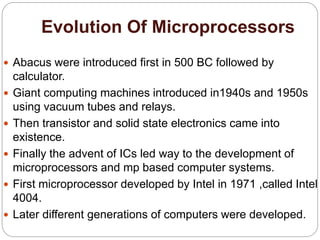
Evolution Of Microprocessors
 Abacus were introduced first in 500 BC followed by
calculator.
 Giant computing machines introduced in1940s and 1950s
using vacuum tubes and relays.
 Then transistor and solid state electronics came into
existence.
 Finally the advent of ICs led way to the development of
microprocessors and mp based computer systems.
 First microprocessor developed by Intel in 1971 ,called Intel
4004.
 Later different generations of computers were developed.
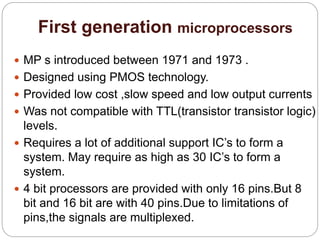
First generation microprocessors
 MP s introduced between 1971 and 1973 .
 Designed using PMOS technology.
 Provided low cost ,slow speed and low output currents
 Was not compatible with TTL(transistor transistor logic)
levels.
 Requires a lot of additional support IC’s to form a
system. May require as high as 30 IC’s to form a
system.
 4 bit processors are provided with only 16 pins.But 8
bit and 16 bit are with 40 pins.Due to limitations of
pins,the signals are multiplexed.
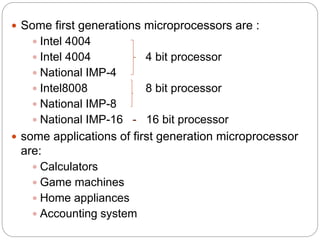
 Some first generations microprocessors are :
 Intel 4004
 Intel 4004 4 bit processor
 National IMP-4
 Intel8008 8 bit processor
 National IMP-8
 National IMP-16 - 16 bit processor
 some applications of first generation microprocessor
are:
 Calculators
 Game machines
 Home appliances
 Accounting system
Second generation microprocessors
 Period from 1973 to 1977
 Manufactured in NMOS technology
 Offers higher speed and density than PMOS.
 Compatible with TTL
 Larger chip size
 40 pins
 Ability to address large memory spaces.
 Ability to address more I/O ports
 Faster operation
 Better interrupt handling capacity
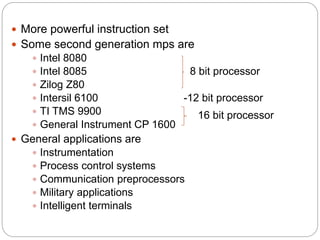
 More powerful instruction set
 Some second generation mps are
 Intel 8080
 Intel 8085 8 bit processor
 Zilog Z80
 Intersil 6100 -12 bit processor
 TI TMS 9900
 General Instrument CP 1600
 General applications are
 Instrumentation
 Process control systems
 Communication preprocessors
 Military applications
 Intelligent terminals
16 bit processor
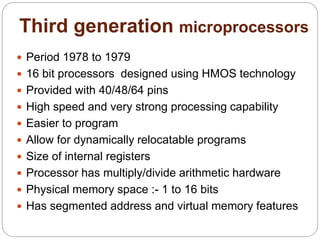
Third generation microprocessors
 Period 1978 to 1979
 16 bit processors designed using HMOS technology
 Provided with 40/48/64 pins
 High speed and very strong processing capability
 Easier to program
 Allow for dynamically relocatable programs
 Size of internal registers
 Processor has multiply/divide arithmetic hardware
 Physical memory space :- 1 to 16 bits
 Has segmented address and virtual memory features
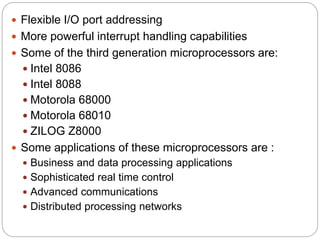
 Flexible I/O port addressing
 More powerful interrupt handling capabilities
 Some of the third generation microprocessors are:
 Intel 8086
 Intel 8088
 Motorola 68000
 Motorola 68010
 ZILOG Z8000
 Some applications of these microprocessors are :
 Business and data processing applications
 Sophisticated real time control
 Advanced communications
 Distributed processing networks
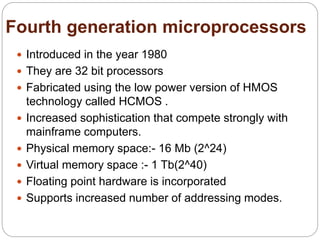
Fourth generation microprocessors
 Introduced in the year 1980
 They are 32 bit processors
 Fabricated using the low power version of HMOS
technology called HCMOS .
 Increased sophistication that compete strongly with
mainframe computers.
 Physical memory space:- 16 Mb (2^24)
 Virtual memory space :- 1 Tb(2^40)
 Floating point hardware is incorporated
 Supports increased number of addressing modes.
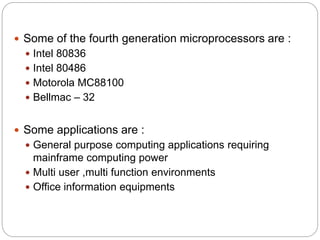
 Some of the fourth generation microprocessors are :
 Intel 80836
 Intel 80486
 Motorola MC88100
 Bellmac – 32
 Some applications are :
 General purpose computing applications requiring
mainframe computing power
 Multi user ,multi function environments
 Office information equipments
Fifth generation microprocessors
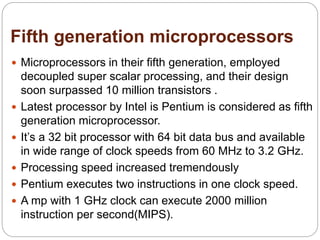
 Microprocessors in their fifth generation, employed
decoupled super scalar processing, and their design
soon surpassed 10 million transistors .
 Latest processor by Intel is Pentium is considered as fifth
generation microprocessor.
 It’s a 32 bit processor with 64 bit data bus and available
in wide range of clock speeds from 60 MHz to 3.2 GHz.
 Processing speed increased tremendously
 Pentium executes two instructions in one clock speed.
 A mp with 1 GHz clock can execute 2000 million
instruction per second(MIPS).
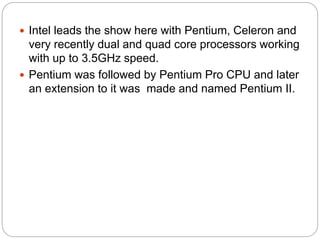
 Intel leads the show here with Pentium, Celeron and
very recently dual and quad core processors working
with up to 3.5GHz speed.
 Pentium was followed by Pentium Pro CPU and later
an extension to it was made and named Pentium II.
THANK YOU

Microprocessors

  • 1.
  • 2.
  • 3.
    Contents  Introduction (Microprocessors) Evolution of microprocessors  First generation  Second generation  Third generation  Fourth generation  Fifth generation
  • 4.
    Introduction  Microprocessor isa program controlled device ,which fetches (from memory),decodes it, and executes information.  Used as CPU in computers  Most mps are single chipped devices  Basic blocks of mp are set of registers, ALU and a control unit.  It is identified with the size of the data the ALU can work with at a time.  8085 mp has 8 bit ALU,so it is called 8 bit processor.  8086 has a 16 bit ALU, so it is called as 16 bit processor.
  • 5.
    Evolution Of Microprocessors Abacus were introduced first in 500 BC followed by calculator.  Giant computing machines introduced in1940s and 1950s using vacuum tubes and relays.  Then transistor and solid state electronics came into existence.  Finally the advent of ICs led way to the development of microprocessors and mp based computer systems.  First microprocessor developed by Intel in 1971 ,called Intel 4004.  Later different generations of computers were developed.
  • 6.
    First generation microprocessors MP s introduced between 1971 and 1973 .  Designed using PMOS technology.  Provided low cost ,slow speed and low output currents  Was not compatible with TTL(transistor transistor logic) levels.  Requires a lot of additional support IC’s to form a system. May require as high as 30 IC’s to form a system.  4 bit processors are provided with only 16 pins.But 8 bit and 16 bit are with 40 pins.Due to limitations of pins,the signals are multiplexed.
  • 7.
     Some firstgenerations microprocessors are :  Intel 4004  Intel 4004 4 bit processor  National IMP-4  Intel8008 8 bit processor  National IMP-8  National IMP-16 - 16 bit processor  some applications of first generation microprocessor are:  Calculators  Game machines  Home appliances  Accounting system
  • 8.
    Second generation microprocessors Period from 1973 to 1977  Manufactured in NMOS technology  Offers higher speed and density than PMOS.  Compatible with TTL  Larger chip size  40 pins  Ability to address large memory spaces.  Ability to address more I/O ports  Faster operation  Better interrupt handling capacity
  • 9.
     More powerfulinstruction set  Some second generation mps are  Intel 8080  Intel 8085 8 bit processor  Zilog Z80  Intersil 6100 -12 bit processor  TI TMS 9900  General Instrument CP 1600  General applications are  Instrumentation  Process control systems  Communication preprocessors  Military applications  Intelligent terminals 16 bit processor
  • 10.
    Third generation microprocessors Period 1978 to 1979  16 bit processors designed using HMOS technology  Provided with 40/48/64 pins  High speed and very strong processing capability  Easier to program  Allow for dynamically relocatable programs  Size of internal registers  Processor has multiply/divide arithmetic hardware  Physical memory space :- 1 to 16 bits  Has segmented address and virtual memory features
  • 11.
     Flexible I/Oport addressing  More powerful interrupt handling capabilities  Some of the third generation microprocessors are:  Intel 8086  Intel 8088  Motorola 68000  Motorola 68010  ZILOG Z8000  Some applications of these microprocessors are :  Business and data processing applications  Sophisticated real time control  Advanced communications  Distributed processing networks
  • 12.
    Fourth generation microprocessors Introduced in the year 1980  They are 32 bit processors  Fabricated using the low power version of HMOS technology called HCMOS .  Increased sophistication that compete strongly with mainframe computers.  Physical memory space:- 16 Mb (2^24)  Virtual memory space :- 1 Tb(2^40)  Floating point hardware is incorporated  Supports increased number of addressing modes.
  • 13.
     Some ofthe fourth generation microprocessors are :  Intel 80836  Intel 80486  Motorola MC88100  Bellmac – 32  Some applications are :  General purpose computing applications requiring mainframe computing power  Multi user ,multi function environments  Office information equipments
  • 14.
    Fifth generation microprocessors Microprocessors in their fifth generation, employed decoupled super scalar processing, and their design soon surpassed 10 million transistors .  Latest processor by Intel is Pentium is considered as fifth generation microprocessor.  It’s a 32 bit processor with 64 bit data bus and available in wide range of clock speeds from 60 MHz to 3.2 GHz.  Processing speed increased tremendously  Pentium executes two instructions in one clock speed.  A mp with 1 GHz clock can execute 2000 million instruction per second(MIPS).
  • 15.
     Intel leadsthe show here with Pentium, Celeron and very recently dual and quad core processors working with up to 3.5GHz speed.  Pentium was followed by Pentium Pro CPU and later an extension to it was made and named Pentium II.
  • 16.