MICROINJECTION
GENE TRANSFER
METHOD
RANA SAHA
B.PHARM. 3RD YEAR
ABSTRACT
The direct microinjection of DNA into the cytoplasm or nuclei of cultured cells is
sometimes used as a transfection method. It is highly efficient at the level of
individual cells. The most significant use of this technique is introduction of DNA
into the oocytes, eggs and embryos of animals, either for transient expression
analysis (e.g. in fish or Xenopus) or to generate transgenic animals (e.g. mice,
Drosophilathis). The procedure is time consuming and only a small number of
cells can be treated. Originally, this technique was used for the transformation of
cells that were resistant to any other method of transfection. Stable transfection
efficiencies are extremely high, in the order of 20%, and very small quantities of
DNA are sufficient.
GENE TRANSFER TECHNIQUES
Due to amphipathic nature of the phospholipid bilayer of the
plasma membrane, polar molecules such as DNA and protein
are unable to freely pass through the membrane. Various
physical or mechanical methods are employed to overcome
this and aid in gene transfer as listed below-
1. Electroporation
2. Microinjection
3. Particle Bombardment
4. Sonoporation
5. Laser induced
6. Bead transfection
MICROINJECTION GENE
TRANSFER TECHNIQUE
 DNA microinjection was first proposed by Dr. Marshall A. Barber in the early of
nineteenth century.
 This method is widely used for gene transfection in mammals.
 It involves delivery of foreign DNA into a living cell (e.g. a cell, egg, oocyte,
embryos of animals) through a fine glass micropipette. The introduced DNA
may lead to the over or under expression of certain genes.
 It is used to identify the characteristic function of dominant genes.
PROCEDURE
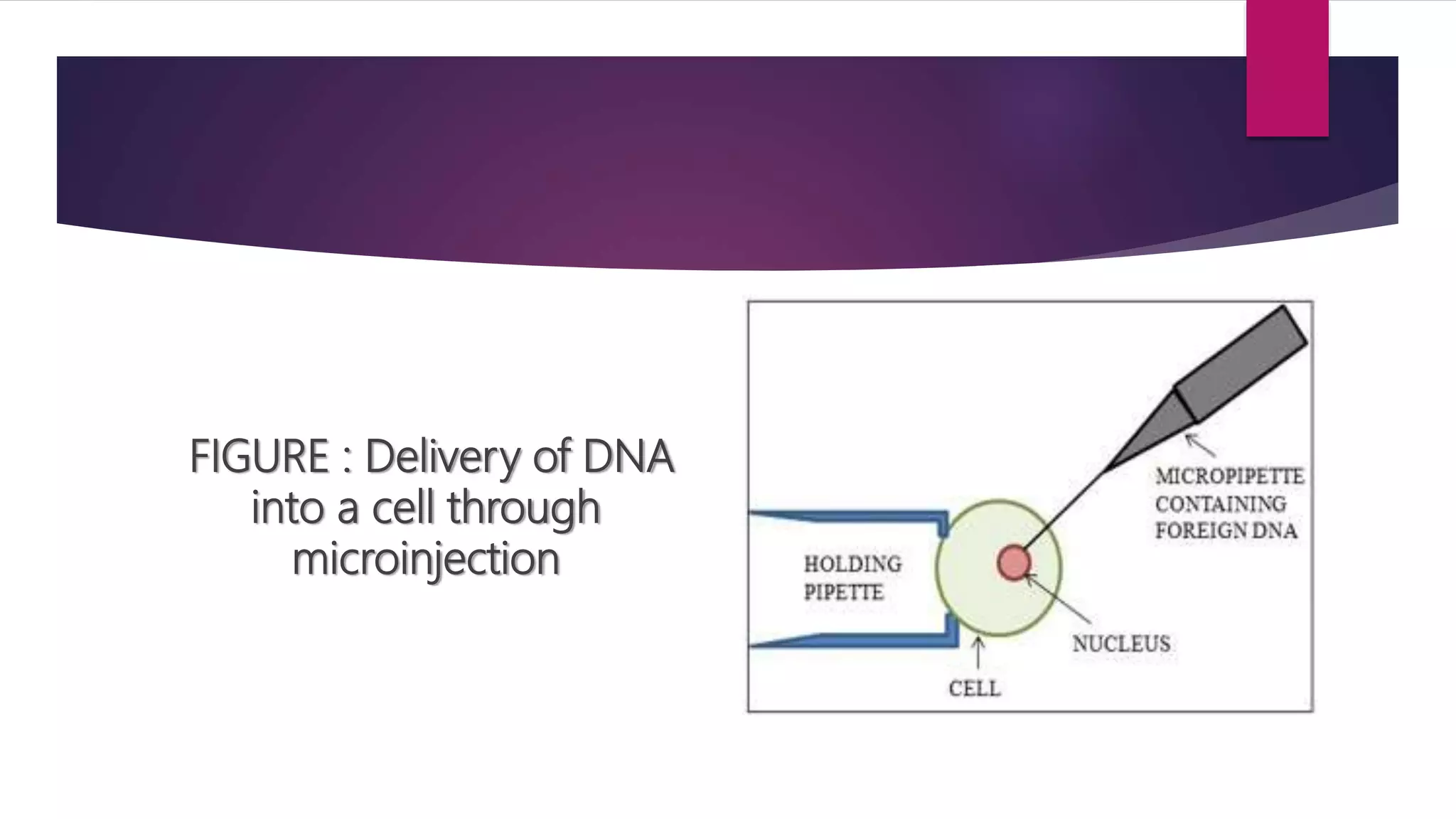
 The delivery of foreign DNA is done under a powerful microscope using
a glass micropipette tip of 0.5 mm diameter.
 Cells to be microinjected are placed in a container. A holding pipette is
placed in the field of view of the microscope thatsucks and holds a
target cell at the tip. The tip of micropipette is injected through the
membrane of the cell to deliver the contents of the needle into the
cytoplasm and then the empty needle is taken out.
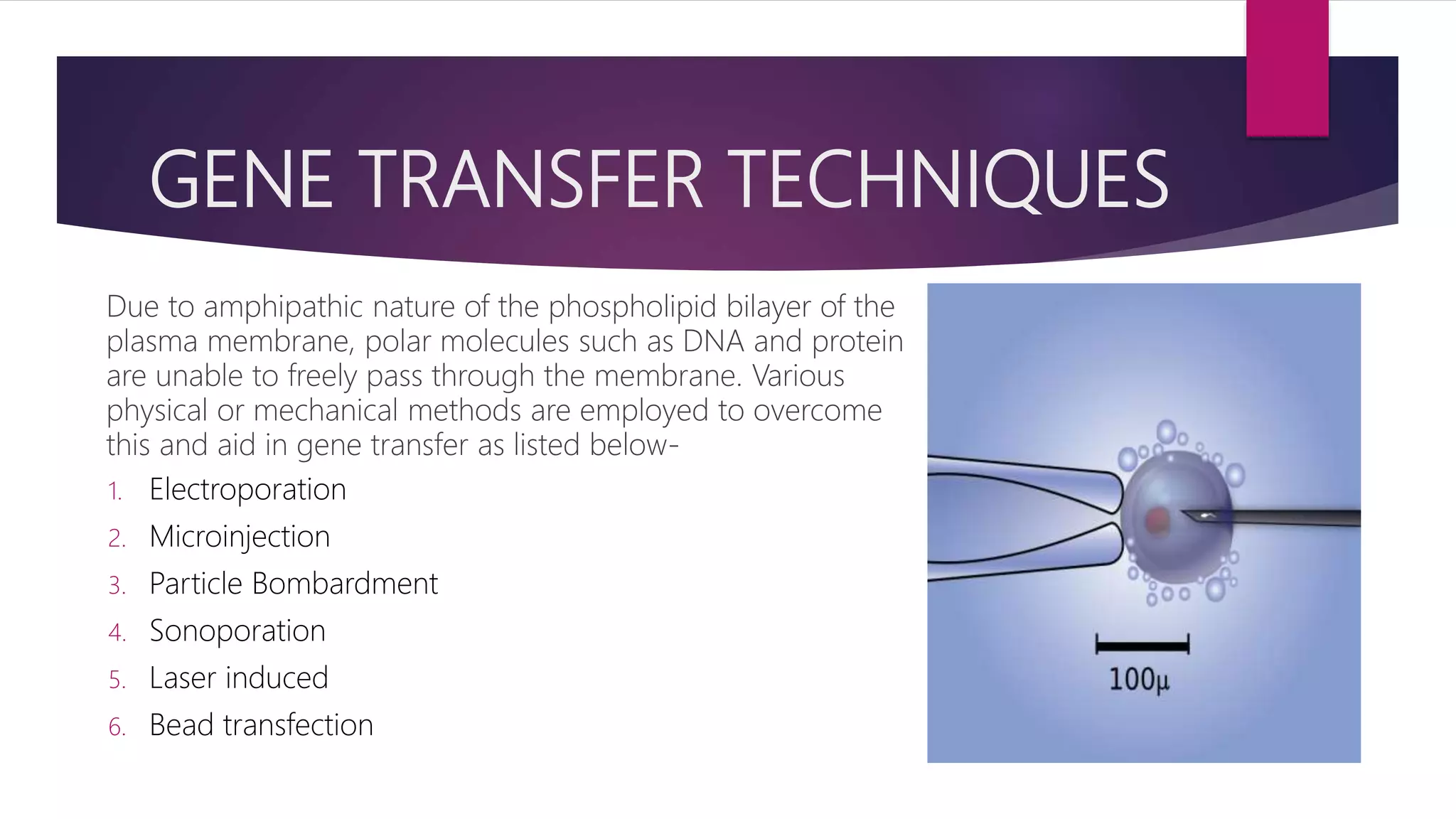
FIGURE : Delivery of DNA
into a cell through
microinjection
ADVANTAGES
1) No requirement of a marker gene.
2) Introduction of the target gene directly into a single cell.
3) Easy identification of transformed cells upon injection of dye along with the DNA.
4) No requirement of selection of the transformed cells using antibiotic resistance or
herbicide resistance markers.
5) It can be used for creating transgenic organisms, particularly mammals.
DISADVANTAGE
1) The procedure is time consuming and
2) Only a small number of cells can be treated.
CONCLUSION
This technique provides direct nuclear delivery of DNA avoiding the endogenous
pathway and also ensures that the DNA is delivered intact. Microinjection is
suitable for the introduction of large vectors such as YACs into the pronuclei of
fertilized mouse eggs. DNA delivered in this manner must be very pure so it
needs a lot of preparation as it is necessary to avoid fragmentation. Shearing can
also occur in the delivery needle, and large DNA fragments are often protected
by suspension in a high salt buffer and/or mixing with polyamines and other
protective agents. Now transfection of cultured cells is automated with
computer-controlled micromanipulation and microinjection processes as well as
the automated production of injection capillaries and the standardization of cell
preparation procedure.
REFERENCES
National Programme for Technology Enhanced Learning, a project funded by
MHRD, Govt. of India.
Molecular Biology Of The Gene by James. D. Watson, PEARSON Publication.
https://en.wikipedia.org/wiki/Microinjection
Biotechnology by P.K.Gupta, Rastogi Publication
Biotechnology by B.D.Singh, Kalpana publication
THANK YOU.

MICROINJECTION GENE TRANSFER METHOD

  • 1.
  • 2.
    ABSTRACT The direct microinjectionof DNA into the cytoplasm or nuclei of cultured cells is sometimes used as a transfection method. It is highly efficient at the level of individual cells. The most significant use of this technique is introduction of DNA into the oocytes, eggs and embryos of animals, either for transient expression analysis (e.g. in fish or Xenopus) or to generate transgenic animals (e.g. mice, Drosophilathis). The procedure is time consuming and only a small number of cells can be treated. Originally, this technique was used for the transformation of cells that were resistant to any other method of transfection. Stable transfection efficiencies are extremely high, in the order of 20%, and very small quantities of DNA are sufficient.
  • 3.
    GENE TRANSFER TECHNIQUES Dueto amphipathic nature of the phospholipid bilayer of the plasma membrane, polar molecules such as DNA and protein are unable to freely pass through the membrane. Various physical or mechanical methods are employed to overcome this and aid in gene transfer as listed below- 1. Electroporation 2. Microinjection 3. Particle Bombardment 4. Sonoporation 5. Laser induced 6. Bead transfection
  • 4.
    MICROINJECTION GENE TRANSFER TECHNIQUE DNA microinjection was first proposed by Dr. Marshall A. Barber in the early of nineteenth century.  This method is widely used for gene transfection in mammals.  It involves delivery of foreign DNA into a living cell (e.g. a cell, egg, oocyte, embryos of animals) through a fine glass micropipette. The introduced DNA may lead to the over or under expression of certain genes.  It is used to identify the characteristic function of dominant genes.
  • 5.
    PROCEDURE  The deliveryof foreign DNA is done under a powerful microscope using a glass micropipette tip of 0.5 mm diameter.  Cells to be microinjected are placed in a container. A holding pipette is placed in the field of view of the microscope thatsucks and holds a target cell at the tip. The tip of micropipette is injected through the membrane of the cell to deliver the contents of the needle into the cytoplasm and then the empty needle is taken out.
  • 6.
    FIGURE : Deliveryof DNA into a cell through microinjection
  • 7.
    ADVANTAGES 1) No requirementof a marker gene. 2) Introduction of the target gene directly into a single cell. 3) Easy identification of transformed cells upon injection of dye along with the DNA. 4) No requirement of selection of the transformed cells using antibiotic resistance or herbicide resistance markers. 5) It can be used for creating transgenic organisms, particularly mammals.
  • 8.
    DISADVANTAGE 1) The procedureis time consuming and 2) Only a small number of cells can be treated.
  • 9.
    CONCLUSION This technique providesdirect nuclear delivery of DNA avoiding the endogenous pathway and also ensures that the DNA is delivered intact. Microinjection is suitable for the introduction of large vectors such as YACs into the pronuclei of fertilized mouse eggs. DNA delivered in this manner must be very pure so it needs a lot of preparation as it is necessary to avoid fragmentation. Shearing can also occur in the delivery needle, and large DNA fragments are often protected by suspension in a high salt buffer and/or mixing with polyamines and other protective agents. Now transfection of cultured cells is automated with computer-controlled micromanipulation and microinjection processes as well as the automated production of injection capillaries and the standardization of cell preparation procedure.
  • 10.
    REFERENCES National Programme forTechnology Enhanced Learning, a project funded by MHRD, Govt. of India. Molecular Biology Of The Gene by James. D. Watson, PEARSON Publication. https://en.wikipedia.org/wiki/Microinjection Biotechnology by P.K.Gupta, Rastogi Publication Biotechnology by B.D.Singh, Kalpana publication
  • 11.