1
PHYSICAL CHEMISTRY
A Presentation by
MEHREEN SHARIF
2
3
Contents
 Oil Consumption and its Recovery
 Methods of Enhanced Oil Recovery
 Microbial Enhanced Oil Recovery (MEOR)
 Use of Microorganisms in MEOR
 MEOR Processes
 Biosurfactants Application
 Economical Feasibility
 Ecological Impact
 Limitations
 Conclusions
 References
4
OBJECTIVES
To make familiar with the current situation of world oil
consumption
To tell about different oil recovery methods
To introduce about Microbial Enhanced Oil Recovery (MEOR)
To discuss economical and ecological assessment of MEOR
5
OIL CONSUMPTION AND FUTURE ANALYSIS
6
THE SHORTFALL
7
8
OIL RECOVERY METHODS
Primary Oil Recovery
Secondary Oil
Recovery
Tertiary Oil Recovery
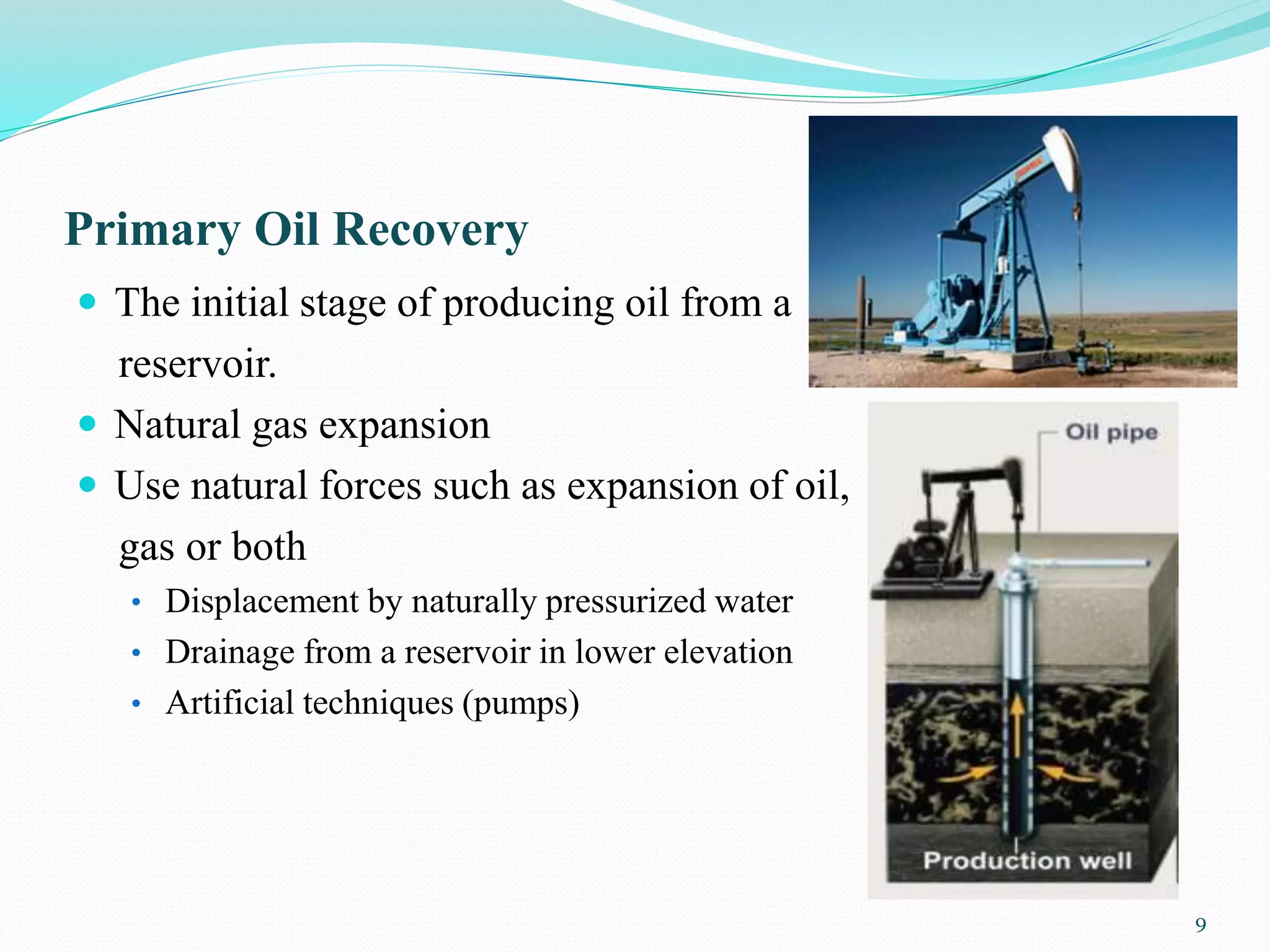
Primary Oil Recovery
 The initial stage of producing oil from a
reservoir.
 Natural gas expansion
 Use natural forces such as expansion of oil,
gas or both
• Displacement by naturally pressurized water
• Drainage from a reservoir in lower elevation
• Artificial techniques (pumps)
9
Secondary Oil Recovery
 Injection of external fluids into a reservoir
to increase reservoir pressure and to
displace oil towards the wellbore
 Essentially augmenting the natural forces
used in primary methods
 Water flooding
10
Water flooding
11
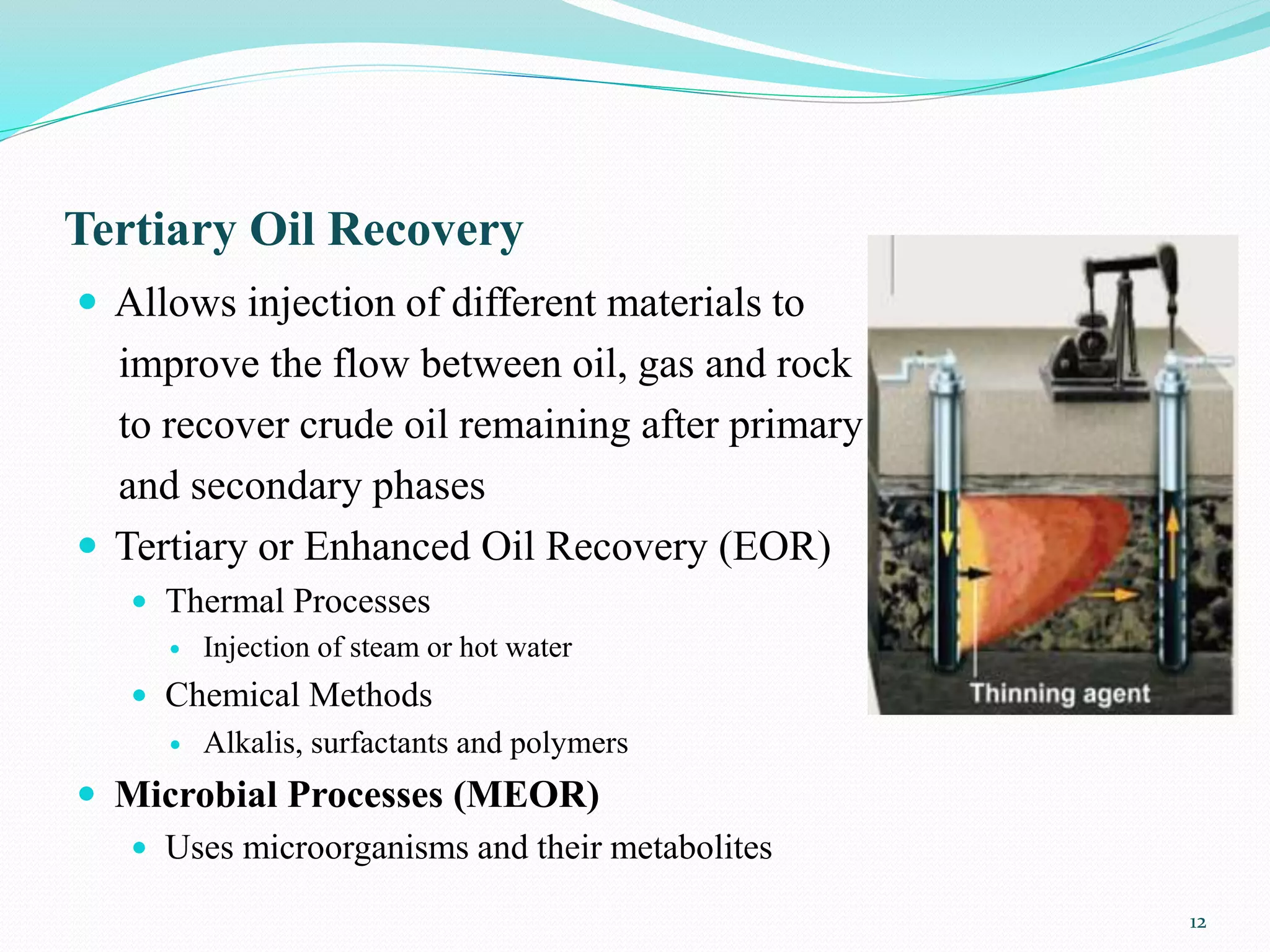
Tertiary Oil Recovery
 Allows injection of different materials to
improve the flow between oil, gas and rock
to recover crude oil remaining after primary
and secondary phases
 Tertiary or Enhanced Oil Recovery (EOR)
 Thermal Processes
 Injection of steam or hot water
 Chemical Methods
 Alkalis, surfactants and polymers
 Microbial Processes (MEOR)
 Uses microorganisms and their metabolites
12
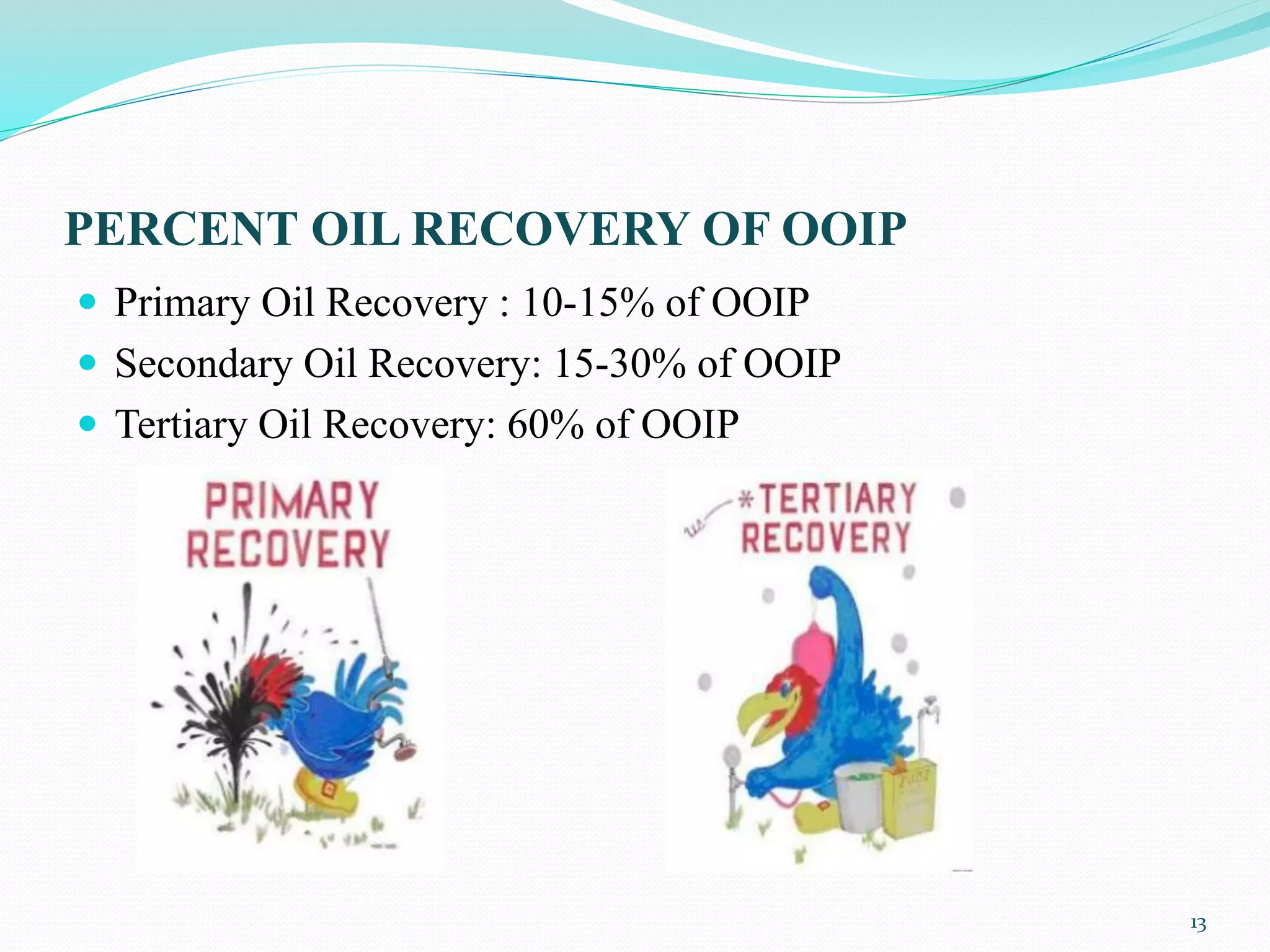
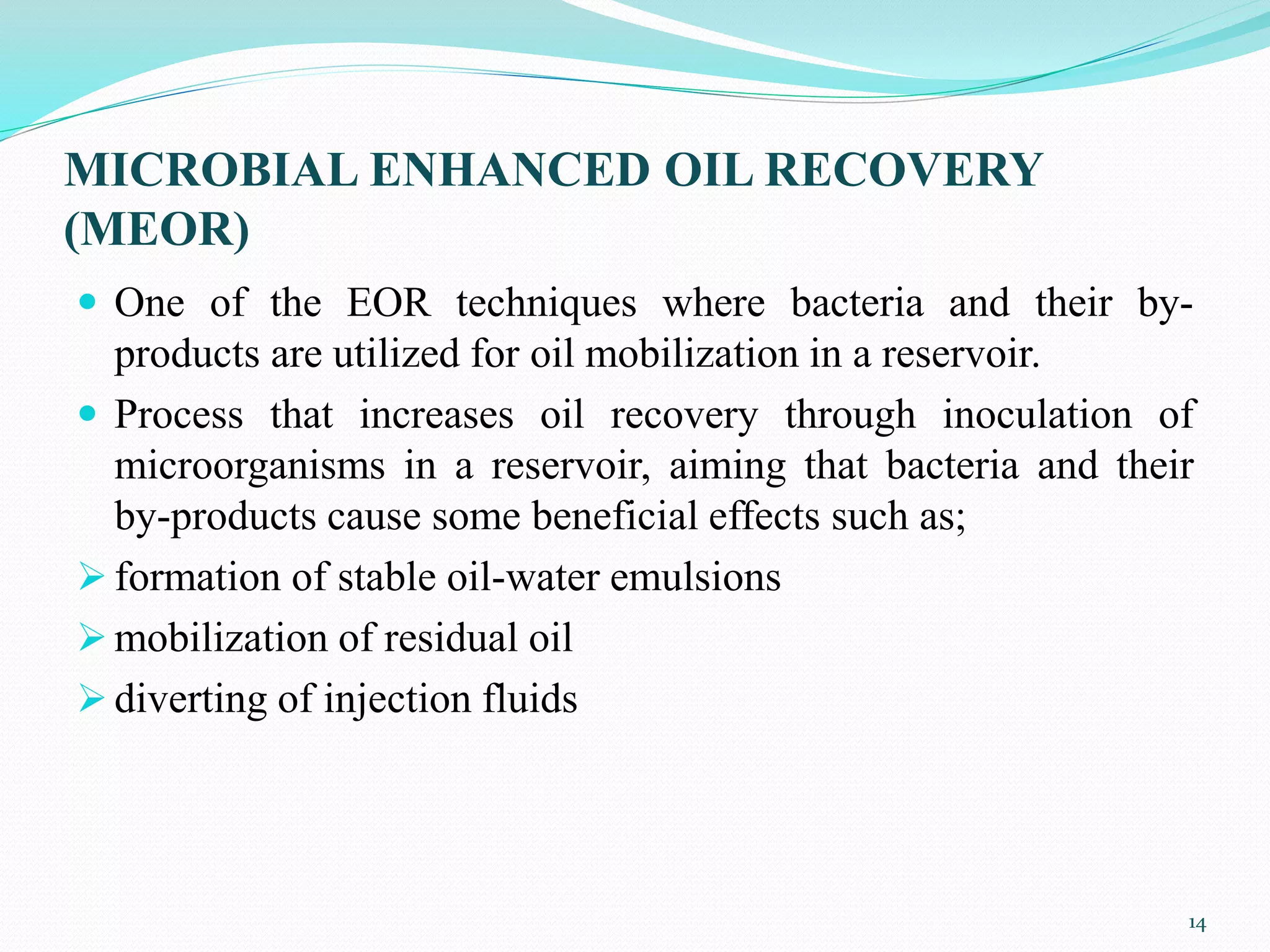
PERCENT OIL RECOVERY OF OOIP
 Primary Oil Recovery : 10-15% of OOIP
 Secondary Oil Recovery: 15-30% of OOIP
 Tertiary Oil Recovery: 60% of OOIP
13
MICROBIAL ENHANCED OIL RECOVERY
(MEOR)
 One of the EOR techniques where bacteria and their by-
products are utilized for oil mobilization in a reservoir.
 Process that increases oil recovery through inoculation of
microorganisms in a reservoir, aiming that bacteria and their
by-products cause some beneficial effects such as;
 formation of stable oil-water emulsions
 mobilization of residual oil
 diverting of injection fluids
14
Why we needed MEOR?
 A large proportion of crude oil; a valuable and non-renewable
energy resource, is left behind in the ground.
 A dire need to produce more crude oil to meet the worldwide
rising energy demand
 Previously un-extractable reserves are more costly to produce
 MEOR extra 20-30% oil recovery
15
NUTRIENTS
16
MICROORGANISMS IN MEOR
 Nature of microorganisms
 mostly anaerobic extremophiles
 Bacteria are usually hydrocarbon-utilizing, non-pathogenic,
and are naturally occurring in petroleum reservoirs.
 Bacterial population can tolerate harsh environments.
 Maximum growth rate of microbes selected for use,
 In past below 80ºC now up to 121ºC
 Bacillus strains grown on glucose mineral salts medium (most
utilized in MEOR)
17
Different microorganisms, their related metabolites
and applications in MEOR
18
Sen, R. Biotechnology in petroleum recovery: the microbial EOR. Progress in energy
and combustion Science, 34(6): 714-724 (2008)
BIOSURFACTANTS ROLE IN IFT REDUCTION
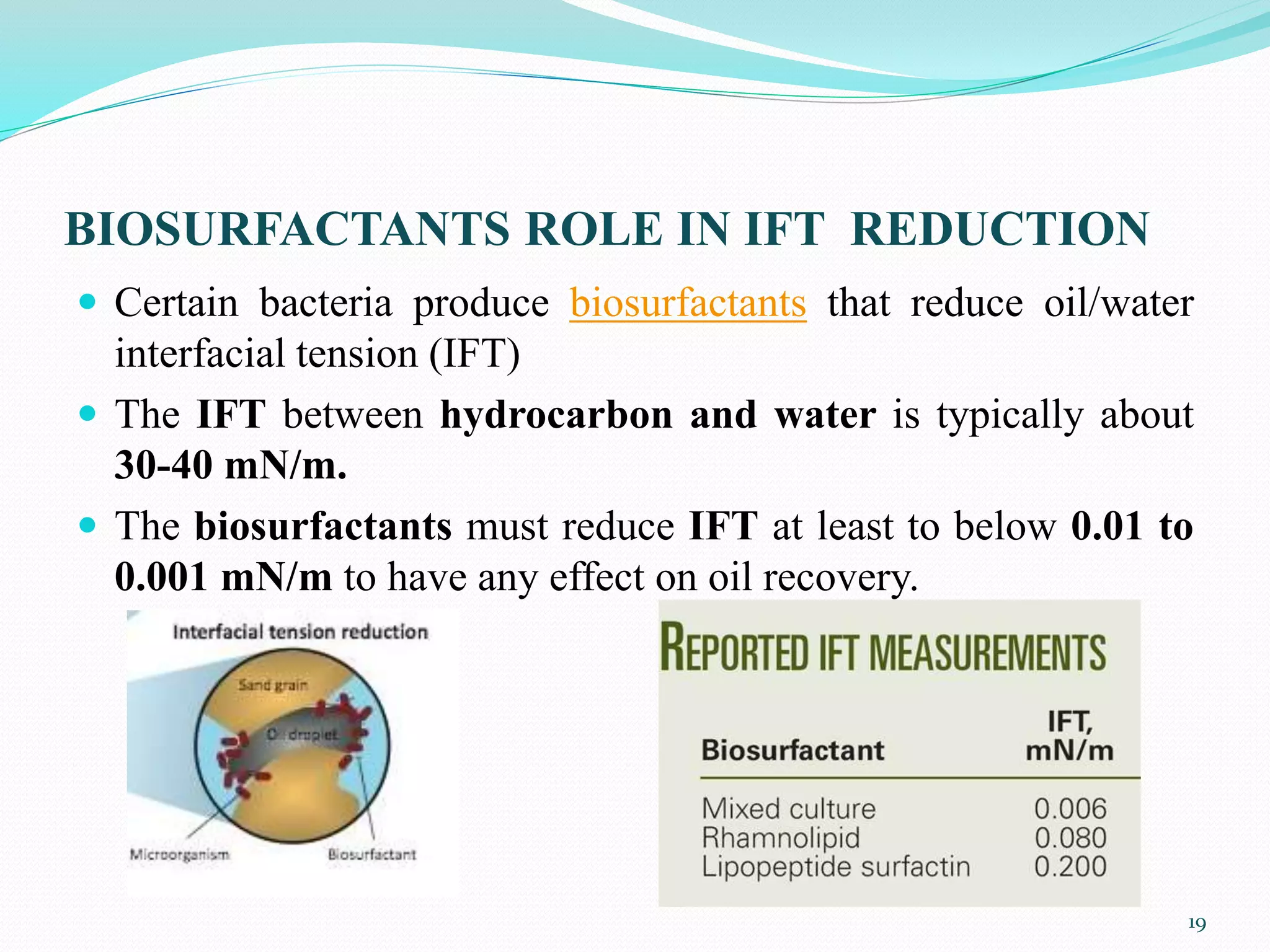
 Certain bacteria produce biosurfactants that reduce oil/water
interfacial tension (IFT)
 The IFT between hydrocarbon and water is typically about
30-40 mN/m.
 The biosurfactants must reduce IFT at least to below 0.01 to
0.001 mN/m to have any effect on oil recovery.
19
20
INJECTION
Water
Nutrients
Microbes
21
Huff and Puff Method
22
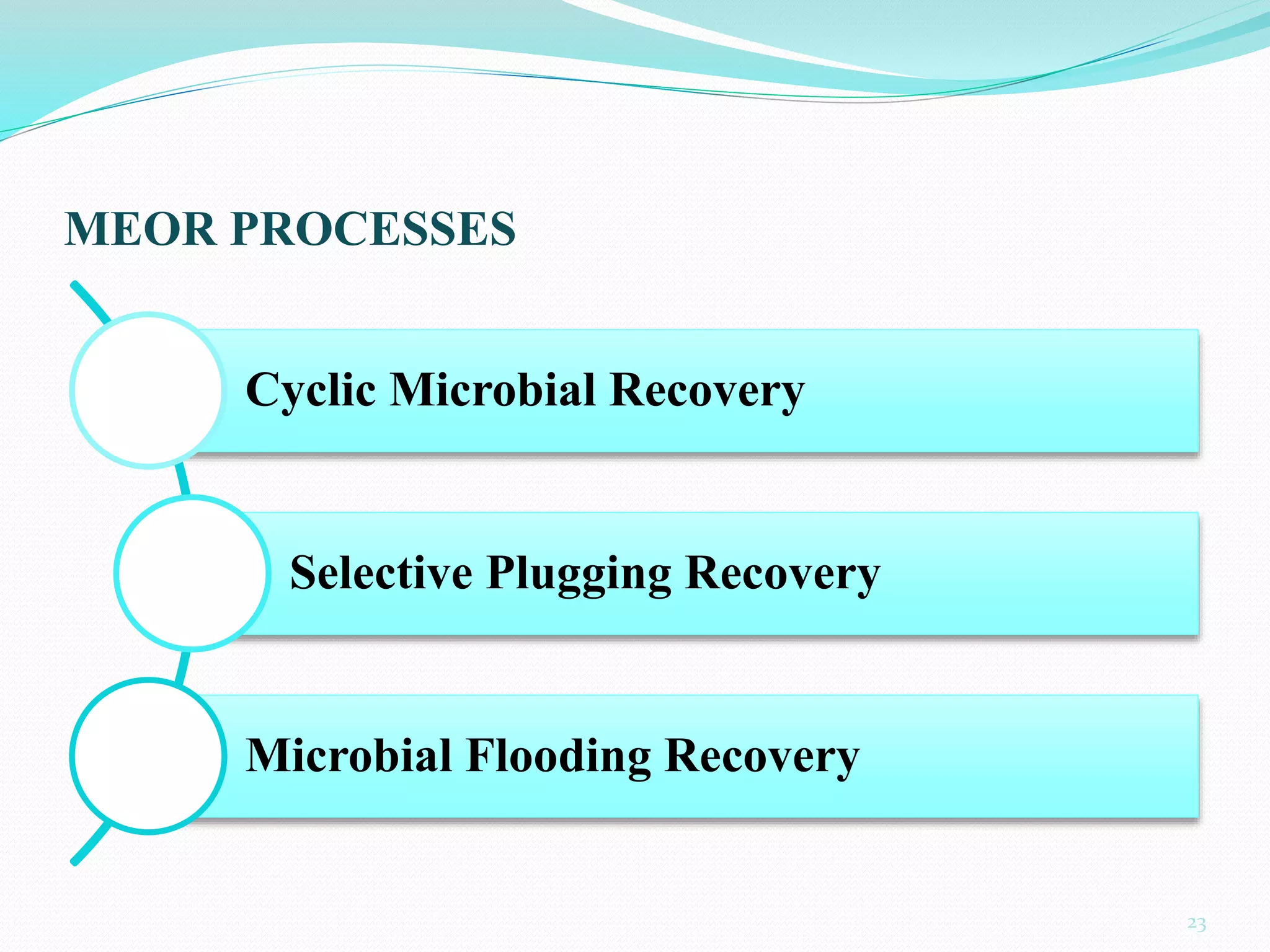
MEOR PROCESSES
Cyclic Microbial Recovery
Selective Plugging Recovery
Microbial Flooding Recovery
23
a) CYCLIC MICROBIAL RECOVERY
24
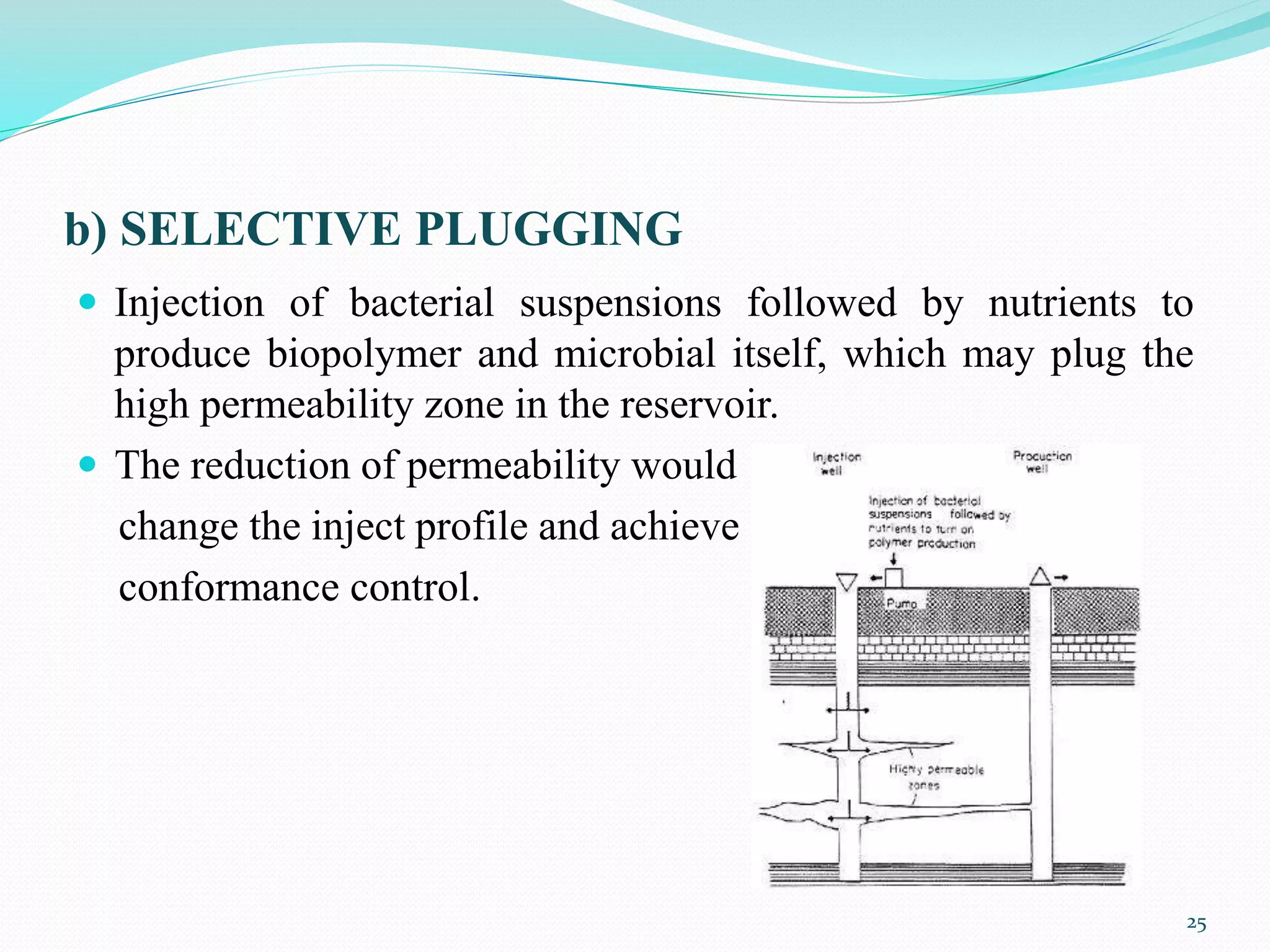
b) SELECTIVE PLUGGING
 Injection of bacterial suspensions followed by nutrients to
produce biopolymer and microbial itself, which may plug the
high permeability zone in the reservoir.
 The reduction of permeability would
change the inject profile and achieve
conformance control.
25
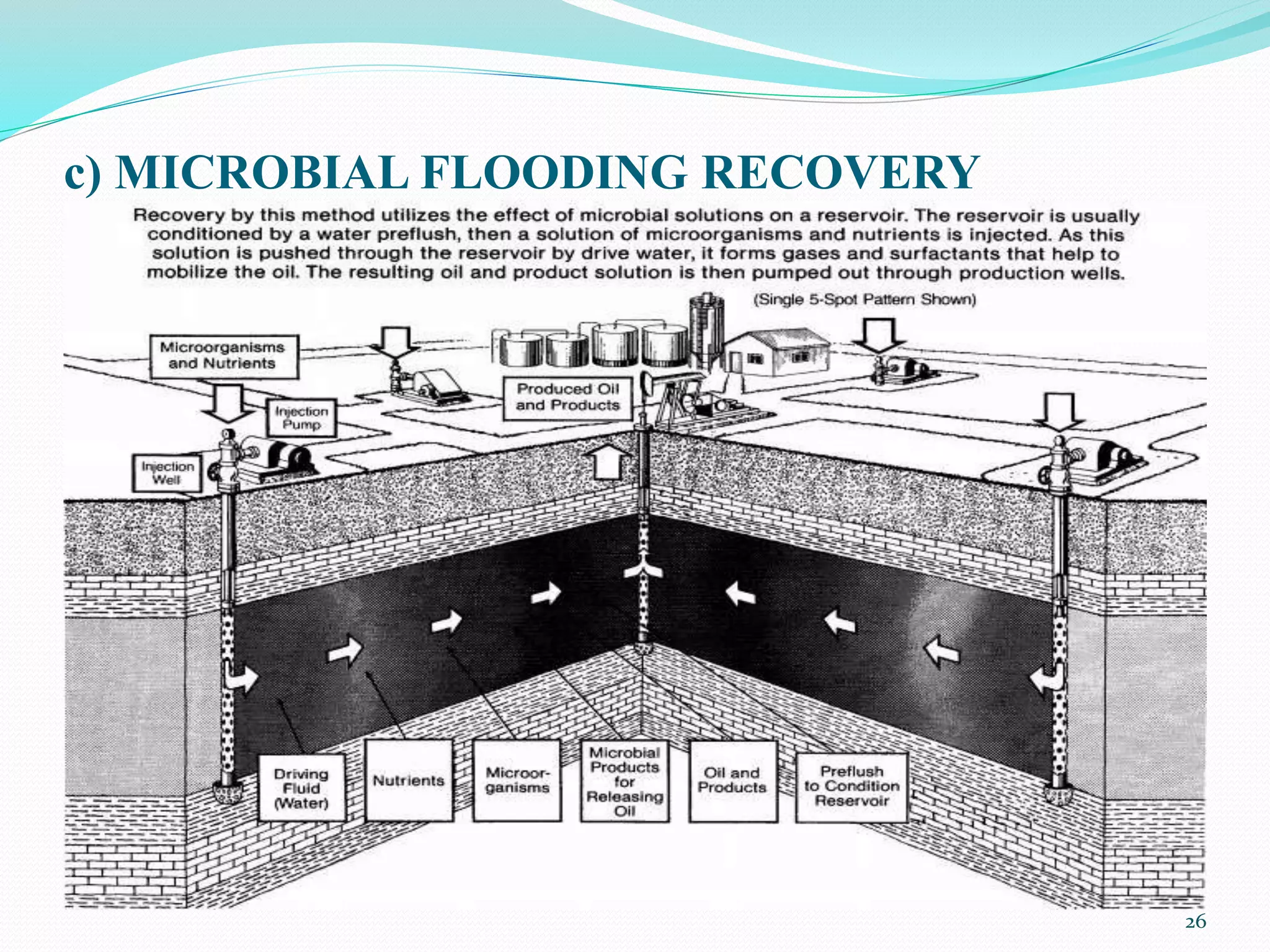
c) MICROBIAL FLOODING RECOVERY
26
Biosurfactant Metabolite Modeling
 Empirical equation to demonstrate the surfactant’s effect on
IFT σ ,
σ∗(Ms) = σ − tanh(l3 Ms − l2) + 1 + l1
− tanh(−l2) + 1 + l1
Here,
σ∗ is new IFT value,
Ms is the concentration of surfactant
lj,various properties of surfactant
27
ECONOMICAL FEASIBILITY
 Increase the production of oil
 Higher economic lifetime of the wells
 Microbes and nutrients are relatively inexpensive
 Low operating cost and profitable
 Economically attractive for marginally producing oil fields
 Implementation needs minor modifications to existing field
facilities
28
ECOLOGICAL IMPACT
Eco-friendly
MEOR produce organic chemicals less harmful than synthetic
chemicals used by other Enhanced Oil Recovery methods.
 Biodegradable Products
MEOR products are all biodegradable and will not be
accumulated in the environment, therefore are environmentally
compatible.
29
LIMITATIONS
 Mineral Content
Increasing salinity absorbs water from the microbe and negatively
effects its growth
 Reservoir parameters
Permeability, temperature, pH, etc. affects selection of our types
and our growth
 Lack of experience
Study of bacteria metabolism, and relation to subsurface
environment, need great effort
30
Continue...
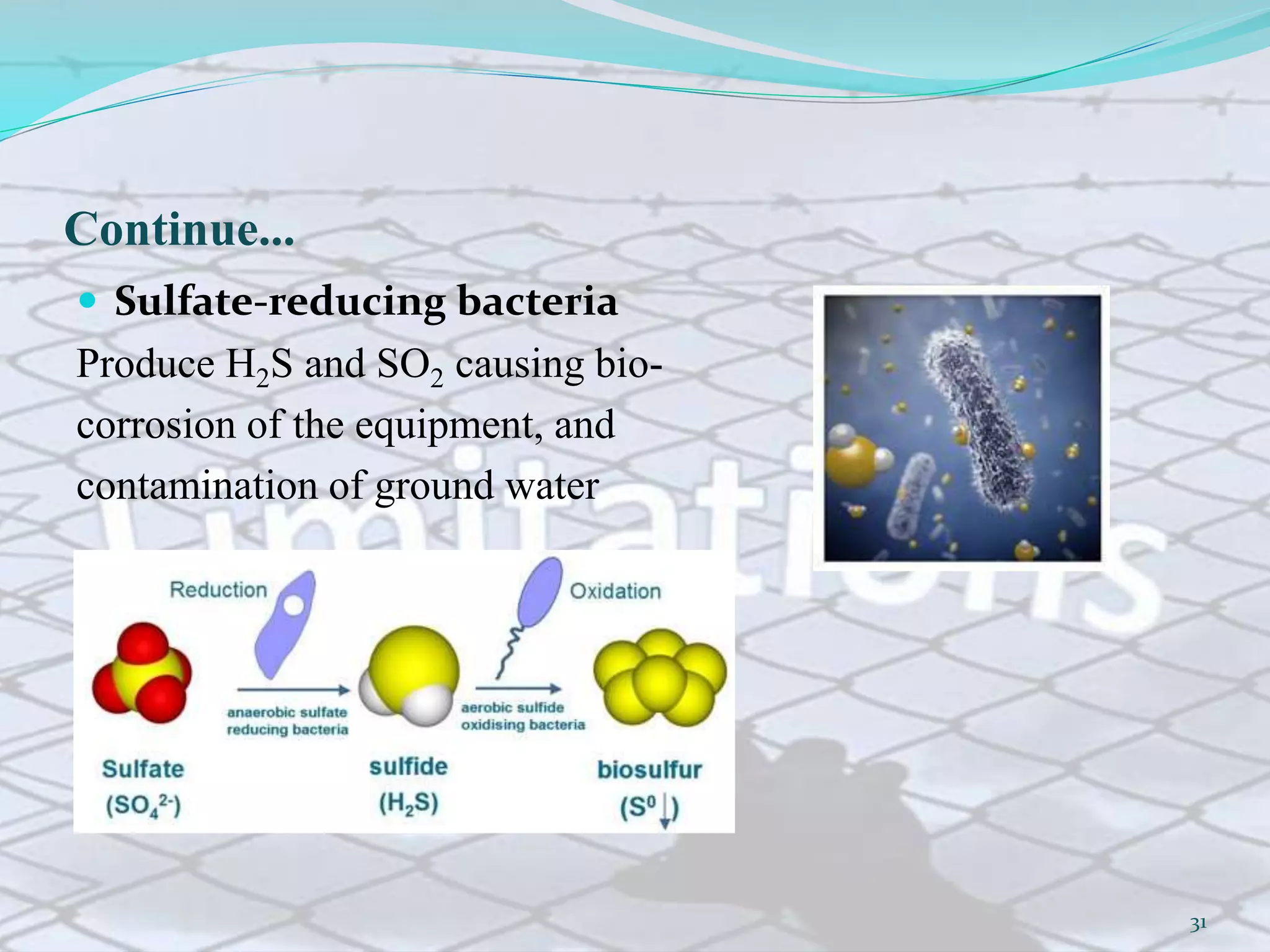
 Sulfate-reducing bacteria
Produce H2S and SO2 causing bio-
corrosion of the equipment, and
contamination of ground water
31
CONCLUSIONS
Great achievements
MEOR has developed for decades. MEOR has great potential
to become a viable alternative to the traditional EOR chemical
methods. A series of fundamental research work has been
done. Several pilot tests have been applied in the fields.
 Promising EOR technology
The success of research work and pilot tests makes this
technology attractive in the industry. This cost-effective and eco-
friendly methods could contribute more in oil production,
especially in mature oil fields.
32
Continue…
 Need more efforts
Since this technology has developed for a relatively long time,
and has great achievements, to turn the promising into reality
needs more efforts. The modern biological technology accelerates
MEOR, which needs money and talents.
33
REFERENCES
 Geetha, S. J., Banat, I. M. and Joshi, S. J. Biosurfactants: Production and potential
applications in Microbial Enhanced Oil Recovery (MEOR). Biocatalysis and
Agricultural Biotechnology, 14: 23-32 (2018)
 Wang, T., Yu, L., Xiu, J., Ma, Y., Lin, W., Ma, T. and Wang, L. A mathematical
model for microbial enhanced oil recovery using biopolymer-producing
microorganism. Fuel, 216: 589-595 (2018)
 Zhao, F., Shi, R., Cui, Q., Han, S., Dong, H. and Zhang, Y. Biosurfactant production
under diverse conditions by two kinds of biosurfactant-producing bacteria for
microbial enhanced oil recovery. Journal of Petroleum Science and Engineering,
157: 124-130 (2017)
 Sivasankar, P. and Kumar, G. S. Influence of pH on dynamics of microbial enhanced
oil recovery processes using biosurfactant producing Pseudomonas putida:
Mathematical modelling and numerical simulation. Bioresource technology, 224:
498-508 (2017)
 Xuezhong, W. A. N. G., Yuanliang, Y. A. N. G. and Weijun, X. I. Microbial
enhanced oil recovery of oil-water transitional zone in thin-shallow extra heavy oil
reservoirs: A case study of Chunfeng Oilfield in western margin of Junggar Basin,
NW China. Petroleum Exploration and Development, 43(4): 689-694 (2016)
34
 Hosseininoosheri, P., Lashgari, H. R. and Sepehrnoori, K. A novel method to
model and characterize in-situ bio-surfactant production in microbial enhanced
oil recovery. Fuel, 183: 501-511 (2016)
 Santos, D. K. F., Rufino, R. D., Luna, J. M., Santos, V. A and Sarubbo, L. A.
Biosurfactants: multifunctional biomolecules of the 21st century. International
journal of molecular sciences, 17(3): 401(2016)
 El-Sheshtawy, H. S., Aiad, I., Osman, M. E., Abo-ELnasr, A. A. and Kobisy, A.
S. Production of biosurfactant from Bacillus licheniformis for microbial
enhanced oil recovery and inhibition the growth of sulfate reducing bacteria.
Egyptian Journal of Petroleum, 24(2): 155-162 (2015)
 Hung, H. C. and Shreve, G. S. Effect of the hydrocarbon phase on interfacial
and thermodynamic properties of two anionic glycolipid biosurfactants in
hydrocarbon/water systems. The Journal of Physical Chemistry B, 105 (50):
12596-12600 (2001)
35
36
ANY QUESTION!
37

Microbial Enhance Oil Recovery

  • 1.
  • 2.
  • 3.
  • 4.
    Contents  Oil Consumptionand its Recovery  Methods of Enhanced Oil Recovery  Microbial Enhanced Oil Recovery (MEOR)  Use of Microorganisms in MEOR  MEOR Processes  Biosurfactants Application  Economical Feasibility  Ecological Impact  Limitations  Conclusions  References 4
  • 5.
    OBJECTIVES To make familiarwith the current situation of world oil consumption To tell about different oil recovery methods To introduce about Microbial Enhanced Oil Recovery (MEOR) To discuss economical and ecological assessment of MEOR 5
  • 6.
    OIL CONSUMPTION ANDFUTURE ANALYSIS 6
  • 7.
  • 8.
    8 OIL RECOVERY METHODS PrimaryOil Recovery Secondary Oil Recovery Tertiary Oil Recovery
  • 9.
    Primary Oil Recovery The initial stage of producing oil from a reservoir.  Natural gas expansion  Use natural forces such as expansion of oil, gas or both • Displacement by naturally pressurized water • Drainage from a reservoir in lower elevation • Artificial techniques (pumps) 9
  • 10.
    Secondary Oil Recovery Injection of external fluids into a reservoir to increase reservoir pressure and to displace oil towards the wellbore  Essentially augmenting the natural forces used in primary methods  Water flooding 10
  • 11.
  • 12.
    Tertiary Oil Recovery Allows injection of different materials to improve the flow between oil, gas and rock to recover crude oil remaining after primary and secondary phases  Tertiary or Enhanced Oil Recovery (EOR)  Thermal Processes  Injection of steam or hot water  Chemical Methods  Alkalis, surfactants and polymers  Microbial Processes (MEOR)  Uses microorganisms and their metabolites 12
  • 13.
    PERCENT OIL RECOVERYOF OOIP  Primary Oil Recovery : 10-15% of OOIP  Secondary Oil Recovery: 15-30% of OOIP  Tertiary Oil Recovery: 60% of OOIP 13
  • 14.
    MICROBIAL ENHANCED OILRECOVERY (MEOR)  One of the EOR techniques where bacteria and their by- products are utilized for oil mobilization in a reservoir.  Process that increases oil recovery through inoculation of microorganisms in a reservoir, aiming that bacteria and their by-products cause some beneficial effects such as;  formation of stable oil-water emulsions  mobilization of residual oil  diverting of injection fluids 14
  • 15.
    Why we neededMEOR?  A large proportion of crude oil; a valuable and non-renewable energy resource, is left behind in the ground.  A dire need to produce more crude oil to meet the worldwide rising energy demand  Previously un-extractable reserves are more costly to produce  MEOR extra 20-30% oil recovery 15
  • 16.
  • 17.
    MICROORGANISMS IN MEOR Nature of microorganisms  mostly anaerobic extremophiles  Bacteria are usually hydrocarbon-utilizing, non-pathogenic, and are naturally occurring in petroleum reservoirs.  Bacterial population can tolerate harsh environments.  Maximum growth rate of microbes selected for use,  In past below 80ºC now up to 121ºC  Bacillus strains grown on glucose mineral salts medium (most utilized in MEOR) 17
  • 18.
    Different microorganisms, theirrelated metabolites and applications in MEOR 18 Sen, R. Biotechnology in petroleum recovery: the microbial EOR. Progress in energy and combustion Science, 34(6): 714-724 (2008)
  • 19.
    BIOSURFACTANTS ROLE INIFT REDUCTION  Certain bacteria produce biosurfactants that reduce oil/water interfacial tension (IFT)  The IFT between hydrocarbon and water is typically about 30-40 mN/m.  The biosurfactants must reduce IFT at least to below 0.01 to 0.001 mN/m to have any effect on oil recovery. 19
  • 20.
  • 21.
  • 22.
    Huff and PuffMethod 22
  • 23.
    MEOR PROCESSES Cyclic MicrobialRecovery Selective Plugging Recovery Microbial Flooding Recovery 23
  • 24.
  • 25.
    b) SELECTIVE PLUGGING Injection of bacterial suspensions followed by nutrients to produce biopolymer and microbial itself, which may plug the high permeability zone in the reservoir.  The reduction of permeability would change the inject profile and achieve conformance control. 25
  • 26.
  • 27.
    Biosurfactant Metabolite Modeling Empirical equation to demonstrate the surfactant’s effect on IFT σ , σ∗(Ms) = σ − tanh(l3 Ms − l2) + 1 + l1 − tanh(−l2) + 1 + l1 Here, σ∗ is new IFT value, Ms is the concentration of surfactant lj,various properties of surfactant 27
  • 28.
    ECONOMICAL FEASIBILITY  Increasethe production of oil  Higher economic lifetime of the wells  Microbes and nutrients are relatively inexpensive  Low operating cost and profitable  Economically attractive for marginally producing oil fields  Implementation needs minor modifications to existing field facilities 28
  • 29.
    ECOLOGICAL IMPACT Eco-friendly MEOR produceorganic chemicals less harmful than synthetic chemicals used by other Enhanced Oil Recovery methods.  Biodegradable Products MEOR products are all biodegradable and will not be accumulated in the environment, therefore are environmentally compatible. 29
  • 30.
    LIMITATIONS  Mineral Content Increasingsalinity absorbs water from the microbe and negatively effects its growth  Reservoir parameters Permeability, temperature, pH, etc. affects selection of our types and our growth  Lack of experience Study of bacteria metabolism, and relation to subsurface environment, need great effort 30
  • 31.
    Continue...  Sulfate-reducing bacteria ProduceH2S and SO2 causing bio- corrosion of the equipment, and contamination of ground water 31
  • 32.
    CONCLUSIONS Great achievements MEOR hasdeveloped for decades. MEOR has great potential to become a viable alternative to the traditional EOR chemical methods. A series of fundamental research work has been done. Several pilot tests have been applied in the fields.  Promising EOR technology The success of research work and pilot tests makes this technology attractive in the industry. This cost-effective and eco- friendly methods could contribute more in oil production, especially in mature oil fields. 32
  • 33.
    Continue…  Need moreefforts Since this technology has developed for a relatively long time, and has great achievements, to turn the promising into reality needs more efforts. The modern biological technology accelerates MEOR, which needs money and talents. 33
  • 34.
    REFERENCES  Geetha, S.J., Banat, I. M. and Joshi, S. J. Biosurfactants: Production and potential applications in Microbial Enhanced Oil Recovery (MEOR). Biocatalysis and Agricultural Biotechnology, 14: 23-32 (2018)  Wang, T., Yu, L., Xiu, J., Ma, Y., Lin, W., Ma, T. and Wang, L. A mathematical model for microbial enhanced oil recovery using biopolymer-producing microorganism. Fuel, 216: 589-595 (2018)  Zhao, F., Shi, R., Cui, Q., Han, S., Dong, H. and Zhang, Y. Biosurfactant production under diverse conditions by two kinds of biosurfactant-producing bacteria for microbial enhanced oil recovery. Journal of Petroleum Science and Engineering, 157: 124-130 (2017)  Sivasankar, P. and Kumar, G. S. Influence of pH on dynamics of microbial enhanced oil recovery processes using biosurfactant producing Pseudomonas putida: Mathematical modelling and numerical simulation. Bioresource technology, 224: 498-508 (2017)  Xuezhong, W. A. N. G., Yuanliang, Y. A. N. G. and Weijun, X. I. Microbial enhanced oil recovery of oil-water transitional zone in thin-shallow extra heavy oil reservoirs: A case study of Chunfeng Oilfield in western margin of Junggar Basin, NW China. Petroleum Exploration and Development, 43(4): 689-694 (2016) 34
  • 35.
     Hosseininoosheri, P.,Lashgari, H. R. and Sepehrnoori, K. A novel method to model and characterize in-situ bio-surfactant production in microbial enhanced oil recovery. Fuel, 183: 501-511 (2016)  Santos, D. K. F., Rufino, R. D., Luna, J. M., Santos, V. A and Sarubbo, L. A. Biosurfactants: multifunctional biomolecules of the 21st century. International journal of molecular sciences, 17(3): 401(2016)  El-Sheshtawy, H. S., Aiad, I., Osman, M. E., Abo-ELnasr, A. A. and Kobisy, A. S. Production of biosurfactant from Bacillus licheniformis for microbial enhanced oil recovery and inhibition the growth of sulfate reducing bacteria. Egyptian Journal of Petroleum, 24(2): 155-162 (2015)  Hung, H. C. and Shreve, G. S. Effect of the hydrocarbon phase on interfacial and thermodynamic properties of two anionic glycolipid biosurfactants in hydrocarbon/water systems. The Journal of Physical Chemistry B, 105 (50): 12596-12600 (2001) 35
  • 36.
  • 37.

Editor's Notes

  • #13 Microemulsion to assist in extraction