Please,	
  Come	
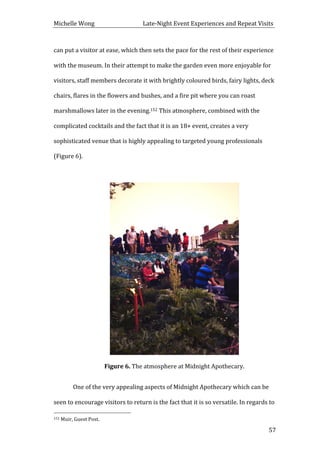
  Again!	


How	
  Visitor	
  Experiences	
  at	
  Late-­‐Night	
  Events	
  
Encourage	
  Repeat	
  Visits	


By	
  Michelle	
  Wong	


Masters	
  Dissertation	
  
University	
  of	
  Leicester	
  
School	
  of	
  Museum	
  Studies	
  
2013	


Michelle	
  Wong	


  Late-­‐Night	
  Event	
  Experiences	
  and	
  Repeat	
  Visits	
  
	
   2	


Abstract.	
  Late-­‐night	
  events	
  have	
  become	
  increasingly	
  popular	
  
with	
  cultural	
  and	
  heritage	
  institutions	
  of	
  all	
  sizes.	
  It	
  is	
  a	
  
new	
  phenomenon	
  and	
  despite	
  being	
  useful	
  for	
  
attracting	
  new	
  audiences,	
  there	
  is	
  still	
  very	
  little	
  
research	
  about	
  their	
  potential	
  to	
  contribute	
  to	
  an	
  
institution’s	
  broader	
  goals	
  and	
  objectives.	
  As	
  attracting	
  
repeat	
  visitors	
  is	
  a	
  big	
  issue	
  for	
  museums	
  today,	
  the	
  
purpose	
  of	
  this	
  dissertation	
  therefore	
  is	
  to	
  look	
  at	
  how	
  
late-­‐night	
  events	
  can	
  encourage	
  repeat	
  visits	
  to	
  the	
  
museum.	
  The	
  environment	
  of	
  a	
  late-­‐night	
  event	
  is	
  ideal	
  
for	
  informal,	
  social	
  learning	
  and	
  thus	
  fulfills	
  the	
  
museum’s	
  educational	
  purpose.	
  The	
  unique	
  visitor	
  
experiences	
  of	
  late-­‐night	
  events	
  yield	
  memorable	
  
moments	
  that	
  help	
  to	
  change	
  the	
  perception	
  of	
  the	
  
museum.	
  In	
  turn,	
  this	
  encourages	
  visitors	
  to	
  attend	
  
more	
  of	
  these	
  events.	
  Science	
  Museum	
  Lates	
  and	
  the	
  
Brunel	
  Museum’s	
  Midnight	
  Apothecary	
  events	
  
exemplify	
  how	
  institutions	
  of	
  all	
  sizes	
  are	
  capable	
  of	
  
capitalizing	
  on	
  the	
  potential	
  of	
  late-­‐night	
  events.	
  This	
  
research	
  contributes	
  to	
  the	
  small	
  body	
  of	
  literature	
  
about	
  late-­‐night	
  events	
  by	
  looking	
  at	
  these	
  new	
  
offerings	
  within	
  the	
  museum	
  sector	
  in	
  a	
  broader	
  
context	
  in	
  which	
  they	
  can	
  help	
  institutions	
  reach	
  set	
  
goals	
  and	
  objectives.	


Word	
  Count.	
  	
  13,861	
  words	


Michelle	
  Wong	


  Late-­‐Night	
  Event	
  Experiences	
  and	
  Repeat	
  Visits	
  
	
   3	
  
Table	
  of	
  Contents	
  
List	
  of	
  Figures	
  ......................................................................................................................	
  4	
  
Acknowledgements	
  ...........................................................................................................	
  5	
  
Introduction	
  ........................................................................................................................	
  6	
  
Methodology	
  .................................................................................................................................	
  8	
  
Dissertation	
  Summary	
  ..............................................................................................................	
  9	
  
Chapter	
  One:	
  History	
  of	
  Late-­‐Night	
  Events	
  and	
  Their	
  Rise	
  in	
  Popularity	
  ....	
  13	
  
The	
  Importance	
  of	
  Audience	
  Research	
  ...............................................................................	
  13	
  
Late-­‐Night	
  Events	
  as	
  a	
  New	
  Offering	
  ...................................................................................	
  15	
  
Fulfilling	
  the	
  Museum’s	
  Purpose	
  ..........................................................................................	
  21	
  
Conclusion	
  ...................................................................................................................................	
  25	
  
Chapter	
  Two:	
  Visitor	
  Experiences	
  at	
  Late-­‐Night	
  Events	
  ....................................	
  27	
  
Understanding	
  the	
  Visitor	
  Experience	
  ................................................................................	
  27	
  
How	
  Visitor	
  Experiences	
  Influence	
  Potential	
  Repeat	
  Visitors	
  ......................................	
  31	
  
Expectations	
  ............................................................................................................................................	
  32	
  
Social	
  Media	
  .............................................................................................................................................	
  34	
  
Satisfaction	
  ..............................................................................................................................................	
  39	
  
The	
  Effects	
  of	
  Late-­‐Night	
  Events	
  ...........................................................................................	
  42	
  
Conclusion	
  ...................................................................................................................................	
  44	
  
Chapter	
  Three:	
  Late-­‐Night	
  Events	
  of	
  Every	
  Size	
  ...................................................	
  45	
  
Lates	
  at	
  the	
  Science	
  Museum	
  .................................................................................................	
  45	
  
Midnight	
  Apothecary	
  at	
  the	
  Brunel	
  Museum	
  ....................................................................	
  53	
  
Conclusion	
  ...................................................................................................................................	
  60	
  
Future	
  Research	
  and	
  Limitations	
  ..............................................................................	
  61	
  
Conclusion	
  .........................................................................................................................	
  63	
  
Appendix	
  ............................................................................................................................	
  66	
  
Bibliography	
  .....................................................................................................................	
  68	


Michelle	
  Wong	


  Late-­‐Night	
  Event	
  Experiences	
  and	
  Repeat	
  Visits	
  
	
   4	
  
List	
  of	
  Figures	


Figure	
  1.	
  Visual	
  representation	
  of	
  Eric	
  Kuhn’s	
  hierarchy	
  of	
  desires,	
  in	
  the	
  style	
  of	
  
Maslow’s	
  hierarchy	
  of	
  needs.	
  .................................................................................	
  18	
  
Figure	
  2.	
  Cycle	
  of	
  expectations	
  and	
  satisfaction.	
  ...............................................................	
  31	
  
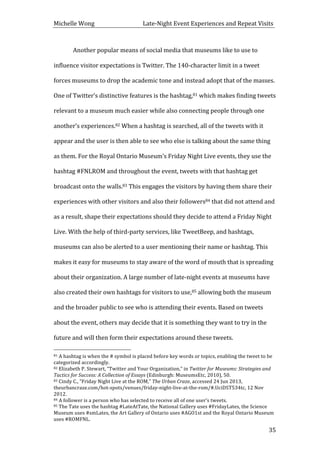
Figure	
  3.	
  Science	
  Museum	
  tweet	
  from	
  the	
  “An	
  evening	
  dedicated	
  to	
  surgery”	
  
Lates	
  ..................................................................................................................................	
  36	
  
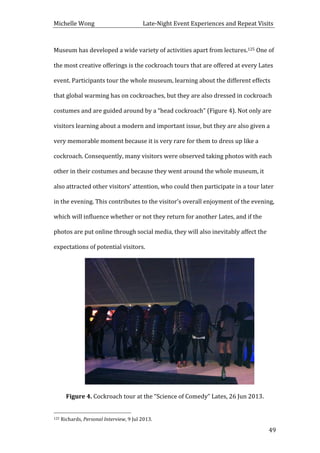
Figure	
  4.	
  Cockroach	
  tour	
  at	
  the	
  “Science	
  of	
  Comedy”	
  Lates,	
  26	
  Jun	
  2013.	
  .............	
  49	
  
Figure	
  5.	
  Drinks	
  menu	
  at	
  the	
  Midnight	
  Apothecary’s	
  first	
  birthday	
  celebration,	
  as	
  
part	
  of	
  Museums	
  At	
  Night	
  2013.	
  ...........................................................................	
  54	
  
Figure	
  6.	
  The	
  atmosphere	
  at	
  Midnight	
  Apothecary.	
  .........................................................	
  57	


Michelle	
  Wong	


  Late-­‐Night	
  Event	
  Experiences	
  and	
  Repeat	
  Visits	
  
	
   5	
  
Acknowledgements	


   I	
  would	
  like	
  to	
  thank	
  all	
  of	
  the	
  tutors	
  at	
  the	
  School	
  of	
  Museum	
  Studies	
  for	
  
providing	
  an	
  incredible	
  learning	
  environment	
  throughout	
  the	
  year,	
  and	
  a	
  special	
  
thanks	
  to	
  both	
  Paul	
  Martin	
  and	
  Richard	
  Sandell	
  for	
  their	
  guidance	
  during	
  my	
  
studies.	
  My	
  thanks	
  are	
  also	
  extended	
  to	
  Catherine	
  Braithwaite,	
  who	
  sparked	
  not	
  
only	
  my	
  interest	
  in	
  late-­‐night	
  events,	
  but	
  in	
  museum	
  marketing	
  in	
  general.	


   I	
  am	
  extremely	
  grateful	
  for	
  the	
  various	
  museum	
  professionals	
  who	
  took	
  
the	
  time	
  to	
  answer	
  my	
  emails	
  regarding	
  their	
  late-­‐night	
  events,	
  in	
  particular	
  
Anthony	
  Richards	
  at	
  the	
  Science	
  Museum	
  and	
  Robert	
  Hulse	
  at	
  the	
  Brunel	
  
Museum.	
  Without	
  their	
  contributions,	
  my	
  research	
  would	
  have	
  lacked	
  the	
  
evidence	
  needed	
  to	
  substantiate	
  my	
  arguments.	


   To	
  my	
  fellow	
  classmates	
  and	
  dear	
  friends,	
  without	
  you,	
  I	
  would	
  never	
  
have	
  survived	
  the	
  long	
  hours	
  spent	
  at	
  the	
  library.	
  Thank	
  you	
  for	
  maintaining	
  my	
  
sanity.	


   Last,	
  but	
  definitely	
  not	
  least,	
  I	
  would	
  like	
  to	
  thank	
  my	
  family.	
  To	
  my	
  
parents,	
  Donald	
  and	
  Maisie,	
  whose	
  unending	
  support	
  I	
  could	
  not	
  do	
  without,	
  and	
  
to	
  my	
  younger	
  brother	
  Christopher,	
  who	
  had	
  the	
  pleasure	
  of	
  spending	
  hours	
  
proofreading	
  my	
  work.	
  Without	
  you	
  guys,	
  I	
  would	
  not	
  be	
  where	
  I	
  am	
  today.	


Michelle	
  Wong	


  Late-­‐Night	
  Event	
  Experiences	
  and	
  Repeat	
  Visits	
  
	
   6	
  
Introduction	


“In	
  the	
  daytime,	
  then,	
  when	
  we	
  enter	
  a	
  museum,	
  we	
  
anticipate	
  finding	
  something	
  to	
  marvel	
  at.	
  We	
  want	
  to	
  see	
  
magical	
  and	
  strange	
  objects,	
  to	
  hear	
  tales	
  from	
  different	
  
worlds	
  and	
  different	
  times.	
  We	
  already	
  enter	
  a	
  place	
  of	
  
wonders,	
  which	
  shifts	
  into	
  a	
  stranger	
  landscape	
  yet	
  when	
  
the	
  lights	
  go	
  off,	
  and	
  night	
  falls.”	
  1	
  
-­‐	
  Jenny	
  Walklate	


As	
  Jenny	
  Walklate	
  states	
  in	
  the	
  above	
  quote,	
  museums	
  are	
  places	
  of	
  
wonder,	
  offering	
  the	
  opportunity	
  to	
  step	
  outside	
  of	
  one’s	
  daily	
  routine	
  and	
  step	
  
into	
  a	
  world	
  that	
  is	
  completely	
  different	
  from	
  the	
  norm.	
  Now	
  imagine	
  this	
  
strange	
  world	
  at	
  night,	
  with	
  the	
  lights	
  off,	
  the	
  air	
  full	
  of	
  mystery	
  and	
  music,	
  a	
  
drink	
  in	
  your	
  hand,	
  surrounded	
  by	
  friends.	
  This	
  is	
  the	
  environment	
  that	
  a	
  late-­‐
night	
  event	
  visitor	
  encounters	
  when	
  they	
  visit	
  a	
  museum	
  at	
  night.	
  Late-­‐night	
  
events	
  at	
  museums2	
  have	
  become	
  increasingly	
  popular	
  with	
  both	
  museum	
  
professionals	
  and	
  the	
  public.	
  For	
  museum	
  professionals,	
  they	
  are	
  a	
  proven	
  
means	
  of	
  attracting	
  new	
  audiences	
  that	
  would	
  not	
  normally	
  visit	
  the	
  museum,3	
  
and	
  for	
  the	
  public,	
  late-­‐night	
  events	
  take	
  a	
  place	
  that	
  is	
  usually	
  very	
  sterile	
  and	
  
seemingly	
  unwelcoming	
  and	
  turn	
  it	
  into	
  a	
  social	
  venue	
  for	
  people	
  who	
  are	
  
looking	
  for	
  an	
  enjoyable	
  night	
  out.	
  Whilst	
  late-­‐night	
  events	
  are	
  excellent	
  for	
  
attracting	
  new	
  audiences	
  to	
  museums,4	
  there	
  is	
  very	
  little	
  information	
  or	


1	
  Jenny	
  Walklate,	
  “Guest	
  post:	
  Jenny	
  Walklate	
  describes	
  the	
  experience	
  of	
  a	
  museum	
  at	
  night,”	
  
Museums	
  at	
  Night	
  Blog,	
  accessed	
  3	
  Jun	
  2013,	
  
http://museumsatnight.wordpress.com/2010/02/16/guest-­‐post-­‐jenny-­‐walklate-­‐describes-­‐the-­‐
experience-­‐of-­‐a-­‐museum-­‐at-­‐night/,	
  16	
  Feb	
  2010.	
  
2	
  For	
  the	
  purposes	
  of	
  this	
  dissertation,	
  I	
  mean	
  to	
  encompass	
  and	
  include	
  all	
  different	
  types	
  of	
  
cultural	
  and	
  heritage	
  institutions	
  when	
  referring	
  solely	
  to	
  museum.	
  
3	
  Rebecca	
  Atkinson,	
  “Why	
  Hold	
  Late-­‐Night	
  Events?”	
  Museum	
  Practice,	
  accessed	
  3	
  Jun	
  2013,	
  
http://www.museumsassociation.org/museum-­‐practice/late-­‐night-­‐events/14122012-­‐why-­‐
hold-­‐late-­‐night-­‐events,	
  14	
  Dec	
  2012.	
  
4	
  Ibid.	
  
Michelle	
  Wong	


  Late-­‐Night	
  Event	
  Experiences	
  and	
  Repeat	
  Visits	
  
	
   7	
  
literature	
  about	
  how	
  these	
  events	
  support	
  institutional	
  goals.	
  My	
  dissertation	
  
will	
  attempt	
  to	
  address	
  this	
  issue	
  by	
  looking	
  at	
  how	
  the	
  visitor	
  experience	
  at	
  
late-­‐night	
  events	
  can	
  help	
  museums	
  gain	
  repeat	
  visitors.	


   Museums	
  are	
  increasingly	
  struggling	
  to	
  get	
  visitors	
  through	
  their	
  doors	
  
more	
  than	
  once,	
  and	
  with	
  the	
  added	
  pressure	
  from	
  outside	
  bodies,	
  mainly	
  those	
  
funding	
  the	
  museum,	
  to	
  get	
  higher	
  visitor	
  numbers,5	
  this	
  has	
  become	
  a	
  major	
  
concern	
  for	
  many	
  institutions.	
  A	
  way	
  in	
  which	
  many	
  museums,	
  particularly	
  
smaller	
  institutions,	
  are	
  able	
  to	
  attract	
  repeat	
  visitors	
  is	
  by	
  varying	
  their	
  
programmes.6	
  The	
  adoption	
  of	
  late-­‐night	
  events	
  has	
  been	
  a	
  welcome	
  addition	
  to	
  
museum	
  programming	
  and,	
  emerging	
  at	
  a	
  point	
  in	
  time	
  where	
  museums	
  have	
  
started	
  to	
  lose	
  their	
  appeal	
  to	
  the	
  majority	
  of	
  the	
  public,7	
  these	
  events	
  are	
  an	
  
ideal	
  way	
  for	
  museums	
  to	
  show	
  themselves	
  in	
  a	
  different,	
  more	
  exciting	
  and	
  
appealing	
  light.	
  In	
  terms	
  of	
  capturing	
  repeat	
  visitors,	
  the	
  visitor	
  experience	
  plays	
  
a	
  crucial	
  part	
  in	
  the	
  decision-­‐making	
  process	
  of	
  the	
  public	
  when	
  deciding	
  
whether	
  or	
  not	
  to	
  return	
  to	
  a	
  museum.	
  Since	
  there	
  is	
  a	
  gap	
  in	
  academic	
  literature	
  
surrounding	
  the	
  impact	
  that	
  the	
  visitor	
  experience	
  can	
  have	
  on	
  repeat	
  visitors,	
  I	
  
am	
  interested	
  in	
  looking	
  at	
  how	
  museums	
  can	
  encourage	
  increased	
  numbers	
  of	
  
repeat	
  visits	
  by	
  focusing	
  on	
  their	
  visitor	
  experiences,	
  and	
  crucially	
  how	
  late-­‐
night	
  events	
  can	
  enhance	
  those	
  experiences.	
  Whilst	
  late-­‐night	
  events	
  may	
  take	
  
high	
  levels	
  of	
  staff	
  time	
  and	
  effort	
  to	
  put	
  together,	
  this	
  paper	
  will	
  argue	
  that	
  the	
  
potential	
  results	
  are	
  worth	
  the	
  resources	
  being	
  put	
  into	
  them.	


5	
  Fiona	
  McLean,	
  Marketing	
  the	
  Museum	
  (London:	
  Routledge,	
  1997),	
  37.	
  
6	
  Robert	
  Hulse,	
  Director,	
  Brunel	
  Museum,	
  Personal	
  Correspondence,	
  21	
  Jun	
  2013.	
  
7	
  Nina	
  Simon,	
  The	
  Participatory	
  Museum,	
  accessed	
  14	
  Jul	
  2013,	
  
http://www.participatorymuseum.org/preface/.	
  
Michelle	
  Wong	


  Late-­‐Night	
  Event	
  Experiences	
  and	
  Repeat	
  Visits	
  
	
   8	
  
Methodology	


   The	
  primary	
  methodology	
  for	
  this	
  paper	
  is	
  literature	
  review.	
  While	
  
researching	
  for	
  this	
  dissertation,	
  I	
  found	
  a	
  wide	
  range	
  of	
  academic	
  texts	
  relating	
  
to	
  museum	
  audiences	
  and	
  the	
  visitor	
  experience.	
  They	
  are	
  popular	
  topics	
  within	
  
the	
  museum	
  studies	
  oeuvre	
  and	
  a	
  number	
  of	
  authors	
  have	
  written	
  on	
  the	
  
subject8.	
  The	
  problem	
  that	
  I	
  encountered	
  was	
  with	
  locating	
  academic	
  texts	
  
regarding	
  late-­‐night	
  events.	
  Because	
  this	
  phenomenon	
  is	
  relatively	
  new,	
  there	
  is	
  
very	
  little	
  research	
  available.	
  Currently,	
  the	
  main	
  body	
  of	
  research	
  regarding	
  
late-­‐night	
  events	
  is	
  a	
  series	
  of	
  online	
  articles	
  by	
  Rebecca	
  Atkinson	
  on	
  the	
  
Museums	
  Association	
  website.9	
  While	
  it	
  is	
  a	
  small	
  resource,	
  the	
  information	
  
provided	
  in	
  these	
  articles	
  is	
  important	
  in	
  developing	
  a	
  better	
  understanding	
  of	
  
late-­‐night	
  events.	
  The	
  purpose	
  of	
  this	
  dissertation	
  is	
  to	
  provide	
  a	
  foundation	
  of	
  
research	
  which	
  will	
  enable	
  museum	
  professionals	
  to	
  grasp	
  the	
  full	
  potential	
  of	
  
late-­‐night	
  events,	
  and	
  how	
  they	
  can	
  be	
  used	
  to	
  attract	
  repeat	
  visitors.	
  To	
  
supplement	
  these	
  secondary	
  resources,	
  I	
  personally	
  attended	
  a	
  variety	
  of	
  
different	
  museum	
  late-­‐nights	
  and	
  will	
  use	
  my	
  critical	
  observations	
  in	
  my	
  case	
  
study	
  analyses.	
  I	
  also	
  successfully	
  contacted	
  various	
  managers	
  and	
  museum	


8	
  McLean,	
  Marketing	
  the	
  Museum.	
  Marilyn	
  Hood,	
  “Staying	
  Away:	
  Why	
  people	
  choose	
  not	
  to	
  visit	
  
museums,”	
  in	
  Reinventing	
  the	
  Museum:	
  Historical	
  and	
  Contemporary	
  Perspectives	
  on	
  the	
  Paradigm	
  
Shift	
  (2004).	
  John	
  H.	
  Falk	
  and	
  Lynn	
  D.	
  Dierking,	
  Learning	
  From	
  Museums	
  (Walnut	
  Creek,	
  CA:	
  
AltaMira	
  Press,	
  2000).	
  John	
  H.	
  Falk	
  and	
  Lynn	
  D.	
  Dierking,	
  The	
  Museum	
  Experience	
  (Washington:	
  
Whalesback	
  Books,	
  1992).	
  John	
  H.	
  Falk	
  and	
  Lynn	
  D.	
  Dierking,	
  The	
  Museum	
  Experience	
  Revisited	
  
(Walnut	
  Creek,	
  CA:	
  Left	
  Coast	
  Press,	
  inc.,	
  2013).	
  Sue	
  Runyard	
  and	
  Ylva	
  French,	
  Marketing	
  &	
  
Public	
  Relations	
  Handbook:	
  For	
  Museums,	
  Galleries	
  &	
  Heritage	
  Attractions	
  (London:	
  The	
  
Stationery	
  Office,	
  1999).	
  Neil	
  and	
  Philip	
  Kotler,	
  Museum	
  Strategy	
  &	
  Marketing	
  (San	
  Fransisco:	
  
Jossey-­‐Bass,	
  1998).	
  	
  
9	
  “Late-­‐night	
  events,”	
  Museum	
  Practice,	
  accessed	
  18	
  Jul	
  2013,	
  
http://www.museumsassociation.org/museum-­‐practice/late-­‐night-­‐events.	
  
Michelle	
  Wong	


  Late-­‐Night	
  Event	
  Experiences	
  and	
  Repeat	
  Visits	
  
	
   9	
  
directors10	
  who	
  have	
  provided	
  supporting	
  information	
  for	
  both	
  my	
  theoretical	
  
research	
  and	
  my	
  personal	
  observations.	


Dissertation	
  Summary	


   In	
  the	
  first	
  chapter	
  of	
  the	
  dissertation,	
  it	
  is	
  important	
  to	
  acknowledge	
  the	
  
importance	
  of	
  audience	
  research	
  and	
  how	
  this	
  information	
  influences	
  the	
  
decisions	
  a	
  museum	
  makes	
  about	
  the	
  nature	
  of	
  the	
  programmes	
  it	
  will	
  present	
  
to	
  the	
  public.	
  Marilyn	
  Hood’s	
  research	
  has	
  proven	
  invaluable	
  when	
  segmenting	
  
the	
  general	
  public	
  and	
  analyzing	
  why	
  some	
  people	
  may	
  not	
  visit	
  museums.	
  Even	
  
though	
  this	
  research	
  was	
  undertaken	
  in	
  1980,	
  it	
  continues	
  to	
  be	
  referred	
  to	
  in	
  
more	
  contemporary	
  texts.	
  The	
  age	
  of	
  this	
  research	
  has	
  necessitated	
  a	
  broad	
  
approach	
  to	
  gathering	
  information	
  through	
  literature,	
  and	
  several	
  authors	
  have	
  
been	
  able	
  to	
  contribute	
  to	
  Hood’s	
  work.	
  While	
  the	
  work	
  of	
  John	
  Falk	
  and	
  Lynn	
  
Dierking	
  looks	
  at	
  the	
  visitor	
  experience	
  and	
  learning	
  within	
  the	
  museum,	
  they	
  
have	
  addressed	
  the	
  topic	
  of	
  who	
  is	
  and	
  is	
  not	
  visiting	
  the	
  museum	
  and	
  what	
  
contributes	
  to	
  their	
  decision-­‐making	
  processes.	
  These	
  processes	
  are	
  very	
  
important	
  when	
  discussing	
  how	
  to	
  encourage	
  visitors	
  to	
  return	
  to	
  a	
  museum.	


   Neil	
  Kotler	
  and	
  Philip	
  Kotler	
  have	
  done	
  some	
  important	
  work	
  in	
  regards	
  
to	
  what	
  museums	
  can	
  do	
  to	
  better	
  address	
  the	
  needs	
  of	
  their	
  audiences,	
  both	
  
existing	
  and	
  potential.	
  They	
  look	
  at	
  different	
  marketing	
  strategies	
  that	
  take	
  the	
  
unique	
  selling	
  points	
  of	
  museums	
  and	
  make	
  various	
  suggestions	
  as	
  to	
  how	


10	
  Robert	
  Hulse,	
  Director	
  of	
  the	
  Brunel	
  Museum;	
  Rebecca	
  Jacobs,	
  Activities	
  and	
  Events	
  Officer	
  at	
  
the	
  William	
  Morris	
  Gallery;	
  Amanda	
  Rice,	
  Audience	
  Insight	
  Manager	
  at	
  the	
  Royal	
  Ontario	
  
Museum;	
  and	
  Anthony	
  Richards,	
  Head	
  of	
  Learning	
  Operations	
  at	
  the	
  Science	
  Museum.	
  
Michelle	
  Wong	


  Late-­‐Night	
  Event	
  Experiences	
  and	
  Repeat	
  Visits	
  
	
   10	
  
museums	
  can	
  attract	
  new	
  audiences,	
  while	
  still	
  appealing	
  to	
  their	
  existing	
  
audiences.	
  I	
  will	
  apply	
  their	
  theoretical	
  knowledge	
  to	
  late-­‐night	
  events	
  and	
  
discuss	
  how	
  these	
  events	
  substantiate	
  their	
  research.	


   The	
  next	
  section	
  in	
  Chapter	
  One	
  involves	
  discussing	
  how	
  late-­‐night	
  
events	
  fulfill	
  the	
  needs	
  and	
  purpose	
  of	
  museums.	
  Ruth	
  Rentschler	
  is	
  important	
  to	
  
acknowledge	
  when	
  examining	
  the	
  shift	
  that	
  has	
  taken	
  place	
  regarding	
  the	
  
overall	
  purpose	
  of	
  museums.	
  Supporting	
  this,	
  a	
  number	
  of	
  other	
  authors11	
  have	
  
argued	
  how	
  the	
  main	
  focus	
  of	
  museums	
  is	
  now	
  on	
  the	
  public	
  and	
  the	
  museum’s	
  
audience	
  rather	
  than	
  solely	
  on	
  its	
  collections.12	
  This	
  move	
  towards	
  a	
  more	
  
visitor-­‐centric	
  museum	
  experience	
  has	
  meant	
  that	
  learning	
  has	
  remained	
  a	
  core	
  
purpose	
  of	
  the	
  museum	
  and	
  I	
  will	
  go	
  into	
  detail	
  about	
  how	
  late-­‐night	
  events	
  
contribute	
  to	
  a	
  visitor’s	
  learning	
  within	
  the	
  museum.	
  My	
  arguments	
  will	
  be	
  
supported	
  primarily	
  by	
  the	
  works	
  of	
  Eilean	
  Hooper-­‐Greenhill	
  and	
  Falk	
  and	
  
Dierking.	
  These	
  texts	
  discuss	
  how	
  ‘museum	
  education’	
  is	
  now	
  understood	
  as	
  
‘museum	
  learning,’	
  which	
  focuses	
  more	
  on	
  learning	
  processes	
  and	
  how	
  to	
  
facilitate	
  visitor	
  learning.13	
  Various	
  aspects	
  of	
  a	
  museum’s	
  late-­‐night	
  event	
  can	
  
contribute	
  to	
  visitors’	
  learning	
  in	
  the	
  museum	
  and	
  it	
  is	
  therefore	
  important	
  for	
  
museums	
  to	
  recognize	
  this	
  and	
  to	
  capitalize	
  on	
  the	
  learning	
  outcome	
  potential.	


11	
  Ruth	
  Rentschler,	
  “Museum	
  Marketing,	
  Understanding	
  Different	
  Types	
  of	
  Audiences,”	
  in	
  
Museum	
  Management	
  and	
  Marketing,	
  eds.	
  Richard	
  Sandell,	
  et	
  al.	
  (London:	
  Routledge,	
  2007).	
  
Runyard	
  &	
  French,	
  Marketing	
  &	
  Public	
  Relations	
  Handbook.	
  ICOM,	
  “Museum	
  definition,”	
  accessed	
  
2	
  Jun	
  2013,	
  icom.museum/the-­‐vision/museum-­‐definition/.	
  McLean,	
  Marketing	
  the	
  Museum.	
  Falk	
  
and	
  Dierking,	
  Learning	
  From	
  Museums.	
  Stephen	
  Weil,	
  “The	
  Museum	
  and	
  the	
  Public”	
  in	
  Museums	
  
and	
  Their	
  Communities,	
  ed.	
  Sheila	
  Watson	
  (New	
  York:	
  Routledge,	
  2007).	
  	
  
12	
  Rentschler,	
  “Museum	
  Marketing,”	
  349.	
  
13	
  Eilean	
  Hooper-­‐Greenhill,	
  Museums	
  and	
  Education:	
  Purpose,	
  Pedagogy,	
  Performance	
  (London	
  
and	
  New	
  York:	
  Routledge,	
  2007),	
  4.	
  
Michelle	
  Wong	


  Late-­‐Night	
  Event	
  Experiences	
  and	
  Repeat	
  Visits	
  
	
   11	
  
	
   Chapter	
  Two	
  will	
  focus	
  specifically	
  on	
  the	
  visitor	
  experience	
  of	
  a	
  late-­‐
night	
  event.	
  Falk	
  and	
  Dierking	
  are	
  the	
  most	
  important	
  authors	
  to	
  reference	
  when	
  
discussing	
  the	
  visitor	
  experience,	
  as	
  their	
  research	
  is	
  the	
  most	
  up	
  to	
  date	
  and	
  
influential.	
  They	
  previously	
  published	
  works	
  back	
  in	
  the	
  1990s	
  and	
  early	
  2000s,	
  
but	
  in	
  early	
  2013,	
  they	
  published	
  The	
  Museum	
  Experience	
  Revisited,	
  which	
  
reanalyzes	
  their	
  previous	
  work,	
  giving	
  greater	
  contemporary	
  information.	
  Their	
  
main	
  argument	
  still	
  remains	
  that	
  there	
  are	
  many	
  aspects	
  of	
  a	
  museum	
  visit	
  that	
  
museums	
  do	
  not	
  always	
  consider	
  when	
  accessing	
  their	
  visitor	
  experience;	
  the	
  
visitor	
  experience	
  involves	
  everything	
  from	
  the	
  decision-­‐making	
  process	
  to	
  the	
  
pre-­‐visit	
  preparations,	
  to	
  the	
  actual	
  visit,	
  to	
  the	
  post-­‐visit	
  experience.	
  Museums	
  
may	
  not	
  be	
  able	
  to	
  control	
  all	
  of	
  these	
  aspects,	
  but	
  they	
  can	
  surely	
  influence	
  
them,	
  in	
  their	
  attempt	
  to	
  create	
  an	
  overall	
  more	
  positive	
  experience.	


   Once	
  this	
  dissertation	
  has	
  established	
  what	
  the	
  visitor	
  experience	
  is,	
  and	
  
what	
  contributes	
  to	
  it,	
  it	
  will	
  look	
  in-­‐depth	
  at	
  the	
  specific	
  visitor	
  experience	
  of	
  
late-­‐night	
  events	
  and	
  how	
  they	
  affect	
  the	
  decision-­‐making	
  process	
  when	
  
choosing	
  to	
  return	
  to	
  a	
  museum.	
  Museum	
  professionals	
  need	
  to	
  be	
  aware	
  of	
  the	
  
endless	
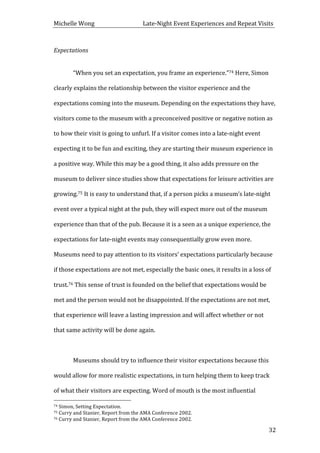
  cycle	
  that	
  is	
  the	
  visitor	
  experience.	
  The	
  cycle	
  begins	
  with	
  the	
  
expectations	
  that	
  visitors	
  develop	
  prior	
  to	
  coming	
  to	
  the	
  museum	
  and	
  then,	
  
based	
  on	
  those	
  expectations,	
  a	
  level	
  of	
  satisfaction	
  is	
  achieved.	
  Word	
  of	
  mouth	
  
propels	
  both	
  aspects	
  of	
  the	
  cycle	
  and	
  as	
  a	
  result,	
  museums	
  need	
  to	
  be	
  highly	
  
aware	
  of	
  social	
  media,	
  as	
  it	
  has	
  increased	
  the	
  impact	
  that	
  word	
  of	
  mouth	
  can	
  
have	
  on	
  potential	
  visitors.	
  I	
  will	
  look	
  at	
  each	
  of	
  these	
  elements	
  in	
  detail	
  in	
  
Chapter	
  Two	
  before	
  analyzing	
  specific	
  elements	
  of	
  a	
  late-­‐night	
  event	
  that	
  would	
  
improve	
  a	
  visitor	
  experience,	
  and	
  thus,	
  encourage	
  repeat	
  visits.	
  	
  
Michelle	
  Wong	


  Late-­‐Night	
  Event	
  Experiences	
  and	
  Repeat	
  Visits	
  
	
   12	


   In	
  Chapter	
  Three,	
  I	
  will	
  analyze	
  the	
  Lates	
  at	
  the	
  Science	
  Museum	
  due	
  to	
  
them	
  being	
  the	
  first	
  institution	
  to	
  more	
  fully	
  explore	
  and	
  develop	
  the	
  idea	
  of	
  
nighttime	
  events	
  at	
  museums.14	
  In	
  an	
  interview	
  with	
  Anthony	
  Richards,	
  the	
  
Head	
  of	
  Learning	
  Operations	
  and	
  a	
  key	
  figure	
  in	
  the	
  creation	
  of	
  the	
  Lates,	
  he	
  
indicated	
  a	
  number	
  of	
  components	
  that	
  make	
  for	
  successful	
  late-­‐night	
  events	
  
that	
  attract	
  new	
  and	
  repeat	
  audiences	
  for	
  any	
  size	
  museum.	
  I	
  will	
  then	
  look	
  at	
  
the	
  Brunel	
  Museum’s	
  Midnight	
  Apothecary	
  programme	
  and	
  how	
  it	
  differs	
  from	
  
the	
  Lates,	
  but	
  is	
  equally	
  successful	
  in	
  attracting	
  repeat	
  visitors.	
  I	
  had	
  the	
  
pleasure	
  of	
  attending	
  both	
  the	
  Science	
  of	
  Comedy	
  Lates	
  in	
  June	
  2013	
  and	
  the	
  
Midnight	
  Apothecary’s	
  first	
  birthday	
  celebration	
  during	
  the	
  Museums	
  At	
  Night	
  
festival	
  in	
  May	
  2013.	
  I	
  thoroughly	
  enjoyed	
  both	
  events,	
  and	
  they	
  have	
  provided	
  
me	
  with	
  my	
  own	
  visitor	
  experience	
  and	
  also	
  critical	
  personal	
  observations	
  that	
  
support	
  my	
  argument	
  of	
  how	
  both	
  museums	
  create	
  positive	
  visitor	
  experiences	
  
that	
  help	
  compel	
  visitors	
  to	
  return	
  to	
  the	
  museum.	


   In	
  the	
  concluding	
  section	
  of	
  my	
  dissertation,	
  I	
  will	
  address	
  the	
  limitations	
  
encountered	
  when	
  researching	
  this	
  subject	
  and	
  how	
  future	
  research	
  could	
  have	
  
a	
  significant	
  impact	
  on	
  the	
  better	
  understanding	
  of	
  late-­‐night	
  events	
  and	
  what	
  
they	
  are	
  capable	
  of	
  achieving.	
  Because	
  these	
  types	
  of	
  events	
  are	
  still	
  relatively	
  
new	
  and	
  increasing	
  in	
  popularity,	
  it	
  is	
  important	
  to	
  continue	
  researching	
  their	
  
various	
  aspects	
  and	
  their	
  inevitable	
  influence	
  in	
  how	
  the	
  public	
  now	
  uses	
  
museums.	


14	
  Anthony	
  Richards,	
  Head	
  of	
  Learning	
  Operations,	
  Science	
  Museum,	
  interview	
  by	
  Michelle	
  
Wong,	
  personal	
  interview	
  (London:	
  9	
  Jul	
  2013).	
  
Michelle	
  Wong	


  Late-­‐Night	
  Event	
  Experiences	
  and	
  Repeat	
  Visits	
  
	
   13	
  
Chapter	
  One:	
  History	
  of	
  Late-­‐Night	
  Events	
  and	
  Their	
  Rise	
  in	
  Popularity	


   This	
  first	
  chapter	
  will	
  discuss	
  the	
  overall	
  importance	
  of	
  audience	
  
research	
  within	
  museums,	
  and	
  how	
  late-­‐night	
  events	
  are	
  a	
  new	
  offering	
  
resulting	
  from	
  this	
  information.	
  Without	
  the	
  information	
  gained	
  from	
  audience	
  
research,	
  museum	
  managers	
  may	
  not	
  have	
  recognized	
  the	
  need	
  to	
  broaden	
  their	
  
offerings	
  to	
  include	
  late-­‐night	
  events.	
  Such	
  occurrences	
  may	
  not	
  seem	
  like	
  they	
  
have	
  a	
  place	
  within	
  the	
  museum,	
  as	
  it	
  could	
  be	
  argued	
  that	
  the	
  socializing	
  aspect	
  
of	
  the	
  events	
  may	
  seem	
  like	
  it	
  is	
  taking	
  the	
  attention	
  off	
  of	
  the	
  collections	
  and	
  the	
  
educational	
  purposes	
  that	
  museums	
  have	
  at	
  their	
  core,	
  but	
  with	
  increasing	
  
amounts	
  of	
  research	
  on	
  learning,	
  specifically	
  within	
  the	
  museum	
  environment,	
  
museums	
  are	
  acknowledging	
  the	
  fact	
  that	
  social	
  learning	
  is	
  highly	
  effective	
  and	
  
are	
  thus	
  embracing	
  the	
  potential	
  that	
  late-­‐night	
  events	
  hold.	


The	
  Importance	
  of	
  Audience	
  Research	


   Audience	
  research	
  is	
  important	
  in	
  studying	
  new	
  museum	
  practices,	
  like	
  
late-­‐night	
  events,	
  because	
  it	
  is	
  through	
  this	
  type	
  of	
  research	
  that	
  a	
  museum	
  is	
  
able	
  to	
  understand	
  what	
  its	
  audiences	
  are	
  looking	
  for.	
  As	
  has	
  been	
  previously	
  
discussed,	
  there	
  has	
  been	
  a	
  shift	
  towards	
  focusing	
  on	
  the	
  public	
  rather	
  than	
  
solely	
  on	
  the	
  collections.	
  This	
  has	
  made	
  it	
  necessary	
  for	
  museums	
  to	
  know	
  
exactly	
  who	
  are	
  their	
  public,	
  both	
  visitors	
  and	
  non-­‐visitors	
  alike,	
  in	
  order	
  for	
  
them	
  to	
  effectively	
  serve	
  the	
  public.15	
  Despite	
  being	
  published	
  in	
  1983,	
  Marilyn	
  
Hood’s	
  article	
  “Staying	
  Away:	
  Why	
  people	
  choose	
  not	
  to	
  visit	
  museums,”	
  is	
  still	


15	
  McLean,	
  Marketing	
  the	
  Museum,	
  90.	
  
Michelle	
  Wong	


  Late-­‐Night	
  Event	
  Experiences	
  and	
  Repeat	
  Visits	
  
	
   14	
  
proving	
  to	
  be	
  relevant	
  and	
  continues	
  to	
  be	
  referenced	
  in	
  literature	
  today,16	
  
providing	
  a	
  basis	
  to	
  understanding	
  museum	
  audiences.	
  Her	
  research	
  at	
  the	
  
Toledo	
  Art	
  Museum	
  found	
  that	
  the	
  public	
  can	
  be	
  segmented	
  into	
  three	
  distinct	
  
audience	
  groups,	
  based	
  on	
  what	
  leisure	
  aspects	
  they	
  value	
  the	
  most:	
  the	
  
frequent	
  visitors,	
  the	
  occasional	
  visitors	
  and	
  the	
  non-­‐participants.17	
  The	
  
frequent	
  visitors,	
  that	
  visited	
  museums	
  more	
  than	
  three	
  times	
  a	
  year,	
  valued	
  
most	
  having	
  the	
  opportunity	
  to	
  learn,	
  having	
  a	
  challenge	
  of	
  new	
  experiences	
  and	
  
doing	
  something	
  worthwhile.18	
  The	
  non-­‐participants	
  valued	
  the	
  three	
  aspects	
  
that	
  the	
  frequent	
  visitors	
  valued	
  the	
  least:	
  being	
  with	
  people	
  (social	
  interaction),	
  
actively	
  participating	
  and	
  feeling	
  comfortable	
  and	
  at	
  ease	
  with	
  their	
  
surroundings.19	
  As	
  expected,	
  the	
  last	
  distinct	
  audience	
  segment,	
  the	
  occasional	
  
visitors,	
  valued	
  similar	
  aspects	
  as	
  both	
  frequent	
  visitors	
  and	
  non-­‐participants.20	
  
Based	
  on	
  her	
  research,	
  museums	
  are	
  able	
  to	
  form	
  a	
  foundation	
  for	
  their	
  
understanding	
  as	
  to	
  why	
  some	
  people	
  do	
  not	
  visit	
  the	
  museum.	
  Two	
  decades	
  
later,	
  Falk	
  and	
  Dierking	
  have	
  found	
  evidence	
  that	
  furthers	
  Hood’s	
  research,	
  
showing	
  that	
  more	
  than	
  half	
  of	
  the	
  public	
  now	
  values	
  learning	
  and	
  doing	
  
something	
  challenging	
  and	
  worthwhile	
  in	
  their	
  leisure	
  time,	
  not	
  just	
  the	
  small	
  
minority	
  of	
  frequent	
  museum	
  visitors.21	
  This	
  is	
  important	
  because	
  it	
  reflects	
  the	
  
change	
  over	
  the	
  years	
  in	
  the	
  public’s	
  desires	
  and	
  how	
  they	
  see	
  their	
  leisure	
  time.	
  
People	
  now	
  want	
  more	
  out	
  of	
  their	
  leisure	
  time	
  and	
  museums	
  need	
  to	
  adapt	
  
accordingly.	
  Late-­‐night	
  events	
  have	
  been	
  employed	
  by	
  museums	
  as	
  a	
  means	
  of	
  
addressing	
  these	
  changes.	
  Psychological	
  access	
  is	
  one	
  of	
  the	
  main	
  arguments	
  for	


16	
  Falk	
  and	
  Dierking,	
  Learning	
  From	
  Museums,	
  73	
  
17	
  Ibid,	
  151.	
  
18	
  Ibid,	
  153.	
  
19	
  Ibid,	
  153.	
  
20	
  Ibid,	
  154.	
  
21	
  Ibid,	
  73.	
  
Michelle	
  Wong	


  Late-­‐Night	
  Event	
  Experiences	
  and	
  Repeat	
  Visits	
  
	
   15	
  
why	
  some	
  of	
  the	
  public	
  does	
  not	
  feel	
  comfortable	
  visiting	
  a	
  museum.22	
  With	
  
proper	
  development,	
  late-­‐night	
  events	
  can	
  help	
  to	
  overcome	
  this	
  sense	
  of	
  
disenfranchisement	
  and	
  alienation.	


   In	
  past	
  years,	
  in	
  addition	
  to	
  the	
  psychological	
  barriers,	
  race	
  and	
  income	
  
have	
  been	
  sufficient	
  reasons	
  for	
  why	
  people	
  were	
  not	
  visiting	
  museums,	
  but	
  Falk	
  
and	
  Dierking	
  now	
  argue	
  that	
  these	
  are	
  no	
  longer	
  reasons	
  enough,	
  and	
  that	
  it	
  is	
  
more	
  about	
  how	
  leisure	
  time	
  is	
  perceived,	
  and	
  how	
  it	
  should	
  be	
  spent.23	
  How	
  the	
  
public	
  perceives	
  museums	
  will	
  be	
  addressed	
  in	
  detail	
  in	
  Chapter	
  Two,	
  but	
  it	
  is	
  
important	
  to	
  note	
  now	
  that	
  museums	
  have	
  the	
  ability	
  to	
  influence	
  the	
  public’s	
  
perceptions.	
  Museums	
  should	
  not	
  be	
  intimidated	
  by	
  the	
  fact	
  that	
  members	
  of	
  the	
  
public	
  value	
  different	
  leisure	
  aspects;	
  they	
  should	
  instead	
  use	
  this	
  to	
  their	
  
advantage	
  and	
  should	
  offer	
  a	
  larger	
  variety	
  of	
  activities	
  by	
  looking	
  at	
  their	
  
collections	
  and	
  exhibitions	
  from	
  different	
  perspectives24	
  to	
  help	
  develop	
  a	
  
broader	
  range	
  of	
  programmes.	
  Especially	
  with	
  the	
  information	
  museums	
  learn	
  
through	
  audience	
  research,	
  the	
  new	
  and/or	
  improved	
  programmes	
  should	
  be	
  
better	
  tailored	
  to	
  the	
  needs	
  and	
  desires	
  of	
  the	
  different	
  audience	
  segments.25	


Late-­‐Night	
  Events	
  as	
  a	
  New	
  Offering	


   Museums	
  have	
  developed	
  late-­‐night	
  events	
  as	
  a	
  new	
  offering	
  in	
  their	
  
attempt	
  to	
  address	
  the	
  growing	
  needs	
  and	
  desires	
  of	
  the	
  public.	
  These	
  events	


22	
  McLean,	
  Marketing	
  the	
  Museum,	
  75.	
  
23	
  Falk	
  and	
  Dierking,	
  The	
  Museum	
  Experience	
  Revisited,	
  52.	
  
24	
  Hood,	
  Staying	
  Away,	
  155.	
  
25	
  Kotler	
  and	
  Kotler,	
  Museum	
  Strategy	
  and	
  Marketing,	
  100.	
  
Michelle	
  Wong	


  Late-­‐Night	
  Event	
  Experiences	
  and	
  Repeat	
  Visits	
  
	
   16	
  
open	
  museums	
  during	
  hours	
  in	
  which	
  they	
  are	
  usually	
  closed.	
  People,	
  who	
  
usually	
  cannot	
  visit	
  the	
  museum	
  during	
  regular	
  opening	
  hours,	
  now	
  have	
  the	
  
chance	
  to	
  see	
  the	
  museum.	
  During	
  these	
  events,	
  museums	
  will	
  often	
  provide	
  the	
  
opportunity	
  to	
  purchase	
  food	
  and	
  drinks,	
  while	
  offering	
  a	
  variety	
  of	
  activities,	
  
many	
  of	
  which	
  relate	
  to	
  current	
  exhibitions.	
  Museums	
  aim	
  to	
  present	
  themselves	
  
in	
  a	
  different	
  light	
  and	
  in	
  doing	
  so,	
  they	
  provide	
  a	
  unique	
  and	
  inspiring	
  
atmosphere	
  that	
  visitors	
  cannot	
  find	
  elsewhere.	


It	
  is	
  important	
  to	
  look	
  at	
  the	
  circumstances	
  through	
  which	
  late-­‐night	
  
events	
  started	
  being	
  offered	
  by	
  museums	
  because	
  they	
  emerged	
  out	
  of	
  
competitive	
  necessity.	
  	
  Museums	
  no	
  longer	
  compete	
  solely	
  with	
  other	
  cultural	
  
and	
  heritage	
  organizations,	
  but	
  they	
  now	
  face	
  the	
  challenge	
  of	
  competing	
  with	
  
large	
  commercial	
  enterprises	
  like	
  shopping	
  centres	
  and	
  the	
  cinema,	
  for	
  a	
  
decreasing	
  amount	
  of	
  the	
  public’s	
  leisure	
  time.26	
  With	
  an	
  increase	
  in	
  working	
  
hours,27	
  leisure	
  time	
  has	
  become	
  a	
  precious	
  resource	
  and	
  people	
  are	
  now	
  being	
  
more	
  careful	
  as	
  to	
  how	
  their	
  free	
  time	
  is	
  spent.28	
  When	
  there	
  is	
  only	
  a	
  limited	
  
amount	
  of	
  free	
  time,	
  people	
  want	
  to	
  make	
  sure	
  that	
  they	
  are	
  doing	
  something	
  
that	
  they	
  find	
  satisfying	
  and	
  enjoyable.	
  Late-­‐night	
  events	
  were	
  developed	
  in	
  
hopes	
  of	
  providing	
  just	
  that.	


26	
  McLean,	
  Marketing	
  the	
  Museum,	
  71.	
  
27	
  “Stress	
  Levels	
  Increase	
  as	
  UK	
  Employees	
  Work	
  More	
  Hours,	
  According	
  to	
  Towers	
  Watson	
  
Study,”	
  HR	
  Review,	
  accessed	
  17	
  Jul	
  2013,	
  http://www.hrreview.co.uk/hr-­‐news/health-­‐
safety/stress-­‐levels-­‐increase-­‐as-­‐uk-­‐employees-­‐work-­‐more-­‐hours-­‐according-­‐to-­‐towers-­‐watson-­‐
study/39039,	
  21	
  Sep	
  2012.	
  
28	
  Andrew	
  Curry	
  and	
  Robert	
  Stanier,	
  “Report	
  from	
  the	
  AMA	
  Conference	
  2002,	
  Changing	
  Worlds,”	
  
Culture	
  Hive,	
  accessed	
  26	
  Jun	
  2013,	
  culturehive.co.uk/wp-­‐content/uploads/2012/11/Report_-­‐
_Changing_Worlds_-­‐_Andrew_Curry,_Robert_Stanier_-­‐_2002.pdf.	
  
Michelle	
  Wong	


  Late-­‐Night	
  Event	
  Experiences	
  and	
  Repeat	
  Visits	
  
	
   17	
  
In	
  today’s	
  world	
  of	
  “absolute	
  abundance	
  in	
  entertainment,”29	
  consumers	
  
have	
  an	
  unlimited	
  number	
  of	
  leisure	
  choices	
  to	
  choose	
  from,	
  but	
  museums	
  have	
  
the	
  ability	
  to	
  offer	
  something,	
  which	
  commercial	
  ventures	
  cannot.	
  Andrew	
  Curry	
  
and	
  Robert	
  Stanier	
  call	
  this	
  the	
  “disappointing	
  gap,”	
  the	
  gap	
  between	
  the	
  
increased	
  spending	
  on	
  leisure	
  and	
  the	
  decreased	
  level	
  of	
  happiness	
  that	
  the	
  
commercial	
  world	
  cannot	
  fill	
  because	
  they	
  are	
  not	
  willing	
  to	
  release	
  their	
  control	
  
over	
  the	
  consumers.30	
  When	
  a	
  consumer	
  goes	
  to	
  the	
  cinema,	
  they	
  have	
  a	
  
controlled	
  response	
  to	
  the	
  film	
  that	
  they	
  are	
  going	
  to	
  see	
  because	
  the	
  film	
  
company	
  has	
  structured	
  it	
  to	
  extract	
  a	
  certain	
  response.	
  When	
  visitors	
  go	
  into	
  
museums,	
  the	
  responses	
  are	
  uncontrolled	
  and	
  thus	
  unique	
  to	
  each	
  individual.	
  
Eric	
  Kuhn	
  makes	
  the	
  argument	
  that	
  it	
  is	
  these	
  uncontrolled	
  responses	
  that	
  give	
  
the	
  arts	
  the	
  upper	
  hand	
  against	
  the	
  commercial	
  world.	
  In	
  a	
  Maslow-­‐esque	
  
analysis	
  (Figure	
  1),	
  he	
  argues	
  that,	
  with	
  the	
  increasing	
  maturity	
  of	
  customers	
  
and	
  cities,	
  desires	
  move	
  from	
  food	
  to	
  retail	
  through	
  to	
  leisure	
  then	
  culture.	
  
Lastly,	
  desires	
  move	
  onward	
  to	
  enlightenment,	
  which	
  can	
  only	
  be	
  achieved	
  
through	
  uncontrolled	
  audience	
  responses.31	


29	
  Mike	
  Masnick,	
  “The	
  Sky	
  Is	
  Rising:	
  The	
  Entertainment	
  Industry	
  Is	
  Large	
  &	
  Growing,”	
  techdirt,	
  
accessed	
  27	
  Jun	
  2013,	
  www.techdirt.com/articles/20120129/17272817580/sky-­‐is-­‐rising-­‐
entertainment-­‐industry-­‐is-­‐large-­‐growing-­‐not-­‐shrinking.shtml,	
  20	
  Jan	
  2012.	
  
30	
  Curry	
  and	
  Stanier,	
  Report	
  from	
  the	
  AMA	
  Conference	
  2002.	
  
31	
  Ibid.	
  
Michelle	
  Wong	


  Late-­‐Night	
  Event	
  Experiences	
  and	
  Repeat	
  Visits	
  
	
   18	


Figure	
  1.	
  Visual	
  representation	
  of	
  Eric	
  Kuhn’s	
  hierarchy	
  of	
  desires,	
  in	
  the	
  style	
  of	
  
Maslow’s	
  hierarchy	
  of	
  needs.	


Late-­‐night	
  events	
  have	
  become	
  increasingly	
  popular	
  because	
  they	
  offer	
  
visitors	
  the	
  opportunity	
  to	
  experience	
  the	
  enlightenment	
  that	
  Kuhn	
  talks	
  
about.32	
  There	
  is	
  no	
  other	
  leisure	
  activity	
  that	
  can	
  offer	
  the	
  same	
  experience	
  as	
  a	
  
late-­‐night	
  event	
  at	
  a	
  museum.	
  As	
  Robert	
  Hulse	
  puts	
  it,	
  “[the]	
  easy	
  access	
  of	
  
modern	
  encapsulation	
  of	
  TV,	
  film	
  and	
  entertainment	
  leaves	
  some	
  people	
  
wanting	
  something	
  immediate	
  and	
  unusual	
  and	
  less	
  sanitized	
  and	
  packaged.”33	
  
As	
  stated	
  before,	
  consumers	
  have	
  a	
  wide	
  array	
  of	
  leisure	
  choices,	
  but	
  they	
  are	
  
inundated	
  with	
  similar	
  activities	
  with	
  few	
  options	
  for	
  something	
  significantly	
  
different.	
  When	
  going	
  out	
  to	
  the	
  pub	
  or	
  the	
  nightclub,	
  you	
  know	
  what	
  to	
  expect,	
  
but	
  when	
  going	
  to	
  a	
  museum	
  at	
  night,	
  the	
  museum	
  presents	
  itself	
  in	
  a	
  completely	
  
different	
  light.	
  Expectations	
  of	
  going	
  to	
  a	
  museum	
  will	
  be	
  discussed	
  further	
  in	


32	
  Neil	
  Kotler	
  and	
  Phillip	
  Kotler,	
  “Can	
  Museums	
  Be	
  All	
  Things	
  to	
  All	
  People?	
  Missions,	
  Goals,	
  and	
  
Marketing’s	
  Role,”	
  in	
  Museum	
  Marketing	
  &	
  Management,	
  eds.	
  Richard	
  Sandell	
  et	
  al.	
  (London:	
  
Routledge,	
  2007),	
  321.	
  
33	
  Hulse,	
  Personal	
  Correspondence,	
  21	
  Jun	
  2013.	
  
Michelle	
  Wong	


  Late-­‐Night	
  Event	
  Experiences	
  and	
  Repeat	
  Visits	
  
	
   19	
  
Chapter	
  Two,	
  when	
  looking	
  at	
  how	
  these	
  expectations	
  contribute	
  to	
  the	
  overall	
  
visitor	
  experience.	
  “They	
  [Museums	
  at	
  night]	
  have	
  an	
  exclusive	
  feel	
  to	
  them,	
  
giving	
  adults	
  a	
  venue	
  away	
  from	
  family	
  life	
  that	
  is	
  grown	
  up	
  but	
  not	
  too	
  serious-­‐	
  
and	
  crucially	
  an	
  alternative	
  to	
  the	
  pub.”34	
  This	
  is	
  one	
  of	
  the	
  advantages	
  that	
  
museums	
  have	
  over	
  a	
  typical	
  night	
  out	
  that	
  involves	
  food,	
  drinks	
  and	
  possibly	
  
dancing.	
  Museums	
  can	
  easily	
  take	
  the	
  characteristic	
  elements	
  of	
  pubs	
  and	
  
nightclubs	
  and	
  put	
  them	
  inside	
  the	
  museum	
  as	
  part	
  of	
  a	
  late-­‐night	
  event.	
  To	
  their	
  
detriment,	
  and	
  the	
  museum’s	
  fortune,	
  other	
  entertainment	
  options	
  are	
  incapable	
  
of	
  recreating	
  collections	
  of	
  interesting	
  objects	
  as	
  vast	
  as	
  museum	
  collections,	
  
making	
  this	
  experience	
  particularly	
  unique.	
  It	
  is	
  these	
  collections	
  of	
  rare,	
  
authentic	
  objects	
  and	
  the	
  interpretation,	
  that	
  offer	
  a	
  rich,	
  multi-­‐dimensional	
  
sensory	
  experience	
  that	
  only	
  museums	
  can	
  provide.35	


With	
  research	
  showing	
  that	
  different	
  types	
  of	
  visitors	
  focus	
  on	
  different	
  
kinds	
  of	
  experiences	
  and	
  that	
  most	
  museum	
  visitors	
  are	
  looking	
  for	
  a	
  range	
  of	
  
experiences,36	
  late-­‐night	
  events	
  make	
  for	
  the	
  perfect	
  occasion	
  to	
  satisfy	
  multiple	
  
desires.	
  An	
  issue	
  that	
  museums	
  often	
  face	
  is	
  finding	
  a	
  balance	
  between	
  
presenting	
  the	
  permanent	
  exhibitions	
  to	
  tourists	
  and	
  out-­‐of-­‐towners	
  against	
  
providing	
  new	
  programming	
  that	
  appeals	
  to	
  frequent	
  visitors.37	
  It	
  is	
  argued	
  here	
  
that	
  late-­‐night	
  events	
  can	
  be	
  a	
  middle	
  ground.	
  Not	
  only	
  will	
  tourists	
  be	
  given	
  the	
  
opportunity	
  to	
  see	
  the	
  permanent	
  exhibitions,	
  but	
  they	
  will	
  also	
  be	
  presented	
  
with	
  the	
  chance	
  to	
  experience	
  a	
  night	
  out	
  in	
  a	
  new	
  city.	
  Meanwhile,	
  those	
  that	


34	
  Rebecca	
  Jacobs,	
  Activities	
  and	
  Events	
  Officer,	
  William	
  Morris	
  Gallery,	
  Personal	
  Correspondence,	
  
2	
  Jul	
  2013.	
  
35	
  Kotler	
  and	
  Kotler,	
  Museum	
  Strategy	
  &	
  Marketing,	
  361.	
  
36	
  Ibid,	
  34.	
  
37	
  Ibid,	
  360.	
  
Michelle	
  Wong	


  Late-­‐Night	
  Event	
  Experiences	
  and	
  Repeat	
  Visits	
  
	
   20	
  
frequent	
  the	
  museum	
  will	
  be	
  exposed	
  to	
  the	
  collections	
  in	
  a	
  new	
  and	
  hopefully	
  
interesting	
  way,	
  while	
  also	
  exploring	
  the	
  museum	
  in	
  a	
  more	
  social	
  context,	
  for	
  
example	
  with	
  food	
  and	
  drink	
  in	
  hand.	


   Another	
  characteristic	
  of	
  late-­‐night	
  events	
  that	
  makes	
  them	
  so	
  appealing	
  
to	
  the	
  public	
  is	
  that	
  they	
  are	
  malleable	
  in	
  the	
  sense	
  that	
  visitors	
  can	
  make	
  it	
  into	
  
the	
  kind	
  of	
  evening	
  they	
  want	
  it	
  to	
  be.	
  In	
  2001,	
  a	
  study	
  was	
  undertaken	
  that	
  
discussed	
  five	
  types	
  of	
  “out-­‐of-­‐home”	
  activities	
  that	
  people	
  liked	
  to	
  engage	
  in:	
  1)	
  
Big	
  night	
  out,	
  2)	
  Specific	
  hooks,	
  3)	
  After	
  work,	
  4)	
  Catching	
  up,	
  and	
  5)	
  Family	
  day	
  
out.38	
  No	
  matter	
  the	
  type	
  of	
  late-­‐night	
  event,	
  whether	
  it	
  is	
  intended	
  for	
  adults	
  
only	
  or	
  if	
  it	
  is	
  for	
  all	
  ages,	
  they	
  can	
  be	
  categorized	
  as	
  all	
  of	
  these	
  types	
  of	
  
activities.	
  If	
  you	
  are	
  looking	
  for	
  a	
  big	
  night	
  out,	
  they	
  can	
  provide	
  you	
  with	
  food,	
  
drinks	
  and	
  dancing,	
  with	
  the	
  potential	
  of	
  meeting	
  new	
  people.	
  Late-­‐night	
  events	
  
are	
  often	
  themed,	
  according	
  to	
  the	
  exhibitions	
  and	
  collections	
  being	
  shown,	
  so	
  
they	
  provide	
  that	
  “specific	
  hook”	
  needed	
  to	
  justify	
  going	
  out.	
  Whether	
  you	
  are	
  
going	
  out	
  after	
  work	
  with	
  colleagues	
  or	
  catching	
  up	
  with	
  friends	
  or	
  family,	
  late-­‐
night	
  events	
  provide	
  an	
  ideal	
  social	
  atmosphere	
  that	
  allows	
  you	
  to	
  relax	
  and	
  chat	
  
while	
  also	
  engaging	
  in	
  interesting	
  experiences.	
  The	
  museum	
  will	
  often	
  offer	
  a	
  
number	
  of	
  interactive	
  activities,	
  but	
  it	
  also	
  allows	
  for	
  visitors	
  to	
  walk	
  around	
  the	
  
museum	
  at	
  their	
  own	
  pace,	
  enabling	
  visitors	
  to	
  wind	
  down	
  after	
  a	
  long	
  day	
  at	
  
work.	
  The	
  museum	
  at	
  night	
  provides	
  a	
  social	
  scene	
  but	
  without	
  the	
  extremely	
  
loud	
  music	
  and	
  overcrowded	
  space	
  that	
  one	
  often	
  finds	
  at	
  a	
  pub	
  or	
  a	
  nightclub.	
  
As	
  Rebecca	
  Jacobs,	
  Activities	
  and	
  Events	
  Officer	
  for	
  the	
  William	
  Morris	
  Gallery,	
  
puts	
  it,	
  “[Late-­‐night	
  events]	
  tap	
  into	
  the	
  hunger	
  for	
  places	
  to	
  meet	
  others,	
  date	


38	
  Curry	
  and	
  Stanier,	
  Report	
  from	
  the	
  AMA	
  Conference	
  2002.	
  
Michelle	
  Wong	


  Late-­‐Night	
  Event	
  Experiences	
  and	
  Repeat	
  Visits	
  
	
   21	
  
venues	
  and	
  places	
  to	
  hang	
  out	
  with	
  friends	
  that	
  are	
  not	
  focused	
  on	
  the	
  drinking	
  
culture.”39	


Late-­‐night	
  visitors	
  are	
  not	
  choosing	
  the	
  museums	
  because	
  of	
  its	
  
stereotype	
  for	
  being	
  a	
  place	
  to	
  learn,	
  but	
  they	
  are	
  picking	
  the	
  museums	
  because	
  
they	
  are	
  offering	
  something	
  different	
  and	
  exciting.	
  Late-­‐night	
  events	
  give	
  visitors,	
  
especially	
  those	
  that	
  cannot	
  visit	
  the	
  museum	
  during	
  its	
  regular	
  opening	
  hours,	
  
the	
  opportunity	
  to	
  step	
  out	
  of	
  their	
  normal	
  lives	
  and	
  into	
  a	
  whole	
  different	
  world.	
  
As	
  has	
  been	
  argued,	
  “visitors	
  do	
  not	
  expect	
  intellectual	
  thrills	
  from	
  attending	
  a	
  
museum.	
  They	
  are,	
  rather,	
  hoping	
  for	
  surprise	
  and	
  excitement	
  as	
  they	
  escape	
  
temporarily	
  the	
  predictable	
  confines	
  of	
  existence.”40	
  After	
  a	
  day	
  at	
  work,	
  visitors	
  
who	
  choose	
  to	
  attend	
  a	
  late-­‐night	
  event	
  at	
  a	
  museum	
  want	
  to	
  do	
  something	
  fun	
  
that	
  will	
  take	
  their	
  minds	
  off	
  of	
  the	
  everyday	
  and	
  mundane.	
  While	
  the	
  social	
  
experiences	
  may	
  be	
  what	
  late-­‐night	
  visitors	
  are	
  seeking,	
  that	
  does	
  not	
  mean	
  that	
  
educational	
  experiences	
  are	
  non-­‐existent.	
  As	
  the	
  Victoria	
  &	
  Albert’s	
  Damien	
  
Whitmore,	
  director	
  of	
  programming	
  said,	
  “The	
  museum	
  becomes	
  a	
  playground,”	
  
where	
  visitors	
  can	
  have	
  fun	
  while	
  learning	
  at	
  the	
  same	
  time.41	


Fulfilling	
  the	
  Museum’s	
  Purpose	


   One	
  of	
  the	
  main	
  selling	
  points	
  of	
  late-­‐night	
  events,	
  and	
  the	
  primary	
  way	
  in	
  
which	
  they	
  fulfill	
  museums’	
  educational	
  purposes	
  is	
  that	
  they	
  are	
  perfect	
  
environments	
  to	
  encourage	
  informal,	
  social	
  learning.	
  While	
  visitors	
  may	
  be	


39	
  Jacobs,	
  Personal	
  Correspondence,	
  2	
  Jul	
  2013.	
  
40	
  Kotler	
  and	
  Kotler,	
  Museum	
  Strategy	
  &	
  Marketing,	
  174.	
  
41	
  Atkinson,	
  Why	
  Hold	
  Late-­‐Night	
  Events.	
  
Michelle	
  Wong	


  Late-­‐Night	
  Event	
  Experiences	
  and	
  Repeat	
  Visits	
  
	
   22	
  
attending	
  the	
  event	
  for	
  the	
  social	
  aspects,	
  learning	
  is	
  not	
  always	
  purposeful	
  and	
  
sometimes	
  we	
  learn	
  without	
  meaning	
  to.42	
  This	
  informal	
  type	
  of	
  learning	
  can	
  
happen	
  in	
  various	
  ways,	
  whether	
  it	
  is	
  someone	
  in	
  the	
  group	
  pointing	
  out	
  an	
  
interesting	
  fact	
  that	
  they	
  have	
  come	
  across	
  or	
  an	
  activity	
  that	
  makes	
  learning	
  a	
  
part	
  of	
  the	
  game.	
  People	
  often	
  visit	
  museum	
  late-­‐night	
  events	
  in	
  social	
  groups	
  
and	
  these	
  types	
  of	
  groups	
  are	
  the	
  primary	
  learning	
  environment	
  for	
  humans.43	
  
When	
  walking	
  around	
  the	
  museum,	
  a	
  venue	
  full	
  of	
  strange	
  and	
  obscure	
  objects,	
  
if	
  something	
  attracts	
  the	
  interest	
  of	
  someone	
  in	
  the	
  group	
  and	
  it	
  is	
  then	
  that	
  the	
  
group	
  will	
  likely	
  stop	
  and	
  learn	
  about	
  that	
  object.	
  Also,	
  if	
  there	
  are	
  a	
  lot	
  of	
  
interactive	
  stations,	
  friends	
  will	
  be	
  interested	
  in	
  seeing	
  what	
  games	
  each	
  other	
  
are	
  playing,	
  thus	
  contributing	
  to	
  each	
  other’s	
  informal	
  learning.	
  Based	
  on	
  my	
  
personal	
  observations	
  at	
  late-­‐night	
  events	
  at	
  various	
  London	
  institutions,	
  it	
  
would	
  be	
  very	
  difficult	
  to	
  not	
  learn	
  something	
  new	
  while	
  at	
  a	
  late-­‐night	
  event	
  
and	
  the	
  evaluations	
  of	
  the	
  Science	
  Museum	
  Lates	
  have	
  even	
  shown	
  that	
  visitors	
  
see	
  learning	
  as	
  an	
  integral	
  part	
  of	
  the	
  fun,	
  leading	
  to	
  the	
  term	
  ‘geek	
  chic.’44	


   The	
  popularity	
  of	
  late-­‐night	
  events	
  can	
  be	
  attributed	
  to	
  the	
  fact	
  that,	
  in	
  
the	
  twenty-­‐first	
  century,	
  leisure	
  experiences	
  are	
  increasingly	
  about	
  self-­‐
actualization	
  and	
  free-­‐choice	
  learning,45	
  which	
  lends	
  itself	
  to	
  the	
  informal	
  type	
  of	
  
learning	
  mentioned	
  above.	
  At	
  the	
  museum,	
  no	
  one	
  is	
  forced	
  to	
  learn	
  anything,	
  
but	
  instead,	
  visitors	
  are	
  given	
  the	
  opportunity	
  to	
  learn	
  about	
  various	
  things	
  at	


42	
  Hooper-­‐Greenhill,	
  Museums	
  and	
  Education,	
  9.	
  
43	
  Falk	
  and	
  Dierking,	
  The	
  Museum	
  Experience,	
  110.	
  Also	
  Falk	
  and	
  Dierking,	
  The	
  Museum	
  
Experience	
  Revisited,	
  45.	
  
44	
  Rebecca	
  Atkinson,	
  “Evaluating	
  Science	
  Museum	
  Lates,”	
  in	
  Museum	
  Practice,	
  accessed	
  3	
  Jun	
  
2013,	
  http://www.museumsassociation.org/museum-­‐practice/late-­‐night-­‐events/14112012-­‐
evaluating-­‐late-­‐night-­‐events,	
  14	
  Dec	
  2012.	
  
45	
  Falk	
  and	
  Dierking,	
  The	
  Museum	
  Experience	
  Revisited,	
  44.	
  
Michelle	
  Wong	


  Late-­‐Night	
  Event	
  Experiences	
  and	
  Repeat	
  Visits	
  
	
   23	
  
their	
  discretion.	
  Jacobs	
  supports	
  this	
  argument	
  by	
  stating	
  that	
  late-­‐night	
  events	
  
have	
  become	
  increasingly	
  popular	
  with	
  the	
  public	
  because	
  they	
  appeal	
  to	
  those	
  
“who	
  are	
  looking	
  for	
  something	
  more	
  than	
  just	
  a	
  visit	
  but	
  less	
  than	
  a	
  ‘learning	
  
experience.’”46	
  Late-­‐night	
  events	
  create	
  situations	
  where	
  visitors	
  can	
  engage	
  in	
  
informal	
  conversations	
  with	
  curators	
  or	
  experts	
  and	
  as	
  a	
  result	
  people	
  are	
  
learning	
  through	
  engaging	
  and	
  stimulating	
  conversations	
  rather	
  than	
  lectures.	
  
These	
  interactions	
  are	
  important	
  for	
  learning	
  because	
  it	
  is	
  through	
  language	
  that	
  
thoughts	
  can	
  be	
  developed	
  and	
  articulated.47	
  Rather	
  than	
  linear	
  interactions	
  
with	
  a	
  screen	
  or	
  text	
  panel,	
  the	
  visitor	
  is	
  able	
  to	
  have	
  a	
  complex	
  conversation	
  
that	
  is	
  directed	
  based	
  on	
  their	
  curiosity	
  and	
  interests.	
  Curiosity	
  at	
  late-­‐night	
  
events	
  is	
  a	
  common	
  element	
  because	
  people,	
  while	
  talking	
  with	
  an	
  expert,	
  may	
  
want	
  more	
  detail	
  about	
  certain	
  topics,	
  or	
  they	
  might	
  see	
  a	
  large	
  group	
  of	
  people	
  
gathered	
  around	
  something	
  and	
  become	
  curious	
  about	
  what	
  is	
  the	
  focus	
  of	
  this	
  
attention.	
  A	
  cycle	
  is	
  then	
  created	
  where	
  curiosity	
  evolves	
  to	
  facilitate	
  learning	
  
and	
  learning,	
  in	
  exchange,	
  occurs	
  in	
  order	
  to	
  satisfy	
  this	
  curiosity.48	
  The	
  visitors	
  
at	
  late-­‐night	
  events	
  satisfy	
  their	
  curiosity	
  by	
  reading	
  text	
  panels,	
  participating	
  in	
  
various	
  activities	
  or	
  speaking	
  with	
  a	
  member	
  of	
  staff,	
  which	
  encourages	
  more	
  
curiosity	
  and	
  thus	
  starts	
  the	
  cycle	
  again.	
  While	
  late-­‐night	
  events	
  provide	
  an	
  
evocative	
  and	
  enabling	
  atmosphere	
  for	
  informal	
  learning,	
  the	
  enjoyable	
  setting	
  
of	
  the	
  event	
  also	
  enhances	
  the	
  effectiveness	
  of	
  this	
  learning.49	


46	
  Jacobs,	
  Personal	
  Correspondence,	
  2	
  Jul	
  2013.	
  
47	
  Hooper-­‐Greenhill,	
  Museums	
  and	
  Education,	
  36.	
  
48	
  Falk	
  and	
  Dierking,	
  Learning	
  From	
  Museums,	
  115.	
  
49	
  Falk	
  and	
  Dierking,	
  The	
  Museum	
  Experience,	
  110.	
  Also	
  Falk	
  and	
  Dierking,	
  The	
  Museum	
  
Experience	
  Revisited,	
  45.	
  
Michelle	
  Wong	


  Late-­‐Night	
  Event	
  Experiences	
  and	
  Repeat	
  Visits	
  
	
   24	
  
	
   The	
  idea	
  of	
  combining	
  enjoyment	
  and	
  learning	
  is	
  not	
  a	
  new	
  idea.	
  Charles	
  
Willson,	
  an	
  American	
  museum	
  pioneer,	
  first	
  presented	
  the	
  term	
  ‘edutainment’	
  in	
  
the	
  1780s,	
  to	
  describe	
  an	
  attractive	
  and	
  entertaining	
  presentation	
  and	
  design	
  
that	
  can	
  facilitate	
  education	
  goals.50	
  This	
  relationship	
  between	
  entertainment	
  
and	
  education	
  has	
  matured	
  since	
  Willson’s	
  time	
  and	
  the	
  two	
  are	
  now	
  being	
  
recognized	
  as	
  working	
  hand	
  in	
  hand	
  with	
  one	
  another.51	
  As	
  pointed	
  out	
  
previously,	
  visitors	
  at	
  Science	
  Museum	
  Lates	
  have	
  proven	
  that	
  learning	
  is	
  an	
  
integral	
  part	
  of	
  the	
  fun	
  they	
  have	
  at	
  late-­‐night	
  events.	
  In	
  recent	
  studies,	
  
researchers	
  have	
  found	
  that	
  the	
  dichotomy	
  between	
  enjoyment	
  and	
  education	
  
does	
  not	
  exist	
  like	
  some	
  may	
  believe	
  and	
  that	
  most	
  museum	
  visitors	
  see	
  their	
  
visits	
  as	
  both	
  fun	
  and	
  educational.52	
  Because	
  enjoyment	
  and	
  education	
  are	
  now	
  
regarded	
  simultaneously,	
  it	
  is	
  easy	
  to	
  see	
  how	
  the	
  term	
  ‘edutainment’	
  has	
  been	
  
disregarded	
  by	
  “most	
  useful	
  current	
  books	
  on	
  museums	
  and	
  education.”53	
  
Authors	
  no	
  longer	
  see	
  the	
  need	
  to	
  distinguish	
  education	
  from	
  enjoyment	
  
because	
  they	
  recognize	
  the	
  fact	
  that	
  education	
  can	
  be	
  enjoyable.	
  In	
  fact,	
  
entertainment	
  in	
  the	
  museum	
  is	
  used	
  as	
  a	
  method	
  of	
  education	
  because	
  they	
  
now	
  believe	
  that	
  learning	
  is	
  best	
  achieved	
  in	
  enjoyable	
  circumstances.54	


   When	
  developing	
  late-­‐night	
  events,	
  museums	
  must	
  make	
  sure	
  that	
  their	
  
educational	
  offerings	
  are	
  not	
  overshadowed	
  by	
  the	
  entertainment	
  aspects	
  of	
  the	
  
evening.	
  If	
  this	
  happens,	
  over	
  time,	
  visitors	
  will	
  no	
  longer	
  differentiate	
  late-­‐night	
  
events	
  at	
  museums	
  from	
  any	
  other	
  leisure	
  activity.	
  Essentially,	
  late-­‐night	
  events	


50	
  Kotler	
  and	
  Ktoler,	
  Can	
  Museums	
  Be	
  All	
  Things	
  to	
  All	
  People,	
  325.	
  
51	
  Hooper-­‐Greenhill,	
  Museums	
  and	
  Education,	
  33.	
  
52	
  Falk	
  and	
  Dierking,	
  The	
  Museum	
  Experience	
  Revisited,	
  44.	
  
53	
  Hooper-­‐Greenhill,	
  Museums	
  and	
  Education,	
  33.	
  
54	
  Eilean	
  Hooper-­‐Greenhill,	
  Museums	
  and	
  Their	
  Visitors	
  (London	
  and	
  New	
  York:	
  Routledge,	
  
1994),	
  140.	
  
Michelle	
  Wong	


  Late-­‐Night	
  Event	
  Experiences	
  and	
  Repeat	
  Visits	
  
	
   25	
  
will	
  lose	
  their	
  unique	
  selling	
  point	
  and	
  this	
  has	
  the	
  potential	
  to	
  upset	
  some	
  
people.	
  An	
  example	
  of	
  a	
  museum	
  losing	
  their	
  educational	
  focus	
  is	
  the	
  
Smithsonian	
  National	
  Museum	
  of	
  Natural	
  History	
  in	
  Washington,	
  D.C.,	
  in	
  1998	
  
when	
  the	
  museum	
  made	
  significant	
  enlargements	
  to	
  its	
  Discovery	
  Centre,	
  
redesigned	
  its	
  gift	
  shop,	
  expanded	
  its	
  restaurant	
  and	
  built	
  a	
  new	
  3D	
  IMAX	
  
theatre	
  to	
  satisfy	
  the	
  entertainment	
  desires	
  of	
  its	
  public,	
  who	
  then	
  argued	
  the	
  
funds	
  should	
  have	
  been	
  used	
  to	
  refurbish	
  the	
  50-­‐year	
  old	
  displays.55	
  Museums	
  
need	
  to	
  recognize	
  the	
  line	
  between	
  themselves	
  and	
  large	
  entertainment	
  
conglomerates,	
  which	
  primarily	
  lies	
  within	
  their	
  overall	
  purpose.	
  Late-­‐night	
  
events	
  may	
  seem	
  like	
  they	
  lean	
  towards	
  the	
  entertainment	
  end	
  of	
  the	
  spectrum,	
  
but	
  many	
  museums	
  make	
  a	
  concerted	
  effort	
  to	
  bring	
  the	
  collections	
  into	
  their	
  
events.56	
  As	
  Whitmore	
  argues,	
  the	
  collection	
  is	
  always	
  at	
  the	
  heart	
  of	
  the	
  events	
  
and	
  “the	
  idea	
  is	
  to	
  bring	
  it	
  alive	
  for	
  young	
  audiences,	
  to	
  inspire	
  creativity	
  and	
  to	
  
really	
  get	
  them	
  to	
  engage.”57	


Conclusion	


   This	
  chapter	
  has	
  looked	
  at	
  how	
  late-­‐night	
  events	
  are	
  new	
  museum	
  
offerings	
  that	
  have	
  been	
  developed	
  in	
  response	
  to	
  audience	
  research,	
  how	
  they	
  
came	
  to	
  be	
  so	
  popular	
  with	
  the	
  public	
  and	
  why	
  museums	
  can	
  justify	
  having	
  them	
  
as	
  part	
  of	
  their	
  programming.	
  Audience	
  research	
  is	
  important	
  to	
  discover	
  the	
  
public’s	
  needs	
  and	
  desires	
  and	
  whether	
  or	
  not	
  these	
  are	
  being	
  satisfied.	
  It	
  
provides	
  the	
  supporting	
  information	
  for	
  decisions	
  made	
  by	
  museum	
  managers	


55	
  Kotler	
  and	
  Kotler,	
  Can	
  Museums	
  Be	
  All	
  Things	
  to	
  All	
  People,	
  326.	
  
56	
  Hulse,	
  Personal	
  Correspondence,	
  21	
  Jun	
  2013.	
  Also	
  Jacobs,	
  Personal	
  Correspondence,	
  2	
  Jul	
  2013.	
  
57	
  Atkinson,	
  Why	
  Hold	
  Late-­‐Night	
  Events.	
  
Michelle	
  Wong	


  Late-­‐Night	
  Event	
  Experiences	
  and	
  Repeat	
  Visits	
  
	
   26	
  
and	
  without	
  it,	
  managers	
  may	
  not	
  have	
  come	
  up	
  with	
  the	
  idea	
  of	
  late-­‐night	
  
events	
  to	
  try	
  and	
  attract	
  a	
  new,	
  younger	
  crowd	
  into	
  the	
  museum.	
  This	
  chapter	
  
also	
  explored	
  the	
  competitive	
  environment	
  within	
  which	
  late-­‐night	
  events	
  
emerged	
  and	
  how	
  they	
  offer	
  a	
  unique	
  experience	
  compared	
  to	
  any	
  other	
  leisure	
  
activity	
  on	
  the	
  market.	
  The	
  fact	
  that	
  it	
  is	
  completely	
  unique	
  from	
  anything	
  else	
  
makes	
  it	
  more	
  appealing	
  to	
  those	
  looking	
  for	
  a	
  way	
  to	
  spend	
  their	
  limited	
  leisure	
  
time.	
  Not	
  only	
  do	
  late-­‐night	
  events	
  successfully	
  draw	
  in	
  new	
  audiences,	
  but	
  they	
  
also	
  reinforce	
  the	
  museum’s	
  overall	
  purpose	
  to	
  educate	
  visitors.	
  Social	
  learning	
  
has	
  been	
  found	
  to	
  be	
  one	
  of	
  the	
  most	
  effective	
  means	
  of	
  learning,58	
  and	
  so	
  by	
  
bringing	
  the	
  entertainment	
  aspects	
  of	
  a	
  night	
  out,	
  like	
  food,	
  drinks	
  and	
  dancing,	
  
to	
  the	
  museum,	
  a	
  highly	
  social	
  learning	
  space	
  is	
  created.	
  The	
  next	
  chapter	
  will	
  
now	
  discuss	
  the	
  visitor	
  experience	
  of	
  late-­‐night	
  events	
  and	
  how	
  these	
  
experiences	
  can	
  encourage	
  repeat	
  visits	
  to	
  the	
  museum.	


58	
  Falk	
  and	
  Dierking,	
  The	
  Museum	
  Experience,	
  110.	
  Also	
  Falk	
  and	
  Dierking,	
  The	
  Museum	
  
Experience	
  Revisited,	
  45.	
  
Michelle	
  Wong	


  Late-­‐Night	
  Event	
  Experiences	
  and	
  Repeat	
  Visits	
  
	
   27	
  
Chapter	
  Two:	
  Visitor	
  Experiences	
  at	
  Late-­‐Night	
  Events	


   Chapter	
  Two	
  will	
  look	
  at	
  the	
  various	
  aspects	
  that	
  make	
  up	
  a	
  visitor	
  
experience	
  and	
  how	
  they	
  contribute	
  to	
  whether	
  or	
  not	
  someone	
  makes	
  a	
  repeat	
  
visit	
  to	
  the	
  museum.	
  Based	
  on	
  this	
  information,	
  late-­‐night	
  events	
  can	
  be	
  tailored	
  
by	
  museums	
  in	
  their	
  attempt	
  to	
  create	
  positive	
  experiences.	
  Even	
  before	
  the	
  
turn	
  of	
  the	
  century,	
  Kotler	
  and	
  Kotler	
  acknowledged	
  the	
  importance	
  of	
  the	
  
visitor	
  experience	
  and	
  how	
  it	
  would	
  determine	
  whether	
  visitors	
  would	
  return	
  
and	
  recommend	
  the	
  museum	
  to	
  others.59	
  Expectations	
  and	
  satisfaction	
  are	
  both	
  
propelled	
  by	
  the	
  word	
  of	
  mouth	
  from	
  visitors	
  and	
  they	
  will	
  be	
  discussed	
  in	
  detail	
  
as	
  they	
  have	
  significant	
  impact	
  on	
  influencing	
  decisions	
  to	
  return	
  to	
  a	
  museum.	
  
This	
  will	
  be	
  analyzed	
  through	
  the	
  scope	
  of	
  late-­‐night	
  events	
  and	
  the	
  unique	
  
experiences	
  they	
  provide	
  audiences.	


Understanding	
  the	
  Visitor	
  Experience	


   Using	
  Falk	
  and	
  Dierking’s	
  “Interactive	
  Experience	
  Model”	
  to	
  analyze	
  late-­‐
night	
  events	
  will	
  provide	
  a	
  solid	
  grounding	
  for	
  understanding	
  the	
  visitor	
  
experience.	
  This	
  framework	
  looks	
  at	
  the	
  visitor	
  experience	
  within	
  the	
  visitor’s	
  
personal,	
  social	
  and	
  physical	
  contexts60	
  and	
  thus	
  gives	
  insight	
  into	
  how	
  visitor’s	
  
experience	
  museums.	
  These	
  experiences	
  are	
  completely	
  unique	
  to	
  each	
  visitor,	
  
but	
  for	
  the	
  sake	
  of	
  further	
  understanding,	
  it	
  is	
  necessary	
  to	
  find	
  commonalities	


59	
  Kotler	
  and	
  Kotler,	
  Museum	
  Strategy	
  and	
  Marketing,	
  43.	
  
60	
  Falk	
  and	
  Dierking,	
  The	
  Museum	
  Experience,	
  2-­‐3.	
  
Michelle	
  Wong	


  Late-­‐Night	
  Event	
  Experiences	
  and	
  Repeat	
  Visits	
  
	
   28	
  
among	
  them.	
  The	
  Interactive	
  Experience	
  Model	
  is	
  one	
  way	
  of	
  achieving	
  this.61	
  
The	
  personal	
  context	
  of	
  a	
  visitor’s	
  experience	
  consists	
  of	
  their	
  previous	
  
experiences	
  and	
  knowledge	
  that	
  then	
  influence	
  their	
  expectations.62	
  Every	
  
visitor	
  is	
  provided	
  the	
  opportunity	
  to	
  learn	
  a	
  wide	
  variety	
  of	
  things	
  in	
  the	
  
museum,	
  but	
  their	
  experience	
  is	
  unique	
  to	
  themselves	
  based	
  on	
  their	
  previous	
  
knowledge.	
  The	
  same	
  information	
  may	
  be	
  interpreted	
  differently	
  among	
  the	
  
same	
  social	
  group	
  based	
  on	
  personal	
  beliefs	
  and	
  previous	
  knowledge	
  about	
  the	
  
subject	
  matter.	
  The	
  social	
  context	
  in	
  which	
  visitors	
  come	
  to	
  museums	
  is	
  
important	
  when	
  considering	
  the	
  people	
  who	
  come	
  with	
  the	
  visitor	
  and	
  how	
  
many	
  other	
  people	
  are	
  at	
  the	
  museum	
  can	
  influence	
  the	
  overall	
  visitor	
  
experience.63	
  A	
  visitor	
  may	
  have	
  a	
  completely	
  different	
  experience	
  when	
  they	
  
are	
  going	
  to	
  the	
  museum	
  with	
  friends	
  than	
  when	
  they	
  come	
  with	
  their	
  family.	
  
The	
  role	
  they	
  play	
  within	
  their	
  social	
  group	
  varies	
  depending	
  on	
  whom	
  they	
  are	
  
with	
  and	
  consequentially	
  influences	
  the	
  type	
  of	
  experience	
  they	
  have.64	
  Lastly,	
  
the	
  physical	
  context	
  influences	
  a	
  visitor’s	
  experience	
  because	
  aspects	
  such	
  as	
  the	
  
architecture	
  and	
  the	
  “feel”	
  of	
  the	
  building	
  can	
  affect	
  the	
  visitor’s	
  behavior	
  and	
  
influence	
  their	
  memory	
  of	
  the	
  experience.65	
  When	
  the	
  visitor	
  enters	
  the	
  museum,	
  
more	
  often	
  than	
  not,	
  they	
  are	
  surrounded	
  by	
  silence.	
  This	
  can	
  be	
  unsettling	
  for	
  
some	
  visitors	
  and	
  this	
  unease	
  then	
  sets	
  a	
  precedent	
  for	
  any	
  future	
  visits.	
  In	
  fact,	
  
many	
  members	
  of	
  the	
  public	
  who	
  do	
  not	
  come	
  to	
  museums	
  see	
  them	
  as	


61	
  Falk	
  and	
  Dierking,	
  The	
  Museum	
  Experience,	
  1.	
  Also	
  Falk	
  and	
  Dierking,	
  The	
  Museum	
  Experience	
  
Revisited,	
  29.	
  
62	
  Falk	
  and	
  Dierking,	
  The	
  Museum	
  Experience,	
  2.	
  Also	
  Falk	
  and	
  Dierking,	
  The	
  Museum	
  Experience	
  
Revisited,	
  27.	
  
63	
  Falk	
  and	
  Dierking,	
  The	
  Museum	
  Experience,	
  3.	
  Also	
  Falk	
  and	
  Dierking,	
  The	
  Museum	
  Experience	
  
Revisited,	
  27.	
  
64	
  Falk	
  and	
  Dierking,	
  The	
  Museum	
  Experience	
  Revisited,	
  149.	
  
65	
  Falk	
  and	
  Dierking,	
  The	
  Museum	
  Experience,	
  3.	
  Also	
  Falk	
  and	
  Dierking,	
  The	
  Museum	
  Experience	
  
Revisited,	
  28.	
  
Michelle	
  Wong	


  Late-­‐Night	
  Event	
  Experiences	
  and	
  Repeat	
  Visits	
  
	
   29	
  
intimidating,	
  elitist	
  and	
  stuffy,66	
  proving	
  that	
  museums	
  need	
  to	
  make	
  an	
  effort	
  to	
  
make	
  themselves	
  a	
  more	
  inviting	
  space	
  to	
  enter.	


   While	
  these	
  contexts	
  directly	
  influence	
  how	
  a	
  museum	
  visitor	
  
experiences	
  the	
  museum,	
  there	
  are	
  other	
  factors	
  that	
  also	
  contribute	
  to	
  the	
  
overall	
  experience.	
  The	
  museum	
  experience	
  must	
  be	
  considered	
  in	
  totality,	
  from	
  
the	
  moment	
  someone	
  thinks	
  about	
  visiting	
  the	
  museum	
  to	
  the	
  recollection	
  of	
  the	
  
experience	
  possibly	
  years	
  later.67	
  The	
  first	
  impressions	
  are	
  equally	
  as	
  important	
  
as	
  the	
  final	
  impressions	
  and	
  this	
  pre-­‐visit	
  often	
  begins	
  with	
  the	
  online	
  
experience.	
  As	
  such,	
  Nina	
  Simon	
  argues,	
  “the	
  ability	
  to	
  successfully	
  set	
  a	
  
powerful	
  and	
  useful	
  expectation	
  for	
  museum	
  experiences	
  is	
  MORE	
  [sic]	
  valuable	
  
than	
  the	
  ability	
  to	
  extend	
  said	
  experience.”68	
  An	
  easy	
  way	
  for	
  a	
  museum	
  to	
  make	
  
a	
  good	
  first	
  impression,	
  according	
  to	
  Simon,	
  is	
  to	
  ensure	
  that	
  the	
  museum’s	
  
website	
  is	
  effective	
  and	
  easy	
  to	
  use.69	
  The	
  link	
  to	
  the	
  museum’s	
  late-­‐night	
  
programming	
  should	
  be	
  easy	
  to	
  find	
  because,	
  as	
  stated	
  in	
  Chapter	
  One,	
  leisure	
  
time	
  is	
  a	
  precious	
  commodity	
  and	
  thus	
  if	
  the	
  event	
  details	
  are	
  difficult	
  to	
  find,	
  a	
  
potential	
  visitor	
  would	
  be	
  discouraged	
  from	
  attending,	
  based	
  on	
  the	
  fact	
  that	
  
they	
  could	
  not	
  find	
  the	
  relevant	
  information.	
  For	
  example,	
  when	
  comparing	
  the	
  
websites	
  for	
  the	
  Victoria	
  &	
  Albert	
  Museum	
  and	
  the	
  Tate,	
  the	
  V&A	
  has	
  made	
  the	
  
information	
  for	
  their	
  Friday	
  Lates	
  easily	
  accessible	
  from	
  the	
  main	
  page,	
  while	
  it	
  
is	
  much	
  more	
  time	
  consuming	
  and	
  complicated	
  to	
  find	
  information	
  about	
  Late	
  at	


66	
  Kotler	
  and	
  Kotler,	
  Museum	
  Strategy	
  and	
  Marketing,	
  100.	
  
67	
  Falk	
  and	
  Dierking,	
  The	
  Museum	
  Experience	
  Revisited,	
  23.	
  
68	
  Nina	
  Simon,	
  “Setting	
  Expectation:	
  The	
  Power	
  of	
  the	
  Pre-­‐Visit,”	
  Museum	
  2.0,	
  accessed	
  17	
  Jun	
  
2013,	
  museumtwo.blogspot.co.uk/2008/01/setting-­‐expectations-­‐power-­‐of-­‐pre-­‐visit.html,	
  8	
  Jan	
  
2008.	
  
69	
  Ibid.	
  
Michelle	
  Wong	


  Late-­‐Night	
  Event	
  Experiences	
  and	
  Repeat	
  Visits	
  
	
   30	
  
Tate	
  events.70	
  As	
  a	
  result	
  of	
  this,	
  it	
  may	
  be	
  easier,	
  and	
  more	
  likely,	
  for	
  a	
  visitor	
  to	
  
attend	
  a	
  Friday	
  Late	
  at	
  the	
  V&A	
  because	
  the	
  information	
  is	
  available	
  to	
  them	
  
without	
  the	
  hassle	
  of	
  looking	
  through	
  various	
  pages	
  of	
  the	
  website.	


   Getting	
  to	
  the	
  museum	
  for	
  a	
  late-­‐night	
  event,	
  specifically	
  the	
  space	
  
between	
  the	
  transit	
  station	
  or	
  car	
  park	
  to	
  the	
  front	
  door,	
  is	
  another	
  aspect	
  of	
  the	
  
visitor	
  experience	
  that	
  needs	
  to	
  be	
  addressed.	
  This	
  is	
  valuable	
  space	
  that	
  can	
  be	
  
used	
  to	
  the	
  museum’s	
  benefit	
  since	
  a	
  visitor’s	
  sense	
  of	
  orientation	
  ultimately	
  
influences	
  their	
  experience.71	
  Signage	
  to	
  begin	
  orientating	
  visitors	
  along	
  their	
  
walk	
  from	
  the	
  underground	
  station,	
  or	
  the	
  car	
  park	
  will	
  go	
  a	
  long	
  way	
  in	
  creating	
  
a	
  sense	
  of	
  comfort.	
  This	
  can	
  include	
  signs	
  showing	
  the	
  way	
  to	
  the	
  entrance,	
  signs	
  
with	
  the	
  prices	
  of	
  food	
  and	
  drinks	
  or	
  signs	
  with	
  what	
  activities	
  are	
  available	
  that	
  
night.	
  These	
  signs	
  will	
  also	
  serve	
  as	
  a	
  promotional	
  tool,	
  as	
  it	
  will	
  inform	
  passers-­‐
by	
  of	
  an	
  event	
  that	
  they	
  may	
  not	
  have	
  known	
  about.	
  An	
  example	
  of	
  a	
  museum	
  
that	
  could	
  have	
  taken	
  better	
  advantage	
  of	
  this	
  potential	
  is	
  the	
  William	
  Morris	
  
Gallery.	
  The	
  gallery	
  participated	
  in	
  Museums	
  At	
  Night	
  2013	
  by	
  holding	
  “Vintage	
  
Bop	
  &	
  Beats,”	
  a	
  1960s	
  themed	
  event	
  to	
  coincide	
  with	
  the	
  “David	
  Bailey’s	
  East	
  
End	
  Faces”	
  exhibition.	
  In	
  my	
  own	
  visiting	
  experience,	
  I	
  found	
  that	
  in	
  walking	
  up	
  
to	
  the	
  building,	
  I	
  would	
  not	
  have	
  guessed	
  that	
  there	
  was	
  anything	
  going	
  on	
  inside	
  
because	
  there	
  was	
  no	
  indication	
  that	
  there	
  was	
  a	
  free	
  event	
  taking	
  place.	
  The	
  
museum	
  is	
  still	
  in	
  the	
  developing	
  stages	
  of	
  their	
  late-­‐night	
  programming,72	
  and	
  
so	
  this	
  is	
  a	
  small	
  aspect	
  of	
  the	
  museum	
  experience	
  that	
  is	
  important	
  but	
  easily	
  
amendable.	


70	
  Victoria	
  &	
  Albert	
  Museum,	
  “Homepage,”	
  accessed	
  6	
  Jul	
  2013,	
  www.vam.ac.uk.	
  Also	
  Tate,	
  
“Homepage,”	
  accessed	
  6	
  Jul	
  2013,	
  www.tate.org.uk.	
  
71	
  Falk	
  and	
  Dierking,	
  The	
  Museum	
  Experience	
  Revisited,	
  179.	
  
72	
  Jacobs,	
  Personal	
  Correspondence,	
  2	
  Jul	
  2013.	
  
Michelle	
  Wong	


  Late-­‐Night	
  Event	
  Experiences	
  and	
  Repeat	
  Visits	
  
	
   31	
  
How	
  Visitor	
  Experiences	
  Influence	
  Potential	
  Repeat	
  Visitors	


   Attention	
  to	
  detail	
  must	
  be	
  paid	
  to	
  ensure	
  positive	
  visitor	
  experiences	
  
because	
  they	
  will	
  in	
  large	
  part	
  determine	
  whether	
  visitors	
  will	
  return	
  or	
  
recommend	
  the	
  museum	
  to	
  others.73	
  When	
  it	
  comes	
  to	
  late-­‐night	
  events,	
  the	
  two	
  
key	
  aspects	
  of	
  the	
  visitor	
  experience	
  that	
  prove	
  to	
  be	
  influential	
  to	
  this	
  decision	
  
are	
  the	
  expectations	
  one	
  brings	
  to	
  the	
  museum	
  and	
  the	
  level	
  of	
  satisfaction	
  upon	
  
their	
  departure.	
  These	
  two	
  things	
  create	
  a	
  cycle	
  (Figure	
  2),	
  in	
  which	
  word	
  of	
  
mouth	
  propels	
  both	
  spectrums.	
  As	
  the	
  cycle	
  suggests,	
  expectations	
  are	
  formed	
  
primarily	
  through	
  reviews	
  and	
  information	
  that	
  a	
  potential	
  visitor	
  has	
  learned	
  
through	
  word	
  of	
  mouth.	
  It	
  is	
  through	
  this	
  same	
  means	
  that	
  the	
  level	
  of	
  
satisfaction	
  of	
  a	
  visitor	
  is	
  expressed,	
  which	
  inevitably	
  influences	
  the	
  expectations	
  
of	
  other	
  potential	
  visitors.	


Figure	
  2.	
  Cycle	
  of	
  expectations	
  and	
  satisfaction.	


73	
  Kotler	
  and	
  Kotler,	
  Museum	
  Strategy	
  &	
  Marketing,	
  43.	
  
Expectations	
  
Word	
  of	
  
Mouth	
  
Satisfaction	
  
Word	
  of	
  
Mouth	
  
Michelle	
  Wong	


  Late-­‐Night	
  Event	
  Experiences	
  and	
  Repeat	
  Visits	
  
	
   32	
  
Expectations	


   “When	
  you	
  set	
  an	
  expectation,	
  you	
  frame	
  an	
  experience.”74	
  Here,	
  Simon	
  
clearly	
  explains	
  the	
  relationship	
  between	
  the	
  visitor	
  experience	
  and	
  the	
  
expectations	
  coming	
  into	
  the	
  museum.	
  Depending	
  on	
  the	
  expectations	
  they	
  have,	
  
visitors	
  come	
  to	
  the	
  museum	
  with	
  a	
  preconceived	
  positive	
  or	
  negative	
  notion	
  as	
  
to	
  how	
  their	
  visit	
  is	
  going	
  to	
  unfurl.	
  If	
  a	
  visitor	
  comes	
  into	
  a	
  late-­‐night	
  event	
  
expecting	
  it	
  to	
  be	
  fun	
  and	
  exciting,	
  they	
  are	
  starting	
  their	
  museum	
  experience	
  in	
  
a	
  positive	
  way.	
  While	
  this	
  may	
  be	
  a	
  good	
  thing,	
  it	
  also	
  adds	
  pressure	
  on	
  the	
  
museum	
  to	
  deliver	
  since	
  studies	
  show	
  that	
  expectations	
  for	
  leisure	
  activities	
  are	
  
growing.75	
  It	
  is	
  easy	
  to	
  understand	
  that,	
  if	
  a	
  person	
  picks	
  a	
  museum’s	
  late-­‐night	
  
event	
  over	
  a	
  typical	
  night	
  at	
  the	
  pub,	
  they	
  will	
  expect	
  more	
  out	
  of	
  the	
  museum	
  
experience	
  than	
  that	
  of	
  the	
  pub.	
  Because	
  it	
  is	
  a	
  seen	
  as	
  a	
  unique	
  experience,	
  the	
  
expectations	
  for	
  late-­‐night	
  events	
  may	
  consequentially	
  grow	
  even	
  more.	
  
Museums	
  need	
  to	
  pay	
  attention	
  to	
  its	
  visitors’	
  expectations	
  particularly	
  because	
  
if	
  those	
  expectations	
  are	
  not	
  met,	
  especially	
  the	
  basic	
  ones,	
  it	
  results	
  in	
  a	
  loss	
  of	
  
trust.76	
  This	
  sense	
  of	
  trust	
  is	
  founded	
  on	
  the	
  belief	
  that	
  expectations	
  would	
  be	
  
met	
  and	
  the	
  person	
  would	
  not	
  be	
  disappointed.	
  If	
  the	
  expectations	
  are	
  not	
  met,	
  
that	
  experience	
  will	
  leave	
  a	
  lasting	
  impression	
  and	
  will	
  affect	
  whether	
  or	
  not	
  
that	
  same	
  activity	
  will	
  be	
  done	
  again.	


   Museums	
  should	
  try	
  to	
  influence	
  their	
  visitor	
  expectations	
  because	
  this	
  
would	
  allow	
  for	
  more	
  realistic	
  expectations,	
  in	
  turn	
  helping	
  them	
  to	
  keep	
  track	
  
of	
  what	
  their	
  visitors	
  are	
  expecting.	
  Word	
  of	
  mouth	
  is	
  the	
  most	
  influential	


74	
  Simon,	
  Setting	
  Expectation.	
  
75	
  Curry	
  and	
  Stanier,	
  Report	
  from	
  the	
  AMA	
  Conference	
  2002.	
  
76	
  Curry	
  and	
  Stanier,	
  Report	
  from	
  the	
  AMA	
  Conference	
  2002.	
  
Michelle	
  Wong	


  Late-­‐Night	
  Event	
  Experiences	
  and	
  Repeat	
  Visits	
  
	
   33	
  
medium	
  of	
  encouraging	
  people	
  to	
  visit	
  museums,77	
  and	
  so	
  it	
  has	
  a	
  lot	
  of	
  influence	
  
over	
  what	
  kind	
  of	
  expectations	
  are	
  developed.	
  As	
  such,	
  it	
  is	
  very	
  important	
  for	
  
museums	
  to	
  be	
  aware	
  of	
  what	
  people	
  are	
  saying	
  about	
  their	
  organization.	
  Word	
  
of	
  mouth	
  cannot	
  be	
  completely	
  controlled	
  by	
  museums	
  and	
  it	
  is	
  for	
  this	
  reason	
  
that	
  it	
  is	
  highly	
  valued	
  by	
  the	
  public.	
  This	
  kind	
  of	
  second-­‐hand	
  information	
  can	
  
be	
  seen	
  as	
  more	
  reliable,	
  solely	
  because	
  it	
  is	
  not	
  coming	
  from	
  the	
  body	
  trying	
  to	
  
sell	
  it.	
  If	
  two	
  friends	
  are	
  talking	
  about	
  what	
  they	
  did	
  the	
  previous	
  weekend	
  and	
  
one	
  tells	
  the	
  other	
  about	
  their	
  positive	
  trip	
  to	
  a	
  museum’s	
  late-­‐night	
  event,	
  this	
  
kind	
  of	
  conversational	
  suggestion	
  may	
  well	
  constitute	
  the	
  museum’s	
  single	
  most	
  
effective	
  source	
  of	
  publicity	
  and	
  public	
  relations.78	
  Reviews	
  for	
  museum	
  late-­‐
night	
  events,	
  especially	
  on	
  different	
  social	
  media	
  websites,	
  are	
  likewise	
  believed	
  
to	
  be	
  objective	
  and	
  more	
  credible	
  because	
  they	
  are	
  not	
  coming	
  directly	
  from	
  the	
  
museum	
  itself.79	
  Despite	
  this,	
  the	
  information	
  that	
  museums	
  do	
  put	
  on	
  various	
  
social	
  media	
  websites	
  is	
  important	
  because	
  it	
  sets	
  the	
  very	
  basic	
  foundation	
  for	
  
visitors’	
  expectations.	


   Back	
  in	
  1988,	
  Roper	
  Roll	
  determined	
  that	
  people	
  primarily	
  turned	
  to	
  
friends	
  when	
  seeking	
  information	
  that	
  they	
  end	
  up	
  acting	
  upon	
  and	
  now,	
  with	
  
the	
  high	
  accessibility	
  of	
  the	
  Internet,	
  this	
  has	
  only	
  increased.80	
  	
  With	
  the	
  use	
  of	
  
social	
  media	
  websites	
  especially,	
  people	
  are	
  able	
  to	
  share	
  their	
  thoughts	
  and	
  
opinions	
  with	
  essentially	
  anyone	
  who	
  has	
  access	
  to	
  the	
  Internet.	
  These	
  will	
  then	
  
be	
  seen	
  as	
  objective,	
  and	
  will	
  consequently	
  shape	
  visitor	
  expectations.	
  As	
  a	


77	
  Kotler	
  and	
  Kotler,	
  Museum	
  Strategy	
  &	
  Marketing,	
  117.	
  
78	
  Falk	
  and	
  Dierking,	
  The	
  Museum	
  Experience	
  Revisited,	
  87.	
  
79	
  Ibid,	
  86.	
  Also	
  Andy	
  Sernovit,	
  “The	
  Rising	
  Importance	
  of	
  Word	
  of	
  Mouth,”	
  accessed	
  17	
  Jun	
  2013,	
  
www.damniwish.com/the-­‐rising-­‐impo/.	
  Also	
  Kotler	
  and	
  Kotler,	
  Museum	
  Strategy	
  &	
  Marketing,	
  
117.	
  
80	
  Falk	
  and	
  Dierking,	
  The	
  Museum	
  Experience	
  Revisited,	
  86.	
  
Michelle	
  Wong	


  Late-­‐Night	
  Event	
  Experiences	
  and	
  Repeat	
  Visits	
  
	
   34	
  
result,	
  museums	
  must	
  be	
  active	
  in	
  monitoring	
  the	
  various	
  sources	
  of	
  social	
  
media	
  for	
  word	
  of	
  mouth	
  surrounding	
  their	
  organization.	
  Since	
  social	
  media	
  can	
  
be	
  so	
  influential	
  to	
  the	
  museum’s	
  well	
  being,	
  its	
  significance	
  has	
  not	
  been	
  lost	
  on	
  
them.	
  Museum	
  workers	
  are	
  recognizing	
  the	
  potential	
  of	
  social	
  media	
  and	
  how	
  it	
  
can	
  be	
  used	
  to	
  their	
  advantage.	


Social	
  Media	


When	
  museums	
  use	
  social	
  media	
  to	
  their	
  benefit,	
  it	
  is	
  not	
  only	
  a	
  source	
  of	
  
free	
  promotion,	
  but	
  it	
  is	
  also	
  a	
  means	
  of	
  monitoring	
  the	
  word	
  of	
  mouth	
  that	
  is	
  
shaping	
  visitors’	
  expectations.	
  The	
  content	
  put	
  on	
  social	
  media	
  websites,	
  like	
  
Facebook,	
  Twitter,	
  Instagram	
  and	
  Flickr,	
  could	
  be	
  interpreted	
  differently	
  than	
  
the	
  content	
  on	
  the	
  museum	
  website	
  if	
  more	
  informal	
  tone	
  is	
  being	
  used.	
  This	
  will	
  
make	
  the	
  museum	
  seem	
  friendlier,	
  and	
  as	
  a	
  result	
  potential	
  visitors	
  will	
  use	
  such	
  
information	
  as	
  the	
  foundation	
  for	
  their	
  expectations.	
  With	
  regards	
  to	
  Facebook,	
  
museums	
  can	
  create	
  event	
  pages	
  for	
  any	
  of	
  their	
  upcoming	
  late-­‐night	
  events	
  and	
  
because	
  it	
  is	
  in	
  a	
  familiar	
  format	
  for	
  many	
  people,	
  the	
  event	
  details	
  will	
  be	
  easily	
  
found	
  and	
  processed.	
  This	
  promotes	
  the	
  event	
  at	
  no	
  cost	
  to	
  the	
  museum,	
  and	
  it	
  
gives	
  the	
  viewer	
  a	
  sense	
  of	
  what	
  they	
  can	
  expect	
  from	
  their	
  visiting	
  experience.	
  
Based	
  on	
  the	
  information	
  provided	
  on	
  such	
  pages,	
  a	
  potential	
  visitor	
  will	
  begin	
  
to	
  formulate	
  their	
  pre-­‐visit	
  expectations.	
  By	
  listing	
  the	
  activities	
  available	
  at	
  the	
  
event,	
  the	
  viewer	
  can	
  see	
  what	
  offerings	
  the	
  museum	
  has	
  and,	
  if	
  they	
  decide	
  to	
  
attend,	
  their	
  expectations	
  will	
  be	
  the	
  result	
  of	
  what	
  they	
  read	
  and	
  see	
  online.	
  
Because	
  of	
  this,	
  museums	
  need	
  to	
  make	
  sure	
  these	
  pages	
  are	
  as	
  appealing	
  as	
  
possible.	
  	
  
Michelle	
  Wong	


  Late-­‐Night	
  Event	
  Experiences	
  and	
  Repeat	
  Visits	
  
	
   35	
  
	
   Another	
  popular	
  means	
  of	
  social	
  media	
  that	
  museums	
  like	
  to	
  use	
  to	
  
influence	
  visitor	
  expectations	
  is	
  Twitter.	
  The	
  140-­‐character	
  limit	
  in	
  a	
  tweet	
  
forces	
  museums	
  to	
  drop	
  the	
  academic	
  tone	
  and	
  instead	
  adopt	
  that	
  of	
  the	
  masses.	
  
One	
  of	
  Twitter’s	
  distinctive	
  features	
  is	
  the	
  hashtag,81	
  which	
  makes	
  finding	
  tweets	
  
relevant	
  to	
  a	
  museum	
  much	
  easier	
  while	
  also	
  connecting	
  people	
  through	
  one	
  
another’s	
  experiences.82	
  When	
  a	
  hashtag	
  is	
  searched,	
  all	
  of	
  the	
  tweets	
  with	
  it	
  
appear	
  and	
  the	
  user	
  is	
  then	
  able	
  to	
  see	
  who	
  else	
  is	
  talking	
  about	
  the	
  same	
  thing	
  
as	
  them.	
  For	
  the	
  Royal	
  Ontario	
  Museum’s	
  Friday	
  Night	
  Live	
  events,	
  they	
  use	
  the	
  
hashtag	
  #FNLROM	
  and	
  throughout	
  the	
  event,	
  tweets	
  with	
  that	
  hashtag	
  get	
  
broadcast	
  onto	
  the	
  walls.83	
  This	
  engages	
  the	
  visitors	
  by	
  having	
  them	
  share	
  their	
  
experiences	
  with	
  other	
  visitors	
  and	
  also	
  their	
  followers84	
  that	
  did	
  not	
  attend	
  and	
  
as	
  a	
  result,	
  shape	
  their	
  expectations	
  should	
  they	
  decide	
  to	
  attend	
  a	
  Friday	
  Night	
  
Live.	
  With	
  the	
  help	
  of	
  third-­‐party	
  services,	
  like	
  TweetBeep,	
  and	
  hashtags,	
  
museums	
  can	
  also	
  be	
  alerted	
  to	
  a	
  user	
  mentioning	
  their	
  name	
  or	
  hashtag.	
  This	
  
makes	
  it	
  easy	
  for	
  museums	
  to	
  stay	
  aware	
  of	
  the	
  word	
  of	
  mouth	
  that	
  is	
  spreading	
  
about	
  their	
  organization.	
  A	
  large	
  number	
  of	
  late-­‐night	
  events	
  at	
  museums	
  have	
  
also	
  created	
  their	
  own	
  hashtags	
  for	
  visitors	
  to	
  use,85	
  allowing	
  both	
  the	
  museum	
  
and	
  the	
  broader	
  public	
  to	
  see	
  who	
  is	
  attending	
  their	
  events.	
  Based	
  on	
  tweets	
  
about	
  the	
  event,	
  others	
  may	
  decide	
  that	
  it	
  is	
  something	
  they	
  want	
  to	
  try	
  in	
  the	
  
future	
  and	
  will	
  then	
  form	
  their	
  expectations	
  around	
  these	
  tweets.	


81	
  A	
  hashtag	
  is	
  when	
  the	
  #	
  symbol	
  is	
  placed	
  before	
  key	
  words	
  or	
  topics,	
  enabling	
  the	
  tweet	
  to	
  be	
  
categorized	
  accordingly.	
  
82	
  Elizabeth	
  P.	
  Stewart,	
  “Twitter	
  and	
  Your	
  Organization,”	
  in	
  Twitter	
  for	
  Museums:	
  Strategies	
  and	
  
Tactics	
  for	
  Success:	
  A	
  Collection	
  of	
  Essays	
  (Edinburgh:	
  MuseumsEtc,	
  2010),	
  50.	
  
83	
  Cindy	
  C.,	
  “Friday	
  Night	
  Live	
  at	
  the	
  ROM,”	
  The	
  Urban	
  Craze,	
  accessed	
  24	
  Jun	
  2013,	
  
theurbancraze.com/hot-­‐spots/venues/friday-­‐night-­‐live-­‐at-­‐the-­‐rom/#.UciDST534tc,	
  12	
  Nov	
  
2012.	
  	
  
84	
  A	
  follower	
  is	
  a	
  person	
  who	
  has	
  selected	
  to	
  receive	
  all	
  of	
  one	
  user’s	
  tweets.	
  	
  
85	
  The	
  Tate	
  uses	
  the	
  hashtag	
  #LateAtTate,	
  the	
  National	
  Gallery	
  uses	
  #FridayLates,	
  the	
  Science	
  
Museum	
  uses	
  #smLates,	
  the	
  Art	
  Gallery	
  of	
  Ontario	
  uses	
  #AGO1st	
  and	
  the	
  Royal	
  Ontario	
  Museum	
  
uses	
  #ROMFNL.	
  
Michelle	
  Wong	


  Late-­‐Night	
  Event	
  Experiences	
  and	
  Repeat	
  Visits	
  
	
   36	


Figure	
  3.	
  Science	
  Museum	
  tweet	
  from	
  the	
  “An	
  evening	
  dedicated	
  to	
  surgery”	
  
Lates	


As	
  such,	
  while	
  Twitter	
  is	
  helping	
  to	
  promote	
  events,	
  it	
  is	
  simultaneously	
  
building	
  expectations	
  for	
  potential	
  future	
  late-­‐night	
  visitors.	
  For	
  example,	
  the	
  
“Mend	
  a	
  Broken	
  Heart”	
  event	
  at	
  the	
  Science	
  Museum	
  in	
  February	
  2013	
  recreated	
  
a	
  full-­‐size	
  operating	
  theatre	
  for	
  audiences	
  to	
  watch	
  as	
  a	
  top	
  heart	
  surgeon	
  talked	
  
them	
  through	
  an	
  operation	
  through	
  an	
  interactive	
  Q&A	
  session.86	
  The	
  museum	
  
had	
  a	
  member	
  of	
  staff	
  live	
  tweeting	
  while	
  one	
  of	
  the	
  sessions	
  was	
  taking	
  place	


86	
  “Mend	
  a	
  Broken	
  Heart	
  at	
  the	
  Science	
  Museum’s	
  February	
  Lates	
  with	
  MasterCard,”	
  Science	
  
Museum,	
  accessed	
  7	
  Jul	
  2013,	
  
www.sciencemuseum.org.uk/about_us/press_and_media/press_releases/2013/02/February%2
0Lates.aspx,	
  10	
  Feb	
  2013.	
  
Michelle	
  Wong	


  Late-­‐Night	
  Event	
  Experiences	
  and	
  Repeat	
  Visits	
  
	
   37	
  
and	
  included	
  a	
  photo	
  of	
  the	
  audience	
  watching	
  (Figure	
  3).87	
  There	
  are	
  a	
  number	
  
of	
  things	
  this	
  one	
  tweet	
  is	
  doing.	
  First,	
  it	
  is	
  sharing	
  with	
  all	
  of	
  the	
  Science	
  
Museum’s	
  twitter	
  followers	
  what	
  is	
  going	
  on	
  at	
  that	
  moment	
  in	
  the	
  museum.	
  
Twitter	
  happens	
  in	
  real	
  time	
  and	
  so	
  it	
  is	
  more	
  reactive	
  than	
  other	
  online	
  sources.	
  
A	
  study	
  states	
  that	
  real	
  time	
  information	
  is	
  more	
  useful	
  to	
  people88	
  and	
  in	
  this	
  
case,	
  someone	
  who	
  might	
  be	
  looking	
  for	
  something	
  to	
  do	
  on	
  that	
  particular	
  night	
  
may	
  see	
  this	
  photo	
  and	
  decide	
  that	
  they	
  should	
  go	
  to	
  the	
  Science	
  Museum.	
  This	
  
photo	
  can	
  also	
  build	
  expectations	
  for	
  future	
  late-­‐night	
  visitors	
  by	
  showing	
  
potential	
  visitors	
  what	
  kind	
  of	
  activities	
  are	
  available	
  and	
  how	
  they	
  differ	
  from	
  
what	
  is	
  normally	
  offered	
  during	
  the	
  day.	


   Instagram	
  is	
  another	
  increasingly	
  popular	
  source	
  of	
  social	
  media	
  for	
  the	
  
target	
  audiences	
  of	
  late-­‐night	
  events	
  and	
  can	
  be	
  used	
  to	
  orientate	
  visitors	
  and	
  
influence	
  their	
  expectations	
  prior	
  to	
  a	
  visit.	
  Instagram89	
  allows	
  users	
  to	
  take	
  
photos,	
  apply	
  a	
  variety	
  of	
  different	
  filters	
  and	
  post	
  these	
  edited	
  images	
  with	
  
accompanying	
  hashtags	
  associated	
  with	
  the	
  photo.	
  After	
  a	
  mere	
  28	
  months	
  after	
  
its	
  creation	
  early	
  2006,	
  Instagram	
  hit	
  an	
  100	
  million	
  mark	
  for	
  the	
  number	
  of	
  
active	
  users,	
  with	
  the	
  last	
  ten	
  million	
  users	
  joining	
  within	
  the	
  span	
  of	
  a	
  month.90	
  
As	
  it	
  keeps	
  growing,	
  a	
  large	
  number	
  of	
  museums	
  have	
  followed	
  suit.	
  	
  Like	
  
Twitter,	
  Instagram	
  requires	
  very	
  little	
  time	
  commitment	
  and	
  has	
  the	
  potential	
  to	
  
orientate	
  visitors	
  before	
  they	
  enter	
  the	
  building.	
  At	
  the	
  end	
  of	
  November	
  2012,	


87	
  Science	
  Museum	
  (@ScienceMuseum),	
  Twitter	
  post,	
  accessed	
  7	
  Jul	
  2013,	
  
https://twitter.com/sciencemuseum/status/306850194694221825/photo/1,	
  27	
  Feb	
  2013.	
  
88	
  Laurence	
  Hill,	
  “What	
  to	
  Tweet	
  About,”	
  in	
  Twitter	
  for	
  Museums:	
  Strategies	
  and	
  Tactics	
  for	
  
Success:	
  A	
  Collection	
  of	
  Essays,	
  edited	
  by	
  Dana	
  Allen-­‐Greil,	
  (Edinburgh:	
  MuseumsEtc.,	
  2010),	
  99.	
  
89	
  Instagram,	
  accessed	
  13	
  Jul	
  2013,	
  http://instagram.com/.	
  
90	
  Daniel	
  Bates,	
  “Instagram	
  hits	
  100	
  million	
  users,	
  with	
  10	
  million	
  joining	
  the	
  retro	
  photo	
  sharing	
  
service	
  in	
  the	
  last	
  MONTH,”	
  Daily	
  Mail	
  Online,	
  accessed	
  13	
  Jul	
  2013,	
  
http://www.dailymail.co.uk/sciencetech/article-­‐2285331/Instagram-­‐hits-­‐100m-­‐users-­‐-­‐reveals-­‐
10m-­‐joined-­‐retro-­‐photo-­‐service-­‐MONTH.html,	
  27	
  Feb	
  2013.	
  
Michelle	
  Wong	


  Late-­‐Night	
  Event	
  Experiences	
  and	
  Repeat	
  Visits	
  
	
   38	
  
the	
  Royal	
  Ontario	
  Museum	
  (ROM)	
  in	
  Toronto,	
  Canada	
  was	
  one	
  of	
  the	
  museums	
  
that	
  successfully	
  incorporated	
  Instagram	
  into	
  their	
  audience	
  engagement	
  by	
  
hosting	
  Instagram	
  tours.	
  During	
  these	
  tours,	
  the	
  museum	
  invited	
  visitors	
  to	
  take	
  
photos	
  of	
  the	
  different	
  galleries	
  and	
  share	
  them	
  by	
  using	
  the	
  hashtag	
  
“#instaROM.”91	
  This	
  shows	
  potential	
  visitors	
  what	
  is	
  inside	
  the	
  museum	
  and	
  
thus	
  what	
  they	
  can	
  come	
  to	
  expect	
  upon	
  their	
  arrival.	
  Since	
  then,	
  the	
  hashtag	
  has	
  
become	
  an	
  umbrella	
  hashtag	
  to	
  incorporate	
  any	
  photos	
  taken	
  at	
  the	
  ROM,	
  
allowing	
  users	
  to	
  experience	
  the	
  museum	
  from	
  a	
  variety	
  of	
  different	
  angles	
  and	
  
as	
  a	
  result,	
  sparking	
  their	
  interest	
  in	
  visiting.	


Another	
  social	
  media	
  website	
  currently	
  very	
  popular	
  with	
  museums	
  for	
  
sharing	
  photos	
  is	
  Flickr,	
  and	
  this	
  is	
  primarily	
  because	
  it	
  creates	
  a	
  sense	
  of	
  
community	
  among	
  users,	
  which	
  contributes	
  to	
  positive	
  visitor	
  experiences	
  and	
  
the	
  spreading	
  of	
  positive	
  word	
  of	
  mouth.	
  Flickr	
  seeks	
  to	
  make	
  sharing	
  photos	
  as	
  
easy	
  as	
  possible	
  with	
  as	
  many	
  people	
  as	
  the	
  user	
  would	
  like.92	
  This	
  is	
  an	
  
appealing	
  service	
  for	
  museums	
  because	
  it	
  is	
  cheap,	
  easy	
  to	
  use	
  and	
  there	
  is	
  a	
  
large	
  and	
  active	
  community	
  of	
  users.93	
  Museums	
  can	
  create	
  groups	
  for	
  their	
  late-­‐
night	
  events,	
  where	
  they	
  can	
  upload	
  photos	
  to	
  show	
  potential	
  visitors	
  what	
  goes	
  
on	
  in	
  the	
  museum	
  at	
  night.	
  Users	
  are	
  encouraged	
  to	
  join	
  the	
  Flickr	
  group	
  and	
  to	
  
upload	
  their	
  own	
  photos	
  of	
  events	
  they	
  have	
  attended.	
  Engaging	
  the	
  public	
  in	
  
this	
  way	
  creates	
  a	
  positive	
  relationship	
  between	
  the	
  visitor	
  and	
  the	
  museum	
  and	
  
a	
  sense	
  of	
  community	
  among	
  users,	
  which	
  contributes	
  to	
  a	
  positive	
  visitor	


91	
  Ryan	
  Dodge,	
  “#instaROM,”	
  ROM	
  Blogs,	
  accessed	
  13	
  Jul	
  2013,	
  
www.rom.on.ca/en/blog/instarom,	
  15	
  Nov	
  2012.	
  
92	
  “About	
  Flickr,”	
  Flickr,	
  accessed	
  8	
  Jul	
  2013,	
  www.flickr.com/about/.	
  
93	
  Jim	
  Richardson,	
  “Five	
  Ways	
  in	
  Which	
  Museums	
  Are	
  Using	
  Flickr,”	
  MuseumNext,	
  accessed	
  8	
  Jul	
  
2013,	
  www.museumnext.org/2010/blog/five-­‐ways-­‐in-­‐which-­‐museums-­‐are-­‐using-­‐flickr,	
  22	
  Dec	
  
2009.	
  
Michelle	
  Wong	


  Late-­‐Night	
  Event	
  Experiences	
  and	
  Repeat	
  Visits	
  
	
   39	
  
experience.	
  An	
  example	
  of	
  this	
  is	
  The	
  National	
  Museums	
  of	
  Scotland’s	
  “RBS	
  
Museum	
  Lates”	
  group	
  with	
  38	
  members	
  (as	
  of	
  8	
  July	
  2013).	
  In	
  total,	
  these	
  
members	
  have	
  uploaded	
  1,013	
  photos	
  and	
  comment	
  on	
  each	
  other’s	
  photos	
  on	
  a	
  
somewhat	
  regular	
  basis.94	
  It	
  is	
  clear	
  that	
  these	
  users	
  enjoy	
  attending	
  the	
  late-­‐
night	
  events	
  and	
  as	
  a	
  result,	
  they	
  become	
  advocates	
  through	
  their	
  use	
  of	
  Flickr.	
  It	
  
is	
  through	
  their	
  satisfying	
  experiences	
  at	
  late-­‐night	
  events	
  that	
  result	
  in	
  their	
  
positive	
  word	
  of	
  mouth,	
  which	
  then	
  helps	
  to	
  shape	
  other	
  potential	
  visitors’	
  
expectations.	


Satisfaction	


   A	
  visitor’s	
  level	
  of	
  satisfaction	
  has	
  the	
  ability	
  to	
  translate	
  into	
  positive	
  
word	
  of	
  mouth,	
  but	
  visitors	
  may	
  not	
  make	
  this	
  connection	
  if	
  their	
  experience	
  
ends	
  the	
  moment	
  they	
  leave	
  the	
  museum.	
  Because	
  of	
  this,	
  museums	
  need	
  to	
  
encourage	
  the	
  recollection	
  and	
  rehearsal	
  of	
  these	
  positive	
  experiences.	
  A	
  study	
  
by	
  David	
  Anderson	
  and	
  Hiroyuki	
  Shimizu	
  that	
  looked	
  at	
  visitors’	
  memories	
  of	
  
the	
  1970	
  World	
  Expo	
  in	
  Japan	
  found	
  that	
  memories	
  with	
  a	
  sense	
  of	
  fulfillment	
  
would	
  be	
  more	
  likely	
  to	
  be	
  rehearsed	
  through	
  reflection	
  or	
  conversation	
  later	
  in	
  
life,	
  thus	
  making	
  them	
  more	
  vivid.95	
  If	
  this	
  is	
  the	
  case,	
  the	
  visitors	
  that	
  leave	
  a	
  
late-­‐night	
  event	
  feeling	
  content	
  with	
  their	
  level	
  of	
  satisfaction,	
  they	
  will	
  be	
  more	
  
likely	
  to	
  tell	
  people	
  around	
  them,	
  meanwhile	
  making	
  the	
  memories	
  more	
  vivid	
  
and	
  exciting	
  in	
  their	
  own	
  minds.	
  This	
  not	
  only	
  reinforces	
  their	
  own	
  positive	
  
experience,	
  thus	
  making	
  a	
  return	
  visit	
  an	
  appealing	
  idea,	
  but	
  it	
  also	
  encourages	


94	
  The	
  National	
  Museums	
  of	
  Scotland,	
  “RBS	
  Museum	
  Lates,”	
  Flickr,	
  accessed	
  8	
  Jul	
  2013,	
  
www.flickr.com/groups/rbsmuseumlates/.	
  
95	
  Falk	
  and	
  Dierking,	
  The	
  Museum	
  Experience	
  Revisited,	
  203.	
  
Michelle	
  Wong	


  Late-­‐Night	
  Event	
  Experiences	
  and	
  Repeat	
  Visits	
  
	
   40	
  
others	
  to	
  attend	
  a	
  late-­‐night	
  event	
  as	
  well.	
  It	
  could	
  be	
  this	
  positive	
  review	
  of	
  an	
  
event	
  that	
  pushes	
  a	
  person	
  who	
  has	
  previously	
  been	
  to	
  the	
  museum	
  during	
  the	
  
day	
  to	
  visit	
  again	
  during	
  the	
  evening.	


   If	
  memories	
  become	
  more	
  vivid	
  through	
  increased	
  recollection,	
  it	
  is	
  
important	
  for	
  museums	
  to	
  keep	
  late-­‐night	
  visitors	
  engaged	
  after	
  they	
  have	
  left	
  
the	
  museum	
  because	
  this	
  could	
  possibly	
  increase	
  the	
  amount	
  of	
  word	
  of	
  mouth	
  
that	
  these	
  visitors	
  then	
  spread.	
  To	
  do	
  this,	
  museums	
  are	
  taking	
  to	
  social	
  media,	
  
particularly	
  those	
  discussed	
  earlier	
  in	
  this	
  chapter,	
  in	
  their	
  attempt	
  to	
  prolong	
  
these	
  visitor	
  experiences.96	
  On	
  their	
  Facebook	
  page,	
  museums	
  can	
  easily	
  post	
  
photos	
  that	
  they	
  took	
  on	
  the	
  night	
  of	
  an	
  event	
  and	
  ask	
  for	
  people	
  to	
  tag	
  
themselves97	
  in	
  them.	
  This	
  will	
  result	
  in	
  visitors	
  looking	
  through	
  all	
  of	
  the	
  photos,	
  
trying	
  to	
  find	
  themselves,	
  which	
  will	
  help	
  them	
  relive	
  the	
  event.	
  Once	
  they	
  tag	
  
themselves	
  in	
  photos,	
  these	
  photos	
  will	
  also	
  show	
  up	
  on	
  their	
  timeline98,	
  where	
  
all	
  of	
  their	
  friends	
  can	
  see	
  them.	
  Through	
  this	
  process,	
  the	
  museum	
  is	
  able	
  to	
  
strengthen	
  the	
  memories	
  of	
  the	
  event	
  in	
  the	
  visitor’s	
  mind	
  while	
  also	
  reaching	
  
other	
  potential	
  visitors.	
  With	
  Twitter,	
  museums	
  will	
  often	
  ask	
  for	
  visitors	
  to	
  post	
  
photos	
  that	
  they	
  took	
  with	
  a	
  hashtag	
  associated	
  with	
  the	
  late-­‐night	
  event.	
  This	
  
again	
  engages	
  the	
  visitor’s	
  memory	
  of	
  the	
  event	
  and	
  it	
  also	
  exposes	
  others	
  to	
  the	
  
photo	
  and	
  to	
  the	
  experience	
  of	
  the	
  event.	
  Through	
  Twitter,	
  one	
  tweet	
  has	
  the	
  
potential	
  of	
  reaching	
  an	
  exponential	
  number	
  of	
  people.	
  As	
  Laurence	
  Hill	
  explains,	
  
if	
  one	
  of	
  the	
  museum’s	
  engaged	
  followers	
  has	
  one	
  hundred	
  followers,	
  each	
  of	


96	
  Falk	
  and	
  Dierking,	
  The	
  Museum	
  Experience	
  Revisited,	
  286.	
  
97	
  One	
  of	
  the	
  features	
  of	
  Facebook	
  allows	
  users	
  to	
  “tag”	
  photos,	
  which	
  essentially	
  means	
  
associating	
  a	
  photo	
  to	
  their	
  profile	
  account.	
  Once	
  a	
  photo	
  is	
  tagged,	
  it	
  will	
  show	
  up	
  on	
  their	
  main	
  
account	
  page.	
  	
  
98	
  A	
  Facebook	
  timeline	
  is	
  the	
  page	
  of	
  a	
  user’s	
  account	
  that	
  shows	
  their	
  status	
  updates	
  and	
  photos	
  
of	
  them.	
  
Michelle	
  Wong	


  Late-­‐Night	
  Event	
  Experiences	
  and	
  Repeat	
  Visits	
  
	
   41	
  
whom	
  have	
  their	
  own	
  one	
  hundred	
  followers,	
  who	
  also	
  have	
  one	
  hundred	
  
followers,	
  that	
  results	
  in	
  a	
  potential	
  audience	
  of	
  one	
  million.99	
  Another	
  way	
  in	
  
which	
  museums	
  prolong	
  the	
  museum	
  experience	
  is	
  through	
  Flickr	
  competitions.	
  
After	
  an	
  event,	
  museums	
  will	
  ask	
  their	
  visitors	
  to	
  upload	
  their	
  photos	
  to	
  a	
  Flickr	
  
group,	
  which	
  will	
  then	
  be	
  judged	
  by	
  members	
  of	
  the	
  museum’s	
  staff.	
  Especially	
  
with	
  the	
  Museums	
  at	
  Night	
  photo	
  competition,	
  the	
  winning	
  photos	
  received	
  a	
  
large	
  amount	
  of	
  publicity,	
  which	
  was	
  beneficial	
  for	
  not	
  only	
  the	
  festival	
  and	
  
museums,	
  but	
  also	
  the	
  visitor,	
  whose	
  name	
  was	
  posted	
  with	
  their	
  photo.100	
  
These	
  competitions	
  engage	
  visitors	
  in	
  the	
  same	
  way	
  in	
  which	
  Facebook	
  or	
  
Twitter	
  might,	
  but	
  with	
  the	
  added	
  incentive	
  of	
  getting	
  widespread	
  recognition	
  
for	
  their	
  photographic	
  skills.	


   The	
  cycle	
  between	
  expectations	
  and	
  satisfaction	
  in	
  Figure	
  2	
  starts	
  again	
  
when	
  visitors	
  engage	
  with	
  museums	
  after	
  they	
  leave	
  the	
  museum	
  and	
  share	
  
their	
  experiences	
  with	
  others.	
  Unless	
  a	
  visitor	
  attends	
  a	
  late-­‐night	
  event	
  with	
  no	
  
previous	
  knowledge	
  about	
  what	
  it	
  is	
  and	
  what	
  it	
  includes,	
  visitors	
  will	
  always	
  
have	
  some	
  level	
  of	
  expectation	
  when	
  stepping	
  into	
  the	
  museum.	
  Based	
  on	
  those	
  
expectations,	
  they	
  will	
  leave	
  the	
  museum	
  with	
  a	
  level	
  of	
  satisfaction,	
  which	
  will	
  
influence	
  the	
  type	
  of	
  word	
  of	
  mouth	
  they	
  share	
  with	
  the	
  people	
  around	
  them.	
  
These	
  new	
  potential	
  visitors	
  then	
  base	
  their	
  expectations	
  on	
  what	
  they	
  have	
  
heard	
  from	
  those	
  who	
  have	
  attend	
  past	
  events,	
  thus	
  restarting	
  the	
  cycle.	
  
Museums	
  need	
  to	
  see	
  expectations	
  and	
  overall	
  satisfaction	
  as	
  highly	
  dependent	


99	
  Hill,	
  What	
  to	
  Tweet	
  About,	
  93.	
  
100	
  Culture24,	
  “Announcing	
  the	
  Museums	
  at	
  Night	
  2010	
  photo	
  competition	
  winners,”	
  Museums	
  at	
  
Night	
  Blog,	
  accessed	
  8	
  Jul	
  2013,	
  museumsatnight.wordpress.com/2010/08/25/announcing-­‐the-­‐
museums-­‐at-­‐night-­‐2010-­‐photo-­‐competition-­‐winners/25	
  Aug	
  2010.	
  
Michelle	
  Wong	


  Late-­‐Night	
  Event	
  Experiences	
  and	
  Repeat	
  Visits	
  
	
   42	
  
of	
  each	
  other	
  and	
  recognize	
  the	
  large	
  impact	
  that	
  word	
  of	
  mouth	
  has	
  on	
  both	
  of	
  
these.	


The	
  Effects	
  of	
  Late-­‐Night	
  Events	


   The	
  visitor	
  experience	
  within	
  the	
  context	
  of	
  a	
  late-­‐night	
  event	
  enhances	
  
the	
  museum’s	
  attempt	
  in	
  gaining	
  repeat	
  visitors	
  because	
  the	
  social	
  nature	
  of	
  the	
  
occurrences	
  makes	
  them	
  more	
  memorable,	
  and	
  thus	
  making	
  it	
  appealing	
  to	
  
return	
  to	
  the	
  museum.	
  Research	
  has	
  shown	
  that	
  the	
  social	
  aspect	
  of	
  a	
  normal	
  
museum	
  visit	
  is	
  rarely,	
  if	
  ever,	
  forgotten	
  and	
  that	
  sometimes	
  it	
  is	
  all	
  a	
  visitor	
  
remembers	
  about	
  the	
  visit.101	
  Museums	
  can	
  use	
  this	
  to	
  their	
  advantage	
  when	
  
holding	
  late-­‐night	
  events	
  because	
  their	
  visitors,	
  who	
  automatically	
  form	
  long-­‐
term	
  memories	
  of	
  events	
  and	
  places	
  without	
  knowing	
  it,102	
  will	
  then	
  associate	
  a	
  
visit	
  to	
  the	
  museum	
  with	
  a	
  fulfilling	
  evening	
  combined	
  with	
  the	
  characteristics	
  of	
  
a	
  pub	
  or	
  nightclub.	
  The	
  informal	
  atmosphere	
  of	
  the	
  museum	
  in	
  the	
  evening	
  
allows	
  for	
  easy	
  socializing	
  among	
  visitors,	
  putting	
  them	
  at	
  ease	
  while	
  also	
  
making	
  the	
  event	
  memorable.	
  After	
  their	
  experience	
  at	
  the	
  late-­‐night	
  event	
  and	
  
with	
  proper	
  encouragement	
  from	
  the	
  museum,	
  visitors	
  will	
  recount	
  their	
  
experiences	
  at	
  the	
  museum	
  and	
  as	
  Anderson	
  and	
  Shimizu	
  argue,103	
  these	
  
memories	
  will	
  become	
  more	
  vivid	
  and	
  will	
  make	
  other	
  late-­‐night	
  events	
  very	
  
appealing.	


101	
  Falk	
  and	
  Dierking,	
  The	
  Museum	
  Experiences,	
  54.	
  Also	
  Falk	
  and	
  Dierking,	
  The	
  Museum	
  
Experience	
  Revisited,	
  149.	
  
102	
  Falk	
  and	
  Dierking,	
  Learning	
  From	
  Museums,	
  65.	
  
103	
  Falk	
  and	
  Dierking,	
  The	
  Museum	
  Experience	
  Revisited,	
  203.	
  
Michelle	
  Wong	


  Late-­‐Night	
  Event	
  Experiences	
  and	
  Repeat	
  Visits	
  
	
   43	
  
Along	
  with	
  creating	
  long	
  lasting	
  memories,	
  late-­‐night	
  events	
  are	
  highly	
  
effective	
  in	
  changing	
  the	
  perception	
  of	
  museums	
  among	
  the	
  public,	
  which	
  helps	
  
to	
  encourage	
  repeat	
  visits.	
  Institutions,	
  which	
  have	
  in	
  the	
  past	
  seemed	
  elitist	
  and	
  
formal	
  to	
  sections	
  of	
  the	
  public	
  now	
  become	
  more	
  social	
  with	
  a	
  new	
  purpose	
  and	
  
are	
  presented	
  in	
  a	
  completely	
  different	
  light,104	
  making	
  them	
  much	
  more	
  inviting.	
  
This	
  preconceived	
  idea	
  about	
  the	
  nature	
  of	
  museums	
  was	
  identified	
  as	
  one	
  of	
  the	
  
reasons	
  why	
  some	
  people	
  were	
  not	
  visiting	
  the	
  museum,	
  but	
  late-­‐night	
  events	
  
offer	
  a	
  drastically	
  different	
  atmosphere	
  that	
  can	
  appeal	
  to	
  these	
  people.	
  For	
  
some	
  members	
  of	
  the	
  public,	
  many	
  museums,	
  especially	
  big	
  national	
  museums	
  
like	
  the	
  Natural	
  History	
  Museum,	
  the	
  Tate	
  and	
  the	
  V&A,	
  may	
  seem	
  as	
  though	
  
they	
  are	
  always	
  crowded	
  with	
  school	
  groups	
  and	
  children.	
  This	
  perception	
  is	
  
challenged	
  by	
  late-­‐night	
  events,	
  which	
  are	
  usually	
  18+	
  only.	
  This	
  makes	
  the	
  
museum	
  much	
  more	
  inviting	
  for	
  those	
  who	
  want	
  to	
  enjoy	
  the	
  museum	
  but	
  
without	
  the	
  noisy	
  children.	


Museum	
  visitors	
  play	
  an	
  increasingly	
  influential	
  role	
  in	
  shaping	
  the	
  
perception	
  of	
  museums	
  because	
  the	
  word	
  of	
  mouth	
  they	
  spread	
  not	
  only	
  affects	
  
expectations	
  and	
  levels	
  of	
  satisfaction,	
  but	
  it	
  also	
  changes	
  the	
  museum’s	
  
perception.	
  When	
  they	
  talk	
  about	
  the	
  event	
  on	
  any	
  social	
  media	
  website,	
  they	
  
are	
  effectively	
  shaping	
  the	
  perception	
  of	
  the	
  museum	
  for	
  those	
  in	
  their	
  social	
  
group.105	
  Late-­‐night	
  events	
  give	
  museums	
  the	
  opportunity	
  to	
  take	
  on	
  
contemporary,	
  and	
  sometimes	
  controversial,	
  themes	
  that	
  they	
  would	
  not	
  be	
  able	
  
to	
  do	
  during	
  regular	
  opening	
  hours.	
  By	
  doing	
  so,	
  they	
  are	
  becoming	
  relevant	
  for	


104	
  Rosie	
  Clarke,	
  “Shaping	
  24:	
  Interview	
  with	
  Rosie	
  Clarke,	
  Campaigns	
  Officer	
  at	
  Culture	
  24,”	
  
accessed	
  on	
  14	
  Apr	
  2013,	
  www.shaping24.eu/en/conference/marketing-­‐seminar-­‐speakers/-­‐
interview-­‐rosie-­‐clarke.	
  
105	
  Falk	
  and	
  Dierking,	
  The	
  Museum	
  Experience	
  Revisited,	
  65.	
  
Michelle	
  Wong	


  Late-­‐Night	
  Event	
  Experiences	
  and	
  Repeat	
  Visits	
  
	
   44	
  
their	
  target	
  audiences	
  and	
  the	
  visitors	
  are	
  recognizing	
  this	
  and	
  are	
  spreading	
  the	
  
word	
  to	
  others	
  through	
  various	
  social	
  media	
  outlets.	
  What	
  potential	
  visitors	
  
hear	
  and	
  read	
  online	
  not	
  only	
  helps	
  to	
  form	
  their	
  expectations,	
  but	
  it	
  also	
  
influences	
  how	
  they	
  perceive	
  the	
  museum.	
  The	
  V&A	
  reports	
  that,	
  as	
  a	
  result	
  of	
  
their	
  late-­‐night	
  events,	
  they	
  are	
  now	
  seen	
  as	
  contemporary,	
  alive	
  and	
  sexy.106	
  
This	
  exemplifies	
  how	
  late-­‐night	
  events	
  can	
  change	
  how	
  the	
  public	
  perceives	
  a	
  
museum	
  and	
  thus	
  make	
  it	
  relevant	
  again.	


Conclusion	


   In	
  this	
  chapter,	
  the	
  contexts	
  in	
  which	
  a	
  visitor	
  experiences	
  the	
  museum	
  
has	
  been	
  explored	
  and	
  discussed,	
  and	
  how	
  it	
  needs	
  to	
  be	
  understood	
  in	
  its	
  
entirety	
  to	
  better	
  understand	
  why	
  this	
  experience	
  can	
  influence	
  whether	
  or	
  not	
  
a	
  visitor	
  returns	
  to	
  the	
  museum.	
  A	
  visitor	
  experience	
  is	
  also	
  based	
  largely	
  upon	
  
expectations	
  that	
  a	
  visitor	
  has	
  before	
  entering	
  the	
  museum	
  and	
  the	
  level	
  of	
  
satisfaction	
  they	
  have	
  when	
  they	
  leave.	
  Word	
  of	
  mouth	
  is	
  a	
  propelling	
  
component	
  for	
  both	
  of	
  these	
  and	
  as	
  a	
  result,	
  creates	
  a	
  cycle	
  between	
  the	
  two.	
  
Expectations,	
  based	
  on	
  word	
  of	
  mouth,	
  influence	
  the	
  visitor’s	
  level	
  of	
  satisfaction,	
  
which	
  results	
  in	
  the	
  word	
  of	
  mouth	
  that	
  inevitably	
  influences	
  others’	
  
expectations	
  and	
  thus	
  restarts	
  the	
  cycle.	
  Lastly,	
  we	
  looked	
  at	
  how	
  visitor	
  
experiences	
  at	
  late-­‐night	
  events	
  in	
  particular	
  can	
  help	
  to	
  encourage	
  visitors	
  to	
  
return	
  to	
  the	
  museum,	
  whether	
  it	
  is	
  during	
  regular	
  opening	
  hours	
  or	
  for	
  another	
  
late-­‐night	
  event.	


106	
  Atkinson,	
  Why	
  Hold	
  Late-­‐Night	
  Events.	
  
Michelle	
  Wong	


  Late-­‐Night	
  Event	
  Experiences	
  and	
  Repeat	
  Visits	
  
	
   45	
  
Chapter	
  Three:	
  Late-­‐Night	
  Events	
  of	
  Every	
  Size	


  The	
  Science	
  Museum	
  was	
  the	
  first	
  museum	
  in	
  the	
  United	
  Kingdom	
  to	
  
attempt	
  late-­‐night	
  events,	
  in	
  scale	
  and	
  in	
  scope,	
  like	
  the	
  public	
  knows	
  them	
  
now.107	
  This	
  chapter	
  will	
  therefore	
  look	
  at	
  the	
  Lates	
  programme,	
  and	
  how	
  it	
  
influenced	
  the	
  rest	
  of	
  the	
  museum	
  community.	
  As	
  late-­‐night	
  offerings	
  have	
  
developed,	
  an	
  increasing	
  number	
  of	
  museums	
  began	
  to	
  acknowledge	
  their	
  
potential	
  benefits	
  and,	
  as	
  a	
  result,	
  an	
  increasing	
  number	
  of	
  late-­‐night	
  events	
  are	
  
being	
  held.	
  While	
  not	
  all	
  museums	
  can	
  afford	
  to	
  throw	
  large	
  events	
  like	
  the	
  
Science	
  Museum,	
  smaller	
  institutions	
  are	
  also	
  able	
  to	
  take	
  the	
  idea	
  and	
  
objectives	
  of	
  late-­‐night	
  events	
  and	
  make	
  them	
  equally	
  as	
  successful.	
  The	
  Brunel	
  
Museum’s	
  Midnight	
  Apothecary	
  events	
  will	
  be	
  examined	
  as	
  such.	
  These	
  two	
  case	
  
studies	
  will	
  show	
  that	
  museums	
  of	
  all	
  sizes	
  are	
  capable	
  of	
  offering	
  unique	
  
evening	
  experiences	
  that	
  work	
  towards	
  fulfilling	
  institutional	
  goals	
  and	
  
objectives.	


Lates	
  at	
  the	
  Science	
  Museum	


   Through	
  audience	
  research,	
  the	
  Science	
  Museum	
  found	
  that	
  they	
  were	
  
highly	
  successful	
  in	
  attracting	
  families	
  and	
  school	
  groups,	
  but	
  that	
  the	
  adult	
  
segments,	
  particularly	
  young	
  adults	
  and	
  professionals,	
  were	
  not	
  attending	
  the	
  
museum.108	
  As	
  a	
  result,	
  Anthony	
  Richards,	
  Head	
  of	
  Learning	
  Operations	
  and	
  
supervisor	
  for	
  the	
  Lates	
  team,	
  pitched	
  the	
  idea	
  of	
  holding	
  an	
  adults-­‐only	
  event	


107	
  Richards,	
  Personal	
  Interview,	
  9	
  Jul	
  2013.	
  
108	
  Ibid.	
  
Michelle	
  Wong	


  Late-­‐Night	
  Event	
  Experiences	
  and	
  Repeat	
  Visits	
  
	
   46	
  
that	
  would	
  utilize	
  the	
  new	
  Launchpad,	
  an	
  area	
  built	
  to	
  help	
  educate	
  children	
  
through	
  interactive	
  games,	
  in	
  an	
  adult-­‐friendly	
  manner.109	
  Many	
  residents	
  in	
  
London	
  now	
  have	
  past	
  experiences	
  with	
  the	
  Science	
  Museum	
  from	
  their	
  
childhood,	
  but	
  as	
  they	
  grow	
  older,	
  they	
  see	
  it	
  as	
  a	
  place	
  no	
  longer	
  for	
  them,	
  but	
  
instead	
  for	
  children.	
  As	
  a	
  result,	
  the	
  Lates	
  were	
  developed	
  in	
  an	
  attempt	
  to	
  
“reacquaint	
  them	
  with	
  an	
  old	
  friend,”	
  and	
  in	
  late-­‐2008,	
  the	
  Science	
  Museum	
  held	
  
their	
  first	
  Lates	
  event.110	
  Now	
  curated	
  by	
  an	
  uncensored	
  team	
  of	
  five	
  people,	
  all	
  
in	
  their	
  mid-­‐20s,	
  Lates	
  take	
  on	
  contemporary,	
  exciting	
  and	
  sometimes	
  very	
  
controversial	
  themes	
  that	
  allow	
  the	
  museum	
  to	
  show	
  the	
  public	
  that	
  they	
  are	
  not	
  
just	
  for	
  families	
  and	
  school	
  groups.111	


Experiencing	
  one	
  of	
  these	
  events	
  is	
  completely	
  different	
  from	
  attending	
  
the	
  museum	
  during	
  their	
  regular	
  opening	
  hours.	
  For	
  one,	
  the	
  events	
  are	
  always	
  
18+	
  only,	
  meaning	
  visitors	
  are	
  left	
  assured	
  that	
  children	
  will	
  not	
  be	
  present	
  and	
  
they	
  can	
  expect	
  the	
  content	
  to	
  be	
  much	
  more	
  adult-­‐themed.112	
  Because	
  of	
  this,	
  
Lates	
  have	
  proven	
  to	
  be	
  extremely	
  successful	
  in	
  bringing	
  their	
  targeted	
  young	
  
adults	
  and	
  professionals	
  into	
  the	
  museum,	
  often	
  for	
  the	
  first	
  time	
  in	
  their	
  adult	
  
lives.113	
  The	
  Lates	
  team,	
  who	
  are	
  responsible	
  for	
  selecting	
  the	
  major	
  themes	
  for	
  
events,	
  have	
  no	
  overseeing	
  committee	
  and	
  therefore	
  they	
  are	
  able	
  to	
  take	
  on	
  
mature,	
  contemporary	
  and	
  controversial	
  themes	
  that	
  the	
  museum	
  otherwise	
  
would	
  not	
  be	
  able	
  to	
  associate	
  itself	
  with.	
  Consequently,	
  the	
  museum	
  is	
  slowly	
  
changing	
  how	
  the	
  public	
  perceives	
  the	
  museum.	
  by	
  demonstrating	
  how	
  they	
  are	


109	
  Richards,	
  Personal	
  Interview,	
  9	
  Jul	
  2013.	
  
110	
  Ibid.	
  
111	
  Ibid.	
  
112	
  Ibid.	
  
113	
  Atkinson,	
  Evaluating	
  Science	
  Museum	
  Lates.	
  
Michelle	
  Wong	


  Late-­‐Night	
  Event	
  Experiences	
  and	
  Repeat	
  Visits	
  
	
   47	
  
relevant	
  to	
  their	
  lives.	
  Another	
  way	
  in	
  which	
  the	
  Science	
  Museum	
  shows	
  its	
  
relevancy	
  is	
  by	
  being	
  very	
  conscious	
  of	
  the	
  nature	
  of	
  late-­‐night	
  events	
  and	
  how	
  
quickly	
  these	
  type	
  of	
  events	
  change,	
  and	
  so	
  the	
  museum	
  is	
  constantly	
  
experimenting	
  with	
  new	
  activities	
  to	
  stay	
  ahead	
  of	
  other	
  events,	
  both	
  within	
  and	
  
outside	
  of	
  the	
  museum	
  field.114	
  One	
  way	
  that	
  they	
  keep	
  improving	
  and	
  
innovating	
  is	
  by	
  refusing	
  to	
  accept	
  or	
  settle	
  for	
  an	
  event	
  format.115	
  A	
  new	
  format,	
  
combined	
  with	
  a	
  controversial	
  theme,	
  was	
  employed	
  by	
  the	
  museum	
  for	
  the	
  
Sexual	
  Health	
  night,	
  held	
  in	
  September	
  2010.	
  While	
  they	
  still	
  held	
  the	
  standard	
  
activities,	
  like	
  the	
  cockroach	
  tours,	
  speed	
  dating	
  and	
  the	
  pub	
  quiz,	
  the	
  event	
  also	
  
included	
  an	
  activity	
  that	
  required	
  visitors	
  to	
  try	
  and	
  collect	
  five	
  wristbands	
  with	
  
the	
  five	
  most	
  common	
  sexually	
  transmitted	
  diseases	
  (STDs)	
  on	
  them.	
  This	
  was	
  a	
  
highly	
  interactive	
  format	
  and	
  aimed	
  to	
  get	
  the	
  whole	
  audience	
  to	
  participate	
  in	
  
an	
  activity	
  together.116	
  As	
  the	
  museum	
  tries	
  out	
  new	
  formats,	
  late-­‐night	
  visitors	
  
remain	
  interested	
  in	
  attending	
  more	
  events	
  because	
  there	
  are	
  new	
  activities	
  to	
  
experience.	


   While	
  Lates	
  are	
  highly	
  social	
  events,	
  they	
  still	
  fulfill	
  the	
  Science	
  Museum’s	
  
educational	
  mission	
  to	
  make	
  sense	
  of	
  the	
  science	
  that	
  shapes	
  our	
  lives117	
  by	
  
demonstrating	
  that	
  museums	
  do	
  not	
  have	
  to	
  compromise	
  their	
  purpose	
  in	
  order	
  
to	
  offer	
  late-­‐night	
  events	
  to	
  the	
  public.	
  They	
  simply	
  take	
  a	
  different	
  
perspective.118	
  For	
  the	
  Sexual	
  Health	
  night,	
  the	
  underlying	
  purpose	
  of	
  the	


114	
  Richards,	
  Personal	
  Interview,	
  9	
  Jul	
  2013.	
  
115	
  Ibid.	
  
116	
  Ibid.	
  
117	
  Science	
  Museum,	
  “Science	
  Museum	
  Group	
  Annual	
  Reports	
  &	
  Accounts	
  2011-­‐2012,”	
  accessed	
  
16	
  Jul	
  2013,	
  
http://www.sciencemuseum.org.uk/about_us/smg/~/~/media/9A2AC1D349674D1CAAA0D3
AC75D6E201.ashx.	
  
118	
  Hood,	
  Staying	
  Away,	
  155.	
  
Michelle	
  Wong	


  Late-­‐Night	
  Event	
  Experiences	
  and	
  Repeat	
  Visits	
  
	
   48	
  
activity	
  with	
  the	
  wristbands	
  was	
  educational.	
  Richards	
  says	
  that	
  STDs	
  were	
  an	
  
increasingly	
  problematic	
  issue	
  among	
  young	
  adults	
  at	
  the	
  time,	
  and	
  so	
  the	
  
museum	
  developed	
  this	
  activity	
  to	
  help	
  educate	
  them	
  about	
  those	
  issues.119	
  
Lates	
  also	
  provide,	
  more	
  generally,	
  access	
  to	
  collections	
  and	
  interpretation,	
  one-­‐
to-­‐one	
  sessions	
  with	
  curators	
  and	
  experts,	
  live	
  participation	
  and	
  facilitated	
  
learning	
  through	
  many	
  of	
  the	
  activities	
  being	
  held.	
  Overall,	
  Lates	
  make	
  science	
  
friendly	
  and	
  accessible	
  while	
  bringing	
  up	
  contemporary	
  issues	
  and	
  showing	
  
science	
  as	
  part	
  of	
  society,	
  thus	
  fulfilling	
  the	
  museum’s	
  purpose.120	


   Lates	
  encourage	
  learning	
  by	
  also	
  offer	
  a	
  unique	
  learning	
  environment	
  
where	
  enjoyment	
  is	
  an	
  integral	
  part	
  of	
  the	
  learning	
  process,	
  allowing	
  visitors	
  to	
  
experience	
  deeper	
  levels	
  of	
  learning	
  and	
  remember	
  more.121	
  As	
  a	
  result,	
  the	
  
term	
  ‘geek	
  chic’	
  was	
  coined	
  to	
  describe	
  the	
  type	
  of	
  experience	
  one	
  has	
  at	
  
Lates.122	
  Richards	
  warns	
  museums	
  to	
  be	
  careful	
  not	
  to	
  go	
  too	
  far	
  down	
  the	
  
entertainment	
  route	
  and	
  points	
  out	
  how	
  all	
  the	
  activities	
  held	
  at	
  Lates	
  are	
  
related	
  both	
  to	
  the	
  theme	
  of	
  the	
  night	
  and	
  to	
  science	
  in	
  general.123	
  This	
  is	
  a	
  
perfect	
  example	
  of	
  how	
  museums	
  use	
  entertainment	
  as	
  a	
  method	
  of	
  education,	
  
which	
  Hooper-­‐Greenhill	
  argues	
  is	
  the	
  best	
  circumstance	
  in	
  which	
  to	
  learn.124	
  
Being	
  creative	
  with	
  the	
  vehicle	
  through	
  which	
  the	
  museum	
  presents	
  its	
  
information	
  is	
  an	
  important	
  factor	
  that	
  can	
  have	
  a	
  significant	
  impact	
  on	
  the	
  
visitor	
  experience	
  and	
  likely	
  encourages	
  visitors	
  to	
  return.	
  Lecture	
  series	
  do	
  not	
  
always	
  attract	
  people	
  who	
  are	
  not	
  interested	
  in	
  science	
  and	
  so	
  the	
  Science	


119	
  Richards,	
  Personal	
  Interview,	
  9	
  Jul	
  2013.	
  
120	
  Ibid.	
  
121	
  Hooper-­‐Greenhill,	
  Museums	
  and	
  Education,	
  36.	
  
122	
  Atkinson,	
  Evaluating	
  Science	
  Museum	
  Lates.	
  
123	
  Richards,	
  Personal	
  Interview,	
  9	
  Jul	
  2013.	
  
124	
  Hooper-­‐Greenhill,	
  Museums	
  and	
  Their	
  Visitors,	
  140.	
  
Michelle	
  Wong	


  Late-­‐Night	
  Event	
  Experiences	
  and	
  Repeat	
  Visits	
  
	
   49	
  
Museum	
  has	
  developed	
  a	
  wide	
  variety	
  of	
  activities	
  apart	
  from	
  lectures.125	
  One	
  of	
  
the	
  most	
  creative	
  offerings	
  is	
  the	
  cockroach	
  tours	
  that	
  are	
  offered	
  at	
  every	
  Lates	
  
event.	
  Participants	
  tour	
  the	
  whole	
  museum,	
  learning	
  about	
  the	
  different	
  effects	
  
that	
  global	
  warming	
  has	
  on	
  cockroaches,	
  but	
  they	
  are	
  also	
  dressed	
  in	
  cockroach	
  
costumes	
  and	
  are	
  guided	
  around	
  by	
  a	
  “head	
  cockroach”	
  (Figure	
  4).	
  Not	
  only	
  are	
  
visitors	
  learning	
  about	
  a	
  modern	
  and	
  important	
  issue,	
  but	
  they	
  are	
  also	
  given	
  a	
  
very	
  memorable	
  moment	
  because	
  it	
  is	
  very	
  rare	
  for	
  them	
  to	
  dress	
  up	
  like	
  a	
  
cockroach.	
  Consequently,	
  many	
  visitors	
  were	
  observed	
  taking	
  photos	
  with	
  each	
  
other	
  in	
  their	
  costumes	
  and	
  because	
  they	
  went	
  around	
  the	
  whole	
  museum,	
  it	
  
also	
  attracted	
  other	
  visitors’	
  attention,	
  who	
  could	
  then	
  participate	
  in	
  a	
  tour	
  later	
  
in	
  the	
  evening.	
  This	
  contributes	
  to	
  the	
  visitor’s	
  overall	
  enjoyment	
  of	
  the	
  evening,	
  
which	
  will	
  influence	
  whether	
  or	
  not	
  they	
  return	
  for	
  another	
  Lates,	
  and	
  if	
  the	
  
photos	
  are	
  put	
  online	
  through	
  social	
  media,	
  they	
  will	
  also	
  inevitably	
  affect	
  the	
  
expectations	
  of	
  potential	
  visitors.	


Figure	
  4.	
  Cockroach	
  tour	
  at	
  the	
  “Science	
  of	
  Comedy”	
  Lates,	
  26	
  Jun	
  2013.	


125	
  Richards,	
  Personal	
  Interview,	
  9	
  Jul	
  2013.	
  
Michelle	
  Wong	


  Late-­‐Night	
  Event	
  Experiences	
  and	
  Repeat	
  Visits	
  
	
   50	
  
	
   The	
  Science	
  Museum	
  is	
  fully	
  aware	
  of	
  the	
  crucial	
  role	
  that	
  social	
  media	
  
plays	
  in	
  terms	
  of	
  framing	
  visitor	
  experiences	
  before	
  they	
  arrive	
  at	
  the	
  museum	
  
because	
  they	
  have	
  witnessed	
  its	
  impact.	
  For	
  the	
  first	
  Lates,	
  the	
  museum	
  did	
  a	
  
small	
  amount	
  of	
  marketing,	
  but	
  since	
  then,	
  they	
  have	
  not	
  engaged	
  further	
  in	
  this	
  
because	
  of	
  the	
  high	
  impact	
  of	
  social	
  media.126	
  This	
  is	
  supplemented	
  by	
  the	
  
knowledge	
  gained	
  from	
  their	
  Lates	
  evaluations	
  that	
  social	
  media	
  is	
  how	
  the	
  
majority	
  of	
  their	
  visitors	
  hear	
  of	
  the	
  late-­‐night	
  events.127	
  With	
  the	
  targeted	
  
audiences,	
  the	
  exposure	
  to	
  tweets	
  on	
  Twitter	
  is	
  enormous128	
  and	
  with	
  the	
  use	
  of	
  
the	
  hashtag	
  #smLates,	
  the	
  public	
  is	
  able	
  to	
  construct	
  their	
  views	
  and	
  
expectations	
  for	
  Lates	
  fairly	
  easily.	
  To	
  appeal	
  to	
  the	
  more	
  visual	
  people,	
  the	
  
Science	
  Museum’s	
  Instagram	
  account	
  consists	
  primarily	
  of	
  photos	
  of	
  different	
  
Lates,129	
  which	
  also	
  helps	
  to	
  shape	
  expectations	
  surrounding	
  the	
  late-­‐night	
  
events.	


Through	
  activities	
  like	
  the	
  cockroach	
  tours,	
  serious	
  subjects	
  are	
  tackled	
  
in	
  a	
  non-­‐patronizing	
  way,	
  which	
  helps	
  to	
  create	
  an	
  open	
  and	
  welcoming	
  
environment	
  that	
  visitors	
  feel	
  comfortable	
  within.130	
  Richards	
  considers	
  it	
  
extremely	
  important	
  not	
  to	
  patronize	
  late-­‐night	
  visitors	
  and	
  so	
  Lates	
  approach	
  
issues	
  in	
  a	
  serious	
  but	
  fun	
  way.131	
  Again,	
  this	
  is	
  where	
  coming	
  up	
  with	
  creative	
  
vehicles	
  for	
  information	
  becomes	
  crucial	
  because	
  if	
  visitors	
  are	
  enjoying	
  
themselves,	
  they	
  will	
  feel	
  more	
  comfortable	
  in	
  their	
  surroundings	
  and	
  thus	
  will	


126	
  Richards,	
  Personal	
  Interview,	
  9	
  Jul	
  2013.	
  
127	
  Anthony	
  Richards,	
  Personal	
  Correspondence,	
  15	
  Jul	
  2013.	
  
128	
  Richards,	
  Personal	
  Interview,	
  9	
  Jul	
  2013.	
  
129	
  Science	
  Museum,	
  “sciencemuseum,”	
  Instagram,	
  accessed	
  13	
  Jul	
  2013,	
  
http://instagram.com/sciencemuseum.	
  
130	
  Atkinson,	
  Evaluating	
  Science	
  Museum	
  Lates.	
  
131	
  Richards,	
  Personal	
  Interview,	
  9	
  Jul	
  2013.	
  
Michelle	
  Wong	


  Late-­‐Night	
  Event	
  Experiences	
  and	
  Repeat	
  Visits	
  
	
   51	
  
have	
  a	
  better	
  museum	
  experience.	
  To	
  help	
  with	
  creating	
  this	
  comfortable	
  and	
  
social	
  environment,	
  the	
  Science	
  Museum	
  has	
  their	
  DJ	
  already	
  playing	
  music	
  
when	
  visitors	
  are	
  entering	
  the	
  building.132	
  One	
  of	
  the	
  reasons	
  why	
  some	
  people	
  
do	
  not	
  visit	
  museums	
  is	
  because	
  they	
  feel	
  uncomfortable	
  in	
  the	
  silence	
  that	
  
surrounds	
  them,133	
  but	
  by	
  having	
  the	
  music	
  playing	
  already,	
  it	
  can	
  put	
  them	
  at	
  
ease.	
  Another	
  way	
  in	
  which	
  the	
  museum	
  helps	
  to	
  put	
  visitors	
  at	
  ease	
  is	
  by	
  
orientating	
  them	
  before	
  they	
  enter	
  the	
  museum.	
  Knowing	
  that	
  the	
  public	
  queues	
  
to	
  get	
  in,	
  the	
  museum	
  has	
  used	
  this	
  to	
  their	
  advantage	
  and	
  helps	
  orientate	
  
visitors	
  during	
  this	
  time.	
  Closer	
  to	
  when	
  the	
  doors	
  open,	
  an	
  employee	
  hands	
  out	
  
guides	
  for	
  the	
  night’s	
  event	
  which	
  includes	
  a	
  map,	
  a	
  list	
  of	
  the	
  different	
  activities	
  
and	
  the	
  times	
  they	
  run	
  and	
  a	
  list	
  of	
  important	
  information,	
  like	
  where	
  the	
  toilets	
  
are	
  situated.	
  This	
  helps	
  to	
  improve	
  the	
  visitor	
  experience	
  because	
  it	
  allows	
  
visitors	
  to	
  orientate	
  themselves	
  and	
  plan	
  out	
  their	
  evening	
  prior	
  to	
  entering	
  the	
  
building,	
  whilst	
  also	
  giving	
  them	
  something	
  to	
  do	
  while	
  waiting	
  in	
  the	
  queue.	
  
This	
  also	
  ensures	
  that	
  visitors	
  do	
  not	
  feel	
  as	
  if	
  their	
  time	
  is	
  wasted	
  once	
  entering	
  
the	
  building,	
  trying	
  to	
  figure	
  out	
  which	
  activities	
  to	
  do	
  and	
  how	
  to	
  get	
  there.	


   A	
  great	
  way	
  that	
  the	
  Science	
  Museum	
  prolongs	
  the	
  museum	
  experience	
  of	
  
their	
  visitors	
  is	
  by	
  having	
  a	
  photo	
  booth	
  available	
  to	
  visitors	
  throughout	
  the	
  
evening.	
  It	
  was	
  the	
  first	
  activity	
  that	
  visitors	
  encountered	
  if	
  walking	
  the	
  length	
  of	
  
the	
  museum,	
  which,	
  it	
  was	
  observed,	
  the	
  majority	
  of	
  visitors	
  did	
  do	
  upon	
  
entering,	
  and	
  it	
  was	
  clear	
  what	
  it	
  was	
  meant	
  to	
  be.	
  The	
  photo	
  booth	
  provides	
  a	
  
fun	
  activity	
  for	
  visitors	
  to	
  participate	
  in,	
  but	
  it	
  also	
  gives	
  the	
  museum	
  content	
  for	
  
their	
  various	
  social	
  media	
  outlets.	
  By	
  posting	
  these	
  photos	
  on	
  Twitter,	
  it	
  shows	


132	
  Richards,	
  Personal	
  Interview,	
  9	
  Jul	
  2013.	
  
133	
  Kotler	
  and	
  Kotler,	
  Museum	
  Strategy	
  and	
  Marketing,	
  100.	
  
Michelle	
  Wong	


  Late-­‐Night	
  Event	
  Experiences	
  and	
  Repeat	
  Visits	
  
	
   52	
  
potential	
  visitors	
  the	
  kind	
  of	
  activities	
  that	
  take	
  place	
  during	
  Lates.	
  On	
  Facebook,	
  
a	
  photo	
  album	
  can	
  be	
  created	
  by	
  the	
  museum	
  and	
  in	
  order	
  to	
  keep	
  visitors	
  
engaged	
  after	
  their	
  visit,	
  they	
  can	
  be	
  asked	
  to	
  tag	
  themselves	
  in	
  the	
  photos.	
  This	
  
not	
  only	
  shares	
  the	
  photo	
  with	
  all	
  of	
  their	
  Facebook	
  friends,	
  but	
  it	
  also	
  makes	
  the	
  
memory	
  of	
  the	
  event	
  more	
  vivid	
  in	
  the	
  visitor’s	
  mind,	
  as	
  described	
  in	
  Chapter	
  
Two.	


   Memorable	
  moments	
  at	
  late-­‐night	
  events	
  encourage	
  visitors	
  to	
  return	
  to	
  
the	
  museum	
  because	
  they	
  are	
  long-­‐lasting134	
  and	
  if	
  they	
  are	
  looking	
  for	
  a	
  leisure	
  
activity	
  to	
  do,	
  they	
  will	
  always	
  remember	
  late-­‐night	
  events	
  as	
  being	
  a	
  good	
  
option.	
  Some	
  of	
  the	
  most	
  popular	
  activities	
  at	
  Lates,	
  like	
  the	
  pub	
  quiz	
  and	
  speed	
  
dating,	
  came	
  into	
  fruition	
  after	
  looking	
  at	
  what	
  popular	
  activities	
  existed	
  already	
  
in	
  London	
  and	
  the	
  decision	
  to	
  run	
  them	
  in	
  the	
  museum.135	
  The	
  popularity	
  of	
  
these	
  activities	
  has	
  garnered	
  them	
  a	
  regular	
  group	
  of	
  attendees	
  and	
  the	
  Science	
  
Museum	
  now	
  has	
  a	
  reputation	
  as	
  a	
  place	
  for	
  singles	
  because	
  of	
  the	
  speed	
  
dating.136	


   Lates	
  at	
  the	
  Science	
  Museum	
  have	
  not	
  only	
  changed	
  the	
  public’s	
  
perception	
  of	
  the	
  museum,	
  but	
  also	
  the	
  perception	
  of	
  what	
  a	
  late-­‐night	
  event	
  is	
  
within	
  the	
  museum	
  community.137	
  According	
  to	
  Richards,	
  before	
  the	
  Lates	
  were	
  
developed,	
  evening	
  events	
  at	
  museums	
  consisted	
  of	
  wine,	
  cheese	
  and	
  jazz	
  music.	
  
He	
  recognized	
  the	
  unrealized	
  potential	
  of	
  the	
  night	
  and	
  created	
  what	
  is	
  now	
  the	
  
standard	
  for	
  what	
  a	
  late-­‐night	
  event	
  should	
  be	
  like.	
  As	
  a	
  result	
  of	
  the	
  Science	


134	
  Falk	
  and	
  Dierking,	
  Learning	
  From	
  Museums,	
  65.	
  
135	
  Richards,	
  Personal	
  Interview,	
  9	
  Jul	
  2013.	
  
136	
  Atkinson,	
  Evaluating	
  Science	
  Museum	
  Lates.	
  
137	
  Richards,	
  Personal	
  Interview,	
  9	
  Jul	
  2013.	
  
Michelle	
  Wong	


  Late-­‐Night	
  Event	
  Experiences	
  and	
  Repeat	
  Visits	
  
	
   53	
  
Museum’s	
  success,	
  a	
  number	
  of	
  museums	
  have	
  replicated	
  the	
  style	
  of	
  the	
  
organization’s	
  Lates,	
  as	
  demonstrated	
  in	
  the	
  late-­‐night	
  offerings	
  of	
  all	
  of	
  the	
  
museums	
  along	
  Exhibition	
  Road,	
  where	
  the	
  Science	
  Museum	
  is	
  located.	
  This	
  
does	
  not	
  bother	
  Richards.	
  In	
  fact,	
  he	
  thinks	
  all	
  museums,	
  no	
  matter	
  their	
  size,	
  are	
  
capable	
  of	
  holding	
  successful	
  late-­‐night	
  events.	
  He	
  argues	
  that	
  it	
  is	
  simply	
  about	
  
getting	
  the	
  tone	
  of	
  the	
  event	
  right,	
  because	
  a	
  smaller	
  institution	
  will	
  inevitably	
  
have	
  a	
  different	
  “feel”	
  than	
  that	
  of	
  a	
  larger	
  museum.138	


Midnight	
  Apothecary	
  at	
  the	
  Brunel	
  Museum	


   Midnight	
  Apothecary	
  held	
  at	
  the	
  Brunel	
  Museum,	
  a	
  small	
  transport	
  
museum	
  in	
  Rotherhithe	
  that	
  gets	
  on	
  average	
  25,000	
  visitors	
  annually,139	
  is	
  a	
  
good	
  case	
  study	
  to	
  exemplify	
  how	
  smaller	
  institutions	
  can	
  hold	
  successful	
  late-­‐
night	
  events.	
  It	
  was	
  developed	
  as	
  a	
  new	
  offering	
  in	
  an	
  attempt	
  to	
  attract	
  new	
  
audiences	
  for	
  the	
  museum’s	
  Saturday	
  evening	
  event	
  for	
  the	
  Museums	
  At	
  Night	
  
2012.140	
  Since	
  then,	
  it	
  was	
  named	
  “hottest	
  popup	
  cocktail	
  bar	
  in	
  town”	
  in	
  
2012,141	
  is	
  held	
  twice	
  every	
  weekend	
  in	
  the	
  summer	
  season	
  and	
  has	
  successfully	
  
attracted	
  a	
  new,	
  21-­‐45	
  year	
  old	
  audience	
  that	
  have	
  become	
  repeat	
  visitors.142	
  
The	
  event	
  offers	
  the	
  opportunity	
  for	
  visitors	
  to	
  enjoy	
  special	
  cocktails	
  (Figure	
  5)	
  
that	
  include	
  flowers	
  and	
  herbs	
  from	
  the	
  museum’s	
  garden	
  in	
  which	
  they	
  can	
  sit	


138	
  Richards,	
  Personal	
  Interview,	
  9	
  Jul	
  2013.	
  
139	
  Robert	
  Hulse,	
  Director,	
  Brunel	
  Museum,	
  Personal	
  Correspondence,	
  11	
  Jul	
  2013.	
  
140	
  Lottie	
  Muir,	
  “Guest	
  Post:	
  Lottie	
  Muir	
  describes	
  the	
  Brunel	
  Museum’s	
  Midnight	
  Apothecary	
  
pop-­‐up	
  cocktail	
  bar,”	
  Museums	
  at	
  Night	
  Blog,	
  accessed	
  21	
  Jun	
  2013,	
  
http://museumsatnight.wordpress.com/2013/03/15/midnight-­‐apothecary-­‐brunel-­‐museum-­‐
lottie-­‐muir/,	
  15	
  Mar	
  2013.	
  
141	
  “Midnight	
  Apothecary,”	
  The	
  Brunel	
  Museum,	
  accessed	
  14	
  Jul	
  2013,	
  http://www.brunel-­‐
museum.org.uk/events/midnight-­‐apothecary/.	
  
142	
  Muir,	
  Guest	
  Post.	
  
Michelle	
  Wong	


  Late-­‐Night	
  Event	
  Experiences	
  and	
  Repeat	
  Visits	
  
	
   54	
  
and	
  enjoy	
  the	
  sunset	
  over	
  the	
  Thames	
  River.	
  This	
  unique	
  setting	
  may	
  be	
  enticing	
  
in	
  itself,	
  but	
  for	
  those	
  that	
  do	
  not	
  want	
  to	
  go	
  to	
  the	
  pub	
  for	
  a	
  drink,	
  Midnight	
  
Apothecary	
  is	
  the	
  only	
  other	
  option	
  in	
  Rotherhithe.143	
  Like	
  the	
  Lates	
  at	
  the	
  
Science	
  Museum,	
  the	
  Brunel	
  Museum	
  is	
  therefore	
  also	
  presenting	
  the	
  event	
  as	
  an	
  
alternative	
  night	
  out.	


Figure	
  5.	
  Drinks	
  menu	
  at	
  the	
  Midnight	
  Apothecary’s	
  first	
  birthday	
  celebration,	
  
as	
  part	
  of	
  Museums	
  At	
  Night	
  2013.	


   Despite	
  their	
  broad	
  similarities,	
  the	
  visitor	
  experience	
  at	
  Midnight	
  
Apothecary	
  differs	
  greatly	
  from	
  that	
  of	
  Lates	
  at	
  the	
  Science	
  Museum,	
  but	
  it	
  is	
  
equally	
  as	
  positive	
  and	
  encouraging	
  for	
  the	
  visitor	
  to	
  return	
  to	
  the	
  museum.	
  The	


143	
  Hulse,	
  Personal	
  Correspondence,	
  21	
  Jun	
  2013.	
  
Michelle	
  Wong	


  Late-­‐Night	
  Event	
  Experiences	
  and	
  Repeat	
  Visits	
  
	
   55	
  
Brunel	
  Museum’s	
  main	
  webpage	
  makes	
  it	
  very	
  easy	
  for	
  potential	
  visitors	
  to	
  find	
  
information	
  about	
  Midnight	
  Apothecary.	
  As	
  Simon	
  argues,	
  this	
  is	
  an	
  important	
  
part	
  of	
  a	
  museum	
  experience	
  because	
  this	
  is	
  how	
  it	
  begins.144	
  The	
  museum	
  also	
  
has	
  very	
  active	
  Facebook	
  and	
  Twitter	
  accounts	
  that	
  both	
  promote	
  Midnight	
  
Apothecary.	
  In	
  this	
  case,	
  social	
  media	
  proves	
  to	
  be	
  a	
  very	
  useful	
  resource	
  as	
  it	
  is	
  
free	
  and	
  has	
  direct	
  links	
  to	
  the	
  younger	
  audiences	
  that	
  the	
  museum	
  is	
  targeting.	
  
On	
  Facebook,	
  in	
  addition	
  to	
  promoting	
  the	
  events	
  on	
  their	
  main	
  page,	
  the	
  
museum	
  also	
  creates	
  individual	
  events	
  for	
  each	
  week,	
  which	
  is	
  especially	
  good	
  
for	
  when	
  they	
  decide	
  to	
  have	
  a	
  theme.	
  For	
  example,	
  for	
  the	
  month	
  of	
  July	
  in	
  2013,	
  
Midnight	
  Apothecary	
  helped	
  to	
  celebrate	
  Canada	
  Day,	
  American	
  Independence	
  
Day	
  and	
  French	
  Bastille	
  Day	
  by	
  having	
  Canadian,	
  American	
  and	
  French-­‐inspired	
  
cocktails	
  respectively.145	
  Through	
  their	
  use	
  of	
  social	
  media,	
  the	
  Brunel	
  Museum	
  
is	
  aware	
  of	
  their	
  visitors’	
  experiences	
  and	
  as	
  a	
  result,	
  knows	
  that	
  there	
  are	
  very	
  
positive	
  and	
  complimentary	
  comments	
  being	
  spread	
  about	
  the	
  event.146	


As	
  a	
  result	
  of	
  their	
  visitors	
  being	
  between	
  the	
  ages	
  of	
  21-­‐45,147	
  the	
  
museum	
  does	
  very	
  little	
  marketing	
  for	
  Midnight	
  Apothecary	
  because	
  their	
  
audience	
  does	
  it	
  for	
  them	
  through	
  the	
  use	
  of	
  social	
  media,	
  reviews	
  and	
  photos.148	
  
By	
  doing	
  so,	
  visitors	
  are	
  shaping	
  the	
  expectations	
  of	
  the	
  potential	
  visitors	
  and	
  
are	
  strengthening	
  their	
  own	
  memories	
  of	
  the	
  event	
  at	
  the	
  same	
  time,	
  thus	
  
making	
  a	
  return	
  visit	
  appealing	
  to	
  themselves.	
  While	
  the	
  manager	
  in	
  charge	
  of	
  
their	
  Twitter	
  account	
  is	
  quick	
  to	
  re-­‐tweet	
  or	
  favourite	
  any	
  tweet	
  with	
  the	


144	
  Simon,	
  Setting	
  Expectation.	
  
145	
  “Midnight	
  Apothecary,”	
  The	
  Brunel	
  Museum.	
  
146	
  Hulse,	
  Personal	
  Correspondence,	
  21	
  Jun	
  2013.	
  
147	
  Ibid.	
  
148	
  Ibid.	
  
Michelle	
  Wong	


  Late-­‐Night	
  Event	
  Experiences	
  and	
  Repeat	
  Visits	
  
	
   56	
  
hashtag	
  #midnightapothecary,149	
  the	
  museum	
  is	
  still	
  missing	
  out	
  on	
  an	
  equally	
  
influential	
  source	
  of	
  social	
  media:	
  Instagram.	
  The	
  Brunel	
  Museum	
  has	
  not	
  yet	
  
joined	
  the	
  growing	
  number	
  of	
  museums	
  with	
  Instagram	
  accounts	
  and	
  it	
  might	
  be	
  
something	
  they	
  should	
  consider	
  doing	
  because	
  many	
  of	
  their	
  visitors	
  are	
  
influencing	
  potential	
  visitors’	
  expectations	
  through	
  the	
  photos	
  they	
  post	
  on	
  the	
  
photo	
  sharing	
  application.	
  Instead	
  of	
  being	
  able	
  to	
  include	
  the	
  museum’s	
  account,	
  
visitors	
  are	
  using	
  the	
  hashtag	
  #brunelmuseum,150	
  in	
  addition	
  to	
  
#midnightapothecary,151	
  for	
  their	
  photos	
  from	
  the	
  event.	
  While	
  the	
  museum	
  
does	
  a	
  good	
  job	
  monitoring	
  word	
  of	
  mouth	
  that	
  spreads	
  through	
  Facebook	
  and	
  
Twitter,	
  the	
  amount	
  of	
  time	
  commitment	
  required	
  for	
  Instagram	
  is	
  very	
  low	
  and	
  
as	
  such,	
  is	
  another	
  easy	
  medium	
  of	
  social	
  media	
  that	
  could	
  provide	
  insight	
  into	
  
the	
  public’s	
  perception	
  of	
  the	
  museum	
  and	
  Midnight	
  Apothecary	
  events.	


While	
  Midnight	
  Apothecary	
  does	
  not	
  offer	
  the	
  same	
  number	
  of	
  activities	
  
as	
  Lates,	
  the	
  museum	
  instead	
  focuses	
  on	
  its	
  venue	
  and	
  uses	
  it	
  to	
  effectively	
  
create	
  a	
  backdrop	
  that	
  is	
  essential	
  to	
  the	
  unique	
  experience	
  that	
  is	
  Midnight	
  
Apothecary.	
  Because	
  the	
  museum	
  venue	
  is	
  much	
  smaller	
  than	
  the	
  Science	
  
Museum,	
  the	
  number	
  of	
  visitors	
  that	
  it	
  can	
  accommodate	
  is	
  much	
  smaller,	
  but	
  
this	
  makes	
  it	
  feel	
  more	
  intimate	
  and	
  exclusive.	
  The	
  size	
  of	
  the	
  venue	
  also	
  helps	
  in	
  
attracting	
  visitors	
  that	
  may	
  not	
  like	
  visiting	
  museums	
  because	
  it	
  is	
  not	
  a	
  large	
  
and	
  intimidating	
  building,	
  but	
  is	
  rather	
  unassuming	
  and	
  welcoming.	
  This	
  alone	


149	
  Twitter	
  users	
  are	
  given	
  the	
  option	
  to	
  “re-­‐tweet”	
  or	
  “favourite”	
  tweets	
  made	
  by	
  other	
  users.	
  To	
  
re-­‐tweet	
  is	
  to	
  re-­‐post	
  what	
  another	
  has	
  already	
  tweeted,	
  verbatim,	
  to	
  all	
  of	
  your	
  follwers	
  and	
  to	
  
favourite	
  a	
  tweet	
  is	
  to	
  show	
  your	
  enjoyment	
  of	
  what	
  another	
  user	
  has	
  tweeted.	
  
150	
  “#brunelmuseum,”	
  Pingram,	
  accessed	
  13	
  Jul	
  2013,	
  
http://www.pingram.me/tag/brunelmuseum.	
  
151	
  “#midnightapothecary,”	
  Pingram,	
  accessed	
  13	
  Jul	
  2013,	
  
http://www.pingram.me/tag/?q=midnightapothecary.	
  
Michelle	
  Wong	


  Late-­‐Night	
  Event	
  Experiences	
  and	
  Repeat	
  Visits	
  
	
   57	
  
can	
  put	
  a	
  visitor	
  at	
  ease,	
  which	
  then	
  sets	
  the	
  pace	
  for	
  the	
  rest	
  of	
  their	
  experience	
  
with	
  the	
  museum.	
  In	
  their	
  attempt	
  to	
  make	
  the	
  garden	
  even	
  more	
  enjoyable	
  for	
  
visitors,	
  staff	
  members	
  decorate	
  it	
  with	
  brightly	
  coloured	
  birds,	
  fairy	
  lights,	
  deck	
  
chairs,	
  flares	
  in	
  the	
  flowers	
  and	
  bushes,	
  and	
  a	
  fire	
  pit	
  where	
  you	
  can	
  roast	
  
marshmallows	
  later	
  in	
  the	
  evening.152	
  This	
  atmosphere,	
  combined	
  with	
  the	
  
complicated	
  cocktails	
  and	
  the	
  fact	
  that	
  it	
  is	
  an	
  18+	
  event,	
  creates	
  a	
  very	
  
sophisticated	
  venue	
  that	
  is	
  highly	
  appealing	
  to	
  targeted	
  young	
  professionals	
  
(Figure	
  6).	


Figure	
  6.	
  The	
  atmosphere	
  at	
  Midnight	
  Apothecary.	
  
One	
  of	
  the	
  very	
  appealing	
  aspects	
  of	
  Midnight	
  Apothecary	
  which	
  can	
  be	
  
seen	
  to	
  encourage	
  visitors	
  to	
  return	
  is	
  the	
  fact	
  that	
  it	
  is	
  so	
  versatile.	
  In	
  regards	
  to	


152	
  Muir,	
  Guest	
  Post.	
  
Michelle	
  Wong	


  Late-­‐Night	
  Event	
  Experiences	
  and	
  Repeat	
  Visits	
  
	
   58	
  
the	
  study	
  mentioned	
  in	
  Chapter	
  One	
  that	
  found	
  five	
  types	
  of	
  “out-­‐of-­‐home”	
  
activities	
  that	
  people	
  liked	
  to	
  engage	
  in,	
  Midnight	
  Apothecary	
  can	
  be	
  seen	
  as	
  all	
  
of	
  these	
  activities,	
  except	
  for	
  the	
  family	
  day	
  out.	
  Because	
  it	
  begins	
  at	
  17.30	
  on	
  
Saturday	
  evenings,	
  it	
  is	
  the	
  ideal	
  place	
  to	
  go	
  for	
  after	
  casual	
  drinks	
  with	
  friends	
  
or	
  co-­‐workers,	
  but	
  because	
  it	
  ends	
  at	
  22.30,	
  it	
  still	
  offers	
  visitors	
  the	
  opportunity	
  
to	
  continue	
  their	
  evening	
  at	
  another	
  venue,	
  without	
  worrying	
  that	
  places	
  might	
  
be	
  closed.	
  Friends	
  and	
  family	
  can	
  come	
  to	
  Midnight	
  Apothecary	
  to	
  catch	
  up	
  in	
  
the	
  knowledge	
  that	
  it	
  is	
  a	
  nice	
  social	
  venue	
  and	
  that	
  they	
  will	
  not	
  have	
  to	
  deal	
  
with	
  the	
  loud	
  music	
  and	
  large	
  crowds	
  that	
  can	
  be	
  found	
  at	
  pubs	
  or	
  nightclubs.	
  
Lastly,	
  it	
  provides	
  a	
  specific	
  hook	
  by	
  appealing	
  to	
  naturalists,	
  gardeners	
  and	
  
anyone	
  else	
  who	
  would	
  enjoy	
  a	
  beautiful	
  outdoor	
  venue.	
  The	
  specialty	
  cocktails,	
  
with	
  their	
  herb-­‐	
  and	
  flower-­‐infused	
  liquors	
  appeal	
  to	
  not	
  just	
  those	
  interested	
  in	
  
mixology,	
  but	
  also	
  those	
  simply	
  interested	
  in	
  gardening.	
  Midnight	
  Apothecary,	
  as	
  
demonstrated,	
  can	
  satisfy	
  a	
  wide	
  variety	
  of	
  needs	
  when	
  it	
  comes	
  to	
  
accommodating	
  a	
  leisure	
  night	
  out	
  for	
  the	
  museum’s	
  targeted	
  audience	
  and	
  
because	
  of	
  this,	
  it	
  is	
  an	
  appealing	
  event	
  that	
  visitors	
  return	
  to,	
  as	
  proven	
  by	
  the	
  
museum’s	
  research.153	


To	
  offer	
  an	
  educational	
  component	
  to	
  the	
  evening,	
  tours	
  of	
  the	
  Thames	
  
Tunnel154	
  are	
  given	
  throughout	
  the	
  evening	
  for	
  those	
  who	
  are	
  interested	
  in	
  
participating.	
  This	
  optional	
  tour	
  offers	
  free-­‐choice	
  learning	
  to	
  visitors	
  as	
  it	
  
provides	
  the	
  opportunity	
  for	
  visitors	
  to	
  continue	
  enjoying	
  their	
  cocktail	
  with	


153	
  Muir,	
  Guest	
  Post.	
  
154	
  The	
  Thames	
  Tunnel	
  was	
  first	
  opened	
  in	
  1843	
  and	
  is	
  described	
  by	
  the	
  museum	
  on	
  their	
  
website	
  as	
  the	
  “Eighth	
  Wonder	
  of	
  the	
  World”	
  of	
  the	
  time.	
  It	
  was	
  the	
  first	
  major	
  project	
  to	
  prove	
  
that	
  tunnels	
  could	
  be	
  built	
  underwater	
  and	
  provides	
  a	
  connection	
  between	
  Rotherhithe	
  and	
  
Wapping.	
  
Michelle	
  Wong	


  Late-­‐Night	
  Event	
  Experiences	
  and	
  Repeat	
  Visits	
  
	
   59	
  
their	
  friends,	
  participate	
  in	
  the	
  tour	
  or	
  decide	
  to	
  participate	
  in	
  a	
  later	
  tour.	
  As	
  a	
  
registered	
  charity,	
  Midnight	
  Apothecary	
  also	
  fulfills	
  clause	
  three	
  of	
  the	
  Brunel	
  
Museum’s	
  registration	
  that	
  requires	
  the	
  museum	
  ‘to	
  provide	
  a	
  recreational	
  
facility	
  for	
  local	
  residents	
  and	
  for	
  the	
  public	
  at	
  large	
  at	
  Rotherhithe	
  and,	
  subject	
  
thereto,	
  to	
  generally	
  enhance	
  the	
  surrounding	
  conservation	
  area.’155	
  While	
  the	
  
rooftop	
  garden	
  was	
  originally	
  designed	
  for	
  the	
  enjoyment	
  of	
  visitors,	
  local	
  
volunteers	
  and	
  school	
  groups,156	
  Midnight	
  Apothecary	
  now	
  shares	
  that	
  
enjoyment	
  with	
  a	
  new	
  broader	
  audience.	


While	
  the	
  Science	
  Museum	
  is	
  active	
  in	
  engaging	
  their	
  visitors	
  after	
  they	
  
have	
  left	
  the	
  museum,	
  the	
  Brunel	
  Museum	
  does	
  nothing	
  apart	
  from	
  leafleting	
  
them	
  if	
  they	
  provide	
  an	
  address	
  or	
  an	
  email	
  address.157	
  Dependent	
  on	
  if	
  they	
  
have	
  the	
  resources	
  to	
  do	
  so,	
  it	
  would	
  be	
  fairly	
  easy	
  for	
  the	
  museum	
  to	
  prolong	
  
the	
  visitor	
  experience,	
  and	
  thus	
  solidify	
  their	
  visit	
  as	
  a	
  lasting	
  memory,	
  by	
  using	
  
the	
  photo	
  booth	
  idea	
  of	
  the	
  Science	
  Museum.	
  With	
  the	
  garden	
  overlooking	
  the	
  
Thames	
  and	
  the	
  event	
  occurring	
  around	
  sunset,	
  this	
  would	
  provide	
  a	
  beautiful	
  
backdrop	
  to	
  the	
  photos	
  and	
  the	
  flowers	
  from	
  the	
  garden	
  can	
  be	
  easily	
  used	
  as	
  
props.	
  The	
  museum	
  could	
  then	
  post	
  these	
  photos	
  on	
  Facebook	
  and	
  allow	
  visitors	
  
to	
  tag	
  themselves,	
  consequentially	
  sharing	
  the	
  photos	
  with	
  their	
  friends	
  and	
  
shaping	
  expectations	
  for	
  future	
  Midnight	
  Apothecary	
  events.	


155	
  Hulse,	
  Personal	
  Correspondence,	
  21	
  Jun	
  2013.	
  
156	
  Muir,	
  Guest	
  Post.	
  
157	
  Hulse,	
  Personal	
  Correspondence,	
  21	
  Jun	
  2013.	
  
Michelle	
  Wong	


  Late-­‐Night	
  Event	
  Experiences	
  and	
  Repeat	
  Visits	
  
	
   60	
  
Conclusion	


These	
  two	
  case	
  studies	
  provide	
  evidence	
  for	
  how	
  museums,	
  both	
  large	
  
and	
  small,	
  are	
  capable	
  of	
  creating	
  positive	
  visitor	
  experiences	
  at	
  late-­‐night	
  
events	
  that	
  help	
  to	
  encourage	
  visitors	
  to	
  come	
  back	
  to	
  the	
  museum.	
  The	
  Science	
  
Museum	
  has	
  successfully	
  developed	
  their	
  Lates,	
  which	
  now	
  renews	
  their	
  
relationship	
  with	
  visitors	
  who	
  previously	
  thought	
  the	
  museum	
  was	
  solely	
  for	
  
children	
  and	
  families.	
  Through	
  informal	
  learning,	
  popular	
  activities	
  and	
  the	
  use	
  
of	
  controversial	
  themes,	
  Lates	
  have	
  become	
  one	
  of	
  the	
  most	
  well	
  known	
  
museum	
  late-­‐night	
  events	
  in	
  London	
  with	
  a	
  large	
  group	
  of	
  regular	
  attendees.	
  At	
  
the	
  Brunel	
  Museum,	
  they	
  were	
  able	
  to	
  use	
  their	
  resources	
  to	
  their	
  full	
  potential	
  
and	
  as	
  a	
  result,	
  have	
  developed	
  the	
  regular	
  Midnight	
  Apothecary	
  programming.	
  
Midnight	
  Apothecary	
  is	
  capable	
  of	
  satisfying	
  a	
  variety	
  of	
  desires,	
  dependent	
  on	
  
those	
  of	
  the	
  individual	
  visitors.	
  It	
  provides	
  an	
  overall	
  unique	
  environment	
  where	
  
one	
  can	
  enjoy	
  nature	
  and	
  the	
  outdoors	
  on	
  the	
  rooftop	
  garden	
  while	
  sipping	
  on	
  a	
  
specialty	
  cocktail	
  with	
  herbs	
  and	
  flowers	
  from	
  the	
  garden	
  in	
  it.	


Michelle	
  Wong	


  Late-­‐Night	
  Event	
  Experiences	
  and	
  Repeat	
  Visits	
  
	
   61	
  
Future	
  Research	
  and	
  Limitations	


   While	
  the	
  research	
  of	
  this	
  dissertation	
  argued	
  for	
  the	
  idea	
  that	
  visitor	
  
experiences	
  at	
  late-­‐night	
  events	
  can	
  help	
  to	
  encourage	
  repeat	
  visits,	
  there	
  is	
  still	
  
an	
  opportunity	
  for	
  more	
  research	
  to	
  better	
  understand	
  the	
  phenomenon.	
  In	
  
regards	
  to	
  the	
  social	
  learning	
  processes	
  among	
  groups,	
  which	
  is	
  the	
  primary	
  
type	
  of	
  learning	
  at	
  late-­‐night	
  events,	
  a	
  severe	
  limitation	
  is	
  the	
  fact	
  that	
  most	
  
literature	
  and	
  research	
  which	
  has	
  been	
  undertaken	
  so	
  far	
  within	
  this	
  area	
  
focuses	
  itself	
  on	
  families	
  rather	
  than	
  adult-­‐only	
  groups.158	
  Further	
  investigation	
  
into	
  how	
  adults	
  interact	
  among	
  themselves	
  in	
  social	
  settings,	
  like	
  late-­‐night	
  
events,	
  will	
  provide	
  insight	
  into	
  their	
  learning	
  processes	
  and	
  will	
  thus	
  help	
  
museums	
  to	
  develop	
  new	
  activities	
  that	
  are	
  tailored	
  to	
  these	
  processes.	
  This	
  will	
  
not	
  only	
  help	
  to	
  provide	
  enjoyable	
  experiences	
  for	
  the	
  visitors,	
  encouraging	
  
them	
  to	
  return,	
  but	
  it	
  will	
  also	
  satisfy	
  the	
  museum’s	
  aim	
  to	
  educate	
  their	
  
audiences.	


   Another	
  limitation	
  was	
  the	
  lack	
  of	
  academic	
  sources	
  regarding	
  late-­‐night	
  
events	
  due	
  to	
  their	
  recent	
  increase	
  in	
  popularity.	
  The	
  only	
  source	
  available	
  is	
  a	
  
series	
  of	
  online	
  journal	
  articles	
  by	
  Rebecca	
  Atkinson,	
  and	
  while	
  they	
  look	
  at	
  
various	
  aspects	
  of	
  late-­‐night	
  events,	
  they	
  lack	
  a	
  depth	
  that	
  can	
  only	
  be	
  provided	
  
by	
  substance	
  from	
  various	
  visitor	
  studies	
  and	
  their	
  results.	
  This	
  dissertation	
  has	
  
formed	
  a	
  framework	
  for	
  the	
  continuation	
  of	
  this	
  research.	
  Atkinson	
  
acknowledges	
  the	
  benefits	
  of	
  holding	
  late-­‐night	
  events,	
  including	
  their	
  potential	


158	
  Falk	
  and	
  Dierking,	
  Learning	
  From	
  Museums,	
  98.	
  
Michelle	
  Wong	


  Late-­‐Night	
  Event	
  Experiences	
  and	
  Repeat	
  Visits	
  
	
   62	
  
to	
  change	
  perceptions	
  and	
  to	
  become	
  relevant	
  to	
  young	
  people,159	
  but	
  she	
  fails	
  to	
  
explain	
  how.	
  The	
  activities	
  and	
  the	
  opportunity	
  of	
  attending	
  the	
  museum	
  out	
  of	
  
regular	
  hours	
  are	
  no	
  doubt	
  a	
  major	
  incentive	
  for	
  visitors,	
  but	
  these	
  must	
  be	
  
looked	
  at	
  in	
  a	
  broader	
  context.	
  This	
  will	
  help	
  museums	
  to	
  improve	
  their	
  late-­‐
night	
  events	
  and	
  it	
  will	
  also	
  show	
  them	
  how	
  these	
  events	
  have	
  the	
  potential	
  to	
  
make	
  a	
  significant	
  contribution	
  to	
  their	
  larger	
  institutional	
  goals	
  and	
  objectives.	
  
By	
  fully	
  understanding	
  their	
  potential,	
  museums	
  can	
  utilize	
  late-­‐night	
  events	
  to	
  
create	
  a	
  community	
  of	
  regular	
  attendees,	
  who	
  previously	
  may	
  not	
  have	
  visited	
  
the	
  museum	
  otherwise.	


   To	
  further	
  the	
  research	
  of	
  this	
  dissertation,	
  qualitative	
  audience	
  research	
  
needs	
  to	
  be	
  done	
  in	
  order	
  to	
  form	
  an	
  understanding	
  of	
  why	
  late-­‐night	
  visitors	
  
return	
  to	
  the	
  museum.	
  Right	
  now,	
  the	
  Science	
  Museum	
  performs	
  quantitative	
  
evaluations	
  at	
  all	
  of	
  their	
  Lates	
  through	
  the	
  use	
  of	
  visitor	
  surveys	
  (Appendix)	
  to	
  
find	
  out	
  how	
  often	
  visitors	
  come	
  to	
  Lates	
  and	
  what	
  their	
  favourite	
  aspect	
  of	
  the	
  
event	
  is,	
  but	
  to	
  get	
  the	
  information	
  necessary	
  for	
  a	
  more	
  in	
  depth	
  understanding	
  
of	
  late-­‐night	
  events,	
  museums	
  need	
  to	
  undertake	
  more	
  thorough	
  research.	
  
Qualitative	
  research	
  can	
  be	
  done	
  through	
  focus	
  groups	
  made	
  up	
  of	
  late-­‐night	
  
visitors	
  to	
  better	
  comprehend	
  the	
  specifics	
  surrounding	
  their	
  visit	
  to	
  a	
  late-­‐night	
  
event	
  and	
  their	
  overall	
  visitor	
  experience	
  and	
  how	
  this	
  may	
  influence	
  their	
  
decision	
  to	
  return	
  to	
  the	
  museum.	
  With	
  this	
  knowledge,	
  museums	
  will	
  be	
  able	
  to	
  
see	
  what	
  kind	
  of	
  components	
  of	
  the	
  visitor	
  experience	
  make	
  a	
  repeat	
  visit	
  
appealing	
  and	
  thus	
  will	
  be	
  able	
  to	
  tailor	
  their	
  offerings	
  to	
  encourage	
  visitors	
  to	
  
return	
  to	
  the	
  museum.	


159	
  Atkinson,	
  Why	
  Hold	
  Late-­‐Night	
  Events.	
  
Michelle	
  Wong	


  Late-­‐Night	
  Event	
  Experiences	
  and	
  Repeat	
  Visits	
  
	
   63	
  
Conclusion	


   The	
  goal	
  of	
  this	
  dissertation	
  was	
  to	
  bring	
  to	
  light	
  the	
  effect	
  a	
  visitor’s	
  
experience	
  at	
  a	
  late-­‐night	
  event	
  could	
  have	
  in	
  the	
  decision	
  to	
  return	
  to	
  a	
  museum.	
  
While	
  the	
  museum	
  community	
  already	
  acknowledges	
  the	
  capabilities	
  of	
  late-­‐
night	
  events	
  to	
  attract	
  new	
  audiences,	
  many	
  museums	
  have	
  yet	
  to	
  recognize	
  the	
  
full	
  potential	
  of	
  these	
  events.	
  This	
  paper	
  first	
  indicated	
  how	
  audience	
  research	
  is	
  
important	
  in	
  the	
  development	
  of	
  new	
  offerings,	
  like	
  late-­‐night	
  events.	
  Based	
  on	
  
their	
  research,	
  museums	
  are	
  now	
  more	
  aware	
  that	
  their	
  audiences,	
  both	
  
potential	
  and	
  existing,	
  are	
  looking	
  for	
  fulfilling	
  social	
  experiences	
  to	
  fill	
  their	
  
limited	
  leisure	
  time.	
  Late-­‐night	
  events	
  have	
  provided	
  an	
  alternative	
  option	
  for	
  an	
  
evening	
  out	
  on	
  the	
  town	
  that	
  satisfies	
  not	
  only	
  social	
  needs,	
  but	
  also	
  the	
  desire	
  
for	
  a	
  range	
  of	
  experiences.	
  These	
  events	
  can	
  successfully	
  compete	
  with	
  larger	
  
entertainment	
  conglomerates	
  while	
  staying	
  true	
  to	
  the	
  museum’s	
  core	
  
educational	
  purpose.	
  Informal	
  learning	
  within	
  social	
  groups	
  has	
  been	
  proven	
  to	
  
be	
  the	
  primary	
  learning	
  environment	
  for	
  humans,160	
  and	
  late-­‐night	
  events	
  
provide	
  an	
  ideal	
  venue	
  for	
  this	
  type	
  of	
  learning.	


   Understanding	
  how	
  late-­‐night	
  events	
  fit	
  within	
  larger	
  organizational	
  
missions	
  and	
  how	
  they	
  came	
  into	
  existence	
  is	
  important	
  because	
  it	
  proves	
  how	
  
enjoyment	
  is	
  not	
  mutually	
  exclusive	
  of	
  education.	
  From	
  there,	
  the	
  dissertation	
  is	
  
able	
  to	
  analyze	
  late-­‐night	
  events	
  in	
  a	
  more	
  substantial	
  manner	
  by	
  looking	
  at	
  the	
  
visitor	
  experience	
  at	
  these	
  events	
  and	
  how	
  they	
  encourage	
  visitors	
  to	
  return	
  to	
  
the	
  museum	
  by	
  offering	
  a	
  different,	
  more	
  memorable	
  experience	
  than	
  that	
  of	
  a	


160	
  Falk	
  and	
  Dierking,	
  The	
  Museum	
  Experience,	
  110.	
  Also	
  Falk	
  and	
  Dierking,	
  The	
  Museum	
  
Experience	
  Revisited,	
  45.	
  
Michelle	
  Wong	


  Late-­‐Night	
  Event	
  Experiences	
  and	
  Repeat	
  Visits	
  
	
   64	
  
day-­‐visit.	
  It	
  is	
  important	
  to	
  acknowledge	
  the	
  totality	
  of	
  the	
  museum	
  experience	
  
and	
  how	
  second-­‐hand	
  information	
  that	
  is	
  spread	
  through	
  various	
  means	
  of	
  
social	
  media	
  is	
  crucial	
  in	
  influencing	
  visitors’	
  experiences	
  of	
  late-­‐night	
  events.	
  
Based	
  on	
  what	
  they	
  hear	
  and	
  read	
  beforehand,	
  visitors	
  form	
  expectations,	
  which	
  
are	
  then	
  the	
  basis	
  for	
  their	
  level	
  of	
  satisfaction	
  and	
  overall	
  experience	
  at	
  the	
  end	
  
of	
  the	
  evening.	
  To	
  aid	
  in	
  creating	
  a	
  pleasant	
  experience	
  while	
  in	
  the	
  museum,	
  a	
  
wide	
  variety	
  of	
  activities	
  are	
  offered	
  with	
  the	
  potential	
  of	
  becoming	
  memorable	
  
moments	
  of	
  the	
  evening,	
  which	
  will	
  be	
  remembered	
  for	
  a	
  long	
  time.	
  Having	
  these	
  
enjoyable	
  memories	
  at	
  the	
  museum	
  encourages	
  visitors	
  to	
  return	
  to	
  the	
  museum	
  
because	
  they	
  know	
  it	
  is	
  a	
  fulfilling	
  experience	
  and	
  that	
  their	
  leisure	
  time	
  will	
  not	
  
be	
  wasted	
  on	
  attending.	


   In	
  order	
  to	
  understand	
  how	
  late-­‐night	
  programmes	
  can	
  successfully	
  
benefit	
  museums	
  of	
  all	
  sizes,	
  detailed	
  case	
  studies	
  were	
  conducted	
  for	
  Lates	
  at	
  
the	
  Science	
  Museum	
  and	
  Midnight	
  Apothecary	
  at	
  the	
  Brunel	
  Museum.	
  These	
  case	
  
studies	
  contributed	
  to	
  the	
  overall	
  dissertation	
  by	
  showing	
  how	
  positive	
  visitor	
  
experiences	
  can	
  be	
  achieved,	
  regardless	
  of	
  the	
  size	
  of	
  the	
  museum.	
  A	
  large	
  
museum	
  like	
  the	
  Science	
  Museum	
  is	
  able	
  to	
  offer	
  a	
  large	
  number	
  of	
  activities	
  
throughout	
  the	
  evening	
  to	
  allow	
  for	
  a	
  variety	
  of	
  experiences,	
  which	
  satisfy	
  
visitors’	
  expectations.	
  The	
  popularity	
  of	
  a	
  number	
  of	
  the	
  activities,	
  like	
  the	
  
cockroach	
  tours,	
  speed	
  dating	
  and	
  the	
  pub	
  quiz,	
  have	
  garnered	
  the	
  museum	
  a	
  
crowd	
  of	
  regular	
  attendees.	
  Smaller	
  museums,	
  like	
  the	
  Brunel	
  Museum,	
  may	
  not	
  
have	
  the	
  same	
  resources	
  to	
  fund	
  an	
  evening	
  like	
  Lates,	
  but	
  they	
  capitalize	
  on	
  
their	
  assets,	
  which	
  for	
  them	
  is	
  their	
  rooftop	
  garden.	
  They	
  use	
  this	
  to	
  their	
  
advantage	
  by	
  creating	
  a	
  completely	
  unique	
  social	
  venue	
  the	
  members	
  of	
  their	
  
Michelle	
  Wong	


  Late-­‐Night	
  Event	
  Experiences	
  and	
  Repeat	
  Visits	
  
	
   65	
  
neighbourhood	
  and	
  community	
  can	
  come	
  and	
  enjoy	
  specialty	
  cocktails	
  and	
  each	
  
other’s	
  company.	
  Not	
  only	
  does	
  this	
  fulfill	
  a	
  requirement	
  of	
  their	
  registration	
  as	
  a	
  
charity,	
  but	
  it	
  also	
  provides	
  an	
  alternative	
  to	
  a	
  typical	
  night	
  at	
  the	
  pub	
  and	
  can	
  
satisfy	
  a	
  variety	
  of	
  leisure	
  needs.	


   This	
  dissertation	
  was	
  the	
  first	
  piece	
  of	
  research	
  to	
  look	
  at	
  the	
  visitor	
  
experience	
  of	
  late-­‐night	
  events	
  and	
  how	
  they	
  can	
  help	
  increase	
  the	
  number	
  of	
  
repeat	
  visitors.	
  My	
  research	
  elaborates	
  on	
  the	
  argument	
  that	
  visitor	
  experiences	
  
play	
  a	
  large	
  determining	
  factor	
  in	
  whether	
  visitors	
  will	
  return	
  to	
  the	
  museum.161	
  
In	
  today’s	
  world	
  of	
  decreasing	
  leisure	
  time	
  and	
  an	
  increasing	
  number	
  of	
  leisure	
  
options,	
  people	
  are	
  becoming	
  more	
  selective	
  with	
  their	
  time	
  and	
  as	
  late-­‐night	
  
events	
  continue	
  to	
  be	
  offered,	
  museums	
  need	
  to	
  realize	
  that	
  these	
  events	
  can	
  do	
  
better	
  than	
  attract	
  new	
  audiences	
  as	
  a	
  one-­‐off.	
  They	
  have	
  an	
  untapped	
  potential	
  
to	
  turn	
  those	
  new	
  audiences	
  into	
  repeat	
  visitors.	


161	
  Kotler	
  and	
  Kotler,	
  Museum	
  Strategy	
  &	
  Marketing,	
  43.	
  
Michelle	
  Wong	


  Late-­‐Night	
  Event	
  Experiences	
  and	
  Repeat	
  Visits	
  
	
   66	
  
Appendix	


Michelle	
  Wong	


  Late-­‐Night	
  Event	
  Experiences	
  and	
  Repeat	
  Visits	
  
	
   67	


Michelle	
  Wong	


  Late-­‐Night	
  Event	
  Experiences	
  and	
  Repeat	
  Visits	
  
	
   68	
  
Bibliography	


Atkinson,	
  Rebecca.	
  “Evaluating	
  Science	
  Museum	
  Lates.”	
  Museum	
  Practice.	
  
Accessed	
  3	
  Jun	
  2013.	
  http://www.museumsassociation.org/museum-­‐
practice/late-­‐night-­‐events/14112012-­‐evaluating-­‐late-­‐night-­‐events,	
  14	
  Dec	
  2012.	


Atkinson,	
  Rebecca.	
  “Why	
  Hold	
  Late-­‐Night	
  Events?”	
  Museum	
  Practice.	
  Accessed	
  3	
  
Jun	
  2013.	
  http://www.museumsassociation.org/museum-­‐practice/late-­‐night-­‐
events/14122012-­‐why-­‐hold-­‐late-­‐night-­‐events,	
  14	
  Dec	
  2012.	


Bates,	
  Daniel.	
  “Instagram	
  hits	
  100	
  million	
  users,	
  with	
  10	
  million	
  joining	
  the	
  retro	
  
photo	
  sharing	
  service	
  in	
  the	
  last	
  MONTH.”	
  Daily	
  Mail	
  Online.	
  Accessed	
  13	
  Jul	
  
2013.	
  http://www.dailymail.co.uk/sciencetech/article-­‐2285331/Instagram-­‐
hits-­‐100m-­‐users-­‐-­‐reveals-­‐10m-­‐joined-­‐retro-­‐photo-­‐service-­‐MONTH.html,	
  27	
  Feb	
  
2013.	


The	
  Brunel	
  Museum.	
  “Midnight	
  Apothecary.”	
  Accessed	
  14	
  Jul	
  2013.	
  
http://www.brunel-­‐museum.org.uk/events/midnight-­‐apothecary/.	


C.,	
  Cindy.	
  “Friday	
  Night	
  Live	
  at	
  the	
  ROM.”	
  The	
  Urban	
  Craze.	
  Accessed	
  24	
  Jun	
  2013.	
  
theurbancraze.com/hot-­‐spots/venues/friday-­‐night-­‐live-­‐at-­‐the-­‐
rom/#.UciDST534tc,	
  12	
  Nov	
  2012.	


Clarke,	
  Rosie.	
  “Shaping	
  24:	
  Interview	
  with	
  Rosie	
  Clarke,	
  Campaigns	
  Officer	
  at	
  
Culture	
  24.”	
  Accessed	
  on	
  14	
  Apr	
  2013.	
  
www.shaping24.eu/en/conference/marketing-­‐seminar-­‐speakers/-­‐interview-­‐
rosie-­‐clarke.	


Culture24.	
  “Announcing	
  the	
  Museums	
  at	
  Night	
  2010	
  photo	
  competition	
  winners.”	
  
Museums	
  at	
  Night	
  Blog.	
  Accessed	
  8	
  Jul	
  2013.	
  
museumsatnight.wordpress.com/2010/08/25/announcing-­‐the-­‐museums-­‐at-­‐
night-­‐2010-­‐photo-­‐competition-­‐winners/,	
  25	
  Aug	
  2010.	


Curry,	
  Andrew	
  and	
  Stanier,	
  Robert.	
  “Report	
  from	
  the	
  AMA	
  Conference	
  2002,	
  
Changing	
  Worlds.”	
  Culture	
  Hive.	
  Accessed	
  26	
  Jun	
  2013.	
  culturehive.co.uk/wp-­‐
content/uploads/2012/11/Report_-­‐_Changing_Worlds_-­‐
_Andrew_Curry,_Robert_Stanier_-­‐_2002.pdf.	


Dodge,	
  Ryan.	
  “#instaROM.”	
  ROM	
  Blogs.	
  Accessed	
  13	
  Jul	
  2013.	
  
www.rom.on.ca/en/blog/instarom,	
  15	
  Nov	
  2012.	


Falk,	
  John	
  H.	
  and	
  Dierking,	
  Lynn	
  D.	
  Learning	
  From	
  Museums.	
  Walnut	
  Creek,	
  CA:	
  
AltaMira	
  Press,	
  2000.	


Falk,	
  John	
  H.	
  and	
  Dierking,	
  Lynn	
  D.	
  The	
  Museum	
  Experience.	
  Washington:	
  
Whalesback	
  Books,	
  1992.	


Falk,	
  John	
  H.	
  and	
  Dierking,	
  Lynn	
  D.	
  The	
  Museum	
  Experience	
  Revisited.	
  Walnut	
  
Creek,	
  CA:	
  Left	
  Coast	
  Press,	
  inc.,	
  2013.	
  
Michelle	
  Wong	


  Late-­‐Night	
  Event	
  Experiences	
  and	
  Repeat	
  Visits	
  
	
   69	
  
Flickr.	
  “About	
  Flickr.”	
  Accessed	
  8	
  Jul	
  2013.	
  www.flickr.com/about/.	


Hill,	
  Laurence.	
  “What	
  to	
  Tweet	
  About,”	
  in	
  Twitter	
  for	
  Museums:	
  Strategies	
  and	
  
Tactics	
  for	
  Success:	
  A	
  Collection	
  of	
  Essays,	
  edited	
  by	
  Dana	
  Allen-­‐Greil,	
  90-­‐106.	
  
Edinburgh:	
  MuseumsEtc.,	
  2010.	


Hood,	
  Marilyn.	
  “Staying	
  Away:	
  Why	
  people	
  choose	
  not	
  to	
  visit	
  museums.”	
  In	
  
Reinventing	
  the	
  Museum:	
  Historical	
  and	
  Contemporary	
  Perspectives	
  on	
  the	
  
Paradigm	
  Shift.	
  2004.	


Hooper-­‐Greenhill,	
  Eilean.	
  Museums	
  and	
  Education:	
  Purpose,	
  Pedagogy,	
  
Performance.	
  London	
  and	
  New	
  York:	
  Routledge,	
  2007.	


Hooper-­‐Greenhill,	
  Eilean.	
  Museums	
  and	
  Their	
  Visitors.	
  London	
  and	
  New	
  York:	
  
Routledge,	
  1994.	


HR	
  Review.	
  “Stress	
  Levels	
  Increase	
  as	
  UK	
  Employees	
  Work	
  More	
  Hours,	
  
According	
  to	
  Towers	
  Watson	
  Study.”	
  Accessed	
  17	
  Jul	
  2013.	
  
http://www.hrreview.co.uk/hr-­‐news/health-­‐safety/stress-­‐levels-­‐increase-­‐as-­‐
uk-­‐employees-­‐work-­‐more-­‐hours-­‐according-­‐to-­‐towers-­‐watson-­‐study/39039,	
  21	
  
Sep	
  2012.	


Hulse,	
  Robert,	
  Director,	
  Brunel	
  Museum.	
  Personal	
  Correspondence.	
  21	
  Jun	
  2013.	


Hulse,	
  Robert,	
  Director,	
  Brunel	
  Museum.	
  Personal	
  Correspondence.	
  11	
  Jul	
  2013.	


ICOM.	
  “Museum	
  Definition.”	
  Accessed	
  2	
  Jun	
  2013.	
  icom.museum/the-­‐
vision/museum-­‐definition/.	


Instagram.	
  Accessed	
  13	
  Jul	
  2013.	
  http://instagram.com/.	


Jacobs,	
  Rebecca,	
  Activities	
  and	
  Events	
  Officer,	
  William	
  Morris	
  Gallery.	
  Personal	
  
Correspondence	
  (2	
  Jul	
  2013).	


Kotler,	
  Neil	
  and	
  Kotler,	
  Philip.	
  “Can	
  Museums	
  Be	
  All	
  Things	
  to	
  All	
  People?	
  
Missions,	
  Goals,	
  and	
  Marketing’s	
  Role.”	
  In	
  Museum	
  Marketing	
  &	
  Management,	
  
edited	
  by	
  Richard	
  Sandell	
  and	
  Robert	
  R.	
  Janes,	
  313-­‐330.	
  London:	
  Routledge,	
  
2007.	


Kotler,	
  Neil	
  and	
  Kotler,	
  Philip.	
  Museum	
  Strategy	
  and	
  Marketing.	
  San	
  Francisco:	
  
Jossey-­‐Bass,	
  1998.	


Masnick,	
  Mike.	
  “The	
  Sky	
  Is	
  Rising:	
  The	
  Entertainment	
  Industry	
  Is	
  Large	
  &	
  
Growing.”	
  techdirt.	
  Accessed	
  27	
  Jun	
  2013.	
  
www.techdirt.com/articles/20120129/17272817580/sky-­‐is-­‐rising-­‐
entertainment-­‐industry-­‐is-­‐large-­‐growing-­‐not-­‐shrinking.shtml,	
  20	
  Jan	
  2012.	


McLean,	
  Fiona.	
  Marketing	
  the	
  Museum.	
  London:	
  Routledge,	
  1997.	


Michelle	
  Wong	


  Late-­‐Night	
  Event	
  Experiences	
  and	
  Repeat	
  Visits	
  
	
   70	
  
Muir,	
  Lottie.	
  “Guest	
  Post:	
  Lottie	
  Muir	
  describes	
  the	
  Brunel	
  Museum’s	
  Midnight	
  
Apothecary	
  pop-­‐up	
  cocktail	
  bar.”	
  Museums	
  at	
  Night	
  Blog.	
  Accessed	
  21	
  Jun	
  2013.	
  
http://museumsatnight.wordpress.com/2013/03/15/midnight-­‐apothecary-­‐
brunel-­‐museum-­‐lottie-­‐muir/,	
  15	
  Mar	
  2013.	


Museum	
  Practice.	
  “Late-­‐night	
  events.”	
  Accessed	
  18	
  Jul	
  2013.	
  
http://www.museumsassociation.org/museum-­‐practice/late-­‐night-­‐events.	


The	
  National	
  Museums	
  of	
  Scotland.	
  “RBS	
  Museum	
  Lates.”	
  Flickr.	
  Accessed	
  8	
  Jul	
  
2013.	
  www.flickr.com/groups/rbsmuseumlates/.	


Pingram.	
  “#brunelmuseum.”	
  Accessed	
  13	
  Jul	
  2013.	
  
http://www.pingram.me/tag/brunelmuseum.	


Pingram.	
  “#midnightapothecary.”	
  Accessed	
  13	
  Jul	
  2013.	
  
http://www.pingram.me/tag/?q=midnightapothecary.	


Rentschler,	
  Ruth.	
  “Museum	
  Marketing,	
  Understanding	
  Different	
  Types	
  of	
  
Audiences.”	
  In	
  Museum	
  Management	
  and	
  Marketing,	
  edited	
  by	
  Richard	
  Sandell	
  
and	
  Robert	
  R.	
  Janes,	
  345-­‐365.	
  London:	
  Routledge,	
  2007.	


Richards,	
  Anthony,	
  Head	
  of	
  Learning	
  Operations,	
  Science	
  Museum.	
  Personal	
  
Correspondence.	
  15	
  Jul	
  2013.	


Richards,	
  Anthony,	
  Head	
  of	
  Learning	
  Operations,	
  Science	
  Museum.	
  Interview	
  by	
  
Michelle	
  Wong.	
  Personal	
  Interview.	
  London,	
  9	
  Jul	
  2013.	


Richardson,	
  Jim.	
  “Five	
  Ways	
  in	
  Which	
  Museums	
  Are	
  Using	
  Flickr.”	
  MuseumNext.	
  
Accessed	
  8	
  Jul	
  2013.	
  www.museumnext.org/2010/blog/five-­‐ways-­‐in-­‐which-­‐
museums-­‐are-­‐using-­‐flickr,	
  22	
  Dec	
  2009.	


Runyard,	
  Sue	
  and	
  French,	
  Ylva.	
  Marketing	
  &	
  Public	
  Relations	
  Handbook:	
  For	
  
Museums,	
  Galleries	
  &	
  Heritage	
  Attractions.	
  London:	
  The	
  Stationery	
  Office,	
  1999.	


Science	
  Museum.	
  “@sciencemuseum.”	
  Instagram.	
  Accessed	
  13	
  Jul	
  2013.	
  
http://instagram.com/sciencemuseum.	


Science	
  Museum.	
  “Mend	
  a	
  Broken	
  Heart	
  at	
  the	
  Science	
  Museum’s	
  February	
  Lates	
  
with	
  MasterCard.”	
  Accessed	
  7	
  Jul	
  2013.	
  
www.sciencemuseum.org.uk/about_us/press_and_media/press_releases/2013/
02/February%20Lates.aspx,	
  10	
  Feb	
  2013.	


Science	
  Museum	
  (@ScienceMuseum).	
  Twitter	
  post.	
  Accessed	
  7	
  Jul	
  2013.	
  
https://twitter.com/sciencemuseum/status/306850194694221825/photo/1,	
  
27	
  Feb	
  2013.	


Science	
  Museum.	
  “Science	
  Museum	
  Group	
  Annual	
  Reports	
  &	
  Accounts	
  2011-­‐
2012.”	
  Accessed	
  16	
  Jul	
  2013.	
  
Michelle	
  Wong	


  Late-­‐Night	
  Event	
  Experiences	
  and	
  Repeat	
  Visits	
  
	
   71	
  
http://www.sciencemuseum.org.uk/about_us/smg/~/~/media/9A2AC1D3496
74D1CAAA0D3AC75D6E201.ashx.	


Sernovit,	
  Andy.	
  “The	
  Rising	
  Importance	
  of	
  Word	
  of	
  Mouth.”	
  Accessed	
  17	
  Jun	
  
2013.	
  www.damniwish.com/the-­‐rising-­‐impo/.	


Simon,	
  Nina.	
  The	
  Participatory	
  Museum.	
  Accessed	
  14	
  Jul	
  2013.	
  
http://www.participatorymuseum.org/preface/.	


Simon,	
  Nina.	
  “Setting	
  Expectation:	
  The	
  Power	
  of	
  the	
  Pre-­‐Visit.”	
  Museum	
  2.0.	
  
Accessed	
  17	
  Jun	
  2013.	
  museumtwo.blogspot.co.uk/2008/01/setting-­‐
expectations-­‐power-­‐of-­‐pre-­‐visit.html,	
  8	
  Jan	
  2008.	


Stewart,	
  Elizabeth	
  P.	
  “Twitter	
  and	
  Your	
  Organization.”	
  In	
  Twitter	
  for	
  Museums:	
  
Strategies	
  and	
  Tactics	
  for	
  Success:	
  A	
  Collection	
  of	
  Essays,	
  edited	
  by	
  Dana	
  Allen-­‐
Greil,	
  44-­‐62.	
  Edinburgh:	
  MuseumsEtc,	
  2010.	


Tate.	
  “Homepage.”	
  Accessed	
  6	
  Jul	
  2013,	
  www.tate.org.uk.	


Victoria	
  &	
  Albert	
  Museum.	
  “Homepage.”	
  Accessed	
  6	
  Jul	
  2013.	
  www.vam.ac.uk.	


Walklate,	
  Jenny.	
  “Guest	
  post:	
  Jenny	
  Walklate	
  describes	
  the	
  experience	
  of	
  a	
  
museum	
  at	
  night.”	
  Museums	
  at	
  Night	
  Blog.	
  Accessed	
  3	
  Jun	
  2013.	
  
http://museumsatnight.wordpress.com/2010/02/16/guest-­‐post-­‐jenny-­‐
walklate-­‐describes-­‐the-­‐experience-­‐of-­‐a-­‐museum-­‐at-­‐night/.	
  16	
  Feb	
  2010.	


Weil,	
  Stephen.	
  “The	
  Museum	
  and	
  the	
  Public.”	
  In	
  Museums	
  and	
  Their	
  Communities,	
  
edited	
  by	
  Sheila	
  Watson,	
  32-­‐46.	
  New	
  York:	
  Routledge,	
  2007.	


Michelle Wong - MA Dissertation 2013

  • 1.
    Please,  Come  Again!     How  Visitor  Experiences  at  Late-­‐Night  Events   Encourage  Repeat  Visits                     By  Michelle  Wong       Masters  Dissertation   University  of  Leicester   School  of  Museum  Studies   2013                                    
  • 2.
    Michelle  Wong                                                                    Late-­‐Night  Event  Experiences  and  Repeat  Visits     2     Abstract.  Late-­‐night  events  have  become  increasingly  popular   with  cultural  and  heritage  institutions  of  all  sizes.  It  is  a   new  phenomenon  and  despite  being  useful  for   attracting  new  audiences,  there  is  still  very  little   research  about  their  potential  to  contribute  to  an   institution’s  broader  goals  and  objectives.  As  attracting   repeat  visitors  is  a  big  issue  for  museums  today,  the   purpose  of  this  dissertation  therefore  is  to  look  at  how   late-­‐night  events  can  encourage  repeat  visits  to  the   museum.  The  environment  of  a  late-­‐night  event  is  ideal   for  informal,  social  learning  and  thus  fulfills  the   museum’s  educational  purpose.  The  unique  visitor   experiences  of  late-­‐night  events  yield  memorable   moments  that  help  to  change  the  perception  of  the   museum.  In  turn,  this  encourages  visitors  to  attend   more  of  these  events.  Science  Museum  Lates  and  the   Brunel  Museum’s  Midnight  Apothecary  events   exemplify  how  institutions  of  all  sizes  are  capable  of   capitalizing  on  the  potential  of  late-­‐night  events.  This   research  contributes  to  the  small  body  of  literature   about  late-­‐night  events  by  looking  at  these  new   offerings  within  the  museum  sector  in  a  broader   context  in  which  they  can  help  institutions  reach  set   goals  and  objectives.       Word  Count.    13,861  words                                      
  • 3.
    Michelle  Wong                                                                    Late-­‐Night  Event  Experiences  and  Repeat  Visits     3   Table  of  Contents   List  of  Figures  ......................................................................................................................  4   Acknowledgements  ...........................................................................................................  5   Introduction  ........................................................................................................................  6   Methodology  .................................................................................................................................  8   Dissertation  Summary  ..............................................................................................................  9   Chapter  One:  History  of  Late-­‐Night  Events  and  Their  Rise  in  Popularity  ....  13   The  Importance  of  Audience  Research  ...............................................................................  13   Late-­‐Night  Events  as  a  New  Offering  ...................................................................................  15   Fulfilling  the  Museum’s  Purpose  ..........................................................................................  21   Conclusion  ...................................................................................................................................  25   Chapter  Two:  Visitor  Experiences  at  Late-­‐Night  Events  ....................................  27   Understanding  the  Visitor  Experience  ................................................................................  27   How  Visitor  Experiences  Influence  Potential  Repeat  Visitors  ......................................  31   Expectations  ............................................................................................................................................  32   Social  Media  .............................................................................................................................................  34   Satisfaction  ..............................................................................................................................................  39   The  Effects  of  Late-­‐Night  Events  ...........................................................................................  42   Conclusion  ...................................................................................................................................  44   Chapter  Three:  Late-­‐Night  Events  of  Every  Size  ...................................................  45   Lates  at  the  Science  Museum  .................................................................................................  45   Midnight  Apothecary  at  the  Brunel  Museum  ....................................................................  53   Conclusion  ...................................................................................................................................  60   Future  Research  and  Limitations  ..............................................................................  61   Conclusion  .........................................................................................................................  63   Appendix  ............................................................................................................................  66   Bibliography  .....................................................................................................................  68                    
  • 4.
    Michelle  Wong                                                                    Late-­‐Night  Event  Experiences  and  Repeat  Visits     4   List  of  Figures     Figure  1.  Visual  representation  of  Eric  Kuhn’s  hierarchy  of  desires,  in  the  style  of   Maslow’s  hierarchy  of  needs.  .................................................................................  18   Figure  2.  Cycle  of  expectations  and  satisfaction.  ...............................................................  31   Figure  3.  Science  Museum  tweet  from  the  “An  evening  dedicated  to  surgery”   Lates  ..................................................................................................................................  36   Figure  4.  Cockroach  tour  at  the  “Science  of  Comedy”  Lates,  26  Jun  2013.  .............  49   Figure  5.  Drinks  menu  at  the  Midnight  Apothecary’s  first  birthday  celebration,  as   part  of  Museums  At  Night  2013.  ...........................................................................  54   Figure  6.  The  atmosphere  at  Midnight  Apothecary.  .........................................................  57                                                        
  • 5.
    Michelle  Wong                                                                    Late-­‐Night  Event  Experiences  and  Repeat  Visits     5   Acknowledgements       I  would  like  to  thank  all  of  the  tutors  at  the  School  of  Museum  Studies  for   providing  an  incredible  learning  environment  throughout  the  year,  and  a  special   thanks  to  both  Paul  Martin  and  Richard  Sandell  for  their  guidance  during  my   studies.  My  thanks  are  also  extended  to  Catherine  Braithwaite,  who  sparked  not   only  my  interest  in  late-­‐night  events,  but  in  museum  marketing  in  general.         I  am  extremely  grateful  for  the  various  museum  professionals  who  took   the  time  to  answer  my  emails  regarding  their  late-­‐night  events,  in  particular   Anthony  Richards  at  the  Science  Museum  and  Robert  Hulse  at  the  Brunel   Museum.  Without  their  contributions,  my  research  would  have  lacked  the   evidence  needed  to  substantiate  my  arguments.       To  my  fellow  classmates  and  dear  friends,  without  you,  I  would  never   have  survived  the  long  hours  spent  at  the  library.  Thank  you  for  maintaining  my   sanity.         Last,  but  definitely  not  least,  I  would  like  to  thank  my  family.  To  my   parents,  Donald  and  Maisie,  whose  unending  support  I  could  not  do  without,  and   to  my  younger  brother  Christopher,  who  had  the  pleasure  of  spending  hours   proofreading  my  work.  Without  you  guys,  I  would  not  be  where  I  am  today.                                                
  • 6.
    Michelle  Wong                                                                    Late-­‐Night  Event  Experiences  and  Repeat  Visits     6   Introduction     “In  the  daytime,  then,  when  we  enter  a  museum,  we   anticipate  finding  something  to  marvel  at.  We  want  to  see   magical  and  strange  objects,  to  hear  tales  from  different   worlds  and  different  times.  We  already  enter  a  place  of   wonders,  which  shifts  into  a  stranger  landscape  yet  when   the  lights  go  off,  and  night  falls.”  1   -­‐  Jenny  Walklate       As  Jenny  Walklate  states  in  the  above  quote,  museums  are  places  of   wonder,  offering  the  opportunity  to  step  outside  of  one’s  daily  routine  and  step   into  a  world  that  is  completely  different  from  the  norm.  Now  imagine  this   strange  world  at  night,  with  the  lights  off,  the  air  full  of  mystery  and  music,  a   drink  in  your  hand,  surrounded  by  friends.  This  is  the  environment  that  a  late-­‐ night  event  visitor  encounters  when  they  visit  a  museum  at  night.  Late-­‐night   events  at  museums2  have  become  increasingly  popular  with  both  museum   professionals  and  the  public.  For  museum  professionals,  they  are  a  proven   means  of  attracting  new  audiences  that  would  not  normally  visit  the  museum,3   and  for  the  public,  late-­‐night  events  take  a  place  that  is  usually  very  sterile  and   seemingly  unwelcoming  and  turn  it  into  a  social  venue  for  people  who  are   looking  for  an  enjoyable  night  out.  Whilst  late-­‐night  events  are  excellent  for   attracting  new  audiences  to  museums,4  there  is  very  little  information  or                                                                                                                   1  Jenny  Walklate,  “Guest  post:  Jenny  Walklate  describes  the  experience  of  a  museum  at  night,”   Museums  at  Night  Blog,  accessed  3  Jun  2013,   http://museumsatnight.wordpress.com/2010/02/16/guest-­‐post-­‐jenny-­‐walklate-­‐describes-­‐the-­‐ experience-­‐of-­‐a-­‐museum-­‐at-­‐night/,  16  Feb  2010.   2  For  the  purposes  of  this  dissertation,  I  mean  to  encompass  and  include  all  different  types  of   cultural  and  heritage  institutions  when  referring  solely  to  museum.   3  Rebecca  Atkinson,  “Why  Hold  Late-­‐Night  Events?”  Museum  Practice,  accessed  3  Jun  2013,   http://www.museumsassociation.org/museum-­‐practice/late-­‐night-­‐events/14122012-­‐why-­‐ hold-­‐late-­‐night-­‐events,  14  Dec  2012.   4  Ibid.  
  • 7.
    Michelle  Wong                                                                    Late-­‐Night  Event  Experiences  and  Repeat  Visits     7   literature  about  how  these  events  support  institutional  goals.  My  dissertation   will  attempt  to  address  this  issue  by  looking  at  how  the  visitor  experience  at   late-­‐night  events  can  help  museums  gain  repeat  visitors.       Museums  are  increasingly  struggling  to  get  visitors  through  their  doors   more  than  once,  and  with  the  added  pressure  from  outside  bodies,  mainly  those   funding  the  museum,  to  get  higher  visitor  numbers,5  this  has  become  a  major   concern  for  many  institutions.  A  way  in  which  many  museums,  particularly   smaller  institutions,  are  able  to  attract  repeat  visitors  is  by  varying  their   programmes.6  The  adoption  of  late-­‐night  events  has  been  a  welcome  addition  to   museum  programming  and,  emerging  at  a  point  in  time  where  museums  have   started  to  lose  their  appeal  to  the  majority  of  the  public,7  these  events  are  an   ideal  way  for  museums  to  show  themselves  in  a  different,  more  exciting  and   appealing  light.  In  terms  of  capturing  repeat  visitors,  the  visitor  experience  plays   a  crucial  part  in  the  decision-­‐making  process  of  the  public  when  deciding   whether  or  not  to  return  to  a  museum.  Since  there  is  a  gap  in  academic  literature   surrounding  the  impact  that  the  visitor  experience  can  have  on  repeat  visitors,  I   am  interested  in  looking  at  how  museums  can  encourage  increased  numbers  of   repeat  visits  by  focusing  on  their  visitor  experiences,  and  crucially  how  late-­‐ night  events  can  enhance  those  experiences.  Whilst  late-­‐night  events  may  take   high  levels  of  staff  time  and  effort  to  put  together,  this  paper  will  argue  that  the   potential  results  are  worth  the  resources  being  put  into  them.                                                                                                                       5  Fiona  McLean,  Marketing  the  Museum  (London:  Routledge,  1997),  37.   6  Robert  Hulse,  Director,  Brunel  Museum,  Personal  Correspondence,  21  Jun  2013.   7  Nina  Simon,  The  Participatory  Museum,  accessed  14  Jul  2013,   http://www.participatorymuseum.org/preface/.  
  • 8.
    Michelle  Wong                                                                    Late-­‐Night  Event  Experiences  and  Repeat  Visits     8   Methodology       The  primary  methodology  for  this  paper  is  literature  review.  While   researching  for  this  dissertation,  I  found  a  wide  range  of  academic  texts  relating   to  museum  audiences  and  the  visitor  experience.  They  are  popular  topics  within   the  museum  studies  oeuvre  and  a  number  of  authors  have  written  on  the   subject8.  The  problem  that  I  encountered  was  with  locating  academic  texts   regarding  late-­‐night  events.  Because  this  phenomenon  is  relatively  new,  there  is   very  little  research  available.  Currently,  the  main  body  of  research  regarding   late-­‐night  events  is  a  series  of  online  articles  by  Rebecca  Atkinson  on  the   Museums  Association  website.9  While  it  is  a  small  resource,  the  information   provided  in  these  articles  is  important  in  developing  a  better  understanding  of   late-­‐night  events.  The  purpose  of  this  dissertation  is  to  provide  a  foundation  of   research  which  will  enable  museum  professionals  to  grasp  the  full  potential  of   late-­‐night  events,  and  how  they  can  be  used  to  attract  repeat  visitors.  To   supplement  these  secondary  resources,  I  personally  attended  a  variety  of   different  museum  late-­‐nights  and  will  use  my  critical  observations  in  my  case   study  analyses.  I  also  successfully  contacted  various  managers  and  museum                                                                                                                   8  McLean,  Marketing  the  Museum.  Marilyn  Hood,  “Staying  Away:  Why  people  choose  not  to  visit   museums,”  in  Reinventing  the  Museum:  Historical  and  Contemporary  Perspectives  on  the  Paradigm   Shift  (2004).  John  H.  Falk  and  Lynn  D.  Dierking,  Learning  From  Museums  (Walnut  Creek,  CA:   AltaMira  Press,  2000).  John  H.  Falk  and  Lynn  D.  Dierking,  The  Museum  Experience  (Washington:   Whalesback  Books,  1992).  John  H.  Falk  and  Lynn  D.  Dierking,  The  Museum  Experience  Revisited   (Walnut  Creek,  CA:  Left  Coast  Press,  inc.,  2013).  Sue  Runyard  and  Ylva  French,  Marketing  &   Public  Relations  Handbook:  For  Museums,  Galleries  &  Heritage  Attractions  (London:  The   Stationery  Office,  1999).  Neil  and  Philip  Kotler,  Museum  Strategy  &  Marketing  (San  Fransisco:   Jossey-­‐Bass,  1998).     9  “Late-­‐night  events,”  Museum  Practice,  accessed  18  Jul  2013,   http://www.museumsassociation.org/museum-­‐practice/late-­‐night-­‐events.  
  • 9.
    Michelle  Wong                                                                    Late-­‐Night  Event  Experiences  and  Repeat  Visits     9   directors10  who  have  provided  supporting  information  for  both  my  theoretical   research  and  my  personal  observations.       Dissertation  Summary       In  the  first  chapter  of  the  dissertation,  it  is  important  to  acknowledge  the   importance  of  audience  research  and  how  this  information  influences  the   decisions  a  museum  makes  about  the  nature  of  the  programmes  it  will  present   to  the  public.  Marilyn  Hood’s  research  has  proven  invaluable  when  segmenting   the  general  public  and  analyzing  why  some  people  may  not  visit  museums.  Even   though  this  research  was  undertaken  in  1980,  it  continues  to  be  referred  to  in   more  contemporary  texts.  The  age  of  this  research  has  necessitated  a  broad   approach  to  gathering  information  through  literature,  and  several  authors  have   been  able  to  contribute  to  Hood’s  work.  While  the  work  of  John  Falk  and  Lynn   Dierking  looks  at  the  visitor  experience  and  learning  within  the  museum,  they   have  addressed  the  topic  of  who  is  and  is  not  visiting  the  museum  and  what   contributes  to  their  decision-­‐making  processes.  These  processes  are  very   important  when  discussing  how  to  encourage  visitors  to  return  to  a  museum.         Neil  Kotler  and  Philip  Kotler  have  done  some  important  work  in  regards   to  what  museums  can  do  to  better  address  the  needs  of  their  audiences,  both   existing  and  potential.  They  look  at  different  marketing  strategies  that  take  the   unique  selling  points  of  museums  and  make  various  suggestions  as  to  how                                                                                                                   10  Robert  Hulse,  Director  of  the  Brunel  Museum;  Rebecca  Jacobs,  Activities  and  Events  Officer  at   the  William  Morris  Gallery;  Amanda  Rice,  Audience  Insight  Manager  at  the  Royal  Ontario   Museum;  and  Anthony  Richards,  Head  of  Learning  Operations  at  the  Science  Museum.  
  • 10.
    Michelle  Wong                                                                    Late-­‐Night  Event  Experiences  and  Repeat  Visits     10   museums  can  attract  new  audiences,  while  still  appealing  to  their  existing   audiences.  I  will  apply  their  theoretical  knowledge  to  late-­‐night  events  and   discuss  how  these  events  substantiate  their  research.         The  next  section  in  Chapter  One  involves  discussing  how  late-­‐night   events  fulfill  the  needs  and  purpose  of  museums.  Ruth  Rentschler  is  important  to   acknowledge  when  examining  the  shift  that  has  taken  place  regarding  the   overall  purpose  of  museums.  Supporting  this,  a  number  of  other  authors11  have   argued  how  the  main  focus  of  museums  is  now  on  the  public  and  the  museum’s   audience  rather  than  solely  on  its  collections.12  This  move  towards  a  more   visitor-­‐centric  museum  experience  has  meant  that  learning  has  remained  a  core   purpose  of  the  museum  and  I  will  go  into  detail  about  how  late-­‐night  events   contribute  to  a  visitor’s  learning  within  the  museum.  My  arguments  will  be   supported  primarily  by  the  works  of  Eilean  Hooper-­‐Greenhill  and  Falk  and   Dierking.  These  texts  discuss  how  ‘museum  education’  is  now  understood  as   ‘museum  learning,’  which  focuses  more  on  learning  processes  and  how  to   facilitate  visitor  learning.13  Various  aspects  of  a  museum’s  late-­‐night  event  can   contribute  to  visitors’  learning  in  the  museum  and  it  is  therefore  important  for   museums  to  recognize  this  and  to  capitalize  on  the  learning  outcome  potential.                                                                                                                       11  Ruth  Rentschler,  “Museum  Marketing,  Understanding  Different  Types  of  Audiences,”  in   Museum  Management  and  Marketing,  eds.  Richard  Sandell,  et  al.  (London:  Routledge,  2007).   Runyard  &  French,  Marketing  &  Public  Relations  Handbook.  ICOM,  “Museum  definition,”  accessed   2  Jun  2013,  icom.museum/the-­‐vision/museum-­‐definition/.  McLean,  Marketing  the  Museum.  Falk   and  Dierking,  Learning  From  Museums.  Stephen  Weil,  “The  Museum  and  the  Public”  in  Museums   and  Their  Communities,  ed.  Sheila  Watson  (New  York:  Routledge,  2007).     12  Rentschler,  “Museum  Marketing,”  349.   13  Eilean  Hooper-­‐Greenhill,  Museums  and  Education:  Purpose,  Pedagogy,  Performance  (London   and  New  York:  Routledge,  2007),  4.  
  • 11.
    Michelle  Wong                                                                    Late-­‐Night  Event  Experiences  and  Repeat  Visits     11     Chapter  Two  will  focus  specifically  on  the  visitor  experience  of  a  late-­‐ night  event.  Falk  and  Dierking  are  the  most  important  authors  to  reference  when   discussing  the  visitor  experience,  as  their  research  is  the  most  up  to  date  and   influential.  They  previously  published  works  back  in  the  1990s  and  early  2000s,   but  in  early  2013,  they  published  The  Museum  Experience  Revisited,  which   reanalyzes  their  previous  work,  giving  greater  contemporary  information.  Their   main  argument  still  remains  that  there  are  many  aspects  of  a  museum  visit  that   museums  do  not  always  consider  when  accessing  their  visitor  experience;  the   visitor  experience  involves  everything  from  the  decision-­‐making  process  to  the   pre-­‐visit  preparations,  to  the  actual  visit,  to  the  post-­‐visit  experience.  Museums   may  not  be  able  to  control  all  of  these  aspects,  but  they  can  surely  influence   them,  in  their  attempt  to  create  an  overall  more  positive  experience.         Once  this  dissertation  has  established  what  the  visitor  experience  is,  and   what  contributes  to  it,  it  will  look  in-­‐depth  at  the  specific  visitor  experience  of   late-­‐night  events  and  how  they  affect  the  decision-­‐making  process  when   choosing  to  return  to  a  museum.  Museum  professionals  need  to  be  aware  of  the   endless  cycle  that  is  the  visitor  experience.  The  cycle  begins  with  the   expectations  that  visitors  develop  prior  to  coming  to  the  museum  and  then,   based  on  those  expectations,  a  level  of  satisfaction  is  achieved.  Word  of  mouth   propels  both  aspects  of  the  cycle  and  as  a  result,  museums  need  to  be  highly   aware  of  social  media,  as  it  has  increased  the  impact  that  word  of  mouth  can   have  on  potential  visitors.  I  will  look  at  each  of  these  elements  in  detail  in   Chapter  Two  before  analyzing  specific  elements  of  a  late-­‐night  event  that  would   improve  a  visitor  experience,  and  thus,  encourage  repeat  visits.    
  • 12.
    Michelle  Wong                                                                    Late-­‐Night  Event  Experiences  and  Repeat  Visits     12       In  Chapter  Three,  I  will  analyze  the  Lates  at  the  Science  Museum  due  to   them  being  the  first  institution  to  more  fully  explore  and  develop  the  idea  of   nighttime  events  at  museums.14  In  an  interview  with  Anthony  Richards,  the   Head  of  Learning  Operations  and  a  key  figure  in  the  creation  of  the  Lates,  he   indicated  a  number  of  components  that  make  for  successful  late-­‐night  events   that  attract  new  and  repeat  audiences  for  any  size  museum.  I  will  then  look  at   the  Brunel  Museum’s  Midnight  Apothecary  programme  and  how  it  differs  from   the  Lates,  but  is  equally  successful  in  attracting  repeat  visitors.  I  had  the   pleasure  of  attending  both  the  Science  of  Comedy  Lates  in  June  2013  and  the   Midnight  Apothecary’s  first  birthday  celebration  during  the  Museums  At  Night   festival  in  May  2013.  I  thoroughly  enjoyed  both  events,  and  they  have  provided   me  with  my  own  visitor  experience  and  also  critical  personal  observations  that   support  my  argument  of  how  both  museums  create  positive  visitor  experiences   that  help  compel  visitors  to  return  to  the  museum.         In  the  concluding  section  of  my  dissertation,  I  will  address  the  limitations   encountered  when  researching  this  subject  and  how  future  research  could  have   a  significant  impact  on  the  better  understanding  of  late-­‐night  events  and  what   they  are  capable  of  achieving.  Because  these  types  of  events  are  still  relatively   new  and  increasing  in  popularity,  it  is  important  to  continue  researching  their   various  aspects  and  their  inevitable  influence  in  how  the  public  now  uses   museums.                                                                                                                     14  Anthony  Richards,  Head  of  Learning  Operations,  Science  Museum,  interview  by  Michelle   Wong,  personal  interview  (London:  9  Jul  2013).  
  • 13.
    Michelle  Wong                                                                    Late-­‐Night  Event  Experiences  and  Repeat  Visits     13   Chapter  One:  History  of  Late-­‐Night  Events  and  Their  Rise  in  Popularity       This  first  chapter  will  discuss  the  overall  importance  of  audience   research  within  museums,  and  how  late-­‐night  events  are  a  new  offering   resulting  from  this  information.  Without  the  information  gained  from  audience   research,  museum  managers  may  not  have  recognized  the  need  to  broaden  their   offerings  to  include  late-­‐night  events.  Such  occurrences  may  not  seem  like  they   have  a  place  within  the  museum,  as  it  could  be  argued  that  the  socializing  aspect   of  the  events  may  seem  like  it  is  taking  the  attention  off  of  the  collections  and  the   educational  purposes  that  museums  have  at  their  core,  but  with  increasing   amounts  of  research  on  learning,  specifically  within  the  museum  environment,   museums  are  acknowledging  the  fact  that  social  learning  is  highly  effective  and   are  thus  embracing  the  potential  that  late-­‐night  events  hold.       The  Importance  of  Audience  Research       Audience  research  is  important  in  studying  new  museum  practices,  like   late-­‐night  events,  because  it  is  through  this  type  of  research  that  a  museum  is   able  to  understand  what  its  audiences  are  looking  for.  As  has  been  previously   discussed,  there  has  been  a  shift  towards  focusing  on  the  public  rather  than   solely  on  the  collections.  This  has  made  it  necessary  for  museums  to  know   exactly  who  are  their  public,  both  visitors  and  non-­‐visitors  alike,  in  order  for   them  to  effectively  serve  the  public.15  Despite  being  published  in  1983,  Marilyn   Hood’s  article  “Staying  Away:  Why  people  choose  not  to  visit  museums,”  is  still                                                                                                                   15  McLean,  Marketing  the  Museum,  90.  
  • 14.
    Michelle  Wong                                                                    Late-­‐Night  Event  Experiences  and  Repeat  Visits     14   proving  to  be  relevant  and  continues  to  be  referenced  in  literature  today,16   providing  a  basis  to  understanding  museum  audiences.  Her  research  at  the   Toledo  Art  Museum  found  that  the  public  can  be  segmented  into  three  distinct   audience  groups,  based  on  what  leisure  aspects  they  value  the  most:  the   frequent  visitors,  the  occasional  visitors  and  the  non-­‐participants.17  The   frequent  visitors,  that  visited  museums  more  than  three  times  a  year,  valued   most  having  the  opportunity  to  learn,  having  a  challenge  of  new  experiences  and   doing  something  worthwhile.18  The  non-­‐participants  valued  the  three  aspects   that  the  frequent  visitors  valued  the  least:  being  with  people  (social  interaction),   actively  participating  and  feeling  comfortable  and  at  ease  with  their   surroundings.19  As  expected,  the  last  distinct  audience  segment,  the  occasional   visitors,  valued  similar  aspects  as  both  frequent  visitors  and  non-­‐participants.20   Based  on  her  research,  museums  are  able  to  form  a  foundation  for  their   understanding  as  to  why  some  people  do  not  visit  the  museum.  Two  decades   later,  Falk  and  Dierking  have  found  evidence  that  furthers  Hood’s  research,   showing  that  more  than  half  of  the  public  now  values  learning  and  doing   something  challenging  and  worthwhile  in  their  leisure  time,  not  just  the  small   minority  of  frequent  museum  visitors.21  This  is  important  because  it  reflects  the   change  over  the  years  in  the  public’s  desires  and  how  they  see  their  leisure  time.   People  now  want  more  out  of  their  leisure  time  and  museums  need  to  adapt   accordingly.  Late-­‐night  events  have  been  employed  by  museums  as  a  means  of   addressing  these  changes.  Psychological  access  is  one  of  the  main  arguments  for                                                                                                                   16  Falk  and  Dierking,  Learning  From  Museums,  73   17  Ibid,  151.   18  Ibid,  153.   19  Ibid,  153.   20  Ibid,  154.   21  Ibid,  73.  
  • 15.
    Michelle  Wong                                                                    Late-­‐Night  Event  Experiences  and  Repeat  Visits     15   why  some  of  the  public  does  not  feel  comfortable  visiting  a  museum.22  With   proper  development,  late-­‐night  events  can  help  to  overcome  this  sense  of   disenfranchisement  and  alienation.       In  past  years,  in  addition  to  the  psychological  barriers,  race  and  income   have  been  sufficient  reasons  for  why  people  were  not  visiting  museums,  but  Falk   and  Dierking  now  argue  that  these  are  no  longer  reasons  enough,  and  that  it  is   more  about  how  leisure  time  is  perceived,  and  how  it  should  be  spent.23  How  the   public  perceives  museums  will  be  addressed  in  detail  in  Chapter  Two,  but  it  is   important  to  note  now  that  museums  have  the  ability  to  influence  the  public’s   perceptions.  Museums  should  not  be  intimidated  by  the  fact  that  members  of  the   public  value  different  leisure  aspects;  they  should  instead  use  this  to  their   advantage  and  should  offer  a  larger  variety  of  activities  by  looking  at  their   collections  and  exhibitions  from  different  perspectives24  to  help  develop  a   broader  range  of  programmes.  Especially  with  the  information  museums  learn   through  audience  research,  the  new  and/or  improved  programmes  should  be   better  tailored  to  the  needs  and  desires  of  the  different  audience  segments.25     Late-­‐Night  Events  as  a  New  Offering       Museums  have  developed  late-­‐night  events  as  a  new  offering  in  their   attempt  to  address  the  growing  needs  and  desires  of  the  public.  These  events                                                                                                                   22  McLean,  Marketing  the  Museum,  75.   23  Falk  and  Dierking,  The  Museum  Experience  Revisited,  52.   24  Hood,  Staying  Away,  155.   25  Kotler  and  Kotler,  Museum  Strategy  and  Marketing,  100.  
  • 16.
    Michelle  Wong                                                                    Late-­‐Night  Event  Experiences  and  Repeat  Visits     16   open  museums  during  hours  in  which  they  are  usually  closed.  People,  who   usually  cannot  visit  the  museum  during  regular  opening  hours,  now  have  the   chance  to  see  the  museum.  During  these  events,  museums  will  often  provide  the   opportunity  to  purchase  food  and  drinks,  while  offering  a  variety  of  activities,   many  of  which  relate  to  current  exhibitions.  Museums  aim  to  present  themselves   in  a  different  light  and  in  doing  so,  they  provide  a  unique  and  inspiring   atmosphere  that  visitors  cannot  find  elsewhere.       It  is  important  to  look  at  the  circumstances  through  which  late-­‐night   events  started  being  offered  by  museums  because  they  emerged  out  of   competitive  necessity.    Museums  no  longer  compete  solely  with  other  cultural   and  heritage  organizations,  but  they  now  face  the  challenge  of  competing  with   large  commercial  enterprises  like  shopping  centres  and  the  cinema,  for  a   decreasing  amount  of  the  public’s  leisure  time.26  With  an  increase  in  working   hours,27  leisure  time  has  become  a  precious  resource  and  people  are  now  being   more  careful  as  to  how  their  free  time  is  spent.28  When  there  is  only  a  limited   amount  of  free  time,  people  want  to  make  sure  that  they  are  doing  something   that  they  find  satisfying  and  enjoyable.  Late-­‐night  events  were  developed  in   hopes  of  providing  just  that.                                                                                                                     26  McLean,  Marketing  the  Museum,  71.   27  “Stress  Levels  Increase  as  UK  Employees  Work  More  Hours,  According  to  Towers  Watson   Study,”  HR  Review,  accessed  17  Jul  2013,  http://www.hrreview.co.uk/hr-­‐news/health-­‐ safety/stress-­‐levels-­‐increase-­‐as-­‐uk-­‐employees-­‐work-­‐more-­‐hours-­‐according-­‐to-­‐towers-­‐watson-­‐ study/39039,  21  Sep  2012.   28  Andrew  Curry  and  Robert  Stanier,  “Report  from  the  AMA  Conference  2002,  Changing  Worlds,”   Culture  Hive,  accessed  26  Jun  2013,  culturehive.co.uk/wp-­‐content/uploads/2012/11/Report_-­‐ _Changing_Worlds_-­‐_Andrew_Curry,_Robert_Stanier_-­‐_2002.pdf.  
  • 17.
    Michelle  Wong                                                                    Late-­‐Night  Event  Experiences  and  Repeat  Visits     17   In  today’s  world  of  “absolute  abundance  in  entertainment,”29  consumers   have  an  unlimited  number  of  leisure  choices  to  choose  from,  but  museums  have   the  ability  to  offer  something,  which  commercial  ventures  cannot.  Andrew  Curry   and  Robert  Stanier  call  this  the  “disappointing  gap,”  the  gap  between  the   increased  spending  on  leisure  and  the  decreased  level  of  happiness  that  the   commercial  world  cannot  fill  because  they  are  not  willing  to  release  their  control   over  the  consumers.30  When  a  consumer  goes  to  the  cinema,  they  have  a   controlled  response  to  the  film  that  they  are  going  to  see  because  the  film   company  has  structured  it  to  extract  a  certain  response.  When  visitors  go  into   museums,  the  responses  are  uncontrolled  and  thus  unique  to  each  individual.   Eric  Kuhn  makes  the  argument  that  it  is  these  uncontrolled  responses  that  give   the  arts  the  upper  hand  against  the  commercial  world.  In  a  Maslow-­‐esque   analysis  (Figure  1),  he  argues  that,  with  the  increasing  maturity  of  customers   and  cities,  desires  move  from  food  to  retail  through  to  leisure  then  culture.   Lastly,  desires  move  onward  to  enlightenment,  which  can  only  be  achieved   through  uncontrolled  audience  responses.31                                                                                                                     29  Mike  Masnick,  “The  Sky  Is  Rising:  The  Entertainment  Industry  Is  Large  &  Growing,”  techdirt,   accessed  27  Jun  2013,  www.techdirt.com/articles/20120129/17272817580/sky-­‐is-­‐rising-­‐ entertainment-­‐industry-­‐is-­‐large-­‐growing-­‐not-­‐shrinking.shtml,  20  Jan  2012.   30  Curry  and  Stanier,  Report  from  the  AMA  Conference  2002.   31  Ibid.  
  • 18.
    Michelle  Wong                                                                    Late-­‐Night  Event  Experiences  and  Repeat  Visits     18     Figure  1.  Visual  representation  of  Eric  Kuhn’s  hierarchy  of  desires,  in  the  style  of   Maslow’s  hierarchy  of  needs.       Late-­‐night  events  have  become  increasingly  popular  because  they  offer   visitors  the  opportunity  to  experience  the  enlightenment  that  Kuhn  talks   about.32  There  is  no  other  leisure  activity  that  can  offer  the  same  experience  as  a   late-­‐night  event  at  a  museum.  As  Robert  Hulse  puts  it,  “[the]  easy  access  of   modern  encapsulation  of  TV,  film  and  entertainment  leaves  some  people   wanting  something  immediate  and  unusual  and  less  sanitized  and  packaged.”33   As  stated  before,  consumers  have  a  wide  array  of  leisure  choices,  but  they  are   inundated  with  similar  activities  with  few  options  for  something  significantly   different.  When  going  out  to  the  pub  or  the  nightclub,  you  know  what  to  expect,   but  when  going  to  a  museum  at  night,  the  museum  presents  itself  in  a  completely   different  light.  Expectations  of  going  to  a  museum  will  be  discussed  further  in                                                                                                                   32  Neil  Kotler  and  Phillip  Kotler,  “Can  Museums  Be  All  Things  to  All  People?  Missions,  Goals,  and   Marketing’s  Role,”  in  Museum  Marketing  &  Management,  eds.  Richard  Sandell  et  al.  (London:   Routledge,  2007),  321.   33  Hulse,  Personal  Correspondence,  21  Jun  2013.  
  • 19.
    Michelle  Wong                                                                    Late-­‐Night  Event  Experiences  and  Repeat  Visits     19   Chapter  Two,  when  looking  at  how  these  expectations  contribute  to  the  overall   visitor  experience.  “They  [Museums  at  night]  have  an  exclusive  feel  to  them,   giving  adults  a  venue  away  from  family  life  that  is  grown  up  but  not  too  serious-­‐   and  crucially  an  alternative  to  the  pub.”34  This  is  one  of  the  advantages  that   museums  have  over  a  typical  night  out  that  involves  food,  drinks  and  possibly   dancing.  Museums  can  easily  take  the  characteristic  elements  of  pubs  and   nightclubs  and  put  them  inside  the  museum  as  part  of  a  late-­‐night  event.  To  their   detriment,  and  the  museum’s  fortune,  other  entertainment  options  are  incapable   of  recreating  collections  of  interesting  objects  as  vast  as  museum  collections,   making  this  experience  particularly  unique.  It  is  these  collections  of  rare,   authentic  objects  and  the  interpretation,  that  offer  a  rich,  multi-­‐dimensional   sensory  experience  that  only  museums  can  provide.35       With  research  showing  that  different  types  of  visitors  focus  on  different   kinds  of  experiences  and  that  most  museum  visitors  are  looking  for  a  range  of   experiences,36  late-­‐night  events  make  for  the  perfect  occasion  to  satisfy  multiple   desires.  An  issue  that  museums  often  face  is  finding  a  balance  between   presenting  the  permanent  exhibitions  to  tourists  and  out-­‐of-­‐towners  against   providing  new  programming  that  appeals  to  frequent  visitors.37  It  is  argued  here   that  late-­‐night  events  can  be  a  middle  ground.  Not  only  will  tourists  be  given  the   opportunity  to  see  the  permanent  exhibitions,  but  they  will  also  be  presented   with  the  chance  to  experience  a  night  out  in  a  new  city.  Meanwhile,  those  that                                                                                                                   34  Rebecca  Jacobs,  Activities  and  Events  Officer,  William  Morris  Gallery,  Personal  Correspondence,   2  Jul  2013.   35  Kotler  and  Kotler,  Museum  Strategy  &  Marketing,  361.   36  Ibid,  34.   37  Ibid,  360.  
  • 20.
    Michelle  Wong                                                                    Late-­‐Night  Event  Experiences  and  Repeat  Visits     20   frequent  the  museum  will  be  exposed  to  the  collections  in  a  new  and  hopefully   interesting  way,  while  also  exploring  the  museum  in  a  more  social  context,  for   example  with  food  and  drink  in  hand.         Another  characteristic  of  late-­‐night  events  that  makes  them  so  appealing   to  the  public  is  that  they  are  malleable  in  the  sense  that  visitors  can  make  it  into   the  kind  of  evening  they  want  it  to  be.  In  2001,  a  study  was  undertaken  that   discussed  five  types  of  “out-­‐of-­‐home”  activities  that  people  liked  to  engage  in:  1)   Big  night  out,  2)  Specific  hooks,  3)  After  work,  4)  Catching  up,  and  5)  Family  day   out.38  No  matter  the  type  of  late-­‐night  event,  whether  it  is  intended  for  adults   only  or  if  it  is  for  all  ages,  they  can  be  categorized  as  all  of  these  types  of   activities.  If  you  are  looking  for  a  big  night  out,  they  can  provide  you  with  food,   drinks  and  dancing,  with  the  potential  of  meeting  new  people.  Late-­‐night  events   are  often  themed,  according  to  the  exhibitions  and  collections  being  shown,  so   they  provide  that  “specific  hook”  needed  to  justify  going  out.  Whether  you  are   going  out  after  work  with  colleagues  or  catching  up  with  friends  or  family,  late-­‐ night  events  provide  an  ideal  social  atmosphere  that  allows  you  to  relax  and  chat   while  also  engaging  in  interesting  experiences.  The  museum  will  often  offer  a   number  of  interactive  activities,  but  it  also  allows  for  visitors  to  walk  around  the   museum  at  their  own  pace,  enabling  visitors  to  wind  down  after  a  long  day  at   work.  The  museum  at  night  provides  a  social  scene  but  without  the  extremely   loud  music  and  overcrowded  space  that  one  often  finds  at  a  pub  or  a  nightclub.   As  Rebecca  Jacobs,  Activities  and  Events  Officer  for  the  William  Morris  Gallery,   puts  it,  “[Late-­‐night  events]  tap  into  the  hunger  for  places  to  meet  others,  date                                                                                                                   38  Curry  and  Stanier,  Report  from  the  AMA  Conference  2002.  
  • 21.
    Michelle  Wong                                                                    Late-­‐Night  Event  Experiences  and  Repeat  Visits     21   venues  and  places  to  hang  out  with  friends  that  are  not  focused  on  the  drinking   culture.”39     Late-­‐night  visitors  are  not  choosing  the  museums  because  of  its   stereotype  for  being  a  place  to  learn,  but  they  are  picking  the  museums  because   they  are  offering  something  different  and  exciting.  Late-­‐night  events  give  visitors,   especially  those  that  cannot  visit  the  museum  during  its  regular  opening  hours,   the  opportunity  to  step  out  of  their  normal  lives  and  into  a  whole  different  world.   As  has  been  argued,  “visitors  do  not  expect  intellectual  thrills  from  attending  a   museum.  They  are,  rather,  hoping  for  surprise  and  excitement  as  they  escape   temporarily  the  predictable  confines  of  existence.”40  After  a  day  at  work,  visitors   who  choose  to  attend  a  late-­‐night  event  at  a  museum  want  to  do  something  fun   that  will  take  their  minds  off  of  the  everyday  and  mundane.  While  the  social   experiences  may  be  what  late-­‐night  visitors  are  seeking,  that  does  not  mean  that   educational  experiences  are  non-­‐existent.  As  the  Victoria  &  Albert’s  Damien   Whitmore,  director  of  programming  said,  “The  museum  becomes  a  playground,”   where  visitors  can  have  fun  while  learning  at  the  same  time.41       Fulfilling  the  Museum’s  Purpose       One  of  the  main  selling  points  of  late-­‐night  events,  and  the  primary  way  in   which  they  fulfill  museums’  educational  purposes  is  that  they  are  perfect   environments  to  encourage  informal,  social  learning.  While  visitors  may  be                                                                                                                   39  Jacobs,  Personal  Correspondence,  2  Jul  2013.   40  Kotler  and  Kotler,  Museum  Strategy  &  Marketing,  174.   41  Atkinson,  Why  Hold  Late-­‐Night  Events.  
  • 22.
    Michelle  Wong                                                                    Late-­‐Night  Event  Experiences  and  Repeat  Visits     22   attending  the  event  for  the  social  aspects,  learning  is  not  always  purposeful  and   sometimes  we  learn  without  meaning  to.42  This  informal  type  of  learning  can   happen  in  various  ways,  whether  it  is  someone  in  the  group  pointing  out  an   interesting  fact  that  they  have  come  across  or  an  activity  that  makes  learning  a   part  of  the  game.  People  often  visit  museum  late-­‐night  events  in  social  groups   and  these  types  of  groups  are  the  primary  learning  environment  for  humans.43   When  walking  around  the  museum,  a  venue  full  of  strange  and  obscure  objects,   if  something  attracts  the  interest  of  someone  in  the  group  and  it  is  then  that  the   group  will  likely  stop  and  learn  about  that  object.  Also,  if  there  are  a  lot  of   interactive  stations,  friends  will  be  interested  in  seeing  what  games  each  other   are  playing,  thus  contributing  to  each  other’s  informal  learning.  Based  on  my   personal  observations  at  late-­‐night  events  at  various  London  institutions,  it   would  be  very  difficult  to  not  learn  something  new  while  at  a  late-­‐night  event   and  the  evaluations  of  the  Science  Museum  Lates  have  even  shown  that  visitors   see  learning  as  an  integral  part  of  the  fun,  leading  to  the  term  ‘geek  chic.’44         The  popularity  of  late-­‐night  events  can  be  attributed  to  the  fact  that,  in   the  twenty-­‐first  century,  leisure  experiences  are  increasingly  about  self-­‐ actualization  and  free-­‐choice  learning,45  which  lends  itself  to  the  informal  type  of   learning  mentioned  above.  At  the  museum,  no  one  is  forced  to  learn  anything,   but  instead,  visitors  are  given  the  opportunity  to  learn  about  various  things  at                                                                                                                   42  Hooper-­‐Greenhill,  Museums  and  Education,  9.   43  Falk  and  Dierking,  The  Museum  Experience,  110.  Also  Falk  and  Dierking,  The  Museum   Experience  Revisited,  45.   44  Rebecca  Atkinson,  “Evaluating  Science  Museum  Lates,”  in  Museum  Practice,  accessed  3  Jun   2013,  http://www.museumsassociation.org/museum-­‐practice/late-­‐night-­‐events/14112012-­‐ evaluating-­‐late-­‐night-­‐events,  14  Dec  2012.   45  Falk  and  Dierking,  The  Museum  Experience  Revisited,  44.  
  • 23.
    Michelle  Wong                                                                    Late-­‐Night  Event  Experiences  and  Repeat  Visits     23   their  discretion.  Jacobs  supports  this  argument  by  stating  that  late-­‐night  events   have  become  increasingly  popular  with  the  public  because  they  appeal  to  those   “who  are  looking  for  something  more  than  just  a  visit  but  less  than  a  ‘learning   experience.’”46  Late-­‐night  events  create  situations  where  visitors  can  engage  in   informal  conversations  with  curators  or  experts  and  as  a  result  people  are   learning  through  engaging  and  stimulating  conversations  rather  than  lectures.   These  interactions  are  important  for  learning  because  it  is  through  language  that   thoughts  can  be  developed  and  articulated.47  Rather  than  linear  interactions   with  a  screen  or  text  panel,  the  visitor  is  able  to  have  a  complex  conversation   that  is  directed  based  on  their  curiosity  and  interests.  Curiosity  at  late-­‐night   events  is  a  common  element  because  people,  while  talking  with  an  expert,  may   want  more  detail  about  certain  topics,  or  they  might  see  a  large  group  of  people   gathered  around  something  and  become  curious  about  what  is  the  focus  of  this   attention.  A  cycle  is  then  created  where  curiosity  evolves  to  facilitate  learning   and  learning,  in  exchange,  occurs  in  order  to  satisfy  this  curiosity.48  The  visitors   at  late-­‐night  events  satisfy  their  curiosity  by  reading  text  panels,  participating  in   various  activities  or  speaking  with  a  member  of  staff,  which  encourages  more   curiosity  and  thus  starts  the  cycle  again.  While  late-­‐night  events  provide  an   evocative  and  enabling  atmosphere  for  informal  learning,  the  enjoyable  setting   of  the  event  also  enhances  the  effectiveness  of  this  learning.49                                                                                                                     46  Jacobs,  Personal  Correspondence,  2  Jul  2013.   47  Hooper-­‐Greenhill,  Museums  and  Education,  36.   48  Falk  and  Dierking,  Learning  From  Museums,  115.   49  Falk  and  Dierking,  The  Museum  Experience,  110.  Also  Falk  and  Dierking,  The  Museum   Experience  Revisited,  45.  
  • 24.
    Michelle  Wong                                                                    Late-­‐Night  Event  Experiences  and  Repeat  Visits     24     The  idea  of  combining  enjoyment  and  learning  is  not  a  new  idea.  Charles   Willson,  an  American  museum  pioneer,  first  presented  the  term  ‘edutainment’  in   the  1780s,  to  describe  an  attractive  and  entertaining  presentation  and  design   that  can  facilitate  education  goals.50  This  relationship  between  entertainment   and  education  has  matured  since  Willson’s  time  and  the  two  are  now  being   recognized  as  working  hand  in  hand  with  one  another.51  As  pointed  out   previously,  visitors  at  Science  Museum  Lates  have  proven  that  learning  is  an   integral  part  of  the  fun  they  have  at  late-­‐night  events.  In  recent  studies,   researchers  have  found  that  the  dichotomy  between  enjoyment  and  education   does  not  exist  like  some  may  believe  and  that  most  museum  visitors  see  their   visits  as  both  fun  and  educational.52  Because  enjoyment  and  education  are  now   regarded  simultaneously,  it  is  easy  to  see  how  the  term  ‘edutainment’  has  been   disregarded  by  “most  useful  current  books  on  museums  and  education.”53   Authors  no  longer  see  the  need  to  distinguish  education  from  enjoyment   because  they  recognize  the  fact  that  education  can  be  enjoyable.  In  fact,   entertainment  in  the  museum  is  used  as  a  method  of  education  because  they   now  believe  that  learning  is  best  achieved  in  enjoyable  circumstances.54         When  developing  late-­‐night  events,  museums  must  make  sure  that  their   educational  offerings  are  not  overshadowed  by  the  entertainment  aspects  of  the   evening.  If  this  happens,  over  time,  visitors  will  no  longer  differentiate  late-­‐night   events  at  museums  from  any  other  leisure  activity.  Essentially,  late-­‐night  events                                                                                                                   50  Kotler  and  Ktoler,  Can  Museums  Be  All  Things  to  All  People,  325.   51  Hooper-­‐Greenhill,  Museums  and  Education,  33.   52  Falk  and  Dierking,  The  Museum  Experience  Revisited,  44.   53  Hooper-­‐Greenhill,  Museums  and  Education,  33.   54  Eilean  Hooper-­‐Greenhill,  Museums  and  Their  Visitors  (London  and  New  York:  Routledge,   1994),  140.  
  • 25.
    Michelle  Wong                                                                    Late-­‐Night  Event  Experiences  and  Repeat  Visits     25   will  lose  their  unique  selling  point  and  this  has  the  potential  to  upset  some   people.  An  example  of  a  museum  losing  their  educational  focus  is  the   Smithsonian  National  Museum  of  Natural  History  in  Washington,  D.C.,  in  1998   when  the  museum  made  significant  enlargements  to  its  Discovery  Centre,   redesigned  its  gift  shop,  expanded  its  restaurant  and  built  a  new  3D  IMAX   theatre  to  satisfy  the  entertainment  desires  of  its  public,  who  then  argued  the   funds  should  have  been  used  to  refurbish  the  50-­‐year  old  displays.55  Museums   need  to  recognize  the  line  between  themselves  and  large  entertainment   conglomerates,  which  primarily  lies  within  their  overall  purpose.  Late-­‐night   events  may  seem  like  they  lean  towards  the  entertainment  end  of  the  spectrum,   but  many  museums  make  a  concerted  effort  to  bring  the  collections  into  their   events.56  As  Whitmore  argues,  the  collection  is  always  at  the  heart  of  the  events   and  “the  idea  is  to  bring  it  alive  for  young  audiences,  to  inspire  creativity  and  to   really  get  them  to  engage.”57       Conclusion       This  chapter  has  looked  at  how  late-­‐night  events  are  new  museum   offerings  that  have  been  developed  in  response  to  audience  research,  how  they   came  to  be  so  popular  with  the  public  and  why  museums  can  justify  having  them   as  part  of  their  programming.  Audience  research  is  important  to  discover  the   public’s  needs  and  desires  and  whether  or  not  these  are  being  satisfied.  It   provides  the  supporting  information  for  decisions  made  by  museum  managers                                                                                                                   55  Kotler  and  Kotler,  Can  Museums  Be  All  Things  to  All  People,  326.   56  Hulse,  Personal  Correspondence,  21  Jun  2013.  Also  Jacobs,  Personal  Correspondence,  2  Jul  2013.   57  Atkinson,  Why  Hold  Late-­‐Night  Events.  
  • 26.
    Michelle  Wong                                                                    Late-­‐Night  Event  Experiences  and  Repeat  Visits     26   and  without  it,  managers  may  not  have  come  up  with  the  idea  of  late-­‐night   events  to  try  and  attract  a  new,  younger  crowd  into  the  museum.  This  chapter   also  explored  the  competitive  environment  within  which  late-­‐night  events   emerged  and  how  they  offer  a  unique  experience  compared  to  any  other  leisure   activity  on  the  market.  The  fact  that  it  is  completely  unique  from  anything  else   makes  it  more  appealing  to  those  looking  for  a  way  to  spend  their  limited  leisure   time.  Not  only  do  late-­‐night  events  successfully  draw  in  new  audiences,  but  they   also  reinforce  the  museum’s  overall  purpose  to  educate  visitors.  Social  learning   has  been  found  to  be  one  of  the  most  effective  means  of  learning,58  and  so  by   bringing  the  entertainment  aspects  of  a  night  out,  like  food,  drinks  and  dancing,   to  the  museum,  a  highly  social  learning  space  is  created.  The  next  chapter  will   now  discuss  the  visitor  experience  of  late-­‐night  events  and  how  these   experiences  can  encourage  repeat  visits  to  the  museum.                                                                                                                                     58  Falk  and  Dierking,  The  Museum  Experience,  110.  Also  Falk  and  Dierking,  The  Museum   Experience  Revisited,  45.  
  • 27.
    Michelle  Wong                                                                    Late-­‐Night  Event  Experiences  and  Repeat  Visits     27   Chapter  Two:  Visitor  Experiences  at  Late-­‐Night  Events       Chapter  Two  will  look  at  the  various  aspects  that  make  up  a  visitor   experience  and  how  they  contribute  to  whether  or  not  someone  makes  a  repeat   visit  to  the  museum.  Based  on  this  information,  late-­‐night  events  can  be  tailored   by  museums  in  their  attempt  to  create  positive  experiences.  Even  before  the   turn  of  the  century,  Kotler  and  Kotler  acknowledged  the  importance  of  the   visitor  experience  and  how  it  would  determine  whether  visitors  would  return   and  recommend  the  museum  to  others.59  Expectations  and  satisfaction  are  both   propelled  by  the  word  of  mouth  from  visitors  and  they  will  be  discussed  in  detail   as  they  have  significant  impact  on  influencing  decisions  to  return  to  a  museum.   This  will  be  analyzed  through  the  scope  of  late-­‐night  events  and  the  unique   experiences  they  provide  audiences.       Understanding  the  Visitor  Experience       Using  Falk  and  Dierking’s  “Interactive  Experience  Model”  to  analyze  late-­‐ night  events  will  provide  a  solid  grounding  for  understanding  the  visitor   experience.  This  framework  looks  at  the  visitor  experience  within  the  visitor’s   personal,  social  and  physical  contexts60  and  thus  gives  insight  into  how  visitor’s   experience  museums.  These  experiences  are  completely  unique  to  each  visitor,   but  for  the  sake  of  further  understanding,  it  is  necessary  to  find  commonalities                                                                                                                   59  Kotler  and  Kotler,  Museum  Strategy  and  Marketing,  43.   60  Falk  and  Dierking,  The  Museum  Experience,  2-­‐3.  
  • 28.
    Michelle  Wong                                                                    Late-­‐Night  Event  Experiences  and  Repeat  Visits     28   among  them.  The  Interactive  Experience  Model  is  one  way  of  achieving  this.61   The  personal  context  of  a  visitor’s  experience  consists  of  their  previous   experiences  and  knowledge  that  then  influence  their  expectations.62  Every   visitor  is  provided  the  opportunity  to  learn  a  wide  variety  of  things  in  the   museum,  but  their  experience  is  unique  to  themselves  based  on  their  previous   knowledge.  The  same  information  may  be  interpreted  differently  among  the   same  social  group  based  on  personal  beliefs  and  previous  knowledge  about  the   subject  matter.  The  social  context  in  which  visitors  come  to  museums  is   important  when  considering  the  people  who  come  with  the  visitor  and  how   many  other  people  are  at  the  museum  can  influence  the  overall  visitor   experience.63  A  visitor  may  have  a  completely  different  experience  when  they   are  going  to  the  museum  with  friends  than  when  they  come  with  their  family.   The  role  they  play  within  their  social  group  varies  depending  on  whom  they  are   with  and  consequentially  influences  the  type  of  experience  they  have.64  Lastly,   the  physical  context  influences  a  visitor’s  experience  because  aspects  such  as  the   architecture  and  the  “feel”  of  the  building  can  affect  the  visitor’s  behavior  and   influence  their  memory  of  the  experience.65  When  the  visitor  enters  the  museum,   more  often  than  not,  they  are  surrounded  by  silence.  This  can  be  unsettling  for   some  visitors  and  this  unease  then  sets  a  precedent  for  any  future  visits.  In  fact,   many  members  of  the  public  who  do  not  come  to  museums  see  them  as                                                                                                                   61  Falk  and  Dierking,  The  Museum  Experience,  1.  Also  Falk  and  Dierking,  The  Museum  Experience   Revisited,  29.   62  Falk  and  Dierking,  The  Museum  Experience,  2.  Also  Falk  and  Dierking,  The  Museum  Experience   Revisited,  27.   63  Falk  and  Dierking,  The  Museum  Experience,  3.  Also  Falk  and  Dierking,  The  Museum  Experience   Revisited,  27.   64  Falk  and  Dierking,  The  Museum  Experience  Revisited,  149.   65  Falk  and  Dierking,  The  Museum  Experience,  3.  Also  Falk  and  Dierking,  The  Museum  Experience   Revisited,  28.  
  • 29.
    Michelle  Wong                                                                    Late-­‐Night  Event  Experiences  and  Repeat  Visits     29   intimidating,  elitist  and  stuffy,66  proving  that  museums  need  to  make  an  effort  to   make  themselves  a  more  inviting  space  to  enter.       While  these  contexts  directly  influence  how  a  museum  visitor   experiences  the  museum,  there  are  other  factors  that  also  contribute  to  the   overall  experience.  The  museum  experience  must  be  considered  in  totality,  from   the  moment  someone  thinks  about  visiting  the  museum  to  the  recollection  of  the   experience  possibly  years  later.67  The  first  impressions  are  equally  as  important   as  the  final  impressions  and  this  pre-­‐visit  often  begins  with  the  online   experience.  As  such,  Nina  Simon  argues,  “the  ability  to  successfully  set  a   powerful  and  useful  expectation  for  museum  experiences  is  MORE  [sic]  valuable   than  the  ability  to  extend  said  experience.”68  An  easy  way  for  a  museum  to  make   a  good  first  impression,  according  to  Simon,  is  to  ensure  that  the  museum’s   website  is  effective  and  easy  to  use.69  The  link  to  the  museum’s  late-­‐night   programming  should  be  easy  to  find  because,  as  stated  in  Chapter  One,  leisure   time  is  a  precious  commodity  and  thus  if  the  event  details  are  difficult  to  find,  a   potential  visitor  would  be  discouraged  from  attending,  based  on  the  fact  that   they  could  not  find  the  relevant  information.  For  example,  when  comparing  the   websites  for  the  Victoria  &  Albert  Museum  and  the  Tate,  the  V&A  has  made  the   information  for  their  Friday  Lates  easily  accessible  from  the  main  page,  while  it   is  much  more  time  consuming  and  complicated  to  find  information  about  Late  at                                                                                                                   66  Kotler  and  Kotler,  Museum  Strategy  and  Marketing,  100.   67  Falk  and  Dierking,  The  Museum  Experience  Revisited,  23.   68  Nina  Simon,  “Setting  Expectation:  The  Power  of  the  Pre-­‐Visit,”  Museum  2.0,  accessed  17  Jun   2013,  museumtwo.blogspot.co.uk/2008/01/setting-­‐expectations-­‐power-­‐of-­‐pre-­‐visit.html,  8  Jan   2008.   69  Ibid.  
  • 30.
    Michelle  Wong                                                                    Late-­‐Night  Event  Experiences  and  Repeat  Visits     30   Tate  events.70  As  a  result  of  this,  it  may  be  easier,  and  more  likely,  for  a  visitor  to   attend  a  Friday  Late  at  the  V&A  because  the  information  is  available  to  them   without  the  hassle  of  looking  through  various  pages  of  the  website.       Getting  to  the  museum  for  a  late-­‐night  event,  specifically  the  space   between  the  transit  station  or  car  park  to  the  front  door,  is  another  aspect  of  the   visitor  experience  that  needs  to  be  addressed.  This  is  valuable  space  that  can  be   used  to  the  museum’s  benefit  since  a  visitor’s  sense  of  orientation  ultimately   influences  their  experience.71  Signage  to  begin  orientating  visitors  along  their   walk  from  the  underground  station,  or  the  car  park  will  go  a  long  way  in  creating   a  sense  of  comfort.  This  can  include  signs  showing  the  way  to  the  entrance,  signs   with  the  prices  of  food  and  drinks  or  signs  with  what  activities  are  available  that   night.  These  signs  will  also  serve  as  a  promotional  tool,  as  it  will  inform  passers-­‐ by  of  an  event  that  they  may  not  have  known  about.  An  example  of  a  museum   that  could  have  taken  better  advantage  of  this  potential  is  the  William  Morris   Gallery.  The  gallery  participated  in  Museums  At  Night  2013  by  holding  “Vintage   Bop  &  Beats,”  a  1960s  themed  event  to  coincide  with  the  “David  Bailey’s  East   End  Faces”  exhibition.  In  my  own  visiting  experience,  I  found  that  in  walking  up   to  the  building,  I  would  not  have  guessed  that  there  was  anything  going  on  inside   because  there  was  no  indication  that  there  was  a  free  event  taking  place.  The   museum  is  still  in  the  developing  stages  of  their  late-­‐night  programming,72  and   so  this  is  a  small  aspect  of  the  museum  experience  that  is  important  but  easily   amendable.                                                                                                                     70  Victoria  &  Albert  Museum,  “Homepage,”  accessed  6  Jul  2013,  www.vam.ac.uk.  Also  Tate,   “Homepage,”  accessed  6  Jul  2013,  www.tate.org.uk.   71  Falk  and  Dierking,  The  Museum  Experience  Revisited,  179.   72  Jacobs,  Personal  Correspondence,  2  Jul  2013.  
  • 31.
    Michelle  Wong                                                                    Late-­‐Night  Event  Experiences  and  Repeat  Visits     31   How  Visitor  Experiences  Influence  Potential  Repeat  Visitors       Attention  to  detail  must  be  paid  to  ensure  positive  visitor  experiences   because  they  will  in  large  part  determine  whether  visitors  will  return  or   recommend  the  museum  to  others.73  When  it  comes  to  late-­‐night  events,  the  two   key  aspects  of  the  visitor  experience  that  prove  to  be  influential  to  this  decision   are  the  expectations  one  brings  to  the  museum  and  the  level  of  satisfaction  upon   their  departure.  These  two  things  create  a  cycle  (Figure  2),  in  which  word  of   mouth  propels  both  spectrums.  As  the  cycle  suggests,  expectations  are  formed   primarily  through  reviews  and  information  that  a  potential  visitor  has  learned   through  word  of  mouth.  It  is  through  this  same  means  that  the  level  of   satisfaction  of  a  visitor  is  expressed,  which  inevitably  influences  the  expectations   of  other  potential  visitors.         Figure  2.  Cycle  of  expectations  and  satisfaction.                                                                                                                             73  Kotler  and  Kotler,  Museum  Strategy  &  Marketing,  43.   Expectations   Word  of   Mouth   Satisfaction   Word  of   Mouth  
  • 32.
    Michelle  Wong                                                                    Late-­‐Night  Event  Experiences  and  Repeat  Visits     32   Expectations       “When  you  set  an  expectation,  you  frame  an  experience.”74  Here,  Simon   clearly  explains  the  relationship  between  the  visitor  experience  and  the   expectations  coming  into  the  museum.  Depending  on  the  expectations  they  have,   visitors  come  to  the  museum  with  a  preconceived  positive  or  negative  notion  as   to  how  their  visit  is  going  to  unfurl.  If  a  visitor  comes  into  a  late-­‐night  event   expecting  it  to  be  fun  and  exciting,  they  are  starting  their  museum  experience  in   a  positive  way.  While  this  may  be  a  good  thing,  it  also  adds  pressure  on  the   museum  to  deliver  since  studies  show  that  expectations  for  leisure  activities  are   growing.75  It  is  easy  to  understand  that,  if  a  person  picks  a  museum’s  late-­‐night   event  over  a  typical  night  at  the  pub,  they  will  expect  more  out  of  the  museum   experience  than  that  of  the  pub.  Because  it  is  a  seen  as  a  unique  experience,  the   expectations  for  late-­‐night  events  may  consequentially  grow  even  more.   Museums  need  to  pay  attention  to  its  visitors’  expectations  particularly  because   if  those  expectations  are  not  met,  especially  the  basic  ones,  it  results  in  a  loss  of   trust.76  This  sense  of  trust  is  founded  on  the  belief  that  expectations  would  be   met  and  the  person  would  not  be  disappointed.  If  the  expectations  are  not  met,   that  experience  will  leave  a  lasting  impression  and  will  affect  whether  or  not   that  same  activity  will  be  done  again.         Museums  should  try  to  influence  their  visitor  expectations  because  this   would  allow  for  more  realistic  expectations,  in  turn  helping  them  to  keep  track   of  what  their  visitors  are  expecting.  Word  of  mouth  is  the  most  influential                                                                                                                   74  Simon,  Setting  Expectation.   75  Curry  and  Stanier,  Report  from  the  AMA  Conference  2002.   76  Curry  and  Stanier,  Report  from  the  AMA  Conference  2002.  
  • 33.
    Michelle  Wong                                                                    Late-­‐Night  Event  Experiences  and  Repeat  Visits     33   medium  of  encouraging  people  to  visit  museums,77  and  so  it  has  a  lot  of  influence   over  what  kind  of  expectations  are  developed.  As  such,  it  is  very  important  for   museums  to  be  aware  of  what  people  are  saying  about  their  organization.  Word   of  mouth  cannot  be  completely  controlled  by  museums  and  it  is  for  this  reason   that  it  is  highly  valued  by  the  public.  This  kind  of  second-­‐hand  information  can   be  seen  as  more  reliable,  solely  because  it  is  not  coming  from  the  body  trying  to   sell  it.  If  two  friends  are  talking  about  what  they  did  the  previous  weekend  and   one  tells  the  other  about  their  positive  trip  to  a  museum’s  late-­‐night  event,  this   kind  of  conversational  suggestion  may  well  constitute  the  museum’s  single  most   effective  source  of  publicity  and  public  relations.78  Reviews  for  museum  late-­‐ night  events,  especially  on  different  social  media  websites,  are  likewise  believed   to  be  objective  and  more  credible  because  they  are  not  coming  directly  from  the   museum  itself.79  Despite  this,  the  information  that  museums  do  put  on  various   social  media  websites  is  important  because  it  sets  the  very  basic  foundation  for   visitors’  expectations.       Back  in  1988,  Roper  Roll  determined  that  people  primarily  turned  to   friends  when  seeking  information  that  they  end  up  acting  upon  and  now,  with   the  high  accessibility  of  the  Internet,  this  has  only  increased.80    With  the  use  of   social  media  websites  especially,  people  are  able  to  share  their  thoughts  and   opinions  with  essentially  anyone  who  has  access  to  the  Internet.  These  will  then   be  seen  as  objective,  and  will  consequently  shape  visitor  expectations.  As  a                                                                                                                   77  Kotler  and  Kotler,  Museum  Strategy  &  Marketing,  117.   78  Falk  and  Dierking,  The  Museum  Experience  Revisited,  87.   79  Ibid,  86.  Also  Andy  Sernovit,  “The  Rising  Importance  of  Word  of  Mouth,”  accessed  17  Jun  2013,   www.damniwish.com/the-­‐rising-­‐impo/.  Also  Kotler  and  Kotler,  Museum  Strategy  &  Marketing,   117.   80  Falk  and  Dierking,  The  Museum  Experience  Revisited,  86.  
  • 34.
    Michelle  Wong                                                                    Late-­‐Night  Event  Experiences  and  Repeat  Visits     34   result,  museums  must  be  active  in  monitoring  the  various  sources  of  social   media  for  word  of  mouth  surrounding  their  organization.  Since  social  media  can   be  so  influential  to  the  museum’s  well  being,  its  significance  has  not  been  lost  on   them.  Museum  workers  are  recognizing  the  potential  of  social  media  and  how  it   can  be  used  to  their  advantage.       Social  Media     When  museums  use  social  media  to  their  benefit,  it  is  not  only  a  source  of   free  promotion,  but  it  is  also  a  means  of  monitoring  the  word  of  mouth  that  is   shaping  visitors’  expectations.  The  content  put  on  social  media  websites,  like   Facebook,  Twitter,  Instagram  and  Flickr,  could  be  interpreted  differently  than   the  content  on  the  museum  website  if  more  informal  tone  is  being  used.  This  will   make  the  museum  seem  friendlier,  and  as  a  result  potential  visitors  will  use  such   information  as  the  foundation  for  their  expectations.  With  regards  to  Facebook,   museums  can  create  event  pages  for  any  of  their  upcoming  late-­‐night  events  and   because  it  is  in  a  familiar  format  for  many  people,  the  event  details  will  be  easily   found  and  processed.  This  promotes  the  event  at  no  cost  to  the  museum,  and  it   gives  the  viewer  a  sense  of  what  they  can  expect  from  their  visiting  experience.   Based  on  the  information  provided  on  such  pages,  a  potential  visitor  will  begin   to  formulate  their  pre-­‐visit  expectations.  By  listing  the  activities  available  at  the   event,  the  viewer  can  see  what  offerings  the  museum  has  and,  if  they  decide  to   attend,  their  expectations  will  be  the  result  of  what  they  read  and  see  online.   Because  of  this,  museums  need  to  make  sure  these  pages  are  as  appealing  as   possible.    
  • 35.
    Michelle  Wong                                                                    Late-­‐Night  Event  Experiences  and  Repeat  Visits     35     Another  popular  means  of  social  media  that  museums  like  to  use  to   influence  visitor  expectations  is  Twitter.  The  140-­‐character  limit  in  a  tweet   forces  museums  to  drop  the  academic  tone  and  instead  adopt  that  of  the  masses.   One  of  Twitter’s  distinctive  features  is  the  hashtag,81  which  makes  finding  tweets   relevant  to  a  museum  much  easier  while  also  connecting  people  through  one   another’s  experiences.82  When  a  hashtag  is  searched,  all  of  the  tweets  with  it   appear  and  the  user  is  then  able  to  see  who  else  is  talking  about  the  same  thing   as  them.  For  the  Royal  Ontario  Museum’s  Friday  Night  Live  events,  they  use  the   hashtag  #FNLROM  and  throughout  the  event,  tweets  with  that  hashtag  get   broadcast  onto  the  walls.83  This  engages  the  visitors  by  having  them  share  their   experiences  with  other  visitors  and  also  their  followers84  that  did  not  attend  and   as  a  result,  shape  their  expectations  should  they  decide  to  attend  a  Friday  Night   Live.  With  the  help  of  third-­‐party  services,  like  TweetBeep,  and  hashtags,   museums  can  also  be  alerted  to  a  user  mentioning  their  name  or  hashtag.  This   makes  it  easy  for  museums  to  stay  aware  of  the  word  of  mouth  that  is  spreading   about  their  organization.  A  large  number  of  late-­‐night  events  at  museums  have   also  created  their  own  hashtags  for  visitors  to  use,85  allowing  both  the  museum   and  the  broader  public  to  see  who  is  attending  their  events.  Based  on  tweets   about  the  event,  others  may  decide  that  it  is  something  they  want  to  try  in  the   future  and  will  then  form  their  expectations  around  these  tweets.                                                                                                                     81  A  hashtag  is  when  the  #  symbol  is  placed  before  key  words  or  topics,  enabling  the  tweet  to  be   categorized  accordingly.   82  Elizabeth  P.  Stewart,  “Twitter  and  Your  Organization,”  in  Twitter  for  Museums:  Strategies  and   Tactics  for  Success:  A  Collection  of  Essays  (Edinburgh:  MuseumsEtc,  2010),  50.   83  Cindy  C.,  “Friday  Night  Live  at  the  ROM,”  The  Urban  Craze,  accessed  24  Jun  2013,   theurbancraze.com/hot-­‐spots/venues/friday-­‐night-­‐live-­‐at-­‐the-­‐rom/#.UciDST534tc,  12  Nov   2012.     84  A  follower  is  a  person  who  has  selected  to  receive  all  of  one  user’s  tweets.     85  The  Tate  uses  the  hashtag  #LateAtTate,  the  National  Gallery  uses  #FridayLates,  the  Science   Museum  uses  #smLates,  the  Art  Gallery  of  Ontario  uses  #AGO1st  and  the  Royal  Ontario  Museum   uses  #ROMFNL.  
  • 36.
    Michelle  Wong                                                                    Late-­‐Night  Event  Experiences  and  Repeat  Visits     36           Figure  3.  Science  Museum  tweet  from  the  “An  evening  dedicated  to  surgery”   Lates     As  such,  while  Twitter  is  helping  to  promote  events,  it  is  simultaneously   building  expectations  for  potential  future  late-­‐night  visitors.  For  example,  the   “Mend  a  Broken  Heart”  event  at  the  Science  Museum  in  February  2013  recreated   a  full-­‐size  operating  theatre  for  audiences  to  watch  as  a  top  heart  surgeon  talked   them  through  an  operation  through  an  interactive  Q&A  session.86  The  museum   had  a  member  of  staff  live  tweeting  while  one  of  the  sessions  was  taking  place                                                                                                                   86  “Mend  a  Broken  Heart  at  the  Science  Museum’s  February  Lates  with  MasterCard,”  Science   Museum,  accessed  7  Jul  2013,   www.sciencemuseum.org.uk/about_us/press_and_media/press_releases/2013/02/February%2 0Lates.aspx,  10  Feb  2013.  
  • 37.
    Michelle  Wong                                                                    Late-­‐Night  Event  Experiences  and  Repeat  Visits     37   and  included  a  photo  of  the  audience  watching  (Figure  3).87  There  are  a  number   of  things  this  one  tweet  is  doing.  First,  it  is  sharing  with  all  of  the  Science   Museum’s  twitter  followers  what  is  going  on  at  that  moment  in  the  museum.   Twitter  happens  in  real  time  and  so  it  is  more  reactive  than  other  online  sources.   A  study  states  that  real  time  information  is  more  useful  to  people88  and  in  this   case,  someone  who  might  be  looking  for  something  to  do  on  that  particular  night   may  see  this  photo  and  decide  that  they  should  go  to  the  Science  Museum.  This   photo  can  also  build  expectations  for  future  late-­‐night  visitors  by  showing   potential  visitors  what  kind  of  activities  are  available  and  how  they  differ  from   what  is  normally  offered  during  the  day.       Instagram  is  another  increasingly  popular  source  of  social  media  for  the   target  audiences  of  late-­‐night  events  and  can  be  used  to  orientate  visitors  and   influence  their  expectations  prior  to  a  visit.  Instagram89  allows  users  to  take   photos,  apply  a  variety  of  different  filters  and  post  these  edited  images  with   accompanying  hashtags  associated  with  the  photo.  After  a  mere  28  months  after   its  creation  early  2006,  Instagram  hit  an  100  million  mark  for  the  number  of   active  users,  with  the  last  ten  million  users  joining  within  the  span  of  a  month.90   As  it  keeps  growing,  a  large  number  of  museums  have  followed  suit.    Like   Twitter,  Instagram  requires  very  little  time  commitment  and  has  the  potential  to   orientate  visitors  before  they  enter  the  building.  At  the  end  of  November  2012,                                                                                                                   87  Science  Museum  (@ScienceMuseum),  Twitter  post,  accessed  7  Jul  2013,   https://twitter.com/sciencemuseum/status/306850194694221825/photo/1,  27  Feb  2013.   88  Laurence  Hill,  “What  to  Tweet  About,”  in  Twitter  for  Museums:  Strategies  and  Tactics  for   Success:  A  Collection  of  Essays,  edited  by  Dana  Allen-­‐Greil,  (Edinburgh:  MuseumsEtc.,  2010),  99.   89  Instagram,  accessed  13  Jul  2013,  http://instagram.com/.   90  Daniel  Bates,  “Instagram  hits  100  million  users,  with  10  million  joining  the  retro  photo  sharing   service  in  the  last  MONTH,”  Daily  Mail  Online,  accessed  13  Jul  2013,   http://www.dailymail.co.uk/sciencetech/article-­‐2285331/Instagram-­‐hits-­‐100m-­‐users-­‐-­‐reveals-­‐ 10m-­‐joined-­‐retro-­‐photo-­‐service-­‐MONTH.html,  27  Feb  2013.  
  • 38.
    Michelle  Wong                                                                    Late-­‐Night  Event  Experiences  and  Repeat  Visits     38   the  Royal  Ontario  Museum  (ROM)  in  Toronto,  Canada  was  one  of  the  museums   that  successfully  incorporated  Instagram  into  their  audience  engagement  by   hosting  Instagram  tours.  During  these  tours,  the  museum  invited  visitors  to  take   photos  of  the  different  galleries  and  share  them  by  using  the  hashtag   “#instaROM.”91  This  shows  potential  visitors  what  is  inside  the  museum  and   thus  what  they  can  come  to  expect  upon  their  arrival.  Since  then,  the  hashtag  has   become  an  umbrella  hashtag  to  incorporate  any  photos  taken  at  the  ROM,   allowing  users  to  experience  the  museum  from  a  variety  of  different  angles  and   as  a  result,  sparking  their  interest  in  visiting.       Another  social  media  website  currently  very  popular  with  museums  for   sharing  photos  is  Flickr,  and  this  is  primarily  because  it  creates  a  sense  of   community  among  users,  which  contributes  to  positive  visitor  experiences  and   the  spreading  of  positive  word  of  mouth.  Flickr  seeks  to  make  sharing  photos  as   easy  as  possible  with  as  many  people  as  the  user  would  like.92  This  is  an   appealing  service  for  museums  because  it  is  cheap,  easy  to  use  and  there  is  a   large  and  active  community  of  users.93  Museums  can  create  groups  for  their  late-­‐ night  events,  where  they  can  upload  photos  to  show  potential  visitors  what  goes   on  in  the  museum  at  night.  Users  are  encouraged  to  join  the  Flickr  group  and  to   upload  their  own  photos  of  events  they  have  attended.  Engaging  the  public  in   this  way  creates  a  positive  relationship  between  the  visitor  and  the  museum  and   a  sense  of  community  among  users,  which  contributes  to  a  positive  visitor                                                                                                                   91  Ryan  Dodge,  “#instaROM,”  ROM  Blogs,  accessed  13  Jul  2013,   www.rom.on.ca/en/blog/instarom,  15  Nov  2012.   92  “About  Flickr,”  Flickr,  accessed  8  Jul  2013,  www.flickr.com/about/.   93  Jim  Richardson,  “Five  Ways  in  Which  Museums  Are  Using  Flickr,”  MuseumNext,  accessed  8  Jul   2013,  www.museumnext.org/2010/blog/five-­‐ways-­‐in-­‐which-­‐museums-­‐are-­‐using-­‐flickr,  22  Dec   2009.  
  • 39.
    Michelle  Wong                                                                    Late-­‐Night  Event  Experiences  and  Repeat  Visits     39   experience.  An  example  of  this  is  The  National  Museums  of  Scotland’s  “RBS   Museum  Lates”  group  with  38  members  (as  of  8  July  2013).  In  total,  these   members  have  uploaded  1,013  photos  and  comment  on  each  other’s  photos  on  a   somewhat  regular  basis.94  It  is  clear  that  these  users  enjoy  attending  the  late-­‐ night  events  and  as  a  result,  they  become  advocates  through  their  use  of  Flickr.  It   is  through  their  satisfying  experiences  at  late-­‐night  events  that  result  in  their   positive  word  of  mouth,  which  then  helps  to  shape  other  potential  visitors’   expectations.     Satisfaction       A  visitor’s  level  of  satisfaction  has  the  ability  to  translate  into  positive   word  of  mouth,  but  visitors  may  not  make  this  connection  if  their  experience   ends  the  moment  they  leave  the  museum.  Because  of  this,  museums  need  to   encourage  the  recollection  and  rehearsal  of  these  positive  experiences.  A  study   by  David  Anderson  and  Hiroyuki  Shimizu  that  looked  at  visitors’  memories  of   the  1970  World  Expo  in  Japan  found  that  memories  with  a  sense  of  fulfillment   would  be  more  likely  to  be  rehearsed  through  reflection  or  conversation  later  in   life,  thus  making  them  more  vivid.95  If  this  is  the  case,  the  visitors  that  leave  a   late-­‐night  event  feeling  content  with  their  level  of  satisfaction,  they  will  be  more   likely  to  tell  people  around  them,  meanwhile  making  the  memories  more  vivid   and  exciting  in  their  own  minds.  This  not  only  reinforces  their  own  positive   experience,  thus  making  a  return  visit  an  appealing  idea,  but  it  also  encourages                                                                                                                   94  The  National  Museums  of  Scotland,  “RBS  Museum  Lates,”  Flickr,  accessed  8  Jul  2013,   www.flickr.com/groups/rbsmuseumlates/.   95  Falk  and  Dierking,  The  Museum  Experience  Revisited,  203.  
  • 40.
    Michelle  Wong                                                                    Late-­‐Night  Event  Experiences  and  Repeat  Visits     40   others  to  attend  a  late-­‐night  event  as  well.  It  could  be  this  positive  review  of  an   event  that  pushes  a  person  who  has  previously  been  to  the  museum  during  the   day  to  visit  again  during  the  evening.         If  memories  become  more  vivid  through  increased  recollection,  it  is   important  for  museums  to  keep  late-­‐night  visitors  engaged  after  they  have  left   the  museum  because  this  could  possibly  increase  the  amount  of  word  of  mouth   that  these  visitors  then  spread.  To  do  this,  museums  are  taking  to  social  media,   particularly  those  discussed  earlier  in  this  chapter,  in  their  attempt  to  prolong   these  visitor  experiences.96  On  their  Facebook  page,  museums  can  easily  post   photos  that  they  took  on  the  night  of  an  event  and  ask  for  people  to  tag   themselves97  in  them.  This  will  result  in  visitors  looking  through  all  of  the  photos,   trying  to  find  themselves,  which  will  help  them  relive  the  event.  Once  they  tag   themselves  in  photos,  these  photos  will  also  show  up  on  their  timeline98,  where   all  of  their  friends  can  see  them.  Through  this  process,  the  museum  is  able  to   strengthen  the  memories  of  the  event  in  the  visitor’s  mind  while  also  reaching   other  potential  visitors.  With  Twitter,  museums  will  often  ask  for  visitors  to  post   photos  that  they  took  with  a  hashtag  associated  with  the  late-­‐night  event.  This   again  engages  the  visitor’s  memory  of  the  event  and  it  also  exposes  others  to  the   photo  and  to  the  experience  of  the  event.  Through  Twitter,  one  tweet  has  the   potential  of  reaching  an  exponential  number  of  people.  As  Laurence  Hill  explains,   if  one  of  the  museum’s  engaged  followers  has  one  hundred  followers,  each  of                                                                                                                   96  Falk  and  Dierking,  The  Museum  Experience  Revisited,  286.   97  One  of  the  features  of  Facebook  allows  users  to  “tag”  photos,  which  essentially  means   associating  a  photo  to  their  profile  account.  Once  a  photo  is  tagged,  it  will  show  up  on  their  main   account  page.     98  A  Facebook  timeline  is  the  page  of  a  user’s  account  that  shows  their  status  updates  and  photos   of  them.  
  • 41.
    Michelle  Wong                                                                    Late-­‐Night  Event  Experiences  and  Repeat  Visits     41   whom  have  their  own  one  hundred  followers,  who  also  have  one  hundred   followers,  that  results  in  a  potential  audience  of  one  million.99  Another  way  in   which  museums  prolong  the  museum  experience  is  through  Flickr  competitions.   After  an  event,  museums  will  ask  their  visitors  to  upload  their  photos  to  a  Flickr   group,  which  will  then  be  judged  by  members  of  the  museum’s  staff.  Especially   with  the  Museums  at  Night  photo  competition,  the  winning  photos  received  a   large  amount  of  publicity,  which  was  beneficial  for  not  only  the  festival  and   museums,  but  also  the  visitor,  whose  name  was  posted  with  their  photo.100   These  competitions  engage  visitors  in  the  same  way  in  which  Facebook  or   Twitter  might,  but  with  the  added  incentive  of  getting  widespread  recognition   for  their  photographic  skills.       The  cycle  between  expectations  and  satisfaction  in  Figure  2  starts  again   when  visitors  engage  with  museums  after  they  leave  the  museum  and  share   their  experiences  with  others.  Unless  a  visitor  attends  a  late-­‐night  event  with  no   previous  knowledge  about  what  it  is  and  what  it  includes,  visitors  will  always   have  some  level  of  expectation  when  stepping  into  the  museum.  Based  on  those   expectations,  they  will  leave  the  museum  with  a  level  of  satisfaction,  which  will   influence  the  type  of  word  of  mouth  they  share  with  the  people  around  them.   These  new  potential  visitors  then  base  their  expectations  on  what  they  have   heard  from  those  who  have  attend  past  events,  thus  restarting  the  cycle.   Museums  need  to  see  expectations  and  overall  satisfaction  as  highly  dependent                                                                                                                   99  Hill,  What  to  Tweet  About,  93.   100  Culture24,  “Announcing  the  Museums  at  Night  2010  photo  competition  winners,”  Museums  at   Night  Blog,  accessed  8  Jul  2013,  museumsatnight.wordpress.com/2010/08/25/announcing-­‐the-­‐ museums-­‐at-­‐night-­‐2010-­‐photo-­‐competition-­‐winners/25  Aug  2010.  
  • 42.
    Michelle  Wong                                                                    Late-­‐Night  Event  Experiences  and  Repeat  Visits     42   of  each  other  and  recognize  the  large  impact  that  word  of  mouth  has  on  both  of   these.       The  Effects  of  Late-­‐Night  Events       The  visitor  experience  within  the  context  of  a  late-­‐night  event  enhances   the  museum’s  attempt  in  gaining  repeat  visitors  because  the  social  nature  of  the   occurrences  makes  them  more  memorable,  and  thus  making  it  appealing  to   return  to  the  museum.  Research  has  shown  that  the  social  aspect  of  a  normal   museum  visit  is  rarely,  if  ever,  forgotten  and  that  sometimes  it  is  all  a  visitor   remembers  about  the  visit.101  Museums  can  use  this  to  their  advantage  when   holding  late-­‐night  events  because  their  visitors,  who  automatically  form  long-­‐ term  memories  of  events  and  places  without  knowing  it,102  will  then  associate  a   visit  to  the  museum  with  a  fulfilling  evening  combined  with  the  characteristics  of   a  pub  or  nightclub.  The  informal  atmosphere  of  the  museum  in  the  evening   allows  for  easy  socializing  among  visitors,  putting  them  at  ease  while  also   making  the  event  memorable.  After  their  experience  at  the  late-­‐night  event  and   with  proper  encouragement  from  the  museum,  visitors  will  recount  their   experiences  at  the  museum  and  as  Anderson  and  Shimizu  argue,103  these   memories  will  become  more  vivid  and  will  make  other  late-­‐night  events  very   appealing.                                                                                                                       101  Falk  and  Dierking,  The  Museum  Experiences,  54.  Also  Falk  and  Dierking,  The  Museum   Experience  Revisited,  149.   102  Falk  and  Dierking,  Learning  From  Museums,  65.   103  Falk  and  Dierking,  The  Museum  Experience  Revisited,  203.  
  • 43.
    Michelle  Wong                                                                    Late-­‐Night  Event  Experiences  and  Repeat  Visits     43   Along  with  creating  long  lasting  memories,  late-­‐night  events  are  highly   effective  in  changing  the  perception  of  museums  among  the  public,  which  helps   to  encourage  repeat  visits.  Institutions,  which  have  in  the  past  seemed  elitist  and   formal  to  sections  of  the  public  now  become  more  social  with  a  new  purpose  and   are  presented  in  a  completely  different  light,104  making  them  much  more  inviting.   This  preconceived  idea  about  the  nature  of  museums  was  identified  as  one  of  the   reasons  why  some  people  were  not  visiting  the  museum,  but  late-­‐night  events   offer  a  drastically  different  atmosphere  that  can  appeal  to  these  people.  For   some  members  of  the  public,  many  museums,  especially  big  national  museums   like  the  Natural  History  Museum,  the  Tate  and  the  V&A,  may  seem  as  though   they  are  always  crowded  with  school  groups  and  children.  This  perception  is   challenged  by  late-­‐night  events,  which  are  usually  18+  only.  This  makes  the   museum  much  more  inviting  for  those  who  want  to  enjoy  the  museum  but   without  the  noisy  children.       Museum  visitors  play  an  increasingly  influential  role  in  shaping  the   perception  of  museums  because  the  word  of  mouth  they  spread  not  only  affects   expectations  and  levels  of  satisfaction,  but  it  also  changes  the  museum’s   perception.  When  they  talk  about  the  event  on  any  social  media  website,  they   are  effectively  shaping  the  perception  of  the  museum  for  those  in  their  social   group.105  Late-­‐night  events  give  museums  the  opportunity  to  take  on   contemporary,  and  sometimes  controversial,  themes  that  they  would  not  be  able   to  do  during  regular  opening  hours.  By  doing  so,  they  are  becoming  relevant  for                                                                                                                   104  Rosie  Clarke,  “Shaping  24:  Interview  with  Rosie  Clarke,  Campaigns  Officer  at  Culture  24,”   accessed  on  14  Apr  2013,  www.shaping24.eu/en/conference/marketing-­‐seminar-­‐speakers/-­‐ interview-­‐rosie-­‐clarke.   105  Falk  and  Dierking,  The  Museum  Experience  Revisited,  65.  
  • 44.
    Michelle  Wong                                                                    Late-­‐Night  Event  Experiences  and  Repeat  Visits     44   their  target  audiences  and  the  visitors  are  recognizing  this  and  are  spreading  the   word  to  others  through  various  social  media  outlets.  What  potential  visitors   hear  and  read  online  not  only  helps  to  form  their  expectations,  but  it  also   influences  how  they  perceive  the  museum.  The  V&A  reports  that,  as  a  result  of   their  late-­‐night  events,  they  are  now  seen  as  contemporary,  alive  and  sexy.106   This  exemplifies  how  late-­‐night  events  can  change  how  the  public  perceives  a   museum  and  thus  make  it  relevant  again.       Conclusion       In  this  chapter,  the  contexts  in  which  a  visitor  experiences  the  museum   has  been  explored  and  discussed,  and  how  it  needs  to  be  understood  in  its   entirety  to  better  understand  why  this  experience  can  influence  whether  or  not   a  visitor  returns  to  the  museum.  A  visitor  experience  is  also  based  largely  upon   expectations  that  a  visitor  has  before  entering  the  museum  and  the  level  of   satisfaction  they  have  when  they  leave.  Word  of  mouth  is  a  propelling   component  for  both  of  these  and  as  a  result,  creates  a  cycle  between  the  two.   Expectations,  based  on  word  of  mouth,  influence  the  visitor’s  level  of  satisfaction,   which  results  in  the  word  of  mouth  that  inevitably  influences  others’   expectations  and  thus  restarts  the  cycle.  Lastly,  we  looked  at  how  visitor   experiences  at  late-­‐night  events  in  particular  can  help  to  encourage  visitors  to   return  to  the  museum,  whether  it  is  during  regular  opening  hours  or  for  another   late-­‐night  event.                                                                                                                       106  Atkinson,  Why  Hold  Late-­‐Night  Events.  
  • 45.
    Michelle  Wong                                                                    Late-­‐Night  Event  Experiences  and  Repeat  Visits     45   Chapter  Three:  Late-­‐Night  Events  of  Every  Size        The  Science  Museum  was  the  first  museum  in  the  United  Kingdom  to   attempt  late-­‐night  events,  in  scale  and  in  scope,  like  the  public  knows  them   now.107  This  chapter  will  therefore  look  at  the  Lates  programme,  and  how  it   influenced  the  rest  of  the  museum  community.  As  late-­‐night  offerings  have   developed,  an  increasing  number  of  museums  began  to  acknowledge  their   potential  benefits  and,  as  a  result,  an  increasing  number  of  late-­‐night  events  are   being  held.  While  not  all  museums  can  afford  to  throw  large  events  like  the   Science  Museum,  smaller  institutions  are  also  able  to  take  the  idea  and   objectives  of  late-­‐night  events  and  make  them  equally  as  successful.  The  Brunel   Museum’s  Midnight  Apothecary  events  will  be  examined  as  such.  These  two  case   studies  will  show  that  museums  of  all  sizes  are  capable  of  offering  unique   evening  experiences  that  work  towards  fulfilling  institutional  goals  and   objectives.       Lates  at  the  Science  Museum       Through  audience  research,  the  Science  Museum  found  that  they  were   highly  successful  in  attracting  families  and  school  groups,  but  that  the  adult   segments,  particularly  young  adults  and  professionals,  were  not  attending  the   museum.108  As  a  result,  Anthony  Richards,  Head  of  Learning  Operations  and   supervisor  for  the  Lates  team,  pitched  the  idea  of  holding  an  adults-­‐only  event                                                                                                                   107  Richards,  Personal  Interview,  9  Jul  2013.   108  Ibid.  
  • 46.
    Michelle  Wong                                                                    Late-­‐Night  Event  Experiences  and  Repeat  Visits     46   that  would  utilize  the  new  Launchpad,  an  area  built  to  help  educate  children   through  interactive  games,  in  an  adult-­‐friendly  manner.109  Many  residents  in   London  now  have  past  experiences  with  the  Science  Museum  from  their   childhood,  but  as  they  grow  older,  they  see  it  as  a  place  no  longer  for  them,  but   instead  for  children.  As  a  result,  the  Lates  were  developed  in  an  attempt  to   “reacquaint  them  with  an  old  friend,”  and  in  late-­‐2008,  the  Science  Museum  held   their  first  Lates  event.110  Now  curated  by  an  uncensored  team  of  five  people,  all   in  their  mid-­‐20s,  Lates  take  on  contemporary,  exciting  and  sometimes  very   controversial  themes  that  allow  the  museum  to  show  the  public  that  they  are  not   just  for  families  and  school  groups.111       Experiencing  one  of  these  events  is  completely  different  from  attending   the  museum  during  their  regular  opening  hours.  For  one,  the  events  are  always   18+  only,  meaning  visitors  are  left  assured  that  children  will  not  be  present  and   they  can  expect  the  content  to  be  much  more  adult-­‐themed.112  Because  of  this,   Lates  have  proven  to  be  extremely  successful  in  bringing  their  targeted  young   adults  and  professionals  into  the  museum,  often  for  the  first  time  in  their  adult   lives.113  The  Lates  team,  who  are  responsible  for  selecting  the  major  themes  for   events,  have  no  overseeing  committee  and  therefore  they  are  able  to  take  on   mature,  contemporary  and  controversial  themes  that  the  museum  otherwise   would  not  be  able  to  associate  itself  with.  Consequently,  the  museum  is  slowly   changing  how  the  public  perceives  the  museum.  by  demonstrating  how  they  are                                                                                                                   109  Richards,  Personal  Interview,  9  Jul  2013.   110  Ibid.   111  Ibid.   112  Ibid.   113  Atkinson,  Evaluating  Science  Museum  Lates.  
  • 47.
    Michelle  Wong                                                                    Late-­‐Night  Event  Experiences  and  Repeat  Visits     47   relevant  to  their  lives.  Another  way  in  which  the  Science  Museum  shows  its   relevancy  is  by  being  very  conscious  of  the  nature  of  late-­‐night  events  and  how   quickly  these  type  of  events  change,  and  so  the  museum  is  constantly   experimenting  with  new  activities  to  stay  ahead  of  other  events,  both  within  and   outside  of  the  museum  field.114  One  way  that  they  keep  improving  and   innovating  is  by  refusing  to  accept  or  settle  for  an  event  format.115  A  new  format,   combined  with  a  controversial  theme,  was  employed  by  the  museum  for  the   Sexual  Health  night,  held  in  September  2010.  While  they  still  held  the  standard   activities,  like  the  cockroach  tours,  speed  dating  and  the  pub  quiz,  the  event  also   included  an  activity  that  required  visitors  to  try  and  collect  five  wristbands  with   the  five  most  common  sexually  transmitted  diseases  (STDs)  on  them.  This  was  a   highly  interactive  format  and  aimed  to  get  the  whole  audience  to  participate  in   an  activity  together.116  As  the  museum  tries  out  new  formats,  late-­‐night  visitors   remain  interested  in  attending  more  events  because  there  are  new  activities  to   experience.       While  Lates  are  highly  social  events,  they  still  fulfill  the  Science  Museum’s   educational  mission  to  make  sense  of  the  science  that  shapes  our  lives117  by   demonstrating  that  museums  do  not  have  to  compromise  their  purpose  in  order   to  offer  late-­‐night  events  to  the  public.  They  simply  take  a  different   perspective.118  For  the  Sexual  Health  night,  the  underlying  purpose  of  the                                                                                                                   114  Richards,  Personal  Interview,  9  Jul  2013.   115  Ibid.   116  Ibid.   117  Science  Museum,  “Science  Museum  Group  Annual  Reports  &  Accounts  2011-­‐2012,”  accessed   16  Jul  2013,   http://www.sciencemuseum.org.uk/about_us/smg/~/~/media/9A2AC1D349674D1CAAA0D3 AC75D6E201.ashx.   118  Hood,  Staying  Away,  155.  
  • 48.
    Michelle  Wong                                                                    Late-­‐Night  Event  Experiences  and  Repeat  Visits     48   activity  with  the  wristbands  was  educational.  Richards  says  that  STDs  were  an   increasingly  problematic  issue  among  young  adults  at  the  time,  and  so  the   museum  developed  this  activity  to  help  educate  them  about  those  issues.119   Lates  also  provide,  more  generally,  access  to  collections  and  interpretation,  one-­‐ to-­‐one  sessions  with  curators  and  experts,  live  participation  and  facilitated   learning  through  many  of  the  activities  being  held.  Overall,  Lates  make  science   friendly  and  accessible  while  bringing  up  contemporary  issues  and  showing   science  as  part  of  society,  thus  fulfilling  the  museum’s  purpose.120         Lates  encourage  learning  by  also  offer  a  unique  learning  environment   where  enjoyment  is  an  integral  part  of  the  learning  process,  allowing  visitors  to   experience  deeper  levels  of  learning  and  remember  more.121  As  a  result,  the   term  ‘geek  chic’  was  coined  to  describe  the  type  of  experience  one  has  at   Lates.122  Richards  warns  museums  to  be  careful  not  to  go  too  far  down  the   entertainment  route  and  points  out  how  all  the  activities  held  at  Lates  are   related  both  to  the  theme  of  the  night  and  to  science  in  general.123  This  is  a   perfect  example  of  how  museums  use  entertainment  as  a  method  of  education,   which  Hooper-­‐Greenhill  argues  is  the  best  circumstance  in  which  to  learn.124   Being  creative  with  the  vehicle  through  which  the  museum  presents  its   information  is  an  important  factor  that  can  have  a  significant  impact  on  the   visitor  experience  and  likely  encourages  visitors  to  return.  Lecture  series  do  not   always  attract  people  who  are  not  interested  in  science  and  so  the  Science                                                                                                                   119  Richards,  Personal  Interview,  9  Jul  2013.   120  Ibid.   121  Hooper-­‐Greenhill,  Museums  and  Education,  36.   122  Atkinson,  Evaluating  Science  Museum  Lates.   123  Richards,  Personal  Interview,  9  Jul  2013.   124  Hooper-­‐Greenhill,  Museums  and  Their  Visitors,  140.  
  • 49.
    Michelle  Wong                                                                    Late-­‐Night  Event  Experiences  and  Repeat  Visits     49   Museum  has  developed  a  wide  variety  of  activities  apart  from  lectures.125  One  of   the  most  creative  offerings  is  the  cockroach  tours  that  are  offered  at  every  Lates   event.  Participants  tour  the  whole  museum,  learning  about  the  different  effects   that  global  warming  has  on  cockroaches,  but  they  are  also  dressed  in  cockroach   costumes  and  are  guided  around  by  a  “head  cockroach”  (Figure  4).  Not  only  are   visitors  learning  about  a  modern  and  important  issue,  but  they  are  also  given  a   very  memorable  moment  because  it  is  very  rare  for  them  to  dress  up  like  a   cockroach.  Consequently,  many  visitors  were  observed  taking  photos  with  each   other  in  their  costumes  and  because  they  went  around  the  whole  museum,  it   also  attracted  other  visitors’  attention,  who  could  then  participate  in  a  tour  later   in  the  evening.  This  contributes  to  the  visitor’s  overall  enjoyment  of  the  evening,   which  will  influence  whether  or  not  they  return  for  another  Lates,  and  if  the   photos  are  put  online  through  social  media,  they  will  also  inevitably  affect  the   expectations  of  potential  visitors.     Figure  4.  Cockroach  tour  at  the  “Science  of  Comedy”  Lates,  26  Jun  2013.                                                                                                                   125  Richards,  Personal  Interview,  9  Jul  2013.  
  • 50.
    Michelle  Wong                                                                    Late-­‐Night  Event  Experiences  and  Repeat  Visits     50     The  Science  Museum  is  fully  aware  of  the  crucial  role  that  social  media   plays  in  terms  of  framing  visitor  experiences  before  they  arrive  at  the  museum   because  they  have  witnessed  its  impact.  For  the  first  Lates,  the  museum  did  a   small  amount  of  marketing,  but  since  then,  they  have  not  engaged  further  in  this   because  of  the  high  impact  of  social  media.126  This  is  supplemented  by  the   knowledge  gained  from  their  Lates  evaluations  that  social  media  is  how  the   majority  of  their  visitors  hear  of  the  late-­‐night  events.127  With  the  targeted   audiences,  the  exposure  to  tweets  on  Twitter  is  enormous128  and  with  the  use  of   the  hashtag  #smLates,  the  public  is  able  to  construct  their  views  and   expectations  for  Lates  fairly  easily.  To  appeal  to  the  more  visual  people,  the   Science  Museum’s  Instagram  account  consists  primarily  of  photos  of  different   Lates,129  which  also  helps  to  shape  expectations  surrounding  the  late-­‐night   events.       Through  activities  like  the  cockroach  tours,  serious  subjects  are  tackled   in  a  non-­‐patronizing  way,  which  helps  to  create  an  open  and  welcoming   environment  that  visitors  feel  comfortable  within.130  Richards  considers  it   extremely  important  not  to  patronize  late-­‐night  visitors  and  so  Lates  approach   issues  in  a  serious  but  fun  way.131  Again,  this  is  where  coming  up  with  creative   vehicles  for  information  becomes  crucial  because  if  visitors  are  enjoying   themselves,  they  will  feel  more  comfortable  in  their  surroundings  and  thus  will                                                                                                                   126  Richards,  Personal  Interview,  9  Jul  2013.   127  Anthony  Richards,  Personal  Correspondence,  15  Jul  2013.   128  Richards,  Personal  Interview,  9  Jul  2013.   129  Science  Museum,  “sciencemuseum,”  Instagram,  accessed  13  Jul  2013,   http://instagram.com/sciencemuseum.   130  Atkinson,  Evaluating  Science  Museum  Lates.   131  Richards,  Personal  Interview,  9  Jul  2013.  
  • 51.
    Michelle  Wong                                                                    Late-­‐Night  Event  Experiences  and  Repeat  Visits     51   have  a  better  museum  experience.  To  help  with  creating  this  comfortable  and   social  environment,  the  Science  Museum  has  their  DJ  already  playing  music   when  visitors  are  entering  the  building.132  One  of  the  reasons  why  some  people   do  not  visit  museums  is  because  they  feel  uncomfortable  in  the  silence  that   surrounds  them,133  but  by  having  the  music  playing  already,  it  can  put  them  at   ease.  Another  way  in  which  the  museum  helps  to  put  visitors  at  ease  is  by   orientating  them  before  they  enter  the  museum.  Knowing  that  the  public  queues   to  get  in,  the  museum  has  used  this  to  their  advantage  and  helps  orientate   visitors  during  this  time.  Closer  to  when  the  doors  open,  an  employee  hands  out   guides  for  the  night’s  event  which  includes  a  map,  a  list  of  the  different  activities   and  the  times  they  run  and  a  list  of  important  information,  like  where  the  toilets   are  situated.  This  helps  to  improve  the  visitor  experience  because  it  allows   visitors  to  orientate  themselves  and  plan  out  their  evening  prior  to  entering  the   building,  whilst  also  giving  them  something  to  do  while  waiting  in  the  queue.   This  also  ensures  that  visitors  do  not  feel  as  if  their  time  is  wasted  once  entering   the  building,  trying  to  figure  out  which  activities  to  do  and  how  to  get  there.       A  great  way  that  the  Science  Museum  prolongs  the  museum  experience  of   their  visitors  is  by  having  a  photo  booth  available  to  visitors  throughout  the   evening.  It  was  the  first  activity  that  visitors  encountered  if  walking  the  length  of   the  museum,  which,  it  was  observed,  the  majority  of  visitors  did  do  upon   entering,  and  it  was  clear  what  it  was  meant  to  be.  The  photo  booth  provides  a   fun  activity  for  visitors  to  participate  in,  but  it  also  gives  the  museum  content  for   their  various  social  media  outlets.  By  posting  these  photos  on  Twitter,  it  shows                                                                                                                   132  Richards,  Personal  Interview,  9  Jul  2013.   133  Kotler  and  Kotler,  Museum  Strategy  and  Marketing,  100.  
  • 52.
    Michelle  Wong                                                                    Late-­‐Night  Event  Experiences  and  Repeat  Visits     52   potential  visitors  the  kind  of  activities  that  take  place  during  Lates.  On  Facebook,   a  photo  album  can  be  created  by  the  museum  and  in  order  to  keep  visitors   engaged  after  their  visit,  they  can  be  asked  to  tag  themselves  in  the  photos.  This   not  only  shares  the  photo  with  all  of  their  Facebook  friends,  but  it  also  makes  the   memory  of  the  event  more  vivid  in  the  visitor’s  mind,  as  described  in  Chapter   Two.         Memorable  moments  at  late-­‐night  events  encourage  visitors  to  return  to   the  museum  because  they  are  long-­‐lasting134  and  if  they  are  looking  for  a  leisure   activity  to  do,  they  will  always  remember  late-­‐night  events  as  being  a  good   option.  Some  of  the  most  popular  activities  at  Lates,  like  the  pub  quiz  and  speed   dating,  came  into  fruition  after  looking  at  what  popular  activities  existed  already   in  London  and  the  decision  to  run  them  in  the  museum.135  The  popularity  of   these  activities  has  garnered  them  a  regular  group  of  attendees  and  the  Science   Museum  now  has  a  reputation  as  a  place  for  singles  because  of  the  speed   dating.136       Lates  at  the  Science  Museum  have  not  only  changed  the  public’s   perception  of  the  museum,  but  also  the  perception  of  what  a  late-­‐night  event  is   within  the  museum  community.137  According  to  Richards,  before  the  Lates  were   developed,  evening  events  at  museums  consisted  of  wine,  cheese  and  jazz  music.   He  recognized  the  unrealized  potential  of  the  night  and  created  what  is  now  the   standard  for  what  a  late-­‐night  event  should  be  like.  As  a  result  of  the  Science                                                                                                                   134  Falk  and  Dierking,  Learning  From  Museums,  65.   135  Richards,  Personal  Interview,  9  Jul  2013.   136  Atkinson,  Evaluating  Science  Museum  Lates.   137  Richards,  Personal  Interview,  9  Jul  2013.  
  • 53.
    Michelle  Wong                                                                    Late-­‐Night  Event  Experiences  and  Repeat  Visits     53   Museum’s  success,  a  number  of  museums  have  replicated  the  style  of  the   organization’s  Lates,  as  demonstrated  in  the  late-­‐night  offerings  of  all  of  the   museums  along  Exhibition  Road,  where  the  Science  Museum  is  located.  This   does  not  bother  Richards.  In  fact,  he  thinks  all  museums,  no  matter  their  size,  are   capable  of  holding  successful  late-­‐night  events.  He  argues  that  it  is  simply  about   getting  the  tone  of  the  event  right,  because  a  smaller  institution  will  inevitably   have  a  different  “feel”  than  that  of  a  larger  museum.138       Midnight  Apothecary  at  the  Brunel  Museum       Midnight  Apothecary  held  at  the  Brunel  Museum,  a  small  transport   museum  in  Rotherhithe  that  gets  on  average  25,000  visitors  annually,139  is  a   good  case  study  to  exemplify  how  smaller  institutions  can  hold  successful  late-­‐ night  events.  It  was  developed  as  a  new  offering  in  an  attempt  to  attract  new   audiences  for  the  museum’s  Saturday  evening  event  for  the  Museums  At  Night   2012.140  Since  then,  it  was  named  “hottest  popup  cocktail  bar  in  town”  in   2012,141  is  held  twice  every  weekend  in  the  summer  season  and  has  successfully   attracted  a  new,  21-­‐45  year  old  audience  that  have  become  repeat  visitors.142   The  event  offers  the  opportunity  for  visitors  to  enjoy  special  cocktails  (Figure  5)   that  include  flowers  and  herbs  from  the  museum’s  garden  in  which  they  can  sit                                                                                                                   138  Richards,  Personal  Interview,  9  Jul  2013.   139  Robert  Hulse,  Director,  Brunel  Museum,  Personal  Correspondence,  11  Jul  2013.   140  Lottie  Muir,  “Guest  Post:  Lottie  Muir  describes  the  Brunel  Museum’s  Midnight  Apothecary   pop-­‐up  cocktail  bar,”  Museums  at  Night  Blog,  accessed  21  Jun  2013,   http://museumsatnight.wordpress.com/2013/03/15/midnight-­‐apothecary-­‐brunel-­‐museum-­‐ lottie-­‐muir/,  15  Mar  2013.   141  “Midnight  Apothecary,”  The  Brunel  Museum,  accessed  14  Jul  2013,  http://www.brunel-­‐ museum.org.uk/events/midnight-­‐apothecary/.   142  Muir,  Guest  Post.  
  • 54.
    Michelle  Wong                                                                    Late-­‐Night  Event  Experiences  and  Repeat  Visits     54   and  enjoy  the  sunset  over  the  Thames  River.  This  unique  setting  may  be  enticing   in  itself,  but  for  those  that  do  not  want  to  go  to  the  pub  for  a  drink,  Midnight   Apothecary  is  the  only  other  option  in  Rotherhithe.143  Like  the  Lates  at  the   Science  Museum,  the  Brunel  Museum  is  therefore  also  presenting  the  event  as  an   alternative  night  out.       Figure  5.  Drinks  menu  at  the  Midnight  Apothecary’s  first  birthday  celebration,   as  part  of  Museums  At  Night  2013.       Despite  their  broad  similarities,  the  visitor  experience  at  Midnight   Apothecary  differs  greatly  from  that  of  Lates  at  the  Science  Museum,  but  it  is   equally  as  positive  and  encouraging  for  the  visitor  to  return  to  the  museum.  The                                                                                                                   143  Hulse,  Personal  Correspondence,  21  Jun  2013.  
  • 55.
    Michelle  Wong                                                                    Late-­‐Night  Event  Experiences  and  Repeat  Visits     55   Brunel  Museum’s  main  webpage  makes  it  very  easy  for  potential  visitors  to  find   information  about  Midnight  Apothecary.  As  Simon  argues,  this  is  an  important   part  of  a  museum  experience  because  this  is  how  it  begins.144  The  museum  also   has  very  active  Facebook  and  Twitter  accounts  that  both  promote  Midnight   Apothecary.  In  this  case,  social  media  proves  to  be  a  very  useful  resource  as  it  is   free  and  has  direct  links  to  the  younger  audiences  that  the  museum  is  targeting.   On  Facebook,  in  addition  to  promoting  the  events  on  their  main  page,  the   museum  also  creates  individual  events  for  each  week,  which  is  especially  good   for  when  they  decide  to  have  a  theme.  For  example,  for  the  month  of  July  in  2013,   Midnight  Apothecary  helped  to  celebrate  Canada  Day,  American  Independence   Day  and  French  Bastille  Day  by  having  Canadian,  American  and  French-­‐inspired   cocktails  respectively.145  Through  their  use  of  social  media,  the  Brunel  Museum   is  aware  of  their  visitors’  experiences  and  as  a  result,  knows  that  there  are  very   positive  and  complimentary  comments  being  spread  about  the  event.146       As  a  result  of  their  visitors  being  between  the  ages  of  21-­‐45,147  the   museum  does  very  little  marketing  for  Midnight  Apothecary  because  their   audience  does  it  for  them  through  the  use  of  social  media,  reviews  and  photos.148   By  doing  so,  visitors  are  shaping  the  expectations  of  the  potential  visitors  and   are  strengthening  their  own  memories  of  the  event  at  the  same  time,  thus   making  a  return  visit  appealing  to  themselves.  While  the  manager  in  charge  of   their  Twitter  account  is  quick  to  re-­‐tweet  or  favourite  any  tweet  with  the                                                                                                                   144  Simon,  Setting  Expectation.   145  “Midnight  Apothecary,”  The  Brunel  Museum.   146  Hulse,  Personal  Correspondence,  21  Jun  2013.   147  Ibid.   148  Ibid.  
  • 56.
    Michelle  Wong                                                                    Late-­‐Night  Event  Experiences  and  Repeat  Visits     56   hashtag  #midnightapothecary,149  the  museum  is  still  missing  out  on  an  equally   influential  source  of  social  media:  Instagram.  The  Brunel  Museum  has  not  yet   joined  the  growing  number  of  museums  with  Instagram  accounts  and  it  might  be   something  they  should  consider  doing  because  many  of  their  visitors  are   influencing  potential  visitors’  expectations  through  the  photos  they  post  on  the   photo  sharing  application.  Instead  of  being  able  to  include  the  museum’s  account,   visitors  are  using  the  hashtag  #brunelmuseum,150  in  addition  to   #midnightapothecary,151  for  their  photos  from  the  event.  While  the  museum   does  a  good  job  monitoring  word  of  mouth  that  spreads  through  Facebook  and   Twitter,  the  amount  of  time  commitment  required  for  Instagram  is  very  low  and   as  such,  is  another  easy  medium  of  social  media  that  could  provide  insight  into   the  public’s  perception  of  the  museum  and  Midnight  Apothecary  events.       While  Midnight  Apothecary  does  not  offer  the  same  number  of  activities   as  Lates,  the  museum  instead  focuses  on  its  venue  and  uses  it  to  effectively   create  a  backdrop  that  is  essential  to  the  unique  experience  that  is  Midnight   Apothecary.  Because  the  museum  venue  is  much  smaller  than  the  Science   Museum,  the  number  of  visitors  that  it  can  accommodate  is  much  smaller,  but   this  makes  it  feel  more  intimate  and  exclusive.  The  size  of  the  venue  also  helps  in   attracting  visitors  that  may  not  like  visiting  museums  because  it  is  not  a  large   and  intimidating  building,  but  is  rather  unassuming  and  welcoming.  This  alone                                                                                                                   149  Twitter  users  are  given  the  option  to  “re-­‐tweet”  or  “favourite”  tweets  made  by  other  users.  To   re-­‐tweet  is  to  re-­‐post  what  another  has  already  tweeted,  verbatim,  to  all  of  your  follwers  and  to   favourite  a  tweet  is  to  show  your  enjoyment  of  what  another  user  has  tweeted.   150  “#brunelmuseum,”  Pingram,  accessed  13  Jul  2013,   http://www.pingram.me/tag/brunelmuseum.   151  “#midnightapothecary,”  Pingram,  accessed  13  Jul  2013,   http://www.pingram.me/tag/?q=midnightapothecary.  
  • 57.
    Michelle  Wong                                                                    Late-­‐Night  Event  Experiences  and  Repeat  Visits     57   can  put  a  visitor  at  ease,  which  then  sets  the  pace  for  the  rest  of  their  experience   with  the  museum.  In  their  attempt  to  make  the  garden  even  more  enjoyable  for   visitors,  staff  members  decorate  it  with  brightly  coloured  birds,  fairy  lights,  deck   chairs,  flares  in  the  flowers  and  bushes,  and  a  fire  pit  where  you  can  roast   marshmallows  later  in  the  evening.152  This  atmosphere,  combined  with  the   complicated  cocktails  and  the  fact  that  it  is  an  18+  event,  creates  a  very   sophisticated  venue  that  is  highly  appealing  to  targeted  young  professionals   (Figure  6).       Figure  6.  The  atmosphere  at  Midnight  Apothecary.   One  of  the  very  appealing  aspects  of  Midnight  Apothecary  which  can  be   seen  to  encourage  visitors  to  return  is  the  fact  that  it  is  so  versatile.  In  regards  to                                                                                                                   152  Muir,  Guest  Post.  
  • 58.
    Michelle  Wong                                                                    Late-­‐Night  Event  Experiences  and  Repeat  Visits     58   the  study  mentioned  in  Chapter  One  that  found  five  types  of  “out-­‐of-­‐home”   activities  that  people  liked  to  engage  in,  Midnight  Apothecary  can  be  seen  as  all   of  these  activities,  except  for  the  family  day  out.  Because  it  begins  at  17.30  on   Saturday  evenings,  it  is  the  ideal  place  to  go  for  after  casual  drinks  with  friends   or  co-­‐workers,  but  because  it  ends  at  22.30,  it  still  offers  visitors  the  opportunity   to  continue  their  evening  at  another  venue,  without  worrying  that  places  might   be  closed.  Friends  and  family  can  come  to  Midnight  Apothecary  to  catch  up  in   the  knowledge  that  it  is  a  nice  social  venue  and  that  they  will  not  have  to  deal   with  the  loud  music  and  large  crowds  that  can  be  found  at  pubs  or  nightclubs.   Lastly,  it  provides  a  specific  hook  by  appealing  to  naturalists,  gardeners  and   anyone  else  who  would  enjoy  a  beautiful  outdoor  venue.  The  specialty  cocktails,   with  their  herb-­‐  and  flower-­‐infused  liquors  appeal  to  not  just  those  interested  in   mixology,  but  also  those  simply  interested  in  gardening.  Midnight  Apothecary,  as   demonstrated,  can  satisfy  a  wide  variety  of  needs  when  it  comes  to   accommodating  a  leisure  night  out  for  the  museum’s  targeted  audience  and   because  of  this,  it  is  an  appealing  event  that  visitors  return  to,  as  proven  by  the   museum’s  research.153     To  offer  an  educational  component  to  the  evening,  tours  of  the  Thames   Tunnel154  are  given  throughout  the  evening  for  those  who  are  interested  in   participating.  This  optional  tour  offers  free-­‐choice  learning  to  visitors  as  it   provides  the  opportunity  for  visitors  to  continue  enjoying  their  cocktail  with                                                                                                                   153  Muir,  Guest  Post.   154  The  Thames  Tunnel  was  first  opened  in  1843  and  is  described  by  the  museum  on  their   website  as  the  “Eighth  Wonder  of  the  World”  of  the  time.  It  was  the  first  major  project  to  prove   that  tunnels  could  be  built  underwater  and  provides  a  connection  between  Rotherhithe  and   Wapping.  
  • 59.
    Michelle  Wong                                                                    Late-­‐Night  Event  Experiences  and  Repeat  Visits     59   their  friends,  participate  in  the  tour  or  decide  to  participate  in  a  later  tour.  As  a   registered  charity,  Midnight  Apothecary  also  fulfills  clause  three  of  the  Brunel   Museum’s  registration  that  requires  the  museum  ‘to  provide  a  recreational   facility  for  local  residents  and  for  the  public  at  large  at  Rotherhithe  and,  subject   thereto,  to  generally  enhance  the  surrounding  conservation  area.’155  While  the   rooftop  garden  was  originally  designed  for  the  enjoyment  of  visitors,  local   volunteers  and  school  groups,156  Midnight  Apothecary  now  shares  that   enjoyment  with  a  new  broader  audience.     While  the  Science  Museum  is  active  in  engaging  their  visitors  after  they   have  left  the  museum,  the  Brunel  Museum  does  nothing  apart  from  leafleting   them  if  they  provide  an  address  or  an  email  address.157  Dependent  on  if  they   have  the  resources  to  do  so,  it  would  be  fairly  easy  for  the  museum  to  prolong   the  visitor  experience,  and  thus  solidify  their  visit  as  a  lasting  memory,  by  using   the  photo  booth  idea  of  the  Science  Museum.  With  the  garden  overlooking  the   Thames  and  the  event  occurring  around  sunset,  this  would  provide  a  beautiful   backdrop  to  the  photos  and  the  flowers  from  the  garden  can  be  easily  used  as   props.  The  museum  could  then  post  these  photos  on  Facebook  and  allow  visitors   to  tag  themselves,  consequentially  sharing  the  photos  with  their  friends  and   shaping  expectations  for  future  Midnight  Apothecary  events.                                                                                                                       155  Hulse,  Personal  Correspondence,  21  Jun  2013.   156  Muir,  Guest  Post.   157  Hulse,  Personal  Correspondence,  21  Jun  2013.  
  • 60.
    Michelle  Wong                                                                    Late-­‐Night  Event  Experiences  and  Repeat  Visits     60   Conclusion     These  two  case  studies  provide  evidence  for  how  museums,  both  large   and  small,  are  capable  of  creating  positive  visitor  experiences  at  late-­‐night   events  that  help  to  encourage  visitors  to  come  back  to  the  museum.  The  Science   Museum  has  successfully  developed  their  Lates,  which  now  renews  their   relationship  with  visitors  who  previously  thought  the  museum  was  solely  for   children  and  families.  Through  informal  learning,  popular  activities  and  the  use   of  controversial  themes,  Lates  have  become  one  of  the  most  well  known   museum  late-­‐night  events  in  London  with  a  large  group  of  regular  attendees.  At   the  Brunel  Museum,  they  were  able  to  use  their  resources  to  their  full  potential   and  as  a  result,  have  developed  the  regular  Midnight  Apothecary  programming.   Midnight  Apothecary  is  capable  of  satisfying  a  variety  of  desires,  dependent  on   those  of  the  individual  visitors.  It  provides  an  overall  unique  environment  where   one  can  enjoy  nature  and  the  outdoors  on  the  rooftop  garden  while  sipping  on  a   specialty  cocktail  with  herbs  and  flowers  from  the  garden  in  it.                
  • 61.
    Michelle  Wong                                                                    Late-­‐Night  Event  Experiences  and  Repeat  Visits     61   Future  Research  and  Limitations       While  the  research  of  this  dissertation  argued  for  the  idea  that  visitor   experiences  at  late-­‐night  events  can  help  to  encourage  repeat  visits,  there  is  still   an  opportunity  for  more  research  to  better  understand  the  phenomenon.  In   regards  to  the  social  learning  processes  among  groups,  which  is  the  primary   type  of  learning  at  late-­‐night  events,  a  severe  limitation  is  the  fact  that  most   literature  and  research  which  has  been  undertaken  so  far  within  this  area   focuses  itself  on  families  rather  than  adult-­‐only  groups.158  Further  investigation   into  how  adults  interact  among  themselves  in  social  settings,  like  late-­‐night   events,  will  provide  insight  into  their  learning  processes  and  will  thus  help   museums  to  develop  new  activities  that  are  tailored  to  these  processes.  This  will   not  only  help  to  provide  enjoyable  experiences  for  the  visitors,  encouraging   them  to  return,  but  it  will  also  satisfy  the  museum’s  aim  to  educate  their   audiences.         Another  limitation  was  the  lack  of  academic  sources  regarding  late-­‐night   events  due  to  their  recent  increase  in  popularity.  The  only  source  available  is  a   series  of  online  journal  articles  by  Rebecca  Atkinson,  and  while  they  look  at   various  aspects  of  late-­‐night  events,  they  lack  a  depth  that  can  only  be  provided   by  substance  from  various  visitor  studies  and  their  results.  This  dissertation  has   formed  a  framework  for  the  continuation  of  this  research.  Atkinson   acknowledges  the  benefits  of  holding  late-­‐night  events,  including  their  potential                                                                                                                   158  Falk  and  Dierking,  Learning  From  Museums,  98.  
  • 62.
    Michelle  Wong                                                                    Late-­‐Night  Event  Experiences  and  Repeat  Visits     62   to  change  perceptions  and  to  become  relevant  to  young  people,159  but  she  fails  to   explain  how.  The  activities  and  the  opportunity  of  attending  the  museum  out  of   regular  hours  are  no  doubt  a  major  incentive  for  visitors,  but  these  must  be   looked  at  in  a  broader  context.  This  will  help  museums  to  improve  their  late-­‐ night  events  and  it  will  also  show  them  how  these  events  have  the  potential  to   make  a  significant  contribution  to  their  larger  institutional  goals  and  objectives.   By  fully  understanding  their  potential,  museums  can  utilize  late-­‐night  events  to   create  a  community  of  regular  attendees,  who  previously  may  not  have  visited   the  museum  otherwise.         To  further  the  research  of  this  dissertation,  qualitative  audience  research   needs  to  be  done  in  order  to  form  an  understanding  of  why  late-­‐night  visitors   return  to  the  museum.  Right  now,  the  Science  Museum  performs  quantitative   evaluations  at  all  of  their  Lates  through  the  use  of  visitor  surveys  (Appendix)  to   find  out  how  often  visitors  come  to  Lates  and  what  their  favourite  aspect  of  the   event  is,  but  to  get  the  information  necessary  for  a  more  in  depth  understanding   of  late-­‐night  events,  museums  need  to  undertake  more  thorough  research.   Qualitative  research  can  be  done  through  focus  groups  made  up  of  late-­‐night   visitors  to  better  comprehend  the  specifics  surrounding  their  visit  to  a  late-­‐night   event  and  their  overall  visitor  experience  and  how  this  may  influence  their   decision  to  return  to  the  museum.  With  this  knowledge,  museums  will  be  able  to   see  what  kind  of  components  of  the  visitor  experience  make  a  repeat  visit   appealing  and  thus  will  be  able  to  tailor  their  offerings  to  encourage  visitors  to   return  to  the  museum.                                                                                                                   159  Atkinson,  Why  Hold  Late-­‐Night  Events.  
  • 63.
    Michelle  Wong                                                                    Late-­‐Night  Event  Experiences  and  Repeat  Visits     63   Conclusion       The  goal  of  this  dissertation  was  to  bring  to  light  the  effect  a  visitor’s   experience  at  a  late-­‐night  event  could  have  in  the  decision  to  return  to  a  museum.   While  the  museum  community  already  acknowledges  the  capabilities  of  late-­‐ night  events  to  attract  new  audiences,  many  museums  have  yet  to  recognize  the   full  potential  of  these  events.  This  paper  first  indicated  how  audience  research  is   important  in  the  development  of  new  offerings,  like  late-­‐night  events.  Based  on   their  research,  museums  are  now  more  aware  that  their  audiences,  both   potential  and  existing,  are  looking  for  fulfilling  social  experiences  to  fill  their   limited  leisure  time.  Late-­‐night  events  have  provided  an  alternative  option  for  an   evening  out  on  the  town  that  satisfies  not  only  social  needs,  but  also  the  desire   for  a  range  of  experiences.  These  events  can  successfully  compete  with  larger   entertainment  conglomerates  while  staying  true  to  the  museum’s  core   educational  purpose.  Informal  learning  within  social  groups  has  been  proven  to   be  the  primary  learning  environment  for  humans,160  and  late-­‐night  events   provide  an  ideal  venue  for  this  type  of  learning.         Understanding  how  late-­‐night  events  fit  within  larger  organizational   missions  and  how  they  came  into  existence  is  important  because  it  proves  how   enjoyment  is  not  mutually  exclusive  of  education.  From  there,  the  dissertation  is   able  to  analyze  late-­‐night  events  in  a  more  substantial  manner  by  looking  at  the   visitor  experience  at  these  events  and  how  they  encourage  visitors  to  return  to   the  museum  by  offering  a  different,  more  memorable  experience  than  that  of  a                                                                                                                   160  Falk  and  Dierking,  The  Museum  Experience,  110.  Also  Falk  and  Dierking,  The  Museum   Experience  Revisited,  45.  
  • 64.
    Michelle  Wong                                                                    Late-­‐Night  Event  Experiences  and  Repeat  Visits     64   day-­‐visit.  It  is  important  to  acknowledge  the  totality  of  the  museum  experience   and  how  second-­‐hand  information  that  is  spread  through  various  means  of   social  media  is  crucial  in  influencing  visitors’  experiences  of  late-­‐night  events.   Based  on  what  they  hear  and  read  beforehand,  visitors  form  expectations,  which   are  then  the  basis  for  their  level  of  satisfaction  and  overall  experience  at  the  end   of  the  evening.  To  aid  in  creating  a  pleasant  experience  while  in  the  museum,  a   wide  variety  of  activities  are  offered  with  the  potential  of  becoming  memorable   moments  of  the  evening,  which  will  be  remembered  for  a  long  time.  Having  these   enjoyable  memories  at  the  museum  encourages  visitors  to  return  to  the  museum   because  they  know  it  is  a  fulfilling  experience  and  that  their  leisure  time  will  not   be  wasted  on  attending.       In  order  to  understand  how  late-­‐night  programmes  can  successfully   benefit  museums  of  all  sizes,  detailed  case  studies  were  conducted  for  Lates  at   the  Science  Museum  and  Midnight  Apothecary  at  the  Brunel  Museum.  These  case   studies  contributed  to  the  overall  dissertation  by  showing  how  positive  visitor   experiences  can  be  achieved,  regardless  of  the  size  of  the  museum.  A  large   museum  like  the  Science  Museum  is  able  to  offer  a  large  number  of  activities   throughout  the  evening  to  allow  for  a  variety  of  experiences,  which  satisfy   visitors’  expectations.  The  popularity  of  a  number  of  the  activities,  like  the   cockroach  tours,  speed  dating  and  the  pub  quiz,  have  garnered  the  museum  a   crowd  of  regular  attendees.  Smaller  museums,  like  the  Brunel  Museum,  may  not   have  the  same  resources  to  fund  an  evening  like  Lates,  but  they  capitalize  on   their  assets,  which  for  them  is  their  rooftop  garden.  They  use  this  to  their   advantage  by  creating  a  completely  unique  social  venue  the  members  of  their  
  • 65.
    Michelle  Wong                                                                    Late-­‐Night  Event  Experiences  and  Repeat  Visits     65   neighbourhood  and  community  can  come  and  enjoy  specialty  cocktails  and  each   other’s  company.  Not  only  does  this  fulfill  a  requirement  of  their  registration  as  a   charity,  but  it  also  provides  an  alternative  to  a  typical  night  at  the  pub  and  can   satisfy  a  variety  of  leisure  needs.         This  dissertation  was  the  first  piece  of  research  to  look  at  the  visitor   experience  of  late-­‐night  events  and  how  they  can  help  increase  the  number  of   repeat  visitors.  My  research  elaborates  on  the  argument  that  visitor  experiences   play  a  large  determining  factor  in  whether  visitors  will  return  to  the  museum.161   In  today’s  world  of  decreasing  leisure  time  and  an  increasing  number  of  leisure   options,  people  are  becoming  more  selective  with  their  time  and  as  late-­‐night   events  continue  to  be  offered,  museums  need  to  realize  that  these  events  can  do   better  than  attract  new  audiences  as  a  one-­‐off.  They  have  an  untapped  potential   to  turn  those  new  audiences  into  repeat  visitors.                                                                                                                                       161  Kotler  and  Kotler,  Museum  Strategy  &  Marketing,  43.  
  • 66.
    Michelle  Wong                                                                    Late-­‐Night  Event  Experiences  and  Repeat  Visits     66   Appendix    
  • 67.
    Michelle  Wong                                                                    Late-­‐Night  Event  Experiences  and  Repeat  Visits     67    
  • 68.
    Michelle  Wong                                                                    Late-­‐Night  Event  Experiences  and  Repeat  Visits     68   Bibliography     Atkinson,  Rebecca.  “Evaluating  Science  Museum  Lates.”  Museum  Practice.   Accessed  3  Jun  2013.  http://www.museumsassociation.org/museum-­‐ practice/late-­‐night-­‐events/14112012-­‐evaluating-­‐late-­‐night-­‐events,  14  Dec  2012.     Atkinson,  Rebecca.  “Why  Hold  Late-­‐Night  Events?”  Museum  Practice.  Accessed  3   Jun  2013.  http://www.museumsassociation.org/museum-­‐practice/late-­‐night-­‐ events/14122012-­‐why-­‐hold-­‐late-­‐night-­‐events,  14  Dec  2012.     Bates,  Daniel.  “Instagram  hits  100  million  users,  with  10  million  joining  the  retro   photo  sharing  service  in  the  last  MONTH.”  Daily  Mail  Online.  Accessed  13  Jul   2013.  http://www.dailymail.co.uk/sciencetech/article-­‐2285331/Instagram-­‐ hits-­‐100m-­‐users-­‐-­‐reveals-­‐10m-­‐joined-­‐retro-­‐photo-­‐service-­‐MONTH.html,  27  Feb   2013.     The  Brunel  Museum.  “Midnight  Apothecary.”  Accessed  14  Jul  2013.   http://www.brunel-­‐museum.org.uk/events/midnight-­‐apothecary/.     C.,  Cindy.  “Friday  Night  Live  at  the  ROM.”  The  Urban  Craze.  Accessed  24  Jun  2013.   theurbancraze.com/hot-­‐spots/venues/friday-­‐night-­‐live-­‐at-­‐the-­‐ rom/#.UciDST534tc,  12  Nov  2012.     Clarke,  Rosie.  “Shaping  24:  Interview  with  Rosie  Clarke,  Campaigns  Officer  at   Culture  24.”  Accessed  on  14  Apr  2013.   www.shaping24.eu/en/conference/marketing-­‐seminar-­‐speakers/-­‐interview-­‐ rosie-­‐clarke.     Culture24.  “Announcing  the  Museums  at  Night  2010  photo  competition  winners.”   Museums  at  Night  Blog.  Accessed  8  Jul  2013.   museumsatnight.wordpress.com/2010/08/25/announcing-­‐the-­‐museums-­‐at-­‐ night-­‐2010-­‐photo-­‐competition-­‐winners/,  25  Aug  2010.     Curry,  Andrew  and  Stanier,  Robert.  “Report  from  the  AMA  Conference  2002,   Changing  Worlds.”  Culture  Hive.  Accessed  26  Jun  2013.  culturehive.co.uk/wp-­‐ content/uploads/2012/11/Report_-­‐_Changing_Worlds_-­‐ _Andrew_Curry,_Robert_Stanier_-­‐_2002.pdf.     Dodge,  Ryan.  “#instaROM.”  ROM  Blogs.  Accessed  13  Jul  2013.   www.rom.on.ca/en/blog/instarom,  15  Nov  2012.     Falk,  John  H.  and  Dierking,  Lynn  D.  Learning  From  Museums.  Walnut  Creek,  CA:   AltaMira  Press,  2000.     Falk,  John  H.  and  Dierking,  Lynn  D.  The  Museum  Experience.  Washington:   Whalesback  Books,  1992.     Falk,  John  H.  and  Dierking,  Lynn  D.  The  Museum  Experience  Revisited.  Walnut   Creek,  CA:  Left  Coast  Press,  inc.,  2013.  
  • 69.
    Michelle  Wong                                                                    Late-­‐Night  Event  Experiences  and  Repeat  Visits     69   Flickr.  “About  Flickr.”  Accessed  8  Jul  2013.  www.flickr.com/about/.     Hill,  Laurence.  “What  to  Tweet  About,”  in  Twitter  for  Museums:  Strategies  and   Tactics  for  Success:  A  Collection  of  Essays,  edited  by  Dana  Allen-­‐Greil,  90-­‐106.   Edinburgh:  MuseumsEtc.,  2010.     Hood,  Marilyn.  “Staying  Away:  Why  people  choose  not  to  visit  museums.”  In   Reinventing  the  Museum:  Historical  and  Contemporary  Perspectives  on  the   Paradigm  Shift.  2004.     Hooper-­‐Greenhill,  Eilean.  Museums  and  Education:  Purpose,  Pedagogy,   Performance.  London  and  New  York:  Routledge,  2007.     Hooper-­‐Greenhill,  Eilean.  Museums  and  Their  Visitors.  London  and  New  York:   Routledge,  1994.     HR  Review.  “Stress  Levels  Increase  as  UK  Employees  Work  More  Hours,   According  to  Towers  Watson  Study.”  Accessed  17  Jul  2013.   http://www.hrreview.co.uk/hr-­‐news/health-­‐safety/stress-­‐levels-­‐increase-­‐as-­‐ uk-­‐employees-­‐work-­‐more-­‐hours-­‐according-­‐to-­‐towers-­‐watson-­‐study/39039,  21   Sep  2012.     Hulse,  Robert,  Director,  Brunel  Museum.  Personal  Correspondence.  21  Jun  2013.     Hulse,  Robert,  Director,  Brunel  Museum.  Personal  Correspondence.  11  Jul  2013.     ICOM.  “Museum  Definition.”  Accessed  2  Jun  2013.  icom.museum/the-­‐ vision/museum-­‐definition/.     Instagram.  Accessed  13  Jul  2013.  http://instagram.com/.     Jacobs,  Rebecca,  Activities  and  Events  Officer,  William  Morris  Gallery.  Personal   Correspondence  (2  Jul  2013).     Kotler,  Neil  and  Kotler,  Philip.  “Can  Museums  Be  All  Things  to  All  People?   Missions,  Goals,  and  Marketing’s  Role.”  In  Museum  Marketing  &  Management,   edited  by  Richard  Sandell  and  Robert  R.  Janes,  313-­‐330.  London:  Routledge,   2007.     Kotler,  Neil  and  Kotler,  Philip.  Museum  Strategy  and  Marketing.  San  Francisco:   Jossey-­‐Bass,  1998.     Masnick,  Mike.  “The  Sky  Is  Rising:  The  Entertainment  Industry  Is  Large  &   Growing.”  techdirt.  Accessed  27  Jun  2013.   www.techdirt.com/articles/20120129/17272817580/sky-­‐is-­‐rising-­‐ entertainment-­‐industry-­‐is-­‐large-­‐growing-­‐not-­‐shrinking.shtml,  20  Jan  2012.     McLean,  Fiona.  Marketing  the  Museum.  London:  Routledge,  1997.    
  • 70.
    Michelle  Wong                                                                    Late-­‐Night  Event  Experiences  and  Repeat  Visits     70   Muir,  Lottie.  “Guest  Post:  Lottie  Muir  describes  the  Brunel  Museum’s  Midnight   Apothecary  pop-­‐up  cocktail  bar.”  Museums  at  Night  Blog.  Accessed  21  Jun  2013.   http://museumsatnight.wordpress.com/2013/03/15/midnight-­‐apothecary-­‐ brunel-­‐museum-­‐lottie-­‐muir/,  15  Mar  2013.     Museum  Practice.  “Late-­‐night  events.”  Accessed  18  Jul  2013.   http://www.museumsassociation.org/museum-­‐practice/late-­‐night-­‐events.     The  National  Museums  of  Scotland.  “RBS  Museum  Lates.”  Flickr.  Accessed  8  Jul   2013.  www.flickr.com/groups/rbsmuseumlates/.     Pingram.  “#brunelmuseum.”  Accessed  13  Jul  2013.   http://www.pingram.me/tag/brunelmuseum.     Pingram.  “#midnightapothecary.”  Accessed  13  Jul  2013.   http://www.pingram.me/tag/?q=midnightapothecary.     Rentschler,  Ruth.  “Museum  Marketing,  Understanding  Different  Types  of   Audiences.”  In  Museum  Management  and  Marketing,  edited  by  Richard  Sandell   and  Robert  R.  Janes,  345-­‐365.  London:  Routledge,  2007.     Richards,  Anthony,  Head  of  Learning  Operations,  Science  Museum.  Personal   Correspondence.  15  Jul  2013.     Richards,  Anthony,  Head  of  Learning  Operations,  Science  Museum.  Interview  by   Michelle  Wong.  Personal  Interview.  London,  9  Jul  2013.     Richardson,  Jim.  “Five  Ways  in  Which  Museums  Are  Using  Flickr.”  MuseumNext.   Accessed  8  Jul  2013.  www.museumnext.org/2010/blog/five-­‐ways-­‐in-­‐which-­‐ museums-­‐are-­‐using-­‐flickr,  22  Dec  2009.     Runyard,  Sue  and  French,  Ylva.  Marketing  &  Public  Relations  Handbook:  For   Museums,  Galleries  &  Heritage  Attractions.  London:  The  Stationery  Office,  1999.       Science  Museum.  “@sciencemuseum.”  Instagram.  Accessed  13  Jul  2013.   http://instagram.com/sciencemuseum.     Science  Museum.  “Mend  a  Broken  Heart  at  the  Science  Museum’s  February  Lates   with  MasterCard.”  Accessed  7  Jul  2013.   www.sciencemuseum.org.uk/about_us/press_and_media/press_releases/2013/ 02/February%20Lates.aspx,  10  Feb  2013.     Science  Museum  (@ScienceMuseum).  Twitter  post.  Accessed  7  Jul  2013.   https://twitter.com/sciencemuseum/status/306850194694221825/photo/1,   27  Feb  2013.     Science  Museum.  “Science  Museum  Group  Annual  Reports  &  Accounts  2011-­‐ 2012.”  Accessed  16  Jul  2013.  
  • 71.
    Michelle  Wong                                                                    Late-­‐Night  Event  Experiences  and  Repeat  Visits     71   http://www.sciencemuseum.org.uk/about_us/smg/~/~/media/9A2AC1D3496 74D1CAAA0D3AC75D6E201.ashx.     Sernovit,  Andy.  “The  Rising  Importance  of  Word  of  Mouth.”  Accessed  17  Jun   2013.  www.damniwish.com/the-­‐rising-­‐impo/.     Simon,  Nina.  The  Participatory  Museum.  Accessed  14  Jul  2013.   http://www.participatorymuseum.org/preface/.     Simon,  Nina.  “Setting  Expectation:  The  Power  of  the  Pre-­‐Visit.”  Museum  2.0.   Accessed  17  Jun  2013.  museumtwo.blogspot.co.uk/2008/01/setting-­‐ expectations-­‐power-­‐of-­‐pre-­‐visit.html,  8  Jan  2008.     Stewart,  Elizabeth  P.  “Twitter  and  Your  Organization.”  In  Twitter  for  Museums:   Strategies  and  Tactics  for  Success:  A  Collection  of  Essays,  edited  by  Dana  Allen-­‐ Greil,  44-­‐62.  Edinburgh:  MuseumsEtc,  2010.     Tate.  “Homepage.”  Accessed  6  Jul  2013,  www.tate.org.uk.     Victoria  &  Albert  Museum.  “Homepage.”  Accessed  6  Jul  2013.  www.vam.ac.uk.       Walklate,  Jenny.  “Guest  post:  Jenny  Walklate  describes  the  experience  of  a   museum  at  night.”  Museums  at  Night  Blog.  Accessed  3  Jun  2013.   http://museumsatnight.wordpress.com/2010/02/16/guest-­‐post-­‐jenny-­‐ walklate-­‐describes-­‐the-­‐experience-­‐of-­‐a-­‐museum-­‐at-­‐night/.  16  Feb  2010.     Weil,  Stephen.  “The  Museum  and  the  Public.”  In  Museums  and  Their  Communities,   edited  by  Sheila  Watson,  32-­‐46.  New  York:  Routledge,  2007.