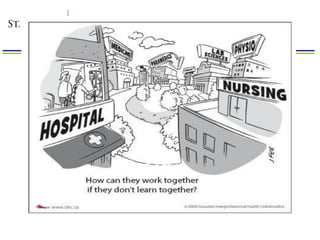
Can we achieve Interprofessional
             Collaboration?
Learning from St. Joseph’s Health Centre

     Michael Heffer, RPh, BScPhm, MHSc.
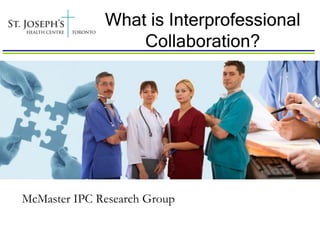
What is Interprofessional
                  Collaboration?


McMaster IPC Research Group
What is Interprofessional
                                   Collaboration?
St. Joseph’s Health Centre adds:
• IPC is intentional
• Supported by learning with, from and
   about one another to leverage
   individual and team capacity


* St. Joseph’s Health Centre
•
IPC Expected Outcomes

• Increased access to healthcare for
  patients
• Improved outcomes for patients with
  chronic diseases
• Less tension and conflict among
  caregivers
• Better use of clinical resources
  (healthcare professionals)
Structure/Enablers
                  Required for IPC

• Government support / Legislation
• Senior Leadership support within your
  own hospital
• Complimentary IPE structure in place
• Change leaders within hospitals
  and universities
Government Support for
                           IPC
Provincial initiatives
1st
• Ministry of Health and Long Term
    Care (MOHLTC) created IPC
    Steering Committee 2006
Government Support for
                           IPC
Provincial initiatives
2nd:
• Joint initiative between MOHLTC and
  MTCU (Ministry of Training, Colleges
  and Universities)
• Health Force Ontario 2006.
• Mandate: Funding for IPC programs
              since Oct 2008
Government Support for
                           IPC
Provincial initiatives
3rd
• MOHLTC approached Health Professions
    Regulatory Advisory Council (HPRAC)
• Bill 179
      Expanded scope of practice for 12
      professions
      Inter-College Collaboration
Government Support for
                                IPC
Federal Level IPC Initiatives

•   Health Canada funds the CIHC
    Canadian Interprofessional Health
    Collaborative
•   Fall 2008 created IPC Working Group

•   Published:
    National IPC Competency Framework
    Feb 2010
IPE Support for IPC
To Facilitate Adoption of IPC

“There must be a seamless
  integration between the
  education system preparing the
  workforce and the health care
  system that employs it.”

  * Final report: IPC Strategic Implementation Committee May 2010
IPC Think Pair Share
• Question: What activities are
  happening or need to happen in our
  education system to graduate
  students ready for IPC?

• Task: Pair up with a colleague at
        your table
        Discuss /generate ideas
IPE Support for IPC
MOHLTC and MTCU*

•   Financial support to the six Ont. Academic Health
    Science Centres

•   Dedicated resources to promote the development of an
    interprofessional curriculum.

•   PIPER at McMaster
    Program for Interprofessional Practice, Education and
    Research

    * MTCU: Ministry of Training, Colleges and Universities
Senior Leadership
              Support Within Hospitals
Important for:
• Establishing IPC reporting structures that have
  accountability

•   Supporting IPC awareness initiatives that
    influence culture change /acceptance

•   Agreeing to devote resources to improvement
    initiatives that support IPC

•   All the above: helps establish credibility with
    staff
Senior Leadership
               Support Within Hospitals
Why should Senior Leaders support IPC?

•   Improved outcomes for patients = optimal patient care
    = decreased LOS (length of stay)

•   Less tension and conflict = staff satisfaction
                             = lower staff turnover
                             = improved recruitment
                               (great reputation)

•   Better use of clinical resources
               = improved efficiency of team
               = lower cost per case compared to peer
                        hospitals
Senior Leadership
                  Support Within Hospitals
Existing Structure at SJHC

•   IPAC     Interprofessional Advisory Committee

•   Interprofessional Point of Care Teams

•   IPC listed as a Strategic Priority for 2011-2014 Objectives

•   Portfolios:   Director of Interprofessional Practice
                  Director of Interprofessional Education

•   Change Leaders:       Professional Practice Leaders
                          Education Coordinators
                          Professional Clinical Coordinators
IPC Change Leaders
Development of our Change Leaders

•   Regarded as IPC project champions
•   Added skill set: Change management methodology
                     Quality improvement methodology


•   Collaboration with centre of IPE UofT
•   ehpic program
•   Collaborative Change Leadership Program
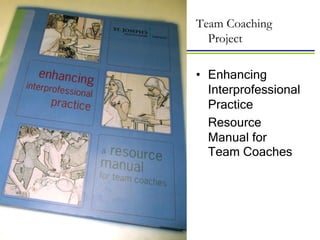
Team Coaching
  Project

• Enhancing
  Interprofessional
  Practice
  Resource
  Manual for
  Team Coaches
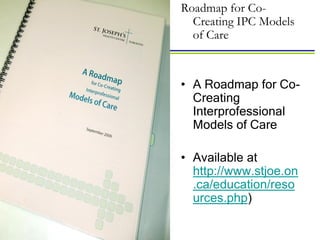
Roadmap for Co-
  Creating IPC Models
  of Care


• A Roadmap for Co-
  Creating
  Interprofessional
  Models of Care

• Available at
  http://www.stjoe.on
  .ca/education/reso
  urces.php)
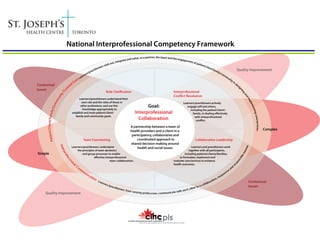
IPC Core Competencies
• Trust & Respect
• Knowledge of other Professional Roles
• Appreciating Difference & Conflict
  Resolution
• Willingness to Share Power
• Shared Decision Making

CIHC addition:
• Focus on patient-centered care
Finding Opportunities for
                                IPC
Creating IPC Initiatives

• Brainstorming sessions
• Looking at existing patient care teams
  Areas for improvement?

• Look at patient care populations that may
  benefit from a collaborative team
  approach – groups at high risk?
IPC Think Pair Share
Question: What areas of hospital
  practice can you think of that
  might benefit from a more
  collaborative approach to patient
  care?
• Task: Pair up with a colleague at
         your table
         Discuss/generate ideas
The AIR Team
                                     Experience
The Assertive Interprofessional Respiratory Team
• The Care Providers
  – Registered Nurse
  – Registered Pharmacist
  – Registered Respiratory Therapist
• The Care Context
  – St. Joseph’s Health Centre – Emergency Dept (ED)
• The Patient Population
  – Patients with a respiratory-related health issue
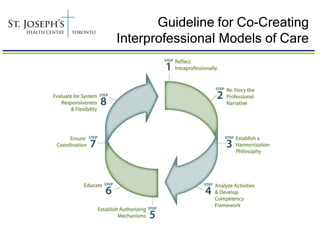
Guideline for Co-Creating
Interprofessional Models of Care
IPC Models of Care
           Step 1: Intraprofessional Reflection
Example Questions:

•    What is my profession’s traditional role
    within this type of setting?
•   What does my profession have in terms
    of knowledge, skill and judgement that
    can be used to enhance care for this
    type of patient?
•   How much am I personally prepared to
    negotiate my professional boundaries?
IPC Models of Care
           Step 2: Re-story the Professional
                   Narrative


1. What are some stereotypes about our
   profession?
2. Which activities, practices or roles do we
   need to keep?
3. What possible future practice could be
   supported by the knowledge, skills and
   judgement of our profession
IPC Models of Care
             Step 3: Establish a Harmonization
                     Philosophy
Examples of Assumptions:
• Each skill or competency will be considered in
   light of what the profession is currently doing,
   should be doing or could be doing.

•   Decisions will be made with the provincial
    College regulators in mind

•   Scopes of practice will be optimized for the
    purpose of enhancing patient-centered care
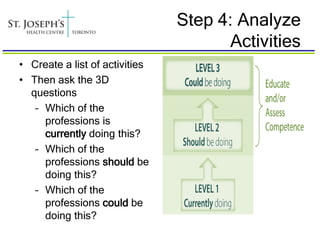
Step 4: Analyze
                                       Activities
• Create a list of activities
• Then ask the 3D
  questions
   – Which of the
     professions is
     currently doing this?
   – Which of the
     professions should be
     doing this?
   – Which of the
     professions could be
     doing this?
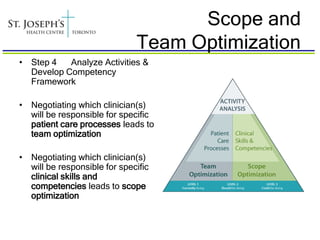
Scope and
                              Team Optimization
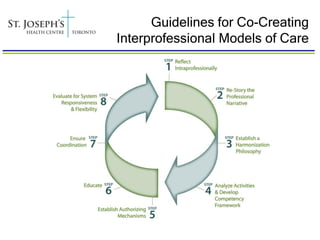
• Step 4   Analyze Activities &
  Develop Competency
  Framework

• Negotiating which clinician(s)
  will be responsible for specific
  patient care processes leads to
  team optimization

• Negotiating which clinician(s)
  will be responsible for specific
  clinical skills and
  competencies leads to scope
  optimization
IPC Think Pair Share
Consider a Diabetes Clinic Team
The team consists of a nurse, physician, dietitian
  and pharmacist.
Questions:
• Can you think of activities that could be shared
  to promote team optimization?
• What activities might be negotiated for scope
  optimization?

•   Task: Discuss /generate ideas with a colleague
    at your table
Guidelines for Co-Creating
Interprofessional Models of Care
Step 8: Evaluate the
                                 System
Evaluation focused on whether the AIR team
  Interprofessional model of care would impact
  quality of care as evidenced by:

• Key access and flow indicators
• Patient experience of care
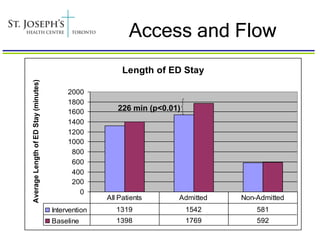
Access and Flow
                                                          Length of ED Stay
Average Length of ED Stay (minutes)


                                           2000
                                           1800
                                           1600         226 min (p<0.01)
                                           1400
                                           1200
                                           1000
                                            800
                                            600
                                            400
                                            200
                                              0
                                                     All Patients      Admitted   Non-Admitted
                                      Intervention      1319               1542       581
                                      Baseline          1398               1769       592
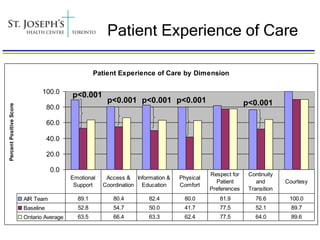
Patient Experience of Care

                                                    Patient Experience of Care by Dimension

                                100.0
                                           p<0.001
                                                        p<0.001 p<0.001 p<0.001                           p<0.001
Percent Positive Score


                                    80.0

                                    60.0

                                    40.0

                                    20.0

                                     0.0
                                                                                            Respect for    Continuity
                                           Emotional    Access & Information &   Physical
                                                                                              Patient         and       Courtesy
                                            Support    Coordination Education    Comfort
                                                                                            Preferences    Transition
                         AIR Team            89.1         80.4        82.4         80.0        81.9          76.6        100.0
                         Baseline            52.8         54.7        50.0         41.7        77.5          52.1         89.7
                         Ontario Average     63.5         66.4        63.3         62.4        77.5          64.0         89.6
Other IPC initiatives at
                        St. Joseph’s
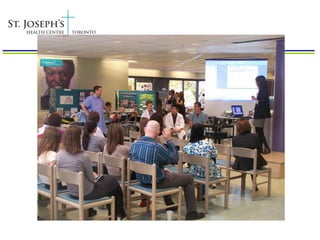
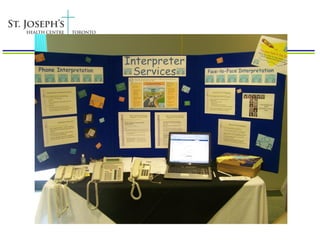
•   Interprofessional Skills Fair
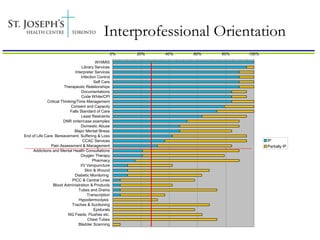
•   Interprofessional Orientation
•   Scope of Practice Quiz
•   Interprofessional Journal Club
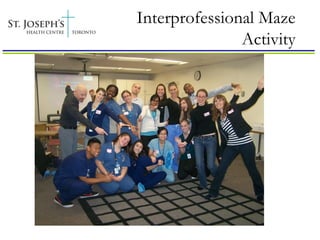
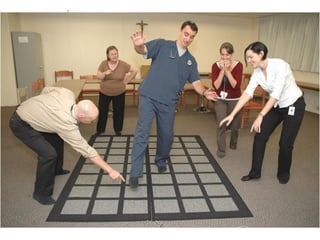
•   Interprofessional Maze Activity
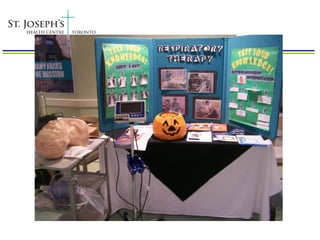
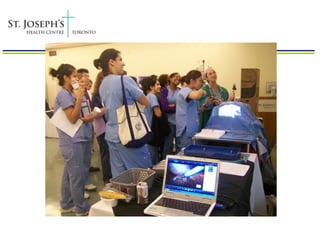
Interprofessional Skills Fair
Interprofessional Orientation
                                                      0%   20%   40%   60%   80%   100%

                                           WHIMIS
                                   Library Services
                              Interpreter Services
                                  Infection Control
                                          Self Care
                       Therapeutic Relationships
                                  Documentations
                                  Code White/CPI
             Critical Thinking/Time Management
                            Consent and Capacity
                           Falls Standard of Care
                                  Least Restraints
                       DNR order/case examples
                                  Domestic Abuse
                              Major Mental Illness
End of Life Care, Bereavement, Suffering & Loss
                                   CCAC Services                                          IP
               Pain Assessment & Management                                               Partially IP
     Addictions and Mental Health Consultations
                                 Oxygen Therapy
                                         Pharmacy
                                 I/V Venipuncture
                                     Skin & Wound
                              Diabetic Monitoring
                             PICC & Central Lines
                 Blood Administration & Products
                                Tubes and Drains
                                      Transcription
                                Hypodermoclysis
                            Traches & Suctioning
                                          Epidurals
                          NG Feeds, Flushes etc.
                                      Chest Tubes
                                Bladder Scanning
Scope of Practice
Interactive Quiz
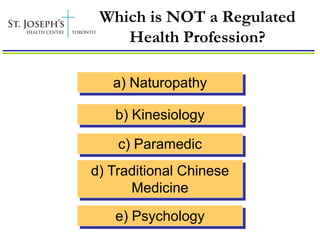
Which is NOT a Regulated
    Health Profession?

   a) Naturopathy

   b) Kinesiology

    c) Paramedic
d) Traditional Chinese
      Medicine
   e) Psychology
C
Paramedic
How many of the 13 controlled acts were
     authorized to physicians?
                a) 10
                b) 13
                 c) 11

                d) 12
                 e) 9
D
12
The Registered Dietician (RD) is responsible for which
          of the following re: tube feeding?

 a) Determining access & inserting the tube

     b) Conducting the assessment to
  determine needs, the Formula, and rate
  c) Teaching the patient/family to use the
               feeding pump
    d) Flushing the tube with sterile water
B
Conducting the assessment to determine needs,
            the Formula, and rate
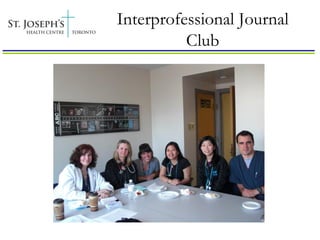
Interprofessional Journal
          Club
Interprofessional Maze
               Activity
Other Initiatives at SJHC
                    that support IPC

•   Interprofessional Orientation
•   IPE week
•   Interprofessional Skills Fair
•   Interprofessional Journal Club
•   Scope of Practice Quiz
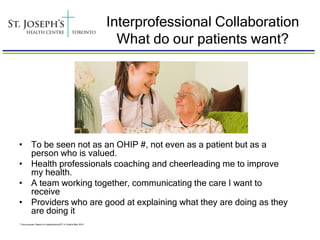
Interprofessional Collaboration
                                                                   What do our patients want?


• To be seen not as an OHIP #, not even as a patient but as a
  person who is valued.
• Health professionals coaching and cheerleading me to improve
  my health.
• A team working together, communicating the care I want to
  receive
• Providers who are good at explaining what they are doing as they
  are doing it
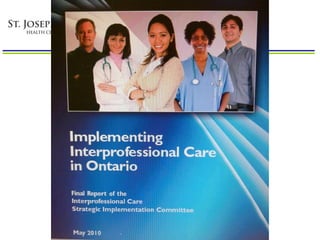
* Focus groups: Report on Implementing IPC in Ontario May 2010
Thank you to partners
                    & Change Leaders


    Mary Kapetanos, Jeff Dionne, Marie Eason-Klatt, Helen
Papakyriacou, Marcia Sivilotti, Chris Ashdown, Lynne Strathern,
           Scott Graney, Janice Klutt, Jenny Seah

Michael heffer interprofessional collaboration

  • 1.
    Can we achieveInterprofessional Collaboration? Learning from St. Joseph’s Health Centre Michael Heffer, RPh, BScPhm, MHSc.
  • 2.
    What is Interprofessional Collaboration? McMaster IPC Research Group
  • 3.
    What is Interprofessional Collaboration? St. Joseph’s Health Centre adds: • IPC is intentional • Supported by learning with, from and about one another to leverage individual and team capacity * St. Joseph’s Health Centre
  • 4.
  • 5.
    IPC Expected Outcomes •Increased access to healthcare for patients • Improved outcomes for patients with chronic diseases • Less tension and conflict among caregivers • Better use of clinical resources (healthcare professionals)
  • 6.
    Structure/Enablers Required for IPC • Government support / Legislation • Senior Leadership support within your own hospital • Complimentary IPE structure in place • Change leaders within hospitals and universities
  • 8.
    Government Support for IPC Provincial initiatives 1st • Ministry of Health and Long Term Care (MOHLTC) created IPC Steering Committee 2006
  • 10.
    Government Support for IPC Provincial initiatives 2nd: • Joint initiative between MOHLTC and MTCU (Ministry of Training, Colleges and Universities) • Health Force Ontario 2006. • Mandate: Funding for IPC programs since Oct 2008
  • 11.
    Government Support for IPC Provincial initiatives 3rd • MOHLTC approached Health Professions Regulatory Advisory Council (HPRAC) • Bill 179 Expanded scope of practice for 12 professions Inter-College Collaboration
  • 12.
    Government Support for IPC Federal Level IPC Initiatives • Health Canada funds the CIHC Canadian Interprofessional Health Collaborative • Fall 2008 created IPC Working Group • Published: National IPC Competency Framework Feb 2010
  • 14.
    IPE Support forIPC To Facilitate Adoption of IPC “There must be a seamless integration between the education system preparing the workforce and the health care system that employs it.” * Final report: IPC Strategic Implementation Committee May 2010
  • 15.
    IPC Think PairShare • Question: What activities are happening or need to happen in our education system to graduate students ready for IPC? • Task: Pair up with a colleague at your table Discuss /generate ideas
  • 16.
    IPE Support forIPC MOHLTC and MTCU* • Financial support to the six Ont. Academic Health Science Centres • Dedicated resources to promote the development of an interprofessional curriculum. • PIPER at McMaster Program for Interprofessional Practice, Education and Research * MTCU: Ministry of Training, Colleges and Universities
  • 18.
    Senior Leadership Support Within Hospitals Important for: • Establishing IPC reporting structures that have accountability • Supporting IPC awareness initiatives that influence culture change /acceptance • Agreeing to devote resources to improvement initiatives that support IPC • All the above: helps establish credibility with staff
  • 19.
    Senior Leadership Support Within Hospitals Why should Senior Leaders support IPC? • Improved outcomes for patients = optimal patient care = decreased LOS (length of stay) • Less tension and conflict = staff satisfaction = lower staff turnover = improved recruitment (great reputation) • Better use of clinical resources = improved efficiency of team = lower cost per case compared to peer hospitals
  • 20.
    Senior Leadership Support Within Hospitals Existing Structure at SJHC • IPAC Interprofessional Advisory Committee • Interprofessional Point of Care Teams • IPC listed as a Strategic Priority for 2011-2014 Objectives • Portfolios: Director of Interprofessional Practice Director of Interprofessional Education • Change Leaders: Professional Practice Leaders Education Coordinators Professional Clinical Coordinators
  • 22.
    IPC Change Leaders Developmentof our Change Leaders • Regarded as IPC project champions • Added skill set: Change management methodology Quality improvement methodology • Collaboration with centre of IPE UofT • ehpic program • Collaborative Change Leadership Program
  • 24.
    Team Coaching Project • Enhancing Interprofessional Practice Resource Manual for Team Coaches
  • 25.
    Roadmap for Co- Creating IPC Models of Care • A Roadmap for Co- Creating Interprofessional Models of Care • Available at http://www.stjoe.on .ca/education/reso urces.php)
  • 26.
    IPC Core Competencies •Trust & Respect • Knowledge of other Professional Roles • Appreciating Difference & Conflict Resolution • Willingness to Share Power • Shared Decision Making CIHC addition: • Focus on patient-centered care
  • 29.
    Finding Opportunities for IPC Creating IPC Initiatives • Brainstorming sessions • Looking at existing patient care teams Areas for improvement? • Look at patient care populations that may benefit from a collaborative team approach – groups at high risk?
  • 30.
    IPC Think PairShare Question: What areas of hospital practice can you think of that might benefit from a more collaborative approach to patient care? • Task: Pair up with a colleague at your table Discuss/generate ideas
  • 31.
    The AIR Team Experience The Assertive Interprofessional Respiratory Team • The Care Providers – Registered Nurse – Registered Pharmacist – Registered Respiratory Therapist • The Care Context – St. Joseph’s Health Centre – Emergency Dept (ED) • The Patient Population – Patients with a respiratory-related health issue
  • 32.
  • 33.
    IPC Models ofCare Step 1: Intraprofessional Reflection Example Questions: • What is my profession’s traditional role within this type of setting? • What does my profession have in terms of knowledge, skill and judgement that can be used to enhance care for this type of patient? • How much am I personally prepared to negotiate my professional boundaries?
  • 34.
    IPC Models ofCare Step 2: Re-story the Professional Narrative 1. What are some stereotypes about our profession? 2. Which activities, practices or roles do we need to keep? 3. What possible future practice could be supported by the knowledge, skills and judgement of our profession
  • 36.
    IPC Models ofCare Step 3: Establish a Harmonization Philosophy Examples of Assumptions: • Each skill or competency will be considered in light of what the profession is currently doing, should be doing or could be doing. • Decisions will be made with the provincial College regulators in mind • Scopes of practice will be optimized for the purpose of enhancing patient-centered care
  • 37.
    Step 4: Analyze Activities • Create a list of activities • Then ask the 3D questions – Which of the professions is currently doing this? – Which of the professions should be doing this? – Which of the professions could be doing this?
  • 38.
    Scope and Team Optimization • Step 4 Analyze Activities & Develop Competency Framework • Negotiating which clinician(s) will be responsible for specific patient care processes leads to team optimization • Negotiating which clinician(s) will be responsible for specific clinical skills and competencies leads to scope optimization
  • 39.
    IPC Think PairShare Consider a Diabetes Clinic Team The team consists of a nurse, physician, dietitian and pharmacist. Questions: • Can you think of activities that could be shared to promote team optimization? • What activities might be negotiated for scope optimization? • Task: Discuss /generate ideas with a colleague at your table
  • 40.
  • 41.
    Step 8: Evaluatethe System Evaluation focused on whether the AIR team Interprofessional model of care would impact quality of care as evidenced by: • Key access and flow indicators • Patient experience of care
  • 42.
    Access and Flow Length of ED Stay Average Length of ED Stay (minutes) 2000 1800 1600 226 min (p<0.01) 1400 1200 1000 800 600 400 200 0 All Patients Admitted Non-Admitted Intervention 1319 1542 581 Baseline 1398 1769 592
  • 43.
    Patient Experience ofCare Patient Experience of Care by Dimension 100.0 p<0.001 p<0.001 p<0.001 p<0.001 p<0.001 Percent Positive Score 80.0 60.0 40.0 20.0 0.0 Respect for Continuity Emotional Access & Information & Physical Patient and Courtesy Support Coordination Education Comfort Preferences Transition AIR Team 89.1 80.4 82.4 80.0 81.9 76.6 100.0 Baseline 52.8 54.7 50.0 41.7 77.5 52.1 89.7 Ontario Average 63.5 66.4 63.3 62.4 77.5 64.0 89.6
  • 46.
    Other IPC initiativesat St. Joseph’s • Interprofessional Skills Fair • Interprofessional Orientation • Scope of Practice Quiz • Interprofessional Journal Club • Interprofessional Maze Activity
  • 47.
  • 52.
    Interprofessional Orientation 0% 20% 40% 60% 80% 100% WHIMIS Library Services Interpreter Services Infection Control Self Care Therapeutic Relationships Documentations Code White/CPI Critical Thinking/Time Management Consent and Capacity Falls Standard of Care Least Restraints DNR order/case examples Domestic Abuse Major Mental Illness End of Life Care, Bereavement, Suffering & Loss CCAC Services IP Pain Assessment & Management Partially IP Addictions and Mental Health Consultations Oxygen Therapy Pharmacy I/V Venipuncture Skin & Wound Diabetic Monitoring PICC & Central Lines Blood Administration & Products Tubes and Drains Transcription Hypodermoclysis Traches & Suctioning Epidurals NG Feeds, Flushes etc. Chest Tubes Bladder Scanning
  • 53.
  • 54.
    Which is NOTa Regulated Health Profession? a) Naturopathy b) Kinesiology c) Paramedic d) Traditional Chinese Medicine e) Psychology
  • 55.
  • 56.
    How many ofthe 13 controlled acts were authorized to physicians? a) 10 b) 13 c) 11 d) 12 e) 9
  • 57.
  • 58.
    The Registered Dietician(RD) is responsible for which of the following re: tube feeding? a) Determining access & inserting the tube b) Conducting the assessment to determine needs, the Formula, and rate c) Teaching the patient/family to use the feeding pump d) Flushing the tube with sterile water
  • 59.
    B Conducting the assessmentto determine needs, the Formula, and rate
  • 60.
  • 61.
  • 62.
    Other Initiatives atSJHC that support IPC • Interprofessional Orientation • IPE week • Interprofessional Skills Fair • Interprofessional Journal Club • Scope of Practice Quiz
  • 63.
    Interprofessional Collaboration What do our patients want? • To be seen not as an OHIP #, not even as a patient but as a person who is valued. • Health professionals coaching and cheerleading me to improve my health. • A team working together, communicating the care I want to receive • Providers who are good at explaining what they are doing as they are doing it * Focus groups: Report on Implementing IPC in Ontario May 2010
  • 64.
    Thank you topartners & Change Leaders Mary Kapetanos, Jeff Dionne, Marie Eason-Klatt, Helen Papakyriacou, Marcia Sivilotti, Chris Ashdown, Lynne Strathern, Scott Graney, Janice Klutt, Jenny Seah